The Global Innovation Index 2015
Effective Innovation Policies for Development
The Global Innovation Index 2015
Effective Innovation Policies for Development
Soumitra Dutta, Bruno Lanvin, and Sacha Wunsch-Vincent
Editors
The Global Innovation Index 2015: Effective Innovation Policies
for Development is the result of a collaboration between
Cornell University, INSEAD, and the World Intellectual Property
Organization (WIPO) as co-publishers, and their Knowledge
Partners.
The terms‘country’,‘economy’, and‘nation’as used in this report
do not in all cases refer to a territorial entity that is a state as
understood by international law and practice. The terms cover
well-defined, geographically self-contained economic areas
that may not be states but for which statistical data are main-
tained on a separate and independent basis.
Disclaimer: This publication is not intended to reflect the views
of the Member States or the WIPO Secretariat.
This work is licensed under the Creative Commons Attribution
Non-commercial No-Derivatives 3.0 IGO License. The user is
allowed to reproduce, distribute and publicly perform this
publication without explicit permission, provided that the
content is accompanied by an acknowledgement that WIPO,
Cornell University, and INSEAD are the source. No part of this
publication can be used for commercial purposes or adapted/
translated/modified without the prior permission of WIPO.
Please write to treaties[dot]mail[at]wipo[dot]int to obtain
permission.
To view a copy of the license, please visit
http://creativecommons.org/licenses/by-nc-nd/3.0/igo/.
When content, such as an image, graphic, data, trademark, or
logo, is attributed to a third party, the user is solely responsible
for clearing the rights with the right holders.
Suggested citation: Cornell University, INSEAD, and WIPO
(2015): The Global Innovation Index 2015: Effective Innovation
Policies for Development, Fontainebleau, Ithaca, and Geneva.
ISSN 2263-3693
ISBN 978-2-9522210-8-5
Printed and bound in Geneva, Switzerland, by the World
Intellectual Property Organization.
iii
THEGLOBALINNOVATIONINDEX2015Contents
Preface:ReleasingtheGlobalInnovationIndex2015: v
EffectiveInnovationPoliciesforDevelopment
By Soumitra Dutta, Cornell University; Bruno Lanvin, INSEAD;
and Francis Gurry, World Intellectual Property Organization
Foreword:TheInnovationImperative vii
By Johan Aurik, Managing Partner and Chairman of the Board,
A.T. Kearney
Foreword:LeveragingPoliciestoTriggerInnovation ix
By Chandrajit Banerjee, Director General, Confederation
of Indian Industry
Foreword:GovernmentPolicies:ACatalyst xi
foraNation’sInnovationGrowth
By Osman Sultan, Chief Executive Officer, du
ContributorstotheReport xiii
AdvisoryBoardtotheGlobalInnovationIndex xv
ExecutiveSummary xvii
RANKINGS
GlobalInnovationIndex2015Rankings xxx
CHAPTERS
Chapter1:TheGlobalInnovationIndex2015: 3
EffectiveInnovationPoliciesforDevelopment
By Soumitra Dutta, Alexandra L. Bernard, and Rafael Escalona
Reynoso, Cornell University; Bruno Lanvin, INSEAD; and Sacha
Wunsch-Vincent, WIPO
Annex 1: The Global Innovation Index (GII) Conceptual Framework 41
Annex 2: Adjustments to the Global Innovation Index Framework 49
and Year-on-Year Comparability of Results
Annex 3: Joint Research Centre Statistical Audit of the 53
2015 Global Innovation Index
By Michaela Saisana and Marcos Domínguez-Torreiro,
European Commission, Joint Research Centre (JRC), Ispra,
Italy
Chapter2:BenchmarkingInnovationPerformance 65
attheGlobalandCountryLevels
By Alexandra L. Bernard and Rafael Escalona Reynoso, Cornell
University; Michaela Saisana, European Commission, Joint
Research Centre; Martin Schaaper, UNESCO Institute for Statistics;
and Francesca Guadagno and Sacha Wunsch-Vincent, WIPO
Contents
Chapter3:InnovationPoliciesforDevelopment 81
By Micheline Goedhuys, Hugo Hollanders, and Pierre Mohnen,
UNU-MERIT (United Nations University and Maastricht University)
Chapter4:PrinciplesforNationalInnovationSuccess 89
By Robert D. Atkinson and Stephen Ezell, Information
Technology and Innovation Foundation
Chapter5:InnovationPolicy:ABusinessPerspective 99
By Kai Engel and Justin Shepherd, A.T. Kearney; and Martin
Ruppert, IMP³rove – European Innovation Management Academy
Chapter6:TheImpactofScienceandTechnologyPolicies 105
onRapidEconomicDevelopmentinChina
By Dongmin Chen, Shilin Zheng, and Lei Guo, Peking University
Chapter7:RadicalInstitutionalChange: 113
EnablingtheTransformationofGeorgia’sInnovationSystem
By Cristina Chaminade and Maria Moskovko, CIRCLE, Lund
University
Chapter8:PoliciestoDriveInnovationinIndia 121
By Senapathy ‘Kris’ Gopalakrishnan and Jibak Dasgupta,
Confederation of Indian Industry
Chapter9:EffectiveInnovationPoliciesforDevelopment: 131
TheCaseofKenya
By Bitange Ndemo, University of Nairobi
Chapter10:InnovationPerformanceoftheMalaysianEconomy 139
By Rajah Rasiah and Xiao-Shan Yap, University of Malaya
Chapter11:EffectiveInnovationPoliciesforDevelopment: 147
Uganda
By Julius Ecuru, Uganda National Council for Science and
Technology; and Dick Kawooya, University of South Carolina,
School of Library and Information Science
APPENDICES
AppendixI:Country/EconomyProfiles 157
AppendixII:DataTables 303
AppendixIII:SourcesandDefinitions 389
AppendixIV:TechnicalNotes 405
AppendixV:AbouttheAuthors 411
v
THEGLOBALINNOVATIONINDEX2015Preface
PREFACE
ReleasingtheGlobalInnovation
Index2015:EffectiveInnovation
PoliciesforDevelopment
PREFACE
We are pleased to present the 2015 Global Innovation
Index (GII) with this year’s theme of ‘Effective
Innovation Policies for Development’.
Innovation-driven growth is no longer the preroga-
tive of high-income countries alone. Developing coun-
tries increasingly design policies intended to increase
their innovation capacity. Innovation policies have taken
different forms, depending on countries’ perceived
needs; their impact has also varied across countries
at similar levels of development. Certain developing
countries have managed to continually improve their
innovation inputs and outputs. Others still struggle.
The difference in the impact of innovation policies
raises a number of questions, including: Which develop-
ing countries outperform in innovation relative to their
level of development and their peers? How do the inno-
vation actors of these countries meaningfully design and
implement effective innovation policies and practices?
One objective of this year’s GII is to seek answers to
these questions by taking advantage of the rich time-
series dataset it has produced since 2011. Independent
from the yearly changes in rankings, our analysis iden-
tifies economies that consistently overperform when
compared with those of a similar level of development.
Although not even a decade ago many of these low- and
middle-income economies were not on the innovation
map, they are now increasingly part of a more globalized
innovation landscape. Their experience holds lessons
for other countries and for the global distribution of
innovation more broadly.
Over the last eight years, the GII has established itself
as a leading reference on innovation, providing a tool for
action for decision makers. In 2013 the GII was launched
by the United Nations (UN) Secretary-General Ban
Ki-moon in Geneva at the High-Level Segment of the
UN Economic and Social Council. In 2014, as part of
Australia’s preparations to host the annual Group of
Twenty (G20) Leaders’ Summit, we joined Australia’s
Minister for Industry Ian Macfarlane at a gathering of
international business leaders in Sydney to launch the
GII. The discussion centred on how innovation can
help achieve the G20’s growth targets. In addition, GII-
related meetings took place in Africa, Asia, the Middle
East, and North and Latin America, with the aim of
improving data availability, innovation performance,
and policy. In 2015 our goal is to intensify the use of
the GII to assist developing countries to further improve
their innovation systems.
This year we welcome A.T. Kearney and its IMP3rove
– European Innovation Management Academy as a
new Knowledge Partner. We thank our other current
Knowledge Partners—the Confederation of Indian
Industry and du—for their continued support. We also
thank Huawei, in particular Ken Hu, its Rotating CEO,
for making key contributions as a Knowledge Partner
over the last two years.
Likewise, we thank our prominent Advisory Board,
which has been enriched by five new members this
year: Yuko Harayama, Executive Member, Council for
Science, Technology and Innovation, Cabinet Office,
Government of Japan, Japan; Hugo Hollanders, Senior
Researcher, United Nations University – Maastricht
Economic and Social Research Institute on Innovation
and Technology (UNU-MERIT), the Netherlands;
Beethika Khan, Program Director, National Science
Foundation (NSF), United States of America; Mary
O’Kane, Professor, NSW Chief Scientist and Engineer,
Australia; and Houlin Zhao, Secretary-General,
International Telecommunication Union (ITU).
We hope that the collective efforts of innovation
actors using the GII will continue to pave the way for
better innovation policies around the world.
SOUMITRA DUTTA
Dean, Samuel Curtis Johnson Graduate School of Management, Cornell University
FRANCIS GURRY
Director General, World Intellectual Property Organization
BRUNO LANVIN
Executive Director for Global Indices, INSEAD
©WIPO, 2015. Photo by Emmanuel Berrod.
vii
THEGLOBALINNOVATIONINDEX2015	Foreword
FOREWORD
TheInnovationImperative
In advising the world’s leading private- and public-sector
organizations, providing innovative solutions that deliver
sustained value to our clients is central to our success.
While our firm has a long history—nearly 90 years—
of being innovative, we also recognize that innovation
can all too easily slip into the background. Supporting
innovation is one thing; actively driving and creating an
innovative culture is quite another.
As a result, a few years ago, as part of A.T. Kearney’s
broader strategic vision, we launched a new innova-
tion initiative. Through a series of related initiatives
that encourage colleagues to collaborate and advance
innovative ideas, we have seen a remarkable surge of
enthusiasm, passion, and results. Indeed, the first ideas
sparked by the initiative are already bearing fruit.
Our experience in fostering innovation is on a small
scale, but it also speaks to the key theme of the Global
Innovation Index 2015: Innovation requires the right
policies to actively support and sustain it. As countries
and regions develop economic growth strategies, the
imperative to put innovation at the top of the agenda
has never been stronger.
Our 2015 Foreign Direct Investment Confidence
Index, which assesses likely foreign investment decisions
by global business leaders, finds that investors are readily
looking past emerging countries that boast low labour
costs in favour of developed countries that are committed
to—and can demonstrably show—continuous innovation.
In fact, three-quarters of the top investment destinations
are still developed economies.
The question is: How can a developing country
make—and sustain—the shift to an innovation-driven
economy? The lessons in these pages provide invaluable
insights from some of the world’s leading authorities.
Certainly there are many nuances to consider, but some
of the basics are remarkably consistent: Address and
engage all stakeholders and support them in developing
a strong ecosystem of innovation. Nurture an environ-
ment that strives for and values collaboration. Engage
new partners from diverse and varied backgrounds.
Keep pace with the moving targets of new technologies
and market opportunities. Develop policies to attract
international talent, young entrepreneurs, and investors.
Set clear goals and develop appropriate measures to track
progress. Learn from, and be inspired by, the best.
As my colleagues Kai Engel, Violetka Dirlea, and
Jochen Graff discuss in their new book, Masters of
Innovation, even with the best ideas, speed and agility
are paramount. Ever-shrinking innovation cycles pose
a constant threat of falling behind, while complex deci-
sion structures can stall innovation. Effective strategies
for combatting both must be woven into every new
policy.
I would like to thank the GII team for their dedi-
cation and passion in their ongoing efforts to advance
innovation—and we are delighted to be an active part-
ner and regular contributor to this endeavour. We also
remain committed to advancing innovation through our
nonprofit subsidiary, IMP3rove – European Innovation
Management Academy, which builds on our interna-
tional experience, on a global network of IMP3rove-
trained business advisors, and on the largest database on
innovation management with close to 5,000 companies
worldwide. We encourage you to participate and join us.
Finally, I encourage everyone to keep the conversa-
tion going—to reach across traditional boundaries and
divides to support the policies that drive innovation,
benefitting both our own communities and, more
broadly, society at large.
Johan Aurik
Managing Partner and Chairman of the Board
A.T. Kearney
ix
THEGLOBALINNOVATIONINDEX2015Foreword
FOREWORD
Innovation is gaining prominence in all kinds of eco-
nomic activity around the world. Not only advanced
economies but also developing nations are finding that
innovation is one of the main drivers of economic
growth. This renewed understanding of the significance
of innovation is having a growing impact on the course
of policy formulation in many countries.
A closer look suggests that developing nations are no
longer lagging behind high-income ones in their efforts
to introduce policies that will increase their innovation
capacity. On the contrary, in many cases developing
nations are taking the lead in embracing innovation to
boost their industrial and economic growth.
Over the years the Global Innovation Index (GII)
has measured the innovation capacity of nations across
the world and presented a comparative analysis to help
in understanding the variation in national competen-
cies. The findings of the last five years of GII rankings
in its innovation input and output pillars demonstrate
that certain countries are consistently doing better than
their peers in the same income and region categories.
Although multiple factors are involved in this superior
innovation performance, policy presents a major dif-
ferentiating factor in the majority of cases.
This year the GII has taken steps to understand pre-
cisely how policy has been leveraged by some of the
innovation achievers among the developing nations,
allowing them to outperform their peers. This is an
important aspect to study because it not only helps to
inform the peer group of the best policy practices, but it
also identifies gaps in policy that stagnate further growth
prospects for the achiever.
This year India has been chosen as an example of
an innovation achiever in Central and Southern Asia in
the group of lower-middle-income countries. Chapter
8 in this report presents India as a representative inno-
vation achiever by providing a narrative of how the
country has shaped its innovation policy over the years
and a perspective on what has worked for India and
what not. The chapter also outlines lessons that can be
useful for its peers in this area and considers ways that
India can overcome its policy bottlenecks to become an
innovation-driven nation.
The GII 2015 also includes insightful chapters from
other innovation achievers among developing coun-
tries. These chapters analyse the evolution of innova-
tion policy in these countries in more detail and try
to establish a link between good business practices and
smart innovation policies. They also provide informa-
tion about how effective these policies have been in
developing an environment that supports innovation in
these countries.
As always, the GII team has been outstanding in its
professionalism and approach to bring out this year’s
report, and I congratulate them for their consistency
and dedication. The current edition will be a very useful
reference for policy makers across the globe who wish
to leverage the strengths of innovation for sustaining
economic growth.
CHANDRAJIT BANERJEE
Director General
Confederation of Indian Industry
LeveragingPoliciestoTrigger
Innovation
xi
THEGLOBALINNOVATIONINDEX2015Foreword
FOREWORD
People have been innovating around the world for cen-
turies—either inventing or challenging the status quo.
Although inventions have been successful in silos or
pockets, far-reaching and scalable innovation has most
frequently occurred within organized and government-
supported frameworks.
The United Arab Emirates (UAE) has always been a
supporter of innovation, evidenced not only by the Burj
Khalifa and other engineering marvels, but also by the
country’s high level of entrepreneurial ventures. A col-
laborative effort among public and private stakeholders
is driving a move towards diversification where entre-
preneurs and small- and medium-sized enterprises play
a huge role, encouraging the entrepreneurial aspirations
of UAE millennials.
Over the past years, the UAE’s leaders have worked
to diversify the country’s economy and move into a new
phase of growth. Their ambition of fostering innova-
tion and knowledge-driven growth is clearly docu-
mented in the country’s Vision 2021 national strategy.
The pioneering Mars Mission is only one of the many
examples showing that the UAE is on track to achieve
its objectives.
With the rollout of the National Innovation Strategy
in late 2014, the UAE government has provided a frame-
work for innovation to flourish even further. This strat-
egy underpins the government’s ambition for Vision
2021 and is a concrete step to further long-term, cre-
ative, and sustainable gains rather than short-term wins.
It is this sort of cohesive and interconnected approach
to innovation policies—with an emphasis on addressing
grassroots issues—that may find resonance and success
and that can truly contribute to the nation’s develop-
ment. This year’s GII theme ‘Effective Innovation
Policies for Development’ in particular underscores a
great resource for helping to understand what policies
have worked and how they can be implemented in dif-
ferent countries. The UAE, for instance, has recently
introduced innovation policy in the education sector
that aims at improving the technology standard in
schools and universities to disrupt and rebuild the sys-
tem with innovation as the driving force, nurturing the
thought leaders of tomorrow.
We at du have long been advocates of change and
innovation, and are extremely proud to be a partner
to the government in achieving this ambition. Core to
this position is the delivery of better, faster, and smarter
communication solutions to ensure knowledge diffusion
and seamless innovation. Our Smart City initiatives are
paving the way with innovative digital solutions that
will in turn enable innovation by the UAE’s residents.
We have a dream of connected innovation and are work-
ing hand in hand with national and international players
to enjoy the benefits of a knowledge-based economy,
powered by connectedness and mobility.
The Global Innovation Index report is a useful barom-
eter on an economy’s innovation performance, and
provides tools that we, and every economy wanting to
enhance its innovation capacity, can use.
OSMAN SULTAN
Chief Executive Officer
du
GovernmentPolicies:ACatalystfora
Nation’sInnovationGrowth
xiii
THEGLOBALINNOVATIONINDEX2015Contributors
CONTRIBUTORS
The Global Innovation Index 2015: Effective Innovation Policies for Development was developed under the general direction of Francis GURRY (Director
General, World Intellectual Property Organization) and the editors of the report, Soumitra DUTTA, Bruno LANVIN, and Sacha WUNSCH-VINCENT.
The report was prepared and coordinated by a core team comprising:
CORE TEAM
Alexandra BERNARD, GII Project Manager, Samuel Curtis Johnson
Graduate School of Management, Cornell University
Soumitra DUTTA, Anne and Elmer Lindseth Dean, Professor
of Management, Samuel Curtis Johnson Graduate School of
Management, Cornell University
Rafael ESCALONA REYNOSO, GII Lead Researcher, Samuel Curtis
Johnson Graduate School of Management, Cornell University
Bruno LANVIN, Executive Director for Global Indices, INSEAD
Sacha WUNSCH-VINCENT, Senior Economist, Economics and
Statistics Division, WIPO
The following persons and institutions have supported the
production of the GII:
COPUBLISHERS
Cornell University
Carolyn P. O’KEEFE, Chief Marketing Officer, Charles and Janet Jarvie
Executive Director of Marketing, Samuel Curtis Johnson Graduate
School of Management, Cornell University
Shannon DORTCH, Communications Specialist, Social Media
Manager, Samuel Curtis Johnson Graduate School of Management,
Cornell University
INSEAD
Christine HIRZEL, Global Head, External Relations
Sophie BADRE, Associate Director, Media Relations
Chris HOWELLS, Editor, INSEAD Knowledge
Joe CHEDID, Associate Director, Communications & PR, Middle East
Aileen HUANG, Assistant Director, Media Relations, Asia
World Intellectual Property Organization (WIPO)
Carsten FINK, Chief Economist, Economics and Statistics Division
Francesca GUADAGNO, Economics Section
WIPO IP Statistics Section
WIPO Communications Division
WIPO Department of External Relations
WIPO Printing & Publication Production Section
KNOWLEDGE PARTNERS
Confederation of Indian Industry
Anjan DAS, Executive Director
Jibak DASGUPTA, Deputy Director
du
Luma BOURISLY, Vice President, Corporate Communications
Maryam AL BALOOSHI, PR Lead, Corporate
Sveccha KUMAR, Manager, Corporate Sustainability
Rashid AL AHMEDI, Senior Director, Special Projects and External
Affairs
Yasmine ABDELAZIZ, Public Relations and Media Senior Specialist,
Chief Executive Officer’s Office
A.T. Kearney
Kai ENGEL, Partner
Violetka DIRLEA, Partner
Naveen MENON, Partner
Michael WEISS, Partner
Bob WILLEN, Partner
Branko ZIBRET, Partner
Mauricio ZUAZUA, Partner
Olivier GERGELE, Principal
Krzysztof JEDZINIAK, Manager
Bharat KAPOOR, Manager
Justin SHEPHERD, Manager
Akash MAYUR, Associate
David UHLENBROCK, SEA Marketing Coordinator
Anja VINTER, EMEA Marketing Coordinator
Jim BROWN, Marketing Director North America
IMP³rove – European Innovation Management Academy
Eva DIEDRICHS, Managing Director
Martin RUPPERT, Managing Director
ContributorstotheReport
(Continued on next page)
xiv
THEGLOBALINNOVATIONINDEX2015Contributors
DIRECT COLLABORATORS
Antanina GARANASVILI, PhD candidate in Economics, University of
Padova (former intern at the WIPO Economics and Statistics Division)
Michaela SAISANA, Composite Indicators (COIN) - Project Leader;
and Andrea SALTELLI, Head of Unit, Econometrics and Applied
Statistics Unit, Joint Research Centre of the European Commission
Hope STEELE, Editor, Steele Editorial Services
Neil WEINBERG, Principal, Neil Weinberg Design
DATA COLLABORATORS
We are also grateful to the following persons/institutions for
their collaboration with specific data requests:
Mohsen BONAKDARPOUR, Managing Director; and Scott FLEMING,
Director, IHS Economics
Alex CHISHOLM, Director, Statistical Analysis; and Hillary CHAN,
Research Analysis Associate Manager, Graduate Management
Admission Council (GMAC)
Thierry GEIGER, Senior Economist and Associate Director, and Attilio
Di Battista, Quantitative Economist, Global Competitiveness and
Risks, World Economic Forum (WEF)
Dong GUO, Statistician; and Jürgen MUTH, Statistical Assistant,
Statistics Unit, Research, Statistics and Industrial Policy Branch, United
Nations Industrial Development Organization (UNIDO)
Hector HERNÁNDEZ, Project leader – Innovation, Joint Research
Centre, Institute for Prospective Technological Studies Unit Knowledge
for Growth; and Miguel QUEROL SUQUIA, Information and
Communication Officer – IPTS, Joint Research Centre, Communication
Unit, European Commission
Derek HILL, National Center for Science and Engineering Statistics,
National Science Foundation, United States of America
Élise LEGAULT, Programme Specialist, and Chiao-Ling CHIEN,
Assistant Programme Specialist, Education Indicators and Data Analysis
Section; Lydia DELOUMEAUX, Assistant Programme Specialist, and
Lisa BARBOSA, Statistical Assistant, Culture Unit; Martin SCHAAPER,
Programme Specialist, Luciana MARINS and Rohan PATHIRAGE,
Assistant Programme Specialists, and Zahia SALMI and Sirina KERIM-
DIKENI, Statistical Assistants, Science, Technology and Innovation
Unit, all from the United Nations Educational, Scientific and Cultural
Organization (UNESCO) Institute for Statistics (UIS)
Derek SLATER, Policy Manager; Alex KOZAK, Senior Policy Analyst,
Google
Barbara D’ANDREA, Senior Statistician, and Andreas MAURER, Chief,
International Trade Statistics Section; Adelina MENDOZA, Senior
Statistical Officer, Market Access Intelligence Section; and Joscelyn
MAGDELEINE, Statistical Officer, Trade in Services Section, all from the
Economic Research and Statistics Division, World Trade Organization
(WTO)
Ben SOWTER, Head of Division, QS Intelligence Unit, QS Quacquarelli
Symonds Ltd
Theodoor SPARREBOOM, Senior Labour Economist; and
Alan WITTRUP, Database System Developer, Department of Statistics,
International Labour Office (ILO)
Petra STEINER, Key Account Manager, Bureau van Dijk Electronic
Publishing GmbH
Susan TELTSCHER, Head; Esperanza MAGPANTAY, Senior
Statistician; Ivan VALLEJO, Market Analyst; and Nathalie
DELMAS, Assistant, at the ICT Data and Statistics Division (IDS),
Telecommunication Development Bureau (BDT), International
Telecommunication Union (ITU)
Matthew ZOOK, Professor at the University of Kentucky and
President, ZookNIC Inc.
Energy Data Centre, headed by Jean-Yves Garnier, International
Energy Agency (IEA)
United Nations Commodity Trade Statistics Database,
Department of Economic and Social Affairs/Statistics Division,
http://comtrade.un.org/db/
PwC Global entertainment and media outlook 2013-2017,
www.pwc.com/outlook
xv
THEGLOBALINNOVATIONINDEX2015AdvisoryBoard
ADVISORY BOARD
In 2011, an Advisory Board was set up to provide advice
on the research underlying the Global Innovation Index
(GII), generate synergies at its stages of development, and
assist with the dissemination of its messages and results.
The Advisory Board is a select group of leading interna-
tional practitioners and experts with unique knowledge
and skills in the realm of innovation. Its members, while
coming from diverse geographical and institutional
backgrounds (international organizations, the public
sector, non-governmental organizations, business, and
academia), participate in their personal capacity. We
are grateful for the time and support provided by the
Advisory Board members.
In 2015, we welcome five new members to the
Advisory Board: Yuko Harayama, Hugo Hollanders,
Beethika Khan, Mary O’Kane, and Houlin Zhao.
We would like to express our gratitude to Daniele
Archibugi, Research Director at the Italian National
ResearchCouncil;RobertBell,formerProgramDirector
at the National Science Foundation of the United States
of America; Lynn St. Amour, former President and
Chief Executive Officer of the Internet Society; and
Hamadoun Touré, former Secretary-General of the
International Telecommunication Union, for their col-
lective thoughtful contributions to the previous editions
of the GII as members of the Advisory Board.
AdvisoryBoardtotheGlobalInnovationIndex
ADVISORY BOARD MEMBERS
Khalid S. AL-SULTAN
Rector, King Fahad University for Petroleum and Minerals, Saudi Arabia
Robert D. ATKINSON
President, The Information Technology and Innovation Foundation (ITIF),
United States of America
Irina BOKOVA
Director General of the United Nations Educational, Scientific and Cultural
Organization (UNESCO)
Dongmin CHEN
Professor/Dean, School of Innovation and Entrepreneurship and Director,
Office of Business Development for Science and Technology, Peking
University, China
Leonid GOKHBERG
First Vice-Rector, Higher School of Economics (HSE), and Director, HSE
Institute for Statistical Studies and Economics of Knowledge, Russian
Federation
Yuko HARAYAMA
Executive Member, Council for Science, Technology and Innovation,
Cabinet Office, Government of Japan
Rolf-Dieter HEUER
Director General, European Organization for Nuclear Research (CERN)
Hugo HOLLANDERS
Senior Researcher, UNU-MERIT (Maastricht University)
Beethika KHAN
Program Director, National Science Foundation (NSF), United States of
America
Raghunath Anant MASHELKAR
Bhatnagar Fellow, National Chemical Laboratory, Council of Scientific and
Industrial Research (CSIR); Chairperson, National Innovation Foundation;
and President, Global Research Alliance, India
Diego MOLANO VEGA
Former Minister, Information Technologies and Communications, Colombia
Mary O’KANE
Professor, NSW Chief Scientist and Engineer, Australia
Sibusiso SIBISI
President and Chief Executive Officer, Council for Scientific and Industrial
Research (CSIR), South Africa
Rob STEELE
Secretary-General, International Organization for Standardization (ISO)
Houlin ZHAO
Secretary-General, International Telecommunication Union (ITU)
xvii
THEGLOBALINNOVATIONINDEX2015ExecutiveSummary
The Global Innovation Index (GII) 2015 covers 141
economies around the world and uses 79 indicators across
a range of themes. Thus GII 2015 presents us with a rich
dataset to identify and analyse global innovation trends.
The theme for this year’s GII is ‘Effective Innovation
Policies for Development’. Taking advantage of the
wealth of information produced by the GII analysis in its
past editions, the outcome of various innovation policies
can be reviewed to support their claims to effectiveness
and to determine the impact that an economy’s degree
of development has on their efficacy.
This report presents chapters that discuss different
aspects of the index and the theme, followed by appen-
dices that provide a profile for each of the countries/
economies covered this year, the data from individual
data tables for each indicator, detailed information about
the sources and definitions of each indicator, and techni-
cal notes about the composition of the index.
Below we provide a summary of the chapters.
Chapter 1, ‘The Global Innovation Index 2015:
Effective Innovation Policies for Development’, writ-
ten by Soumitra Dutta, Rafael Escalona Reynoso, and
Alexandra L. Bernard from Cornell University; Bruno
Lanvin from INSEAD; and Sacha Wunsch-Vincent
from WIPO, introduces the idea that innovation-driven
growth is no longer the prerogative of high-income
countries alone, while providing tangible examples of
effective innovation policies undertaken by developing
countries with corresponding positive results in the GII
rankings. Furthermore, this chapter discusses the results
of this year’s rankings. The key findings from the chap-
ter are summarized below:
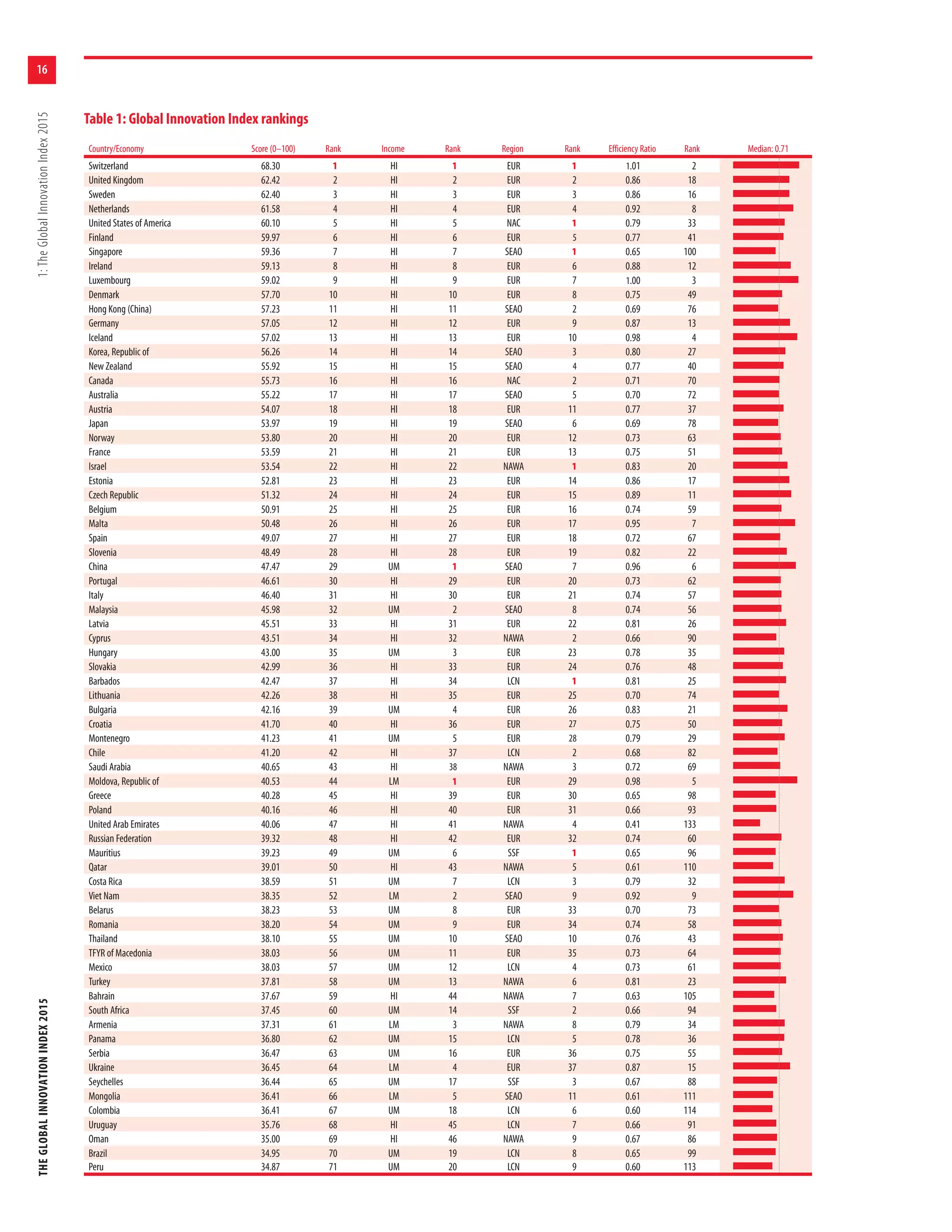
• Switzerland, the United Kingdom (UK), Sweden,
the Netherlands, and the United States of America
(USA) are the world’s five most-innovative nations;
at the same time, China, Malaysia, Viet Nam,
India, Jordan, Kenya, Uganda, and a group of
other countries are outpacing their economic
peers in 2015.
• The GII leaders have created well-linked inno-
vation ecosystems where investments in human
capital, combined with strong innovation infra-
structures, contribute to high levels of creativ-
ity. In particular, the top 25 countries in the
GII consistently score well in most indicators
and have strengths in areas such as information
and communication technologies and business
sophistication, which includes knowledge work-
ers, innovation linkages, and knowledge absorp-
tion; they also create high levels of measurable
outputs including creative goods and services.
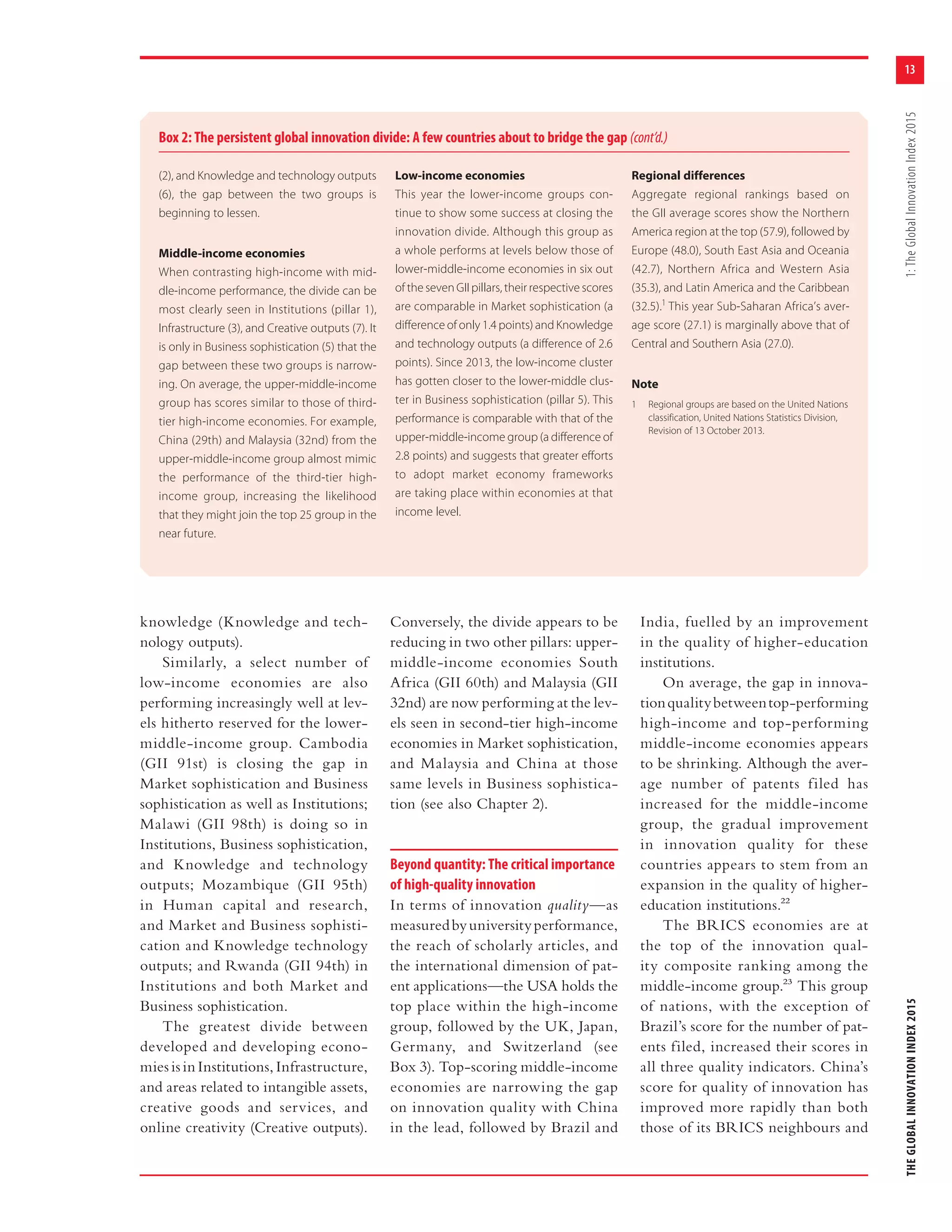
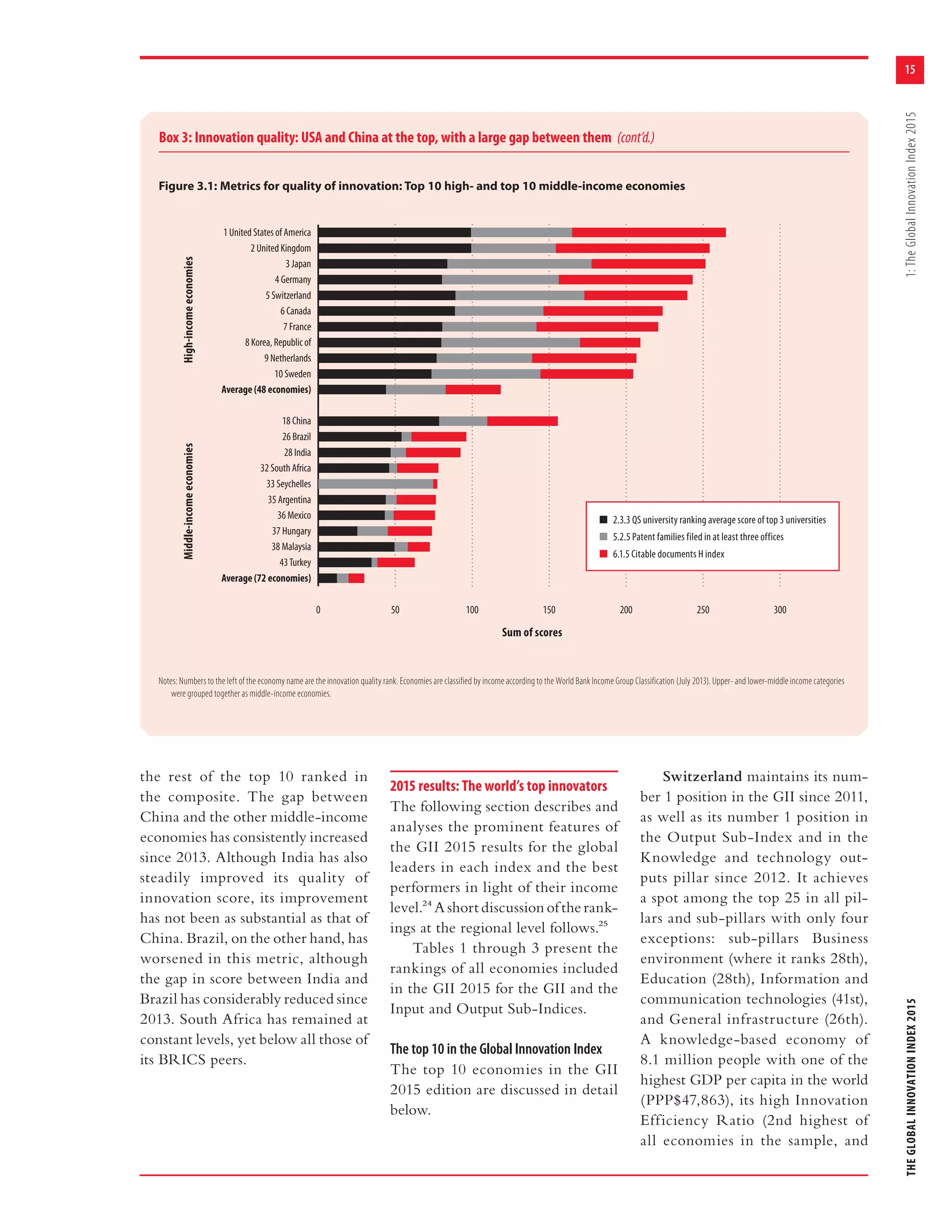
• But innovation is not only about volume: Quality
counts, too. In terms of innovation quality—as
measured by university performance, the reach
of scholarly articles, and the international dimen-
sion of patent applications—the USA holds the top
place within the high-income group, followed by
the UK, Japan, Germany, and Switzerland. Top-
scoring middle-income economies are narrowing
the gap on innovation quality: China leads this
group, followed by Brazil and India, fuelled by an
improvement in the quality of higher-education
institutions.
• The GII 2015 confirms the persistence of global
innovation divides. Among the top 10 and top
25, rankings have changed but the set of econ-
omies remains unaltered (the only exceptions
being the Czech Republic, which has made
its way into the top 25, and Malta, which has
dropped from this list).
• For the purposes of this report, economies that
perform at least 10 percent better than their peers
for their level of gross domestic product (GDP)
are called ‘innovation achievers’.
• The 14 middle-income countries outperform-
ing others in their income group—in order of
performance—are the Republic of Moldova,
ExecutiveSummary
EXECUTIVE SUMMARY
xviii
THEGLOBALINNOVATIONINDEX2015ExecutiveSummary
China, Viet Nam, Armenia, Senegal, Mongolia,
Malaysia, Montenegro, Ukraine, India, Bulgaria,
Thailand, Morocco, and Jordan. The eight
low-income countries outperforming others in
their income group are Malawi, Mozambique,
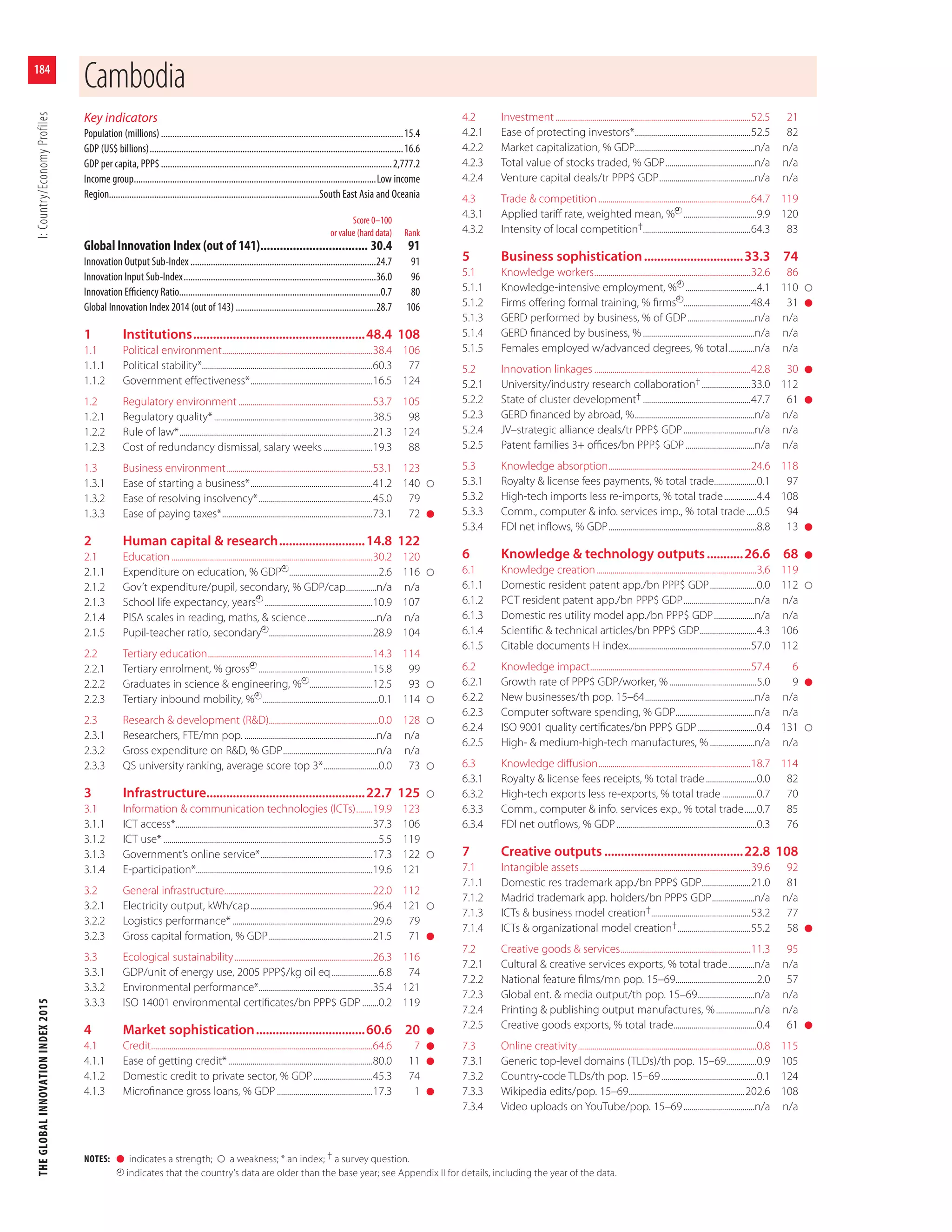
Rwanda, Kenya, Mali, Burkina Faso, Cambodia,
and Uganda. These innovation achievers dem-
onstrate rising levels of innovation input and
output results because of improvements made to
institutional frameworks, a skilled labour force
with expanded tertiary education, better inno-
vation infrastructures, a deeper integration with
global credit investment and trade markets, and a
sophisticated business community—even if prog-
ress on these dimensions is not uniform across
their economies.
• On average, the technology gap between devel-
oping and developed countries is narrowing.
One explanation for this phenomenon is that
more and more developing countries outper-
form in innovation inputs and outputs relative to
their level of development. The GII 2015 studies
these ‘outperformers’—namely Armenia, China,
Georgia, India, Jordan, Kenya, Malaysia, the
Republic of Moldova, Mongolia, Uganda, and
Viet Nam—analysing them in more detail and
establishing links between performance and good
business practices or innovation policies. They
and other countries have realized that technol-
ogy adoption alone is no longer sufficient to
maintain a high-growth scenario; rather, invest-
ment in innovation is now crucial to spur further
catch-up. As a result, national innovation policy
programmes and the corresponding institutional
arrangements have flourished in low- and mid-
dle-income countries.
• The top three economies in the GII rankings
for each region are as follows: in Sub-Saharan
Africa, the top three are Mauritius, South Africa,
and Senegal; in Central and Southern Asia, these
are India, Kazakhstan, and Sri Lanka; in Latin
America and the Caribbean, these are Chile,
Costa Rica, and Mexico; in Northern Africa and
Western Asia, these are Israel, Cyprus, and Saudi
Arabia; in Southeast Asia and Oceania, these are
Singapore, Hong Kong (China), and the Republic
of Korea; in Europe, these are Switzerland,
the UK, and Sweden; in Northern America,
there are only two—the USA and Canada.
• Encouraging signs continue to emerge in Sub-
Saharan Africa. Following the trend identified in
the GII last year, driven by selected countries, the
Sub-Saharan Africa region has caught up signifi-
cantly. In addition to South Africa, some African
countries—in particular, Burkina Faso, Kenya,
Malawi, Rwanda, and Senegal—stand out for
having made important progress.
• Although Latin America and the Caribbean
region’s GII rankings have been slow to improve,
Brazil, Argentina, and Mexico stand out as econ-
omies performing above the region’s average GII
score. The consistent overperformance of Chile,
Costa Rica, and Colombia—in both regional
terms and as compared to their peers of similar
economic development—is also noteworthy, as is
the emergent role of Peru and Uruguay.
Chapter 2, ‘Benchmarking Innovation Outperfor-
mance at the Global and County Levels’, written by
Rafael Escalona Reynoso and Alexandra L. Bernard
from Cornell University; Michaela Saisana from the Joint
Research Centre at the European Commission; Martin
Schaaper from UNESCO Institute for Statistics; and
Sacha Wunsch-Vincent and Francesca Guadagno from
WIPO, assesses the list of innovation achievers and pillar
outperformers over the period 2011–14 and identifies a
select group of 11 innovation outperformer economies.
The chapter stresses that, at the country level—especially
in developing countries—the emphasis on fostering inno-
vation has increased and national innovation policies and
programmes are flourishing.
• Although tracking absolute levels of innovation
over time is difficult, measuring such progress
has become a priority for policy makers who are
seeking ways to assess the effectiveness of their
innovation policies and innovation systems. This
interest has also been permeated by high-level
international development-related discussions.
• By tracking global progress in innovation and
focusing on those developing countries that out-
perform in innovation compared to countries
at similar levels of development, the GII can be
used to monitor progress in innovation and iden-
tify areas of strengths and weaknesses in innova-
tion efforts.
• The analysis within the chapter finds a growing per-
centage of countries with above-par performance
(those that outperform their peers with a similar
xix
THEGLOBALINNOVATIONINDEX2015ExecutiveSummary
level of economic development). The number of
these innovation achievers continues to increase
through the period under study here, namely
2011–14.
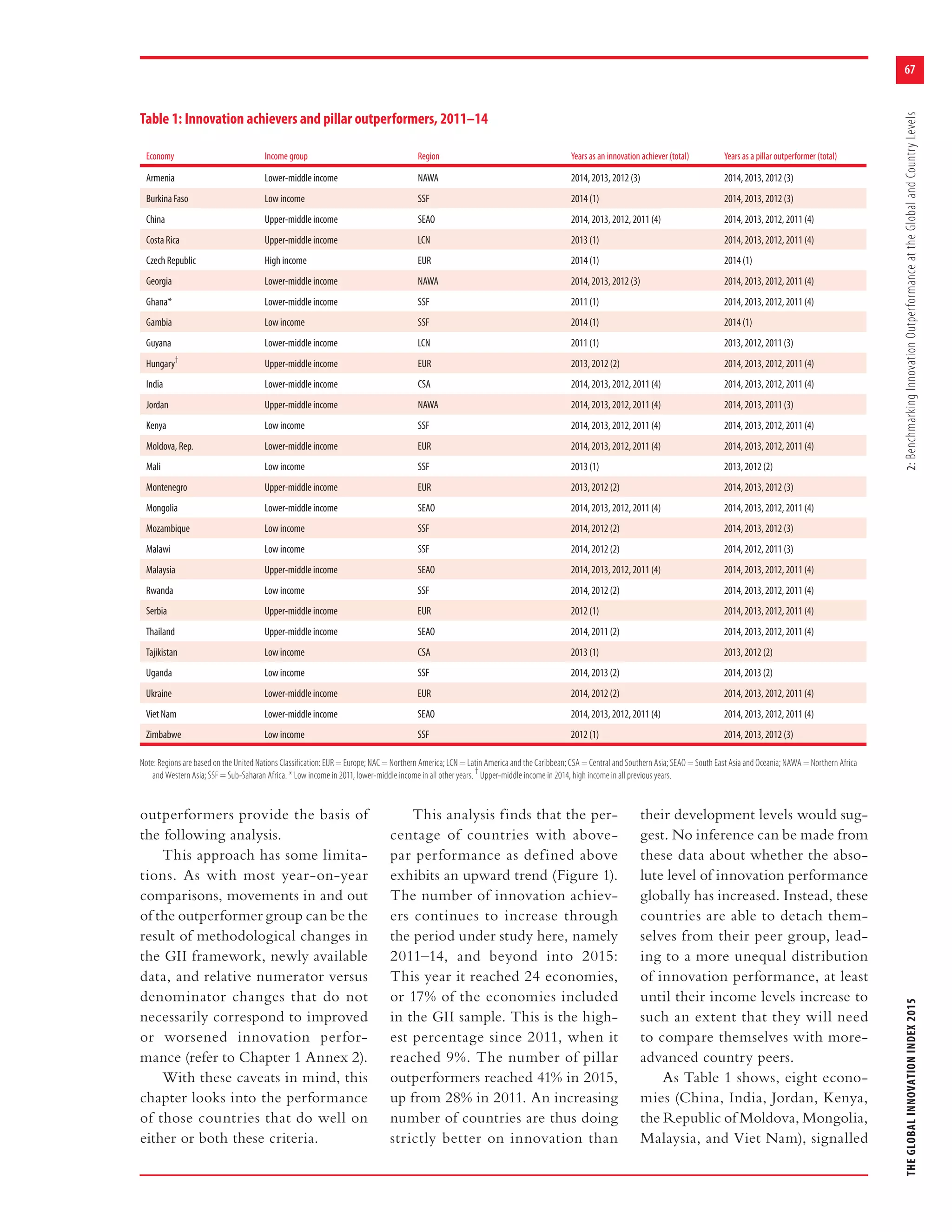
• Eight economies (China, India, Jordan, Kenya,
the Republic of Moldova, Mongolia, Malaysia,
and Viet Nam) can be signalled as innovation
achievers, outperforming their peers on the over-
all GII score during 2011–14.
• Fifteen economies (China, Costa Rica, Georgia,
Ghana, Hungary, India, Kenya, the Republic of
Moldova, Mongolia, Malaysia, Rwanda, Serbia,
Thailand, Ukraine, and Viet Nam) outperformed
their peers in at least four innovation input or
output pillars during 2011–14.
• Eleven developing countries (Armenia, China,
Georgia, India, Jordan, Kenya, Malaysia, the
Republic of Moldova, Mongolia, Uganda, and
Viet Nam) are labelled ‘innovation outperform-
ers’ because they conform to the following two
more stringent rules: (1) their GII score relative
to their GDP is significantly higher than it is for
other economies (they attain ‘innovation achiever’
status) for two or more recent years (including
at least 2013 and 2014); and (2) they outperform
their income-group peers in a minimum of four
innovation input or output pillars (they are desig-
nated ‘pillar outperformers’) for two or more years
(including at least 2013 and 2014).
• Innovation achievers seem to perform the stron-
gest in Market sophistication and Knowledge
and technology outputs. At low income lev-
els, countries that outperform their peers focus
on removing structural obstacles to innovation,
such as poor access to finance and poor linkages
within the innovation systems. At higher income
levels, efforts concentrate on increasing invest-
ments, spurring growth in innovation outputs,
and improving human capital.
• Although the innovation system literature puts
great emphasis on the role of human capital and
institutions for innovation and development,
these innovation input factors seem to be the
most difficult of all inputs in which to achieve
good scores, both in general and for low-income
countries in particular. These results do not nec-
essarily imply a lack of policy interest in these
areas, but they might suggest that it is easier to
outperform peers in certain inputs, either because
efforts to improve these inputs bring more imme-
diate benefits or because peer countries perform
particularly poorly in these areas.
• Research and development (R&D) is one of the
key policy areas that can secure technological
potential and, therefore, innovation and economic
growth. In order to reach the income levels of
high-income countries, low- and middle-income
countries need to expand their access to technol-
ogy and their capacity to use it.
• Countries at higher income levels, instead, can
benefit from more developed innovation systems,
where education and research can effectively pro-
vide the knowledge and skills to boost innovation.
This allows them to more effectively translate
innovation efforts into knowledge and technology
outputs.
Chapter 3, ‘Innovation Policies for Development,’
written by Micheline Goedhuys, Hugo Hollanders, and
Pierre Mohnen from UNU-MERIT (United Nations
University and Maastricht University), emphasizes
that the competitiveness of both companies and coun-
tries depends on their ability to innovate and move in
the direction of frontier technology and knowledge.
Innovation policies have been recently introduced in
most emerging economies. Even in developing and
least-developed countries, innovation is at the core of
the political debate, but the focus of innovation policies
in these countries differs from that of policies in more
advanced economies.
• There is a wide heterogeneity among enterprises
in emerging economies. Besides top-performing
companies, emerging economies also host large
groups of micro and small businesses, operating
far below the frontier of innovation, with basic
technologies and low levels of human capital.
Raising the productivity of these smaller pro-
ducers through innovation and the adoption of
better technologies will have a substantial aggre-
gate impact on a country’s economic growth,
employment, poverty alleviation, and sustainable
development.
• At the aggregate level and in comparison with
data from developed economies, innovation
in developing countries is more incremental
than radical and takes place in an informal set-
ting more often than it does in formal R&D
laboratories.
xx
THEGLOBALINNOVATIONINDEX2015ExecutiveSummary
• For emerging countries that are catching up,
experience shows that technology adoption alone
is no longer sufficient to maintain a high-growth
scenario. These countries too must invest in
innovation, and governmental support is crucial
for promoting it.
• In developing and emerging economies, the
importance of innovation is widely recognized
and innovation policies occupy a central role in
their development plans and strategies.
• In emerging countries, innovation is seen as key
to addressing pressing societal problems such
as pollution, health issues, poverty, and unem-
ployment. The role and significance of innova-
tion goes beyond the objective of economic suc-
cess. Rather it should be seen through the lens
of inclusive development because it can address
poverty and health issues, and through the lens of
environmental sustainable development because
it can address problems of pollution and energy
provision.
• Since innovation processes are also more ori-
ented towards knowledge diffusion and absorp-
tion, instead of investing in R&D, to a large
extent firms in emerging economies try to reap
the benefits of catching up through adoption and
international technology transfer, and favour tax
incentives over direct R&D support grants.
• Emphasis in emerging countries should be placed
on gaining knowledge as much as on provid-
ing the right framework conditions that stimu-
late a process of innovation and knowledge dif-
fusion: political stability and supportive institu-
tions; good and widespread technical and tertiary
education to enhance absorptive capacity; reliable
and widespread basic infrastructure; excellent
provision of information and communication
technology (ICT) property rights; and stronger
links and interaction between publicly funded
research institutes and private companies.
• The ultimate policy mix will depend on a coun-
try’s broader development objectives, and will
have to be made in collaboration with all the
stakeholders to maximize the chances of suc-
cess. Good coordination between ministries and
between the private and the government sectors
is therefore essential.
• It is also essential to monitor the impact of inno-
vation policies in order to determine whether
policies have worked and which policies might
be most effective.
• Countries need to invest in research and innova-
tion to develop products that address their par-
ticular needs. Governments are therefore devel-
oping innovation-support policies that take into
account the specificities of their domestic indus-
tries. A few emerging countries have successfully
introduced such policies and provide interest-
ing cases from which lessons can be learned on a
diverse range of innovation policies.
Chapter 4, ‘Principles for National Innovation
Success,’ written by Robert D. Atkinson and Stephen
Ezell from the Information Technology and Innovation
Foundation, discusses the growing recognition that
innovation is something in which all nations, includ-
ing developed and developing, can, and indeed should,
be engaged. The chapter presents six key principles all
nations need to consider in order to design and imple-
ment the most effective innovation policies:
• Principle 1: Innovation policy should focus
on maximizing innovation in all industries.
Although manufacturing generally, and high-
tech manufacturing specifically, is an important
component of innovation, maximizing innova-
tion requires maximizing innovation across all
industries.
• Principle 2: Innovation policy should support all
types and phases of innovation. One of the big-
gest mistakes countries make with their innova-
tion strategies is to define innovation too nar-
rowly, focusing mainly on developing and manu-
facturing high-tech products. Countries should
focus more on across-the-board productivity
growth strategies than on trying to grow pri-
marily by shifting the compositional mix of their
economy from lower- to higher-value-added
sectors.
• Principle 3: Enable churn and creative destruc-
tion. To succeed in innovation, nations need to
do more than merely enable some value-added
innovation to supplement what is already going
on in other, leading economies. They need to
enable disruptive innovation, which is often gen-
erated by new market entrants, especially those
emerging in their own economies.
xxi
THEGLOBALINNOVATIONINDEX2015ExecutiveSummary
• Principle 4: Keep the price of capital goods
imports, especially information and communi-
cations technology (ICT) imports, low. Without
new capital investment refreshing a nation’s capi-
tal stock, innovation loses its power, productivity
growth stagnates, and business competitiveness
declines. The easiest and most important way
countries can keep the cost of capital goods low
is to limit tariffs and other trade barriers.
» ICTs represent a general purpose technology
that are a foundational driver of modern eco-
nomic growth, accounting themselves for as
much as one-quarter of economic growth in
many developing nations today.
» Although many nations impose high taxes and
tariffs on ICT products in an attempt to either
boost government revenue or to create a com-
petitive domestic ICT industry or both, many
nations—including China, Georgia, Malaysia,
and Viet Nam—do a reasonably good job of
limiting government-imposed costs on ICT
products.
• Principle 5: Support the creation of key innova-
tion inputs. Firms not only need access to best-
in-class, affordable ICT inputs, they also need
access to other key innovation inputs, including
digital infrastructure, a skilled workforce, and
knowledge—both its production and its transfer.
Examples of such support include:
» Kenya’s National ICT Master Plan 2013/14–
2017/18, introduced in April 2014, has played
a vital role in developing a strategy to compre-
hensively deploy digital infrastructure, notably
wireless and broadband Internet, throughout
Kenya and to complement that availability of
infrastructure with demand for it generated by
popular applications such as mobile money and
mobile government services.
» Countries increasingly recognize talent as a
vital source of competitive advantage and thus
have made education and training a core com-
ponent of their innovation strategies.
» Because entrepreneurship is so risky and often
involves first-time entrepreneurs, initiatives to
help entrepreneurs learn from each other can
be critical.
• Principle 6: Develop a national innovation and
productivity strategy and organizations to sup-
port it. In addition to national strategies, many
successful nations have also established national
innovation agencies specifically dedicated to
spurring domestic innovation.
» For example, Kenya, India, Malaysia, Thailand,
and Viet Nam have each established a National
Innovation Agency.
» National innovation foundations also create
national innovation strategies that constitute
a game plan for how their countries can com-
pete and win in a modern, innovation-based
global economy. For instance, Kenya’s National
Science, Technology and Innovation Policy
underscores the importance of mainstreaming
science, technology, and innovation across all
sectors of the economy.
The chapter concludes:
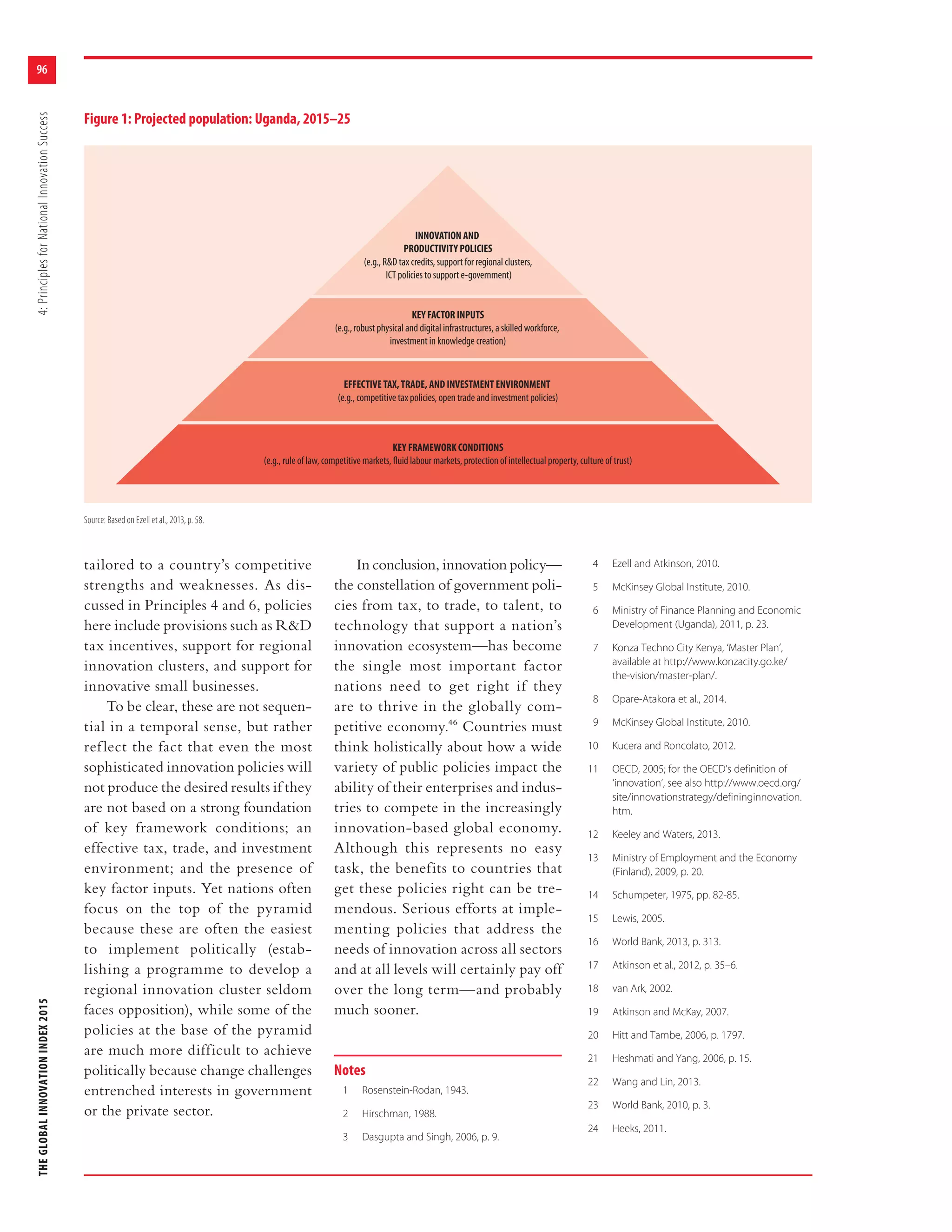
• Countries attempting to achieve national innova-
tion success need to envision a four-level pyra-
mid as the path to prosperity that is based on key
framework conditions; these support an effective
tax, trade, and investment environment; these in
turn support key factor inputs; and finally, at the
top of the pyramid, is a group of innovation and
productivity policies.
• Countries must think holistically about how a
wide variety of public policies impact the abil-
ity of their enterprises and industries to com-
pete in the increasingly innovation-based global
economy.
Chapter 5, ‘Innovation and Policy: A Business
Perspective,’ written by Kai Engel and Justin Shepherd
from A.T. Kearney and Martin Ruppert from the
IMP3rove – European Innovation Management
Academy, presents the findings of a survey of over 400
business leaders across several different countries to pro-
vide a business perspective on innovation policies. The
results are as follows:
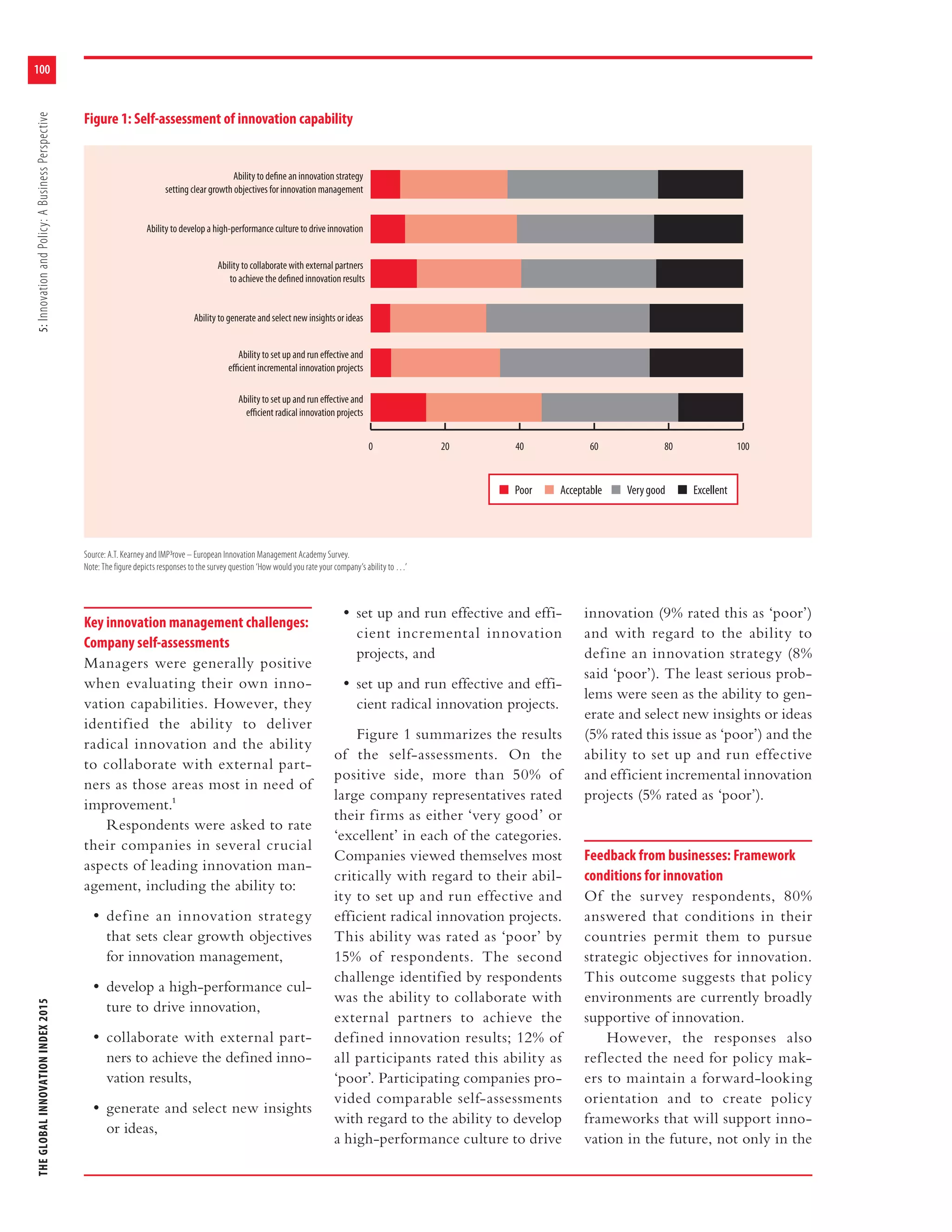
• Managers were generally positive and confident
when evaluating their own innovation capabili-
ties. Over half of those surveyed rated their per-
formance as ‘excellent’ or ‘very good’ across all
areas.
xxii
THEGLOBALINNOVATIONINDEX2015ExecutiveSummary
• Delivering radical innovation and collaborating
with external partners were the two areas where
companies saw the greatest need for improvement.
• Eighty percent of respondents answered that con-
ditions in their countries permit them to pursue
strategic objectives for innovation. This outcome
suggests that policy environments are currently
broadly supportive of innovation.
• The responses also reflected the need for policy
makers to maintain a forward-looking orienta-
tion and to create policy frameworks that will
support innovation in the future, not only in the
present.
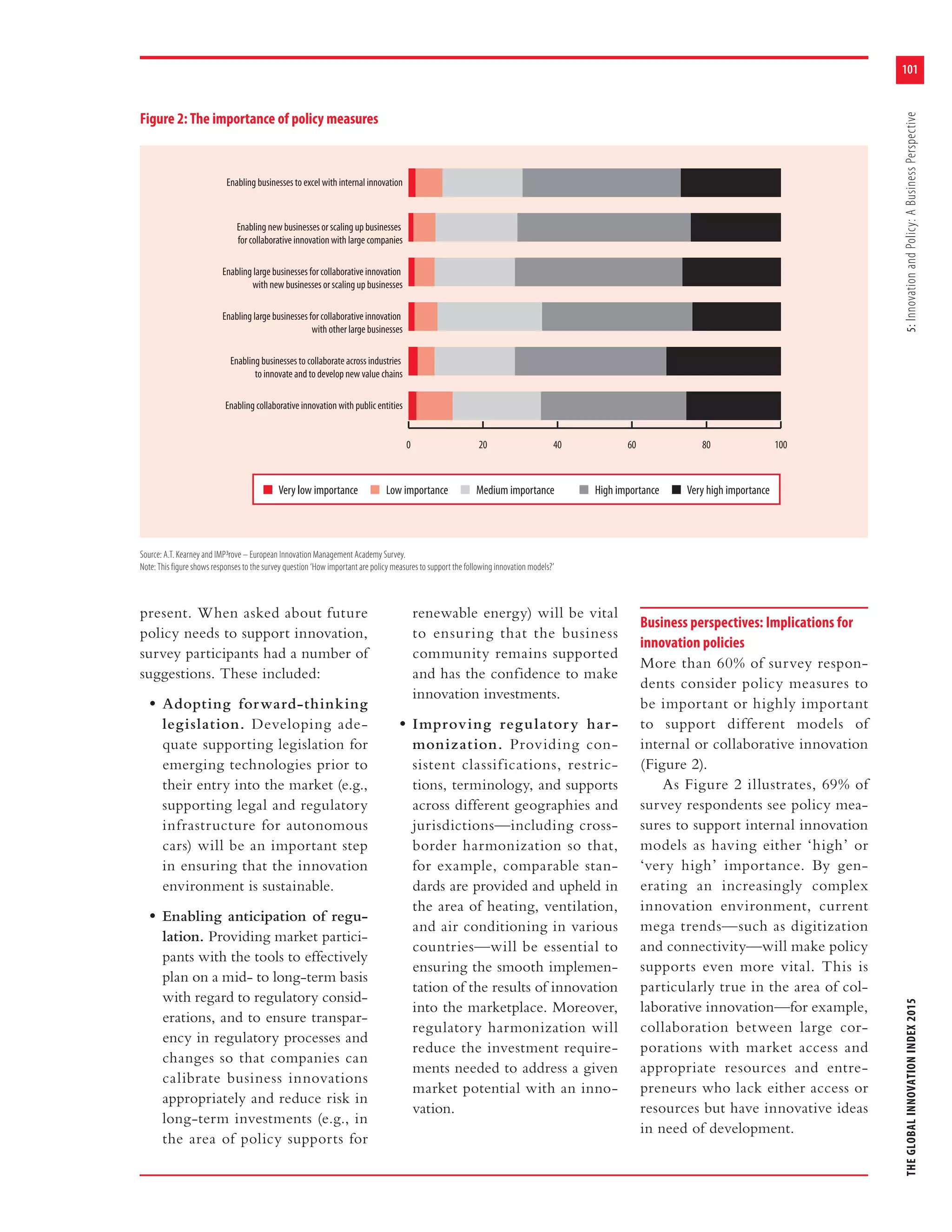
• More than 60% of survey respondents consider
policy measures to be ‘important’ or ‘highly
important’ to support different models of internal
or collaborative innovation.
• Sixty-nine percent of survey respondents see pol-
icy measures to support internal innovation mod-
els as having either ‘high’ or ‘very high’ impor-
tance. By generating an increasingly complex
innovation environment, current mega trends—
such as digitization and connectivity—will make
policy supports even more vital.
• When asked about future policy needs to sup-
port innovation, respondents suggested adopting
forward-thinking legislation to ensure sustain-
ability in the innovation environment; providing
market participants with the tools to anticipate
regulation; and improving regulatory harmoni-
zation to ensure smooth implementation into the
international marketplace.
• Survey participants were further asked to name
up to three specific actions that would develop
enhanced conditions for innovation in their
country: (1) to enhance innovation and entrepre-
neurship-related skills, (2) to provide large R&D
infrastructure support (e.g., lab space and equip-
ment), and (3) to provide direct financial R&D
support. These priorities reflect the findings of
the GII 2014, which indicated room for improve-
ment in Human capital and Market sophistica-
tion–related factors such as access to finance,
innovation linkages, and infrastructure.
• Encouraging policy that supports the develop-
ment of an environment in which innovation can
thrive should be a focus of efforts from the busi-
ness community.
Chapter 6, ‘The Impact of Science and Technology
Policies on Rapid Economic Development in China,’
written by Dongmin Chen, Shilin Zheng, and Lei
Guo from Peking University, details how science and
technology (S&T) policy reform and innovation have
been the important drivers for China’s remarkable GDP
achievement and have accelerated progress in higher
education and research and development (R&D):
• A Medium- and Long-Term National S&T
Development Plan for 2006–2020 (the 2006
National Plan) was issued in 2006. The plan
emphasizes achieving sustainable economic
growth, seeking innovation-driven growth strat-
egies, and further enhancing independent inno-
vation capacity. Objectives of national policies
shifted from promoting R&D to building an
innovation ecosystem.
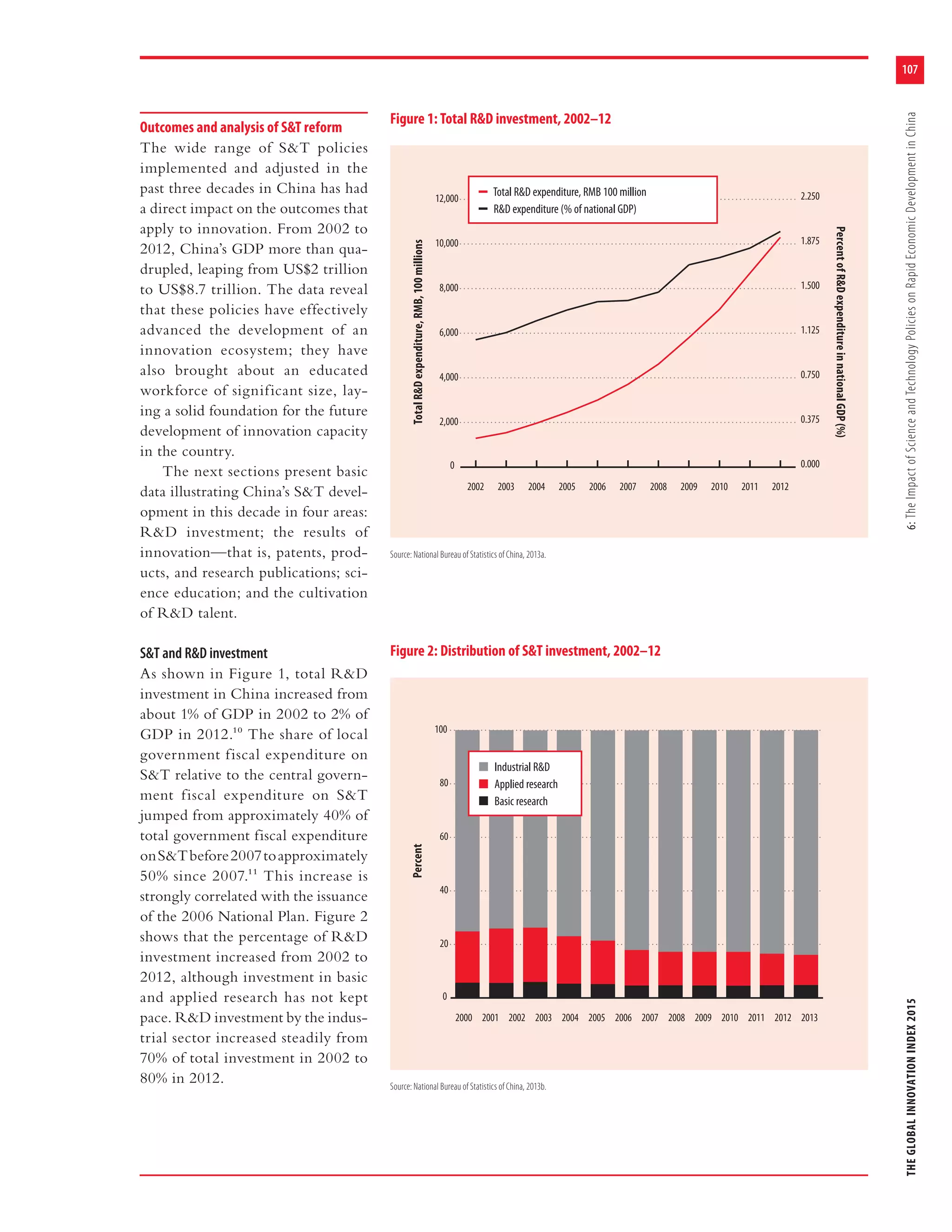
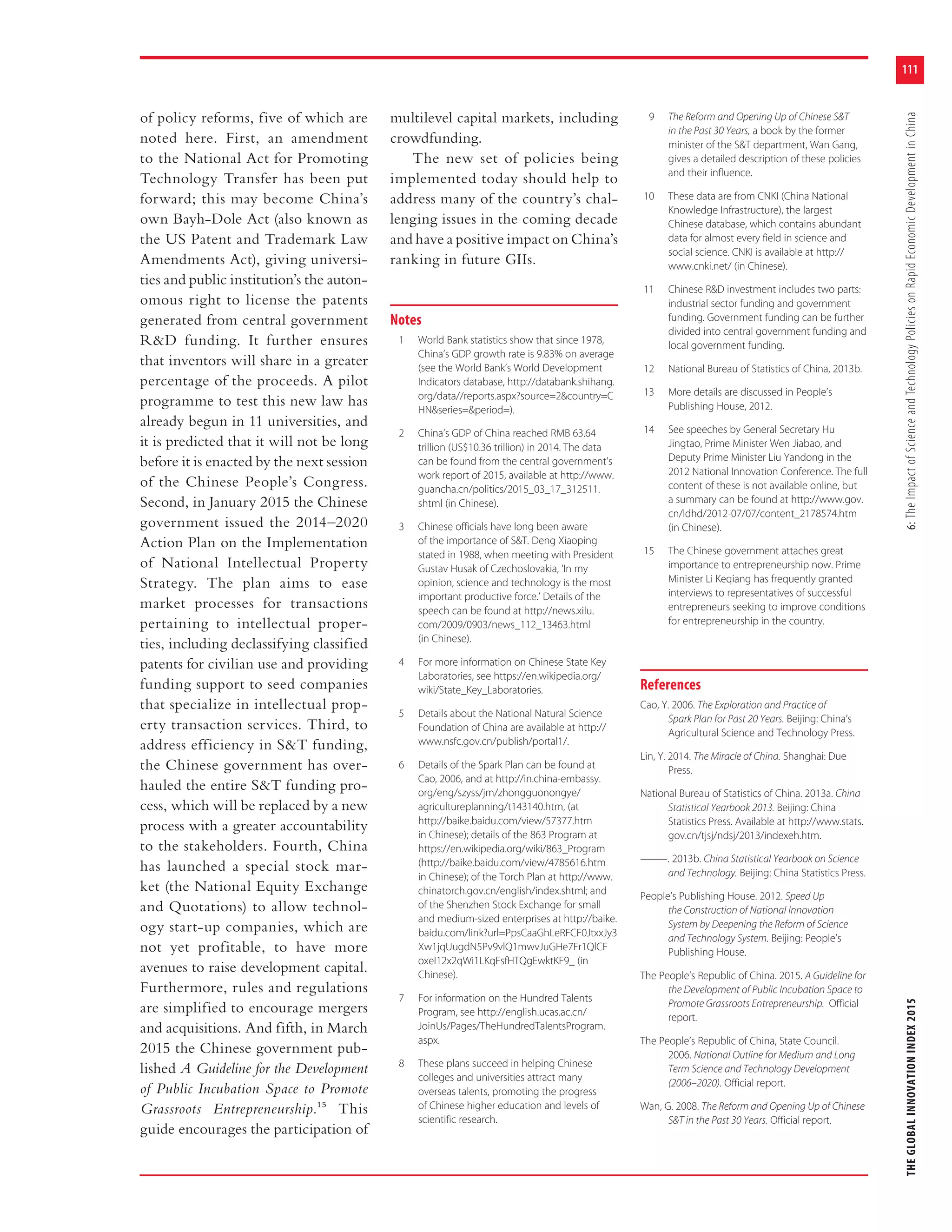
• Following the 2006 National Plan, Chinese
R&D investment clearly stepped up and the rate
of local government investment in R&D sur-
passed that of the central government. Moreover,
the positive market response encouraged the
industrial sector to steadily increase R&D
investment.
• To further push talent mobility, particularly in
critical S&T fields, a very effective Thousand
Talents Recruitment Program was launched by
the central government. This has so far drawn
more than 2,000 overseas Chinese scholars and
leading industrial innovators back to China.
• The wide range of S&T policies implemented
and adjusted over the past three decades has effec-
tively advanced the development of an innova-
tion ecosystem, as well as significantly increasing
the size of the educated workforce, laying out a
solid foundation for China’s future development.
• The strategy of ‘rejuvenating the nation’s econ-
omy with science and education’ has accelerated
the development of China’s top education sys-
tem, increased the quantity of undergraduates
and Master’s graduates, and increased investment
in talented researchers, leading to an increase of
both the quality and quantity of researchers.
• Over the last two years, the Chinese govern-
ment issued the 2014–2020 Action Plan on the
Implementation of National Intellectual Property
Strategy to ease the market processes for transac-
tions pertaining to intellectual properties. It has
xxiii
THEGLOBALINNOVATIONINDEX2015ExecutiveSummary
also overhauled the entire S&T funding processes
to improve efficiency, launched a special stock
market to allow technology start-up companies
to have more avenues through which to raise
development capital, and published A Guideline
for the Development of Public Incubation Space to
promote grassroots entrepreneurship to encour-
age the participation of multi-level capital mar-
kets, including crowdfunding.
• China has set a national target of becoming a
leading innovative country by 2020. Reaching
this target depends on continuing policy reform
to further improve a balanced relationship
between the government and market forces; to
establish a more comprehensive innovation eco-
system; to nurture a legal and regulatory sys-
tem that encourages investment in innovation
and entrepreneurship by all sectors; and to foster
open and fair competition among private, state-
owned, and foreign enterprises.
Chapter 7, ‘Radical Institutional Change: Enabling
the Transformation of Georgia´s Innovation System’,
written by Cristina Chaminade and Maria Moskovko
from CIRCLE, Lund University, discusses the key insti-
tutional changes that are enabling Georgia to drive a
rapid and positive change in its innovation performance.
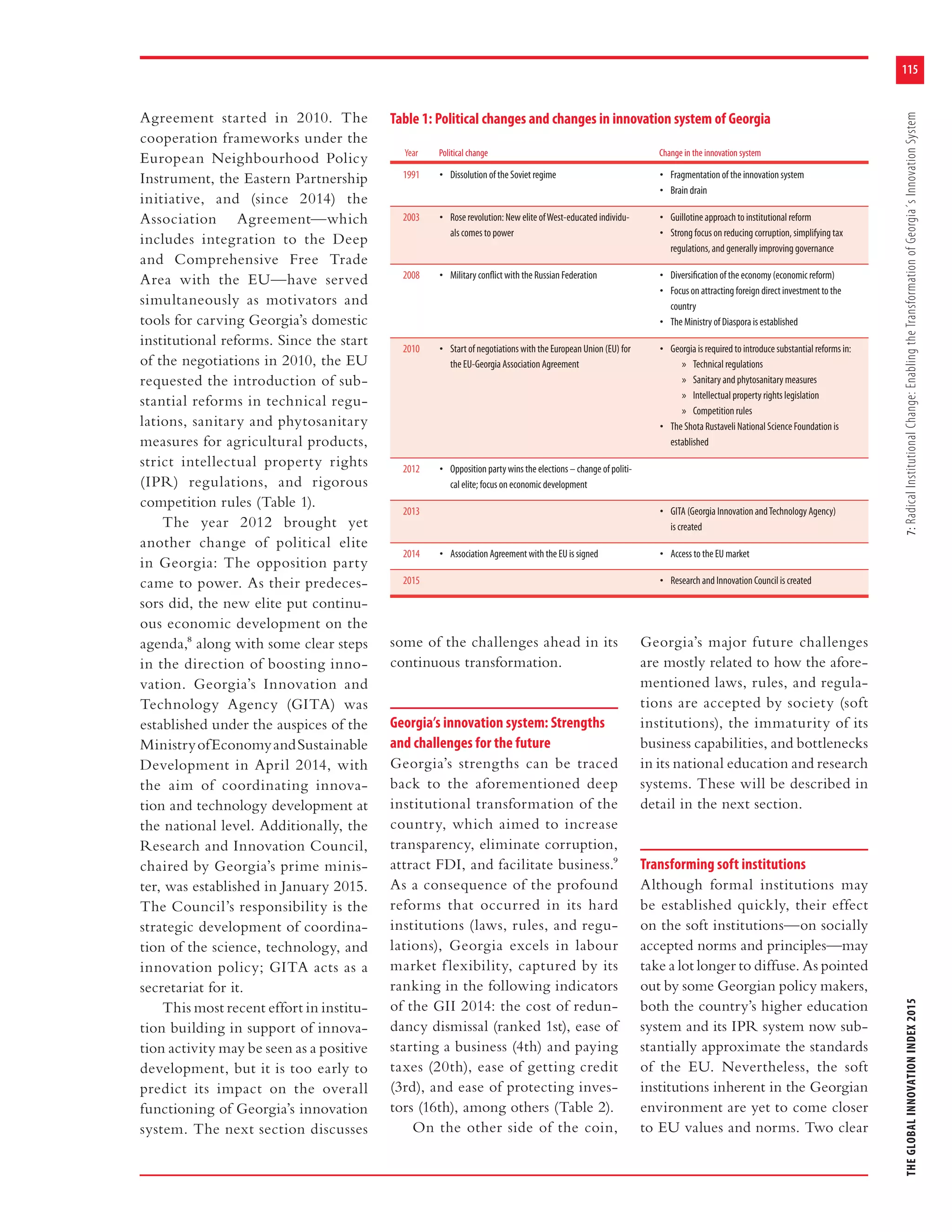
• Since the collapse of the Soviet Union, Georgia
has undertaken a process of deep transforma-
tion of its institutional framework enabled by
the Association Agreement with the European
Union. These reforms have improved tax admin-
istration and reduced corruption, progress that
explains its exceptional performance in the
GII rankings in Institutions and the significant
increase of foreign direct investment inflows.
The institutional change has led to a sizeable
improvement in its innovation system. Further
institutional change is necessary, however, to
strengthen its education and research systems and
improve firms’ capabilities.
• Soft institutions, represented by societal practices,
are harder to change. Intellectual property rights
(IPR) protection is one of the areas in which soft
institutions are making it difficult to implement
new formal institutions.
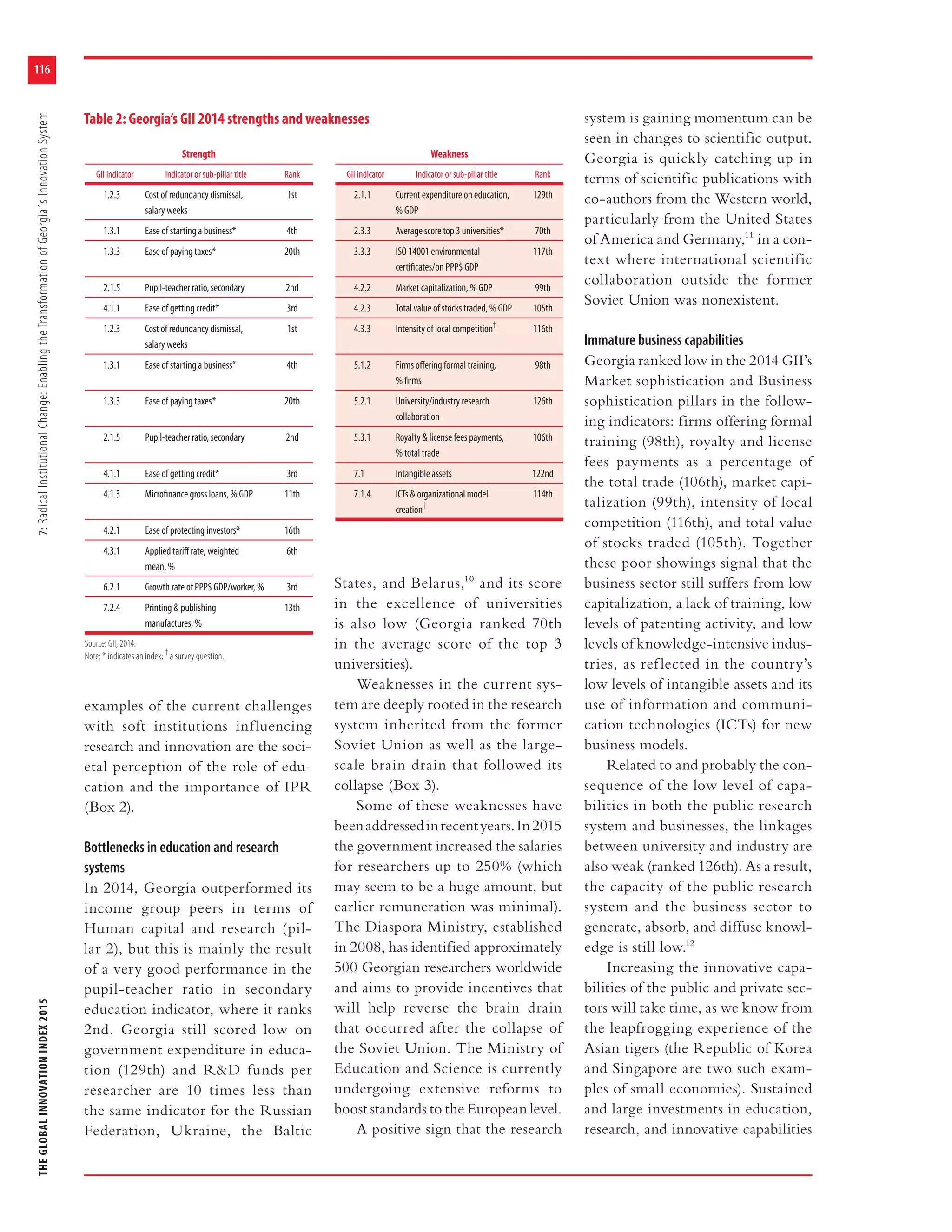
• Despite the overall good performance in Human
capital and research, Georgia is still facing the
challenge of a fragmented research system and
the loss of researchers who left the country after
the collapse of the Soviet Union. To solve these
issues, the Georgian government has increased
salaries for researchers, offered incentives to
high-skilled Georgians who return to the coun-
try, and reformed the education system to bring
it closer to the European standard.
• The Georgian business sector suffers from low
capitalization, lack of training, low levels of pat-
enting activity, and low levels of knowledge-
intensive industries, which are reflected in its low
levels of intangible assets and a poor use of ICTs,
which severely hampers innovation capacity. The
business sector is also poorly linked to university
and research organizations. Investments in firms’
innovation capabilities are needed—a major chal-
lenge for countries with very limited resources.
• The Association Agreement with the European
Union (signed in 2014) could become a way to
address some of the weaknesses outlined above.
The agreement covers a large number of sectors
and policy areas, including education, research
and technological development, and ICT devel-
opment. Moreover, access to the European mar-
ket is expected to increase firms’ incentives to be
competitive.
• Links to multinational corporations are very
important, but they need time and absorptive
capacity to develop. Intermediate organizations
such as non-governmental organizations and
measuring and testing centres can play a crucial
role in translating the knowledge of multina-
tional corporations to the local actors.
• Especially given the current unstable situation
in Eastern Europe and other external factors, it
is essential for its continued development that
Georgia stay on course on the innovation policy
front.
Chapter 8, ‘Policies to Drive Innovation in India,’
written by Senapathy ‘Kris’ Gopalakrishnan and Jibak
Dasgupta from the Confederation of Indian Industry,
discusses the innovation performance of India, high-
lighting the strengths and weaknesses of its innovation
system and the government interventions associated
with them. Despite its achievements, especially in its
scientific base and information technology (IT) and
telecommunications industries, India still needs to
implement substantial reforms in its innovation policy
in order to further improve its innovation performance.
xxiv
THEGLOBALINNOVATIONINDEX2015ExecutiveSummary
• India has consistently performed poorly dur-
ing the last four years in political stability, ease
of starting a business, tertiary inbound mobility,
and environmental performance.
• Over the years, India has developed a stable foun-
dation for scientific, technological, and business
education by setting up centres of excellence. This
contributed to its 66% average growth rate in sci-
entific publications over the period 2006–10.
• The National Telecom Policy of 1994 and sub-
sequent policy on broadband in 2004 lay the
foundation for the rise of the Indian IT and tele-
communications (mobile) industry. The National
Telecom policy and IT Policy of 2012 is expected
to further accelerate the growth of this industry
by encouraging innovation and R&D in cutting-
edge technologies, provide benefits to small- and
medium-sized enterprises (SMEs) and start-ups,
create a pool of 10 million skilled workers, and
make at least one individual in every household
e-literate.
• The SME sector has a high growth potential.
This potential, however, has not yet materialized
because of low credit availability. Government
intervention in this area has focused on cluster
development through various schemes and pro-
grammes of the Ministry of Micro, Small &
Medium Enterprises and the National Innovation
Council. Despite these efforts, SME cluster
development in India is still not satisfactory.
• The Indian IPR regime has been crafted to strike
a balance between protecting IPRs to support
the commercialization of innovation and cater-
ing to social needs. This resulted in a relatively
weaker IPR regime and a lower propensity to
filing patents in India.
• With a population of more than 1.2 billion, and
with 50% of that population under the age of
25, India faces a huge demand for higher educa-
tion. This problem is exacerbated by low teacher
quality, constraints in research capacity, and huge
socioeconomic disparities.
• Despite their success, the Indian IT and tele-
communications industries could contribute
even more to economic growth and develop-
ment in the country. For this to happen, higher
education, IPR, institutional reforms, regula-
tory environment, infrastructure, and incentives
for entrepreneurship and R&D (especially for
SMEs) should receive increased support of the
government.
• As a partial response to these challenges, the
newly elected government established a Ministry
for Skill Development and Entrepreneurship, cre-
ated financial schemes for SMEs and incubation
programmes for start-ups, launched Intellectual
Property Facilitation Centres to spread an intellec-
tual property culture within SMEs, and announced
increased expenditures on infrastructure.
Chapter 9, ‘Effective Innovation Policies for
Development: The Case of Kenya’, written by Bitange
Ndemo from the University of Nairobi, discusses how
Kenya improved its innovation performance thanks to
local innovators and a long R&D history in some key
sectors, such as agriculture and health care. However,
this rapid increase in new innovations is not strictly
associated with the innovation policies in place in the
country. These, therefore, need to improve to stimu-
late further innovation by guaranteeing stability and
adequacy of funds for innovation, strengthening link-
ages between all the actors of the innovation system, and
better communicating government plans to firms and
innovation actors. The chapter explains:
• Pressure from a rapidly growing population, scar-
city of resources, and soaring unemployment are
driving the Kenyan government to push inno-
vation as a new source of jobs. Successful com-
mercialization of locally developed innovations
has led to increased understanding of its potential
to create employment and deal with local prob-
lems. Multinational corporations are also setting
up research facilities in Kenya to get closer to this
new potential market.
• Relative to other African countries, some of
Kenya’s strengths lie in its governance sys-
tem and political stability as well as its levels of
expenditures on education and R&D, access to
credit, microfinance gross loans, royalty and fees
receipts, and intensity of local competition.
• Innovations in the financial sector (e.g., the dif-
fusion of mobile banking) facilitate access to
credit and explain the improvements in market
and business sophistication.
• Since 2006 the government has created a num-
ber of ministries and organizations to stim-
ulate human capital development, R&D
xxv
THEGLOBALINNOVATIONINDEX2015ExecutiveSummary
expenditures, and improve science and technol-
ogy infrastructures.
• An emphasis was also placed on pursuing more
and better collaborations and partnerships and
encouraging entrepreneurship through start-up
and accelerator programmes, incubation, and the
creation of a technology park.
• Despite the existence of a policy framework,
challenges hindering the adoption of innovation
as a key driver of economic growth still exist.
As a consequence, resource allocation to R&D
is often not guaranteed and the little that is allo-
cated to research organizations is spent on recur-
rent expenditures.
• Actors within the innovation system are still
weakly linked, leading to capacity underuti-
lization, disconnection between industry and
research organizations, and obstacles to innovate
for SMEs.
• In terms of future challenges, the education
system needs to place more emphasis on sci-
ence, technology, engineering, and mathemat-
ics (STEM); create more technical, industrial
and vocational education training institutions;
and move to business-friendly educational pro-
grammes. These issues are currently being tack-
led by creating a number of institutions. This
proliferation of institutions, however, is not
expected to solve these issues.
• The chapter also views lessons for Kenya from
other countries. The USA has much to offer in
its new approach to building a community of
innovators—the TechShop concept—which is
being explored through a collaboration between
the University of Nairobi and MIT. The chap-
ter then takes a look at an approach to encour-
aging start-up creation and SME growth from
the Republic of Korea, which begins in reforms
to the education system, coupled with military
service. Together these may foster a culture of
risk-taking and innovation, and may be a useful
model for Kenya to consider.
Chapter 10, ‘Innovation Performance of the
Malaysian Economy’, written by Rajah Rasiah and
Xiao-Shan Yap from the University of Malaya, details
how Malaysia offers an excellent example of a middle-
income country that has done well in areas such as busi-
ness financing of innovation and commercialization as
well as in Market sophistication and Business sophistica-
tion, but at the same time still has considerable progress
yet to make in areas such as knowledge-based activities
and technological dependence. The chapter details:
• Despite strong commercialization in business
R&D, including in business financing, the coun-
try’s relatively poor performance in innovation
efficiency shows a need to review government
policies on the execution of government-spon-
sored R&D funds.
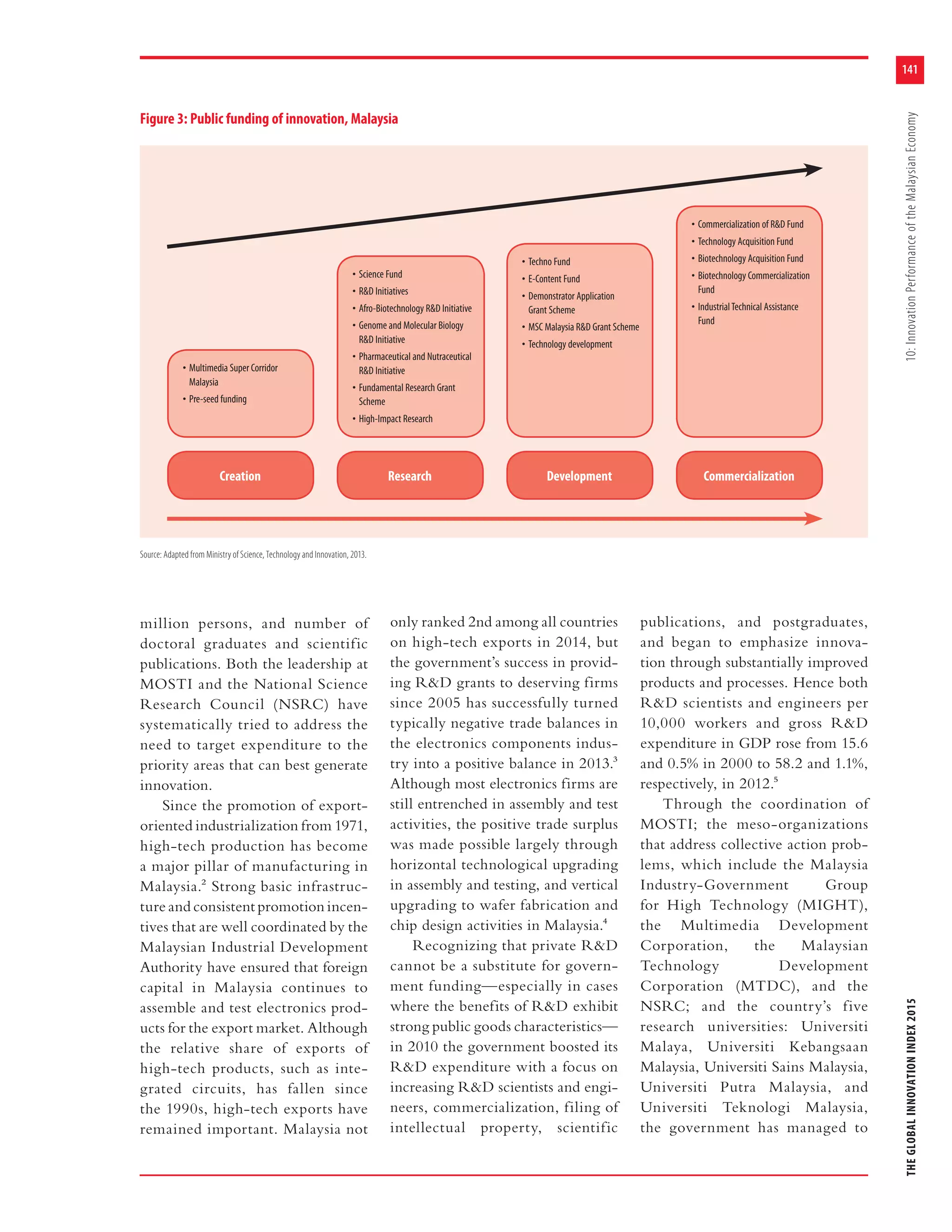
• Government support of innovation in Malaysia is
primarily through science, technology, and inno-
vation policies (STI) that began in the 1980s. The
Ministry of Science, Technology and Innovation
(MOSTI) supports the creation, research, devel-
opment, and commercialization of innovative
activities in Malaysia.
• After 2006, following efforts by the government
to stimulate R&D in the country, the number
of projects approved and the amounts involved
rose. Stimulating R&D is viewed as key to mak-
ing Malaysia a developed country by 2020.
• The Intensification of Research in Priority Areas
grant was launched in 1988 under MOSTI,
which was targeted at government organizations
such as universities and public research institutes
to stimulate research. At the same time, the gov-
ernment introduced the double deduction tax
incentive for firms undertaking approved R&D.
The Industrial R&D Grant Scheme to support
R&D in the private sector was introduced in
1997.
• The increasing focus by the government on
research funding has helped stimulate expansion
in innovation input and output, as can be seen
from the rise in R&D expenditure as a share of
GDP, R&D researchers and scientists per mil-
lion persons, and the output of doctoral graduates
and scientific publications. Both the leadership
at MOSTI and the National Science Research
Council have systematically tried to address
the fundamental aspects of targeting expendi-
ture to the priority areas that can best generate
innovation.
• Since the promotion of export-oriented indus-
trialization from 1971, high-tech produc-
tion has become a major pillar of manufactur-
ing in Malaysia. Strong basic infrastructure
xxvi
THEGLOBALINNOVATIONINDEX2015ExecutiveSummary
and consistent promotion incentives that are
well coordinated by the Malaysian Industrial
Development Authority have ensured that for-
eign capital continues to remain in Malaysia to
assemble and test electronics products for the
export market.
• Recognizing that private R&D cannot be a sub-
stitute for government funding—especially where
the benefits share strong public goods character-
istics—in 2010 the government increased R&D
expenditure with a focus on increasing R&D
scientists and engineers, commercialization, the
filing of intellectual property, scientific publica-
tions, and postgraduates, and began to emphasize
innovation through substantially improved prod-
ucts and processes.
• The Malaysian government has managed to
expand scientific input and output through
the coordination of MOSTI with the meso-
organizations of the Malaysia Industr y-
Government Group for High Technology, the
Multimedia Development Corporation, the
Malaysian Technology Development Corporation,
the National Science Research Council and
the five research universities: Universiti Malaya,
Universiti Kebangsaan Malaysia, Universiti Sains
Malaysia, University Putra Malaysia, and Universiti
Teknologi Malaysia.
• The chronic deficit in royalty and licensing fee
receipts and payments demonstrates that Malaysia
still relies heavily on foreign technology and ser-
vices. Policies are needed to transform Malaysia
from a technology-importing to a technology-
exporting country.
• In 2012 the Collaborative Research in Engineering,
Science & Technology (CREST) was established
to drive growth in the electrical-electronics indus-
try, focusing on bringing together the three key
stakeholders (industry, academia, and the govern-
ment) in collaborative R&D, talent development,
and commercialization. Because each research
project granted by CREST conditions the partici-
pation of both universities and industrial firms, it
is directly targeted at building university-industry
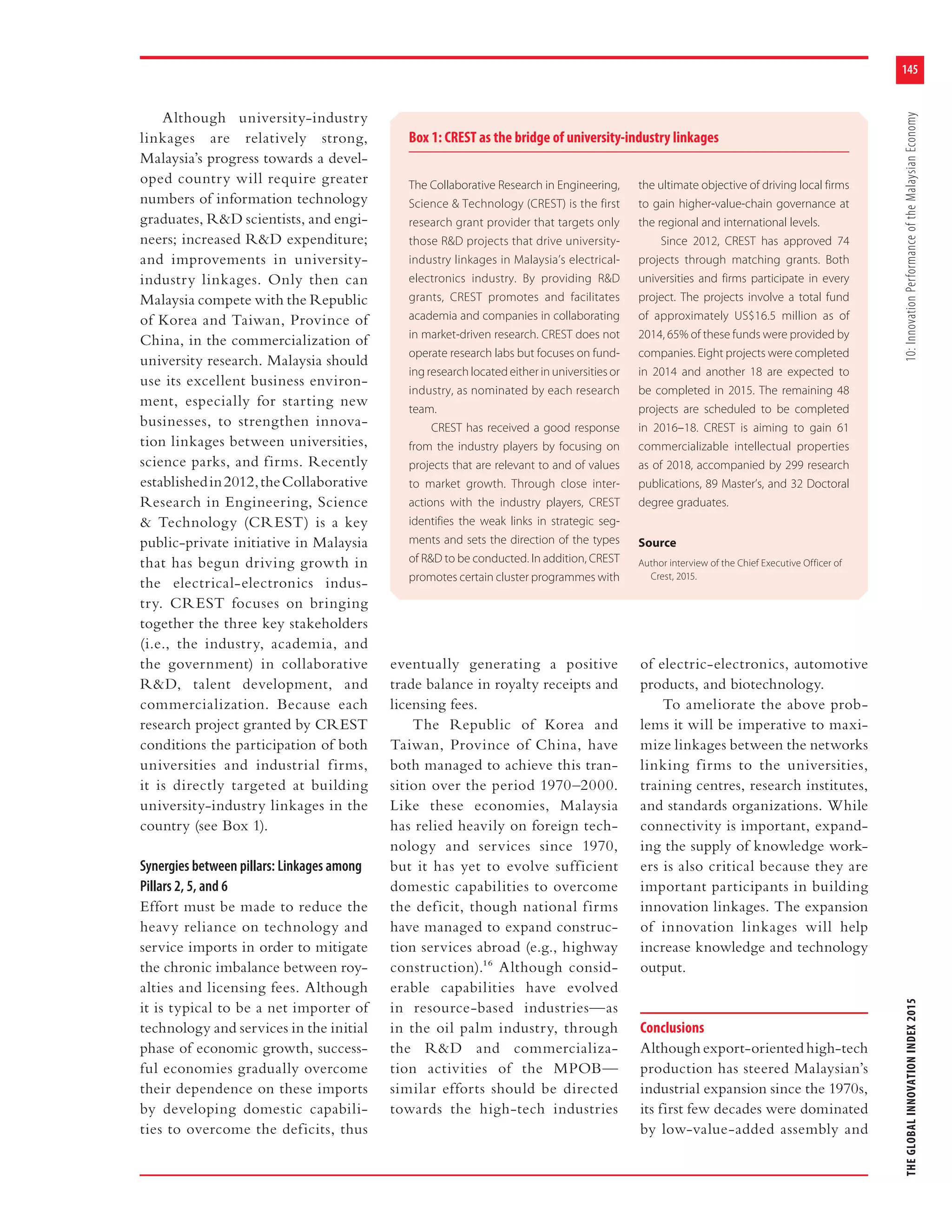
linkages in the country.
• The main shortcomings that have restricted
Malaysia’s GII ranking from rising above 33rd
place relate to the efficiency of the innovation
inputs and outputs. As a consequence Malaysia
has remained a net technology and services
importer with net receipts and licensing fees
remaining negative for many years. There should
be greater effort made to improve institutional
support and knowledge-based activities and turn
Malaysia into a net exporter of technology and
services.
Chapter 11, ‘Effective Innovation Policies for
Development: Uganda’, written by Julius Ecuru
from the Uganda National Council for Science and
Technology and Dick Kawooya from the University
of South Carolina, School of Library and Information
Science, discusses the case of Uganda and how it has
changed dramatically in both economic terms and in
other areas as a result of its relative political and eco-
nomic stability. Uganda’s rapidly growing population
requires simultaneously expanding the economy to
accommodate the people’s needs and adopting more
sustainable practices in natural resource management.
For this reason, Uganda should turn to innovation and
the creative use of resources across all sectors of the
economy in order to build a sustainable future. The
chapter explains:
• The Uganda government is deepening private-
sector investment by improving its business envi-
ronment and competitiveness through innovation.
• Uganda’s GII strength in areas such as strong
foreign direct investment net inflows is a direct
result of the relative stability of the economy.
• Innovations in agro-processing and value addi-
tion may be essential for creating new sources of
growth and agribusiness.
• The new Ministry of Education, Science,
Technology, and Sports is a consequence of pol-
icy discussions over the last decade that identified
a need for a standalone ministry for science and
technology.
• Universities and other research organizations
need to have internal policies that address and
encourage research and intellectual property
management.
• Uganda has a solid institutional foundation for
developing the private sector. However, the pri-
vate sector must be competitive domestically and
internationally.
• Implementing the Uganda Registration Services
Bureau’s Strategic Investment Plan for 2012–17
xxvii
THEGLOBALINNOVATIONINDEX2015ExecutiveSummary
may remove institutional bottlenecks involved
in business registration, which in turn would
improve Uganda’s current low score on the ease
of starting and cost of running a business.
• One important dimension of innovation in
Uganda is its learning-by-doing aspect, especially
in the informal sector, which constitutes about
two-thirds of the country’s businesses.
• To foster productivity in the informal sector,
efforts have been made to improve the skills
of youth and women so they can either start or
improve their businesses.
• The rapid growth of universities in the country
is an opportunity to harness young talent by sup-
porting creative work, research, and innovation.
• Streamlining the financing policy for research
and innovation is a vital next step.
• Creating new businesses through active business
incubation should be pursued.
• Government’s sustained support and commit-
ment to research and innovation activities in uni-
versities, research institutes, and other centres is
needed through direct as well as annual competi-
tive grants.
• Uganda’s experiences provide lessons that can
be valuable for other low-income countries that
need to improve their ranking in the GII. The
most important lesson is that policy formulation
and institutional capacity development around
STI must be addressed concurrently. Strong lead-
ership can also provide an essential component of
successful progress in bridging the gap between
research and innovation centres and industry.
Rankings
THEGLOBALINNOVATIONINDEX2015Rankings
xxx
Country/Economy Score (0–100) Rank Income Rank Region Rank Efficiency Ratio Rank Median: 0.71
Switzerland 68.30 1 HI 1 EUR 1 1.01 2
United Kingdom 62.42 2 HI 2 EUR 2 0.86 18
Sweden 62.40 3 HI 3 EUR 3 0.86 16
Netherlands 61.58 4 HI 4 EUR 4 0.92 8
United States of America 60.10 5 HI 5 NAC 1 0.79 33
Finland 59.97 6 HI 6 EUR 5 0.77 41
Singapore 59.36 7 HI 7 SEAO 1 0.65 100
Ireland 59.13 8 HI 8 EUR 6 0.88 12
Luxembourg 59.02 9 HI 9 EUR 7 1.00 3
Denmark 57.70 10 HI 10 EUR 8 0.75 49
Hong Kong (China) 57.23 11 HI 11 SEAO 2 0.69 76
Germany 57.05 12 HI 12 EUR 9 0.87 13
Iceland 57.02 13 HI 13 EUR 10 0.98 4
Korea, Republic of 56.26 14 HI 14 SEAO 3 0.80 27
New Zealand 55.92 15 HI 15 SEAO 4 0.77 40
Canada 55.73 16 HI 16 NAC 2 0.71 70
Australia 55.22 17 HI 17 SEAO 5 0.70 72
Austria 54.07 18 HI 18 EUR 11 0.77 37
Japan 53.97 19 HI 19 SEAO 6 0.69 78
Norway 53.80 20 HI 20 EUR 12 0.73 63
France 53.59 21 HI 21 EUR 13 0.75 51
Israel 53.54 22 HI 22 NAWA 1 0.83 20
Estonia 52.81 23 HI 23 EUR 14 0.86 17
Czech Republic 51.32 24 HI 24 EUR 15 0.89 11
Belgium 50.91 25 HI 25 EUR 16 0.74 59
Malta 50.48 26 HI 26 EUR 17 0.95 7
Spain 49.07 27 HI 27 EUR 18 0.72 67
Slovenia 48.49 28 HI 28 EUR 19 0.82 22
China 47.47 29 UM 1 SEAO 7 0.96 6
Portugal 46.61 30 HI 29 EUR 20 0.73 62
Italy 46.40 31 HI 30 EUR 21 0.74 57
Malaysia 45.98 32 UM 2 SEAO 8 0.74 56
Latvia 45.51 33 HI 31 EUR 22 0.81 26
Cyprus 43.51 34 HI 32 NAWA 2 0.66 90
Hungary 43.00 35 UM 3 EUR 23 0.78 35
Slovakia 42.99 36 HI 33 EUR 24 0.76 48
Barbados 42.47 37 HI 34 LCN 1 0.81 25
Lithuania 42.26 38 HI 35 EUR 25 0.70 74
Bulgaria 42.16 39 UM 4 EUR 26 0.83 21
Croatia 41.70 40 HI 36 EUR 27 0.75 50
Montenegro 41.23 41 UM 5 EUR 28 0.79 29
Chile 41.20 42 HI 37 LCN 2 0.68 82
Saudi Arabia 40.65 43 HI 38 NAWA 3 0.72 69
Moldova, Republic of 40.53 44 LM 1 EUR 29 0.98 5
Greece 40.28 45 HI 39 EUR 30 0.65 98
Poland 40.16 46 HI 40 EUR 31 0.66 93
United Arab Emirates 40.06 47 HI 41 NAWA 4 0.41 133
Russian Federation 39.32 48 HI 42 EUR 32 0.74 60
Mauritius 39.23 49 UM 6 SSF 1 0.65 96
Qatar 39.01 50 HI 43 NAWA 5 0.61 110
Costa Rica 38.59 51 UM 7 LCN 3 0.79 32
Viet Nam 38.35 52 LM 2 SEAO 9 0.92 9
Belarus 38.23 53 UM 8 EUR 33 0.70 73
Romania 38.20 54 UM 9 EUR 34 0.74 58
Thailand 38.10 55 UM 10 SEAO 10 0.76 43
TFYR of Macedonia 38.03 56 UM 11 EUR 35 0.73 64
Mexico 38.03 57 UM 12 LCN 4 0.73 61
Turkey 37.81 58 UM 13 NAWA 6 0.81 23
Bahrain 37.67 59 HI 44 NAWA 7 0.63 105
South Africa 37.45 60 UM 14 SSF 2 0.66 94
Armenia 37.31 61 LM 3 NAWA 8 0.79 34
Panama 36.80 62 UM 15 LCN 5 0.78 36
Serbia 36.47 63 UM 16 EUR 36 0.75 55
Ukraine 36.45 64 LM 4 EUR 37 0.87 15
Seychelles 36.44 65 UM 17 SSF 3 0.67 88
Mongolia 36.41 66 LM 5 SEAO 11 0.61 111
Colombia 36.41 67 UM 18 LCN 6 0.60 114
Uruguay 35.76 68 HI 45 LCN 7 0.66 91
Oman 35.00 69 HI 46 NAWA 9 0.67 86
Brazil 34.95 70 UM 19 LCN 8 0.65 99
Peru 34.87 71 UM 20 LCN 9 0.60 113
Global Innovation Index rankings
xxxi
THEGLOBALINNOVATIONINDEX2015Rankings
Country/Economy Score (0–100) Rank Income Rank Region Rank Efficiency Ratio Rank Median: 0.71
Argentina 34.30 72 UM 21 LCN 10 0.75 52
Georgia 33.83 73 LM 6 NAWA 10 0.62 107
Lebanon 33.82 74 UM 22 NAWA 11 0.67 87
Jordan 33.78 75 UM 23 NAWA 12 0.72 68
Tunisia 33.48 76 UM 24 NAWA 13 0.71 71
Kuwait 33.20 77 HI 47 NAWA 14 0.73 65
Morocco 33.19 78 LM 7 NAWA 15 0.64 102
Bosnia and Herzegovina 32.31 79 UM 25 EUR 38 0.39 135
Trinidad andTobago 32.18 80 HI 48 LCN 11 0.66 92
India 31.74 81 LM 8 CSA 1 0.79 31
Kazakhstan 31.25 82 UM 26 CSA 2 0.53 124
Philippines 31.05 83 LM 9 SEAO 12 0.76 44
Senegal 30.95 84 LM 10 SSF 4 0.81 24
Sri Lanka 30.79 85 LM 11 CSA 3 0.76 46
Guyana 30.75 86 LM 12 LCN 12 0.65 95
Albania 30.74 87 UM 27 EUR 39 0.49 129
Paraguay 30.69 88 LM 13 LCN 13 0.75 54
Dominican Republic 30.60 89 UM 28 LCN 14 0.61 108
Botswana 30.49 90 UM 29 SSF 5 0.54 120
Cambodia 30.35 91 LI 1 SEAO 13 0.69 80
Kenya 30.19 92 LI 2 SSF 6 0.79 30
Azerbaijan 30.10 93 UM 30 NAWA 16 0.60 115
Rwanda 30.09 94 LI 3 SSF 7 0.42 131
Mozambique 30.07 95 LI 4 SSF 8 0.63 104
Jamaica 29.95 96 UM 31 LCN 15 0.54 121
Indonesia 29.79 97 LM 14 SEAO 14 0.77 42
Malawi 29.71 98 LI 5 SSF 9 0.75 53
El Salvador 29.31 99 LM 15 LCN 16 0.62 106
Egypt 28.91 100 LM 16 NAWA 17 0.68 83
Guatemala 28.84 101 LM 17 LCN 17 0.67 89
Burkina Faso 28.68 102 LI 6 SSF 10 0.68 85
CaboVerde 28.59 103 LM 18 SSF 11 0.54 119
Bolivia, Plurinational State of 28.58 104 LM 19 LCN 18 0.76 45
Mali 28.37 105 LI 7 SSF 12 0.87 14
Iran, Islamic Republic of 28.37 106 UM 32 CSA 4 0.63 103
Namibia 28.15 107 UM 33 SSF 13 0.51 126
Ghana 28.04 108 LM 20 SSF 14 0.69 79
Kyrgyzstan 27.96 109 LM 21 CSA 5 0.53 122
Cameroon 27.80 110 LM 22 SSF 15 0.84 19
Uganda 27.65 111 LI 8 SSF 16 0.57 118
Gambia 27.49 112 LI 9 SSF 17 0.77 39
Honduras 27.48 113 LM 23 LCN 19 0.57 117
Tajikistan 27.46 114 LI 10 CSA 6 0.65 101
Fiji 27.31 115 UM 34 SEAO 15 0.28 140
Côte d'Ivoire 27.16 116 LM 24 SSF 18 0.90 10
Tanzania, United Republic of 27.00 117 LI 11 SSF 19 0.77 38
Lesotho 26.97 118 LM 25 SSF 20 0.50 128
Ecuador 26.87 119 UM 35 LCN 20 0.51 127
Angola 26.20 120 UM 36 SSF 21 1.02 1
Bhutan 26.06 121 LM 26 CSA 7 0.33 138
Uzbekistan 25.89 122 LM 27 CSA 8 0.53 123
Swaziland 25.37 123 LM 28 SSF 22 0.42 132
Zambia 24.64 124 LM 29 SSF 23 0.68 81
Madagascar 24.42 125 LI 12 SSF 24 0.59 116
Algeria 24.38 126 UM 37 NAWA 18 0.52 125
Ethiopia 24.17 127 LI 13 SSF 25 0.72 66
Nigeria 23.72 128 LM 30 SSF 26 0.80 28
Bangladesh 23.71 129 LI 14 CSA 9 0.61 112
Nicaragua 23.47 130 LM 31 LCN 21 0.47 130
Pakistan 23.07 131 LM 32 CSA 10 0.76 47
Venezuela, Bolivarian Republic of 22.77 132 UM 38 LCN 22 0.68 84
Zimbabwe 22.52 133 LI 15 SSF 27 0.69 77
Niger 21.22 134 LI 16 SSF 28 0.29 139
Nepal 21.08 135 LI 17 CSA 11 0.40 134
Burundi 21.04 136 LI 18 SSF 29 0.36 137
Yemen 20.80 137 LM 33 NAWA 19 0.65 97
Myanmar 20.27 138 LI 19 SEAO 16 0.69 75
Guinea 18.49 139 LI 20 SSF 30 0.61 109
Togo 18.43 140 LI 21 SSF 31 0.24 141
Sudan 14.95 141 LM 34 SSF 32 0.37 136
Note: World Bank Income Group Classification (July 2013): LI = low income; LM = lower-middle income; UM = upper-middle income; and HI = high income. Regions are based on the United Nations Classification: EUR = Europe;
NAC = Northern America; LCN = Latin America and the Caribbean; CSA = Central and Southern Asia; SEAO = South East Asia and Oceania; NAWA = Northern Africa and Western Asia; SSF = Sub-Saharan Africa.
Global Innovation Index rankings (continued)
Chapters
3
THEGLOBALINNOVATIONINDEX20151:TheGlobalInnovationIndex2015
TheGlobalInnovationIndex2015:EffectiveInnovationPolicies
forDevelopment
SOUMITRA DUTTA, RAFAEL ESCALONA REYNOSO, and ALEXANDRA L. BERNARD, Cornell University
BRUNO LANVIN, INSEAD
SACHA WUNSCH-VINCENT, WIPO
CHAPTER 1
Since the Global Innovation Index
(GII) 2015 was released last year,
the world economy has continued
on its path of restrained recovery.
The challenge of how to inject
more momentum into the economic
outlook, spurring economic growth
around the globe, remains.
Overcoming a fragile recovery: Laying
the foundations for future growth
The world’s leading economic insti-
tutions predict moderate economic
growth in 2015 at levels similar to
2014, preceding a more pronounced
increase in growth in 2016.1
On average, growth in emerg-
ing markets is still clearly positive,
despite a significant slowdown that
involves Latin America and Sub-
Sahara Africa in particular, but
also fast-growing middle-income
economies such as China.2 Although
risks remain, growth in nearly all
high-income countries such as the
United States of America (USA) and
also in Japan and most countries of
the European Union has, if only
slightly in most cases, picked up as
compared to last year.
Although welcome, the pro-
jected increases in growth con-
tinue to be modest and uneven. A
shared growth momentum with the
potential to reduce the persistent
high unemployment and secure
continued catch-up growth in less-
developed nations is lacking.
Indeed, economic output is cur-
rently far below the growth trajec-
tory that had been anticipated before
the 2009 economic crisis. Worse,
recent reports confirm that potential
output growth has declined in recent
years.3 This concerns not only high-
income but also developing econo-
mies, which could see a slowdown
in their adoption of productivity-
enhancing technologies as their
investment and economic growth
slows.4 Whether this is primarily a
cyclical issue—and thus a legacy of
the economic setback in 2009—or a
more structural problem endanger-
ing future growth is being vigor-
ously debated by economists.
Regardless of the outcome of
this debate, there are clear signs that
actions to spur efficiency gains as
measured by total factor productiv-
ity growth are urgently needed to
avert a more persistent low-growth
scenario. Increased investments, in
areas including infrastructure and
technology, and a focus on innova-
tion will be critical in this context.
Innovation expenditures: Back to a new
‘normal’ of moderate growth
Over the last few years, this report
and others have cautioned that the
economic crisis might slow innova-
tion more permanently, negatively
impacting the future source of
growth.5
In the aftermath of the eco-
nomic crisis that began in 2009,
the governments in many countries
averted this threat.6 The significant
drop of private R&D in these coun-
tries was efficiently offset by gov-
ernment R&D investments in 2010
and 2011.7 Continued high spending
in select emerging countries such as
China, Turkey, and Mexico, and
also in high-income Republic of
Korea, subsequently led to signifi-
cant overall R&D growth through
in 2012 (see Box 1).
By our estimates, global R&D
expenditures have thus re-entered a
moderate growth path. Importantly,
on average, businesses are again the
drivers of R&D spending growth.
Still, the stabilization or fall
of government R&D budgets in
advanced countries, the slowdown in
emerging markets, and the decreased
appetite of business investment have
slowed the advance of innovation
expenditures. In 2013, according to
our estimates, global R&D growth
was subdued—the result in part of
weakening private R&D expendi-
ture growth as of late 2012, which
has seemingly intensified in 2014.
Global R&D intensity—computed
as global R&D expenditures over
global GDP—stayed relatively flat:
from 1.6% in 2008 to 1.7% in 2013,
with Israel, the Republic of Korea,
and Japan being the most R&D-
intensive countries.8
In terms of the global use of
intellectual property (IP), the lat-
est figures point to 9% patent fil-
ing growth in 2013; this is slightly
THEGLOBALINNOVATIONINDEX20151:TheGlobalInnovationIndex2015
4
weaker than the two-decade growth
record set in 2012.9 These aggregates
hide the fact that actual IP filings
have decreased in Japan and many
European countries, while they have
strongly increased in China and the
Republic of Korea.
Considering these various fac-
tors—namely, sluggish investment,
continued weak growth, and per-
sistent unemployment—boosting
innovation expenditures from busi-
nesses and ensuring the dynamic
impact needed to re-fuel global
growth is the challenge. This objec-
tive will require not only longer-
term strategies on the corporate
side but also ambitious policies from
governments.
Importantly, the challenge of
sustaining growth and innovation is
no longer the prerogative of high-
income countries alone. This is why
this year’s GII explores the theme
of ‘Effective Innovation Policies for
Development’.
Effective innovation policies for
development
On average, the technology gap
between developing and developed
countries appears to be narrowing.10
One explanation is that more and
more developing countries out-
perform in innovation inputs and
outputs relative to their level of
development (see Chapter 2). The
GII 2015 studies these ‘outperform-
ers’—including Armenia, China,
Georgia, India, Jordan, Kenya,
Malaysia, the Republic of Moldova,
Mongolia, Uganda, and Viet Nam.
These and other countries have
realized that technology adoption
alone is no longer sufficient to
maintain a high-growth scenario;
rather innovation is now crucial for
catching up to high-income coun-
tries. As a result, national innovation
policyprogrammesareflourishingin
low- and middle-income countries.
The specificities of innovation systems in
developing countries
One question looms large: How can
the prevailing innovation policy
approaches of high-income coun-
tries be adapted to work for develop-
ing countries, if at all?
To find an answer, the first step is
tolookattheinnovationpolicymixes
that high-income economies have
fine-tuned over the last decades.11
Policy makers in these countries
follow an innovation system approach
in which innovation—understood
broadly—is the result of complex
Box 1: Moderate post-crisis R&D expenditure growth largely driven by the private sector
After global R&D spending stagnated (or,
in many advanced economies, fell) in 2009,
combined global private and public R&D
expenditure followed a path of constant
growth, increasing by 3.7% in 2010, 5.3% in
2011,and5.6%in2012.Althoughdataarestill
incomplete, estimated global R&D spending
grew by about 4.3% in 2013.1
Gross domes-
tic expenditures on R&D (GERD) in the high-
income economies of the Organisation for
Economic Co-operation and Development
(OECD) increased by 1.4% in 2010, 3.6% in
2011, 3% in 2012, and 2.6 % in 2013.2
The
slowdown after 2011 was triggered mainly
by continued weakening public R&D spend-
ing in those economies.
The worldwide recovery of business
enterprise expenditure on R&D (BERD) was
quick, reaching 3.2% growth in 2010 and
gaining at the faster pace of 7.2% in 2011
and 6.6% in 2012. Although data are incom-
plete for 2013, BERD is estimated to exhibit a
more moderate growth of 5.1% in that year.3
Businesses in high-income countries of the
OECD contributed to the recovery of R&D
expenditure with 4.8% growth in 2011, 4%
growth in 2012, and 3.2 % growth in 2013.4
R&D spending by the top R&D perform-
ing 2,500 companies worldwide, as identi-
fied by the European Union’s 2014 Industrial
R&D Investment Scoreboard, grew by 8% in
2011, 7 % in 2012, and a slower 4.9% in 2013.5
According to PricewaterhouseCoopers and
Strategy&, R&D spending by the top R&D
performing 1,000 companies worldwide
grew by 9.7% in 2012 and 3.8% in 2013, but
only 1.4% in 2014.6
Regardless of the global economic
slowdown, business and total R&D spend-
ing are significantly above crisis levels in
most economies; so is the spending of
top R&D firms, which reached new heights
in 2013 or 2014. The situation in terms of
total R&D spending across countries is not
uniform, however (see Tables 1.1 and 1.2). A
large number of Eastern European countries,
other large European economies such as
France and Ireland, some high-income Asian
economies such as the Republic of Korea,
and emerging economies such as China and
the Russian Federation have experienced
no aggregate drop in R&D spending. Some
economies, such as Slovakia and Estonia,
have recovered from the slowdown quickly,
offsetting the plunge in R&D spending seen
during the crisis. Others, such as Israel and
Germany, have seen a more timid recovery.
Japan has recently returned to its pre-crisis
levels for combined public and private R&D,
and the United Kingdom’s business R&D
spending has now fully recovered.
Nonetheless,somehigh-incomeecono-
mies—such as Portugal, Finland, Singapore,
and South Africa—continue to exhibit R&D
spending below their pre-crisis levels.
Note
Thanks to Antanina Garanasvili, PhD candidate,
University of Padova, and our colleagues from the
UNESCO Institute for Statistics for help in producing
Box 1.
Notes and references for this box appear at the end
of the chapter.
(Continued)
5
THEGLOBALINNOVATIONINDEX20151:TheGlobalInnovationIndex2015
Box 1: Moderate post-crisis R&D expenditure growth largely driven by the private sector (cont’d.)
Table 1.1: Gross domestic expenditure on R&D (GERD):
Crisis and recovery compared
Countries with no fall in GERD during the crisis that have expanded since
CRISIS RECOVERY
2008 2009 2010 2011 2012 2013
China 100 124 145 166 193 218
Poland 100 113 128 139 167 166
Turkey 100 111 121 134 147 157
Korea, Rep. 100 106 119 133 147 156
Slovenia 100 103 118 140 145 144p
Hungary 100 108 110 116 122 137
Belgium 100 100 107 114 119 121p
Russian Fed. 100 111 104 105 112 113
France 100 104 105 108 110 110p
Denmark 100 105 102 104 105 106p
Argentina 100 115 128 146 166 n/a
Switzerland 100 n/a n/a n/a 113 n/a
Mexico 100 102 113 110 n/a n/a
Ireland 100 109 108 106 108 n/a
Australia 100 n/a 102 102 n/a n/a
Italy* 100 99 101 100 102 99p
Note: * Countries that reached 99% of their 2008 GERD spending in 2013; 2008 is indexed as 100%.
Countries with fall in GERD but above pre-crisis levels in 2013
CRISIS RECOVERY
2008 2009 2010 2011 2012 2013
Slovakia 100 97 132 147 181 188
Czech Rep. 100 99 105 125 142 150p
Estonia 100 94 110 176 170 139p
Netherlands 100 99 102 114 116 116p
Germany 100 99 103 109 113 115p
Israel 100 96 97 105 112 115
Austria 100 97 104 105 111 111p
Norway 100 101 99 102 105 108p
Japan 100 91 93 96 97 102
Chile 100 93 92 104 113 n/a
United States 100 99 99 101 105p
n/a
GERD below crisis levels in 2013
CRISIS RECOVERY
2008 2009 2010 2011 2012 2013
United Kingdom 100 99 98 99 96 98p
Sweden 100 93 92 95 97 98m
Canada 100 100 99 99 97 94p
Finland 100 97 99 99 92 88
Greece 100 90 82 83 80 88p
Spain 100 99 99 96 90 88p
Portugal 100 106 105 98 89 87p
Luxembourg 100 99 91 87 71 73p
Romania 100 75 73 81 79 66
Singapore 100 82 88 100 96 n/a
Iceland 100 100 n/a 93 n/a n/a
South Africa 100 92 83 85 88 n/a
Note: p = provisional data; m = underestimated or based on underestimated data.
Source: OECD MSTI, February 2015; data used: Gross domestic expenditure on R&D (GERD) at constant 2005
PPP$, index = 2008.
Table 1.2: Business enterprise expenditure on R&D
(BERD): Crisis and recovery compared
Countries with no fall in BERD during the crisis that have expanded since
CRISIS RECOVERY
2008 2009 2010 2011 2012 2013
Poland 100 104 110 135 201 234
China 100 124 145 171 200 228
Hungary 100 118 125 138 152 180
Slovenia 100 103 124 160 170 171p
Turkey 100 101 116 131 150 168
Korea, Rep. 100 105 118 135 152 162
France 100 102 105 110 113 114p
Russian Fed. 100 110 100 102 104 109
Ireland 100 115 115 116 120 n/a
Mexico 100 109 113 111 n/a n/a
Switzerland 100 n/a n/a n/a 106 n/a
Denmark* 100 105 98 99 99 99p
Note: * Countries that reached 99% of their 2008 BERD spending in 2013; 2008 is indexed as 100%.
Countries with fall in BERD during the crisis but above crisis levels in 2013
CRISIS RECOVERY
2008 2009 2010 2011 2012 2013
Slovakia 100 93 130 127 174 203
Estonia 100 98 127 257 226 153p
Czech Rep. 100 96 103 118 130 138p
Netherlands 100 93 98 127 134 134p
Belgium 100 97 105 114 120 123p
Israel 100 97 97 105 111 114
Germany 100 97 99 107 111 113p
Austria 100 96 103 104 110 110p
Norway 100 98 95 100 103 106p
United Kingdom 100 96 96 102 99 102p
Italy 100 99 102 103 103 100p
Argentina 100 93 108 131 130 n/a
United States 100 96 94 97 103p n/a
Japan* 100 88 90 94 94 99
Note: * Countries that reached 99% of their 2008 BERD spending in 2013; 2008 is indexed as 100%.
BERD below crisis levels in 2013
CRISIS RECOVERY
2008 2009 2010 2011 2012 2013
Sweden 100 88 86 88 88 92
Canada 100 98 95 96 92 87
Spain 100 93 93 91 87 85p
Portugal 100 100 96 93 88 82p
Finland 100 93 93 94 86 82
Romania 100 101 94 97 103 67
Luxembourg 100 96 79 78 56 57p
Australia 100 96 97 97 n/a n/a
Chile 100 68 68 88 96 n/a
Iceland 100 92 88 90 n/a n/a
Singapore 100 70 75 87 81 n/a
South Africa 100 83 70 69 66 n/a
Note: p = provisional data.
Source: OECD MSTI, February 2015; data used: Business enterprise expenditure on R&D (BERD) at constant
2005 PPP$, index = 2008.
THEGLOBALINNOVATIONINDEX20151:TheGlobalInnovationIndex2015
6
interactions among all innovation
actors, policies, and institutions.12
They also draw on the understand-
ing, born of experience, that con-
verting a scientific breakthrough or
an idea into a successfully commer-
cialized innovation often involves
a long journey with no guaranteed
outcomes. Beyond incentivizing
research, complementary measures
are required to bring product, pro-
cess, marketing, and organizational
innovation to fruition.
Two main policy strands form
the core of present innovation
policy. On the one hand, there is
a need to improve the framework
conditions for innovation; these
include the business environment,
access to finance, competition, and
trade openness, as captured in the
Innovation Input Sub-Index of the
GII model.
On the other hand, nations also
need dedicated innovation policies
targeting both innovation actors
and the linkages among them;
these include collaborative research
projects, public-private partner-
ships, and clusters.13 High-income
countries follow a set of dedicated
supply- and demand-side innovation
policies (see Chapter 3 by Goedhuys
et al.).14 This entails creating a strong
human capital and research base that
includes research infrastructures,
sophisticated firms and markets,
innovation linkages, and knowledge
absorption, and that fosters innova-
tion outputs as captured by the GII.
Direct support for business R&D
and innovation is provided in the
form of grants, subsidies, or indirect
measures such as R&D tax credits.
Universities and public research
organizations are funded either via
across-the-board or more competi-
tive funding mechanisms.
In addition, there is also renewed
interest in demand-side measures.
This interest is evident while using
classic instruments such as public
procurement, as well as while test-
ing out new approaches to promote
innovation specific to overcoming
a key societal challenge in fields
such as clean energy and health.
Demand-side measures also facili-
tate the uptake of specific innova-
tions (including via standards or
regulations) and can foster user-led
innovation.15 Business executives
in charge of innovation surveyed
in Chapter 5 by Engel et al. stress
the importance of forward-thinking
legislation to support future innova-
tion and the related markets (e.g., for
autonomous cars). They also stress
the need for the international har-
monization of regulations for new
technologies so they can diffuse
more rapidly and be commercially
viable.
Another new policy develop-
ment is the focus on creating an
‘innovation culture’ with businesses,
students, and society at large. This is
meant to spur greater entrepreneur-
ial activity and to achieve a better
public appreciation of the role of
science and innovation. The design
of proper metrics and evaluation
strategies of policies is emphasized
too. Indeed, the formulation and
measurement of innovation policies
is increasingly treated as a science in
its own right.
Regardless of these develop-
ments, finding the right combina-
tion between demand and supply
measures, and between public and
private funding for innovation,
remains largely a trial-and-error
type of endeavour. In addition,
although it is tempting to think so,
a simple migration of policy mixes
developed in high-income countries
to developing countries is unlikely
to bear fruit. Innovation policies
and institutions need to be context-
specific, reflecting the extensive
heterogeneity and varying trajecto-
ries of countries.16
The heterogeneity among
countries aside, broadly speaking
a number of differences between
developed and developing countries
need to be considered:17
First, evidently the framework
conditions for innovation are more
challenging in developing countries.
Beyond macroeconomic challenges,
this often manifests itself in poorer
infrastructure; weaker product, cap-
ital, and labour markets; and weaker
education systems. Ineffective regu-
latory set-ups that do not provide the
proper incentives to innovation are
often a problem.18 Developing coun-
tries also frequently face inherently
dissimilar pressures—for example,
high population growth and a
resulting younger population, or
more intense inequalities.
Second, for sheer budgetary rea-
sons, the capacity to finance, coor-
dinate, and evaluate a large package
of innovation policies is constrained
in developing countries. Although
arguably all components of inno-
vation policy dimensions seem
important, tough priority-setting is
required. Moreover, in the context
of developing countries, the inno-
vation policy coordination between
various local, regional, and national
levels of government is often even
more demanding than it is in devel-
oped ones.
Third, the industrial structure
of most low- and middle-income
countries is usually different, with a
greater reliance on agriculture, the
extraction of raw materials, and too
few—mostly low-value-added—
manufacturing activities (e.g., food
processing, textiles), as well as an
increasing reliance on services
industries such as creative sectors,
tourism, transport, and retail activi-
ties. Micro- and small businesses
play an above-average role for the
7
THEGLOBALINNOVATIONINDEX20151:TheGlobalInnovationIndex2015
broader economy and potentially for
innovation too. Although frequently
neglected, the informal sector often
matters greatly, as described in
Chapters 9 by Ndemo on Kenya
and 11 by Ecuru and Kawooya on
Uganda.
Fourth, country- or sector-
specific exceptions aside, innova-
tion capabilities in developing
countries are typically less advanced
than those in developed countries.
For one, the human resource base
remains comparatively weak (see
Chapter 2); the brain drain abroad
is high (see Chapter 7 by Chaminade
and Moskovo on Georgia and the
GII report of 2014). Innovation
actors and linkages between them
are usually weaker; public research
organizations are often the only
actors engaged in research and often
operate in an isolated fashion with-
out links to the real economy, while
firms tend to have a low absorp-
tive capacity. In the formal sector,
improvements in maintenance,
engineering, and quality control,
rather than fresh R&D investment,
tend to drive innovation. Sources of
learning and innovation frequently
result from foreign direct investment
(FDI) or technology acquisition
from technologies developed abroad.
Firms tend to have a low absorptive
capacity and do not interact with sci-
entific institutions or science more
broadly. As noted in Chapter 5,
collaborating with external partners
in innovation remains an important
challenge for companies.
In turn, innovation under scar-
city is the daily dare of dynamic
clusters of small, informal firms and
other actors in developing countries.
As outlined by Mashelkar (a member
of the GII Advisory Board) in 2012,
the focus is often on innovating with
limited means and with the aim of
providing more affordable access
of quality goods and services and
improving the livelihood for poorer
segments of the population.19
Tailoring innovation policies to the needs
of developing countries
A few lessons that apply to the future
of innovation policy approaches in
developing countries emerge from
this edition of the GII and existing
innovation policy experiences.
Institutionally speaking, a per-
sistent, well-coordinated national
innovation policy plan with clear
targets and a matching institutional
set-up have proved a key ingredi-
ent for success. All too often a suc-
cession of vaguely defined, often
uncoordinated, and inadequately
implemented innovation policy
plans can be observed. In many
areas, however, perseverance is key
to success. China, for example, has
succeeded in making science and
technology a cornerstone of higher
education and R&D driving inno-
vation (see Chapter 6 by Chen et al.);
India is another example of success
in education and ICT development
driving innovation (see Chapter 8
by Gopalakrishnan and Dasgupta).
Institution-building—the develop-
ment of human resources and inno-
vation capacities in certain fields
of science or particular sectors—is
indeed an expensive medium- to
long-term process that can hardly
be fast-tracked.
In terms of organizational set-
up, a coordinating ministry or
body often offers the managing and
leadership hub required, as shown
in Chapter 10 by Rasiah and Yap
on Malaysia. The fragmentation
of key innovation responsibilities
across different ministries or agen-
cies is often a drag on effectiveness.
The mere creation of an ‘innova-
tion ministry’, however, will rarely
prove successful if it remains sur-
rounded by a plethora of other often
more powerful ministries. Instead,
cross-cutting innovation agencies
or councils reporting directly to, or
chaired by, top-level government
officials such as the prime minister
have been successful (see Chapters 7
and 9 on Georgia and Kenya).
Importantly, developing coun-
tries should not forget the signifi-
cance of coordinating with other,
related policy strategies—in par-
ticular those aimed at enhancing
education and skills, as well as key
economic policy matters such as
foreign investment and international
trade (see Chapter 4 by Atkinson and
Ezell and Chapter 10 on Malaysia).
A more strategic coordination of
IP policies with innovation policy
objectives is desirable, while also
fostering the creation of recognized
brands, strong physical or intangible
assets, and appealing creative works.
At the outset, the design of
innovation policies will require
a thorough review of the exist-
ing innovation system, along with
its strengths and weaknesses. The
involvement of key innovation
actors in this process, including
successful national innovators and
entrepreneurs abroad—is critical.
Effective implementation will
entail building the skills needed to
execute policy. Ensuring access to
suitably skilled science, technology,
and innovation (STI) policy manag-
ers remains a work in progress even
in high-income countries.
In addition, innovation met-
rics are needed to assess the state
of play. Developing countries are
increasingly adopting rich-country
STI indicators and surveys (refer to
Box 1 in Annex 1 of the first chapter
of the GII 2013). Yet metrics focused
on R&D personnel or expenditures,
or innovation surveys sent to formal
firms, for instance, might provide
only a partial—or even distorted—
measure of innovation realities in
THEGLOBALINNOVATIONINDEX20151:TheGlobalInnovationIndex2015
8
developing economies. In many of
them innovation works differently
than it does in advanced economies,
and is more incremental and based
in grassroots experience, often tak-
ing place outside the formal business
sector. Including but not limited to
the GII, work is still needed to pro-
duce innovation metrics and survey
approaches that are more appropriate
for developing countries.
In terms of innovation policy
substance, a few lessons emerge
from this edition of the GII and the
experience of developing countries.
Despite of the specific nature of
innovation in developing countries,
policies are often framed narrowly
and focus on high-tech products,
clusters, or special economic zones,
and are formulated with an eye on
the integration of local operations
and products into global value chains
through the support of FDI and the
use of lower tariffs. For this reason,
these strategies are also often focused
on absorbing technology from for-
eign multinational enterprises and
creating national champions or par-
ticular sectoral high-tech or global
value chain–related strengths.
This ‘international specializa-
tion’-type approach is not without
success: indeed, it was often vital
in driving the ascension of many
technology-savvy developing coun-
tries. China, for instance, focused on
telecommunications and electronics
assembly, India on software back-
office operations and software, Viet
Nam on IT and automotive assem-
bly, and Malaysia on IT assembly.
All are innovation outperformers as
identified in Chapter 2 of this report.
However, this type of strategy
has often led to enclaves of higher-
productivity activities, with weak
links to the rest of the economy,
composed by a plethora of micro and
small firms that operate far from the
technological frontier. Hence, even
if a country has been successful
in attracting FDI and in becom-
ing an integral part of the global
value chain, there is no guarantee
that spillovers will automatically
spur more domestic innovation (see
Chapters 7 and 10 on Georgia and
Malaysia).
Overall, risks associated with
policies aimed at fostering national
champions or pockets of excel-
lence remain high. The number of
announced high-tech clusters that
remain empty shells and of strategic
‘national priority’ sectors that never
took off is a vivid reminder of such
risks. Top-down approaches in des-
ignating clusters or picking cham-
pions and priority sectors might
come at the expense of fostering
true bottom-up entrepreneurship
that thrives on the creation of an
open and competitive level playing
field that gives space to potential
local innovators. Every so often
these activities come at the expense
of focusing on more domestically
generated innovation. Domestic
innovation is significant because it
can address actual local challenges
through technologies that are not at
the world frontier but that work in
the local context.
Fostering existing domestic
innovation capabilities—including
in traditional sectors such as agricul-
ture, food, mining, energy—should
be emphasized. This will require,
first, a more strategic focus on and
assessment of key strengths, and
then a determination of how these
strengths can be built up. In the pro-
cess, and to leverage their strengths,
countries will also want to devise
smart and more customized IP strat-
egies (see the example of Georgia in
Chapter 7 for agricultural sciences
and of Uganda in Chapter 11 for the
agro-processing industry).
Furthermore, the disruptive and
remarkable nature of innovation
that is more service-based and
works from the bottom up tends to
be underestimated. Indeed, certain
African countries have experienced
rapid and spontaneous innovations
in finance (e-banking), telecommu-
nications, medical technologies, and
other areas in recent years. The well-
known case of M-PESA in Kenya
noted in Chapters 3 and 9 is just one
example. The developing-country
contextandaregulatoryenvironment
that is sometimes more permissive
can help innovation in the service
sector and promote leapfrogging in
ways rarely seen in higher-income
economies. Moreover, developing
countries have seen the emergence
of more grassroots-type innovations
for health, education, and transport
that make significant contributions
to the quality of daily lives.
In sum, the potential payoff of
creating technology-neutral frame-
work conditions for more bottom-
up innovation, along with a certain
degree of serendipity, remains sig-
nificant. Introducing more labour
market flexibility; allowing for fair
competition among private, foreign,
and state-owned firms; facilitating
access to finance; making it easier to
start a business; and fostering an effi-
cient ICT infrastructure (see Chapter
4) are actions that—at times—might
be both faster to implement and
can yield quicker returns. Yet this
approach comes with less control;
progress and impacts are not easily
monitored by data.
Priorities for dedicated innova-
tion policies should focus on three
opportunities. First, all the GII-
related national assessments on the
ground show that increasing busi-
ness sophistication—in terms of its
linkages to science and its institu-
tions (for example, via joint research
projects), foreign subsidiaries, and
the recruitment of scientists—is
often the single biggest challenge.
9
THEGLOBALINNOVATIONINDEX20151:TheGlobalInnovationIndex2015
Unfortunately, some developing
countries produce above-par sci-
ence and engineering graduates and
researchers but never put these talents
to use in local business innovation,
leaving these precious resources idle.
Second, although significant
resources are devoted to attracting
foreign multinationals and invest-
ment, less attention is paid to the
question of how to capture and maxi-
mize positive spillovers to the local
economy. Intermediate organizations
such as non-governmental organiza-
tions or measuring and testing centres
can play a crucial role in transmit-
ting the knowledge of multination-
als to local actors, as documented in
Chapter 7 on Georgia. Furthermore,
labour mobility and the upgrading
of supplier activities are essential.
People working for multinationals
can also incentivized to start their
own businesses. Moreover, scaling
up innovative activities in small and
micro-enterprises in the informal
sector as well as in formal firms and
strengthening their linkages to for-
mal institutions should be a priority.20
Finally, steering innovation and
research to finding context-specific
solutions to local challenges that are
not necessarily frontier technolo-
gies or part of existing global value
chains seems underexplored.21 Such
solutions can be applicable to partic-
ular energy, transport, or sanitation
needs; or can be for processing local
produce, upgrading local artisan-
ship, or reaping economic rewards
from a thriving creative industry.
Rallying national efforts around
particular health or other develop-
ing-country challenges that remain
unaddressed by innovation systems
in higher-income countries is also
promising. Other developing coun-
tries facing similar conditions and
seeking similar solutions constitute
a large potential set of buyers for
context-specific innovation; south-
south trade in tailored innovative
goods and services is increasingly
both a reality and a goal.
The GII conceptual framework
The GII is focused both on improv-
ing ways to measure innovation and
understanding it, and on identifying
targeted policies and good practices.
The GII helps to create an environ-
ment in which innovation factors are
continually evaluated. It provides a
key tool of detailed metrics for 141
economies this year, representing
95.1% of the world’s population and
98.6% of the world’s GDP (in cur-
rent US dollars).
Four measures are calculated: the
overall GII, the Input and Output
Figure 1: Framework of the Global Innovation Index 2015
Global Innovation Index
(average)
Innovation Efficiency Ratio
(ratio)
Innovation Input
Sub-Index
Institutions
Human
capital and
research Infrastructure
Market
sophistication
Business
sophistication
Creative
outputs
Knowledge
creation
Knowledge
impact
Knowledge
diffusion
Innovation Output
Sub-Index
Political
environment
Regulatory
environment
Business
environment
Education
Tertiary
education
Research &
development
ICTs
General
infrastructure
Ecological
sustainability
Credit
Investment
Trade &
competition
Knowledge
workers
Innovation
linkages
Knowledge
absorption
Intangible
assets
Creative goods
and services
Knowledge and
technology
outputs
Online
creativity
THEGLOBALINNOVATIONINDEX20151:TheGlobalInnovationIndex2015
10
Sub-Indices, and the Innovation
Efficiency Ratio (Figure 1).
• The overall GII score is the
simple average of the Input and
Output Sub-Index scores.
• The Innovation Input Sub-
Index is comprised of five input
pillars that capture elements
of the national economy that
enable innovative activities: (1)
Institutions, (2) Human capital
and research, (3) Infrastructure,
(4) Market sophistication, and (5)
Business sophistication.
• The Innovation Output Sub-
Index provides information
about outputs that are the results
of innovative activities within
the economy. There are two
output pillars: (6) Knowledge
and technology outputs and (7)
Creative outputs.
• The Innovation Efficiency
Ratio is the ratio of the Output
Sub-Index score over the Input
Sub-Index score. It shows how
much innovation output a given
country is getting for its inputs.
Each pillar is divided into three
sub-pillars and each sub-pillar is
composed of individual indicators,
for a total of 79 indicators. Further
details on the GII framework and
the indicators used are provided in
Annex 1. It is important to note that
each year the variables included in
the GII computation are reviewed
and updated to provide the best and
most current assessment of global
innovation. Other methodological
issues—such as missing data, revised
scaling factors, and new countries
added to the sample—also impact
year-on-year comparability of the
rankings (details of these changes to
the framework and factors impact-
ing year-on-year comparability are
provided in Annex 2).
The Global Innovation Index 2015:
Main findings
The GII 2015 results have shown
consistency in areas such as top
rankings and the innovation divide.
However, there have also been some
new developments, particularly
evident within the middle-income
economies and the Sub-Sahara
Africa region. In the following
pages, a number of findings from the
report are exposed in greater detail.
The key messages are:
• Among the top, quality mat-
ters. Among high-income coun-
tries, a major divider can be
found in the quality of inno-
vation. This is the area in
which the USA and the United
Kingdom (UK), largely as a
result of their world-class uni-
versities, stay ahead of the pack
(refer to Box 3 on pages 14–15
for further details).
• Several emerging innovators
are now on the heels of rich
countries. Differences are erod-
ing between the champions of
the middle-income countries
(Malaysia, China) and the lower
tier of high-income countries
(refer to Box 2 on page 12–13 for
further details).
• Institutions matter. Across
regions, the most visible dif-
ferentiator in terms of inno-
vation performance is found
in the Institutions pillar. GII
metrics hence confirm a core
principle of international policy
literature: good innovation poli-
cies start with good innovation
institutions.
The set of rules defined by insti-
tutions is particularly impor-
tant for developing economies
because the rules stipulate norms
of interaction among actors in
recurrent situations. Eventually,
these rules set the formal and
informal guidelines followed by
national, international, private,
and public realms as they inter-
act to produce and develop new
ideas and innovations in particu-
lar regions.
• Among poor economies, busi-
ness sophistication makes a big
difference. Low-income coun-
tries that have made efforts on
business sophistication are able
to do well, sometimes overtak-
ing some middle-income coun-
tries (refer to Box 2 for further
details).
• Encouraging signs emerge
in Sub-Saharan Africa. In
2015 the Sub-Saharan Africa
region has caught up with and
even superseded Central and
Southern Asia in several pillars
(Institutions, Business sophis-
tication, and Creative outputs).
In addition to South Africa,
some preeminent performances
from this region include some
of the same economies flagged
in 2014 as stand-out innovation
achievers: Burkina Faso, Kenya,
Malawi, Rwanda, Senegal (refer
to Figure 4 for further details
and Chapter 1, Box 4, in the GII
2014 report).
• BRICS economies—partic-
ularly China—are gaining
ground in innovation qual-
ity. Among the middle-income
top 10 in innovation quality, the
BRICS economies are at the top.
At the same time, the distance
between China and the others
is rapidly increasing (see Box 3).
The Russian Federation is now
among the high-income group;
it would be 3rd if it was still con-
sidered among the upper-middle
income countries.
11
THEGLOBALINNOVATIONINDEX20151:TheGlobalInnovationIndex2015
Stability at the top, with a strong
performance from the UK and the USA
As seen in recent editions of the
GII, there is relative stability in the
top 10: Switzerland leads again in
2015, the UK takes the second spot,
and the USA makes it into the top
5. Switzerland ranks consistently as
number 1 in the GII and among the
top 25 in all pillars and all but four
sub-pillars. Finland (6th) declines
by two spots this year. Except for
one change, the top 10 ranked
economies in the GII 2015 remain
the same as in 2014. Ireland (ranked
11th in 2014) enters the top 10 at
8th position, pushing Hong Kong
(China) just over to 11th position
(down from rank 10 in 2014). The
top 10 economies in 2015 are listed
below; Figure 2 shows movement in
the top 10 ranked economies over
the last four years:
1.Switzerland
2.United Kingdom (UK)
3.Sweden
4.Netherlands
5.United States of America (USA)
6.Finland
7.Singapore
8.Ireland
9.Luxembourg
10.Denmark
Furthermore, stability across the
top 25 has also been evident across the
years. With the exception of Malta
dropping out (26th this year) and the
Czech Republic moving in (24th),
the top 25 have included the same set
of countries since 2011. Within this
group, however, some notable large
high-income countries are moving
upwards and closer to the top-tier
performers. Three clear cases are
Germany (15th in 2013, 13th in 2014,
12th in 2015), the Republic of Korea
(18th in 2013, 16th in 2014, 14th in
2015), and Japan (22nd in 2013, 21st
in 2014, 19th in 2015): The Republic
of Korea and Japan can attribute their
ascent primarily to improved rank-
ings on the Output Sub-Index, and
Germany to the Input Sub-Index.
Several emerging countries now on the
heels of richer countries
The GII 2015 confirms the contin-
ued existence of global innovation
divides (see Box 2). The gap between
the innovation performance of
high-income top performers and
those poorer economies that follow
is large. However, in the case of a
few countries, this gap is begin-
ning to erode. This is especially
noticeable between the lower tier
of high-income economies and the
upper-middle-income group. China
(GII 29th) and Malaysia (GII 32nd)
now achieve scores closer to those
of high-income countries in four of
the GII pillars. More specifically,
they are closing the gap in areas
associated with credit, investment,
and economic competition (Market
sophistication); those linked to the
acquisition and transfer of knowl-
edge (Business sophistication); those
associated with education and with
R&D (Human capital and research);
and those associated with the cre-
ation, impact, and diffusion of
Figure 2: Movement in the top 10 of the GII
2
3
4
5
6
7
8
9
1
10
2013
Switzerland
Sweden
United Kingdom
Netherlands
USA
Finland
Hong Kong (China)
Singapore
Denmark
Ireland
2014
Sweden
Finland
Switzerland
United Kingdom
Netherlands
USA
Singapore
Denmark
Luxembourg
Hong Kong (China)
2015
Sweden
Netherlands
Switzerland
United Kingdom
USA
Finland
Singapore
Ireland
Luxembourg
Denmark
2012
Switzerland
Sweden
Singapore
Finland
United Kingdom
Netherlands
Denmark
Hong Kong (China)
Ireland
USA
THEGLOBALINNOVATIONINDEX20151:TheGlobalInnovationIndex2015
12
Box 2: The persistent global innovation divide: A few countries about to bridge the gap
Stability among the top economies has
always been a recognized feature of the
GII rankings. This steadiness has allowed
Switzerland to remain number 1 for the fifth
consecutive year and for the composition
of the top 25 economies to continue mostly
unchanged. Yet the countries within the top
10 and top 25 ranks have seen some move-
ment: for the first time the Czech Republic
(24th) is part of the top 25 group, and Ireland
(8th) is back in the top 10. Conversely, Hong
Kong (China) (11th) and Malta (26th) have
left their positions among the top 10 and
top 25 economies, respectively.
The persistence of an innovation divide
is confirmed by the fact that the cluster of
the top 25 GII leaders are all high-income
economies, and that its composition has
remained relatively unchanged since 2011.
Although consistency has been unmistakable
at the high-income level, noticeable ranking
moves are happening more frequently within
lower-income groups.
The distance between the top-ranked
economies and the groups that follow is still
apparent, however, as captured by Figure
2.1. This figure shows the three different
echelons of the high-income economies
(the top 10, the top 11 to 25, and other high-
income economies that rank below 25), as
well as the upper- and lower-middle-income
and low-income groups.
High-income economies
This year the top 10 high-income econo-
mies perform better than the second-tier
high-income group in all pillars, particularly
in Market sophistication (pillar 4), Business
sophistication (pillar 5), and Knowledge and
technology outputs (pillar 6). Compared
with the results of the GII 2014, the gap
between these two groups has expanded,
as seen most markedly in pillars 5 and 6, and
marginally in Human capital and research
(pillar 2). However, a reduction in the divide
between the two high-income groups is vis-
ible in Infrastructure (pillar 3), and especially
inthetwopillars—Marketsophistication(pil-
lar 4) and Creative outputs (pillar 7)—where
both groups have achieved almost the same
average scores (59.7 and 58.7, respectively).
The largest divide between income
groups is evident between the second and
third tiers of high-income economies. The
high-income economies that are ranked
above 25 perform at significantly lower
levels in the Human capital and research (pil-
lar 2), Knowledge and technology outputs
(pillar 6), and Creative outputs (pillar 7) than
the second-tier high-income group (those
ranked 11–25). Yet, as the third-tier high-
income group starts to perform better in
Institutions (1), Human capital and research
Figure 2.1: The persistent innovation divide: Stability among the GII 2015 top 10 and top 25
Note: Countries/economies are classified according to the World Bank Income Group Classification (July 2013).
Creative
outputs
Knowledge and
technology outputs
Business sophistication Market sophistication
Infrastructure
Human capital
and research
Institutions
20
40
60
80
100
Average scores
Top 10 (high income)
11 to 25 (high income)
Other high income
Upper-middle income
Lower-middle income
Low income
(Continued)
13
THEGLOBALINNOVATIONINDEX20151:TheGlobalInnovationIndex2015
Box 2: The persistent global innovation divide: A few countries about to bridge the gap (cont’d.)
(2), and Knowledge and technology outputs
(6), the gap between the two groups is
beginning to lessen.
Middle-income economies
When contrasting high-income with mid-
dle-income performance, the divide can be
most clearly seen in Institutions (pillar 1),
Infrastructure (3), and Creative outputs (7). It
is only in Business sophistication (5) that the
gap between these two groups is narrow-
ing. On average, the upper-middle-income
group has scores similar to those of third-
tier high-income economies. For example,
China (29th) and Malaysia (32nd) from the
upper-middle-income group almost mimic
the performance of the third-tier high-
income group, increasing the likelihood
that they might join the top 25 group in the
near future.
Low-income economies
This year the lower-income groups con-
tinue to show some success at closing the
innovation divide. Although this group as
a whole performs at levels below those of
lower-middle-income economies in six out
of the seven GII pillars, their respective scores
are comparable in Market sophistication (a
difference of only 1.4 points) and Knowledge
and technology outputs (a difference of 2.6
points). Since 2013, the low-income cluster
has gotten closer to the lower-middle clus-
ter in Business sophistication (pillar 5). This
performance is comparable with that of the
upper-middle-income group (a difference of
2.8 points) and suggests that greater efforts
to adopt market economy frameworks
are taking place within economies at that
income level.
Regional differences
Aggregate regional rankings based on
the GII average scores show the Northern
America region at the top (57.9), followed by
Europe (48.0), South East Asia and Oceania
(42.7), Northern Africa and Western Asia
(35.3), and Latin America and the Caribbean
(32.5).1
This year Sub-Saharan Africa’s aver-
age score (27.1) is marginally above that of
Central and Southern Asia (27.0).
Note
1 Regional groups are based on the United Nations
classification, United Nations Statistics Division,
Revision of 13 October 2013.
knowledge (Knowledge and tech-
nology outputs).
Similarly, a select number of
low-income economies are also
performing increasingly well at lev-
els hitherto reserved for the lower-
middle-income group. Cambodia
(GII 91st) is closing the gap in
Market sophistication and Business
sophistication as well as Institutions;
Malawi (GII 98th) is doing so in
Institutions, Business sophistication,
and Knowledge and technology
outputs; Mozambique (GII 95th)
in Human capital and research,
and Market and Business sophisti-
cation and Knowledge technology
outputs; and Rwanda (GII 94th) in
Institutions and both Market and
Business sophistication.
The greatest divide between
developed and developing econo-
mies is in Institutions, Infrastructure,
and areas related to intangible assets,
creative goods and services, and
online creativity (Creative outputs).
Conversely, the divide appears to be
reducing in two other pillars: upper-
middle-income economies South
Africa (GII 60th) and Malaysia (GII
32nd) are now performing at the lev-
els seen in second-tier high-income
economies in Market sophistication,
and Malaysia and China at those
same levels in Business sophistica-
tion (see also Chapter 2).
Beyond quantity: The critical importance
of high-quality innovation
In terms of innovation quality—as
measuredbyuniversityperformance,
the reach of scholarly articles, and
the international dimension of pat-
ent applications—the USA holds the
top place within the high-income
group, followed by the UK, Japan,
Germany, and Switzerland (see
Box 3). Top-scoring middle-income
economies are narrowing the gap
on innovation quality with China
in the lead, followed by Brazil and
India, fuelled by an improvement
in the quality of higher-education
institutions.
On average, the gap in innova-
tionqualitybetweentop-performing
high-income and top-performing
middle-income economies appears
to be shrinking. Although the aver-
age number of patents filed has
increased for the middle-income
group, the gradual improvement
in innovation quality for these
countries appears to stem from an
expansion in the quality of higher-
education institutions.22
The BRICS economies are at
the top of the innovation qual-
ity composite ranking among the
middle-income group.23 This group
of nations, with the exception of
Brazil’s score for the number of pat-
ents filed, increased their scores in
all three quality indicators. China’s
score for quality of innovation has
improved more rapidly than both
those of its BRICS neighbours and
THEGLOBALINNOVATIONINDEX20151:TheGlobalInnovationIndex2015
14
Box 3: Innovation quality: USA and China at the top, with a large gap between them
Measuring the quality of innovation-related
input and output indicators as well as their
quantity is critical. Indeed, some countries
have managed to ramp up the quantity
of some indicators—such as education
expenditures, patents, or publications, for
instance—without making much impact. It
is to address this concern that three addi-
tional indicators were introduced into the
Global Innovation Index (GII) in 2013, aiming
to better measure the quality of innovation:
(1) quality of local universities (2.3.3, QS
university rankings average score of top 3
universities); (2) internationalization of local
inventions (5.2.5, patent families filed in at
least three offices); and the number of cita-
tions that local research documents receive
abroad (6.1.5, citable documents H index).
Figure 3.1 shows the sum of the scores of
these three indicators and captures the top
10 highest-performing high- and middle-
income economies for this composite
indicator.
Top 10 high-income economies
Among the high-income economies, the
United States of America (USA) tops the
GII rankings in innovation quality. This per-
formance results from its 2nd place in top
university rankings and its 1st place in the
number of research document citations
abroad (citable documents abroad) for the
third year in a row. The United Kingdom (UK)
regains the 2nd position in innovation qual-
ity this year, above Japan and Germany, with
its 1st place in the top university rankings
and citable documents abroad (where it ties
with the USA), keeping the spot it has held
since 2013. This upward movement can be
also attributed to increasing levels of patents
filed in at least three offices (patents filed).
Similarly, in 2015 the UK also holds 2nd place
in the overall GII for second year in a row.
Japan (GII rank of 19), while moving up in the
overall GII rankings, drops one position this
year to 3rd in innovation quality. Although
retaining the same rank in top university
rankings and citable documents abroad (7th
and 6th, respectively), Japan slipped from
1st to 2nd in patents filed this year, affect-
ing its overall performance on the quality of
innovation.
Like Japan, Canada (GII 16) and France
(GII 21) perform better in the combined
quality indicators ranking than in the overall
GII ranking. In combined innovation qual-
ity, Canada moves up one position to 6th,
switching places with France. This can be
explained in part by Canada’s improvement
in both the top university rankings and
patents filed, in addition to France’s slightly
less robust performance in the latter this
year. France, however, retains its 4th position
in citable documents abroad for the third
consecutive year and achieves 7th place in
the quality of innovation. The Republic of
Korea moves up two positions in both the
overall GII (rank 14) and in the composite
quality of innovation (8) this year. This is
partially the result of a marginally better per-
formance in the top university rankings indi-
cator. Although Germany (GII 12) performs
the same as last year in these indicators, it
drops one position in the innovation quality
composite, primarily because of going from
top position in citable documents abroad
last year to 3rd in 2015.
Top 10 middle-income economies
Following renewed domestic policy atten-
tion on ramping up innovation quality,
China (GII 29) moves up to 18th position in
the innovation quality ranking, retaining the
top place among the middle-income econo-
mies and narrowing the gap that separates
it from the high-income group. This upward
movement can be attributed to its 1st place
ranking among middle-income economies
in the top university rankings (11th out of
all GII economies) plus an improvement in
the number of patents filed. Brazil (GII 70)
and India (GII 81)—two of the four BRICS
economies in this list—remain in 2nd and
3rd position, respectively, in the innova-
tion quality composite ranking among
the middle-income nations for the second
consecutive year. Although both countries
moved down in their overall GII ranking,
their performance (similar to that of 2014
in all three quality indicators) has both kept
them in the top 5 among middle-income
economies and helped them move upwards
in terms of the quality of innovation com-
posite (26th and 28th, respectively). For
India, this year’s substantial improvement in
patents filed also contributed to this perfor-
mance. South Africa (GII 60) keeps its upward
trajectory in innovation quality, moving
into the 32nd composite position—4th
among middle-income economies. Along
with most of the other BRICS economies, it
has also seen a drop in its GII rank this year
but has retained its strong performance in
innovation quality. Even though the Russian
Federation (GII 48) is not among the top 10
high-income innovation quality performers,
its sum of scores for these indicators this year
is much better than most middle-income
countries in the top 10. Its ranking for the
combined indicators is 27, above that of
India and South Africa.
With the exception of China and
Hungary, whose innovation quality scores
display a balance similar to that of high-
income economies, the majority of middle-
income economies still face a significant
journey if they are to improve their innova-
tion quality metrics. It is also noteworthy that
even the innovation quality top performers
depend heavily on their high university
rankings to achieve their top-quality scores.
More priority could be given to the calibre
of publications and—the area in which
middle-income countries show the weak-
est relative performance—to patents filed
globally. (Continued)
15
THEGLOBALINNOVATIONINDEX20151:TheGlobalInnovationIndex2015
the rest of the top 10 ranked in
the composite. The gap between
China and the other middle-income
economies has consistently increased
since 2013. Although India has also
steadily improved its quality of
innovation score, its improvement
has not been as substantial as that of
China. Brazil, on the other hand, has
worsened in this metric, although
the gap in score between India and
Brazil has considerably reduced since
2013. South Africa has remained at
constant levels, yet below all those of
its BRICS peers.
2015 results: The world’s top innovators
The following section describes and
analyses the prominent features of
the GII 2015 results for the global
leaders in each index and the best
performers in light of their income
level.24 A short discussion of the rank-
ings at the regional level follows.25
Tables 1 through 3 present the
rankings of all economies included
in the GII 2015 for the GII and the
Input and Output Sub-Indices.
The top 10 in the Global Innovation Index
The top 10 economies in the GII
2015 edition are discussed in detail
below.
Switzerland maintains its num-
ber 1 position in the GII since 2011,
as well as its number 1 position in
the Output Sub-Index and in the
Knowledge and technology out-
puts pillar since 2012. It achieves
a spot among the top 25 in all pil-
lars and sub-pillars with only four
exceptions: sub-pillars Business
environment (where it ranks 28th),
Education (28th), Information and
communication technologies (41st),
and General infrastructure (26th).
A knowledge-based economy of
8.1 million people with one of the
highest GDP per capita in the world
(PPP$47,863), its high Innovation
Efficiency Ratio (2nd highest of
all economies in the sample, and
Figure 3.1: Metrics for quality of innovation: Top 10 high- and top 10 middle-income economies
Notes: Numbers to the left of the economy name are the innovation quality rank. Economies are classified by income according to the World Bank Income Group Classification (July 2013). Upper- and lower-middle income categories
were grouped together as middle-income economies.
0 50 100 150 200 250 300
Average (72 economies)
43Turkey
38 Malaysia
37 Hungary
36 Mexico
35 Argentina
33 Seychelles
32 South Africa
28 India
26 Brazil
18 China
Average (48 economies)
10 Sweden
9 Netherlands
8 Korea, Republic of
7 France
6 Canada
5 Switzerland
4 Germany
3 Japan
2 United Kingdom
1 United States of America
2.3.3 QS university ranking average score of top 3 universities
5.2.5 Patent families filed in at least three offices
6.1.5 Citable documents H index
High-incomeeconomiesMiddle-incomeeconomies
Sum of scores
Box 3: Innovation quality: USA and China at the top, with a large gap between them (cont’d.)
THEGLOBALINNOVATIONINDEX20151:TheGlobalInnovationIndex2015
16
Country/Economy Score (0–100) Rank Income Rank Region Rank Efficiency Ratio Rank Median: 0.71
Switzerland 68.30 1 HI 1 EUR 1 1.01 2
United Kingdom 62.42 2 HI 2 EUR 2 0.86 18
Sweden 62.40 3 HI 3 EUR 3 0.86 16
Netherlands 61.58 4 HI 4 EUR 4 0.92 8
United States of America 60.10 5 HI 5 NAC 1 0.79 33
Finland 59.97 6 HI 6 EUR 5 0.77 41
Singapore 59.36 7 HI 7 SEAO 1 0.65 100
Ireland 59.13 8 HI 8 EUR 6 0.88 12
Luxembourg 59.02 9 HI 9 EUR 7 1.00 3
Denmark 57.70 10 HI 10 EUR 8 0.75 49
Hong Kong (China) 57.23 11 HI 11 SEAO 2 0.69 76
Germany 57.05 12 HI 12 EUR 9 0.87 13
Iceland 57.02 13 HI 13 EUR 10 0.98 4
Korea, Republic of 56.26 14 HI 14 SEAO 3 0.80 27
New Zealand 55.92 15 HI 15 SEAO 4 0.77 40
Canada 55.73 16 HI 16 NAC 2 0.71 70
Australia 55.22 17 HI 17 SEAO 5 0.70 72
Austria 54.07 18 HI 18 EUR 11 0.77 37
Japan 53.97 19 HI 19 SEAO 6 0.69 78
Norway 53.80 20 HI 20 EUR 12 0.73 63
France 53.59 21 HI 21 EUR 13 0.75 51
Israel 53.54 22 HI 22 NAWA 1 0.83 20
Estonia 52.81 23 HI 23 EUR 14 0.86 17
Czech Republic 51.32 24 HI 24 EUR 15 0.89 11
Belgium 50.91 25 HI 25 EUR 16 0.74 59
Malta 50.48 26 HI 26 EUR 17 0.95 7
Spain 49.07 27 HI 27 EUR 18 0.72 67
Slovenia 48.49 28 HI 28 EUR 19 0.82 22
China 47.47 29 UM 1 SEAO 7 0.96 6
Portugal 46.61 30 HI 29 EUR 20 0.73 62
Italy 46.40 31 HI 30 EUR 21 0.74 57
Malaysia 45.98 32 UM 2 SEAO 8 0.74 56
Latvia 45.51 33 HI 31 EUR 22 0.81 26
Cyprus 43.51 34 HI 32 NAWA 2 0.66 90
Hungary 43.00 35 UM 3 EUR 23 0.78 35
Slovakia 42.99 36 HI 33 EUR 24 0.76 48
Barbados 42.47 37 HI 34 LCN 1 0.81 25
Lithuania 42.26 38 HI 35 EUR 25 0.70 74
Bulgaria 42.16 39 UM 4 EUR 26 0.83 21
Croatia 41.70 40 HI 36 EUR 27 0.75 50
Montenegro 41.23 41 UM 5 EUR 28 0.79 29
Chile 41.20 42 HI 37 LCN 2 0.68 82
Saudi Arabia 40.65 43 HI 38 NAWA 3 0.72 69
Moldova, Republic of 40.53 44 LM 1 EUR 29 0.98 5
Greece 40.28 45 HI 39 EUR 30 0.65 98
Poland 40.16 46 HI 40 EUR 31 0.66 93
United Arab Emirates 40.06 47 HI 41 NAWA 4 0.41 133
Russian Federation 39.32 48 HI 42 EUR 32 0.74 60
Mauritius 39.23 49 UM 6 SSF 1 0.65 96
Qatar 39.01 50 HI 43 NAWA 5 0.61 110
Costa Rica 38.59 51 UM 7 LCN 3 0.79 32
Viet Nam 38.35 52 LM 2 SEAO 9 0.92 9
Belarus 38.23 53 UM 8 EUR 33 0.70 73
Romania 38.20 54 UM 9 EUR 34 0.74 58
Thailand 38.10 55 UM 10 SEAO 10 0.76 43
TFYR of Macedonia 38.03 56 UM 11 EUR 35 0.73 64
Mexico 38.03 57 UM 12 LCN 4 0.73 61
Turkey 37.81 58 UM 13 NAWA 6 0.81 23
Bahrain 37.67 59 HI 44 NAWA 7 0.63 105
South Africa 37.45 60 UM 14 SSF 2 0.66 94
Armenia 37.31 61 LM 3 NAWA 8 0.79 34
Panama 36.80 62 UM 15 LCN 5 0.78 36
Serbia 36.47 63 UM 16 EUR 36 0.75 55
Ukraine 36.45 64 LM 4 EUR 37 0.87 15
Seychelles 36.44 65 UM 17 SSF 3 0.67 88
Mongolia 36.41 66 LM 5 SEAO 11 0.61 111
Colombia 36.41 67 UM 18 LCN 6 0.60 114
Uruguay 35.76 68 HI 45 LCN 7 0.66 91
Oman 35.00 69 HI 46 NAWA 9 0.67 86
Brazil 34.95 70 UM 19 LCN 8 0.65 99
Peru 34.87 71 UM 20 LCN 9 0.60 113
Table 1: Global Innovation Index rankings
17
THEGLOBALINNOVATIONINDEX20151:TheGlobalInnovationIndex2015
Country/Economy Score (0–100) Rank Income Rank Region Rank Efficiency Ratio Rank Median: 0.71
Argentina 34.30 72 UM 21 LCN 10 0.75 52
Georgia 33.83 73 LM 6 NAWA 10 0.62 107
Lebanon 33.82 74 UM 22 NAWA 11 0.67 87
Jordan 33.78 75 UM 23 NAWA 12 0.72 68
Tunisia 33.48 76 UM 24 NAWA 13 0.71 71
Kuwait 33.20 77 HI 47 NAWA 14 0.73 65
Morocco 33.19 78 LM 7 NAWA 15 0.64 102
Bosnia and Herzegovina 32.31 79 UM 25 EUR 38 0.39 135
Trinidad andTobago 32.18 80 HI 48 LCN 11 0.66 92
India 31.74 81 LM 8 CSA 1 0.79 31
Kazakhstan 31.25 82 UM 26 CSA 2 0.53 124
Philippines 31.05 83 LM 9 SEAO 12 0.76 44
Senegal 30.95 84 LM 10 SSF 4 0.81 24
Sri Lanka 30.79 85 LM 11 CSA 3 0.76 46
Guyana 30.75 86 LM 12 LCN 12 0.65 95
Albania 30.74 87 UM 27 EUR 39 0.49 129
Paraguay 30.69 88 LM 13 LCN 13 0.75 54
Dominican Republic 30.60 89 UM 28 LCN 14 0.61 108
Botswana 30.49 90 UM 29 SSF 5 0.54 120
Cambodia 30.35 91 LI 1 SEAO 13 0.69 80
Kenya 30.19 92 LI 2 SSF 6 0.79 30
Azerbaijan 30.10 93 UM 30 NAWA 16 0.60 115
Rwanda 30.09 94 LI 3 SSF 7 0.42 131
Mozambique 30.07 95 LI 4 SSF 8 0.63 104
Jamaica 29.95 96 UM 31 LCN 15 0.54 121
Indonesia 29.79 97 LM 14 SEAO 14 0.77 42
Malawi 29.71 98 LI 5 SSF 9 0.75 53
El Salvador 29.31 99 LM 15 LCN 16 0.62 106
Egypt 28.91 100 LM 16 NAWA 17 0.68 83
Guatemala 28.84 101 LM 17 LCN 17 0.67 89
Burkina Faso 28.68 102 LI 6 SSF 10 0.68 85
CaboVerde 28.59 103 LM 18 SSF 11 0.54 119
Bolivia, Plurinational State of 28.58 104 LM 19 LCN 18 0.76 45
Mali 28.37 105 LI 7 SSF 12 0.87 14
Iran, Islamic Republic of 28.37 106 UM 32 CSA 4 0.63 103
Namibia 28.15 107 UM 33 SSF 13 0.51 126
Ghana 28.04 108 LM 20 SSF 14 0.69 79
Kyrgyzstan 27.96 109 LM 21 CSA 5 0.53 122
Cameroon 27.80 110 LM 22 SSF 15 0.84 19
Uganda 27.65 111 LI 8 SSF 16 0.57 118
Gambia 27.49 112 LI 9 SSF 17 0.77 39
Honduras 27.48 113 LM 23 LCN 19 0.57 117
Tajikistan 27.46 114 LI 10 CSA 6 0.65 101
Fiji 27.31 115 UM 34 SEAO 15 0.28 140
Côte d'Ivoire 27.16 116 LM 24 SSF 18 0.90 10
Tanzania, United Republic of 27.00 117 LI 11 SSF 19 0.77 38
Lesotho 26.97 118 LM 25 SSF 20 0.50 128
Ecuador 26.87 119 UM 35 LCN 20 0.51 127
Angola 26.20 120 UM 36 SSF 21 1.02 1
Bhutan 26.06 121 LM 26 CSA 7 0.33 138
Uzbekistan 25.89 122 LM 27 CSA 8 0.53 123
Swaziland 25.37 123 LM 28 SSF 22 0.42 132
Zambia 24.64 124 LM 29 SSF 23 0.68 81
Madagascar 24.42 125 LI 12 SSF 24 0.59 116
Algeria 24.38 126 UM 37 NAWA 18 0.52 125
Ethiopia 24.17 127 LI 13 SSF 25 0.72 66
Nigeria 23.72 128 LM 30 SSF 26 0.80 28
Bangladesh 23.71 129 LI 14 CSA 9 0.61 112
Nicaragua 23.47 130 LM 31 LCN 21 0.47 130
Pakistan 23.07 131 LM 32 CSA 10 0.76 47
Venezuela, Bolivarian Republic of 22.77 132 UM 38 LCN 22 0.68 84
Zimbabwe 22.52 133 LI 15 SSF 27 0.69 77
Niger 21.22 134 LI 16 SSF 28 0.29 139
Nepal 21.08 135 LI 17 CSA 11 0.40 134
Burundi 21.04 136 LI 18 SSF 29 0.36 137
Yemen 20.80 137 LM 33 NAWA 19 0.65 97
Myanmar 20.27 138 LI 19 SEAO 16 0.69 75
Guinea 18.49 139 LI 20 SSF 30 0.61 109
Togo 18.43 140 LI 21 SSF 31 0.24 141
Sudan 14.95 141 LM 34 SSF 32 0.37 136
Note: World Bank Income Group Classification (July 2013): LI = low income; LM = lower-middle income; UM = upper-middle income; and HI = high income. Regions are based on the United Nations Classification: EUR = Europe;
NAC = Northern America; LCN = Latin America and the Caribbean; CSA = Central and Southern Asia; SEAO = South East Asia and Oceania; NAWA = Northern Africa and Western Asia; SSF = Sub-Saharan Africa.
Table 1: Global Innovation Index rankings (continued)
THEGLOBALINNOVATIONINDEX20151:TheGlobalInnovationIndex2015
18
Country/Economy Score (0–100) Rank Income Rank Region Rank Median: 41.68
Singapore 72.12 1 HI 1 SEAO 1
Switzerland 67.96 2 HI 2 EUR 1
Finland 67.91 3 HI 3 EUR 2
Hong Kong (China) 67.61 4 HI 4 SEAO 2
United States of America 67.31 5 HI 5 NAC 1
United Kingdom 67.15 6 HI 6 EUR 3
Sweden 67.01 7 HI 7 EUR 4
Denmark 65.87 8 HI 8 EUR 5
Canada 65.05 9 HI 9 NAC 2
Australia 64.84 10 HI 10 SEAO 3
Netherlands 64.23 11 HI 11 EUR 6
Japan 63.83 12 HI 12 SEAO 4
New Zealand 63.14 13 HI 13 SEAO 5
Ireland 62.90 14 HI 14 EUR 7
Korea, Republic of 62.37 15 HI 15 SEAO 6
Norway 62.18 16 HI 16 EUR 8
France 61.25 17 HI 17 EUR 9
Germany 60.99 18 HI 18 EUR 10
Austria 60.95 19 HI 19 EUR 11
Luxembourg 59.02 20 HI 20 EUR 12
Belgium 58.61 21 HI 21 EUR 13
Israel 58.50 22 HI 22 NAWA 1
Iceland 57.48 23 HI 23 EUR 14
Spain 57.00 24 HI 24 EUR 15
United Arab Emirates 56.85 25 HI 25 NAWA 2
Estonia 56.78 26 HI 26 EUR 16
Czech Republic 54.18 27 HI 27 EUR 17
Portugal 53.80 28 HI 28 EUR 18
Italy 53.38 29 HI 29 EUR 19
Slovenia 53.22 30 HI 30 EUR 20
Malaysia 52.78 31 UM 1 SEAO 7
Cyprus 52.35 32 HI 31 NAWA 3
Malta 51.81 33 HI 32 EUR 21
Latvia 50.41 34 HI 33 EUR 22
Lithuania 49.86 35 HI 34 EUR 23
Chile 48.96 36 HI 35 LCN 1
Slovakia 48.93 37 HI 36 EUR 24
Greece 48.81 38 HI 37 EUR 25
Poland 48.44 39 HI 38 EUR 26
Qatar 48.42 40 HI 39 NAWA 4
China 48.36 41 UM 2 SEAO 8
Hungary 48.25 42 UM 3 EUR 27
Croatia 47.65 43 HI 40 EUR 28
Mauritius 47.49 44 UM 4 SSF 1
Saudi Arabia 47.31 45 HI 41 NAWA 5
Barbados 46.94 46 HI 42 LCN 2
Bosnia and Herzegovina 46.42 47 UM 5 EUR 29
Bahrain 46.24 48 HI 43 NAWA 6
Bulgaria 46.10 49 UM 6 EUR 30
Montenegro 45.94 50 UM 7 EUR 31
Colombia 45.44 51 UM 8 LCN 3
Russian Federation 45.33 52 HI 44 EUR 32
Mongolia 45.23 53 LM 1 SEAO 9
South Africa 45.19 54 UM 10 SSF 2
Belarus 44.91 55 UM 11 EUR 33
TFYR of Macedonia 43.99 56 UM 12 EUR 34
Romania 43.95 57 UM 13 EUR 35
Mexico 43.87 58 UM 14 LCN 4
Seychelles 43.68 59 UM 15 SSF 3
Peru 43.50 60 UM 16 LCN 5
Costa Rica 43.21 61 UM 17 LCN 6
Thailand 43.17 62 UM 18 SEAO 10
Uruguay 43.06 63 HI 45 LCN 7
Fiji 42.61 64 UM 19 SEAO 11
Brazil 42.38 65 UM 20 LCN 8
Rwanda 42.33 66 LI 1 SSF 4
Georgia 41.84 67 LM 2 NAWA 7
Oman 41.83 68 HI 46 NAWA 8
Armenia 41.79 69 LM 3 NAWA 9
Serbia 41.78 70 UM 21 EUR 36
Turkey 41.68 71 UM 22 NAWA 10
Table 2: Innovation Input Sub-Index rankings
19
THEGLOBALINNOVATIONINDEX20151:TheGlobalInnovationIndex2015
Country/Economy Score (0–100) Rank Income Rank Region Rank Median: 41.68
Panama 41.40 72 UM 23 LCN 9
Albania 41.22 73 UM 24 EUR 37
Moldova, Republic of 40.99 74 LM 4 EUR 38
Kazakhstan 40.98 75 UM 25 CSA 1
Morocco 40.55 76 LM 5 NAWA 11
Lebanon 40.53 77 UM 26 NAWA 12
Viet Nam 40.04 78 LM 6 SEAO 12
Botswana 39.63 79 UM 27 SSF 5
Jordan 39.29 80 UM 28 NAWA 13
Argentina 39.22 81 UM 29 LCN 10
Bhutan 39.20 82 LM 7 CSA 2
Tunisia 39.10 83 UM 30 NAWA 14
Ukraine 39.06 84 LM 8 EUR 39
Jamaica 38.93 85 UM 31 LCN 11
Trinidad andTobago 38.80 86 HI 47 LCN 12
Kuwait 38.44 87 HI 48 NAWA 15
Dominican Republic 37.92 88 UM 32 LCN 13
Azerbaijan 37.59 89 UM 33 NAWA 16
Guyana 37.21 90 LM 9 LCN 14
Namibia 37.18 91 UM 34 SSF 6
CaboVerde 37.13 92 LM 10 SSF 7
Mozambique 36.86 93 LI 2 SSF 8
Kyrgyzstan 36.57 94 LM 11 CSA 3
El Salvador 36.18 95 LM 12 LCN 15
Cambodia 35.98 96 LI 3 SEAO 13
Lesotho 35.93 97 LM 13 SSF 9
Swaziland 35.71 98 LM 14 SSF 10
Ecuador 35.63 99 UM 35 LCN 16
India 35.51 100 LM 15 CSA 4
Philippines 35.24 101 LM 16 SEAO 14
Uganda 35.17 102 LI 4 SSF 11
Paraguay 35.15 103 LM 17 LCN 17
Sri Lanka 35.01 104 LM 18 CSA 5
Honduras 34.94 105 LM 19 LCN 18
Iran, Islamic Republic of 34.75 106 UM 36 CSA 6
Guatemala 34.62 107 LM 20 LCN 19
Egypt 34.42 108 LM 21 NAWA 17
Burkina Faso 34.20 109 LI 5 SSF 12
Senegal 34.13 110 LM 22 SSF 13
Malawi 34.00 111 LI 6 SSF 14
Uzbekistan 33.88 112 LM 23 CSA 7
Kenya 33.75 113 LI 7 SSF 15
Indonesia 33.74 114 LM 24 SEAO 15
Tajikistan 33.39 115 LI 8 CSA 8
Ghana 33.22 116 LM 25 SSF 16
Niger 32.87 117 LI 9 SSF 17
Bolivia, Plurinational State of 32.49 118 LM 26 LCN 20
Algeria 32.08 119 UM 37 NAWA 18
Nicaragua 31.94 120 LM 27 LCN 21
Gambia 31.03 121 LI 10 SSF 18
Burundi 30.96 122 LI 11 SSF 19
Madagascar 30.66 123 LI 12 SSF 20
Tanzania, United Republic of 30.45 124 LI 13 SSF 21
Mali 30.37 125 LI 14 SSF 22
Cameroon 30.19 126 LM 28 SSF 23
Nepal 30.02 127 LI 15 CSA 9
Togo 29.65 128 LI 16 SSF 24
Bangladesh 29.48 129 LI 17 CSA 10
Zambia 29.26 130 LM 29 SSF 25
Côte d'Ivoire 28.57 131 LM 30 SSF 26
Ethiopia 28.04 132 LI 18 SSF 27
Venezuela, Bolivarian Republic of 27.15 133 UM 38 LCN 22
Zimbabwe 26.61 134 LI 19 SSF 28
Nigeria 26.30 135 LM 31 SSF 29
Pakistan 26.25 136 LM 32 CSA 11
Angola 25.91 137 UM 39 SSF 30
Yemen 25.20 138 LM 33 NAWA 19
Myanmar 23.92 139 LI 20 SEAO 16
Guinea 22.92 140 LI 21 SSF 31
Sudan 21.90 141 LM 34 SSF 32
Note: World Bank Income Group Classification (July 2013): LI = low income; LM = lower-middle income; UM = upper-middle income; and HI = high income. Regions are based on the United Nations Classification: EUR = Europe;
NAC = Northern America; LCN = Latin America and the Caribbean; CSA = Central and Southern Asia; SEAO = South East Asia and Oceania; NAWA = Northern Africa and Western Asia; SSF = Sub-Saharan Africa.
Table 2: Innovation Input Sub-Index rankings (continued)
THEGLOBALINNOVATIONINDEX20151:TheGlobalInnovationIndex2015
20
Country/Economy Score (0–100) Rank Income Rank Region Rank Median: 27.86
Switzerland 68.63 1 HI 1 EUR 1
Luxembourg 59.02 2 HI 2 EUR 2
Netherlands 58.93 3 HI 3 EUR 3
Sweden 57.78 4 HI 4 EUR 4
United Kingdom 57.70 5 HI 5 EUR 5
Iceland 56.56 6 HI 6 EUR 6
Ireland 55.37 7 HI 7 EUR 7
Germany 53.11 8 HI 8 EUR 8
United States of America 52.89 9 HI 9 NAC 1
Finland 52.04 10 HI 10 EUR 9
Korea, Republic of 50.15 11 HI 11 SEAO 1
Denmark 49.53 12 HI 12 EUR 10
Malta 49.16 13 HI 13 EUR 11
Estonia 48.83 14 HI 14 EUR 12
New Zealand 48.71 15 HI 15 SEAO 2
Israel 48.59 16 HI 16 NAWA 1
Czech Republic 48.46 17 HI 17 EUR 13
Austria 47.19 18 HI 18 EUR 14
Hong Kong (China) 46.86 19 HI 19 SEAO 3
Singapore 46.60 20 HI 20 SEAO 4
China 46.57 21 UM 1 SEAO 5
Canada 46.42 22 HI 21 NAC 2
France 45.93 23 HI 22 EUR 15
Australia 45.61 24 HI 23 SEAO 6
Norway 45.43 25 HI 24 EUR 16
Japan 44.10 26 HI 25 SEAO 7
Slovenia 43.77 27 HI 26 EUR 17
Belgium 43.22 28 HI 27 EUR 18
Spain 41.14 29 HI 28 EUR 19
Latvia 40.60 30 HI 29 EUR 20
Moldova, Republic of 40.06 31 LM 1 EUR 21
Italy 39.41 32 HI 30 EUR 22
Portugal 39.41 33 HI 31 EUR 23
Malaysia 39.18 34 UM 2 SEAO 8
Bulgaria 38.23 35 UM 3 EUR 24
Barbados 38.00 36 HI 32 LCN 1
Hungary 37.74 37 UM 4 EUR 25
Slovakia 37.05 38 HI 33 EUR 26
Viet Nam 36.65 39 LM 2 SEAO 9
Montenegro 36.52 40 UM 5 EUR 27
Croatia 35.75 41 HI 34 EUR 28
Lithuania 34.66 42 HI 35 EUR 29
Cyprus 34.66 43 HI 36 NAWA 2
Saudi Arabia 33.99 44 HI 37 NAWA 3
Costa Rica 33.96 45 UM 6 LCN 2
Turkey 33.93 46 UM 7 NAWA 4
Ukraine 33.85 47 LM 3 EUR 30
Chile 33.45 48 HI 38 LCN 3
Russian Federation 33.32 49 HI 39 EUR 31
Thailand 33.02 50 UM 8 SEAO 10
Armenia 32.83 51 LM 4 NAWA 5
Romania 32.45 52 UM 9 EUR 32
Panama 32.20 53 UM 10 LCN 4
Mexico 32.19 54 UM 11 LCN 5
TFYR of Macedonia 32.07 55 UM 12 EUR 33
Poland 31.87 56 HI 40 EUR 34
Greece 31.75 57 HI 41 EUR 35
Belarus 31.55 58 UM 13 EUR 36
Serbia 31.16 59 UM 14 EUR 37
Mauritius 30.98 60 UM 15 SSF 1
South Africa 29.70 61 UM 16 SSF 2
Qatar 29.60 62 HI 42 NAWA 6
Argentina 29.38 63 UM 17 LCN 6
Seychelles 29.21 64 UM 18 SSF 3
Bahrain 29.10 65 HI 43 NAWA 7
Uruguay 28.45 66 HI 44 LCN 7
Jordan 28.26 67 UM 19 NAWA 8
Oman 28.16 68 HI 45 NAWA 9
India 27.97 69 LM 5 CSA 1
Kuwait 27.96 70 HI 46 NAWA 10
Tunisia 27.86 71 UM 20 NAWA 11
Table 3: Innovation Output Sub-Index rankings
21
THEGLOBALINNOVATIONINDEX20151:TheGlobalInnovationIndex2015
Country/Economy Score (0–100) Rank Income Rank Region Rank Median: 27.86
Senegal 27.77 72 LM 6 SSF 4
Mongolia 27.59 73 LM 7 SEAO 11
Brazil 27.52 74 UM 21 LCN 8
Colombia 27.37 75 UM 22 LCN 9
Lebanon 27.11 76 UM 23 NAWA 12
Philippines 26.86 77 LM 8 SEAO 12
Kenya 26.64 78 LI 1 SSF 5
Sri Lanka 26.56 79 LM 9 CSA 2
Angola 26.49 80 UM 24 SSF 6
Mali 26.37 81 LI 2 SSF 7
Peru 26.24 82 UM 25 LCN 10
Paraguay 26.22 83 LM 10 LCN 11
Morocco 25.84 84 LM 11 NAWA 13
Indonesia 25.83 85 LM 12 SEAO 13
Georgia 25.81 86 LM 13 NAWA 14
Côte d'Ivoire 25.74 87 LM 14 SSF 8
Trinidad andTobago 25.55 88 HI 47 LCN 12
Malawi 25.42 89 LI 3 SSF 9
Cameroon 25.40 90 LM 15 SSF 10
Cambodia 24.72 91 LI 4 SEAO 14
Bolivia, Plurinational State of 24.68 92 LM 16 LCN 13
Guyana 24.28 93 LM 17 LCN 14
Gambia 23.95 94 LI 5 SSF 11
Tanzania, United Republic of 23.56 95 LI 6 SSF 12
Egypt 23.39 96 LM 18 NAWA 15
Mozambique 23.29 97 LI 7 SSF 13
Dominican Republic 23.28 98 UM 26 LCN 15
United Arab Emirates 23.27 99 HI 48 NAWA 16
Burkina Faso 23.16 100 LI 8 SSF 14
Guatemala 23.06 101 LM 19 LCN 16
Ghana 22.86 102 LM 20 SSF 15
Azerbaijan 22.62 103 UM 27 NAWA 17
El Salvador 22.43 104 LM 21 LCN 17
Iran, Islamic Republic of 21.99 105 UM 28 CSA 3
Tajikistan 21.54 106 LI 9 CSA 4
Kazakhstan 21.52 107 UM 29 CSA 5
Botswana 21.35 108 UM 30 SSF 16
Nigeria 21.15 109 LM 22 SSF 17
Jamaica 20.97 110 UM 31 LCN 18
Ethiopia 20.29 111 LI 10 SSF 18
Albania 20.26 112 UM 32 EUR 38
Uganda 20.13 113 LI 11 SSF 19
CaboVerde 20.05 114 LM 23 SSF 20
Zambia 20.02 115 LM 24 SSF 21
Honduras 20.01 116 LM 25 LCN 19
Pakistan 19.90 117 LM 26 CSA 6
Kyrgyzstan 19.35 118 LM 27 CSA 7
Namibia 19.11 119 UM 33 SSF 22
Zimbabwe 18.42 120 LI 12 SSF 23
Venezuela, Bolivarian Republic of 18.40 121 UM 34 LCN 20
Bosnia and Herzegovina 18.21 122 UM 35 EUR 39
Madagascar 18.17 123 LI 13 SSF 24
Ecuador 18.11 124 UM 36 LCN 21
Lesotho 18.01 125 LM 28 SSF 25
Bangladesh 17.94 126 LI 14 CSA 8
Uzbekistan 17.89 127 LM 29 CSA 9
Rwanda 17.85 128 LI 15 SSF 26
Algeria 16.68 129 UM 37 NAWA 18
Myanmar 16.62 130 LI 16 SEAO 15
Yemen 16.41 131 LM 30 NAWA 19
Swaziland 15.03 132 LM 31 SSF 27
Nicaragua 15.00 133 LM 32 LCN 22
Guinea 14.06 134 LI 17 SSF 28
Bhutan 12.93 135 LM 33 CSA 10
Nepal 12.14 136 LI 18 CSA 11
Fiji 12.01 137 UM 38 SEAO 16
Burundi 11.13 138 LI 19 SSF 29
Niger 9.57 139 LI 20 SSF 30
Sudan 8.00 140 LM 34 SSF 31
Togo 7.20 141 LI 21 SSF 32
Note: World Bank Income Group Classification (July 2013): LI = low income; LM = lower-middle income; UM = upper-middle income; and HI = high income. Regions are based on the United Nations Classification: EUR = Europe;
NAC = Northern America; LCN = Latin America and the Caribbean; CSA = Central and Southern Asia; SEAO = South East Asia and Oceania; NAWA = Northern Africa and Western Asia; SSF = Sub-Saharan Africa.
Table 3: Innovation Output Sub-Index rankings (continued)
THEGLOBALINNOVATIONINDEX20151:TheGlobalInnovationIndex2015
22
1st among the GII top 10) allows
Switzerland to translate its robust
innovation capabilities into high-
level innovation outputs.
The runner-up, the United
Kingdom (UK), keeps its position
from last year after a strong rise from
10th in 2011 to 2nd in 2014 and 2015,
with strengths in both its innovation
inputs (6th) and outputs (5th). The
UK places within the top 25 in all
pillars and sub-pillars with only
three exceptions: sub-pillars General
infrastructure (48th), Knowledge
absorption (30th), and Intangible
assets (31st). Although it keeps its
2nd place in the overall GII rank-
ings, the UK improves its ranking
in the Human capital and research
pillar (by three places) and Creative
outputs (two places). Conversely, it
slightly worsens in the Knowledge
and technology outputs pillar (three
places), with the remaining pillars
moving up or down by only one
place. The UK has strengths in all
pillars except Institutions and ranks
1st in two of the three innovation
quality indicators (see Box 3). Its
weaknesses are mainly in the areas
of education, investment, and pro-
ductivity—for example, in graduates
in science and engineering (39th),
the pupil-teacher ratio for secondary
education (56th), gross capital for-
mation (122nd), and the growth rate
of GDP per person engaged (78th),
as well as in domestic trademark
applications (50th).
The stability in the top three
continues with Sweden in 3rd place,
leading the Nordic countries. It
achieves positions among the top 25
in all pillars, ranking 4th in overall
outputs (2nd in Knowledge and tech-
nology outputs and 11th in Creative
outputs), and in all sub-pillars with
the exception of Trade and competi-
tion (28th) and Knowledge impact
(28th). Sweden has improved its
ranking by two places in two of the
seven GII pillars: Human capital and
research (4th), notably in the qual-
ity of its universities; and Business
sophistication (7th), notably in the
areas of knowledge workers and
knowledge absorption. Sweden also
drops three places in Infrastructure
(7th)—in part as a result of the meth-
odological changes of the UNPAN
data on Government online service
and E-participation data,26 as well as
five places in Market sophistication
(14th) and two in Creative outputs
(11th).
The Netherlands is ranked 4th
in the GII this year (up from 5th in
2014), and is 3rd in the Output Sub-
Index and 11th in the Input Sub-
Index. It achieves positions among
thetop25inallpillars,improvingthe
most in Human capital and research
(by five places to reach 17th) and
Knowledge and technology outputs
(by three places to 6th). Its weakest
showing is in Market sophistication
at 17th place, which, however, also
improved by two places this year. At
the indicator level, the Netherlands
ranks the strongest in the online e-
participation index (1st), the logistics
performance index (2nd), royalties
and license fee payments and receipts
(1st and 2nd places, respectively),
and country-code top level domains
(1st). Some of its major weaknesses
(measured in percent ranks to take
account of missing values) are in the
Tertiary education sub-pillar, with a
low number of tertiary graduates in
science and engineering, and in the
ease of starting a business, ease of
protecting investors, joint venture/
strategic alliance deals, and the cul-
tural and creative services exports
variables.
The United States of America
(USA) is ranked 5th, up one spot
from 6th in 2014, coming in 5th
in inputs and 9th in outputs. The
USA keeps its 1st place position in
the Market sophistication pillar and
Credit sub-pillar and has leading
positions (within the top 25) for the
rest of the pillars and 16 of the 21
sub-pillars. It also comes 1st in 7
of the 74 indicators with available
data, including the cost of redun-
dancy dismissal, total value of stocks
traded, national office patent appli-
cations, citable documents H index,
total computer software spending,
generic top-level domains, and video
uploads on YouTube. A weaker
performance is seen in the number
of ISO 14001 environmental cer-
tificates (96th), ISO 9001 quality
certificates (90th), gross capital for-
mation (89th), growth rate of GDP
per person engaged (79th), GDP per
unit of energy use (76th), number of
graduates in science and engineering
(75th), and GERD financed by busi-
ness abroad (72nd).
Finland ranks 6th, down two
positions from 2014, as a result of
worsening in the Infrastructure pil-
lar by eight places, Knowledge and
technology outputs by three places,
and Creative outputs by five places.
However, it still ranks 1st in both
Institutions and Human capital and
research. Finland falls more than
five places in the ICTs—notably
also the consequence of a change
of the methodology underlying the
Government online service and
e-participation data of UNPAN,27 as
well as dropping in the Knowledge
diffusion and Creative goods and
services sub-pillars. Conversely,
Finland improves by more than
five places in the Trade and com-
petition and Knowledge absorption
sub-pillars. The improvement in
Knowledge absorption is mainly the
result of other countries perform-
ing worse in this sub-pillar, lifting
Finland up. Its loss of three posi-
tions in Knowledge and technology
outputs is partly caused by lower
high-tech and ICT services exports,
which is potentially linked to the
23
THEGLOBALINNOVATIONINDEX20151:TheGlobalInnovationIndex2015
lesser prominence of the ICT firm
Nokia.
Singapore maintains its 2014
position at 7th place, the top-ranked
country in the South East Asia and
Oceania region. Singapore ranks 1st
in innovation inputs (because of its
1st place in the Infrastructure and
Business sophistication pillars and
2nd place in the Institutions pil-
lar), yet it ranks 20th in innovation
outputs, thus achieving quite a low
ranking in innovation efficiency
(100th). Singapore remains consis-
tent across most areas of the GII,
but with some notable progress in
the Political environment (where it
improves by 15 places), Ecological
sustainability (9 places), Knowledge
impact (5 places), and Knowledge
diffusion (11 places) sub-pillars.
Although the improvement in
Political environment is the result
of the removal of the press freedom
index variable this year (see Annex
2), Singapore greatly improves in the
GDP per unit of energy use vari-
able, the growth rate of GDP per
person engaged variable, and most
of the variables in sub-pillar 6.3,
Knowledge diffusion. Conversely,
Singapore declines in the Investment
(down four places), Trade and com-
petition (six places), and Knowledge
creation sub-pillars (five places).
Ireland is ranked 8th in 2015 (up
three places from 2014) and is back
in the top 10 for the second time.
This improvement is attributable to
a much improved innovation effi-
ciency ranking (from 47th to 12th),
a consequence of strengthening
its innovation outputs (from 11th
place in 2014 to 7th place in 2015).
Ireland ranks in the top 25 across
all pillars, with its biggest progress
in Infrastructure (14 places) and
Creative outputs (7 places). These
pillar improvements are the result
of significant improvement in all
variables within the Ecological
sustainability and Intangible assets
sub-pillars.28 Conversely, Ireland
worsens slightly in Institutions (six
places), Human capital and research
(two places), Market sophistication
(six places), and Business sophisti-
cation (one place). At the variable
level, some of Ireland’s weaknesses
are the cost of redundancy dismissal,
total value of stocks traded, inten-
sity of local competition, high-tech
imports, national office patent appli-
cations, and cultural and creative
services exports.
Luxembourg maintains its 9th
place position while improving
its innovation output ranking to
2nd place (from 5th in 2014) and
its innovation efficiency ranking
to 3rd place (from 9th in 2014). It
greatly improved in the Market
sophistication pillar by 28 places,
mainly because of improvements
made in the Investment and Trade
and competition sub-pillars. This
is the result of an increased num-
ber of venture capital deals and the
removal of the non-agricultural
market access weighted tariff indi-
cator from the GII model. The rest
of Luxembourg’s performance in
the GII this year remains relatively
stable with the exception of Human
capital and research, where it drops
from 27nd place in 2014 to 34th.
This is the consequence of a drop
in both the amount of government
expenditure per pupil in second-
ary education and the number of
graduates in science and engineer-
ing. Identified strengths include
ICT access, environmental perfor-
mance, employment in knowledge-
intensive services, joint venture
deals, and cultural and creative ser-
vices exports.
Denmark is ranked 10th, down
two positions from 8th place in
2014. This fall is similar to that of
Finland, and—except for Sweden—
there has been a noticeable decrease
in the GII innovation performance
of the Nordic European countries
since 2011. Despite this decline, the
country performs strongly in both
the Input Sub-Index (at 8th place)
and the Output Sub-Index (12th). It
achieves a leading position (within
the top 25) in all pillars and in 14
out of 21 sub-pillars, with strengths
in its government effectiveness,
regulatory quality, rule of law,
school life expectancy, number of
researchers, ICT use, and number
of scientific and technical publi-
cations. Denmark’s several steep
drops in 2015 are mainly in the
Infrastructure pillar in areas such as
the government’s online index and
e-participation index,29 GDP per
unit of energy use, and the number
of ISO 14001 certificates.
The top 10 in the Innovation Input
Sub-Index
The Innovation Input Sub-Index
considers the elements of an econ-
omy that enable innovative activ-
ity through five pillars. The top
10 economies in the Innovation
Input Sub-Index are Singapore,
Switzerland, Finland, Hong Kong
(China), the USA, the UK, Sweden,
Denmark, Canada, and Australia.
Hong Kong (China), Canada, and
Australia are the only economies in
this group that are not also in the
GII top 10.
Hong Kong (China) is ranked
11th in the GII overall, down from
10th in 2014. However, it ranks
4th in the Input Sub-Index, with
top 10 rankings in the Institutions
(8th), Infrastructure (2nd), and
Market sophistication (2nd) input
pillars. It also ranks 8th in Creative
outputs. Hong Kong (China)’s big-
gest strengths in the input variables
are in regulatory quality, GDP per
unit of energy use, domestic credit
to private sector, ease of protect-
ing investors, market capitalization,
THEGLOBALINNOVATIONINDEX20151:TheGlobalInnovationIndex2015
24
intensity of local competition, and
high-tech imports. Its biggest drop
this year is in Business sophistication
(where it falls by nine places to 15th)
and in the Knowledge workers sub-
pillar, mainly the result of its perfor-
mance in the percentage of females
employed with advanced degrees.30
Hong Kong (China)’s biggest
improvement is in the Knowledge
and technology output pillar (it
improves by 14 places to 31st place)
in all sub-pillars and most variables.
Canada is ranked 16th, down
from 12th in 2014 and 11th in
2013. It ranks 9th in the Input Sub-
Index, with top 10 rankings on the
Institutions pillar (6th)—linked to
its strong performance (1st) in the
Business environment sub-pillar—
and the Market sophistication pillar
(4th), the result of a robust perfor-
mance in the Investment (5th) and
Credit (9th) sub-pillars. Canada’s
decline is mostly the result of its drop
in the Human capital and research
pillar, from 13th in 2014 to 22nd this
year. Its main weakness in this pillar
is linked to government expenditure
on secondary education per pupil,
where it ranks 65th.
Australia maintains its 17th place
overall GII rank and 10th place rank
in the Input Sub-Index from 2014.
It also maintains its top 10 rankings
in three pillars: Human capital and
research (9th), Infrastructure (4th),
and Market sophistication (9th).
It improves by three places in the
Infrastructure pillar across two sub-
pillars: ICTs (7th) and Ecological
sustainability (27th). It also improves
in Business sophistication by three
places to 23rd, as a result of improve-
ments made in two sub-pillars:
Knowledge workers and Innovation
linkages. In relation to innovation
outputs, Australia also improved in
Creative outputs by five places to 7th
place, with improvements within all
three sub-pillars. Australia’s main
falls take place in Human capital
and research (down two places) and
Knowledge and technology outputs
(down eight places).
Thetop10intheInnovationOutput
Sub-Index
The Innovation Output Sub-Index
variables provide information on
elements that are the result of inno-
vation within an economy. Although
scores on the Input and Output
Sub-Indices might differ substan-
tially, leading to important shifts in
rankings from one sub-index to the
other for particular countries, the
data confirm that efforts made to
improve enabling environments are
rewarded with increased innovation
outputs.
The top 10 countries in the
Innovation Output Sub-Index this
year are Switzerland, Luxembourg,
the Netherlands, Sweden, the UK,
Iceland, Ireland, Germany, the USA,
and Finland. Ireland enters the list
this year (ranked 11th in 2014), while
Malta drops to 13th place. Eight of
these countries are already in the GII
top 10; the profiles of the other two
economies are discussed below.
Iceland is ranked 13th in the GII
overall, up six positions from 19th
in 2014. This Nordic country ranks
23th in the Input Sub-Index and 6th
in the Output Sub-Index. While the
main leverage on the output side
comes from its consistent 1st place
in Creative outputs, where Iceland
shows strengths in all sub-pillars and
most indicators, it also shows great
progress in the Knowledge and tech-
nology outputs sub-pillar (with an
improvement of 12 places to reach
24th). This advance is linked to a
substantial improvement in FDI
net outflows.31 In addition, notable
developments have been made in
the percentage of graduates in sci-
ence and engineering (18 places), its
performance in the e-participation
index (15 places), and ease of pro-
tecting investors (14 places). Notable
weaknesses for Iceland are its high-
tech imports (100th), growth rate of
labour productivity (103rd), high-
tech and medium-high-tech output
(85th), and creative goods exports
(92nd).
Germany is ranked 12th in the
overall GII, up one place from 2014.
As has been the case for the past three
years, Germany’s relative strengths
lies in the Output Sub-Index (8th),
although it ranks a respectable 18th
in the Input Sub-Index and shows a
balanced profile, with pillar rank-
ings ranging from 10th to 22nd. All
sub-pillars rank among the top 40
with the exception of Investment
(59th) and Creative goods and
services (43rd). Germany’s output
strengths are attributable to its 1st
place ranking in national office pat-
ent applications and country-code
top-level domains, its 3rd place in
the citable documents H index, and
its 5th position in high-tech and
medium-high-tech output.
Top performers by income group
Viewing economies among their
income-group peers can illustrate
important relative competitive
advantages and help decision makers
glean important lessons for improved
performance that are applicable on
the ground. This report attempts to
abide by this underlying principle by
assessing results on the basis of the
development stages of countries.
Table 4 shows the 10 best per-
formers in each index by income
group. The top 28 positions in
the GII are taken by high-income
economies, the same number as in
2014. Switzerland, the UK, Sweden,
and the USA are among the high-
income top 10 on the three main
indices, while Switzerland is the
25
THEGLOBALINNOVATIONINDEX20151:TheGlobalInnovationIndex2015
Table 4: Ten best-ranked economies by income group (rank)
Global Innovation Index Innovation Input Sub-index Innovation Output Sub-index Innovation Efficiency Ratio
High-income economies (48 in total)
1 Switzerland (1) Singapore (1) Switzerland (1) Switzerland (2)
2 United Kingdom (2) Switzerland (2) Luxembourg (2) Luxembourg (3)
3 Sweden (3) Finland (3) Netherlands (3) Iceland (4)
4 Netherlands (4) Hong Kong (China) (4) Sweden (4) Malta (7)
5 United States of America (5) United States of America (5) United Kingdom (5) Netherlands (8)
6 Finland (6) United Kingdom (6) Iceland (6) Czech Republic (11)
7 Singapore (7) Sweden (7) Ireland (7) Ireland (12)
8 Ireland (8) Denmark (8) Germany (8) Germany (13)
9 Luxembourg (9) Canada (9) United States of America (9) Sweden (16)
10 Denmark (10) Australia (10) Finland (10) Estonia (17)
Upper-middle-income economies (38 in total)
1 China (29) Malaysia (31) China (21) Angola (1)
2 Malaysia (32) China (41) Malaysia (34) China (6)
3 Hungary (35) Hungary (42) Bulgaria (35) Bulgaria (21)
4 Bulgaria (39) Mauritius (44) Hungary (37) Turkey (23)
5 Montenegro (41) Bosnia and Herzegovina (47) Montenegro (40) Montenegro (29)
6 Mauritius (49) Bulgaria (49) Costa Rica (45) Costa Rica (32)
7 Costa Rica (51) Montenegro (50) Turkey (46) Hungary (35)
8 Belarus (53) Colombia (51) Thailand (50) Panama (36)
9 Romania (54) South Africa (54) Romania (52) Thailand (43)
10 Thailand (55) Belarus (55) Panama (53) Argentina (52)
Lower-middle-income economies (34 in total)
1 Moldova, Republic of (44) Mongolia (53) Moldova, Republic of (31) Moldova, Republic of (5)
2 Viet Nam (52) Georgia (67) Viet Nam (39) Viet Nam (9)
3 Armenia (61) Armenia (69) Ukraine (47) Côte d'Ivoire (10)
4 Ukraine (64) Moldova, Republic of (74) Armenia (51) Ukraine (15)
5 Mongolia (66) Morocco (76) India (69) Cameroon (19)
6 Georgia (73) Viet Nam (78) Senegal (72) Senegal (24)
7 Morocco (78) Bhutan (82) Mongolia (73) Nigeria (28)
8 India (81) Ukraine (84) Philippines (77) India (31)
9 Philippines (83) Guyana (90) Sri Lanka (79) Armenia (34)
10 Senegal (84) Cabo Verde (92) Paraguay (83) Indonesia (42)
Low-income economies (21 in total)
1 Cambodia (91) Rwanda (66) Kenya (78) Mali (14)
2 Kenya (92) Mozambique (93) Mali (81) Kenya (30)
3 Rwanda (94) Cambodia (96) Malawi (89) Tanzania, United Republic of (38)
4 Mozambique (95) Uganda (102) Cambodia (91) Gambia (39)
5 Malawi (98) Burkina Faso (109) Gambia (94) Malawi (53)
6 Burkina Faso (102) Malawi (111) Tanzania, United Republic of (95) Ethiopia (66)
7 Mali (105) Kenya (113) Mozambique (97) Myanmar (75)
8 Uganda (111) Tajikistan (115) Burkina Faso (100) Zimbabwe (77)
9 Gambia (112) Niger (117) Tajikistan (106) Cambodia (80)
10 Tajikistan (114) Gambia (121) Ethiopia (111) Burkina Faso (85)
Note: Economies with top 10 positions in the GII, the Input Sub-Index, and the Output Sub-Index within their income group are highlighted in bold.
THEGLOBALINNOVATIONINDEX20151:TheGlobalInnovationIndex2015
26
only economy also in the high-
income top 10 in the efficiency ratio.
Among the upper-middle-
income 10 best performers, five
remain from 2014: China (29th),
Malaysia (32nd), Hungary (35th),
Bulgaria (39th), and Mauritius
(49th); Thailand (55th) enters this
list again this year. Newcomers to
this group of 10 best performers are
Montenegro (41st), Costa Rica (51st),
Belarus (53rd), and Romania (54th),
which displace Turkey (58th), South
Africa (60th), Panama (62nd), and
Seychelles (65th).
China, Malaysia, Hungary,
Bulgaria, and Montenegro are
among the 10 best performers in the
three indices; of these, all except
Malaysia also make it to the upper-
middle-income top 10 in the effi-
ciency ratio.
The same analysis for lower-
middle-income countries shows
that eight of the top 10 countries
from 2014 remain in the top 10 this
year, which include the Republic of
Moldova (44th), Viet Nam (52nd),
Armenia (61st), Ukraine (64th),
Mongolia (66th), Georgia (73rd),
Morocco (78th), India (81st); new
this year are the Philippines (83rd)
and Senegal (84th). The Republic
of Moldova, Viet Nam, Ukraine,
Armenia, and Mongolia are among
the top 10 in the three indices; all
of these except Mongolia are the
only countries from this income
group with top 10 positions in the
efficiency ratio as well.
There has also been a strong con-
sistency among low-income coun-
tries, with nine out of 10 economies
remaining in the top 10. Cambodia
paves its way to 1st place in this
income group (91st),32 followed
by Kenya (92nd), Rwanda (94th),
Mozambique (95th), Malawi (98th),
Burkina Faso (102nd), Mali (105th),
Uganda (111st), and Gambia (112nd),
while Tajikistan (114th) displaces
Kyrgyzstan (109th).
Performing strongly across all
aspects of the GII, Cambodia, Kenya,
Mozambique, Malawi, Burkina
Faso, Gambia, and Tajikistan are
among the top 10 in all three indi-
ces; of these except Malaysia and
Tajikistan are in the low-income top
10 on efficiency.
The effectiveness of innovation systems and
policies: The Innovation Efficiency Ratio
The Innovation Efficiency Ratio is
calculated as the ratio of the Output
Sub-Index score over the Input
Sub-Index score. It is designed to
assess the effectiveness of innovation
systems and policies. The 10 coun-
tries with the highest Innovation
Efficiency Ratios are countries that
combine certain levels of innova-
tion inputs with more robust output
results (see Table 1): Angola (120th),
Switzerland (1st), Luxembourg
(9th), Iceland (13th), the Republic
of Moldova (44th), China (29th),
Malta (26th), the Netherlands (4th),
Viet Nam (52nd), and Côte d’Ivoire
(116th). Countries in this list such
as Angola and Côte d’Ivoire do not
show significant innovation input
and output results, yet their effi-
ciency ratios appear high because
their outputs outweigh their inputs
on a low level. Indeed, economies
might reach a relatively high effi-
ciency ratio as a result of particularly
low input scores. Because of this,
efficiency ratios must be analysed
jointly with GII, Input, and Output
scores, and with the development
stages of the economies in mind.
Five of the top 10 most efficient
economies are high-income econo-
mies: Switzerland, Luxembourg,
Iceland, Malta, and the Netherlands.
Countries from Sub-Saharan
Africa, Europe, South East Asia and
Oceania, and Northern Africa and
Western Asia take up the first 20
positions in this ratio.
Among upper-middle-income
countries, Angola—with the pro-
viso noted above—and China are in
the top 10. China makes it to the top
25 globally in outputs, surmounting
lower capabilities. In this income
group, 50% of countries have better
rankings in outputs than they do in
inputs.
Among lower-middle-income
countries, the Republic of Moldova,
Viet Nam, and Côte d’Ivoire are
among the global top 10. The
Republic of Moldova and Viet Nam
are in the global top 50 in outputs,
with lower positions in inputs.
Within this income group, 61.8%
of countries have better rankings
in outputs than in inputs. No low-
income countries are in the top 10
innovation efficiency rankings.
Leaders and achievers: Leveraging strengths
and addressing weaknesses
Figure 3 on pages 28–29 illustrates
the above findings by presenting
the GII scores plotted against GDP
per capita in PPP$ (in natural logs).
When countries’ stages of develop-
ment are considered, the GII results
can be interpreted in a new light
(refer to Box 2 in Chapter 2).
The economies that appear close
to the trend line show results that are
in accordance with what is expected
from their level of development.33 A
majority of economies are in this
category. The farther up and above
the trend line a country appears, the
better its innovation performance
is when compared with that of its
peers at the same stage of develop-
ment. Light-coloured bubbles in the
figure correspond to the efficient
innovators (a majority of them are
situated above the trend line), while
the dark-coloured bubbles represent
those countries in the lower half of
the Innovation Efficiency Ratio.
27
THEGLOBALINNOVATIONINDEX20151:TheGlobalInnovationIndex2015
• Among the innovation lead-
ers we find the top 25 countries
already discussed above: They
are the same economies as in
2014, with the exception of the
Czech Republic (new this year)
and the removal of Malta—all
with GII scores above 50. They
have succeeded in creating well-
linked innovation systems where
investments in human capital
thrive in fertile and stable inno-
vation infrastructures to create
impressive levels of innovation
outputs.
• Economies that perform at least
10 percent higher than their
peers for their level of GDP are
called ‘innovation achievers’.
These economies are shown in
Table 5.
• Innovation achievers demon-
strate rising levels of innovation
results because they have made
improvements to their insti-
tutional frameworks and they
have a skilled labour force with
expanded tertiary education,
better innovation infrastructures,
a deeper integration with global
credit investment and trade mar-
kets, and a sophisticated business
community—even if progress on
these dimensions is not uniform
across their economies.
• There is also a group of econo-
mies that perform at least 10 per-
cent below their peers for their
level of GDP. This group of
economies includes 34 countries:
7 from the high-income group
(6 of these are from the Middle
East), 14 from the upper-middle-
income group, 7 from the lower-
middle, and 5 low-income.
Latin America and the Caribbean:
Untapped innovation potential
When reviewing the performance of
regions at the pillar level it becomes
evident that each has its own
strengths. Latin America and the
Caribbean is an example where these
strengths are latent, yet innovation
has still not reached desired levels. In
this region, Brazil, Argentina, and
Mexico—three of the world largest
economies based on their GDPs—
stand out as economies performing
above the region’s GII average. Yet
none have been signalled as innova-
tion achievers, while smaller nations
such as Costa Rica and Guyana have
reached this category in the past (see
Box 4).
Although it has been noted that
the region is converging towards
higher scores in Infrastructure and
Market sophistication, largely as
a result of consistent policies to
invigorate these areas, its aggregate
performance has remained stable.
However, economies such as Chile,
Colombia, and Costa Rica, as well as
Mexico and Peru, perform increas-
ingly well (refer to Box 4 on pages
33–34 for more details).
Regional rankings
This section discusses regional and
sub-regional trends, with snapshots
for some of the economies leading
in the rankings.
Table  6 on page  30 presents a
heatmap with the scores for the top
10, along with average scores by
income and regional group. To put
the discussion of rankings further
into perspective, Figure 4 on page 31
presents, for each region, bars rep-
resenting the median pillar scores
(second quartile) as well as the range
of scores determined by the first and
second quartile; regions are presented
in decreasing order of their average
GII rankings (except for the EU,
which is placed at the end).
Sub-Saharan Africa (32 countries)
In recent years, three Sub-Saharan
African countries have reached posi-
tions in the upper half of the GII
rankings: Mauritius has been in the
top half since 2011 and is 49th in
2015 (although down from 40th in
2014); South Africa, which has been
in the top half of the rankings in all
previous editions of the GII, is 60th
in 2015 (down from 53rd in 2014);
and Seychelles, which was in the top
half of the rankings (51st) in 2014, is
down to 65th in 2015. In addition,
Table 5: Innovation achievers and their
income groups and regions
Economy Income group Region
Latvia High-income EUR
Malta High-income EUR
China Upper-middle SEAO
Malaysia Upper-middle SEAO
Montenegro Upper-middle EUR
Bulgaria Upper-middle EUR
Thailand Upper-middle SEAO
Jordan Upper-middle NAWA
Moldova, Rep. Lower-middle EUR
Viet Nam Lower-middle SEAO
Armenia Lower-middle NAWA
Senegal Lower-middle SSF
Mongolia Lower-middle SEAO
Ukraine Lower-middle EUR
India Lower-middle CSA
Morocco Lower-middle NAWA
Malawi Low-income SSF
Mozambique Low-income SSF
Rwanda Low-income SSF
Kenya Low-income SSF
Mali Low-income SSF
Burkina Faso Low-income SSF
Cambodia Low-income SEAO
Uganda Low-income SSF
Note: These countries appear 10% or more above the trend line and
are listed here in order of distance.
Regions are based on the United Nations Classification: EUR = Europe;
NAC = Northern America; LCN = Latin America and the Caribbean;
CSA = Central and Southern Asia; SEAO = South East Asia and Oceania;
NAWA = Northern Africa and Western Asia; SSF = Sub-Saharan Africa.
THEGLOBALINNOVATIONINDEX20151:TheGlobalInnovationIndex2015
28
Figure 3: GII scores and GDP per capita in PPP$ (bubbles sized by population)
10
20
30
40
50
60
70
400 1,600 6,400 25,600 102,400
SG
HK
CA
AUJP
CY
LTCL
GR
PL AEMU
QA
BY BH
ZA
SCMN
CO UY
OM
BR
PE
GE
LBTN
MA
BA TTKZ
GY AL DO BW
KH AZRWMZ
JMSV
EG
GT
BF CV IRNA
GH
KG
UG HN
TJ
FJLS EC
BT
UZ
SZ
ZM
MG
DZ
BD
NI
VEZW
NE NPBI YE
MM
GN
TG
SD
Leaders
Achievers
Underperformers
relative to GDP
CH
GB SE
NL US
FI
IE LU
DK
DE
ISKR
NZ
AT
NO
FRILEE
CZ BE
MT
ES
SI
CN
PT
ITMY
LV
HU SK
BBBG
HRME
SAMD
RU
CR
VN
RO
TH MK
MX
TR
AM
PA
RSUA
ARJO
KW
IN
PH
SN
LK
PY
KE
ID
MW
BOML
CM
GM
CITZ AO
ET
NG
PK
GDP per capita in PPP$ (ln scale)
GIIscore
Efficient innovators
Inefficient innovators
Note: ‘Efficient innovators’ are countries/economies with Innovation Efficiency ratios ≥ 0.71; ‘Inefficient innovators’ have ratios < 0.71; the trend line is a polynomial of degree three with intercept (R² = 0.739).
29
THEGLOBALINNOVATIONINDEX20151:TheGlobalInnovationIndex2015
Figure 3: GII scores and GDP per capita in PPP$ (bubbles sized by population): ISO-2 Country Codes
Code Country
AE.......................................................United Arab Emirates
AL............................................................................Albania
AM..........................................................................Armenia
AO.............................................................................Angola
AR.........................................................................Argentina
AT..............................................................................Austria
AU..........................................................................Australia
AZ....................................................................... Azerbaijan
BA..................................................Bosnia and Herzegovina
BB..........................................................................Barbados
BD......................................................................Bangladesh
BE ...........................................................................Belgium
BF ....................................................................Burkina Faso
BG...........................................................................Bulgaria
BH............................................................................Bahrain
BI.............................................................................Burundi
BO..................................................Bolivia, Plurinational St.
BR............................................................................... Brazil
BT .............................................................................Bhutan
BW........................................................................Botswana
BY.............................................................................Belarus
CA.............................................................................Canada
CH......................................................................Switzerland
CI ......................................................................Côte d’Ivoire
CL................................................................................. Chile
CM .......................................................................Cameroon
CN............................................................................... China
CO......................................................................... Colombia
CR........................................................................ Costa Rica
CV.......................................................................CaboVerde
CY..............................................................................Cyprus
CZ..................................................................Czech Republic
DE..........................................................................Germany
DK..........................................................................Denmark
DO.........................................................Dominican Republic
DZ.............................................................................Algeria
EC.............................................................................Ecuador
EE..............................................................................Estonia
EG...............................................................................Egypt
ES................................................................................ Spain
ET............................................................................Ethiopia
FI...............................................................................Finland
FJ .....................................................................................Fiji
FR ..............................................................................France
GB.............................................................. United Kingdom
GE............................................................................Georgia
GH..............................................................................Ghana
Code Country
GM...........................................................................Gambia
GN.............................................................................Guinea
GR..............................................................................Greece
GT.......................................................................Guatemala
GY............................................................................ Guyana
HK.......................................................... Hong Kong (China)
HN.........................................................................Honduras
HR.............................................................................Croatia
HU...........................................................................Hungary
ID..........................................................................Indonesia
IE...............................................................................Ireland
IL..................................................................................Israel
IN.................................................................................India
IR.............................................................. Iran, Islamic Rep.
IS ..............................................................................Iceland
IT...................................................................................Italy
JM............................................................................Jamaica
JO...............................................................................Jordan
JP................................................................................Japan
KE ...............................................................................Kenya
KG.......................................................................Kyrgyzstan
KH........................................................................ Cambodia
KR.......................................................................Korea, Rep.
KW............................................................................Kuwait
KZ ......................................................................Kazakhstan
LB ...........................................................................Lebanon
LK...........................................................................Sri Lanka
LS.............................................................................Lesotho
LT..........................................................................Lithuania
LU .................................................................... Luxembourg
LV................................................................................Latvia
MA..........................................................................Morocco
MD.................................................................Moldova, Rep.
ME ....................................................................Montenegro
MG....................................................................Madagascar
MK.........................................................TFYR of Macedonia
ML................................................................................. Mali
MM.......................................................................Myanmar
MN........................................................................Mongolia
MT...............................................................................Malta
MU........................................................................Mauritius
MW...........................................................................Malawi
MX............................................................................Mexico
MY......................................................................... Malaysia
MZ ...................................................................Mozambique
NA...........................................................................Namibia
NE................................................................................Niger
Code Country
NG.............................................................................Nigeria
NI......................................................................... Nicaragua
NL.....................................................................Netherlands
NO............................................................................Norway
NP...............................................................................Nepal
NZ....................................................................New Zealand
OM..............................................................................Oman
PA ........................................................................... Panama
PE .................................................................................Peru
PH.......................................................................Philippines
PK...........................................................................Pakistan
PL.............................................................................. Poland
PT ...........................................................................Portugal
PY..........................................................................Paraguay
QA................................................................................Qatar
RO..........................................................................Romania
RS .............................................................................. Serbia
RU.......................................................... Russian Federation
RW.......................................................................... Rwanda
SA....................................................................Saudi Arabia
SC.........................................................................Seychelles
SD.............................................................................. Sudan
SE.............................................................................Sweden
SG........................................................................ Singapore
SI ............................................................................Slovenia
SK ...........................................................................Slovakia
SN............................................................................Senegal
SV.......................................................................El Salvador
SZ.........................................................................Swaziland
TG .................................................................................Togo
TH...........................................................................Thailand
TJ.......................................................................... Tajikistan
TN............................................................................. Tunisia
TR ..............................................................................Turkey
TT......................................................... Trinidad andTobago
TZ.......................................................Tanzania, United Rep.
UA............................................................................Ukraine
UG............................................................................Uganda
US.................................................United States of America
UY...........................................................................Uruguay
UZ.......................................................................Uzbekistan
VE ...............................................Venezuela, Bolivarian Rep.
VN..........................................................................Viet Nam
YE...............................................................................Yemen
ZA.....................................................................South Africa
ZM ............................................................................Zambia
ZW.......................................................................Zimbabwe
THEGLOBALINNOVATIONINDEX20151:TheGlobalInnovationIndex2015
30
six other countries from this region
are ranked among the top 100:
Senegal (84th), Botswana (90th),
Kenya (92nd), Rwanda (94th),
Mozambique (95th), and Malawi
(98th). However, with 31 missing
values, Seychelles ranks 1st in the
list of economies with the highest
number of missing values (see Annex
2). If one removes Seychelles from
the top list for this reason, the top
regional performers are Mauritius,
South Africa, and Senegal.
The remaining 23 countries in
this region can be found at the bot-
tom of the rankings (100 or lower);
10 of them have improved since 2014.
Malawi, Mozambique, Senegal,
Rwanda, Kenya, Mali, Burkina
Faso, and Uganda—also an inno-
vation outperformer—are among
the innovation achievers this year,
while Burundi, Niger, Namibia,
Angola, Swaziland, Guinea, Togo,
Seychelles, Botswana, and Sudan
have below-par performances.
Countries from this region with
the biggest improvement in GII
rankings are Malawi and Angola
(improving 15 places each), Senegal
and Mali (14 each), Mozambique (12),
Rwanda (8), Burkina Faso (7), and
the United Republic of Tanzania (6).
Table 6: Heatmap for GII top 10 economies and regional and income group averages (1–100)
Country/Economy
GII
Institutions
Humancapital
andresearch
Infrastructure
Marketsophistication
Businesssophistication
Input
Knowldegeand
technologyoutputs
Creativeoutputs
Output
Efficiency
Switzerland 68.29 89.62 59.22 58.63 72.33 59.97 67.95 72.41 64.84 68.63 1.01
United Kingdom 62.42 87.32 57.45 63.04 74.31 53.59 67.14 54.92 60.48 57.70 0.86
Sweden 62.39 90.00 61.67 62.75 63.70 56.92 67.01 60.45 55.10 57.77 0.86
Netherlands 61.58 91.88 51.72 60.50 61.77 55.26 64.23 55.93 61.92 58.93 0.92
United States of America 60.10 86.81 54.03 58.84 81.48 55.35 67.30 57.96 47.81 52.89 0.79
Finland 59.97 95.84 64.89 58.51 61.51 58.75 67.90 51.89 52.18 52.03 0.77
Singapore 59.35 95.44 60.89 69.54 71.57 63.13 72.11 51.47 41.71 46.59 0.65
Ireland 59.13 87.22 50.05 54.86 63.96 58.36 62.89 55.70 55.02 55.36 0.88
Luxembourg 59.01 83.54 40.84 54.23 56.23 60.24 59.02 49.06 68.96 59.01 1.00
Denmark 57.70 93.13 62.43 55.71 68.35 49.71 65.87 46.06 52.99 49.53 0.75
Average 37.01 62.10 31.15 39.25 48.55 35.66 43.35 28.23 33.10 30.67 0.69
Region
Northern America 57.91 49.65 89.73 51.50 59.87 77.48 66.18 49.94 49.36 49.65 0.75
Europe 47.99 76.37 44.15 49.61 54.95 42.29 53.48 39.44 45.56 42.50 0.79
South East Asia and Oceania 42.68 65.87 38.43 46.25 56.16 41.70 49.68 35.53 35.84 35.69 0.72
Northern Africa andWestern Asia 35.26 61.05 32.08 41.74 46.24 30.44 42.31 24.83 31.59 28.21 0.67
Latin America and the Caribbean 32.49 54.87 25.29 35.37 44.29 35.37 39.04 21.01 30.86 25.94 0.66
Sub-Saharan Africa 27.05 51.66 16.89 25.60 41.37 30.29 33.16 19.34 22.53 20.94 0.64
Central and Southern Asia 27.03 47.67 22.41 31.77 43.00 25.60 34.09 20.12 19.82 19.97 0.59
Income level
High income 49.63 79.98 46.35 53.51 56.81 44.27 56.18 39.64 46.50 43.07 0.76
Upper-middle income 34.58 58.90 29.85 38.75 46.17 33.31 41.40 25.10 30.44 27.77 0.67
Lower-middle income 29.10 49.90 20.60 30.04 43.53 29.34 34.68 21.41 25.61 23.51 0.68
Low income 25.35 46.76 15.88 22.49 42.14 30.48 31.55 18.86 19.43 19.14 0.61
Note: Darker shadings indicate better performances. Countries/economies are classified according to the World Bank Income Group and the United Nations Regional Classifications (July 2012 and 11 February 2013, respectively)
Worst Average Best
31
THEGLOBALINNOVATIONINDEX2015	1:TheGlobalInnovationIndex2015
Figure 4: Median scores by regional group and by pillar
Creative outputs
Knowledge and technology outputs
Business sophistication
Market sophistication
Infrastructure
Human capital and research
Institutions
0 20 40 60 80 100
n  Northern America
n  Europe
n  Southeast Asia and Oceania
n  Northern Africa andWest Asia
n  Latin America and the Caribbean
n  Central and Southern Asia
n  Sub-Saharan Africa
n  European Union
Score
Note: The bars show median scores (second quartiles); the lines show the range of scores between the first and third quartiles.
THEGLOBALINNOVATIONINDEX20151:TheGlobalInnovationIndex2015
32
Nearly 50% of the countries with
the highest number of missing values
(20 or more) are from this region
(see Annex 2). Because the GII does
not impute values for missing data,
including missing values can have
a positive impact on some econo-
mies’ overall rankings. If only those
countries with data coverage of 75%
or higher were assessed, Seychelles
would lose its 2nd place ranking
(it ties for the highest number of
missing values), as would Rwanda
(95th, data coverage of 72%) and
Malawi (98th, data coverage of
71%), which now rank 7th and 9th
in the region, respectively. This
would make Senegal number 3 in
the region, and bring in Namibia
as 8th, Ghana as 9th, and Uganda
as 10th. Conversely, two countries
from this region should be com-
mended for having over 90% data
coverage: South Africa and Kenya.
Central and Southern Asia (11 economies)
In all prior editions of the GII, of the
countries in Central and Southern
Asia,onlyIndia(81st)andKazakhstan
(82nd) have consistently achieved
positions among the first 100; this
year, Bhutan (121st) drops out of the
top 100 and is displaced by Sri Lanka
(85th). The remaining seven coun-
tries of the region are found at the
bottom of the rankings: the Islamic
Republic of Iran (106th), Kyrgyzstan
(109th), Tajikistan (114th),
Uzbekistan (122nd), Bangladesh
(129th), Pakistan (131st), and Nepal
(135th). In 2015 only India remains
an innovation achiever, with Nepal
and Bhutan joining Tajikistan,
Uzbekistan, Pakistan, Kazakhstan,
and the Islamic Republic of Iran
with below-par performances rela-
tive to their GDP (Figure 3). All of
these countries, with the exception
of Pakistan and Kazakhstan, are
highlighted as being among those
economies with the highest number
of missing values (see Annex 2).
India still comes 1st in the region,
although it is now 8th among lower-
middle-income countries (7th in
2014) and has dropped five positions
in the overall GII since 2014. With
more than 1.2 billion inhabitants
and a robust economy, this lower-
middle-income country is again
among the innovation achievers
and has also been highlighted as
an innovation outperformer (see
Chapters 2 and 8). Its new govern-
ment is dedicated to focusing on
further improving the economy,
business investment, and innova-
tion. India’s strengths lie in the sub-
pillars Knowledge diffusion (34th),
R&D (44th), General infrastruc-
ture (43rd), and Investment (42nd).
India has made some progress in
Institutions (improving two places)
and Knowledge and technology out-
puts (improving one place to reach
49th). Still, its position remains
weaker in Institutions (104th) and
Infrastructure (87th), with rankings
deteriorating in Human capital and
research (103rd), Market sophistica-
tion (72nd), Business sophistication
(116th), and Creative outputs (95th)
(falling from 96th, 50th, 93rd, and
82nd in 2014, respectively).
Sri Lanka makes commendable
progress in its GII ranking from
105th in 2014 to 85th this year. With
the exception of Creative outputs,
Sri Lanka advances significantly in
all GII pillars. Although some of
this development can be linked to
methodological changes (see Annex
2) and other countries worsening
(particularly in Human capital and
research), Sri Lanka makes advance-
ments at the raw data level in areas
such as the government’s online ser-
vice index and online e-participa-
tion,34 GDP per unit of energy use,
and communications and computer
and information services imports.
Conversely, Sri Lanka worsened at
the raw data level in areas such as
ease of starting a business, ease of
resolving insolvency, rule of law,
employmentinknowledge-intensive
services, and new business density.
Latin America and the Caribbean
(22 economies)
Latin America and the Caribbean
includes only upper- and lower-
middle-income economies except
for high-income Barbados, Trinidad
and Tobago, Chile, and Uruguay
(see also Box 4 for details about this
region).
This year Barbados (37th) reaches
1st place in the regional rankings,35
followed by Chile (42nd) and upper-
middle-income countries Costa
Rica (51st), Mexico (57th), Panama
(62nd), Colombia (67th), Uruguay
(68th), and Brazil (70th)—all in the
first half of the rankings. However,
with 26 missing values, Barbados is
among the economies with the high-
est number of missing values (see
Annex 2). If Barbados is eliminated
from the top list for this reason, the
top regional performers are Chile,
Costa Rica, and Mexico.
The remaining countries in the
top 100 are Peru (71st), Argentina
(72nd), Trinidad and Tobago (80th),
Guyana (86th), Paraguay (88th),
Dominican Republic (89th), Jamaica
(96th), and El Salvador (99th). The
remaining countries are ranked
below 100: Guatemala (101st),
the Plurinational State of Bolivia
(104th), Honduras (113th), Ecuador
(119th), Nicaragua (130th), and the
Bolivarian Republic of Venezuela
(132nd).
No countries in the region are
among innovation achievers this
year; seven display below-par per-
formances relative to their GDP
per capita (Figure  3): Jamaica
and Dominican Republic (both
drop from performing at par to
33
THEGLOBALINNOVATIONINDEX20151:TheGlobalInnovationIndex2015
Box 4: Latin America and the Caribbean: A region with improving but largely untapped innovation potential
This year the Global Innovation Index (GII)
identifies a small set of emerging economies
that exhibit remarkable innovation perfor-
mance over time. Innovation performance
is reviewed by assessing a country’s GII score
and its performance in each of the seven
innovation input and output factors relative
to its level of development (see Chapter 2).
In this analysis, no economies from Latin
Americaqualifyasinnovationoutperformers.1
However, between 2011 and 2014, only
Costa Rica (2013) and Guyana (2011) were
once reported as outperforming on innova-
tion relative to their development level.2
The
fact that Chile is a high-income economy—
and thus is now competing with world lead-
ers—makes it harder for it to outperform
relative to its development level.
Figure 4.1 and the data for 2015 show
that only Chile, Colombia, and Costa Rica
detach themselves from their expected
performance and move in the direction
of outperforming relative to their GDP per
capita.3
Mexico and Peru are next in line,
and they also do well on various innovation
inputs and outputs in 2015.
This tendency of the relatively strong
performance exhibited by the countries
noted above is also mirrored by the regional
comparison. Since 2011—in addition to
Argentina, Brazil, and Uruguay—Chile,
Colombia, and Costa Rica have consistently
performed above the region’s average GII,
both overall as well as on input and output
metrics. Mexico and Peru excel primarily in
the area of innovation inputs.
When it comes to outperformance at
the pillar level, six Latin-American econo-
mies scored above their income group
average in four or more pillars almost every
year since 2011: Brazil and Costa Rica (every
year) and Argentina, El Salvador, Panama,
and Peru (every year except one) (see Table
4.1). Nine countries have done so in 2015.
Colombia and Costa Rica both outperform
in five or more pillars in 2015. At the regional
level both these economies also outperform
in most pillars, with the exception of Market
sophistication for Colombia and Creative
outputs for Costa Rica. Chile is far from
outperforming its high-income peers in four
or more pillars, yet its notable performance
is shown by above-average regional scores
in all seven pillars. Mexico stands out in 2015
because it is the only country in the region
to score above the upper-middle-income
averages in all seven pillars this year.
(Continued on next page)
GII2015score
Performing at development
Performing below development
Upper bound
Trend line
Lower bound
Figure 4.1: Latin America and the Caribbean economies closest to the innovation achievers’ threshold, 2015
4,000 10,800 29,160
15
20
25
30
35
40
45
50
55
VEN
NIC
ECUJAM
DOM
TTO
ARG
URY
PAN
BRB
SLV
GUY
BRA
HND
MEX
BOL
PER
CHL
PRY
GTM
COL
CRI
GDP per capita in PPP$
Note: ARG = Argentina; BOL = Bolivia, Plurinational State of; BRB = Barbados; BRA = Brazil; CHL = Chile; COL = Colombia; CRI = Costa Rica; DOM = Dominican Republic; ECU = Ecuador; GTM = Guatemala; GUY = Guyana;
HND = Honduras; JAM = Jamaica; MEX = Mexico; NIC = Nicaragua; PAN = Panama; PER = Peru; PRY = Paraguay; SLV = El Salvador; TTO = Trinidad and Tobago; URY = Uruguay; and VEN = Venezuela, Bolivarian Republic.
performing below-par), Nicaragua,
Argentina, Ecuador, Trinidad
and Tobago, and the Bolivarian
Republic of Venezuela. Honduras,
El Salvador, and Uruguay, all
improved since 2014, move out of
this underperformer group.
Barbados is ranked 37th, up four
positions from 41st place in 2014.
With a population of 0.3 million
and a GDP per capita of PPP$25,193,
Barbados ranks 46th in the Input
Sub-Index (down from 38th in
2014). It comes in at 36th in the
Output Sub-Index (up from 53rd),
where its significant improvement
is determined by better rankings in
THEGLOBALINNOVATIONINDEX20151:TheGlobalInnovationIndex2015
34
the pillars of Knowledge and tech-
nology outputs (18th up from 33rd)
and Creative outputs (63rd up from
85th).
Brazil is ranked 70th (down from
61st in 2014), 19th among upper-
middle-income countries (down
from 16th), and 8th in the region
(down from 5th). Although Brazil
drops in its overall GII ranking, it
improves in a number of innovation
inputs. The country improves in six
of the eight variables in Institutions,
bringing up this pillar ranking by 11
places to reach 85th. In addition, it
improves in Market sophistication
by two places to 87th, a result of
bettering eight of this pillar’s nine
variables. Conversely, Brazil’s major
falls take place in both innovation
output pillars, where it drops from
65th to 72nd in Knowledge and
technology outputs and from 64th to
82nd in Creative outputs. Although
its fall in Knowledge diffusion is
mainly the result of other countries
improving in this area, it is declining
in ICTs and business and organiza-
tional model creation, and in online
creativity, as measured by the GII.
Northern Africa and Western Asia
(19 economies)
Israel (22nd) and Cyprus (34th)
achieve the top positions in the
region for the third year running.
Three of the six countries of the
Gulf Cooperation Council (GCC)
come next: Saudi Arabia (43rd), the
United Arab Emirates (47th), and
Qatar (50th).
Although the scaling by GDP of
a few indicators (required for com-
parability across countries) penalizes
the relatively wealthy, resource-rich
countries of the GCC, they often
exhibit relative shortcomings in
important areas in which this effect
does not prevail, such as Institutions,
Market sophistication, and Business
sophistication. This phenomenon—
reminiscent of what has been called
the ‘resource curse’ or the ‘paradox
of plenty’—has been discussed in the
GII before (see the 2013 and 2014
reports). These GCC countries,
however, are uniquely positioned
to do better in the years to come.
Many of them have been diversify-
ing towards innovation-rich sectors
already.
Furthermore, the revisions to the
PPP conversion factors implemented
by the World Bank’s International
Comparison Program (ICP) (refer
to Annex 2), a scaling factor used for
11 of the 79 GII variables, had a par-
ticularly significant impact on nine
economies in this region, especially
the United Arab Emirates, Jordan,
Kuwait, Bahrain, Saudi Arabia, and
Oman. Although the revised PPP
values did not greatly affect the
overall GII rankings in the region,
Box 4: Latin America and the Caribbean: A region with improving but largely untapped innovation potential (cont’d.)
Notes
1 For a country to be labeled as an ‘innovation
outperformer’it has to be identified as an
‘innovation achiever’and it must also score
above its income group average in four or
more GII pillars for two or more years, includ-
ing the two most recent—2013 and 2014. In
2015 11 economies were identified as innova-
tion outperformers this was 2013 and 2014.
Northern America is the only other region that
has no representation among this group of 11
innovation outperformers. This is because the
countries that comprise this region are among
the top 25 innovation leaders and hence not
eligible for innovation outperformer status. See
Chapter 2 for more details.
2 Guyana is missing 33% of the data points for its
analysis (27 out of 80 indicators have no data
available).
3 The general trendline is defined by the scores
and economic development level of all
countries considered in the GII. The threshold
bounds are defined as 10% above and 10%
below the scores defined by trendline (see Box
2 in Chapter 2 for more details).
Economy Income group
Years as an innovation
achiever (total)
Years as a pillar
outperformer (total)
Argentina Upper-middle income 2014, 2013, 2012, 2011 (4)
Bolivia, Plurinational St.
Lower-middle income
2015, 2013 (2)
Brazil
Upper-middle income
2015, 2014, 2013, 2012, 2011 (5)
Colombia
Upper-middle income
2015, 2013 (2)
Costa Rica
Upper-middle income
2013 (1) 2015, 2014, 2013, 2012, 2011 (5)
El Salvador
Lower-middle income
2015, 2014, 2013, 2012 (4)
Guatemala
Lower-middle income
2012 (1)
Guyana
Lower-middle income
2011 (1) 2013, 2012, 2011 (3)
Honduras
Lower-middle income
2013 (1)
Panama
Upper-middle income
2015, 2014, 2012, 2011 (4)
Mexico
Upper-middle income
2015, 2014, 2013 (3)
Nicaragua
Lower-middle income
2013, 2012 (2)
Paraguay
Lower-middle income
2015, 2014, 2012 (3)
Peru Upper-middle income 2015, 2014, 2013, 2012 (4)
Table 4.1: Latin America and the Caribbean: Innovation achievers and pillar
outperformers, 2011–15
35
THEGLOBALINNOVATIONINDEX20151:TheGlobalInnovationIndex2015
they did affect some of the variable-
level rankings.
Most of the countries in this
region rank in the top 100, includ-
ing Turkey (58th), Bahrain (59th),
Armenia (61st), Oman (69th),
Georgia (73rd), Lebanon (74th),
Jordan (75th), Tunisia (76th), Kuwait
(77th), Morocco (78th), Azerbaijan
(93rd), and Egypt (100th). Only
two fall out of the top 100—Algeria
(126th) and Yemen (137th).
Although Israel is the only inno-
vation leader in the region, Armenia
and Jordan remain in the group of
innovation achievers (both are also
flagged as innovation outperform-
ers; see Chapter 2) and are joined by
Morocco this year, while Georgia
just falls out of this group. Morocco
has made a notable improvement of
eight places—another example of a
country putting in effort to improve
its innovation metrics. Improving
at the raw data level in expendi-
ture on education and government
expenditure on secondary education
per pupil are the main reasons for
Morocco’s progress in Human capi-
tal and research, where it advances
from 64th to 56th. Conversely, its
improvement in Infrastructure is
linked to methodological changes
to the UN e-Government Survey
methodology questionnaire (vari-
ables 3.1.3 and 3.1.4).
Lebanon, Azerbaijan, Saudi
Arabia, the United Arab Emirates,
Yemen, Algeria, Bahrain, Oman,
Kuwait, and Qatar show below-par
performances compared to their
income levels (Figure 3).
Israel falls seven places from
15th in 2014 to 22nd in 2015, yet
still remains number 1 in the region.
With an innovation input rank
of 22 and an output rank of 16, it
has improved its overall efficiency
ratio ranking from 42nd to 20th.
Israel’s biggest drops are in Human
capital and research (5th in 2014 to
11th in 2015), Market sophistication
(12th in 2014 to 21st in 2015), and
Business sophistication (3rd in 2014
to 11th in 2015). Since last year Israel
has considerably improved its data
availability. But while helping to
provide a more accurate picture of
its innovation ranking, the inclu-
sion of these new data is partially
responsible for Israel’s fall in Human
capital and research and its overall
ranking (see Annex 2). Israel also
makes some notable improvements
at the variable level, particularly in
applied tariff rates, communications,
computer and information services
imports, and cultural and creative
services exports.
South East Asia and Oceania (16 economies)
This region’s 16 economies range
across all income groups. The first
five rank among the top 25 in
the three indices (GII, inputs, and
outputs): Singapore (7th), which
displaces Hong Kong (China) at the
top of the regional rankings this
year; Hong Kong (China), which is
now 11th globally; the Republic of
Korea (14th); New Zealand (15th);
and Australia (17th). These five
economies, as well as Japan (19th),
are innovation leaders, all placing
within the top 25.
Among upper-middle-income
economies, China (29th) and
Malaysia (32nd) rank high, with
Thailand falling back down the
ranks from 48th in 2014 to 55th in
2015 and Fiji performing poorly at
115th. Lower-middle-income Viet
Nam keeps its innovation achiever
status—and is flagged as an innova-
tion outperformer—while advanc-
ing 19 places to 52nd. Mongolia
drops to 66th, the Philippines pro-
gresses to 83rd, and Indonesia falls
to 97th. Low-income Cambodia
now places in the top 100 (up from
106th in 2014 to 91st in 2015) and
Myanmar is ranked 138th.
This region has six innova-
tion achievers: China, Viet Nam,
Mongolia (also an innovation out-
performer), Malaysia, Cambodia (a
new addition), and Thailand. With
the exception of Northern America,
South East Asia and Oceania is
the region with the lowest num-
ber of economies with below-par
innovation performances (only
Myanmar;see Figure 3).
For the fourth year in a row
China maintains its strengths: over-
all, it preserves its 29th place ranking
and is 1st among upper-middle-
income countries and 7th in the
region. China advances in all areas
of the Institutions pillar (ranked
91st) and makes slight improvements
in Human capital and research (up
one place to 31st), Infrastructure
(up seven places to 32nd), Business
sophistication (up one place to 31st),
and Creative outputs (up five places
to 54th). China has also been flagged
as an innovation outperformer in this
year’s edition (see Chapters 2 and 6).
Conversely, China dropped slightly
in Market sophistication (down five
places to 59th) and Knowledge and
technology outputs (down one place
to 3rd). China is only 3.5 points
away from making it into the GII
top 25, an improvement over the 3.9
points away it was in 2014.36
Malaysia, improving one place
to reach 32nd this year, has put
considerable effort into improv-
ing its innovation performance
and coordinating its STI via the
Ministry of Science, Technology
and Innovation. The result of this
effort is also evident in its low
level of missing values (only two).
It improves in three overall pillars
of the GII: Institutions (by eight
places to 42nd), Business sophistica-
tion (by seven places to 22nd), and
Knowledge technology and outputs
(by four places to 35th). Conversely,
while it dropped only seven places
THEGLOBALINNOVATIONINDEX20151:TheGlobalInnovationIndex2015
36
in Creative outputs, it dropped nine
and ten places in Infrastructure and
Market sophistication, respectively.
Malaysia has also been flagged as
an innovation outperformer in this
year’s edition (see Chapter 2).
Europe (39 countries)
As last year, a total of 16 European
countries (13 of them from the EU)
are among the top 25: Switzerland
(1st), the UK (2nd), Sweden (3rd),
the Netherlands (4th), Finland
(6th), Ireland (8th), Luxembourg
(9th), Denmark (10th), Germany
(12th), Iceland (13th), Austria
(18th), Norway (20th), France (21st),
Estonia (23rd), the Czech Republic
(24th), and Belgium (25th). All of
these achieve positions in the top 25
in both the Output and Input Sub-
Indices with the exception of Estonia
(26th in inputs), the Czech Republic
(27th in inputs), and Belgium (28th
in outputs). It should be noted that
most of the countries in this region
have the fewest missing values, lead-
ing them to display the most accurate
GII rankings (see Annex 2).
Sixteen countries follow among
the top 50 and maintain relatively
stable rankings since 2014, including
all remaining EU countries, with the
exception of Romania (54th): Malta
(26th), Spain (27th), Slovenia (28th),
Portugal (30th), Italy (31st), Latvia
(33rd), Hungary (35th), Slovakia
(36th), Lithuania (38th), Bulgaria
(39th), Croatia (40th), Montenegro
(41st), the Republic of Moldova
(44th), Greece (45th), Poland (46th),
and the Russian Federation (48th).
The remaining European
economies, with the exception of
Ukraine, improve their overall GII
rankings from 2014 to 2015: Belarus
(53rd, up from 58th in 2014), the
Former Yugoslav Republic of
Macedonia (56th, up from 60th in
2014), Serbia (63rd, 67th in 2014),
Ukraine (64th, 63rd in 2014), Bosnia
and Herzegovina (79th, 81st in
2014), and Albania (87th, 94th in
2014). In addition, the Republic of
Moldova and Ukraine are positioned
among the innovation achievers (the
Republic of Moldova is also an inno-
vation outperformer), while Greece
and Albania show below-par perfor-
mances (see Figure 3).
Ranking 48th, up one position
from its 49th place in 2014, the
Russian Federation is ranked 32nd
in Europe. This year the country
maintains a relatively stable position
across innovation inputs (from 56th
in 2014 to 52nd in 2015) and outputs
(from 45th in 2014 to 49th in 2015).
Its biggest improvements lie in the
Market and Business sophistication
pillars, improving 17 positions to
94th and 16 positions to 44th place,
respectively. Within these pillars, the
Russian Federation’s strengths are
employmentinknowledge-intensive
services, the percentage of females
employed with advanced degrees,
royalties and license fee payments,
national office patent applications,
national office utility model appli-
cations, citable documents H index,
and FDI net outflows. Its biggest
fall is in Infrastructure, dropping 14
places to 65th. Its main weakness in
this pillar is GDP per unit of energy
use.
Conclusions
The theme for this year’s GII is
‘Effective Innovation Policies for
Development’. This chapter has
provided a current assessment of
global innovation expenditures in
the context of a fragile economic
recovery. In addition, it has analysed
opportunities and challenges when
designing innovation policies in a
developing country context.
Finally, this chapter has pre-
sented the main GII 2015 results,
distilling six main messages. The
six key messages addressed by this
chapter—that quality matters at
the top; that emerging economies
are catching up to rich economies;
that institutions matter (especially
because of their role in establishing
rules for international interaction);
that the Business sophistication pil-
lar makes a particularly big differ-
ence among low-income economies;
that encouraging signs are emerg-
ing in Sub-Saharan Africa; and that
the BRICS economies, especially
China, are gaining ground in inno-
vation quality—indicate that there is
potential for those economies on the
cusp of the top 10 or top 25 to make
their way into the top rankings,
provided they focus their efforts on
improving key areas of innovation
such as innovation institutions and
the quality of innovation.
The remaining chapters provide
more details on developing countries
that have outperformed on innova-
tion. Chapter 2 identifies a set of
low- and middle-income countries
that—over time—have succeeded
in outperforming on innovation
generally and on specific innovation
inputs and outputs more specifically.
Chapters 3 through 11 then provide
additional details on innovation
policies adapted in some of these
developing countries, assessing their
strengths and further development
potential.
37
THEGLOBALINNOVATIONINDEX20151:TheGlobalInnovationIndex2015
Notes and References for Box 1
Notes
1 Data are based on the UNESCO-UIS Science
& Technology Data Center, updated February
2015. Data used: GERD, performed by
business enterprise (in ‘000 PPP$, constant
prices, 2005).
Economies included: Afghanistan, Albania,
Algeria, Angola, Antigua and Barbuda,
Argentina, Armenia, Australia, Austria,
Azerbaijan, Bahamas, Bahrain, Bangladesh,
Barbados, Belarus, Belgium, Belize, Benin,
Bermuda, Bhutan, Bolivia (Plurinational State
of), Bosnia and Herzegovina, Botswana,
Brazil, Brunei Darussalam, Bulgaria, Burkina
Faso, Burundi, Cabo Verde, Cambodia,
Cameroon, Canada, Central African Republic,
Chad, Chile, China, Colombia, Comoros,
Congo, Costa Rica, Croatia, Cuba, Cyprus,
Czech Republic, Côte d’Ivoire, Democratic
Republic of the Congo, Denmark, Djibouti,
Dominica, Dominican Republic, Ecuador,
Egypt, El Salvador, Equatorial Guinea, Eritrea,
Estonia, Ethiopia, Finland, France, Gabon,
Gambia, Georgia, Germany, Ghana, Greece,
Grenada, Guatemala, Guinea, Guinea-Bissau,
Guyana, Haiti, Honduras, Hong Kong (China),
Hungary, Iceland, India, Indonesia, Iran
(Islamic Republic of), Iraq, Ireland, Israel,
Italy, Japan, Jordan, Kazakhstan, Kenya,
Kuwait, Kyrgyzstan, Lao People’s Democratic
Republic, Latvia, Lebanon, Lesotho,
Liberia, Libya, Lithuania, Luxembourg,
Macao (China), Madagascar, Malawi,
Malaysia, Maldives, Mali, Malta, Mauritania,
Mauritius, Mexico, Mongolia, Montenegro,
Morocco, Mozambique, Namibia, Nepal,
the Netherlands, New Zealand, Nicaragua,
Niger, Nigeria, Norway, Oman, Pakistan,
Panama, Paraguay, Peru, Philippines, Poland,
Portugal, Puerto Rico, Qatar, Republic of
Korea, the Republic of Moldova, Romania,
Russian Federation, Rwanda, Saint Kitts and
Nevis, Saint Lucia, Saint Vincent and the
Grenadines, Sao Tome and Principe, Saudi
Arabia, Senegal, Serbia, Seychelles, Sierra
Leone, Singapore, Slovakia, Slovenia, South
Africa, Spain, Sri Lanka, Sudan, Suriname,
Swaziland, Sweden, Switzerland, Taiwan
(China), Tajikistan, Thailand, the Former
Yugoslav Republic of Macedonia, Timor-
Leste, Togo, Trinidad and Tobago, Tunisia,
Turkey, Turkmenistan, Uganda, Ukraine, the
United Arab Emirates, the United Kingdom,
the United Republic of Tanzania, the United
States of America, Uruguay, Uzbekistan,
Venezuela (Bolivarian Republic of), Viet Nam,
Yemen, Zambia, and Zimbabwe.
2 Data are based on the OECD Main Science
and Technology Indicators (MSTI), updated
4 February 2015. Data used: Gross domestic
expenditure on R&D (GERD) at constant 2005
PPP$. OECD countries are represented by the
MSTI indicator ‘OECD-total’.
3 UNESCO-UIS Science & Technology Data
Center and OECD Main Science and
Technology Indicators (MSTI), updated
February 2015. Data used: GERD, performed
by business enterprise (in ‘000 PPP$, constant
prices, 2005).
Economies included are the same as those
listed in endnote 1.
4 OECD MSTI, updated 4 February 2015. Data
used: Business enterprise expenditure on
R&D (BERD) at constant 2005 PPP$, See Main
Science and Technology Indicators (MSTI)
indicator ‘OECD-total’.
5 Based on the 2014 EU Industrial R&D
Investment Scoreboard from the European
Commission (DG Research and Innovation
and DG Joint Research Centre). The 2014
Scoreboard is based on a changing sample of
the top 2,500 R&D spenders of a given year.
What is measured is the total value of these
firms’ global R&D expenditures, irrespective
of the location where the relevant R&D
takes place. The distribution of countries
in global top 2,500 R&D spenders shows
that firms with headquarters in the United
States of America, Japan, and Germany were
still the top R&D spenders in 2013. Firms in
China have increased their share to 3.8% in
2013, while the share of Japanese firms has
decreased to 15.9%.
6 PricewaterhouseCoopers and Strategy&,
2014. This growth is based on a changing
sample of firms of the top 1,000 R&D
spenders of a given year. It also measures the
total value of their global R&D expenditures,
irrespective of the location where the
relevant R&D takes place.
References
European Commission. 2014. The 2014 EU Industrial
R&D Investment Scoreboard. Authors Héctor
Hernández, Alexander Tübke, Fernando
Hervás, Antonio Vezzani, Mafini Dosso, Sara
Amoroso, and Nicola Grassano. Seville, Spain:
European Commission, Joint Research Centre.
OECD (Organisation for Economic Co-operation
and Development). 2014. OECD Science,
Technology and Industry Outlook 2014. Paris:
OECD Publishing.
PricewaterhouseCoopers and Strategy&. 2014.
‘Global Innovation 1000: Proven Paths to
Innovation Success: Ten Years of Research
Reveal the Best R&D Strategies for the
Decade Ahead’. strategy+business magazine
77 (Winter 2014), 28 October. Available at
http://www.strategy-business.com/article/00
295?gko=b91bb&tid=27782251&pg=all.
Notes and References for Chapter 1
Notes
1 IMF, 2015a; OECD, 2015.
2 IMF, 2015a.
3 Conference Board, 2015; IMF, 2015b.
4 World Bank, 2015.
5 OECD, 2009; WIPO, 2010; Dutta et al., 2013,
2014.
6 Dutta et al., 2014.
7 Dutta et al., 2014, based on UNESCO Institute
for Statistics R&D data and OECD Main
Science and Technology Indicators. See also
OECD, 2014.
8 The biggest increase in R&D intensity
between 2008 and 2013 was achieved by the
Republic of Korea, with a jump from 3.12% to
4.15% of GDP. Slovenia exhibited an increase
of nearly 1%, expanding from 1.66% in 2008
to 2.65% in 2013, while the Czech Republic,
China, and Serbia have increased their R&D
Intensity by 0.7%, 0.61%, and 0.59%.
9 WIPO, 2014. Note also that patent
applications under WIPO’s Patent
Cooperation Treaty (PCT) saw a 4.5% increase
in 2014; this represents a fall in growth
compared with previous years (WIPO, 2015).
10 WIPO, 2011a.
11 It must be noted that even in these
experienced innovative nations, deciding and
implementing the right innovation policy
mix remains a continual challenge because
innovation parameters and objectives tend to
evolve. See OECD, 2014.
12 The innovation system approach aims to
provide a holistic framework to analyse
innovation performance (Freeman, 1987;
Lundvall, 1992; Edquist, 1997). It starts from
the assumption that firms do not conduct
innovation in isolation, but instead are part of
a larger system made of multiple agents—for
example, universities, financial institutions,
governments, and so on—that interact with
each other. The functioning and outcomes
of innovation systems also depend on
institutional, organizational, historical, and
political framework conditions.
13 OECD, 2010, proposes a conceptual
innovation policy framework of this sort.
14 See also OECD, 2014.
15 Technopolis, 2011.
16 Chaminade et al., 2009; Lundvall et al., 2009;
Gault et al., 2010. This heterogeneity is well
reflected in the 11 countries chosen as
developing-country outperformers this year,
which range from Armenia and China to
Uganda.
17 Kraemer-Mbula and Wamae, 2010; WIPO,
2011b.
18 Maharajh and Kraemer-Mbula, 2010.
THEGLOBALINNOVATIONINDEX20151:TheGlobalInnovationIndex2015
38
19 Mashelkar, 2012.
20 Fu et al., 2014; Kraemer-Mbula and Wunsch-
Vincent, forthcoming.
21 Srinivas and Sutz, 2008.
22 China, which relies heavily on the number of
patents, is an exception to this finding.
23 The Russian Federation, which is now
classified as a high-income economy, is an
exception to this finding.
24 Economies are grouped according to the
World Bank classification, which divides them
according to 2011 gross national income
(GNI) per capita, calculated using the World
Bank Atlas method. The groups are: low
income, US$1,025 or less; lower-middle
income, US$1,026 to US$4,035; upper-middle
income, US$4,036 to US$12,475; and high
income, US$12,476 or more.
25 Since 2012, the regional groups have been
based on the United Nations Classification:
EUR = Europe; NAC = Northern America; LCN
= Latin America and the Caribbean; CSA =
Central and Southern Asia; SEAO = South East
Asia and Oceania; NAWA = Northern Africa
and Western Asia; and SSF = Sub-Saharan
Africa.
26 Note the change in UN methodology for
indicators 3.1.3 and 3.1.4 (see Annex 2).
27 Note the change in UN methodology for
indicators 3.1.3 and 3.1.4 (see Annex 2).
28 Ireland’s improvements in these sub-pillars
are partly the result of missing data for
indicator 7.1.1 (domestic res trademark app./
bn PPP$ GDP).
29 Please note the change in UN methodology
at the source for indicators 3.1.3 and 3.1.4
(see Annex 2).
30 This variable was introduced into the GII
model in 2015.
31 Following the financial crisis, the Icelandic
government introduced a number of
measures, including capital controls. These
measures strongly affected the patterns
of FDI net outflows in Iceland, making a
significant impact on Iceland’s performance
in Knowledge and technology outputs.
32 It should be noted that Cambodia has a
significantly high number of missing values
(23), which may impact its overall GII ranking.
33 The trend line is defined as a polynomial of
degree 3 with intercept.
34 Despite some changes in the UN
e-Government Survey methodology
questionnaire to better reflect new trends,
Sri-Lanka makes very good progress in
e-government development.
35 This regional ranking, however, should
take into account the fact that a significant
number of variables are missing for Barbados.
If Barbados was disregarded in the rankings
due to low data coverage, Chile would
be ranked 1st in the region. Conversely,
Colombia is one of the best-performing
economies in terms of data coverage, with
only one missing value. Colombia also
improved its overall GII ranking by one place
this year.
36 In order to make it into the top 25, typically a
country needs a score of 50. However, there
have been instances where a country has had
a score of over 50, but did not make it into
the top 50, because there were already 50
countries above it.
References
Chaminade, C., L. Bengt-Åke, J. Van, and K. J.
Joseph. 2009. ‘Designing Innovation Policies
for Development: Towards a Systematic
Experimentation-Based Approach’. In
Handbook of innovation Systems and
Developing Countries: Building Domestic
Capabilities in a Global Setting, eds. B-Å.
Lundvall, K. J. Joseph, C. Chaminade, and J.
Vang. Cheltenham: Edward Elgar Publishing.
Conference Board. 2015. Productivity Brief 2015:
Global Productivity Growth Stuck in the Slow
Lane with No Signs of Recovery in Sight, authors
B. van Ark and A. Erumban, May. New York:
The Conference Board.
Cornell University, INSEAD, and WIPO. 2014. The
Global Innovation Index 2014: The Human
Factor in Innovation, eds. S. Dutta, B. Lanvin
and S. Wunsch-Vincent. Ithaca, Fontainebleau,
and Geneva: Cornell, INSEAD, and WIPO.
Dutta, B. D. Benavente, B. Lanvin, and S. Wunsch-
Vincent. 2013. ‘The Global Innovation Index
2013: Local Dynamics Keep Innovation
Strong in the Face of the Crisis’. In The Global
Innovation Index 2013: The Local Dynamics of
Innovation, eds. S. Dutta and B. Lanvin. Ithaca,
Fontainebleau, and Geneva: Cornell, INSEAD,
and WIPO. 3–67.
Dutta, S., Escalona Reynoso, R, Bernard, A., Lanvin,
B., and S. Wunsch-Vincent. 2014. ‘The Global
Innovation Index 2014: Nurturing New
Sources of Growth by Developing the Human
Factor in Innovation’. In The Global Innovation
Index 2014: The Human Factor in Innovation,
eds. S. Dutta, B. Lanvin and S. Wunsch-
Vincent. Ithaca, Fontainebleau, and Geneva:
Cornell, INSEAD, and WIPO. 3–68.
Edquist, C. 1997. ‘Systems of Innovation
Approaches: Their Emergence and
Characteristics’.In Systems of Innovation:
Technologies, Institutions and Organizations,
ed. C. Edquist. London: Pinter.
Freeman, C. 1987. Technology, Policy, and Economic
Performance: Lessons from Japan. London:
Pinter Publishers.
Fu, X., B. Zanello, G. Essegby, J. Hou, and P. Mohnen.
2014. Innovation in Low Income Countries. A
survey report for The Diffusion of Innovation
in Low Income Countries project (DILIC).
DFID-ESRC Growth Research Programme,
Oxford: University of Oxford.
Gault, F. 2010. ‘Innovation and Development’. In
Innovation Strategies for a Global Economy,
ed. F. Gault. Cheltenham: Edward Elgar
Publishing. 133–64.
IMF (International Monetary Fund). 2015a. ‘ Recent
Developments and Prospects’. In World
Economic Outlook (WEO): Uneven Growth:
Short- and Long-Term Factors. April 2015.
Washington, DC: IMF.
———. 2015b. ‘Where Are We Headed? Perspectives
on Potential Output’. World Economic Outlook
(WEO): Uneven Growth: Short- and Long-Term
Factors. April 2015. Washington, DC: IMF.
Kraemer-Mbula, E. and W. Wamae. 2010. ‘Adapting
the Innovation Systems Framework to
Sub-Saharan Africa’. In Innovation and the
Development Agenda, eds. E. Kraemer-Mbula
and W. Wamae. Paris: OECD Publishing.
65–90.
Kraemer-Mbula, E. and S. Wunsch-Vincent.
Forthcoming. ‘The Informal Economy in
Developing Nations: Hidden Engine of
Innovation?’ In New Economic Insights and
Policies. Cambridge: Cambridge University
Press.
Lanvin, B. and P. Evans, eds. 2013. Global Talent
Competitiveness Index 2013. INSEAD, Adecco,
and HCLI. Available at http://global-indices.
insead.edu/gtci.
Lundvall, B-Å. 1992. National Systems of Innovation:
Towards a Theory of Innovation and Interactive
Learning. London: Pinter Publishers.
Lundvall, B-Å., J. Vang, J. Joseph, and C. Chaminade.
2009. ‘Innovation System Research and
Developing Countries’. In Handbook of
Innovation Systems and Developing Countries:
Building Domestic Capabilities in a Global
Setting, eds. B-Å. Lundvall, K. J. Joseph,
C. Chaminade, and J. Vang. Cheltenham:
Edward Elgar Publishing.
Maharajh, R. and E. Kraemer-Mbula. 2010.
‘Innovation Strategies in Developing
Countries’. In Innovation and the Development
Agenda, eds. E. Kraemer-Mbula and W.
Wamae. Paris: OECD Publishing. 133–51.
Mashelkar, R. A. 2012. On ‘Building an Inclusive
Innovation Ecosystem’. Paper presented at
the Innovation for Inclusive Development
conference, Cape Town, 21 November 2012.
Department of Science and Technology,
South Africa and OECD, Cape Town.
OECD (Organisation for Economic Co-operation
and Development). 2009. Policy Responses
to the Economic Crisis: Investing in Innovation
for Long-Term Growth, eds. D. Guellec and S.
Wunsch-Vincent. Paris: OECD Publishing.
———. 2010. ‘The Innovation Policy Mix’. Science,
Technology and Industry Outlook 2010. Paris:
OECD Publishing. Chapter 4.
39
THEGLOBALINNOVATIONINDEX20151:TheGlobalInnovationIndex2015
———. 2014. Science, Technology and Industry
Outlook 2014. Paris: OECD Publishing.
———. 2015. Economic Outlook 97, preliminary
version, June 2015. Paris: OECD Publishing.
Srinivas, S. and J. Sutz. 2008. ‘Developing Countries
and Innovation: Searching for a New
Analytical Approach’. Technology in Society
30: 129–40.
Technopolis. 2011. Trends and Challenges in
Demand-Side Innovation Policies in Europe:
Thematic Report 2011. Report prepared for the
European Commission, 26 October. Brighton:
Technopolis.
World Bank. 2015. Global Economic Prospects 2015:
The Global Economy in Transition. Washington,
DC: World Bank Group.
WIPO (World Intellectual Property Organization).
2010. ‘The Impact of the Economic Crisis and
Recovery on Innovation’. World Intellectual
Property Indicators 2010. Geneva: WIPO,
Economics and Statistics Division.
———.2011a. ‘The Changing Nature of Innovation
and Intellectual Property’. In World Intellectual
Property Report 2011. Geneva: WIPO,
Economics and Statistics Division. Chapter 1.
———.2011b. ‘Harnessing Public Research for
Innovation: The Role of Intellectual Property’.
In World Intellectual Property Report 2011.
Geneva: WIPO, Economics and Statistics
Division. Chapter 4.
———. 2014. World Intellectual Property Indicators
2014. Geneva: WIPO, Economics and Statistics
Division.
———. 2015. Patent Cooperation Treaty Yearly Review.
Geneva: WIPO, Economics and Statistics
Division.
41
THEGLOBALINNOVATIONINDEX2015Annex1:TheGIIConceptualFramework
TheGlobalInnovationIndex(GII)ConceptualFramework
The rationale for the Global Innovation
Index
The Global Innovation Index (GII)
project was launched by INSEAD
in 2007 with the simple goal of
determining how to find metrics
and approaches that better capture
the richness of innovation in society
and go beyond such traditional mea-
sures of innovation as the number
of research articles and the level of
research and development (R&D)
expenditures.1
There were several motivations
for setting this goal. First, innovation
is important for driving economic
progress and competitiveness—
both for developed and developing
economies. Many governments are
putting innovation at the centre of
their growth strategies. Second, the
definition of innovation has broad-
ened—it is no longer restricted to
R&D laboratories and to published
scientific papers. Innovation could be
and is more general and horizontal in
nature, and includes social innova-
tions and business model innovations
as well as technical ones. Last but
not least, recognizing and celebrat-
ing innovation in emerging markets
is seen as critical for inspiring peo-
ple—especially the next generation
of entrepreneurs and innovators.
The GII helps to create an envi-
ronment in which innovation factors
are under continual evaluation, and
it provides a key tool and a rich data-
base of detailed metrics for refining
innovation policies.
ANNEX 1
The GII is not meant to be the
ultimate and definitive ranking of
economies with respect to innova-
tion. Measuring innovation outputs
and impacts remains difficult; hence
great emphasis is placed on measur-
ing the climate and infrastructure
for innovation and on assessing
related outcomes.
Although the end results take the
shape of several rankings, the GII is
more concerned with improving
the ‘journey’ to better measure and
understand innovation and with
identifying targeted policies, good
practices, and other levers that foster
innovation. The rich metrics can be
used—on the level of the index, the
sub-indices, or the actual raw data
of individual variables—to moni-
tor performance over time and to
benchmark developments against
countries in the same region or of
the same income category.
Drawing on the expertise of
the GII’s Knowledge Partners and
its prominent Advisory Board, the
GII model is continually updated to
reflect the improved availability of
statistics and our understanding of
innovation. This year, however, the
model has reached a level of matu-
rity that requires only minor updates
(refer to Annex 2).
An inclusive perspective on innovation
The GII adopts a broad notion of
innovation, originally elaborated
in the Oslo Manual developed by
the European Communities and
the Organisation for Economic
Co-operation and Development
(OECD):2
An innovation is the implementation
of a new or significantly improved
product (good or service), a new
process, a new marketing method, or a
new organizational method in business
practices, workplace organization, or
external relations.
This definition reflects the evo-
lution of the way innovation has
been perceived and understood over
the last two decades.3
Previously economists and pol-
icy makers focused on R&D-based
technological product innovation,
largely produced in-house and
mostly in manufacturing indus-
tries. This type of innovation was
performed by a highly educated
labour force in R&D-intensive
companies. The process leading to
such innovation was conceptualized
as closed, internal, and localized.
Technological breakthroughs were
necessarily ‘radical’ and took place
at the ‘global knowledge frontier’.
This characterization implied the
existence of leading and lagging
countries, with low- or middle-
income economies only catching up.
Today, innovation capability is
seen more as the ability to exploit
new technological combinations; it
embraces the notion of incremental
innovation and ‘innovation without
research’. Non-R&D innovative
expenditure is an important com-
ponent of reaping the rewards of
technological innovation. Interest in
THEGLOBALINNOVATIONINDEX2015Annex1:TheGIIConceptualFramework
42
understanding how innovation takes
place in low- and middle-income
countries is increasing, along with an
awareness that incremental forms of
innovation can impact development.
Furthermore, the process of innova-
tion itself has changed significantly.
Investment in innovation-related
activity has consistently intensified
at the firm, country, and global
levels, adding both new innovation
actors from outside high-income
economies and nonprofit actors. The
structure of knowledge production
activity is more complex and geo-
graphically dispersed than ever.
A key challenge is to find metrics
that capture innovation as it actually
happens in the world today.4 Direct
official measures that quantify inno-
vation outputs remain extremely
scarce.5 For example, there are no
official statistics on the amount of
innovative activity—defined as the
number of new products, processes,
or other innovations—for any given
innovation actor, let alone for any
given country (see Box 1, Annex 1
of Chapter 1 in the GII 2013). Most
measures also struggle to appropri-
ately capture the innovation outputs
of a wider spectrum of innovation
actors, such as the services sector or
public entities.
The GII aims to move beyond
the mere measurement of such
simple innovation metrics. To do so
will require the integration of new
variables, with a trade-off between
the quality of the variable on the one
hand and achieving good country
coverage on the other hand.
The timeliest possible indicators
are used for the GII: 29.8% of data
obtained are from 2014, 31.9% are
from2013,12.5%arefrom2012,4.4%
from 2011, and the small remainder
(5.6%) are from earlier years.6
The GII conceptual framework
The GII is an evolving project that
builds on its previous editions while
incorporating newly available data
and that is inspired by the latest
research on the measurement of
innovation. This year the GII model
includes 141 countries/economies
that represent 95.1% of the world’s
population and 98.6% of the world’s
GDP (in current US dollars). The
GII relies on two sub-indices—the
Innovation Input Sub-Index and the
Innovation Output Sub-Index—
each built around pillars. Four mea-
sures are calculated (see Figure 1):
1. Innovation Input Sub-Index:
Fiveinputpillarscaptureelements
Figure 1: Framework of the Global Innovation Index 2015
Global Innovation Index
(average)
Innovation Efficiency Ratio
(ratio)
Innovation Input
Sub-Index
Institutions
Human
capital and
research Infrastructure
Market
sophistication
Business
sophistication
Creative
outputs
Knowledge
creation
Knowledge
impact
Knowledge
diffusion
Innovation Output
Sub-Index
Political
environment
Regulatory
environment
Business
environment
Education
Tertiary
education
Research &
development
ICTs
General
infrastructure
Ecological
sustainability
Credit
Investment
Trade &
competition
Knowledge
workers
Innovation
linkages
Knowledge
absorption
Intangible
assets
Creative goods
and services
Knowledge and
technology
outputs
Online
creativity
43
THEGLOBALINNOVATIONINDEX2015Annex1:TheGIIConceptualFramework
of the national economy that en-
able innovative activities.
2. Innovation Output Sub-Index:
Innovation outputs are the re-
sults of innovative activities
within the economy. Although
the Output Sub-Index includes
only two pillars, it has the
same weight in calculating the
overall GII scores as the Input
Sub-Index.
3. The overall GII score is the
simple average of the Input and
Output Sub-Indices.
4. The Innovation Efficiency
Ratio is the ratio of the Output
Sub-Index to the Input Sub-
Index. It shows how much inno-
vation output a given country is
getting for its inputs.
Each pillar is divided into three
sub-pillars, each of which is com-
posed of individual indicators, for a
total of 79 indicators. The GII pays
specialattentiontopresentingascore-
board for each economy that includes
strengths and weaknesses (Appendix I
Country/Economy Profiles), making
accessible the data series (Appendix
II Data Tables), and providing data
sources and definitions (Appendix
III) and detailed technical notes
(Appendix IV). Adjustments to the
GII framework, including a detailed
analysis of the factors influencing
year-on-year changes, are detailed in
Annex 2. In addition, since 2011 the
GII has been submitted to an inde-
pendent statistical audit performed
by the Joint Research Centre of the
European Union (results are detailed
in Annex 3).
A table is included here for each
pillar. That table provides a list of
the pillar’s indicators, specifying
their type (composite indicators are
identified with an asterisk ‘*’, survey
questions with a dagger ‘†’, and the
remaining indicators are hard data);
their weight in the index (indicators
with half weight are identified with
the letter ‘a’); and the direction of
their effect (indicators for which
higher values imply worse out-
comes are identified with the letter
‘b’). The table then provides each
indicator’s average values (in their
respective units) per income group
(World Bank classification) and for
the whole sample of 141 economies
retained in the final computation
(Tables 1a through 1g).
The Innovation Input Sub-Index
The first sub-index of the GII, the
Innovation Input Sub-Index, has five
enabler pillars: Institutions, Human
capital and research, Infrastructure,
Market sophistication, and Business
sophistication. Enabler pillars
define aspects of the environment
conducive to innovation within an
economy.
Pillar 1: Institutions
Nurturing an institutional frame-
work that attracts business and
fosters growth by providing good
governance and the correct levels of
protection and incentives is essential
to innovation. The Institutions pillar
captures the institutional framework
of a country (Table 1a).
The Political environment sub-
pillar includes three indices that
reflect perceptions of the likelihood
that a government might be destabi-
lized; the quality of public and civil
services, policy formulation, and
implementation.
The Regulatory environment
sub-pillar draws on two indices
aimed at capturing perceptions on
the ability of the government to
formulate and implement cohesive
policies that promote the develop-
ment of the private sector and at
evaluating the extent to which the
rule of law prevails (in aspects such
as contract enforcement, property
rights, the police, and the courts).
The third indicator evaluates the
cost of redundancy dismissal as the
sum, in salary weeks, of the cost of
advance notice requirements added
to severance payments due when
terminating a redundant worker.
The Business environment sub-
pillar expands on three aspects that
directly affect private entrepreneur-
ial endeavours by using the World
Bank indices on the ease of start-
ing a business; the ease of resolving
insolvency (based on the recovery
rate recorded as the cents on the
dollar recouped by creditors through
reorganization, liquidation, or debt
Table 1a: Institutions pillar
Average value by income group
High Upper-middle Lower-middle Low
Indicator income income income income Mean
1 Institutions
1.1 Political environment
1.1.1 Political stability*....................................................................... 0.70 ........... –0.23............. –0.57............. –0.83............. –0.08
1.1.2 Government effectiveness*............................................... 1.18 ........... –0.10............. –0.48............. –0.84................ 0.14
1.2 Regulatory environment
1.2.1 Regulatory quality*a
................................................................ 1.12 ........... –0.07............. –0.42............. –0.70................ 0.16
1.2.2 Rule of law*a
................................................................................. 1.13 ........... –0.30............. –0.59............. –0.81................ 0.04
1.2.3 Cost of redundancy dismissal, salary weeksb
........ 14.55 ............ 18.98 ............ 25.63 ............ 20.05 ............ 19.23
1.3 Business environment
1.3.1 Ease of starting a business*............................................. 89.53 ............ 82.42 ............ 82.20 ............ 68.95 ............ 82.78
1.3.2 Ease of resolving insolvency*......................................... 68.18 ............ 49.08 ............ 36.67 ............ 36.62 ............ 50.73
1.3.3 Ease of paying taxes*........................................................... 83.06 ............ 69.42 ............ 61.05 ............ 62.94 ............ 71.08
Note: (*) index, (†) survey question, (a) half weight, (b) higher values indicate worse outcomes.
THEGLOBALINNOVATIONINDEX2015Annex1:TheGIIConceptualFramework
44
enforcement/foreclosure proceed-
ings); and the ease of paying taxes.
Pillar 2: Human capital and research
The level and standard of education
and research activity in a country are
prime determinants of the innova-
tion capacity of a nation. This pillar
tries to gauge the human capital of
countries (Table 1b).
The first sub-pillar includes a
mix of indicators aimed at captur-
ing achievements at the elementary
and secondary education levels.
Education expenditure and school
life expectancy are good proxies for
coverage. Government expenditure
per pupil, secondary gives a sense of
the level of priority given to second-
ary education by the state. The qual-
ity of education is measured through
the results to the OECD Programme
for International Student Assessment
(PISA), which examines 15-year-old
students’ performances in reading,
mathematics, and science, as well as
the pupil-teacher ratio.
Higher education is crucial for
economies to move up the value chain
beyond simple production processes
and products. The sub-pillar on
tertiary education aims at capturing
coverage (tertiary enrolment); prior-
ity is given to the sectors tradition-
ally associated with innovation (with
a series on the percentage of tertiary
graduates in science and engineering,
manufacturing, and construction);
and the inbound and mobility of ter-
tiary students, which plays a crucial
role in the exchange of ideas and skills
necessary for innovation.
The last sub-pillar, on R&D,
measures the level and quality of
R&D activities, with indicators on
researchers (full-time equivalence),
gross expenditure, and the quality
of scientific and research institutions
as measured by the average score of
the top three universities in the QS
World University Ranking of 2014.
By design, this indicator aims at
capturing the availability of at least
three higher education institutions
of quality within each economy (i.e.,
included in the global top 700), and
is not aimed at assessing the aver-
age level of all institutions within a
particular economy.
Pillar 3: Infrastructure
The third pillar includes three sub-
pillars: Information and communi-
cation technologies (ICTs), General
infrastructure, and Ecological sus-
tainability (Table 1c).
Good and ecologically friendly
communication, transport, and
energy infrastructures facilitate the
production and exchange of ideas,
services, and goods and feed into the
innovation system through increased
productivity and efficiency, lower
transaction costs, better access to
markets, and sustainable growth.
The ICTs sub-pillar includes four
indices developed by international
organizations on ICT access, ICT
use, online service by governments,
and online participation of citizens.
Table 1b: Human capital & research pillar
Average value by income group
High Upper-middle Lower-middle Low
Indicator income income income income Mean
2 Human capital and research
2.1 Education
2.1.1 Expenditure on education, % GDP................................ 5.25 .............. 4.66 .............. 4.79 ............... 4.02 ............... 4.79
2.1.2 Govt expend. on edu./pupil, secondary¹................. 25.32 ............ 17.82 ............ 20.17 ............ 25.45 ............ 22.38
2.1.3 School life expectancy, years.......................................... 16.10 ............ 13.85 ............ 11.49 ............... 9.65 ............ 13.37
2.1.4 PISA scales in reading, maths & sciencea
............... 496.34 ......... 427.85 ......... 360.19 ................ n/a ......... 469.85
2.1.5 Pupil-teacher ratio, secondarya,b
................................... 10.89 ............ 15.46 ............ 19.75 ............ 29.25 ............ 17.39
2.2 Tertiary education
2.2.1 Tertiary enrolment, % grossa
........................................... 65.03 ............ 42.16 ............ 24.31 ............... 7.73 ............ 40.44
2.2.2 Graduates in science & engineering, %................... 22.70 ............ 21.40 ............ 18.96 ............ 17.59 ............ 20.98
2.2.3 Tertiary inbound mobility, %a
............................................ 9.52 .............. 4.04 .............. 1.50 ............... 1.94 ............... 5.31
2.3 Research and development (R&D)
2.3.1 Researchers, FTE/mn pop........................................... 3,683.00 ......... 733.34 ......... 266.97 ............ 53.44 ..... 1,761.81
2.3.2 Gross expenditure on R&D, % GDP................................ 1.64 .............. 0.55 .............. 0.28 ............... 0.38 ............... 0.91
2.3.3 QS university ranking, average score top 3*......... 43.92 ............ 17.58 .............. 5.81 ............... 0.63 ............ 21.18
Note: (*) index, (†) survey question, (a) half weight, (b) higher values indicate worse outcomes.
1 Scaled by percent of GDP per capita.
Table 1c: Infrastructure pillar
Average value by income group
High Upper-middle Lower-middle Low
Indicator income income income income Mean
3 Infrastructure
3.1 Information and communication technologies (ICTs)
3.1.1 ICT access*.................................................................................... 7.99 .............. 5.58 .............. 4.07 ............... 2.53 ............... 5.63
3.1.2 ICT use*........................................................................................... 6.24 .............. 3.13 .............. 1.59 ............... 0.49 ............... 3.47
3.1.3 Government’s online service*........................................... 0.71 .............. 0.46 .............. 0.36 ............... 0.22 ............... 0.48
3.1.4 E-participation*.......................................................................... 0.67 .............. 0.46 .............. 0.39 ............... 0.25 ............... 0.48
3.2 General infrastructure
3.2.1 Electricity output, kWh/capa
..................................... 9,572.81 ..... 2,788.14 ..... 1,401.56 ......... 412.03 ..... 4,841.24
3.2.2 Logistics performance*a
....................................................... 3.54 .............. 2.89 .............. 2.64 ............... 2.50 ............... 3.00
3.2.3 Gross capital formation, % GDP.................................... 20.55 ............ 25.16 ............ 24.32 ............ 24.36 ............ 23.25
3.3 Ecological sustainability
3.3.1 GDP/unit of energy use, 2005 PPP$/kg oil eq......... 8.09 .............. 8.58 .............. 7.23 ............... 4.48 ............... 7.71
3.3.2 Environmental performance*........................................ 70.37 ............ 53.78 ............ 42.71 ............ 33.17 ............ 53.57
3.3.3 ISO 14001 environ. certificates/bn PPP& GDPa
....... 4.16 .............. 2.60 .............. 0.43 ............... 0.49 ............... 2.33
Note: (*) index, (†
) survey question, (a) half weight, (b) higher values indicate worse outcomes.
45
THEGLOBALINNOVATIONINDEX2015Annex1:TheGIIConceptualFramework
The sub-pillar on general infra-
structure includes the average of
electricity output in kWh per capita;
a composite indicator on logistics
performance; and gross capital for-
mation, which consists of outlays on
additions to the fixed assets and net
inventories of the economy, including
land improvements (fences, ditches,
drains); plant, machinery, and equip-
ment purchases; and the construction
of roads, railways, and the like, includ-
ing schools, offices, hospitals, private
residential dwellings, and commercial
and industrial buildings.
The sub-pillar on ecological sus-
tainability includes three indicators:
GDPperunitofenergyuse(ameasure
of efficiency in the use of energy), the
Environmental Performance Index
of Yale and Columbia Universities,
and the number of certificates of con-
formity with standard ISO 14001 on
environmental management systems
issued.
Pillar 4: Market sophistication
The ongoing global financial crisis
has underscored how crucial the
availability of credit, investment
funds, and access to international
markets is for businesses to prosper.
The Market sophistication pillar has
three sub-pillars structured around
market conditions and the total level
of transactions (Table 1d).
The Credit sub-pillar includes a
measure on the ease of getting credit
aimed at measuring the degree to
which collateral and bankruptcy
laws facilitate lending by protecting
the rights of borrowers and lenders,
as well as the rules and practices
affecting the coverage, scope, and
accessibility of credit information.
Transactions are given by the total
value of domestic credit and, in an
attempt to make the model more
applicable to emerging markets, by
the gross loan portfolio of microfi-
nance institutions.
The Investment sub-pillar
includes the ease of protecting inves-
tors index as well as three indicators
on the level of transactions. To show
whether market size is matched by
market dynamism, stock market
capitalization is complemented by
the total value of shares traded. The
last metric is a hard data metric on
venture capital deals, taking into
account a total of 19,462 deals in 73
countries in 2014.
The last sub-pillar tackles trade
and competition. The market
conditions for trade are given in the
first indicator measuring the average
tariff rate weighted by import shares.
The second indicator is a survey ques-
tion that reflects on the intensity of
competition in local markets. Efforts
made at finding hard data on compe-
tition have so far proved unsuccessful.
Pillar 5: Business sophistication
The last enabler pillar tries to cap-
ture the level of business sophistica-
tion to assess how conducive firms
are to innovation activity (Table 1e).
Table 1d: Market sophistication pillar
Average value by income group
High Upper-middle Lower-middle Low
Indicator income income income income Mean
4 Market sophistication
4.1 Credit
4.1.1 Ease of getting credit*........................................................ 57.71 ............ 53.16 ............ 49.26 ............ 31.67 ............ 50.57
4.1.2 Domestic credit to private sector, % GDP............ 110.10 ............ 56.65 ............ 37.21 ............ 22.92 ............ 65.64
4.1.3 Microfinance gross loans, % GDP................................... 0.14 .............. 0.89 .............. 2.66 ............... 2.74 ............... 1.88
4.2 Investment
4.2.1 Ease of protecting investors* ......................................... 60.90 ............ 56.12 ............ 48.97 ............ 47.26 ............ 54.70
4.2.2 Market capitalization, % GDPa
........................................ 64.61 ............ 42.25 ............ 24.27 ............ 31.35 ............ 47.65
4.2.3 Total value of stocks traded, % GDPa
......................... 38.95 ............ 13.09 .............. 3.50 ............... 3.59 ............ 21.76
4.2.4 Venture capital deals/tr PPP$ GDPa
............................... 0.23 .............. 0.08 .............. 0.03 ............... 0.04 ............... 0.15
4.3 Trade and competition
4.3.1 Applied tariff rate, weighted mean, %a,b
..................... 2.32 .............. 5.79 .............. 6.38 ............... 8.76 ............... 5.19
4.3.2 Intensity of local competition†........................................ 5.45 .............. 4.77 .............. 4.79 ............... 4.73 ............... 5.02
Note: (*) index, (†
) survey question, (a) half weight, (b) higher values indicate worse outcomes.
Table 1e: Business sophistication pillar
Average value by income group
High Upper-middle Lower-middle Low
Indicator income income income income Mean
5 Business sophistication
5.1 Knowledge workers
5.1.1 Knowledge-intensive employment, %..................... 38.46 ............ 22.40 ............ 17.34 ............... 5.35 ............ 26.26
5.1.2 Firms offering formal training, % firms..................... 40.64 ............ 41.47 ............ 31.98 ............ 30.72 ............ 36.37
5.1.3 GERD performed by business, %a
................................... 1.09 .............. 0.27 .............. 0.08 ............... 0.07 ............... 0.63
5.1.4 GERD financed by business, %a
..................................... 43.44 ............ 27.45 ............ 17.12 ............... 6.08 ............ 31.66
5.1.5 Females emp. w/ adv. degrees, % tot. emp.a
........ 18.48 ............ 12.56 ............ 10.34 ............... 2.45 ............ 14.29
5.2 Innovation linkages
5.2.1 University/industry research collaboration†a......... 4.50 .............. 3.52 .............. 3.24 ............... 3.10 ............... 3.75
5.2.2 State of cluster development†......................................... 4.36 .............. 3.67 .............. 3.61 ............... 3.40 ............... 3.87
5.2.3 GERD financed by abroad, %.......................................... 13.16 .............. 9.98 ............ 10.60 ............ 31.15 ............ 14.09
5.2.4 JV-strategic alliance deals/tr PPP$ GDPa
..................... 0.03 .............. 0.01 .............. 0.01 ............... 0.01 ............... 0.02
5.2.5 Patent families filed in 3+ offices/bn PPP$ GDPa
.. 0.98 .............. 0.10 .............. 0.03 ............... 0.06 ............... 0.46
5.3 Knowledge absorption
5.3.1 Royaly & license fees pay’ts, % total tradea
............... 1.74 .............. 0.55 .............. 0.50 ............... 0.12 ............... 0.87
5.3.2 High-tech imports less re-imports, % tot. trade.... 9.25 .............. 9.13 .............. 6.86 ............... 7.32 ............... 8.42
5.3.3 Comm., comp. & info services imp., % tot. trade... 1.41 .............. 0.86 .............. 0.82 ............... 1.75 ............... 1.16
5.3.4 FDI net inflows, % GDP.......................................................... 4.02 .............. 3.89 .............. 3.66 ............... 5.22 ............... 4.07
Note: (*) index, (†
) survey question, (a) half weight, (b) higher values indicate worse outcomes.
THEGLOBALINNOVATIONINDEX2015Annex1:TheGIIConceptualFramework
46
The Human capital and research
pillar (pillar 2) made the case that
the accumulation of human capital
through education, and particularly
higher education and the prioritiza-
tion of R&D activities, is an indis-
pensable condition for innovation to
take place. That logic is taken one
step further here with the assertion
that businesses foster their produc-
tivity, competitiveness, and innova-
tion potential with the employment
of highly qualified professionals and
technicians.
The first sub-pillar includes
four quantitative indicators on
knowledge workers: employment
in knowledge-intensive services;
the availability of formal training at
the firm level; R&D performed by
business enterprise (GERD) as a per-
centage of GDP (i.e., GERD over
GDP); and the percentage of total
gross expenditure of R&D that is
financed by business enterprise. In
addition, the sub-pillar includes an
indicator related to the percentage
of females employed with advanced
degrees. This indicator, in addition
to providing a glimpse into the gen-
der labour distributions of nations,
offers more information about the
degree of sophistication of the local
human capital currently employed.
Innovation linkages and public/
private/academic partnerships are
essential to innovation. In emerg-
ing markets, pockets of wealth have
developed around industrial or
technological clusters and networks,
in sharp contrast to the poverty
that may prevail in the rest of the
territory. The Innovation linkages
sub-pillar draws on both qualita-
tive and quantitative data regarding
business/university collaboration
on R&D, the prevalence of well-
developed and deep clusters, the
level of gross R&D expenditure
financed by abroad, and the num-
ber of deals on joint ventures and
strategic alliances. The latter covers
a total of 1,623 deals announced
in 2014, with firms headquartered
in 104 participating economies.7
In addition, the total number of
Patent Cooperation Treaty (PCT)
and national office published patent
family applications filed by residents
in at least three offices proxies for
international linkages.
In broad terms, pillar 4 on mar-
ket sophistication makes the case
that well-functioning markets con-
tribute to the innovation environ-
ment through competitive pressure,
efficiency gains, and economies of
transaction and by allowing supply
to meet demand. Markets that are
open to foreign trade and investment
have the additional effect of expos-
ing domestic firms to best practices
around the globe, which is critical
to innovation through knowledge
absorption and diffusion, which are
considered in pillars 5 and 6. The
rationale behind sub-pillars 5.3 on
knowledge absorption (an enabler)
and 6.3 on knowledge diffusion (a
result)—two sub-pillars designed to
be mirror images of each other—is
precisely that together they will
reveal how good countries are at
absorbing and diffusing knowledge.
Sub-pillar 5.3 includes four
statistics that are linked to sectors
with high-tech content or are key
to innovation: royalty and license
fees payments as a percentage of
total trade; high-tech imports (net of
re-imports) as a percentage of total
imports; imports of communication,
computer and information services
as a percentage of total trade; and net
inflows of foreign direct investment
(FDI) as a percentage of GDP.
The Innovation Output Sub-Index
Innovation outputs are the results
of innovative activities within the
economy. Although the Output
Sub-Index includes only two pillars,
it has the same weight in calculating
the overall GII scores as the Input
Sub-Index. There are two output
pillars: Knowledge and technology
outputs and Creative outputs.
Pillar 6: Knowledge and technology outputs
This pillar covers all those vari-
ables that are traditionally thought
to be the fruits of inventions and/
or innovations (Table 1f). The first
sub-pillar refers to the creation of
knowledge. It includes five indica-
tors that are the result of inventive
and innovative activities: patent
applications filed by residents both
at the national patent office and at
the international level through the
PCT; utility model applications filed
by residents at the national office;
scientific and technical published
articles in peer-reviewed journals;
and an economy’s number of articles
(H) that have received at least H
citations.
The second sub-pillar, on knowl-
edge impact, includes statistics rep-
resenting the impact of innovation
activities at the micro- and macro-
economic level or related proxies:
increases in labour productivity, the
entry density of new firms, spend-
ing on computer software, and the
number of certificates of conformity
with standard ISO 9001 on quality
management systems issued. To
strengthen the sub-pillar, the mea-
sure of high- and medium-high-tech
industrial output over total manu-
factures output is also included.
The third sub-pillar, on knowl-
edge diffusion, is the mirror image
of the knowledge absorption sub-
pillar of pillar 5. It includes four
statistics all linked to sectors with
high-tech content or that are key to
innovation: royalty and license fees
receipts as a percentage of total trade;
high-tech exports (net of re-exports)
as a percentage of total exports (net
47
THEGLOBALINNOVATIONINDEX2015Annex1:TheGIIConceptualFramework
of re-exports); exports of commu-
nication, computer and information
services as a percentage of total
trade; and net outflows of FDI as a
percentage of GDP.
Pillar 7: Creative outputs
The role of creativity for innovation
is still largely underappreciated in
innovation measurement and policy
debates. Since its inception, the GII
has always emphasized measuring
creativity as part of its Innovation
Output Sub-Index. The last pillar,
on creative outputs, has three sub-
pillars (Table 1g).
The first sub-pillar on intangible
assets includes statistics on trade-
mark applications by residents at the
national office; trademark applica-
tions under the Madrid System by
country of origin, and two survey
questions regarding the use of ICTs
in business and organizational mod-
els, new areas that are increasingly
linked to process innovations in the
literature.
The second sub-pillar on cre-
ative goods and services includes
proxies to get at creativity and the
creative outputs of an economy.
Last year, in an attempt to include
broader sectoral coverage, a global
entertainment and media output
composite was added. In addition,
the indicator on audio-visual and
related services exports was renamed
‘Cultural and creative services
exports’ and expanded to include
information services, advertising,
market research and public opinion
polling, and other, personal, cultural
and recreational services (as a per-
centage of total trade). These two
indicators complement the remain-
der of the sub-pillar, which measures
national feature films produced in
a given country (per capita count);
printing and publishing output (as
a percentage of total manufactures
output); and creative goods exports
(as a percentage of total trade), all
which are aimed at providing an
overall sense of the international
reach of creative activities in the
country.
The third sub-pillar on online
creativity includes four indica-
tors, all scaled by population aged
15 through 69 years old: generic
(biz, info, org, net, and com) and
country-code top level domains,
average monthly edits to Wikipedia;
and video uploads on YouTube.
Attempts made to strengthen this
sub-pillar with indicators in areas
such as blog posting, online gaming,
the development of applications, and
have so far proved unsuccessful.
Table 1f: Knowledge & technology outputs pillar
Average value by income group
High Upper-middle Lower-middle Low
Indicator income income income income Mean
6 Knowledge and technology outputs
6.1 Knowledge creation
6.1.1 Domestic resident patent app/bn PPP$ GDPa
....... 6.87 .............. 2.89 .............. 1.73 ............... 0.48 ............... 4.04
6.1.2 PCT resident patent app/bn PPP$ GDPa
.................... 3.54 .............. 0.27 .............. 0.08 ............... 0.07 ............... 1.66
6.1.3 Domestic res utility model app/bn PPP$ GDP....... 1.70 .............. 3.46 .............. 4.30 ............... 1.14 ............... 2.79
6.1.4 Scientific & technical articles/bn PPP$ GDPa
........ 29.72 ............ 11.10 .............. 6.03 ............... 8.89 ............ 15.79
6.1.5 Citable documents H index*a
....................................... 355.48 ......... 128.16 ............ 82.79 ............ 69.29 ......... 185.84
6.2 Knowledge impact
6.2.1 Growth rate of PPP$ GDP/worker, %............................ 0.72 .............. 1.62 .............. 3.20 ............... 2.61 ............... 1.70
6.2.2 New businesses/th pop. 15–64a
...................................... 6.03 .............. 3.41 .............. 0.94 ............... 0.37 ............... 3.58
6.2.3 Computer software spending, % GDPa
....................... 0.49 .............. 0.31 .............. 0.25 ............... 0.27 ............... 0.38
6.2.4 ISO 9001 quality certificates/bn PPP$ GDPa
.......... 15.27 .............. 9.60 .............. 2.61 ............... 1.16 ............... 8.59
6.2.5 High- & medium-high-tech manufactures, %a
.... 31.81 ............ 24.43 ............ 15.82 ............... 6.30 ............ 24.39
6.3 Knowledge diffusion
6.3.1 Royalty & license fees receipts, % total tradea
......... 1.08 .............. 0.11 .............. 0.22 ............... 0.18 ............... 0.50
6.3.2 High-tech exports less re-exports, % tot. tradea
..... 6.44 .............. 4.35 .............. 1.53 ............... 0.28 ............... 3.90
6.3.3 Comm., comp. & info. services exp., % tot. tradea
.. 2.41 .............. 1.48 .............. 2.06 ............... 2.02 ............... 2.02
6.3.4 FDI net outflows, % GDP................................................... 16.13 .............. 6.80 .............. 0.33 ............... 0.63 ............... 8.24
Note: (*) index, (†) survey question, (a) half weight, (b) higher values indicate worse outcomes.
Table 1g: Creative outputs pillar
Average value by income group
High Upper-middle Lower-middle Low
Indicator income income income income Mean
7 Creative outputs
7.1 Intangible assets
7.1.1 Domestic res trademark app/bn PPP$ GDP.......... 61.69 ............ 51.77 ............ 57.27 ............ 21.96 ............ 54.44
7.1.2 Madrid trademark applications/bn PPP$ GDPa
...... 2.01 .............. 0.67 .............. 0.61 ............... 0.05 ............... 1.31
7.1.3 ICTs & business model creation†.................................... 4.92 .............. 4.20 .............. 4.06 ............... 3.85 ............... 4.38
7.1.4 ICTs & organizational models creation†..................... 4.77 .............. 4.01 .............. 3.87 ............... 3.60 ............... 4.19
7.2 Creative goods and services
7.2.1 Cultural & creative services exp., % total tradea
..... 0.80 .............. 0.47 .............. 0.22 ............... 0.04 ............... 0.52
7.2.2 National feature films/mn pop. 15–69a
....................... 8.95 .............. 4.11 .............. 5.23 ............... 1.07 ............... 6.10
7.2.3 Global ent. & media output/th pop. 15–69a
............ 1.34 .............. 0.25 .............. 0.05 ............... 0.07 ............... 0.87
7.2.4 Printing & publishing manufactures, %...................... 2.99 .............. 1.75 .............. 1.35 ............... 1.63 ............... 2.22
7.2.5 Creative goods exports, % total trade.......................... 1.73 .............. 1.90 .............. 0.65 ............... 0.10 ............... 1.31
7.3 Online creativity
7.3.1 Generic TLDs/th pop. 15–69........................................... 37.96 .............. 9.19 .............. 1.60 ............... 0.35 ............ 15.84
7.3.2 Country-code TLDs/th pop. 15–69............................. 38.02 .............. 8.95 .............. 1.17 ............... 0.18 ............ 15.66
7.3.3 Wikipedia monthly edits/mn pop. 15–69......... 5,306.45 ..... 1,704.75 ......... 577.19 ............ 55.38 ..... 2,413.32
7.3.4 Video uploads on YouTube/pop. 15–69.................. 85.59 ............ 70.47 ............ 48.95 ............ 21.28 ............ 74.32
Note: (*) index, (†) survey question, (a) half weight, (b) higher values indicate worse outcomes. Scores rather than values are presented for indicators 7.3.1,
7.3.2, and 7.3.4.
THEGLOBALINNOVATIONINDEX2015Annex1:TheGIIConceptualFramework
48
Notes
1 For a fuller introduction to the Global
Innovation Index, see the GII 2011. Examples
of other composite innovation indices were
reviewed there too. The Global Innovation
Policy Index of the Information Technology
and Innovation Foundation, which is quite
complementary to the GII, was formulated in
2012.
2 Eurostat and OECD, 2005.
3 OECD, 2010; INSEAD, 2011; and WIPO, 2011.
4 INSEAD, 2011; OECD Scoreboard, 2013; WIPO,
2011.
5 INSEAD, 2011; OECD, 2011; WIPO, 2011
6 For completeness, 2.3% of data points are
from 2010, 1.1% from 2009, 0.8% from 2008,
0.5% from 2007, 0.4% from 2006, 0.3% from
2005, and 0.2% from 2004. In addition, the
GII is calculated on the basis of 9,386 data
points (compared to 11,139 with complete
series), implying that 15.7% of data points are
missing. Data Tables (Appendix II) include the
reference year for each data point and mark
missing data as not available (n/a).
7 These data were determined from a query
on joint ventures/strategic alliances deals
announced in 2014 from Thomson Reuters
SDC Platinum database. A count variable was
created: each participating nation of each
company in a deal (n countries per deal) gets,
per deal, a score equivalent to 1/n so that all
country scores add up to the total number of
deals.
References
Cornell University, INSEAD, and WIPO (World
Intellectual Property Organization). 2013.
The Global Innovation Index 2013: The Local
Dynamics of Innovation, eds. S. Dutta and B.
Lanvin. Geneva, Ithaca, and Fontainebleau:
Cornell, INSEAD, and WIPO.
———. 2014. The Global Innovation Index 2014: The
Human Factor in Innovation, eds. S. Dutta,
B. Lanvin, and S. Wunsch-Vincent. Geneva,
Ithaca, and Fontainebleau: Cornell, INSEAD,
and WIPO. 3–68.
Eurostat and OECD (Organisation for Economic
Co-operation and Development). 2005.
Oslo Manual: Guidelines for Collecting and
Interpreting Innovation Data, 3rd edition. Paris:
OECD.
INSEAD. 2011. The Global Innovation Index 2011:
Accelerating Growth and Development, ed. S.
Dutta. Fontainebleau: INSEAD.
OECD (Organisation for Economic Co-operation and
Development). 2010. The OECD Innovation
Strategy: Getting a Head Start on Tomorrow.
Paris: OECD.
———. 2013. OECD Science, Technology and Industry
Scoreboard 2013. Paris: OECD.
UNCTAD/UNDP (United Nations Conference on
Trade and Development/United Nations
Development Programme). 2008. Creative
Economy: Report 2008. New York: UN.
Available at http://www.unctad.org/en/docs/
ditc20082cer_en.pdf.
———. 2010. Creative Economy: Report 2010. New
York: UN. Available at http://www.unctad.org/
en/docs/ditctab20103_en.pdf.
WIPO (World Intellectual Property Organization),
2011. ‘The Changing Nature of Innovation
and Intellectual Property’. In World Intellectual
Property Report 2011: The Changing Face
of Innovation, Chapter 1. Geneva: WIPO.
Available at http://www.wio.int/econ_stat/
en/economics/publications.html.
49
THEGLOBALINNOVATIONINDEX2015Annex2:AdjustmentsandYear-on-YearComparabilty
AdjustmentstotheGlobalInnovationIndexFrameworkandYear-on-Year
ComparabilityofResults
The Global Innovation Index (GII) is
a cross-country performance assess-
ment, compiled on an annual basis,
which continuously seeks to update
and improve the way innovation is
measured. The GII report pays spe-
cial attention to making accessible
the statistics used in the Country/
Economy Profiles and Data Tables,
providing data sources and defini-
tions and detailing the computation
methodology (Appendices I, II, III,
and IV, respectively). This annex
summarizes the changes made this
year and provides an assessment of
the impact of these changes on the
comparability of rankings.
Adjustments to the Global Innovation
Index framework
The GII model is revised every year
in a transparent exercise. This year,
no change was made at the pillar or
sub-pillar level.
Beyond the use of World
Intellectual Property Organization
(WIPO) data, we collaborate with
both public international bodies such
as the International Energy Agency;
the United Nations Educational,
Scientific and Cultural Organization
(UNESCO); and the International
Telecommunication Union (ITU)
as well as private organizations such
as the International Organization for
Standardization (ISO); IHS Global
Insight; QS Quacquarelli Symonds
Ltd; ZookNIC Inc; Google; and
PwC to obtain the best available
ANNEX 2
data on innovation measurement
globally.
Although the rationale for
the adjustments made to the GII
framework is explained in detail in
Annex 1, Table 1 provides a sum-
mary of these changes for quick
reference. A total of six indicators
were modified this year: three indi-
cators were deleted or replaced, two
underwent methodological changes
(new computation methodology at
the source), and one changed its
indicator number as a result of the
framework adjustments.
The statistical audit performed
by the Joint Research Centre (see
Annex 3) provides a confidence
interval for each ranking following
a robustness and uncertainty analysis
of the modelling assumptions.
Sources of changes in the rankings
The GII compares the performance
of national innovation systems across
economies,butitalsopresentschanges
in economy rankings over time.
Importantly, scores and rankings
from one year to the next are not
directly comparable (see Annex 2 of
the GII 2013 for a full explanation).
Making inferences about absolute or
relative performance on the basis of
year-on-year differences in rankings
can be misleading. Each ranking
reflects the relative positioning of
that particular country/economy on
the basis of the conceptual frame-
work, the data coverage, and the
sample of economies—elements that
change from one year to another.
A few particular factors influ-
ence the year-on-year ranking of a
country/economy:
• the actual performance of the
economy in question;
• adjustments made to the GII
framework;
Table 1: Changes to the Global Innovation Index framework
GII 2014 Adjustment GII 2015
1.1.3 Press Freedom Index* Deleted
2.3.1 Researchers, headcounts/mn pop. Methodology
changed
2.3.1 Researchers, FTE/mn pop.
4.3.2 Non-agricultural mkt access
weighted tariff, %
Deleted
4.3.3 Intensity of local competition Number
changed
4.3.2 Intensity of local competition
5.1.4 GERD performed by business
enterprise, %
Methodology
changed
5.1.4 GERD financed by business
enterprise, %
5.1.5 GMAT test takers/mn pop. 20–34 Replaced 5.1.5 Females employed with advanced
degrees, % total employed
* Currently searching for a better variable to capture the openness of an economy to innovation.
THEGLOBALINNOVATIONINDEX2015Annex2:AdjustmentsandYear-on-YearComparabilty
50
• data updates, the treatment of
outliers, and missing values; and
• the inclusion or exclusion of
countries/economies in the
sample.
Additionally, the following char-
acteristics complicate the time-series
analysis based on simple GII scores
or rankings:
• Missing values. The GII pro-
duces relative index scores,
which means that a missing value
for one economy affects the
index score of other economies.
Because the number of missing
values decreases every year, this
problem is reduced over time.
• Reference year. The data
underlying the GII do not refer
to a single year but to several
years, depending on the latest
available year for any given vari-
able. In addition, the reference
years for different variables are
not the same for each economy.
The motivation for this approach
is that it widens the set of data
points for cross-economy com-
parability.
• Normalization factor. Most
GII variables are normalized
using either GDP or population.
This approach is also intended
to enable cross-economy com-
parability. Yet, again, year-on-
year changes in individual vari-
ables may be driven either by
the variable’s numerator or by its
denominator.
• Consistent data collection.
Finally, measuring year-on-year
performance changes relies on
the consistent collection of data
over time. Changes in the defi-
nition of variables or in the data
collection process could create
movements in the rankings that
are unrelated to true perfor-
mance.
A detailed economy study based
on the GII database and the country/
economy profile over time, coupled
with analytical work on grounds
that include innovation actors and
decision makers, yields the best
results in terms of grasping an
economy’s innovation performance
over time as well as possible avenues
for improvement.
Methodology and data
The revision of the computation
methodology for certain individual
indicators has caused significant
shifts in the results for several coun-
tries. The methodologies underpin-
ning indicators 3.1.3 Government
Online Service Index and 3.1.4
E-Participation Index,1 both com-
puted by the United Nations, have
been revised.
Similarly, the World Bank’s
International Comparison Programme
(ICP) has revised the methodology
used to compute the purchasing
power parity (PPP) conversion fac-
tor. This factor is used to compute the
GDP in PPP current international
dollars (PPP$ GDP), a scaling factor
used to enable country comparisons
for variables 3.3.3, 4.2.4, 5.2.4, 5.2.5,
6.1.1, 6.1.2, 6.1.3, 6.1.4, 6.2.4, 7.1.1,
and 7.1.2. This choice of denomina-
tor was dictated by a willingness to
appropriately account for differences
in development stages; in addition,
scaling these variables by population
would improperly bias results to the
detriment of economies with large
young or large ageing populations.
As a result, PPP estimates are
not comparable with those published
in previous editions and, in some
countries, they differ significantly.
Table 2 details those countries that
were most affected by the revised
PPP values, using the 2013 reference
year as an example.
Because of a larger revised PPP$
GDP figure, some of the GII scores
for the variables scaled by this factor
have decreased for those countries,
partly affecting their rankings in
these variables.2 However, in some
Table 2: Changes in GDP PPP$ values
Economy GDP PPP$ per former ICP GDP PPP$ per revised ICP Change
Zimbabwe 7.40 25.92 246%
Zambia 25.45 57.08 124%
United Arab Emirates 269.82 570.57 111%
Nigeria 478.53 972.65 103%
Myanmar 111.12 221.48 99%
Indonesia 1,284.78 2,511.44 95%
Jordan 40.02 76.11 90%
Mongolia 17.03 31.78 87%
Algeria 284.68 522.31 83%
Kuwait 154.23 276.31 79%
Sudan 89.97 151.69 69%
Bahrain 34.96 58.28 67%
Egypt 551.44 909.82 65%
Saudi Arabia 927.76 1,527.73 65%
Oman 94.86 155.46 64%
Yemen 62.61 102.33 63%
Kazakhstan 243.56 395.46 62%
51
THEGLOBALINNOVATIONINDEX2015Annex2:AdjustmentsandYear-on-YearComparabilty
instances an economy’s numera-
tor for these variables has actually
decreased from last year to this year,
which can be another, unrelated rea-
son for a lower score. The impact
of the PPP$ GDP revision in the
overall GII rankings is negligible.
Missing values
When it comes to country cover-
age, the objective is to include as
many economies as possible. To be
included in the GII, economies must
have a minimum data coverage of
48 indicators out of 79 (60%) and
scores for at least two sub-pillars per
pillar. Missing values are indicated
with ‘n/a’ and are not considered in
the sub-pillar score.
Since its inception, the GII has
had a positive influence on data
availability, increasing awareness
of the importance of submitting
timely data. The number of data
points submitted by economies to
international data agencies has sub-
stantially increased in recent years.
However, eradicating missing values
can have an initial negative affect on
an economy’s GII ranking (this can
be viewed as a structural break in the
time series). Over time, these results
are smoothed out and the effect is a
more positive and accurate ranking.
For several economies, the num-
ber of missing data points remains
very high. Table 3 lists the coun-
tries that have the highest number
of missing data points (20 or more),
ranking them according to how
many data points are missing.
Conversely, Table 4 lists those
economies with the best data cover-
age, ranking them according to the
least number of missed data points.
These economies are missing at most
only five data points; some are miss-
ing none at all.
Table 3: GII economies with the most
missing values
Economy Number of missing values
Seychelles 31
Angola 31
Togo 31
Gambia 30
Uzbekistan 30
Myanmar 30
Sudan 30
CaboVerde 29
Lesotho 29
Burundi 29
Fiji 28
Swaziland 28
Niger 28
Guinea 28
Guyana 27
Bhutan 27
Nicaragua 27
Barbados 26
Bosnia and Herzegovina 24
Cambodia 23
Malawi 23
Honduras 23
Zimbabwe 23
Yemen 23
Rwanda 22
Cameroon 22
Côte d’Ivoire 22
Nepal 22
United Arab Emirates 21
Trinidad andTobago 21
Mali 21
Tajikistan 21
Zambia 21
Kuwait 20
Jamaica 20
Burkina Faso 20
Table 4: GII economies with the fewest
missing values
Economy Number of missing values
Hungary 0
Poland 0
Germany 1
Czech Republic 1
Spain 1
Portugal 1
Russian Federation 1
Colombia 1
Finland 2
Korea, Rep. 2
Austria 2
Japan 2
France 2
Italy 2
Malaysia 2
Bulgaria 2
Greece 2
Romania 2
Turkey 2
Ukraine 2
United Kingdom 3
Sweden 3
Netherlands 3
Denmark 3
New Zealand 3
Australia 3
Israel 3
Estonia 3
Chile 3
Thailand 3
Brazil 3
Ireland 4
Norway 4
Belgium 4
Slovenia 4
Latvia 4
Slovakia 4
Lithuania 4
Mexico 4
Serbia 4
Indonesia 4
United States of America 5
Costa Rica 5
South Africa 5
Argentina 5
Philippines 5
THEGLOBALINNOVATIONINDEX2015Annex2:AdjustmentsandYear-on-YearComparabilty
52
Notes
1 The Government Online Service Index this
year focuses more on e-participation in
particular, and on the presence of open data
initiatives on government websites, than it
did in previous editions. The 2014 version
of the E-Government Survey expanded the
assessment of e-participation so as to include
also the use of e-government programmes to
engage citizens in public policy making and
implementation. The survey was updated
to improve the accuracy of the information
collected on e-consultation and e-decision-
making initiatives. New questions and
updates were also made to better assess
data publishing and sharing by government
agencies; the availability of information on
the citizens’ rights to access government
information; the provision of outcome on
feedback received from citizens concerning
the improvement of its online services; and
the provision of tools in order to obtain
public opinion for public policy deliberation
through social media, online polls, petition
tools, voting tools, online-bulletin boards,
and online discussion forums.
2 Notable instances of decreased scores
include Bahrain (for indicator 7.1.1), Indonesia
(3.3.3, 6.2.4), Jordan (7.1.1), Kazakhstan (7.1.1),
Saudi Arabia (3.3.3, 6.1.4), Sudan (3.3.3), and
United Arab Emirates (3.3.3).
53
THEGLOBALINNOVATIONINDEX2015Annex3:JRCStatisticalAuditoftheGII
JointResearchCentreStatisticalAuditofthe2015GlobalInnovationIndex
MICHAELA SAISANA and MARCOS DOMÍNGUEZ-TORREIRO, European Commission, Joint Research Centre (JRC), Ispra, Italy
Conceptual and practical challenges
are inevitable when trying to under-
stand and model the fundamentals
of innovation at the national level
worldwide. The Global Innovation
Index (GII) considers these concep-
tual challenges in Chapter 1 and deals
with practical challenges—related
to data quality and methodological
choices—by grouping country-level
data into 21 sub-pillars, 7 pillars, 2
sub-indices, and, finally, an overall
index. The object of this annex is
to offer a detailed insight into the
practical issues related to the con-
struction of the index, analysing
in-depth the statistical soundness
of the calculations and assumptions
made to arrive at the final index
rankings. Notwithstanding, statisti-
cal soundness should be regarded as
a necessary but not sufficient condi-
tion for a sound GII, since the cor-
relations underpinning the majority
of the statistical analyses carried out
herein ‘need not necessarily represent
the real influence of the individual
indicators on the phenomenon being
measured’.1 Consequently, the devel-
opment of the GII must be nurtured
by a dynamic iterative dialogue
between the principles of statistical
and conceptual soundness or, to put
it another way, between the theoreti-
cal understanding of innovation and
the empirical observations of the data
underlying the variables.
The Econometrics and Applied
StatisticsattheEuropeanCommission
Joint Research Centre (JRC) in Ispra
ANNEX 3
has been invited for the fifth consecu-
tive year to audit the GII. As in pre-
vious editions, the present JRC audit
will focus on the statistical soundness
ofthemulti-levelstructureoftheindex
as well as on the impact of key model-
ling assumptions on the results.2 The
external qualitative check provided by
the JRC guarantees the transparency
and reliability of the index for both
policy makers and other stakeholders,
thus facilitating more accurate prior-
ity setting and policy formulation in
this particular field.
As in past GII reports, the JRC
analysis complements the country
rankings with confidence intervals
for the GII, the Innovation Input Sub-
Index and the Innovation Output
Sub-Index, in order to better appre-
ciate the robustness of these ranks to
the computation methodology. In
addition, the JRC analysis includes
an assessment of the added value of
the GII, and a measure of distance
to the efficient frontier of innovation
by using data envelopment analysis.
Conceptual and statistical coherence in
the GII framework
An earlier version of the GII model
was assessed by the JRC in April-
May 2015. Fine-tuning suggestions
were taken into account in the final
computation of the rankings in an
iterative process with the JRC aimed
at setting the foundation for a bal-
anced index. The entire process fol-
lowed four steps (see Figure 1).
Step 1: Conceptual consistency
Seventy-nine indicators were
selected for their relevance to a spe-
cific innovation pillar on the basis of
the literature review, expert opinion,
country coverage, and timeliness. To
represent a fair picture of country dif-
ferences, indicators were scaled either
at the source or by the GII team as
appropriate and where needed.
Step 2: Data checks
The most recently released data
within the period 2004–14 were
used for each economy. Almost 75%
of the available data refer to 2013 or
more recent years. Countries were
included if data availability was at
least 60% (i.e., 47 out of 79 vari-
ables) and at least two of the three
sub-pillars in each pillar could be
computed. Potentially problematic
indicators that could bias the overall
results were identified as those hav-
ing absolute skewness greater than 2
and kurtosis greater than 3.5;3 these
were treated either by winsorization
or by taking the natural logarithm
(in case of more than five outliers).
These criteria were decided jointly
with the JRC back in 2011 (see
Appendix IV Technical Notes in this
report for details).
Step 3: Statistical Coherence
Weights as scaling coefficients
Weights of 0.5 or 1.0 were jointly
decided between the JRC and the
GII team in 2012 to be scaling
coefficients and not importance
THEGLOBALINNOVATIONINDEX2015Annex3:JRCStatisticalAuditoftheGII
54
Figure 1: Conceptual and statistical coherence in the GII 2015 framework
Step 1. Conceptual consistency
• Compatibility with existing literature on innovation and pillar
definition
• Scaling factors per indicator to represent a fair picture of country
differences (e.g., GDP, population)
Step 2. Data checks
• Check for data recency (almost 75% of available data refer to
2013–2015)
• Availability requirements per country: coverage > 60% and
at least two sub-pillars per pillar
• Check for reporting errors (interquartile range)
• Outlier treatment (skewness and kurtosis)
• Direct contact with data providers
Step 3. Statistical coherence
• Treatment of highly collinear variables as a single indicator
• Assessment of grouping sub-pillars to pillars, to sub-indices, and to GII
• Use of weights as scaling coefficients to ensure statistical coherence
• Assessment of arithmetic average assumption
• Assessment of potential redundancy of information in the overall GII
Step 4. Qualitative review
• Internal qualitative review (INSEAD,WIPO, Cornell University)
• External qualitative review (JRC, international experts)
Source: Saisana and Domínguez-Torreiro, European Commission Joint Research Centre, 2015.
coefficients, with the aim of arriv-
ing at sub-pillar and pillar scores that
were balanced in their underlying
components (i.e., that indicators
and sub-pillars can explain a similar
amount of variance in their respec-
tive sub-pillars/pillars). Paruolo et
al. (2013) show that, in weighted
arithmetic averages, the ratio of
two nominal weights gives the rate
of substitutability between the two
indicators, and hence can be used to
revealtherelativeimportanceofindi-
vidual indicators. This importance
can then be compared with ex-post
measures of variables’ importance,
such as the non-linear Pearson cor-
relation ratio. As a result of this
analysis, 36 out of 79 indicators and
two sub-pillars—7.2 Creative goods
and services and 7.3 Creation of
online content—were assigned half
weight while all other indicators and
sub-pillars were assigned a weight of
1.0. Nevertheless, for five indicators
with Pearson correlation coefficients
that have respective sub-pillar scores
below 0.5, some further reflection is
needed because they seem to behave
as ‘noise’ at all aggregation levels in
the GII framework. This applies to
5.2.3 GERD financed by abroad;
5.3.4 Foreign direct investment, net
inflows; 6.2.1 Growth rate of GDP
per person engaged; 6.2.2 New
business density; and 7.2.4 Printing
and publishing output.
Principal components analysis and
reliability item analysis
Principal component analysis (PCA)
was used to assess to what extent
the conceptual framework is con-
firmed by statistical approaches.
PCA results confirm the presence
of a single latent dimension in each
of the seven pillars (one component
with an eigenvalue greater than 1.0)
that captures between 61% (pillar 4:
Market sophistication) up to 85%
(pillar 1: Institutions) of the total
variance in the three underlying sub-
pillars. These results reveal that the
adjustments made to the 2015 GII
framework have further improved
the already good statistical coher-
ence properties of the previous ver-
sion. Furthermore, results confirm
the expectation that the sub-pillars
are more correlated to their own pil-
lar than to any other pillar and that
all coefficients are greater than 0.75
(see Table 1).
The five input pillars share a
single statistical dimension that
55
THEGLOBALINNOVATIONINDEX2015Annex3:JRCStatisticalAuditoftheGII
summarizes 81% of the total vari-
ance, and the five loadings (correla-
tion coefficients) of these pillars are
very similar to each other. This sim-
ilarity suggests that the five pillars
make roughly equal contributions to
the variation of the Innovation Input
Sub-Index scores, as envisaged by
the developing team. The reliability
of the Input Sub-Index, measured
by the Cronbach alpha value, is very
high at 0.95—well above the 0.70
threshold for a reliable aggregate.4
The two output pillars—
Knowledge and technology outputs
and Creative outputs—are strongly
correlated to each other (0.83); they
are also both strongly correlated
with the Innovation Output Sub-
index (0.95). This result suggests that
the Output Sub-index is also well
balanced in its two pillars.
Finally, building the GII as
the simple average of the Input
Sub-Index and Output Sub-Index
is also statistically justifiable because
the Pearson correlation coefficient
of either sub-index with the overall
GII is 0.98; the two sub-indices have
a correlation of 0.93. Thus far, results
show that the grouping of sub-pillars
into pillars, sub-indices, and the GII
2015 is statistically coherent, and
that the GII has a balanced structure
at each aggregation level.
Added value of the GII
As already discussed, the Input
and Output Sub-Indices correlate
strongly with each other and with
the overall GII. Furthermore, the
five pillars in the Input Sub-Index
have a very high statistical reliabil-
ity. These results—the strong cor-
relation between Input and Output
Sub-Indices and the high statistical
reliability of the five input pillars—
may be interpreted by some as a sign
of redundancy of information in the
GII. However, this is not the case
here. In fact, for more than 50.4%
(up to 69.5%) of the 141 economies
included in the GII 2015, the GII
ranking and any of the seven pillar
rankings differ by 10 positions or
more (see Table 2). This is a desired
outcome because it demonstrates
the added value of the GII rank-
ing, which helps to highlight other
aspects of innovation that do not
emerge directly by looking into the
seven pillars separately. At the same
time, this result points to the value
of duly taking into account the GII
pillars, sub-pillars, and individual
indicators on their own merit. By
doing so, country-specific strengths
and bottlenecks on innovation can
be identified and serve as an input
for evidence-based policymaking.
Table 1: Statistical coherence in the GII: Correlations between sub-pillars and pillars
Sub-pillar Institutions
Human capital
and research Infrastructure
Market
sophistication
Business
sophistication
Knowledge
and technology
outputs
Creative
outputs
INPUT
Political environment 0.94 0.75 0.79 0.69 0.75 0.67 0.80
Regulatory environment 0.92 0.64 0.65 0.64 0.63 0.59 0.71
Business environment 0.89 0.73 0.76 0.74 0.71 0.69 0.76
Education 0.64 0.82 0.63 0.52 0.67 0.64 0.67
Tertiary education 0.56 0.79 0.60 0.39 0.45 0.51 0.59
Research and development (R&D) 0.71 0.89 0.79 0.70 0.80 0.87 0.80
Information and communication technologies (ICTs) 0.76 0.80 0.95 0.70 0.73 0.75 0.80
General infrastructure 0.60 0.61 0.78 0.54 0.55 0.58 0.59
Ecological sustainability 0.67 0.68 0.83 0.65 0.65 0.69 0.75
Credit 0.44 0.33 0.40 0.75 0.46 0.40 0.45
Investment 0.67 0.67 0.68 0.80 0.70 0.71 0.68
Trade and competition 0.60 0.53 0.62 0.79 0.60 0.59 0.71
Knowledge workers 0.62 0.75 0.72 0.65 0.86 0.77 0.74
Innovation linkages 0.72 0.65 0.65 0.70 0.76 0.67 0.74
Knowledge absorption 0.48 0.44 0.41 0.47 0.79 0.57 0.51
OUTPUT
Knowledge creation 0.58 0.78 0.64 0.57 0.69 0.85 0.69
Knowledge impact 0.53 0.67 0.72 0.63 0.63 0.83 0.69
Knowledge diffusion 0.64 0.62 0.61 0.65 0.81 0.83 0.71
Intangible assets 0.68 0.66 0.70 0.73 0.72 0.71 0.90
Creative goods and services 0.71 0.77 0.76 0.72 0.76 0.76 0.87
Online creativity 0.81 0.85 0.81 0.69 0.78 0.77 0.90
Source: Saisana and Dominguez-Torreiro, European Commission Joint Research Centre, 2015.
THEGLOBALINNOVATIONINDEX2015Annex3:JRCStatisticalAuditoftheGII
56
Table 2: Distribution of differences between pillar and GII rankings
Innovation Input Sub-Index Innovation Output Sub-Index
Rank differences (positions) Institutions (%)
Human capital
and research (%) Infrastructure (%)
Market
sophistication (%)
Business
sophistication (%)
Knowledge and
technology outputs (%) Creative outputs (%)
More than 30 15.6 14.2 12.1 27.0 25.5 17.7 7.8
20–29 12.1 17.0 15.6 14.2 10.6 14.9 12.8
10–19 24.1 22.7 26.2 28.4 24.8 27.0 29.8
10 or more* 51.8 53.9 53.9 69.5 61.0 59.6 50.4
5–9 25.5 25.5 22.7 14.9 17.7 17.0 22.0
Less than 5 19.1 19.9 20.6 14.2 19.1 22.0 24.8
Same rank 3.5 0.7 2.8 1.4 2.1 1.4 2.8
Total† 100.0 100.0 100.0 100.0 100.0 100.0 100.0
Source: Saisana and Dominguez-Torreiro, European Commission Joint Research Centre, 2015.
* This column is the sum of the prior three rows.
† This column is the sum of all white rows.
Step 4: Qualitative Review
Finally, the GII results—includ-
ing overall country classifications
and relative performances in terms
of the Innovation Input or Output
Sub-Indices—were evaluated to
verify that the overall results are, to
a great extent, consistent with cur-
rent evidence, existing research, and
prevailing theory. Notwithstanding
these statistical tests and the positive
outcomes on the statistical coher-
ence of the GII structure, the GII
model is and has to remain open
for future improvements as better
data, more comprehensive surveys
and assessments, and new relevant
research studies become available.
The impact of modelling assumptions on
the GII results
Setting up an underlying structure
for the index based on a battery
of pillars; choosing the individual
variables to be used as indicators;
deciding whether or not to impute
missing data; selecting the normal-
ization approach to be applied, the
weights to be assigned, the rule of
aggregation to be implemented, and
other elements of the index are all
modelling assumptions with a direct
impact on the GII scores and rank-
ings. The rationale for these choices
is manifold. For instance, expert
opinion is behind the selection of
the individual indicators, com-
mon practice suggests the use of a
min-max normalization approach
in the [0–100] range, the treatment
of outliers is driven by statistical
analysis, and simplicity and parsi-
mony criteria seem to advocate for
not imputing missing data. The
unavoidable uncertainty stemming
from the above-mentioned model-
ling choices is accounted for in the
robustness assessment carried out by
the JRC. More precisely, the meth-
odology applied herein allows for
the joint and simultaneous analysis
of the impact of such choices on the
national scores, resulting in error
estimates and confidence intervals
calculated for the GII 2015 indi-
vidual country rankings.
As suggested in the relevant
literature on composite indica-
tors,5 the robustness assessment was
based on Monte Carlo simulation
and multi-modelling approaches,
applied to ‘error-free’ data where
potential outliers and eventual
errors and typos have already been
corrected in a preliminary stage. In
particular, the three key modelling
issues considered in the assessment of
the GII were the pillar weights, the
treatment of missing data, and the
aggregation formula used.
Monte Carlo simulation com-
prised 1,000 runs of different sets
of weights for the seven pillars in
the GII. The weights were assigned
to the pillars based on uniform
continuous distributions centred in
the reference values. The ranges of
simulated weights were defined by
taking into account both the need
for a wide enough interval to allow
for meaningful robustness checks
and the need to respect the under-
lying principle of the GII that the
Input and the Output Sub-Indices
should be placed on equal footings.
As a result of these considerations,
the limit values of uncertainty for
the five input pillars are 10%–30%;
the limit values for the two output
pillars are 40%–60% (see Table 3).
The GII developing team, for
transparency and replicability, has
always opted not to estimate missing
data. The ‘no imputation’ choice,
which is common in similar con-
texts, might encourage economies
not to report low data values. In
fact, with arithmetic average, the
57
THEGLOBALINNOVATIONINDEX2015Annex3:JRCStatisticalAuditoftheGII
’no imputation’ choice is equivalent
to replacing missing values with the
average of the available (normal-
ized) data within each sub-pillar. To
overcome this limitation, the JRC
estimated missing data using the
Expectation Maximization (EM)
algorithm.6
Regarding the aggregation for-
mula, decision-theory practitioners
have challenged the use of simple
arithmetic averages because of their
fully compensatory nature, in which
a comparative high advantage on
a few indicators can compensate
a comparative disadvantage on
many indicators.7 The JRC relaxed
this strong perfect substitutability
assumption inherent in the arithme-
tic average and considered instead
the geometric average, which is a
partially compensatory approach
that rewards economies with bal-
anced profiles and motivates econo-
mies to improve in the GII pillars in
which they perform poorly, and not
just in any GII pillar.8
Four models were tested based
on the combination of no imputa-
tion versus EM imputation, and
arithmetic versus geometric average,
combined with 1,000 simulations
per model (random weights versus
fixed weights), for a total of 4,000
simulations for the GII and each
of the two sub-indices (see Table 3
for a summary of the uncertainties
considered).
Uncertainty analysis results
The main results of the robustness
analysis are shown in Figure 2 with
median ranks and 90% confidence
intervals computed across the 4,000
Monte Carlo simulations for the
GII and the two sub-indices. The
figure orders economies from best
to worst according to their reference
rank (black line), the dot being the
median rank.
All published GII 2015 ranks
lay within the simulated 90%
confidence intervals, and for most
economies these intervals are nar-
row enough for meaningful infer-
ences to be drawn: there are fewer
than 10 positions for 80 of the 141
economies. However, it is also true
that some economy ranks vary sig-
nificantly with changes in weights
and aggregation formula and, where
applicable, they also vary because
of the estimation of missing data.
Indeed, 32 economies have 90% con-
fidence interval widths between 20
and 29. Confidence interval widths
for another 7 economies lie between
30 and 39 (Montenegro, Uganda,
Uzbekistan, Belarus, Barbados,
Egypt, Kyrgyzstan), and for 2 coun-
tries (Bhutan and Fiji) the widths are
40 or greater. For these economies
the GII ranks should be interpreted
cautiously and certainly not taken
at face value. Some caution is also
warranted in the Input Sub-Index
for 37 economies that have 90% con-
fidence interval widths over 20 (up
to 53 for Bosnia and Herzegovina).
The Output Sub-Index is slightly
more sensitive to the methodologi-
cal choices: 48 countries have 90%
confidence interval widths over 20
(up to 48 for Togo). This sensitiv-
ity is mostly the consequence of the
estimation of missing data and the
fact that there are only two pillars:
this means that changes to the impu-
tation method, weights, or aggrega-
tion formula have a more notable
impact on the country ranks.
Although some economy ranks,
in the GII 2015 overall or in the
two sub-indices, appear to be sensi-
tive to the methodological choices,
the published rankings for the
vast majority can be considered as
representative of the plurality of
scenarios simulated herein. Taking
Reference Alternative
I. Uncertainty in the treatment of missing values No estimation of missing data Expectation Maximization (EM)
II. Uncertainty in the aggregation formula at the pillar level Arithmetic average Geometric average
III. Uncertainty intervals for the GII weights
GII Sub-Index Pillar Reference value for the weight Distribution assigned for robustness analysis
Innovation Input Institutions 0.2 U[0.1, 0.3]
Human capital and research 0.2 U[0.1, 0.3]
Infrastructure 0.2 U[0.1, 0.3]
Market sophistication 0.2 U[0.1, 0.3]
Business sophistication 0.2 U[0.1, 0.3]
Innovation Output Knowledge and technology outputs 0.5 U[0.4, 0.6]
Creative outputs 0.5 U[0.4, 0.6]
Table 3: Uncertainty parameters: Missing values, aggregation, and weights
Source: Saisana and Domínguez-Torreiro, European Commission Joint Research Centre, 2015.
THEGLOBALINNOVATIONINDEX2015Annex3:JRCStatisticalAuditoftheGII
58
1
11
21
31
41
51
61
71
81
91
101
111
121
131
141
Figure 2a: Robustness analysis (GII rank vs. median rank, 90% confidence intervals)
Source: Saisana and Domínguez-Torreiro, European Commission Joint Research Centre, 2015.
Notes: Median ranks and intervals are calculated over 4,000 simulated scenarios combining random weights, imputed versus missing values, and geometric versus arithmetic average at the pillar level. The Spearman rank correlation
between the median rank and the GII 2015 rank is 0.986.
l Median rank
— GII 2015 rank
GII2015ranksandintervalsofsimulatedranks
Countries/Economies
1
11
21
31
41
51
61
71
81
91
101
111
121
131
141
Source: Saisana and Domínguez-Torreiro, European Commission Joint Research Centre, 2015.
Notes: Median ranks and intervals are calculated over 4,000 simulated scenarios combining random weights, imputed versus missing values, and geometric versus arithmetic average at the pillar level. The Spearman rank correlation
between the median rank and the Innovation Input 2015 rank is 0.983.
Figure 2b: Robustness analysis (Input rank vs. median rank, 90% confidence intervals)
l Median rank
— GII 2015 Input rank
GII2015:Inputranksandintervalofsimulatedranks
Countries/Economies
59
THEGLOBALINNOVATIONINDEX2015Annex3:JRCStatisticalAuditoftheGII
the median rank as the yardstick for
an economy’s expected rank in the
realm of the GII’s unavoidable meth-
odological uncertainties, 75% of the
economies are found to shift fewer
than seven positions with respect to
the median rank in the GII (seven
and eleven positions in the Input and
Output Sub-Index, respectively).
For full transparency and infor-
mation, Table 4 reports the GII 2015
Index and Input and Output Sub-
Indices economy ranks together
with the simulated 90% confidence
intervals in order to better appreciate
the robustness of the results to the
choice of weights, of the aggregation
formula and the impact of estimat-
ing missing data (where applicable).
Sensitivity analysis results
Complementary to the uncertainty
analysis, sensitivity analysis has
been used to identify which of the
modelling assumptions have the
highest impact on certain coun-
try ranks. Table 5 summarizes the
impact of one-at-a-time changes of
either the EM imputation method or
the geometric aggregation formula,
with random weights. The most
influential assumption is the choice
of no imputation versus EM imputa-
tion; this is particularly influential
for the Output Sub-Index, then
for the GII, and least for the Input
Sub-Index. This sensitivity is the
result of the data availability, which
is less satisfactory in the case of the
Output Sub-Index: 29 countries
have data coverage well below the
60% threshold over the 27 variables
in the Output Sub-Index. Instead,
data coverage is satisfactory in the
case of the Input Sub-Index (all
economies have indicator coverage
more than 65% over the 52 vari-
ables). This factor has affected the
uncertainty analysis as well, and has
propagated from the Output Sub-
Index to the estimation of the overall
GII. The choice of the aggregation
formula has a very limited impact on
the economies’ ranks.
Our recommendation would be
to consider country ranks in the GII
2015 and in the Input and Output
Sub-Indexes not only at face value
but also within the 90% confidence
intervals in order to better appreci-
ate to what degree a country’s rank
depends on the modelling choices.
Furthermore, the 60% indicator
coverage threshold needs to be
applied separately to the Input and
the Output Sub-Indices.
1
11
21
31
41
51
61
71
81
91
101
111
121
131
141
Source: Saisana and Domínguez-Torreiro, European Commission Joint Research Centre, 2015.
Notes: Median ranks and intervals are calculated over 4,000 simulated scenarios combining random weights, imputation versus no imputation of missing values, and geometric versus arithmetic average at the pillar level. The Spearman rank
correlation between the median rank and the Innovation Output 2015 rank is 0.966.
Figure 2c: Robustness analysis (Output rank vs. median rank, 90% confidence intervals)
l Median rank
— GII 2015 Output rank
GII2015:Outputranksandintervalofsimulatedranks
Countries/Economies
THEGLOBALINNOVATIONINDEX2015Annex3:JRCStatisticalAuditoftheGII
60
Table 4: GII 2015 and Input/Output Sub-Indices: Ranks and 90% confidence intervals
GII 2015 Input Sub-Index Output Sub-Index
Country/Economy Rank Interval Rank Interval Rank Interval
Switzerland 1 [1, 1] 2 [2, 5] 1 [1, 1]
United Kingdom 2 [2, 3] 6 [1, 6] 5 [3, 5]
Sweden 3 [2, 4] 7 [2, 8] 4 [3, 6]
Netherlands 4 [3, 5] 11 [7, 13] 3 [2, 3]
United States of America 5 [5, 10] 5 [4, 8] 9 [9, 14]
Finland 6 [4, 6] 3 [1, 6] 10 [6, 10]
Singapore 7 [6, 13] 1 [1, 8] 20 [18, 23]
Ireland 8 [6, 10] 14 [7, 16] 7 [6, 11]
Luxembourg 9 [6, 13] 20 [19, 24] 2 [2, 7]
Denmark 10 [7, 12] 8 [6, 11] 12 [8, 12]
Hong Kong (China) 11 [8, 23] 4 [2, 23] 19 [18, 23]
Germany 12 [6, 13] 18 [12, 19] 8 [5, 8]
Iceland 13 [12, 22] 23 [22, 27] 6 [4, 14]
Korea, Republic of 14 [7, 14] 15 [7, 16] 11 [8, 13]
New Zealand 15 [14, 18] 13 [12, 16] 15 [15, 21]
Canada 16 [15, 25] 9 [7, 25] 22 [22, 26]
Australia 17 [12, 18] 10 [8, 12] 24 [16, 25]
Austria 18 [13, 19] 19 [16, 20] 18 [13, 18]
Japan 19 [13, 21] 12 [9, 13] 26 [20, 27]
Norway 20 [18, 22] 16 [13, 19] 25 [21, 26]
France 21 [15, 21] 17 [14, 19] 23 [16, 23]
Israel 22 [17, 23] 22 [16, 24] 16 [14, 20]
Estonia 23 [20, 23] 26 [20, 26] 14 [14, 17]
Czech Republic 24 [19, 24] 27 [25, 28] 17 [11, 17]
Belgium 25 [25, 26] 21 [20, 23] 28 [28, 30]
Malta 26 [25, 32] 33 [29, 38] 13 [12, 28]
Spain 27 [24, 28] 24 [19, 25] 29 [26, 30]
Slovenia 28 [27, 29] 30 [27, 31] 27 [26, 27]
China 29 [27, 32] 41 [33, 48] 21 [14, 24]
Portugal 30 [28, 31] 28 [26, 32] 33 [30, 33]
Italy 31 [28, 31] 29 [27, 32] 32 [29, 33]
Malaysia 32 [30, 33] 31 [25, 32] 34 [34, 36]
Latvia 33 [32, 34] 34 [31, 37] 30 [30, 37]
Cyprus 34 [34, 43] 32 [31, 38] 43 [39, 52]
Hungary 35 [33, 35] 42 [34, 42] 37 [34, 37]
Slovakia 36 [35, 37] 37 [37, 43] 38 [36, 38]
Barbados 37 [36, 69] 46 [39, 73] 36 [36, 68]
Lithuania 38 [37, 39] 35 [31, 36] 42 [41, 46]
Bulgaria 39 [35, 39] 49 [42, 49] 35 [33, 35]
Croatia 40 [40, 44] 43 [40, 46] 41 [41, 47]
Montenegro 41 [41, 71] 50 [50, 75] 40 [40, 73]
Chile 42 [38, 42] 36 [32, 40] 48 [45, 53]
Saudi Arabia 43 [43, 67] 45 [43, 58] 44 [44, 77]
Moldova, Republic of 44 [39, 45] 74 [65, 74] 31 [29, 32]
Greece 45 [41, 49] 38 [33, 43] 57 [50, 59]
Poland 46 [37, 46] 39 [35, 41] 56 [42, 57]
United Arab Emirates 47 [39, 60] 25 [25, 46] 99 [66, 99]
Russian Federation 48 [41, 51] 52 [40, 55] 49 [39, 53]
Mauritius 49 [40, 60] 44 [39, 60] 60 [40, 62]
Qatar 50 [50, 60] 40 [36, 49] 62 [62, 70]
Costa Rica 51 [46, 52] 61 [48, 64] 45 [43, 47]
Viet Nam 52 [52, 67] 78 [75, 87] 39 [39, 55]
Belarus 53 [46, 78] 55 [50, 79] 58 [40, 82]
Romania 54 [47, 55] 57 [48, 57] 52 [40, 55]
Thailand 55 [49, 58] 62 [47, 62] 50 [44, 59]
TFYR Macedonia 56 [56, 66] 56 [56, 74] 55 [55, 61]
Mexico 57 [50, 57] 58 [50, 61] 54 [50, 54]
Turkey 58 [49, 59] 71 [54, 71] 46 [38, 51]
Bahrain 59 [59, 69] 48 [45, 73] 65 [65, 76]
South Africa 60 [53, 62] 54 [44, 56] 61 [54, 68]
Armenia 61 [53, 61] 69 [58, 74] 51 [49, 51]
Panama 62 [56, 62] 72 [58, 72] 53 [47, 56]
Serbia 63 [54, 63] 70 [54, 70] 59 [53, 59]
Ukraine 64 [47, 66] 84 [59, 84] 47 [38, 52]
Seychelles 65 [65, 80] 59 [59, 101] 64 [63, 99]
Mongolia 66 [43, 66] 53 [45, 53] 73 [39, 73]
Colombia 67 [49, 67] 51 [43, 53] 75 [54, 76]
Uruguay 68 [59, 68] 63 [52, 63] 66 [62, 66]
Oman 69 [69, 78] 68 [55, 77] 68 [68, 91]
Brazil 70 [54, 72] 65 [51, 68] 74 [58, 83]
Peru 71 [65, 80] 60 [58, 71] 82 [67, 103]
61
THEGLOBALINNOVATIONINDEX2015Annex3:JRCStatisticalAuditoftheGII
Table 4: GII 2015 and Input/Output Sub-Indices: Ranks and 90% confidence intervals (continued)
GII 2015 Input Sub-Index Output Sub-Index
Country/Economy Rank Interval Rank Interval Rank Interval
Argentina 72 [60, 76] 81 [57, 85] 63 [58, 70]
Georgia 73 [65, 73] 67 [58, 77] 86 [66, 86]
Lebanon 74 [72, 82] 77 [65, 83] 76 [68, 89]
Jordan 75 [68, 76] 80 [60, 83] 67 [67, 74]
Tunisia 76 [76, 81] 83 [66, 87] 71 [71, 82]
Kuwait 77 [77, 87] 87 [74, 100] 70 [70, 90]
Morocco 78 [69, 78] 76 [63, 77] 84 [67, 84]
Bosnia and Herzegovina 79 [79, 100] 47 [47, 100] 122 [93, 122]
Trinidad andTobago 80 [80, 90] 86 [83, 94] 88 [87, 96]
India 81 [73, 81] 100 [84, 100] 69 [58, 69]
Kazakhstan 82 [77, 87] 75 [63, 75] 107 [80, 114]
Philippines 83 [76, 86] 101 [84, 101] 77 [60, 79]
Senegal 84 [84, 107] 110 [101, 111] 72 [72, 108]
Sri Lanka 85 [76, 98] 104 [79, 114] 79 [72, 84]
Guyana 86 [86, 110] 90 [90, 121] 93 [89, 132]
Albania 87 [87, 95] 73 [72, 84] 112 [89, 121]
Paraguay 88 [73, 88] 103 [90, 103] 83 [60, 83]
Dominican Republic 89 [89, 107] 88 [87, 98] 98 [90, 128]
Botswana 90 [85, 110] 79 [72, 82] 108 [108, 126]
Cambodia 91 [84, 102] 96 [96, 113] 91 [71, 95]
Kenya 92 [79, 103] 113 [93, 113] 78 [71, 95]
Azerbaijan 93 [82, 102] 89 [85, 101] 103 [77, 113]
Rwanda 94 [81, 103] 66 [66, 86] 128 [90, 128]
Mozambique 95 [94, 104] 93 [80, 109] 97 [97, 112]
Jamaica 96 [96, 96] 85 [80, 91] 110 [91, 112]
Indonesia 97 [73, 97] 114 [80, 114] 85 [68, 85]
Malawi 98 [98, 117] 111 [111, 125] 89 [89, 107]
El Salvador 99 [92, 100] 95 [80, 95] 104 [99, 115]
Egypt 100 [85, 118] 108 [92, 115] 96 [82, 125]
Guatemala 101 [88, 108] 107 [94, 114] 101 [84, 109]
Burkina Faso 102 [102, 130] 109 [107, 124] 100 [100, 133]
CaboVerde 103 [93, 121] 92 [92, 117] 114 [92, 122]
Bolivia, Plurinational State of 104 [95, 118] 118 [101, 128] 92 [92, 107]
Mali 105 [105, 128] 125 [119, 127] 81 [81, 122]
Iran, Islamic Republic of 106 [93, 108] 106 [86, 113] 105 [97, 113]
Namibia 107 [98, 116] 91 [76, 106] 119 [119, 128]
Ghana 108 [96, 124] 116 [91, 118] 102 [102, 131]
Kyrgyzstan 109 [84, 118] 94 [76, 99] 118 [88, 135]
Cameroon 110 [110, 131] 126 [119, 129] 90 [90, 134]
Uganda 111 [95, 125] 102 [92, 118] 113 [96, 139]
Gambia 112 [107, 128] 121 [121, 136] 94 [78, 114]
Honduras 113 [90, 113] 105 [94, 115] 116 [85, 116]
Tajikistan 114 [90, 114] 115 [101, 121] 106 [79, 106]
Fiji 115 [79, 125] 64 [64, 105] 137 [94, 140]
Côte d'Ivoire 116 [115, 132] 131 [127, 132] 87 [87, 117]
Tanzania, United Republic of 117 [110, 118] 124 [109, 128] 95 [95, 120]
Lesotho 118 [106, 129] 97 [95, 113] 125 [118, 135]
Ecuador 119 [98, 123] 99 [91, 107] 124 [103, 130]
Angola 120 [120, 130] 137 [133, 139] 80 [80, 122]
Bhutan 121 [98, 138] 82 [81, 106] 135 [129, 138]
Uzbekistan 122 [107, 138] 112 [112, 136] 127 [97, 136]
Swaziland 123 [111, 130] 98 [93, 119] 132 [128, 133]
Zambia 124 [115, 124] 130 [116, 139] 115 [108, 118]
Madagascar 125 [113, 135] 123 [117, 134] 123 [106, 126]
Algeria 126 [105, 130] 119 [108, 123] 129 [107, 136]
Ethiopia 127 [118, 140] 132 [120, 141] 111 [111, 137]
Nigeria 128 [118, 134] 135 [130, 138] 109 [100, 114]
Bangladesh 129 [105, 129] 129 [103, 129] 126 [100, 126]
Nicaragua 130 [105, 130] 120 [106, 132] 133 [105, 133]
Pakistan 131 [104, 131] 136 [124, 136] 117 [86, 117]
Venezuela, Bolivarian Republic of 132 [119, 138] 133 [120, 140] 121 [116, 131]
Zimbabwe 133 [131, 140] 134 [129, 141] 120 [120, 129]
Niger 134 [122, 139] 117 [106, 133] 139 [134, 140]
Nepal 135 [121, 137] 127 [118, 129] 136 [115, 137]
Burundi 136 [134, 138] 122 [116, 133] 138 [134, 140]
Yemen 137 [130, 140] 138 [133, 139] 131 [124, 139]
Myanmar 138 [130, 138] 139 [129, 139] 130 [103, 130]
Guinea 139 [135, 140] 140 [132, 141] 134 [129, 137]
Togo 140 [117, 141] 128 [127, 137] 141 [93, 141]
Sudan 141 [140, 141] 141 [138, 141] 140 [139, 141]
Source: Saisana and Domínguez-Torreiro, European Commission Joint Research Centre, 2015.
THEGLOBALINNOVATIONINDEX2015Annex3:JRCStatisticalAuditoftheGII
62
Conclusion
The JRC analysis suggests that the
conceptualized multi-level structure
of the GII 2015—with its 21 sub-
pillars, 7 pillars, 2 sub-indices, up
to an overall index—is statistically
sound and balanced: that is, each
sub-pillar makes a similar contribu-
tion to the variation of its respective
pillar. The no-imputation choice for
not treating missing values, com-
mon in relevant contexts and justi-
fied on grounds of transparency and
replicability, can at times have an
undesirable impact on some coun-
try scores for the Innovation Output
Sub-Index in particular, with the
additional negative side-effect that
it may encourage countries not to
report low data values. The choice
of the GII team this year to use
weights as scaling coefficients dur-
ing the development of the index
(the same choice that has been made
since 2012) constitutes a signifi-
cant departure from the traditional
vision of weights as a reflection of
indicators’ importance in a weighted
average. It is hoped that such a con-
sideration will be made also by other
developers of composite indicators.
The strong correlations between
the GII components are proven
not to be a sign of redundancy of
information in the GII. For more
than 50.4% (up to 69.5%) of the 141
economies included in the GII 2015,
the GII ranking and the rankings of
any of the seven pillars differ by 10
positions or more. This demonstrates
the added value of the GII rank-
ing, which helps to highlight other
components of innovation that do
not emerge directly by looking into
the seven pillars separately.
All published GII 2015 ranks
lay within the simulated 90% con-
fidence intervals that take into
account the unavoidable uncertain-
ties in the estimation of missing data,
the weights (fixed vs. random), and
the aggregation formula (arithmetic
vs. geometric average) at the pil-
lar level. For most countries these
intervals are narrow enough for
meaningful inferences to be drawn:
the intervals comprise fewer than 10
positions for 80 of the 141 econo-
mies. Caution is needed for some
countries with ranks that are highly
sensitive to the methodological
choices. The Output Sub-Index is
more sensitive to the methodologi-
cal choices; sensitivity is mostly the
consequence of the estimation of
missing data and the fact that there
are only two pillars; hence changes
to the imputation method, weights,
or aggregation formula have a more
notable impact on the country ranks.
Nevertheless, country ranks, either
in the GII 2015 or in the two sub-
indexes, can be considered represen-
tative of the many possible scenarios:
75% of the countries shift fewer than
seven positions with respect to the
median rank in the GII (seven and
eleven positions, respectively, in the
Input and Output Sub-Indices).
All things considered, the pres-
ent JRC audit endorses the statistical
soundness and reliability of the GII
index as a benchmarking tool for
innovation practices at the country
level around the world. Needless to
say, the usefulness of the GII index
as a standalone policy evaluation tool
should be enhanced by simultane-
ously reading and reflecting on the
wealth of information on innovation
issues gathered and disseminated
within the overall GII framework,
which in any case should be regarded
as a sound attempt to pave the way
for better and more informed inno-
vation policies worldwide.
Table 5: Sensitivity analysis: Impact of modelling choices on economies with most sensitive ranks
Index or Sub-Index Uncertainty tested (pillar level only)
Number of economies that improve
by 20 or more positions
Number of economies that deteriorate
by 20 or more positions
GII Geometric vs. arithmetic average 0 1
EM imputation vs. no imputation of missing data 8 2
Geometric average and EM imputation vs. arithmetic average and missing values 8 4
Input Sub-Index Geometric vs. arithmetic average 1 1
EM imputation vs. no imputation of missing data 1 1
Geometric average and EM imputation vs. arithmetic average and missing values 1 1
Output Sub-Index Geometric vs. arithmetic average 2 1
EM imputation vs. no imputation of missing data 15 18
Geometric average and EM imputation vs. arithmetic average and missing values 15 18
Source: Saisana and Domínguez-Torreiro, European Commission Joint Research Centre, 2015.
63
THEGLOBALINNOVATIONINDEX2015Annex3:JRCStatisticalAuditoftheGII
Notes
1 OECD/EC JRC, 2008, p. 26.
2 The JRC analysis was based on the
recommendations of the OECD/EC JRC
(2008) Handbook on Composite Indicators
and on more recent research from the JRC.
The JRC audits on composite indicators
are conducted upon request of the index
developers and are available at https://
ec.europa.eu/jrc/en/coin.
3 Groeneveld and Meeden (1984) set the
criteria for absolute skewness above 1 and
kurtosis above 3.5. The skewness criterion
was relaxed to account for the small sample
(141 economies).
4 Nunnally, 1978.
5 Saisana et al., 2005; Saisana et al., 2011.
6 The Expectation-Maximization (EM)
algorithm (Little and Rubin, 2002) is an
iterative procedure that finds the maximum
likelihood estimates of the parameter vector
by repeating two steps: (1) The expectation
E-step: Given a set of parameter estimates,
such as a mean vector and covariance matrix
for a multivariate normal distribution, the
E-step calculates the conditional expectation
of the complete-data log likelihood given the
observed data and the parameter estimates.
(2) The maximization M-step: Given a
complete-data log likelihood, the M-step
finds the parameter estimates to maximize
the complete-data log likelihood from the
E-step. The two steps are iterated until the
iterations converge.
7 Munda, 2008.
8 In the geometric average, pillars are
multiplied as opposed to summed in the
arithmetic average. Pillar weights appear
as exponents in the multiplication. All pillar
scores were greater than zero, hence there
was no reason to rescale them to avoid zero
values that would have led to zero geometric
averages.
References
Groeneveld, R. A. and G. Meeden. 1984. ‘Measuring
Skewness and Kurtosis’. The Statistician 33:
391–99.
Little, R. J. A. and D. B. Rubin. 2002. Statistical Analysis
with Missing Data. 2nd edition. Hoboken, NJ:
John Wiley & Sons, Inc.
Munda, G. 2008. Social Multi-Criteria Evaluation for
a Sustainable Economy. Berlin Heidelberg:
Springer-Verlag.
Nunnally, J. 1978. Psychometric Theory. New York:
McGraw-Hill.
OECD/EC JRC (Organisation for Economic
Co-operation and Development/European
Commission, Joint Research Centre). 2008.
Handbook on Constructing Composite
Indicators: Methodology and User Guide. Paris:
OECD.
Paruolo, P., M. Saisana, and A. Saltelli. 2013. ‘Ratings
and Rankings: Voodoo or Science?’ Journal of
the Royal Statistical Society A 176 (3): 609–34.
Saisana, M., B. D’Hombres, and A. Saltelli. 2011.
‘Rickety Numbers: Volatility of University
Rankings and Policy Implications’. Research
Policy 40: 165–77.
Saisana, M., A. Saltelli, and S. Tarantola. 2005.
‘Uncertainty and Sensitivity Analysis
Techniques as Tools for the Analysis and
Validation of Composite Indicators’. Journal of
the Royal Statistical Society A 168 (2): 307–23.
Saltelli, A., M. Ratto, T. Andres, F. Campolongo,
J. Cariboni, D. Gatelli, M., Saisana, and S.
Tarantola. 2008. Global Sensitivity Analysis:
The Primer. Chichester, England: John Wiley
& Sons.
65
THEGLOBALINNOVATIONINDEX20152:BenchmarkingInnovationOutperformanceattheGlobalandCountryLevels
BenchmarkingInnovationOutperformanceattheGlobalandCountryLevels
RAFAEL ESCALONA REYNOSO and ALEXANDRA L. BERNARD, Cornell University
MICHAELA SAISANA, European Commission, Joint Research Centre (JRC) - Econometrics and Applied Statistics
MARTIN SCHAAPER, UNESCO Institute for Statistics (UIS)
SACHA WUNSCH-VINCENT and FRANCESCA GUADAGNO, WIPO
CHAPTER 2
National innovation policies and pro-
grammes are flourishing. Especially
in developing countries, the emphasis
on fostering innovation has now also
increased.Atthegloballevel,theneed
to spur innovation to foster economic
growth and to find solutions to social
challenges is increasingly recognized.
Accordingly, benchmarking
innovation performance is becom-
ing a greater priority. Taking advan-
tage of the wealth of information
produced by the Global Innovation
Index (GII) over the last years, this
chapter compares the innovation
performance of specific countries,
identifies developing nations that
persistently outperform their peers
on innovation performance, and
analyses how their local efforts have
improved their capacity to innovate.
This will help other countries look
ahead to policy changes they might
want to implement themselves.
The chapter first discusses why
measuring innovation is important.
It then identifies those developing
countries that performed persistently
above their peers.1 This is followed
by a discussion of innovation achiev-
ers—those with scores in the overall
GII that are higher than expected
for their level of development—and
a consideration of their strengths
and weaknesses. This is followed by
a look at pillar outperformer coun-
tries—those that perform above their
income-group peers in more than
half the pillars of the GII. The next
section examines the 11 innovation
outperformers this year—these are
countries that have attained both
innovation achiever and pillar out-
performer status—and takes a look
at their policy strategies. Finally, the
chapter zeros in on the role that edu-
cation and research systems play for
the innovation outperformers. The
conclusions that end the chapter note
characteristics common to the persis-
tent outperforming countries.
The importance of measuring innovation
performance
Measuring progress in innovation
has become essential for policy
makers seeking ways to assess the
effectiveness of their innovation
systems and polices. Interest in
innovation measurement has even
permeated high-level international
development-related discussions. At
the global level, the United Nations
(UN) Sustainable Development
Goals (SDGs), for instance, will
set a new development agenda (see
Box 1). Innovation has a large role
to play in this agenda, both as a
means to achieve improvements in
health, environmental protection,
food security, and so on, and as a
goal in itself. The identification of
cross-cutting indicators that can
capture innovation progress is thus
an ongoing process in the respective
UN fora as well.
As discussed in Chapter 1, innova-
tion needs to be understood broadly
and also to be recognized as the result
ofcomplexinteractionsamongvarious
actors, such as firms, education and
research organizations, and the public
sector. Successful innovation also must
incorporate the coevolution of institu-
tions and regulations as well as science,
technology, and innovation policies.
To produce a comprehensive measure
for benchmarking innovation perfor-
mance, it is necessary to go beyond
readily available one-dimensional
statistics such as research and devel-
opment (R&D) expenditure and the
number of patents.
Identifying developing countries
with persistently high innovation
performance
By comparing respective innova-
tion performances and identifying
those developing countries that
outperform others at similar levels
of economic development, the GII
can help identify areas of strengths
and weaknesses in innovation
efforts and point to priority areas
for improvement.
To recap, the GII tradition-
ally relies on two sub-indices: the
Innovation Input Sub-Index and the
InnovationOutputSub-Index,which
have a total of seven pillars between
them. Five innovation inputs are
used to build the Innovation Input
Sub-Index. These capture the char-
acteristics of the enabling environ-
ment for innovation and include:
(1) Institutions, (2) Human capital
and research, (3) Infrastructure,
THEGLOBALINNOVATIONINDEX20152:BenchmarkingInnovationOutperformanceattheGlobalandCountryLevels
66
Box 1: The Post 2015 Development Agenda: From Millennium Development Goals to Sustainable Development Goals
In September 2015, the Member States of
the United Nations (UN) are expected to
agree on the various elements that make
up the Post 2015 Development Agenda.
Central to this agreement will be the adop-
tion of the Sustainable Development Goals
(SDGs), which are intended to build on the
Millennium Development Goals (MDGs) and
will provide the main basis for a comprehen-
sive set of targets that will shape develop-
ment in the period 2015–30.
The Post 2015 Development Agenda
calls for a transformative shift to a low
carbon and socially equitable economy
that balances economic progress with
safeguarding tvhe environment. In a shift
from the approach of the MDGs, which
focused on developing countries, the SDGs
will be universal in their application and
implementation.
It is ever more recognized, especially
within the UN, that innovation is key for this
purpose. The development and transfer of
technologies requires an enabling environ-
ment: a national innovation system that
promotes the development of domestic
technological solutions as well as north-
south, south-south, and triangular technol-
ogy transfer and cooperation. Countries
able to build and nurture effective national
innovation systems are best able to harness
technologies—both old and new.
However, as the Global Innovation
Index (GII) demonstrates, such systems are
highly complex and interactive. Policy mak-
ers require evidence to support effective
decision making in building such systems.
Data are important for monitoring, review-
ing, and accountability in terms of SDG prog-
ress; they are of even greater significance
in guiding policy makers to make the right
decisions at the national level. The SDGs
will establish 17 Goals with 169 targets. This
will provide the framework for monitoring,
review, and accountability at the global,
regional, and national levels. Technology
and innovation as a cross-cutting issue feeds
into several of these goals and targets. Goal
9, in particular—‘Build resilient infrastruc-
ture, promote inclusive and sustainable
industrialization and foster innovation’—
makes explicit reference to innovation and
refers to several elements that compose the
GII, namely infrastructures, access to credit,
market access, resource efficiency and envi-
ronmentally friendly technologies, access to
ICT, scientific research, and technological
capabilities.
As the indicator framework for the SDGs
is developed over the coming months, the
GII can provide an important contribution
and the critical data required to monitor
innovation.
Source
UNDESA, 2015.
(4) Market sophistication, and (5)
Business sophistication. Two innova-
tion outputs compose the Innovation
Output Sub-Index: (6) Knowledge
and technology outputs and (7)
Creative outputs.
This chapter benchmarks
national innovation performance by
taking into account both the overall
GII scores and those of the seven
individual GII pillars. Countries
are termed ‘innovation achievers’
and said to outperform their peers
if their GII scores are higher than
expected based on their level of
economic development (as measured
by GDP per capita) (see Box  2).
Countries also have the opportu-
nity to be ‘pillar outperformers’ if
they outperform their peers on more
than half of the seven GII pillars.
Countries that meet both of these
benchmarks are hereto referred to
as ‘innovation outperformers’. These
Figure 1: Percentage of economies outperforming at the GII score and pillar level,
2011–14
0
10
20
30
40
50
20152014201320122011
PercentofGIIsample
Note: Innovation achievers are those with GII levels higher than expected based on their level of economic development. Pillar outperformers are those
performing above their income group in four or more pillars.
Pillar outperformers
Innovation achievers
67
THEGLOBALINNOVATIONINDEX20152:BenchmarkingInnovationOutperformanceattheGlobalandCountryLevels
outperformers provide the basis of
the following analysis.
This approach has some limita-
tions. As with most year-on-year
comparisons, movements in and out
of the outperformer group can be the
result of methodological changes in
the GII framework, newly available
data, and relative numerator versus
denominator changes that do not
necessarily correspond to improved
or worsened innovation perfor-
mance (refer to Chapter 1 Annex 2).
With these caveats in mind, this
chapter looks into the performance
of those countries that do well on
either or both these criteria.
This analysis finds that the per-
centage of countries with above-
par performance as defined above
exhibits an upward trend (Figure 1).
The number of innovation achiev-
ers continues to increase through
the period under study here, namely
2011–14, and beyond into 2015:
This year it reached 24 economies,
or 17% of the economies included
in the GII sample. This is the high-
est percentage since 2011, when it
reached 9%. The number of pillar
outperformers reached 41% in 2015,
up from 28% in 2011. An increasing
number of countries are thus doing
strictly better on innovation than
their development levels would sug-
gest. No inference can be made from
these data about whether the abso-
lute level of innovation performance
globally has increased. Instead, these
countries are able to detach them-
selves from their peer group, lead-
ing to a more unequal distribution
of innovation performance, at least
until their income levels increase to
such an extent that they will need
to compare themselves with more-
advanced country peers.
As Table 1 shows, eight econo-
mies (China, India, Jordan, Kenya,
the Republic of Moldova, Mongolia,
Malaysia, and Viet Nam), signalled
Table 1: Innovation achievers and pillar outperformers, 2011–14
Economy Income group Region Years as an innovation achiever (total) Years as a pillar outperformer (total)
Armenia Lower-middle income NAWA 2014, 2013, 2012 (3) 2014, 2013, 2012 (3)
Burkina Faso Low income SSF 2014 (1) 2014, 2013, 2012 (3)
China Upper-middle income SEAO 2014, 2013, 2012, 2011 (4) 2014, 2013, 2012, 2011 (4)
Costa Rica Upper-middle income LCN 2013 (1) 2014, 2013, 2012, 2011 (4)
Czech Republic High income EUR 2014 (1) 2014 (1)
Georgia Lower-middle income NAWA 2014, 2013, 2012 (3) 2014, 2013, 2012, 2011 (4)
Ghana* Lower-middle income SSF 2011 (1) 2014, 2013, 2012, 2011 (4)
Gambia Low income SSF 2014 (1) 2014 (1)
Guyana Lower-middle income LCN 2011 (1) 2013, 2012, 2011 (3)
Hungary†
Upper-middle income EUR 2013, 2012 (2) 2014, 2013, 2012, 2011 (4)
India Lower-middle income CSA 2014, 2013, 2012, 2011 (4) 2014, 2013, 2012, 2011 (4)
Jordan Upper-middle income NAWA 2014, 2013, 2012, 2011 (4) 2014, 2013, 2011 (3)
Kenya Low income SSF 2014, 2013, 2012, 2011 (4) 2014, 2013, 2012, 2011 (4)
Moldova, Rep. Lower-middle income EUR 2014, 2013, 2012, 2011 (4) 2014, 2013, 2012, 2011 (4)
Mali Low income SSF 2013 (1) 2013, 2012 (2)
Montenegro Upper-middle income EUR 2013, 2012 (2) 2014, 2013, 2012 (3)
Mongolia Lower-middle income SEAO 2014, 2013, 2012, 2011 (4) 2014, 2013, 2012, 2011 (4)
Mozambique Low income SSF 2014, 2012 (2) 2014, 2013, 2012 (3)
Malawi Low income SSF 2014, 2012 (2) 2014, 2012, 2011 (3)
Malaysia Upper-middle income SEAO 2014, 2013, 2012, 2011 (4) 2014, 2013, 2012, 2011 (4)
Rwanda Low income SSF 2014, 2012 (2) 2014, 2013, 2012, 2011 (4)
Serbia Upper-middle income EUR 2012 (1) 2014, 2013, 2012, 2011 (4)
Thailand Upper-middle income SEAO 2014, 2011 (2) 2014, 2013, 2012, 2011 (4)
Tajikistan Low income CSA 2013 (1) 2013, 2012 (2)
Uganda Low income SSF 2014, 2013 (2) 2014, 2013 (2)
Ukraine Lower-middle income EUR 2014, 2012 (2) 2014, 2013, 2012, 2011 (4)
Viet Nam Lower-middle income SEAO 2014, 2013, 2012, 2011 (4) 2014, 2013, 2012, 2011 (4)
Zimbabwe Low income SSF 2012 (1) 2014, 2013, 2012 (3)
Note: Regions are based on the United Nations Classification: EUR = Europe; NAC = Northern America; LCN = Latin America and the Caribbean; CSA = Central and Southern Asia; SEAO = South East Asia and Oceania; NAWA = Northern Africa
and Western Asia; SSF = Sub-Saharan Africa. * Low income in 2011, lower-middle income in all other years. †
Upper-middle income in 2014, high income in all previous years.
THEGLOBALINNOVATIONINDEX20152:BenchmarkingInnovationOutperformanceattheGlobalandCountryLevels
68
Box 2: How innovation performance relative to GDP is identified and classified
Since 2012 the process of determining a
country’s innovation status has relied on
both its Global Innovation Index (GII) score
and its level of economic development, as
measured by gross domestic product (GDP)
percapita.OncetheGIIscoresforeachcoun-
tryaredetermined,thesearecontrastedwith
their current year’s GDP based on per capita
purchasing power parity (GDP PC PPP$).1
To
facilitate the comparison between GDP per
capita and GII scores (on a scale of 0–100),
and given that GDP per capita in PPP$ (ln
scale) for each country follows a log-normal
distribution, the latter are transformed using
natural logarithms. The GII scores (Y axis) for
all countries are then plotted against their
GDP per capita (X axis).2
The plotted data
points for all countries help define a trend
line—a polynomial regression of the form
y = f (x)—and its equation, which models the
relationship between these variables. Using
the equation that defines this trend line, the
expected GII score for each country can be
calculated (the dependent variable), given
its degree of economic development as
measured by GDP per capita (the indepen-
dent variable).3
These expected scores help
define the range within which a country’s
score is perceived as performing in line with
its level of economic development.
For each country, the upper bound in
this range is determined by increasing its
expected score by 10%; the lower bound
is determined by decreasing its expected
score by 10%. A country is considered to be
an ‘innovation achiever’ if its GII score falls
above its upper bound. When a country’s
GII score falls within bounds it is considered
to be performing as expected for its level
of development; when a country’s GII score
falls below the lower bound it is considered
to be performing below its level of develop-
ment. Figure 2.1 shows a close-up of the
trend line and bounds for the GII 2015 as
well as the data points for three economies:
Montenegro (GII 41), an innovation achiever;
Costa Rica (GII 51) performing in line with
its economic development; and the Islamic
Republic of Iran (GII 106), performing below
its level of development.
In addition to the above, other condi-
tions help to determine each economy’s
status with respect to innovation capac-
ity. Table 2.1 summarizes the complete
set of conditions. This process locates all
innovation achievers above the defined
trend line, while those economies identified
as innovating below capacity are located
below it.
Figure 2.2 shows the distribution of all
countries in the GII 2015 once their scores
are plotted versus the natural logarithm
of their current GDP per capita. The figure
also shows the trend line, which defines
the relationship between the independent
variable (GDP per capita) and the dependent
variable (GII score). The trend line’s equation
and the coefficient of determination (R2
),
which indicates how well it explains the
relationship between these two variables,
are also displayed in the figure.
Innovation achievers (shown in red) are
identified as performing above their level of
economic development and thus are always
located above the trend line. Economies
performing at levels expected for their eco-
nomic development (shown in black) are
located above, on, or below the trend line.
Their distribution is, however, constrained
by the bounds set by their expected scores:
10% plus or minus these scores as defined
by the trend line’s equation. Nations whose
innovation performance is noted as being
below their level of economic development
(shown in grey), are located below the trend
line.
(Continued)
Status GII score
Difference between GII score and 10% above trend line
(x = ln GDP per capita)(x = LN GDP per capita)
Difference between GII score and 10% below trend line
(x = ln GDP per capita)
Innovation achievers < 50†
> 0* > 0
Innovators at development < 50†
< 0 > 0
Innovators below development < 50†
< 0 < 0*
Note: * A necessary condition; †
Not a necessary condition. In some cases, economies with a GII score of 50 or more that are not among the top 25 can be considered innovation achievers.
Table 2.1: Rules for determining innovation performance with respect to GDP
as innovation achievers, outperform
their peers on the overall GII score
during 2011–14. By excelling in all
four years, these countries demon-
strate the most persistent innovation
performance measured as GII score
relative to their GDP. These inno-
vation achievers are all upper- and
lower-middle-income countries,
with the exception of low-income
Kenya.
The table also shows that 15
economies (China, Costa Rica,
Georgia, Ghana, Hungary, India,
Kenya, the Republic of Moldova,
Mongolia, Malaysia, Rwanda,
Serbia, Thailand, Ukraine, and Viet
Nam) qualify as pillar outperform-
ers—that is, they outperform their
peers in at least four innovation
input or output pillars for all four
years during 2011–14. There is some
overlap between the eight innova-
tion achievers listed above and these
69
THEGLOBALINNOVATIONINDEX20152:BenchmarkingInnovationOutperformanceattheGlobalandCountryLevels
Box 2: How innovation performance relative to GDP is identified and classified
Notes
1 Population is also considered in this process
(illustrated by the size of the data point in
Figure 6 of Chapter 1). This is done to provide an
additional dimension. This parameter, however,
does not influence either the distribution or the
resulting plotted trend line, and it is therefore not
considered in Figure 2.2
2 Each year since 2013 the trend line has been
defined as a polynomial regression of degree 3
with intercept. For the year 2012, the trend line
was defined as a polynomial of degree 4 without
intercept, which is why it was re-calculated for
this exercise.
3 The high-income economies that lead the GII
rankings (see Figure 3 in Chapter 1) are not con-
sidered in Chapter 2.
Innovation achiever
Performing at development
Performing below development
Upper bound
Trend line
Lower bound
Figure 2.1: Innovation capacity of three countries: Trend line, upper and lower bounds
Figure 2.2 Distribution of innovation performance in the GII 2015
Iran, Islamic Rep.
Costa Rica
Montenegro
10,000 14,000 18,000
15
20
25
30
35
40
45
50
55
6 8 10 12
0
20
40
60
80
pillar outperformers. The table also
includes countries that qualify in
either category for fewer than all
four years.
Going further, 11 develop-
ing countries—Armenia, China,
Georgia, India, Jordan, Kenya,
Malaysia, the Republic of Moldova,
Mongolia, Uganda, and Viet
Nam—are labelled ‘innovation out-
performers’ because they conform
to both rules: (1) being an innova-
tion achiever for two or more recent
years (including 2013 and 2014), and
(2) being a pillar outperformer for
two or more years (including 2013
and 2014). Countries that outper-
form on one of these two criteria are
discussed in the following sections.
GII2015score
GDP per capita in PPP$ (ln scale)
GII2015score
y = 0.1815x3
– 2.8173x2
+ 14.263x
R2
= 0.739
Innovation achiever
Performing at development
Performing below development
Trend line
THEGLOBALINNOVATIONINDEX20152:BenchmarkingInnovationOutperformanceattheGlobalandCountryLevels
70
Innovation achievers by income group
and region
Since 2011, innovation achievers—
countries that outperform in their
overall GII score relative to their
level of development—are mostly
found in the low (11 countries), and
lower-middle (9 countries) income
groups. In regional terms, they are
mostly from Sub-Saharan Africa (11
countries), followed by some coun-
tries in Europe (7): namely the Czech
Republic, Hungary, Latvia, the
Republic of Moldova, Montenegro,
Ukraine, and Serbia. The European
economies are all transition econo-
mies, currently implementing
various strategies to improve their
innovation performance and bring
it closer to that of other European
countries. Naturally, this suggests
that producing above-par innova-
tion capacity—that is, breaking
out from the group of innovation
peers—is relatively easier at lower
income levels (Figures 2a and 2b).
During 2011–13 the number of
innovation outperforming countries
as measured by innovation achiever
status among lower-income coun-
tries initially remained quite stable.
However, this group increased con-
siderablyin2014,pointingtoahomo-
geneous innovation performance in
the past but an increasing number
of excelling countries more recently
(Burkina Faso, Gambia, Kenya,
Mozambique, Malawi, Rwanda,
and Uganda) (see Figure 3a). The
decrease in the percentage of
upper-middle-income innovation
achievers, especially from 2013 to
2014, is mainly the result of more
low-income economies—particular
those from Sub-Saharan Africa—
attaining innovation achiever status.
Indeed, the number of Sub-Saharan
African innovation achievers has
expanded more than other groups
over recent years (see Figure 3b).
Among these countries, some have
consistently reached innovation
achiever status (Uganda since 2013,
Senegal since 2012, Kenya over the
whole period). Others (e.g., Rwanda
and Mozambique), however, have
qualified as innovation achievers
only sporadically.
Strengths and weaknesses of innovation
achievers
This section identifies the GII
strengths and weaknesses of innova-
tion achievers relative to their peers
in the same income group. Certain
technical issues, such as consistency
and availability of data, normaliza-
tion, and the inclusion of new indi-
cators bias the reliability of these
results, however, and need to be kept
in mind.
Note: Regions are based on the United Nations Classification: CSA = Central and Southern Asia; EUR = Europe; LCN = Latin America and the Caribbean; NAWA = Northern Africa and Western Asia; SEAO = South East Asia and Oceania; SSF =
Sub-Saharan Africa.
Figure 2: Innovation achievers, 2011–14
2a: By income group 2b: By region
High income
Upper-middle income
Lower-middle income
Low income
SSF
EUR
SEAO
NAWA
CSA
LCN
7% 7%
7%
27%
37%
30% 23%
17%
37% 10%
71
THEGLOBALINNOVATIONINDEX20152:BenchmarkingInnovationOutperformanceattheGlobalandCountryLevels
Low-income innovation achievers
Relative to the other low-income
economies, innovation achievers
in this group perform particularly
well in the Market sophistication
and Business sophistication pillars.
Access to credit and innovation link-
ages are their areas of strongest per-
formance. These are key inputs in
the innovation process of develop-
ing countries, particularly given the
financial constraints faced by their
local firms and the fragmentation of
their local innovation systems.
As discussed in Chapter 1, the
innovation system literature puts
great emphasis on the role of human
capital and institutions for innova-
tion and development. Yet these
innovation input factors seem to be
the most difficult of all inputs in
which to achieve good scores, both
in general and for low-income coun-
tries in particular. Two low-income
countries that show good scores
in the Institutions pillar (Burkina
Faso and Malawi in 2012) score
the highest in Regulatory environ-
ments and, in particular, labour
market flexibilities. Only a few low-
income economies outperform in
Human capital and research: Kenya,
Mozambique, Rwanda, Tajikistan,
Uganda, Burkina Faso, Malawi, and
Zimbabwe.
Lower-middle-income innovation achievers
Lower-middle-income innovation
achievers also perform well in
Market sophistication, thanks either
to their relatively more developed
financial systems (India) or to effec-
tive credit markets (e.g., Armenia,
Georgia, and Mongolia). Most of
these countries have their highest
scores in Knowledge and technology
outputs, in the form of Knowledge
creation through utility models (the
Republic of Moldova and Ukraine),
Knowledge diffusion through com-
munications, computer and infor-
mation services exports (India), or
Knowledge impact through ISO
certifications (Viet Nam). Despite
these heterogeneities—which often
relate to the different innovation
strategies adopted—this finding
hints at innovation systems that are
more highly developed.
Similarly, few lower-middle-
income innovation achievers excel
in Institutions. When they do so,
their performance is driven by high
scores in labour market flexibilities.
Ukraine is the sole country to per-
form exceptionally well in Human
capital and research, thanks to its
performance in Tertiary education,
in particular tertiary enrolment;
other lower-middle-income innovation
achievers find it difficult to excel in
this area.
Figure 3: Percentage of innovation achievers, 2011–14
Note: The income group for each economy is that of the reported year. Regions are based on the United Nations Classification: CSA = Central and Southern Asia; EUR = Europe; LCN = Latin America and the Caribbean; NAWA = Northern Africa
and Western Asia; SEAO = South East Asia and Oceania; SSF = Sub-Saharan Africa.
0
20
40
60
80
100
2014201320122011
0
20
40
60
80
100
2014201320122011
3a: By income group 3b: By region
High income
Upper-middle income
Lower-middle income
Low income
SSF
EUR
SEAO
NAWA
CSA
LCN
Percentageoftotal
Percentageoftotal
THEGLOBALINNOVATIONINDEX20152:BenchmarkingInnovationOutperformanceattheGlobalandCountryLevels
72
Upper-middle-income innovation achievers
A different story emerges when
looking at upper-middle-income
innovation achievers, which present
a persistently strong performance in
the Knowledge and technology out-
puts and Human capital and research
pillars. As the data show, high scores
in Knowledge and technology out-
puts can be either the result of efforts
in boosting labour productivity, pat-
ent activity, and use of utility models
(China) or the result of surges in
ICT exports (Costa Rica in 2013).2
Results such as these illustrate why
some countries manage to be persis-
tent innovation achievers while oth-
ers do not, and how some strategies
can be greatly effective in produc-
ing tangible results. Furthermore,
countries adopt different strategies to
support human capital and research,
which results in different areas of
excellence. For example, relative to
their income-group peers, Malaysia
and Thailand excel in the number of
graduates in science and engineer-
ing, while China excels at improv-
ing basic education and the quality
of universities.
Another important area of
strength for upper-middle-income
innovation achievers is found in the
Business sophistication pillar, par-
ticularly in Knowledge workers and
Knowledge absorption. Innovation
achievers at higher levels of GDP
focus on improving their share of
knowledge workers. Knowledge
absorption seems to still play a role
at higher income levels. This is not
surprising considering that most
innovation achievers identified here
are heavily embedded in global value
and innovation networks. These
offer great learning opportunities for
local firms interacting with global
market leaders.
Conclusions and possible policy implications
A few conclusions from this analysis
emerge: First, innovation achievers
seem to perform the most strongly
in Market sophistication and
Knowledge and technology outputs.
At lower income levels, countries
that outperform their peers focus
on removing structural obstacles to
innovation, such as poor access to
finance and poor linkages within
the innovation systems. At higher
income levels, efforts concentrate
on increasing investments, spurring
growth in innovation outputs, and
improving human capital.
Second, although the litera-
ture emphasizes the important role
of human capital and institutions
in development and innovation,
low- and lower-middle-income
innovation achievers are progressing
slowly in these areas (especially in
Human capital and research). These
results do not necessarily imply a
lack of policy interest on the part of
these countries in these areas; rather,
in contrast to other innovation input
factors, pursuing and excelling in
these elements takes more time.
While efforts in certain areas bring
more immediate benefits, however,
longer-term objectives should not be
neglected, and persistence is key.
Countries with above-par performance
on innovation input or output factors
Another way to look at global prog-
ress in innovation is to analyse the
pillar outperformer economies—
those that perform above their
income-group peers in more than
half the innovation input and output
pillars. Because of the structure of
the GII, monitoring performance
at the pillar level helps capture the
outcome of policy efforts in par-
ticular areas known to be associated
with innovation. Noting progress
in at least four pillars demonstrates a
positive performance in over half of
the areas in which the GII focuses to
measure innovation.
The number of economies with
above-par performance in at least
four innovation inputs or outputs
has witnessed a steady expansion
during 2011–14, increasing from 28
economies in 2011 to 52 economies
in 2014.3 Overall, 67 economies can
be identified as outperforming their
peers in four or more innovation
inputs or outputs in at least one year
during 2011–14. Although percent-
ages show a small drop in 2013, the
sheer number of countries remained
above its 2011 level, confirming
the upward trend in outperforming
countries (Figure 4). This increase is
attributable mainly to more upper-
middle- and low-income countries
joining the group.
The majority of these economies
are from the upper- and lower-
middle-income groups (37% and
34%, respectively); only 24% are
from the low-income group.
Reviewing the pillar outper-
formers sheds light on the areas
for which countries across differ-
ent income levels can more easily
outperform their peers. The high-
income economies in this group
outperformed in Human capital and
research, implying large differences
in educational and research systems
among these countries. Results for
upper- and lower-middle-income
countries are more difficult to inter-
pret, and they point to a frequency of
outperformance in Creative outputs
for upper-middle-income economies
and in Creative outputs as well as
Infrastructure for lower-middle-
income ones. Low-income econo-
mies with above-par performance
in at least four innovation inputs or
outputs outperform most frequently
in Business sophistication; some of
them face obstacles to improving in
Human capital and research. Finally,
73
THEGLOBALINNOVATIONINDEX20152:BenchmarkingInnovationOutperformanceattheGlobalandCountryLevels
as suggested in the previous analysis
of innovation achievers, Knowledge
and technology outputs appears to
be the most challenging pillar for
achieving the outperformance status,
given the difficulties of transforming
innovation efforts into outputs.
Identifying innovation outperformers
and their policy strategies
As indicated earlier, 11 developing
countries can be labelled ‘innova-
tion outperformers’ because they
conform to the following two more
stringent rules: namely, (1) their
GII score relative to their GDP is
significantly higher than that of
other economies for two or more
recent years (including at least
2013 and 2014), and (2) they out-
perform their income-group peers
in a minimum of four innovation
inputs or outputs pillars for two or
more years (including at least 2013
and 2014). By setting a minimum
number of years in which countries
have to outperform their peers,
the importance of perseverance in
innovation policy is emphasized (see
Chapter 1).4 According to the GII
database 2011–14, these innovation
outperformers are from five regions:
Southeast Asia and Oceania
• China
• Malaysia
• Mongolia
• Viet Nam
Northern Africa and Western Asia
• Armenia
• Georgia
• Jordan
Sub-Saharan Africa
• Kenya
• Uganda
Central and Southern Asia
• India
Europe
• Republic of Moldova
The group of countries identi-
fied above is quite heterogeneous.
This section presents a brief review
of policies and their outcomes in each
of these countries. Some of them—
namely China (Chapter 6), Georgia
(Chapter 7), India (Chapter 8), Kenya
(Chapter 9), Malaysia (Chapter 10),
and Uganda (Chapter  11)—are
reviewed in more detail in the cor-
responding country chapters.
Armenia, from the lower-
middle-income group, was both an
innovation achiever and a pillar out-
performer in all seven pillars during
2012–14. Armenia is making consid-
erable efforts to strengthen its inno-
vation system, which has become
one of the strategic priorities of the
Armenian authorities. Its strongest
performances are in Institutions,
thanks to its favourable business
environment and labour market
flexibilities; and in Knowledge and
technology outputs, the result of
high scores in domestic patent and
utility model applications, scientific
publications, and communications,
computer and information ser-
vices exports. High scores in ICT
exports might be explained by the
narrow strategic focus adopted by
the Armenian innovation strategy.
Many new initiatives—such as incu-
bators, initiatives to revert the dias-
pora, and a strategy for the growth
of export-oriented industries—
explicitly target the ICT industry.
Although this policy seems to have
been quite successful (Armenia was
ranked 91st in ICT service exports
in 2012 and jumped to 30th position
in 2013, 23rd in 2014, and 21st in
2015), these policies could usefully
be extended to other industries.
Poor linkages, especially between
universities and industry, reduce
the innovation performance of the
country. This weakness is related to
the narrow interpretation of innova-
tion adopted by Armenian authori-
ties, who are focusing on frontier
Figure 4: Pillar outperformers, percentage of GII sample, 2011–14
0
20
40
60
80
100
2014201320122011
PercentofGIIsample
Note: This figure does not include the GII top 25 economies in each year.
Number of outperformed pillars
1 or more
4 or more
2 or more
5 or more
3 or more
6 or more
THEGLOBALINNOVATIONINDEX20152:BenchmarkingInnovationOutperformanceattheGlobalandCountryLevels
74
technological innovations while
leaving aside other aspects of the
innovation system such as linkages.
Science and innovation are sepa-
rately managed even at the highest
levels of government, split between
the State Committee of Science and
the Ministry of Economy.5
Chinaistheonlycountrythathas
moved rapidly closer to the group of
top 25 countries of the GII, a sign of
its exceptional policy persistence in
science, innovation, and intellectual
property matters. It scored above
the average of the upper-middle-
income group in five to six innova-
tion inputs and outputs for each of
the years 2011–14. By 2014, taking
account of the various scaling fac-
tors used in the GII, China excelled
above almost all other economies
in Knowledge and technology out-
puts, ranking 2nd worldwide, after
Switzerland. China placed in the
top three positions in the number of
domestic resident patents and labour
productivity growth. Its scores in
utility model applications and high-
tech exports also contributed to its
strong performance in Knowledge
and technology outputs. Despite the
evident progress in the quantity of
innovation outputs, the quality of
these outputs has been questioned
(see Chapter 6 by Chen et al.). In
recent years, China has significantly
improved the quality of its universi-
ties, but improvements in the other
two indicators are limited (see Box 3
in Chapter 1).
Georgia has consistently out-
performed its peers in Institutions,
Human capital and research, and
Knowledge and technology outputs
during the period under consid-
eration. In Chapter 7, Chaminade
and Moskovko suggest that radi-
cal reforms beginning in the early
2000s were successful at developing
a more business-friendly regula-
tory environment and reducing
corruption. These efforts facilitated
business operations and attracted
foreign direct investment (FDI).
Although Georgia outperformed its
peers in Human capital and research
and Knowledge and technology
outputs as well, these results seem
to be the consequence of extraordi-
narily high scores in a few indicators
only, namely the pupil-teacher ratio
in secondary education and labour
productivity growth. Improving the
quality of its education and research
systems is indeed among the biggest
challenges ahead for Georgia.
India is the only country from
the Central and Southern Asia region
to appear in this group. During
2011–14, India performed above the
lower-middle-income group aver-
age in Infrastructure, Market sophis-
tication, Knowledge and technology
outputs, and Creative outputs. In
some of these inputs and outputs, the
Indianperformancecanbeexplained
by the singularity of the Indian
case. Despite being a lower-middle-
income country, India is considered
an influential global player and an
emerging industrializing economy.
For its level of development, India
has a strong specialization in soft-
ware, a high-tech industry, and an
impressive set of clusters of excel-
lence (see the chapter ‘Innovation
Clusters Initiative: Transforming
India’s Industry Clusters for Inclusive
Growth and Global Competition’
in the GII 2013).6 This partially
explains the country’s performance
in Knowledge and technology
outputs, where its highest score is
in communications, computer and
information services exports. As
Chapter 8 by Gopalakrishnan and
Dasgupta discusses, a long series
of innovation policies contributed
to create the necessary condi-
tions for transforming India into a
knowledge-based society. Despite its
remarkable performance, however,
India is still facing a number of chal-
lenges. Among others, its huge and
young population puts the education
system under stress and its regulatory
environment discourages entrepre-
neurs from starting new businesses.
Jordan is one of three econo-
mies from the Northern Africa and
Western Asia region and the only
one that is signalled as an innova-
tion achiever in all four years. Its
performance was particularly strong
in Institutions, thanks to its scores
in Regulatory environment: Jordan
has ranked 1st since 2012 in labour
market flexibilities and the Creative
outputs pillar. Despite being an
innovation achiever every year since
2011, Jordan’s overall ranking in the
GII fell from 41st in 2011 to 64th
in 2014 (and now 75th in 2015).
Between 2012 and 2014, Jordan’s
main challenges related to its poor
performance in Market sophistica-
tion, in particular in the indicators
measuring ease of getting credit and
protecting investors. Performance
in this area improved in 2015, but
not enough to compensate for the
lower rankings in almost all other
areas (except for Infrastructure). For
example, although Jordan performed
well in Business sophistication in the
past because of solid improvements
in innovation linkages, in 2015 it
lost 34 spots in this area. Similarly, in
Knowledge and technology outputs
Jordan lost 23 positions in the 2015
rankings, almost reaching again the
position it held in 2012. Limited
evidence, however, exists to deter-
mine which policies can explain this
performance.
Kenya is one of the two Sub-
Saharan Africa nations identified
in the group of innovation outper-
formers. In the most recent years
Kenya obtained its highest scores
in access to Credit and Trade and
competition. Kenya is also perform-
ing well in Education as a result of
75
THEGLOBALINNOVATIONINDEX20152:BenchmarkingInnovationOutperformanceattheGlobalandCountryLevels
consistently high investments in
education. As suggested in Chapter
9 by Ndemo, efforts by Kenya’s local
government and numerous entre-
preneurial initiatives have activated
a previously stagnant innovation
system. Kenya is a country that is
producing exciting new innova-
tions by using modern technolo-
gies—mainly ICT-based ones. This
new innovative spirit is converting
Kenya into one of Africa’s leaders
in ICT and attracting multinational
corporations to set up research labo-
ratories in the country (the success
of this attraction is also evidenced
by the increasingly high scores in
percentages of R&D financed by
foreign firms). A comprehensive
policy for science, technology, and
innovation focused on stimulating
entrepreneurship via incubators,
technology parks, and other research
infrastructure is expected to further
encourage entrepreneurship. These
efforts are also aimed at stimulat-
ing collaborations and partnerships,
especially between universities and
firms. Despite the existence of a
policy framework, however, inno-
vation is still not acknowledged as a
key driver of economic growth. As
a consequence, resource allocation
to R&D is often not guaranteed and
the little that is allocated to research
organizations is spent on recurrent
expenditures.
Malaysia is the only economy
out of the 11 identified that out-
performed consistently and in all
innovation inputs and outputs
throughout the whole period. In
2014 it performed better than 75%
of the countries included in the
entire GII sample in Human capital
and research, Infrastructure, and
Market and Business sophistication.
In Human capital and research,
Malaysia improved the most in
R&D, moving from 54th position in
2011 to 32nd in 2014. The country
also made considerable gains in
Institutions, improving especially
its business environment. Since 2012
Malaysia has ranked 1st in ease of
getting credit and very highly in
investment-related variables. Apart
from creating a favourable business
environment, policies have focused
on increasing the number of gradu-
ates in science and engineering, a
variable in which the country has
ranked persistently high. Between
2011 and 2014, Malaysia ranked in
the top three positions also in high-
tech imports and exports, reflect-
ing its successful integration in
global value chains. As discussed in
Chapter 10 by Rasiah and Yap, such
an extraordinary performance is
the fruit of large public investments
and policy coordination between
the various government agencies in
charge of science, technology, and
innovation. Malaysia still needs to
make considerable progress in fos-
tering knowledge-based activities
and reducing technological depen-
dence, as confirmed by its low scores
in Knowledge workers, Innovation
linkages, and Knowledge creation.
These are typical issues for net
importers of technology; in these
cases, developing domestic innova-
tion capabilities is needed to move
from absorbing foreign knowledge
and technology to creating domestic
new knowledge and technologies.
The Republic of Moldova has
been identified as one of the rising
innovators in Europe. Its perfor-
mance has been consistent in almost
all innovation inputs and outputs
during 2011–14. It performed above
75% of the economies in the GII in
Knowledge and technology outputs
and Creative outputs. These high
scores are the result of high num-
bers of utility model applications
and trademark registrations. Indeed,
government efforts towards increas-
ing intellectual property rights
awareness and encouraging its use
led to the establishment of the State
Agency on Intellectual Property and
the implementation of a National
Intellectual Property Strategy,
which have been in place since 2011
and 2012, respectively. These efforts
may at least partially explain the
country’s high scores in these indi-
cators. The Republic of Moldova
performs poorly in Business sophis-
tication, however, because of weak
innovation linkages—in particular
its limited cluster development and
university-industry collaborations.
Mongolia scored above its
lower-middle-income peers in all
input-side variables during 2011–13,
and in 2014 it outperformed its peers
in all seven innovation inputs and
outputs covered by the GII.7 In 2014
the country performed higher than
77% of all economies in the GII in
Market sophistication. This signals
improvements in access to credit.
Mongolia performs well also in
Infrastructure, more specifically in
gross fixed capital formation. This
is not surprising given the country’s
extremely high growth rates over
the last few years. Despite being an
innovation achiever also in 2015,
Mongolia lost some positions in the
GII ranking. This can be explained
in part by the country’s slowdown in
economic performance and its lower
position in FDI inflows (Mongolia
ranked 1st in this indicator in 2014
but dropped to 6th this year). The
next months will be critical to decid-
ing Mongolia’s future innovation
path. The country lacks the financial
resources to exploit new knowledge
and it lacks adequate infrastructure
to either guarantee supply or ensure
logistical and technical support. It is
therefore difficult for Mongolia to
fully exploit its innovative potential.8
Uganda is the second country
from Sub-Saharan Africa and the
one that presents the least robust
THEGLOBALINNOVATIONINDEX20152:BenchmarkingInnovationOutperformanceattheGlobalandCountryLevels
76
innovation performance in this
group of innovation outperformer
countries. Between 2011 and 2014,
Uganda outperformed its low-income
peers in Institutions and Creative
outputs and showed a strong per-
formance in Business sophistication,
in particular in innovation linkages
(thanks to high R&D financed from
abroad) and Knowledge absorption
(thanks to high FDI inflows and
high-tech imports). As detailed in
Chapter 11 by Ecuru and Kawooya,
Uganda has maintained political
stability since 1986 and has accom-
panied this stability with institution-
building reforms. These efforts may
explain the country’s performance
in Institutions and FDI inflows.
Uganda’s main weaknesses relate to
its Regulatory environment, which
discourages entrepreneurship, and its
poor performance in Tertiary edu-
cation and R&D. The implemen-
tation of the Strategic Investment
Plan for 2012–17 is expected to
mainstream business registration,
thus improving Uganda’s current
low scores on the ease of starting a
business. The policy focus on STEM
(science, technology, engineering,
and mathematics) might positively
affect results on Tertiary education,
improving especially the indicator
on the number of graduates in sci-
ence and engineering. The chal-
lenge in this area will be to match
the policy commitments to STEM
promotion with financial resource
allocations.
Viet Nam is one of the four
South East Asia and Oceania coun-
tries identified in this list. Its per-
formance has been consistently high
in Infrastructure, Knowledge and
technology outputs, and Creative
outputs. Viet Nam has been work-
ing towards developing its national
innovation system by improving its
regulatory framework and engaging
in institution building.9 Integration
in global trade via global value chains
and the attraction of FDI is creat-
ing opportunities for learning and
upgrading. This is well captured by
the GII, which evidences a good per-
formance in Business sophistication,
in particular in Knowledge absorp-
tion (through high-tech imports and
FDI inflows) and Innovation link-
ages (via clusters). Improvements
in these innovation inputs are
also likely to have influenced Viet
Nam’s performance in Knowledge
and technology outputs, as shown
by its higher labour productivity
and improved quality of production
through ISO certifications. Viet
Nam is performing weakly and hav-
ing difficulty in improving all the
dimensions of the Institutions pillar
in addition to Research and devel-
opment. It is also facing hurdles in
its investment environment as well
as trade and competition (Market
sophistication).
Improved education and research
systems: Benefitting innovation
outperformers
Overcoming a poorly educated
population is a crucial to improv-
ing innovative performance (see
Chapters 1 and 2 of the GII 2014).
As previous sections have shown,
developing countries with above-
par performance in innovation often
still perform poorly in Human capi-
tal and research. Are these 11 coun-
tries doing better in this regard? The
analysis in this section shows to what
extent continued poor performance
in this pillar applies to the 11 coun-
tries identified as outperformers.
Figure 5 illustrates the educa-
tional attainment of the population,
which provides an important con-
text for innovation performance.
Without a skilled workforce, prox-
ied here by the level of qualification
achieved, it is difficult to innovate in
a significant way. The figure shows a
Figure 5: Percentage of population aged 25 years and older with post-secondary
education, by year
0
10
20
30
40
50
Uganda
(2013)
Kenya
(2010)
China
(2010)
Viet Nam
(2009)
Malaysia
(2010)
Jordan
(2010)
Moldova, Rep.
(2013)
Mongolia
(2010)
Armenia
(2011)
Georgia
(2012)
Percent
Source: UNESCO Institute for Statistics database, June 2015.
Note: ‘Post-secondary education’ refers to UNESCO’s International Standard Classification of Education (ISCED) level 4 or higher.
77
THEGLOBALINNOVATIONINDEX20152:BenchmarkingInnovationOutperformanceattheGlobalandCountryLevels
mixed picture for 10 of the innova-
tion outperformers.10 Out of the 95
countries in the UNESCO Institute
for Statistics database for which there
are data, Georgia occupies 5th place,
with half its population having
attained a post-secondary degree,
closely followed by Armenia in 8th
place (47%). Mongolia, the Republic
of Moldova, and Jordan are in the top
half of the rankings, but the percent-
ages of post-secondary graduates in
Malaysia, Viet Nam, China, Kenya,
and Uganda are rather low.
All the outperformer countries
except Georgia have improved on
their gross enrolment ratio (GER),11
charted in Figure  6, since 2000.
Five of the eleven are doing so in
percentages above the global aver-
age. In Mongolia, the GER stood
at 61.1% in 2012, up from 30.2%
in 2000. For eight of the countries,
the annual average growth rate was
higher than the growth rate for
the GII sample average. Uganda
(12.0%) and China (10.8%) expe-
rienced double-digit growth rates,
ahead of Viet Nam (8.4%) and India
(8.3%). Lower-than-average growth
rates were observed in Armenia, the
Republic of Moldova, and Georgia.
Proposing and implementing pol-
icies that support R&D is one of the
key strategies needed to secure tech-
nological potential and, therefore,
innovation and economic growth.
In order to reach the income levels
of high-income countries, low- and
middle-income countries need to
expand their access and capacity to
use technology. Domestic R&D is
also critical to the process of ‘catch-
ing up’ and adapting technologies
developed abroad.12 In the absence
of a sufficient level of R&D, the
absorptive capacity needed to take
full advantage of technology transfer
is often lacking, as is the capacity to
design new pathways to production
and establish new markets.13
Figure 7 shows the expenditure
on R&D (expressed as a percentage of
GDP) of these 11 economies. China’s
progress has been remarkable: It is
the only one that comes close to the
developed countries’ average and,
indeed, is poised to soon overtake
it. However, only one innovation
achiever—Malaysia—performs
above the developing countries’ aver-
age. Kenya is close to the developing
countries’ average and the 1% thresh-
old that many governments have set
as target. India’s R&D expenditure
stands at 0.8%. The other countries,
however, display lower R&D invest-
ment expenditures.
The number of researchers
(expressed per million inhabitants)
illustrates a somewhat different pic-
ture. Most of the innovation achiev-
ers are now above the developing
countries’ average, led by Malaysia
(see Figure  8). Especially Kenya,
but also India and Uganda, which
are doing relatively well in terms
of R&D expenditure, are doing
much worse in terms of the num-
ber of researchers. This discrepancy
is posing a bit of a puzzle, because
wages and salaries of researchers are
an important component of R&D
expenditure, and therefore the two
concepts are closely linked. Most
likely it is a result of the method-
ological procedures adopted when
collecting the data; these procedures
present a reason for concern, and are
something that should be addressed
by these countries.
This section of the chapter has
shown that the 11 economies iden-
tified in this report as persistent
innovation outperformers do not
show a homogeneous performance
in indicators of Human capital and
research. Countries such as Georgia,
Mongolia, the Republic of Moldova,
Jordan, and Malaysia have a more
developed tertiary education system;
others, like China and Malaysia, are
stronger in R&D.
Figure 6: Gross enrolment ratio in tertiary education, 2000 and 2012
0
10
20
30
40
50
60
70
Kenya
(2009)
Uganda
(2011)
Viet
Nam
IndiaChinaGeorgiaWorldMalaysia
(2011)
Moldova,
Rep.
ArmeniaJordanMongolia
Percent
Source: UNESCO Institute for Statistics database, January 2015.
Note: Years in parentheses refer to the year of the latest available data.
l 2000
2012
THEGLOBALINNOVATIONINDEX20152:BenchmarkingInnovationOutperformanceattheGlobalandCountryLevels
78
Conclusions
Inspiteoftheoftenfragmentedinno-
vation systems (which often depend
on external sources of knowledge
and technology), developing coun-
tries are capable of making strides
in innovation.
Among the 11 outperforming
economies, this chapter identi-
fies some persistent outperformers.
Relative to their peers, these coun-
tries have sustained a strong innova-
tion performance over the last years.
The degree of heterogeneity among
these countries is significant: They
range from relatively small European
and Western Asian countries such as
Georgia, the Republic of Moldova,
and Jordan to important global
players such as China and India.
One commonality among them is
their relatively stronger performance
in production of knowledge and
technologies.
Just how developing countries
can further boost their innovation
performance is the subject of policy
debate (see Chapter 1). Improving
innovation linkages and knowledge
absorption is crucial for developing
countries to outperform in innova-
tion. Building critical strengths in
innovation inputs such as institu-
tions, education, and research takes
time and is more difficult to achieve.
Yet, in the more medium run, these
factors will be essential to allowing
developing countries to more effec-
tively translate innovation efforts
into knowledge and technology
outputs.
Notes
1 The 25 high-income economies that lead the
GII rankings (see Figure 3 in Chapter 1) are
not considered in Chapter 2.
2 The high score of Costa Rica in Knowledge
and technology outputs reflects the effect
of foreign direct investment (FDI) and the
country’s integration in global value chains.
Figure 8: Researchers per million inhabitants, latest year available
0
500
1,000
1,500
2,000
2,500
3,000
3,500
4,000
Uganda
(2010)
India
(2010)
Kenya
(2010)
Developing
countries
(2009)
Mongolia
(2013)
Moldova
Rep.
(2013)
Viet Nam
(2011)
Armenia
(2013)
China
(2013/
2012)
Georgia
(2005)
Jordan
(2008)
Malaysia
(2012)
Developed
countries
(2009)
Percent
Source: UNESCO Institute for Statistics database, January 2015.
Note: The year in parentheses is the year of the latest available data. Jordan, Georgia, Armenia, Viet Nam, and Mongolia have data only for the headcount num-
ber of all researchers (full and part time); data for full-time equivalent researchers are not available for these countries. India has data for only the full-time
equivalent researchers.
All researchers
Full-time equivalent researchers
Average, full-time equivalent researchers
Figure 7: R&D expenditure as a percentage of GDP, around 2000–13
Georgia
(2000,
2005)
Viet Nam
(2002,
2011)
Armenia
(2000,
2013)
Mongolia
(2000,
2013)
Moldova,
Rep.
(2003,
2013)
Jordan
(2002,
2008)
Uganda
(2002,
2010)
India
(2000,
2011)
Kenya
(2007,
2010)
Developing
countries
(2002,
2009)
Developed
countries
(2002,
2009)
Malaysia
(2000,
2012)
China
(2000,
2013)
0.0
0.5
1.0
1.5
2.0
2.5
PercentGDP
Source: UNESCO Institute for Statistics database, January 2015
Note: Years in parentheses refer to the year of the latest available data.
l Earliest year
Latest year
Average, latest year
79
THEGLOBALINNOVATIONINDEX20152:BenchmarkingInnovationOutperformanceattheGlobalandCountryLevels
3 These figures exclude the top 25 innovation
performers.
4 With the exception of Georgia, which
this year is identified as performing at
development level, all other economies
remained innovation achievers in 2015.
Jordan did not show above-par performance
in four or more innovation inputs and
outputs. While Georgia remained quite close
to the achiever ‘borderline’ and could easily
become part of this group in upcoming
years, Jordan will require additional efforts to
sustain innovation.
5 See also UNECE, 2014.
6 Mitra, 2013.
7 It has to be noted that for various indicators
within pillar 6 (Knowledge and technology
outputs) Mongolia has no available data. This
happens mainly in sub-pillar 6.2, Knowledge
impact.
8 The authors thank Mike Turner, Chair of the
Business Department at Broward College
HCMC, Viet Nam Campus, for his contribution
on the innovation system in in Mongolia.
9 See also OECD and World Bank, 2014.
10 No data exist for India.
11 The ‘gross enrolment ratio’ is defined as the
number of students enrolled in a given level
of education, regardless of age, expressed
as a percentage of the official school-age
population corresponding to the same
level of education. For the tertiary level, the
population used is the 5-year age group
starting from the official secondary school
graduation age.
12 Archibugi and Pietrobelli, 2003.
13 UIS, 2014.
References
Archibugi, D. and C. Pietrobelli. 2003. ‘The
Globalisation of Technology and its
Implications for Developing Countries:
Windows of Opportunity or Further Burden?’
Technological Forecasting and Social Change
70 (9): 861–83.
Dutta, B., D. Benavente, B. Lanvin, and S. Wunsch-
Vincent. 2013. ‘The Global Innovation Index
2013: Local Dynamics Keep Innovation
Strong in the Face of the Crisis’. In The Global
Innovation Index 2013: The Local Dynamics
of Innovation, eds. S. Dutta and B. Lanvin.
Geneva, Ithaca, and Fontainebleau: Cornell,
INSEAD, and WIPO. 3–67.
Dutta, S., R. Escalona Reynoso, A. Bernard, B. Lanvin,
and S. Wunsch-Vincent. 2014. ‘The Global
Innovation Index 2014: Nurturing New
Sources of Growth by Developing the Human
Factor in Innovation’. In The Global Innovation
Index 2014: The Human Factor in Innovation,
eds. S. Dutta, B. Lanvin, and S. Wunsch-
Vincent. Geneva, Ithaca, and Fontainebleau:
Cornell, INSEAD, and WIPO. 3–68.
Mitra, S. 2013. ‘Innovation Clusters Initiative:
Transforming India’s Industry Clusters for
Inclusive Growth and Global Competition’.
In The Global Innovation Index 2013: The Local
Dynamics of Innovation, eds. S. Dutta and B.
Lanvin. Geneva, Ithaca, and Fontainebleau:
Cornell, INSEAD, and WIPO. 107–14.
OECD (Organisation for Economic Co-operation
and Development) and World Bank. 2014. A
Review of Science, Technology and Innovation
in Vietnam. Paris: OECD Publishing.
Schaaper, M. 2014. ‘The Human Factor in
Innovation’. In The Global Innovation Index
2014: The Human Factor in Innovation, eds.
S. Dutta, B. Lanvin, and S. Wunsch-Vincent.
Geneva, Ithaca, and Fontainebleau: Cornell,
INSEAD, and WIPO. 69–75.
UIS (UNESCO Institute for Statistics). 2014. Higher
Education in South and East Asia: Expanding
Out, Expanding Up: The Rise of Graduate
Education and University Research. Montreal:
UIS.
UNDESA (United Nations Department of Economic
and Social Affairs). 2015. Transforming Our
World: The 2030 Agenda for Global Action:
Final Draft of the Outcome Document for
the UN Summit to Adopt the Post-2015
Development Agenda. 8 July. https://
sustainabledevelopment.un.org/content/
documents/7603Final%20draft%20
outcome%20document%20UN%20Sept%20
Summit%20w%20letter_08072015.pdf.
UNECE (United Nations Economic Commission
for Europe). 2014. Innovation Performance
Review of Armenia. Geneva: United Nations
Publications.
81
THEGLOBALINNOVATIONINDEX20153:InnovationPoliciesforDevelopment
InnovationPoliciesforDevelopment
MICHELINE GOEDHUYS, HUGO HOLLANDERS, and PIERRE MOHNEN, UNU-MERIT (United Nations University and Maastricht University)
CHAPTER 3
Innovation is a key driver of eco-
nomic success. Companies in devel-
oped economies innovate to reduce
production costs, to develop new
products, and to create new markets.
Innovative enterprises are shown to
beeconomicallymoresuccessfulthan
firms that rely on tried and true pro-
cesses and approaches.1 Innovation
also generates unintended spillover
benefits for other companies and
consumers—for example, by lower-
ing the prices or increasing the qual-
ity of intermediate or final demand
products. Similar to investment in
research and development (R&D)
activities, investment in innovations
by enterprises is at a level below
what would be optimal for soci-
ety because of market and system
failures (Box 1). Governments in
developed economies have therefore
been supporting business innovation
by offering various kinds of direct
and indirect support programmes,
including loans, grants, tax incen-
tives, and tax reductions.
Globalization and innovation
With globalization, firms in emerg-
ing and developing economies find
themselves under more and more
pressure to engage in continuous
innovation. R&D, software, design,
engineering, training, marketing,
and management all play an increas-
ingly important role in the produc-
tion of goods and services, even in
more traditional industries, such as
textiles and food. In addition, rising
international standards dominate in
international trade and global value
chains. The competitiveness of both
companies and countries therefore
depends on their ability to innovate
and move in the direction of frontier
technology and knowledge.
However, there is a wide het-
erogeneity among enterprises in
emerging economies: some compa-
nies operate close to the technologi-
cal frontier and rely more on their
own research and innovation efforts,
either alone or in collaboration with
others, to develop new products
and improve production processes.
Emerging countries such as India,
China, and the Republic of Korea
hostcompaniesthataretechnological
leaders in their respective industries.
But besides those top-performing
companies, emerging economies are
also hosting large groups of micro
and small businesses, operating far
below the frontier of innovation,
with basic technologies and low
levels of human capital. Raising the
productivity of these smaller pro-
ducers through innovation and the
adoption of better technologies will
have a substantial aggregate impact
on a country’s economic growth,
employment, poverty alleviation,
and sustainable development.
With such heterogeneity in the
productive sector, innovation in
emerging and developing countries
is also diverse in nature; it is deter-
mined not only by the level of tech-
nological complexity, industry of
activity, and firm size, but also by the
institutions and infrastructure where
the company operates. Innovation
Box 1: Market and system failures
Market failures are the result of (1) excessive
uncertainty, (2) absence of markets for risks,
(3) insufficient appropriability (leading to
failure to appropriate returns from innova-
tion and new knowledge), (4) financing
problems in the presence of information
asymmetries, (5) failure of markets to assign
values to externalities (impacting knowl-
edge diffusion), and (6) undervaluation of
public good technologies in firms’ strategies.
The first two types of market failures involve
risk aversion hampering innovation activity;
this affects small and medium-sized enter-
prises in particular because these firms have
limited sources of funds.
Not only can markets fail to deliver opti-
mal results but so can the lack of a favour-
able business environment for innovation,
which is referred to as ‘system failure’. The
concept of system failure aims at ensuring
that the innovation system works effec-
tively as a whole by removing blockages
that hinder the effective networking of its
components.¹
Note
1 European Commission, 2009.
THEGLOBALINNOVATIONINDEX20153:InnovationPoliciesforDevelopment
82
surveys from developing countries
have provided data on the charac-
teristics of the innovation process in
developing-country firms. At the
aggregate level and in comparison
with data from developed econo-
mies, innovation in developing
countries is more incremental than
radical and takes place in an informal
setting more often than it does in for-
mal R&D laboratories. Innovations
are primarily driven by investments
in and mastery of new machinery
and equipment that embody more
advanced technologies; innovations
less often arise from new products
or technologies developed through
R&D. Furthermore, marketing
and organizational innovations also
play an important role, especially in
countries that liberalized and priva-
tized their economies, thus forcing
their companies to restructure.2
In this context, governments are
increasingly challenged to develop
policies that stimulate innovation
and facilitate large-scale diffusion of
existing knowledge and improved
technologies. This is a complex pro-
cess that, depending on target groups
and on the government’s objec-
tives—for example, employment
growth or reduced environmental
impacts—combines interventions
to stimulate embodied technology
acquisition with policies to develop
research capacity and raise the
human resources needed to absorb,
adapt, and master technologies
developed elsewhere. For emerg-
ing countries that are catching up,
experience shows that technology
adoption alone is no longer sufficient
to maintain a high-growth scenario.
These countries too must invest in
innovation, and governmental sup-
port is crucial for promoting it.
Social challenges and innovation policies
in developing and emerging economies
In developing and emerging econo-
mies, the importance of innovation
is widely recognized and innovation
policies occupy a central role in their
development plans and strategies.
Emerging countries, by definition,
are growing rapidly and expand-
ing production at impressive rates.
However, they also face particular
challenges, two of which stand out.
First, all emerging countries with
the exception of China have very
young and growing populations.
The rapidly expanding young labour
force is often facing high levels of
unemployment, resulting in fragile
groups, widespread poverty, and
unequal growth. Another problem
that lines up with rapid develop-
ment and demographic change is
the increased pressure on natural
resources and pollution—a pres-
sure that is felt both locally and in
international markets. As countries
develop, their energy needs increase
and a limited availability of energy
can quickly become a binding con-
straint. In the same way, the avail-
ability of land for housing and food
production is a critical factor. This is
especially critical in countries where
the agriculture sector and agro-pro-
cessing comprise the driving force
of growth, and where land tenure
systems could encourage further
land fragmentation.
In emerging countries, inno-
vation is seen as key to addressing
pressing societal problems such as
pollution, health issues, poverty, and
unemployment. The role and sig-
nificance of innovation goes beyond
the objective of economic success.
Rather it should be seen through
the lens of inclusive development
because it can address poverty and
health issues, and through the lens of
environmental sustainable develop-
ment because it can address problems
of pollution and energy provision.
Illustrating this point, in many
low-income developing countries
local demand comes from individuals
whose preferences, aspirations, and
budgets are of a different nature than
those in high-income countries.
So-called inclusive innovations
directed at this stretch of the popu-
lation may be low-priced but have a
high social value because they allow
large segments of society to benefit
from them. Low-cost manpowered
irrigation pumps or folded-paper
microscopes for US$0.50 that
Box 2: M-PESA: An example of inclusive innovation
M-PESA (‘M’ for mobile; ‘pesa’ is Swahili
for money) is a mobile phone–based
money transfer and micro-financing ser-
vice, launched in 2007 by Vodafone for
Safaricom and Vodacom. M-PESA allows
users to deposit, withdraw, and transfer
money easily with a mobile device. Users
are charged a small fee for sending and
withdrawing money using the service.
M-PESA is a branchless banking service;
its customers can deposit and withdraw
money from a network of agents that
includes airtime resellers and retail outlets
acting as banking agents. M-PESA has
spread quickly, and by 2010 had become
the most successful mobile phone–based
financial service in the developing world.
By 2015, a stock of about 20 million M-PESA
accounts had been registered in Kenya.
It has since expanded to South Africa
and India, among others, and in 2014 to
Romania.
Sources
The Economist, 2013; Mas and Radcliffe, 2010;
Safaricom, no date.
83
THEGLOBALINNOVATIONINDEX20153:InnovationPoliciesforDevelopment
offer the same quality as desktop
microscopes are examples. Another
example from Kenya is M-PESA
(see Box 2), as are the many useful
mobile phone applications that have
been developed to provide quick and
accurate market information and
production technologies to farm-
ers in rural areas (such as M-Farm
and iCow),3 to give health-related
information (such as Mimba Bora),4
or to provide entertainment (such as
Matatu and Afrinolly).5
Emerging economies have a high
demand for agricultural and bio-
technological research, as well as a
need for more research on neglected
tropical diseases such as dengue,
river blindness, tropical parasites,
and malaria, as well as acute respira-
tory infections, diarrhoea, tubercu-
losis, and HIV/AIDS. Influencing
the direction of the international
research agenda into these research
domains has important conse-
quences for multiple areas, such as
agricultural production, nutrition,
and health.
With innovation occupying a
central place in a sustainable and
inclusive development agenda, it is
not surprising that innovation poli-
cies can be can be found in differ-
ent policy domains, strategies, and
pieces of legislation. For instance,
in Uganda—one of the more suc-
cessful countries in terms of inno-
vation, and discussed more in detail
in Chapter 11—numerous policies
that support research and innovation
are identified. These include the
country’s National Industrialization
Policy; its National Science,
Technology and Innovation Policy
2009; its National Development Plan
2010; and its Agricultural Sector
Development Strategy and Plan.
The same holds for Kenya, where
the political institutions supporting
innovation are so numerous that
coordination and harmonization
issues arise (Chapter 9). As Table 1
shows, experts assessed that by 2014
both countries had made consider-
able progress in meeting their sci-
ence, technology, and innovation
(STI) policy objectives and priorities.
Innovation policies have been
recently introduced in most emerg-
ing economies. Even in develop-
ing and least-developed countries,
innovation is at the core of the
political debate. The Republic of
Moldova, for example, introduced
its innovation strategy ‘Innovations
for Competitiveness’ for the period
2013–2020. This strategy aims
to stimulate innovation in firms
and society in general.6 In another
example, recent policy initiatives in
Viet Nam are setting the stage for
developing a mature national inno-
vation system.7
Broad tendencies of innovation policy
frameworks
Governments in developed countries
have a whole range of instruments at
their disposal to stimulate firms to
invest more in research and innova-
tion. These tools include direct and
indirect support measures for R&D
and innovation, institutional and
competitive funding instruments,
and supply-side and demand-side
measures.8 In Europe the range of
policy instruments is most diverse:
not only are European Union (EU)
Member States adapting measures
to their own needs but also the
European Commission is support-
ing research and innovation with
instruments open to firms in all
Member States and other European
countries. A recent study, drawing
lessons from 10 years of European
innovation policies, shows that
Europe is a thriving environment
for such policies.9
By contrast, because of their
reduced fiscal space, governments
in developing and emerging coun-
tries have less room to manoeuvre.
Given their limited tax income, in
part the result of the large size of
Table 1: Science, technology, and innovation (STI) policies: Kenya and Uganda, 2014
Policy characteristic Kenya Uganda
Title • Science,Technology and Innovation
Act (2013)
• Draft National Science,Technology
and Innovation Policy (2012)
• National ScienceTechnology
and Innovation Policy (2009)
Objectives and priorities (percent of goals reached as formulated in national policy)
Research capacity 75% 75%
Human resources 75% 50%
Network of researchers 50% 75%
ICTs 50% 75%
Institutional capacity 25% 50%
Links with the private sector 25% 25%
STI policy authority • Presidential Advisory
• Parliamentary Committee on
Education, Research andTechnology
• National Commission on Science,
Technology and Innovation
• Ministry of Education, Science and
Technology
• Uganda National Council for Science
andTechnology (UNCST) operates
under Ministry of Finance, Planning
and Economic Development)*
Source: Iizuka et al., 2015. For more details on the entries in the table see http://www.merit.unu.edu/deipafrica.
* The UNCST is expected to become part of the new Ministry of Education, Sports, Science and Technology.
THEGLOBALINNOVATIONINDEX20153:InnovationPoliciesforDevelopment
84
their informal economy, these coun-
tries have less leeway to correct for
market failures. Since innovation
processes are also more oriented
towards knowledge diffusion and
absorption, as described above, the
focus of innovation policies in these
countries differs from policies in
more advanced economies.
Because developing and emerg-
ing country governments do not
have the same latitude as those in
developed countries to hand out
R&D tax credits, subsidies, or gov-
ernment procurement contracts,
firms in these countries largely rely
on themselves to build up a stock of
technological knowledge. Instead of
investing in R&D, to a large extent
these firms try to reap the benefits
of catching up through adoption and
international technology transfer.
Among the various possible chan-
nels for transfer are imports of capital
goods, subcontracting agreements,
technical assistance programmes,
technology licensing contracts,
international standards certifica-
tion, and inward foreign direct
investment.
In the context of such innovation
processes, and considering that most
of the firms in developing countries
are small, without patents, and with
little experience in intellectual prop-
erty protection, these firms should
favour tax incentives over direct
R&D support in the form of grants
or R&D subsidies. It gives them
immediate funds to innovate and
invest without having to write grant
applications that would partially leak
their innovative ideas. Moreover,
given the small size of these firms’
R&D budgets, the R&D tax incen-
tives policy does not suffer from the
presence of deadweight loss (financ-
ing R&D that would have taken
place anyway).
In part for the reasons just men-
tioned, firms in developing countries
often do not have the technological
expertise or the financial means to
run R&D laboratories. This does
not prevent them, however, from
being creative and finding solutions
to day-to-day problems by way of
incremental innovations—on-the-
shop-floor kinds of small improve-
ments in engineering, management,
or marketing and training their
workforce. The success of these
efforts depends on their technologi-
cal capabilities. These capabilities
are necessary to select and acquire
the adequate technologies, to adapt
those technologies to local circum-
stances, and to operate and develop
them further, and they include skills,
experiences, attitudes, and school-
ing. In cases of successful develop-
ment of technological capabilities in
an economy, local firms gradually
move from adapting imported tech-
nology to indigenously developing
technology, as in the cases of the
Republic of Korea and Taiwan,
Province of China.
The fact that companies rely less
on formal R&D puts into perspec-
tive the policies of some emerging
countries that aim to achieve target
levels of R&D/GDP ratios (e.g., a
2% target is presently set for India)
comparable to those of industrial-
ized countries. Emphasis in emerg-
ing countries should be placed on
reaching R&D levels as much as
on providing the right framework
conditions that stimulate a process
of innovation and knowledge diffu-
sion: political stability and supportive
institutions; good and widespread
technical and tertiary education to
enhance absorptive capacity; reliable
and widespread basic infrastructure;
excellent provision of information
and communication technology
(ICT) property rights; and stronger
links and interaction between pub-
licly funded research institutes and
private companies.
Each of these components is
represented in the GII framework.
In the context of emerging econo-
mies, some of the pillars cannot
be overemphasized. Institutions
are important because they create
the proper framework conditions
for doing business.10 All countries
are currently developing legisla-
tion and innovation support plans.
The success of this approach is seen
in Uganda, which embarked on a
period of political stability since
1986 accompanied by strong inno-
vation and growth performance (see
Chapter 11).
Human capital and research sup-
ply the necessary skills, but equally
serve other social targets. There is
usually a gap between the demand
for education and the availabil-
ity of resources. Improvements in
primary education and in primary
and secondary technical education
are vital for basic technological
capabilities. But the development
of more specialized capabilities is
also imperative in key areas where
technologies—such as ICTs and bio-
technology—are changing rapidly.
This may require higher education
in technical, scientific, and agri-
cultural disciplines. In Uganda, for
instance, scholarship schemes pri-
oritize students in STEM (science,
technology, engineering, and math)
fields and attract diaspora in these
fields. In Kenya, by contrast, tertiary
education has been neglected, and
various institutions are now created
to coordinate technical education
and vocational training.
Infrastructure, in particular
ICTs, has a leveraging effect on the
exchange of knowledge and new
technologies. Low-cost ICTs facili-
tate inclusive innovations such that
all people in society will benefit
from the advantages of new products
and processes. Access to ICTs will
foster the diffusion of information
85
THEGLOBALINNOVATIONINDEX20153:InnovationPoliciesforDevelopment
and knowledge that may have a
more profound societal impact than
the creation of new knowledge (such
as the M-PESA example in Kenya).
There exists a broad consensus
that stronger export orientation
triggers innovation and the devel-
opment of capabilities. Competing
in international markets requires
meeting international technology
and quality standards. The body of
standards that firms have to imple-
ment is rising and relates not only to
product standards but increasingly
also to process standards, labour
standards, and standards for environ-
mental conduct. For firms in devel-
oping countries, even more than
for firms in advanced economies,
the adherence to these standards
and the acquisition of certifications
are important to reduce transaction
costs.11 But the standards certifica-
tion process also triggers innova-
tion through improved managerial
practices and company-wide opera-
tional improvements and training.
Policy can play a crucial role in
raising awareness of these standards
and assisting local firms as they go
through the difficult certification
procedure.
An innovation policy for devel-
oping and emerging economies is
thus necessarily multifaceted and
complex, involving aspects of educa-
tion policy, industrial policy, inter-
national trade policy, and various
other institutional reforms. With
limited budgets, most countries
will have to make hard choices on
where to invest to make the most
of their available human and natu-
ral resources and their competitive
advantage. Choices of smart special-
ization may also be done in collabo-
ration with other countries.
The ultimate policy mix will
depend on a country’s broader devel-
opment objectives, and will have to
be made in collaboration with all
the stakeholders to maximize the
chances of success. Good coordina-
tion between ministries and between
the private and the government sec-
tors is therefore essential. In other
words, the systemic nature of inno-
vation policy needs to be reinforced.
Padilla-Pérez and Gaudin identify
the following eight barriers of inno-
vation policy in Central America, but
the same barriers are likely to apply
to many developing and emerging
economies: the absence of high-level
political support for STI policies;
frequent institutional changes and
the absence of long-term planning;
modest government support for STI;
insufficient enforcement of institu-
tions to promote innovations, such as
intellectual property rights and com-
petition; lack of coordination among
government agencies and policies; a
lack of absorptive capacity and weak
educational system; difficulties in
financing STI; and a lack of policy
evaluations.12
The need for progress in metrics
It is essential to monitor the impact
of innovation policies in order to
determine whether policies have
worked and which policies might
be most effective. For this, gov-
ernments need access to relevant,
timely, and reliable statistical infor-
mation. A wide range of statistics
is available in developed countries,
including, among others, data on
educational skills, R&D expendi-
ture, patent applications, trademarks
and designs, and firms’ innovation
activities (these latter are collected
using innovation surveys). High-
quality indicators are essential for
good STI policy making because
decision making will otherwise be
based on partial knowledge of the
STI systems already in place.13
The first innovation surveys
asking firms about their innovation
activities date back to the 1980s.
Following the recommendations on
measuring innovation in the Oslo
Manual,14 the European Commission
took the initiative in the early 1990s
to develop a harmonized question-
naire—the Community Innovation
Survey—which is currently used by
most European countries and has
inspired setting up innovation sur-
veys in countries around the globe.15
A recent study by the United Nations
Educational, Scientific and Cultural
Organization (UNESCO) Institute
for Statistics (UIS) has identified
fewer than 30 non-European or non-
OECDcountriesthathaveintroduced
at least one innovation survey since
the early 2000s.16 Many emerging
economies have not yet introduced
an innovation survey to measure
firms’ innovation activities. Not all
of the indicators developed for more-
advanced economies are equally
relevant to less-developed economies.
The international standards and pro-
tocols developed for collecting data in
advanced economies are sometimes
incompatible with the STI systems
found in many developing countries.
For emerging economies this might
be less problematic because they are
evolving into advanced economies,
so the international standards and
protocols are more applicable and
thus achievable.
A great deal of GDP—as much
as 40%—in developing economies
is generated in the informal sector.
In terms of total employment, the
part played by the informal sec-
tor is even greater.17 Currently the
innovation surveys conducted in
developing countries, however, do
not cover firms from the informal
sector. As a report on innovation
in Ghana shows,18 the proportion
of innovating firms may be lower
in the informal than in the formal
sector, but nevertheless be quite size-
able. For instance, in Ghana, 72%
THEGLOBALINNOVATIONINDEX20153:InnovationPoliciesforDevelopment
86
of the firms in the informal sector
declared themselves to be innovative
compared with 90% in the formal
sector. Actual innovation surveys
do not cover firms in the informal
sector because these are not formally
registered. It would be interesting
to assess innovation in the informal
sector and to understand what moti-
vates these firms to be innovative. It
is encouraging that new work aimed
at better understanding innovation
in the informal sector has been
ongoing for the last three years.19 To
better capture innovation, our mea-
surement frameworks and tools will
have to be adapted in this regard.20
The 2015 GII is based on data
available for all 141 countries
included this year on the various
pillars of innovation. This need for
pervasive statistics for comparability
purposes stands in conflict with the
localnatureofsomeinnovationchar-
acteristics. M-PESA, for instance,
is available in several countries but
not yet in many others. The use of
M-PESA would be a good indicator
of creative output pillars, but given
its local usage it cannot yet be used
as a component of the GII.
Conclusions
Emerging economies are very con-
scious that innovation plays a key
role in an environmentally sustain-
able and socially balanced growth
agenda. Innovation policy has
therefore moved to the centre of the
policy debate. Because innovation
is not only a process of knowledge
diffusion, as countries develop, sim-
ply adopting existing technologies
is no longer sufficient to maintain
a high growth rate. Rather coun-
tries need to invest in research and
innovation to develop products
that address their particular needs.
Governments are therefore develop-
ing innovation-support policies that
take into account the specificities
of their domestic industries. A few
emerging countries have success-
fully introduced such policies and
provide interesting cases from which
lessons can be learned on a diverse
range of innovation policies.
Notes
1 Mohnen and Hall, 2013.
2 Bogliacino et al., 2012.
3 M-Farm provides Kenyan farmers price
information for their products and inputs
via SMS text. iCow provides small-scale dairy
farmers in Kenya information, via SMS text,
on different aspects of their cows’ lifecycle,
thus raising family incomes by improving
milk production. More details are available
at http://www.mfarm.co.ke/ and http://icow.
co.ke/.
4 Mimba Bora is a mobile application that
helps expectant women to monitor their
pregnancies. More details are available at
http://www.mimbabora.com/.
5 Matatu is a two-player card game originating
from Uganda available for smartphones.
Afrinolly is an application that allows users in
Africa to watch movie trailers, music videos,
and concert videos on their smartphones.
More details are available at http://www.
afrinolly.com/.
6 European Commission, 2013.
7 OECD, 2014.
8 OECD, 2010.
9 Izsak and Markianidou, 2013.
10 Goedhuys and Srholec, 2014.
11 Goedhuys and Sleuwaegen, 2013.
12 Padilla-Pérez and Gaudin, 2014.
13 Tijssen and Hollanders, 2006.
14 OECD, 2005.
15 Arundel and Smith, 2013.
16 Information about the first UIS innovation
data collection is available at http://www.
uis.unesco.org/ScienceTechnology/Pages/
innovation-data-release.aspx.
17 Iizuka et al., 2015.
18 Fu et al., 2014.
19 The full details of this project can be found
at http://www.wipo.int/econ_stat/en/
economics/studies/. See also de Beer et al.,
2013.
20 Charmes et al., 2015.
References
Arundel, A. and K. Smith. 2013. ‘History of the
Community Innovation Survey’. In Handbook
of Innovation Indicators and Measurement, ed.
F. Gault. Cheltenham: Edward Elgar. 60–87.
Bogliacino, F., G. Perani, M. Pianta, and S. Supino.
2012. ‘Innovation and Development: The
Evidence from Innovation Surveys’. Latin
American Business Review 13 (3): 219–61.
Charmes, J., F. Gault, and S. Wunsch-Vincent. 2015,
forthcoming. ‘Formulating an Agenda for
the Measurement of Innovation in the
Informal Economy’. In The Informal Economy
in Developing Nations: Hidden Engine of
Innovation? ed. E. Kraemer-Mbula and S.
Wunsch-Vincent. New Economic Insights and
Policies. Cambridge: Cambridge University
Press. Chapter 9.
de Beer, J., K. Fu, and S. Wunsch-Vincent. 2013.
‘The Informal Economy, Innovation and
Intellectual Property: Concepts, Metrics and
Policy Considerations’. WIPO Economics
Working Paper No. 10. Geneva: World
Intellectual Property Organization.
The Economist. 2013. ‘Why Does Kenya Lead the
World in Mobile Money?’ The Economist
explains, 27 May. Available at http://
www.economist.com/blogs/economist-
explains/2013/05/economist-explains-18.
European Commission. 2009. Making Public Support
for Innovation in the EU More Effective: Lessons
Learned from a Public Consultation for Action at
Community Level. Commission Staff Working
Document SEC(2009)1197. Available at http://
ec.europa.eu/enterprise/policies/innovation/
files/swd_effectiveness_en.pdf.
———. 2013. The Innovation Strategy of the
Republic of Moldova for the Period 2013–2020:
‘Innovations for Competitiveness’. ERAWATCH
Policy Documents. Available at http://
erawatch.jrc.ec.europa.eu/erawatch/
opencms/information/country_pages/md/
policydocument/policydoc_0003.
Fu, X., G. Zanello, G.U. Essegbey, J. Hou, and P.
Mohnen. 2014. Innovation in Low Income
Countries: A Survey Report. Technology and
Management Center for Development,
Oxford University.
Goedhuys, M. and L. Sleuwaegen. 2013. ‘The Impact
of International Standards Certification on
the Performance of Firms in Less Developed
Countries’. World Development 47: 87–101.
Goedhuys, M. and M. Srholec. 2014. ‘Technological
Capabilities, Institutions and Firm
Productivity: A Multilevel Study’. European
Journal of Development Research 27: 122–39.
Iizuka, M., P. Mawoko, and F. Gault. 2015. ‘Innovation
for Development in Southern & Eastern
Africa: Challenges for Promoting ST&I Policy.’
UNU-MERIT Policy Brief No. 1-2015.
Izsak, K. and P. Markianidou. 2013. Lessons from
Ten Years of Innovation Policy: What Can
Be Learnt from INNO Policy TrendChart and
the Innovation Union Scoreboard. Brussels:
European Commission.
87
THEGLOBALINNOVATIONINDEX20153:InnovationPoliciesforDevelopment
Mas, I. and D. Radcliffe. 2010. ‘Mobil Payments Go
Viral: M-PESA in Kenya’. Yes Africa Can: Stories
from a Dynamic Continent. Washington,
DC: World Bank. Available at http://
siteresources.worldbank.org/AFRICAEXT/
Resources/258643-1271798012256/M-
PESA_Kenya.pdf.
OECD (Organisation for Economic Co-operation and
Development). 2005. Oslo Manual: Guidelines
for Collecting and Interpreting Technological
Innovation Data. Paris: OECD Publishing.
———. 2010. Science, Technology and Industry
Outlook 2010. Paris: OECD Publishing.
———. 2014. Science, Technology and Innovation in
Viet Nam. Paris: OECD Publishing.
———. 2015. Innovation Policies for Inclusive
Development, Scaling up Inclusive Innovations.
Paris: OECD Publishing.
Padilla-Pérez, R. and Y. Gaudin. 2014. ‘Science,
Technology and Innovation Policies in Small
and Developing Economies: The Case of
Central America’. Research Policy 43: 749–59.
Safaricom. No date. M-PESA. Available at http://
www.safaricom.co.ke/personal/m-pesa/.
Tijssen, R. and H. Hollanders. 2006. ‘Using Science
and Technology Indicators to Support
Knowledge-Based Economies’. UNU-MERIT
Policy Brief No. 11-2006.
89
THEGLOBALINNOVATIONINDEX20154:PrinciplesforNationalInnovationSuccess
PrinciplesforNationalInnovationSuccess
ROBERT D. ATKINSON and STEPHEN EZELL, Information Technology and Innovation Foundation (ITIF)
CHAPTER 4
For many decades, international
economists assumed that developed
nations innovated and developing
nations received those innovations
through foreign direct investment
(FDI), licensing and other forms of
technologytransfer,orsimplybypur-
chasing products. But now—because
the ubiquitous rise of technologies
such as the Internet, growing access
to the world’s knowledge pools, and
deepening global supply chains have
greatly reduced the cost of innovat-
ing—there is a growing recognition
that innovation is something in
which all nations can, and indeed
should, be engaged.
Although few if any emerg-
ing economies can be at the global
forefront of producing innovation in
the most-advanced technology sec-
tors, such as biotech and semicon-
ductors, they can certainly engage
in innovation in some specialized
areas. They can also host production
sites in innovation-based industries.
Moreover, because innovation—as
defined in the Global Innovation
Index (GII) and elsewhere—is more
than merely the development of
advanced technology products but
also involves the development of
new processes and business mod-
els across all industries, all nations
need to consider how they can best
participate in and contribute to the
global innovation economy.
But the real question is how.
In fact, how to design and imple-
ment effective innovation policies in
the context of lower- and middle-
income economies is the theme of
this edition of the GII. The many
examples of global best practices
for supporting innovation include
everything from enabling start-up
firms to register online easily with
the government to implementing
research and development (R&D)
tax credits and supporting broad-
band deployment. Guiding any
actions to spur innovation should be
a set of innovation policy principles
that nations, both developed and
developing, can follow to maximize
innovation advantage. This chapter
presents six key principles nations
need to consider, in conjunc-
tion with the lessons drawn from
Chapter 3, ‘Innovation Policies for
Development’.
Principle 1: Innovation policy should
focus on maximizing innovation in all
industries
All too often when policy makers
consider ways to spur innovation,
their focus goes to the production
of high-tech, high-value-added
products. How can they open a data
centre or attract a biotech firm to
locate within their borders? How
can they launch the next global
technology company? A related but
slightly more encompassing view
focuses on spurring manufacturing
above all else.
This focus on high-valued-
added tradable goods mirrors a long
tradition in international develop-
ment literature of trying to grow
by shifting a nation’s industrial
structure. A seminal 1943 paper by
Rosenstein-Rodan, which argued
for investment in manufacturing, set
the stage for this framework when he
discussed how ‘unemployed work-
ers ... are taken from the land and
put into a large new shoe factory.’1
Fifteen years later Hirschman dou-
bled down on manufacturing with
his theory of forward and backward
linkages, which was largely pre-
mised on the notion of large-scale
capital formation in select manufac-
turing industries that in turn pro-
vided linkages and other economic
activities.2 As Dasgupta and Singh
explain, Cambridge economist
Nicholas Kaldor built on these
concepts, arguing that ‘the rate of
productivity growth depends on the
expansion of the manufacturing sec-
tor. Expansion of the manufacturing
sector will lead to more productivity
growth from the manufacturing sec-
tor, which will lead to more produc-
tivity across the whole economy.’3 If
development no longer focuses on
the shoe factory, it now focuses on
the semiconductor factory.
Despite this tradition—and,
frankly, this bias—in development
literature and development prac-
tice, more recent evidence suggests
that it is not the shift to high-tech
production that maximizes growth
in developing nations but rather it
is the spurring of innovation in all
THEGLOBALINNOVATIONINDEX20154:PrinciplesforNationalInnovationSuccess
90
sectors, including traditional sectors
such as farming, retail, logistics, and
business services.4 The ability to
boost productivity in non-manufac-
turing sectors more easily through
the application of information
and communication technologies
(ICTs) along with recognition of
the increasing importance of traded
services sectors has driven this new
understanding. This explains why
an increasingly robust body of eco-
nomic literature finds that across-
the-board productivity growth is
actually the key driver of economic
growth.5 In other words, the pro-
ductivity and innovation capacity
of all of a country’s sectors matter
more than whether or not the nation
develops a few innovation-based
industries. That is why Uganda’s
National Science, Technology, and
Innovation Plan, launched in 2012,
recognizes the need to ‘develop a
sector-wide’ approach to stimu-
late innovation across all sectors of
Uganda’s economy, including the
agricultural, energy, services, and
information technology sectors.6
Likewise, Kenya envisions Konza,
the Technology City of Kenya, as
a hub for the development of inno-
vative technologies empowering
entrepreneurial start-ups launching
innovative businesses in a range of
sectors, from agriculture to mobile
banking and ICT services.7 Similarly,
Ghana established its Farmer Field
Fora, a participatory extension
approach that leverages elements of
the innovation systems perspective,
which has been demonstrated to
help farmers innovate.8
In a 2010 report, the McKinsey
Global Institute provided compel-
ling evidence that the developing
nationsthatemphasizeanacross-the-
board productivity and innovation
approach perform best.9 The report
finds that countries that outperform
their peers on productivity do not
have a more ‘favorable’ sector mix
(e.g., more high-tech industries),
but instead have more productive
firms overall, regardless of sector.
Similarly, Kucera and Roncolato
find that productivity growth across
all sectors is more powerful than real-
locating the mix of sectors towards
those with higher productivity
growth.10 For India, for example,
the authors find that within-sector
effects contributed 5% and re-
allocation effects just 0.3% to India’s
average annual labour productivity
growth from 1999 to 2008. That is,
the growth effect accounted for 94%
of all productivity growth. In short,
while manufacturing generally, and
high-tech manufacturing specifi-
cally, is an important component of
innovation, maximizing innovation
requires maximizing innovation
across all industries.
Principle 2: Innovation policy should
support all types and phases of
innovation
To be most effective, countries’
innovation activity should not only
focus on all industries, it should also
consider all points of the innova-
tion value chain—in all types of
innovation and along all phases of
development. For the reality is that
innovations can arise at many differ-
ent points in the development pro-
cess, including conception, R&D,
transfer (the shift of the ‘technology’
to the production organization), and
deployment or marketplace usage.
Yet one of the biggest mistakes
countries make with their innova-
tion strategies is that they define
innovation too narrowly, focusing
mainly on developing and manufac-
turing high-tech products.
The Organisation for Economic
Co-operation and Development
(OECD) correctly notes in its Oslo
Manual that innovation can entail
a new product, process, marketing
method, or organizational innova-
tion.11 Keely and Waters go further,
arguing in their book Ten Types of
Innovation: The Discipline of Building
Breakthroughs that when it comes to
business innovations there are mul-
tiple types of innovation, including
network innovations, business struc-
ture innovations, service innovations,
and channel innovations.12 Their
research demonstrates that firms
that focus only on product innova-
tions achieve suboptimal innovation
performance. The same is true for
a nation. Nations that succeed in
innovation need all organizations in
all industries to be able to innovate
in all areas, not just new products
from firms in high-tech industries.
Nations also increasingly recognize
that if they are to succeed ‘at innova-
tion’ (especially the type of innova-
tion that is not purely technological
in nature) they need to train their
CEOs, entrepreneurs, government
staff, and so on in the latest tools and
methods available to stimulate the
development of innovative concepts
and business models. Indeed, an
increasing number of tools—such
as the Business Model Canvas, the
Autodesk Innovation Genome, and
the Ten Types of Innovation—can
help individuals think about innova-
tion in a structured, systemic way,
providing a resource equally valu-
able to policy makers and to business
people.
Moreover, just as innovation is
more than the development of shiny
new widgets, innovation policy
is more than just science policy.
Innovation policy involves the same
set of policy issues that countries deal
with all the time, but it focuses on
ways to address those issues with a
view towards maximizing innova-
tion and productivity. For example,
countries can operate their govern-
ment procurement practices the
91
THEGLOBALINNOVATIONINDEX20154:PrinciplesforNationalInnovationSuccess
same way they always have, or they
can reorganize their practices in a
manner specifically designed to
promote innovation. Likewise, they
can organize their corporate tax
systems simply to raise revenues or
to raise revenues in ways that also
drive innovation and traded-sector
competitiveness. They can set up
their science policies just to support
science, or they can organize their
investments in scientific research in
ways that also support technology
commercialization and the innova-
tion needs of industry.
The most sophisticated coun-
tries recognize this. Their innova-
tion strategies constitute a coherent
approach that seeks to coordinate
disparate policies towards scientific
research, technology commercial-
ization, ICT investments, education
and skills development, tax, trade,
intellectual property (IP), govern-
ment procurement, and regulation
in an integrated fashion that drives
economic growth by fostering
innovation. As Finland’s National
Innovation Strategy argues, it is vital
that a nation’s innovation strategies
comprehensively address a broad set
of policy issues because ‘piecemeal
policy measures will not suffice in
ensuring a nation’s pioneering posi-
tion in innovation activity, and thus
growth in national productivity and
competitive ability.’13
Principle 3: Enable churn and creative
destruction
If innovation across all industries and
parts of the innovation value chain
is the key to innovation success and
growth, then one critical ingredi-
ent in allowing this to happen is the
embrace of churn and what noted
innovation economist Schumpeter
called ‘creative destruction’.14 That
is, to succeed in innovation, nations
need to do more than merely enable
some value-added innovation to
supplement what is already going on
in other, leading economies. They
need to enable disruptive innova-
tion, which is often generated by
newmarketentrants,especiallythose
emerging in their own economies.
Akeyfactorinenablingdisruptive
innovation is the presence of com-
petitive markets. As William Lewis,
the former head of the McKinsey
Global Institute, has argued, per-
haps no factor is more essential to
driving economic growth than the
presence of competitive markets. He
finds that ‘[d]ifferences in competi-
tion in product markets are much
more important [than differences in
labour and capital markets]. Policies
governing competition in product
markets are as important as macro-
economic policies.’15
When countries design policies
of all kinds to spur competition,
this not only enables disruptive new
entrants to gain market share, it also
forces incumbent organizations to
respond by becoming more innova-
tive in order to survive. Countries
that support competitive domestic
markets create the conditions for
new entrepreneurial ventures to
flourish while at the same time
incentivizing established firms to
continue to innovate and to boost
productivity. But countries that
protect entrenched, incumbent,
or politically favoured industries
from market-based competition
only damage their own country’s
productivity and economic growth
potential.
One straightforward way coun-
tries can foster competition is to
make it easier to start a new business,
a process that is needlessly complex
and time consuming in too many
countries. In some nations it can
take more than a year to start a new
business. Yet the evidence clearly
shows that delays caused by entry
regulations are associated with lower
rates of firm entry. Malaysia requires
just three procedures to start a busi-
ness, ranking 15th in the 2014 GII
for the ease of starting a business,
while Armenia ranked 6th in this
indicator.
However, just as an economy
needs to make it easy for businesses
to start, it also needs to make it easy
for them to fail or to downsize so
that innovators can take their place.
This means reasonable bankruptcy
policies and policies enabling labour
market flexibility such that talent
can be deployed (or redeployed) to
the most productive pursuits. Yet
many nations, desperate to keep
employment high, do the opposite
and try to protect workers from
business downsizings and closings.
Paradoxically, this situation results
not in worker protection, but in
employers deciding that they will
minimize the numbers of workers
they need. As the World Bank’s
World Development Report 2013
notes, ‘Creative destruction, the
mainstay of economic growth,
happens to a large extent through
labor reallocation. As workers move
from jobs in low-productivity firms
and obsolete firms to jobs in more
dynamic economic units, output
increases and the economy moves
closer to the efficiency frontier.’16
One crucial driver of competitive
markets is the ability of foreign firms
to compete in domestic markets,
either through exports or through
direct investment. Research shows
that FDI can contribute significantly
to regional innovation capacity and
economic growth. For example,
foreign R&D investments have
been shown to spur local companies
in the receiving country to increase
their own share of R&D, leading
to regional clusters of innovation-
based economic activity.17 Clearly
this is not an either-or situation.
THEGLOBALINNOVATIONINDEX20154:PrinciplesforNationalInnovationSuccess
92
Innovation cannot thrive in nations
that depend solely on either foreign
or domestic enterprises alone. They
need a healthy ecosystem of both.
Principle 4: Keep the price of capital
goods imports, especially ICT imports,
low
Innovation success is not just about
coming up with good ideas. It is also
about process innovation, which is
enabled by investment in machinery,
equipment, and software, particu-
larly ICTs. This makes robust capital
investment in machinery, equip-
ment, and software a fundamental
driver of innovation and productiv-
ity growth. Without new capital
investment refreshing a nation’s
capital stock, innovation loses its
power, productivity growth stag-
nates, and business competitiveness
declines. Firms’ investments in capi-
tal equipment are especially impor-
tant because they produce spillovers
that extend beyond the firm itself
and benefit the broader economy.
For example, van Ark finds that the
spillovers from investment in new
capital equipment are larger than
the size of the benefits accrued by
the investing firm.18 In other words,
the total benefits to society from
firms investing in ICTs are twice as
large as the benefits received by the
investing firm.
The impact on growth from
investment in some capital goods—
notably ICTs—is amplified because
these investments enable down-
stream innovations in products,
processes, marketing methods, and
business organization. In fact, many
economists consider ICTs to be a
‘general purpose technology’ that
delivers outsized impacts—and not
just in a few industries or applica-
tion areas, but across virtually all
industries and applications.19 For
example, Hitt and Tambe find that
the spillovers from firms’ invest-
ments in information processing,
equipment, and software (IPES) are
‘significant and almost as large in
size as the effects of their own IPES
investment.’20 This is a primary
reason why ICTs generate a bigger
return to productivity growth than
most other forms of capital invest-
ment. It also explains why ICTs have
become the global economy’s great-
est driver of economic growth, in
developed and developing countries
alike. For instance, Heshmati and
Yang find that ICTs accounted for
38% of Chinese total factor produc-
tivity growth and as much as 21%
of Chinese gross domestic product
(GDP) growth from 1980 to 2001.21
Updating these data in 2013, Wang
and Lin find that the contribution
of ICTs to Chinese GDP growth
remained steady at approximately
20% from 2003 to 2007.22 Likewise,
a World Bank report finds that
‘ICT has been the main driver of
Kenya’s economic growth over the
last decade’, with ICTs responsible
for roughly one-quarter of Kenya’s
GDP growth during the 2000s.23
As Manchester University’s Richard
Heeks concludes, ‘ICTs will have
contributed something like one-
quarter of GDP growth in many
developing countries during the
first decade of the twenty-first cen-
tury.’24 ICTs are particularly vital in
developing nations that are further
from the production possibility
frontier and where there is still a
vast amount of low-hanging fruit
that ICT investment can capture.
For example, simple things such as
enabling the restructuring of the
retail industry so that larger, ICT-
driven chains can gain more market
share can play a significant role in
driving productivity.
There are several ways countries
can keep the cost of capital goods
low. The easiest and most important
is to limit tariffs and other trade
barriers. A number of studies have
shown that nations that impose
tariffs on ICT goods to create a
competitive domestic ICT industry
succeed only in limiting adoption of
ICTs by users (businesses and con-
sumers) by raising prices. Nations
should also be sure to not tax ICT
products at a higher rate than other
products. Likewise, local content
requirements for capital goods and
ICT goods, by definition, raise the
price of ICT goods for domestic
businesses and consumers. In fact, a
recent Information Technology and
InnovationFoundation(ITIF)report
estimates yearly growth reductions
to be between 0.7 percentage points
and 2.3 percentage points of GDP
per capita for countries with the
highest tax and tariff rates on ICT
products.25
Although many nations impose
high taxes and tariffs on ICT prod-
ucts in an attempt to either boost
government revenue or to create a
competitive domestic ICT industry
or both, many nations—including
China, Georgia, Malaysia, and Viet
Nam—do a reasonably good job
of limiting government-imposed
costs on ICT products. The World
Trade Organization’s Information
Technology Agreement, chartered
in 1996, has played an important role
in reducing tariffs on global trade
in ICT products—and contribut-
ing to increased ICT goods and
services exports from the countries
participating in the agreement.26 For
example, Malaysia saw its exports of
ICT goods increase by more than
50% from 1996 to 2011. In contrast,
developing nations that did not
join the Information Technology
Agreement have seen their partici-
pation in global value chains for the
production of ICT products decline
by over 60% since that year.27
93
THEGLOBALINNOVATIONINDEX20154:PrinciplesforNationalInnovationSuccess
More proactively, nations can
ensure that their tax policies towards
capital investment are favourable.
Many nations have put in place or
expanded tax incentives designed to
spur investment, including invest-
ment in manufacturing plants
and equipment. In Malaysia, for
example, companies can depreciate
general plant and equipment over
six years, and heavy machinery over
four years; they can depreciate com-
puter and information technology
(IT) equipment even faster. For cor-
porate income tax purposes, Brazil
allows 100% depreciation in the year
of acquisition for new machinery,
equipment, and instruments exclu-
sively dedicated to R&D as well as
100% amortization for intangibles
used in R&D.
Principle 5: Support the creation of key
innovation inputs
Firms not only need access to best-
in-class, affordable ICT inputs,
they also need access to other key
innovation inputs, including digital
infrastructure, a skilled workforce,
and knowledge—both its produc-
tion and its transfer.
Although physical infrastruc-
tures remain important, today digi-
tal infrastructure is a crucial enabler
of innovation. Digital infrastructure
is about much more than the land-
line telephone networks of the past.
Today it refers to the deployment
of advanced wireless telecommu-
nications networks and high-speed
broadband networks as well as to
spurring deployment of a range of
ICT applications, from intelligent
transportation systems and mobile
payments to health IT, digital sig-
natures, and e-government. But
although effective ICT policies can
spur the digital transformation of
a country’s economy, they require
that countries coordinate policies
regarding competition and regula-
tion, R&D, universal service, and
spectrum allocation, often as part of
national informatization plans. For
example, the Modi government in
India unveiled in 2014 its Digital
India programme, which—among
other goals—seeks to provide high-
speed Internet access to every Indian
village while also enabling universal
access to mobile phones.28 Africa is
the world’s fastest-growing mobile
market, with the fastest growth
occurring in African countries
whose governments have imple-
mented proactive policies to spur the
digital transformation of their soci-
eties. For example, Kenya’s National
ICT Master Plan 2013/14–2017/18,29
introduced in April 2014, has played
a vital role in developing a strategy
to comprehensively deploy digi-
tal infrastructure, notably wireless
and broadband Internet, through-
out Kenya and to complement that
availability of infrastructure with
demand for it generated by popular
applications such as mobile money
and mobile government services.
One result is that 93% of Kenyans
are mobile phone users and 73% are
mobile money customers.30
Providing access to quality edu-
cation is fundamental to any coun-
try’s long-term economic success.
Countries increasingly recognize
talent as a vital source of competi-
tive advantage and thus have made
education and training a core com-
ponent of their innovation strategies.
These countries recognize that talent
has become ‘the world’s most sought
after commodity’.31 They know that,
if a child receives an education, he or
she is much more likely to get out of
poverty and achieve a more prosper-
ous future. But success in innovation
requires more than broad-based,
quality education; it means a seri-
ous focus on science, technology,
engineering, and math (STEM)
education. For example, the Jordan
Education Initiative seeks to enable
Jordanian students to compete in the
global knowledge economy in large
partbyfocusingonSTEMeducation,
training teachers and administrators
to use technology in the classroom,
and guiding students through criti-
cal thinking and analysis.32
Ideally the focus of countries’
strategies for educating their citizens
should be broader than STEM to
encompass STEEM (with the second
‘E’ standing for entrepreneurship).
Policy makers around the world
have increasingly come to realize
that entrepreneurship, particularly
high-growth entrepreneurship, is
critical for economic development.
Public policy can play a central role
in supporting this entrepreneur-
ship. One place to start is with
entrepreneurial education (this is a
central focus of innovation policy
in Uganda, for example), because
entrepreneurship is more than just
talent and knowledge. Some nations
have both in ample supply, but they
lag in entrepreneurship, in part
because of culture, but also in part
because they do not do enough to
teach and support entrepreneur-
ship. Governments should support
entrepreneurship education at both
the high school and college levels. In
addition, governments can help pro-
vide entrepreneurial ‘infrastructure’
such as accelerators—organizations
that provide space for entrepreneurs
and linkages to mentors and potential
customers. This is why the United
Nations Children’s Fund (UNICEF)
created a global network of innova-
tion labs that act as accelerators that
bring businesses, universities, gov-
ernments, and civil society together
to create sustainable solutions to the
most pressing challenges facing chil-
dren and youth.33 The lab model cre-
ates opportunities for young people,
who have a unique insight into the
THEGLOBALINNOVATIONINDEX20154:PrinciplesforNationalInnovationSuccess
94
challenges that affect their commu-
nities, and helps them team up with
local leaders to develop creative and
sustainable solutions to the problems
they identify as a priority.
These kinds of support and inter-
mediary organizations also can play
a critical role in vetting and giving
entrepreneurs a seal of approval,
making it easier for a high-growth
entrepreneur to make a pitch for their
business or product to angel investors
and customers. Yet it is very hard for
potential investors or customers to
know whether they are dealing with
someone who has the next big thing
or simply a person with an interest-
ing, but not marketable, idea. For
this reason, one role of innovation
incubators such as the 1776 global
incubator located in Washington,
DC, is to evaluate entrepreneurs and
show a portfolio of similar start-ups
to bigger ‘buyers’.34
Because entrepreneurship is so
risky and often involves first-time
entrepreneurs, initiatives to help
entrepreneurs learn from each other
can be critical. Hence the proposal
for a global entrepreneurship corps—
where leaders from other sectors
bring capital, ideas, and mentorship
and meet in specific cities where
there is limited access to such talent
and resources—may play an impor-
tant role. In addition, setting up a
web-based global entrepreneurship
mentorship programme whereby
mentors in developed nations can
help budding entrepreneurs in
developing nations, perhaps through
Internet telephony tools, can also be
a valuable tool.
In addition, a country’s sci-
ence and R&D policies are crucial
determinants of its economic vital-
ity. Relevant policies here include
robust and growing public funding
for R&D, ensuring that businesses
have incentives to invest in R&D,
and implementing policies that
enable a nation’s organizations to
adopt newer and better technologies
than are currently in use. Underlying
these policies is the fact that, without
them, the level of innovation in an
economy is almost always suboptimal
from a societal perspective. Indeed,
the significant spillover benefits
from innovation mean that, even
under ‘perfect’ market conditions,
the private sector will underinvest in
the factors that underpin innovation,
including R&D.
Because small and medium-sized
enterprises (SMEs) account for such
a large share of enterprises in many
developing countries, it is important
that nations implement programmes
to help those SMEs boost their pro-
ductivity and innovation capacity.
For example, India’s Ministry of
Micro,Small,&MediumEnterprises
(MSME) aims to strengthen the sci-
ence and technology potential of
Indian MSMEs in semi-urban and
rural areas, offering various awards
and incentives to encourage entre-
preneurship, cluster networking, and
support to target groups—initiatives
conceptually on par with efforts
to support manufacturing SMEs
in Western countries.35 Likewise,
a number of Latin American and
Caribbean countries have launched
programmes or ministries, such as
Chile’s SERCOTEC and Mexico’s
SPYME (Sub-Secretariat of the
Small and Medium Enterprise), that
seek to support growth and innova-
tion among their small enterprises
and manufacturers.36
Finally, nations need an infra-
structure for technology transfer and
diffusion to compound the return
on their domestic innovation invest-
ments. Obtaining the full benefits of
public support for research relies on
the effective transfer of knowledge
from the university and govern-
ment lab to the private sector so it
can be developed into marketable
innovations. A range of policies can
help spur the commercialization
of research, but one indispensable
policy enables vesting the IP rights
of government-funded research
with the university or research
institution, as a wide range of econ-
omies—including Brazil, China,
Indonesia, Malaysia, the Philippines,
the Russian Federation, Singapore,
South Africa, the Republic of Korea,
and the United States of America—
have done.37
An increasing number of nations
are using innovation vouchers to spur
innovation. These low-cost grants,
typically US$5,000 to US$10,000,
connectstart-upswithpublicresearch
institutes to incentivize R&D among
young, innovative firms. The goals
of these vouchers include enabling
knowledge transfers between start-
ups and research institutes/universi-
ties, supporting sectoral innovation
in manufacturing, supporting inno-
vation management and advisory ser-
vices, speeding commercialization of
start-up ideas, and focusing research
institutions on the commercial
applications of their research. India
and Moldova—two of the eleven
outperformer countries identified in
the GII 2014—are among the almost
two dozen nations (including many
larger ones such as Austria, Canada,
Croatia, England, Ireland, and the
Netherlands) that have found success
using innovation vouchers.
Principle 6: Develop a national
innovation and productivity strategy and
organizations to support it
Although innovation is largely driven
by entrepreneurs and the private sec-
tor, government action (as described
above) can play a strategic supportive
role. That role can be optimized
if nations develop well-designed
national innovation and productivity
strategies.
95
THEGLOBALINNOVATIONINDEX20154:PrinciplesforNationalInnovationSuccess
For example, in 2010, India estab-
lished a National Innovation Council
to define a new roadmap for research
and innovation along with a Science
and Engineering Research Board to
act as a funding agency. In 2013, the
Government of India published a new
Science, Technology, and Innovation
(STI) Policy Statement, which rec-
ognized that ‘India has hitherto not
accorded due importance to innova-
tion as an instrument of policy,’ and
resolved to develop ‘a New Paradigm
of STI for the people.’38 The plan
focuses on the integration of sci-
ence, technology, and innovation
to create social good and economic
wealth, recognizing Indian society
as a major stakeholder. Although
those policies were launched by the
previous Singh administration, new
Prime Minister Narendra Modi has
built on them with a focus on entre-
preneurship, notably by launching a
new Ministry for Skill Development
and Entrepreneurship.39 The STI
Policy Statement declared its goal to
raise India’s national R&D intensity
(R&D as a share of GDP) from the
0.85% level of today to 2% by 2020.
In another example of a national strat-
egy addressing innovation, in 2010,
the Government of Ghana released
its National Science, Technology
and Innovation Policy.40 Over fifty
nations have now developed national
innovation strategies.41
In addition to national strate-
gies, many successful nations have
also established national innova-
tion agencies specifically dedicated
to spurring domestic innova-
tion. For example, Kenya, India,
Malaysia, Thailand, and Viet Nam
have each established a National
Innovation Agency. Many of these
are relatively new institutions. For
instance, Kenya launched the Kenya
National Innovation Agency in 2013
and Malaysia founded its Agensi
Inovasi Malaysia in 2010, although
Thailand’s National Innovation
Agency dates back to 2003. Among
other tasks, these agencies work to
promote absorptive capacity and
help firms—especially manufactur-
ers and SMEs—increase produc-
tivity by adopting best processes
and technologies, training firms
and entrepreneurs in innovation
skills and competencies, promot-
ing knowledge/technology transfer
from universities and labs to the pri-
vate sector, and helping link domes-
tic firms into global supply chains.
National innovation founda-
tions also create national innova-
tion strategies that constitute a
game plan for how their countries
can compete and win in a modern,
innovation-based global economy.
For instance, Kenya’s National
Science, Technology and Innovation
Policy underscores the importance
of mainstreaming science, technol-
ogy, and innovation across all sectors
of the economy. Uganda authored its
first National Science, Technology,
and Innovation Plan in 2011.42
Armenia, China, India, Malaysia,
Moldova, Mongolia, Thailand, and
Viet Nam also have articulated simi-
lar national innovation strategies.
Strengthening the intellectual prop-
erty regimes that underpin innova-
tion economies has been a core
focus of the innovation strategies
of many such countries, including
notably in Jordan and Mongolia. For
instance, Mongolia devotes an entire
chapter of the Science & Technology
Master Plan of Mongolia 2007–2020 to
‘Improving the system of protecting
and utilizing intellectual property
rights.’43 India recently released
a Draft National IPR policy and
set up an IP think tank within its
Department of Industrial Policy
and Promotion.44 And researchers
in Jordan have connected the coun-
try’s stronger embrace of IP rights
in the 1990s with increases in GDP,
inbound FDI, and decreased reliance
on foreign aid.45
Conclusions
Countries attempting to achieve
national innovation success need to
envision a four-level pyramid as the
path to prosperity (see Figure 1 on
the following page). At the base level
are key framework conditions such
as the rule of law, ease of doing busi-
ness, competitive markets, flexible
labour markets, the effective pro-
tection of property (including intel-
lectual property), and a culture of
trust—topics addressed in Principles
1 through 3 of this chapter. Without
these key framework conditions,
even the most sophisticated innova-
tion and industrial policies will not
succeed. The next level includes an
effective tax, trade, and investment
environment. Key considerations
here include establishing a globally
competitive tax environment and
implementing policies that encour-
age trade and FDI. Countries best
succeed at attracting FDI when they
use an attraction strategy, not a com-
pulsion strategy, and welcome but
not force investment in their nations.
After these factors are in place,
nations need to focus on supporting
the kinds of external factors firms
needtosucceed.Theseincluderobust
physical and digital infrastructures; a
skilled workforce with broad-based
general capabilities as well as the
specialized skills matching needs of
key industries; and robust knowl-
edge creation (e.g., investment in
science and technology), as discussed
in Principles 4 and 5. But even these
are not enough. Indeed, with more
nations realizing that mastery of
these three levels is needed just to
be in the game, success requires
going to a fourth level that includes
effectively crafted innovation and
productivity policies specifically
THEGLOBALINNOVATIONINDEX20154:PrinciplesforNationalInnovationSuccess
96
tailored to a country’s competitive
strengths and weaknesses. As dis-
cussed in Principles 4 and 6, policies
here include provisions such as R&D
tax incentives, support for regional
innovation clusters, and support for
innovative small businesses.
To be clear, these are not sequen-
tial in a temporal sense, but rather
reflect the fact that even the most
sophisticated innovation policies will
not produce the desired results if they
are not based on a strong foundation
of key framework conditions; an
effective tax, trade, and investment
environment; and the presence of
key factor inputs. Yet nations often
focus on the top of the pyramid
because these are often the easiest
to implement politically (estab-
lishing a programme to develop a
regional innovation cluster seldom
faces opposition), while some of the
policies at the base of the pyramid
are much more difficult to achieve
politically because change challenges
entrenched interests in government
or the private sector.
In conclusion, innovation policy—
the constellation of government poli-
cies from tax, to trade, to talent, to
technology that support a nation’s
innovation ecosystem—has become
the single most important factor
nations need to get right if they
are to thrive in the globally com-
petitive economy.46 Countries must
think holistically about how a wide
variety of public policies impact the
ability of their enterprises and indus-
tries to compete in the increasingly
innovation-based global economy.
Although this represents no easy
task, the benefits to countries that
get these policies right can be tre-
mendous. Serious efforts at imple-
menting policies that address the
needs of innovation across all sectors
and at all levels will certainly pay off
over the long term—and probably
much sooner.
Notes
1 Rosenstein-Rodan, 1943.
2 Hirschman, 1988.
3 Dasgupta and Singh, 2006, p. 9.
4 Ezell and Atkinson, 2010.
5 McKinsey Global Institute, 2010.
6 Ministry of Finance Planning and Economic
Development (Uganda), 2011, p. 23.
7 Konza Techno City Kenya, ‘Master Plan’,
available at http://www.konzacity.go.ke/
the-vision/master-plan/.
8 Opare-Atakora et al., 2014.
9 McKinsey Global Institute, 2010.
10 Kucera and Roncolato, 2012.
11 OECD, 2005; for the OECD’s definition of
‘innovation’, see also http://www.oecd.org/
site/innovationstrategy/defininginnovation.
htm.
12 Keeley and Waters, 2013.
13 Ministry of Employment and the Economy
(Finland), 2009, p. 20.
14 Schumpeter, 1975, pp. 82-85.
15 Lewis, 2005.
16 World Bank, 2013, p. 313.
17 Atkinson et al., 2012, p. 35–6.
18 van Ark, 2002.
19 Atkinson and McKay, 2007.
20 Hitt and Tambe, 2006, p. 1797.
21 Heshmati and Yang, 2006, p. 15.
22 Wang and Lin, 2013.
23 World Bank, 2010, p. 3.
24 Heeks, 2011.
EFFECTIVETAX,TRADE, AND INVESTMENT ENVIRONMENT
(e.g., competitive tax policies, open trade and investment policies)
KEY FACTOR INPUTS
(e.g., robust physical and digital infrastructures, a skilled workforce,
investment in knowledge creation)
KEY FRAMEWORK CONDITIONS
(e.g., rule of law, competitive markets, fluid labour markets, protection of intellectual property, culture of trust)
INNOVATION AND
PRODUCTIVITY POLICIES
(e.g., R&D tax credits, support for regional clusters,
ICT policies to support e-government)
Figure 1: Projected population: Uganda, 2015–25
Source: Based on Ezell et al., 2013, p. 58.
97
THEGLOBALINNOVATIONINDEX20154:PrinciplesforNationalInnovationSuccess
25 Miller and Atkinson, 2014.
26 Ezell, 2012.
27 OECD, 2013.
28 For details about the Digital India
programme, see http://deity.gov.in/sites/
upload_files/dit/files/Digital%20India.pdf.
29 For details about Kenya’s National ICT
Masterplan 2013/14–2017/18, see https://
www.kenet.or.ke/sites/default/files/Final%20
ICT%20Masterplan%20Apr%202014.pdf.
30 Demombynes and Thegeya, 2012, p. 2.
31 Atkinson et al., 2012, p. 117.
32 Jordan Education Initiative, available at http://
www.jei.org.jo/.
33 Details about UNICEF’s innovation labs
can be found at http://www.unicef.org/
innovation/innovation_73201.html.
34 For details about the 1776 incubator, see
http://www.1776.vc/.
35 For details about India’s MSME ministry, see
http://msme.gov.in/mob/home.aspx.
36 Andes et al. 2013.
37 Atkinson et al., 2012, p. 46.
38 Ministry of Science and Technology (India),
2013, p. 2.
39 Borpuzari, 2014.
40 Ministry of Environment, Science and
Technology (Ghana), 2010.
41 Ezell et al., 2015.
42 Ministry of Finance Planning and Economic
Development (Uganda), 2011.
43 UNESCO, 2007.
44 Sridevan et al. 2014.
45 Cepeda et al., 2010, p. 11.
46 Atkinson and Ezell, 2012, p. 10.
References
1776. ‘About Us.’ Available at http://www.1776.vc/
about/.
Andes, S., S. J. Ezell, and J. Leal. 2013. An Alternative
to Mercantilism: Manufacturing Extension
Services in Latin American and Caribbean
Countries. Washington, DC: ITIF. Available at
http://www2.itif.org/2013-manufacturing-
extension-services-latin-america-caribbean.
pdf.
Atkinson, R. D. and S. J. Ezell. 2012. Innovation
Economics: The Race for Global Advantage.
New Haven, CT: Yale University Press.
Atkinson, R. D., S. J. Ezell, and L. A. Stewart. 2012. The
Global Innovation Policy Index. Washington,
DC: ITIF. Available at http://www2.itif.
org/2012-global-innovation-policy-index.pdf.
Atkinson, R. D. and A. McKay. 2007. Digital Prosperity:
Understanding the Economic Benefits of the
Information Technology Revolution, March.
Washington, DC: ITIF. Available at http://
www.itif.org/files/digital_prosperity.pdf.
Borpuzari, P. 2014. ‘Narendra Modi Appoints
Sarbananda Sonowal Minister for Skill
Development, Entrepreneurship’. The
Economic Times, 27 May. Available at http://
articles.economictimes.indiatimes.com/
2014-05-27/news/50122840_1_national-skill-
development-agency-entrepreneurship-sam-
pitroda.
Cepeda, R. C., D. C. Lippoldt, and J. Senft. 2010.
‘Policy Complements to the Strengthening
of IPRS in Developing Countries’. OECD Trade
Policy Papers No. 104. Available at http://
dx.doi.org/10.1787/5km7fmwz85d4-en.
Dasgupta, S. and A. Singh. 2006. ‘Manufacturing,
Services and Premature Deindustrialization in
Developing Countries: A Kaldorian Analysis’.
UNU-WIDER Research Paper No. 2006/49,
UNU-WIDER, United Nations University, May.
Available at http://www.rrojasdatabank.info/
rp2006-49.pdf.
Demombynes G. and A. Thegeya. 2012. ‘Kenya’s
Mobile Revolution and the Promise of Mobile
Savings’. World Bank Policy Research Paper No.
5988. Available at http://elibrary.worldbank.
org/doi/pdf/10.1596/1813-9450-5988.
Department of Electronics and Information
Technology (DEITY) (India). 2015. ‘Digital
India’. DEITY, January. Available at pib.nic.
in/archieve/others/2014/aug/d2014082010.
pptx.
Ezell, S. J. 2012. ‘The Benefits of ITA Expansion
for Developing Countries’, December.
Washington, DC: ITIF. Available at http://
www2.itif.org/2012-benefits-ita-developing-
countries.pdf.
Ezell, S. J. and R. D. Atkinson. 2010. The Good, the
Bad, and the Ugly (and the Self Destructive)
of Innovation Policy, October. Washington,
DC: ITIF. Available at http://www.itif.org/
files/2010-good-bad-ugly.pdf.
Ezell, S. J., R. D. Atkinson, and M. A. Wein. 2013.
Localization Barriers to Trade: Threat to the
Global Innovation Economy. Washington, DC:
ITIF. Available at http://www2.itif.org/2013-
localization-barriers-to-trade.pdf?_ga=1.7079
1632.1998667003.1421519660.
Ezell, S. J., F. Spring, and K. Bitka. 2015. ‘The
Global Flourishing of National Innovation
Foundations’, April. Washington, DC: ITIF.
Available at http://www2.itif.org/2015-
flourishing-national-innovation.pdf?_ga=1.38
223331.1998667003.1421519660.
Heeks, R. 2011. ‘ICT and Economic Growth: Evidence
from Kenya’. ICTs for Development (blog), 16
June. Available at http://ict4dblog.wordpress.
com/2011/06/26/ict-and-economic-growth-
evidence-from-kenya/.
Heshmati, A. and W. Yang. 2006. ‘Contribution of
ICT to the Chinese Economic Growth’. RATIO
Institute and Techno-Economics and Policy
Program, College of Engineering, Seoul
National University. Available at https://
docs.google.com/file/d/1oFItzryXSMXs2
UYqYRRRBDONuD4O77q9CyeTB6tYh0T-
C93xfDWnHfd1YbZH/edit?hl=en_US.
Hirschman, A. O. 1988. The Strategy of Economic
Development. Boulder, CO: Westview Press.
Hitt L. and P.Tambe. 2006. ‘Measuring Spillovers
from Information Technology Investments.’
ICIS 2006 Proceedings. Paper 108. Available at
http://aisel.aisnet.org/cgi/viewcontent.cgi?arti
cle=1229&context=icis2006.
ICT Authority (Kenya). 2014. The Kenya National ICT
Masterplan 2013/2014-2017/2018. Available
at https://www.kenet.or.ke/sites/default/
files/Final%20ICT%20Masterplan%20Apr%20
2014.pdf.
Jordan Education Initiative. ‘About Us’. Available
at http://www.jei.org.jo/.
Keeley, L. and H. Waters. 2013. Ten Types of
Innovation: The Discipline of Building
Breakthroughs. Hoboken, NJ: Wiley.
Konza Techno City Kenya. ‘Master Plan’. Available
at http://www.konzacity.go.ke/the-vision/
master-plan/.
Kucera, D. and L. Roncolato. 2012. ‘Structure Matters:
Sectoral Drivers of Growth and the Labour
Productivity-Employment Relationship’.
International Labour Office Research Paper No.
3. Geneva: ILO. Available at http://www.ilo.
org/wcmsp5/groups/public/---dgreports/---
inst/documents/publication/wcms_195178.
pdf.
Lewis, W. 2005. The Power of Productivity. Chicago, IL:
University of Chicago Press.
McKinsey Global Institute. 2010. ‘How to Compete
and Grow: A Sector Guide to Policy’, March.
McKinsey Global Institute. Available at http://
www.mckinsey.com/insights/economic_
studies/how_to_compete_and_grow.
Miller, B. and R. D. Atkinson. 2014. ’Digital Drag:
Ranking 125 Nations on Taxes and Tariffs
on ICT Goods and Services’, October.
Washington, DC: ITIF. Available at http://
www2.itif.org/2014-ict-taxes-tariffs.pdf?_ga=1
.267915598.1998667003.1421519660.
Ministry of Employment and the Economy (Finland).
2009. ‘Government’s Communication on
Finland’s National Innovation Strategy to
the Parliament’, March. Finnish Ministry of
Employment and the Economy, March 2009.
Available at http://www.tem.fi/files/21010/
National_Innovation_Strategy_March_2009.
pdf.
Ministry of Environment, Science and Technology
(Ghana). 2010. ‘National Science, Technology,
and Innovation Policy’. Available at http://
chet.org.za/manual/media/files/chet_
hernana_docs/Ghana/National/Ghana%20
S%20and%20T%20policy%202010.pdf.
THEGLOBALINNOVATIONINDEX20154:PrinciplesforNationalInnovationSuccess
98
Ministry of Finance Planning and Economic
Development (Uganda). 2011. National
Science, Technology, and Innovation Plan
2012/2013–2017/2018. Available at http://
workspace.unpan.org/sites/internet/
documents/unpan048881.pdf.
Ministry of Science and Technology (India). 2013.
Science, Technology, and Innovation Policy
2013. Available at http://dst.gov.in/sti-policy-
eng.pdf.
OECD (Organisation for Economic Co-operation and
Development). 2005. Oslo Manual: Guidelines
for Collecting and Interpreting Innovation Data,
3rd Edition. Geneva: OECD.
———. 2013. ‘Implications of Global Value Chains
for Trade, Investment, Development, and
Jobs’, 6 August. Paper prepared for the G-20
Leaders Summit, Saint Petersburg (Russian
Federation), September 2013. Available at
http://www.oecd.org/sti/ind/G20-Global-
Value-Chains-2013.pdf.
Opare-Atakora, D., S. Donkoh, and A. Alhassan. 2014.
‘Farmer Field Fora and Adoption of Yam
Integrated Pest and Disease Management
Technologies in Northern Ghana’. Journal of
Agricultural Extension and Rural Development
6 (5): 143–52.
Rosenstein-Rodan, P. N. 1943. ‘Problems of
Industrialization of Eastern and South-Eastern
Europe’. The Economic Journal 53 (June–
September, 1943): 202–11. Available at http://
www.econ.nyu.edu/user/debraj/Courses/
Readings/RosensteinRodan.pdf.
Schumpeter, J. 1975. Capitalism, Socialism and
Democracy. New York: Harper.
Sridevan, Justice P., P. M. Singh, N. K. Sabharwal,
P. Bhargava, R. Srinivasan, and U. Pandit.
2014. National IPR Policy, First Draft.
Indian Department of Industrial Policy
and Promotion, 19 December. Available
at http://dipp.nic.in/English/Schemes/
Intellectual_Property_Rights/IPR_
Policy_24December2014.pdf.
UNESCO (United Nations Educational, Scientific
and Cultural Organization). 2007. Science
& Technology Master Plan of Mongolia
2007–2020. Ulaanbaator, Mongolia:
UNESCO Science Policy Studies.
Available at http://unesdoc.unesco.org/
images/0015/001514/151490E.pdf.
van Ark, B. 2002. ‘Measuring the New Economy:
An International Comparative Perspective’.
Review of Income and Wealth 48 (2002): 1–14.
Wang, C. C. and G. C. S. Lin. 2013. ‘Dynamics of
Innovation in a Globalizing China: Regional
Environment, Inter-Firm Relations and Firm
Attributes’. Journal of Economic Geography 13
(3): 397–418. Available at
http://joeg.oxfordjournals.org/content/
early/2012/07/28/jeg.lbs019.abstract.
World Bank. 2013. World Development Report 2013:
Jobs. Washington, DC: International Bank for
Reconstruction and Development/World
Bank. Available at http://siteresources.
worldbank.org/EXTNWDR2013/
Resources/8258024-1320950747192/
8260293-1322665883147/WDR_2013_
Report.pdf.
World Bank, Poverty Reduction and Economic
Management Unit Africa Region. 2010. Kenya
Economic Update. December 2010, Edition
3. Nairobi, Kenya: World Bank. Available
at http://siteresources.worldbank.org/
KENYAEXTN/Resources/KEU-Dec_2010_
with_cover_e-version.pdf.
99
THEGLOBALINNOVATIONINDEX20155:InnovationandPolicy:ABusinessPerspective
Box 1: Key findings
The survey’s findings fall into two gen-
eral categories: areas where innovation
is considered to be well supported and
areas of concern. The list below sum-
marizes these findings.
• Surveyed companies were confident
about their own innovation capaci-
ties; over half of those surveyed rated
their performance as ‘excellent’ or
‘very good’ across all areas.
• Delivering radical innovation and col-
laboratingwithexternalpartnerswere
the two areas where companies saw
the greatest need for improvement.
• Eighty percent of survey respon-
dents said that conditions in their
countries enable them to pursue
strategic objectives for innovation.
• However, respondents highlighted
policy concerns in three areas:
forward-thinking legislation to sup-
portfuturemarkets,thepredictability
of regulation, and the harmonization
of international regulation.
• More than 60% of survey respon-
dents consider policy measures to
be ‘important’ or ‘highly important’
to support innovation.
• Respondents suggested that the
innovation environment could
be improved by policies aimed at
enhancing innovation and entre-
preneurship-related skills, providing
large R&D infrastructure support
(e.g., lab space and equipment), and
providing direct financial support.
InnovationandPolicy:ABusinessPerspective
KAI ENGEL and JUSTIN SHEPHERD, A.T. Kearney
MARTIN RUPPERT, IMP3rove – European Innovation Management Academy
CHAPTER 5
To provide a business perspective on
innovationpoliciesinthefocuscoun-
tries of this year’s Global Innovation
Index (GII), a survey of over 400
business leaders across several differ-
ent countries was conducted by A.T.
Kearney and IMP3
rove – European
Innovation Management Academy
to gain a bottom-up perspective on
innovation policy and to serve as a
complement to the overall GII. This
chapter presents the results of that
survey.
Study methodology
In order to elicit an understanding
of the framework conditions needed
for innovation and to determine key
aspects of policy that would enhance
the innovation environment, the
survey was composed of three the-
matic pillars:
• the identification of current
challenges faced by companies in
managing innovation;
• the receipt of feedback from
business representatives about
how they perceive framework
conditions for innovation in
their countries; and
• the synthesis of a business per-
spective on the implications for
innovation policies.
Morethan400innovationexperts
and leaders of large companies par-
ticipated to provide a bottom-up
perspective on innovation policies.
The survey analysed the perspec-
tive of large corporations in order
to receive feedback from those firms
with a strong international represen-
tation; this international perspective
enabled them to compare framework
conditions for innovation in differ-
ent countries. The survey addressed
innovation experts or business leaders
of these companies to receive direct
feedback from those affected by
innovation policies.
Company representatives were
located in four focus countries—
Malaysia, India, Singapore, and
Turkey—that were selected based
on their placement in the GII report.
Malaysia and India are representa-
tives of ‘innovation outperformer’
developing countries that, as a result
of their strong performance in the
seven pillars of the GII, have been
chosen as countries central to this
year’s analytical chapters. Singapore
was selected as a top-20 country
of the GII 2014 and is geographic
neighbour of Malaysia. Turkey was
selected for comparison because it is
a newly industrialized country.
In addition, and with particular
focus on qualitative feedback, a small
sample of evidence from Germany
and Poland serves to provide a
comparison to the situation in the
European Union, and results from
the United Arab Emirates provide
a perspective from the Middle East.
Key findings from all countries are
provided in Box 1.
THEGLOBALINNOVATIONINDEX20155:InnovationandPolicy:ABusinessPerspective
100
Key innovation management challenges:
Company self-assessments
Managers were generally positive
when evaluating their own inno-
vation capabilities. However, they
identified the ability to deliver
radical innovation and the ability
to collaborate with external part-
ners as those areas most in need of
improvement.1
Respondents were asked to rate
their companies in several crucial
aspects of leading innovation man-
agement, including the ability to:
• define an innovation strategy
that sets clear growth objectives
for innovation management,
• develop a high-performance cul-
ture to drive innovation,
• collaborate with external part-
ners to achieve the defined inno-
vation results,
• generate and select new insights
or ideas,
• set up and run effective and effi-
cient incremental innovation
projects, and
• set up and run effective and effi-
cient radical innovation projects.
Figure 1 summarizes the results
of the self-assessments. On the
positive side, more than 50% of
large company representatives rated
their firms as either ‘very good’ or
‘excellent’ in each of the categories.
Companies viewed themselves most
critically with regard to their abil-
ity to set up and run effective and
efficient radical innovation projects.
This ability was rated as ‘poor’ by
15% of respondents. The second
challenge identified by respondents
was the ability to collaborate with
external partners to achieve the
defined innovation results; 12% of
all participants rated this ability as
‘poor’. Participating companies pro-
vided comparable self-assessments
with regard to the ability to develop
a high-performance culture to drive
innovation (9% rated this as ‘poor’)
and with regard to the ability to
define an innovation strategy (8%
said ‘poor’). The least serious prob-
lems were seen as the ability to gen-
erate and select new insights or ideas
(5% rated this issue as ‘poor’) and the
ability to set up and run effective
and efficient incremental innovation
projects (5% rated as ‘poor’).
Feedback from businesses: Framework
conditions for innovation
Of the survey respondents, 80%
answered that conditions in their
countries permit them to pursue
strategic objectives for innovation.
This outcome suggests that policy
environments are currently broadly
supportive of innovation.
However, the responses also
reflected the need for policy mak-
ers to maintain a forward-looking
orientation and to create policy
frameworks that will support inno-
vation in the future, not only in the
0 20 40 60 80 100
Ability to set up and run effective and
efficient radical innovation projects
Ability to set up and run effective and
efficient incremental innovation projects
Ability to generate and select new insights or ideas
Ability to collaborate with external partners
to achieve the defined innovation results
Ability to develop a high-performance culture to drive innovation
Ability to define an innovation strategy
setting clear growth objectives for innovation management
Figure 1: Self-assessment of innovation capability
Source: A.T. Kearney and IMP³rove – European Innovation Management Academy Survey.
Note: The figure depicts responses to the survey question ‘How would you rate your company’s ability to …’
Poor Acceptable Verygood Excellent
101
THEGLOBALINNOVATIONINDEX20155:InnovationandPolicy:ABusinessPerspective
present. When asked about future
policy needs to support innovation,
survey participants had a number of
suggestions. These included:
• Adopting forward-thinking
legislation. Developing ade-
quate supporting legislation for
emerging technologies prior to
their entry into the market (e.g.,
supporting legal and regulatory
infrastructure for autonomous
cars) will be an important step
in ensuring that the innovation
environment is sustainable.
• Enabling anticipation of regu-
lation. Providing market partici-
pants with the tools to effectively
plan on a mid- to long-term basis
with regard to regulatory consid-
erations, and to ensure transpar-
ency in regulatory processes and
changes so that companies can
calibrate business innovations
appropriately and reduce risk in
long-term investments (e.g., in
the area of policy supports for
renewable energy) will be vital
to ensuring that the business
community remains supported
and has the confidence to make
innovation investments.
• Improving regulatory har-
monization. Providing con-
sistent classifications, restric-
tions, terminology, and supports
across different geographies and
jurisdictions—including cross-
border harmonization so that,
for example, comparable stan-
dards are provided and upheld in
the area of heating, ventilation,
and air conditioning in various
countries—will be essential to
ensuring the smooth implemen-
tation of the results of innovation
into the marketplace. Moreover,
regulatory harmonization will
reduce the investment require-
ments needed to address a given
market potential with an inno-
vation.
Business perspectives: Implications for
innovation policies
More than 60% of survey respon-
dents consider policy measures to
be important or highly important
to support different models of
internal or collaborative innovation
(Figure 2).
As Figure 2 illustrates, 69% of
survey respondents see policy mea-
sures to support internal innovation
models as having either ‘high’ or
‘very high’ importance. By gen-
erating an increasingly complex
innovation environment, current
mega trends—such as digitization
and connectivity—will make policy
supports even more vital. This is
particularly true in the area of col-
laborative innovation—for example,
collaboration between large cor-
porations with market access and
appropriate resources and entre-
preneurs who lack either access or
resources but have innovative ideas
in need of development.
0 20 40 60 80 100
Enabling collaborative innovation with public entities
Enabling businesses to collaborate across industries
to innovate and to develop new value chains
Enabling large businesses for collaborative innovation
with other large businesses
Enabling large businesses for collaborative innovation
with new businesses or scaling up businesses
Enabling new businesses or scaling up businesses
for collaborative innovation with large companies
Enabling businesses to excel with internal innovation
Figure 2: The importance of policy measures
Source: A.T. Kearney and IMP³rove – European Innovation Management Academy Survey.
Note: This figure shows responses to the survey question ‘How important are policy measures to support the following innovation models?’
Very low importance Low importance Medium importance High importance Very high importance
THEGLOBALINNOVATIONINDEX20155:InnovationandPolicy:ABusinessPerspective
102
1st priority
Percent of
answers 2nd priority
Percent of
answers 3rd priority
Percent of
answers
India Provide large R&D
infrastructure support
(for example, lab space
and equipment)
25 Improve ICT
infrastructure
22 Provide direct financial
R&D support
22
Malaysia Provide large R&D
infrastructure support
(for example, lab space
and equipment)
33 Enhance innovation and
entrepreneurship-related
skills and education
28 Improve ICT
infrastructure
27
Singapore Provide direct financial
R&D support
34 Provide innovation
support services
25 Develop measures to
lower factor cost
21
Turkey Enhance innovation and
entrepreneurship-related
skills and education
41 Provide direct financial
R&D support
40 Enhance political stability 32
Source: A.T. Kearney and IMP³rove – European Innovation Management Academy Survey.
Note: These data are the results of the survey question ‘Which (up to three) specific actions by policy makers or business representatives would be most
important for developing enhanced conditions for innovation in your country?’
Table 1: Top three priorities for innovation, by focus country
Table 2: Global Innovation Index 2014 scores: Comparison of focus countries
Score
GII pillar or sub-pillar India Malaysia Singapore Turkey
Institutions 50.8 68.2 92.8 54.9
Human capital & research 22.7 41.6 64.9 33.3
Infrastructure 32.1 45.7 65.6 35.6
Market sophistication 51.2 63.9 78.2 49.1
Business sophistication 28.0 42.9 66.7 25.4
Knowledge workers 25.0 48.1 76.4 34.4
Innovation linkages 38.9 33.8 51.5 25.1
Knowledge absorption 20.2 46.8 72.1 16.8
Knowledge and technology outputs 32.2 35.5 46.7 32.3
Creative outputs 28.6 42.0 43.1 41.2
Source: GII, 2014.
Table 3: Priority policy areas for collaborative innovation, percent of answers by focus
country
Policy intention
Country
To support
investment in
research and
technologies (%)
To enhance skills for
innovation (%)
To enhance
innovation
competencies of
firms (%)
To strengthen
linkages within
innovation networks
(%)
To enhance demand
and framework
conditions for
innovation (%)
India 63 51 63 55 28
Malaysia 67 63 47 52 29
Singapore 68 57 62 51 35
Turkey 44 34 30 20 18
Source: A.T. Kearney and IMP³rove – European Innovation Management Academy Survey.
Note: The table presents answers to the survey question ‘Which policy instruments should policy makers focus on to foster collaborative innovation?’
Overall, 71% of survey respon-
dents saw high or very high impor-
tance in policy measures intended
to enable new businesses or to scale
up current operations to collaborate
with large, established businesses in
innovation—and vice versa.2 Of the
survey respondents, 72% consider
enabling businesses to collaborate
across industries to innovate and
develop new value chains to be
important or highly important. Both
the importance of policies that enable
collaborative innovation between
large businesses and the importance
of enabling collaborative innovation
with public entities were highlighted
by 64% of survey respondents.
Survey participants were further
asked to name up to three specific
actions that would develop enhanced
conditions for innovation in their
country (Table 1).
The highest priorities identified
by the group were:
1. to enhance innovation and en-
trepreneurship-related skills,
2. to provide large R&D infra-
structure support (e.g., lab space
and equipment), and
3. to provide direct financial R&D
support.
These priorities reflect the find-
ings of the GII 2014, which indicated
room for improvement in Human
capital and Market sophistication–
relatedfactorssuchasaccesstofinance,
innovation linkages, and infrastruc-
ture (see Table 2 for an overview).
Business representatives see three
priorities for policies to foster collab-
orative innovation: to support invest-
ment, to enhance education (on the
level of both personal skills and firm
competency), and to strengthen
innovation linkages.
In the specific area of collabora-
tive innovation, over 60% of respon-
dents from Singapore, Malaysia, and
India and over 40% from Turkey
highlighted the role of policies
needed to support investment in
research and technologies (Table 3).
Education and skill needs, how-
ever, were rated nearly as high as
103
THEGLOBALINNOVATIONINDEX20155:InnovationandPolicy:ABusinessPerspective
financing needs by participants.
Policies to enhance skills for innova-
tion (including personal skills devel-
oped through education) and the
competencies of firms were selected
as a priority area. Reflecting the
important challenge of identifying
and selecting appropriate partners
in innovation, the role of policies
to strengthen linkages within inno-
vation networks was also noted as
being crucial.
Conclusion
A recent study has shown that
business representatives not only
acknowledge the importance of
innovation management, but they
expect its significance to increase
in the future.3 As the results of this
survey with more than 400 business
representatives indicate, policy mak-
ers play an important role as enablers
for innovation management of their
businesses. Importantly, enabling
innovation not only includes pro-
viding funding but also develop-
ing framework conditions that can
enable businesses to excel in and
beyond their home country.
A business perspective clearly
demonstrates the essential role that
innovation plays for business. But it
plays an essential role for the overall
economic development of countries
as well—and, of course, it is a vir-
tuous circle: A growing economy
is good for business. Encouraging
policy that supports the develop-
ment of an environment in which
innovation can thrive should be a
focus of efforts from the business
community.
Notes
1 Radical innovations result in totally new
products, services, processes, organizations,
or business models. Incremental innovations
lead to improvements to existing products,
services, process, organizations, or business
models.
2 For a detailed analysis of collaborative
innovation between large corporations and
entrepreneurs, see the World Economic
Forum, 2015, forthcoming.
3 IMP3
rove – European Innovation
Management Academy, 2015.
References
Cornell University, INSEAD, and WIPO. 2014. The
Global Innovation Index 2014: The Human
Factor in Innovation, eds. S. Dutta, B. Lanvin,
and S. Wunsch-Vincent. Ithaca, Fontainebleau,
and Geneva: Cornell, INSEAD, and WIPO.
IMP³rove – European Innovation Management
Academy. 2015. Overview on the IMP³rove
Benchmarking Database and the IMP³rove
Consultant Network. IMP³rove Update.
Available at www.improve-innovation.eu/
wp-content/uploads/2015/07/IMP³rove-
Update-May-2015.pdf.
World Economic Forum. 2014. Enhancing Europe’s
Competitiveness: Fostering Innovation-Driven
Entrepreneurship in Europe. Insight Report,
in collaboration with A.T. Kearney. Geneva:
World Economic Forum.
———. 2015, forthcoming. Collaborative Innovation:
Transforming Business, Driving Growth.
Project in collaboration with A.T. Kearney
and the IMP³rove – European Innovation
Management Academy. Available at
http://www.weforum.org/projects/
collaborative-innovation-transforming-
business-driving-growth.
105
THEGLOBALINNOVATIONINDEX20156:TheImpactofScienceandTechnologyPoliciesonRapidEconomicDevelopmentinChina
TheImpactofScienceandTechnologyPoliciesonRapidEconomic
DevelopmentinChina
DONGMIN CHEN, SHILIN ZHENG, and LEI GUO, Peking University
CHAPTER 6
Thirty years of ongoing economic
reforms in China has led to an unin-
terrupted annual economic growth
rate of more than 9% on average,1
an astonishing accomplishment. In
2010 China surpassed Japan in terms
of GDP and became the second larg-
est economy in the world. In 2014
China’s GDP reached US$10 tril-
lion dollars: it is now one of only
two countries in the world to have
attained this scale—the other is the
United States of America (USA).2
Policy reform and innovation have
been important drivers of China’s
remarkable achievement.3 Since
1978 China has implemented a
series of large-scale science and
technology (S&T) reforms that have
accelerated progress in higher edu-
cation and research and development
(R&D). The 2008 global financial
crisis disrupted the high growth
rate of China’s manufacturing-based
economy, which adapts or imitates
traditional technologies from devel-
oped economies. As a result of this
crisis, China was pressed to make
structural economic reforms that
focused on building up domestic
innovation infrastructure and the
competitiveness of domestic research
institutions. These policies have
become key factors in influencing
the country’s continuing economic
development. In 2014 the Global
Innovation Index (GII) ranked
China at 29th place worldwide,
1st among upper-middle-income
nations and 7th in the South East
Asia and Oceania regions. China
also leads substantially in innovation
among the BRICS nations (Brazil,
Russian Federation, India, China,
and South Africa). China’s most
notable achievement in the GII is in
the Knowledge and technology out-
puts pillar, in which it ranked 2nd in
2014; this led to its 2nd place in the
Innovation Efficiency Ratio in that
year. This chapter provides an over-
view and analysis of the evolution of
China’s key S&T policies and their
impact over the past three decades.
It also outlines a new phase of key
policy change taking place today
that could have major effects in the
coming decade.
Four phases of China’s S&T policy
evolution
In the late 1970s China implemented
a series of S&T policies to boost the
country’s economy in relation to the
rest of the world. Since then, its S&T
policies have evolved to become vital
drivers of progress for both research
and the economy.
The experimental phase (1978–85)
In early 1980s, China’s economic
foundation was weak and its level
of S&T research was far behind that
of developed nations. It became
clear that the Soviet model for S&T
research, which it had adopted in
the 1960s, had serious drawbacks
and had led to a severe disconnect
between research and industry.
Initial policy reform, therefore,
focused on spin-offs and partial
privatization of selected parts of
public research institutions that were
commercially viable. This separa-
tion initially alleviated some of the
financial burden of the holding
institutions; later these privatized
entities became substantial assets.
Although they were few in number,
some of the most successful technol-
ogy companies in China today were
formed during this period. They
include the computer products and
services company Lenovo (formerly
Legend computer), a spin-off from
the Computing Institute of the
Academy of Sciences; and the con-
glomerate Founder Group, a spin-
off from Peking University based
on a digital Asian font typesetting
technology. The initial phase of
reform took a bottom-up approach
because at that time national S&T
funding was still very limited. At
the national level, important ini-
tiatives such as the Key National
Research Projects (1984), the Key
National Laboratories, and others
were launched to focus the limited
available funding on research groups
that exhibited better performance.4
The systemic reform phase (1985–95)
Top-down nationwide system
reforms did not take place until 1985,
when the central government issued
the Science and Technology System
Reform Act. The primary objective
of this Act was to bridge the gap
THEGLOBALINNOVATIONINDEX20156:TheImpactofScienceandTechnologyPoliciesonRapidEconomicDevelopmentinChina
106
between research institutions and
relevant industries. By emphasizing
competitiveness and other connec-
tions to the market, the Act aimed to
gradually strengthen the economic
impact of S&T funding. As a result
of this Act, a number of reforms took
effect. The most significant included
the establishment of the National
Natural Science Foundation of
China, which is intended to pro-
mote and finance basic and applied
research,5 along with a number of
new initiatives supporting applied
and translation research such as the
863 Program (1986), the Spark Plan
(1986), the Torch Plan (1988), and
the Shenzhen Stock Exchange for
small and medium-sized enterprises
(1990), which all sought to improve
the prospects of commercialization.6
To improve the country’s higher
education system and enhance the
link between higher education and
social development, in 1993 the
government instated the 211 Project
as part of its long-term strategies
for national economic and social
development. A special budget was
dedicated to a group of leading uni-
versities selected from each prov-
ince and from major cities such as
Beijing. This budget was enacted in
the country’s 9th Five-Year National
Budget Plan, and was fully imple-
mented in 1995. An important talent
programme—the Hundred Talents
Program of the Chinese Academy
of Sciences, which offers positions
to qualified applicants with an inter-
national doctoral degree—was also
introduced during this period to
encourage overseas Chinese scholars
to return to China and take up key
teaching and research positions.7
The deepening reform phase (1996–2006)
The 9th Five-Year National Budget
Plan, the Outline of the 2010
National Target, and a series of
resolutions officially kicked off
a period of deepening of system
reform in S&T development. A
fundamental national strategy was
officially established with the aim
of ‘rejuvenating the nation’s econ-
omy with science and education.’
In 1996 China passed the Act of
Promoting Commercialization of
S&T Discoveries and Inventions.
Together these new policies focused
on three areas: shifting the drivers
of innovation from public research
organizations to industrial sectors;
improving the R&D and innova-
tion capacity of industrial sectors;
and improving the efficiency of
the commercialization of academic
outputs.
During this period, changes in
the national innovation infrastruc-
ture encompassed four key measures.
These measures were the launch of
the985Initiative,intendedtoexpand
the 211 Project to include key tech-
nology and engineering universities
for the national advanced education
development fund as a way to fos-
ter the development of world-class
Chinese universities; the implemen-
tation of the Knowledge Innovation
initiative in the Chinese Academy of
Sciences to raise the research levels
of public institutions; the establish-
ment of large-scale R&D funding
for basic research with initiatives
such as the 973 Program; and the
introduction of the Yangzi River
Scholars Program, which signifi-
cantly increases professors’ wages
to attract talented researchers and
professors to Chinese Universities.8
Long-term plan and policy optimization
(2006–14)
A Medium- and Long-Term
National S&T Development Plan
for 2006–2020 (the 2006 National
Plan) was issued in 2006. The 2006
National Plan outlines guidelines for
S&T development: nurturing inde-
pendent innovation, fostering the
ability to leapfrog in key technology
areas, building major infrastructure,
and developing future global leader-
ship. The plan emphasizes achieving
sustainable economic growth, seek-
ing innovation-driven growth strat-
egies, and enhancing independent
innovation capacity. During this
period the government’s focus was
the optimization of the effectiveness
of the policy and the management
of its implementation. Previously
issued policies and regulations that
had lacked coordination needed to
be consolidated into sets of coher-
ent policies. Policy objectives shifted
from promoting R&D to building
an innovation ecosystem. Those
one-fits-all policies had to be tai-
lored to address more specific goals
to be effective.
To further push the mobility
of innovative talent, particularly
in critical S&T fields, a very effec-
tive Thousand Talents Recruitment
Program was launched by the cen-
tral government in 2011. So far this
programme has drawn more than
2,000 overseas Chinese scholars and
leading industrial innovators back to
China.
In 2012 China set the goal of
being a ‘top innovative nation’ by
2020. The 18th Communist Party
National Congress held at the end
of 2012 established ‘innovation-
driven growth strategy’ as a national
development strategy. It called for
setting clear targets, improving
entrepreneurship, making industry
the main driver behind innovation,
and establishing market-oriented
mechanisms to facilitate collab-
orative technology transfer from
academics to the industrial sectors.
Together, these changes should pro-
pel China’s global competitiveness
in innovation and ensure its long-
term sustainable development.9
107
THEGLOBALINNOVATIONINDEX20156:TheImpactofScienceandTechnologyPoliciesonRapidEconomicDevelopmentinChina
Outcomes and analysis of S&T reform
The wide range of S&T policies
implemented and adjusted in the
past three decades in China has had
a direct impact on the outcomes that
apply to innovation. From 2002 to
2012, China’s GDP more than qua-
drupled, leaping from US$2 trillion
to US$8.7 trillion. The data reveal
that these policies have effectively
advanced the development of an
innovation ecosystem; they have
also brought about an educated
workforce of significant size, lay-
ing a solid foundation for the future
development of innovation capacity
in the country.
The next sections present basic
data illustrating China’s S&T devel-
opment in this decade in four areas:
R&D investment; the results of
innovation—that is, patents, prod-
ucts, and research publications; sci-
ence education; and the cultivation
of R&D talent.
S&T and R&D investment
As shown in Figure 1, total R&D
investment in China increased from
about 1% of GDP in 2002 to 2% of
GDP in 2012.10 The share of local
government fiscal expenditure on
S&T relative to the central govern-
ment fiscal expenditure on S&T
jumped from approximately 40% of
total government fiscal expenditure
onS&Tbefore2007toapproximately
50% since 2007.11 This increase is
strongly correlated with the issuance
of the 2006 National Plan. Figure 2
shows that the percentage of R&D
investment increased from 2002 to
2012, although investment in basic
and applied research has not kept
pace. R&D investment by the indus-
trial sector increased steadily from
70% of total investment in 2002 to
80% in 2012.
0
2,000
4,000
6,000
8,000
10,000
12,000
0.000
0.375
0.750
1.125
1.500
1.875
2.250
20122011201020092008200720062005200420032002
Figure 1: Total R&D investment, 2002–12
Source: National Bureau of Statistics of China, 2013a.
Total R&D expenditure, RMB 100 million
R&D expenditure (% of national GDP)
0
20
40
60
80
100
20132012201120102009200820072006200520042003200220012000
Figure 2: Distribution of S&T investment, 2002–12
Source: National Bureau of Statistics of China, 2013b.
Industrial R&D
Applied research
Basic research
TotalR&Dexpenditure,RMB,100millionsPercent
PercentofR&DexpenditureinnationalGDP(%)
THEGLOBALINNOVATIONINDEX20156:TheImpactofScienceandTechnologyPoliciesonRapidEconomicDevelopmentinChina
108
Innovation results: Patents, products, and
research publications
Domestic patent applications have
grownrapidly,withanaveragerateof
approximately 17.5% in recent years.
Since 2012 China has become 1st in
the GII indicator for the number of
total domestic patent applications; it
has also been 1st in the GII indicator
for domestic resident utility model
applications for all years from 2011
through 2014. However, based on
national data, the growth of inter-
national patent applications appears
to be slowing in comparison to the
very rapid growth of domestic patent
applications. Within the domestic
applications, the issued invention
patents grew more slowly than issued
utility models patents and designs
patents (see Figure 3). Between 2002
and 2012 technology product output
(proxied by revenue from new prod-
ucts; see Figure 4), increased rapidly,
especially after 2006. This increase
demonstrates that the Chinese gov-
ernment’s innovation policies were
successful in attracting organizations
to invest in R&D and helping enter-
prises to be more successful in terms
of innovation.
Figure  5 shows that Chinese
research publications have made
huge increases from 2000 to 2011
according to the three key interna-
tional indexes—the Science Citation
Index (SCI), the Engineering Index
(EI),andtheConferenceProceedings
Citations Index-Science (CPCI-S).
The corresponding average annual
growth rates are 16.6%, 22.9%, and
21.8%, respectively. In 2000, China
ranked only 8th, 3rd, and 8th world-
wide in the SCI, the EI, and the
CPCI-S, respectively. Since 2007,
these worldwide rankings have
gone up to 2nd, 1st, and 2nd place,
respectively. This demonstrates that
both the 211 Project of 1993 and
the 985 Initiative of 1998, which
aimed to boost higher education
0
100,000
200,000
300,000
400,000
500,000
600,000
20122011201020092008200720062005200420032002
Figure 3: Patents issued, 2002–12
Source: National Bureau of Statistics of China, 2013b.
Utility patents
Design patents
Invention patents
0
20,000
40,000
60,000
80,000
100,000
120,000
20132012201120102009200820072006200520042003200220012000
Figure 4: R&D investment and revenue from new products, 2002–12
Source: National Bureau of Statistics of China, 2013b.
R&D investment
Revenue
NumberofpatentsRMB,100millions
109
THEGLOBALINNOVATIONINDEX20156:TheImpactofScienceandTechnologyPoliciesonRapidEconomicDevelopmentinChina
and establish the Chinese Natural
Science Foundation and other
research establishments, have made
a great impact on China’s research
publications.
Science education
The successful development of
science and technology in China
cannot be separated from the
development of education and the
cultivation of a highly skilled work-
force. The reform puts an intense
emphasis on education and is mak-
ing a huge attempt to develop top-
quality education and to increase
the ratio of high school graduates
who are enrolled in colleges and
universities. The number of col-
lege and university graduates in the
sciences increased from 1,337,300
students in 2002 to 6,081,600 in
2012 (Figure 6)—an average annual
increase rate of 16.4%. The num-
ber of Master and PhD graduates
increased from 80,800 in 2002 to
486,500 in 2012, an average annual
increase rate of 19.7%. The vast tal-
ent cultivated by the strong scientific
education system continuously offers
a highly skilled, educated workforce
for the marketplace to support the
rapid build-up of China’s innovation
system.
Cultivation of an R&D workforce
China’s S&T policies place great
value on S&T talent mobility. The
Thousand Talents Program and a
series of other talent programmes
have greatly added to China’s high-
end talent pool, especially in the
most competitive fields. A number
of important breakthroughs can
be attributed to those who have
returned to China from abroad.
China’s focus on education has led
to a rapid increase in the number of
R&D personnel (the GII indicator
for researchers in headcounts per
million population increased from
0
30,000
60,000
90,000
120,000
150,000
180,000
20112010200920082007200620052000
Figure 5: Number of Chinese science and technology publications taken by three key
international indexes, 2002–12
Source: National Bureau of Statistics of China, 2013b.
Science Citation Index
Engineering Index
Conference Proceedings Citation Index-Science
0
100
200
300
400
500
600
700
20132012201120102009200820072006200520042003200220012000
Figure 6: Graduates in science, 2002–12
Source: National Bureau of Statistics of China, 2013b.
NumberofpublicationsNumberofgraduates,10,000s
Undergraduates
Master and PhD graduates
THEGLOBALINNOVATIONINDEX20156:TheImpactofScienceandTechnologyPoliciesonRapidEconomicDevelopmentinChina
110
1.1 million in 2009 to 1.5 million
in 2012), as well as their quality and
skill. Since 2004 China’s R&D full-
time equivalent personnel grew at a
rate of 10% or higher, and by 2012
it had already reached a total of 3.3
million people.12
What other countries can learn from
China
Since their beginning in the 1980s,
China’s evolving S&T policies and
its economic reforms have had a
profound effect on the outcome of
innovation in the country, especially
from 2002 to 2012. By consider-
ing the quantitative analysis made
available by the GII, the following
positive observations can be drawn:
First, the shift from a bottom-up to a
top-down approach has worked well
for a developing economy that began
with limited national resources.
Second, the increase in R&D
investment went hand in hand with a
largeincreaseinGDP,asevidencedby
China’s improvement in the GII indi-
cator on gross expenditure on R&D,
which progressed from 25th place in
2012 to 21st in 2013, and finally to
19th in 2014. Most notably, follow-
ing the launch of the 2006 National
Plan, Chinese R&D investment
clearly stepped up and the rate of local
government investment in R&D sur-
passed the rate of investment made by
the central government. Moreover,
the positive market response encour-
aged the industrial sector to steadily
increase R&D investment, as seen
by the improvement in GII variable
GERD financed by business, which
grew from 73.9% in 2011 to 74.6% in
2014. However, investment in basic
and applied research has not kept up
with this pace, warranting serious
concern.
The third observation is that the
strategy of ‘rejuvenating the nation’s
economywithscienceandeducation’
has accelerated the development
of China’s top education system
(evidenced by the GII variable QS
university ranking, which improved
from 36th in 2011 to 10th in 2014).
The quantity of undergraduates
and Master’s graduates has clearly
increased (seen by the GII variable
on tertiary enrolment, which grew
from 21.8% of gross enrolment in
2009 to 26.7% in 2012). Both the
quality and quantity of researchers
has greatly increased, and the rate at
which researchers in basic sciences
has increased has been compara-
tively higher than the rate of increase
of researchers in other areas.
The fourth observation concerns
the outputs of R&D research: the
increase of patent applications in
China and of utility patents has been
rapid. This growth is demonstrated by
the GII through its indicators domes-
tic resident patent applications, which
rose from 293,000 patents in 2010 to
704,000 patents in 2013; and domes-
tic resident utility model applications,
which rose from 407,000 applications
in 2010 to 885,000 in 2013. In addi-
tion, science and technology publi-
cations by Chinese researchers have
enjoyed a high intake worldwide by
the SCI, the EI, and other interna-
tional indices, although the percent-
age of top-quality papers remains low
(seen in the GII through scientific
and technical articles, ranked 40th in
2011 dropped to 56th in 2014; and
citable documents H index, ranked
16th in 2014).
What China can learn from other
countries
Although China has made remark-
able achievements in R&D invest-
ment and S&T outputs, quite a
large gap still exists between China
and developed nations in terms of
investments in basic research, high-
value inventions, and high-impact
research, which are all essential
for entering the high-income
category of nations. Indeed, the
2014 GII placed China 2nd in the
Knowledge and technology outputs
pillar, close to or even overtak-
ing some high-income nations.
However, Creative outputs (ranked
59th in 2014), Market sophistica-
tion (concerned with credit system
and openness, ranked 54th in 2014),
and Institutions (concerned with the
regulatory and legal system, ranked
114th in 2014) are three pillars that
have dragged down China’s overall
GII competiveness when compared
with top-ranking countries. China
has set a national target of becom-
ing a leading innovative country by
2020. Achieving this target depends
on continuing policy reform to fur-
ther improve a balanced relationship
between the government and market
forces; to establish a more compre-
hensive innovation ecosystem; to
nurture a legal and regulatory sys-
tem that encourages investment in
innovation and entrepreneurship by
all sectors; and to foster open and fair
competition among private, state-
owned, and foreign enterprises.13
To meet this goal, besides boosting
investment in research and com-
mercialization activities, China can
look towards reforms undertaken by
other countries at the same level of
development to address issues in legal
and regulatory systems, encourage
market forces, and foster competi-
tion among all stakeholders.
The latest reforms
During the National Innovation
Conference held in 2012, the Chinese
government clearly acknowledged
the need to improve the above-
mentioned areas.14 Since the transi-
tionofthepresentgovernmentduring
the 18th Communist Party Congress,
China has begun yet another round
111
THEGLOBALINNOVATIONINDEX20156:TheImpactofScienceandTechnologyPoliciesonRapidEconomicDevelopmentinChina
of policy reforms, five of which are
noted here. First, an amendment
to the National Act for Promoting
Technology Transfer has been put
forward; this may become China’s
own Bayh-Dole Act (also known as
the US Patent and Trademark Law
Amendments Act), giving universi-
ties and public institution’s the auton-
omous right to license the patents
generated from central government
R&D funding. It further ensures
that inventors will share in a greater
percentage of the proceeds. A pilot
programme to test this new law has
already begun in 11 universities, and
it is predicted that it will not be long
before it is enacted by the next session
of the Chinese People’s Congress.
Second, in January 2015 the Chinese
government issued the 2014–2020
Action Plan on the Implementation
of National Intellectual Property
Strategy. The plan aims to ease
market processes for transactions
pertaining to intellectual proper-
ties, including declassifying classified
patents for civilian use and providing
funding support to seed companies
that specialize in intellectual prop-
erty transaction services. Third, to
address efficiency in S&T funding,
the Chinese government has over-
hauled the entire S&T funding pro-
cess, which will be replaced by a new
process with a greater accountability
to the stakeholders. Fourth, China
has launched a special stock mar-
ket (the National Equity Exchange
and Quotations) to allow technol-
ogy start-up companies, which are
not yet profitable, to have more
avenues to raise development capital.
Furthermore, rules and regulations
are simplified to encourage mergers
and acquisitions. And fifth, in March
2015 the Chinese government pub-
lished A Guideline for the Development
of Public Incubation Space to Promote
Grassroots Entrepreneurship.15 This
guide encourages the participation of
multilevel capital markets, including
crowdfunding.
The new set of policies being
implemented today should help to
address many of the country’s chal-
lenging issues in the coming decade
and have a positive impact on China’s
ranking in future GIIs.
Notes
1 World Bank statistics show that since 1978,
China’s GDP growth rate is 9.83% on average
(see the World Bank’s World Development
Indicators database, http://databank.shihang.
org/data//reports.aspx?source=2&country=C
HN&series=&period=).
2 China’s GDP of China reached RMB 63.64
trillion (US$10.36 trillion) in 2014. The data
can be found from the central government’s
work report of 2015, available at http://www.
guancha.cn/politics/2015_03_17_312511.
shtml (in Chinese).
3 Chinese officials have long been aware
of the importance of S&T. Deng Xiaoping
stated in 1988, when meeting with President
Gustav Husak of Czechoslovakia, ‘In my
opinion, science and technology is the most
important productive force.’ Details of the
speech can be found at http://news.xilu.
com/2009/0903/news_112_13463.html
(in Chinese).
4 For more information on Chinese State Key
Laboratories, see https://en.wikipedia.org/
wiki/State_Key_Laboratories.
5 Details about the National Natural Science
Foundation of China are available at http://
www.nsfc.gov.cn/publish/portal1/.
6 Details of the Spark Plan can be found at
Cao, 2006, and at http://in.china-embassy.
org/eng/szyss/jm/zhongguonongye/
agricultureplanning/t143140.htm, (at
http://baike.baidu.com/view/57377.htm
in Chinese); details of the 863 Program at
https://en.wikipedia.org/wiki/863_Program
(http://baike.baidu.com/view/4785616.htm
in Chinese); of the Torch Plan at http://www.
chinatorch.gov.cn/english/index.shtml; and
of the Shenzhen Stock Exchange for small
and medium-sized enterprises at http://baike.
baidu.com/link?url=PpsCaaGhLeRFCF0JtxxJy3
Xw1jqUugdN5Pv9vlQ1mwvJuGHe7Fr1QlCF
oxeI12x2qWi1LKqFsfHTQgEwktKF9_ (in
Chinese).
7 For information on the Hundred Talents
Program, see http://english.ucas.ac.cn/
JoinUs/Pages/TheHundredTalentsProgram.
aspx.
8 These plans succeed in helping Chinese
colleges and universities attract many
overseas talents, promoting the progress
of Chinese higher education and levels of
scientific research.
9 The Reform and Opening Up of Chinese S&T
in the Past 30 Years, a book by the former
minister of the S&T department, Wan Gang,
gives a detailed description of these policies
and their influence.
10 These data are from CNKI (China National
Knowledge Infrastructure), the largest
Chinese database, which contains abundant
data for almost every field in science and
social science. CNKI is available at http://
www.cnki.net/ (in Chinese).
11 Chinese R&D investment includes two parts:
industrial sector funding and government
funding. Government funding can be further
divided into central government funding and
local government funding.
12 National Bureau of Statistics of China, 2013b.
13 More details are discussed in People’s
Publishing House, 2012.
14 See speeches by General Secretary Hu
Jingtao, Prime Minister Wen Jiabao, and
Deputy Prime Minister Liu Yandong in the
2012 National Innovation Conference. The full
content of these is not available online, but
a summary can be found at http://www.gov.
cn/ldhd/2012-07/07/content_2178574.htm
(in Chinese).
15 The Chinese government attaches great
importance to entrepreneurship now. Prime
Minister Li Keqiang has frequently granted
interviews to representatives of successful
entrepreneurs seeking to improve conditions
for entrepreneurship in the country.
References
Cao, Y. 2006. The Exploration and Practice of
Spark Plan for Past 20 Years. Beijing: China’s
Agricultural Science and Technology Press.
Lin, Y. 2014. The Miracle of China. Shanghai: Due
Press.
National Bureau of Statistics of China. 2013a. China
Statistical Yearbook 2013. Beijing: China
Statistics Press. Available at http://www.stats.
gov.cn/tjsj/ndsj/2013/indexeh.htm.
———. 2013b. China Statistical Yearbook on Science
and Technology. Beijing: China Statistics Press.
People’s Publishing House. 2012. Speed Up
the Construction of National Innovation
System by Deepening the Reform of Science
and Technology System. Beijing: People’s
Publishing House.
The People’s Republic of China. 2015. A Guideline for
the Development of Public Incubation Space to
Promote Grassroots Entrepreneurship. Official
report.
The People’s Republic of China, State Council.
2006. National Outline for Medium and Long
Term Science and Technology Development
(2006–2020). Official report.
Wan, G. 2008. The Reform and Opening Up of Chinese
S&T in the Past 30 Years. Official report.
113
THEGLOBALINNOVATIONINDEX20157:RadicalInstitutionalChange:EnablingtheTransformationofGeorgia´sInnovationSystem
RadicalInstitutionalChange:EnablingtheTransformationofGeorgia’s
InnovationSystem
CRISTINA CHAMINADE and MARIA MOSKOVKO, CIRCLE, Lund University
CHAPTER 7
Georgia is a post-Soviet country in
the south Caucasus region, strategi-
cally located on the crossroads of
Eastern Europe and Western Asia.
Occupying a territory of 69,700
square kilometres and with a popu-
lation of 4.5 million people, Georgia
belongs to the Global Innovation
Index (GII) lower-middle-income
economies group.
The 2015 GII report recognizes
Georgia as an innovation achiever
among other countries in the same
income-group and region.1 In the
GII 2014 Georgia ranked 74th out
of the 143 countries covered in
the report. For the last four years,
Georgia has been outperforming its
lower-middle-income group peers
in terms of Institutions (pillar 1),
Human capital and research (pillar
2), Market sophistication (pillar 4),
and Knowledge and technological
outputs (pillar 6); it also has achieved
noticeable improvements in the
GII Innovation Efficiency Ratio.
Overall, Georgia consistently scored
better on the input side than on the
output side.
This chapter discusses the key
innovation policies and private-
sector actions that are enabling
Georgia to drive a rapid and positive
changeinitsinnovationperformance.
Since the early 2000s, the country
has been labelled a top reformer
according to the following indices:
the World Bank’s Ease of Doing
Business, the Heritage Foundation’s
Index of Economic Freedom,
and Transparency International’s
Corruption Perception Index.
Georgia is a very good example of
an economy that has successfully
transitioned from an emerging
innovation system by transforming
its institutional framework. This
pattern of development has been
followed by other countries such as
Kenya and Armenia (also highlighted
as examples of outperformers in the
current GII).
The first section of this chapter
looks at the enablers of the radical
institutional change in Georgia,
stressing the role of the new West-
educated elite and the diaspora in
driving the processes of change as
well as the influence of the accords
with the European Union (EU). The
following section reveals the existing
challenges of the Georgian innova-
tion system. The chapter argues that
its future development may require
complementing institutional change
with efforts in other, less-developed
aspects such as human capital and
research capabilities, infrastructure,
business sophistication, and creative
outputs. The chapter concludes
with some reflections on the future
opportunities and challenges of
Georgia.2
The chapter is based on primary
and secondary data. Interviews were
conducted in February 2015 with
Georgian policy makers. Topics
included identifying the organiza-
tions—both newly created and those
inherited from the Soviet past—that
support Georgia’s science, technol-
ogy, and innovation system; regula-
tory changes introduced since 2003
and societal perception of these
reforms; and the impact of post-
Soviet heritage and of international
cooperation and linkages. Finally,
the interviewers asked about the
main challenges faced by Georgian
policy makers and what lessons
could be learned by other post-
Soviet countries from Georgia’s
experience.
Institutional change: Enabling the
transformation of Georgia’s innovation
system
Georgia’s improved innovation
performance during 2011–14 may
be explained by the institutional
changes that have taken place since
the Rose Revolution—the first
peaceful transfer of power in the
Caucasus—in 2003. Institutions—in
the context of this chapter defined as
the ‘rules of the game’3—have long
been considered a key component
of a national innovation system.4
Institutions may be ‘hard’ formal
ones such as laws and regulations,
or they may be ‘soft’ informal ones,
characterized by rules shaping social
behaviour. The latter may exist in a
society even when legally binding
rules are not in place.
Georgia, as part of the former
Soviet Union, experienced the first
set of radical changes that came with
the dissolution of the Soviet regime
THEGLOBALINNOVATIONINDEX20157:RadicalInstitutionalChange:EnablingtheTransformationofGeorgia´sInnovationSystem
114
in 1991. The shock of this col-
lapse led the country to undertake
major internal transformation and
to develop new structures in state-
building. As a result, older formal
institutions were replaced by a set of
new laws and Acts. However, the soft
institutions, represented by social
practices, needed longer to evolve.
For example, the weak political
structure, high rates of organized
crime, and widespread corruption
in the 1990s positioned Georgia as
a failed state.
Following massive protests over
the disputed nature of the fairness
of the parliamentary elections, the
2003 democratic Rose Revolution
in Georgia brought a change of
political power and a second wave
of changes. Under the new political
elite of predominantly younger and
West-educated individuals, Georgia
adopted what the Organisation
for Economic Co-operation and
Development (OECD) has charac-
terized as the ‘Guillotine approach’
to institutional reforms.5 Instead of
a gradual transformation of differ-
ent institutions (of regulations and
regimes), Georgia adopted a much
more drastic approach to institu-
tionalchange(similartotheapproach
taken by Kenya and Armenia). The
new agenda put forward a rigorous
anti-corruption campaign, which
improved the economic situation.
The new regulations (hard institu-
tions) enabled a fundamental trans-
formation of Georgia’s institutional
environment with simplified tax
codes and improved tax adminis-
tration, battled corruption, and put
into place various mechanisms to
make the country attractive to for-
eign direct investment (FDI).6 Box 1
presents the views of some policy
makers concerning the country’s
fight against corruption.
The role that the young West-
educated elite and diaspora played
in Georgia’s institutional reform
processes and in establishing trans-
national innovation networks is
evident. But the changes were not
limited to hard institutions alone.
The role of the country’s youth may
also be reflected in the change of
the social norms, which diffused
into the societal practices by virtue
of the country’s commitment to
reforms. Georgian anti-corruption
efforts, introduced by the young
West-educated elite, have spread
widely in Georgian society and
remain the most prominent example
of successful changes in the coun-
try’s soft institutions. For example,
as some interviewees noted, the road
traffic police (who used to be the
most corrupt) were replaced entirely
by newly selected and trained offi-
cers who are under more stringent
control nowadays and do not take
bribes. As a consequence, people
stopped giving and receiving bribes
in order to get any kind of licence
or official document as had been
customary earlier.
The 2008 military conflict with
the Russian Federation, followed by
a trade embargo on Georgian export
produce, caused strained geopo-
litical conditions and a complex
economic situation in the country.
As a consequence, a series of new
reforms were implemented with the
purpose of diversifying the economy
and improving the country’s image
for attracting foreign investors;7
ultimately these provided a way to
introduce technology in the country
and modernize the industrial sector.
The modernization of the
research system inherited from
the Soviet Union (see Box 3) also
began around this time. In 2010 the
Shota Rustaveli National Science
Foundation, merging the Georgia
National Science Foundation
and the Rustaveli Foundation for
Georgian Studies, Humanities and
Social Sciences, was established. The
main mandate of the newly cre-
ated foundation was to reform the
humanities and social sciences in
Georgia and introduce mechanisms
to fund research through open com-
petition and international research
programmes. In 2008 the Ministry
of Diaspora was created with the
aim of providing incentives for
the return of migrated Georgians,
including around 500 researchers.
Probably one of the most
important forces behind the most
recent transformations of the socio-
economic system in which the
innovation system is embedded is
Georgia’s cooperation agreement
with the EU; negotiations for this
Box 1: Reducing corruption in
Georgia: The perspective of policy
makers
Reducing corruption has become one
of the cornerstones of institutional
reform in Georgia, and officials are
deeply concerned about controlling
all aspects of it.
As one of the interviewees noted:
Points of contact between
citizens and government had
to be taken to the minimum, in
order to get rid of the widely
spread corruption in services that
the state is obliged to provide to
the citizens. That was innovation
in itself for us, which had an
impact on everybody’s life
(Interview, 10 February 2015).
As another interviewee pointed
out:
… When the government
is corrupt, people only care
about getting their share of the
‘profit’. When corruption and
cumbersome bureaucracy are
eradicated, people [in power]
care only about the future of the
country and decisions are made
very fast (Interview, 10 February
2015).
115
THEGLOBALINNOVATIONINDEX20157:RadicalInstitutionalChange:EnablingtheTransformationofGeorgia´sInnovationSystem
Agreement started in 2010. The
cooperation frameworks under the
European Neighbourhood Policy
Instrument, the Eastern Partnership
initiative, and (since 2014) the
Association Agreement—which
includes integration to the Deep
and Comprehensive Free Trade
Area with the EU—have served
simultaneously as motivators and
tools for carving Georgia’s domestic
institutional reforms. Since the start
of the negotiations in 2010, the EU
requested the introduction of sub-
stantial reforms in technical regu-
lations, sanitary and phytosanitary
measures for agricultural products,
strict intellectual property rights
(IPR) regulations, and rigorous
competition rules (Table 1).
The year 2012 brought yet
another change of political elite
in Georgia: The opposition party
came to power. As their predeces-
sors did, the new elite put continu-
ous economic development on the
agenda,8 along with some clear steps
in the direction of boosting inno-
vation. Georgia’s Innovation and
Technology Agency (GITA) was
established under the auspices of the
MinistryofEconomyandSustainable
Development in April 2014, with
the aim of coordinating innova-
tion and technology development at
the national level. Additionally, the
Research and Innovation Council,
chaired by Georgia’s prime minis-
ter, was established in January 2015.
The Council’s responsibility is the
strategic development of coordina-
tion of the science, technology, and
innovation policy; GITA acts as a
secretariat for it.
This most recent effort in institu-
tion building in support of innova-
tion activity may be seen as a positive
development, but it is too early to
predict its impact on the overall
functioning of Georgia’s innovation
system. The next section discusses
some of the challenges ahead in its
continuous transformation.
Georgia’s innovation system: Strengths
and challenges for the future
Georgia’s strengths can be traced
back to the aforementioned deep
institutional transformation of the
country, which aimed to increase
transparency, eliminate corruption,
attract FDI, and facilitate business.9
As a consequence of the profound
reforms that occurred in its hard
institutions (laws, rules, and regu-
lations), Georgia excels in labour
market flexibility, captured by its
ranking in the following indicators
of the GII 2014: the cost of redun-
dancy dismissal (ranked 1st), ease of
starting a business (4th) and paying
taxes (20th), ease of getting credit
(3rd), and ease of protecting inves-
tors (16th), among others (Table 2).
On the other side of the coin,
Georgia’s major future challenges
are mostly related to how the afore-
mentioned laws, rules, and regula-
tions are accepted by society (soft
institutions), the immaturity of its
business capabilities, and bottlenecks
in its national education and research
systems. These will be described in
detail in the next section.
Transforming soft institutions
Although formal institutions may
be established quickly, their effect
on the soft institutions—on socially
accepted norms and principles—may
take a lot longer to diffuse. As pointed
out by some Georgian policy makers,
both the country’s higher education
system and its IPR system now sub-
stantially approximate the standards
of the EU. Nevertheless, the soft
institutions inherent in the Georgian
environment are yet to come closer
to EU values and norms. Two clear
Year Political change Change in the innovation system
1991 • Dissolution of the Soviet regime • Fragmentation of the innovation system
• Brain drain
2003 • Rose revolution: New elite ofWest-educated individu-
als comes to power
• Guillotine approach to institutional reform
• Strong focus on reducing corruption, simplifying tax
regulations, and generally improving governance
2008 • Military conflict with the Russian Federation • Diversification of the economy (economic reform)
• Focus on attracting foreign direct investment to the
country
• The Ministry of Diaspora is established
2010 • Start of negotiations with the European Union (EU) for
the EU-Georgia Association Agreement
• Georgia is required to introduce substantial reforms in:
» Technical regulations
» Sanitary and phytosanitary measures
» Intellectual property rights legislation
» Competition rules
• The Shota Rustaveli National Science Foundation is
established
2012 • Opposition party wins the elections – change of politi-
cal elite; focus on economic development
2013 • GITA (Georgia Innovation andTechnology Agency)
is created
2014 • Association Agreement with the EU is signed • Access to the EU market
2015 • Research and Innovation Council is created
Table 1: Political changes and changes in innovation system of Georgia
THEGLOBALINNOVATIONINDEX20157:RadicalInstitutionalChange:EnablingtheTransformationofGeorgia´sInnovationSystem
116
examples of the current challenges
with soft institutions influencing
research and innovation are the soci-
etal perception of the role of edu-
cation and the importance of IPR
(Box 2).
Bottlenecks in education and research
systems
In 2014, Georgia outperformed its
income group peers in terms of
Human capital and research (pil-
lar 2), but this is mainly the result
of a very good performance in the
pupil-teacher ratio in secondary
education indicator, where it ranks
2nd. Georgia still scored low on
government expenditure in educa-
tion (129th) and R&D funds per
researcher are 10 times less than
the same indicator for the Russian
Federation, Ukraine, the Baltic
States, and Belarus,10 and its score
in the excellence of universities
is also low (Georgia ranked 70th
in the average score of the top 3
universities).
Weaknesses in the current sys-
tem are deeply rooted in the research
system inherited from the former
Soviet Union as well as the large-
scale brain drain that followed its
collapse (Box 3).
Some of these weaknesses have
beenaddressedinrecentyears.In2015
the government increased the salaries
for researchers up to 250% (which
may seem to be a huge amount, but
earlier remuneration was minimal).
The Diaspora Ministry, established
in 2008, has identified approximately
500 Georgian researchers worldwide
and aims to provide incentives that
will help reverse the brain drain
that occurred after the collapse of
the Soviet Union. The Ministry of
Education and Science is currently
undergoing extensive reforms to
boost standards to the European level.
A positive sign that the research
system is gaining momentum can be
seen in changes to scientific output.
Georgia is quickly catching up in
terms of scientific publications with
co-authors from the Western world,
particularly from the United States
of America and Germany,11 in a con-
text where international scientific
collaboration outside the former
Soviet Union was nonexistent.
Immature business capabilities
Georgia ranked low in the 2014 GII’s
Market sophistication and Business
sophistication pillars in the follow-
ing indicators: firms offering formal
training (98th), royalty and license
fees payments as a percentage of
the total trade (106th), market capi-
talization (99th), intensity of local
competition (116th), and total value
of stocks traded (105th). Together
these poor showings signal that the
business sector still suffers from low
capitalization, a lack of training, low
levels of patenting activity, and low
levels of knowledge-intensive indus-
tries, as reflected in the country’s
low levels of intangible assets and its
use of information and communi-
cation technologies (ICTs) for new
business models.
Related to and probably the con-
sequence of the low level of capa-
bilities in both the public research
system and businesses, the linkages
between university and industry are
also weak (ranked 126th). As a result,
the capacity of the public research
system and the business sector to
generate, absorb, and diffuse knowl-
edge is still low.12
Increasing the innovative capa-
bilities of the public and private sec-
tors will take time, as we know from
the leapfrogging experience of the
Asian tigers (the Republic of Korea
and Singapore are two such exam-
ples of small economies). Sustained
and large investments in education,
research, and innovative capabilities
Table 2: Georgia’s GII 2014 strengths and weaknesses
Strength Weakness
GII indicator Indicator or sub-pillar title Rank GII indicator Indicator or sub-pillar title Rank
1.2.3 Cost of redundancy dismissal,
salary weeks
1st 2.1.1 Current expenditure on education,
% GDP
129th
1.3.1 Ease of starting a business* 4th 2.3.3 Average score top 3 universities* 70th
1.3.3 Ease of paying taxes* 20th 3.3.3 ISO 14001 environmental
certificates/bn PPP$ GDP
117th
2.1.5 Pupil-teacher ratio, secondary 2nd 4.2.2 Market capitalization, % GDP 99th
4.1.1 Ease of getting credit* 3rd 4.2.3 Total value of stocks traded, % GDP 105th
1.2.3 Cost of redundancy dismissal,
salary weeks
1st 4.3.3 Intensity of local competition†
116th
1.3.1 Ease of starting a business* 4th 5.1.2 Firms offering formal training,
% firms
98th
1.3.3 Ease of paying taxes* 20th 5.2.1 University/industry research
collaboration
126th
2.1.5 Pupil-teacher ratio, secondary 2nd 5.3.1 Royalty & license fees payments,
% total trade
106th
4.1.1 Ease of getting credit* 3rd 7.1 Intangible assets 122nd
4.1.3 Microfinance gross loans, % GDP 11th 7.1.4 ICTs & organizational model
creation†
114th
4.2.1 Ease of protecting investors* 16th
4.3.1 Applied tariff rate, weighted
mean, %
6th
6.2.1 Growth rate of PPP$ GDP/worker, % 3rd
7.2.4 Printing & publishing
manufactures, %
13th
Source: GII, 2014.
Note: * indicates an index; †
a survey question.
117
THEGLOBALINNOVATIONINDEX20157:RadicalInstitutionalChange:EnablingtheTransformationofGeorgia´sInnovationSystem
in firms are needed, although this is
a major challenge for countries with
very limited resources.
Steps ahead
The Association Agreement with
the EU signed in 2014 may be a way
to address some of the weaknesses of
the business sector and the research
system outlined above. The agree-
ment is expected to have a positive
impact on the competitiveness of the
Georgian firms by providing them
with access to the large European
market. The agreement also men-
tions explicit support in the effort
to align Georgia’s legislation to EU
norms and assistance in trade-related
reforms.13 The agreement covers a
large array of sectors and policy
areas, including education, research,
and technological development.14 A
key sector of interest mentioned in
the agreement is the development of
ICTs, which may have an impact on
the performance of Georgia in terms
of outputs in the coming years.
For Georgia, as well as for other
countries in the lower-middle-
income group, some of the challenges
ahead rest on their capacity to continue
strengthening their education and research
systems. Continued incremental steps
that increase funding and raise the
quality of education and research, as
well as steps that build capability, are
expected to build up the foundation
upon which a sound innovation sys-
tem may be constructed.
A cornerstone for the future
development of Georgia’s innova-
tion system is to continue utilizing
the mechanisms of cooperation with
the EU throughout the next stage
Box 2: Challenges with soft institutions: Perception of education and intellectual property rights
Despite having all legislation in place, the
enforcement of intellectual property rights
(IPR) remains a challenge in Georgia as in
many other countries. According to one
policy maker interviewed for this chapter:
Partially this relates to the post-Soviet
heritage, where private property did
not exist and intellectual property was
not given quite the same attention.
Apart from that, Georgian society at
large is not even aware why illegal
content should not be downloaded
(Interview, 10 February 2015).
Raising awareness throughout society
about the need for robust national IPR
has thus been a priority assignment of
Sakpatenti, the National Intellectual Property
Centre of Georgia. Another challenge is
partially posed by the:
lack of interest from multinational
corporations (MNCs) to enforce the
IPR on the Georgian market and,
generally, developing countries’
markets. ... This could have been
done by arguing the infringements
in courts and lowering the licensing
prices for developing markets, rather
than following their general foreign
market policy. If an MNC reduces the
price, I can then persuade my society
to purchase the legal content from
them. Paying less would be better
than not paying anything at all
(Interview, 10 February 2015).
Even though the post-Soviet heritage
left Georgia with the cultural understanding
of the importance of possessing higher
education and corruption in education is no
longer present, there is:
not too much quality, either. ... The
notion of having a ‘piece of paper’—a
diploma—rather than knowledge
is still essential for many people
(Interview, 9 February 2015).
Box 3. The Georgian research system: An inherited past
In the former Soviet Union, the Academy
of Sciences was organized centrally. The
academies of the republics—including
Georgia’s—specialized in specific lines of
research that were set by the All-Union
Academy of Sciences. This resulted in a
severe fragmentation of the innovation
system after the collapse of the Soviet
Union, with dramatic differences between
the new independent countries in terms
of capacity and specialization.1
Georgia
was left with a strong cybernetic institute
and a biotechnology centre that had been
devoted to the development of biological
weapons for military use as well as a num-
ber of other research areas. The nearly
100 R&D organizations (mostly belonging
to the Georgian Academy of Sciences)
became independent entities with limited
basic funding, which implied the need to
compete for grants.2
As a consequence,
many institutions merged together, inte-
grated with universities, or closed down
entirely. The result is that approximately
50 research centres are operating today,
with highly heterogeneous performance.3
The severe lack of funds for education
and research that occurred during the
first years after the collapse of the Soviet
Union forced many researchers to leave
the country, further weakening Georgia’s
research system.
Notes
1 According to Gzoyan et al., almost ‘58% of
R&D institutions, 66.7% of scientific personnel
and over 72% of the total R&D expenditure in
the USSR were concentrated in Soviet Russia’.
Gzoyan et al., 2015, p. 198.
2 Gzoyan et al., 2015.
3 Interviews with policy makers, 9 February 2015.
THEGLOBALINNOVATIONINDEX20157:RadicalInstitutionalChange:EnablingtheTransformationofGeorgia´sInnovationSystem
118
of the Deep and Comprehensive
Free Trade Area (DCFTA) imple-
mentation process. Particularly
important will be approximating
the functioning of SMEs in Georgia
to EU standards, both in terms of
regulative measures and in practice.
These higher standards may lead to
boosting the intensity of local com-
petition, which is one of Georgia’s
current weaknesses.
The reform of institutions
has been a crucial component of
Georgia’s current achievements in
terms of innovation. It is important
to focus on the well-functioning aspects
of reformed institutions and use these
as a basis from which to tackle current
challenges. Eradication of petty cor-
ruption and effectiveness of state
bureaucracy have been the high-
lights of Georgia’s reform pursuits.
Incorporation of the methods that
worked in the past is expected to
prove effective for tackling the cur-
rent shortcomings in areas such as
IPR enforcement.
Georgia’s agriculture has been
one of the country’s competitive
advantages. Continued attraction of
FDI in agriculture, along with the
simultaneous development of agri-
cultural sciences and strengthening
its absorptive capacity, are expected
to facilitate innovation outcomes.
Links to multinational corporations
(MNCs), when strong, are usually
very valuable, but these links need
time and the absorptive capacity
of indigenous firms to develop.
Intermediate organizations such as
non-governmental organizations or
measuring and testing centres can
play a crucial role in translating the
knowledge of MNCs to local actors,
as the experience in other innovation
systems in transition has shown.15
The diaspora plays a significant
role in Georgia’s development, and
the established Diaspora Ministry
has identified more than 500 scholars
with a Georgian background. If suc-
cessful in bringing them back to the
country, these individuals may be
able to facilitate the future develop-
ment of public and private research
in Georgia, as well as strengthen
the country’s ties with scientific
collaboration worldwide, as previ-
ous diaspora experiences in other
economies have done.
Finally, the current unstable
situation in Eastern Europe and
other external factors may shift the
priorities of Georgian policy makers
when it comes to decision making
on particular issues. However, it is
essential for Georgia’s continued
development that the country stay
on course on the innovation policy
front. Utilizing the well-function-
ing aspects of reformed institutions
may serve as a solid basis on which
Georgia can stand on in these tur-
bulent times when dealing with the
contemporary challenges of its inno-
vation system.
Conclusions and lessons to learn
Georgia has demonstrated its com-
mitment to the steps of transition
from an emerging innovation sys-
tem through a deep transforma-
tion of its institutional framework.
Georgia’s experience may serve as
a good example to follow for other
developing economies that struggle
with the quality of their core insti-
tutions. Other former post-Soviet
countries, by following Georgia’s
steps in drastic institutional trans-
formations, may also find that the
successful outcomes of reforms in
one area may easily spill over into
other policy areas. For example, a
simplified bureaucracy and rigor-
ous tax reforms have improved the
existing business climate in Georgia.
Moreover, a battle against petty
corruption in Georgia’s public sec-
tor increased the trust of foreign
investors, resulting in a significant
increase of FDI inflows.
Appreciation of the role of
diaspora and empowerment of
West-educated elite as a means for
radical institutional transformation
is another lesson that might be use-
ful for other countries. Georgia has
demonstrated that its younger gen-
eration is capable of making bold
decisions when it comes to drastic
institutional changes. It has also sig-
nalled its appreciation of Georgians
living abroad by establishing ties and
cooperation with the diaspora.
Together, the institutional
reforms already implemented have
put Georgia solidly on a path
towards greater innovation and a
more robust economy. Although a
lot of work remains to be done, such
steps lay a foundation upon which a
solid innovation system may gradu-
ally be built.
Notes
1 An ‘innovation achiever’ is an economy
that has a GII score relative to its GDP that
is significantly higher than that of other
economies in its category for four or more
recent years, including 2013 and 2014.
2 This chapter is based on the analysis of
secondary information as well as face-to-face
in-depth interviews with key informants
in Georgia conducted between 9 and 10
February 2015.
3 North, 1991.
4 Johnson, 1992.
5 World Bank, 2010.
6 Çelikpala, 2004.
7 Moskovko, 2012.
8 Government of Georgia, 2014.
9 ‘Strengths’ in the GII 2014 are defined as
those GII indicators scored with percent ranks
greater than the 10th largest percent rank
among the 81 indicators of that economy.
10 Gogodze and Uridia, 2010.
11 Gzoyan et al., 2015.
12 Gogodze, 2013.
13 European Commission, 2013.
119
THEGLOBALINNOVATIONINDEX20157:RadicalInstitutionalChange:EnablingtheTransformationofGeorgia´sInnovationSystem
14 Fields covered in the Agreement include
economic dialogue; management of public
finances and financial control; taxation;
statistics; transport; energy cooperation;
environment; climate action; industrial and
enterprise policy and mining; company law,
accounting and auditing and corporate
governance; financial services; cooperation
in the field of information society; tourism;
agriculture and rural development; fisheries
and maritime governance; cooperation
in research, technological development
and demonstration; consumer policy;
employment, social policy and equal
opportunities; public health; education,
training and youth; cooperation in the
cultural field; cooperation in the audiovisual
and media fields; cooperation in the field
of sport and physical activity; civil society
cooperation; regional development, cross-
border and regional level cooperation; civil
protection based on gradual approximation
with the EU acquis, and also—where
relevant—with international norms and
standards.
15 Lall and Pietrobelli, 2005; Lundvall et al., 2009.
References
Çelikpala, M. 2004. ‘From a Failed State to a
Weak One? Georgia and Turkish-Georgian
Relations’. Development 24: 75–86.
European Commission. 2013. ‘EU-Georgia
Association Agreement: “What Does the
Agreement Offer?” ’. European Union External
Action. Available at http://eeas.europa.eu/
georgia/pdf/quick_guide_eu_ge_aa_en.pdf.
Gogodze, J. 2013. ‘Composite Indicator ECAICI and
Positioning of Georgia’s Innovative Capacities
in Europe-Central Asia Region’. MPRA Paper
No. 43921, posted 21 January. Available at
http://mpra.ub.uni-muenchen.de/43921/.
Gogodze, J. and M. Uridia. 2010. ‘Georgian Research
and Development System in 1996–2005’.
MPRA Paper No. 26333, posted 3 November.
Available at http://mpra.ub.uni-muenchen.
de/26333/.
Government of Georgia. 2014. Government
Program for Strong, Democratic,
United Georgia. Available at http://
gov.ge/files/41_44526_228228_
Governmentprogram.pdf.
Gzoyan, E. G., L. A. Hovhannisyan, S. A. Aleksanyan,
N. A. Ghazaryan, S. R. Hunanyan, A. Bourghida,
and S. A. Sargsyan. 2015. ‘Comparative
Analysis of the Scientific Output of Armenia,
Azerbaijan and Georgia’. Scientometrics 102:
195–212.
Johnson, B. 1992. ‘Institutional Learning’. In National
Systems of Innovation: Toward a Theory of
Innovation and Interactive Learning, ed. B.-Å.
Lundvall. London: Anthem Press. 23–44.
Lall, S. and C. Pietrobelli. 2005. ‘National Technology
Systems in Sub-Saharan Africa’. Int. J.
Technology and Globalisation 1 (3/4): 313–42.
Lundvall, B. Å., K. J. Joseph, C. Chaminade, and J.
Vang. 2009. Handbook of Innovation Systems
and Developing Countries. Chentelham:
Edward Elgar.
Moskovko, M. 2012. ‘Diffusion of European Norms:
Adoption of the European Principle of Rule of
Law by Georgia and Ukraine’. STVM 23. Lund:
Lund University, Department of Political
Science.
North, D. C. 1991. ‘Towards a Theory of Institutional
Change’. Quarterly Review of Economics and
Business 31: 3–11.
World Bank. 2010. Innovation Policy: A Guide for
Developing Countries. Washington, DC: World
Bank.
121
THEGLOBALINNOVATIONINDEX20158:PoliciestoDriveInnovationinIndia
PoliciestoDriveInnovationinIndia
SENAPATHY KRISÍ GOPALAKRISHNAN and JIBAK DASGUPTA, Confederation of Indian Industry
CHAPTER 8
India is a lower-middle-income
economy in Central and Southern
Asia with more than 1.2 billion
people and an economy of $1.8
trillion GDP in absolute terms
for 2014, and according to Global
Innovation Index (GII) ranking for
last four consecutive years, has been
an outperformer in its peer group
in terms of its innovation capacity.
The other economies in India’s peer
group include Bhutan, Sri Lanka,
Uzbekistan, and Pakistan.
The evolving policy landscape and
research and development growth
In terms of the size of the economy
and the volume and diversity of its
population, India has an advantage
over its peers, but its dominance in
innovation capacity has not been
mere coincidence. It is a result of the
gradually increasing focus of its pol-
icy regime, a focus that has moved
from science to technology and on
to innovation and entrepreneurship,
and has been supported by years
of planning and implementation.
After independence, policy makers
in India targeted economic growth
through industrialization and the
development of science. Initially,
industrial development was planned
around setting up and empowering
public-sector undertakings. The
scientific policy focused on the
acquisition, dissemination, and dis-
covery of scientific knowledge, and
stressed exclusively the cultivation of
science and scientific research with
a suboptimal focus on technology
development.
The Industrial Policy Resolution
of 1956 lay down policies that gave a
statemonopolytoallheavyindustries.
The Industrial Policy Statement of
1977 emphasized decentralization,
and the Industrial Policy Statement
of 1980 stressed the need to pro-
mote competition in the domestic
market coupled with technological
upgrading.1 The Technology Policy
Statement of 1983 stressed technol-
ogy development in the country,
shifting from the earlier focus on sci-
entific development. The objective
of the 1983 statement was to enable
development of indigenous technol-
ogy and the efficient absorption and
adaptation of imported technology
that could cater to national priori-
ties. During the early 1980s, the pri-
vate sector expanded gradually and
the performance of Indian public-
sector undertakings declined. With
these policy measures in place, the
GDP growth rate remained sluggish
(at around 3.5%),2 under an inward-
looking and protectionist industrial
policy regime.
During the 1990s, policy making
in the science and technology sector
started aligning with the country’s
overall economic policy frame-
work, which favoured industrial
research and development (R&D),
the identification of technology
needs, and technology development.
Gradually the focus shifted towards
collaboration between public and
private institutions, identifying
priority sectors and social needs,
enhancing international collabora-
tions, and strengthening human cap-
ital. In 1991 in a historic moment,
with the help of a reformist budget,
the Indian economy opened up by
loosening its protectionist policies.
With a more open economy and
the gradual shift in R&D and indus-
trialization policy goals, scientific
departments such as the Department
of Science and Technology and
the Department of Scientific and
Industrial Research became proac-
tive in collaborating with industry
in public-private partnerships. This
approach incentivized the private
industry towards R&D by providing
shared costs and rewards, and it pro-
vided a buffer against the high-risk
basic research component of R&D.
This collaboration was advantageous
for industry. Research projects ini-
tiated at the institutes were now
jointly funded by the government
and industry; formerly, they would
have been funded by industry alone.
According to the latest data
(updated through 2009–10 and
projected for two subsequent years)
released by the Ministry of Science
and Technology, gross expenditure
on R&D (GERD) in the country has
been consistently increasing over the
years. From 24,117.24 crore Indian
rupees ( ) in 2004–05, it has reached
53,041.30 crore in 2009–10, an
increase of around 45%. The R&D
THEGLOBALINNOVATIONINDEX20158:PoliciestoDriveInnovationinIndia
122
andGDPratioincreasedsignificantly
from 0.81% in 2004–05 to 0.87% in
2009–10. These data alluded to the
strong growth in R&D in India that
has occurred over the last decade
compared with its closest peers, such
as Pakistan (0.68% in 2007) and Sri
Lanka (0.11% in 2008).3 GERD as
a percentage of GDP from 2011 to
2014 also ranks India consistently
below 50, making Pakistan second
in the peer group.
With this overview of India’s
growth in its innovation capacity,
driven by its industrial and science
and technology policy regime vis-à-
vis its peers, the next section reviews
India’sinnovationrankingintheGII.
Subsequent sections will highlight
what India has done to score higher
than its peers in the lower-middle-
income countries, the innovation
policies that appear to have fostered
innovation, and areas in policy that
may need improvement. The chapter
concludes with lessons to learn from
India’s experience and that of other
countries, and, finally, a proposal
for policy mixes that would enable
India and similar countries improve
in their innovation ranking.
Review of GII findings and pillars and
their impact on India’s ranking
As noted in the previous section,
over the years the policy regime
in India has evolved to become
favourable in terms of innovation,
but since the economic slowdown in
2008—specifically after 2010—the
performance of the Indian economy
has remained somewhat unstable.
Over the last four years India has
witnessed a reduction in its overall
GII ranking, which dropped from
62th place in 2011 to 76th in 2014.
This change in ranking can be pri-
marily attributed to two major fac-
tors. The first concerns the changing
dynamics of the country’s political,
educational, and business environ-
ment, and the second concerns the
structural change GII has undergone
to improve itself as an assessment
tool over the years.
According to GII data, the
input parameters in which India
has consistently performed poorly
during the last four years are politi-
cal stability, ease of starting a busi-
ness, tertiary inbound mobility,
and environmental performance.
These findings also resonate with
the general public’s perception that
the government has been relatively
inactive during this period in terms
of making policy decisions. Among
the reasons for this inactivity is the
slowdown experienced in the overall
economy, the country’s high infla-
tion,andclamouroverseverecorrup-
tion charges against the incumbent
government. Weaknesses that are
underscored in the GII occur in the
area of ease of starting a business—
a persistent matter of contention in
India, which presents regulatory
hurdles to entrepreneurs through a
highly complex compliance regime
and heavy bureaucratic interfer-
ence. Such government interference
discourages entrepreneurs from
effectively starting and running busi-
nesses. The tertiary inbound mobil-
ity indicator concerns the number of
foreign students studying in Indian
institutions. Although India’s higher
education sector ranks better than
many other developed economies in
terms of the quality of its students,
because of a lack of adequate infra-
structure and student support system
it loses out on the opportunity to
attract foreign students. Finally, as a
developing nation, India still holds
a debate between the procurement
of expensive, eco-friendly technol-
ogy and the use of traditional, low-
cost technologies that have a high
carbon footprint. India’s dismal
ranking (155th out of 176) in the
2014 Environmental Performance
Index is evidence of the fact that the
country has lacked efficient policy
measures to tackle this issue.4
Also influencing the decline in
India’s GII ranking are the struc-
tural changes of the index. The GII
model is continually updated to
reflect the improved availability of
statistics and a better understanding
of the meaning and implications of
innovation. Updates to indicators have
prompted India’s drop in ranking
in six of the indicators that have
changed. Over the years the GII has
used new indicators to better capture
the different elements of the model.
For example, adding indicators on
global entertainment and media
output and using patent applications
instead of patent registrations were
a feature of the 2014 GII. Changes in
absolute data values have been another
factor. These include the decrease
in variables such as total value of
stocks traded, market capitalization,
and market access for non-agricultural
exports over the 2011–14 period.
Also affecting India’s ranking is low
data availability in instances where
some indicators for India were not
available for a more recent year,
revised at the source, or simply not
reported. Finally, a variation in relative
performance (i.e., better performance
by other economies in specific indi-
cators) has also been responsible for
India’s overall change in ranking.
Because India’s rank in the GII
has gradually declined over years, it
may be misconstrued by many that
India has performed poorly in terms
of its innovation capacity building,
but this would probably be a wrong
analysis. The GII states that there
are certain areas where data could
not be captured because of the non-
availability of standard international
indicators, and even if some of these
areas have produced good innovation
advantage for a country like India, it
123
THEGLOBALINNOVATIONINDEX20158:PoliciestoDriveInnovationinIndia
does not translate into ranking. The
following section illustrates some of
the key areas driven by its evolving
policy landscape that have worked
well for India, and other areas that
need further improvement.
Areas that have worked well and areas
that need further improvement
The GII for the last seven years
has been consistently publishing
the ranking of countries on their
innovation capacity and analysing
the innovation input and output
parameters that affect the relative
strengths and weaknesses of nations.
In this process, the GII has identified
several key factors that have been
responsible for better performance
for some nations compared with
their peers in a specific economic
and geographical category. India has
been identified as one such innova-
tion achiever in its peer group of
lower-middle-income economies
in the Central and Southern Asia
region. Following are some of the
key areas identified by the GII as
responsible for relative strengths
and weaknesses of India’s innovation
prowess vis-à-vis its peers.
Areas of strength
This section presents some key areas
where India has outperformed its
peers in terms of building its innova-
tion capacity guided by an effective
policy regime. Some of these—such
as information technology and
mobile penetration—have been a
great success; in these areas, India
has performed on par with the best
in the world.
Top Indian universities
Over the years, India has developed
a stable foundation for scientific,
technological, and business educa-
tion by setting up centres of excel-
lence such as the Indian Institutes of
Science (IISC), the Indian Institutes
of Technology (IITs), and the Indian
Institutes of Management (IIMs).
These premier institutions have
prospered over time and produced
some of the most brilliant minds on
the world stage. Admission to these
premier Indian institutions has, con-
sistently, been competitive with a ‘1
out of 50’ student admission ratio for
IITs,5 and a ‘1 out of 150’ student
success ratio for IIMs; this trend has
grown over years. This competition
for admission is even fiercer than the
competition for admission in the top
US schools such as the Massachusetts
Institute of Technology (MIT),
where the ratio stands at around 1
out of 10 who apply.6 This com-
petitive landscape and the influx of
meritorious students have provided
a natural advantage for India, which
positions its top institutions as some
of the best in the world. Despite
many challenges, average scores at
top universities in India has been a
strong point for its superior innova-
tion ranking, not only among its
peers but also among all nations.
Citation of publications
Allied to higher education, the
strength of scholarly publications
from India has been a key propo-
nent for driving innovation capac-
ity. The higher education sector in
India has contributed to the 66%
average growth rate in the output
of scientific publications as assessed
over a five-year period (2006–10).
Among all disciplines, engineering
research has made the most signifi-
cant progress, and Indian scientific
papers have nearly quadrupled their
presence in the top-ranked 1% of
journals worldwide. In addition, the
improvement of the citation rate (and
therefore their impact) in engineer-
ing disciplines has been significant,
and this level of impact has grown
steadily since the 1993–97 period. A
government study also indicates that
the citation impact of Indian publi-
cations has increased from 0.35 in
1981–85 to about 0.68 in 2006–10,7
which helped India to lead the cita-
tion index among its peers.
Mobile networks, information
technology, and broadband
The other important segment in
which India has leapfrogged, leav-
ing others in its category behind,
is its mobile networks, information
technology, and broadband. When
the first National Telecom Policy
was launched in 1994, the telephone
density in India was about 0.8 per
hundred persons; the world average
was 10.0 per hundred persons. This
density was even lower than that of
other developing countries such as
China (1.7 per hundred persons),
Pakistan (2.0), and Malaysia (13.0).8
By 1999 India had achieved some
of the targets laid down in the 1994
policy, such as the penetration of
one public call office per 522 urban
population against the target of one
public call office per 500,9 and estab-
lishing 8.7 million telephone lines—
even more than the planned target
of 7.5 million. In addition, targets
were set to achieve a teledensity
of 7% and 15% by 2005 and 2010,
respectively, and to increase rural
teledensity from 0.4% to 4% by 2010.
Online electronic commerce was
encouraged to pass on information
seamlessly with the addition of 10
gigabytes of bandwidth on national
routes (expandable up to terabytes in
some special cases).10
With a penetration of broadband
and Internet in the country standing
at around 0.02% and 0.40%, respec-
tively, in 2004, the government
announced an exclusive policy on
broadband.11 With all these policies
in place, the growth of telecom-
munications connectivity through
mobile telephones rapidly expanded
THEGLOBALINNOVATIONINDEX20158:PoliciestoDriveInnovationinIndia
124
in the next decade. The number of
telephone connections surged from
41 million in December 2001 to a
staggering 943 million by February
2012, out of which 911 million alone
were added via the cellular segment
(mobile phones). The increasing
teledensity and sharply declining
tariffs in a competitive market made
India the fastest-growing telecom-
munications market in the world
and placed it far ahead of its peers
in the Central and Southern Asian
regions. The sector was responsible
for almost 3% of country’s GDP. The
National Telecom Policy 2012 was
conceived in this context, with the
aim of transforming India into an
empowered and inclusive knowl-
edge-based society.12
Information technology (IT)
in India was a fledgling industry
during the 1970s, and few players
were active in the market. Over
the years the pace of growth in this
sector remained faster than in other
segments because it did not require
much capital to set up a business,
and it also provided relatively short
lead times to generate revenue. The
development of new Indian organi-
zations in this space has grown expo-
nentially in the last two decades,
with revenue growth from US$5
billion in 1997 to around US$64
billion in 2007,13 and to US$108
billion in 2013.14 The yearly growth
in IT revenue from 2000 to 2013 is
illustrated in Figure 1.
Recognizing the growing poten-
tial of the IT sector in the 1980s,
the government opened the sector
up to external competition. In the
1990s policies were directed towards
developing required infrastructure
in telecommunications to support
IT growth. As a result, during the
period2000–13,theIT-businesspro-
cess management sector expanded
at a compound annual growth rate
(CAGR) of 25%, which is three to
four times higher than the global
average. The IT policy of 2012, by
looking at this trend, has put forth
the ambitious target of increasing
revenue to US$300 billion by 2020.
It is also envisaged that this policy
will help to scale up innovation and
R&D in cutting-edge technolo-
gies, provide benefits to small- and
medium-sized enterprises (SMEs)
and start-ups, create a pool of 10
million skilled workers, and make at
least one individual in every house-
hold e-literate.15 With the growth of
IT, coupled with the advancement
of broadband technologies, access
to the Internet grew multifold from
2000 to 2013, at a CAGR of around
32.5%. Annual Internet penetration
in India is illustrated in Figure 2.
This revolution in communica-
tions has affected a pace of knowl-
edge creation and dissemination in
the economy that is unprecedented
in Indian history. It has helped to
transform innovation-driven entre-
preneurship from the point of aspira-
tion to the point of reality for the
people of India.
Gross capital formation and market
capitalization
India, as one of the fastest-growing
economies in the world, has dem-
onstrated strengths in factors such as
gross capital formation, market capi-
talization, and total value of stocks
traded. India’s high GDP growth
rate has complemented a strong gross
capital formation that consists of out-
lays on additions to the fixed assets
of the economy plus net changes in
the level of inventories. After the
country’s economic liberalization in
1991, Indian industry also posted a
high growth trajectory with more
and more firms getting listed in the
Bombay Stock Exchange (BSE) and
National Stock Exchange (NSE),16
which in turn increased the coun-
try’s market capitalization over the
years. As the volume of the stock
0
20
40
60
80
100
120
20132012201120102009200820072006200520042003200220012000
Figure 1: Yearly revenue growth in IT, US$ billions (2000–13)US$billions
Sources: Authors’ calculations, based on IBEF, 2014; NASSCOM, 2008; and OECD, 2010.
125
THEGLOBALINNOVATIONINDEX20158:PoliciestoDriveInnovationinIndia
market grew, so did the total value
of traded stock. The BSE Sensex,
also known as ‘BSE 30’, is the most
commonly used term for referring to
the trading volume in India. When
compared with the NSE, the BSC
has statistics that are similar in terms
of total market capitalization, but in
terms of share volume, the NSE is
almost twice as large as the BSE.17
The equity market capitalization for
BSE from 2011–12 to 2014–15 has
risen from US$1,235.05 billion to
US$1,626.68 billion, respectively.18
The other factor that has played a
major role in this success is the clear
policy guidelines laid down by the
Securities and Exchange Board of
India for regulating the financial
market.
Areas of weakness
Although India exhibits areas in
which it has performed very well
and areas that have allowed it to
be a successful outperformer in its
peer group per the GII classification,
the country also has many areas of
weaknesses. In this section we will
consider three of these weak areas:
SMEs, intellectual property rights,
and higher education. In all of these
areas a much better innovation
policy will be indispensable.
Small- and medium-sized enterprises
InIndia,theSMEsectorisresponsible
for 45% of total manufacturing out-
put and employs around 70 million
people. The potential of this sector
makes it important for realizing the
policy target of achieving manufac-
turing output equal to a 25% share
of GDP, an increase from its current
level of 16%. Although the SME
sector has a high growth potential,
its sub-optimal development could
be attributed to a lack of adequate
cash flow caused by low credit avail-
ability in the form of equity as well
as debt.19 This concern is amplified
because SMEs have a large number
of unregistered units under their
purview for which credit is much
harder to come.20 Cluster develop-
ment in India has traditionally been
spearheaded by the Ministry of
Micro,Small&MediumEnterprises.
The ministry runs an initiative—
the Micro & Small Enterprises
Cluster Development Programme
(MSE-CDP)—that looks at the
development of industrial clusters
encompassing marketing, exports,
skill development, and the setting up
of common facility centres; the ini-
tiative includes upgrading the tech-
nology of enterprises.21 According to
a study released by UNIDO in 2003,
around 388 SME clusters across
India have been affected by this
initiative.22 Although this has pro-
vided a good platform from which
Indian SME clusters could grow,
it has not been enough to bring a
rapid improvement in the sector
in terms of fostering R&D-driven
innovation. Recognizing this lack of
competitiveness in the SME sector as
a major impediment, in 2005–06 the
government announced the formu-
lation of a National Manufacturing
Competitiveness Programme
(NMCP) to address firm-level com-
petitiveness. Since this development,
the yearly growth of the SMEs has
improved marginally. Also in 2011
the National Innovation Council of
the Government of India launched
a flagship initiative on innovation
clusters, at a pilot stage. The innova-
tion cluster programme has thus far
successfully piloted only five clusters
across India.23 The overall situation
of SME cluster growth in India has
remained sub-optimal.
Intellectual property rights
Intellectual property is one of the
key indicators of the innovation out-
put of an economy. In India, a per-
sistent contradiction exists between
protecting intellectual rights for
0
5
10
15
20
20132012201120102009200820072006200520042003200220012000
Figure 2: Annual penetration: Percent of population with access to the Internet
Percenttotalpopulation
Source: Authors’ calculations, based on data available in http://www.internetlivestats.com, accessed 30 April 2015.
THEGLOBALINNOVATIONINDEX20158:PoliciestoDriveInnovationinIndia
126
commercialization and profitmak-
ing and catering to the social needs
and obligations to the poor. Owing
to this contradiction, policy and
patent laws have been crafted to
strike a balance between these two
considerations. This has resulted
in a relatively weaker intellectual
property rights (IPR) regime than
those of other developed nations.
Figure  3a compares patents filed
against patents granted (for Indian,
foreign, and total) over a 10-year
period. Figure 3b concerns the per-
centage of patents granted by the
Indian patent office and indicates
that this percentage has significantly
declined over the years, particularly
since 2008–09. Figure 3c compares
the rate of foreign and Indian patent
grants and indicates that, over years,
the foreign patent grant percentage is
significantly higher than the patent
grant percentage in India. Figure 3d
contrasts international and domestic
patent filings by Indians and shows
that the share of international pat-
ents filed by Indians is minuscule
compared with patents filed in
India. This is a worrying situation
for an economy like India’s, which
is striving to grow multifold in the
near future and aspiring to become a
knowledge-driven economy.
Higher education
Although India’s top educational
institutions have done relatively
well over the years, India is still
grappling with some pressing issues
in higher education that need imme-
diate attention. With a population of
more than 1.2 billion, and with 50%
of that population under the age of
25, there is a huge demand for higher
education in India. This has resulted
in an enormous supply-demand gap,
with an enrolment rate of only an
18% in higher education institu-
tions, leaving a large section of the
population deprived of educational
opportunities after high school. The
government is aiming to increase
the enrolment rate to 30% by 2020.
Other issues that the higher educa-
tion sector is currently confronted by
are poor teacher quality, constraints
in research capacity and innovation
(owing to low enrolment in PhD
programmes, few opportunities for
interdisciplinary working, a weak
innovation ecosystem in academia,
and low industry-university collab-
oration), and a large socioeconomic
disparity.
Conclusions and the way forward
The preceding sections have out-
lined how India’s economic growth
has been influenced by its policy
regime over a period of time. This
section reiterates some of the stron-
ger as well as weaker areas in the
economy where India and other
nations can learn and benefit from
each other. The section also lists
key areas that need immediate and
sustained policy interventions, and
notes some of the recent initiatives
undertaken by the government and
other stakeholders to improve the
country’s innovation capacity.
The main areas where India
provides an example for rest of the
world are in the growth of its ICT
regime (mostly mobile penetration)
and in its IT and IT-enabled services
(ITeS) sector. Previous sections have
discussed how, with the implementa-
tion of progressive policy measures,
these two sectors have emerged to
be trendsetters in a span of just two
decades. For countries with similar
economic and demographic condi-
tions, the India story could be a
very useful case study to consider.
Many of the lessons India has learned
can be adopted to emulate a similar
growth experience in a short span
of time.
Although ICTs and IT have
together comprised a vital differen-
tiating component that increases the
pace of the innovation and knowl-
edge development in the economy,
their benefit can truly be realized
when areas such as higher education,
IPR, the regulatory and business
environment (which affect the ease
of doing business), physical infra-
structure (such as railways, roadways,
freight transport, etc.), and institu-
tional reforms get appropriate atten-
tion and sufficient support from the
government. In these key areas India
can learn from developed economies
about how policy can play a major
role for improvement and provide
a long-term dividend. The other
most important step would be to
create entrepreneurship policy at the
national and state levels to leverage
existing resources effectively.
In light of the above observations,
the following are suggested as the
primary areas in which government
needs to carefully and deliberately
formulate robust policy measures to
achieve economic growth driven by
innovation:
• Higher education. As noted
earlier, India lacks an adequate
number of higher education
institutions to cater to its grow-
ing number of aspiring students.
The level of university-industry
collaboration in India is also
minuscule compared with that
of other developed nations, and
there is dearth of high-quality
teachers in the education sys-
tem. The government needs to
look into all these aspects care-
fully while devising a suitable
policy for the higher education
sector.
• Industrial innovation. SMEs
are the future growth engines of
any economy; an economy is as
innovative as its SMEs. In order
127
THEGLOBALINNOVATIONINDEX20158:PoliciestoDriveInnovationinIndia
Figure 3: Trends in Indian patents
Sources: Authors’ calculations based on the Ministry of Commerce & Industry (India), 2013; Statistical Country Profile: India, WIPO database, http://www.wipo.int/ipstats/en/statistics/country_profile/profile.jsp?code=IN.
3b: Patents granted by the Indian Patent Office, percent
3d: Patent filings: International versus Indian
0
10,000
20,000
30,000
40,000
50,000
2012–13
2011–12
2010–11
2009–10
2008–09
2007–08
2006–07
2005–06
2004–05
2003–04
2002–03
3a: Trends
Numberofpatents
0
20
40
60
80
100
2012–13
2011–12
2010–11
2009–10
2008–09
2007–08
2006–07
2005–06
2004–05
2003–04
2002–03
3c: Patents granted by the Indian Patent Office: Indian versus
foreign, percent
Percentofpatentsgranted
0
10
20
30
40
50
2012–13
2011–12
2010–11
2009–10
2008–09
2007–08
2006–07
2005–06
2004–05
2003–04
2002–03
0 10,000 20,000 30,000 40,000 50,000
2012–13
2011–12
2010–11
2009–10
2008–09
Percentofpatentsgrantedoftotalfiled
Total number of patents filed
Total patents filed
Total patents granted
Patents granted (foreign)
Patents granted (Indian)
Percent of foreign patents granted
Percent of Indian patents granted
Applications filed by Indians in India
Applications filed by Indians abroad
THEGLOBALINNOVATIONINDEX20158:PoliciestoDriveInnovationinIndia
128
to infuse a culture of innovation
and R&D into Indian SMEs,
proper fiscal and tax guidelines
must be set by the government
so that more and more SMEs see
benefit in R&D and adopt this as
their future business strategy.
• Entrepreneurship. As the
world economy becomes more
volatile and India faces the
adverse effects of this eco-
nomic instability, it is essential
for the government to stimu-
late job creation in the economy
far more than usual by devis-
ing new methods. This goal
can be achieved through build-
ing a strong entrepreneurial
ecosystem and incentivizing
innovation-driven start-ups.
Policy concerning entrepreneur-
ship at the national and provin-
cial level needs to be formulated
to stimulate this process, which
is currently nonexistent.
• Easing the business envi-
ronment. India ranks poorly
in terms of its ease of doing
business parameters. This will
remain a major obstacle that
India must address if it is to
hasten its economic growth (in
terms of its GDP) from its cur-
rent level of 5–7% to 10% and
above. Providing simple regula-
tory guidelines, moving all pro-
cesses online, and ensuring less
paperwork and less bureaucratic
interference will be the key. This
can be achieved only through
policy-level amendments.
• Infrastructure development.
Although IT infrastructure in
the country has improved by
leaps and bounds over the years,
the scenario in the physical infra-
structure development remains
grim. Unless India gears up its
infrastructure development—
that is, unless it builds good
roads and efficient railways (pas-
senger and freight corridors) and
modernizes its ports—it will be
hard to develop industrial cor-
ridors and attract foreign invest-
ments. Clear policy guidelines
and investment in these sectors
will boost the economy and trig-
ger new innovative solutions for
existing bottlenecks.
• Intellectual property rights.
The existing IPR regime in
India has traditionally been weak
when compared with that of
developed economies in terms of
protecting new technologies and
innovations. The merit of strong,
enforced IPR in certain sectors,
such as pharmaceutical and bio-
techology, may be largely debat-
able when weighing the needs
of the business community to
protect intellectual property for
commercialization and to make
a profit with the obligations and
needs of the country’s large poor
population. But India (including
its poor) cannot afford to allow
a weak IPR regime to remain
a long-term barrier for its new
entrepreneurs if it intends to ful-
fil its aspirations of becoming
an innovation-driven economy.
The government must find ways
to study and address this impor-
tant driver of innovation while
restructuring its existing laws
and its enforcements.
In 2014 the newly elected
Indian government, as one of its
first moves, established an aligned
Ministry for Skill Development and
Entrepreneurship. This is a step for-
ward. With the intervention of the
government and the private sector,
the level of innovation in Indian
industry is also growing and more
and more Indian SMEs are coming
forward to invest in collaborative
R&D. For example, public-private
partnership platforms such as the
Global Innovation and Technology
Alliance, a not–for–profit organi-
zation, are opening up opportuni-
ties for Indian companies to join
with their foreign counterparts and
develop products and technology
through joint R&D programmes.
To enhance PhD education in the
country, in 2013 the prime minister’s
office launched the Prime Minister’s
Fellowship Scheme for Doctoral
Research, which is unique in its
promotion of industrial research.
According to this scheme, the gov-
ernment provides 50% of the total
cost of a fellowship to students for
performing research in a real-time
industry environment. Industry pro-
vides the rest, and any IPR once cre-
ated is owned jointly by the student
and the industry concerned.24
InIndia’smostrecentUnion(cen-
tral) budget presented in February
2015,25 the government placed
considerable emphasis on rapid
development in the SME sector by
addressing the funding issue. It has
created a fund of 20,000 crore with
a credit guarantee of 3,000 crore
for entrepreneurs in this sector.26 In
addition, it set aside 1,000 crore for
a Techno-Financial, Incubation and
Facilitation Programme to support
all aspects of start-up businesses, and
other self-employment activities,
particularly in technology-driven
areas.27 The Ministry of Micro,
Small & Medium Enterprises has
launched Intellectual Property
Facilitation Centres in different
parts of the country with the aim
of creating an intellectual property
culture within SMEs by looking at
protection, capacity building, infor-
mation services, and counselling and
advisory services regarding IPR.
The government is also looking
to boost the development of sectors
such as infrastructure, transport,
smart cities, manufacturing, and
129
THEGLOBALINNOVATIONINDEX20158:PoliciestoDriveInnovationinIndia
IT to supplement growth. Recently
launched schemes such as Make in
India and Digital India are steps in
this direction. Furthermore, reforms
in India’s credit delivery mechanism
to its poor have been addressed
by credit transfer schemes such as
Pradhan Mantri Jan-Dhan Yojana,
which aims to increase disposable
income for India’s poor.
Given the unique challenges that
India faces, achieving even 40 to
50% of their targets by some of these
initiatives will amount to an eco-
nomic revolution. The momentum
is building positively and the time is
favourable for India to change gears
and get its innovation journey onto
the fast track.
Notes
1 The Press Information Bureau, Government
of India, released a series of press notes
concerning Industrial Policy Highlights. These
can be found online at http://eaindustry.nic.
in/handbk/chap001.pdf; subsequent versions
can be found by adjusting the chapter
number in the link.
2 Mohan, 2008.
3 For growth in Pakistan, see Kahn and
Khattak, 2014; for growth in Sri Lanka, see
Weerasinghe, 2013.
4 EPI, 2014.
5 Basu, 2014.
6 PwC, 2012.
7 Department of Science and Technology,
Government of India, 2012.
8 Ministry of Communications &
Information Technology, Department of
Telecommunications (India), 1994.
9 A public call office (PCO) is a telephone
facility located in a public place in India.
10 Ministry of Communications &
Information Technology, Department of
Telecommunications (India), 1999.
11 Ministry of Communications &
Information Technology, Department of
Telecommunications (India), 2004.
12 Ministry of Communications & IT, Department
of Telecommunications (India), 2012.
13 Gupta, 2010.
14 IBEF, 2014.
15 Ministry of Communications & IT, Department
of Electronics & Information Technology
(DeitY), 2012.
16 The Bombay Stock Exchange is available at
http://www.bseindia.com/; the National Stock
Exchange is available at http://www.nse-
india.com/.
17 See S&P BSE Equity Market Capitalisation,
available at http://www.bseindia.com/
markets/keystatics/Keystat_maktcap.
aspx?expandable=0’.
18 See http://www.bseindia.com/
markets/keystatics/Keystat_maktcap.
aspx?expandable=0, accessed 30 April 2015.
19 In India the availability and access to equity
and debt for micro business is relatively low
compared with that of other developed
nations. The entrepreneurial sector is slowly
building and gradually policies are being
framed that allow creation and access to
more such funds by micro businesses and
start-ups. See ‘Private sector investment
for MSME’ under ‘Financial Resources’
Working Group for the Twelfth Five Year Plan
(2012–2017) of India’s Planning Commission,
available at http://planningcommission.
gov.in/aboutus/committee/index.
php?about=12strindx.htm.
20 For the purpose of collecting data relating
to manufacturing activities through a
sample survey, all manufacturing units in
the country are classified into two broad
sectors: registered and unregistered sectors
or organized and unorganized sectors (the
terms are often used interchangeably).
Although the registered manufacturing
sector covers the manufacturing units
registered under sections 2m (i) and 2m (ii)
of the Factories Act of 1948 or under the Bidi
& Cigar Workers (Condition of Employment)
Act of 1966—that is, the units employing
10 or more workers and using power or 20
or more workers but not using power—the
unregistered manufacturing sector covers all
+residual manufacturing units. See Section
5, ‘Industrial Statistics’, from the Ministry of
Statistics, available at http://mospi.nic.in/nscr/
is.htm.
21 Ittyerah, 2009.
22 UNIDO, 2003; data are taken from http://
www.dcmsme.gov.in/clusters/clus/smelist.
htm#clus.
23 National Innovation Council, 2013, pp. 19–20.
24 CII, 2014 and 2015.
25 Jaitley, 2015.
26 For details about MUDRA, see http://www.
mudra.org.in/faq.php.
27 Ministry of Finance (India), Press Information
Bureau, 2015.
References
Basu, S. D. 2014. ‘Race to IITs Just Got Tougher;
Number of Candidates Who Qualified in JEE
Advanced 6,360 More than Last Year’. The
Economic Times, 20 June. Available at http://
articles.economictimes.indiatimes.com/2014-
06-20/news/50739176_1_1-26-lakh-students-
joint-entrance-exam-iit-seat.
CII (Confederation of Indian Industry). 2014 and
2015. ‘Prime Minister’s Fellowship Scheme
for Doctoral Research’. Available at http://
primeministerfellowshipscheme.in/Home.
aspx.
Department of Science and Technology,
Government of India. 2012. Bibliometric Study
of India’s Scientific Publication Outputs During
2001–10: Evidence for Changing Trends. New
Delhi: Government of India. Available at
http://dst.gov.in/whats_new/whats_new12/
report.pdf.
EPI (Environmental Performance Index). 2014. ‘India
Ranks 155th on the 2014 Environmental
Performance Index’. Press release. Available
at http://epi.yale.edu/files/2014_epi_press_
release_-_india_.pdf.
Gupta, D. 2010. ‘Information Technology Industry
in India Growth Structure and Performance’.
In Human Resource Development Practices in
Information Technology Industry in India. PhD
thesis, Punjab School of Economics. 138–56.
IBEF (India Brand Equity Foundation). 2014.
Indian IT and ITeS Industry Analysis, 31
August. Available at http://www.ibef.org/
pages/36252.
Ittyerah, A. C. 2009. Evaluation Study of Micro & Small
Enterprises Cluster Development Programme.
New Delhi: IIPA (Indian Institute of Public
Administration). Available at http://www.
dcmsme.gov.in/schemes/evaluation_
study(MSME)_cluster.pdf.
Jaitley, A. 2015. Budget 2015–2016, speech of Arun
Jaitley, Minister of Finance. Available at http://
indiabudget.nic.in/bspeecha.asp.
Kahn, J. and N. U. R. Kattak. 2014. ‘The Significance
of Research and Development for Economic
Growth: The Case of Pakistan’. MPRA Paper
No. 56006, posted 21 May. Available at http://
mpra.ub.uni-muenchen.de/56005/1/MPRA_
paper_56005.pdf.
Ministry of Commerce & Industry, Department
of Industrial Policy and Promotion (India).
2013. Intellectual Property India: Annual
Report 2012–2013. Office of the Controller
General of Patents, Designs, Trade Marks
and Geographical Indication. Available at
http://ipindia.gov.in/cgpdtm/AnnualReport_
English_2012_2013.pdf.
Ministry of Communications & IT, Department of
Electronics & Information Technology (DeitY).
2012. National Information Technology Policy
2012. Available at http://deity.gov.in/content/
national-information-technology-policy-2012.
THEGLOBALINNOVATIONINDEX20158:PoliciestoDriveInnovationinIndia
130
Ministry of Communications & IT, Department of
Telecommunications (India). 1994. National
Telecom Policy, 1994. Available at http://www.
dot.gov.in/telecom-polices/national-telecom-
policy-1994.
———. 1999. National Telecom Policy, 1999. Available
at http://www.dot.gov.in/telecom-polices/
new-telecom-policy-1999.
———. 2004. Broadband Policy, 2004. Available at
http://www.dot.gov.in/telecom-polices/
broadband-policy-2004.
———. 2012. National Telecom Policy, 2012. Available
at http://www.dot.gov.in/sites/default/files/
NTP-06.06.2012-final.pdf.
Ministry of Finance (India), Press Information Bureau.
2015. ‘Self-Employment and Talent Utilisation
(SETU) to be Established’. Press release,
28 February. Available at http://pib.nic.in/
newsite/PrintRelease.aspx?relid=116187.
Mohan, R. 2008. ‘The Growth Record of the Indian
Economy, 1950–2008: A Story of Sustained
Savings and Investment’. RBI Bulletin March:
373–97.
NASSCOM. 2008. Indian IT-BPO Industry: NASSCOM
Analysis Factsheet. Available at http://www.
almamate.in/pdf/IT_Industry_Factsheet_2008.
pdf.
National Innovation Council (India). 2013. Report
to the People: Third Year. New Delhi: National
Innovation Council. Available at http://
innovationcouncilarchive.nic.in/images/
stories/report/rtp2013/Report%20to%20
the%20People%202013%20-%20National%20
Innovation%20Council%20(English).pdf.
OECD (Organisation for Economic Co-operation
and Development). 2010. The Information
and Communication Technology Sector in
India: Performance, Growth and Key Challenges.
Unclassified Document JT03286352.
Available at http://www.oecd.org/sti/
ieconomy/45576760.pdf.
PwC (PricewaterhouseCoopers). 2012. India - Higher
Education Sector: Opportunities for Private
Participation. Available at https://www.pwc.
in/en_IN/in/assets/pdfs/industries/education-
services.pdf.
UNIDO (United Nations Industrial Development
Organization). 2003. ‘Methodology and the
Action Plan for Updation on SME Industrial
Clusters.’ Compiled by UNIDO Focal Point,
CDP UNIDO, 14 November. Available at
http://www.dcmsme.gov.in/clusters/unido/
methcludata.htm#basic.
Weerasinhghe, M. C. 2013. ‘R&D Country Profile:
Sri Lanka’. Presentation for the Consultative
Expert Working Group on Research and
Development: Financing and Coordination.
Bangkok, Thailand, 25–26 July 2013.
Available at http://www.searo.who.int/
entity/intellectual_property/about/
strategy/23bDrManujandDrAnton.pdf?ua=1.
131
THEGLOBALINNOVATIONINDEX20159:EffectiveInnovationPoliciesforDevelopment:TheCaseofKenya
EffectiveInnovationPoliciesforDevelopment:TheCaseofKenya
BITANGE NDEMO, University of Nairobi
CHAPTER 9
Over the past 10 years Kenya has
made a stunning innovation journey
in which the country’s youths have
played an important role. The gov-
ernment has responded to the clear
desire of Kenya’s youth to engage in
innovation with new policies and
increased funding for research and
development (R&D) as a strategy
for creating jobs and supporting
innovation.
Pressure from a rapidly growing
population, scarce resources, and
soaring unemployment are driving
the government to seek new avenues
of job creation. Kenya’s Vision 2030,1
a long-term blueprint for develop-
ment, estimated that the economy
would need to grow at a rate of 10
percent for 20 years in order to effec-
tively mitigate social, economic, and
political problems. The country’s
economic growth rate has, however,
been slowed by political instability
and a host of international factors
such as high oil prices and declining
tourism.
This chapter focuses on recent
innovation policies and systems in
Kenya intended to address these
issues, paying special attention to
what has worked and what has not
in relation to the Global Innovation
Index (GII). The chapter begins by
explaining Kenya’s focus on inno-
vation, followed by a review of
innovation policies in the country.
It reviews Kenya’s position in the
GII rankings and examines which
policies have been effective, and
which have not. Challenges at both
the policy and operational levels
are evaluated and used to inform
a review of educational reforms in
the country. To reinforce the con-
clusions presented, lessons are drawn
from the United States of America
(USA) and the Republic of Korea,
and Kenya’s own strengths in inno-
vation are highlighted.
Kenya’s path to recovery
In spite of Kenya’s many challenges,
there are some indications that the
economy may be on a recovery path
towards its 10 percent target growth
rate. The 2015 World Bank’s Global
Economic Prospects report raised
Kenya’s economic growth forecast to
6 percent in 2015 and 6.6 percent in
2016, up from previous projections
of 4.6 percent and 5 percent, respec-
tively.2 These projections are higher
than Sub-Saharan Africa’s average
projected growth rate of 5.1 percent.
The World Bank report indicates
that higher spending on infrastruc-
ture, recovery of the agricultural
sector, and falling oil prices are key
to Kenya’s economic expansion. The
economy will remain strong in the
near term as a result of the country’s
strong private sector and market-
friendly policies.
On the socio-political front, a
constitutional dispensation imple-
mented in 2010 has brought several
important reforms.3 The new consti-
tution provides Kenyans with a bill
of rights guaranteeing fundamental
freedoms and equal opportunity for
all—including women, who had
previously experienced diminished
legal status. The country is improv-
ing access to social services—such
as education and healthcare—for
both urban and rural populations,
as a way of combating inequality.
With devolved governance and a
fairly stable political environment
compared with many other African
countries, Kenya is in a better posi-
tion to leverage innovation.
Unemployment is perhaps the
country’s greatest threat to stability,
especially with the recruitment of
idle youth into terror groups such as
Al Shabaab. But, ironically, the need
for jobs is precipitating innovation.
The Guardian reports on an innova-
tive project called ‘LivelyHoods’
that began in Nairobi’s Kawangware
slum. The project creates employ-
ment opportunities by training
youths to sell products tailored to
the needs of their communities.
The scheme’s iSmart brands include
fuel-efficient cookstoves (more than
3,233 of which had been sold by
2014), as well as solar lamps and reus-
able sanitary products for women.
All the products are vetted for their
suitability by LivelyHoods represen-
tatives and potential customers.4
Similar innovative products are
being developed in other sectors,
including the quickly expanding
information and communication
technology (ICT) field. Kenya is
THEGLOBALINNOVATIONINDEX20159:EffectiveInnovationPoliciesforDevelopment:TheCaseofKenya
132
becoming a leader in ICT innova-
tionsinAfrica.5Forexample,thesuc-
cessful commercialization of mobile
money in Kenya such as M-PESA
has led to increased understand-
ing of the potential for innovation
to deal with local problems. Many
youths have sought to duplicate the
success of mobile money products
and platforms. This large, educated,
tech-savvy but unemployed youth
population has attracted global mul-
tinational corporations to Kenya. A
number of these multinational firms
have set up research facilities in the
country, which will continue to
drive innovation.
Innovations, especially in the
agricultural sector, have also led to
greater productivity and contrib-
uted to the country’s growth. For
example, applications such as iCow
(an agricultural information service)
and M-Farm (a market informa-
tion service) have greatly improved
productivity in the livestock and
agricultural sectors, respectively.6
A recent rebasing of the economy
established that the size of Kenya’s
economy was 25 percent larger than
previously believed, making it the
5th largest economy in Sub-Saharan
Africa—behind only Nigeria, South
Africa, Angola, and Sudan. Some
studies attribute Kenya’s growing
economy largely to ICTs.7
Innovation policies in Kenya
Kenya’s first innovation policy was
launched in 2006 with the imple-
mentation of the Vision 2030 initia-
tive. The policy declared that Kenya
would break from the past and start
doing things differently. The Vision
2030 discourse centred on insti-
tutional reforms, human resource
development, and enhanced R&D
as well as improved science and tech-
nology infrastructure. An emphasis
was also placed on pursuing more
and better collaborations and part-
nerships. The Ministry of Education,
Science and Technology was created
to spearhead capacity building and
innovation.
The creation of this ministry
led to the development of several
institutions that support innovation,
including the National Commission
for Science, Technology and
Innovation; the Kenya National
InnovationAgency;andtheNational
Research Fund. Another key institu-
tionwithintheinnovationecosystem
is the Kenya Education Network,
which facilitates the sharing of
educational and research resources
through a government-subsidized
national broadband network; it also
serves as the National Research and
Education Network.
In 2009, a comprehensive policy
on Science, Technology, Innovation
Policy and Strategy (STIPS) was
developed. STIPS sought to main-
stream the application of science,
technology, and innovation in all
sectors and processes of the economy
to ensure that Kenyans benefit from
allavailablecapacitiesandcapabilities
in order to achieve the objectives of
Vision 2030. STIPS prioritized sev-
eral areas for intervention, including
agriculture and rural development;
health and life sciences; trade and
industry; human resource devel-
opment; physical infrastructure;
energy, environment, and natural
resource management; and ICTs.
The 2010 constitution also rec-
ognizes the role of indigenous inno-
vations in development. Article 11,
Section 2b and c of the constitution
reads: ‘… recognise the role of sci-
ence and indigenous technologies in
the development of the nation; and
promote the intellectual property
rights of the people of Kenya.’8 To
operationalize the constitutional
requirement for the recognition of
indigenous knowledge, a sessional
paper on science and technology was
published and, in 2012, the Science,
Technology and Innovation Act was
enacted.9
Since the progress that has been
made in both policy and institutions,
research and innovation have begun
to advance in Kenya. Universities
are competing to set up software and
hardware incubation centres that
would link them to industry. The
UniversityofNairobiandStrathmore
University have track records of suc-
cessful incubation programmes that
have led to the commercialization
of their research outputs. And, for
the first time, corporate Kenya has
begun investing in some of these
incubation programmes.
After success with Ushahidi,
an open source software developed
in Kenya for information collec-
tion, visualization, and interactive
mapping,10 the premier innovation
hub I-Hub has branched off from
software to hardware and is com-
ing up with their first product, a
connectivity device called ‘BRCK’.
BRCK was designed and prototyped
in Nairobi. It was meant to solve
local problems of erratic electricity
and Internet in both rural and urban
areas, but it has also found its way
to new markets in much the same
way that the mobile money transfer
innovation M-PESA has found its
way into markets beyond its original
target. The success of BRCK has led
to the establishment of a prototyping
technology shop in Nairobi, the first
of its kind in Kenya. This will help
small and medium-sized enterprises
(SMEs) create new products and
introduce them to the market.
The most innovative products
in different sectors are being facili-
tated by ICTs, with examples in
agriculture, manufacturing, health,
and financial services. Most of these
products seek to improve productiv-
ity. For example, the service iCow,
133
THEGLOBALINNOVATIONINDEX20159:EffectiveInnovationPoliciesforDevelopment:TheCaseofKenya
which provides livestock farmers
with information, aimed to—and
succeeded in—greatly improving
dairy production in Kenya. Whereas
in the past it was difficult to even
explain terms such as ‘productivity’
to farmers, these new applications
have made it possible to do so.
Perhaps the most important
development in research and inno-
vation is the fact that all universities
now have a senior staff member, at
the level of deputy vice-chancellor,
who is in charge of research. This
has resulted in the development
of supporting infrastructure. For
example, Jomo Kenyatta University
of Agriculture and Technology has
put up an Industrial Technology
Park for research output. Kenyatta
University has its Manu Chandaria
Incubation Centre; the University of
Nairobi started C4DLab (a software
incubation centre) and will soon
start its own science park, which will
focus more on its fab lab, in conjunc-
tion with the Massachusetts Institute
of Technology (MIT). Konza City
Technology Park is also underway
and will harmonize university
research activity with industry and
government.11 Most universities are
collaborating with international
partners to enhance knowledge
transfer while, at the same time,
providing new solutions.
Multinational corporations are
also setting up research labs in Kenya
to expand their own research reach,
while getting closer to the source of
unique problems. For example, IBM
is collaborating with the Kenyan
government to create innovations
around big data and the next genera-
tion of government.
Kenya in the Global Innovation Index
Kenya climbed up the rankings
in the GII, rising from 99th posi-
tion in 2013 to 85th in 2014. The
country’s efficiency levels also
greatly improved, leaping from
71st position in 2013 to 26th in
2014. These improvements can be
attributed to innovative applications
of ICTs in various sectors. The
financial sector is about to experi-
ence a tremendous transformation
as a result of the 2015 partnership
between Kenya Commercial Bank
(KCB), the largest bank in the
country, and Safaricom, the largest
mobile network operator and the
owner M-PESA. These partner-
ships will enable mobile customers
to access credit of up to 1,000,000
Kenyan shillings (US$11,000) with-
out actually having to go to the
bank or provide security. Equity
Bank, another large bank, has also
acquired a mobile virtual network
operator license to compete with the
Safaricom/KCB partnership. Such
initiatives contribute to Kenya’s stel-
lar performance within its region
in the GII, especially in market
and business sophistication, which
is measured in credit availability,
investments, trade, and competition.
The GII 2014 ranks Kenya
1st among the 17 low-income
Sub-Saharan economies at different
levels of development included in
the sample. Table 1 shows that what
Kenya spends on R&D (as a per-
centage of GDP) is higher than all
other Sub-Saharan Africa countries.
In terms of absolute expenditure,
it ranks 3rd after South Africa and
Egypt.
The last few editions of the GII
have shown the great progress that
Kenya has made in using innova-
tion to boost its potential. To take
advantage of the progress it has
already made, Kenya—as well as
other African countries—need to
improve institutions, build human
capital, invest more in innovation
infrastructure, create an enabling
environment for knowledge and
technical and creative output, and
continue to embrace a free market
economy to encourage greater mar-
ket and business sophistication.
What has worked and what has not?
The innovation witnessed in Kenya
haslargelytakenplaceoutsideofficial
innovation policy, which was crafted
after some sectors had already begun
considerable innovation efforts. In
many ways, the policy framework
is catching up to what is already a
work in progress.
The agricultural and health sec-
tors in Kenya have a long history
Country Survey year GERD (PPP$ millions) GERD (% of GDP) GERD per capita (PPP$)
Burkina Faso * 2009 38.10 0.20 2.38
Egypt *,†
2011 2,223.35 0.43 26.94
Ethiopia †
2010 208.74 0.24 2.51
Ghana 2010 150.20 0.38 6.16
Kenya 2010 652.00 0.98 16.09
Senegal 2010 130.50 0.54 10.50
South Africa 2010 4,021.3 0.76 80.21
Uganda 2010 237.80 0.50 7.11
Source: Adapted from NPCA, 2014; data from ASTII R&D surveys 2010 or latest year available; GDP, PPP, and population data sourced from the
African Development Bank.
* Data not disaggregated by sector; †
GERD does not include private non-profit R&D expenditure.
Table 1: Gross domestic expenditure on research and development (GERD), 2010
THEGLOBALINNOVATIONINDEX20159:EffectiveInnovationPoliciesforDevelopment:TheCaseofKenya
134
of R&D as well as of creating new
products. The ICT sector came late
to innovation, but it has had a greater
impactthanothersectors.Innovation
in Kenya is driven by pockets of
institutions that either have a history
of R&D or are led by individual risk
takers. Institutions such as the Kenya
Agricultural Research Institute,
the Kenya Industrial Research and
Development Institute, and the
Kenya Medical Research Institute,
as well as research into tea and coffee
development, all have great tradi-
tions of research and innovation.
The emerging ICT innovation
hubs, however, are driven by a
few individual risk takers, both in
government and industry. The suc-
cess of the crisis-mapping software
Ushahidi and the mobile money
platform M-PESA, for example, has
attracted other innovators. A group
of young developers going by the
name ‘skunkworks’ began to orga-
nize BarCamps around Nairobi to
share their innovations; this even-
tually led to the creation of devel-
opment hubs. Later, corporations
joined in by financing the develop-
ment of some applications for the
mobile platform. Aid agencies also
began to fund Hackathons, which
attracted large numbers of youths
keen on showcasing their innova-
tions. But these rapid innovations,
encouraged by greater capacity for
technology diffusion, occurred
before the country had a relevant
policy framework in place, and in
fact, the emerging innovation com-
munity did not pay attention to these
developments when they did finally
happen. Although it was a policy
framework intended for all sectors,
awareness of it has largely remained
within the Ministry of Science and
Technology and a few research
institutions.
The ICT sector did benefit from
thegovernment’slaunchoftheKenya
OpenDatainitiativeandthewilling-
ness of the Ministry of Information
and Communication (MOIC) to
work closely with the developer
community. These relationships
have produced various innovation
hubs—including I-Hub, I-Lab, and
A-Lab—from which flowed inno-
vations beneficial to a cross-section
of economic sectors. Through their
mentoring programmes, events, and
training, and by providing Internet
access and office equipment, the
hubs are supporting innovative local
developments not only in the ICT
and creative industries, but also
in other sectors such as renewable
energy (for example, with Negawatt
Challenge, a competition aimed at
finding new energy solutions) and
agriculture (with market informa-
tion applications such as M-Farm,
noted earlier).12
The MOIC also adopted public-
private partnerships as a strategy
to ensure knowledge transfer and
modernize Kenya’s industrial sec-
tor. Consequently, multinational
companies such as IBM have set up
research labs in Kenya to exploit big
data and develop new applications
that would run the next generation
of government. Through the Vision
2030 objectives, the MOIC started
to encourage start-ups and accelera-
tor programmes through incubation
at various institutions of higher
learning. This approach has already
borne fruit: it was through this incu-
bation programme that the idea of
the Konza City Technology Park,
discussed earlier, was conceived.
Through its Ministry of
Industrialization and Enterprise
Development (MOIED), the gov-
ernment has set up a Micro and
Small Enterprise Authority (MSEA)
aimed at restructuring the sector by
mainstreaming small businesses and
encouraging entrepreneurship. The
MSEA began operating in 2013, but
has yet to have its desired impact. The
MOIED is critical, as it is responsible
for facilitating tax incentives at tech-
nology parks. Volunteer academics
encourage entrepreneurship in the
innovation hubs, helping start-ups
to move their ideas to the market.
In 2013 the Government of
Kenya, through the Ministry of
Labour, Social Security and Services
came up with a policy document
(Sessional Paper No. 3) to opera-
tionalize productivity improve-
ment programmes initiated by the
government in order to achieve
Vision 2030.13 This policy docu-
ment contains specific and targeted
interventions. Key proposals include
the establishment of a National
Productivity Council to facilitate
inter-sectoral coordination of pol-
icy and programmes, initiatives of
the public and private sectors, and
enactment and implementation of
a Productivity Management Act
to guide productivity management
efforts in the country.
Challenges
Key challenges to the Kenyan inno-
vation system appear on two levels:
policy and operational. This sec-
tion evaluates these challenges and
then uses this evaluation to inform
a review of Kenya’s educational
reforms.
Policy level
Despite the existence of a policy
framework, challenges hindering
adoption of innovation as a key driver
for economic growth still exist. In
the period 2007–12, resource allo-
cation to R&D was prioritized as
a basis for achieving Vision 2030.
However, that momentum has since
dissipated as a result of the lack of
a national commitment to leverage
innovation for greater economic
expansion. Resource allocation to
135
THEGLOBALINNOVATIONINDEX20159:EffectiveInnovationPoliciesforDevelopment:TheCaseofKenya
R&D is often not guaranteed, and
the little that is allocated to research
institutions is spent on recurrent
expenditures.
Serious coordination gaps con-
tinue to undermine innovation.
These include a lack both of central
coordination of R&D and of advo-
cacy for multidisciplinary research.
Even within the government,
researchisundertakenlargelyinsilos,
leading to capacity underutilization.
This lack of coordination means that
SMEs do not have the R&D support
necessary to bring new products to
market. The situation is further
complicated by the fact that techni-
cal, industrial, and vocational educa-
tion training institutions (TIVETs)
are declining, as some have been
converted into universities. There is
now, however, a policy initiative to
create a TIVET Authority and build
new institutions.14
A report on the Kenya National
Systems of Innovations (KNSI)
by the United Nations Industrial
Development Organization (UNIDO)
confirmed these challenges and arrived
at the following conclusions:
• connectivity between the core
actors of the KNSI is fragile;
• the KNSI has an asymmetric
distribution of actor links;
• certain imbalances are present in
the directionality of actor rela-
tionships;
• significant latent barriers to
innovation are uncertainty
avoidance, risk, unsophisticated
markets, and skills capacity; and
• extant policy instruments face
limitations in overcoming the
constraints of the barriers to
innovation.15
UNIDO’s conclusions are not
new, but Kenya is beginning to have
the capacity to address them, as can
be seen in the country’s rise in the
GII rankings.
Operational level
At the operational level, the discon-
nect between industry and research
institutions undermines innova-
tion. While industry complains that
graduates from local universities are
not ready for industry, universities
complain that they are not getting
enough feedback from industry.
Some leading firms, especially in
the ICT sector, are filling the ICT
skills gap of workers by provid-
ing bridging courses and offering
internships. Some universities have
also begun incubation centres to
nurture emerging entrepreneurs.
Often the main challenge for
incubation hubs is determining
ways to make potential beneficiaries
aware of the opportunity and how to
take advantage of it.16 This requires
specialized skills and experience in
order to understand the demand pat-
terns, business models, and market
intelligence. Unfortunately, those in
Kenya with this skill set are older-
generation Kenyans who tend to dis-
like the tech-savvy youths. But for
these hubs to succeed, both groups
must find a way to work together.
Having been in the midst of the cre-
ation of incubation centres, I have
observed this first-hand.
Educational reforms
Over the past 20 years, tertiary edu-
cation in Kenya has been reduced
to almost nothing. Most TIVET
colleges were converted to univer-
sities without building new institu-
tions. The education system needs
to place more emphasis on science,
technology, engineering, and math-
ematics (STEM) disciplines and to
build a network for manufacturing
innovations similar to the USA’s
Educate to Innovate programme.
In Kenya the policy framework
of 2009 has created a Technical
Education and Vocational Training
Authority to coordinate tertiary
education in the country. A National
Observatory for science, technol-
ogy, and innovation is to be created
to enhance sharing of knowledge,
policy formulation and policy
implementation. Unfortunately, this
multiplicity of new institutions may,
in the end, be Kenya’s greatest bar-
rier to innovation: other countries
have tried this model and failed.
Lessons from Kenya and beyond
This section draws lessons from the
USA and the Republic of Korea, and
concludes by highlighting Kenya’s
own strengths in innovation. The
USA provides great lessons because
partnerships already exist between
US universities such as MIT and
local universities for developing new
products using the fab lab technolo-
gies. The Republic of Korea too has
had a very close technical relation-
ship with Kenya; many Kenyans have
gone through the Korean Institute
of Science and Technology, which
has played a key role in the country’s
development.
The United States of America
Kenya can learn a lot from the
USA’s TechShop concept. This new
approach to building a community
of innovators is increasingly becom-
ing the playground for innovation in
the USA. TechShop centres, some-
times referred to as ‘hackerspace’
or ‘learning centres’, provide tools
and space for fabrication and proto-
typing, as well as classes. They are
equipped with comprehensive tools
and software and participants can
make virtually anything.
THEGLOBALINNOVATIONINDEX20159:EffectiveInnovationPoliciesforDevelopment:TheCaseofKenya
136
Dickel et al., in their 2014 study
of TechShops, concluded that:
… by applying the concept of real-life
laboratories to the analysis of shared
machine shops and the developments
that emerge in this context, this article
considers the subject of this special issue
as a promising example that embodies
significant properties of a reflexive
innovation society. It provides evidence
for novel modes of innovative and
creative action that is based on hybrid
forms of collaboration, the bottom-up
coordination of collective action and
a strong notion of accessibility and
openness.¹⁷
I-Hub has begun to test the
TechShop concept to enhance
innovation capabilities in the realm
of hardware, which has not yet been
exploited in Kenya. The University
of Nairobi’s collaboration with MIT
and other similar arrangements pro-
vides the best chance for Kenya to
successfully transfer knowledge from
the USA. Kenya is poised to apply
this new and innovative concept.
The Republic of Korea
The Organisation for Economic
Co-operation and Development
(OECD), in its 2014 evaluation of
industry and technology policies in
the Republic of Korea, noted that the
country has one of the best and more
comprehensive R&D programmes
in the world. The programme itself
enables the government to accept
greater risk in publicly supported
R&D, and the country’s higher tol-
erance for risk continues to pay off.
As in Kenya, Korean SMEs and
research institutions tend to shy
away from intense collaborations
with academic institutions. To over-
come this problem and enhance the
commercialization of research, the
Republic of Korea is establishing a
more business-friendly education
system that addresses cultural and
other barriers to start-ups. The edu-
cation system also aims to address
issues of collaboration between
businesses and research institutions,
giving systematic support for public-
private innovation partnerships and
inspiring the development of highly
trained students to support indus-
trial innovation and to encourage
students to join innovation-oriented
companies, SMEs in particular.
Furthermore, the Republic of
Korea is encouraging more start-up
creation and SME growth through
tax credits to enhance radical
innovation.
As Kenya considers reforms to
its education system, it might look
at the example of the changes made
to the Korean education system
coupled with their military service
perhaps fosters a culture of risk tak-
ing and innovation. There is need for
Kenya to emulate Korea and more
importantly R&D and encourage
innovation.
Kenya
Although the country is just begin-
ning its innovation journey, other
emerging economies can still learn
something from Kenya, includ-
ing the benefits of using deliberate
policy interventions; of leadership
in government with an appetite for
risk taking; of the construction of
collaborations and partnerships with
the private sector including multi-
national corporations; of increasing
funding research; and of the devel-
opment of incubation centres across
universities to foster innovation.
Relative to other African countries,
some of Kenya’s strengths lie in its
current expenditure on education,
relatively easy access to credit for
individuals, increasing R&D spend-
ing, and intensity of local competi-
tion (Kenya is a free market economy
where competition is encouraged).
These variables positively influence
innovative capacity.
Research by Koria et al. shows a
comparative analysis of determinants
of the effectiveness and efficiency
of the Ghana National System of
Innovation (GNSI) and the Kenya
National System of Innovation
(KNSI).18 Two regression analyses
were performed of the innovative-
ness of business enterprises and of
the strength of linkages between
research institutes and the produc-
tion system with respect to an array
of independent variables of the
countries’ national systems of inno-
vation. The research established that
actor linkages and ICT affect the
GNSI positively, while they affect
the KNSI negatively. Ghana presents
a good case study of the impact of
these linkages.
Conclusions
Relative to other countries in Africa,
Kenya is making solid progress in
innovation—but a great deal more
needs to be done. It has developed
a comprehensive innovation policy
framework, but the relationships
between research institutions and
industry remain disjointed. The
government has played an important
role in creating an effective triple
helix that will eventually harmonize
innovation programmes for greater
economic growth, but the com-
munication of policy to innovation
actors must be enhanced. Kenya
should also learn from countries
such as the USA, where the con-
cept of the TechShop is helping to
develop communities of innovation,
and the Republic of Korea, where
R&D activities are supported by the
government to enhance greater risk
taking, producing great benefits.
Furthermore, extending tax
credits to research activities by the
private sector would facilitate greater
innovativecapabilities.Thereisalsoa
need to review the education system,
to encourage the establishment of
more TIVETs and business-friendly
educational programmes, and to
137
THEGLOBALINNOVATIONINDEX20159:EffectiveInnovationPoliciesforDevelopment:TheCaseofKenya
foster greater collaboration between
industry (specifically SMEs) and
research institutions.
Notes
1 Government of Kenya, 2007. For details
about Kenya’s Vision 2030, see http://www.
vision2030.go.ke/.
2 World Bank, 2015.
3 Sihanya, 2012.
4 Roopanarne, 2014.
5 Saine innovation network, 2013; World Bank,
2010.
6 For details about iCow, see http://icow.co.ke/;
for information about M-Farm, see http://
www.mfarm.co.ke/.
7 For example, see World Bank, 2010.
8 Government of Kenya, 2010.
9 Government of Kenya, 2013a.
10 For more information about Ushahidi, see
http://www.ushahidi.com/product/ushahidi/.
11 Information about these industrial and
incubation centers can be found at the
following websites: http://www.c4dlab.ac.ke/;
http://www.ku.ac.ke/chandaria-biic/; https://
www.fablabs.io/universityofnairobi; http://
media01.24hrstech.com/PDFs/10A-Review_
of_UoN_Science_and_Tech_Park.pdf; http://
www.jkuat.ac.ke/industrial-park-to-foster-
industrialization/; and http://www.konzacity.
go.ke/.
12 Information about Negawatt is available at
http://www.negawattchallenge.com/about/;
information about M-Farm is available at
http://www.mfarm.co.ke/.
13 Government of Kenya, 2013c.
14 Government of Kenya, 2013b.
15 UNIDO, 2014.
16 Having been in the midst of the creation of
incubation centres, I have observed this first-
hand.
17 Dickel et al., 2014, p. 16.
18 Koria et al., 2014.
References
Dickel, S., J. Ferdinand, and U. Petschow. 2014.
‘Shared Machine Shops as Real-Life
Laboratories’. Journal of Peer Production Issue
5: Shared Machine Shops. October. Available
at http://peerproduction.net/issues/issue-5-
shared-machine-shops/.
Government of Kenya. 2007. Kenya Vision 2030:
The Popular Version. Nairobi: Government of
Kenya.
Government of Kenya. 2010. Constitution of Kenya,
Revised Edition 2010. Nairobi: National Council
for Law Reporting with the Authority of
the Attorney General. Available at https://
www.kenyaembassy.com/pdfs/The%20
Constitution%20of%20Kenya.pdf.
Government of Kenya. 2013a. Kenya Gazette
Supplement No. 43 (Acts No. 28). The Science
Technology and Innovation Act, 2013. Nairobi:
Government of Kenya.
Government of Kenya. 2013b. Kenya Gazette
Supplement No. 44 (Acts No. 29). The Technical
and Vocational Education and Training Act,
2013. Nairobi: Government of Kenya.
Government of Kenya. 2013c. Sessional Paper No. 3
of 2013 on National Productivity Policy. Ministry
of Labour, Social Security and Services. Nairobi:
Government of Kenya.
Koria R., F. Bartels, L., Andriano, and S. Koeszegi.
2014. ‘Effectiveness and Efficiency of National
Systems of Innovation: The Importance of
ICT: The Cases of Ghana and Kenya’. IST-
Africa Conference Proceedings, Le Meridien Ile
Maurice, 7–9 May, 2014.
NPCA (NEPAD Planning and Coordinating Agency).
2014. African Innovation Outlook 2014.
Pretoria: NPCA.
OECD (Organisation for Economic Co-operation
and Development). 2014. OECD Reviews of
Innovation Policy: Industry and Technology
Policies in Korea. Paris: OECD Publishing.
Roopanarne, L. 2014. ‘Kenya’s Unemployed Youth
Find Fresh Hope in the Form of LivelyHoods’.
The Guardian, Poverty matters blog, 5 January.
Available at http://www.theguardian.com/
global-development/poverty-matters/2014/
jan/05/kenya-unemployed-youth-fresh-hope-
livelyhoods.
Saine innovation network. 2013. ‘Kenya and South
Africa Leading Innovation in the African
Continent’. Saine post. Available at http://
www.saine.co.za/wordpress/kenya-and-
south-africa-leading-innovation-in-the-
african-continent/.
Sihanya, B. 2012. ‘Constitutional Implementation in
Kenya, 2010–2015: Challenges and Prospects’.
FES Kenya Occasional Paper No. 5. Nairobi,
Kenya: Friedrich-Ebert-Stiftung.
UNIDO (United Nations Industrial Development
Organization). 2014. Progress Report of the
Kenya National System of Innovation.
World Bank. 2010. ‘At the Tipping Point? The
Implications of Kenya’s ICT Revolution with
a Special Focus on Mobile Money’. Kenya
Economic Update December, Edition 3.
Nairobi: Poverty Reduction and Economic
Management Unit Africa Region, World Bank.
World Bank. 2015. Global Economic Prospects: Having
Fiscal Space and Using It. Washington, DC:
World Bank Group.
139
THEGLOBALINNOVATIONINDEX201510:InnovationPerformanceoftheMalaysianEconomy
InnovationPerformanceoftheMalaysianEconomy
RAJAH RASIAH and XIAO-SHAN YAP, University of Malaya
CHAPTER 10
On the back of political stability,
inflows of foreign direct invest-
ment, and export-oriented industri-
alization, Malaysia has successfully
transformed itself into an upper-
middle-income country. It had a
population of 29.2 million and pur-
chasing power parity–based GDP
per capita of US$17,748 in 2014.
Malaysia has been an innovation
achiever over the period 2011–2014,
as seen in improvements to its Global
Innovation Index (GII) score relative
to its GDP. Furthermore, Malaysia’s
remarkable innovation performance
led it to record the highest GII rank
among the middle-income countries
in 2014.
Malaysia has remained an upper-
middle-income country since the
1980s. Because the government is
seeking to advance the country to
the high-income group by 2020, it is
attempting to determine the causes
of this long stagnation so that it can
intervene effectively. The slow pace
of GDP growth since 1997 is largely
a consequence of poor performance
on the efficiency ratio of innovation
inputs and outputs. Despite achiev-
ing an innovation efficiency score
of 0.8, Malaysia ranked 72nd in
the world in 2014. Indeed, this is a
major concern of the government,
which has attempted to raise the
performance of innovation expen-
diture in the country by emphasiz-
ing commercialization and training
programmes.
As an innovation outperformer,
Malaysia offers an excellent example
of an upper-middle-income country
that has done well in areas such as
business financing of innovation
and commercialization, as well as
Market and Business sophistication.
At the same time, however, consid-
erable improvement in areas such
as knowledge-based activities and
technological dependence are still
needed. This chapter seeks to ana-
lyze the reasons behind Malaysia’s
achievements and shortcom-
ings, and to offer policy-relevant
recommendations for advancing
innovation in the country.
Malaysia’s performance in the GII
Malaysia placed 33rd among all
countries in the GII in 2014, slightly
below the 31st rank it achieved in
2011 (Figure  1). Its rankings on
innovation inputs and innova-
tion outputs were 30th and 35th,
respectively. However, it did not
perform well on the efficiency of
innovation last year, placing only
72nd. Although Malaysia’s overall
0
20
40
60
80
100
2014201320122011
Figure 1: Global Innovation Index: GII and sub-index rankings: Malaysia, 2011–14
GIIrank
Source: GII, 2011–2014.
Overall GII rank
Innovation Efficiency Ratio rank
Innovation Output Sub-Index rank
Innovation Input Sub-Index rank
THEGLOBALINNOVATIONINDEX201510:InnovationPerformanceoftheMalaysianEconomy
140
GII rank did not change much over
the period 2011–14, its actual score
improved from 44.1 in 2011 to 46.9
in 2013–14. Malaysia’s innovation
efficiency rank fell from 52nd in
2013 to 77th in 2014, but its actual
score improved significantly—from
0.7 in 2011 to 0.8 in 2013–14. The
relative fall in rank is a consequence
of other countries improving their
scores much more than Malaysia.
Among the seven main pillars
of the GII, Malaysia ranked 17th in
Market sophistication with an aggre-
gate score of 63.9 (see Figure 2).
Malaysia’s worst performance was in
the Institutions pillar, at 50th (with
a score of 68.2). It came in 39th in
both Knowledge and technology
inputs (35.5) and Creative outputs
(40.0) with a score of 42.0, and 35th
in Human capital and research (41.6)
and Infrastructure (45.7). It did bet-
ter in Business sophistication, rank-
ing 29th with a score of 42.9.
Overall, Malaysia has done well
in all the direct variables relevant
to innovation, such as innova-
tion inputs and outputs. However,
despite strong commercialization
in business research and develop-
ment (R&D), including in business
financing, the country’s relatively
poor performance in innovation
efficiency indicates a need to review
government policies concerning the
implementation of government-
sponsored R&D funds in the
country.
Government policies that promote
innovation
Government support of innovation
inMalaysiaoccursprimarilythrough
its science, technology, and innova-
tion policies that began to be imple-
mented in the 1980s. The types of
programmes, focal areas, and target
groups are shown in Figure 3; these
are administered by the government
directly and through the coordina-
tion of other public bodies. The
Ministry of Science, Technology
and Innovation (MOSTI) supports
the creation, research, development,
and commercialization of innovative
activities in Malaysia. The number
of projects approved by MOSTI
and the amounts involved have
increased since the government’s
first efforts, in 1991, to provide
R&D grants following the introduc-
tion of the Action Plan for Industrial
Technology Development to stimu-
late R&D in the country.1
Direct funding to stimulate
research began in 1988 when the
Intensification of Research in
Priority Areas grant was launched
under MOSTI. This grant was
targeted towards public organiza-
tions such as universities and public
research institutes. At the same time,
the government introduced the
double deduction tax incentive—a
scheme offering tax exemption—for
firms undertaking approved R&D.
The Industrial R&D Grant Scheme
to support R&D in the private sector
was introduced in 1997 by MOSTI.
What has worked
Malaysia outperformed its middle-
income peers in all seven pillars of
the GII over the period 2011–14. Its
general institutions for stimulating
innovation are good, as can be seen
from the improvements in its rank-
ing in the ease of starting a business
indicator, from 90th in 2012 to 15th
in 2014. Malaysia’s ranking in sub-
pillar 1.3, Business environment, has
also improved, seen in its rise from
53rd place in 2011 to 25th in 2014.
At the same time, the government’s
increasing focus on research fund-
ing has helped stimulate expansion
in innovation inputs and outputs,
evidenced by the rise in R&D
expenditure as a share of GDP,
R&D researchers and scientists per
0
20
40
60
80
2014201320122011
Figure 2: GII pillar rankings: Malaysia, 2011–14
Source: GII, 2011–2014.
Institutions
Infrastructure
Business sophistication
Creative outputs
Human capital and research
Market sophistication
Knowledge and technology outputs
GIIrank
141
THEGLOBALINNOVATIONINDEX201510:InnovationPerformanceoftheMalaysianEconomy
million persons, and number of
doctoral graduates and scientific
publications. Both the leadership at
MOSTI and the National Science
Research Council (NSRC) have
systematically tried to address the
need to target expenditure to the
priority areas that can best generate
innovation.
Since the promotion of export-
oriented industrialization from 1971,
high-tech production has become
a major pillar of manufacturing in
Malaysia.2 Strong basic infrastruc-
ture and consistent promotion incen-
tives that are well coordinated by the
Malaysian Industrial Development
Authority have ensured that foreign
capital in Malaysia continues to
assemble and test electronics prod-
ucts for the export market. Although
the relative share of exports of
high-tech products, such as inte-
grated circuits, has fallen since
the 1990s, high-tech exports have
remained important. Malaysia not
only ranked 2nd among all countries
on high-tech exports in 2014, but
the government’s success in provid-
ing R&D grants to deserving firms
since 2005 has successfully turned
typically negative trade balances in
the electronics components indus-
try into a positive balance in 2013.3
Although most electronics firms are
still entrenched in assembly and test
activities, the positive trade surplus
was made possible largely through
horizontal technological upgrading
in assembly and testing, and vertical
upgrading to wafer fabrication and
chip design activities in Malaysia.4
Recognizing that private R&D
cannot be a substitute for govern-
ment funding—especially in cases
where the benefits of R&D exhibit
strong public goods characteristics—
in 2010 the government boosted its
R&D expenditure with a focus on
increasing R&D scientists and engi-
neers, commercialization, filing of
intellectual property, scientific
publications, and postgraduates,
and began to emphasize innova-
tion through substantially improved
products and processes. Hence both
R&D scientists and engineers per
10,000 workers and gross R&D
expenditure in GDP rose from 15.6
and 0.5% in 2000 to 58.2 and 1.1%,
respectively, in 2012.5
Through the coordination of
MOSTI; the meso-organizations
that address collective action prob-
lems, which include the Malaysia
Industry-Government Group
for High Technology (MIGHT),
the Multimedia Development
Corporation, the Malaysian
Technology Development
Corporation (MTDC), and the
NSRC; and the country’s five
research universities: Universiti
Malaya, Universiti Kebangsaan
Malaysia, Universiti Sains Malaysia,
Universiti Putra Malaysia, and
Universiti Teknologi Malaysia,
the government has managed to
Figure 3: Public funding of innovation, Malaysia
Source: Adapted from Ministry of Science, Technology and Innovation, 2013.
Creation Research Development Commercialization
• Multimedia Super Corridor
Malaysia
• Pre-seed funding
• Science Fund
• R&D Initiatives
• Afro-Biotechnology R&D Initiative
• Genome and Molecular Biology
R&D Initiative
• Pharmaceutical and Nutraceutical
R&D Initiative
• Fundamental Research Grant
Scheme
• High-Impact Research
• Techno Fund
• E-Content Fund
• Demonstrator Application
Grant Scheme
• MSC Malaysia R&D Grant Scheme
• Technology development
• Commercialization of R&D Fund
• Technology Acquisition Fund
• Biotechnology Acquisition Fund
• Biotechnology Commercialization
Fund
• IndustrialTechnical Assistance
Fund
THEGLOBALINNOVATIONINDEX201510:InnovationPerformanceoftheMalaysianEconomy
142
expand scientific input and output.
Consequently, R&D scientists and
engineers per 10,000 workers and
gross expenditure in R&D (GERD)
in GDP as a percentage have risen
strongly; the share of R&D scientists
and engineers per 10,000 workers
also rose from 17.9 in 2006 to 58.2 in
2011, while GERD rose from 0.64
in 2006 to 1.13 in 2012.6
Since the 1990s, the government
has strongly encouraged the starting
of science and technology parks; it
also launched MSC Malaysia (then
known as the ‘Multimedia Super
Corridor’) in 1996. Several grants,
including the highly lucrative
Techno-Fund, were launched to
support this initiative. Since 2006,
after a growing emphasis on perfor-
mance (measured by the numbers of
scientific publications and patents),
these grants helped to raise the
quantity of university-industry col-
laboration links and scientific pub-
lications. The provision of research
grants to universities—which
include some, such as the E-science
fund, that encourage participa-
tion by industry—has helped raise
university-industry collaboration
in R&D activities in Malaysia. As
shown in Figure 4, the university-
industry collaboration in R&D
score improved from 61.7 in 2011
to 67.0 in 2014. As a consequence,
Malaysia’s ranking in this indicator
went up from 21st in 2011 to 15th
in 2014.
Among the positive impacts of
government support for funding
research in universities through the
Long Run Research Grant Scheme,
the Fundamental Research Grant
Scheme, the High Impact Research,
and E-science grants is the sharp rise
in scientific publications, though the
numbers are still not comparable to
those produced in the Republic of
Korea or Taiwan, Province of China.
Publications listed in the Thomson
Reuters Web of Science index and
the scopus databases of Malaysia’s
five public research universities rose
sharply, from 1,391 and 2,228 in
2006 to 8,736 and 12,122, respec-
tively, in 2014.7 The total number of
publications is not yet fully recorded
in both databases, suggesting that
the number of publications in the
two databases may actually show a
significant rise in 2014.
Business R&D has also per-
formed well in Malaysia, both in
terms of the commercialization of
output and in the financing of it.
An example of a successful busi-
ness R&D programme is the R&D
undertaken by members of the
Malaysian Palm Oil Board (MPOB),
which is financed from cess (taxes)
collected from firms. Despite the
saturation of land available for physi-
cal expansion, palm oil exports and
the supply of palm oil products rose
over the period 2000–14.8 A major
contributor to the sustainability of
oil-based products is the new tech-
nologies and services emerging from
R&D financed through MPOB’s
cess fund. The number of success-
ful transfers of new technologies
and services from such R&D varied
between 21 and 59 over the period
2000–14.
What has not worked
Despite being an innovation outper-
former, some weaknesses still need
to be addressed. Malaysia’s perfor-
mance in the efficiency of innova-
tion has not kept pace with the
significant improvements made in
several pillars. Although Malaysia’s
Innovation Efficiency Ratio placed
it 72nd in the 2014 GII (score 0.74),
dropping from 52nd in 2013 (score
0.81), it was ranked 84th in 2012
(score 0.69) and 77th in 2011 (0.66).
This relatively low performance can
be attributed to its weak institutions,
trade balance in royalties and licens-
ing fees, and knowledge output.
0
20
40
60
80
2014201320122011
21 20
17
15
61.7
65.1 66.4 67.0
Figure 4: University-industry collaboration in R&D: Score and rank, Malaysia, 2011–14
Source: GII, 2011–2014.
Score
Rank
GIIscoreandrank
143
THEGLOBALINNOVATIONINDEX201510:InnovationPerformanceoftheMalaysianEconomy
Knowledge and technology outputs
(pillar 6)
Innovation is strongly influenced
by knowledge-based activities.
Malaysia has not done well in this
area: its ranking on knowledge-
based workers, innovation linkages,
and knowledge and technology out-
puts has fallen from 2011 to 2014.
Indeed,theGIIscoresforKnowledge
workers, Innovation linkages, and
Knowledge technology and outputs
for Malaysia fell from 69.0, 44.9, and
65.0, respectively, in 2011 to 48.1,
33.8, and 35.5, respectively, in 2014
(see Figure 5).
Thegovernmentcreatedtheinsti-
tutional setting for solving collective
action problems by launching several
initiatives:theMalaysianTechnology
Development Corporation, the
Human Resource Development
Council, MIGHT, the Multimedia
Development Corporation, and the
Multimedia Super Corridor. It also
corporatized the Malaysian Institute
of Microelectronics Systems in the
1990s to stimulate knowledge-
based activities in the country, and
increased grants to support R&D.9
But much remains to be done
to establish and strengthen links
between these organizations and
private firms, which may explain
why Malaysia’s strength in innova-
tion linkages fell between 2011 and
2014.
Business sophistication (pillar 5)
Trade balance in royalties and licens-
ing fees is one indicator of innova-
tion performance. Malaysia’s score
and ranking in this indicator has
fallen over the period 2011–14 (its
score fell from 57.5 to 19.6, and its
rank fell from 11th to 47th).10
An intense assessment of receipts
and payments shows that Malaysia
has faced chronic deficits on trade
in technology and service. Receipts
enjoyed by Malaysia initially grew
sharply from US$26.2 million
in 2006 to US$265.7 million in
2009, but has since fallen in trend
terms to US$135.4 million in 2012
(Figure 6). Payments made fell ini-
tially from US$1370 million in 2005
to US$954 million in 2006 before
rising to US$1,634 million in 2011
and falling again slightly in 2012 to
US$1,532. The much larger pay-
ments made against receipts received
has continued to produce net defi-
cit in receipts on the royalties and
licensing account of trade. The net
receipts improved in trend terms
from negative US$1,343 million in
2005 to negative US$867 in 2009.
However, net receipts increased in
2010, to negative US$1,485.
The chronic deficit in royalty
and licensing fee receipts and pay-
ments demonstrates that Malaysia
still relies strongly on foreign tech-
nology and services. Policies are
needed to transform Malaysia from
a technology-importing country
to a technology-exporting one. In
addition to aggressive marketing
of national technologies, it will be
important for strategies to stimulate
the gradual substitution of imported
technologies.
Although strong government
funding has been accompanied by
strong innovation output, such as
in scientific publications and pat-
ents, it has not produced the same
effect on the commercialization of
these results. While the weak results
are largely a consequence of weak
university-industry linkages, it can-
not be due to a lack of businesses
capable of undertaking such activi-
ties, because businesses in Malaysia
show strong internal funding and
commercialization capabilities.
Strong university-industry link-
ages exist in industrial training of
undergraduates, but those linkages
are not so obvious in R&D and in
the placement of academics in firms.
Hence, although the government
0
20
40
60
80
2014201320122011
Figure 5: Knowledge workers, Innovation linkages, and Knowledge and technology
outputs scores: Malaysia, 2011–14
Source: GII, 2011–2014.
Knowledge workers
Innovation linkages
Knowledge and technology outputs
GIIscore
THEGLOBALINNOVATIONINDEX201510:InnovationPerformanceoftheMalaysianEconomy
144
has emphasized university-industry
linkages in a number of grants
distributed to universities, such as
the E-science fund, much of the
university research in the country
is undertaken without much input
from firms.
What Malaysia can learn from others
There is a need to enforce the univer-
sity-industry matching grant frame-
work that some economies—such as
Taiwan, Province of China—suc-
cessfully launched to ensure strong
commercialization of GERD.11 The
Inno-fund in Malaysia partially deals
with that framework but should be
expanded to cover all grants advanced
by the government.12
The case of Taiwan, Province
of China, is a good example. The
economy’s Industrial Technology
Research Institute (ITRI) has served
as a key incubator that commercial-
izes R&D and spins off indigenous
technology-intensive firms, ever
since the government identified
catching up in the integrated cir-
cuit industry as a goal in the 1970s.
Since then, the incubator continues
to spin off firms in other impor-
tant technology-related industries,
aligning with the technology road-
maps of the government. Although
still primarily specialized as original
equipment manufacturers and origi-
nal designing manufacturers, inte-
grated circuit firms in this economy
have caught up with world’s frontier
technologies by constantly absorb-
ing and assimilating new external
knowledge while developing their
own.13 In sub-industries, such as
integrated circuits and machinery
and equipment, firms in Taiwan,
Province of China, are shaping the
globe’s technology frontier.14
Malaysia can also learn from
the brain gain and brain circula-
tion strategies of Taiwan, Province
of China, because large numbers of
Malaysia professionals are still living
in Singapore, the United States of
America, Australia, and the United
Kingdom.15 The economy’s exist-
ing brain gain policies should be
complemented by giving leadership
positions in the key meso-organiza-
tions, such as MOSTI, the MTDC,
and MIGHT, to Malaysians who are
endowed with tacit and experiential
knowledge. Such an effort will also
allow Malaysian firms to leap across
stages in the technology trajectory
of products.
Future work
Although Malaysia has performed
well as an innovating nation, much
has to be done for it to move up
the GII rankings in a number of
innovation pillars. The most press-
ing are the Knowledge workers and
Innovation linkages subpillars and
the Knowledge and technology out-
puts pillar, as well as the net royalty
and license fee receipts, as Malaysia’s
rank in these areas fell over the
period 2011–14.
Knowledge and technology outputs (pillar 6)
The government can introduce a
number of strategies to check the fall
in ranking in knowledge-associated
activities in Malaysia. The prob-
lem is not so much a consequence
of falling enrolment in science and
technology–based courses in schools
and universities—Malaysia has done
well using such measures. Instead
the issue appears to be a relative
decline in quality. A first step will be
to investigate why the average per-
formance of students in science and
mathematics in the PISA assessment
placed Malaysia 51st in 2014. The
low performance is an indicator of
the lack of quality that is essential for
workers participation in knowledge-
based activities.
–1,500
–1,000
–500
0
500
1,000
1,500
2,000
20122011201020092008200720062005
Figure 6: Royalty and licensing fees: Malaysia, 2005–12
Source: GII, 2011–2014.
Receipts Payments Balance
US$,millions
145
THEGLOBALINNOVATIONINDEX201510:InnovationPerformanceoftheMalaysianEconomy
Although university-industry
linkages are relatively strong,
Malaysia’s progress towards a devel-
oped country will require greater
numbers of information technology
graduates, R&D scientists, and engi-
neers; increased R&D expenditure;
and improvements in university-
industry linkages. Only then can
Malaysia compete with the Republic
of Korea and Taiwan, Province of
China, in the commercialization of
university research. Malaysia should
use its excellent business environ-
ment, especially for starting new
businesses, to strengthen innova-
tion linkages between universities,
science parks, and firms. Recently
establishedin2012,theCollaborative
Research in Engineering, Science
& Technology (CREST) is a key
public-private initiative in Malaysia
that has begun driving growth in
the electrical-electronics indus-
try. CREST focuses on bringing
together the three key stakeholders
(i.e., the industry, academia, and
the government) in collaborative
R&D, talent development, and
commercialization. Because each
research project granted by CREST
conditions the participation of both
universities and industrial firms,
it is directly targeted at building
university-industry linkages in the
country (see Box 1).
Synergies between pillars: Linkages among
Pillars 2, 5, and 6
Effort must be made to reduce the
heavy reliance on technology and
service imports in order to mitigate
the chronic imbalance between roy-
alties and licensing fees. Although
it is typical to be a net importer of
technology and services in the initial
phase of economic growth, success-
ful economies gradually overcome
their dependence on these imports
by developing domestic capabili-
ties to overcome the deficits, thus
eventually generating a positive
trade balance in royalty receipts and
licensing fees.
The Republic of Korea and
Taiwan, Province of China, have
both managed to achieve this tran-
sition over the period 1970–2000.
Like these economies, Malaysia
has relied heavily on foreign tech-
nology and services since 1970,
but it has yet to evolve sufficient
domestic capabilities to overcome
the deficit, though national firms
have managed to expand construc-
tion services abroad (e.g., highway
construction).16 Although consid-
erable capabilities have evolved
in resource-based industries—as
in the oil palm industry, through
the R&D and commercializa-
tion activities of the MPOB—
similar efforts should be directed
towards the high-tech industries
of electric-electronics, automotive
products, and biotechnology.
To ameliorate the above prob-
lems it will be imperative to maxi-
mize linkages between the networks
linking firms to the universities,
training centres, research institutes,
and standards organizations. While
connectivity is important, expand-
ing the supply of knowledge work-
ers is also critical because they are
important participants in building
innovation linkages. The expansion
of innovation linkages will help
increase knowledge and technology
output.
Conclusions
Althoughexport-orientedhigh-tech
production has steered Malaysian’s
industrial expansion since the 1970s,
its first few decades were dominated
by low-value-added assembly and
Box 1: CREST as the bridge of university-industry linkages
The Collaborative Research in Engineering,
Science & Technology (CREST) is the first
research grant provider that targets only
those R&D projects that drive university-
industry linkages in Malaysia’s electrical-
electronics industry. By providing R&D
grants, CREST promotes and facilitates
academia and companies in collaborating
in market-driven research. CREST does not
operate research labs but focuses on fund-
ing research located either in universities or
industry, as nominated by each research
team.
CREST has received a good response
from the industry players by focusing on
projects that are relevant to and of values
to market growth. Through close inter-
actions with the industry players, CREST
identifies the weak links in strategic seg-
ments and sets the direction of the types
of R&D to be conducted. In addition, CREST
promotes certain cluster programmes with
the ultimate objective of driving local firms
to gain higher-value-chain governance at
the regional and international levels.
Since 2012, CREST has approved 74
projects through matching grants. Both
universities and firms participate in every
project. The projects involve a total fund
of approximately US$16.5 million as of
2014, 65% of these funds were provided by
companies. Eight projects were completed
in 2014 and another 18 are expected to
be completed in 2015. The remaining 48
projects are scheduled to be completed
in 2016–18. CREST is aiming to gain 61
commercializable intellectual properties
as of 2018, accompanied by 299 research
publications, 89 Master’s, and 32 Doctoral
degree graduates.
Source
Author interview of the Chief Executive Officer of
Crest, 2015.
THEGLOBALINNOVATIONINDEX201510:InnovationPerformanceoftheMalaysianEconomy
146
test activities. Following the real-
ization in the 1990s that science,
technology, and innovation are cru-
cial to sustaining rapid growth and
structural change in the country,
the government began directly and
heavily financing R&D activities
in universities, public laboratories,
and industry. Important initiatives,
funded through the pooling of cess,
have been instrumental in stimulat-
ing the commercialization of R&D
in businesses. The MPOB is a good
example of such an initiative. Other
successful schemes include the provi-
sion of grants to research universities,
which has significantly stimulated
expansion in scientific publications
since 2006 and expanded innovation
inputs and outputs.
The steering provided by the
NSRC has been important, because
this council has attempted to sys-
tematically address the different
innovation pillars. It has called on
the government to raise R&D fund-
ing and has periodically evaluated
the performance of the meso-orga-
nizations, such as MIGHT, MTDC,
and the Multimedia Development
Corporation, which were launched
to solve collection action problems,
including those in public universi-
ties, associated with the production
and delivery of knowledge output.
The main shortcomings pre-
venting Malaysia from lifting its
GII ranking above 33rd place relate
to the efficiency of the innova-
tion inputs and outputs. Both its
scores and rankings in Knowledge
workers, Innovation linkages, and
Knowledge and technology output
rankings have fallen between 2011
and2014.Asaconsequence,Malaysia
has remained a net technology and
services importer, with net receipts
and licensing fees remaining nega-
tive for many years. Greater efforts
should be made to improve institu-
tional support and knowledge-based
activities to turn Malaysia into a net
exporter of technology and services.
Taiwan, Province of China, is a good
model for Malaysia to consider in
its efforts to strengthen innovation
efficiency.
Malaysia’s boosting of university-
industry linkages, as reflected in the
efforts of CREST, is a good example
for other countries that want to
improve their innovation capacity.
By making it a requisite for universi-
ties to engage industry when seek-
ing public R&D grants, scientific
research at universities is increas-
ingly targeted at commercialization.
Notes
1 Malaysia, 1995.
2 Rasiah, 2011.
3 WTO, 2014.
4 Rasiah et al., 2015b.
5 MASTIC, 2012; Ministry of Science,
Technology and Innovation, 2013.
6 MASTIC, 2012; Ministry of Science,
Technology and Innovation, 2013.
7 Information about the Web of Science
index can be found at http://wokinfo.com/;
information about the University Malaya
database (2015) was accessed on 15 May
2015 from http://portal.um.edu.my/mt.php?
f=perpustakaan&fn=Comparison-5RU-WOS-
SCO-2006-2015-30Apr15-chart-asean.pdf.
8 MPOB, 2015.
9 Malaysia, 1995.
10 Indicator 5.3.1, royalties and license fees
payments over total trade, changed in 2014
from being divided by total services imports
to being divided by total trade.
11 Rasiah et al., 2010.
12 Ministry of Science, Technology and
Innovation, 2013.
13 Rasiah et al., 2015b.
14 Tsai and Cheng, 2006.
15 Rasiah et al., 2015a.
16 Ministry of Science, Technology and
Innovation, 2013.
References
Cornell University, INSEAD, and WIPO (World
Intellectual Property Organization). 2013.
The Global Innovation Index 2013: The Local
Dynamics of Innovation, eds. S. Dutta and B.
Lanvin. Geneva, Ithaca, and Fontainebleau:
Cornell, INSEAD, and WIPO.
———. 2014. The Global Innovation Index 2013: The
Human Factor in Innovation, eds. S. Dutta and
B. Lanvin. Geneva, Ithaca, and Fontainebleau:
Cornell, INSEAD, and WIPO.
INSEAD. 2011. The Global Innovation Index 2011:
Accelerating Growth and Development, ed. S.
Dutta. Fontainebleau: INSEAD.
INSEAD and WIPO (World Intellectual Property
Organization). 2012. The Global Innovation
Index 2012: Stronger Innovation Linkages for
Global Growth, ed. S. Dutta. Fontainebleau:
INSEAD and WIPO.
Malaysia, Economic Planning Unit. 1995. Seventh
Malaysia Plan 1996–2000. Kuala Lumpur:
Government Printers.
MASTIC (Malaysian Science and Technology
Information Centre). 2012. National Survey
of Innovation. Putrajayam Malaysia: MASTIC
and Ministry of Science, Technology and
Innovation. Available at http://www.mastic.
gov.my/en/web/guest/national-innovation-
survey.
Ministry of Science, Technology and Innovation
(Malaysia). 2013. Malaysia: Science Technology
and Innovation Indicators Report 2013.
Putrajaya: Ministry of Science Technology and
Innovation.
MPOB (Malaysian Palm Oil Board). No date. List of
MPOB Technologies Transfer Projects, various
years. Available at http://www.mpob.gov.
my/en/technologies-for-commercialization/
previous-technologies/, accessed 15 March
2015.
Rasiah, R., ed. 2011. Malaysian Economy: Unfolding
Growth and Social Change. Shah Alam: Oxford
University Press.
Rasiah, R., X. X. Kong, and Y. Lin. 2010. ‘Innovation
and Learning in the Integrated Circuits
Industry in China and Taiwan’. Journal of the
Asia Pacific Economy 15 (3): 226–47.
Rasiah, R., Y. Lin, and M. Anandakrishnan. 2015a.
‘The Role of the Diaspora in Supporting
Innovation Systems: The Experience of India,
Malaysia and Taiwan.’ In Emerging Economies,
ed. P. Shome and P. Sharma. New Delhi:
Springer. 353–73.
Rasiah R., X. S. Yap, and S. F. Yap. 2015b. ‘Sticky Spots
on Slippery Slopes: The Development of the
Integrated Circuits Industry in Emerging East
Asia’. Institutions and Economies 7(1): 52–79.
Tsai, T. and B. S. Cheng. 2006. The Silicon Dragon:
High Tech Industry in Taiwan. Cheltenham:
Edward Elgar.
WTO (World Trade Organization). 2014. International
Trade Statistics. Geneva: World Trade
Organization.
147
THEGLOBALINNOVATIONINDEX201511:EffectiveInnovationPoliciesforDevelopment:Uganda
0
10
20
30
40
50
202520202015
46.7
40.4
35.8
EffectiveInnovationPoliciesforDevelopment:Uganda
JULIUS ECURU, Uganda National Council for Science and Technology
DICK KAWOOYA, University of South Carolina, School of Library and Information Science
CHAPTER 11
As a landlocked country, Uganda’s
economy is largely dependent on
neighbouring countries for access
to and participation in global eco-
nomic activities. Until recently,
following two decades of armed
conflict that lasted from 1966 to
1986, Uganda relied on Kenya for
the majority of its consumer goods.
Since 1986 the country has focused
its efforts on recovery, with socio-
economic activities and public poli-
cies geared towards development in
key sectors such as roads, energy,
agriculture, health, education, and
security. Uganda’s recent progress in
the Global Innovation Index (GII)
is the result of nearly 30 years of
consistent and relatively predict-
able socioeconomic policies aimed
at transforming the country from a
peasant society to a middle-income
economy by the year 2040.1
The country has changed dra-
matically in both economic terms
and other areas as a result of its rela-
tive political and economic stability.
Demographic changes are the most
notable. Between 1969 and 2014,
Uganda’s annual population growth
rate was 2.88%—one of the highest
in the world.2 As shown in Figure 1,
the 2014 census projects that the
population will reach 46.7 million
by the year 2025.3 The population
growth rate between 2015 and 2025
is expected to be 3.03%—again, one
of the highest globally.4 Although
a healthy growing population is
commendable, such demographic
trends—where the population is
becoming predominantly one of
youths—place significant pressure
on limited resources. Such a rapidly
growing population requires simul-
taneously expanding the economy to
accommodate the people’s needs and
adopting more sustainable practices
in natural resource management. It
is, therefore, absolutely critical for
Uganda to turn to innovation and
the creative use of resources across
all sectors of the economy. So far
Uganda’s development strategies and
policies have emphasized innovation
through science and technology
capacity development for various
core sectors, including manufac-
turing and agro-processing, which
are growing.5 That growth partly
explains Uganda’s recent improve-
ment in GII rankings.
This chapter presents a plausible
explanation for Uganda’s consistent
improvement in the GII. The next
section reviews Uganda’s innova-
tion ranking in the GII. Subsequent
sections highlight what Uganda has
done to score higher than other low-
income countries, the innovation
Figure 1: Projected population: Uganda, 2015–25
Population(millions)
Source: Uganda Bureau of Statistics, 2014a.
THEGLOBALINNOVATIONINDEX201511:EffectiveInnovationPoliciesforDevelopment:Uganda
148
policies that appear to have fostered
innovation, and areas in policy that
may need improvement. The chap-
ter concludes with lessons to learn
from Uganda’s experience and that
of other countries, and, finally, a
proposal for policy mixes that would
enable Uganda and similar countries
improve in their innovation ranking.
Uganda’s innovation ranking
In 2014, Uganda was classified as an
‘innovation achiever’ for the second
time by the GII.6 This means that
Uganda’s GII score relative to its
GDP is significantly higher than
that of other economies in its low-
income bracket. Uganda was ranked
106th in 2011, 117th in 2012, 89th
in 2013, and 91st in 2014, consis-
tently outperforming a number of
low-income countries. Although its
GII performance might appear to
be an outlier, long-term observers
of the country’s stable economic
policies and performance will not
find its GII scores surprising. For the
period 1986–2010, the government’s
emphasis was on economic recovery;
now it is on transforming Uganda
into a middle-income society.7 The
government is currently focusing on
deepening private-sector investment
by improving its business environ-
ment and competitiveness through
innovation. Uganda’s GII strength
in areas such as strong foreign
direct investment net inflows is a
direct result of the relative stability
of the economy. Reform processes
currently underway are aimed at
addressing structural and institu-
tional weaknesses that directly relate
to Uganda’s weak areas in the GII
indicators, such as the ease of start-
ing and the cost of doing business.
However, as discussed below, the
existing legal and policy framework
is responsible for Uganda’s positive
innovation attributes.
Uganda’s growth prospects
Uganda’s economy is largely agro-
based. The country’s major exports
are coffee, tea, cotton, and tobacco.
Fish, assorted fruits, essential oils,
vegetable, cereals, pulses, animal
products, and minerals make up the
pool of its non-traditional exports.
Thus innovations in agro-processing
and value addition may be essential
for creating new sources of growth
and agribusiness. Already Uganda is
among a few African countries that
are prioritizing investments in mod-
ern biosciences, especially in disease
diagnostics, vaccine development,
crop productivity improvement,
and value-added agro-produce.
Arguably, this type of investment
puts Uganda on the path towards sus-
tainable agricultural transformation.
It also presents an opportunity to
transition the majority of Ugandans
from subsistence to commercial
farming. Such effort could be an
impetus for minimizing exports of
raw materials and obtaining more
revenue from trade in finished or
semi-processed products.
Uganda’s growth prospects look
bright in both the medium and the
long term. Uganda’s recent positive
innovation ranking is attributable to
government efforts to increase and
sustain higher rates of economic
growth. Development experts proj-
ect that economic growth rates of
at least 7% per annum are needed if
Uganda is to achieve middle-income
status within the next two or three
decades.8 Its real GDP growth rate
has so far averaged 5.3% per annum
between 2001 and 2011. This growth
in GDP has made positive gains in
reducing poverty rates—these have
fallen from 56% in 1992 to 31% in
2006, and they fell again, to 19.7%,
in 2013.9 These and other indicators
are expected to improve even more
as the country takes advantage of the
crude oil discovered in 2006 in the
Albertine Rift in western Uganda;
production is expected to begin by
end of this decade.10
Uganda’s innovation policy reforms
Uganda’s innovation policies can be
traced through different sector poli-
cies, strategies, and pieces of legisla-
tion. Among these are the National
Industrialization Policy 2008; the
National Science, Technology and
Innovation (STI) Policy 2009;
the National Development Plan
2010; the Agricultural Sector
Development Strategy and Plan; and
several others. Although Uganda
appears to have numerous policies
relating to research and innovation,
its challenge is to get a policy mix
that is synergistic and creates an
environment conducive to learn-
ing and interaction among actors in
the public sector, private businesses,
and civil society. Nonetheless, the
emphasis on science and technol-
ogy in today’s government policies
and strategies calls for more action
from national organizations such as
the Uganda National Council for
Science and Technology as well as
from local and regional innovation
networks such as the Innovation
Systems and Clusters Programme at
Makerere University, Bio-Innovate,
AfricaLics, and the Pan African
Competitiveness Forum.
Policy discussions over the last
decade have centred on institu-
tion building. These efforts have
identified a need for a standalone
ministry for science and technol-
ogy, and have developed incentives
such as a national innovation and
industrialization fund to support
the commercialization of new tech-
nologies.11 Consequently, science
and technology have been added
to the Ministry of Education and
Sports, creating a new Ministry of
Education, Science, Technology,
149
THEGLOBALINNOVATIONINDEX201511:EffectiveInnovationPoliciesforDevelopment:Uganda
and Sports. This ministry augments
government’s capacity development
efforts in the science, technol-
ogy, engineering, and mathematics
(STEM) fields.12 These institutional,
structural, and human capacity ele-
ments of the innovation ecosystem
have been emphasized in Uganda’s
Vision 2040. The challenge going
forward will be to match the policy
commitments to STEM promotion
with financial resource allocations
andtoencouragethevariousactorsto
interact and learn from each other to
spur innovation. Uganda’s GII rank-
ing may improve if the government
sustains the momentum it has cre-
ated—for example, through initia-
tives such as the National Innovation
Fund (US$0.2 million) in the period
2003–04, the Presidential Support
to Scientists (US$4 million) in the
period 2006–14, and the Millennium
Science Initiative Project (US$33.35
million) in the period 2007–13.
There is also a need to improve the
management of intellectual property
(IP). A number of IP laws have been
updated in the last decade; updates
include the Patents (Amendment)
Act (2002), the Copyright and
Neighbouring Rights Act (2006),
the Trademarks Act (2010), the
Plant Variety Protection Bill (2014),
and the Industrial Property Law
(2014). However, many scientists
and innovators in Uganda are not
aware of the existing IP laws. As
a result, many simply do not take
advantage of IP protection to lever-
age their competitive advantage.
Furthermore, universities and other
research organizations—with the
exception of Makerere University,
Uganda’s largest public university—
do not have internal policies that
address and encourage research and
IP management. Where such policies
do exist, they are not used or imple-
mented.13 Probably more problematic
is the inadequacy of the institutional
framework for administering IP
protections, especially in areas such
as patents, which require highly
trained and experienced experts in
law and examination. Although the
recent restructuring of the Uganda
Registration Services Bureau
(URSB) into a semi-autonomous
agency will go a long way towards
building administrative capacity,
much remains to be done in terms of
human capacity in the legal fraternity
to support IP and knowledge-based
businesses.
Innovation policy initiatives that appear to
have worked
Successful initiatives fall into
two general categories: those that
enhance the competitiveness of
firms and those that boost learning
and competence. Both these areas
are addressed below.
Enhancing the competitiveness of firms
Uganda promotes the private sector
as the engine for economic growth
and development, but the private
sector must be competitive domesti-
callyandinternationally.Effortshave
been made to develop the private
sector since Uganda’s independence
in 1962, but these have become more
vigorous since the 1980s. The found-
ing of the Private Sector Foundation
for capacity and policy advocacy
(1995), the Enterprise Uganda
Foundation Limited for promot-
ing entrepreneurship and business
growth, the Uganda Investment
Authority (1991) to create a favour-
able investment climate, and the
Uganda Export Promotion Board to
facilitate exports of Ugandan goods
and services are probably some of
the best known. Collectively, these
entities have established a solid insti-
tutional foundation for developing
Uganda’s private sector. To this
end, the policy focus has shifted to
enhancing firm competitiveness.14
Furthermore, since 2004, the annual
Presidential Investors Round Table
(PIRT)—which is chaired by the
country’s president—has become an
influential forum in which industry
can advocate for reforms in policy
and service delivery that promote
their business interests. As a result
of the president’s personal involve-
ment, resolutions made at PIRT
are often given priority in their
implementation.
Innovation and competitiveness
in service delivery within the pub-
lic sector is also emphasized. The
Civil Service College recognizes
innovative public-service organiza-
tions. Bodies such as the Uganda
Revenue Authority have deployed
information and communication
technologies in tax administration,
making it increasingly easier for tax
payers to comply with their tax obli-
gations. Similarly, the Ministry of
Finance has rolled out the Integrated
Financial Management System,
making it easier for public agencies
to manage their financial resources.
As previously noted, reforms tak-
ing place within the URSB have
improved IP administration and
management as well as business
registration services. Implementing
the URSB’s Strategic Investment
Plan for 2012–17 may remove insti-
tutional bottlenecks involved in
business registration, which in turn
would improve Uganda’s current
low score on the ease of starting and
cost of running businesses.
Learning and competence building
Higher education in Uganda has
dramatically grown in the last
decade. Uganda has 189 tertiary
institutions, of which 72% (115)
are privately owned.15 As shown in
Table 1, enrolment is primarily in
universities, leaving little room for
other institutes such as technical
colleges, which traditionally play
THEGLOBALINNOVATIONINDEX201511:EffectiveInnovationPoliciesforDevelopment:Uganda
150
critical roles in STI training. Public
universities, which constitute 28%
of tertiary institutions, are mainly
science and technology-oriented.
However, enrolment in STEM pro-
grammes is still under 25% for all
universities, a rate that is captured
by the GII as a weakness. Teaching
is the main focus of most universities
in Uganda, although research capac-
ity is growing in a number of public
universities, especially Makerere
University. Furthermore, the co-
location of public universities in the
various regions of the country, and
an emphasis on STEM education,
may in the long term have a positive
influence on the local innovative
activities of surrounding firms and
communities.
At the same time, entrepreneur-
ial activities are gaining prominence
within university systems, especially
Makerere University. These show an
increasing recognition of the value
of university-industry-government
links. At Makerere University, for
example, the Innovation Systems
and Clusters Programme, which
started in 2003–04 with initial sup-
port from the Swedish International
Development Cooperation Agency
(Sida), has established and is work-
ing with more than 50 innova-
tive clusters in different sectors of
trade. Cluster formation is encour-
aged by the industrial policy of
Uganda of 2008. Another example
is Makerere University’s efforts
to build competence in innova-
tion and development through
a Master of Science Programme
in Technology Innovation and
Industrial Development (TIID) at
its College of Engineering, Design,
Art and Technology. Although the
programme is still quite new (it was
established in 2012), it builds on
many years of collaboration between
Makerere University and the
Norwegian University of Science
and Technology. TIID will be
instrumental in locally training the
next generation of STI experts. TIID
draws from and is deeply rooted in
activities of key partners such as the
Uganda Institution of Professional
Engineers, the Uganda Association
of Architects, the Uganda National
Association of Building and Civil
Engineering Contractors, the
Uganda Manufacturers Association,
and the Uganda Small Scale
Industries Association.16 These ini-
tiatives, among others, may go some
way towards explaining Uganda’s
GII strength with respect to inno-
vation linkages and research and
development financing from abroad.
One important dimension of
innovation in Uganda is its learning
by doing aspect, especially in the
informal sector, which constitutes
about two-thirds of the country’s
businesses.17 Because the majority of
agricultural activities are informal in
nature and 72% of the labour force is
engaged in agriculture, the informal
Institution type Number of Institutions Enrolment, male Enrolment, female Total Percentage of total institutions
Universities 32 78,817 61,270 140,087 71.3
Business institutes 58 12,260 12,724 24,984 12.7
National teachers colleges 7 4,989 2,853 7,842 4.0
Health care institutes 21 3,924 3,564 7,488 3.8
Management institutes 12 2,293 3,179 5,472 2.8
Technical colleges 5 2,914 336 3,250 1.7
Agriculture, fisheries, and forestry institutes 3 1,169 456 1,625 0.8
Media institutes 4 967 653 1,620 0.8
Theology colleges 11 1,326 271 1,597 0.8
Law institutes 1 500 300 800 0.4
Cooperative colleges 2 204 144 348 0.2
Tourism institutes 3 137 89 226 0.1
Art institutes 1 134 61 195 0.1
Aviation institutes 1 127 20 147 0.1
Meteorological institutes 1 15 24 39 0.0
Survey institutes 1 27 3 30 0.0
Others 2 452 188 640 0.3
Total 165 110,255 86,135 196,390 100.0
Source: National Council for Higher Education, cited in Uganda Bureau of Statistics, 2014b, p. 18.
Table 1: Enrolment in Ugandan institutions 2011–12
151
THEGLOBALINNOVATIONINDEX201511:EffectiveInnovationPoliciesforDevelopment:Uganda
economy contributes significantly
to the country’s GDP.18 To foster
productivity in the informal sector,
effortshavebeenmade—particularly
by non-governmental organizations
such as the Gatsby Trust, SNV,
the Belgian Development Agency
(BTC), Deutsche Gesellschaft
für Technische Zusammenarbeit
(GTZ), and Swisscontact, among
others—to improve the skills of
youth and women so they can either
start or improve their businesses.
Although these efforts have so far
focused on poverty alleviation, job
creation, or income enhancement,
attention should be paid to the com-
petitiveness of the informal sector.
Complementary initiatives by the
Uganda government and develop-
ment partners have concentrated on
improving business, technical, and
vocational skills through the Skilling
Uganda Project. This programme
was launched in 2012 with the goal
of meeting the skills needs of small
and medium-sized enterprises.
Innovation promotion
Innovation promotion by the gov-
ernment, especially by inspiring
young people to be creative and
demonstrating this support at the
highest political office, the presi-
dency, builds a culture of innovation
that pays off in the long term. The
president’s support has been evident
through funding creative pro-
grammes at Makerere University,
such as the electric Kiira EV motor
vehicle (Box 1), and through devel-
oping value-added products by
the Colleges of Agriculture and
Environment and of Veterinary
Medicine. Prototypes have been
developed, some patented, through
the president’s initiative, part of
which is also implemented through
the Uganda National Council for
Science and Technology. Scaling
up these prototypes into commer-
cial products remains a challenge,
however. Although access to credit
has improved dramatically, as shown
in Uganda’s GII data, the ease of
starting businesses based on new
home-grown technologies remains
challenging. On the other hand,
anecdotal evidence shows that the
president’s emphasis on wealth
creation within communities is
inspiring creativity and innovative
thinking among youth, especially
in agro-processing and agribusiness.
Such creativity has often drawn the
attention of the media, which have
featuredsuccessfulentrepreneursand
products. Examples of such media
attention include ‘Seeds of Gold’,
a feature article published every
Wednesday in the Daily Monitor
newspaper,19 and ‘Pakasa’, a feature
story published in every Friday edi-
tion of New Vision Newspaper.20
What Uganda’s innovation policy should
emphasize
Uganda is making progress with
respect to building innovation
capabilities in both the public and
private sector. However, a policy
mix that promotes innovation and
creativity in universities and firms
is needed. The rapid growth of
universities is an opportunity to
harness young talent by supporting
creative work, research, and inno-
vation. Streamlining the financing
policy for research and innovation is
a vital next step. Public universities
and research organizations receive
direct funding from government,
but less than 2% of funds received is
Box 1: Formal and informal sector collaboration: The Kiira EV
One of the major breakthroughs that
resulted from the Presidential Support to
Scientists is East and Central Africa’s first
electric vehicle, called the ‘Kiira EV’.1
The
Kiira EV is a prototype electric car designed
and produced in Uganda by engineering
students and faculty researchers at Makerere
University’s College of Engineering, Design,
Art and Technology through the Centre for
Research in Transportation Technologies
(CRTT). Although the Kiira EV is an important
technological breakthrough for Ugandan
researchers,theinvolvementandintegration
of the informal-sector artisans in its produc-
tion is an even more important aspect of the
innovation process. The Kiira EV project was
designed by CRTT researchers and students,
and informal-sector artisans were heavily
involved in the fabrication of its components
and in translating theoretical designs into
practical solutions. Informal-sector artisans
who worked on the project were required
to sign non-disclosure agreements, which
would help to protect Makerere University’s
trade secrets. The Kiira EV is expected to
go into production in 2018 with a unique
labour model that integrates informal-sector
workers into the manufacturing of the cars.
This distinctive model of vertical integra-
tion between formal and informal sectors
exemplified in the Kiira EV project is critical
to transforming African labour markets and
economic activities that are predominantly
informal in nature.
Note
1 Kawooya, 2014.
THEGLOBALINNOVATIONINDEX201511:EffectiveInnovationPoliciesforDevelopment:Uganda
152
allocated to research and innovation
activities. This direct funding, albeit
small, should be supplemented with
competitive grants that are made
available annually. Competitive
grants for research and innovation
attracts good talent and encourages
creativity in research organizations
and universities. This model of
financing research and innovation
ensures accountability for results
and resources, and it is usually the
bedrock upon which international
research funding and collaborations
are built. Creating new businesses
through active business incuba-
tion should also be pursued. Some
work in this regard is being done at
Makerere University and the Uganda
Industrial Research Institute, but
it is centred more on technology
development and incubation than
on business incubation. Capacity
development for business incuba-
tion is desirable and can be matched
with support offered to innovative
cluster initiatives, where universities
play enhanced roles in knowledge
brokerage for business.
Regionally, collaboration among
universities and research organizations
within the East Africa Community
appears to be growing. Regional net-
works such as Bio-Innovate, which
support bioscience innovations across
the region, have made remarkable
progress in capacity building for
bio-based innovations. This, along
with other regional initiatives such
as the Biosciences eastern and central
Africa Hub – International Livestock
Research Institute,21 catalyse and
support innovation processes at
national and regional level. Another
example is the newly established
East Africa Commission for Science
and Technology in Kigali Rwanda,
which also emerges as a regional plat-
form for collaboration in science and
technology.22
Lessons to be learned
The key lesson for countries low in
the GII rankings, especially those
in the low-income bracket, is that
policy formulation and institutional
capacity development around STI
must be addressed concurrently.
Innovation-driven economies
owe their success in part to strong
political leadership in STI policy
and implementation. The recent
creation of a Ministry of Education,
Science, Technology and Sports (in
March 2015), with respect to sci-
ence and technology governance,
puts Uganda on par with Kenya,
Tanzania, Ethiopia, South Africa,
and the Republic of Korea, to
mention a few countries. Having a
standalone ministry for science and
technology is good but not necessar-
ily sufficient as a driver for innova-
tion, however. The new institutional
arrangement, which creates a new
docket for science and technology,
should interact and work synergisti-
cally with the other actors—particu-
larly the Finance Ministry and the
Trade and Industry Ministry. Such
co-working would mimic scenarios
in innovation-driven economies,
which have their trade and industry
ministries tightly connected within
their national systems of innovation,
and which play enhanced roles in
bridging the gap between research
and innovation centres and industry.
This also requires support for active
business incubation programmes
closely linked to higher education
institutes.
Conclusions
Uganda can maintain its lead and
do progressively better in its inno-
vation ranking. The GII rankings
for the period 2011–14 consistently
show Uganda outperforming other
low-income countries at the same
level of development. As shown in
this chapter, Uganda’s innovation
performance is closely linked to
the wider mix of socioeconomic
policies, which over the years have
remained stable and predictable. The
policy mix has enabled both the
attraction of foreign direct invest-
ment and the advance of other con-
ditions favourable to learning and
innovation. That notwithstanding,
much remains to be done. The cost
and ease of doing business remain
unacceptably high compared with
that of other low-income countries.
Also needed are sustained support
and government commitment to
research and innovation activities in
universities, research institutes, and
other centres through direct as well
as annual competitive grants.
Uganda has made great strides
towards improved innovation capac-
ity. Its promise is that the country is
positioned to make even more prog-
ress in the near and medium term.
Notes
1 Government of Uganda, 2013.
2 UBOS, 2014a.
3 UBOS, 2014a.
4 UBOS, 2014a.
5 UBOS, 2014b.
6 Countries in this classification were previously
termed ‘innovation learners’.
7 MFPED, 2010.
8 MFPED, 2010.
9 MFPED, 2014.
10 Silvia, 2014.
11 Ecuru et al., 2012.
12 MoES, 2013.
13 Kabi et al., 2013.
14 MFPED, 2012.
15 MoES, 2013.
16 For details about the Master of Science
in Technology Innovation and Industrial
Development Programme, see http://cedat.
mak.ac.ug/graduate-programmes/master-
of-science-in-technology-innovation-and-
industrial-development.
17 Kawooya, 2014.
153
THEGLOBALINNOVATIONINDEX201511:EffectiveInnovationPoliciesforDevelopment:Uganda
18 UBOS, 2014b.
19 For example, on 25 March 2015 the ‘Seeds of
Gold’ featured a journalist who ventured into
passion fruit farming (Afedraru, 2015); The
Daily Monitor newspaper is available at www.
monitor.co.ug.
20 For example, on 20 March 2015 the ‘Pakasa’
story featured a businesswoman who
ventured into trade in South Sudan (Kanaabi,
2015); the New Vision Newspaper is available
at www.newvision.co.ug.
21 For details about this hub, see http://hub.
africabiosciences.org/.
22 Bahati, 2014.
References
Afedraru, L. 2015. ‘From Journalist to Passion
Fruit Grower’. The Daily Monitor, 25 March.
Available at http://www.monitor.co.ug/
Magazines/Farming/From-journalist-to-
passion-fruit-grower/-/689860/2664262/-/
v2ejpr/-/index.html.
Bahati, P. M. 2014. ‘East Africa: Rwanda to Host
EAC Science and Technology Commission’.
allAfrica, 25 February. Available at http://
allafrica.com/stories/201402261514.html.
Ecuru, J., L. Trojer, Y. N. Ziraba, and P. O. Lating.
2012. ‘Structure and Dynamics of Uganda’s
Technological Innovation System’. African
Journal of Science, Technology, Innovation and
Development 4 (4): 255–74.
Government of Uganda. 2013. Uganda Vision 2040.
Kampala: Government of Uganda.
Kabi, F., F. B. Bareeba, M. Kwizera, P. Walekhwa, V.
D. S. R. Prasad, D. V. N. Raju, J. Rubaramira,
and A. Ssekitoleko. 2013. ‘Public-Private
Partnerships for Unlocking the Potential
of Dairy Cattle Productivity in Uganda for
Improved Livelihoods’. Livestock Research for
Rural Development 25 (6). Available at http://
www.lrrd.org/lrrd25/6/kabi25109.htm.
Kanaabi, M. 2015. ‘I lost Sh. 3.8b of my Capital in
South Sudan’. The New Vision, 20 March.
Kawooya, D. 2014. ‘Informal-Formal Sector
Interactions in Automotive Engineering,
Kampala’. In Innovation & Intellectual Property
- Collaborative Dynamics in Africa, eds. J. de
Beer, C. Armstrong, C. Oguamanam, and S.
Tobias, Cape Town: UCT Press in association
with the IP Unit, Faculty of Law, University of
Cape Town (UCT) and Deutsche Gesellschaft
für Internationale Zusammenarbeit.
MoES (Ministry of Education and Sports, Uganda).
2013. Ministerial Policy Statement 2012/13.
Kampala. Available at http://www.education.
go.ug/files/downloads/MPS FY 2012-13.pdf.
MFPED (Ministry of Finance Planning and
Economic Development, Uganda). 2010.
National Development Plan 2010/11-2014/15:
Development. Kampala: Government of
Uganda.
MFPED (Ministry of Finance Planning and Economic
Development, Uganda). 2012. Competitiveness
and Investment Climate Strategy: Progress
Report on the Implementation of the Doing
Business in Uganda reform memo, 2009.
Kampala: Government of Uganda.
MFPED (Ministry of Finance Planning and Economic
Development, Uganda). 2014. Poverty
Status Report 2014. Kampala: Government of
Uganda.
Silvia, A. 2014. ‘Bulk of Uganda Commercial Oil
Production to Start in 2017’. Reuters, 9
May. Available at http://www.reuters.
com/article/2014/05/09/uganda-oil-
idUSL6N0NV4AW20140509.
UBOS (Uganda Bureau of Statistics). 2014a. 2014
Census Population. Kampala: Government of
Uganda.
UBOS (Uganda Bureau of Statistics). 2014b.
Statistical Abstract 2014. Kampala:
Government of Uganda.
Appendices
I
Country/EconomyProfiles
The following tables provide
detailed profiles for each of the 141
economies in the Global Innovation
Index (GII) 2015. They are con-
structed around four sections.
1 Five key indicators at the
beginning of each profile are
intended to put the economy into
context. They present the popu-
lation in millions,1
GDP in US$
billions, and GDP per capita in
PPP current international dol-
lars.2
The fourth indicator cate-
gorizes the economy into income
group and the fifth indicates its
geographical region.3
2 The next section pro-
vides the economy’s scores
and rankings on the GII, the
Innovation Output Sub-Index,
the Innovation Input Sub-Index,
and the Innovation Efficiency
Ratio.
The GII ranking for the 2014
edition comes next. Because two
economies dropped out in 2015,
and because of adjustments made to
the GII framework every year and
other technical factors not directly
related to actual performance (miss-
ing data, updates of data, etc.), the GII
rankings are not directly comparable
from one year to the next. Please refer
to Annex 2 of Chapter 1 for details.
Scores are normalized in
the 0–100 range except for the
Innovation Efficiency Ratio, for
which scores revolve around the
number 1 (this index is calculated as
the ratio between the Output and
Input Sub-Indices).
The Innovation Input Sub-Index
score is calculated as the simple aver-
age of the scores in the first five pil-
lars, while the Innovation Output
Sub-Index is calculated as the sim-
ple average of the scores in the last
two pillars.
3 Pillars are identified by single-
digit numbers, sub-pillars by two-
digit numbers, and indicators by
three-digit numbers. For example,
indicator 1.3.1, ease of starting a busi-
ness, appears under sub-pillar 1.3,
Business environment, which in turn
appears under pillar 1, Institutions.
The 2015 GII includes 79 indi-
cators and three types of data.
Composite indicators are identified
with an asterisk (*), survey ques-
tions from the World Economic
Forum’s Executive Opinion Survey
are identified with a dagger (†), and
the remaining indicators are all
hard data series.
For hard data, the original
value is provided (except for indi-
cators 7.3.1, 7.3.2, and 7.3.4, for
which the raw data were provided
under the condition that only the
normalized scores be published).
Normalized scores in the 0–100
range are provided for everything
else (index and survey data, sub-
pillars, pillars, and indices).
When data are either not
available or out of date (the cut-
off year is 2004), ‘n/a’ is used. To
the right of the indicator title, a
clock symbol indicates that the
country’s data for that indica-
tor are older than the base year.
More details, including the year
of the data in question, are avail-
able in Appendix II.
For further details, see Appendix
III, Sources and Definitions, and
Appendix IV, Technical Notes.
4 To the far right of each col-
umn, a solid circle indicates that an
indicator is one of the strengths of
the country/economy in question,
and a hollow circle indicates that it
is a weakness.
THEGLOBALINNOVATIONINDEX2015I:Country/EconomyProfiles
159
Country/EconomyProfiles
THEGLOBALINNOVATIONINDEX2015I:Country/EconomyProfiles
8
NOTES: indicates a strength; a weakness; * an index; † a survey question.
indicates that the country’s data are older than the base year; see Appendix II for details, including the year of the data.
Key indicators
Population (millions).............................................................................................................3.2
GDP (US$ billions)................................................................................................................13.3
GDP per capita, PPP$......................................................................................................9,903.5
Income group........................................................................................... Upper-middle income
Region..............................................................................................................................Europe
Score 0–100
or value (hard data) Rank
Global Innovation Index (out of 141)................................. 30.7 87
Innovation Output Sub-Index ..................................................................................20.3 112
Innovation Input Sub-Index.....................................................................................41.2 73
Innovation Efficiency Ratio.........................................................................................0.5 129
Global Innovation Index 2014 (out of 143) ..............................................................30.5 94
1 Institutions....................................................60.1 70
1.1 Political environment..........................................................................49.0 72
1.1.1 Political stability*....................................................................................65.6 62
1.1.2 Government effectiveness*............................................................32.4 87
1.2 Regulatory environment..................................................................58.5 91
1.2.1 Regulatory quality*..............................................................................52.5 65
1.2.2 Rule of law*...............................................................................................32.4 95
1.2.3 Cost of redundancy dismissal, salary weeks........................20.8 96
1.3 Business environment........................................................................72.7 56
1.3.1 Ease of starting a business*............................................................91.9 36
1.3.2 Ease of resolving insolvency*........................................................61.4 42
1.3.3 Ease of paying taxes*..........................................................................64.8 102
2 Human capital & research..........................21.8 101
2.1 Education...................................................................................................38.0 91
2.1.1 Expenditure on education, % GDP ............................................3.3 105
2.1.2 Gov’t expenditure/pupil, secondary, % GDP/cap...............n/a n/a
2.1.3 School life expectancy, years...........................................................n/a n/a
2.1.4 PISA scales in reading, maths, & science.............................395.2 57
2.1.5 Pupil-teacher ratio, secondary......................................................14.8 63
2.2 Tertiary education.................................................................................25.7 85
2.2.1 Tertiary enrolment, % gross............................................................55.5 47
2.2.2 Graduates in science & engineering, % ...............................13.8 88
2.2.3 Tertiary inbound mobility, %.............................................................1.3 78
2.3 Research & development (R&D)......................................................1.7 108
2.3.1 Researchers, FTE/mn pop. .........................................................147.9 79
2.3.2 Gross expenditure on R&D, % GDP ...........................................0.2 99
2.3.3 QS university ranking, average score top 3*...........................0.0 73
3 Infrastructure................................................39.0 71
3.1 Information & communication technologies (ICTs)........44.2 74
3.1.1 ICT access*.................................................................................................46.2 84
3.1.2 ICT use*.......................................................................................................32.6 63
3.1.3 Government’s online service*.......................................................44.9 72
3.1.4 E-participation*.......................................................................................52.9 59
3.2 General infrastructure.........................................................................26.8 88
3.2.1 Electricity output, kWh/cap.....................................................1,495.3 86
3.2.2 Logistics performance*.......................................................................n/a n/a
3.2.3 Gross capital formation, % GDP...................................................24.9 45
3.3 Ecological sustainability....................................................................46.0 40
3.3.1 GDP/unit of energy use, 2005 PPP$/kg oil eq....................12.3 10
3.3.2 Environmental performance*........................................................54.7 61
3.3.3 ISO 14001 environmental certificates/bn PPP$ GDP ........1.1 63
4 Market sophistication.................................59.1 24
4.1 Credit.............................................................................................................35.8 53
4.1.1 Ease of getting credit*.......................................................................65.0 34
4.1.2 Domestic credit to private sector, % GDP.............................37.6 88
4.1.3 Microfinance gross loans, % GDP ..................................................2.6 22
4.2 Investment ................................................................................................72.5 3
4.2.1 Ease of protecting investors*.........................................................72.5 7
4.2.2 Market capitalization, % GDP...........................................................n/a n/a
4.2.3 Total value of stocks traded, % GDP............................................n/a n/a
4.2.4 Venture capital deals/tr PPP$ GDP...............................................n/a n/a
4.3 Trade & competition...........................................................................68.9 99
4.3.1 Applied tariff rate, weighted mean, %........................................1.1 36
4.3.2 Intensity of local competition†.....................................................41.5 131
5 Business sophistication..............................26.2 118
5.1 Knowledge workers.............................................................................22.9 113
5.1.1 Knowledge-intensive employment, % ................................16.1 89
5.1.2 Firms offering formal training, % firms....................................23.8 80
5.1.3 GERD performed by business, % of GDP.................................n/a n/a
5.1.4 GERD financed by business, % .....................................................3.3 79
5.1.5 Females employed w/advanced degrees, % total..............9.0 66
5.2 Innovation linkages .............................................................................19.7 126
5.2.1 University/industry research collaboration†........................22.3 128
5.2.2 State of cluster development† .....................................................33.4 120
5.2.3 GERD financed by abroad, % ........................................................7.4 54
5.2.4 JV–strategic alliance deals/tr PPP$ GDP...................................n/a n/a
5.2.5 Patent families 3+ offices/bn PPP$ GDP ................................0.1 50
5.3 Knowledge absorption......................................................................36.0 58
5.3.1 Royalty & license fees payments, % total trade.....................0.4 63
5.3.2 High-tech imports less re-imports, % total trade................3.6 116
5.3.3 Comm., computer & info. services imp., % total trade.....1.6 36
5.3.4 FDI net inflows, % GDP......................................................................11.5 10
6 Knowledge & technology outputs...........18.5 110
6.1 Knowledge creation...............................................................................2.9 126
6.1.1 Domestic resident patent app./bn PPP$ GDP ...................0.1 99
6.1.2 PCT resident patent app./bn PPP$ GDP....................................0.0 86
6.1.3 Domestic res utility model app./bn PPP$ GDP....................n/a n/a
6.1.4 Scientific & technical articles/bn PPP$ GDP............................5.3 96
6.1.5 Citable documents H index............................................................40.0 127
6.2 Knowledge impact...............................................................................26.0 117
6.2.1 Growth rate of PPP$ GDP/worker, %...........................................0.7 82
6.2.2 New businesses/th pop. 15–64.......................................................0.9 74
6.2.3 Computer software spending, % GDP.......................................n/a n/a
6.2.4 ISO 9001 quality certificates/bn PPP$ GDP.............................5.5 58
6.2.5 High- & medium-high-tech manufactures, %.......................1.0 99
6.3 Knowledge diffusion...........................................................................26.7 74
6.3.1 Royalty & license fees receipts, % total trade.........................0.0 86
6.3.2 High-tech exports less re-exports, % total trade.................0.2 94
6.3.3 Comm., computer & info. services exp., % total trade......3.4 16
6.3.4 FDI net outflows, % GDP.....................................................................0.2 81
7 Creative outputs ..........................................22.0 114
7.1 Intangible assets....................................................................................29.6 129
7.1.1 Domestic res trademark app./bn PPP$ GDP........................49.9 52
7.1.2 Madrid trademark app. holders/bn PPP$ GDP......................0.2 50
7.1.3 ICTs & business model creation†.................................................40.1 119
7.1.4 ICTs & organizational model creation†....................................34.2 126
7.2 Creative goods & services................................................................19.5 69
7.2.1 Cultural & creative services exports, % total trade..............0.8 18
7.2.2 National feature films/mn pop. 15–69.......................................n/a n/a
7.2.3 Global ent. & media output/th pop. 15–69............................n/a n/a
7.2.4 Printing & publishing output manufactures, %...................n/a n/a
7.2.5 Creative goods exports, % total trade.........................................0.1 84
7.3 Online creativity........................................................................................9.2 81
7.3.1 Generic top-level domains (TLDs)/th pop. 15–69...............6.8 53
7.3.2 Country-code TLDs/th pop. 15–69...............................................1.7 76
7.3.3 Wikipedia edits/pop. 15–69.....................................................2,576.7 47
7.3.4 Video uploads on YouTube/pop. 15–69...................................n/a n/a
Albania
1
3
4
2
THEGLOBALINNOVATIONINDEX2015I:Country/EconomyProfiles
160
All top ranks (of 1) are high-
lighted as strengths; for the remain-
ing indicators, strengths and weak-
nesses of a particular economy are
based on the percentage of econo-
mies with scores that fall below its
score (i.e., percent ranks).
• For a given economy, strengths
(l) are those scores with percent
ranks greater than the 10th larg-
est percent rank among the 79
indicators in that economy.
• Similarly, for that economy,
weaknesses ( ) are those scores
with percent ranks lower than
the 10th smallest percent rank
among the 79 indicators in that
economy.
Percent ranks embed more infor-
mationthanranksandallowforcom-
parisons of ranks of series with miss-
ing data and ties in ranks. Examples
from Ireland illustrate this point:
1. Strengths for Ireland are all indi-
cators with percent ranks above
0.96 (10th largest percent rank
for Ireland); weaknesses are all
indicators with percent ranks
below 0.60 (Ireland’s 10th small-
est percent rank).
2. Ireland ranks 6th out of 141
economies in 4.2.1, ease of pro-
tecting investors, with a percent
rank of 0.96; this indicator is a
strength for Ireland.
3. Ireland also ranks 6th in 5.2.4,
JV-strategic alliance deals/tr PPP$
GDP, but with a percent rank of
0.94 (because only 94 countries
are covered by that indicator),
this indicator is not a strength
for Ireland.
4. The rank of 58 (percent rank of
0.57) in 4.3.2, intensity of local com-
petition, is a weakness for Ireland.
By contrast, the rank of 96 for
Myanmar for that same indicator
is a strength for Myanmar (with
a percent rank of 0.28, this is
above the cutoff for strengths for
Myanmar, which is 0.24).
Percent ranks are not reported in
the Country/Economy Profiles but
they are presented in the Data Tables
(Appendix II).
Notes
1 Data are from the United Nations,
Department of Economic and Social Affairs,
Population Division, World Population
Prospects: The 2012 Revision.
2 Data for GDP and GDP per capita are from
the International Monetary Fund World
Economic Outlook 2014 database.
3 Income group is according to the World
Bank Income Group Classification (July 2013):
LI = low income; LM = lower-middle income;
UM = upper-middle income; and HI = high
income. Geographical regions are based on
the United Nations Classification:
EUR = Europe; NAC = Northern America;
LCN = Latin America and the Caribbean;
CSA = Central and Southern Asia;
SEAO = South East Asia and Oceania;
NAWA = Northern Africa and Western Asia;
and SSF = Sub-Saharan Africa.
THEGLOBALINNOVATIONINDEX2015I:Country/EconomyProfiles
161
IndexofCountry/EconomyProfiles
Country/Economy Page
Albania.................................................. 162
Algeria................................................... 163
Angola................................................... 164
Argentina............................................. 165
Armenia................................................ 166
Australia................................................ 167
Austria ................................................... 168
Azerbaijan........................................... 169
Bahrain.................................................. 170
Bangladesh......................................... 171
Barbados.............................................. 172
Belarus................................................... 173
Belgium................................................ 174
Bhutan................................................... 175
Bolivia, Plurinational St................ 176
Bosnia and Herzegovina............ 177
Botswana............................................. 178
Brazil....................................................... 179
Bulgaria................................................. 180
Burkina Faso....................................... 181
Burundi................................................. 182
Cabo Verde......................................... 183
Cambodia............................................ 184
Cameroon........................................... 185
Canada.................................................. 186
Chile........................................................ 187
China...................................................... 188
Colombia............................................. 189
Costa Rica............................................ 190
Côte d’Ivoire...................................... 191
Croatia................................................... 192
Cyprus ................................................... 193
Czech Republic................................ 194
Denmark.............................................. 195
Dominican Republic..................... 196
Ecuador................................................. 197
Country/Economy Page
Egypt...................................................... 198
El Salvador.......................................... 199
Estonia................................................... 200
Ethiopia ................................................ 201
Fiji............................................................. 202
Finland .................................................. 203
France.................................................... 204
Gambia................................................. 205
Georgia................................................. 206
Germany.............................................. 207
Ghana.................................................... 208
Greece................................................... 209
Guatemala.......................................... 210
Guinea................................................... 211
Guyana.................................................. 212
Honduras............................................. 213
Hong Kong (China)....................... 214
Hungary............................................... 215
Iceland................................................... 216
India........................................................ 217
Indonesia............................................. 218
Iran, Islamic Rep.............................. 219
Ireland.................................................... 220
Israel........................................................ 221
Italy.......................................................... 222
Jamaica................................................. 223
Japan...................................................... 224
Jordan.................................................... 225
Kazakhstan ......................................... 226
Kenya..................................................... 227
Korea, Rep........................................... 228
Kuwait.................................................... 229
Kyrgyzstan........................................... 230
Latvia...................................................... 231
Lebanon............................................... 232
Lesotho................................................. 233
Country/Economy Page
Lithuania.............................................. 234
Luxembourg...................................... 235
Madagascar........................................ 236
Malawi................................................... 237
Malaysia................................................ 238
Mali.......................................................... 239
Malta....................................................... 240
Mauritius.............................................. 241
Mexico................................................... 242
Moldova, Rep.................................... 243
Mongolia............................................. 244
Montenegro ...................................... 245
Morocco............................................... 246
Mozambique..................................... 247
Myanmar ............................................. 248
Namibia................................................ 249
Nepal...................................................... 250
Netherlands....................................... 251
New Zealand..................................... 252
Nicaragua............................................ 253
Niger....................................................... 254
Nigeria................................................... 255
Norway................................................. 256
Oman..................................................... 257
Pakistan................................................. 258
Panama................................................. 259
Paraguay.............................................. 260
Peru......................................................... 261
Philippines.......................................... 262
Poland................................................... 263
Portugal................................................ 264
Qatar....................................................... 265
Romania............................................... 266
Russian Federation........................ 267
Rwanda................................................. 268
Saudi Arabia....................................... 269
Country/Economy Page
Senegal................................................. 270
Serbia..................................................... 271
Seychelles ........................................... 272
Singapore............................................ 273
Slovakia................................................. 274
Slovenia................................................ 275
South Africa....................................... 276
Spain....................................................... 277
Sri Lanka............................................... 278
Sudan..................................................... 279
Swaziland............................................ 280
Sweden................................................. 281
Switzerland......................................... 282
Tajikistan............................................... 283
Tanzania, United Rep................... 284
TFYR of Macedonia....................... 285
Thailand................................................ 286
Togo........................................................ 287
Trinidad and Tobago.................... 288
Tunisia.................................................... 289
Turkey.................................................... 290
Uganda................................................. 291
Ukraine.................................................. 292
United Arab Emirates................... 293
United Kingdom............................. 294
United States of America.......... 295
Uruguay................................................ 296
Uzbekistan.......................................... 297
Venezuela, Bolivarian Rep......... 298
Viet Nam.............................................. 299
Yemen................................................... 300
Zambia.................................................. 301
Zimbabwe.......................................... 302
THEGLOBALINNOVATIONINDEX2015I:Country/EconomyProfiles
162
NOTES: l indicates a strength; a weakness; * an index; † a survey question.
indicates that the country’s data are older than the base year; see Appendix II for details, including the year of the data.
Key indicators
Population (millions).............................................................................................................3.2
GDP (US$ billions)................................................................................................................13.3
GDP per capita, PPP$......................................................................................................9,903.5
Income group........................................................................................... Upper-middle income
Region..............................................................................................................................Europe
Score 0–100
or value (hard data) Rank
Global Innovation Index (out of 141)................................. 30.7 87
Innovation Output Sub-Index ..................................................................................20.3 112
Innovation Input Sub-Index.....................................................................................41.2 73
Innovation Efficiency Ratio.........................................................................................0.5 129
Global Innovation Index 2014 (out of 143) ..............................................................30.5 94
1 Institutions....................................................60.1 70
1.1 Political environment..........................................................................49.0 72
1.1.1 Political stability*....................................................................................65.6 62
1.1.2 Government effectiveness*............................................................32.4 87
1.2 Regulatory environment..................................................................58.5 91
1.2.1 Regulatory quality*..............................................................................52.5 65
1.2.2 Rule of law*...............................................................................................32.4 95
1.2.3 Cost of redundancy dismissal, salary weeks........................20.8 96
1.3 Business environment........................................................................72.7 56
1.3.1 Ease of starting a business*............................................................91.9 36 l
1.3.2 Ease of resolving insolvency*........................................................61.4 42 l
1.3.3 Ease of paying taxes*..........................................................................64.8 102
2 Human capital & research..........................21.8 101
2.1 Education...................................................................................................38.0 91
2.1.1 Expenditure on education, % GDP ............................................3.3 105
2.1.2 Gov’t expenditure/pupil, secondary, % GDP/cap...............n/a n/a
2.1.3 School life expectancy, years...........................................................n/a n/a
2.1.4 PISA scales in reading, maths, & science.............................395.2 57
2.1.5 Pupil-teacher ratio, secondary......................................................14.8 63
2.2 Tertiary education.................................................................................25.7 85
2.2.1 Tertiary enrolment, % gross............................................................55.5 47
2.2.2 Graduates in science & engineering, % ...............................13.8 88
2.2.3 Tertiary inbound mobility, %.............................................................1.3 78
2.3 Research & development (R&D)......................................................1.7 108
2.3.1 Researchers, FTE/mn pop. .........................................................147.9 79
2.3.2 Gross expenditure on R&D, % GDP ...........................................0.2 99
2.3.3 QS university ranking, average score top 3*...........................0.0 73
3 Infrastructure................................................39.0 71
3.1 Information & communication technologies (ICTs)........44.2 74
3.1.1 ICT access*.................................................................................................46.2 84
3.1.2 ICT use*.......................................................................................................32.6 63
3.1.3 Government’s online service*.......................................................44.9 72
3.1.4 E-participation*.......................................................................................52.9 59
3.2 General infrastructure.........................................................................26.8 88
3.2.1 Electricity output, kWh/cap.....................................................1,495.3 86
3.2.2 Logistics performance*.......................................................................n/a n/a
3.2.3 Gross capital formation, % GDP...................................................24.9 45
3.3 Ecological sustainability....................................................................46.0 40 l
3.3.1 GDP/unit of energy use, 2005 PPP$/kg oil eq....................12.3 10 l
3.3.2 Environmental performance*........................................................54.7 61
3.3.3 ISO 14001 environmental certificates/bn PPP$ GDP ........1.1 63
4 Market sophistication.................................59.1 24 l
4.1 Credit.............................................................................................................35.8 53
4.1.1 Ease of getting credit*.......................................................................65.0 34
4.1.2 Domestic credit to private sector, % GDP.............................37.6 88
4.1.3 Microfinance gross loans, % GDP ..................................................2.6 22 l
4.2 Investment ................................................................................................72.5 3
4.2.1 Ease of protecting investors*.........................................................72.5 7 l
4.2.2 Market capitalization, % GDP...........................................................n/a n/a
4.2.3 Total value of stocks traded, % GDP............................................n/a n/a
4.2.4 Venture capital deals/tr PPP$ GDP...............................................n/a n/a
4.3 Trade & competition...........................................................................68.9 99
4.3.1 Applied tariff rate, weighted mean, %........................................1.1 36 l
4.3.2 Intensity of local competition†.....................................................41.5 131
5 Business sophistication..............................26.2 118
5.1 Knowledge workers.............................................................................22.9 113
5.1.1 Knowledge-intensive employment, % ................................16.1 89
5.1.2 Firms offering formal training, % firms....................................23.8 80
5.1.3 GERD performed by business, % of GDP.................................n/a n/a
5.1.4 GERD financed by business, % .....................................................3.3 79
5.1.5 Females employed w/advanced degrees, % total..............9.0 66
5.2 Innovation linkages .............................................................................19.7 126
5.2.1 University/industry research collaboration†........................22.3 128
5.2.2 State of cluster development† .....................................................33.4 120
5.2.3 GERD financed by abroad, % ........................................................7.4 54
5.2.4 JV–strategic alliance deals/tr PPP$ GDP...................................n/a n/a
5.2.5 Patent families 3+ offices/bn PPP$ GDP ................................0.1 50
5.3 Knowledge absorption......................................................................36.0 58
5.3.1 Royalty & license fees payments, % total trade.....................0.4 63
5.3.2 High-tech imports less re-imports, % total trade................3.6 116
5.3.3 Comm., computer & info. services imp., % total trade.....1.6 36 l
5.3.4 FDI net inflows, % GDP......................................................................11.5 10 l
6 Knowledge & technology outputs...........18.5 110
6.1 Knowledge creation...............................................................................2.9 126
6.1.1 Domestic resident patent app./bn PPP$ GDP ...................0.1 99
6.1.2 PCT resident patent app./bn PPP$ GDP....................................0.0 86
6.1.3 Domestic res utility model app./bn PPP$ GDP....................n/a n/a
6.1.4 Scientific & technical articles/bn PPP$ GDP............................5.3 96
6.1.5 Citable documents H index............................................................40.0 127
6.2 Knowledge impact...............................................................................26.0 117
6.2.1 Growth rate of PPP$ GDP/worker, %...........................................0.7 82
6.2.2 New businesses/th pop. 15–64.......................................................0.9 74
6.2.3 Computer software spending, % GDP.......................................n/a n/a
6.2.4 ISO 9001 quality certificates/bn PPP$ GDP.............................5.5 58
6.2.5 High- & medium-high-tech manufactures, %.......................1.0 99
6.3 Knowledge diffusion...........................................................................26.7 74
6.3.1 Royalty & license fees receipts, % total trade.........................0.0 86
6.3.2 High-tech exports less re-exports, % total trade.................0.2 94
6.3.3 Comm., computer & info. services exp., % total trade......3.4 16 l
6.3.4 FDI net outflows, % GDP.....................................................................0.2 81
7 Creative outputs ..........................................22.0 114
7.1 Intangible assets....................................................................................29.6 129
7.1.1 Domestic res trademark app./bn PPP$ GDP........................49.9 52
7.1.2 Madrid trademark app. holders/bn PPP$ GDP......................0.2 50
7.1.3 ICTs & business model creation†.................................................40.1 119
7.1.4 ICTs & organizational model creation†....................................34.2 126
7.2 Creative goods & services................................................................19.5 69
7.2.1 Cultural & creative services exports, % total trade..............0.8 18 l
7.2.2 National feature films/mn pop. 15–69.......................................n/a n/a
7.2.3 Global ent. & media output/th pop. 15–69............................n/a n/a
7.2.4 Printing & publishing output manufactures, %...................n/a n/a
7.2.5 Creative goods exports, % total trade.........................................0.1 84
7.3 Online creativity........................................................................................9.2 81
7.3.1 Generic top-level domains (TLDs)/th pop. 15–69...............6.8 53
7.3.2 Country-code TLDs/th pop. 15–69...............................................1.7 76
7.3.3 Wikipedia edits/pop. 15–69.....................................................2,576.7 47
7.3.4 Video uploads on YouTube/pop. 15–69...................................n/a n/a
Albania
NOTES: l indicates a strength; a weakness; * an index; † a survey question.
indicates that the country’s data are older than the base year; see Appendix II for details, including the year of the data.
163
THEGLOBALINNOVATIONINDEX2015I:Country/EconomyProfiles
Key indicators
Population (millions)...........................................................................................................39.9
GDP (US$ billions)..............................................................................................................214.1
GDP per capita, PPP$......................................................................................................7,815.9
Income group........................................................................................... Upper-middle income
Region.....................................................................................Northern Africa andWestern Asia
Score 0–100
or value (hard data) Rank
Global Innovation Index (out of 141)................................. 24.4 126
Innovation Output Sub-Index ..................................................................................16.7 129
Innovation Input Sub-Index.....................................................................................32.1 119
Innovation Efficiency Ratio.........................................................................................0.5 125
Global Innovation Index 2014 (out of 143) ..............................................................24.2 133
1 Institutions....................................................45.1 120
1.1 Political environment..........................................................................30.2 120
1.1.1 Political stability*....................................................................................35.2 123
1.1.2 Government effectiveness*............................................................25.1 106
1.2 Regulatory environment..................................................................52.2 108
1.2.1 Regulatory quality*..............................................................................16.2 135
1.2.2 Rule of law*...............................................................................................29.5 105
1.2.3 Cost of redundancy dismissal, salary weeks........................17.3 78 l
1.3 Business environment........................................................................52.8 127
1.3.1 Ease of starting a business*............................................................74.1 114
1.3.2 Ease of resolving insolvency*........................................................42.7 91
1.3.3 Ease of paying taxes*..........................................................................41.6 133
2 Human capital & research..........................26.2 82 l
2.1 Education...................................................................................................45.4 67
2.1.1 Expenditure on education, % GDP ............................................4.3 77
2.1.2 Gov’t expenditure/pupil, secondary, % GDP/cap...............n/a n/a
2.1.3 School life expectancy, years .....................................................14.0 58 l
2.1.4 PISA scales in reading, maths, & science..................................n/a n/a
2.1.5 Pupil-teacher ratio, secondary........................................................n/a n/a
2.2 Tertiary education.................................................................................32.2 69 l
2.2.1 Tertiary enrolment, % gross............................................................31.5 75 l
2.2.2 Graduates in science & engineering, % ...............................25.0 26 l
2.2.3 Tertiary inbound mobility, % .........................................................0.5 91
2.3 Research & development (R&D)......................................................1.1 115
2.3.1 Researchers, FTE/mn pop. .........................................................164.7 71
2.3.2 Gross expenditure on R&D, % GDP ...........................................0.1 112
2.3.3 QS university ranking, average score top 3*...........................0.0 73
3 Infrastructure................................................31.4 95
3.1 Information & communication technologies (ICTs)........16.9 128
3.1.1 ICT access*.................................................................................................44.6 93
3.1.2 ICT use*..........................................................................................................7.3 115
3.1.3 Government’s online service*..........................................................7.9 136
3.1.4 E-participation*..........................................................................................7.8 137
3.2 General infrastructure.........................................................................40.1 38 l
3.2.1 Electricity output, kWh/cap.....................................................1,491.6 87
3.2.2 Logistics performance*.....................................................................24.9 91
3.2.3 Gross capital formation, % GDP...................................................37.7 9 l
3.3 Ecological sustainability....................................................................37.3 72 l
3.3.1 GDP/unit of energy use, 2005 PPP$/kg oil eq.......................9.4 33 l
3.3.2 Environmental performance*........................................................50.1 82
3.3.3 ISO 14001 environmental certificates/bn PPP$ GDP ........0.2 115
4 Market sophistication.................................36.8 124
4.1 Credit................................................................................................................7.0 135
4.1.1 Ease of getting credit*.......................................................................10.0 133
4.1.2 Domestic credit to private sector, % GDP.............................16.7 123
4.1.3 Microfinance gross loans, % GDP .................................................n/a n/a
4.2 Investment ................................................................................................45.0 41
4.2.1 Ease of protecting investors*.........................................................45.0 114
4.2.2 Market capitalization, % GDP...........................................................n/a n/a
4.2.3 Total value of stocks traded, % GDP............................................n/a n/a
4.2.4 Venture capital deals/tr PPP$ GDP...............................................n/a n/a
4.3 Trade & competition...........................................................................58.3 131
4.3.1 Applied tariff rate, weighted mean, % ....................................8.6 113
4.3.2 Intensity of local competition†.....................................................46.7 129
5 Business sophistication..............................20.9 135
5.1 Knowledge workers.............................................................................21.5 118
5.1.1 Knowledge-intensive employment, %....................................17.6 82
5.1.2 Firms offering formal training, % firms .................................17.3 95
5.1.3 GERD performed by business, % of GDP.................................n/a n/a
5.1.4 GERD financed by business, %.......................................................n/a n/a
5.1.5 Females employed w/advanced degrees, % total ..........4.4 77
5.2 Innovation linkages .............................................................................20.0 125
5.2.1 University/industry research collaboration†........................21.1 129
5.2.2 State of cluster development† .....................................................38.6 102
5.2.3 GERD financed by abroad, %...........................................................n/a n/a
5.2.4 JV–strategic alliance deals/tr PPP$ GDP....................................0.0 87
5.2.5 Patent families 3+ offices/bn PPP$ GDP ................................0.0 103
5.3 Knowledge absorption......................................................................21.4 132
5.3.1 Royalty & license fees payments, % total trade .................0.2 85
5.3.2 High-tech imports less re-imports, % total trade................7.3 61 l
5.3.3 Comm., computer & info. services imp., % total trade ..0.2 118
5.3.4 FDI net inflows, % GDP.........................................................................0.8 118
6 Knowledge & technology outputs...........17.8 115
6.1 Knowledge creation...............................................................................4.0 113
6.1.1 Domestic resident patent app./bn PPP$ GDP.......................0.2 88
6.1.2 PCT resident patent app./bn PPP$ GDP....................................0.0 95
6.1.3 Domestic res utility model app./bn PPP$ GDP....................n/a n/a
6.1.4 Scientific & technical articles/bn PPP$ GDP............................4.2 107
6.1.5 Citable documents H index............................................................89.0 81 l
6.2 Knowledge impact...............................................................................34.4 87
6.2.1 Growth rate of PPP$ GDP/worker, %...........................................1.6 57 l
6.2.2 New businesses/th pop. 15–64.......................................................0.5 85
6.2.3 Computer software spending, % GDP.......................................n/a n/a
6.2.4 ISO 9001 quality certificates/bn PPP$ GDP.............................1.0 114
6.2.5 High- & medium-high-tech manufactures, % .................29.1 38 l
6.3 Knowledge diffusion...........................................................................14.9 128
6.3.1 Royalty & license fees receipts, % total trade ......................0.0 97
6.3.2 High-tech exports less re-exports, % total trade.................0.0 126
6.3.3 Comm., computer & info. services exp., % total trade ..0.4 103
6.3.4 FDI net outflows, % GDP..................................................................(0.1) 113
7 Creative outputs ..........................................15.6 131
7.1 Intangible assets....................................................................................20.6 135
7.1.1 Domestic res trademark app./bn PPP$ GDP .......................6.9 99
7.1.2 Madrid trademark app. holders/bn PPP$ GDP ..................0.0 68
7.1.3 ICTs & business model creation†.................................................34.5 131
7.1.4 ICTs & organizational model creation†....................................35.2 125
7.2 Creative goods & services...................................................................8.1 105
7.2.1 Cultural & creative services exports, % total trade..............0.2 52
7.2.2 National feature films/mn pop. 15–69.......................................n/a n/a
7.2.3 Global ent. & media output/th pop. 15–69.............................1.5 51
7.2.4 Printing & publishing output manufactures, % .................1.2 62
7.2.5 Creative goods exports, % total trade.........................................0.0 128
7.3 Online creativity.....................................................................................13.1 75 l
7.3.1 Generic top-level domains (TLDs)/th pop. 15–69...............0.5 116
7.3.2 Country-code TLDs/th pop. 15–69...............................................0.1 121
7.3.3 Wikipedia edits/pop. 15–69.........................................................399.7 95
7.3.4 Video uploads on YouTube/pop. 15–69.................................48.7 66
Algeria
THEGLOBALINNOVATIONINDEX2015I:Country/EconomyProfiles
164
NOTES: l indicates a strength; a weakness; * an index; † a survey question.
indicates that the country’s data are older than the base year; see Appendix II for details, including the year of the data.
Key indicators
Population (millions)...........................................................................................................22.1
GDP (US$ billions)..............................................................................................................128.6
GDP per capita, PPP$......................................................................................................6,484.7
Income group........................................................................................... Upper-middle income
Region...........................................................................................................Sub-Saharan Africa
Score 0–100
or value (hard data) Rank
Global Innovation Index (out of 141)................................. 26.2 120
Innovation Output Sub-Index ..................................................................................26.5 80 l
Innovation Input Sub-Index.....................................................................................25.9 137
Innovation Efficiency Ratio.........................................................................................1.0 1 l
Global Innovation Index 2014 (out of 143) ..............................................................23.8 135
1 Institutions....................................................35.2 135
1.1 Political environment..........................................................................31.2 119
1.1.1 Political stability*....................................................................................55.0 86 l
1.1.2 Government effectiveness*...............................................................7.5 137
1.2 Regulatory environment..................................................................35.5 134
1.2.1 Regulatory quality*..............................................................................19.8 130
1.2.2 Rule of law*...............................................................................................13.6 138
1.2.3 Cost of redundancy dismissal, salary weeks........................31.0 130
1.3 Business environment........................................................................39.0 138
1.3.1 Ease of starting a business*............................................................56.6 135
1.3.2 Ease of resolving insolvency*...........................................................0.0 139
1.3.3 Ease of paying taxes*..........................................................................60.4 110
2 Human capital & research..........................13.6 130
2.1 Education...................................................................................................34.9 102 l
2.1.1 Expenditure on education, % GDP ............................................3.5 99 l
2.1.2 Gov’t expenditure/pupil, secondary, % GDP/cap...............n/a n/a
2.1.3 School life expectancy, years .....................................................11.3 101
2.1.4 PISA scales in reading, maths, & science..................................n/a n/a
2.1.5 Pupil-teacher ratio, secondary ...................................................27.4 102
2.2 Tertiary education....................................................................................5.8 133
2.2.1 Tertiary enrolment, % gross ...........................................................7.5 119
2.2.2 Graduates in science & engineering, %....................................n/a n/a
2.2.3 Tertiary inbound mobility, %............................................................n/a n/a
2.3 Research & development (R&D)......................................................0.3 123
2.3.1 Researchers, FTE/mn pop. ............................................................57.0 87
2.3.2 Gross expenditure on R&D, % GDP..............................................n/a n/a
2.3.3 QS university ranking, average score top 3*...........................0.0 73
3 Infrastructure................................................21.1 128
3.1 Information & communication technologies (ICTs)........22.3 119
3.1.1 ICT access*.................................................................................................25.2 126
3.1.2 ICT use*.......................................................................................................10.6 109
3.1.3 Government’s online service*.......................................................29.9 106
3.1.4 E-participation*.......................................................................................23.5 115
3.2 General infrastructure.........................................................................12.3 135
3.2.1 Electricity output, kWh/cap.........................................................269.6 112
3.2.2 Logistics performance*.....................................................................19.5 104
3.2.3 Gross capital formation, % GDP...................................................14.8 125
3.3 Ecological sustainability....................................................................28.7 102 l
3.3.1 GDP/unit of energy use, 2005 PPP$/kg oil eq.......................9.5 29 l
3.3.2 Environmental performance*........................................................28.7 130
3.3.3 ISO 14001 environmental certificates/bn PPP$ GDP ........0.1 131
4 Market sophistication.................................35.3 131
4.1 Credit................................................................................................................3.8 140
4.1.1 Ease of getting credit*..........................................................................5.0 138
4.1.2 Domestic credit to private sector, % GDP.............................23.5 112
4.1.3 Microfinance gross loans, % GDP ...............................................0.0 79
4.2 Investment ................................................................................................51.7 23
4.2.1 Ease of protecting investors*.........................................................51.7 83 l
4.2.2 Market capitalization, % GDP...........................................................n/a n/a
4.2.3 Total value of stocks traded, % GDP............................................n/a n/a
4.2.4 Venture capital deals/tr PPP$ GDP...............................................n/a n/a
4.3 Trade & competition...........................................................................50.3 137
4.3.1 Applied tariff rate, weighted mean, % ....................................7.4 103 l
4.3.2 Intensity of local competition†.....................................................26.7 133
5 Business sophistication..............................24.3 126
5.1 Knowledge workers.............................................................................26.5 102
5.1.1 Knowledge-intensive employment, %......................................n/a n/a
5.1.2 Firms offering formal training, % firms .................................23.5 82 l
5.1.3 GERD performed by business, % of GDP.................................n/a n/a
5.1.4 GERD financed by business, %.......................................................n/a n/a
5.1.5 Females employed w/advanced degrees, % total.............n/a n/a
5.2 Innovation linkages .............................................................................23.2 111
5.2.1 University/industry research collaboration†........................16.9 132
5.2.2 State of cluster development† .....................................................26.3 131
5.2.3 GERD financed by abroad, %...........................................................n/a n/a
5.2.4 JV–strategic alliance deals/tr PPP$ GDP...................................n/a n/a
5.2.5 Patent families 3+ offices/bn PPP$ GDP..................................n/a n/a
5.3 Knowledge absorption......................................................................23.2 124
5.3.1 Royalty & license fees payments, % total trade .................0.0 123
5.3.2 High-tech imports less re-imports, % total trade...............n/a n/a
5.3.3 Comm., computer & info. services imp., % total trade ..0.9 64 l
5.3.4 FDI net inflows, % GDP......................................................................(3.5) 139
6 Knowledge & technology outputs...........30.8 45 l
6.1 Knowledge creation...............................................................................0.6 141
6.1.1 Domestic resident patent app./bn PPP$ GDP......................n/a n/a
6.1.2 PCT resident patent app./bn PPP$ GDP....................................0.0 96
6.1.3 Domestic res utility model app./bn PPP$ GDP....................n/a n/a
6.1.4 Scientific & technical articles/bn PPP$ GDP............................0.3 139
6.1.5 Citable documents H index............................................................28.0 134
6.2 Knowledge impact...............................................................................43.7 43
6.2.1 Growth rate of PPP$ GDP/worker, %...........................................2.0 43 l
6.2.2 New businesses/th pop. 15–64......................................................n/a n/a
6.2.3 Computer software spending, % GDP.......................................n/a n/a
6.2.4 ISO 9001 quality certificates/bn PPP$ GDP.............................0.3 134
6.2.5 High- & medium-high-tech manufactures, %......................n/a n/a
6.3 Knowledge diffusion...........................................................................48.2 21 l
6.3.1 Royalty & license fees receipts, % total trade ......................0.0 83 l
6.3.2 High-tech exports less re-exports, % total trade................n/a n/a
6.3.3 Comm., computer & info. services exp., % total trade.....n/a n/a
6.3.4 FDI net outflows, % GDP.....................................................................4.9 10 l
7 Creative outputs ..........................................22.2 112
7.1 Intangible assets....................................................................................33.2 123
7.1.1 Domestic res trademark app./bn PPP$ GDP..........................n/a n/a
7.1.2 Madrid trademark app. holders/bn PPP$ GDP.....................n/a n/a
7.1.3 ICTs & business model creation†.................................................38.8 124
7.1.4 ICTs & organizational model creation†....................................27.6 132
7.2 Creative goods & services..................................................................n/a n/a
7.2.1 Cultural & creative services exports, % total trade.............n/a n/a
7.2.2 National feature films/mn pop. 15–69.......................................n/a n/a
7.2.3 Global ent. & media output/th pop. 15–69............................n/a n/a
7.2.4 Printing & publishing output manufactures, %...................n/a n/a
7.2.5 Creative goods exports, % total trade........................................n/a n/a
7.3 Online creativity........................................................................................0.1 131
7.3.1 Generic top-level domains (TLDs)/th pop. 15–69...............0.0 140
7.3.2 Country-code TLDs/th pop. 15–69...............................................0.0 133
7.3.3 Wikipedia edits/pop. 15–69............................................................58.5 118
7.3.4 Video uploads on YouTube/pop. 15–69...................................n/a n/a
Angola
NOTES: l indicates a strength; a weakness; * an index; † a survey question.
indicates that the country’s data are older than the base year; see Appendix II for details, including the year of the data.
165
THEGLOBALINNOVATIONINDEX2015I:Country/EconomyProfiles
Key indicators
Population (millions)...........................................................................................................41.8
GDP (US$ billions)..............................................................................................................540.2
GDP per capita, PPP$....................................................................................................18,917.3
Income group........................................................................................... Upper-middle income
Region.....................................................................................Latin America and the Caribbean
Score 0–100
or value (hard data) Rank
Global Innovation Index (out of 141)................................. 34.3 72
Innovation Output Sub-Index ..................................................................................29.4 63
Innovation Input Sub-Index.....................................................................................39.2 81
Innovation Efficiency Ratio.........................................................................................0.7 52
Global Innovation Index 2014 (out of 143) ..............................................................35.1 70
1 Institutions....................................................48.0 111
1.1 Political environment..........................................................................49.6 71
1.1.1 Political stability*....................................................................................65.6 61
1.1.2 Government effectiveness*............................................................33.6 85
1.2 Regulatory environment..................................................................40.3 128
1.2.1 Regulatory quality*..............................................................................21.5 128
1.2.2 Rule of law*...............................................................................................28.2 106
1.2.3 Cost of redundancy dismissal, salary weeks........................30.3 127
1.3 Business environment........................................................................54.2 120
1.3.1 Ease of starting a business*............................................................72.6 117
1.3.2 Ease of resolving insolvency*........................................................45.1 78
1.3.3 Ease of paying taxes*..........................................................................45.0 129
2 Human capital & research..........................37.7 44
2.1 Education...................................................................................................49.8 54
2.1.1 Expenditure on education, % GDP...............................................5.1 52
2.1.2 Gov’t expenditure/pupil, secondary, % GDP/cap.............19.6 59
2.1.3 School life expectancy, years.........................................................17.9 6 l
2.1.4 PISA scales in reading, maths, & science.............................396.7 55
2.1.5 Pupil-teacher ratio, secondary ...................................................10.9 32
2.2 Tertiary education.................................................................................39.1 48
2.2.1 Tertiary enrolment, % gross............................................................80.3 10 l
2.2.2 Graduates in science & engineering, % ...............................13.5 89
2.2.3 Tertiary inbound mobility, %............................................................n/a n/a
2.3 Research & development (R&D)...................................................24.1 39
2.3.1 Researchers, FTE/mn pop. .....................................................1,255.8 43
2.3.2 Gross expenditure on R&D, % GDP ...........................................0.6 56
2.3.3 QS university ranking, average score top 3*........................43.8 32 l
3 Infrastructure................................................38.2 74
3.1 Information & communication technologies (ICTs)........52.6 52
3.1.1 ICT access*.................................................................................................66.2 52
3.1.2 ICT use*.......................................................................................................34.2 61
3.1.3 Government’s online service*.......................................................55.1 55
3.1.4 E-participation*.......................................................................................54.9 54
3.2 General infrastructure.........................................................................25.4 98
3.2.1 Electricity output, kWh/cap.....................................................3,280.0 57
3.2.2 Logistics performance*.....................................................................42.1 58
3.2.3 Gross capital formation, % GDP...................................................18.0 111
3.3 Ecological sustainability....................................................................36.6 76
3.3.1 GDP/unit of energy use, 2005 PPP$/kg oil eq.......................8.2 49
3.3.2 Environmental performance*........................................................49.6 83
3.3.3 ISO 14001 environmental certificates/bn PPP$ GDP ........1.4 53
4 Market sophistication.................................35.9 127
4.1 Credit.............................................................................................................17.9 118
4.1.1 Ease of getting credit*.......................................................................50.0 65
4.1.2 Domestic credit to private sector, % GDP.............................15.8 126
4.1.3 Microfinance gross loans, % GDP ..................................................0.0 83
4.2 Investment ................................................................................................24.0 130
4.2.1 Ease of protecting investors*.........................................................57.5 60
4.2.2 Market capitalization, % GDP............................................................5.7 100
4.2.3 Total value of stocks traded, % GDP.............................................0.2 87
4.2.4 Venture capital deals/tr PPP$ GDP................................................0.0 58
4.3 Trade & competition...........................................................................65.9 113
4.3.1 Applied tariff rate, weighted mean, %........................................5.6 87
4.3.2 Intensity of local competition†.....................................................51.2 125
5 Business sophistication..............................36.3 61
5.1 Knowledge workers.............................................................................46.1 43
5.1.1 Knowledge-intensive employment, % ................................24.6 58
5.1.2 Firms offering formal training, % firms .................................63.6 6 l
5.1.3 GERD performed by business, % of GDP ...............................0.1 55
5.1.4 GERD financed by business, % ..................................................21.3 59
5.1.5 Females employed w/advanced degrees, % total .......16.9 31
5.2 Innovation linkages .............................................................................17.7 130
5.2.1 University/industry research collaboration†........................43.9 64
5.2.2 State of cluster development† .....................................................35.3 115
5.2.3 GERD financed by abroad, % ........................................................0.6 94
5.2.4 JV–strategic alliance deals/tr PPP$ GDP....................................0.0 85
5.2.5 Patent families 3+ offices/bn PPP$ GDP...................................0.0 61
5.3 Knowledge absorption......................................................................45.0 26 l
5.3.1 Royalty & license fees payments, % total trade.....................2.6 6 l
5.3.2 High-tech imports less re-imports, % total trade.............10.5 29 l
5.3.3 Comm., computer & info. services imp., % total trade.....1.2 51
5.3.4 FDI net inflows, % GDP.........................................................................1.7 93
6 Knowledge & technology outputs...........22.2 95
6.1 Knowledge creation...............................................................................9.7 71
6.1.1 Domestic resident patent app./bn PPP$ GDP.......................0.7 70
6.1.2 PCT resident patent app./bn PPP$ GDP...................................n/a n/a
6.1.3 Domestic res utility model app./bn PPP$ GDP.....................0.2 47
6.1.4 Scientific & technical articles/bn PPP$ GDP............................8.5 71
6.1.5 Citable documents H index.........................................................249.0 35 l
6.2 Knowledge impact...............................................................................30.0 104
6.2.1 Growth rate of PPP$ GDP/worker, %...........................................1.4 62
6.2.2 New businesses/th pop. 15–64.......................................................0.5 91
6.2.3 Computer software spending, % GDP........................................0.2 71
6.2.4 ISO 9001 quality certificates/bn PPP$ GDP.............................7.1 49
6.2.5 High- & medium-high-tech manufactures, %......................n/a n/a
6.3 Knowledge diffusion...........................................................................27.0 72
6.3.1 Royalty & license fees receipts, % total trade.........................0.1 48
6.3.2 High-tech exports less re-exports, % total trade.................2.6 45
6.3.3 Comm., computer & info. services exp., % total trade......1.9 43
6.3.4 FDI net outflows, % GDP.....................................................................0.2 84
7 Creative outputs ..........................................36.5 50
7.1 Intangible assets....................................................................................44.0 77
7.1.1 Domestic res trademark app./bn PPP$ GDP........................70.4 25 l
7.1.2 Madrid trademark app. holders/bn PPP$ GDP.....................n/a n/a
7.1.3 ICTs & business model creation†.................................................45.9 107
7.1.4 ICTs & organizational model creation†....................................47.1 94
7.2 Creative goods & services................................................................20.4 65
7.2.1 Cultural & creative services exports, % total trade..............0.9 15 l
7.2.2 National feature films/mn pop. 15–69........................................5.9 33
7.2.3 Global ent. & media output/th pop. 15–69..........................15.0 29
7.2.4 Printing & publishing output manufactures, %...................n/a n/a
7.2.5 Creative goods exports, % total trade.........................................0.2 82
7.3 Online creativity.....................................................................................37.8 36
7.3.1 Generic top-level domains (TLDs)/th pop. 15–69...............3.6 65
7.3.2 Country-code TLDs/th pop. 15–69............................................38.5 17 l
7.3.3 Wikipedia edits/pop. 15–69.....................................................3,777.6 35 l
7.3.4 Video uploads on YouTube/pop. 15–69.................................81.2 31
Argentina
THEGLOBALINNOVATIONINDEX2015I:Country/EconomyProfiles
166
NOTES: l indicates a strength; a weakness; * an index; † a survey question.
indicates that the country’s data are older than the base year; see Appendix II for details, including the year of the data.
Key indicators
Population (millions).............................................................................................................3.0
GDP (US$ billions)................................................................................................................10.3
GDP per capita, PPP$......................................................................................................6,539.8
Income group........................................................................................... Lower-middle income
Region.....................................................................................Northern Africa andWestern Asia
Score 0–100
or value (hard data) Rank
Global Innovation Index (out of 141)................................. 37.3 61
Innovation Output Sub-Index ..................................................................................32.8 51
Innovation Input Sub-Index.....................................................................................41.8 69
Innovation Efficiency Ratio.........................................................................................0.8 34
Global Innovation Index 2014 (out of 143) ..............................................................36.1 65
1 Institutions....................................................67.0 57
1.1 Political environment..........................................................................54.5 59
1.1.1 Political stability*....................................................................................65.9 60
1.1.2 Government effectiveness*............................................................43.2 63
1.2 Regulatory environment..................................................................70.3 53
1.2.1 Regulatory quality*..............................................................................53.9 62
1.2.2 Rule of law*...............................................................................................39.3 79
1.2.3 Cost of redundancy dismissal, salary weeks........................11.0 41
1.3 Business environment........................................................................76.0 42
1.3.1 Ease of starting a business*............................................................97.8 4 l
1.3.2 Ease of resolving insolvency*........................................................48.1 66
1.3.3 Ease of paying taxes*..........................................................................82.1 36
2 Human capital & research..........................19.0 105
2.1 Education...................................................................................................26.4 127
2.1.1 Expenditure on education, % GDP...............................................2.3 122
2.1.2 Gov’t expenditure/pupil, secondary, % GDP/cap.............17.7 71
2.1.3 School life expectancy, years .....................................................12.3 88
2.1.4 PISA scales in reading, maths, & science..................................n/a n/a
2.1.5 Pupil-teacher ratio, secondary........................................................n/a n/a
2.2 Tertiary education.................................................................................27.9 80
2.2.1 Tertiary enrolment, % gross............................................................46.1 58
2.2.2 Graduates in science & engineering, % ...............................15.9 78
2.2.3 Tertiary inbound mobility, %.............................................................3.0 53
2.3 Research & development (R&D)......................................................2.7 98
2.3.1 Researchers, FTE/mn pop. .................................................................n/a n/a
2.3.2 Gross expenditure on R&D, % GDP...............................................0.2 83
2.3.3 QS university ranking, average score top 3*...........................0.0 73
3 Infrastructure................................................37.3 76
3.1 Information & communication technologies (ICTs)........50.2 57
3.1.1 ICT access*.................................................................................................56.4 68
3.1.2 ICT use*.......................................................................................................30.2 70
3.1.3 Government’s online service*.......................................................61.4 43
3.1.4 E-participation*.......................................................................................52.9 59
3.2 General infrastructure.........................................................................25.4 97
3.2.1 Electricity output, kWh/cap.....................................................2,705.7 66
3.2.2 Logistics performance*.....................................................................26.1 87
3.2.3 Gross capital formation, % GDP...................................................22.4 62
3.3 Ecological sustainability....................................................................36.3 77
3.3.1 GDP/unit of energy use, 2005 PPP$/kg oil eq.......................6.5 79
3.3.2 Environmental performance*........................................................61.7 45
3.3.3 ISO 14001 environmental certificates/bn PPP$ GDP ........0.2 120
4 Market sophistication.................................54.7 36
4.1 Credit.............................................................................................................59.6 11 l
4.1.1 Ease of getting credit*.......................................................................65.0 34
4.1.2 Domestic credit to private sector, % GDP.............................45.2 75
4.1.3 Microfinance gross loans, % GDP ..................................................8.4 1 l
4.2 Investment ................................................................................................26.1 113
4.2.1 Ease of protecting investors*.........................................................60.0 47
4.2.2 Market capitalization, % GDP............................................................1.3 107
4.2.3 Total value of stocks traded, % GDP.............................................0.0 106
4.2.4 Venture capital deals/tr PPP$ GDP................................................0.1 30
4.3 Trade & competition...........................................................................78.3 61
4.3.1 Applied tariff rate, weighted mean, %........................................2.3 48
4.3.2 Intensity of local competition†.....................................................64.5 82
5 Business sophistication..............................31.0 89
5.1 Knowledge workers.............................................................................39.8 65
5.1.1 Knowledge-intensive employment, % ................................26.9 52
5.1.2 Firms offering formal training, % firms....................................14.2 101
5.1.3 GERD performed by business, % of GDP.................................n/a n/a
5.1.4 GERD financed by business, %.......................................................n/a n/a
5.1.5 Females employed w/advanced degrees, % total...........27.4 5 l
5.2 Innovation linkages .............................................................................20.8 122
5.2.1 University/industry research collaboration†........................34.2 109
5.2.2 State of cluster development† .....................................................36.9 110
5.2.3 GERD financed by abroad, %............................................................2.8 75
5.2.4 JV–strategic alliance deals/tr PPP$ GDP...................................n/a n/a
5.2.5 Patent families 3+ offices/bn PPP$ GDP ................................0.1 51
5.3 Knowledge absorption......................................................................32.4 72
5.3.1 Royalty & license fees payments, % total trade....................n/a n/a
5.3.2 High-tech imports less re-imports, % total trade................5.7 87
5.3.3 Comm., computer & info. services imp., % total trade.....1.1 55
5.3.4 FDI net inflows, % GDP.........................................................................3.5 50
6 Knowledge & technology outputs...........30.6 46
6.1 Knowledge creation............................................................................25.4 38
6.1.1 Domestic resident patent app./bn PPP$ GDP.......................5.4 18 l
6.1.2 PCT resident patent app./bn PPP$ GDP....................................0.2 53
6.1.3 Domestic res utility model app./bn PPP$ GDP.....................1.7 17
6.1.4 Scientific & technical articles/bn PPP$ GDP.........................28.5 27 l
6.1.5 Citable documents H index.........................................................116.0 61
6.2 Knowledge impact...............................................................................36.6 72
6.2.1 Growth rate of PPP$ GDP/worker, %...........................................4.6 11 l
6.2.2 New businesses/th pop. 15–64.......................................................1.5 54
6.2.3 Computer software spending, % GDP.......................................n/a n/a
6.2.4 ISO 9001 quality certificates/bn PPP$ GDP.............................0.7 119
6.2.5 High- & medium-high-tech manufactures, %.......................4.2 91
6.3 Knowledge diffusion...........................................................................29.7 60
6.3.1 Royalty & license fees receipts, % total trade........................n/a n/a
6.3.2 High-tech exports less re-exports, % total trade.................0.2 93
6.3.3 Comm., computer & info. services exp., % total trade......2.8 21 l
6.3.4 FDI net outflows, % GDP.....................................................................0.2 85
7 Creative outputs ..........................................35.1 55
7.1 Intangible assets....................................................................................51.3 40
7.1.1 Domestic res trademark app./bn PPP$ GDP........................86.2 18 l
7.1.2 Madrid trademark app. holders/bn PPP$ GDP......................1.1 29
7.1.3 ICTs & business model creation†.................................................59.2 54
7.1.4 ICTs & organizational model creation†....................................59.3 44
7.2 Creative goods & services................................................................23.7 53
7.2.1 Cultural & creative services exports, % total trade..............0.3 47
7.2.2 National feature films/mn pop. 15–69.....................................13.1 12 l
7.2.3 Global ent. & media output/th pop. 15–69............................n/a n/a
7.2.4 Printing & publishing output manufactures, %....................1.6 43
7.2.5 Creative goods exports, % total trade.........................................0.5 58
7.3 Online creativity.....................................................................................14.1 74
7.3.1 Generic top-level domains (TLDs)/th pop. 15–69...............3.4 67
7.3.2 Country-code TLDs/th pop. 15–69...............................................4.4 57
7.3.3 Wikipedia edits/pop. 15–69.....................................................4,651.3 30 l
7.3.4 Video uploads on YouTube/pop. 15–69...................................n/a n/a
Armenia
NOTES: l indicates a strength; a weakness; * an index; † a survey question.
indicates that the country’s data are older than the base year; see Appendix II for details, including the year of the data.
167
THEGLOBALINNOVATIONINDEX2015I:Country/EconomyProfiles
Key indicators
Population (millions)...........................................................................................................23.6
GDP (US$ billions)...........................................................................................................1,444.2
GDP per capita, PPP$....................................................................................................44,345.9
Income group..........................................................................................................High income
Region.............................................................................................South East Asia and Oceania
Score 0–100
or value (hard data) Rank
Global Innovation Index (out of 141)................................. 55.2 17
Innovation Output Sub-Index ..................................................................................45.6 24
Innovation Input Sub-Index.....................................................................................64.8 10
Innovation Efficiency Ratio.........................................................................................0.7 72
Global Innovation Index 2014 (out of 143) ..............................................................55.0 17
1 Institutions....................................................89.3 11
1.1 Political environment..........................................................................87.3 13
1.1.1 Political stability*....................................................................................89.3 17
1.1.2 Government effectiveness*............................................................85.3 11
1.2 Regulatory environment..................................................................93.8 12
1.2.1 Regulatory quality*..............................................................................95.4 7 l
1.2.2 Rule of law*...............................................................................................94.3 10
1.2.3 Cost of redundancy dismissal, salary weeks........................11.7 44
1.3 Business environment........................................................................86.9 12
1.3.1 Ease of starting a business*............................................................96.5 7 l
1.3.2 Ease of resolving insolvency*........................................................81.6 13
1.3.3 Ease of paying taxes*..........................................................................82.5 34
2 Human capital & research..........................57.0 9
2.1 Education...................................................................................................54.3 32
2.1.1 Expenditure on education, % GDP...............................................5.1 54
2.1.2 Gov’t expenditure/pupil, secondary, % GDP/cap.............17.9 69
2.1.3 School life expectancy, years.........................................................20.2 1 l
2.1.4 PISA scales in reading, maths, & science.............................512.5 14
2.1.5 Pupil-teacher ratio, secondary........................................................n/a n/a
2.2 Tertiary education.................................................................................52.9 13
2.2.1 Tertiary enrolment, % gross............................................................86.3 6 l
2.2.2 Graduates in science & engineering, % ...............................15.9 77
2.2.3 Tertiary inbound mobility, %..........................................................18.3 7
2.3 Research & development (R&D)...................................................63.9 10
2.3.1 Researchers, FTE/mn pop. .....................................................4,280.4 16
2.3.2 Gross expenditure on R&D, % GDP ...........................................2.3 15
2.3.3 QS university ranking, average score top 3*........................86.8 5 l
3 Infrastructure................................................63.7 4 l
3.1 Information & communication technologies (ICTs)........86.0 7 l
3.1.1 ICT access*.................................................................................................82.3 20
3.1.2 ICT use*.......................................................................................................74.8 11
3.1.3 Government’s online service*.......................................................92.9 8
3.1.4 E-participation*.......................................................................................94.1 7
3.2 General infrastructure.........................................................................55.0 13
3.2.1 Electricity output, kWh/cap.................................................. 10,544.5 12
3.2.2 Logistics performance*.....................................................................84.1 16
3.2.3 Gross capital formation, % GDP...................................................26.9 37
3.3 Ecological sustainability....................................................................50.1 27
3.3.1 GDP/unit of energy use, 2005 PPP$/kg oil eq.......................6.9 69
3.3.2 Environmental performance*........................................................82.4 3 l
3.3.3 ISO 14001 environmental certificates/bn PPP$ GDP ........3.2 31
4 Market sophistication.................................66.7 9
4.1 Credit.............................................................................................................65.5 6 l
4.1.1 Ease of getting credit*.......................................................................90.0 4 l
4.1.2 Domestic credit to private sector, % GDP..........................125.8 20
4.1.3 Microfinance gross loans, % GDP .................................................n/a n/a
4.2 Investment ................................................................................................46.2 36
4.2.1 Ease of protecting investors*.........................................................56.7 67
4.2.2 Market capitalization, % GDP.........................................................83.8 19
4.2.3 Total value of stocks traded, % GDP..........................................68.5 11
4.2.4 Venture capital deals/tr PPP$ GDP................................................0.1 29
4.3 Trade & competition...........................................................................88.5 10
4.3.1 Applied tariff rate, weighted mean, % ....................................1.8 43
4.3.2 Intensity of local competition†.....................................................83.2 6 l
5 Business sophistication..............................47.4 23
5.1 Knowledge workers.............................................................................66.7 10
5.1.1 Knowledge-intensive employment, %....................................43.8 15
5.1.2 Firms offering formal training, % firms......................................n/a n/a
5.1.3 GERD performed by business, % of GDP ...............................1.3 16
5.1.4 GERD financed by business, % ..................................................61.9 7
5.1.5 Females employed w/advanced degrees, % total...........22.6 15
5.2 Innovation linkages .............................................................................41.2 38
5.2.1 University/industry research collaboration†........................64.1 20
5.2.2 State of cluster development† .....................................................53.1 40
5.2.3 GERD financed by abroad, % ........................................................1.6 84
5.2.4 JV–strategic alliance deals/tr PPP$ GDP....................................0.0 10
5.2.5 Patent families 3+ offices/bn PPP$ GDP...................................0.7 20
5.3 Knowledge absorption......................................................................34.4 63
5.3.1 Royalty & license fees payments, % total trade.....................1.2 20
5.3.2 High-tech imports less re-imports, % total trade................9.6 37
5.3.3 Comm., computer & info. services imp., % total trade.....0.7 78
5.3.4 FDI net inflows, % GDP.........................................................................3.2 60
6 Knowledge & technology outputs...........34.8 39
6.1 Knowledge creation............................................................................34.9 26
6.1.1 Domestic resident patent app./bn PPP$ GDP.......................2.9 34
6.1.2 PCT resident patent app./bn PPP$ GDP....................................1.6 26
6.1.3 Domestic res utility model app./bn PPP$ GDP.....................1.1 26
6.1.4 Scientific & technical articles/bn PPP$ GDP.........................47.7 10
6.1.5 Citable documents H index.........................................................583.0 10
6.2 Knowledge impact...............................................................................46.2 32
6.2.1 Growth rate of PPP$ GDP/worker, %...........................................1.4 64
6.2.2 New businesses/th pop. 15–64....................................................12.2 8
6.2.3 Computer software spending, % GDP........................................0.3 46
6.2.4 ISO 9001 quality certificates/bn PPP$ GDP..........................12.5 31
6.2.5 High- & medium-high-tech manufactures, %....................20.4 56
6.3 Knowledge diffusion...........................................................................23.2 99
6.3.1 Royalty & license fees receipts, % total trade.........................0.2 32
6.3.2 High-tech exports less re-exports, % total trade.................1.7 54
6.3.3 Comm., computer & info. services exp., % total trade......0.9 79
6.3.4 FDI net outflows, % GDP..................................................................(0.3) 114
7 Creative outputs ..........................................56.5 7 l
7.1 Intangible assets....................................................................................53.3 34
7.1.1 Domestic res trademark app./bn PPP$ GDP........................65.9 31
7.1.2 Madrid trademark app. holders/bn PPP$ GDP......................1.4 23
7.1.3 ICTs & business model creation†.................................................64.3 34
7.1.4 ICTs & organizational model creation†....................................69.3 17
7.2 Creative goods & services................................................................44.8 7
7.2.1 Cultural & creative services exports, % total trade..............0.1 61
7.2.2 National feature films/mn pop. 15–69........................................1.6 64
7.2.3 Global ent. & media output/th pop. 15–69..........................68.2 3 l
7.2.4 Printing & publishing output manufactures, % .................6.1 1 l
7.2.5 Creative goods exports, % total trade.........................................0.6 51
7.3 Online creativity.....................................................................................74.4 6 l
7.3.1 Generic top-level domains (TLDs)/th pop. 15–69............77.6 10
7.3.2 Country-code TLDs/th pop. 15–69............................................73.2 14
7.3.3 Wikipedia edits/pop. 15–69.....................................................7,868.5 9
7.3.4 Video uploads on YouTube/pop. 15–69.................................88.6 17
Australia
THEGLOBALINNOVATIONINDEX2015I:Country/EconomyProfiles
168
NOTES: l indicates a strength; a weakness; * an index; † a survey question.
indicates that the country’s data are older than the base year; see Appendix II for details, including the year of the data.
Key indicators
Population (millions).............................................................................................................8.5
GDP (US$ billions)..............................................................................................................437.1
GDP per capita, PPP$....................................................................................................43,796.0
Income group..........................................................................................................High income
Region..............................................................................................................................Europe
Score 0–100
or value (hard data) Rank
Global Innovation Index (out of 141)................................. 54.1 18
Innovation Output Sub-Index ..................................................................................47.2 18
Innovation Input Sub-Index.....................................................................................60.9 19
Innovation Efficiency Ratio.........................................................................................0.8 37
Global Innovation Index 2014 (out of 143) ..............................................................53.4 20
1 Institutions....................................................88.7 12 l
1.1 Political environment..........................................................................90.5 9 l
1.1.1 Political stability*....................................................................................97.4 4 l
1.1.2 Government effectiveness*............................................................83.7 15
1.2 Regulatory environment..................................................................95.9 8 l
1.2.1 Regulatory quality*..............................................................................87.2 17
1.2.2 Rule of law*...............................................................................................96.3 6 l
1.2.3 Cost of redundancy dismissal, salary weeks...........................8.0 1 l
1.3 Business environment........................................................................79.5 31
1.3.1 Ease of starting a business*............................................................83.4 82
1.3.2 Ease of resolving insolvency*........................................................78.8 15
1.3.3 Ease of paying taxes*..........................................................................76.4 58
2 Human capital & research..........................57.4 8 l
2.1 Education...................................................................................................56.3 22
2.1.1 Expenditure on education, % GDP...............................................5.8 35
2.1.2 Gov’t expenditure/pupil, secondary, % GDP/cap.............30.5 22
2.1.3 School life expectancy, years.........................................................15.7 28
2.1.4 PISA scales in reading, maths, & science.............................500.3 18
2.1.5 Pupil-teacher ratio, secondary.........................................................9.5 23
2.2 Tertiary education.................................................................................57.5 7 l
2.2.1 Tertiary enrolment, % gross............................................................72.4 22
2.2.2 Graduates in science & engineering, %..................................25.4 22
2.2.3 Tertiary inbound mobility, %..........................................................15.4 11 l
2.3 Research & development (R&D)...................................................58.3 16
2.3.1 Researchers, FTE/mn pop. ........................................................4,699.5 11 l
2.3.2 Gross expenditure on R&D, % GDP...............................................2.9 9 l
2.3.3 QS university ranking, average score top 3*........................49.8 26
3 Infrastructure................................................55.2 23
3.1 Information & communication technologies (ICTs)........70.8 25
3.1.1 ICT access*.................................................................................................82.8 17
3.1.2 ICT use*.......................................................................................................62.8 22
3.1.3 Government’s online service*.......................................................74.8 23
3.1.4 E-participation*.......................................................................................62.7 40
3.2 General infrastructure.........................................................................42.7 33
3.2.1 Electricity output, kWh/cap.....................................................7,618.9 25
3.2.2 Logistics performance*.....................................................................75.9 21
3.2.3 Gross capital formation, % GDP...................................................20.9 74
3.3 Ecological sustainability....................................................................52.2 21
3.3.1 GDP/unit of energy use, 2005 PPP$/kg oil eq.......................9.3 35
3.3.2 Environmental performance*........................................................78.3 8 l
3.3.3 ISO 14001 environmental certificates/bn PPP$ GDP ........2.8 38
4 Market sophistication.................................56.5 30
4.1 Credit.............................................................................................................48.1 28
4.1.1 Ease of getting credit*.......................................................................60.0 48
4.1.2 Domestic credit to private sector, % GDP..........................112.1 26
4.1.3 Microfinance gross loans, % GDP .................................................n/a n/a
4.2 Investment ................................................................................................32.8 79
4.2.1 Ease of protecting investors*.........................................................63.3 31
4.2.2 Market capitalization, % GDP.........................................................26.0 61
4.2.3 Total value of stocks traded, % GDP..........................................11.6 37
4.2.4 Venture capital deals/tr PPP$ GDP................................................0.1 26
4.3 Trade & competition...........................................................................88.5 12 l
4.3.1 Applied tariff rate, weighted mean, %........................................1.0 9
4.3.2 Intensity of local competition†.....................................................80.3 13 l
5 Business sophistication..............................47.0 24
5.1 Knowledge workers.............................................................................56.1 27
5.1.1 Knowledge-intensive employment, %....................................39.8 24
5.1.2 Firms offering formal training, % firms......................................n/a n/a
5.1.3 GERD performed by business, % of GDP..................................2.0 10
5.1.4 GERD financed by business, %.....................................................44.5 28
5.1.5 Females employed w/advanced degrees, % total...........10.3 62
5.2 Innovation linkages .............................................................................43.6 26
5.2.1 University/industry research collaboration†........................61.3 23
5.2.2 State of cluster development† .....................................................65.8 15
5.2.3 GERD financed by abroad, %.........................................................16.4 27
5.2.4 JV–strategic alliance deals/tr PPP$ GDP....................................0.0 64
5.2.5 Patent families 3+ offices/bn PPP$ GDP...................................1.4 12 l
5.3 Knowledge absorption......................................................................41.3 37
5.3.1 Royalty & license fees payments, % total trade.....................0.8 38
5.3.2 High-tech imports less re-imports, % total trade................8.9 49
5.3.3 Comm., computer & info. services imp., % total trade.....1.8 23
5.3.4 FDI net inflows, % GDP.........................................................................3.3 52
6 Knowledge & technology outputs...........43.0 17
6.1 Knowledge creation............................................................................37.9 23
6.1.1 Domestic resident patent app./bn PPP$ GDP.......................5.6 16
6.1.2 PCT resident patent app./bn PPP$ GDP....................................3.5 14
6.1.3 Domestic res utility model app./bn PPP$ GDP.....................1.5 20
6.1.4 Scientific & technical articles/bn PPP$ GDP.........................34.6 21
6.1.5 Citable documents H index.........................................................416.0 17
6.2 Knowledge impact...............................................................................41.3 51
6.2.1 Growth rate of PPP$ GDP/worker, %........................................(0.0) 100
6.2.2 New businesses/th pop. 15–64.......................................................0.5 89
6.2.3 Computer software spending, % GDP........................................0.6 13
6.2.4 ISO 9001 quality certificates/bn PPP$ GDP..........................11.9 34
6.2.5 High- & medium-high-tech manufactures, %....................42.4 18
6.3 Knowledge diffusion...........................................................................49.9 16
6.3.1 Royalty & license fees receipts, % total trade.........................0.5 24
6.3.2 High-tech exports less re-exports, % total trade.................9.0 24
6.3.3 Comm., computer & info. services exp., % total trade......2.8 20
6.3.4 FDI net outflows, % GDP.....................................................................3.8 17
7 Creative outputs ..........................................51.3 17
7.1 Intangible assets....................................................................................54.9 30
7.1.1 Domestic res trademark app./bn PPP$ GDP........................69.8 26
7.1.2 Madrid trademark app. holders/bn PPP$ GDP......................2.5 7 l
7.1.3 ICTs & business model creation†.................................................65.4 31
7.1.4 ICTs & organizational model creation†....................................58.5 47
7.2 Creative goods & services................................................................33.7 31
7.2.1 Cultural & creative services exports, % total trade..............0.7 26
7.2.2 National feature films/mn pop. 15–69........................................7.5 25
7.2.3 Global ent. & media output/th pop. 15–69..........................55.4 9
7.2.4 Printing & publishing output manufactures, %....................1.5 45
7.2.5 Creative goods exports, % total trade.........................................1.4 34
7.3 Online creativity.....................................................................................61.7 15
7.3.1 Generic top-level domains (TLDs)/th pop. 15–69............43.5 20
7.3.2 Country-code TLDs/th pop. 15–69............................................85.5 9 l
7.3.3 Wikipedia edits/pop. 15–69.....................................................4,879.5 26
7.3.4 Video uploads on YouTube/pop. 15–69.................................81.8 30
Austria
NOTES: l indicates a strength; a weakness; * an index; † a survey question.
indicates that the country’s data are older than the base year; see Appendix II for details, including the year of the data.
169
THEGLOBALINNOVATIONINDEX2015I:Country/EconomyProfiles
Key indicators
Population (millions).............................................................................................................9.5
GDP (US$ billions)................................................................................................................74.1
GDP per capita, PPP$....................................................................................................11,675.7
Income group........................................................................................... Upper-middle income
Region.....................................................................................Northern Africa andWestern Asia
Score 0–100
or value (hard data) Rank
Global Innovation Index (out of 141)................................. 30.1 93
Innovation Output Sub-Index ..................................................................................22.6 103
Innovation Input Sub-Index.....................................................................................37.6 89
Innovation Efficiency Ratio.........................................................................................0.6 115
Global Innovation Index 2014 (out of 143) ..............................................................29.6 101
1 Institutions....................................................56.2 81
1.1 Political environment..........................................................................41.6 94
1.1.1 Political stability*....................................................................................54.0 90
1.1.2 Government effectiveness*............................................................29.1 95
1.2 Regulatory environment..................................................................53.0 107
1.2.1 Regulatory quality*..............................................................................36.5 105
1.2.2 Rule of law*...............................................................................................29.7 103
1.2.3 Cost of redundancy dismissal, salary weeks........................21.7 101
1.3 Business environment........................................................................74.1 51
1.3.1 Ease of starting a business*............................................................95.5 12 l
1.3.2 Ease of resolving insolvency*........................................................43.0 88
1.3.3 Ease of paying taxes*..........................................................................83.8 30 l
2 Human capital & research..........................21.9 100
2.1 Education...................................................................................................31.2 114
2.1.1 Expenditure on education, % GDP...............................................2.4 121
2.1.2 Gov’t expenditure/pupil, secondary, % GDP/cap...............n/a n/a
2.1.3 School life expectancy, years.........................................................11.9 92
2.1.4 PISA scales in reading, maths, & science..................................n/a n/a
2.1.5 Pupil-teacher ratio, secondary........................................................n/a n/a
2.2 Tertiary education.................................................................................22.1 97
2.2.1 Tertiary enrolment, % gross............................................................20.4 90
2.2.2 Graduates in science & engineering, %..................................16.2 73
2.2.3 Tertiary inbound mobility, %.............................................................2.5 59
2.3 Research & development (R&D)...................................................12.3 62
2.3.1 Researchers, FTE/mn pop. .................................................................n/a n/a
2.3.2 Gross expenditure on R&D, % GDP...............................................0.2 88
2.3.3 QS university ranking, average score top 3*........................19.8 54
3 Infrastructure................................................37.1 78
3.1 Information & communication technologies (ICTs)........47.8 69
3.1.1 ICT access*.................................................................................................60.7 65
3.1.2 ICT use*.......................................................................................................44.0 49
3.1.3 Government’s online service*.......................................................43.3 76
3.1.4 E-participation*.......................................................................................43.1 76
3.2 General infrastructure.........................................................................23.5 107
3.2.1 Electricity output, kWh/cap.....................................................2,471.8 71
3.2.2 Logistics performance*.....................................................................14.7 115
3.2.3 Gross capital formation, % GDP...................................................23.5 53
3.3 Ecological sustainability....................................................................40.1 59
3.3.1 GDP/unit of energy use, 2005 PPP$/kg oil eq.......................9.6 28 l
3.3.2 Environmental performance*........................................................55.5 58
3.3.3 ISO 14001 environmental certificates/bn PPP$ GDP ........0.4 90
4 Market sophistication.................................52.0 47 l
4.1 Credit.............................................................................................................26.8 83
4.1.1 Ease of getting credit*.......................................................................40.0 93
4.1.2 Domestic credit to private sector, % GDP.............................25.5 107
4.1.3 Microfinance gross loans, % GDP ..................................................2.8 18 l
4.2 Investment ................................................................................................59.2 10
4.2.1 Ease of protecting investors*.........................................................59.2 49
4.2.2 Market capitalization, % GDP...........................................................n/a n/a
4.2.3 Total value of stocks traded, % GDP............................................n/a n/a
4.2.4 Venture capital deals/tr PPP$ GDP...............................................n/a n/a
4.3 Trade & competition...........................................................................70.1 95
4.3.1 Applied tariff rate, weighted mean, %........................................4.5 76
4.3.2 Intensity of local competition†.....................................................55.8 116
5 Business sophistication..............................20.7 136
5.1 Knowledge workers.............................................................................23.8 110
5.1.1 Knowledge-intensive employment, %....................................23.4 64
5.1.2 Firms offering formal training, % firms....................................20.3 90
5.1.3 GERD performed by business, % of GDP..................................0.0 77
5.1.4 GERD financed by business, %........................................................4.6 74
5.1.5 Females employed w/advanced degrees, % total...........12.9 49
5.2 Innovation linkages .............................................................................17.4 133
5.2.1 University/industry research collaboration†........................36.0 101
5.2.2 State of cluster development† .....................................................40.1 96
5.2.3 GERD financed by abroad, %............................................................0.2 97
5.2.4 JV–strategic alliance deals/tr PPP$ GDP....................................0.0 78
5.2.5 Patent families 3+ offices/bn PPP$ GDP ................................0.0 91
5.3 Knowledge absorption......................................................................21.0 134
5.3.1 Royalty & license fees payments, % total trade .................0.1 101
5.3.2 High-tech imports less re-imports, % total trade................3.9 112
5.3.3 Comm., computer & info. services imp., % total trade.....0.5 91
5.3.4 FDI net inflows, % GDP.........................................................................3.6 49 l
6 Knowledge & technology outputs...........19.0 108
6.1 Knowledge creation...............................................................................2.8 130
6.1.1 Domestic resident patent app./bn PPP$ GDP.......................1.0 61
6.1.2 PCT resident patent app./bn PPP$ GDP....................................0.0 99
6.1.3 Domestic res utility model app./bn PPP$ GDP.....................0.1 57
6.1.4 Scientific & technical articles/bn PPP$ GDP............................2.7 120
6.1.5 Citable documents H index............................................................50.0 116
6.2 Knowledge impact...............................................................................33.0 94
6.2.1 Growth rate of PPP$ GDP/worker, %...........................................2.9 31 l
6.2.2 New businesses/th pop. 15–64.......................................................0.7 81
6.2.3 Computer software spending, % GDP.......................................n/a n/a
6.2.4 ISO 9001 quality certificates/bn PPP$ GDP.............................1.6 102
6.2.5 High- & medium-high-tech manufactures, %....................10.9 73
6.3 Knowledge diffusion...........................................................................21.2 107
6.3.1 Royalty & license fees receipts, % total trade ......................0.0 114
6.3.2 High-tech exports less re-exports, % total trade.................0.3 92
6.3.3 Comm., computer & info. services exp., % total trade......0.4 99
6.3.4 FDI net outflows, % GDP.....................................................................2.0 34 l
7 Creative outputs ..........................................26.2 93
7.1 Intangible assets....................................................................................39.8 91
7.1.1 Domestic res trademark app./bn PPP$ GDP........................22.4 77
7.1.2 Madrid trademark app. holders/bn PPP$ GDP......................0.2 49
7.1.3 ICTs & business model creation†.................................................63.2 40 l
7.1.4 ICTs & organizational model creation†....................................62.5 26 l
7.2 Creative goods & services................................................................20.1 68
7.2.1 Cultural & creative services exports, % total trade..............0.0 69
7.2.2 National feature films/mn pop. 15–69.....................................26.1 1 l
7.2.3 Global ent. & media output/th pop. 15–69............................n/a n/a
7.2.4 Printing & publishing output manufactures, %....................0.7 83
7.2.5 Creative goods exports, % total trade.........................................0.0 125
7.3 Online creativity........................................................................................5.1 92
7.3.1 Generic top-level domains (TLDs)/th pop. 15–69...............1.3 100
7.3.2 Country-code TLDs/th pop. 15–69...............................................1.4 84
7.3.3 Wikipedia edits/pop. 15–69.....................................................1,709.4 59
7.3.4 Video uploads on YouTube/pop. 15–69...................................n/a n/a
Azerbaijan
THEGLOBALINNOVATIONINDEX2015I:Country/EconomyProfiles
170
NOTES: l indicates a strength; a weakness; * an index; † a survey question.
indicates that the country’s data are older than the base year; see Appendix II for details, including the year of the data.
Key indicators
Population (millions).............................................................................................................1.3
GDP (US$ billions)................................................................................................................33.9
GDP per capita, PPP$....................................................................................................36,039.2
Income group..........................................................................................................High income
Region.....................................................................................Northern Africa andWestern Asia
Score 0–100
or value (hard data) Rank
Global Innovation Index (out of 141)................................. 37.7 59
Innovation Output Sub-Index ..................................................................................29.1 65
Innovation Input Sub-Index.....................................................................................46.2 48
Innovation Efficiency Ratio.........................................................................................0.6 105
Global Innovation Index 2014 (out of 143) ..............................................................36.3 62
1 Institutions....................................................65.3 58
1.1 Political environment..........................................................................44.1 83
1.1.1 Political stability*....................................................................................31.0 132
1.1.2 Government effectiveness*............................................................57.2 43
1.2 Regulatory environment..................................................................80.2 31
1.2.1 Regulatory quality*..............................................................................63.8 45
1.2.2 Rule of law*...............................................................................................57.0 51
1.2.3 Cost of redundancy dismissal, salary weeks...........................8.0 1 l
1.3 Business environment........................................................................71.7 59
1.3.1 Ease of starting a business*............................................................76.9 107
1.3.2 Ease of resolving insolvency*........................................................44.2 82
1.3.3 Ease of paying taxes*..........................................................................93.9 8 l
2 Human capital & research..........................28.4 71
2.1 Education...................................................................................................44.6 70
2.1.1 Expenditure on education, % GDP...............................................2.7 114
2.1.2 Gov’t expenditure/pupil, secondary, % GDP/cap...............n/a n/a
2.1.3 School life expectancy, years...........................................................n/a n/a
2.1.4 PISA scales in reading, maths, & science..................................n/a n/a
2.1.5 Pupil-teacher ratio, secondary.........................................................9.8 28
2.2 Tertiary education.................................................................................33.2 65
2.2.1 Tertiary enrolment, % gross............................................................33.5 72
2.2.2 Graduates in science & engineering, % ...............................17.9 64
2.2.3 Tertiary inbound mobility, %.............................................................8.5 21
2.3 Research & development (R&D)......................................................7.5 74
2.3.1 Researchers, FTE/mn pop. .................................................................n/a n/a
2.3.2 Gross expenditure on R&D, % GDP...............................................0.0 115
2.3.3 QS university ranking, average score top 3*........................14.3 59
3 Infrastructure................................................52.5 27
3.1 Information & communication technologies (ICTs)........81.0 10 l
3.1.1 ICT access*.................................................................................................77.2 29
3.1.2 ICT use*.......................................................................................................70.6 16 l
3.1.3 Government’s online service*.......................................................93.7 7 l
3.1.4 E-participation*.......................................................................................82.4 14 l
3.2 General infrastructure.........................................................................47.7 21 l
3.2.1 Electricity output, kWh/cap.................................................. 18,765.2 4 l
3.2.2 Logistics performance*.....................................................................47.0 50
3.2.3 Gross capital formation, % GDP...................................................18.9 102
3.3 Ecological sustainability....................................................................28.8 100
3.3.1 GDP/unit of energy use, 2005 PPP$/kg oil eq.......................3.8 112
3.3.2 Environmental performance*........................................................51.8 73
3.3.3 ISO 14001 environmental certificates/bn PPP$ GDP ........1.1 64
4 Market sophistication.................................46.8 71
4.1 Credit.............................................................................................................30.9 70
4.1.1 Ease of getting credit*.......................................................................40.0 93
4.1.2 Domestic credit to private sector, % GDP.............................69.1 51
4.1.3 Microfinance gross loans, % GDP .................................................n/a n/a
4.2 Investment ................................................................................................33.2 77
4.2.1 Ease of protecting investors*.........................................................50.0 91
4.2.2 Market capitalization, % GDP.........................................................52.2 36
4.2.3 Total value of stocks traded, % GDP.............................................1.0 65
4.2.4 Venture capital deals/tr PPP$ GDP...............................................n/a n/a
4.3 Trade & competition...........................................................................76.3 68
4.3.1 Applied tariff rate, weighted mean, %........................................5.7 89
4.3.2 Intensity of local competition†.....................................................72.6 44
5 Business sophistication..............................38.1 48
5.1 Knowledge workers...............................................................................n/a n/a
5.1.1 Knowledge-intensive employment, %......................................n/a n/a
5.1.2 Firms offering formal training, % firms......................................n/a n/a
5.1.3 GERD performed by business, % of GDP.................................n/a n/a
5.1.4 GERD financed by business, %.......................................................n/a n/a
5.1.5 Females employed w/advanced degrees, % total.............n/a n/a
5.2 Innovation linkages .............................................................................47.3 19 l
5.2.1 University/industry research collaboration†........................37.9 87
5.2.2 State of cluster development† .....................................................55.6 31
5.2.3 GERD financed by abroad, %.........................................................30.4 15 l
5.2.4 JV–strategic alliance deals/tr PPP$ GDP....................................0.1 1 l
5.2.5 Patent families 3+ offices/bn PPP$ GDP ................................0.0 75
5.3 Knowledge absorption......................................................................28.9 96
5.3.1 Royalty & license fees payments, % total trade....................n/a n/a
5.3.2 High-tech imports less re-imports, % total trade................4.2 109
5.3.3 Comm., computer & info. services imp., % total trade....n/a n/a
5.3.4 FDI net inflows, % GDP.........................................................................3.0 65
6 Knowledge & technology outputs...........25.0 75
6.1 Knowledge creation...............................................................................1.9 137
6.1.1 Domestic resident patent app./bn PPP$ GDP.......................0.1 106
6.1.2 PCT resident patent app./bn PPP$ GDP....................................0.0 85
6.1.3 Domestic res utility model app./bn PPP$ GDP....................n/a n/a
6.1.4 Scientific & technical articles/bn PPP$ GDP............................2.6 121
6.1.5 Citable documents H index............................................................43.0 122
6.2 Knowledge impact...............................................................................34.5 86
6.2.1 Growth rate of PPP$ GDP/worker, %...........................................1.5 61
6.2.2 New businesses/th pop. 15–64......................................................n/a n/a
6.2.3 Computer software spending, % GDP........................................0.3 27
6.2.4 ISO 9001 quality certificates/bn PPP$ GDP.............................4.8 64
6.2.5 High- & medium-high-tech manufactures, % ....................9.9 78
6.3 Knowledge diffusion...........................................................................38.6 36
6.3.1 Royalty & license fees receipts, % total trade........................n/a n/a
6.3.2 High-tech exports less re-exports, % total trade.................0.0 123
6.3.3 Comm., computer & info. services exp., % total trade.....n/a n/a
6.3.4 FDI net outflows, % GDP.....................................................................3.2 21 l
7 Creative outputs ..........................................33.2 65
7.1 Intangible assets....................................................................................42.8 84
7.1.1 Domestic res trademark app./bn PPP$ GDP...........................7.4 97
7.1.2 Madrid trademark app. holders/bn PPP$ GDP.....................n/a n/a
7.1.3 ICTs & business model creation†.................................................64.2 36
7.1.4 ICTs & organizational model creation†....................................61.6 30
7.2 Creative goods & services................................................................23.2 56
7.2.1 Cultural & creative services exports, % total trade.............n/a n/a
7.2.2 National feature films/mn pop. 15–69.....................................34.8 1 l
7.2.3 Global ent. & media output/th pop. 15–69.............................8.5 38
7.2.4 Printing & publishing output manufactures, % .................1.0 72
7.2.5 Creative goods exports, % total trade .....................................0.0 126
7.3 Online creativity.....................................................................................24.0 54
7.3.1 Generic top-level domains (TLDs)/th pop. 15–69...............6.7 54
7.3.2 Country-code TLDs/th pop. 15–69...............................................1.8 74
7.3.3 Wikipedia edits/pop. 15–69.....................................................1,547.7 64
7.3.4 Video uploads on YouTube/pop. 15–69.................................75.9 44
Bahrain
NOTES: l indicates a strength; a weakness; * an index; † a survey question.
indicates that the country’s data are older than the base year; see Appendix II for details, including the year of the data.
171
THEGLOBALINNOVATIONINDEX2015I:Country/EconomyProfiles
Key indicators
Population (millions).........................................................................................................158.5
GDP (US$ billions)..............................................................................................................185.4
GDP per capita, PPP$......................................................................................................2,215.6
Income group...........................................................................................................Low income
Region................................................................................................Central and Southern Asia
Score 0–100
or value (hard data) Rank
Global Innovation Index (out of 141)................................. 23.7 129
Innovation Output Sub-Index ..................................................................................17.9 126
Innovation Input Sub-Index.....................................................................................29.5 129
Innovation Efficiency Ratio.........................................................................................0.6 112
Global Innovation Index 2014 (out of 143) ..............................................................24.4 129
1 Institutions....................................................40.9 129
1.1 Political environment..........................................................................21.8 133
1.1.1 Political stability*....................................................................................24.3 134
1.1.2 Government effectiveness*............................................................19.2 119
1.2 Regulatory environment..................................................................39.4 129
1.2.1 Regulatory quality*..............................................................................23.1 124
1.2.2 Rule of law*...............................................................................................25.5 115
1.2.3 Cost of redundancy dismissal, salary weeks........................31.0 129
1.3 Business environment........................................................................61.6 97
1.3.1 Ease of starting a business*............................................................81.4 94
1.3.2 Ease of resolving insolvency*........................................................29.5 124
1.3.3 Ease of paying taxes*..........................................................................74.0 65 l
2 Human capital & research..........................14.5 126
2.1 Education...................................................................................................20.7 135
2.1.1 Expenditure on education, % GDP ............................................2.2 123
2.1.2 Gov’t expenditure/pupil, secondary, % GDP/cap.............13.9 88
2.1.3 School life expectancy, years .....................................................10.0 116
2.1.4 PISA scales in reading, maths, & science..................................n/a n/a
2.1.5 Pupil-teacher ratio, secondary......................................................32.2 111
2.2 Tertiary education.................................................................................17.3 108
2.2.1 Tertiary enrolment, % gross............................................................13.2 103
2.2.2 Graduates in science & engineering, %..................................15.6 80
2.2.3 Tertiary inbound mobility, % .........................................................0.1 111
2.3 Research & development (R&D)......................................................5.6 80
2.3.1 Researchers, FTE/mn pop. .................................................................n/a n/a
2.3.2 Gross expenditure on R&D, % GDP..............................................n/a n/a
2.3.3 QS university ranking, average score top 3*...........................5.6 67
3 Infrastructure................................................27.3 109
3.1 Information & communication technologies (ICTs)........25.6 112
3.1.1 ICT access*.................................................................................................25.7 124
3.1.2 ICT use*..........................................................................................................2.7 128
3.1.3 Government’s online service*.......................................................34.6 92
3.1.4 E-participation*.......................................................................................39.2 82
3.2 General infrastructure.........................................................................28.3 78
3.2.1 Electricity output, kWh/cap.........................................................317.0 109
3.2.2 Logistics performance*.....................................................................20.5 101
3.2.3 Gross capital formation, % GDP...................................................29.2 24 l
3.3 Ecological sustainability....................................................................28.0 106
3.3.1 GDP/unit of energy use, 2005 PPP$/kg oil eq.......................9.8 26 l
3.3.2 Environmental performance*........................................................25.6 136
3.3.3 ISO 14001 environmental certificates/bn PPP$ GDP ........0.1 125
4 Market sophistication.................................39.0 115
4.1 Credit.............................................................................................................23.0 99
4.1.1 Ease of getting credit*.......................................................................30.0 113
4.1.2 Domestic credit to private sector, % GDP.............................41.8 81
4.1.3 Microfinance gross loans, % GDP ..................................................2.2 24 l
4.2 Investment ................................................................................................34.3 74
4.2.1 Ease of protecting investors*.........................................................60.8 41 l
4.2.2 Market capitalization, % GDP.........................................................13.1 80
4.2.3 Total value of stocks traded, % GDP.............................................9.4 40 l
4.2.4 Venture capital deals/tr PPP$ GDP...............................................n/a n/a
4.3 Trade & competition...........................................................................59.8 129
4.3.1 Applied tariff rate, weighted mean, % .................................13.0 133
4.3.2 Intensity of local competition†.....................................................65.4 76
5 Business sophistication..............................25.6 122
5.1 Knowledge workers.............................................................................28.7 97
5.1.1 Knowledge-intensive employment, % ................................20.0 73
5.1.2 Firms offering formal training, % firms....................................21.9 87
5.1.3 GERD performed by business, % of GDP.................................n/a n/a
5.1.4 GERD financed by business, %.......................................................n/a n/a
5.1.5 Females employed w/advanced degrees, % total.............n/a n/a
5.2 Innovation linkages .............................................................................25.2 100
5.2.1 University/industry research collaboration†........................26.0 126
5.2.2 State of cluster development† .....................................................47.5 63
5.2.3 GERD financed by abroad, %...........................................................n/a n/a
5.2.4 JV–strategic alliance deals/tr PPP$ GDP....................................0.0 73
5.2.5 Patent families 3+ offices/bn PPP$ GDP...................................0.0 108
5.3 Knowledge absorption......................................................................23.0 126
5.3.1 Royalty & license fees payments, % total trade .................0.0 113
5.3.2 High-tech imports less re-imports, % total trade................9.4 41 l
5.3.3 Comm., computer & info. services imp., % total trade ..0.1 121
5.3.4 FDI net inflows, % GDP.........................................................................1.2 108
6 Knowledge & technology outputs...........17.6 116
6.1 Knowledge creation...............................................................................5.1 103
6.1.1 Domestic resident patent app./bn PPP$ GDP.......................0.1 97
6.1.2 PCT resident patent app./bn PPP$ GDP...................................n/a n/a
6.1.3 Domestic res utility model app./bn PPP$ GDP....................n/a n/a
6.1.4 Scientific & technical articles/bn PPP$ GDP............................2.8 117
6.1.5 Citable documents H index.........................................................112.0 65 l
6.2 Knowledge impact...............................................................................29.4 106
6.2.1 Growth rate of PPP$ GDP/worker, %...........................................3.4 24 l
6.2.2 New businesses/th pop. 15–64.......................................................0.1 101
6.2.3 Computer software spending, % GDP........................................0.2 72
6.2.4 ISO 9001 quality certificates/bn PPP$ GDP.............................0.5 123
6.2.5 High- & medium-high-tech manufactures, % .................10.9 74
6.3 Knowledge diffusion...........................................................................18.3 117
6.3.1 Royalty & license fees receipts, % total trade ......................0.0 110
6.3.2 High-tech exports less re-exports, % total trade.................0.1 102
6.3.3 Comm., computer & info. services exp., % total trade ..1.3 69
6.3.4 FDI net outflows, % GDP.....................................................................0.0 103
7 Creative outputs ..........................................18.3 124
7.1 Intangible assets....................................................................................32.0 126
7.1.1 Domestic res trademark app./bn PPP$ GDP........................16.1 92
7.1.2 Madrid trademark app. holders/bn PPP$ GDP.....................n/a n/a
7.1.3 ICTs & business model creation†.................................................45.7 109
7.1.4 ICTs & organizational model creation†....................................42.5 107
7.2 Creative goods & services...................................................................8.7 102
7.2.1 Cultural & creative services exports, % total trade..............0.0 86
7.2.2 National feature films/mn pop. 15–69........................................0.5 94
7.2.3 Global ent. & media output/th pop. 15–69............................n/a n/a
7.2.4 Printing & publishing output manufactures, % .................1.5 46 l
7.2.5 Creative goods exports, % total trade .....................................0.1 98
7.3 Online creativity........................................................................................0.4 118
7.3.1 Generic top-level domains (TLDs)/th pop. 15–69...............0.4 120
7.3.2 Country-code TLDs/th pop. 15–69...............................................0.0 132
7.3.3 Wikipedia edits/pop. 15–69.........................................................121.6 111
7.3.4 Video uploads on YouTube/pop. 15–69...................................n/a n/a
Bangladesh
THEGLOBALINNOVATIONINDEX2015I:Country/EconomyProfiles
172
NOTES: l indicates a strength; a weakness; * an index; † a survey question.
indicates that the country’s data are older than the base year; see Appendix II for details, including the year of the data.
Key indicators
Population (millions).............................................................................................................0.3
GDP (US$ billions)..................................................................................................................4.3
GDP per capita, PPP$....................................................................................................25,193.3
Income group..........................................................................................................High income
Region.....................................................................................Latin America and the Caribbean
Score 0–100
or value (hard data) Rank
Global Innovation Index (out of 141)................................. 42.5 37
Innovation Output Sub-Index ..................................................................................38.0 36
Innovation Input Sub-Index.....................................................................................46.9 46
Innovation Efficiency Ratio.........................................................................................0.8 25
Global Innovation Index 2014 (out of 143) ..............................................................40.8 41
1 Institutions....................................................79.8 27
1.1 Political environment..........................................................................86.9 15 l
1.1.1 Political stability*....................................................................................96.1 8 l
1.1.2 Government effectiveness*............................................................77.8 23 l
1.2 Regulatory environment..................................................................75.4 41
1.2.1 Regulatory quality*..............................................................................59.2 54
1.2.2 Rule of law*...............................................................................................74.2 28
1.2.3 Cost of redundancy dismissal, salary weeks........................16.0 73
1.3 Business environment........................................................................77.1 36
1.3.1 Ease of starting a business*............................................................84.4 77
1.3.2 Ease of resolving insolvency*........................................................74.1 24 l
1.3.3 Ease of paying taxes*..........................................................................73.0 74
2 Human capital & research..........................30.5 62
2.1 Education...................................................................................................49.9 52
2.1.1 Expenditure on education, % GDP...............................................5.6 39
2.1.2 Gov’t expenditure/pupil, secondary, % GDP/cap .........25.0 39
2.1.3 School life expectancy, years .....................................................15.4 34
2.1.4 PISA scales in reading, maths, & science..................................n/a n/a
2.1.5 Pupil-teacher ratio, secondary ...................................................14.6 60
2.2 Tertiary education.................................................................................41.5 39
2.2.1 Tertiary enrolment, % gross ........................................................60.8 40
2.2.2 Graduates in science & engineering, % ...............................15.0 83
2.2.3 Tertiary inbound mobility, % ......................................................13.8 12 l
2.3 Research & development (R&D)...........................................................- 128
2.3.1 Researchers, FTE/mn pop. .................................................................n/a n/a
2.3.2 Gross expenditure on R&D, % GDP..............................................n/a n/a
2.3.3 QS university ranking, average score top 3*................................- 73
3 Infrastructure................................................29.2 100
3.1 Information & communication technologies (ICTs)........40.6 83
3.1.1 ICT access*.................................................................................................78.6 24
3.1.2 ICT use*.......................................................................................................52.0 37
3.1.3 Government’s online service*.......................................................22.0 119
3.1.4 E-participation*..........................................................................................9.8 133
3.2 General infrastructure.........................................................................13.6 134
3.2.1 Electricity output, kWh/cap..............................................................n/a n/a
3.2.2 Logistics performance*.......................................................................n/a n/a
3.2.3 Gross capital formation, % GDP...................................................14.5 127
3.3 Ecological sustainability....................................................................33.3 86
3.3.1 GDP/unit of energy use, 2005 PPP$/kg oil eq......................n/a n/a
3.3.2 Environmental performance*........................................................45.5 93
3.3.3 ISO 14001 environmental certificates/bn PPP$ GDP ........1.1 62
4 Market sophistication.................................41.5 105
4.1 Credit.............................................................................................................30.3 72
4.1.1 Ease of getting credit*.......................................................................35.0 102
4.1.2 Domestic credit to private sector, % GDP ..........................80.6 39
4.1.3 Microfinance gross loans, % GDP .................................................n/a n/a
4.2 Investment ................................................................................................31.9 85
4.2.1 Ease of protecting investors*.........................................................30.8 138
4.2.2 Market capitalization, % GDP......................................................106.4 11 l
4.2.3 Total value of stocks traded, % GDP.............................................0.4 80
4.2.4 Venture capital deals/tr PPP$ GDP...............................................n/a n/a
4.3 Trade & competition...........................................................................62.2 122
4.3.1 Applied tariff rate, weighted mean, % .................................14.8 135
4.3.2 Intensity of local competition†.....................................................76.4 26
5 Business sophistication..............................53.8 12
5.1 Knowledge workers.............................................................................47.0 41
5.1.1 Knowledge-intensive employment, %....................................30.9 46
5.1.2 Firms offering formal training, % firms .................................35.5 50
5.1.3 GERD performed by business, % of GDP.................................n/a n/a
5.1.4 GERD financed by business, %.......................................................n/a n/a
5.1.5 Females employed w/advanced degrees, % total.............n/a n/a
5.2 Innovation linkages .............................................................................60.5 4 l
5.2.1 University/industry research collaboration†........................49.9 41
5.2.2 State of cluster development† .....................................................46.1 71
5.2.3 GERD financed by abroad, %...........................................................n/a n/a
5.2.4 JV–strategic alliance deals/tr PPP$ GDP...................................n/a n/a
5.2.5 Patent families 3+ offices/bn PPP$ GDP...................................6.7 1 l
5.3 Knowledge absorption......................................................................53.7 8 l
5.3.1 Royalty & license fees payments, % total trade .................0.9 34
5.3.2 High-tech imports less re-imports, % total trade...............n/a n/a
5.3.3 Comm., computer & info. services imp., % total trade ..1.9 20 l
5.3.4 FDI net inflows, % GDP ..................................................................12.2 8 l
6 Knowledge & technology outputs...........42.4 18 l
6.1 Knowledge creation............................................................................32.7 30
6.1.1 Domestic resident patent app./bn PPP$ GDP.......................0.7 71
6.1.2 PCT resident patent app./bn PPP$ GDP.................................38.8 1 l
6.1.3 Domestic res utility model app./bn PPP$ GDP....................n/a n/a
6.1.4 Scientific & technical articles/bn PPP$ GDP.........................14.2 52
6.1.5 Citable documents H index............................................................55.0 113
6.2 Knowledge impact...............................................................................36.5 73
6.2.1 Growth rate of PPP$ GDP/worker, %........................................(1.0) 110
6.2.2 New businesses/th pop. 15–64......................................................n/a n/a
6.2.3 Computer software spending, % GDP.......................................n/a n/a
6.2.4 ISO 9001 quality certificates/bn PPP$ GDP..........................10.3 40
6.2.5 High- & medium-high-tech manufactures, %......................n/a n/a
6.3 Knowledge diffusion...........................................................................58.0 8 l
6.3.1 Royalty & license fees receipts, % total trade ......................0.2 42
6.3.2 High-tech exports less re-exports, % total trade................n/a n/a
6.3.3 Comm., computer & info. services exp., % total trade ..1.8 47
6.3.4 FDI net outflows, % GDP ..................................................................7.7 7 l
7 Creative outputs ..........................................33.6 63
7.1 Intangible assets....................................................................................44.3 75
7.1.1 Domestic res trademark app./bn PPP$ GDP........................49.7 53
7.1.2 Madrid trademark app. holders/bn PPP$ GDP.....................n/a n/a
7.1.3 ICTs & business model creation†.................................................53.5 76
7.1.4 ICTs & organizational model creation†....................................52.3 68
7.2 Creative goods & services..................................................................n/a n/a
7.2.1 Cultural & creative services exports, % total trade.............n/a n/a
7.2.2 National feature films/mn pop. 15–69.......................................n/a n/a
7.2.3 Global ent. & media output/th pop. 15–69............................n/a n/a
7.2.4 Printing & publishing output manufactures, %...................n/a n/a
7.2.5 Creative goods exports, % total trade........................................n/a n/a
7.3 Online creativity.....................................................................................12.2 76
7.3.1 Generic top-level domains (TLDs)/th pop. 15–69............19.3 31
7.3.2 Country-code TLDs/th pop. 15–69...............................................1.7 77
7.3.3 Wikipedia edits/pop. 15–69.....................................................2,125.3 51
7.3.4 Video uploads on YouTube/pop. 15–69...................................n/a n/a
Barbados
NOTES: l indicates a strength; a weakness; * an index; † a survey question.
indicates that the country’s data are older than the base year; see Appendix II for details, including the year of the data.
173
THEGLOBALINNOVATIONINDEX2015I:Country/EconomyProfiles
Key indicators
Population (millions).............................................................................................................9.3
GDP (US$ billions)................................................................................................................76.1
GDP per capita, PPP$....................................................................................................16,327.4
Income group........................................................................................... Upper-middle income
Region..............................................................................................................................Europe
Score 0–100
or value (hard data) Rank
Global Innovation Index (out of 141)................................. 38.2 53
Innovation Output Sub-Index ..................................................................................31.5 58
Innovation Input Sub-Index.....................................................................................44.9 55
Innovation Efficiency Ratio.........................................................................................0.7 73
Global Innovation Index 2014 (out of 143) ..............................................................37.1 58
1 Institutions....................................................53.2 94
1.1 Political environment..........................................................................39.7 101
1.1.1 Political stability*....................................................................................63.5 66
1.1.2 Government effectiveness*............................................................15.9 127
1.2 Regulatory environment..................................................................47.1 118
1.2.1 Regulatory quality*..............................................................................18.7 132
1.2.2 Rule of law*...............................................................................................24.0 119
1.2.3 Cost of redundancy dismissal, salary weeks........................21.7 101
1.3 Business environment........................................................................72.8 55
1.3.1 Ease of starting a business*............................................................91.9 35
1.3.2 Ease of resolving insolvency*........................................................48.2 65
1.3.3 Ease of paying taxes*..........................................................................78.3 50
2 Human capital & research..........................43.0 32 l
2.1 Education...................................................................................................63.2 7 l
2.1.1 Expenditure on education, % GDP...............................................5.1 53
2.1.2 Gov’t expenditure/pupil, secondary, % GDP/cap...............n/a n/a
2.1.3 School life expectancy, years.........................................................15.7 29 l
2.1.4 PISA scales in reading, maths, & science..................................n/a n/a
2.1.5 Pupil-teacher ratio, secondary.........................................................7.8 2 l
2.2 Tertiary education.................................................................................49.9 18 l
2.2.1 Tertiary enrolment, % gross............................................................92.9 5 l
2.2.2 Graduates in science & engineering, %..................................27.2 17 l
2.2.3 Tertiary inbound mobility, %.............................................................2.4 60
2.3 Research & development (R&D)...................................................15.8 53
2.3.1 Researchers, FTE/mn pop. .................................................................n/a n/a
2.3.2 Gross expenditure on R&D, % GDP...............................................0.7 49
2.3.3 QS university ranking, average score top 3*........................15.5 57
3 Infrastructure................................................42.0 60
3.1 Information & communication technologies (ICTs)........47.8 67
3.1.1 ICT access*.................................................................................................73.9 35
3.1.2 ICT use*.......................................................................................................49.9 38
3.1.3 Government’s online service*.......................................................32.3 95
3.1.4 E-participation*.......................................................................................35.3 88
3.2 General infrastructure.........................................................................42.3 36
3.2.1 Electricity output, kWh/cap.....................................................3,255.7 58
3.2.2 Logistics performance*.....................................................................24.3 94
3.2.3 Gross capital formation, % GDP...................................................37.7 8 l
3.3 Ecological sustainability....................................................................35.7 79
3.3.1 GDP/unit of energy use, 2005 PPP$/kg oil eq.......................4.7 102
3.3.2 Environmental performance*........................................................67.7 32
3.3.3 ISO 14001 environmental certificates/bn PPP$ GDP ........0.4 88
4 Market sophistication.................................56.1 32 l
4.1 Credit.............................................................................................................23.3 97
4.1.1 Ease of getting credit*.......................................................................40.0 93
4.1.2 Domestic credit to private sector, % GDP.............................24.1 110
4.1.3 Microfinance gross loans, % GDP .................................................n/a n/a
4.2 Investment ................................................................................................51.7 23
4.2.1 Ease of protecting investors*.........................................................51.7 83
4.2.2 Market capitalization, % GDP...........................................................n/a n/a
4.2.3 Total value of stocks traded, % GDP............................................n/a n/a
4.2.4 Venture capital deals/tr PPP$ GDP...............................................n/a n/a
4.3 Trade & competition...........................................................................93.3 2 l
4.3.1 Applied tariff rate, weighted mean, %........................................2.0 45
4.3.2 Intensity of local competition†.......................................................n/a n/a
5 Business sophistication..............................30.3 94
5.1 Knowledge workers.............................................................................59.6 23 l
5.1.1 Knowledge-intensive employment, % ................................35.9 33
5.1.2 Firms offering formal training, % firms....................................51.1 25 l
5.1.3 GERD performed by business, % of GDP..................................0.4 35
5.1.4 GERD financed by business, %.....................................................43.8 32
5.1.5 Females employed w/advanced degrees, % total .......33.8 1 l
5.2 Innovation linkages ................................................................................8.1 137
5.2.1 University/industry research collaboration†..........................n/a n/a
5.2.2 State of cluster development† .......................................................n/a n/a
5.2.3 GERD financed by abroad, %............................................................7.9 49
5.2.4 JV–strategic alliance deals/tr PPP$ GDP....................................0.0 61
5.2.5 Patent families 3+ offices/bn PPP$ GDP ................................0.0 76
5.3 Knowledge absorption......................................................................23.2 125
5.3.1 Royalty & license fees payments, % total trade.....................0.3 73
5.3.2 High-tech imports less re-imports, % total trade................5.7 88
5.3.3 Comm., computer & info. services imp., % total trade.....0.4 99
5.3.4 FDI net inflows, % GDP.........................................................................3.1 63
6 Knowledge & technology outputs...........37.1 32 l
6.1 Knowledge creation............................................................................48.2 15 l
6.1.1 Domestic resident patent app./bn PPP$ GDP.......................8.9 7 l
6.1.2 PCT resident patent app./bn PPP$ GDP....................................0.1 66
6.1.3 Domestic res utility model app./bn PPP$ GDP.....................6.3 1 l
6.1.4 Scientific & technical articles/bn PPP$ GDP............................6.3 90
6.1.5 Citable documents H index.........................................................114.0 63
6.2 Knowledge impact...............................................................................38.9 61
6.2.1 Growth rate of PPP$ GDP/worker, %...........................................2.8 35
6.2.2 New businesses/th pop. 15–64.......................................................1.1 63
6.2.3 Computer software spending, % GDP.......................................n/a n/a
6.2.4 ISO 9001 quality certificates/bn PPP$ GDP.............................0.8 118
6.2.5 High- & medium-high-tech manufactures, %....................31.4 35
6.3 Knowledge diffusion...........................................................................24.1 90
6.3.1 Royalty & license fees receipts, % total trade.........................0.1 65
6.3.2 High-tech exports less re-exports, % total trade.................1.8 52
6.3.3 Comm., computer & info. services exp., % total trade......1.7 54
6.3.4 FDI net outflows, % GDP.....................................................................0.4 72
7 Creative outputs ..........................................26.0 94
7.1 Intangible assets....................................................................................44.9 70
7.1.1 Domestic res trademark app./bn PPP$ GDP........................97.0 14 l
7.1.2 Madrid trademark app. holders/bn PPP$ GDP......................1.1 28
7.1.3 ICTs & business model creation†...................................................n/a n/a
7.1.4 ICTs & organizational model creation†......................................n/a n/a
7.2 Creative goods & services...................................................................6.6 113
7.2.1 Cultural & creative services exports, % total trade..............0.0 72
7.2.2 National feature films/mn pop. 15–69........................................0.6 91
7.2.3 Global ent. & media output/th pop. 15–69............................n/a n/a
7.2.4 Printing & publishing output manufactures, %...................n/a n/a
7.2.5 Creative goods exports, % total trade.........................................0.4 65
7.3 Online creativity........................................................................................7.7 84
7.3.1 Generic top-level domains (TLDs)/th pop. 15–69...............2.0 88
7.3.2 Country-code TLDs/th pop. 15–69...............................................7.3 47
7.3.3 Wikipedia edits/pop. 15–69.....................................................1,864.6 57
7.3.4 Video uploads on YouTube/pop. 15–69...................................n/a n/a
Belarus
THEGLOBALINNOVATIONINDEX2015I:Country/EconomyProfiles
174
NOTES: l indicates a strength; a weakness; * an index; † a survey question.
indicates that the country’s data are older than the base year; see Appendix II for details, including the year of the data.
Key indicators
Population (millions)...........................................................................................................11.1
GDP (US$ billions)..............................................................................................................534.7
GDP per capita, PPP$....................................................................................................38,826.5
Income group..........................................................................................................High income
Region..............................................................................................................................Europe
Score 0–100
or value (hard data) Rank
Global Innovation Index (out of 141)................................. 50.9 25
Innovation Output Sub-Index ..................................................................................43.2 28
Innovation Input Sub-Index.....................................................................................58.6 21
Innovation Efficiency Ratio.........................................................................................0.7 59
Global Innovation Index 2014 (out of 143) ..............................................................51.7 23
1 Institutions....................................................83.3 19
1.1 Political environment..........................................................................85.6 17
1.1.1 Political stability*....................................................................................86.8 27
1.1.2 Government effectiveness*............................................................84.4 14 l
1.2 Regulatory environment..................................................................80.2 30
1.2.1 Regulatory quality*..............................................................................82.2 19
1.2.2 Rule of law*...............................................................................................85.0 20
1.2.3 Cost of redundancy dismissal, salary weeks........................19.7 90
1.3 Business environment........................................................................84.2 18
1.3.1 Ease of starting a business*............................................................94.4 14 l
1.3.2 Ease of resolving insolvency*........................................................83.9 10 l
1.3.3 Ease of paying taxes*..........................................................................74.2 63
2 Human capital & research..........................51.4 18
2.1 Education...................................................................................................57.1 19
2.1.1 Expenditure on education, % GDP...............................................6.5 22
2.1.2 Gov’t expenditure/pupil, secondary, % GDP/cap.............38.6 8 l
2.1.3 School life expectancy, years.........................................................16.3 18
2.1.4 PISA scales in reading, maths, & science.............................509.8 15
2.1.5 Pupil-teacher ratio, secondary........................................................n/a n/a
2.2 Tertiary education.................................................................................40.2 44
2.2.1 Tertiary enrolment, % gross............................................................70.8 24
2.2.2 Graduates in science & engineering, %..................................16.4 72
2.2.3 Tertiary inbound mobility, %.............................................................9.0 18
2.3 Research & development (R&D)...................................................56.8 17
2.3.1 Researchers, FTE/mn pop. ........................................................4,020.8 21
2.3.2 Gross expenditure on R&D, % GDP...............................................2.4 13
2.3.3 QS university ranking, average score top 3*........................66.3 15
3 Infrastructure................................................52.5 28
3.1 Information & communication technologies (ICTs)........68.7 29
3.1.1 ICT access*.................................................................................................82.6 18
3.1.2 ICT use*.......................................................................................................61.8 25
3.1.3 Government’s online service*.......................................................67.7 31
3.1.4 E-participation*.......................................................................................62.7 40
3.2 General infrastructure.........................................................................46.8 25
3.2.1 Electricity output, kWh/cap.....................................................7,430.5 28
3.2.2 Logistics performance*.....................................................................96.1 3 l
3.2.3 Gross capital formation, % GDP...................................................20.3 82
3.3 Ecological sustainability....................................................................41.9 51
3.3.1 GDP/unit of energy use, 2005 PPP$/kg oil eq.......................6.5 80
3.3.2 Environmental performance*........................................................66.6 36
3.3.3 ISO 14001 environmental certificates/bn PPP$ GDP ........2.5 42
4 Market sophistication.................................54.9 35
4.1 Credit.............................................................................................................36.8 50
4.1.1 Ease of getting credit*.......................................................................45.0 80
4.1.2 Domestic credit to private sector, % GDP.............................89.4 36
4.1.3 Microfinance gross loans, % GDP .................................................n/a n/a
4.2 Investment ................................................................................................37.5 61
4.2.1 Ease of protecting investors*.........................................................61.7 38
4.2.2 Market capitalization, % GDP.........................................................60.1 31
4.2.3 Total value of stocks traded, % GDP..........................................20.7 29
4.2.4 Venture capital deals/tr PPP$ GDP................................................0.1 28
4.3 Trade & competition...........................................................................90.4 6 l
4.3.1 Applied tariff rate, weighted mean, %........................................1.0 9
4.3.2 Intensity of local competition†.....................................................84.1 5 l
5 Business sophistication..............................51.0 14 l
5.1 Knowledge workers.............................................................................68.9 8 l
5.1.1 Knowledge-intensive employment, %....................................44.4 12
5.1.2 Firms offering formal training, % firms......................................n/a n/a
5.1.3 GERD performed by business, % of GDP..................................1.6 12
5.1.4 GERD financed by business, % ..................................................60.2 12
5.1.5 Females employed w/advanced degrees, % total...........23.2 12
5.2 Innovation linkages .............................................................................43.4 27
5.2.1 University/industry research collaboration†........................76.3 6 l
5.2.2 State of cluster development† .....................................................61.6 20
5.2.3 GERD financed by abroad, % .....................................................13.0 36
5.2.4 JV–strategic alliance deals/tr PPP$ GDP....................................0.0 40
5.2.5 Patent families 3+ offices/bn PPP$ GDP...................................0.8 18
5.3 Knowledge absorption......................................................................40.8 39
5.3.1 Royalty & license fees payments, % total trade.....................0.7 45
5.3.2 High-tech imports less re-imports, % total trade................9.6 38
5.3.3 Comm., computer & info. services imp., % total trade.....2.0 18
5.3.4 FDI net inflows, % GDP......................................................................(0.6) 133
6 Knowledge & technology outputs...........36.1 36
6.1 Knowledge creation............................................................................39.0 22
6.1.1 Domestic resident patent app./bn PPP$ GDP.......................1.5 57
6.1.2 PCT resident patent app./bn PPP$ GDP....................................2.5 18
6.1.3 Domestic res utility model app./bn PPP$ GDP....................n/a n/a
6.1.4 Scientific & technical articles/bn PPP$ GDP.........................40.5 15
6.1.5 Citable documents H index.........................................................502.0 13 l
6.2 Knowledge impact...............................................................................41.9 50
6.2.1 Growth rate of PPP$ GDP/worker, %...........................................0.0 98
6.2.2 New businesses/th pop. 15–64.......................................................2.5 42
6.2.3 Computer software spending, % GDP........................................0.7 6 l
6.2.4 ISO 9001 quality certificates/bn PPP$ GDP.............................8.1 45
6.2.5 High- & medium-high-tech manufactures, %....................35.0 29
6.3 Knowledge diffusion...........................................................................27.3 70
6.3.1 Royalty & license fees receipts, % total trade.........................0.8 18
6.3.2 High-tech exports less re-exports, % total trade..............10.0 21
6.3.3 Comm., computer & info. services exp., % total trade......2.7 24
6.3.4 FDI net outflows, % GDP..................................................................(4.9) 123
7 Creative outputs ..........................................50.4 20
7.1 Intangible assets....................................................................................50.8 43
7.1.1 Domestic res trademark app./bn PPP$ GDP........................45.5 57
7.1.2 Madrid trademark app. holders/bn PPP$ GDP......................1.6 18
7.1.3 ICTs & business model creation†.................................................68.0 23
7.1.4 ICTs & organizational model creation†....................................66.2 23
7.2 Creative goods & services................................................................39.4 19
7.2.1 Cultural & creative services exports, % total trade..............1.4 5 l
7.2.2 National feature films/mn pop. 15–69........................................9.0 19
7.2.3 Global ent. & media output/th pop. 15–69..........................46.2 15
7.2.4 Printing & publishing output manufactures, %....................1.4 54
7.2.5 Creative goods exports, % total trade.........................................1.8 23
7.3 Online creativity.....................................................................................60.4 16
7.3.1 Generic top-level domains (TLDs)/th pop. 15–69............25.8 26
7.3.2 Country-code TLDs/th pop. 15–69............................................80.7 11 l
7.3.3 Wikipedia edits/pop. 15–69.....................................................6,650.7 17
7.3.4 Video uploads on YouTube/pop. 15–69.................................86.0 23
Belgium
NOTES: l indicates a strength; a weakness; * an index; † a survey question.
indicates that the country’s data are older than the base year; see Appendix II for details, including the year of the data.
175
THEGLOBALINNOVATIONINDEX2015I:Country/EconomyProfiles
Key indicators
Population (millions).............................................................................................................0.8
GDP (US$ billions)..................................................................................................................2.1
GDP per capita, PPP$......................................................................................................6,864.3
Income group........................................................................................... Lower-middle income
Region................................................................................................Central and Southern Asia
Score 0–100
or value (hard data) Rank
Global Innovation Index (out of 141)................................. 26.1 121
Innovation Output Sub-Index ..................................................................................12.9 135
Innovation Input Sub-Index.....................................................................................39.2 82
Innovation Efficiency Ratio.........................................................................................0.3 138
Global Innovation Index 2014 (out of 143) ..............................................................31.8 86
1 Institutions....................................................62.7 63 l
1.1 Political environment..........................................................................67.5 44 l
1.1.1 Political stability*....................................................................................83.9 34 l
1.1.2 Government effectiveness*............................................................51.1 51 l
1.2 Regulatory environment..................................................................67.9 64 l
1.2.1 Regulatory quality*..............................................................................18.6 133
1.2.2 Rule of law*...............................................................................................54.1 55 l
1.2.3 Cost of redundancy dismissal, salary weeks...........................8.3 19 l
1.3 Business environment........................................................................52.9 126
1.3.1 Ease of starting a business*............................................................85.0 76
1.3.2 Ease of resolving insolvency*...........................................................0.0 139
1.3.3 Ease of paying taxes*..........................................................................73.6 68 l
2 Human capital & research..........................17.5 114
2.1 Education...................................................................................................45.0 69
2.1.1 Expenditure on education, % GDP...............................................5.5 41 l
2.1.2 Gov’t expenditure/pupil, secondary, % GDP/cap.............33.6 13 l
2.1.3 School life expectancy, years.........................................................12.6 83
2.1.4 PISA scales in reading, maths, & science..................................n/a n/a
2.1.5 Pupil-teacher ratio, secondary......................................................19.9 83
2.2 Tertiary education....................................................................................7.4 129
2.2.1 Tertiary enrolment, % gross...............................................................9.4 114
2.2.2 Graduates in science & engineering, %....................................n/a n/a
2.2.3 Tertiary inbound mobility, %............................................................n/a n/a
2.3 Research & development (R&D)......................................................0.0 128
2.3.1 Researchers, FTE/mn pop. .................................................................n/a n/a
2.3.2 Gross expenditure on R&D, % GDP..............................................n/a n/a
2.3.3 QS university ranking, average score top 3*...........................0.0 73
3 Infrastructure................................................41.8 61 l
3.1 Information & communication technologies (ICTs)........27.1 109
3.1.1 ICT access*.................................................................................................31.8 113
3.1.2 ICT use*.......................................................................................................16.7 97
3.1.3 Government’s online service*.......................................................24.4 113
3.1.4 E-participation*.......................................................................................35.3 88
3.2 General infrastructure.........................................................................64.8 4 l
3.2.1 Electricity output, kWh/cap..............................................................n/a n/a
3.2.2 Logistics performance*........................................................................6.6 125
3.2.3 Gross capital formation, % GDP...................................................51.5 2 l
3.3 Ecological sustainability....................................................................33.6 85
3.3.1 GDP/unit of energy use, 2005 PPP$/kg oil eq......................n/a n/a
3.3.2 Environmental performance*........................................................46.9 91
3.3.3 ISO 14001 environmental certificates/bn PPP$ GDP ........0.9 68
4 Market sophistication.................................48.2 63 l
4.1 Credit.............................................................................................................45.6 32
4.1.1 Ease of getting credit*.......................................................................50.0 65
4.1.2 Domestic credit to private sector, % GDP.............................46.1 72
4.1.3 Microfinance gross loans, % GDP ...............................................6.1 5 l
4.2 Investment ................................................................................................50.0 29
4.2.1 Ease of protecting investors*.........................................................50.0 91
4.2.2 Market capitalization, % GDP...........................................................n/a n/a
4.2.3 Total value of stocks traded, % GDP............................................n/a n/a
4.2.4 Venture capital deals/tr PPP$ GDP...............................................n/a n/a
4.3 Trade & competition...........................................................................48.8 138
4.3.1 Applied tariff rate, weighted mean, % .................................17.8 137
4.3.2 Intensity of local competition†.....................................................60.2 102
5 Business sophistication..............................25.7 121
5.1 Knowledge workers.............................................................................21.9 115
5.1.1 Knowledge-intensive employment, %....................................16.5 88
5.1.2 Firms offering formal training, % firms .................................23.3 83
5.1.3 GERD performed by business, % of GDP.................................n/a n/a
5.1.4 GERD financed by business, %.......................................................n/a n/a
5.1.5 Females employed w/advanced degrees, % total..............1.1 83
5.2 Innovation linkages .............................................................................38.0 51 l
5.2.1 University/industry research collaboration†........................28.1 122
5.2.2 State of cluster development† .....................................................42.9 80
5.2.3 GERD financed by abroad, %...........................................................n/a n/a
5.2.4 JV–strategic alliance deals/tr PPP$ GDP...................................n/a n/a
5.2.5 Patent families 3+ offices/bn PPP$ GDP..................................n/a n/a
5.3 Knowledge absorption......................................................................17.3 139
5.3.1 Royalty & license fees payments, % total trade.....................0.0 122
5.3.2 High-tech imports less re-imports, % total trade................3.3 119
5.3.3 Comm., computer & info. services imp., % total trade.....0.4 103
5.3.4 FDI net inflows, % GDP.........................................................................1.1 110
6 Knowledge & technology outputs............. 2.6 141
6.1 Knowledge creation...............................................................................5.2 102
6.1.1 Domestic resident patent app./bn PPP$ GDP.......................0.6 74
6.1.2 PCT resident patent app./bn PPP$ GDP...................................n/a n/a
6.1.3 Domestic res utility model app./bn PPP$ GDP....................n/a n/a
6.1.4 Scientific & technical articles/bn PPP$ GDP............................7.3 79
6.1.5 Citable documents H index............................................................20.0 140
6.2 Knowledge impact..................................................................................2.4 138
6.2.1 Growth rate of PPP$ GDP/worker, %..........................................n/a n/a
6.2.2 New businesses/th pop. 15–64.......................................................0.2 97
6.2.3 Computer software spending, % GDP.......................................n/a n/a
6.2.4 ISO 9001 quality certificates/bn PPP$ GDP.............................1.7 100
6.2.5 High- & medium-high-tech manufactures, %......................n/a n/a
6.3 Knowledge diffusion..............................................................................0.3 138
6.3.1 Royalty & license fees receipts, % total trade.........................0.0 105
6.3.2 High-tech exports less re-exports, % total trade.................0.0 124
6.3.3 Comm., computer & info. services exp., % total trade.....n/a n/a
6.3.4 FDI net outflows, % GDP....................................................................n/a n/a
7 Creative outputs ..........................................23.3 107
7.1 Intangible assets....................................................................................29.0 130
7.1.1 Domestic res trademark app./bn PPP$ GDP...........................2.9 102
7.1.2 Madrid trademark app. holders/bn PPP$ GDP.....................n/a n/a
7.1.3 ICTs & business model creation†.................................................45.4 111
7.1.4 ICTs & organizational model creation†....................................41.4 112
7.2 Creative goods & services................................................................33.6 32
7.2.1 Cultural & creative services exports, % total trade.............n/a n/a
7.2.2 National feature films/mn pop. 15–69 .................................58.5 1 l
7.2.3 Global ent. & media output/th pop. 15–69............................n/a n/a
7.2.4 Printing & publishing output manufactures, %...................n/a n/a
7.2.5 Creative goods exports, % total trade .....................................0.0 120
7.3 Online creativity........................................................................................1.5 111
7.3.1 Generic top-level domains (TLDs)/th pop. 15–69...............2.4 82
7.3.2 Country-code TLDs/th pop. 15–69...............................................0.9 87
7.3.3 Wikipedia edits/pop. 15–69.........................................................178.9 109
7.3.4 Video uploads on YouTube/pop. 15–69...................................n/a n/a
Bhutan
THEGLOBALINNOVATIONINDEX2015I:Country/EconomyProfiles
176
NOTES: l indicates a strength; a weakness; * an index; † a survey question.
indicates that the country’s data are older than the base year; see Appendix II for details, including the year of the data.
Key indicators
Population (millions)...........................................................................................................10.8
GDP (US$ billions)................................................................................................................34.4
GDP per capita, PPP$......................................................................................................5,616.5
Income group........................................................................................... Lower-middle income
Region.....................................................................................Latin America and the Caribbean
Score 0–100
or value (hard data) Rank
Global Innovation Index (out of 141)................................. 28.6 104
Innovation Output Sub-Index ..................................................................................24.7 92
Innovation Input Sub-Index.....................................................................................32.5 118
Innovation Efficiency Ratio.........................................................................................0.8 45 l
Global Innovation Index 2014 (out of 143) ..............................................................27.8 111
1 Institutions....................................................30.9 139
1.1 Political environment..........................................................................43.1 87
1.1.1 Political stability*....................................................................................55.6 84
1.1.2 Government effectiveness*............................................................30.6 91
1.2 Regulatory environment..................................................................11.5 139
1.2.1 Regulatory quality*..............................................................................26.8 121
1.2.2 Rule of law*...............................................................................................19.1 128
1.2.3 Cost of redundancy dismissal, salary weeks .....................82.3 138
1.3 Business environment........................................................................38.0 140
1.3.1 Ease of starting a business*............................................................59.1 134
1.3.2 Ease of resolving insolvency*........................................................42.8 90
1.3.3 Ease of paying taxes*..........................................................................12.2 141
2 Human capital & research..........................26.0 84
2.1 Education...................................................................................................44.2 71
2.1.1 Expenditure on education, % GDP...............................................6.4 23 l
2.1.2 Gov’t expenditure/pupil, secondary, % GDP/cap.............20.3 56 l
2.1.3 School life expectancy, years .....................................................13.2 76
2.1.4 PISA scales in reading, maths, & science..................................n/a n/a
2.1.5 Pupil-teacher ratio, secondary ...................................................18.2 79
2.2 Tertiary education.................................................................................31.8 71
2.2.1 Tertiary enrolment, % gross ........................................................37.7 68
2.2.2 Graduates in science & engineering, %....................................n/a n/a
2.2.3 Tertiary inbound mobility, %............................................................n/a n/a
2.3 Research & development (R&D)......................................................1.8 105
2.3.1 Researchers, FTE/mn pop. .........................................................162.1 72
2.3.2 Gross expenditure on R&D, % GDP ...........................................0.2 96
2.3.3 QS university ranking, average score top 3*...........................0.0 73
3 Infrastructure................................................28.7 104
3.1 Information & communication technologies (ICTs)........35.1 94
3.1.1 ICT access*.................................................................................................41.1 98
3.1.2 ICT use*.......................................................................................................18.6 92
3.1.3 Government’s online service*.......................................................39.4 82
3.1.4 E-participation*.......................................................................................41.2 79
3.2 General infrastructure.........................................................................18.7 124
3.2.1 Electricity output, kWh/cap.........................................................729.6 99
3.2.2 Logistics performance*.....................................................................16.3 111
3.2.3 Gross capital formation, % GDP...................................................20.8 76
3.3 Ecological sustainability....................................................................32.3 89
3.3.1 GDP/unit of energy use, 2005 PPP$/kg oil eq.......................6.2 86
3.3.2 Environmental performance*........................................................50.5 78
3.3.3 ISO 14001 environmental certificates/bn PPP$ GDP ........0.8 71
4 Market sophistication.................................46.4 73
4.1 Credit.............................................................................................................49.8 24 l
4.1.1 Ease of getting credit*.......................................................................35.0 102
4.1.2 Domestic credit to private sector, % GDP.............................47.0 70
4.1.3 Microfinance gross loans, % GDP ...............................................14.7 1 l
4.2 Investment ................................................................................................22.9 133
4.2.1 Ease of protecting investors*.........................................................40.8 128
4.2.2 Market capitalization, % GDP.........................................................16.4 78
4.2.3 Total value of stocks traded, % GDP.............................................0.1 102
4.2.4 Venture capital deals/tr PPP$ GDP...............................................n/a n/a
4.3 Trade & competition...........................................................................66.6 108
4.3.1 Applied tariff rate, weighted mean, %........................................3.7 61 l
4.3.2 Intensity of local competition†.....................................................46.0 130
5 Business sophistication..............................30.5 92
5.1 Knowledge workers.............................................................................39.6 66 l
5.1.1 Knowledge-intensive employment, % ................................15.3 92
5.1.2 Firms offering formal training, % firms .................................57.1 14 l
5.1.3 GERD performed by business, % of GDP.................................n/a n/a
5.1.4 GERD financed by business, % .....................................................5.2 73
5.1.5 Females employed w/advanced degrees, % total.............n/a n/a
5.2 Innovation linkages .............................................................................22.3 115
5.2.1 University/industry research collaboration†........................42.3 70
5.2.2 State of cluster development† .....................................................41.0 91
5.2.3 GERD financed by abroad, % ........................................................1.9 81
5.2.4 JV–strategic alliance deals/tr PPP$ GDP...................................n/a n/a
5.2.5 Patent families 3+ offices/bn PPP$ GDP ................................0.0 70
5.3 Knowledge absorption......................................................................29.5 94
5.3.1 Royalty & license fees payments, % total trade .................0.4 64
5.3.2 High-tech imports less re-imports, % total trade................7.9 55 l
5.3.3 Comm., computer & info. services imp., % total trade ..0.6 83
5.3.4 FDI net inflows, % GDP.........................................................................5.7 27 l
6 Knowledge & technology outputs...........20.0 102
6.1 Knowledge creation...............................................................................5.4 100
6.1.1 Domestic resident patent app./bn PPP$ GDP......................n/a n/a
6.1.2 PCT resident patent app./bn PPP$ GDP...................................n/a n/a
6.1.3 Domestic res utility model app./bn PPP$ GDP....................n/a n/a
6.1.4 Scientific & technical articles/bn PPP$ GDP............................3.2 113
6.1.5 Citable documents H index............................................................71.0 94
6.2 Knowledge impact...............................................................................34.3 88
6.2.1 Growth rate of PPP$ GDP/worker, %...........................................3.1 28 l
6.2.2 New businesses/th pop. 15–64.......................................................0.6 84
6.2.3 Computer software spending, % GDP........................................0.2 63
6.2.4 ISO 9001 quality certificates/bn PPP$ GDP.............................3.3 75
6.2.5 High- & medium-high-tech manufactures, %......................n/a n/a
6.3 Knowledge diffusion...........................................................................20.3 111
6.3.1 Royalty & license fees receipts, % total trade ......................0.1 62
6.3.2 High-tech exports less re-exports, % total trade.................0.4 82
6.3.3 Comm., computer & info. services exp., % total trade ..1.0 77
6.3.4 FDI net outflows, % GDP ..................................................................0.0 105
7 Creative outputs ..........................................29.4 84
7.1 Intangible assets....................................................................................47.4 60
7.1.1 Domestic res trademark app./bn PPP$ GDP..........................n/a n/a
7.1.2 Madrid trademark app. holders/bn PPP$ GDP.....................n/a n/a
7.1.3 ICTs & business model creation†.................................................47.7 99
7.1.4 ICTs & organizational model creation†....................................47.2 92
7.2 Creative goods & services................................................................20.3 66 l
7.2.1 Cultural & creative services exports, % total trade..............0.2 48
7.2.2 National feature films/mn pop. 15–69 ....................................4.1 42 l
7.2.3 Global ent. & media output/th pop. 15–69............................n/a n/a
7.2.4 Printing & publishing output manufactures, %...................n/a n/a
7.2.5 Creative goods exports, % total trade.........................................1.1 38 l
7.3 Online creativity........................................................................................2.4 105
7.3.1 Generic top-level domains (TLDs)/th pop. 15–69...............2.1 87
7.3.2 Country-code TLDs/th pop. 15–69...............................................0.6 95
7.3.3 Wikipedia edits/pop. 15–69.........................................................590.5 90
7.3.4 Video uploads on YouTube/pop. 15–69...................................n/a n/a
Bolivia,PlurinationalStateof
NOTES: l indicates a strength; a weakness; * an index; † a survey question.
indicates that the country’s data are older than the base year; see Appendix II for details, including the year of the data.
177
THEGLOBALINNOVATIONINDEX2015I:Country/EconomyProfiles
Key indicators
Population (millions).............................................................................................................3.8
GDP (US$ billions)................................................................................................................18.0
GDP per capita, PPP$......................................................................................................8,589.8
Income group........................................................................................... Upper-middle income
Region..............................................................................................................................Europe
Score 0–100
or value (hard data) Rank
Global Innovation Index (out of 141)................................. 32.3 79
Innovation Output Sub-Index ..................................................................................18.2 122
Innovation Input Sub-Index.....................................................................................46.4 47
Innovation Efficiency Ratio.........................................................................................0.4 135
Global Innovation Index 2014 (out of 143) ..............................................................32.4 81
1 Institutions....................................................59.6 71
1.1 Political environment..........................................................................42.1 92
1.1.1 Political stability*....................................................................................55.1 85
1.1.2 Government effectiveness*............................................................29.2 94
1.2 Regulatory environment..................................................................71.0 50
1.2.1 Regulatory quality*..............................................................................45.6 76
1.2.2 Rule of law*...............................................................................................43.2 68
1.2.3 Cost of redundancy dismissal, salary weeks...........................9.2 28 l
1.3 Business environment........................................................................65.6 81
1.3.1 Ease of starting a business*............................................................72.5 118
1.3.2 Ease of resolving insolvency*........................................................66.2 32 l
1.3.3 Ease of paying taxes*..........................................................................58.2 116
2 Human capital & research..........................39.9 38
2.1 Education...................................................................................................89.6 1
2.1.1 Expenditure on education, % GDP..............................................n/a n/a
2.1.2 Gov’t expenditure/pupil, secondary, % GDP/cap...............n/a n/a
2.1.3 School life expectancy, years...........................................................n/a n/a
2.1.4 PISA scales in reading, maths, & science..................................n/a n/a
2.1.5 Pupil-teacher ratio, secondary......................................................11.1 33 l
2.2 Tertiary education.................................................................................27.6 81
2.2.1 Tertiary enrolment, % gross..............................................................n/a n/a
2.2.2 Graduates in science & engineering, %....................................n/a n/a
2.2.3 Tertiary inbound mobility, %.............................................................6.5 26 l
2.3 Research & development (R&D)......................................................2.6 99
2.3.1 Researchers, FTE/mn pop. .........................................................150.6 77
2.3.2 Gross expenditure on R&D, % GDP ...........................................0.3 80
2.3.3 QS university ranking, average score top 3*...........................0.0 73
3 Infrastructure................................................30.9 96
3.1 Information & communication technologies (ICTs)........36.3 92
3.1.1 ICT access*.................................................................................................56.3 69
3.1.2 ICT use*.......................................................................................................37.1 59
3.1.3 Government’s online service*.......................................................28.3 110
3.1.4 E-participation*.......................................................................................23.5 115
3.2 General infrastructure.........................................................................24.9 100
3.2.1 Electricity output, kWh/cap.....................................................3,676.8 53
3.2.2 Logistics performance*.....................................................................29.9 78
3.2.3 Gross capital formation, % GDP...................................................19.8 88
3.3 Ecological sustainability....................................................................31.4 92
3.3.1 GDP/unit of energy use, 2005 PPP$/kg oil eq.......................4.2 106
3.3.2 Environmental performance*........................................................45.8 92
3.3.3 ISO 14001 environmental certificates/bn PPP$ GDP ........3.8 25 l
4 Market sophistication.................................61.6 18
4.1 Credit.............................................................................................................35.4 54
4.1.1 Ease of getting credit*.......................................................................65.0 34
4.1.2 Domestic credit to private sector, % GDP.............................62.0 54
4.1.3 Microfinance gross loans, % GDP ..................................................1.8 28
4.2 Investment ................................................................................................54.2 17
4.2.1 Ease of protecting investors*.........................................................54.2 75
4.2.2 Market capitalization, % GDP...........................................................n/a n/a
4.2.3 Total value of stocks traded, % GDP............................................n/a n/a
4.2.4 Venture capital deals/tr PPP$ GDP...............................................n/a n/a
4.3 Trade & competition...........................................................................95.3 1 l
4.3.1 Applied tariff rate, weighted mean, %........................................1.4 39 l
4.3.2 Intensity of local competition†.......................................................n/a n/a
5 Business sophistication..............................40.1 41
5.1 Knowledge workers.............................................................................33.6 84
5.1.1 Knowledge-intensive employment, %......................................n/a n/a
5.1.2 Firms offering formal training, % firms....................................52.1 21 l
5.1.3 GERD performed by business, % of GDP ...............................0.2 53
5.1.4 GERD financed by business, % .....................................................1.2 84
5.1.5 Females employed w/advanced degrees, % total.............n/a n/a
5.2 Innovation linkages .............................................................................62.2 3
5.2.1 University/industry research collaboration†..........................n/a n/a
5.2.2 State of cluster development† .......................................................n/a n/a
5.2.3 GERD financed by abroad, % .....................................................48.7 7 l
5.2.4 JV–strategic alliance deals/tr PPP$ GDP...................................n/a n/a
5.2.5 Patent families 3+ offices/bn PPP$ GDP..................................n/a n/a
5.3 Knowledge absorption......................................................................24.5 119
5.3.1 Royalty & license fees payments, % total trade.....................0.1 106
5.3.2 High-tech imports less re-imports, % total trade................5.4 92
5.3.3 Comm., computer & info. services imp., % total trade.....0.8 65
5.3.4 FDI net inflows, % GDP.........................................................................1.8 91
6 Knowledge & technology outputs...........23.0 89
6.1 Knowledge creation...............................................................................5.0 105
6.1.1 Domestic resident patent app./bn PPP$ GDP.......................0.2 90
6.1.2 PCT resident patent app./bn PPP$ GDP....................................0.1 59
6.1.3 Domestic res utility model app./bn PPP$ GDP....................n/a n/a
6.1.4 Scientific & technical articles/bn PPP$ GDP............................9.1 70
6.1.5 Citable documents H index............................................................49.0 117
6.2 Knowledge impact...............................................................................38.7 63
6.2.1 Growth rate of PPP$ GDP/worker, %...........................................0.3 90
6.2.2 New businesses/th pop. 15–64.......................................................0.7 80
6.2.3 Computer software spending, % GDP.......................................n/a n/a
6.2.4 ISO 9001 quality certificates/bn PPP$ GDP..........................21.3 18 l
6.2.5 High- & medium-high-tech manufactures, %......................n/a n/a
6.3 Knowledge diffusion...........................................................................25.2 86
6.3.1 Royalty & license fees receipts, % total trade.........................0.2 39
6.3.2 High-tech exports less re-exports, % total trade.................0.9 66
6.3.3 Comm., computer & info. services exp., % total trade.....n/a n/a
6.3.4 FDI net outflows, % GDP.....................................................................0.1 88
7 Creative outputs ..........................................13.4 135
7.1 Intangible assets.......................................................................................9.9 137
7.1.1 Domestic res trademark app./bn PPP$ GDP........................17.9 88
7.1.2 Madrid trademark app. holders/bn PPP$ GDP......................0.5 41
7.1.3 ICTs & business model creation†...................................................n/a n/a
7.1.4 ICTs & organizational model creation†......................................n/a n/a
7.2 Creative goods & services...................................................................6.9 112
7.2.1 Cultural & creative services exports, % total trade..............0.0 73
7.2.2 National feature films/mn pop. 15–69........................................3.9 43
7.2.3 Global ent. & media output/th pop. 15–69............................n/a n/a
7.2.4 Printing & publishing output manufactures, %...................n/a n/a
7.2.5 Creative goods exports, % total trade.........................................0.2 79
7.3 Online creativity.....................................................................................26.9 49
7.3.1 Generic top-level domains (TLDs)/th pop. 15–69...............2.8 75
7.3.2 Country-code TLDs/th pop. 15–69...............................................2.5 68
7.3.3 Wikipedia edits/pop. 15–69.....................................................3,913.2 34 l
7.3.4 Video uploads on YouTube/pop. 15–69.................................73.4 51
BosniaandHerzegovina
THEGLOBALINNOVATIONINDEX2015I:Country/EconomyProfiles
178
NOTES: l indicates a strength; a weakness; * an index; † a survey question.
indicates that the country’s data are older than the base year; see Appendix II for details, including the year of the data.
Key indicators
Population (millions).............................................................................................................2.0
GDP (US$ billions)................................................................................................................15.8
GDP per capita, PPP$....................................................................................................17,106.3
Income group........................................................................................... Upper-middle income
Region...........................................................................................................Sub-Saharan Africa
Score 0–100
or value (hard data) Rank
Global Innovation Index (out of 141)................................. 30.5 90
Innovation Output Sub-Index ..................................................................................21.3 108
Innovation Input Sub-Index.....................................................................................39.6 79
Innovation Efficiency Ratio.........................................................................................0.5 120
Global Innovation Index 2014 (out of 143) ..............................................................30.9 92
1 Institutions....................................................69.0 48
1.1 Political environment..........................................................................69.6 40 l
1.1.1 Political stability*....................................................................................90.3 14 l
1.1.2 Government effectiveness*............................................................48.9 56
1.2 Regulatory environment..................................................................68.6 60
1.2.1 Regulatory quality*..............................................................................65.3 41 l
1.2.2 Rule of law*...............................................................................................63.4 39 l
1.2.3 Cost of redundancy dismissal, salary weeks........................21.7 100
1.3 Business environment........................................................................68.8 70
1.3.1 Ease of starting a business*............................................................71.7 119
1.3.2 Ease of resolving insolvency*........................................................57.2 47 l
1.3.3 Ease of paying taxes*..........................................................................77.5 55
2 Human capital & research..........................23.4 93
2.1 Education...................................................................................................56.0 24 l
2.1.1 Expenditure on education, % GDP ............................................9.5 2 l
2.1.2 Gov’t expenditure/pupil, secondary, % GDP/cap .........33.0 17 l
2.1.3 School life expectancy, years .....................................................12.5 85
2.1.4 PISA scales in reading, maths, & science..................................n/a n/a
2.1.5 Pupil-teacher ratio, secondary ...................................................13.9 52
2.2 Tertiary education....................................................................................8.1 126
2.2.1 Tertiary enrolment, % gross ........................................................17.9 94
2.2.2 Graduates in science & engineering, %....................................n/a n/a
2.2.3 Tertiary inbound mobility, % .........................................................0.4 100
2.3 Research & development (R&D)......................................................6.2 76
2.3.1 Researchers, FTE/mn pop. .................................................................n/a n/a
2.3.2 Gross expenditure on R&D, % GDP ...........................................0.5 59
2.3.3 QS university ranking, average score top 3*...........................0.0 73
3 Infrastructure................................................34.8 86
3.1 Information & communication technologies (ICTs)........33.2 98
3.1.1 ICT access*.................................................................................................40.6 99
3.1.2 ICT use*.......................................................................................................30.3 69
3.1.3 Government’s online service*.......................................................30.7 101
3.1.4 E-participation*.......................................................................................31.4 101
3.2 General infrastructure.........................................................................30.1 72
3.2.1 Electricity output, kWh/cap.........................................................125.0 119
3.2.2 Logistics performance*.....................................................................16.9 110
3.2.3 Gross capital formation, % GDP...................................................31.9 16 l
3.3 Ecological sustainability....................................................................41.0 54
3.3.1 GDP/unit of energy use, 2005 PPP$/kg oil eq....................11.9 15 l
3.3.2 Environmental performance*........................................................47.6 89
3.3.3 ISO 14001 environmental certificates/bn PPP$ GDP ........0.3 103
4 Market sophistication.................................43.9 91
4.1 Credit.............................................................................................................32.1 62
4.1.1 Ease of getting credit*.......................................................................55.0 56
4.1.2 Domestic credit to private sector, % GDP.............................32.0 94
4.1.3 Microfinance gross loans, % GDP .................................................n/a n/a
4.2 Investment ................................................................................................29.6 98
4.2.1 Ease of protecting investors*.........................................................49.2 93
4.2.2 Market capitalization, % GDP.........................................................31.6 55
4.2.3 Total value of stocks traded, % GDP.............................................0.8 72
4.2.4 Venture capital deals/tr PPP$ GDP...............................................n/a n/a
4.3 Trade & competition...........................................................................70.0 96
4.3.1 Applied tariff rate, weighted mean, %........................................6.4 93
4.3.2 Intensity of local competition†.....................................................62.4 92
5 Business sophistication..............................27.0 112
5.1 Knowledge workers.............................................................................36.0 77
5.1.1 Knowledge-intensive employment, % ................................17.9 81
5.1.2 Firms offering formal training, % firms .................................51.9 22 l
5.1.3 GERD performed by business, % of GDP ...............................0.1 62
5.1.4 GERD financed by business, %.......................................................n/a n/a
5.1.5 Females employed w/advanced degrees, % total ..........9.2 65
5.2 Innovation linkages .............................................................................27.1 91
5.2.1 University/industry research collaboration†........................35.7 102
5.2.2 State of cluster development† .....................................................38.7 101
5.2.3 GERD financed by abroad, %...........................................................n/a n/a
5.2.4 JV–strategic alliance deals/tr PPP$ GDP....................................0.0 37
5.2.5 Patent families 3+ offices/bn PPP$ GDP...................................0.0 108
5.3 Knowledge absorption......................................................................17.9 138
5.3.1 Royalty & license fees payments, % total trade .................0.2 91
5.3.2 High-tech imports less re-imports, % total trade................3.2 121
5.3.3 Comm., computer & info. services imp., % total trade ..0.4 104
5.3.4 FDI net inflows, % GDP.........................................................................1.3 103
6 Knowledge & technology outputs...........20.0 104
6.1 Knowledge creation...............................................................................4.3 110
6.1.1 Domestic resident patent app./bn PPP$ GDP.......................0.3 87
6.1.2 PCT resident patent app./bn PPP$ GDP...................................n/a n/a
6.1.3 Domestic res utility model app./bn PPP$ GDP .................0.1 52
6.1.4 Scientific & technical articles/bn PPP$ GDP............................7.7 76
6.1.5 Citable documents H index............................................................63.0 101
6.2 Knowledge impact...............................................................................41.2 52
6.2.1 Growth rate of PPP$ GDP/worker, %..........................................n/a n/a
6.2.2 New businesses/th pop. 15–64....................................................12.3 7 l
6.2.3 Computer software spending, % GDP.......................................n/a n/a
6.2.4 ISO 9001 quality certificates/bn PPP$ GDP.............................0.4 133
6.2.5 High- & medium-high-tech manufactures, %......................n/a n/a
6.3 Knowledge diffusion...........................................................................14.4 129
6.3.1 Royalty & license fees receipts, % total trade ......................0.0 106
6.3.2 High-tech exports less re-exports, % total trade.................0.3 86
6.3.3 Comm., computer & info. services exp., % total trade ..0.1 118
6.3.4 FDI net outflows, % GDP..................................................................(0.0) 108
7 Creative outputs ..........................................22.7 110
7.1 Intangible assets....................................................................................41.5 89
7.1.1 Domestic res trademark app./bn PPP$ GDP..........................n/a n/a
7.1.2 Madrid trademark app. holders/bn PPP$ GDP.....................n/a n/a
7.1.3 ICTs & business model creation†.................................................44.2 114
7.1.4 ICTs & organizational model creation†....................................38.8 121
7.2 Creative goods & services...................................................................6.1 114
7.2.1 Cultural & creative services exports, % total trade.............n/a n/a
7.2.2 National feature films/mn pop. 15–69.......................................n/a n/a
7.2.3 Global ent. & media output/th pop. 15–69............................n/a n/a
7.2.4 Printing & publishing output manufactures, %...................n/a n/a
7.2.5 Creative goods exports, % total trade.........................................0.2 77
7.3 Online creativity........................................................................................1.8 109
7.3.1 Generic top-level domains (TLDs)/th pop. 15–69...............1.5 98
7.3.2 Country-code TLDs/th pop. 15–69...............................................2.2 70
7.3.3 Wikipedia edits/pop. 15–69.........................................................240.5 105
7.3.4 Video uploads on YouTube/pop. 15–69...................................n/a n/a
Botswana
NOTES: l indicates a strength; a weakness; * an index; † a survey question.
indicates that the country’s data are older than the base year; see Appendix II for details, including the year of the data.
179
THEGLOBALINNOVATIONINDEX2015I:Country/EconomyProfiles
Key indicators
Population (millions).........................................................................................................202.0
GDP (US$ billions)...........................................................................................................2,353.0
GDP per capita, PPP$....................................................................................................12,525.7
Income group........................................................................................... Upper-middle income
Region.....................................................................................Latin America and the Caribbean
Score 0–100
or value (hard data) Rank
Global Innovation Index (out of 141)................................. 34.9 70
Innovation Output Sub-Index ..................................................................................27.5 74
Innovation Input Sub-Index.....................................................................................42.4 65
Innovation Efficiency Ratio.........................................................................................0.6 99
Global Innovation Index 2014 (out of 143) ..............................................................36.3 61
1 Institutions....................................................55.8 85
1.1 Political environment..........................................................................48.3 75
1.1.1 Political stability*....................................................................................57.3 83
1.1.2 Government effectiveness*............................................................39.3 75
1.2 Regulatory environment..................................................................66.1 73
1.2.1 Regulatory quality*..............................................................................49.6 69
1.2.2 Rule of law*...............................................................................................44.5 64
1.2.3 Cost of redundancy dismissal, salary weeks........................15.4 68
1.3 Business environment........................................................................53.1 124
1.3.1 Ease of starting a business*............................................................63.4 131
1.3.2 Ease of resolving insolvency*........................................................54.5 53
1.3.3 Ease of paying taxes*..........................................................................41.3 134
2 Human capital & research..........................30.1 63
2.1 Education...................................................................................................43.7 73
2.1.1 Expenditure on education, % GDP ............................................5.8 33
2.1.2 Gov’t expenditure/pupil, secondary, % GDP/cap .........21.6 49
2.1.3 School life expectancy, years .....................................................14.2 55
2.1.4 PISA scales in reading, maths, & science.............................402.1 53
2.1.5 Pupil-teacher ratio, secondary......................................................16.0 69
2.2 Tertiary education.................................................................................16.0 111
2.2.1 Tertiary enrolment, % gross ........................................................25.5 83
2.2.2 Graduates in science & engineering, %..................................12.0 94
2.2.3 Tertiary inbound mobility, %.............................................................0.2 104
2.3 Research & development (R&D)...................................................30.5 33 l
2.3.1 Researchers, FTE/mn pop. .........................................................710.3 55
2.3.2 Gross expenditure on R&D, % GDP ...........................................1.2 30 l
2.3.3 QS university ranking, average score top 3*........................54.0 23 l
3 Infrastructure................................................40.1 67
3.1 Information & communication technologies (ICTs)........58.0 43
3.1.1 ICT access*.................................................................................................61.4 64
3.1.2 ICT use*.......................................................................................................40.1 56
3.1.3 Government’s online service*.......................................................59.8 49
3.1.4 E-participation*.......................................................................................70.6 24 l
3.2 General infrastructure.........................................................................23.2 109
3.2.1 Electricity output, kWh/cap.....................................................2,781.0 65
3.2.2 Logistics performance*.....................................................................39.9 63
3.2.3 Gross capital formation, % GDP...................................................17.0 116
3.3 Ecological sustainability....................................................................39.1 63
3.3.1 GDP/unit of energy use, 2005 PPP$/kg oil eq.......................9.0 41
3.3.2 Environmental performance*........................................................53.0 69
3.3.3 ISO 14001 environmental certificates/bn PPP$ GDP ........1.2 61
4 Market sophistication.................................44.3 87
4.1 Credit.............................................................................................................22.7 102
4.1.1 Ease of getting credit*.......................................................................45.0 80
4.1.2 Domestic credit to private sector, % GDP.............................70.7 47
4.1.3 Microfinance gross loans, % GDP ..................................................0.1 69
4.2 Investment ................................................................................................38.2 60
4.2.1 Ease of protecting investors*.........................................................62.5 34
4.2.2 Market capitalization, % GDP.........................................................54.7 35
4.2.3 Total value of stocks traded, % GDP..........................................37.1 21 l
4.2.4 Venture capital deals/tr PPP$ GDP................................................0.0 52
4.3 Trade & competition...........................................................................72.0 89
4.3.1 Applied tariff rate, weighted mean, %........................................7.7 106
4.3.2 Intensity of local competition†.....................................................71.2 50
5 Business sophistication..............................41.6 37
5.1 Knowledge workers.............................................................................42.2 54
5.1.1 Knowledge-intensive employment, %....................................21.0 69
5.1.2 Firms offering formal training, % firms .................................42.2 41
5.1.3 GERD performed by business, % of GDP.................................n/a n/a
5.1.4 GERD financed by business, % ..................................................43.1 33
5.1.5 Females employed w/advanced degrees, % total ..........8.3 67
5.2 Innovation linkages .............................................................................35.8 59
5.2.1 University/industry research collaboration†........................46.7 52
5.2.2 State of cluster development† .....................................................60.4 22 l
5.2.3 GERD financed by abroad, %...........................................................n/a n/a
5.2.4 JV–strategic alliance deals/tr PPP$ GDP....................................0.0 75
5.2.5 Patent families 3+ offices/bn PPP$ GDP...................................0.0 63
5.3 Knowledge absorption......................................................................46.7 21 l
5.3.1 Royalty & license fees payments, % total trade.....................1.2 21 l
5.3.2 High-tech imports less re-imports, % total trade.............12.0 23 l
5.3.3 Comm., computer & info. services imp., % total trade.....1.7 29 l
5.3.4 FDI net inflows, % GDP.........................................................................3.6 46
6 Knowledge & technology outputs...........25.4 72
6.1 Knowledge creation............................................................................15.9 56
6.1.1 Domestic resident patent app./bn PPP$ GDP.......................1.5 55
6.1.2 PCT resident patent app./bn PPP$ GDP....................................0.2 51
6.1.3 Domestic res utility model app./bn PPP$ GDP.....................0.9 29
6.1.4 Scientific & technical articles/bn PPP$ GDP.........................11.8 63
6.1.5 Citable documents H index.........................................................342.0 22 l
6.2 Knowledge impact...............................................................................36.5 74
6.2.1 Growth rate of PPP$ GDP/worker, %...........................................0.8 80
6.2.2 New businesses/th pop. 15–64.......................................................2.2 45
6.2.3 Computer software spending, % GDP........................................0.3 49
6.2.4 ISO 9001 quality certificates/bn PPP$ GDP.............................6.9 51
6.2.5 High- & medium-high-tech manufactures, %....................39.8 22 l
6.3 Knowledge diffusion...........................................................................23.9 93
6.3.1 Royalty & license fees receipts, % total trade.........................0.2 38
6.3.2 High-tech exports less re-exports, % total trade.................3.0 44
6.3.3 Comm., computer & info. services exp., % total trade......0.3 109
6.3.4 FDI net outflows, % GDP.....................................................................0.6 64
7 Creative outputs ..........................................29.6 82
7.1 Intangible assets....................................................................................42.3 87
7.1.1 Domestic res trademark app./bn PPP$ GDP........................41.2 61
7.1.2 Madrid trademark app. holders/bn PPP$ GDP.....................n/a n/a
7.1.3 ICTs & business model creation†.................................................54.1 73
7.1.4 ICTs & organizational model creation†....................................50.8 74
7.2 Creative goods & services...................................................................9.8 96
7.2.1 Cultural & creative services exports, % total trade..............0.3 45
7.2.2 National feature films/mn pop. 15–69........................................0.9 79
7.2.3 Global ent. & media output/th pop. 15–69.............................9.3 36
7.2.4 Printing & publishing output manufactures, %....................0.9 77
7.2.5 Creative goods exports, % total trade.........................................0.2 76
7.3 Online creativity.....................................................................................23.9 55
7.3.1 Generic top-level domains (TLDs)/th pop. 15–69...............1.9 90
7.3.2 Country-code TLDs/th pop. 15–69............................................10.3 43
7.3.3 Wikipedia edits/pop. 15–69.........................................................971.2 76
7.3.4 Video uploads on YouTube/pop. 15–69.................................76.2 43
Brazil
THEGLOBALINNOVATIONINDEX2015I:Country/EconomyProfiles
180
NOTES: l indicates a strength; a weakness; * an index; † a survey question.
indicates that the country’s data are older than the base year; see Appendix II for details, including the year of the data.
Key indicators
Population (millions).............................................................................................................7.2
GDP (US$ billions)................................................................................................................55.8
GDP per capita, PPP$....................................................................................................15,031.3
Income group........................................................................................... Upper-middle income
Region..............................................................................................................................Europe
Score 0–100
or value (hard data) Rank
Global Innovation Index (out of 141)................................. 42.2 39
Innovation Output Sub-Index ..................................................................................38.2 35
Innovation Input Sub-Index.....................................................................................46.1 49
Innovation Efficiency Ratio.........................................................................................0.8 21 l
Global Innovation Index 2014 (out of 143) ..............................................................40.7 44
1 Institutions....................................................69.7 45
1.1 Political environment..........................................................................57.0 54
1.1.1 Political stability*....................................................................................68.5 56
1.1.2 Government effectiveness*............................................................45.5 61
1.2 Regulatory environment..................................................................75.8 39
1.2.1 Regulatory quality*..............................................................................61.6 49
1.2.2 Rule of law*...............................................................................................44.0 66
1.2.3 Cost of redundancy dismissal, salary weeks...........................8.6 20 l
1.3 Business environment........................................................................76.3 40
1.3.1 Ease of starting a business*............................................................91.1 42
1.3.2 Ease of resolving insolvency*........................................................64.8 36
1.3.3 Ease of paying taxes*..........................................................................73.2 71
2 Human capital & research..........................32.2 58
2.1 Education...................................................................................................43.6 74
2.1.1 Expenditure on education, % GDP...............................................3.8 89
2.1.2 Gov’t expenditure/pupil, secondary, % GDP/cap.............22.2 48
2.1.3 School life expectancy, years.........................................................14.4 52
2.1.4 PISA scales in reading, maths, & science.............................440.4 42
2.1.5 Pupil-teacher ratio, secondary......................................................12.3 43
2.2 Tertiary education.................................................................................38.7 50
2.2.1 Tertiary enrolment, % gross............................................................62.7 33
2.2.2 Graduates in science & engineering, %..................................21.5 43
2.2.3 Tertiary inbound mobility, %.............................................................3.9 46
2.3 Research & development (R&D)...................................................14.4 57
2.3.1 Researchers, FTE/mn pop. ........................................................1,699.3 39
2.3.2 Gross expenditure on R&D, % GDP...............................................0.7 52
2.3.3 QS university ranking, average score top 3*...........................7.3 65
3 Infrastructure................................................43.3 53
3.1 Information & communication technologies (ICTs)........41.1 81
3.1.1 ICT access*.................................................................................................67.7 50
3.1.2 ICT use*.......................................................................................................47.7 41
3.1.3 Government’s online service*.......................................................23.6 117
3.1.4 E-participation*.......................................................................................25.5 110
3.2 General infrastructure.........................................................................37.5 50
3.2.1 Electricity output, kWh/cap.....................................................6,372.0 30
3.2.2 Logistics performance*.....................................................................50.8 45
3.2.3 Gross capital formation, % GDP...................................................23.5 54
3.3 Ecological sustainability....................................................................51.2 26 l
3.3.1 GDP/unit of energy use, 2005 PPP$/kg oil eq.......................4.9 99
3.3.2 Environmental performance*........................................................64.0 40
3.3.3 ISO 14001 environmental certificates/bn PPP$ GDP .....11.0 5 l
4 Market sophistication.................................48.9 61
4.1 Credit.............................................................................................................36.1 52
4.1.1 Ease of getting credit*.......................................................................70.0 22
4.1.2 Domestic credit to private sector, % GDP.............................69.6 50
4.1.3 Microfinance gross loans, % GDP ..................................................1.4 34
4.2 Investment ................................................................................................29.1 101
4.2.1 Ease of protecting investors*.........................................................68.3 14 l
4.2.2 Market capitalization, % GDP.........................................................12.7 81
4.2.3 Total value of stocks traded, % GDP.............................................0.7 74
4.2.4 Venture capital deals/tr PPP$ GDP................................................0.0 63
4.3 Trade & competition...........................................................................81.3 45
4.3.1 Applied tariff rate, weighted mean, %........................................1.0 9
4.3.2 Intensity of local competition†.....................................................66.1 72
5 Business sophistication..............................36.4 60
5.1 Knowledge workers.............................................................................42.8 50
5.1.1 Knowledge-intensive employment, %....................................31.0 45
5.1.2 Firms offering formal training, % firms....................................42.8 39
5.1.3 GERD performed by business, % of GDP..................................0.4 38
5.1.4 GERD financed by business, %.....................................................19.4 62
5.1.5 Females employed w/advanced degrees, % total...........18.5 26
5.2 Innovation linkages .............................................................................38.6 48
5.2.1 University/industry research collaboration†........................33.3 110
5.2.2 State of cluster development† .....................................................32.6 123
5.2.3 GERD financed by abroad, %.........................................................48.3 8 l
5.2.4 JV–strategic alliance deals/tr PPP$ GDP...................................n/a n/a
5.2.5 Patent families 3+ offices/bn PPP$ GDP...................................0.1 54
5.3 Knowledge absorption......................................................................27.8 102
5.3.1 Royalty & license fees payments, % total trade.....................0.5 52
5.3.2 High-tech imports less re-imports, % total trade................6.3 75
5.3.3 Comm., computer & info. services imp., % total trade.....0.7 76
5.3.4 FDI net inflows, % GDP.........................................................................3.6 48
6 Knowledge & technology outputs...........35.4 37
6.1 Knowledge creation............................................................................25.6 37
6.1.1 Domestic resident patent app./bn PPP$ GDP.......................2.3 45
6.1.2 PCT resident patent app./bn PPP$ GDP....................................0.4 43
6.1.3 Domestic res utility model app./bn PPP$ GDP.....................2.9 11 l
6.1.4 Scientific & technical articles/bn PPP$ GDP.........................16.1 48
6.1.5 Citable documents H index.........................................................154.0 45
6.2 Knowledge impact...............................................................................51.3 18 l
6.2.1 Growth rate of PPP$ GDP/worker, %...........................................0.7 83
6.2.2 New businesses/th pop. 15–64.......................................................9.0 12 l
6.2.3 Computer software spending, % GDP........................................0.3 40
6.2.4 ISO 9001 quality certificates/bn PPP$ GDP..........................43.1 3 l
6.2.5 High- & medium-high-tech manufactures, %....................18.9 60
6.3 Knowledge diffusion...........................................................................29.2 62
6.3.1 Royalty & license fees receipts, % total trade.........................0.1 63
6.3.2 High-tech exports less re-exports, % total trade.................3.1 42
6.3.3 Comm., computer & info. services exp., % total trade......2.1 38
6.3.4 FDI net outflows, % GDP.....................................................................1.2 49
7 Creative outputs ..........................................41.1 34
7.1 Intangible assets....................................................................................53.5 33
7.1.1 Domestic res trademark app./bn PPP$ GDP.....................111.5 9 l
7.1.2 Madrid trademark app. holders/bn PPP$ GDP......................2.2 11 l
7.1.3 ICTs & business model creation†.................................................51.0 89
7.1.4 ICTs & organizational model creation†....................................48.0 88
7.2 Creative goods & services................................................................22.3 59
7.2.1 Cultural & creative services exports, % total trade..............0.8 25
7.2.2 National feature films/mn pop. 15–69........................................2.8 53
7.2.3 Global ent. & media output/th pop. 15–69............................n/a n/a
7.2.4 Printing & publishing output manufactures, %....................1.2 64
7.2.5 Creative goods exports, % total trade.........................................0.8 43
7.3 Online creativity.....................................................................................35.1 38
7.3.1 Generic top-level domains (TLDs)/th pop. 15–69............24.8 28 l
7.3.2 Country-code TLDs/th pop. 15–69...............................................2.8 65
7.3.3 Wikipedia edits/pop. 15–69.....................................................4,772.6 28 l
7.3.4 Video uploads on YouTube/pop. 15–69.................................77.4 41
Bulgaria
NOTES: l indicates a strength; a weakness; * an index; † a survey question.
indicates that the country’s data are older than the base year; see Appendix II for details, including the year of the data.
181
THEGLOBALINNOVATIONINDEX2015I:Country/EconomyProfiles
Key indicators
Population (millions)...........................................................................................................17.4
GDP (US$ billions)................................................................................................................12.5
GDP per capita, PPP$......................................................................................................1,666.6
Income group...........................................................................................................Low income
Region...........................................................................................................Sub-Saharan Africa
Score 0–100
or value (hard data) Rank
Global Innovation Index (out of 141)................................. 28.7 102
Innovation Output Sub-Index ..................................................................................23.2 100
Innovation Input Sub-Index.....................................................................................34.2 109
Innovation Efficiency Ratio.........................................................................................0.7 85
Global Innovation Index 2014 (out of 143) ..............................................................28.2 109
1 Institutions....................................................52.3 97
1.1 Political environment..........................................................................35.1 110
1.1.1 Political stability*....................................................................................45.5 109
1.1.2 Government effectiveness*............................................................24.7 107
1.2 Regulatory environment..................................................................66.8 69 l
1.2.1 Regulatory quality*..............................................................................43.4 83
1.2.2 Rule of law*...............................................................................................33.6 92
1.2.3 Cost of redundancy dismissal, salary weeks........................10.4 38 l
1.3 Business environment........................................................................55.1 116
1.3.1 Ease of starting a business*............................................................69.1 121
1.3.2 Ease of resolving insolvency*........................................................38.1 105
1.3.3 Ease of paying taxes*..........................................................................58.1 117
2 Human capital & research..........................15.7 119
2.1 Education...................................................................................................22.2 131
2.1.1 Expenditure on education, % GDP...............................................3.4 100
2.1.2 Gov’t expenditure/pupil, secondary, % GDP/cap.............16.6 75
2.1.3 School life expectancy, years............................................................7.8 129
2.1.4 PISA scales in reading, maths, & science..................................n/a n/a
2.1.5 Pupil-teacher ratio, secondary......................................................26.9 100
2.2 Tertiary education.................................................................................23.3 94
2.2.1 Tertiary enrolment, % gross...............................................................4.8 125
2.2.2 Graduates in science & engineering, %..................................19.9 57
2.2.3 Tertiary inbound mobility, %.............................................................2.9 54 l
2.3 Research & development (R&D)......................................................1.7 109
2.3.1 Researchers, FTE/mn pop. ............................................................47.8 91
2.3.2 Gross expenditure on R&D, % GDP ...........................................0.2 89
2.3.3 QS university ranking, average score top 3*...........................0.0 73
3 Infrastructure................................................22.6 127
3.1 Information & communication technologies (ICTs)........18.2 125
3.1.1 ICT access*.................................................................................................24.6 127
3.1.2 ICT use*..........................................................................................................4.5 124
3.1.3 Government’s online service*.......................................................29.9 106
3.1.4 E-participation*.......................................................................................13.7 129
3.2 General infrastructure.........................................................................22.4 111
3.2.1 Electricity output, kWh/cap..............................................................n/a n/a
3.2.2 Logistics performance*.....................................................................24.3 93
3.2.3 Gross capital formation, % GDP...................................................18.0 109
3.3 Ecological sustainability....................................................................27.3 110
3.3.1 GDP/unit of energy use, 2005 PPP$/kg oil eq......................n/a n/a
3.3.2 Environmental performance*........................................................40.5 106
3.3.3 ISO 14001 environmental certificates/bn PPP$ GDP ........0.1 126
4 Market sophistication.................................42.9 97
4.1 Credit.............................................................................................................17.9 119
4.1.1 Ease of getting credit*.......................................................................30.0 113
4.1.2 Domestic credit to private sector, % GDP.............................26.1 106
4.1.3 Microfinance gross loans, % GDP ..................................................1.4 33 l
4.2 Investment ................................................................................................45.8 37
4.2.1 Ease of protecting investors*.........................................................45.8 107
4.2.2 Market capitalization, % GDP...........................................................n/a n/a
4.2.3 Total value of stocks traded, % GDP............................................n/a n/a
4.2.4 Venture capital deals/tr PPP$ GDP...............................................n/a n/a
4.3 Trade & competition...........................................................................65.1 118
4.3.1 Applied tariff rate, weighted mean, %........................................8.4 110
4.3.2 Intensity of local competition†.....................................................59.4 106
5 Business sophistication..............................37.4 52 l
5.1 Knowledge workers.............................................................................24.0 108
5.1.1 Knowledge-intensive employment, %......................................n/a n/a
5.1.2 Firms offering formal training, % firms .................................24.8 78
5.1.3 GERD performed by business, % of GDP.................................n/a n/a
5.1.4 GERD financed by business, % ..................................................11.9 68
5.1.5 Females employed w/advanced degrees, % total.............n/a n/a
5.2 Innovation linkages .............................................................................50.4 14
5.2.1 University/industry research collaboration†........................36.1 100
5.2.2 State of cluster development† .....................................................31.6 126
5.2.3 GERD financed by abroad, % .....................................................59.6 2 l
5.2.4 JV–strategic alliance deals/tr PPP$ GDP...................................n/a n/a
5.2.5 Patent families 3+ offices/bn PPP$ GDP..................................n/a n/a
5.3 Knowledge absorption......................................................................37.7 48 l
5.3.1 Royalty & license fees payments, % total trade .................0.0 120
5.3.2 High-tech imports less re-imports, % total trade................4.5 107
5.3.3 Comm., computer & info. services imp., % total trade ..2.5 8 l
5.3.4 FDI net inflows, % GDP.........................................................................3.2 57 l
6 Knowledge & technology outputs...........21.4 99
6.1 Knowledge creation...............................................................................5.1 104
6.1.1 Domestic resident patent app./bn PPP$ GDP ...................0.1 101
6.1.2 PCT resident patent app./bn PPP$ GDP...................................n/a n/a
6.1.3 Domestic res utility model app./bn PPP$ GDP .................0.1 50
6.1.4 Scientific & technical articles/bn PPP$ GDP.........................10.0 68 l
6.1.5 Citable documents H index............................................................71.0 94
6.2 Knowledge impact...............................................................................36.6 71 l
6.2.1 Growth rate of PPP$ GDP/worker, %...........................................2.9 30 l
6.2.2 New businesses/th pop. 15–64.......................................................0.1 98
6.2.3 Computer software spending, % GDP.......................................n/a n/a
6.2.4 ISO 9001 quality certificates/bn PPP$ GDP.............................1.6 104
6.2.5 High- & medium-high-tech manufactures, %......................n/a n/a
6.3 Knowledge diffusion...........................................................................22.5 101
6.3.1 Royalty & license fees receipts, % total trade ......................0.0 87
6.3.2 High-tech exports less re-exports, % total trade.................0.1 110
6.3.3 Comm., computer & info. services exp., % total trade ..2.3 31 l
6.3.4 FDI net outflows, % GDP ..................................................................0.0 100
7 Creative outputs ..........................................24.9 100
7.1 Intangible assets....................................................................................48.4 55 l
7.1.1 Domestic res trademark app./bn PPP$ GDP..........................n/a n/a
7.1.2 Madrid trademark app. holders/bn PPP$ GDP.....................n/a n/a
7.1.3 ICTs & business model creation†.................................................55.0 71 l
7.1.4 ICTs & organizational model creation†....................................41.8 110
7.2 Creative goods & services...................................................................2.8 121
7.2.1 Cultural & creative services exports, % total trade.............n/a n/a
7.2.2 National feature films/mn pop. 15–69........................................1.8 59
7.2.3 Global ent. & media output/th pop. 15–69............................n/a n/a
7.2.4 Printing & publishing output manufactures, %...................n/a n/a
7.2.5 Creative goods exports, % total trade .....................................0.0 112
7.3 Online creativity........................................................................................0.1 139
7.3.1 Generic top-level domains (TLDs)/th pop. 15–69...............0.1 132
7.3.2 Country-code TLDs/th pop. 15–69...............................................0.0 129
7.3.3 Wikipedia edits/pop. 15–69...............................................................8.7 138
7.3.4 Video uploads on YouTube/pop. 15–69...................................n/a n/a
BurkinaFaso
THEGLOBALINNOVATIONINDEX2015I:Country/EconomyProfiles
182
NOTES: l indicates a strength; a weakness; * an index; † a survey question.
indicates that the country’s data are older than the base year; see Appendix II for details, including the year of the data.
Key indicators
Population (millions)...........................................................................................................10.5
GDP (US$ billions)..................................................................................................................3.1
GDP per capita, PPP$.........................................................................................................666.4
Income group...........................................................................................................Low income
Region...........................................................................................................Sub-Saharan Africa
Score 0–100
or value (hard data) Rank
Global Innovation Index (out of 141)................................. 21.0 136
Innovation Output Sub-Index ..................................................................................11.1 138
Innovation Input Sub-Index.....................................................................................31.0 122
Innovation Efficiency Ratio.........................................................................................0.4 137
Global Innovation Index 2014 (out of 143) ..............................................................22.4 138
1 Institutions....................................................46.4 118
1.1 Political environment..........................................................................22.2 132
1.1.1 Political stability*....................................................................................32.1 130
1.1.2 Government effectiveness*............................................................12.3 131
1.2 Regulatory environment..................................................................53.2 106
1.2.1 Regulatory quality*..............................................................................24.6 123
1.2.2 Rule of law*...............................................................................................19.4 127
1.2.3 Cost of redundancy dismissal, salary weeks........................15.9 71 l
1.3 Business environment........................................................................63.9 87 l
1.3.1 Ease of starting a business*............................................................94.3 17 l
1.3.2 Ease of resolving insolvency*........................................................30.6 122
1.3.3 Ease of paying taxes*..........................................................................66.8 98
2 Human capital & research..........................17.3 115
2.1 Education...................................................................................................35.8 94
2.1.1 Expenditure on education, % GDP...............................................5.8 34 l
2.1.2 Gov’t expenditure/pupil, secondary, % GDP/cap.............33.0 16 l
2.1.3 School life expectancy, years .....................................................10.1 115
2.1.4 PISA scales in reading, maths, & science..................................n/a n/a
2.1.5 Pupil-teacher ratio, secondary......................................................31.7 110
2.2 Tertiary education.................................................................................14.9 113
2.2.1 Tertiary enrolment, % gross ...........................................................3.2 130
2.2.2 Graduates in science & engineering, % ..................................9.6 97
2.2.3 Tertiary inbound mobility, % .........................................................6.2 29 l
2.3 Research & development (R&D)......................................................1.3 111
2.3.1 Researchers, FTE/mn pop. .................................................................n/a n/a
2.3.2 Gross expenditure on R&D, % GDP ...........................................0.1 103
2.3.3 QS university ranking, average score top 3*...........................0.0 73
3 Infrastructure................................................17.7 136
3.1 Information & communication technologies (ICTs)...........3.7 141
3.1.1 ICT access*...................................................................................................n/a n/a
3.1.2 ICT use*.........................................................................................................n/a n/a
3.1.3 Government’s online service*..........................................................1.6 139
3.1.4 E-participation*..........................................................................................5.9 139
3.2 General infrastructure.........................................................................23.5 108
3.2.1 Electricity output, kWh/cap..............................................................n/a n/a
3.2.2 Logistics performance*.....................................................................20.6 100
3.2.3 Gross capital formation, % GDP...................................................19.6 91
3.3 Ecological sustainability....................................................................25.8 118
3.3.1 GDP/unit of energy use, 2005 PPP$/kg oil eq......................n/a n/a
3.3.2 Environmental performance*........................................................25.8 135
3.3.3 ISO 14001 environmental certificates/bn PPP$ GDP .......n/a n/a
4 Market sophistication.................................42.7 99
4.1 Credit.............................................................................................................13.3 126
4.1.1 Ease of getting credit*.......................................................................10.0 133
4.1.2 Domestic credit to private sector, % GDP.............................18.0 118
4.1.3 Microfinance gross loans, % GDP ..................................................2.1 25 l
4.2 Investment ................................................................................................51.7 23
4.2.1 Ease of protecting investors*.........................................................51.7 83 l
4.2.2 Market capitalization, % GDP...........................................................n/a n/a
4.2.3 Total value of stocks traded, % GDP............................................n/a n/a
4.2.4 Venture capital deals/tr PPP$ GDP...............................................n/a n/a
4.3 Trade & competition...........................................................................63.1 121
4.3.1 Applied tariff rate, weighted mean, %........................................6.4 94
4.3.2 Intensity of local competition†.....................................................48.6 127
5 Business sophistication..............................30.7 91
5.1 Knowledge workers.............................................................................24.7 105
5.1.1 Knowledge-intensive employment, %......................................n/a n/a
5.1.2 Firms offering formal training, % firms .................................22.1 85
5.1.3 GERD performed by business, % of GDP.................................n/a n/a
5.1.4 GERD financed by business, %.......................................................n/a n/a
5.1.5 Females employed w/advanced degrees, % total.............n/a n/a
5.2 Innovation linkages .............................................................................36.2 54 l
5.2.1 University/industry research collaboration†........................29.7 118
5.2.2 State of cluster development† .....................................................28.9 129
5.2.3 GERD financed by abroad, % .....................................................39.9 12 l
5.2.4 JV–strategic alliance deals/tr PPP$ GDP...................................n/a n/a
5.2.5 Patent families 3+ offices/bn PPP$ GDP ................................0.2 31 l
5.3 Knowledge absorption......................................................................31.2 85 l
5.3.1 Royalty & license fees payments, % total trade .................0.0 125
5.3.2 High-tech imports less re-imports, % total trade................9.8 33 l
5.3.3 Comm., computer & info. services imp., % total trade....n/a n/a
5.3.4 FDI net inflows, % GDP.........................................................................0.3 126
6 Knowledge & technology outputs............. 7.2 139
6.1 Knowledge creation...............................................................................2.6 133
6.1.1 Domestic resident patent app./bn PPP$ GDP......................n/a n/a
6.1.2 PCT resident patent app./bn PPP$ GDP...................................n/a n/a
6.1.3 Domestic res utility model app./bn PPP$ GDP....................n/a n/a
6.1.4 Scientific & technical articles/bn PPP$ GDP............................2.7 118
6.1.5 Citable documents H index............................................................26.0 136
6.2 Knowledge impact..................................................................................1.3 140
6.2.1 Growth rate of PPP$ GDP/worker, %..........................................n/a n/a
6.2.2 New businesses/th pop. 15–64......................................................n/a n/a
6.2.3 Computer software spending, % GDP.......................................n/a n/a
6.2.4 ISO 9001 quality certificates/bn PPP$ GDP.............................0.0 141
6.2.5 High- & medium-high-tech manufactures, % ....................1.8 97
6.3 Knowledge diffusion...........................................................................17.7 120
6.3.1 Royalty & license fees receipts, % total trade ......................0.0 108
6.3.2 High-tech exports less re-exports, % total trade.................0.2 95
6.3.3 Comm., computer & info. services exp., % total trade.....n/a n/a
6.3.4 FDI net outflows, % GDP.....................................................................0.0 101
7 Creative outputs ..........................................15.1 133
7.1 Intangible assets....................................................................................26.4 132
7.1.1 Domestic res trademark app./bn PPP$ GDP..........................n/a n/a
7.1.2 Madrid trademark app. holders/bn PPP$ GDP.....................n/a n/a
7.1.3 ICTs & business model creation†.................................................29.0 132
7.1.4 ICTs & organizational model creation†....................................23.9 133
7.2 Creative goods & services...................................................................7.4 107
7.2.1 Cultural & creative services exports, % total trade.............n/a n/a
7.2.2 National feature films/mn pop. 15–69.......................................n/a n/a
7.2.3 Global ent. & media output/th pop. 15–69............................n/a n/a
7.2.4 Printing & publishing output manufactures, % .................0.8 81
7.2.5 Creative goods exports, % total trade .....................................0.1 87
7.3 Online creativity........................................................................................0.1 137
7.3.1 Generic top-level domains (TLDs)/th pop. 15–69...............0.0 136
7.3.2 Country-code TLDs/th pop. 15–69...............................................0.1 118
7.3.3 Wikipedia edits/pop. 15–69...............................................................7.6 139
7.3.4 Video uploads on YouTube/pop. 15–69...................................n/a n/a
Burundi
NOTES: l indicates a strength; a weakness; * an index; † a survey question.
indicates that the country’s data are older than the base year; see Appendix II for details, including the year of the data.
183
THEGLOBALINNOVATIONINDEX2015I:Country/EconomyProfiles
Key indicators
Population (millions).............................................................................................................0.5
GDP (US$ billions)..................................................................................................................1.9
GDP per capita, PPP$......................................................................................................4,482.6
Income group........................................................................................... Lower-middle income
Region...........................................................................................................Sub-Saharan Africa
Score 0–100
or value (hard data) Rank
Global Innovation Index (out of 141)................................. 28.6 103
Innovation Output Sub-Index ..................................................................................20.1 114
Innovation Input Sub-Index.....................................................................................37.1 92
Innovation Efficiency Ratio.........................................................................................0.5 119
Global Innovation Index 2014 (out of 143) ..............................................................30.1 97
1 Institutions....................................................57.6 79
1.1 Political environment..........................................................................64.4 49 l
1.1.1 Political stability*....................................................................................84.1 33 l
1.1.2 Government effectiveness*............................................................44.8 62 l
1.2 Regulatory environment..................................................................55.0 102
1.2.1 Regulatory quality*..............................................................................44.6 81
1.2.2 Rule of law*...............................................................................................60.5 44 l
1.2.3 Cost of redundancy dismissal, salary weeks........................29.5 125
1.3 Business environment........................................................................53.4 122
1.3.1 Ease of starting a business*............................................................87.0 66 l
1.3.2 Ease of resolving insolvency*...........................................................0.0 139
1.3.3 Ease of paying taxes*..........................................................................73.1 73
2 Human capital & research..........................17.5 113
2.1 Education...................................................................................................40.4 85
2.1.1 Expenditure on education, % GDP...............................................5.0 56 l
2.1.2 Gov’t expenditure/pupil, secondary, % GDP/cap.............14.8 87
2.1.3 School life expectancy, years.........................................................13.5 72
2.1.4 PISA scales in reading, maths, & science..................................n/a n/a
2.1.5 Pupil-teacher ratio, secondary......................................................16.7 74
2.2 Tertiary education.................................................................................11.5 122
2.2.1 Tertiary enrolment, % gross............................................................22.8 87
2.2.2 Graduates in science & engineering, %....................................n/a n/a
2.2.3 Tertiary inbound mobility, %.............................................................1.0 82
2.3 Research & development (R&D)......................................................0.7 117
2.3.1 Researchers, FTE/mn pop. ............................................................51.0 89
2.3.2 Gross expenditure on R&D, % GDP ...........................................0.1 111
2.3.3 QS university ranking, average score top 3*...........................0.0 73
3 Infrastructure................................................41.0 62 l
3.1 Information & communication technologies (ICTs)........25.2 113
3.1.1 ICT access*.................................................................................................45.5 88
3.1.2 ICT use*.......................................................................................................29.0 73
3.1.3 Government’s online service*.......................................................16.5 125
3.1.4 E-participation*..........................................................................................9.8 133
3.2 General infrastructure.........................................................................67.7 2
3.2.1 Electricity output, kWh/cap..............................................................n/a n/a
3.2.2 Logistics performance*.......................................................................n/a n/a
3.2.3 Gross capital formation, % GDP...................................................39.4 7 l
3.3 Ecological sustainability....................................................................30.2 94
3.3.1 GDP/unit of energy use, 2005 PPP$/kg oil eq......................n/a n/a
3.3.2 Environmental performance*........................................................44.1 97
3.3.3 ISO 14001 environmental certificates/bn PPP$ GDP ........0.3 100
4 Market sophistication.................................41.9 102
4.1 Credit.............................................................................................................29.9 76
4.1.1 Ease of getting credit*.......................................................................40.0 93
4.1.2 Domestic credit to private sector, % GDP.............................63.2 53 l
4.1.3 Microfinance gross loans, % GDP .................................................n/a n/a
4.2 Investment ................................................................................................35.0 68
4.2.1 Ease of protecting investors*.........................................................35.0 133
4.2.2 Market capitalization, % GDP...........................................................n/a n/a
4.2.3 Total value of stocks traded, % GDP............................................n/a n/a
4.2.4 Venture capital deals/tr PPP$ GDP...............................................n/a n/a
4.3 Trade & competition...........................................................................60.9 127
4.3.1 Applied tariff rate, weighted mean, % .................................10.2 122
4.3.2 Intensity of local competition†.....................................................57.6 112
5 Business sophistication..............................27.6 107
5.1 Knowledge workers.............................................................................17.4 127
5.1.1 Knowledge-intensive employment, %......................................n/a n/a
5.1.2 Firms offering formal training, % firms .................................16.6 96
5.1.3 GERD performed by business, % of GDP.................................n/a n/a
5.1.4 GERD financed by business, %.......................................................n/a n/a
5.1.5 Females employed w/advanced degrees, % total.............n/a n/a
5.2 Innovation linkages .............................................................................38.6 49
5.2.1 University/industry research collaboration†........................36.9 94
5.2.2 State of cluster development† .....................................................39.4 98
5.2.3 GERD financed by abroad, %...........................................................n/a n/a
5.2.4 JV–strategic alliance deals/tr PPP$ GDP...................................n/a n/a
5.2.5 Patent families 3+ offices/bn PPP$ GDP..................................n/a n/a
5.3 Knowledge absorption......................................................................26.8 107
5.3.1 Royalty & license fees payments, % total trade.....................0.0 119
5.3.2 High-tech imports less re-imports, % total trade................3.5 118
5.3.3 Comm., computer & info. services imp., % total trade.....1.4 40 l
5.3.4 FDI net inflows, % GDP.........................................................................2.1 80
6 Knowledge & technology outputs...........12.8 129
6.1 Knowledge creation...............................................................................6.0 94
6.1.1 Domestic resident patent app./bn PPP$ GDP......................n/a n/a
6.1.2 PCT resident patent app./bn PPP$ GDP...................................n/a n/a
6.1.3 Domestic res utility model app./bn PPP$ GDP....................n/a n/a
6.1.4 Scientific & technical articles/bn PPP$ GDP............................8.2 73
6.1.5 Citable documents H index............................................................13.0 141
6.2 Knowledge impact..................................................................................7.0 129
6.2.1 Growth rate of PPP$ GDP/worker, %..........................................n/a n/a
6.2.2 New businesses/th pop. 15–64......................................................n/a n/a
6.2.3 Computer software spending, % GDP.......................................n/a n/a
6.2.4 ISO 9001 quality certificates/bn PPP$ GDP.............................3.4 73
6.2.5 High- & medium-high-tech manufactures, %......................n/a n/a
6.3 Knowledge diffusion...........................................................................25.3 85
6.3.1 Royalty & license fees receipts, % total trade ......................0.0 115
6.3.2 High-tech exports less re-exports, % total trade.................0.0 125
6.3.3 Comm., computer & info. services exp., % total trade......2.9 19 l
6.3.4 FDI net outflows, % GDP.....................................................................0.7 59 l
7 Creative outputs ..........................................27.3 88
7.1 Intangible assets....................................................................................53.1 35
7.1.1 Domestic res trademark app./bn PPP$ GDP..........................n/a n/a
7.1.2 Madrid trademark app. holders/bn PPP$ GDP.....................n/a n/a
7.1.3 ICTs & business model creation†.................................................56.4 68
7.1.4 ICTs & organizational model creation†....................................49.7 77
7.2 Creative goods & services...................................................................1.1 130
7.2.1 Cultural & creative services exports, % total trade..............0.0 66
7.2.2 National feature films/mn pop. 15–69........................................0.0 104
7.2.3 Global ent. & media output/th pop. 15–69............................n/a n/a
7.2.4 Printing & publishing output manufactures, %...................n/a n/a
7.2.5 Creative goods exports, % total trade........................................n/a n/a
7.3 Online creativity........................................................................................2.0 108
7.3.1 Generic top-level domains (TLDs)/th pop. 15–69...............2.6 78
7.3.2 Country-code TLDs/th pop. 15–69...............................................1.0 85
7.3.3 Wikipedia edits/pop. 15–69.........................................................299.8 100
7.3.4 Video uploads on YouTube/pop. 15–69...................................n/a n/a
CaboVerde
THEGLOBALINNOVATIONINDEX2015I:Country/EconomyProfiles
184
NOTES: l indicates a strength; a weakness; * an index; † a survey question.
indicates that the country’s data are older than the base year; see Appendix II for details, including the year of the data.
Key indicators
Population (millions)...........................................................................................................15.4
GDP (US$ billions)................................................................................................................16.6
GDP per capita, PPP$......................................................................................................2,777.2
Income group...........................................................................................................Low income
Region.............................................................................................South East Asia and Oceania
Score 0–100
or value (hard data) Rank
Global Innovation Index (out of 141)................................. 30.4 91
Innovation Output Sub-Index ..................................................................................24.7 91
Innovation Input Sub-Index.....................................................................................36.0 96
Innovation Efficiency Ratio.........................................................................................0.7 80
Global Innovation Index 2014 (out of 143) ..............................................................28.7 106
1 Institutions....................................................48.4 108
1.1 Political environment..........................................................................38.4 106
1.1.1 Political stability*....................................................................................60.3 77
1.1.2 Government effectiveness*............................................................16.5 124
1.2 Regulatory environment..................................................................53.7 105
1.2.1 Regulatory quality*..............................................................................38.5 98
1.2.2 Rule of law*...............................................................................................21.3 124
1.2.3 Cost of redundancy dismissal, salary weeks........................19.3 88
1.3 Business environment........................................................................53.1 123
1.3.1 Ease of starting a business*............................................................41.2 140
1.3.2 Ease of resolving insolvency*........................................................45.0 79
1.3.3 Ease of paying taxes*..........................................................................73.1 72 l
2 Human capital & research..........................14.8 122
2.1 Education...................................................................................................30.2 120
2.1.1 Expenditure on education, % GDP ............................................2.6 116
2.1.2 Gov’t expenditure/pupil, secondary, % GDP/cap...............n/a n/a
2.1.3 School life expectancy, years .....................................................10.9 107
2.1.4 PISA scales in reading, maths, & science..................................n/a n/a
2.1.5 Pupil-teacher ratio, secondary ...................................................28.9 104
2.2 Tertiary education.................................................................................14.3 114
2.2.1 Tertiary enrolment, % gross ........................................................15.8 99
2.2.2 Graduates in science & engineering, % ...............................12.5 93
2.2.3 Tertiary inbound mobility, % .........................................................0.1 114
2.3 Research & development (R&D)......................................................0.0 128
2.3.1 Researchers, FTE/mn pop. .................................................................n/a n/a
2.3.2 Gross expenditure on R&D, % GDP..............................................n/a n/a
2.3.3 QS university ranking, average score top 3*...........................0.0 73
3 Infrastructure................................................22.7 125
3.1 Information & communication technologies (ICTs)........19.9 123
3.1.1 ICT access*.................................................................................................37.3 106
3.1.2 ICT use*..........................................................................................................5.5 119
3.1.3 Government’s online service*.......................................................17.3 122
3.1.4 E-participation*.......................................................................................19.6 121
3.2 General infrastructure.........................................................................22.0 112
3.2.1 Electricity output, kWh/cap............................................................96.4 121
3.2.2 Logistics performance*.....................................................................29.6 79
3.2.3 Gross capital formation, % GDP...................................................21.5 71 l
3.3 Ecological sustainability....................................................................26.3 116
3.3.1 GDP/unit of energy use, 2005 PPP$/kg oil eq.......................6.8 74
3.3.2 Environmental performance*........................................................35.4 121
3.3.3 ISO 14001 environmental certificates/bn PPP$ GDP ........0.2 119
4 Market sophistication.................................60.6 20 l
4.1 Credit.............................................................................................................64.6 7 l
4.1.1 Ease of getting credit*.......................................................................80.0 11 l
4.1.2 Domestic credit to private sector, % GDP.............................45.3 74
4.1.3 Microfinance gross loans, % GDP ...............................................17.3 1 l
4.2 Investment ................................................................................................52.5 21
4.2.1 Ease of protecting investors*.........................................................52.5 82
4.2.2 Market capitalization, % GDP...........................................................n/a n/a
4.2.3 Total value of stocks traded, % GDP............................................n/a n/a
4.2.4 Venture capital deals/tr PPP$ GDP...............................................n/a n/a
4.3 Trade & competition...........................................................................64.7 119
4.3.1 Applied tariff rate, weighted mean, % ....................................9.9 120
4.3.2 Intensity of local competition†.....................................................64.3 83
5 Business sophistication..............................33.3 74
5.1 Knowledge workers.............................................................................32.6 86
5.1.1 Knowledge-intensive employment, % ...................................4.1 110
5.1.2 Firms offering formal training, % firms .................................48.4 31 l
5.1.3 GERD performed by business, % of GDP.................................n/a n/a
5.1.4 GERD financed by business, %.......................................................n/a n/a
5.1.5 Females employed w/advanced degrees, % total.............n/a n/a
5.2 Innovation linkages .............................................................................42.8 30 l
5.2.1 University/industry research collaboration†........................33.0 112
5.2.2 State of cluster development† .....................................................47.7 61 l
5.2.3 GERD financed by abroad, %...........................................................n/a n/a
5.2.4 JV–strategic alliance deals/tr PPP$ GDP...................................n/a n/a
5.2.5 Patent families 3+ offices/bn PPP$ GDP..................................n/a n/a
5.3 Knowledge absorption......................................................................24.6 118
5.3.1 Royalty & license fees payments, % total trade.....................0.1 97
5.3.2 High-tech imports less re-imports, % total trade................4.4 108
5.3.3 Comm., computer & info. services imp., % total trade.....0.5 94
5.3.4 FDI net inflows, % GDP.........................................................................8.8 13 l
6 Knowledge & technology outputs...........26.6 68 l
6.1 Knowledge creation...............................................................................3.6 119
6.1.1 Domestic resident patent app./bn PPP$ GDP.......................0.0 112
6.1.2 PCT resident patent app./bn PPP$ GDP...................................n/a n/a
6.1.3 Domestic res utility model app./bn PPP$ GDP....................n/a n/a
6.1.4 Scientific & technical articles/bn PPP$ GDP............................4.3 106
6.1.5 Citable documents H index............................................................57.0 112
6.2 Knowledge impact...............................................................................57.4 6
6.2.1 Growth rate of PPP$ GDP/worker, %...........................................5.0 9 l
6.2.2 New businesses/th pop. 15–64......................................................n/a n/a
6.2.3 Computer software spending, % GDP.......................................n/a n/a
6.2.4 ISO 9001 quality certificates/bn PPP$ GDP.............................0.4 131
6.2.5 High- & medium-high-tech manufactures, %......................n/a n/a
6.3 Knowledge diffusion...........................................................................18.7 114
6.3.1 Royalty & license fees receipts, % total trade.........................0.0 82
6.3.2 High-tech exports less re-exports, % total trade.................0.7 70
6.3.3 Comm., computer & info. services exp., % total trade......0.7 85
6.3.4 FDI net outflows, % GDP.....................................................................0.3 76
7 Creative outputs ..........................................22.8 108
7.1 Intangible assets....................................................................................39.6 92
7.1.1 Domestic res trademark app./bn PPP$ GDP........................21.0 81
7.1.2 Madrid trademark app. holders/bn PPP$ GDP.....................n/a n/a
7.1.3 ICTs & business model creation†.................................................53.2 77
7.1.4 ICTs & organizational model creation†....................................55.2 58 l
7.2 Creative goods & services................................................................11.3 95
7.2.1 Cultural & creative services exports, % total trade.............n/a n/a
7.2.2 National feature films/mn pop. 15–69........................................2.0 57
7.2.3 Global ent. & media output/th pop. 15–69............................n/a n/a
7.2.4 Printing & publishing output manufactures, %...................n/a n/a
7.2.5 Creative goods exports, % total trade.........................................0.4 61 l
7.3 Online creativity........................................................................................0.8 115
7.3.1 Generic top-level domains (TLDs)/th pop. 15–69...............0.9 105
7.3.2 Country-code TLDs/th pop. 15–69...............................................0.1 124
7.3.3 Wikipedia edits/pop. 15–69.........................................................202.6 108
7.3.4 Video uploads on YouTube/pop. 15–69...................................n/a n/a
Cambodia
NOTES: l indicates a strength; a weakness; * an index; † a survey question.
indicates that the country’s data are older than the base year; see Appendix II for details, including the year of the data.
185
THEGLOBALINNOVATIONINDEX2015I:Country/EconomyProfiles
Key indicators
Population (millions)...........................................................................................................22.8
GDP (US$ billions)................................................................................................................31.7
GDP per capita, PPP$......................................................................................................2,514.2
Income group........................................................................................... Lower-middle income
Region...........................................................................................................Sub-Saharan Africa
Score 0–100
or value (hard data) Rank
Global Innovation Index (out of 141)................................. 27.8 110
Innovation Output Sub-Index ..................................................................................25.4 90
Innovation Input Sub-Index.....................................................................................30.2 126
Innovation Efficiency Ratio.........................................................................................0.8 19 l
Global Innovation Index 2014 (out of 143) ..............................................................27.5 114
1 Institutions....................................................44.5 125
1.1 Political environment..........................................................................34.7 111
1.1.1 Political stability*....................................................................................51.4 98
1.1.2 Government effectiveness*............................................................18.0 121
1.2 Regulatory environment..................................................................49.0 116
1.2.1 Regulatory quality*..............................................................................23.1 125
1.2.2 Rule of law*...............................................................................................19.8 126
1.2.3 Cost of redundancy dismissal, salary weeks........................19.9 91
1.3 Business environment........................................................................49.7 133
1.3.1 Ease of starting a business*............................................................76.4 108
1.3.2 Ease of resolving insolvency*........................................................36.4 109
1.3.3 Ease of paying taxes*..........................................................................36.3 137
2 Human capital & research..........................18.0 111
2.1 Education...................................................................................................29.7 121
2.1.1 Expenditure on education, % GDP...............................................3.0 109
2.1.2 Gov’t expenditure/pupil, secondary, % GDP/cap.............19.7 58 l
2.1.3 School life expectancy, years .....................................................10.4 111
2.1.4 PISA scales in reading, maths, & science..................................n/a n/a
2.1.5 Pupil-teacher ratio, secondary......................................................21.4 89
2.2 Tertiary education.................................................................................24.5 88
2.2.1 Tertiary enrolment, % gross ........................................................11.9 107
2.2.2 Graduates in science & engineering, % ...............................21.0 48 l
2.2.3 Tertiary inbound mobility, % .........................................................1.4 76
2.3 Research & development (R&D)......................................................0.0 128
2.3.1 Researchers, FTE/mn pop. .................................................................n/a n/a
2.3.2 Gross expenditure on R&D, % GDP..............................................n/a n/a
2.3.3 QS university ranking, average score top 3*...........................0.0 73
3 Infrastructure................................................19.6 133
3.1 Information & communication technologies (ICTs)........16.4 131
3.1.1 ICT access*.................................................................................................27.5 120
3.1.2 ICT use*..........................................................................................................2.8 127
3.1.3 Government’s online service*.......................................................19.7 121
3.1.4 E-participation*.......................................................................................15.7 126
3.2 General infrastructure.........................................................................15.1 132
3.2.1 Electricity output, kWh/cap.........................................................290.4 110
3.2.2 Logistics performance*........................................................................6.9 124
3.2.3 Gross capital formation, % GDP...................................................20.2 83
3.3 Ecological sustainability....................................................................27.4 109
3.3.1 GDP/unit of energy use, 2005 PPP$/kg oil eq.......................7.0 65 l
3.3.2 Environmental performance*........................................................36.7 118
3.3.3 ISO 14001 environmental certificates/bn PPP$ GDP ........0.2 118
4 Market sophistication.................................40.6 110
4.1 Credit.............................................................................................................17.5 121
4.1.1 Ease of getting credit*.......................................................................35.0 102
4.1.2 Domestic credit to private sector, % GDP.............................14.8 130
4.1.3 Microfinance gross loans, % GDP ..................................................1.2 35 l
4.2 Investment ................................................................................................46.7 33
4.2.1 Ease of protecting investors*.........................................................46.7 102
4.2.2 Market capitalization, % GDP...........................................................n/a n/a
4.2.3 Total value of stocks traded, % GDP............................................n/a n/a
4.2.4 Venture capital deals/tr PPP$ GDP...............................................n/a n/a
4.3 Trade & competition...........................................................................57.6 132
4.3.1 Applied tariff rate, weighted mean, %.....................................12.7 131
4.3.2 Intensity of local competition†.....................................................59.7 105
5 Business sophistication..............................28.2 103
5.1 Knowledge workers.............................................................................29.2 95
5.1.1 Knowledge-intensive employment, %......................................n/a n/a
5.1.2 Firms offering formal training, % firms .................................25.5 76
5.1.3 GERD performed by business, % of GDP.................................n/a n/a
5.1.4 GERD financed by business, %.......................................................n/a n/a
5.1.5 Females employed w/advanced degrees, % total.............n/a n/a
5.2 Innovation linkages .............................................................................32.1 64 l
5.2.1 University/industry research collaboration†........................39.6 79
5.2.2 State of cluster development† .....................................................41.9 84
5.2.3 GERD financed by abroad, %...........................................................n/a n/a
5.2.4 JV–strategic alliance deals/tr PPP$ GDP...................................n/a n/a
5.2.5 Patent families 3+ offices/bn PPP$ GDP ................................0.0 73
5.3 Knowledge absorption......................................................................23.4 122
5.3.1 Royalty & license fees payments, % total trade .................0.1 103
5.3.2 High-tech imports less re-imports, % total trade...............n/a n/a
5.3.3 Comm., computer & info. services imp., % total trade ..0.5 98
5.3.4 FDI net inflows, % GDP.........................................................................2.0 87
6 Knowledge & technology outputs...........18.2 114
6.1 Knowledge creation...............................................................................8.0 85
6.1.1 Domestic resident patent app./bn PPP$ GDP......................n/a n/a
6.1.2 PCT resident patent app./bn PPP$ GDP ................................0.0 93
6.1.3 Domestic res utility model app./bn PPP$ GDP....................n/a n/a
6.1.4 Scientific & technical articles/bn PPP$ GDP.........................11.3 66 l
6.1.5 Citable documents H index............................................................78.0 90
6.2 Knowledge impact...............................................................................28.6 110
6.2.1 Growth rate of PPP$ GDP/worker, %...........................................1.7 54 l
6.2.2 New businesses/th pop. 15–64......................................................n/a n/a
6.2.3 Computer software spending, % GDP........................................0.2 73
6.2.4 ISO 9001 quality certificates/bn PPP$ GDP.............................0.5 124
6.2.5 High- & medium-high-tech manufactures, % ....................5.1 90
6.3 Knowledge diffusion...........................................................................18.0 119
6.3.1 Royalty & license fees receipts, % total trade ......................0.0 102
6.3.2 High-tech exports less re-exports, % total trade................n/a n/a
6.3.3 Comm., computer & info. services exp., % total trade ..1.2 71
6.3.4 FDI net outflows, % GDP..................................................................(1.3) 121
7 Creative outputs ..........................................32.6 68 l
7.1 Intangible assets....................................................................................51.1 41
7.1.1 Domestic res trademark app./bn PPP$ GDP..........................n/a n/a
7.1.2 Madrid trademark app. holders/bn PPP$ GDP.....................n/a n/a
7.1.3 ICTs & business model creation†.................................................53.1 78 l
7.1.4 ICTs & organizational model creation†....................................49.2 79
7.2 Creative goods & services................................................................28.0 44 l
7.2.1 Cultural & creative services exports, % total trade..............1.2 11 l
7.2.2 National feature films/mn pop. 15–69 ....................................1.8 58 l
7.2.3 Global ent. & media output/th pop. 15–69............................n/a n/a
7.2.4 Printing & publishing output manufactures, % .................1.3 58 l
7.2.5 Creative goods exports, % total trade........................................n/a n/a
7.3 Online creativity........................................................................................0.3 124
7.3.1 Generic top-level domains (TLDs)/th pop. 15–69...............0.2 125
7.3.2 Country-code TLDs/th pop. 15–69...............................................0.4 104
7.3.3 Wikipedia edits/pop. 15–69............................................................27.5 130
7.3.4 Video uploads on YouTube/pop. 15–69...................................n/a n/a
Cameroon
THEGLOBALINNOVATIONINDEX2015I:Country/EconomyProfiles
186
NOTES: l indicates a strength; a weakness; * an index; † a survey question.
indicates that the country’s data are older than the base year; see Appendix II for details, including the year of the data.
Key indicators
Population (millions)...........................................................................................................35.5
GDP (US$ billions)...........................................................................................................1,788.7
GDP per capita, PPP$....................................................................................................44,655.7
Income group..........................................................................................................High income
Region.............................................................................................................Northern America
Score 0–100
or value (hard data) Rank
Global Innovation Index (out of 141)................................. 55.7 16
Innovation Output Sub-Index ..................................................................................46.4 22
Innovation Input Sub-Index.....................................................................................65.1 9
Innovation Efficiency Ratio.........................................................................................0.7 70
Global Innovation Index 2014 (out of 143) ..............................................................56.1 12
1 Institutions....................................................92.7 6 l
1.1 Political environment..........................................................................89.5 11
1.1.1 Political stability*....................................................................................89.6 16
1.1.2 Government effectiveness*............................................................89.3 7
1.2 Regulatory environment..................................................................94.9 10
1.2.1 Regulatory quality*..............................................................................93.5 11
1.2.2 Rule of law*...............................................................................................93.9 12
1.2.3 Cost of redundancy dismissal, salary weeks........................10.0 34
1.3 Business environment........................................................................93.7 1 l
1.3.1 Ease of starting a business*............................................................98.8 2 l
1.3.2 Ease of resolving insolvency*........................................................89.2 6 l
1.3.3 Ease of paying taxes*..........................................................................93.0 9
2 Human capital & research..........................49.0 22
2.1 Education...................................................................................................37.5 92
2.1.1 Expenditure on education, % GDP...............................................5.3 45
2.1.2 Gov’t expenditure/pupil, secondary, % GDP/cap.............18.3 65
2.1.3 School life expectancy, years...........................................................n/a n/a
2.1.4 PISA scales in reading, maths, & science.............................522.2 8
2.1.5 Pupil-teacher ratio, secondary........................................................n/a n/a
2.2 Tertiary education...................................................................................n/a n/a
2.2.1 Tertiary enrolment, % gross..............................................................n/a n/a
2.2.2 Graduates in science & engineering, %....................................n/a n/a
2.2.3 Tertiary inbound mobility, %............................................................n/a n/a
2.3 Research & development (R&D)...................................................60.4 14
2.3.1 Researchers, FTE/mn pop. .....................................................4,493.7 13
2.3.2 Gross expenditure on R&D, % GDP...............................................1.6 24
2.3.3 QS university ranking, average score top 3*........................88.8 4 l
3 Infrastructure................................................60.9 11
3.1 Information & communication technologies (ICTs)........80.0 11
3.1.1 ICT access*.................................................................................................80.1 22
3.1.2 ICT use*.......................................................................................................66.3 20
3.1.3 Government’s online service*.......................................................91.3 10
3.1.4 E-participation*.......................................................................................82.4 14
3.2 General infrastructure.........................................................................62.6 5 l
3.2.1 Electricity output, kWh/cap.................................................. 18,511.8 5 l
3.2.2 Logistics performance*.....................................................................86.4 12
3.2.3 Gross capital formation, % GDP...................................................23.8 51
3.3 Ecological sustainability....................................................................40.1 58
3.3.1 GDP/unit of energy use, 2005 PPP$/kg oil eq.......................5.2 94
3.3.2 Environmental performance*........................................................73.1 24
3.3.3 ISO 14001 environmental certificates/bn PPP$ GDP ........1.2 60
4 Market sophistication.................................73.5 4 l
4.1 Credit.............................................................................................................62.8 9
4.1.1 Ease of getting credit*.......................................................................85.0 7
4.1.2 Domestic credit to private sector, % GDP .......................124.9 21
4.1.3 Microfinance gross loans, % GDP .................................................n/a n/a
4.2 Investment ................................................................................................71.5 5 l
4.2.1 Ease of protecting investors*.........................................................72.5 7
4.2.2 Market capitalization, % GDP......................................................110.7 10
4.2.3 Total value of stocks traded, % GDP..........................................66.3 12
4.2.4 Venture capital deals/tr PPP$ GDP................................................0.7 4 l
4.3 Trade & competition...........................................................................86.1 20
4.3.1 Applied tariff rate, weighted mean, %........................................0.8 5 l
4.3.2 Intensity of local competition†.....................................................75.0 31
5 Business sophistication..............................49.3 18
5.1 Knowledge workers.............................................................................56.0 28
5.1.1 Knowledge-intensive employment, %....................................44.2 14
5.1.2 Firms offering formal training, % firms......................................n/a n/a
5.1.3 GERD performed by business, % of GDP..................................0.8 25
5.1.4 GERD financed by business, %.....................................................46.4 25
5.1.5 Females employed w/advanced degrees, % total...........15.6 35
5.2 Innovation linkages .............................................................................50.1 15
5.2.1 University/industry research collaboration†........................65.0 18
5.2.2 State of cluster development† .....................................................62.9 18
5.2.3 GERD financed by abroad, %............................................................6.0 61
5.2.4 JV–strategic alliance deals/tr PPP$ GDP....................................0.1 4 l
5.2.5 Patent families 3+ offices/bn PPP$ GDP...................................1.0 16
5.3 Knowledge absorption......................................................................41.6 35
5.3.1 Royalty & license fees payments, % total trade.....................1.9 9
5.3.2 High-tech imports less re-imports, % total trade.............10.2 30
5.3.3 Comm., computer & info. services imp., % total trade.....1.0 58
5.3.4 FDI net inflows, % GDP.........................................................................3.7 44
6 Knowledge & technology outputs...........41.9 21
6.1 Knowledge creation............................................................................45.0 18
6.1.1 Domestic resident patent app./bn PPP$ GDP.......................3.0 32
6.1.2 PCT resident patent app./bn PPP$ GDP....................................1.9 24
6.1.3 Domestic res utility model app./bn PPP$ GDP....................n/a n/a
6.1.4 Scientific & technical articles/bn PPP$ GDP.........................37.4 17
6.1.5 Citable documents H index.........................................................725.0 5 l
6.2 Knowledge impact...............................................................................39.7 56
6.2.1 Growth rate of PPP$ GDP/worker, %...........................................0.1 97
6.2.2 New businesses/th pop. 15–64.......................................................1.1 66
6.2.3 Computer software spending, % GDP........................................0.8 3 l
6.2.4 ISO 9001 quality certificates/bn PPP$ GDP.............................5.5 59
6.2.5 High- & medium-high-tech manufactures, %....................28.5 39
6.3 Knowledge diffusion...........................................................................41.0 33
6.3.1 Royalty & license fees receipts, % total trade.........................0.7 19
6.3.2 High-tech exports less re-exports, % total trade.................5.7 29
6.3.3 Comm., computer & info. services exp., % total trade......1.7 52
6.3.4 FDI net outflows, % GDP.....................................................................2.5 26
7 Creative outputs ..........................................50.9 18
7.1 Intangible assets....................................................................................55.9 23
7.1.1 Domestic res trademark app./bn PPP$ GDP........................51.4 47
7.1.2 Madrid trademark app. holders/bn PPP$ GDP.....................n/a n/a
7.1.3 ICTs & business model creation†.................................................68.9 20
7.1.4 ICTs & organizational model creation†....................................70.8 12
7.2 Creative goods & services................................................................23.3 55
7.2.1 Cultural & creative services exports, % total trade..............0.7 28
7.2.2 National feature films/mn pop. 15–69........................................3.6 46
7.2.3 Global ent. & media output/th pop. 15–69..........................49.5 13
7.2.4 Printing & publishing output manufactures, %....................0.4 93
7.2.5 Creative goods exports, % total trade.........................................1.0 39
7.3 Online creativity.....................................................................................68.5 11
7.3.1 Generic top-level domains (TLDs)/th pop. 15–69............89.9 6 l
7.3.2 Country-code TLDs/th pop. 15–69............................................37.7 20
7.3.3 Wikipedia edits/pop. 15–69.....................................................7,167.2 16
7.3.4 Video uploads on YouTube/pop. 15–69.................................93.5 6
Canada
NOTES: l indicates a strength; a weakness; * an index; † a survey question.
indicates that the country’s data are older than the base year; see Appendix II for details, including the year of the data.
187
THEGLOBALINNOVATIONINDEX2015I:Country/EconomyProfiles
Key indicators
Population (millions)...........................................................................................................17.8
GDP (US$ billions)..............................................................................................................258.0
GDP per capita, PPP$....................................................................................................19,887.3
Income group..........................................................................................................High income
Region.....................................................................................Latin America and the Caribbean
Score 0–100
or value (hard data) Rank
Global Innovation Index (out of 141)................................. 41.2 42
Innovation Output Sub-Index ..................................................................................33.4 48
Innovation Input Sub-Index.....................................................................................49.0 36
Innovation Efficiency Ratio.........................................................................................0.7 82
Global Innovation Index 2014 (out of 143) ..............................................................40.6 46
1 Institutions....................................................73.8 37
1.1 Political environment..........................................................................74.2 34
1.1.1 Political stability*....................................................................................73.4 50
1.1.2 Government effectiveness*............................................................75.0 25
1.2 Regulatory environment..................................................................73.4 44
1.2.1 Regulatory quality*..............................................................................87.2 16 l
1.2.2 Rule of law*...............................................................................................83.2 22
1.2.3 Cost of redundancy dismissal, salary weeks........................27.4 118
1.3 Business environment........................................................................73.9 54
1.3.1 Ease of starting a business*............................................................89.8 50
1.3.2 Ease of resolving insolvency*........................................................47.4 68
1.3.3 Ease of paying taxes*..........................................................................84.5 28
2 Human capital & research..........................32.3 57
2.1 Education...................................................................................................42.2 78
2.1.1 Expenditure on education, % GDP...............................................4.6 71
2.1.2 Gov’t expenditure/pupil, secondary, % GDP/cap.............18.1 68
2.1.3 School life expectancy, years.........................................................15.2 37
2.1.4 PISA scales in reading, maths, & science.............................436.3 45
2.1.5 Pupil-teacher ratio, secondary......................................................20.0 85
2.2 Tertiary education.................................................................................34.7 59
2.2.1 Tertiary enrolment, % gross............................................................74.4 18 l
2.2.2 Graduates in science & engineering, %..................................19.2 58
2.2.3 Tertiary inbound mobility, %.............................................................0.3 101
2.3 Research & development (R&D)...................................................19.9 46
2.3.1 Researchers, FTE/mn pop. .........................................................389.2 62
2.3.2 Gross expenditure on R&D, % GDP ...........................................0.4 72
2.3.3 QS university ranking, average score top 3*........................46.8 29
3 Infrastructure................................................50.0 35
3.1 Information & communication technologies (ICTs)........70.1 26
3.1.1 ICT access*.................................................................................................63.5 60
3.1.2 ICT use*.......................................................................................................40.8 55
3.1.3 Government’s online service*.......................................................81.9 16 l
3.1.4 E-participation*.......................................................................................94.1 7 l
3.2 General infrastructure.........................................................................34.7 57
3.2.1 Electricity output, kWh/cap.....................................................4,282.7 49
3.2.2 Logistics performance*.....................................................................55.8 40
3.2.3 Gross capital formation, % GDP...................................................22.2 64
3.3 Ecological sustainability....................................................................45.2 44
3.3.1 GDP/unit of energy use, 2005 PPP$/kg oil eq.......................7.5 56
3.3.2 Environmental performance*........................................................69.9 29
3.3.3 ISO 14001 environmental certificates/bn PPP$ GDP ........2.5 41
4 Market sophistication.................................50.9 51
4.1 Credit.............................................................................................................30.7 71
4.1.1 Ease of getting credit*.......................................................................50.0 65
4.1.2 Domestic credit to private sector, % GDP..........................105.9 29
4.1.3 Microfinance gross loans, % GDP ..................................................0.7 43
4.2 Investment ................................................................................................40.8 49
4.2.1 Ease of protecting investors*.........................................................58.3 54
4.2.2 Market capitalization, % GDP......................................................117.7 7 l
4.2.3 Total value of stocks traded, % GDP..........................................17.6 30
4.2.4 Venture capital deals/tr PPP$ GDP................................................0.0 68
4.3 Trade & competition...........................................................................81.3 46
4.3.1 Applied tariff rate, weighted mean, % ....................................4.0 64
4.3.2 Intensity of local competition†.....................................................76.5 25
5 Business sophistication..............................37.7 51
5.1 Knowledge workers.............................................................................45.2 46
5.1.1 Knowledge-intensive employment, %....................................24.3 60
5.1.2 Firms offering formal training, % firms .................................57.5 13 l
5.1.3 GERD performed by business, % of GDP ...............................0.1 56
5.1.4 GERD financed by business, % ..................................................34.9 44
5.1.5 Females employed w/advanced degrees, % total...........14.5 39
5.2 Innovation linkages .............................................................................30.6 76
5.2.1 University/industry research collaboration†........................53.3 37
5.2.2 State of cluster development† .....................................................48.4 58
5.2.3 GERD financed by abroad, % .....................................................17.5 24
5.2.4 JV–strategic alliance deals/tr PPP$ GDP....................................0.0 45
5.2.5 Patent families 3+ offices/bn PPP$ GDP...................................0.0 85
5.3 Knowledge absorption......................................................................37.5 51
5.3.1 Royalty & license fees payments, % total trade.....................1.0 27
5.3.2 High-tech imports less re-imports, % total trade................9.7 35
5.3.3 Comm., computer & info. services imp., % total trade ..0.8 67
5.3.4 FDI net inflows, % GDP.........................................................................7.3 18 l
6 Knowledge & technology outputs...........28.3 57
6.1 Knowledge creation............................................................................10.7 67
6.1.1 Domestic resident patent app./bn PPP$ GDP.......................0.9 67
6.1.2 PCT resident patent app./bn PPP$ GDP....................................0.4 46
6.1.3 Domestic res utility model app./bn PPP$ GDP.....................0.2 44
6.1.4 Scientific & technical articles/bn PPP$ GDP.........................16.6 46
6.1.5 Citable documents H index.........................................................214.0 37
6.2 Knowledge impact...............................................................................44.4 40
6.2.1 Growth rate of PPP$ GDP/worker, %...........................................3.8 16 l
6.2.2 New businesses/th pop. 15–64.......................................................5.7 20
6.2.3 Computer software spending, % GDP........................................0.3 45
6.2.4 ISO 9001 quality certificates/bn PPP$ GDP..........................10.7 38
6.2.5 High- & medium-high-tech manufactures, % .................21.7 52
6.3 Knowledge diffusion...........................................................................29.9 58
6.3.1 Royalty & license fees receipts, % total trade.........................0.1 58
6.3.2 High-tech exports less re-exports, % total trade.................0.7 71
6.3.3 Comm., computer & info. services exp., % total trade ..0.4 101
6.3.4 FDI net outflows, % GDP.....................................................................3.9 16 l
7 Creative outputs ..........................................38.6 45
7.1 Intangible assets....................................................................................55.7 25
7.1.1 Domestic res trademark app./bn PPP$ GDP........................73.6 24
7.1.2 Madrid trademark app. holders/bn PPP$ GDP.....................n/a n/a
7.1.3 ICTs & business model creation†.................................................66.4 28
7.1.4 ICTs & organizational model creation†....................................59.9 40
7.2 Creative goods & services...................................................................8.2 104
7.2.1 Cultural & creative services exports, % total trade.............n/a n/a
7.2.2 National feature films/mn pop. 15–69........................................2.4 55
7.2.3 Global ent. & media output/th pop. 15–69.............................8.6 37
7.2.4 Printing & publishing output manufactures, %...................n/a n/a
7.2.5 Creative goods exports, % total trade.........................................0.2 75
7.3 Online creativity.....................................................................................34.7 40
7.3.1 Generic top-level domains (TLDs)/th pop. 15–69...............2.5 81
7.3.2 Country-code TLDs/th pop. 15–69............................................15.6 38
7.3.3 Wikipedia edits/pop. 15–69.....................................................5,520.3 21 l
7.3.4 Video uploads on YouTube/pop. 15–69.................................80.2 34
Chile
THEGLOBALINNOVATIONINDEX2015I:Country/EconomyProfiles
188
NOTES: l indicates a strength; a weakness; * an index; † a survey question.
indicates that the country’s data are older than the base year; see Appendix II for details, including the year of the data.
Key indicators
Population (millions)......................................................................................................1,393.8
GDP (US$ billions).........................................................................................................10,380.4
GDP per capita, PPP$....................................................................................................10,694.7
Income group........................................................................................... Upper-middle income
Region.............................................................................................South East Asia and Oceania
Score 0–100
or value (hard data) Rank
Global Innovation Index (out of 141)................................. 47.5 29
Innovation Output Sub-Index ..................................................................................46.6 21
Innovation Input Sub-Index.....................................................................................48.4 41
Innovation Efficiency Ratio.........................................................................................1.0 6 l
Global Innovation Index 2014 (out of 143) ..............................................................46.6 29
1 Institutions....................................................54.0 91
1.1 Political environment..........................................................................45.6 79
1.1.1 Political stability*....................................................................................50.7 99
1.1.2 Government effectiveness*............................................................40.6 70
1.2 Regulatory environment..................................................................49.6 115
1.2.1 Regulatory quality*..............................................................................39.6 92
1.2.2 Rule of law*...............................................................................................35.5 88
1.2.3 Cost of redundancy dismissal, salary weeks........................27.4 118
1.3 Business environment........................................................................66.7 78
1.3.1 Ease of starting a business*............................................................77.4 105
1.3.2 Ease of resolving insolvency*........................................................55.3 51
1.3.3 Ease of paying taxes*..........................................................................67.4 94
2 Human capital & research..........................43.1 31
2.1 Education...................................................................................................70.8 2 l
2.1.1 Expenditure on education, % GDP..............................................n/a n/a
2.1.2 Gov’t expenditure/pupil, secondary, % GDP/cap...............n/a n/a
2.1.3 School life expectancy, years.........................................................13.1 78
2.1.4 PISA scales in reading, maths, & science.............................587.5 1 l
2.1.5 Pupil-teacher ratio, secondary......................................................14.5 59
2.2 Tertiary education.................................................................................11.7 121
2.2.1 Tertiary enrolment, % gross............................................................26.7 82
2.2.2 Graduates in science & engineering, %....................................n/a n/a
2.2.3 Tertiary inbound mobility, %.............................................................0.3 103
2.3 Research & development (R&D)...................................................46.9 21
2.3.1 Researchers, FTE/mn pop. ........................................................1,071.1 47
2.3.2 Gross expenditure on R&D, % GDP...............................................2.1 17
2.3.3 QS university ranking, average score top 3*........................78.5 11
3 Infrastructure................................................50.5 32
3.1 Information & communication technologies (ICTs)........51.6 54
3.1.1 ICT access*.................................................................................................51.0 77
3.1.2 ICT use*.......................................................................................................29.9 71
3.1.3 Government’s online service*.......................................................60.6 47
3.1.4 E-participation*.......................................................................................64.7 33
3.2 General infrastructure.........................................................................65.1 3 l
3.2.1 Electricity output, kWh/cap.....................................................3,690.5 52
3.2.2 Logistics performance*.....................................................................69.9 27
3.2.3 Gross capital formation, % GDP...................................................47.7 4 l
3.3 Ecological sustainability....................................................................35.0 82
3.3.1 GDP/unit of energy use, 2005 PPP$/kg oil eq.......................4.5 103
3.3.2 Environmental performance*........................................................43.0 102
3.3.3 ISO 14001 environmental certificates/bn PPP$ GDP ........6.5 17
4 Market sophistication.................................49.2 59
4.1 Credit.............................................................................................................31.9 63
4.1.1 Ease of getting credit*.......................................................................50.0 65
4.1.2 Domestic credit to private sector, % GDP..........................140.0 16
4.1.3 Microfinance gross loans, % GDP ..................................................0.0 86
4.2 Investment ................................................................................................36.6 62
4.2.1 Ease of protecting investors*.........................................................45.0 114
4.2.2 Market capitalization, % GDP.........................................................44.9 44
4.2.3 Total value of stocks traded, % GDP..........................................70.8 8
4.2.4 Venture capital deals/tr PPP$ GDP................................................0.1 34
4.3 Trade & competition...........................................................................79.2 59
4.3.1 Applied tariff rate, weighted mean, % ....................................4.1 66
4.3.2 Intensity of local competition†.....................................................72.6 42
5 Business sophistication..............................44.9 31
5.1 Knowledge workers.............................................................................61.2 20
5.1.1 Knowledge-intensive employment, % ...................................7.4 104
5.1.2 Firms offering formal training, % firms .................................79.2 1 l
5.1.3 GERD performed by business, % of GDP..................................1.6 13
5.1.4 GERD financed by business, %.....................................................74.6 3 l
5.1.5 Females employed w/advanced degrees, % total.............n/a n/a
5.2 Innovation linkages .............................................................................31.1 71
5.2.1 University/industry research collaboration†........................56.7 31
5.2.2 State of cluster development† .....................................................59.3 23
5.2.3 GERD financed by abroad, %............................................................0.9 89
5.2.4 JV–strategic alliance deals/tr PPP$ GDP....................................0.0 57
5.2.5 Patent families 3+ offices/bn PPP$ GDP...................................0.3 29
5.3 Knowledge absorption......................................................................42.6 32
5.3.1 Royalty & license fees payments, % total trade.....................0.9 35
5.3.2 High-tech imports less re-imports, % total trade.............18.8 8 l
5.3.3 Comm., computer & info. services imp., % total trade.....0.3 112
5.3.4 FDI net inflows, % GDP.........................................................................3.8 40
6 Knowledge & technology outputs...........58.0 3 l
6.1 Knowledge creation............................................................................64.1 6 l
6.1.1 Domestic resident patent app./bn PPP$ GDP....................43.6 1 l
6.1.2 PCT resident patent app./bn PPP$ GDP....................................1.4 27
6.1.3 Domestic res utility model app./bn PPP$ GDP..................54.7 1 l
6.1.4 Scientific & technical articles/bn PPP$ GDP.........................14.0 53
6.1.5 Citable documents H index.........................................................436.0 16
6.2 Knowledge impact...............................................................................67.2 1 l
6.2.1 Growth rate of PPP$ GDP/worker, %...........................................7.1 1 l
6.2.2 New businesses/th pop. 15–64......................................................n/a n/a
6.2.3 Computer software spending, % GDP........................................0.4 23
6.2.4 ISO 9001 quality certificates/bn PPP$ GDP..........................20.8 19
6.2.5 High- & medium-high-tech manufactures, %....................43.1 15
6.3 Knowledge diffusion...........................................................................42.8 28
6.3.1 Royalty & license fees receipts, % total trade.........................0.0 76
6.3.2 High-tech exports less re-exports, % total trade..............28.4 1 l
6.3.3 Comm., computer & info. services exp., % total trade......0.7 86
6.3.4 FDI net outflows, % GDP.....................................................................1.8 36
7 Creative outputs ..........................................35.1 54
7.1 Intangible assets....................................................................................52.4 39
7.1.1 Domestic res trademark app./bn PPP$ GDP.....................107.2 11
7.1.2 Madrid trademark app. holders/bn PPP$ GDP......................0.1 54
7.1.3 ICTs & business model creation†.................................................60.6 47
7.1.4 ICTs & organizational model creation†....................................61.4 32
7.2 Creative goods & services................................................................33.0 35
7.2.1 Cultural & creative services exports, % total trade..............0.2 49
7.2.2 National feature films/mn pop. 15–69........................................0.6 89
7.2.3 Global ent. & media output/th pop. 15–69.............................3.0 47
7.2.4 Printing & publishing output manufactures, %....................0.5 91
7.2.5 Creative goods exports, % total trade......................................14.0 1 l
7.3 Online creativity........................................................................................2.6 104
7.3.1 Generic top-level domains (TLDs)/th pop. 15–69...............2.3 84
7.3.2 Country-code TLDs/th pop. 15–69...............................................4.5 54
7.3.3 Wikipedia edits/pop. 15–69.........................................................149.8 110
7.3.4 Video uploads on YouTube/pop. 15–69...................................n/a n/a
China
NOTES: l indicates a strength; a weakness; * an index; † a survey question.
indicates that the country’s data are older than the base year; see Appendix II for details, including the year of the data.
189
THEGLOBALINNOVATIONINDEX2015I:Country/EconomyProfiles
Key indicators
Population (millions)...........................................................................................................48.9
GDP (US$ billions)..............................................................................................................384.9
GDP per capita, PPP$....................................................................................................11,730.3
Income group........................................................................................... Upper-middle income
Region.....................................................................................Latin America and the Caribbean
Score 0–100
or value (hard data) Rank
Global Innovation Index (out of 141)................................. 36.4 67
Innovation Output Sub-Index ..................................................................................27.4 75
Innovation Input Sub-Index.....................................................................................45.4 51
Innovation Efficiency Ratio.........................................................................................0.6 114
Global Innovation Index 2014 (out of 143) ..............................................................35.5 68
1 Institutions....................................................58.2 77
1.1 Political environment..........................................................................37.7 107
1.1.1 Political stability*....................................................................................32.8 127
1.1.2 Government effectiveness*............................................................42.5 66
1.2 Regulatory environment..................................................................64.9 76
1.2.1 Regulatory quality*..............................................................................58.1 57
1.2.2 Rule of law*...............................................................................................35.7 87
1.2.3 Cost of redundancy dismissal, salary weeks........................16.7 76
1.3 Business environment........................................................................71.9 58
1.3.1 Ease of starting a business*............................................................86.1 70
1.3.2 Ease of resolving insolvency*........................................................70.0 28
1.3.3 Ease of paying taxes*..........................................................................59.7 112
2 Human capital & research..........................31.2 59
2.1 Education...................................................................................................35.7 95
2.1.1 Expenditure on education, % GDP...............................................4.9 63
2.1.2 Gov’t expenditure/pupil, secondary, % GDP/cap.............17.0 73
2.1.3 School life expectancy, years .....................................................13.5 68
2.1.4 PISA scales in reading, maths, & science.............................392.9 58
2.1.5 Pupil-teacher ratio, secondary......................................................25.2 96
2.2 Tertiary education.................................................................................41.8 37
2.2.1 Tertiary enrolment, % gross............................................................48.3 52
2.2.2 Graduates in science & engineering, %..................................21.5 45
2.2.3 Tertiary inbound mobility, %............................................................n/a n/a
2.3 Research & development (R&D)...................................................16.1 51
2.3.1 Researchers, FTE/mn pop. .........................................................161.5 74
2.3.2 Gross expenditure on R&D, % GDP...............................................0.2 84
2.3.3 QS university ranking, average score top 3*........................41.4 34
3 Infrastructure................................................48.4 39
3.1 Information & communication technologies (ICTs)........63.0 38
3.1.1 ICT access*.................................................................................................54.4 74
3.1.2 ICT use*.......................................................................................................30.7 68
3.1.3 Government’s online service*.......................................................78.7 17 l
3.1.4 E-participation*.......................................................................................88.2 11 l
3.2 General infrastructure.........................................................................26.0 95
3.2.1 Electricity output, kWh/cap.....................................................1,306.9 91
3.2.2 Logistics performance*.....................................................................24.4 92
3.2.3 Gross capital formation, % GDP...................................................25.0 44
3.3 Ecological sustainability....................................................................56.1 14 l
3.3.1 GDP/unit of energy use, 2005 PPP$/kg oil eq....................15.6 2 l
3.3.2 Environmental performance*........................................................50.8 76
3.3.3 ISO 14001 environmental certificates/bn PPP$ GDP ........4.6 23 l
4 Market sophistication.................................53.7 38
4.1 Credit.............................................................................................................44.8 34
4.1.1 Ease of getting credit*.......................................................................95.0 2 l
4.1.2 Domestic credit to private sector, % GDP.............................50.2 67
4.1.3 Microfinance gross loans, % GDP ..................................................2.0 27
4.2 Investment ................................................................................................38.7 58
4.2.1 Ease of protecting investors*.........................................................71.7 10 l
4.2.2 Market capitalization, % GDP.........................................................70.8 22
4.2.3 Total value of stocks traded, % GDP.............................................7.0 45
4.2.4 Venture capital deals/tr PPP$ GDP................................................0.0 61
4.3 Trade & competition...........................................................................77.5 65
4.3.1 Applied tariff rate, weighted mean, %........................................4.4 75
4.3.2 Intensity of local competition†.....................................................70.3 54
5 Business sophistication..............................35.8 63
5.1 Knowledge workers.............................................................................42.4 53
5.1.1 Knowledge-intensive employment, % ................................16.8 86
5.1.2 Firms offering formal training, % firms .................................65.2 5 l
5.1.3 GERD performed by business, % of GDP..................................0.1 70
5.1.4 GERD financed by business, %.....................................................29.0 50
5.1.5 Females employed w/advanced degrees, % total...........13.2 47
5.2 Innovation linkages .............................................................................22.1 116
5.2.1 University/industry research collaboration†........................48.8 47
5.2.2 State of cluster development† .....................................................45.2 75
5.2.3 GERD financed by abroad, %............................................................2.4 79
5.2.4 JV–strategic alliance deals/tr PPP$ GDP....................................0.0 58
5.2.5 Patent families 3+ offices/bn PPP$ GDP...................................0.0 94
5.3 Knowledge absorption......................................................................42.8 31
5.3.1 Royalty & license fees payments, % total trade.....................0.8 39
5.3.2 High-tech imports less re-imports, % total trade.............15.6 13 l
5.3.3 Comm., computer & info. services imp., % total trade.....0.8 66
5.3.4 FDI net inflows, % GDP.........................................................................4.4 35
6 Knowledge & technology outputs...........23.7 86
6.1 Knowledge creation...............................................................................6.4 93
6.1.1 Domestic resident patent app./bn PPP$ GDP.......................0.4 78
6.1.2 PCT resident patent app./bn PPP$ GDP....................................0.2 55
6.1.3 Domestic res utility model app./bn PPP$ GDP.....................0.4 39
6.1.4 Scientific & technical articles/bn PPP$ GDP............................5.1 97
6.1.5 Citable documents H index.........................................................151.0 47
6.2 Knowledge impact...............................................................................39.7 57
6.2.1 Growth rate of PPP$ GDP/worker, %...........................................2.2 41
6.2.2 New businesses/th pop. 15–64.......................................................2.0 47
6.2.3 Computer software spending, % GDP........................................0.2 64
6.2.4 ISO 9001 quality certificates/bn PPP$ GDP..........................22.2 17 l
6.2.5 High- & medium-high-tech manufactures, %....................22.1 50
6.3 Knowledge diffusion...........................................................................25.1 87
6.3.1 Royalty & license fees receipts, % total trade.........................0.1 53
6.3.2 High-tech exports less re-exports, % total trade.................1.2 60
6.3.3 Comm., computer & info. services exp., % total trade......0.4 100
6.3.4 FDI net outflows, % GDP.....................................................................2.0 33
7 Creative outputs ..........................................31.0 77
7.1 Intangible assets....................................................................................38.7 95
7.1.1 Domestic res trademark app./bn PPP$ GDP........................32.0 68
7.1.2 Madrid trademark app. holders/bn PPP$ GDP......................0.1 56
7.1.3 ICTs & business model creation†.................................................60.2 49
7.1.4 ICTs & organizational model creation†....................................57.6 52
7.2 Creative goods & services................................................................18.2 71
7.2.1 Cultural & creative services exports, % total trade..............0.4 40
7.2.2 National feature films/mn pop. 15–69........................................0.8 83
7.2.3 Global ent. & media output/th pop. 15–69.............................5.7 44
7.2.4 Printing & publishing output manufactures, %....................2.6 17 l
7.2.5 Creative goods exports, % total trade.........................................0.3 72
7.3 Online creativity.....................................................................................28.4 45
7.3.1 Generic top-level domains (TLDs)/th pop. 15–69...............3.4 68
7.3.2 Country-code TLDs/th pop. 15–69............................................21.3 33
7.3.3 Wikipedia edits/pop. 15–69.....................................................2,259.6 49
7.3.4 Video uploads on YouTube/pop. 15–69.................................72.2 55
Colombia
THEGLOBALINNOVATIONINDEX2015I:Country/EconomyProfiles
190
NOTES: l indicates a strength; a weakness; * an index; † a survey question.
indicates that the country’s data are older than the base year; see Appendix II for details, including the year of the data.
Key indicators
Population (millions).............................................................................................................4.9
GDP (US$ billions)................................................................................................................48.1
GDP per capita, PPP$....................................................................................................13,341.1
Income group........................................................................................... Upper-middle income
Region.....................................................................................Latin America and the Caribbean
Score 0–100
or value (hard data) Rank
Global Innovation Index (out of 141)................................. 38.6 51
Innovation Output Sub-Index ..................................................................................34.0 45
Innovation Input Sub-Index.....................................................................................43.2 61
Innovation Efficiency Ratio.........................................................................................0.8 32
Global Innovation Index 2014 (out of 143) ..............................................................37.3 57
1 Institutions....................................................67.3 56
1.1 Political environment..........................................................................67.4 45
1.1.1 Political stability*....................................................................................80.6 38
1.1.2 Government effectiveness*............................................................54.1 45
1.2 Regulatory environment..................................................................70.4 52
1.2.1 Regulatory quality*..............................................................................63.2 47
1.2.2 Rule of law*...............................................................................................60.8 43
1.2.3 Cost of redundancy dismissal, salary weeks........................18.7 84
1.3 Business environment........................................................................64.0 86
1.3.1 Ease of starting a business*............................................................80.9 96
1.3.2 Ease of resolving insolvency*........................................................44.0 83
1.3.3 Ease of paying taxes*..........................................................................67.3 95
2 Human capital & research..........................26.3 80
2.1 Education...................................................................................................48.2 57
2.1.1 Expenditure on education, % GDP...............................................6.9 14 l
2.1.2 Gov’t expenditure/pupil, secondary, % GDP/cap.............24.8 40
2.1.3 School life expectancy, years.........................................................13.9 60
2.1.4 PISA scales in reading, maths, & science.............................425.6 46
2.1.5 Pupil-teacher ratio, secondary......................................................13.8 50
2.2 Tertiary education.................................................................................22.0 98
2.2.1 Tertiary enrolment, % gross............................................................47.6 55
2.2.2 Graduates in science & engineering, % ...............................11.9 95
2.2.3 Tertiary inbound mobility, % .........................................................1.4 74
2.3 Research & development (R&D)......................................................8.8 72
2.3.1 Researchers, FTE/mn pop. .....................................................1,289.0 42
2.3.2 Gross expenditure on R&D, % GDP ...........................................0.5 64
2.3.3 QS university ranking, average score top 3*...........................0.0 73
3 Infrastructure................................................44.7 49
3.1 Information & communication technologies (ICTs)........62.8 40
3.1.1 ICT access*.................................................................................................62.7 62
3.1.2 ICT use*.......................................................................................................44.8 48
3.1.3 Government’s online service*.......................................................61.4 43
3.1.4 E-participation*.......................................................................................82.4 14 l
3.2 General infrastructure.........................................................................24.5 102
3.2.1 Electricity output, kWh/cap.....................................................2,115.4 77
3.2.2 Logistics performance*.....................................................................27.5 82
3.2.3 Gross capital formation, % GDP...................................................21.9 68
3.3 Ecological sustainability....................................................................46.8 38
3.3.1 GDP/unit of energy use, 2005 PPP$/kg oil eq....................11.9 15 l
3.3.2 Environmental performance*........................................................58.5 51
3.3.3 ISO 14001 environmental certificates/bn PPP$ GDP ........1.2 58
4 Market sophistication.................................38.4 120
4.1 Credit.............................................................................................................20.7 112
4.1.1 Ease of getting credit*.......................................................................45.0 80
4.1.2 Domestic credit to private sector, % GDP.............................50.4 66
4.1.3 Microfinance gross loans, % GDP ..................................................0.1 62
4.2 Investment ................................................................................................14.8 141
4.2.1 Ease of protecting investors*.........................................................28.3 141
4.2.2 Market capitalization, % GDP............................................................4.4 102
4.2.3 Total value of stocks traded, % GDP.............................................0.1 101
4.2.4 Venture capital deals/tr PPP$ GDP...............................................n/a n/a
4.3 Trade & competition...........................................................................79.5 55
4.3.1 Applied tariff rate, weighted mean, % ....................................3.1 58
4.3.2 Intensity of local competition†.....................................................69.7 57
5 Business sophistication..............................39.4 42
5.1 Knowledge workers.............................................................................40.6 61
5.1.1 Knowledge-intensive employment, %....................................25.0 56
5.1.2 Firms offering formal training, % firms .................................54.7 20 l
5.1.3 GERD performed by business, % of GDP ...............................0.1 65
5.1.4 GERD financed by business, % ..................................................18.8 64
5.1.5 Females employed w/advanced degrees, % total...........13.2 48
5.2 Innovation linkages .............................................................................30.6 75
5.2.1 University/industry research collaboration†........................56.0 32
5.2.2 State of cluster development† .....................................................53.9 36
5.2.3 GERD financed by abroad, % ........................................................6.5 58
5.2.4 JV–strategic alliance deals/tr PPP$ GDP...................................n/a n/a
5.2.5 Patent families 3+ offices/bn PPP$ GDP...................................0.0 83
5.3 Knowledge absorption......................................................................46.9 20 l
5.3.1 Royalty & license fees payments, % total trade.....................0.3 72
5.3.2 High-tech imports less re-imports, % total trade.............20.9 5 l
5.3.3 Comm., computer & info. services imp., % total trade.....0.6 84
5.3.4 FDI net inflows, % GD
The Global Innovation Index, 2015

The Global Innovation Index, 2015

  • 1.
    The Global InnovationIndex 2015 Effective Innovation Policies for Development
  • 3.
    The Global InnovationIndex 2015 Effective Innovation Policies for Development Soumitra Dutta, Bruno Lanvin, and Sacha Wunsch-Vincent Editors
  • 4.
    The Global InnovationIndex 2015: Effective Innovation Policies for Development is the result of a collaboration between Cornell University, INSEAD, and the World Intellectual Property Organization (WIPO) as co-publishers, and their Knowledge Partners. The terms‘country’,‘economy’, and‘nation’as used in this report do not in all cases refer to a territorial entity that is a state as understood by international law and practice. The terms cover well-defined, geographically self-contained economic areas that may not be states but for which statistical data are main- tained on a separate and independent basis. Disclaimer: This publication is not intended to reflect the views of the Member States or the WIPO Secretariat. This work is licensed under the Creative Commons Attribution Non-commercial No-Derivatives 3.0 IGO License. The user is allowed to reproduce, distribute and publicly perform this publication without explicit permission, provided that the content is accompanied by an acknowledgement that WIPO, Cornell University, and INSEAD are the source. No part of this publication can be used for commercial purposes or adapted/ translated/modified without the prior permission of WIPO. Please write to treaties[dot]mail[at]wipo[dot]int to obtain permission. To view a copy of the license, please visit http://creativecommons.org/licenses/by-nc-nd/3.0/igo/. When content, such as an image, graphic, data, trademark, or logo, is attributed to a third party, the user is solely responsible for clearing the rights with the right holders. Suggested citation: Cornell University, INSEAD, and WIPO (2015): The Global Innovation Index 2015: Effective Innovation Policies for Development, Fontainebleau, Ithaca, and Geneva. ISSN 2263-3693 ISBN 978-2-9522210-8-5 Printed and bound in Geneva, Switzerland, by the World Intellectual Property Organization.
  • 5.
    iii THEGLOBALINNOVATIONINDEX2015Contents Preface:ReleasingtheGlobalInnovationIndex2015: v EffectiveInnovationPoliciesforDevelopment By SoumitraDutta, Cornell University; Bruno Lanvin, INSEAD; and Francis Gurry, World Intellectual Property Organization Foreword:TheInnovationImperative vii By Johan Aurik, Managing Partner and Chairman of the Board, A.T. Kearney Foreword:LeveragingPoliciestoTriggerInnovation ix By Chandrajit Banerjee, Director General, Confederation of Indian Industry Foreword:GovernmentPolicies:ACatalyst xi foraNation’sInnovationGrowth By Osman Sultan, Chief Executive Officer, du ContributorstotheReport xiii AdvisoryBoardtotheGlobalInnovationIndex xv ExecutiveSummary xvii RANKINGS GlobalInnovationIndex2015Rankings xxx CHAPTERS Chapter1:TheGlobalInnovationIndex2015: 3 EffectiveInnovationPoliciesforDevelopment By Soumitra Dutta, Alexandra L. Bernard, and Rafael Escalona Reynoso, Cornell University; Bruno Lanvin, INSEAD; and Sacha Wunsch-Vincent, WIPO Annex 1: The Global Innovation Index (GII) Conceptual Framework 41 Annex 2: Adjustments to the Global Innovation Index Framework 49 and Year-on-Year Comparability of Results Annex 3: Joint Research Centre Statistical Audit of the 53 2015 Global Innovation Index By Michaela Saisana and Marcos Domínguez-Torreiro, European Commission, Joint Research Centre (JRC), Ispra, Italy Chapter2:BenchmarkingInnovationPerformance 65 attheGlobalandCountryLevels By Alexandra L. Bernard and Rafael Escalona Reynoso, Cornell University; Michaela Saisana, European Commission, Joint Research Centre; Martin Schaaper, UNESCO Institute for Statistics; and Francesca Guadagno and Sacha Wunsch-Vincent, WIPO Contents Chapter3:InnovationPoliciesforDevelopment 81 By Micheline Goedhuys, Hugo Hollanders, and Pierre Mohnen, UNU-MERIT (United Nations University and Maastricht University) Chapter4:PrinciplesforNationalInnovationSuccess 89 By Robert D. Atkinson and Stephen Ezell, Information Technology and Innovation Foundation Chapter5:InnovationPolicy:ABusinessPerspective 99 By Kai Engel and Justin Shepherd, A.T. Kearney; and Martin Ruppert, IMP³rove – European Innovation Management Academy Chapter6:TheImpactofScienceandTechnologyPolicies 105 onRapidEconomicDevelopmentinChina By Dongmin Chen, Shilin Zheng, and Lei Guo, Peking University Chapter7:RadicalInstitutionalChange: 113 EnablingtheTransformationofGeorgia’sInnovationSystem By Cristina Chaminade and Maria Moskovko, CIRCLE, Lund University Chapter8:PoliciestoDriveInnovationinIndia 121 By Senapathy ‘Kris’ Gopalakrishnan and Jibak Dasgupta, Confederation of Indian Industry Chapter9:EffectiveInnovationPoliciesforDevelopment: 131 TheCaseofKenya By Bitange Ndemo, University of Nairobi Chapter10:InnovationPerformanceoftheMalaysianEconomy 139 By Rajah Rasiah and Xiao-Shan Yap, University of Malaya Chapter11:EffectiveInnovationPoliciesforDevelopment: 147 Uganda By Julius Ecuru, Uganda National Council for Science and Technology; and Dick Kawooya, University of South Carolina, School of Library and Information Science APPENDICES AppendixI:Country/EconomyProfiles 157 AppendixII:DataTables 303 AppendixIII:SourcesandDefinitions 389 AppendixIV:TechnicalNotes 405 AppendixV:AbouttheAuthors 411
  • 7.
    v THEGLOBALINNOVATIONINDEX2015Preface PREFACE ReleasingtheGlobalInnovation Index2015:EffectiveInnovation PoliciesforDevelopment PREFACE We are pleasedto present the 2015 Global Innovation Index (GII) with this year’s theme of ‘Effective Innovation Policies for Development’. Innovation-driven growth is no longer the preroga- tive of high-income countries alone. Developing coun- tries increasingly design policies intended to increase their innovation capacity. Innovation policies have taken different forms, depending on countries’ perceived needs; their impact has also varied across countries at similar levels of development. Certain developing countries have managed to continually improve their innovation inputs and outputs. Others still struggle. The difference in the impact of innovation policies raises a number of questions, including: Which develop- ing countries outperform in innovation relative to their level of development and their peers? How do the inno- vation actors of these countries meaningfully design and implement effective innovation policies and practices? One objective of this year’s GII is to seek answers to these questions by taking advantage of the rich time- series dataset it has produced since 2011. Independent from the yearly changes in rankings, our analysis iden- tifies economies that consistently overperform when compared with those of a similar level of development. Although not even a decade ago many of these low- and middle-income economies were not on the innovation map, they are now increasingly part of a more globalized innovation landscape. Their experience holds lessons for other countries and for the global distribution of innovation more broadly. Over the last eight years, the GII has established itself as a leading reference on innovation, providing a tool for action for decision makers. In 2013 the GII was launched by the United Nations (UN) Secretary-General Ban Ki-moon in Geneva at the High-Level Segment of the UN Economic and Social Council. In 2014, as part of Australia’s preparations to host the annual Group of Twenty (G20) Leaders’ Summit, we joined Australia’s Minister for Industry Ian Macfarlane at a gathering of international business leaders in Sydney to launch the GII. The discussion centred on how innovation can help achieve the G20’s growth targets. In addition, GII- related meetings took place in Africa, Asia, the Middle East, and North and Latin America, with the aim of improving data availability, innovation performance, and policy. In 2015 our goal is to intensify the use of the GII to assist developing countries to further improve their innovation systems. This year we welcome A.T. Kearney and its IMP3rove – European Innovation Management Academy as a new Knowledge Partner. We thank our other current Knowledge Partners—the Confederation of Indian Industry and du—for their continued support. We also thank Huawei, in particular Ken Hu, its Rotating CEO, for making key contributions as a Knowledge Partner over the last two years. Likewise, we thank our prominent Advisory Board, which has been enriched by five new members this year: Yuko Harayama, Executive Member, Council for Science, Technology and Innovation, Cabinet Office, Government of Japan, Japan; Hugo Hollanders, Senior Researcher, United Nations University – Maastricht Economic and Social Research Institute on Innovation and Technology (UNU-MERIT), the Netherlands; Beethika Khan, Program Director, National Science Foundation (NSF), United States of America; Mary O’Kane, Professor, NSW Chief Scientist and Engineer, Australia; and Houlin Zhao, Secretary-General, International Telecommunication Union (ITU). We hope that the collective efforts of innovation actors using the GII will continue to pave the way for better innovation policies around the world. SOUMITRA DUTTA Dean, Samuel Curtis Johnson Graduate School of Management, Cornell University FRANCIS GURRY Director General, World Intellectual Property Organization BRUNO LANVIN Executive Director for Global Indices, INSEAD ©WIPO, 2015. Photo by Emmanuel Berrod.
  • 9.
    vii THEGLOBALINNOVATIONINDEX2015 Foreword FOREWORD TheInnovationImperative In advising theworld’s leading private- and public-sector organizations, providing innovative solutions that deliver sustained value to our clients is central to our success. While our firm has a long history—nearly 90 years— of being innovative, we also recognize that innovation can all too easily slip into the background. Supporting innovation is one thing; actively driving and creating an innovative culture is quite another. As a result, a few years ago, as part of A.T. Kearney’s broader strategic vision, we launched a new innova- tion initiative. Through a series of related initiatives that encourage colleagues to collaborate and advance innovative ideas, we have seen a remarkable surge of enthusiasm, passion, and results. Indeed, the first ideas sparked by the initiative are already bearing fruit. Our experience in fostering innovation is on a small scale, but it also speaks to the key theme of the Global Innovation Index 2015: Innovation requires the right policies to actively support and sustain it. As countries and regions develop economic growth strategies, the imperative to put innovation at the top of the agenda has never been stronger. Our 2015 Foreign Direct Investment Confidence Index, which assesses likely foreign investment decisions by global business leaders, finds that investors are readily looking past emerging countries that boast low labour costs in favour of developed countries that are committed to—and can demonstrably show—continuous innovation. In fact, three-quarters of the top investment destinations are still developed economies. The question is: How can a developing country make—and sustain—the shift to an innovation-driven economy? The lessons in these pages provide invaluable insights from some of the world’s leading authorities. Certainly there are many nuances to consider, but some of the basics are remarkably consistent: Address and engage all stakeholders and support them in developing a strong ecosystem of innovation. Nurture an environ- ment that strives for and values collaboration. Engage new partners from diverse and varied backgrounds. Keep pace with the moving targets of new technologies and market opportunities. Develop policies to attract international talent, young entrepreneurs, and investors. Set clear goals and develop appropriate measures to track progress. Learn from, and be inspired by, the best. As my colleagues Kai Engel, Violetka Dirlea, and Jochen Graff discuss in their new book, Masters of Innovation, even with the best ideas, speed and agility are paramount. Ever-shrinking innovation cycles pose a constant threat of falling behind, while complex deci- sion structures can stall innovation. Effective strategies for combatting both must be woven into every new policy. I would like to thank the GII team for their dedi- cation and passion in their ongoing efforts to advance innovation—and we are delighted to be an active part- ner and regular contributor to this endeavour. We also remain committed to advancing innovation through our nonprofit subsidiary, IMP3rove – European Innovation Management Academy, which builds on our interna- tional experience, on a global network of IMP3rove- trained business advisors, and on the largest database on innovation management with close to 5,000 companies worldwide. We encourage you to participate and join us. Finally, I encourage everyone to keep the conversa- tion going—to reach across traditional boundaries and divides to support the policies that drive innovation, benefitting both our own communities and, more broadly, society at large. Johan Aurik Managing Partner and Chairman of the Board A.T. Kearney
  • 11.
    ix THEGLOBALINNOVATIONINDEX2015Foreword FOREWORD Innovation is gainingprominence in all kinds of eco- nomic activity around the world. Not only advanced economies but also developing nations are finding that innovation is one of the main drivers of economic growth. This renewed understanding of the significance of innovation is having a growing impact on the course of policy formulation in many countries. A closer look suggests that developing nations are no longer lagging behind high-income ones in their efforts to introduce policies that will increase their innovation capacity. On the contrary, in many cases developing nations are taking the lead in embracing innovation to boost their industrial and economic growth. Over the years the Global Innovation Index (GII) has measured the innovation capacity of nations across the world and presented a comparative analysis to help in understanding the variation in national competen- cies. The findings of the last five years of GII rankings in its innovation input and output pillars demonstrate that certain countries are consistently doing better than their peers in the same income and region categories. Although multiple factors are involved in this superior innovation performance, policy presents a major dif- ferentiating factor in the majority of cases. This year the GII has taken steps to understand pre- cisely how policy has been leveraged by some of the innovation achievers among the developing nations, allowing them to outperform their peers. This is an important aspect to study because it not only helps to inform the peer group of the best policy practices, but it also identifies gaps in policy that stagnate further growth prospects for the achiever. This year India has been chosen as an example of an innovation achiever in Central and Southern Asia in the group of lower-middle-income countries. Chapter 8 in this report presents India as a representative inno- vation achiever by providing a narrative of how the country has shaped its innovation policy over the years and a perspective on what has worked for India and what not. The chapter also outlines lessons that can be useful for its peers in this area and considers ways that India can overcome its policy bottlenecks to become an innovation-driven nation. The GII 2015 also includes insightful chapters from other innovation achievers among developing coun- tries. These chapters analyse the evolution of innova- tion policy in these countries in more detail and try to establish a link between good business practices and smart innovation policies. They also provide informa- tion about how effective these policies have been in developing an environment that supports innovation in these countries. As always, the GII team has been outstanding in its professionalism and approach to bring out this year’s report, and I congratulate them for their consistency and dedication. The current edition will be a very useful reference for policy makers across the globe who wish to leverage the strengths of innovation for sustaining economic growth. CHANDRAJIT BANERJEE Director General Confederation of Indian Industry LeveragingPoliciestoTrigger Innovation
  • 13.
    xi THEGLOBALINNOVATIONINDEX2015Foreword FOREWORD People have beeninnovating around the world for cen- turies—either inventing or challenging the status quo. Although inventions have been successful in silos or pockets, far-reaching and scalable innovation has most frequently occurred within organized and government- supported frameworks. The United Arab Emirates (UAE) has always been a supporter of innovation, evidenced not only by the Burj Khalifa and other engineering marvels, but also by the country’s high level of entrepreneurial ventures. A col- laborative effort among public and private stakeholders is driving a move towards diversification where entre- preneurs and small- and medium-sized enterprises play a huge role, encouraging the entrepreneurial aspirations of UAE millennials. Over the past years, the UAE’s leaders have worked to diversify the country’s economy and move into a new phase of growth. Their ambition of fostering innova- tion and knowledge-driven growth is clearly docu- mented in the country’s Vision 2021 national strategy. The pioneering Mars Mission is only one of the many examples showing that the UAE is on track to achieve its objectives. With the rollout of the National Innovation Strategy in late 2014, the UAE government has provided a frame- work for innovation to flourish even further. This strat- egy underpins the government’s ambition for Vision 2021 and is a concrete step to further long-term, cre- ative, and sustainable gains rather than short-term wins. It is this sort of cohesive and interconnected approach to innovation policies—with an emphasis on addressing grassroots issues—that may find resonance and success and that can truly contribute to the nation’s develop- ment. This year’s GII theme ‘Effective Innovation Policies for Development’ in particular underscores a great resource for helping to understand what policies have worked and how they can be implemented in dif- ferent countries. The UAE, for instance, has recently introduced innovation policy in the education sector that aims at improving the technology standard in schools and universities to disrupt and rebuild the sys- tem with innovation as the driving force, nurturing the thought leaders of tomorrow. We at du have long been advocates of change and innovation, and are extremely proud to be a partner to the government in achieving this ambition. Core to this position is the delivery of better, faster, and smarter communication solutions to ensure knowledge diffusion and seamless innovation. Our Smart City initiatives are paving the way with innovative digital solutions that will in turn enable innovation by the UAE’s residents. We have a dream of connected innovation and are work- ing hand in hand with national and international players to enjoy the benefits of a knowledge-based economy, powered by connectedness and mobility. The Global Innovation Index report is a useful barom- eter on an economy’s innovation performance, and provides tools that we, and every economy wanting to enhance its innovation capacity, can use. OSMAN SULTAN Chief Executive Officer du GovernmentPolicies:ACatalystfora Nation’sInnovationGrowth
  • 15.
    xiii THEGLOBALINNOVATIONINDEX2015Contributors CONTRIBUTORS The Global InnovationIndex 2015: Effective Innovation Policies for Development was developed under the general direction of Francis GURRY (Director General, World Intellectual Property Organization) and the editors of the report, Soumitra DUTTA, Bruno LANVIN, and Sacha WUNSCH-VINCENT. The report was prepared and coordinated by a core team comprising: CORE TEAM Alexandra BERNARD, GII Project Manager, Samuel Curtis Johnson Graduate School of Management, Cornell University Soumitra DUTTA, Anne and Elmer Lindseth Dean, Professor of Management, Samuel Curtis Johnson Graduate School of Management, Cornell University Rafael ESCALONA REYNOSO, GII Lead Researcher, Samuel Curtis Johnson Graduate School of Management, Cornell University Bruno LANVIN, Executive Director for Global Indices, INSEAD Sacha WUNSCH-VINCENT, Senior Economist, Economics and Statistics Division, WIPO The following persons and institutions have supported the production of the GII: COPUBLISHERS Cornell University Carolyn P. O’KEEFE, Chief Marketing Officer, Charles and Janet Jarvie Executive Director of Marketing, Samuel Curtis Johnson Graduate School of Management, Cornell University Shannon DORTCH, Communications Specialist, Social Media Manager, Samuel Curtis Johnson Graduate School of Management, Cornell University INSEAD Christine HIRZEL, Global Head, External Relations Sophie BADRE, Associate Director, Media Relations Chris HOWELLS, Editor, INSEAD Knowledge Joe CHEDID, Associate Director, Communications & PR, Middle East Aileen HUANG, Assistant Director, Media Relations, Asia World Intellectual Property Organization (WIPO) Carsten FINK, Chief Economist, Economics and Statistics Division Francesca GUADAGNO, Economics Section WIPO IP Statistics Section WIPO Communications Division WIPO Department of External Relations WIPO Printing & Publication Production Section KNOWLEDGE PARTNERS Confederation of Indian Industry Anjan DAS, Executive Director Jibak DASGUPTA, Deputy Director du Luma BOURISLY, Vice President, Corporate Communications Maryam AL BALOOSHI, PR Lead, Corporate Sveccha KUMAR, Manager, Corporate Sustainability Rashid AL AHMEDI, Senior Director, Special Projects and External Affairs Yasmine ABDELAZIZ, Public Relations and Media Senior Specialist, Chief Executive Officer’s Office A.T. Kearney Kai ENGEL, Partner Violetka DIRLEA, Partner Naveen MENON, Partner Michael WEISS, Partner Bob WILLEN, Partner Branko ZIBRET, Partner Mauricio ZUAZUA, Partner Olivier GERGELE, Principal Krzysztof JEDZINIAK, Manager Bharat KAPOOR, Manager Justin SHEPHERD, Manager Akash MAYUR, Associate David UHLENBROCK, SEA Marketing Coordinator Anja VINTER, EMEA Marketing Coordinator Jim BROWN, Marketing Director North America IMP³rove – European Innovation Management Academy Eva DIEDRICHS, Managing Director Martin RUPPERT, Managing Director ContributorstotheReport (Continued on next page)
  • 16.
    xiv THEGLOBALINNOVATIONINDEX2015Contributors DIRECT COLLABORATORS Antanina GARANASVILI,PhD candidate in Economics, University of Padova (former intern at the WIPO Economics and Statistics Division) Michaela SAISANA, Composite Indicators (COIN) - Project Leader; and Andrea SALTELLI, Head of Unit, Econometrics and Applied Statistics Unit, Joint Research Centre of the European Commission Hope STEELE, Editor, Steele Editorial Services Neil WEINBERG, Principal, Neil Weinberg Design DATA COLLABORATORS We are also grateful to the following persons/institutions for their collaboration with specific data requests: Mohsen BONAKDARPOUR, Managing Director; and Scott FLEMING, Director, IHS Economics Alex CHISHOLM, Director, Statistical Analysis; and Hillary CHAN, Research Analysis Associate Manager, Graduate Management Admission Council (GMAC) Thierry GEIGER, Senior Economist and Associate Director, and Attilio Di Battista, Quantitative Economist, Global Competitiveness and Risks, World Economic Forum (WEF) Dong GUO, Statistician; and Jürgen MUTH, Statistical Assistant, Statistics Unit, Research, Statistics and Industrial Policy Branch, United Nations Industrial Development Organization (UNIDO) Hector HERNÁNDEZ, Project leader – Innovation, Joint Research Centre, Institute for Prospective Technological Studies Unit Knowledge for Growth; and Miguel QUEROL SUQUIA, Information and Communication Officer – IPTS, Joint Research Centre, Communication Unit, European Commission Derek HILL, National Center for Science and Engineering Statistics, National Science Foundation, United States of America Élise LEGAULT, Programme Specialist, and Chiao-Ling CHIEN, Assistant Programme Specialist, Education Indicators and Data Analysis Section; Lydia DELOUMEAUX, Assistant Programme Specialist, and Lisa BARBOSA, Statistical Assistant, Culture Unit; Martin SCHAAPER, Programme Specialist, Luciana MARINS and Rohan PATHIRAGE, Assistant Programme Specialists, and Zahia SALMI and Sirina KERIM- DIKENI, Statistical Assistants, Science, Technology and Innovation Unit, all from the United Nations Educational, Scientific and Cultural Organization (UNESCO) Institute for Statistics (UIS) Derek SLATER, Policy Manager; Alex KOZAK, Senior Policy Analyst, Google Barbara D’ANDREA, Senior Statistician, and Andreas MAURER, Chief, International Trade Statistics Section; Adelina MENDOZA, Senior Statistical Officer, Market Access Intelligence Section; and Joscelyn MAGDELEINE, Statistical Officer, Trade in Services Section, all from the Economic Research and Statistics Division, World Trade Organization (WTO) Ben SOWTER, Head of Division, QS Intelligence Unit, QS Quacquarelli Symonds Ltd Theodoor SPARREBOOM, Senior Labour Economist; and Alan WITTRUP, Database System Developer, Department of Statistics, International Labour Office (ILO) Petra STEINER, Key Account Manager, Bureau van Dijk Electronic Publishing GmbH Susan TELTSCHER, Head; Esperanza MAGPANTAY, Senior Statistician; Ivan VALLEJO, Market Analyst; and Nathalie DELMAS, Assistant, at the ICT Data and Statistics Division (IDS), Telecommunication Development Bureau (BDT), International Telecommunication Union (ITU) Matthew ZOOK, Professor at the University of Kentucky and President, ZookNIC Inc. Energy Data Centre, headed by Jean-Yves Garnier, International Energy Agency (IEA) United Nations Commodity Trade Statistics Database, Department of Economic and Social Affairs/Statistics Division, http://comtrade.un.org/db/ PwC Global entertainment and media outlook 2013-2017, www.pwc.com/outlook
  • 17.
    xv THEGLOBALINNOVATIONINDEX2015AdvisoryBoard ADVISORY BOARD In 2011,an Advisory Board was set up to provide advice on the research underlying the Global Innovation Index (GII), generate synergies at its stages of development, and assist with the dissemination of its messages and results. The Advisory Board is a select group of leading interna- tional practitioners and experts with unique knowledge and skills in the realm of innovation. Its members, while coming from diverse geographical and institutional backgrounds (international organizations, the public sector, non-governmental organizations, business, and academia), participate in their personal capacity. We are grateful for the time and support provided by the Advisory Board members. In 2015, we welcome five new members to the Advisory Board: Yuko Harayama, Hugo Hollanders, Beethika Khan, Mary O’Kane, and Houlin Zhao. We would like to express our gratitude to Daniele Archibugi, Research Director at the Italian National ResearchCouncil;RobertBell,formerProgramDirector at the National Science Foundation of the United States of America; Lynn St. Amour, former President and Chief Executive Officer of the Internet Society; and Hamadoun Touré, former Secretary-General of the International Telecommunication Union, for their col- lective thoughtful contributions to the previous editions of the GII as members of the Advisory Board. AdvisoryBoardtotheGlobalInnovationIndex ADVISORY BOARD MEMBERS Khalid S. AL-SULTAN Rector, King Fahad University for Petroleum and Minerals, Saudi Arabia Robert D. ATKINSON President, The Information Technology and Innovation Foundation (ITIF), United States of America Irina BOKOVA Director General of the United Nations Educational, Scientific and Cultural Organization (UNESCO) Dongmin CHEN Professor/Dean, School of Innovation and Entrepreneurship and Director, Office of Business Development for Science and Technology, Peking University, China Leonid GOKHBERG First Vice-Rector, Higher School of Economics (HSE), and Director, HSE Institute for Statistical Studies and Economics of Knowledge, Russian Federation Yuko HARAYAMA Executive Member, Council for Science, Technology and Innovation, Cabinet Office, Government of Japan Rolf-Dieter HEUER Director General, European Organization for Nuclear Research (CERN) Hugo HOLLANDERS Senior Researcher, UNU-MERIT (Maastricht University) Beethika KHAN Program Director, National Science Foundation (NSF), United States of America Raghunath Anant MASHELKAR Bhatnagar Fellow, National Chemical Laboratory, Council of Scientific and Industrial Research (CSIR); Chairperson, National Innovation Foundation; and President, Global Research Alliance, India Diego MOLANO VEGA Former Minister, Information Technologies and Communications, Colombia Mary O’KANE Professor, NSW Chief Scientist and Engineer, Australia Sibusiso SIBISI President and Chief Executive Officer, Council for Scientific and Industrial Research (CSIR), South Africa Rob STEELE Secretary-General, International Organization for Standardization (ISO) Houlin ZHAO Secretary-General, International Telecommunication Union (ITU)
  • 19.
    xvii THEGLOBALINNOVATIONINDEX2015ExecutiveSummary The Global InnovationIndex (GII) 2015 covers 141 economies around the world and uses 79 indicators across a range of themes. Thus GII 2015 presents us with a rich dataset to identify and analyse global innovation trends. The theme for this year’s GII is ‘Effective Innovation Policies for Development’. Taking advantage of the wealth of information produced by the GII analysis in its past editions, the outcome of various innovation policies can be reviewed to support their claims to effectiveness and to determine the impact that an economy’s degree of development has on their efficacy. This report presents chapters that discuss different aspects of the index and the theme, followed by appen- dices that provide a profile for each of the countries/ economies covered this year, the data from individual data tables for each indicator, detailed information about the sources and definitions of each indicator, and techni- cal notes about the composition of the index. Below we provide a summary of the chapters. Chapter 1, ‘The Global Innovation Index 2015: Effective Innovation Policies for Development’, writ- ten by Soumitra Dutta, Rafael Escalona Reynoso, and Alexandra L. Bernard from Cornell University; Bruno Lanvin from INSEAD; and Sacha Wunsch-Vincent from WIPO, introduces the idea that innovation-driven growth is no longer the prerogative of high-income countries alone, while providing tangible examples of effective innovation policies undertaken by developing countries with corresponding positive results in the GII rankings. Furthermore, this chapter discusses the results of this year’s rankings. The key findings from the chap- ter are summarized below: • Switzerland, the United Kingdom (UK), Sweden, the Netherlands, and the United States of America (USA) are the world’s five most-innovative nations; at the same time, China, Malaysia, Viet Nam, India, Jordan, Kenya, Uganda, and a group of other countries are outpacing their economic peers in 2015. • The GII leaders have created well-linked inno- vation ecosystems where investments in human capital, combined with strong innovation infra- structures, contribute to high levels of creativ- ity. In particular, the top 25 countries in the GII consistently score well in most indicators and have strengths in areas such as information and communication technologies and business sophistication, which includes knowledge work- ers, innovation linkages, and knowledge absorp- tion; they also create high levels of measurable outputs including creative goods and services. • But innovation is not only about volume: Quality counts, too. In terms of innovation quality—as measured by university performance, the reach of scholarly articles, and the international dimen- sion of patent applications—the USA holds the top place within the high-income group, followed by the UK, Japan, Germany, and Switzerland. Top- scoring middle-income economies are narrowing the gap on innovation quality: China leads this group, followed by Brazil and India, fuelled by an improvement in the quality of higher-education institutions. • The GII 2015 confirms the persistence of global innovation divides. Among the top 10 and top 25, rankings have changed but the set of econ- omies remains unaltered (the only exceptions being the Czech Republic, which has made its way into the top 25, and Malta, which has dropped from this list). • For the purposes of this report, economies that perform at least 10 percent better than their peers for their level of gross domestic product (GDP) are called ‘innovation achievers’. • The 14 middle-income countries outperform- ing others in their income group—in order of performance—are the Republic of Moldova, ExecutiveSummary EXECUTIVE SUMMARY
  • 20.
    xviii THEGLOBALINNOVATIONINDEX2015ExecutiveSummary China, Viet Nam,Armenia, Senegal, Mongolia, Malaysia, Montenegro, Ukraine, India, Bulgaria, Thailand, Morocco, and Jordan. The eight low-income countries outperforming others in their income group are Malawi, Mozambique, Rwanda, Kenya, Mali, Burkina Faso, Cambodia, and Uganda. These innovation achievers dem- onstrate rising levels of innovation input and output results because of improvements made to institutional frameworks, a skilled labour force with expanded tertiary education, better inno- vation infrastructures, a deeper integration with global credit investment and trade markets, and a sophisticated business community—even if prog- ress on these dimensions is not uniform across their economies. • On average, the technology gap between devel- oping and developed countries is narrowing. One explanation for this phenomenon is that more and more developing countries outper- form in innovation inputs and outputs relative to their level of development. The GII 2015 studies these ‘outperformers’—namely Armenia, China, Georgia, India, Jordan, Kenya, Malaysia, the Republic of Moldova, Mongolia, Uganda, and Viet Nam—analysing them in more detail and establishing links between performance and good business practices or innovation policies. They and other countries have realized that technol- ogy adoption alone is no longer sufficient to maintain a high-growth scenario; rather, invest- ment in innovation is now crucial to spur further catch-up. As a result, national innovation policy programmes and the corresponding institutional arrangements have flourished in low- and mid- dle-income countries. • The top three economies in the GII rankings for each region are as follows: in Sub-Saharan Africa, the top three are Mauritius, South Africa, and Senegal; in Central and Southern Asia, these are India, Kazakhstan, and Sri Lanka; in Latin America and the Caribbean, these are Chile, Costa Rica, and Mexico; in Northern Africa and Western Asia, these are Israel, Cyprus, and Saudi Arabia; in Southeast Asia and Oceania, these are Singapore, Hong Kong (China), and the Republic of Korea; in Europe, these are Switzerland, the UK, and Sweden; in Northern America, there are only two—the USA and Canada. • Encouraging signs continue to emerge in Sub- Saharan Africa. Following the trend identified in the GII last year, driven by selected countries, the Sub-Saharan Africa region has caught up signifi- cantly. In addition to South Africa, some African countries—in particular, Burkina Faso, Kenya, Malawi, Rwanda, and Senegal—stand out for having made important progress. • Although Latin America and the Caribbean region’s GII rankings have been slow to improve, Brazil, Argentina, and Mexico stand out as econ- omies performing above the region’s average GII score. The consistent overperformance of Chile, Costa Rica, and Colombia—in both regional terms and as compared to their peers of similar economic development—is also noteworthy, as is the emergent role of Peru and Uruguay. Chapter 2, ‘Benchmarking Innovation Outperfor- mance at the Global and County Levels’, written by Rafael Escalona Reynoso and Alexandra L. Bernard from Cornell University; Michaela Saisana from the Joint Research Centre at the European Commission; Martin Schaaper from UNESCO Institute for Statistics; and Sacha Wunsch-Vincent and Francesca Guadagno from WIPO, assesses the list of innovation achievers and pillar outperformers over the period 2011–14 and identifies a select group of 11 innovation outperformer economies. The chapter stresses that, at the country level—especially in developing countries—the emphasis on fostering inno- vation has increased and national innovation policies and programmes are flourishing. • Although tracking absolute levels of innovation over time is difficult, measuring such progress has become a priority for policy makers who are seeking ways to assess the effectiveness of their innovation policies and innovation systems. This interest has also been permeated by high-level international development-related discussions. • By tracking global progress in innovation and focusing on those developing countries that out- perform in innovation compared to countries at similar levels of development, the GII can be used to monitor progress in innovation and iden- tify areas of strengths and weaknesses in innova- tion efforts. • The analysis within the chapter finds a growing per- centage of countries with above-par performance (those that outperform their peers with a similar
  • 21.
    xix THEGLOBALINNOVATIONINDEX2015ExecutiveSummary level of economicdevelopment). The number of these innovation achievers continues to increase through the period under study here, namely 2011–14. • Eight economies (China, India, Jordan, Kenya, the Republic of Moldova, Mongolia, Malaysia, and Viet Nam) can be signalled as innovation achievers, outperforming their peers on the over- all GII score during 2011–14. • Fifteen economies (China, Costa Rica, Georgia, Ghana, Hungary, India, Kenya, the Republic of Moldova, Mongolia, Malaysia, Rwanda, Serbia, Thailand, Ukraine, and Viet Nam) outperformed their peers in at least four innovation input or output pillars during 2011–14. • Eleven developing countries (Armenia, China, Georgia, India, Jordan, Kenya, Malaysia, the Republic of Moldova, Mongolia, Uganda, and Viet Nam) are labelled ‘innovation outperform- ers’ because they conform to the following two more stringent rules: (1) their GII score relative to their GDP is significantly higher than it is for other economies (they attain ‘innovation achiever’ status) for two or more recent years (including at least 2013 and 2014); and (2) they outperform their income-group peers in a minimum of four innovation input or output pillars (they are desig- nated ‘pillar outperformers’) for two or more years (including at least 2013 and 2014). • Innovation achievers seem to perform the stron- gest in Market sophistication and Knowledge and technology outputs. At low income lev- els, countries that outperform their peers focus on removing structural obstacles to innovation, such as poor access to finance and poor linkages within the innovation systems. At higher income levels, efforts concentrate on increasing invest- ments, spurring growth in innovation outputs, and improving human capital. • Although the innovation system literature puts great emphasis on the role of human capital and institutions for innovation and development, these innovation input factors seem to be the most difficult of all inputs in which to achieve good scores, both in general and for low-income countries in particular. These results do not nec- essarily imply a lack of policy interest in these areas, but they might suggest that it is easier to outperform peers in certain inputs, either because efforts to improve these inputs bring more imme- diate benefits or because peer countries perform particularly poorly in these areas. • Research and development (R&D) is one of the key policy areas that can secure technological potential and, therefore, innovation and economic growth. In order to reach the income levels of high-income countries, low- and middle-income countries need to expand their access to technol- ogy and their capacity to use it. • Countries at higher income levels, instead, can benefit from more developed innovation systems, where education and research can effectively pro- vide the knowledge and skills to boost innovation. This allows them to more effectively translate innovation efforts into knowledge and technology outputs. Chapter 3, ‘Innovation Policies for Development,’ written by Micheline Goedhuys, Hugo Hollanders, and Pierre Mohnen from UNU-MERIT (United Nations University and Maastricht University), emphasizes that the competitiveness of both companies and coun- tries depends on their ability to innovate and move in the direction of frontier technology and knowledge. Innovation policies have been recently introduced in most emerging economies. Even in developing and least-developed countries, innovation is at the core of the political debate, but the focus of innovation policies in these countries differs from that of policies in more advanced economies. • There is a wide heterogeneity among enterprises in emerging economies. Besides top-performing companies, emerging economies also host large groups of micro and small businesses, operating far below the frontier of innovation, with basic technologies and low levels of human capital. Raising the productivity of these smaller pro- ducers through innovation and the adoption of better technologies will have a substantial aggre- gate impact on a country’s economic growth, employment, poverty alleviation, and sustainable development. • At the aggregate level and in comparison with data from developed economies, innovation in developing countries is more incremental than radical and takes place in an informal set- ting more often than it does in formal R&D laboratories.
  • 22.
    xx THEGLOBALINNOVATIONINDEX2015ExecutiveSummary • For emergingcountries that are catching up, experience shows that technology adoption alone is no longer sufficient to maintain a high-growth scenario. These countries too must invest in innovation, and governmental support is crucial for promoting it. • In developing and emerging economies, the importance of innovation is widely recognized and innovation policies occupy a central role in their development plans and strategies. • In emerging countries, innovation is seen as key to addressing pressing societal problems such as pollution, health issues, poverty, and unem- ployment. The role and significance of innova- tion goes beyond the objective of economic suc- cess. Rather it should be seen through the lens of inclusive development because it can address poverty and health issues, and through the lens of environmental sustainable development because it can address problems of pollution and energy provision. • Since innovation processes are also more ori- ented towards knowledge diffusion and absorp- tion, instead of investing in R&D, to a large extent firms in emerging economies try to reap the benefits of catching up through adoption and international technology transfer, and favour tax incentives over direct R&D support grants. • Emphasis in emerging countries should be placed on gaining knowledge as much as on provid- ing the right framework conditions that stimu- late a process of innovation and knowledge dif- fusion: political stability and supportive institu- tions; good and widespread technical and tertiary education to enhance absorptive capacity; reliable and widespread basic infrastructure; excellent provision of information and communication technology (ICT) property rights; and stronger links and interaction between publicly funded research institutes and private companies. • The ultimate policy mix will depend on a coun- try’s broader development objectives, and will have to be made in collaboration with all the stakeholders to maximize the chances of suc- cess. Good coordination between ministries and between the private and the government sectors is therefore essential. • It is also essential to monitor the impact of inno- vation policies in order to determine whether policies have worked and which policies might be most effective. • Countries need to invest in research and innova- tion to develop products that address their par- ticular needs. Governments are therefore devel- oping innovation-support policies that take into account the specificities of their domestic indus- tries. A few emerging countries have successfully introduced such policies and provide interest- ing cases from which lessons can be learned on a diverse range of innovation policies. Chapter 4, ‘Principles for National Innovation Success,’ written by Robert D. Atkinson and Stephen Ezell from the Information Technology and Innovation Foundation, discusses the growing recognition that innovation is something in which all nations, includ- ing developed and developing, can, and indeed should, be engaged. The chapter presents six key principles all nations need to consider in order to design and imple- ment the most effective innovation policies: • Principle 1: Innovation policy should focus on maximizing innovation in all industries. Although manufacturing generally, and high- tech manufacturing specifically, is an important component of innovation, maximizing innova- tion requires maximizing innovation across all industries. • Principle 2: Innovation policy should support all types and phases of innovation. One of the big- gest mistakes countries make with their innova- tion strategies is to define innovation too nar- rowly, focusing mainly on developing and manu- facturing high-tech products. Countries should focus more on across-the-board productivity growth strategies than on trying to grow pri- marily by shifting the compositional mix of their economy from lower- to higher-value-added sectors. • Principle 3: Enable churn and creative destruc- tion. To succeed in innovation, nations need to do more than merely enable some value-added innovation to supplement what is already going on in other, leading economies. They need to enable disruptive innovation, which is often gen- erated by new market entrants, especially those emerging in their own economies.
  • 23.
    xxi THEGLOBALINNOVATIONINDEX2015ExecutiveSummary • Principle 4:Keep the price of capital goods imports, especially information and communi- cations technology (ICT) imports, low. Without new capital investment refreshing a nation’s capi- tal stock, innovation loses its power, productivity growth stagnates, and business competitiveness declines. The easiest and most important way countries can keep the cost of capital goods low is to limit tariffs and other trade barriers. » ICTs represent a general purpose technology that are a foundational driver of modern eco- nomic growth, accounting themselves for as much as one-quarter of economic growth in many developing nations today. » Although many nations impose high taxes and tariffs on ICT products in an attempt to either boost government revenue or to create a com- petitive domestic ICT industry or both, many nations—including China, Georgia, Malaysia, and Viet Nam—do a reasonably good job of limiting government-imposed costs on ICT products. • Principle 5: Support the creation of key innova- tion inputs. Firms not only need access to best- in-class, affordable ICT inputs, they also need access to other key innovation inputs, including digital infrastructure, a skilled workforce, and knowledge—both its production and its transfer. Examples of such support include: » Kenya’s National ICT Master Plan 2013/14– 2017/18, introduced in April 2014, has played a vital role in developing a strategy to compre- hensively deploy digital infrastructure, notably wireless and broadband Internet, throughout Kenya and to complement that availability of infrastructure with demand for it generated by popular applications such as mobile money and mobile government services. » Countries increasingly recognize talent as a vital source of competitive advantage and thus have made education and training a core com- ponent of their innovation strategies. » Because entrepreneurship is so risky and often involves first-time entrepreneurs, initiatives to help entrepreneurs learn from each other can be critical. • Principle 6: Develop a national innovation and productivity strategy and organizations to sup- port it. In addition to national strategies, many successful nations have also established national innovation agencies specifically dedicated to spurring domestic innovation. » For example, Kenya, India, Malaysia, Thailand, and Viet Nam have each established a National Innovation Agency. » National innovation foundations also create national innovation strategies that constitute a game plan for how their countries can com- pete and win in a modern, innovation-based global economy. For instance, Kenya’s National Science, Technology and Innovation Policy underscores the importance of mainstreaming science, technology, and innovation across all sectors of the economy. The chapter concludes: • Countries attempting to achieve national innova- tion success need to envision a four-level pyra- mid as the path to prosperity that is based on key framework conditions; these support an effective tax, trade, and investment environment; these in turn support key factor inputs; and finally, at the top of the pyramid, is a group of innovation and productivity policies. • Countries must think holistically about how a wide variety of public policies impact the abil- ity of their enterprises and industries to com- pete in the increasingly innovation-based global economy. Chapter 5, ‘Innovation and Policy: A Business Perspective,’ written by Kai Engel and Justin Shepherd from A.T. Kearney and Martin Ruppert from the IMP3rove – European Innovation Management Academy, presents the findings of a survey of over 400 business leaders across several different countries to pro- vide a business perspective on innovation policies. The results are as follows: • Managers were generally positive and confident when evaluating their own innovation capabili- ties. Over half of those surveyed rated their per- formance as ‘excellent’ or ‘very good’ across all areas.
  • 24.
    xxii THEGLOBALINNOVATIONINDEX2015ExecutiveSummary • Delivering radicalinnovation and collaborating with external partners were the two areas where companies saw the greatest need for improvement. • Eighty percent of respondents answered that con- ditions in their countries permit them to pursue strategic objectives for innovation. This outcome suggests that policy environments are currently broadly supportive of innovation. • The responses also reflected the need for policy makers to maintain a forward-looking orienta- tion and to create policy frameworks that will support innovation in the future, not only in the present. • More than 60% of survey respondents consider policy measures to be ‘important’ or ‘highly important’ to support different models of internal or collaborative innovation. • Sixty-nine percent of survey respondents see pol- icy measures to support internal innovation mod- els as having either ‘high’ or ‘very high’ impor- tance. By generating an increasingly complex innovation environment, current mega trends— such as digitization and connectivity—will make policy supports even more vital. • When asked about future policy needs to sup- port innovation, respondents suggested adopting forward-thinking legislation to ensure sustain- ability in the innovation environment; providing market participants with the tools to anticipate regulation; and improving regulatory harmoni- zation to ensure smooth implementation into the international marketplace. • Survey participants were further asked to name up to three specific actions that would develop enhanced conditions for innovation in their country: (1) to enhance innovation and entrepre- neurship-related skills, (2) to provide large R&D infrastructure support (e.g., lab space and equip- ment), and (3) to provide direct financial R&D support. These priorities reflect the findings of the GII 2014, which indicated room for improve- ment in Human capital and Market sophistica- tion–related factors such as access to finance, innovation linkages, and infrastructure. • Encouraging policy that supports the develop- ment of an environment in which innovation can thrive should be a focus of efforts from the busi- ness community. Chapter 6, ‘The Impact of Science and Technology Policies on Rapid Economic Development in China,’ written by Dongmin Chen, Shilin Zheng, and Lei Guo from Peking University, details how science and technology (S&T) policy reform and innovation have been the important drivers for China’s remarkable GDP achievement and have accelerated progress in higher education and research and development (R&D): • A Medium- and Long-Term National S&T Development Plan for 2006–2020 (the 2006 National Plan) was issued in 2006. The plan emphasizes achieving sustainable economic growth, seeking innovation-driven growth strat- egies, and further enhancing independent inno- vation capacity. Objectives of national policies shifted from promoting R&D to building an innovation ecosystem. • Following the 2006 National Plan, Chinese R&D investment clearly stepped up and the rate of local government investment in R&D sur- passed that of the central government. Moreover, the positive market response encouraged the industrial sector to steadily increase R&D investment. • To further push talent mobility, particularly in critical S&T fields, a very effective Thousand Talents Recruitment Program was launched by the central government. This has so far drawn more than 2,000 overseas Chinese scholars and leading industrial innovators back to China. • The wide range of S&T policies implemented and adjusted over the past three decades has effec- tively advanced the development of an innova- tion ecosystem, as well as significantly increasing the size of the educated workforce, laying out a solid foundation for China’s future development. • The strategy of ‘rejuvenating the nation’s econ- omy with science and education’ has accelerated the development of China’s top education sys- tem, increased the quantity of undergraduates and Master’s graduates, and increased investment in talented researchers, leading to an increase of both the quality and quantity of researchers. • Over the last two years, the Chinese govern- ment issued the 2014–2020 Action Plan on the Implementation of National Intellectual Property Strategy to ease the market processes for transac- tions pertaining to intellectual properties. It has
  • 25.
    xxiii THEGLOBALINNOVATIONINDEX2015ExecutiveSummary also overhauled theentire S&T funding processes to improve efficiency, launched a special stock market to allow technology start-up companies to have more avenues through which to raise development capital, and published A Guideline for the Development of Public Incubation Space to promote grassroots entrepreneurship to encour- age the participation of multi-level capital mar- kets, including crowdfunding. • China has set a national target of becoming a leading innovative country by 2020. Reaching this target depends on continuing policy reform to further improve a balanced relationship between the government and market forces; to establish a more comprehensive innovation eco- system; to nurture a legal and regulatory sys- tem that encourages investment in innovation and entrepreneurship by all sectors; and to foster open and fair competition among private, state- owned, and foreign enterprises. Chapter 7, ‘Radical Institutional Change: Enabling the Transformation of Georgia´s Innovation System’, written by Cristina Chaminade and Maria Moskovko from CIRCLE, Lund University, discusses the key insti- tutional changes that are enabling Georgia to drive a rapid and positive change in its innovation performance. • Since the collapse of the Soviet Union, Georgia has undertaken a process of deep transforma- tion of its institutional framework enabled by the Association Agreement with the European Union. These reforms have improved tax admin- istration and reduced corruption, progress that explains its exceptional performance in the GII rankings in Institutions and the significant increase of foreign direct investment inflows. The institutional change has led to a sizeable improvement in its innovation system. Further institutional change is necessary, however, to strengthen its education and research systems and improve firms’ capabilities. • Soft institutions, represented by societal practices, are harder to change. Intellectual property rights (IPR) protection is one of the areas in which soft institutions are making it difficult to implement new formal institutions. • Despite the overall good performance in Human capital and research, Georgia is still facing the challenge of a fragmented research system and the loss of researchers who left the country after the collapse of the Soviet Union. To solve these issues, the Georgian government has increased salaries for researchers, offered incentives to high-skilled Georgians who return to the coun- try, and reformed the education system to bring it closer to the European standard. • The Georgian business sector suffers from low capitalization, lack of training, low levels of pat- enting activity, and low levels of knowledge- intensive industries, which are reflected in its low levels of intangible assets and a poor use of ICTs, which severely hampers innovation capacity. The business sector is also poorly linked to university and research organizations. Investments in firms’ innovation capabilities are needed—a major chal- lenge for countries with very limited resources. • The Association Agreement with the European Union (signed in 2014) could become a way to address some of the weaknesses outlined above. The agreement covers a large number of sectors and policy areas, including education, research and technological development, and ICT devel- opment. Moreover, access to the European mar- ket is expected to increase firms’ incentives to be competitive. • Links to multinational corporations are very important, but they need time and absorptive capacity to develop. Intermediate organizations such as non-governmental organizations and measuring and testing centres can play a crucial role in translating the knowledge of multina- tional corporations to the local actors. • Especially given the current unstable situation in Eastern Europe and other external factors, it is essential for its continued development that Georgia stay on course on the innovation policy front. Chapter 8, ‘Policies to Drive Innovation in India,’ written by Senapathy ‘Kris’ Gopalakrishnan and Jibak Dasgupta from the Confederation of Indian Industry, discusses the innovation performance of India, high- lighting the strengths and weaknesses of its innovation system and the government interventions associated with them. Despite its achievements, especially in its scientific base and information technology (IT) and telecommunications industries, India still needs to implement substantial reforms in its innovation policy in order to further improve its innovation performance.
  • 26.
    xxiv THEGLOBALINNOVATIONINDEX2015ExecutiveSummary • India hasconsistently performed poorly dur- ing the last four years in political stability, ease of starting a business, tertiary inbound mobility, and environmental performance. • Over the years, India has developed a stable foun- dation for scientific, technological, and business education by setting up centres of excellence. This contributed to its 66% average growth rate in sci- entific publications over the period 2006–10. • The National Telecom Policy of 1994 and sub- sequent policy on broadband in 2004 lay the foundation for the rise of the Indian IT and tele- communications (mobile) industry. The National Telecom policy and IT Policy of 2012 is expected to further accelerate the growth of this industry by encouraging innovation and R&D in cutting- edge technologies, provide benefits to small- and medium-sized enterprises (SMEs) and start-ups, create a pool of 10 million skilled workers, and make at least one individual in every household e-literate. • The SME sector has a high growth potential. This potential, however, has not yet materialized because of low credit availability. Government intervention in this area has focused on cluster development through various schemes and pro- grammes of the Ministry of Micro, Small & Medium Enterprises and the National Innovation Council. Despite these efforts, SME cluster development in India is still not satisfactory. • The Indian IPR regime has been crafted to strike a balance between protecting IPRs to support the commercialization of innovation and cater- ing to social needs. This resulted in a relatively weaker IPR regime and a lower propensity to filing patents in India. • With a population of more than 1.2 billion, and with 50% of that population under the age of 25, India faces a huge demand for higher educa- tion. This problem is exacerbated by low teacher quality, constraints in research capacity, and huge socioeconomic disparities. • Despite their success, the Indian IT and tele- communications industries could contribute even more to economic growth and develop- ment in the country. For this to happen, higher education, IPR, institutional reforms, regula- tory environment, infrastructure, and incentives for entrepreneurship and R&D (especially for SMEs) should receive increased support of the government. • As a partial response to these challenges, the newly elected government established a Ministry for Skill Development and Entrepreneurship, cre- ated financial schemes for SMEs and incubation programmes for start-ups, launched Intellectual Property Facilitation Centres to spread an intellec- tual property culture within SMEs, and announced increased expenditures on infrastructure. Chapter 9, ‘Effective Innovation Policies for Development: The Case of Kenya’, written by Bitange Ndemo from the University of Nairobi, discusses how Kenya improved its innovation performance thanks to local innovators and a long R&D history in some key sectors, such as agriculture and health care. However, this rapid increase in new innovations is not strictly associated with the innovation policies in place in the country. These, therefore, need to improve to stimu- late further innovation by guaranteeing stability and adequacy of funds for innovation, strengthening link- ages between all the actors of the innovation system, and better communicating government plans to firms and innovation actors. The chapter explains: • Pressure from a rapidly growing population, scar- city of resources, and soaring unemployment are driving the Kenyan government to push inno- vation as a new source of jobs. Successful com- mercialization of locally developed innovations has led to increased understanding of its potential to create employment and deal with local prob- lems. Multinational corporations are also setting up research facilities in Kenya to get closer to this new potential market. • Relative to other African countries, some of Kenya’s strengths lie in its governance sys- tem and political stability as well as its levels of expenditures on education and R&D, access to credit, microfinance gross loans, royalty and fees receipts, and intensity of local competition. • Innovations in the financial sector (e.g., the dif- fusion of mobile banking) facilitate access to credit and explain the improvements in market and business sophistication. • Since 2006 the government has created a num- ber of ministries and organizations to stim- ulate human capital development, R&D
  • 27.
    xxv THEGLOBALINNOVATIONINDEX2015ExecutiveSummary expenditures, and improvescience and technol- ogy infrastructures. • An emphasis was also placed on pursuing more and better collaborations and partnerships and encouraging entrepreneurship through start-up and accelerator programmes, incubation, and the creation of a technology park. • Despite the existence of a policy framework, challenges hindering the adoption of innovation as a key driver of economic growth still exist. As a consequence, resource allocation to R&D is often not guaranteed and the little that is allo- cated to research organizations is spent on recur- rent expenditures. • Actors within the innovation system are still weakly linked, leading to capacity underuti- lization, disconnection between industry and research organizations, and obstacles to innovate for SMEs. • In terms of future challenges, the education system needs to place more emphasis on sci- ence, technology, engineering, and mathemat- ics (STEM); create more technical, industrial and vocational education training institutions; and move to business-friendly educational pro- grammes. These issues are currently being tack- led by creating a number of institutions. This proliferation of institutions, however, is not expected to solve these issues. • The chapter also views lessons for Kenya from other countries. The USA has much to offer in its new approach to building a community of innovators—the TechShop concept—which is being explored through a collaboration between the University of Nairobi and MIT. The chap- ter then takes a look at an approach to encour- aging start-up creation and SME growth from the Republic of Korea, which begins in reforms to the education system, coupled with military service. Together these may foster a culture of risk-taking and innovation, and may be a useful model for Kenya to consider. Chapter 10, ‘Innovation Performance of the Malaysian Economy’, written by Rajah Rasiah and Xiao-Shan Yap from the University of Malaya, details how Malaysia offers an excellent example of a middle- income country that has done well in areas such as busi- ness financing of innovation and commercialization as well as in Market sophistication and Business sophistica- tion, but at the same time still has considerable progress yet to make in areas such as knowledge-based activities and technological dependence. The chapter details: • Despite strong commercialization in business R&D, including in business financing, the coun- try’s relatively poor performance in innovation efficiency shows a need to review government policies on the execution of government-spon- sored R&D funds. • Government support of innovation in Malaysia is primarily through science, technology, and inno- vation policies (STI) that began in the 1980s. The Ministry of Science, Technology and Innovation (MOSTI) supports the creation, research, devel- opment, and commercialization of innovative activities in Malaysia. • After 2006, following efforts by the government to stimulate R&D in the country, the number of projects approved and the amounts involved rose. Stimulating R&D is viewed as key to mak- ing Malaysia a developed country by 2020. • The Intensification of Research in Priority Areas grant was launched in 1988 under MOSTI, which was targeted at government organizations such as universities and public research institutes to stimulate research. At the same time, the gov- ernment introduced the double deduction tax incentive for firms undertaking approved R&D. The Industrial R&D Grant Scheme to support R&D in the private sector was introduced in 1997. • The increasing focus by the government on research funding has helped stimulate expansion in innovation input and output, as can be seen from the rise in R&D expenditure as a share of GDP, R&D researchers and scientists per mil- lion persons, and the output of doctoral graduates and scientific publications. Both the leadership at MOSTI and the National Science Research Council have systematically tried to address the fundamental aspects of targeting expendi- ture to the priority areas that can best generate innovation. • Since the promotion of export-oriented indus- trialization from 1971, high-tech produc- tion has become a major pillar of manufactur- ing in Malaysia. Strong basic infrastructure
  • 28.
    xxvi THEGLOBALINNOVATIONINDEX2015ExecutiveSummary and consistent promotionincentives that are well coordinated by the Malaysian Industrial Development Authority have ensured that for- eign capital continues to remain in Malaysia to assemble and test electronics products for the export market. • Recognizing that private R&D cannot be a sub- stitute for government funding—especially where the benefits share strong public goods character- istics—in 2010 the government increased R&D expenditure with a focus on increasing R&D scientists and engineers, commercialization, the filing of intellectual property, scientific publica- tions, and postgraduates, and began to emphasize innovation through substantially improved prod- ucts and processes. • The Malaysian government has managed to expand scientific input and output through the coordination of MOSTI with the meso- organizations of the Malaysia Industr y- Government Group for High Technology, the Multimedia Development Corporation, the Malaysian Technology Development Corporation, the National Science Research Council and the five research universities: Universiti Malaya, Universiti Kebangsaan Malaysia, Universiti Sains Malaysia, University Putra Malaysia, and Universiti Teknologi Malaysia. • The chronic deficit in royalty and licensing fee receipts and payments demonstrates that Malaysia still relies heavily on foreign technology and ser- vices. Policies are needed to transform Malaysia from a technology-importing to a technology- exporting country. • In 2012 the Collaborative Research in Engineering, Science & Technology (CREST) was established to drive growth in the electrical-electronics indus- try, focusing on bringing together the three key stakeholders (industry, academia, and the govern- ment) in collaborative R&D, talent development, and commercialization. Because each research project granted by CREST conditions the partici- pation of both universities and industrial firms, it is directly targeted at building university-industry linkages in the country. • The main shortcomings that have restricted Malaysia’s GII ranking from rising above 33rd place relate to the efficiency of the innovation inputs and outputs. As a consequence Malaysia has remained a net technology and services importer with net receipts and licensing fees remaining negative for many years. There should be greater effort made to improve institutional support and knowledge-based activities and turn Malaysia into a net exporter of technology and services. Chapter 11, ‘Effective Innovation Policies for Development: Uganda’, written by Julius Ecuru from the Uganda National Council for Science and Technology and Dick Kawooya from the University of South Carolina, School of Library and Information Science, discusses the case of Uganda and how it has changed dramatically in both economic terms and in other areas as a result of its relative political and eco- nomic stability. Uganda’s rapidly growing population requires simultaneously expanding the economy to accommodate the people’s needs and adopting more sustainable practices in natural resource management. For this reason, Uganda should turn to innovation and the creative use of resources across all sectors of the economy in order to build a sustainable future. The chapter explains: • The Uganda government is deepening private- sector investment by improving its business envi- ronment and competitiveness through innovation. • Uganda’s GII strength in areas such as strong foreign direct investment net inflows is a direct result of the relative stability of the economy. • Innovations in agro-processing and value addi- tion may be essential for creating new sources of growth and agribusiness. • The new Ministry of Education, Science, Technology, and Sports is a consequence of pol- icy discussions over the last decade that identified a need for a standalone ministry for science and technology. • Universities and other research organizations need to have internal policies that address and encourage research and intellectual property management. • Uganda has a solid institutional foundation for developing the private sector. However, the pri- vate sector must be competitive domestically and internationally. • Implementing the Uganda Registration Services Bureau’s Strategic Investment Plan for 2012–17
  • 29.
    xxvii THEGLOBALINNOVATIONINDEX2015ExecutiveSummary may remove institutionalbottlenecks involved in business registration, which in turn would improve Uganda’s current low score on the ease of starting and cost of running a business. • One important dimension of innovation in Uganda is its learning-by-doing aspect, especially in the informal sector, which constitutes about two-thirds of the country’s businesses. • To foster productivity in the informal sector, efforts have been made to improve the skills of youth and women so they can either start or improve their businesses. • The rapid growth of universities in the country is an opportunity to harness young talent by sup- porting creative work, research, and innovation. • Streamlining the financing policy for research and innovation is a vital next step. • Creating new businesses through active business incubation should be pursued. • Government’s sustained support and commit- ment to research and innovation activities in uni- versities, research institutes, and other centres is needed through direct as well as annual competi- tive grants. • Uganda’s experiences provide lessons that can be valuable for other low-income countries that need to improve their ranking in the GII. The most important lesson is that policy formulation and institutional capacity development around STI must be addressed concurrently. Strong lead- ership can also provide an essential component of successful progress in bridging the gap between research and innovation centres and industry.
  • 31.
  • 32.
    THEGLOBALINNOVATIONINDEX2015Rankings xxx Country/Economy Score (0–100)Rank Income Rank Region Rank Efficiency Ratio Rank Median: 0.71 Switzerland 68.30 1 HI 1 EUR 1 1.01 2 United Kingdom 62.42 2 HI 2 EUR 2 0.86 18 Sweden 62.40 3 HI 3 EUR 3 0.86 16 Netherlands 61.58 4 HI 4 EUR 4 0.92 8 United States of America 60.10 5 HI 5 NAC 1 0.79 33 Finland 59.97 6 HI 6 EUR 5 0.77 41 Singapore 59.36 7 HI 7 SEAO 1 0.65 100 Ireland 59.13 8 HI 8 EUR 6 0.88 12 Luxembourg 59.02 9 HI 9 EUR 7 1.00 3 Denmark 57.70 10 HI 10 EUR 8 0.75 49 Hong Kong (China) 57.23 11 HI 11 SEAO 2 0.69 76 Germany 57.05 12 HI 12 EUR 9 0.87 13 Iceland 57.02 13 HI 13 EUR 10 0.98 4 Korea, Republic of 56.26 14 HI 14 SEAO 3 0.80 27 New Zealand 55.92 15 HI 15 SEAO 4 0.77 40 Canada 55.73 16 HI 16 NAC 2 0.71 70 Australia 55.22 17 HI 17 SEAO 5 0.70 72 Austria 54.07 18 HI 18 EUR 11 0.77 37 Japan 53.97 19 HI 19 SEAO 6 0.69 78 Norway 53.80 20 HI 20 EUR 12 0.73 63 France 53.59 21 HI 21 EUR 13 0.75 51 Israel 53.54 22 HI 22 NAWA 1 0.83 20 Estonia 52.81 23 HI 23 EUR 14 0.86 17 Czech Republic 51.32 24 HI 24 EUR 15 0.89 11 Belgium 50.91 25 HI 25 EUR 16 0.74 59 Malta 50.48 26 HI 26 EUR 17 0.95 7 Spain 49.07 27 HI 27 EUR 18 0.72 67 Slovenia 48.49 28 HI 28 EUR 19 0.82 22 China 47.47 29 UM 1 SEAO 7 0.96 6 Portugal 46.61 30 HI 29 EUR 20 0.73 62 Italy 46.40 31 HI 30 EUR 21 0.74 57 Malaysia 45.98 32 UM 2 SEAO 8 0.74 56 Latvia 45.51 33 HI 31 EUR 22 0.81 26 Cyprus 43.51 34 HI 32 NAWA 2 0.66 90 Hungary 43.00 35 UM 3 EUR 23 0.78 35 Slovakia 42.99 36 HI 33 EUR 24 0.76 48 Barbados 42.47 37 HI 34 LCN 1 0.81 25 Lithuania 42.26 38 HI 35 EUR 25 0.70 74 Bulgaria 42.16 39 UM 4 EUR 26 0.83 21 Croatia 41.70 40 HI 36 EUR 27 0.75 50 Montenegro 41.23 41 UM 5 EUR 28 0.79 29 Chile 41.20 42 HI 37 LCN 2 0.68 82 Saudi Arabia 40.65 43 HI 38 NAWA 3 0.72 69 Moldova, Republic of 40.53 44 LM 1 EUR 29 0.98 5 Greece 40.28 45 HI 39 EUR 30 0.65 98 Poland 40.16 46 HI 40 EUR 31 0.66 93 United Arab Emirates 40.06 47 HI 41 NAWA 4 0.41 133 Russian Federation 39.32 48 HI 42 EUR 32 0.74 60 Mauritius 39.23 49 UM 6 SSF 1 0.65 96 Qatar 39.01 50 HI 43 NAWA 5 0.61 110 Costa Rica 38.59 51 UM 7 LCN 3 0.79 32 Viet Nam 38.35 52 LM 2 SEAO 9 0.92 9 Belarus 38.23 53 UM 8 EUR 33 0.70 73 Romania 38.20 54 UM 9 EUR 34 0.74 58 Thailand 38.10 55 UM 10 SEAO 10 0.76 43 TFYR of Macedonia 38.03 56 UM 11 EUR 35 0.73 64 Mexico 38.03 57 UM 12 LCN 4 0.73 61 Turkey 37.81 58 UM 13 NAWA 6 0.81 23 Bahrain 37.67 59 HI 44 NAWA 7 0.63 105 South Africa 37.45 60 UM 14 SSF 2 0.66 94 Armenia 37.31 61 LM 3 NAWA 8 0.79 34 Panama 36.80 62 UM 15 LCN 5 0.78 36 Serbia 36.47 63 UM 16 EUR 36 0.75 55 Ukraine 36.45 64 LM 4 EUR 37 0.87 15 Seychelles 36.44 65 UM 17 SSF 3 0.67 88 Mongolia 36.41 66 LM 5 SEAO 11 0.61 111 Colombia 36.41 67 UM 18 LCN 6 0.60 114 Uruguay 35.76 68 HI 45 LCN 7 0.66 91 Oman 35.00 69 HI 46 NAWA 9 0.67 86 Brazil 34.95 70 UM 19 LCN 8 0.65 99 Peru 34.87 71 UM 20 LCN 9 0.60 113 Global Innovation Index rankings
  • 33.
    xxxi THEGLOBALINNOVATIONINDEX2015Rankings Country/Economy Score (0–100)Rank Income Rank Region Rank Efficiency Ratio Rank Median: 0.71 Argentina 34.30 72 UM 21 LCN 10 0.75 52 Georgia 33.83 73 LM 6 NAWA 10 0.62 107 Lebanon 33.82 74 UM 22 NAWA 11 0.67 87 Jordan 33.78 75 UM 23 NAWA 12 0.72 68 Tunisia 33.48 76 UM 24 NAWA 13 0.71 71 Kuwait 33.20 77 HI 47 NAWA 14 0.73 65 Morocco 33.19 78 LM 7 NAWA 15 0.64 102 Bosnia and Herzegovina 32.31 79 UM 25 EUR 38 0.39 135 Trinidad andTobago 32.18 80 HI 48 LCN 11 0.66 92 India 31.74 81 LM 8 CSA 1 0.79 31 Kazakhstan 31.25 82 UM 26 CSA 2 0.53 124 Philippines 31.05 83 LM 9 SEAO 12 0.76 44 Senegal 30.95 84 LM 10 SSF 4 0.81 24 Sri Lanka 30.79 85 LM 11 CSA 3 0.76 46 Guyana 30.75 86 LM 12 LCN 12 0.65 95 Albania 30.74 87 UM 27 EUR 39 0.49 129 Paraguay 30.69 88 LM 13 LCN 13 0.75 54 Dominican Republic 30.60 89 UM 28 LCN 14 0.61 108 Botswana 30.49 90 UM 29 SSF 5 0.54 120 Cambodia 30.35 91 LI 1 SEAO 13 0.69 80 Kenya 30.19 92 LI 2 SSF 6 0.79 30 Azerbaijan 30.10 93 UM 30 NAWA 16 0.60 115 Rwanda 30.09 94 LI 3 SSF 7 0.42 131 Mozambique 30.07 95 LI 4 SSF 8 0.63 104 Jamaica 29.95 96 UM 31 LCN 15 0.54 121 Indonesia 29.79 97 LM 14 SEAO 14 0.77 42 Malawi 29.71 98 LI 5 SSF 9 0.75 53 El Salvador 29.31 99 LM 15 LCN 16 0.62 106 Egypt 28.91 100 LM 16 NAWA 17 0.68 83 Guatemala 28.84 101 LM 17 LCN 17 0.67 89 Burkina Faso 28.68 102 LI 6 SSF 10 0.68 85 CaboVerde 28.59 103 LM 18 SSF 11 0.54 119 Bolivia, Plurinational State of 28.58 104 LM 19 LCN 18 0.76 45 Mali 28.37 105 LI 7 SSF 12 0.87 14 Iran, Islamic Republic of 28.37 106 UM 32 CSA 4 0.63 103 Namibia 28.15 107 UM 33 SSF 13 0.51 126 Ghana 28.04 108 LM 20 SSF 14 0.69 79 Kyrgyzstan 27.96 109 LM 21 CSA 5 0.53 122 Cameroon 27.80 110 LM 22 SSF 15 0.84 19 Uganda 27.65 111 LI 8 SSF 16 0.57 118 Gambia 27.49 112 LI 9 SSF 17 0.77 39 Honduras 27.48 113 LM 23 LCN 19 0.57 117 Tajikistan 27.46 114 LI 10 CSA 6 0.65 101 Fiji 27.31 115 UM 34 SEAO 15 0.28 140 Côte d'Ivoire 27.16 116 LM 24 SSF 18 0.90 10 Tanzania, United Republic of 27.00 117 LI 11 SSF 19 0.77 38 Lesotho 26.97 118 LM 25 SSF 20 0.50 128 Ecuador 26.87 119 UM 35 LCN 20 0.51 127 Angola 26.20 120 UM 36 SSF 21 1.02 1 Bhutan 26.06 121 LM 26 CSA 7 0.33 138 Uzbekistan 25.89 122 LM 27 CSA 8 0.53 123 Swaziland 25.37 123 LM 28 SSF 22 0.42 132 Zambia 24.64 124 LM 29 SSF 23 0.68 81 Madagascar 24.42 125 LI 12 SSF 24 0.59 116 Algeria 24.38 126 UM 37 NAWA 18 0.52 125 Ethiopia 24.17 127 LI 13 SSF 25 0.72 66 Nigeria 23.72 128 LM 30 SSF 26 0.80 28 Bangladesh 23.71 129 LI 14 CSA 9 0.61 112 Nicaragua 23.47 130 LM 31 LCN 21 0.47 130 Pakistan 23.07 131 LM 32 CSA 10 0.76 47 Venezuela, Bolivarian Republic of 22.77 132 UM 38 LCN 22 0.68 84 Zimbabwe 22.52 133 LI 15 SSF 27 0.69 77 Niger 21.22 134 LI 16 SSF 28 0.29 139 Nepal 21.08 135 LI 17 CSA 11 0.40 134 Burundi 21.04 136 LI 18 SSF 29 0.36 137 Yemen 20.80 137 LM 33 NAWA 19 0.65 97 Myanmar 20.27 138 LI 19 SEAO 16 0.69 75 Guinea 18.49 139 LI 20 SSF 30 0.61 109 Togo 18.43 140 LI 21 SSF 31 0.24 141 Sudan 14.95 141 LM 34 SSF 32 0.37 136 Note: World Bank Income Group Classification (July 2013): LI = low income; LM = lower-middle income; UM = upper-middle income; and HI = high income. Regions are based on the United Nations Classification: EUR = Europe; NAC = Northern America; LCN = Latin America and the Caribbean; CSA = Central and Southern Asia; SEAO = South East Asia and Oceania; NAWA = Northern Africa and Western Asia; SSF = Sub-Saharan Africa. Global Innovation Index rankings (continued)
  • 35.
  • 37.
    3 THEGLOBALINNOVATIONINDEX20151:TheGlobalInnovationIndex2015 TheGlobalInnovationIndex2015:EffectiveInnovationPolicies forDevelopment SOUMITRA DUTTA, RAFAELESCALONA REYNOSO, and ALEXANDRA L. BERNARD, Cornell University BRUNO LANVIN, INSEAD SACHA WUNSCH-VINCENT, WIPO CHAPTER 1 Since the Global Innovation Index (GII) 2015 was released last year, the world economy has continued on its path of restrained recovery. The challenge of how to inject more momentum into the economic outlook, spurring economic growth around the globe, remains. Overcoming a fragile recovery: Laying the foundations for future growth The world’s leading economic insti- tutions predict moderate economic growth in 2015 at levels similar to 2014, preceding a more pronounced increase in growth in 2016.1 On average, growth in emerg- ing markets is still clearly positive, despite a significant slowdown that involves Latin America and Sub- Sahara Africa in particular, but also fast-growing middle-income economies such as China.2 Although risks remain, growth in nearly all high-income countries such as the United States of America (USA) and also in Japan and most countries of the European Union has, if only slightly in most cases, picked up as compared to last year. Although welcome, the pro- jected increases in growth con- tinue to be modest and uneven. A shared growth momentum with the potential to reduce the persistent high unemployment and secure continued catch-up growth in less- developed nations is lacking. Indeed, economic output is cur- rently far below the growth trajec- tory that had been anticipated before the 2009 economic crisis. Worse, recent reports confirm that potential output growth has declined in recent years.3 This concerns not only high- income but also developing econo- mies, which could see a slowdown in their adoption of productivity- enhancing technologies as their investment and economic growth slows.4 Whether this is primarily a cyclical issue—and thus a legacy of the economic setback in 2009—or a more structural problem endanger- ing future growth is being vigor- ously debated by economists. Regardless of the outcome of this debate, there are clear signs that actions to spur efficiency gains as measured by total factor productiv- ity growth are urgently needed to avert a more persistent low-growth scenario. Increased investments, in areas including infrastructure and technology, and a focus on innova- tion will be critical in this context. Innovation expenditures: Back to a new ‘normal’ of moderate growth Over the last few years, this report and others have cautioned that the economic crisis might slow innova- tion more permanently, negatively impacting the future source of growth.5 In the aftermath of the eco- nomic crisis that began in 2009, the governments in many countries averted this threat.6 The significant drop of private R&D in these coun- tries was efficiently offset by gov- ernment R&D investments in 2010 and 2011.7 Continued high spending in select emerging countries such as China, Turkey, and Mexico, and also in high-income Republic of Korea, subsequently led to signifi- cant overall R&D growth through in 2012 (see Box 1). By our estimates, global R&D expenditures have thus re-entered a moderate growth path. Importantly, on average, businesses are again the drivers of R&D spending growth. Still, the stabilization or fall of government R&D budgets in advanced countries, the slowdown in emerging markets, and the decreased appetite of business investment have slowed the advance of innovation expenditures. In 2013, according to our estimates, global R&D growth was subdued—the result in part of weakening private R&D expendi- ture growth as of late 2012, which has seemingly intensified in 2014. Global R&D intensity—computed as global R&D expenditures over global GDP—stayed relatively flat: from 1.6% in 2008 to 1.7% in 2013, with Israel, the Republic of Korea, and Japan being the most R&D- intensive countries.8 In terms of the global use of intellectual property (IP), the lat- est figures point to 9% patent fil- ing growth in 2013; this is slightly
  • 38.
    THEGLOBALINNOVATIONINDEX20151:TheGlobalInnovationIndex2015 4 weaker than thetwo-decade growth record set in 2012.9 These aggregates hide the fact that actual IP filings have decreased in Japan and many European countries, while they have strongly increased in China and the Republic of Korea. Considering these various fac- tors—namely, sluggish investment, continued weak growth, and per- sistent unemployment—boosting innovation expenditures from busi- nesses and ensuring the dynamic impact needed to re-fuel global growth is the challenge. This objec- tive will require not only longer- term strategies on the corporate side but also ambitious policies from governments. Importantly, the challenge of sustaining growth and innovation is no longer the prerogative of high- income countries alone. This is why this year’s GII explores the theme of ‘Effective Innovation Policies for Development’. Effective innovation policies for development On average, the technology gap between developing and developed countries appears to be narrowing.10 One explanation is that more and more developing countries out- perform in innovation inputs and outputs relative to their level of development (see Chapter 2). The GII 2015 studies these ‘outperform- ers’—including Armenia, China, Georgia, India, Jordan, Kenya, Malaysia, the Republic of Moldova, Mongolia, Uganda, and Viet Nam. These and other countries have realized that technology adoption alone is no longer sufficient to maintain a high-growth scenario; rather innovation is now crucial for catching up to high-income coun- tries. As a result, national innovation policyprogrammesareflourishingin low- and middle-income countries. The specificities of innovation systems in developing countries One question looms large: How can the prevailing innovation policy approaches of high-income coun- tries be adapted to work for develop- ing countries, if at all? To find an answer, the first step is tolookattheinnovationpolicymixes that high-income economies have fine-tuned over the last decades.11 Policy makers in these countries follow an innovation system approach in which innovation—understood broadly—is the result of complex Box 1: Moderate post-crisis R&D expenditure growth largely driven by the private sector After global R&D spending stagnated (or, in many advanced economies, fell) in 2009, combined global private and public R&D expenditure followed a path of constant growth, increasing by 3.7% in 2010, 5.3% in 2011,and5.6%in2012.Althoughdataarestill incomplete, estimated global R&D spending grew by about 4.3% in 2013.1 Gross domes- tic expenditures on R&D (GERD) in the high- income economies of the Organisation for Economic Co-operation and Development (OECD) increased by 1.4% in 2010, 3.6% in 2011, 3% in 2012, and 2.6 % in 2013.2 The slowdown after 2011 was triggered mainly by continued weakening public R&D spend- ing in those economies. The worldwide recovery of business enterprise expenditure on R&D (BERD) was quick, reaching 3.2% growth in 2010 and gaining at the faster pace of 7.2% in 2011 and 6.6% in 2012. Although data are incom- plete for 2013, BERD is estimated to exhibit a more moderate growth of 5.1% in that year.3 Businesses in high-income countries of the OECD contributed to the recovery of R&D expenditure with 4.8% growth in 2011, 4% growth in 2012, and 3.2 % growth in 2013.4 R&D spending by the top R&D perform- ing 2,500 companies worldwide, as identi- fied by the European Union’s 2014 Industrial R&D Investment Scoreboard, grew by 8% in 2011, 7 % in 2012, and a slower 4.9% in 2013.5 According to PricewaterhouseCoopers and Strategy&, R&D spending by the top R&D performing 1,000 companies worldwide grew by 9.7% in 2012 and 3.8% in 2013, but only 1.4% in 2014.6 Regardless of the global economic slowdown, business and total R&D spend- ing are significantly above crisis levels in most economies; so is the spending of top R&D firms, which reached new heights in 2013 or 2014. The situation in terms of total R&D spending across countries is not uniform, however (see Tables 1.1 and 1.2). A large number of Eastern European countries, other large European economies such as France and Ireland, some high-income Asian economies such as the Republic of Korea, and emerging economies such as China and the Russian Federation have experienced no aggregate drop in R&D spending. Some economies, such as Slovakia and Estonia, have recovered from the slowdown quickly, offsetting the plunge in R&D spending seen during the crisis. Others, such as Israel and Germany, have seen a more timid recovery. Japan has recently returned to its pre-crisis levels for combined public and private R&D, and the United Kingdom’s business R&D spending has now fully recovered. Nonetheless,somehigh-incomeecono- mies—such as Portugal, Finland, Singapore, and South Africa—continue to exhibit R&D spending below their pre-crisis levels. Note Thanks to Antanina Garanasvili, PhD candidate, University of Padova, and our colleagues from the UNESCO Institute for Statistics for help in producing Box 1. Notes and references for this box appear at the end of the chapter. (Continued)
  • 39.
    5 THEGLOBALINNOVATIONINDEX20151:TheGlobalInnovationIndex2015 Box 1: Moderatepost-crisis R&D expenditure growth largely driven by the private sector (cont’d.) Table 1.1: Gross domestic expenditure on R&D (GERD): Crisis and recovery compared Countries with no fall in GERD during the crisis that have expanded since CRISIS RECOVERY 2008 2009 2010 2011 2012 2013 China 100 124 145 166 193 218 Poland 100 113 128 139 167 166 Turkey 100 111 121 134 147 157 Korea, Rep. 100 106 119 133 147 156 Slovenia 100 103 118 140 145 144p Hungary 100 108 110 116 122 137 Belgium 100 100 107 114 119 121p Russian Fed. 100 111 104 105 112 113 France 100 104 105 108 110 110p Denmark 100 105 102 104 105 106p Argentina 100 115 128 146 166 n/a Switzerland 100 n/a n/a n/a 113 n/a Mexico 100 102 113 110 n/a n/a Ireland 100 109 108 106 108 n/a Australia 100 n/a 102 102 n/a n/a Italy* 100 99 101 100 102 99p Note: * Countries that reached 99% of their 2008 GERD spending in 2013; 2008 is indexed as 100%. Countries with fall in GERD but above pre-crisis levels in 2013 CRISIS RECOVERY 2008 2009 2010 2011 2012 2013 Slovakia 100 97 132 147 181 188 Czech Rep. 100 99 105 125 142 150p Estonia 100 94 110 176 170 139p Netherlands 100 99 102 114 116 116p Germany 100 99 103 109 113 115p Israel 100 96 97 105 112 115 Austria 100 97 104 105 111 111p Norway 100 101 99 102 105 108p Japan 100 91 93 96 97 102 Chile 100 93 92 104 113 n/a United States 100 99 99 101 105p n/a GERD below crisis levels in 2013 CRISIS RECOVERY 2008 2009 2010 2011 2012 2013 United Kingdom 100 99 98 99 96 98p Sweden 100 93 92 95 97 98m Canada 100 100 99 99 97 94p Finland 100 97 99 99 92 88 Greece 100 90 82 83 80 88p Spain 100 99 99 96 90 88p Portugal 100 106 105 98 89 87p Luxembourg 100 99 91 87 71 73p Romania 100 75 73 81 79 66 Singapore 100 82 88 100 96 n/a Iceland 100 100 n/a 93 n/a n/a South Africa 100 92 83 85 88 n/a Note: p = provisional data; m = underestimated or based on underestimated data. Source: OECD MSTI, February 2015; data used: Gross domestic expenditure on R&D (GERD) at constant 2005 PPP$, index = 2008. Table 1.2: Business enterprise expenditure on R&D (BERD): Crisis and recovery compared Countries with no fall in BERD during the crisis that have expanded since CRISIS RECOVERY 2008 2009 2010 2011 2012 2013 Poland 100 104 110 135 201 234 China 100 124 145 171 200 228 Hungary 100 118 125 138 152 180 Slovenia 100 103 124 160 170 171p Turkey 100 101 116 131 150 168 Korea, Rep. 100 105 118 135 152 162 France 100 102 105 110 113 114p Russian Fed. 100 110 100 102 104 109 Ireland 100 115 115 116 120 n/a Mexico 100 109 113 111 n/a n/a Switzerland 100 n/a n/a n/a 106 n/a Denmark* 100 105 98 99 99 99p Note: * Countries that reached 99% of their 2008 BERD spending in 2013; 2008 is indexed as 100%. Countries with fall in BERD during the crisis but above crisis levels in 2013 CRISIS RECOVERY 2008 2009 2010 2011 2012 2013 Slovakia 100 93 130 127 174 203 Estonia 100 98 127 257 226 153p Czech Rep. 100 96 103 118 130 138p Netherlands 100 93 98 127 134 134p Belgium 100 97 105 114 120 123p Israel 100 97 97 105 111 114 Germany 100 97 99 107 111 113p Austria 100 96 103 104 110 110p Norway 100 98 95 100 103 106p United Kingdom 100 96 96 102 99 102p Italy 100 99 102 103 103 100p Argentina 100 93 108 131 130 n/a United States 100 96 94 97 103p n/a Japan* 100 88 90 94 94 99 Note: * Countries that reached 99% of their 2008 BERD spending in 2013; 2008 is indexed as 100%. BERD below crisis levels in 2013 CRISIS RECOVERY 2008 2009 2010 2011 2012 2013 Sweden 100 88 86 88 88 92 Canada 100 98 95 96 92 87 Spain 100 93 93 91 87 85p Portugal 100 100 96 93 88 82p Finland 100 93 93 94 86 82 Romania 100 101 94 97 103 67 Luxembourg 100 96 79 78 56 57p Australia 100 96 97 97 n/a n/a Chile 100 68 68 88 96 n/a Iceland 100 92 88 90 n/a n/a Singapore 100 70 75 87 81 n/a South Africa 100 83 70 69 66 n/a Note: p = provisional data. Source: OECD MSTI, February 2015; data used: Business enterprise expenditure on R&D (BERD) at constant 2005 PPP$, index = 2008.
  • 40.
    THEGLOBALINNOVATIONINDEX20151:TheGlobalInnovationIndex2015 6 interactions among allinnovation actors, policies, and institutions.12 They also draw on the understand- ing, born of experience, that con- verting a scientific breakthrough or an idea into a successfully commer- cialized innovation often involves a long journey with no guaranteed outcomes. Beyond incentivizing research, complementary measures are required to bring product, pro- cess, marketing, and organizational innovation to fruition. Two main policy strands form the core of present innovation policy. On the one hand, there is a need to improve the framework conditions for innovation; these include the business environment, access to finance, competition, and trade openness, as captured in the Innovation Input Sub-Index of the GII model. On the other hand, nations also need dedicated innovation policies targeting both innovation actors and the linkages among them; these include collaborative research projects, public-private partner- ships, and clusters.13 High-income countries follow a set of dedicated supply- and demand-side innovation policies (see Chapter 3 by Goedhuys et al.).14 This entails creating a strong human capital and research base that includes research infrastructures, sophisticated firms and markets, innovation linkages, and knowledge absorption, and that fosters innova- tion outputs as captured by the GII. Direct support for business R&D and innovation is provided in the form of grants, subsidies, or indirect measures such as R&D tax credits. Universities and public research organizations are funded either via across-the-board or more competi- tive funding mechanisms. In addition, there is also renewed interest in demand-side measures. This interest is evident while using classic instruments such as public procurement, as well as while test- ing out new approaches to promote innovation specific to overcoming a key societal challenge in fields such as clean energy and health. Demand-side measures also facili- tate the uptake of specific innova- tions (including via standards or regulations) and can foster user-led innovation.15 Business executives in charge of innovation surveyed in Chapter 5 by Engel et al. stress the importance of forward-thinking legislation to support future innova- tion and the related markets (e.g., for autonomous cars). They also stress the need for the international har- monization of regulations for new technologies so they can diffuse more rapidly and be commercially viable. Another new policy develop- ment is the focus on creating an ‘innovation culture’ with businesses, students, and society at large. This is meant to spur greater entrepreneur- ial activity and to achieve a better public appreciation of the role of science and innovation. The design of proper metrics and evaluation strategies of policies is emphasized too. Indeed, the formulation and measurement of innovation policies is increasingly treated as a science in its own right. Regardless of these develop- ments, finding the right combina- tion between demand and supply measures, and between public and private funding for innovation, remains largely a trial-and-error type of endeavour. In addition, although it is tempting to think so, a simple migration of policy mixes developed in high-income countries to developing countries is unlikely to bear fruit. Innovation policies and institutions need to be context- specific, reflecting the extensive heterogeneity and varying trajecto- ries of countries.16 The heterogeneity among countries aside, broadly speaking a number of differences between developed and developing countries need to be considered:17 First, evidently the framework conditions for innovation are more challenging in developing countries. Beyond macroeconomic challenges, this often manifests itself in poorer infrastructure; weaker product, cap- ital, and labour markets; and weaker education systems. Ineffective regu- latory set-ups that do not provide the proper incentives to innovation are often a problem.18 Developing coun- tries also frequently face inherently dissimilar pressures—for example, high population growth and a resulting younger population, or more intense inequalities. Second, for sheer budgetary rea- sons, the capacity to finance, coor- dinate, and evaluate a large package of innovation policies is constrained in developing countries. Although arguably all components of inno- vation policy dimensions seem important, tough priority-setting is required. Moreover, in the context of developing countries, the inno- vation policy coordination between various local, regional, and national levels of government is often even more demanding than it is in devel- oped ones. Third, the industrial structure of most low- and middle-income countries is usually different, with a greater reliance on agriculture, the extraction of raw materials, and too few—mostly low-value-added— manufacturing activities (e.g., food processing, textiles), as well as an increasing reliance on services industries such as creative sectors, tourism, transport, and retail activi- ties. Micro- and small businesses play an above-average role for the
  • 41.
    7 THEGLOBALINNOVATIONINDEX20151:TheGlobalInnovationIndex2015 broader economy andpotentially for innovation too. Although frequently neglected, the informal sector often matters greatly, as described in Chapters 9 by Ndemo on Kenya and 11 by Ecuru and Kawooya on Uganda. Fourth, country- or sector- specific exceptions aside, innova- tion capabilities in developing countries are typically less advanced than those in developed countries. For one, the human resource base remains comparatively weak (see Chapter 2); the brain drain abroad is high (see Chapter 7 by Chaminade and Moskovo on Georgia and the GII report of 2014). Innovation actors and linkages between them are usually weaker; public research organizations are often the only actors engaged in research and often operate in an isolated fashion with- out links to the real economy, while firms tend to have a low absorp- tive capacity. In the formal sector, improvements in maintenance, engineering, and quality control, rather than fresh R&D investment, tend to drive innovation. Sources of learning and innovation frequently result from foreign direct investment (FDI) or technology acquisition from technologies developed abroad. Firms tend to have a low absorptive capacity and do not interact with sci- entific institutions or science more broadly. As noted in Chapter 5, collaborating with external partners in innovation remains an important challenge for companies. In turn, innovation under scar- city is the daily dare of dynamic clusters of small, informal firms and other actors in developing countries. As outlined by Mashelkar (a member of the GII Advisory Board) in 2012, the focus is often on innovating with limited means and with the aim of providing more affordable access of quality goods and services and improving the livelihood for poorer segments of the population.19 Tailoring innovation policies to the needs of developing countries A few lessons that apply to the future of innovation policy approaches in developing countries emerge from this edition of the GII and existing innovation policy experiences. Institutionally speaking, a per- sistent, well-coordinated national innovation policy plan with clear targets and a matching institutional set-up have proved a key ingredi- ent for success. All too often a suc- cession of vaguely defined, often uncoordinated, and inadequately implemented innovation policy plans can be observed. In many areas, however, perseverance is key to success. China, for example, has succeeded in making science and technology a cornerstone of higher education and R&D driving inno- vation (see Chapter 6 by Chen et al.); India is another example of success in education and ICT development driving innovation (see Chapter 8 by Gopalakrishnan and Dasgupta). Institution-building—the develop- ment of human resources and inno- vation capacities in certain fields of science or particular sectors—is indeed an expensive medium- to long-term process that can hardly be fast-tracked. In terms of organizational set- up, a coordinating ministry or body often offers the managing and leadership hub required, as shown in Chapter 10 by Rasiah and Yap on Malaysia. The fragmentation of key innovation responsibilities across different ministries or agen- cies is often a drag on effectiveness. The mere creation of an ‘innova- tion ministry’, however, will rarely prove successful if it remains sur- rounded by a plethora of other often more powerful ministries. Instead, cross-cutting innovation agencies or councils reporting directly to, or chaired by, top-level government officials such as the prime minister have been successful (see Chapters 7 and 9 on Georgia and Kenya). Importantly, developing coun- tries should not forget the signifi- cance of coordinating with other, related policy strategies—in par- ticular those aimed at enhancing education and skills, as well as key economic policy matters such as foreign investment and international trade (see Chapter 4 by Atkinson and Ezell and Chapter 10 on Malaysia). A more strategic coordination of IP policies with innovation policy objectives is desirable, while also fostering the creation of recognized brands, strong physical or intangible assets, and appealing creative works. At the outset, the design of innovation policies will require a thorough review of the exist- ing innovation system, along with its strengths and weaknesses. The involvement of key innovation actors in this process, including successful national innovators and entrepreneurs abroad—is critical. Effective implementation will entail building the skills needed to execute policy. Ensuring access to suitably skilled science, technology, and innovation (STI) policy manag- ers remains a work in progress even in high-income countries. In addition, innovation met- rics are needed to assess the state of play. Developing countries are increasingly adopting rich-country STI indicators and surveys (refer to Box 1 in Annex 1 of the first chapter of the GII 2013). Yet metrics focused on R&D personnel or expenditures, or innovation surveys sent to formal firms, for instance, might provide only a partial—or even distorted— measure of innovation realities in
  • 42.
    THEGLOBALINNOVATIONINDEX20151:TheGlobalInnovationIndex2015 8 developing economies. Inmany of them innovation works differently than it does in advanced economies, and is more incremental and based in grassroots experience, often tak- ing place outside the formal business sector. Including but not limited to the GII, work is still needed to pro- duce innovation metrics and survey approaches that are more appropriate for developing countries. In terms of innovation policy substance, a few lessons emerge from this edition of the GII and the experience of developing countries. Despite of the specific nature of innovation in developing countries, policies are often framed narrowly and focus on high-tech products, clusters, or special economic zones, and are formulated with an eye on the integration of local operations and products into global value chains through the support of FDI and the use of lower tariffs. For this reason, these strategies are also often focused on absorbing technology from for- eign multinational enterprises and creating national champions or par- ticular sectoral high-tech or global value chain–related strengths. This ‘international specializa- tion’-type approach is not without success: indeed, it was often vital in driving the ascension of many technology-savvy developing coun- tries. China, for instance, focused on telecommunications and electronics assembly, India on software back- office operations and software, Viet Nam on IT and automotive assem- bly, and Malaysia on IT assembly. All are innovation outperformers as identified in Chapter 2 of this report. However, this type of strategy has often led to enclaves of higher- productivity activities, with weak links to the rest of the economy, composed by a plethora of micro and small firms that operate far from the technological frontier. Hence, even if a country has been successful in attracting FDI and in becom- ing an integral part of the global value chain, there is no guarantee that spillovers will automatically spur more domestic innovation (see Chapters 7 and 10 on Georgia and Malaysia). Overall, risks associated with policies aimed at fostering national champions or pockets of excel- lence remain high. The number of announced high-tech clusters that remain empty shells and of strategic ‘national priority’ sectors that never took off is a vivid reminder of such risks. Top-down approaches in des- ignating clusters or picking cham- pions and priority sectors might come at the expense of fostering true bottom-up entrepreneurship that thrives on the creation of an open and competitive level playing field that gives space to potential local innovators. Every so often these activities come at the expense of focusing on more domestically generated innovation. Domestic innovation is significant because it can address actual local challenges through technologies that are not at the world frontier but that work in the local context. Fostering existing domestic innovation capabilities—including in traditional sectors such as agricul- ture, food, mining, energy—should be emphasized. This will require, first, a more strategic focus on and assessment of key strengths, and then a determination of how these strengths can be built up. In the pro- cess, and to leverage their strengths, countries will also want to devise smart and more customized IP strat- egies (see the example of Georgia in Chapter 7 for agricultural sciences and of Uganda in Chapter 11 for the agro-processing industry). Furthermore, the disruptive and remarkable nature of innovation that is more service-based and works from the bottom up tends to be underestimated. Indeed, certain African countries have experienced rapid and spontaneous innovations in finance (e-banking), telecommu- nications, medical technologies, and other areas in recent years. The well- known case of M-PESA in Kenya noted in Chapters 3 and 9 is just one example. The developing-country contextandaregulatoryenvironment that is sometimes more permissive can help innovation in the service sector and promote leapfrogging in ways rarely seen in higher-income economies. Moreover, developing countries have seen the emergence of more grassroots-type innovations for health, education, and transport that make significant contributions to the quality of daily lives. In sum, the potential payoff of creating technology-neutral frame- work conditions for more bottom- up innovation, along with a certain degree of serendipity, remains sig- nificant. Introducing more labour market flexibility; allowing for fair competition among private, foreign, and state-owned firms; facilitating access to finance; making it easier to start a business; and fostering an effi- cient ICT infrastructure (see Chapter 4) are actions that—at times—might be both faster to implement and can yield quicker returns. Yet this approach comes with less control; progress and impacts are not easily monitored by data. Priorities for dedicated innova- tion policies should focus on three opportunities. First, all the GII- related national assessments on the ground show that increasing busi- ness sophistication—in terms of its linkages to science and its institu- tions (for example, via joint research projects), foreign subsidiaries, and the recruitment of scientists—is often the single biggest challenge.
  • 43.
    9 THEGLOBALINNOVATIONINDEX20151:TheGlobalInnovationIndex2015 Unfortunately, some developing countriesproduce above-par sci- ence and engineering graduates and researchers but never put these talents to use in local business innovation, leaving these precious resources idle. Second, although significant resources are devoted to attracting foreign multinationals and invest- ment, less attention is paid to the question of how to capture and maxi- mize positive spillovers to the local economy. Intermediate organizations such as non-governmental organiza- tions or measuring and testing centres can play a crucial role in transmit- ting the knowledge of multination- als to local actors, as documented in Chapter 7 on Georgia. Furthermore, labour mobility and the upgrading of supplier activities are essential. People working for multinationals can also incentivized to start their own businesses. Moreover, scaling up innovative activities in small and micro-enterprises in the informal sector as well as in formal firms and strengthening their linkages to for- mal institutions should be a priority.20 Finally, steering innovation and research to finding context-specific solutions to local challenges that are not necessarily frontier technolo- gies or part of existing global value chains seems underexplored.21 Such solutions can be applicable to partic- ular energy, transport, or sanitation needs; or can be for processing local produce, upgrading local artisan- ship, or reaping economic rewards from a thriving creative industry. Rallying national efforts around particular health or other develop- ing-country challenges that remain unaddressed by innovation systems in higher-income countries is also promising. Other developing coun- tries facing similar conditions and seeking similar solutions constitute a large potential set of buyers for context-specific innovation; south- south trade in tailored innovative goods and services is increasingly both a reality and a goal. The GII conceptual framework The GII is focused both on improv- ing ways to measure innovation and understanding it, and on identifying targeted policies and good practices. The GII helps to create an environ- ment in which innovation factors are continually evaluated. It provides a key tool of detailed metrics for 141 economies this year, representing 95.1% of the world’s population and 98.6% of the world’s GDP (in cur- rent US dollars). Four measures are calculated: the overall GII, the Input and Output Figure 1: Framework of the Global Innovation Index 2015 Global Innovation Index (average) Innovation Efficiency Ratio (ratio) Innovation Input Sub-Index Institutions Human capital and research Infrastructure Market sophistication Business sophistication Creative outputs Knowledge creation Knowledge impact Knowledge diffusion Innovation Output Sub-Index Political environment Regulatory environment Business environment Education Tertiary education Research & development ICTs General infrastructure Ecological sustainability Credit Investment Trade & competition Knowledge workers Innovation linkages Knowledge absorption Intangible assets Creative goods and services Knowledge and technology outputs Online creativity
  • 44.
    THEGLOBALINNOVATIONINDEX20151:TheGlobalInnovationIndex2015 10 Sub-Indices, and theInnovation Efficiency Ratio (Figure 1). • The overall GII score is the simple average of the Input and Output Sub-Index scores. • The Innovation Input Sub- Index is comprised of five input pillars that capture elements of the national economy that enable innovative activities: (1) Institutions, (2) Human capital and research, (3) Infrastructure, (4) Market sophistication, and (5) Business sophistication. • The Innovation Output Sub- Index provides information about outputs that are the results of innovative activities within the economy. There are two output pillars: (6) Knowledge and technology outputs and (7) Creative outputs. • The Innovation Efficiency Ratio is the ratio of the Output Sub-Index score over the Input Sub-Index score. It shows how much innovation output a given country is getting for its inputs. Each pillar is divided into three sub-pillars and each sub-pillar is composed of individual indicators, for a total of 79 indicators. Further details on the GII framework and the indicators used are provided in Annex 1. It is important to note that each year the variables included in the GII computation are reviewed and updated to provide the best and most current assessment of global innovation. Other methodological issues—such as missing data, revised scaling factors, and new countries added to the sample—also impact year-on-year comparability of the rankings (details of these changes to the framework and factors impact- ing year-on-year comparability are provided in Annex 2). The Global Innovation Index 2015: Main findings The GII 2015 results have shown consistency in areas such as top rankings and the innovation divide. However, there have also been some new developments, particularly evident within the middle-income economies and the Sub-Sahara Africa region. In the following pages, a number of findings from the report are exposed in greater detail. The key messages are: • Among the top, quality mat- ters. Among high-income coun- tries, a major divider can be found in the quality of inno- vation. This is the area in which the USA and the United Kingdom (UK), largely as a result of their world-class uni- versities, stay ahead of the pack (refer to Box 3 on pages 14–15 for further details). • Several emerging innovators are now on the heels of rich countries. Differences are erod- ing between the champions of the middle-income countries (Malaysia, China) and the lower tier of high-income countries (refer to Box 2 on page 12–13 for further details). • Institutions matter. Across regions, the most visible dif- ferentiator in terms of inno- vation performance is found in the Institutions pillar. GII metrics hence confirm a core principle of international policy literature: good innovation poli- cies start with good innovation institutions. The set of rules defined by insti- tutions is particularly impor- tant for developing economies because the rules stipulate norms of interaction among actors in recurrent situations. Eventually, these rules set the formal and informal guidelines followed by national, international, private, and public realms as they inter- act to produce and develop new ideas and innovations in particu- lar regions. • Among poor economies, busi- ness sophistication makes a big difference. Low-income coun- tries that have made efforts on business sophistication are able to do well, sometimes overtak- ing some middle-income coun- tries (refer to Box 2 for further details). • Encouraging signs emerge in Sub-Saharan Africa. In 2015 the Sub-Saharan Africa region has caught up with and even superseded Central and Southern Asia in several pillars (Institutions, Business sophis- tication, and Creative outputs). In addition to South Africa, some preeminent performances from this region include some of the same economies flagged in 2014 as stand-out innovation achievers: Burkina Faso, Kenya, Malawi, Rwanda, Senegal (refer to Figure 4 for further details and Chapter 1, Box 4, in the GII 2014 report). • BRICS economies—partic- ularly China—are gaining ground in innovation qual- ity. Among the middle-income top 10 in innovation quality, the BRICS economies are at the top. At the same time, the distance between China and the others is rapidly increasing (see Box 3). The Russian Federation is now among the high-income group; it would be 3rd if it was still con- sidered among the upper-middle income countries.
  • 45.
    11 THEGLOBALINNOVATIONINDEX20151:TheGlobalInnovationIndex2015 Stability at thetop, with a strong performance from the UK and the USA As seen in recent editions of the GII, there is relative stability in the top 10: Switzerland leads again in 2015, the UK takes the second spot, and the USA makes it into the top 5. Switzerland ranks consistently as number 1 in the GII and among the top 25 in all pillars and all but four sub-pillars. Finland (6th) declines by two spots this year. Except for one change, the top 10 ranked economies in the GII 2015 remain the same as in 2014. Ireland (ranked 11th in 2014) enters the top 10 at 8th position, pushing Hong Kong (China) just over to 11th position (down from rank 10 in 2014). The top 10 economies in 2015 are listed below; Figure 2 shows movement in the top 10 ranked economies over the last four years: 1.Switzerland 2.United Kingdom (UK) 3.Sweden 4.Netherlands 5.United States of America (USA) 6.Finland 7.Singapore 8.Ireland 9.Luxembourg 10.Denmark Furthermore, stability across the top 25 has also been evident across the years. With the exception of Malta dropping out (26th this year) and the Czech Republic moving in (24th), the top 25 have included the same set of countries since 2011. Within this group, however, some notable large high-income countries are moving upwards and closer to the top-tier performers. Three clear cases are Germany (15th in 2013, 13th in 2014, 12th in 2015), the Republic of Korea (18th in 2013, 16th in 2014, 14th in 2015), and Japan (22nd in 2013, 21st in 2014, 19th in 2015): The Republic of Korea and Japan can attribute their ascent primarily to improved rank- ings on the Output Sub-Index, and Germany to the Input Sub-Index. Several emerging countries now on the heels of richer countries The GII 2015 confirms the contin- ued existence of global innovation divides (see Box 2). The gap between the innovation performance of high-income top performers and those poorer economies that follow is large. However, in the case of a few countries, this gap is begin- ning to erode. This is especially noticeable between the lower tier of high-income economies and the upper-middle-income group. China (GII 29th) and Malaysia (GII 32nd) now achieve scores closer to those of high-income countries in four of the GII pillars. More specifically, they are closing the gap in areas associated with credit, investment, and economic competition (Market sophistication); those linked to the acquisition and transfer of knowl- edge (Business sophistication); those associated with education and with R&D (Human capital and research); and those associated with the cre- ation, impact, and diffusion of Figure 2: Movement in the top 10 of the GII 2 3 4 5 6 7 8 9 1 10 2013 Switzerland Sweden United Kingdom Netherlands USA Finland Hong Kong (China) Singapore Denmark Ireland 2014 Sweden Finland Switzerland United Kingdom Netherlands USA Singapore Denmark Luxembourg Hong Kong (China) 2015 Sweden Netherlands Switzerland United Kingdom USA Finland Singapore Ireland Luxembourg Denmark 2012 Switzerland Sweden Singapore Finland United Kingdom Netherlands Denmark Hong Kong (China) Ireland USA
  • 46.
    THEGLOBALINNOVATIONINDEX20151:TheGlobalInnovationIndex2015 12 Box 2: Thepersistent global innovation divide: A few countries about to bridge the gap Stability among the top economies has always been a recognized feature of the GII rankings. This steadiness has allowed Switzerland to remain number 1 for the fifth consecutive year and for the composition of the top 25 economies to continue mostly unchanged. Yet the countries within the top 10 and top 25 ranks have seen some move- ment: for the first time the Czech Republic (24th) is part of the top 25 group, and Ireland (8th) is back in the top 10. Conversely, Hong Kong (China) (11th) and Malta (26th) have left their positions among the top 10 and top 25 economies, respectively. The persistence of an innovation divide is confirmed by the fact that the cluster of the top 25 GII leaders are all high-income economies, and that its composition has remained relatively unchanged since 2011. Although consistency has been unmistakable at the high-income level, noticeable ranking moves are happening more frequently within lower-income groups. The distance between the top-ranked economies and the groups that follow is still apparent, however, as captured by Figure 2.1. This figure shows the three different echelons of the high-income economies (the top 10, the top 11 to 25, and other high- income economies that rank below 25), as well as the upper- and lower-middle-income and low-income groups. High-income economies This year the top 10 high-income econo- mies perform better than the second-tier high-income group in all pillars, particularly in Market sophistication (pillar 4), Business sophistication (pillar 5), and Knowledge and technology outputs (pillar 6). Compared with the results of the GII 2014, the gap between these two groups has expanded, as seen most markedly in pillars 5 and 6, and marginally in Human capital and research (pillar 2). However, a reduction in the divide between the two high-income groups is vis- ible in Infrastructure (pillar 3), and especially inthetwopillars—Marketsophistication(pil- lar 4) and Creative outputs (pillar 7)—where both groups have achieved almost the same average scores (59.7 and 58.7, respectively). The largest divide between income groups is evident between the second and third tiers of high-income economies. The high-income economies that are ranked above 25 perform at significantly lower levels in the Human capital and research (pil- lar 2), Knowledge and technology outputs (pillar 6), and Creative outputs (pillar 7) than the second-tier high-income group (those ranked 11–25). Yet, as the third-tier high- income group starts to perform better in Institutions (1), Human capital and research Figure 2.1: The persistent innovation divide: Stability among the GII 2015 top 10 and top 25 Note: Countries/economies are classified according to the World Bank Income Group Classification (July 2013). Creative outputs Knowledge and technology outputs Business sophistication Market sophistication Infrastructure Human capital and research Institutions 20 40 60 80 100 Average scores Top 10 (high income) 11 to 25 (high income) Other high income Upper-middle income Lower-middle income Low income (Continued)
  • 47.
    13 THEGLOBALINNOVATIONINDEX20151:TheGlobalInnovationIndex2015 Box 2: Thepersistent global innovation divide: A few countries about to bridge the gap (cont’d.) (2), and Knowledge and technology outputs (6), the gap between the two groups is beginning to lessen. Middle-income economies When contrasting high-income with mid- dle-income performance, the divide can be most clearly seen in Institutions (pillar 1), Infrastructure (3), and Creative outputs (7). It is only in Business sophistication (5) that the gap between these two groups is narrow- ing. On average, the upper-middle-income group has scores similar to those of third- tier high-income economies. For example, China (29th) and Malaysia (32nd) from the upper-middle-income group almost mimic the performance of the third-tier high- income group, increasing the likelihood that they might join the top 25 group in the near future. Low-income economies This year the lower-income groups con- tinue to show some success at closing the innovation divide. Although this group as a whole performs at levels below those of lower-middle-income economies in six out of the seven GII pillars, their respective scores are comparable in Market sophistication (a difference of only 1.4 points) and Knowledge and technology outputs (a difference of 2.6 points). Since 2013, the low-income cluster has gotten closer to the lower-middle clus- ter in Business sophistication (pillar 5). This performance is comparable with that of the upper-middle-income group (a difference of 2.8 points) and suggests that greater efforts to adopt market economy frameworks are taking place within economies at that income level. Regional differences Aggregate regional rankings based on the GII average scores show the Northern America region at the top (57.9), followed by Europe (48.0), South East Asia and Oceania (42.7), Northern Africa and Western Asia (35.3), and Latin America and the Caribbean (32.5).1 This year Sub-Saharan Africa’s aver- age score (27.1) is marginally above that of Central and Southern Asia (27.0). Note 1 Regional groups are based on the United Nations classification, United Nations Statistics Division, Revision of 13 October 2013. knowledge (Knowledge and tech- nology outputs). Similarly, a select number of low-income economies are also performing increasingly well at lev- els hitherto reserved for the lower- middle-income group. Cambodia (GII 91st) is closing the gap in Market sophistication and Business sophistication as well as Institutions; Malawi (GII 98th) is doing so in Institutions, Business sophistication, and Knowledge and technology outputs; Mozambique (GII 95th) in Human capital and research, and Market and Business sophisti- cation and Knowledge technology outputs; and Rwanda (GII 94th) in Institutions and both Market and Business sophistication. The greatest divide between developed and developing econo- mies is in Institutions, Infrastructure, and areas related to intangible assets, creative goods and services, and online creativity (Creative outputs). Conversely, the divide appears to be reducing in two other pillars: upper- middle-income economies South Africa (GII 60th) and Malaysia (GII 32nd) are now performing at the lev- els seen in second-tier high-income economies in Market sophistication, and Malaysia and China at those same levels in Business sophistica- tion (see also Chapter 2). Beyond quantity: The critical importance of high-quality innovation In terms of innovation quality—as measuredbyuniversityperformance, the reach of scholarly articles, and the international dimension of pat- ent applications—the USA holds the top place within the high-income group, followed by the UK, Japan, Germany, and Switzerland (see Box 3). Top-scoring middle-income economies are narrowing the gap on innovation quality with China in the lead, followed by Brazil and India, fuelled by an improvement in the quality of higher-education institutions. On average, the gap in innova- tionqualitybetweentop-performing high-income and top-performing middle-income economies appears to be shrinking. Although the aver- age number of patents filed has increased for the middle-income group, the gradual improvement in innovation quality for these countries appears to stem from an expansion in the quality of higher- education institutions.22 The BRICS economies are at the top of the innovation qual- ity composite ranking among the middle-income group.23 This group of nations, with the exception of Brazil’s score for the number of pat- ents filed, increased their scores in all three quality indicators. China’s score for quality of innovation has improved more rapidly than both those of its BRICS neighbours and
  • 48.
    THEGLOBALINNOVATIONINDEX20151:TheGlobalInnovationIndex2015 14 Box 3: Innovationquality: USA and China at the top, with a large gap between them Measuring the quality of innovation-related input and output indicators as well as their quantity is critical. Indeed, some countries have managed to ramp up the quantity of some indicators—such as education expenditures, patents, or publications, for instance—without making much impact. It is to address this concern that three addi- tional indicators were introduced into the Global Innovation Index (GII) in 2013, aiming to better measure the quality of innovation: (1) quality of local universities (2.3.3, QS university rankings average score of top 3 universities); (2) internationalization of local inventions (5.2.5, patent families filed in at least three offices); and the number of cita- tions that local research documents receive abroad (6.1.5, citable documents H index). Figure 3.1 shows the sum of the scores of these three indicators and captures the top 10 highest-performing high- and middle- income economies for this composite indicator. Top 10 high-income economies Among the high-income economies, the United States of America (USA) tops the GII rankings in innovation quality. This per- formance results from its 2nd place in top university rankings and its 1st place in the number of research document citations abroad (citable documents abroad) for the third year in a row. The United Kingdom (UK) regains the 2nd position in innovation qual- ity this year, above Japan and Germany, with its 1st place in the top university rankings and citable documents abroad (where it ties with the USA), keeping the spot it has held since 2013. This upward movement can be also attributed to increasing levels of patents filed in at least three offices (patents filed). Similarly, in 2015 the UK also holds 2nd place in the overall GII for second year in a row. Japan (GII rank of 19), while moving up in the overall GII rankings, drops one position this year to 3rd in innovation quality. Although retaining the same rank in top university rankings and citable documents abroad (7th and 6th, respectively), Japan slipped from 1st to 2nd in patents filed this year, affect- ing its overall performance on the quality of innovation. Like Japan, Canada (GII 16) and France (GII 21) perform better in the combined quality indicators ranking than in the overall GII ranking. In combined innovation qual- ity, Canada moves up one position to 6th, switching places with France. This can be explained in part by Canada’s improvement in both the top university rankings and patents filed, in addition to France’s slightly less robust performance in the latter this year. France, however, retains its 4th position in citable documents abroad for the third consecutive year and achieves 7th place in the quality of innovation. The Republic of Korea moves up two positions in both the overall GII (rank 14) and in the composite quality of innovation (8) this year. This is partially the result of a marginally better per- formance in the top university rankings indi- cator. Although Germany (GII 12) performs the same as last year in these indicators, it drops one position in the innovation quality composite, primarily because of going from top position in citable documents abroad last year to 3rd in 2015. Top 10 middle-income economies Following renewed domestic policy atten- tion on ramping up innovation quality, China (GII 29) moves up to 18th position in the innovation quality ranking, retaining the top place among the middle-income econo- mies and narrowing the gap that separates it from the high-income group. This upward movement can be attributed to its 1st place ranking among middle-income economies in the top university rankings (11th out of all GII economies) plus an improvement in the number of patents filed. Brazil (GII 70) and India (GII 81)—two of the four BRICS economies in this list—remain in 2nd and 3rd position, respectively, in the innova- tion quality composite ranking among the middle-income nations for the second consecutive year. Although both countries moved down in their overall GII ranking, their performance (similar to that of 2014 in all three quality indicators) has both kept them in the top 5 among middle-income economies and helped them move upwards in terms of the quality of innovation com- posite (26th and 28th, respectively). For India, this year’s substantial improvement in patents filed also contributed to this perfor- mance. South Africa (GII 60) keeps its upward trajectory in innovation quality, moving into the 32nd composite position—4th among middle-income economies. Along with most of the other BRICS economies, it has also seen a drop in its GII rank this year but has retained its strong performance in innovation quality. Even though the Russian Federation (GII 48) is not among the top 10 high-income innovation quality performers, its sum of scores for these indicators this year is much better than most middle-income countries in the top 10. Its ranking for the combined indicators is 27, above that of India and South Africa. With the exception of China and Hungary, whose innovation quality scores display a balance similar to that of high- income economies, the majority of middle- income economies still face a significant journey if they are to improve their innova- tion quality metrics. It is also noteworthy that even the innovation quality top performers depend heavily on their high university rankings to achieve their top-quality scores. More priority could be given to the calibre of publications and—the area in which middle-income countries show the weak- est relative performance—to patents filed globally. (Continued)
  • 49.
    15 THEGLOBALINNOVATIONINDEX20151:TheGlobalInnovationIndex2015 the rest ofthe top 10 ranked in the composite. The gap between China and the other middle-income economies has consistently increased since 2013. Although India has also steadily improved its quality of innovation score, its improvement has not been as substantial as that of China. Brazil, on the other hand, has worsened in this metric, although the gap in score between India and Brazil has considerably reduced since 2013. South Africa has remained at constant levels, yet below all those of its BRICS peers. 2015 results: The world’s top innovators The following section describes and analyses the prominent features of the GII 2015 results for the global leaders in each index and the best performers in light of their income level.24 A short discussion of the rank- ings at the regional level follows.25 Tables 1 through 3 present the rankings of all economies included in the GII 2015 for the GII and the Input and Output Sub-Indices. The top 10 in the Global Innovation Index The top 10 economies in the GII 2015 edition are discussed in detail below. Switzerland maintains its num- ber 1 position in the GII since 2011, as well as its number 1 position in the Output Sub-Index and in the Knowledge and technology out- puts pillar since 2012. It achieves a spot among the top 25 in all pil- lars and sub-pillars with only four exceptions: sub-pillars Business environment (where it ranks 28th), Education (28th), Information and communication technologies (41st), and General infrastructure (26th). A knowledge-based economy of 8.1 million people with one of the highest GDP per capita in the world (PPP$47,863), its high Innovation Efficiency Ratio (2nd highest of all economies in the sample, and Figure 3.1: Metrics for quality of innovation: Top 10 high- and top 10 middle-income economies Notes: Numbers to the left of the economy name are the innovation quality rank. Economies are classified by income according to the World Bank Income Group Classification (July 2013). Upper- and lower-middle income categories were grouped together as middle-income economies. 0 50 100 150 200 250 300 Average (72 economies) 43Turkey 38 Malaysia 37 Hungary 36 Mexico 35 Argentina 33 Seychelles 32 South Africa 28 India 26 Brazil 18 China Average (48 economies) 10 Sweden 9 Netherlands 8 Korea, Republic of 7 France 6 Canada 5 Switzerland 4 Germany 3 Japan 2 United Kingdom 1 United States of America 2.3.3 QS university ranking average score of top 3 universities 5.2.5 Patent families filed in at least three offices 6.1.5 Citable documents H index High-incomeeconomiesMiddle-incomeeconomies Sum of scores Box 3: Innovation quality: USA and China at the top, with a large gap between them (cont’d.)
  • 50.
    THEGLOBALINNOVATIONINDEX20151:TheGlobalInnovationIndex2015 16 Country/Economy Score (0–100)Rank Income Rank Region Rank Efficiency Ratio Rank Median: 0.71 Switzerland 68.30 1 HI 1 EUR 1 1.01 2 United Kingdom 62.42 2 HI 2 EUR 2 0.86 18 Sweden 62.40 3 HI 3 EUR 3 0.86 16 Netherlands 61.58 4 HI 4 EUR 4 0.92 8 United States of America 60.10 5 HI 5 NAC 1 0.79 33 Finland 59.97 6 HI 6 EUR 5 0.77 41 Singapore 59.36 7 HI 7 SEAO 1 0.65 100 Ireland 59.13 8 HI 8 EUR 6 0.88 12 Luxembourg 59.02 9 HI 9 EUR 7 1.00 3 Denmark 57.70 10 HI 10 EUR 8 0.75 49 Hong Kong (China) 57.23 11 HI 11 SEAO 2 0.69 76 Germany 57.05 12 HI 12 EUR 9 0.87 13 Iceland 57.02 13 HI 13 EUR 10 0.98 4 Korea, Republic of 56.26 14 HI 14 SEAO 3 0.80 27 New Zealand 55.92 15 HI 15 SEAO 4 0.77 40 Canada 55.73 16 HI 16 NAC 2 0.71 70 Australia 55.22 17 HI 17 SEAO 5 0.70 72 Austria 54.07 18 HI 18 EUR 11 0.77 37 Japan 53.97 19 HI 19 SEAO 6 0.69 78 Norway 53.80 20 HI 20 EUR 12 0.73 63 France 53.59 21 HI 21 EUR 13 0.75 51 Israel 53.54 22 HI 22 NAWA 1 0.83 20 Estonia 52.81 23 HI 23 EUR 14 0.86 17 Czech Republic 51.32 24 HI 24 EUR 15 0.89 11 Belgium 50.91 25 HI 25 EUR 16 0.74 59 Malta 50.48 26 HI 26 EUR 17 0.95 7 Spain 49.07 27 HI 27 EUR 18 0.72 67 Slovenia 48.49 28 HI 28 EUR 19 0.82 22 China 47.47 29 UM 1 SEAO 7 0.96 6 Portugal 46.61 30 HI 29 EUR 20 0.73 62 Italy 46.40 31 HI 30 EUR 21 0.74 57 Malaysia 45.98 32 UM 2 SEAO 8 0.74 56 Latvia 45.51 33 HI 31 EUR 22 0.81 26 Cyprus 43.51 34 HI 32 NAWA 2 0.66 90 Hungary 43.00 35 UM 3 EUR 23 0.78 35 Slovakia 42.99 36 HI 33 EUR 24 0.76 48 Barbados 42.47 37 HI 34 LCN 1 0.81 25 Lithuania 42.26 38 HI 35 EUR 25 0.70 74 Bulgaria 42.16 39 UM 4 EUR 26 0.83 21 Croatia 41.70 40 HI 36 EUR 27 0.75 50 Montenegro 41.23 41 UM 5 EUR 28 0.79 29 Chile 41.20 42 HI 37 LCN 2 0.68 82 Saudi Arabia 40.65 43 HI 38 NAWA 3 0.72 69 Moldova, Republic of 40.53 44 LM 1 EUR 29 0.98 5 Greece 40.28 45 HI 39 EUR 30 0.65 98 Poland 40.16 46 HI 40 EUR 31 0.66 93 United Arab Emirates 40.06 47 HI 41 NAWA 4 0.41 133 Russian Federation 39.32 48 HI 42 EUR 32 0.74 60 Mauritius 39.23 49 UM 6 SSF 1 0.65 96 Qatar 39.01 50 HI 43 NAWA 5 0.61 110 Costa Rica 38.59 51 UM 7 LCN 3 0.79 32 Viet Nam 38.35 52 LM 2 SEAO 9 0.92 9 Belarus 38.23 53 UM 8 EUR 33 0.70 73 Romania 38.20 54 UM 9 EUR 34 0.74 58 Thailand 38.10 55 UM 10 SEAO 10 0.76 43 TFYR of Macedonia 38.03 56 UM 11 EUR 35 0.73 64 Mexico 38.03 57 UM 12 LCN 4 0.73 61 Turkey 37.81 58 UM 13 NAWA 6 0.81 23 Bahrain 37.67 59 HI 44 NAWA 7 0.63 105 South Africa 37.45 60 UM 14 SSF 2 0.66 94 Armenia 37.31 61 LM 3 NAWA 8 0.79 34 Panama 36.80 62 UM 15 LCN 5 0.78 36 Serbia 36.47 63 UM 16 EUR 36 0.75 55 Ukraine 36.45 64 LM 4 EUR 37 0.87 15 Seychelles 36.44 65 UM 17 SSF 3 0.67 88 Mongolia 36.41 66 LM 5 SEAO 11 0.61 111 Colombia 36.41 67 UM 18 LCN 6 0.60 114 Uruguay 35.76 68 HI 45 LCN 7 0.66 91 Oman 35.00 69 HI 46 NAWA 9 0.67 86 Brazil 34.95 70 UM 19 LCN 8 0.65 99 Peru 34.87 71 UM 20 LCN 9 0.60 113 Table 1: Global Innovation Index rankings
  • 51.
    17 THEGLOBALINNOVATIONINDEX20151:TheGlobalInnovationIndex2015 Country/Economy Score (0–100)Rank Income Rank Region Rank Efficiency Ratio Rank Median: 0.71 Argentina 34.30 72 UM 21 LCN 10 0.75 52 Georgia 33.83 73 LM 6 NAWA 10 0.62 107 Lebanon 33.82 74 UM 22 NAWA 11 0.67 87 Jordan 33.78 75 UM 23 NAWA 12 0.72 68 Tunisia 33.48 76 UM 24 NAWA 13 0.71 71 Kuwait 33.20 77 HI 47 NAWA 14 0.73 65 Morocco 33.19 78 LM 7 NAWA 15 0.64 102 Bosnia and Herzegovina 32.31 79 UM 25 EUR 38 0.39 135 Trinidad andTobago 32.18 80 HI 48 LCN 11 0.66 92 India 31.74 81 LM 8 CSA 1 0.79 31 Kazakhstan 31.25 82 UM 26 CSA 2 0.53 124 Philippines 31.05 83 LM 9 SEAO 12 0.76 44 Senegal 30.95 84 LM 10 SSF 4 0.81 24 Sri Lanka 30.79 85 LM 11 CSA 3 0.76 46 Guyana 30.75 86 LM 12 LCN 12 0.65 95 Albania 30.74 87 UM 27 EUR 39 0.49 129 Paraguay 30.69 88 LM 13 LCN 13 0.75 54 Dominican Republic 30.60 89 UM 28 LCN 14 0.61 108 Botswana 30.49 90 UM 29 SSF 5 0.54 120 Cambodia 30.35 91 LI 1 SEAO 13 0.69 80 Kenya 30.19 92 LI 2 SSF 6 0.79 30 Azerbaijan 30.10 93 UM 30 NAWA 16 0.60 115 Rwanda 30.09 94 LI 3 SSF 7 0.42 131 Mozambique 30.07 95 LI 4 SSF 8 0.63 104 Jamaica 29.95 96 UM 31 LCN 15 0.54 121 Indonesia 29.79 97 LM 14 SEAO 14 0.77 42 Malawi 29.71 98 LI 5 SSF 9 0.75 53 El Salvador 29.31 99 LM 15 LCN 16 0.62 106 Egypt 28.91 100 LM 16 NAWA 17 0.68 83 Guatemala 28.84 101 LM 17 LCN 17 0.67 89 Burkina Faso 28.68 102 LI 6 SSF 10 0.68 85 CaboVerde 28.59 103 LM 18 SSF 11 0.54 119 Bolivia, Plurinational State of 28.58 104 LM 19 LCN 18 0.76 45 Mali 28.37 105 LI 7 SSF 12 0.87 14 Iran, Islamic Republic of 28.37 106 UM 32 CSA 4 0.63 103 Namibia 28.15 107 UM 33 SSF 13 0.51 126 Ghana 28.04 108 LM 20 SSF 14 0.69 79 Kyrgyzstan 27.96 109 LM 21 CSA 5 0.53 122 Cameroon 27.80 110 LM 22 SSF 15 0.84 19 Uganda 27.65 111 LI 8 SSF 16 0.57 118 Gambia 27.49 112 LI 9 SSF 17 0.77 39 Honduras 27.48 113 LM 23 LCN 19 0.57 117 Tajikistan 27.46 114 LI 10 CSA 6 0.65 101 Fiji 27.31 115 UM 34 SEAO 15 0.28 140 Côte d'Ivoire 27.16 116 LM 24 SSF 18 0.90 10 Tanzania, United Republic of 27.00 117 LI 11 SSF 19 0.77 38 Lesotho 26.97 118 LM 25 SSF 20 0.50 128 Ecuador 26.87 119 UM 35 LCN 20 0.51 127 Angola 26.20 120 UM 36 SSF 21 1.02 1 Bhutan 26.06 121 LM 26 CSA 7 0.33 138 Uzbekistan 25.89 122 LM 27 CSA 8 0.53 123 Swaziland 25.37 123 LM 28 SSF 22 0.42 132 Zambia 24.64 124 LM 29 SSF 23 0.68 81 Madagascar 24.42 125 LI 12 SSF 24 0.59 116 Algeria 24.38 126 UM 37 NAWA 18 0.52 125 Ethiopia 24.17 127 LI 13 SSF 25 0.72 66 Nigeria 23.72 128 LM 30 SSF 26 0.80 28 Bangladesh 23.71 129 LI 14 CSA 9 0.61 112 Nicaragua 23.47 130 LM 31 LCN 21 0.47 130 Pakistan 23.07 131 LM 32 CSA 10 0.76 47 Venezuela, Bolivarian Republic of 22.77 132 UM 38 LCN 22 0.68 84 Zimbabwe 22.52 133 LI 15 SSF 27 0.69 77 Niger 21.22 134 LI 16 SSF 28 0.29 139 Nepal 21.08 135 LI 17 CSA 11 0.40 134 Burundi 21.04 136 LI 18 SSF 29 0.36 137 Yemen 20.80 137 LM 33 NAWA 19 0.65 97 Myanmar 20.27 138 LI 19 SEAO 16 0.69 75 Guinea 18.49 139 LI 20 SSF 30 0.61 109 Togo 18.43 140 LI 21 SSF 31 0.24 141 Sudan 14.95 141 LM 34 SSF 32 0.37 136 Note: World Bank Income Group Classification (July 2013): LI = low income; LM = lower-middle income; UM = upper-middle income; and HI = high income. Regions are based on the United Nations Classification: EUR = Europe; NAC = Northern America; LCN = Latin America and the Caribbean; CSA = Central and Southern Asia; SEAO = South East Asia and Oceania; NAWA = Northern Africa and Western Asia; SSF = Sub-Saharan Africa. Table 1: Global Innovation Index rankings (continued)
  • 52.
    THEGLOBALINNOVATIONINDEX20151:TheGlobalInnovationIndex2015 18 Country/Economy Score (0–100)Rank Income Rank Region Rank Median: 41.68 Singapore 72.12 1 HI 1 SEAO 1 Switzerland 67.96 2 HI 2 EUR 1 Finland 67.91 3 HI 3 EUR 2 Hong Kong (China) 67.61 4 HI 4 SEAO 2 United States of America 67.31 5 HI 5 NAC 1 United Kingdom 67.15 6 HI 6 EUR 3 Sweden 67.01 7 HI 7 EUR 4 Denmark 65.87 8 HI 8 EUR 5 Canada 65.05 9 HI 9 NAC 2 Australia 64.84 10 HI 10 SEAO 3 Netherlands 64.23 11 HI 11 EUR 6 Japan 63.83 12 HI 12 SEAO 4 New Zealand 63.14 13 HI 13 SEAO 5 Ireland 62.90 14 HI 14 EUR 7 Korea, Republic of 62.37 15 HI 15 SEAO 6 Norway 62.18 16 HI 16 EUR 8 France 61.25 17 HI 17 EUR 9 Germany 60.99 18 HI 18 EUR 10 Austria 60.95 19 HI 19 EUR 11 Luxembourg 59.02 20 HI 20 EUR 12 Belgium 58.61 21 HI 21 EUR 13 Israel 58.50 22 HI 22 NAWA 1 Iceland 57.48 23 HI 23 EUR 14 Spain 57.00 24 HI 24 EUR 15 United Arab Emirates 56.85 25 HI 25 NAWA 2 Estonia 56.78 26 HI 26 EUR 16 Czech Republic 54.18 27 HI 27 EUR 17 Portugal 53.80 28 HI 28 EUR 18 Italy 53.38 29 HI 29 EUR 19 Slovenia 53.22 30 HI 30 EUR 20 Malaysia 52.78 31 UM 1 SEAO 7 Cyprus 52.35 32 HI 31 NAWA 3 Malta 51.81 33 HI 32 EUR 21 Latvia 50.41 34 HI 33 EUR 22 Lithuania 49.86 35 HI 34 EUR 23 Chile 48.96 36 HI 35 LCN 1 Slovakia 48.93 37 HI 36 EUR 24 Greece 48.81 38 HI 37 EUR 25 Poland 48.44 39 HI 38 EUR 26 Qatar 48.42 40 HI 39 NAWA 4 China 48.36 41 UM 2 SEAO 8 Hungary 48.25 42 UM 3 EUR 27 Croatia 47.65 43 HI 40 EUR 28 Mauritius 47.49 44 UM 4 SSF 1 Saudi Arabia 47.31 45 HI 41 NAWA 5 Barbados 46.94 46 HI 42 LCN 2 Bosnia and Herzegovina 46.42 47 UM 5 EUR 29 Bahrain 46.24 48 HI 43 NAWA 6 Bulgaria 46.10 49 UM 6 EUR 30 Montenegro 45.94 50 UM 7 EUR 31 Colombia 45.44 51 UM 8 LCN 3 Russian Federation 45.33 52 HI 44 EUR 32 Mongolia 45.23 53 LM 1 SEAO 9 South Africa 45.19 54 UM 10 SSF 2 Belarus 44.91 55 UM 11 EUR 33 TFYR of Macedonia 43.99 56 UM 12 EUR 34 Romania 43.95 57 UM 13 EUR 35 Mexico 43.87 58 UM 14 LCN 4 Seychelles 43.68 59 UM 15 SSF 3 Peru 43.50 60 UM 16 LCN 5 Costa Rica 43.21 61 UM 17 LCN 6 Thailand 43.17 62 UM 18 SEAO 10 Uruguay 43.06 63 HI 45 LCN 7 Fiji 42.61 64 UM 19 SEAO 11 Brazil 42.38 65 UM 20 LCN 8 Rwanda 42.33 66 LI 1 SSF 4 Georgia 41.84 67 LM 2 NAWA 7 Oman 41.83 68 HI 46 NAWA 8 Armenia 41.79 69 LM 3 NAWA 9 Serbia 41.78 70 UM 21 EUR 36 Turkey 41.68 71 UM 22 NAWA 10 Table 2: Innovation Input Sub-Index rankings
  • 53.
    19 THEGLOBALINNOVATIONINDEX20151:TheGlobalInnovationIndex2015 Country/Economy Score (0–100)Rank Income Rank Region Rank Median: 41.68 Panama 41.40 72 UM 23 LCN 9 Albania 41.22 73 UM 24 EUR 37 Moldova, Republic of 40.99 74 LM 4 EUR 38 Kazakhstan 40.98 75 UM 25 CSA 1 Morocco 40.55 76 LM 5 NAWA 11 Lebanon 40.53 77 UM 26 NAWA 12 Viet Nam 40.04 78 LM 6 SEAO 12 Botswana 39.63 79 UM 27 SSF 5 Jordan 39.29 80 UM 28 NAWA 13 Argentina 39.22 81 UM 29 LCN 10 Bhutan 39.20 82 LM 7 CSA 2 Tunisia 39.10 83 UM 30 NAWA 14 Ukraine 39.06 84 LM 8 EUR 39 Jamaica 38.93 85 UM 31 LCN 11 Trinidad andTobago 38.80 86 HI 47 LCN 12 Kuwait 38.44 87 HI 48 NAWA 15 Dominican Republic 37.92 88 UM 32 LCN 13 Azerbaijan 37.59 89 UM 33 NAWA 16 Guyana 37.21 90 LM 9 LCN 14 Namibia 37.18 91 UM 34 SSF 6 CaboVerde 37.13 92 LM 10 SSF 7 Mozambique 36.86 93 LI 2 SSF 8 Kyrgyzstan 36.57 94 LM 11 CSA 3 El Salvador 36.18 95 LM 12 LCN 15 Cambodia 35.98 96 LI 3 SEAO 13 Lesotho 35.93 97 LM 13 SSF 9 Swaziland 35.71 98 LM 14 SSF 10 Ecuador 35.63 99 UM 35 LCN 16 India 35.51 100 LM 15 CSA 4 Philippines 35.24 101 LM 16 SEAO 14 Uganda 35.17 102 LI 4 SSF 11 Paraguay 35.15 103 LM 17 LCN 17 Sri Lanka 35.01 104 LM 18 CSA 5 Honduras 34.94 105 LM 19 LCN 18 Iran, Islamic Republic of 34.75 106 UM 36 CSA 6 Guatemala 34.62 107 LM 20 LCN 19 Egypt 34.42 108 LM 21 NAWA 17 Burkina Faso 34.20 109 LI 5 SSF 12 Senegal 34.13 110 LM 22 SSF 13 Malawi 34.00 111 LI 6 SSF 14 Uzbekistan 33.88 112 LM 23 CSA 7 Kenya 33.75 113 LI 7 SSF 15 Indonesia 33.74 114 LM 24 SEAO 15 Tajikistan 33.39 115 LI 8 CSA 8 Ghana 33.22 116 LM 25 SSF 16 Niger 32.87 117 LI 9 SSF 17 Bolivia, Plurinational State of 32.49 118 LM 26 LCN 20 Algeria 32.08 119 UM 37 NAWA 18 Nicaragua 31.94 120 LM 27 LCN 21 Gambia 31.03 121 LI 10 SSF 18 Burundi 30.96 122 LI 11 SSF 19 Madagascar 30.66 123 LI 12 SSF 20 Tanzania, United Republic of 30.45 124 LI 13 SSF 21 Mali 30.37 125 LI 14 SSF 22 Cameroon 30.19 126 LM 28 SSF 23 Nepal 30.02 127 LI 15 CSA 9 Togo 29.65 128 LI 16 SSF 24 Bangladesh 29.48 129 LI 17 CSA 10 Zambia 29.26 130 LM 29 SSF 25 Côte d'Ivoire 28.57 131 LM 30 SSF 26 Ethiopia 28.04 132 LI 18 SSF 27 Venezuela, Bolivarian Republic of 27.15 133 UM 38 LCN 22 Zimbabwe 26.61 134 LI 19 SSF 28 Nigeria 26.30 135 LM 31 SSF 29 Pakistan 26.25 136 LM 32 CSA 11 Angola 25.91 137 UM 39 SSF 30 Yemen 25.20 138 LM 33 NAWA 19 Myanmar 23.92 139 LI 20 SEAO 16 Guinea 22.92 140 LI 21 SSF 31 Sudan 21.90 141 LM 34 SSF 32 Note: World Bank Income Group Classification (July 2013): LI = low income; LM = lower-middle income; UM = upper-middle income; and HI = high income. Regions are based on the United Nations Classification: EUR = Europe; NAC = Northern America; LCN = Latin America and the Caribbean; CSA = Central and Southern Asia; SEAO = South East Asia and Oceania; NAWA = Northern Africa and Western Asia; SSF = Sub-Saharan Africa. Table 2: Innovation Input Sub-Index rankings (continued)
  • 54.
    THEGLOBALINNOVATIONINDEX20151:TheGlobalInnovationIndex2015 20 Country/Economy Score (0–100)Rank Income Rank Region Rank Median: 27.86 Switzerland 68.63 1 HI 1 EUR 1 Luxembourg 59.02 2 HI 2 EUR 2 Netherlands 58.93 3 HI 3 EUR 3 Sweden 57.78 4 HI 4 EUR 4 United Kingdom 57.70 5 HI 5 EUR 5 Iceland 56.56 6 HI 6 EUR 6 Ireland 55.37 7 HI 7 EUR 7 Germany 53.11 8 HI 8 EUR 8 United States of America 52.89 9 HI 9 NAC 1 Finland 52.04 10 HI 10 EUR 9 Korea, Republic of 50.15 11 HI 11 SEAO 1 Denmark 49.53 12 HI 12 EUR 10 Malta 49.16 13 HI 13 EUR 11 Estonia 48.83 14 HI 14 EUR 12 New Zealand 48.71 15 HI 15 SEAO 2 Israel 48.59 16 HI 16 NAWA 1 Czech Republic 48.46 17 HI 17 EUR 13 Austria 47.19 18 HI 18 EUR 14 Hong Kong (China) 46.86 19 HI 19 SEAO 3 Singapore 46.60 20 HI 20 SEAO 4 China 46.57 21 UM 1 SEAO 5 Canada 46.42 22 HI 21 NAC 2 France 45.93 23 HI 22 EUR 15 Australia 45.61 24 HI 23 SEAO 6 Norway 45.43 25 HI 24 EUR 16 Japan 44.10 26 HI 25 SEAO 7 Slovenia 43.77 27 HI 26 EUR 17 Belgium 43.22 28 HI 27 EUR 18 Spain 41.14 29 HI 28 EUR 19 Latvia 40.60 30 HI 29 EUR 20 Moldova, Republic of 40.06 31 LM 1 EUR 21 Italy 39.41 32 HI 30 EUR 22 Portugal 39.41 33 HI 31 EUR 23 Malaysia 39.18 34 UM 2 SEAO 8 Bulgaria 38.23 35 UM 3 EUR 24 Barbados 38.00 36 HI 32 LCN 1 Hungary 37.74 37 UM 4 EUR 25 Slovakia 37.05 38 HI 33 EUR 26 Viet Nam 36.65 39 LM 2 SEAO 9 Montenegro 36.52 40 UM 5 EUR 27 Croatia 35.75 41 HI 34 EUR 28 Lithuania 34.66 42 HI 35 EUR 29 Cyprus 34.66 43 HI 36 NAWA 2 Saudi Arabia 33.99 44 HI 37 NAWA 3 Costa Rica 33.96 45 UM 6 LCN 2 Turkey 33.93 46 UM 7 NAWA 4 Ukraine 33.85 47 LM 3 EUR 30 Chile 33.45 48 HI 38 LCN 3 Russian Federation 33.32 49 HI 39 EUR 31 Thailand 33.02 50 UM 8 SEAO 10 Armenia 32.83 51 LM 4 NAWA 5 Romania 32.45 52 UM 9 EUR 32 Panama 32.20 53 UM 10 LCN 4 Mexico 32.19 54 UM 11 LCN 5 TFYR of Macedonia 32.07 55 UM 12 EUR 33 Poland 31.87 56 HI 40 EUR 34 Greece 31.75 57 HI 41 EUR 35 Belarus 31.55 58 UM 13 EUR 36 Serbia 31.16 59 UM 14 EUR 37 Mauritius 30.98 60 UM 15 SSF 1 South Africa 29.70 61 UM 16 SSF 2 Qatar 29.60 62 HI 42 NAWA 6 Argentina 29.38 63 UM 17 LCN 6 Seychelles 29.21 64 UM 18 SSF 3 Bahrain 29.10 65 HI 43 NAWA 7 Uruguay 28.45 66 HI 44 LCN 7 Jordan 28.26 67 UM 19 NAWA 8 Oman 28.16 68 HI 45 NAWA 9 India 27.97 69 LM 5 CSA 1 Kuwait 27.96 70 HI 46 NAWA 10 Tunisia 27.86 71 UM 20 NAWA 11 Table 3: Innovation Output Sub-Index rankings
  • 55.
    21 THEGLOBALINNOVATIONINDEX20151:TheGlobalInnovationIndex2015 Country/Economy Score (0–100)Rank Income Rank Region Rank Median: 27.86 Senegal 27.77 72 LM 6 SSF 4 Mongolia 27.59 73 LM 7 SEAO 11 Brazil 27.52 74 UM 21 LCN 8 Colombia 27.37 75 UM 22 LCN 9 Lebanon 27.11 76 UM 23 NAWA 12 Philippines 26.86 77 LM 8 SEAO 12 Kenya 26.64 78 LI 1 SSF 5 Sri Lanka 26.56 79 LM 9 CSA 2 Angola 26.49 80 UM 24 SSF 6 Mali 26.37 81 LI 2 SSF 7 Peru 26.24 82 UM 25 LCN 10 Paraguay 26.22 83 LM 10 LCN 11 Morocco 25.84 84 LM 11 NAWA 13 Indonesia 25.83 85 LM 12 SEAO 13 Georgia 25.81 86 LM 13 NAWA 14 Côte d'Ivoire 25.74 87 LM 14 SSF 8 Trinidad andTobago 25.55 88 HI 47 LCN 12 Malawi 25.42 89 LI 3 SSF 9 Cameroon 25.40 90 LM 15 SSF 10 Cambodia 24.72 91 LI 4 SEAO 14 Bolivia, Plurinational State of 24.68 92 LM 16 LCN 13 Guyana 24.28 93 LM 17 LCN 14 Gambia 23.95 94 LI 5 SSF 11 Tanzania, United Republic of 23.56 95 LI 6 SSF 12 Egypt 23.39 96 LM 18 NAWA 15 Mozambique 23.29 97 LI 7 SSF 13 Dominican Republic 23.28 98 UM 26 LCN 15 United Arab Emirates 23.27 99 HI 48 NAWA 16 Burkina Faso 23.16 100 LI 8 SSF 14 Guatemala 23.06 101 LM 19 LCN 16 Ghana 22.86 102 LM 20 SSF 15 Azerbaijan 22.62 103 UM 27 NAWA 17 El Salvador 22.43 104 LM 21 LCN 17 Iran, Islamic Republic of 21.99 105 UM 28 CSA 3 Tajikistan 21.54 106 LI 9 CSA 4 Kazakhstan 21.52 107 UM 29 CSA 5 Botswana 21.35 108 UM 30 SSF 16 Nigeria 21.15 109 LM 22 SSF 17 Jamaica 20.97 110 UM 31 LCN 18 Ethiopia 20.29 111 LI 10 SSF 18 Albania 20.26 112 UM 32 EUR 38 Uganda 20.13 113 LI 11 SSF 19 CaboVerde 20.05 114 LM 23 SSF 20 Zambia 20.02 115 LM 24 SSF 21 Honduras 20.01 116 LM 25 LCN 19 Pakistan 19.90 117 LM 26 CSA 6 Kyrgyzstan 19.35 118 LM 27 CSA 7 Namibia 19.11 119 UM 33 SSF 22 Zimbabwe 18.42 120 LI 12 SSF 23 Venezuela, Bolivarian Republic of 18.40 121 UM 34 LCN 20 Bosnia and Herzegovina 18.21 122 UM 35 EUR 39 Madagascar 18.17 123 LI 13 SSF 24 Ecuador 18.11 124 UM 36 LCN 21 Lesotho 18.01 125 LM 28 SSF 25 Bangladesh 17.94 126 LI 14 CSA 8 Uzbekistan 17.89 127 LM 29 CSA 9 Rwanda 17.85 128 LI 15 SSF 26 Algeria 16.68 129 UM 37 NAWA 18 Myanmar 16.62 130 LI 16 SEAO 15 Yemen 16.41 131 LM 30 NAWA 19 Swaziland 15.03 132 LM 31 SSF 27 Nicaragua 15.00 133 LM 32 LCN 22 Guinea 14.06 134 LI 17 SSF 28 Bhutan 12.93 135 LM 33 CSA 10 Nepal 12.14 136 LI 18 CSA 11 Fiji 12.01 137 UM 38 SEAO 16 Burundi 11.13 138 LI 19 SSF 29 Niger 9.57 139 LI 20 SSF 30 Sudan 8.00 140 LM 34 SSF 31 Togo 7.20 141 LI 21 SSF 32 Note: World Bank Income Group Classification (July 2013): LI = low income; LM = lower-middle income; UM = upper-middle income; and HI = high income. Regions are based on the United Nations Classification: EUR = Europe; NAC = Northern America; LCN = Latin America and the Caribbean; CSA = Central and Southern Asia; SEAO = South East Asia and Oceania; NAWA = Northern Africa and Western Asia; SSF = Sub-Saharan Africa. Table 3: Innovation Output Sub-Index rankings (continued)
  • 56.
    THEGLOBALINNOVATIONINDEX20151:TheGlobalInnovationIndex2015 22 1st among theGII top 10) allows Switzerland to translate its robust innovation capabilities into high- level innovation outputs. The runner-up, the United Kingdom (UK), keeps its position from last year after a strong rise from 10th in 2011 to 2nd in 2014 and 2015, with strengths in both its innovation inputs (6th) and outputs (5th). The UK places within the top 25 in all pillars and sub-pillars with only three exceptions: sub-pillars General infrastructure (48th), Knowledge absorption (30th), and Intangible assets (31st). Although it keeps its 2nd place in the overall GII rank- ings, the UK improves its ranking in the Human capital and research pillar (by three places) and Creative outputs (two places). Conversely, it slightly worsens in the Knowledge and technology outputs pillar (three places), with the remaining pillars moving up or down by only one place. The UK has strengths in all pillars except Institutions and ranks 1st in two of the three innovation quality indicators (see Box 3). Its weaknesses are mainly in the areas of education, investment, and pro- ductivity—for example, in graduates in science and engineering (39th), the pupil-teacher ratio for secondary education (56th), gross capital for- mation (122nd), and the growth rate of GDP per person engaged (78th), as well as in domestic trademark applications (50th). The stability in the top three continues with Sweden in 3rd place, leading the Nordic countries. It achieves positions among the top 25 in all pillars, ranking 4th in overall outputs (2nd in Knowledge and tech- nology outputs and 11th in Creative outputs), and in all sub-pillars with the exception of Trade and competi- tion (28th) and Knowledge impact (28th). Sweden has improved its ranking by two places in two of the seven GII pillars: Human capital and research (4th), notably in the qual- ity of its universities; and Business sophistication (7th), notably in the areas of knowledge workers and knowledge absorption. Sweden also drops three places in Infrastructure (7th)—in part as a result of the meth- odological changes of the UNPAN data on Government online service and E-participation data,26 as well as five places in Market sophistication (14th) and two in Creative outputs (11th). The Netherlands is ranked 4th in the GII this year (up from 5th in 2014), and is 3rd in the Output Sub- Index and 11th in the Input Sub- Index. It achieves positions among thetop25inallpillars,improvingthe most in Human capital and research (by five places to reach 17th) and Knowledge and technology outputs (by three places to 6th). Its weakest showing is in Market sophistication at 17th place, which, however, also improved by two places this year. At the indicator level, the Netherlands ranks the strongest in the online e- participation index (1st), the logistics performance index (2nd), royalties and license fee payments and receipts (1st and 2nd places, respectively), and country-code top level domains (1st). Some of its major weaknesses (measured in percent ranks to take account of missing values) are in the Tertiary education sub-pillar, with a low number of tertiary graduates in science and engineering, and in the ease of starting a business, ease of protecting investors, joint venture/ strategic alliance deals, and the cul- tural and creative services exports variables. The United States of America (USA) is ranked 5th, up one spot from 6th in 2014, coming in 5th in inputs and 9th in outputs. The USA keeps its 1st place position in the Market sophistication pillar and Credit sub-pillar and has leading positions (within the top 25) for the rest of the pillars and 16 of the 21 sub-pillars. It also comes 1st in 7 of the 74 indicators with available data, including the cost of redun- dancy dismissal, total value of stocks traded, national office patent appli- cations, citable documents H index, total computer software spending, generic top-level domains, and video uploads on YouTube. A weaker performance is seen in the number of ISO 14001 environmental cer- tificates (96th), ISO 9001 quality certificates (90th), gross capital for- mation (89th), growth rate of GDP per person engaged (79th), GDP per unit of energy use (76th), number of graduates in science and engineering (75th), and GERD financed by busi- ness abroad (72nd). Finland ranks 6th, down two positions from 2014, as a result of worsening in the Infrastructure pil- lar by eight places, Knowledge and technology outputs by three places, and Creative outputs by five places. However, it still ranks 1st in both Institutions and Human capital and research. Finland falls more than five places in the ICTs—notably also the consequence of a change of the methodology underlying the Government online service and e-participation data of UNPAN,27 as well as dropping in the Knowledge diffusion and Creative goods and services sub-pillars. Conversely, Finland improves by more than five places in the Trade and com- petition and Knowledge absorption sub-pillars. The improvement in Knowledge absorption is mainly the result of other countries perform- ing worse in this sub-pillar, lifting Finland up. Its loss of three posi- tions in Knowledge and technology outputs is partly caused by lower high-tech and ICT services exports, which is potentially linked to the
  • 57.
    23 THEGLOBALINNOVATIONINDEX20151:TheGlobalInnovationIndex2015 lesser prominence ofthe ICT firm Nokia. Singapore maintains its 2014 position at 7th place, the top-ranked country in the South East Asia and Oceania region. Singapore ranks 1st in innovation inputs (because of its 1st place in the Infrastructure and Business sophistication pillars and 2nd place in the Institutions pil- lar), yet it ranks 20th in innovation outputs, thus achieving quite a low ranking in innovation efficiency (100th). Singapore remains consis- tent across most areas of the GII, but with some notable progress in the Political environment (where it improves by 15 places), Ecological sustainability (9 places), Knowledge impact (5 places), and Knowledge diffusion (11 places) sub-pillars. Although the improvement in Political environment is the result of the removal of the press freedom index variable this year (see Annex 2), Singapore greatly improves in the GDP per unit of energy use vari- able, the growth rate of GDP per person engaged variable, and most of the variables in sub-pillar 6.3, Knowledge diffusion. Conversely, Singapore declines in the Investment (down four places), Trade and com- petition (six places), and Knowledge creation sub-pillars (five places). Ireland is ranked 8th in 2015 (up three places from 2014) and is back in the top 10 for the second time. This improvement is attributable to a much improved innovation effi- ciency ranking (from 47th to 12th), a consequence of strengthening its innovation outputs (from 11th place in 2014 to 7th place in 2015). Ireland ranks in the top 25 across all pillars, with its biggest progress in Infrastructure (14 places) and Creative outputs (7 places). These pillar improvements are the result of significant improvement in all variables within the Ecological sustainability and Intangible assets sub-pillars.28 Conversely, Ireland worsens slightly in Institutions (six places), Human capital and research (two places), Market sophistication (six places), and Business sophisti- cation (one place). At the variable level, some of Ireland’s weaknesses are the cost of redundancy dismissal, total value of stocks traded, inten- sity of local competition, high-tech imports, national office patent appli- cations, and cultural and creative services exports. Luxembourg maintains its 9th place position while improving its innovation output ranking to 2nd place (from 5th in 2014) and its innovation efficiency ranking to 3rd place (from 9th in 2014). It greatly improved in the Market sophistication pillar by 28 places, mainly because of improvements made in the Investment and Trade and competition sub-pillars. This is the result of an increased num- ber of venture capital deals and the removal of the non-agricultural market access weighted tariff indi- cator from the GII model. The rest of Luxembourg’s performance in the GII this year remains relatively stable with the exception of Human capital and research, where it drops from 27nd place in 2014 to 34th. This is the consequence of a drop in both the amount of government expenditure per pupil in second- ary education and the number of graduates in science and engineer- ing. Identified strengths include ICT access, environmental perfor- mance, employment in knowledge- intensive services, joint venture deals, and cultural and creative ser- vices exports. Denmark is ranked 10th, down two positions from 8th place in 2014. This fall is similar to that of Finland, and—except for Sweden— there has been a noticeable decrease in the GII innovation performance of the Nordic European countries since 2011. Despite this decline, the country performs strongly in both the Input Sub-Index (at 8th place) and the Output Sub-Index (12th). It achieves a leading position (within the top 25) in all pillars and in 14 out of 21 sub-pillars, with strengths in its government effectiveness, regulatory quality, rule of law, school life expectancy, number of researchers, ICT use, and number of scientific and technical publi- cations. Denmark’s several steep drops in 2015 are mainly in the Infrastructure pillar in areas such as the government’s online index and e-participation index,29 GDP per unit of energy use, and the number of ISO 14001 certificates. The top 10 in the Innovation Input Sub-Index The Innovation Input Sub-Index considers the elements of an econ- omy that enable innovative activ- ity through five pillars. The top 10 economies in the Innovation Input Sub-Index are Singapore, Switzerland, Finland, Hong Kong (China), the USA, the UK, Sweden, Denmark, Canada, and Australia. Hong Kong (China), Canada, and Australia are the only economies in this group that are not also in the GII top 10. Hong Kong (China) is ranked 11th in the GII overall, down from 10th in 2014. However, it ranks 4th in the Input Sub-Index, with top 10 rankings in the Institutions (8th), Infrastructure (2nd), and Market sophistication (2nd) input pillars. It also ranks 8th in Creative outputs. Hong Kong (China)’s big- gest strengths in the input variables are in regulatory quality, GDP per unit of energy use, domestic credit to private sector, ease of protect- ing investors, market capitalization,
  • 58.
    THEGLOBALINNOVATIONINDEX20151:TheGlobalInnovationIndex2015 24 intensity of localcompetition, and high-tech imports. Its biggest drop this year is in Business sophistication (where it falls by nine places to 15th) and in the Knowledge workers sub- pillar, mainly the result of its perfor- mance in the percentage of females employed with advanced degrees.30 Hong Kong (China)’s biggest improvement is in the Knowledge and technology output pillar (it improves by 14 places to 31st place) in all sub-pillars and most variables. Canada is ranked 16th, down from 12th in 2014 and 11th in 2013. It ranks 9th in the Input Sub- Index, with top 10 rankings on the Institutions pillar (6th)—linked to its strong performance (1st) in the Business environment sub-pillar— and the Market sophistication pillar (4th), the result of a robust perfor- mance in the Investment (5th) and Credit (9th) sub-pillars. Canada’s decline is mostly the result of its drop in the Human capital and research pillar, from 13th in 2014 to 22nd this year. Its main weakness in this pillar is linked to government expenditure on secondary education per pupil, where it ranks 65th. Australia maintains its 17th place overall GII rank and 10th place rank in the Input Sub-Index from 2014. It also maintains its top 10 rankings in three pillars: Human capital and research (9th), Infrastructure (4th), and Market sophistication (9th). It improves by three places in the Infrastructure pillar across two sub- pillars: ICTs (7th) and Ecological sustainability (27th). It also improves in Business sophistication by three places to 23rd, as a result of improve- ments made in two sub-pillars: Knowledge workers and Innovation linkages. In relation to innovation outputs, Australia also improved in Creative outputs by five places to 7th place, with improvements within all three sub-pillars. Australia’s main falls take place in Human capital and research (down two places) and Knowledge and technology outputs (down eight places). Thetop10intheInnovationOutput Sub-Index The Innovation Output Sub-Index variables provide information on elements that are the result of inno- vation within an economy. Although scores on the Input and Output Sub-Indices might differ substan- tially, leading to important shifts in rankings from one sub-index to the other for particular countries, the data confirm that efforts made to improve enabling environments are rewarded with increased innovation outputs. The top 10 countries in the Innovation Output Sub-Index this year are Switzerland, Luxembourg, the Netherlands, Sweden, the UK, Iceland, Ireland, Germany, the USA, and Finland. Ireland enters the list this year (ranked 11th in 2014), while Malta drops to 13th place. Eight of these countries are already in the GII top 10; the profiles of the other two economies are discussed below. Iceland is ranked 13th in the GII overall, up six positions from 19th in 2014. This Nordic country ranks 23th in the Input Sub-Index and 6th in the Output Sub-Index. While the main leverage on the output side comes from its consistent 1st place in Creative outputs, where Iceland shows strengths in all sub-pillars and most indicators, it also shows great progress in the Knowledge and tech- nology outputs sub-pillar (with an improvement of 12 places to reach 24th). This advance is linked to a substantial improvement in FDI net outflows.31 In addition, notable developments have been made in the percentage of graduates in sci- ence and engineering (18 places), its performance in the e-participation index (15 places), and ease of pro- tecting investors (14 places). Notable weaknesses for Iceland are its high- tech imports (100th), growth rate of labour productivity (103rd), high- tech and medium-high-tech output (85th), and creative goods exports (92nd). Germany is ranked 12th in the overall GII, up one place from 2014. As has been the case for the past three years, Germany’s relative strengths lies in the Output Sub-Index (8th), although it ranks a respectable 18th in the Input Sub-Index and shows a balanced profile, with pillar rank- ings ranging from 10th to 22nd. All sub-pillars rank among the top 40 with the exception of Investment (59th) and Creative goods and services (43rd). Germany’s output strengths are attributable to its 1st place ranking in national office pat- ent applications and country-code top-level domains, its 3rd place in the citable documents H index, and its 5th position in high-tech and medium-high-tech output. Top performers by income group Viewing economies among their income-group peers can illustrate important relative competitive advantages and help decision makers glean important lessons for improved performance that are applicable on the ground. This report attempts to abide by this underlying principle by assessing results on the basis of the development stages of countries. Table 4 shows the 10 best per- formers in each index by income group. The top 28 positions in the GII are taken by high-income economies, the same number as in 2014. Switzerland, the UK, Sweden, and the USA are among the high- income top 10 on the three main indices, while Switzerland is the
  • 59.
    25 THEGLOBALINNOVATIONINDEX20151:TheGlobalInnovationIndex2015 Table 4: Tenbest-ranked economies by income group (rank) Global Innovation Index Innovation Input Sub-index Innovation Output Sub-index Innovation Efficiency Ratio High-income economies (48 in total) 1 Switzerland (1) Singapore (1) Switzerland (1) Switzerland (2) 2 United Kingdom (2) Switzerland (2) Luxembourg (2) Luxembourg (3) 3 Sweden (3) Finland (3) Netherlands (3) Iceland (4) 4 Netherlands (4) Hong Kong (China) (4) Sweden (4) Malta (7) 5 United States of America (5) United States of America (5) United Kingdom (5) Netherlands (8) 6 Finland (6) United Kingdom (6) Iceland (6) Czech Republic (11) 7 Singapore (7) Sweden (7) Ireland (7) Ireland (12) 8 Ireland (8) Denmark (8) Germany (8) Germany (13) 9 Luxembourg (9) Canada (9) United States of America (9) Sweden (16) 10 Denmark (10) Australia (10) Finland (10) Estonia (17) Upper-middle-income economies (38 in total) 1 China (29) Malaysia (31) China (21) Angola (1) 2 Malaysia (32) China (41) Malaysia (34) China (6) 3 Hungary (35) Hungary (42) Bulgaria (35) Bulgaria (21) 4 Bulgaria (39) Mauritius (44) Hungary (37) Turkey (23) 5 Montenegro (41) Bosnia and Herzegovina (47) Montenegro (40) Montenegro (29) 6 Mauritius (49) Bulgaria (49) Costa Rica (45) Costa Rica (32) 7 Costa Rica (51) Montenegro (50) Turkey (46) Hungary (35) 8 Belarus (53) Colombia (51) Thailand (50) Panama (36) 9 Romania (54) South Africa (54) Romania (52) Thailand (43) 10 Thailand (55) Belarus (55) Panama (53) Argentina (52) Lower-middle-income economies (34 in total) 1 Moldova, Republic of (44) Mongolia (53) Moldova, Republic of (31) Moldova, Republic of (5) 2 Viet Nam (52) Georgia (67) Viet Nam (39) Viet Nam (9) 3 Armenia (61) Armenia (69) Ukraine (47) Côte d'Ivoire (10) 4 Ukraine (64) Moldova, Republic of (74) Armenia (51) Ukraine (15) 5 Mongolia (66) Morocco (76) India (69) Cameroon (19) 6 Georgia (73) Viet Nam (78) Senegal (72) Senegal (24) 7 Morocco (78) Bhutan (82) Mongolia (73) Nigeria (28) 8 India (81) Ukraine (84) Philippines (77) India (31) 9 Philippines (83) Guyana (90) Sri Lanka (79) Armenia (34) 10 Senegal (84) Cabo Verde (92) Paraguay (83) Indonesia (42) Low-income economies (21 in total) 1 Cambodia (91) Rwanda (66) Kenya (78) Mali (14) 2 Kenya (92) Mozambique (93) Mali (81) Kenya (30) 3 Rwanda (94) Cambodia (96) Malawi (89) Tanzania, United Republic of (38) 4 Mozambique (95) Uganda (102) Cambodia (91) Gambia (39) 5 Malawi (98) Burkina Faso (109) Gambia (94) Malawi (53) 6 Burkina Faso (102) Malawi (111) Tanzania, United Republic of (95) Ethiopia (66) 7 Mali (105) Kenya (113) Mozambique (97) Myanmar (75) 8 Uganda (111) Tajikistan (115) Burkina Faso (100) Zimbabwe (77) 9 Gambia (112) Niger (117) Tajikistan (106) Cambodia (80) 10 Tajikistan (114) Gambia (121) Ethiopia (111) Burkina Faso (85) Note: Economies with top 10 positions in the GII, the Input Sub-Index, and the Output Sub-Index within their income group are highlighted in bold.
  • 60.
    THEGLOBALINNOVATIONINDEX20151:TheGlobalInnovationIndex2015 26 only economy alsoin the high- income top 10 in the efficiency ratio. Among the upper-middle- income 10 best performers, five remain from 2014: China (29th), Malaysia (32nd), Hungary (35th), Bulgaria (39th), and Mauritius (49th); Thailand (55th) enters this list again this year. Newcomers to this group of 10 best performers are Montenegro (41st), Costa Rica (51st), Belarus (53rd), and Romania (54th), which displace Turkey (58th), South Africa (60th), Panama (62nd), and Seychelles (65th). China, Malaysia, Hungary, Bulgaria, and Montenegro are among the 10 best performers in the three indices; of these, all except Malaysia also make it to the upper- middle-income top 10 in the effi- ciency ratio. The same analysis for lower- middle-income countries shows that eight of the top 10 countries from 2014 remain in the top 10 this year, which include the Republic of Moldova (44th), Viet Nam (52nd), Armenia (61st), Ukraine (64th), Mongolia (66th), Georgia (73rd), Morocco (78th), India (81st); new this year are the Philippines (83rd) and Senegal (84th). The Republic of Moldova, Viet Nam, Ukraine, Armenia, and Mongolia are among the top 10 in the three indices; all of these except Mongolia are the only countries from this income group with top 10 positions in the efficiency ratio as well. There has also been a strong con- sistency among low-income coun- tries, with nine out of 10 economies remaining in the top 10. Cambodia paves its way to 1st place in this income group (91st),32 followed by Kenya (92nd), Rwanda (94th), Mozambique (95th), Malawi (98th), Burkina Faso (102nd), Mali (105th), Uganda (111st), and Gambia (112nd), while Tajikistan (114th) displaces Kyrgyzstan (109th). Performing strongly across all aspects of the GII, Cambodia, Kenya, Mozambique, Malawi, Burkina Faso, Gambia, and Tajikistan are among the top 10 in all three indi- ces; of these except Malaysia and Tajikistan are in the low-income top 10 on efficiency. The effectiveness of innovation systems and policies: The Innovation Efficiency Ratio The Innovation Efficiency Ratio is calculated as the ratio of the Output Sub-Index score over the Input Sub-Index score. It is designed to assess the effectiveness of innovation systems and policies. The 10 coun- tries with the highest Innovation Efficiency Ratios are countries that combine certain levels of innova- tion inputs with more robust output results (see Table 1): Angola (120th), Switzerland (1st), Luxembourg (9th), Iceland (13th), the Republic of Moldova (44th), China (29th), Malta (26th), the Netherlands (4th), Viet Nam (52nd), and Côte d’Ivoire (116th). Countries in this list such as Angola and Côte d’Ivoire do not show significant innovation input and output results, yet their effi- ciency ratios appear high because their outputs outweigh their inputs on a low level. Indeed, economies might reach a relatively high effi- ciency ratio as a result of particularly low input scores. Because of this, efficiency ratios must be analysed jointly with GII, Input, and Output scores, and with the development stages of the economies in mind. Five of the top 10 most efficient economies are high-income econo- mies: Switzerland, Luxembourg, Iceland, Malta, and the Netherlands. Countries from Sub-Saharan Africa, Europe, South East Asia and Oceania, and Northern Africa and Western Asia take up the first 20 positions in this ratio. Among upper-middle-income countries, Angola—with the pro- viso noted above—and China are in the top 10. China makes it to the top 25 globally in outputs, surmounting lower capabilities. In this income group, 50% of countries have better rankings in outputs than they do in inputs. Among lower-middle-income countries, the Republic of Moldova, Viet Nam, and Côte d’Ivoire are among the global top 10. The Republic of Moldova and Viet Nam are in the global top 50 in outputs, with lower positions in inputs. Within this income group, 61.8% of countries have better rankings in outputs than in inputs. No low- income countries are in the top 10 innovation efficiency rankings. Leaders and achievers: Leveraging strengths and addressing weaknesses Figure 3 on pages 28–29 illustrates the above findings by presenting the GII scores plotted against GDP per capita in PPP$ (in natural logs). When countries’ stages of develop- ment are considered, the GII results can be interpreted in a new light (refer to Box 2 in Chapter 2). The economies that appear close to the trend line show results that are in accordance with what is expected from their level of development.33 A majority of economies are in this category. The farther up and above the trend line a country appears, the better its innovation performance is when compared with that of its peers at the same stage of develop- ment. Light-coloured bubbles in the figure correspond to the efficient innovators (a majority of them are situated above the trend line), while the dark-coloured bubbles represent those countries in the lower half of the Innovation Efficiency Ratio.
  • 61.
    27 THEGLOBALINNOVATIONINDEX20151:TheGlobalInnovationIndex2015 • Among theinnovation lead- ers we find the top 25 countries already discussed above: They are the same economies as in 2014, with the exception of the Czech Republic (new this year) and the removal of Malta—all with GII scores above 50. They have succeeded in creating well- linked innovation systems where investments in human capital thrive in fertile and stable inno- vation infrastructures to create impressive levels of innovation outputs. • Economies that perform at least 10 percent higher than their peers for their level of GDP are called ‘innovation achievers’. These economies are shown in Table 5. • Innovation achievers demon- strate rising levels of innovation results because they have made improvements to their insti- tutional frameworks and they have a skilled labour force with expanded tertiary education, better innovation infrastructures, a deeper integration with global credit investment and trade mar- kets, and a sophisticated business community—even if progress on these dimensions is not uniform across their economies. • There is also a group of econo- mies that perform at least 10 per- cent below their peers for their level of GDP. This group of economies includes 34 countries: 7 from the high-income group (6 of these are from the Middle East), 14 from the upper-middle- income group, 7 from the lower- middle, and 5 low-income. Latin America and the Caribbean: Untapped innovation potential When reviewing the performance of regions at the pillar level it becomes evident that each has its own strengths. Latin America and the Caribbean is an example where these strengths are latent, yet innovation has still not reached desired levels. In this region, Brazil, Argentina, and Mexico—three of the world largest economies based on their GDPs— stand out as economies performing above the region’s GII average. Yet none have been signalled as innova- tion achievers, while smaller nations such as Costa Rica and Guyana have reached this category in the past (see Box 4). Although it has been noted that the region is converging towards higher scores in Infrastructure and Market sophistication, largely as a result of consistent policies to invigorate these areas, its aggregate performance has remained stable. However, economies such as Chile, Colombia, and Costa Rica, as well as Mexico and Peru, perform increas- ingly well (refer to Box 4 on pages 33–34 for more details). Regional rankings This section discusses regional and sub-regional trends, with snapshots for some of the economies leading in the rankings. Table  6 on page  30 presents a heatmap with the scores for the top 10, along with average scores by income and regional group. To put the discussion of rankings further into perspective, Figure 4 on page 31 presents, for each region, bars rep- resenting the median pillar scores (second quartile) as well as the range of scores determined by the first and second quartile; regions are presented in decreasing order of their average GII rankings (except for the EU, which is placed at the end). Sub-Saharan Africa (32 countries) In recent years, three Sub-Saharan African countries have reached posi- tions in the upper half of the GII rankings: Mauritius has been in the top half since 2011 and is 49th in 2015 (although down from 40th in 2014); South Africa, which has been in the top half of the rankings in all previous editions of the GII, is 60th in 2015 (down from 53rd in 2014); and Seychelles, which was in the top half of the rankings (51st) in 2014, is down to 65th in 2015. In addition, Table 5: Innovation achievers and their income groups and regions Economy Income group Region Latvia High-income EUR Malta High-income EUR China Upper-middle SEAO Malaysia Upper-middle SEAO Montenegro Upper-middle EUR Bulgaria Upper-middle EUR Thailand Upper-middle SEAO Jordan Upper-middle NAWA Moldova, Rep. Lower-middle EUR Viet Nam Lower-middle SEAO Armenia Lower-middle NAWA Senegal Lower-middle SSF Mongolia Lower-middle SEAO Ukraine Lower-middle EUR India Lower-middle CSA Morocco Lower-middle NAWA Malawi Low-income SSF Mozambique Low-income SSF Rwanda Low-income SSF Kenya Low-income SSF Mali Low-income SSF Burkina Faso Low-income SSF Cambodia Low-income SEAO Uganda Low-income SSF Note: These countries appear 10% or more above the trend line and are listed here in order of distance. Regions are based on the United Nations Classification: EUR = Europe; NAC = Northern America; LCN = Latin America and the Caribbean; CSA = Central and Southern Asia; SEAO = South East Asia and Oceania; NAWA = Northern Africa and Western Asia; SSF = Sub-Saharan Africa.
  • 62.
    THEGLOBALINNOVATIONINDEX20151:TheGlobalInnovationIndex2015 28 Figure 3: GIIscores and GDP per capita in PPP$ (bubbles sized by population) 10 20 30 40 50 60 70 400 1,600 6,400 25,600 102,400 SG HK CA AUJP CY LTCL GR PL AEMU QA BY BH ZA SCMN CO UY OM BR PE GE LBTN MA BA TTKZ GY AL DO BW KH AZRWMZ JMSV EG GT BF CV IRNA GH KG UG HN TJ FJLS EC BT UZ SZ ZM MG DZ BD NI VEZW NE NPBI YE MM GN TG SD Leaders Achievers Underperformers relative to GDP CH GB SE NL US FI IE LU DK DE ISKR NZ AT NO FRILEE CZ BE MT ES SI CN PT ITMY LV HU SK BBBG HRME SAMD RU CR VN RO TH MK MX TR AM PA RSUA ARJO KW IN PH SN LK PY KE ID MW BOML CM GM CITZ AO ET NG PK GDP per capita in PPP$ (ln scale) GIIscore Efficient innovators Inefficient innovators Note: ‘Efficient innovators’ are countries/economies with Innovation Efficiency ratios ≥ 0.71; ‘Inefficient innovators’ have ratios < 0.71; the trend line is a polynomial of degree three with intercept (R² = 0.739).
  • 63.
    29 THEGLOBALINNOVATIONINDEX20151:TheGlobalInnovationIndex2015 Figure 3: GIIscores and GDP per capita in PPP$ (bubbles sized by population): ISO-2 Country Codes Code Country AE.......................................................United Arab Emirates AL............................................................................Albania AM..........................................................................Armenia AO.............................................................................Angola AR.........................................................................Argentina AT..............................................................................Austria AU..........................................................................Australia AZ....................................................................... Azerbaijan BA..................................................Bosnia and Herzegovina BB..........................................................................Barbados BD......................................................................Bangladesh BE ...........................................................................Belgium BF ....................................................................Burkina Faso BG...........................................................................Bulgaria BH............................................................................Bahrain BI.............................................................................Burundi BO..................................................Bolivia, Plurinational St. BR............................................................................... Brazil BT .............................................................................Bhutan BW........................................................................Botswana BY.............................................................................Belarus CA.............................................................................Canada CH......................................................................Switzerland CI ......................................................................Côte d’Ivoire CL................................................................................. Chile CM .......................................................................Cameroon CN............................................................................... China CO......................................................................... Colombia CR........................................................................ Costa Rica CV.......................................................................CaboVerde CY..............................................................................Cyprus CZ..................................................................Czech Republic DE..........................................................................Germany DK..........................................................................Denmark DO.........................................................Dominican Republic DZ.............................................................................Algeria EC.............................................................................Ecuador EE..............................................................................Estonia EG...............................................................................Egypt ES................................................................................ Spain ET............................................................................Ethiopia FI...............................................................................Finland FJ .....................................................................................Fiji FR ..............................................................................France GB.............................................................. United Kingdom GE............................................................................Georgia GH..............................................................................Ghana Code Country GM...........................................................................Gambia GN.............................................................................Guinea GR..............................................................................Greece GT.......................................................................Guatemala GY............................................................................ Guyana HK.......................................................... Hong Kong (China) HN.........................................................................Honduras HR.............................................................................Croatia HU...........................................................................Hungary ID..........................................................................Indonesia IE...............................................................................Ireland IL..................................................................................Israel IN.................................................................................India IR.............................................................. Iran, Islamic Rep. IS ..............................................................................Iceland IT...................................................................................Italy JM............................................................................Jamaica JO...............................................................................Jordan JP................................................................................Japan KE ...............................................................................Kenya KG.......................................................................Kyrgyzstan KH........................................................................ Cambodia KR.......................................................................Korea, Rep. KW............................................................................Kuwait KZ ......................................................................Kazakhstan LB ...........................................................................Lebanon LK...........................................................................Sri Lanka LS.............................................................................Lesotho LT..........................................................................Lithuania LU .................................................................... Luxembourg LV................................................................................Latvia MA..........................................................................Morocco MD.................................................................Moldova, Rep. ME ....................................................................Montenegro MG....................................................................Madagascar MK.........................................................TFYR of Macedonia ML................................................................................. Mali MM.......................................................................Myanmar MN........................................................................Mongolia MT...............................................................................Malta MU........................................................................Mauritius MW...........................................................................Malawi MX............................................................................Mexico MY......................................................................... Malaysia MZ ...................................................................Mozambique NA...........................................................................Namibia NE................................................................................Niger Code Country NG.............................................................................Nigeria NI......................................................................... Nicaragua NL.....................................................................Netherlands NO............................................................................Norway NP...............................................................................Nepal NZ....................................................................New Zealand OM..............................................................................Oman PA ........................................................................... Panama PE .................................................................................Peru PH.......................................................................Philippines PK...........................................................................Pakistan PL.............................................................................. Poland PT ...........................................................................Portugal PY..........................................................................Paraguay QA................................................................................Qatar RO..........................................................................Romania RS .............................................................................. Serbia RU.......................................................... Russian Federation RW.......................................................................... Rwanda SA....................................................................Saudi Arabia SC.........................................................................Seychelles SD.............................................................................. Sudan SE.............................................................................Sweden SG........................................................................ Singapore SI ............................................................................Slovenia SK ...........................................................................Slovakia SN............................................................................Senegal SV.......................................................................El Salvador SZ.........................................................................Swaziland TG .................................................................................Togo TH...........................................................................Thailand TJ.......................................................................... Tajikistan TN............................................................................. Tunisia TR ..............................................................................Turkey TT......................................................... Trinidad andTobago TZ.......................................................Tanzania, United Rep. UA............................................................................Ukraine UG............................................................................Uganda US.................................................United States of America UY...........................................................................Uruguay UZ.......................................................................Uzbekistan VE ...............................................Venezuela, Bolivarian Rep. VN..........................................................................Viet Nam YE...............................................................................Yemen ZA.....................................................................South Africa ZM ............................................................................Zambia ZW.......................................................................Zimbabwe
  • 64.
    THEGLOBALINNOVATIONINDEX20151:TheGlobalInnovationIndex2015 30 six other countriesfrom this region are ranked among the top 100: Senegal (84th), Botswana (90th), Kenya (92nd), Rwanda (94th), Mozambique (95th), and Malawi (98th). However, with 31 missing values, Seychelles ranks 1st in the list of economies with the highest number of missing values (see Annex 2). If one removes Seychelles from the top list for this reason, the top regional performers are Mauritius, South Africa, and Senegal. The remaining 23 countries in this region can be found at the bot- tom of the rankings (100 or lower); 10 of them have improved since 2014. Malawi, Mozambique, Senegal, Rwanda, Kenya, Mali, Burkina Faso, and Uganda—also an inno- vation outperformer—are among the innovation achievers this year, while Burundi, Niger, Namibia, Angola, Swaziland, Guinea, Togo, Seychelles, Botswana, and Sudan have below-par performances. Countries from this region with the biggest improvement in GII rankings are Malawi and Angola (improving 15 places each), Senegal and Mali (14 each), Mozambique (12), Rwanda (8), Burkina Faso (7), and the United Republic of Tanzania (6). Table 6: Heatmap for GII top 10 economies and regional and income group averages (1–100) Country/Economy GII Institutions Humancapital andresearch Infrastructure Marketsophistication Businesssophistication Input Knowldegeand technologyoutputs Creativeoutputs Output Efficiency Switzerland 68.29 89.62 59.22 58.63 72.33 59.97 67.95 72.41 64.84 68.63 1.01 United Kingdom 62.42 87.32 57.45 63.04 74.31 53.59 67.14 54.92 60.48 57.70 0.86 Sweden 62.39 90.00 61.67 62.75 63.70 56.92 67.01 60.45 55.10 57.77 0.86 Netherlands 61.58 91.88 51.72 60.50 61.77 55.26 64.23 55.93 61.92 58.93 0.92 United States of America 60.10 86.81 54.03 58.84 81.48 55.35 67.30 57.96 47.81 52.89 0.79 Finland 59.97 95.84 64.89 58.51 61.51 58.75 67.90 51.89 52.18 52.03 0.77 Singapore 59.35 95.44 60.89 69.54 71.57 63.13 72.11 51.47 41.71 46.59 0.65 Ireland 59.13 87.22 50.05 54.86 63.96 58.36 62.89 55.70 55.02 55.36 0.88 Luxembourg 59.01 83.54 40.84 54.23 56.23 60.24 59.02 49.06 68.96 59.01 1.00 Denmark 57.70 93.13 62.43 55.71 68.35 49.71 65.87 46.06 52.99 49.53 0.75 Average 37.01 62.10 31.15 39.25 48.55 35.66 43.35 28.23 33.10 30.67 0.69 Region Northern America 57.91 49.65 89.73 51.50 59.87 77.48 66.18 49.94 49.36 49.65 0.75 Europe 47.99 76.37 44.15 49.61 54.95 42.29 53.48 39.44 45.56 42.50 0.79 South East Asia and Oceania 42.68 65.87 38.43 46.25 56.16 41.70 49.68 35.53 35.84 35.69 0.72 Northern Africa andWestern Asia 35.26 61.05 32.08 41.74 46.24 30.44 42.31 24.83 31.59 28.21 0.67 Latin America and the Caribbean 32.49 54.87 25.29 35.37 44.29 35.37 39.04 21.01 30.86 25.94 0.66 Sub-Saharan Africa 27.05 51.66 16.89 25.60 41.37 30.29 33.16 19.34 22.53 20.94 0.64 Central and Southern Asia 27.03 47.67 22.41 31.77 43.00 25.60 34.09 20.12 19.82 19.97 0.59 Income level High income 49.63 79.98 46.35 53.51 56.81 44.27 56.18 39.64 46.50 43.07 0.76 Upper-middle income 34.58 58.90 29.85 38.75 46.17 33.31 41.40 25.10 30.44 27.77 0.67 Lower-middle income 29.10 49.90 20.60 30.04 43.53 29.34 34.68 21.41 25.61 23.51 0.68 Low income 25.35 46.76 15.88 22.49 42.14 30.48 31.55 18.86 19.43 19.14 0.61 Note: Darker shadings indicate better performances. Countries/economies are classified according to the World Bank Income Group and the United Nations Regional Classifications (July 2012 and 11 February 2013, respectively) Worst Average Best
  • 65.
    31 THEGLOBALINNOVATIONINDEX2015 1:TheGlobalInnovationIndex2015 Figure 4: Medianscores by regional group and by pillar Creative outputs Knowledge and technology outputs Business sophistication Market sophistication Infrastructure Human capital and research Institutions 0 20 40 60 80 100 n  Northern America n  Europe n  Southeast Asia and Oceania n  Northern Africa andWest Asia n  Latin America and the Caribbean n  Central and Southern Asia n  Sub-Saharan Africa n  European Union Score Note: The bars show median scores (second quartiles); the lines show the range of scores between the first and third quartiles.
  • 66.
    THEGLOBALINNOVATIONINDEX20151:TheGlobalInnovationIndex2015 32 Nearly 50% ofthe countries with the highest number of missing values (20 or more) are from this region (see Annex 2). Because the GII does not impute values for missing data, including missing values can have a positive impact on some econo- mies’ overall rankings. If only those countries with data coverage of 75% or higher were assessed, Seychelles would lose its 2nd place ranking (it ties for the highest number of missing values), as would Rwanda (95th, data coverage of 72%) and Malawi (98th, data coverage of 71%), which now rank 7th and 9th in the region, respectively. This would make Senegal number 3 in the region, and bring in Namibia as 8th, Ghana as 9th, and Uganda as 10th. Conversely, two countries from this region should be com- mended for having over 90% data coverage: South Africa and Kenya. Central and Southern Asia (11 economies) In all prior editions of the GII, of the countries in Central and Southern Asia,onlyIndia(81st)andKazakhstan (82nd) have consistently achieved positions among the first 100; this year, Bhutan (121st) drops out of the top 100 and is displaced by Sri Lanka (85th). The remaining seven coun- tries of the region are found at the bottom of the rankings: the Islamic Republic of Iran (106th), Kyrgyzstan (109th), Tajikistan (114th), Uzbekistan (122nd), Bangladesh (129th), Pakistan (131st), and Nepal (135th). In 2015 only India remains an innovation achiever, with Nepal and Bhutan joining Tajikistan, Uzbekistan, Pakistan, Kazakhstan, and the Islamic Republic of Iran with below-par performances rela- tive to their GDP (Figure 3). All of these countries, with the exception of Pakistan and Kazakhstan, are highlighted as being among those economies with the highest number of missing values (see Annex 2). India still comes 1st in the region, although it is now 8th among lower- middle-income countries (7th in 2014) and has dropped five positions in the overall GII since 2014. With more than 1.2 billion inhabitants and a robust economy, this lower- middle-income country is again among the innovation achievers and has also been highlighted as an innovation outperformer (see Chapters 2 and 8). Its new govern- ment is dedicated to focusing on further improving the economy, business investment, and innova- tion. India’s strengths lie in the sub- pillars Knowledge diffusion (34th), R&D (44th), General infrastruc- ture (43rd), and Investment (42nd). India has made some progress in Institutions (improving two places) and Knowledge and technology out- puts (improving one place to reach 49th). Still, its position remains weaker in Institutions (104th) and Infrastructure (87th), with rankings deteriorating in Human capital and research (103rd), Market sophistica- tion (72nd), Business sophistication (116th), and Creative outputs (95th) (falling from 96th, 50th, 93rd, and 82nd in 2014, respectively). Sri Lanka makes commendable progress in its GII ranking from 105th in 2014 to 85th this year. With the exception of Creative outputs, Sri Lanka advances significantly in all GII pillars. Although some of this development can be linked to methodological changes (see Annex 2) and other countries worsening (particularly in Human capital and research), Sri Lanka makes advance- ments at the raw data level in areas such as the government’s online ser- vice index and online e-participa- tion,34 GDP per unit of energy use, and communications and computer and information services imports. Conversely, Sri Lanka worsened at the raw data level in areas such as ease of starting a business, ease of resolving insolvency, rule of law, employmentinknowledge-intensive services, and new business density. Latin America and the Caribbean (22 economies) Latin America and the Caribbean includes only upper- and lower- middle-income economies except for high-income Barbados, Trinidad and Tobago, Chile, and Uruguay (see also Box 4 for details about this region). This year Barbados (37th) reaches 1st place in the regional rankings,35 followed by Chile (42nd) and upper- middle-income countries Costa Rica (51st), Mexico (57th), Panama (62nd), Colombia (67th), Uruguay (68th), and Brazil (70th)—all in the first half of the rankings. However, with 26 missing values, Barbados is among the economies with the high- est number of missing values (see Annex 2). If Barbados is eliminated from the top list for this reason, the top regional performers are Chile, Costa Rica, and Mexico. The remaining countries in the top 100 are Peru (71st), Argentina (72nd), Trinidad and Tobago (80th), Guyana (86th), Paraguay (88th), Dominican Republic (89th), Jamaica (96th), and El Salvador (99th). The remaining countries are ranked below 100: Guatemala (101st), the Plurinational State of Bolivia (104th), Honduras (113th), Ecuador (119th), Nicaragua (130th), and the Bolivarian Republic of Venezuela (132nd). No countries in the region are among innovation achievers this year; seven display below-par per- formances relative to their GDP per capita (Figure  3): Jamaica and Dominican Republic (both drop from performing at par to
  • 67.
    33 THEGLOBALINNOVATIONINDEX20151:TheGlobalInnovationIndex2015 Box 4: LatinAmerica and the Caribbean: A region with improving but largely untapped innovation potential This year the Global Innovation Index (GII) identifies a small set of emerging economies that exhibit remarkable innovation perfor- mance over time. Innovation performance is reviewed by assessing a country’s GII score and its performance in each of the seven innovation input and output factors relative to its level of development (see Chapter 2). In this analysis, no economies from Latin Americaqualifyasinnovationoutperformers.1 However, between 2011 and 2014, only Costa Rica (2013) and Guyana (2011) were once reported as outperforming on innova- tion relative to their development level.2 The fact that Chile is a high-income economy— and thus is now competing with world lead- ers—makes it harder for it to outperform relative to its development level. Figure 4.1 and the data for 2015 show that only Chile, Colombia, and Costa Rica detach themselves from their expected performance and move in the direction of outperforming relative to their GDP per capita.3 Mexico and Peru are next in line, and they also do well on various innovation inputs and outputs in 2015. This tendency of the relatively strong performance exhibited by the countries noted above is also mirrored by the regional comparison. Since 2011—in addition to Argentina, Brazil, and Uruguay—Chile, Colombia, and Costa Rica have consistently performed above the region’s average GII, both overall as well as on input and output metrics. Mexico and Peru excel primarily in the area of innovation inputs. When it comes to outperformance at the pillar level, six Latin-American econo- mies scored above their income group average in four or more pillars almost every year since 2011: Brazil and Costa Rica (every year) and Argentina, El Salvador, Panama, and Peru (every year except one) (see Table 4.1). Nine countries have done so in 2015. Colombia and Costa Rica both outperform in five or more pillars in 2015. At the regional level both these economies also outperform in most pillars, with the exception of Market sophistication for Colombia and Creative outputs for Costa Rica. Chile is far from outperforming its high-income peers in four or more pillars, yet its notable performance is shown by above-average regional scores in all seven pillars. Mexico stands out in 2015 because it is the only country in the region to score above the upper-middle-income averages in all seven pillars this year. (Continued on next page) GII2015score Performing at development Performing below development Upper bound Trend line Lower bound Figure 4.1: Latin America and the Caribbean economies closest to the innovation achievers’ threshold, 2015 4,000 10,800 29,160 15 20 25 30 35 40 45 50 55 VEN NIC ECUJAM DOM TTO ARG URY PAN BRB SLV GUY BRA HND MEX BOL PER CHL PRY GTM COL CRI GDP per capita in PPP$ Note: ARG = Argentina; BOL = Bolivia, Plurinational State of; BRB = Barbados; BRA = Brazil; CHL = Chile; COL = Colombia; CRI = Costa Rica; DOM = Dominican Republic; ECU = Ecuador; GTM = Guatemala; GUY = Guyana; HND = Honduras; JAM = Jamaica; MEX = Mexico; NIC = Nicaragua; PAN = Panama; PER = Peru; PRY = Paraguay; SLV = El Salvador; TTO = Trinidad and Tobago; URY = Uruguay; and VEN = Venezuela, Bolivarian Republic. performing below-par), Nicaragua, Argentina, Ecuador, Trinidad and Tobago, and the Bolivarian Republic of Venezuela. Honduras, El Salvador, and Uruguay, all improved since 2014, move out of this underperformer group. Barbados is ranked 37th, up four positions from 41st place in 2014. With a population of 0.3 million and a GDP per capita of PPP$25,193, Barbados ranks 46th in the Input Sub-Index (down from 38th in 2014). It comes in at 36th in the Output Sub-Index (up from 53rd), where its significant improvement is determined by better rankings in
  • 68.
    THEGLOBALINNOVATIONINDEX20151:TheGlobalInnovationIndex2015 34 the pillars ofKnowledge and tech- nology outputs (18th up from 33rd) and Creative outputs (63rd up from 85th). Brazil is ranked 70th (down from 61st in 2014), 19th among upper- middle-income countries (down from 16th), and 8th in the region (down from 5th). Although Brazil drops in its overall GII ranking, it improves in a number of innovation inputs. The country improves in six of the eight variables in Institutions, bringing up this pillar ranking by 11 places to reach 85th. In addition, it improves in Market sophistication by two places to 87th, a result of bettering eight of this pillar’s nine variables. Conversely, Brazil’s major falls take place in both innovation output pillars, where it drops from 65th to 72nd in Knowledge and technology outputs and from 64th to 82nd in Creative outputs. Although its fall in Knowledge diffusion is mainly the result of other countries improving in this area, it is declining in ICTs and business and organiza- tional model creation, and in online creativity, as measured by the GII. Northern Africa and Western Asia (19 economies) Israel (22nd) and Cyprus (34th) achieve the top positions in the region for the third year running. Three of the six countries of the Gulf Cooperation Council (GCC) come next: Saudi Arabia (43rd), the United Arab Emirates (47th), and Qatar (50th). Although the scaling by GDP of a few indicators (required for com- parability across countries) penalizes the relatively wealthy, resource-rich countries of the GCC, they often exhibit relative shortcomings in important areas in which this effect does not prevail, such as Institutions, Market sophistication, and Business sophistication. This phenomenon— reminiscent of what has been called the ‘resource curse’ or the ‘paradox of plenty’—has been discussed in the GII before (see the 2013 and 2014 reports). These GCC countries, however, are uniquely positioned to do better in the years to come. Many of them have been diversify- ing towards innovation-rich sectors already. Furthermore, the revisions to the PPP conversion factors implemented by the World Bank’s International Comparison Program (ICP) (refer to Annex 2), a scaling factor used for 11 of the 79 GII variables, had a par- ticularly significant impact on nine economies in this region, especially the United Arab Emirates, Jordan, Kuwait, Bahrain, Saudi Arabia, and Oman. Although the revised PPP values did not greatly affect the overall GII rankings in the region, Box 4: Latin America and the Caribbean: A region with improving but largely untapped innovation potential (cont’d.) Notes 1 For a country to be labeled as an ‘innovation outperformer’it has to be identified as an ‘innovation achiever’and it must also score above its income group average in four or more GII pillars for two or more years, includ- ing the two most recent—2013 and 2014. In 2015 11 economies were identified as innova- tion outperformers this was 2013 and 2014. Northern America is the only other region that has no representation among this group of 11 innovation outperformers. This is because the countries that comprise this region are among the top 25 innovation leaders and hence not eligible for innovation outperformer status. See Chapter 2 for more details. 2 Guyana is missing 33% of the data points for its analysis (27 out of 80 indicators have no data available). 3 The general trendline is defined by the scores and economic development level of all countries considered in the GII. The threshold bounds are defined as 10% above and 10% below the scores defined by trendline (see Box 2 in Chapter 2 for more details). Economy Income group Years as an innovation achiever (total) Years as a pillar outperformer (total) Argentina Upper-middle income 2014, 2013, 2012, 2011 (4) Bolivia, Plurinational St. Lower-middle income 2015, 2013 (2) Brazil Upper-middle income 2015, 2014, 2013, 2012, 2011 (5) Colombia Upper-middle income 2015, 2013 (2) Costa Rica Upper-middle income 2013 (1) 2015, 2014, 2013, 2012, 2011 (5) El Salvador Lower-middle income 2015, 2014, 2013, 2012 (4) Guatemala Lower-middle income 2012 (1) Guyana Lower-middle income 2011 (1) 2013, 2012, 2011 (3) Honduras Lower-middle income 2013 (1) Panama Upper-middle income 2015, 2014, 2012, 2011 (4) Mexico Upper-middle income 2015, 2014, 2013 (3) Nicaragua Lower-middle income 2013, 2012 (2) Paraguay Lower-middle income 2015, 2014, 2012 (3) Peru Upper-middle income 2015, 2014, 2013, 2012 (4) Table 4.1: Latin America and the Caribbean: Innovation achievers and pillar outperformers, 2011–15
  • 69.
    35 THEGLOBALINNOVATIONINDEX20151:TheGlobalInnovationIndex2015 they did affectsome of the variable- level rankings. Most of the countries in this region rank in the top 100, includ- ing Turkey (58th), Bahrain (59th), Armenia (61st), Oman (69th), Georgia (73rd), Lebanon (74th), Jordan (75th), Tunisia (76th), Kuwait (77th), Morocco (78th), Azerbaijan (93rd), and Egypt (100th). Only two fall out of the top 100—Algeria (126th) and Yemen (137th). Although Israel is the only inno- vation leader in the region, Armenia and Jordan remain in the group of innovation achievers (both are also flagged as innovation outperform- ers; see Chapter 2) and are joined by Morocco this year, while Georgia just falls out of this group. Morocco has made a notable improvement of eight places—another example of a country putting in effort to improve its innovation metrics. Improving at the raw data level in expendi- ture on education and government expenditure on secondary education per pupil are the main reasons for Morocco’s progress in Human capi- tal and research, where it advances from 64th to 56th. Conversely, its improvement in Infrastructure is linked to methodological changes to the UN e-Government Survey methodology questionnaire (vari- ables 3.1.3 and 3.1.4). Lebanon, Azerbaijan, Saudi Arabia, the United Arab Emirates, Yemen, Algeria, Bahrain, Oman, Kuwait, and Qatar show below-par performances compared to their income levels (Figure 3). Israel falls seven places from 15th in 2014 to 22nd in 2015, yet still remains number 1 in the region. With an innovation input rank of 22 and an output rank of 16, it has improved its overall efficiency ratio ranking from 42nd to 20th. Israel’s biggest drops are in Human capital and research (5th in 2014 to 11th in 2015), Market sophistication (12th in 2014 to 21st in 2015), and Business sophistication (3rd in 2014 to 11th in 2015). Since last year Israel has considerably improved its data availability. But while helping to provide a more accurate picture of its innovation ranking, the inclu- sion of these new data is partially responsible for Israel’s fall in Human capital and research and its overall ranking (see Annex 2). Israel also makes some notable improvements at the variable level, particularly in applied tariff rates, communications, computer and information services imports, and cultural and creative services exports. South East Asia and Oceania (16 economies) This region’s 16 economies range across all income groups. The first five rank among the top 25 in the three indices (GII, inputs, and outputs): Singapore (7th), which displaces Hong Kong (China) at the top of the regional rankings this year; Hong Kong (China), which is now 11th globally; the Republic of Korea (14th); New Zealand (15th); and Australia (17th). These five economies, as well as Japan (19th), are innovation leaders, all placing within the top 25. Among upper-middle-income economies, China (29th) and Malaysia (32nd) rank high, with Thailand falling back down the ranks from 48th in 2014 to 55th in 2015 and Fiji performing poorly at 115th. Lower-middle-income Viet Nam keeps its innovation achiever status—and is flagged as an innova- tion outperformer—while advanc- ing 19 places to 52nd. Mongolia drops to 66th, the Philippines pro- gresses to 83rd, and Indonesia falls to 97th. Low-income Cambodia now places in the top 100 (up from 106th in 2014 to 91st in 2015) and Myanmar is ranked 138th. This region has six innova- tion achievers: China, Viet Nam, Mongolia (also an innovation out- performer), Malaysia, Cambodia (a new addition), and Thailand. With the exception of Northern America, South East Asia and Oceania is the region with the lowest num- ber of economies with below-par innovation performances (only Myanmar;see Figure 3). For the fourth year in a row China maintains its strengths: over- all, it preserves its 29th place ranking and is 1st among upper-middle- income countries and 7th in the region. China advances in all areas of the Institutions pillar (ranked 91st) and makes slight improvements in Human capital and research (up one place to 31st), Infrastructure (up seven places to 32nd), Business sophistication (up one place to 31st), and Creative outputs (up five places to 54th). China has also been flagged as an innovation outperformer in this year’s edition (see Chapters 2 and 6). Conversely, China dropped slightly in Market sophistication (down five places to 59th) and Knowledge and technology outputs (down one place to 3rd). China is only 3.5 points away from making it into the GII top 25, an improvement over the 3.9 points away it was in 2014.36 Malaysia, improving one place to reach 32nd this year, has put considerable effort into improv- ing its innovation performance and coordinating its STI via the Ministry of Science, Technology and Innovation. The result of this effort is also evident in its low level of missing values (only two). It improves in three overall pillars of the GII: Institutions (by eight places to 42nd), Business sophistica- tion (by seven places to 22nd), and Knowledge technology and outputs (by four places to 35th). Conversely, while it dropped only seven places
  • 70.
    THEGLOBALINNOVATIONINDEX20151:TheGlobalInnovationIndex2015 36 in Creative outputs,it dropped nine and ten places in Infrastructure and Market sophistication, respectively. Malaysia has also been flagged as an innovation outperformer in this year’s edition (see Chapter 2). Europe (39 countries) As last year, a total of 16 European countries (13 of them from the EU) are among the top 25: Switzerland (1st), the UK (2nd), Sweden (3rd), the Netherlands (4th), Finland (6th), Ireland (8th), Luxembourg (9th), Denmark (10th), Germany (12th), Iceland (13th), Austria (18th), Norway (20th), France (21st), Estonia (23rd), the Czech Republic (24th), and Belgium (25th). All of these achieve positions in the top 25 in both the Output and Input Sub- Indices with the exception of Estonia (26th in inputs), the Czech Republic (27th in inputs), and Belgium (28th in outputs). It should be noted that most of the countries in this region have the fewest missing values, lead- ing them to display the most accurate GII rankings (see Annex 2). Sixteen countries follow among the top 50 and maintain relatively stable rankings since 2014, including all remaining EU countries, with the exception of Romania (54th): Malta (26th), Spain (27th), Slovenia (28th), Portugal (30th), Italy (31st), Latvia (33rd), Hungary (35th), Slovakia (36th), Lithuania (38th), Bulgaria (39th), Croatia (40th), Montenegro (41st), the Republic of Moldova (44th), Greece (45th), Poland (46th), and the Russian Federation (48th). The remaining European economies, with the exception of Ukraine, improve their overall GII rankings from 2014 to 2015: Belarus (53rd, up from 58th in 2014), the Former Yugoslav Republic of Macedonia (56th, up from 60th in 2014), Serbia (63rd, 67th in 2014), Ukraine (64th, 63rd in 2014), Bosnia and Herzegovina (79th, 81st in 2014), and Albania (87th, 94th in 2014). In addition, the Republic of Moldova and Ukraine are positioned among the innovation achievers (the Republic of Moldova is also an inno- vation outperformer), while Greece and Albania show below-par perfor- mances (see Figure 3). Ranking 48th, up one position from its 49th place in 2014, the Russian Federation is ranked 32nd in Europe. This year the country maintains a relatively stable position across innovation inputs (from 56th in 2014 to 52nd in 2015) and outputs (from 45th in 2014 to 49th in 2015). Its biggest improvements lie in the Market and Business sophistication pillars, improving 17 positions to 94th and 16 positions to 44th place, respectively. Within these pillars, the Russian Federation’s strengths are employmentinknowledge-intensive services, the percentage of females employed with advanced degrees, royalties and license fee payments, national office patent applications, national office utility model appli- cations, citable documents H index, and FDI net outflows. Its biggest fall is in Infrastructure, dropping 14 places to 65th. Its main weakness in this pillar is GDP per unit of energy use. Conclusions The theme for this year’s GII is ‘Effective Innovation Policies for Development’. This chapter has provided a current assessment of global innovation expenditures in the context of a fragile economic recovery. In addition, it has analysed opportunities and challenges when designing innovation policies in a developing country context. Finally, this chapter has pre- sented the main GII 2015 results, distilling six main messages. The six key messages addressed by this chapter—that quality matters at the top; that emerging economies are catching up to rich economies; that institutions matter (especially because of their role in establishing rules for international interaction); that the Business sophistication pil- lar makes a particularly big differ- ence among low-income economies; that encouraging signs are emerg- ing in Sub-Saharan Africa; and that the BRICS economies, especially China, are gaining ground in inno- vation quality—indicate that there is potential for those economies on the cusp of the top 10 or top 25 to make their way into the top rankings, provided they focus their efforts on improving key areas of innovation such as innovation institutions and the quality of innovation. The remaining chapters provide more details on developing countries that have outperformed on innova- tion. Chapter 2 identifies a set of low- and middle-income countries that—over time—have succeeded in outperforming on innovation generally and on specific innovation inputs and outputs more specifically. Chapters 3 through 11 then provide additional details on innovation policies adapted in some of these developing countries, assessing their strengths and further development potential.
  • 71.
    37 THEGLOBALINNOVATIONINDEX20151:TheGlobalInnovationIndex2015 Notes and Referencesfor Box 1 Notes 1 Data are based on the UNESCO-UIS Science & Technology Data Center, updated February 2015. Data used: GERD, performed by business enterprise (in ‘000 PPP$, constant prices, 2005). Economies included: Afghanistan, Albania, Algeria, Angola, Antigua and Barbuda, Argentina, Armenia, Australia, Austria, Azerbaijan, Bahamas, Bahrain, Bangladesh, Barbados, Belarus, Belgium, Belize, Benin, Bermuda, Bhutan, Bolivia (Plurinational State of), Bosnia and Herzegovina, Botswana, Brazil, Brunei Darussalam, Bulgaria, Burkina Faso, Burundi, Cabo Verde, Cambodia, Cameroon, Canada, Central African Republic, Chad, Chile, China, Colombia, Comoros, Congo, Costa Rica, Croatia, Cuba, Cyprus, Czech Republic, Côte d’Ivoire, Democratic Republic of the Congo, Denmark, Djibouti, Dominica, Dominican Republic, Ecuador, Egypt, El Salvador, Equatorial Guinea, Eritrea, Estonia, Ethiopia, Finland, France, Gabon, Gambia, Georgia, Germany, Ghana, Greece, Grenada, Guatemala, Guinea, Guinea-Bissau, Guyana, Haiti, Honduras, Hong Kong (China), Hungary, Iceland, India, Indonesia, Iran (Islamic Republic of), Iraq, Ireland, Israel, Italy, Japan, Jordan, Kazakhstan, Kenya, Kuwait, Kyrgyzstan, Lao People’s Democratic Republic, Latvia, Lebanon, Lesotho, Liberia, Libya, Lithuania, Luxembourg, Macao (China), Madagascar, Malawi, Malaysia, Maldives, Mali, Malta, Mauritania, Mauritius, Mexico, Mongolia, Montenegro, Morocco, Mozambique, Namibia, Nepal, the Netherlands, New Zealand, Nicaragua, Niger, Nigeria, Norway, Oman, Pakistan, Panama, Paraguay, Peru, Philippines, Poland, Portugal, Puerto Rico, Qatar, Republic of Korea, the Republic of Moldova, Romania, Russian Federation, Rwanda, Saint Kitts and Nevis, Saint Lucia, Saint Vincent and the Grenadines, Sao Tome and Principe, Saudi Arabia, Senegal, Serbia, Seychelles, Sierra Leone, Singapore, Slovakia, Slovenia, South Africa, Spain, Sri Lanka, Sudan, Suriname, Swaziland, Sweden, Switzerland, Taiwan (China), Tajikistan, Thailand, the Former Yugoslav Republic of Macedonia, Timor- Leste, Togo, Trinidad and Tobago, Tunisia, Turkey, Turkmenistan, Uganda, Ukraine, the United Arab Emirates, the United Kingdom, the United Republic of Tanzania, the United States of America, Uruguay, Uzbekistan, Venezuela (Bolivarian Republic of), Viet Nam, Yemen, Zambia, and Zimbabwe. 2 Data are based on the OECD Main Science and Technology Indicators (MSTI), updated 4 February 2015. Data used: Gross domestic expenditure on R&D (GERD) at constant 2005 PPP$. OECD countries are represented by the MSTI indicator ‘OECD-total’. 3 UNESCO-UIS Science & Technology Data Center and OECD Main Science and Technology Indicators (MSTI), updated February 2015. Data used: GERD, performed by business enterprise (in ‘000 PPP$, constant prices, 2005). Economies included are the same as those listed in endnote 1. 4 OECD MSTI, updated 4 February 2015. Data used: Business enterprise expenditure on R&D (BERD) at constant 2005 PPP$, See Main Science and Technology Indicators (MSTI) indicator ‘OECD-total’. 5 Based on the 2014 EU Industrial R&D Investment Scoreboard from the European Commission (DG Research and Innovation and DG Joint Research Centre). The 2014 Scoreboard is based on a changing sample of the top 2,500 R&D spenders of a given year. What is measured is the total value of these firms’ global R&D expenditures, irrespective of the location where the relevant R&D takes place. The distribution of countries in global top 2,500 R&D spenders shows that firms with headquarters in the United States of America, Japan, and Germany were still the top R&D spenders in 2013. Firms in China have increased their share to 3.8% in 2013, while the share of Japanese firms has decreased to 15.9%. 6 PricewaterhouseCoopers and Strategy&, 2014. This growth is based on a changing sample of firms of the top 1,000 R&D spenders of a given year. It also measures the total value of their global R&D expenditures, irrespective of the location where the relevant R&D takes place. References European Commission. 2014. The 2014 EU Industrial R&D Investment Scoreboard. Authors Héctor Hernández, Alexander Tübke, Fernando Hervás, Antonio Vezzani, Mafini Dosso, Sara Amoroso, and Nicola Grassano. Seville, Spain: European Commission, Joint Research Centre. OECD (Organisation for Economic Co-operation and Development). 2014. OECD Science, Technology and Industry Outlook 2014. Paris: OECD Publishing. PricewaterhouseCoopers and Strategy&. 2014. ‘Global Innovation 1000: Proven Paths to Innovation Success: Ten Years of Research Reveal the Best R&D Strategies for the Decade Ahead’. strategy+business magazine 77 (Winter 2014), 28 October. Available at http://www.strategy-business.com/article/00 295?gko=b91bb&tid=27782251&pg=all. Notes and References for Chapter 1 Notes 1 IMF, 2015a; OECD, 2015. 2 IMF, 2015a. 3 Conference Board, 2015; IMF, 2015b. 4 World Bank, 2015. 5 OECD, 2009; WIPO, 2010; Dutta et al., 2013, 2014. 6 Dutta et al., 2014. 7 Dutta et al., 2014, based on UNESCO Institute for Statistics R&D data and OECD Main Science and Technology Indicators. See also OECD, 2014. 8 The biggest increase in R&D intensity between 2008 and 2013 was achieved by the Republic of Korea, with a jump from 3.12% to 4.15% of GDP. Slovenia exhibited an increase of nearly 1%, expanding from 1.66% in 2008 to 2.65% in 2013, while the Czech Republic, China, and Serbia have increased their R&D Intensity by 0.7%, 0.61%, and 0.59%. 9 WIPO, 2014. Note also that patent applications under WIPO’s Patent Cooperation Treaty (PCT) saw a 4.5% increase in 2014; this represents a fall in growth compared with previous years (WIPO, 2015). 10 WIPO, 2011a. 11 It must be noted that even in these experienced innovative nations, deciding and implementing the right innovation policy mix remains a continual challenge because innovation parameters and objectives tend to evolve. See OECD, 2014. 12 The innovation system approach aims to provide a holistic framework to analyse innovation performance (Freeman, 1987; Lundvall, 1992; Edquist, 1997). It starts from the assumption that firms do not conduct innovation in isolation, but instead are part of a larger system made of multiple agents—for example, universities, financial institutions, governments, and so on—that interact with each other. The functioning and outcomes of innovation systems also depend on institutional, organizational, historical, and political framework conditions. 13 OECD, 2010, proposes a conceptual innovation policy framework of this sort. 14 See also OECD, 2014. 15 Technopolis, 2011. 16 Chaminade et al., 2009; Lundvall et al., 2009; Gault et al., 2010. This heterogeneity is well reflected in the 11 countries chosen as developing-country outperformers this year, which range from Armenia and China to Uganda. 17 Kraemer-Mbula and Wamae, 2010; WIPO, 2011b. 18 Maharajh and Kraemer-Mbula, 2010.
  • 72.
    THEGLOBALINNOVATIONINDEX20151:TheGlobalInnovationIndex2015 38 19 Mashelkar, 2012. 20Fu et al., 2014; Kraemer-Mbula and Wunsch- Vincent, forthcoming. 21 Srinivas and Sutz, 2008. 22 China, which relies heavily on the number of patents, is an exception to this finding. 23 The Russian Federation, which is now classified as a high-income economy, is an exception to this finding. 24 Economies are grouped according to the World Bank classification, which divides them according to 2011 gross national income (GNI) per capita, calculated using the World Bank Atlas method. The groups are: low income, US$1,025 or less; lower-middle income, US$1,026 to US$4,035; upper-middle income, US$4,036 to US$12,475; and high income, US$12,476 or more. 25 Since 2012, the regional groups have been based on the United Nations Classification: EUR = Europe; NAC = Northern America; LCN = Latin America and the Caribbean; CSA = Central and Southern Asia; SEAO = South East Asia and Oceania; NAWA = Northern Africa and Western Asia; and SSF = Sub-Saharan Africa. 26 Note the change in UN methodology for indicators 3.1.3 and 3.1.4 (see Annex 2). 27 Note the change in UN methodology for indicators 3.1.3 and 3.1.4 (see Annex 2). 28 Ireland’s improvements in these sub-pillars are partly the result of missing data for indicator 7.1.1 (domestic res trademark app./ bn PPP$ GDP). 29 Please note the change in UN methodology at the source for indicators 3.1.3 and 3.1.4 (see Annex 2). 30 This variable was introduced into the GII model in 2015. 31 Following the financial crisis, the Icelandic government introduced a number of measures, including capital controls. These measures strongly affected the patterns of FDI net outflows in Iceland, making a significant impact on Iceland’s performance in Knowledge and technology outputs. 32 It should be noted that Cambodia has a significantly high number of missing values (23), which may impact its overall GII ranking. 33 The trend line is defined as a polynomial of degree 3 with intercept. 34 Despite some changes in the UN e-Government Survey methodology questionnaire to better reflect new trends, Sri-Lanka makes very good progress in e-government development. 35 This regional ranking, however, should take into account the fact that a significant number of variables are missing for Barbados. If Barbados was disregarded in the rankings due to low data coverage, Chile would be ranked 1st in the region. Conversely, Colombia is one of the best-performing economies in terms of data coverage, with only one missing value. Colombia also improved its overall GII ranking by one place this year. 36 In order to make it into the top 25, typically a country needs a score of 50. However, there have been instances where a country has had a score of over 50, but did not make it into the top 50, because there were already 50 countries above it. References Chaminade, C., L. Bengt-Åke, J. Van, and K. J. Joseph. 2009. ‘Designing Innovation Policies for Development: Towards a Systematic Experimentation-Based Approach’. In Handbook of innovation Systems and Developing Countries: Building Domestic Capabilities in a Global Setting, eds. B-Å. Lundvall, K. J. Joseph, C. Chaminade, and J. Vang. Cheltenham: Edward Elgar Publishing. Conference Board. 2015. Productivity Brief 2015: Global Productivity Growth Stuck in the Slow Lane with No Signs of Recovery in Sight, authors B. van Ark and A. Erumban, May. New York: The Conference Board. Cornell University, INSEAD, and WIPO. 2014. The Global Innovation Index 2014: The Human Factor in Innovation, eds. S. Dutta, B. Lanvin and S. Wunsch-Vincent. Ithaca, Fontainebleau, and Geneva: Cornell, INSEAD, and WIPO. Dutta, B. D. Benavente, B. Lanvin, and S. Wunsch- Vincent. 2013. ‘The Global Innovation Index 2013: Local Dynamics Keep Innovation Strong in the Face of the Crisis’. In The Global Innovation Index 2013: The Local Dynamics of Innovation, eds. S. Dutta and B. Lanvin. Ithaca, Fontainebleau, and Geneva: Cornell, INSEAD, and WIPO. 3–67. Dutta, S., Escalona Reynoso, R, Bernard, A., Lanvin, B., and S. Wunsch-Vincent. 2014. ‘The Global Innovation Index 2014: Nurturing New Sources of Growth by Developing the Human Factor in Innovation’. In The Global Innovation Index 2014: The Human Factor in Innovation, eds. S. Dutta, B. Lanvin and S. Wunsch- Vincent. Ithaca, Fontainebleau, and Geneva: Cornell, INSEAD, and WIPO. 3–68. Edquist, C. 1997. ‘Systems of Innovation Approaches: Their Emergence and Characteristics’.In Systems of Innovation: Technologies, Institutions and Organizations, ed. C. Edquist. London: Pinter. Freeman, C. 1987. Technology, Policy, and Economic Performance: Lessons from Japan. London: Pinter Publishers. Fu, X., B. Zanello, G. Essegby, J. Hou, and P. Mohnen. 2014. Innovation in Low Income Countries. A survey report for The Diffusion of Innovation in Low Income Countries project (DILIC). DFID-ESRC Growth Research Programme, Oxford: University of Oxford. Gault, F. 2010. ‘Innovation and Development’. In Innovation Strategies for a Global Economy, ed. F. Gault. Cheltenham: Edward Elgar Publishing. 133–64. IMF (International Monetary Fund). 2015a. ‘ Recent Developments and Prospects’. In World Economic Outlook (WEO): Uneven Growth: Short- and Long-Term Factors. April 2015. Washington, DC: IMF. ———. 2015b. ‘Where Are We Headed? Perspectives on Potential Output’. World Economic Outlook (WEO): Uneven Growth: Short- and Long-Term Factors. April 2015. Washington, DC: IMF. Kraemer-Mbula, E. and W. Wamae. 2010. ‘Adapting the Innovation Systems Framework to Sub-Saharan Africa’. In Innovation and the Development Agenda, eds. E. Kraemer-Mbula and W. Wamae. Paris: OECD Publishing. 65–90. Kraemer-Mbula, E. and S. Wunsch-Vincent. Forthcoming. ‘The Informal Economy in Developing Nations: Hidden Engine of Innovation?’ In New Economic Insights and Policies. Cambridge: Cambridge University Press. Lanvin, B. and P. Evans, eds. 2013. Global Talent Competitiveness Index 2013. INSEAD, Adecco, and HCLI. Available at http://global-indices. insead.edu/gtci. Lundvall, B-Å. 1992. National Systems of Innovation: Towards a Theory of Innovation and Interactive Learning. London: Pinter Publishers. Lundvall, B-Å., J. Vang, J. Joseph, and C. Chaminade. 2009. ‘Innovation System Research and Developing Countries’. In Handbook of Innovation Systems and Developing Countries: Building Domestic Capabilities in a Global Setting, eds. B-Å. Lundvall, K. J. Joseph, C. Chaminade, and J. Vang. Cheltenham: Edward Elgar Publishing. Maharajh, R. and E. Kraemer-Mbula. 2010. ‘Innovation Strategies in Developing Countries’. In Innovation and the Development Agenda, eds. E. Kraemer-Mbula and W. Wamae. Paris: OECD Publishing. 133–51. Mashelkar, R. A. 2012. On ‘Building an Inclusive Innovation Ecosystem’. Paper presented at the Innovation for Inclusive Development conference, Cape Town, 21 November 2012. Department of Science and Technology, South Africa and OECD, Cape Town. OECD (Organisation for Economic Co-operation and Development). 2009. Policy Responses to the Economic Crisis: Investing in Innovation for Long-Term Growth, eds. D. Guellec and S. Wunsch-Vincent. Paris: OECD Publishing. ———. 2010. ‘The Innovation Policy Mix’. Science, Technology and Industry Outlook 2010. Paris: OECD Publishing. Chapter 4.
  • 73.
    39 THEGLOBALINNOVATIONINDEX20151:TheGlobalInnovationIndex2015 ———. 2014. Science,Technology and Industry Outlook 2014. Paris: OECD Publishing. ———. 2015. Economic Outlook 97, preliminary version, June 2015. Paris: OECD Publishing. Srinivas, S. and J. Sutz. 2008. ‘Developing Countries and Innovation: Searching for a New Analytical Approach’. Technology in Society 30: 129–40. Technopolis. 2011. Trends and Challenges in Demand-Side Innovation Policies in Europe: Thematic Report 2011. Report prepared for the European Commission, 26 October. Brighton: Technopolis. World Bank. 2015. Global Economic Prospects 2015: The Global Economy in Transition. Washington, DC: World Bank Group. WIPO (World Intellectual Property Organization). 2010. ‘The Impact of the Economic Crisis and Recovery on Innovation’. World Intellectual Property Indicators 2010. Geneva: WIPO, Economics and Statistics Division. ———.2011a. ‘The Changing Nature of Innovation and Intellectual Property’. In World Intellectual Property Report 2011. Geneva: WIPO, Economics and Statistics Division. Chapter 1. ———.2011b. ‘Harnessing Public Research for Innovation: The Role of Intellectual Property’. In World Intellectual Property Report 2011. Geneva: WIPO, Economics and Statistics Division. Chapter 4. ———. 2014. World Intellectual Property Indicators 2014. Geneva: WIPO, Economics and Statistics Division. ———. 2015. Patent Cooperation Treaty Yearly Review. Geneva: WIPO, Economics and Statistics Division.
  • 75.
    41 THEGLOBALINNOVATIONINDEX2015Annex1:TheGIIConceptualFramework TheGlobalInnovationIndex(GII)ConceptualFramework The rationale forthe Global Innovation Index The Global Innovation Index (GII) project was launched by INSEAD in 2007 with the simple goal of determining how to find metrics and approaches that better capture the richness of innovation in society and go beyond such traditional mea- sures of innovation as the number of research articles and the level of research and development (R&D) expenditures.1 There were several motivations for setting this goal. First, innovation is important for driving economic progress and competitiveness— both for developed and developing economies. Many governments are putting innovation at the centre of their growth strategies. Second, the definition of innovation has broad- ened—it is no longer restricted to R&D laboratories and to published scientific papers. Innovation could be and is more general and horizontal in nature, and includes social innova- tions and business model innovations as well as technical ones. Last but not least, recognizing and celebrat- ing innovation in emerging markets is seen as critical for inspiring peo- ple—especially the next generation of entrepreneurs and innovators. The GII helps to create an envi- ronment in which innovation factors are under continual evaluation, and it provides a key tool and a rich data- base of detailed metrics for refining innovation policies. ANNEX 1 The GII is not meant to be the ultimate and definitive ranking of economies with respect to innova- tion. Measuring innovation outputs and impacts remains difficult; hence great emphasis is placed on measur- ing the climate and infrastructure for innovation and on assessing related outcomes. Although the end results take the shape of several rankings, the GII is more concerned with improving the ‘journey’ to better measure and understand innovation and with identifying targeted policies, good practices, and other levers that foster innovation. The rich metrics can be used—on the level of the index, the sub-indices, or the actual raw data of individual variables—to moni- tor performance over time and to benchmark developments against countries in the same region or of the same income category. Drawing on the expertise of the GII’s Knowledge Partners and its prominent Advisory Board, the GII model is continually updated to reflect the improved availability of statistics and our understanding of innovation. This year, however, the model has reached a level of matu- rity that requires only minor updates (refer to Annex 2). An inclusive perspective on innovation The GII adopts a broad notion of innovation, originally elaborated in the Oslo Manual developed by the European Communities and the Organisation for Economic Co-operation and Development (OECD):2 An innovation is the implementation of a new or significantly improved product (good or service), a new process, a new marketing method, or a new organizational method in business practices, workplace organization, or external relations. This definition reflects the evo- lution of the way innovation has been perceived and understood over the last two decades.3 Previously economists and pol- icy makers focused on R&D-based technological product innovation, largely produced in-house and mostly in manufacturing indus- tries. This type of innovation was performed by a highly educated labour force in R&D-intensive companies. The process leading to such innovation was conceptualized as closed, internal, and localized. Technological breakthroughs were necessarily ‘radical’ and took place at the ‘global knowledge frontier’. This characterization implied the existence of leading and lagging countries, with low- or middle- income economies only catching up. Today, innovation capability is seen more as the ability to exploit new technological combinations; it embraces the notion of incremental innovation and ‘innovation without research’. Non-R&D innovative expenditure is an important com- ponent of reaping the rewards of technological innovation. Interest in
  • 76.
    THEGLOBALINNOVATIONINDEX2015Annex1:TheGIIConceptualFramework 42 understanding how innovationtakes place in low- and middle-income countries is increasing, along with an awareness that incremental forms of innovation can impact development. Furthermore, the process of innova- tion itself has changed significantly. Investment in innovation-related activity has consistently intensified at the firm, country, and global levels, adding both new innovation actors from outside high-income economies and nonprofit actors. The structure of knowledge production activity is more complex and geo- graphically dispersed than ever. A key challenge is to find metrics that capture innovation as it actually happens in the world today.4 Direct official measures that quantify inno- vation outputs remain extremely scarce.5 For example, there are no official statistics on the amount of innovative activity—defined as the number of new products, processes, or other innovations—for any given innovation actor, let alone for any given country (see Box 1, Annex 1 of Chapter 1 in the GII 2013). Most measures also struggle to appropri- ately capture the innovation outputs of a wider spectrum of innovation actors, such as the services sector or public entities. The GII aims to move beyond the mere measurement of such simple innovation metrics. To do so will require the integration of new variables, with a trade-off between the quality of the variable on the one hand and achieving good country coverage on the other hand. The timeliest possible indicators are used for the GII: 29.8% of data obtained are from 2014, 31.9% are from2013,12.5%arefrom2012,4.4% from 2011, and the small remainder (5.6%) are from earlier years.6 The GII conceptual framework The GII is an evolving project that builds on its previous editions while incorporating newly available data and that is inspired by the latest research on the measurement of innovation. This year the GII model includes 141 countries/economies that represent 95.1% of the world’s population and 98.6% of the world’s GDP (in current US dollars). The GII relies on two sub-indices—the Innovation Input Sub-Index and the Innovation Output Sub-Index— each built around pillars. Four mea- sures are calculated (see Figure 1): 1. Innovation Input Sub-Index: Fiveinputpillarscaptureelements Figure 1: Framework of the Global Innovation Index 2015 Global Innovation Index (average) Innovation Efficiency Ratio (ratio) Innovation Input Sub-Index Institutions Human capital and research Infrastructure Market sophistication Business sophistication Creative outputs Knowledge creation Knowledge impact Knowledge diffusion Innovation Output Sub-Index Political environment Regulatory environment Business environment Education Tertiary education Research & development ICTs General infrastructure Ecological sustainability Credit Investment Trade & competition Knowledge workers Innovation linkages Knowledge absorption Intangible assets Creative goods and services Knowledge and technology outputs Online creativity
  • 77.
    43 THEGLOBALINNOVATIONINDEX2015Annex1:TheGIIConceptualFramework of the nationaleconomy that en- able innovative activities. 2. Innovation Output Sub-Index: Innovation outputs are the re- sults of innovative activities within the economy. Although the Output Sub-Index includes only two pillars, it has the same weight in calculating the overall GII scores as the Input Sub-Index. 3. The overall GII score is the simple average of the Input and Output Sub-Indices. 4. The Innovation Efficiency Ratio is the ratio of the Output Sub-Index to the Input Sub- Index. It shows how much inno- vation output a given country is getting for its inputs. Each pillar is divided into three sub-pillars, each of which is com- posed of individual indicators, for a total of 79 indicators. The GII pays specialattentiontopresentingascore- board for each economy that includes strengths and weaknesses (Appendix I Country/Economy Profiles), making accessible the data series (Appendix II Data Tables), and providing data sources and definitions (Appendix III) and detailed technical notes (Appendix IV). Adjustments to the GII framework, including a detailed analysis of the factors influencing year-on-year changes, are detailed in Annex 2. In addition, since 2011 the GII has been submitted to an inde- pendent statistical audit performed by the Joint Research Centre of the European Union (results are detailed in Annex 3). A table is included here for each pillar. That table provides a list of the pillar’s indicators, specifying their type (composite indicators are identified with an asterisk ‘*’, survey questions with a dagger ‘†’, and the remaining indicators are hard data); their weight in the index (indicators with half weight are identified with the letter ‘a’); and the direction of their effect (indicators for which higher values imply worse out- comes are identified with the letter ‘b’). The table then provides each indicator’s average values (in their respective units) per income group (World Bank classification) and for the whole sample of 141 economies retained in the final computation (Tables 1a through 1g). The Innovation Input Sub-Index The first sub-index of the GII, the Innovation Input Sub-Index, has five enabler pillars: Institutions, Human capital and research, Infrastructure, Market sophistication, and Business sophistication. Enabler pillars define aspects of the environment conducive to innovation within an economy. Pillar 1: Institutions Nurturing an institutional frame- work that attracts business and fosters growth by providing good governance and the correct levels of protection and incentives is essential to innovation. The Institutions pillar captures the institutional framework of a country (Table 1a). The Political environment sub- pillar includes three indices that reflect perceptions of the likelihood that a government might be destabi- lized; the quality of public and civil services, policy formulation, and implementation. The Regulatory environment sub-pillar draws on two indices aimed at capturing perceptions on the ability of the government to formulate and implement cohesive policies that promote the develop- ment of the private sector and at evaluating the extent to which the rule of law prevails (in aspects such as contract enforcement, property rights, the police, and the courts). The third indicator evaluates the cost of redundancy dismissal as the sum, in salary weeks, of the cost of advance notice requirements added to severance payments due when terminating a redundant worker. The Business environment sub- pillar expands on three aspects that directly affect private entrepreneur- ial endeavours by using the World Bank indices on the ease of start- ing a business; the ease of resolving insolvency (based on the recovery rate recorded as the cents on the dollar recouped by creditors through reorganization, liquidation, or debt Table 1a: Institutions pillar Average value by income group High Upper-middle Lower-middle Low Indicator income income income income Mean 1 Institutions 1.1 Political environment 1.1.1 Political stability*....................................................................... 0.70 ........... –0.23............. –0.57............. –0.83............. –0.08 1.1.2 Government effectiveness*............................................... 1.18 ........... –0.10............. –0.48............. –0.84................ 0.14 1.2 Regulatory environment 1.2.1 Regulatory quality*a ................................................................ 1.12 ........... –0.07............. –0.42............. –0.70................ 0.16 1.2.2 Rule of law*a ................................................................................. 1.13 ........... –0.30............. –0.59............. –0.81................ 0.04 1.2.3 Cost of redundancy dismissal, salary weeksb ........ 14.55 ............ 18.98 ............ 25.63 ............ 20.05 ............ 19.23 1.3 Business environment 1.3.1 Ease of starting a business*............................................. 89.53 ............ 82.42 ............ 82.20 ............ 68.95 ............ 82.78 1.3.2 Ease of resolving insolvency*......................................... 68.18 ............ 49.08 ............ 36.67 ............ 36.62 ............ 50.73 1.3.3 Ease of paying taxes*........................................................... 83.06 ............ 69.42 ............ 61.05 ............ 62.94 ............ 71.08 Note: (*) index, (†) survey question, (a) half weight, (b) higher values indicate worse outcomes.
  • 78.
    THEGLOBALINNOVATIONINDEX2015Annex1:TheGIIConceptualFramework 44 enforcement/foreclosure proceed- ings); andthe ease of paying taxes. Pillar 2: Human capital and research The level and standard of education and research activity in a country are prime determinants of the innova- tion capacity of a nation. This pillar tries to gauge the human capital of countries (Table 1b). The first sub-pillar includes a mix of indicators aimed at captur- ing achievements at the elementary and secondary education levels. Education expenditure and school life expectancy are good proxies for coverage. Government expenditure per pupil, secondary gives a sense of the level of priority given to second- ary education by the state. The qual- ity of education is measured through the results to the OECD Programme for International Student Assessment (PISA), which examines 15-year-old students’ performances in reading, mathematics, and science, as well as the pupil-teacher ratio. Higher education is crucial for economies to move up the value chain beyond simple production processes and products. The sub-pillar on tertiary education aims at capturing coverage (tertiary enrolment); prior- ity is given to the sectors tradition- ally associated with innovation (with a series on the percentage of tertiary graduates in science and engineering, manufacturing, and construction); and the inbound and mobility of ter- tiary students, which plays a crucial role in the exchange of ideas and skills necessary for innovation. The last sub-pillar, on R&D, measures the level and quality of R&D activities, with indicators on researchers (full-time equivalence), gross expenditure, and the quality of scientific and research institutions as measured by the average score of the top three universities in the QS World University Ranking of 2014. By design, this indicator aims at capturing the availability of at least three higher education institutions of quality within each economy (i.e., included in the global top 700), and is not aimed at assessing the aver- age level of all institutions within a particular economy. Pillar 3: Infrastructure The third pillar includes three sub- pillars: Information and communi- cation technologies (ICTs), General infrastructure, and Ecological sus- tainability (Table 1c). Good and ecologically friendly communication, transport, and energy infrastructures facilitate the production and exchange of ideas, services, and goods and feed into the innovation system through increased productivity and efficiency, lower transaction costs, better access to markets, and sustainable growth. The ICTs sub-pillar includes four indices developed by international organizations on ICT access, ICT use, online service by governments, and online participation of citizens. Table 1b: Human capital & research pillar Average value by income group High Upper-middle Lower-middle Low Indicator income income income income Mean 2 Human capital and research 2.1 Education 2.1.1 Expenditure on education, % GDP................................ 5.25 .............. 4.66 .............. 4.79 ............... 4.02 ............... 4.79 2.1.2 Govt expend. on edu./pupil, secondary¹................. 25.32 ............ 17.82 ............ 20.17 ............ 25.45 ............ 22.38 2.1.3 School life expectancy, years.......................................... 16.10 ............ 13.85 ............ 11.49 ............... 9.65 ............ 13.37 2.1.4 PISA scales in reading, maths & sciencea ............... 496.34 ......... 427.85 ......... 360.19 ................ n/a ......... 469.85 2.1.5 Pupil-teacher ratio, secondarya,b ................................... 10.89 ............ 15.46 ............ 19.75 ............ 29.25 ............ 17.39 2.2 Tertiary education 2.2.1 Tertiary enrolment, % grossa ........................................... 65.03 ............ 42.16 ............ 24.31 ............... 7.73 ............ 40.44 2.2.2 Graduates in science & engineering, %................... 22.70 ............ 21.40 ............ 18.96 ............ 17.59 ............ 20.98 2.2.3 Tertiary inbound mobility, %a ............................................ 9.52 .............. 4.04 .............. 1.50 ............... 1.94 ............... 5.31 2.3 Research and development (R&D) 2.3.1 Researchers, FTE/mn pop........................................... 3,683.00 ......... 733.34 ......... 266.97 ............ 53.44 ..... 1,761.81 2.3.2 Gross expenditure on R&D, % GDP................................ 1.64 .............. 0.55 .............. 0.28 ............... 0.38 ............... 0.91 2.3.3 QS university ranking, average score top 3*......... 43.92 ............ 17.58 .............. 5.81 ............... 0.63 ............ 21.18 Note: (*) index, (†) survey question, (a) half weight, (b) higher values indicate worse outcomes. 1 Scaled by percent of GDP per capita. Table 1c: Infrastructure pillar Average value by income group High Upper-middle Lower-middle Low Indicator income income income income Mean 3 Infrastructure 3.1 Information and communication technologies (ICTs) 3.1.1 ICT access*.................................................................................... 7.99 .............. 5.58 .............. 4.07 ............... 2.53 ............... 5.63 3.1.2 ICT use*........................................................................................... 6.24 .............. 3.13 .............. 1.59 ............... 0.49 ............... 3.47 3.1.3 Government’s online service*........................................... 0.71 .............. 0.46 .............. 0.36 ............... 0.22 ............... 0.48 3.1.4 E-participation*.......................................................................... 0.67 .............. 0.46 .............. 0.39 ............... 0.25 ............... 0.48 3.2 General infrastructure 3.2.1 Electricity output, kWh/capa ..................................... 9,572.81 ..... 2,788.14 ..... 1,401.56 ......... 412.03 ..... 4,841.24 3.2.2 Logistics performance*a ....................................................... 3.54 .............. 2.89 .............. 2.64 ............... 2.50 ............... 3.00 3.2.3 Gross capital formation, % GDP.................................... 20.55 ............ 25.16 ............ 24.32 ............ 24.36 ............ 23.25 3.3 Ecological sustainability 3.3.1 GDP/unit of energy use, 2005 PPP$/kg oil eq......... 8.09 .............. 8.58 .............. 7.23 ............... 4.48 ............... 7.71 3.3.2 Environmental performance*........................................ 70.37 ............ 53.78 ............ 42.71 ............ 33.17 ............ 53.57 3.3.3 ISO 14001 environ. certificates/bn PPP& GDPa ....... 4.16 .............. 2.60 .............. 0.43 ............... 0.49 ............... 2.33 Note: (*) index, († ) survey question, (a) half weight, (b) higher values indicate worse outcomes.
  • 79.
    45 THEGLOBALINNOVATIONINDEX2015Annex1:TheGIIConceptualFramework The sub-pillar ongeneral infra- structure includes the average of electricity output in kWh per capita; a composite indicator on logistics performance; and gross capital for- mation, which consists of outlays on additions to the fixed assets and net inventories of the economy, including land improvements (fences, ditches, drains); plant, machinery, and equip- ment purchases; and the construction of roads, railways, and the like, includ- ing schools, offices, hospitals, private residential dwellings, and commercial and industrial buildings. The sub-pillar on ecological sus- tainability includes three indicators: GDPperunitofenergyuse(ameasure of efficiency in the use of energy), the Environmental Performance Index of Yale and Columbia Universities, and the number of certificates of con- formity with standard ISO 14001 on environmental management systems issued. Pillar 4: Market sophistication The ongoing global financial crisis has underscored how crucial the availability of credit, investment funds, and access to international markets is for businesses to prosper. The Market sophistication pillar has three sub-pillars structured around market conditions and the total level of transactions (Table 1d). The Credit sub-pillar includes a measure on the ease of getting credit aimed at measuring the degree to which collateral and bankruptcy laws facilitate lending by protecting the rights of borrowers and lenders, as well as the rules and practices affecting the coverage, scope, and accessibility of credit information. Transactions are given by the total value of domestic credit and, in an attempt to make the model more applicable to emerging markets, by the gross loan portfolio of microfi- nance institutions. The Investment sub-pillar includes the ease of protecting inves- tors index as well as three indicators on the level of transactions. To show whether market size is matched by market dynamism, stock market capitalization is complemented by the total value of shares traded. The last metric is a hard data metric on venture capital deals, taking into account a total of 19,462 deals in 73 countries in 2014. The last sub-pillar tackles trade and competition. The market conditions for trade are given in the first indicator measuring the average tariff rate weighted by import shares. The second indicator is a survey ques- tion that reflects on the intensity of competition in local markets. Efforts made at finding hard data on compe- tition have so far proved unsuccessful. Pillar 5: Business sophistication The last enabler pillar tries to cap- ture the level of business sophistica- tion to assess how conducive firms are to innovation activity (Table 1e). Table 1d: Market sophistication pillar Average value by income group High Upper-middle Lower-middle Low Indicator income income income income Mean 4 Market sophistication 4.1 Credit 4.1.1 Ease of getting credit*........................................................ 57.71 ............ 53.16 ............ 49.26 ............ 31.67 ............ 50.57 4.1.2 Domestic credit to private sector, % GDP............ 110.10 ............ 56.65 ............ 37.21 ............ 22.92 ............ 65.64 4.1.3 Microfinance gross loans, % GDP................................... 0.14 .............. 0.89 .............. 2.66 ............... 2.74 ............... 1.88 4.2 Investment 4.2.1 Ease of protecting investors* ......................................... 60.90 ............ 56.12 ............ 48.97 ............ 47.26 ............ 54.70 4.2.2 Market capitalization, % GDPa ........................................ 64.61 ............ 42.25 ............ 24.27 ............ 31.35 ............ 47.65 4.2.3 Total value of stocks traded, % GDPa ......................... 38.95 ............ 13.09 .............. 3.50 ............... 3.59 ............ 21.76 4.2.4 Venture capital deals/tr PPP$ GDPa ............................... 0.23 .............. 0.08 .............. 0.03 ............... 0.04 ............... 0.15 4.3 Trade and competition 4.3.1 Applied tariff rate, weighted mean, %a,b ..................... 2.32 .............. 5.79 .............. 6.38 ............... 8.76 ............... 5.19 4.3.2 Intensity of local competition†........................................ 5.45 .............. 4.77 .............. 4.79 ............... 4.73 ............... 5.02 Note: (*) index, († ) survey question, (a) half weight, (b) higher values indicate worse outcomes. Table 1e: Business sophistication pillar Average value by income group High Upper-middle Lower-middle Low Indicator income income income income Mean 5 Business sophistication 5.1 Knowledge workers 5.1.1 Knowledge-intensive employment, %..................... 38.46 ............ 22.40 ............ 17.34 ............... 5.35 ............ 26.26 5.1.2 Firms offering formal training, % firms..................... 40.64 ............ 41.47 ............ 31.98 ............ 30.72 ............ 36.37 5.1.3 GERD performed by business, %a ................................... 1.09 .............. 0.27 .............. 0.08 ............... 0.07 ............... 0.63 5.1.4 GERD financed by business, %a ..................................... 43.44 ............ 27.45 ............ 17.12 ............... 6.08 ............ 31.66 5.1.5 Females emp. w/ adv. degrees, % tot. emp.a ........ 18.48 ............ 12.56 ............ 10.34 ............... 2.45 ............ 14.29 5.2 Innovation linkages 5.2.1 University/industry research collaboration†a......... 4.50 .............. 3.52 .............. 3.24 ............... 3.10 ............... 3.75 5.2.2 State of cluster development†......................................... 4.36 .............. 3.67 .............. 3.61 ............... 3.40 ............... 3.87 5.2.3 GERD financed by abroad, %.......................................... 13.16 .............. 9.98 ............ 10.60 ............ 31.15 ............ 14.09 5.2.4 JV-strategic alliance deals/tr PPP$ GDPa ..................... 0.03 .............. 0.01 .............. 0.01 ............... 0.01 ............... 0.02 5.2.5 Patent families filed in 3+ offices/bn PPP$ GDPa .. 0.98 .............. 0.10 .............. 0.03 ............... 0.06 ............... 0.46 5.3 Knowledge absorption 5.3.1 Royaly & license fees pay’ts, % total tradea ............... 1.74 .............. 0.55 .............. 0.50 ............... 0.12 ............... 0.87 5.3.2 High-tech imports less re-imports, % tot. trade.... 9.25 .............. 9.13 .............. 6.86 ............... 7.32 ............... 8.42 5.3.3 Comm., comp. & info services imp., % tot. trade... 1.41 .............. 0.86 .............. 0.82 ............... 1.75 ............... 1.16 5.3.4 FDI net inflows, % GDP.......................................................... 4.02 .............. 3.89 .............. 3.66 ............... 5.22 ............... 4.07 Note: (*) index, († ) survey question, (a) half weight, (b) higher values indicate worse outcomes.
  • 80.
    THEGLOBALINNOVATIONINDEX2015Annex1:TheGIIConceptualFramework 46 The Human capitaland research pillar (pillar 2) made the case that the accumulation of human capital through education, and particularly higher education and the prioritiza- tion of R&D activities, is an indis- pensable condition for innovation to take place. That logic is taken one step further here with the assertion that businesses foster their produc- tivity, competitiveness, and innova- tion potential with the employment of highly qualified professionals and technicians. The first sub-pillar includes four quantitative indicators on knowledge workers: employment in knowledge-intensive services; the availability of formal training at the firm level; R&D performed by business enterprise (GERD) as a per- centage of GDP (i.e., GERD over GDP); and the percentage of total gross expenditure of R&D that is financed by business enterprise. In addition, the sub-pillar includes an indicator related to the percentage of females employed with advanced degrees. This indicator, in addition to providing a glimpse into the gen- der labour distributions of nations, offers more information about the degree of sophistication of the local human capital currently employed. Innovation linkages and public/ private/academic partnerships are essential to innovation. In emerg- ing markets, pockets of wealth have developed around industrial or technological clusters and networks, in sharp contrast to the poverty that may prevail in the rest of the territory. The Innovation linkages sub-pillar draws on both qualita- tive and quantitative data regarding business/university collaboration on R&D, the prevalence of well- developed and deep clusters, the level of gross R&D expenditure financed by abroad, and the num- ber of deals on joint ventures and strategic alliances. The latter covers a total of 1,623 deals announced in 2014, with firms headquartered in 104 participating economies.7 In addition, the total number of Patent Cooperation Treaty (PCT) and national office published patent family applications filed by residents in at least three offices proxies for international linkages. In broad terms, pillar 4 on mar- ket sophistication makes the case that well-functioning markets con- tribute to the innovation environ- ment through competitive pressure, efficiency gains, and economies of transaction and by allowing supply to meet demand. Markets that are open to foreign trade and investment have the additional effect of expos- ing domestic firms to best practices around the globe, which is critical to innovation through knowledge absorption and diffusion, which are considered in pillars 5 and 6. The rationale behind sub-pillars 5.3 on knowledge absorption (an enabler) and 6.3 on knowledge diffusion (a result)—two sub-pillars designed to be mirror images of each other—is precisely that together they will reveal how good countries are at absorbing and diffusing knowledge. Sub-pillar 5.3 includes four statistics that are linked to sectors with high-tech content or are key to innovation: royalty and license fees payments as a percentage of total trade; high-tech imports (net of re-imports) as a percentage of total imports; imports of communication, computer and information services as a percentage of total trade; and net inflows of foreign direct investment (FDI) as a percentage of GDP. The Innovation Output Sub-Index Innovation outputs are the results of innovative activities within the economy. Although the Output Sub-Index includes only two pillars, it has the same weight in calculating the overall GII scores as the Input Sub-Index. There are two output pillars: Knowledge and technology outputs and Creative outputs. Pillar 6: Knowledge and technology outputs This pillar covers all those vari- ables that are traditionally thought to be the fruits of inventions and/ or innovations (Table 1f). The first sub-pillar refers to the creation of knowledge. It includes five indica- tors that are the result of inventive and innovative activities: patent applications filed by residents both at the national patent office and at the international level through the PCT; utility model applications filed by residents at the national office; scientific and technical published articles in peer-reviewed journals; and an economy’s number of articles (H) that have received at least H citations. The second sub-pillar, on knowl- edge impact, includes statistics rep- resenting the impact of innovation activities at the micro- and macro- economic level or related proxies: increases in labour productivity, the entry density of new firms, spend- ing on computer software, and the number of certificates of conformity with standard ISO 9001 on quality management systems issued. To strengthen the sub-pillar, the mea- sure of high- and medium-high-tech industrial output over total manu- factures output is also included. The third sub-pillar, on knowl- edge diffusion, is the mirror image of the knowledge absorption sub- pillar of pillar 5. It includes four statistics all linked to sectors with high-tech content or that are key to innovation: royalty and license fees receipts as a percentage of total trade; high-tech exports (net of re-exports) as a percentage of total exports (net
  • 81.
    47 THEGLOBALINNOVATIONINDEX2015Annex1:TheGIIConceptualFramework of re-exports); exportsof commu- nication, computer and information services as a percentage of total trade; and net outflows of FDI as a percentage of GDP. Pillar 7: Creative outputs The role of creativity for innovation is still largely underappreciated in innovation measurement and policy debates. Since its inception, the GII has always emphasized measuring creativity as part of its Innovation Output Sub-Index. The last pillar, on creative outputs, has three sub- pillars (Table 1g). The first sub-pillar on intangible assets includes statistics on trade- mark applications by residents at the national office; trademark applica- tions under the Madrid System by country of origin, and two survey questions regarding the use of ICTs in business and organizational mod- els, new areas that are increasingly linked to process innovations in the literature. The second sub-pillar on cre- ative goods and services includes proxies to get at creativity and the creative outputs of an economy. Last year, in an attempt to include broader sectoral coverage, a global entertainment and media output composite was added. In addition, the indicator on audio-visual and related services exports was renamed ‘Cultural and creative services exports’ and expanded to include information services, advertising, market research and public opinion polling, and other, personal, cultural and recreational services (as a per- centage of total trade). These two indicators complement the remain- der of the sub-pillar, which measures national feature films produced in a given country (per capita count); printing and publishing output (as a percentage of total manufactures output); and creative goods exports (as a percentage of total trade), all which are aimed at providing an overall sense of the international reach of creative activities in the country. The third sub-pillar on online creativity includes four indica- tors, all scaled by population aged 15 through 69 years old: generic (biz, info, org, net, and com) and country-code top level domains, average monthly edits to Wikipedia; and video uploads on YouTube. Attempts made to strengthen this sub-pillar with indicators in areas such as blog posting, online gaming, the development of applications, and have so far proved unsuccessful. Table 1f: Knowledge & technology outputs pillar Average value by income group High Upper-middle Lower-middle Low Indicator income income income income Mean 6 Knowledge and technology outputs 6.1 Knowledge creation 6.1.1 Domestic resident patent app/bn PPP$ GDPa ....... 6.87 .............. 2.89 .............. 1.73 ............... 0.48 ............... 4.04 6.1.2 PCT resident patent app/bn PPP$ GDPa .................... 3.54 .............. 0.27 .............. 0.08 ............... 0.07 ............... 1.66 6.1.3 Domestic res utility model app/bn PPP$ GDP....... 1.70 .............. 3.46 .............. 4.30 ............... 1.14 ............... 2.79 6.1.4 Scientific & technical articles/bn PPP$ GDPa ........ 29.72 ............ 11.10 .............. 6.03 ............... 8.89 ............ 15.79 6.1.5 Citable documents H index*a ....................................... 355.48 ......... 128.16 ............ 82.79 ............ 69.29 ......... 185.84 6.2 Knowledge impact 6.2.1 Growth rate of PPP$ GDP/worker, %............................ 0.72 .............. 1.62 .............. 3.20 ............... 2.61 ............... 1.70 6.2.2 New businesses/th pop. 15–64a ...................................... 6.03 .............. 3.41 .............. 0.94 ............... 0.37 ............... 3.58 6.2.3 Computer software spending, % GDPa ....................... 0.49 .............. 0.31 .............. 0.25 ............... 0.27 ............... 0.38 6.2.4 ISO 9001 quality certificates/bn PPP$ GDPa .......... 15.27 .............. 9.60 .............. 2.61 ............... 1.16 ............... 8.59 6.2.5 High- & medium-high-tech manufactures, %a .... 31.81 ............ 24.43 ............ 15.82 ............... 6.30 ............ 24.39 6.3 Knowledge diffusion 6.3.1 Royalty & license fees receipts, % total tradea ......... 1.08 .............. 0.11 .............. 0.22 ............... 0.18 ............... 0.50 6.3.2 High-tech exports less re-exports, % tot. tradea ..... 6.44 .............. 4.35 .............. 1.53 ............... 0.28 ............... 3.90 6.3.3 Comm., comp. & info. services exp., % tot. tradea .. 2.41 .............. 1.48 .............. 2.06 ............... 2.02 ............... 2.02 6.3.4 FDI net outflows, % GDP................................................... 16.13 .............. 6.80 .............. 0.33 ............... 0.63 ............... 8.24 Note: (*) index, (†) survey question, (a) half weight, (b) higher values indicate worse outcomes. Table 1g: Creative outputs pillar Average value by income group High Upper-middle Lower-middle Low Indicator income income income income Mean 7 Creative outputs 7.1 Intangible assets 7.1.1 Domestic res trademark app/bn PPP$ GDP.......... 61.69 ............ 51.77 ............ 57.27 ............ 21.96 ............ 54.44 7.1.2 Madrid trademark applications/bn PPP$ GDPa ...... 2.01 .............. 0.67 .............. 0.61 ............... 0.05 ............... 1.31 7.1.3 ICTs & business model creation†.................................... 4.92 .............. 4.20 .............. 4.06 ............... 3.85 ............... 4.38 7.1.4 ICTs & organizational models creation†..................... 4.77 .............. 4.01 .............. 3.87 ............... 3.60 ............... 4.19 7.2 Creative goods and services 7.2.1 Cultural & creative services exp., % total tradea ..... 0.80 .............. 0.47 .............. 0.22 ............... 0.04 ............... 0.52 7.2.2 National feature films/mn pop. 15–69a ....................... 8.95 .............. 4.11 .............. 5.23 ............... 1.07 ............... 6.10 7.2.3 Global ent. & media output/th pop. 15–69a ............ 1.34 .............. 0.25 .............. 0.05 ............... 0.07 ............... 0.87 7.2.4 Printing & publishing manufactures, %...................... 2.99 .............. 1.75 .............. 1.35 ............... 1.63 ............... 2.22 7.2.5 Creative goods exports, % total trade.......................... 1.73 .............. 1.90 .............. 0.65 ............... 0.10 ............... 1.31 7.3 Online creativity 7.3.1 Generic TLDs/th pop. 15–69........................................... 37.96 .............. 9.19 .............. 1.60 ............... 0.35 ............ 15.84 7.3.2 Country-code TLDs/th pop. 15–69............................. 38.02 .............. 8.95 .............. 1.17 ............... 0.18 ............ 15.66 7.3.3 Wikipedia monthly edits/mn pop. 15–69......... 5,306.45 ..... 1,704.75 ......... 577.19 ............ 55.38 ..... 2,413.32 7.3.4 Video uploads on YouTube/pop. 15–69.................. 85.59 ............ 70.47 ............ 48.95 ............ 21.28 ............ 74.32 Note: (*) index, (†) survey question, (a) half weight, (b) higher values indicate worse outcomes. Scores rather than values are presented for indicators 7.3.1, 7.3.2, and 7.3.4.
  • 82.
    THEGLOBALINNOVATIONINDEX2015Annex1:TheGIIConceptualFramework 48 Notes 1 For afuller introduction to the Global Innovation Index, see the GII 2011. Examples of other composite innovation indices were reviewed there too. The Global Innovation Policy Index of the Information Technology and Innovation Foundation, which is quite complementary to the GII, was formulated in 2012. 2 Eurostat and OECD, 2005. 3 OECD, 2010; INSEAD, 2011; and WIPO, 2011. 4 INSEAD, 2011; OECD Scoreboard, 2013; WIPO, 2011. 5 INSEAD, 2011; OECD, 2011; WIPO, 2011 6 For completeness, 2.3% of data points are from 2010, 1.1% from 2009, 0.8% from 2008, 0.5% from 2007, 0.4% from 2006, 0.3% from 2005, and 0.2% from 2004. In addition, the GII is calculated on the basis of 9,386 data points (compared to 11,139 with complete series), implying that 15.7% of data points are missing. Data Tables (Appendix II) include the reference year for each data point and mark missing data as not available (n/a). 7 These data were determined from a query on joint ventures/strategic alliances deals announced in 2014 from Thomson Reuters SDC Platinum database. A count variable was created: each participating nation of each company in a deal (n countries per deal) gets, per deal, a score equivalent to 1/n so that all country scores add up to the total number of deals. References Cornell University, INSEAD, and WIPO (World Intellectual Property Organization). 2013. The Global Innovation Index 2013: The Local Dynamics of Innovation, eds. S. Dutta and B. Lanvin. Geneva, Ithaca, and Fontainebleau: Cornell, INSEAD, and WIPO. ———. 2014. The Global Innovation Index 2014: The Human Factor in Innovation, eds. S. Dutta, B. Lanvin, and S. Wunsch-Vincent. Geneva, Ithaca, and Fontainebleau: Cornell, INSEAD, and WIPO. 3–68. Eurostat and OECD (Organisation for Economic Co-operation and Development). 2005. Oslo Manual: Guidelines for Collecting and Interpreting Innovation Data, 3rd edition. Paris: OECD. INSEAD. 2011. The Global Innovation Index 2011: Accelerating Growth and Development, ed. S. Dutta. Fontainebleau: INSEAD. OECD (Organisation for Economic Co-operation and Development). 2010. The OECD Innovation Strategy: Getting a Head Start on Tomorrow. Paris: OECD. ———. 2013. OECD Science, Technology and Industry Scoreboard 2013. Paris: OECD. UNCTAD/UNDP (United Nations Conference on Trade and Development/United Nations Development Programme). 2008. Creative Economy: Report 2008. New York: UN. Available at http://www.unctad.org/en/docs/ ditc20082cer_en.pdf. ———. 2010. Creative Economy: Report 2010. New York: UN. Available at http://www.unctad.org/ en/docs/ditctab20103_en.pdf. WIPO (World Intellectual Property Organization), 2011. ‘The Changing Nature of Innovation and Intellectual Property’. In World Intellectual Property Report 2011: The Changing Face of Innovation, Chapter 1. Geneva: WIPO. Available at http://www.wio.int/econ_stat/ en/economics/publications.html.
  • 83.
    49 THEGLOBALINNOVATIONINDEX2015Annex2:AdjustmentsandYear-on-YearComparabilty AdjustmentstotheGlobalInnovationIndexFrameworkandYear-on-Year ComparabilityofResults The Global InnovationIndex (GII) is a cross-country performance assess- ment, compiled on an annual basis, which continuously seeks to update and improve the way innovation is measured. The GII report pays spe- cial attention to making accessible the statistics used in the Country/ Economy Profiles and Data Tables, providing data sources and defini- tions and detailing the computation methodology (Appendices I, II, III, and IV, respectively). This annex summarizes the changes made this year and provides an assessment of the impact of these changes on the comparability of rankings. Adjustments to the Global Innovation Index framework The GII model is revised every year in a transparent exercise. This year, no change was made at the pillar or sub-pillar level. Beyond the use of World Intellectual Property Organization (WIPO) data, we collaborate with both public international bodies such as the International Energy Agency; the United Nations Educational, Scientific and Cultural Organization (UNESCO); and the International Telecommunication Union (ITU) as well as private organizations such as the International Organization for Standardization (ISO); IHS Global Insight; QS Quacquarelli Symonds Ltd; ZookNIC Inc; Google; and PwC to obtain the best available ANNEX 2 data on innovation measurement globally. Although the rationale for the adjustments made to the GII framework is explained in detail in Annex 1, Table 1 provides a sum- mary of these changes for quick reference. A total of six indicators were modified this year: three indi- cators were deleted or replaced, two underwent methodological changes (new computation methodology at the source), and one changed its indicator number as a result of the framework adjustments. The statistical audit performed by the Joint Research Centre (see Annex 3) provides a confidence interval for each ranking following a robustness and uncertainty analysis of the modelling assumptions. Sources of changes in the rankings The GII compares the performance of national innovation systems across economies,butitalsopresentschanges in economy rankings over time. Importantly, scores and rankings from one year to the next are not directly comparable (see Annex 2 of the GII 2013 for a full explanation). Making inferences about absolute or relative performance on the basis of year-on-year differences in rankings can be misleading. Each ranking reflects the relative positioning of that particular country/economy on the basis of the conceptual frame- work, the data coverage, and the sample of economies—elements that change from one year to another. A few particular factors influ- ence the year-on-year ranking of a country/economy: • the actual performance of the economy in question; • adjustments made to the GII framework; Table 1: Changes to the Global Innovation Index framework GII 2014 Adjustment GII 2015 1.1.3 Press Freedom Index* Deleted 2.3.1 Researchers, headcounts/mn pop. Methodology changed 2.3.1 Researchers, FTE/mn pop. 4.3.2 Non-agricultural mkt access weighted tariff, % Deleted 4.3.3 Intensity of local competition Number changed 4.3.2 Intensity of local competition 5.1.4 GERD performed by business enterprise, % Methodology changed 5.1.4 GERD financed by business enterprise, % 5.1.5 GMAT test takers/mn pop. 20–34 Replaced 5.1.5 Females employed with advanced degrees, % total employed * Currently searching for a better variable to capture the openness of an economy to innovation.
  • 84.
    THEGLOBALINNOVATIONINDEX2015Annex2:AdjustmentsandYear-on-YearComparabilty 50 • data updates,the treatment of outliers, and missing values; and • the inclusion or exclusion of countries/economies in the sample. Additionally, the following char- acteristics complicate the time-series analysis based on simple GII scores or rankings: • Missing values. The GII pro- duces relative index scores, which means that a missing value for one economy affects the index score of other economies. Because the number of missing values decreases every year, this problem is reduced over time. • Reference year. The data underlying the GII do not refer to a single year but to several years, depending on the latest available year for any given vari- able. In addition, the reference years for different variables are not the same for each economy. The motivation for this approach is that it widens the set of data points for cross-economy com- parability. • Normalization factor. Most GII variables are normalized using either GDP or population. This approach is also intended to enable cross-economy com- parability. Yet, again, year-on- year changes in individual vari- ables may be driven either by the variable’s numerator or by its denominator. • Consistent data collection. Finally, measuring year-on-year performance changes relies on the consistent collection of data over time. Changes in the defi- nition of variables or in the data collection process could create movements in the rankings that are unrelated to true perfor- mance. A detailed economy study based on the GII database and the country/ economy profile over time, coupled with analytical work on grounds that include innovation actors and decision makers, yields the best results in terms of grasping an economy’s innovation performance over time as well as possible avenues for improvement. Methodology and data The revision of the computation methodology for certain individual indicators has caused significant shifts in the results for several coun- tries. The methodologies underpin- ning indicators 3.1.3 Government Online Service Index and 3.1.4 E-Participation Index,1 both com- puted by the United Nations, have been revised. Similarly, the World Bank’s International Comparison Programme (ICP) has revised the methodology used to compute the purchasing power parity (PPP) conversion fac- tor. This factor is used to compute the GDP in PPP current international dollars (PPP$ GDP), a scaling factor used to enable country comparisons for variables 3.3.3, 4.2.4, 5.2.4, 5.2.5, 6.1.1, 6.1.2, 6.1.3, 6.1.4, 6.2.4, 7.1.1, and 7.1.2. This choice of denomina- tor was dictated by a willingness to appropriately account for differences in development stages; in addition, scaling these variables by population would improperly bias results to the detriment of economies with large young or large ageing populations. As a result, PPP estimates are not comparable with those published in previous editions and, in some countries, they differ significantly. Table 2 details those countries that were most affected by the revised PPP values, using the 2013 reference year as an example. Because of a larger revised PPP$ GDP figure, some of the GII scores for the variables scaled by this factor have decreased for those countries, partly affecting their rankings in these variables.2 However, in some Table 2: Changes in GDP PPP$ values Economy GDP PPP$ per former ICP GDP PPP$ per revised ICP Change Zimbabwe 7.40 25.92 246% Zambia 25.45 57.08 124% United Arab Emirates 269.82 570.57 111% Nigeria 478.53 972.65 103% Myanmar 111.12 221.48 99% Indonesia 1,284.78 2,511.44 95% Jordan 40.02 76.11 90% Mongolia 17.03 31.78 87% Algeria 284.68 522.31 83% Kuwait 154.23 276.31 79% Sudan 89.97 151.69 69% Bahrain 34.96 58.28 67% Egypt 551.44 909.82 65% Saudi Arabia 927.76 1,527.73 65% Oman 94.86 155.46 64% Yemen 62.61 102.33 63% Kazakhstan 243.56 395.46 62%
  • 85.
    51 THEGLOBALINNOVATIONINDEX2015Annex2:AdjustmentsandYear-on-YearComparabilty instances an economy’snumera- tor for these variables has actually decreased from last year to this year, which can be another, unrelated rea- son for a lower score. The impact of the PPP$ GDP revision in the overall GII rankings is negligible. Missing values When it comes to country cover- age, the objective is to include as many economies as possible. To be included in the GII, economies must have a minimum data coverage of 48 indicators out of 79 (60%) and scores for at least two sub-pillars per pillar. Missing values are indicated with ‘n/a’ and are not considered in the sub-pillar score. Since its inception, the GII has had a positive influence on data availability, increasing awareness of the importance of submitting timely data. The number of data points submitted by economies to international data agencies has sub- stantially increased in recent years. However, eradicating missing values can have an initial negative affect on an economy’s GII ranking (this can be viewed as a structural break in the time series). Over time, these results are smoothed out and the effect is a more positive and accurate ranking. For several economies, the num- ber of missing data points remains very high. Table 3 lists the coun- tries that have the highest number of missing data points (20 or more), ranking them according to how many data points are missing. Conversely, Table 4 lists those economies with the best data cover- age, ranking them according to the least number of missed data points. These economies are missing at most only five data points; some are miss- ing none at all. Table 3: GII economies with the most missing values Economy Number of missing values Seychelles 31 Angola 31 Togo 31 Gambia 30 Uzbekistan 30 Myanmar 30 Sudan 30 CaboVerde 29 Lesotho 29 Burundi 29 Fiji 28 Swaziland 28 Niger 28 Guinea 28 Guyana 27 Bhutan 27 Nicaragua 27 Barbados 26 Bosnia and Herzegovina 24 Cambodia 23 Malawi 23 Honduras 23 Zimbabwe 23 Yemen 23 Rwanda 22 Cameroon 22 Côte d’Ivoire 22 Nepal 22 United Arab Emirates 21 Trinidad andTobago 21 Mali 21 Tajikistan 21 Zambia 21 Kuwait 20 Jamaica 20 Burkina Faso 20 Table 4: GII economies with the fewest missing values Economy Number of missing values Hungary 0 Poland 0 Germany 1 Czech Republic 1 Spain 1 Portugal 1 Russian Federation 1 Colombia 1 Finland 2 Korea, Rep. 2 Austria 2 Japan 2 France 2 Italy 2 Malaysia 2 Bulgaria 2 Greece 2 Romania 2 Turkey 2 Ukraine 2 United Kingdom 3 Sweden 3 Netherlands 3 Denmark 3 New Zealand 3 Australia 3 Israel 3 Estonia 3 Chile 3 Thailand 3 Brazil 3 Ireland 4 Norway 4 Belgium 4 Slovenia 4 Latvia 4 Slovakia 4 Lithuania 4 Mexico 4 Serbia 4 Indonesia 4 United States of America 5 Costa Rica 5 South Africa 5 Argentina 5 Philippines 5
  • 86.
    THEGLOBALINNOVATIONINDEX2015Annex2:AdjustmentsandYear-on-YearComparabilty 52 Notes 1 The GovernmentOnline Service Index this year focuses more on e-participation in particular, and on the presence of open data initiatives on government websites, than it did in previous editions. The 2014 version of the E-Government Survey expanded the assessment of e-participation so as to include also the use of e-government programmes to engage citizens in public policy making and implementation. The survey was updated to improve the accuracy of the information collected on e-consultation and e-decision- making initiatives. New questions and updates were also made to better assess data publishing and sharing by government agencies; the availability of information on the citizens’ rights to access government information; the provision of outcome on feedback received from citizens concerning the improvement of its online services; and the provision of tools in order to obtain public opinion for public policy deliberation through social media, online polls, petition tools, voting tools, online-bulletin boards, and online discussion forums. 2 Notable instances of decreased scores include Bahrain (for indicator 7.1.1), Indonesia (3.3.3, 6.2.4), Jordan (7.1.1), Kazakhstan (7.1.1), Saudi Arabia (3.3.3, 6.1.4), Sudan (3.3.3), and United Arab Emirates (3.3.3).
  • 87.
    53 THEGLOBALINNOVATIONINDEX2015Annex3:JRCStatisticalAuditoftheGII JointResearchCentreStatisticalAuditofthe2015GlobalInnovationIndex MICHAELA SAISANA andMARCOS DOMÍNGUEZ-TORREIRO, European Commission, Joint Research Centre (JRC), Ispra, Italy Conceptual and practical challenges are inevitable when trying to under- stand and model the fundamentals of innovation at the national level worldwide. The Global Innovation Index (GII) considers these concep- tual challenges in Chapter 1 and deals with practical challenges—related to data quality and methodological choices—by grouping country-level data into 21 sub-pillars, 7 pillars, 2 sub-indices, and, finally, an overall index. The object of this annex is to offer a detailed insight into the practical issues related to the con- struction of the index, analysing in-depth the statistical soundness of the calculations and assumptions made to arrive at the final index rankings. Notwithstanding, statisti- cal soundness should be regarded as a necessary but not sufficient condi- tion for a sound GII, since the cor- relations underpinning the majority of the statistical analyses carried out herein ‘need not necessarily represent the real influence of the individual indicators on the phenomenon being measured’.1 Consequently, the devel- opment of the GII must be nurtured by a dynamic iterative dialogue between the principles of statistical and conceptual soundness or, to put it another way, between the theoreti- cal understanding of innovation and the empirical observations of the data underlying the variables. The Econometrics and Applied StatisticsattheEuropeanCommission Joint Research Centre (JRC) in Ispra ANNEX 3 has been invited for the fifth consecu- tive year to audit the GII. As in pre- vious editions, the present JRC audit will focus on the statistical soundness ofthemulti-levelstructureoftheindex as well as on the impact of key model- ling assumptions on the results.2 The external qualitative check provided by the JRC guarantees the transparency and reliability of the index for both policy makers and other stakeholders, thus facilitating more accurate prior- ity setting and policy formulation in this particular field. As in past GII reports, the JRC analysis complements the country rankings with confidence intervals for the GII, the Innovation Input Sub- Index and the Innovation Output Sub-Index, in order to better appre- ciate the robustness of these ranks to the computation methodology. In addition, the JRC analysis includes an assessment of the added value of the GII, and a measure of distance to the efficient frontier of innovation by using data envelopment analysis. Conceptual and statistical coherence in the GII framework An earlier version of the GII model was assessed by the JRC in April- May 2015. Fine-tuning suggestions were taken into account in the final computation of the rankings in an iterative process with the JRC aimed at setting the foundation for a bal- anced index. The entire process fol- lowed four steps (see Figure 1). Step 1: Conceptual consistency Seventy-nine indicators were selected for their relevance to a spe- cific innovation pillar on the basis of the literature review, expert opinion, country coverage, and timeliness. To represent a fair picture of country dif- ferences, indicators were scaled either at the source or by the GII team as appropriate and where needed. Step 2: Data checks The most recently released data within the period 2004–14 were used for each economy. Almost 75% of the available data refer to 2013 or more recent years. Countries were included if data availability was at least 60% (i.e., 47 out of 79 vari- ables) and at least two of the three sub-pillars in each pillar could be computed. Potentially problematic indicators that could bias the overall results were identified as those hav- ing absolute skewness greater than 2 and kurtosis greater than 3.5;3 these were treated either by winsorization or by taking the natural logarithm (in case of more than five outliers). These criteria were decided jointly with the JRC back in 2011 (see Appendix IV Technical Notes in this report for details). Step 3: Statistical Coherence Weights as scaling coefficients Weights of 0.5 or 1.0 were jointly decided between the JRC and the GII team in 2012 to be scaling coefficients and not importance
  • 88.
    THEGLOBALINNOVATIONINDEX2015Annex3:JRCStatisticalAuditoftheGII 54 Figure 1: Conceptualand statistical coherence in the GII 2015 framework Step 1. Conceptual consistency • Compatibility with existing literature on innovation and pillar definition • Scaling factors per indicator to represent a fair picture of country differences (e.g., GDP, population) Step 2. Data checks • Check for data recency (almost 75% of available data refer to 2013–2015) • Availability requirements per country: coverage > 60% and at least two sub-pillars per pillar • Check for reporting errors (interquartile range) • Outlier treatment (skewness and kurtosis) • Direct contact with data providers Step 3. Statistical coherence • Treatment of highly collinear variables as a single indicator • Assessment of grouping sub-pillars to pillars, to sub-indices, and to GII • Use of weights as scaling coefficients to ensure statistical coherence • Assessment of arithmetic average assumption • Assessment of potential redundancy of information in the overall GII Step 4. Qualitative review • Internal qualitative review (INSEAD,WIPO, Cornell University) • External qualitative review (JRC, international experts) Source: Saisana and Domínguez-Torreiro, European Commission Joint Research Centre, 2015. coefficients, with the aim of arriv- ing at sub-pillar and pillar scores that were balanced in their underlying components (i.e., that indicators and sub-pillars can explain a similar amount of variance in their respec- tive sub-pillars/pillars). Paruolo et al. (2013) show that, in weighted arithmetic averages, the ratio of two nominal weights gives the rate of substitutability between the two indicators, and hence can be used to revealtherelativeimportanceofindi- vidual indicators. This importance can then be compared with ex-post measures of variables’ importance, such as the non-linear Pearson cor- relation ratio. As a result of this analysis, 36 out of 79 indicators and two sub-pillars—7.2 Creative goods and services and 7.3 Creation of online content—were assigned half weight while all other indicators and sub-pillars were assigned a weight of 1.0. Nevertheless, for five indicators with Pearson correlation coefficients that have respective sub-pillar scores below 0.5, some further reflection is needed because they seem to behave as ‘noise’ at all aggregation levels in the GII framework. This applies to 5.2.3 GERD financed by abroad; 5.3.4 Foreign direct investment, net inflows; 6.2.1 Growth rate of GDP per person engaged; 6.2.2 New business density; and 7.2.4 Printing and publishing output. Principal components analysis and reliability item analysis Principal component analysis (PCA) was used to assess to what extent the conceptual framework is con- firmed by statistical approaches. PCA results confirm the presence of a single latent dimension in each of the seven pillars (one component with an eigenvalue greater than 1.0) that captures between 61% (pillar 4: Market sophistication) up to 85% (pillar 1: Institutions) of the total variance in the three underlying sub- pillars. These results reveal that the adjustments made to the 2015 GII framework have further improved the already good statistical coher- ence properties of the previous ver- sion. Furthermore, results confirm the expectation that the sub-pillars are more correlated to their own pil- lar than to any other pillar and that all coefficients are greater than 0.75 (see Table 1). The five input pillars share a single statistical dimension that
  • 89.
    55 THEGLOBALINNOVATIONINDEX2015Annex3:JRCStatisticalAuditoftheGII summarizes 81% ofthe total vari- ance, and the five loadings (correla- tion coefficients) of these pillars are very similar to each other. This sim- ilarity suggests that the five pillars make roughly equal contributions to the variation of the Innovation Input Sub-Index scores, as envisaged by the developing team. The reliability of the Input Sub-Index, measured by the Cronbach alpha value, is very high at 0.95—well above the 0.70 threshold for a reliable aggregate.4 The two output pillars— Knowledge and technology outputs and Creative outputs—are strongly correlated to each other (0.83); they are also both strongly correlated with the Innovation Output Sub- index (0.95). This result suggests that the Output Sub-index is also well balanced in its two pillars. Finally, building the GII as the simple average of the Input Sub-Index and Output Sub-Index is also statistically justifiable because the Pearson correlation coefficient of either sub-index with the overall GII is 0.98; the two sub-indices have a correlation of 0.93. Thus far, results show that the grouping of sub-pillars into pillars, sub-indices, and the GII 2015 is statistically coherent, and that the GII has a balanced structure at each aggregation level. Added value of the GII As already discussed, the Input and Output Sub-Indices correlate strongly with each other and with the overall GII. Furthermore, the five pillars in the Input Sub-Index have a very high statistical reliabil- ity. These results—the strong cor- relation between Input and Output Sub-Indices and the high statistical reliability of the five input pillars— may be interpreted by some as a sign of redundancy of information in the GII. However, this is not the case here. In fact, for more than 50.4% (up to 69.5%) of the 141 economies included in the GII 2015, the GII ranking and any of the seven pillar rankings differ by 10 positions or more (see Table 2). This is a desired outcome because it demonstrates the added value of the GII rank- ing, which helps to highlight other aspects of innovation that do not emerge directly by looking into the seven pillars separately. At the same time, this result points to the value of duly taking into account the GII pillars, sub-pillars, and individual indicators on their own merit. By doing so, country-specific strengths and bottlenecks on innovation can be identified and serve as an input for evidence-based policymaking. Table 1: Statistical coherence in the GII: Correlations between sub-pillars and pillars Sub-pillar Institutions Human capital and research Infrastructure Market sophistication Business sophistication Knowledge and technology outputs Creative outputs INPUT Political environment 0.94 0.75 0.79 0.69 0.75 0.67 0.80 Regulatory environment 0.92 0.64 0.65 0.64 0.63 0.59 0.71 Business environment 0.89 0.73 0.76 0.74 0.71 0.69 0.76 Education 0.64 0.82 0.63 0.52 0.67 0.64 0.67 Tertiary education 0.56 0.79 0.60 0.39 0.45 0.51 0.59 Research and development (R&D) 0.71 0.89 0.79 0.70 0.80 0.87 0.80 Information and communication technologies (ICTs) 0.76 0.80 0.95 0.70 0.73 0.75 0.80 General infrastructure 0.60 0.61 0.78 0.54 0.55 0.58 0.59 Ecological sustainability 0.67 0.68 0.83 0.65 0.65 0.69 0.75 Credit 0.44 0.33 0.40 0.75 0.46 0.40 0.45 Investment 0.67 0.67 0.68 0.80 0.70 0.71 0.68 Trade and competition 0.60 0.53 0.62 0.79 0.60 0.59 0.71 Knowledge workers 0.62 0.75 0.72 0.65 0.86 0.77 0.74 Innovation linkages 0.72 0.65 0.65 0.70 0.76 0.67 0.74 Knowledge absorption 0.48 0.44 0.41 0.47 0.79 0.57 0.51 OUTPUT Knowledge creation 0.58 0.78 0.64 0.57 0.69 0.85 0.69 Knowledge impact 0.53 0.67 0.72 0.63 0.63 0.83 0.69 Knowledge diffusion 0.64 0.62 0.61 0.65 0.81 0.83 0.71 Intangible assets 0.68 0.66 0.70 0.73 0.72 0.71 0.90 Creative goods and services 0.71 0.77 0.76 0.72 0.76 0.76 0.87 Online creativity 0.81 0.85 0.81 0.69 0.78 0.77 0.90 Source: Saisana and Dominguez-Torreiro, European Commission Joint Research Centre, 2015.
  • 90.
    THEGLOBALINNOVATIONINDEX2015Annex3:JRCStatisticalAuditoftheGII 56 Table 2: Distributionof differences between pillar and GII rankings Innovation Input Sub-Index Innovation Output Sub-Index Rank differences (positions) Institutions (%) Human capital and research (%) Infrastructure (%) Market sophistication (%) Business sophistication (%) Knowledge and technology outputs (%) Creative outputs (%) More than 30 15.6 14.2 12.1 27.0 25.5 17.7 7.8 20–29 12.1 17.0 15.6 14.2 10.6 14.9 12.8 10–19 24.1 22.7 26.2 28.4 24.8 27.0 29.8 10 or more* 51.8 53.9 53.9 69.5 61.0 59.6 50.4 5–9 25.5 25.5 22.7 14.9 17.7 17.0 22.0 Less than 5 19.1 19.9 20.6 14.2 19.1 22.0 24.8 Same rank 3.5 0.7 2.8 1.4 2.1 1.4 2.8 Total† 100.0 100.0 100.0 100.0 100.0 100.0 100.0 Source: Saisana and Dominguez-Torreiro, European Commission Joint Research Centre, 2015. * This column is the sum of the prior three rows. † This column is the sum of all white rows. Step 4: Qualitative Review Finally, the GII results—includ- ing overall country classifications and relative performances in terms of the Innovation Input or Output Sub-Indices—were evaluated to verify that the overall results are, to a great extent, consistent with cur- rent evidence, existing research, and prevailing theory. Notwithstanding these statistical tests and the positive outcomes on the statistical coher- ence of the GII structure, the GII model is and has to remain open for future improvements as better data, more comprehensive surveys and assessments, and new relevant research studies become available. The impact of modelling assumptions on the GII results Setting up an underlying structure for the index based on a battery of pillars; choosing the individual variables to be used as indicators; deciding whether or not to impute missing data; selecting the normal- ization approach to be applied, the weights to be assigned, the rule of aggregation to be implemented, and other elements of the index are all modelling assumptions with a direct impact on the GII scores and rank- ings. The rationale for these choices is manifold. For instance, expert opinion is behind the selection of the individual indicators, com- mon practice suggests the use of a min-max normalization approach in the [0–100] range, the treatment of outliers is driven by statistical analysis, and simplicity and parsi- mony criteria seem to advocate for not imputing missing data. The unavoidable uncertainty stemming from the above-mentioned model- ling choices is accounted for in the robustness assessment carried out by the JRC. More precisely, the meth- odology applied herein allows for the joint and simultaneous analysis of the impact of such choices on the national scores, resulting in error estimates and confidence intervals calculated for the GII 2015 indi- vidual country rankings. As suggested in the relevant literature on composite indica- tors,5 the robustness assessment was based on Monte Carlo simulation and multi-modelling approaches, applied to ‘error-free’ data where potential outliers and eventual errors and typos have already been corrected in a preliminary stage. In particular, the three key modelling issues considered in the assessment of the GII were the pillar weights, the treatment of missing data, and the aggregation formula used. Monte Carlo simulation com- prised 1,000 runs of different sets of weights for the seven pillars in the GII. The weights were assigned to the pillars based on uniform continuous distributions centred in the reference values. The ranges of simulated weights were defined by taking into account both the need for a wide enough interval to allow for meaningful robustness checks and the need to respect the under- lying principle of the GII that the Input and the Output Sub-Indices should be placed on equal footings. As a result of these considerations, the limit values of uncertainty for the five input pillars are 10%–30%; the limit values for the two output pillars are 40%–60% (see Table 3). The GII developing team, for transparency and replicability, has always opted not to estimate missing data. The ‘no imputation’ choice, which is common in similar con- texts, might encourage economies not to report low data values. In fact, with arithmetic average, the
  • 91.
    57 THEGLOBALINNOVATIONINDEX2015Annex3:JRCStatisticalAuditoftheGII ’no imputation’ choiceis equivalent to replacing missing values with the average of the available (normal- ized) data within each sub-pillar. To overcome this limitation, the JRC estimated missing data using the Expectation Maximization (EM) algorithm.6 Regarding the aggregation for- mula, decision-theory practitioners have challenged the use of simple arithmetic averages because of their fully compensatory nature, in which a comparative high advantage on a few indicators can compensate a comparative disadvantage on many indicators.7 The JRC relaxed this strong perfect substitutability assumption inherent in the arithme- tic average and considered instead the geometric average, which is a partially compensatory approach that rewards economies with bal- anced profiles and motivates econo- mies to improve in the GII pillars in which they perform poorly, and not just in any GII pillar.8 Four models were tested based on the combination of no imputa- tion versus EM imputation, and arithmetic versus geometric average, combined with 1,000 simulations per model (random weights versus fixed weights), for a total of 4,000 simulations for the GII and each of the two sub-indices (see Table 3 for a summary of the uncertainties considered). Uncertainty analysis results The main results of the robustness analysis are shown in Figure 2 with median ranks and 90% confidence intervals computed across the 4,000 Monte Carlo simulations for the GII and the two sub-indices. The figure orders economies from best to worst according to their reference rank (black line), the dot being the median rank. All published GII 2015 ranks lay within the simulated 90% confidence intervals, and for most economies these intervals are nar- row enough for meaningful infer- ences to be drawn: there are fewer than 10 positions for 80 of the 141 economies. However, it is also true that some economy ranks vary sig- nificantly with changes in weights and aggregation formula and, where applicable, they also vary because of the estimation of missing data. Indeed, 32 economies have 90% con- fidence interval widths between 20 and 29. Confidence interval widths for another 7 economies lie between 30 and 39 (Montenegro, Uganda, Uzbekistan, Belarus, Barbados, Egypt, Kyrgyzstan), and for 2 coun- tries (Bhutan and Fiji) the widths are 40 or greater. For these economies the GII ranks should be interpreted cautiously and certainly not taken at face value. Some caution is also warranted in the Input Sub-Index for 37 economies that have 90% con- fidence interval widths over 20 (up to 53 for Bosnia and Herzegovina). The Output Sub-Index is slightly more sensitive to the methodologi- cal choices: 48 countries have 90% confidence interval widths over 20 (up to 48 for Togo). This sensitiv- ity is mostly the consequence of the estimation of missing data and the fact that there are only two pillars: this means that changes to the impu- tation method, weights, or aggrega- tion formula have a more notable impact on the country ranks. Although some economy ranks, in the GII 2015 overall or in the two sub-indices, appear to be sensi- tive to the methodological choices, the published rankings for the vast majority can be considered as representative of the plurality of scenarios simulated herein. Taking Reference Alternative I. Uncertainty in the treatment of missing values No estimation of missing data Expectation Maximization (EM) II. Uncertainty in the aggregation formula at the pillar level Arithmetic average Geometric average III. Uncertainty intervals for the GII weights GII Sub-Index Pillar Reference value for the weight Distribution assigned for robustness analysis Innovation Input Institutions 0.2 U[0.1, 0.3] Human capital and research 0.2 U[0.1, 0.3] Infrastructure 0.2 U[0.1, 0.3] Market sophistication 0.2 U[0.1, 0.3] Business sophistication 0.2 U[0.1, 0.3] Innovation Output Knowledge and technology outputs 0.5 U[0.4, 0.6] Creative outputs 0.5 U[0.4, 0.6] Table 3: Uncertainty parameters: Missing values, aggregation, and weights Source: Saisana and Domínguez-Torreiro, European Commission Joint Research Centre, 2015.
  • 92.
    THEGLOBALINNOVATIONINDEX2015Annex3:JRCStatisticalAuditoftheGII 58 1 11 21 31 41 51 61 71 81 91 101 111 121 131 141 Figure 2a: Robustnessanalysis (GII rank vs. median rank, 90% confidence intervals) Source: Saisana and Domínguez-Torreiro, European Commission Joint Research Centre, 2015. Notes: Median ranks and intervals are calculated over 4,000 simulated scenarios combining random weights, imputed versus missing values, and geometric versus arithmetic average at the pillar level. The Spearman rank correlation between the median rank and the GII 2015 rank is 0.986. l Median rank — GII 2015 rank GII2015ranksandintervalsofsimulatedranks Countries/Economies 1 11 21 31 41 51 61 71 81 91 101 111 121 131 141 Source: Saisana and Domínguez-Torreiro, European Commission Joint Research Centre, 2015. Notes: Median ranks and intervals are calculated over 4,000 simulated scenarios combining random weights, imputed versus missing values, and geometric versus arithmetic average at the pillar level. The Spearman rank correlation between the median rank and the Innovation Input 2015 rank is 0.983. Figure 2b: Robustness analysis (Input rank vs. median rank, 90% confidence intervals) l Median rank — GII 2015 Input rank GII2015:Inputranksandintervalofsimulatedranks Countries/Economies
  • 93.
    59 THEGLOBALINNOVATIONINDEX2015Annex3:JRCStatisticalAuditoftheGII the median rankas the yardstick for an economy’s expected rank in the realm of the GII’s unavoidable meth- odological uncertainties, 75% of the economies are found to shift fewer than seven positions with respect to the median rank in the GII (seven and eleven positions in the Input and Output Sub-Index, respectively). For full transparency and infor- mation, Table 4 reports the GII 2015 Index and Input and Output Sub- Indices economy ranks together with the simulated 90% confidence intervals in order to better appreciate the robustness of the results to the choice of weights, of the aggregation formula and the impact of estimat- ing missing data (where applicable). Sensitivity analysis results Complementary to the uncertainty analysis, sensitivity analysis has been used to identify which of the modelling assumptions have the highest impact on certain coun- try ranks. Table 5 summarizes the impact of one-at-a-time changes of either the EM imputation method or the geometric aggregation formula, with random weights. The most influential assumption is the choice of no imputation versus EM imputa- tion; this is particularly influential for the Output Sub-Index, then for the GII, and least for the Input Sub-Index. This sensitivity is the result of the data availability, which is less satisfactory in the case of the Output Sub-Index: 29 countries have data coverage well below the 60% threshold over the 27 variables in the Output Sub-Index. Instead, data coverage is satisfactory in the case of the Input Sub-Index (all economies have indicator coverage more than 65% over the 52 vari- ables). This factor has affected the uncertainty analysis as well, and has propagated from the Output Sub- Index to the estimation of the overall GII. The choice of the aggregation formula has a very limited impact on the economies’ ranks. Our recommendation would be to consider country ranks in the GII 2015 and in the Input and Output Sub-Indexes not only at face value but also within the 90% confidence intervals in order to better appreci- ate to what degree a country’s rank depends on the modelling choices. Furthermore, the 60% indicator coverage threshold needs to be applied separately to the Input and the Output Sub-Indices. 1 11 21 31 41 51 61 71 81 91 101 111 121 131 141 Source: Saisana and Domínguez-Torreiro, European Commission Joint Research Centre, 2015. Notes: Median ranks and intervals are calculated over 4,000 simulated scenarios combining random weights, imputation versus no imputation of missing values, and geometric versus arithmetic average at the pillar level. The Spearman rank correlation between the median rank and the Innovation Output 2015 rank is 0.966. Figure 2c: Robustness analysis (Output rank vs. median rank, 90% confidence intervals) l Median rank — GII 2015 Output rank GII2015:Outputranksandintervalofsimulatedranks Countries/Economies
  • 94.
    THEGLOBALINNOVATIONINDEX2015Annex3:JRCStatisticalAuditoftheGII 60 Table 4: GII2015 and Input/Output Sub-Indices: Ranks and 90% confidence intervals GII 2015 Input Sub-Index Output Sub-Index Country/Economy Rank Interval Rank Interval Rank Interval Switzerland 1 [1, 1] 2 [2, 5] 1 [1, 1] United Kingdom 2 [2, 3] 6 [1, 6] 5 [3, 5] Sweden 3 [2, 4] 7 [2, 8] 4 [3, 6] Netherlands 4 [3, 5] 11 [7, 13] 3 [2, 3] United States of America 5 [5, 10] 5 [4, 8] 9 [9, 14] Finland 6 [4, 6] 3 [1, 6] 10 [6, 10] Singapore 7 [6, 13] 1 [1, 8] 20 [18, 23] Ireland 8 [6, 10] 14 [7, 16] 7 [6, 11] Luxembourg 9 [6, 13] 20 [19, 24] 2 [2, 7] Denmark 10 [7, 12] 8 [6, 11] 12 [8, 12] Hong Kong (China) 11 [8, 23] 4 [2, 23] 19 [18, 23] Germany 12 [6, 13] 18 [12, 19] 8 [5, 8] Iceland 13 [12, 22] 23 [22, 27] 6 [4, 14] Korea, Republic of 14 [7, 14] 15 [7, 16] 11 [8, 13] New Zealand 15 [14, 18] 13 [12, 16] 15 [15, 21] Canada 16 [15, 25] 9 [7, 25] 22 [22, 26] Australia 17 [12, 18] 10 [8, 12] 24 [16, 25] Austria 18 [13, 19] 19 [16, 20] 18 [13, 18] Japan 19 [13, 21] 12 [9, 13] 26 [20, 27] Norway 20 [18, 22] 16 [13, 19] 25 [21, 26] France 21 [15, 21] 17 [14, 19] 23 [16, 23] Israel 22 [17, 23] 22 [16, 24] 16 [14, 20] Estonia 23 [20, 23] 26 [20, 26] 14 [14, 17] Czech Republic 24 [19, 24] 27 [25, 28] 17 [11, 17] Belgium 25 [25, 26] 21 [20, 23] 28 [28, 30] Malta 26 [25, 32] 33 [29, 38] 13 [12, 28] Spain 27 [24, 28] 24 [19, 25] 29 [26, 30] Slovenia 28 [27, 29] 30 [27, 31] 27 [26, 27] China 29 [27, 32] 41 [33, 48] 21 [14, 24] Portugal 30 [28, 31] 28 [26, 32] 33 [30, 33] Italy 31 [28, 31] 29 [27, 32] 32 [29, 33] Malaysia 32 [30, 33] 31 [25, 32] 34 [34, 36] Latvia 33 [32, 34] 34 [31, 37] 30 [30, 37] Cyprus 34 [34, 43] 32 [31, 38] 43 [39, 52] Hungary 35 [33, 35] 42 [34, 42] 37 [34, 37] Slovakia 36 [35, 37] 37 [37, 43] 38 [36, 38] Barbados 37 [36, 69] 46 [39, 73] 36 [36, 68] Lithuania 38 [37, 39] 35 [31, 36] 42 [41, 46] Bulgaria 39 [35, 39] 49 [42, 49] 35 [33, 35] Croatia 40 [40, 44] 43 [40, 46] 41 [41, 47] Montenegro 41 [41, 71] 50 [50, 75] 40 [40, 73] Chile 42 [38, 42] 36 [32, 40] 48 [45, 53] Saudi Arabia 43 [43, 67] 45 [43, 58] 44 [44, 77] Moldova, Republic of 44 [39, 45] 74 [65, 74] 31 [29, 32] Greece 45 [41, 49] 38 [33, 43] 57 [50, 59] Poland 46 [37, 46] 39 [35, 41] 56 [42, 57] United Arab Emirates 47 [39, 60] 25 [25, 46] 99 [66, 99] Russian Federation 48 [41, 51] 52 [40, 55] 49 [39, 53] Mauritius 49 [40, 60] 44 [39, 60] 60 [40, 62] Qatar 50 [50, 60] 40 [36, 49] 62 [62, 70] Costa Rica 51 [46, 52] 61 [48, 64] 45 [43, 47] Viet Nam 52 [52, 67] 78 [75, 87] 39 [39, 55] Belarus 53 [46, 78] 55 [50, 79] 58 [40, 82] Romania 54 [47, 55] 57 [48, 57] 52 [40, 55] Thailand 55 [49, 58] 62 [47, 62] 50 [44, 59] TFYR Macedonia 56 [56, 66] 56 [56, 74] 55 [55, 61] Mexico 57 [50, 57] 58 [50, 61] 54 [50, 54] Turkey 58 [49, 59] 71 [54, 71] 46 [38, 51] Bahrain 59 [59, 69] 48 [45, 73] 65 [65, 76] South Africa 60 [53, 62] 54 [44, 56] 61 [54, 68] Armenia 61 [53, 61] 69 [58, 74] 51 [49, 51] Panama 62 [56, 62] 72 [58, 72] 53 [47, 56] Serbia 63 [54, 63] 70 [54, 70] 59 [53, 59] Ukraine 64 [47, 66] 84 [59, 84] 47 [38, 52] Seychelles 65 [65, 80] 59 [59, 101] 64 [63, 99] Mongolia 66 [43, 66] 53 [45, 53] 73 [39, 73] Colombia 67 [49, 67] 51 [43, 53] 75 [54, 76] Uruguay 68 [59, 68] 63 [52, 63] 66 [62, 66] Oman 69 [69, 78] 68 [55, 77] 68 [68, 91] Brazil 70 [54, 72] 65 [51, 68] 74 [58, 83] Peru 71 [65, 80] 60 [58, 71] 82 [67, 103]
  • 95.
    61 THEGLOBALINNOVATIONINDEX2015Annex3:JRCStatisticalAuditoftheGII Table 4: GII2015 and Input/Output Sub-Indices: Ranks and 90% confidence intervals (continued) GII 2015 Input Sub-Index Output Sub-Index Country/Economy Rank Interval Rank Interval Rank Interval Argentina 72 [60, 76] 81 [57, 85] 63 [58, 70] Georgia 73 [65, 73] 67 [58, 77] 86 [66, 86] Lebanon 74 [72, 82] 77 [65, 83] 76 [68, 89] Jordan 75 [68, 76] 80 [60, 83] 67 [67, 74] Tunisia 76 [76, 81] 83 [66, 87] 71 [71, 82] Kuwait 77 [77, 87] 87 [74, 100] 70 [70, 90] Morocco 78 [69, 78] 76 [63, 77] 84 [67, 84] Bosnia and Herzegovina 79 [79, 100] 47 [47, 100] 122 [93, 122] Trinidad andTobago 80 [80, 90] 86 [83, 94] 88 [87, 96] India 81 [73, 81] 100 [84, 100] 69 [58, 69] Kazakhstan 82 [77, 87] 75 [63, 75] 107 [80, 114] Philippines 83 [76, 86] 101 [84, 101] 77 [60, 79] Senegal 84 [84, 107] 110 [101, 111] 72 [72, 108] Sri Lanka 85 [76, 98] 104 [79, 114] 79 [72, 84] Guyana 86 [86, 110] 90 [90, 121] 93 [89, 132] Albania 87 [87, 95] 73 [72, 84] 112 [89, 121] Paraguay 88 [73, 88] 103 [90, 103] 83 [60, 83] Dominican Republic 89 [89, 107] 88 [87, 98] 98 [90, 128] Botswana 90 [85, 110] 79 [72, 82] 108 [108, 126] Cambodia 91 [84, 102] 96 [96, 113] 91 [71, 95] Kenya 92 [79, 103] 113 [93, 113] 78 [71, 95] Azerbaijan 93 [82, 102] 89 [85, 101] 103 [77, 113] Rwanda 94 [81, 103] 66 [66, 86] 128 [90, 128] Mozambique 95 [94, 104] 93 [80, 109] 97 [97, 112] Jamaica 96 [96, 96] 85 [80, 91] 110 [91, 112] Indonesia 97 [73, 97] 114 [80, 114] 85 [68, 85] Malawi 98 [98, 117] 111 [111, 125] 89 [89, 107] El Salvador 99 [92, 100] 95 [80, 95] 104 [99, 115] Egypt 100 [85, 118] 108 [92, 115] 96 [82, 125] Guatemala 101 [88, 108] 107 [94, 114] 101 [84, 109] Burkina Faso 102 [102, 130] 109 [107, 124] 100 [100, 133] CaboVerde 103 [93, 121] 92 [92, 117] 114 [92, 122] Bolivia, Plurinational State of 104 [95, 118] 118 [101, 128] 92 [92, 107] Mali 105 [105, 128] 125 [119, 127] 81 [81, 122] Iran, Islamic Republic of 106 [93, 108] 106 [86, 113] 105 [97, 113] Namibia 107 [98, 116] 91 [76, 106] 119 [119, 128] Ghana 108 [96, 124] 116 [91, 118] 102 [102, 131] Kyrgyzstan 109 [84, 118] 94 [76, 99] 118 [88, 135] Cameroon 110 [110, 131] 126 [119, 129] 90 [90, 134] Uganda 111 [95, 125] 102 [92, 118] 113 [96, 139] Gambia 112 [107, 128] 121 [121, 136] 94 [78, 114] Honduras 113 [90, 113] 105 [94, 115] 116 [85, 116] Tajikistan 114 [90, 114] 115 [101, 121] 106 [79, 106] Fiji 115 [79, 125] 64 [64, 105] 137 [94, 140] Côte d'Ivoire 116 [115, 132] 131 [127, 132] 87 [87, 117] Tanzania, United Republic of 117 [110, 118] 124 [109, 128] 95 [95, 120] Lesotho 118 [106, 129] 97 [95, 113] 125 [118, 135] Ecuador 119 [98, 123] 99 [91, 107] 124 [103, 130] Angola 120 [120, 130] 137 [133, 139] 80 [80, 122] Bhutan 121 [98, 138] 82 [81, 106] 135 [129, 138] Uzbekistan 122 [107, 138] 112 [112, 136] 127 [97, 136] Swaziland 123 [111, 130] 98 [93, 119] 132 [128, 133] Zambia 124 [115, 124] 130 [116, 139] 115 [108, 118] Madagascar 125 [113, 135] 123 [117, 134] 123 [106, 126] Algeria 126 [105, 130] 119 [108, 123] 129 [107, 136] Ethiopia 127 [118, 140] 132 [120, 141] 111 [111, 137] Nigeria 128 [118, 134] 135 [130, 138] 109 [100, 114] Bangladesh 129 [105, 129] 129 [103, 129] 126 [100, 126] Nicaragua 130 [105, 130] 120 [106, 132] 133 [105, 133] Pakistan 131 [104, 131] 136 [124, 136] 117 [86, 117] Venezuela, Bolivarian Republic of 132 [119, 138] 133 [120, 140] 121 [116, 131] Zimbabwe 133 [131, 140] 134 [129, 141] 120 [120, 129] Niger 134 [122, 139] 117 [106, 133] 139 [134, 140] Nepal 135 [121, 137] 127 [118, 129] 136 [115, 137] Burundi 136 [134, 138] 122 [116, 133] 138 [134, 140] Yemen 137 [130, 140] 138 [133, 139] 131 [124, 139] Myanmar 138 [130, 138] 139 [129, 139] 130 [103, 130] Guinea 139 [135, 140] 140 [132, 141] 134 [129, 137] Togo 140 [117, 141] 128 [127, 137] 141 [93, 141] Sudan 141 [140, 141] 141 [138, 141] 140 [139, 141] Source: Saisana and Domínguez-Torreiro, European Commission Joint Research Centre, 2015.
  • 96.
    THEGLOBALINNOVATIONINDEX2015Annex3:JRCStatisticalAuditoftheGII 62 Conclusion The JRC analysissuggests that the conceptualized multi-level structure of the GII 2015—with its 21 sub- pillars, 7 pillars, 2 sub-indices, up to an overall index—is statistically sound and balanced: that is, each sub-pillar makes a similar contribu- tion to the variation of its respective pillar. The no-imputation choice for not treating missing values, com- mon in relevant contexts and justi- fied on grounds of transparency and replicability, can at times have an undesirable impact on some coun- try scores for the Innovation Output Sub-Index in particular, with the additional negative side-effect that it may encourage countries not to report low data values. The choice of the GII team this year to use weights as scaling coefficients dur- ing the development of the index (the same choice that has been made since 2012) constitutes a signifi- cant departure from the traditional vision of weights as a reflection of indicators’ importance in a weighted average. It is hoped that such a con- sideration will be made also by other developers of composite indicators. The strong correlations between the GII components are proven not to be a sign of redundancy of information in the GII. For more than 50.4% (up to 69.5%) of the 141 economies included in the GII 2015, the GII ranking and the rankings of any of the seven pillars differ by 10 positions or more. This demonstrates the added value of the GII rank- ing, which helps to highlight other components of innovation that do not emerge directly by looking into the seven pillars separately. All published GII 2015 ranks lay within the simulated 90% con- fidence intervals that take into account the unavoidable uncertain- ties in the estimation of missing data, the weights (fixed vs. random), and the aggregation formula (arithmetic vs. geometric average) at the pil- lar level. For most countries these intervals are narrow enough for meaningful inferences to be drawn: the intervals comprise fewer than 10 positions for 80 of the 141 econo- mies. Caution is needed for some countries with ranks that are highly sensitive to the methodological choices. The Output Sub-Index is more sensitive to the methodologi- cal choices; sensitivity is mostly the consequence of the estimation of missing data and the fact that there are only two pillars; hence changes to the imputation method, weights, or aggregation formula have a more notable impact on the country ranks. Nevertheless, country ranks, either in the GII 2015 or in the two sub- indexes, can be considered represen- tative of the many possible scenarios: 75% of the countries shift fewer than seven positions with respect to the median rank in the GII (seven and eleven positions, respectively, in the Input and Output Sub-Indices). All things considered, the pres- ent JRC audit endorses the statistical soundness and reliability of the GII index as a benchmarking tool for innovation practices at the country level around the world. Needless to say, the usefulness of the GII index as a standalone policy evaluation tool should be enhanced by simultane- ously reading and reflecting on the wealth of information on innovation issues gathered and disseminated within the overall GII framework, which in any case should be regarded as a sound attempt to pave the way for better and more informed inno- vation policies worldwide. Table 5: Sensitivity analysis: Impact of modelling choices on economies with most sensitive ranks Index or Sub-Index Uncertainty tested (pillar level only) Number of economies that improve by 20 or more positions Number of economies that deteriorate by 20 or more positions GII Geometric vs. arithmetic average 0 1 EM imputation vs. no imputation of missing data 8 2 Geometric average and EM imputation vs. arithmetic average and missing values 8 4 Input Sub-Index Geometric vs. arithmetic average 1 1 EM imputation vs. no imputation of missing data 1 1 Geometric average and EM imputation vs. arithmetic average and missing values 1 1 Output Sub-Index Geometric vs. arithmetic average 2 1 EM imputation vs. no imputation of missing data 15 18 Geometric average and EM imputation vs. arithmetic average and missing values 15 18 Source: Saisana and Domínguez-Torreiro, European Commission Joint Research Centre, 2015.
  • 97.
    63 THEGLOBALINNOVATIONINDEX2015Annex3:JRCStatisticalAuditoftheGII Notes 1 OECD/EC JRC,2008, p. 26. 2 The JRC analysis was based on the recommendations of the OECD/EC JRC (2008) Handbook on Composite Indicators and on more recent research from the JRC. The JRC audits on composite indicators are conducted upon request of the index developers and are available at https:// ec.europa.eu/jrc/en/coin. 3 Groeneveld and Meeden (1984) set the criteria for absolute skewness above 1 and kurtosis above 3.5. The skewness criterion was relaxed to account for the small sample (141 economies). 4 Nunnally, 1978. 5 Saisana et al., 2005; Saisana et al., 2011. 6 The Expectation-Maximization (EM) algorithm (Little and Rubin, 2002) is an iterative procedure that finds the maximum likelihood estimates of the parameter vector by repeating two steps: (1) The expectation E-step: Given a set of parameter estimates, such as a mean vector and covariance matrix for a multivariate normal distribution, the E-step calculates the conditional expectation of the complete-data log likelihood given the observed data and the parameter estimates. (2) The maximization M-step: Given a complete-data log likelihood, the M-step finds the parameter estimates to maximize the complete-data log likelihood from the E-step. The two steps are iterated until the iterations converge. 7 Munda, 2008. 8 In the geometric average, pillars are multiplied as opposed to summed in the arithmetic average. Pillar weights appear as exponents in the multiplication. All pillar scores were greater than zero, hence there was no reason to rescale them to avoid zero values that would have led to zero geometric averages. References Groeneveld, R. A. and G. Meeden. 1984. ‘Measuring Skewness and Kurtosis’. The Statistician 33: 391–99. Little, R. J. A. and D. B. Rubin. 2002. Statistical Analysis with Missing Data. 2nd edition. Hoboken, NJ: John Wiley & Sons, Inc. Munda, G. 2008. Social Multi-Criteria Evaluation for a Sustainable Economy. Berlin Heidelberg: Springer-Verlag. Nunnally, J. 1978. Psychometric Theory. New York: McGraw-Hill. OECD/EC JRC (Organisation for Economic Co-operation and Development/European Commission, Joint Research Centre). 2008. Handbook on Constructing Composite Indicators: Methodology and User Guide. Paris: OECD. Paruolo, P., M. Saisana, and A. Saltelli. 2013. ‘Ratings and Rankings: Voodoo or Science?’ Journal of the Royal Statistical Society A 176 (3): 609–34. Saisana, M., B. D’Hombres, and A. Saltelli. 2011. ‘Rickety Numbers: Volatility of University Rankings and Policy Implications’. Research Policy 40: 165–77. Saisana, M., A. Saltelli, and S. Tarantola. 2005. ‘Uncertainty and Sensitivity Analysis Techniques as Tools for the Analysis and Validation of Composite Indicators’. Journal of the Royal Statistical Society A 168 (2): 307–23. Saltelli, A., M. Ratto, T. Andres, F. Campolongo, J. Cariboni, D. Gatelli, M., Saisana, and S. Tarantola. 2008. Global Sensitivity Analysis: The Primer. Chichester, England: John Wiley & Sons.
  • 99.
    65 THEGLOBALINNOVATIONINDEX20152:BenchmarkingInnovationOutperformanceattheGlobalandCountryLevels BenchmarkingInnovationOutperformanceattheGlobalandCountryLevels RAFAEL ESCALONA REYNOSOand ALEXANDRA L. BERNARD, Cornell University MICHAELA SAISANA, European Commission, Joint Research Centre (JRC) - Econometrics and Applied Statistics MARTIN SCHAAPER, UNESCO Institute for Statistics (UIS) SACHA WUNSCH-VINCENT and FRANCESCA GUADAGNO, WIPO CHAPTER 2 National innovation policies and pro- grammes are flourishing. Especially in developing countries, the emphasis on fostering innovation has now also increased.Atthegloballevel,theneed to spur innovation to foster economic growth and to find solutions to social challenges is increasingly recognized. Accordingly, benchmarking innovation performance is becom- ing a greater priority. Taking advan- tage of the wealth of information produced by the Global Innovation Index (GII) over the last years, this chapter compares the innovation performance of specific countries, identifies developing nations that persistently outperform their peers on innovation performance, and analyses how their local efforts have improved their capacity to innovate. This will help other countries look ahead to policy changes they might want to implement themselves. The chapter first discusses why measuring innovation is important. It then identifies those developing countries that performed persistently above their peers.1 This is followed by a discussion of innovation achiev- ers—those with scores in the overall GII that are higher than expected for their level of development—and a consideration of their strengths and weaknesses. This is followed by a look at pillar outperformer coun- tries—those that perform above their income-group peers in more than half the pillars of the GII. The next section examines the 11 innovation outperformers this year—these are countries that have attained both innovation achiever and pillar out- performer status—and takes a look at their policy strategies. Finally, the chapter zeros in on the role that edu- cation and research systems play for the innovation outperformers. The conclusions that end the chapter note characteristics common to the persis- tent outperforming countries. The importance of measuring innovation performance Measuring progress in innovation has become essential for policy makers seeking ways to assess the effectiveness of their innovation systems and polices. Interest in innovation measurement has even permeated high-level international development-related discussions. At the global level, the United Nations (UN) Sustainable Development Goals (SDGs), for instance, will set a new development agenda (see Box 1). Innovation has a large role to play in this agenda, both as a means to achieve improvements in health, environmental protection, food security, and so on, and as a goal in itself. The identification of cross-cutting indicators that can capture innovation progress is thus an ongoing process in the respective UN fora as well. As discussed in Chapter 1, innova- tion needs to be understood broadly and also to be recognized as the result ofcomplexinteractionsamongvarious actors, such as firms, education and research organizations, and the public sector. Successful innovation also must incorporate the coevolution of institu- tions and regulations as well as science, technology, and innovation policies. To produce a comprehensive measure for benchmarking innovation perfor- mance, it is necessary to go beyond readily available one-dimensional statistics such as research and devel- opment (R&D) expenditure and the number of patents. Identifying developing countries with persistently high innovation performance By comparing respective innova- tion performances and identifying those developing countries that outperform others at similar levels of economic development, the GII can help identify areas of strengths and weaknesses in innovation efforts and point to priority areas for improvement. To recap, the GII tradition- ally relies on two sub-indices: the Innovation Input Sub-Index and the InnovationOutputSub-Index,which have a total of seven pillars between them. Five innovation inputs are used to build the Innovation Input Sub-Index. These capture the char- acteristics of the enabling environ- ment for innovation and include: (1) Institutions, (2) Human capital and research, (3) Infrastructure,
  • 100.
    THEGLOBALINNOVATIONINDEX20152:BenchmarkingInnovationOutperformanceattheGlobalandCountryLevels 66 Box 1: ThePost 2015 Development Agenda: From Millennium Development Goals to Sustainable Development Goals In September 2015, the Member States of the United Nations (UN) are expected to agree on the various elements that make up the Post 2015 Development Agenda. Central to this agreement will be the adop- tion of the Sustainable Development Goals (SDGs), which are intended to build on the Millennium Development Goals (MDGs) and will provide the main basis for a comprehen- sive set of targets that will shape develop- ment in the period 2015–30. The Post 2015 Development Agenda calls for a transformative shift to a low carbon and socially equitable economy that balances economic progress with safeguarding tvhe environment. In a shift from the approach of the MDGs, which focused on developing countries, the SDGs will be universal in their application and implementation. It is ever more recognized, especially within the UN, that innovation is key for this purpose. The development and transfer of technologies requires an enabling environ- ment: a national innovation system that promotes the development of domestic technological solutions as well as north- south, south-south, and triangular technol- ogy transfer and cooperation. Countries able to build and nurture effective national innovation systems are best able to harness technologies—both old and new. However, as the Global Innovation Index (GII) demonstrates, such systems are highly complex and interactive. Policy mak- ers require evidence to support effective decision making in building such systems. Data are important for monitoring, review- ing, and accountability in terms of SDG prog- ress; they are of even greater significance in guiding policy makers to make the right decisions at the national level. The SDGs will establish 17 Goals with 169 targets. This will provide the framework for monitoring, review, and accountability at the global, regional, and national levels. Technology and innovation as a cross-cutting issue feeds into several of these goals and targets. Goal 9, in particular—‘Build resilient infrastruc- ture, promote inclusive and sustainable industrialization and foster innovation’— makes explicit reference to innovation and refers to several elements that compose the GII, namely infrastructures, access to credit, market access, resource efficiency and envi- ronmentally friendly technologies, access to ICT, scientific research, and technological capabilities. As the indicator framework for the SDGs is developed over the coming months, the GII can provide an important contribution and the critical data required to monitor innovation. Source UNDESA, 2015. (4) Market sophistication, and (5) Business sophistication. Two innova- tion outputs compose the Innovation Output Sub-Index: (6) Knowledge and technology outputs and (7) Creative outputs. This chapter benchmarks national innovation performance by taking into account both the overall GII scores and those of the seven individual GII pillars. Countries are termed ‘innovation achievers’ and said to outperform their peers if their GII scores are higher than expected based on their level of economic development (as measured by GDP per capita) (see Box  2). Countries also have the opportu- nity to be ‘pillar outperformers’ if they outperform their peers on more than half of the seven GII pillars. Countries that meet both of these benchmarks are hereto referred to as ‘innovation outperformers’. These Figure 1: Percentage of economies outperforming at the GII score and pillar level, 2011–14 0 10 20 30 40 50 20152014201320122011 PercentofGIIsample Note: Innovation achievers are those with GII levels higher than expected based on their level of economic development. Pillar outperformers are those performing above their income group in four or more pillars. Pillar outperformers Innovation achievers
  • 101.
    67 THEGLOBALINNOVATIONINDEX20152:BenchmarkingInnovationOutperformanceattheGlobalandCountryLevels outperformers provide thebasis of the following analysis. This approach has some limita- tions. As with most year-on-year comparisons, movements in and out of the outperformer group can be the result of methodological changes in the GII framework, newly available data, and relative numerator versus denominator changes that do not necessarily correspond to improved or worsened innovation perfor- mance (refer to Chapter 1 Annex 2). With these caveats in mind, this chapter looks into the performance of those countries that do well on either or both these criteria. This analysis finds that the per- centage of countries with above- par performance as defined above exhibits an upward trend (Figure 1). The number of innovation achiev- ers continues to increase through the period under study here, namely 2011–14, and beyond into 2015: This year it reached 24 economies, or 17% of the economies included in the GII sample. This is the high- est percentage since 2011, when it reached 9%. The number of pillar outperformers reached 41% in 2015, up from 28% in 2011. An increasing number of countries are thus doing strictly better on innovation than their development levels would sug- gest. No inference can be made from these data about whether the abso- lute level of innovation performance globally has increased. Instead, these countries are able to detach them- selves from their peer group, lead- ing to a more unequal distribution of innovation performance, at least until their income levels increase to such an extent that they will need to compare themselves with more- advanced country peers. As Table 1 shows, eight econo- mies (China, India, Jordan, Kenya, the Republic of Moldova, Mongolia, Malaysia, and Viet Nam), signalled Table 1: Innovation achievers and pillar outperformers, 2011–14 Economy Income group Region Years as an innovation achiever (total) Years as a pillar outperformer (total) Armenia Lower-middle income NAWA 2014, 2013, 2012 (3) 2014, 2013, 2012 (3) Burkina Faso Low income SSF 2014 (1) 2014, 2013, 2012 (3) China Upper-middle income SEAO 2014, 2013, 2012, 2011 (4) 2014, 2013, 2012, 2011 (4) Costa Rica Upper-middle income LCN 2013 (1) 2014, 2013, 2012, 2011 (4) Czech Republic High income EUR 2014 (1) 2014 (1) Georgia Lower-middle income NAWA 2014, 2013, 2012 (3) 2014, 2013, 2012, 2011 (4) Ghana* Lower-middle income SSF 2011 (1) 2014, 2013, 2012, 2011 (4) Gambia Low income SSF 2014 (1) 2014 (1) Guyana Lower-middle income LCN 2011 (1) 2013, 2012, 2011 (3) Hungary† Upper-middle income EUR 2013, 2012 (2) 2014, 2013, 2012, 2011 (4) India Lower-middle income CSA 2014, 2013, 2012, 2011 (4) 2014, 2013, 2012, 2011 (4) Jordan Upper-middle income NAWA 2014, 2013, 2012, 2011 (4) 2014, 2013, 2011 (3) Kenya Low income SSF 2014, 2013, 2012, 2011 (4) 2014, 2013, 2012, 2011 (4) Moldova, Rep. Lower-middle income EUR 2014, 2013, 2012, 2011 (4) 2014, 2013, 2012, 2011 (4) Mali Low income SSF 2013 (1) 2013, 2012 (2) Montenegro Upper-middle income EUR 2013, 2012 (2) 2014, 2013, 2012 (3) Mongolia Lower-middle income SEAO 2014, 2013, 2012, 2011 (4) 2014, 2013, 2012, 2011 (4) Mozambique Low income SSF 2014, 2012 (2) 2014, 2013, 2012 (3) Malawi Low income SSF 2014, 2012 (2) 2014, 2012, 2011 (3) Malaysia Upper-middle income SEAO 2014, 2013, 2012, 2011 (4) 2014, 2013, 2012, 2011 (4) Rwanda Low income SSF 2014, 2012 (2) 2014, 2013, 2012, 2011 (4) Serbia Upper-middle income EUR 2012 (1) 2014, 2013, 2012, 2011 (4) Thailand Upper-middle income SEAO 2014, 2011 (2) 2014, 2013, 2012, 2011 (4) Tajikistan Low income CSA 2013 (1) 2013, 2012 (2) Uganda Low income SSF 2014, 2013 (2) 2014, 2013 (2) Ukraine Lower-middle income EUR 2014, 2012 (2) 2014, 2013, 2012, 2011 (4) Viet Nam Lower-middle income SEAO 2014, 2013, 2012, 2011 (4) 2014, 2013, 2012, 2011 (4) Zimbabwe Low income SSF 2012 (1) 2014, 2013, 2012 (3) Note: Regions are based on the United Nations Classification: EUR = Europe; NAC = Northern America; LCN = Latin America and the Caribbean; CSA = Central and Southern Asia; SEAO = South East Asia and Oceania; NAWA = Northern Africa and Western Asia; SSF = Sub-Saharan Africa. * Low income in 2011, lower-middle income in all other years. † Upper-middle income in 2014, high income in all previous years.
  • 102.
    THEGLOBALINNOVATIONINDEX20152:BenchmarkingInnovationOutperformanceattheGlobalandCountryLevels 68 Box 2: Howinnovation performance relative to GDP is identified and classified Since 2012 the process of determining a country’s innovation status has relied on both its Global Innovation Index (GII) score and its level of economic development, as measured by gross domestic product (GDP) percapita.OncetheGIIscoresforeachcoun- tryaredetermined,thesearecontrastedwith their current year’s GDP based on per capita purchasing power parity (GDP PC PPP$).1 To facilitate the comparison between GDP per capita and GII scores (on a scale of 0–100), and given that GDP per capita in PPP$ (ln scale) for each country follows a log-normal distribution, the latter are transformed using natural logarithms. The GII scores (Y axis) for all countries are then plotted against their GDP per capita (X axis).2 The plotted data points for all countries help define a trend line—a polynomial regression of the form y = f (x)—and its equation, which models the relationship between these variables. Using the equation that defines this trend line, the expected GII score for each country can be calculated (the dependent variable), given its degree of economic development as measured by GDP per capita (the indepen- dent variable).3 These expected scores help define the range within which a country’s score is perceived as performing in line with its level of economic development. For each country, the upper bound in this range is determined by increasing its expected score by 10%; the lower bound is determined by decreasing its expected score by 10%. A country is considered to be an ‘innovation achiever’ if its GII score falls above its upper bound. When a country’s GII score falls within bounds it is considered to be performing as expected for its level of development; when a country’s GII score falls below the lower bound it is considered to be performing below its level of develop- ment. Figure 2.1 shows a close-up of the trend line and bounds for the GII 2015 as well as the data points for three economies: Montenegro (GII 41), an innovation achiever; Costa Rica (GII 51) performing in line with its economic development; and the Islamic Republic of Iran (GII 106), performing below its level of development. In addition to the above, other condi- tions help to determine each economy’s status with respect to innovation capac- ity. Table 2.1 summarizes the complete set of conditions. This process locates all innovation achievers above the defined trend line, while those economies identified as innovating below capacity are located below it. Figure 2.2 shows the distribution of all countries in the GII 2015 once their scores are plotted versus the natural logarithm of their current GDP per capita. The figure also shows the trend line, which defines the relationship between the independent variable (GDP per capita) and the dependent variable (GII score). The trend line’s equation and the coefficient of determination (R2 ), which indicates how well it explains the relationship between these two variables, are also displayed in the figure. Innovation achievers (shown in red) are identified as performing above their level of economic development and thus are always located above the trend line. Economies performing at levels expected for their eco- nomic development (shown in black) are located above, on, or below the trend line. Their distribution is, however, constrained by the bounds set by their expected scores: 10% plus or minus these scores as defined by the trend line’s equation. Nations whose innovation performance is noted as being below their level of economic development (shown in grey), are located below the trend line. (Continued) Status GII score Difference between GII score and 10% above trend line (x = ln GDP per capita)(x = LN GDP per capita) Difference between GII score and 10% below trend line (x = ln GDP per capita) Innovation achievers < 50† > 0* > 0 Innovators at development < 50† < 0 > 0 Innovators below development < 50† < 0 < 0* Note: * A necessary condition; † Not a necessary condition. In some cases, economies with a GII score of 50 or more that are not among the top 25 can be considered innovation achievers. Table 2.1: Rules for determining innovation performance with respect to GDP as innovation achievers, outperform their peers on the overall GII score during 2011–14. By excelling in all four years, these countries demon- strate the most persistent innovation performance measured as GII score relative to their GDP. These inno- vation achievers are all upper- and lower-middle-income countries, with the exception of low-income Kenya. The table also shows that 15 economies (China, Costa Rica, Georgia, Ghana, Hungary, India, Kenya, the Republic of Moldova, Mongolia, Malaysia, Rwanda, Serbia, Thailand, Ukraine, and Viet Nam) qualify as pillar outperform- ers—that is, they outperform their peers in at least four innovation input or output pillars for all four years during 2011–14. There is some overlap between the eight innova- tion achievers listed above and these
  • 103.
    69 THEGLOBALINNOVATIONINDEX20152:BenchmarkingInnovationOutperformanceattheGlobalandCountryLevels Box 2: Howinnovation performance relative to GDP is identified and classified Notes 1 Population is also considered in this process (illustrated by the size of the data point in Figure 6 of Chapter 1). This is done to provide an additional dimension. This parameter, however, does not influence either the distribution or the resulting plotted trend line, and it is therefore not considered in Figure 2.2 2 Each year since 2013 the trend line has been defined as a polynomial regression of degree 3 with intercept. For the year 2012, the trend line was defined as a polynomial of degree 4 without intercept, which is why it was re-calculated for this exercise. 3 The high-income economies that lead the GII rankings (see Figure 3 in Chapter 1) are not con- sidered in Chapter 2. Innovation achiever Performing at development Performing below development Upper bound Trend line Lower bound Figure 2.1: Innovation capacity of three countries: Trend line, upper and lower bounds Figure 2.2 Distribution of innovation performance in the GII 2015 Iran, Islamic Rep. Costa Rica Montenegro 10,000 14,000 18,000 15 20 25 30 35 40 45 50 55 6 8 10 12 0 20 40 60 80 pillar outperformers. The table also includes countries that qualify in either category for fewer than all four years. Going further, 11 develop- ing countries—Armenia, China, Georgia, India, Jordan, Kenya, Malaysia, the Republic of Moldova, Mongolia, Uganda, and Viet Nam—are labelled ‘innovation out- performers’ because they conform to both rules: (1) being an innova- tion achiever for two or more recent years (including 2013 and 2014), and (2) being a pillar outperformer for two or more years (including 2013 and 2014). Countries that outper- form on one of these two criteria are discussed in the following sections. GII2015score GDP per capita in PPP$ (ln scale) GDP per capita in PPP$ (ln scale) GII2015score y = 0.1815x3 – 2.8173x2 + 14.263x R2 = 0.739 Innovation achiever Performing at development Performing below development Trend line
  • 104.
    THEGLOBALINNOVATIONINDEX20152:BenchmarkingInnovationOutperformanceattheGlobalandCountryLevels 70 Innovation achievers byincome group and region Since 2011, innovation achievers— countries that outperform in their overall GII score relative to their level of development—are mostly found in the low (11 countries), and lower-middle (9 countries) income groups. In regional terms, they are mostly from Sub-Saharan Africa (11 countries), followed by some coun- tries in Europe (7): namely the Czech Republic, Hungary, Latvia, the Republic of Moldova, Montenegro, Ukraine, and Serbia. The European economies are all transition econo- mies, currently implementing various strategies to improve their innovation performance and bring it closer to that of other European countries. Naturally, this suggests that producing above-par innova- tion capacity—that is, breaking out from the group of innovation peers—is relatively easier at lower income levels (Figures 2a and 2b). During 2011–13 the number of innovation outperforming countries as measured by innovation achiever status among lower-income coun- tries initially remained quite stable. However, this group increased con- siderablyin2014,pointingtoahomo- geneous innovation performance in the past but an increasing number of excelling countries more recently (Burkina Faso, Gambia, Kenya, Mozambique, Malawi, Rwanda, and Uganda) (see Figure 3a). The decrease in the percentage of upper-middle-income innovation achievers, especially from 2013 to 2014, is mainly the result of more low-income economies—particular those from Sub-Saharan Africa— attaining innovation achiever status. Indeed, the number of Sub-Saharan African innovation achievers has expanded more than other groups over recent years (see Figure 3b). Among these countries, some have consistently reached innovation achiever status (Uganda since 2013, Senegal since 2012, Kenya over the whole period). Others (e.g., Rwanda and Mozambique), however, have qualified as innovation achievers only sporadically. Strengths and weaknesses of innovation achievers This section identifies the GII strengths and weaknesses of innova- tion achievers relative to their peers in the same income group. Certain technical issues, such as consistency and availability of data, normaliza- tion, and the inclusion of new indi- cators bias the reliability of these results, however, and need to be kept in mind. Note: Regions are based on the United Nations Classification: CSA = Central and Southern Asia; EUR = Europe; LCN = Latin America and the Caribbean; NAWA = Northern Africa and Western Asia; SEAO = South East Asia and Oceania; SSF = Sub-Saharan Africa. Figure 2: Innovation achievers, 2011–14 2a: By income group 2b: By region High income Upper-middle income Lower-middle income Low income SSF EUR SEAO NAWA CSA LCN 7% 7% 7% 27% 37% 30% 23% 17% 37% 10%
  • 105.
    71 THEGLOBALINNOVATIONINDEX20152:BenchmarkingInnovationOutperformanceattheGlobalandCountryLevels Low-income innovation achievers Relativeto the other low-income economies, innovation achievers in this group perform particularly well in the Market sophistication and Business sophistication pillars. Access to credit and innovation link- ages are their areas of strongest per- formance. These are key inputs in the innovation process of develop- ing countries, particularly given the financial constraints faced by their local firms and the fragmentation of their local innovation systems. As discussed in Chapter 1, the innovation system literature puts great emphasis on the role of human capital and institutions for innova- tion and development. Yet these innovation input factors seem to be the most difficult of all inputs in which to achieve good scores, both in general and for low-income coun- tries in particular. Two low-income countries that show good scores in the Institutions pillar (Burkina Faso and Malawi in 2012) score the highest in Regulatory environ- ments and, in particular, labour market flexibilities. Only a few low- income economies outperform in Human capital and research: Kenya, Mozambique, Rwanda, Tajikistan, Uganda, Burkina Faso, Malawi, and Zimbabwe. Lower-middle-income innovation achievers Lower-middle-income innovation achievers also perform well in Market sophistication, thanks either to their relatively more developed financial systems (India) or to effec- tive credit markets (e.g., Armenia, Georgia, and Mongolia). Most of these countries have their highest scores in Knowledge and technology outputs, in the form of Knowledge creation through utility models (the Republic of Moldova and Ukraine), Knowledge diffusion through com- munications, computer and infor- mation services exports (India), or Knowledge impact through ISO certifications (Viet Nam). Despite these heterogeneities—which often relate to the different innovation strategies adopted—this finding hints at innovation systems that are more highly developed. Similarly, few lower-middle- income innovation achievers excel in Institutions. When they do so, their performance is driven by high scores in labour market flexibilities. Ukraine is the sole country to per- form exceptionally well in Human capital and research, thanks to its performance in Tertiary education, in particular tertiary enrolment; other lower-middle-income innovation achievers find it difficult to excel in this area. Figure 3: Percentage of innovation achievers, 2011–14 Note: The income group for each economy is that of the reported year. Regions are based on the United Nations Classification: CSA = Central and Southern Asia; EUR = Europe; LCN = Latin America and the Caribbean; NAWA = Northern Africa and Western Asia; SEAO = South East Asia and Oceania; SSF = Sub-Saharan Africa. 0 20 40 60 80 100 2014201320122011 0 20 40 60 80 100 2014201320122011 3a: By income group 3b: By region High income Upper-middle income Lower-middle income Low income SSF EUR SEAO NAWA CSA LCN Percentageoftotal Percentageoftotal
  • 106.
    THEGLOBALINNOVATIONINDEX20152:BenchmarkingInnovationOutperformanceattheGlobalandCountryLevels 72 Upper-middle-income innovation achievers Adifferent story emerges when looking at upper-middle-income innovation achievers, which present a persistently strong performance in the Knowledge and technology out- puts and Human capital and research pillars. As the data show, high scores in Knowledge and technology out- puts can be either the result of efforts in boosting labour productivity, pat- ent activity, and use of utility models (China) or the result of surges in ICT exports (Costa Rica in 2013).2 Results such as these illustrate why some countries manage to be persis- tent innovation achievers while oth- ers do not, and how some strategies can be greatly effective in produc- ing tangible results. Furthermore, countries adopt different strategies to support human capital and research, which results in different areas of excellence. For example, relative to their income-group peers, Malaysia and Thailand excel in the number of graduates in science and engineer- ing, while China excels at improv- ing basic education and the quality of universities. Another important area of strength for upper-middle-income innovation achievers is found in the Business sophistication pillar, par- ticularly in Knowledge workers and Knowledge absorption. Innovation achievers at higher levels of GDP focus on improving their share of knowledge workers. Knowledge absorption seems to still play a role at higher income levels. This is not surprising considering that most innovation achievers identified here are heavily embedded in global value and innovation networks. These offer great learning opportunities for local firms interacting with global market leaders. Conclusions and possible policy implications A few conclusions from this analysis emerge: First, innovation achievers seem to perform the most strongly in Market sophistication and Knowledge and technology outputs. At lower income levels, countries that outperform their peers focus on removing structural obstacles to innovation, such as poor access to finance and poor linkages within the innovation systems. At higher income levels, efforts concentrate on increasing investments, spurring growth in innovation outputs, and improving human capital. Second, although the litera- ture emphasizes the important role of human capital and institutions in development and innovation, low- and lower-middle-income innovation achievers are progressing slowly in these areas (especially in Human capital and research). These results do not necessarily imply a lack of policy interest on the part of these countries in these areas; rather, in contrast to other innovation input factors, pursuing and excelling in these elements takes more time. While efforts in certain areas bring more immediate benefits, however, longer-term objectives should not be neglected, and persistence is key. Countries with above-par performance on innovation input or output factors Another way to look at global prog- ress in innovation is to analyse the pillar outperformer economies— those that perform above their income-group peers in more than half the innovation input and output pillars. Because of the structure of the GII, monitoring performance at the pillar level helps capture the outcome of policy efforts in par- ticular areas known to be associated with innovation. Noting progress in at least four pillars demonstrates a positive performance in over half of the areas in which the GII focuses to measure innovation. The number of economies with above-par performance in at least four innovation inputs or outputs has witnessed a steady expansion during 2011–14, increasing from 28 economies in 2011 to 52 economies in 2014.3 Overall, 67 economies can be identified as outperforming their peers in four or more innovation inputs or outputs in at least one year during 2011–14. Although percent- ages show a small drop in 2013, the sheer number of countries remained above its 2011 level, confirming the upward trend in outperforming countries (Figure 4). This increase is attributable mainly to more upper- middle- and low-income countries joining the group. The majority of these economies are from the upper- and lower- middle-income groups (37% and 34%, respectively); only 24% are from the low-income group. Reviewing the pillar outper- formers sheds light on the areas for which countries across differ- ent income levels can more easily outperform their peers. The high- income economies in this group outperformed in Human capital and research, implying large differences in educational and research systems among these countries. Results for upper- and lower-middle-income countries are more difficult to inter- pret, and they point to a frequency of outperformance in Creative outputs for upper-middle-income economies and in Creative outputs as well as Infrastructure for lower-middle- income ones. Low-income econo- mies with above-par performance in at least four innovation inputs or outputs outperform most frequently in Business sophistication; some of them face obstacles to improving in Human capital and research. Finally,
  • 107.
    73 THEGLOBALINNOVATIONINDEX20152:BenchmarkingInnovationOutperformanceattheGlobalandCountryLevels as suggested inthe previous analysis of innovation achievers, Knowledge and technology outputs appears to be the most challenging pillar for achieving the outperformance status, given the difficulties of transforming innovation efforts into outputs. Identifying innovation outperformers and their policy strategies As indicated earlier, 11 developing countries can be labelled ‘innova- tion outperformers’ because they conform to the following two more stringent rules: namely, (1) their GII score relative to their GDP is significantly higher than that of other economies for two or more recent years (including at least 2013 and 2014), and (2) they out- perform their income-group peers in a minimum of four innovation inputs or outputs pillars for two or more years (including at least 2013 and 2014). By setting a minimum number of years in which countries have to outperform their peers, the importance of perseverance in innovation policy is emphasized (see Chapter 1).4 According to the GII database 2011–14, these innovation outperformers are from five regions: Southeast Asia and Oceania • China • Malaysia • Mongolia • Viet Nam Northern Africa and Western Asia • Armenia • Georgia • Jordan Sub-Saharan Africa • Kenya • Uganda Central and Southern Asia • India Europe • Republic of Moldova The group of countries identi- fied above is quite heterogeneous. This section presents a brief review of policies and their outcomes in each of these countries. Some of them— namely China (Chapter 6), Georgia (Chapter 7), India (Chapter 8), Kenya (Chapter 9), Malaysia (Chapter 10), and Uganda (Chapter  11)—are reviewed in more detail in the cor- responding country chapters. Armenia, from the lower- middle-income group, was both an innovation achiever and a pillar out- performer in all seven pillars during 2012–14. Armenia is making consid- erable efforts to strengthen its inno- vation system, which has become one of the strategic priorities of the Armenian authorities. Its strongest performances are in Institutions, thanks to its favourable business environment and labour market flexibilities; and in Knowledge and technology outputs, the result of high scores in domestic patent and utility model applications, scientific publications, and communications, computer and information ser- vices exports. High scores in ICT exports might be explained by the narrow strategic focus adopted by the Armenian innovation strategy. Many new initiatives—such as incu- bators, initiatives to revert the dias- pora, and a strategy for the growth of export-oriented industries— explicitly target the ICT industry. Although this policy seems to have been quite successful (Armenia was ranked 91st in ICT service exports in 2012 and jumped to 30th position in 2013, 23rd in 2014, and 21st in 2015), these policies could usefully be extended to other industries. Poor linkages, especially between universities and industry, reduce the innovation performance of the country. This weakness is related to the narrow interpretation of innova- tion adopted by Armenian authori- ties, who are focusing on frontier Figure 4: Pillar outperformers, percentage of GII sample, 2011–14 0 20 40 60 80 100 2014201320122011 PercentofGIIsample Note: This figure does not include the GII top 25 economies in each year. Number of outperformed pillars 1 or more 4 or more 2 or more 5 or more 3 or more 6 or more
  • 108.
    THEGLOBALINNOVATIONINDEX20152:BenchmarkingInnovationOutperformanceattheGlobalandCountryLevels 74 technological innovations while leavingaside other aspects of the innovation system such as linkages. Science and innovation are sepa- rately managed even at the highest levels of government, split between the State Committee of Science and the Ministry of Economy.5 Chinaistheonlycountrythathas moved rapidly closer to the group of top 25 countries of the GII, a sign of its exceptional policy persistence in science, innovation, and intellectual property matters. It scored above the average of the upper-middle- income group in five to six innova- tion inputs and outputs for each of the years 2011–14. By 2014, taking account of the various scaling fac- tors used in the GII, China excelled above almost all other economies in Knowledge and technology out- puts, ranking 2nd worldwide, after Switzerland. China placed in the top three positions in the number of domestic resident patents and labour productivity growth. Its scores in utility model applications and high- tech exports also contributed to its strong performance in Knowledge and technology outputs. Despite the evident progress in the quantity of innovation outputs, the quality of these outputs has been questioned (see Chapter 6 by Chen et al.). In recent years, China has significantly improved the quality of its universi- ties, but improvements in the other two indicators are limited (see Box 3 in Chapter 1). Georgia has consistently out- performed its peers in Institutions, Human capital and research, and Knowledge and technology outputs during the period under consid- eration. In Chapter 7, Chaminade and Moskovko suggest that radi- cal reforms beginning in the early 2000s were successful at developing a more business-friendly regula- tory environment and reducing corruption. These efforts facilitated business operations and attracted foreign direct investment (FDI). Although Georgia outperformed its peers in Human capital and research and Knowledge and technology outputs as well, these results seem to be the consequence of extraordi- narily high scores in a few indicators only, namely the pupil-teacher ratio in secondary education and labour productivity growth. Improving the quality of its education and research systems is indeed among the biggest challenges ahead for Georgia. India is the only country from the Central and Southern Asia region to appear in this group. During 2011–14, India performed above the lower-middle-income group aver- age in Infrastructure, Market sophis- tication, Knowledge and technology outputs, and Creative outputs. In some of these inputs and outputs, the Indianperformancecanbeexplained by the singularity of the Indian case. Despite being a lower-middle- income country, India is considered an influential global player and an emerging industrializing economy. For its level of development, India has a strong specialization in soft- ware, a high-tech industry, and an impressive set of clusters of excel- lence (see the chapter ‘Innovation Clusters Initiative: Transforming India’s Industry Clusters for Inclusive Growth and Global Competition’ in the GII 2013).6 This partially explains the country’s performance in Knowledge and technology outputs, where its highest score is in communications, computer and information services exports. As Chapter 8 by Gopalakrishnan and Dasgupta discusses, a long series of innovation policies contributed to create the necessary condi- tions for transforming India into a knowledge-based society. Despite its remarkable performance, however, India is still facing a number of chal- lenges. Among others, its huge and young population puts the education system under stress and its regulatory environment discourages entrepre- neurs from starting new businesses. Jordan is one of three econo- mies from the Northern Africa and Western Asia region and the only one that is signalled as an innova- tion achiever in all four years. Its performance was particularly strong in Institutions, thanks to its scores in Regulatory environment: Jordan has ranked 1st since 2012 in labour market flexibilities and the Creative outputs pillar. Despite being an innovation achiever every year since 2011, Jordan’s overall ranking in the GII fell from 41st in 2011 to 64th in 2014 (and now 75th in 2015). Between 2012 and 2014, Jordan’s main challenges related to its poor performance in Market sophistica- tion, in particular in the indicators measuring ease of getting credit and protecting investors. Performance in this area improved in 2015, but not enough to compensate for the lower rankings in almost all other areas (except for Infrastructure). For example, although Jordan performed well in Business sophistication in the past because of solid improvements in innovation linkages, in 2015 it lost 34 spots in this area. Similarly, in Knowledge and technology outputs Jordan lost 23 positions in the 2015 rankings, almost reaching again the position it held in 2012. Limited evidence, however, exists to deter- mine which policies can explain this performance. Kenya is one of the two Sub- Saharan Africa nations identified in the group of innovation outper- formers. In the most recent years Kenya obtained its highest scores in access to Credit and Trade and competition. Kenya is also perform- ing well in Education as a result of
  • 109.
    75 THEGLOBALINNOVATIONINDEX20152:BenchmarkingInnovationOutperformanceattheGlobalandCountryLevels consistently high investmentsin education. As suggested in Chapter 9 by Ndemo, efforts by Kenya’s local government and numerous entre- preneurial initiatives have activated a previously stagnant innovation system. Kenya is a country that is producing exciting new innova- tions by using modern technolo- gies—mainly ICT-based ones. This new innovative spirit is converting Kenya into one of Africa’s leaders in ICT and attracting multinational corporations to set up research labo- ratories in the country (the success of this attraction is also evidenced by the increasingly high scores in percentages of R&D financed by foreign firms). A comprehensive policy for science, technology, and innovation focused on stimulating entrepreneurship via incubators, technology parks, and other research infrastructure is expected to further encourage entrepreneurship. These efforts are also aimed at stimulat- ing collaborations and partnerships, especially between universities and firms. Despite the existence of a policy framework, however, inno- vation is still not acknowledged as a key driver of economic growth. As a consequence, resource allocation to R&D is often not guaranteed and the little that is allocated to research organizations is spent on recurrent expenditures. Malaysia is the only economy out of the 11 identified that out- performed consistently and in all innovation inputs and outputs throughout the whole period. In 2014 it performed better than 75% of the countries included in the entire GII sample in Human capital and research, Infrastructure, and Market and Business sophistication. In Human capital and research, Malaysia improved the most in R&D, moving from 54th position in 2011 to 32nd in 2014. The country also made considerable gains in Institutions, improving especially its business environment. Since 2012 Malaysia has ranked 1st in ease of getting credit and very highly in investment-related variables. Apart from creating a favourable business environment, policies have focused on increasing the number of gradu- ates in science and engineering, a variable in which the country has ranked persistently high. Between 2011 and 2014, Malaysia ranked in the top three positions also in high- tech imports and exports, reflect- ing its successful integration in global value chains. As discussed in Chapter 10 by Rasiah and Yap, such an extraordinary performance is the fruit of large public investments and policy coordination between the various government agencies in charge of science, technology, and innovation. Malaysia still needs to make considerable progress in fos- tering knowledge-based activities and reducing technological depen- dence, as confirmed by its low scores in Knowledge workers, Innovation linkages, and Knowledge creation. These are typical issues for net importers of technology; in these cases, developing domestic innova- tion capabilities is needed to move from absorbing foreign knowledge and technology to creating domestic new knowledge and technologies. The Republic of Moldova has been identified as one of the rising innovators in Europe. Its perfor- mance has been consistent in almost all innovation inputs and outputs during 2011–14. It performed above 75% of the economies in the GII in Knowledge and technology outputs and Creative outputs. These high scores are the result of high num- bers of utility model applications and trademark registrations. Indeed, government efforts towards increas- ing intellectual property rights awareness and encouraging its use led to the establishment of the State Agency on Intellectual Property and the implementation of a National Intellectual Property Strategy, which have been in place since 2011 and 2012, respectively. These efforts may at least partially explain the country’s high scores in these indi- cators. The Republic of Moldova performs poorly in Business sophis- tication, however, because of weak innovation linkages—in particular its limited cluster development and university-industry collaborations. Mongolia scored above its lower-middle-income peers in all input-side variables during 2011–13, and in 2014 it outperformed its peers in all seven innovation inputs and outputs covered by the GII.7 In 2014 the country performed higher than 77% of all economies in the GII in Market sophistication. This signals improvements in access to credit. Mongolia performs well also in Infrastructure, more specifically in gross fixed capital formation. This is not surprising given the country’s extremely high growth rates over the last few years. Despite being an innovation achiever also in 2015, Mongolia lost some positions in the GII ranking. This can be explained in part by the country’s slowdown in economic performance and its lower position in FDI inflows (Mongolia ranked 1st in this indicator in 2014 but dropped to 6th this year). The next months will be critical to decid- ing Mongolia’s future innovation path. The country lacks the financial resources to exploit new knowledge and it lacks adequate infrastructure to either guarantee supply or ensure logistical and technical support. It is therefore difficult for Mongolia to fully exploit its innovative potential.8 Uganda is the second country from Sub-Saharan Africa and the one that presents the least robust
  • 110.
    THEGLOBALINNOVATIONINDEX20152:BenchmarkingInnovationOutperformanceattheGlobalandCountryLevels 76 innovation performance inthis group of innovation outperformer countries. Between 2011 and 2014, Uganda outperformed its low-income peers in Institutions and Creative outputs and showed a strong per- formance in Business sophistication, in particular in innovation linkages (thanks to high R&D financed from abroad) and Knowledge absorption (thanks to high FDI inflows and high-tech imports). As detailed in Chapter 11 by Ecuru and Kawooya, Uganda has maintained political stability since 1986 and has accom- panied this stability with institution- building reforms. These efforts may explain the country’s performance in Institutions and FDI inflows. Uganda’s main weaknesses relate to its Regulatory environment, which discourages entrepreneurship, and its poor performance in Tertiary edu- cation and R&D. The implemen- tation of the Strategic Investment Plan for 2012–17 is expected to mainstream business registration, thus improving Uganda’s current low scores on the ease of starting a business. The policy focus on STEM (science, technology, engineering, and mathematics) might positively affect results on Tertiary education, improving especially the indicator on the number of graduates in sci- ence and engineering. The chal- lenge in this area will be to match the policy commitments to STEM promotion with financial resource allocations. Viet Nam is one of the four South East Asia and Oceania coun- tries identified in this list. Its per- formance has been consistently high in Infrastructure, Knowledge and technology outputs, and Creative outputs. Viet Nam has been work- ing towards developing its national innovation system by improving its regulatory framework and engaging in institution building.9 Integration in global trade via global value chains and the attraction of FDI is creat- ing opportunities for learning and upgrading. This is well captured by the GII, which evidences a good per- formance in Business sophistication, in particular in Knowledge absorp- tion (through high-tech imports and FDI inflows) and Innovation link- ages (via clusters). Improvements in these innovation inputs are also likely to have influenced Viet Nam’s performance in Knowledge and technology outputs, as shown by its higher labour productivity and improved quality of production through ISO certifications. Viet Nam is performing weakly and hav- ing difficulty in improving all the dimensions of the Institutions pillar in addition to Research and devel- opment. It is also facing hurdles in its investment environment as well as trade and competition (Market sophistication). Improved education and research systems: Benefitting innovation outperformers Overcoming a poorly educated population is a crucial to improv- ing innovative performance (see Chapters 1 and 2 of the GII 2014). As previous sections have shown, developing countries with above- par performance in innovation often still perform poorly in Human capi- tal and research. Are these 11 coun- tries doing better in this regard? The analysis in this section shows to what extent continued poor performance in this pillar applies to the 11 coun- tries identified as outperformers. Figure 5 illustrates the educa- tional attainment of the population, which provides an important con- text for innovation performance. Without a skilled workforce, prox- ied here by the level of qualification achieved, it is difficult to innovate in a significant way. The figure shows a Figure 5: Percentage of population aged 25 years and older with post-secondary education, by year 0 10 20 30 40 50 Uganda (2013) Kenya (2010) China (2010) Viet Nam (2009) Malaysia (2010) Jordan (2010) Moldova, Rep. (2013) Mongolia (2010) Armenia (2011) Georgia (2012) Percent Source: UNESCO Institute for Statistics database, June 2015. Note: ‘Post-secondary education’ refers to UNESCO’s International Standard Classification of Education (ISCED) level 4 or higher.
  • 111.
    77 THEGLOBALINNOVATIONINDEX20152:BenchmarkingInnovationOutperformanceattheGlobalandCountryLevels mixed picture for10 of the innova- tion outperformers.10 Out of the 95 countries in the UNESCO Institute for Statistics database for which there are data, Georgia occupies 5th place, with half its population having attained a post-secondary degree, closely followed by Armenia in 8th place (47%). Mongolia, the Republic of Moldova, and Jordan are in the top half of the rankings, but the percent- ages of post-secondary graduates in Malaysia, Viet Nam, China, Kenya, and Uganda are rather low. All the outperformer countries except Georgia have improved on their gross enrolment ratio (GER),11 charted in Figure  6, since 2000. Five of the eleven are doing so in percentages above the global aver- age. In Mongolia, the GER stood at 61.1% in 2012, up from 30.2% in 2000. For eight of the countries, the annual average growth rate was higher than the growth rate for the GII sample average. Uganda (12.0%) and China (10.8%) expe- rienced double-digit growth rates, ahead of Viet Nam (8.4%) and India (8.3%). Lower-than-average growth rates were observed in Armenia, the Republic of Moldova, and Georgia. Proposing and implementing pol- icies that support R&D is one of the key strategies needed to secure tech- nological potential and, therefore, innovation and economic growth. In order to reach the income levels of high-income countries, low- and middle-income countries need to expand their access and capacity to use technology. Domestic R&D is also critical to the process of ‘catch- ing up’ and adapting technologies developed abroad.12 In the absence of a sufficient level of R&D, the absorptive capacity needed to take full advantage of technology transfer is often lacking, as is the capacity to design new pathways to production and establish new markets.13 Figure 7 shows the expenditure on R&D (expressed as a percentage of GDP) of these 11 economies. China’s progress has been remarkable: It is the only one that comes close to the developed countries’ average and, indeed, is poised to soon overtake it. However, only one innovation achiever—Malaysia—performs above the developing countries’ aver- age. Kenya is close to the developing countries’ average and the 1% thresh- old that many governments have set as target. India’s R&D expenditure stands at 0.8%. The other countries, however, display lower R&D invest- ment expenditures. The number of researchers (expressed per million inhabitants) illustrates a somewhat different pic- ture. Most of the innovation achiev- ers are now above the developing countries’ average, led by Malaysia (see Figure  8). Especially Kenya, but also India and Uganda, which are doing relatively well in terms of R&D expenditure, are doing much worse in terms of the num- ber of researchers. This discrepancy is posing a bit of a puzzle, because wages and salaries of researchers are an important component of R&D expenditure, and therefore the two concepts are closely linked. Most likely it is a result of the method- ological procedures adopted when collecting the data; these procedures present a reason for concern, and are something that should be addressed by these countries. This section of the chapter has shown that the 11 economies iden- tified in this report as persistent innovation outperformers do not show a homogeneous performance in indicators of Human capital and research. Countries such as Georgia, Mongolia, the Republic of Moldova, Jordan, and Malaysia have a more developed tertiary education system; others, like China and Malaysia, are stronger in R&D. Figure 6: Gross enrolment ratio in tertiary education, 2000 and 2012 0 10 20 30 40 50 60 70 Kenya (2009) Uganda (2011) Viet Nam IndiaChinaGeorgiaWorldMalaysia (2011) Moldova, Rep. ArmeniaJordanMongolia Percent Source: UNESCO Institute for Statistics database, January 2015. Note: Years in parentheses refer to the year of the latest available data. l 2000 2012
  • 112.
    THEGLOBALINNOVATIONINDEX20152:BenchmarkingInnovationOutperformanceattheGlobalandCountryLevels 78 Conclusions Inspiteoftheoftenfragmentedinno- vation systems (whichoften depend on external sources of knowledge and technology), developing coun- tries are capable of making strides in innovation. Among the 11 outperforming economies, this chapter identi- fies some persistent outperformers. Relative to their peers, these coun- tries have sustained a strong innova- tion performance over the last years. The degree of heterogeneity among these countries is significant: They range from relatively small European and Western Asian countries such as Georgia, the Republic of Moldova, and Jordan to important global players such as China and India. One commonality among them is their relatively stronger performance in production of knowledge and technologies. Just how developing countries can further boost their innovation performance is the subject of policy debate (see Chapter 1). Improving innovation linkages and knowledge absorption is crucial for developing countries to outperform in innova- tion. Building critical strengths in innovation inputs such as institu- tions, education, and research takes time and is more difficult to achieve. Yet, in the more medium run, these factors will be essential to allowing developing countries to more effec- tively translate innovation efforts into knowledge and technology outputs. Notes 1 The 25 high-income economies that lead the GII rankings (see Figure 3 in Chapter 1) are not considered in Chapter 2. 2 The high score of Costa Rica in Knowledge and technology outputs reflects the effect of foreign direct investment (FDI) and the country’s integration in global value chains. Figure 8: Researchers per million inhabitants, latest year available 0 500 1,000 1,500 2,000 2,500 3,000 3,500 4,000 Uganda (2010) India (2010) Kenya (2010) Developing countries (2009) Mongolia (2013) Moldova Rep. (2013) Viet Nam (2011) Armenia (2013) China (2013/ 2012) Georgia (2005) Jordan (2008) Malaysia (2012) Developed countries (2009) Percent Source: UNESCO Institute for Statistics database, January 2015. Note: The year in parentheses is the year of the latest available data. Jordan, Georgia, Armenia, Viet Nam, and Mongolia have data only for the headcount num- ber of all researchers (full and part time); data for full-time equivalent researchers are not available for these countries. India has data for only the full-time equivalent researchers. All researchers Full-time equivalent researchers Average, full-time equivalent researchers Figure 7: R&D expenditure as a percentage of GDP, around 2000–13 Georgia (2000, 2005) Viet Nam (2002, 2011) Armenia (2000, 2013) Mongolia (2000, 2013) Moldova, Rep. (2003, 2013) Jordan (2002, 2008) Uganda (2002, 2010) India (2000, 2011) Kenya (2007, 2010) Developing countries (2002, 2009) Developed countries (2002, 2009) Malaysia (2000, 2012) China (2000, 2013) 0.0 0.5 1.0 1.5 2.0 2.5 PercentGDP Source: UNESCO Institute for Statistics database, January 2015 Note: Years in parentheses refer to the year of the latest available data. l Earliest year Latest year Average, latest year
  • 113.
    79 THEGLOBALINNOVATIONINDEX20152:BenchmarkingInnovationOutperformanceattheGlobalandCountryLevels 3 These figuresexclude the top 25 innovation performers. 4 With the exception of Georgia, which this year is identified as performing at development level, all other economies remained innovation achievers in 2015. Jordan did not show above-par performance in four or more innovation inputs and outputs. While Georgia remained quite close to the achiever ‘borderline’ and could easily become part of this group in upcoming years, Jordan will require additional efforts to sustain innovation. 5 See also UNECE, 2014. 6 Mitra, 2013. 7 It has to be noted that for various indicators within pillar 6 (Knowledge and technology outputs) Mongolia has no available data. This happens mainly in sub-pillar 6.2, Knowledge impact. 8 The authors thank Mike Turner, Chair of the Business Department at Broward College HCMC, Viet Nam Campus, for his contribution on the innovation system in in Mongolia. 9 See also OECD and World Bank, 2014. 10 No data exist for India. 11 The ‘gross enrolment ratio’ is defined as the number of students enrolled in a given level of education, regardless of age, expressed as a percentage of the official school-age population corresponding to the same level of education. For the tertiary level, the population used is the 5-year age group starting from the official secondary school graduation age. 12 Archibugi and Pietrobelli, 2003. 13 UIS, 2014. References Archibugi, D. and C. Pietrobelli. 2003. ‘The Globalisation of Technology and its Implications for Developing Countries: Windows of Opportunity or Further Burden?’ Technological Forecasting and Social Change 70 (9): 861–83. Dutta, B., D. Benavente, B. Lanvin, and S. Wunsch- Vincent. 2013. ‘The Global Innovation Index 2013: Local Dynamics Keep Innovation Strong in the Face of the Crisis’. In The Global Innovation Index 2013: The Local Dynamics of Innovation, eds. S. Dutta and B. Lanvin. Geneva, Ithaca, and Fontainebleau: Cornell, INSEAD, and WIPO. 3–67. Dutta, S., R. Escalona Reynoso, A. Bernard, B. Lanvin, and S. Wunsch-Vincent. 2014. ‘The Global Innovation Index 2014: Nurturing New Sources of Growth by Developing the Human Factor in Innovation’. In The Global Innovation Index 2014: The Human Factor in Innovation, eds. S. Dutta, B. Lanvin, and S. Wunsch- Vincent. Geneva, Ithaca, and Fontainebleau: Cornell, INSEAD, and WIPO. 3–68. Mitra, S. 2013. ‘Innovation Clusters Initiative: Transforming India’s Industry Clusters for Inclusive Growth and Global Competition’. In The Global Innovation Index 2013: The Local Dynamics of Innovation, eds. S. Dutta and B. Lanvin. Geneva, Ithaca, and Fontainebleau: Cornell, INSEAD, and WIPO. 107–14. OECD (Organisation for Economic Co-operation and Development) and World Bank. 2014. A Review of Science, Technology and Innovation in Vietnam. Paris: OECD Publishing. Schaaper, M. 2014. ‘The Human Factor in Innovation’. In The Global Innovation Index 2014: The Human Factor in Innovation, eds. S. Dutta, B. Lanvin, and S. Wunsch-Vincent. Geneva, Ithaca, and Fontainebleau: Cornell, INSEAD, and WIPO. 69–75. UIS (UNESCO Institute for Statistics). 2014. Higher Education in South and East Asia: Expanding Out, Expanding Up: The Rise of Graduate Education and University Research. Montreal: UIS. UNDESA (United Nations Department of Economic and Social Affairs). 2015. Transforming Our World: The 2030 Agenda for Global Action: Final Draft of the Outcome Document for the UN Summit to Adopt the Post-2015 Development Agenda. 8 July. https:// sustainabledevelopment.un.org/content/ documents/7603Final%20draft%20 outcome%20document%20UN%20Sept%20 Summit%20w%20letter_08072015.pdf. UNECE (United Nations Economic Commission for Europe). 2014. Innovation Performance Review of Armenia. Geneva: United Nations Publications.
  • 115.
    81 THEGLOBALINNOVATIONINDEX20153:InnovationPoliciesforDevelopment InnovationPoliciesforDevelopment MICHELINE GOEDHUYS, HUGOHOLLANDERS, and PIERRE MOHNEN, UNU-MERIT (United Nations University and Maastricht University) CHAPTER 3 Innovation is a key driver of eco- nomic success. Companies in devel- oped economies innovate to reduce production costs, to develop new products, and to create new markets. Innovative enterprises are shown to beeconomicallymoresuccessfulthan firms that rely on tried and true pro- cesses and approaches.1 Innovation also generates unintended spillover benefits for other companies and consumers—for example, by lower- ing the prices or increasing the qual- ity of intermediate or final demand products. Similar to investment in research and development (R&D) activities, investment in innovations by enterprises is at a level below what would be optimal for soci- ety because of market and system failures (Box 1). Governments in developed economies have therefore been supporting business innovation by offering various kinds of direct and indirect support programmes, including loans, grants, tax incen- tives, and tax reductions. Globalization and innovation With globalization, firms in emerg- ing and developing economies find themselves under more and more pressure to engage in continuous innovation. R&D, software, design, engineering, training, marketing, and management all play an increas- ingly important role in the produc- tion of goods and services, even in more traditional industries, such as textiles and food. In addition, rising international standards dominate in international trade and global value chains. The competitiveness of both companies and countries therefore depends on their ability to innovate and move in the direction of frontier technology and knowledge. However, there is a wide het- erogeneity among enterprises in emerging economies: some compa- nies operate close to the technologi- cal frontier and rely more on their own research and innovation efforts, either alone or in collaboration with others, to develop new products and improve production processes. Emerging countries such as India, China, and the Republic of Korea hostcompaniesthataretechnological leaders in their respective industries. But besides those top-performing companies, emerging economies are also hosting large groups of micro and small businesses, operating far below the frontier of innovation, with basic technologies and low levels of human capital. Raising the productivity of these smaller pro- ducers through innovation and the adoption of better technologies will have a substantial aggregate impact on a country’s economic growth, employment, poverty alleviation, and sustainable development. With such heterogeneity in the productive sector, innovation in emerging and developing countries is also diverse in nature; it is deter- mined not only by the level of tech- nological complexity, industry of activity, and firm size, but also by the institutions and infrastructure where the company operates. Innovation Box 1: Market and system failures Market failures are the result of (1) excessive uncertainty, (2) absence of markets for risks, (3) insufficient appropriability (leading to failure to appropriate returns from innova- tion and new knowledge), (4) financing problems in the presence of information asymmetries, (5) failure of markets to assign values to externalities (impacting knowl- edge diffusion), and (6) undervaluation of public good technologies in firms’ strategies. The first two types of market failures involve risk aversion hampering innovation activity; this affects small and medium-sized enter- prises in particular because these firms have limited sources of funds. Not only can markets fail to deliver opti- mal results but so can the lack of a favour- able business environment for innovation, which is referred to as ‘system failure’. The concept of system failure aims at ensuring that the innovation system works effec- tively as a whole by removing blockages that hinder the effective networking of its components.¹ Note 1 European Commission, 2009.
  • 116.
    THEGLOBALINNOVATIONINDEX20153:InnovationPoliciesforDevelopment 82 surveys from developingcountries have provided data on the charac- teristics of the innovation process in developing-country firms. At the aggregate level and in comparison with data from developed econo- mies, innovation in developing countries is more incremental than radical and takes place in an informal setting more often than it does in for- mal R&D laboratories. Innovations are primarily driven by investments in and mastery of new machinery and equipment that embody more advanced technologies; innovations less often arise from new products or technologies developed through R&D. Furthermore, marketing and organizational innovations also play an important role, especially in countries that liberalized and priva- tized their economies, thus forcing their companies to restructure.2 In this context, governments are increasingly challenged to develop policies that stimulate innovation and facilitate large-scale diffusion of existing knowledge and improved technologies. This is a complex pro- cess that, depending on target groups and on the government’s objec- tives—for example, employment growth or reduced environmental impacts—combines interventions to stimulate embodied technology acquisition with policies to develop research capacity and raise the human resources needed to absorb, adapt, and master technologies developed elsewhere. For emerg- ing countries that are catching up, experience shows that technology adoption alone is no longer sufficient to maintain a high-growth scenario. These countries too must invest in innovation, and governmental sup- port is crucial for promoting it. Social challenges and innovation policies in developing and emerging economies In developing and emerging econo- mies, the importance of innovation is widely recognized and innovation policies occupy a central role in their development plans and strategies. Emerging countries, by definition, are growing rapidly and expand- ing production at impressive rates. However, they also face particular challenges, two of which stand out. First, all emerging countries with the exception of China have very young and growing populations. The rapidly expanding young labour force is often facing high levels of unemployment, resulting in fragile groups, widespread poverty, and unequal growth. Another problem that lines up with rapid develop- ment and demographic change is the increased pressure on natural resources and pollution—a pres- sure that is felt both locally and in international markets. As countries develop, their energy needs increase and a limited availability of energy can quickly become a binding con- straint. In the same way, the avail- ability of land for housing and food production is a critical factor. This is especially critical in countries where the agriculture sector and agro-pro- cessing comprise the driving force of growth, and where land tenure systems could encourage further land fragmentation. In emerging countries, inno- vation is seen as key to addressing pressing societal problems such as pollution, health issues, poverty, and unemployment. The role and sig- nificance of innovation goes beyond the objective of economic success. Rather it should be seen through the lens of inclusive development because it can address poverty and health issues, and through the lens of environmental sustainable develop- ment because it can address problems of pollution and energy provision. Illustrating this point, in many low-income developing countries local demand comes from individuals whose preferences, aspirations, and budgets are of a different nature than those in high-income countries. So-called inclusive innovations directed at this stretch of the popu- lation may be low-priced but have a high social value because they allow large segments of society to benefit from them. Low-cost manpowered irrigation pumps or folded-paper microscopes for US$0.50 that Box 2: M-PESA: An example of inclusive innovation M-PESA (‘M’ for mobile; ‘pesa’ is Swahili for money) is a mobile phone–based money transfer and micro-financing ser- vice, launched in 2007 by Vodafone for Safaricom and Vodacom. M-PESA allows users to deposit, withdraw, and transfer money easily with a mobile device. Users are charged a small fee for sending and withdrawing money using the service. M-PESA is a branchless banking service; its customers can deposit and withdraw money from a network of agents that includes airtime resellers and retail outlets acting as banking agents. M-PESA has spread quickly, and by 2010 had become the most successful mobile phone–based financial service in the developing world. By 2015, a stock of about 20 million M-PESA accounts had been registered in Kenya. It has since expanded to South Africa and India, among others, and in 2014 to Romania. Sources The Economist, 2013; Mas and Radcliffe, 2010; Safaricom, no date.
  • 117.
    83 THEGLOBALINNOVATIONINDEX20153:InnovationPoliciesforDevelopment offer the samequality as desktop microscopes are examples. Another example from Kenya is M-PESA (see Box 2), as are the many useful mobile phone applications that have been developed to provide quick and accurate market information and production technologies to farm- ers in rural areas (such as M-Farm and iCow),3 to give health-related information (such as Mimba Bora),4 or to provide entertainment (such as Matatu and Afrinolly).5 Emerging economies have a high demand for agricultural and bio- technological research, as well as a need for more research on neglected tropical diseases such as dengue, river blindness, tropical parasites, and malaria, as well as acute respira- tory infections, diarrhoea, tubercu- losis, and HIV/AIDS. Influencing the direction of the international research agenda into these research domains has important conse- quences for multiple areas, such as agricultural production, nutrition, and health. With innovation occupying a central place in a sustainable and inclusive development agenda, it is not surprising that innovation poli- cies can be can be found in differ- ent policy domains, strategies, and pieces of legislation. For instance, in Uganda—one of the more suc- cessful countries in terms of inno- vation, and discussed more in detail in Chapter 11—numerous policies that support research and innovation are identified. These include the country’s National Industrialization Policy; its National Science, Technology and Innovation Policy 2009; its National Development Plan 2010; and its Agricultural Sector Development Strategy and Plan. The same holds for Kenya, where the political institutions supporting innovation are so numerous that coordination and harmonization issues arise (Chapter 9). As Table 1 shows, experts assessed that by 2014 both countries had made consider- able progress in meeting their sci- ence, technology, and innovation (STI) policy objectives and priorities. Innovation policies have been recently introduced in most emerg- ing economies. Even in develop- ing and least-developed countries, innovation is at the core of the political debate. The Republic of Moldova, for example, introduced its innovation strategy ‘Innovations for Competitiveness’ for the period 2013–2020. This strategy aims to stimulate innovation in firms and society in general.6 In another example, recent policy initiatives in Viet Nam are setting the stage for developing a mature national inno- vation system.7 Broad tendencies of innovation policy frameworks Governments in developed countries have a whole range of instruments at their disposal to stimulate firms to invest more in research and innova- tion. These tools include direct and indirect support measures for R&D and innovation, institutional and competitive funding instruments, and supply-side and demand-side measures.8 In Europe the range of policy instruments is most diverse: not only are European Union (EU) Member States adapting measures to their own needs but also the European Commission is support- ing research and innovation with instruments open to firms in all Member States and other European countries. A recent study, drawing lessons from 10 years of European innovation policies, shows that Europe is a thriving environment for such policies.9 By contrast, because of their reduced fiscal space, governments in developing and emerging coun- tries have less room to manoeuvre. Given their limited tax income, in part the result of the large size of Table 1: Science, technology, and innovation (STI) policies: Kenya and Uganda, 2014 Policy characteristic Kenya Uganda Title • Science,Technology and Innovation Act (2013) • Draft National Science,Technology and Innovation Policy (2012) • National ScienceTechnology and Innovation Policy (2009) Objectives and priorities (percent of goals reached as formulated in national policy) Research capacity 75% 75% Human resources 75% 50% Network of researchers 50% 75% ICTs 50% 75% Institutional capacity 25% 50% Links with the private sector 25% 25% STI policy authority • Presidential Advisory • Parliamentary Committee on Education, Research andTechnology • National Commission on Science, Technology and Innovation • Ministry of Education, Science and Technology • Uganda National Council for Science andTechnology (UNCST) operates under Ministry of Finance, Planning and Economic Development)* Source: Iizuka et al., 2015. For more details on the entries in the table see http://www.merit.unu.edu/deipafrica. * The UNCST is expected to become part of the new Ministry of Education, Sports, Science and Technology.
  • 118.
    THEGLOBALINNOVATIONINDEX20153:InnovationPoliciesforDevelopment 84 their informal economy,these coun- tries have less leeway to correct for market failures. Since innovation processes are also more oriented towards knowledge diffusion and absorption, as described above, the focus of innovation policies in these countries differs from policies in more advanced economies. Because developing and emerg- ing country governments do not have the same latitude as those in developed countries to hand out R&D tax credits, subsidies, or gov- ernment procurement contracts, firms in these countries largely rely on themselves to build up a stock of technological knowledge. Instead of investing in R&D, to a large extent these firms try to reap the benefits of catching up through adoption and international technology transfer. Among the various possible chan- nels for transfer are imports of capital goods, subcontracting agreements, technical assistance programmes, technology licensing contracts, international standards certifica- tion, and inward foreign direct investment. In the context of such innovation processes, and considering that most of the firms in developing countries are small, without patents, and with little experience in intellectual prop- erty protection, these firms should favour tax incentives over direct R&D support in the form of grants or R&D subsidies. It gives them immediate funds to innovate and invest without having to write grant applications that would partially leak their innovative ideas. Moreover, given the small size of these firms’ R&D budgets, the R&D tax incen- tives policy does not suffer from the presence of deadweight loss (financ- ing R&D that would have taken place anyway). In part for the reasons just men- tioned, firms in developing countries often do not have the technological expertise or the financial means to run R&D laboratories. This does not prevent them, however, from being creative and finding solutions to day-to-day problems by way of incremental innovations—on-the- shop-floor kinds of small improve- ments in engineering, management, or marketing and training their workforce. The success of these efforts depends on their technologi- cal capabilities. These capabilities are necessary to select and acquire the adequate technologies, to adapt those technologies to local circum- stances, and to operate and develop them further, and they include skills, experiences, attitudes, and school- ing. In cases of successful develop- ment of technological capabilities in an economy, local firms gradually move from adapting imported tech- nology to indigenously developing technology, as in the cases of the Republic of Korea and Taiwan, Province of China. The fact that companies rely less on formal R&D puts into perspec- tive the policies of some emerging countries that aim to achieve target levels of R&D/GDP ratios (e.g., a 2% target is presently set for India) comparable to those of industrial- ized countries. Emphasis in emerg- ing countries should be placed on reaching R&D levels as much as on providing the right framework conditions that stimulate a process of innovation and knowledge diffu- sion: political stability and supportive institutions; good and widespread technical and tertiary education to enhance absorptive capacity; reliable and widespread basic infrastructure; excellent provision of information and communication technology (ICT) property rights; and stronger links and interaction between pub- licly funded research institutes and private companies. Each of these components is represented in the GII framework. In the context of emerging econo- mies, some of the pillars cannot be overemphasized. Institutions are important because they create the proper framework conditions for doing business.10 All countries are currently developing legisla- tion and innovation support plans. The success of this approach is seen in Uganda, which embarked on a period of political stability since 1986 accompanied by strong inno- vation and growth performance (see Chapter 11). Human capital and research sup- ply the necessary skills, but equally serve other social targets. There is usually a gap between the demand for education and the availabil- ity of resources. Improvements in primary education and in primary and secondary technical education are vital for basic technological capabilities. But the development of more specialized capabilities is also imperative in key areas where technologies—such as ICTs and bio- technology—are changing rapidly. This may require higher education in technical, scientific, and agri- cultural disciplines. In Uganda, for instance, scholarship schemes pri- oritize students in STEM (science, technology, engineering, and math) fields and attract diaspora in these fields. In Kenya, by contrast, tertiary education has been neglected, and various institutions are now created to coordinate technical education and vocational training. Infrastructure, in particular ICTs, has a leveraging effect on the exchange of knowledge and new technologies. Low-cost ICTs facili- tate inclusive innovations such that all people in society will benefit from the advantages of new products and processes. Access to ICTs will foster the diffusion of information
  • 119.
    85 THEGLOBALINNOVATIONINDEX20153:InnovationPoliciesforDevelopment and knowledge thatmay have a more profound societal impact than the creation of new knowledge (such as the M-PESA example in Kenya). There exists a broad consensus that stronger export orientation triggers innovation and the devel- opment of capabilities. Competing in international markets requires meeting international technology and quality standards. The body of standards that firms have to imple- ment is rising and relates not only to product standards but increasingly also to process standards, labour standards, and standards for environ- mental conduct. For firms in devel- oping countries, even more than for firms in advanced economies, the adherence to these standards and the acquisition of certifications are important to reduce transaction costs.11 But the standards certifica- tion process also triggers innova- tion through improved managerial practices and company-wide opera- tional improvements and training. Policy can play a crucial role in raising awareness of these standards and assisting local firms as they go through the difficult certification procedure. An innovation policy for devel- oping and emerging economies is thus necessarily multifaceted and complex, involving aspects of educa- tion policy, industrial policy, inter- national trade policy, and various other institutional reforms. With limited budgets, most countries will have to make hard choices on where to invest to make the most of their available human and natu- ral resources and their competitive advantage. Choices of smart special- ization may also be done in collabo- ration with other countries. The ultimate policy mix will depend on a country’s broader devel- opment objectives, and will have to be made in collaboration with all the stakeholders to maximize the chances of success. Good coordina- tion between ministries and between the private and the government sec- tors is therefore essential. In other words, the systemic nature of inno- vation policy needs to be reinforced. Padilla-Pérez and Gaudin identify the following eight barriers of inno- vation policy in Central America, but the same barriers are likely to apply to many developing and emerging economies: the absence of high-level political support for STI policies; frequent institutional changes and the absence of long-term planning; modest government support for STI; insufficient enforcement of institu- tions to promote innovations, such as intellectual property rights and com- petition; lack of coordination among government agencies and policies; a lack of absorptive capacity and weak educational system; difficulties in financing STI; and a lack of policy evaluations.12 The need for progress in metrics It is essential to monitor the impact of innovation policies in order to determine whether policies have worked and which policies might be most effective. For this, gov- ernments need access to relevant, timely, and reliable statistical infor- mation. A wide range of statistics is available in developed countries, including, among others, data on educational skills, R&D expendi- ture, patent applications, trademarks and designs, and firms’ innovation activities (these latter are collected using innovation surveys). High- quality indicators are essential for good STI policy making because decision making will otherwise be based on partial knowledge of the STI systems already in place.13 The first innovation surveys asking firms about their innovation activities date back to the 1980s. Following the recommendations on measuring innovation in the Oslo Manual,14 the European Commission took the initiative in the early 1990s to develop a harmonized question- naire—the Community Innovation Survey—which is currently used by most European countries and has inspired setting up innovation sur- veys in countries around the globe.15 A recent study by the United Nations Educational, Scientific and Cultural Organization (UNESCO) Institute for Statistics (UIS) has identified fewer than 30 non-European or non- OECDcountriesthathaveintroduced at least one innovation survey since the early 2000s.16 Many emerging economies have not yet introduced an innovation survey to measure firms’ innovation activities. Not all of the indicators developed for more- advanced economies are equally relevant to less-developed economies. The international standards and pro- tocols developed for collecting data in advanced economies are sometimes incompatible with the STI systems found in many developing countries. For emerging economies this might be less problematic because they are evolving into advanced economies, so the international standards and protocols are more applicable and thus achievable. A great deal of GDP—as much as 40%—in developing economies is generated in the informal sector. In terms of total employment, the part played by the informal sec- tor is even greater.17 Currently the innovation surveys conducted in developing countries, however, do not cover firms from the informal sector. As a report on innovation in Ghana shows,18 the proportion of innovating firms may be lower in the informal than in the formal sector, but nevertheless be quite size- able. For instance, in Ghana, 72%
  • 120.
    THEGLOBALINNOVATIONINDEX20153:InnovationPoliciesforDevelopment 86 of the firmsin the informal sector declared themselves to be innovative compared with 90% in the formal sector. Actual innovation surveys do not cover firms in the informal sector because these are not formally registered. It would be interesting to assess innovation in the informal sector and to understand what moti- vates these firms to be innovative. It is encouraging that new work aimed at better understanding innovation in the informal sector has been ongoing for the last three years.19 To better capture innovation, our mea- surement frameworks and tools will have to be adapted in this regard.20 The 2015 GII is based on data available for all 141 countries included this year on the various pillars of innovation. This need for pervasive statistics for comparability purposes stands in conflict with the localnatureofsomeinnovationchar- acteristics. M-PESA, for instance, is available in several countries but not yet in many others. The use of M-PESA would be a good indicator of creative output pillars, but given its local usage it cannot yet be used as a component of the GII. Conclusions Emerging economies are very con- scious that innovation plays a key role in an environmentally sustain- able and socially balanced growth agenda. Innovation policy has therefore moved to the centre of the policy debate. Because innovation is not only a process of knowledge diffusion, as countries develop, sim- ply adopting existing technologies is no longer sufficient to maintain a high growth rate. Rather coun- tries need to invest in research and innovation to develop products that address their particular needs. Governments are therefore develop- ing innovation-support policies that take into account the specificities of their domestic industries. A few emerging countries have success- fully introduced such policies and provide interesting cases from which lessons can be learned on a diverse range of innovation policies. Notes 1 Mohnen and Hall, 2013. 2 Bogliacino et al., 2012. 3 M-Farm provides Kenyan farmers price information for their products and inputs via SMS text. iCow provides small-scale dairy farmers in Kenya information, via SMS text, on different aspects of their cows’ lifecycle, thus raising family incomes by improving milk production. More details are available at http://www.mfarm.co.ke/ and http://icow. co.ke/. 4 Mimba Bora is a mobile application that helps expectant women to monitor their pregnancies. More details are available at http://www.mimbabora.com/. 5 Matatu is a two-player card game originating from Uganda available for smartphones. Afrinolly is an application that allows users in Africa to watch movie trailers, music videos, and concert videos on their smartphones. More details are available at http://www. afrinolly.com/. 6 European Commission, 2013. 7 OECD, 2014. 8 OECD, 2010. 9 Izsak and Markianidou, 2013. 10 Goedhuys and Srholec, 2014. 11 Goedhuys and Sleuwaegen, 2013. 12 Padilla-Pérez and Gaudin, 2014. 13 Tijssen and Hollanders, 2006. 14 OECD, 2005. 15 Arundel and Smith, 2013. 16 Information about the first UIS innovation data collection is available at http://www. uis.unesco.org/ScienceTechnology/Pages/ innovation-data-release.aspx. 17 Iizuka et al., 2015. 18 Fu et al., 2014. 19 The full details of this project can be found at http://www.wipo.int/econ_stat/en/ economics/studies/. See also de Beer et al., 2013. 20 Charmes et al., 2015. References Arundel, A. and K. Smith. 2013. ‘History of the Community Innovation Survey’. In Handbook of Innovation Indicators and Measurement, ed. F. Gault. Cheltenham: Edward Elgar. 60–87. Bogliacino, F., G. Perani, M. Pianta, and S. Supino. 2012. ‘Innovation and Development: The Evidence from Innovation Surveys’. Latin American Business Review 13 (3): 219–61. Charmes, J., F. Gault, and S. Wunsch-Vincent. 2015, forthcoming. ‘Formulating an Agenda for the Measurement of Innovation in the Informal Economy’. In The Informal Economy in Developing Nations: Hidden Engine of Innovation? ed. E. Kraemer-Mbula and S. Wunsch-Vincent. New Economic Insights and Policies. Cambridge: Cambridge University Press. Chapter 9. de Beer, J., K. Fu, and S. Wunsch-Vincent. 2013. ‘The Informal Economy, Innovation and Intellectual Property: Concepts, Metrics and Policy Considerations’. WIPO Economics Working Paper No. 10. Geneva: World Intellectual Property Organization. The Economist. 2013. ‘Why Does Kenya Lead the World in Mobile Money?’ The Economist explains, 27 May. Available at http:// www.economist.com/blogs/economist- explains/2013/05/economist-explains-18. European Commission. 2009. Making Public Support for Innovation in the EU More Effective: Lessons Learned from a Public Consultation for Action at Community Level. Commission Staff Working Document SEC(2009)1197. Available at http:// ec.europa.eu/enterprise/policies/innovation/ files/swd_effectiveness_en.pdf. ———. 2013. The Innovation Strategy of the Republic of Moldova for the Period 2013–2020: ‘Innovations for Competitiveness’. ERAWATCH Policy Documents. Available at http:// erawatch.jrc.ec.europa.eu/erawatch/ opencms/information/country_pages/md/ policydocument/policydoc_0003. Fu, X., G. Zanello, G.U. Essegbey, J. Hou, and P. Mohnen. 2014. Innovation in Low Income Countries: A Survey Report. Technology and Management Center for Development, Oxford University. Goedhuys, M. and L. Sleuwaegen. 2013. ‘The Impact of International Standards Certification on the Performance of Firms in Less Developed Countries’. World Development 47: 87–101. Goedhuys, M. and M. Srholec. 2014. ‘Technological Capabilities, Institutions and Firm Productivity: A Multilevel Study’. European Journal of Development Research 27: 122–39. Iizuka, M., P. Mawoko, and F. Gault. 2015. ‘Innovation for Development in Southern & Eastern Africa: Challenges for Promoting ST&I Policy.’ UNU-MERIT Policy Brief No. 1-2015. Izsak, K. and P. Markianidou. 2013. Lessons from Ten Years of Innovation Policy: What Can Be Learnt from INNO Policy TrendChart and the Innovation Union Scoreboard. Brussels: European Commission.
  • 121.
    87 THEGLOBALINNOVATIONINDEX20153:InnovationPoliciesforDevelopment Mas, I. andD. Radcliffe. 2010. ‘Mobil Payments Go Viral: M-PESA in Kenya’. Yes Africa Can: Stories from a Dynamic Continent. Washington, DC: World Bank. Available at http:// siteresources.worldbank.org/AFRICAEXT/ Resources/258643-1271798012256/M- PESA_Kenya.pdf. OECD (Organisation for Economic Co-operation and Development). 2005. Oslo Manual: Guidelines for Collecting and Interpreting Technological Innovation Data. Paris: OECD Publishing. ———. 2010. Science, Technology and Industry Outlook 2010. Paris: OECD Publishing. ———. 2014. Science, Technology and Innovation in Viet Nam. Paris: OECD Publishing. ———. 2015. Innovation Policies for Inclusive Development, Scaling up Inclusive Innovations. Paris: OECD Publishing. Padilla-Pérez, R. and Y. Gaudin. 2014. ‘Science, Technology and Innovation Policies in Small and Developing Economies: The Case of Central America’. Research Policy 43: 749–59. Safaricom. No date. M-PESA. Available at http:// www.safaricom.co.ke/personal/m-pesa/. Tijssen, R. and H. Hollanders. 2006. ‘Using Science and Technology Indicators to Support Knowledge-Based Economies’. UNU-MERIT Policy Brief No. 11-2006.
  • 123.
    89 THEGLOBALINNOVATIONINDEX20154:PrinciplesforNationalInnovationSuccess PrinciplesforNationalInnovationSuccess ROBERT D. ATKINSONand STEPHEN EZELL, Information Technology and Innovation Foundation (ITIF) CHAPTER 4 For many decades, international economists assumed that developed nations innovated and developing nations received those innovations through foreign direct investment (FDI), licensing and other forms of technologytransfer,orsimplybypur- chasing products. But now—because the ubiquitous rise of technologies such as the Internet, growing access to the world’s knowledge pools, and deepening global supply chains have greatly reduced the cost of innovat- ing—there is a growing recognition that innovation is something in which all nations can, and indeed should, be engaged. Although few if any emerg- ing economies can be at the global forefront of producing innovation in the most-advanced technology sec- tors, such as biotech and semicon- ductors, they can certainly engage in innovation in some specialized areas. They can also host production sites in innovation-based industries. Moreover, because innovation—as defined in the Global Innovation Index (GII) and elsewhere—is more than merely the development of advanced technology products but also involves the development of new processes and business mod- els across all industries, all nations need to consider how they can best participate in and contribute to the global innovation economy. But the real question is how. In fact, how to design and imple- ment effective innovation policies in the context of lower- and middle- income economies is the theme of this edition of the GII. The many examples of global best practices for supporting innovation include everything from enabling start-up firms to register online easily with the government to implementing research and development (R&D) tax credits and supporting broad- band deployment. Guiding any actions to spur innovation should be a set of innovation policy principles that nations, both developed and developing, can follow to maximize innovation advantage. This chapter presents six key principles nations need to consider, in conjunc- tion with the lessons drawn from Chapter 3, ‘Innovation Policies for Development’. Principle 1: Innovation policy should focus on maximizing innovation in all industries All too often when policy makers consider ways to spur innovation, their focus goes to the production of high-tech, high-value-added products. How can they open a data centre or attract a biotech firm to locate within their borders? How can they launch the next global technology company? A related but slightly more encompassing view focuses on spurring manufacturing above all else. This focus on high-valued- added tradable goods mirrors a long tradition in international develop- ment literature of trying to grow by shifting a nation’s industrial structure. A seminal 1943 paper by Rosenstein-Rodan, which argued for investment in manufacturing, set the stage for this framework when he discussed how ‘unemployed work- ers ... are taken from the land and put into a large new shoe factory.’1 Fifteen years later Hirschman dou- bled down on manufacturing with his theory of forward and backward linkages, which was largely pre- mised on the notion of large-scale capital formation in select manufac- turing industries that in turn pro- vided linkages and other economic activities.2 As Dasgupta and Singh explain, Cambridge economist Nicholas Kaldor built on these concepts, arguing that ‘the rate of productivity growth depends on the expansion of the manufacturing sec- tor. Expansion of the manufacturing sector will lead to more productivity growth from the manufacturing sec- tor, which will lead to more produc- tivity across the whole economy.’3 If development no longer focuses on the shoe factory, it now focuses on the semiconductor factory. Despite this tradition—and, frankly, this bias—in development literature and development prac- tice, more recent evidence suggests that it is not the shift to high-tech production that maximizes growth in developing nations but rather it is the spurring of innovation in all
  • 124.
    THEGLOBALINNOVATIONINDEX20154:PrinciplesforNationalInnovationSuccess 90 sectors, including traditionalsectors such as farming, retail, logistics, and business services.4 The ability to boost productivity in non-manufac- turing sectors more easily through the application of information and communication technologies (ICTs) along with recognition of the increasing importance of traded services sectors has driven this new understanding. This explains why an increasingly robust body of eco- nomic literature finds that across- the-board productivity growth is actually the key driver of economic growth.5 In other words, the pro- ductivity and innovation capacity of all of a country’s sectors matter more than whether or not the nation develops a few innovation-based industries. That is why Uganda’s National Science, Technology, and Innovation Plan, launched in 2012, recognizes the need to ‘develop a sector-wide’ approach to stimu- late innovation across all sectors of Uganda’s economy, including the agricultural, energy, services, and information technology sectors.6 Likewise, Kenya envisions Konza, the Technology City of Kenya, as a hub for the development of inno- vative technologies empowering entrepreneurial start-ups launching innovative businesses in a range of sectors, from agriculture to mobile banking and ICT services.7 Similarly, Ghana established its Farmer Field Fora, a participatory extension approach that leverages elements of the innovation systems perspective, which has been demonstrated to help farmers innovate.8 In a 2010 report, the McKinsey Global Institute provided compel- ling evidence that the developing nationsthatemphasizeanacross-the- board productivity and innovation approach perform best.9 The report finds that countries that outperform their peers on productivity do not have a more ‘favorable’ sector mix (e.g., more high-tech industries), but instead have more productive firms overall, regardless of sector. Similarly, Kucera and Roncolato find that productivity growth across all sectors is more powerful than real- locating the mix of sectors towards those with higher productivity growth.10 For India, for example, the authors find that within-sector effects contributed 5% and re- allocation effects just 0.3% to India’s average annual labour productivity growth from 1999 to 2008. That is, the growth effect accounted for 94% of all productivity growth. In short, while manufacturing generally, and high-tech manufacturing specifi- cally, is an important component of innovation, maximizing innovation requires maximizing innovation across all industries. Principle 2: Innovation policy should support all types and phases of innovation To be most effective, countries’ innovation activity should not only focus on all industries, it should also consider all points of the innova- tion value chain—in all types of innovation and along all phases of development. For the reality is that innovations can arise at many differ- ent points in the development pro- cess, including conception, R&D, transfer (the shift of the ‘technology’ to the production organization), and deployment or marketplace usage. Yet one of the biggest mistakes countries make with their innova- tion strategies is that they define innovation too narrowly, focusing mainly on developing and manufac- turing high-tech products. The Organisation for Economic Co-operation and Development (OECD) correctly notes in its Oslo Manual that innovation can entail a new product, process, marketing method, or organizational innova- tion.11 Keely and Waters go further, arguing in their book Ten Types of Innovation: The Discipline of Building Breakthroughs that when it comes to business innovations there are mul- tiple types of innovation, including network innovations, business struc- ture innovations, service innovations, and channel innovations.12 Their research demonstrates that firms that focus only on product innova- tions achieve suboptimal innovation performance. The same is true for a nation. Nations that succeed in innovation need all organizations in all industries to be able to innovate in all areas, not just new products from firms in high-tech industries. Nations also increasingly recognize that if they are to succeed ‘at innova- tion’ (especially the type of innova- tion that is not purely technological in nature) they need to train their CEOs, entrepreneurs, government staff, and so on in the latest tools and methods available to stimulate the development of innovative concepts and business models. Indeed, an increasing number of tools—such as the Business Model Canvas, the Autodesk Innovation Genome, and the Ten Types of Innovation—can help individuals think about innova- tion in a structured, systemic way, providing a resource equally valu- able to policy makers and to business people. Moreover, just as innovation is more than the development of shiny new widgets, innovation policy is more than just science policy. Innovation policy involves the same set of policy issues that countries deal with all the time, but it focuses on ways to address those issues with a view towards maximizing innova- tion and productivity. For example, countries can operate their govern- ment procurement practices the
  • 125.
    91 THEGLOBALINNOVATIONINDEX20154:PrinciplesforNationalInnovationSuccess same way theyalways have, or they can reorganize their practices in a manner specifically designed to promote innovation. Likewise, they can organize their corporate tax systems simply to raise revenues or to raise revenues in ways that also drive innovation and traded-sector competitiveness. They can set up their science policies just to support science, or they can organize their investments in scientific research in ways that also support technology commercialization and the innova- tion needs of industry. The most sophisticated coun- tries recognize this. Their innova- tion strategies constitute a coherent approach that seeks to coordinate disparate policies towards scientific research, technology commercial- ization, ICT investments, education and skills development, tax, trade, intellectual property (IP), govern- ment procurement, and regulation in an integrated fashion that drives economic growth by fostering innovation. As Finland’s National Innovation Strategy argues, it is vital that a nation’s innovation strategies comprehensively address a broad set of policy issues because ‘piecemeal policy measures will not suffice in ensuring a nation’s pioneering posi- tion in innovation activity, and thus growth in national productivity and competitive ability.’13 Principle 3: Enable churn and creative destruction If innovation across all industries and parts of the innovation value chain is the key to innovation success and growth, then one critical ingredi- ent in allowing this to happen is the embrace of churn and what noted innovation economist Schumpeter called ‘creative destruction’.14 That is, to succeed in innovation, nations need to do more than merely enable some value-added innovation to supplement what is already going on in other, leading economies. They need to enable disruptive innova- tion, which is often generated by newmarketentrants,especiallythose emerging in their own economies. Akeyfactorinenablingdisruptive innovation is the presence of com- petitive markets. As William Lewis, the former head of the McKinsey Global Institute, has argued, per- haps no factor is more essential to driving economic growth than the presence of competitive markets. He finds that ‘[d]ifferences in competi- tion in product markets are much more important [than differences in labour and capital markets]. Policies governing competition in product markets are as important as macro- economic policies.’15 When countries design policies of all kinds to spur competition, this not only enables disruptive new entrants to gain market share, it also forces incumbent organizations to respond by becoming more innova- tive in order to survive. Countries that support competitive domestic markets create the conditions for new entrepreneurial ventures to flourish while at the same time incentivizing established firms to continue to innovate and to boost productivity. But countries that protect entrenched, incumbent, or politically favoured industries from market-based competition only damage their own country’s productivity and economic growth potential. One straightforward way coun- tries can foster competition is to make it easier to start a new business, a process that is needlessly complex and time consuming in too many countries. In some nations it can take more than a year to start a new business. Yet the evidence clearly shows that delays caused by entry regulations are associated with lower rates of firm entry. Malaysia requires just three procedures to start a busi- ness, ranking 15th in the 2014 GII for the ease of starting a business, while Armenia ranked 6th in this indicator. However, just as an economy needs to make it easy for businesses to start, it also needs to make it easy for them to fail or to downsize so that innovators can take their place. This means reasonable bankruptcy policies and policies enabling labour market flexibility such that talent can be deployed (or redeployed) to the most productive pursuits. Yet many nations, desperate to keep employment high, do the opposite and try to protect workers from business downsizings and closings. Paradoxically, this situation results not in worker protection, but in employers deciding that they will minimize the numbers of workers they need. As the World Bank’s World Development Report 2013 notes, ‘Creative destruction, the mainstay of economic growth, happens to a large extent through labor reallocation. As workers move from jobs in low-productivity firms and obsolete firms to jobs in more dynamic economic units, output increases and the economy moves closer to the efficiency frontier.’16 One crucial driver of competitive markets is the ability of foreign firms to compete in domestic markets, either through exports or through direct investment. Research shows that FDI can contribute significantly to regional innovation capacity and economic growth. For example, foreign R&D investments have been shown to spur local companies in the receiving country to increase their own share of R&D, leading to regional clusters of innovation- based economic activity.17 Clearly this is not an either-or situation.
  • 126.
    THEGLOBALINNOVATIONINDEX20154:PrinciplesforNationalInnovationSuccess 92 Innovation cannot thrivein nations that depend solely on either foreign or domestic enterprises alone. They need a healthy ecosystem of both. Principle 4: Keep the price of capital goods imports, especially ICT imports, low Innovation success is not just about coming up with good ideas. It is also about process innovation, which is enabled by investment in machinery, equipment, and software, particu- larly ICTs. This makes robust capital investment in machinery, equip- ment, and software a fundamental driver of innovation and productiv- ity growth. Without new capital investment refreshing a nation’s capital stock, innovation loses its power, productivity growth stag- nates, and business competitiveness declines. Firms’ investments in capi- tal equipment are especially impor- tant because they produce spillovers that extend beyond the firm itself and benefit the broader economy. For example, van Ark finds that the spillovers from investment in new capital equipment are larger than the size of the benefits accrued by the investing firm.18 In other words, the total benefits to society from firms investing in ICTs are twice as large as the benefits received by the investing firm. The impact on growth from investment in some capital goods— notably ICTs—is amplified because these investments enable down- stream innovations in products, processes, marketing methods, and business organization. In fact, many economists consider ICTs to be a ‘general purpose technology’ that delivers outsized impacts—and not just in a few industries or applica- tion areas, but across virtually all industries and applications.19 For example, Hitt and Tambe find that the spillovers from firms’ invest- ments in information processing, equipment, and software (IPES) are ‘significant and almost as large in size as the effects of their own IPES investment.’20 This is a primary reason why ICTs generate a bigger return to productivity growth than most other forms of capital invest- ment. It also explains why ICTs have become the global economy’s great- est driver of economic growth, in developed and developing countries alike. For instance, Heshmati and Yang find that ICTs accounted for 38% of Chinese total factor produc- tivity growth and as much as 21% of Chinese gross domestic product (GDP) growth from 1980 to 2001.21 Updating these data in 2013, Wang and Lin find that the contribution of ICTs to Chinese GDP growth remained steady at approximately 20% from 2003 to 2007.22 Likewise, a World Bank report finds that ‘ICT has been the main driver of Kenya’s economic growth over the last decade’, with ICTs responsible for roughly one-quarter of Kenya’s GDP growth during the 2000s.23 As Manchester University’s Richard Heeks concludes, ‘ICTs will have contributed something like one- quarter of GDP growth in many developing countries during the first decade of the twenty-first cen- tury.’24 ICTs are particularly vital in developing nations that are further from the production possibility frontier and where there is still a vast amount of low-hanging fruit that ICT investment can capture. For example, simple things such as enabling the restructuring of the retail industry so that larger, ICT- driven chains can gain more market share can play a significant role in driving productivity. There are several ways countries can keep the cost of capital goods low. The easiest and most important is to limit tariffs and other trade barriers. A number of studies have shown that nations that impose tariffs on ICT goods to create a competitive domestic ICT industry succeed only in limiting adoption of ICTs by users (businesses and con- sumers) by raising prices. Nations should also be sure to not tax ICT products at a higher rate than other products. Likewise, local content requirements for capital goods and ICT goods, by definition, raise the price of ICT goods for domestic businesses and consumers. In fact, a recent Information Technology and InnovationFoundation(ITIF)report estimates yearly growth reductions to be between 0.7 percentage points and 2.3 percentage points of GDP per capita for countries with the highest tax and tariff rates on ICT products.25 Although many nations impose high taxes and tariffs on ICT prod- ucts in an attempt to either boost government revenue or to create a competitive domestic ICT industry or both, many nations—including China, Georgia, Malaysia, and Viet Nam—do a reasonably good job of limiting government-imposed costs on ICT products. The World Trade Organization’s Information Technology Agreement, chartered in 1996, has played an important role in reducing tariffs on global trade in ICT products—and contribut- ing to increased ICT goods and services exports from the countries participating in the agreement.26 For example, Malaysia saw its exports of ICT goods increase by more than 50% from 1996 to 2011. In contrast, developing nations that did not join the Information Technology Agreement have seen their partici- pation in global value chains for the production of ICT products decline by over 60% since that year.27
  • 127.
    93 THEGLOBALINNOVATIONINDEX20154:PrinciplesforNationalInnovationSuccess More proactively, nationscan ensure that their tax policies towards capital investment are favourable. Many nations have put in place or expanded tax incentives designed to spur investment, including invest- ment in manufacturing plants and equipment. In Malaysia, for example, companies can depreciate general plant and equipment over six years, and heavy machinery over four years; they can depreciate com- puter and information technology (IT) equipment even faster. For cor- porate income tax purposes, Brazil allows 100% depreciation in the year of acquisition for new machinery, equipment, and instruments exclu- sively dedicated to R&D as well as 100% amortization for intangibles used in R&D. Principle 5: Support the creation of key innovation inputs Firms not only need access to best- in-class, affordable ICT inputs, they also need access to other key innovation inputs, including digital infrastructure, a skilled workforce, and knowledge—both its produc- tion and its transfer. Although physical infrastruc- tures remain important, today digi- tal infrastructure is a crucial enabler of innovation. Digital infrastructure is about much more than the land- line telephone networks of the past. Today it refers to the deployment of advanced wireless telecommu- nications networks and high-speed broadband networks as well as to spurring deployment of a range of ICT applications, from intelligent transportation systems and mobile payments to health IT, digital sig- natures, and e-government. But although effective ICT policies can spur the digital transformation of a country’s economy, they require that countries coordinate policies regarding competition and regula- tion, R&D, universal service, and spectrum allocation, often as part of national informatization plans. For example, the Modi government in India unveiled in 2014 its Digital India programme, which—among other goals—seeks to provide high- speed Internet access to every Indian village while also enabling universal access to mobile phones.28 Africa is the world’s fastest-growing mobile market, with the fastest growth occurring in African countries whose governments have imple- mented proactive policies to spur the digital transformation of their soci- eties. For example, Kenya’s National ICT Master Plan 2013/14–2017/18,29 introduced in April 2014, has played a vital role in developing a strategy to comprehensively deploy digi- tal infrastructure, notably wireless and broadband Internet, through- out Kenya and to complement that availability of infrastructure with demand for it generated by popular applications such as mobile money and mobile government services. One result is that 93% of Kenyans are mobile phone users and 73% are mobile money customers.30 Providing access to quality edu- cation is fundamental to any coun- try’s long-term economic success. Countries increasingly recognize talent as a vital source of competi- tive advantage and thus have made education and training a core com- ponent of their innovation strategies. These countries recognize that talent has become ‘the world’s most sought after commodity’.31 They know that, if a child receives an education, he or she is much more likely to get out of poverty and achieve a more prosper- ous future. But success in innovation requires more than broad-based, quality education; it means a seri- ous focus on science, technology, engineering, and math (STEM) education. For example, the Jordan Education Initiative seeks to enable Jordanian students to compete in the global knowledge economy in large partbyfocusingonSTEMeducation, training teachers and administrators to use technology in the classroom, and guiding students through criti- cal thinking and analysis.32 Ideally the focus of countries’ strategies for educating their citizens should be broader than STEM to encompass STEEM (with the second ‘E’ standing for entrepreneurship). Policy makers around the world have increasingly come to realize that entrepreneurship, particularly high-growth entrepreneurship, is critical for economic development. Public policy can play a central role in supporting this entrepreneur- ship. One place to start is with entrepreneurial education (this is a central focus of innovation policy in Uganda, for example), because entrepreneurship is more than just talent and knowledge. Some nations have both in ample supply, but they lag in entrepreneurship, in part because of culture, but also in part because they do not do enough to teach and support entrepreneur- ship. Governments should support entrepreneurship education at both the high school and college levels. In addition, governments can help pro- vide entrepreneurial ‘infrastructure’ such as accelerators—organizations that provide space for entrepreneurs and linkages to mentors and potential customers. This is why the United Nations Children’s Fund (UNICEF) created a global network of innova- tion labs that act as accelerators that bring businesses, universities, gov- ernments, and civil society together to create sustainable solutions to the most pressing challenges facing chil- dren and youth.33 The lab model cre- ates opportunities for young people, who have a unique insight into the
  • 128.
    THEGLOBALINNOVATIONINDEX20154:PrinciplesforNationalInnovationSuccess 94 challenges that affecttheir commu- nities, and helps them team up with local leaders to develop creative and sustainable solutions to the problems they identify as a priority. These kinds of support and inter- mediary organizations also can play a critical role in vetting and giving entrepreneurs a seal of approval, making it easier for a high-growth entrepreneur to make a pitch for their business or product to angel investors and customers. Yet it is very hard for potential investors or customers to know whether they are dealing with someone who has the next big thing or simply a person with an interest- ing, but not marketable, idea. For this reason, one role of innovation incubators such as the 1776 global incubator located in Washington, DC, is to evaluate entrepreneurs and show a portfolio of similar start-ups to bigger ‘buyers’.34 Because entrepreneurship is so risky and often involves first-time entrepreneurs, initiatives to help entrepreneurs learn from each other can be critical. Hence the proposal for a global entrepreneurship corps— where leaders from other sectors bring capital, ideas, and mentorship and meet in specific cities where there is limited access to such talent and resources—may play an impor- tant role. In addition, setting up a web-based global entrepreneurship mentorship programme whereby mentors in developed nations can help budding entrepreneurs in developing nations, perhaps through Internet telephony tools, can also be a valuable tool. In addition, a country’s sci- ence and R&D policies are crucial determinants of its economic vital- ity. Relevant policies here include robust and growing public funding for R&D, ensuring that businesses have incentives to invest in R&D, and implementing policies that enable a nation’s organizations to adopt newer and better technologies than are currently in use. Underlying these policies is the fact that, without them, the level of innovation in an economy is almost always suboptimal from a societal perspective. Indeed, the significant spillover benefits from innovation mean that, even under ‘perfect’ market conditions, the private sector will underinvest in the factors that underpin innovation, including R&D. Because small and medium-sized enterprises (SMEs) account for such a large share of enterprises in many developing countries, it is important that nations implement programmes to help those SMEs boost their pro- ductivity and innovation capacity. For example, India’s Ministry of Micro,Small,&MediumEnterprises (MSME) aims to strengthen the sci- ence and technology potential of Indian MSMEs in semi-urban and rural areas, offering various awards and incentives to encourage entre- preneurship, cluster networking, and support to target groups—initiatives conceptually on par with efforts to support manufacturing SMEs in Western countries.35 Likewise, a number of Latin American and Caribbean countries have launched programmes or ministries, such as Chile’s SERCOTEC and Mexico’s SPYME (Sub-Secretariat of the Small and Medium Enterprise), that seek to support growth and innova- tion among their small enterprises and manufacturers.36 Finally, nations need an infra- structure for technology transfer and diffusion to compound the return on their domestic innovation invest- ments. Obtaining the full benefits of public support for research relies on the effective transfer of knowledge from the university and govern- ment lab to the private sector so it can be developed into marketable innovations. A range of policies can help spur the commercialization of research, but one indispensable policy enables vesting the IP rights of government-funded research with the university or research institution, as a wide range of econ- omies—including Brazil, China, Indonesia, Malaysia, the Philippines, the Russian Federation, Singapore, South Africa, the Republic of Korea, and the United States of America— have done.37 An increasing number of nations are using innovation vouchers to spur innovation. These low-cost grants, typically US$5,000 to US$10,000, connectstart-upswithpublicresearch institutes to incentivize R&D among young, innovative firms. The goals of these vouchers include enabling knowledge transfers between start- ups and research institutes/universi- ties, supporting sectoral innovation in manufacturing, supporting inno- vation management and advisory ser- vices, speeding commercialization of start-up ideas, and focusing research institutions on the commercial applications of their research. India and Moldova—two of the eleven outperformer countries identified in the GII 2014—are among the almost two dozen nations (including many larger ones such as Austria, Canada, Croatia, England, Ireland, and the Netherlands) that have found success using innovation vouchers. Principle 6: Develop a national innovation and productivity strategy and organizations to support it Although innovation is largely driven by entrepreneurs and the private sec- tor, government action (as described above) can play a strategic supportive role. That role can be optimized if nations develop well-designed national innovation and productivity strategies.
  • 129.
    95 THEGLOBALINNOVATIONINDEX20154:PrinciplesforNationalInnovationSuccess For example, in2010, India estab- lished a National Innovation Council to define a new roadmap for research and innovation along with a Science and Engineering Research Board to act as a funding agency. In 2013, the Government of India published a new Science, Technology, and Innovation (STI) Policy Statement, which rec- ognized that ‘India has hitherto not accorded due importance to innova- tion as an instrument of policy,’ and resolved to develop ‘a New Paradigm of STI for the people.’38 The plan focuses on the integration of sci- ence, technology, and innovation to create social good and economic wealth, recognizing Indian society as a major stakeholder. Although those policies were launched by the previous Singh administration, new Prime Minister Narendra Modi has built on them with a focus on entre- preneurship, notably by launching a new Ministry for Skill Development and Entrepreneurship.39 The STI Policy Statement declared its goal to raise India’s national R&D intensity (R&D as a share of GDP) from the 0.85% level of today to 2% by 2020. In another example of a national strat- egy addressing innovation, in 2010, the Government of Ghana released its National Science, Technology and Innovation Policy.40 Over fifty nations have now developed national innovation strategies.41 In addition to national strate- gies, many successful nations have also established national innova- tion agencies specifically dedicated to spurring domestic innova- tion. For example, Kenya, India, Malaysia, Thailand, and Viet Nam have each established a National Innovation Agency. Many of these are relatively new institutions. For instance, Kenya launched the Kenya National Innovation Agency in 2013 and Malaysia founded its Agensi Inovasi Malaysia in 2010, although Thailand’s National Innovation Agency dates back to 2003. Among other tasks, these agencies work to promote absorptive capacity and help firms—especially manufactur- ers and SMEs—increase produc- tivity by adopting best processes and technologies, training firms and entrepreneurs in innovation skills and competencies, promot- ing knowledge/technology transfer from universities and labs to the pri- vate sector, and helping link domes- tic firms into global supply chains. National innovation founda- tions also create national innova- tion strategies that constitute a game plan for how their countries can compete and win in a modern, innovation-based global economy. For instance, Kenya’s National Science, Technology and Innovation Policy underscores the importance of mainstreaming science, technol- ogy, and innovation across all sectors of the economy. Uganda authored its first National Science, Technology, and Innovation Plan in 2011.42 Armenia, China, India, Malaysia, Moldova, Mongolia, Thailand, and Viet Nam also have articulated simi- lar national innovation strategies. Strengthening the intellectual prop- erty regimes that underpin innova- tion economies has been a core focus of the innovation strategies of many such countries, including notably in Jordan and Mongolia. For instance, Mongolia devotes an entire chapter of the Science & Technology Master Plan of Mongolia 2007–2020 to ‘Improving the system of protecting and utilizing intellectual property rights.’43 India recently released a Draft National IPR policy and set up an IP think tank within its Department of Industrial Policy and Promotion.44 And researchers in Jordan have connected the coun- try’s stronger embrace of IP rights in the 1990s with increases in GDP, inbound FDI, and decreased reliance on foreign aid.45 Conclusions Countries attempting to achieve national innovation success need to envision a four-level pyramid as the path to prosperity (see Figure 1 on the following page). At the base level are key framework conditions such as the rule of law, ease of doing busi- ness, competitive markets, flexible labour markets, the effective pro- tection of property (including intel- lectual property), and a culture of trust—topics addressed in Principles 1 through 3 of this chapter. Without these key framework conditions, even the most sophisticated innova- tion and industrial policies will not succeed. The next level includes an effective tax, trade, and investment environment. Key considerations here include establishing a globally competitive tax environment and implementing policies that encour- age trade and FDI. Countries best succeed at attracting FDI when they use an attraction strategy, not a com- pulsion strategy, and welcome but not force investment in their nations. After these factors are in place, nations need to focus on supporting the kinds of external factors firms needtosucceed.Theseincluderobust physical and digital infrastructures; a skilled workforce with broad-based general capabilities as well as the specialized skills matching needs of key industries; and robust knowl- edge creation (e.g., investment in science and technology), as discussed in Principles 4 and 5. But even these are not enough. Indeed, with more nations realizing that mastery of these three levels is needed just to be in the game, success requires going to a fourth level that includes effectively crafted innovation and productivity policies specifically
  • 130.
    THEGLOBALINNOVATIONINDEX20154:PrinciplesforNationalInnovationSuccess 96 tailored to acountry’s competitive strengths and weaknesses. As dis- cussed in Principles 4 and 6, policies here include provisions such as R&D tax incentives, support for regional innovation clusters, and support for innovative small businesses. To be clear, these are not sequen- tial in a temporal sense, but rather reflect the fact that even the most sophisticated innovation policies will not produce the desired results if they are not based on a strong foundation of key framework conditions; an effective tax, trade, and investment environment; and the presence of key factor inputs. Yet nations often focus on the top of the pyramid because these are often the easiest to implement politically (estab- lishing a programme to develop a regional innovation cluster seldom faces opposition), while some of the policies at the base of the pyramid are much more difficult to achieve politically because change challenges entrenched interests in government or the private sector. In conclusion, innovation policy— the constellation of government poli- cies from tax, to trade, to talent, to technology that support a nation’s innovation ecosystem—has become the single most important factor nations need to get right if they are to thrive in the globally com- petitive economy.46 Countries must think holistically about how a wide variety of public policies impact the ability of their enterprises and indus- tries to compete in the increasingly innovation-based global economy. Although this represents no easy task, the benefits to countries that get these policies right can be tre- mendous. Serious efforts at imple- menting policies that address the needs of innovation across all sectors and at all levels will certainly pay off over the long term—and probably much sooner. Notes 1 Rosenstein-Rodan, 1943. 2 Hirschman, 1988. 3 Dasgupta and Singh, 2006, p. 9. 4 Ezell and Atkinson, 2010. 5 McKinsey Global Institute, 2010. 6 Ministry of Finance Planning and Economic Development (Uganda), 2011, p. 23. 7 Konza Techno City Kenya, ‘Master Plan’, available at http://www.konzacity.go.ke/ the-vision/master-plan/. 8 Opare-Atakora et al., 2014. 9 McKinsey Global Institute, 2010. 10 Kucera and Roncolato, 2012. 11 OECD, 2005; for the OECD’s definition of ‘innovation’, see also http://www.oecd.org/ site/innovationstrategy/defininginnovation. htm. 12 Keeley and Waters, 2013. 13 Ministry of Employment and the Economy (Finland), 2009, p. 20. 14 Schumpeter, 1975, pp. 82-85. 15 Lewis, 2005. 16 World Bank, 2013, p. 313. 17 Atkinson et al., 2012, p. 35–6. 18 van Ark, 2002. 19 Atkinson and McKay, 2007. 20 Hitt and Tambe, 2006, p. 1797. 21 Heshmati and Yang, 2006, p. 15. 22 Wang and Lin, 2013. 23 World Bank, 2010, p. 3. 24 Heeks, 2011. EFFECTIVETAX,TRADE, AND INVESTMENT ENVIRONMENT (e.g., competitive tax policies, open trade and investment policies) KEY FACTOR INPUTS (e.g., robust physical and digital infrastructures, a skilled workforce, investment in knowledge creation) KEY FRAMEWORK CONDITIONS (e.g., rule of law, competitive markets, fluid labour markets, protection of intellectual property, culture of trust) INNOVATION AND PRODUCTIVITY POLICIES (e.g., R&D tax credits, support for regional clusters, ICT policies to support e-government) Figure 1: Projected population: Uganda, 2015–25 Source: Based on Ezell et al., 2013, p. 58.
  • 131.
    97 THEGLOBALINNOVATIONINDEX20154:PrinciplesforNationalInnovationSuccess 25 Miller andAtkinson, 2014. 26 Ezell, 2012. 27 OECD, 2013. 28 For details about the Digital India programme, see http://deity.gov.in/sites/ upload_files/dit/files/Digital%20India.pdf. 29 For details about Kenya’s National ICT Masterplan 2013/14–2017/18, see https:// www.kenet.or.ke/sites/default/files/Final%20 ICT%20Masterplan%20Apr%202014.pdf. 30 Demombynes and Thegeya, 2012, p. 2. 31 Atkinson et al., 2012, p. 117. 32 Jordan Education Initiative, available at http:// www.jei.org.jo/. 33 Details about UNICEF’s innovation labs can be found at http://www.unicef.org/ innovation/innovation_73201.html. 34 For details about the 1776 incubator, see http://www.1776.vc/. 35 For details about India’s MSME ministry, see http://msme.gov.in/mob/home.aspx. 36 Andes et al. 2013. 37 Atkinson et al., 2012, p. 46. 38 Ministry of Science and Technology (India), 2013, p. 2. 39 Borpuzari, 2014. 40 Ministry of Environment, Science and Technology (Ghana), 2010. 41 Ezell et al., 2015. 42 Ministry of Finance Planning and Economic Development (Uganda), 2011. 43 UNESCO, 2007. 44 Sridevan et al. 2014. 45 Cepeda et al., 2010, p. 11. 46 Atkinson and Ezell, 2012, p. 10. References 1776. ‘About Us.’ Available at http://www.1776.vc/ about/. Andes, S., S. J. Ezell, and J. Leal. 2013. An Alternative to Mercantilism: Manufacturing Extension Services in Latin American and Caribbean Countries. Washington, DC: ITIF. Available at http://www2.itif.org/2013-manufacturing- extension-services-latin-america-caribbean. pdf. Atkinson, R. D. and S. J. Ezell. 2012. Innovation Economics: The Race for Global Advantage. New Haven, CT: Yale University Press. Atkinson, R. D., S. J. Ezell, and L. A. Stewart. 2012. The Global Innovation Policy Index. Washington, DC: ITIF. Available at http://www2.itif. org/2012-global-innovation-policy-index.pdf. Atkinson, R. D. and A. McKay. 2007. Digital Prosperity: Understanding the Economic Benefits of the Information Technology Revolution, March. Washington, DC: ITIF. Available at http:// www.itif.org/files/digital_prosperity.pdf. Borpuzari, P. 2014. ‘Narendra Modi Appoints Sarbananda Sonowal Minister for Skill Development, Entrepreneurship’. The Economic Times, 27 May. Available at http:// articles.economictimes.indiatimes.com/ 2014-05-27/news/50122840_1_national-skill- development-agency-entrepreneurship-sam- pitroda. Cepeda, R. C., D. C. Lippoldt, and J. Senft. 2010. ‘Policy Complements to the Strengthening of IPRS in Developing Countries’. OECD Trade Policy Papers No. 104. Available at http:// dx.doi.org/10.1787/5km7fmwz85d4-en. Dasgupta, S. and A. Singh. 2006. ‘Manufacturing, Services and Premature Deindustrialization in Developing Countries: A Kaldorian Analysis’. UNU-WIDER Research Paper No. 2006/49, UNU-WIDER, United Nations University, May. Available at http://www.rrojasdatabank.info/ rp2006-49.pdf. Demombynes G. and A. Thegeya. 2012. ‘Kenya’s Mobile Revolution and the Promise of Mobile Savings’. World Bank Policy Research Paper No. 5988. Available at http://elibrary.worldbank. org/doi/pdf/10.1596/1813-9450-5988. Department of Electronics and Information Technology (DEITY) (India). 2015. ‘Digital India’. DEITY, January. Available at pib.nic. in/archieve/others/2014/aug/d2014082010. pptx. Ezell, S. J. 2012. ‘The Benefits of ITA Expansion for Developing Countries’, December. Washington, DC: ITIF. Available at http:// www2.itif.org/2012-benefits-ita-developing- countries.pdf. Ezell, S. J. and R. D. Atkinson. 2010. The Good, the Bad, and the Ugly (and the Self Destructive) of Innovation Policy, October. Washington, DC: ITIF. Available at http://www.itif.org/ files/2010-good-bad-ugly.pdf. Ezell, S. J., R. D. Atkinson, and M. A. Wein. 2013. Localization Barriers to Trade: Threat to the Global Innovation Economy. Washington, DC: ITIF. Available at http://www2.itif.org/2013- localization-barriers-to-trade.pdf?_ga=1.7079 1632.1998667003.1421519660. Ezell, S. J., F. Spring, and K. Bitka. 2015. ‘The Global Flourishing of National Innovation Foundations’, April. Washington, DC: ITIF. Available at http://www2.itif.org/2015- flourishing-national-innovation.pdf?_ga=1.38 223331.1998667003.1421519660. Heeks, R. 2011. ‘ICT and Economic Growth: Evidence from Kenya’. ICTs for Development (blog), 16 June. Available at http://ict4dblog.wordpress. com/2011/06/26/ict-and-economic-growth- evidence-from-kenya/. Heshmati, A. and W. Yang. 2006. ‘Contribution of ICT to the Chinese Economic Growth’. RATIO Institute and Techno-Economics and Policy Program, College of Engineering, Seoul National University. Available at https:// docs.google.com/file/d/1oFItzryXSMXs2 UYqYRRRBDONuD4O77q9CyeTB6tYh0T- C93xfDWnHfd1YbZH/edit?hl=en_US. Hirschman, A. O. 1988. The Strategy of Economic Development. Boulder, CO: Westview Press. Hitt L. and P.Tambe. 2006. ‘Measuring Spillovers from Information Technology Investments.’ ICIS 2006 Proceedings. Paper 108. Available at http://aisel.aisnet.org/cgi/viewcontent.cgi?arti cle=1229&context=icis2006. ICT Authority (Kenya). 2014. The Kenya National ICT Masterplan 2013/2014-2017/2018. Available at https://www.kenet.or.ke/sites/default/ files/Final%20ICT%20Masterplan%20Apr%20 2014.pdf. Jordan Education Initiative. ‘About Us’. Available at http://www.jei.org.jo/. Keeley, L. and H. Waters. 2013. Ten Types of Innovation: The Discipline of Building Breakthroughs. Hoboken, NJ: Wiley. Konza Techno City Kenya. ‘Master Plan’. Available at http://www.konzacity.go.ke/the-vision/ master-plan/. Kucera, D. and L. Roncolato. 2012. ‘Structure Matters: Sectoral Drivers of Growth and the Labour Productivity-Employment Relationship’. International Labour Office Research Paper No. 3. Geneva: ILO. Available at http://www.ilo. org/wcmsp5/groups/public/---dgreports/--- inst/documents/publication/wcms_195178. pdf. Lewis, W. 2005. The Power of Productivity. Chicago, IL: University of Chicago Press. McKinsey Global Institute. 2010. ‘How to Compete and Grow: A Sector Guide to Policy’, March. McKinsey Global Institute. Available at http:// www.mckinsey.com/insights/economic_ studies/how_to_compete_and_grow. Miller, B. and R. D. Atkinson. 2014. ’Digital Drag: Ranking 125 Nations on Taxes and Tariffs on ICT Goods and Services’, October. Washington, DC: ITIF. Available at http:// www2.itif.org/2014-ict-taxes-tariffs.pdf?_ga=1 .267915598.1998667003.1421519660. Ministry of Employment and the Economy (Finland). 2009. ‘Government’s Communication on Finland’s National Innovation Strategy to the Parliament’, March. Finnish Ministry of Employment and the Economy, March 2009. Available at http://www.tem.fi/files/21010/ National_Innovation_Strategy_March_2009. pdf. Ministry of Environment, Science and Technology (Ghana). 2010. ‘National Science, Technology, and Innovation Policy’. Available at http:// chet.org.za/manual/media/files/chet_ hernana_docs/Ghana/National/Ghana%20 S%20and%20T%20policy%202010.pdf.
  • 132.
    THEGLOBALINNOVATIONINDEX20154:PrinciplesforNationalInnovationSuccess 98 Ministry of FinancePlanning and Economic Development (Uganda). 2011. National Science, Technology, and Innovation Plan 2012/2013–2017/2018. Available at http:// workspace.unpan.org/sites/internet/ documents/unpan048881.pdf. Ministry of Science and Technology (India). 2013. Science, Technology, and Innovation Policy 2013. Available at http://dst.gov.in/sti-policy- eng.pdf. OECD (Organisation for Economic Co-operation and Development). 2005. Oslo Manual: Guidelines for Collecting and Interpreting Innovation Data, 3rd Edition. Geneva: OECD. ———. 2013. ‘Implications of Global Value Chains for Trade, Investment, Development, and Jobs’, 6 August. Paper prepared for the G-20 Leaders Summit, Saint Petersburg (Russian Federation), September 2013. Available at http://www.oecd.org/sti/ind/G20-Global- Value-Chains-2013.pdf. Opare-Atakora, D., S. Donkoh, and A. Alhassan. 2014. ‘Farmer Field Fora and Adoption of Yam Integrated Pest and Disease Management Technologies in Northern Ghana’. Journal of Agricultural Extension and Rural Development 6 (5): 143–52. Rosenstein-Rodan, P. N. 1943. ‘Problems of Industrialization of Eastern and South-Eastern Europe’. The Economic Journal 53 (June– September, 1943): 202–11. Available at http:// www.econ.nyu.edu/user/debraj/Courses/ Readings/RosensteinRodan.pdf. Schumpeter, J. 1975. Capitalism, Socialism and Democracy. New York: Harper. Sridevan, Justice P., P. M. Singh, N. K. Sabharwal, P. Bhargava, R. Srinivasan, and U. Pandit. 2014. National IPR Policy, First Draft. Indian Department of Industrial Policy and Promotion, 19 December. Available at http://dipp.nic.in/English/Schemes/ Intellectual_Property_Rights/IPR_ Policy_24December2014.pdf. UNESCO (United Nations Educational, Scientific and Cultural Organization). 2007. Science & Technology Master Plan of Mongolia 2007–2020. Ulaanbaator, Mongolia: UNESCO Science Policy Studies. Available at http://unesdoc.unesco.org/ images/0015/001514/151490E.pdf. van Ark, B. 2002. ‘Measuring the New Economy: An International Comparative Perspective’. Review of Income and Wealth 48 (2002): 1–14. Wang, C. C. and G. C. S. Lin. 2013. ‘Dynamics of Innovation in a Globalizing China: Regional Environment, Inter-Firm Relations and Firm Attributes’. Journal of Economic Geography 13 (3): 397–418. Available at http://joeg.oxfordjournals.org/content/ early/2012/07/28/jeg.lbs019.abstract. World Bank. 2013. World Development Report 2013: Jobs. Washington, DC: International Bank for Reconstruction and Development/World Bank. Available at http://siteresources. worldbank.org/EXTNWDR2013/ Resources/8258024-1320950747192/ 8260293-1322665883147/WDR_2013_ Report.pdf. World Bank, Poverty Reduction and Economic Management Unit Africa Region. 2010. Kenya Economic Update. December 2010, Edition 3. Nairobi, Kenya: World Bank. Available at http://siteresources.worldbank.org/ KENYAEXTN/Resources/KEU-Dec_2010_ with_cover_e-version.pdf.
  • 133.
    99 THEGLOBALINNOVATIONINDEX20155:InnovationandPolicy:ABusinessPerspective Box 1: Keyfindings The survey’s findings fall into two gen- eral categories: areas where innovation is considered to be well supported and areas of concern. The list below sum- marizes these findings. • Surveyed companies were confident about their own innovation capaci- ties; over half of those surveyed rated their performance as ‘excellent’ or ‘very good’ across all areas. • Delivering radical innovation and col- laboratingwithexternalpartnerswere the two areas where companies saw the greatest need for improvement. • Eighty percent of survey respon- dents said that conditions in their countries enable them to pursue strategic objectives for innovation. • However, respondents highlighted policy concerns in three areas: forward-thinking legislation to sup- portfuturemarkets,thepredictability of regulation, and the harmonization of international regulation. • More than 60% of survey respon- dents consider policy measures to be ‘important’ or ‘highly important’ to support innovation. • Respondents suggested that the innovation environment could be improved by policies aimed at enhancing innovation and entre- preneurship-related skills, providing large R&D infrastructure support (e.g., lab space and equipment), and providing direct financial support. InnovationandPolicy:ABusinessPerspective KAI ENGEL and JUSTIN SHEPHERD, A.T. Kearney MARTIN RUPPERT, IMP3rove – European Innovation Management Academy CHAPTER 5 To provide a business perspective on innovationpoliciesinthefocuscoun- tries of this year’s Global Innovation Index (GII), a survey of over 400 business leaders across several differ- ent countries was conducted by A.T. Kearney and IMP3 rove – European Innovation Management Academy to gain a bottom-up perspective on innovation policy and to serve as a complement to the overall GII. This chapter presents the results of that survey. Study methodology In order to elicit an understanding of the framework conditions needed for innovation and to determine key aspects of policy that would enhance the innovation environment, the survey was composed of three the- matic pillars: • the identification of current challenges faced by companies in managing innovation; • the receipt of feedback from business representatives about how they perceive framework conditions for innovation in their countries; and • the synthesis of a business per- spective on the implications for innovation policies. Morethan400innovationexperts and leaders of large companies par- ticipated to provide a bottom-up perspective on innovation policies. The survey analysed the perspec- tive of large corporations in order to receive feedback from those firms with a strong international represen- tation; this international perspective enabled them to compare framework conditions for innovation in differ- ent countries. The survey addressed innovation experts or business leaders of these companies to receive direct feedback from those affected by innovation policies. Company representatives were located in four focus countries— Malaysia, India, Singapore, and Turkey—that were selected based on their placement in the GII report. Malaysia and India are representa- tives of ‘innovation outperformer’ developing countries that, as a result of their strong performance in the seven pillars of the GII, have been chosen as countries central to this year’s analytical chapters. Singapore was selected as a top-20 country of the GII 2014 and is geographic neighbour of Malaysia. Turkey was selected for comparison because it is a newly industrialized country. In addition, and with particular focus on qualitative feedback, a small sample of evidence from Germany and Poland serves to provide a comparison to the situation in the European Union, and results from the United Arab Emirates provide a perspective from the Middle East. Key findings from all countries are provided in Box 1.
  • 134.
    THEGLOBALINNOVATIONINDEX20155:InnovationandPolicy:ABusinessPerspective 100 Key innovation managementchallenges: Company self-assessments Managers were generally positive when evaluating their own inno- vation capabilities. However, they identified the ability to deliver radical innovation and the ability to collaborate with external part- ners as those areas most in need of improvement.1 Respondents were asked to rate their companies in several crucial aspects of leading innovation man- agement, including the ability to: • define an innovation strategy that sets clear growth objectives for innovation management, • develop a high-performance cul- ture to drive innovation, • collaborate with external part- ners to achieve the defined inno- vation results, • generate and select new insights or ideas, • set up and run effective and effi- cient incremental innovation projects, and • set up and run effective and effi- cient radical innovation projects. Figure 1 summarizes the results of the self-assessments. On the positive side, more than 50% of large company representatives rated their firms as either ‘very good’ or ‘excellent’ in each of the categories. Companies viewed themselves most critically with regard to their abil- ity to set up and run effective and efficient radical innovation projects. This ability was rated as ‘poor’ by 15% of respondents. The second challenge identified by respondents was the ability to collaborate with external partners to achieve the defined innovation results; 12% of all participants rated this ability as ‘poor’. Participating companies pro- vided comparable self-assessments with regard to the ability to develop a high-performance culture to drive innovation (9% rated this as ‘poor’) and with regard to the ability to define an innovation strategy (8% said ‘poor’). The least serious prob- lems were seen as the ability to gen- erate and select new insights or ideas (5% rated this issue as ‘poor’) and the ability to set up and run effective and efficient incremental innovation projects (5% rated as ‘poor’). Feedback from businesses: Framework conditions for innovation Of the survey respondents, 80% answered that conditions in their countries permit them to pursue strategic objectives for innovation. This outcome suggests that policy environments are currently broadly supportive of innovation. However, the responses also reflected the need for policy mak- ers to maintain a forward-looking orientation and to create policy frameworks that will support inno- vation in the future, not only in the 0 20 40 60 80 100 Ability to set up and run effective and efficient radical innovation projects Ability to set up and run effective and efficient incremental innovation projects Ability to generate and select new insights or ideas Ability to collaborate with external partners to achieve the defined innovation results Ability to develop a high-performance culture to drive innovation Ability to define an innovation strategy setting clear growth objectives for innovation management Figure 1: Self-assessment of innovation capability Source: A.T. Kearney and IMP³rove – European Innovation Management Academy Survey. Note: The figure depicts responses to the survey question ‘How would you rate your company’s ability to …’ Poor Acceptable Verygood Excellent
  • 135.
    101 THEGLOBALINNOVATIONINDEX20155:InnovationandPolicy:ABusinessPerspective present. When askedabout future policy needs to support innovation, survey participants had a number of suggestions. These included: • Adopting forward-thinking legislation. Developing ade- quate supporting legislation for emerging technologies prior to their entry into the market (e.g., supporting legal and regulatory infrastructure for autonomous cars) will be an important step in ensuring that the innovation environment is sustainable. • Enabling anticipation of regu- lation. Providing market partici- pants with the tools to effectively plan on a mid- to long-term basis with regard to regulatory consid- erations, and to ensure transpar- ency in regulatory processes and changes so that companies can calibrate business innovations appropriately and reduce risk in long-term investments (e.g., in the area of policy supports for renewable energy) will be vital to ensuring that the business community remains supported and has the confidence to make innovation investments. • Improving regulatory har- monization. Providing con- sistent classifications, restric- tions, terminology, and supports across different geographies and jurisdictions—including cross- border harmonization so that, for example, comparable stan- dards are provided and upheld in the area of heating, ventilation, and air conditioning in various countries—will be essential to ensuring the smooth implemen- tation of the results of innovation into the marketplace. Moreover, regulatory harmonization will reduce the investment require- ments needed to address a given market potential with an inno- vation. Business perspectives: Implications for innovation policies More than 60% of survey respon- dents consider policy measures to be important or highly important to support different models of internal or collaborative innovation (Figure 2). As Figure 2 illustrates, 69% of survey respondents see policy mea- sures to support internal innovation models as having either ‘high’ or ‘very high’ importance. By gen- erating an increasingly complex innovation environment, current mega trends—such as digitization and connectivity—will make policy supports even more vital. This is particularly true in the area of col- laborative innovation—for example, collaboration between large cor- porations with market access and appropriate resources and entre- preneurs who lack either access or resources but have innovative ideas in need of development. 0 20 40 60 80 100 Enabling collaborative innovation with public entities Enabling businesses to collaborate across industries to innovate and to develop new value chains Enabling large businesses for collaborative innovation with other large businesses Enabling large businesses for collaborative innovation with new businesses or scaling up businesses Enabling new businesses or scaling up businesses for collaborative innovation with large companies Enabling businesses to excel with internal innovation Figure 2: The importance of policy measures Source: A.T. Kearney and IMP³rove – European Innovation Management Academy Survey. Note: This figure shows responses to the survey question ‘How important are policy measures to support the following innovation models?’ Very low importance Low importance Medium importance High importance Very high importance
  • 136.
    THEGLOBALINNOVATIONINDEX20155:InnovationandPolicy:ABusinessPerspective 102 1st priority Percent of answers2nd priority Percent of answers 3rd priority Percent of answers India Provide large R&D infrastructure support (for example, lab space and equipment) 25 Improve ICT infrastructure 22 Provide direct financial R&D support 22 Malaysia Provide large R&D infrastructure support (for example, lab space and equipment) 33 Enhance innovation and entrepreneurship-related skills and education 28 Improve ICT infrastructure 27 Singapore Provide direct financial R&D support 34 Provide innovation support services 25 Develop measures to lower factor cost 21 Turkey Enhance innovation and entrepreneurship-related skills and education 41 Provide direct financial R&D support 40 Enhance political stability 32 Source: A.T. Kearney and IMP³rove – European Innovation Management Academy Survey. Note: These data are the results of the survey question ‘Which (up to three) specific actions by policy makers or business representatives would be most important for developing enhanced conditions for innovation in your country?’ Table 1: Top three priorities for innovation, by focus country Table 2: Global Innovation Index 2014 scores: Comparison of focus countries Score GII pillar or sub-pillar India Malaysia Singapore Turkey Institutions 50.8 68.2 92.8 54.9 Human capital & research 22.7 41.6 64.9 33.3 Infrastructure 32.1 45.7 65.6 35.6 Market sophistication 51.2 63.9 78.2 49.1 Business sophistication 28.0 42.9 66.7 25.4 Knowledge workers 25.0 48.1 76.4 34.4 Innovation linkages 38.9 33.8 51.5 25.1 Knowledge absorption 20.2 46.8 72.1 16.8 Knowledge and technology outputs 32.2 35.5 46.7 32.3 Creative outputs 28.6 42.0 43.1 41.2 Source: GII, 2014. Table 3: Priority policy areas for collaborative innovation, percent of answers by focus country Policy intention Country To support investment in research and technologies (%) To enhance skills for innovation (%) To enhance innovation competencies of firms (%) To strengthen linkages within innovation networks (%) To enhance demand and framework conditions for innovation (%) India 63 51 63 55 28 Malaysia 67 63 47 52 29 Singapore 68 57 62 51 35 Turkey 44 34 30 20 18 Source: A.T. Kearney and IMP³rove – European Innovation Management Academy Survey. Note: The table presents answers to the survey question ‘Which policy instruments should policy makers focus on to foster collaborative innovation?’ Overall, 71% of survey respon- dents saw high or very high impor- tance in policy measures intended to enable new businesses or to scale up current operations to collaborate with large, established businesses in innovation—and vice versa.2 Of the survey respondents, 72% consider enabling businesses to collaborate across industries to innovate and develop new value chains to be important or highly important. Both the importance of policies that enable collaborative innovation between large businesses and the importance of enabling collaborative innovation with public entities were highlighted by 64% of survey respondents. Survey participants were further asked to name up to three specific actions that would develop enhanced conditions for innovation in their country (Table 1). The highest priorities identified by the group were: 1. to enhance innovation and en- trepreneurship-related skills, 2. to provide large R&D infra- structure support (e.g., lab space and equipment), and 3. to provide direct financial R&D support. These priorities reflect the find- ings of the GII 2014, which indicated room for improvement in Human capital and Market sophistication– relatedfactorssuchasaccesstofinance, innovation linkages, and infrastruc- ture (see Table 2 for an overview). Business representatives see three priorities for policies to foster collab- orative innovation: to support invest- ment, to enhance education (on the level of both personal skills and firm competency), and to strengthen innovation linkages. In the specific area of collabora- tive innovation, over 60% of respon- dents from Singapore, Malaysia, and India and over 40% from Turkey highlighted the role of policies needed to support investment in research and technologies (Table 3). Education and skill needs, how- ever, were rated nearly as high as
  • 137.
    103 THEGLOBALINNOVATIONINDEX20155:InnovationandPolicy:ABusinessPerspective financing needs byparticipants. Policies to enhance skills for innova- tion (including personal skills devel- oped through education) and the competencies of firms were selected as a priority area. Reflecting the important challenge of identifying and selecting appropriate partners in innovation, the role of policies to strengthen linkages within inno- vation networks was also noted as being crucial. Conclusion A recent study has shown that business representatives not only acknowledge the importance of innovation management, but they expect its significance to increase in the future.3 As the results of this survey with more than 400 business representatives indicate, policy mak- ers play an important role as enablers for innovation management of their businesses. Importantly, enabling innovation not only includes pro- viding funding but also develop- ing framework conditions that can enable businesses to excel in and beyond their home country. A business perspective clearly demonstrates the essential role that innovation plays for business. But it plays an essential role for the overall economic development of countries as well—and, of course, it is a vir- tuous circle: A growing economy is good for business. Encouraging policy that supports the develop- ment of an environment in which innovation can thrive should be a focus of efforts from the business community. Notes 1 Radical innovations result in totally new products, services, processes, organizations, or business models. Incremental innovations lead to improvements to existing products, services, process, organizations, or business models. 2 For a detailed analysis of collaborative innovation between large corporations and entrepreneurs, see the World Economic Forum, 2015, forthcoming. 3 IMP3 rove – European Innovation Management Academy, 2015. References Cornell University, INSEAD, and WIPO. 2014. The Global Innovation Index 2014: The Human Factor in Innovation, eds. S. Dutta, B. Lanvin, and S. Wunsch-Vincent. Ithaca, Fontainebleau, and Geneva: Cornell, INSEAD, and WIPO. IMP³rove – European Innovation Management Academy. 2015. Overview on the IMP³rove Benchmarking Database and the IMP³rove Consultant Network. IMP³rove Update. Available at www.improve-innovation.eu/ wp-content/uploads/2015/07/IMP³rove- Update-May-2015.pdf. World Economic Forum. 2014. Enhancing Europe’s Competitiveness: Fostering Innovation-Driven Entrepreneurship in Europe. Insight Report, in collaboration with A.T. Kearney. Geneva: World Economic Forum. ———. 2015, forthcoming. Collaborative Innovation: Transforming Business, Driving Growth. Project in collaboration with A.T. Kearney and the IMP³rove – European Innovation Management Academy. Available at http://www.weforum.org/projects/ collaborative-innovation-transforming- business-driving-growth.
  • 139.
    105 THEGLOBALINNOVATIONINDEX20156:TheImpactofScienceandTechnologyPoliciesonRapidEconomicDevelopmentinChina TheImpactofScienceandTechnologyPoliciesonRapidEconomic DevelopmentinChina DONGMIN CHEN, SHILINZHENG, and LEI GUO, Peking University CHAPTER 6 Thirty years of ongoing economic reforms in China has led to an unin- terrupted annual economic growth rate of more than 9% on average,1 an astonishing accomplishment. In 2010 China surpassed Japan in terms of GDP and became the second larg- est economy in the world. In 2014 China’s GDP reached US$10 tril- lion dollars: it is now one of only two countries in the world to have attained this scale—the other is the United States of America (USA).2 Policy reform and innovation have been important drivers of China’s remarkable achievement.3 Since 1978 China has implemented a series of large-scale science and technology (S&T) reforms that have accelerated progress in higher edu- cation and research and development (R&D). The 2008 global financial crisis disrupted the high growth rate of China’s manufacturing-based economy, which adapts or imitates traditional technologies from devel- oped economies. As a result of this crisis, China was pressed to make structural economic reforms that focused on building up domestic innovation infrastructure and the competitiveness of domestic research institutions. These policies have become key factors in influencing the country’s continuing economic development. In 2014 the Global Innovation Index (GII) ranked China at 29th place worldwide, 1st among upper-middle-income nations and 7th in the South East Asia and Oceania regions. China also leads substantially in innovation among the BRICS nations (Brazil, Russian Federation, India, China, and South Africa). China’s most notable achievement in the GII is in the Knowledge and technology out- puts pillar, in which it ranked 2nd in 2014; this led to its 2nd place in the Innovation Efficiency Ratio in that year. This chapter provides an over- view and analysis of the evolution of China’s key S&T policies and their impact over the past three decades. It also outlines a new phase of key policy change taking place today that could have major effects in the coming decade. Four phases of China’s S&T policy evolution In the late 1970s China implemented a series of S&T policies to boost the country’s economy in relation to the rest of the world. Since then, its S&T policies have evolved to become vital drivers of progress for both research and the economy. The experimental phase (1978–85) In early 1980s, China’s economic foundation was weak and its level of S&T research was far behind that of developed nations. It became clear that the Soviet model for S&T research, which it had adopted in the 1960s, had serious drawbacks and had led to a severe disconnect between research and industry. Initial policy reform, therefore, focused on spin-offs and partial privatization of selected parts of public research institutions that were commercially viable. This separa- tion initially alleviated some of the financial burden of the holding institutions; later these privatized entities became substantial assets. Although they were few in number, some of the most successful technol- ogy companies in China today were formed during this period. They include the computer products and services company Lenovo (formerly Legend computer), a spin-off from the Computing Institute of the Academy of Sciences; and the con- glomerate Founder Group, a spin- off from Peking University based on a digital Asian font typesetting technology. The initial phase of reform took a bottom-up approach because at that time national S&T funding was still very limited. At the national level, important ini- tiatives such as the Key National Research Projects (1984), the Key National Laboratories, and others were launched to focus the limited available funding on research groups that exhibited better performance.4 The systemic reform phase (1985–95) Top-down nationwide system reforms did not take place until 1985, when the central government issued the Science and Technology System Reform Act. The primary objective of this Act was to bridge the gap
  • 140.
    THEGLOBALINNOVATIONINDEX20156:TheImpactofScienceandTechnologyPoliciesonRapidEconomicDevelopmentinChina 106 between research institutionsand relevant industries. By emphasizing competitiveness and other connec- tions to the market, the Act aimed to gradually strengthen the economic impact of S&T funding. As a result of this Act, a number of reforms took effect. The most significant included the establishment of the National Natural Science Foundation of China, which is intended to pro- mote and finance basic and applied research,5 along with a number of new initiatives supporting applied and translation research such as the 863 Program (1986), the Spark Plan (1986), the Torch Plan (1988), and the Shenzhen Stock Exchange for small and medium-sized enterprises (1990), which all sought to improve the prospects of commercialization.6 To improve the country’s higher education system and enhance the link between higher education and social development, in 1993 the government instated the 211 Project as part of its long-term strategies for national economic and social development. A special budget was dedicated to a group of leading uni- versities selected from each prov- ince and from major cities such as Beijing. This budget was enacted in the country’s 9th Five-Year National Budget Plan, and was fully imple- mented in 1995. An important talent programme—the Hundred Talents Program of the Chinese Academy of Sciences, which offers positions to qualified applicants with an inter- national doctoral degree—was also introduced during this period to encourage overseas Chinese scholars to return to China and take up key teaching and research positions.7 The deepening reform phase (1996–2006) The 9th Five-Year National Budget Plan, the Outline of the 2010 National Target, and a series of resolutions officially kicked off a period of deepening of system reform in S&T development. A fundamental national strategy was officially established with the aim of ‘rejuvenating the nation’s econ- omy with science and education.’ In 1996 China passed the Act of Promoting Commercialization of S&T Discoveries and Inventions. Together these new policies focused on three areas: shifting the drivers of innovation from public research organizations to industrial sectors; improving the R&D and innova- tion capacity of industrial sectors; and improving the efficiency of the commercialization of academic outputs. During this period, changes in the national innovation infrastruc- ture encompassed four key measures. These measures were the launch of the985Initiative,intendedtoexpand the 211 Project to include key tech- nology and engineering universities for the national advanced education development fund as a way to fos- ter the development of world-class Chinese universities; the implemen- tation of the Knowledge Innovation initiative in the Chinese Academy of Sciences to raise the research levels of public institutions; the establish- ment of large-scale R&D funding for basic research with initiatives such as the 973 Program; and the introduction of the Yangzi River Scholars Program, which signifi- cantly increases professors’ wages to attract talented researchers and professors to Chinese Universities.8 Long-term plan and policy optimization (2006–14) A Medium- and Long-Term National S&T Development Plan for 2006–2020 (the 2006 National Plan) was issued in 2006. The 2006 National Plan outlines guidelines for S&T development: nurturing inde- pendent innovation, fostering the ability to leapfrog in key technology areas, building major infrastructure, and developing future global leader- ship. The plan emphasizes achieving sustainable economic growth, seek- ing innovation-driven growth strat- egies, and enhancing independent innovation capacity. During this period the government’s focus was the optimization of the effectiveness of the policy and the management of its implementation. Previously issued policies and regulations that had lacked coordination needed to be consolidated into sets of coher- ent policies. Policy objectives shifted from promoting R&D to building an innovation ecosystem. Those one-fits-all policies had to be tai- lored to address more specific goals to be effective. To further push the mobility of innovative talent, particularly in critical S&T fields, a very effec- tive Thousand Talents Recruitment Program was launched by the cen- tral government in 2011. So far this programme has drawn more than 2,000 overseas Chinese scholars and leading industrial innovators back to China. In 2012 China set the goal of being a ‘top innovative nation’ by 2020. The 18th Communist Party National Congress held at the end of 2012 established ‘innovation- driven growth strategy’ as a national development strategy. It called for setting clear targets, improving entrepreneurship, making industry the main driver behind innovation, and establishing market-oriented mechanisms to facilitate collab- orative technology transfer from academics to the industrial sectors. Together, these changes should pro- pel China’s global competitiveness in innovation and ensure its long- term sustainable development.9
  • 141.
    107 THEGLOBALINNOVATIONINDEX20156:TheImpactofScienceandTechnologyPoliciesonRapidEconomicDevelopmentinChina Outcomes and analysisof S&T reform The wide range of S&T policies implemented and adjusted in the past three decades in China has had a direct impact on the outcomes that apply to innovation. From 2002 to 2012, China’s GDP more than qua- drupled, leaping from US$2 trillion to US$8.7 trillion. The data reveal that these policies have effectively advanced the development of an innovation ecosystem; they have also brought about an educated workforce of significant size, lay- ing a solid foundation for the future development of innovation capacity in the country. The next sections present basic data illustrating China’s S&T devel- opment in this decade in four areas: R&D investment; the results of innovation—that is, patents, prod- ucts, and research publications; sci- ence education; and the cultivation of R&D talent. S&T and R&D investment As shown in Figure 1, total R&D investment in China increased from about 1% of GDP in 2002 to 2% of GDP in 2012.10 The share of local government fiscal expenditure on S&T relative to the central govern- ment fiscal expenditure on S&T jumped from approximately 40% of total government fiscal expenditure onS&Tbefore2007toapproximately 50% since 2007.11 This increase is strongly correlated with the issuance of the 2006 National Plan. Figure 2 shows that the percentage of R&D investment increased from 2002 to 2012, although investment in basic and applied research has not kept pace. R&D investment by the indus- trial sector increased steadily from 70% of total investment in 2002 to 80% in 2012. 0 2,000 4,000 6,000 8,000 10,000 12,000 0.000 0.375 0.750 1.125 1.500 1.875 2.250 20122011201020092008200720062005200420032002 Figure 1: Total R&D investment, 2002–12 Source: National Bureau of Statistics of China, 2013a. Total R&D expenditure, RMB 100 million R&D expenditure (% of national GDP) 0 20 40 60 80 100 20132012201120102009200820072006200520042003200220012000 Figure 2: Distribution of S&T investment, 2002–12 Source: National Bureau of Statistics of China, 2013b. Industrial R&D Applied research Basic research TotalR&Dexpenditure,RMB,100millionsPercent PercentofR&DexpenditureinnationalGDP(%)
  • 142.
    THEGLOBALINNOVATIONINDEX20156:TheImpactofScienceandTechnologyPoliciesonRapidEconomicDevelopmentinChina 108 Innovation results: Patents,products, and research publications Domestic patent applications have grownrapidly,withanaveragerateof approximately 17.5% in recent years. Since 2012 China has become 1st in the GII indicator for the number of total domestic patent applications; it has also been 1st in the GII indicator for domestic resident utility model applications for all years from 2011 through 2014. However, based on national data, the growth of inter- national patent applications appears to be slowing in comparison to the very rapid growth of domestic patent applications. Within the domestic applications, the issued invention patents grew more slowly than issued utility models patents and designs patents (see Figure 3). Between 2002 and 2012 technology product output (proxied by revenue from new prod- ucts; see Figure 4), increased rapidly, especially after 2006. This increase demonstrates that the Chinese gov- ernment’s innovation policies were successful in attracting organizations to invest in R&D and helping enter- prises to be more successful in terms of innovation. Figure  5 shows that Chinese research publications have made huge increases from 2000 to 2011 according to the three key interna- tional indexes—the Science Citation Index (SCI), the Engineering Index (EI),andtheConferenceProceedings Citations Index-Science (CPCI-S). The corresponding average annual growth rates are 16.6%, 22.9%, and 21.8%, respectively. In 2000, China ranked only 8th, 3rd, and 8th world- wide in the SCI, the EI, and the CPCI-S, respectively. Since 2007, these worldwide rankings have gone up to 2nd, 1st, and 2nd place, respectively. This demonstrates that both the 211 Project of 1993 and the 985 Initiative of 1998, which aimed to boost higher education 0 100,000 200,000 300,000 400,000 500,000 600,000 20122011201020092008200720062005200420032002 Figure 3: Patents issued, 2002–12 Source: National Bureau of Statistics of China, 2013b. Utility patents Design patents Invention patents 0 20,000 40,000 60,000 80,000 100,000 120,000 20132012201120102009200820072006200520042003200220012000 Figure 4: R&D investment and revenue from new products, 2002–12 Source: National Bureau of Statistics of China, 2013b. R&D investment Revenue NumberofpatentsRMB,100millions
  • 143.
    109 THEGLOBALINNOVATIONINDEX20156:TheImpactofScienceandTechnologyPoliciesonRapidEconomicDevelopmentinChina and establish theChinese Natural Science Foundation and other research establishments, have made a great impact on China’s research publications. Science education The successful development of science and technology in China cannot be separated from the development of education and the cultivation of a highly skilled work- force. The reform puts an intense emphasis on education and is mak- ing a huge attempt to develop top- quality education and to increase the ratio of high school graduates who are enrolled in colleges and universities. The number of col- lege and university graduates in the sciences increased from 1,337,300 students in 2002 to 6,081,600 in 2012 (Figure 6)—an average annual increase rate of 16.4%. The num- ber of Master and PhD graduates increased from 80,800 in 2002 to 486,500 in 2012, an average annual increase rate of 19.7%. The vast tal- ent cultivated by the strong scientific education system continuously offers a highly skilled, educated workforce for the marketplace to support the rapid build-up of China’s innovation system. Cultivation of an R&D workforce China’s S&T policies place great value on S&T talent mobility. The Thousand Talents Program and a series of other talent programmes have greatly added to China’s high- end talent pool, especially in the most competitive fields. A number of important breakthroughs can be attributed to those who have returned to China from abroad. China’s focus on education has led to a rapid increase in the number of R&D personnel (the GII indicator for researchers in headcounts per million population increased from 0 30,000 60,000 90,000 120,000 150,000 180,000 20112010200920082007200620052000 Figure 5: Number of Chinese science and technology publications taken by three key international indexes, 2002–12 Source: National Bureau of Statistics of China, 2013b. Science Citation Index Engineering Index Conference Proceedings Citation Index-Science 0 100 200 300 400 500 600 700 20132012201120102009200820072006200520042003200220012000 Figure 6: Graduates in science, 2002–12 Source: National Bureau of Statistics of China, 2013b. NumberofpublicationsNumberofgraduates,10,000s Undergraduates Master and PhD graduates
  • 144.
    THEGLOBALINNOVATIONINDEX20156:TheImpactofScienceandTechnologyPoliciesonRapidEconomicDevelopmentinChina 110 1.1 million in2009 to 1.5 million in 2012), as well as their quality and skill. Since 2004 China’s R&D full- time equivalent personnel grew at a rate of 10% or higher, and by 2012 it had already reached a total of 3.3 million people.12 What other countries can learn from China Since their beginning in the 1980s, China’s evolving S&T policies and its economic reforms have had a profound effect on the outcome of innovation in the country, especially from 2002 to 2012. By consider- ing the quantitative analysis made available by the GII, the following positive observations can be drawn: First, the shift from a bottom-up to a top-down approach has worked well for a developing economy that began with limited national resources. Second, the increase in R&D investment went hand in hand with a largeincreaseinGDP,asevidencedby China’s improvement in the GII indi- cator on gross expenditure on R&D, which progressed from 25th place in 2012 to 21st in 2013, and finally to 19th in 2014. Most notably, follow- ing the launch of the 2006 National Plan, Chinese R&D investment clearly stepped up and the rate of local government investment in R&D sur- passed the rate of investment made by the central government. Moreover, the positive market response encour- aged the industrial sector to steadily increase R&D investment, as seen by the improvement in GII variable GERD financed by business, which grew from 73.9% in 2011 to 74.6% in 2014. However, investment in basic and applied research has not kept up with this pace, warranting serious concern. The third observation is that the strategy of ‘rejuvenating the nation’s economywithscienceandeducation’ has accelerated the development of China’s top education system (evidenced by the GII variable QS university ranking, which improved from 36th in 2011 to 10th in 2014). The quantity of undergraduates and Master’s graduates has clearly increased (seen by the GII variable on tertiary enrolment, which grew from 21.8% of gross enrolment in 2009 to 26.7% in 2012). Both the quality and quantity of researchers has greatly increased, and the rate at which researchers in basic sciences has increased has been compara- tively higher than the rate of increase of researchers in other areas. The fourth observation concerns the outputs of R&D research: the increase of patent applications in China and of utility patents has been rapid. This growth is demonstrated by the GII through its indicators domes- tic resident patent applications, which rose from 293,000 patents in 2010 to 704,000 patents in 2013; and domes- tic resident utility model applications, which rose from 407,000 applications in 2010 to 885,000 in 2013. In addi- tion, science and technology publi- cations by Chinese researchers have enjoyed a high intake worldwide by the SCI, the EI, and other interna- tional indices, although the percent- age of top-quality papers remains low (seen in the GII through scientific and technical articles, ranked 40th in 2011 dropped to 56th in 2014; and citable documents H index, ranked 16th in 2014). What China can learn from other countries Although China has made remark- able achievements in R&D invest- ment and S&T outputs, quite a large gap still exists between China and developed nations in terms of investments in basic research, high- value inventions, and high-impact research, which are all essential for entering the high-income category of nations. Indeed, the 2014 GII placed China 2nd in the Knowledge and technology outputs pillar, close to or even overtak- ing some high-income nations. However, Creative outputs (ranked 59th in 2014), Market sophistica- tion (concerned with credit system and openness, ranked 54th in 2014), and Institutions (concerned with the regulatory and legal system, ranked 114th in 2014) are three pillars that have dragged down China’s overall GII competiveness when compared with top-ranking countries. China has set a national target of becom- ing a leading innovative country by 2020. Achieving this target depends on continuing policy reform to fur- ther improve a balanced relationship between the government and market forces; to establish a more compre- hensive innovation ecosystem; to nurture a legal and regulatory sys- tem that encourages investment in innovation and entrepreneurship by all sectors; and to foster open and fair competition among private, state- owned, and foreign enterprises.13 To meet this goal, besides boosting investment in research and com- mercialization activities, China can look towards reforms undertaken by other countries at the same level of development to address issues in legal and regulatory systems, encourage market forces, and foster competi- tion among all stakeholders. The latest reforms During the National Innovation Conference held in 2012, the Chinese government clearly acknowledged the need to improve the above- mentioned areas.14 Since the transi- tionofthepresentgovernmentduring the 18th Communist Party Congress, China has begun yet another round
  • 145.
    111 THEGLOBALINNOVATIONINDEX20156:TheImpactofScienceandTechnologyPoliciesonRapidEconomicDevelopmentinChina of policy reforms,five of which are noted here. First, an amendment to the National Act for Promoting Technology Transfer has been put forward; this may become China’s own Bayh-Dole Act (also known as the US Patent and Trademark Law Amendments Act), giving universi- ties and public institution’s the auton- omous right to license the patents generated from central government R&D funding. It further ensures that inventors will share in a greater percentage of the proceeds. A pilot programme to test this new law has already begun in 11 universities, and it is predicted that it will not be long before it is enacted by the next session of the Chinese People’s Congress. Second, in January 2015 the Chinese government issued the 2014–2020 Action Plan on the Implementation of National Intellectual Property Strategy. The plan aims to ease market processes for transactions pertaining to intellectual proper- ties, including declassifying classified patents for civilian use and providing funding support to seed companies that specialize in intellectual prop- erty transaction services. Third, to address efficiency in S&T funding, the Chinese government has over- hauled the entire S&T funding pro- cess, which will be replaced by a new process with a greater accountability to the stakeholders. Fourth, China has launched a special stock mar- ket (the National Equity Exchange and Quotations) to allow technol- ogy start-up companies, which are not yet profitable, to have more avenues to raise development capital. Furthermore, rules and regulations are simplified to encourage mergers and acquisitions. And fifth, in March 2015 the Chinese government pub- lished A Guideline for the Development of Public Incubation Space to Promote Grassroots Entrepreneurship.15 This guide encourages the participation of multilevel capital markets, including crowdfunding. The new set of policies being implemented today should help to address many of the country’s chal- lenging issues in the coming decade and have a positive impact on China’s ranking in future GIIs. Notes 1 World Bank statistics show that since 1978, China’s GDP growth rate is 9.83% on average (see the World Bank’s World Development Indicators database, http://databank.shihang. org/data//reports.aspx?source=2&country=C HN&series=&period=). 2 China’s GDP of China reached RMB 63.64 trillion (US$10.36 trillion) in 2014. The data can be found from the central government’s work report of 2015, available at http://www. guancha.cn/politics/2015_03_17_312511. shtml (in Chinese). 3 Chinese officials have long been aware of the importance of S&T. Deng Xiaoping stated in 1988, when meeting with President Gustav Husak of Czechoslovakia, ‘In my opinion, science and technology is the most important productive force.’ Details of the speech can be found at http://news.xilu. com/2009/0903/news_112_13463.html (in Chinese). 4 For more information on Chinese State Key Laboratories, see https://en.wikipedia.org/ wiki/State_Key_Laboratories. 5 Details about the National Natural Science Foundation of China are available at http:// www.nsfc.gov.cn/publish/portal1/. 6 Details of the Spark Plan can be found at Cao, 2006, and at http://in.china-embassy. org/eng/szyss/jm/zhongguonongye/ agricultureplanning/t143140.htm, (at http://baike.baidu.com/view/57377.htm in Chinese); details of the 863 Program at https://en.wikipedia.org/wiki/863_Program (http://baike.baidu.com/view/4785616.htm in Chinese); of the Torch Plan at http://www. chinatorch.gov.cn/english/index.shtml; and of the Shenzhen Stock Exchange for small and medium-sized enterprises at http://baike. baidu.com/link?url=PpsCaaGhLeRFCF0JtxxJy3 Xw1jqUugdN5Pv9vlQ1mwvJuGHe7Fr1QlCF oxeI12x2qWi1LKqFsfHTQgEwktKF9_ (in Chinese). 7 For information on the Hundred Talents Program, see http://english.ucas.ac.cn/ JoinUs/Pages/TheHundredTalentsProgram. aspx. 8 These plans succeed in helping Chinese colleges and universities attract many overseas talents, promoting the progress of Chinese higher education and levels of scientific research. 9 The Reform and Opening Up of Chinese S&T in the Past 30 Years, a book by the former minister of the S&T department, Wan Gang, gives a detailed description of these policies and their influence. 10 These data are from CNKI (China National Knowledge Infrastructure), the largest Chinese database, which contains abundant data for almost every field in science and social science. CNKI is available at http:// www.cnki.net/ (in Chinese). 11 Chinese R&D investment includes two parts: industrial sector funding and government funding. Government funding can be further divided into central government funding and local government funding. 12 National Bureau of Statistics of China, 2013b. 13 More details are discussed in People’s Publishing House, 2012. 14 See speeches by General Secretary Hu Jingtao, Prime Minister Wen Jiabao, and Deputy Prime Minister Liu Yandong in the 2012 National Innovation Conference. The full content of these is not available online, but a summary can be found at http://www.gov. cn/ldhd/2012-07/07/content_2178574.htm (in Chinese). 15 The Chinese government attaches great importance to entrepreneurship now. Prime Minister Li Keqiang has frequently granted interviews to representatives of successful entrepreneurs seeking to improve conditions for entrepreneurship in the country. References Cao, Y. 2006. The Exploration and Practice of Spark Plan for Past 20 Years. Beijing: China’s Agricultural Science and Technology Press. Lin, Y. 2014. The Miracle of China. Shanghai: Due Press. National Bureau of Statistics of China. 2013a. China Statistical Yearbook 2013. Beijing: China Statistics Press. Available at http://www.stats. gov.cn/tjsj/ndsj/2013/indexeh.htm. ———. 2013b. China Statistical Yearbook on Science and Technology. Beijing: China Statistics Press. People’s Publishing House. 2012. Speed Up the Construction of National Innovation System by Deepening the Reform of Science and Technology System. Beijing: People’s Publishing House. The People’s Republic of China. 2015. A Guideline for the Development of Public Incubation Space to Promote Grassroots Entrepreneurship. Official report. The People’s Republic of China, State Council. 2006. National Outline for Medium and Long Term Science and Technology Development (2006–2020). Official report. Wan, G. 2008. The Reform and Opening Up of Chinese S&T in the Past 30 Years. Official report.
  • 147.
    113 THEGLOBALINNOVATIONINDEX20157:RadicalInstitutionalChange:EnablingtheTransformationofGeorgia´sInnovationSystem RadicalInstitutionalChange:EnablingtheTransformationofGeorgia’s InnovationSystem CRISTINA CHAMINADE andMARIA MOSKOVKO, CIRCLE, Lund University CHAPTER 7 Georgia is a post-Soviet country in the south Caucasus region, strategi- cally located on the crossroads of Eastern Europe and Western Asia. Occupying a territory of 69,700 square kilometres and with a popu- lation of 4.5 million people, Georgia belongs to the Global Innovation Index (GII) lower-middle-income economies group. The 2015 GII report recognizes Georgia as an innovation achiever among other countries in the same income-group and region.1 In the GII 2014 Georgia ranked 74th out of the 143 countries covered in the report. For the last four years, Georgia has been outperforming its lower-middle-income group peers in terms of Institutions (pillar 1), Human capital and research (pillar 2), Market sophistication (pillar 4), and Knowledge and technological outputs (pillar 6); it also has achieved noticeable improvements in the GII Innovation Efficiency Ratio. Overall, Georgia consistently scored better on the input side than on the output side. This chapter discusses the key innovation policies and private- sector actions that are enabling Georgia to drive a rapid and positive changeinitsinnovationperformance. Since the early 2000s, the country has been labelled a top reformer according to the following indices: the World Bank’s Ease of Doing Business, the Heritage Foundation’s Index of Economic Freedom, and Transparency International’s Corruption Perception Index. Georgia is a very good example of an economy that has successfully transitioned from an emerging innovation system by transforming its institutional framework. This pattern of development has been followed by other countries such as Kenya and Armenia (also highlighted as examples of outperformers in the current GII). The first section of this chapter looks at the enablers of the radical institutional change in Georgia, stressing the role of the new West- educated elite and the diaspora in driving the processes of change as well as the influence of the accords with the European Union (EU). The following section reveals the existing challenges of the Georgian innova- tion system. The chapter argues that its future development may require complementing institutional change with efforts in other, less-developed aspects such as human capital and research capabilities, infrastructure, business sophistication, and creative outputs. The chapter concludes with some reflections on the future opportunities and challenges of Georgia.2 The chapter is based on primary and secondary data. Interviews were conducted in February 2015 with Georgian policy makers. Topics included identifying the organiza- tions—both newly created and those inherited from the Soviet past—that support Georgia’s science, technol- ogy, and innovation system; regula- tory changes introduced since 2003 and societal perception of these reforms; and the impact of post- Soviet heritage and of international cooperation and linkages. Finally, the interviewers asked about the main challenges faced by Georgian policy makers and what lessons could be learned by other post- Soviet countries from Georgia’s experience. Institutional change: Enabling the transformation of Georgia’s innovation system Georgia’s improved innovation performance during 2011–14 may be explained by the institutional changes that have taken place since the Rose Revolution—the first peaceful transfer of power in the Caucasus—in 2003. Institutions—in the context of this chapter defined as the ‘rules of the game’3—have long been considered a key component of a national innovation system.4 Institutions may be ‘hard’ formal ones such as laws and regulations, or they may be ‘soft’ informal ones, characterized by rules shaping social behaviour. The latter may exist in a society even when legally binding rules are not in place. Georgia, as part of the former Soviet Union, experienced the first set of radical changes that came with the dissolution of the Soviet regime
  • 148.
    THEGLOBALINNOVATIONINDEX20157:RadicalInstitutionalChange:EnablingtheTransformationofGeorgia´sInnovationSystem 114 in 1991. Theshock of this col- lapse led the country to undertake major internal transformation and to develop new structures in state- building. As a result, older formal institutions were replaced by a set of new laws and Acts. However, the soft institutions, represented by social practices, needed longer to evolve. For example, the weak political structure, high rates of organized crime, and widespread corruption in the 1990s positioned Georgia as a failed state. Following massive protests over the disputed nature of the fairness of the parliamentary elections, the 2003 democratic Rose Revolution in Georgia brought a change of political power and a second wave of changes. Under the new political elite of predominantly younger and West-educated individuals, Georgia adopted what the Organisation for Economic Co-operation and Development (OECD) has charac- terized as the ‘Guillotine approach’ to institutional reforms.5 Instead of a gradual transformation of differ- ent institutions (of regulations and regimes), Georgia adopted a much more drastic approach to institu- tionalchange(similartotheapproach taken by Kenya and Armenia). The new agenda put forward a rigorous anti-corruption campaign, which improved the economic situation. The new regulations (hard institu- tions) enabled a fundamental trans- formation of Georgia’s institutional environment with simplified tax codes and improved tax adminis- tration, battled corruption, and put into place various mechanisms to make the country attractive to for- eign direct investment (FDI).6 Box 1 presents the views of some policy makers concerning the country’s fight against corruption. The role that the young West- educated elite and diaspora played in Georgia’s institutional reform processes and in establishing trans- national innovation networks is evident. But the changes were not limited to hard institutions alone. The role of the country’s youth may also be reflected in the change of the social norms, which diffused into the societal practices by virtue of the country’s commitment to reforms. Georgian anti-corruption efforts, introduced by the young West-educated elite, have spread widely in Georgian society and remain the most prominent example of successful changes in the coun- try’s soft institutions. For example, as some interviewees noted, the road traffic police (who used to be the most corrupt) were replaced entirely by newly selected and trained offi- cers who are under more stringent control nowadays and do not take bribes. As a consequence, people stopped giving and receiving bribes in order to get any kind of licence or official document as had been customary earlier. The 2008 military conflict with the Russian Federation, followed by a trade embargo on Georgian export produce, caused strained geopo- litical conditions and a complex economic situation in the country. As a consequence, a series of new reforms were implemented with the purpose of diversifying the economy and improving the country’s image for attracting foreign investors;7 ultimately these provided a way to introduce technology in the country and modernize the industrial sector. The modernization of the research system inherited from the Soviet Union (see Box 3) also began around this time. In 2010 the Shota Rustaveli National Science Foundation, merging the Georgia National Science Foundation and the Rustaveli Foundation for Georgian Studies, Humanities and Social Sciences, was established. The main mandate of the newly cre- ated foundation was to reform the humanities and social sciences in Georgia and introduce mechanisms to fund research through open com- petition and international research programmes. In 2008 the Ministry of Diaspora was created with the aim of providing incentives for the return of migrated Georgians, including around 500 researchers. Probably one of the most important forces behind the most recent transformations of the socio- economic system in which the innovation system is embedded is Georgia’s cooperation agreement with the EU; negotiations for this Box 1: Reducing corruption in Georgia: The perspective of policy makers Reducing corruption has become one of the cornerstones of institutional reform in Georgia, and officials are deeply concerned about controlling all aspects of it. As one of the interviewees noted: Points of contact between citizens and government had to be taken to the minimum, in order to get rid of the widely spread corruption in services that the state is obliged to provide to the citizens. That was innovation in itself for us, which had an impact on everybody’s life (Interview, 10 February 2015). As another interviewee pointed out: … When the government is corrupt, people only care about getting their share of the ‘profit’. When corruption and cumbersome bureaucracy are eradicated, people [in power] care only about the future of the country and decisions are made very fast (Interview, 10 February 2015).
  • 149.
    115 THEGLOBALINNOVATIONINDEX20157:RadicalInstitutionalChange:EnablingtheTransformationofGeorgia´sInnovationSystem Agreement started in2010. The cooperation frameworks under the European Neighbourhood Policy Instrument, the Eastern Partnership initiative, and (since 2014) the Association Agreement—which includes integration to the Deep and Comprehensive Free Trade Area with the EU—have served simultaneously as motivators and tools for carving Georgia’s domestic institutional reforms. Since the start of the negotiations in 2010, the EU requested the introduction of sub- stantial reforms in technical regu- lations, sanitary and phytosanitary measures for agricultural products, strict intellectual property rights (IPR) regulations, and rigorous competition rules (Table 1). The year 2012 brought yet another change of political elite in Georgia: The opposition party came to power. As their predeces- sors did, the new elite put continu- ous economic development on the agenda,8 along with some clear steps in the direction of boosting inno- vation. Georgia’s Innovation and Technology Agency (GITA) was established under the auspices of the MinistryofEconomyandSustainable Development in April 2014, with the aim of coordinating innova- tion and technology development at the national level. Additionally, the Research and Innovation Council, chaired by Georgia’s prime minis- ter, was established in January 2015. The Council’s responsibility is the strategic development of coordina- tion of the science, technology, and innovation policy; GITA acts as a secretariat for it. This most recent effort in institu- tion building in support of innova- tion activity may be seen as a positive development, but it is too early to predict its impact on the overall functioning of Georgia’s innovation system. The next section discusses some of the challenges ahead in its continuous transformation. Georgia’s innovation system: Strengths and challenges for the future Georgia’s strengths can be traced back to the aforementioned deep institutional transformation of the country, which aimed to increase transparency, eliminate corruption, attract FDI, and facilitate business.9 As a consequence of the profound reforms that occurred in its hard institutions (laws, rules, and regu- lations), Georgia excels in labour market flexibility, captured by its ranking in the following indicators of the GII 2014: the cost of redun- dancy dismissal (ranked 1st), ease of starting a business (4th) and paying taxes (20th), ease of getting credit (3rd), and ease of protecting inves- tors (16th), among others (Table 2). On the other side of the coin, Georgia’s major future challenges are mostly related to how the afore- mentioned laws, rules, and regula- tions are accepted by society (soft institutions), the immaturity of its business capabilities, and bottlenecks in its national education and research systems. These will be described in detail in the next section. Transforming soft institutions Although formal institutions may be established quickly, their effect on the soft institutions—on socially accepted norms and principles—may take a lot longer to diffuse. As pointed out by some Georgian policy makers, both the country’s higher education system and its IPR system now sub- stantially approximate the standards of the EU. Nevertheless, the soft institutions inherent in the Georgian environment are yet to come closer to EU values and norms. Two clear Year Political change Change in the innovation system 1991 • Dissolution of the Soviet regime • Fragmentation of the innovation system • Brain drain 2003 • Rose revolution: New elite ofWest-educated individu- als comes to power • Guillotine approach to institutional reform • Strong focus on reducing corruption, simplifying tax regulations, and generally improving governance 2008 • Military conflict with the Russian Federation • Diversification of the economy (economic reform) • Focus on attracting foreign direct investment to the country • The Ministry of Diaspora is established 2010 • Start of negotiations with the European Union (EU) for the EU-Georgia Association Agreement • Georgia is required to introduce substantial reforms in: » Technical regulations » Sanitary and phytosanitary measures » Intellectual property rights legislation » Competition rules • The Shota Rustaveli National Science Foundation is established 2012 • Opposition party wins the elections – change of politi- cal elite; focus on economic development 2013 • GITA (Georgia Innovation andTechnology Agency) is created 2014 • Association Agreement with the EU is signed • Access to the EU market 2015 • Research and Innovation Council is created Table 1: Political changes and changes in innovation system of Georgia
  • 150.
    THEGLOBALINNOVATIONINDEX20157:RadicalInstitutionalChange:EnablingtheTransformationofGeorgia´sInnovationSystem 116 examples of thecurrent challenges with soft institutions influencing research and innovation are the soci- etal perception of the role of edu- cation and the importance of IPR (Box 2). Bottlenecks in education and research systems In 2014, Georgia outperformed its income group peers in terms of Human capital and research (pil- lar 2), but this is mainly the result of a very good performance in the pupil-teacher ratio in secondary education indicator, where it ranks 2nd. Georgia still scored low on government expenditure in educa- tion (129th) and R&D funds per researcher are 10 times less than the same indicator for the Russian Federation, Ukraine, the Baltic States, and Belarus,10 and its score in the excellence of universities is also low (Georgia ranked 70th in the average score of the top 3 universities). Weaknesses in the current sys- tem are deeply rooted in the research system inherited from the former Soviet Union as well as the large- scale brain drain that followed its collapse (Box 3). Some of these weaknesses have beenaddressedinrecentyears.In2015 the government increased the salaries for researchers up to 250% (which may seem to be a huge amount, but earlier remuneration was minimal). The Diaspora Ministry, established in 2008, has identified approximately 500 Georgian researchers worldwide and aims to provide incentives that will help reverse the brain drain that occurred after the collapse of the Soviet Union. The Ministry of Education and Science is currently undergoing extensive reforms to boost standards to the European level. A positive sign that the research system is gaining momentum can be seen in changes to scientific output. Georgia is quickly catching up in terms of scientific publications with co-authors from the Western world, particularly from the United States of America and Germany,11 in a con- text where international scientific collaboration outside the former Soviet Union was nonexistent. Immature business capabilities Georgia ranked low in the 2014 GII’s Market sophistication and Business sophistication pillars in the follow- ing indicators: firms offering formal training (98th), royalty and license fees payments as a percentage of the total trade (106th), market capi- talization (99th), intensity of local competition (116th), and total value of stocks traded (105th). Together these poor showings signal that the business sector still suffers from low capitalization, a lack of training, low levels of patenting activity, and low levels of knowledge-intensive indus- tries, as reflected in the country’s low levels of intangible assets and its use of information and communi- cation technologies (ICTs) for new business models. Related to and probably the con- sequence of the low level of capa- bilities in both the public research system and businesses, the linkages between university and industry are also weak (ranked 126th). As a result, the capacity of the public research system and the business sector to generate, absorb, and diffuse knowl- edge is still low.12 Increasing the innovative capa- bilities of the public and private sec- tors will take time, as we know from the leapfrogging experience of the Asian tigers (the Republic of Korea and Singapore are two such exam- ples of small economies). Sustained and large investments in education, research, and innovative capabilities Table 2: Georgia’s GII 2014 strengths and weaknesses Strength Weakness GII indicator Indicator or sub-pillar title Rank GII indicator Indicator or sub-pillar title Rank 1.2.3 Cost of redundancy dismissal, salary weeks 1st 2.1.1 Current expenditure on education, % GDP 129th 1.3.1 Ease of starting a business* 4th 2.3.3 Average score top 3 universities* 70th 1.3.3 Ease of paying taxes* 20th 3.3.3 ISO 14001 environmental certificates/bn PPP$ GDP 117th 2.1.5 Pupil-teacher ratio, secondary 2nd 4.2.2 Market capitalization, % GDP 99th 4.1.1 Ease of getting credit* 3rd 4.2.3 Total value of stocks traded, % GDP 105th 1.2.3 Cost of redundancy dismissal, salary weeks 1st 4.3.3 Intensity of local competition† 116th 1.3.1 Ease of starting a business* 4th 5.1.2 Firms offering formal training, % firms 98th 1.3.3 Ease of paying taxes* 20th 5.2.1 University/industry research collaboration 126th 2.1.5 Pupil-teacher ratio, secondary 2nd 5.3.1 Royalty & license fees payments, % total trade 106th 4.1.1 Ease of getting credit* 3rd 7.1 Intangible assets 122nd 4.1.3 Microfinance gross loans, % GDP 11th 7.1.4 ICTs & organizational model creation† 114th 4.2.1 Ease of protecting investors* 16th 4.3.1 Applied tariff rate, weighted mean, % 6th 6.2.1 Growth rate of PPP$ GDP/worker, % 3rd 7.2.4 Printing & publishing manufactures, % 13th Source: GII, 2014. Note: * indicates an index; † a survey question.
  • 151.
    117 THEGLOBALINNOVATIONINDEX20157:RadicalInstitutionalChange:EnablingtheTransformationofGeorgia´sInnovationSystem in firms areneeded, although this is a major challenge for countries with very limited resources. Steps ahead The Association Agreement with the EU signed in 2014 may be a way to address some of the weaknesses of the business sector and the research system outlined above. The agree- ment is expected to have a positive impact on the competitiveness of the Georgian firms by providing them with access to the large European market. The agreement also men- tions explicit support in the effort to align Georgia’s legislation to EU norms and assistance in trade-related reforms.13 The agreement covers a large array of sectors and policy areas, including education, research, and technological development.14 A key sector of interest mentioned in the agreement is the development of ICTs, which may have an impact on the performance of Georgia in terms of outputs in the coming years. For Georgia, as well as for other countries in the lower-middle- income group, some of the challenges ahead rest on their capacity to continue strengthening their education and research systems. Continued incremental steps that increase funding and raise the quality of education and research, as well as steps that build capability, are expected to build up the foundation upon which a sound innovation sys- tem may be constructed. A cornerstone for the future development of Georgia’s innova- tion system is to continue utilizing the mechanisms of cooperation with the EU throughout the next stage Box 2: Challenges with soft institutions: Perception of education and intellectual property rights Despite having all legislation in place, the enforcement of intellectual property rights (IPR) remains a challenge in Georgia as in many other countries. According to one policy maker interviewed for this chapter: Partially this relates to the post-Soviet heritage, where private property did not exist and intellectual property was not given quite the same attention. Apart from that, Georgian society at large is not even aware why illegal content should not be downloaded (Interview, 10 February 2015). Raising awareness throughout society about the need for robust national IPR has thus been a priority assignment of Sakpatenti, the National Intellectual Property Centre of Georgia. Another challenge is partially posed by the: lack of interest from multinational corporations (MNCs) to enforce the IPR on the Georgian market and, generally, developing countries’ markets. ... This could have been done by arguing the infringements in courts and lowering the licensing prices for developing markets, rather than following their general foreign market policy. If an MNC reduces the price, I can then persuade my society to purchase the legal content from them. Paying less would be better than not paying anything at all (Interview, 10 February 2015). Even though the post-Soviet heritage left Georgia with the cultural understanding of the importance of possessing higher education and corruption in education is no longer present, there is: not too much quality, either. ... The notion of having a ‘piece of paper’—a diploma—rather than knowledge is still essential for many people (Interview, 9 February 2015). Box 3. The Georgian research system: An inherited past In the former Soviet Union, the Academy of Sciences was organized centrally. The academies of the republics—including Georgia’s—specialized in specific lines of research that were set by the All-Union Academy of Sciences. This resulted in a severe fragmentation of the innovation system after the collapse of the Soviet Union, with dramatic differences between the new independent countries in terms of capacity and specialization.1 Georgia was left with a strong cybernetic institute and a biotechnology centre that had been devoted to the development of biological weapons for military use as well as a num- ber of other research areas. The nearly 100 R&D organizations (mostly belonging to the Georgian Academy of Sciences) became independent entities with limited basic funding, which implied the need to compete for grants.2 As a consequence, many institutions merged together, inte- grated with universities, or closed down entirely. The result is that approximately 50 research centres are operating today, with highly heterogeneous performance.3 The severe lack of funds for education and research that occurred during the first years after the collapse of the Soviet Union forced many researchers to leave the country, further weakening Georgia’s research system. Notes 1 According to Gzoyan et al., almost ‘58% of R&D institutions, 66.7% of scientific personnel and over 72% of the total R&D expenditure in the USSR were concentrated in Soviet Russia’. Gzoyan et al., 2015, p. 198. 2 Gzoyan et al., 2015. 3 Interviews with policy makers, 9 February 2015.
  • 152.
    THEGLOBALINNOVATIONINDEX20157:RadicalInstitutionalChange:EnablingtheTransformationofGeorgia´sInnovationSystem 118 of the Deepand Comprehensive Free Trade Area (DCFTA) imple- mentation process. Particularly important will be approximating the functioning of SMEs in Georgia to EU standards, both in terms of regulative measures and in practice. These higher standards may lead to boosting the intensity of local com- petition, which is one of Georgia’s current weaknesses. The reform of institutions has been a crucial component of Georgia’s current achievements in terms of innovation. It is important to focus on the well-functioning aspects of reformed institutions and use these as a basis from which to tackle current challenges. Eradication of petty cor- ruption and effectiveness of state bureaucracy have been the high- lights of Georgia’s reform pursuits. Incorporation of the methods that worked in the past is expected to prove effective for tackling the cur- rent shortcomings in areas such as IPR enforcement. Georgia’s agriculture has been one of the country’s competitive advantages. Continued attraction of FDI in agriculture, along with the simultaneous development of agri- cultural sciences and strengthening its absorptive capacity, are expected to facilitate innovation outcomes. Links to multinational corporations (MNCs), when strong, are usually very valuable, but these links need time and the absorptive capacity of indigenous firms to develop. Intermediate organizations such as non-governmental organizations or measuring and testing centres can play a crucial role in translating the knowledge of MNCs to local actors, as the experience in other innovation systems in transition has shown.15 The diaspora plays a significant role in Georgia’s development, and the established Diaspora Ministry has identified more than 500 scholars with a Georgian background. If suc- cessful in bringing them back to the country, these individuals may be able to facilitate the future develop- ment of public and private research in Georgia, as well as strengthen the country’s ties with scientific collaboration worldwide, as previ- ous diaspora experiences in other economies have done. Finally, the current unstable situation in Eastern Europe and other external factors may shift the priorities of Georgian policy makers when it comes to decision making on particular issues. However, it is essential for Georgia’s continued development that the country stay on course on the innovation policy front. Utilizing the well-function- ing aspects of reformed institutions may serve as a solid basis on which Georgia can stand on in these tur- bulent times when dealing with the contemporary challenges of its inno- vation system. Conclusions and lessons to learn Georgia has demonstrated its com- mitment to the steps of transition from an emerging innovation sys- tem through a deep transforma- tion of its institutional framework. Georgia’s experience may serve as a good example to follow for other developing economies that struggle with the quality of their core insti- tutions. Other former post-Soviet countries, by following Georgia’s steps in drastic institutional trans- formations, may also find that the successful outcomes of reforms in one area may easily spill over into other policy areas. For example, a simplified bureaucracy and rigor- ous tax reforms have improved the existing business climate in Georgia. Moreover, a battle against petty corruption in Georgia’s public sec- tor increased the trust of foreign investors, resulting in a significant increase of FDI inflows. Appreciation of the role of diaspora and empowerment of West-educated elite as a means for radical institutional transformation is another lesson that might be use- ful for other countries. Georgia has demonstrated that its younger gen- eration is capable of making bold decisions when it comes to drastic institutional changes. It has also sig- nalled its appreciation of Georgians living abroad by establishing ties and cooperation with the diaspora. Together, the institutional reforms already implemented have put Georgia solidly on a path towards greater innovation and a more robust economy. Although a lot of work remains to be done, such steps lay a foundation upon which a solid innovation system may gradu- ally be built. Notes 1 An ‘innovation achiever’ is an economy that has a GII score relative to its GDP that is significantly higher than that of other economies in its category for four or more recent years, including 2013 and 2014. 2 This chapter is based on the analysis of secondary information as well as face-to-face in-depth interviews with key informants in Georgia conducted between 9 and 10 February 2015. 3 North, 1991. 4 Johnson, 1992. 5 World Bank, 2010. 6 Çelikpala, 2004. 7 Moskovko, 2012. 8 Government of Georgia, 2014. 9 ‘Strengths’ in the GII 2014 are defined as those GII indicators scored with percent ranks greater than the 10th largest percent rank among the 81 indicators of that economy. 10 Gogodze and Uridia, 2010. 11 Gzoyan et al., 2015. 12 Gogodze, 2013. 13 European Commission, 2013.
  • 153.
    119 THEGLOBALINNOVATIONINDEX20157:RadicalInstitutionalChange:EnablingtheTransformationofGeorgia´sInnovationSystem 14 Fields coveredin the Agreement include economic dialogue; management of public finances and financial control; taxation; statistics; transport; energy cooperation; environment; climate action; industrial and enterprise policy and mining; company law, accounting and auditing and corporate governance; financial services; cooperation in the field of information society; tourism; agriculture and rural development; fisheries and maritime governance; cooperation in research, technological development and demonstration; consumer policy; employment, social policy and equal opportunities; public health; education, training and youth; cooperation in the cultural field; cooperation in the audiovisual and media fields; cooperation in the field of sport and physical activity; civil society cooperation; regional development, cross- border and regional level cooperation; civil protection based on gradual approximation with the EU acquis, and also—where relevant—with international norms and standards. 15 Lall and Pietrobelli, 2005; Lundvall et al., 2009. References Çelikpala, M. 2004. ‘From a Failed State to a Weak One? Georgia and Turkish-Georgian Relations’. Development 24: 75–86. European Commission. 2013. ‘EU-Georgia Association Agreement: “What Does the Agreement Offer?” ’. European Union External Action. Available at http://eeas.europa.eu/ georgia/pdf/quick_guide_eu_ge_aa_en.pdf. Gogodze, J. 2013. ‘Composite Indicator ECAICI and Positioning of Georgia’s Innovative Capacities in Europe-Central Asia Region’. MPRA Paper No. 43921, posted 21 January. Available at http://mpra.ub.uni-muenchen.de/43921/. Gogodze, J. and M. Uridia. 2010. ‘Georgian Research and Development System in 1996–2005’. MPRA Paper No. 26333, posted 3 November. Available at http://mpra.ub.uni-muenchen. de/26333/. Government of Georgia. 2014. Government Program for Strong, Democratic, United Georgia. Available at http:// gov.ge/files/41_44526_228228_ Governmentprogram.pdf. Gzoyan, E. G., L. A. Hovhannisyan, S. A. Aleksanyan, N. A. Ghazaryan, S. R. Hunanyan, A. Bourghida, and S. A. Sargsyan. 2015. ‘Comparative Analysis of the Scientific Output of Armenia, Azerbaijan and Georgia’. Scientometrics 102: 195–212. Johnson, B. 1992. ‘Institutional Learning’. In National Systems of Innovation: Toward a Theory of Innovation and Interactive Learning, ed. B.-Å. Lundvall. London: Anthem Press. 23–44. Lall, S. and C. Pietrobelli. 2005. ‘National Technology Systems in Sub-Saharan Africa’. Int. J. Technology and Globalisation 1 (3/4): 313–42. Lundvall, B. Å., K. J. Joseph, C. Chaminade, and J. Vang. 2009. Handbook of Innovation Systems and Developing Countries. Chentelham: Edward Elgar. Moskovko, M. 2012. ‘Diffusion of European Norms: Adoption of the European Principle of Rule of Law by Georgia and Ukraine’. STVM 23. Lund: Lund University, Department of Political Science. North, D. C. 1991. ‘Towards a Theory of Institutional Change’. Quarterly Review of Economics and Business 31: 3–11. World Bank. 2010. Innovation Policy: A Guide for Developing Countries. Washington, DC: World Bank.
  • 155.
    121 THEGLOBALINNOVATIONINDEX20158:PoliciestoDriveInnovationinIndia PoliciestoDriveInnovationinIndia SENAPATHY KRISÍ GOPALAKRISHNANand JIBAK DASGUPTA, Confederation of Indian Industry CHAPTER 8 India is a lower-middle-income economy in Central and Southern Asia with more than 1.2 billion people and an economy of $1.8 trillion GDP in absolute terms for 2014, and according to Global Innovation Index (GII) ranking for last four consecutive years, has been an outperformer in its peer group in terms of its innovation capacity. The other economies in India’s peer group include Bhutan, Sri Lanka, Uzbekistan, and Pakistan. The evolving policy landscape and research and development growth In terms of the size of the economy and the volume and diversity of its population, India has an advantage over its peers, but its dominance in innovation capacity has not been mere coincidence. It is a result of the gradually increasing focus of its pol- icy regime, a focus that has moved from science to technology and on to innovation and entrepreneurship, and has been supported by years of planning and implementation. After independence, policy makers in India targeted economic growth through industrialization and the development of science. Initially, industrial development was planned around setting up and empowering public-sector undertakings. The scientific policy focused on the acquisition, dissemination, and dis- covery of scientific knowledge, and stressed exclusively the cultivation of science and scientific research with a suboptimal focus on technology development. The Industrial Policy Resolution of 1956 lay down policies that gave a statemonopolytoallheavyindustries. The Industrial Policy Statement of 1977 emphasized decentralization, and the Industrial Policy Statement of 1980 stressed the need to pro- mote competition in the domestic market coupled with technological upgrading.1 The Technology Policy Statement of 1983 stressed technol- ogy development in the country, shifting from the earlier focus on sci- entific development. The objective of the 1983 statement was to enable development of indigenous technol- ogy and the efficient absorption and adaptation of imported technology that could cater to national priori- ties. During the early 1980s, the pri- vate sector expanded gradually and the performance of Indian public- sector undertakings declined. With these policy measures in place, the GDP growth rate remained sluggish (at around 3.5%),2 under an inward- looking and protectionist industrial policy regime. During the 1990s, policy making in the science and technology sector started aligning with the country’s overall economic policy frame- work, which favoured industrial research and development (R&D), the identification of technology needs, and technology development. Gradually the focus shifted towards collaboration between public and private institutions, identifying priority sectors and social needs, enhancing international collabora- tions, and strengthening human cap- ital. In 1991 in a historic moment, with the help of a reformist budget, the Indian economy opened up by loosening its protectionist policies. With a more open economy and the gradual shift in R&D and indus- trialization policy goals, scientific departments such as the Department of Science and Technology and the Department of Scientific and Industrial Research became proac- tive in collaborating with industry in public-private partnerships. This approach incentivized the private industry towards R&D by providing shared costs and rewards, and it pro- vided a buffer against the high-risk basic research component of R&D. This collaboration was advantageous for industry. Research projects ini- tiated at the institutes were now jointly funded by the government and industry; formerly, they would have been funded by industry alone. According to the latest data (updated through 2009–10 and projected for two subsequent years) released by the Ministry of Science and Technology, gross expenditure on R&D (GERD) in the country has been consistently increasing over the years. From 24,117.24 crore Indian rupees ( ) in 2004–05, it has reached 53,041.30 crore in 2009–10, an increase of around 45%. The R&D
  • 156.
    THEGLOBALINNOVATIONINDEX20158:PoliciestoDriveInnovationinIndia 122 andGDPratioincreasedsignificantly from 0.81% in2004–05 to 0.87% in 2009–10. These data alluded to the strong growth in R&D in India that has occurred over the last decade compared with its closest peers, such as Pakistan (0.68% in 2007) and Sri Lanka (0.11% in 2008).3 GERD as a percentage of GDP from 2011 to 2014 also ranks India consistently below 50, making Pakistan second in the peer group. With this overview of India’s growth in its innovation capacity, driven by its industrial and science and technology policy regime vis-à- vis its peers, the next section reviews India’sinnovationrankingintheGII. Subsequent sections will highlight what India has done to score higher than its peers in the lower-middle- income countries, the innovation policies that appear to have fostered innovation, and areas in policy that may need improvement. The chapter concludes with lessons to learn from India’s experience and that of other countries, and, finally, a proposal for policy mixes that would enable India and similar countries improve in their innovation ranking. Review of GII findings and pillars and their impact on India’s ranking As noted in the previous section, over the years the policy regime in India has evolved to become favourable in terms of innovation, but since the economic slowdown in 2008—specifically after 2010—the performance of the Indian economy has remained somewhat unstable. Over the last four years India has witnessed a reduction in its overall GII ranking, which dropped from 62th place in 2011 to 76th in 2014. This change in ranking can be pri- marily attributed to two major fac- tors. The first concerns the changing dynamics of the country’s political, educational, and business environ- ment, and the second concerns the structural change GII has undergone to improve itself as an assessment tool over the years. According to GII data, the input parameters in which India has consistently performed poorly during the last four years are politi- cal stability, ease of starting a busi- ness, tertiary inbound mobility, and environmental performance. These findings also resonate with the general public’s perception that the government has been relatively inactive during this period in terms of making policy decisions. Among the reasons for this inactivity is the slowdown experienced in the overall economy, the country’s high infla- tion,andclamouroverseverecorrup- tion charges against the incumbent government. Weaknesses that are underscored in the GII occur in the area of ease of starting a business— a persistent matter of contention in India, which presents regulatory hurdles to entrepreneurs through a highly complex compliance regime and heavy bureaucratic interfer- ence. Such government interference discourages entrepreneurs from effectively starting and running busi- nesses. The tertiary inbound mobil- ity indicator concerns the number of foreign students studying in Indian institutions. Although India’s higher education sector ranks better than many other developed economies in terms of the quality of its students, because of a lack of adequate infra- structure and student support system it loses out on the opportunity to attract foreign students. Finally, as a developing nation, India still holds a debate between the procurement of expensive, eco-friendly technol- ogy and the use of traditional, low- cost technologies that have a high carbon footprint. India’s dismal ranking (155th out of 176) in the 2014 Environmental Performance Index is evidence of the fact that the country has lacked efficient policy measures to tackle this issue.4 Also influencing the decline in India’s GII ranking are the struc- tural changes of the index. The GII model is continually updated to reflect the improved availability of statistics and a better understanding of the meaning and implications of innovation. Updates to indicators have prompted India’s drop in ranking in six of the indicators that have changed. Over the years the GII has used new indicators to better capture the different elements of the model. For example, adding indicators on global entertainment and media output and using patent applications instead of patent registrations were a feature of the 2014 GII. Changes in absolute data values have been another factor. These include the decrease in variables such as total value of stocks traded, market capitalization, and market access for non-agricultural exports over the 2011–14 period. Also affecting India’s ranking is low data availability in instances where some indicators for India were not available for a more recent year, revised at the source, or simply not reported. Finally, a variation in relative performance (i.e., better performance by other economies in specific indi- cators) has also been responsible for India’s overall change in ranking. Because India’s rank in the GII has gradually declined over years, it may be misconstrued by many that India has performed poorly in terms of its innovation capacity building, but this would probably be a wrong analysis. The GII states that there are certain areas where data could not be captured because of the non- availability of standard international indicators, and even if some of these areas have produced good innovation advantage for a country like India, it
  • 157.
    123 THEGLOBALINNOVATIONINDEX20158:PoliciestoDriveInnovationinIndia does not translateinto ranking. The following section illustrates some of the key areas driven by its evolving policy landscape that have worked well for India, and other areas that need further improvement. Areas that have worked well and areas that need further improvement The GII for the last seven years has been consistently publishing the ranking of countries on their innovation capacity and analysing the innovation input and output parameters that affect the relative strengths and weaknesses of nations. In this process, the GII has identified several key factors that have been responsible for better performance for some nations compared with their peers in a specific economic and geographical category. India has been identified as one such innova- tion achiever in its peer group of lower-middle-income economies in the Central and Southern Asia region. Following are some of the key areas identified by the GII as responsible for relative strengths and weaknesses of India’s innovation prowess vis-à-vis its peers. Areas of strength This section presents some key areas where India has outperformed its peers in terms of building its innova- tion capacity guided by an effective policy regime. Some of these—such as information technology and mobile penetration—have been a great success; in these areas, India has performed on par with the best in the world. Top Indian universities Over the years, India has developed a stable foundation for scientific, technological, and business educa- tion by setting up centres of excel- lence such as the Indian Institutes of Science (IISC), the Indian Institutes of Technology (IITs), and the Indian Institutes of Management (IIMs). These premier institutions have prospered over time and produced some of the most brilliant minds on the world stage. Admission to these premier Indian institutions has, con- sistently, been competitive with a ‘1 out of 50’ student admission ratio for IITs,5 and a ‘1 out of 150’ student success ratio for IIMs; this trend has grown over years. This competition for admission is even fiercer than the competition for admission in the top US schools such as the Massachusetts Institute of Technology (MIT), where the ratio stands at around 1 out of 10 who apply.6 This com- petitive landscape and the influx of meritorious students have provided a natural advantage for India, which positions its top institutions as some of the best in the world. Despite many challenges, average scores at top universities in India has been a strong point for its superior innova- tion ranking, not only among its peers but also among all nations. Citation of publications Allied to higher education, the strength of scholarly publications from India has been a key propo- nent for driving innovation capac- ity. The higher education sector in India has contributed to the 66% average growth rate in the output of scientific publications as assessed over a five-year period (2006–10). Among all disciplines, engineering research has made the most signifi- cant progress, and Indian scientific papers have nearly quadrupled their presence in the top-ranked 1% of journals worldwide. In addition, the improvement of the citation rate (and therefore their impact) in engineer- ing disciplines has been significant, and this level of impact has grown steadily since the 1993–97 period. A government study also indicates that the citation impact of Indian publi- cations has increased from 0.35 in 1981–85 to about 0.68 in 2006–10,7 which helped India to lead the cita- tion index among its peers. Mobile networks, information technology, and broadband The other important segment in which India has leapfrogged, leav- ing others in its category behind, is its mobile networks, information technology, and broadband. When the first National Telecom Policy was launched in 1994, the telephone density in India was about 0.8 per hundred persons; the world average was 10.0 per hundred persons. This density was even lower than that of other developing countries such as China (1.7 per hundred persons), Pakistan (2.0), and Malaysia (13.0).8 By 1999 India had achieved some of the targets laid down in the 1994 policy, such as the penetration of one public call office per 522 urban population against the target of one public call office per 500,9 and estab- lishing 8.7 million telephone lines— even more than the planned target of 7.5 million. In addition, targets were set to achieve a teledensity of 7% and 15% by 2005 and 2010, respectively, and to increase rural teledensity from 0.4% to 4% by 2010. Online electronic commerce was encouraged to pass on information seamlessly with the addition of 10 gigabytes of bandwidth on national routes (expandable up to terabytes in some special cases).10 With a penetration of broadband and Internet in the country standing at around 0.02% and 0.40%, respec- tively, in 2004, the government announced an exclusive policy on broadband.11 With all these policies in place, the growth of telecom- munications connectivity through mobile telephones rapidly expanded
  • 158.
    THEGLOBALINNOVATIONINDEX20158:PoliciestoDriveInnovationinIndia 124 in the nextdecade. The number of telephone connections surged from 41 million in December 2001 to a staggering 943 million by February 2012, out of which 911 million alone were added via the cellular segment (mobile phones). The increasing teledensity and sharply declining tariffs in a competitive market made India the fastest-growing telecom- munications market in the world and placed it far ahead of its peers in the Central and Southern Asian regions. The sector was responsible for almost 3% of country’s GDP. The National Telecom Policy 2012 was conceived in this context, with the aim of transforming India into an empowered and inclusive knowl- edge-based society.12 Information technology (IT) in India was a fledgling industry during the 1970s, and few players were active in the market. Over the years the pace of growth in this sector remained faster than in other segments because it did not require much capital to set up a business, and it also provided relatively short lead times to generate revenue. The development of new Indian organi- zations in this space has grown expo- nentially in the last two decades, with revenue growth from US$5 billion in 1997 to around US$64 billion in 2007,13 and to US$108 billion in 2013.14 The yearly growth in IT revenue from 2000 to 2013 is illustrated in Figure 1. Recognizing the growing poten- tial of the IT sector in the 1980s, the government opened the sector up to external competition. In the 1990s policies were directed towards developing required infrastructure in telecommunications to support IT growth. As a result, during the period2000–13,theIT-businesspro- cess management sector expanded at a compound annual growth rate (CAGR) of 25%, which is three to four times higher than the global average. The IT policy of 2012, by looking at this trend, has put forth the ambitious target of increasing revenue to US$300 billion by 2020. It is also envisaged that this policy will help to scale up innovation and R&D in cutting-edge technolo- gies, provide benefits to small- and medium-sized enterprises (SMEs) and start-ups, create a pool of 10 million skilled workers, and make at least one individual in every house- hold e-literate.15 With the growth of IT, coupled with the advancement of broadband technologies, access to the Internet grew multifold from 2000 to 2013, at a CAGR of around 32.5%. Annual Internet penetration in India is illustrated in Figure 2. This revolution in communica- tions has affected a pace of knowl- edge creation and dissemination in the economy that is unprecedented in Indian history. It has helped to transform innovation-driven entre- preneurship from the point of aspira- tion to the point of reality for the people of India. Gross capital formation and market capitalization India, as one of the fastest-growing economies in the world, has dem- onstrated strengths in factors such as gross capital formation, market capi- talization, and total value of stocks traded. India’s high GDP growth rate has complemented a strong gross capital formation that consists of out- lays on additions to the fixed assets of the economy plus net changes in the level of inventories. After the country’s economic liberalization in 1991, Indian industry also posted a high growth trajectory with more and more firms getting listed in the Bombay Stock Exchange (BSE) and National Stock Exchange (NSE),16 which in turn increased the coun- try’s market capitalization over the years. As the volume of the stock 0 20 40 60 80 100 120 20132012201120102009200820072006200520042003200220012000 Figure 1: Yearly revenue growth in IT, US$ billions (2000–13)US$billions Sources: Authors’ calculations, based on IBEF, 2014; NASSCOM, 2008; and OECD, 2010.
  • 159.
    125 THEGLOBALINNOVATIONINDEX20158:PoliciestoDriveInnovationinIndia market grew, sodid the total value of traded stock. The BSE Sensex, also known as ‘BSE 30’, is the most commonly used term for referring to the trading volume in India. When compared with the NSE, the BSC has statistics that are similar in terms of total market capitalization, but in terms of share volume, the NSE is almost twice as large as the BSE.17 The equity market capitalization for BSE from 2011–12 to 2014–15 has risen from US$1,235.05 billion to US$1,626.68 billion, respectively.18 The other factor that has played a major role in this success is the clear policy guidelines laid down by the Securities and Exchange Board of India for regulating the financial market. Areas of weakness Although India exhibits areas in which it has performed very well and areas that have allowed it to be a successful outperformer in its peer group per the GII classification, the country also has many areas of weaknesses. In this section we will consider three of these weak areas: SMEs, intellectual property rights, and higher education. In all of these areas a much better innovation policy will be indispensable. Small- and medium-sized enterprises InIndia,theSMEsectorisresponsible for 45% of total manufacturing out- put and employs around 70 million people. The potential of this sector makes it important for realizing the policy target of achieving manufac- turing output equal to a 25% share of GDP, an increase from its current level of 16%. Although the SME sector has a high growth potential, its sub-optimal development could be attributed to a lack of adequate cash flow caused by low credit avail- ability in the form of equity as well as debt.19 This concern is amplified because SMEs have a large number of unregistered units under their purview for which credit is much harder to come.20 Cluster develop- ment in India has traditionally been spearheaded by the Ministry of Micro,Small&MediumEnterprises. The ministry runs an initiative— the Micro & Small Enterprises Cluster Development Programme (MSE-CDP)—that looks at the development of industrial clusters encompassing marketing, exports, skill development, and the setting up of common facility centres; the ini- tiative includes upgrading the tech- nology of enterprises.21 According to a study released by UNIDO in 2003, around 388 SME clusters across India have been affected by this initiative.22 Although this has pro- vided a good platform from which Indian SME clusters could grow, it has not been enough to bring a rapid improvement in the sector in terms of fostering R&D-driven innovation. Recognizing this lack of competitiveness in the SME sector as a major impediment, in 2005–06 the government announced the formu- lation of a National Manufacturing Competitiveness Programme (NMCP) to address firm-level com- petitiveness. Since this development, the yearly growth of the SMEs has improved marginally. Also in 2011 the National Innovation Council of the Government of India launched a flagship initiative on innovation clusters, at a pilot stage. The innova- tion cluster programme has thus far successfully piloted only five clusters across India.23 The overall situation of SME cluster growth in India has remained sub-optimal. Intellectual property rights Intellectual property is one of the key indicators of the innovation out- put of an economy. In India, a per- sistent contradiction exists between protecting intellectual rights for 0 5 10 15 20 20132012201120102009200820072006200520042003200220012000 Figure 2: Annual penetration: Percent of population with access to the Internet Percenttotalpopulation Source: Authors’ calculations, based on data available in http://www.internetlivestats.com, accessed 30 April 2015.
  • 160.
    THEGLOBALINNOVATIONINDEX20158:PoliciestoDriveInnovationinIndia 126 commercialization and profitmak- ingand catering to the social needs and obligations to the poor. Owing to this contradiction, policy and patent laws have been crafted to strike a balance between these two considerations. This has resulted in a relatively weaker intellectual property rights (IPR) regime than those of other developed nations. Figure  3a compares patents filed against patents granted (for Indian, foreign, and total) over a 10-year period. Figure 3b concerns the per- centage of patents granted by the Indian patent office and indicates that this percentage has significantly declined over the years, particularly since 2008–09. Figure 3c compares the rate of foreign and Indian patent grants and indicates that, over years, the foreign patent grant percentage is significantly higher than the patent grant percentage in India. Figure 3d contrasts international and domestic patent filings by Indians and shows that the share of international pat- ents filed by Indians is minuscule compared with patents filed in India. This is a worrying situation for an economy like India’s, which is striving to grow multifold in the near future and aspiring to become a knowledge-driven economy. Higher education Although India’s top educational institutions have done relatively well over the years, India is still grappling with some pressing issues in higher education that need imme- diate attention. With a population of more than 1.2 billion, and with 50% of that population under the age of 25, there is a huge demand for higher education in India. This has resulted in an enormous supply-demand gap, with an enrolment rate of only an 18% in higher education institu- tions, leaving a large section of the population deprived of educational opportunities after high school. The government is aiming to increase the enrolment rate to 30% by 2020. Other issues that the higher educa- tion sector is currently confronted by are poor teacher quality, constraints in research capacity and innovation (owing to low enrolment in PhD programmes, few opportunities for interdisciplinary working, a weak innovation ecosystem in academia, and low industry-university collab- oration), and a large socioeconomic disparity. Conclusions and the way forward The preceding sections have out- lined how India’s economic growth has been influenced by its policy regime over a period of time. This section reiterates some of the stron- ger as well as weaker areas in the economy where India and other nations can learn and benefit from each other. The section also lists key areas that need immediate and sustained policy interventions, and notes some of the recent initiatives undertaken by the government and other stakeholders to improve the country’s innovation capacity. The main areas where India provides an example for rest of the world are in the growth of its ICT regime (mostly mobile penetration) and in its IT and IT-enabled services (ITeS) sector. Previous sections have discussed how, with the implementa- tion of progressive policy measures, these two sectors have emerged to be trendsetters in a span of just two decades. For countries with similar economic and demographic condi- tions, the India story could be a very useful case study to consider. Many of the lessons India has learned can be adopted to emulate a similar growth experience in a short span of time. Although ICTs and IT have together comprised a vital differen- tiating component that increases the pace of the innovation and knowl- edge development in the economy, their benefit can truly be realized when areas such as higher education, IPR, the regulatory and business environment (which affect the ease of doing business), physical infra- structure (such as railways, roadways, freight transport, etc.), and institu- tional reforms get appropriate atten- tion and sufficient support from the government. In these key areas India can learn from developed economies about how policy can play a major role for improvement and provide a long-term dividend. The other most important step would be to create entrepreneurship policy at the national and state levels to leverage existing resources effectively. In light of the above observations, the following are suggested as the primary areas in which government needs to carefully and deliberately formulate robust policy measures to achieve economic growth driven by innovation: • Higher education. As noted earlier, India lacks an adequate number of higher education institutions to cater to its grow- ing number of aspiring students. The level of university-industry collaboration in India is also minuscule compared with that of other developed nations, and there is dearth of high-quality teachers in the education sys- tem. The government needs to look into all these aspects care- fully while devising a suitable policy for the higher education sector. • Industrial innovation. SMEs are the future growth engines of any economy; an economy is as innovative as its SMEs. In order
  • 161.
    127 THEGLOBALINNOVATIONINDEX20158:PoliciestoDriveInnovationinIndia Figure 3: Trendsin Indian patents Sources: Authors’ calculations based on the Ministry of Commerce & Industry (India), 2013; Statistical Country Profile: India, WIPO database, http://www.wipo.int/ipstats/en/statistics/country_profile/profile.jsp?code=IN. 3b: Patents granted by the Indian Patent Office, percent 3d: Patent filings: International versus Indian 0 10,000 20,000 30,000 40,000 50,000 2012–13 2011–12 2010–11 2009–10 2008–09 2007–08 2006–07 2005–06 2004–05 2003–04 2002–03 3a: Trends Numberofpatents 0 20 40 60 80 100 2012–13 2011–12 2010–11 2009–10 2008–09 2007–08 2006–07 2005–06 2004–05 2003–04 2002–03 3c: Patents granted by the Indian Patent Office: Indian versus foreign, percent Percentofpatentsgranted 0 10 20 30 40 50 2012–13 2011–12 2010–11 2009–10 2008–09 2007–08 2006–07 2005–06 2004–05 2003–04 2002–03 0 10,000 20,000 30,000 40,000 50,000 2012–13 2011–12 2010–11 2009–10 2008–09 Percentofpatentsgrantedoftotalfiled Total number of patents filed Total patents filed Total patents granted Patents granted (foreign) Patents granted (Indian) Percent of foreign patents granted Percent of Indian patents granted Applications filed by Indians in India Applications filed by Indians abroad
  • 162.
    THEGLOBALINNOVATIONINDEX20158:PoliciestoDriveInnovationinIndia 128 to infuse aculture of innovation and R&D into Indian SMEs, proper fiscal and tax guidelines must be set by the government so that more and more SMEs see benefit in R&D and adopt this as their future business strategy. • Entrepreneurship. As the world economy becomes more volatile and India faces the adverse effects of this eco- nomic instability, it is essential for the government to stimu- late job creation in the economy far more than usual by devis- ing new methods. This goal can be achieved through build- ing a strong entrepreneurial ecosystem and incentivizing innovation-driven start-ups. Policy concerning entrepreneur- ship at the national and provin- cial level needs to be formulated to stimulate this process, which is currently nonexistent. • Easing the business envi- ronment. India ranks poorly in terms of its ease of doing business parameters. This will remain a major obstacle that India must address if it is to hasten its economic growth (in terms of its GDP) from its cur- rent level of 5–7% to 10% and above. Providing simple regula- tory guidelines, moving all pro- cesses online, and ensuring less paperwork and less bureaucratic interference will be the key. This can be achieved only through policy-level amendments. • Infrastructure development. Although IT infrastructure in the country has improved by leaps and bounds over the years, the scenario in the physical infra- structure development remains grim. Unless India gears up its infrastructure development— that is, unless it builds good roads and efficient railways (pas- senger and freight corridors) and modernizes its ports—it will be hard to develop industrial cor- ridors and attract foreign invest- ments. Clear policy guidelines and investment in these sectors will boost the economy and trig- ger new innovative solutions for existing bottlenecks. • Intellectual property rights. The existing IPR regime in India has traditionally been weak when compared with that of developed economies in terms of protecting new technologies and innovations. The merit of strong, enforced IPR in certain sectors, such as pharmaceutical and bio- techology, may be largely debat- able when weighing the needs of the business community to protect intellectual property for commercialization and to make a profit with the obligations and needs of the country’s large poor population. But India (including its poor) cannot afford to allow a weak IPR regime to remain a long-term barrier for its new entrepreneurs if it intends to ful- fil its aspirations of becoming an innovation-driven economy. The government must find ways to study and address this impor- tant driver of innovation while restructuring its existing laws and its enforcements. In 2014 the newly elected Indian government, as one of its first moves, established an aligned Ministry for Skill Development and Entrepreneurship. This is a step for- ward. With the intervention of the government and the private sector, the level of innovation in Indian industry is also growing and more and more Indian SMEs are coming forward to invest in collaborative R&D. For example, public-private partnership platforms such as the Global Innovation and Technology Alliance, a not–for–profit organi- zation, are opening up opportuni- ties for Indian companies to join with their foreign counterparts and develop products and technology through joint R&D programmes. To enhance PhD education in the country, in 2013 the prime minister’s office launched the Prime Minister’s Fellowship Scheme for Doctoral Research, which is unique in its promotion of industrial research. According to this scheme, the gov- ernment provides 50% of the total cost of a fellowship to students for performing research in a real-time industry environment. Industry pro- vides the rest, and any IPR once cre- ated is owned jointly by the student and the industry concerned.24 InIndia’smostrecentUnion(cen- tral) budget presented in February 2015,25 the government placed considerable emphasis on rapid development in the SME sector by addressing the funding issue. It has created a fund of 20,000 crore with a credit guarantee of 3,000 crore for entrepreneurs in this sector.26 In addition, it set aside 1,000 crore for a Techno-Financial, Incubation and Facilitation Programme to support all aspects of start-up businesses, and other self-employment activities, particularly in technology-driven areas.27 The Ministry of Micro, Small & Medium Enterprises has launched Intellectual Property Facilitation Centres in different parts of the country with the aim of creating an intellectual property culture within SMEs by looking at protection, capacity building, infor- mation services, and counselling and advisory services regarding IPR. The government is also looking to boost the development of sectors such as infrastructure, transport, smart cities, manufacturing, and
  • 163.
    129 THEGLOBALINNOVATIONINDEX20158:PoliciestoDriveInnovationinIndia IT to supplementgrowth. Recently launched schemes such as Make in India and Digital India are steps in this direction. Furthermore, reforms in India’s credit delivery mechanism to its poor have been addressed by credit transfer schemes such as Pradhan Mantri Jan-Dhan Yojana, which aims to increase disposable income for India’s poor. Given the unique challenges that India faces, achieving even 40 to 50% of their targets by some of these initiatives will amount to an eco- nomic revolution. The momentum is building positively and the time is favourable for India to change gears and get its innovation journey onto the fast track. Notes 1 The Press Information Bureau, Government of India, released a series of press notes concerning Industrial Policy Highlights. These can be found online at http://eaindustry.nic. in/handbk/chap001.pdf; subsequent versions can be found by adjusting the chapter number in the link. 2 Mohan, 2008. 3 For growth in Pakistan, see Kahn and Khattak, 2014; for growth in Sri Lanka, see Weerasinghe, 2013. 4 EPI, 2014. 5 Basu, 2014. 6 PwC, 2012. 7 Department of Science and Technology, Government of India, 2012. 8 Ministry of Communications & Information Technology, Department of Telecommunications (India), 1994. 9 A public call office (PCO) is a telephone facility located in a public place in India. 10 Ministry of Communications & Information Technology, Department of Telecommunications (India), 1999. 11 Ministry of Communications & Information Technology, Department of Telecommunications (India), 2004. 12 Ministry of Communications & IT, Department of Telecommunications (India), 2012. 13 Gupta, 2010. 14 IBEF, 2014. 15 Ministry of Communications & IT, Department of Electronics & Information Technology (DeitY), 2012. 16 The Bombay Stock Exchange is available at http://www.bseindia.com/; the National Stock Exchange is available at http://www.nse- india.com/. 17 See S&P BSE Equity Market Capitalisation, available at http://www.bseindia.com/ markets/keystatics/Keystat_maktcap. aspx?expandable=0’. 18 See http://www.bseindia.com/ markets/keystatics/Keystat_maktcap. aspx?expandable=0, accessed 30 April 2015. 19 In India the availability and access to equity and debt for micro business is relatively low compared with that of other developed nations. The entrepreneurial sector is slowly building and gradually policies are being framed that allow creation and access to more such funds by micro businesses and start-ups. See ‘Private sector investment for MSME’ under ‘Financial Resources’ Working Group for the Twelfth Five Year Plan (2012–2017) of India’s Planning Commission, available at http://planningcommission. gov.in/aboutus/committee/index. php?about=12strindx.htm. 20 For the purpose of collecting data relating to manufacturing activities through a sample survey, all manufacturing units in the country are classified into two broad sectors: registered and unregistered sectors or organized and unorganized sectors (the terms are often used interchangeably). Although the registered manufacturing sector covers the manufacturing units registered under sections 2m (i) and 2m (ii) of the Factories Act of 1948 or under the Bidi & Cigar Workers (Condition of Employment) Act of 1966—that is, the units employing 10 or more workers and using power or 20 or more workers but not using power—the unregistered manufacturing sector covers all +residual manufacturing units. See Section 5, ‘Industrial Statistics’, from the Ministry of Statistics, available at http://mospi.nic.in/nscr/ is.htm. 21 Ittyerah, 2009. 22 UNIDO, 2003; data are taken from http:// www.dcmsme.gov.in/clusters/clus/smelist. htm#clus. 23 National Innovation Council, 2013, pp. 19–20. 24 CII, 2014 and 2015. 25 Jaitley, 2015. 26 For details about MUDRA, see http://www. mudra.org.in/faq.php. 27 Ministry of Finance (India), Press Information Bureau, 2015. References Basu, S. D. 2014. ‘Race to IITs Just Got Tougher; Number of Candidates Who Qualified in JEE Advanced 6,360 More than Last Year’. The Economic Times, 20 June. Available at http:// articles.economictimes.indiatimes.com/2014- 06-20/news/50739176_1_1-26-lakh-students- joint-entrance-exam-iit-seat. CII (Confederation of Indian Industry). 2014 and 2015. ‘Prime Minister’s Fellowship Scheme for Doctoral Research’. Available at http:// primeministerfellowshipscheme.in/Home. aspx. Department of Science and Technology, Government of India. 2012. Bibliometric Study of India’s Scientific Publication Outputs During 2001–10: Evidence for Changing Trends. New Delhi: Government of India. Available at http://dst.gov.in/whats_new/whats_new12/ report.pdf. EPI (Environmental Performance Index). 2014. ‘India Ranks 155th on the 2014 Environmental Performance Index’. Press release. Available at http://epi.yale.edu/files/2014_epi_press_ release_-_india_.pdf. Gupta, D. 2010. ‘Information Technology Industry in India Growth Structure and Performance’. In Human Resource Development Practices in Information Technology Industry in India. PhD thesis, Punjab School of Economics. 138–56. IBEF (India Brand Equity Foundation). 2014. Indian IT and ITeS Industry Analysis, 31 August. Available at http://www.ibef.org/ pages/36252. Ittyerah, A. C. 2009. Evaluation Study of Micro & Small Enterprises Cluster Development Programme. New Delhi: IIPA (Indian Institute of Public Administration). Available at http://www. dcmsme.gov.in/schemes/evaluation_ study(MSME)_cluster.pdf. Jaitley, A. 2015. Budget 2015–2016, speech of Arun Jaitley, Minister of Finance. Available at http:// indiabudget.nic.in/bspeecha.asp. Kahn, J. and N. U. R. Kattak. 2014. ‘The Significance of Research and Development for Economic Growth: The Case of Pakistan’. MPRA Paper No. 56006, posted 21 May. Available at http:// mpra.ub.uni-muenchen.de/56005/1/MPRA_ paper_56005.pdf. Ministry of Commerce & Industry, Department of Industrial Policy and Promotion (India). 2013. Intellectual Property India: Annual Report 2012–2013. Office of the Controller General of Patents, Designs, Trade Marks and Geographical Indication. Available at http://ipindia.gov.in/cgpdtm/AnnualReport_ English_2012_2013.pdf. Ministry of Communications & IT, Department of Electronics & Information Technology (DeitY). 2012. National Information Technology Policy 2012. Available at http://deity.gov.in/content/ national-information-technology-policy-2012.
  • 164.
    THEGLOBALINNOVATIONINDEX20158:PoliciestoDriveInnovationinIndia 130 Ministry of Communications& IT, Department of Telecommunications (India). 1994. National Telecom Policy, 1994. Available at http://www. dot.gov.in/telecom-polices/national-telecom- policy-1994. ———. 1999. National Telecom Policy, 1999. Available at http://www.dot.gov.in/telecom-polices/ new-telecom-policy-1999. ———. 2004. Broadband Policy, 2004. Available at http://www.dot.gov.in/telecom-polices/ broadband-policy-2004. ———. 2012. National Telecom Policy, 2012. Available at http://www.dot.gov.in/sites/default/files/ NTP-06.06.2012-final.pdf. Ministry of Finance (India), Press Information Bureau. 2015. ‘Self-Employment and Talent Utilisation (SETU) to be Established’. Press release, 28 February. Available at http://pib.nic.in/ newsite/PrintRelease.aspx?relid=116187. Mohan, R. 2008. ‘The Growth Record of the Indian Economy, 1950–2008: A Story of Sustained Savings and Investment’. RBI Bulletin March: 373–97. NASSCOM. 2008. Indian IT-BPO Industry: NASSCOM Analysis Factsheet. Available at http://www. almamate.in/pdf/IT_Industry_Factsheet_2008. pdf. National Innovation Council (India). 2013. Report to the People: Third Year. New Delhi: National Innovation Council. Available at http:// innovationcouncilarchive.nic.in/images/ stories/report/rtp2013/Report%20to%20 the%20People%202013%20-%20National%20 Innovation%20Council%20(English).pdf. OECD (Organisation for Economic Co-operation and Development). 2010. The Information and Communication Technology Sector in India: Performance, Growth and Key Challenges. Unclassified Document JT03286352. Available at http://www.oecd.org/sti/ ieconomy/45576760.pdf. PwC (PricewaterhouseCoopers). 2012. India - Higher Education Sector: Opportunities for Private Participation. Available at https://www.pwc. in/en_IN/in/assets/pdfs/industries/education- services.pdf. UNIDO (United Nations Industrial Development Organization). 2003. ‘Methodology and the Action Plan for Updation on SME Industrial Clusters.’ Compiled by UNIDO Focal Point, CDP UNIDO, 14 November. Available at http://www.dcmsme.gov.in/clusters/unido/ methcludata.htm#basic. Weerasinhghe, M. C. 2013. ‘R&D Country Profile: Sri Lanka’. Presentation for the Consultative Expert Working Group on Research and Development: Financing and Coordination. Bangkok, Thailand, 25–26 July 2013. Available at http://www.searo.who.int/ entity/intellectual_property/about/ strategy/23bDrManujandDrAnton.pdf?ua=1.
  • 165.
    131 THEGLOBALINNOVATIONINDEX20159:EffectiveInnovationPoliciesforDevelopment:TheCaseofKenya EffectiveInnovationPoliciesforDevelopment:TheCaseofKenya BITANGE NDEMO, Universityof Nairobi CHAPTER 9 Over the past 10 years Kenya has made a stunning innovation journey in which the country’s youths have played an important role. The gov- ernment has responded to the clear desire of Kenya’s youth to engage in innovation with new policies and increased funding for research and development (R&D) as a strategy for creating jobs and supporting innovation. Pressure from a rapidly growing population, scarce resources, and soaring unemployment are driving the government to seek new avenues of job creation. Kenya’s Vision 2030,1 a long-term blueprint for develop- ment, estimated that the economy would need to grow at a rate of 10 percent for 20 years in order to effec- tively mitigate social, economic, and political problems. The country’s economic growth rate has, however, been slowed by political instability and a host of international factors such as high oil prices and declining tourism. This chapter focuses on recent innovation policies and systems in Kenya intended to address these issues, paying special attention to what has worked and what has not in relation to the Global Innovation Index (GII). The chapter begins by explaining Kenya’s focus on inno- vation, followed by a review of innovation policies in the country. It reviews Kenya’s position in the GII rankings and examines which policies have been effective, and which have not. Challenges at both the policy and operational levels are evaluated and used to inform a review of educational reforms in the country. To reinforce the con- clusions presented, lessons are drawn from the United States of America (USA) and the Republic of Korea, and Kenya’s own strengths in inno- vation are highlighted. Kenya’s path to recovery In spite of Kenya’s many challenges, there are some indications that the economy may be on a recovery path towards its 10 percent target growth rate. The 2015 World Bank’s Global Economic Prospects report raised Kenya’s economic growth forecast to 6 percent in 2015 and 6.6 percent in 2016, up from previous projections of 4.6 percent and 5 percent, respec- tively.2 These projections are higher than Sub-Saharan Africa’s average projected growth rate of 5.1 percent. The World Bank report indicates that higher spending on infrastruc- ture, recovery of the agricultural sector, and falling oil prices are key to Kenya’s economic expansion. The economy will remain strong in the near term as a result of the country’s strong private sector and market- friendly policies. On the socio-political front, a constitutional dispensation imple- mented in 2010 has brought several important reforms.3 The new consti- tution provides Kenyans with a bill of rights guaranteeing fundamental freedoms and equal opportunity for all—including women, who had previously experienced diminished legal status. The country is improv- ing access to social services—such as education and healthcare—for both urban and rural populations, as a way of combating inequality. With devolved governance and a fairly stable political environment compared with many other African countries, Kenya is in a better posi- tion to leverage innovation. Unemployment is perhaps the country’s greatest threat to stability, especially with the recruitment of idle youth into terror groups such as Al Shabaab. But, ironically, the need for jobs is precipitating innovation. The Guardian reports on an innova- tive project called ‘LivelyHoods’ that began in Nairobi’s Kawangware slum. The project creates employ- ment opportunities by training youths to sell products tailored to the needs of their communities. The scheme’s iSmart brands include fuel-efficient cookstoves (more than 3,233 of which had been sold by 2014), as well as solar lamps and reus- able sanitary products for women. All the products are vetted for their suitability by LivelyHoods represen- tatives and potential customers.4 Similar innovative products are being developed in other sectors, including the quickly expanding information and communication technology (ICT) field. Kenya is
  • 166.
    THEGLOBALINNOVATIONINDEX20159:EffectiveInnovationPoliciesforDevelopment:TheCaseofKenya 132 becoming a leaderin ICT innova- tionsinAfrica.5Forexample,thesuc- cessful commercialization of mobile money in Kenya such as M-PESA has led to increased understand- ing of the potential for innovation to deal with local problems. Many youths have sought to duplicate the success of mobile money products and platforms. This large, educated, tech-savvy but unemployed youth population has attracted global mul- tinational corporations to Kenya. A number of these multinational firms have set up research facilities in the country, which will continue to drive innovation. Innovations, especially in the agricultural sector, have also led to greater productivity and contrib- uted to the country’s growth. For example, applications such as iCow (an agricultural information service) and M-Farm (a market informa- tion service) have greatly improved productivity in the livestock and agricultural sectors, respectively.6 A recent rebasing of the economy established that the size of Kenya’s economy was 25 percent larger than previously believed, making it the 5th largest economy in Sub-Saharan Africa—behind only Nigeria, South Africa, Angola, and Sudan. Some studies attribute Kenya’s growing economy largely to ICTs.7 Innovation policies in Kenya Kenya’s first innovation policy was launched in 2006 with the imple- mentation of the Vision 2030 initia- tive. The policy declared that Kenya would break from the past and start doing things differently. The Vision 2030 discourse centred on insti- tutional reforms, human resource development, and enhanced R&D as well as improved science and tech- nology infrastructure. An emphasis was also placed on pursuing more and better collaborations and part- nerships. The Ministry of Education, Science and Technology was created to spearhead capacity building and innovation. The creation of this ministry led to the development of several institutions that support innovation, including the National Commission for Science, Technology and Innovation; the Kenya National InnovationAgency;andtheNational Research Fund. Another key institu- tionwithintheinnovationecosystem is the Kenya Education Network, which facilitates the sharing of educational and research resources through a government-subsidized national broadband network; it also serves as the National Research and Education Network. In 2009, a comprehensive policy on Science, Technology, Innovation Policy and Strategy (STIPS) was developed. STIPS sought to main- stream the application of science, technology, and innovation in all sectors and processes of the economy to ensure that Kenyans benefit from allavailablecapacitiesandcapabilities in order to achieve the objectives of Vision 2030. STIPS prioritized sev- eral areas for intervention, including agriculture and rural development; health and life sciences; trade and industry; human resource devel- opment; physical infrastructure; energy, environment, and natural resource management; and ICTs. The 2010 constitution also rec- ognizes the role of indigenous inno- vations in development. Article 11, Section 2b and c of the constitution reads: ‘… recognise the role of sci- ence and indigenous technologies in the development of the nation; and promote the intellectual property rights of the people of Kenya.’8 To operationalize the constitutional requirement for the recognition of indigenous knowledge, a sessional paper on science and technology was published and, in 2012, the Science, Technology and Innovation Act was enacted.9 Since the progress that has been made in both policy and institutions, research and innovation have begun to advance in Kenya. Universities are competing to set up software and hardware incubation centres that would link them to industry. The UniversityofNairobiandStrathmore University have track records of suc- cessful incubation programmes that have led to the commercialization of their research outputs. And, for the first time, corporate Kenya has begun investing in some of these incubation programmes. After success with Ushahidi, an open source software developed in Kenya for information collec- tion, visualization, and interactive mapping,10 the premier innovation hub I-Hub has branched off from software to hardware and is com- ing up with their first product, a connectivity device called ‘BRCK’. BRCK was designed and prototyped in Nairobi. It was meant to solve local problems of erratic electricity and Internet in both rural and urban areas, but it has also found its way to new markets in much the same way that the mobile money transfer innovation M-PESA has found its way into markets beyond its original target. The success of BRCK has led to the establishment of a prototyping technology shop in Nairobi, the first of its kind in Kenya. This will help small and medium-sized enterprises (SMEs) create new products and introduce them to the market. The most innovative products in different sectors are being facili- tated by ICTs, with examples in agriculture, manufacturing, health, and financial services. Most of these products seek to improve productiv- ity. For example, the service iCow,
  • 167.
    133 THEGLOBALINNOVATIONINDEX20159:EffectiveInnovationPoliciesforDevelopment:TheCaseofKenya which provides livestockfarmers with information, aimed to—and succeeded in—greatly improving dairy production in Kenya. Whereas in the past it was difficult to even explain terms such as ‘productivity’ to farmers, these new applications have made it possible to do so. Perhaps the most important development in research and inno- vation is the fact that all universities now have a senior staff member, at the level of deputy vice-chancellor, who is in charge of research. This has resulted in the development of supporting infrastructure. For example, Jomo Kenyatta University of Agriculture and Technology has put up an Industrial Technology Park for research output. Kenyatta University has its Manu Chandaria Incubation Centre; the University of Nairobi started C4DLab (a software incubation centre) and will soon start its own science park, which will focus more on its fab lab, in conjunc- tion with the Massachusetts Institute of Technology (MIT). Konza City Technology Park is also underway and will harmonize university research activity with industry and government.11 Most universities are collaborating with international partners to enhance knowledge transfer while, at the same time, providing new solutions. Multinational corporations are also setting up research labs in Kenya to expand their own research reach, while getting closer to the source of unique problems. For example, IBM is collaborating with the Kenyan government to create innovations around big data and the next genera- tion of government. Kenya in the Global Innovation Index Kenya climbed up the rankings in the GII, rising from 99th posi- tion in 2013 to 85th in 2014. The country’s efficiency levels also greatly improved, leaping from 71st position in 2013 to 26th in 2014. These improvements can be attributed to innovative applications of ICTs in various sectors. The financial sector is about to experi- ence a tremendous transformation as a result of the 2015 partnership between Kenya Commercial Bank (KCB), the largest bank in the country, and Safaricom, the largest mobile network operator and the owner M-PESA. These partner- ships will enable mobile customers to access credit of up to 1,000,000 Kenyan shillings (US$11,000) with- out actually having to go to the bank or provide security. Equity Bank, another large bank, has also acquired a mobile virtual network operator license to compete with the Safaricom/KCB partnership. Such initiatives contribute to Kenya’s stel- lar performance within its region in the GII, especially in market and business sophistication, which is measured in credit availability, investments, trade, and competition. The GII 2014 ranks Kenya 1st among the 17 low-income Sub-Saharan economies at different levels of development included in the sample. Table 1 shows that what Kenya spends on R&D (as a per- centage of GDP) is higher than all other Sub-Saharan Africa countries. In terms of absolute expenditure, it ranks 3rd after South Africa and Egypt. The last few editions of the GII have shown the great progress that Kenya has made in using innova- tion to boost its potential. To take advantage of the progress it has already made, Kenya—as well as other African countries—need to improve institutions, build human capital, invest more in innovation infrastructure, create an enabling environment for knowledge and technical and creative output, and continue to embrace a free market economy to encourage greater mar- ket and business sophistication. What has worked and what has not? The innovation witnessed in Kenya haslargelytakenplaceoutsideofficial innovation policy, which was crafted after some sectors had already begun considerable innovation efforts. In many ways, the policy framework is catching up to what is already a work in progress. The agricultural and health sec- tors in Kenya have a long history Country Survey year GERD (PPP$ millions) GERD (% of GDP) GERD per capita (PPP$) Burkina Faso * 2009 38.10 0.20 2.38 Egypt *,† 2011 2,223.35 0.43 26.94 Ethiopia † 2010 208.74 0.24 2.51 Ghana 2010 150.20 0.38 6.16 Kenya 2010 652.00 0.98 16.09 Senegal 2010 130.50 0.54 10.50 South Africa 2010 4,021.3 0.76 80.21 Uganda 2010 237.80 0.50 7.11 Source: Adapted from NPCA, 2014; data from ASTII R&D surveys 2010 or latest year available; GDP, PPP, and population data sourced from the African Development Bank. * Data not disaggregated by sector; † GERD does not include private non-profit R&D expenditure. Table 1: Gross domestic expenditure on research and development (GERD), 2010
  • 168.
    THEGLOBALINNOVATIONINDEX20159:EffectiveInnovationPoliciesforDevelopment:TheCaseofKenya 134 of R&D aswell as of creating new products. The ICT sector came late to innovation, but it has had a greater impactthanothersectors.Innovation in Kenya is driven by pockets of institutions that either have a history of R&D or are led by individual risk takers. Institutions such as the Kenya Agricultural Research Institute, the Kenya Industrial Research and Development Institute, and the Kenya Medical Research Institute, as well as research into tea and coffee development, all have great tradi- tions of research and innovation. The emerging ICT innovation hubs, however, are driven by a few individual risk takers, both in government and industry. The suc- cess of the crisis-mapping software Ushahidi and the mobile money platform M-PESA, for example, has attracted other innovators. A group of young developers going by the name ‘skunkworks’ began to orga- nize BarCamps around Nairobi to share their innovations; this even- tually led to the creation of devel- opment hubs. Later, corporations joined in by financing the develop- ment of some applications for the mobile platform. Aid agencies also began to fund Hackathons, which attracted large numbers of youths keen on showcasing their innova- tions. But these rapid innovations, encouraged by greater capacity for technology diffusion, occurred before the country had a relevant policy framework in place, and in fact, the emerging innovation com- munity did not pay attention to these developments when they did finally happen. Although it was a policy framework intended for all sectors, awareness of it has largely remained within the Ministry of Science and Technology and a few research institutions. The ICT sector did benefit from thegovernment’slaunchoftheKenya OpenDatainitiativeandthewilling- ness of the Ministry of Information and Communication (MOIC) to work closely with the developer community. These relationships have produced various innovation hubs—including I-Hub, I-Lab, and A-Lab—from which flowed inno- vations beneficial to a cross-section of economic sectors. Through their mentoring programmes, events, and training, and by providing Internet access and office equipment, the hubs are supporting innovative local developments not only in the ICT and creative industries, but also in other sectors such as renewable energy (for example, with Negawatt Challenge, a competition aimed at finding new energy solutions) and agriculture (with market informa- tion applications such as M-Farm, noted earlier).12 The MOIC also adopted public- private partnerships as a strategy to ensure knowledge transfer and modernize Kenya’s industrial sec- tor. Consequently, multinational companies such as IBM have set up research labs in Kenya to exploit big data and develop new applications that would run the next generation of government. Through the Vision 2030 objectives, the MOIC started to encourage start-ups and accelera- tor programmes through incubation at various institutions of higher learning. This approach has already borne fruit: it was through this incu- bation programme that the idea of the Konza City Technology Park, discussed earlier, was conceived. Through its Ministry of Industrialization and Enterprise Development (MOIED), the gov- ernment has set up a Micro and Small Enterprise Authority (MSEA) aimed at restructuring the sector by mainstreaming small businesses and encouraging entrepreneurship. The MSEA began operating in 2013, but has yet to have its desired impact. The MOIED is critical, as it is responsible for facilitating tax incentives at tech- nology parks. Volunteer academics encourage entrepreneurship in the innovation hubs, helping start-ups to move their ideas to the market. In 2013 the Government of Kenya, through the Ministry of Labour, Social Security and Services came up with a policy document (Sessional Paper No. 3) to opera- tionalize productivity improve- ment programmes initiated by the government in order to achieve Vision 2030.13 This policy docu- ment contains specific and targeted interventions. Key proposals include the establishment of a National Productivity Council to facilitate inter-sectoral coordination of pol- icy and programmes, initiatives of the public and private sectors, and enactment and implementation of a Productivity Management Act to guide productivity management efforts in the country. Challenges Key challenges to the Kenyan inno- vation system appear on two levels: policy and operational. This sec- tion evaluates these challenges and then uses this evaluation to inform a review of Kenya’s educational reforms. Policy level Despite the existence of a policy framework, challenges hindering adoption of innovation as a key driver for economic growth still exist. In the period 2007–12, resource allo- cation to R&D was prioritized as a basis for achieving Vision 2030. However, that momentum has since dissipated as a result of the lack of a national commitment to leverage innovation for greater economic expansion. Resource allocation to
  • 169.
    135 THEGLOBALINNOVATIONINDEX20159:EffectiveInnovationPoliciesforDevelopment:TheCaseofKenya R&D is oftennot guaranteed, and the little that is allocated to research institutions is spent on recurrent expenditures. Serious coordination gaps con- tinue to undermine innovation. These include a lack both of central coordination of R&D and of advo- cacy for multidisciplinary research. Even within the government, researchisundertakenlargelyinsilos, leading to capacity underutilization. This lack of coordination means that SMEs do not have the R&D support necessary to bring new products to market. The situation is further complicated by the fact that techni- cal, industrial, and vocational educa- tion training institutions (TIVETs) are declining, as some have been converted into universities. There is now, however, a policy initiative to create a TIVET Authority and build new institutions.14 A report on the Kenya National Systems of Innovations (KNSI) by the United Nations Industrial Development Organization (UNIDO) confirmed these challenges and arrived at the following conclusions: • connectivity between the core actors of the KNSI is fragile; • the KNSI has an asymmetric distribution of actor links; • certain imbalances are present in the directionality of actor rela- tionships; • significant latent barriers to innovation are uncertainty avoidance, risk, unsophisticated markets, and skills capacity; and • extant policy instruments face limitations in overcoming the constraints of the barriers to innovation.15 UNIDO’s conclusions are not new, but Kenya is beginning to have the capacity to address them, as can be seen in the country’s rise in the GII rankings. Operational level At the operational level, the discon- nect between industry and research institutions undermines innova- tion. While industry complains that graduates from local universities are not ready for industry, universities complain that they are not getting enough feedback from industry. Some leading firms, especially in the ICT sector, are filling the ICT skills gap of workers by provid- ing bridging courses and offering internships. Some universities have also begun incubation centres to nurture emerging entrepreneurs. Often the main challenge for incubation hubs is determining ways to make potential beneficiaries aware of the opportunity and how to take advantage of it.16 This requires specialized skills and experience in order to understand the demand pat- terns, business models, and market intelligence. Unfortunately, those in Kenya with this skill set are older- generation Kenyans who tend to dis- like the tech-savvy youths. But for these hubs to succeed, both groups must find a way to work together. Having been in the midst of the cre- ation of incubation centres, I have observed this first-hand. Educational reforms Over the past 20 years, tertiary edu- cation in Kenya has been reduced to almost nothing. Most TIVET colleges were converted to univer- sities without building new institu- tions. The education system needs to place more emphasis on science, technology, engineering, and math- ematics (STEM) disciplines and to build a network for manufacturing innovations similar to the USA’s Educate to Innovate programme. In Kenya the policy framework of 2009 has created a Technical Education and Vocational Training Authority to coordinate tertiary education in the country. A National Observatory for science, technol- ogy, and innovation is to be created to enhance sharing of knowledge, policy formulation and policy implementation. Unfortunately, this multiplicity of new institutions may, in the end, be Kenya’s greatest bar- rier to innovation: other countries have tried this model and failed. Lessons from Kenya and beyond This section draws lessons from the USA and the Republic of Korea, and concludes by highlighting Kenya’s own strengths in innovation. The USA provides great lessons because partnerships already exist between US universities such as MIT and local universities for developing new products using the fab lab technolo- gies. The Republic of Korea too has had a very close technical relation- ship with Kenya; many Kenyans have gone through the Korean Institute of Science and Technology, which has played a key role in the country’s development. The United States of America Kenya can learn a lot from the USA’s TechShop concept. This new approach to building a community of innovators is increasingly becom- ing the playground for innovation in the USA. TechShop centres, some- times referred to as ‘hackerspace’ or ‘learning centres’, provide tools and space for fabrication and proto- typing, as well as classes. They are equipped with comprehensive tools and software and participants can make virtually anything.
  • 170.
    THEGLOBALINNOVATIONINDEX20159:EffectiveInnovationPoliciesforDevelopment:TheCaseofKenya 136 Dickel et al.,in their 2014 study of TechShops, concluded that: … by applying the concept of real-life laboratories to the analysis of shared machine shops and the developments that emerge in this context, this article considers the subject of this special issue as a promising example that embodies significant properties of a reflexive innovation society. It provides evidence for novel modes of innovative and creative action that is based on hybrid forms of collaboration, the bottom-up coordination of collective action and a strong notion of accessibility and openness.¹⁷ I-Hub has begun to test the TechShop concept to enhance innovation capabilities in the realm of hardware, which has not yet been exploited in Kenya. The University of Nairobi’s collaboration with MIT and other similar arrangements pro- vides the best chance for Kenya to successfully transfer knowledge from the USA. Kenya is poised to apply this new and innovative concept. The Republic of Korea The Organisation for Economic Co-operation and Development (OECD), in its 2014 evaluation of industry and technology policies in the Republic of Korea, noted that the country has one of the best and more comprehensive R&D programmes in the world. The programme itself enables the government to accept greater risk in publicly supported R&D, and the country’s higher tol- erance for risk continues to pay off. As in Kenya, Korean SMEs and research institutions tend to shy away from intense collaborations with academic institutions. To over- come this problem and enhance the commercialization of research, the Republic of Korea is establishing a more business-friendly education system that addresses cultural and other barriers to start-ups. The edu- cation system also aims to address issues of collaboration between businesses and research institutions, giving systematic support for public- private innovation partnerships and inspiring the development of highly trained students to support indus- trial innovation and to encourage students to join innovation-oriented companies, SMEs in particular. Furthermore, the Republic of Korea is encouraging more start-up creation and SME growth through tax credits to enhance radical innovation. As Kenya considers reforms to its education system, it might look at the example of the changes made to the Korean education system coupled with their military service perhaps fosters a culture of risk tak- ing and innovation. There is need for Kenya to emulate Korea and more importantly R&D and encourage innovation. Kenya Although the country is just begin- ning its innovation journey, other emerging economies can still learn something from Kenya, includ- ing the benefits of using deliberate policy interventions; of leadership in government with an appetite for risk taking; of the construction of collaborations and partnerships with the private sector including multi- national corporations; of increasing funding research; and of the devel- opment of incubation centres across universities to foster innovation. Relative to other African countries, some of Kenya’s strengths lie in its current expenditure on education, relatively easy access to credit for individuals, increasing R&D spend- ing, and intensity of local competi- tion (Kenya is a free market economy where competition is encouraged). These variables positively influence innovative capacity. Research by Koria et al. shows a comparative analysis of determinants of the effectiveness and efficiency of the Ghana National System of Innovation (GNSI) and the Kenya National System of Innovation (KNSI).18 Two regression analyses were performed of the innovative- ness of business enterprises and of the strength of linkages between research institutes and the produc- tion system with respect to an array of independent variables of the countries’ national systems of inno- vation. The research established that actor linkages and ICT affect the GNSI positively, while they affect the KNSI negatively. Ghana presents a good case study of the impact of these linkages. Conclusions Relative to other countries in Africa, Kenya is making solid progress in innovation—but a great deal more needs to be done. It has developed a comprehensive innovation policy framework, but the relationships between research institutions and industry remain disjointed. The government has played an important role in creating an effective triple helix that will eventually harmonize innovation programmes for greater economic growth, but the com- munication of policy to innovation actors must be enhanced. Kenya should also learn from countries such as the USA, where the con- cept of the TechShop is helping to develop communities of innovation, and the Republic of Korea, where R&D activities are supported by the government to enhance greater risk taking, producing great benefits. Furthermore, extending tax credits to research activities by the private sector would facilitate greater innovativecapabilities.Thereisalsoa need to review the education system, to encourage the establishment of more TIVETs and business-friendly educational programmes, and to
  • 171.
    137 THEGLOBALINNOVATIONINDEX20159:EffectiveInnovationPoliciesforDevelopment:TheCaseofKenya foster greater collaborationbetween industry (specifically SMEs) and research institutions. Notes 1 Government of Kenya, 2007. For details about Kenya’s Vision 2030, see http://www. vision2030.go.ke/. 2 World Bank, 2015. 3 Sihanya, 2012. 4 Roopanarne, 2014. 5 Saine innovation network, 2013; World Bank, 2010. 6 For details about iCow, see http://icow.co.ke/; for information about M-Farm, see http:// www.mfarm.co.ke/. 7 For example, see World Bank, 2010. 8 Government of Kenya, 2010. 9 Government of Kenya, 2013a. 10 For more information about Ushahidi, see http://www.ushahidi.com/product/ushahidi/. 11 Information about these industrial and incubation centers can be found at the following websites: http://www.c4dlab.ac.ke/; http://www.ku.ac.ke/chandaria-biic/; https:// www.fablabs.io/universityofnairobi; http:// media01.24hrstech.com/PDFs/10A-Review_ of_UoN_Science_and_Tech_Park.pdf; http:// www.jkuat.ac.ke/industrial-park-to-foster- industrialization/; and http://www.konzacity. go.ke/. 12 Information about Negawatt is available at http://www.negawattchallenge.com/about/; information about M-Farm is available at http://www.mfarm.co.ke/. 13 Government of Kenya, 2013c. 14 Government of Kenya, 2013b. 15 UNIDO, 2014. 16 Having been in the midst of the creation of incubation centres, I have observed this first- hand. 17 Dickel et al., 2014, p. 16. 18 Koria et al., 2014. References Dickel, S., J. Ferdinand, and U. Petschow. 2014. ‘Shared Machine Shops as Real-Life Laboratories’. Journal of Peer Production Issue 5: Shared Machine Shops. October. Available at http://peerproduction.net/issues/issue-5- shared-machine-shops/. Government of Kenya. 2007. Kenya Vision 2030: The Popular Version. Nairobi: Government of Kenya. Government of Kenya. 2010. Constitution of Kenya, Revised Edition 2010. Nairobi: National Council for Law Reporting with the Authority of the Attorney General. Available at https:// www.kenyaembassy.com/pdfs/The%20 Constitution%20of%20Kenya.pdf. Government of Kenya. 2013a. Kenya Gazette Supplement No. 43 (Acts No. 28). The Science Technology and Innovation Act, 2013. Nairobi: Government of Kenya. Government of Kenya. 2013b. Kenya Gazette Supplement No. 44 (Acts No. 29). The Technical and Vocational Education and Training Act, 2013. Nairobi: Government of Kenya. Government of Kenya. 2013c. Sessional Paper No. 3 of 2013 on National Productivity Policy. Ministry of Labour, Social Security and Services. Nairobi: Government of Kenya. Koria R., F. Bartels, L., Andriano, and S. Koeszegi. 2014. ‘Effectiveness and Efficiency of National Systems of Innovation: The Importance of ICT: The Cases of Ghana and Kenya’. IST- Africa Conference Proceedings, Le Meridien Ile Maurice, 7–9 May, 2014. NPCA (NEPAD Planning and Coordinating Agency). 2014. African Innovation Outlook 2014. Pretoria: NPCA. OECD (Organisation for Economic Co-operation and Development). 2014. OECD Reviews of Innovation Policy: Industry and Technology Policies in Korea. Paris: OECD Publishing. Roopanarne, L. 2014. ‘Kenya’s Unemployed Youth Find Fresh Hope in the Form of LivelyHoods’. The Guardian, Poverty matters blog, 5 January. Available at http://www.theguardian.com/ global-development/poverty-matters/2014/ jan/05/kenya-unemployed-youth-fresh-hope- livelyhoods. Saine innovation network. 2013. ‘Kenya and South Africa Leading Innovation in the African Continent’. Saine post. Available at http:// www.saine.co.za/wordpress/kenya-and- south-africa-leading-innovation-in-the- african-continent/. Sihanya, B. 2012. ‘Constitutional Implementation in Kenya, 2010–2015: Challenges and Prospects’. FES Kenya Occasional Paper No. 5. Nairobi, Kenya: Friedrich-Ebert-Stiftung. UNIDO (United Nations Industrial Development Organization). 2014. Progress Report of the Kenya National System of Innovation. World Bank. 2010. ‘At the Tipping Point? The Implications of Kenya’s ICT Revolution with a Special Focus on Mobile Money’. Kenya Economic Update December, Edition 3. Nairobi: Poverty Reduction and Economic Management Unit Africa Region, World Bank. World Bank. 2015. Global Economic Prospects: Having Fiscal Space and Using It. Washington, DC: World Bank Group.
  • 173.
    139 THEGLOBALINNOVATIONINDEX201510:InnovationPerformanceoftheMalaysianEconomy InnovationPerformanceoftheMalaysianEconomy RAJAH RASIAH andXIAO-SHAN YAP, University of Malaya CHAPTER 10 On the back of political stability, inflows of foreign direct invest- ment, and export-oriented industri- alization, Malaysia has successfully transformed itself into an upper- middle-income country. It had a population of 29.2 million and pur- chasing power parity–based GDP per capita of US$17,748 in 2014. Malaysia has been an innovation achiever over the period 2011–2014, as seen in improvements to its Global Innovation Index (GII) score relative to its GDP. Furthermore, Malaysia’s remarkable innovation performance led it to record the highest GII rank among the middle-income countries in 2014. Malaysia has remained an upper- middle-income country since the 1980s. Because the government is seeking to advance the country to the high-income group by 2020, it is attempting to determine the causes of this long stagnation so that it can intervene effectively. The slow pace of GDP growth since 1997 is largely a consequence of poor performance on the efficiency ratio of innovation inputs and outputs. Despite achiev- ing an innovation efficiency score of 0.8, Malaysia ranked 72nd in the world in 2014. Indeed, this is a major concern of the government, which has attempted to raise the performance of innovation expen- diture in the country by emphasiz- ing commercialization and training programmes. As an innovation outperformer, Malaysia offers an excellent example of an upper-middle-income country that has done well in areas such as business financing of innovation and commercialization, as well as Market and Business sophistication. At the same time, however, consid- erable improvement in areas such as knowledge-based activities and technological dependence are still needed. This chapter seeks to ana- lyze the reasons behind Malaysia’s achievements and shortcom- ings, and to offer policy-relevant recommendations for advancing innovation in the country. Malaysia’s performance in the GII Malaysia placed 33rd among all countries in the GII in 2014, slightly below the 31st rank it achieved in 2011 (Figure  1). Its rankings on innovation inputs and innova- tion outputs were 30th and 35th, respectively. However, it did not perform well on the efficiency of innovation last year, placing only 72nd. Although Malaysia’s overall 0 20 40 60 80 100 2014201320122011 Figure 1: Global Innovation Index: GII and sub-index rankings: Malaysia, 2011–14 GIIrank Source: GII, 2011–2014. Overall GII rank Innovation Efficiency Ratio rank Innovation Output Sub-Index rank Innovation Input Sub-Index rank
  • 174.
    THEGLOBALINNOVATIONINDEX201510:InnovationPerformanceoftheMalaysianEconomy 140 GII rank didnot change much over the period 2011–14, its actual score improved from 44.1 in 2011 to 46.9 in 2013–14. Malaysia’s innovation efficiency rank fell from 52nd in 2013 to 77th in 2014, but its actual score improved significantly—from 0.7 in 2011 to 0.8 in 2013–14. The relative fall in rank is a consequence of other countries improving their scores much more than Malaysia. Among the seven main pillars of the GII, Malaysia ranked 17th in Market sophistication with an aggre- gate score of 63.9 (see Figure 2). Malaysia’s worst performance was in the Institutions pillar, at 50th (with a score of 68.2). It came in 39th in both Knowledge and technology inputs (35.5) and Creative outputs (40.0) with a score of 42.0, and 35th in Human capital and research (41.6) and Infrastructure (45.7). It did bet- ter in Business sophistication, rank- ing 29th with a score of 42.9. Overall, Malaysia has done well in all the direct variables relevant to innovation, such as innova- tion inputs and outputs. However, despite strong commercialization in business research and develop- ment (R&D), including in business financing, the country’s relatively poor performance in innovation efficiency indicates a need to review government policies concerning the implementation of government- sponsored R&D funds in the country. Government policies that promote innovation Government support of innovation inMalaysiaoccursprimarilythrough its science, technology, and innova- tion policies that began to be imple- mented in the 1980s. The types of programmes, focal areas, and target groups are shown in Figure 3; these are administered by the government directly and through the coordina- tion of other public bodies. The Ministry of Science, Technology and Innovation (MOSTI) supports the creation, research, development, and commercialization of innovative activities in Malaysia. The number of projects approved by MOSTI and the amounts involved have increased since the government’s first efforts, in 1991, to provide R&D grants following the introduc- tion of the Action Plan for Industrial Technology Development to stimu- late R&D in the country.1 Direct funding to stimulate research began in 1988 when the Intensification of Research in Priority Areas grant was launched under MOSTI. This grant was targeted towards public organiza- tions such as universities and public research institutes. At the same time, the government introduced the double deduction tax incentive—a scheme offering tax exemption—for firms undertaking approved R&D. The Industrial R&D Grant Scheme to support R&D in the private sector was introduced in 1997 by MOSTI. What has worked Malaysia outperformed its middle- income peers in all seven pillars of the GII over the period 2011–14. Its general institutions for stimulating innovation are good, as can be seen from the improvements in its rank- ing in the ease of starting a business indicator, from 90th in 2012 to 15th in 2014. Malaysia’s ranking in sub- pillar 1.3, Business environment, has also improved, seen in its rise from 53rd place in 2011 to 25th in 2014. At the same time, the government’s increasing focus on research fund- ing has helped stimulate expansion in innovation inputs and outputs, evidenced by the rise in R&D expenditure as a share of GDP, R&D researchers and scientists per 0 20 40 60 80 2014201320122011 Figure 2: GII pillar rankings: Malaysia, 2011–14 Source: GII, 2011–2014. Institutions Infrastructure Business sophistication Creative outputs Human capital and research Market sophistication Knowledge and technology outputs GIIrank
  • 175.
    141 THEGLOBALINNOVATIONINDEX201510:InnovationPerformanceoftheMalaysianEconomy million persons, andnumber of doctoral graduates and scientific publications. Both the leadership at MOSTI and the National Science Research Council (NSRC) have systematically tried to address the need to target expenditure to the priority areas that can best generate innovation. Since the promotion of export- oriented industrialization from 1971, high-tech production has become a major pillar of manufacturing in Malaysia.2 Strong basic infrastruc- ture and consistent promotion incen- tives that are well coordinated by the Malaysian Industrial Development Authority have ensured that foreign capital in Malaysia continues to assemble and test electronics prod- ucts for the export market. Although the relative share of exports of high-tech products, such as inte- grated circuits, has fallen since the 1990s, high-tech exports have remained important. Malaysia not only ranked 2nd among all countries on high-tech exports in 2014, but the government’s success in provid- ing R&D grants to deserving firms since 2005 has successfully turned typically negative trade balances in the electronics components indus- try into a positive balance in 2013.3 Although most electronics firms are still entrenched in assembly and test activities, the positive trade surplus was made possible largely through horizontal technological upgrading in assembly and testing, and vertical upgrading to wafer fabrication and chip design activities in Malaysia.4 Recognizing that private R&D cannot be a substitute for govern- ment funding—especially in cases where the benefits of R&D exhibit strong public goods characteristics— in 2010 the government boosted its R&D expenditure with a focus on increasing R&D scientists and engi- neers, commercialization, filing of intellectual property, scientific publications, and postgraduates, and began to emphasize innova- tion through substantially improved products and processes. Hence both R&D scientists and engineers per 10,000 workers and gross R&D expenditure in GDP rose from 15.6 and 0.5% in 2000 to 58.2 and 1.1%, respectively, in 2012.5 Through the coordination of MOSTI; the meso-organizations that address collective action prob- lems, which include the Malaysia Industry-Government Group for High Technology (MIGHT), the Multimedia Development Corporation, the Malaysian Technology Development Corporation (MTDC), and the NSRC; and the country’s five research universities: Universiti Malaya, Universiti Kebangsaan Malaysia, Universiti Sains Malaysia, Universiti Putra Malaysia, and Universiti Teknologi Malaysia, the government has managed to Figure 3: Public funding of innovation, Malaysia Source: Adapted from Ministry of Science, Technology and Innovation, 2013. Creation Research Development Commercialization • Multimedia Super Corridor Malaysia • Pre-seed funding • Science Fund • R&D Initiatives • Afro-Biotechnology R&D Initiative • Genome and Molecular Biology R&D Initiative • Pharmaceutical and Nutraceutical R&D Initiative • Fundamental Research Grant Scheme • High-Impact Research • Techno Fund • E-Content Fund • Demonstrator Application Grant Scheme • MSC Malaysia R&D Grant Scheme • Technology development • Commercialization of R&D Fund • Technology Acquisition Fund • Biotechnology Acquisition Fund • Biotechnology Commercialization Fund • IndustrialTechnical Assistance Fund
  • 176.
    THEGLOBALINNOVATIONINDEX201510:InnovationPerformanceoftheMalaysianEconomy 142 expand scientific inputand output. Consequently, R&D scientists and engineers per 10,000 workers and gross expenditure in R&D (GERD) in GDP as a percentage have risen strongly; the share of R&D scientists and engineers per 10,000 workers also rose from 17.9 in 2006 to 58.2 in 2011, while GERD rose from 0.64 in 2006 to 1.13 in 2012.6 Since the 1990s, the government has strongly encouraged the starting of science and technology parks; it also launched MSC Malaysia (then known as the ‘Multimedia Super Corridor’) in 1996. Several grants, including the highly lucrative Techno-Fund, were launched to support this initiative. Since 2006, after a growing emphasis on perfor- mance (measured by the numbers of scientific publications and patents), these grants helped to raise the quantity of university-industry col- laboration links and scientific pub- lications. The provision of research grants to universities—which include some, such as the E-science fund, that encourage participa- tion by industry—has helped raise university-industry collaboration in R&D activities in Malaysia. As shown in Figure 4, the university- industry collaboration in R&D score improved from 61.7 in 2011 to 67.0 in 2014. As a consequence, Malaysia’s ranking in this indicator went up from 21st in 2011 to 15th in 2014. Among the positive impacts of government support for funding research in universities through the Long Run Research Grant Scheme, the Fundamental Research Grant Scheme, the High Impact Research, and E-science grants is the sharp rise in scientific publications, though the numbers are still not comparable to those produced in the Republic of Korea or Taiwan, Province of China. Publications listed in the Thomson Reuters Web of Science index and the scopus databases of Malaysia’s five public research universities rose sharply, from 1,391 and 2,228 in 2006 to 8,736 and 12,122, respec- tively, in 2014.7 The total number of publications is not yet fully recorded in both databases, suggesting that the number of publications in the two databases may actually show a significant rise in 2014. Business R&D has also per- formed well in Malaysia, both in terms of the commercialization of output and in the financing of it. An example of a successful busi- ness R&D programme is the R&D undertaken by members of the Malaysian Palm Oil Board (MPOB), which is financed from cess (taxes) collected from firms. Despite the saturation of land available for physi- cal expansion, palm oil exports and the supply of palm oil products rose over the period 2000–14.8 A major contributor to the sustainability of oil-based products is the new tech- nologies and services emerging from R&D financed through MPOB’s cess fund. The number of success- ful transfers of new technologies and services from such R&D varied between 21 and 59 over the period 2000–14. What has not worked Despite being an innovation outper- former, some weaknesses still need to be addressed. Malaysia’s perfor- mance in the efficiency of innova- tion has not kept pace with the significant improvements made in several pillars. Although Malaysia’s Innovation Efficiency Ratio placed it 72nd in the 2014 GII (score 0.74), dropping from 52nd in 2013 (score 0.81), it was ranked 84th in 2012 (score 0.69) and 77th in 2011 (0.66). This relatively low performance can be attributed to its weak institutions, trade balance in royalties and licens- ing fees, and knowledge output. 0 20 40 60 80 2014201320122011 21 20 17 15 61.7 65.1 66.4 67.0 Figure 4: University-industry collaboration in R&D: Score and rank, Malaysia, 2011–14 Source: GII, 2011–2014. Score Rank GIIscoreandrank
  • 177.
    143 THEGLOBALINNOVATIONINDEX201510:InnovationPerformanceoftheMalaysianEconomy Knowledge and technologyoutputs (pillar 6) Innovation is strongly influenced by knowledge-based activities. Malaysia has not done well in this area: its ranking on knowledge- based workers, innovation linkages, and knowledge and technology out- puts has fallen from 2011 to 2014. Indeed,theGIIscoresforKnowledge workers, Innovation linkages, and Knowledge technology and outputs for Malaysia fell from 69.0, 44.9, and 65.0, respectively, in 2011 to 48.1, 33.8, and 35.5, respectively, in 2014 (see Figure 5). Thegovernmentcreatedtheinsti- tutional setting for solving collective action problems by launching several initiatives:theMalaysianTechnology Development Corporation, the Human Resource Development Council, MIGHT, the Multimedia Development Corporation, and the Multimedia Super Corridor. It also corporatized the Malaysian Institute of Microelectronics Systems in the 1990s to stimulate knowledge- based activities in the country, and increased grants to support R&D.9 But much remains to be done to establish and strengthen links between these organizations and private firms, which may explain why Malaysia’s strength in innova- tion linkages fell between 2011 and 2014. Business sophistication (pillar 5) Trade balance in royalties and licens- ing fees is one indicator of innova- tion performance. Malaysia’s score and ranking in this indicator has fallen over the period 2011–14 (its score fell from 57.5 to 19.6, and its rank fell from 11th to 47th).10 An intense assessment of receipts and payments shows that Malaysia has faced chronic deficits on trade in technology and service. Receipts enjoyed by Malaysia initially grew sharply from US$26.2 million in 2006 to US$265.7 million in 2009, but has since fallen in trend terms to US$135.4 million in 2012 (Figure 6). Payments made fell ini- tially from US$1370 million in 2005 to US$954 million in 2006 before rising to US$1,634 million in 2011 and falling again slightly in 2012 to US$1,532. The much larger pay- ments made against receipts received has continued to produce net defi- cit in receipts on the royalties and licensing account of trade. The net receipts improved in trend terms from negative US$1,343 million in 2005 to negative US$867 in 2009. However, net receipts increased in 2010, to negative US$1,485. The chronic deficit in royalty and licensing fee receipts and pay- ments demonstrates that Malaysia still relies strongly on foreign tech- nology and services. Policies are needed to transform Malaysia from a technology-importing country to a technology-exporting one. In addition to aggressive marketing of national technologies, it will be important for strategies to stimulate the gradual substitution of imported technologies. Although strong government funding has been accompanied by strong innovation output, such as in scientific publications and pat- ents, it has not produced the same effect on the commercialization of these results. While the weak results are largely a consequence of weak university-industry linkages, it can- not be due to a lack of businesses capable of undertaking such activi- ties, because businesses in Malaysia show strong internal funding and commercialization capabilities. Strong university-industry link- ages exist in industrial training of undergraduates, but those linkages are not so obvious in R&D and in the placement of academics in firms. Hence, although the government 0 20 40 60 80 2014201320122011 Figure 5: Knowledge workers, Innovation linkages, and Knowledge and technology outputs scores: Malaysia, 2011–14 Source: GII, 2011–2014. Knowledge workers Innovation linkages Knowledge and technology outputs GIIscore
  • 178.
    THEGLOBALINNOVATIONINDEX201510:InnovationPerformanceoftheMalaysianEconomy 144 has emphasized university-industry linkagesin a number of grants distributed to universities, such as the E-science fund, much of the university research in the country is undertaken without much input from firms. What Malaysia can learn from others There is a need to enforce the univer- sity-industry matching grant frame- work that some economies—such as Taiwan, Province of China—suc- cessfully launched to ensure strong commercialization of GERD.11 The Inno-fund in Malaysia partially deals with that framework but should be expanded to cover all grants advanced by the government.12 The case of Taiwan, Province of China, is a good example. The economy’s Industrial Technology Research Institute (ITRI) has served as a key incubator that commercial- izes R&D and spins off indigenous technology-intensive firms, ever since the government identified catching up in the integrated cir- cuit industry as a goal in the 1970s. Since then, the incubator continues to spin off firms in other impor- tant technology-related industries, aligning with the technology road- maps of the government. Although still primarily specialized as original equipment manufacturers and origi- nal designing manufacturers, inte- grated circuit firms in this economy have caught up with world’s frontier technologies by constantly absorb- ing and assimilating new external knowledge while developing their own.13 In sub-industries, such as integrated circuits and machinery and equipment, firms in Taiwan, Province of China, are shaping the globe’s technology frontier.14 Malaysia can also learn from the brain gain and brain circula- tion strategies of Taiwan, Province of China, because large numbers of Malaysia professionals are still living in Singapore, the United States of America, Australia, and the United Kingdom.15 The economy’s exist- ing brain gain policies should be complemented by giving leadership positions in the key meso-organiza- tions, such as MOSTI, the MTDC, and MIGHT, to Malaysians who are endowed with tacit and experiential knowledge. Such an effort will also allow Malaysian firms to leap across stages in the technology trajectory of products. Future work Although Malaysia has performed well as an innovating nation, much has to be done for it to move up the GII rankings in a number of innovation pillars. The most press- ing are the Knowledge workers and Innovation linkages subpillars and the Knowledge and technology out- puts pillar, as well as the net royalty and license fee receipts, as Malaysia’s rank in these areas fell over the period 2011–14. Knowledge and technology outputs (pillar 6) The government can introduce a number of strategies to check the fall in ranking in knowledge-associated activities in Malaysia. The prob- lem is not so much a consequence of falling enrolment in science and technology–based courses in schools and universities—Malaysia has done well using such measures. Instead the issue appears to be a relative decline in quality. A first step will be to investigate why the average per- formance of students in science and mathematics in the PISA assessment placed Malaysia 51st in 2014. The low performance is an indicator of the lack of quality that is essential for workers participation in knowledge- based activities. –1,500 –1,000 –500 0 500 1,000 1,500 2,000 20122011201020092008200720062005 Figure 6: Royalty and licensing fees: Malaysia, 2005–12 Source: GII, 2011–2014. Receipts Payments Balance US$,millions
  • 179.
    145 THEGLOBALINNOVATIONINDEX201510:InnovationPerformanceoftheMalaysianEconomy Although university-industry linkages arerelatively strong, Malaysia’s progress towards a devel- oped country will require greater numbers of information technology graduates, R&D scientists, and engi- neers; increased R&D expenditure; and improvements in university- industry linkages. Only then can Malaysia compete with the Republic of Korea and Taiwan, Province of China, in the commercialization of university research. Malaysia should use its excellent business environ- ment, especially for starting new businesses, to strengthen innova- tion linkages between universities, science parks, and firms. Recently establishedin2012,theCollaborative Research in Engineering, Science & Technology (CREST) is a key public-private initiative in Malaysia that has begun driving growth in the electrical-electronics indus- try. CREST focuses on bringing together the three key stakeholders (i.e., the industry, academia, and the government) in collaborative R&D, talent development, and commercialization. Because each research project granted by CREST conditions the participation of both universities and industrial firms, it is directly targeted at building university-industry linkages in the country (see Box 1). Synergies between pillars: Linkages among Pillars 2, 5, and 6 Effort must be made to reduce the heavy reliance on technology and service imports in order to mitigate the chronic imbalance between roy- alties and licensing fees. Although it is typical to be a net importer of technology and services in the initial phase of economic growth, success- ful economies gradually overcome their dependence on these imports by developing domestic capabili- ties to overcome the deficits, thus eventually generating a positive trade balance in royalty receipts and licensing fees. The Republic of Korea and Taiwan, Province of China, have both managed to achieve this tran- sition over the period 1970–2000. Like these economies, Malaysia has relied heavily on foreign tech- nology and services since 1970, but it has yet to evolve sufficient domestic capabilities to overcome the deficit, though national firms have managed to expand construc- tion services abroad (e.g., highway construction).16 Although consid- erable capabilities have evolved in resource-based industries—as in the oil palm industry, through the R&D and commercializa- tion activities of the MPOB— similar efforts should be directed towards the high-tech industries of electric-electronics, automotive products, and biotechnology. To ameliorate the above prob- lems it will be imperative to maxi- mize linkages between the networks linking firms to the universities, training centres, research institutes, and standards organizations. While connectivity is important, expand- ing the supply of knowledge work- ers is also critical because they are important participants in building innovation linkages. The expansion of innovation linkages will help increase knowledge and technology output. Conclusions Althoughexport-orientedhigh-tech production has steered Malaysian’s industrial expansion since the 1970s, its first few decades were dominated by low-value-added assembly and Box 1: CREST as the bridge of university-industry linkages The Collaborative Research in Engineering, Science & Technology (CREST) is the first research grant provider that targets only those R&D projects that drive university- industry linkages in Malaysia’s electrical- electronics industry. By providing R&D grants, CREST promotes and facilitates academia and companies in collaborating in market-driven research. CREST does not operate research labs but focuses on fund- ing research located either in universities or industry, as nominated by each research team. CREST has received a good response from the industry players by focusing on projects that are relevant to and of values to market growth. Through close inter- actions with the industry players, CREST identifies the weak links in strategic seg- ments and sets the direction of the types of R&D to be conducted. In addition, CREST promotes certain cluster programmes with the ultimate objective of driving local firms to gain higher-value-chain governance at the regional and international levels. Since 2012, CREST has approved 74 projects through matching grants. Both universities and firms participate in every project. The projects involve a total fund of approximately US$16.5 million as of 2014, 65% of these funds were provided by companies. Eight projects were completed in 2014 and another 18 are expected to be completed in 2015. The remaining 48 projects are scheduled to be completed in 2016–18. CREST is aiming to gain 61 commercializable intellectual properties as of 2018, accompanied by 299 research publications, 89 Master’s, and 32 Doctoral degree graduates. Source Author interview of the Chief Executive Officer of Crest, 2015.
  • 180.
    THEGLOBALINNOVATIONINDEX201510:InnovationPerformanceoftheMalaysianEconomy 146 test activities. Followingthe real- ization in the 1990s that science, technology, and innovation are cru- cial to sustaining rapid growth and structural change in the country, the government began directly and heavily financing R&D activities in universities, public laboratories, and industry. Important initiatives, funded through the pooling of cess, have been instrumental in stimulat- ing the commercialization of R&D in businesses. The MPOB is a good example of such an initiative. Other successful schemes include the provi- sion of grants to research universities, which has significantly stimulated expansion in scientific publications since 2006 and expanded innovation inputs and outputs. The steering provided by the NSRC has been important, because this council has attempted to sys- tematically address the different innovation pillars. It has called on the government to raise R&D fund- ing and has periodically evaluated the performance of the meso-orga- nizations, such as MIGHT, MTDC, and the Multimedia Development Corporation, which were launched to solve collection action problems, including those in public universi- ties, associated with the production and delivery of knowledge output. The main shortcomings pre- venting Malaysia from lifting its GII ranking above 33rd place relate to the efficiency of the innova- tion inputs and outputs. Both its scores and rankings in Knowledge workers, Innovation linkages, and Knowledge and technology output rankings have fallen between 2011 and2014.Asaconsequence,Malaysia has remained a net technology and services importer, with net receipts and licensing fees remaining nega- tive for many years. Greater efforts should be made to improve institu- tional support and knowledge-based activities to turn Malaysia into a net exporter of technology and services. Taiwan, Province of China, is a good model for Malaysia to consider in its efforts to strengthen innovation efficiency. Malaysia’s boosting of university- industry linkages, as reflected in the efforts of CREST, is a good example for other countries that want to improve their innovation capacity. By making it a requisite for universi- ties to engage industry when seek- ing public R&D grants, scientific research at universities is increas- ingly targeted at commercialization. Notes 1 Malaysia, 1995. 2 Rasiah, 2011. 3 WTO, 2014. 4 Rasiah et al., 2015b. 5 MASTIC, 2012; Ministry of Science, Technology and Innovation, 2013. 6 MASTIC, 2012; Ministry of Science, Technology and Innovation, 2013. 7 Information about the Web of Science index can be found at http://wokinfo.com/; information about the University Malaya database (2015) was accessed on 15 May 2015 from http://portal.um.edu.my/mt.php? f=perpustakaan&fn=Comparison-5RU-WOS- SCO-2006-2015-30Apr15-chart-asean.pdf. 8 MPOB, 2015. 9 Malaysia, 1995. 10 Indicator 5.3.1, royalties and license fees payments over total trade, changed in 2014 from being divided by total services imports to being divided by total trade. 11 Rasiah et al., 2010. 12 Ministry of Science, Technology and Innovation, 2013. 13 Rasiah et al., 2015b. 14 Tsai and Cheng, 2006. 15 Rasiah et al., 2015a. 16 Ministry of Science, Technology and Innovation, 2013. References Cornell University, INSEAD, and WIPO (World Intellectual Property Organization). 2013. The Global Innovation Index 2013: The Local Dynamics of Innovation, eds. S. Dutta and B. Lanvin. Geneva, Ithaca, and Fontainebleau: Cornell, INSEAD, and WIPO. ———. 2014. The Global Innovation Index 2013: The Human Factor in Innovation, eds. S. Dutta and B. Lanvin. Geneva, Ithaca, and Fontainebleau: Cornell, INSEAD, and WIPO. INSEAD. 2011. The Global Innovation Index 2011: Accelerating Growth and Development, ed. S. Dutta. Fontainebleau: INSEAD. INSEAD and WIPO (World Intellectual Property Organization). 2012. The Global Innovation Index 2012: Stronger Innovation Linkages for Global Growth, ed. S. Dutta. Fontainebleau: INSEAD and WIPO. Malaysia, Economic Planning Unit. 1995. Seventh Malaysia Plan 1996–2000. Kuala Lumpur: Government Printers. MASTIC (Malaysian Science and Technology Information Centre). 2012. National Survey of Innovation. Putrajayam Malaysia: MASTIC and Ministry of Science, Technology and Innovation. Available at http://www.mastic. gov.my/en/web/guest/national-innovation- survey. Ministry of Science, Technology and Innovation (Malaysia). 2013. Malaysia: Science Technology and Innovation Indicators Report 2013. Putrajaya: Ministry of Science Technology and Innovation. MPOB (Malaysian Palm Oil Board). No date. List of MPOB Technologies Transfer Projects, various years. Available at http://www.mpob.gov. my/en/technologies-for-commercialization/ previous-technologies/, accessed 15 March 2015. Rasiah, R., ed. 2011. Malaysian Economy: Unfolding Growth and Social Change. Shah Alam: Oxford University Press. Rasiah, R., X. X. Kong, and Y. Lin. 2010. ‘Innovation and Learning in the Integrated Circuits Industry in China and Taiwan’. Journal of the Asia Pacific Economy 15 (3): 226–47. Rasiah, R., Y. Lin, and M. Anandakrishnan. 2015a. ‘The Role of the Diaspora in Supporting Innovation Systems: The Experience of India, Malaysia and Taiwan.’ In Emerging Economies, ed. P. Shome and P. Sharma. New Delhi: Springer. 353–73. Rasiah R., X. S. Yap, and S. F. Yap. 2015b. ‘Sticky Spots on Slippery Slopes: The Development of the Integrated Circuits Industry in Emerging East Asia’. Institutions and Economies 7(1): 52–79. Tsai, T. and B. S. Cheng. 2006. The Silicon Dragon: High Tech Industry in Taiwan. Cheltenham: Edward Elgar. WTO (World Trade Organization). 2014. International Trade Statistics. Geneva: World Trade Organization.
  • 181.
    147 THEGLOBALINNOVATIONINDEX201511:EffectiveInnovationPoliciesforDevelopment:Uganda 0 10 20 30 40 50 202520202015 46.7 40.4 35.8 EffectiveInnovationPoliciesforDevelopment:Uganda JULIUS ECURU, UgandaNational Council for Science and Technology DICK KAWOOYA, University of South Carolina, School of Library and Information Science CHAPTER 11 As a landlocked country, Uganda’s economy is largely dependent on neighbouring countries for access to and participation in global eco- nomic activities. Until recently, following two decades of armed conflict that lasted from 1966 to 1986, Uganda relied on Kenya for the majority of its consumer goods. Since 1986 the country has focused its efforts on recovery, with socio- economic activities and public poli- cies geared towards development in key sectors such as roads, energy, agriculture, health, education, and security. Uganda’s recent progress in the Global Innovation Index (GII) is the result of nearly 30 years of consistent and relatively predict- able socioeconomic policies aimed at transforming the country from a peasant society to a middle-income economy by the year 2040.1 The country has changed dra- matically in both economic terms and other areas as a result of its rela- tive political and economic stability. Demographic changes are the most notable. Between 1969 and 2014, Uganda’s annual population growth rate was 2.88%—one of the highest in the world.2 As shown in Figure 1, the 2014 census projects that the population will reach 46.7 million by the year 2025.3 The population growth rate between 2015 and 2025 is expected to be 3.03%—again, one of the highest globally.4 Although a healthy growing population is commendable, such demographic trends—where the population is becoming predominantly one of youths—place significant pressure on limited resources. Such a rapidly growing population requires simul- taneously expanding the economy to accommodate the people’s needs and adopting more sustainable practices in natural resource management. It is, therefore, absolutely critical for Uganda to turn to innovation and the creative use of resources across all sectors of the economy. So far Uganda’s development strategies and policies have emphasized innovation through science and technology capacity development for various core sectors, including manufac- turing and agro-processing, which are growing.5 That growth partly explains Uganda’s recent improve- ment in GII rankings. This chapter presents a plausible explanation for Uganda’s consistent improvement in the GII. The next section reviews Uganda’s innova- tion ranking in the GII. Subsequent sections highlight what Uganda has done to score higher than other low- income countries, the innovation Figure 1: Projected population: Uganda, 2015–25 Population(millions) Source: Uganda Bureau of Statistics, 2014a.
  • 182.
    THEGLOBALINNOVATIONINDEX201511:EffectiveInnovationPoliciesforDevelopment:Uganda 148 policies that appearto have fostered innovation, and areas in policy that may need improvement. The chap- ter concludes with lessons to learn from Uganda’s experience and that of other countries, and, finally, a proposal for policy mixes that would enable Uganda and similar countries improve in their innovation ranking. Uganda’s innovation ranking In 2014, Uganda was classified as an ‘innovation achiever’ for the second time by the GII.6 This means that Uganda’s GII score relative to its GDP is significantly higher than that of other economies in its low- income bracket. Uganda was ranked 106th in 2011, 117th in 2012, 89th in 2013, and 91st in 2014, consis- tently outperforming a number of low-income countries. Although its GII performance might appear to be an outlier, long-term observers of the country’s stable economic policies and performance will not find its GII scores surprising. For the period 1986–2010, the government’s emphasis was on economic recovery; now it is on transforming Uganda into a middle-income society.7 The government is currently focusing on deepening private-sector investment by improving its business environ- ment and competitiveness through innovation. Uganda’s GII strength in areas such as strong foreign direct investment net inflows is a direct result of the relative stability of the economy. Reform processes currently underway are aimed at addressing structural and institu- tional weaknesses that directly relate to Uganda’s weak areas in the GII indicators, such as the ease of start- ing and the cost of doing business. However, as discussed below, the existing legal and policy framework is responsible for Uganda’s positive innovation attributes. Uganda’s growth prospects Uganda’s economy is largely agro- based. The country’s major exports are coffee, tea, cotton, and tobacco. Fish, assorted fruits, essential oils, vegetable, cereals, pulses, animal products, and minerals make up the pool of its non-traditional exports. Thus innovations in agro-processing and value addition may be essential for creating new sources of growth and agribusiness. Already Uganda is among a few African countries that are prioritizing investments in mod- ern biosciences, especially in disease diagnostics, vaccine development, crop productivity improvement, and value-added agro-produce. Arguably, this type of investment puts Uganda on the path towards sus- tainable agricultural transformation. It also presents an opportunity to transition the majority of Ugandans from subsistence to commercial farming. Such effort could be an impetus for minimizing exports of raw materials and obtaining more revenue from trade in finished or semi-processed products. Uganda’s growth prospects look bright in both the medium and the long term. Uganda’s recent positive innovation ranking is attributable to government efforts to increase and sustain higher rates of economic growth. Development experts proj- ect that economic growth rates of at least 7% per annum are needed if Uganda is to achieve middle-income status within the next two or three decades.8 Its real GDP growth rate has so far averaged 5.3% per annum between 2001 and 2011. This growth in GDP has made positive gains in reducing poverty rates—these have fallen from 56% in 1992 to 31% in 2006, and they fell again, to 19.7%, in 2013.9 These and other indicators are expected to improve even more as the country takes advantage of the crude oil discovered in 2006 in the Albertine Rift in western Uganda; production is expected to begin by end of this decade.10 Uganda’s innovation policy reforms Uganda’s innovation policies can be traced through different sector poli- cies, strategies, and pieces of legisla- tion. Among these are the National Industrialization Policy 2008; the National Science, Technology and Innovation (STI) Policy 2009; the National Development Plan 2010; the Agricultural Sector Development Strategy and Plan; and several others. Although Uganda appears to have numerous policies relating to research and innovation, its challenge is to get a policy mix that is synergistic and creates an environment conducive to learn- ing and interaction among actors in the public sector, private businesses, and civil society. Nonetheless, the emphasis on science and technol- ogy in today’s government policies and strategies calls for more action from national organizations such as the Uganda National Council for Science and Technology as well as from local and regional innovation networks such as the Innovation Systems and Clusters Programme at Makerere University, Bio-Innovate, AfricaLics, and the Pan African Competitiveness Forum. Policy discussions over the last decade have centred on institu- tion building. These efforts have identified a need for a standalone ministry for science and technol- ogy, and have developed incentives such as a national innovation and industrialization fund to support the commercialization of new tech- nologies.11 Consequently, science and technology have been added to the Ministry of Education and Sports, creating a new Ministry of Education, Science, Technology,
  • 183.
    149 THEGLOBALINNOVATIONINDEX201511:EffectiveInnovationPoliciesforDevelopment:Uganda and Sports. Thisministry augments government’s capacity development efforts in the science, technol- ogy, engineering, and mathematics (STEM) fields.12 These institutional, structural, and human capacity ele- ments of the innovation ecosystem have been emphasized in Uganda’s Vision 2040. The challenge going forward will be to match the policy commitments to STEM promotion with financial resource allocations andtoencouragethevariousactorsto interact and learn from each other to spur innovation. Uganda’s GII rank- ing may improve if the government sustains the momentum it has cre- ated—for example, through initia- tives such as the National Innovation Fund (US$0.2 million) in the period 2003–04, the Presidential Support to Scientists (US$4 million) in the period 2006–14, and the Millennium Science Initiative Project (US$33.35 million) in the period 2007–13. There is also a need to improve the management of intellectual property (IP). A number of IP laws have been updated in the last decade; updates include the Patents (Amendment) Act (2002), the Copyright and Neighbouring Rights Act (2006), the Trademarks Act (2010), the Plant Variety Protection Bill (2014), and the Industrial Property Law (2014). However, many scientists and innovators in Uganda are not aware of the existing IP laws. As a result, many simply do not take advantage of IP protection to lever- age their competitive advantage. Furthermore, universities and other research organizations—with the exception of Makerere University, Uganda’s largest public university— do not have internal policies that address and encourage research and IP management. Where such policies do exist, they are not used or imple- mented.13 Probably more problematic is the inadequacy of the institutional framework for administering IP protections, especially in areas such as patents, which require highly trained and experienced experts in law and examination. Although the recent restructuring of the Uganda Registration Services Bureau (URSB) into a semi-autonomous agency will go a long way towards building administrative capacity, much remains to be done in terms of human capacity in the legal fraternity to support IP and knowledge-based businesses. Innovation policy initiatives that appear to have worked Successful initiatives fall into two general categories: those that enhance the competitiveness of firms and those that boost learning and competence. Both these areas are addressed below. Enhancing the competitiveness of firms Uganda promotes the private sector as the engine for economic growth and development, but the private sector must be competitive domesti- callyandinternationally.Effortshave been made to develop the private sector since Uganda’s independence in 1962, but these have become more vigorous since the 1980s. The found- ing of the Private Sector Foundation for capacity and policy advocacy (1995), the Enterprise Uganda Foundation Limited for promot- ing entrepreneurship and business growth, the Uganda Investment Authority (1991) to create a favour- able investment climate, and the Uganda Export Promotion Board to facilitate exports of Ugandan goods and services are probably some of the best known. Collectively, these entities have established a solid insti- tutional foundation for developing Uganda’s private sector. To this end, the policy focus has shifted to enhancing firm competitiveness.14 Furthermore, since 2004, the annual Presidential Investors Round Table (PIRT)—which is chaired by the country’s president—has become an influential forum in which industry can advocate for reforms in policy and service delivery that promote their business interests. As a result of the president’s personal involve- ment, resolutions made at PIRT are often given priority in their implementation. Innovation and competitiveness in service delivery within the pub- lic sector is also emphasized. The Civil Service College recognizes innovative public-service organiza- tions. Bodies such as the Uganda Revenue Authority have deployed information and communication technologies in tax administration, making it increasingly easier for tax payers to comply with their tax obli- gations. Similarly, the Ministry of Finance has rolled out the Integrated Financial Management System, making it easier for public agencies to manage their financial resources. As previously noted, reforms tak- ing place within the URSB have improved IP administration and management as well as business registration services. Implementing the URSB’s Strategic Investment Plan for 2012–17 may remove insti- tutional bottlenecks involved in business registration, which in turn would improve Uganda’s current low score on the ease of starting and cost of running businesses. Learning and competence building Higher education in Uganda has dramatically grown in the last decade. Uganda has 189 tertiary institutions, of which 72% (115) are privately owned.15 As shown in Table 1, enrolment is primarily in universities, leaving little room for other institutes such as technical colleges, which traditionally play
  • 184.
    THEGLOBALINNOVATIONINDEX201511:EffectiveInnovationPoliciesforDevelopment:Uganda 150 critical roles inSTI training. Public universities, which constitute 28% of tertiary institutions, are mainly science and technology-oriented. However, enrolment in STEM pro- grammes is still under 25% for all universities, a rate that is captured by the GII as a weakness. Teaching is the main focus of most universities in Uganda, although research capac- ity is growing in a number of public universities, especially Makerere University. Furthermore, the co- location of public universities in the various regions of the country, and an emphasis on STEM education, may in the long term have a positive influence on the local innovative activities of surrounding firms and communities. At the same time, entrepreneur- ial activities are gaining prominence within university systems, especially Makerere University. These show an increasing recognition of the value of university-industry-government links. At Makerere University, for example, the Innovation Systems and Clusters Programme, which started in 2003–04 with initial sup- port from the Swedish International Development Cooperation Agency (Sida), has established and is work- ing with more than 50 innova- tive clusters in different sectors of trade. Cluster formation is encour- aged by the industrial policy of Uganda of 2008. Another example is Makerere University’s efforts to build competence in innova- tion and development through a Master of Science Programme in Technology Innovation and Industrial Development (TIID) at its College of Engineering, Design, Art and Technology. Although the programme is still quite new (it was established in 2012), it builds on many years of collaboration between Makerere University and the Norwegian University of Science and Technology. TIID will be instrumental in locally training the next generation of STI experts. TIID draws from and is deeply rooted in activities of key partners such as the Uganda Institution of Professional Engineers, the Uganda Association of Architects, the Uganda National Association of Building and Civil Engineering Contractors, the Uganda Manufacturers Association, and the Uganda Small Scale Industries Association.16 These ini- tiatives, among others, may go some way towards explaining Uganda’s GII strength with respect to inno- vation linkages and research and development financing from abroad. One important dimension of innovation in Uganda is its learning by doing aspect, especially in the informal sector, which constitutes about two-thirds of the country’s businesses.17 Because the majority of agricultural activities are informal in nature and 72% of the labour force is engaged in agriculture, the informal Institution type Number of Institutions Enrolment, male Enrolment, female Total Percentage of total institutions Universities 32 78,817 61,270 140,087 71.3 Business institutes 58 12,260 12,724 24,984 12.7 National teachers colleges 7 4,989 2,853 7,842 4.0 Health care institutes 21 3,924 3,564 7,488 3.8 Management institutes 12 2,293 3,179 5,472 2.8 Technical colleges 5 2,914 336 3,250 1.7 Agriculture, fisheries, and forestry institutes 3 1,169 456 1,625 0.8 Media institutes 4 967 653 1,620 0.8 Theology colleges 11 1,326 271 1,597 0.8 Law institutes 1 500 300 800 0.4 Cooperative colleges 2 204 144 348 0.2 Tourism institutes 3 137 89 226 0.1 Art institutes 1 134 61 195 0.1 Aviation institutes 1 127 20 147 0.1 Meteorological institutes 1 15 24 39 0.0 Survey institutes 1 27 3 30 0.0 Others 2 452 188 640 0.3 Total 165 110,255 86,135 196,390 100.0 Source: National Council for Higher Education, cited in Uganda Bureau of Statistics, 2014b, p. 18. Table 1: Enrolment in Ugandan institutions 2011–12
  • 185.
    151 THEGLOBALINNOVATIONINDEX201511:EffectiveInnovationPoliciesforDevelopment:Uganda economy contributes significantly tothe country’s GDP.18 To foster productivity in the informal sector, effortshavebeenmade—particularly by non-governmental organizations such as the Gatsby Trust, SNV, the Belgian Development Agency (BTC), Deutsche Gesellschaft für Technische Zusammenarbeit (GTZ), and Swisscontact, among others—to improve the skills of youth and women so they can either start or improve their businesses. Although these efforts have so far focused on poverty alleviation, job creation, or income enhancement, attention should be paid to the com- petitiveness of the informal sector. Complementary initiatives by the Uganda government and develop- ment partners have concentrated on improving business, technical, and vocational skills through the Skilling Uganda Project. This programme was launched in 2012 with the goal of meeting the skills needs of small and medium-sized enterprises. Innovation promotion Innovation promotion by the gov- ernment, especially by inspiring young people to be creative and demonstrating this support at the highest political office, the presi- dency, builds a culture of innovation that pays off in the long term. The president’s support has been evident through funding creative pro- grammes at Makerere University, such as the electric Kiira EV motor vehicle (Box 1), and through devel- oping value-added products by the Colleges of Agriculture and Environment and of Veterinary Medicine. Prototypes have been developed, some patented, through the president’s initiative, part of which is also implemented through the Uganda National Council for Science and Technology. Scaling up these prototypes into commer- cial products remains a challenge, however. Although access to credit has improved dramatically, as shown in Uganda’s GII data, the ease of starting businesses based on new home-grown technologies remains challenging. On the other hand, anecdotal evidence shows that the president’s emphasis on wealth creation within communities is inspiring creativity and innovative thinking among youth, especially in agro-processing and agribusiness. Such creativity has often drawn the attention of the media, which have featuredsuccessfulentrepreneursand products. Examples of such media attention include ‘Seeds of Gold’, a feature article published every Wednesday in the Daily Monitor newspaper,19 and ‘Pakasa’, a feature story published in every Friday edi- tion of New Vision Newspaper.20 What Uganda’s innovation policy should emphasize Uganda is making progress with respect to building innovation capabilities in both the public and private sector. However, a policy mix that promotes innovation and creativity in universities and firms is needed. The rapid growth of universities is an opportunity to harness young talent by supporting creative work, research, and inno- vation. Streamlining the financing policy for research and innovation is a vital next step. Public universities and research organizations receive direct funding from government, but less than 2% of funds received is Box 1: Formal and informal sector collaboration: The Kiira EV One of the major breakthroughs that resulted from the Presidential Support to Scientists is East and Central Africa’s first electric vehicle, called the ‘Kiira EV’.1 The Kiira EV is a prototype electric car designed and produced in Uganda by engineering students and faculty researchers at Makerere University’s College of Engineering, Design, Art and Technology through the Centre for Research in Transportation Technologies (CRTT). Although the Kiira EV is an important technological breakthrough for Ugandan researchers,theinvolvementandintegration of the informal-sector artisans in its produc- tion is an even more important aspect of the innovation process. The Kiira EV project was designed by CRTT researchers and students, and informal-sector artisans were heavily involved in the fabrication of its components and in translating theoretical designs into practical solutions. Informal-sector artisans who worked on the project were required to sign non-disclosure agreements, which would help to protect Makerere University’s trade secrets. The Kiira EV is expected to go into production in 2018 with a unique labour model that integrates informal-sector workers into the manufacturing of the cars. This distinctive model of vertical integra- tion between formal and informal sectors exemplified in the Kiira EV project is critical to transforming African labour markets and economic activities that are predominantly informal in nature. Note 1 Kawooya, 2014.
  • 186.
    THEGLOBALINNOVATIONINDEX201511:EffectiveInnovationPoliciesforDevelopment:Uganda 152 allocated to researchand innovation activities. This direct funding, albeit small, should be supplemented with competitive grants that are made available annually. Competitive grants for research and innovation attracts good talent and encourages creativity in research organizations and universities. This model of financing research and innovation ensures accountability for results and resources, and it is usually the bedrock upon which international research funding and collaborations are built. Creating new businesses through active business incuba- tion should also be pursued. Some work in this regard is being done at Makerere University and the Uganda Industrial Research Institute, but it is centred more on technology development and incubation than on business incubation. Capacity development for business incuba- tion is desirable and can be matched with support offered to innovative cluster initiatives, where universities play enhanced roles in knowledge brokerage for business. Regionally, collaboration among universities and research organizations within the East Africa Community appears to be growing. Regional net- works such as Bio-Innovate, which support bioscience innovations across the region, have made remarkable progress in capacity building for bio-based innovations. This, along with other regional initiatives such as the Biosciences eastern and central Africa Hub – International Livestock Research Institute,21 catalyse and support innovation processes at national and regional level. Another example is the newly established East Africa Commission for Science and Technology in Kigali Rwanda, which also emerges as a regional plat- form for collaboration in science and technology.22 Lessons to be learned The key lesson for countries low in the GII rankings, especially those in the low-income bracket, is that policy formulation and institutional capacity development around STI must be addressed concurrently. Innovation-driven economies owe their success in part to strong political leadership in STI policy and implementation. The recent creation of a Ministry of Education, Science, Technology and Sports (in March 2015), with respect to sci- ence and technology governance, puts Uganda on par with Kenya, Tanzania, Ethiopia, South Africa, and the Republic of Korea, to mention a few countries. Having a standalone ministry for science and technology is good but not necessar- ily sufficient as a driver for innova- tion, however. The new institutional arrangement, which creates a new docket for science and technology, should interact and work synergisti- cally with the other actors—particu- larly the Finance Ministry and the Trade and Industry Ministry. Such co-working would mimic scenarios in innovation-driven economies, which have their trade and industry ministries tightly connected within their national systems of innovation, and which play enhanced roles in bridging the gap between research and innovation centres and industry. This also requires support for active business incubation programmes closely linked to higher education institutes. Conclusions Uganda can maintain its lead and do progressively better in its inno- vation ranking. The GII rankings for the period 2011–14 consistently show Uganda outperforming other low-income countries at the same level of development. As shown in this chapter, Uganda’s innovation performance is closely linked to the wider mix of socioeconomic policies, which over the years have remained stable and predictable. The policy mix has enabled both the attraction of foreign direct invest- ment and the advance of other con- ditions favourable to learning and innovation. That notwithstanding, much remains to be done. The cost and ease of doing business remain unacceptably high compared with that of other low-income countries. Also needed are sustained support and government commitment to research and innovation activities in universities, research institutes, and other centres through direct as well as annual competitive grants. Uganda has made great strides towards improved innovation capac- ity. Its promise is that the country is positioned to make even more prog- ress in the near and medium term. Notes 1 Government of Uganda, 2013. 2 UBOS, 2014a. 3 UBOS, 2014a. 4 UBOS, 2014a. 5 UBOS, 2014b. 6 Countries in this classification were previously termed ‘innovation learners’. 7 MFPED, 2010. 8 MFPED, 2010. 9 MFPED, 2014. 10 Silvia, 2014. 11 Ecuru et al., 2012. 12 MoES, 2013. 13 Kabi et al., 2013. 14 MFPED, 2012. 15 MoES, 2013. 16 For details about the Master of Science in Technology Innovation and Industrial Development Programme, see http://cedat. mak.ac.ug/graduate-programmes/master- of-science-in-technology-innovation-and- industrial-development. 17 Kawooya, 2014.
  • 187.
    153 THEGLOBALINNOVATIONINDEX201511:EffectiveInnovationPoliciesforDevelopment:Uganda 18 UBOS, 2014b. 19For example, on 25 March 2015 the ‘Seeds of Gold’ featured a journalist who ventured into passion fruit farming (Afedraru, 2015); The Daily Monitor newspaper is available at www. monitor.co.ug. 20 For example, on 20 March 2015 the ‘Pakasa’ story featured a businesswoman who ventured into trade in South Sudan (Kanaabi, 2015); the New Vision Newspaper is available at www.newvision.co.ug. 21 For details about this hub, see http://hub. africabiosciences.org/. 22 Bahati, 2014. References Afedraru, L. 2015. ‘From Journalist to Passion Fruit Grower’. The Daily Monitor, 25 March. Available at http://www.monitor.co.ug/ Magazines/Farming/From-journalist-to- passion-fruit-grower/-/689860/2664262/-/ v2ejpr/-/index.html. Bahati, P. M. 2014. ‘East Africa: Rwanda to Host EAC Science and Technology Commission’. allAfrica, 25 February. Available at http:// allafrica.com/stories/201402261514.html. Ecuru, J., L. Trojer, Y. N. Ziraba, and P. O. Lating. 2012. ‘Structure and Dynamics of Uganda’s Technological Innovation System’. African Journal of Science, Technology, Innovation and Development 4 (4): 255–74. Government of Uganda. 2013. Uganda Vision 2040. Kampala: Government of Uganda. Kabi, F., F. B. Bareeba, M. Kwizera, P. Walekhwa, V. D. S. R. Prasad, D. V. N. Raju, J. Rubaramira, and A. Ssekitoleko. 2013. ‘Public-Private Partnerships for Unlocking the Potential of Dairy Cattle Productivity in Uganda for Improved Livelihoods’. Livestock Research for Rural Development 25 (6). Available at http:// www.lrrd.org/lrrd25/6/kabi25109.htm. Kanaabi, M. 2015. ‘I lost Sh. 3.8b of my Capital in South Sudan’. The New Vision, 20 March. Kawooya, D. 2014. ‘Informal-Formal Sector Interactions in Automotive Engineering, Kampala’. In Innovation & Intellectual Property - Collaborative Dynamics in Africa, eds. J. de Beer, C. Armstrong, C. Oguamanam, and S. Tobias, Cape Town: UCT Press in association with the IP Unit, Faculty of Law, University of Cape Town (UCT) and Deutsche Gesellschaft für Internationale Zusammenarbeit. MoES (Ministry of Education and Sports, Uganda). 2013. Ministerial Policy Statement 2012/13. Kampala. Available at http://www.education. go.ug/files/downloads/MPS FY 2012-13.pdf. MFPED (Ministry of Finance Planning and Economic Development, Uganda). 2010. National Development Plan 2010/11-2014/15: Development. Kampala: Government of Uganda. MFPED (Ministry of Finance Planning and Economic Development, Uganda). 2012. Competitiveness and Investment Climate Strategy: Progress Report on the Implementation of the Doing Business in Uganda reform memo, 2009. Kampala: Government of Uganda. MFPED (Ministry of Finance Planning and Economic Development, Uganda). 2014. Poverty Status Report 2014. Kampala: Government of Uganda. Silvia, A. 2014. ‘Bulk of Uganda Commercial Oil Production to Start in 2017’. Reuters, 9 May. Available at http://www.reuters. com/article/2014/05/09/uganda-oil- idUSL6N0NV4AW20140509. UBOS (Uganda Bureau of Statistics). 2014a. 2014 Census Population. Kampala: Government of Uganda. UBOS (Uganda Bureau of Statistics). 2014b. Statistical Abstract 2014. Kampala: Government of Uganda.
  • 189.
  • 191.
  • 193.
    The following tablesprovide detailed profiles for each of the 141 economies in the Global Innovation Index (GII) 2015. They are con- structed around four sections. 1 Five key indicators at the beginning of each profile are intended to put the economy into context. They present the popu- lation in millions,1 GDP in US$ billions, and GDP per capita in PPP current international dol- lars.2 The fourth indicator cate- gorizes the economy into income group and the fifth indicates its geographical region.3 2 The next section pro- vides the economy’s scores and rankings on the GII, the Innovation Output Sub-Index, the Innovation Input Sub-Index, and the Innovation Efficiency Ratio. The GII ranking for the 2014 edition comes next. Because two economies dropped out in 2015, and because of adjustments made to the GII framework every year and other technical factors not directly related to actual performance (miss- ing data, updates of data, etc.), the GII rankings are not directly comparable from one year to the next. Please refer to Annex 2 of Chapter 1 for details. Scores are normalized in the 0–100 range except for the Innovation Efficiency Ratio, for which scores revolve around the number 1 (this index is calculated as the ratio between the Output and Input Sub-Indices). The Innovation Input Sub-Index score is calculated as the simple aver- age of the scores in the first five pil- lars, while the Innovation Output Sub-Index is calculated as the sim- ple average of the scores in the last two pillars. 3 Pillars are identified by single- digit numbers, sub-pillars by two- digit numbers, and indicators by three-digit numbers. For example, indicator 1.3.1, ease of starting a busi- ness, appears under sub-pillar 1.3, Business environment, which in turn appears under pillar 1, Institutions. The 2015 GII includes 79 indi- cators and three types of data. Composite indicators are identified with an asterisk (*), survey ques- tions from the World Economic Forum’s Executive Opinion Survey are identified with a dagger (†), and the remaining indicators are all hard data series. For hard data, the original value is provided (except for indi- cators 7.3.1, 7.3.2, and 7.3.4, for which the raw data were provided under the condition that only the normalized scores be published). Normalized scores in the 0–100 range are provided for everything else (index and survey data, sub- pillars, pillars, and indices). When data are either not available or out of date (the cut- off year is 2004), ‘n/a’ is used. To the right of the indicator title, a clock symbol indicates that the country’s data for that indica- tor are older than the base year. More details, including the year of the data in question, are avail- able in Appendix II. For further details, see Appendix III, Sources and Definitions, and Appendix IV, Technical Notes. 4 To the far right of each col- umn, a solid circle indicates that an indicator is one of the strengths of the country/economy in question, and a hollow circle indicates that it is a weakness. THEGLOBALINNOVATIONINDEX2015I:Country/EconomyProfiles 159 Country/EconomyProfiles THEGLOBALINNOVATIONINDEX2015I:Country/EconomyProfiles 8 NOTES: indicates a strength; a weakness; * an index; † a survey question. indicates that the country’s data are older than the base year; see Appendix II for details, including the year of the data. Key indicators Population (millions).............................................................................................................3.2 GDP (US$ billions)................................................................................................................13.3 GDP per capita, PPP$......................................................................................................9,903.5 Income group........................................................................................... Upper-middle income Region..............................................................................................................................Europe Score 0–100 or value (hard data) Rank Global Innovation Index (out of 141)................................. 30.7 87 Innovation Output Sub-Index ..................................................................................20.3 112 Innovation Input Sub-Index.....................................................................................41.2 73 Innovation Efficiency Ratio.........................................................................................0.5 129 Global Innovation Index 2014 (out of 143) ..............................................................30.5 94 1 Institutions....................................................60.1 70 1.1 Political environment..........................................................................49.0 72 1.1.1 Political stability*....................................................................................65.6 62 1.1.2 Government effectiveness*............................................................32.4 87 1.2 Regulatory environment..................................................................58.5 91 1.2.1 Regulatory quality*..............................................................................52.5 65 1.2.2 Rule of law*...............................................................................................32.4 95 1.2.3 Cost of redundancy dismissal, salary weeks........................20.8 96 1.3 Business environment........................................................................72.7 56 1.3.1 Ease of starting a business*............................................................91.9 36 1.3.2 Ease of resolving insolvency*........................................................61.4 42 1.3.3 Ease of paying taxes*..........................................................................64.8 102 2 Human capital & research..........................21.8 101 2.1 Education...................................................................................................38.0 91 2.1.1 Expenditure on education, % GDP ............................................3.3 105 2.1.2 Gov’t expenditure/pupil, secondary, % GDP/cap...............n/a n/a 2.1.3 School life expectancy, years...........................................................n/a n/a 2.1.4 PISA scales in reading, maths, & science.............................395.2 57 2.1.5 Pupil-teacher ratio, secondary......................................................14.8 63 2.2 Tertiary education.................................................................................25.7 85 2.2.1 Tertiary enrolment, % gross............................................................55.5 47 2.2.2 Graduates in science & engineering, % ...............................13.8 88 2.2.3 Tertiary inbound mobility, %.............................................................1.3 78 2.3 Research & development (R&D)......................................................1.7 108 2.3.1 Researchers, FTE/mn pop. .........................................................147.9 79 2.3.2 Gross expenditure on R&D, % GDP ...........................................0.2 99 2.3.3 QS university ranking, average score top 3*...........................0.0 73 3 Infrastructure................................................39.0 71 3.1 Information & communication technologies (ICTs)........44.2 74 3.1.1 ICT access*.................................................................................................46.2 84 3.1.2 ICT use*.......................................................................................................32.6 63 3.1.3 Government’s online service*.......................................................44.9 72 3.1.4 E-participation*.......................................................................................52.9 59 3.2 General infrastructure.........................................................................26.8 88 3.2.1 Electricity output, kWh/cap.....................................................1,495.3 86 3.2.2 Logistics performance*.......................................................................n/a n/a 3.2.3 Gross capital formation, % GDP...................................................24.9 45 3.3 Ecological sustainability....................................................................46.0 40 3.3.1 GDP/unit of energy use, 2005 PPP$/kg oil eq....................12.3 10 3.3.2 Environmental performance*........................................................54.7 61 3.3.3 ISO 14001 environmental certificates/bn PPP$ GDP ........1.1 63 4 Market sophistication.................................59.1 24 4.1 Credit.............................................................................................................35.8 53 4.1.1 Ease of getting credit*.......................................................................65.0 34 4.1.2 Domestic credit to private sector, % GDP.............................37.6 88 4.1.3 Microfinance gross loans, % GDP ..................................................2.6 22 4.2 Investment ................................................................................................72.5 3 4.2.1 Ease of protecting investors*.........................................................72.5 7 4.2.2 Market capitalization, % GDP...........................................................n/a n/a 4.2.3 Total value of stocks traded, % GDP............................................n/a n/a 4.2.4 Venture capital deals/tr PPP$ GDP...............................................n/a n/a 4.3 Trade & competition...........................................................................68.9 99 4.3.1 Applied tariff rate, weighted mean, %........................................1.1 36 4.3.2 Intensity of local competition†.....................................................41.5 131 5 Business sophistication..............................26.2 118 5.1 Knowledge workers.............................................................................22.9 113 5.1.1 Knowledge-intensive employment, % ................................16.1 89 5.1.2 Firms offering formal training, % firms....................................23.8 80 5.1.3 GERD performed by business, % of GDP.................................n/a n/a 5.1.4 GERD financed by business, % .....................................................3.3 79 5.1.5 Females employed w/advanced degrees, % total..............9.0 66 5.2 Innovation linkages .............................................................................19.7 126 5.2.1 University/industry research collaboration†........................22.3 128 5.2.2 State of cluster development† .....................................................33.4 120 5.2.3 GERD financed by abroad, % ........................................................7.4 54 5.2.4 JV–strategic alliance deals/tr PPP$ GDP...................................n/a n/a 5.2.5 Patent families 3+ offices/bn PPP$ GDP ................................0.1 50 5.3 Knowledge absorption......................................................................36.0 58 5.3.1 Royalty & license fees payments, % total trade.....................0.4 63 5.3.2 High-tech imports less re-imports, % total trade................3.6 116 5.3.3 Comm., computer & info. services imp., % total trade.....1.6 36 5.3.4 FDI net inflows, % GDP......................................................................11.5 10 6 Knowledge & technology outputs...........18.5 110 6.1 Knowledge creation...............................................................................2.9 126 6.1.1 Domestic resident patent app./bn PPP$ GDP ...................0.1 99 6.1.2 PCT resident patent app./bn PPP$ GDP....................................0.0 86 6.1.3 Domestic res utility model app./bn PPP$ GDP....................n/a n/a 6.1.4 Scientific & technical articles/bn PPP$ GDP............................5.3 96 6.1.5 Citable documents H index............................................................40.0 127 6.2 Knowledge impact...............................................................................26.0 117 6.2.1 Growth rate of PPP$ GDP/worker, %...........................................0.7 82 6.2.2 New businesses/th pop. 15–64.......................................................0.9 74 6.2.3 Computer software spending, % GDP.......................................n/a n/a 6.2.4 ISO 9001 quality certificates/bn PPP$ GDP.............................5.5 58 6.2.5 High- & medium-high-tech manufactures, %.......................1.0 99 6.3 Knowledge diffusion...........................................................................26.7 74 6.3.1 Royalty & license fees receipts, % total trade.........................0.0 86 6.3.2 High-tech exports less re-exports, % total trade.................0.2 94 6.3.3 Comm., computer & info. services exp., % total trade......3.4 16 6.3.4 FDI net outflows, % GDP.....................................................................0.2 81 7 Creative outputs ..........................................22.0 114 7.1 Intangible assets....................................................................................29.6 129 7.1.1 Domestic res trademark app./bn PPP$ GDP........................49.9 52 7.1.2 Madrid trademark app. holders/bn PPP$ GDP......................0.2 50 7.1.3 ICTs & business model creation†.................................................40.1 119 7.1.4 ICTs & organizational model creation†....................................34.2 126 7.2 Creative goods & services................................................................19.5 69 7.2.1 Cultural & creative services exports, % total trade..............0.8 18 7.2.2 National feature films/mn pop. 15–69.......................................n/a n/a 7.2.3 Global ent. & media output/th pop. 15–69............................n/a n/a 7.2.4 Printing & publishing output manufactures, %...................n/a n/a 7.2.5 Creative goods exports, % total trade.........................................0.1 84 7.3 Online creativity........................................................................................9.2 81 7.3.1 Generic top-level domains (TLDs)/th pop. 15–69...............6.8 53 7.3.2 Country-code TLDs/th pop. 15–69...............................................1.7 76 7.3.3 Wikipedia edits/pop. 15–69.....................................................2,576.7 47 7.3.4 Video uploads on YouTube/pop. 15–69...................................n/a n/a Albania 1 3 4 2
  • 194.
    THEGLOBALINNOVATIONINDEX2015I:Country/EconomyProfiles 160 All top ranks(of 1) are high- lighted as strengths; for the remain- ing indicators, strengths and weak- nesses of a particular economy are based on the percentage of econo- mies with scores that fall below its score (i.e., percent ranks). • For a given economy, strengths (l) are those scores with percent ranks greater than the 10th larg- est percent rank among the 79 indicators in that economy. • Similarly, for that economy, weaknesses ( ) are those scores with percent ranks lower than the 10th smallest percent rank among the 79 indicators in that economy. Percent ranks embed more infor- mationthanranksandallowforcom- parisons of ranks of series with miss- ing data and ties in ranks. Examples from Ireland illustrate this point: 1. Strengths for Ireland are all indi- cators with percent ranks above 0.96 (10th largest percent rank for Ireland); weaknesses are all indicators with percent ranks below 0.60 (Ireland’s 10th small- est percent rank). 2. Ireland ranks 6th out of 141 economies in 4.2.1, ease of pro- tecting investors, with a percent rank of 0.96; this indicator is a strength for Ireland. 3. Ireland also ranks 6th in 5.2.4, JV-strategic alliance deals/tr PPP$ GDP, but with a percent rank of 0.94 (because only 94 countries are covered by that indicator), this indicator is not a strength for Ireland. 4. The rank of 58 (percent rank of 0.57) in 4.3.2, intensity of local com- petition, is a weakness for Ireland. By contrast, the rank of 96 for Myanmar for that same indicator is a strength for Myanmar (with a percent rank of 0.28, this is above the cutoff for strengths for Myanmar, which is 0.24). Percent ranks are not reported in the Country/Economy Profiles but they are presented in the Data Tables (Appendix II). Notes 1 Data are from the United Nations, Department of Economic and Social Affairs, Population Division, World Population Prospects: The 2012 Revision. 2 Data for GDP and GDP per capita are from the International Monetary Fund World Economic Outlook 2014 database. 3 Income group is according to the World Bank Income Group Classification (July 2013): LI = low income; LM = lower-middle income; UM = upper-middle income; and HI = high income. Geographical regions are based on the United Nations Classification: EUR = Europe; NAC = Northern America; LCN = Latin America and the Caribbean; CSA = Central and Southern Asia; SEAO = South East Asia and Oceania; NAWA = Northern Africa and Western Asia; and SSF = Sub-Saharan Africa.
  • 195.
    THEGLOBALINNOVATIONINDEX2015I:Country/EconomyProfiles 161 IndexofCountry/EconomyProfiles Country/Economy Page Albania.................................................. 162 Algeria...................................................163 Angola................................................... 164 Argentina............................................. 165 Armenia................................................ 166 Australia................................................ 167 Austria ................................................... 168 Azerbaijan........................................... 169 Bahrain.................................................. 170 Bangladesh......................................... 171 Barbados.............................................. 172 Belarus................................................... 173 Belgium................................................ 174 Bhutan................................................... 175 Bolivia, Plurinational St................ 176 Bosnia and Herzegovina............ 177 Botswana............................................. 178 Brazil....................................................... 179 Bulgaria................................................. 180 Burkina Faso....................................... 181 Burundi................................................. 182 Cabo Verde......................................... 183 Cambodia............................................ 184 Cameroon........................................... 185 Canada.................................................. 186 Chile........................................................ 187 China...................................................... 188 Colombia............................................. 189 Costa Rica............................................ 190 Côte d’Ivoire...................................... 191 Croatia................................................... 192 Cyprus ................................................... 193 Czech Republic................................ 194 Denmark.............................................. 195 Dominican Republic..................... 196 Ecuador................................................. 197 Country/Economy Page Egypt...................................................... 198 El Salvador.......................................... 199 Estonia................................................... 200 Ethiopia ................................................ 201 Fiji............................................................. 202 Finland .................................................. 203 France.................................................... 204 Gambia................................................. 205 Georgia................................................. 206 Germany.............................................. 207 Ghana.................................................... 208 Greece................................................... 209 Guatemala.......................................... 210 Guinea................................................... 211 Guyana.................................................. 212 Honduras............................................. 213 Hong Kong (China)....................... 214 Hungary............................................... 215 Iceland................................................... 216 India........................................................ 217 Indonesia............................................. 218 Iran, Islamic Rep.............................. 219 Ireland.................................................... 220 Israel........................................................ 221 Italy.......................................................... 222 Jamaica................................................. 223 Japan...................................................... 224 Jordan.................................................... 225 Kazakhstan ......................................... 226 Kenya..................................................... 227 Korea, Rep........................................... 228 Kuwait.................................................... 229 Kyrgyzstan........................................... 230 Latvia...................................................... 231 Lebanon............................................... 232 Lesotho................................................. 233 Country/Economy Page Lithuania.............................................. 234 Luxembourg...................................... 235 Madagascar........................................ 236 Malawi................................................... 237 Malaysia................................................ 238 Mali.......................................................... 239 Malta....................................................... 240 Mauritius.............................................. 241 Mexico................................................... 242 Moldova, Rep.................................... 243 Mongolia............................................. 244 Montenegro ...................................... 245 Morocco............................................... 246 Mozambique..................................... 247 Myanmar ............................................. 248 Namibia................................................ 249 Nepal...................................................... 250 Netherlands....................................... 251 New Zealand..................................... 252 Nicaragua............................................ 253 Niger....................................................... 254 Nigeria................................................... 255 Norway................................................. 256 Oman..................................................... 257 Pakistan................................................. 258 Panama................................................. 259 Paraguay.............................................. 260 Peru......................................................... 261 Philippines.......................................... 262 Poland................................................... 263 Portugal................................................ 264 Qatar....................................................... 265 Romania............................................... 266 Russian Federation........................ 267 Rwanda................................................. 268 Saudi Arabia....................................... 269 Country/Economy Page Senegal................................................. 270 Serbia..................................................... 271 Seychelles ........................................... 272 Singapore............................................ 273 Slovakia................................................. 274 Slovenia................................................ 275 South Africa....................................... 276 Spain....................................................... 277 Sri Lanka............................................... 278 Sudan..................................................... 279 Swaziland............................................ 280 Sweden................................................. 281 Switzerland......................................... 282 Tajikistan............................................... 283 Tanzania, United Rep................... 284 TFYR of Macedonia....................... 285 Thailand................................................ 286 Togo........................................................ 287 Trinidad and Tobago.................... 288 Tunisia.................................................... 289 Turkey.................................................... 290 Uganda................................................. 291 Ukraine.................................................. 292 United Arab Emirates................... 293 United Kingdom............................. 294 United States of America.......... 295 Uruguay................................................ 296 Uzbekistan.......................................... 297 Venezuela, Bolivarian Rep......... 298 Viet Nam.............................................. 299 Yemen................................................... 300 Zambia.................................................. 301 Zimbabwe.......................................... 302
  • 196.
    THEGLOBALINNOVATIONINDEX2015I:Country/EconomyProfiles 162 NOTES: l indicatesa strength; a weakness; * an index; † a survey question. indicates that the country’s data are older than the base year; see Appendix II for details, including the year of the data. Key indicators Population (millions).............................................................................................................3.2 GDP (US$ billions)................................................................................................................13.3 GDP per capita, PPP$......................................................................................................9,903.5 Income group........................................................................................... Upper-middle income Region..............................................................................................................................Europe Score 0–100 or value (hard data) Rank Global Innovation Index (out of 141)................................. 30.7 87 Innovation Output Sub-Index ..................................................................................20.3 112 Innovation Input Sub-Index.....................................................................................41.2 73 Innovation Efficiency Ratio.........................................................................................0.5 129 Global Innovation Index 2014 (out of 143) ..............................................................30.5 94 1 Institutions....................................................60.1 70 1.1 Political environment..........................................................................49.0 72 1.1.1 Political stability*....................................................................................65.6 62 1.1.2 Government effectiveness*............................................................32.4 87 1.2 Regulatory environment..................................................................58.5 91 1.2.1 Regulatory quality*..............................................................................52.5 65 1.2.2 Rule of law*...............................................................................................32.4 95 1.2.3 Cost of redundancy dismissal, salary weeks........................20.8 96 1.3 Business environment........................................................................72.7 56 1.3.1 Ease of starting a business*............................................................91.9 36 l 1.3.2 Ease of resolving insolvency*........................................................61.4 42 l 1.3.3 Ease of paying taxes*..........................................................................64.8 102 2 Human capital & research..........................21.8 101 2.1 Education...................................................................................................38.0 91 2.1.1 Expenditure on education, % GDP ............................................3.3 105 2.1.2 Gov’t expenditure/pupil, secondary, % GDP/cap...............n/a n/a 2.1.3 School life expectancy, years...........................................................n/a n/a 2.1.4 PISA scales in reading, maths, & science.............................395.2 57 2.1.5 Pupil-teacher ratio, secondary......................................................14.8 63 2.2 Tertiary education.................................................................................25.7 85 2.2.1 Tertiary enrolment, % gross............................................................55.5 47 2.2.2 Graduates in science & engineering, % ...............................13.8 88 2.2.3 Tertiary inbound mobility, %.............................................................1.3 78 2.3 Research & development (R&D)......................................................1.7 108 2.3.1 Researchers, FTE/mn pop. .........................................................147.9 79 2.3.2 Gross expenditure on R&D, % GDP ...........................................0.2 99 2.3.3 QS university ranking, average score top 3*...........................0.0 73 3 Infrastructure................................................39.0 71 3.1 Information & communication technologies (ICTs)........44.2 74 3.1.1 ICT access*.................................................................................................46.2 84 3.1.2 ICT use*.......................................................................................................32.6 63 3.1.3 Government’s online service*.......................................................44.9 72 3.1.4 E-participation*.......................................................................................52.9 59 3.2 General infrastructure.........................................................................26.8 88 3.2.1 Electricity output, kWh/cap.....................................................1,495.3 86 3.2.2 Logistics performance*.......................................................................n/a n/a 3.2.3 Gross capital formation, % GDP...................................................24.9 45 3.3 Ecological sustainability....................................................................46.0 40 l 3.3.1 GDP/unit of energy use, 2005 PPP$/kg oil eq....................12.3 10 l 3.3.2 Environmental performance*........................................................54.7 61 3.3.3 ISO 14001 environmental certificates/bn PPP$ GDP ........1.1 63 4 Market sophistication.................................59.1 24 l 4.1 Credit.............................................................................................................35.8 53 4.1.1 Ease of getting credit*.......................................................................65.0 34 4.1.2 Domestic credit to private sector, % GDP.............................37.6 88 4.1.3 Microfinance gross loans, % GDP ..................................................2.6 22 l 4.2 Investment ................................................................................................72.5 3 4.2.1 Ease of protecting investors*.........................................................72.5 7 l 4.2.2 Market capitalization, % GDP...........................................................n/a n/a 4.2.3 Total value of stocks traded, % GDP............................................n/a n/a 4.2.4 Venture capital deals/tr PPP$ GDP...............................................n/a n/a 4.3 Trade & competition...........................................................................68.9 99 4.3.1 Applied tariff rate, weighted mean, %........................................1.1 36 l 4.3.2 Intensity of local competition†.....................................................41.5 131 5 Business sophistication..............................26.2 118 5.1 Knowledge workers.............................................................................22.9 113 5.1.1 Knowledge-intensive employment, % ................................16.1 89 5.1.2 Firms offering formal training, % firms....................................23.8 80 5.1.3 GERD performed by business, % of GDP.................................n/a n/a 5.1.4 GERD financed by business, % .....................................................3.3 79 5.1.5 Females employed w/advanced degrees, % total..............9.0 66 5.2 Innovation linkages .............................................................................19.7 126 5.2.1 University/industry research collaboration†........................22.3 128 5.2.2 State of cluster development† .....................................................33.4 120 5.2.3 GERD financed by abroad, % ........................................................7.4 54 5.2.4 JV–strategic alliance deals/tr PPP$ GDP...................................n/a n/a 5.2.5 Patent families 3+ offices/bn PPP$ GDP ................................0.1 50 5.3 Knowledge absorption......................................................................36.0 58 5.3.1 Royalty & license fees payments, % total trade.....................0.4 63 5.3.2 High-tech imports less re-imports, % total trade................3.6 116 5.3.3 Comm., computer & info. services imp., % total trade.....1.6 36 l 5.3.4 FDI net inflows, % GDP......................................................................11.5 10 l 6 Knowledge & technology outputs...........18.5 110 6.1 Knowledge creation...............................................................................2.9 126 6.1.1 Domestic resident patent app./bn PPP$ GDP ...................0.1 99 6.1.2 PCT resident patent app./bn PPP$ GDP....................................0.0 86 6.1.3 Domestic res utility model app./bn PPP$ GDP....................n/a n/a 6.1.4 Scientific & technical articles/bn PPP$ GDP............................5.3 96 6.1.5 Citable documents H index............................................................40.0 127 6.2 Knowledge impact...............................................................................26.0 117 6.2.1 Growth rate of PPP$ GDP/worker, %...........................................0.7 82 6.2.2 New businesses/th pop. 15–64.......................................................0.9 74 6.2.3 Computer software spending, % GDP.......................................n/a n/a 6.2.4 ISO 9001 quality certificates/bn PPP$ GDP.............................5.5 58 6.2.5 High- & medium-high-tech manufactures, %.......................1.0 99 6.3 Knowledge diffusion...........................................................................26.7 74 6.3.1 Royalty & license fees receipts, % total trade.........................0.0 86 6.3.2 High-tech exports less re-exports, % total trade.................0.2 94 6.3.3 Comm., computer & info. services exp., % total trade......3.4 16 l 6.3.4 FDI net outflows, % GDP.....................................................................0.2 81 7 Creative outputs ..........................................22.0 114 7.1 Intangible assets....................................................................................29.6 129 7.1.1 Domestic res trademark app./bn PPP$ GDP........................49.9 52 7.1.2 Madrid trademark app. holders/bn PPP$ GDP......................0.2 50 7.1.3 ICTs & business model creation†.................................................40.1 119 7.1.4 ICTs & organizational model creation†....................................34.2 126 7.2 Creative goods & services................................................................19.5 69 7.2.1 Cultural & creative services exports, % total trade..............0.8 18 l 7.2.2 National feature films/mn pop. 15–69.......................................n/a n/a 7.2.3 Global ent. & media output/th pop. 15–69............................n/a n/a 7.2.4 Printing & publishing output manufactures, %...................n/a n/a 7.2.5 Creative goods exports, % total trade.........................................0.1 84 7.3 Online creativity........................................................................................9.2 81 7.3.1 Generic top-level domains (TLDs)/th pop. 15–69...............6.8 53 7.3.2 Country-code TLDs/th pop. 15–69...............................................1.7 76 7.3.3 Wikipedia edits/pop. 15–69.....................................................2,576.7 47 7.3.4 Video uploads on YouTube/pop. 15–69...................................n/a n/a Albania
  • 197.
    NOTES: l indicatesa strength; a weakness; * an index; † a survey question. indicates that the country’s data are older than the base year; see Appendix II for details, including the year of the data. 163 THEGLOBALINNOVATIONINDEX2015I:Country/EconomyProfiles Key indicators Population (millions)...........................................................................................................39.9 GDP (US$ billions)..............................................................................................................214.1 GDP per capita, PPP$......................................................................................................7,815.9 Income group........................................................................................... Upper-middle income Region.....................................................................................Northern Africa andWestern Asia Score 0–100 or value (hard data) Rank Global Innovation Index (out of 141)................................. 24.4 126 Innovation Output Sub-Index ..................................................................................16.7 129 Innovation Input Sub-Index.....................................................................................32.1 119 Innovation Efficiency Ratio.........................................................................................0.5 125 Global Innovation Index 2014 (out of 143) ..............................................................24.2 133 1 Institutions....................................................45.1 120 1.1 Political environment..........................................................................30.2 120 1.1.1 Political stability*....................................................................................35.2 123 1.1.2 Government effectiveness*............................................................25.1 106 1.2 Regulatory environment..................................................................52.2 108 1.2.1 Regulatory quality*..............................................................................16.2 135 1.2.2 Rule of law*...............................................................................................29.5 105 1.2.3 Cost of redundancy dismissal, salary weeks........................17.3 78 l 1.3 Business environment........................................................................52.8 127 1.3.1 Ease of starting a business*............................................................74.1 114 1.3.2 Ease of resolving insolvency*........................................................42.7 91 1.3.3 Ease of paying taxes*..........................................................................41.6 133 2 Human capital & research..........................26.2 82 l 2.1 Education...................................................................................................45.4 67 2.1.1 Expenditure on education, % GDP ............................................4.3 77 2.1.2 Gov’t expenditure/pupil, secondary, % GDP/cap...............n/a n/a 2.1.3 School life expectancy, years .....................................................14.0 58 l 2.1.4 PISA scales in reading, maths, & science..................................n/a n/a 2.1.5 Pupil-teacher ratio, secondary........................................................n/a n/a 2.2 Tertiary education.................................................................................32.2 69 l 2.2.1 Tertiary enrolment, % gross............................................................31.5 75 l 2.2.2 Graduates in science & engineering, % ...............................25.0 26 l 2.2.3 Tertiary inbound mobility, % .........................................................0.5 91 2.3 Research & development (R&D)......................................................1.1 115 2.3.1 Researchers, FTE/mn pop. .........................................................164.7 71 2.3.2 Gross expenditure on R&D, % GDP ...........................................0.1 112 2.3.3 QS university ranking, average score top 3*...........................0.0 73 3 Infrastructure................................................31.4 95 3.1 Information & communication technologies (ICTs)........16.9 128 3.1.1 ICT access*.................................................................................................44.6 93 3.1.2 ICT use*..........................................................................................................7.3 115 3.1.3 Government’s online service*..........................................................7.9 136 3.1.4 E-participation*..........................................................................................7.8 137 3.2 General infrastructure.........................................................................40.1 38 l 3.2.1 Electricity output, kWh/cap.....................................................1,491.6 87 3.2.2 Logistics performance*.....................................................................24.9 91 3.2.3 Gross capital formation, % GDP...................................................37.7 9 l 3.3 Ecological sustainability....................................................................37.3 72 l 3.3.1 GDP/unit of energy use, 2005 PPP$/kg oil eq.......................9.4 33 l 3.3.2 Environmental performance*........................................................50.1 82 3.3.3 ISO 14001 environmental certificates/bn PPP$ GDP ........0.2 115 4 Market sophistication.................................36.8 124 4.1 Credit................................................................................................................7.0 135 4.1.1 Ease of getting credit*.......................................................................10.0 133 4.1.2 Domestic credit to private sector, % GDP.............................16.7 123 4.1.3 Microfinance gross loans, % GDP .................................................n/a n/a 4.2 Investment ................................................................................................45.0 41 4.2.1 Ease of protecting investors*.........................................................45.0 114 4.2.2 Market capitalization, % GDP...........................................................n/a n/a 4.2.3 Total value of stocks traded, % GDP............................................n/a n/a 4.2.4 Venture capital deals/tr PPP$ GDP...............................................n/a n/a 4.3 Trade & competition...........................................................................58.3 131 4.3.1 Applied tariff rate, weighted mean, % ....................................8.6 113 4.3.2 Intensity of local competition†.....................................................46.7 129 5 Business sophistication..............................20.9 135 5.1 Knowledge workers.............................................................................21.5 118 5.1.1 Knowledge-intensive employment, %....................................17.6 82 5.1.2 Firms offering formal training, % firms .................................17.3 95 5.1.3 GERD performed by business, % of GDP.................................n/a n/a 5.1.4 GERD financed by business, %.......................................................n/a n/a 5.1.5 Females employed w/advanced degrees, % total ..........4.4 77 5.2 Innovation linkages .............................................................................20.0 125 5.2.1 University/industry research collaboration†........................21.1 129 5.2.2 State of cluster development† .....................................................38.6 102 5.2.3 GERD financed by abroad, %...........................................................n/a n/a 5.2.4 JV–strategic alliance deals/tr PPP$ GDP....................................0.0 87 5.2.5 Patent families 3+ offices/bn PPP$ GDP ................................0.0 103 5.3 Knowledge absorption......................................................................21.4 132 5.3.1 Royalty & license fees payments, % total trade .................0.2 85 5.3.2 High-tech imports less re-imports, % total trade................7.3 61 l 5.3.3 Comm., computer & info. services imp., % total trade ..0.2 118 5.3.4 FDI net inflows, % GDP.........................................................................0.8 118 6 Knowledge & technology outputs...........17.8 115 6.1 Knowledge creation...............................................................................4.0 113 6.1.1 Domestic resident patent app./bn PPP$ GDP.......................0.2 88 6.1.2 PCT resident patent app./bn PPP$ GDP....................................0.0 95 6.1.3 Domestic res utility model app./bn PPP$ GDP....................n/a n/a 6.1.4 Scientific & technical articles/bn PPP$ GDP............................4.2 107 6.1.5 Citable documents H index............................................................89.0 81 l 6.2 Knowledge impact...............................................................................34.4 87 6.2.1 Growth rate of PPP$ GDP/worker, %...........................................1.6 57 l 6.2.2 New businesses/th pop. 15–64.......................................................0.5 85 6.2.3 Computer software spending, % GDP.......................................n/a n/a 6.2.4 ISO 9001 quality certificates/bn PPP$ GDP.............................1.0 114 6.2.5 High- & medium-high-tech manufactures, % .................29.1 38 l 6.3 Knowledge diffusion...........................................................................14.9 128 6.3.1 Royalty & license fees receipts, % total trade ......................0.0 97 6.3.2 High-tech exports less re-exports, % total trade.................0.0 126 6.3.3 Comm., computer & info. services exp., % total trade ..0.4 103 6.3.4 FDI net outflows, % GDP..................................................................(0.1) 113 7 Creative outputs ..........................................15.6 131 7.1 Intangible assets....................................................................................20.6 135 7.1.1 Domestic res trademark app./bn PPP$ GDP .......................6.9 99 7.1.2 Madrid trademark app. holders/bn PPP$ GDP ..................0.0 68 7.1.3 ICTs & business model creation†.................................................34.5 131 7.1.4 ICTs & organizational model creation†....................................35.2 125 7.2 Creative goods & services...................................................................8.1 105 7.2.1 Cultural & creative services exports, % total trade..............0.2 52 7.2.2 National feature films/mn pop. 15–69.......................................n/a n/a 7.2.3 Global ent. & media output/th pop. 15–69.............................1.5 51 7.2.4 Printing & publishing output manufactures, % .................1.2 62 7.2.5 Creative goods exports, % total trade.........................................0.0 128 7.3 Online creativity.....................................................................................13.1 75 l 7.3.1 Generic top-level domains (TLDs)/th pop. 15–69...............0.5 116 7.3.2 Country-code TLDs/th pop. 15–69...............................................0.1 121 7.3.3 Wikipedia edits/pop. 15–69.........................................................399.7 95 7.3.4 Video uploads on YouTube/pop. 15–69.................................48.7 66 Algeria
  • 198.
    THEGLOBALINNOVATIONINDEX2015I:Country/EconomyProfiles 164 NOTES: l indicatesa strength; a weakness; * an index; † a survey question. indicates that the country’s data are older than the base year; see Appendix II for details, including the year of the data. Key indicators Population (millions)...........................................................................................................22.1 GDP (US$ billions)..............................................................................................................128.6 GDP per capita, PPP$......................................................................................................6,484.7 Income group........................................................................................... Upper-middle income Region...........................................................................................................Sub-Saharan Africa Score 0–100 or value (hard data) Rank Global Innovation Index (out of 141)................................. 26.2 120 Innovation Output Sub-Index ..................................................................................26.5 80 l Innovation Input Sub-Index.....................................................................................25.9 137 Innovation Efficiency Ratio.........................................................................................1.0 1 l Global Innovation Index 2014 (out of 143) ..............................................................23.8 135 1 Institutions....................................................35.2 135 1.1 Political environment..........................................................................31.2 119 1.1.1 Political stability*....................................................................................55.0 86 l 1.1.2 Government effectiveness*...............................................................7.5 137 1.2 Regulatory environment..................................................................35.5 134 1.2.1 Regulatory quality*..............................................................................19.8 130 1.2.2 Rule of law*...............................................................................................13.6 138 1.2.3 Cost of redundancy dismissal, salary weeks........................31.0 130 1.3 Business environment........................................................................39.0 138 1.3.1 Ease of starting a business*............................................................56.6 135 1.3.2 Ease of resolving insolvency*...........................................................0.0 139 1.3.3 Ease of paying taxes*..........................................................................60.4 110 2 Human capital & research..........................13.6 130 2.1 Education...................................................................................................34.9 102 l 2.1.1 Expenditure on education, % GDP ............................................3.5 99 l 2.1.2 Gov’t expenditure/pupil, secondary, % GDP/cap...............n/a n/a 2.1.3 School life expectancy, years .....................................................11.3 101 2.1.4 PISA scales in reading, maths, & science..................................n/a n/a 2.1.5 Pupil-teacher ratio, secondary ...................................................27.4 102 2.2 Tertiary education....................................................................................5.8 133 2.2.1 Tertiary enrolment, % gross ...........................................................7.5 119 2.2.2 Graduates in science & engineering, %....................................n/a n/a 2.2.3 Tertiary inbound mobility, %............................................................n/a n/a 2.3 Research & development (R&D)......................................................0.3 123 2.3.1 Researchers, FTE/mn pop. ............................................................57.0 87 2.3.2 Gross expenditure on R&D, % GDP..............................................n/a n/a 2.3.3 QS university ranking, average score top 3*...........................0.0 73 3 Infrastructure................................................21.1 128 3.1 Information & communication technologies (ICTs)........22.3 119 3.1.1 ICT access*.................................................................................................25.2 126 3.1.2 ICT use*.......................................................................................................10.6 109 3.1.3 Government’s online service*.......................................................29.9 106 3.1.4 E-participation*.......................................................................................23.5 115 3.2 General infrastructure.........................................................................12.3 135 3.2.1 Electricity output, kWh/cap.........................................................269.6 112 3.2.2 Logistics performance*.....................................................................19.5 104 3.2.3 Gross capital formation, % GDP...................................................14.8 125 3.3 Ecological sustainability....................................................................28.7 102 l 3.3.1 GDP/unit of energy use, 2005 PPP$/kg oil eq.......................9.5 29 l 3.3.2 Environmental performance*........................................................28.7 130 3.3.3 ISO 14001 environmental certificates/bn PPP$ GDP ........0.1 131 4 Market sophistication.................................35.3 131 4.1 Credit................................................................................................................3.8 140 4.1.1 Ease of getting credit*..........................................................................5.0 138 4.1.2 Domestic credit to private sector, % GDP.............................23.5 112 4.1.3 Microfinance gross loans, % GDP ...............................................0.0 79 4.2 Investment ................................................................................................51.7 23 4.2.1 Ease of protecting investors*.........................................................51.7 83 l 4.2.2 Market capitalization, % GDP...........................................................n/a n/a 4.2.3 Total value of stocks traded, % GDP............................................n/a n/a 4.2.4 Venture capital deals/tr PPP$ GDP...............................................n/a n/a 4.3 Trade & competition...........................................................................50.3 137 4.3.1 Applied tariff rate, weighted mean, % ....................................7.4 103 l 4.3.2 Intensity of local competition†.....................................................26.7 133 5 Business sophistication..............................24.3 126 5.1 Knowledge workers.............................................................................26.5 102 5.1.1 Knowledge-intensive employment, %......................................n/a n/a 5.1.2 Firms offering formal training, % firms .................................23.5 82 l 5.1.3 GERD performed by business, % of GDP.................................n/a n/a 5.1.4 GERD financed by business, %.......................................................n/a n/a 5.1.5 Females employed w/advanced degrees, % total.............n/a n/a 5.2 Innovation linkages .............................................................................23.2 111 5.2.1 University/industry research collaboration†........................16.9 132 5.2.2 State of cluster development† .....................................................26.3 131 5.2.3 GERD financed by abroad, %...........................................................n/a n/a 5.2.4 JV–strategic alliance deals/tr PPP$ GDP...................................n/a n/a 5.2.5 Patent families 3+ offices/bn PPP$ GDP..................................n/a n/a 5.3 Knowledge absorption......................................................................23.2 124 5.3.1 Royalty & license fees payments, % total trade .................0.0 123 5.3.2 High-tech imports less re-imports, % total trade...............n/a n/a 5.3.3 Comm., computer & info. services imp., % total trade ..0.9 64 l 5.3.4 FDI net inflows, % GDP......................................................................(3.5) 139 6 Knowledge & technology outputs...........30.8 45 l 6.1 Knowledge creation...............................................................................0.6 141 6.1.1 Domestic resident patent app./bn PPP$ GDP......................n/a n/a 6.1.2 PCT resident patent app./bn PPP$ GDP....................................0.0 96 6.1.3 Domestic res utility model app./bn PPP$ GDP....................n/a n/a 6.1.4 Scientific & technical articles/bn PPP$ GDP............................0.3 139 6.1.5 Citable documents H index............................................................28.0 134 6.2 Knowledge impact...............................................................................43.7 43 6.2.1 Growth rate of PPP$ GDP/worker, %...........................................2.0 43 l 6.2.2 New businesses/th pop. 15–64......................................................n/a n/a 6.2.3 Computer software spending, % GDP.......................................n/a n/a 6.2.4 ISO 9001 quality certificates/bn PPP$ GDP.............................0.3 134 6.2.5 High- & medium-high-tech manufactures, %......................n/a n/a 6.3 Knowledge diffusion...........................................................................48.2 21 l 6.3.1 Royalty & license fees receipts, % total trade ......................0.0 83 l 6.3.2 High-tech exports less re-exports, % total trade................n/a n/a 6.3.3 Comm., computer & info. services exp., % total trade.....n/a n/a 6.3.4 FDI net outflows, % GDP.....................................................................4.9 10 l 7 Creative outputs ..........................................22.2 112 7.1 Intangible assets....................................................................................33.2 123 7.1.1 Domestic res trademark app./bn PPP$ GDP..........................n/a n/a 7.1.2 Madrid trademark app. holders/bn PPP$ GDP.....................n/a n/a 7.1.3 ICTs & business model creation†.................................................38.8 124 7.1.4 ICTs & organizational model creation†....................................27.6 132 7.2 Creative goods & services..................................................................n/a n/a 7.2.1 Cultural & creative services exports, % total trade.............n/a n/a 7.2.2 National feature films/mn pop. 15–69.......................................n/a n/a 7.2.3 Global ent. & media output/th pop. 15–69............................n/a n/a 7.2.4 Printing & publishing output manufactures, %...................n/a n/a 7.2.5 Creative goods exports, % total trade........................................n/a n/a 7.3 Online creativity........................................................................................0.1 131 7.3.1 Generic top-level domains (TLDs)/th pop. 15–69...............0.0 140 7.3.2 Country-code TLDs/th pop. 15–69...............................................0.0 133 7.3.3 Wikipedia edits/pop. 15–69............................................................58.5 118 7.3.4 Video uploads on YouTube/pop. 15–69...................................n/a n/a Angola
  • 199.
    NOTES: l indicatesa strength; a weakness; * an index; † a survey question. indicates that the country’s data are older than the base year; see Appendix II for details, including the year of the data. 165 THEGLOBALINNOVATIONINDEX2015I:Country/EconomyProfiles Key indicators Population (millions)...........................................................................................................41.8 GDP (US$ billions)..............................................................................................................540.2 GDP per capita, PPP$....................................................................................................18,917.3 Income group........................................................................................... Upper-middle income Region.....................................................................................Latin America and the Caribbean Score 0–100 or value (hard data) Rank Global Innovation Index (out of 141)................................. 34.3 72 Innovation Output Sub-Index ..................................................................................29.4 63 Innovation Input Sub-Index.....................................................................................39.2 81 Innovation Efficiency Ratio.........................................................................................0.7 52 Global Innovation Index 2014 (out of 143) ..............................................................35.1 70 1 Institutions....................................................48.0 111 1.1 Political environment..........................................................................49.6 71 1.1.1 Political stability*....................................................................................65.6 61 1.1.2 Government effectiveness*............................................................33.6 85 1.2 Regulatory environment..................................................................40.3 128 1.2.1 Regulatory quality*..............................................................................21.5 128 1.2.2 Rule of law*...............................................................................................28.2 106 1.2.3 Cost of redundancy dismissal, salary weeks........................30.3 127 1.3 Business environment........................................................................54.2 120 1.3.1 Ease of starting a business*............................................................72.6 117 1.3.2 Ease of resolving insolvency*........................................................45.1 78 1.3.3 Ease of paying taxes*..........................................................................45.0 129 2 Human capital & research..........................37.7 44 2.1 Education...................................................................................................49.8 54 2.1.1 Expenditure on education, % GDP...............................................5.1 52 2.1.2 Gov’t expenditure/pupil, secondary, % GDP/cap.............19.6 59 2.1.3 School life expectancy, years.........................................................17.9 6 l 2.1.4 PISA scales in reading, maths, & science.............................396.7 55 2.1.5 Pupil-teacher ratio, secondary ...................................................10.9 32 2.2 Tertiary education.................................................................................39.1 48 2.2.1 Tertiary enrolment, % gross............................................................80.3 10 l 2.2.2 Graduates in science & engineering, % ...............................13.5 89 2.2.3 Tertiary inbound mobility, %............................................................n/a n/a 2.3 Research & development (R&D)...................................................24.1 39 2.3.1 Researchers, FTE/mn pop. .....................................................1,255.8 43 2.3.2 Gross expenditure on R&D, % GDP ...........................................0.6 56 2.3.3 QS university ranking, average score top 3*........................43.8 32 l 3 Infrastructure................................................38.2 74 3.1 Information & communication technologies (ICTs)........52.6 52 3.1.1 ICT access*.................................................................................................66.2 52 3.1.2 ICT use*.......................................................................................................34.2 61 3.1.3 Government’s online service*.......................................................55.1 55 3.1.4 E-participation*.......................................................................................54.9 54 3.2 General infrastructure.........................................................................25.4 98 3.2.1 Electricity output, kWh/cap.....................................................3,280.0 57 3.2.2 Logistics performance*.....................................................................42.1 58 3.2.3 Gross capital formation, % GDP...................................................18.0 111 3.3 Ecological sustainability....................................................................36.6 76 3.3.1 GDP/unit of energy use, 2005 PPP$/kg oil eq.......................8.2 49 3.3.2 Environmental performance*........................................................49.6 83 3.3.3 ISO 14001 environmental certificates/bn PPP$ GDP ........1.4 53 4 Market sophistication.................................35.9 127 4.1 Credit.............................................................................................................17.9 118 4.1.1 Ease of getting credit*.......................................................................50.0 65 4.1.2 Domestic credit to private sector, % GDP.............................15.8 126 4.1.3 Microfinance gross loans, % GDP ..................................................0.0 83 4.2 Investment ................................................................................................24.0 130 4.2.1 Ease of protecting investors*.........................................................57.5 60 4.2.2 Market capitalization, % GDP............................................................5.7 100 4.2.3 Total value of stocks traded, % GDP.............................................0.2 87 4.2.4 Venture capital deals/tr PPP$ GDP................................................0.0 58 4.3 Trade & competition...........................................................................65.9 113 4.3.1 Applied tariff rate, weighted mean, %........................................5.6 87 4.3.2 Intensity of local competition†.....................................................51.2 125 5 Business sophistication..............................36.3 61 5.1 Knowledge workers.............................................................................46.1 43 5.1.1 Knowledge-intensive employment, % ................................24.6 58 5.1.2 Firms offering formal training, % firms .................................63.6 6 l 5.1.3 GERD performed by business, % of GDP ...............................0.1 55 5.1.4 GERD financed by business, % ..................................................21.3 59 5.1.5 Females employed w/advanced degrees, % total .......16.9 31 5.2 Innovation linkages .............................................................................17.7 130 5.2.1 University/industry research collaboration†........................43.9 64 5.2.2 State of cluster development† .....................................................35.3 115 5.2.3 GERD financed by abroad, % ........................................................0.6 94 5.2.4 JV–strategic alliance deals/tr PPP$ GDP....................................0.0 85 5.2.5 Patent families 3+ offices/bn PPP$ GDP...................................0.0 61 5.3 Knowledge absorption......................................................................45.0 26 l 5.3.1 Royalty & license fees payments, % total trade.....................2.6 6 l 5.3.2 High-tech imports less re-imports, % total trade.............10.5 29 l 5.3.3 Comm., computer & info. services imp., % total trade.....1.2 51 5.3.4 FDI net inflows, % GDP.........................................................................1.7 93 6 Knowledge & technology outputs...........22.2 95 6.1 Knowledge creation...............................................................................9.7 71 6.1.1 Domestic resident patent app./bn PPP$ GDP.......................0.7 70 6.1.2 PCT resident patent app./bn PPP$ GDP...................................n/a n/a 6.1.3 Domestic res utility model app./bn PPP$ GDP.....................0.2 47 6.1.4 Scientific & technical articles/bn PPP$ GDP............................8.5 71 6.1.5 Citable documents H index.........................................................249.0 35 l 6.2 Knowledge impact...............................................................................30.0 104 6.2.1 Growth rate of PPP$ GDP/worker, %...........................................1.4 62 6.2.2 New businesses/th pop. 15–64.......................................................0.5 91 6.2.3 Computer software spending, % GDP........................................0.2 71 6.2.4 ISO 9001 quality certificates/bn PPP$ GDP.............................7.1 49 6.2.5 High- & medium-high-tech manufactures, %......................n/a n/a 6.3 Knowledge diffusion...........................................................................27.0 72 6.3.1 Royalty & license fees receipts, % total trade.........................0.1 48 6.3.2 High-tech exports less re-exports, % total trade.................2.6 45 6.3.3 Comm., computer & info. services exp., % total trade......1.9 43 6.3.4 FDI net outflows, % GDP.....................................................................0.2 84 7 Creative outputs ..........................................36.5 50 7.1 Intangible assets....................................................................................44.0 77 7.1.1 Domestic res trademark app./bn PPP$ GDP........................70.4 25 l 7.1.2 Madrid trademark app. holders/bn PPP$ GDP.....................n/a n/a 7.1.3 ICTs & business model creation†.................................................45.9 107 7.1.4 ICTs & organizational model creation†....................................47.1 94 7.2 Creative goods & services................................................................20.4 65 7.2.1 Cultural & creative services exports, % total trade..............0.9 15 l 7.2.2 National feature films/mn pop. 15–69........................................5.9 33 7.2.3 Global ent. & media output/th pop. 15–69..........................15.0 29 7.2.4 Printing & publishing output manufactures, %...................n/a n/a 7.2.5 Creative goods exports, % total trade.........................................0.2 82 7.3 Online creativity.....................................................................................37.8 36 7.3.1 Generic top-level domains (TLDs)/th pop. 15–69...............3.6 65 7.3.2 Country-code TLDs/th pop. 15–69............................................38.5 17 l 7.3.3 Wikipedia edits/pop. 15–69.....................................................3,777.6 35 l 7.3.4 Video uploads on YouTube/pop. 15–69.................................81.2 31 Argentina
  • 200.
    THEGLOBALINNOVATIONINDEX2015I:Country/EconomyProfiles 166 NOTES: l indicatesa strength; a weakness; * an index; † a survey question. indicates that the country’s data are older than the base year; see Appendix II for details, including the year of the data. Key indicators Population (millions).............................................................................................................3.0 GDP (US$ billions)................................................................................................................10.3 GDP per capita, PPP$......................................................................................................6,539.8 Income group........................................................................................... Lower-middle income Region.....................................................................................Northern Africa andWestern Asia Score 0–100 or value (hard data) Rank Global Innovation Index (out of 141)................................. 37.3 61 Innovation Output Sub-Index ..................................................................................32.8 51 Innovation Input Sub-Index.....................................................................................41.8 69 Innovation Efficiency Ratio.........................................................................................0.8 34 Global Innovation Index 2014 (out of 143) ..............................................................36.1 65 1 Institutions....................................................67.0 57 1.1 Political environment..........................................................................54.5 59 1.1.1 Political stability*....................................................................................65.9 60 1.1.2 Government effectiveness*............................................................43.2 63 1.2 Regulatory environment..................................................................70.3 53 1.2.1 Regulatory quality*..............................................................................53.9 62 1.2.2 Rule of law*...............................................................................................39.3 79 1.2.3 Cost of redundancy dismissal, salary weeks........................11.0 41 1.3 Business environment........................................................................76.0 42 1.3.1 Ease of starting a business*............................................................97.8 4 l 1.3.2 Ease of resolving insolvency*........................................................48.1 66 1.3.3 Ease of paying taxes*..........................................................................82.1 36 2 Human capital & research..........................19.0 105 2.1 Education...................................................................................................26.4 127 2.1.1 Expenditure on education, % GDP...............................................2.3 122 2.1.2 Gov’t expenditure/pupil, secondary, % GDP/cap.............17.7 71 2.1.3 School life expectancy, years .....................................................12.3 88 2.1.4 PISA scales in reading, maths, & science..................................n/a n/a 2.1.5 Pupil-teacher ratio, secondary........................................................n/a n/a 2.2 Tertiary education.................................................................................27.9 80 2.2.1 Tertiary enrolment, % gross............................................................46.1 58 2.2.2 Graduates in science & engineering, % ...............................15.9 78 2.2.3 Tertiary inbound mobility, %.............................................................3.0 53 2.3 Research & development (R&D)......................................................2.7 98 2.3.1 Researchers, FTE/mn pop. .................................................................n/a n/a 2.3.2 Gross expenditure on R&D, % GDP...............................................0.2 83 2.3.3 QS university ranking, average score top 3*...........................0.0 73 3 Infrastructure................................................37.3 76 3.1 Information & communication technologies (ICTs)........50.2 57 3.1.1 ICT access*.................................................................................................56.4 68 3.1.2 ICT use*.......................................................................................................30.2 70 3.1.3 Government’s online service*.......................................................61.4 43 3.1.4 E-participation*.......................................................................................52.9 59 3.2 General infrastructure.........................................................................25.4 97 3.2.1 Electricity output, kWh/cap.....................................................2,705.7 66 3.2.2 Logistics performance*.....................................................................26.1 87 3.2.3 Gross capital formation, % GDP...................................................22.4 62 3.3 Ecological sustainability....................................................................36.3 77 3.3.1 GDP/unit of energy use, 2005 PPP$/kg oil eq.......................6.5 79 3.3.2 Environmental performance*........................................................61.7 45 3.3.3 ISO 14001 environmental certificates/bn PPP$ GDP ........0.2 120 4 Market sophistication.................................54.7 36 4.1 Credit.............................................................................................................59.6 11 l 4.1.1 Ease of getting credit*.......................................................................65.0 34 4.1.2 Domestic credit to private sector, % GDP.............................45.2 75 4.1.3 Microfinance gross loans, % GDP ..................................................8.4 1 l 4.2 Investment ................................................................................................26.1 113 4.2.1 Ease of protecting investors*.........................................................60.0 47 4.2.2 Market capitalization, % GDP............................................................1.3 107 4.2.3 Total value of stocks traded, % GDP.............................................0.0 106 4.2.4 Venture capital deals/tr PPP$ GDP................................................0.1 30 4.3 Trade & competition...........................................................................78.3 61 4.3.1 Applied tariff rate, weighted mean, %........................................2.3 48 4.3.2 Intensity of local competition†.....................................................64.5 82 5 Business sophistication..............................31.0 89 5.1 Knowledge workers.............................................................................39.8 65 5.1.1 Knowledge-intensive employment, % ................................26.9 52 5.1.2 Firms offering formal training, % firms....................................14.2 101 5.1.3 GERD performed by business, % of GDP.................................n/a n/a 5.1.4 GERD financed by business, %.......................................................n/a n/a 5.1.5 Females employed w/advanced degrees, % total...........27.4 5 l 5.2 Innovation linkages .............................................................................20.8 122 5.2.1 University/industry research collaboration†........................34.2 109 5.2.2 State of cluster development† .....................................................36.9 110 5.2.3 GERD financed by abroad, %............................................................2.8 75 5.2.4 JV–strategic alliance deals/tr PPP$ GDP...................................n/a n/a 5.2.5 Patent families 3+ offices/bn PPP$ GDP ................................0.1 51 5.3 Knowledge absorption......................................................................32.4 72 5.3.1 Royalty & license fees payments, % total trade....................n/a n/a 5.3.2 High-tech imports less re-imports, % total trade................5.7 87 5.3.3 Comm., computer & info. services imp., % total trade.....1.1 55 5.3.4 FDI net inflows, % GDP.........................................................................3.5 50 6 Knowledge & technology outputs...........30.6 46 6.1 Knowledge creation............................................................................25.4 38 6.1.1 Domestic resident patent app./bn PPP$ GDP.......................5.4 18 l 6.1.2 PCT resident patent app./bn PPP$ GDP....................................0.2 53 6.1.3 Domestic res utility model app./bn PPP$ GDP.....................1.7 17 6.1.4 Scientific & technical articles/bn PPP$ GDP.........................28.5 27 l 6.1.5 Citable documents H index.........................................................116.0 61 6.2 Knowledge impact...............................................................................36.6 72 6.2.1 Growth rate of PPP$ GDP/worker, %...........................................4.6 11 l 6.2.2 New businesses/th pop. 15–64.......................................................1.5 54 6.2.3 Computer software spending, % GDP.......................................n/a n/a 6.2.4 ISO 9001 quality certificates/bn PPP$ GDP.............................0.7 119 6.2.5 High- & medium-high-tech manufactures, %.......................4.2 91 6.3 Knowledge diffusion...........................................................................29.7 60 6.3.1 Royalty & license fees receipts, % total trade........................n/a n/a 6.3.2 High-tech exports less re-exports, % total trade.................0.2 93 6.3.3 Comm., computer & info. services exp., % total trade......2.8 21 l 6.3.4 FDI net outflows, % GDP.....................................................................0.2 85 7 Creative outputs ..........................................35.1 55 7.1 Intangible assets....................................................................................51.3 40 7.1.1 Domestic res trademark app./bn PPP$ GDP........................86.2 18 l 7.1.2 Madrid trademark app. holders/bn PPP$ GDP......................1.1 29 7.1.3 ICTs & business model creation†.................................................59.2 54 7.1.4 ICTs & organizational model creation†....................................59.3 44 7.2 Creative goods & services................................................................23.7 53 7.2.1 Cultural & creative services exports, % total trade..............0.3 47 7.2.2 National feature films/mn pop. 15–69.....................................13.1 12 l 7.2.3 Global ent. & media output/th pop. 15–69............................n/a n/a 7.2.4 Printing & publishing output manufactures, %....................1.6 43 7.2.5 Creative goods exports, % total trade.........................................0.5 58 7.3 Online creativity.....................................................................................14.1 74 7.3.1 Generic top-level domains (TLDs)/th pop. 15–69...............3.4 67 7.3.2 Country-code TLDs/th pop. 15–69...............................................4.4 57 7.3.3 Wikipedia edits/pop. 15–69.....................................................4,651.3 30 l 7.3.4 Video uploads on YouTube/pop. 15–69...................................n/a n/a Armenia
  • 201.
    NOTES: l indicatesa strength; a weakness; * an index; † a survey question. indicates that the country’s data are older than the base year; see Appendix II for details, including the year of the data. 167 THEGLOBALINNOVATIONINDEX2015I:Country/EconomyProfiles Key indicators Population (millions)...........................................................................................................23.6 GDP (US$ billions)...........................................................................................................1,444.2 GDP per capita, PPP$....................................................................................................44,345.9 Income group..........................................................................................................High income Region.............................................................................................South East Asia and Oceania Score 0–100 or value (hard data) Rank Global Innovation Index (out of 141)................................. 55.2 17 Innovation Output Sub-Index ..................................................................................45.6 24 Innovation Input Sub-Index.....................................................................................64.8 10 Innovation Efficiency Ratio.........................................................................................0.7 72 Global Innovation Index 2014 (out of 143) ..............................................................55.0 17 1 Institutions....................................................89.3 11 1.1 Political environment..........................................................................87.3 13 1.1.1 Political stability*....................................................................................89.3 17 1.1.2 Government effectiveness*............................................................85.3 11 1.2 Regulatory environment..................................................................93.8 12 1.2.1 Regulatory quality*..............................................................................95.4 7 l 1.2.2 Rule of law*...............................................................................................94.3 10 1.2.3 Cost of redundancy dismissal, salary weeks........................11.7 44 1.3 Business environment........................................................................86.9 12 1.3.1 Ease of starting a business*............................................................96.5 7 l 1.3.2 Ease of resolving insolvency*........................................................81.6 13 1.3.3 Ease of paying taxes*..........................................................................82.5 34 2 Human capital & research..........................57.0 9 2.1 Education...................................................................................................54.3 32 2.1.1 Expenditure on education, % GDP...............................................5.1 54 2.1.2 Gov’t expenditure/pupil, secondary, % GDP/cap.............17.9 69 2.1.3 School life expectancy, years.........................................................20.2 1 l 2.1.4 PISA scales in reading, maths, & science.............................512.5 14 2.1.5 Pupil-teacher ratio, secondary........................................................n/a n/a 2.2 Tertiary education.................................................................................52.9 13 2.2.1 Tertiary enrolment, % gross............................................................86.3 6 l 2.2.2 Graduates in science & engineering, % ...............................15.9 77 2.2.3 Tertiary inbound mobility, %..........................................................18.3 7 2.3 Research & development (R&D)...................................................63.9 10 2.3.1 Researchers, FTE/mn pop. .....................................................4,280.4 16 2.3.2 Gross expenditure on R&D, % GDP ...........................................2.3 15 2.3.3 QS university ranking, average score top 3*........................86.8 5 l 3 Infrastructure................................................63.7 4 l 3.1 Information & communication technologies (ICTs)........86.0 7 l 3.1.1 ICT access*.................................................................................................82.3 20 3.1.2 ICT use*.......................................................................................................74.8 11 3.1.3 Government’s online service*.......................................................92.9 8 3.1.4 E-participation*.......................................................................................94.1 7 3.2 General infrastructure.........................................................................55.0 13 3.2.1 Electricity output, kWh/cap.................................................. 10,544.5 12 3.2.2 Logistics performance*.....................................................................84.1 16 3.2.3 Gross capital formation, % GDP...................................................26.9 37 3.3 Ecological sustainability....................................................................50.1 27 3.3.1 GDP/unit of energy use, 2005 PPP$/kg oil eq.......................6.9 69 3.3.2 Environmental performance*........................................................82.4 3 l 3.3.3 ISO 14001 environmental certificates/bn PPP$ GDP ........3.2 31 4 Market sophistication.................................66.7 9 4.1 Credit.............................................................................................................65.5 6 l 4.1.1 Ease of getting credit*.......................................................................90.0 4 l 4.1.2 Domestic credit to private sector, % GDP..........................125.8 20 4.1.3 Microfinance gross loans, % GDP .................................................n/a n/a 4.2 Investment ................................................................................................46.2 36 4.2.1 Ease of protecting investors*.........................................................56.7 67 4.2.2 Market capitalization, % GDP.........................................................83.8 19 4.2.3 Total value of stocks traded, % GDP..........................................68.5 11 4.2.4 Venture capital deals/tr PPP$ GDP................................................0.1 29 4.3 Trade & competition...........................................................................88.5 10 4.3.1 Applied tariff rate, weighted mean, % ....................................1.8 43 4.3.2 Intensity of local competition†.....................................................83.2 6 l 5 Business sophistication..............................47.4 23 5.1 Knowledge workers.............................................................................66.7 10 5.1.1 Knowledge-intensive employment, %....................................43.8 15 5.1.2 Firms offering formal training, % firms......................................n/a n/a 5.1.3 GERD performed by business, % of GDP ...............................1.3 16 5.1.4 GERD financed by business, % ..................................................61.9 7 5.1.5 Females employed w/advanced degrees, % total...........22.6 15 5.2 Innovation linkages .............................................................................41.2 38 5.2.1 University/industry research collaboration†........................64.1 20 5.2.2 State of cluster development† .....................................................53.1 40 5.2.3 GERD financed by abroad, % ........................................................1.6 84 5.2.4 JV–strategic alliance deals/tr PPP$ GDP....................................0.0 10 5.2.5 Patent families 3+ offices/bn PPP$ GDP...................................0.7 20 5.3 Knowledge absorption......................................................................34.4 63 5.3.1 Royalty & license fees payments, % total trade.....................1.2 20 5.3.2 High-tech imports less re-imports, % total trade................9.6 37 5.3.3 Comm., computer & info. services imp., % total trade.....0.7 78 5.3.4 FDI net inflows, % GDP.........................................................................3.2 60 6 Knowledge & technology outputs...........34.8 39 6.1 Knowledge creation............................................................................34.9 26 6.1.1 Domestic resident patent app./bn PPP$ GDP.......................2.9 34 6.1.2 PCT resident patent app./bn PPP$ GDP....................................1.6 26 6.1.3 Domestic res utility model app./bn PPP$ GDP.....................1.1 26 6.1.4 Scientific & technical articles/bn PPP$ GDP.........................47.7 10 6.1.5 Citable documents H index.........................................................583.0 10 6.2 Knowledge impact...............................................................................46.2 32 6.2.1 Growth rate of PPP$ GDP/worker, %...........................................1.4 64 6.2.2 New businesses/th pop. 15–64....................................................12.2 8 6.2.3 Computer software spending, % GDP........................................0.3 46 6.2.4 ISO 9001 quality certificates/bn PPP$ GDP..........................12.5 31 6.2.5 High- & medium-high-tech manufactures, %....................20.4 56 6.3 Knowledge diffusion...........................................................................23.2 99 6.3.1 Royalty & license fees receipts, % total trade.........................0.2 32 6.3.2 High-tech exports less re-exports, % total trade.................1.7 54 6.3.3 Comm., computer & info. services exp., % total trade......0.9 79 6.3.4 FDI net outflows, % GDP..................................................................(0.3) 114 7 Creative outputs ..........................................56.5 7 l 7.1 Intangible assets....................................................................................53.3 34 7.1.1 Domestic res trademark app./bn PPP$ GDP........................65.9 31 7.1.2 Madrid trademark app. holders/bn PPP$ GDP......................1.4 23 7.1.3 ICTs & business model creation†.................................................64.3 34 7.1.4 ICTs & organizational model creation†....................................69.3 17 7.2 Creative goods & services................................................................44.8 7 7.2.1 Cultural & creative services exports, % total trade..............0.1 61 7.2.2 National feature films/mn pop. 15–69........................................1.6 64 7.2.3 Global ent. & media output/th pop. 15–69..........................68.2 3 l 7.2.4 Printing & publishing output manufactures, % .................6.1 1 l 7.2.5 Creative goods exports, % total trade.........................................0.6 51 7.3 Online creativity.....................................................................................74.4 6 l 7.3.1 Generic top-level domains (TLDs)/th pop. 15–69............77.6 10 7.3.2 Country-code TLDs/th pop. 15–69............................................73.2 14 7.3.3 Wikipedia edits/pop. 15–69.....................................................7,868.5 9 7.3.4 Video uploads on YouTube/pop. 15–69.................................88.6 17 Australia
  • 202.
    THEGLOBALINNOVATIONINDEX2015I:Country/EconomyProfiles 168 NOTES: l indicatesa strength; a weakness; * an index; † a survey question. indicates that the country’s data are older than the base year; see Appendix II for details, including the year of the data. Key indicators Population (millions).............................................................................................................8.5 GDP (US$ billions)..............................................................................................................437.1 GDP per capita, PPP$....................................................................................................43,796.0 Income group..........................................................................................................High income Region..............................................................................................................................Europe Score 0–100 or value (hard data) Rank Global Innovation Index (out of 141)................................. 54.1 18 Innovation Output Sub-Index ..................................................................................47.2 18 Innovation Input Sub-Index.....................................................................................60.9 19 Innovation Efficiency Ratio.........................................................................................0.8 37 Global Innovation Index 2014 (out of 143) ..............................................................53.4 20 1 Institutions....................................................88.7 12 l 1.1 Political environment..........................................................................90.5 9 l 1.1.1 Political stability*....................................................................................97.4 4 l 1.1.2 Government effectiveness*............................................................83.7 15 1.2 Regulatory environment..................................................................95.9 8 l 1.2.1 Regulatory quality*..............................................................................87.2 17 1.2.2 Rule of law*...............................................................................................96.3 6 l 1.2.3 Cost of redundancy dismissal, salary weeks...........................8.0 1 l 1.3 Business environment........................................................................79.5 31 1.3.1 Ease of starting a business*............................................................83.4 82 1.3.2 Ease of resolving insolvency*........................................................78.8 15 1.3.3 Ease of paying taxes*..........................................................................76.4 58 2 Human capital & research..........................57.4 8 l 2.1 Education...................................................................................................56.3 22 2.1.1 Expenditure on education, % GDP...............................................5.8 35 2.1.2 Gov’t expenditure/pupil, secondary, % GDP/cap.............30.5 22 2.1.3 School life expectancy, years.........................................................15.7 28 2.1.4 PISA scales in reading, maths, & science.............................500.3 18 2.1.5 Pupil-teacher ratio, secondary.........................................................9.5 23 2.2 Tertiary education.................................................................................57.5 7 l 2.2.1 Tertiary enrolment, % gross............................................................72.4 22 2.2.2 Graduates in science & engineering, %..................................25.4 22 2.2.3 Tertiary inbound mobility, %..........................................................15.4 11 l 2.3 Research & development (R&D)...................................................58.3 16 2.3.1 Researchers, FTE/mn pop. ........................................................4,699.5 11 l 2.3.2 Gross expenditure on R&D, % GDP...............................................2.9 9 l 2.3.3 QS university ranking, average score top 3*........................49.8 26 3 Infrastructure................................................55.2 23 3.1 Information & communication technologies (ICTs)........70.8 25 3.1.1 ICT access*.................................................................................................82.8 17 3.1.2 ICT use*.......................................................................................................62.8 22 3.1.3 Government’s online service*.......................................................74.8 23 3.1.4 E-participation*.......................................................................................62.7 40 3.2 General infrastructure.........................................................................42.7 33 3.2.1 Electricity output, kWh/cap.....................................................7,618.9 25 3.2.2 Logistics performance*.....................................................................75.9 21 3.2.3 Gross capital formation, % GDP...................................................20.9 74 3.3 Ecological sustainability....................................................................52.2 21 3.3.1 GDP/unit of energy use, 2005 PPP$/kg oil eq.......................9.3 35 3.3.2 Environmental performance*........................................................78.3 8 l 3.3.3 ISO 14001 environmental certificates/bn PPP$ GDP ........2.8 38 4 Market sophistication.................................56.5 30 4.1 Credit.............................................................................................................48.1 28 4.1.1 Ease of getting credit*.......................................................................60.0 48 4.1.2 Domestic credit to private sector, % GDP..........................112.1 26 4.1.3 Microfinance gross loans, % GDP .................................................n/a n/a 4.2 Investment ................................................................................................32.8 79 4.2.1 Ease of protecting investors*.........................................................63.3 31 4.2.2 Market capitalization, % GDP.........................................................26.0 61 4.2.3 Total value of stocks traded, % GDP..........................................11.6 37 4.2.4 Venture capital deals/tr PPP$ GDP................................................0.1 26 4.3 Trade & competition...........................................................................88.5 12 l 4.3.1 Applied tariff rate, weighted mean, %........................................1.0 9 4.3.2 Intensity of local competition†.....................................................80.3 13 l 5 Business sophistication..............................47.0 24 5.1 Knowledge workers.............................................................................56.1 27 5.1.1 Knowledge-intensive employment, %....................................39.8 24 5.1.2 Firms offering formal training, % firms......................................n/a n/a 5.1.3 GERD performed by business, % of GDP..................................2.0 10 5.1.4 GERD financed by business, %.....................................................44.5 28 5.1.5 Females employed w/advanced degrees, % total...........10.3 62 5.2 Innovation linkages .............................................................................43.6 26 5.2.1 University/industry research collaboration†........................61.3 23 5.2.2 State of cluster development† .....................................................65.8 15 5.2.3 GERD financed by abroad, %.........................................................16.4 27 5.2.4 JV–strategic alliance deals/tr PPP$ GDP....................................0.0 64 5.2.5 Patent families 3+ offices/bn PPP$ GDP...................................1.4 12 l 5.3 Knowledge absorption......................................................................41.3 37 5.3.1 Royalty & license fees payments, % total trade.....................0.8 38 5.3.2 High-tech imports less re-imports, % total trade................8.9 49 5.3.3 Comm., computer & info. services imp., % total trade.....1.8 23 5.3.4 FDI net inflows, % GDP.........................................................................3.3 52 6 Knowledge & technology outputs...........43.0 17 6.1 Knowledge creation............................................................................37.9 23 6.1.1 Domestic resident patent app./bn PPP$ GDP.......................5.6 16 6.1.2 PCT resident patent app./bn PPP$ GDP....................................3.5 14 6.1.3 Domestic res utility model app./bn PPP$ GDP.....................1.5 20 6.1.4 Scientific & technical articles/bn PPP$ GDP.........................34.6 21 6.1.5 Citable documents H index.........................................................416.0 17 6.2 Knowledge impact...............................................................................41.3 51 6.2.1 Growth rate of PPP$ GDP/worker, %........................................(0.0) 100 6.2.2 New businesses/th pop. 15–64.......................................................0.5 89 6.2.3 Computer software spending, % GDP........................................0.6 13 6.2.4 ISO 9001 quality certificates/bn PPP$ GDP..........................11.9 34 6.2.5 High- & medium-high-tech manufactures, %....................42.4 18 6.3 Knowledge diffusion...........................................................................49.9 16 6.3.1 Royalty & license fees receipts, % total trade.........................0.5 24 6.3.2 High-tech exports less re-exports, % total trade.................9.0 24 6.3.3 Comm., computer & info. services exp., % total trade......2.8 20 6.3.4 FDI net outflows, % GDP.....................................................................3.8 17 7 Creative outputs ..........................................51.3 17 7.1 Intangible assets....................................................................................54.9 30 7.1.1 Domestic res trademark app./bn PPP$ GDP........................69.8 26 7.1.2 Madrid trademark app. holders/bn PPP$ GDP......................2.5 7 l 7.1.3 ICTs & business model creation†.................................................65.4 31 7.1.4 ICTs & organizational model creation†....................................58.5 47 7.2 Creative goods & services................................................................33.7 31 7.2.1 Cultural & creative services exports, % total trade..............0.7 26 7.2.2 National feature films/mn pop. 15–69........................................7.5 25 7.2.3 Global ent. & media output/th pop. 15–69..........................55.4 9 7.2.4 Printing & publishing output manufactures, %....................1.5 45 7.2.5 Creative goods exports, % total trade.........................................1.4 34 7.3 Online creativity.....................................................................................61.7 15 7.3.1 Generic top-level domains (TLDs)/th pop. 15–69............43.5 20 7.3.2 Country-code TLDs/th pop. 15–69............................................85.5 9 l 7.3.3 Wikipedia edits/pop. 15–69.....................................................4,879.5 26 7.3.4 Video uploads on YouTube/pop. 15–69.................................81.8 30 Austria
  • 203.
    NOTES: l indicatesa strength; a weakness; * an index; † a survey question. indicates that the country’s data are older than the base year; see Appendix II for details, including the year of the data. 169 THEGLOBALINNOVATIONINDEX2015I:Country/EconomyProfiles Key indicators Population (millions).............................................................................................................9.5 GDP (US$ billions)................................................................................................................74.1 GDP per capita, PPP$....................................................................................................11,675.7 Income group........................................................................................... Upper-middle income Region.....................................................................................Northern Africa andWestern Asia Score 0–100 or value (hard data) Rank Global Innovation Index (out of 141)................................. 30.1 93 Innovation Output Sub-Index ..................................................................................22.6 103 Innovation Input Sub-Index.....................................................................................37.6 89 Innovation Efficiency Ratio.........................................................................................0.6 115 Global Innovation Index 2014 (out of 143) ..............................................................29.6 101 1 Institutions....................................................56.2 81 1.1 Political environment..........................................................................41.6 94 1.1.1 Political stability*....................................................................................54.0 90 1.1.2 Government effectiveness*............................................................29.1 95 1.2 Regulatory environment..................................................................53.0 107 1.2.1 Regulatory quality*..............................................................................36.5 105 1.2.2 Rule of law*...............................................................................................29.7 103 1.2.3 Cost of redundancy dismissal, salary weeks........................21.7 101 1.3 Business environment........................................................................74.1 51 1.3.1 Ease of starting a business*............................................................95.5 12 l 1.3.2 Ease of resolving insolvency*........................................................43.0 88 1.3.3 Ease of paying taxes*..........................................................................83.8 30 l 2 Human capital & research..........................21.9 100 2.1 Education...................................................................................................31.2 114 2.1.1 Expenditure on education, % GDP...............................................2.4 121 2.1.2 Gov’t expenditure/pupil, secondary, % GDP/cap...............n/a n/a 2.1.3 School life expectancy, years.........................................................11.9 92 2.1.4 PISA scales in reading, maths, & science..................................n/a n/a 2.1.5 Pupil-teacher ratio, secondary........................................................n/a n/a 2.2 Tertiary education.................................................................................22.1 97 2.2.1 Tertiary enrolment, % gross............................................................20.4 90 2.2.2 Graduates in science & engineering, %..................................16.2 73 2.2.3 Tertiary inbound mobility, %.............................................................2.5 59 2.3 Research & development (R&D)...................................................12.3 62 2.3.1 Researchers, FTE/mn pop. .................................................................n/a n/a 2.3.2 Gross expenditure on R&D, % GDP...............................................0.2 88 2.3.3 QS university ranking, average score top 3*........................19.8 54 3 Infrastructure................................................37.1 78 3.1 Information & communication technologies (ICTs)........47.8 69 3.1.1 ICT access*.................................................................................................60.7 65 3.1.2 ICT use*.......................................................................................................44.0 49 3.1.3 Government’s online service*.......................................................43.3 76 3.1.4 E-participation*.......................................................................................43.1 76 3.2 General infrastructure.........................................................................23.5 107 3.2.1 Electricity output, kWh/cap.....................................................2,471.8 71 3.2.2 Logistics performance*.....................................................................14.7 115 3.2.3 Gross capital formation, % GDP...................................................23.5 53 3.3 Ecological sustainability....................................................................40.1 59 3.3.1 GDP/unit of energy use, 2005 PPP$/kg oil eq.......................9.6 28 l 3.3.2 Environmental performance*........................................................55.5 58 3.3.3 ISO 14001 environmental certificates/bn PPP$ GDP ........0.4 90 4 Market sophistication.................................52.0 47 l 4.1 Credit.............................................................................................................26.8 83 4.1.1 Ease of getting credit*.......................................................................40.0 93 4.1.2 Domestic credit to private sector, % GDP.............................25.5 107 4.1.3 Microfinance gross loans, % GDP ..................................................2.8 18 l 4.2 Investment ................................................................................................59.2 10 4.2.1 Ease of protecting investors*.........................................................59.2 49 4.2.2 Market capitalization, % GDP...........................................................n/a n/a 4.2.3 Total value of stocks traded, % GDP............................................n/a n/a 4.2.4 Venture capital deals/tr PPP$ GDP...............................................n/a n/a 4.3 Trade & competition...........................................................................70.1 95 4.3.1 Applied tariff rate, weighted mean, %........................................4.5 76 4.3.2 Intensity of local competition†.....................................................55.8 116 5 Business sophistication..............................20.7 136 5.1 Knowledge workers.............................................................................23.8 110 5.1.1 Knowledge-intensive employment, %....................................23.4 64 5.1.2 Firms offering formal training, % firms....................................20.3 90 5.1.3 GERD performed by business, % of GDP..................................0.0 77 5.1.4 GERD financed by business, %........................................................4.6 74 5.1.5 Females employed w/advanced degrees, % total...........12.9 49 5.2 Innovation linkages .............................................................................17.4 133 5.2.1 University/industry research collaboration†........................36.0 101 5.2.2 State of cluster development† .....................................................40.1 96 5.2.3 GERD financed by abroad, %............................................................0.2 97 5.2.4 JV–strategic alliance deals/tr PPP$ GDP....................................0.0 78 5.2.5 Patent families 3+ offices/bn PPP$ GDP ................................0.0 91 5.3 Knowledge absorption......................................................................21.0 134 5.3.1 Royalty & license fees payments, % total trade .................0.1 101 5.3.2 High-tech imports less re-imports, % total trade................3.9 112 5.3.3 Comm., computer & info. services imp., % total trade.....0.5 91 5.3.4 FDI net inflows, % GDP.........................................................................3.6 49 l 6 Knowledge & technology outputs...........19.0 108 6.1 Knowledge creation...............................................................................2.8 130 6.1.1 Domestic resident patent app./bn PPP$ GDP.......................1.0 61 6.1.2 PCT resident patent app./bn PPP$ GDP....................................0.0 99 6.1.3 Domestic res utility model app./bn PPP$ GDP.....................0.1 57 6.1.4 Scientific & technical articles/bn PPP$ GDP............................2.7 120 6.1.5 Citable documents H index............................................................50.0 116 6.2 Knowledge impact...............................................................................33.0 94 6.2.1 Growth rate of PPP$ GDP/worker, %...........................................2.9 31 l 6.2.2 New businesses/th pop. 15–64.......................................................0.7 81 6.2.3 Computer software spending, % GDP.......................................n/a n/a 6.2.4 ISO 9001 quality certificates/bn PPP$ GDP.............................1.6 102 6.2.5 High- & medium-high-tech manufactures, %....................10.9 73 6.3 Knowledge diffusion...........................................................................21.2 107 6.3.1 Royalty & license fees receipts, % total trade ......................0.0 114 6.3.2 High-tech exports less re-exports, % total trade.................0.3 92 6.3.3 Comm., computer & info. services exp., % total trade......0.4 99 6.3.4 FDI net outflows, % GDP.....................................................................2.0 34 l 7 Creative outputs ..........................................26.2 93 7.1 Intangible assets....................................................................................39.8 91 7.1.1 Domestic res trademark app./bn PPP$ GDP........................22.4 77 7.1.2 Madrid trademark app. holders/bn PPP$ GDP......................0.2 49 7.1.3 ICTs & business model creation†.................................................63.2 40 l 7.1.4 ICTs & organizational model creation†....................................62.5 26 l 7.2 Creative goods & services................................................................20.1 68 7.2.1 Cultural & creative services exports, % total trade..............0.0 69 7.2.2 National feature films/mn pop. 15–69.....................................26.1 1 l 7.2.3 Global ent. & media output/th pop. 15–69............................n/a n/a 7.2.4 Printing & publishing output manufactures, %....................0.7 83 7.2.5 Creative goods exports, % total trade.........................................0.0 125 7.3 Online creativity........................................................................................5.1 92 7.3.1 Generic top-level domains (TLDs)/th pop. 15–69...............1.3 100 7.3.2 Country-code TLDs/th pop. 15–69...............................................1.4 84 7.3.3 Wikipedia edits/pop. 15–69.....................................................1,709.4 59 7.3.4 Video uploads on YouTube/pop. 15–69...................................n/a n/a Azerbaijan
  • 204.
    THEGLOBALINNOVATIONINDEX2015I:Country/EconomyProfiles 170 NOTES: l indicatesa strength; a weakness; * an index; † a survey question. indicates that the country’s data are older than the base year; see Appendix II for details, including the year of the data. Key indicators Population (millions).............................................................................................................1.3 GDP (US$ billions)................................................................................................................33.9 GDP per capita, PPP$....................................................................................................36,039.2 Income group..........................................................................................................High income Region.....................................................................................Northern Africa andWestern Asia Score 0–100 or value (hard data) Rank Global Innovation Index (out of 141)................................. 37.7 59 Innovation Output Sub-Index ..................................................................................29.1 65 Innovation Input Sub-Index.....................................................................................46.2 48 Innovation Efficiency Ratio.........................................................................................0.6 105 Global Innovation Index 2014 (out of 143) ..............................................................36.3 62 1 Institutions....................................................65.3 58 1.1 Political environment..........................................................................44.1 83 1.1.1 Political stability*....................................................................................31.0 132 1.1.2 Government effectiveness*............................................................57.2 43 1.2 Regulatory environment..................................................................80.2 31 1.2.1 Regulatory quality*..............................................................................63.8 45 1.2.2 Rule of law*...............................................................................................57.0 51 1.2.3 Cost of redundancy dismissal, salary weeks...........................8.0 1 l 1.3 Business environment........................................................................71.7 59 1.3.1 Ease of starting a business*............................................................76.9 107 1.3.2 Ease of resolving insolvency*........................................................44.2 82 1.3.3 Ease of paying taxes*..........................................................................93.9 8 l 2 Human capital & research..........................28.4 71 2.1 Education...................................................................................................44.6 70 2.1.1 Expenditure on education, % GDP...............................................2.7 114 2.1.2 Gov’t expenditure/pupil, secondary, % GDP/cap...............n/a n/a 2.1.3 School life expectancy, years...........................................................n/a n/a 2.1.4 PISA scales in reading, maths, & science..................................n/a n/a 2.1.5 Pupil-teacher ratio, secondary.........................................................9.8 28 2.2 Tertiary education.................................................................................33.2 65 2.2.1 Tertiary enrolment, % gross............................................................33.5 72 2.2.2 Graduates in science & engineering, % ...............................17.9 64 2.2.3 Tertiary inbound mobility, %.............................................................8.5 21 2.3 Research & development (R&D)......................................................7.5 74 2.3.1 Researchers, FTE/mn pop. .................................................................n/a n/a 2.3.2 Gross expenditure on R&D, % GDP...............................................0.0 115 2.3.3 QS university ranking, average score top 3*........................14.3 59 3 Infrastructure................................................52.5 27 3.1 Information & communication technologies (ICTs)........81.0 10 l 3.1.1 ICT access*.................................................................................................77.2 29 3.1.2 ICT use*.......................................................................................................70.6 16 l 3.1.3 Government’s online service*.......................................................93.7 7 l 3.1.4 E-participation*.......................................................................................82.4 14 l 3.2 General infrastructure.........................................................................47.7 21 l 3.2.1 Electricity output, kWh/cap.................................................. 18,765.2 4 l 3.2.2 Logistics performance*.....................................................................47.0 50 3.2.3 Gross capital formation, % GDP...................................................18.9 102 3.3 Ecological sustainability....................................................................28.8 100 3.3.1 GDP/unit of energy use, 2005 PPP$/kg oil eq.......................3.8 112 3.3.2 Environmental performance*........................................................51.8 73 3.3.3 ISO 14001 environmental certificates/bn PPP$ GDP ........1.1 64 4 Market sophistication.................................46.8 71 4.1 Credit.............................................................................................................30.9 70 4.1.1 Ease of getting credit*.......................................................................40.0 93 4.1.2 Domestic credit to private sector, % GDP.............................69.1 51 4.1.3 Microfinance gross loans, % GDP .................................................n/a n/a 4.2 Investment ................................................................................................33.2 77 4.2.1 Ease of protecting investors*.........................................................50.0 91 4.2.2 Market capitalization, % GDP.........................................................52.2 36 4.2.3 Total value of stocks traded, % GDP.............................................1.0 65 4.2.4 Venture capital deals/tr PPP$ GDP...............................................n/a n/a 4.3 Trade & competition...........................................................................76.3 68 4.3.1 Applied tariff rate, weighted mean, %........................................5.7 89 4.3.2 Intensity of local competition†.....................................................72.6 44 5 Business sophistication..............................38.1 48 5.1 Knowledge workers...............................................................................n/a n/a 5.1.1 Knowledge-intensive employment, %......................................n/a n/a 5.1.2 Firms offering formal training, % firms......................................n/a n/a 5.1.3 GERD performed by business, % of GDP.................................n/a n/a 5.1.4 GERD financed by business, %.......................................................n/a n/a 5.1.5 Females employed w/advanced degrees, % total.............n/a n/a 5.2 Innovation linkages .............................................................................47.3 19 l 5.2.1 University/industry research collaboration†........................37.9 87 5.2.2 State of cluster development† .....................................................55.6 31 5.2.3 GERD financed by abroad, %.........................................................30.4 15 l 5.2.4 JV–strategic alliance deals/tr PPP$ GDP....................................0.1 1 l 5.2.5 Patent families 3+ offices/bn PPP$ GDP ................................0.0 75 5.3 Knowledge absorption......................................................................28.9 96 5.3.1 Royalty & license fees payments, % total trade....................n/a n/a 5.3.2 High-tech imports less re-imports, % total trade................4.2 109 5.3.3 Comm., computer & info. services imp., % total trade....n/a n/a 5.3.4 FDI net inflows, % GDP.........................................................................3.0 65 6 Knowledge & technology outputs...........25.0 75 6.1 Knowledge creation...............................................................................1.9 137 6.1.1 Domestic resident patent app./bn PPP$ GDP.......................0.1 106 6.1.2 PCT resident patent app./bn PPP$ GDP....................................0.0 85 6.1.3 Domestic res utility model app./bn PPP$ GDP....................n/a n/a 6.1.4 Scientific & technical articles/bn PPP$ GDP............................2.6 121 6.1.5 Citable documents H index............................................................43.0 122 6.2 Knowledge impact...............................................................................34.5 86 6.2.1 Growth rate of PPP$ GDP/worker, %...........................................1.5 61 6.2.2 New businesses/th pop. 15–64......................................................n/a n/a 6.2.3 Computer software spending, % GDP........................................0.3 27 6.2.4 ISO 9001 quality certificates/bn PPP$ GDP.............................4.8 64 6.2.5 High- & medium-high-tech manufactures, % ....................9.9 78 6.3 Knowledge diffusion...........................................................................38.6 36 6.3.1 Royalty & license fees receipts, % total trade........................n/a n/a 6.3.2 High-tech exports less re-exports, % total trade.................0.0 123 6.3.3 Comm., computer & info. services exp., % total trade.....n/a n/a 6.3.4 FDI net outflows, % GDP.....................................................................3.2 21 l 7 Creative outputs ..........................................33.2 65 7.1 Intangible assets....................................................................................42.8 84 7.1.1 Domestic res trademark app./bn PPP$ GDP...........................7.4 97 7.1.2 Madrid trademark app. holders/bn PPP$ GDP.....................n/a n/a 7.1.3 ICTs & business model creation†.................................................64.2 36 7.1.4 ICTs & organizational model creation†....................................61.6 30 7.2 Creative goods & services................................................................23.2 56 7.2.1 Cultural & creative services exports, % total trade.............n/a n/a 7.2.2 National feature films/mn pop. 15–69.....................................34.8 1 l 7.2.3 Global ent. & media output/th pop. 15–69.............................8.5 38 7.2.4 Printing & publishing output manufactures, % .................1.0 72 7.2.5 Creative goods exports, % total trade .....................................0.0 126 7.3 Online creativity.....................................................................................24.0 54 7.3.1 Generic top-level domains (TLDs)/th pop. 15–69...............6.7 54 7.3.2 Country-code TLDs/th pop. 15–69...............................................1.8 74 7.3.3 Wikipedia edits/pop. 15–69.....................................................1,547.7 64 7.3.4 Video uploads on YouTube/pop. 15–69.................................75.9 44 Bahrain
  • 205.
    NOTES: l indicatesa strength; a weakness; * an index; † a survey question. indicates that the country’s data are older than the base year; see Appendix II for details, including the year of the data. 171 THEGLOBALINNOVATIONINDEX2015I:Country/EconomyProfiles Key indicators Population (millions).........................................................................................................158.5 GDP (US$ billions)..............................................................................................................185.4 GDP per capita, PPP$......................................................................................................2,215.6 Income group...........................................................................................................Low income Region................................................................................................Central and Southern Asia Score 0–100 or value (hard data) Rank Global Innovation Index (out of 141)................................. 23.7 129 Innovation Output Sub-Index ..................................................................................17.9 126 Innovation Input Sub-Index.....................................................................................29.5 129 Innovation Efficiency Ratio.........................................................................................0.6 112 Global Innovation Index 2014 (out of 143) ..............................................................24.4 129 1 Institutions....................................................40.9 129 1.1 Political environment..........................................................................21.8 133 1.1.1 Political stability*....................................................................................24.3 134 1.1.2 Government effectiveness*............................................................19.2 119 1.2 Regulatory environment..................................................................39.4 129 1.2.1 Regulatory quality*..............................................................................23.1 124 1.2.2 Rule of law*...............................................................................................25.5 115 1.2.3 Cost of redundancy dismissal, salary weeks........................31.0 129 1.3 Business environment........................................................................61.6 97 1.3.1 Ease of starting a business*............................................................81.4 94 1.3.2 Ease of resolving insolvency*........................................................29.5 124 1.3.3 Ease of paying taxes*..........................................................................74.0 65 l 2 Human capital & research..........................14.5 126 2.1 Education...................................................................................................20.7 135 2.1.1 Expenditure on education, % GDP ............................................2.2 123 2.1.2 Gov’t expenditure/pupil, secondary, % GDP/cap.............13.9 88 2.1.3 School life expectancy, years .....................................................10.0 116 2.1.4 PISA scales in reading, maths, & science..................................n/a n/a 2.1.5 Pupil-teacher ratio, secondary......................................................32.2 111 2.2 Tertiary education.................................................................................17.3 108 2.2.1 Tertiary enrolment, % gross............................................................13.2 103 2.2.2 Graduates in science & engineering, %..................................15.6 80 2.2.3 Tertiary inbound mobility, % .........................................................0.1 111 2.3 Research & development (R&D)......................................................5.6 80 2.3.1 Researchers, FTE/mn pop. .................................................................n/a n/a 2.3.2 Gross expenditure on R&D, % GDP..............................................n/a n/a 2.3.3 QS university ranking, average score top 3*...........................5.6 67 3 Infrastructure................................................27.3 109 3.1 Information & communication technologies (ICTs)........25.6 112 3.1.1 ICT access*.................................................................................................25.7 124 3.1.2 ICT use*..........................................................................................................2.7 128 3.1.3 Government’s online service*.......................................................34.6 92 3.1.4 E-participation*.......................................................................................39.2 82 3.2 General infrastructure.........................................................................28.3 78 3.2.1 Electricity output, kWh/cap.........................................................317.0 109 3.2.2 Logistics performance*.....................................................................20.5 101 3.2.3 Gross capital formation, % GDP...................................................29.2 24 l 3.3 Ecological sustainability....................................................................28.0 106 3.3.1 GDP/unit of energy use, 2005 PPP$/kg oil eq.......................9.8 26 l 3.3.2 Environmental performance*........................................................25.6 136 3.3.3 ISO 14001 environmental certificates/bn PPP$ GDP ........0.1 125 4 Market sophistication.................................39.0 115 4.1 Credit.............................................................................................................23.0 99 4.1.1 Ease of getting credit*.......................................................................30.0 113 4.1.2 Domestic credit to private sector, % GDP.............................41.8 81 4.1.3 Microfinance gross loans, % GDP ..................................................2.2 24 l 4.2 Investment ................................................................................................34.3 74 4.2.1 Ease of protecting investors*.........................................................60.8 41 l 4.2.2 Market capitalization, % GDP.........................................................13.1 80 4.2.3 Total value of stocks traded, % GDP.............................................9.4 40 l 4.2.4 Venture capital deals/tr PPP$ GDP...............................................n/a n/a 4.3 Trade & competition...........................................................................59.8 129 4.3.1 Applied tariff rate, weighted mean, % .................................13.0 133 4.3.2 Intensity of local competition†.....................................................65.4 76 5 Business sophistication..............................25.6 122 5.1 Knowledge workers.............................................................................28.7 97 5.1.1 Knowledge-intensive employment, % ................................20.0 73 5.1.2 Firms offering formal training, % firms....................................21.9 87 5.1.3 GERD performed by business, % of GDP.................................n/a n/a 5.1.4 GERD financed by business, %.......................................................n/a n/a 5.1.5 Females employed w/advanced degrees, % total.............n/a n/a 5.2 Innovation linkages .............................................................................25.2 100 5.2.1 University/industry research collaboration†........................26.0 126 5.2.2 State of cluster development† .....................................................47.5 63 5.2.3 GERD financed by abroad, %...........................................................n/a n/a 5.2.4 JV–strategic alliance deals/tr PPP$ GDP....................................0.0 73 5.2.5 Patent families 3+ offices/bn PPP$ GDP...................................0.0 108 5.3 Knowledge absorption......................................................................23.0 126 5.3.1 Royalty & license fees payments, % total trade .................0.0 113 5.3.2 High-tech imports less re-imports, % total trade................9.4 41 l 5.3.3 Comm., computer & info. services imp., % total trade ..0.1 121 5.3.4 FDI net inflows, % GDP.........................................................................1.2 108 6 Knowledge & technology outputs...........17.6 116 6.1 Knowledge creation...............................................................................5.1 103 6.1.1 Domestic resident patent app./bn PPP$ GDP.......................0.1 97 6.1.2 PCT resident patent app./bn PPP$ GDP...................................n/a n/a 6.1.3 Domestic res utility model app./bn PPP$ GDP....................n/a n/a 6.1.4 Scientific & technical articles/bn PPP$ GDP............................2.8 117 6.1.5 Citable documents H index.........................................................112.0 65 l 6.2 Knowledge impact...............................................................................29.4 106 6.2.1 Growth rate of PPP$ GDP/worker, %...........................................3.4 24 l 6.2.2 New businesses/th pop. 15–64.......................................................0.1 101 6.2.3 Computer software spending, % GDP........................................0.2 72 6.2.4 ISO 9001 quality certificates/bn PPP$ GDP.............................0.5 123 6.2.5 High- & medium-high-tech manufactures, % .................10.9 74 6.3 Knowledge diffusion...........................................................................18.3 117 6.3.1 Royalty & license fees receipts, % total trade ......................0.0 110 6.3.2 High-tech exports less re-exports, % total trade.................0.1 102 6.3.3 Comm., computer & info. services exp., % total trade ..1.3 69 6.3.4 FDI net outflows, % GDP.....................................................................0.0 103 7 Creative outputs ..........................................18.3 124 7.1 Intangible assets....................................................................................32.0 126 7.1.1 Domestic res trademark app./bn PPP$ GDP........................16.1 92 7.1.2 Madrid trademark app. holders/bn PPP$ GDP.....................n/a n/a 7.1.3 ICTs & business model creation†.................................................45.7 109 7.1.4 ICTs & organizational model creation†....................................42.5 107 7.2 Creative goods & services...................................................................8.7 102 7.2.1 Cultural & creative services exports, % total trade..............0.0 86 7.2.2 National feature films/mn pop. 15–69........................................0.5 94 7.2.3 Global ent. & media output/th pop. 15–69............................n/a n/a 7.2.4 Printing & publishing output manufactures, % .................1.5 46 l 7.2.5 Creative goods exports, % total trade .....................................0.1 98 7.3 Online creativity........................................................................................0.4 118 7.3.1 Generic top-level domains (TLDs)/th pop. 15–69...............0.4 120 7.3.2 Country-code TLDs/th pop. 15–69...............................................0.0 132 7.3.3 Wikipedia edits/pop. 15–69.........................................................121.6 111 7.3.4 Video uploads on YouTube/pop. 15–69...................................n/a n/a Bangladesh
  • 206.
    THEGLOBALINNOVATIONINDEX2015I:Country/EconomyProfiles 172 NOTES: l indicatesa strength; a weakness; * an index; † a survey question. indicates that the country’s data are older than the base year; see Appendix II for details, including the year of the data. Key indicators Population (millions).............................................................................................................0.3 GDP (US$ billions)..................................................................................................................4.3 GDP per capita, PPP$....................................................................................................25,193.3 Income group..........................................................................................................High income Region.....................................................................................Latin America and the Caribbean Score 0–100 or value (hard data) Rank Global Innovation Index (out of 141)................................. 42.5 37 Innovation Output Sub-Index ..................................................................................38.0 36 Innovation Input Sub-Index.....................................................................................46.9 46 Innovation Efficiency Ratio.........................................................................................0.8 25 Global Innovation Index 2014 (out of 143) ..............................................................40.8 41 1 Institutions....................................................79.8 27 1.1 Political environment..........................................................................86.9 15 l 1.1.1 Political stability*....................................................................................96.1 8 l 1.1.2 Government effectiveness*............................................................77.8 23 l 1.2 Regulatory environment..................................................................75.4 41 1.2.1 Regulatory quality*..............................................................................59.2 54 1.2.2 Rule of law*...............................................................................................74.2 28 1.2.3 Cost of redundancy dismissal, salary weeks........................16.0 73 1.3 Business environment........................................................................77.1 36 1.3.1 Ease of starting a business*............................................................84.4 77 1.3.2 Ease of resolving insolvency*........................................................74.1 24 l 1.3.3 Ease of paying taxes*..........................................................................73.0 74 2 Human capital & research..........................30.5 62 2.1 Education...................................................................................................49.9 52 2.1.1 Expenditure on education, % GDP...............................................5.6 39 2.1.2 Gov’t expenditure/pupil, secondary, % GDP/cap .........25.0 39 2.1.3 School life expectancy, years .....................................................15.4 34 2.1.4 PISA scales in reading, maths, & science..................................n/a n/a 2.1.5 Pupil-teacher ratio, secondary ...................................................14.6 60 2.2 Tertiary education.................................................................................41.5 39 2.2.1 Tertiary enrolment, % gross ........................................................60.8 40 2.2.2 Graduates in science & engineering, % ...............................15.0 83 2.2.3 Tertiary inbound mobility, % ......................................................13.8 12 l 2.3 Research & development (R&D)...........................................................- 128 2.3.1 Researchers, FTE/mn pop. .................................................................n/a n/a 2.3.2 Gross expenditure on R&D, % GDP..............................................n/a n/a 2.3.3 QS university ranking, average score top 3*................................- 73 3 Infrastructure................................................29.2 100 3.1 Information & communication technologies (ICTs)........40.6 83 3.1.1 ICT access*.................................................................................................78.6 24 3.1.2 ICT use*.......................................................................................................52.0 37 3.1.3 Government’s online service*.......................................................22.0 119 3.1.4 E-participation*..........................................................................................9.8 133 3.2 General infrastructure.........................................................................13.6 134 3.2.1 Electricity output, kWh/cap..............................................................n/a n/a 3.2.2 Logistics performance*.......................................................................n/a n/a 3.2.3 Gross capital formation, % GDP...................................................14.5 127 3.3 Ecological sustainability....................................................................33.3 86 3.3.1 GDP/unit of energy use, 2005 PPP$/kg oil eq......................n/a n/a 3.3.2 Environmental performance*........................................................45.5 93 3.3.3 ISO 14001 environmental certificates/bn PPP$ GDP ........1.1 62 4 Market sophistication.................................41.5 105 4.1 Credit.............................................................................................................30.3 72 4.1.1 Ease of getting credit*.......................................................................35.0 102 4.1.2 Domestic credit to private sector, % GDP ..........................80.6 39 4.1.3 Microfinance gross loans, % GDP .................................................n/a n/a 4.2 Investment ................................................................................................31.9 85 4.2.1 Ease of protecting investors*.........................................................30.8 138 4.2.2 Market capitalization, % GDP......................................................106.4 11 l 4.2.3 Total value of stocks traded, % GDP.............................................0.4 80 4.2.4 Venture capital deals/tr PPP$ GDP...............................................n/a n/a 4.3 Trade & competition...........................................................................62.2 122 4.3.1 Applied tariff rate, weighted mean, % .................................14.8 135 4.3.2 Intensity of local competition†.....................................................76.4 26 5 Business sophistication..............................53.8 12 5.1 Knowledge workers.............................................................................47.0 41 5.1.1 Knowledge-intensive employment, %....................................30.9 46 5.1.2 Firms offering formal training, % firms .................................35.5 50 5.1.3 GERD performed by business, % of GDP.................................n/a n/a 5.1.4 GERD financed by business, %.......................................................n/a n/a 5.1.5 Females employed w/advanced degrees, % total.............n/a n/a 5.2 Innovation linkages .............................................................................60.5 4 l 5.2.1 University/industry research collaboration†........................49.9 41 5.2.2 State of cluster development† .....................................................46.1 71 5.2.3 GERD financed by abroad, %...........................................................n/a n/a 5.2.4 JV–strategic alliance deals/tr PPP$ GDP...................................n/a n/a 5.2.5 Patent families 3+ offices/bn PPP$ GDP...................................6.7 1 l 5.3 Knowledge absorption......................................................................53.7 8 l 5.3.1 Royalty & license fees payments, % total trade .................0.9 34 5.3.2 High-tech imports less re-imports, % total trade...............n/a n/a 5.3.3 Comm., computer & info. services imp., % total trade ..1.9 20 l 5.3.4 FDI net inflows, % GDP ..................................................................12.2 8 l 6 Knowledge & technology outputs...........42.4 18 l 6.1 Knowledge creation............................................................................32.7 30 6.1.1 Domestic resident patent app./bn PPP$ GDP.......................0.7 71 6.1.2 PCT resident patent app./bn PPP$ GDP.................................38.8 1 l 6.1.3 Domestic res utility model app./bn PPP$ GDP....................n/a n/a 6.1.4 Scientific & technical articles/bn PPP$ GDP.........................14.2 52 6.1.5 Citable documents H index............................................................55.0 113 6.2 Knowledge impact...............................................................................36.5 73 6.2.1 Growth rate of PPP$ GDP/worker, %........................................(1.0) 110 6.2.2 New businesses/th pop. 15–64......................................................n/a n/a 6.2.3 Computer software spending, % GDP.......................................n/a n/a 6.2.4 ISO 9001 quality certificates/bn PPP$ GDP..........................10.3 40 6.2.5 High- & medium-high-tech manufactures, %......................n/a n/a 6.3 Knowledge diffusion...........................................................................58.0 8 l 6.3.1 Royalty & license fees receipts, % total trade ......................0.2 42 6.3.2 High-tech exports less re-exports, % total trade................n/a n/a 6.3.3 Comm., computer & info. services exp., % total trade ..1.8 47 6.3.4 FDI net outflows, % GDP ..................................................................7.7 7 l 7 Creative outputs ..........................................33.6 63 7.1 Intangible assets....................................................................................44.3 75 7.1.1 Domestic res trademark app./bn PPP$ GDP........................49.7 53 7.1.2 Madrid trademark app. holders/bn PPP$ GDP.....................n/a n/a 7.1.3 ICTs & business model creation†.................................................53.5 76 7.1.4 ICTs & organizational model creation†....................................52.3 68 7.2 Creative goods & services..................................................................n/a n/a 7.2.1 Cultural & creative services exports, % total trade.............n/a n/a 7.2.2 National feature films/mn pop. 15–69.......................................n/a n/a 7.2.3 Global ent. & media output/th pop. 15–69............................n/a n/a 7.2.4 Printing & publishing output manufactures, %...................n/a n/a 7.2.5 Creative goods exports, % total trade........................................n/a n/a 7.3 Online creativity.....................................................................................12.2 76 7.3.1 Generic top-level domains (TLDs)/th pop. 15–69............19.3 31 7.3.2 Country-code TLDs/th pop. 15–69...............................................1.7 77 7.3.3 Wikipedia edits/pop. 15–69.....................................................2,125.3 51 7.3.4 Video uploads on YouTube/pop. 15–69...................................n/a n/a Barbados
  • 207.
    NOTES: l indicatesa strength; a weakness; * an index; † a survey question. indicates that the country’s data are older than the base year; see Appendix II for details, including the year of the data. 173 THEGLOBALINNOVATIONINDEX2015I:Country/EconomyProfiles Key indicators Population (millions).............................................................................................................9.3 GDP (US$ billions)................................................................................................................76.1 GDP per capita, PPP$....................................................................................................16,327.4 Income group........................................................................................... Upper-middle income Region..............................................................................................................................Europe Score 0–100 or value (hard data) Rank Global Innovation Index (out of 141)................................. 38.2 53 Innovation Output Sub-Index ..................................................................................31.5 58 Innovation Input Sub-Index.....................................................................................44.9 55 Innovation Efficiency Ratio.........................................................................................0.7 73 Global Innovation Index 2014 (out of 143) ..............................................................37.1 58 1 Institutions....................................................53.2 94 1.1 Political environment..........................................................................39.7 101 1.1.1 Political stability*....................................................................................63.5 66 1.1.2 Government effectiveness*............................................................15.9 127 1.2 Regulatory environment..................................................................47.1 118 1.2.1 Regulatory quality*..............................................................................18.7 132 1.2.2 Rule of law*...............................................................................................24.0 119 1.2.3 Cost of redundancy dismissal, salary weeks........................21.7 101 1.3 Business environment........................................................................72.8 55 1.3.1 Ease of starting a business*............................................................91.9 35 1.3.2 Ease of resolving insolvency*........................................................48.2 65 1.3.3 Ease of paying taxes*..........................................................................78.3 50 2 Human capital & research..........................43.0 32 l 2.1 Education...................................................................................................63.2 7 l 2.1.1 Expenditure on education, % GDP...............................................5.1 53 2.1.2 Gov’t expenditure/pupil, secondary, % GDP/cap...............n/a n/a 2.1.3 School life expectancy, years.........................................................15.7 29 l 2.1.4 PISA scales in reading, maths, & science..................................n/a n/a 2.1.5 Pupil-teacher ratio, secondary.........................................................7.8 2 l 2.2 Tertiary education.................................................................................49.9 18 l 2.2.1 Tertiary enrolment, % gross............................................................92.9 5 l 2.2.2 Graduates in science & engineering, %..................................27.2 17 l 2.2.3 Tertiary inbound mobility, %.............................................................2.4 60 2.3 Research & development (R&D)...................................................15.8 53 2.3.1 Researchers, FTE/mn pop. .................................................................n/a n/a 2.3.2 Gross expenditure on R&D, % GDP...............................................0.7 49 2.3.3 QS university ranking, average score top 3*........................15.5 57 3 Infrastructure................................................42.0 60 3.1 Information & communication technologies (ICTs)........47.8 67 3.1.1 ICT access*.................................................................................................73.9 35 3.1.2 ICT use*.......................................................................................................49.9 38 3.1.3 Government’s online service*.......................................................32.3 95 3.1.4 E-participation*.......................................................................................35.3 88 3.2 General infrastructure.........................................................................42.3 36 3.2.1 Electricity output, kWh/cap.....................................................3,255.7 58 3.2.2 Logistics performance*.....................................................................24.3 94 3.2.3 Gross capital formation, % GDP...................................................37.7 8 l 3.3 Ecological sustainability....................................................................35.7 79 3.3.1 GDP/unit of energy use, 2005 PPP$/kg oil eq.......................4.7 102 3.3.2 Environmental performance*........................................................67.7 32 3.3.3 ISO 14001 environmental certificates/bn PPP$ GDP ........0.4 88 4 Market sophistication.................................56.1 32 l 4.1 Credit.............................................................................................................23.3 97 4.1.1 Ease of getting credit*.......................................................................40.0 93 4.1.2 Domestic credit to private sector, % GDP.............................24.1 110 4.1.3 Microfinance gross loans, % GDP .................................................n/a n/a 4.2 Investment ................................................................................................51.7 23 4.2.1 Ease of protecting investors*.........................................................51.7 83 4.2.2 Market capitalization, % GDP...........................................................n/a n/a 4.2.3 Total value of stocks traded, % GDP............................................n/a n/a 4.2.4 Venture capital deals/tr PPP$ GDP...............................................n/a n/a 4.3 Trade & competition...........................................................................93.3 2 l 4.3.1 Applied tariff rate, weighted mean, %........................................2.0 45 4.3.2 Intensity of local competition†.......................................................n/a n/a 5 Business sophistication..............................30.3 94 5.1 Knowledge workers.............................................................................59.6 23 l 5.1.1 Knowledge-intensive employment, % ................................35.9 33 5.1.2 Firms offering formal training, % firms....................................51.1 25 l 5.1.3 GERD performed by business, % of GDP..................................0.4 35 5.1.4 GERD financed by business, %.....................................................43.8 32 5.1.5 Females employed w/advanced degrees, % total .......33.8 1 l 5.2 Innovation linkages ................................................................................8.1 137 5.2.1 University/industry research collaboration†..........................n/a n/a 5.2.2 State of cluster development† .......................................................n/a n/a 5.2.3 GERD financed by abroad, %............................................................7.9 49 5.2.4 JV–strategic alliance deals/tr PPP$ GDP....................................0.0 61 5.2.5 Patent families 3+ offices/bn PPP$ GDP ................................0.0 76 5.3 Knowledge absorption......................................................................23.2 125 5.3.1 Royalty & license fees payments, % total trade.....................0.3 73 5.3.2 High-tech imports less re-imports, % total trade................5.7 88 5.3.3 Comm., computer & info. services imp., % total trade.....0.4 99 5.3.4 FDI net inflows, % GDP.........................................................................3.1 63 6 Knowledge & technology outputs...........37.1 32 l 6.1 Knowledge creation............................................................................48.2 15 l 6.1.1 Domestic resident patent app./bn PPP$ GDP.......................8.9 7 l 6.1.2 PCT resident patent app./bn PPP$ GDP....................................0.1 66 6.1.3 Domestic res utility model app./bn PPP$ GDP.....................6.3 1 l 6.1.4 Scientific & technical articles/bn PPP$ GDP............................6.3 90 6.1.5 Citable documents H index.........................................................114.0 63 6.2 Knowledge impact...............................................................................38.9 61 6.2.1 Growth rate of PPP$ GDP/worker, %...........................................2.8 35 6.2.2 New businesses/th pop. 15–64.......................................................1.1 63 6.2.3 Computer software spending, % GDP.......................................n/a n/a 6.2.4 ISO 9001 quality certificates/bn PPP$ GDP.............................0.8 118 6.2.5 High- & medium-high-tech manufactures, %....................31.4 35 6.3 Knowledge diffusion...........................................................................24.1 90 6.3.1 Royalty & license fees receipts, % total trade.........................0.1 65 6.3.2 High-tech exports less re-exports, % total trade.................1.8 52 6.3.3 Comm., computer & info. services exp., % total trade......1.7 54 6.3.4 FDI net outflows, % GDP.....................................................................0.4 72 7 Creative outputs ..........................................26.0 94 7.1 Intangible assets....................................................................................44.9 70 7.1.1 Domestic res trademark app./bn PPP$ GDP........................97.0 14 l 7.1.2 Madrid trademark app. holders/bn PPP$ GDP......................1.1 28 7.1.3 ICTs & business model creation†...................................................n/a n/a 7.1.4 ICTs & organizational model creation†......................................n/a n/a 7.2 Creative goods & services...................................................................6.6 113 7.2.1 Cultural & creative services exports, % total trade..............0.0 72 7.2.2 National feature films/mn pop. 15–69........................................0.6 91 7.2.3 Global ent. & media output/th pop. 15–69............................n/a n/a 7.2.4 Printing & publishing output manufactures, %...................n/a n/a 7.2.5 Creative goods exports, % total trade.........................................0.4 65 7.3 Online creativity........................................................................................7.7 84 7.3.1 Generic top-level domains (TLDs)/th pop. 15–69...............2.0 88 7.3.2 Country-code TLDs/th pop. 15–69...............................................7.3 47 7.3.3 Wikipedia edits/pop. 15–69.....................................................1,864.6 57 7.3.4 Video uploads on YouTube/pop. 15–69...................................n/a n/a Belarus
  • 208.
    THEGLOBALINNOVATIONINDEX2015I:Country/EconomyProfiles 174 NOTES: l indicatesa strength; a weakness; * an index; † a survey question. indicates that the country’s data are older than the base year; see Appendix II for details, including the year of the data. Key indicators Population (millions)...........................................................................................................11.1 GDP (US$ billions)..............................................................................................................534.7 GDP per capita, PPP$....................................................................................................38,826.5 Income group..........................................................................................................High income Region..............................................................................................................................Europe Score 0–100 or value (hard data) Rank Global Innovation Index (out of 141)................................. 50.9 25 Innovation Output Sub-Index ..................................................................................43.2 28 Innovation Input Sub-Index.....................................................................................58.6 21 Innovation Efficiency Ratio.........................................................................................0.7 59 Global Innovation Index 2014 (out of 143) ..............................................................51.7 23 1 Institutions....................................................83.3 19 1.1 Political environment..........................................................................85.6 17 1.1.1 Political stability*....................................................................................86.8 27 1.1.2 Government effectiveness*............................................................84.4 14 l 1.2 Regulatory environment..................................................................80.2 30 1.2.1 Regulatory quality*..............................................................................82.2 19 1.2.2 Rule of law*...............................................................................................85.0 20 1.2.3 Cost of redundancy dismissal, salary weeks........................19.7 90 1.3 Business environment........................................................................84.2 18 1.3.1 Ease of starting a business*............................................................94.4 14 l 1.3.2 Ease of resolving insolvency*........................................................83.9 10 l 1.3.3 Ease of paying taxes*..........................................................................74.2 63 2 Human capital & research..........................51.4 18 2.1 Education...................................................................................................57.1 19 2.1.1 Expenditure on education, % GDP...............................................6.5 22 2.1.2 Gov’t expenditure/pupil, secondary, % GDP/cap.............38.6 8 l 2.1.3 School life expectancy, years.........................................................16.3 18 2.1.4 PISA scales in reading, maths, & science.............................509.8 15 2.1.5 Pupil-teacher ratio, secondary........................................................n/a n/a 2.2 Tertiary education.................................................................................40.2 44 2.2.1 Tertiary enrolment, % gross............................................................70.8 24 2.2.2 Graduates in science & engineering, %..................................16.4 72 2.2.3 Tertiary inbound mobility, %.............................................................9.0 18 2.3 Research & development (R&D)...................................................56.8 17 2.3.1 Researchers, FTE/mn pop. ........................................................4,020.8 21 2.3.2 Gross expenditure on R&D, % GDP...............................................2.4 13 2.3.3 QS university ranking, average score top 3*........................66.3 15 3 Infrastructure................................................52.5 28 3.1 Information & communication technologies (ICTs)........68.7 29 3.1.1 ICT access*.................................................................................................82.6 18 3.1.2 ICT use*.......................................................................................................61.8 25 3.1.3 Government’s online service*.......................................................67.7 31 3.1.4 E-participation*.......................................................................................62.7 40 3.2 General infrastructure.........................................................................46.8 25 3.2.1 Electricity output, kWh/cap.....................................................7,430.5 28 3.2.2 Logistics performance*.....................................................................96.1 3 l 3.2.3 Gross capital formation, % GDP...................................................20.3 82 3.3 Ecological sustainability....................................................................41.9 51 3.3.1 GDP/unit of energy use, 2005 PPP$/kg oil eq.......................6.5 80 3.3.2 Environmental performance*........................................................66.6 36 3.3.3 ISO 14001 environmental certificates/bn PPP$ GDP ........2.5 42 4 Market sophistication.................................54.9 35 4.1 Credit.............................................................................................................36.8 50 4.1.1 Ease of getting credit*.......................................................................45.0 80 4.1.2 Domestic credit to private sector, % GDP.............................89.4 36 4.1.3 Microfinance gross loans, % GDP .................................................n/a n/a 4.2 Investment ................................................................................................37.5 61 4.2.1 Ease of protecting investors*.........................................................61.7 38 4.2.2 Market capitalization, % GDP.........................................................60.1 31 4.2.3 Total value of stocks traded, % GDP..........................................20.7 29 4.2.4 Venture capital deals/tr PPP$ GDP................................................0.1 28 4.3 Trade & competition...........................................................................90.4 6 l 4.3.1 Applied tariff rate, weighted mean, %........................................1.0 9 4.3.2 Intensity of local competition†.....................................................84.1 5 l 5 Business sophistication..............................51.0 14 l 5.1 Knowledge workers.............................................................................68.9 8 l 5.1.1 Knowledge-intensive employment, %....................................44.4 12 5.1.2 Firms offering formal training, % firms......................................n/a n/a 5.1.3 GERD performed by business, % of GDP..................................1.6 12 5.1.4 GERD financed by business, % ..................................................60.2 12 5.1.5 Females employed w/advanced degrees, % total...........23.2 12 5.2 Innovation linkages .............................................................................43.4 27 5.2.1 University/industry research collaboration†........................76.3 6 l 5.2.2 State of cluster development† .....................................................61.6 20 5.2.3 GERD financed by abroad, % .....................................................13.0 36 5.2.4 JV–strategic alliance deals/tr PPP$ GDP....................................0.0 40 5.2.5 Patent families 3+ offices/bn PPP$ GDP...................................0.8 18 5.3 Knowledge absorption......................................................................40.8 39 5.3.1 Royalty & license fees payments, % total trade.....................0.7 45 5.3.2 High-tech imports less re-imports, % total trade................9.6 38 5.3.3 Comm., computer & info. services imp., % total trade.....2.0 18 5.3.4 FDI net inflows, % GDP......................................................................(0.6) 133 6 Knowledge & technology outputs...........36.1 36 6.1 Knowledge creation............................................................................39.0 22 6.1.1 Domestic resident patent app./bn PPP$ GDP.......................1.5 57 6.1.2 PCT resident patent app./bn PPP$ GDP....................................2.5 18 6.1.3 Domestic res utility model app./bn PPP$ GDP....................n/a n/a 6.1.4 Scientific & technical articles/bn PPP$ GDP.........................40.5 15 6.1.5 Citable documents H index.........................................................502.0 13 l 6.2 Knowledge impact...............................................................................41.9 50 6.2.1 Growth rate of PPP$ GDP/worker, %...........................................0.0 98 6.2.2 New businesses/th pop. 15–64.......................................................2.5 42 6.2.3 Computer software spending, % GDP........................................0.7 6 l 6.2.4 ISO 9001 quality certificates/bn PPP$ GDP.............................8.1 45 6.2.5 High- & medium-high-tech manufactures, %....................35.0 29 6.3 Knowledge diffusion...........................................................................27.3 70 6.3.1 Royalty & license fees receipts, % total trade.........................0.8 18 6.3.2 High-tech exports less re-exports, % total trade..............10.0 21 6.3.3 Comm., computer & info. services exp., % total trade......2.7 24 6.3.4 FDI net outflows, % GDP..................................................................(4.9) 123 7 Creative outputs ..........................................50.4 20 7.1 Intangible assets....................................................................................50.8 43 7.1.1 Domestic res trademark app./bn PPP$ GDP........................45.5 57 7.1.2 Madrid trademark app. holders/bn PPP$ GDP......................1.6 18 7.1.3 ICTs & business model creation†.................................................68.0 23 7.1.4 ICTs & organizational model creation†....................................66.2 23 7.2 Creative goods & services................................................................39.4 19 7.2.1 Cultural & creative services exports, % total trade..............1.4 5 l 7.2.2 National feature films/mn pop. 15–69........................................9.0 19 7.2.3 Global ent. & media output/th pop. 15–69..........................46.2 15 7.2.4 Printing & publishing output manufactures, %....................1.4 54 7.2.5 Creative goods exports, % total trade.........................................1.8 23 7.3 Online creativity.....................................................................................60.4 16 7.3.1 Generic top-level domains (TLDs)/th pop. 15–69............25.8 26 7.3.2 Country-code TLDs/th pop. 15–69............................................80.7 11 l 7.3.3 Wikipedia edits/pop. 15–69.....................................................6,650.7 17 7.3.4 Video uploads on YouTube/pop. 15–69.................................86.0 23 Belgium
  • 209.
    NOTES: l indicatesa strength; a weakness; * an index; † a survey question. indicates that the country’s data are older than the base year; see Appendix II for details, including the year of the data. 175 THEGLOBALINNOVATIONINDEX2015I:Country/EconomyProfiles Key indicators Population (millions).............................................................................................................0.8 GDP (US$ billions)..................................................................................................................2.1 GDP per capita, PPP$......................................................................................................6,864.3 Income group........................................................................................... Lower-middle income Region................................................................................................Central and Southern Asia Score 0–100 or value (hard data) Rank Global Innovation Index (out of 141)................................. 26.1 121 Innovation Output Sub-Index ..................................................................................12.9 135 Innovation Input Sub-Index.....................................................................................39.2 82 Innovation Efficiency Ratio.........................................................................................0.3 138 Global Innovation Index 2014 (out of 143) ..............................................................31.8 86 1 Institutions....................................................62.7 63 l 1.1 Political environment..........................................................................67.5 44 l 1.1.1 Political stability*....................................................................................83.9 34 l 1.1.2 Government effectiveness*............................................................51.1 51 l 1.2 Regulatory environment..................................................................67.9 64 l 1.2.1 Regulatory quality*..............................................................................18.6 133 1.2.2 Rule of law*...............................................................................................54.1 55 l 1.2.3 Cost of redundancy dismissal, salary weeks...........................8.3 19 l 1.3 Business environment........................................................................52.9 126 1.3.1 Ease of starting a business*............................................................85.0 76 1.3.2 Ease of resolving insolvency*...........................................................0.0 139 1.3.3 Ease of paying taxes*..........................................................................73.6 68 l 2 Human capital & research..........................17.5 114 2.1 Education...................................................................................................45.0 69 2.1.1 Expenditure on education, % GDP...............................................5.5 41 l 2.1.2 Gov’t expenditure/pupil, secondary, % GDP/cap.............33.6 13 l 2.1.3 School life expectancy, years.........................................................12.6 83 2.1.4 PISA scales in reading, maths, & science..................................n/a n/a 2.1.5 Pupil-teacher ratio, secondary......................................................19.9 83 2.2 Tertiary education....................................................................................7.4 129 2.2.1 Tertiary enrolment, % gross...............................................................9.4 114 2.2.2 Graduates in science & engineering, %....................................n/a n/a 2.2.3 Tertiary inbound mobility, %............................................................n/a n/a 2.3 Research & development (R&D)......................................................0.0 128 2.3.1 Researchers, FTE/mn pop. .................................................................n/a n/a 2.3.2 Gross expenditure on R&D, % GDP..............................................n/a n/a 2.3.3 QS university ranking, average score top 3*...........................0.0 73 3 Infrastructure................................................41.8 61 l 3.1 Information & communication technologies (ICTs)........27.1 109 3.1.1 ICT access*.................................................................................................31.8 113 3.1.2 ICT use*.......................................................................................................16.7 97 3.1.3 Government’s online service*.......................................................24.4 113 3.1.4 E-participation*.......................................................................................35.3 88 3.2 General infrastructure.........................................................................64.8 4 l 3.2.1 Electricity output, kWh/cap..............................................................n/a n/a 3.2.2 Logistics performance*........................................................................6.6 125 3.2.3 Gross capital formation, % GDP...................................................51.5 2 l 3.3 Ecological sustainability....................................................................33.6 85 3.3.1 GDP/unit of energy use, 2005 PPP$/kg oil eq......................n/a n/a 3.3.2 Environmental performance*........................................................46.9 91 3.3.3 ISO 14001 environmental certificates/bn PPP$ GDP ........0.9 68 4 Market sophistication.................................48.2 63 l 4.1 Credit.............................................................................................................45.6 32 4.1.1 Ease of getting credit*.......................................................................50.0 65 4.1.2 Domestic credit to private sector, % GDP.............................46.1 72 4.1.3 Microfinance gross loans, % GDP ...............................................6.1 5 l 4.2 Investment ................................................................................................50.0 29 4.2.1 Ease of protecting investors*.........................................................50.0 91 4.2.2 Market capitalization, % GDP...........................................................n/a n/a 4.2.3 Total value of stocks traded, % GDP............................................n/a n/a 4.2.4 Venture capital deals/tr PPP$ GDP...............................................n/a n/a 4.3 Trade & competition...........................................................................48.8 138 4.3.1 Applied tariff rate, weighted mean, % .................................17.8 137 4.3.2 Intensity of local competition†.....................................................60.2 102 5 Business sophistication..............................25.7 121 5.1 Knowledge workers.............................................................................21.9 115 5.1.1 Knowledge-intensive employment, %....................................16.5 88 5.1.2 Firms offering formal training, % firms .................................23.3 83 5.1.3 GERD performed by business, % of GDP.................................n/a n/a 5.1.4 GERD financed by business, %.......................................................n/a n/a 5.1.5 Females employed w/advanced degrees, % total..............1.1 83 5.2 Innovation linkages .............................................................................38.0 51 l 5.2.1 University/industry research collaboration†........................28.1 122 5.2.2 State of cluster development† .....................................................42.9 80 5.2.3 GERD financed by abroad, %...........................................................n/a n/a 5.2.4 JV–strategic alliance deals/tr PPP$ GDP...................................n/a n/a 5.2.5 Patent families 3+ offices/bn PPP$ GDP..................................n/a n/a 5.3 Knowledge absorption......................................................................17.3 139 5.3.1 Royalty & license fees payments, % total trade.....................0.0 122 5.3.2 High-tech imports less re-imports, % total trade................3.3 119 5.3.3 Comm., computer & info. services imp., % total trade.....0.4 103 5.3.4 FDI net inflows, % GDP.........................................................................1.1 110 6 Knowledge & technology outputs............. 2.6 141 6.1 Knowledge creation...............................................................................5.2 102 6.1.1 Domestic resident patent app./bn PPP$ GDP.......................0.6 74 6.1.2 PCT resident patent app./bn PPP$ GDP...................................n/a n/a 6.1.3 Domestic res utility model app./bn PPP$ GDP....................n/a n/a 6.1.4 Scientific & technical articles/bn PPP$ GDP............................7.3 79 6.1.5 Citable documents H index............................................................20.0 140 6.2 Knowledge impact..................................................................................2.4 138 6.2.1 Growth rate of PPP$ GDP/worker, %..........................................n/a n/a 6.2.2 New businesses/th pop. 15–64.......................................................0.2 97 6.2.3 Computer software spending, % GDP.......................................n/a n/a 6.2.4 ISO 9001 quality certificates/bn PPP$ GDP.............................1.7 100 6.2.5 High- & medium-high-tech manufactures, %......................n/a n/a 6.3 Knowledge diffusion..............................................................................0.3 138 6.3.1 Royalty & license fees receipts, % total trade.........................0.0 105 6.3.2 High-tech exports less re-exports, % total trade.................0.0 124 6.3.3 Comm., computer & info. services exp., % total trade.....n/a n/a 6.3.4 FDI net outflows, % GDP....................................................................n/a n/a 7 Creative outputs ..........................................23.3 107 7.1 Intangible assets....................................................................................29.0 130 7.1.1 Domestic res trademark app./bn PPP$ GDP...........................2.9 102 7.1.2 Madrid trademark app. holders/bn PPP$ GDP.....................n/a n/a 7.1.3 ICTs & business model creation†.................................................45.4 111 7.1.4 ICTs & organizational model creation†....................................41.4 112 7.2 Creative goods & services................................................................33.6 32 7.2.1 Cultural & creative services exports, % total trade.............n/a n/a 7.2.2 National feature films/mn pop. 15–69 .................................58.5 1 l 7.2.3 Global ent. & media output/th pop. 15–69............................n/a n/a 7.2.4 Printing & publishing output manufactures, %...................n/a n/a 7.2.5 Creative goods exports, % total trade .....................................0.0 120 7.3 Online creativity........................................................................................1.5 111 7.3.1 Generic top-level domains (TLDs)/th pop. 15–69...............2.4 82 7.3.2 Country-code TLDs/th pop. 15–69...............................................0.9 87 7.3.3 Wikipedia edits/pop. 15–69.........................................................178.9 109 7.3.4 Video uploads on YouTube/pop. 15–69...................................n/a n/a Bhutan
  • 210.
    THEGLOBALINNOVATIONINDEX2015I:Country/EconomyProfiles 176 NOTES: l indicatesa strength; a weakness; * an index; † a survey question. indicates that the country’s data are older than the base year; see Appendix II for details, including the year of the data. Key indicators Population (millions)...........................................................................................................10.8 GDP (US$ billions)................................................................................................................34.4 GDP per capita, PPP$......................................................................................................5,616.5 Income group........................................................................................... Lower-middle income Region.....................................................................................Latin America and the Caribbean Score 0–100 or value (hard data) Rank Global Innovation Index (out of 141)................................. 28.6 104 Innovation Output Sub-Index ..................................................................................24.7 92 Innovation Input Sub-Index.....................................................................................32.5 118 Innovation Efficiency Ratio.........................................................................................0.8 45 l Global Innovation Index 2014 (out of 143) ..............................................................27.8 111 1 Institutions....................................................30.9 139 1.1 Political environment..........................................................................43.1 87 1.1.1 Political stability*....................................................................................55.6 84 1.1.2 Government effectiveness*............................................................30.6 91 1.2 Regulatory environment..................................................................11.5 139 1.2.1 Regulatory quality*..............................................................................26.8 121 1.2.2 Rule of law*...............................................................................................19.1 128 1.2.3 Cost of redundancy dismissal, salary weeks .....................82.3 138 1.3 Business environment........................................................................38.0 140 1.3.1 Ease of starting a business*............................................................59.1 134 1.3.2 Ease of resolving insolvency*........................................................42.8 90 1.3.3 Ease of paying taxes*..........................................................................12.2 141 2 Human capital & research..........................26.0 84 2.1 Education...................................................................................................44.2 71 2.1.1 Expenditure on education, % GDP...............................................6.4 23 l 2.1.2 Gov’t expenditure/pupil, secondary, % GDP/cap.............20.3 56 l 2.1.3 School life expectancy, years .....................................................13.2 76 2.1.4 PISA scales in reading, maths, & science..................................n/a n/a 2.1.5 Pupil-teacher ratio, secondary ...................................................18.2 79 2.2 Tertiary education.................................................................................31.8 71 2.2.1 Tertiary enrolment, % gross ........................................................37.7 68 2.2.2 Graduates in science & engineering, %....................................n/a n/a 2.2.3 Tertiary inbound mobility, %............................................................n/a n/a 2.3 Research & development (R&D)......................................................1.8 105 2.3.1 Researchers, FTE/mn pop. .........................................................162.1 72 2.3.2 Gross expenditure on R&D, % GDP ...........................................0.2 96 2.3.3 QS university ranking, average score top 3*...........................0.0 73 3 Infrastructure................................................28.7 104 3.1 Information & communication technologies (ICTs)........35.1 94 3.1.1 ICT access*.................................................................................................41.1 98 3.1.2 ICT use*.......................................................................................................18.6 92 3.1.3 Government’s online service*.......................................................39.4 82 3.1.4 E-participation*.......................................................................................41.2 79 3.2 General infrastructure.........................................................................18.7 124 3.2.1 Electricity output, kWh/cap.........................................................729.6 99 3.2.2 Logistics performance*.....................................................................16.3 111 3.2.3 Gross capital formation, % GDP...................................................20.8 76 3.3 Ecological sustainability....................................................................32.3 89 3.3.1 GDP/unit of energy use, 2005 PPP$/kg oil eq.......................6.2 86 3.3.2 Environmental performance*........................................................50.5 78 3.3.3 ISO 14001 environmental certificates/bn PPP$ GDP ........0.8 71 4 Market sophistication.................................46.4 73 4.1 Credit.............................................................................................................49.8 24 l 4.1.1 Ease of getting credit*.......................................................................35.0 102 4.1.2 Domestic credit to private sector, % GDP.............................47.0 70 4.1.3 Microfinance gross loans, % GDP ...............................................14.7 1 l 4.2 Investment ................................................................................................22.9 133 4.2.1 Ease of protecting investors*.........................................................40.8 128 4.2.2 Market capitalization, % GDP.........................................................16.4 78 4.2.3 Total value of stocks traded, % GDP.............................................0.1 102 4.2.4 Venture capital deals/tr PPP$ GDP...............................................n/a n/a 4.3 Trade & competition...........................................................................66.6 108 4.3.1 Applied tariff rate, weighted mean, %........................................3.7 61 l 4.3.2 Intensity of local competition†.....................................................46.0 130 5 Business sophistication..............................30.5 92 5.1 Knowledge workers.............................................................................39.6 66 l 5.1.1 Knowledge-intensive employment, % ................................15.3 92 5.1.2 Firms offering formal training, % firms .................................57.1 14 l 5.1.3 GERD performed by business, % of GDP.................................n/a n/a 5.1.4 GERD financed by business, % .....................................................5.2 73 5.1.5 Females employed w/advanced degrees, % total.............n/a n/a 5.2 Innovation linkages .............................................................................22.3 115 5.2.1 University/industry research collaboration†........................42.3 70 5.2.2 State of cluster development† .....................................................41.0 91 5.2.3 GERD financed by abroad, % ........................................................1.9 81 5.2.4 JV–strategic alliance deals/tr PPP$ GDP...................................n/a n/a 5.2.5 Patent families 3+ offices/bn PPP$ GDP ................................0.0 70 5.3 Knowledge absorption......................................................................29.5 94 5.3.1 Royalty & license fees payments, % total trade .................0.4 64 5.3.2 High-tech imports less re-imports, % total trade................7.9 55 l 5.3.3 Comm., computer & info. services imp., % total trade ..0.6 83 5.3.4 FDI net inflows, % GDP.........................................................................5.7 27 l 6 Knowledge & technology outputs...........20.0 102 6.1 Knowledge creation...............................................................................5.4 100 6.1.1 Domestic resident patent app./bn PPP$ GDP......................n/a n/a 6.1.2 PCT resident patent app./bn PPP$ GDP...................................n/a n/a 6.1.3 Domestic res utility model app./bn PPP$ GDP....................n/a n/a 6.1.4 Scientific & technical articles/bn PPP$ GDP............................3.2 113 6.1.5 Citable documents H index............................................................71.0 94 6.2 Knowledge impact...............................................................................34.3 88 6.2.1 Growth rate of PPP$ GDP/worker, %...........................................3.1 28 l 6.2.2 New businesses/th pop. 15–64.......................................................0.6 84 6.2.3 Computer software spending, % GDP........................................0.2 63 6.2.4 ISO 9001 quality certificates/bn PPP$ GDP.............................3.3 75 6.2.5 High- & medium-high-tech manufactures, %......................n/a n/a 6.3 Knowledge diffusion...........................................................................20.3 111 6.3.1 Royalty & license fees receipts, % total trade ......................0.1 62 6.3.2 High-tech exports less re-exports, % total trade.................0.4 82 6.3.3 Comm., computer & info. services exp., % total trade ..1.0 77 6.3.4 FDI net outflows, % GDP ..................................................................0.0 105 7 Creative outputs ..........................................29.4 84 7.1 Intangible assets....................................................................................47.4 60 7.1.1 Domestic res trademark app./bn PPP$ GDP..........................n/a n/a 7.1.2 Madrid trademark app. holders/bn PPP$ GDP.....................n/a n/a 7.1.3 ICTs & business model creation†.................................................47.7 99 7.1.4 ICTs & organizational model creation†....................................47.2 92 7.2 Creative goods & services................................................................20.3 66 l 7.2.1 Cultural & creative services exports, % total trade..............0.2 48 7.2.2 National feature films/mn pop. 15–69 ....................................4.1 42 l 7.2.3 Global ent. & media output/th pop. 15–69............................n/a n/a 7.2.4 Printing & publishing output manufactures, %...................n/a n/a 7.2.5 Creative goods exports, % total trade.........................................1.1 38 l 7.3 Online creativity........................................................................................2.4 105 7.3.1 Generic top-level domains (TLDs)/th pop. 15–69...............2.1 87 7.3.2 Country-code TLDs/th pop. 15–69...............................................0.6 95 7.3.3 Wikipedia edits/pop. 15–69.........................................................590.5 90 7.3.4 Video uploads on YouTube/pop. 15–69...................................n/a n/a Bolivia,PlurinationalStateof
  • 211.
    NOTES: l indicatesa strength; a weakness; * an index; † a survey question. indicates that the country’s data are older than the base year; see Appendix II for details, including the year of the data. 177 THEGLOBALINNOVATIONINDEX2015I:Country/EconomyProfiles Key indicators Population (millions).............................................................................................................3.8 GDP (US$ billions)................................................................................................................18.0 GDP per capita, PPP$......................................................................................................8,589.8 Income group........................................................................................... Upper-middle income Region..............................................................................................................................Europe Score 0–100 or value (hard data) Rank Global Innovation Index (out of 141)................................. 32.3 79 Innovation Output Sub-Index ..................................................................................18.2 122 Innovation Input Sub-Index.....................................................................................46.4 47 Innovation Efficiency Ratio.........................................................................................0.4 135 Global Innovation Index 2014 (out of 143) ..............................................................32.4 81 1 Institutions....................................................59.6 71 1.1 Political environment..........................................................................42.1 92 1.1.1 Political stability*....................................................................................55.1 85 1.1.2 Government effectiveness*............................................................29.2 94 1.2 Regulatory environment..................................................................71.0 50 1.2.1 Regulatory quality*..............................................................................45.6 76 1.2.2 Rule of law*...............................................................................................43.2 68 1.2.3 Cost of redundancy dismissal, salary weeks...........................9.2 28 l 1.3 Business environment........................................................................65.6 81 1.3.1 Ease of starting a business*............................................................72.5 118 1.3.2 Ease of resolving insolvency*........................................................66.2 32 l 1.3.3 Ease of paying taxes*..........................................................................58.2 116 2 Human capital & research..........................39.9 38 2.1 Education...................................................................................................89.6 1 2.1.1 Expenditure on education, % GDP..............................................n/a n/a 2.1.2 Gov’t expenditure/pupil, secondary, % GDP/cap...............n/a n/a 2.1.3 School life expectancy, years...........................................................n/a n/a 2.1.4 PISA scales in reading, maths, & science..................................n/a n/a 2.1.5 Pupil-teacher ratio, secondary......................................................11.1 33 l 2.2 Tertiary education.................................................................................27.6 81 2.2.1 Tertiary enrolment, % gross..............................................................n/a n/a 2.2.2 Graduates in science & engineering, %....................................n/a n/a 2.2.3 Tertiary inbound mobility, %.............................................................6.5 26 l 2.3 Research & development (R&D)......................................................2.6 99 2.3.1 Researchers, FTE/mn pop. .........................................................150.6 77 2.3.2 Gross expenditure on R&D, % GDP ...........................................0.3 80 2.3.3 QS university ranking, average score top 3*...........................0.0 73 3 Infrastructure................................................30.9 96 3.1 Information & communication technologies (ICTs)........36.3 92 3.1.1 ICT access*.................................................................................................56.3 69 3.1.2 ICT use*.......................................................................................................37.1 59 3.1.3 Government’s online service*.......................................................28.3 110 3.1.4 E-participation*.......................................................................................23.5 115 3.2 General infrastructure.........................................................................24.9 100 3.2.1 Electricity output, kWh/cap.....................................................3,676.8 53 3.2.2 Logistics performance*.....................................................................29.9 78 3.2.3 Gross capital formation, % GDP...................................................19.8 88 3.3 Ecological sustainability....................................................................31.4 92 3.3.1 GDP/unit of energy use, 2005 PPP$/kg oil eq.......................4.2 106 3.3.2 Environmental performance*........................................................45.8 92 3.3.3 ISO 14001 environmental certificates/bn PPP$ GDP ........3.8 25 l 4 Market sophistication.................................61.6 18 4.1 Credit.............................................................................................................35.4 54 4.1.1 Ease of getting credit*.......................................................................65.0 34 4.1.2 Domestic credit to private sector, % GDP.............................62.0 54 4.1.3 Microfinance gross loans, % GDP ..................................................1.8 28 4.2 Investment ................................................................................................54.2 17 4.2.1 Ease of protecting investors*.........................................................54.2 75 4.2.2 Market capitalization, % GDP...........................................................n/a n/a 4.2.3 Total value of stocks traded, % GDP............................................n/a n/a 4.2.4 Venture capital deals/tr PPP$ GDP...............................................n/a n/a 4.3 Trade & competition...........................................................................95.3 1 l 4.3.1 Applied tariff rate, weighted mean, %........................................1.4 39 l 4.3.2 Intensity of local competition†.......................................................n/a n/a 5 Business sophistication..............................40.1 41 5.1 Knowledge workers.............................................................................33.6 84 5.1.1 Knowledge-intensive employment, %......................................n/a n/a 5.1.2 Firms offering formal training, % firms....................................52.1 21 l 5.1.3 GERD performed by business, % of GDP ...............................0.2 53 5.1.4 GERD financed by business, % .....................................................1.2 84 5.1.5 Females employed w/advanced degrees, % total.............n/a n/a 5.2 Innovation linkages .............................................................................62.2 3 5.2.1 University/industry research collaboration†..........................n/a n/a 5.2.2 State of cluster development† .......................................................n/a n/a 5.2.3 GERD financed by abroad, % .....................................................48.7 7 l 5.2.4 JV–strategic alliance deals/tr PPP$ GDP...................................n/a n/a 5.2.5 Patent families 3+ offices/bn PPP$ GDP..................................n/a n/a 5.3 Knowledge absorption......................................................................24.5 119 5.3.1 Royalty & license fees payments, % total trade.....................0.1 106 5.3.2 High-tech imports less re-imports, % total trade................5.4 92 5.3.3 Comm., computer & info. services imp., % total trade.....0.8 65 5.3.4 FDI net inflows, % GDP.........................................................................1.8 91 6 Knowledge & technology outputs...........23.0 89 6.1 Knowledge creation...............................................................................5.0 105 6.1.1 Domestic resident patent app./bn PPP$ GDP.......................0.2 90 6.1.2 PCT resident patent app./bn PPP$ GDP....................................0.1 59 6.1.3 Domestic res utility model app./bn PPP$ GDP....................n/a n/a 6.1.4 Scientific & technical articles/bn PPP$ GDP............................9.1 70 6.1.5 Citable documents H index............................................................49.0 117 6.2 Knowledge impact...............................................................................38.7 63 6.2.1 Growth rate of PPP$ GDP/worker, %...........................................0.3 90 6.2.2 New businesses/th pop. 15–64.......................................................0.7 80 6.2.3 Computer software spending, % GDP.......................................n/a n/a 6.2.4 ISO 9001 quality certificates/bn PPP$ GDP..........................21.3 18 l 6.2.5 High- & medium-high-tech manufactures, %......................n/a n/a 6.3 Knowledge diffusion...........................................................................25.2 86 6.3.1 Royalty & license fees receipts, % total trade.........................0.2 39 6.3.2 High-tech exports less re-exports, % total trade.................0.9 66 6.3.3 Comm., computer & info. services exp., % total trade.....n/a n/a 6.3.4 FDI net outflows, % GDP.....................................................................0.1 88 7 Creative outputs ..........................................13.4 135 7.1 Intangible assets.......................................................................................9.9 137 7.1.1 Domestic res trademark app./bn PPP$ GDP........................17.9 88 7.1.2 Madrid trademark app. holders/bn PPP$ GDP......................0.5 41 7.1.3 ICTs & business model creation†...................................................n/a n/a 7.1.4 ICTs & organizational model creation†......................................n/a n/a 7.2 Creative goods & services...................................................................6.9 112 7.2.1 Cultural & creative services exports, % total trade..............0.0 73 7.2.2 National feature films/mn pop. 15–69........................................3.9 43 7.2.3 Global ent. & media output/th pop. 15–69............................n/a n/a 7.2.4 Printing & publishing output manufactures, %...................n/a n/a 7.2.5 Creative goods exports, % total trade.........................................0.2 79 7.3 Online creativity.....................................................................................26.9 49 7.3.1 Generic top-level domains (TLDs)/th pop. 15–69...............2.8 75 7.3.2 Country-code TLDs/th pop. 15–69...............................................2.5 68 7.3.3 Wikipedia edits/pop. 15–69.....................................................3,913.2 34 l 7.3.4 Video uploads on YouTube/pop. 15–69.................................73.4 51 BosniaandHerzegovina
  • 212.
    THEGLOBALINNOVATIONINDEX2015I:Country/EconomyProfiles 178 NOTES: l indicatesa strength; a weakness; * an index; † a survey question. indicates that the country’s data are older than the base year; see Appendix II for details, including the year of the data. Key indicators Population (millions).............................................................................................................2.0 GDP (US$ billions)................................................................................................................15.8 GDP per capita, PPP$....................................................................................................17,106.3 Income group........................................................................................... Upper-middle income Region...........................................................................................................Sub-Saharan Africa Score 0–100 or value (hard data) Rank Global Innovation Index (out of 141)................................. 30.5 90 Innovation Output Sub-Index ..................................................................................21.3 108 Innovation Input Sub-Index.....................................................................................39.6 79 Innovation Efficiency Ratio.........................................................................................0.5 120 Global Innovation Index 2014 (out of 143) ..............................................................30.9 92 1 Institutions....................................................69.0 48 1.1 Political environment..........................................................................69.6 40 l 1.1.1 Political stability*....................................................................................90.3 14 l 1.1.2 Government effectiveness*............................................................48.9 56 1.2 Regulatory environment..................................................................68.6 60 1.2.1 Regulatory quality*..............................................................................65.3 41 l 1.2.2 Rule of law*...............................................................................................63.4 39 l 1.2.3 Cost of redundancy dismissal, salary weeks........................21.7 100 1.3 Business environment........................................................................68.8 70 1.3.1 Ease of starting a business*............................................................71.7 119 1.3.2 Ease of resolving insolvency*........................................................57.2 47 l 1.3.3 Ease of paying taxes*..........................................................................77.5 55 2 Human capital & research..........................23.4 93 2.1 Education...................................................................................................56.0 24 l 2.1.1 Expenditure on education, % GDP ............................................9.5 2 l 2.1.2 Gov’t expenditure/pupil, secondary, % GDP/cap .........33.0 17 l 2.1.3 School life expectancy, years .....................................................12.5 85 2.1.4 PISA scales in reading, maths, & science..................................n/a n/a 2.1.5 Pupil-teacher ratio, secondary ...................................................13.9 52 2.2 Tertiary education....................................................................................8.1 126 2.2.1 Tertiary enrolment, % gross ........................................................17.9 94 2.2.2 Graduates in science & engineering, %....................................n/a n/a 2.2.3 Tertiary inbound mobility, % .........................................................0.4 100 2.3 Research & development (R&D)......................................................6.2 76 2.3.1 Researchers, FTE/mn pop. .................................................................n/a n/a 2.3.2 Gross expenditure on R&D, % GDP ...........................................0.5 59 2.3.3 QS university ranking, average score top 3*...........................0.0 73 3 Infrastructure................................................34.8 86 3.1 Information & communication technologies (ICTs)........33.2 98 3.1.1 ICT access*.................................................................................................40.6 99 3.1.2 ICT use*.......................................................................................................30.3 69 3.1.3 Government’s online service*.......................................................30.7 101 3.1.4 E-participation*.......................................................................................31.4 101 3.2 General infrastructure.........................................................................30.1 72 3.2.1 Electricity output, kWh/cap.........................................................125.0 119 3.2.2 Logistics performance*.....................................................................16.9 110 3.2.3 Gross capital formation, % GDP...................................................31.9 16 l 3.3 Ecological sustainability....................................................................41.0 54 3.3.1 GDP/unit of energy use, 2005 PPP$/kg oil eq....................11.9 15 l 3.3.2 Environmental performance*........................................................47.6 89 3.3.3 ISO 14001 environmental certificates/bn PPP$ GDP ........0.3 103 4 Market sophistication.................................43.9 91 4.1 Credit.............................................................................................................32.1 62 4.1.1 Ease of getting credit*.......................................................................55.0 56 4.1.2 Domestic credit to private sector, % GDP.............................32.0 94 4.1.3 Microfinance gross loans, % GDP .................................................n/a n/a 4.2 Investment ................................................................................................29.6 98 4.2.1 Ease of protecting investors*.........................................................49.2 93 4.2.2 Market capitalization, % GDP.........................................................31.6 55 4.2.3 Total value of stocks traded, % GDP.............................................0.8 72 4.2.4 Venture capital deals/tr PPP$ GDP...............................................n/a n/a 4.3 Trade & competition...........................................................................70.0 96 4.3.1 Applied tariff rate, weighted mean, %........................................6.4 93 4.3.2 Intensity of local competition†.....................................................62.4 92 5 Business sophistication..............................27.0 112 5.1 Knowledge workers.............................................................................36.0 77 5.1.1 Knowledge-intensive employment, % ................................17.9 81 5.1.2 Firms offering formal training, % firms .................................51.9 22 l 5.1.3 GERD performed by business, % of GDP ...............................0.1 62 5.1.4 GERD financed by business, %.......................................................n/a n/a 5.1.5 Females employed w/advanced degrees, % total ..........9.2 65 5.2 Innovation linkages .............................................................................27.1 91 5.2.1 University/industry research collaboration†........................35.7 102 5.2.2 State of cluster development† .....................................................38.7 101 5.2.3 GERD financed by abroad, %...........................................................n/a n/a 5.2.4 JV–strategic alliance deals/tr PPP$ GDP....................................0.0 37 5.2.5 Patent families 3+ offices/bn PPP$ GDP...................................0.0 108 5.3 Knowledge absorption......................................................................17.9 138 5.3.1 Royalty & license fees payments, % total trade .................0.2 91 5.3.2 High-tech imports less re-imports, % total trade................3.2 121 5.3.3 Comm., computer & info. services imp., % total trade ..0.4 104 5.3.4 FDI net inflows, % GDP.........................................................................1.3 103 6 Knowledge & technology outputs...........20.0 104 6.1 Knowledge creation...............................................................................4.3 110 6.1.1 Domestic resident patent app./bn PPP$ GDP.......................0.3 87 6.1.2 PCT resident patent app./bn PPP$ GDP...................................n/a n/a 6.1.3 Domestic res utility model app./bn PPP$ GDP .................0.1 52 6.1.4 Scientific & technical articles/bn PPP$ GDP............................7.7 76 6.1.5 Citable documents H index............................................................63.0 101 6.2 Knowledge impact...............................................................................41.2 52 6.2.1 Growth rate of PPP$ GDP/worker, %..........................................n/a n/a 6.2.2 New businesses/th pop. 15–64....................................................12.3 7 l 6.2.3 Computer software spending, % GDP.......................................n/a n/a 6.2.4 ISO 9001 quality certificates/bn PPP$ GDP.............................0.4 133 6.2.5 High- & medium-high-tech manufactures, %......................n/a n/a 6.3 Knowledge diffusion...........................................................................14.4 129 6.3.1 Royalty & license fees receipts, % total trade ......................0.0 106 6.3.2 High-tech exports less re-exports, % total trade.................0.3 86 6.3.3 Comm., computer & info. services exp., % total trade ..0.1 118 6.3.4 FDI net outflows, % GDP..................................................................(0.0) 108 7 Creative outputs ..........................................22.7 110 7.1 Intangible assets....................................................................................41.5 89 7.1.1 Domestic res trademark app./bn PPP$ GDP..........................n/a n/a 7.1.2 Madrid trademark app. holders/bn PPP$ GDP.....................n/a n/a 7.1.3 ICTs & business model creation†.................................................44.2 114 7.1.4 ICTs & organizational model creation†....................................38.8 121 7.2 Creative goods & services...................................................................6.1 114 7.2.1 Cultural & creative services exports, % total trade.............n/a n/a 7.2.2 National feature films/mn pop. 15–69.......................................n/a n/a 7.2.3 Global ent. & media output/th pop. 15–69............................n/a n/a 7.2.4 Printing & publishing output manufactures, %...................n/a n/a 7.2.5 Creative goods exports, % total trade.........................................0.2 77 7.3 Online creativity........................................................................................1.8 109 7.3.1 Generic top-level domains (TLDs)/th pop. 15–69...............1.5 98 7.3.2 Country-code TLDs/th pop. 15–69...............................................2.2 70 7.3.3 Wikipedia edits/pop. 15–69.........................................................240.5 105 7.3.4 Video uploads on YouTube/pop. 15–69...................................n/a n/a Botswana
  • 213.
    NOTES: l indicatesa strength; a weakness; * an index; † a survey question. indicates that the country’s data are older than the base year; see Appendix II for details, including the year of the data. 179 THEGLOBALINNOVATIONINDEX2015I:Country/EconomyProfiles Key indicators Population (millions).........................................................................................................202.0 GDP (US$ billions)...........................................................................................................2,353.0 GDP per capita, PPP$....................................................................................................12,525.7 Income group........................................................................................... Upper-middle income Region.....................................................................................Latin America and the Caribbean Score 0–100 or value (hard data) Rank Global Innovation Index (out of 141)................................. 34.9 70 Innovation Output Sub-Index ..................................................................................27.5 74 Innovation Input Sub-Index.....................................................................................42.4 65 Innovation Efficiency Ratio.........................................................................................0.6 99 Global Innovation Index 2014 (out of 143) ..............................................................36.3 61 1 Institutions....................................................55.8 85 1.1 Political environment..........................................................................48.3 75 1.1.1 Political stability*....................................................................................57.3 83 1.1.2 Government effectiveness*............................................................39.3 75 1.2 Regulatory environment..................................................................66.1 73 1.2.1 Regulatory quality*..............................................................................49.6 69 1.2.2 Rule of law*...............................................................................................44.5 64 1.2.3 Cost of redundancy dismissal, salary weeks........................15.4 68 1.3 Business environment........................................................................53.1 124 1.3.1 Ease of starting a business*............................................................63.4 131 1.3.2 Ease of resolving insolvency*........................................................54.5 53 1.3.3 Ease of paying taxes*..........................................................................41.3 134 2 Human capital & research..........................30.1 63 2.1 Education...................................................................................................43.7 73 2.1.1 Expenditure on education, % GDP ............................................5.8 33 2.1.2 Gov’t expenditure/pupil, secondary, % GDP/cap .........21.6 49 2.1.3 School life expectancy, years .....................................................14.2 55 2.1.4 PISA scales in reading, maths, & science.............................402.1 53 2.1.5 Pupil-teacher ratio, secondary......................................................16.0 69 2.2 Tertiary education.................................................................................16.0 111 2.2.1 Tertiary enrolment, % gross ........................................................25.5 83 2.2.2 Graduates in science & engineering, %..................................12.0 94 2.2.3 Tertiary inbound mobility, %.............................................................0.2 104 2.3 Research & development (R&D)...................................................30.5 33 l 2.3.1 Researchers, FTE/mn pop. .........................................................710.3 55 2.3.2 Gross expenditure on R&D, % GDP ...........................................1.2 30 l 2.3.3 QS university ranking, average score top 3*........................54.0 23 l 3 Infrastructure................................................40.1 67 3.1 Information & communication technologies (ICTs)........58.0 43 3.1.1 ICT access*.................................................................................................61.4 64 3.1.2 ICT use*.......................................................................................................40.1 56 3.1.3 Government’s online service*.......................................................59.8 49 3.1.4 E-participation*.......................................................................................70.6 24 l 3.2 General infrastructure.........................................................................23.2 109 3.2.1 Electricity output, kWh/cap.....................................................2,781.0 65 3.2.2 Logistics performance*.....................................................................39.9 63 3.2.3 Gross capital formation, % GDP...................................................17.0 116 3.3 Ecological sustainability....................................................................39.1 63 3.3.1 GDP/unit of energy use, 2005 PPP$/kg oil eq.......................9.0 41 3.3.2 Environmental performance*........................................................53.0 69 3.3.3 ISO 14001 environmental certificates/bn PPP$ GDP ........1.2 61 4 Market sophistication.................................44.3 87 4.1 Credit.............................................................................................................22.7 102 4.1.1 Ease of getting credit*.......................................................................45.0 80 4.1.2 Domestic credit to private sector, % GDP.............................70.7 47 4.1.3 Microfinance gross loans, % GDP ..................................................0.1 69 4.2 Investment ................................................................................................38.2 60 4.2.1 Ease of protecting investors*.........................................................62.5 34 4.2.2 Market capitalization, % GDP.........................................................54.7 35 4.2.3 Total value of stocks traded, % GDP..........................................37.1 21 l 4.2.4 Venture capital deals/tr PPP$ GDP................................................0.0 52 4.3 Trade & competition...........................................................................72.0 89 4.3.1 Applied tariff rate, weighted mean, %........................................7.7 106 4.3.2 Intensity of local competition†.....................................................71.2 50 5 Business sophistication..............................41.6 37 5.1 Knowledge workers.............................................................................42.2 54 5.1.1 Knowledge-intensive employment, %....................................21.0 69 5.1.2 Firms offering formal training, % firms .................................42.2 41 5.1.3 GERD performed by business, % of GDP.................................n/a n/a 5.1.4 GERD financed by business, % ..................................................43.1 33 5.1.5 Females employed w/advanced degrees, % total ..........8.3 67 5.2 Innovation linkages .............................................................................35.8 59 5.2.1 University/industry research collaboration†........................46.7 52 5.2.2 State of cluster development† .....................................................60.4 22 l 5.2.3 GERD financed by abroad, %...........................................................n/a n/a 5.2.4 JV–strategic alliance deals/tr PPP$ GDP....................................0.0 75 5.2.5 Patent families 3+ offices/bn PPP$ GDP...................................0.0 63 5.3 Knowledge absorption......................................................................46.7 21 l 5.3.1 Royalty & license fees payments, % total trade.....................1.2 21 l 5.3.2 High-tech imports less re-imports, % total trade.............12.0 23 l 5.3.3 Comm., computer & info. services imp., % total trade.....1.7 29 l 5.3.4 FDI net inflows, % GDP.........................................................................3.6 46 6 Knowledge & technology outputs...........25.4 72 6.1 Knowledge creation............................................................................15.9 56 6.1.1 Domestic resident patent app./bn PPP$ GDP.......................1.5 55 6.1.2 PCT resident patent app./bn PPP$ GDP....................................0.2 51 6.1.3 Domestic res utility model app./bn PPP$ GDP.....................0.9 29 6.1.4 Scientific & technical articles/bn PPP$ GDP.........................11.8 63 6.1.5 Citable documents H index.........................................................342.0 22 l 6.2 Knowledge impact...............................................................................36.5 74 6.2.1 Growth rate of PPP$ GDP/worker, %...........................................0.8 80 6.2.2 New businesses/th pop. 15–64.......................................................2.2 45 6.2.3 Computer software spending, % GDP........................................0.3 49 6.2.4 ISO 9001 quality certificates/bn PPP$ GDP.............................6.9 51 6.2.5 High- & medium-high-tech manufactures, %....................39.8 22 l 6.3 Knowledge diffusion...........................................................................23.9 93 6.3.1 Royalty & license fees receipts, % total trade.........................0.2 38 6.3.2 High-tech exports less re-exports, % total trade.................3.0 44 6.3.3 Comm., computer & info. services exp., % total trade......0.3 109 6.3.4 FDI net outflows, % GDP.....................................................................0.6 64 7 Creative outputs ..........................................29.6 82 7.1 Intangible assets....................................................................................42.3 87 7.1.1 Domestic res trademark app./bn PPP$ GDP........................41.2 61 7.1.2 Madrid trademark app. holders/bn PPP$ GDP.....................n/a n/a 7.1.3 ICTs & business model creation†.................................................54.1 73 7.1.4 ICTs & organizational model creation†....................................50.8 74 7.2 Creative goods & services...................................................................9.8 96 7.2.1 Cultural & creative services exports, % total trade..............0.3 45 7.2.2 National feature films/mn pop. 15–69........................................0.9 79 7.2.3 Global ent. & media output/th pop. 15–69.............................9.3 36 7.2.4 Printing & publishing output manufactures, %....................0.9 77 7.2.5 Creative goods exports, % total trade.........................................0.2 76 7.3 Online creativity.....................................................................................23.9 55 7.3.1 Generic top-level domains (TLDs)/th pop. 15–69...............1.9 90 7.3.2 Country-code TLDs/th pop. 15–69............................................10.3 43 7.3.3 Wikipedia edits/pop. 15–69.........................................................971.2 76 7.3.4 Video uploads on YouTube/pop. 15–69.................................76.2 43 Brazil
  • 214.
    THEGLOBALINNOVATIONINDEX2015I:Country/EconomyProfiles 180 NOTES: l indicatesa strength; a weakness; * an index; † a survey question. indicates that the country’s data are older than the base year; see Appendix II for details, including the year of the data. Key indicators Population (millions).............................................................................................................7.2 GDP (US$ billions)................................................................................................................55.8 GDP per capita, PPP$....................................................................................................15,031.3 Income group........................................................................................... Upper-middle income Region..............................................................................................................................Europe Score 0–100 or value (hard data) Rank Global Innovation Index (out of 141)................................. 42.2 39 Innovation Output Sub-Index ..................................................................................38.2 35 Innovation Input Sub-Index.....................................................................................46.1 49 Innovation Efficiency Ratio.........................................................................................0.8 21 l Global Innovation Index 2014 (out of 143) ..............................................................40.7 44 1 Institutions....................................................69.7 45 1.1 Political environment..........................................................................57.0 54 1.1.1 Political stability*....................................................................................68.5 56 1.1.2 Government effectiveness*............................................................45.5 61 1.2 Regulatory environment..................................................................75.8 39 1.2.1 Regulatory quality*..............................................................................61.6 49 1.2.2 Rule of law*...............................................................................................44.0 66 1.2.3 Cost of redundancy dismissal, salary weeks...........................8.6 20 l 1.3 Business environment........................................................................76.3 40 1.3.1 Ease of starting a business*............................................................91.1 42 1.3.2 Ease of resolving insolvency*........................................................64.8 36 1.3.3 Ease of paying taxes*..........................................................................73.2 71 2 Human capital & research..........................32.2 58 2.1 Education...................................................................................................43.6 74 2.1.1 Expenditure on education, % GDP...............................................3.8 89 2.1.2 Gov’t expenditure/pupil, secondary, % GDP/cap.............22.2 48 2.1.3 School life expectancy, years.........................................................14.4 52 2.1.4 PISA scales in reading, maths, & science.............................440.4 42 2.1.5 Pupil-teacher ratio, secondary......................................................12.3 43 2.2 Tertiary education.................................................................................38.7 50 2.2.1 Tertiary enrolment, % gross............................................................62.7 33 2.2.2 Graduates in science & engineering, %..................................21.5 43 2.2.3 Tertiary inbound mobility, %.............................................................3.9 46 2.3 Research & development (R&D)...................................................14.4 57 2.3.1 Researchers, FTE/mn pop. ........................................................1,699.3 39 2.3.2 Gross expenditure on R&D, % GDP...............................................0.7 52 2.3.3 QS university ranking, average score top 3*...........................7.3 65 3 Infrastructure................................................43.3 53 3.1 Information & communication technologies (ICTs)........41.1 81 3.1.1 ICT access*.................................................................................................67.7 50 3.1.2 ICT use*.......................................................................................................47.7 41 3.1.3 Government’s online service*.......................................................23.6 117 3.1.4 E-participation*.......................................................................................25.5 110 3.2 General infrastructure.........................................................................37.5 50 3.2.1 Electricity output, kWh/cap.....................................................6,372.0 30 3.2.2 Logistics performance*.....................................................................50.8 45 3.2.3 Gross capital formation, % GDP...................................................23.5 54 3.3 Ecological sustainability....................................................................51.2 26 l 3.3.1 GDP/unit of energy use, 2005 PPP$/kg oil eq.......................4.9 99 3.3.2 Environmental performance*........................................................64.0 40 3.3.3 ISO 14001 environmental certificates/bn PPP$ GDP .....11.0 5 l 4 Market sophistication.................................48.9 61 4.1 Credit.............................................................................................................36.1 52 4.1.1 Ease of getting credit*.......................................................................70.0 22 4.1.2 Domestic credit to private sector, % GDP.............................69.6 50 4.1.3 Microfinance gross loans, % GDP ..................................................1.4 34 4.2 Investment ................................................................................................29.1 101 4.2.1 Ease of protecting investors*.........................................................68.3 14 l 4.2.2 Market capitalization, % GDP.........................................................12.7 81 4.2.3 Total value of stocks traded, % GDP.............................................0.7 74 4.2.4 Venture capital deals/tr PPP$ GDP................................................0.0 63 4.3 Trade & competition...........................................................................81.3 45 4.3.1 Applied tariff rate, weighted mean, %........................................1.0 9 4.3.2 Intensity of local competition†.....................................................66.1 72 5 Business sophistication..............................36.4 60 5.1 Knowledge workers.............................................................................42.8 50 5.1.1 Knowledge-intensive employment, %....................................31.0 45 5.1.2 Firms offering formal training, % firms....................................42.8 39 5.1.3 GERD performed by business, % of GDP..................................0.4 38 5.1.4 GERD financed by business, %.....................................................19.4 62 5.1.5 Females employed w/advanced degrees, % total...........18.5 26 5.2 Innovation linkages .............................................................................38.6 48 5.2.1 University/industry research collaboration†........................33.3 110 5.2.2 State of cluster development† .....................................................32.6 123 5.2.3 GERD financed by abroad, %.........................................................48.3 8 l 5.2.4 JV–strategic alliance deals/tr PPP$ GDP...................................n/a n/a 5.2.5 Patent families 3+ offices/bn PPP$ GDP...................................0.1 54 5.3 Knowledge absorption......................................................................27.8 102 5.3.1 Royalty & license fees payments, % total trade.....................0.5 52 5.3.2 High-tech imports less re-imports, % total trade................6.3 75 5.3.3 Comm., computer & info. services imp., % total trade.....0.7 76 5.3.4 FDI net inflows, % GDP.........................................................................3.6 48 6 Knowledge & technology outputs...........35.4 37 6.1 Knowledge creation............................................................................25.6 37 6.1.1 Domestic resident patent app./bn PPP$ GDP.......................2.3 45 6.1.2 PCT resident patent app./bn PPP$ GDP....................................0.4 43 6.1.3 Domestic res utility model app./bn PPP$ GDP.....................2.9 11 l 6.1.4 Scientific & technical articles/bn PPP$ GDP.........................16.1 48 6.1.5 Citable documents H index.........................................................154.0 45 6.2 Knowledge impact...............................................................................51.3 18 l 6.2.1 Growth rate of PPP$ GDP/worker, %...........................................0.7 83 6.2.2 New businesses/th pop. 15–64.......................................................9.0 12 l 6.2.3 Computer software spending, % GDP........................................0.3 40 6.2.4 ISO 9001 quality certificates/bn PPP$ GDP..........................43.1 3 l 6.2.5 High- & medium-high-tech manufactures, %....................18.9 60 6.3 Knowledge diffusion...........................................................................29.2 62 6.3.1 Royalty & license fees receipts, % total trade.........................0.1 63 6.3.2 High-tech exports less re-exports, % total trade.................3.1 42 6.3.3 Comm., computer & info. services exp., % total trade......2.1 38 6.3.4 FDI net outflows, % GDP.....................................................................1.2 49 7 Creative outputs ..........................................41.1 34 7.1 Intangible assets....................................................................................53.5 33 7.1.1 Domestic res trademark app./bn PPP$ GDP.....................111.5 9 l 7.1.2 Madrid trademark app. holders/bn PPP$ GDP......................2.2 11 l 7.1.3 ICTs & business model creation†.................................................51.0 89 7.1.4 ICTs & organizational model creation†....................................48.0 88 7.2 Creative goods & services................................................................22.3 59 7.2.1 Cultural & creative services exports, % total trade..............0.8 25 7.2.2 National feature films/mn pop. 15–69........................................2.8 53 7.2.3 Global ent. & media output/th pop. 15–69............................n/a n/a 7.2.4 Printing & publishing output manufactures, %....................1.2 64 7.2.5 Creative goods exports, % total trade.........................................0.8 43 7.3 Online creativity.....................................................................................35.1 38 7.3.1 Generic top-level domains (TLDs)/th pop. 15–69............24.8 28 l 7.3.2 Country-code TLDs/th pop. 15–69...............................................2.8 65 7.3.3 Wikipedia edits/pop. 15–69.....................................................4,772.6 28 l 7.3.4 Video uploads on YouTube/pop. 15–69.................................77.4 41 Bulgaria
  • 215.
    NOTES: l indicatesa strength; a weakness; * an index; † a survey question. indicates that the country’s data are older than the base year; see Appendix II for details, including the year of the data. 181 THEGLOBALINNOVATIONINDEX2015I:Country/EconomyProfiles Key indicators Population (millions)...........................................................................................................17.4 GDP (US$ billions)................................................................................................................12.5 GDP per capita, PPP$......................................................................................................1,666.6 Income group...........................................................................................................Low income Region...........................................................................................................Sub-Saharan Africa Score 0–100 or value (hard data) Rank Global Innovation Index (out of 141)................................. 28.7 102 Innovation Output Sub-Index ..................................................................................23.2 100 Innovation Input Sub-Index.....................................................................................34.2 109 Innovation Efficiency Ratio.........................................................................................0.7 85 Global Innovation Index 2014 (out of 143) ..............................................................28.2 109 1 Institutions....................................................52.3 97 1.1 Political environment..........................................................................35.1 110 1.1.1 Political stability*....................................................................................45.5 109 1.1.2 Government effectiveness*............................................................24.7 107 1.2 Regulatory environment..................................................................66.8 69 l 1.2.1 Regulatory quality*..............................................................................43.4 83 1.2.2 Rule of law*...............................................................................................33.6 92 1.2.3 Cost of redundancy dismissal, salary weeks........................10.4 38 l 1.3 Business environment........................................................................55.1 116 1.3.1 Ease of starting a business*............................................................69.1 121 1.3.2 Ease of resolving insolvency*........................................................38.1 105 1.3.3 Ease of paying taxes*..........................................................................58.1 117 2 Human capital & research..........................15.7 119 2.1 Education...................................................................................................22.2 131 2.1.1 Expenditure on education, % GDP...............................................3.4 100 2.1.2 Gov’t expenditure/pupil, secondary, % GDP/cap.............16.6 75 2.1.3 School life expectancy, years............................................................7.8 129 2.1.4 PISA scales in reading, maths, & science..................................n/a n/a 2.1.5 Pupil-teacher ratio, secondary......................................................26.9 100 2.2 Tertiary education.................................................................................23.3 94 2.2.1 Tertiary enrolment, % gross...............................................................4.8 125 2.2.2 Graduates in science & engineering, %..................................19.9 57 2.2.3 Tertiary inbound mobility, %.............................................................2.9 54 l 2.3 Research & development (R&D)......................................................1.7 109 2.3.1 Researchers, FTE/mn pop. ............................................................47.8 91 2.3.2 Gross expenditure on R&D, % GDP ...........................................0.2 89 2.3.3 QS university ranking, average score top 3*...........................0.0 73 3 Infrastructure................................................22.6 127 3.1 Information & communication technologies (ICTs)........18.2 125 3.1.1 ICT access*.................................................................................................24.6 127 3.1.2 ICT use*..........................................................................................................4.5 124 3.1.3 Government’s online service*.......................................................29.9 106 3.1.4 E-participation*.......................................................................................13.7 129 3.2 General infrastructure.........................................................................22.4 111 3.2.1 Electricity output, kWh/cap..............................................................n/a n/a 3.2.2 Logistics performance*.....................................................................24.3 93 3.2.3 Gross capital formation, % GDP...................................................18.0 109 3.3 Ecological sustainability....................................................................27.3 110 3.3.1 GDP/unit of energy use, 2005 PPP$/kg oil eq......................n/a n/a 3.3.2 Environmental performance*........................................................40.5 106 3.3.3 ISO 14001 environmental certificates/bn PPP$ GDP ........0.1 126 4 Market sophistication.................................42.9 97 4.1 Credit.............................................................................................................17.9 119 4.1.1 Ease of getting credit*.......................................................................30.0 113 4.1.2 Domestic credit to private sector, % GDP.............................26.1 106 4.1.3 Microfinance gross loans, % GDP ..................................................1.4 33 l 4.2 Investment ................................................................................................45.8 37 4.2.1 Ease of protecting investors*.........................................................45.8 107 4.2.2 Market capitalization, % GDP...........................................................n/a n/a 4.2.3 Total value of stocks traded, % GDP............................................n/a n/a 4.2.4 Venture capital deals/tr PPP$ GDP...............................................n/a n/a 4.3 Trade & competition...........................................................................65.1 118 4.3.1 Applied tariff rate, weighted mean, %........................................8.4 110 4.3.2 Intensity of local competition†.....................................................59.4 106 5 Business sophistication..............................37.4 52 l 5.1 Knowledge workers.............................................................................24.0 108 5.1.1 Knowledge-intensive employment, %......................................n/a n/a 5.1.2 Firms offering formal training, % firms .................................24.8 78 5.1.3 GERD performed by business, % of GDP.................................n/a n/a 5.1.4 GERD financed by business, % ..................................................11.9 68 5.1.5 Females employed w/advanced degrees, % total.............n/a n/a 5.2 Innovation linkages .............................................................................50.4 14 5.2.1 University/industry research collaboration†........................36.1 100 5.2.2 State of cluster development† .....................................................31.6 126 5.2.3 GERD financed by abroad, % .....................................................59.6 2 l 5.2.4 JV–strategic alliance deals/tr PPP$ GDP...................................n/a n/a 5.2.5 Patent families 3+ offices/bn PPP$ GDP..................................n/a n/a 5.3 Knowledge absorption......................................................................37.7 48 l 5.3.1 Royalty & license fees payments, % total trade .................0.0 120 5.3.2 High-tech imports less re-imports, % total trade................4.5 107 5.3.3 Comm., computer & info. services imp., % total trade ..2.5 8 l 5.3.4 FDI net inflows, % GDP.........................................................................3.2 57 l 6 Knowledge & technology outputs...........21.4 99 6.1 Knowledge creation...............................................................................5.1 104 6.1.1 Domestic resident patent app./bn PPP$ GDP ...................0.1 101 6.1.2 PCT resident patent app./bn PPP$ GDP...................................n/a n/a 6.1.3 Domestic res utility model app./bn PPP$ GDP .................0.1 50 6.1.4 Scientific & technical articles/bn PPP$ GDP.........................10.0 68 l 6.1.5 Citable documents H index............................................................71.0 94 6.2 Knowledge impact...............................................................................36.6 71 l 6.2.1 Growth rate of PPP$ GDP/worker, %...........................................2.9 30 l 6.2.2 New businesses/th pop. 15–64.......................................................0.1 98 6.2.3 Computer software spending, % GDP.......................................n/a n/a 6.2.4 ISO 9001 quality certificates/bn PPP$ GDP.............................1.6 104 6.2.5 High- & medium-high-tech manufactures, %......................n/a n/a 6.3 Knowledge diffusion...........................................................................22.5 101 6.3.1 Royalty & license fees receipts, % total trade ......................0.0 87 6.3.2 High-tech exports less re-exports, % total trade.................0.1 110 6.3.3 Comm., computer & info. services exp., % total trade ..2.3 31 l 6.3.4 FDI net outflows, % GDP ..................................................................0.0 100 7 Creative outputs ..........................................24.9 100 7.1 Intangible assets....................................................................................48.4 55 l 7.1.1 Domestic res trademark app./bn PPP$ GDP..........................n/a n/a 7.1.2 Madrid trademark app. holders/bn PPP$ GDP.....................n/a n/a 7.1.3 ICTs & business model creation†.................................................55.0 71 l 7.1.4 ICTs & organizational model creation†....................................41.8 110 7.2 Creative goods & services...................................................................2.8 121 7.2.1 Cultural & creative services exports, % total trade.............n/a n/a 7.2.2 National feature films/mn pop. 15–69........................................1.8 59 7.2.3 Global ent. & media output/th pop. 15–69............................n/a n/a 7.2.4 Printing & publishing output manufactures, %...................n/a n/a 7.2.5 Creative goods exports, % total trade .....................................0.0 112 7.3 Online creativity........................................................................................0.1 139 7.3.1 Generic top-level domains (TLDs)/th pop. 15–69...............0.1 132 7.3.2 Country-code TLDs/th pop. 15–69...............................................0.0 129 7.3.3 Wikipedia edits/pop. 15–69...............................................................8.7 138 7.3.4 Video uploads on YouTube/pop. 15–69...................................n/a n/a BurkinaFaso
  • 216.
    THEGLOBALINNOVATIONINDEX2015I:Country/EconomyProfiles 182 NOTES: l indicatesa strength; a weakness; * an index; † a survey question. indicates that the country’s data are older than the base year; see Appendix II for details, including the year of the data. Key indicators Population (millions)...........................................................................................................10.5 GDP (US$ billions)..................................................................................................................3.1 GDP per capita, PPP$.........................................................................................................666.4 Income group...........................................................................................................Low income Region...........................................................................................................Sub-Saharan Africa Score 0–100 or value (hard data) Rank Global Innovation Index (out of 141)................................. 21.0 136 Innovation Output Sub-Index ..................................................................................11.1 138 Innovation Input Sub-Index.....................................................................................31.0 122 Innovation Efficiency Ratio.........................................................................................0.4 137 Global Innovation Index 2014 (out of 143) ..............................................................22.4 138 1 Institutions....................................................46.4 118 1.1 Political environment..........................................................................22.2 132 1.1.1 Political stability*....................................................................................32.1 130 1.1.2 Government effectiveness*............................................................12.3 131 1.2 Regulatory environment..................................................................53.2 106 1.2.1 Regulatory quality*..............................................................................24.6 123 1.2.2 Rule of law*...............................................................................................19.4 127 1.2.3 Cost of redundancy dismissal, salary weeks........................15.9 71 l 1.3 Business environment........................................................................63.9 87 l 1.3.1 Ease of starting a business*............................................................94.3 17 l 1.3.2 Ease of resolving insolvency*........................................................30.6 122 1.3.3 Ease of paying taxes*..........................................................................66.8 98 2 Human capital & research..........................17.3 115 2.1 Education...................................................................................................35.8 94 2.1.1 Expenditure on education, % GDP...............................................5.8 34 l 2.1.2 Gov’t expenditure/pupil, secondary, % GDP/cap.............33.0 16 l 2.1.3 School life expectancy, years .....................................................10.1 115 2.1.4 PISA scales in reading, maths, & science..................................n/a n/a 2.1.5 Pupil-teacher ratio, secondary......................................................31.7 110 2.2 Tertiary education.................................................................................14.9 113 2.2.1 Tertiary enrolment, % gross ...........................................................3.2 130 2.2.2 Graduates in science & engineering, % ..................................9.6 97 2.2.3 Tertiary inbound mobility, % .........................................................6.2 29 l 2.3 Research & development (R&D)......................................................1.3 111 2.3.1 Researchers, FTE/mn pop. .................................................................n/a n/a 2.3.2 Gross expenditure on R&D, % GDP ...........................................0.1 103 2.3.3 QS university ranking, average score top 3*...........................0.0 73 3 Infrastructure................................................17.7 136 3.1 Information & communication technologies (ICTs)...........3.7 141 3.1.1 ICT access*...................................................................................................n/a n/a 3.1.2 ICT use*.........................................................................................................n/a n/a 3.1.3 Government’s online service*..........................................................1.6 139 3.1.4 E-participation*..........................................................................................5.9 139 3.2 General infrastructure.........................................................................23.5 108 3.2.1 Electricity output, kWh/cap..............................................................n/a n/a 3.2.2 Logistics performance*.....................................................................20.6 100 3.2.3 Gross capital formation, % GDP...................................................19.6 91 3.3 Ecological sustainability....................................................................25.8 118 3.3.1 GDP/unit of energy use, 2005 PPP$/kg oil eq......................n/a n/a 3.3.2 Environmental performance*........................................................25.8 135 3.3.3 ISO 14001 environmental certificates/bn PPP$ GDP .......n/a n/a 4 Market sophistication.................................42.7 99 4.1 Credit.............................................................................................................13.3 126 4.1.1 Ease of getting credit*.......................................................................10.0 133 4.1.2 Domestic credit to private sector, % GDP.............................18.0 118 4.1.3 Microfinance gross loans, % GDP ..................................................2.1 25 l 4.2 Investment ................................................................................................51.7 23 4.2.1 Ease of protecting investors*.........................................................51.7 83 l 4.2.2 Market capitalization, % GDP...........................................................n/a n/a 4.2.3 Total value of stocks traded, % GDP............................................n/a n/a 4.2.4 Venture capital deals/tr PPP$ GDP...............................................n/a n/a 4.3 Trade & competition...........................................................................63.1 121 4.3.1 Applied tariff rate, weighted mean, %........................................6.4 94 4.3.2 Intensity of local competition†.....................................................48.6 127 5 Business sophistication..............................30.7 91 5.1 Knowledge workers.............................................................................24.7 105 5.1.1 Knowledge-intensive employment, %......................................n/a n/a 5.1.2 Firms offering formal training, % firms .................................22.1 85 5.1.3 GERD performed by business, % of GDP.................................n/a n/a 5.1.4 GERD financed by business, %.......................................................n/a n/a 5.1.5 Females employed w/advanced degrees, % total.............n/a n/a 5.2 Innovation linkages .............................................................................36.2 54 l 5.2.1 University/industry research collaboration†........................29.7 118 5.2.2 State of cluster development† .....................................................28.9 129 5.2.3 GERD financed by abroad, % .....................................................39.9 12 l 5.2.4 JV–strategic alliance deals/tr PPP$ GDP...................................n/a n/a 5.2.5 Patent families 3+ offices/bn PPP$ GDP ................................0.2 31 l 5.3 Knowledge absorption......................................................................31.2 85 l 5.3.1 Royalty & license fees payments, % total trade .................0.0 125 5.3.2 High-tech imports less re-imports, % total trade................9.8 33 l 5.3.3 Comm., computer & info. services imp., % total trade....n/a n/a 5.3.4 FDI net inflows, % GDP.........................................................................0.3 126 6 Knowledge & technology outputs............. 7.2 139 6.1 Knowledge creation...............................................................................2.6 133 6.1.1 Domestic resident patent app./bn PPP$ GDP......................n/a n/a 6.1.2 PCT resident patent app./bn PPP$ GDP...................................n/a n/a 6.1.3 Domestic res utility model app./bn PPP$ GDP....................n/a n/a 6.1.4 Scientific & technical articles/bn PPP$ GDP............................2.7 118 6.1.5 Citable documents H index............................................................26.0 136 6.2 Knowledge impact..................................................................................1.3 140 6.2.1 Growth rate of PPP$ GDP/worker, %..........................................n/a n/a 6.2.2 New businesses/th pop. 15–64......................................................n/a n/a 6.2.3 Computer software spending, % GDP.......................................n/a n/a 6.2.4 ISO 9001 quality certificates/bn PPP$ GDP.............................0.0 141 6.2.5 High- & medium-high-tech manufactures, % ....................1.8 97 6.3 Knowledge diffusion...........................................................................17.7 120 6.3.1 Royalty & license fees receipts, % total trade ......................0.0 108 6.3.2 High-tech exports less re-exports, % total trade.................0.2 95 6.3.3 Comm., computer & info. services exp., % total trade.....n/a n/a 6.3.4 FDI net outflows, % GDP.....................................................................0.0 101 7 Creative outputs ..........................................15.1 133 7.1 Intangible assets....................................................................................26.4 132 7.1.1 Domestic res trademark app./bn PPP$ GDP..........................n/a n/a 7.1.2 Madrid trademark app. holders/bn PPP$ GDP.....................n/a n/a 7.1.3 ICTs & business model creation†.................................................29.0 132 7.1.4 ICTs & organizational model creation†....................................23.9 133 7.2 Creative goods & services...................................................................7.4 107 7.2.1 Cultural & creative services exports, % total trade.............n/a n/a 7.2.2 National feature films/mn pop. 15–69.......................................n/a n/a 7.2.3 Global ent. & media output/th pop. 15–69............................n/a n/a 7.2.4 Printing & publishing output manufactures, % .................0.8 81 7.2.5 Creative goods exports, % total trade .....................................0.1 87 7.3 Online creativity........................................................................................0.1 137 7.3.1 Generic top-level domains (TLDs)/th pop. 15–69...............0.0 136 7.3.2 Country-code TLDs/th pop. 15–69...............................................0.1 118 7.3.3 Wikipedia edits/pop. 15–69...............................................................7.6 139 7.3.4 Video uploads on YouTube/pop. 15–69...................................n/a n/a Burundi
  • 217.
    NOTES: l indicatesa strength; a weakness; * an index; † a survey question. indicates that the country’s data are older than the base year; see Appendix II for details, including the year of the data. 183 THEGLOBALINNOVATIONINDEX2015I:Country/EconomyProfiles Key indicators Population (millions).............................................................................................................0.5 GDP (US$ billions)..................................................................................................................1.9 GDP per capita, PPP$......................................................................................................4,482.6 Income group........................................................................................... Lower-middle income Region...........................................................................................................Sub-Saharan Africa Score 0–100 or value (hard data) Rank Global Innovation Index (out of 141)................................. 28.6 103 Innovation Output Sub-Index ..................................................................................20.1 114 Innovation Input Sub-Index.....................................................................................37.1 92 Innovation Efficiency Ratio.........................................................................................0.5 119 Global Innovation Index 2014 (out of 143) ..............................................................30.1 97 1 Institutions....................................................57.6 79 1.1 Political environment..........................................................................64.4 49 l 1.1.1 Political stability*....................................................................................84.1 33 l 1.1.2 Government effectiveness*............................................................44.8 62 l 1.2 Regulatory environment..................................................................55.0 102 1.2.1 Regulatory quality*..............................................................................44.6 81 1.2.2 Rule of law*...............................................................................................60.5 44 l 1.2.3 Cost of redundancy dismissal, salary weeks........................29.5 125 1.3 Business environment........................................................................53.4 122 1.3.1 Ease of starting a business*............................................................87.0 66 l 1.3.2 Ease of resolving insolvency*...........................................................0.0 139 1.3.3 Ease of paying taxes*..........................................................................73.1 73 2 Human capital & research..........................17.5 113 2.1 Education...................................................................................................40.4 85 2.1.1 Expenditure on education, % GDP...............................................5.0 56 l 2.1.2 Gov’t expenditure/pupil, secondary, % GDP/cap.............14.8 87 2.1.3 School life expectancy, years.........................................................13.5 72 2.1.4 PISA scales in reading, maths, & science..................................n/a n/a 2.1.5 Pupil-teacher ratio, secondary......................................................16.7 74 2.2 Tertiary education.................................................................................11.5 122 2.2.1 Tertiary enrolment, % gross............................................................22.8 87 2.2.2 Graduates in science & engineering, %....................................n/a n/a 2.2.3 Tertiary inbound mobility, %.............................................................1.0 82 2.3 Research & development (R&D)......................................................0.7 117 2.3.1 Researchers, FTE/mn pop. ............................................................51.0 89 2.3.2 Gross expenditure on R&D, % GDP ...........................................0.1 111 2.3.3 QS university ranking, average score top 3*...........................0.0 73 3 Infrastructure................................................41.0 62 l 3.1 Information & communication technologies (ICTs)........25.2 113 3.1.1 ICT access*.................................................................................................45.5 88 3.1.2 ICT use*.......................................................................................................29.0 73 3.1.3 Government’s online service*.......................................................16.5 125 3.1.4 E-participation*..........................................................................................9.8 133 3.2 General infrastructure.........................................................................67.7 2 3.2.1 Electricity output, kWh/cap..............................................................n/a n/a 3.2.2 Logistics performance*.......................................................................n/a n/a 3.2.3 Gross capital formation, % GDP...................................................39.4 7 l 3.3 Ecological sustainability....................................................................30.2 94 3.3.1 GDP/unit of energy use, 2005 PPP$/kg oil eq......................n/a n/a 3.3.2 Environmental performance*........................................................44.1 97 3.3.3 ISO 14001 environmental certificates/bn PPP$ GDP ........0.3 100 4 Market sophistication.................................41.9 102 4.1 Credit.............................................................................................................29.9 76 4.1.1 Ease of getting credit*.......................................................................40.0 93 4.1.2 Domestic credit to private sector, % GDP.............................63.2 53 l 4.1.3 Microfinance gross loans, % GDP .................................................n/a n/a 4.2 Investment ................................................................................................35.0 68 4.2.1 Ease of protecting investors*.........................................................35.0 133 4.2.2 Market capitalization, % GDP...........................................................n/a n/a 4.2.3 Total value of stocks traded, % GDP............................................n/a n/a 4.2.4 Venture capital deals/tr PPP$ GDP...............................................n/a n/a 4.3 Trade & competition...........................................................................60.9 127 4.3.1 Applied tariff rate, weighted mean, % .................................10.2 122 4.3.2 Intensity of local competition†.....................................................57.6 112 5 Business sophistication..............................27.6 107 5.1 Knowledge workers.............................................................................17.4 127 5.1.1 Knowledge-intensive employment, %......................................n/a n/a 5.1.2 Firms offering formal training, % firms .................................16.6 96 5.1.3 GERD performed by business, % of GDP.................................n/a n/a 5.1.4 GERD financed by business, %.......................................................n/a n/a 5.1.5 Females employed w/advanced degrees, % total.............n/a n/a 5.2 Innovation linkages .............................................................................38.6 49 5.2.1 University/industry research collaboration†........................36.9 94 5.2.2 State of cluster development† .....................................................39.4 98 5.2.3 GERD financed by abroad, %...........................................................n/a n/a 5.2.4 JV–strategic alliance deals/tr PPP$ GDP...................................n/a n/a 5.2.5 Patent families 3+ offices/bn PPP$ GDP..................................n/a n/a 5.3 Knowledge absorption......................................................................26.8 107 5.3.1 Royalty & license fees payments, % total trade.....................0.0 119 5.3.2 High-tech imports less re-imports, % total trade................3.5 118 5.3.3 Comm., computer & info. services imp., % total trade.....1.4 40 l 5.3.4 FDI net inflows, % GDP.........................................................................2.1 80 6 Knowledge & technology outputs...........12.8 129 6.1 Knowledge creation...............................................................................6.0 94 6.1.1 Domestic resident patent app./bn PPP$ GDP......................n/a n/a 6.1.2 PCT resident patent app./bn PPP$ GDP...................................n/a n/a 6.1.3 Domestic res utility model app./bn PPP$ GDP....................n/a n/a 6.1.4 Scientific & technical articles/bn PPP$ GDP............................8.2 73 6.1.5 Citable documents H index............................................................13.0 141 6.2 Knowledge impact..................................................................................7.0 129 6.2.1 Growth rate of PPP$ GDP/worker, %..........................................n/a n/a 6.2.2 New businesses/th pop. 15–64......................................................n/a n/a 6.2.3 Computer software spending, % GDP.......................................n/a n/a 6.2.4 ISO 9001 quality certificates/bn PPP$ GDP.............................3.4 73 6.2.5 High- & medium-high-tech manufactures, %......................n/a n/a 6.3 Knowledge diffusion...........................................................................25.3 85 6.3.1 Royalty & license fees receipts, % total trade ......................0.0 115 6.3.2 High-tech exports less re-exports, % total trade.................0.0 125 6.3.3 Comm., computer & info. services exp., % total trade......2.9 19 l 6.3.4 FDI net outflows, % GDP.....................................................................0.7 59 l 7 Creative outputs ..........................................27.3 88 7.1 Intangible assets....................................................................................53.1 35 7.1.1 Domestic res trademark app./bn PPP$ GDP..........................n/a n/a 7.1.2 Madrid trademark app. holders/bn PPP$ GDP.....................n/a n/a 7.1.3 ICTs & business model creation†.................................................56.4 68 7.1.4 ICTs & organizational model creation†....................................49.7 77 7.2 Creative goods & services...................................................................1.1 130 7.2.1 Cultural & creative services exports, % total trade..............0.0 66 7.2.2 National feature films/mn pop. 15–69........................................0.0 104 7.2.3 Global ent. & media output/th pop. 15–69............................n/a n/a 7.2.4 Printing & publishing output manufactures, %...................n/a n/a 7.2.5 Creative goods exports, % total trade........................................n/a n/a 7.3 Online creativity........................................................................................2.0 108 7.3.1 Generic top-level domains (TLDs)/th pop. 15–69...............2.6 78 7.3.2 Country-code TLDs/th pop. 15–69...............................................1.0 85 7.3.3 Wikipedia edits/pop. 15–69.........................................................299.8 100 7.3.4 Video uploads on YouTube/pop. 15–69...................................n/a n/a CaboVerde
  • 218.
    THEGLOBALINNOVATIONINDEX2015I:Country/EconomyProfiles 184 NOTES: l indicatesa strength; a weakness; * an index; † a survey question. indicates that the country’s data are older than the base year; see Appendix II for details, including the year of the data. Key indicators Population (millions)...........................................................................................................15.4 GDP (US$ billions)................................................................................................................16.6 GDP per capita, PPP$......................................................................................................2,777.2 Income group...........................................................................................................Low income Region.............................................................................................South East Asia and Oceania Score 0–100 or value (hard data) Rank Global Innovation Index (out of 141)................................. 30.4 91 Innovation Output Sub-Index ..................................................................................24.7 91 Innovation Input Sub-Index.....................................................................................36.0 96 Innovation Efficiency Ratio.........................................................................................0.7 80 Global Innovation Index 2014 (out of 143) ..............................................................28.7 106 1 Institutions....................................................48.4 108 1.1 Political environment..........................................................................38.4 106 1.1.1 Political stability*....................................................................................60.3 77 1.1.2 Government effectiveness*............................................................16.5 124 1.2 Regulatory environment..................................................................53.7 105 1.2.1 Regulatory quality*..............................................................................38.5 98 1.2.2 Rule of law*...............................................................................................21.3 124 1.2.3 Cost of redundancy dismissal, salary weeks........................19.3 88 1.3 Business environment........................................................................53.1 123 1.3.1 Ease of starting a business*............................................................41.2 140 1.3.2 Ease of resolving insolvency*........................................................45.0 79 1.3.3 Ease of paying taxes*..........................................................................73.1 72 l 2 Human capital & research..........................14.8 122 2.1 Education...................................................................................................30.2 120 2.1.1 Expenditure on education, % GDP ............................................2.6 116 2.1.2 Gov’t expenditure/pupil, secondary, % GDP/cap...............n/a n/a 2.1.3 School life expectancy, years .....................................................10.9 107 2.1.4 PISA scales in reading, maths, & science..................................n/a n/a 2.1.5 Pupil-teacher ratio, secondary ...................................................28.9 104 2.2 Tertiary education.................................................................................14.3 114 2.2.1 Tertiary enrolment, % gross ........................................................15.8 99 2.2.2 Graduates in science & engineering, % ...............................12.5 93 2.2.3 Tertiary inbound mobility, % .........................................................0.1 114 2.3 Research & development (R&D)......................................................0.0 128 2.3.1 Researchers, FTE/mn pop. .................................................................n/a n/a 2.3.2 Gross expenditure on R&D, % GDP..............................................n/a n/a 2.3.3 QS university ranking, average score top 3*...........................0.0 73 3 Infrastructure................................................22.7 125 3.1 Information & communication technologies (ICTs)........19.9 123 3.1.1 ICT access*.................................................................................................37.3 106 3.1.2 ICT use*..........................................................................................................5.5 119 3.1.3 Government’s online service*.......................................................17.3 122 3.1.4 E-participation*.......................................................................................19.6 121 3.2 General infrastructure.........................................................................22.0 112 3.2.1 Electricity output, kWh/cap............................................................96.4 121 3.2.2 Logistics performance*.....................................................................29.6 79 3.2.3 Gross capital formation, % GDP...................................................21.5 71 l 3.3 Ecological sustainability....................................................................26.3 116 3.3.1 GDP/unit of energy use, 2005 PPP$/kg oil eq.......................6.8 74 3.3.2 Environmental performance*........................................................35.4 121 3.3.3 ISO 14001 environmental certificates/bn PPP$ GDP ........0.2 119 4 Market sophistication.................................60.6 20 l 4.1 Credit.............................................................................................................64.6 7 l 4.1.1 Ease of getting credit*.......................................................................80.0 11 l 4.1.2 Domestic credit to private sector, % GDP.............................45.3 74 4.1.3 Microfinance gross loans, % GDP ...............................................17.3 1 l 4.2 Investment ................................................................................................52.5 21 4.2.1 Ease of protecting investors*.........................................................52.5 82 4.2.2 Market capitalization, % GDP...........................................................n/a n/a 4.2.3 Total value of stocks traded, % GDP............................................n/a n/a 4.2.4 Venture capital deals/tr PPP$ GDP...............................................n/a n/a 4.3 Trade & competition...........................................................................64.7 119 4.3.1 Applied tariff rate, weighted mean, % ....................................9.9 120 4.3.2 Intensity of local competition†.....................................................64.3 83 5 Business sophistication..............................33.3 74 5.1 Knowledge workers.............................................................................32.6 86 5.1.1 Knowledge-intensive employment, % ...................................4.1 110 5.1.2 Firms offering formal training, % firms .................................48.4 31 l 5.1.3 GERD performed by business, % of GDP.................................n/a n/a 5.1.4 GERD financed by business, %.......................................................n/a n/a 5.1.5 Females employed w/advanced degrees, % total.............n/a n/a 5.2 Innovation linkages .............................................................................42.8 30 l 5.2.1 University/industry research collaboration†........................33.0 112 5.2.2 State of cluster development† .....................................................47.7 61 l 5.2.3 GERD financed by abroad, %...........................................................n/a n/a 5.2.4 JV–strategic alliance deals/tr PPP$ GDP...................................n/a n/a 5.2.5 Patent families 3+ offices/bn PPP$ GDP..................................n/a n/a 5.3 Knowledge absorption......................................................................24.6 118 5.3.1 Royalty & license fees payments, % total trade.....................0.1 97 5.3.2 High-tech imports less re-imports, % total trade................4.4 108 5.3.3 Comm., computer & info. services imp., % total trade.....0.5 94 5.3.4 FDI net inflows, % GDP.........................................................................8.8 13 l 6 Knowledge & technology outputs...........26.6 68 l 6.1 Knowledge creation...............................................................................3.6 119 6.1.1 Domestic resident patent app./bn PPP$ GDP.......................0.0 112 6.1.2 PCT resident patent app./bn PPP$ GDP...................................n/a n/a 6.1.3 Domestic res utility model app./bn PPP$ GDP....................n/a n/a 6.1.4 Scientific & technical articles/bn PPP$ GDP............................4.3 106 6.1.5 Citable documents H index............................................................57.0 112 6.2 Knowledge impact...............................................................................57.4 6 6.2.1 Growth rate of PPP$ GDP/worker, %...........................................5.0 9 l 6.2.2 New businesses/th pop. 15–64......................................................n/a n/a 6.2.3 Computer software spending, % GDP.......................................n/a n/a 6.2.4 ISO 9001 quality certificates/bn PPP$ GDP.............................0.4 131 6.2.5 High- & medium-high-tech manufactures, %......................n/a n/a 6.3 Knowledge diffusion...........................................................................18.7 114 6.3.1 Royalty & license fees receipts, % total trade.........................0.0 82 6.3.2 High-tech exports less re-exports, % total trade.................0.7 70 6.3.3 Comm., computer & info. services exp., % total trade......0.7 85 6.3.4 FDI net outflows, % GDP.....................................................................0.3 76 7 Creative outputs ..........................................22.8 108 7.1 Intangible assets....................................................................................39.6 92 7.1.1 Domestic res trademark app./bn PPP$ GDP........................21.0 81 7.1.2 Madrid trademark app. holders/bn PPP$ GDP.....................n/a n/a 7.1.3 ICTs & business model creation†.................................................53.2 77 7.1.4 ICTs & organizational model creation†....................................55.2 58 l 7.2 Creative goods & services................................................................11.3 95 7.2.1 Cultural & creative services exports, % total trade.............n/a n/a 7.2.2 National feature films/mn pop. 15–69........................................2.0 57 7.2.3 Global ent. & media output/th pop. 15–69............................n/a n/a 7.2.4 Printing & publishing output manufactures, %...................n/a n/a 7.2.5 Creative goods exports, % total trade.........................................0.4 61 l 7.3 Online creativity........................................................................................0.8 115 7.3.1 Generic top-level domains (TLDs)/th pop. 15–69...............0.9 105 7.3.2 Country-code TLDs/th pop. 15–69...............................................0.1 124 7.3.3 Wikipedia edits/pop. 15–69.........................................................202.6 108 7.3.4 Video uploads on YouTube/pop. 15–69...................................n/a n/a Cambodia
  • 219.
    NOTES: l indicatesa strength; a weakness; * an index; † a survey question. indicates that the country’s data are older than the base year; see Appendix II for details, including the year of the data. 185 THEGLOBALINNOVATIONINDEX2015I:Country/EconomyProfiles Key indicators Population (millions)...........................................................................................................22.8 GDP (US$ billions)................................................................................................................31.7 GDP per capita, PPP$......................................................................................................2,514.2 Income group........................................................................................... Lower-middle income Region...........................................................................................................Sub-Saharan Africa Score 0–100 or value (hard data) Rank Global Innovation Index (out of 141)................................. 27.8 110 Innovation Output Sub-Index ..................................................................................25.4 90 Innovation Input Sub-Index.....................................................................................30.2 126 Innovation Efficiency Ratio.........................................................................................0.8 19 l Global Innovation Index 2014 (out of 143) ..............................................................27.5 114 1 Institutions....................................................44.5 125 1.1 Political environment..........................................................................34.7 111 1.1.1 Political stability*....................................................................................51.4 98 1.1.2 Government effectiveness*............................................................18.0 121 1.2 Regulatory environment..................................................................49.0 116 1.2.1 Regulatory quality*..............................................................................23.1 125 1.2.2 Rule of law*...............................................................................................19.8 126 1.2.3 Cost of redundancy dismissal, salary weeks........................19.9 91 1.3 Business environment........................................................................49.7 133 1.3.1 Ease of starting a business*............................................................76.4 108 1.3.2 Ease of resolving insolvency*........................................................36.4 109 1.3.3 Ease of paying taxes*..........................................................................36.3 137 2 Human capital & research..........................18.0 111 2.1 Education...................................................................................................29.7 121 2.1.1 Expenditure on education, % GDP...............................................3.0 109 2.1.2 Gov’t expenditure/pupil, secondary, % GDP/cap.............19.7 58 l 2.1.3 School life expectancy, years .....................................................10.4 111 2.1.4 PISA scales in reading, maths, & science..................................n/a n/a 2.1.5 Pupil-teacher ratio, secondary......................................................21.4 89 2.2 Tertiary education.................................................................................24.5 88 2.2.1 Tertiary enrolment, % gross ........................................................11.9 107 2.2.2 Graduates in science & engineering, % ...............................21.0 48 l 2.2.3 Tertiary inbound mobility, % .........................................................1.4 76 2.3 Research & development (R&D)......................................................0.0 128 2.3.1 Researchers, FTE/mn pop. .................................................................n/a n/a 2.3.2 Gross expenditure on R&D, % GDP..............................................n/a n/a 2.3.3 QS university ranking, average score top 3*...........................0.0 73 3 Infrastructure................................................19.6 133 3.1 Information & communication technologies (ICTs)........16.4 131 3.1.1 ICT access*.................................................................................................27.5 120 3.1.2 ICT use*..........................................................................................................2.8 127 3.1.3 Government’s online service*.......................................................19.7 121 3.1.4 E-participation*.......................................................................................15.7 126 3.2 General infrastructure.........................................................................15.1 132 3.2.1 Electricity output, kWh/cap.........................................................290.4 110 3.2.2 Logistics performance*........................................................................6.9 124 3.2.3 Gross capital formation, % GDP...................................................20.2 83 3.3 Ecological sustainability....................................................................27.4 109 3.3.1 GDP/unit of energy use, 2005 PPP$/kg oil eq.......................7.0 65 l 3.3.2 Environmental performance*........................................................36.7 118 3.3.3 ISO 14001 environmental certificates/bn PPP$ GDP ........0.2 118 4 Market sophistication.................................40.6 110 4.1 Credit.............................................................................................................17.5 121 4.1.1 Ease of getting credit*.......................................................................35.0 102 4.1.2 Domestic credit to private sector, % GDP.............................14.8 130 4.1.3 Microfinance gross loans, % GDP ..................................................1.2 35 l 4.2 Investment ................................................................................................46.7 33 4.2.1 Ease of protecting investors*.........................................................46.7 102 4.2.2 Market capitalization, % GDP...........................................................n/a n/a 4.2.3 Total value of stocks traded, % GDP............................................n/a n/a 4.2.4 Venture capital deals/tr PPP$ GDP...............................................n/a n/a 4.3 Trade & competition...........................................................................57.6 132 4.3.1 Applied tariff rate, weighted mean, %.....................................12.7 131 4.3.2 Intensity of local competition†.....................................................59.7 105 5 Business sophistication..............................28.2 103 5.1 Knowledge workers.............................................................................29.2 95 5.1.1 Knowledge-intensive employment, %......................................n/a n/a 5.1.2 Firms offering formal training, % firms .................................25.5 76 5.1.3 GERD performed by business, % of GDP.................................n/a n/a 5.1.4 GERD financed by business, %.......................................................n/a n/a 5.1.5 Females employed w/advanced degrees, % total.............n/a n/a 5.2 Innovation linkages .............................................................................32.1 64 l 5.2.1 University/industry research collaboration†........................39.6 79 5.2.2 State of cluster development† .....................................................41.9 84 5.2.3 GERD financed by abroad, %...........................................................n/a n/a 5.2.4 JV–strategic alliance deals/tr PPP$ GDP...................................n/a n/a 5.2.5 Patent families 3+ offices/bn PPP$ GDP ................................0.0 73 5.3 Knowledge absorption......................................................................23.4 122 5.3.1 Royalty & license fees payments, % total trade .................0.1 103 5.3.2 High-tech imports less re-imports, % total trade...............n/a n/a 5.3.3 Comm., computer & info. services imp., % total trade ..0.5 98 5.3.4 FDI net inflows, % GDP.........................................................................2.0 87 6 Knowledge & technology outputs...........18.2 114 6.1 Knowledge creation...............................................................................8.0 85 6.1.1 Domestic resident patent app./bn PPP$ GDP......................n/a n/a 6.1.2 PCT resident patent app./bn PPP$ GDP ................................0.0 93 6.1.3 Domestic res utility model app./bn PPP$ GDP....................n/a n/a 6.1.4 Scientific & technical articles/bn PPP$ GDP.........................11.3 66 l 6.1.5 Citable documents H index............................................................78.0 90 6.2 Knowledge impact...............................................................................28.6 110 6.2.1 Growth rate of PPP$ GDP/worker, %...........................................1.7 54 l 6.2.2 New businesses/th pop. 15–64......................................................n/a n/a 6.2.3 Computer software spending, % GDP........................................0.2 73 6.2.4 ISO 9001 quality certificates/bn PPP$ GDP.............................0.5 124 6.2.5 High- & medium-high-tech manufactures, % ....................5.1 90 6.3 Knowledge diffusion...........................................................................18.0 119 6.3.1 Royalty & license fees receipts, % total trade ......................0.0 102 6.3.2 High-tech exports less re-exports, % total trade................n/a n/a 6.3.3 Comm., computer & info. services exp., % total trade ..1.2 71 6.3.4 FDI net outflows, % GDP..................................................................(1.3) 121 7 Creative outputs ..........................................32.6 68 l 7.1 Intangible assets....................................................................................51.1 41 7.1.1 Domestic res trademark app./bn PPP$ GDP..........................n/a n/a 7.1.2 Madrid trademark app. holders/bn PPP$ GDP.....................n/a n/a 7.1.3 ICTs & business model creation†.................................................53.1 78 l 7.1.4 ICTs & organizational model creation†....................................49.2 79 7.2 Creative goods & services................................................................28.0 44 l 7.2.1 Cultural & creative services exports, % total trade..............1.2 11 l 7.2.2 National feature films/mn pop. 15–69 ....................................1.8 58 l 7.2.3 Global ent. & media output/th pop. 15–69............................n/a n/a 7.2.4 Printing & publishing output manufactures, % .................1.3 58 l 7.2.5 Creative goods exports, % total trade........................................n/a n/a 7.3 Online creativity........................................................................................0.3 124 7.3.1 Generic top-level domains (TLDs)/th pop. 15–69...............0.2 125 7.3.2 Country-code TLDs/th pop. 15–69...............................................0.4 104 7.3.3 Wikipedia edits/pop. 15–69............................................................27.5 130 7.3.4 Video uploads on YouTube/pop. 15–69...................................n/a n/a Cameroon
  • 220.
    THEGLOBALINNOVATIONINDEX2015I:Country/EconomyProfiles 186 NOTES: l indicatesa strength; a weakness; * an index; † a survey question. indicates that the country’s data are older than the base year; see Appendix II for details, including the year of the data. Key indicators Population (millions)...........................................................................................................35.5 GDP (US$ billions)...........................................................................................................1,788.7 GDP per capita, PPP$....................................................................................................44,655.7 Income group..........................................................................................................High income Region.............................................................................................................Northern America Score 0–100 or value (hard data) Rank Global Innovation Index (out of 141)................................. 55.7 16 Innovation Output Sub-Index ..................................................................................46.4 22 Innovation Input Sub-Index.....................................................................................65.1 9 Innovation Efficiency Ratio.........................................................................................0.7 70 Global Innovation Index 2014 (out of 143) ..............................................................56.1 12 1 Institutions....................................................92.7 6 l 1.1 Political environment..........................................................................89.5 11 1.1.1 Political stability*....................................................................................89.6 16 1.1.2 Government effectiveness*............................................................89.3 7 1.2 Regulatory environment..................................................................94.9 10 1.2.1 Regulatory quality*..............................................................................93.5 11 1.2.2 Rule of law*...............................................................................................93.9 12 1.2.3 Cost of redundancy dismissal, salary weeks........................10.0 34 1.3 Business environment........................................................................93.7 1 l 1.3.1 Ease of starting a business*............................................................98.8 2 l 1.3.2 Ease of resolving insolvency*........................................................89.2 6 l 1.3.3 Ease of paying taxes*..........................................................................93.0 9 2 Human capital & research..........................49.0 22 2.1 Education...................................................................................................37.5 92 2.1.1 Expenditure on education, % GDP...............................................5.3 45 2.1.2 Gov’t expenditure/pupil, secondary, % GDP/cap.............18.3 65 2.1.3 School life expectancy, years...........................................................n/a n/a 2.1.4 PISA scales in reading, maths, & science.............................522.2 8 2.1.5 Pupil-teacher ratio, secondary........................................................n/a n/a 2.2 Tertiary education...................................................................................n/a n/a 2.2.1 Tertiary enrolment, % gross..............................................................n/a n/a 2.2.2 Graduates in science & engineering, %....................................n/a n/a 2.2.3 Tertiary inbound mobility, %............................................................n/a n/a 2.3 Research & development (R&D)...................................................60.4 14 2.3.1 Researchers, FTE/mn pop. .....................................................4,493.7 13 2.3.2 Gross expenditure on R&D, % GDP...............................................1.6 24 2.3.3 QS university ranking, average score top 3*........................88.8 4 l 3 Infrastructure................................................60.9 11 3.1 Information & communication technologies (ICTs)........80.0 11 3.1.1 ICT access*.................................................................................................80.1 22 3.1.2 ICT use*.......................................................................................................66.3 20 3.1.3 Government’s online service*.......................................................91.3 10 3.1.4 E-participation*.......................................................................................82.4 14 3.2 General infrastructure.........................................................................62.6 5 l 3.2.1 Electricity output, kWh/cap.................................................. 18,511.8 5 l 3.2.2 Logistics performance*.....................................................................86.4 12 3.2.3 Gross capital formation, % GDP...................................................23.8 51 3.3 Ecological sustainability....................................................................40.1 58 3.3.1 GDP/unit of energy use, 2005 PPP$/kg oil eq.......................5.2 94 3.3.2 Environmental performance*........................................................73.1 24 3.3.3 ISO 14001 environmental certificates/bn PPP$ GDP ........1.2 60 4 Market sophistication.................................73.5 4 l 4.1 Credit.............................................................................................................62.8 9 4.1.1 Ease of getting credit*.......................................................................85.0 7 4.1.2 Domestic credit to private sector, % GDP .......................124.9 21 4.1.3 Microfinance gross loans, % GDP .................................................n/a n/a 4.2 Investment ................................................................................................71.5 5 l 4.2.1 Ease of protecting investors*.........................................................72.5 7 4.2.2 Market capitalization, % GDP......................................................110.7 10 4.2.3 Total value of stocks traded, % GDP..........................................66.3 12 4.2.4 Venture capital deals/tr PPP$ GDP................................................0.7 4 l 4.3 Trade & competition...........................................................................86.1 20 4.3.1 Applied tariff rate, weighted mean, %........................................0.8 5 l 4.3.2 Intensity of local competition†.....................................................75.0 31 5 Business sophistication..............................49.3 18 5.1 Knowledge workers.............................................................................56.0 28 5.1.1 Knowledge-intensive employment, %....................................44.2 14 5.1.2 Firms offering formal training, % firms......................................n/a n/a 5.1.3 GERD performed by business, % of GDP..................................0.8 25 5.1.4 GERD financed by business, %.....................................................46.4 25 5.1.5 Females employed w/advanced degrees, % total...........15.6 35 5.2 Innovation linkages .............................................................................50.1 15 5.2.1 University/industry research collaboration†........................65.0 18 5.2.2 State of cluster development† .....................................................62.9 18 5.2.3 GERD financed by abroad, %............................................................6.0 61 5.2.4 JV–strategic alliance deals/tr PPP$ GDP....................................0.1 4 l 5.2.5 Patent families 3+ offices/bn PPP$ GDP...................................1.0 16 5.3 Knowledge absorption......................................................................41.6 35 5.3.1 Royalty & license fees payments, % total trade.....................1.9 9 5.3.2 High-tech imports less re-imports, % total trade.............10.2 30 5.3.3 Comm., computer & info. services imp., % total trade.....1.0 58 5.3.4 FDI net inflows, % GDP.........................................................................3.7 44 6 Knowledge & technology outputs...........41.9 21 6.1 Knowledge creation............................................................................45.0 18 6.1.1 Domestic resident patent app./bn PPP$ GDP.......................3.0 32 6.1.2 PCT resident patent app./bn PPP$ GDP....................................1.9 24 6.1.3 Domestic res utility model app./bn PPP$ GDP....................n/a n/a 6.1.4 Scientific & technical articles/bn PPP$ GDP.........................37.4 17 6.1.5 Citable documents H index.........................................................725.0 5 l 6.2 Knowledge impact...............................................................................39.7 56 6.2.1 Growth rate of PPP$ GDP/worker, %...........................................0.1 97 6.2.2 New businesses/th pop. 15–64.......................................................1.1 66 6.2.3 Computer software spending, % GDP........................................0.8 3 l 6.2.4 ISO 9001 quality certificates/bn PPP$ GDP.............................5.5 59 6.2.5 High- & medium-high-tech manufactures, %....................28.5 39 6.3 Knowledge diffusion...........................................................................41.0 33 6.3.1 Royalty & license fees receipts, % total trade.........................0.7 19 6.3.2 High-tech exports less re-exports, % total trade.................5.7 29 6.3.3 Comm., computer & info. services exp., % total trade......1.7 52 6.3.4 FDI net outflows, % GDP.....................................................................2.5 26 7 Creative outputs ..........................................50.9 18 7.1 Intangible assets....................................................................................55.9 23 7.1.1 Domestic res trademark app./bn PPP$ GDP........................51.4 47 7.1.2 Madrid trademark app. holders/bn PPP$ GDP.....................n/a n/a 7.1.3 ICTs & business model creation†.................................................68.9 20 7.1.4 ICTs & organizational model creation†....................................70.8 12 7.2 Creative goods & services................................................................23.3 55 7.2.1 Cultural & creative services exports, % total trade..............0.7 28 7.2.2 National feature films/mn pop. 15–69........................................3.6 46 7.2.3 Global ent. & media output/th pop. 15–69..........................49.5 13 7.2.4 Printing & publishing output manufactures, %....................0.4 93 7.2.5 Creative goods exports, % total trade.........................................1.0 39 7.3 Online creativity.....................................................................................68.5 11 7.3.1 Generic top-level domains (TLDs)/th pop. 15–69............89.9 6 l 7.3.2 Country-code TLDs/th pop. 15–69............................................37.7 20 7.3.3 Wikipedia edits/pop. 15–69.....................................................7,167.2 16 7.3.4 Video uploads on YouTube/pop. 15–69.................................93.5 6 Canada
  • 221.
    NOTES: l indicatesa strength; a weakness; * an index; † a survey question. indicates that the country’s data are older than the base year; see Appendix II for details, including the year of the data. 187 THEGLOBALINNOVATIONINDEX2015I:Country/EconomyProfiles Key indicators Population (millions)...........................................................................................................17.8 GDP (US$ billions)..............................................................................................................258.0 GDP per capita, PPP$....................................................................................................19,887.3 Income group..........................................................................................................High income Region.....................................................................................Latin America and the Caribbean Score 0–100 or value (hard data) Rank Global Innovation Index (out of 141)................................. 41.2 42 Innovation Output Sub-Index ..................................................................................33.4 48 Innovation Input Sub-Index.....................................................................................49.0 36 Innovation Efficiency Ratio.........................................................................................0.7 82 Global Innovation Index 2014 (out of 143) ..............................................................40.6 46 1 Institutions....................................................73.8 37 1.1 Political environment..........................................................................74.2 34 1.1.1 Political stability*....................................................................................73.4 50 1.1.2 Government effectiveness*............................................................75.0 25 1.2 Regulatory environment..................................................................73.4 44 1.2.1 Regulatory quality*..............................................................................87.2 16 l 1.2.2 Rule of law*...............................................................................................83.2 22 1.2.3 Cost of redundancy dismissal, salary weeks........................27.4 118 1.3 Business environment........................................................................73.9 54 1.3.1 Ease of starting a business*............................................................89.8 50 1.3.2 Ease of resolving insolvency*........................................................47.4 68 1.3.3 Ease of paying taxes*..........................................................................84.5 28 2 Human capital & research..........................32.3 57 2.1 Education...................................................................................................42.2 78 2.1.1 Expenditure on education, % GDP...............................................4.6 71 2.1.2 Gov’t expenditure/pupil, secondary, % GDP/cap.............18.1 68 2.1.3 School life expectancy, years.........................................................15.2 37 2.1.4 PISA scales in reading, maths, & science.............................436.3 45 2.1.5 Pupil-teacher ratio, secondary......................................................20.0 85 2.2 Tertiary education.................................................................................34.7 59 2.2.1 Tertiary enrolment, % gross............................................................74.4 18 l 2.2.2 Graduates in science & engineering, %..................................19.2 58 2.2.3 Tertiary inbound mobility, %.............................................................0.3 101 2.3 Research & development (R&D)...................................................19.9 46 2.3.1 Researchers, FTE/mn pop. .........................................................389.2 62 2.3.2 Gross expenditure on R&D, % GDP ...........................................0.4 72 2.3.3 QS university ranking, average score top 3*........................46.8 29 3 Infrastructure................................................50.0 35 3.1 Information & communication technologies (ICTs)........70.1 26 3.1.1 ICT access*.................................................................................................63.5 60 3.1.2 ICT use*.......................................................................................................40.8 55 3.1.3 Government’s online service*.......................................................81.9 16 l 3.1.4 E-participation*.......................................................................................94.1 7 l 3.2 General infrastructure.........................................................................34.7 57 3.2.1 Electricity output, kWh/cap.....................................................4,282.7 49 3.2.2 Logistics performance*.....................................................................55.8 40 3.2.3 Gross capital formation, % GDP...................................................22.2 64 3.3 Ecological sustainability....................................................................45.2 44 3.3.1 GDP/unit of energy use, 2005 PPP$/kg oil eq.......................7.5 56 3.3.2 Environmental performance*........................................................69.9 29 3.3.3 ISO 14001 environmental certificates/bn PPP$ GDP ........2.5 41 4 Market sophistication.................................50.9 51 4.1 Credit.............................................................................................................30.7 71 4.1.1 Ease of getting credit*.......................................................................50.0 65 4.1.2 Domestic credit to private sector, % GDP..........................105.9 29 4.1.3 Microfinance gross loans, % GDP ..................................................0.7 43 4.2 Investment ................................................................................................40.8 49 4.2.1 Ease of protecting investors*.........................................................58.3 54 4.2.2 Market capitalization, % GDP......................................................117.7 7 l 4.2.3 Total value of stocks traded, % GDP..........................................17.6 30 4.2.4 Venture capital deals/tr PPP$ GDP................................................0.0 68 4.3 Trade & competition...........................................................................81.3 46 4.3.1 Applied tariff rate, weighted mean, % ....................................4.0 64 4.3.2 Intensity of local competition†.....................................................76.5 25 5 Business sophistication..............................37.7 51 5.1 Knowledge workers.............................................................................45.2 46 5.1.1 Knowledge-intensive employment, %....................................24.3 60 5.1.2 Firms offering formal training, % firms .................................57.5 13 l 5.1.3 GERD performed by business, % of GDP ...............................0.1 56 5.1.4 GERD financed by business, % ..................................................34.9 44 5.1.5 Females employed w/advanced degrees, % total...........14.5 39 5.2 Innovation linkages .............................................................................30.6 76 5.2.1 University/industry research collaboration†........................53.3 37 5.2.2 State of cluster development† .....................................................48.4 58 5.2.3 GERD financed by abroad, % .....................................................17.5 24 5.2.4 JV–strategic alliance deals/tr PPP$ GDP....................................0.0 45 5.2.5 Patent families 3+ offices/bn PPP$ GDP...................................0.0 85 5.3 Knowledge absorption......................................................................37.5 51 5.3.1 Royalty & license fees payments, % total trade.....................1.0 27 5.3.2 High-tech imports less re-imports, % total trade................9.7 35 5.3.3 Comm., computer & info. services imp., % total trade ..0.8 67 5.3.4 FDI net inflows, % GDP.........................................................................7.3 18 l 6 Knowledge & technology outputs...........28.3 57 6.1 Knowledge creation............................................................................10.7 67 6.1.1 Domestic resident patent app./bn PPP$ GDP.......................0.9 67 6.1.2 PCT resident patent app./bn PPP$ GDP....................................0.4 46 6.1.3 Domestic res utility model app./bn PPP$ GDP.....................0.2 44 6.1.4 Scientific & technical articles/bn PPP$ GDP.........................16.6 46 6.1.5 Citable documents H index.........................................................214.0 37 6.2 Knowledge impact...............................................................................44.4 40 6.2.1 Growth rate of PPP$ GDP/worker, %...........................................3.8 16 l 6.2.2 New businesses/th pop. 15–64.......................................................5.7 20 6.2.3 Computer software spending, % GDP........................................0.3 45 6.2.4 ISO 9001 quality certificates/bn PPP$ GDP..........................10.7 38 6.2.5 High- & medium-high-tech manufactures, % .................21.7 52 6.3 Knowledge diffusion...........................................................................29.9 58 6.3.1 Royalty & license fees receipts, % total trade.........................0.1 58 6.3.2 High-tech exports less re-exports, % total trade.................0.7 71 6.3.3 Comm., computer & info. services exp., % total trade ..0.4 101 6.3.4 FDI net outflows, % GDP.....................................................................3.9 16 l 7 Creative outputs ..........................................38.6 45 7.1 Intangible assets....................................................................................55.7 25 7.1.1 Domestic res trademark app./bn PPP$ GDP........................73.6 24 7.1.2 Madrid trademark app. holders/bn PPP$ GDP.....................n/a n/a 7.1.3 ICTs & business model creation†.................................................66.4 28 7.1.4 ICTs & organizational model creation†....................................59.9 40 7.2 Creative goods & services...................................................................8.2 104 7.2.1 Cultural & creative services exports, % total trade.............n/a n/a 7.2.2 National feature films/mn pop. 15–69........................................2.4 55 7.2.3 Global ent. & media output/th pop. 15–69.............................8.6 37 7.2.4 Printing & publishing output manufactures, %...................n/a n/a 7.2.5 Creative goods exports, % total trade.........................................0.2 75 7.3 Online creativity.....................................................................................34.7 40 7.3.1 Generic top-level domains (TLDs)/th pop. 15–69...............2.5 81 7.3.2 Country-code TLDs/th pop. 15–69............................................15.6 38 7.3.3 Wikipedia edits/pop. 15–69.....................................................5,520.3 21 l 7.3.4 Video uploads on YouTube/pop. 15–69.................................80.2 34 Chile
  • 222.
    THEGLOBALINNOVATIONINDEX2015I:Country/EconomyProfiles 188 NOTES: l indicatesa strength; a weakness; * an index; † a survey question. indicates that the country’s data are older than the base year; see Appendix II for details, including the year of the data. Key indicators Population (millions)......................................................................................................1,393.8 GDP (US$ billions).........................................................................................................10,380.4 GDP per capita, PPP$....................................................................................................10,694.7 Income group........................................................................................... Upper-middle income Region.............................................................................................South East Asia and Oceania Score 0–100 or value (hard data) Rank Global Innovation Index (out of 141)................................. 47.5 29 Innovation Output Sub-Index ..................................................................................46.6 21 Innovation Input Sub-Index.....................................................................................48.4 41 Innovation Efficiency Ratio.........................................................................................1.0 6 l Global Innovation Index 2014 (out of 143) ..............................................................46.6 29 1 Institutions....................................................54.0 91 1.1 Political environment..........................................................................45.6 79 1.1.1 Political stability*....................................................................................50.7 99 1.1.2 Government effectiveness*............................................................40.6 70 1.2 Regulatory environment..................................................................49.6 115 1.2.1 Regulatory quality*..............................................................................39.6 92 1.2.2 Rule of law*...............................................................................................35.5 88 1.2.3 Cost of redundancy dismissal, salary weeks........................27.4 118 1.3 Business environment........................................................................66.7 78 1.3.1 Ease of starting a business*............................................................77.4 105 1.3.2 Ease of resolving insolvency*........................................................55.3 51 1.3.3 Ease of paying taxes*..........................................................................67.4 94 2 Human capital & research..........................43.1 31 2.1 Education...................................................................................................70.8 2 l 2.1.1 Expenditure on education, % GDP..............................................n/a n/a 2.1.2 Gov’t expenditure/pupil, secondary, % GDP/cap...............n/a n/a 2.1.3 School life expectancy, years.........................................................13.1 78 2.1.4 PISA scales in reading, maths, & science.............................587.5 1 l 2.1.5 Pupil-teacher ratio, secondary......................................................14.5 59 2.2 Tertiary education.................................................................................11.7 121 2.2.1 Tertiary enrolment, % gross............................................................26.7 82 2.2.2 Graduates in science & engineering, %....................................n/a n/a 2.2.3 Tertiary inbound mobility, %.............................................................0.3 103 2.3 Research & development (R&D)...................................................46.9 21 2.3.1 Researchers, FTE/mn pop. ........................................................1,071.1 47 2.3.2 Gross expenditure on R&D, % GDP...............................................2.1 17 2.3.3 QS university ranking, average score top 3*........................78.5 11 3 Infrastructure................................................50.5 32 3.1 Information & communication technologies (ICTs)........51.6 54 3.1.1 ICT access*.................................................................................................51.0 77 3.1.2 ICT use*.......................................................................................................29.9 71 3.1.3 Government’s online service*.......................................................60.6 47 3.1.4 E-participation*.......................................................................................64.7 33 3.2 General infrastructure.........................................................................65.1 3 l 3.2.1 Electricity output, kWh/cap.....................................................3,690.5 52 3.2.2 Logistics performance*.....................................................................69.9 27 3.2.3 Gross capital formation, % GDP...................................................47.7 4 l 3.3 Ecological sustainability....................................................................35.0 82 3.3.1 GDP/unit of energy use, 2005 PPP$/kg oil eq.......................4.5 103 3.3.2 Environmental performance*........................................................43.0 102 3.3.3 ISO 14001 environmental certificates/bn PPP$ GDP ........6.5 17 4 Market sophistication.................................49.2 59 4.1 Credit.............................................................................................................31.9 63 4.1.1 Ease of getting credit*.......................................................................50.0 65 4.1.2 Domestic credit to private sector, % GDP..........................140.0 16 4.1.3 Microfinance gross loans, % GDP ..................................................0.0 86 4.2 Investment ................................................................................................36.6 62 4.2.1 Ease of protecting investors*.........................................................45.0 114 4.2.2 Market capitalization, % GDP.........................................................44.9 44 4.2.3 Total value of stocks traded, % GDP..........................................70.8 8 4.2.4 Venture capital deals/tr PPP$ GDP................................................0.1 34 4.3 Trade & competition...........................................................................79.2 59 4.3.1 Applied tariff rate, weighted mean, % ....................................4.1 66 4.3.2 Intensity of local competition†.....................................................72.6 42 5 Business sophistication..............................44.9 31 5.1 Knowledge workers.............................................................................61.2 20 5.1.1 Knowledge-intensive employment, % ...................................7.4 104 5.1.2 Firms offering formal training, % firms .................................79.2 1 l 5.1.3 GERD performed by business, % of GDP..................................1.6 13 5.1.4 GERD financed by business, %.....................................................74.6 3 l 5.1.5 Females employed w/advanced degrees, % total.............n/a n/a 5.2 Innovation linkages .............................................................................31.1 71 5.2.1 University/industry research collaboration†........................56.7 31 5.2.2 State of cluster development† .....................................................59.3 23 5.2.3 GERD financed by abroad, %............................................................0.9 89 5.2.4 JV–strategic alliance deals/tr PPP$ GDP....................................0.0 57 5.2.5 Patent families 3+ offices/bn PPP$ GDP...................................0.3 29 5.3 Knowledge absorption......................................................................42.6 32 5.3.1 Royalty & license fees payments, % total trade.....................0.9 35 5.3.2 High-tech imports less re-imports, % total trade.............18.8 8 l 5.3.3 Comm., computer & info. services imp., % total trade.....0.3 112 5.3.4 FDI net inflows, % GDP.........................................................................3.8 40 6 Knowledge & technology outputs...........58.0 3 l 6.1 Knowledge creation............................................................................64.1 6 l 6.1.1 Domestic resident patent app./bn PPP$ GDP....................43.6 1 l 6.1.2 PCT resident patent app./bn PPP$ GDP....................................1.4 27 6.1.3 Domestic res utility model app./bn PPP$ GDP..................54.7 1 l 6.1.4 Scientific & technical articles/bn PPP$ GDP.........................14.0 53 6.1.5 Citable documents H index.........................................................436.0 16 6.2 Knowledge impact...............................................................................67.2 1 l 6.2.1 Growth rate of PPP$ GDP/worker, %...........................................7.1 1 l 6.2.2 New businesses/th pop. 15–64......................................................n/a n/a 6.2.3 Computer software spending, % GDP........................................0.4 23 6.2.4 ISO 9001 quality certificates/bn PPP$ GDP..........................20.8 19 6.2.5 High- & medium-high-tech manufactures, %....................43.1 15 6.3 Knowledge diffusion...........................................................................42.8 28 6.3.1 Royalty & license fees receipts, % total trade.........................0.0 76 6.3.2 High-tech exports less re-exports, % total trade..............28.4 1 l 6.3.3 Comm., computer & info. services exp., % total trade......0.7 86 6.3.4 FDI net outflows, % GDP.....................................................................1.8 36 7 Creative outputs ..........................................35.1 54 7.1 Intangible assets....................................................................................52.4 39 7.1.1 Domestic res trademark app./bn PPP$ GDP.....................107.2 11 7.1.2 Madrid trademark app. holders/bn PPP$ GDP......................0.1 54 7.1.3 ICTs & business model creation†.................................................60.6 47 7.1.4 ICTs & organizational model creation†....................................61.4 32 7.2 Creative goods & services................................................................33.0 35 7.2.1 Cultural & creative services exports, % total trade..............0.2 49 7.2.2 National feature films/mn pop. 15–69........................................0.6 89 7.2.3 Global ent. & media output/th pop. 15–69.............................3.0 47 7.2.4 Printing & publishing output manufactures, %....................0.5 91 7.2.5 Creative goods exports, % total trade......................................14.0 1 l 7.3 Online creativity........................................................................................2.6 104 7.3.1 Generic top-level domains (TLDs)/th pop. 15–69...............2.3 84 7.3.2 Country-code TLDs/th pop. 15–69...............................................4.5 54 7.3.3 Wikipedia edits/pop. 15–69.........................................................149.8 110 7.3.4 Video uploads on YouTube/pop. 15–69...................................n/a n/a China
  • 223.
    NOTES: l indicatesa strength; a weakness; * an index; † a survey question. indicates that the country’s data are older than the base year; see Appendix II for details, including the year of the data. 189 THEGLOBALINNOVATIONINDEX2015I:Country/EconomyProfiles Key indicators Population (millions)...........................................................................................................48.9 GDP (US$ billions)..............................................................................................................384.9 GDP per capita, PPP$....................................................................................................11,730.3 Income group........................................................................................... Upper-middle income Region.....................................................................................Latin America and the Caribbean Score 0–100 or value (hard data) Rank Global Innovation Index (out of 141)................................. 36.4 67 Innovation Output Sub-Index ..................................................................................27.4 75 Innovation Input Sub-Index.....................................................................................45.4 51 Innovation Efficiency Ratio.........................................................................................0.6 114 Global Innovation Index 2014 (out of 143) ..............................................................35.5 68 1 Institutions....................................................58.2 77 1.1 Political environment..........................................................................37.7 107 1.1.1 Political stability*....................................................................................32.8 127 1.1.2 Government effectiveness*............................................................42.5 66 1.2 Regulatory environment..................................................................64.9 76 1.2.1 Regulatory quality*..............................................................................58.1 57 1.2.2 Rule of law*...............................................................................................35.7 87 1.2.3 Cost of redundancy dismissal, salary weeks........................16.7 76 1.3 Business environment........................................................................71.9 58 1.3.1 Ease of starting a business*............................................................86.1 70 1.3.2 Ease of resolving insolvency*........................................................70.0 28 1.3.3 Ease of paying taxes*..........................................................................59.7 112 2 Human capital & research..........................31.2 59 2.1 Education...................................................................................................35.7 95 2.1.1 Expenditure on education, % GDP...............................................4.9 63 2.1.2 Gov’t expenditure/pupil, secondary, % GDP/cap.............17.0 73 2.1.3 School life expectancy, years .....................................................13.5 68 2.1.4 PISA scales in reading, maths, & science.............................392.9 58 2.1.5 Pupil-teacher ratio, secondary......................................................25.2 96 2.2 Tertiary education.................................................................................41.8 37 2.2.1 Tertiary enrolment, % gross............................................................48.3 52 2.2.2 Graduates in science & engineering, %..................................21.5 45 2.2.3 Tertiary inbound mobility, %............................................................n/a n/a 2.3 Research & development (R&D)...................................................16.1 51 2.3.1 Researchers, FTE/mn pop. .........................................................161.5 74 2.3.2 Gross expenditure on R&D, % GDP...............................................0.2 84 2.3.3 QS university ranking, average score top 3*........................41.4 34 3 Infrastructure................................................48.4 39 3.1 Information & communication technologies (ICTs)........63.0 38 3.1.1 ICT access*.................................................................................................54.4 74 3.1.2 ICT use*.......................................................................................................30.7 68 3.1.3 Government’s online service*.......................................................78.7 17 l 3.1.4 E-participation*.......................................................................................88.2 11 l 3.2 General infrastructure.........................................................................26.0 95 3.2.1 Electricity output, kWh/cap.....................................................1,306.9 91 3.2.2 Logistics performance*.....................................................................24.4 92 3.2.3 Gross capital formation, % GDP...................................................25.0 44 3.3 Ecological sustainability....................................................................56.1 14 l 3.3.1 GDP/unit of energy use, 2005 PPP$/kg oil eq....................15.6 2 l 3.3.2 Environmental performance*........................................................50.8 76 3.3.3 ISO 14001 environmental certificates/bn PPP$ GDP ........4.6 23 l 4 Market sophistication.................................53.7 38 4.1 Credit.............................................................................................................44.8 34 4.1.1 Ease of getting credit*.......................................................................95.0 2 l 4.1.2 Domestic credit to private sector, % GDP.............................50.2 67 4.1.3 Microfinance gross loans, % GDP ..................................................2.0 27 4.2 Investment ................................................................................................38.7 58 4.2.1 Ease of protecting investors*.........................................................71.7 10 l 4.2.2 Market capitalization, % GDP.........................................................70.8 22 4.2.3 Total value of stocks traded, % GDP.............................................7.0 45 4.2.4 Venture capital deals/tr PPP$ GDP................................................0.0 61 4.3 Trade & competition...........................................................................77.5 65 4.3.1 Applied tariff rate, weighted mean, %........................................4.4 75 4.3.2 Intensity of local competition†.....................................................70.3 54 5 Business sophistication..............................35.8 63 5.1 Knowledge workers.............................................................................42.4 53 5.1.1 Knowledge-intensive employment, % ................................16.8 86 5.1.2 Firms offering formal training, % firms .................................65.2 5 l 5.1.3 GERD performed by business, % of GDP..................................0.1 70 5.1.4 GERD financed by business, %.....................................................29.0 50 5.1.5 Females employed w/advanced degrees, % total...........13.2 47 5.2 Innovation linkages .............................................................................22.1 116 5.2.1 University/industry research collaboration†........................48.8 47 5.2.2 State of cluster development† .....................................................45.2 75 5.2.3 GERD financed by abroad, %............................................................2.4 79 5.2.4 JV–strategic alliance deals/tr PPP$ GDP....................................0.0 58 5.2.5 Patent families 3+ offices/bn PPP$ GDP...................................0.0 94 5.3 Knowledge absorption......................................................................42.8 31 5.3.1 Royalty & license fees payments, % total trade.....................0.8 39 5.3.2 High-tech imports less re-imports, % total trade.............15.6 13 l 5.3.3 Comm., computer & info. services imp., % total trade.....0.8 66 5.3.4 FDI net inflows, % GDP.........................................................................4.4 35 6 Knowledge & technology outputs...........23.7 86 6.1 Knowledge creation...............................................................................6.4 93 6.1.1 Domestic resident patent app./bn PPP$ GDP.......................0.4 78 6.1.2 PCT resident patent app./bn PPP$ GDP....................................0.2 55 6.1.3 Domestic res utility model app./bn PPP$ GDP.....................0.4 39 6.1.4 Scientific & technical articles/bn PPP$ GDP............................5.1 97 6.1.5 Citable documents H index.........................................................151.0 47 6.2 Knowledge impact...............................................................................39.7 57 6.2.1 Growth rate of PPP$ GDP/worker, %...........................................2.2 41 6.2.2 New businesses/th pop. 15–64.......................................................2.0 47 6.2.3 Computer software spending, % GDP........................................0.2 64 6.2.4 ISO 9001 quality certificates/bn PPP$ GDP..........................22.2 17 l 6.2.5 High- & medium-high-tech manufactures, %....................22.1 50 6.3 Knowledge diffusion...........................................................................25.1 87 6.3.1 Royalty & license fees receipts, % total trade.........................0.1 53 6.3.2 High-tech exports less re-exports, % total trade.................1.2 60 6.3.3 Comm., computer & info. services exp., % total trade......0.4 100 6.3.4 FDI net outflows, % GDP.....................................................................2.0 33 7 Creative outputs ..........................................31.0 77 7.1 Intangible assets....................................................................................38.7 95 7.1.1 Domestic res trademark app./bn PPP$ GDP........................32.0 68 7.1.2 Madrid trademark app. holders/bn PPP$ GDP......................0.1 56 7.1.3 ICTs & business model creation†.................................................60.2 49 7.1.4 ICTs & organizational model creation†....................................57.6 52 7.2 Creative goods & services................................................................18.2 71 7.2.1 Cultural & creative services exports, % total trade..............0.4 40 7.2.2 National feature films/mn pop. 15–69........................................0.8 83 7.2.3 Global ent. & media output/th pop. 15–69.............................5.7 44 7.2.4 Printing & publishing output manufactures, %....................2.6 17 l 7.2.5 Creative goods exports, % total trade.........................................0.3 72 7.3 Online creativity.....................................................................................28.4 45 7.3.1 Generic top-level domains (TLDs)/th pop. 15–69...............3.4 68 7.3.2 Country-code TLDs/th pop. 15–69............................................21.3 33 7.3.3 Wikipedia edits/pop. 15–69.....................................................2,259.6 49 7.3.4 Video uploads on YouTube/pop. 15–69.................................72.2 55 Colombia
  • 224.
    THEGLOBALINNOVATIONINDEX2015I:Country/EconomyProfiles 190 NOTES: l indicatesa strength; a weakness; * an index; † a survey question. indicates that the country’s data are older than the base year; see Appendix II for details, including the year of the data. Key indicators Population (millions).............................................................................................................4.9 GDP (US$ billions)................................................................................................................48.1 GDP per capita, PPP$....................................................................................................13,341.1 Income group........................................................................................... Upper-middle income Region.....................................................................................Latin America and the Caribbean Score 0–100 or value (hard data) Rank Global Innovation Index (out of 141)................................. 38.6 51 Innovation Output Sub-Index ..................................................................................34.0 45 Innovation Input Sub-Index.....................................................................................43.2 61 Innovation Efficiency Ratio.........................................................................................0.8 32 Global Innovation Index 2014 (out of 143) ..............................................................37.3 57 1 Institutions....................................................67.3 56 1.1 Political environment..........................................................................67.4 45 1.1.1 Political stability*....................................................................................80.6 38 1.1.2 Government effectiveness*............................................................54.1 45 1.2 Regulatory environment..................................................................70.4 52 1.2.1 Regulatory quality*..............................................................................63.2 47 1.2.2 Rule of law*...............................................................................................60.8 43 1.2.3 Cost of redundancy dismissal, salary weeks........................18.7 84 1.3 Business environment........................................................................64.0 86 1.3.1 Ease of starting a business*............................................................80.9 96 1.3.2 Ease of resolving insolvency*........................................................44.0 83 1.3.3 Ease of paying taxes*..........................................................................67.3 95 2 Human capital & research..........................26.3 80 2.1 Education...................................................................................................48.2 57 2.1.1 Expenditure on education, % GDP...............................................6.9 14 l 2.1.2 Gov’t expenditure/pupil, secondary, % GDP/cap.............24.8 40 2.1.3 School life expectancy, years.........................................................13.9 60 2.1.4 PISA scales in reading, maths, & science.............................425.6 46 2.1.5 Pupil-teacher ratio, secondary......................................................13.8 50 2.2 Tertiary education.................................................................................22.0 98 2.2.1 Tertiary enrolment, % gross............................................................47.6 55 2.2.2 Graduates in science & engineering, % ...............................11.9 95 2.2.3 Tertiary inbound mobility, % .........................................................1.4 74 2.3 Research & development (R&D)......................................................8.8 72 2.3.1 Researchers, FTE/mn pop. .....................................................1,289.0 42 2.3.2 Gross expenditure on R&D, % GDP ...........................................0.5 64 2.3.3 QS university ranking, average score top 3*...........................0.0 73 3 Infrastructure................................................44.7 49 3.1 Information & communication technologies (ICTs)........62.8 40 3.1.1 ICT access*.................................................................................................62.7 62 3.1.2 ICT use*.......................................................................................................44.8 48 3.1.3 Government’s online service*.......................................................61.4 43 3.1.4 E-participation*.......................................................................................82.4 14 l 3.2 General infrastructure.........................................................................24.5 102 3.2.1 Electricity output, kWh/cap.....................................................2,115.4 77 3.2.2 Logistics performance*.....................................................................27.5 82 3.2.3 Gross capital formation, % GDP...................................................21.9 68 3.3 Ecological sustainability....................................................................46.8 38 3.3.1 GDP/unit of energy use, 2005 PPP$/kg oil eq....................11.9 15 l 3.3.2 Environmental performance*........................................................58.5 51 3.3.3 ISO 14001 environmental certificates/bn PPP$ GDP ........1.2 58 4 Market sophistication.................................38.4 120 4.1 Credit.............................................................................................................20.7 112 4.1.1 Ease of getting credit*.......................................................................45.0 80 4.1.2 Domestic credit to private sector, % GDP.............................50.4 66 4.1.3 Microfinance gross loans, % GDP ..................................................0.1 62 4.2 Investment ................................................................................................14.8 141 4.2.1 Ease of protecting investors*.........................................................28.3 141 4.2.2 Market capitalization, % GDP............................................................4.4 102 4.2.3 Total value of stocks traded, % GDP.............................................0.1 101 4.2.4 Venture capital deals/tr PPP$ GDP...............................................n/a n/a 4.3 Trade & competition...........................................................................79.5 55 4.3.1 Applied tariff rate, weighted mean, % ....................................3.1 58 4.3.2 Intensity of local competition†.....................................................69.7 57 5 Business sophistication..............................39.4 42 5.1 Knowledge workers.............................................................................40.6 61 5.1.1 Knowledge-intensive employment, %....................................25.0 56 5.1.2 Firms offering formal training, % firms .................................54.7 20 l 5.1.3 GERD performed by business, % of GDP ...............................0.1 65 5.1.4 GERD financed by business, % ..................................................18.8 64 5.1.5 Females employed w/advanced degrees, % total...........13.2 48 5.2 Innovation linkages .............................................................................30.6 75 5.2.1 University/industry research collaboration†........................56.0 32 5.2.2 State of cluster development† .....................................................53.9 36 5.2.3 GERD financed by abroad, % ........................................................6.5 58 5.2.4 JV–strategic alliance deals/tr PPP$ GDP...................................n/a n/a 5.2.5 Patent families 3+ offices/bn PPP$ GDP...................................0.0 83 5.3 Knowledge absorption......................................................................46.9 20 l 5.3.1 Royalty & license fees payments, % total trade.....................0.3 72 5.3.2 High-tech imports less re-imports, % total trade.............20.9 5 l 5.3.3 Comm., computer & info. services imp., % total trade.....0.6 84 5.3.4 FDI net inflows, % GD