
Volume 05
LÍNGUA
INGLESA
2 Coleção Estudo
Sumário-LínguaInglesa
Frente A
17 3	 The Passive Voice
Autor: Bruno Porcaro
18 11	 Suffixes and Prefixes
Autor: Bruno Porcaro
19 27	 If Clauses
Autor: Bruno Porcaro
20 35	Prepositions
Autor: Bruno Porcaro
FRENTE
3Editora Bernoulli
MÓDULOLÍNGUA INGLESA
PASSIVE VOICE
A voz passiva é constituída por:
Structure
auxiliary verb (to be) + main verb (past participle)
Quase sempre, podemos passar uma sentença da forma
ativa para a forma passiva, omitindo ou não o agente da
ação.
Veja as mudanças que ocorrem em uma frase quando ela
passa da voz ativa (VA) para a voz passiva (VP):
–	 O objeto da VA torna-se sujeito da passiva.
–	 O verbo to be é introduzido no mesmo tempo do verbo
principal da VA.
–	 O verbo principal da VA vai para o particípio na VP.
–	 A preposição by – por, pelo(a) – é introduzida.
–	 O sujeito da VA torna-se agente da passiva e pode ser
omitido quando indefinido ou sem importância.
Exemplos:
–	She corrected the tests. (VA)
	 The tests were corrected by her. (VP)
–	They are building a new road here. (VA)
	 A new road is being built here. (VP)
Uma das razões para se utilizar a voz passiva é a
possibilidade de omitir qualquer menção ao agente da ação
expressada na voz ativa. Quando o agente da passiva é
vago, irrelevante, óbvio, ou parece ser, ele geralmente é
omitido. Assim, na voz passiva, a ênfase é dada à ação,
à coisa em si. A omissão também acontece nos casos em
que a identidade do agente é desconhecida ou o agente não
é uma pessoa específica. Veja o exemplo:
They are building a new road here. → A new road is being
built here.
Uma estrada que está sendo construída só pode ser
construída por operários, geralmente, desconhecidos do
falante. Nesse caso, o foco é direcionado para a estrada,
e não para os operários, por isso ocorre a omissão do agente.
No quadro a seguir, apresentam-se os tempos verbais e
suas transformações.
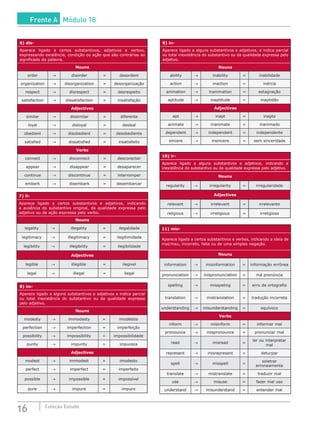
Tempo Verbal VA VP
Present Continuous is recognizing is being recognized
Simple Present recognizes is recognized
Simple Past recognized was recognized
Past Continuous was recognizing was being recognized
Present Perfect has recognized has been recognized
Past Perfect had recognized had been recognized
Simple Future will recognize will be recognized
Conditional Simple would recognize would be recognized
Conditional Perfect
would have
recognized
would have been
recognized
Também podemos formar a voz passiva com verbos
modais, usando a seguinte estrutura:
Structure
modal verb + auxiliary verb (to be) +
main verb (past participle)
Exemplos:
–	 The girls should clean the house today. (VA)
	 The house should be cleaned (by the girls) today. (VP)
–	They ought to fix the gate. (VA)
	 The gate ought to be fixed. (VP)
Note que, com verbos transitivos diretos e indiretos, temos
duas maneiras de formar a passiva.
Exemplos:
–	He gave her a gift. (VA)
	She was given a gift. (VP1)
	 A gift was given to her. (VP2)
–	You sent them a letter. (VA)
	They were sent a letter. (VP1)
	 A letter was sent to them. (VP2)
The Passive Voice 17 A
4 Coleção Estudo
Com os verbos intransitivos preposicionados, a preposição
geralmente finaliza a passiva (quando o agente é omitido).
Exemplos:
–	The babysitter is taking care of the baby. (VA)
	 The baby is being taken care of (by the babysitter). (VP)
–	The police looked for the thief. (VA)
	 The thief was looked for (by the police). (VP)
SXC
CHECK IT OUTC
O past participle é uma forma verbal da
língua inglesa que corresponde ao particípio do
verbo, em português. Ela também é chamada de
“ed form”, porque é formada pela adição de -d ou -ed
à forma base dos verbos regulares. No entanto,
é bom lembrar que, no caso dos irregulares,
o particípio assume formas diferentes para cada verbo.
Por isso, sempre tenha uma tabela de verbos e um
bom dicionário em mãos!
O past participle pode exercer três funções:
-	 Ser adjetivo de frases.
	 He had a broken heart.
	 You can consider it a finished work.
-	 Compor o tempo verbal Present Perfect.
	 I have done that before.
	 You have seen it before.
-	 Compor a voz passiva.
	 The book was sold to Sarah.
	 The beer was drunk by the grown-ups.
CONSOLIDATION
01.	 CHANGE the following sentences from the active to the
passive voice. Do NOT change the tense.
A)	 Mary played that violin.
	_______________________________________________
B)	 A hurricane destroyed that city.
	_______________________________________________
C)	 The students enjoyed the seminar very much.
	_______________________________________________
D)	 John took that magazine from the library.
	_______________________________________________
E)	 Tedd will park that car.
	_______________________________________________
02.	(FUVEST-SP/Adaptado) REESCREVA na voz ativa ou
passiva, conforme o caso:
A)	 His work has catalyzed revolutions.
	 _______________________________________________
B)	 The world’s tribes are being absorbed into modern
civilization.
	 _______________________________________________
C)	 They were thought to be thieves.
	 _______________________________________________
D)	 The letter will be kept in secret.
	 _______________________________________________
PROPOSED EXERCISES
01.	(CESCEA-SP) The money _________ by an unknown
person.
A)	was stolen					D)	has stolen
B)	stolen						E)	were
C)	 have been stolen
02.	 (ITA-SP) He _________ to bed as soon as he got to the
hospital, wasn’t he?
A)	put							D)	was put
B)	was putting				E)	puts
C)	 will put	
03.	(OSEC-SP) A wonderful house ____________ by him
yesterday.
A)	 have been sold			 D)	 has been sold
B)	 has be sold				 E)	 has sold
C)	 was sold
04.	(CESCEM-SP) He is ______________ to the doctor.
A)	being taken				D)	taking
B)	being taking				E)	been taken
C)	took
05.	 (FAAP-SP) Great discoveries ______________ in this
country.
A)	is							D)	were been made
B)	was						E)	have been made
C)	 was been made
06.	 (Mackenzie-SP) A voz passiva de “Somebody must send
me the new books” é:
A)	 The new books would be sent to me.
B)	 The new books must be sent by somebody.
C)	 I must sent the new books.
D)	 The new books must be sent to me.
E)	 I will sent the new books.
Frente A Módulo 17
LÍNGUAINGLESA
5Editora Bernoulli
07.	 (Mackenzie-SP) Choose the CORRECT alternative.
Change the following sentence to the passive voice: “You
don’t need to wind this wonderful watch.”
A)	 This wonderful watch isn’t needed to be wind.
B)	 This wonderful watch doesn’t need to be winded.
C)	 This wonderful watch doesn’t need to be wound.
D)	 This wonderful watch don’t need to be wounded.
E)	 You don’t need to be wounded by this wonderful
watch.
08.	 (FMU/FIAM-SP) A forma passiva de “Nobody beat the
record of this race” é:
A)	 The record of this race wasn’t beaten.
B)	 The record of this race was beat by nobody.
C)	 The record of this race was beaten by nobody.
D)	 Nobody is beat by the record of this race.
E)	 Nobody was beat the record of this race.
09.	(OSEC-SP) Procure a sentença que esteja na voz ativa e
identifique a alternativa correspondente na voz passiva.
It has been estimated that there are now fewer than
2,000 Blue Whales in the Antarctic. They should ban
whale-hunting.
A)	 Blue Whales have been estimated fewer than 2,000.
B)	 In the Antarctic, Blue Whales would be banned.
C)	 Whale-hunting is banned in the Antarctic.
D)	 Something has been estimated and banned.
E)	 Whale-hunting should be banned.
10.	 (UFPI) Assinale a voz passiva de “Nobody had punished
the boy”.
A)	 The boy was not punished.
B)	 The boy had punished nobody.
C)	 The boy had not been punished by nobody.
D)	 The boy nobody had punished.
E)	 The boy had not been punished.
11.	 (FESVV-ES) The passive voice of “That fellow is typing
my letter” is:
A)	 My letter is typed by that fellow.
B)	 My letter is being typing by that fellow.
C)	 My letter is being typed by that fellow.
D)	 My letter was being typed by that fellow.
E)	 My letter was being typing by that fellow.
12.	 (Cesgranrio / Adaptado) Mark the sentence below which
is NOT in the passive voice:
A)	 [...] a revolutionary telephone system was unveiled.
B)	 A sophisticated computer was programmed [...]
C)	 It was instructed to translate “out of sight, out of
mind” [...]
D)	The Russian translation was then fed into the
computer [...]
E)	 [...] a computer will invariably have difficulty in
making sense of it.
13.	 (UFV-MG–2010) The passive structure “[…] the Western
science press has been filled with articles […]” can be
rewritten in the active voice as:
A)	 Articles have filled the Western science press.
B)	 Articles are being filled by the Western science press.
C)	 Articles are filling the Western science press.
D)	 Articles have been filling the Western science press.
TEXT I
UFTM-MG
Bone marrow cells regenerate
heart in Brazil test
		Rio de Janeiro, Brazil (Reuters) – Infusing patients with
bone marrow cells can reinvigorate their dying hearts
and grow tiny new arteries and heart muscle tissue,
a treatment that may one day make heart transplant
5	 unnecessary, Brazilian researchers said on Friday.
Dr. Hans Fernando Dohmann, coordinator of the research
carried out at the Pro-Cardiac Hospital in Rio de Janeiro,
told Reuters four patients out of the five studied no
longer needed transplants after being treated with stem
10	 cells. “It was the first time we saw stem cells actually
generate new arterioles, although we have indirectly
observed that before via tests. That eliminated the need
for transplants in four patients who had indisputable
transplant indications,” he said. The experiment, to be
15	 detailed to a weekend meeting of heart researchers and
submitted to the journal Circulation, adds to a growing
body of research that suggests such treatments can
someday avoid the need for many transplants.
		 When one patient died of a stroke after 11 months of
20	 treatment, Dohmann’s team was able to do an autopsy
and actually look at what had happened to his heart. They
could see the tiny new arteries in the treated area and
also saw what looked like new muscle tissue. “This is the
first documented development of cardiac muscle tissue
25	 in humans… while the accepted concept is that cardiac
muscle cells, just like nerve cells, do not regenerate”,
Dohmann said. He said his team would continue testing
other patients. “But this one leaves us quite convinced,
as we have real proof that is a human heart,” he said.
30		 Dohmann’s team treated 14 patients with bone marrow
cells between December 2001 and late 2003. Seven
other patients in the control group were treated with
conventional methods, and doctors said their recovery
was not as good. During the period, two deaths occurred
The Passive Voice
6 Coleção Estudo
35	 in the stem cell group and one death in the smaller control
group, which did not receive the stem cell treatment.
The research was carried out jointly with Texas Heart
Institute, which designed the stem cell injector, and with
the Rio de Janeiro Federal University. Bone marrow is a
40	 rich source of adult stem cells, which are blood cells that
retain the capacity to grow into a range of cells including
white blood cells, blood vessel cells and heart cells.
REUTERS. Sep. 24, 2004. Available at: <http://www.reuters.com>.
01.	 A passagem do primeiro parágrafo –”[...] four patients
out of the five studied no longer needed transplants
[...]”– significa, em português:
A)	 Quatro pacientes e mais os cinco estudados não
precisam mais de transplante.
B)	 Quatro pacientes, fora os outros cinco estudados,
podem adiar o transplante.
C)	 Quatro pacientes em cinco estudados não precisaram
mais de transplante.
D)	 40% dos pacientes estudados podem não precisar de
transplante.
E)	 Um paciente não precisa mais fazer o transplante.
02.	 A passagem do último parágrafo do texto – [...] which are
blood cells that retain the capacity to grow into a range
of cells [...]
A)	 define medula óssea.
B)	 enumera tipos de células sanguíneas.
C)	 explica o que são células-tronco.
D)	 generaliza tipos de células sanguíneas.
E)	 exemplifica um tipo de célula-tronco.
03.	 Segundo as informações fornecidas no texto:
A)	 O tratamento com células-tronco é perigoso, pois
morreram mais pacientes deste grupo do que do
grupo controle.
B)	 A autópsia do paciente que morreu após 11 meses
de tratamento com células-tronco forneceu a prova
da eficácia do tratamento.
C)	 Os pacientes que receberam tratamento tradicional
apresentaram resultados melhores do que os do grupo
controle.
D)	 As células-tronco são retiradas de pequenas artérias
que se encontram na medula e nos músculos de
adultos.
E)	 O experimento do Dr. Dohmann apresentou resultados
melhores que os dos testes indiretos em laboratório.
04.	 Na frase do primeiro parágrafo do texto – [...] although
we have indirectly observed that before via tests. – a
palavra although introduz uma ideia de
A)	ressalva 						D)	alternativa
B)	consequência 					E)	contradição
C)	adição
05.	 O experimento mencionado no texto indica que
A)	 o tecido do músculo cardíaco pode ser melhor irrigado
por células da medula óssea.
B)	 novas artérias não diminuem os riscos do transplante.
C)	 muitas pesquisas futuras serão necessárias para
verificar os dados obtidos.
D)	 a regeneração de células-tronco é possível.
E)	 futuramente os transplantes cardíacos poderão ser
evitados.
06.	 Uma ideia preponderante questionada pelo estudo do
Dr. Hans Dohmann é a de que
A)	 as células nervosas e as do músculo cardíaco não se
regeneram.
B)	 as células nervosas não se propagam, mas as
cardíacas se regeneram.
C)	 há um preconceito em relação ao uso de terapias
genéticas na cardiologia.
D)	 as células-tronco atuam em células musculares, mas
não nas nervosas.
E)	 a vida das células nervosas é mais longa que a das
células musculares.
07.	 Durante o período de dezembro de 2001 até o fim de
2003, a equipe de Dohmann
A)	 cuidou de 14 pacientes com problemas cardíacos e
de medula óssea.
B)	 não aplicou o tratamento com células-tronco ao grupo
controle.
C)	 percebeu que 7 dos 14 pacientes não desenvolveram
cardiopatias.
D)	 observou 21 pacientes, sendo que 14 destes foram
tratados com métodos convencionais.
E)	 constatou que 7 dos 14 pacientes não tiveram uma
boa recuperação.
08.	 A pesquisa mencionada no texto
A)	 foi financiada pelo Texas Heart Institute.
B)	 foi acompanhada pelo jornal médico Circulation e
divulgada pela Reuters.
C)	 usou verbas federais para compra de equipamentos
médicos.
D)	 recrutou pacientes por meio da Universidade Federal
do Rio de Janeiro.
E)	 foi realizada no Hospital Pró-Cardíaco no Rio de
Janeiro.
09.	 O tratamento coordenado pelo Dr. Dohmann
A)	 usou células ósseas para tratar de problemas
cardíacos.
B)	 foi testado em pacientes que haviam feito transplante
cardíaco.
C)	 provocou a morte de apenas um paciente, 11 meses
após o transplante.
D)	 utilizou células-tronco provenientes de medula óssea.
E)	 desenvolveu as fibras musculares do corpo, inclusive
do coração.
Frente A Módulo 17
LÍNGUAINGLESA
7Editora Bernoulli
TEXT II
Milton Campos-MG–2009
The Eiffel Tower
		 The Eiffel Tower is the most famous of the monuments
in Paris. It was built over 100 years ago by Gustave Eiffel,
and that is how it got its name. He wanted to beat the
world’s record for the highest monument by erecting
a 1,000-foot tower. The highest cathedrals of the time
did not rise even half that height. Gustave Eiffel had a
brilliant idea: his tower would be iron, much lighter than
anything built in stone, and would not risk toppling under
its own weight. It barely took two years to erect – quite
an accomplishment!
		 He fabricated whole portions of it in his workshops,
then fitted the pieces together like a toy construction
set on the banks of the River Seine. It is now the most
visited monument in Europe, but the Eiffel Tower had
plenty of critics in its day. Not everybody liked it. Some
thought it was plain ugly and nastily called it the “Awful
Tower”. There were several plans to tear it down. But it
is still standing, and has even grown.
		 With the television antennas on it, the “Iron Lady”
stands over 320.75 meters high (1,052 feet). Today, it
is not the highest building in the world, even the now-
dwarfed (though very famous) Empire State Building in
New York City beats it, standing 448 meters (1,472 feet).
What difference does it make? Since the year 2000, the
Tower has been shimmering gorgeously, lighting up Paris
nights, more beautiful than ever!
DALY, Jean. Monuments that tell stories of Paris, p. 40.
01.	 The Eiffel Tower is a(an) monument.
A)	irreparable.				
B)	imminent.					
C)	prominent.
D)	 average height.
02.	 “He wanted to beat the world’s record for the highest
monument by erecting a 1,000-foot tower.”
All the alternatives can replace the underlined word,
EXCEPT
A)	constructing.				
B)	rising.						
C)	raising.
D)	 building up.
03.	 Simply one statement is true of “The Eiffel Tower”, which
means that it
A)	 used to be the highest building ever.
B)	 was constructed in the lightest stone.
C)	 was funded by a bank along the River Seine.
D)	 was erected at random.
04.	 All these can be said about Gustave Eiffel, EXCEPT that
A)	 it didn’t take him too long to accomplish such a defiant
goal.
B)	 he has been a model to those who don’t give up before
hardships.
C)	 his unique work has left us a world legacy.
D)	 he didn’t face up to any criticism at his time.
TEXT III
FGV-SP–2011
Restoration drama
1		 The doormen outside the headquarters of Shanghai’s
Municipal Education Commission have a new colleague
these days. On Friday evenings and Saturday mornings
they are joined by a young Mandarin-speaking Israeli,
who keeps an eye on comings and goings. The
ivy-covered compound, built in the 1920s, is also the
home of Ohel Rachel, one of Shanghai’s last surviving
synagogues. This month, for the first time in almost 60
years, it reopened for regular Sabbath services.
2		 That Ohel Rachel was reopened, even though Judaism
is not one of China’s five officially recognised religions,
is one of a number of signs that Shanghai may be
coming to terms with its past. After the Communist
revolution in 1949, much of the city’s history was swept
under the carpet, and its grand old buildings put to new
uses. Some of these buildings had been designated for
protection in recent decades, but the heritage signs
posted on them typically give little detail about their
previous significance.
3		 Ohel Rachel was neglected for decades. Even now, the
2,000-strong Jewish community has been promised regular
access only until October, when the Shanghai World Expo
ends. But Rabbi Shalom Greenberg, who led the campaign
for its reopening, says that the city’s authorities have
indicated unofficially that it will be hard to reverse the
decision. He believes that Shanghai’s economic revival
has made officials more confident in treating its complex
history, and able “to use the past to benefit the future –
even if the past was not so much to their liking.”
The Passive Voice
8 Coleção Estudo
4		 Shanghai’s small Russian Orthodox community has
also, for the first time, received permission to use one of
the pre-war churches built by White Russians. Shanghai’s
former British cathedral, the Holy Trinity, has been
painstakingly renovated by China’s official Protestant
church.
5		 At the north end of the Bund, Shanghai’s famous
waterfront, the area around the original British consulate
has been renovated. Even the buildings’ original names,
such as the Baptist Publication Society Building and the
former headquarters of Britain’s Royal Asiatic Society,
have been reinstated. “This is nothing to do with politics,”
says Zhou Wei, governor of the district which includes
the Bund. “This is about history and culture. This area
is the root of the development of modern Shanghai.”
Mr. hou says that Shanghai is treating the protection of
its distinctive history and culture with new seriousness.
6		 Around the city, a number of signs detailing
long-forgotten street names have been erected.
The Shanghai Corporate Pavilion at the World Expo,
funded by local state enterprises, commissioned a
Pulitzer-prize-winning photographer, Liu Heung Shing,
to compile a book of images of Shanghai’s history, giving
him unprecedented access to the city’s archives.
7		 Yet this more relaxed attitude towards history does
not always beget more vigorous preservation. In some
areas of the city, demolition continues. The demand for
new infrastructure, or simply property, can be more than
enough to trump the appeal of conservation. Parts of the
wartime Jewish “ghetto” area in Hongkou district, for
instance, were recently knocked down. Parts of the past
itself are still off limits too. In Mr. Liu’s book, a number
of historical moments are notably absent, such as the
student protests in Shanghai in 1989. Some history is
still too hard to face.
THE ECONOMIST. May 29th
-Jun. 4th
2010.
01.	 According to the information in the article, Ohel Rachel
MOST likely
A)	 must let Chinese citizens enter its premises as a
condition for being allowed to conduct regular Sabbath
services.
B)	 recently moved to its new headquarters in a building
at Shanghai’s Municipal Education Commission
compound.
C)	 is the oldest synagogue in Shanghai.
D)	 is the only Orthodox Jewish synagogue allowed to
conduct regular Sabbath services in Shanghai.
E)	 was not used as a place for regular Sabbath services
for more than half of its existence.
02.	 According to the information in the article, which of the
following probably BEST explains one important aspect
of the reopening of Ohel Rachel?
A)	 It may indicate that China’s government is ready to
give official recognition to the Jewish religion.
B)	 It will probably lead to a strengthening of diplomatic
and commercial relations between China and Israel.
C)	 It could mean that Shanghai is starting to take an
honest look at its history.
D)	 It could be a sign that Shanghai is finally willing to
recognize the great importance of Judaism in the
development of the city.
E)	 It is a sign that China may finally be willing to examine
honestly the role of various ethnic and religious groups
in its long history.
03.	 According to the information in the article, though
Shanghai is showing interest in protecting its historic
buildings, it has
A)	 concentrated most of its efforts on constructions from
the Communist era.
B)	 ignored many constructions because of their religious
significance.
C)	 done little to help the general public understand why
those buildings are important.
D)	 refused to identify systematically which buildings are
in fact being protected.
E)	 established vague, secretive criteria for judging the
historical significance of certain constructions.
04.	 In paragraph 3, the phrase “[…] the city’s authorities have
indicated unofficially that it will be hard to reverse the
decision” MOST likely refers to which of the following?
A)	 Shanghai’s government has let it be known informally
that Shanghai’s Jewish community will probably be
allowed to continue using Ohel Rachel.
B)	 Unfortunately, Ohel Rachel will probably be demolished
to make way for a new building.
C)	 An agreement with Shanghai’s government means
that Shanghai’s Jewish community will probably have
to vacate Ohel Rachel at the end of October.
D)	 It is highly doubtful that Shanghai’s government will
change its mind and continue to allow Ohel Rachel to
be used for Jewish religious services.
E)	 Shanghai’s government told Rabbi Shalom Greenberg
that the city’s Jewish community will be allowed
regular access to Ohel Rachel only until the end of
the Shanghai World Expo.
Frente A Módulo 17
LÍNGUAINGLESA
9Editora Bernoulli
05.	 In paragraph 5, “This” in the statement “This is nothing
to do with politics” MOST likely refers to the
A)	 Shanghai government’s new religious and cultural
tolerance.
B)	 Shanghai government’s greater confidence, which is
a consequence of the city’s economic revival.
C)	 Shanghai government’s decision to reopen Ohel
Rachel for regular Sabbath services.
D)	 restoration of a section of the north end of Shanghai’s
Bund.
E)	 controversy surrounding the renovation of Shanghai’s
old British consulate, along with many neighboring
buildings.
06.	 With respect to Shanghai’s history, which of the following
is NOT supported by the information in the article?
A)	 At the moment, Ohel Rachel is one of a small group
of Shanghai synagogues that are still in operation.
B)	 After the Communist revolution in 1949, Shanghai
was too poor to study and preserve its architectural
and religious history.
C)	 After the Communist revolution of 1949, Shanghai
deliberately ignored some important aspects of its
multi-cultural, multi-religious history.
D)	 One Jewish leader thinks that Shanghai officials find
certain aspects of their city’s history disagreeable.
E)	 Religious discrimination in Shanghai was directed not
only at the city’s Jewish community, but also at other
groups.
07.	 According to the information in the article, Liu Heung
Shing
A)	 made a book that fails to give a complete picture of
Shanghai’s history.
B)	 made an all-inclusive and prize-winning book of
historical Shanghai images.
C)	 was commissioned by the Shanghai government to
photograph the city’s current, day-to-day reality.
D)	 was the first person ever to enter Shangai’s archives.
E)	 almost abandoned his historical-image project
because of Shanghai government interference.
08.	 According to the information in the article, Shanghai’s
more liberal, more serious approach to its culture and
history
A)	 is supported by the great majority of Shanghai
residents.
B)	 has benefited mainly the city’s Jewish community.
C)	 has received a lot of support from the Russian
Orthodox Church and the British government.
D)	 still must overcome strong political opposition before
it can be implemented.
E)	 has at times been obliged to give way to business and
political interests.
ENEM EXERCISES
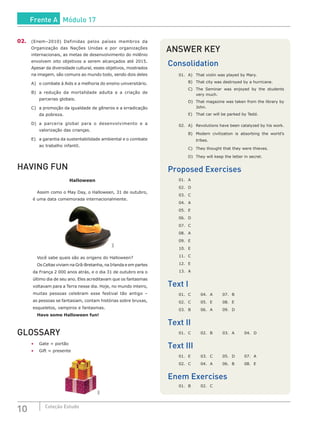
Texto para a questão 01
EditoriadeArte
01.	 The idea implied by the cartoon is that
A)	 the country of Israel is being kicked by people of the
world.
B)	 Israel is the center of attention to many people around
the world.
C)	 Israel is not allowed to play in the World Cup.
D)	 there is no place for Israel in the world.
E)	 the soccer team of Israel wasn’t qualified for the
world cup.
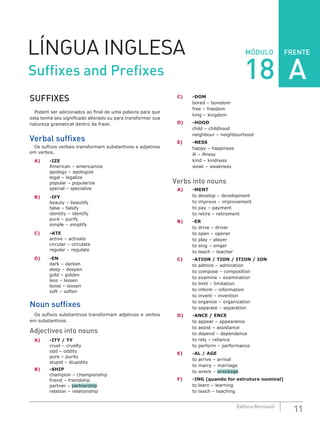
Texto para a questão 02
Available at: <http://www.chris-alexander.co.uk/1191>.
Accessed: July 28, 2010. (Adapted).
The Passive Voice
10 Coleção Estudo
02.	(Enem–2010) Definidas pelos países membros da
Organização das Nações Unidas e por organizações
internacionais, as metas de desenvolvimento do milênio
envolvem oito objetivos a serem alcançados até 2015.
Apesar da diversidade cultural, esses objetivos, mostrados
na imagem, são comuns ao mundo todo, sendo dois deles
A)	 o combate à Aids e a melhoria do ensino universitário.
B)	 a redução da mortalidade adulta e a criação de
parcerias globais.
C)	 a promoção da igualdade de gêneros e a erradicação
da pobreza.
D)	a parceria global para o desenvolvimento e a
valorização das crianças.
E)	 a garantia da sustentabilidade ambiental e o combate
ao trabalho infantil.
HAVING FUN
Halloween
		 Assim como o May Day, o Halloween, 31 de outubro,
é uma data comemorada internacionalmente.
SXC
		 Você sabe quais são as origens do Halloween?
		 Os Celtas viviam na Grã-Bretanha, na Irlanda e em partes
da França 2 000 anos atrás, e o dia 31 de outubro era o
último dia de seu ano. Eles acreditavam que os fantasmas
voltavam para a Terra nesse dia. Hoje, no mundo inteiro,
muitas pessoas celebram esse festival tão antigo –
as pessoas se fantasiam, contam histórias sobre bruxas,
esqueletos, vampiros e fantasmas.
		 Have some Halloween fun!
GLOSSARY
•	 Gate = portão
•	 Gift = presente
SXC
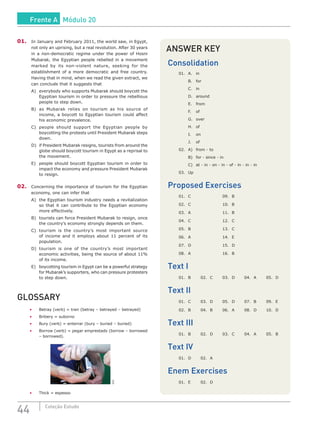
ANSWER KEY
Consolidation
01.	 A)	 That violin was played by Mary.
	 B)	 That city was destroyed by a hurricane.
	 C)	 The Seminar was enjoyed by the students
very much.
	 D)	 That magazine was taken from the library by
John.
	 E)	 That car will be parked by Tedd.
02.	 A)	 Revolutions have been catalyzed by his work.
	 B)	 Modern civilization is absorbing the world’s
tribes.
	 C)	 They thought that they were thieves.
	 D)	 They will keep the letter in secret.
Proposed Exercises
01.	A
02.	D
03.	C
04.	A
05.	E
06.	 D
07.	C
08.	A
09.	E
10.	E
11.	C
12.	E
13.	A
Text I
01.	C	 04.	A	 07.	B
02.	C	 05.	E	 08.	E
03.	 B	 06.	 A	 09.	 D
Text II
01.	C	 02.	B	 03.	A	 04.	D
Text III
01.	E	 03.	C	 05.	D	 07.	A
02.	 C	 04.	 A	 06.	 B	 08.	 E
Enem Exercises
01.	B	 02.	C
Frente A Módulo 17
FRENTE
11Editora Bernoulli
MÓDULOLÍNGUA INGLESA
SUFFIXES
Podem ser adicionados ao final de uma palavra para que
esta tenha seu significado alterado ou para transformar sua
natureza gramatical dentro da frase.
Verbal suffixes
Os sufixos verbais transformam substantivos e adjetivos
em verbos.
A)	-IZE
	 American – americanize
	 apology – apologize
	 legal – legalize
	 popular – popularize
	 special – specialize
B)	-IFY
	 beauty – beautify
	 false – falsify
	 identity – identify
	 pure – purify
	 simple – simplify
C)	-ATE
	 active – activate
	 circular – circulate
	 regular – regulate
D)	-EN
	 dark – darken
	 deep – deepen
	 gold – golden
	 less – lessen
	 loose – loosen
	 soft – soften
Noun suffixes
Os sufixos substantivos transformam adjetivos e verbos
em substantivos.
Adjectives into nouns
A)	 -ITY / TY
	 cruel – cruelty
	 odd – oddity
	 pure – purity
	 stupid – stupidity
B)	-SHIP
	 champion – championship
	 friend – friendship
	 partner – partnership
	 relation – relationship
C)	-DOM
	 bored – boredom
	 free – freedom
	 king – kingdom
D)	-HOOD
	 child – childhood
	 neighbour – neighbourhood
E)	-NESS
	 happy – happiness
	 ill – illness
	 kind – kindness
	 weak – weakness
Verbs into nouns
A)	-MENT
	 to develop – development
	 to improve – improvement
	 to pay – payment
	 to retire – retirement
B)	-ER
	 to drive – driver
	 to open – opener
	 to play – player
	 to sing – singer
	 to teach – teacher
C)	 -ATION / TION / ITION / ION
	 to admire – admiration
	 to compose – composition
	 to examine – examination
	 to limit – limitation
	 to inform – information
	 to invent – invention
	 to organize – organization
	 to separate – separation
D)	 -ANCE / ENCE
	 to appear – appearance
	 to assist – assistance
	 to depend – dependence
	 to rely – reliance
	 to perform – performance
E)	 -AL / AGE
	 to arrive – arrival
	 to marry – marriage
	 to wreck – wreckage
F)	 -ING (quando for estrutura nominal)
	 to learn – learning
	 to teach – teaching
Suffixes and Prefixes 18 A
12 Coleção Estudo
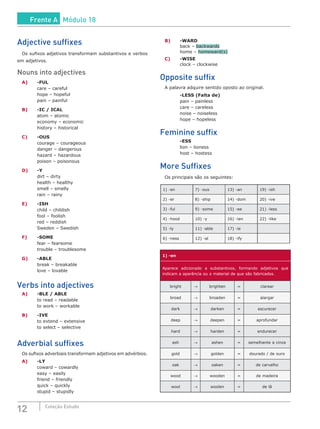
Adjective suffixes
Os sufixos adjetivos transformam substantivos e verbos
em adjetivos.
Nouns into adjectives
A)	 -FUL
	 care – careful
	 hope – hopeful
	 pain – painful
B)	 -IC / ICAL
	 atom – atomic
	 economy – economic
	 history – historical
C)	 -OUS
	 courage – courageous
	 danger – dangerous
	 hazard – hazardous
	 poison – poisonous
D)	 -Y
	 dirt – dirty
	 health – healthy
	 smell – smelly
	 rain – rainy
E)	 -ISH
	 child – childish
	 fool – foolish
	 red – reddish
	 Sweden – Swedish
F)	 -SOME
	 fear – fearsome
	 trouble – troublesome
G)	 -ABLE
	 break – breakable
	 love – lovable
Verbs into adjectives
A)	 -BLE / ABLE
	 to read – readable
	 to work – workable
B)	 -IVE
	 to extend – extensive
	 to select – selective
Adverbial suffixes
Os sufixos adverbiais transformam adjetivos em advérbios.
A)	 -LY
	 coward – cowardly
	 easy – easily
	 friend – friendly
	 quick – quickly
	 stupid – stupidly
B)	 -WARD
	 back – backwards
	 home – homeward(s)
C)	 -WISE
	 clock – clockwise
Opposite suffix
A palavra adquire sentido oposto ao original.
	 -LESS (Falta de)
	 pain – painless
	 care – careless
	 noise – noiseless
	 hope – hopeless
Feminine suffix
	 -ESS
	 lion – lioness
	 host – hostess
More Suffixes
Os principais são os seguintes:
1) -en 7) -ous 13) -an 19) -ish
2) -er 8) -ship 14) -dom 20) -ive
3) -ful 9) -some 15) -ee 21) -less
4) -hood 10) -y 16) -ian 22) -like
5) -ly 11) -able 17) -ie
6) -ness 12) -al 18) -ify
1) -en
Aparece adicionado a substantivos, formando adjetivos que
indicam a aparência ou o material de que são fabricados.
bright → brighten = clarear
broad → broaden = alargar
dark → darken = escurecer
deep → deepen = aprofundar
hard → harden = endurecer
ash → ashen = semelhante a cinza
gold → golden = dourado / de ouro
oak → oaken = de carvalho
wood → wooden = de madeira
wool → woolen = de lã
Frente A Módulo 18
LÍNGUAINGLESA
13Editora Bernoulli
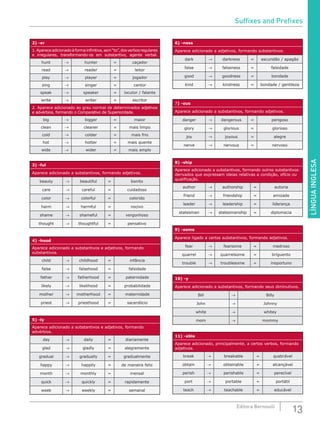
2) -er
1.Apareceadicionadoàformainfinitiva,sem“to”,dosverbosregulares
e irregulares, transformando-os em substantivo, agente verbal.
hunt → hunter = caçador
read → reader = leitor
play → player = jogador
sing → singer = cantor
speak → speaker = locutor / falante
write → writer = escritor
2. Aparece adicionado ao grau normal de determinados adjetivos
e advérbios, formando o Comparativo de Superioridade.
big → bigger = maior
clean → cleaner = mais limpo
cold → colder = mais frio
hot → hotter = mais quente
wide → wider = mais amplo
3) -ful
Aparece adicionado a substantivos, formando adjetivos.
beauty → beautiful = bonito
care → careful = cuidadoso
color → colorful = colorido
harm → harmful = nocivo
shame → shameful = vergonhoso
thought → thoughtful = pensativo
4) -hood
Aparece adicionado a substantivos e adjetivos, formando
substantivos.
child → childhood = infância
false → falsehood = falsidade
father → fatherhood = paternidade
likely → likelihood = probabilidade
mother → motherhood = maternidade
priest → priesthood = sacerdócio
5) -ly
Aparece adicionado a substantivos e adjetivos, formando
advérbios.
day → daily = diariamente
glad → gladly = alegremente
gradual → gradually = gradualmente
happy → happily = de maneira feliz
month → monthly = mensal
quick → quickly = rapidamente
week → weekly = semanal
6) -ness
Aparece adicionado a adjetivos, formando substantivos.
dark → darkness = escuridão / apagão
false → falseness = falsidade
good → goodness = bondade
kind → kindness = bondade / gentileza
7) -ous
Aparece adicionado a substantivos, formando adjetivos.
danger → dangerous = perigoso
glory → glorious = glorioso
joy → joyous = alegre
nerve → nervous = nervoso
8) -ship
Aparece adicionado a substantivos, formando outros substantivos
derivados que expressam ideias relativas a condição, ofício ou
qualificação.
author → authorship = autoria
friend → friendship = amizade
leader → leadership = liderança
statesman → statesmanship = diplomacia
9) -some
Aparece ligado a certos substantivos, formando adjetivos.
fear → fearsome = medroso
quarrel → quarrelsome = briguento
trouble → troublesome = inoportuno
10) -y
Aparece adicionado a substantivos, formando seus diminutivos.
Bill → Billy
John → Johnny
white → whitey
mom → mommy
11) -able
Aparece adicionado, principalmente, a certos verbos, formando
adjetivos.
break → breakable = quebrável
obtain → obtainable = alcançável
perish → perishable = perecível
port → portable = portátil
teach → teachable = educável
Suffixes and Prefixes
14 Coleção Estudo
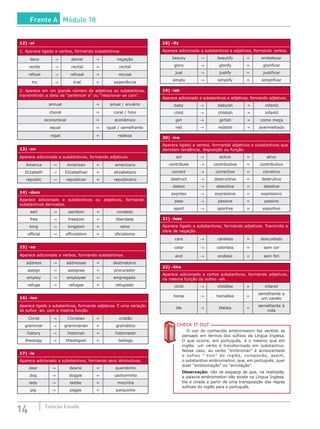
12) -al
1. Aparece ligado a verbos, formando substantivos.
deny → denial = negação
recite → recital = recital
refuse → refusal = recusa
try → trial = experiência
2. Aparece em um grande número de adjetivos ou substantivos,
transmitindo a ideia de “pertencer a” ou “relacionar-se com”.
annual = anual / anuário
choral = coral / hino
economical = econômico
equal = igual / semelhante
regal = realeza
13) -an
Aparece adicionado a substantivos, formando adjetivos.
America → American = americano
Elizabeth → Elizabethan = elizabetano
republic → republican = republicano
14) -dom
Aparece adicionado a substantivos ou adjetivos, formando
substantivos derivados.
earl → earldom = condado
free → freedom = liberdade
king → kingdom = reino
official → officialdom = oficialismo
15) -ee
Aparece adicionado a verbos, formando substantivos.
address → addressee = destinatário
assign → assignee = procurador
employ → employee = empregado
refuge → refugee = refugiado
16) -ian
Aparece ligado a substantivos, formando adjetivos. É uma variação
do sufixo -an, com a mesma função.
Christ → Christian = cristão
grammar → grammarian = gramático
history → historian = historiador
theology → theologian = teólogo
17) -ie
Aparece adicionado a substantivos, formando seus diminutivos.
dear → dearie = queridinho
dog → doggie = cachorrinho
lady → laddie = mocinha
pig → piggie = porquinho
18) -ify
Aparece adicionado a substantivos e adjetivos, formando verbos.
beauty → beautify = embelezar
glory → glorify = glorificar
just → justify = justificar
simply → simplify = simplificar
19) -ish
Aparece adicionado a substantivos e adjetivos, formando adjetivos.
baby → babyish = infantil
child → childish = infantil
girl → girlish = como moça
red → reddish = avermelhado
20) -ive
Aparece ligado a verbos, formando adjetivos e substantivos que
denotam tendência, disposição ou função.
act → active = ativo
contribute → contributive = contributivo
correct → corrective = corretivo
destruct → destructive = destrutivo
detect → detective = detetive
express → expressive = expressivo
pass → passive = passivo
sport → sportive = esportivo
21) -less
Aparece ligado a substantivos, formando adjetivos. Transmite a
ideia de negação.
care → careless = descuidado
color → colorless = sem cor
end → endless = sem fim
22) -like
Aparece adicionado a certos substantivos, formando adjetivos,
na mesma função do sufixo -ish.
child → childlike = infantil
horse → horselike =
semelhante a
um cavalo
life → lifelike =
semelhante à
vida
CHECK IT OUTC
O uso do conhecido embromation faz sentido se
pensado em termos dos sufixos da Língua Inglesa.
O que ocorre, em português, é o mesmo que em
inglês: um verbo é transformado em substantivo.
Nesse caso, ao verbo “embromar” é acrescentado
o sufixo “-tion” do inglês, compondo, assim,
o substantivo embromation, que, em português, quer
dizer “embromação” ou “enrolação”.
Observação: não se esqueça de que, na realidade,
a palavra embromation não existe na Língua Inglesa.
Ela é criada a partir de uma transposição das regras
sufixais do inglês para o português.
Frente A Módulo 18
LÍNGUAINGLESA
15Editora Bernoulli
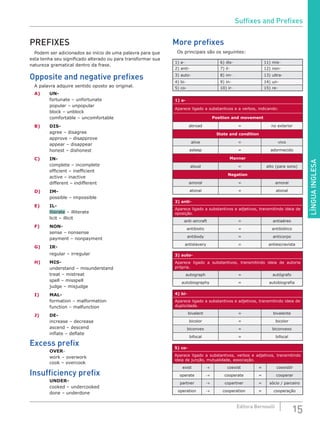
PREFIXES
Podem ser adicionados ao início de uma palavra para que
esta tenha seu significado alterado ou para transformar sua
natureza gramatical dentro da frase.
Opposite and negative prefixes
A palavra adquire sentido oposto ao original.
A)	UN-
	 fortunate – unfortunate
	 popular – unpopular
	 block – unblock
	 comfortable – uncomfortable
B)	DIS-
	 agree – disagree	
	 approve – disapprove
	 appear – disappear
	 honest – dishonest
C)	IN-
	 complete – incomplete
	 efficient – inefficient
	 active – inactive
	 different – indifferent
D)	IM-
	 possible – impossible
E)	IL-
	 literate – illiterate
	 licit – illicit
F)	 NON-
	 sense – nonsense
	 payment – nonpayment
G)	IR-
	 regular – irregular
H)	MIS-
	 understand – misunderstand
	 treat – mistreat	
	 spell – misspell
	 judge – misjudge
I)	MAL-
	 formation – malformation
	 function – malfunction
J)	DE-
	 increase – decrease
	 ascend – descend
	 inflate – deflate
Excess prefix
	 OVER-
	 work – overwork
	 cook – overcook
Insufficiency prefix
	 UNDER-
	 cooked – undercooked
	 done – underdone
More prefixes
Os principais são os seguintes:
1) a- 6) dis- 11) mis-
2) anti- 7) il- 12) non-
3) auto- 8) im- 13) ultra-
4) bi- 9) in- 14) un-
5) co- 10) ir- 15) re-
1) a-
Aparece ligado a substantivos e a verbos, indicando:
Position and movement
abroad = no exterior
State and condition
alive = vivo
asleep = adormecido
Manner
aloud = alto (para sons)
Negation
amoral = amoral
atonal = atonal
2) anti-
Aparece ligado a substantivos e adjetivos, transmitindo ideia de
oposição.
anti-aircraft = antiaéreo
antibiotic = antibiótico
antibody = anticorpo
antislavery = antiescravista
3) auto-
Aparece ligado a substantivos, transmitindo ideia de autoria
própria.
autograph = autógrafo
autobiography = autobiografia
4) bi-
Aparece ligado a substantivos e adjetivos, transmitindo ideia de
duplicidade.
bivalent = bivalente
bicolor = bicolor
biconvex = biconvexo
bifocal = bifocal
5) co-
Aparece ligado a substantivos, verbos e adjetivos, transmitindo
ideia de junção, mutualidade, associação.
exist → coexist = coexistir
operate → cooperate = cooperar
partner → copartner = sócio / parceiro
operation → cooperation = cooperação
Suffixes and Prefixes
16 Coleção Estudo
6) dis-
Aparece ligado a certos substantivos, adjetivos e verbos,
expressando existência, condição ou ação que são contrárias ao
significado da palavra.
Nouns
order → disorder = desordem
organization → disorganization = desorganização
respect → disrespect = desrespeito
satisfaction → dissatisfaction = insatisfação
Adjectives
similar → dissimilar = diferente
loyal → disloyal = desleal
obedient → disobedient = desobediente
satisfied → dissatisfied = insatisfeito
Verbs
connect → disconnect = desconectar
appear → disappear = desaparecer
continue → discontinue = interromper
embark → disembark = desembarcar
7) il-
Aparece ligado a certos substantivos e adjetivos, indicando
a ausência do substantivo original, da qualidade expressa pelo
adjetivo ou da ação expressa pelo verbo.
Nouns
legality → illegality = ilegalidade
legitimacy → illegitimacy = ilegitimidade
legibility → illegibility = ilegibilidade
Adjectives
legible → illegible = ilegível
legal → illegal = ilegal
8) im-
Aparece ligado a alguns substantivos e adjetivos e indica parcial
ou total inexistência do substantivo ou da qualidade expressa
pelo adjetivo.
Nouns
modesty → immodesty = imodéstia
perfection → imperfection = imperfeição
possibility → impossibility = impossibilidade
purity → impurity = impureza
Adjectives
modest → immodest = imodesto
perfect → imperfect = imperfeito
possible → impossible = impossível
pure → impure = impuro
9) in-
Aparece ligado a alguns substantivos e adjetivos, e indica parcial
ou total inexistência do substantivo ou da qualidade expressa pelo
adjetivo.
Nouns
ability → inability = inabilidade
action → inaction = inércia
animation → inanimation = estagnação
aptitude → inaptitude = inaptidão
Adjectives
apt → inapt = inapto
animate → inanimate = inanimado
dependent → independent = independente
sincere → insincere = sem sinceridade
10) ir-
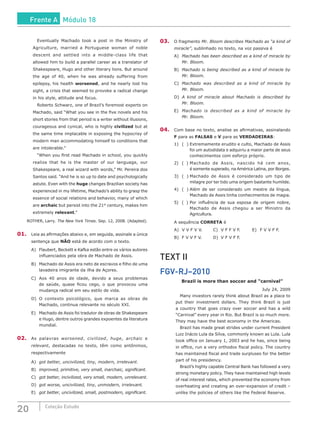
Aparece ligado a alguns substantivos e adjetivos, indicando a
inexistência do substantivo ou da qualidade expressa pelo adjetivo.
Nouns
regularity → irregularity = irregularidade
Adjectives
relevant → irrelevant = irrelevante
religious → irreligious = irreligioso
11) mis-
Aparece ligado a certos substantivos e verbos, indicando a ideia de
mal/mau, incorreto, falta ou de uma simples negação.
Nouns
information → misinformation = informação errônea
pronunciation → mispronunciation = má pronúncia
spelling → misspeling = erro de ortografia
translation → mistranslation = tradução incorreta
understanding → misunderstanding = equívoco
Verbs
inform → misinform = informar mal
pronounce → mispronounce = pronunciar mal
read → misread =
ler ou interpretar
mal
represent → misrepresent = deturpar
spell → misspell =
soletrar
erroneamente
translate → mistranslate = traduzir mal
use → misuse = fazer mal uso
understand → misunderstand = entender mal
Frente A Módulo 18
LÍNGUAINGLESA
17Editora Bernoulli
12) non-
Aparece ligado a certos substantivos ou adjetivos e indica a
inexistência do substantivo ou da qualidade expressa pelo
adjetivo.
Nouns
believer → nonbeliever = incrédulo
discrimination → nondiscrimination =
não
discriminação
fiction → nonfiction = não ficção
intervention → nonintervention = não intervenção
member → nonmember =
que não é
membro
smoker → nonsmoker = não fumante
Adjectives
aggressive → nonaggressive = não agressivo
alcoholic → nonalcoholic = não alcoólico
American → non American =
que não é
americano
Brazilian → non Brazilian =
que não é
brasileiro
breakable → nonbreakable = inquebrável
combustible → noncombustible = incombustível
irritating → nonirritating = que não irrita
Jewish → non Jewish = que não é judeu
permanent → nonpermanent =
que não é
permanente
professional → nonprofessional =
que não é
profissional
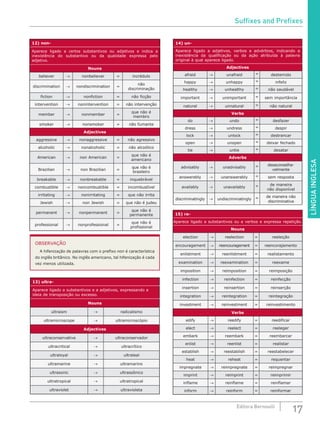
OBSERVAÇÃO
A hifenização de palavras com o prefixo non é característica
do inglês britânico. No inglês americano, tal hifenização é cada
vez menos utilizada.
13) ultra-
Aparece ligado a substantivos e a adjetivos, expressando a
ideia de transposição ou excesso.
Nouns
ultraism → radicalismo
ultramicroscope → ultramicroscópio
Adjectives
ultraconservative → ultraconservador
ultracritical → ultracrítico
ultraloyal → ultraleal
ultramarine → ultramarino
ultrasonic → ultrassônico
ultratropical → ultratropical
ultraviolet → ultravioleta
14) un-
Aparece ligado a adjetivos, verbos e advérbios, indicando a
inexistência da qualificação ou da ação atribuída à palavra
original à qual aparece ligado.
Adjectives
afraid → unafraid = destemido
happy → unhappy = infeliz
healthy → unhealthy = não saudável
important → unimportant = sem importância
natural → unnatural = não natural
Verbs
do → undo = desfazer
dress → undress = despir
lock → unlock = destrancar
open → unopen = deixar fechado
tie → untie = desatar
Adverbs
advisably → unadvisably = desaconselha-
velmente
answerably → unanswerably = sem resposta
availably → unavailably = de maneira
não disponível
discriminatingly → undiscriminatingly = de maneira não
discriminativa
15) re-
Aparece ligado a substantivos ou a verbos e expressa repetição.
Nouns
election → reelection = reeleição
encouragement → reencouragement = reencorajamento
enlistment → reenlistment = realistamento
examination → reexamination = reexame
imposition → reimposition = reimposição
infection → reinfection = reinfecção
insertion → reinsertion = reinserção
integration → reintegration = reintegração
investment → reinvestment = reinvestimento
Verbs
edify → reedify = reedificar
elect → reelect = reeleger
embark → reembark = reembarcar
enlist → reenlist = realistar
establish → reestablish = reestabelecer
heat → reheat = requentar
impregnate → reimpregnate = reimpregnar
imprint → reimprint = reimprimir
inflame → reinflame = reinflamar
inform → reinform = reinformar
Suffixes and Prefixes
18 Coleção Estudo
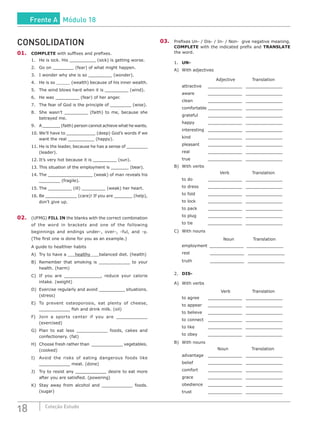
CONSOLIDATION
01.	 COMPLETE with suffixes and prefixes.
1.	 He is sick. His __________ (sick) is getting worse.
2.	 Go on ________ (fear) of what might happen.
3.	 I wonder why she is so _________ (wonder).
4.	 He is so (wealth) because of his inner wealth.
5.	 The wind blows hard when it is _________ (wind).
6.	 He was _________ (fear) of her anger.
7.	 The fear of God is the principle of ________ (wise).
8.	 She wasn’t _________ (faith) to me, because she
betrayed me.
9.	 A _______ (faith) person cannot achieve what he wants.
10.	We’ll have to ___________ (deep) God’s words if we
want the real __________ (happy).
11.	He is the leader, because he has a sense of ________
(leader).
12.	It’s very hot because it is _________ (sun).
13.	This situation of the employment is _______ (bear).
14.	The _________________ (weak) of man reveals his
________ (fragile).
15.	The _________ (ill) _________ (weak) her heart.
16.	Be ____________ (care)! If you are _______ (help),
don’t give up.
02.	 (UFMG) FILL IN the blanks with the correct combination
of the word in brackets and one of the following
beginnings and endings under-, over-, -ful, and -y.
(The first one is done for you as an example.)
A guide to healthier habits
A)	 Try to have a healthy balanced diet. (health)
B)	 Remember that smoking is ____________ to your
health. (harm)
C)	 If you are ______________, reduce your calorie
intake. (weight)
D)	 Exercise regularly and avoid ____________ situations.
(stress)
E)	 To prevent osteoporosis, eat plenty of cheese,
____________ fish and drink milk. (oil)
F)	 Join a sports center if you are ____________
(exercised)
G)	Plan to eat less ____________ foods, cakes and
confectionery. (fat)
H)	 Choose fresh rather than ____________ vegetables.
(cooked)
I)	 Avoid the risks of eating dangerous foods like
____________ meat. (done)
J)	 Try to resist any ____________ desire to eat more
after you are satisfied. (powering)
K)	 Stay away from alcohol and ____________ foods.
(sugar)
03.	 Prefixes Un- / Dis- / In- / Non- give negative meaning.
COMPLETE with the indicated prefix and TRANSLATE
the word.
1.	 UN-
A)	 With adjectives
					 Adjective			Translation
	 attractive _____________ ______________
	 aware	 _____________ ______________
	 clean	 _____________ ______________
	 comfortable _____________ ______________
	 grateful	 _____________ ______________
	 happy	 _____________ ______________
	 interesting _____________ ______________
	 kind	 _____________ ______________
	 pleasant _____________ ______________
	 real	 _____________ ______________
	 true	 _____________ ______________
B)	 With verbs
				 Verb			 Translation
	 to do	 _____________ ______________
	 to dress	 _____________ ______________
	 to fold	 _____________ ______________
	 to lock	 _____________ ______________
	 to pack	 _____________ ______________
	 to plug	 _____________ ______________
	 to tie	 _____________ ______________
C)	 With nouns
					 Noun		 Translation
	 employment _____________ ______________
	 rest	 _____________ ______________
	 truth	 _____________ ______________
2.	 DIS-
A)	 With verbs
						Verb 			Translation
	 to agree	 _____________ ______________
	 to appear _____________ ______________
	 to believe _____________ ______________
	 to connect _____________ ______________
	 to like	 _____________ ______________
	 to obey	 _____________ ______________
B)	 With nouns
					 Noun			 Translation
	 advantage _____________ ______________
	 belief	 _____________ ______________
	 comfort	 _____________ ______________
	 grace	 _____________ ______________
	 obedience _____________ ______________
	 trust	 _____________ ______________
Frente A Módulo 18
LÍNGUAINGLESA
19Editora Bernoulli
3.	 IN-
A)	 With adjectives
					Adjective 			Translation
	 capable	 _____________ ______________
	 complete _____________ ______________
	 convenient _____________ ______________
	 human	 _____________ ______________
	 organic	 _____________ ______________
	 sane	 _____________ ______________
	 secure	 _____________ ______________
B)	 We use im (not in) before m, p and b
	 Adjective	 Translation
	 mature	 _____________ ______________
	 patient	 _____________ ______________
	 balanced _____________ ______________
4.	 NON-	
A)	 With adjectives and nouns
			 	Adjective / Noun		Translation
	 alcoholic _____________ ______________
	 poisonous _____________ ______________
	 smoking	 _____________ ______________
	 stop	 _____________ ______________
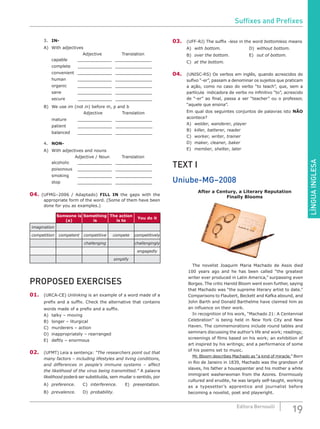
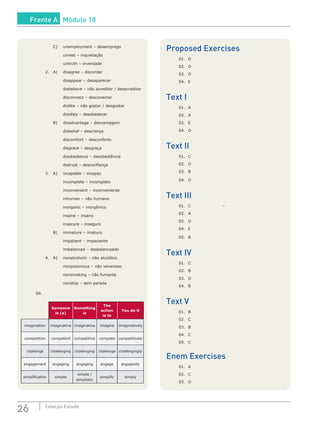
04. (UFMG–2006 / Adaptado) FILL IN the gaps with the
appropriate form of the word. (Some of them have been
done for you as examples.)
Someone is
(a)
Something
is
The action
is to
You do it
imagination
competition competent competitive compete competitively
challenging challengingly
engagedly
simplify
PROPOSED EXERCISES
01.	(URCA-CE) Unlinking is an example of a word made of a
prefix and a suffix. Check the alternative that contains
words made of a prefix and a suffix.
A)	 talky – moving
B)	 longer – liturgical
C)	 murderers – action
D)	 inappropriately – rearranged
E)	 deftly – enormous
02.	 (UFMT) Leia a sentença: “The researchers point out that
many factors – including lifestyles and living conditions,
and differences in people’s immune systems – affect
the likelihood of the virus being transmitted.” A palavra
likelihood poderá ser substituída, sem mudar o sentido, por
A)	 preference.	C)	interference.	E)	presentation.
B)	 prevalence.	D)	probability.
03.	 (UFF-RJ) The suffix -less in the word bottomless means
A)	 with bottom.				D)	without bottom.
B)	 over the bottom.			E)	out of bottom.
C)	 at the bottom.
04.	(UNISC-RS) Os verbos em inglês, quando acrescidos do
sufixo “-er”, passam a denominar os sujeitos que praticam
a ação, como no caso do verbo “to teach”, que, sem a
partícula indicadora de verbo no infinitivo “to”, acrescido
de “-er” ao final, passa a ser “teacher” ou o professor,
“aquele que ensina”.
Em qual dos seguintes conjuntos de palavras isto NÃO
acontece?
A)	 welder, wanderer, player
B)	 killer, batterer, reader
C)	 worker, writer, trainer
D)	 maker, cleaner, baker
E)	 member, shelter, later
TEXT I
Uniube-MG–2008
After a Century, a Literary Reputation
Finally Blooms
		 The novelist Joaquim Maria Machado de Assis died
100 years ago and he has been called “the greatest
writer ever produced in Latin America,” surpassing even
Borges. The critic Harold Bloom went even further, saying
that Machado was “the supreme literary artist to date.”
Comparisons to Flaubert, Beckett and Kafka abound, and
John Barth and Donald Barthelme have claimed him as
an influence on their work.
		 In recognition of his work, “Machado 21: A Centennial
Celebration” is being held in New York City and New
Haven. The commemorations include round tables and
seminars discussing the author’s life and work; readings;
screenings of films based on his work; an exhibition of
art inspired by his writings; and a performance of some
of his poems set to music.
		Mr. Bloom describes Machado as “a kind of miracle.” Born
in Rio de Janeiro in 1839, Machado was the grandson of
slaves, his father a housepainter and his mother a white
immigrant washerwoman from the Azores. Enormously
cultured and erudite, he was largely self-taught, working
as a typesetter’s apprentice and journalist before
becoming a novelist, poet and playwright.
Suffixes and Prefixes
20 Coleção Estudo
		 Eventually Machado took a post in the Ministry of
Agriculture, married a Portuguese woman of noble
descent and settled into a middle-class life that
allowed him to build a parallel career as a translator of
Shakespeare, Hugo and other literary lions. But around
the age of 40, when he was already suffering from
epilepsy, his health worsened, and he nearly lost his
sight, a crisis that seemed to provoke a radical change
in his style, attitude and focus.
		 Roberto Schwarz, one of Brazil’s foremost experts on
Machado, said “What you see in the five novels and his
short stories from that period is a writer without illusions,
courageous and cynical, who is highly civilized but at
the same time implacable in exposing the hypocrisy of
modern man accommodating himself to conditions that
are intolerable.”
		 “When you first read Machado in school, you quickly
realize that he is the master of our language, our
Shakespeare, a real wizard with words,” Mr. Pereira dos
Santos said. “And he is so up to date and psychologically
astute. Even with the huge changes Brazilian society has
experienced in my lifetime, Machado’s ability to grasp the
essence of social relations and behavior, many of which
are archaic but persist into the 21st
century, makes him
extremely relevant.”
ROTHER, Larry. The New York Times. Sep. 12, 2008. (Adapted).
01.	 Leia as afirmações abaixo e, em seguida, assinale a única
sentença que NÃO está de acordo com o texto.
A)	 Flaubert, Beckett e Kafka estão entre os vários autores
influenciados pela obra de Machado de Assis.
B)	 Machado de Assis era neto de escravos e filho de uma
lavadeira imigrante da ilha de Açores.
C)	 Aos 40 anos de idade, devido a seus problemas
de saúde, quase ficou cego, o que provocou uma
mudança radical em seu estilo de vida.
D)	O contexto psicológico, que marca as obras de
Machado, continua relevante no século XXI.
E)	 Machado de Assis foi tradutor de obras de Shakespeare
e Hugo, dentre outros grandes expoentes da literatura
mundial.
02.	 As palavras worsened, civilized, huge, archaic e
relevant, destacadas no texto, têm como antônimos,
respectivamente
A)	 got better, uncivilized, tiny, modern, irrelevant.
B)	 improved, primitive, very small, inarchaic, significant.
C)	 got better, incivilized, very small, modern, unrelevant.
D)	 got worse, uncivilized, tiny, unmodern, irrelevant.
E)	 got better, uncivilized, small, postmodern, significant.
03.	 O fragmento Mr. Bloom describes Machado as “a kind of
miracle”, sublinhado no texto, na voz passiva é
A)	 Machado has been described as a kind of miracle by
Mr. Bloom.
B)	 Machado is being described as a kind of miracle by
Mr. Bloom.
C)	 Machado was described as a kind of miracle by
Mr. Bloom.
D)	 A kind of miracle about Machado is described by
Mr. Bloom.
E)	 Machado is described as a kind of miracle by
Mr. Bloom.
04.	 Com base no texto, analise as afirmativas, assinalando
F para as FALSAS e V para as VERDADEIRAS:
1)	 ( )	Extremamente erudito e culto, Machado de Assis
	 foi um autodidata e adquiriu a maior parte de seus
	 conhecimentos com esforço próprio.
2)	 ( )	Machado de Assis, nascido há cem anos,
	 é somente superado, na América Latina, por Borges.
3)	 ( )	Machado de Assis é considerado um tipo de
	 milagre por ter tido uma origem bastante humilde.
4)	 ( )	Além de ser considerado um mestre da língua,
	 Machado de Assis tinha conhecimentos de magia.
5)	 ( )	Por influência de sua esposa de origem nobre,
	 Machado de Assis chegou a ser Ministro da
	Agricultura.
A sequência CORRETA é
A)	 V V F V V.		 C)	 V F F V F.		 E)	 F V V F F.
B)	 F V V F V.		 D)	 V F V F F.
TEXT II
FGV-RJ–2010
Brazil is more than soccer and “carnival”
July 24, 2009
		 Many investors rarely think about Brazil as a place to
put their investment dollars. They think Brazil is just
a country that goes crazy over soccer and has a wild
“Carnival” every year in Rio. But Brazil is so much more.
They may have the best economy in the Americas.
		 Brazil has made great strides under current President
Luiz Inácio Lula da Silva, commonly known as Lula. Lula
took office on January 1, 2003 and he has, since being
in office, run a very orthodox fiscal policy. The country
has maintained fiscal and trade surpluses for the better
part of his presidency.
		 Brazil’s highly capable Central Bank has followed a very
strong monetary policy. They have maintained high levels
of real interest rates, which prevented the economy from
overheating and creating an over-expansion of credit –
unlike the policies of others like the Federal Reserve.
Frente A Módulo 18
LÍNGUAINGLESA
21Editora Bernoulli
		 In late April, the Brazilian Central Bank cut their interest
rate from 11.25% to 10.25%. This leaves them plenty
of room to cut interest rates further, if necessary, to
stimulate the Brazilian economy. Again, this distinguishes
the Brazilian Central Bank from the Federal Reserve and
others, who have left themselves virtually no room to
cut interest rates further.
		 Also, Brazil has long pursued a strategy of achieving
energy independence from foreign oil. Brazil started
its own ethanol program – based on its rich sugar crop
and offshore oil exploration using deep-sea drilling
methods. It’s achieved a remarkable degree of energy
self-sufficiency – again setting it apart from much of the
rest of the world.
		 Brazil, unlike the United States and other economies,
is not over-levered – it has prudent fiscal and monetary
policies, balanced and diversified trade, along with
a coherent energy policy. It leaves the country well
positioned for the future.
Available at: <www.istockanalyst.com/article/viewarticle
articleid/3370044#>. (Adapted).
01.	 According to the text,
A)	 Lula’s government has become much more
conservative since 2003.
B)	 the idea that Brazil is just Carnival and soccer is
becoming less and less widespread among investors.
C)	 Brazilian economy did not overheat due to high
interest rates established by its Central Bank.
D)	 Brazilian Central Bank adopted some policies in line
with the Federal Reserve, the American Central Bank.
E)	 in April, the Federal Reserve cut their interest rate
from 11.25% to 10.25% to stimulate the Brazilian
economy.
02.	 One of the favorable aspects the text presents about Brazil
is its
A)	 political leadership in the Americas.
B)	 over-levered economy.
C)	 attraction to foreign investors.
D)	 coherent energy policy.
E)	 unstable level of interest rates.
03.	 In terms of energy, Brazil is praised in the text because
A)	 of its extensive sugar crop.
B)	 unlike other countries, it is quite self-sufficient.
C)	 the deep-sea drilling methods are very competitive
to obtain oil.
D)	 the ethanol program is an eco-friendly method.
E)	 both ethanol and offshore oil are still experimental
sources of energy.
04.	 No trecho do terceiro parágrafo do texto “unlike the
policies of others like the Federal Reserve”, as palavras
unlike e like indicam, respectivamente,
A)	 rejeição; probabilidade.
B)	 diferença; semelhança.
C)	 desaprovação; aprovação.
D)	 diferenciação; exemplificação.
E)	 improbabilidade; probabilidade.
TEXT III
UFMT–2007
Amazon studies link malaria to deforestation
		 [RIO DE JANEIRO] Two studies in the Amazon rainforest
have shown a link between deforestation and an increased
risk of malaria. The findings have implications for health
management and environmental policy in the region.
		 According to research published today, the clearing of
trees in Brazil’s Amazon region to create new settlements
increases the short-term risk of malaria by creating areas
of standing water in which mosquitoes can lay their eggs.
The study, in Proceedings of the National Academy of
Sciences, also found that once agriculture and urban
development are established in frontier regions, this
habitat declines and malaria transmission rates fall.
“Malaria mitigation strategies for frontier settlements
require a combination of preventive and curative methods
and close collaboration between the health and agricultural
sectors”, say the team led by Marcia Caldas de Castro of
the University of South Carolina, United States.
		 The study comes less than a month after one in
neighbouring Peru showed that malaria epidemics in
the Amazon were linked to deforestation. The findings
appeared in January’s issue of the American Journal
of Tropical Medicine and Hygiene. The study showed
that the biting rate of Anopheles darlingi, the Amazon’s
main malaria-spreading mosquito, was nearly 300 times
greater in cleared areas than in forested ones.
		 “Most people think malaria is on the rise simply because
the mosquito feeds on the increasing numbers of humans
in the rainforest. But our results show that altering the
landscape likely plays an even larger role than people
moving into the jungle”, says lead researcher Jonathan
Patz, of the University of Wisconsin-Madison, United States.
		 Patz says the fact that deforestation may affect the
prevalence of a disease like malaria raises some larger
issues. “I feel conservation policy is one and the same
with public health policy. It’s probable that protect
conservation areas may ultimately be an important tool
in our disease prevention strategies”, he says.
MASSARANI, Luisa; SHANAHAN, Mike.
Available at: <www.scidev.net/news/index.cfm?fuscaction=
printarticle&itemid=2627&language=1>.
Suffixes and Prefixes
22 Coleção Estudo
01.	 O estudo publicado no Proceeding of the National Academy
of Sciences mostra que
A)	 o mosquito transmissor da malária não sobrevive em
ambientes urbanos.
B)	 o desenvolvimento de áreas agrícolas prejudica os
métodos de prevenção da malária.
C)	 o desmatamento aumenta o risco de malária a
curto prazo, pois proporciona ambientes de água
estagnada, propícios a criadouro de mosquitos.
D)	 as políticas ambientais e de saúde pública na região
amazônica estão sintonizadas para erradicar as
doenças tropicais decorrentes do desmatamento.
E)	 o mosquito que transmite a malária ataca 300 vezes
mais em áreas urbanizadas que ficam perto de
florestas.
02.	 Segundo o pesquisador Jonathan Patz,
A)	 o desmatamento pode afetar a predominância de
doenças como, por exemplo, a malária, o que levanta
questões mais amplas.
B)	 as estratégias de prevenção de doenças devem levar
em conta o agronegócio e os povos da floresta.
C)	 a malária está aumentando, simplesmente porque há
mais pessoas entrando na floresta.
D)	a alteração da natureza desempenha um papel
importante na vida das pessoas que vivem na selva.
E)	 os estudos feitos no Peru em janeiro mostram que
houve um aumento de 300% na proliferação do
mosquito Anopheles darlingi.
03.	 No trecho do segundo parágrafo do texto, “this
habitat declines and malaria transmission rates fall”,
this habitat refere-se a
A)	 Agriculture and urban development.
B)	 Frontier regions.
C)	 Brazil’s Amazon region.
D)	 Areas of standing water.
E)	 Amazon rainforest.
04.	 No trecho do quarto parágrafo “But our results show that
altering the landscape likely plays an even larger role than
people moving into the jungle” a palavra likely indica uma
A)	 aprovação.		 C)	 preferência.	 E)	 probabilidade.
B)	 comparação.	 D)	 exemplificação.
05.	 Segundo o texto, os dois estudos
A)	 foram elaborados no Brasil e publicados em periódicos
internacionais nos Estados Unidos.
B)	 vinculam o desmatamento da Floresta Amazônica à
maior incidência de malária.
C)	 sugerem que a preservação ambiental resolverá o
problema das doenças tropicais em geral.
D)	 atribuem o aumento da malária na região amazônica
a políticas de saúde pública inadequadas.
E)	 foram patrocinados por verbas públicas brasileiras em
colaboração com os governos do Peru e dos Estados
Unidos.
TEXT IV
Unimontes-MG–2010
Gossip and rumors: Why do people do it?
	 Let’s say you’ve just heard a really juicy rumor about
someone you know. It may not be true, but it’s too good
to keep to yourself. Your first instinct is to hop online
and e-mail it to all your friends. We’ve all had that kind
of urge. But why? Here are some possible reasons:
	 To feel superior
	 When people are feeling bad about themselves, they
sometimes think they’ll feel better if there were someone
worse off than they are. It’s like, it’s okay being near the
bottom, as long as they’re not actually on the bottom.
The easiest way of escaping the bottom is to make up a
rumor that puts another person there.
	 To feel like part of the group
	 If everybody else is gossiping or spreading rumors, you
might feel you have to do the same thing in order to
fit in. When you’re in on the secret, you’re in the group.
Unfortunately, the person who the gossip or rumor is
about is usually left out of the group for the same reason
that you’re let into it.
	 For attention
	 When you know a secret that nobody knows, or are the
first person in your group to hear a rumor, it can make
you the center of attention. A rumor or piece of gossip is
sometimes like money; telling it to people is like buying
their attention, if only for a few minutes. You might even
save up a really scandalous rumor, waiting for the right
moment to blab so you get the maximum amount of
attention for it.
	 For control or power
	 Certain people always want to be in control and at the top
of the ladder. You probably know at least one person who
needs to be the leader, say what goes, and make all the
decisions. When people are at the top of the popularity
scale, or are determined to climb higher, one way they
do this is by reducing the “status” of another person.
It’s like one caveman beating up another caveman for
control of the tribe … only it’s done with cruel whispers
and petty remarks instead of fists.
IT’S MY LIFE, May 14th
, 2010.
Available at: <http://pbskids.org/itsmylife>. (Adapted).
01.	 O texto apresenta a seguinte afirmação sobre a circulação
de boatos:
A)	 Um boato se espalha com a mesma velocidade com
que deixa de existir.
B)	 Entre os jovens, espalhar um boato pode ser uma
forma de ser visto pelo grupo como alguém que
esbanja coragem.
C)	 Temos grande necessidade de dividir um boato que
tenha chegado aos nossos ouvidos com as pessoas
com quem convivemos.
D)	 Não é o boato em si que deve estar em julgamento,
mas o fato de não se ter controle sobre ele.
Frente A Módulo 18
LÍNGUAINGLESA
23Editora Bernoulli
02.	 De acordo com o texto, espalhar boatos sobre alguém
pode ser visto como
A)	 um passaporte para fazermos parte do grupo de
pessoas a quem ninguém intimida, com receio de ser
o alvo da próxima fofoca.
B)	 uma forma de velar a inferioridade que sentimos em
relação a outras pessoas.
C)	 um meio de se evitar que verdades secretas sobre
nós se tornem públicas, ao desviarmos o foco das
atenções para outras pessoas.
D)	 um modo dissimulado de não ser o alvo das atenções,
expondo outras pessoas a rodas de fofocas.
03.	 Tendo em vista o assunto boato ou fofoca, apresentado
nesse texto, é CORRETO afirmar:
A)	 Esse assunto pode ser justificado se houver razões
plausíveis para que ele tenha surgido.
B)	 A possibilidade de fofoca provoca nas pessoas receio
de se exporem, isolando-as umas das outras.
C)	 O boato só funciona se houver um meio de controlar
a regularidade com que ele irá se espalhar.
D)	 Esse assunto aponta para a crueldade com que somos
capazes de tratar o próximo.
04.	 De acordo com o texto, o boato pode, quando
queremos dele tirar vantagem, ter, para nós, valor
como o do/da, EXCETO
A)	amizade.
B)	dinheiro.
C)	popularidade.
D)	bem-estar.
TEXT V
FCMMG–2008
Heart attack, stroke and cardiac
arrest warning signs
Dial 9-1-1 Fast
SXC
American Heart
Association
Learn and Live
		Heart attack and stroke are life-and-death emergencies.
Every second counts. If you see or have any of the
listed symptoms, immediately call 9-1-1. Not all these
signs occur in every heart attack or stroke. Sometimes
they go away and return. If some occur, get help fast!
Today heart attack and stroke victims can benefit
from new medications and treatments unavailable
to patients in years past. For example, clot-busting
drugs can stop some heart attacks and strokes
in progress, reducing disability and saving lives. But to
be effective, these drugs must be given relatively quickly
after heart attack or stroke symptoms first appear. So
again, don’t delay – get help right away!
	Statistics
		 Coronary heart disease is America’s No. 1 killer.
Stroke is No. 3 and a leading cause of serious disability.
That’s why it’s so important to reduce your risk factors,
know the warning signs, and know how to respond
quickly and properly if warning signs occur.
	 Heart attack warning signs
		 Some heart attacks are sudden and intense – the
“movie heart attack,” where no one doubts what’s
happening. But most heart attacks start slowly, with
mild pain or discomfort. Often people affected aren’t sure
what’s wrong and wait too long before getting help. Here
are signs that can mean a heart attack is happening:
•	 Chest discomfort. Most heart attacks involve discomfort
in the center of the chest that lasts more than a few
minutes, or that goes away and comes back. It can feel
like uncomfortable pressure, squeezing, fullness or pain.
•	 Discomfort in other areas of the upper body. Symptoms
can include pain or discomfort in one or both arms, the
back, neck, jaw or stomach.
•	 Shortness of breath. May occur with or without chest
discomfort.
•	 Other signs: These may include breaking out in a cold
sweat, nausea or light headed.
		 As with men, women’s most common heart attack
symptom is chest pain or discomfort. But women are
somewhat more likely than men to experience some of
the other common symptoms, particularly shortness of
breath, nausea/vomiting, and back or jaw pain. If you
or someone you’re with has chest discomfort, especially
with one or more of the other signs, don’t wait longer
than a few minutes (no more than 5) before calling for
help. Call 9-1-1... Get to a hospital right away.
Available at: <http://www.eleoscenters.org/
Medicalnews.htm>.
01.	 The text is an alert for people to be aware of
A)	 patients’ medications.
B)	 heart attack symptoms.
C)	 emergency ambulances.
D)	 life-and-death procedures.
Suffixes and Prefixes
24 Coleção Estudo
02.	 According to the text, clot-busting drugs have all of the
following effects, EXCEPT
A)	 they may save lives.
B)	 they can reduce disability.
C)	 they delay stroke treatment.
D)	 they stop some heart attacks.
03.	 According to the text, the GREATEST cause of death in
America is
A)	 bone disabilities.
B)	 coronary heart disease.
C)	 heart attacks in progress.
D)	 clot-busting drug addiction.
04.	 As to the way they come, heart attacks
A)	 come slowly when they are fatal.
B)	 cause discomfort if they are sudden.
C)	 can happen either suddenly or slowly.
D)	 start slowly if they are going to be mild.
05.	 All the following symptoms in the chest should be the
warning of a heart attack, EXCEPT
A)	 pain that lasts more than a few minutes.
B)	 chest discomfort that comes and goes.
C)	 acute pain in the upper part of the legs.
D)	 discomfort in the center of the chest.
ENEM EXERCISES
Texto para as questões 01 a 03
Sharing Good Practice in Gender Equality –
Women into Leadership
ArgonneNationalLaboratory/CreativeCommons
		This practical workshop will focus on how to get
more women into leadership positions within Science,
Engineering and Technology (SET). “Beacons” of good
practice will provide case studies on their successful
schemes, how they implemented them and what they
learned. Attendees, in round table discussions, will be
able to share ideas and benchmark their performance
against similar organisations.
	 Topics include:
	 •	Presenting the business case for implementing a
women in leadership strategy.
	 •	How to encourage women into managerial and senior
roles in SET.
	 •	Implementing effective policies and practices to tackle
barriers to progression.
	 •	Setting up sustainable networks and mentoring
schemes for potential female leaders.
	 Who should attend?
	 Equality & Diversity Managers, Human Resources
Advisers and Managers, SET Professionals and
Workplace Champions.
	 Cost £150.00. Places for this event are limited.
	 To register and pay online click here
	 To register and pay by cheque click here
	 To register and pay by bank transfer click here
Available at: http://www.theukrc.org/events/2010/12/sharing-
good-practice-in-gender-equality-women-into-leadership.
Accessed: Jan. 24th
, 2011. (Adapted).
01.	 A participação das mulheres tem sido, nos últimos
anos, uma temática recorrente em debates acerca do
lugar da ciência, engenharia e tecnologia no mundo
contemporâneo. Deve-se reconhecer que a importância
dessa participação varia bastante de acordo com o país,
mas que, de toda maneira, vêm se multiplicando os
fóruns de discussão, as redes de intercâmbio e outros
empreendimentos em que se discutem o valor e o
contínuo crescimento da atuação feminina nas diversas
áreas de conhecimento. Tendo isso em vista, o objetivo
da passagem apresentada é
A)	 divulgar a realização de uma oficina sobre como ter
mais mulheres em posições de liderança em ciência,
engenharia e tecnologia.
B)	 convencer, através de uma palestra, da necessidade
de se debater a participação das mulheres no mundo
científico e de como inseri-las no mercado de trabalho
de países em desenvolvimento.
C)	 organizar, em uma aula, as tarefas realizadas pelas
mulheres no trabalho em ciência, engenharia e
tecnologia em países em desenvolvimento.
D)	 implementar, no congresso, políticas de liderança das
mulheres em empresas com dificuldades em países
em desenvolvimento.
E)	 padronizar, em uma oficina, a realização de estudos de
casos sobre mulheres na liderança e implementá-los
em empresas que têm os homens como maioria em
trabalhos em ciência, engenharia e tecnologia.
Frente A Módulo 18
LÍNGUAINGLESA
25Editora Bernoulli
02.	 Na passagem “‘Beacons’ of good practice will provide
case studies on their successful schemes [...]”, a
palavra beacons mostra que estudos de caso serão
apresentados por pessoas que
A)	 encorajam as mulheres para trabalhar em posições de
gerenciamento em assuntos de ciência, engenharia
e tecnologia.
B)	 conviveram com mulheres bem-sucedidas na
implementação de políticas para promover o
progresso da ciência, engenharia e tecnologia.
C)	 obtiveram sucesso nas suas propostas e que
apresentarão a forma como as implementaram e o
que aprenderam com a experiência.
D)	 têm dúvidas sobre como implantar políticas públicas
sobre mulheres na liderança nas áres de ciência,
engenharia e tecnologia.
E)	 obtiveram sucesso nas suas propostas de políticas
públicas e que mostrarão as consequências dessas
políticas bem como os erros cometidos.
03.	 A logística do evento é de responsabilidade da UKRC,
organização que, ao apresentar o evento, determina que
A)	 os lugares deverão ser limitados, mas o evento
é gratuito para mulheres que se encontram na
liderança de empresas que trabalham com ciência,
engenharia e tecnologia.
B)	 os lugares já estão reservados para gerentes e
conselheiros de setores de recursos humanos, e o
valor de 150 libras deve ser pago online, por meio
de cheque ou transferência bancária.
C)	 os lugares devem ser confirmados pela Internet sob o
custo de 150 libras para homens gerentes de setores
de recursos humanos de qualquer tipo de empresa.
D)	 os lugares são limitados, e o custo, de 150 libras, pode
ser pago tanto pela Internet, quanto por cheque ou
transferência bancária.
E) os lugares são limitados e podem ser ocupados por
alunos de recursos humanos e gerentes de empresas
em setores de ciência, engenharia e tecnologia.
GLOSSARY
•	 Backwards = para trás
•	 Homeward(s) = em direção à casa
•	 Literate = alfabetizado
	
SXC
•	 Partnership = parceria
•	 Wreckage = destroços
ANSWER KEY
Consolidation
01.	1.	 sickness
	 2.	fearless
	 3.	wonderful
	 4.	wealthy
	 5.	windy
	 6.	 fearful
	 7.	wisdom
	 8.	faithful
	 9.	faithless
	 10.	deepen – happiness
	 11.	leadership
	 12.	sunny
	 13.	unbearable
	 14.	weakness – fragility
	 15.	illness – weakened
	 16.	careful – helpless
02.	 B. harmful
	 C. overweight
	 D. stressful
	 E. oily
	 F. underexercised
	 G. fatty
	 H. overcooked
	 I. underdone
	 J. overpowering
	 K. sugary
03.	 1.	 A)	 unattractive – não atraente
			 unaware – não ciente
			 unclean – não limpo
			 uncomfortable – desconfortável
			 ungrateful – ingrato
			 unhappy – infeliz
			 uninteresting – desinteressante
			 unkind – antipático
			 unpleasant – desagradável
			 unreal – irreal
			 untrue – falso
		 B)	 undo – desfazer
			 undress – despir
			 unfold – desdobrar
			 unlock – destrancar
			 unpack – desempacotar
			 unplug – desconectar
			 untie – desamarrar
Suffixes and Prefixes
26 Coleção Estudo
		 C)	 unemployment – desemprego
			 unrest – inquietação
			 untruth – inverdade
	 2.	 A)	 disagree – discordar
			 disappear – desaparecer
			 disbelieve – não acreditar / desacreditar
			 disconnect – desconectar
			 dislike – não gostar / desgostar
			 disobey – desobedecer
		 B)	 disadvantage – desvantagem
			 disbelief – descrença
			 discomfort – desconforto
			 disgrace – desgraça
			 disobedience – desobediência
			 distrust – desconfiança
	 3.	 A)	 incapable – incapaz
			 incomplete – incompleto
			 inconvenient – inconveniente
			 inhuman – não humano
			 inorganic – inorgânico
			 insane – insano
			 insecure – inseguro
		 B)	 immature – imaturo
			 impatient – impaciente
			 imbalanced – desbalanceado
	 4.	 A)	 nonalcoholic – não alcoólico
			 nonpoisonous – não venenoso
			 nonsmoking – não fumante
			 nonstop – sem parada
04.	
Someone
is (a)
Something
is
The
action
is to
You do it
imagination imaginative imaginative imagine imaginatively
competition competent competitive compete competitively
challenge challenging challenging challenge challengingly
engagement engaging engaging engage engagedly
simplification simple
simple /
simplistic
simplify simply
Proposed Exercises
01.	D			
02.	D			
03.	D			
04.	E
Text I
01.	A			
02.	A			
03.	E			
04.	D
Text II
01.	C			
02.	D			
03.	B			
04.	D
Text III
01.	C			 –
02.	A			
03.	D
04.	E
05.	B		 				
Text IV
01.	C
02.	B
03.	D
04.	B
Text V
01.	B			
02.	C			
03.	B			
04.	C
05.	C
Enem Exercises
01.	A
02.	C
03.	D
Frente A Módulo 18
FRENTE
27Editora Bernoulli
MÓDULOLÍNGUA INGLESA
IF CLAUSES
Structure
Conditional Clause (if) + Main Clause
As Conditional Clauses ou Orações Condicionais têm a
função de expressar uma condição ou hipótese sobre uma
determinada situação. Algumas situações são possíveis,
algumas são prováveis e outras são impossíveis. O falante
imagina uma situação hipotética (possível ou não) e, depois,
compara tal situação com possíveis consequências ou
resultados, ou oferece outras conclusões lógicas sobre ela.
As condicionais são, geralmente, iniciadas pela conjunção
subordinada if e, por esse motivo, também são chamadas
de If Clauses.
As Conditional Clauses são divididas em quatro tipos, de
acordo com suas funções:
A)	 Type 0
Conditional Clause (Present Simple) +
Main Clause (Present Simple)
Essa condicional se refere a fatos que são sempre
verdadeiros, como fatos científicos e verdades universais.
Exemplos:
–	 If I am right, you are wrong.
–	 If you heat water, it boils.
–	 If you are 5 years old, you’re underaged.
SXC
B)	 Type 1
Conditional Clause (Present Simple) +
Main Clause (will + infinitive)
Essa condicional se refere a possibilidades reais no tempo
presente ou no tempo futuro.
Exemplos:
–	 If I have money, I will travel.
–	 If I get a promotion, I will be very happy.
–	 If I pass the “vestibular”, I will throw a big party.
–	 If I win the lottery, I will buy a house.
C)	 Type 2
Conditional Clause (Past Simple) +
Main Clause (would + infinitive)
Essa condicional se refere a possibilidades irreais no
tempo futuro.
Exemplos:
–	 If you did it, I would look it over.
–	 If I had money, I would travel.
–	 If I needed a new dress, I would buy one.
–	 If I could, I would visit my uncle in Dubai.
D)	 Type 3
Conditional Clause (Past Perfect) +
Main Clause (would + have + past participle)
Essa condicional se refere a possibilidades irreais no
tempo passado.
Exemplos:
–	 If I had known it before, I would not have done
that.
–	 If I had smoked, I would have been smelling pretty
bad.
–	 If I had learned German when I was young,
	I would have worked in a better company.
–	 If I had gone to India, I would have brought you a
souvenir.
If Clauses 19 A
28 Coleção Estudo
Algumas observações importantes:
Pode-se inverter o verbo com o sujeito, omitindo-se o
if se a frase for introduzida por um verbo auxiliar – como
were, had ou should.
Exemplos:
–	 If I were in your place, I wouldn’t make a mistake.
	 Were I in your place, I wouldn’t make a mistake.
Pode-se usar a conjunção unless em vez da conjunção
if se a frase for negativa, desde que a oração subordinada
seja passada para a afirmativa.
Exemplos:
–	 If she doesn’t stay, she won’t be able to face the
situation.
	 Unless she stays, she won’t be able to face the
situation.
Nas If Clauses, o passado do verbo to be sempre será
were para todos os pronomes pessoais, na forma subjuntiva.
Singular Plural
1st
person If I were If we were
2nd
person If you were If you were
3rd
person
If he were
If they wereIf she were
If it were
Exemplos:
–	 If I were you, I wouldn’t go there.
–	 If he were the president, he would change that.
CHECK IT OUTC
Lembre-se de que, de acordo com a estruturação
da If Clause, haverá necessidade de usar vírgula
ou não.
A)	 If Clause + main clause
	 Usa-se vírgula.
	Exemplo:
–	 If you get a better job, you will
receive a decent salary.
B)	 Main clause + If Clause
	 Não se usa vírgula.
	Exemplo:
–	 You will receive a decent salary if
you get a better job.
CONSOLIDATION
01.	 COMPLETE with the right form of the verb.
A)	 I will go on the picnic if there ____________ time to
get ready. (be)
B)	 I would go on the picnic if there ___________ time
to get ready. (be)
C)	 I would have gone on the picnic if there ____________
time to get ready. (be)
D)	 If she ___________ enough money, she will pay cash
for the car. (have)
E)	 If she ____________ enough money, she would pay
cash for the car. (have)
02.	(FUVEST-SP / Adaptado) REESCREVA, empregando
no tempo correto, os verbos indicados.
A)	 If you had listened to me, you _______________
(1 – to buy) the tickets in advance, and now we
_____________ (2 – to be able) to see the play.
B)	 The man walked up to Jim and asked him if he
_________________ (3 – to spare) a few pence
for a cup of coffee. When Jim ignored him he began
______________ (4 – to walk) by Jim’s side and
_______________ (5 – to say) that he had been
trying to get a job for the last month but that no one
would give him one because he _________________
(6 – to be) in prison.
03.	 PREENCHA os espaços em branco com a forma correta
dos verbos entre parênteses, utilizando o condicional e
o passado.
A)	 What _____________ (you, do) if you _____________
(be) the President?
B)	 If I _________ (can), I _________________ (travel)
all over the world.
C)	I (pay) you if I (have)
the money.
D)	 I ___________ (not tell) you even if I ______________
(know) it.
E)	 If she __________ (be) single, I ___________
(marry) her.
F)	 If I _________ (win) the lottery, I _____________
(buy) a house.
Frente A Módulo 19
LÍNGUAINGLESA
29Editora Bernoulli
04.	 RELACIONE as colunas a seguir, formando orações
condicionais.
Coluna A Coluna B
A)	 If I have time tomorrow	 ( ) if I get into trouble?
B)	 Will you help me			 ( ) he’ll go to jail.
C)	 If you listen to him,		 ( ) if it stops raining.
D)	 If the police catch him,	 ( ) I’ll give you a ring.
E)	 We’ll go for a walk			 ( ) you will learn a lot.
PROPOSED EXERCISES
01.	 (ITA-SP) Lady Astor MP: “If you (I) my husband, I (II)
poison your coffee”.
Churchill: “If you (III) my wife, I (IV) drink it.”
Os termos que MELHOR preenchem as lacunas I, II,
III e IV são
A)	 were (I), would (II), were (III), had (IV).
B)	 was (I), would (II), was (III), would (IV).
C)	 were (I), had (II), were (III), had (IV).
D)	 was (I), could (II), was (III), would (IV).
E)	 were (I), would (II), were (III), would (IV).
02.	 (ITA-SP) Leia a seguir o comentário publicado pela revista
Newsweek: “He had lots of German in him. Some Irish.
But no Jew. I think that if he (I) a little Jew he (II) it
out”. (Singer Courtney Love, on the suicide of her rock-
star husband, Kurt Cobain.)
As lacunas I e II do comentário anterior devem ser
preenchidas, respectivamente, por
A)	I- had had, II- would have stuck
B)	I- has had, II- would stick
C)	I- have had, II- had had stuck
D)	I- had had, II- had stuck
E)	I- had, II- would stuck
03.	 (Mackenzie-SP) Indicate the alternative that BEST
completes the following sentence.
“If you had taken my advice, you ____________.”
A)	 would learned the lesson
B)	 would have learnt the lesson
C)	 should learned the lesson
D)	 would learn the lesson
E)	 should understand the lesson
04.	(VUNESP) Assinale a alternativa CORRETA.
I did not think she _________ come.
A)	 was				D)	don’t
B)	 were				E)	doesn’t
C)	 would
(ITA-SP) A questão 05 deve ser respondida com base no texto
a seguir.
Privacy on parade
New technologies allow total strangers to know almost
everything about a person. Author Peter F. Eder writes about
the ongoing invasion of personal privacy will get much worse
unless better safeguards are quickly established.
THE FUTURIST, 28(4): 38-42, July/August 1994.
05.	 De que forma o trecho “[...] unless better safeguards are
quickly established” poderia ser reescrito, sem alteração
do significado do texto?
A)	[...] if better safeguards are established quickly.
B)	[...] if better safeguards quickly established.
C)	[...] if better safeguards are not quickly established.
D)	[...] when better safeguards are quickly established.
E)	[...] when better safeguards are not established.
06.	 (FCMMG) Fill in the blank with the CORRECT alternative.
If the government hadn’t promoted such campaigns, a lot
of children _____________ died.
A)	had						D)	would be
B)	have					E)	would have
C)	would
07.	 (FCMMG) Fill in the blank with the CORRECT alternative.
If the early human hunters hadn’t developed a method
to refuel quickly, they ___________ survived.
A)	had						D)	should have
B)	would					E)	would not have
C)	should
08.	 (PUC Rio) Mark the option that completes the following
sentence CORRECTLY.
If Americans had been given more Medicare than guns,
they ___________ safer.
A)	felt						D)	will have felt
B)	 would feel 				 E)	 would have felt
C)	 will feel
09.	 (Milton Campos-MG) If he _______ a sailor, he _______
everyone in the boat.	
A)	 were / will save		 D)	 were / would save
B)	 was / will save			 E)	 are / would save
C)	 is / would save
10.	 (UFV-MG) If I _______ money, I ________ to Europe.
A)	 had / would go
B)	 have / went
C)	 had / will go
D)	 have / would have gone
E)	 have / would go
If Clauses
30 Coleção Estudo
11.	 (FCMMG) If you go without the proper vitamins, your
character may change.
The underlined verbs in the previous sentence can be
replaced correctly by all pairs of verb tenses below, EXCEPT
A)	 live / will change
B)	 lived / could change
C)	 had lived / would have changed
D)	 lived / might change
E)	 had lived / will change
12.	 (UFU-MG) Choose the RIGHT alternative.
A)	 If he ran all the way, he’ll get there in time.
B)	 If he had run all the way, he’ll get there in time.
C)	 If he runs all the way, he’ll get there in time.
D)	 If he runs all the way, he would get there in time.
E)	 If he rans all the way, he had got there in time.
13.	 (FCMMG) Fill in the blank with the CORRECT alternative.
She would not have had a deformed baby if she
___________ the powerful sedative thalidomide during
her pregnancy.
A)	had	
B)	 had not taken
C)	 has not taken
D)	 has not take
E)	 would have taken
14.	 (FCMMG) If your child miserable, don’t worry.
He .
A)	 feels / will get back
B)	 felt / will get back	
C)	 feels / would get back
D)	 have felt / would get back
E)	 had felt / will get back
15.	 (PUC Minas) If I you, I would go home tomorrow.
A)	am					D)	would be
B)	was				E)	have been
C)	were
16.	 (PUC Minas) If she really arrived so late, she ____________
punished.
A)	 ought be
B)	 should been
C)	 must have been
D)	 must wait
E)	 None of the above alternatives applies.
17.	 (ITA-SP) Peter _______________ the examination if he
had worked harder.
A)	 would pass	
B)	 will pass
C)	 was passing
D)	 would have passed
E)	 had passed
18.	 (Newton Paiva-MG) If Pitta’s plans work well, São Paulo
____________ improve its living conditions.
A)	would
B)	 would have
C)	will
D)	can’t
E)	 would have
19.	(PUC-Campinas-SP) Assinale a letra correspondente à
alternativa que preenche CORRETAMENTE as lacunas
da frase apresentada.
“Frederick, what’s the matter with you? This is the third
assignment you haven’t turned in!”
“I know, Mr. Dwarf. I would have turned them in ________
but I’ve been extremely busy.”
“But that’s no excuse. You must understand that I’ll have
to fail you if you don’t complete your requirements.”
“Yes, I know. I’ll try to catch up.”
A)	 when I have time
B)	 if I had time
C)	 if I had had time
D)	 if I will have time
E)	 when I would have time
CHECK IT OUTC
If e When
If e When não são usados da mesma maneira.
Em condições que não são reais, somente o if,
não o when, deve ser usado. When é usado
para se referir a alguma coisa que o falante
sabe, ou tem certeza que vai acontecer em
algum momento.
Exemplos:
-	 If we win the lottery, we’ll give up our
jobs and fly to the Caribbean.
	 (o falante não sabe se o evento vai
acontecer)
-	 When Emma comes in, tell her I want
to speak to her.
	 (o falante sabe que Emma está vindo)
Frente A Módulo 19
LÍNGUAINGLESA
31Editora Bernoulli
TEXT I
UFTM-MG–2010
Global Alliance for
Improved Nutrition
		 The Global Alliance for Improved Nutrition (GAIN)
is an alliance driven by the vision of a world without
malnutrition.
		 GAIN mobilizes public (I) partnerships and provides
financial and technical support to deliver healthier
foods and supplements to those people most at risk of
malnutrition.
		 Our innovative partnership projects in more than
25 countries are improving the lives of (II) 200 million
people. Our project portfolio is growing and our goal is
to reach one billion people.
THE ECONOMIST. Available at: <http://www.gainhealth.org/> .
Sept. 2009.
01.	A PRINCIPAL missão da organização não governamental
GAIN é
A)	 mobilizar outras ONGs para que se extermine a fome
no mundo.
B)	 arrecadar a ajuda de um bilhão de pessoas.
C)	 distribuir alimentação para crianças que sofrem de
má nutrição.
D)	 diminuir a má nutrição através de diversas ações.
E)	 convencer outros países a distribuir fortificantes a
pessoas famintas.
02.	 Assinale a alternativa que preenche CORRETAMENTE
os espaços I e II, respectivamente.
A)	 governmental ... fewer than
B)	 industrialized ... most
C)	 private ... nearly
D)	 rich	... more than
E)	 innovative ... all
03.	 In “[…] and our goal is to reach one billion people”
we may say that the organization expects to
A)	 become bigger and bigger.
B)	 gain more financial support.
C)	 get to a particular level.
D)	 grow as soon as possible.
E)	 increase their vision of the world.
TEXT II
Uniube-MG–2009
IF YOU COULD WISH FOR
ANYTHING, WHAT WOULD
IT BE?
A BIG SUNNY FIELD
TO BE IN.
A STUPID FIELD?! YOU’VE
GOT THAT NOW! THINK BIG!
RICHES! POWER! PRETEND
YOU COULD HAVE ANYTHING!
ACTUALLY, IT’S HARD TO
ARGUE WITH SOMEONE WHO
LOOKS SO HAPPY.
25 Great Calvin and Hobbes Strips
01.	 Assinale a alternativa que explica a filosofia de vida de
Calvin e Hobbes.
A)	 Ambos, Calvin e Hobbes, buscam vidas bem diferentes
das que já usufruem.
B)	 Ambos, Calvin e Hobbes, estão felizes com o que já
possuem.
C)	 Hobbes vive satisfeito com o que possui. No entanto,
Calvin almeja mais da vida, como riquezas e poder.
D)	 A felicidade para Hobbes está em viver ao ar livre em
um campo ensolarado, e Calvin concorda com ele.
E)	 Calvin discorda do anseio de vida de Hobbes de buscar
coisas grandiosas.
If Clauses
32 Coleção Estudo
TEXT III
UFSJ-MG–2011
Text I
How to get rid of e-waste or technology trash
Think green when you dispose of e-waste
		Most electronic waste enters the disposal stream
without regulation or forethought. The immediate impact
is lost opportunity for re-use and recycling. The longer
term consequences affect the environment, ground water,
05	 and public health.
		 DO YOUR PART and TELL COLLEAGUES, NEIGHBORS
and FRIENDS:
	 –	Find out what your county and state have to offer in
terms of electronics recycling programs. Mention this to
10	 co-workers, friends and neighbors.
	 –	Ask if the manufacturer of the equipment you no longer
need has a take-back or buy-back program.
	 –	Donate your used electronic equipment to businesses
that refurbish them for charities, non-profits, schools
15	 and thrift stores.
	 –	Donate your equipment to programs/organizations that
sell components such as aluminum and plastics for scrap.
	 –	Be sure to remove any personal information from
computers or cell phones before recycling them.
Available at: <http://www.ehow.com/how_5175179_
rid-ewaste-technology-trash.html>. Accessed: July 5, 2010.
01.	 According to the text it is CORRECT to say that
A)	 aluminum and plastics are the only components that
cannot be recycled by charities, schools or thrift
stores.
B)	 all manufacturers of electronic equipment have a
take-back and a buy-back policy.
C)	 there is not a rigid regulation which impedes electronic
waste to enter the disposal stream.
D)	recycling cell phones and computers depend on
government policies and special authorization.
02.	 About the verbs “find out” and “mention”, in the fragment
“Find out what your county and state have to offer in
terms of electronics recycling programs. Mention this
to co-workers, friends and neighbors” (lines 8-10), it is
CORRECT to say that they are
A)	 in the imperative mood and express an idea of
punishment or threat.
B)	 in the imperative mood and express a desire to
convince others to do something.
C)	 stative verbs and express an idea of a progressive
action or permanent state.
D)	 in the subjunctive mood and express a desire to be
mandatory or forceful.
03.	The MAIN idea of the text is to motivate the readers to
A)	 give their share and be aware of their individual
responsibility concerning the environmental issue.
B)	 draw their attention to the macro-aspects that
regulate environmental issues in Brazil and overseas.
C)	 call out for a more strict regulation to electronic waste
to protect the water supplies.
D)	 ban electronic devices from their daily lives in order
to protect the environment.
04.	 The word “forethought”, in the sentence “Most electronic
waste enters the disposal stream without regulation or
forethought” (lines 1-2), means, in the text,
A)	 immediate control.		 C)	 self-evaluation.
B)	provident care.			D)	government regulation.
Text II
Charge 1 Charge 2
DAD,
WHY DON’T YOU
BUY ONE OF THOSE
SCREENSAVERS?
What’s ur
address?
pizza
Available at: <www.funfluster.com>. Accessed: Aug. 21, 2010.
05.	 The boy’s question in charge 1 shows that
A)	 some fish screensavers are sold in pet shops.
B)	 he wants to buy pets, especially fish, for his dad.
C)	 he thinks the pet shop windows are screensavers.
D)	 fishes and screensavers are out for sale in the shop.
06.	 In charge 2, we can understand that
A)	 the police officer does not know how to speak English
at all.
B)	 the boy did not understand what the police officer
was asking.
C)	 the police officer wants to send e-mails to the boy’s
parents.
D)	 the police officer and the boy are using formal English.
07.	 Charges 1 and 2 have in common the understanding that
modern kids
A)	 use computers so much that they mix real and virtual
worlds.
B)	 use computers to play games and never read or write.
C)	 do not respect the adults anymore and are very
demanding.
D)	 use computers so much that they do not interact with
people anymore.
Frente A Módulo 19
LÍNGUAINGLESA
33Editora Bernoulli
TEXT IV
UFC
Amelia’s letter
	 Dear Members of the UNICEF,
	 I am an eleven-year-old girl and come from a small
village. I left home to come to the city and to work to send
money to my family. Now I make T-shirts in a factory.
I work twelve hours a day for very little money. The
factory is very dirty and hot. The boss is very mean and
often beats us. He makes us work very hard without
breaks. My friends and I want to leave but we know
that working in the factory is better than begging in the
streets. The boss tells us this every single day...
	 Could you please tell us what to do?
	Amelia
VOICES OF YOUTH. Available at: <http://www.unicef.org/voy/
meeting/rig/casestud.html>. (Adapted).
Glossary
beg – mendigar, pedir esmola
mean – sórdido, ruim, vil
01.	 Choose the option that CORRECTLY completes the
sentence:
lf Amelia _______________, she _______________.
A)	 had left her family behind – could have gotten a job
B)	 hadn’t come from a small village – wouldn’t be eleven
years old
C)	 worked less than 12 hours a day – wouldn’t be beaten
by her boss
D)	 hadn’t gotten a job in a factory – might have worked
with her mean boss
E)	 weren’t afraid of ending up begging in the streets –
would have already left the factory
TEXT V
UFMG–2009
Promoting a Global Dialogue on Water
		Water scarcity has been surfacing more and more
as a serious global issue in recent years. That scarcity
has caused significant business disruptions across all
sectors and geographies, and with all the associated
5	 technical, economic, political, environmental and social
implications. This reality is projected to worsen in the
future, as a result of climate change and demographics.
		 The UN Human Development Report 2006 stresses
this critical issue: “Better access to water and sanitation
10	 would act as the catalyst for a giant advance in human
development, creating opportunities for gains in public
health, education and economic growth.” Experience from
the climate change debate has shown that translating
awareness to specific action takes many years.
15		 There is a major challenge in catalyzing effective action
on a global level. Governments play an important role in
helping to mitigate and adapt to the challenge, but so does
the private sector, through individual company actions and
through innovative public-private partnerships.
20		 Such partnerships can offer a useful solution. Since late
2005, the Forum’s Water Initiative has focused on creating
networks in South Africa and India. The objective has been
to catalyze ideas for public-private water infrastructure
projects and shape them into well-developed,
25	 bankable project propositions, and financing plans.
Available at: <http://www.weforum.org/en/initiatives/water/
GlobalDialogue/index.htm>. Accessed: July, 2008. (Adapted).
01.	 According to the text, we CANNOT say that water scarcity,
worldwide,
A)	 has affected businesses.
B)	 has been debated lately.
C)	 has improved the climate.
D)	 has had social implications.
02.	 The word “does” (line 17) can be BEST interpreted as
A)	 catalyzes effective action.
B)	 challenges the adaptation.
C)	 innovates partnerships.
D)	 plays an important role.
03.	 The organization of this text is in the form of
A)	 arguments for and against.
B)	 hyphotesis and proof.
C)	 problem and solution.
D)	 sequence of descriptions.
04.	 We can say that the text argues in favor of
A)	adaptation.				C)	opportunities.
B)	 financing.					 D)	 partnerships.
ENEM EXERCISES
Read the paragraph:
We often hear about Baghdad, Iraq on the news.
As everyone knows, Iraq is the site of the war that
American is involved in. But did you know that it is also
the site of one of the Seven Wonders of the Ancient
World?  The Hanging Gardens of Babylon were located on
the Euphrates River near the present day Baghdad. They
were beautiful, green, terraced gardens. They must have
been a fantastic sight in this desert country.
SAT extracts. (Adapted).
If Clauses
34 Coleção Estudo
01.	 We can imply from the paragraph that
A)	 there are beautiful sites in the city of Baghdad.
B)	 the Euphrates River is near the city of Baghdad.
C)	 the Hanging Gardens of Babylon are out of Iraq.
D)	 the city is destroyed by the war.
E)	 the soldiers conquered the Babylon.
02.	 We can certify that the Hanging Gardens
A)	 were established in the city of Baghdad.
B)	 were an overwhelming place in the desert.
C)	 faced the beautiful city.
D)	 looked out fantastic sights.
E)	 established the border of the river and the city.
03.	 The sentence “They must have been a fantastic sight in
this desert country” the word “must” represents
A)	obligation.					D)	prohibition.
B)	possibility.					E)	necessity.
C)	 logical conclusion.
HAVING FUN
Hyphenated Liberty
NinaPaley/MimiandEunice
Available at: <www.mimiandeunice.com/page/12/>.
Accessed: Feb. 28, 2011.
GLOSSARY
•	 Face (verb) = encarar (face – faced – faced)
•	 Lottery = loteria
SXC
•	 Mistake = erro
02.	 A)	 1.	 would have bought
		 2.	 would be able
	 B)	 3.	 would spare
		 4.	walking
		 5.	said
		 6.	 was
03.	 A)	 would you do / were
	 B)	 could / would travel
	 C)	 would pay / had
	 D)	 wouldn’t tell / knew
	 E)	 were / would marry
	 F)	 won / would buy
04.	 B, D, E, A, C
Proposed Exercises
01.	E	 05.	C	 09. 	D	 13.	B	 17.	D
02.	 A	 06.	 E	 10.	 A	 14.	 A	 18.	 C
03.	B	 07.	E	 11.	E	 15.	C	 19.	C
04.	 C	 08.	 E	 12.	 C	 16.	 E
Text I
01.	D
02.	C
03.	A
Text II
01.	C
Text III
01.	C
02.	B
03.	A
04.	B
05.	C
06.	 B
07.	A
Text IV
01.	E
Text V
01.	C	 03.	C
02.	D	 04.	D
Enem Exercises
01.	B	 02.	B	 03.	C
ANSWER KEY
Consolidation
01.	A)	is
	 B)	were
	 C)	 had been
	 D)	has
	 E)	had
Frente A Módulo 19
FRENTE
35Editora Bernoulli
MÓDULOLÍNGUA INGLESA
PREPOSITIONS
As preposições são usadas em vários contextos e expressam relações de lugar, tempo, meio, condição, modo e finalidade.
Vários usos são idiomáticos, sendo aplicados em diferentes contextos.
Prepositions of time Prepositions of manner Prepositions of place
at: at five o’clock
for: for an hour
from: from Monday to Friday
by: by midday
in: in 1990
in February
in four weeks
in the morning
in: She was in a hurry.
by: By studying it, you’ll develop.
like: He looks like you.
to: He went to the club.
of: Could you tell the Board of Directors?
in: He is in the car.
from: He is far away from here.
at: He is at the club.
at: He lives at 1774 Richmond Road.
on: He lives on Richmond Road.
Other prepositions
above, over = acima, sobre ≠ below, under,
beneath, underneath = embaixo, abaixo
after = atrás, depois ≠ before = antes, diante
against = contra ≠ in favor = a favor
down = para baixo ≠ up = para cima
in = dentro ≠ out = fora
in front of = em frente,
na frente ≠ behind = atrás
near, next,
close, nearby
= perto ≠ far from,
distant, away = distante
on = ligado ≠ off = desligado, fora
with = com ≠ without = sem
about = sobre, a respeito de
across / through = através
around / round = ao redor, em torno de
as = como
beside = ao lado de
besides = além de
between / among = entre, no meio de
beyond = além de
by = junto, por
for = por, durante, para
from = de, do, da
into = para dentro
opposite = do lado oposto
since = desde
to = para
towards = em direção a
throughout = por todo, durante, todo
until / till = até
within = dentro de (tempo)
CHECK IT OUTC
Atenção para o uso de preposições em
perguntas: elas devem ser posicionadas no final
da frase. Veja os exemplos a seguir:
-	 What are you guys talking about?
-	 What did you come for?
-	 Where do you come from?
-	 Who were you with?
Prepositions 20 A
36 Coleção Estudo
Examples of main prepositions
1.	About - a respeito de, sobre, cerca de, a ponto de
Exemplos:
–	 He told me about your problem.
–	 He was about to jump.
2.	Above - por sobre, sobre, mais de, superior a, acima
Exemplos:
–	 The bird was flying above the trees.
–	 She looked at the stars above.
–	 Please write down the exercise above.
3.	Across - através de, do outro lado
Exemplos:
–	 She walked across the road.
–	 His mother hurried across the street to meet
him.
4.	After - depois de, após, atrás de
Exemplos:
–	 I went to work after breakfast.
–	 He died on March 2nd
and was buried the day
after.
–	 The dog was running after the cat.
5.	Against - contra
Exemplo:
–	 Lula has campaigned publicly against the death
penalty.
6.	Along - junto, ao longo de, por
Exemplos:
–	 Can I bring the children along?
–	Go along South Street and turn right.
SXC
7.	 Amid, amidst - enquanto, cercado de, ao redor
Exemplo:
–	 The mayor resigned amid accusations of
corruption and bribery.
8.	 Among , amongst - entre (mais de dois elementos),
perto de, por
Exemplo:
–	 We were talking among the trees.
9.	 Apart from - exceto, distante de
Exemplos:
–	 Everyone was there apart from John and Mary.
–	 I’m never happy when we are apart from each
other.
10.	Around - ao redor de, perto de, por
Exemplos:
–	 He turned around and shouted at me.
–	 We walked around the city.
11.	At - no, na, em, para, com, a, de, às
Exemplos:
–	 They will come at 5 o‘clock.
–	 He wants to spend more time at home.
12.	Before - diante, antes de, em frente de
Exemplos:
–	 Think carefully before you choose.
–	 She wanted to meet him once before.
13.	Behind - atrás, detrás de, depois de
Exemplos:
–	 I stayed behind to take care of the people.
–	 The man behind us was calling you.
14.	Below - abaixo de, abaixo
Exemplos:
–	 The land is 500 meters below the ocean level.
–	 There’s no hell below us.
15.	Beneath - embaixo
Exemplo:
–	 The ground beneath your feet is full of oil.
16.	Beside - ao lado, fora
Exemplo:
–	 We found a beautiful park beside the river.
17.	Besides - além de
Exemplo:
–	 Besides English he speaks French.
18.	Between - entre (dois elementos)
Exemplo:
–	 The land is between Boston and Washington DC.
19.	Beyond - além de
Exemplo:
–	 Our knowledge doesn’t extend beyond these
new facts.
20.	By - por, através de, por meio de
Exemplo:
–	 The building was destroyed by the fire.
21.	Despite - a despeito de, apesar de
Exemplo:
–	 He loves her, despite the fact that she betrayed
him.
22.	Down - abaixo, para baixo
Exemplo:
–	 She was walking down the street.
23.	During - durante
Exemplo:
–	 Many creatures live underground during the day.
Frente A Módulo 20
LÍNGUAINGLESA
37Editora Bernoulli
24.	Except - exceto
Exemplo:
–	 We haven’t told anyone except him.
25.	For - para, durante, devido a
Exemplo:
–	 I bought some flowers for you.
26.	From - de, do, da, desde
Exemplos:
–	 He will have to borrow money from you.
–	 She is from São Paulo.
27.	In - em, dentro de, no meio de, a, de, com, para
Exemplos:
–	 She is in Los Angeles.
–	 They met in 1995.
–	Come in and sit down.
–	 The job is great in a career like that.
28.	lnside - em, dentro de, para dentro, do lado de dentro
Exemplos:
–	What’s inside the book?
–	 The bike is inside the garage.
29.	Into - para, em, para dentro de
Exemplos:
–	Translate into Portuguese.
–	 He talked us into buying a new car.
30.	Like - como
Exemplo:
–	 He speaks like an Italian.
31.	Near - próximo de, junto a, acerca de
Exemplo:
–	 The chair is near the elevator.
32.	Of - de, feito de, a respeito de, em
Exemplos:
–	 This is an important cause of illness.
–	 It was nice of you to help me.
33.	Off - de, fora de, para fora, afastado de
Exemplos:
–	 That house is off the road.
–	 She got off the bus at the next stop.
34.	On - em, sobre, em cima de, a respeito de
Exemplo:
–	 They spend money on health projects.
35.	Onto - sobre uma superfície, sobre
Exemplo:
–	 A tree fell onto a car.
36.	Outside - fora de, lado de fora
Exemplo:
–	 He is outside the state.
37.	Out - fora
Exemplo:
–	 He got out of home.
38.	Over – sobre, por sobre, acima de, mais de
Exemplos:
–	 The sky is over our bodies.
–	 He got over 40 million votes.
–	 A bridge over the river.
39.	Per – por
Exemplo:
–	 He charges $20 per hour.
40.	Round – em volta de, por todo
Exemplo:
–	 The Earth moves round the Sun.
41.	Since – desde
Exemplo:
–	 I’ve been abroad since 2008.
42.	Through – através de, durante, por, por causa de,
devido a
Exemplo:
–	 The pretty woman is walking through the street.
–	 He lost the order through production delays.
43.	Throughout – por todo, durante todo, ao longo de
Exemplo:
–	 They export their products to markets
throughout the world.
44.	 Till (until) – até
Exemplo:
–	 I’ll love you till the end of time.
45.	To – para, até, por, de
Exemplos:
–	 Say yes to life.
–	 It’s ten to six.
46.	Towards – em direção a
Exemplo:
–	 She is going towards the precipice.
47.	With – com
Exemplos:
–	 He is going out with her.
–	 The air was thick with smoke.
48.	Without – sem
Exemplo:
–	 I can’t see without my glasses.
49.	Within – dentro de
Exemplo:
–	 Can you finish your report within a week?
Prepositions
38 Coleção Estudo
VERBS, ADJECTIVES AND
SUBSTANTIVES THAT REQUIRE
PREPOSITION
Verbs
account for explicar, justificar
agree on
concordar com
agree with
ask for pedir por
apologize to pedir desculpa a
believe in acreditar em
belong to pertencer a
borrow from tomar emprestado de
consist of consistir em
depend on, upon depender de
dream about / of sonhar com
get rid of livrar-se de
hear about / from / of ouvir sobre / de
insist on insistir em
listen for / to escutar a
look at olhar para
look for procurar por
look after tomar conta de
look like parecer com
look forward to esperar ansiosamente por
recover from recuperar-se de
remind of lembrar-se de
see about investigar algo
talk about / of falar sobre / de
think about / of pensar sobre / em
wait for / on esperar por / servir
Adjectives
to be addicted to viciado em
to be ashamed of ter vergonha de
to be free from / of estar livre de
to be good / bad at ser bom / mau em
Substantives
at work no trabalho
at hand na mão, possível de fazer
by heart de cor
by mistake por engano
in a hurry com pressa
in time a tempo
on time na hora certa
on business a negócios
CONSOLIDATION
01.	(UFMG–2007) FILL IN the blanks in the text with one of
the words from the box below.
Attention: You may need to use some of the words more
than once. Not all words from the box will necessarily
be used. (The first one is done for you as an example.)
at / beside / for / from / in / of / out / over /
with / around
Brazilians were the first to raise cattle in South America,
imported from Cape Verde to São Paulo (A) in
the 1530s. Churrasco (pronounced shoo-RAS-koo) or
Brazilian barbecue was the traditional staple food of the
gaúchos or cowboys of Southern Brazil (B) __________
centuries before it spread to Rio de Janeiro and São
Paulo. It has become very fashionable and there
are excellent churrascarias (restaurants specializing
(C) _________ Brazilian barbecue) all over Brazil and
(D) __________ the world. These are called churrascaria
de rodízio because waiters move (E) _________ table
to table bringing different types of meats on skewers
(F ) ________ which they slice portions onto your plate.
The meat was originally cooked (G) _________ coals,
usually in a pit dug in the ground, skewered in metal
spits. The only seasoning was coarse salt and each gaúcho
had his own churrasco knife which he used to cut pieces
(H) _______ meat from the spit. People in Southern Brazil
have churrasco pits built (I) __________ their backyards
with bricks or incorporated into a wall (J) __________
decorative tile around the edges. (In the US, we use a
gas grill!)
Available at: <http://www.maria-brazil.org/barbecue.htm>
Accessed: Apr. 2006.
02.	(FUVEST-SP / Adaptado) Use as preposições CORRETAS:
A)	 I studied there _____ 1965 ____ 1969.
B)	 She has been telephoning _______ hours, ______
10 o’clock ____ the morning.
C)	 I was born ____ 2 o’clock ____ the morning, ___ a
Sunday ___ April _____ the year 1958, _____ a farm
_____ a small village called Sta. Cruz, ______ the
state of Goiás, Brazil.
03.	(FUVEST-SP) A mesma preposição é usada para todos os
casos seguintes; qual é ela?
A)	 It is very hard to bring ________ children.
B)	 She made _________ that story.
C)	 Actors have to be make __________ experts as well.
D)	 I will ring you ________ before 7 o’clock.
Frente A Módulo 20
LÍNGUAINGLESA
39Editora Bernoulli
PROPOSED EXERCISES
01.	 (Unificado-RS) Sally borrowed it ______________ Mary.
A)	at				C)	from 				E)	to
B)	off 				D)	of
02.	 (UFAL) Let’s talk ______________ your problem.
A)	to				C)	about 			 	E)	in
B)	at 				D)	on
03.	 (UFU-MG) He’s coming _________________ São Paulo
and he’s going __________ Brasília ___________ bus.
A)	 from, to, by 					 D)	 out, to, in
B)	 to, from, by 					 E)	 from, to, at
C)	 by, from, on
04.	 (FGV-SP) There was a fight _______________ two men
at the office this morning.
A)	in				C)	between 			E)	at
B)	on				D)	among
05.	 (FCC-BA) There are several important differences
___________ cricket and football.
A)	in				C)	among 			E)	near
B)	between		 D)	to
06.	(FAAP-SP) I intend to travel _____________ the world
__________ my brother.
A)	 around, with		 C)	 in, with			 E)	 from, with
B)	 on, for 				 D)	 away, of
07.	 (PUC-SP) The museum is not _________________ Oxford
Street.
A)	between			C)	at 				E)	along
B)	far of				D)	near
08.	 (PUC-SP) We got ________ the bus at our destination.
A)	off					C)	out 			E)	away
B)	of					D)	from
09.	 (ITA-SP) I am in Jundiaí, ________________ an hour I
hope to be in São Paulo.
A)	inside				C)	since 			E)	with
B)	within 				D)	above
10.	 (Unifenas-MG) He carried the box _______________ the
stairs ___________ the attic ________ his shoulder.
A)	 on - up - at					 D)	 near - in - at
B)	 up - to - on					 E)	 by - for - on
C)	 up -into - by
11.	 (UEMA) We traveled ________________ bus, because we
came _________ Salvador. When we arrived __________
São Luís we went ___________ the hotel. São Luís is a
city ___________ the coast.
A)	 in - of - in - from - on
B)	 by - from - in - to - on
C)	 by - of - from - by - in
D)	 on - to - on - to - in
E)	 at - by - in - from - on
12.	 (FMU/FIAM-SP) We have nothing _________ common
________ them so we have to put an end _____________
our society once and ____________ all.
A)	 on - to - for - to
B)	 on - between - on - in
C)	 in - with - to - for
D)	 from - at - to - on
E)	 at - with - in - by
13.	 (FCMMG) Fill in the blanks with the CORRECT preposition.
In terms ___________ refueling, if you don’t consume
during the winter, you’ll probably be low ________
glycogen, ________ this case, when you’re tired, you’d
better take a day _______.
A)	 on - on - on - off				
B)	 of - on - in - off				
C)	 of - in - in - off
D)	 of - on - in - out
E)	 off - in - on - out
14.	 (FCMMG) Fill in the blanks with the CORRECT preposition.
The resurgence ___________ birth defects is especially
painful __________ members of Brazil’s first thalidomide
generation, born ___________ 1960.
A)	 of - of - on					
B)	 of - for - at					
C)	 at - around - on
D)	 for - of - around
E)	 of - for - around
15.	 (Mackenzie-SP) In my Math class Fred sits in front of me
and Marlene sits ____________ me.
A)	before						D)	behind
B)	below						E)	between
C)	among
16.	 (UFMA) Complete.
Killing Fields and Amadeus were nominated __________
several Oscars ____________ the Academy members.
A)	by - for						C)	for - bye
B)	for - by						D)	bye - for
Prepositions
40 Coleção Estudo
TEXT I
Unimontes-MG–2010
What is fashion?
		 Fashion is something we deal with everyday. Even
people who say they don’t care what they wear choose
clothes every morning that say a lot about them and
how they feel that day.
5		 One certain thing in the fashion world is change.
We are constantly being bombarded with new fashion
ideas from music, videos, books, and television.
Movies also have a big impact on what people wear.
Ray-Ban sold more sunglasses after the movie
10	 Men in Black. Sometimes a trend is worldwide. Back in the
1950s, teenagers everywhere dressed like Elvis Presley.
		 Clothes separate people into groups:
		 Clothes reveal what groups people are in. Styles show
who you are, but they also create stereotypes and distance
15	 between groups. For instance, a businessman might
look at a boy with green hair and multiple piercings
as a freak* and outsider. But to another person, the
boy is a strict conformist. He dresses a certain way to
deliver the message of rebellion and separation, but
20	 within that group, the look is uniform. Acceptance or
rejection of a style is a reaction to the society we live in.
		 Fashion is a language which tells a story about the
person who wears it. “Clothes create a wordless means
of communication that we all understand,” according to
25	 Katherine Hamnett, a top British fashion designer. Hamnett
became popular when her t-shirts with large messages
like “Choose Life” were worn by several rock bands.
		 Fashion is big business. More people are involved
in the buying, selling and production of clothing than
30	 any other business in the world. Everyday, millions of
workers design, sew, glue, dye, and transport clothing
to stores. Ads on buses, billboards* and magazines give us
ideas about what to wear, consciously, or subconsciously.
		 Clothing can be used as a political weapon.
35	 In nineteenth century England, laws prohibited people
from wearing clothes produced in France. During
twentieth century communist revolutions, uniforms were
used to abolish class and race distinctions.
Available at: <http://www.pbs.org/newshour/infocus/fashion/
whatisfashion.html>. Accessed: Feb. 10, 2009.
*freak = excêntrico
*billboards = outdoors (no Brasil)
01.	 Quando o assunto é moda, de acordo com o texto,
pode-se afirmar que
A)	 as pessoas, de fato, não se preocupam muito com
o que vestir, embora a moda tente incutir nelas um
padrão.
B)	 a roupa, num dado momento, revela muito sobre a
pessoa e seus sentimentos.
C)	 se percebe, na atualidade, uma tendência da moda a
sofrer menos variações de uma década para outra.
D)	 o estilo de se vestir das pessoas tem sido bastante
uniforme, mesmo que tenham idades diferentes.
02.	 No texto, afirma-se sobre moda que, EXCETO
A)	 ela tem como característica a mudança.
B)	 ela invade a nossa vida por meio da mídia.
C)	 ela divide opiniões quando se trata de copiar uma
tendência lançada por um artista famoso.
D)	 ela é capaz de, por vezes, lançar uma tendência que
é copiada no mundo inteiro.
03.	 Segundo o texto, a moda pode
A)	 subverter costumes, ao criar estereótipos que, em
vez de afastar, aproximam as pessoas.
B)	 uniformizar os gostos e as tendências de gerações
diferentes.
C)	 contribuir para que estilos, looks e tendências
completamente distintos convivam, formando um
único grupo.
D)	segregar as pessoas, dividindo-as em grupos,
de acordo com um estilo.
04.	 Pode-se afirmar, de acordo com o texto, EXCETO
A)	 As questões políticas ditadas pela moda muitas
vezes fazem com que ajamos de forma inconsciente,
prejudicial a nós.
B)	 A roupa pode ser usada com uma motivação política
dentro de um grupo ou país.
C)	 Anúncios de moda podem nos induzir a usar
determinada roupa.
D)	 O comércio de roupas é maior que qualquer outro no
mundo.
05.	 Even people who say they don’t care what they wear
choose clothes every morning that say a lot about them
and how they feel that day. (linhas 1-4)
A que fazem referência as palavras sublinhadas nesse
trecho?
A)	 A “people” e “clothes”, respectivamente.
B)	 A “clothes” e “people”, respectivamente.
C)	 Ambas referem-se a “clothes”.
D)	 Ambas referem-se a “people”.
Frente A Módulo 20
LÍNGUAINGLESA
41Editora Bernoulli
TEXT II
PUC Minas
		 Crime, as we are all aware, has been a growing problem all
over the world in the last 30 years. But we are not powerless
against crime. Much is being done – and more can be done
– to reverse the trend. You can play a part in it.
		 The first step toward preventing crime is understanding
its nature. Most crime is against property, not people.
And most is not carried out by professionals; nor is it
carefully planned. Property crimes thrive on the easy
opportunity. They are often committed by adolescents
and young men, the majority of whom stop offending
as they grow older – peak ages for offending are 15-18.
Also and not surprisingly, the risk of crime varies greatly
depending on where you live.
		 This reliance by criminals on the easy opportunity is the
key to much crime prevention. Motor cars for example,
are a sitting target for the criminal. Expensive, attractive
and mobile, they are often left out the streets for long
periods at a time.
		 The police estimate that 70-90 per cent of car crime
result from easy opportunities. Surveys have shown that
approximately one in five drivers do not always bother
to secure their cars by locking all the doors and shutting
all the windows. It’s the same story with our homes.
In approximately 30 per cent of domestic burglaries,
the burglar simply walks in without needing to use force;
the house holder has left a door unlocked or window
open.
		 If opportunities like these did not exist, criminals would
have a much harder time. The chances are that many
crimes would not be committed at all, which would in
turn release more police time for tackling serious crime.
Of course, the primary responsibility for coping with
crime rests with the police and the courts. But there are
many ways that you can help reverse the trend.
KENNY, Nick; JOHNSON, Roger. Target First Certificate.
Oxford: Heinemann International.
01.	 For the last three decades crime rate has
A)	 been reported day by day.
B)	 begun to shock criminals.
C)	 increased the world over.
D)	 grown in dangerous areas.
E)	 changed people behavior.
02.	 The writer suggests that
A)	 some types of crimes can not be solved yet.
B)	 everyone can do something to prevent crime.
C)	 only the police can reverse the local trend.
D)	 people are becoming more and more indifferent.
E)	 people are disappointed with some regulations.
03.	 A great number of crimes involve
A)	 adults and not the underaged.
B)	 people and not rich properties.
C)	 professionals and not amateurs.
D)	 our possessions and not ourselves.
E)	 the suburbs and not country houses.
04.	 Some crimes are committed by
A) unhappy officers.			 D) unlucky detectives.
B) unskilled people.			 E) unreliable students.
C) unassisted adults.
05.	 Property crimes are the result of
A) political engagement.
B) opportunistic policy.
C) professional inability.
D) the owner’s carelessness.
E) people’s lack of planning.
06.	 In general property crimes are committed by young people
who
A)	 give up crime a few years later.
B)	 depend on advice to give up crime.
C)	 cannot reverse their criminal trend.
D)	 plan carefully what they want to do.
E)	 cannot understand the nature of crime.
07.	 Most car crimes happen because
A)	 drivers do not mind being stolen.
B)	 parked cars are easy to be stolen.
C)	 motor cars seem easier to be towed.
D)	 businessmen leave their cars at home.
E)	 many thieves are wandering aimlessly.
08.	 ___________ per cent of drivers never lock their cars.
A)	One			C)	Five			E)	Fifteen
B)	Six				D)	Twenty
09.	 If house owners kept doors and windows locked,
A)	 burglars would not have to use any force at all.
B)	 the burglar’s chances would be greatly increased.
C)	 the police would not save as much time as they do.
D)	 criminals would have better opportunities to repent.
E)	 burglars would have much more difficulty getting in.
10.	 If people followed a few simple rules to keep their
properties safe,
A)	 forgery would no doubt go up.
B)	 robbery would certainly double.
C)	 car thefts would remain stable.
D)	 crime would be drastically cut.
E)	 the number of murders would rise.
Prepositions
42 Coleção Estudo
TEXT III
UFSJ-MG–2011
Film review: Avatar
Culture Kiosque Cinema Reviews
Zoe Saldan as Neytiri in Avatar Photo courtesy of 20th
Century Fox
		 I felt increasingly uncomfortable as I watched James
Cameron’s vastly expensive, exhaustively-gestated
film Avatar. It wasn’t to do with the astronomical
budget and light-years-long production, nor the
5	 result of my recently sprained back (although the length
of the film, on top of a full 45 minutes of previews and
adverts, didn’t help that either).
		 It wasn’t even primarily the consequence of
the enormous and excessive marketing and
10	 merchandising hype, making it impossible for anyone
who walks around town, watches television or reads
a newspaper to be unaware of those strange white
blotched, be-tailed and blue-skinned giant humanoid
Navi with distorted faces who dominate the film.
15		 My main concern, as the epic dragged on ineluctably
towards its ever more predictable conclusion, was
the underlying message. The good aspect, I suppose,
was the righteous, politically correct theme: that evil,
unethical, capitalist man in the ruthless pursuit of natural
20	 resources is destroying both his own environment and
the traditional peoples who live in harmony with it. A bit
of anti-imperial, pro-nature propaganda is no bad thing.
		 But it’s a convenient cop-out to transfer the story
to an exotic far-flung planet in the distant future, with
25	 much of the action played out by Avatar surrogates.
It cowardly avoids any too-direct and sensitive parallels
with our own present and all-too-Earth-bound, human-
driven dilemma. The distance from our own reality
also allows an easier transition to implausibly corny
30	 extremes, as we are initiated into a Gaia-like religion that
manifests itself through glowing white aerial tree-roots.
Its anthropomorphic name, incidentally, is the goddess
Eywa intriguingly close to the Arabic word for “yes.”
		 But the really depressing aspect of the whole saga is
35	 still more fundamental. The Navi may be tall, strong,
nimble, eco-savvy and intelligent (for the sake of our
human “heroes,” some even conveniently speak English).
But the plot inevitably requires an American Earthling (or
rather his virtual avatar) to come to the rescue, taking
40	 charge of his new-found exotic friends in order to save
them. And, still worse, their only defense, inevitably,
is violence. Used in the hands of the righteous, it seems
the laws of Hollywood are indeed universal: aggression
delivers. Subtlety, cunning, humor, negotiation, trickery,
45	 or even a gentle application of force are apparently
not in the toolbox of this latest creation that requires
the usual deployment of serious firepower, most of it
apparently hardly updated since Vietnam let alone Iraq.
		 Despite the inter-galactic travel, in that sense
50	 Avatar dovetails closely with our modern era, when
pimply CIA and U.S. Army hirelings operate joystick-
controlled drones that kill real people in Pakistan,
while their own inconveniences are limited to the level
of air conditioning or the extent of available popcorn.
55		 Nevertheless, there are some upsides, and more
positive messages, too. After all, our hero Jake Sully
is a marine who breaks free of his military bonds and
conventions to switch sides and support the just.
Furthermore, he is played as a paraplegic albeit within
60	 limits (Sam Worthington, the actor is able-bodied, and
he really comes into his own as his able-bodied avatar).
Sigourney Weaver does a great job in surpassing her
Alien moment, as a tough but righteous scientist who
defiantly smokes cigarettes (an act that is presumably
65	 now all but illegal on screen, except perhaps in a parallel,
avatar-dominated solar system?). A modest Cameron
clin d’oeil to Apocalypse Now has Stephen Lang as the
evil human colonel playing a touch of the Valkyries
as he goes for the Navi kill. There again, by popular
70	 child pressure, we are off to see it again shortly.
JACK, Andrew. Culture Kiosque Cinema Reviews. London, Jan. 12, 2010.
Available at: <http://www.culturekiosque.com/nouveau/
cinema/film_review_avatardetailajack449.htmlst>.
Accessed: Aug. 21, 2010. (Adapted).
01.	 The view on the film Avatar portrayed in the review by
Andrew Jack is
A)	 mainly positive, pointing at some negative aspects.
B)	 mainly negative, pointing at some positive aspects.
C)	 only negative, not showing any positive aspects.
D)	 only positive, not showing any negative aspects.
02.	 According to Andrew Jack, one POSITIVE aspect of the
film Avatar is
A)	 the astronomical budget and the time spent in the
light-years-long production of the film.
B)	 the anti-smoking campaign implicit in the great
performance of the actor Sigourney Weaver.
C)	 the choice of using an intelligent, eco-savvy American
Earthling to come to the rescue of the Earth.
D)	the pro-environmental message and the politically
correct theme in which the film is based on.
03.	 In the text, the meanings of the words “ineluctably” and
“ruthless” (lines 15 and 19) are, respectively, a way in
which it is
A)	 unavoidable and uncontrolled / showing a deep feeling
of admiration towards the natural events and the
human beings.
B)	 enjoyable and funny or hilarious / showing no
respectful feelings for a person or object; without any
sense of honor.
C)	 impossible to escape from; unavoidable / showing
no respect for human feelings; without any pity or
forgiveness.
D)	 easily predictable and expected / showing a sense of
honor and amazement towards a person, object or event.
Frente A Módulo 20
LÍNGUAINGLESA
43Editora Bernoulli
04.	 The cohesion device “nevertheless” (line 55) is used in
the text to
A)	 introduce a different viewpoint from the one that had
been presented before.
B)	 exemplify and illustrate the arguments that had been
presented before.
C)	 come to a conclusion based on the facts that had been
presented before.
D)	 sum up the viewpoints and arguments that had been
presented before.
05.	 From the points of view presented in the review, it is
CORRECT to say that the reviewer
A)	 thinks the use of Avatar surrogates may create
identification positions between the spectators and
the message presented in the film.
B)	 is against the Hollywood trend and thinks violence
should not be used as a way to solve problems, even
if it is used by the heroes of the films.
C)	 thinks the film is great because it is positively
associated to the policy developed by CIA and the
U.S. army towards real people in Pakistan.
D)	thinks the movie director could not have used a
character in the film played as a paraplegic who broke
free of his military bonds to support the just.
TEXT IV
ITA-SP–2010
Reprinted from Funny Times / PO Box 18530 / Cleveland Hts. OH 44118
phone: 216.371.8600 / email: ft@funnytimes.com
Extra-Cushy Soles
Supports your
ever-increasing
weight
Velcro Closures
Minimizes
strenuous
bending
time
Elastic
Expands
as you do!
Vertical Stripes
Slimming!
Zipper Pockets
Great snack
storage
Cotton Layer
Wicks food and
beverage spills
away from your
skin
Wind proof Outer Layer
Keeps you toasty
thru hours of
inactivity
01.	 Assinale a opção que NÃO descreve benefícios apontados
na figura.
A)	 Sapatos com velcro e fáceis de fechar.
B)	 Calça comprida com elástico na cintura.
C)	 Bolso com fecho especial para guloseimas.
D)	 Blusa sintética e aderente à pele.
E)	 Jaqueta resistente ao vento.
02.	 Considere as seguintes afirmações:
I.	 As listas verticais indicadas afinam a silhueta.
II.	 A figura mostra sapatos que não se desgastam com
o tempo.
III.	Inactive Wear é apropriada para praticantes de
exercícios físicos.
Está(ão) CORRETA(S)
A)	 apenas a I.			 D)	 apenas a I e a II.
B)	 apenas a II.			 E)	 todas.
C)	 apenas a III.
ENEM EXERCISES
Boycott Egyptian tourism
until Mubarak steps down
		 Our friends at Nonviolence International have just
launched a boycott in support of the mass nonviolent
uprising in Egypt that we should all sign on to. Here are
the details:
		 We call on you to show your support for the Egyptian
people by participating in a full boycott of tourism in
Egypt until President Mubarak resigns. This boycott is
paired with a pledge to visit Egypt and revitalize the
tourism industry once President Mubarak resigns. Be a
part of this campaign to prove that a free, democratic
Egypt will enjoy prosperity far beyond the unkept
promises made by President Mubarak.
		 With tourism making up about 11 percent of Egypt’s
gross domestic product, a widespread international
boycott on travel to country has the potential to be very
effective in adding pressure to the regime to step down.
		 And once Mubarak’s reign comes to an end, in addition
to the pyramids tourists will flock to Egypt to visit Tahrir
Square!
		 To sign the petition, click here.
STONER, Eric. Feb. 9, 2011.
Available at: <http://wagingnonviolence.org/2011/02/boycott-
egyptian-tourism-until-mubarak-steps-down/>.
Accessed: Feb. 10, 2011.
Prepositions
44 Coleção Estudo
01.	 In January and February 2011, the world saw, in Egypt,
not only an uprising, but a real revolution. After 30 years
in a non-democratic regime under the power of Hosni
Mubarak, the Egyptian people rebelled in a movement
marked by its non-violent nature, seeking for the
establishment of a more democratic and free country.
Having that in mind, when we read the given extract, we
can conclude that it suggests that
A)	 everybody who supports Mubarak should boycott the
Egyptian tourism in order to pressure the rebellious
people to step down.
B)	 as Mubarak relies on tourism as his source of
income, a boycott to Egyptian tourism could affect
his economic prevalence.
C)	 people should support the Egyptian people by
boycotting the protests until President Mubarak steps
down.
D)	 if President Mubarak resigns, tourists from around the
globe should boycott tourism in Egypt as a reprisal to
the movement.
E)	 people should boycott Egyptian tourism in order to
impact the economy and pressure President Mubarak
to resign.
02.	 Concerning the importance of tourism for the Egyptian
economy, one can infer that
A)	 the Egyptian tourism industry needs a revitalization
so that it can contribute to the Egyptian economy
more effectively.
B)	 tourists can force President Mubarak to resign, once
the country’s economy strongly depends on them.
C)	 tourism is the country’s most important source
of income and it employs about 11 percent of its
population.
D)	tourism is one of the country’s most important
economic activities, being the source of about 11%
of its income.
E)	 boycotting tourism in Egypt can be a powerful strategy
for Mubarak’s supporters, who can pressure protesters
to step down.
GLOSSARY
•	 Betray (verb) = trair (betray – betrayed – betrayed)
•	 Bribery = suborno
•	 Bury (verb) = enterrar (bury – buried – buried)
•	 Borrow (verb) = pegar emprestado (borrow – borrowed
– borrowed).
SXC
•	 Thick = espesso
ANSWER KEY
Consolidation
01.	A.	 in
	 B.	for
	 C.	in
	 D.	around
	 E.	from
	 F.	of
	 G.	over
	 H.	of
	 I.	on
	 J.	of
02.	 A)	 from - to
	 B)	 for - since - in
	 C)	 at - in - on - in - of - in - in - in
03.	Up
Proposed Exercises
01.	C			 09.	B
02.	C			 10.	B
03.	A			 11.	B
04.	C			 12.	C
05.	B			 13.	C
06.	 A			 14.	 E
07.	D			 15.	D
08.	 A			 16.	 B
Text I
01.	B	 02.	C	 03.	D	 04.	A	 05.	D
Text II
01.	C	 03.	D	 05.	D	 07.	B	 09.	E
02.	 B	 04.	 B	 06.	 A	 08.	 D	 10.	 D
Text III
01.	B	 02.	D	 03.	C	 04.	A	 05.	B
Text IV
01.	D	 02.	A
Enem Exercises
01.	E	 02.	D
Frente A Módulo 20
INFINITIVE PAST TENSE PAST PARTICIPLE TRANSLATION
A
to accuse accused accused acusar
to allow allowed allowed permitir
to annoy annoyed annoyed incomodar
to appear appeared appeared aparecer
to arrange arranged arranged arranjar
to avoid avoided avoided evitar
B
to beg begged begged suplicar
to behave behaved behaved comportar-se
to believe believed believed acreditar
to belong belonged belonged pertencer
to betray betrayed betrayed trair
to borrow borrowed borrowed pedir emprestado
to breathe breathed breathed respirar
to bury buried buried enterrar
C
to care cared cared importar-se
to claim claimed claimed reivindicar
to complain complained complained reclamar
D
to defeat defeated defeated derrotar
to delay delayed delayed atrasar
to deny denied denied negar
to deserve deserved deserved merecer
to desire desired desired desejar
to distinguish distinguished distinguished distinguir
to drop dropped dropped derrubar
E
to encourage encouraged encouraged encorajar
to envy envied envied invejar
to excuse excused excused desculpar
F
to fear feared feared temer
to fetch fetched fetched ir buscar
to fill filled filled encher
to fire fired fired despedir, disparar
to frighten frightened frightened assustar
H
to happen happened happened acontecer
to hate hated hated odiar
to help helped helped ajudar
to hurry hurried hurried apressar-se
I
to inhabit inhabited inhabited habitar
to insult insulted insulted insultar
J
to joke joked joked brincar
to jugde jugded jugded julgar
to jump jumped jumped pular
K
to knock knocked knocked bater
L
to land landed landed aterrisar
to laugh laughed laughed rir
M
to marry married married casar-se
to murder murdered murdered matar
O
to obey obeyed obeyed obedecer
to omit omitted omitted omitir
to order ordered ordered ordenar, pedir
to owe owed owed dever
to own owned owned ter, possuir
LIST OF REGULAR VERBS
INFINITIVE PAST TENSE PAST PARTICIPLE TRANSLATION
P
to permit permitted permitted permitir
to persuade persuaded persuaded persuadir
to place placed placed colocar
to prefer preferred preferred preferir
to prevent prevented prevented evitar, impedir
to pronounce pronounced pronounced pronunciar
Q
to quarrel quarreled quarreled discutir, brigar
R
to raise raised raised levantar
to refuse refused refused recusar
to reply replied replied responder
S
to seem seemed seemed parecer
to shout shouted shouted gritar
to struggle struggled struggled esforçar-se
to succeed succeeded succeeded ter sucesso
T
to taste tasted tasted provar (alimentos, bebidas)
W
to warn warned warned advertir
to waste wasted wasted desperdiçar
to wonder wondered wondered querer saber, imaginar
to wreck wrecked wrecked colidir, chocar
LIST OF IRREGULAR VERBS
INFINITIVE PAST TENSE PAST PARTICIPLE TRANSLATION
A
to arise arose arisen surgir, erguer-se
to awake awoke awoken despertar, acordar
B
to be was, were been ser, estar
to bear bore born, borne suportar, dar à luz
to beat beat beaten bater, espancar
to become became become tornar-se
to befall befell befallen acontecer
to beget begot begotten, begot procriar, gerar
to begin began begun começar, iniciar
to behold beheld beheld contemplar
to bend bent bent curvar, dobrar
to bet bet bet apostar
to bid bid bid oferecer, concorrer
to bind bound bound unir, encadernar
to bite bit bitten morder, engolir a isca
to bleed bled bled sangrar, ter hemorragia
to blow blew blown (as)soprar, estourar
to break broke broken quebrar, romper
to breed bred bred procriar, reproduzir
to bring brought brought trazer
to broadcast broadcast broadcast irradiar, transmitir
to build built built construir, edificar
to burst burst burst arrebentar, estourar
to buy bought bought comprar
C
to cast cast cast arremessar, lançar
to catch caught caught pegar, capturar
to choose chose chosen escolher
to cling clung clung aderir, segurar-se
to come came come vir
to cost cost cost custar
to creep crept crept rastejar, engatinhar
to cut cut cut cortar, reduzir
INFINITIVE PAST TENSE PAST PARTICIPLE TRANSLATION
D
to deal dealt dealt negociar, tratar
to dig dug dug cavar, cavoucar
to do did done fazer
to draw drew drawn sacar, desenhar
to drink drank drunk beber
to drive drove driven dirigir, ir de carro
to dwell dwelt dwelt morar
E
to eat ate eaten comer
F
to fall fell fallen cair
to feed fed fed alimentar, nutrir
to feel felt felt sentir, sentir-se
to fight fought fought lutar, batalhar
to find found found achar, encontrar
to flee fled fled fugir, escapar
to fling flung flung arremessar
to fly flew flown voar, pilotar
to forbid forbade forbidden proibir
to forget forgot forgotten esquecer
to forgive forgave forgiven perdoar
to freeze froze frozen congelar, paralisar
G
to get got gotten, got obter, conseguir
to give gave given dar, conceder
to go went gone ir
to grind ground ground moer
to grow grew grown crescer, cultivar
H
to have had had ter, beber, comer
to hear heard heard ouvir, escutar
to hide hid hidden, hid esconder
to hit hit hit bater, ferir
to hold held held segurar
to hurt hurt hurt machucar, ferir
K
to keep kept kept guardar, manter
to know knew known saber, conhecer
to knell knelt knelt ajoelhar-se
L
to lay laid laid pôr (ovos)
to lead led led liderar, guiar
to leave left left deixar, partir
to lend lent lent dar emprestado
to let let let deixar, alugar
to lie lay lain deitar(-se)
to lose lost lost perder, extraviar
M
to make made made fazer, fabricar
to mean meant meant significar
to meet met met encontrar, conhecer
O
to overcome overcame overcome superar
to overtake overtook overtaken alcançar, surpreender
P
to pay paid paid pagar
to put put put colocar, pôr
Q
to quit quit quit abandonar, largar de
R
to read read read ler
to ride rode ridden andar, cavalgar
INFINITIVE PAST TENSE PAST PARTICIPLE TRANSLATION
to ring rang rung tocar (campainha)
to rise rose risen subir, erguer-se
to run ran run correr, concorrer
S
to saw sawed sawn serrar
to say said said dizer
to see saw seen ver, entender
to seek sought sought procurar
to sell sold sold vender
to send sent sent mandar, enviar
to set set set pôr, colocar, ajustar
to shake shook shaken sacudir, tremer
to shed shed shed derramar, deixar cair
to shine shone shone brilhar, reluzir
to shoot shot shot atirar, alvejar
to show showed shown mostrar, exibir
to shrink shrank shrunk encolher, contrair
to shut shut shut fechar, cerrar
to sing sang sung cantar
to sink sank sunk afundar, submergir
to sit sat sat sentar
to slay slew slain matar, assassinar
to sleep slept slept dormir
to slide slid slid deslizar, escorregar
to sling slung slung atirar, arremessar
to speak spoke spoken falar
to spend spent spent gastar, passar (tempo)
to spin spun spun girar, rodopiar
to spit spit, spat spit, spat cuspir
to spread spread spread espalhar, difundir
to spring sprang sprung saltar, pular
to stand stood stood ficar de pé, aguentar
to steal stole stolen roubar, furtar
to stick stuck stuck cravar, fincar, enfiar
to sting stung stung picar c/ ferrão (inseto)
to stink stank stunk cheirar mal, feder
to strike struck struck golpear, bater
to string strung strung encordoar, amarrar
to strive strove striven esforçar-se, lutar
to swear swore sworn jurar, prometer
to sweep swept swept varrer
to swim swam swum nadar
to swing swang, swung swung balançar, alternar
T
to take took taken tomar, pegar, aceitar
to teach taught taught ensinar, dar aula
to tear tore torn rasgar, despedaçar
to tell told told contar (uma história)
to think thought thought pensar
to throw threw thrown atirar, arremessar
to tread trod trodden pisar, trilhar, seguir
U
to undergo underwent undergone submeter-se a, suportar
to understand understood understood entender, compreender
to uphold upheld upheld sustentar, apoiar
to upset upset upset perturbar, preocupar
W
to wear wore worn vestir, usar, desgastar
to win won won vencer, ganhar
to wind wound wound enrolar, dar corda
to write wrote written escrever, redigir
to weep wept wept chorar

Ingles volume-5

  • 1.
  • 2.
    2 Coleção Estudo Sumário-LínguaInglesa FrenteA 17 3 The Passive Voice Autor: Bruno Porcaro 18 11 Suffixes and Prefixes Autor: Bruno Porcaro 19 27 If Clauses Autor: Bruno Porcaro 20 35 Prepositions Autor: Bruno Porcaro
  • 3.
    FRENTE 3Editora Bernoulli MÓDULOLÍNGUA INGLESA PASSIVEVOICE A voz passiva é constituída por: Structure auxiliary verb (to be) + main verb (past participle) Quase sempre, podemos passar uma sentença da forma ativa para a forma passiva, omitindo ou não o agente da ação. Veja as mudanças que ocorrem em uma frase quando ela passa da voz ativa (VA) para a voz passiva (VP): – O objeto da VA torna-se sujeito da passiva. – O verbo to be é introduzido no mesmo tempo do verbo principal da VA. – O verbo principal da VA vai para o particípio na VP. – A preposição by – por, pelo(a) – é introduzida. – O sujeito da VA torna-se agente da passiva e pode ser omitido quando indefinido ou sem importância. Exemplos: – She corrected the tests. (VA) The tests were corrected by her. (VP) – They are building a new road here. (VA) A new road is being built here. (VP) Uma das razões para se utilizar a voz passiva é a possibilidade de omitir qualquer menção ao agente da ação expressada na voz ativa. Quando o agente da passiva é vago, irrelevante, óbvio, ou parece ser, ele geralmente é omitido. Assim, na voz passiva, a ênfase é dada à ação, à coisa em si. A omissão também acontece nos casos em que a identidade do agente é desconhecida ou o agente não é uma pessoa específica. Veja o exemplo: They are building a new road here. → A new road is being built here. Uma estrada que está sendo construída só pode ser construída por operários, geralmente, desconhecidos do falante. Nesse caso, o foco é direcionado para a estrada, e não para os operários, por isso ocorre a omissão do agente. No quadro a seguir, apresentam-se os tempos verbais e suas transformações. Tempo Verbal VA VP Present Continuous is recognizing is being recognized Simple Present recognizes is recognized Simple Past recognized was recognized Past Continuous was recognizing was being recognized Present Perfect has recognized has been recognized Past Perfect had recognized had been recognized Simple Future will recognize will be recognized Conditional Simple would recognize would be recognized Conditional Perfect would have recognized would have been recognized Também podemos formar a voz passiva com verbos modais, usando a seguinte estrutura: Structure modal verb + auxiliary verb (to be) + main verb (past participle) Exemplos: – The girls should clean the house today. (VA) The house should be cleaned (by the girls) today. (VP) – They ought to fix the gate. (VA) The gate ought to be fixed. (VP) Note que, com verbos transitivos diretos e indiretos, temos duas maneiras de formar a passiva. Exemplos: – He gave her a gift. (VA) She was given a gift. (VP1) A gift was given to her. (VP2) – You sent them a letter. (VA) They were sent a letter. (VP1) A letter was sent to them. (VP2) The Passive Voice 17 A
  • 4.
    4 Coleção Estudo Comos verbos intransitivos preposicionados, a preposição geralmente finaliza a passiva (quando o agente é omitido). Exemplos: – The babysitter is taking care of the baby. (VA) The baby is being taken care of (by the babysitter). (VP) – The police looked for the thief. (VA) The thief was looked for (by the police). (VP) SXC CHECK IT OUTC O past participle é uma forma verbal da língua inglesa que corresponde ao particípio do verbo, em português. Ela também é chamada de “ed form”, porque é formada pela adição de -d ou -ed à forma base dos verbos regulares. No entanto, é bom lembrar que, no caso dos irregulares, o particípio assume formas diferentes para cada verbo. Por isso, sempre tenha uma tabela de verbos e um bom dicionário em mãos! O past participle pode exercer três funções: - Ser adjetivo de frases. He had a broken heart. You can consider it a finished work. - Compor o tempo verbal Present Perfect. I have done that before. You have seen it before. - Compor a voz passiva. The book was sold to Sarah. The beer was drunk by the grown-ups. CONSOLIDATION 01. CHANGE the following sentences from the active to the passive voice. Do NOT change the tense. A) Mary played that violin. _______________________________________________ B) A hurricane destroyed that city. _______________________________________________ C) The students enjoyed the seminar very much. _______________________________________________ D) John took that magazine from the library. _______________________________________________ E) Tedd will park that car. _______________________________________________ 02. (FUVEST-SP/Adaptado) REESCREVA na voz ativa ou passiva, conforme o caso: A) His work has catalyzed revolutions. _______________________________________________ B) The world’s tribes are being absorbed into modern civilization. _______________________________________________ C) They were thought to be thieves. _______________________________________________ D) The letter will be kept in secret. _______________________________________________ PROPOSED EXERCISES 01. (CESCEA-SP) The money _________ by an unknown person. A) was stolen D) has stolen B) stolen E) were C) have been stolen 02. (ITA-SP) He _________ to bed as soon as he got to the hospital, wasn’t he? A) put D) was put B) was putting E) puts C) will put 03. (OSEC-SP) A wonderful house ____________ by him yesterday. A) have been sold D) has been sold B) has be sold E) has sold C) was sold 04. (CESCEM-SP) He is ______________ to the doctor. A) being taken D) taking B) being taking E) been taken C) took 05. (FAAP-SP) Great discoveries ______________ in this country. A) is D) were been made B) was E) have been made C) was been made 06. (Mackenzie-SP) A voz passiva de “Somebody must send me the new books” é: A) The new books would be sent to me. B) The new books must be sent by somebody. C) I must sent the new books. D) The new books must be sent to me. E) I will sent the new books. Frente A Módulo 17
  • 5.
    LÍNGUAINGLESA 5Editora Bernoulli 07. (Mackenzie-SP)Choose the CORRECT alternative. Change the following sentence to the passive voice: “You don’t need to wind this wonderful watch.” A) This wonderful watch isn’t needed to be wind. B) This wonderful watch doesn’t need to be winded. C) This wonderful watch doesn’t need to be wound. D) This wonderful watch don’t need to be wounded. E) You don’t need to be wounded by this wonderful watch. 08. (FMU/FIAM-SP) A forma passiva de “Nobody beat the record of this race” é: A) The record of this race wasn’t beaten. B) The record of this race was beat by nobody. C) The record of this race was beaten by nobody. D) Nobody is beat by the record of this race. E) Nobody was beat the record of this race. 09. (OSEC-SP) Procure a sentença que esteja na voz ativa e identifique a alternativa correspondente na voz passiva. It has been estimated that there are now fewer than 2,000 Blue Whales in the Antarctic. They should ban whale-hunting. A) Blue Whales have been estimated fewer than 2,000. B) In the Antarctic, Blue Whales would be banned. C) Whale-hunting is banned in the Antarctic. D) Something has been estimated and banned. E) Whale-hunting should be banned. 10. (UFPI) Assinale a voz passiva de “Nobody had punished the boy”. A) The boy was not punished. B) The boy had punished nobody. C) The boy had not been punished by nobody. D) The boy nobody had punished. E) The boy had not been punished. 11. (FESVV-ES) The passive voice of “That fellow is typing my letter” is: A) My letter is typed by that fellow. B) My letter is being typing by that fellow. C) My letter is being typed by that fellow. D) My letter was being typed by that fellow. E) My letter was being typing by that fellow. 12. (Cesgranrio / Adaptado) Mark the sentence below which is NOT in the passive voice: A) [...] a revolutionary telephone system was unveiled. B) A sophisticated computer was programmed [...] C) It was instructed to translate “out of sight, out of mind” [...] D) The Russian translation was then fed into the computer [...] E) [...] a computer will invariably have difficulty in making sense of it. 13. (UFV-MG–2010) The passive structure “[…] the Western science press has been filled with articles […]” can be rewritten in the active voice as: A) Articles have filled the Western science press. B) Articles are being filled by the Western science press. C) Articles are filling the Western science press. D) Articles have been filling the Western science press. TEXT I UFTM-MG Bone marrow cells regenerate heart in Brazil test Rio de Janeiro, Brazil (Reuters) – Infusing patients with bone marrow cells can reinvigorate their dying hearts and grow tiny new arteries and heart muscle tissue, a treatment that may one day make heart transplant 5 unnecessary, Brazilian researchers said on Friday. Dr. Hans Fernando Dohmann, coordinator of the research carried out at the Pro-Cardiac Hospital in Rio de Janeiro, told Reuters four patients out of the five studied no longer needed transplants after being treated with stem 10 cells. “It was the first time we saw stem cells actually generate new arterioles, although we have indirectly observed that before via tests. That eliminated the need for transplants in four patients who had indisputable transplant indications,” he said. The experiment, to be 15 detailed to a weekend meeting of heart researchers and submitted to the journal Circulation, adds to a growing body of research that suggests such treatments can someday avoid the need for many transplants. When one patient died of a stroke after 11 months of 20 treatment, Dohmann’s team was able to do an autopsy and actually look at what had happened to his heart. They could see the tiny new arteries in the treated area and also saw what looked like new muscle tissue. “This is the first documented development of cardiac muscle tissue 25 in humans… while the accepted concept is that cardiac muscle cells, just like nerve cells, do not regenerate”, Dohmann said. He said his team would continue testing other patients. “But this one leaves us quite convinced, as we have real proof that is a human heart,” he said. 30 Dohmann’s team treated 14 patients with bone marrow cells between December 2001 and late 2003. Seven other patients in the control group were treated with conventional methods, and doctors said their recovery was not as good. During the period, two deaths occurred The Passive Voice
  • 6.
    6 Coleção Estudo 35 in the stem cell group and one death in the smaller control group, which did not receive the stem cell treatment. The research was carried out jointly with Texas Heart Institute, which designed the stem cell injector, and with the Rio de Janeiro Federal University. Bone marrow is a 40 rich source of adult stem cells, which are blood cells that retain the capacity to grow into a range of cells including white blood cells, blood vessel cells and heart cells. REUTERS. Sep. 24, 2004. Available at: <http://www.reuters.com>. 01. A passagem do primeiro parágrafo –”[...] four patients out of the five studied no longer needed transplants [...]”– significa, em português: A) Quatro pacientes e mais os cinco estudados não precisam mais de transplante. B) Quatro pacientes, fora os outros cinco estudados, podem adiar o transplante. C) Quatro pacientes em cinco estudados não precisaram mais de transplante. D) 40% dos pacientes estudados podem não precisar de transplante. E) Um paciente não precisa mais fazer o transplante. 02. A passagem do último parágrafo do texto – [...] which are blood cells that retain the capacity to grow into a range of cells [...] A) define medula óssea. B) enumera tipos de células sanguíneas. C) explica o que são células-tronco. D) generaliza tipos de células sanguíneas. E) exemplifica um tipo de célula-tronco. 03. Segundo as informações fornecidas no texto: A) O tratamento com células-tronco é perigoso, pois morreram mais pacientes deste grupo do que do grupo controle. B) A autópsia do paciente que morreu após 11 meses de tratamento com células-tronco forneceu a prova da eficácia do tratamento. C) Os pacientes que receberam tratamento tradicional apresentaram resultados melhores do que os do grupo controle. D) As células-tronco são retiradas de pequenas artérias que se encontram na medula e nos músculos de adultos. E) O experimento do Dr. Dohmann apresentou resultados melhores que os dos testes indiretos em laboratório. 04. Na frase do primeiro parágrafo do texto – [...] although we have indirectly observed that before via tests. – a palavra although introduz uma ideia de A) ressalva D) alternativa B) consequência E) contradição C) adição 05. O experimento mencionado no texto indica que A) o tecido do músculo cardíaco pode ser melhor irrigado por células da medula óssea. B) novas artérias não diminuem os riscos do transplante. C) muitas pesquisas futuras serão necessárias para verificar os dados obtidos. D) a regeneração de células-tronco é possível. E) futuramente os transplantes cardíacos poderão ser evitados. 06. Uma ideia preponderante questionada pelo estudo do Dr. Hans Dohmann é a de que A) as células nervosas e as do músculo cardíaco não se regeneram. B) as células nervosas não se propagam, mas as cardíacas se regeneram. C) há um preconceito em relação ao uso de terapias genéticas na cardiologia. D) as células-tronco atuam em células musculares, mas não nas nervosas. E) a vida das células nervosas é mais longa que a das células musculares. 07. Durante o período de dezembro de 2001 até o fim de 2003, a equipe de Dohmann A) cuidou de 14 pacientes com problemas cardíacos e de medula óssea. B) não aplicou o tratamento com células-tronco ao grupo controle. C) percebeu que 7 dos 14 pacientes não desenvolveram cardiopatias. D) observou 21 pacientes, sendo que 14 destes foram tratados com métodos convencionais. E) constatou que 7 dos 14 pacientes não tiveram uma boa recuperação. 08. A pesquisa mencionada no texto A) foi financiada pelo Texas Heart Institute. B) foi acompanhada pelo jornal médico Circulation e divulgada pela Reuters. C) usou verbas federais para compra de equipamentos médicos. D) recrutou pacientes por meio da Universidade Federal do Rio de Janeiro. E) foi realizada no Hospital Pró-Cardíaco no Rio de Janeiro. 09. O tratamento coordenado pelo Dr. Dohmann A) usou células ósseas para tratar de problemas cardíacos. B) foi testado em pacientes que haviam feito transplante cardíaco. C) provocou a morte de apenas um paciente, 11 meses após o transplante. D) utilizou células-tronco provenientes de medula óssea. E) desenvolveu as fibras musculares do corpo, inclusive do coração. Frente A Módulo 17
  • 7.
    LÍNGUAINGLESA 7Editora Bernoulli TEXT II MiltonCampos-MG–2009 The Eiffel Tower The Eiffel Tower is the most famous of the monuments in Paris. It was built over 100 years ago by Gustave Eiffel, and that is how it got its name. He wanted to beat the world’s record for the highest monument by erecting a 1,000-foot tower. The highest cathedrals of the time did not rise even half that height. Gustave Eiffel had a brilliant idea: his tower would be iron, much lighter than anything built in stone, and would not risk toppling under its own weight. It barely took two years to erect – quite an accomplishment! He fabricated whole portions of it in his workshops, then fitted the pieces together like a toy construction set on the banks of the River Seine. It is now the most visited monument in Europe, but the Eiffel Tower had plenty of critics in its day. Not everybody liked it. Some thought it was plain ugly and nastily called it the “Awful Tower”. There were several plans to tear it down. But it is still standing, and has even grown. With the television antennas on it, the “Iron Lady” stands over 320.75 meters high (1,052 feet). Today, it is not the highest building in the world, even the now- dwarfed (though very famous) Empire State Building in New York City beats it, standing 448 meters (1,472 feet). What difference does it make? Since the year 2000, the Tower has been shimmering gorgeously, lighting up Paris nights, more beautiful than ever! DALY, Jean. Monuments that tell stories of Paris, p. 40. 01. The Eiffel Tower is a(an) monument. A) irreparable. B) imminent. C) prominent. D) average height. 02. “He wanted to beat the world’s record for the highest monument by erecting a 1,000-foot tower.” All the alternatives can replace the underlined word, EXCEPT A) constructing. B) rising. C) raising. D) building up. 03. Simply one statement is true of “The Eiffel Tower”, which means that it A) used to be the highest building ever. B) was constructed in the lightest stone. C) was funded by a bank along the River Seine. D) was erected at random. 04. All these can be said about Gustave Eiffel, EXCEPT that A) it didn’t take him too long to accomplish such a defiant goal. B) he has been a model to those who don’t give up before hardships. C) his unique work has left us a world legacy. D) he didn’t face up to any criticism at his time. TEXT III FGV-SP–2011 Restoration drama 1 The doormen outside the headquarters of Shanghai’s Municipal Education Commission have a new colleague these days. On Friday evenings and Saturday mornings they are joined by a young Mandarin-speaking Israeli, who keeps an eye on comings and goings. The ivy-covered compound, built in the 1920s, is also the home of Ohel Rachel, one of Shanghai’s last surviving synagogues. This month, for the first time in almost 60 years, it reopened for regular Sabbath services. 2 That Ohel Rachel was reopened, even though Judaism is not one of China’s five officially recognised religions, is one of a number of signs that Shanghai may be coming to terms with its past. After the Communist revolution in 1949, much of the city’s history was swept under the carpet, and its grand old buildings put to new uses. Some of these buildings had been designated for protection in recent decades, but the heritage signs posted on them typically give little detail about their previous significance. 3 Ohel Rachel was neglected for decades. Even now, the 2,000-strong Jewish community has been promised regular access only until October, when the Shanghai World Expo ends. But Rabbi Shalom Greenberg, who led the campaign for its reopening, says that the city’s authorities have indicated unofficially that it will be hard to reverse the decision. He believes that Shanghai’s economic revival has made officials more confident in treating its complex history, and able “to use the past to benefit the future – even if the past was not so much to their liking.” The Passive Voice
  • 8.
    8 Coleção Estudo 4 Shanghai’s small Russian Orthodox community has also, for the first time, received permission to use one of the pre-war churches built by White Russians. Shanghai’s former British cathedral, the Holy Trinity, has been painstakingly renovated by China’s official Protestant church. 5 At the north end of the Bund, Shanghai’s famous waterfront, the area around the original British consulate has been renovated. Even the buildings’ original names, such as the Baptist Publication Society Building and the former headquarters of Britain’s Royal Asiatic Society, have been reinstated. “This is nothing to do with politics,” says Zhou Wei, governor of the district which includes the Bund. “This is about history and culture. This area is the root of the development of modern Shanghai.” Mr. hou says that Shanghai is treating the protection of its distinctive history and culture with new seriousness. 6 Around the city, a number of signs detailing long-forgotten street names have been erected. The Shanghai Corporate Pavilion at the World Expo, funded by local state enterprises, commissioned a Pulitzer-prize-winning photographer, Liu Heung Shing, to compile a book of images of Shanghai’s history, giving him unprecedented access to the city’s archives. 7 Yet this more relaxed attitude towards history does not always beget more vigorous preservation. In some areas of the city, demolition continues. The demand for new infrastructure, or simply property, can be more than enough to trump the appeal of conservation. Parts of the wartime Jewish “ghetto” area in Hongkou district, for instance, were recently knocked down. Parts of the past itself are still off limits too. In Mr. Liu’s book, a number of historical moments are notably absent, such as the student protests in Shanghai in 1989. Some history is still too hard to face. THE ECONOMIST. May 29th -Jun. 4th 2010. 01. According to the information in the article, Ohel Rachel MOST likely A) must let Chinese citizens enter its premises as a condition for being allowed to conduct regular Sabbath services. B) recently moved to its new headquarters in a building at Shanghai’s Municipal Education Commission compound. C) is the oldest synagogue in Shanghai. D) is the only Orthodox Jewish synagogue allowed to conduct regular Sabbath services in Shanghai. E) was not used as a place for regular Sabbath services for more than half of its existence. 02. According to the information in the article, which of the following probably BEST explains one important aspect of the reopening of Ohel Rachel? A) It may indicate that China’s government is ready to give official recognition to the Jewish religion. B) It will probably lead to a strengthening of diplomatic and commercial relations between China and Israel. C) It could mean that Shanghai is starting to take an honest look at its history. D) It could be a sign that Shanghai is finally willing to recognize the great importance of Judaism in the development of the city. E) It is a sign that China may finally be willing to examine honestly the role of various ethnic and religious groups in its long history. 03. According to the information in the article, though Shanghai is showing interest in protecting its historic buildings, it has A) concentrated most of its efforts on constructions from the Communist era. B) ignored many constructions because of their religious significance. C) done little to help the general public understand why those buildings are important. D) refused to identify systematically which buildings are in fact being protected. E) established vague, secretive criteria for judging the historical significance of certain constructions. 04. In paragraph 3, the phrase “[…] the city’s authorities have indicated unofficially that it will be hard to reverse the decision” MOST likely refers to which of the following? A) Shanghai’s government has let it be known informally that Shanghai’s Jewish community will probably be allowed to continue using Ohel Rachel. B) Unfortunately, Ohel Rachel will probably be demolished to make way for a new building. C) An agreement with Shanghai’s government means that Shanghai’s Jewish community will probably have to vacate Ohel Rachel at the end of October. D) It is highly doubtful that Shanghai’s government will change its mind and continue to allow Ohel Rachel to be used for Jewish religious services. E) Shanghai’s government told Rabbi Shalom Greenberg that the city’s Jewish community will be allowed regular access to Ohel Rachel only until the end of the Shanghai World Expo. Frente A Módulo 17
  • 9.
    LÍNGUAINGLESA 9Editora Bernoulli 05. Inparagraph 5, “This” in the statement “This is nothing to do with politics” MOST likely refers to the A) Shanghai government’s new religious and cultural tolerance. B) Shanghai government’s greater confidence, which is a consequence of the city’s economic revival. C) Shanghai government’s decision to reopen Ohel Rachel for regular Sabbath services. D) restoration of a section of the north end of Shanghai’s Bund. E) controversy surrounding the renovation of Shanghai’s old British consulate, along with many neighboring buildings. 06. With respect to Shanghai’s history, which of the following is NOT supported by the information in the article? A) At the moment, Ohel Rachel is one of a small group of Shanghai synagogues that are still in operation. B) After the Communist revolution in 1949, Shanghai was too poor to study and preserve its architectural and religious history. C) After the Communist revolution of 1949, Shanghai deliberately ignored some important aspects of its multi-cultural, multi-religious history. D) One Jewish leader thinks that Shanghai officials find certain aspects of their city’s history disagreeable. E) Religious discrimination in Shanghai was directed not only at the city’s Jewish community, but also at other groups. 07. According to the information in the article, Liu Heung Shing A) made a book that fails to give a complete picture of Shanghai’s history. B) made an all-inclusive and prize-winning book of historical Shanghai images. C) was commissioned by the Shanghai government to photograph the city’s current, day-to-day reality. D) was the first person ever to enter Shangai’s archives. E) almost abandoned his historical-image project because of Shanghai government interference. 08. According to the information in the article, Shanghai’s more liberal, more serious approach to its culture and history A) is supported by the great majority of Shanghai residents. B) has benefited mainly the city’s Jewish community. C) has received a lot of support from the Russian Orthodox Church and the British government. D) still must overcome strong political opposition before it can be implemented. E) has at times been obliged to give way to business and political interests. ENEM EXERCISES Texto para a questão 01 EditoriadeArte 01. The idea implied by the cartoon is that A) the country of Israel is being kicked by people of the world. B) Israel is the center of attention to many people around the world. C) Israel is not allowed to play in the World Cup. D) there is no place for Israel in the world. E) the soccer team of Israel wasn’t qualified for the world cup. Texto para a questão 02 Available at: <http://www.chris-alexander.co.uk/1191>. Accessed: July 28, 2010. (Adapted). The Passive Voice
  • 10.
    10 Coleção Estudo 02. (Enem–2010)Definidas pelos países membros da Organização das Nações Unidas e por organizações internacionais, as metas de desenvolvimento do milênio envolvem oito objetivos a serem alcançados até 2015. Apesar da diversidade cultural, esses objetivos, mostrados na imagem, são comuns ao mundo todo, sendo dois deles A) o combate à Aids e a melhoria do ensino universitário. B) a redução da mortalidade adulta e a criação de parcerias globais. C) a promoção da igualdade de gêneros e a erradicação da pobreza. D) a parceria global para o desenvolvimento e a valorização das crianças. E) a garantia da sustentabilidade ambiental e o combate ao trabalho infantil. HAVING FUN Halloween Assim como o May Day, o Halloween, 31 de outubro, é uma data comemorada internacionalmente. SXC Você sabe quais são as origens do Halloween? Os Celtas viviam na Grã-Bretanha, na Irlanda e em partes da França 2 000 anos atrás, e o dia 31 de outubro era o último dia de seu ano. Eles acreditavam que os fantasmas voltavam para a Terra nesse dia. Hoje, no mundo inteiro, muitas pessoas celebram esse festival tão antigo – as pessoas se fantasiam, contam histórias sobre bruxas, esqueletos, vampiros e fantasmas. Have some Halloween fun! GLOSSARY • Gate = portão • Gift = presente SXC ANSWER KEY Consolidation 01. A) That violin was played by Mary. B) That city was destroyed by a hurricane. C) The Seminar was enjoyed by the students very much. D) That magazine was taken from the library by John. E) That car will be parked by Tedd. 02. A) Revolutions have been catalyzed by his work. B) Modern civilization is absorbing the world’s tribes. C) They thought that they were thieves. D) They will keep the letter in secret. Proposed Exercises 01. A 02. D 03. C 04. A 05. E 06. D 07. C 08. A 09. E 10. E 11. C 12. E 13. A Text I 01. C 04. A 07. B 02. C 05. E 08. E 03. B 06. A 09. D Text II 01. C 02. B 03. A 04. D Text III 01. E 03. C 05. D 07. A 02. C 04. A 06. B 08. E Enem Exercises 01. B 02. C Frente A Módulo 17
  • 11.
    FRENTE 11Editora Bernoulli MÓDULOLÍNGUA INGLESA SUFFIXES Podemser adicionados ao final de uma palavra para que esta tenha seu significado alterado ou para transformar sua natureza gramatical dentro da frase. Verbal suffixes Os sufixos verbais transformam substantivos e adjetivos em verbos. A) -IZE American – americanize apology – apologize legal – legalize popular – popularize special – specialize B) -IFY beauty – beautify false – falsify identity – identify pure – purify simple – simplify C) -ATE active – activate circular – circulate regular – regulate D) -EN dark – darken deep – deepen gold – golden less – lessen loose – loosen soft – soften Noun suffixes Os sufixos substantivos transformam adjetivos e verbos em substantivos. Adjectives into nouns A) -ITY / TY cruel – cruelty odd – oddity pure – purity stupid – stupidity B) -SHIP champion – championship friend – friendship partner – partnership relation – relationship C) -DOM bored – boredom free – freedom king – kingdom D) -HOOD child – childhood neighbour – neighbourhood E) -NESS happy – happiness ill – illness kind – kindness weak – weakness Verbs into nouns A) -MENT to develop – development to improve – improvement to pay – payment to retire – retirement B) -ER to drive – driver to open – opener to play – player to sing – singer to teach – teacher C) -ATION / TION / ITION / ION to admire – admiration to compose – composition to examine – examination to limit – limitation to inform – information to invent – invention to organize – organization to separate – separation D) -ANCE / ENCE to appear – appearance to assist – assistance to depend – dependence to rely – reliance to perform – performance E) -AL / AGE to arrive – arrival to marry – marriage to wreck – wreckage F) -ING (quando for estrutura nominal) to learn – learning to teach – teaching Suffixes and Prefixes 18 A
  • 12.
    12 Coleção Estudo Adjectivesuffixes Os sufixos adjetivos transformam substantivos e verbos em adjetivos. Nouns into adjectives A) -FUL care – careful hope – hopeful pain – painful B) -IC / ICAL atom – atomic economy – economic history – historical C) -OUS courage – courageous danger – dangerous hazard – hazardous poison – poisonous D) -Y dirt – dirty health – healthy smell – smelly rain – rainy E) -ISH child – childish fool – foolish red – reddish Sweden – Swedish F) -SOME fear – fearsome trouble – troublesome G) -ABLE break – breakable love – lovable Verbs into adjectives A) -BLE / ABLE to read – readable to work – workable B) -IVE to extend – extensive to select – selective Adverbial suffixes Os sufixos adverbiais transformam adjetivos em advérbios. A) -LY coward – cowardly easy – easily friend – friendly quick – quickly stupid – stupidly B) -WARD back – backwards home – homeward(s) C) -WISE clock – clockwise Opposite suffix A palavra adquire sentido oposto ao original. -LESS (Falta de) pain – painless care – careless noise – noiseless hope – hopeless Feminine suffix -ESS lion – lioness host – hostess More Suffixes Os principais são os seguintes: 1) -en 7) -ous 13) -an 19) -ish 2) -er 8) -ship 14) -dom 20) -ive 3) -ful 9) -some 15) -ee 21) -less 4) -hood 10) -y 16) -ian 22) -like 5) -ly 11) -able 17) -ie 6) -ness 12) -al 18) -ify 1) -en Aparece adicionado a substantivos, formando adjetivos que indicam a aparência ou o material de que são fabricados. bright → brighten = clarear broad → broaden = alargar dark → darken = escurecer deep → deepen = aprofundar hard → harden = endurecer ash → ashen = semelhante a cinza gold → golden = dourado / de ouro oak → oaken = de carvalho wood → wooden = de madeira wool → woolen = de lã Frente A Módulo 18
  • 13.
    LÍNGUAINGLESA 13Editora Bernoulli 2) -er 1.Apareceadicionadoàformainfinitiva,sem“to”,dosverbosregulares eirregulares, transformando-os em substantivo, agente verbal. hunt → hunter = caçador read → reader = leitor play → player = jogador sing → singer = cantor speak → speaker = locutor / falante write → writer = escritor 2. Aparece adicionado ao grau normal de determinados adjetivos e advérbios, formando o Comparativo de Superioridade. big → bigger = maior clean → cleaner = mais limpo cold → colder = mais frio hot → hotter = mais quente wide → wider = mais amplo 3) -ful Aparece adicionado a substantivos, formando adjetivos. beauty → beautiful = bonito care → careful = cuidadoso color → colorful = colorido harm → harmful = nocivo shame → shameful = vergonhoso thought → thoughtful = pensativo 4) -hood Aparece adicionado a substantivos e adjetivos, formando substantivos. child → childhood = infância false → falsehood = falsidade father → fatherhood = paternidade likely → likelihood = probabilidade mother → motherhood = maternidade priest → priesthood = sacerdócio 5) -ly Aparece adicionado a substantivos e adjetivos, formando advérbios. day → daily = diariamente glad → gladly = alegremente gradual → gradually = gradualmente happy → happily = de maneira feliz month → monthly = mensal quick → quickly = rapidamente week → weekly = semanal 6) -ness Aparece adicionado a adjetivos, formando substantivos. dark → darkness = escuridão / apagão false → falseness = falsidade good → goodness = bondade kind → kindness = bondade / gentileza 7) -ous Aparece adicionado a substantivos, formando adjetivos. danger → dangerous = perigoso glory → glorious = glorioso joy → joyous = alegre nerve → nervous = nervoso 8) -ship Aparece adicionado a substantivos, formando outros substantivos derivados que expressam ideias relativas a condição, ofício ou qualificação. author → authorship = autoria friend → friendship = amizade leader → leadership = liderança statesman → statesmanship = diplomacia 9) -some Aparece ligado a certos substantivos, formando adjetivos. fear → fearsome = medroso quarrel → quarrelsome = briguento trouble → troublesome = inoportuno 10) -y Aparece adicionado a substantivos, formando seus diminutivos. Bill → Billy John → Johnny white → whitey mom → mommy 11) -able Aparece adicionado, principalmente, a certos verbos, formando adjetivos. break → breakable = quebrável obtain → obtainable = alcançável perish → perishable = perecível port → portable = portátil teach → teachable = educável Suffixes and Prefixes
  • 14.
    14 Coleção Estudo 12)-al 1. Aparece ligado a verbos, formando substantivos. deny → denial = negação recite → recital = recital refuse → refusal = recusa try → trial = experiência 2. Aparece em um grande número de adjetivos ou substantivos, transmitindo a ideia de “pertencer a” ou “relacionar-se com”. annual = anual / anuário choral = coral / hino economical = econômico equal = igual / semelhante regal = realeza 13) -an Aparece adicionado a substantivos, formando adjetivos. America → American = americano Elizabeth → Elizabethan = elizabetano republic → republican = republicano 14) -dom Aparece adicionado a substantivos ou adjetivos, formando substantivos derivados. earl → earldom = condado free → freedom = liberdade king → kingdom = reino official → officialdom = oficialismo 15) -ee Aparece adicionado a verbos, formando substantivos. address → addressee = destinatário assign → assignee = procurador employ → employee = empregado refuge → refugee = refugiado 16) -ian Aparece ligado a substantivos, formando adjetivos. É uma variação do sufixo -an, com a mesma função. Christ → Christian = cristão grammar → grammarian = gramático history → historian = historiador theology → theologian = teólogo 17) -ie Aparece adicionado a substantivos, formando seus diminutivos. dear → dearie = queridinho dog → doggie = cachorrinho lady → laddie = mocinha pig → piggie = porquinho 18) -ify Aparece adicionado a substantivos e adjetivos, formando verbos. beauty → beautify = embelezar glory → glorify = glorificar just → justify = justificar simply → simplify = simplificar 19) -ish Aparece adicionado a substantivos e adjetivos, formando adjetivos. baby → babyish = infantil child → childish = infantil girl → girlish = como moça red → reddish = avermelhado 20) -ive Aparece ligado a verbos, formando adjetivos e substantivos que denotam tendência, disposição ou função. act → active = ativo contribute → contributive = contributivo correct → corrective = corretivo destruct → destructive = destrutivo detect → detective = detetive express → expressive = expressivo pass → passive = passivo sport → sportive = esportivo 21) -less Aparece ligado a substantivos, formando adjetivos. Transmite a ideia de negação. care → careless = descuidado color → colorless = sem cor end → endless = sem fim 22) -like Aparece adicionado a certos substantivos, formando adjetivos, na mesma função do sufixo -ish. child → childlike = infantil horse → horselike = semelhante a um cavalo life → lifelike = semelhante à vida CHECK IT OUTC O uso do conhecido embromation faz sentido se pensado em termos dos sufixos da Língua Inglesa. O que ocorre, em português, é o mesmo que em inglês: um verbo é transformado em substantivo. Nesse caso, ao verbo “embromar” é acrescentado o sufixo “-tion” do inglês, compondo, assim, o substantivo embromation, que, em português, quer dizer “embromação” ou “enrolação”. Observação: não se esqueça de que, na realidade, a palavra embromation não existe na Língua Inglesa. Ela é criada a partir de uma transposição das regras sufixais do inglês para o português. Frente A Módulo 18
  • 15.
    LÍNGUAINGLESA 15Editora Bernoulli PREFIXES Podem seradicionados ao início de uma palavra para que esta tenha seu significado alterado ou para transformar sua natureza gramatical dentro da frase. Opposite and negative prefixes A palavra adquire sentido oposto ao original. A) UN- fortunate – unfortunate popular – unpopular block – unblock comfortable – uncomfortable B) DIS- agree – disagree approve – disapprove appear – disappear honest – dishonest C) IN- complete – incomplete efficient – inefficient active – inactive different – indifferent D) IM- possible – impossible E) IL- literate – illiterate licit – illicit F) NON- sense – nonsense payment – nonpayment G) IR- regular – irregular H) MIS- understand – misunderstand treat – mistreat spell – misspell judge – misjudge I) MAL- formation – malformation function – malfunction J) DE- increase – decrease ascend – descend inflate – deflate Excess prefix OVER- work – overwork cook – overcook Insufficiency prefix UNDER- cooked – undercooked done – underdone More prefixes Os principais são os seguintes: 1) a- 6) dis- 11) mis- 2) anti- 7) il- 12) non- 3) auto- 8) im- 13) ultra- 4) bi- 9) in- 14) un- 5) co- 10) ir- 15) re- 1) a- Aparece ligado a substantivos e a verbos, indicando: Position and movement abroad = no exterior State and condition alive = vivo asleep = adormecido Manner aloud = alto (para sons) Negation amoral = amoral atonal = atonal 2) anti- Aparece ligado a substantivos e adjetivos, transmitindo ideia de oposição. anti-aircraft = antiaéreo antibiotic = antibiótico antibody = anticorpo antislavery = antiescravista 3) auto- Aparece ligado a substantivos, transmitindo ideia de autoria própria. autograph = autógrafo autobiography = autobiografia 4) bi- Aparece ligado a substantivos e adjetivos, transmitindo ideia de duplicidade. bivalent = bivalente bicolor = bicolor biconvex = biconvexo bifocal = bifocal 5) co- Aparece ligado a substantivos, verbos e adjetivos, transmitindo ideia de junção, mutualidade, associação. exist → coexist = coexistir operate → cooperate = cooperar partner → copartner = sócio / parceiro operation → cooperation = cooperação Suffixes and Prefixes
  • 16.
    16 Coleção Estudo 6)dis- Aparece ligado a certos substantivos, adjetivos e verbos, expressando existência, condição ou ação que são contrárias ao significado da palavra. Nouns order → disorder = desordem organization → disorganization = desorganização respect → disrespect = desrespeito satisfaction → dissatisfaction = insatisfação Adjectives similar → dissimilar = diferente loyal → disloyal = desleal obedient → disobedient = desobediente satisfied → dissatisfied = insatisfeito Verbs connect → disconnect = desconectar appear → disappear = desaparecer continue → discontinue = interromper embark → disembark = desembarcar 7) il- Aparece ligado a certos substantivos e adjetivos, indicando a ausência do substantivo original, da qualidade expressa pelo adjetivo ou da ação expressa pelo verbo. Nouns legality → illegality = ilegalidade legitimacy → illegitimacy = ilegitimidade legibility → illegibility = ilegibilidade Adjectives legible → illegible = ilegível legal → illegal = ilegal 8) im- Aparece ligado a alguns substantivos e adjetivos e indica parcial ou total inexistência do substantivo ou da qualidade expressa pelo adjetivo. Nouns modesty → immodesty = imodéstia perfection → imperfection = imperfeição possibility → impossibility = impossibilidade purity → impurity = impureza Adjectives modest → immodest = imodesto perfect → imperfect = imperfeito possible → impossible = impossível pure → impure = impuro 9) in- Aparece ligado a alguns substantivos e adjetivos, e indica parcial ou total inexistência do substantivo ou da qualidade expressa pelo adjetivo. Nouns ability → inability = inabilidade action → inaction = inércia animation → inanimation = estagnação aptitude → inaptitude = inaptidão Adjectives apt → inapt = inapto animate → inanimate = inanimado dependent → independent = independente sincere → insincere = sem sinceridade 10) ir- Aparece ligado a alguns substantivos e adjetivos, indicando a inexistência do substantivo ou da qualidade expressa pelo adjetivo. Nouns regularity → irregularity = irregularidade Adjectives relevant → irrelevant = irrelevante religious → irreligious = irreligioso 11) mis- Aparece ligado a certos substantivos e verbos, indicando a ideia de mal/mau, incorreto, falta ou de uma simples negação. Nouns information → misinformation = informação errônea pronunciation → mispronunciation = má pronúncia spelling → misspeling = erro de ortografia translation → mistranslation = tradução incorreta understanding → misunderstanding = equívoco Verbs inform → misinform = informar mal pronounce → mispronounce = pronunciar mal read → misread = ler ou interpretar mal represent → misrepresent = deturpar spell → misspell = soletrar erroneamente translate → mistranslate = traduzir mal use → misuse = fazer mal uso understand → misunderstand = entender mal Frente A Módulo 18
  • 17.
    LÍNGUAINGLESA 17Editora Bernoulli 12) non- Apareceligado a certos substantivos ou adjetivos e indica a inexistência do substantivo ou da qualidade expressa pelo adjetivo. Nouns believer → nonbeliever = incrédulo discrimination → nondiscrimination = não discriminação fiction → nonfiction = não ficção intervention → nonintervention = não intervenção member → nonmember = que não é membro smoker → nonsmoker = não fumante Adjectives aggressive → nonaggressive = não agressivo alcoholic → nonalcoholic = não alcoólico American → non American = que não é americano Brazilian → non Brazilian = que não é brasileiro breakable → nonbreakable = inquebrável combustible → noncombustible = incombustível irritating → nonirritating = que não irrita Jewish → non Jewish = que não é judeu permanent → nonpermanent = que não é permanente professional → nonprofessional = que não é profissional OBSERVAÇÃO A hifenização de palavras com o prefixo non é característica do inglês britânico. No inglês americano, tal hifenização é cada vez menos utilizada. 13) ultra- Aparece ligado a substantivos e a adjetivos, expressando a ideia de transposição ou excesso. Nouns ultraism → radicalismo ultramicroscope → ultramicroscópio Adjectives ultraconservative → ultraconservador ultracritical → ultracrítico ultraloyal → ultraleal ultramarine → ultramarino ultrasonic → ultrassônico ultratropical → ultratropical ultraviolet → ultravioleta 14) un- Aparece ligado a adjetivos, verbos e advérbios, indicando a inexistência da qualificação ou da ação atribuída à palavra original à qual aparece ligado. Adjectives afraid → unafraid = destemido happy → unhappy = infeliz healthy → unhealthy = não saudável important → unimportant = sem importância natural → unnatural = não natural Verbs do → undo = desfazer dress → undress = despir lock → unlock = destrancar open → unopen = deixar fechado tie → untie = desatar Adverbs advisably → unadvisably = desaconselha- velmente answerably → unanswerably = sem resposta availably → unavailably = de maneira não disponível discriminatingly → undiscriminatingly = de maneira não discriminativa 15) re- Aparece ligado a substantivos ou a verbos e expressa repetição. Nouns election → reelection = reeleição encouragement → reencouragement = reencorajamento enlistment → reenlistment = realistamento examination → reexamination = reexame imposition → reimposition = reimposição infection → reinfection = reinfecção insertion → reinsertion = reinserção integration → reintegration = reintegração investment → reinvestment = reinvestimento Verbs edify → reedify = reedificar elect → reelect = reeleger embark → reembark = reembarcar enlist → reenlist = realistar establish → reestablish = reestabelecer heat → reheat = requentar impregnate → reimpregnate = reimpregnar imprint → reimprint = reimprimir inflame → reinflame = reinflamar inform → reinform = reinformar Suffixes and Prefixes
  • 18.
    18 Coleção Estudo CONSOLIDATION 01. COMPLETE with suffixes and prefixes. 1. He is sick. His __________ (sick) is getting worse. 2. Go on ________ (fear) of what might happen. 3. I wonder why she is so _________ (wonder). 4. He is so (wealth) because of his inner wealth. 5. The wind blows hard when it is _________ (wind). 6. He was _________ (fear) of her anger. 7. The fear of God is the principle of ________ (wise). 8. She wasn’t _________ (faith) to me, because she betrayed me. 9. A _______ (faith) person cannot achieve what he wants. 10. We’ll have to ___________ (deep) God’s words if we want the real __________ (happy). 11. He is the leader, because he has a sense of ________ (leader). 12. It’s very hot because it is _________ (sun). 13. This situation of the employment is _______ (bear). 14. The _________________ (weak) of man reveals his ________ (fragile). 15. The _________ (ill) _________ (weak) her heart. 16. Be ____________ (care)! If you are _______ (help), don’t give up. 02. (UFMG) FILL IN the blanks with the correct combination of the word in brackets and one of the following beginnings and endings under-, over-, -ful, and -y. (The first one is done for you as an example.) A guide to healthier habits A) Try to have a healthy balanced diet. (health) B) Remember that smoking is ____________ to your health. (harm) C) If you are ______________, reduce your calorie intake. (weight) D) Exercise regularly and avoid ____________ situations. (stress) E) To prevent osteoporosis, eat plenty of cheese, ____________ fish and drink milk. (oil) F) Join a sports center if you are ____________ (exercised) G) Plan to eat less ____________ foods, cakes and confectionery. (fat) H) Choose fresh rather than ____________ vegetables. (cooked) I) Avoid the risks of eating dangerous foods like ____________ meat. (done) J) Try to resist any ____________ desire to eat more after you are satisfied. (powering) K) Stay away from alcohol and ____________ foods. (sugar) 03. Prefixes Un- / Dis- / In- / Non- give negative meaning. COMPLETE with the indicated prefix and TRANSLATE the word. 1. UN- A) With adjectives Adjective Translation attractive _____________ ______________ aware _____________ ______________ clean _____________ ______________ comfortable _____________ ______________ grateful _____________ ______________ happy _____________ ______________ interesting _____________ ______________ kind _____________ ______________ pleasant _____________ ______________ real _____________ ______________ true _____________ ______________ B) With verbs Verb Translation to do _____________ ______________ to dress _____________ ______________ to fold _____________ ______________ to lock _____________ ______________ to pack _____________ ______________ to plug _____________ ______________ to tie _____________ ______________ C) With nouns Noun Translation employment _____________ ______________ rest _____________ ______________ truth _____________ ______________ 2. DIS- A) With verbs Verb Translation to agree _____________ ______________ to appear _____________ ______________ to believe _____________ ______________ to connect _____________ ______________ to like _____________ ______________ to obey _____________ ______________ B) With nouns Noun Translation advantage _____________ ______________ belief _____________ ______________ comfort _____________ ______________ grace _____________ ______________ obedience _____________ ______________ trust _____________ ______________ Frente A Módulo 18
  • 19.
    LÍNGUAINGLESA 19Editora Bernoulli 3. IN- A) With adjectives Adjective Translation capable _____________ ______________ complete _____________ ______________ convenient _____________ ______________ human _____________ ______________ organic _____________ ______________ sane _____________ ______________ secure _____________ ______________ B) We use im (not in) before m, p and b Adjective Translation mature _____________ ______________ patient _____________ ______________ balanced _____________ ______________ 4. NON- A) With adjectives and nouns Adjective / Noun Translation alcoholic _____________ ______________ poisonous _____________ ______________ smoking _____________ ______________ stop _____________ ______________ 04. (UFMG–2006 / Adaptado) FILL IN the gaps with the appropriate form of the word. (Some of them have been done for you as examples.) Someone is (a) Something is The action is to You do it imagination competition competent competitive compete competitively challenging challengingly engagedly simplify PROPOSED EXERCISES 01. (URCA-CE) Unlinking is an example of a word made of a prefix and a suffix. Check the alternative that contains words made of a prefix and a suffix. A) talky – moving B) longer – liturgical C) murderers – action D) inappropriately – rearranged E) deftly – enormous 02. (UFMT) Leia a sentença: “The researchers point out that many factors – including lifestyles and living conditions, and differences in people’s immune systems – affect the likelihood of the virus being transmitted.” A palavra likelihood poderá ser substituída, sem mudar o sentido, por A) preference. C) interference. E) presentation. B) prevalence. D) probability. 03. (UFF-RJ) The suffix -less in the word bottomless means A) with bottom. D) without bottom. B) over the bottom. E) out of bottom. C) at the bottom. 04. (UNISC-RS) Os verbos em inglês, quando acrescidos do sufixo “-er”, passam a denominar os sujeitos que praticam a ação, como no caso do verbo “to teach”, que, sem a partícula indicadora de verbo no infinitivo “to”, acrescido de “-er” ao final, passa a ser “teacher” ou o professor, “aquele que ensina”. Em qual dos seguintes conjuntos de palavras isto NÃO acontece? A) welder, wanderer, player B) killer, batterer, reader C) worker, writer, trainer D) maker, cleaner, baker E) member, shelter, later TEXT I Uniube-MG–2008 After a Century, a Literary Reputation Finally Blooms The novelist Joaquim Maria Machado de Assis died 100 years ago and he has been called “the greatest writer ever produced in Latin America,” surpassing even Borges. The critic Harold Bloom went even further, saying that Machado was “the supreme literary artist to date.” Comparisons to Flaubert, Beckett and Kafka abound, and John Barth and Donald Barthelme have claimed him as an influence on their work. In recognition of his work, “Machado 21: A Centennial Celebration” is being held in New York City and New Haven. The commemorations include round tables and seminars discussing the author’s life and work; readings; screenings of films based on his work; an exhibition of art inspired by his writings; and a performance of some of his poems set to music. Mr. Bloom describes Machado as “a kind of miracle.” Born in Rio de Janeiro in 1839, Machado was the grandson of slaves, his father a housepainter and his mother a white immigrant washerwoman from the Azores. Enormously cultured and erudite, he was largely self-taught, working as a typesetter’s apprentice and journalist before becoming a novelist, poet and playwright. Suffixes and Prefixes
  • 20.
    20 Coleção Estudo Eventually Machado took a post in the Ministry of Agriculture, married a Portuguese woman of noble descent and settled into a middle-class life that allowed him to build a parallel career as a translator of Shakespeare, Hugo and other literary lions. But around the age of 40, when he was already suffering from epilepsy, his health worsened, and he nearly lost his sight, a crisis that seemed to provoke a radical change in his style, attitude and focus. Roberto Schwarz, one of Brazil’s foremost experts on Machado, said “What you see in the five novels and his short stories from that period is a writer without illusions, courageous and cynical, who is highly civilized but at the same time implacable in exposing the hypocrisy of modern man accommodating himself to conditions that are intolerable.” “When you first read Machado in school, you quickly realize that he is the master of our language, our Shakespeare, a real wizard with words,” Mr. Pereira dos Santos said. “And he is so up to date and psychologically astute. Even with the huge changes Brazilian society has experienced in my lifetime, Machado’s ability to grasp the essence of social relations and behavior, many of which are archaic but persist into the 21st century, makes him extremely relevant.” ROTHER, Larry. The New York Times. Sep. 12, 2008. (Adapted). 01. Leia as afirmações abaixo e, em seguida, assinale a única sentença que NÃO está de acordo com o texto. A) Flaubert, Beckett e Kafka estão entre os vários autores influenciados pela obra de Machado de Assis. B) Machado de Assis era neto de escravos e filho de uma lavadeira imigrante da ilha de Açores. C) Aos 40 anos de idade, devido a seus problemas de saúde, quase ficou cego, o que provocou uma mudança radical em seu estilo de vida. D) O contexto psicológico, que marca as obras de Machado, continua relevante no século XXI. E) Machado de Assis foi tradutor de obras de Shakespeare e Hugo, dentre outros grandes expoentes da literatura mundial. 02. As palavras worsened, civilized, huge, archaic e relevant, destacadas no texto, têm como antônimos, respectivamente A) got better, uncivilized, tiny, modern, irrelevant. B) improved, primitive, very small, inarchaic, significant. C) got better, incivilized, very small, modern, unrelevant. D) got worse, uncivilized, tiny, unmodern, irrelevant. E) got better, uncivilized, small, postmodern, significant. 03. O fragmento Mr. Bloom describes Machado as “a kind of miracle”, sublinhado no texto, na voz passiva é A) Machado has been described as a kind of miracle by Mr. Bloom. B) Machado is being described as a kind of miracle by Mr. Bloom. C) Machado was described as a kind of miracle by Mr. Bloom. D) A kind of miracle about Machado is described by Mr. Bloom. E) Machado is described as a kind of miracle by Mr. Bloom. 04. Com base no texto, analise as afirmativas, assinalando F para as FALSAS e V para as VERDADEIRAS: 1) ( ) Extremamente erudito e culto, Machado de Assis foi um autodidata e adquiriu a maior parte de seus conhecimentos com esforço próprio. 2) ( ) Machado de Assis, nascido há cem anos, é somente superado, na América Latina, por Borges. 3) ( ) Machado de Assis é considerado um tipo de milagre por ter tido uma origem bastante humilde. 4) ( ) Além de ser considerado um mestre da língua, Machado de Assis tinha conhecimentos de magia. 5) ( ) Por influência de sua esposa de origem nobre, Machado de Assis chegou a ser Ministro da Agricultura. A sequência CORRETA é A) V V F V V. C) V F F V F. E) F V V F F. B) F V V F V. D) V F V F F. TEXT II FGV-RJ–2010 Brazil is more than soccer and “carnival” July 24, 2009 Many investors rarely think about Brazil as a place to put their investment dollars. They think Brazil is just a country that goes crazy over soccer and has a wild “Carnival” every year in Rio. But Brazil is so much more. They may have the best economy in the Americas. Brazil has made great strides under current President Luiz Inácio Lula da Silva, commonly known as Lula. Lula took office on January 1, 2003 and he has, since being in office, run a very orthodox fiscal policy. The country has maintained fiscal and trade surpluses for the better part of his presidency. Brazil’s highly capable Central Bank has followed a very strong monetary policy. They have maintained high levels of real interest rates, which prevented the economy from overheating and creating an over-expansion of credit – unlike the policies of others like the Federal Reserve. Frente A Módulo 18
  • 21.
    LÍNGUAINGLESA 21Editora Bernoulli Inlate April, the Brazilian Central Bank cut their interest rate from 11.25% to 10.25%. This leaves them plenty of room to cut interest rates further, if necessary, to stimulate the Brazilian economy. Again, this distinguishes the Brazilian Central Bank from the Federal Reserve and others, who have left themselves virtually no room to cut interest rates further. Also, Brazil has long pursued a strategy of achieving energy independence from foreign oil. Brazil started its own ethanol program – based on its rich sugar crop and offshore oil exploration using deep-sea drilling methods. It’s achieved a remarkable degree of energy self-sufficiency – again setting it apart from much of the rest of the world. Brazil, unlike the United States and other economies, is not over-levered – it has prudent fiscal and monetary policies, balanced and diversified trade, along with a coherent energy policy. It leaves the country well positioned for the future. Available at: <www.istockanalyst.com/article/viewarticle articleid/3370044#>. (Adapted). 01. According to the text, A) Lula’s government has become much more conservative since 2003. B) the idea that Brazil is just Carnival and soccer is becoming less and less widespread among investors. C) Brazilian economy did not overheat due to high interest rates established by its Central Bank. D) Brazilian Central Bank adopted some policies in line with the Federal Reserve, the American Central Bank. E) in April, the Federal Reserve cut their interest rate from 11.25% to 10.25% to stimulate the Brazilian economy. 02. One of the favorable aspects the text presents about Brazil is its A) political leadership in the Americas. B) over-levered economy. C) attraction to foreign investors. D) coherent energy policy. E) unstable level of interest rates. 03. In terms of energy, Brazil is praised in the text because A) of its extensive sugar crop. B) unlike other countries, it is quite self-sufficient. C) the deep-sea drilling methods are very competitive to obtain oil. D) the ethanol program is an eco-friendly method. E) both ethanol and offshore oil are still experimental sources of energy. 04. No trecho do terceiro parágrafo do texto “unlike the policies of others like the Federal Reserve”, as palavras unlike e like indicam, respectivamente, A) rejeição; probabilidade. B) diferença; semelhança. C) desaprovação; aprovação. D) diferenciação; exemplificação. E) improbabilidade; probabilidade. TEXT III UFMT–2007 Amazon studies link malaria to deforestation [RIO DE JANEIRO] Two studies in the Amazon rainforest have shown a link between deforestation and an increased risk of malaria. The findings have implications for health management and environmental policy in the region. According to research published today, the clearing of trees in Brazil’s Amazon region to create new settlements increases the short-term risk of malaria by creating areas of standing water in which mosquitoes can lay their eggs. The study, in Proceedings of the National Academy of Sciences, also found that once agriculture and urban development are established in frontier regions, this habitat declines and malaria transmission rates fall. “Malaria mitigation strategies for frontier settlements require a combination of preventive and curative methods and close collaboration between the health and agricultural sectors”, say the team led by Marcia Caldas de Castro of the University of South Carolina, United States. The study comes less than a month after one in neighbouring Peru showed that malaria epidemics in the Amazon were linked to deforestation. The findings appeared in January’s issue of the American Journal of Tropical Medicine and Hygiene. The study showed that the biting rate of Anopheles darlingi, the Amazon’s main malaria-spreading mosquito, was nearly 300 times greater in cleared areas than in forested ones. “Most people think malaria is on the rise simply because the mosquito feeds on the increasing numbers of humans in the rainforest. But our results show that altering the landscape likely plays an even larger role than people moving into the jungle”, says lead researcher Jonathan Patz, of the University of Wisconsin-Madison, United States. Patz says the fact that deforestation may affect the prevalence of a disease like malaria raises some larger issues. “I feel conservation policy is one and the same with public health policy. It’s probable that protect conservation areas may ultimately be an important tool in our disease prevention strategies”, he says. MASSARANI, Luisa; SHANAHAN, Mike. Available at: <www.scidev.net/news/index.cfm?fuscaction= printarticle&itemid=2627&language=1>. Suffixes and Prefixes
  • 22.
    22 Coleção Estudo 01. O estudo publicado no Proceeding of the National Academy of Sciences mostra que A) o mosquito transmissor da malária não sobrevive em ambientes urbanos. B) o desenvolvimento de áreas agrícolas prejudica os métodos de prevenção da malária. C) o desmatamento aumenta o risco de malária a curto prazo, pois proporciona ambientes de água estagnada, propícios a criadouro de mosquitos. D) as políticas ambientais e de saúde pública na região amazônica estão sintonizadas para erradicar as doenças tropicais decorrentes do desmatamento. E) o mosquito que transmite a malária ataca 300 vezes mais em áreas urbanizadas que ficam perto de florestas. 02. Segundo o pesquisador Jonathan Patz, A) o desmatamento pode afetar a predominância de doenças como, por exemplo, a malária, o que levanta questões mais amplas. B) as estratégias de prevenção de doenças devem levar em conta o agronegócio e os povos da floresta. C) a malária está aumentando, simplesmente porque há mais pessoas entrando na floresta. D) a alteração da natureza desempenha um papel importante na vida das pessoas que vivem na selva. E) os estudos feitos no Peru em janeiro mostram que houve um aumento de 300% na proliferação do mosquito Anopheles darlingi. 03. No trecho do segundo parágrafo do texto, “this habitat declines and malaria transmission rates fall”, this habitat refere-se a A) Agriculture and urban development. B) Frontier regions. C) Brazil’s Amazon region. D) Areas of standing water. E) Amazon rainforest. 04. No trecho do quarto parágrafo “But our results show that altering the landscape likely plays an even larger role than people moving into the jungle” a palavra likely indica uma A) aprovação. C) preferência. E) probabilidade. B) comparação. D) exemplificação. 05. Segundo o texto, os dois estudos A) foram elaborados no Brasil e publicados em periódicos internacionais nos Estados Unidos. B) vinculam o desmatamento da Floresta Amazônica à maior incidência de malária. C) sugerem que a preservação ambiental resolverá o problema das doenças tropicais em geral. D) atribuem o aumento da malária na região amazônica a políticas de saúde pública inadequadas. E) foram patrocinados por verbas públicas brasileiras em colaboração com os governos do Peru e dos Estados Unidos. TEXT IV Unimontes-MG–2010 Gossip and rumors: Why do people do it? Let’s say you’ve just heard a really juicy rumor about someone you know. It may not be true, but it’s too good to keep to yourself. Your first instinct is to hop online and e-mail it to all your friends. We’ve all had that kind of urge. But why? Here are some possible reasons: To feel superior When people are feeling bad about themselves, they sometimes think they’ll feel better if there were someone worse off than they are. It’s like, it’s okay being near the bottom, as long as they’re not actually on the bottom. The easiest way of escaping the bottom is to make up a rumor that puts another person there. To feel like part of the group If everybody else is gossiping or spreading rumors, you might feel you have to do the same thing in order to fit in. When you’re in on the secret, you’re in the group. Unfortunately, the person who the gossip or rumor is about is usually left out of the group for the same reason that you’re let into it. For attention When you know a secret that nobody knows, or are the first person in your group to hear a rumor, it can make you the center of attention. A rumor or piece of gossip is sometimes like money; telling it to people is like buying their attention, if only for a few minutes. You might even save up a really scandalous rumor, waiting for the right moment to blab so you get the maximum amount of attention for it. For control or power Certain people always want to be in control and at the top of the ladder. You probably know at least one person who needs to be the leader, say what goes, and make all the decisions. When people are at the top of the popularity scale, or are determined to climb higher, one way they do this is by reducing the “status” of another person. It’s like one caveman beating up another caveman for control of the tribe … only it’s done with cruel whispers and petty remarks instead of fists. IT’S MY LIFE, May 14th , 2010. Available at: <http://pbskids.org/itsmylife>. (Adapted). 01. O texto apresenta a seguinte afirmação sobre a circulação de boatos: A) Um boato se espalha com a mesma velocidade com que deixa de existir. B) Entre os jovens, espalhar um boato pode ser uma forma de ser visto pelo grupo como alguém que esbanja coragem. C) Temos grande necessidade de dividir um boato que tenha chegado aos nossos ouvidos com as pessoas com quem convivemos. D) Não é o boato em si que deve estar em julgamento, mas o fato de não se ter controle sobre ele. Frente A Módulo 18
  • 23.
    LÍNGUAINGLESA 23Editora Bernoulli 02. Deacordo com o texto, espalhar boatos sobre alguém pode ser visto como A) um passaporte para fazermos parte do grupo de pessoas a quem ninguém intimida, com receio de ser o alvo da próxima fofoca. B) uma forma de velar a inferioridade que sentimos em relação a outras pessoas. C) um meio de se evitar que verdades secretas sobre nós se tornem públicas, ao desviarmos o foco das atenções para outras pessoas. D) um modo dissimulado de não ser o alvo das atenções, expondo outras pessoas a rodas de fofocas. 03. Tendo em vista o assunto boato ou fofoca, apresentado nesse texto, é CORRETO afirmar: A) Esse assunto pode ser justificado se houver razões plausíveis para que ele tenha surgido. B) A possibilidade de fofoca provoca nas pessoas receio de se exporem, isolando-as umas das outras. C) O boato só funciona se houver um meio de controlar a regularidade com que ele irá se espalhar. D) Esse assunto aponta para a crueldade com que somos capazes de tratar o próximo. 04. De acordo com o texto, o boato pode, quando queremos dele tirar vantagem, ter, para nós, valor como o do/da, EXCETO A) amizade. B) dinheiro. C) popularidade. D) bem-estar. TEXT V FCMMG–2008 Heart attack, stroke and cardiac arrest warning signs Dial 9-1-1 Fast SXC American Heart Association Learn and Live Heart attack and stroke are life-and-death emergencies. Every second counts. If you see or have any of the listed symptoms, immediately call 9-1-1. Not all these signs occur in every heart attack or stroke. Sometimes they go away and return. If some occur, get help fast! Today heart attack and stroke victims can benefit from new medications and treatments unavailable to patients in years past. For example, clot-busting drugs can stop some heart attacks and strokes in progress, reducing disability and saving lives. But to be effective, these drugs must be given relatively quickly after heart attack or stroke symptoms first appear. So again, don’t delay – get help right away! Statistics Coronary heart disease is America’s No. 1 killer. Stroke is No. 3 and a leading cause of serious disability. That’s why it’s so important to reduce your risk factors, know the warning signs, and know how to respond quickly and properly if warning signs occur. Heart attack warning signs Some heart attacks are sudden and intense – the “movie heart attack,” where no one doubts what’s happening. But most heart attacks start slowly, with mild pain or discomfort. Often people affected aren’t sure what’s wrong and wait too long before getting help. Here are signs that can mean a heart attack is happening: • Chest discomfort. Most heart attacks involve discomfort in the center of the chest that lasts more than a few minutes, or that goes away and comes back. It can feel like uncomfortable pressure, squeezing, fullness or pain. • Discomfort in other areas of the upper body. Symptoms can include pain or discomfort in one or both arms, the back, neck, jaw or stomach. • Shortness of breath. May occur with or without chest discomfort. • Other signs: These may include breaking out in a cold sweat, nausea or light headed. As with men, women’s most common heart attack symptom is chest pain or discomfort. But women are somewhat more likely than men to experience some of the other common symptoms, particularly shortness of breath, nausea/vomiting, and back or jaw pain. If you or someone you’re with has chest discomfort, especially with one or more of the other signs, don’t wait longer than a few minutes (no more than 5) before calling for help. Call 9-1-1... Get to a hospital right away. Available at: <http://www.eleoscenters.org/ Medicalnews.htm>. 01. The text is an alert for people to be aware of A) patients’ medications. B) heart attack symptoms. C) emergency ambulances. D) life-and-death procedures. Suffixes and Prefixes
  • 24.
    24 Coleção Estudo 02. According to the text, clot-busting drugs have all of the following effects, EXCEPT A) they may save lives. B) they can reduce disability. C) they delay stroke treatment. D) they stop some heart attacks. 03. According to the text, the GREATEST cause of death in America is A) bone disabilities. B) coronary heart disease. C) heart attacks in progress. D) clot-busting drug addiction. 04. As to the way they come, heart attacks A) come slowly when they are fatal. B) cause discomfort if they are sudden. C) can happen either suddenly or slowly. D) start slowly if they are going to be mild. 05. All the following symptoms in the chest should be the warning of a heart attack, EXCEPT A) pain that lasts more than a few minutes. B) chest discomfort that comes and goes. C) acute pain in the upper part of the legs. D) discomfort in the center of the chest. ENEM EXERCISES Texto para as questões 01 a 03 Sharing Good Practice in Gender Equality – Women into Leadership ArgonneNationalLaboratory/CreativeCommons This practical workshop will focus on how to get more women into leadership positions within Science, Engineering and Technology (SET). “Beacons” of good practice will provide case studies on their successful schemes, how they implemented them and what they learned. Attendees, in round table discussions, will be able to share ideas and benchmark their performance against similar organisations. Topics include: • Presenting the business case for implementing a women in leadership strategy. • How to encourage women into managerial and senior roles in SET. • Implementing effective policies and practices to tackle barriers to progression. • Setting up sustainable networks and mentoring schemes for potential female leaders. Who should attend? Equality & Diversity Managers, Human Resources Advisers and Managers, SET Professionals and Workplace Champions. Cost £150.00. Places for this event are limited. To register and pay online click here To register and pay by cheque click here To register and pay by bank transfer click here Available at: http://www.theukrc.org/events/2010/12/sharing- good-practice-in-gender-equality-women-into-leadership. Accessed: Jan. 24th , 2011. (Adapted). 01. A participação das mulheres tem sido, nos últimos anos, uma temática recorrente em debates acerca do lugar da ciência, engenharia e tecnologia no mundo contemporâneo. Deve-se reconhecer que a importância dessa participação varia bastante de acordo com o país, mas que, de toda maneira, vêm se multiplicando os fóruns de discussão, as redes de intercâmbio e outros empreendimentos em que se discutem o valor e o contínuo crescimento da atuação feminina nas diversas áreas de conhecimento. Tendo isso em vista, o objetivo da passagem apresentada é A) divulgar a realização de uma oficina sobre como ter mais mulheres em posições de liderança em ciência, engenharia e tecnologia. B) convencer, através de uma palestra, da necessidade de se debater a participação das mulheres no mundo científico e de como inseri-las no mercado de trabalho de países em desenvolvimento. C) organizar, em uma aula, as tarefas realizadas pelas mulheres no trabalho em ciência, engenharia e tecnologia em países em desenvolvimento. D) implementar, no congresso, políticas de liderança das mulheres em empresas com dificuldades em países em desenvolvimento. E) padronizar, em uma oficina, a realização de estudos de casos sobre mulheres na liderança e implementá-los em empresas que têm os homens como maioria em trabalhos em ciência, engenharia e tecnologia. Frente A Módulo 18
  • 25.
    LÍNGUAINGLESA 25Editora Bernoulli 02. Napassagem “‘Beacons’ of good practice will provide case studies on their successful schemes [...]”, a palavra beacons mostra que estudos de caso serão apresentados por pessoas que A) encorajam as mulheres para trabalhar em posições de gerenciamento em assuntos de ciência, engenharia e tecnologia. B) conviveram com mulheres bem-sucedidas na implementação de políticas para promover o progresso da ciência, engenharia e tecnologia. C) obtiveram sucesso nas suas propostas e que apresentarão a forma como as implementaram e o que aprenderam com a experiência. D) têm dúvidas sobre como implantar políticas públicas sobre mulheres na liderança nas áres de ciência, engenharia e tecnologia. E) obtiveram sucesso nas suas propostas de políticas públicas e que mostrarão as consequências dessas políticas bem como os erros cometidos. 03. A logística do evento é de responsabilidade da UKRC, organização que, ao apresentar o evento, determina que A) os lugares deverão ser limitados, mas o evento é gratuito para mulheres que se encontram na liderança de empresas que trabalham com ciência, engenharia e tecnologia. B) os lugares já estão reservados para gerentes e conselheiros de setores de recursos humanos, e o valor de 150 libras deve ser pago online, por meio de cheque ou transferência bancária. C) os lugares devem ser confirmados pela Internet sob o custo de 150 libras para homens gerentes de setores de recursos humanos de qualquer tipo de empresa. D) os lugares são limitados, e o custo, de 150 libras, pode ser pago tanto pela Internet, quanto por cheque ou transferência bancária. E) os lugares são limitados e podem ser ocupados por alunos de recursos humanos e gerentes de empresas em setores de ciência, engenharia e tecnologia. GLOSSARY • Backwards = para trás • Homeward(s) = em direção à casa • Literate = alfabetizado SXC • Partnership = parceria • Wreckage = destroços ANSWER KEY Consolidation 01. 1. sickness 2. fearless 3. wonderful 4. wealthy 5. windy 6. fearful 7. wisdom 8. faithful 9. faithless 10. deepen – happiness 11. leadership 12. sunny 13. unbearable 14. weakness – fragility 15. illness – weakened 16. careful – helpless 02. B. harmful C. overweight D. stressful E. oily F. underexercised G. fatty H. overcooked I. underdone J. overpowering K. sugary 03. 1. A) unattractive – não atraente unaware – não ciente unclean – não limpo uncomfortable – desconfortável ungrateful – ingrato unhappy – infeliz uninteresting – desinteressante unkind – antipático unpleasant – desagradável unreal – irreal untrue – falso B) undo – desfazer undress – despir unfold – desdobrar unlock – destrancar unpack – desempacotar unplug – desconectar untie – desamarrar Suffixes and Prefixes
  • 26.
    26 Coleção Estudo C) unemployment – desemprego unrest – inquietação untruth – inverdade 2. A) disagree – discordar disappear – desaparecer disbelieve – não acreditar / desacreditar disconnect – desconectar dislike – não gostar / desgostar disobey – desobedecer B) disadvantage – desvantagem disbelief – descrença discomfort – desconforto disgrace – desgraça disobedience – desobediência distrust – desconfiança 3. A) incapable – incapaz incomplete – incompleto inconvenient – inconveniente inhuman – não humano inorganic – inorgânico insane – insano insecure – inseguro B) immature – imaturo impatient – impaciente imbalanced – desbalanceado 4. A) nonalcoholic – não alcoólico nonpoisonous – não venenoso nonsmoking – não fumante nonstop – sem parada 04. Someone is (a) Something is The action is to You do it imagination imaginative imaginative imagine imaginatively competition competent competitive compete competitively challenge challenging challenging challenge challengingly engagement engaging engaging engage engagedly simplification simple simple / simplistic simplify simply Proposed Exercises 01. D 02. D 03. D 04. E Text I 01. A 02. A 03. E 04. D Text II 01. C 02. D 03. B 04. D Text III 01. C – 02. A 03. D 04. E 05. B Text IV 01. C 02. B 03. D 04. B Text V 01. B 02. C 03. B 04. C 05. C Enem Exercises 01. A 02. C 03. D Frente A Módulo 18
  • 27.
    FRENTE 27Editora Bernoulli MÓDULOLÍNGUA INGLESA IFCLAUSES Structure Conditional Clause (if) + Main Clause As Conditional Clauses ou Orações Condicionais têm a função de expressar uma condição ou hipótese sobre uma determinada situação. Algumas situações são possíveis, algumas são prováveis e outras são impossíveis. O falante imagina uma situação hipotética (possível ou não) e, depois, compara tal situação com possíveis consequências ou resultados, ou oferece outras conclusões lógicas sobre ela. As condicionais são, geralmente, iniciadas pela conjunção subordinada if e, por esse motivo, também são chamadas de If Clauses. As Conditional Clauses são divididas em quatro tipos, de acordo com suas funções: A) Type 0 Conditional Clause (Present Simple) + Main Clause (Present Simple) Essa condicional se refere a fatos que são sempre verdadeiros, como fatos científicos e verdades universais. Exemplos: – If I am right, you are wrong. – If you heat water, it boils. – If you are 5 years old, you’re underaged. SXC B) Type 1 Conditional Clause (Present Simple) + Main Clause (will + infinitive) Essa condicional se refere a possibilidades reais no tempo presente ou no tempo futuro. Exemplos: – If I have money, I will travel. – If I get a promotion, I will be very happy. – If I pass the “vestibular”, I will throw a big party. – If I win the lottery, I will buy a house. C) Type 2 Conditional Clause (Past Simple) + Main Clause (would + infinitive) Essa condicional se refere a possibilidades irreais no tempo futuro. Exemplos: – If you did it, I would look it over. – If I had money, I would travel. – If I needed a new dress, I would buy one. – If I could, I would visit my uncle in Dubai. D) Type 3 Conditional Clause (Past Perfect) + Main Clause (would + have + past participle) Essa condicional se refere a possibilidades irreais no tempo passado. Exemplos: – If I had known it before, I would not have done that. – If I had smoked, I would have been smelling pretty bad. – If I had learned German when I was young, I would have worked in a better company. – If I had gone to India, I would have brought you a souvenir. If Clauses 19 A
  • 28.
    28 Coleção Estudo Algumasobservações importantes: Pode-se inverter o verbo com o sujeito, omitindo-se o if se a frase for introduzida por um verbo auxiliar – como were, had ou should. Exemplos: – If I were in your place, I wouldn’t make a mistake. Were I in your place, I wouldn’t make a mistake. Pode-se usar a conjunção unless em vez da conjunção if se a frase for negativa, desde que a oração subordinada seja passada para a afirmativa. Exemplos: – If she doesn’t stay, she won’t be able to face the situation. Unless she stays, she won’t be able to face the situation. Nas If Clauses, o passado do verbo to be sempre será were para todos os pronomes pessoais, na forma subjuntiva. Singular Plural 1st person If I were If we were 2nd person If you were If you were 3rd person If he were If they wereIf she were If it were Exemplos: – If I were you, I wouldn’t go there. – If he were the president, he would change that. CHECK IT OUTC Lembre-se de que, de acordo com a estruturação da If Clause, haverá necessidade de usar vírgula ou não. A) If Clause + main clause Usa-se vírgula. Exemplo: – If you get a better job, you will receive a decent salary. B) Main clause + If Clause Não se usa vírgula. Exemplo: – You will receive a decent salary if you get a better job. CONSOLIDATION 01. COMPLETE with the right form of the verb. A) I will go on the picnic if there ____________ time to get ready. (be) B) I would go on the picnic if there ___________ time to get ready. (be) C) I would have gone on the picnic if there ____________ time to get ready. (be) D) If she ___________ enough money, she will pay cash for the car. (have) E) If she ____________ enough money, she would pay cash for the car. (have) 02. (FUVEST-SP / Adaptado) REESCREVA, empregando no tempo correto, os verbos indicados. A) If you had listened to me, you _______________ (1 – to buy) the tickets in advance, and now we _____________ (2 – to be able) to see the play. B) The man walked up to Jim and asked him if he _________________ (3 – to spare) a few pence for a cup of coffee. When Jim ignored him he began ______________ (4 – to walk) by Jim’s side and _______________ (5 – to say) that he had been trying to get a job for the last month but that no one would give him one because he _________________ (6 – to be) in prison. 03. PREENCHA os espaços em branco com a forma correta dos verbos entre parênteses, utilizando o condicional e o passado. A) What _____________ (you, do) if you _____________ (be) the President? B) If I _________ (can), I _________________ (travel) all over the world. C) I (pay) you if I (have) the money. D) I ___________ (not tell) you even if I ______________ (know) it. E) If she __________ (be) single, I ___________ (marry) her. F) If I _________ (win) the lottery, I _____________ (buy) a house. Frente A Módulo 19
  • 29.
    LÍNGUAINGLESA 29Editora Bernoulli 04. RELACIONEas colunas a seguir, formando orações condicionais. Coluna A Coluna B A) If I have time tomorrow ( ) if I get into trouble? B) Will you help me ( ) he’ll go to jail. C) If you listen to him, ( ) if it stops raining. D) If the police catch him, ( ) I’ll give you a ring. E) We’ll go for a walk ( ) you will learn a lot. PROPOSED EXERCISES 01. (ITA-SP) Lady Astor MP: “If you (I) my husband, I (II) poison your coffee”. Churchill: “If you (III) my wife, I (IV) drink it.” Os termos que MELHOR preenchem as lacunas I, II, III e IV são A) were (I), would (II), were (III), had (IV). B) was (I), would (II), was (III), would (IV). C) were (I), had (II), were (III), had (IV). D) was (I), could (II), was (III), would (IV). E) were (I), would (II), were (III), would (IV). 02. (ITA-SP) Leia a seguir o comentário publicado pela revista Newsweek: “He had lots of German in him. Some Irish. But no Jew. I think that if he (I) a little Jew he (II) it out”. (Singer Courtney Love, on the suicide of her rock- star husband, Kurt Cobain.) As lacunas I e II do comentário anterior devem ser preenchidas, respectivamente, por A) I- had had, II- would have stuck B) I- has had, II- would stick C) I- have had, II- had had stuck D) I- had had, II- had stuck E) I- had, II- would stuck 03. (Mackenzie-SP) Indicate the alternative that BEST completes the following sentence. “If you had taken my advice, you ____________.” A) would learned the lesson B) would have learnt the lesson C) should learned the lesson D) would learn the lesson E) should understand the lesson 04. (VUNESP) Assinale a alternativa CORRETA. I did not think she _________ come. A) was D) don’t B) were E) doesn’t C) would (ITA-SP) A questão 05 deve ser respondida com base no texto a seguir. Privacy on parade New technologies allow total strangers to know almost everything about a person. Author Peter F. Eder writes about the ongoing invasion of personal privacy will get much worse unless better safeguards are quickly established. THE FUTURIST, 28(4): 38-42, July/August 1994. 05. De que forma o trecho “[...] unless better safeguards are quickly established” poderia ser reescrito, sem alteração do significado do texto? A) [...] if better safeguards are established quickly. B) [...] if better safeguards quickly established. C) [...] if better safeguards are not quickly established. D) [...] when better safeguards are quickly established. E) [...] when better safeguards are not established. 06. (FCMMG) Fill in the blank with the CORRECT alternative. If the government hadn’t promoted such campaigns, a lot of children _____________ died. A) had D) would be B) have E) would have C) would 07. (FCMMG) Fill in the blank with the CORRECT alternative. If the early human hunters hadn’t developed a method to refuel quickly, they ___________ survived. A) had D) should have B) would E) would not have C) should 08. (PUC Rio) Mark the option that completes the following sentence CORRECTLY. If Americans had been given more Medicare than guns, they ___________ safer. A) felt D) will have felt B) would feel E) would have felt C) will feel 09. (Milton Campos-MG) If he _______ a sailor, he _______ everyone in the boat. A) were / will save D) were / would save B) was / will save E) are / would save C) is / would save 10. (UFV-MG) If I _______ money, I ________ to Europe. A) had / would go B) have / went C) had / will go D) have / would have gone E) have / would go If Clauses
  • 30.
    30 Coleção Estudo 11. (FCMMG) If you go without the proper vitamins, your character may change. The underlined verbs in the previous sentence can be replaced correctly by all pairs of verb tenses below, EXCEPT A) live / will change B) lived / could change C) had lived / would have changed D) lived / might change E) had lived / will change 12. (UFU-MG) Choose the RIGHT alternative. A) If he ran all the way, he’ll get there in time. B) If he had run all the way, he’ll get there in time. C) If he runs all the way, he’ll get there in time. D) If he runs all the way, he would get there in time. E) If he rans all the way, he had got there in time. 13. (FCMMG) Fill in the blank with the CORRECT alternative. She would not have had a deformed baby if she ___________ the powerful sedative thalidomide during her pregnancy. A) had B) had not taken C) has not taken D) has not take E) would have taken 14. (FCMMG) If your child miserable, don’t worry. He . A) feels / will get back B) felt / will get back C) feels / would get back D) have felt / would get back E) had felt / will get back 15. (PUC Minas) If I you, I would go home tomorrow. A) am D) would be B) was E) have been C) were 16. (PUC Minas) If she really arrived so late, she ____________ punished. A) ought be B) should been C) must have been D) must wait E) None of the above alternatives applies. 17. (ITA-SP) Peter _______________ the examination if he had worked harder. A) would pass B) will pass C) was passing D) would have passed E) had passed 18. (Newton Paiva-MG) If Pitta’s plans work well, São Paulo ____________ improve its living conditions. A) would B) would have C) will D) can’t E) would have 19. (PUC-Campinas-SP) Assinale a letra correspondente à alternativa que preenche CORRETAMENTE as lacunas da frase apresentada. “Frederick, what’s the matter with you? This is the third assignment you haven’t turned in!” “I know, Mr. Dwarf. I would have turned them in ________ but I’ve been extremely busy.” “But that’s no excuse. You must understand that I’ll have to fail you if you don’t complete your requirements.” “Yes, I know. I’ll try to catch up.” A) when I have time B) if I had time C) if I had had time D) if I will have time E) when I would have time CHECK IT OUTC If e When If e When não são usados da mesma maneira. Em condições que não são reais, somente o if, não o when, deve ser usado. When é usado para se referir a alguma coisa que o falante sabe, ou tem certeza que vai acontecer em algum momento. Exemplos: - If we win the lottery, we’ll give up our jobs and fly to the Caribbean. (o falante não sabe se o evento vai acontecer) - When Emma comes in, tell her I want to speak to her. (o falante sabe que Emma está vindo) Frente A Módulo 19
  • 31.
    LÍNGUAINGLESA 31Editora Bernoulli TEXT I UFTM-MG–2010 GlobalAlliance for Improved Nutrition The Global Alliance for Improved Nutrition (GAIN) is an alliance driven by the vision of a world without malnutrition. GAIN mobilizes public (I) partnerships and provides financial and technical support to deliver healthier foods and supplements to those people most at risk of malnutrition. Our innovative partnership projects in more than 25 countries are improving the lives of (II) 200 million people. Our project portfolio is growing and our goal is to reach one billion people. THE ECONOMIST. Available at: <http://www.gainhealth.org/> . Sept. 2009. 01. A PRINCIPAL missão da organização não governamental GAIN é A) mobilizar outras ONGs para que se extermine a fome no mundo. B) arrecadar a ajuda de um bilhão de pessoas. C) distribuir alimentação para crianças que sofrem de má nutrição. D) diminuir a má nutrição através de diversas ações. E) convencer outros países a distribuir fortificantes a pessoas famintas. 02. Assinale a alternativa que preenche CORRETAMENTE os espaços I e II, respectivamente. A) governmental ... fewer than B) industrialized ... most C) private ... nearly D) rich ... more than E) innovative ... all 03. In “[…] and our goal is to reach one billion people” we may say that the organization expects to A) become bigger and bigger. B) gain more financial support. C) get to a particular level. D) grow as soon as possible. E) increase their vision of the world. TEXT II Uniube-MG–2009 IF YOU COULD WISH FOR ANYTHING, WHAT WOULD IT BE? A BIG SUNNY FIELD TO BE IN. A STUPID FIELD?! YOU’VE GOT THAT NOW! THINK BIG! RICHES! POWER! PRETEND YOU COULD HAVE ANYTHING! ACTUALLY, IT’S HARD TO ARGUE WITH SOMEONE WHO LOOKS SO HAPPY. 25 Great Calvin and Hobbes Strips 01. Assinale a alternativa que explica a filosofia de vida de Calvin e Hobbes. A) Ambos, Calvin e Hobbes, buscam vidas bem diferentes das que já usufruem. B) Ambos, Calvin e Hobbes, estão felizes com o que já possuem. C) Hobbes vive satisfeito com o que possui. No entanto, Calvin almeja mais da vida, como riquezas e poder. D) A felicidade para Hobbes está em viver ao ar livre em um campo ensolarado, e Calvin concorda com ele. E) Calvin discorda do anseio de vida de Hobbes de buscar coisas grandiosas. If Clauses
  • 32.
    32 Coleção Estudo TEXTIII UFSJ-MG–2011 Text I How to get rid of e-waste or technology trash Think green when you dispose of e-waste Most electronic waste enters the disposal stream without regulation or forethought. The immediate impact is lost opportunity for re-use and recycling. The longer term consequences affect the environment, ground water, 05 and public health. DO YOUR PART and TELL COLLEAGUES, NEIGHBORS and FRIENDS: – Find out what your county and state have to offer in terms of electronics recycling programs. Mention this to 10 co-workers, friends and neighbors. – Ask if the manufacturer of the equipment you no longer need has a take-back or buy-back program. – Donate your used electronic equipment to businesses that refurbish them for charities, non-profits, schools 15 and thrift stores. – Donate your equipment to programs/organizations that sell components such as aluminum and plastics for scrap. – Be sure to remove any personal information from computers or cell phones before recycling them. Available at: <http://www.ehow.com/how_5175179_ rid-ewaste-technology-trash.html>. Accessed: July 5, 2010. 01. According to the text it is CORRECT to say that A) aluminum and plastics are the only components that cannot be recycled by charities, schools or thrift stores. B) all manufacturers of electronic equipment have a take-back and a buy-back policy. C) there is not a rigid regulation which impedes electronic waste to enter the disposal stream. D) recycling cell phones and computers depend on government policies and special authorization. 02. About the verbs “find out” and “mention”, in the fragment “Find out what your county and state have to offer in terms of electronics recycling programs. Mention this to co-workers, friends and neighbors” (lines 8-10), it is CORRECT to say that they are A) in the imperative mood and express an idea of punishment or threat. B) in the imperative mood and express a desire to convince others to do something. C) stative verbs and express an idea of a progressive action or permanent state. D) in the subjunctive mood and express a desire to be mandatory or forceful. 03. The MAIN idea of the text is to motivate the readers to A) give their share and be aware of their individual responsibility concerning the environmental issue. B) draw their attention to the macro-aspects that regulate environmental issues in Brazil and overseas. C) call out for a more strict regulation to electronic waste to protect the water supplies. D) ban electronic devices from their daily lives in order to protect the environment. 04. The word “forethought”, in the sentence “Most electronic waste enters the disposal stream without regulation or forethought” (lines 1-2), means, in the text, A) immediate control. C) self-evaluation. B) provident care. D) government regulation. Text II Charge 1 Charge 2 DAD, WHY DON’T YOU BUY ONE OF THOSE SCREENSAVERS? What’s ur address? pizza Available at: <www.funfluster.com>. Accessed: Aug. 21, 2010. 05. The boy’s question in charge 1 shows that A) some fish screensavers are sold in pet shops. B) he wants to buy pets, especially fish, for his dad. C) he thinks the pet shop windows are screensavers. D) fishes and screensavers are out for sale in the shop. 06. In charge 2, we can understand that A) the police officer does not know how to speak English at all. B) the boy did not understand what the police officer was asking. C) the police officer wants to send e-mails to the boy’s parents. D) the police officer and the boy are using formal English. 07. Charges 1 and 2 have in common the understanding that modern kids A) use computers so much that they mix real and virtual worlds. B) use computers to play games and never read or write. C) do not respect the adults anymore and are very demanding. D) use computers so much that they do not interact with people anymore. Frente A Módulo 19
  • 33.
    LÍNGUAINGLESA 33Editora Bernoulli TEXT IV UFC Amelia’sletter Dear Members of the UNICEF, I am an eleven-year-old girl and come from a small village. I left home to come to the city and to work to send money to my family. Now I make T-shirts in a factory. I work twelve hours a day for very little money. The factory is very dirty and hot. The boss is very mean and often beats us. He makes us work very hard without breaks. My friends and I want to leave but we know that working in the factory is better than begging in the streets. The boss tells us this every single day... Could you please tell us what to do? Amelia VOICES OF YOUTH. Available at: <http://www.unicef.org/voy/ meeting/rig/casestud.html>. (Adapted). Glossary beg – mendigar, pedir esmola mean – sórdido, ruim, vil 01. Choose the option that CORRECTLY completes the sentence: lf Amelia _______________, she _______________. A) had left her family behind – could have gotten a job B) hadn’t come from a small village – wouldn’t be eleven years old C) worked less than 12 hours a day – wouldn’t be beaten by her boss D) hadn’t gotten a job in a factory – might have worked with her mean boss E) weren’t afraid of ending up begging in the streets – would have already left the factory TEXT V UFMG–2009 Promoting a Global Dialogue on Water Water scarcity has been surfacing more and more as a serious global issue in recent years. That scarcity has caused significant business disruptions across all sectors and geographies, and with all the associated 5 technical, economic, political, environmental and social implications. This reality is projected to worsen in the future, as a result of climate change and demographics. The UN Human Development Report 2006 stresses this critical issue: “Better access to water and sanitation 10 would act as the catalyst for a giant advance in human development, creating opportunities for gains in public health, education and economic growth.” Experience from the climate change debate has shown that translating awareness to specific action takes many years. 15 There is a major challenge in catalyzing effective action on a global level. Governments play an important role in helping to mitigate and adapt to the challenge, but so does the private sector, through individual company actions and through innovative public-private partnerships. 20 Such partnerships can offer a useful solution. Since late 2005, the Forum’s Water Initiative has focused on creating networks in South Africa and India. The objective has been to catalyze ideas for public-private water infrastructure projects and shape them into well-developed, 25 bankable project propositions, and financing plans. Available at: <http://www.weforum.org/en/initiatives/water/ GlobalDialogue/index.htm>. Accessed: July, 2008. (Adapted). 01. According to the text, we CANNOT say that water scarcity, worldwide, A) has affected businesses. B) has been debated lately. C) has improved the climate. D) has had social implications. 02. The word “does” (line 17) can be BEST interpreted as A) catalyzes effective action. B) challenges the adaptation. C) innovates partnerships. D) plays an important role. 03. The organization of this text is in the form of A) arguments for and against. B) hyphotesis and proof. C) problem and solution. D) sequence of descriptions. 04. We can say that the text argues in favor of A) adaptation. C) opportunities. B) financing. D) partnerships. ENEM EXERCISES Read the paragraph: We often hear about Baghdad, Iraq on the news. As everyone knows, Iraq is the site of the war that American is involved in. But did you know that it is also the site of one of the Seven Wonders of the Ancient World?  The Hanging Gardens of Babylon were located on the Euphrates River near the present day Baghdad. They were beautiful, green, terraced gardens. They must have been a fantastic sight in this desert country. SAT extracts. (Adapted). If Clauses
  • 34.
    34 Coleção Estudo 01. We can imply from the paragraph that A) there are beautiful sites in the city of Baghdad. B) the Euphrates River is near the city of Baghdad. C) the Hanging Gardens of Babylon are out of Iraq. D) the city is destroyed by the war. E) the soldiers conquered the Babylon. 02. We can certify that the Hanging Gardens A) were established in the city of Baghdad. B) were an overwhelming place in the desert. C) faced the beautiful city. D) looked out fantastic sights. E) established the border of the river and the city. 03. The sentence “They must have been a fantastic sight in this desert country” the word “must” represents A) obligation. D) prohibition. B) possibility. E) necessity. C) logical conclusion. HAVING FUN Hyphenated Liberty NinaPaley/MimiandEunice Available at: <www.mimiandeunice.com/page/12/>. Accessed: Feb. 28, 2011. GLOSSARY • Face (verb) = encarar (face – faced – faced) • Lottery = loteria SXC • Mistake = erro 02. A) 1. would have bought 2. would be able B) 3. would spare 4. walking 5. said 6. was 03. A) would you do / were B) could / would travel C) would pay / had D) wouldn’t tell / knew E) were / would marry F) won / would buy 04. B, D, E, A, C Proposed Exercises 01. E 05. C 09. D 13. B 17. D 02. A 06. E 10. A 14. A 18. C 03. B 07. E 11. E 15. C 19. C 04. C 08. E 12. C 16. E Text I 01. D 02. C 03. A Text II 01. C Text III 01. C 02. B 03. A 04. B 05. C 06. B 07. A Text IV 01. E Text V 01. C 03. C 02. D 04. D Enem Exercises 01. B 02. B 03. C ANSWER KEY Consolidation 01. A) is B) were C) had been D) has E) had Frente A Módulo 19
  • 35.
    FRENTE 35Editora Bernoulli MÓDULOLÍNGUA INGLESA PREPOSITIONS Aspreposições são usadas em vários contextos e expressam relações de lugar, tempo, meio, condição, modo e finalidade. Vários usos são idiomáticos, sendo aplicados em diferentes contextos. Prepositions of time Prepositions of manner Prepositions of place at: at five o’clock for: for an hour from: from Monday to Friday by: by midday in: in 1990 in February in four weeks in the morning in: She was in a hurry. by: By studying it, you’ll develop. like: He looks like you. to: He went to the club. of: Could you tell the Board of Directors? in: He is in the car. from: He is far away from here. at: He is at the club. at: He lives at 1774 Richmond Road. on: He lives on Richmond Road. Other prepositions above, over = acima, sobre ≠ below, under, beneath, underneath = embaixo, abaixo after = atrás, depois ≠ before = antes, diante against = contra ≠ in favor = a favor down = para baixo ≠ up = para cima in = dentro ≠ out = fora in front of = em frente, na frente ≠ behind = atrás near, next, close, nearby = perto ≠ far from, distant, away = distante on = ligado ≠ off = desligado, fora with = com ≠ without = sem about = sobre, a respeito de across / through = através around / round = ao redor, em torno de as = como beside = ao lado de besides = além de between / among = entre, no meio de beyond = além de by = junto, por for = por, durante, para from = de, do, da into = para dentro opposite = do lado oposto since = desde to = para towards = em direção a throughout = por todo, durante, todo until / till = até within = dentro de (tempo) CHECK IT OUTC Atenção para o uso de preposições em perguntas: elas devem ser posicionadas no final da frase. Veja os exemplos a seguir: - What are you guys talking about? - What did you come for? - Where do you come from? - Who were you with? Prepositions 20 A
  • 36.
    36 Coleção Estudo Examplesof main prepositions 1. About - a respeito de, sobre, cerca de, a ponto de Exemplos: – He told me about your problem. – He was about to jump. 2. Above - por sobre, sobre, mais de, superior a, acima Exemplos: – The bird was flying above the trees. – She looked at the stars above. – Please write down the exercise above. 3. Across - através de, do outro lado Exemplos: – She walked across the road. – His mother hurried across the street to meet him. 4. After - depois de, após, atrás de Exemplos: – I went to work after breakfast. – He died on March 2nd and was buried the day after. – The dog was running after the cat. 5. Against - contra Exemplo: – Lula has campaigned publicly against the death penalty. 6. Along - junto, ao longo de, por Exemplos: – Can I bring the children along? – Go along South Street and turn right. SXC 7. Amid, amidst - enquanto, cercado de, ao redor Exemplo: – The mayor resigned amid accusations of corruption and bribery. 8. Among , amongst - entre (mais de dois elementos), perto de, por Exemplo: – We were talking among the trees. 9. Apart from - exceto, distante de Exemplos: – Everyone was there apart from John and Mary. – I’m never happy when we are apart from each other. 10. Around - ao redor de, perto de, por Exemplos: – He turned around and shouted at me. – We walked around the city. 11. At - no, na, em, para, com, a, de, às Exemplos: – They will come at 5 o‘clock. – He wants to spend more time at home. 12. Before - diante, antes de, em frente de Exemplos: – Think carefully before you choose. – She wanted to meet him once before. 13. Behind - atrás, detrás de, depois de Exemplos: – I stayed behind to take care of the people. – The man behind us was calling you. 14. Below - abaixo de, abaixo Exemplos: – The land is 500 meters below the ocean level. – There’s no hell below us. 15. Beneath - embaixo Exemplo: – The ground beneath your feet is full of oil. 16. Beside - ao lado, fora Exemplo: – We found a beautiful park beside the river. 17. Besides - além de Exemplo: – Besides English he speaks French. 18. Between - entre (dois elementos) Exemplo: – The land is between Boston and Washington DC. 19. Beyond - além de Exemplo: – Our knowledge doesn’t extend beyond these new facts. 20. By - por, através de, por meio de Exemplo: – The building was destroyed by the fire. 21. Despite - a despeito de, apesar de Exemplo: – He loves her, despite the fact that she betrayed him. 22. Down - abaixo, para baixo Exemplo: – She was walking down the street. 23. During - durante Exemplo: – Many creatures live underground during the day. Frente A Módulo 20
  • 37.
    LÍNGUAINGLESA 37Editora Bernoulli 24. Except -exceto Exemplo: – We haven’t told anyone except him. 25. For - para, durante, devido a Exemplo: – I bought some flowers for you. 26. From - de, do, da, desde Exemplos: – He will have to borrow money from you. – She is from São Paulo. 27. In - em, dentro de, no meio de, a, de, com, para Exemplos: – She is in Los Angeles. – They met in 1995. – Come in and sit down. – The job is great in a career like that. 28. lnside - em, dentro de, para dentro, do lado de dentro Exemplos: – What’s inside the book? – The bike is inside the garage. 29. Into - para, em, para dentro de Exemplos: – Translate into Portuguese. – He talked us into buying a new car. 30. Like - como Exemplo: – He speaks like an Italian. 31. Near - próximo de, junto a, acerca de Exemplo: – The chair is near the elevator. 32. Of - de, feito de, a respeito de, em Exemplos: – This is an important cause of illness. – It was nice of you to help me. 33. Off - de, fora de, para fora, afastado de Exemplos: – That house is off the road. – She got off the bus at the next stop. 34. On - em, sobre, em cima de, a respeito de Exemplo: – They spend money on health projects. 35. Onto - sobre uma superfície, sobre Exemplo: – A tree fell onto a car. 36. Outside - fora de, lado de fora Exemplo: – He is outside the state. 37. Out - fora Exemplo: – He got out of home. 38. Over – sobre, por sobre, acima de, mais de Exemplos: – The sky is over our bodies. – He got over 40 million votes. – A bridge over the river. 39. Per – por Exemplo: – He charges $20 per hour. 40. Round – em volta de, por todo Exemplo: – The Earth moves round the Sun. 41. Since – desde Exemplo: – I’ve been abroad since 2008. 42. Through – através de, durante, por, por causa de, devido a Exemplo: – The pretty woman is walking through the street. – He lost the order through production delays. 43. Throughout – por todo, durante todo, ao longo de Exemplo: – They export their products to markets throughout the world. 44. Till (until) – até Exemplo: – I’ll love you till the end of time. 45. To – para, até, por, de Exemplos: – Say yes to life. – It’s ten to six. 46. Towards – em direção a Exemplo: – She is going towards the precipice. 47. With – com Exemplos: – He is going out with her. – The air was thick with smoke. 48. Without – sem Exemplo: – I can’t see without my glasses. 49. Within – dentro de Exemplo: – Can you finish your report within a week? Prepositions
  • 38.
    38 Coleção Estudo VERBS,ADJECTIVES AND SUBSTANTIVES THAT REQUIRE PREPOSITION Verbs account for explicar, justificar agree on concordar com agree with ask for pedir por apologize to pedir desculpa a believe in acreditar em belong to pertencer a borrow from tomar emprestado de consist of consistir em depend on, upon depender de dream about / of sonhar com get rid of livrar-se de hear about / from / of ouvir sobre / de insist on insistir em listen for / to escutar a look at olhar para look for procurar por look after tomar conta de look like parecer com look forward to esperar ansiosamente por recover from recuperar-se de remind of lembrar-se de see about investigar algo talk about / of falar sobre / de think about / of pensar sobre / em wait for / on esperar por / servir Adjectives to be addicted to viciado em to be ashamed of ter vergonha de to be free from / of estar livre de to be good / bad at ser bom / mau em Substantives at work no trabalho at hand na mão, possível de fazer by heart de cor by mistake por engano in a hurry com pressa in time a tempo on time na hora certa on business a negócios CONSOLIDATION 01. (UFMG–2007) FILL IN the blanks in the text with one of the words from the box below. Attention: You may need to use some of the words more than once. Not all words from the box will necessarily be used. (The first one is done for you as an example.) at / beside / for / from / in / of / out / over / with / around Brazilians were the first to raise cattle in South America, imported from Cape Verde to São Paulo (A) in the 1530s. Churrasco (pronounced shoo-RAS-koo) or Brazilian barbecue was the traditional staple food of the gaúchos or cowboys of Southern Brazil (B) __________ centuries before it spread to Rio de Janeiro and São Paulo. It has become very fashionable and there are excellent churrascarias (restaurants specializing (C) _________ Brazilian barbecue) all over Brazil and (D) __________ the world. These are called churrascaria de rodízio because waiters move (E) _________ table to table bringing different types of meats on skewers (F ) ________ which they slice portions onto your plate. The meat was originally cooked (G) _________ coals, usually in a pit dug in the ground, skewered in metal spits. The only seasoning was coarse salt and each gaúcho had his own churrasco knife which he used to cut pieces (H) _______ meat from the spit. People in Southern Brazil have churrasco pits built (I) __________ their backyards with bricks or incorporated into a wall (J) __________ decorative tile around the edges. (In the US, we use a gas grill!) Available at: <http://www.maria-brazil.org/barbecue.htm> Accessed: Apr. 2006. 02. (FUVEST-SP / Adaptado) Use as preposições CORRETAS: A) I studied there _____ 1965 ____ 1969. B) She has been telephoning _______ hours, ______ 10 o’clock ____ the morning. C) I was born ____ 2 o’clock ____ the morning, ___ a Sunday ___ April _____ the year 1958, _____ a farm _____ a small village called Sta. Cruz, ______ the state of Goiás, Brazil. 03. (FUVEST-SP) A mesma preposição é usada para todos os casos seguintes; qual é ela? A) It is very hard to bring ________ children. B) She made _________ that story. C) Actors have to be make __________ experts as well. D) I will ring you ________ before 7 o’clock. Frente A Módulo 20
  • 39.
    LÍNGUAINGLESA 39Editora Bernoulli PROPOSED EXERCISES 01. (Unificado-RS) Sally borrowed it ______________ Mary. A) at C) from E) to B) off D) of 02. (UFAL) Let’s talk ______________ your problem. A) to C) about E) in B) at D) on 03. (UFU-MG) He’s coming _________________ São Paulo and he’s going __________ Brasília ___________ bus. A) from, to, by D) out, to, in B) to, from, by E) from, to, at C) by, from, on 04. (FGV-SP) There was a fight _______________ two men at the office this morning. A) in C) between E) at B) on D) among 05. (FCC-BA) There are several important differences ___________ cricket and football. A) in C) among E) near B) between D) to 06. (FAAP-SP) I intend to travel _____________ the world __________ my brother. A) around, with C) in, with E) from, with B) on, for D) away, of 07. (PUC-SP) The museum is not _________________ Oxford Street. A) between C) at E) along B) far of D) near 08. (PUC-SP) We got ________ the bus at our destination. A) off C) out E) away B) of D) from 09. (ITA-SP) I am in Jundiaí, ________________ an hour I hope to be in São Paulo. A) inside C) since E) with B) within D) above 10. (Unifenas-MG) He carried the box _______________ the stairs ___________ the attic ________ his shoulder. A) on - up - at D) near - in - at B) up - to - on E) by - for - on C) up -into - by 11. (UEMA) We traveled ________________ bus, because we came _________ Salvador. When we arrived __________ São Luís we went ___________ the hotel. São Luís is a city ___________ the coast. A) in - of - in - from - on B) by - from - in - to - on C) by - of - from - by - in D) on - to - on - to - in E) at - by - in - from - on 12. (FMU/FIAM-SP) We have nothing _________ common ________ them so we have to put an end _____________ our society once and ____________ all. A) on - to - for - to B) on - between - on - in C) in - with - to - for D) from - at - to - on E) at - with - in - by 13. (FCMMG) Fill in the blanks with the CORRECT preposition. In terms ___________ refueling, if you don’t consume during the winter, you’ll probably be low ________ glycogen, ________ this case, when you’re tired, you’d better take a day _______. A) on - on - on - off B) of - on - in - off C) of - in - in - off D) of - on - in - out E) off - in - on - out 14. (FCMMG) Fill in the blanks with the CORRECT preposition. The resurgence ___________ birth defects is especially painful __________ members of Brazil’s first thalidomide generation, born ___________ 1960. A) of - of - on B) of - for - at C) at - around - on D) for - of - around E) of - for - around 15. (Mackenzie-SP) In my Math class Fred sits in front of me and Marlene sits ____________ me. A) before D) behind B) below E) between C) among 16. (UFMA) Complete. Killing Fields and Amadeus were nominated __________ several Oscars ____________ the Academy members. A) by - for C) for - bye B) for - by D) bye - for Prepositions
  • 40.
    40 Coleção Estudo TEXTI Unimontes-MG–2010 What is fashion? Fashion is something we deal with everyday. Even people who say they don’t care what they wear choose clothes every morning that say a lot about them and how they feel that day. 5 One certain thing in the fashion world is change. We are constantly being bombarded with new fashion ideas from music, videos, books, and television. Movies also have a big impact on what people wear. Ray-Ban sold more sunglasses after the movie 10 Men in Black. Sometimes a trend is worldwide. Back in the 1950s, teenagers everywhere dressed like Elvis Presley. Clothes separate people into groups: Clothes reveal what groups people are in. Styles show who you are, but they also create stereotypes and distance 15 between groups. For instance, a businessman might look at a boy with green hair and multiple piercings as a freak* and outsider. But to another person, the boy is a strict conformist. He dresses a certain way to deliver the message of rebellion and separation, but 20 within that group, the look is uniform. Acceptance or rejection of a style is a reaction to the society we live in. Fashion is a language which tells a story about the person who wears it. “Clothes create a wordless means of communication that we all understand,” according to 25 Katherine Hamnett, a top British fashion designer. Hamnett became popular when her t-shirts with large messages like “Choose Life” were worn by several rock bands. Fashion is big business. More people are involved in the buying, selling and production of clothing than 30 any other business in the world. Everyday, millions of workers design, sew, glue, dye, and transport clothing to stores. Ads on buses, billboards* and magazines give us ideas about what to wear, consciously, or subconsciously. Clothing can be used as a political weapon. 35 In nineteenth century England, laws prohibited people from wearing clothes produced in France. During twentieth century communist revolutions, uniforms were used to abolish class and race distinctions. Available at: <http://www.pbs.org/newshour/infocus/fashion/ whatisfashion.html>. Accessed: Feb. 10, 2009. *freak = excêntrico *billboards = outdoors (no Brasil) 01. Quando o assunto é moda, de acordo com o texto, pode-se afirmar que A) as pessoas, de fato, não se preocupam muito com o que vestir, embora a moda tente incutir nelas um padrão. B) a roupa, num dado momento, revela muito sobre a pessoa e seus sentimentos. C) se percebe, na atualidade, uma tendência da moda a sofrer menos variações de uma década para outra. D) o estilo de se vestir das pessoas tem sido bastante uniforme, mesmo que tenham idades diferentes. 02. No texto, afirma-se sobre moda que, EXCETO A) ela tem como característica a mudança. B) ela invade a nossa vida por meio da mídia. C) ela divide opiniões quando se trata de copiar uma tendência lançada por um artista famoso. D) ela é capaz de, por vezes, lançar uma tendência que é copiada no mundo inteiro. 03. Segundo o texto, a moda pode A) subverter costumes, ao criar estereótipos que, em vez de afastar, aproximam as pessoas. B) uniformizar os gostos e as tendências de gerações diferentes. C) contribuir para que estilos, looks e tendências completamente distintos convivam, formando um único grupo. D) segregar as pessoas, dividindo-as em grupos, de acordo com um estilo. 04. Pode-se afirmar, de acordo com o texto, EXCETO A) As questões políticas ditadas pela moda muitas vezes fazem com que ajamos de forma inconsciente, prejudicial a nós. B) A roupa pode ser usada com uma motivação política dentro de um grupo ou país. C) Anúncios de moda podem nos induzir a usar determinada roupa. D) O comércio de roupas é maior que qualquer outro no mundo. 05. Even people who say they don’t care what they wear choose clothes every morning that say a lot about them and how they feel that day. (linhas 1-4) A que fazem referência as palavras sublinhadas nesse trecho? A) A “people” e “clothes”, respectivamente. B) A “clothes” e “people”, respectivamente. C) Ambas referem-se a “clothes”. D) Ambas referem-se a “people”. Frente A Módulo 20
  • 41.
    LÍNGUAINGLESA 41Editora Bernoulli TEXT II PUCMinas Crime, as we are all aware, has been a growing problem all over the world in the last 30 years. But we are not powerless against crime. Much is being done – and more can be done – to reverse the trend. You can play a part in it. The first step toward preventing crime is understanding its nature. Most crime is against property, not people. And most is not carried out by professionals; nor is it carefully planned. Property crimes thrive on the easy opportunity. They are often committed by adolescents and young men, the majority of whom stop offending as they grow older – peak ages for offending are 15-18. Also and not surprisingly, the risk of crime varies greatly depending on where you live. This reliance by criminals on the easy opportunity is the key to much crime prevention. Motor cars for example, are a sitting target for the criminal. Expensive, attractive and mobile, they are often left out the streets for long periods at a time. The police estimate that 70-90 per cent of car crime result from easy opportunities. Surveys have shown that approximately one in five drivers do not always bother to secure their cars by locking all the doors and shutting all the windows. It’s the same story with our homes. In approximately 30 per cent of domestic burglaries, the burglar simply walks in without needing to use force; the house holder has left a door unlocked or window open. If opportunities like these did not exist, criminals would have a much harder time. The chances are that many crimes would not be committed at all, which would in turn release more police time for tackling serious crime. Of course, the primary responsibility for coping with crime rests with the police and the courts. But there are many ways that you can help reverse the trend. KENNY, Nick; JOHNSON, Roger. Target First Certificate. Oxford: Heinemann International. 01. For the last three decades crime rate has A) been reported day by day. B) begun to shock criminals. C) increased the world over. D) grown in dangerous areas. E) changed people behavior. 02. The writer suggests that A) some types of crimes can not be solved yet. B) everyone can do something to prevent crime. C) only the police can reverse the local trend. D) people are becoming more and more indifferent. E) people are disappointed with some regulations. 03. A great number of crimes involve A) adults and not the underaged. B) people and not rich properties. C) professionals and not amateurs. D) our possessions and not ourselves. E) the suburbs and not country houses. 04. Some crimes are committed by A) unhappy officers. D) unlucky detectives. B) unskilled people. E) unreliable students. C) unassisted adults. 05. Property crimes are the result of A) political engagement. B) opportunistic policy. C) professional inability. D) the owner’s carelessness. E) people’s lack of planning. 06. In general property crimes are committed by young people who A) give up crime a few years later. B) depend on advice to give up crime. C) cannot reverse their criminal trend. D) plan carefully what they want to do. E) cannot understand the nature of crime. 07. Most car crimes happen because A) drivers do not mind being stolen. B) parked cars are easy to be stolen. C) motor cars seem easier to be towed. D) businessmen leave their cars at home. E) many thieves are wandering aimlessly. 08. ___________ per cent of drivers never lock their cars. A) One C) Five E) Fifteen B) Six D) Twenty 09. If house owners kept doors and windows locked, A) burglars would not have to use any force at all. B) the burglar’s chances would be greatly increased. C) the police would not save as much time as they do. D) criminals would have better opportunities to repent. E) burglars would have much more difficulty getting in. 10. If people followed a few simple rules to keep their properties safe, A) forgery would no doubt go up. B) robbery would certainly double. C) car thefts would remain stable. D) crime would be drastically cut. E) the number of murders would rise. Prepositions
  • 42.
    42 Coleção Estudo TEXTIII UFSJ-MG–2011 Film review: Avatar Culture Kiosque Cinema Reviews Zoe Saldan as Neytiri in Avatar Photo courtesy of 20th Century Fox I felt increasingly uncomfortable as I watched James Cameron’s vastly expensive, exhaustively-gestated film Avatar. It wasn’t to do with the astronomical budget and light-years-long production, nor the 5 result of my recently sprained back (although the length of the film, on top of a full 45 minutes of previews and adverts, didn’t help that either). It wasn’t even primarily the consequence of the enormous and excessive marketing and 10 merchandising hype, making it impossible for anyone who walks around town, watches television or reads a newspaper to be unaware of those strange white blotched, be-tailed and blue-skinned giant humanoid Navi with distorted faces who dominate the film. 15 My main concern, as the epic dragged on ineluctably towards its ever more predictable conclusion, was the underlying message. The good aspect, I suppose, was the righteous, politically correct theme: that evil, unethical, capitalist man in the ruthless pursuit of natural 20 resources is destroying both his own environment and the traditional peoples who live in harmony with it. A bit of anti-imperial, pro-nature propaganda is no bad thing. But it’s a convenient cop-out to transfer the story to an exotic far-flung planet in the distant future, with 25 much of the action played out by Avatar surrogates. It cowardly avoids any too-direct and sensitive parallels with our own present and all-too-Earth-bound, human- driven dilemma. The distance from our own reality also allows an easier transition to implausibly corny 30 extremes, as we are initiated into a Gaia-like religion that manifests itself through glowing white aerial tree-roots. Its anthropomorphic name, incidentally, is the goddess Eywa intriguingly close to the Arabic word for “yes.” But the really depressing aspect of the whole saga is 35 still more fundamental. The Navi may be tall, strong, nimble, eco-savvy and intelligent (for the sake of our human “heroes,” some even conveniently speak English). But the plot inevitably requires an American Earthling (or rather his virtual avatar) to come to the rescue, taking 40 charge of his new-found exotic friends in order to save them. And, still worse, their only defense, inevitably, is violence. Used in the hands of the righteous, it seems the laws of Hollywood are indeed universal: aggression delivers. Subtlety, cunning, humor, negotiation, trickery, 45 or even a gentle application of force are apparently not in the toolbox of this latest creation that requires the usual deployment of serious firepower, most of it apparently hardly updated since Vietnam let alone Iraq. Despite the inter-galactic travel, in that sense 50 Avatar dovetails closely with our modern era, when pimply CIA and U.S. Army hirelings operate joystick- controlled drones that kill real people in Pakistan, while their own inconveniences are limited to the level of air conditioning or the extent of available popcorn. 55 Nevertheless, there are some upsides, and more positive messages, too. After all, our hero Jake Sully is a marine who breaks free of his military bonds and conventions to switch sides and support the just. Furthermore, he is played as a paraplegic albeit within 60 limits (Sam Worthington, the actor is able-bodied, and he really comes into his own as his able-bodied avatar). Sigourney Weaver does a great job in surpassing her Alien moment, as a tough but righteous scientist who defiantly smokes cigarettes (an act that is presumably 65 now all but illegal on screen, except perhaps in a parallel, avatar-dominated solar system?). A modest Cameron clin d’oeil to Apocalypse Now has Stephen Lang as the evil human colonel playing a touch of the Valkyries as he goes for the Navi kill. There again, by popular 70 child pressure, we are off to see it again shortly. JACK, Andrew. Culture Kiosque Cinema Reviews. London, Jan. 12, 2010. Available at: <http://www.culturekiosque.com/nouveau/ cinema/film_review_avatardetailajack449.htmlst>. Accessed: Aug. 21, 2010. (Adapted). 01. The view on the film Avatar portrayed in the review by Andrew Jack is A) mainly positive, pointing at some negative aspects. B) mainly negative, pointing at some positive aspects. C) only negative, not showing any positive aspects. D) only positive, not showing any negative aspects. 02. According to Andrew Jack, one POSITIVE aspect of the film Avatar is A) the astronomical budget and the time spent in the light-years-long production of the film. B) the anti-smoking campaign implicit in the great performance of the actor Sigourney Weaver. C) the choice of using an intelligent, eco-savvy American Earthling to come to the rescue of the Earth. D) the pro-environmental message and the politically correct theme in which the film is based on. 03. In the text, the meanings of the words “ineluctably” and “ruthless” (lines 15 and 19) are, respectively, a way in which it is A) unavoidable and uncontrolled / showing a deep feeling of admiration towards the natural events and the human beings. B) enjoyable and funny or hilarious / showing no respectful feelings for a person or object; without any sense of honor. C) impossible to escape from; unavoidable / showing no respect for human feelings; without any pity or forgiveness. D) easily predictable and expected / showing a sense of honor and amazement towards a person, object or event. Frente A Módulo 20
  • 43.
    LÍNGUAINGLESA 43Editora Bernoulli 04. Thecohesion device “nevertheless” (line 55) is used in the text to A) introduce a different viewpoint from the one that had been presented before. B) exemplify and illustrate the arguments that had been presented before. C) come to a conclusion based on the facts that had been presented before. D) sum up the viewpoints and arguments that had been presented before. 05. From the points of view presented in the review, it is CORRECT to say that the reviewer A) thinks the use of Avatar surrogates may create identification positions between the spectators and the message presented in the film. B) is against the Hollywood trend and thinks violence should not be used as a way to solve problems, even if it is used by the heroes of the films. C) thinks the film is great because it is positively associated to the policy developed by CIA and the U.S. army towards real people in Pakistan. D) thinks the movie director could not have used a character in the film played as a paraplegic who broke free of his military bonds to support the just. TEXT IV ITA-SP–2010 Reprinted from Funny Times / PO Box 18530 / Cleveland Hts. OH 44118 phone: 216.371.8600 / email: ft@funnytimes.com Extra-Cushy Soles Supports your ever-increasing weight Velcro Closures Minimizes strenuous bending time Elastic Expands as you do! Vertical Stripes Slimming! Zipper Pockets Great snack storage Cotton Layer Wicks food and beverage spills away from your skin Wind proof Outer Layer Keeps you toasty thru hours of inactivity 01. Assinale a opção que NÃO descreve benefícios apontados na figura. A) Sapatos com velcro e fáceis de fechar. B) Calça comprida com elástico na cintura. C) Bolso com fecho especial para guloseimas. D) Blusa sintética e aderente à pele. E) Jaqueta resistente ao vento. 02. Considere as seguintes afirmações: I. As listas verticais indicadas afinam a silhueta. II. A figura mostra sapatos que não se desgastam com o tempo. III. Inactive Wear é apropriada para praticantes de exercícios físicos. Está(ão) CORRETA(S) A) apenas a I. D) apenas a I e a II. B) apenas a II. E) todas. C) apenas a III. ENEM EXERCISES Boycott Egyptian tourism until Mubarak steps down Our friends at Nonviolence International have just launched a boycott in support of the mass nonviolent uprising in Egypt that we should all sign on to. Here are the details: We call on you to show your support for the Egyptian people by participating in a full boycott of tourism in Egypt until President Mubarak resigns. This boycott is paired with a pledge to visit Egypt and revitalize the tourism industry once President Mubarak resigns. Be a part of this campaign to prove that a free, democratic Egypt will enjoy prosperity far beyond the unkept promises made by President Mubarak. With tourism making up about 11 percent of Egypt’s gross domestic product, a widespread international boycott on travel to country has the potential to be very effective in adding pressure to the regime to step down. And once Mubarak’s reign comes to an end, in addition to the pyramids tourists will flock to Egypt to visit Tahrir Square! To sign the petition, click here. STONER, Eric. Feb. 9, 2011. Available at: <http://wagingnonviolence.org/2011/02/boycott- egyptian-tourism-until-mubarak-steps-down/>. Accessed: Feb. 10, 2011. Prepositions
  • 44.
    44 Coleção Estudo 01. In January and February 2011, the world saw, in Egypt, not only an uprising, but a real revolution. After 30 years in a non-democratic regime under the power of Hosni Mubarak, the Egyptian people rebelled in a movement marked by its non-violent nature, seeking for the establishment of a more democratic and free country. Having that in mind, when we read the given extract, we can conclude that it suggests that A) everybody who supports Mubarak should boycott the Egyptian tourism in order to pressure the rebellious people to step down. B) as Mubarak relies on tourism as his source of income, a boycott to Egyptian tourism could affect his economic prevalence. C) people should support the Egyptian people by boycotting the protests until President Mubarak steps down. D) if President Mubarak resigns, tourists from around the globe should boycott tourism in Egypt as a reprisal to the movement. E) people should boycott Egyptian tourism in order to impact the economy and pressure President Mubarak to resign. 02. Concerning the importance of tourism for the Egyptian economy, one can infer that A) the Egyptian tourism industry needs a revitalization so that it can contribute to the Egyptian economy more effectively. B) tourists can force President Mubarak to resign, once the country’s economy strongly depends on them. C) tourism is the country’s most important source of income and it employs about 11 percent of its population. D) tourism is one of the country’s most important economic activities, being the source of about 11% of its income. E) boycotting tourism in Egypt can be a powerful strategy for Mubarak’s supporters, who can pressure protesters to step down. GLOSSARY • Betray (verb) = trair (betray – betrayed – betrayed) • Bribery = suborno • Bury (verb) = enterrar (bury – buried – buried) • Borrow (verb) = pegar emprestado (borrow – borrowed – borrowed). SXC • Thick = espesso ANSWER KEY Consolidation 01. A. in B. for C. in D. around E. from F. of G. over H. of I. on J. of 02. A) from - to B) for - since - in C) at - in - on - in - of - in - in - in 03. Up Proposed Exercises 01. C 09. B 02. C 10. B 03. A 11. B 04. C 12. C 05. B 13. C 06. A 14. E 07. D 15. D 08. A 16. B Text I 01. B 02. C 03. D 04. A 05. D Text II 01. C 03. D 05. D 07. B 09. E 02. B 04. B 06. A 08. D 10. D Text III 01. B 02. D 03. C 04. A 05. B Text IV 01. D 02. A Enem Exercises 01. E 02. D Frente A Módulo 20
  • 45.
    INFINITIVE PAST TENSEPAST PARTICIPLE TRANSLATION A to accuse accused accused acusar to allow allowed allowed permitir to annoy annoyed annoyed incomodar to appear appeared appeared aparecer to arrange arranged arranged arranjar to avoid avoided avoided evitar B to beg begged begged suplicar to behave behaved behaved comportar-se to believe believed believed acreditar to belong belonged belonged pertencer to betray betrayed betrayed trair to borrow borrowed borrowed pedir emprestado to breathe breathed breathed respirar to bury buried buried enterrar C to care cared cared importar-se to claim claimed claimed reivindicar to complain complained complained reclamar D to defeat defeated defeated derrotar to delay delayed delayed atrasar to deny denied denied negar to deserve deserved deserved merecer to desire desired desired desejar to distinguish distinguished distinguished distinguir to drop dropped dropped derrubar E to encourage encouraged encouraged encorajar to envy envied envied invejar to excuse excused excused desculpar F to fear feared feared temer to fetch fetched fetched ir buscar to fill filled filled encher to fire fired fired despedir, disparar to frighten frightened frightened assustar H to happen happened happened acontecer to hate hated hated odiar to help helped helped ajudar to hurry hurried hurried apressar-se I to inhabit inhabited inhabited habitar to insult insulted insulted insultar J to joke joked joked brincar to jugde jugded jugded julgar to jump jumped jumped pular K to knock knocked knocked bater L to land landed landed aterrisar to laugh laughed laughed rir M to marry married married casar-se to murder murdered murdered matar O to obey obeyed obeyed obedecer to omit omitted omitted omitir to order ordered ordered ordenar, pedir to owe owed owed dever to own owned owned ter, possuir LIST OF REGULAR VERBS INFINITIVE PAST TENSE PAST PARTICIPLE TRANSLATION P to permit permitted permitted permitir to persuade persuaded persuaded persuadir to place placed placed colocar to prefer preferred preferred preferir to prevent prevented prevented evitar, impedir to pronounce pronounced pronounced pronunciar Q to quarrel quarreled quarreled discutir, brigar R to raise raised raised levantar to refuse refused refused recusar to reply replied replied responder S to seem seemed seemed parecer to shout shouted shouted gritar to struggle struggled struggled esforçar-se to succeed succeeded succeeded ter sucesso T to taste tasted tasted provar (alimentos, bebidas) W to warn warned warned advertir to waste wasted wasted desperdiçar to wonder wondered wondered querer saber, imaginar to wreck wrecked wrecked colidir, chocar LIST OF IRREGULAR VERBS INFINITIVE PAST TENSE PAST PARTICIPLE TRANSLATION A to arise arose arisen surgir, erguer-se to awake awoke awoken despertar, acordar B to be was, were been ser, estar to bear bore born, borne suportar, dar à luz to beat beat beaten bater, espancar to become became become tornar-se to befall befell befallen acontecer to beget begot begotten, begot procriar, gerar to begin began begun começar, iniciar to behold beheld beheld contemplar to bend bent bent curvar, dobrar to bet bet bet apostar to bid bid bid oferecer, concorrer to bind bound bound unir, encadernar to bite bit bitten morder, engolir a isca to bleed bled bled sangrar, ter hemorragia to blow blew blown (as)soprar, estourar to break broke broken quebrar, romper to breed bred bred procriar, reproduzir to bring brought brought trazer to broadcast broadcast broadcast irradiar, transmitir to build built built construir, edificar to burst burst burst arrebentar, estourar to buy bought bought comprar C to cast cast cast arremessar, lançar to catch caught caught pegar, capturar to choose chose chosen escolher to cling clung clung aderir, segurar-se to come came come vir to cost cost cost custar to creep crept crept rastejar, engatinhar to cut cut cut cortar, reduzir
  • 46.
    INFINITIVE PAST TENSEPAST PARTICIPLE TRANSLATION D to deal dealt dealt negociar, tratar to dig dug dug cavar, cavoucar to do did done fazer to draw drew drawn sacar, desenhar to drink drank drunk beber to drive drove driven dirigir, ir de carro to dwell dwelt dwelt morar E to eat ate eaten comer F to fall fell fallen cair to feed fed fed alimentar, nutrir to feel felt felt sentir, sentir-se to fight fought fought lutar, batalhar to find found found achar, encontrar to flee fled fled fugir, escapar to fling flung flung arremessar to fly flew flown voar, pilotar to forbid forbade forbidden proibir to forget forgot forgotten esquecer to forgive forgave forgiven perdoar to freeze froze frozen congelar, paralisar G to get got gotten, got obter, conseguir to give gave given dar, conceder to go went gone ir to grind ground ground moer to grow grew grown crescer, cultivar H to have had had ter, beber, comer to hear heard heard ouvir, escutar to hide hid hidden, hid esconder to hit hit hit bater, ferir to hold held held segurar to hurt hurt hurt machucar, ferir K to keep kept kept guardar, manter to know knew known saber, conhecer to knell knelt knelt ajoelhar-se L to lay laid laid pôr (ovos) to lead led led liderar, guiar to leave left left deixar, partir to lend lent lent dar emprestado to let let let deixar, alugar to lie lay lain deitar(-se) to lose lost lost perder, extraviar M to make made made fazer, fabricar to mean meant meant significar to meet met met encontrar, conhecer O to overcome overcame overcome superar to overtake overtook overtaken alcançar, surpreender P to pay paid paid pagar to put put put colocar, pôr Q to quit quit quit abandonar, largar de R to read read read ler to ride rode ridden andar, cavalgar INFINITIVE PAST TENSE PAST PARTICIPLE TRANSLATION to ring rang rung tocar (campainha) to rise rose risen subir, erguer-se to run ran run correr, concorrer S to saw sawed sawn serrar to say said said dizer to see saw seen ver, entender to seek sought sought procurar to sell sold sold vender to send sent sent mandar, enviar to set set set pôr, colocar, ajustar to shake shook shaken sacudir, tremer to shed shed shed derramar, deixar cair to shine shone shone brilhar, reluzir to shoot shot shot atirar, alvejar to show showed shown mostrar, exibir to shrink shrank shrunk encolher, contrair to shut shut shut fechar, cerrar to sing sang sung cantar to sink sank sunk afundar, submergir to sit sat sat sentar to slay slew slain matar, assassinar to sleep slept slept dormir to slide slid slid deslizar, escorregar to sling slung slung atirar, arremessar to speak spoke spoken falar to spend spent spent gastar, passar (tempo) to spin spun spun girar, rodopiar to spit spit, spat spit, spat cuspir to spread spread spread espalhar, difundir to spring sprang sprung saltar, pular to stand stood stood ficar de pé, aguentar to steal stole stolen roubar, furtar to stick stuck stuck cravar, fincar, enfiar to sting stung stung picar c/ ferrão (inseto) to stink stank stunk cheirar mal, feder to strike struck struck golpear, bater to string strung strung encordoar, amarrar to strive strove striven esforçar-se, lutar to swear swore sworn jurar, prometer to sweep swept swept varrer to swim swam swum nadar to swing swang, swung swung balançar, alternar T to take took taken tomar, pegar, aceitar to teach taught taught ensinar, dar aula to tear tore torn rasgar, despedaçar to tell told told contar (uma história) to think thought thought pensar to throw threw thrown atirar, arremessar to tread trod trodden pisar, trilhar, seguir U to undergo underwent undergone submeter-se a, suportar to understand understood understood entender, compreender to uphold upheld upheld sustentar, apoiar to upset upset upset perturbar, preocupar W to wear wore worn vestir, usar, desgastar to win won won vencer, ganhar to wind wound wound enrolar, dar corda to write wrote written escrever, redigir to weep wept wept chorar