Volume 02
LÍNGUA
INGLESA
2 Coleção Estudo
Sumário-LínguaInglesa
Frente A
05 3	 Interrogative Adverbs
Autor: Bruno Porcaro
06 11	 Simple Present Tense
Autor: Bruno Porcaro
07 17	 Simple Past Tense
Autor: Bruno Porcaro
08 25	 Present Continuous and Past Continuous Tenses
Autor: Bruno Porcaro
FRENTE
3Editora Bernoulli
MÓDULOLÍNGUA INGLESA
INTERROGATIVE ADVERBS
Os advérbios interrogativos são utilizados para construir
orações interrogativas. Eles, geralmente, ocupam a posição
inicial dessas orações e requerem respostas mais completas
e específicas, não podendo ser respostas como “sim” e “não”.
Exemplos:
–	 What’s your name?
–	 Where are you going?
–	 Why do you want to take this class?
–	 How much do you earn a month?
Quando what, which, who e whose forem sujeito numa
oração interrogativa, o verbo auxiliar não será usado.
Exemplos:
–	 Who made this pie?
–	 Who wants to get a piece of pie?
–	 Which one interests you?
–	 What is good in the club?
SXC
CHECK IT OUT
Interrogative Adverbs são também conhecidos
como Interrogative Words, Interrogative Pronouns,
Wh-Questions ou Wh-Words – porque, em inglês, a
maioria dos pronomes interrogativos tem as letras
“w” e “h”. Em inglês, os advérbios interrogativos
podem ser usados de maneiras diferentes. Veja:
– Where is he going?
– I wonder where he is going.
– The country where he was born.
– I go where he goes.
Interrogative
Adverbs
Translation Examples
What o que, qual What do you want?
Who quem Who are you?
Where onde
Where did you go
yesterday?
When quando When is your birthday?
Whose de quem Whose car is this?
Which qual
Which color do you
prefer, blue or red?
How como How are you?
How far qual a distância
How far is your house
from here?
How high que altura How high is this building?
How old qual a idade How old are you?
How long quanto tempo
How long will you stay
in Rio?
What time quantas horas What time is it?
Why por que Why are you sad?
How much
quanto(a)
(coisas incontáveis)
How much money do you
have?
How many
quantos(as)
(coisas contáveis)
How many students are
there in this class?
How often qual a frequência
How often do you go to
the cinema?
What else o que mais
What else do you want to
drink?
What kind of que tipo de
What kind of music do you
prefer?
What colour que cor What colour is your car?
How wide qual a largura How wide is this river?
How deep qual a profundidade How deep is your love?
Interrogative Adverbs 05 A
4 Coleção Estudo
CONSOLIDATION
01.	 (UFMG–2009 / 2ª etapa) Suppose you work as an
interviewer for a volunteering program in Brazil. You are
going to conduct a phone interview with some candidates
in English. Your boss gave you the following questions in
Portuguese to help you. TRANSLATE them into English.
A)	 Qual é o seu nome?
_____________________________________________
B)	 Quantos anos você tem?
_____________________________________________
C)	 De que país você é?
_____________________________________________
D)	 Em que cidade você nasceu?
_____________________________________________
E)	 Você já trabalhou como voluntário alguma vez?
_____________________________________________
F)	 Quantas línguas você fala?
_____________________________________________
G)	 Você tem algum problema de saúde?
_____________________________________________
H)	 Por que você escolheu o Brasil para trabalhar como
voluntário?
_____________________________________________
I)	 Seus pais concordam com sua decisão?
_____________________________________________
J)	 Quem vai financiar sua viagem?
_____________________________________________
PROPOSED EXERCISES
01.	 (Milton Campos-MG) ______ did Laura do ______ she
saw the whale roll out of the water? _______ was it like?
_________ did she shout “Bravo”?
A)	 How - where - What - How
B)	 Which - as - How - When
C)	 What - when - What - Why
D)	 What - because - How - What
E)	 What - while - What - Which
02.	 (UFPR) _______ do you prefer: soccer or bowling?
A)	When			C)	What			E)	Which	
B)	Who			D)	Whose	
03.	 (PUC-Campinas-SP) A: ____________ is your brother?
B: He’s 20.
A)	How often					D)	How much
B)	 How many years			 E)	 How old
C)	 How long
04.	 (PUC-Campinas-SP) ” ______ were they talking to ____
I came in?”
A)	 When – who			
B)	 Who – when			
C)	 What – when
D)	 Where – what
E)	 Who – where
05.	 (PUC-Campinas-SP) John: “____________”
	 Mary: “For my headache.”
A)	 Where did you put the aspirins?
B)	 Why do you want an aspirin?
C)	 Where did you go?
D)	 What do you want?
E)	 How many aspirins do you want?
06.	 (Milton Campos-MG)
A:	 ____________ do you estimate life could exist in one
of Jupiter’s moons?
B:	 Well, it seems to have water and water is the major
requirement for life as we’ve already approached.
A)	Why				D)	Which	
B)	Whose				E)	Who
C)	Where
07.	 (PUC-Campinas-SP) ___________ weeks will he stay
here?
A)	How much			D)	When
B)	How long			E)	How
C)	 How many
08.	 (UFS) ” _________ do you work hard?” ”Because I’m
not rich.”
A)	Why				C)	What				E)	How
B)	Where				D)	When		
09.	 (UFU-MG) “ _________ were their names?” “Their names
were Armstrong and Aldrin.”
A)	What				C)	Which			E)	Whom
B)	Whose				D)	Who	
10.	 (UFRGS) _________ is yours, the peach or the orange?
A)	What				C)	Which			E)	Whose
B)	 Who				 D)	 That
11.	 (Cesgranrio) Mark the question to which the following
sentence could be the answer:
“He decided to get out of the car.”
A)	 Whose decision was that?
B)	 Where did he decide to get out of the car?
C)	 When did he decide to get out of the car?
D)	 What did he decide to do?
E)	 How did he decide to get out of the car?
Frente A Módulo 05
LÍNGUAINGLESA
5Editora Bernoulli
TEXT I
UFMG–2007
Political corruption
World map of the Corruption Perceptions Index
	 In broad terms, political corruption is the misuse of public (governmental) power for illegitimate, usually secret, private
advantage.
	 All forms of government are susceptible to political corruption. Forms of corruption vary, but the most common are patronage,
bribery, extortion, influence peddling, fraud, embezzlement, and nepotism. While corruption often facilitates criminal enterprise
such as drug trafficking, money laundering, and criminal prostitution, it[2]
is not restricted to these organized crime activities,
and it[2]
does not always support or shield other crimes.
	 What constitutes corruption differs depending on the country or jurisdiction. Certain political funding practices that are legal in
one place may be illegal in another. In some countries, police and prosecutors have broad discretion over who to arrest and charge,
and the line between discretion and corruption can be difficult to draw, as in racial profiling[1]
. In countries with strong interest
group politics, practices that could easily constitute corruption elsewhere are sometimes sanctified as official group preferences.
Available at: <http://en.wikipedia.org/wiki/Political_corruption#Bribery:_Bribe-takers_and_bribe-givers.>
Accessed: Apr. 2006. (Adapted).
01.	 According to the text, whenever public power is used for
illegal purposes,
A)	 crime activities are restricted.
B)	 personal benefits are reached.
C)	 political corruption is banned.
D)	 public advantage is achieved.
02.	 A map was included in the text in order to show that
corruption is a
A)	 long banned enterprise.
B)	 government top secret.
C)	 few nations’ problem.
D)	 worldwide phenomenon.
03.	 According to the text, the notion of corruption
A)	 changes from place to place.
B)	 constitutes legal activities.
C)	 reflects the official elections.
D)	 results in racial profiling.
04.	 Racial profiling[1]
is mentioned in the text as a kind of
practice
A)	 difficult to categorize.		 C)	 resultant from arrest.
B)	 impossible to fight.		 D)	 seen as corruption.
05.	 Both occurrences of the word it[2]
refer to
A)	 criminal enterprise.		 C)	 political corruption.
B)	 organized crime.			 D)	 racial illegitimacy.
Interrogative Adverbs
6 Coleção Estudo
TEXT II
FCMMG–2007
Childhood Leukaemia Risk Doubles Within 100
Metres of High-Voltage Power Lines
Category: Cancer / Oncology News
Article Date: 15 Sep 2004 - 9:00 p.m. (PDT)
		 The biggest ever publicly funded UK study into power
lines and child cancer has found that children under
the age of 15 living within 100 metres of high-voltage
power lines have close to twice the risk of developing
05	 leukaemia. Children aged 0-5 are the most vulnerable,
so their risk is likely to be even higher.
		 This result from the Oxford Childhood Cancer
Re s e a r c h G r o u p s t u d y, h e a d e d b y G e ra l d
Draper, analysed and compared 33 years of data
10	 (from 1962 to 1995) on 35,000 children diagnosed
with cancer, with their distance to the nearest
electricity transmission line. We have learned that
“preliminary results” of the latest Draper study,
funded to run from 1997-2001, were known as long
15	 as 3 years ago and were formally shown confidentially
to the U.K. Department of Health in May 2003, but to
date has not as yet been entrusted to the public.
		 We of the Trentham Environmental Action Campaign,
an independent research and activist group, believe it
20	 to be absolutely scandalous that 3 years after telling the
Department of Health of these latest UK findings, it is
only as a consequence of our intervention that we are
now able to make these findings public.
		 There appears to have been a determination to
25	 withhold the Draper Report for as long as possible.
		 Our campaign group has been in constant contact
with the Government, Mr George Hooker at the
Department of Health and the National Radiological
Protection Board [NRPB]. We have also been deeply
30	 disappointed in the organisations’ continuing denial
of the problem despite their knowing about these
new study results. The NRPB already acknowledges
that there is international consensus on the fact that
the incidence of childhood leukaemia is doubled at a
35	 magnetic field of 0.4 microtesla, which is exceeded under
most power lines.
		 They said “In the light of these findings (the
association between exposure to magnetic fields
and childhood leukaemia) and the requirement for
40	 additional research, the need for further precautionary
measures should be considered by government”.
		 Electromagnetic fields from power lines are also
linked to adult cancers, depression and suicide. Our
Trentham group carried out a local survey which produced
45	 extremely worrying results. Depression, miscarriages,
headaches, insomnia were much more common in the
people who lived near the power line, compared with
those who lived further away. Some of these health
problems were also found in the important California
50	 Health Department report of 2002.
		 Only 50 years ago developing childhood leukaemia
was an almost certain death sentence. Due to
dramatic improvements in treatment, about 80% of
children who suffer from the most common form of
55	 childhood leukaemia now live for more than 5 years
after treatment, but childhood leukaemia remains the
largest child killer disease. The number of children
developing leukaemia has been steadily growing over
the last 50 years. In 2001, Dr Sam Milham reported
60	 a link between the growth in electricity supply and the
growth in leukaemia incidence in the USA.
Available at: http://www.medicalnewstoday.com/medicalnews.
Accessed: Aug. 05, 2006. (Adapted).
01.	 The text shows the result of a research
A)	 about the advisability of living near power lines.
B)	 on high electricity voltage death reports.
C)	 on leukaemia treatment on children.
D)	 conducted with UK public funds.
02.	 The article discusses the rates of
A)	 children developing skin cancer.
B)	 cancer in children under 15 years.
C)	 different kinds of child leukaemia.
D)	 the treatment for child leukaemia.
03.	 According to the article, in the circumstances discussed,
children between 0 and 5
A)	 run a greater risk of developing leukaemia.
B)	 are more apt to get cured when they are ill.
C)	 suffer more when they develop leukaemia.
D)	 are vulnerable to all kinds of diseases.
04.	 The research whose result is shown in the article
A)	 published the report 33 years ago.
B)	 started collecting data 33 years ago.
C)	 analysed data collected during 33 years.
D)	 was conducted by a 33 year-old scientist.
05.	 The study examined the relation between children with
leukaemia and
A)	 the distance of their homes to electricity transmission
lines.
B)	 adults who suffered the illness in the same period of
time.
C)	 the kind of action the government is taking to help
them.
D)	 those who answered successfully to the treatment.
Frente A Módulo 05
LÍNGUAINGLESA
7Editora Bernoulli
06.	 The Campaign which signs the article shows anger at the
Department of Health
A)	 for the result was not what they had been expecting.
B)	 as the Government claimed the research as their own.
C)	 while that department gets all the honor for the
research.
D)	because the result of the research was not made
public.
07.	 From the text we understand that Mr George Hooker is
responsible for the
A)	 Oxford Childhood Cancer Research Group.
B)	 Trentham Environmental Action Campaign.
C)	 Department of Health and the NRPB.
D)	 California Health Department.
08.	 The text affirms that electromagnetic fields from power
lines also are an outstanding factor in all the following,
EXCEPT
A)	suicides.
B)	dysentery.
C)	depression.
D)	 adult cancers.
09.	 The text states that, comparing the present situation with
50 years ago,
A)	 leukaemia kills as many patients today as it did before.
B)	 children with leukaemia do not die of the disease
any more.
C)	 there has been an improvement in the survival of
leukaemia patients.
D)	 leukaemia has become a very rare disease for children
nowadays.
10.	 The link between the growth in electricity supply and the
growth in leukaemia which the text deals with
A)	 was established by scientists who worked in Oxford.
B)	 has been researched both in the UK and the USA.
C)	 is a typical phenomenon of the United Kingdom.
D)	 was an isolated case study made in California.
TEXT III
UFV-MG–2006
Who Lives Longer?
		 How to live longer is a topic that has fascinated
mankind for centuries. Today scientists are beginning
to separate the facts from the fallacies surrounding the
aging process. Why is it that some people reach a ripe
05	 old age and others do not? Several factors influencing
longevity are set at birth, but surprisingly, many others
are elements that can be changed. Here is what you
should know.
		 Some researchers divide the elements determining
10	 who will live longer into two categories: fixed factors
and changeable factors. Gender, race and heredity
are fixed factors – they can’t be reversed, although
certain long-term social changes can influence them.
For example, women live longer than men – at birth, their
15	 life expectancy is seven to eight years more. However,
cigarette smoking, drinking and reckless driving could
shorten this advantage.
		 There is increasing evidence that length of life is also
influenced by a number of elements that are within our
20	 ability to control. The most obvious are physical lifestyle
factors.
		 Cutting calories may be the single most significant
lifestyle change you can make. Experiments have shown
that in laboratory animals, a 40 percent calorie reduction
25	 leads to a 50 percent extension in longevity. According to
experts, eating less has a more profound and diversified
effect on the aging process than does any other lifestyle
change. It is the only factor we know of in laboratory
animals that is an anti-aging factor.
30		 A long life, however, is not just the result of being
good to your body and avoiding disease. All the various
factors that constitute and influence daily life can be
critical too. In searching for the ingredients to a long,
healthy existence, scientists are studying links between
35	 longevity and the psychological and social aspects of
human existence. Several aspects can play significant
roles in determining your longevity.
		 Researchers have found that people who are socially
integrated – members of a family network, married, or
40	 participants of structured group activities – live longer.
		Early studies indicated that the more friends and
relatives you had, the longer you lived. Newer studies
focus on the types of relationships that are most
beneficial. According to these studies, larger networks
45	 don’t always seem to be advantageous to women, since
certain kinds of ties add more demands rather than
generate more help.
		 A feeling of autonomy or control can come from having
a say in important decisions (where you live, how you
50	 spend your money) or from being surrounded by people
who inspire confidence in your ability to master certain
tasks. Studies show these feelings bring a sense of
well-being and satisfaction with life.
		 Where you live can make a difference in how long
55	 you live. A study by the California Department of Health
Services in Berkeley found a percent higher mortality
rate among people living in a poverty area compared
to those in a nonpoverty area. According to the study,
the difference was not due to age, sex, health care or
60	 lifestyle. The resulting hypothesis was that a locale can
have socioeconomic characteristics, such as high crime
rate and level of stress, that make it unhealthy.
Interrogative Adverbs
8 Coleção Estudo
		 People with higher incomes, more education and
high-statusoccupationstendtolivelonger.Researchersused
65	 to think this was due to better living and job conditions,
nutrition and access to health care, but these theories
have not held up.
		 The message from experts is clear. There are many
ways to add years to your life. Instituting sound health
70	 practices and expanding your circle of acquaintances and
activities will have a beneficial effect. The good news
about aging is many of the factors related to longevity
are also related to life satisfaction.
SKALKA, P. Who lives longer? In: SMITH, L. C.; MARE, N.
(Org.). Topics for today: an advanced reading skills text.
2nd
ed. Boston, MA: Heinle  Heinle, 1997, p. 70-73. (Adapted).
01.	 According to the text, it is CORRECT to say that
A)	 evidence suggests that we cannot control the
elements that make us live longer.
B)	 long-term social changes do not influence gender,
race and heredity.
C)	 although women live longer, some bad habits may
increase this advantage.
D)	 longevity can be influenced by fixed and changeable
factors.
E)	 longevity is not influenced by elements we’re born with.
02.	 It is CORRECT to say that this sentence – “[…] the more
friends and relatives you had, the longer you lived.” –
is closest in meaning to:
A) People who had fewer friends and relatives added
more years to life.
B)	 People who did not have any friends lived longer.
C)	 People who had many relatives but fewer friends lived
longer.
D)	People who had many friends and relatives added
more years to life.
E)	 People who had many friends didn’t add years to life.
03.	 According to the text, it is CORRECT to say that
A)	 cigarette smoking, drinking and reckless driving could
never shorten men’s expectancy of living.
B)	 women live longer than men, in spite of cigarette
smoking, drinking and reckless driving.
C)	 cigarette smoking, drinking and reckless driving could
shorten women’s expectancy of living.
D)	 women live longer than men, no matter the lifestyle
they have.
E)	 women and men have the same length of life
expectancy, regardless of the lifestyle they have.
04.	 According to the text, it is CORRECT to say that
A)	 cutting calories contributes to longevity.
B)	 cutting calories contributes to the aging process.
C)	 cutting calories is the only efficient anti-aging factor.
D)	 cutting calories does not contribute to longevity.
E)	 cutting calories is the least significant anti-aging factor.
05.	 According to the text, the following factors are not
beneficial and can be harmful to living longer, EXCEPT
A)	 living in a poverty area.	 D)	 high level of stress.
B)	 polluted air or water.		 E)	 healthy environment.
C)	 high crime rate.
06.	 The word which functions as a verb in the text is
A)	 aging (line 4).				
B)	 increasing (line 18).		
C)	 driving (line 16).
D)	 avoiding (line 31).
E)	 feeling (line 48).
07.	 All of the following words function as nouns in the text,
EXCEPT
A)	 leads (line 25).			
B)	 practices (line 70).		
C)	 ties (line 46).
D)	 studies (line 41).
E)	 changes (line 13).
08.	 The sentence which is NOT an example of the present
perfect simple is
A)	 “[…] a topic that has fascinated mankind for
centuries.”
B)	 “[…] eating less has a more profound and diversified
effect […].”
C)	 “Experiments have shown that in laboratory animals
[…].”
D)	 “Researchers have found that people who are socially
[…].”
E) “[…] these theories have not held up.”
09.	 The word “shorten” (line 17) is closest in meaning to
A)	increase.				
B)	expand.		
C)	enlarge.
D)	lengthen.			
E)	diminish.
10.	Match the words in column 1 to their referents in column 2:
1.	 others (line 6) 			 ( )	women
2.	 who (line 38)				 ( )	locale
3.	 their (line 14) 				 ( )	factors
4.	 it (line 62) 				 ( )	types of relationships
5.	 that (line 43) 				 ( )	people
The CORRECT sequence is
A)	 3, 1, 4, 2, 5.				
B)	 4, 3, 1, 2, 5.				
C)	 4, 1, 5, 2, 3.
D)	 3, 4, 5, 1, 2.
E)	 3, 4, 1, 5, 2.
Frente A Módulo 05
LÍNGUAINGLESA
9Editora Bernoulli
TEXT IV
UNESP–2010
Introducing E-Jets
Introducing E-jets, a family of four new-generation
aircraft designed specifically to serve market
opportunities in the emerging 70 to 120-seat capacity
segment.
Entirely redesigned, our E-jets are not simply
stretched versions of smaller aircraft platforms. Nor are
they scaled down derivatives of larger models. Embraer
E-jets are engineered from the ground up to maximize
passenger comfort and operating efficiency. It’s a new
concept in commercial air trainsport that blurs the line
between regional jets and mainline aircrafts.
E-jets are designed around integral aviation principles:
Engineering, Efficiency, Ergonomics and Economics.
So,ifyou’re______________forajetthat___________
redefinethefutureofaviation,look____________Embraer.
The answer is E.
www.embraercommercialjets.com
01.	 Com base no texto, analise as seguintes afirmações:
I.	 Os aviões da Embraer são mais adequados para voos
regionais.
II.	 Os aviões da Embraer foram projetados a partir de
projetos de aviões de pequeno porte.
III.	Os aviões da Embraer foram projetados a partir de
projetos de aviões de grande porte.
IV.	Os aviões da Embraer são adequados para voos
regionais e para voos mais longos.
V.	 Os aviões da Embraer de nova geração transportam
entre 70 e 120 passageiros.
Está CORRETO apenas o contido em
A)	 III.				 C)	 I e IV.			 E)	 II, III e IV.
B)	 IV e V.			 D)	 I, II e V.			
02.	 A expressão stretched versions, utilizada no segundo
parágrafo,
A)	 se opõe à expressão scaled down derivatives.
B)	 indica que o tamanho dos aviões foi reduzido.
C)	 indica que a capacidade dos aviões foi expandida.
D)	 indica que a produção dos aviões foi expandida.
E)	 enfatiza a expressão smaller aircraft platforms.
03.	 A expressão blurs the line, utilizada no final do segundo
parágrafo, indica que
A)	 há uma diferença clara entre regional jets e mainline
aircrafts.
B)	 se propõe um novo conceito para a aviação regional.
C)	 se propõe uma linha de produção de aviões maiores.
D)	tornou-se difícil distinguir com clareza a diferença
entre regional jets e mainline aircrafts.
E)	 o conceito de aviação comercial deve ser renovado.
04.	 Os termos que designam os quatro princípios no terceiro
parágrafo do texto provavelmente foram utilizados como
uma estratégia de gênero de propaganda, porque
A)	 se referem especificamente à produção de aviões.
B)	 todos iniciam com a letra e.
C)	 se referem a condições específicas para os passageiros.
D)	 são palavras parecidas com os termos equivalentes
em português.
E)	 resumem as informações contidas no parágrafo
anterior do texto.
05.	 Assinale a alternativa cujas palavras podem ser utilizadas
para completar os espaços no último parágrafo do texto:
A)	 looked ... will ... for
B)	 flying ... can ... for
C)	 flown ... will ... at
D)	 flying ... can ... at
E)	 looking ... will ... to
TEXT V
IME-RJ–2011
Is ‘Facebook’, the social networking website, making
us narcissist? A new book argues we’re much more
self-absorbed nowadays, stating that technology is to
blame. I tweet, therefore I am. Or is it, I tweet, therefore
I am insufferable? As if adult celebrities that pop out
on the red carpets weren’t clue enough, we now have
statistical evidence that we are a lot more in love with
ourselves than we used to be. This social phenomenon has
raised fields of research to academic studies nowadays.
In the book The Narcissism Epidemic: Living in the Age of
Entitlement, Jean M. Twenge, a professor of psychology
at San Diego State University, and W. Keith Campbell, a
social psychologist at the University of Georgia, look to
the Narcissistic Personality Inventory, which measures
self-regard, materialism, and lack of empathy. They found
that the number of college students scoring high on the
test has risen by 30 percent since the early 1980’s.
Interrogative Adverbs
10 Coleção Estudo
01.	 What kind of human behavior is central to the study
mentioned in the text?
A)	 The alienation of the celebrities from the others
around them.
B)	 Addiction to technology.
C)	 The high scoring of college students in academic tests.
D)	 The hard work of social psychologists.
E)	 Excessive positive feelings and admiration of oneself.
02.	 What has NOT been encouraging people to act the way
described in the text?
A)	technology				D)	psychology
B)	narcissism				E)	entitlement
C)	materialism
ENEM EXERCISES
Texto para as questões 01 e 02
PALEY, Nina. 1999. Available at: http://commons.wikimedia.
org/wiki/File:Why_I_Quit_My_Yoga_Class_color.png.
Accessed: Aug. 12th
, 2010.
01.	 O humor da tirinha reside
A)	 na ironia identificável no último quadrinho, quando
Nina se desculpa por não estar pensando.
B)	 no paradoxo, vivenciado por Nina, entre pensar
demais e realizar os exercícios.
C)	 na arrogância da professora de Yoga ao abordar Nina.
D)	 na ambiguidade gerada pela expressão “think too
much”.
E)	 no esforço físico de Nina expresso ao longo da tirinha.
02.	 In the previous cartoon, the verb to quit means to
A)	avoid.					D)	get to.		
B)	give up.				E)	prohibit.
C)	ban.
ANSWER KEY
Consolidation
01.	 A)	 What is your name?
	 B)	 How old are you?
	 C)	 What country are you from?
	 D)	 In which city were you born?
	 E)	 Have you ever worked as a volunteer?
	 F)	 How many languages do you speak?
	 G)	 Do you have any health problem?
	 H)	Why did you choose Brazil to work as a
volunteer?
	 I)	 Do your parents agree with your decision?
	 J)	 Who will sponsor your trip?
Proposed Exercises
01.	C	 04.	B	 07.	C	 10.	C
02.	E	 05.	B	 08.	A	 11.	D
03.	E	 06.	A	 09.	A
Text I
01.	B	 02.	D	 03.	A	 04.	A	 05.	C
Text II
01.	D	 03.	A	 05.	A	 07.	C	 09.	C
02.	B	 04.	C	 06.	D	 08.	B	 10.	B
Text III
01.	D	 03.	C	 05.	E	 07.	A	 09.	E
02.	D	 04.	A	 06.	D	 08.	B	 10.	E
Text IV
01.	B	 02.	A	 03.	D	 04.	B	 05.	E
Text V
01.	E	 02.	D
Enem Exercises
01.	A	 02.	B
GLOSSARY
●	 earn (verb) = ganhar (dinheiro)
	 (earn – earned – earned)
SXC
●	 pie = torta
Frente A Módulo 05
FRENTE
11Editora Bernoulli
MÓDULOLÍNGUA INGLESA
SIMPLE PRESENT
O Simple Present é o tempo verbal que utilizamos quando
fazemos referência a ações habituais ou cotidianas. Por
esse motivo, é muito comum encontrarmos advérbios de
frequência associados ao uso desse tempo verbal.
Exemplos:
–	Peter always visits his mother.
	 adv. verb
–	I usually have breakfast with my family.
	 adv. verb
Frequency adverbs Translation
often / frequently frequentemente
generally geralmente
usually usualmente
seldom / rarely raramente
never nunca
always sempre
Verbs Translation
to come vir
to cry chorar
to dance dançar
to drink beber
to fix consertar
to go ir
to kiss beijar
to like gostar
to live morar, viver
to play jogar, tocar, brincar
to read ler
to say dizer
to sing cantar
to speak falar
to stay ficar, permanecer
to study estudar
to try tentar
to walk caminhar
to want querer
to wash lavar
to watch assistir
to write escrever
O Simple Present é formado pelo verbo na base form
(infinitivo sem to). As únicas mudanças ocorrem na
3ª pessoa do singular.
Exemplos:
–	 They like beer.
–	 We swim three times a week.
–	 You live in Brazil.
–	 I speak English every day.
A 3ª pessoa do singular
Regra geral: Acrescenta-se -s à forma base do verbo.
Exemplos:
–	Peter plays soccer everyday. (to play)
–	 My dog barks every night. (to bark)
–	Sue takes dance classes twice a week. (to take)
•	 Aos verbos terminados em -s, -sh, -ch, -o e -x
acrescenta-se -es.
Exemplos:
to kiss – She kisses	 to go – He goes
to wash – She washes	 to mix – She mixes
to teach – He teaches	 to access – He accesses
•	 Quando o verbo termina em -y precedido de
consoante, retira-se o y e acrescenta-se -ies.
Exemplos:
to study – He studies
to try – She tries
to cry – He cries
Forma interrogativa
Quando não for a 3ª pessoa do singular, coloca-se o
auxiliar DO antes do sujeito. Para a 3ª pessoa do singular,
coloca-se o auxiliar DOES antes do sujeito, e o verbo principal
sempre volta à forma base.
Exemplos:
Affirm.: 	 They live in London.
	 	 She speaks French.
Int.: 	 	 Do they live in London?
	 	 Does she speak French?
Simple Present Tense 06 A
12 Coleção Estudo
Forma negativa
Quando não for 3ª pessoa do singular, coloca-se do not / don’t imediatamente após o sujeito. Para a 3ª pessoa do singular,
coloca-se does not / doesn’t imediatamente após o sujeito, e o verbo principal sempre volta para a forma base.
Exemplos:
Affirm.:	 We drink water.
Neg.:	 We do not drink water. = We don’t drink water.
Affirm.:	 Carol dances very well.
Neg.:	 Carol does not dance very well. = Carol doesn’t dance very well.
Observe o quadro a seguir:
to walk to stay to fly to watch
Affirmative
I, you, we, they walk stay fly watch
he, she, it walks stays flies watches
Interrogative
I, you, we, they Do ___ walk? Do ___ stay? Do ___ fly? Do ___ watch?
he, she, it Does ___ walk? Does ___ stay? Does ___ fly? Does ___ watch?
Negative
I, you, we, they do not walk do not stay do not fly do not watch
he, she, it does not walk does not stay does not fly does not watch
CHECK IT OUT
É muito comum utilizar contrações para as
formas negativas, não só do Simple Present,
mas também em todos os tempos verbais e em
muitos verbos modais. Geralmente, opta-se por
usar contrações no discurso oral ou em escritos
informais; em cartas formais e documentos,
é aconselhável que se use formas abertas.
Contrações do Simple Present:
do not = don’t
does not = doesn’t
CONSOLIDATION
01.	 SUPPLY the correct Present Tense form of these verbs:
A)	 She (go) _________________ to school every day.
B)	 The baby (cry) ___________ when he’s hungry.
C)	 He (study) __________ English twice a week.
D)	 They always (travel) _________________together.
E)	 Lucy (play) _______________ volleyball very well.
02.	 REWRITE the sentences from exercise 01 in the negative
and interrogative forms.
A)	 Neg.:	_____________________________________
		 _____________________________________
	 Int.:	_____________________________________
		 _____________________________________
B)	 Neg.:	_____________________________________
		 _____________________________________
	 Int.:	_____________________________________
		 _____________________________________
C)	 Neg.:	_____________________________________
		 _____________________________________
	 Int.:	_____________________________________
		 _____________________________________
D)	 Neg.:	_____________________________________
		 _____________________________________
	 Int.:	_____________________________________
		 _____________________________________
E)	 Neg.:	_____________________________________
		 _____________________________________
	 Int.:	_____________________________________
		 _____________________________________
Frente A Módulo 06
LÍNGUAINGLESA
13Editora Bernoulli
PROPOSED EXERCISES
01.	 (UFU-MG) Men say that women never invent things, but
scientists ____________agree.
A)	does not		C)	not				E)	did not
B)	 are not			 D)	 do not
02.	 (Milton Campos-MG) Researchers ___________ that
eliminating allergens may help prevent asthma.
A)	has suspected			C)	suspects
B)	suspecting				D)	suspect
03.	 (UFG) Birds often ___________ the stars.
A)	is following				D)	follow
B)	are following			E)	following
C)	follows
04.	 (ITA-SP) John is a good student, so he ___________ to
school every day.
A)	go						D)	going
B)	goes					E)	come
C)	 to go
TEXT I
UFMG
Europe
Sweet or Sour
	 European leaders, take heart: it is possible to resolve
cross-border differences to the satisfaction of all. Eurostar,
the new rail line that connects London, Paris and Brussels,
has come up with a simple – yet decidedly tasteful –
solution to an age-old debate over how to cap off a meal.
	 Britons traditionally prefer to finish with a cheese course.
The rest of Europe is more comfortable, serving the cheese
before dessert makes an appearance. The issue sparked
spirited debates among the trains’ multinational crews,
catering managers and passengers in the dining cars.
Finally, a Solomonic decision: cheese and dessert are
served simultaneously and passengers decide which
comes first.
Glossary:
To take heart: encorajar-se.
To cap off: terminar.
Catering: abastecimento.
01.	 The text talks about
A)	 British restaurants.
B)	 European leaders.
C)	 intercultural problems.
D)	 political troubles.
02.	 “Eurostar” is the name of
A)	 the Brussels restaurant that serves very tasteful food.
B)	 the company that serves food on the London-Paris trains.
C)	 the line that marks the border between Paris and Brussels.
D)	 the railway company that links three cities in Europe.
03.	 Passengers on the train from London to Paris
A)	 can eat either cheese or dessert first.
B)	 have to eat cheese and dessert together.
C)	 may only eat the cheese when in Britain.
D)	 need to eat both the cheese and dessert.
04.	 British people prefer to
A)	 avoid eating any cheese.
B)	 have cheese for dessert.
C)	 leave cheese for the end.
D)	 taste all types of cheese.
05.	 The people concerned with the issue DID NOT include
A)	 catering managers.
B)	 European leaders.
C)	 staff on trains.
D)	 train passengers.
TEXT II
PUC MINAS–2010
Getting Real About the High Price
of Cheap Food
	 Horror stories about the food industry have been with
us since 1906, when Upton Sinclair’s novel The Jungle
told ugly truths about how America produces its meat.
Nowadays, things have got much better, and in some
ways much worse. The U.S. agricultural industry can
now produce unlimited quantities of meat and grains at
remarkably cheap prices. But it does so at a high cost to
the environment, animals and humans. Some of those
hidden prices are the erosion of fertile farmland and the
rise of antibiotic-resistant bacteria among farm animals.
	 Some Americans are noticing such warnings and
working to transform the way the country eats – farmers
who are raising sustainable food in ways that don’t ruin
the Earth. Documentaries and the work of journalists are
reprising Sinclair’s work, awakening a sleeping public to
the realities of how we eat. Change is also coming from
Simple Present Tense
14 Coleção Estudo
the very top. First Lady Michelle Obama’s White House
garden has so far raised a lot of organic produce – and tons
of powerful symbolism. Nevertheless, despite increasing
public awareness, sustainable agriculture remains a
tiny enterprise: according to recent data from the U.S.
Department of Agriculture, less than 1% of American
cropland is farmed organically. Sustainable food is also
pricier than conventional food and harder to find.
	 Unless Americans radically rethink the way they grow
and consume food, they face a future of eroded farmland
and high health costs. Sustainable food has an elitist
reputation, but each of us depends on the soil, animals
and plants. And as every farmer knows, if you don’t take
care of your land, it can’t take care of you.
	 WALSH, Bryan. Getting real about the high price of
cheap food. Time, Aug. 21st
, 2009.
Available at: http://www.time.com/time/health/
article/0,8599,1917458,00.html. (Adapted).
01.	 Upton Sinclair’s novel The Jungle was the first to
A)	 call people’s attention to the quality of food produced
in America.
B)	 instruct Americans on how to produce and sell better
meat.
C)	 deal with the problems concerning America’s food
industry profits.
D)	 tell horror stories that led to the change of agricultural
industry.
02.	 Today, the production of meat and grains in the U.S. is
A)	 insufficient.			 C)	decreasing.
B)	limited.				D)	enormous.
03.	 First Lady Michelle Obama’s White House garden has been
an effort to
A)	 transform America’s economy.
B)	 promote America’s food industry.
C)	 change the way Americans eat.
D)	 encourage Americans to cook at home.
04.	 The word nevertheless in “Nevertheless, despite
increasing public awareness [...]” (paragraph 2) indicates
A)	addition.				C)	conclusion.
B)	contrast.				D)	reason.
05.	 Theproblemwithorganicfoodisthatitis________________
than conventional food.
A)	 more expensive and more difficult to find
B)	 unhealthier and extremely more caloric
C)	 more fattening and harder to digest
D)	 more harmful and more dangerous
06.	 Theword“they“in“[...]theyfaceafuture [...]’’ (paragraph 3)
refers to
A)	animals.				C)	Americans.
B)	soils.					D)	plants.
07.	 Unless Americans radically rethink the way they grow and
consume food,
A)	 they will radically improve their way of living.
B)	 they will have problems with their land and health.
C)	 their life will continue the same for a long time.
D)	 their habits will make them famous worldwide.
TEXT III
UFG–2007
01.	 Leia o seguinte cartum.
McCOY, G. The New York Cartoons. Available at:
http://www.uclick.com/feature/06/08/25/gm060825.gif.
Accessed: Aug. 29th
, 2006.
A fala do personagem tem como pressuposto o fato de que
A)	 o número de planetas foi revisto.
B)	 o conteúdo de ciências é descontextualizado.
C)	 a avaliação da professora foi subjetiva.
D)	 a professora cometeu um erro de conteúdo.
E)	 a educação pode ser prejudicial aos alunos.
TEXT IV
IME-RJ–2011
Scientists say juggling e-mail, phone calls and other
incoming information can change how people think and
behave. They say our ability to focus is being undermined
by bursts of information. These play to a primitive impulse
to respond to immediate opportunities and threats.
Frente A Módulo 06
LÍNGUAINGLESA
15Editora Bernoulli
The stimulation provokes excitement – a dopamine squirt –
that researchers say can be addictive. In its absence,
people feel bored. The resulting distractions can have
deadly consequences, as when cell phone-wielding drivers
and train engineers cause wrecks. And for millions of people
these urges can inflict nicks and cuts on creativity and deep
thought, interrupting work and family life.
01.	 What does the passage imply?
A)	 Bursts of information improve people’s ability to focus.
B)	 Scientists play with the primitive human impulses of
responding to immediate opportunities and threats.
C)	 People feel bored when they talk on their cell phones
or read their emails, nevertheless they are addicted
to it.
D)	 Feeling excited at work and among family members
demands creativity.
E)	 Being constantly fed with different stimuli from
multiple sources may make people unable to get rid
of such excitement.
02.	 The text states that human beings instinctively
A)	 provoke opportunities and threats to other human
beings.
B)	 move towards that which threatens them.
C)	 react to sudden changes they experience.
D)	 interrupt work and family life.
E)	 undermine bursts of information.
ENEM EXERCISES
Texto para as questões 01 a 03
The Longest Bridge-Tunnel Combination:
Oresund Bridge
CreativeCommons
	 This longest combined road and rail bridge in Europe
connects Denmark and Sweden across the Oresund
strait. The  artificial island itself is 4  km long. Shortly
after being built, there were fears that not enough
05	 people were going to use it, but as it turned out,
Danes were buying less expensive houses in Sweden and
commuting to work in Denmark, and the construction
costs of close to 30.1 billion are expected to be paid off
in 2035.
Available at: http://www.hyd-masti.com/2008/03/worlds-
most-interesting-bridges.html. Accessed: Aug. 24th
, 2010.
01.	 When the Oresund Bridge was built, there was the fear
that not enough people were going to use it. However,
the situation
A)	 has not changed because Danes have no interest and
no job in Sweden.
B)	 continues the same due to the fact that the cost of
living is higher in Sweden.
C)	 has changed as Danes started to buy houses in
Sweden and work in Denmark.
D)	 is the same because the constructions costs are very
high for Denmark.
E)	 has changed because Danes wanted to be in peace
with Sweden.
02.	 The Oresund Bridge is innovative because it provides
different means of crossing it. According to the text, these
means are
A)	 airplane and car.			 D)	 boat and train.
B)	 car and train.				 E)	 bicycle and train.
C)	 bicycle and car.
03.	 In the text, “turned out” (line 05) and “paid off” (line 08)
could be, respectively, replaced by
A)	 “arrived” and “started”.
B)	 “produced” and “deficted”.
C)	 “got out” and “bought”.
D)	 “exited” and “accumulated”.
E)	 “ended” and “compensated”.
HAVING FUN
SXC
01.	 FILL IN the blanks using the words in parentheses, in
the correct form.
1.	 A)	 The company is the world’s largest _________.
	 B)	 He ___________ swimming pools. (build / builder)
2. 	 A)	 He ___________ a convertible car.
	 B)	 He is the _________ of the bus. (drive / driver)
3. 	 A)	 I will ___________ you by the end of the week.
	 B)	 There is a ___________ for you on line two. (call / caller)
4. 	 A)	 He is the best ___________.
	 B)	 He ___________ books about children. (write / writer)
5. 	 A)	 He ___________ fashion clothes.
	 B)	 He is a ___________ of clothes. (design / designer)
Simple Present Tense
16 Coleção Estudo
ANSWER KEY
Consolidation
01.	A)	goes
	 B)	cries
	 C)	studies
	 D)	travel
	 E)	plays
02.	 A)	 She doesn’t go to school every day.
		 Does she go to school every day?
	 B)	 The baby doesn’t cry when he’s hungry.
		 Does the baby cry when he’s hungry?
	 C)	 He doesn’t study English twice a week.
		 Does he study English twice a week?
	 D)	 They never travel together.
		 Do they always travel together?
	 E)	 Lucy doesn’t play volleyball very well.
		 Does Lucy play volleyball very well?
Proposed Exercises
01.	D	02.	D	03. 	D	04. 	B
Text I
01.	C	
02.	D	
03.	A	
04.	C	
05.	B
Text II
01.	A			
02.	D	
03.	C
04.	B	
05.	A
06.	C
07.	B
Text III
01.	A
Text IV
01.	E
02.	C
Enem Exercises
01.	C	
02.	B	
03.	E
Having Fun
01.	1.	 A)	 builder
		 B)	builds
	 2.	A)	 drives
		 B)	driver
	 3.	A)	 call
		 B)	caller
	 4.	A)	 writer
		 B)	writes
	 5.	A)	 designs
		 B)	designer
GLOSSARY
●	 bark (verb) = latir (bark - barked - barked)
SXC
Frente A Módulo 06
FRENTE
17Editora Bernoulli
MÓDULOLÍNGUA INGLESA
SIMPLE PAST
O Simple Past é o tempo verbal que utilizamos quando
nos referimos a eventos que ocorreram em um tempo
determinado no passado.
Structure
Subject + past form of the verb + complement
•	No Simple Past, nas formas interrogativa e negativa,
o verbo tem forma de infinitivo sem to.
Exemplos:
–	 Affirm.: Carol passed her exam last year.
–	Inter.: Did Carol pass her exam last year?
–	Neg.: Carol didn’t pass her exam last year.
–	 Affirm.: He went to the movies last week.
–	Inter.: Did he go to the movies last week?
–	Neg.: He didn’t go to the movies last week.
CHECK IT OUT
Com relação ao Simple Past Tense, temos
verbos regulares e irregulares.
Os verbos regulares terminam em -ed.
Para se formar os verbos regulares no
passado, acrescentamos -d, -ed ou -ied,
dependendo das formas originais dos verbos.
Os irregulares não têm uma terminação
específica. Cada um deles tem sua forma
particular, que deve ser memorizada.
Exemplos:
VERBOS REGULARES
VERBOS IRREGULARES
love (base form) – loved (Simple Past)
work (base form) – worked (Simple Past)
study (base form) – studied (Simple Past)
choose (base form) – chose (Simple Past)
swim (base form)– swam (Simple Past)
put (base form) – put (Simple Past)
Usos
•	 Como já dito anteriormente, o Simple Past indica que
a ação ocorreu em um tempo definido no passado.
É comum encontrar advérbios de tempo que
delimitam o tempo de ocorrência da ação verbal.
Time Expressions
yesterday – the day before (yesterday) –
the year before (last year) – last Monday –
last week – last month – ago –
last Christmas – last… – in 2007 – in 1994
Exemplos:
–	He studied Chinese last year.
–	 Did you talk to your friend yesterday?
–	He worked for the company in 1977.
•	 Indica uma ação que ocupou um espaço de tempo
no passado.
Exemplos:
–	 Pauline studied in our school for 5 years when she
lived in our city.
–	Marisa worked in that company from 1990 to 2000.
•	 Ações consecutivas no passado.
Exemplo:
– When I entered the bus, I saw her.
•	 Ações que foram hábitos no passado.
Exemplo:
–	 When Greg was younger, he used to fly kites.
Now he’s a grown-up and doesn’t do that anymore.
SXC
		 kites
Simple Past Tense 07 A
18 Coleção Estudo
CONSOLIDATION I
01.	 FILL IN the blanks with the Simple Past tense form of
the verbs given in parentheses.
A)	 Kelly _________ many friends when she _________
in America. (neg. have – be)
B)	 She _________ in this school last year. (work)
C)	 Where _________ you _________ last weekend? (go)
D)	 John __________ his job when he ___________ to
another country. (leave – move)
E)	 My grandma ___________ a delicious cake yesterday.
(make)
02.	 (UFMG–2006 / 2ª etapa) FILL IN the blanks with
appropriate verbal forms. Use the verbs in parentheses.
(The first one is done for you as an example.)
Money Can’t Buy Job Happiness
By Jeff D. Opdyke
In my first job in 1989, I earned (earn) $16,380 annually,
as a reporter for a newspaper in north Louisiana.
If I could only get to $25,000, I 1._________________
(remember) thinking, life 2.___________________ (be)
a breeze. With a job change a few months later,
I 3.________________ (jump) past $27,000, and soon
I 4.____________ (see) $40,000 as my new bar. So even
if you can 5.________________ (survive) quite nicely on
what you earn, it 6.__________________ (never seem)
enough, and we immediately start 7.________________
(daydream) of a bigger figure. I 8.______________ (talk)
last week to a friend in New York who 9._______________
(approach) in recent months by two companies
looking to steal her away from her current job.
Both 10._____________________ (pay) her a lot more
money than she 11.__________________ (make) now.
She 12._____________ (reach) that level in her current
job where she no longer must 13.__________________
(prove) her abilities. The thing is, she says, when
you 14.___________________ (walk) through the new
doors, you have to prove yourself all over again, and
that 15.______________ (take) energy. I’m very driven,
but to do that when you 16._______________ (establish)
should really take something special, and something more
than money. She 17._______________ (not decide) yet.
But she says: “I 18.________________ (be) very angry
with myself if I traded comfort in my current job just for
money in a job that 19._________________ (not provide)
everything else I might 20._________________ (need).”
OPDYKE, Jeff D. Money can’t buy job happiness. Career Journal,
Apr. 19, 2005. Available at: http://www.careerjournal.com/
myc/workfamily/20050419-opdyke.html. (Adapted).
USED TO
Structure
Used to + Verb
A estrutura used to é usada para:
•	 descrever um hábito ou atividade regular no passado
que não ocorre mais.
Exemplos:
–	 I used to study hard during college.
–	 I didn’t use to play tennis, but now I do it very often.
•	 descrever situações que ocorreram no passado e não
existem mais.
Exemplos:
–	 I used to have an electric guitar.
–	 I used to live in Los Angeles.
OBSERVAÇÃO
A estrutura também é usada para expressar uma ação
à qual se está acostumado ou que é frequente. Veja:
Structure
To be + used to + verb (-ing)
Exemplo:
–	 I am used to working every Saturday.
Frente A Módulo 07
LÍNGUAINGLESA
19Editora Bernoulli
CHECK IT OUT
Atenção ao se fazer menção a hábitos passados
em Língua Inglesa. A forma utilizada para se
referir a tais hábitos é used to, também sendo
possível que, em alguns casos, utilize-se o
verbo modal would.
Exemplos:
– When I was single, I used to play soccer
with my friends every weekend. Now, that I’m
married, I stopped doing that because my wife
is too demanding.
– When I was a child, my mother would wake
me up with a kiss every morning.
A
e
CONSOLIDATION II
01.	 COMPLETE the sentences using used to in the sentences
that follow.
A)	 John __________________ (live) in the suburbs, but
now he lives downtown.
B)	 Mary ____________________ (play) soccer, but not
anymore.
C)	 I ____________________ (study) a lot for vestibular
but now I don’t need it.
D)	 He ________________ (take) a bus, but now he has
got a car.
02.	 (FUVEST-SP) TRANSCREVA as orações, substituindo as
formas verbais was e did e introduzindo Used to:
A)	 John was a good student.
B)	 She never did her lesson poorly.
PROPOSED EXERCISES
01.	 (UEPB–2006 / Adapted) The following question refers to
this poem excerpt:
A Better World
I woke up one day
and I saw that things were not the same.
I heard the cars making a noise
I saw the streets no place for toys.
[…]
I made a plea, do something with me,
because it’s not a simple thing:
our lives are in danger
and we want a better world to live in.
Annita Theodorou
The base forms of the verbs underlined in the poem are,
respectively,
A)	 wake, see, hear and make.
B)	 awake, see, hears and make.
C)	 wake, see, hears and maker.
D)	 awake, sea, hear and make.
E)	 wake, see, hear and maker.
02.	 (UESC-BA–2006 / Adapted) The only regular verb is in
alternative:
A)	 “have” 				 C)	 “find”			 E)	 “throw”
B)	 “pick up”			 D)	 “get”
03.	 (UECE) Uma das seguintes alternativas contém apenas
verbos irregulares; indique-a.
A)	 suppose, commit, cut, destroy
B)	 cut, get, see, devastate
C)	 devastate, take, eat, see
D)	 remake, cut, eat, get
04.	 (UFAC) Assinale o verbo que possui a mesma forma no
presente, passado e particípio passado.
A)	 bind			 	 D)	 cost			
B)	 lay					E)	dive
C)	 can
05.	 (UPE–PE) When Barbara __________ home last night
she __________ so tired that she ________ straight to
her bedroom and __________ asleep.
A)	 arrived; was; went; fell.
B)	 arrived; is; went; fell.
C)	 arrived; was; went; felt.
D)	 arrived; was; go; fell.
E)	 arrives; was; goes; fell.
06.	 (UFMA) The interrogative form of the sentence
“The French captain learned the language of the indians” is:
A)	 Did the French captain learn the language of the
indians?
B)	 Does the French captain learn the language of the
indians?
C)	 Is the French captain learning the language of the
indians?
D)	 Is the French captain going to learn the language of
the indians?
E)	 Didn’t the French captain learn the language of the
indians?
Simple Past Tense
20 Coleção Estudo
TEXT I
FCMMG–2009
Health for Life
Your Lifestyle, Your Genes, And Cancer
Now research explores the complex interactions that cause our
most dreaded disease. A look into some of the steps you can
take to reduce your risk.
	 	 We’ve known for a long time that a high-fat diet,
obesity and lack of exercise can increase the risk of
developing heart disease and type 2 diabetes, two
conditions that affect millions of Americans. What we
05	 are finding out now is that those same lifestyle factors
also play an important role in cancer. That’s the bad
news. The good news is that you can do something about
your lifestyle. If we grew thinner, exercised regularly,
avoided diets rich in red meat (substituting poultry, fish
10	 or vegetable sources of protein) and ate diets
rich in fruits and vegetables, and stopped using
tobacco, we would prevent 70 percent of all cancers.
		 The strongest evidence of the importance of lifestyle
in cancer is that most common cancers arise at
15	 dramatically different rates in different parts of the
globe. Several cancers that are extremely common
in the United States – colon, prostate and breast
cancer – are relatively rare in other parts of the
world, occurring only 1/10th
or 1/20th
as often. Equally
20	 striking, when people migrate from other parts of the
world to the United States, within a generation their cancer
rates approach those of us whose families have lived in
this country for a long time. Even if people in other parts
of the world stay put, but adopt U.S. lifestyle, their risk of
25	 cancer rises; as Japanese have embraced Western habits,
their rates of colon, breast and prostate cancer have
skyrocketed.
		 What is it about our lifestyle that raises the risk of
many types of cancer? The main culprits seem to be the
30	 Western diet, obesity and physical inactivity. While we’ve
known about the importance of tobacco and cancer for
more than 50 years, we are just beginning to understand
how diet, a healthy body weight and regular exercise can
protect us against cancer.
35		 A striking example of the profound influence of diet
was reported last summer in The Journal of the American
Medical Association. Doctors determined the eating habits
of patients with colon cancer in the years following surgical
removal of the cancer. Over the next five years, those
40	 who ate a traditional Western diet had a threefold greater
likelihood of developing a recurrence of the disease than did
those who ate a “prudent” diet rich in fruits and vegetables
and including only small amounts of red meat. How had
diet affected these patients? The surgery clearly had not
45	 removed all their colon-cancer cells: prior to the surgery,
some cells had already spread from the primary tumor.
The Western diet had somehow stimulated the growth of
these small deposits of residual cancer cells.
		 Obesity is the second most important factor in causing
50	 cancer in Western populations after tobacco, and there is
evidence that maintaining a healthy weight is protective
against the disease. A study by the American Cancer
Society in 2003 found that the heaviest people, in
comparison with the leanest, had a significantly increased
55	 risk of death from 10 different kinds of cancer in men,
and from 12 different kinds in women. The most extreme
examples were liver cancer in men (nearly fivefold
increased risk) and uterine cancer in women (more than
sixfold increased risk).
BERG, Robert A.; KOMAROFF, Anthony L. Health for life: your
lifestyle, your genes and cancer. Newsweek, Jun. 30, 2008,
p. 39-40. (Adapted).
01.	 The text deals with the relation between cancer and
A)	 other diseases like diabetes.
B)	 the influence of diet in one’s lifestyle.
C)	 the lifestyle of people in the USA.
D)	 an evidence of its increase in old people.
02.	 Up to recently, it has been well known that obesity,
high-fat diet and lack of exercise
A)	 are important factors in increasing the risk of heart
disease and diabetes.
B)	 are good strategies for avoiding the risk of heart
disease and diabetes.
C)	 are conditions for the developing of various kinds of
heart disease.
D)	 havebecomeaverycommonthingintheworld’slifestyle.
Frente A Módulo 07
LÍNGUAINGLESA
21Editora Bernoulli
03.	 According to the text, millions of Americans
A)	 are obese and follow a high-fat diet.
B)	 have diabetes due to lack of exercise.
C)	 run the risk of developing heart disease.
D)	 suffer from heart disease and type 2 diabetes.
04.	 The alert the article is raising at this point is that
A)	 people who have contracted heart disease or diabetes
are apt to contract cancer.
B)	 high-fat diet, obesity and lack of exercise increase
the risk of developing cancer.
C)	 obese people who have cancer and do not exercise
are likely to die of heart disease.
D)	 the risk of developing cancer is much higher than the
risk of contracting heart disease.
05.	 One of the advices the article is sending people is
A)	 to stop eating too much poultry.
B)	 not to mix vegetable with fish.
C)	 to avoid diets rich in red meat.
D)	 not to eat too much fish.
06.	 The text states that 70 percent of all cancers could be
prevented if people
A)	 had a better diet and smoked less.
B)	 ate more red meat and protein.
C)	 exercised while eating fruit.
D)	 used tobacco more often.
07.	 According to the text, one of the following is NOT among
the most common cancers in the United States:
A)	prostate				C)	colon
B)	breast					D)	lung
08.	 Also according to the text, some cancers that are common
in the United States, in other parts of the world
A)	 have become relatively rare.
B)	 do not exist altogether.
C)	 are spreading quickly.
D)	 are equally common.
09.	 A curious circumstance is that people from other parts of
the world migrate to the United States, their cancer rates
A)	 reach 1/10th
of the rates of their original countries.
B)	 come close to the Japanese who stayed in their own
country.
C)	 keep the same rate as they enjoyed in their countries.
D)	 approach the rate of American families in just one
generation.
10.	 The most important factor in causing cancer in the US
population is, in the CORRECT order,
A)	 tobacco and obesity.
B)	 exercise and obesity.
C)	 low-fat diet and tobacco.
D)	 obesity and heart disease.
TEXT II
FUVEST-SP
		 I used to think I could quit checking my e-mail any
time I wanted to, but I stopped kidding myself years
ago. My e-mail program is up and running 24 hours a
day, and once I submit to its siren call, whole hours
can go missing. I have a friend who recently found
herself stuck on a cruise ship near Panama that didn’t
offer e-mail, so she chartered a helicopter to take
her to the nearest Internet café. There was nothing
in her queue but junk mail and other spam, but she
thought the trip was worth it.
		 I know how she felt. You never know when you’re
going to get that note from Uncle Eric about your
inheritance. Or that White House dinner invitation
with a time-sensitive R.S.V.P.
TIME, Jun. 10, 2002.
01.	 The passage tells us that the writer
A)	 believes it’s about time he stopped thinking he can
break the e-mail habit any time.
B)	 is fully aware that he’s a compulsive e-mail checker.
C)	 used to think only kids wasted whole hours checking
their e-mail.
D)	 didn’t think it would take him years to break the e-mail
habit.
E)	 thinks that once he’s able to stay away from his e-mail
for 24 hours, he’ll get rid of his addiction.
02.	 Choose the CORRECT translation for “[...] whole hours
can go missing.”
A)	 Não sinto falta das horas perdidas.
B)	 Vale a pena desperdiçar várias horas.
C)	 Sou capaz de perder horas inteiras.
D)	 Posso perder totalmente a noção das horas.
E)	 Não me importo em ficar até altas horas.
03.	 What did the writer’s friend find when she was able to
check her e-mail, according to the passage?
A)	 Unimportant messages.	 D)	 No message at all.
B)	 The writer’s message.		 E)	 Her uncle’s message.
C)	 An invitation to dinner.
04.	 According to the passage, the writer’s friend
A)	 was flown to Panama because the cruise ship had made
her feel sick.
B)	 regretted having chartered a helicopter, after she
checked her e-mail in the café.
C)	 left the cruise ship on a helicopter sent by her uncle
to check her e-mail in the nearest Internet café.
D)	 was offered a helicopter to take her to Panama when
her cruise ship was stuck.
E)	 was glad she had left the cruise ship on a helicopter
to check her e-mail in the café.
Simple Past Tense
22 Coleção Estudo
TEXT III
UFMG
Why is the South Pole colder than the North Pole?
Robert Bindschadler, a senior fellow and glaciologist
at NASA’s Goddard Space Flight Center, explains.
NASA
THE U.S. STATION at the South Pole has been occupied
since 1957. The coldest temperature on record for the South
Pole is - 80.6 degrees Celsius.
		Both polar regions of the Earth are cold, primarily
because they receive far less solar radiation than
the tropics and mid-latitudes do. At either pole the
Sun never rises more than 23.5 degrees above
05	 the horizon and both locations experience six months
of continuous darkness. Moreover, most of the sunlight
that does shine on the polar regions is reflected by the
bright white surface. What makes the South Pole so
much colder than the North Pole is that it sits on
10	 top of a very thick ice sheet, which itself sits on
a continent. The surface of the ice sheet at the
South Pole is more than 9,000 feet in elevation
– more than a mile and a half above sea level.
Antarctica is by far the highest continent on the Earth.
15	 In comparison, the North Pole rests in the middle of
the Arctic Ocean, where the surface of floating ice rides
only a foot or so above the surrounding sea. The Arctic
Ocean also acts as an effective heat reservoir, warming
the cold atmosphere in the winter and drawing heat from
20	 the atmosphere in the summer.
Available at: http://www.sciam.com.
01.	 The South Pole is colder than the North Pole because the
first
A)	 gets less heat from the Sun.
B)	 experiences no summer and winter.
C)	 is located on a high continent.
D)	 has less contact with floating ice.
02.	 The text states that
A)	 radiation is higher in one of the two poles.
B)	 brightness creates a white surface in both regions.
C)	 temperatures reach 23.5 degrees in the two regions.
D)	 sunlight is absent for half a year in both poles.
03.	 One can infer from the text that Robert Bindschadler is
A)	a scientist.						C)	an astronaut.
B)	 a flight attendant.				 D)	 a student.
04.	 The word itself (line 10) refers to
A)	 ‘‘a thick ice sheet’’.			 C)	 ‘‘the South Pole’’.
B)	‘‘a continent’’.					D)	‘‘the North Pole’’.
05.	 All the following verbs are used with similar meanings in
the text, EXCEPT
A)	 [...] rests[...] (line 15).		 C)	 [...] sits[...] (line 9).
B)	 [...] acts[...] (line 18).		 D)	 [...] rides[...] (line 16).
TEXT IV
FJP-MG–2010
Hopes rise for UK financial sector
	 The number of new financial companies seeking UK
regulatory authorisation rose 10 per cent in the second
quarter, marking the first increase since early 2008. The
single largest group among the 282 new registrants with
the Financial Services Authority were independent financial
advisers who sell life assurance and other retail products.
The data are likely to boost hopes that parts of the financial
community in London may now be reshaping and adapting
after the financial crisis. The number of firms cancelling
their authorisation with the FSA also slowed by 18 per cent
in the three months to June, a study by IMAS Corporate
Advisors shows. But the researchers warned that it was too
early to say the recession was ending. The 631 cancellations
still far outnumbered the 282 new entrants UK-wide. But
London might be bottoming out: the capital′s 114 new
groups equalled the number of cancellations in the quarter.
MASTERS, Brooke. Hopes rise for UK financial sector. Financial
Times, Aug. 09, 2009. Available at: http://www.ft.com/home/us.
01.	 The text states that new financial companies
A)	 are in the increase in UK.
B)	 are rising funds to start operations.
C)	 decreased in the present year.
D)	 have registered losses lately.
02.	 The financial companies the text talks about are in the
process of
A)	 asking for regulatory authorisation.
B)	 closing their activities started in 2008.
C)	 increasing their regulatory capital.
D)	 marking the demand of customers.
03.	 Thedemandforauthorisationbyfinancialcompanieshasrisen
A)	 for the first time since early 2008.
B)	 in the same rate as last year.
C)	 increasingly from the first months of 2008.
D)	 regularly since the beginning of 2008.
Frente A Módulo 07
LÍNGUAINGLESA
23Editora Bernoulli
04.	 The majority of the companies presented in the text
A)	 belonged to a holding of 282 companies.
B)	 dealt with life insurance and retail products.
C)	 seemed interested in employing only single people.
D)	 were government boards giving authorisation.
05.	 The good news seems to indicate that in London the
A)	 community is coming down with the financial crisis.
B)	 companies fear the financial crisis will not end.
C)	 financial community is finding a solution for the crisis.
D)	 financial crisis is at its peak since the beginning of 2008.
06.	 According to the text, which of the following statements
is TRUE?
A)	 Authorisations increase, cancellations decrease.
B)	 The number of authorisations and cancellations are even.
C)	 The percentage of authorisations slowed by 18% this year.
D)	 The percentage of cancellations is bigger by the day.
TEXT V
UNESP–2011
Status of same-sex marriage South America
	Argentina
	 The Autonomous City of Buenos Aires (a federal district
and capital city of the republic) allows same-sex civil
unions. The province of Rio Negro allows same-sex civil
unions, too. Legislation to enact same-sex marriage
across all of Argentina was approved on July 15, 2010.
	Brazil
	 A law that would allow same-sex civil unions throughout
the nation has been debated. Until the end of the first
semester of 2010 the Supremo Tribunal Federal had not
decided about it.
	Colombia
	 The Colombian Constitutional Court ruled in February
2007 that same-sex couples are entitled to the same
inheritance rights as heterosexuals in common-law
marriages. This ruling made Colombia the first South
American nation to legally recognize gay couples.
Furthermore, in January 2009, the Court ruled that
same-sex couples must be extended all of the rights
offered to cohabitating heterosexual couples.
	Ecuador
	 The Ecuadorian new constitution has made Ecuador stand
out in the region. Ecuador has become the first country
in South America where same-sex civil union couples are
legally recognized as a family and share the same rights
of married heterosexual couples.
	Uruguay
	 Uruguay became the first country in South America to
allow civil unions (for both opposite-sex and same-sex
couples) in a national platform on January 1, 2008.
Children can be adopted by same-sex couples since 2009.
Avaliable at:http://en.wikipedia.org/. (Adapted).
01.	 Assinale a alternativa CORRETA.
A)	 Segundo o texto, os países nos quais os direitos de
casais heterossexuais e de casais homossexuais são
os mesmos são o Equador e a Colômbia.
B)	 De acordo com as informações do texto, entende-se
que uniões civis entre pessoas do mesmo sexo são
legais em todos os países da América do Sul.
C)	 De acordo com o texto, entende-se que, dentre os
países da América do Sul, somente no Brasil ainda não
se permitem uniões civis entre pessoas do mesmo sexo.
D)	 O país da América do Sul onde as uniões civis entre
pessoas do mesmo sexo demoraram mais para ser
legalizadas é o Uruguai.
E)	 As uniões civis entre pessoas do mesmo sexo, válidas
em todo o território brasileiro, foram aprovadas em
2010 pelo Supremo Tribunal Federal.
02.	 Assinale a alternativa CORRETA.
A)	 A Colômbia foi a última nação sul-americana a aprovar
a união civil de casais hétero ou homossexuais.
B)	 A Argentina foi a segunda nação sul-americana a
reconhecer os direitos dos casais do mesmo sexo.
C)	 O Equador foi o país sul-americano que menos
se empenhou para reconhecer os direitos dos
homossexuais.
D)	 O Uruguai foi o primeiro país sul-americano a aprovar
uniões civis de casais hétero e homossexuais.
E)	 O Brasil não tem demonstrado nenhum interesse no
reconhecimento dos direitos dos casais homossexuais.
03.	 Assinale a alternativa na qual todas as palavras são
formas verbais relativas ao passado.
A)	 Adopted, become, decided, recognized, ruled.
B)	 Adopted, allow, become, recognized, ruled.
C)	 Approved, became, been, decided, ruled.
D)	 Allow, approved, became, decided, may.
E)	 Can, debated, entitled, made, offered.
04.	 Com base nas informações do texto, o que podemos
inferir a respeito da situação atual dos casais do mesmo
sexo na Argentina?
A)	 As uniões civis entre pessoas do mesmo sexo são
válidas somente em Buenos Aires e na província de
Rio Negro.
B)	 Os casais do mesmo sexo provavelmente ainda não
têm todos os direitos dos casais heterossexuais.
C)	 A província de Rio Negro foi a região onde uniões civis
entre pessoas do mesmo sexo foram aprovadas mais
recentemente.
D)	Em Buenos Aires, as leis para uniões civis entre
pessoas do mesmo sexo são diferentes do restante
do país.
E)	 Os casais homossexuais poderão ter exatamente os
mesmos deveres dos casais heterossexuais.
Simple Past Tense
24 Coleção Estudo
ENEM EXERCISES
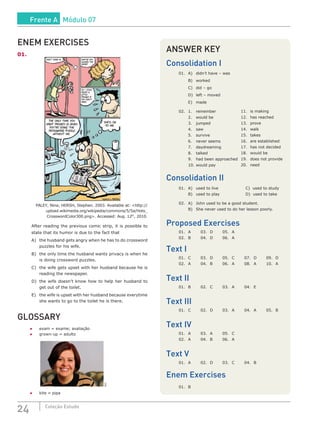
01.	
PALEY, Nina; HERSH, Stephen. 2003. Available at: http://
upload.wikimedia.org/wikipedia/commons/5/5a/Hots_
CrosswordColor300.png. Accessed: Aug. 12th
, 2010.
After reading the previous comic strip, it is possible to
state that its humor is due to the fact that
A)	 the husband gets angry when he has to do crossword
puzzles for his wife.
B)	 the only time the husband wants privacy is when he
is doing crossword puzzles.
C)	 the wife gets upset with her husband because he is
reading the newspaper.
D)	 the wife doesn’t know how to help her husband to
get out of the toilet.
E)	 the wife is upset with her husband because everytime
she wants to go to the toilet he is there.
GLOSSARY
●	 exam = exame; avaliação
●	 grown-up = adulto
	
SXC
●	 kite = pipa
ANSWER KEY
Consolidation I
01.	 A)	 didn’t have – was
	 B)	worked
	 C)	 did – go
	 D)	 left – moved
	 E)	made
02.	 1.	 remember 11.	 is making
12.	 has reached
13.	prove
14.	walk
15.	takes
16.	 are established
17.	 has not decided
18.	 would be
19.	 does not provide
20.	need
	 2.	 would be
	 3.	jumped
	 4.	saw
	 5.	survive
	 6.	 never seems
	 7.	daydreaming
	 8.	talked
	 9.	 had been approached
	 10.	would pay
Consolidation II
01.	 A)	 used to live		 C) used to study
	 B)	 used to play		 D) used to take
02.	 A)	 John used to be a good student.
	 B)	 She never used to do her lesson poorly.
Proposed Exercises
01.	A	 03.	D	 05.	A
02.	B	 04.	D	 06.	A
Text I
01.	C	 03.	D	 05.	C	 07.	D	 09.	D
02.	A	 04.	B	 06.	A	 08.	A	 10.	A
Text II
01.	B	 02.	C	 03.	A	 04.	E
Text III
01.	C	 02.	D	 03.	A	 04.	A	 05.	B
Text IV
01.	A	 03.	A	 05.	C
02.	A	 04.	B	 06.	A
Text V
01.	A	 02.	D	 03.	C	 04.	B
Enem Exercises
01.	B
Frente A Módulo 07
FRENTE
25Editora Bernoulli
MÓDULOLÍNGUA INGLESA
PRESENT CONTINUOUS
O Present Continuous é utilizado para descrever uma ação
que se passa no momento em que é descrita ou, ainda, uma
ação que possui um aspecto temporário.
Structure
She is playing the guitar.
verb to be + main verb (-ing) complement
They are studying English.
verb to be + main verb (-ing) complement
Exemplos:
–	It is raining a lot right now. (descrição simultânea
ao fato)
–	 I usually go to college in the morning, but, as I’m on
vacation, I’m staying at home. (ação com aspecto
temporário)
Outros exemplos:
–	 Alice is reading a book.
–	 They are buying a new house.
–	 I am leaving school.
• 	 Para se fazer uma pergunta no Present Continuous
Tense, basta colocar o verbo to be (na sua forma
presente) antes do sujeito.
Exemplos:
–	 Affirm.: 	 She is dreaming.
–	Inter.:	 Is she dreaming?
• 	 Para fazer uma negação, basta colocar not após o
verbo to be.
Exemplos:
–	 Affirm.:	 They are opening the door.
–	Neg.:	 They are not opening the door.
			 They aren’t opening the door.
GERUND
A forma verbal acrescida de -ing é chamada gerúndio
(gerund). Essa é uma forma nominal do verbo que indica
processo. Para se formar o gerúndio de alguns verbos, além
de lançar mão da regra geral (verb + -ing), é necessário,
também, fazer algumas adaptações. Veja a seguir:
• 	 Para verbos terminados em -e, elimina-se o -e e
acrescenta-se -ing.
Exemplos:
–	 to love: loving
–	 to live: living
–	 to care: caring
–	 to dance: dancing
–	 to come: coming
• 	 Para verbos terminados em “CVC” (consoante-vogal-
consoante), em que essa sequência seja a sílaba
tônica do verbo, dobra-se a última consoante e,
então, acrescenta-se -ing.
Exemplos:
–	 to cut: cutting
–	 to rob: robbing
–	 to permit: permitting
–	 to prefer: preferring
–	 to shop: shopping
OBSERVAÇÃO
Há exceções. Veja:
–	 to die: dying
–	 to lie: lying
sxc
to lie
Present Continuous and
Past Continuous Tenses
08 A
26 Coleção Estudo
to walk to come to fly to stop
Affirmative
I am walking am coming am flying am stopping
he, she, it is walking is coming is flying is stopping
you, we, they are walking are coming are flying are stopping
Interrogative
I Am ___ walking? Am ___ coming? Am ___ flying? Am ___ stopping?
he, she, it Is ___ walking? Is ___ coming? Is ___ flying? Is ___ stopping?
you, we, they Are___ walking? Are ___ coming? Are ___ flying? Are ___ stopping?
Negative
I am not walking am not coming am not flying am not stopping
he, she, it is not walking is not coming is not flying is not stopping
you, we, they are not walking are not coming are not flying are not stopping
sxc
	
sxc
	 to stop			 to fly
Usos
•	 Após verbos de percepção.
Exemplos:
–	 He saw me doing that.
–	 He heard me playing the piano.
•	 O verbo pode estar no gerúndio, caso tenha função
de sujeito da frase, seja precedido de preposição ou
esteja após certos verbos que exigem o gerúndio.
Exemplos:
–	 Smoking is a lousy habit. (sujeito)
–	 He is tired of studying. (of = preposição)
–	She enjoys working with us. (enjoy = verbo que
exige gerúndio)
•	 O verbo com -ing pode ter função adjetiva.	
Exemplos:
–	 This is a very interesting book.
–	 That is an exciting story.
CONSOLIDATION I
01.	 FILL IN the blanks with the Present Continuous of the
verbs in parentheses.
A)	 We ________________ our homework now. (to do)
B)	 What ________________ Mary ________________
to do? (to try)
C)	 He ________________ to us about the story.
(to lie - neg.)
D)	 I can’t talk to you now, I ________________ my hair.
(to wash)
E)	 He ________________ a book. (to write)
F)	 They ________________ a magazine now. (to read
-neg.)
G)	 We ________________ our bike . (to fix)
H)	 What ________________ you ________________
to say to me? (to try)
I)	 ________________ he ________________ at this
moment? (to work)
J)	 The children ________________ with the toys.
(to play)
K)	 Look! That woman ________________ a strange dress.
(to wear)
02.	 (UFMG–2007 / 2ª etapa) Using the verbs in parentheses,
COMPLETE the sentences with the appropriate verbal
forms.
A)	 A study from King’s College London _________________
(suggest) that ___________________ (chew) gum after
meals ____________________ (fight) acid reflux.
B)	 An apple a day _______________(keep) the doctor
away_______________(not be) really that far from
truth, especially when it comes to keeping your
digestive system_________________(run) smoothly.
C)	 Consuming oily fish may_____________(reduce)
the risk of ___________ (develop) asthma. In a
University of Cambridge study of 770 volunteers,
researchers___________________ (find) that those
with symptomatic asthma ______________ (be) less
likely____________ (report) ____________ (eat)
fish at least twice a week throughout the year than
those with asthma.
D)	 One large egg __________________ (contain) just
75 calories, 5 grams of fat and 6.25 grams of protein.
Frente A Módulo 08
LÍNGUAINGLESA
27Editora Bernoulli
E)	 The latest guidelines urge men _____________ (eat)
nine fruits and vegetables a day, in part because they
_____________ (be) at greater risk of many cancers
than women.
F)	 If you ___________(eat) carbs and proteins together,
your body _________________ (not absorb) them
properly, and you ____________ (be) low on key
vitamins.
G)	Lollipop is a favorite children’s snack and
________________ (be) so since it ______________
(introduce) in England in the 1780s. The name comes
from an English dialect word, “lolly,” “tongue,” and the
“pop” is probably associated with the sound made
when the candy __________________ (withdraw)
from the mouth.
PAST CONTINUOUS
O Past Continuous é utilizado para descrever ações que
estavam em progresso no passado. Formamos o Past
Continuous usando a forma
Structure
was
or
were
+ verb (-ing)
• 	 O Past Continuous descreve uma ação que estava
acontecendo quando outra, no Simple Past, ocorreu.
Exemplos:
–	 When I was coming to school, I saw an accident.
		 PC		 SP
–	I was sleeping when the telephone rang.
	 PC			 SP
• 	 O Past Continuous descreve duas ou mais ações
simultâneas no passado.
Exemplos:
–	 The boys were playing soccer while it was raining.
–	 Peter and I were watching TV as Mom was
cooking.
CONSOLIDATION II
01.	 FILL IN the blanks with the Past Continuous form of the
verb in parentheses. The first one is given as an example.
A)	 They were eating in the restaurant. (eat)
B)	 It ________________ when I left home. (rain)
C)	 When you telephoned, I ________________ dinner.
(have)
D)	 The baby ________________ soundly when I went
to wake him up. (sleep)
E)	 He ________________ breakfast when I went to his
hotel room. (order)
F)	 I got sick while we ________________ to Mexico.
(drive)
G)	 He ________________ in California when his father
died. (work)
H)	 I ________________ a nap when you called. (take)
I)	 She ________________ with Mr. Smith when I saw
her at the hall. (talk)
J)	 The accident happened while they ________________
in Mexico. (travel)
K)	 She fell as she ________________ into a taxi. (get)
L)	 The car ________________ at high speed when it
struck the child. (travel)
M)	 WhenIgotupthismorning,thesun________________
brightly. (shine)
N)	 They ________________ in Japan when the war
started. (live)
O)	 I ________________ the paper when you called. (read)
PROPOSED EXERCISES
01.	 (UNESP) Assinale a alternativa que preenche
CORRETAMENTE cada lacuna da frase apresentada.
I __________ to the radio every day, but I __________
listening to it now.
A)	 listen ... am not
B)	 listened ... had
C)	 listening ... was not
D)	 was listening ... not
E)	 not listen ... was
02.	 (Cesgranrio) Indicate the alternative that BEST
completes the following sentence. “He ___________ the
___________ now.”
A)	 could remind - girls’ name
B)	 has reminded - girl’s name
C)	 is remembering - girl’s name
D)	 reminds - name of the girl
E)	 remembers - girl’s name
03.	 (Mackenzie-SP) Indicate the alternative that BEST
completes the following sentence.
“She __________ his proposal, but she __________ a
decision for a while.”
A)	 considers - doesn’t need to make
B)	 is considering - doesn’t want to make
C)	 has considered - had to take
D)	 has been considering - is taking
E)	 considered - needs to take
Present Continuous and Past Continuous Tenses
28 Coleção Estudo
TEXT I
UFOP-MG
Fact or Fiction
Do You Really Need Seven Hours of Sleep?
By Temma Ehrenfeld | Newsweek Web Exclusive
Feb. 19, 2008. | Updated: 12:25 p.m. ET Feb. 19, 2008.
	 Yep, you do. Although people do vary in how much
sleep they need, the differences are slight, and the vast
majority of us (including seniors) need seven to eight
hours. Most people who regularly get less than seven
hours of rest are simply unaware of the damage that
fatigue and sleepiness is doing to their bodies. Chronic
“short-sleepers,” as scientists call them, have forgotten
what it feels like to be well rested, says Robert Rosenberg,
medical director of the Sleep Disorders Center of Prescott
Valley, in Arizona.
	 The evidence indicates that a person who regularly
sleeps less than seven hours a night functions as badly as
someone who hasn’t slept for one to three days, according
to a research review published in the Journal of Clinical
Sleep Medicine last year. Furthermore, the largest current
longitudinal studies (one involving 21,268 people and
another 10,308) showed that sleep-deprivation increased
mortality: the chance of dying younger than people of the
same age, gender and health-risk factors. In the larger
study researchers at the Finnish Institute of Occupational
Health assessed the sleep habits of the group in 1975
and 1981 and then checked to see who was still alive on
Dec. 31, 2003. After comparing subjects’ survival rates to
the average for people of the same age (and adjusting for
other known death risks, like smoking), the researchers
concluded that lack of sleep increased mortality in the
study participants by 26 percent for men and 21 percent
for women. The cause of death might be accidents,
or diseases exacerbated by sleep-deprivation. Other
current research indicates that lack of sleep affects the
body’s hormones, immune system and metabolism;
hence, it can be a risk factor for obesity, diabetes and
heart disease.
	 To evaluate the quality of your own sleep – and whether
you’re getting enough – try these tools offered by the
American Academy of Sleep Medicine.
EHRENFELD, Temma. Fact or Fiction. NewsWeek, Feb.19, 2008.
Available at: http://www.newsweek.com/id/113270.
Accessed: Feb. 20th
, 2008.
01.	Researchers concluded that sleep-deprivation
A)	 must be recommended for old people.
B)	 may cause no impact in death rates.
C)	 improves the quality of life of everyone.
D)	 can be riskier for men than for women.
02.	 The information that we can infer from the text is
A)	 the research reviews discussed are incomplete.
B)	 the larger research involved just a group of women.
C)	 the studies involved over thirty thousand people.
D)	 the stated results have no scientific basis.
03.	 Seven to eight hours of sleep a night is
A) 	too much for students.
B)	 the least for most people.
C)	 very little for children.
D)	 a lot for old people.
04.	 “Short-sleepers” are people who sleep
A)	 less than 7 hours a night.		 C)	 just at night.
B)	 during the work.				 D)	 all the time.
TEXT II
FJP-MG–2010
Fraud Spotlight on Hollywood
By Matthew Garrahan in Los Angeles and Brooke
Masters in New York
Published: August 9 2009 18:59
	 Hollywood studios and film producers are set to face
increasing scrutiny from anti-fraud officials, as a result
of a trial involving incidents in Bangkok that could
have repercussions across the entertainment sector.
Gerald Green, an American film producer, and his wife,
Patricia, are alleged to have violated the US Foreign
Corrupt Practices Act (FCPA) by paying bribes to a Thai
tourism official. It is claimed that the alleged bribes
were offered to obtain contracts to run an international
film festival in Bangkok. Mr Green and his wife have
pleaded not guilty to bribery charges. The Green‘s
trial in Los Angeles, which is entering its second week,
is the first FCPA case to involve the entertainment
industry. The case suggests that Hollywood has joined
the pharmaceuticals and energy industries as a target
of anti-fraud enforcers at the US department of justice.
The new interest of FCPA in Hollywood could become a
severe headache for studios and producers that shoot
films in international locations. The Green‘s trial is likely
to be followed by more FCPA investigations in Hollywood,
Jonathan Drimmer, a former DoJ lawyer, said. “The
justice department identifies a practice [in a particular
industry] and then suddenly they go across that industry
in a lateral manner. They did it with the medical device
industry and they did it with oil and gas companies.”
Available at:http://www.ft.com/home/us.
Accessed: Aug. 9th
, 2009.
Frente A Módulo 08
LÍNGUAINGLESA
29Editora Bernoulli
01.	 Some incidents in Bangkok have brought all of the
following consequences, EXCEPT
A)	 A trial was led to verify the recent incidents which
occurred.
B)	 Authorities have decided to put anti-fraud officials on
trial.
C)	 The incident may bring repercussions to the
entertainment world.
D)	 There is bound to be a closer look into Hollywood and
film producers.
02.	 The incident the article is talking about involves a/an
A)	 alleged assault by a Thai tourism official.
B)	 claim that the Thai tourism official is dishonest.
C)	 possible bribe of a Thai tourism official.
D)	 violation of the law by a Thai tourism official.
03.	 According to the article, pharmaceuticals and energy
industries are
A)	 other entities scrutinized by the US department of
justice.
B)	 involved in the making of a film festival in Bangkok.
C)	 helping Hollywood to increase the entertainment
industry.
D)	 enforcers of the cases scrutinized by the department
of justice.
04.	 The article shows that the incident, followed by the trial
and the interest of the FCPA, may
A)	 bring a lot of problems for studios and producers.
B)	 help Hollywood produce more films abroad.
C)	 launch the entertainment industry upwards.
D)	 stop producers from filming in international locations.
TEXT III
FCMMG
Childhood Obesity
	 Obese kids suffer both physically and emotionally
throughout childhood, and those who remain heavy as
adolescents tend to stay that way into adulthood. The
resulting illnesses – diabetes, heart disease, high blood
pressure, several cancers – have cost the American
government $100 billion in medical expenses. It’s been
estimated that some 6 million American children are now
fat enough to endanger their health and the problem is
growing more extreme and widespread.
	 Teens, even more than younger children, are at risk of
replacing companionship with cookies. If they’re lonely,
the food is their friend. Parents should always look
beyond the weight itself: Is it a warning sign? Is the child
depressed? If the answer is yes, then address the cause,
not the symptom.
	 Being overweight in modern culture is devastating
enough for small children. The point is that a child
who feels loved, not judged, is more likely to accept a
parent’s message about the need to lose weight.
NEWSWEEK, Jul. 3, 2000. (Adapted).
01.	 Obese kids are
A)	 the ones who only face up emotional troubles.
B)	overweight.
C)	 those suffering from high blood pressure.
D)	 the ones that need government’s support.
02.	 The question of childhood obesity
A)	 endangers everyone’s health.
B)	 always leads to depression.
C)	 seems impossible to be tackled.
D)	 can be extended to adulthood.
03.	 Teens are at risk of replacing companionship with cookies.
The boldface words stand for
A)	away from.				
B)	forced.	
C)	approving.
D)	 in danger.
04.	 Food is teens’ friend particularly when they
A)	 see no relationship between cause and symptom.
B)	 get a warning sign regarding overeating.
C)	 are on their own.
D)	 overcome their depression.
05.	 A child who feels loved
A)	 will feel devastated, for gaining weight is unavoidable.
B)	 ought to be judged as well as looked after.
C)	 gets easier to be approached when the topic is the
need to lose weight.
D)	 seldom wonders what their parents’ message is about.
Present Continuous and Past Continuous Tenses
30 Coleção Estudo
TEXT IV
Izabela Hendrix-MG
LYNN, Loreta. Quotable quotes. Reader’s Digest, Aug. 1998, p. 61.
01.	 The sentence above makes it clear that people are always
involved in
A)	 common activities.		
B)	 quantitative work.			
C)	 identical matters.
D)	 ordered happenings.
E)	 competitive situations.
02.	 It is Loreta Lynn’s belief that when a person is not number
one or exceptionally good compared to others, he / she
must be
A)	 similar to other people.	 D)	 an unusual person.
B)	 perfect men or women.	 E)	 as common as others.
C)	 as ordinary as others.
03.	 We can infer from the text that when someone is not
number one,
A)	 he / she cannot be successful in any other way.
B)	 nobody will let him / her experience success.
C)	 he / she must find other ways to be successful.
D)	 there is no other way for him / her to be successful.
E)	 people will help this person to be unsuccessful in life.
TEXT V
FATEC-SP–2011
Haiti’s indentured children
		 The days after Haiti’s earthquake brought joyous
reunions for some families. Others faced the grim reality
that they’d been suddenly robbed of parents or offspring.
But for Haiti’s 225,000 restaveks, or indentured children,
the quake brought only an uncertain future.
		 Slavery – which ended with independence in 1804 –
is illegal in Haiti. And technically, restaveks are not slaves.
The institution has its roots in the Caribbean tradition
of child lending between families (usually relatives)
to pitch in with extra work, care for the elderly or sick,
or to provide opportunity to a child from a poor family.
Generally, rural parents send their children to live with
wealthier families in the cities. In exchange for domestic
labor, the children are supposed to receive lodging, food,
clothing, medicine, and – most importantly – education.
In as many as half of the cases, they do (though
classifying treatment in private homes is notoriously
difficult). The unlucky ones, called restaveks – from the
French rester avec, or “to stay with” – are loaned through
normal channels but denied schooling and subject to
abuse and degradation. This phenomenon has spiked in
modern Haiti, as more and more children end up with
equally impoverished families in the slums.
		 Before the quake, up to 22 percent of Haitian homes
contained restaveks, according to a study funded by
USAID. Keeping restaveks is illegal, but child loans are not
and, given the extent of Haiti’s governmental dysfunction,
it’s hard to tell which cases are which. Now that the quake
has thrown family networks into disarray, the flimsy
social ties supporting restaveks are likely to break down.
“For families struggling in the wake of a catastrophe,
restavek kids are the first to go”, says Glenn Smucker,
an anthropologist who specializes in development work
in Haiti. “Their parents are not there to watch out for
them, so they’re far more vulnerable” to desertion and
trafficking.
		 But even as the numbers of abandoned restaveks swell,
the demand for their services is likely to decrease. A mass
exodus of residents from Port-au-Prince is reversing
decades of migratory trends. If the shift sticks, it means
there will be less need for restaveks in the city. But it’s
also possible that families suffering from the quake’s
economic aftershocks will feel extra pressure to lend out
their children, even as it becomes more likely they’ll end
up as restaveks. Which, combined with a spike in new
orphans, means Haiti will likely see a rise in the number
of its street children in the years to come.
PAUL, Katie. Newsweek.
01.	 De acordo com o texto, o Haiti tenta resolver o problema
das crianças cujos pais morreram no terremoto
A)	 oferecendo ajuda financeira para os responsáveis
pelas crianças.
B)	 facilitando a adoção dessas crianças por famílias
haitianas.
C)	 permitindo o trabalho dessas crianças em casas de
famílias.
D)	encaminhando a maioria das crianças menores de
oito anos para orfanatos do governo.
E)	 incentivando a adoção dessas crianças por famílias
estrangeiras.
Frente A Módulo 08
LÍNGUAINGLESA
31Editora Bernoulli
02.	 O antropólogo Glenn Smucker
A)	 é um especialista em estudos sobre crianças que se
encontram em situação de risco.
B)	 criticou o tratamento dado às crianças abandonadas
nas ruas.
C)	 criou um departamento para facilitar e agilizar a
adoção internacional de crianças haitianas.
D)	propôs a criação de leis de proteção aos menores
haitianos.
E)	 alertou para o fato de que as crianças haitianas podem
ser vítimas de abandono ou de tráfico.
03.	 A palavra flimsy, no 3º parágrafo do texto, pode ser
substituída por
A)	 easy. 				C)	strong.			E)	important.
B)	 difficult.			D)	fragile.
04.	 O texto afirma que a cidade de Porto Príncipe está
A)	 sendo reconstruída rapidamente pelas autoridades
do Haiti.
B)	 destruída, apesar de não ter sido abandonada pelos
moradores.
C)	 alterando sua tradição migratória.
D)	 retomando práticas do tempo da escravidão.
E)	 cercada pelas autoridades do Haiti.
ENEM EXERCISES
Texto para as questões 01 a 05
Brazil faces threat of dengue type 4
Isabela Vieira
Rio de Janeiro – The Minister of Health, José Gomes
Temporão, says there is a possibility that dengue type 4
will spread and become a problem next summer. Three
cases have been confirmed in Roraima. “We have to
be prepared,” said the minister. “It is not certain that
dengue type 4 will spread. The behavior of the virus is
unknown. However, there are direct flights from Roraima
to São Paulo and other locations. So, we have to be
ready next summer to aggressively reduce the disease
vector. Dengue is presently at a level we expected.
It can become an epidemic only when there are many
mosquitoes, so we must reduce them.” Temporão explains
that the dengue type 4 is dangerous because it has not
appeared in Brazil for 28 years. As a result, there is a
large part of the population that is not immune to it.
The cases in Roraima are believed to have come from
Venezuela. “As we cannot stop people from crossing the
border and we don’t have a vaccine, we have to attack the
mosquito that transmits the disease,” says the minister.
The symptoms of dengue type 4 are the same as other
forms of dengue: headache, severe pain in the body and
especially the joints (in English it is called breakbone
fever), diarrhea, vomiting and fever.
Allen Bennett – translator/editor The News in English
Available at: http://agenciabrasil.ebc.com.br
Accessed: Aug. 16th
, 2010.
01.	 The Minister of Health, José Gomes Temporão, says that
Brazil may be fronting a problem next summer. This
problem is due to the fact that
A)	 there are many mosquitoes in Brazil.
B)	 Brazilians are prepared to the struggle against dengue
type 4.
C)	 it is possible that dengue type 4 will spread in the
country.
D)	 the government wants to stop people from crossing
the country’s border.
E)	 the government wants to prohibit flights from Roraima
to São Paulo.
02.	 Temporão also explains that dengue type 4 is dangerous
because
A)	 it has not appeared in the country for 28 years, so
there is a large part of the Brazilian population that
is not immune to it.
B)	 there is not enough vaccine for the population under
28 in Brazil.
C)	 it causes diarrhea and there is a large part of the
population that won’t resist it.
D)	 the mosquitoes came in flights from Venezuela, a
country where the population is not immune to the
disease.
E)	 there is a large part of mosquitoes immune to the
virus since it has not appeared in Brazil for 28 years.
03.	 In the sentence “As a result, there is a large part of the
population that is not immune to it”, the expression as
a result represents an idea of
A)	contrast.				
B)	 cause.			
C)	condition.
D)	reason.
E)	consequence.
04.	 According to the text, one of the symptoms which follow
the dengue disease is
A)	 easily broken bones.
B)	 sore throat.
C)	 breakbone fever.
D)	toothache.
E)	 stomach ache.
05.	 In the extract “We have to be prepared”, the underlined
words can be replaced by the modal
A)	can.					
B)	may.			
C)	shall.
D)	must.
E)	will.
Present Continuous and Past Continuous Tenses
32 Coleção Estudo
HAVING FUN
Holiday: Independence Day – 4th of July
Nos Estados Unidos, o Independence Day – também conhecido
como Fourth of July – é um feriado nacional que celebra a adoção
da Declaração da Independência Americana, a qual ocorreu
no dia 4 de julho de 1776. Na data, é comum haver fogos de
artifício, feiras, piqueniques, shows, jogos de baseball, discursos
políticos, cerimônias e outros eventos públicos e privados que
comemorem a história, o governo e as tradições americanas.
Available at: http://en.wikipedia.org/wiki/Independence_Day_
(United_States).
GLOSSARY
•	 lousy = terrível, nojento, sujo.
•	 vacation = férias
SXC
	 D)	One large egg contains (contain) just
75 calories, 5 grams of fat and 6.25 grams of
protein.
	 E)	 The latest guidelines urge men to eat (eat)
nine fruits and vegetables a day, in part
because they are (be) at greater risk of
many cancers than women.
	 F)	 If you eat (eat) carbs and proteins together,
your body will not absorb (not absorb)
them properly, and you will be (be) low on
key vitamins.
	 G)	Lollipop is a favorite children’s snack and
has been (be) so since it was introduced
(introduce) in England in the 1780s.
The  name comes from an English dialect
word, “lolly,” “tongue,” and the “pop” is
probably associated with the sound made
when the candy is withdrawn (withdraw)
from the mouth.
Consolidation II
01.	 B)	 was raining	 I)	 was talking
J)	 were travelling
K)	 was getting
L)	 was travelling
M)	 was shining
N)	 were living
O)	 was reading
	 C)	 was having	
	 D)	 was sleeping	
	 E)	 was ordering	
	 F)	 were driving	
	 G)	 was working	
	 H)	 was taking	
Proposed Exercises
01.	A	 02.	C	 03.	B
Text I
01.	D	 02.	C	 03.	B	 04.	A
Text II
01.	B	 02.	C	 03.	A	 04.	A
Text III
01.	B	 02.	D	 03.	D	 04.	C	 05.	C
Text IV
01.	E	 02.	D	 03.	C
Text V
01.	C	 02.	E	 03.	D	 04.	C
Enem Exercises
01.	C	 02.	A	 03.	E	 04.	C	 05.	D
ANSWER KEY
Consolidation I
01.	 A)	 are doing	
	 B)	 is – trying	
	 C)	 is not lying	
	 D)	 am washing	
	 E)	 is writing	
	 F)	 are not or aren’t reading
	 G)	are or ’re fixing
	 H)	 are – trying
	 I)	 Is – working
	 J)	 are playing
	 K)	 is wearing
02.	 A)	 A study from King’s College London suggests
(suggest) that chewing (chew) gum after
meals fights (fight) acid reflux.
	 B)	 An apple a day keeps (keep) the doctor
away isn’t (not be) really that far from truth,
especially when it comes to keeping your
digestive system running (run) smoothly.
	 C)	 Consuming oily fish may reduce (reduce)
the risk of developing (develop) asthma.
In a University of Cambridge study of
770 volunteers, researchers found (find) that
those with symptomatic asthma were (be)
less likely to report (report) eating (eat)
fish at least twice a week throughout the year
than those with asthma.
Frente A Módulo 08
INFINITIVE PAST TENSE PAST PARTICIPLE TRANSLATION
A
to accuse accused accused acusar
to allow allowed allowed permitir
to annoy annoyed annoyed incomodar
to appear appeared appeared aparecer
to arrange arranged arranged arranjar
to avoid avoided avoided evitar
B
to beg begged begged suplicar
to behave behaved behaved comportar-se
to believe believed believed acreditar
to belong belonged belonged pertencer
to betray betrayed betrayed trair
to borrow borrowed borrowed pedir emprestado
to breathe breathed breathed respirar
to bury buried buried enterrar
C
to care cared cared importar-se
to claim claimed claimed reivindicar
to complain complained complained reclamar
D
to defeat defeated defeated derrotar
to delay delayed delayed atrasar
to deny denied denied negar
to deserve deserved deserved merecer
to desire desired desired desejar
to distinguish distinguished distinguished distinguir
to drop dropped dropped derrubar
E
to encourage encouraged encouraged encorajar
to envy envied envied invejar
to excuse excused excused desculpar
F
to fear feared feared temer
to fetch fetched fetched ir buscar
to fill filled filled encher
to fire fired fired despedir, disparar
to frighten frightened frightened assustar
H
to happen happened happened acontecer
to hate hated hated odiar
to help helped helped ajudar
to hurry hurried hurried apressar-se
I
to inhabit inhabited inhabited habitar
to insult insulted insulted insultar
J
to joke joked joked brincar
to jugde jugded jugded julgar
to jump jumped jumped pular
K
to knock knocked knocked bater
L
to land landed landed aterrisar
to laugh laughed laughed rir
M
to marry married married casar-se
to murder murdered murdered matar
O
to obey obeyed obeyed obedecer
to omit omitted omitted omitir
to order ordered ordered ordenar, pedir
to owe owed owed dever
to own owned owned ter, possuir
LIST OF REGULAR VERBS
INFINITIVE PAST TENSE PAST PARTICIPLE TRANSLATION
P
to permit permitted permitted permitir
to persuade persuaded persuaded persuadir
to place placed placed colocar
to prefer preferred preferred preferir
to prevent prevented prevented evitar, impedir
to pronounce pronounced pronounced pronunciar
Q
to quarrel quarreled quarreled discutir, brigar
R
to raise raised raised levantar
to refuse refused refused recusar
to reply replied replied responder
S
to seem seemed seemed parecer
to shout shouted shouted gritar
to struggle struggled struggled esforçar-se
to succeed succeeded succeeded ter sucesso
T
to taste tasted tasted provar (alimentos, bebidas)
W
to warn warned warned advertir
to waste wasted wasted desperdiçar
to wonder wondered wondered querer saber, imaginar
to wreck wrecked wrecked colidir, chocar
LIST OF IRREGULAR VERBS
INFINITIVE PAST TENSE PAST PARTICIPLE TRANSLATION
A
to arise arose arisen surgir, erguer-se
to awake awoke awoken despertar, acordar
B
to be was, were been ser, estar
to bear bore born, borne suportar, dar à luz
to beat beat beaten bater, espancar
to become became become tornar-se
to befall befell befallen acontecer
to beget begot begotten, begot procriar, gerar
to begin began begun começar, iniciar
to behold beheld beheld contemplar
to bend bent bent curvar, dobrar
to bet bet bet apostar
to bid bid bid oferecer, concorrer
to bind bound bound unir, encadernar
to bite bit bitten morder, engolir a isca
to bleed bled bled sangrar, ter hemorragia
to blow blew blown (as)soprar, estourar
to break broke broken quebrar, romper
to breed bred bred procriar, reproduzir
to bring brought brought trazer
to broadcast broadcast broadcast irradiar, transmitir
to build built built construir, edificar
to burst burst burst arrebentar, estourar
to buy bought bought comprar
C
to cast cast cast arremessar, lançar
to catch caught caught pegar, capturar
to choose chose chosen escolher
to cling clung clung aderir, segurar-se
to come came come vir
to cost cost cost custar
to creep crept crept rastejar, engatinhar
to cut cut cut cortar, reduzir
INFINITIVE PAST TENSE PAST PARTICIPLE TRANSLATION
D
to deal dealt dealt negociar, tratar
to dig dug dug cavar, cavoucar
to do did done fazer
to draw drew drawn sacar, desenhar
to drink drank drunk beber
to drive drove driven dirigir, ir de carro
to dwell dwelt dwelt morar
E
to eat ate eaten comer
F
to fall fell fallen cair
to feed fed fed alimentar, nutrir
to feel felt felt sentir, sentir-se
to fight fought fought lutar, batalhar
to find found found achar, encontrar
to flee fled fled fugir, escapar
to fling flung flung arremessar
to fly flew flown voar, pilotar
to forbid forbade forbidden proibir
to forget forgot forgotten esquecer
to forgive forgave forgiven perdoar
to freeze froze frozen congelar, paralisar
G
to get got gotten, got obter, conseguir
to give gave given dar, conceder
to go went gone ir
to grind ground ground moer
to grow grew grown crescer, cultivar
H
to have had had ter, beber, comer
to hear heard heard ouvir, escutar
to hide hid hidden, hid esconder
to hit hit hit bater, ferir
to hold held held segurar
to hurt hurt hurt machucar, ferir
K
to keep kept kept guardar, manter
to know knew known saber, conhecer
to knell knelt knelt ajoelhar-se
L
to lay laid laid pôr (ovos)
to lead led led liderar, guiar
to leave left left deixar, partir
to lend lent lent dar emprestado
to let let let deixar, alugar
to lie lay lain deitar(-se)
to lose lost lost perder, extraviar
M
to make made made fazer, fabricar
to mean meant meant significar
to meet met met encontrar, conhecer
O
to overcome overcame overcome superar
to overtake overtook overtaken alcançar, surpreender
P
to pay paid paid pagar
to put put put colocar, pôr
Q
to quit quit quit abandonar, largar de
R
to read read read ler
to ride rode ridden andar, cavalgar
INFINITIVE PAST TENSE PAST PARTICIPLE TRANSLATION
to ring rang rung tocar (campainha)
to rise rose risen subir, erguer-se
to run ran run correr, concorrer
S
to saw sawed sawn serrar
to say said said dizer
to see saw seen ver, entender
to seek sought sought procurar
to sell sold sold vender
to send sent sent mandar, enviar
to set set set pôr, colocar, ajustar
to shake shook shaken sacudir, tremer
to shed shed shed derramar, deixar cair
to shine shone shone brilhar, reluzir
to shoot shot shot atirar, alvejar
to show showed shown mostrar, exibir
to shrink shrank shrunk encolher, contrair
to shut shut shut fechar, cerrar
to sing sang sung cantar
to sink sank sunk afundar, submergir
to sit sat sat sentar
to slay slew slain matar, assassinar
to sleep slept slept dormir
to slide slid slid deslizar, escorregar
to sling slung slung atirar, arremessar
to speak spoke spoken falar
to spend spent spent gastar, passar (tempo)
to spin spun spun girar, rodopiar
to spit spit, spat spit, spat cuspir
to spread spread spread espalhar, difundir
to spring sprang sprung saltar, pular
to stand stood stood ficar de pé, aguentar
to steal stole stolen roubar, furtar
to stick stuck stuck cravar, fincar, enfiar
to sting stung stung picar c/ ferrão (inseto)
to stink stank stunk cheirar mal, feder
to strike struck struck golpear, bater
to string strung strung encordoar, amarrar
to strive strove striven esforçar-se, lutar
to swear swore sworn jurar, prometer
to sweep swept swept varrer
to swim swam swum nadar
to swing swang, swung swung balançar, alternar
T
to take took taken tomar, pegar, aceitar
to teach taught taught ensinar, dar aula
to tear tore torn rasgar, despedaçar
to tell told told contar (uma história)
to think thought thought pensar
to throw threw thrown atirar, arremessar
to tread trod trodden pisar, trilhar, seguir
U
to undergo underwent undergone submeter-se a, suportar
to understand understood understood entender, compreender
to uphold upheld upheld sustentar, apoiar
to upset upset upset perturbar, preocupar
W
to wear wore worn vestir, usar, desgastar
to win won won vencer, ganhar
to wind wound wound enrolar, dar corda
to write wrote written escrever, redigir
to weep wept wept chorar

Ingles volume-2

  • 1.
  • 2.
    2 Coleção Estudo Sumário-LínguaInglesa FrenteA 05 3 Interrogative Adverbs Autor: Bruno Porcaro 06 11 Simple Present Tense Autor: Bruno Porcaro 07 17 Simple Past Tense Autor: Bruno Porcaro 08 25 Present Continuous and Past Continuous Tenses Autor: Bruno Porcaro
  • 3.
    FRENTE 3Editora Bernoulli MÓDULOLÍNGUA INGLESA INTERROGATIVEADVERBS Os advérbios interrogativos são utilizados para construir orações interrogativas. Eles, geralmente, ocupam a posição inicial dessas orações e requerem respostas mais completas e específicas, não podendo ser respostas como “sim” e “não”. Exemplos: – What’s your name? – Where are you going? – Why do you want to take this class? – How much do you earn a month? Quando what, which, who e whose forem sujeito numa oração interrogativa, o verbo auxiliar não será usado. Exemplos: – Who made this pie? – Who wants to get a piece of pie? – Which one interests you? – What is good in the club? SXC CHECK IT OUT Interrogative Adverbs são também conhecidos como Interrogative Words, Interrogative Pronouns, Wh-Questions ou Wh-Words – porque, em inglês, a maioria dos pronomes interrogativos tem as letras “w” e “h”. Em inglês, os advérbios interrogativos podem ser usados de maneiras diferentes. Veja: – Where is he going? – I wonder where he is going. – The country where he was born. – I go where he goes. Interrogative Adverbs Translation Examples What o que, qual What do you want? Who quem Who are you? Where onde Where did you go yesterday? When quando When is your birthday? Whose de quem Whose car is this? Which qual Which color do you prefer, blue or red? How como How are you? How far qual a distância How far is your house from here? How high que altura How high is this building? How old qual a idade How old are you? How long quanto tempo How long will you stay in Rio? What time quantas horas What time is it? Why por que Why are you sad? How much quanto(a) (coisas incontáveis) How much money do you have? How many quantos(as) (coisas contáveis) How many students are there in this class? How often qual a frequência How often do you go to the cinema? What else o que mais What else do you want to drink? What kind of que tipo de What kind of music do you prefer? What colour que cor What colour is your car? How wide qual a largura How wide is this river? How deep qual a profundidade How deep is your love? Interrogative Adverbs 05 A
  • 4.
    4 Coleção Estudo CONSOLIDATION 01. (UFMG–2009 / 2ª etapa) Suppose you work as an interviewer for a volunteering program in Brazil. You are going to conduct a phone interview with some candidates in English. Your boss gave you the following questions in Portuguese to help you. TRANSLATE them into English. A) Qual é o seu nome? _____________________________________________ B) Quantos anos você tem? _____________________________________________ C) De que país você é? _____________________________________________ D) Em que cidade você nasceu? _____________________________________________ E) Você já trabalhou como voluntário alguma vez? _____________________________________________ F) Quantas línguas você fala? _____________________________________________ G) Você tem algum problema de saúde? _____________________________________________ H) Por que você escolheu o Brasil para trabalhar como voluntário? _____________________________________________ I) Seus pais concordam com sua decisão? _____________________________________________ J) Quem vai financiar sua viagem? _____________________________________________ PROPOSED EXERCISES 01. (Milton Campos-MG) ______ did Laura do ______ she saw the whale roll out of the water? _______ was it like? _________ did she shout “Bravo”? A) How - where - What - How B) Which - as - How - When C) What - when - What - Why D) What - because - How - What E) What - while - What - Which 02. (UFPR) _______ do you prefer: soccer or bowling? A) When C) What E) Which B) Who D) Whose 03. (PUC-Campinas-SP) A: ____________ is your brother? B: He’s 20. A) How often D) How much B) How many years E) How old C) How long 04. (PUC-Campinas-SP) ” ______ were they talking to ____ I came in?” A) When – who B) Who – when C) What – when D) Where – what E) Who – where 05. (PUC-Campinas-SP) John: “____________” Mary: “For my headache.” A) Where did you put the aspirins? B) Why do you want an aspirin? C) Where did you go? D) What do you want? E) How many aspirins do you want? 06. (Milton Campos-MG) A: ____________ do you estimate life could exist in one of Jupiter’s moons? B: Well, it seems to have water and water is the major requirement for life as we’ve already approached. A) Why D) Which B) Whose E) Who C) Where 07. (PUC-Campinas-SP) ___________ weeks will he stay here? A) How much D) When B) How long E) How C) How many 08. (UFS) ” _________ do you work hard?” ”Because I’m not rich.” A) Why C) What E) How B) Where D) When 09. (UFU-MG) “ _________ were their names?” “Their names were Armstrong and Aldrin.” A) What C) Which E) Whom B) Whose D) Who 10. (UFRGS) _________ is yours, the peach or the orange? A) What C) Which E) Whose B) Who D) That 11. (Cesgranrio) Mark the question to which the following sentence could be the answer: “He decided to get out of the car.” A) Whose decision was that? B) Where did he decide to get out of the car? C) When did he decide to get out of the car? D) What did he decide to do? E) How did he decide to get out of the car? Frente A Módulo 05
  • 5.
    LÍNGUAINGLESA 5Editora Bernoulli TEXT I UFMG–2007 Politicalcorruption World map of the Corruption Perceptions Index In broad terms, political corruption is the misuse of public (governmental) power for illegitimate, usually secret, private advantage. All forms of government are susceptible to political corruption. Forms of corruption vary, but the most common are patronage, bribery, extortion, influence peddling, fraud, embezzlement, and nepotism. While corruption often facilitates criminal enterprise such as drug trafficking, money laundering, and criminal prostitution, it[2] is not restricted to these organized crime activities, and it[2] does not always support or shield other crimes. What constitutes corruption differs depending on the country or jurisdiction. Certain political funding practices that are legal in one place may be illegal in another. In some countries, police and prosecutors have broad discretion over who to arrest and charge, and the line between discretion and corruption can be difficult to draw, as in racial profiling[1] . In countries with strong interest group politics, practices that could easily constitute corruption elsewhere are sometimes sanctified as official group preferences. Available at: <http://en.wikipedia.org/wiki/Political_corruption#Bribery:_Bribe-takers_and_bribe-givers.> Accessed: Apr. 2006. (Adapted). 01. According to the text, whenever public power is used for illegal purposes, A) crime activities are restricted. B) personal benefits are reached. C) political corruption is banned. D) public advantage is achieved. 02. A map was included in the text in order to show that corruption is a A) long banned enterprise. B) government top secret. C) few nations’ problem. D) worldwide phenomenon. 03. According to the text, the notion of corruption A) changes from place to place. B) constitutes legal activities. C) reflects the official elections. D) results in racial profiling. 04. Racial profiling[1] is mentioned in the text as a kind of practice A) difficult to categorize. C) resultant from arrest. B) impossible to fight. D) seen as corruption. 05. Both occurrences of the word it[2] refer to A) criminal enterprise. C) political corruption. B) organized crime. D) racial illegitimacy. Interrogative Adverbs
  • 6.
    6 Coleção Estudo TEXTII FCMMG–2007 Childhood Leukaemia Risk Doubles Within 100 Metres of High-Voltage Power Lines Category: Cancer / Oncology News Article Date: 15 Sep 2004 - 9:00 p.m. (PDT) The biggest ever publicly funded UK study into power lines and child cancer has found that children under the age of 15 living within 100 metres of high-voltage power lines have close to twice the risk of developing 05 leukaemia. Children aged 0-5 are the most vulnerable, so their risk is likely to be even higher. This result from the Oxford Childhood Cancer Re s e a r c h G r o u p s t u d y, h e a d e d b y G e ra l d Draper, analysed and compared 33 years of data 10 (from 1962 to 1995) on 35,000 children diagnosed with cancer, with their distance to the nearest electricity transmission line. We have learned that “preliminary results” of the latest Draper study, funded to run from 1997-2001, were known as long 15 as 3 years ago and were formally shown confidentially to the U.K. Department of Health in May 2003, but to date has not as yet been entrusted to the public. We of the Trentham Environmental Action Campaign, an independent research and activist group, believe it 20 to be absolutely scandalous that 3 years after telling the Department of Health of these latest UK findings, it is only as a consequence of our intervention that we are now able to make these findings public. There appears to have been a determination to 25 withhold the Draper Report for as long as possible. Our campaign group has been in constant contact with the Government, Mr George Hooker at the Department of Health and the National Radiological Protection Board [NRPB]. We have also been deeply 30 disappointed in the organisations’ continuing denial of the problem despite their knowing about these new study results. The NRPB already acknowledges that there is international consensus on the fact that the incidence of childhood leukaemia is doubled at a 35 magnetic field of 0.4 microtesla, which is exceeded under most power lines. They said “In the light of these findings (the association between exposure to magnetic fields and childhood leukaemia) and the requirement for 40 additional research, the need for further precautionary measures should be considered by government”. Electromagnetic fields from power lines are also linked to adult cancers, depression and suicide. Our Trentham group carried out a local survey which produced 45 extremely worrying results. Depression, miscarriages, headaches, insomnia were much more common in the people who lived near the power line, compared with those who lived further away. Some of these health problems were also found in the important California 50 Health Department report of 2002. Only 50 years ago developing childhood leukaemia was an almost certain death sentence. Due to dramatic improvements in treatment, about 80% of children who suffer from the most common form of 55 childhood leukaemia now live for more than 5 years after treatment, but childhood leukaemia remains the largest child killer disease. The number of children developing leukaemia has been steadily growing over the last 50 years. In 2001, Dr Sam Milham reported 60 a link between the growth in electricity supply and the growth in leukaemia incidence in the USA. Available at: http://www.medicalnewstoday.com/medicalnews. Accessed: Aug. 05, 2006. (Adapted). 01. The text shows the result of a research A) about the advisability of living near power lines. B) on high electricity voltage death reports. C) on leukaemia treatment on children. D) conducted with UK public funds. 02. The article discusses the rates of A) children developing skin cancer. B) cancer in children under 15 years. C) different kinds of child leukaemia. D) the treatment for child leukaemia. 03. According to the article, in the circumstances discussed, children between 0 and 5 A) run a greater risk of developing leukaemia. B) are more apt to get cured when they are ill. C) suffer more when they develop leukaemia. D) are vulnerable to all kinds of diseases. 04. The research whose result is shown in the article A) published the report 33 years ago. B) started collecting data 33 years ago. C) analysed data collected during 33 years. D) was conducted by a 33 year-old scientist. 05. The study examined the relation between children with leukaemia and A) the distance of their homes to electricity transmission lines. B) adults who suffered the illness in the same period of time. C) the kind of action the government is taking to help them. D) those who answered successfully to the treatment. Frente A Módulo 05
  • 7.
    LÍNGUAINGLESA 7Editora Bernoulli 06. TheCampaign which signs the article shows anger at the Department of Health A) for the result was not what they had been expecting. B) as the Government claimed the research as their own. C) while that department gets all the honor for the research. D) because the result of the research was not made public. 07. From the text we understand that Mr George Hooker is responsible for the A) Oxford Childhood Cancer Research Group. B) Trentham Environmental Action Campaign. C) Department of Health and the NRPB. D) California Health Department. 08. The text affirms that electromagnetic fields from power lines also are an outstanding factor in all the following, EXCEPT A) suicides. B) dysentery. C) depression. D) adult cancers. 09. The text states that, comparing the present situation with 50 years ago, A) leukaemia kills as many patients today as it did before. B) children with leukaemia do not die of the disease any more. C) there has been an improvement in the survival of leukaemia patients. D) leukaemia has become a very rare disease for children nowadays. 10. The link between the growth in electricity supply and the growth in leukaemia which the text deals with A) was established by scientists who worked in Oxford. B) has been researched both in the UK and the USA. C) is a typical phenomenon of the United Kingdom. D) was an isolated case study made in California. TEXT III UFV-MG–2006 Who Lives Longer? How to live longer is a topic that has fascinated mankind for centuries. Today scientists are beginning to separate the facts from the fallacies surrounding the aging process. Why is it that some people reach a ripe 05 old age and others do not? Several factors influencing longevity are set at birth, but surprisingly, many others are elements that can be changed. Here is what you should know. Some researchers divide the elements determining 10 who will live longer into two categories: fixed factors and changeable factors. Gender, race and heredity are fixed factors – they can’t be reversed, although certain long-term social changes can influence them. For example, women live longer than men – at birth, their 15 life expectancy is seven to eight years more. However, cigarette smoking, drinking and reckless driving could shorten this advantage. There is increasing evidence that length of life is also influenced by a number of elements that are within our 20 ability to control. The most obvious are physical lifestyle factors. Cutting calories may be the single most significant lifestyle change you can make. Experiments have shown that in laboratory animals, a 40 percent calorie reduction 25 leads to a 50 percent extension in longevity. According to experts, eating less has a more profound and diversified effect on the aging process than does any other lifestyle change. It is the only factor we know of in laboratory animals that is an anti-aging factor. 30 A long life, however, is not just the result of being good to your body and avoiding disease. All the various factors that constitute and influence daily life can be critical too. In searching for the ingredients to a long, healthy existence, scientists are studying links between 35 longevity and the psychological and social aspects of human existence. Several aspects can play significant roles in determining your longevity. Researchers have found that people who are socially integrated – members of a family network, married, or 40 participants of structured group activities – live longer. Early studies indicated that the more friends and relatives you had, the longer you lived. Newer studies focus on the types of relationships that are most beneficial. According to these studies, larger networks 45 don’t always seem to be advantageous to women, since certain kinds of ties add more demands rather than generate more help. A feeling of autonomy or control can come from having a say in important decisions (where you live, how you 50 spend your money) or from being surrounded by people who inspire confidence in your ability to master certain tasks. Studies show these feelings bring a sense of well-being and satisfaction with life. Where you live can make a difference in how long 55 you live. A study by the California Department of Health Services in Berkeley found a percent higher mortality rate among people living in a poverty area compared to those in a nonpoverty area. According to the study, the difference was not due to age, sex, health care or 60 lifestyle. The resulting hypothesis was that a locale can have socioeconomic characteristics, such as high crime rate and level of stress, that make it unhealthy. Interrogative Adverbs
  • 8.
    8 Coleção Estudo People with higher incomes, more education and high-statusoccupationstendtolivelonger.Researchersused 65 to think this was due to better living and job conditions, nutrition and access to health care, but these theories have not held up. The message from experts is clear. There are many ways to add years to your life. Instituting sound health 70 practices and expanding your circle of acquaintances and activities will have a beneficial effect. The good news about aging is many of the factors related to longevity are also related to life satisfaction. SKALKA, P. Who lives longer? In: SMITH, L. C.; MARE, N. (Org.). Topics for today: an advanced reading skills text. 2nd ed. Boston, MA: Heinle Heinle, 1997, p. 70-73. (Adapted). 01. According to the text, it is CORRECT to say that A) evidence suggests that we cannot control the elements that make us live longer. B) long-term social changes do not influence gender, race and heredity. C) although women live longer, some bad habits may increase this advantage. D) longevity can be influenced by fixed and changeable factors. E) longevity is not influenced by elements we’re born with. 02. It is CORRECT to say that this sentence – “[…] the more friends and relatives you had, the longer you lived.” – is closest in meaning to: A) People who had fewer friends and relatives added more years to life. B) People who did not have any friends lived longer. C) People who had many relatives but fewer friends lived longer. D) People who had many friends and relatives added more years to life. E) People who had many friends didn’t add years to life. 03. According to the text, it is CORRECT to say that A) cigarette smoking, drinking and reckless driving could never shorten men’s expectancy of living. B) women live longer than men, in spite of cigarette smoking, drinking and reckless driving. C) cigarette smoking, drinking and reckless driving could shorten women’s expectancy of living. D) women live longer than men, no matter the lifestyle they have. E) women and men have the same length of life expectancy, regardless of the lifestyle they have. 04. According to the text, it is CORRECT to say that A) cutting calories contributes to longevity. B) cutting calories contributes to the aging process. C) cutting calories is the only efficient anti-aging factor. D) cutting calories does not contribute to longevity. E) cutting calories is the least significant anti-aging factor. 05. According to the text, the following factors are not beneficial and can be harmful to living longer, EXCEPT A) living in a poverty area. D) high level of stress. B) polluted air or water. E) healthy environment. C) high crime rate. 06. The word which functions as a verb in the text is A) aging (line 4). B) increasing (line 18). C) driving (line 16). D) avoiding (line 31). E) feeling (line 48). 07. All of the following words function as nouns in the text, EXCEPT A) leads (line 25). B) practices (line 70). C) ties (line 46). D) studies (line 41). E) changes (line 13). 08. The sentence which is NOT an example of the present perfect simple is A) “[…] a topic that has fascinated mankind for centuries.” B) “[…] eating less has a more profound and diversified effect […].” C) “Experiments have shown that in laboratory animals […].” D) “Researchers have found that people who are socially […].” E) “[…] these theories have not held up.” 09. The word “shorten” (line 17) is closest in meaning to A) increase. B) expand. C) enlarge. D) lengthen. E) diminish. 10. Match the words in column 1 to their referents in column 2: 1. others (line 6) ( ) women 2. who (line 38) ( ) locale 3. their (line 14) ( ) factors 4. it (line 62) ( ) types of relationships 5. that (line 43) ( ) people The CORRECT sequence is A) 3, 1, 4, 2, 5. B) 4, 3, 1, 2, 5. C) 4, 1, 5, 2, 3. D) 3, 4, 5, 1, 2. E) 3, 4, 1, 5, 2. Frente A Módulo 05
  • 9.
    LÍNGUAINGLESA 9Editora Bernoulli TEXT IV UNESP–2010 IntroducingE-Jets Introducing E-jets, a family of four new-generation aircraft designed specifically to serve market opportunities in the emerging 70 to 120-seat capacity segment. Entirely redesigned, our E-jets are not simply stretched versions of smaller aircraft platforms. Nor are they scaled down derivatives of larger models. Embraer E-jets are engineered from the ground up to maximize passenger comfort and operating efficiency. It’s a new concept in commercial air trainsport that blurs the line between regional jets and mainline aircrafts. E-jets are designed around integral aviation principles: Engineering, Efficiency, Ergonomics and Economics. So,ifyou’re______________forajetthat___________ redefinethefutureofaviation,look____________Embraer. The answer is E. www.embraercommercialjets.com 01. Com base no texto, analise as seguintes afirmações: I. Os aviões da Embraer são mais adequados para voos regionais. II. Os aviões da Embraer foram projetados a partir de projetos de aviões de pequeno porte. III. Os aviões da Embraer foram projetados a partir de projetos de aviões de grande porte. IV. Os aviões da Embraer são adequados para voos regionais e para voos mais longos. V. Os aviões da Embraer de nova geração transportam entre 70 e 120 passageiros. Está CORRETO apenas o contido em A) III. C) I e IV. E) II, III e IV. B) IV e V. D) I, II e V. 02. A expressão stretched versions, utilizada no segundo parágrafo, A) se opõe à expressão scaled down derivatives. B) indica que o tamanho dos aviões foi reduzido. C) indica que a capacidade dos aviões foi expandida. D) indica que a produção dos aviões foi expandida. E) enfatiza a expressão smaller aircraft platforms. 03. A expressão blurs the line, utilizada no final do segundo parágrafo, indica que A) há uma diferença clara entre regional jets e mainline aircrafts. B) se propõe um novo conceito para a aviação regional. C) se propõe uma linha de produção de aviões maiores. D) tornou-se difícil distinguir com clareza a diferença entre regional jets e mainline aircrafts. E) o conceito de aviação comercial deve ser renovado. 04. Os termos que designam os quatro princípios no terceiro parágrafo do texto provavelmente foram utilizados como uma estratégia de gênero de propaganda, porque A) se referem especificamente à produção de aviões. B) todos iniciam com a letra e. C) se referem a condições específicas para os passageiros. D) são palavras parecidas com os termos equivalentes em português. E) resumem as informações contidas no parágrafo anterior do texto. 05. Assinale a alternativa cujas palavras podem ser utilizadas para completar os espaços no último parágrafo do texto: A) looked ... will ... for B) flying ... can ... for C) flown ... will ... at D) flying ... can ... at E) looking ... will ... to TEXT V IME-RJ–2011 Is ‘Facebook’, the social networking website, making us narcissist? A new book argues we’re much more self-absorbed nowadays, stating that technology is to blame. I tweet, therefore I am. Or is it, I tweet, therefore I am insufferable? As if adult celebrities that pop out on the red carpets weren’t clue enough, we now have statistical evidence that we are a lot more in love with ourselves than we used to be. This social phenomenon has raised fields of research to academic studies nowadays. In the book The Narcissism Epidemic: Living in the Age of Entitlement, Jean M. Twenge, a professor of psychology at San Diego State University, and W. Keith Campbell, a social psychologist at the University of Georgia, look to the Narcissistic Personality Inventory, which measures self-regard, materialism, and lack of empathy. They found that the number of college students scoring high on the test has risen by 30 percent since the early 1980’s. Interrogative Adverbs
  • 10.
    10 Coleção Estudo 01. What kind of human behavior is central to the study mentioned in the text? A) The alienation of the celebrities from the others around them. B) Addiction to technology. C) The high scoring of college students in academic tests. D) The hard work of social psychologists. E) Excessive positive feelings and admiration of oneself. 02. What has NOT been encouraging people to act the way described in the text? A) technology D) psychology B) narcissism E) entitlement C) materialism ENEM EXERCISES Texto para as questões 01 e 02 PALEY, Nina. 1999. Available at: http://commons.wikimedia. org/wiki/File:Why_I_Quit_My_Yoga_Class_color.png. Accessed: Aug. 12th , 2010. 01. O humor da tirinha reside A) na ironia identificável no último quadrinho, quando Nina se desculpa por não estar pensando. B) no paradoxo, vivenciado por Nina, entre pensar demais e realizar os exercícios. C) na arrogância da professora de Yoga ao abordar Nina. D) na ambiguidade gerada pela expressão “think too much”. E) no esforço físico de Nina expresso ao longo da tirinha. 02. In the previous cartoon, the verb to quit means to A) avoid. D) get to. B) give up. E) prohibit. C) ban. ANSWER KEY Consolidation 01. A) What is your name? B) How old are you? C) What country are you from? D) In which city were you born? E) Have you ever worked as a volunteer? F) How many languages do you speak? G) Do you have any health problem? H) Why did you choose Brazil to work as a volunteer? I) Do your parents agree with your decision? J) Who will sponsor your trip? Proposed Exercises 01. C 04. B 07. C 10. C 02. E 05. B 08. A 11. D 03. E 06. A 09. A Text I 01. B 02. D 03. A 04. A 05. C Text II 01. D 03. A 05. A 07. C 09. C 02. B 04. C 06. D 08. B 10. B Text III 01. D 03. C 05. E 07. A 09. E 02. D 04. A 06. D 08. B 10. E Text IV 01. B 02. A 03. D 04. B 05. E Text V 01. E 02. D Enem Exercises 01. A 02. B GLOSSARY ● earn (verb) = ganhar (dinheiro) (earn – earned – earned) SXC ● pie = torta Frente A Módulo 05
  • 11.
    FRENTE 11Editora Bernoulli MÓDULOLÍNGUA INGLESA SIMPLEPRESENT O Simple Present é o tempo verbal que utilizamos quando fazemos referência a ações habituais ou cotidianas. Por esse motivo, é muito comum encontrarmos advérbios de frequência associados ao uso desse tempo verbal. Exemplos: – Peter always visits his mother. adv. verb – I usually have breakfast with my family. adv. verb Frequency adverbs Translation often / frequently frequentemente generally geralmente usually usualmente seldom / rarely raramente never nunca always sempre Verbs Translation to come vir to cry chorar to dance dançar to drink beber to fix consertar to go ir to kiss beijar to like gostar to live morar, viver to play jogar, tocar, brincar to read ler to say dizer to sing cantar to speak falar to stay ficar, permanecer to study estudar to try tentar to walk caminhar to want querer to wash lavar to watch assistir to write escrever O Simple Present é formado pelo verbo na base form (infinitivo sem to). As únicas mudanças ocorrem na 3ª pessoa do singular. Exemplos: – They like beer. – We swim three times a week. – You live in Brazil. – I speak English every day. A 3ª pessoa do singular Regra geral: Acrescenta-se -s à forma base do verbo. Exemplos: – Peter plays soccer everyday. (to play) – My dog barks every night. (to bark) – Sue takes dance classes twice a week. (to take) • Aos verbos terminados em -s, -sh, -ch, -o e -x acrescenta-se -es. Exemplos: to kiss – She kisses to go – He goes to wash – She washes to mix – She mixes to teach – He teaches to access – He accesses • Quando o verbo termina em -y precedido de consoante, retira-se o y e acrescenta-se -ies. Exemplos: to study – He studies to try – She tries to cry – He cries Forma interrogativa Quando não for a 3ª pessoa do singular, coloca-se o auxiliar DO antes do sujeito. Para a 3ª pessoa do singular, coloca-se o auxiliar DOES antes do sujeito, e o verbo principal sempre volta à forma base. Exemplos: Affirm.: They live in London. She speaks French. Int.: Do they live in London? Does she speak French? Simple Present Tense 06 A
  • 12.
    12 Coleção Estudo Formanegativa Quando não for 3ª pessoa do singular, coloca-se do not / don’t imediatamente após o sujeito. Para a 3ª pessoa do singular, coloca-se does not / doesn’t imediatamente após o sujeito, e o verbo principal sempre volta para a forma base. Exemplos: Affirm.: We drink water. Neg.: We do not drink water. = We don’t drink water. Affirm.: Carol dances very well. Neg.: Carol does not dance very well. = Carol doesn’t dance very well. Observe o quadro a seguir: to walk to stay to fly to watch Affirmative I, you, we, they walk stay fly watch he, she, it walks stays flies watches Interrogative I, you, we, they Do ___ walk? Do ___ stay? Do ___ fly? Do ___ watch? he, she, it Does ___ walk? Does ___ stay? Does ___ fly? Does ___ watch? Negative I, you, we, they do not walk do not stay do not fly do not watch he, she, it does not walk does not stay does not fly does not watch CHECK IT OUT É muito comum utilizar contrações para as formas negativas, não só do Simple Present, mas também em todos os tempos verbais e em muitos verbos modais. Geralmente, opta-se por usar contrações no discurso oral ou em escritos informais; em cartas formais e documentos, é aconselhável que se use formas abertas. Contrações do Simple Present: do not = don’t does not = doesn’t CONSOLIDATION 01. SUPPLY the correct Present Tense form of these verbs: A) She (go) _________________ to school every day. B) The baby (cry) ___________ when he’s hungry. C) He (study) __________ English twice a week. D) They always (travel) _________________together. E) Lucy (play) _______________ volleyball very well. 02. REWRITE the sentences from exercise 01 in the negative and interrogative forms. A) Neg.: _____________________________________ _____________________________________ Int.: _____________________________________ _____________________________________ B) Neg.: _____________________________________ _____________________________________ Int.: _____________________________________ _____________________________________ C) Neg.: _____________________________________ _____________________________________ Int.: _____________________________________ _____________________________________ D) Neg.: _____________________________________ _____________________________________ Int.: _____________________________________ _____________________________________ E) Neg.: _____________________________________ _____________________________________ Int.: _____________________________________ _____________________________________ Frente A Módulo 06
  • 13.
    LÍNGUAINGLESA 13Editora Bernoulli PROPOSED EXERCISES 01. (UFU-MG) Men say that women never invent things, but scientists ____________agree. A) does not C) not E) did not B) are not D) do not 02. (Milton Campos-MG) Researchers ___________ that eliminating allergens may help prevent asthma. A) has suspected C) suspects B) suspecting D) suspect 03. (UFG) Birds often ___________ the stars. A) is following D) follow B) are following E) following C) follows 04. (ITA-SP) John is a good student, so he ___________ to school every day. A) go D) going B) goes E) come C) to go TEXT I UFMG Europe Sweet or Sour European leaders, take heart: it is possible to resolve cross-border differences to the satisfaction of all. Eurostar, the new rail line that connects London, Paris and Brussels, has come up with a simple – yet decidedly tasteful – solution to an age-old debate over how to cap off a meal. Britons traditionally prefer to finish with a cheese course. The rest of Europe is more comfortable, serving the cheese before dessert makes an appearance. The issue sparked spirited debates among the trains’ multinational crews, catering managers and passengers in the dining cars. Finally, a Solomonic decision: cheese and dessert are served simultaneously and passengers decide which comes first. Glossary: To take heart: encorajar-se. To cap off: terminar. Catering: abastecimento. 01. The text talks about A) British restaurants. B) European leaders. C) intercultural problems. D) political troubles. 02. “Eurostar” is the name of A) the Brussels restaurant that serves very tasteful food. B) the company that serves food on the London-Paris trains. C) the line that marks the border between Paris and Brussels. D) the railway company that links three cities in Europe. 03. Passengers on the train from London to Paris A) can eat either cheese or dessert first. B) have to eat cheese and dessert together. C) may only eat the cheese when in Britain. D) need to eat both the cheese and dessert. 04. British people prefer to A) avoid eating any cheese. B) have cheese for dessert. C) leave cheese for the end. D) taste all types of cheese. 05. The people concerned with the issue DID NOT include A) catering managers. B) European leaders. C) staff on trains. D) train passengers. TEXT II PUC MINAS–2010 Getting Real About the High Price of Cheap Food Horror stories about the food industry have been with us since 1906, when Upton Sinclair’s novel The Jungle told ugly truths about how America produces its meat. Nowadays, things have got much better, and in some ways much worse. The U.S. agricultural industry can now produce unlimited quantities of meat and grains at remarkably cheap prices. But it does so at a high cost to the environment, animals and humans. Some of those hidden prices are the erosion of fertile farmland and the rise of antibiotic-resistant bacteria among farm animals. Some Americans are noticing such warnings and working to transform the way the country eats – farmers who are raising sustainable food in ways that don’t ruin the Earth. Documentaries and the work of journalists are reprising Sinclair’s work, awakening a sleeping public to the realities of how we eat. Change is also coming from Simple Present Tense
  • 14.
    14 Coleção Estudo thevery top. First Lady Michelle Obama’s White House garden has so far raised a lot of organic produce – and tons of powerful symbolism. Nevertheless, despite increasing public awareness, sustainable agriculture remains a tiny enterprise: according to recent data from the U.S. Department of Agriculture, less than 1% of American cropland is farmed organically. Sustainable food is also pricier than conventional food and harder to find. Unless Americans radically rethink the way they grow and consume food, they face a future of eroded farmland and high health costs. Sustainable food has an elitist reputation, but each of us depends on the soil, animals and plants. And as every farmer knows, if you don’t take care of your land, it can’t take care of you. WALSH, Bryan. Getting real about the high price of cheap food. Time, Aug. 21st , 2009. Available at: http://www.time.com/time/health/ article/0,8599,1917458,00.html. (Adapted). 01. Upton Sinclair’s novel The Jungle was the first to A) call people’s attention to the quality of food produced in America. B) instruct Americans on how to produce and sell better meat. C) deal with the problems concerning America’s food industry profits. D) tell horror stories that led to the change of agricultural industry. 02. Today, the production of meat and grains in the U.S. is A) insufficient. C) decreasing. B) limited. D) enormous. 03. First Lady Michelle Obama’s White House garden has been an effort to A) transform America’s economy. B) promote America’s food industry. C) change the way Americans eat. D) encourage Americans to cook at home. 04. The word nevertheless in “Nevertheless, despite increasing public awareness [...]” (paragraph 2) indicates A) addition. C) conclusion. B) contrast. D) reason. 05. Theproblemwithorganicfoodisthatitis________________ than conventional food. A) more expensive and more difficult to find B) unhealthier and extremely more caloric C) more fattening and harder to digest D) more harmful and more dangerous 06. Theword“they“in“[...]theyfaceafuture [...]’’ (paragraph 3) refers to A) animals. C) Americans. B) soils. D) plants. 07. Unless Americans radically rethink the way they grow and consume food, A) they will radically improve their way of living. B) they will have problems with their land and health. C) their life will continue the same for a long time. D) their habits will make them famous worldwide. TEXT III UFG–2007 01. Leia o seguinte cartum. McCOY, G. The New York Cartoons. Available at: http://www.uclick.com/feature/06/08/25/gm060825.gif. Accessed: Aug. 29th , 2006. A fala do personagem tem como pressuposto o fato de que A) o número de planetas foi revisto. B) o conteúdo de ciências é descontextualizado. C) a avaliação da professora foi subjetiva. D) a professora cometeu um erro de conteúdo. E) a educação pode ser prejudicial aos alunos. TEXT IV IME-RJ–2011 Scientists say juggling e-mail, phone calls and other incoming information can change how people think and behave. They say our ability to focus is being undermined by bursts of information. These play to a primitive impulse to respond to immediate opportunities and threats. Frente A Módulo 06
  • 15.
    LÍNGUAINGLESA 15Editora Bernoulli The stimulationprovokes excitement – a dopamine squirt – that researchers say can be addictive. In its absence, people feel bored. The resulting distractions can have deadly consequences, as when cell phone-wielding drivers and train engineers cause wrecks. And for millions of people these urges can inflict nicks and cuts on creativity and deep thought, interrupting work and family life. 01. What does the passage imply? A) Bursts of information improve people’s ability to focus. B) Scientists play with the primitive human impulses of responding to immediate opportunities and threats. C) People feel bored when they talk on their cell phones or read their emails, nevertheless they are addicted to it. D) Feeling excited at work and among family members demands creativity. E) Being constantly fed with different stimuli from multiple sources may make people unable to get rid of such excitement. 02. The text states that human beings instinctively A) provoke opportunities and threats to other human beings. B) move towards that which threatens them. C) react to sudden changes they experience. D) interrupt work and family life. E) undermine bursts of information. ENEM EXERCISES Texto para as questões 01 a 03 The Longest Bridge-Tunnel Combination: Oresund Bridge CreativeCommons This longest combined road and rail bridge in Europe connects Denmark and Sweden across the Oresund strait. The  artificial island itself is 4  km long. Shortly after being built, there were fears that not enough 05 people were going to use it, but as it turned out, Danes were buying less expensive houses in Sweden and commuting to work in Denmark, and the construction costs of close to 30.1 billion are expected to be paid off in 2035. Available at: http://www.hyd-masti.com/2008/03/worlds- most-interesting-bridges.html. Accessed: Aug. 24th , 2010. 01. When the Oresund Bridge was built, there was the fear that not enough people were going to use it. However, the situation A) has not changed because Danes have no interest and no job in Sweden. B) continues the same due to the fact that the cost of living is higher in Sweden. C) has changed as Danes started to buy houses in Sweden and work in Denmark. D) is the same because the constructions costs are very high for Denmark. E) has changed because Danes wanted to be in peace with Sweden. 02. The Oresund Bridge is innovative because it provides different means of crossing it. According to the text, these means are A) airplane and car. D) boat and train. B) car and train. E) bicycle and train. C) bicycle and car. 03. In the text, “turned out” (line 05) and “paid off” (line 08) could be, respectively, replaced by A) “arrived” and “started”. B) “produced” and “deficted”. C) “got out” and “bought”. D) “exited” and “accumulated”. E) “ended” and “compensated”. HAVING FUN SXC 01. FILL IN the blanks using the words in parentheses, in the correct form. 1. A) The company is the world’s largest _________. B) He ___________ swimming pools. (build / builder) 2. A) He ___________ a convertible car. B) He is the _________ of the bus. (drive / driver) 3. A) I will ___________ you by the end of the week. B) There is a ___________ for you on line two. (call / caller) 4. A) He is the best ___________. B) He ___________ books about children. (write / writer) 5. A) He ___________ fashion clothes. B) He is a ___________ of clothes. (design / designer) Simple Present Tense
  • 16.
    16 Coleção Estudo ANSWERKEY Consolidation 01. A) goes B) cries C) studies D) travel E) plays 02. A) She doesn’t go to school every day. Does she go to school every day? B) The baby doesn’t cry when he’s hungry. Does the baby cry when he’s hungry? C) He doesn’t study English twice a week. Does he study English twice a week? D) They never travel together. Do they always travel together? E) Lucy doesn’t play volleyball very well. Does Lucy play volleyball very well? Proposed Exercises 01. D 02. D 03. D 04. B Text I 01. C 02. D 03. A 04. C 05. B Text II 01. A 02. D 03. C 04. B 05. A 06. C 07. B Text III 01. A Text IV 01. E 02. C Enem Exercises 01. C 02. B 03. E Having Fun 01. 1. A) builder B) builds 2. A) drives B) driver 3. A) call B) caller 4. A) writer B) writes 5. A) designs B) designer GLOSSARY ● bark (verb) = latir (bark - barked - barked) SXC Frente A Módulo 06
  • 17.
    FRENTE 17Editora Bernoulli MÓDULOLÍNGUA INGLESA SIMPLEPAST O Simple Past é o tempo verbal que utilizamos quando nos referimos a eventos que ocorreram em um tempo determinado no passado. Structure Subject + past form of the verb + complement • No Simple Past, nas formas interrogativa e negativa, o verbo tem forma de infinitivo sem to. Exemplos: – Affirm.: Carol passed her exam last year. – Inter.: Did Carol pass her exam last year? – Neg.: Carol didn’t pass her exam last year. – Affirm.: He went to the movies last week. – Inter.: Did he go to the movies last week? – Neg.: He didn’t go to the movies last week. CHECK IT OUT Com relação ao Simple Past Tense, temos verbos regulares e irregulares. Os verbos regulares terminam em -ed. Para se formar os verbos regulares no passado, acrescentamos -d, -ed ou -ied, dependendo das formas originais dos verbos. Os irregulares não têm uma terminação específica. Cada um deles tem sua forma particular, que deve ser memorizada. Exemplos: VERBOS REGULARES VERBOS IRREGULARES love (base form) – loved (Simple Past) work (base form) – worked (Simple Past) study (base form) – studied (Simple Past) choose (base form) – chose (Simple Past) swim (base form)– swam (Simple Past) put (base form) – put (Simple Past) Usos • Como já dito anteriormente, o Simple Past indica que a ação ocorreu em um tempo definido no passado. É comum encontrar advérbios de tempo que delimitam o tempo de ocorrência da ação verbal. Time Expressions yesterday – the day before (yesterday) – the year before (last year) – last Monday – last week – last month – ago – last Christmas – last… – in 2007 – in 1994 Exemplos: – He studied Chinese last year. – Did you talk to your friend yesterday? – He worked for the company in 1977. • Indica uma ação que ocupou um espaço de tempo no passado. Exemplos: – Pauline studied in our school for 5 years when she lived in our city. – Marisa worked in that company from 1990 to 2000. • Ações consecutivas no passado. Exemplo: – When I entered the bus, I saw her. • Ações que foram hábitos no passado. Exemplo: – When Greg was younger, he used to fly kites. Now he’s a grown-up and doesn’t do that anymore. SXC kites Simple Past Tense 07 A
  • 18.
    18 Coleção Estudo CONSOLIDATIONI 01. FILL IN the blanks with the Simple Past tense form of the verbs given in parentheses. A) Kelly _________ many friends when she _________ in America. (neg. have – be) B) She _________ in this school last year. (work) C) Where _________ you _________ last weekend? (go) D) John __________ his job when he ___________ to another country. (leave – move) E) My grandma ___________ a delicious cake yesterday. (make) 02. (UFMG–2006 / 2ª etapa) FILL IN the blanks with appropriate verbal forms. Use the verbs in parentheses. (The first one is done for you as an example.) Money Can’t Buy Job Happiness By Jeff D. Opdyke In my first job in 1989, I earned (earn) $16,380 annually, as a reporter for a newspaper in north Louisiana. If I could only get to $25,000, I 1._________________ (remember) thinking, life 2.___________________ (be) a breeze. With a job change a few months later, I 3.________________ (jump) past $27,000, and soon I 4.____________ (see) $40,000 as my new bar. So even if you can 5.________________ (survive) quite nicely on what you earn, it 6.__________________ (never seem) enough, and we immediately start 7.________________ (daydream) of a bigger figure. I 8.______________ (talk) last week to a friend in New York who 9._______________ (approach) in recent months by two companies looking to steal her away from her current job. Both 10._____________________ (pay) her a lot more money than she 11.__________________ (make) now. She 12._____________ (reach) that level in her current job where she no longer must 13.__________________ (prove) her abilities. The thing is, she says, when you 14.___________________ (walk) through the new doors, you have to prove yourself all over again, and that 15.______________ (take) energy. I’m very driven, but to do that when you 16._______________ (establish) should really take something special, and something more than money. She 17._______________ (not decide) yet. But she says: “I 18.________________ (be) very angry with myself if I traded comfort in my current job just for money in a job that 19._________________ (not provide) everything else I might 20._________________ (need).” OPDYKE, Jeff D. Money can’t buy job happiness. Career Journal, Apr. 19, 2005. Available at: http://www.careerjournal.com/ myc/workfamily/20050419-opdyke.html. (Adapted). USED TO Structure Used to + Verb A estrutura used to é usada para: • descrever um hábito ou atividade regular no passado que não ocorre mais. Exemplos: – I used to study hard during college. – I didn’t use to play tennis, but now I do it very often. • descrever situações que ocorreram no passado e não existem mais. Exemplos: – I used to have an electric guitar. – I used to live in Los Angeles. OBSERVAÇÃO A estrutura também é usada para expressar uma ação à qual se está acostumado ou que é frequente. Veja: Structure To be + used to + verb (-ing) Exemplo: – I am used to working every Saturday. Frente A Módulo 07
  • 19.
    LÍNGUAINGLESA 19Editora Bernoulli CHECK ITOUT Atenção ao se fazer menção a hábitos passados em Língua Inglesa. A forma utilizada para se referir a tais hábitos é used to, também sendo possível que, em alguns casos, utilize-se o verbo modal would. Exemplos: – When I was single, I used to play soccer with my friends every weekend. Now, that I’m married, I stopped doing that because my wife is too demanding. – When I was a child, my mother would wake me up with a kiss every morning. A e CONSOLIDATION II 01. COMPLETE the sentences using used to in the sentences that follow. A) John __________________ (live) in the suburbs, but now he lives downtown. B) Mary ____________________ (play) soccer, but not anymore. C) I ____________________ (study) a lot for vestibular but now I don’t need it. D) He ________________ (take) a bus, but now he has got a car. 02. (FUVEST-SP) TRANSCREVA as orações, substituindo as formas verbais was e did e introduzindo Used to: A) John was a good student. B) She never did her lesson poorly. PROPOSED EXERCISES 01. (UEPB–2006 / Adapted) The following question refers to this poem excerpt: A Better World I woke up one day and I saw that things were not the same. I heard the cars making a noise I saw the streets no place for toys. […] I made a plea, do something with me, because it’s not a simple thing: our lives are in danger and we want a better world to live in. Annita Theodorou The base forms of the verbs underlined in the poem are, respectively, A) wake, see, hear and make. B) awake, see, hears and make. C) wake, see, hears and maker. D) awake, sea, hear and make. E) wake, see, hear and maker. 02. (UESC-BA–2006 / Adapted) The only regular verb is in alternative: A) “have” C) “find” E) “throw” B) “pick up” D) “get” 03. (UECE) Uma das seguintes alternativas contém apenas verbos irregulares; indique-a. A) suppose, commit, cut, destroy B) cut, get, see, devastate C) devastate, take, eat, see D) remake, cut, eat, get 04. (UFAC) Assinale o verbo que possui a mesma forma no presente, passado e particípio passado. A) bind D) cost B) lay E) dive C) can 05. (UPE–PE) When Barbara __________ home last night she __________ so tired that she ________ straight to her bedroom and __________ asleep. A) arrived; was; went; fell. B) arrived; is; went; fell. C) arrived; was; went; felt. D) arrived; was; go; fell. E) arrives; was; goes; fell. 06. (UFMA) The interrogative form of the sentence “The French captain learned the language of the indians” is: A) Did the French captain learn the language of the indians? B) Does the French captain learn the language of the indians? C) Is the French captain learning the language of the indians? D) Is the French captain going to learn the language of the indians? E) Didn’t the French captain learn the language of the indians? Simple Past Tense
  • 20.
    20 Coleção Estudo TEXTI FCMMG–2009 Health for Life Your Lifestyle, Your Genes, And Cancer Now research explores the complex interactions that cause our most dreaded disease. A look into some of the steps you can take to reduce your risk. We’ve known for a long time that a high-fat diet, obesity and lack of exercise can increase the risk of developing heart disease and type 2 diabetes, two conditions that affect millions of Americans. What we 05 are finding out now is that those same lifestyle factors also play an important role in cancer. That’s the bad news. The good news is that you can do something about your lifestyle. If we grew thinner, exercised regularly, avoided diets rich in red meat (substituting poultry, fish 10 or vegetable sources of protein) and ate diets rich in fruits and vegetables, and stopped using tobacco, we would prevent 70 percent of all cancers. The strongest evidence of the importance of lifestyle in cancer is that most common cancers arise at 15 dramatically different rates in different parts of the globe. Several cancers that are extremely common in the United States – colon, prostate and breast cancer – are relatively rare in other parts of the world, occurring only 1/10th or 1/20th as often. Equally 20 striking, when people migrate from other parts of the world to the United States, within a generation their cancer rates approach those of us whose families have lived in this country for a long time. Even if people in other parts of the world stay put, but adopt U.S. lifestyle, their risk of 25 cancer rises; as Japanese have embraced Western habits, their rates of colon, breast and prostate cancer have skyrocketed. What is it about our lifestyle that raises the risk of many types of cancer? The main culprits seem to be the 30 Western diet, obesity and physical inactivity. While we’ve known about the importance of tobacco and cancer for more than 50 years, we are just beginning to understand how diet, a healthy body weight and regular exercise can protect us against cancer. 35 A striking example of the profound influence of diet was reported last summer in The Journal of the American Medical Association. Doctors determined the eating habits of patients with colon cancer in the years following surgical removal of the cancer. Over the next five years, those 40 who ate a traditional Western diet had a threefold greater likelihood of developing a recurrence of the disease than did those who ate a “prudent” diet rich in fruits and vegetables and including only small amounts of red meat. How had diet affected these patients? The surgery clearly had not 45 removed all their colon-cancer cells: prior to the surgery, some cells had already spread from the primary tumor. The Western diet had somehow stimulated the growth of these small deposits of residual cancer cells. Obesity is the second most important factor in causing 50 cancer in Western populations after tobacco, and there is evidence that maintaining a healthy weight is protective against the disease. A study by the American Cancer Society in 2003 found that the heaviest people, in comparison with the leanest, had a significantly increased 55 risk of death from 10 different kinds of cancer in men, and from 12 different kinds in women. The most extreme examples were liver cancer in men (nearly fivefold increased risk) and uterine cancer in women (more than sixfold increased risk). BERG, Robert A.; KOMAROFF, Anthony L. Health for life: your lifestyle, your genes and cancer. Newsweek, Jun. 30, 2008, p. 39-40. (Adapted). 01. The text deals with the relation between cancer and A) other diseases like diabetes. B) the influence of diet in one’s lifestyle. C) the lifestyle of people in the USA. D) an evidence of its increase in old people. 02. Up to recently, it has been well known that obesity, high-fat diet and lack of exercise A) are important factors in increasing the risk of heart disease and diabetes. B) are good strategies for avoiding the risk of heart disease and diabetes. C) are conditions for the developing of various kinds of heart disease. D) havebecomeaverycommonthingintheworld’slifestyle. Frente A Módulo 07
  • 21.
    LÍNGUAINGLESA 21Editora Bernoulli 03. Accordingto the text, millions of Americans A) are obese and follow a high-fat diet. B) have diabetes due to lack of exercise. C) run the risk of developing heart disease. D) suffer from heart disease and type 2 diabetes. 04. The alert the article is raising at this point is that A) people who have contracted heart disease or diabetes are apt to contract cancer. B) high-fat diet, obesity and lack of exercise increase the risk of developing cancer. C) obese people who have cancer and do not exercise are likely to die of heart disease. D) the risk of developing cancer is much higher than the risk of contracting heart disease. 05. One of the advices the article is sending people is A) to stop eating too much poultry. B) not to mix vegetable with fish. C) to avoid diets rich in red meat. D) not to eat too much fish. 06. The text states that 70 percent of all cancers could be prevented if people A) had a better diet and smoked less. B) ate more red meat and protein. C) exercised while eating fruit. D) used tobacco more often. 07. According to the text, one of the following is NOT among the most common cancers in the United States: A) prostate C) colon B) breast D) lung 08. Also according to the text, some cancers that are common in the United States, in other parts of the world A) have become relatively rare. B) do not exist altogether. C) are spreading quickly. D) are equally common. 09. A curious circumstance is that people from other parts of the world migrate to the United States, their cancer rates A) reach 1/10th of the rates of their original countries. B) come close to the Japanese who stayed in their own country. C) keep the same rate as they enjoyed in their countries. D) approach the rate of American families in just one generation. 10. The most important factor in causing cancer in the US population is, in the CORRECT order, A) tobacco and obesity. B) exercise and obesity. C) low-fat diet and tobacco. D) obesity and heart disease. TEXT II FUVEST-SP I used to think I could quit checking my e-mail any time I wanted to, but I stopped kidding myself years ago. My e-mail program is up and running 24 hours a day, and once I submit to its siren call, whole hours can go missing. I have a friend who recently found herself stuck on a cruise ship near Panama that didn’t offer e-mail, so she chartered a helicopter to take her to the nearest Internet café. There was nothing in her queue but junk mail and other spam, but she thought the trip was worth it. I know how she felt. You never know when you’re going to get that note from Uncle Eric about your inheritance. Or that White House dinner invitation with a time-sensitive R.S.V.P. TIME, Jun. 10, 2002. 01. The passage tells us that the writer A) believes it’s about time he stopped thinking he can break the e-mail habit any time. B) is fully aware that he’s a compulsive e-mail checker. C) used to think only kids wasted whole hours checking their e-mail. D) didn’t think it would take him years to break the e-mail habit. E) thinks that once he’s able to stay away from his e-mail for 24 hours, he’ll get rid of his addiction. 02. Choose the CORRECT translation for “[...] whole hours can go missing.” A) Não sinto falta das horas perdidas. B) Vale a pena desperdiçar várias horas. C) Sou capaz de perder horas inteiras. D) Posso perder totalmente a noção das horas. E) Não me importo em ficar até altas horas. 03. What did the writer’s friend find when she was able to check her e-mail, according to the passage? A) Unimportant messages. D) No message at all. B) The writer’s message. E) Her uncle’s message. C) An invitation to dinner. 04. According to the passage, the writer’s friend A) was flown to Panama because the cruise ship had made her feel sick. B) regretted having chartered a helicopter, after she checked her e-mail in the café. C) left the cruise ship on a helicopter sent by her uncle to check her e-mail in the nearest Internet café. D) was offered a helicopter to take her to Panama when her cruise ship was stuck. E) was glad she had left the cruise ship on a helicopter to check her e-mail in the café. Simple Past Tense
  • 22.
    22 Coleção Estudo TEXTIII UFMG Why is the South Pole colder than the North Pole? Robert Bindschadler, a senior fellow and glaciologist at NASA’s Goddard Space Flight Center, explains. NASA THE U.S. STATION at the South Pole has been occupied since 1957. The coldest temperature on record for the South Pole is - 80.6 degrees Celsius. Both polar regions of the Earth are cold, primarily because they receive far less solar radiation than the tropics and mid-latitudes do. At either pole the Sun never rises more than 23.5 degrees above 05 the horizon and both locations experience six months of continuous darkness. Moreover, most of the sunlight that does shine on the polar regions is reflected by the bright white surface. What makes the South Pole so much colder than the North Pole is that it sits on 10 top of a very thick ice sheet, which itself sits on a continent. The surface of the ice sheet at the South Pole is more than 9,000 feet in elevation – more than a mile and a half above sea level. Antarctica is by far the highest continent on the Earth. 15 In comparison, the North Pole rests in the middle of the Arctic Ocean, where the surface of floating ice rides only a foot or so above the surrounding sea. The Arctic Ocean also acts as an effective heat reservoir, warming the cold atmosphere in the winter and drawing heat from 20 the atmosphere in the summer. Available at: http://www.sciam.com. 01. The South Pole is colder than the North Pole because the first A) gets less heat from the Sun. B) experiences no summer and winter. C) is located on a high continent. D) has less contact with floating ice. 02. The text states that A) radiation is higher in one of the two poles. B) brightness creates a white surface in both regions. C) temperatures reach 23.5 degrees in the two regions. D) sunlight is absent for half a year in both poles. 03. One can infer from the text that Robert Bindschadler is A) a scientist. C) an astronaut. B) a flight attendant. D) a student. 04. The word itself (line 10) refers to A) ‘‘a thick ice sheet’’. C) ‘‘the South Pole’’. B) ‘‘a continent’’. D) ‘‘the North Pole’’. 05. All the following verbs are used with similar meanings in the text, EXCEPT A) [...] rests[...] (line 15). C) [...] sits[...] (line 9). B) [...] acts[...] (line 18). D) [...] rides[...] (line 16). TEXT IV FJP-MG–2010 Hopes rise for UK financial sector The number of new financial companies seeking UK regulatory authorisation rose 10 per cent in the second quarter, marking the first increase since early 2008. The single largest group among the 282 new registrants with the Financial Services Authority were independent financial advisers who sell life assurance and other retail products. The data are likely to boost hopes that parts of the financial community in London may now be reshaping and adapting after the financial crisis. The number of firms cancelling their authorisation with the FSA also slowed by 18 per cent in the three months to June, a study by IMAS Corporate Advisors shows. But the researchers warned that it was too early to say the recession was ending. The 631 cancellations still far outnumbered the 282 new entrants UK-wide. But London might be bottoming out: the capital′s 114 new groups equalled the number of cancellations in the quarter. MASTERS, Brooke. Hopes rise for UK financial sector. Financial Times, Aug. 09, 2009. Available at: http://www.ft.com/home/us. 01. The text states that new financial companies A) are in the increase in UK. B) are rising funds to start operations. C) decreased in the present year. D) have registered losses lately. 02. The financial companies the text talks about are in the process of A) asking for regulatory authorisation. B) closing their activities started in 2008. C) increasing their regulatory capital. D) marking the demand of customers. 03. Thedemandforauthorisationbyfinancialcompanieshasrisen A) for the first time since early 2008. B) in the same rate as last year. C) increasingly from the first months of 2008. D) regularly since the beginning of 2008. Frente A Módulo 07
  • 23.
    LÍNGUAINGLESA 23Editora Bernoulli 04. Themajority of the companies presented in the text A) belonged to a holding of 282 companies. B) dealt with life insurance and retail products. C) seemed interested in employing only single people. D) were government boards giving authorisation. 05. The good news seems to indicate that in London the A) community is coming down with the financial crisis. B) companies fear the financial crisis will not end. C) financial community is finding a solution for the crisis. D) financial crisis is at its peak since the beginning of 2008. 06. According to the text, which of the following statements is TRUE? A) Authorisations increase, cancellations decrease. B) The number of authorisations and cancellations are even. C) The percentage of authorisations slowed by 18% this year. D) The percentage of cancellations is bigger by the day. TEXT V UNESP–2011 Status of same-sex marriage South America Argentina The Autonomous City of Buenos Aires (a federal district and capital city of the republic) allows same-sex civil unions. The province of Rio Negro allows same-sex civil unions, too. Legislation to enact same-sex marriage across all of Argentina was approved on July 15, 2010. Brazil A law that would allow same-sex civil unions throughout the nation has been debated. Until the end of the first semester of 2010 the Supremo Tribunal Federal had not decided about it. Colombia The Colombian Constitutional Court ruled in February 2007 that same-sex couples are entitled to the same inheritance rights as heterosexuals in common-law marriages. This ruling made Colombia the first South American nation to legally recognize gay couples. Furthermore, in January 2009, the Court ruled that same-sex couples must be extended all of the rights offered to cohabitating heterosexual couples. Ecuador The Ecuadorian new constitution has made Ecuador stand out in the region. Ecuador has become the first country in South America where same-sex civil union couples are legally recognized as a family and share the same rights of married heterosexual couples. Uruguay Uruguay became the first country in South America to allow civil unions (for both opposite-sex and same-sex couples) in a national platform on January 1, 2008. Children can be adopted by same-sex couples since 2009. Avaliable at:http://en.wikipedia.org/. (Adapted). 01. Assinale a alternativa CORRETA. A) Segundo o texto, os países nos quais os direitos de casais heterossexuais e de casais homossexuais são os mesmos são o Equador e a Colômbia. B) De acordo com as informações do texto, entende-se que uniões civis entre pessoas do mesmo sexo são legais em todos os países da América do Sul. C) De acordo com o texto, entende-se que, dentre os países da América do Sul, somente no Brasil ainda não se permitem uniões civis entre pessoas do mesmo sexo. D) O país da América do Sul onde as uniões civis entre pessoas do mesmo sexo demoraram mais para ser legalizadas é o Uruguai. E) As uniões civis entre pessoas do mesmo sexo, válidas em todo o território brasileiro, foram aprovadas em 2010 pelo Supremo Tribunal Federal. 02. Assinale a alternativa CORRETA. A) A Colômbia foi a última nação sul-americana a aprovar a união civil de casais hétero ou homossexuais. B) A Argentina foi a segunda nação sul-americana a reconhecer os direitos dos casais do mesmo sexo. C) O Equador foi o país sul-americano que menos se empenhou para reconhecer os direitos dos homossexuais. D) O Uruguai foi o primeiro país sul-americano a aprovar uniões civis de casais hétero e homossexuais. E) O Brasil não tem demonstrado nenhum interesse no reconhecimento dos direitos dos casais homossexuais. 03. Assinale a alternativa na qual todas as palavras são formas verbais relativas ao passado. A) Adopted, become, decided, recognized, ruled. B) Adopted, allow, become, recognized, ruled. C) Approved, became, been, decided, ruled. D) Allow, approved, became, decided, may. E) Can, debated, entitled, made, offered. 04. Com base nas informações do texto, o que podemos inferir a respeito da situação atual dos casais do mesmo sexo na Argentina? A) As uniões civis entre pessoas do mesmo sexo são válidas somente em Buenos Aires e na província de Rio Negro. B) Os casais do mesmo sexo provavelmente ainda não têm todos os direitos dos casais heterossexuais. C) A província de Rio Negro foi a região onde uniões civis entre pessoas do mesmo sexo foram aprovadas mais recentemente. D) Em Buenos Aires, as leis para uniões civis entre pessoas do mesmo sexo são diferentes do restante do país. E) Os casais homossexuais poderão ter exatamente os mesmos deveres dos casais heterossexuais. Simple Past Tense
  • 24.
    24 Coleção Estudo ENEMEXERCISES 01. PALEY, Nina; HERSH, Stephen. 2003. Available at: http:// upload.wikimedia.org/wikipedia/commons/5/5a/Hots_ CrosswordColor300.png. Accessed: Aug. 12th , 2010. After reading the previous comic strip, it is possible to state that its humor is due to the fact that A) the husband gets angry when he has to do crossword puzzles for his wife. B) the only time the husband wants privacy is when he is doing crossword puzzles. C) the wife gets upset with her husband because he is reading the newspaper. D) the wife doesn’t know how to help her husband to get out of the toilet. E) the wife is upset with her husband because everytime she wants to go to the toilet he is there. GLOSSARY ● exam = exame; avaliação ● grown-up = adulto SXC ● kite = pipa ANSWER KEY Consolidation I 01. A) didn’t have – was B) worked C) did – go D) left – moved E) made 02. 1. remember 11. is making 12. has reached 13. prove 14. walk 15. takes 16. are established 17. has not decided 18. would be 19. does not provide 20. need 2. would be 3. jumped 4. saw 5. survive 6. never seems 7. daydreaming 8. talked 9. had been approached 10. would pay Consolidation II 01. A) used to live C) used to study B) used to play D) used to take 02. A) John used to be a good student. B) She never used to do her lesson poorly. Proposed Exercises 01. A 03. D 05. A 02. B 04. D 06. A Text I 01. C 03. D 05. C 07. D 09. D 02. A 04. B 06. A 08. A 10. A Text II 01. B 02. C 03. A 04. E Text III 01. C 02. D 03. A 04. A 05. B Text IV 01. A 03. A 05. C 02. A 04. B 06. A Text V 01. A 02. D 03. C 04. B Enem Exercises 01. B Frente A Módulo 07
  • 25.
    FRENTE 25Editora Bernoulli MÓDULOLÍNGUA INGLESA PRESENTCONTINUOUS O Present Continuous é utilizado para descrever uma ação que se passa no momento em que é descrita ou, ainda, uma ação que possui um aspecto temporário. Structure She is playing the guitar. verb to be + main verb (-ing) complement They are studying English. verb to be + main verb (-ing) complement Exemplos: – It is raining a lot right now. (descrição simultânea ao fato) – I usually go to college in the morning, but, as I’m on vacation, I’m staying at home. (ação com aspecto temporário) Outros exemplos: – Alice is reading a book. – They are buying a new house. – I am leaving school. • Para se fazer uma pergunta no Present Continuous Tense, basta colocar o verbo to be (na sua forma presente) antes do sujeito. Exemplos: – Affirm.: She is dreaming. – Inter.: Is she dreaming? • Para fazer uma negação, basta colocar not após o verbo to be. Exemplos: – Affirm.: They are opening the door. – Neg.: They are not opening the door. They aren’t opening the door. GERUND A forma verbal acrescida de -ing é chamada gerúndio (gerund). Essa é uma forma nominal do verbo que indica processo. Para se formar o gerúndio de alguns verbos, além de lançar mão da regra geral (verb + -ing), é necessário, também, fazer algumas adaptações. Veja a seguir: • Para verbos terminados em -e, elimina-se o -e e acrescenta-se -ing. Exemplos: – to love: loving – to live: living – to care: caring – to dance: dancing – to come: coming • Para verbos terminados em “CVC” (consoante-vogal- consoante), em que essa sequência seja a sílaba tônica do verbo, dobra-se a última consoante e, então, acrescenta-se -ing. Exemplos: – to cut: cutting – to rob: robbing – to permit: permitting – to prefer: preferring – to shop: shopping OBSERVAÇÃO Há exceções. Veja: – to die: dying – to lie: lying sxc to lie Present Continuous and Past Continuous Tenses 08 A
  • 26.
    26 Coleção Estudo towalk to come to fly to stop Affirmative I am walking am coming am flying am stopping he, she, it is walking is coming is flying is stopping you, we, they are walking are coming are flying are stopping Interrogative I Am ___ walking? Am ___ coming? Am ___ flying? Am ___ stopping? he, she, it Is ___ walking? Is ___ coming? Is ___ flying? Is ___ stopping? you, we, they Are___ walking? Are ___ coming? Are ___ flying? Are ___ stopping? Negative I am not walking am not coming am not flying am not stopping he, she, it is not walking is not coming is not flying is not stopping you, we, they are not walking are not coming are not flying are not stopping sxc sxc to stop to fly Usos • Após verbos de percepção. Exemplos: – He saw me doing that. – He heard me playing the piano. • O verbo pode estar no gerúndio, caso tenha função de sujeito da frase, seja precedido de preposição ou esteja após certos verbos que exigem o gerúndio. Exemplos: – Smoking is a lousy habit. (sujeito) – He is tired of studying. (of = preposição) – She enjoys working with us. (enjoy = verbo que exige gerúndio) • O verbo com -ing pode ter função adjetiva. Exemplos: – This is a very interesting book. – That is an exciting story. CONSOLIDATION I 01. FILL IN the blanks with the Present Continuous of the verbs in parentheses. A) We ________________ our homework now. (to do) B) What ________________ Mary ________________ to do? (to try) C) He ________________ to us about the story. (to lie - neg.) D) I can’t talk to you now, I ________________ my hair. (to wash) E) He ________________ a book. (to write) F) They ________________ a magazine now. (to read -neg.) G) We ________________ our bike . (to fix) H) What ________________ you ________________ to say to me? (to try) I) ________________ he ________________ at this moment? (to work) J) The children ________________ with the toys. (to play) K) Look! That woman ________________ a strange dress. (to wear) 02. (UFMG–2007 / 2ª etapa) Using the verbs in parentheses, COMPLETE the sentences with the appropriate verbal forms. A) A study from King’s College London _________________ (suggest) that ___________________ (chew) gum after meals ____________________ (fight) acid reflux. B) An apple a day _______________(keep) the doctor away_______________(not be) really that far from truth, especially when it comes to keeping your digestive system_________________(run) smoothly. C) Consuming oily fish may_____________(reduce) the risk of ___________ (develop) asthma. In a University of Cambridge study of 770 volunteers, researchers___________________ (find) that those with symptomatic asthma ______________ (be) less likely____________ (report) ____________ (eat) fish at least twice a week throughout the year than those with asthma. D) One large egg __________________ (contain) just 75 calories, 5 grams of fat and 6.25 grams of protein. Frente A Módulo 08
  • 27.
    LÍNGUAINGLESA 27Editora Bernoulli E) Thelatest guidelines urge men _____________ (eat) nine fruits and vegetables a day, in part because they _____________ (be) at greater risk of many cancers than women. F) If you ___________(eat) carbs and proteins together, your body _________________ (not absorb) them properly, and you ____________ (be) low on key vitamins. G) Lollipop is a favorite children’s snack and ________________ (be) so since it ______________ (introduce) in England in the 1780s. The name comes from an English dialect word, “lolly,” “tongue,” and the “pop” is probably associated with the sound made when the candy __________________ (withdraw) from the mouth. PAST CONTINUOUS O Past Continuous é utilizado para descrever ações que estavam em progresso no passado. Formamos o Past Continuous usando a forma Structure was or were + verb (-ing) • O Past Continuous descreve uma ação que estava acontecendo quando outra, no Simple Past, ocorreu. Exemplos: – When I was coming to school, I saw an accident. PC SP – I was sleeping when the telephone rang. PC SP • O Past Continuous descreve duas ou mais ações simultâneas no passado. Exemplos: – The boys were playing soccer while it was raining. – Peter and I were watching TV as Mom was cooking. CONSOLIDATION II 01. FILL IN the blanks with the Past Continuous form of the verb in parentheses. The first one is given as an example. A) They were eating in the restaurant. (eat) B) It ________________ when I left home. (rain) C) When you telephoned, I ________________ dinner. (have) D) The baby ________________ soundly when I went to wake him up. (sleep) E) He ________________ breakfast when I went to his hotel room. (order) F) I got sick while we ________________ to Mexico. (drive) G) He ________________ in California when his father died. (work) H) I ________________ a nap when you called. (take) I) She ________________ with Mr. Smith when I saw her at the hall. (talk) J) The accident happened while they ________________ in Mexico. (travel) K) She fell as she ________________ into a taxi. (get) L) The car ________________ at high speed when it struck the child. (travel) M) WhenIgotupthismorning,thesun________________ brightly. (shine) N) They ________________ in Japan when the war started. (live) O) I ________________ the paper when you called. (read) PROPOSED EXERCISES 01. (UNESP) Assinale a alternativa que preenche CORRETAMENTE cada lacuna da frase apresentada. I __________ to the radio every day, but I __________ listening to it now. A) listen ... am not B) listened ... had C) listening ... was not D) was listening ... not E) not listen ... was 02. (Cesgranrio) Indicate the alternative that BEST completes the following sentence. “He ___________ the ___________ now.” A) could remind - girls’ name B) has reminded - girl’s name C) is remembering - girl’s name D) reminds - name of the girl E) remembers - girl’s name 03. (Mackenzie-SP) Indicate the alternative that BEST completes the following sentence. “She __________ his proposal, but she __________ a decision for a while.” A) considers - doesn’t need to make B) is considering - doesn’t want to make C) has considered - had to take D) has been considering - is taking E) considered - needs to take Present Continuous and Past Continuous Tenses
  • 28.
    28 Coleção Estudo TEXTI UFOP-MG Fact or Fiction Do You Really Need Seven Hours of Sleep? By Temma Ehrenfeld | Newsweek Web Exclusive Feb. 19, 2008. | Updated: 12:25 p.m. ET Feb. 19, 2008. Yep, you do. Although people do vary in how much sleep they need, the differences are slight, and the vast majority of us (including seniors) need seven to eight hours. Most people who regularly get less than seven hours of rest are simply unaware of the damage that fatigue and sleepiness is doing to their bodies. Chronic “short-sleepers,” as scientists call them, have forgotten what it feels like to be well rested, says Robert Rosenberg, medical director of the Sleep Disorders Center of Prescott Valley, in Arizona. The evidence indicates that a person who regularly sleeps less than seven hours a night functions as badly as someone who hasn’t slept for one to three days, according to a research review published in the Journal of Clinical Sleep Medicine last year. Furthermore, the largest current longitudinal studies (one involving 21,268 people and another 10,308) showed that sleep-deprivation increased mortality: the chance of dying younger than people of the same age, gender and health-risk factors. In the larger study researchers at the Finnish Institute of Occupational Health assessed the sleep habits of the group in 1975 and 1981 and then checked to see who was still alive on Dec. 31, 2003. After comparing subjects’ survival rates to the average for people of the same age (and adjusting for other known death risks, like smoking), the researchers concluded that lack of sleep increased mortality in the study participants by 26 percent for men and 21 percent for women. The cause of death might be accidents, or diseases exacerbated by sleep-deprivation. Other current research indicates that lack of sleep affects the body’s hormones, immune system and metabolism; hence, it can be a risk factor for obesity, diabetes and heart disease. To evaluate the quality of your own sleep – and whether you’re getting enough – try these tools offered by the American Academy of Sleep Medicine. EHRENFELD, Temma. Fact or Fiction. NewsWeek, Feb.19, 2008. Available at: http://www.newsweek.com/id/113270. Accessed: Feb. 20th , 2008. 01. Researchers concluded that sleep-deprivation A) must be recommended for old people. B) may cause no impact in death rates. C) improves the quality of life of everyone. D) can be riskier for men than for women. 02. The information that we can infer from the text is A) the research reviews discussed are incomplete. B) the larger research involved just a group of women. C) the studies involved over thirty thousand people. D) the stated results have no scientific basis. 03. Seven to eight hours of sleep a night is A) too much for students. B) the least for most people. C) very little for children. D) a lot for old people. 04. “Short-sleepers” are people who sleep A) less than 7 hours a night. C) just at night. B) during the work. D) all the time. TEXT II FJP-MG–2010 Fraud Spotlight on Hollywood By Matthew Garrahan in Los Angeles and Brooke Masters in New York Published: August 9 2009 18:59 Hollywood studios and film producers are set to face increasing scrutiny from anti-fraud officials, as a result of a trial involving incidents in Bangkok that could have repercussions across the entertainment sector. Gerald Green, an American film producer, and his wife, Patricia, are alleged to have violated the US Foreign Corrupt Practices Act (FCPA) by paying bribes to a Thai tourism official. It is claimed that the alleged bribes were offered to obtain contracts to run an international film festival in Bangkok. Mr Green and his wife have pleaded not guilty to bribery charges. The Green‘s trial in Los Angeles, which is entering its second week, is the first FCPA case to involve the entertainment industry. The case suggests that Hollywood has joined the pharmaceuticals and energy industries as a target of anti-fraud enforcers at the US department of justice. The new interest of FCPA in Hollywood could become a severe headache for studios and producers that shoot films in international locations. The Green‘s trial is likely to be followed by more FCPA investigations in Hollywood, Jonathan Drimmer, a former DoJ lawyer, said. “The justice department identifies a practice [in a particular industry] and then suddenly they go across that industry in a lateral manner. They did it with the medical device industry and they did it with oil and gas companies.” Available at:http://www.ft.com/home/us. Accessed: Aug. 9th , 2009. Frente A Módulo 08
  • 29.
    LÍNGUAINGLESA 29Editora Bernoulli 01. Someincidents in Bangkok have brought all of the following consequences, EXCEPT A) A trial was led to verify the recent incidents which occurred. B) Authorities have decided to put anti-fraud officials on trial. C) The incident may bring repercussions to the entertainment world. D) There is bound to be a closer look into Hollywood and film producers. 02. The incident the article is talking about involves a/an A) alleged assault by a Thai tourism official. B) claim that the Thai tourism official is dishonest. C) possible bribe of a Thai tourism official. D) violation of the law by a Thai tourism official. 03. According to the article, pharmaceuticals and energy industries are A) other entities scrutinized by the US department of justice. B) involved in the making of a film festival in Bangkok. C) helping Hollywood to increase the entertainment industry. D) enforcers of the cases scrutinized by the department of justice. 04. The article shows that the incident, followed by the trial and the interest of the FCPA, may A) bring a lot of problems for studios and producers. B) help Hollywood produce more films abroad. C) launch the entertainment industry upwards. D) stop producers from filming in international locations. TEXT III FCMMG Childhood Obesity Obese kids suffer both physically and emotionally throughout childhood, and those who remain heavy as adolescents tend to stay that way into adulthood. The resulting illnesses – diabetes, heart disease, high blood pressure, several cancers – have cost the American government $100 billion in medical expenses. It’s been estimated that some 6 million American children are now fat enough to endanger their health and the problem is growing more extreme and widespread. Teens, even more than younger children, are at risk of replacing companionship with cookies. If they’re lonely, the food is their friend. Parents should always look beyond the weight itself: Is it a warning sign? Is the child depressed? If the answer is yes, then address the cause, not the symptom. Being overweight in modern culture is devastating enough for small children. The point is that a child who feels loved, not judged, is more likely to accept a parent’s message about the need to lose weight. NEWSWEEK, Jul. 3, 2000. (Adapted). 01. Obese kids are A) the ones who only face up emotional troubles. B) overweight. C) those suffering from high blood pressure. D) the ones that need government’s support. 02. The question of childhood obesity A) endangers everyone’s health. B) always leads to depression. C) seems impossible to be tackled. D) can be extended to adulthood. 03. Teens are at risk of replacing companionship with cookies. The boldface words stand for A) away from. B) forced. C) approving. D) in danger. 04. Food is teens’ friend particularly when they A) see no relationship between cause and symptom. B) get a warning sign regarding overeating. C) are on their own. D) overcome their depression. 05. A child who feels loved A) will feel devastated, for gaining weight is unavoidable. B) ought to be judged as well as looked after. C) gets easier to be approached when the topic is the need to lose weight. D) seldom wonders what their parents’ message is about. Present Continuous and Past Continuous Tenses
  • 30.
    30 Coleção Estudo TEXTIV Izabela Hendrix-MG LYNN, Loreta. Quotable quotes. Reader’s Digest, Aug. 1998, p. 61. 01. The sentence above makes it clear that people are always involved in A) common activities. B) quantitative work. C) identical matters. D) ordered happenings. E) competitive situations. 02. It is Loreta Lynn’s belief that when a person is not number one or exceptionally good compared to others, he / she must be A) similar to other people. D) an unusual person. B) perfect men or women. E) as common as others. C) as ordinary as others. 03. We can infer from the text that when someone is not number one, A) he / she cannot be successful in any other way. B) nobody will let him / her experience success. C) he / she must find other ways to be successful. D) there is no other way for him / her to be successful. E) people will help this person to be unsuccessful in life. TEXT V FATEC-SP–2011 Haiti’s indentured children The days after Haiti’s earthquake brought joyous reunions for some families. Others faced the grim reality that they’d been suddenly robbed of parents or offspring. But for Haiti’s 225,000 restaveks, or indentured children, the quake brought only an uncertain future. Slavery – which ended with independence in 1804 – is illegal in Haiti. And technically, restaveks are not slaves. The institution has its roots in the Caribbean tradition of child lending between families (usually relatives) to pitch in with extra work, care for the elderly or sick, or to provide opportunity to a child from a poor family. Generally, rural parents send their children to live with wealthier families in the cities. In exchange for domestic labor, the children are supposed to receive lodging, food, clothing, medicine, and – most importantly – education. In as many as half of the cases, they do (though classifying treatment in private homes is notoriously difficult). The unlucky ones, called restaveks – from the French rester avec, or “to stay with” – are loaned through normal channels but denied schooling and subject to abuse and degradation. This phenomenon has spiked in modern Haiti, as more and more children end up with equally impoverished families in the slums. Before the quake, up to 22 percent of Haitian homes contained restaveks, according to a study funded by USAID. Keeping restaveks is illegal, but child loans are not and, given the extent of Haiti’s governmental dysfunction, it’s hard to tell which cases are which. Now that the quake has thrown family networks into disarray, the flimsy social ties supporting restaveks are likely to break down. “For families struggling in the wake of a catastrophe, restavek kids are the first to go”, says Glenn Smucker, an anthropologist who specializes in development work in Haiti. “Their parents are not there to watch out for them, so they’re far more vulnerable” to desertion and trafficking. But even as the numbers of abandoned restaveks swell, the demand for their services is likely to decrease. A mass exodus of residents from Port-au-Prince is reversing decades of migratory trends. If the shift sticks, it means there will be less need for restaveks in the city. But it’s also possible that families suffering from the quake’s economic aftershocks will feel extra pressure to lend out their children, even as it becomes more likely they’ll end up as restaveks. Which, combined with a spike in new orphans, means Haiti will likely see a rise in the number of its street children in the years to come. PAUL, Katie. Newsweek. 01. De acordo com o texto, o Haiti tenta resolver o problema das crianças cujos pais morreram no terremoto A) oferecendo ajuda financeira para os responsáveis pelas crianças. B) facilitando a adoção dessas crianças por famílias haitianas. C) permitindo o trabalho dessas crianças em casas de famílias. D) encaminhando a maioria das crianças menores de oito anos para orfanatos do governo. E) incentivando a adoção dessas crianças por famílias estrangeiras. Frente A Módulo 08
  • 31.
    LÍNGUAINGLESA 31Editora Bernoulli 02. Oantropólogo Glenn Smucker A) é um especialista em estudos sobre crianças que se encontram em situação de risco. B) criticou o tratamento dado às crianças abandonadas nas ruas. C) criou um departamento para facilitar e agilizar a adoção internacional de crianças haitianas. D) propôs a criação de leis de proteção aos menores haitianos. E) alertou para o fato de que as crianças haitianas podem ser vítimas de abandono ou de tráfico. 03. A palavra flimsy, no 3º parágrafo do texto, pode ser substituída por A) easy. C) strong. E) important. B) difficult. D) fragile. 04. O texto afirma que a cidade de Porto Príncipe está A) sendo reconstruída rapidamente pelas autoridades do Haiti. B) destruída, apesar de não ter sido abandonada pelos moradores. C) alterando sua tradição migratória. D) retomando práticas do tempo da escravidão. E) cercada pelas autoridades do Haiti. ENEM EXERCISES Texto para as questões 01 a 05 Brazil faces threat of dengue type 4 Isabela Vieira Rio de Janeiro – The Minister of Health, José Gomes Temporão, says there is a possibility that dengue type 4 will spread and become a problem next summer. Three cases have been confirmed in Roraima. “We have to be prepared,” said the minister. “It is not certain that dengue type 4 will spread. The behavior of the virus is unknown. However, there are direct flights from Roraima to São Paulo and other locations. So, we have to be ready next summer to aggressively reduce the disease vector. Dengue is presently at a level we expected. It can become an epidemic only when there are many mosquitoes, so we must reduce them.” Temporão explains that the dengue type 4 is dangerous because it has not appeared in Brazil for 28 years. As a result, there is a large part of the population that is not immune to it. The cases in Roraima are believed to have come from Venezuela. “As we cannot stop people from crossing the border and we don’t have a vaccine, we have to attack the mosquito that transmits the disease,” says the minister. The symptoms of dengue type 4 are the same as other forms of dengue: headache, severe pain in the body and especially the joints (in English it is called breakbone fever), diarrhea, vomiting and fever. Allen Bennett – translator/editor The News in English Available at: http://agenciabrasil.ebc.com.br Accessed: Aug. 16th , 2010. 01. The Minister of Health, José Gomes Temporão, says that Brazil may be fronting a problem next summer. This problem is due to the fact that A) there are many mosquitoes in Brazil. B) Brazilians are prepared to the struggle against dengue type 4. C) it is possible that dengue type 4 will spread in the country. D) the government wants to stop people from crossing the country’s border. E) the government wants to prohibit flights from Roraima to São Paulo. 02. Temporão also explains that dengue type 4 is dangerous because A) it has not appeared in the country for 28 years, so there is a large part of the Brazilian population that is not immune to it. B) there is not enough vaccine for the population under 28 in Brazil. C) it causes diarrhea and there is a large part of the population that won’t resist it. D) the mosquitoes came in flights from Venezuela, a country where the population is not immune to the disease. E) there is a large part of mosquitoes immune to the virus since it has not appeared in Brazil for 28 years. 03. In the sentence “As a result, there is a large part of the population that is not immune to it”, the expression as a result represents an idea of A) contrast. B) cause. C) condition. D) reason. E) consequence. 04. According to the text, one of the symptoms which follow the dengue disease is A) easily broken bones. B) sore throat. C) breakbone fever. D) toothache. E) stomach ache. 05. In the extract “We have to be prepared”, the underlined words can be replaced by the modal A) can. B) may. C) shall. D) must. E) will. Present Continuous and Past Continuous Tenses
  • 32.
    32 Coleção Estudo HAVINGFUN Holiday: Independence Day – 4th of July Nos Estados Unidos, o Independence Day – também conhecido como Fourth of July – é um feriado nacional que celebra a adoção da Declaração da Independência Americana, a qual ocorreu no dia 4 de julho de 1776. Na data, é comum haver fogos de artifício, feiras, piqueniques, shows, jogos de baseball, discursos políticos, cerimônias e outros eventos públicos e privados que comemorem a história, o governo e as tradições americanas. Available at: http://en.wikipedia.org/wiki/Independence_Day_ (United_States). GLOSSARY • lousy = terrível, nojento, sujo. • vacation = férias SXC D) One large egg contains (contain) just 75 calories, 5 grams of fat and 6.25 grams of protein. E) The latest guidelines urge men to eat (eat) nine fruits and vegetables a day, in part because they are (be) at greater risk of many cancers than women. F) If you eat (eat) carbs and proteins together, your body will not absorb (not absorb) them properly, and you will be (be) low on key vitamins. G) Lollipop is a favorite children’s snack and has been (be) so since it was introduced (introduce) in England in the 1780s. The  name comes from an English dialect word, “lolly,” “tongue,” and the “pop” is probably associated with the sound made when the candy is withdrawn (withdraw) from the mouth. Consolidation II 01. B) was raining I) was talking J) were travelling K) was getting L) was travelling M) was shining N) were living O) was reading C) was having D) was sleeping E) was ordering F) were driving G) was working H) was taking Proposed Exercises 01. A 02. C 03. B Text I 01. D 02. C 03. B 04. A Text II 01. B 02. C 03. A 04. A Text III 01. B 02. D 03. D 04. C 05. C Text IV 01. E 02. D 03. C Text V 01. C 02. E 03. D 04. C Enem Exercises 01. C 02. A 03. E 04. C 05. D ANSWER KEY Consolidation I 01. A) are doing B) is – trying C) is not lying D) am washing E) is writing F) are not or aren’t reading G) are or ’re fixing H) are – trying I) Is – working J) are playing K) is wearing 02. A) A study from King’s College London suggests (suggest) that chewing (chew) gum after meals fights (fight) acid reflux. B) An apple a day keeps (keep) the doctor away isn’t (not be) really that far from truth, especially when it comes to keeping your digestive system running (run) smoothly. C) Consuming oily fish may reduce (reduce) the risk of developing (develop) asthma. In a University of Cambridge study of 770 volunteers, researchers found (find) that those with symptomatic asthma were (be) less likely to report (report) eating (eat) fish at least twice a week throughout the year than those with asthma. Frente A Módulo 08
  • 33.
    INFINITIVE PAST TENSEPAST PARTICIPLE TRANSLATION A to accuse accused accused acusar to allow allowed allowed permitir to annoy annoyed annoyed incomodar to appear appeared appeared aparecer to arrange arranged arranged arranjar to avoid avoided avoided evitar B to beg begged begged suplicar to behave behaved behaved comportar-se to believe believed believed acreditar to belong belonged belonged pertencer to betray betrayed betrayed trair to borrow borrowed borrowed pedir emprestado to breathe breathed breathed respirar to bury buried buried enterrar C to care cared cared importar-se to claim claimed claimed reivindicar to complain complained complained reclamar D to defeat defeated defeated derrotar to delay delayed delayed atrasar to deny denied denied negar to deserve deserved deserved merecer to desire desired desired desejar to distinguish distinguished distinguished distinguir to drop dropped dropped derrubar E to encourage encouraged encouraged encorajar to envy envied envied invejar to excuse excused excused desculpar F to fear feared feared temer to fetch fetched fetched ir buscar to fill filled filled encher to fire fired fired despedir, disparar to frighten frightened frightened assustar H to happen happened happened acontecer to hate hated hated odiar to help helped helped ajudar to hurry hurried hurried apressar-se I to inhabit inhabited inhabited habitar to insult insulted insulted insultar J to joke joked joked brincar to jugde jugded jugded julgar to jump jumped jumped pular K to knock knocked knocked bater L to land landed landed aterrisar to laugh laughed laughed rir M to marry married married casar-se to murder murdered murdered matar O to obey obeyed obeyed obedecer to omit omitted omitted omitir to order ordered ordered ordenar, pedir to owe owed owed dever to own owned owned ter, possuir LIST OF REGULAR VERBS INFINITIVE PAST TENSE PAST PARTICIPLE TRANSLATION P to permit permitted permitted permitir to persuade persuaded persuaded persuadir to place placed placed colocar to prefer preferred preferred preferir to prevent prevented prevented evitar, impedir to pronounce pronounced pronounced pronunciar Q to quarrel quarreled quarreled discutir, brigar R to raise raised raised levantar to refuse refused refused recusar to reply replied replied responder S to seem seemed seemed parecer to shout shouted shouted gritar to struggle struggled struggled esforçar-se to succeed succeeded succeeded ter sucesso T to taste tasted tasted provar (alimentos, bebidas) W to warn warned warned advertir to waste wasted wasted desperdiçar to wonder wondered wondered querer saber, imaginar to wreck wrecked wrecked colidir, chocar LIST OF IRREGULAR VERBS INFINITIVE PAST TENSE PAST PARTICIPLE TRANSLATION A to arise arose arisen surgir, erguer-se to awake awoke awoken despertar, acordar B to be was, were been ser, estar to bear bore born, borne suportar, dar à luz to beat beat beaten bater, espancar to become became become tornar-se to befall befell befallen acontecer to beget begot begotten, begot procriar, gerar to begin began begun começar, iniciar to behold beheld beheld contemplar to bend bent bent curvar, dobrar to bet bet bet apostar to bid bid bid oferecer, concorrer to bind bound bound unir, encadernar to bite bit bitten morder, engolir a isca to bleed bled bled sangrar, ter hemorragia to blow blew blown (as)soprar, estourar to break broke broken quebrar, romper to breed bred bred procriar, reproduzir to bring brought brought trazer to broadcast broadcast broadcast irradiar, transmitir to build built built construir, edificar to burst burst burst arrebentar, estourar to buy bought bought comprar C to cast cast cast arremessar, lançar to catch caught caught pegar, capturar to choose chose chosen escolher to cling clung clung aderir, segurar-se to come came come vir to cost cost cost custar to creep crept crept rastejar, engatinhar to cut cut cut cortar, reduzir
  • 34.
    INFINITIVE PAST TENSEPAST PARTICIPLE TRANSLATION D to deal dealt dealt negociar, tratar to dig dug dug cavar, cavoucar to do did done fazer to draw drew drawn sacar, desenhar to drink drank drunk beber to drive drove driven dirigir, ir de carro to dwell dwelt dwelt morar E to eat ate eaten comer F to fall fell fallen cair to feed fed fed alimentar, nutrir to feel felt felt sentir, sentir-se to fight fought fought lutar, batalhar to find found found achar, encontrar to flee fled fled fugir, escapar to fling flung flung arremessar to fly flew flown voar, pilotar to forbid forbade forbidden proibir to forget forgot forgotten esquecer to forgive forgave forgiven perdoar to freeze froze frozen congelar, paralisar G to get got gotten, got obter, conseguir to give gave given dar, conceder to go went gone ir to grind ground ground moer to grow grew grown crescer, cultivar H to have had had ter, beber, comer to hear heard heard ouvir, escutar to hide hid hidden, hid esconder to hit hit hit bater, ferir to hold held held segurar to hurt hurt hurt machucar, ferir K to keep kept kept guardar, manter to know knew known saber, conhecer to knell knelt knelt ajoelhar-se L to lay laid laid pôr (ovos) to lead led led liderar, guiar to leave left left deixar, partir to lend lent lent dar emprestado to let let let deixar, alugar to lie lay lain deitar(-se) to lose lost lost perder, extraviar M to make made made fazer, fabricar to mean meant meant significar to meet met met encontrar, conhecer O to overcome overcame overcome superar to overtake overtook overtaken alcançar, surpreender P to pay paid paid pagar to put put put colocar, pôr Q to quit quit quit abandonar, largar de R to read read read ler to ride rode ridden andar, cavalgar INFINITIVE PAST TENSE PAST PARTICIPLE TRANSLATION to ring rang rung tocar (campainha) to rise rose risen subir, erguer-se to run ran run correr, concorrer S to saw sawed sawn serrar to say said said dizer to see saw seen ver, entender to seek sought sought procurar to sell sold sold vender to send sent sent mandar, enviar to set set set pôr, colocar, ajustar to shake shook shaken sacudir, tremer to shed shed shed derramar, deixar cair to shine shone shone brilhar, reluzir to shoot shot shot atirar, alvejar to show showed shown mostrar, exibir to shrink shrank shrunk encolher, contrair to shut shut shut fechar, cerrar to sing sang sung cantar to sink sank sunk afundar, submergir to sit sat sat sentar to slay slew slain matar, assassinar to sleep slept slept dormir to slide slid slid deslizar, escorregar to sling slung slung atirar, arremessar to speak spoke spoken falar to spend spent spent gastar, passar (tempo) to spin spun spun girar, rodopiar to spit spit, spat spit, spat cuspir to spread spread spread espalhar, difundir to spring sprang sprung saltar, pular to stand stood stood ficar de pé, aguentar to steal stole stolen roubar, furtar to stick stuck stuck cravar, fincar, enfiar to sting stung stung picar c/ ferrão (inseto) to stink stank stunk cheirar mal, feder to strike struck struck golpear, bater to string strung strung encordoar, amarrar to strive strove striven esforçar-se, lutar to swear swore sworn jurar, prometer to sweep swept swept varrer to swim swam swum nadar to swing swang, swung swung balançar, alternar T to take took taken tomar, pegar, aceitar to teach taught taught ensinar, dar aula to tear tore torn rasgar, despedaçar to tell told told contar (uma história) to think thought thought pensar to throw threw thrown atirar, arremessar to tread trod trodden pisar, trilhar, seguir U to undergo underwent undergone submeter-se a, suportar to understand understood understood entender, compreender to uphold upheld upheld sustentar, apoiar to upset upset upset perturbar, preocupar W to wear wore worn vestir, usar, desgastar to win won won vencer, ganhar to wind wound wound enrolar, dar corda to write wrote written escrever, redigir to weep wept wept chorar