Volume 03
LÍNGUA
INGLESA
2 Coleção Estudo
Sumário-LínguaInglesa
Frente A
09 3	 Future Tenses
Autor: Bruno Porcaro
10 13	 Present Perfect and Past Perfect Tenses
Autor: Bruno Porcaro
11 21	 Modal Verbs
Autor: Bruno Porcaro
12 31	 Relative Pronouns
Autor: Bruno Porcaro
FRENTE
3Editora Bernoulli
MÓDULOLÍNGUA INGLESA
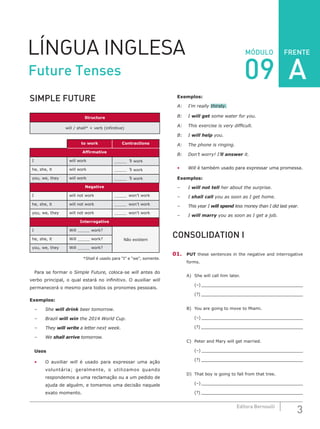
SIMPLE FUTURE
Structure
will / shall* + verb (infinitive)
to work Contractions
Affirmative
I will work _____	 ’ll work
he, she, it will work _____	 ’ll work
you, we, they will work _____	 ’ll work
Negative
I will not work _____	 won’t work
he, she, it will not work _____	 won’t work
you, we, they will not work _____	 won’t work
Interrogative
I Will _____ work?
Não existemhe, she, it Will _____ work?
you, we, they Will _____ work?
*Shall é usado para “I” e “we”, somente.
Para se formar o Simple Future, coloca-se will antes do
verbo principal, o qual estará no infinitivo. O auxiliar will
permanecerá o mesmo para todos os pronomes pessoais.
Exemplos:
–	She will drink beer tomorrow.
–	Brazil will win the 2014 World Cup.
–	They will write a letter next week.
–	We shall arrive tomorrow.
Usos
•	 O auxiliar will é usado para expressar uma ação
voluntária; geralmente, o utilizamos quando
respondemos a uma reclamação ou a um pedido de
ajuda de alguém, e tomamos uma decisão naquele
exato momento.
Exemplos:
A:	 I’m really thirsty.
B:	I will get some water for you.
A:	 This exercise is very difficult.
B:	I will help you.
A:	 The phone is ringing.
B:	 Don’t worry! I’ll answer it.
•	 Will é também usado para expressar uma promessa.
Exemplos:
–	I will not tell her about the surprise.
–	I shall call you as soon as I get home.
–	 This year I will spend less money than I did last year.
–	I will marry you as soon as I get a job.
CONSOLIDATION I
01.	 PUT these sentences in the negative and interrogative
forms.
A)	 She will call him later.
	 (–) ________________________________________
	 (?) ________________________________________
B)	 You are going to move to Miami.
	 (–) ________________________________________
	 (?) ________________________________________
C)	 Peter and Mary will get married.
	 (–) ________________________________________
	 (?) ________________________________________
D)	 That boy is going to fall from that tree.
	 (–) ________________________________________
	 (?) ________________________________________
Future Tenses 09 A
4 Coleção Estudo
NEAR FUTURE
Structure
verb to be + going to + verb (base form)
to come Contractions
Affirmative
I am going to come _____	’m going to come
he, she, it is going to come _____	’s going to come
you, we, they are going to come _____	’re going to come
Negative
I am not going to come
______	’m not going to
come
he, she, it is not going to come
_____	’s not going to
come
you, we, they are not going to come
_____	’re not going to
come
Interrogative
I
Am ____ going to
come?
Não existemhe, she, it
Is ____ going to
come?
you, we, they
Are ____ going to
come?
OBSERVAÇÃO
A negativa se dá sempre no verbo to be (am not / isn’t /
aren’t).
Usos
•	 Going to é usado para falar sobre uma intenção futura
ou plano futuro quando a decisão já foi tomada no
passado.
–	We are going to see that movie tonight at 8:00 pm.
–	We aren’t going to see that movie tonight at 8:00 pm.
–	John is going to buy a Porsche next year.
–	John isn’t going to buy a Porsche next year.
•	 Will ou be + going to são usados para fazer previsões.
–	 It’s 9:30! We will miss the bus.
–	 It’s 9:30! We are going to miss the bus.
–	 The party will be very nice.
–	 The party is going to be very nice.
CHECK IT OUTC
Quando a Língua Inglesa é usada em contextos
informais, observa-se o uso da forma gonna, em
vez da forma going to, para se expressar Near
Future. É interessante observar o motivo pelo
qual essa mudança veio a ocorrer: pelo fato de
a forma going to ser pronunciada de maneira
rápida, ela se reduziu à forma gonna. Observa-se
o uso frequente de gonna em músicas e na língua
oral, como nos exemplos abaixo.
–	 “I’m gonna miss you like a child misses
their blanket”.
–	“It’s gonna be me”.
–	 Is he gonna be there?
–	 Don’t worry, everything’s gonna be all right.
CONSOLIDATION II
01.	 Thank God, it’s Sunday! I am going to go to the beach
with some friends. We are going to play volleyball and
then we are going to swim. My girlfriend Jenna is going
to stay on the sand under the sunshade. At midday we
are going to have lunch in a sea food restaurant near
the beach. We are going to have shrimps and oysters.
At five o’clock in the evening we are going to come back
home. It’s going to be a wonderful day!
ANSWER the questions according to the previous text.
A)	 Is the narrator happy? Why?
____________________________________________
B)	 Where is he going?
____________________________________________
C)	 Is he going alone?
____________________________________________
D)	 Are they going to a shopping center to eat?
____________________________________________
E)	 Where are they going, then?
____________________________________________
Frente A Módulo 09
LÍNGUAINGLESA
5Editora Bernoulli
FUTURE CONTINUOUS
Structure
will / shall*
/ be going to + verb to be (base form) + main verb (-ing)
to help Contractions
Affirmative
I
will be helping
am going to be helping
___	 ’ll be helping
___	 ’m going to be helping
he,
she,
it
will be helping
is going to be helping
___	 ’ll be helping
___	 ’s going to be helping
you,
we,
they
will be helping
are going to be helping
___	 ’ll be helping
___	 ’re going to be helping
Negative
I
will not be helping
am not going to be helping
___	 won’t be helping
___	 ’m not going to be
helping
he,
she,
it
will not be helping
is not going to be helping
___	 won’t be helping
___	 isn’t going to be
helping
you,
we,
they
will not be helping
are not going to be helping
___	 won’t be helping
___	 aren’t going to be
helping
Interrogative
I
Will ___ be helping?
Am ___ going to be helping?
Não existem
he,
she,
it
Will ___ be helping?
Is ___ going to be helping?
you,
we,
they
Will ___ be helping?
Are ___ going to be helping?
*Shall é usado para “I” e “we”, somente.
Usos
•	 Descrever uma ação que estará acontecendo em uma
determinada época do futuro.
Exemplos:
–	 I can’t go out with you because I’ll be working all
morning.
–	 The kids stayed up until very late yesterday, so I’m sure
they are going to be sleeping when you arrive home.
–	We will / shall be sleeping tomorrow night.
–	I am going to be reading tomorrow morning.
SXC
•	 O Future Continuous pode ser usado para um evento
futuro que acontecerá naturalmente, sem ter relação com
intenções, tempo de decisão, tipo de planos, etc.
Exemplos:
–	I will be helping you in a few minutes.
–	He will be presenting the new technologies tonight.
FUTURE PERFECT
Structure
will / be going to + have + verb (past participle)
to see Contractions
Affirmative
I
will have seen
am going to have seen
___	 ’ll have seen
___	 ’m going to have seen
he,
she,
it
will have seen
is going to have seen
___	 ’ll have seen
___	 ’s going to have seen
you,
we,
they
will have seen
are going to have seen
___	 ’ll have seen
___	 ’re going to have seen
Negative
I
will not have seen
am not going to have seen
___	 won’t have seen
___	 ’m not going to have
seen
he,
she,
it
will not have seen
is not going to have seen
___	 won’t have seen
___	 isn’t going to have
seen
you,
we,
they
will not have seen
are not going to have seen
___	 won’t have seen
___	 aren’t going to have
seen
Interrogative
I
Will ___ have seen?
Am ___ going to have seen?
Não existem
he,
she,
it
Will ___ have seen?
Is ___ going to have seen?
you,
we,
they
Will ___have seen?
Are ___ going to have seen?
O Future Perfect é usado para expressar uma ação que
será completada antes de uma outra ação, num tempo
específico no futuro.
Exemplos:
–	I am going to have finished dinner by 8 o’clock.
–	They will have painted the apartment before we
move in.
–	 The students aren’t going to have taken their
summer break before mid-December.
–	 The plane will leave the airport at 10:00 p.m. You will
arrive at the airport at 10:30 p.m. When you arrive,
the plane will have left.
Future Tenses
6 Coleção Estudo
FUTURE PERFECT CONTINUOUS
Structure
will / be going to + have + been + verb (-ing)
to move Contractions
Affirmative
I will / am going to have been moving ___’ll have been moving ___’m going to have been moving
he, she, it will / is going to have been moving ___’ll have been moving ___’s going to have been moving
you, we, they will / are going to have been moving ___’ll have been moving ___’re going to have been moving
Negative
I will not / am not going to have been moving ___ won’t have been moving ___ ’m not going to have been moving
he, she, it will not / is not going to have been moving ___ won’t have been moving ___ isn’t going to have been moving
you, we, they will not / are not going to have been moving ___ won’t have been moving ___ aren’t going to have been moving
Interrogative
I Will ___ have been moving?
Am ___ going to have been moving?
Não existem
he, she, it Will ___ have been moving?
Is ___ going to have been moving?
you, we, they Will ___have been moving?
Are ___ going to have been moving?
O Future Perfect Continuous é usado para expressar uma
ação que estará acontecendo em determinado momento no
tempo futuro e qual será a duração dessa ação.
Exemplos:
–	 By ten o’clock I will have been dancing for 4 hours.
–	 By ten o’clock I won’t have been dancing for 4 hours.
–	 Next July I am going to have been traveling in
Europe for one month.
–	 Next July I’m not going to have been traveling in
Europe for one month.
KurtForstner/CreativeCommons
PROPOSED EXERCISES
01.	 (UNESP-SP) Assinale a alternativa que preenche a lacuna
da frase a seguir CORRETAMENTE.
He will ________ almost everything you ask him.
A)	do	
B)	 to do	
C)	doing	
D)	does
E)	 did
02.	 (Mackenzie-SP) Choose the CORRECT alternative to
complete the sentence.
“Since I haven’t got _________, I will _________.”
A)	 enough time; have the cake made.
B)	 time enough; get someone to make the cake.
C)	 enough time; bake the cake myself.
D)	 any time; make the cake.
E)	 time enough; ask somebody to bake the cake.
03.	 (UNIRIO-RJ / Adaptado) The word shall in “This too shall
pass“ conveys the meaning of
A)	certainty.
B)	likelihood.
C)	possibility.
D)	suggestion.
E)	 expectation.
Frente A Módulo 09
LÍNGUAINGLESA
7Editora Bernoulli
04.	 (Mackenzie-SP) Indicate the alternative that BEST
completes the following sentence.
“A prize ________ to whoever solves this equation.”
A)	has given					D)	will be given
B)	 should give				 E)	 must have given
C)	 is giving
05.	 (Mackenzie-SP) Indicate the alternative that BEST
completes the following sentences.
“_______ to the movies alone?
“Yes, but I wish you _______ with me.”
A)	 Will you go – had come
B)	 Are you going – could come
C)	 Have you gone – were
D)	 Would you go – come
E)	 Should you go – had come
06.	 (CEFET-MG / Adaptado) The following paragraph gives
us the idea of
“Ultrasound techniques developed by NASA to examine
International Space Station crew members may soon find
another use helping treat medical emergencies on Earth.”
A)	 a future fact.
B)	 a present fact.
C)	 a future possibility.
D)	 a present possibility.
E)	 a present probability.
TEXT I
UFG
Mammogram Magic
No question, the test saves lives.
So why don’t more women go?
		 Few intervals in a woman’s life are more unnerving
than the ten minutes she spends with her breasts
squeezed between heavy plates of plastic, trying not
to move or breathe. Imagining what the high-tech
05	 equipment might reveal, or fail to, can be even worse.
		 Dignity and discomfort aside, mammograms do save
lives. But too many women continue to question the
test’s reliability and safety.
		 Bottomline:breastcancerishighlycurable,ifcaughtearly.
10	 But in order to be treated, it must be detected. And
while mammography doesn’t have a 100-percent
accuracy rate, it still is a woman’s best defense.
	[...]
SCHMID, Judith Mandelbaum.
Reader’s Digest, Aug. 2001.
Glossary
unnerving = amedrontadores
squeezed = espremidos
reliability = confiabilidade
01.	 Considerando-se a pergunta expressa no subtítulo do
artigo – “Por que mais mulheres não fazem o exame
de mamografia?” – julgue as afirmações, assinalando
C (CERTO) ou E (ERRADO):
A)	 ( ) porque é um exame caro.
B)	 ( ) porque causa efeitos colaterais.
C)	 ( ) porque é demorado.
D)	 ( ) porque não tem 100% de precisão.
02.	 A respeito da mamografia, assinale C (CERTO) ou
E (ERRADO):
A)	 ( ) it can cause health problems.
B)	 ( ) it is done with modern equipment.
C)	 ( ) it can detect two types of cancer.
D)	 ( ) it makes women feel frightened.
03.	 Tendo em vista os seguintes elementos linguísticos, julgue
as afirmativas, assinalando C (CERTO) ou E (ERRADO):
A)	 ( ) No question (subheading) is a colloquial form for
There is no question about it.
B)	 ( ) do (line 06) gives emphasis to the idea of saving
lives.
C)	 ( ) must (line 10) can be substituted by will.
D)	 ( ) while (line 11) introduces the idea that two actions
are happening at the same time.
Future Tenses
8 Coleção Estudo
TEXT II
FUVEST-SP–2010
Briefing Unemployment The Economist March 14th 2009
		 Last month America’s unemployment rate climbed to
8.1%, the highest in a quarter of a century. For those
newly out of a job, the chances of finding another soon
are the worst since records began 50 years ago. In China
05	 20m migrant workers (maybe 3% of the labour
force) have been laid off. Cambodia’s textile industry,
its main source of exports, has cut one worker
in ten. In Spain the building bust has pushed the
jobless rate up by two-thirds in a year, to 14.8% in
10	 January. And in Japan, where official unemployment used
to be all but unknown, tens of thousands of people on
temporary contracts are losing not just their jobs but
also the housing provided by their employers.
		 The next phase of the world’s economic downturn is
15	 taking shape: a global jobs crisis. Its contours are
only just becoming clear, but the severity, breadth and
likely length of the recession, together with changes
in the structure of labour markets in both rich and
	 emerging economies, suggest the world is about
20	 to undergo its biggest increase in unemployment for
decades.
THE ECONOMIST, Mar. 14th
2009.
01.	 De acordo com o texto, publicado em março de 2009,
A)	 o aumento de postos de trabalho é vital para as
economias emergentes.
B)	 a crise mundial poderia afetar sobretudo os países
mais pobres.
C)	 a estrutura do mercado de trabalho vigente em países
ricos é a principal responsável pela crise.
D)	o mundo poderia enfrentar a maior crise de
desemprego das últimas décadas.
E)	 a crise que a economia mundial vivencia vem sendo
anunciada há décadas.
02.	 Segundo o texto, no Japão,
A)	 o número oficial de desempregados é desconhecido.
B)	 milhares de pessoas estão perdendo seus empregos
e sua moradia.
C)	 grande parte dos trabalhadores possui contratos
temporários de trabalho.
D)	os empregadores omitem o número de postos de
trabalho porque muitos não são oficiais.
E)	 os desempregados estão lutando para manter suas
casas.
03.	 O pronome “another” (line 3) na sentença “[...] the
chances of finding another [...]” refere-se a
A)	país.
B)	trabalhador.
C)	emprego.
D)	oportunidade.
E)	 recorde.
TEXT III
Unimontes-MG–2008
Internet Safety
	 How could we exist without the Internet? That’s how
most of us keep in touch with friends, find homework
support, research a cool place to visit, or find out the
latest news. But besides the millions of sites to visit and
things to do, the Internet offers lots of ways to waste time –
and even get into trouble. And just as in the non-cyber world,
some people you encounter online might try to take
advantage of you – financially or physically.
	 You’ve probably heard stories about people who get into
trouble in chat rooms. Because users can easily remain
anonymous, chat rooms often attract people who are
interested in more than just chatting. They’ll sometimes
ask visitors for information about themselves, their
families, or where they live – information that shouldn’t
be given away[1]
.
	 In some cases predators may use this information
to begin illegal or indecent relationships or to harm a
person’s or family’s well-being.
Frente A Módulo 09
LÍNGUAINGLESA
9Editora Bernoulli
	 Of course, the Internet is home to millions of places
you can and should visit. Like an infinite library, the Web
can take you to the ends of the Earth with the information
it contains.
	 You can use it to do research for school, find out what
movie is playing near you (and whether people like it),
check out a college you’re thinking about, or find a job
or volunteer opportunity. Almost anything you can think
of has a website (or a thousand of them) about it. And
it’s not just websites – blogs, videos, and downloadable
games await to connect you with other users and players.
	 The key is to protect yourself while online.[2]
	 First rule of smart surfing? Remain as anonymous
as possible. That means keeping all private information
private. Here are some examples of private information
that you should never give out on the Internet:
•	 full name
•	 home address
•	 phone number
•	 Social Security number
•	 passwords
•	 names of family members
•	 credit card numbers
	 Most credible people and companies will never ask
for this type of information online. So if someone does,
it’s a red flag that may be up to no good[3]
.
	 Experts recommend that people keep online friendships
in the virtual world. Meeting online friends face-to-face
carries more risks than other types of friendship because
it’s so easy for people to pretend to be something they’re
not when you can’t see them or talk in person.
	 With all the problems you can face online, is it worth
it? For most people, the answer is definitely yes. You just
need to know where the pitfalls are, use some common
sense and caution, and you’ll be in control.
Available at: <http://www.kidshealth.org>
Accessed: Sept. 15th
, 2007. (Adapted).
01.	 O texto traz à tona, sobre a Internet, o fato de
A)	 ser necessário conhecermos formas seguras de
navegar, não revelando nossos dados ou outras
informações pessoais online.
B)	 ser mais seguro, hoje, ter amigos via net, os quais
estão distantes e, assim, não podem tirar vantagem
de nós.
C)	 ser improvável que as amizades, hoje, sem a web,
consolidem-se, devido à dificuldade que as pessoas
têm para se encontrar.
D)	 ser incompreensível as pessoas perderem tanto tempo
online, se é face a face que as relações são de fato
seguras.
02.	 Pode-se afirmar, em conformidade com o texto, que
A)	 o internauta acaba se relaxando nas chat rooms
porque este ainda é um lugar seguro na Internet.
B)	 há internautas que podem agir de má-fé e usar dados
de outros internautas para fins ilícitos.
C)	 a amizade virtual é a abertura de uma porta para a
concretização de uma amizade real.
D) 	há situações na Internet em que nem mesmo o
anonimato priva o usuário de passar por dissabores.
03.	 O texto só NÃO nos permite fazer a seguinte afirmação:
A)	 A Internet possibilita-nos reavaliar as amizades que
fazemos no mundo não cibernético.
B)	 Devemos ver uma amizade virtual com uma certa
desconfiança.
C)	 A Internet tem sido usada como um meio frequente
de comunicação para muitos de nós.
D)	 É preciso agir com cautela ao utilizar a Internet, pois
ela pode também nos prejudicar.
04.	 Só NÃO se pode afirmar, tomando como base o texto,
que, ao usarem a Internet,
A)	 as pessoas encontram auxílio para os trabalhos
escolares.
B)	 as pessoas se atualizam com as notícias mais
recentes.
C)	 as pessoas conseguem não perder o contato com os
amigos.
D)	as pessoas acabam ganhando tempo e evitando
problemas offline.
05.	 Diante do que expõe o texto, só NÃO é correto afirmar:
A)	 As pessoas estão chegando à conclusão de que é
impossível usarem a Internet com segurança.
B)	 É mais fácil para as pessoas enganarem as outras
quando não estão frente a frente.
C)	Um site idôneo não solicita informações que
comprometam a segurança do internauta.
D)	 Não devemos trazer para o mundo real os amigos que
encontramos no mundo virtual.
Future Tenses
10 Coleção Estudo
06.	 Segundo o texto, a Internet pode, EXCETO
A)	 tornar-nos pessoas sem escrúpulos.
B)	 invadir a nossa privacidade.
C)	 trazer para nós decepções.
D)	 minar a nossa segurança.
07.	 Segundo o texto, o internauta deve manter-se
A)	anônimo.
B)	controlador.
C)	omisso.
D)	paciente.
08.	 “[...] information that shouldn’t be given away.” [1]
Por meio do trecho acima, atentando-se para o contexto
em que ele está inserido, é CORRETO dizer que
A)	 os usuários de Internet acabam visitando sites dos
quais obtêm informações equivocadas.
B)	 os usuários de Internet não estão seguros de que
recebem informações verídicas.
C)	 os usuários de Internet podem acabar fornecendo
informações pessoais inadvertidamente.
D)	 os usuários de Internet estão à mercê de informações
falsas nos sites consultados.
09.	 “The key is to protect yourself while online.” [2]
De acordo com a passagem anterior, considerado o
contexto, pode-se dizer:
A)	 Quem protege a si na Internet acaba protegendo a
todos.
B)	 Quem se protege ao usar a Internet evita problemas
ao navegar.
C)	 Quem se protege online pode até liberar seus dados
pessoais.
D)	 Quem usa senha na Internet está bem protegido.
10.	 “[...] it’s a red flag that may be up to no good.” [3]
A expressão acima, de acordo com o contexto, denota
A)	 uma justificativa.
B)	 um alerta.	
C)	 um apelo.
D)	 um consentimento.
TEXT IV
UFAC–2011
Available at: <http://www.cartoonistgroup.com/properties/
wpwg.php?id=104&today=2010-09-10>.
01.	 On the first square, the expression “getting on my nerves”
means:
A)	 Making me very happy.
B)	 Falling in Love.
C)	 Making me very angry.
D)	 Making me very sad.
E)	 Insisting very much.
02.	 “Wanna” in the second square is used in informal
language, during conversation. It is the short form of:
A)	 Want for.
B)	 Want up.
C)	 Want of.
D)	 Want to.
E)	 Want off.
Frente A Módulo 09
LÍNGUAINGLESA
11Editora Bernoulli
ENEM EXERCISES
Brazilian NGOs establish a network to
influence climate change policies
Publication date: October 2002
Source: Center for International Climate and
Environmental Research
	 Through much of the past climate change negotiations,
there has been little interaction between the Brazilian
government and non-governmental organizations.
In 2002, however, Brazilian NGOs formed a network
because they were not satisfied with how the government
dealt with important climate concerns, especially the link
between deforestation and global warming.
	 The network, called the Climate Observatory, aims to
become a vehicle for influencing government views and
policies on climate change. A first priority was to direct more
attention to deforestation, an important yet controversial
issue, both in Brazil and the international arena. In 2002,
the network had 26 members from all over Brazil, and the
effects of the network have included a broader participation
of NGOs in the climate change debate in Brazil.
Available at: < http://www.scidev.net/en/key-documents/
brazilian-ngos-establish-a-network-to-influence-cl.html> .
Accessed: Aug. 12th
, 2010.
01.	 The idea of organizing a network called Climate
Observatory
A)	 was established in a social network discussion about
Brazilian policies.
B)	 emerged from a dissatisfaction with government’s
policies on climate issues.
C)	 was structured by government and non-governmental
members.
D)	 emerged from 26 members from all over Brazil.
E)	 came from an initiative from the Brazilian government.
02.	 After reading the text, we can conclude that the main aim
of the network is
A)	 to build a tool to fight against the global warming.
B)	 to draw national attention to deforestation in
Amazonia.
C)	 to create a problematic issue both in Brazil and around
the world.
D)	to negotiate deforestation among national and
international NGOs.
E)	 to have an effect on the government’s climate policies.
03.	 The word yet in the sentence “A first priority was to
direct more attention to deforestation, an important yet
controversial issue […]” represents
A)	 contrast. 			 C)	 reason.			 E)	 addition.
B)	condition.			D)	cause.
HAVING FUN
Double-decker bus
SXC
A double-decker bus is a bus that has two storeys or
‘decks’. While double-decker long-distance coaches are
in widespread use around the world, double-decker
city buses are less common. Double-decker buses
are popular in some cities of Europe and in parts of
Asia, usually in former British colonies (Hong Kong,
Singapore, etc.). In the UK, double-decker buses are
a common reference item for describing very large
objects; for example, a blue whale is about as long as
‘three double-decker buses’.
From Wikipedia, the free encyclopedia
Available at: <http://en.wikipedia.org/wiki/Double-decker_bus>
Accessed: Nov. 23rd
, 2010.
GLOSSARY
●	 Break = feriado, intervalo
●	 Stay up (phrasal verb) = ficar acordado(a) (stay up –
stayed up – stayed up)
●	 Thirsty = com sede
SXC
Future Tenses
12 Coleção Estudo
ANSWER KEY
Consolidation I
01.	 A)	 She will not / won’t call him later.
		 Will she call him later?
	 B)	 You are not / aren’t going to move to Miami.
		 Are you going to move to Miami?
	 C)	 Peter and Mary will not / won’t get married.
		 Will Peter and Mary get married?
	 D)	 That boy is not / isn’t going to fall from that
tree.
		 Is that boy going to fall from that tree?
Consolidation II
01.	 A)	 Yes, he is. Because it is Sunday.
	 B)	 He is going to the beach.
	 C)	 No, he isn’t.
	 D)	 No, they aren’t.
	 E)	 They are going to have lunch in a sea food
restaurant near the beach.
Proposed Exercises
01.	A
02.	A
03.	A
04.	D
05.	B
06.	C
Text I
01.	 A)	 E
	 B)	 E
	 C)	 E
	 D)	 E
02.	 A)	 E
	 B)	C
	 C)	 E
	 D)	C
03.	A)	C
	 B)	C
	 C)	 E
	 D)	C
Text II
01.	D
02.	B
03.	C
Text III
01. 	A
02.	B
03.	A
04.	D
05.	A
06.	A
07.	A
08.	C
09.	B
10.	B
Text IV
01.	C
02.	D
Enem Exercises
01.	B
02.	 E
03.	A
Frente A Módulo 09
FRENTE
13Editora Bernoulli
MÓDULOLÍNGUA INGLESA
PRESENT PERFECT
Structure
have / has + verb (past participle)
to go Contractions
Affirmative
I have gone ____’ve gone
he, she, it has gone ____’s gone
you, we, they have gone ____’ve gone
Negative
I have not gone ____ haven’t gone
he, she, it has not gone ____ hasn’t gone
you, we, they have not gone ____ haven’t gone
Interrogative
I Have ____ gone?
Não existemhe, she, it Has ____ gone?
you, we, they Have ____ gone?
O Present Perfect é um tempo verbal que não possui
equivalente na língua portuguesa. Pode expressar diversas
ideias.
Usos
O Present Perfect é usado para indicar:
A)	 Ações que aconteceram em um tempo indefinido no
passado.
Exemplos:
–	I’ve been to Italy.
–	He has bought a car.
RudolfStricker/CreativeCommons
CHECK IT OUTC
Past Simple X Present Perfect
PAST SIMPLE
•	 Usamos o Past Simple para nos referirmos
a ações que foram realizadas no tempo
passado.
•	 É necessário indicar quando a ação ocorreu.
Exemplos:
–	He went to Italy last July.
–	 Did you go to school yesterday?
PRESENT PERFECT
•	 Usamos o Present Perfect para nos
referirmos a ações que foram realizadas no
tempo passado, mas que de alguma maneira
trazem uma consequência para o tempo
presente. O Present Perfect geralmente
expressa a ideia de “experiência”.
•	 Não é necessário mencionar quando a ação
ocorreu.
Exemplos:
–	He has been to Italy. (e por isso tem um
conhecimento grande da cultura italiana)
–	We have worked there. (e por isso temos
uma vasta experiência profissional)
B)	 Ações que começaram no passado e continuam até
o presente. Nesse caso, usa-se since (desde) ou for
(por; durante).
Exemplos:
– 	 They have lived here since 1984.
–	Sally has worked with us for seven years.
C)	 Ações que já foram realizadas. Nesse caso,
são acompanhadas por already (já).
Exemplo:
– 	 Paul has already studied this book.
D)	 Ações que acabaram de ocorrer, sendo acompanhadas
por just (neste momento).
Exemplo:
–	John has just written a letter.
E)	 Ações que ainda não foram realizadas. Usa-se, nesse
caso, yet (ainda).
Exemplo:
–	 I haven’t received my salary yet.
Present Perfect and
Past Perfect Tenses
10 A
14 Coleção Estudo
F)	 Ações que não se realizaram até o presente, mas
que podem vir a acontecer. Nesse caso, usa-se never
(nunca) na forma afirmativa e ever (alguma vez) na
forma interrogativa.
Exemplos:
– 	I have never driven a car.
– 	 Have you ever read Hamlet?
G)	 Ações que tenham acontecido várias vezes no
passado.
Exemplos:
–	 These students have failed many times.
–	 Our team has won many games.
CONSOLIDATION I
01.	 FILL IN the blanks with the Present Perfect of the verbs
in parentheses.
A)	That teacher _______ many countries. (to visit)
B)	What _______ you _______ recently? (to do)
C)	She _______ just _______ my letter. (to receive)
D)	John _______ already _______ the exercises. (to do)
E)	They _______ their friends yet. (to see – not)
F)	Where _______ you _______, Alice? (to be)
G)	July _______ there for two years. (to live)
H)	You _______ Linguistics since 1990. (to study)
PRESENTPERFECTCONTINUOUS
Structure
have / has + been + verb (-ing)
to fight Contractions
Affirmative
I have been fighting
____	’ve been
fighting
he, she, it has been fighting ____	’s been fighting
you, we, they have been fighting
____	’ve been
fighting
Negative
I have not been fighting
____	haven’t been
fighting
he, she, it has not been fighting
____	hasn’t been
fighting
you, we, they have not been fighting
____	haven’t been
fighting
Interrogative
I Have ____ been fighting?
Não existemhe, she, it Has ____ been fighting?
you, we, they Have ____ been fighting?
O Present Perfect Continuous é usado para expressar uma
ação que começou no passado e continua no presente (um
dos usos do Present Perfect). Sua estrutura concede à oração
a ideia de que a ação não está encerrada.
Exemplos:
– 	 The children have been studying since seven
o’clock.
–	 Pauline has been working for that company since
1998.
–	 I have been taking math classes with a private
teacher for 3 years.
–	 Mary and John haven’t been attending their soccer
practice.
CONSOLIDATION II
01.	 FILL IN the blanks with the Present Perfect Continuous
of the verbs in parentheses.
A)	 They ___________ for more than an hour. (to talk)
B)	 He ___________ English for many years. (to study)
C)	 It ___________ all day long. (to rain)
D)	 Iraq ___________ for 20 years. (to fight)
E)	 Our team ___________ many others for many years.
(to beat)
PAST PERFECT
Structure
had + verb (past participle)
to make Contractions
Affirmative
I had made ____’d made
he, she, it had made ____’d made
you, we, they had made ____’d made
Negative
I had not made ____ hadn’t made
he, she, it had not made ____ hadn’t made
you, we, they had not made ____ hadn’t made
Interrogative
I Had ____ made?
Não existemhe, she, it Had ____ made?
you, we, they Had ____ made?
Frente A Módulo 10
LÍNGUAINGLESA
15Editora Bernoulli
É usado para expressar uma ação que começou antes
de uma outra que aconteceu no passado. Ele é geralmente
usado no Indirect Speech ou para enfatizar a ordem dos
eventos.
Exemplos:
–	He had worked very hard before he retired.
–	They had danced a lot when the party finished.
–	She had talked to the teacher before the class
started.
OBSERVAÇÃO
Usamos o Past Perfect quando temos mais de uma ação
no passado. A primeira ação será sempre no Past Perfect e
a ação seguinte, no Simple Past Tense.
Past Present
------------------------ X ------------------------X------------------------I------------------------
1ª ação 2ª ação
Past Perfect Simple Past
Palavras e expressões que geralmente aparecem
conectando as duas ações do passado:
•	 WHEN
•	 BEFORE
•	 AFTER
•	 BY THE TIME
Exemplos:
–	 When I arrived home, my brother had already left.
	 1ª ação: My brother had already left. [PAST
PERFECT]
	 2ª ação: I arrived home. [SIMPLE PAST]
–	John had done his homework before he played soccer.
	 1ª ação: John had done his homework. [PAST
PERFECT]
	 2ª ação: He played soccer. [SIMPLE PAST]
–	 They went to the party after they had taken a
shower.
	 1ª ação: They had taken a shower. [PAST PERFECT]
	 2ª ação: They went to the party. [SIMPLE PAST]
Usos
O Past Perfect é usado para indicar:
A)	 Ações que ocorreram antes de outras, no passado.
Exemplos:
–	 The baby had slept when I got home.
–	 I knew that Lucy hadn’t studied for the test yet.
B)	 Indirect speech.
Exemplos:
–	 I have finished my work.
–	 He said that he had finished his work.
C)	 É usado em sentenças compostas no passado, com
conjunções de tempo, como after, before, when, until,
as soon as.
Exemplos:
–	 He returned home after he had left the office.
–	I had studied a lot before I entered University.
JacobRus/CreativeCommons
Harvard University
PAST PERFECT CONTINUOUS
Structure
had + been + verb (-ing)
to do Contractions
Affirmative
I had been doing ____’d been doing
he, she, it had been doing ____’d been doing
you, we, they had been doing ____’d been doing
Negative
I had not been doing ____ hadn’t been doing
he, she, it had not been doing ____ hadn’t been doing
you, we, they had not been doing ____ hadn’t been doing
Interrogative
I Had ____ been doing?
Não existemhe, she, it Had ____ been doing?
you, we, they Had ____ been doing?
O Past Perfect Continuous é usado para expressar uma
ação que estava acontecendo em determinado momento no
tempo passado. Geralmente, essa ação estava em progresso
quando outra aconteceu.
Exemplos:
–	I had been dancing for 4 hours when he arrived at
the party.
–	I hadn’t been dancing for 4 hours when he arrived
at the party.
–	She had been traveling in Europe for one month
before she broke her arm.
–	She hadn’t been traveling in Europe for one month
before she broke her arm.
Present Perfect and Past Perfect Tenses
16 Coleção Estudo
CONSOLIDATION III
01.	 PUT these sentences in the negative and interrogative
forms.
A)	 I had been working there for 10 years before I quit.
	 (–)	 _______________________________________
	_______________________________________
(?)	_______________________________________
	_______________________________________
B)	 Mary had studied a lot.
(–)	_____________________________________
	_______________________________________
(?)	_____________________________________
	_______________________________________
C)	 He had been traveling too much.
(–)	_____________________________________
	_______________________________________
(?)	_____________________________________
	_______________________________________
D)	 They had learned about the Milky Way.
(–)	_____________________________________
	_______________________________________
(?)	_____________________________________
	_______________________________________
E)	 We had been cleaning up the house for three hours
before mom got home.
(–)	_____________________________________
	_______________________________________
(?)	_____________________________________
	_______________________________________
F)	 Louis had bought many presents for his grandson.
(–)	_____________________________________
	_______________________________________
(?)	_____________________________________
	_______________________________________
02.	 COMPLETE with the Past Perfect of the verbs in
parentheses.
A)	 By the time we arrived, they _________. (to leave)
B)	 He said that he __________ that movie. (to see)
C)	 He wanted to know what ________ to his car.
(to happen)
D)	 They asked me why I __________ the party so early.
(to leave)
E)	 What did she say she ____ with the money? (to do)
03.	 Put the verbs into the correct tense: Simple Past or Past
Perfect.
A)	 When he _________ (leave), he _________ (realize)
he _________ (forget) his wallet.
B)	 She _________ (burst) into tears the moment he
_________ (shut) the door.
C)	 His finger _________ (begin) to bleed as soon as he
_________ (cut) himself.
D)	 He _________ (lose) his new knife shortly after he
_________ (buy) it.
E)	 He ____________ (begin) to read as soon as he
_________ (find) his book.
PROPOSED EXERCISES
01.	 (UFMS) I haven’t seen John ___________ he arrived from
Europe.
A)	 when			 C)	 until			 E)	 since
B)	for				D)	before		
02.	(VUNESP) I __________ here since 1970.
A)	live						D)	will live
B)	 have lived				 E)	 would live
C)	 am living
03.	(UNESP) We’re still waiting for Bill. He __________ yet.
A)	 hasn’t come			 D)	 doesn’t come
B)	 haven’t come			 E)	 won’t come
C)	 didn’t come
04.	 (Milton Campos-MG) The Eurostar Train __________ since
November 14, 1994, between London and Paris.
A)	 was running			 D)	 has been running
B)	 ran						 E)	 have run
C)	 is running
05.	 (PUC-Campinas-SP) Although they _________ in the
country since they got married, they are now moving to
town.
A)	live						D)	be living
B)	 have been living		 E)	 None of the above applies.
C)	 are living
06.	 (ITA-SP) Mr. Smith, accompanied by his wife and three
children, _________ just arrived.
A)	 have			 C)	 was		 E)	 are
B)	has				D)	were		
07.	 (Milton Campos-MG) Brazilian coffee ___________
competition on the international market since its price
started going up.
A)	 is losing				 D)	 has been losing
B)	 lost						 E)	 have lost
C)	loses
08.	 (UFG) Why _______ those people singing? Because they
_______ gotten some good news.
A)	are, have				D)	was, has
B)	 is, have				 E)	 was, had
C)	 have, had
09.	 (UFES) They _______ in this city since they were little
boys.
A)	 had lived			 C)	 lived		 E)	 have lived
B)	are living			D)	live		
10.	 (ITA-SP) Sara _______ classes lately, has she?
A)	didn’t attend				D)	hadn’t attended
B)	 hasn’t attended			 E)	 haven’t attended
C)	 doesn’t attend
Frente A Módulo 10
LÍNGUAINGLESA
17Editora Bernoulli
TEXT I
FGV-SP–2010
Petrobras approves first offshore
heavy oil development
Petrobras has approved the development project for its
Siri field in the Campos basin, according to a news report
from Brazil. The field will be the first in the world (01)
extra heavy oil from an offshore site. Siri field, off the
coast of Southeast Brazil, (02) in production tests since
March and the company plans to contract production
equipment in 2011.
Available at: <www.ogfj.com>. (Adapted).
Assinale a alternativa que completa, CORRETA e
respectivamente, cada lacuna no texto.
01.	 A)	 the product		 D)	 is produced
B)	 in production				 E)	 to produce
C)	 will produce
02.	 A)	 would have seen		 D)	 has been
B)	 had been					 E)	 was going
C)	 were done
TEXT II
FUVEST-SP
Making a connection:
Phones are a way of getting together
	 Christoph Oswald has no problem approaching women.
As he makes his way through the crowd at his favorite
Frankfurt club, his cell phone scans a 10-meter radius
for “his type”: tall, slim, sporty, in her 30’s and, most
important, looking for him, a handsome 36-year-old
software consultant who loves ski holidays. Before
he reaches the bar, his phone starts vibrating and an
attractive blonde appears on its screen. “Hi, I’m Susan,”
she says. “Come find me!” Christoph picks her out[1]
of the crowd, and soon they’re laughing over a drink.
	 Both Christoph and Susan have phones equipped with
Symbian Dater, a program that promises to turn the cell
phone into a matchmaker. By downloading Symbian, they
installed a 20-character encrypted code that includes details
of who they are and what they’re looking for in a mate.
Whenever they go out, their matchmaking phones sniff out
other Symbian Daters over the unlicensed, and therefore
free, Bluetooth radio frequency. If profiles match up, the
phones beep wildly and send out short video messages.
NEWSWEEK, Jun. 7-14th
, 2004.
01.	 The passage tells us that at his favorite Frankfurt club,
Christoph Oswald
A)	 phones his girlfriend and asks her to join him for a
drink.
B)	 meets a woman who had left him a phone message
the day before.
C)	 has some difficulty spotting attractive women in the
crowd.
D)	 receives a video message from a woman he has never
met before.
E)	 gets several calls from women on his cell phone.
02.	 According to the passage, Symbian Dater is a program
that
A)	 connects cell phones to radio stations.
B)	 makes it possible to restrict the acceptance of calls
on a cell phone.
C)	 is installed in a cell phone to make it look for its
owner’s perfect mate.
D)	 installs a code in cell phones in order to prevent them
from being used by strangers.
E)	 is still unlicensed because it has to be perfected.
03.	 In the passage, the CORRECT translation for “picks her
out” [1]
is
A)	 sorri para ela.				
B)	 espera por ela.			
C)	 reconhece-a.
D)	 segue-a.
E)	 acena para ela.
04.	 We can conclude from the passage that Christoph Oswald
A)	 wants to meet new people.
B)	 is not pleased with his cell phone.
C)	 does not like outdoor activities.
D)	 is a rather shy person.
E)	 needs company for a ski holiday.
Present Perfect and Past Perfect Tenses
18 Coleção Estudo
TEXT III
UNIRIO-RJ–2006
The Future of Humankind
“Radical Evolution: the promise and peril of enhancing
our minds, our bodies — and what it means to be
human,” by Joel Garreau Doubleday, 2005 [$26]
		 What’s in store for humanity? It is becoming clear
that we will use our growing technological powers to
transform not only the world around us but ourselves,
too. Many forms of human enhancement are already
routine – sports medicine, psychotropic mood drugs,
wakefulness and alertness enhancers, cosmetic surgery,
drugs for sexual performance. Much more will become
possible in coming decades.
		 Joel Garreau’s Radical Evolution joins several recent
titles that attempt to make sense of the radical future
possibilities for our species. The potential prospects
include superintelligent machines, nonaging bodies,
direct connections between human brains or between
brain and computer, fully realistic virtual reality, and
the reanimation of patients in cryonic suspension.
As enablers of such miracle, Garreau mentions especially
“GRIN technologies” – genetics, robotics, information
technology and nanotechnology.
		 The focus of Garreau’s book, however, is not on the
nuts and bolts of the technology itself but rather on
what it[1]
will all mean for humans. His reporting skills
well honed by his work as a journalist and editor at the
Washington Post, Garreau is constantly on the lookout
for the human story behind the ideas. Biographical
sketches of the people he has interviewed for the book
get approximately equal airtime with their opinions
about human extinction and transcendence. The bulk of
one interviewee’s beard, the size of another’s collection
of musical instruments, the length of a third’s pants:
as Garreau knows all too well, these are indispensable
rivets to hold the attention of the current version of
Homo sapiens while we try to ponder whether we will
have indefinite life spans or whether the world will end
before our children have a chance to grow up.
SCIENTIFIC AMERICAN, 2005.
01.	 “The future of humankind” is a
A)	 critique.		 C)	 essay.			 E)	 commentary.
B)	review.			D)	editorial.	
02.	 One idea NOT mentioned by the author in his future
possible world is
A)	 superintelligent machines.
B)	 realistic virtual reality.
C)	 I.T. and nanotechnology.
D)	 forms of human enhancement.
E)	 an egalitarian society.
03.	 One inference that can be made from reading the text is that
A)	 there are many exciting prospective future possibilities
for our species.
B)	 drugs to enhance sexual performance will become
available in the future.
C)	 wakefulness and alertness enhancers will be available
very shortly.
D)	 GRIN technologies will be the focus of Garreau’s next
book.
E)	 the reanimation of patients in cryonic suspension will
never come to pass.
04. 	 The pronoun it [1]
in the sentence “[...] rather on what it
will all mean for humans [...]” refers to
A)	 technology.	 C)	 bolts.		 E)	 Garreau’s book.
B)	nuts.			D)	the focus.	
TEXT IV
AFA-SP–2011
Available at: <www.google.com>. (Adapted).
01.	 According to the cartoon, FIFA
A)	 pretends to improve the world.
B)	 has more ambitious purposes than the others.
C)	 wants to have control over the Roman, Genghis
Khan’s, and British Empires.
D)	 mustn’t be considered an empire.
ENEM EXERCISES
Social networks can warn of disease after disasters
Social networks quickly gather data on possible disease
outbreaks after natural disasters, writes biosurveillance
expert James Wilson.
	 When a natural disaster strikes and there is an
imminent threat of a disease outbreak, existing public
health surveillance systems often cannot hope to meet
the emergency operational needs of healthcare teams
working in challenging conditions.
Frente A Módulo 10
LÍNGUAINGLESA
19Editora Bernoulli
		 This year’s massive earthquake in Haiti, for example,
killed up to 250,000 people and displaced another two
million in the small, under-resourced Caribbean nation.
Many of these displaced people continue to live in grossly
unsanitary tents where diseases such as malaria, dengue
fever, diarrheal illnesses, HIV/AIDS and TB can spread.
But the earthquake also killed a significant number of
the medical and public health community, and clinics,
offices and hardcopy records were destroyed.
		 In such situations, there is a clear need for an
early warning system that provides this hard-pressed
medical community with infectious disease surveillance.
Our organisation, Praecipio International, has been at
the forefront of operational biosurveillance across the
globe – from reporting anthrax outbreaks in Asia to
spikes in viral fever cases in India.
		 We received an alert about the Haiti earthquake 26
minutes after the event, through the Global Disaster
Alert and Coordination System. We quickly did a sweep
of the Internet and began monitoring Twitter feeds in six
languages for the island of Hispaniola, which includes Haiti.
		 We knew straightaway from media, blogs and text
message traffic what was being reported about infectious
disease. By consulting peer-reviewed literature,
we constructed a baseline for several diseases and issued
the first infectious disease forecast report for Haiti on
17 January.
		 By integrating forecasting and real-time warning
systems with rapid, clinical response, countries in the grip
of disaster can control outbreaks of infectious disease
and potentially save thousands of lives. This is a vital,
if often overlooked, component of not only response
and recovery but also preparedness and ultimately,
community resilience.
		 Certainly for Haiti, anything that can be done to stop
further loss of life and build a foundation for community
resilience should be pursued. Through operational
biosurveillance, Haiti can become the first country in
the world to anticipate and intervene to halt disease
outbreaks and epidemics, and serve as a model for the
rest of the world.
James Wilson is executive director of Praecipio
International and the Haiti Epidemic Advisory System.
Available at: <http://www.scidev.net/en/opinions/social-
networks-can-warn-of-disease-after-disasters.html>.
(Adapted). Accessed: Aug. 11th
, 2010.
01.	 The main idea defended by the text is that
A)	 there is nothing to do to avoid disease outbreaks when
a natural disaster happens.
B)	 if a tornado strikes against a town citzens can be
warned before it happens.
C)	 the aftermath of a natural disaster is often unavoidable
and unpredictable.
D)	social networks can help to warn about disease
outbreaks after a natural disaster.
E)	 nothing could be done to help the medical and public
health teams in Haiti.
02.	 Concerning the previous text, after the earthquake, the
Haitian people
A)	 suffered the consequences of unsanitary conditions.
B)	 were deployed from their country due to the
challenging sanitary conditions.
C)	 believed the public health conditions would be
neglected in the country.
D)	were not helped by operational biosurveillance of
social networks.
E)	 died because their government neglected medical
assistance.
03.	 The word “halt” in the sentence “[...] Haiti can become the
first country in the world to anticipate and intervene to halt
disease outbreaks and epidemics […]” can be understood as
A)	“increase”. 				D)	“develop”.	
B)	 “stop”.						 E)	 “quit”.
C)	“release”.
04.	 According to the text, it is possible to state about Praecipio
International that
A)	 Haiti is the first and only country in which the
organization has effectively acted.
B)	 it was created to develop an epidemic control network
in Haiti after the earthquake.
C)	 it has reported anthrax outbreaks in Asia and spikes
in viral fever cases in India.
D)	 it was created to give courses on public health to the
Haitian medical community.
E)	 its offices and hardcopy records were destroyed by
the earthquake in Haiti.
GLOSSARY
●	 Homework = dever de casa
SXC
●	 Office = escritório
●	 Retire (verb) = aposentar-se (retire – retired – retired)
●	 Shower = banho, ducha
Present Perfect and Past Perfect Tenses
20 Coleção Estudo
ANSWER KEY
Consolidation I
01.	 A)	 has visited
	 B)	 have – done
	 C)	 has – received
	 D)	 has – done
	 E)	 haven’t seen
	 F)	 have – been
	 G)	 has lived
	 H)	 have studied
Consolidation II
01.	 A)	 have been talking
	 B)	 has been studying
	 C)	 has been raining
	 D)	 has been fighting
	 E)	 has been beating
Consolidation III
01.	A)	 I hadn’t been working there for 10 years
before I quit.
		 Had you been working there for 10 years
before you quit?
	 B)	 Mary hadn’t studied a lot.
		 Had Mary studied a lot?
	 C)	 He hadn’t been traveling too much.
		 Had he been traveling too much?
	 D)	 They hadn’t learned about the Milky Way.
		 Had they learned about the Milky Way?
	 E)	 We hadn’t been cleaning up the house for
three hours before mom got home.
		 Had we been cleaning up the house for three
hours before mom got home?
	 F)	 Louis hadn’t bought many presents for his
grandson.
		 Had Louis bought many presents for his
grandson?
02.	 A)	 had left
	 B)	 had seen
	 C)	 had happened
	 D)	 had left
	 E)	 had done
03.	 A)	 left - realized - had forgotten
	 B)	 burst - had shut
	 C)	 began - had cut
	 D)	 lost - had bought
	 E)	 began - had found
Proposed Exercises
01.	 E
02.	B
03.	A
04.	D
05.	B
06.	B
07.	D
08.	A
09.	 E
10.	B
Text I
01.	 E
02.	D
Text II
01.	D
02.	C
03.	C
04.	A
Text III
01.	B
02.	 E
03.	A
04.	A
Text IV
01.	B
Enem Exercises
01.	D
02.	A
03.	B
04.	C
Frente A Módulo 10
FRENTE
21Editora Bernoulli
MÓDULOLÍNGUA INGLESA
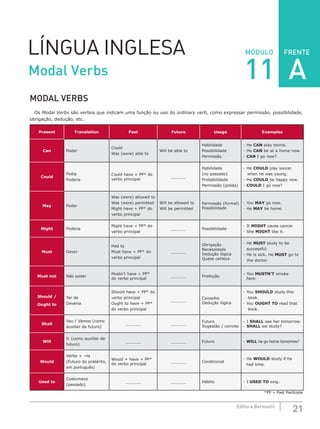
MODAL VERBS
Os Modal Verbs são verbos que indicam uma função ou uso do ordinary verb, como expressar permissão, possibilidade,
obrigação, dedução, etc.
Present Translation Past Future Usage Examples
Can Poder
Could
Was (were) able to
Will be able to
Habilidade
Possibilidade
Permissão
- He CAN play tennis.
- He CAN be at a home now.
- CAN I go now?
Could
Podia
Poderia
Could have + PP* do
verbo principal
______
Habilidade
(no passado)
Probabilidade
Permissão (polida)
- He COULD play soccer
when he was young.
- He COULD be happy now.
- COULD I go now?
May Poder
Was (were) allowed to
Was (were) permitted
Might have + PP* do
verbo principal
Will be allowed to
Will be permitted
Permissão (formal)
Possibilidade
- You MAY go now.
- He MAY be home.
Might Poderia
Might have + PP* do
verbo principal
______ Possibilidade
- It MIGHT cause cancer.
- She MIGHT like it.
Must Dever
Had to
Must have + PP* do
verbo principal
______
Obrigação
Necessidade
Dedução lógica
Quase certeza
- He MUST study to be
successful.
- He is sick. He MUST go to
the doctor.
Must not Não poder
Mustn’t have + PP*
do verbo principal
______ Proibição
- You MUSTN’T smoke
here.
Should /
Ought to
Ter de
Deveria
Should have + PP* do
verbo principal
Ought to have + PP*
do verbo principal
______
Conselho
Dedução lógica
- You SHOULD study this
book.
- You OUGHT TO read that
book.
Shall
Vou / Vamos (como
auxiliar de futuro)
______ ______
Futuro
Sugestão / convite
- I SHALL see her tomorrow.
- SHALL we study?
Will
Ir (como auxiliar de
futuro)
______ ______ Futuro - WILL he go home tomorrow?
Would
Verbo + -ria
(Futuro do pretérito,
em português)
Would + have + PP*
do verbo principal
______ Condicional
- He WOULD study if he
had time.
Used to
Costumava
(passado)
______ ______ Hábito - I USED TO sing.
*PP = Past Participle
Modal Verbs 11 A
22 Coleção Estudo
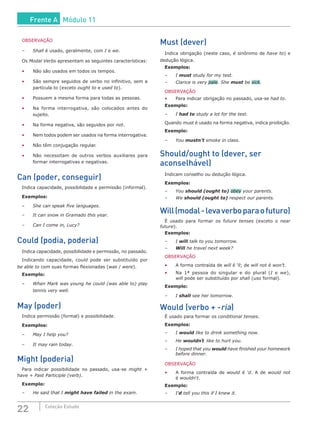
OBSERVAÇÃO
–	Shall é usado, geralmente, com I e we.
Os Modal Verbs apresentam as seguintes características:
•	 Não são usados em todos os tempos.
•	 São sempre seguidos de verbo no infinitivo, sem a
partícula to (exceto ought to e used to).
•	 Possuem a mesma forma para todas as pessoas.
•	 Na forma interrogativa, são colocados antes do
sujeito.
•	 Na forma negativa, são seguidos por not.
•	 Nem todos podem ser usados na forma interrogativa.
•	 Não têm conjugação regular.
•	 Não necessitam de outros verbos auxiliares para
formar interrogativas e negativas.
Can (poder, conseguir)
Indica capacidade, possibilidade e permissão (informal).
Exemplos:
–	 She can speak five languages.
–	 It can snow in Gramado this year.
–	 Can I come in, Lucy?
Could (podia, poderia)
Indica capacidade, possibilidade e permissão, no passado.
Indicando capacidade, could pode ser substituído por
be able to com suas formas flexionadas (was / were).
Exemplo:
–	 When Mark was young he could (was able to) play
tennis very well.
May (poder)
Indica permissão (formal) e possibilidade.
Exemplos:
–	 May I help you?
–	 It may rain today.
Might (poderia)
Para indicar possibilidade no passado, usa-se might +
have + Past Participle (verb).
Exemplo:
–	 He said that I might have failed in the exam.
Must (dever)
Indica obrigação (neste caso, é sinônimo de have to) e
dedução lógica.
Exemplos:
–	I must study for my test.
–	 Clarice is very pale. She must be sick.
OBSERVAÇÃO
•	 Para indicar obrigação no passado, usa-se had to.
Exemplo:
–	I had to study a lot for the test.
Quando must é usado na forma negativa, indica proibição.
Exemplo:
–	You mustn’t smoke in class.
Should/ought to (dever, ser
aconselhável)
Indicam conselho ou dedução lógica.
Exemplos:
–	You should (ought to) obey your parents.
–	We should (ought to) respect our parents.
Will(modal-levaverboparaofuturo)
É usado para formar os future tenses (exceto o near
future).
Exemplos:
–	I will talk to you tomorrow.
–	 Will he travel next week?
OBSERVAÇÃO
•	 A forma contraída de will é ’ll; de will not é won’t.
•	 Na 1ª pessoa do singular e do plural (I e we),
will pode ser substituído por shall (uso formal).
Exemplo:
–	I shall see her tomorrow.
Would (verbo + -ria)
É usado para formar os conditional tenses.
Exemplos:
–	I would like to drink something now.
–	He wouldn´t like to hurt you.
–	 I hoped that you would have finished your homework
before dinner.
OBSERVAÇÃO
•	 A forma contraída de would é ’d. A de would not
é wouldn't.
Exemplo:
–	 I’d tell you this if I knew it.
Frente A Módulo 11
LÍNGUAINGLESA
23Editora Bernoulli
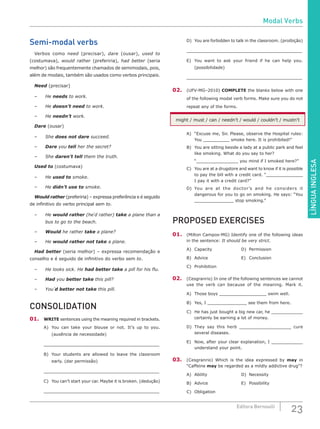
Semi-modal verbs
Verbos como need (precisar), dare (ousar), used to
(costumava), would rather (preferiria), had better (seria
melhor) são frequentemente chamados de semimodais, pois,
além de modais, também são usados como verbos principais.
Need (precisar)
–	He needs to work.
–	He doesn’t need to work.
–	He needn’t work.
Dare (ousar)
–	She does not dare succeed.
–	 Dare you tell her the secret?
–	She daren’t tell them the truth.
Used to (costumava)
–	 He used to smoke.
–	 He didn’t use to smoke.
Would rather (preferiria) – expressa preferência e é seguido
de infinitivo do verbo principal sem to.
–	He would rather (he´d rather) take a plane than a
bus to go to the beach.
–	 Would he rather take a plane?
–	He would rather not take a plane.
Had better (seria melhor) – expressa recomendação e
conselho e é seguido de infinitivo do verbo sem to.
–	 He looks sick. He had better take a pill for his flu.
–	 Had you better take this pill?
–	You´d better not take this pill.
CONSOLIDATION
01.	 WRITE sentences using the meaning required in brackets.
A)	 You can take your blouse or not. It’s up to you.
(ausência de necessidade)
______________________________________________________
B)	 Your students are allowed to leave the classroom
early. (dar permissão)
______________________________________________________
C)	 You can’t start your car. Maybe it is broken. (dedução)
______________________________________________________
D)	 You are forbidden to talk in the classroom. (proibição)
______________________________________________________
E)	 You want to ask your friend if he can help you.
(possibilidade)
______________________________________________________
02.	 (UFV-MG–2010) COMPLETE the blanks below with one
of the following modal verb forms. Make sure you do not
repeat any of the forms.
might / must / can / needn’t / would / couldn’t / mustn’t
A)	 “Excuse me, Sir. Please, observe the Hospital rules:
You __________ smoke here. It is prohibited!”
B)	 You are sitting beside a lady at a public park and feel
like smoking. What do you say to her?
“________________ you mind if I smoked here?”
C)	 You are at a drugstore and want to know if it is possible
to pay the bill with a credit card. “______________
I pay it with a credit card?”
D)	You are at the doctor’s and he considers it
dangerous for you to go on smoking. He says: “You
_______________ stop smoking.”
PROPOSED EXERCISES
01.	 (Milton Campos-MG) Identify one of the following ideas
in the sentence: It should be very strict.
A)	Capacity				D)	Permission
B)	 Advice					 E)	 Conclusion
C)	Prohibition
02.	 (Cesgranrio) In one of the following sentences we cannot
use the verb can because of the meaning. Mark it.
A)	 Those boys __________________ swim well.
B)	 Yes, I _______________ see them from here.
C)	 He has just bought a big new car, he ____________
certainly be earning a lot of money.
D)	They say this herb ___________________ cure
several diseases.
E)	 Now, after your clear explanation, I ____________
understand your point.
03.	 (Cesgranrio) Which is the idea expressed by may in
“Caffeine may be regarded as a mildly addictive drug”?
A)	Ability					D)	Necessity
B)	 Advice					 E)	 Possibility
C)	 Obligation
Modal Verbs
24 Coleção Estudo
04.	 (PUC-Campinas-SP) You ought ___________ a holiday.
A)	take					D)	to take
B)	 took					 E)	 taken
C)	taking
05.	 (PUC-Campinas-SP) Mother to child: “You _______ tell lies.”
A)	mustn’t				D)	haven’t
B)	 may not				 E)	 don’t need
C)	 had better
06.	 (ESPM-SP) Alfredo’s score on the test is the highest in
the class; he _______________________.
A)	 should study last night.
B)	 should have studied last night.
C)	 must have studied last night.
D)	 needn’t have studied last night.
E)	 used to study at nights.
07.	 (PUCPR) My vacation is over. I ________ get back to work
immediately, otherwise I’ll lose my job.
A)	may					D)	might
B)	 should					 E)	 must
C)	can’t
08.	 (Milton Campos-MG) Guerrilla groups in Colombia mustn’t
stimulate ecological destruction. In this sentence,
the underlined word entails an idea of
A)	advice.					D)	permission.
B)	 ability.					 E)	 absence of necessity.
C)	prohibition.
09.	 (PUC Minas) He ______ speak Italian when he was ten
years old.
A)	may					D)	could
B)	 might					 E)	 should
C)	can
10.	(CESCEA-SP) I’d rather stay at home, because it
_________ rain today.
A)	needs not				D)	mustn’t
B)	 have to					 E)	 must to
C)	may
11.	 (FMU-SP) She ______________ study hard now, because
she has no chance to pass.
A)	mustn’t					D)	needn’t
B)	 can’t						 E)	 won’t to
C)	shouldn’t
12.	 (ITA-SP) You _________ to study harder if you don’t want
to fail.
A)	have to						D)	may
B)	 ought						 E)	 can
C)	must
13.	 (UEM-PR) That paint is wet. You __________ touch it.
A)	mustn’t					D)	not
B)	 oughtn’t 					 E)	 doesn’t	
C)	don’t
14.	(CESCEA-SP) You _______________ to know it better.
A)	could						D)	may
B)	 should						 E)	 must
C)	ought
15.	 (Milton Campos–MG) You’re a physician. Tell your patient
it’s absolutely necessary to take all the medicine.
Therefore, he _________________ start taking it right
away.
A)	needn’t						D)	mustn’t
B)	 might						 E)	 can
C)	must
16.	 (Milton Campos-MG)
–	 Could you do me a favor, Ted?
–	 When he was five, he could ride a bike.
–	 Larry could be home, but I’m not certain.
The sentences above present, respectively, the idea of
A)	 ability – capacity – possibility
B)	 possibility – ability – capacity
C)	 polite request – possibility – capacity
D)	 polite request – capacity – possibility
E)	 capacity – polite request – ability
17.	(UNIFENAS-MG) He may bring it back today.
A palavra destacada significa
A)	possibilidade.				D)	obrigação.
B)	 capacidade.				 E)	 dedução.
C)	necessidade.
18.	(UEMA) “You must speak to him.” The modal must can
be replaced by
A)	may.						D)	would.	
B)	 can.						 E)	 have to.
C)	will.
19.	 (UEMA) He ______________ listen carefully. She speaks
very quickly.
A)	must						D)	needn’t
B)	 ought						 E)	 can
C)	has
20.	 (CEUMA-MA) Harold _____________ swim well when he
was young.
A)	could to					D)	could
B)	 didn’t can					 E)	 can to
C)	can
Frente A Módulo 11
LÍNGUAINGLESA
25Editora Bernoulli
21.	 (UFMA) The modal verb is used CORRECTLY.
A)	 You must begin again.	
B)	 You ought begin again.
C)	 You may to begin again.
D)	 You should to begin again.
22.	 (UFMA) I _________________to shoot the arrow.
A)	can							D)	should
B)	 will							 E)	 would
C)	 am going
23.	 (Unip-SP) Tom’s car uses less gas.
He _____________________adjusted the carburetor.
A)	ought to					C)	needed
B)	must have					D)	had to
TEXT I
FCMMG
	 Intruction: Read the text carefully and then choose
the alternative that best completes the questions and
statements.
Beat the clock
	 “Aging is a continuum, not a sudden event”, says Robert
Russell, M. D., professor of medicine and nutrition at Tufts
University in Boston. “You don’t wake up one morning
to discover you’re old.” The nutrition missteps that lead
to ailments from heart disease to osteoporosis when
you’re a senior have their beginnings in the middle years.
	 In short, it’s not years alone that cause deterioration
but how we choose to live them. We could avoid most
age-related diseases and even stretch our average life
span to 120 years from the current 76, simply by making
changes in what we eat in addition to exercising and
reducing stress.
	 Over time, requirements for some nutrients, such
as calcium, vitamin D and vitamin B12
, rise in part
because our bodies become less efficient at absorbing
or manufacturing them or, as with calcium, because
needs escalate. Other nutrients, such as the antioxidants
vitamins C and E and beta-carotene, are needed in
greater amounts than most women are currently getting
to prevent heart disease, cancer, cataracts and delay
aging itself. “It is hard to separate the issue of aging from
the issues of disease”, cautions Jeffrey Blumberg, Ph.D.,
professor of nutrition at the USDA Human Nutrition
Research Center at Tufts University in Boston, “but some
aspects of aging and disease prevention are directly linked
to nutrition, especially the antioxidants.
	 While many nutrient needs are high, calorie needs
decline somewhat (so exercise must increase) if a woman
wants to avoid gaining the otherwise inevitable 10 pounds
per decade. In fact, we should cut back on unnecessary
calories from fat and sugar, while making sure every bite
is chock-full of vitamins and minerals. The sooner you
make these dietary changes, the better. On the other
hand, it’s never too late to reap the benefits.”
LIVING FIT, Apr. 1997.
GUESS the meaning of these words according to the
context.
Aging 	 = ________________________
Misstep 	 = ________________________
Ailment 	 = ________________________
Disease 	 = ________________________
To avoid 	 = ________________________
To stretch	 = ________________________
Span 	 = ________________________
Requirement	 = ________________________
To rise	 = ________________________
To escalate 	 = ________________________
Such as 	 = ________________________
Amount 	 = ________________________
To delay 	 = ________________________
To caution 	 = ________________________
Otherwise 	 = ________________________
To cut back 	 = ________________________
On the other hand	 = ________________________
To reap 	 = ________________________
01.	 What does this statement mean: “Aging is a continuum,
not a sudden event.”
A)	 Aging is a sequence of unexpected events.
B)	 Gettingoldissomethingthatcontinuesinasuddenevent.
C)	It’s not a sudden event but aging itself that
goes on unexpectedly.
D)	 Getting old is a graded sequence of things not related
to an unexpected event.
02.	 What happens in the middle years?
A)	 The nutrition missteps turn into diseases.
B)	 The arising of heart disease and osteoporosis.
C)	 It’s the beginning of the nutrition missteps that
lead to ailments when you’re a senior.
D)	The beginning of ailments caused by the nutrition
missteps when you’re a senior.
03.	 All of the following words are related to disease prevention
BUT
A)	sickness.				C)	exercising.
B)	nutrition.				D)	reducing stress.
Modal Verbs
26 Coleção Estudo
04.	 Why is exercising needed?
A)	 Because a woman can avoid 10 pounds per decade.
B)	 Because calory needs decline to some degree.
C)	 To reduce fat and sugar.
D)	 All of them.
05.	 What does the word delay mean?
A)	Foresee.
B)	Postpone.
C)	Anticipate.
D)	 Look forward to.
06.	 What does the word stretch mean?
A)	 Extend.
B)	Develop.
C)	Improve.
D)	Decrease.
07.	 Why are some nutrients more required over time?
A)	 Because our bodies come to be more limited in
quantity at assimilating or fabricating them.
B)	 Because some of them can prevent some illnesses
besides putting off getting old.
C)	 Becausetheneedsofsomenutrientsbecomemoreintense.
D)	 All of them.
08.	 In the sentence “It is hard to separate the issue of aging
from the issues of disease”, the author intended to say that
A)	 the issues of aging and disease are not linked.
B)	 despite the hardness of the matter aging and
disease are separated.
C)	 it’s not easy to disconnect the issues of aging from
the issues of disease.
D)	 though the issues of aging and disease aren’t linked,
they’re hard to separate.
09.	 In the sentence “It’s never too late to reap the benefits”,
the boldface word means
A)	avoid.
B)	receive.
C)	 cut off.
D)	 give up.
10.	 Which of the following could BETTER summarize the main
topic of the text?
A)	 You’ll beat the clock if you avoid nutrients.
B)	 Body deterioration is not related to nutrition.
C)	 Aging and diseases cannot be avoided at all.
D)	 Nutrition has an important role in delaying aging
and preventing ailments.
TEXT II
UFLA-MG–2009
Instruction: Read passage 1 carefully and answer questions
01 through 04.
Passage 1
	 In Biology[1]
, a species is tipically defined as a group
of animais that breed only with one another[2]
. Thus,
any two animals that can breed belong to the same
species, whereas animals that are unable to breed with
one another are of a different species. The two Central
Valley[3]
salamanders do not interbreed, which would seem
to make it pretty clear that these salamanders should be
classified as different species[4]
.
	 But there is one interesting problem[5]
with these
salamanders. A number of other salamanders inhabit the ring
surrounding Central Valley. Moving north along the eastern
side of the valley, the salamanders have fewer and fewer
blotches. At the northern end of the valley, the salamanders
appear to be a mixture of the two species; these salamanders
are mostly brown, but they still have visible blotches.
01.	 The following sentence: “This definition is widely accepted
by biologists and zoologists, but its application is not
always simple” could be added
A)	 after the word “another” [2]
.
B)	 before “The two Central Valley” [3]
.
C)	 before “In biology” [1]
.
D)	 after the word “species” [4]
.
02.	 Which of the statements below is supported by
paragraph 1?
A)	 A member of one species often lives away from a
member of another species.
B)	 Species classification is based on coloration and
marking, such as black and yellow spots.
C)	 There is no clear definition of what a species is.
D)	 A member of one species is unable to breed with a
member of a different species.
03.	 In paragraph 2 the author states that
A)	 the range of salamanders found along the valley
presents a difficulty to the concept of species.
B)	 the further they live from each other, the fewer the
spots the salamanders have.
C)	 many different species of salamanders live along the
Central Valley.
D)	 the salamanders found at the southern end of the
valley can not breed with salamanders found at the
northern end.
04.	 All the following are very close in meaning to the word
“problem” [5]
, EXCEPT
A)	point.				C)	reason.
B)	issue.				D)	question.
Frente A Módulo 11
LÍNGUAINGLESA
27Editora Bernoulli
Instruction: For questions 05 and 06, choose the one answer
that is closest in meaning to the original sentence.
05.	 According to the U.S. Department of Agriculture, it will be
ten years before the African honey bee will have reached
the borders of the United States.
A)	 Not until ten years will the U.S. borders have been
reached by the African honey bee.
B)	 In ten years the honey bee will have reached the
African borders from the United States.
C)	 The U.S. borders have been reached by the African
honey bees for ten years.
D)	 The African honey bee reached the U.S. borders ten
years ago.
06.	 No less an authority than Senator Edward Kennedy spoke
at the graduation exercises for the law school of the
University of Virginia.
A)	 Senator Edward Kennedy was well known in the
University of Virginia.
B)	 An authority invited Senator Edward Kennedy to speak
to the graduation students.
C)	 Senator Edward Kennedy, a recognized authority,
spoke at the graduation exercises.
D)	 One of the authorities who spoke at the University of
Virginia was Senator Edward Kennedy.
Instruction: Read passage 2 carefully and answer questions
07 through 08.
Passage 2
For Sale
1977 Ford Sedan
White w/light gray interior
Low mileage. Like new
Air, automatic, power steering, brakes
AM/FM, cassette stereo
$5,000 or best offer
By original owner
241-3281 weekdays. 287-4479 weekends
Ask for Jim Black
07.	 Which of the following BEST describes the passage?
A)	 A news item.
B)	 An editorial.
C)	 A recipe.
D)	 A classified ad.
08.	 lt may be concluded that Jim will
A)	 sell his car to a buyer who offers him $4,800 if no one
else offers him more.
B)	 not sell his car for less than $5,000.
C)	 sell his car to the original owner.
D)	 sell his car for any price.
TEXT III
PUC Rio–2010
Texting may be taking a toll
	 	 They do it late at night when their parents are
asleep. They do it in restaurants and while crossing
busy streets. They do it in the classroom with their
hands behind their back. They do it so much their
05	 thumbs hurt. Spurred by the unlimited texting plans
offered by different carriers, American teenagers sent
and received an average of 2,272 text messages per
month in the fourth quarter of 2008, according to the
Nielsen Company – almost 80 messages a day, more
10	 than double the average of a year earlier.
	 The phenomenon is beginning to worry physicians
and psychologists, who say it is leading to anxiety,
distraction in school, falling grades, repetitive
stress injury and sleep deprivation. Dr. Martin Joffe,
15	 a pediatrician in Greenbrae, Calif., recently surveyed
students at two local high schools and said he found
that many were routinely sending hundreds of texts
every day. “That’s one every few minutes,” he said.
“Then you hear that these kids are responding to texts
20	 late at night. That’s going to cause sleep issues in
an age group that’s already plagued with sleep
issues.”
		 The rise in texting is too recent to have produced any
conclusive data on health effects. But Sherry Turkle,
25	 a psychologist who […] has studied texting among
teenagers in the Boston area for three years, said
it might be causing a shift in the way adolescents
develop. “Among the jobs of adolescence are to
separate from your parents, and to find the peace and
30	 quiet to become the person you decide you want to be”, she
said. “Texting hits directly at both those jobs.”
		 Psychologists expect to see teenagers break free
from their parents as they grow into autonomous adults,
Professor Turkle went on, “but if technology makes
35	 something like staying in touch very, very easy, that’s
harder to do; now you have adolescents who are
texting their mothers 15 times a day, asking things
like, ‘Should I get the red shoes or the blue shoes?’”
As for peace and quiet, she said, “if something next
40	 to you is vibrating every couple of minutes, it makes
it very difficult to be in that state of mind. If you’re
being deluged by constant communication, the
pressure to answer immediately is quite high,” she
added. “So if you’re in the middle of a thought, forget
45	 it.” […]
		 Texting may also be taking a toll on teenagers’ thumbs.
Annie Wagner, 15, a ninth-grade honor student in
Bethesda, Md., used to text on her tiny phone as fast as
she typed on a regular keyboard.
50	 A few months ago, she noticed a painful cramping in
her thumbs.
		 Peter W. Johnson, an associate professor of
environmental and occupational health sciences at
the University of Washington, said it was too early
Modal Verbs
28 Coleção Estudo
55	 to tell whether this kind of stress is damaging.
But he added, “Based on our experiences with computer
users, we know intensive repetitive use of the upper
extremities can lead to musculoskeletal disorders, so
we have some reason to be concerned that too much
60	 texting could lead to temporary or permanent damage
to the thumbs.”
HAFNER, Katie. Texting may be taking a toll.
The New York Times, May 25th
, 2009.
01.	The MAIN purpose of the text is to
A)	 list all the causes of thumb disorders among America’s
youth.
B)	 suggest different ways to get away from constant
communication.
C)	 explain in detail how technology prevents teenagers
from finding peace.
D)	 argue that American teens are increasingly dependent
on their mothers.
E)	 alert for possible adverse effects of constant texting
on youngsters.
02.	 According to lines (lines 6-10), American teens
A)	 increased by 50% the number of messages sent in
2008 as compared to 2007.
B)	 exchanged an average of 2,272 text messages per
month during the whole past year.
C)	 wrote more than two thousand text messages per
month in the last four months of 2008.
D)	 were writing a daily average of slightly less than eighty
messages in the last three months of 2008.
E)	 from October to December 2008 sent and received
twice as many messages than in all previous years.
03.	 Mark the option that completes the following sentence
according to the information found in (lines 11-14):
“Physicians and psychologists say that because of
constant texting teenagers may ______.”
A)	 get sick very easily
B)	 be able to control anxiety
C)	 start falling asleep in school
D)	 overcome sleeping problems
E)	 stop paying attention to classes
04.	 Mark the sentence in which the word “as” is used in
the SAME sense as in “Psychologists expect to see
teenagers break free from their parents as they grow
into autonomous adults,” (lines 32-33).
A)	 She cried bitterly as she told her story.
B)	 Some flowers, as the rose, require special care.
C)	 As you are leaving last, please turn out the lights.
D)	 I don’t think it’s as hot and humid today as it was
yesterday.
E)	 It is fairly certain that you will be able to find a job
as a teacher.
05.	 “Might” in “[...] might be causing a shift [...]” (line 27)
and “should” in “ ‘Should I get the red shoes or the blue
shoes?’ ” (line 38) express the ideas of, respectively:
A)	 ability – condition.
B)	 probability – duty.
C)	 possibility – advice.
D)	 permission – obligation.
E)	 theoretical ability – assumption.
06.	 In the statement “Texting may also be taking a toll on
teenagers’ thumbs.” (lines 46-47), “taking a toll on”
means that texting
A)	 is causing damage to the thumbs.
B)	 is preventing musculoskeletal disorders.
C)	 may improve the use of students’ hands.
D)	 depends on the thumbs to be performed.
E)	 has destroyed the thumbs of Americans.
07.	 Check the CORRECT statement concerning the pronoun
“it” in the text.
A)	 In “They do it in restaurants and while crossing busy
streets.” (line 2), “it” refers to “crossing busy streets”.
B)	 In “[...] who say it is leading to anxiety,” (line 12),
“it” refers to “the phenomenon”.
C)	 In “[...] said it might be causing a shift in the way
adolescents develop.” (lines 26-28), “it” refers to “the
Boston area”.
D)	 In “[...] makes it very difficult to be in that state of
mind.” (lines 40-41), “it” refers to “something next
to you”.
E)	 In “ ‘So if you’re in the middle of a thought, forget it.’ ”
(lines 44-45), “it” refers to “the pressure to answer
immediately”.
08.	 In “[...] we know intensive repetitive use of the upper
extremities can lead to musculoskeletal disorders,” (lines
57-58), “lead” could be replaced by any of the words
below, EXCEPT
A)	cause.
B)	worsen.
C)	prompt.
D)	 result in.
E)	 generate.
09.	 Check the words that have the SAME relationship as
“temporary” and “permanent” (line 60).
A)	 to purchase – to lend.
B)	 to survey – to oversee.
C)	 understanding – displeasure.
D)	 serenity – excitement.
E)	 soon – early.
Frente A Módulo 11
LÍNGUAINGLESA
29Editora Bernoulli
10.	 Peter W. Johnson’s comments on the intensive use
of thumbs for constant texting (lines 56-61) can be
understood as
A)	 subtle irony.				 D)	 a formal complaint.
B)	 undue alarm.				 E)	 an important warning.
C)	 heavy criticism.
ENEM EXERCISES
VincentVanGogh
Self-portrait without beard - Vincent Van Gogh, 1889. Private
Collection.
“[…] I have often neglected my appearance. I admit it,
and I also admit that it is “shocking.” But look here, lack
of money and poverty have something to do with it too,
as well as a profound disillusionment, and besides, it is
sometimes a good way of ensuring the solitude you need,
of concentrating more or less on whatever study you are
immersed in.”
Letter from Vincent Van Gogh to Theo Van Gogh.
Written in July 1880 in Cuesmes. Translated by
Mrs. Johanna Van Gogh-Bonger, edited by Robert Harrison,
number 133. Available at: <http://www.webexhibits.org/
vangogh/letter/8/133.htm>. Accessed: Aug. 23
rd
, 2010.
01.	 Considerando o quadro e a carta, podemos concluir que
Van Gogh pintou seu autorretrato baseando-se
A)	 no olhar do outro sobre si.
B)	 na análise sobre a sua sexualidade.
C)	 nas observações feitas por Theo.
D)	 na felicidade de viver um grande amor.
E)	 em sua autocrítica sobre a própria beleza.
02.	 Van Gogh considered himself
A)	 a winner who fought for his life.
B)	 a loser who denies his appearance.
C)	 a painter who acknowledges his appearance.
D)	 a liar who can’t express his image.
E)	 a painter who overstates his heterosexuality.
HAVING FUN
Easter Holidays in the English-speaking world
SXC
Colored Easter eggs in the United States
	 Throughout the English-speaking world, many Easter
traditions are similar with only minor differences. For
example, Saturday is traditionally spent decorating Easter
eggs and hunting for them with children on Sunday
morning, by which time they have been mysteriously
hidden all over the house and garden.
	 Other traditions involve parents telling their children
that eggs and other treats such as chocolate eggs or
rabbits and marshmallow chicks (Peeps) have been
delivered by the Easter Bunny in an Easter basket which
children find waiting for them when they wake up.
Many families observe the religious aspects of Easter by
attending Sunday Mass or services in the morning and
then participating in a feast or party in the afternoon.
Some families have a traditional Sunday roast, often of
either roast lamb or ham. Easter breads such as Simnel
cake, a fruit cake with eleven marzipan balls representing
the eleven faithful apostles, or nut breads such as potica
are traditionally served. Hot cross buns, spiced buns with
a cross on top, are traditionally associated with Good
Friday, but today are often eaten well before and after.
	 In Scotland, the north of England, and Northern
Ireland, the traditions of rolling decorated eggs down
steep hills and pace egging are still adhered to.
In Louisiana, USA, egg tapping is known as egg knocking.
Marksville, Louisiana claims to host the oldest egg
knocking competition in the US, dating back to the 1950s.
Competitors pair up on the steps of the courthouse on
Easter Sunday and knock the tips of two eggs together.
If the shell of your egg cracks you have to forfeit it,
a process that continues until just one egg remains.
	 In the British Overseas Territory of Bermuda, the most
notable feature of the Easter celebration is the flying of
kites to symbolize Christ’s ascent. Traditional Bermuda
kites are constructed by Bermudians of all ages as Easter
approaches, and are normally only flown at Easter.
In addition to hot cross buns and Easter eggs, fish cakes
are traditionally eaten in Bermuda at this time.
Available at: <www.wikipedia.org>.
Accessed: Mar. 21st
, 2010.
Modal Verbs
30 Coleção Estudo
GLOSSARY
●	 Obey (verb) = obedecer (obey – obeyed – obeyed)
●	 Pale = pálido(a)
SXC
●	 Sick = doente
Text I
aging = envelhecer, envelhecimento
misstep = erro
ailment = doença
disease = doença
to avoid = evitar
to stretch = aumentar, esticar
span = período, duração, expectativa
requirement = necessidade
to rise = aumentar
to escalate = intensificar
such as = como
amount = quantidade
to delay = atrasar
to caution = advertir
otherwise = senão
to cut back = reduzir
on the other hand = por outro lado
to reap = colher
01.	D	 06.	A
02.	C	 07.	D
03.	A	 08.	C
04.	D	 09.	B
05.	B	 10.	D
Text II
01.	B	 05.	A
02.	D	 06.	C
03.	A	 07.	D
04.	C	 08.	A
Text III
01.	 E	 06.	 A
02.	D	 07.	B
03.	 E	 08.	 B
04.	A	 09.	D
05.	 C	 10.	 E
Enem Exercises
01.	 E	 02.	 C
ANSWER KEY
Consolidation
01.	 A)	 You don’t have to take your blouse.
		 You needn’t take your blouse.
	 B)	 Your students may leave the classroom.
	 C)	 Your car must be broken.
	 D)	 You mustn’t talk in the classroom.
	 E)	 Can you help me?
02.	A)	mustn’t
	 B)	Would
	 C)	Can
	 D)	must
Proposed Exercises
01.	B	 06.	C	 11.	D	 16.	D	 21.	A
02.	 C	 07.	 E	 12.	 B	 17.	 A	 22.	 C
03.	 E	 08.	 C	 13.	 A	 18.	 E	 23.	 B
04.	D	 09.	D	 14.	C	 19.	A
05.	A	 10.	C	 15.	C	 20.	D
Frente A Módulo 11
FRENTE
31Editora Bernoulli
MÓDULOLÍNGUA INGLESA
RELATIVE PRONOUNS
Who – quem, que
Which – que, qual, quais, o qual, os quais, a qual, as quais
Whom – do qual, dos quais, da qual, das quais
Whose – cujo(s), cuja(s)
That – substitui who, whom e which.
•	 Who se refere a uma pessoa; which se refere a uma
coisa ou animal.
Exemplos:
–	 The girl who remained there was sick.
–	 That’s the minister who resigned his post.
•	 Which pode ser usado, sem mudança de forma, como
sujeito ou objeto de um verbo. Refere-se a coisas.
–	 The book which is on the table is old.
–	 The book which you ordered has just arrived.
–	 She had a surprise which was very good for her.
•	 A forma do objeto de who é whom. Whom é usado
como objeto direto ou indireto do verbo.
Exemplos:
–	 The girl whom you saw is my sister.
–	 The man to whom you spoke is here now.
•	 Whose é usado para indicar posse, tanto para
pessoas como para coisas.
Exemplos:
–	 The dog whose owner is here died.
–	 The student whose advisor is sick is doing his work
alone.
Usos
Quando o antecedente for pessoa
A)	 Who ou that podem ser aplicados quando o
antecedente for pessoa e a função do pronome for
de sujeito (seguido de verbo).
–	 This is the student who / that studies at Bernoulli.
–	 The scientists who / that discovered the vaccine
are here.
B)	 Who, whom, that podem ser usados ou omitidos
(Ø) se a função for de objeto (não seguido do verbo).
–	 Those are the people who / whom / that / Ø Alice
invited to her show.
C)	Usa-se whom se houver preposição antes do
pronome.
–	 John was the guy with whom she went out for lunch.
D)	 Whose é usado para indicar posse e é seguido de
substantivo.
–	 The girl whose mother is here works for me.
Quando o antecedente for coisa ou
animal
A)	Usam-se which ou that se a função do pronome for
de sujeito.
–	 The car which / that belongs to Lucy is comfortable.
B)	 Which e that podem ser usados ou omitidos (Ø) se a
função for de objeto.
–	Everything which / that / Ø I had to study was ok.
C)	 Usa-se which se houver preposição antes do
pronome.
–	 The town in which he lives is very far from here.
D)	 Usa-se whose se este for seguido de substantivo,
para indicar posse.
Exemplo:
–	 That is the book whose subject is interesting.
OBSERVAÇÃO
Não se pode usar that nem se omite o pronome quando
a frase estiver entre vírgulas (oração explicativa).
Exemplos:
–	 The book, which I bought yesterday, is really good.
–	 Mr. Roney, who is a teacher, works at Bernoulli.
Relative Pronouns 12 A
32 Coleção Estudo
SXC
To whom it may concern é uma saudação utilizada
em cartas, declarações e outros documentos formais
quando não se conhece o destinatário dos mesmos.
Equivale, em português, à forma “a quem possa
interessar”.
CHECK IT OUTC
CONSOLIDATION I
01.	 SUPPLY all possible relative pronouns.
A)	 John met the scientist _______ formulated the book.
B)	 Technology, ______ brings us help, is a scientific study.
C)	 Dr. Julie, _________ I saw in the lab, received a prize.
D)	 Dr. Lovis,_____ is 70 years old, is studying the atoms.
E)	 Einstein, _______ theory is famous, was not Brazilian.
CONSOLIDATION II
UFMG–2009
01.	 A reporter wrote a text about the Manuelzão Project to be
published in a newspaper, but there are 11 grammar
mistakes. Read his text and help him CORRECT them
by completing the chart that follows it. The first one is
done for you as an example.
Manuelzão Project
	 	 This old man from the sertão (Brazilian semi-arid
inlands) was always willing to welcome visitors with his
sense of humor and the most peculiar and interesting
tales… These are some of the character traits that
05	 make Manuel Nardi a remarkable figure and inspired the
Brazilian writer João Guimarães Rosa to give life to one of
its most famous characters: Manuelzão. His countryside
wisdom and his concern for the environment were
translated into the cause championed by the project
10	 named after this unique old man.
	 	 Manuel Nardi dead in 1998, a year after the Manuelzão
Project was created. It was the cowboy itself who,
in 1997, introduced the Project at the presentation meeting
held with the Minas Gerais Water Management Institute
15	 and the State of Minas Gerais Sanitation Program.
		 Developing by the Universidade Federal de Minas Gerais
– UFMG, the Manuelzão Project is intended to restore
the Rio das Velhas basin. Activities begun in 1997 at the
UFMG Medical Sciences School in an initiative took by
20	 a group of professors who realized that health are not
simply a medical issue: it is directly related to the social
conditions and to the environment people leave in.
The Manuelzão Project was born from the activities of the
“Rural Internship Project”, which is a compulsory subject
25	 in the UFMG Medical Sciences School curriculum and has
a Public Health oriented syllabus. Students spend three
months in remote municipalities undertaking social and
preventive medical activities.
		 Throughout its existence, the Project has witnessed a
30	 considerable growth in civil society participation, most
notably in the activities conducted by the Manuelzão
Centers scattered along the basin. There is today nearly
50 Local Centers whose work focuses on local issues
and who are supported and advised by the Manuelzão
35	Project.
		 This historical path has led the Manuelzão Project to
expand its activities beyond the academic boundaries of
that group of UFMG scholars.
Available at: <http://www.manuelzao.ufmg.br/english>.
Accessed: Aug. 2008. (Adapted).
Wrong form Correct form Line on the text
make made 5
7
11
12
16
18
19
20
22
32
34
Frente A Módulo 12
LÍNGUAINGLESA
33Editora Bernoulli
PROPOSED EXERCISES
01.	 (Unificado-RJ) In the sentence “[...] it's time to meet
people who work from their homes”, the pronoun who can
be replaced by that. Mark the option that can ONLY be
completed with the relative pronoun who.
A)	 That is the consultant ______________ I met in São
Paulo last week.
B)	 My brother, ______________ works as a consultant,
makes much money.
C)	 Would you like to work with bosses ______________
are understanding?
D)	 Employees ________________ work from home part
of the time are happier.
E)	 The telecommuter to __________________ I was
introduced yesterday is Asian.
02.	 (Milton Campos-MG) There ISN’T a relative pronoun in:
A)	 One of the survivors is the captain of the ship that sank.
B)	 Nine people are in a lifeboat that was built to hold five.
C)	 Parents say that public schools make their children
criminals.
D)	 People in every part of the world complain about the
problem of education which they receive.
E)	 The only people who seem satisfied are the ones who
don’t go to school.
03.	 (PUCPR) Fill in the blanks with a relative pronoun.
The flower exhibit __________ was held in the Botanical
Garden in Curitiba last September showed beautiful
orchids from all over the world.
A)	whose					D)	where
B)	 whom					 E)	 who
C)	that
04.	 (Mackenzie-SP) The writer, ___________ writes are about
scientific fiction, deserves his popularity. Choose the BEST
alternative for the blank space above.
A)	who					D)	whose		
B)	 which					 E)	 whom
C)	that
05.	 (ITA-SP) Assinale a opção CORRETA.
A)	 Some of the boys whom I invited in them didn’t come.
B)	 Some of the boys whose I invited them didn’t come.
C)	 Some of the boys I invited them didn’t come.
D)	 Some of the boys I invited didn’t come.
E)	 None of these.
06.	 (UFSCar-SP) Tell me ___________ you that.
A)	 whom told		 C)	 who			 E)	 whom
B)	 who told		 D)	 whose		
07.	 (UFV-MG) The student __________ lost his book is waiting
in the office.
A)	which					D)	whose		
B)	 what					 E)	 whom
C)	who
08.	 (UFLA-MG) That is the writer _________ book we bought
yesterday.
A)	whom					D)	which		
B)	 who					 E)	 that	
C)	whose
09.	 (PUC-Campinas-SP) I can’t find the student _________.
A)	 what books were lost.
B)	 which lost his book.
C)	 lost his books.
D)	 whose books it was lost.
E)	 who lost his books.
10.	 (FCMSC-SP) Milton Nascimento’s latest record ________
I bought yersterday is extraordinary.
A)	who					D)	which		
B)	 whom					 E)	 whose
C)	what	
11.	 (ITA-SP) The man __________ came here, and ________
you talked with is my relative.
A)	whom, who				
B)	which, whom				
C)	 that, which
D)	 who, whom
E)	 None of these.
12.	 (PUCPR) Insert the APPROPRIATE relative pronoun.
Gossip, to _______ you should pay no attention, is a
bad thing.
Dr. Smith, _________ car is outside, has come to see
a patient.
My friend Jack, ________ is in hospital, is very ill.
This is my uncle John, _________ you have heard so
much about.
A)	 which, whose, who, whom
B)	 that, whose, whom, which
C)	 which, whom, that, who
D)	 whom, whose, that, whom
E)	 that, whom, who, which
13.	 (UFRRJ) Em “Manufacturers have created a whole new
generation of home computers that have greater power
and lower prices.”, a palavra that pode ser substituída por
A)	 what.					D)	 who.		
B)	 which.					E)	 whichever.		
C)	 whose.
Relative Pronouns
34 Coleção Estudo
14.	 (Milton Campos-MG) There’s a lady over there _______
age you can never guess.
Both Martin and Grace earn a small salary, __________
makes them feel miserable.
The worst __________ can happen has already passed.
The car, for _________ I paid a lot, is out of date now.
A)	 whose, which, that, which
B)	 what, that, that, what
C)	 who, that, that, what
D)	 whose, what, who, which
E)	 which, which, where, what
15.	 (OSEC–SP) My uncle, ____________ I’m sure you’ve
met, is now in Australia.
A)	 whose			 C)	 whom			 E)	 what
B)	that			D)	which			
16.	 (FAAP-SP) Que alternativa completa MELHOR a sentença
a seguir, sendo o X a omissão do pronome relativo?
There are two basic groups of people – the wishful
thinkers ____________ throw coins in fountains and
the realists_________ fish them out.
A)	 whose – X					 D)	 who – which
B)	 who – who					 E)	 whom – X
C)	 whom – whom
17.	 (PUC Rio) Check the only pair of relative pronouns that
can CORRECTLY complete the following sentences.
The boys, _______________had been so cute before,
had their skins cut up and ripped off.
The atomic bombings, _______________were one of the
greatest crimes against humanity in the 20th
century,
caused a lot of suffering.
A)	 whom – that				 D)	 that – who
B)	 who – whose				 E)	 who – which
C)	 whose – which
18.	 (Cesgranrio) Mark the item in which the relative pronoun
could be omitted.
A)	 The book which he bought last week was a dictionary.
B)	 The water that falls from the sky is always clean.
C)	 Theboywhobroughttheparcelaskedforaglassofwater.
D)	 The man who came to dinner lives on a farm.
E)	 The water which disappeared back into the air was
necessary.
19.	 (Cesgranrio) The relative pronoun can be omitted in ONLY
ONE of the following sentences. Which one?
A)	 The plate which the air hostess put in front of the
businessman was full of vegetables.
B)	 The police car, which had been following the truck,
stopped at the red light.
C)	 Mr. Jones was the owner of a small circus which used
to go from one town to another.
D)	 It was a very difficult examination paper, which
followed the teacher’s lessons very closely.
E)	 The green house which was built across the street
is now a museum.
TEXT I
Mackenzie-SP–2009
Weathering the storm
		 The specter of rising food and fuel prices now threatens
to destroy an era of unprecedented global prosperity,
with two notable exceptions: Brazil and Canada. Both
countries produce and export enough food and fuel not
just to offset the worst of global inflationary pressures
but even to turn the price spike from a menace to a
boon. They are the only two major economies ___(I)___
prices have not burst the upper limit of the central bank’s
inflation target. And of the two, Brazil is by far the more
surprising success story. The country ___(II)___ suffered
the longest and perhaps the most debilitating bout of
hyperinflation in recent history is now a rare island
of relative stability and prosperity. Brazil’s inflation is
running at 6.5 percent, a rate ___(III)___ worries the
country’s money minders but thanks to their zeal is still
the lowest level in all the major emerging markets.
MARGOLIS, Mac. Available at: <www.newsweek.com>.
01.	 The relative pronouns that PROPERLY fill in blanks I, II
and III, in the text, are
A)	 whose, that and which.
B)	 when, whose and that.
C)	 what, which and which.
D)	 which, which and that.
E)	 where, that and that.
TEXT II
PUC Minas
		 While global warming is being ignored by the political
arm of the Bush administration, the citizens of Europe and
the Pentagon are taking a new look at the greatest danger
such climate change could produce for the Northern
Hemisphere – a sudden change into a new ice age.
		 What they’re finding is not at all comforting: if enough
cold, fresh water coming from the melting polar ice caps
and glaciers of Greenland and flowing into the northern
Atlantic will shut down the Gulf Stream, which[1]
keeps
Europe and northeastern North America warm. The worst
case scenario would be a return of the last ice age in
2 to 3 years and the mid case scenario would be a period
like the “little ice age” of a few centuries ago that disrupted
worldwide weather patterns, leading to extremely
cold winters, desertification, crop failures and wars.
Frente A Módulo 12
LÍNGUAINGLESA
35Editora Bernoulli
		 The warmth is the result of ocean currents that bring
warm surface water up from the equator into northern
regions that would otherwise be so cold that even
in summer they’d be covered with ice. The current
of greatest concern is called “The Great Conveyor
Belt,” which includes the Gulf Stream. It[2]
is driven
by the greater force created by differences in water
temperatures and salinity, as[3]
the North Atlantic Ocean
is saltier and colder than the Pacific. If it stopped flowing
today, the result would be sudden and dramatic. Winter
would start in the eastern half of North America and
all of Europe and Siberia, and never go away. Within
three years, those regions would become uninhabitable
and nearly two billion humans would starve, freeze to
death, or have to relocate.
		 And when might that happen? Nobody knows – the
action of the Great Conveyor Belt in defining ice ages was
discovered only in the last decade. Preliminary computer
models and scientists suggest the change could happen
as early as next year, or it may be generations from now.
It may be starting right now, producing the extremes of
weather we’ve seen in the past few years. What’s almost
certain is that if nothing is done about global warming,
it will[4]
happen sooner rather than[5]
later.
SPEAK UP – Edição 206 – Jul. 2004. (Adapted).
01.	 The political arm of the Bush administration has been
A)	 studying climate changes.
B)	 neglecting global warming.
C)	 fighting a new ice age.
D)	 ignoring Europe and the Pentagon.
02.	 The world is in danger of facing
A)	 the worst economic crisis.
B)	 a new world war in Europe.
C)	 the return of an ice age.
D)	 a change of salinity in the water.
03.	 The word which [1]
refers to
A)	 the Gulf Stream.				 C)	 fresh water.
B)	Greenland.						D)	the North Atlantic.
04.	 The word as [3]
means
A)	while.							C)	though.
B)	like.							D)	because.
05.	 The word it [2]
refers to the
A)	 North Atlantic Ocean.
B)	 Pacific Ocean.
C)	 deeper warm water.
D)	 Great Conveyor Belt.
06.	The WORST risk we are running is of having
A)	 an eternal winter in the Northern Hemisphere.
B)	 the North Atlantic Ocean becoming colder than the
Pacific.
C)	 a shortage of drinking water in the whole world.
D)	 a dramatic change in the salinity of the water.
07.	 Scientists predict the change will happen
A)	 only within centuries.
B)	 at any time now.
C)	 sooner than next year.
D)	 later than computers have announced.
08.	 The word will [4]
conveys the idea of
A)	possibility.					C)	certainty.
B)	obligation.					D)	condition.
09.	 The words rather than [5]
mean
A)	instead of.					C)	because of.
B)	in spite of.					D)	out of.
10.	 The cause of a new ice age is
A)	ice caps.					C)	water salinity.
B)	 weather patterns.			 D)	 global warming.
TEXT III
UFU-MG–2008
Do you suffer from “ringxiety”?
Our increasing reliance on personal technology has led to
techno-neuroses like ringxiety and “crackberry” addiction.
		 Your cell phone rings. You go to answer it, but
there’s no one there. Curiously, there’s no missed call,
either. You realize after a moment that you mistook
a bird chirping for your cell phone’s ring. What’s
05	 weird is that this isn’t the first time this has happened
to you. You’re probably not insane – instead, you are
suffering from what’s come to be called ringxiety.
Relative Pronouns
36 Coleção Estudo
		 It’s not surprising that in the increasingly wireless
and connected world, humanity would begin
10	 to suffer techno-neuroses. Electronic gadgets have
become a part of the everyday lives of people
worldwide. Ringxiety is among the first of these new
neuroses to emerge, along with Internet addiction
and the “crackberry” phenomenon – a person’s
15	 compulsive urge to use and check his BlackBerry wireless
device. While crackberry addiction is a compulsive behavior,
ringxiety may be a result of that and similar compulsions.
		 Some researchers think that ringxiety stems from a
20	 constant state of readiness that could develop in cell
phone users. Before the advent of wireless phones,
no one expected a call while driving in the car,
shopping at the grocery store or dancing at a nightclub.
With cell phones, though, there’s a potential for a call to
25	 come through at any moment. Because of this, it’s
possible that our brains are conditioned to expect
a call constantly, and when a person hears a tone
that reminds him of his cell phone ringing, he will
believe that’s the case. Others believe that ringxiety –
30	 or in this case, phantom ringing – simply stems from
confusion due to the frequency of most stock cell phone
ringtones and the location of our ears.
		 Those who opt to set the phone to “vibrate” rather
than “ring” aren’t off the hook either. Even stranger
35	 than phantom ringing is the phantom vibration
phenomenon. This is also a part of the ringxiety
that David Laramie studied, although fewer ideas
about its origins have been suggested. It’s similar to
phantom ringing, but phantom vibration is a physical
40	 rather than an auditory hallucination. It’s also similar
to another, well-documented phenomenon called
phantom limb syndrome. In this medically recognized
condition, amputees – people who’ve had limbs
removed – report feeling pain in limbs that are no
45	 longer attached to their bodies. Is it possible that people
have become as attached to their cell phones as they
are to their own arms and legs?
CLARK, Josh. Do you suffer from “ringxiety”?.Mar. 2008.
Available at: <http://communication.howstuffworks.com/
ringxiety.htm>. (Adapted).
01.	 Com base no texto, pode-se concluir que a palavra
ringxiety é um neologismo resultante da combinação de
A)	 ringer e antianxiety.			 C)	 ring e contrariety.
B)	 ringing tone e society.			 D)	 anxiety e ring.
02.	 Segundo o texto, há indícios de que uma pessoa esteja
sofrendo de ringxiety quando
A)	 ela deseja ter um celular mais moderno e não tem
recursos para adquiri-lo.
B)	 ela costuma confundir o som de um pássaro com o
toque de seu celular.
C)	 ela demonstra ansiedade sempre que tem de atender
ao telefone celular.
D)	 o telefone celular toca e não é possível identificar a
origem da chamada.
03.	 De acordo com o texto, indique a alternativa que completa
CORRETAMENTE o enunciado.
Crackberry phenomenon can best be defined as
A)	 a compulsive behavior some people feel to use and
check their BlackBerry.
B)	 the ability some people have to invade computers,
such as crackers and hackers.
C)	 a symptom of a techno-neurosis that indicates a
person suffers from ringxiety.
D)	 a positive and desirable behavior in the increasingly
wireless and connected world.
04.	 Marque a alternativa que contém SOMENTE substantivo(s)
e verbo(s) utilizados no texto em contextos que
expressam as noções de “origem, fonte, ou surgimento”.
A)	 Stem – origins – emerge
B)	 Origins – gadgets – advent
C)	 Emerge – origins – weird
D)	 Chirping – stem – origins
05.	 No último parágrafo do texto, o autor apresenta uma
analogia entre phantom vibration e phantom limb
syndrome para insinuar que
A)	 são fenômenos médicos relacionados a alucinações
muito distintas entre si.
B)	 ambos os fenômenos comparados são condições
médicas recentes.
C)	 esses dois fenômenos são síndromes que somente
ocorrem em pessoas amputadas.
D)	 o celular parece ter se tornado uma extensão virtual
do nosso próprio corpo.
06.	 De acordo com o texto, quais das alternativas abaixo
completam corretamente o enunciado a seguir?
According to the text, it is appropriate to say that techno-
neuroses are most probably identified in people
I - who show ringxiety behavior.
II - who are addicted to the Internet.
III - while they are driving, shopping or dancing.
IV - only when they are using their cell phones.
Marque a alternativa que contém somente afirmativas
CORRETAS.
A) I e IV					 C) II, III e IV
B) II e III					 D) I e II
Frente A Módulo 12
LÍNGUAINGLESA
37Editora Bernoulli
07.	 Segundo o texto, quais das alternativas a seguir
completam CORRETAMENTE o enunciado abaixo?
Some researchers, concerning the possible origins of
ringxiety, believe that
I.	 it is caused by insane behavior or some kind
of mental disorder common in people with
techno-neuroses.
II.	 it may result from confusion in the sound frequency
of ringtones and the location of our ears.
III.	it is an anxiety syndrome which reflects the high level
of competition existing in our capitalist society.
IV.	 our brains have become conditioned to expect
cell phone calls constantly in this wireless society.
Marque a alternativa que contém somente afirmativas
CORRETAS.
A)	 II e IV				 C)	 III e IV
B)	 I e III				 D)	 I e II
TEXT IV
FUVEST-SP–2010
		 As everybody knows, if you do not work out, your
muscles get flaccid. What most people don’t realize,
however, is that your brain also stays in better shape
when you exercise.
		 Surprised? Although the idea of exercising cognitive
machinery by performing mentally demanding activities –
popularly termed the “use it or lose it” hypothesis –
is better known, a review of dozens of studies shows
that maintaining a mental edge requires more than that.
Other things you do – including participating in activities
that make you think, getting regular exercise, staying
socially engaged and even having a positive attitude
– have a meaningful influence on how effective your
cognitive functioning will be in old age.
Available at: <www.scientificamerican.com/article>.
Accessed: July 06th
, 2009. (Adapted).
01.	 O texto informa que
A)	 exercícios físicos são benéficos para o corpo e para a
saúde mental.
B)	 as pessoas não se dão conta da importância de
músculos fortes.
C)	 o cérebro é muito pouco exercitado por pessoas que
não trabalham.
D)	 todo mundo deveria exercitar-se diariamente.
E)	 grande parte das pessoas preocupa-se apenas com
a aparência física.
02.	 Segundo o texto, o bom funcionamento de nosso cérebro
na velhice depende, entre outros fatores,
A)	 das perdas e ganhos que vivenciamos ao longo da
vida.
B)	 da herança genética que trazemos conosco.
C)	 das modalidades de exercícios físicos que realizamos.
D)	da complexidade de exercícios intelectuais a que
somos expostos.
E)	 de nosso engajamento em atividades intelectuais e
sociais.
ENEM EXERCISES
Texto para a questão 01
The death of the PC
		 The days of paying for costly software upgrades
are numbered. The PC will soon be obsolete. And
BusinessWeek reports 70% of Americans are already
using the technology that will replace it. Merrill Lynch
calls it “a $160 billion tsunami”. Computing giants
including IBM, Yahoo!, and Amazon are racing to be
the first to cash in on this PC-killing revolution. Yet, two
little-known companies have a huge head start. Get their
names in a free report from The Motley Fool called, “The
Two Words Bill Gates Doesn’t Want You to Hear…”
	 Click here for instant access to this FREE report!
	 BROUGHT TO YOU BY THE MOTLEY FOOL
Available at: <http://www.fool.com>.
Accessed: July 21st
, 2010.
01.	 (Enem–2010) Ao optar por ler a reportagem completa
sobre o assunto anunciado, tem-se acesso a duas palavras
que Bill Gates não quer que o leitor conheça e que se
referem
A)	 aos responsáveis pela divulgação desta informação
na Internet.
B)	 às marcas mais importantes de microcomputadores
do mercado.
C)	 aos nomes dos americanos que inventaram a suposta
tecnologia.
D)	aos sites da Internet pelos quais o produto já pode
ser conhecido.
E)	 às empresas que levam vantagem para serem suas
concorrentes.
Texto para a questão 02
Viva la Vida
I used to rule the world
Seas would rise when I gave the word
Now in the morning and I sleep alone
Sweep the streets I used to own
I used to roll the dice
Feel the fear in my enemy’s eyes
Listen as the crowd would sing
“Now the old king is dead! Long live the king!”
One minute I held the key
Next the walls were closed on me
And I discovered that my castles stand
Upon pillars of salt and pillars of sand
[…]
MARTIN, C. Viva la vida, Coldplay. In: Viva la vida or Death and
all his friends. Parlophone, 2008.
Relative Pronouns
38 Coleção Estudo
02.	 (Enem–2010) Letras de músicas abordam temas que,
de certa forma, podem ser reforçados pela repetição de
trechos ou palavras. O fragmento da canção “Viva la vida”,
por exemplo, permite conhecer o relato de alguém que
A)	 costumava ter o mundo aos seus pés e, de repente,
se viu sem nada.
B)	 almeja o título de rei e, por ele, tem enfrentado
inúmeros inimigos.
C)	 causa pouco temor a seus inimigos, embora tenha
muito poder.
D)	 limpava as ruas e, com seu esforço, tornou-se rei de
seu povo.
E)	 tinha a chave para todos os castelos nos quais
desejava morar.
GLOSSARY
●	 Advisor = orientador(a)
●	 Belong (verb) = pertencer (belong – belonged –
belonged)
●	 Owner = dono(a)
SXC
●	 Remain (verb) = permanecer (remain – remained –
remained)
●	 Resign (verb) = renunciar, aposentar (resign – resigned
– resigned)
Consolidation II
01.	
Wrong
form
Correct
form
Line on
the text
make made 5
its his 7
dead died 11
itself himself 12
Developing Developed 16
begun began 18
took taken 19
are is 20
leave live 22
There is There are 32
who which 34
Proposed Exercises
01.	B			 11.	D
02.	C			 12.	A
03.	C			 13.	B
04.	D			 14.	A
05.	D			 15.	C
06.	B			 16.	B
07.	 C			 17.	 E
08.	C			 18.	A
09.	 E			 19.	 A
10.	D			
Text I
01. 	E
Text II
01. 	B	 03. 	A	 05. 	D	 07.	 B	 09. 	A
02. 	C	 04. 	D	 06. 	A	 08. 	C	 10. 	D
Text III
01. 	D	 03. 	A	 05. 	D	 07. 	A
02. 	B	 04. 	A	 06. 	D
Text IV
01. 	A	 02. 	E
Enem Exercises
01. 	E	 02. 	A
ANSWER KEY
Consolidation I
01.	 A)	 who / that
	 B)	which
	 C)	whom
	 D)	who
	 E)	 whose
Frente A Módulo 12
INFINITIVE PAST TENSE PAST PARTICIPLE TRANSLATION
A
to accuse accused accused acusar
to allow allowed allowed permitir
to annoy annoyed annoyed incomodar
to appear appeared appeared aparecer
to arrange arranged arranged arranjar
to avoid avoided avoided evitar
B
to beg begged begged suplicar
to behave behaved behaved comportar-se
to believe believed believed acreditar
to belong belonged belonged pertencer
to betray betrayed betrayed trair
to borrow borrowed borrowed pedir emprestado
to breathe breathed breathed respirar
to bury buried buried enterrar
C
to care cared cared importar-se
to claim claimed claimed reivindicar
to complain complained complained reclamar
D
to defeat defeated defeated derrotar
to delay delayed delayed atrasar
to deny denied denied negar
to deserve deserved deserved merecer
to desire desired desired desejar
to distinguish distinguished distinguished distinguir
to drop dropped dropped derrubar
E
to encourage encouraged encouraged encorajar
to envy envied envied invejar
to excuse excused excused desculpar
F
to fear feared feared temer
to fetch fetched fetched ir buscar
to fill filled filled encher
to fire fired fired despedir, disparar
to frighten frightened frightened assustar
H
to happen happened happened acontecer
to hate hated hated odiar
to help helped helped ajudar
to hurry hurried hurried apressar-se
I
to inhabit inhabited inhabited habitar
to insult insulted insulted insultar
J
to joke joked joked brincar
to jugde jugded jugded julgar
to jump jumped jumped pular
K
to knock knocked knocked bater
L
to land landed landed aterrisar
to laugh laughed laughed rir
M
to marry married married casar-se
to murder murdered murdered matar
O
to obey obeyed obeyed obedecer
to omit omitted omitted omitir
to order ordered ordered ordenar, pedir
to owe owed owed dever
to own owned owned ter, possuir
LIST OF REGULAR VERBS
INFINITIVE PAST TENSE PAST PARTICIPLE TRANSLATION
P
to permit permitted permitted permitir
to persuade persuaded persuaded persuadir
to place placed placed colocar
to prefer preferred preferred preferir
to prevent prevented prevented evitar, impedir
to pronounce pronounced pronounced pronunciar
Q
to quarrel quarreled quarreled discutir, brigar
R
to raise raised raised levantar
to refuse refused refused recusar
to reply replied replied responder
S
to seem seemed seemed parecer
to shout shouted shouted gritar
to struggle struggled struggled esforçar-se
to succeed succeeded succeeded ter sucesso
T
to taste tasted tasted provar (alimentos, bebidas)
W
to warn warned warned advertir
to waste wasted wasted desperdiçar
to wonder wondered wondered querer saber, imaginar
to wreck wrecked wrecked colidir, chocar
LIST OF IRREGULAR VERBS
INFINITIVE PAST TENSE PAST PARTICIPLE TRANSLATION
A
to arise arose arisen surgir, erguer-se
to awake awoke awoken despertar, acordar
B
to be was, were been ser, estar
to bear bore born, borne suportar, dar à luz
to beat beat beaten bater, espancar
to become became become tornar-se
to befall befell befallen acontecer
to beget begot begotten, begot procriar, gerar
to begin began begun começar, iniciar
to behold beheld beheld contemplar
to bend bent bent curvar, dobrar
to bet bet bet apostar
to bid bid bid oferecer, concorrer
to bind bound bound unir, encadernar
to bite bit bitten morder, engolir a isca
to bleed bled bled sangrar, ter hemorragia
to blow blew blown (as)soprar, estourar
to break broke broken quebrar, romper
to breed bred bred procriar, reproduzir
to bring brought brought trazer
to broadcast broadcast broadcast irradiar, transmitir
to build built built construir, edificar
to burst burst burst arrebentar, estourar
to buy bought bought comprar
C
to cast cast cast arremessar, lançar
to catch caught caught pegar, capturar
to choose chose chosen escolher
to cling clung clung aderir, segurar-se
to come came come vir
to cost cost cost custar
to creep crept crept rastejar, engatinhar
to cut cut cut cortar, reduzir
INFINITIVE PAST TENSE PAST PARTICIPLE TRANSLATION
D
to deal dealt dealt negociar, tratar
to dig dug dug cavar, cavoucar
to do did done fazer
to draw drew drawn sacar, desenhar
to drink drank drunk beber
to drive drove driven dirigir, ir de carro
to dwell dwelt dwelt morar
E
to eat ate eaten comer
F
to fall fell fallen cair
to feed fed fed alimentar, nutrir
to feel felt felt sentir, sentir-se
to fight fought fought lutar, batalhar
to find found found achar, encontrar
to flee fled fled fugir, escapar
to fling flung flung arremessar
to fly flew flown voar, pilotar
to forbid forbade forbidden proibir
to forget forgot forgotten esquecer
to forgive forgave forgiven perdoar
to freeze froze frozen congelar, paralisar
G
to get got gotten, got obter, conseguir
to give gave given dar, conceder
to go went gone ir
to grind ground ground moer
to grow grew grown crescer, cultivar
H
to have had had ter, beber, comer
to hear heard heard ouvir, escutar
to hide hid hidden, hid esconder
to hit hit hit bater, ferir
to hold held held segurar
to hurt hurt hurt machucar, ferir
K
to keep kept kept guardar, manter
to know knew known saber, conhecer
to knell knelt knelt ajoelhar-se
L
to lay laid laid pôr (ovos)
to lead led led liderar, guiar
to leave left left deixar, partir
to lend lent lent dar emprestado
to let let let deixar, alugar
to lie lay lain deitar(-se)
to lose lost lost perder, extraviar
M
to make made made fazer, fabricar
to mean meant meant significar
to meet met met encontrar, conhecer
O
to overcome overcame overcome superar
to overtake overtook overtaken alcançar, surpreender
P
to pay paid paid pagar
to put put put colocar, pôr
Q
to quit quit quit abandonar, largar de
R
to read read read ler
to ride rode ridden andar, cavalgar
INFINITIVE PAST TENSE PAST PARTICIPLE TRANSLATION
to ring rang rung tocar (campainha)
to rise rose risen subir, erguer-se
to run ran run correr, concorrer
S
to saw sawed sawn serrar
to say said said dizer
to see saw seen ver, entender
to seek sought sought procurar
to sell sold sold vender
to send sent sent mandar, enviar
to set set set pôr, colocar, ajustar
to shake shook shaken sacudir, tremer
to shed shed shed derramar, deixar cair
to shine shone shone brilhar, reluzir
to shoot shot shot atirar, alvejar
to show showed shown mostrar, exibir
to shrink shrank shrunk encolher, contrair
to shut shut shut fechar, cerrar
to sing sang sung cantar
to sink sank sunk afundar, submergir
to sit sat sat sentar
to slay slew slain matar, assassinar
to sleep slept slept dormir
to slide slid slid deslizar, escorregar
to sling slung slung atirar, arremessar
to speak spoke spoken falar
to spend spent spent gastar, passar (tempo)
to spin spun spun girar, rodopiar
to spit spit, spat spit, spat cuspir
to spread spread spread espalhar, difundir
to spring sprang sprung saltar, pular
to stand stood stood ficar de pé, aguentar
to steal stole stolen roubar, furtar
to stick stuck stuck cravar, fincar, enfiar
to sting stung stung picar c/ ferrão (inseto)
to stink stank stunk cheirar mal, feder
to strike struck struck golpear, bater
to string strung strung encordoar, amarrar
to strive strove striven esforçar-se, lutar
to swear swore sworn jurar, prometer
to sweep swept swept varrer
to swim swam swum nadar
to swing swang, swung swung balançar, alternar
T
to take took taken tomar, pegar, aceitar
to teach taught taught ensinar, dar aula
to tear tore torn rasgar, despedaçar
to tell told told contar (uma história)
to think thought thought pensar
to throw threw thrown atirar, arremessar
to tread trod trodden pisar, trilhar, seguir
U
to undergo underwent undergone submeter-se a, suportar
to understand understood understood entender, compreender
to uphold upheld upheld sustentar, apoiar
to upset upset upset perturbar, preocupar
W
to wear wore worn vestir, usar, desgastar
to win won won vencer, ganhar
to wind wound wound enrolar, dar corda
to write wrote written escrever, redigir
to weep wept wept chorar

Ingles volume-3

  • 1.
  • 2.
    2 Coleção Estudo Sumário-LínguaInglesa FrenteA 09 3 Future Tenses Autor: Bruno Porcaro 10 13 Present Perfect and Past Perfect Tenses Autor: Bruno Porcaro 11 21 Modal Verbs Autor: Bruno Porcaro 12 31 Relative Pronouns Autor: Bruno Porcaro
  • 3.
    FRENTE 3Editora Bernoulli MÓDULOLÍNGUA INGLESA SIMPLEFUTURE Structure will / shall* + verb (infinitive) to work Contractions Affirmative I will work _____ ’ll work he, she, it will work _____ ’ll work you, we, they will work _____ ’ll work Negative I will not work _____ won’t work he, she, it will not work _____ won’t work you, we, they will not work _____ won’t work Interrogative I Will _____ work? Não existemhe, she, it Will _____ work? you, we, they Will _____ work? *Shall é usado para “I” e “we”, somente. Para se formar o Simple Future, coloca-se will antes do verbo principal, o qual estará no infinitivo. O auxiliar will permanecerá o mesmo para todos os pronomes pessoais. Exemplos: – She will drink beer tomorrow. – Brazil will win the 2014 World Cup. – They will write a letter next week. – We shall arrive tomorrow. Usos • O auxiliar will é usado para expressar uma ação voluntária; geralmente, o utilizamos quando respondemos a uma reclamação ou a um pedido de ajuda de alguém, e tomamos uma decisão naquele exato momento. Exemplos: A: I’m really thirsty. B: I will get some water for you. A: This exercise is very difficult. B: I will help you. A: The phone is ringing. B: Don’t worry! I’ll answer it. • Will é também usado para expressar uma promessa. Exemplos: – I will not tell her about the surprise. – I shall call you as soon as I get home. – This year I will spend less money than I did last year. – I will marry you as soon as I get a job. CONSOLIDATION I 01. PUT these sentences in the negative and interrogative forms. A) She will call him later. (–) ________________________________________ (?) ________________________________________ B) You are going to move to Miami. (–) ________________________________________ (?) ________________________________________ C) Peter and Mary will get married. (–) ________________________________________ (?) ________________________________________ D) That boy is going to fall from that tree. (–) ________________________________________ (?) ________________________________________ Future Tenses 09 A
  • 4.
    4 Coleção Estudo NEARFUTURE Structure verb to be + going to + verb (base form) to come Contractions Affirmative I am going to come _____ ’m going to come he, she, it is going to come _____ ’s going to come you, we, they are going to come _____ ’re going to come Negative I am not going to come ______ ’m not going to come he, she, it is not going to come _____ ’s not going to come you, we, they are not going to come _____ ’re not going to come Interrogative I Am ____ going to come? Não existemhe, she, it Is ____ going to come? you, we, they Are ____ going to come? OBSERVAÇÃO A negativa se dá sempre no verbo to be (am not / isn’t / aren’t). Usos • Going to é usado para falar sobre uma intenção futura ou plano futuro quando a decisão já foi tomada no passado. – We are going to see that movie tonight at 8:00 pm. – We aren’t going to see that movie tonight at 8:00 pm. – John is going to buy a Porsche next year. – John isn’t going to buy a Porsche next year. • Will ou be + going to são usados para fazer previsões. – It’s 9:30! We will miss the bus. – It’s 9:30! We are going to miss the bus. – The party will be very nice. – The party is going to be very nice. CHECK IT OUTC Quando a Língua Inglesa é usada em contextos informais, observa-se o uso da forma gonna, em vez da forma going to, para se expressar Near Future. É interessante observar o motivo pelo qual essa mudança veio a ocorrer: pelo fato de a forma going to ser pronunciada de maneira rápida, ela se reduziu à forma gonna. Observa-se o uso frequente de gonna em músicas e na língua oral, como nos exemplos abaixo. – “I’m gonna miss you like a child misses their blanket”. – “It’s gonna be me”. – Is he gonna be there? – Don’t worry, everything’s gonna be all right. CONSOLIDATION II 01. Thank God, it’s Sunday! I am going to go to the beach with some friends. We are going to play volleyball and then we are going to swim. My girlfriend Jenna is going to stay on the sand under the sunshade. At midday we are going to have lunch in a sea food restaurant near the beach. We are going to have shrimps and oysters. At five o’clock in the evening we are going to come back home. It’s going to be a wonderful day! ANSWER the questions according to the previous text. A) Is the narrator happy? Why? ____________________________________________ B) Where is he going? ____________________________________________ C) Is he going alone? ____________________________________________ D) Are they going to a shopping center to eat? ____________________________________________ E) Where are they going, then? ____________________________________________ Frente A Módulo 09
  • 5.
    LÍNGUAINGLESA 5Editora Bernoulli FUTURE CONTINUOUS Structure will/ shall* / be going to + verb to be (base form) + main verb (-ing) to help Contractions Affirmative I will be helping am going to be helping ___ ’ll be helping ___ ’m going to be helping he, she, it will be helping is going to be helping ___ ’ll be helping ___ ’s going to be helping you, we, they will be helping are going to be helping ___ ’ll be helping ___ ’re going to be helping Negative I will not be helping am not going to be helping ___ won’t be helping ___ ’m not going to be helping he, she, it will not be helping is not going to be helping ___ won’t be helping ___ isn’t going to be helping you, we, they will not be helping are not going to be helping ___ won’t be helping ___ aren’t going to be helping Interrogative I Will ___ be helping? Am ___ going to be helping? Não existem he, she, it Will ___ be helping? Is ___ going to be helping? you, we, they Will ___ be helping? Are ___ going to be helping? *Shall é usado para “I” e “we”, somente. Usos • Descrever uma ação que estará acontecendo em uma determinada época do futuro. Exemplos: – I can’t go out with you because I’ll be working all morning. – The kids stayed up until very late yesterday, so I’m sure they are going to be sleeping when you arrive home. – We will / shall be sleeping tomorrow night. – I am going to be reading tomorrow morning. SXC • O Future Continuous pode ser usado para um evento futuro que acontecerá naturalmente, sem ter relação com intenções, tempo de decisão, tipo de planos, etc. Exemplos: – I will be helping you in a few minutes. – He will be presenting the new technologies tonight. FUTURE PERFECT Structure will / be going to + have + verb (past participle) to see Contractions Affirmative I will have seen am going to have seen ___ ’ll have seen ___ ’m going to have seen he, she, it will have seen is going to have seen ___ ’ll have seen ___ ’s going to have seen you, we, they will have seen are going to have seen ___ ’ll have seen ___ ’re going to have seen Negative I will not have seen am not going to have seen ___ won’t have seen ___ ’m not going to have seen he, she, it will not have seen is not going to have seen ___ won’t have seen ___ isn’t going to have seen you, we, they will not have seen are not going to have seen ___ won’t have seen ___ aren’t going to have seen Interrogative I Will ___ have seen? Am ___ going to have seen? Não existem he, she, it Will ___ have seen? Is ___ going to have seen? you, we, they Will ___have seen? Are ___ going to have seen? O Future Perfect é usado para expressar uma ação que será completada antes de uma outra ação, num tempo específico no futuro. Exemplos: – I am going to have finished dinner by 8 o’clock. – They will have painted the apartment before we move in. – The students aren’t going to have taken their summer break before mid-December. – The plane will leave the airport at 10:00 p.m. You will arrive at the airport at 10:30 p.m. When you arrive, the plane will have left. Future Tenses
  • 6.
    6 Coleção Estudo FUTUREPERFECT CONTINUOUS Structure will / be going to + have + been + verb (-ing) to move Contractions Affirmative I will / am going to have been moving ___’ll have been moving ___’m going to have been moving he, she, it will / is going to have been moving ___’ll have been moving ___’s going to have been moving you, we, they will / are going to have been moving ___’ll have been moving ___’re going to have been moving Negative I will not / am not going to have been moving ___ won’t have been moving ___ ’m not going to have been moving he, she, it will not / is not going to have been moving ___ won’t have been moving ___ isn’t going to have been moving you, we, they will not / are not going to have been moving ___ won’t have been moving ___ aren’t going to have been moving Interrogative I Will ___ have been moving? Am ___ going to have been moving? Não existem he, she, it Will ___ have been moving? Is ___ going to have been moving? you, we, they Will ___have been moving? Are ___ going to have been moving? O Future Perfect Continuous é usado para expressar uma ação que estará acontecendo em determinado momento no tempo futuro e qual será a duração dessa ação. Exemplos: – By ten o’clock I will have been dancing for 4 hours. – By ten o’clock I won’t have been dancing for 4 hours. – Next July I am going to have been traveling in Europe for one month. – Next July I’m not going to have been traveling in Europe for one month. KurtForstner/CreativeCommons PROPOSED EXERCISES 01. (UNESP-SP) Assinale a alternativa que preenche a lacuna da frase a seguir CORRETAMENTE. He will ________ almost everything you ask him. A) do B) to do C) doing D) does E) did 02. (Mackenzie-SP) Choose the CORRECT alternative to complete the sentence. “Since I haven’t got _________, I will _________.” A) enough time; have the cake made. B) time enough; get someone to make the cake. C) enough time; bake the cake myself. D) any time; make the cake. E) time enough; ask somebody to bake the cake. 03. (UNIRIO-RJ / Adaptado) The word shall in “This too shall pass“ conveys the meaning of A) certainty. B) likelihood. C) possibility. D) suggestion. E) expectation. Frente A Módulo 09
  • 7.
    LÍNGUAINGLESA 7Editora Bernoulli 04. (Mackenzie-SP)Indicate the alternative that BEST completes the following sentence. “A prize ________ to whoever solves this equation.” A) has given D) will be given B) should give E) must have given C) is giving 05. (Mackenzie-SP) Indicate the alternative that BEST completes the following sentences. “_______ to the movies alone? “Yes, but I wish you _______ with me.” A) Will you go – had come B) Are you going – could come C) Have you gone – were D) Would you go – come E) Should you go – had come 06. (CEFET-MG / Adaptado) The following paragraph gives us the idea of “Ultrasound techniques developed by NASA to examine International Space Station crew members may soon find another use helping treat medical emergencies on Earth.” A) a future fact. B) a present fact. C) a future possibility. D) a present possibility. E) a present probability. TEXT I UFG Mammogram Magic No question, the test saves lives. So why don’t more women go? Few intervals in a woman’s life are more unnerving than the ten minutes she spends with her breasts squeezed between heavy plates of plastic, trying not to move or breathe. Imagining what the high-tech 05 equipment might reveal, or fail to, can be even worse. Dignity and discomfort aside, mammograms do save lives. But too many women continue to question the test’s reliability and safety. Bottomline:breastcancerishighlycurable,ifcaughtearly. 10 But in order to be treated, it must be detected. And while mammography doesn’t have a 100-percent accuracy rate, it still is a woman’s best defense. [...] SCHMID, Judith Mandelbaum. Reader’s Digest, Aug. 2001. Glossary unnerving = amedrontadores squeezed = espremidos reliability = confiabilidade 01. Considerando-se a pergunta expressa no subtítulo do artigo – “Por que mais mulheres não fazem o exame de mamografia?” – julgue as afirmações, assinalando C (CERTO) ou E (ERRADO): A) ( ) porque é um exame caro. B) ( ) porque causa efeitos colaterais. C) ( ) porque é demorado. D) ( ) porque não tem 100% de precisão. 02. A respeito da mamografia, assinale C (CERTO) ou E (ERRADO): A) ( ) it can cause health problems. B) ( ) it is done with modern equipment. C) ( ) it can detect two types of cancer. D) ( ) it makes women feel frightened. 03. Tendo em vista os seguintes elementos linguísticos, julgue as afirmativas, assinalando C (CERTO) ou E (ERRADO): A) ( ) No question (subheading) is a colloquial form for There is no question about it. B) ( ) do (line 06) gives emphasis to the idea of saving lives. C) ( ) must (line 10) can be substituted by will. D) ( ) while (line 11) introduces the idea that two actions are happening at the same time. Future Tenses
  • 8.
    8 Coleção Estudo TEXTII FUVEST-SP–2010 Briefing Unemployment The Economist March 14th 2009 Last month America’s unemployment rate climbed to 8.1%, the highest in a quarter of a century. For those newly out of a job, the chances of finding another soon are the worst since records began 50 years ago. In China 05 20m migrant workers (maybe 3% of the labour force) have been laid off. Cambodia’s textile industry, its main source of exports, has cut one worker in ten. In Spain the building bust has pushed the jobless rate up by two-thirds in a year, to 14.8% in 10 January. And in Japan, where official unemployment used to be all but unknown, tens of thousands of people on temporary contracts are losing not just their jobs but also the housing provided by their employers. The next phase of the world’s economic downturn is 15 taking shape: a global jobs crisis. Its contours are only just becoming clear, but the severity, breadth and likely length of the recession, together with changes in the structure of labour markets in both rich and emerging economies, suggest the world is about 20 to undergo its biggest increase in unemployment for decades. THE ECONOMIST, Mar. 14th 2009. 01. De acordo com o texto, publicado em março de 2009, A) o aumento de postos de trabalho é vital para as economias emergentes. B) a crise mundial poderia afetar sobretudo os países mais pobres. C) a estrutura do mercado de trabalho vigente em países ricos é a principal responsável pela crise. D) o mundo poderia enfrentar a maior crise de desemprego das últimas décadas. E) a crise que a economia mundial vivencia vem sendo anunciada há décadas. 02. Segundo o texto, no Japão, A) o número oficial de desempregados é desconhecido. B) milhares de pessoas estão perdendo seus empregos e sua moradia. C) grande parte dos trabalhadores possui contratos temporários de trabalho. D) os empregadores omitem o número de postos de trabalho porque muitos não são oficiais. E) os desempregados estão lutando para manter suas casas. 03. O pronome “another” (line 3) na sentença “[...] the chances of finding another [...]” refere-se a A) país. B) trabalhador. C) emprego. D) oportunidade. E) recorde. TEXT III Unimontes-MG–2008 Internet Safety How could we exist without the Internet? That’s how most of us keep in touch with friends, find homework support, research a cool place to visit, or find out the latest news. But besides the millions of sites to visit and things to do, the Internet offers lots of ways to waste time – and even get into trouble. And just as in the non-cyber world, some people you encounter online might try to take advantage of you – financially or physically. You’ve probably heard stories about people who get into trouble in chat rooms. Because users can easily remain anonymous, chat rooms often attract people who are interested in more than just chatting. They’ll sometimes ask visitors for information about themselves, their families, or where they live – information that shouldn’t be given away[1] . In some cases predators may use this information to begin illegal or indecent relationships or to harm a person’s or family’s well-being. Frente A Módulo 09
  • 9.
    LÍNGUAINGLESA 9Editora Bernoulli Ofcourse, the Internet is home to millions of places you can and should visit. Like an infinite library, the Web can take you to the ends of the Earth with the information it contains. You can use it to do research for school, find out what movie is playing near you (and whether people like it), check out a college you’re thinking about, or find a job or volunteer opportunity. Almost anything you can think of has a website (or a thousand of them) about it. And it’s not just websites – blogs, videos, and downloadable games await to connect you with other users and players. The key is to protect yourself while online.[2] First rule of smart surfing? Remain as anonymous as possible. That means keeping all private information private. Here are some examples of private information that you should never give out on the Internet: • full name • home address • phone number • Social Security number • passwords • names of family members • credit card numbers Most credible people and companies will never ask for this type of information online. So if someone does, it’s a red flag that may be up to no good[3] . Experts recommend that people keep online friendships in the virtual world. Meeting online friends face-to-face carries more risks than other types of friendship because it’s so easy for people to pretend to be something they’re not when you can’t see them or talk in person. With all the problems you can face online, is it worth it? For most people, the answer is definitely yes. You just need to know where the pitfalls are, use some common sense and caution, and you’ll be in control. Available at: <http://www.kidshealth.org> Accessed: Sept. 15th , 2007. (Adapted). 01. O texto traz à tona, sobre a Internet, o fato de A) ser necessário conhecermos formas seguras de navegar, não revelando nossos dados ou outras informações pessoais online. B) ser mais seguro, hoje, ter amigos via net, os quais estão distantes e, assim, não podem tirar vantagem de nós. C) ser improvável que as amizades, hoje, sem a web, consolidem-se, devido à dificuldade que as pessoas têm para se encontrar. D) ser incompreensível as pessoas perderem tanto tempo online, se é face a face que as relações são de fato seguras. 02. Pode-se afirmar, em conformidade com o texto, que A) o internauta acaba se relaxando nas chat rooms porque este ainda é um lugar seguro na Internet. B) há internautas que podem agir de má-fé e usar dados de outros internautas para fins ilícitos. C) a amizade virtual é a abertura de uma porta para a concretização de uma amizade real. D) há situações na Internet em que nem mesmo o anonimato priva o usuário de passar por dissabores. 03. O texto só NÃO nos permite fazer a seguinte afirmação: A) A Internet possibilita-nos reavaliar as amizades que fazemos no mundo não cibernético. B) Devemos ver uma amizade virtual com uma certa desconfiança. C) A Internet tem sido usada como um meio frequente de comunicação para muitos de nós. D) É preciso agir com cautela ao utilizar a Internet, pois ela pode também nos prejudicar. 04. Só NÃO se pode afirmar, tomando como base o texto, que, ao usarem a Internet, A) as pessoas encontram auxílio para os trabalhos escolares. B) as pessoas se atualizam com as notícias mais recentes. C) as pessoas conseguem não perder o contato com os amigos. D) as pessoas acabam ganhando tempo e evitando problemas offline. 05. Diante do que expõe o texto, só NÃO é correto afirmar: A) As pessoas estão chegando à conclusão de que é impossível usarem a Internet com segurança. B) É mais fácil para as pessoas enganarem as outras quando não estão frente a frente. C) Um site idôneo não solicita informações que comprometam a segurança do internauta. D) Não devemos trazer para o mundo real os amigos que encontramos no mundo virtual. Future Tenses
  • 10.
    10 Coleção Estudo 06. Segundo o texto, a Internet pode, EXCETO A) tornar-nos pessoas sem escrúpulos. B) invadir a nossa privacidade. C) trazer para nós decepções. D) minar a nossa segurança. 07. Segundo o texto, o internauta deve manter-se A) anônimo. B) controlador. C) omisso. D) paciente. 08. “[...] information that shouldn’t be given away.” [1] Por meio do trecho acima, atentando-se para o contexto em que ele está inserido, é CORRETO dizer que A) os usuários de Internet acabam visitando sites dos quais obtêm informações equivocadas. B) os usuários de Internet não estão seguros de que recebem informações verídicas. C) os usuários de Internet podem acabar fornecendo informações pessoais inadvertidamente. D) os usuários de Internet estão à mercê de informações falsas nos sites consultados. 09. “The key is to protect yourself while online.” [2] De acordo com a passagem anterior, considerado o contexto, pode-se dizer: A) Quem protege a si na Internet acaba protegendo a todos. B) Quem se protege ao usar a Internet evita problemas ao navegar. C) Quem se protege online pode até liberar seus dados pessoais. D) Quem usa senha na Internet está bem protegido. 10. “[...] it’s a red flag that may be up to no good.” [3] A expressão acima, de acordo com o contexto, denota A) uma justificativa. B) um alerta. C) um apelo. D) um consentimento. TEXT IV UFAC–2011 Available at: <http://www.cartoonistgroup.com/properties/ wpwg.php?id=104&today=2010-09-10>. 01. On the first square, the expression “getting on my nerves” means: A) Making me very happy. B) Falling in Love. C) Making me very angry. D) Making me very sad. E) Insisting very much. 02. “Wanna” in the second square is used in informal language, during conversation. It is the short form of: A) Want for. B) Want up. C) Want of. D) Want to. E) Want off. Frente A Módulo 09
  • 11.
    LÍNGUAINGLESA 11Editora Bernoulli ENEM EXERCISES BrazilianNGOs establish a network to influence climate change policies Publication date: October 2002 Source: Center for International Climate and Environmental Research Through much of the past climate change negotiations, there has been little interaction between the Brazilian government and non-governmental organizations. In 2002, however, Brazilian NGOs formed a network because they were not satisfied with how the government dealt with important climate concerns, especially the link between deforestation and global warming. The network, called the Climate Observatory, aims to become a vehicle for influencing government views and policies on climate change. A first priority was to direct more attention to deforestation, an important yet controversial issue, both in Brazil and the international arena. In 2002, the network had 26 members from all over Brazil, and the effects of the network have included a broader participation of NGOs in the climate change debate in Brazil. Available at: < http://www.scidev.net/en/key-documents/ brazilian-ngos-establish-a-network-to-influence-cl.html> . Accessed: Aug. 12th , 2010. 01. The idea of organizing a network called Climate Observatory A) was established in a social network discussion about Brazilian policies. B) emerged from a dissatisfaction with government’s policies on climate issues. C) was structured by government and non-governmental members. D) emerged from 26 members from all over Brazil. E) came from an initiative from the Brazilian government. 02. After reading the text, we can conclude that the main aim of the network is A) to build a tool to fight against the global warming. B) to draw national attention to deforestation in Amazonia. C) to create a problematic issue both in Brazil and around the world. D) to negotiate deforestation among national and international NGOs. E) to have an effect on the government’s climate policies. 03. The word yet in the sentence “A first priority was to direct more attention to deforestation, an important yet controversial issue […]” represents A) contrast. C) reason. E) addition. B) condition. D) cause. HAVING FUN Double-decker bus SXC A double-decker bus is a bus that has two storeys or ‘decks’. While double-decker long-distance coaches are in widespread use around the world, double-decker city buses are less common. Double-decker buses are popular in some cities of Europe and in parts of Asia, usually in former British colonies (Hong Kong, Singapore, etc.). In the UK, double-decker buses are a common reference item for describing very large objects; for example, a blue whale is about as long as ‘three double-decker buses’. From Wikipedia, the free encyclopedia Available at: <http://en.wikipedia.org/wiki/Double-decker_bus> Accessed: Nov. 23rd , 2010. GLOSSARY ● Break = feriado, intervalo ● Stay up (phrasal verb) = ficar acordado(a) (stay up – stayed up – stayed up) ● Thirsty = com sede SXC Future Tenses
  • 12.
    12 Coleção Estudo ANSWERKEY Consolidation I 01. A) She will not / won’t call him later. Will she call him later? B) You are not / aren’t going to move to Miami. Are you going to move to Miami? C) Peter and Mary will not / won’t get married. Will Peter and Mary get married? D) That boy is not / isn’t going to fall from that tree. Is that boy going to fall from that tree? Consolidation II 01. A) Yes, he is. Because it is Sunday. B) He is going to the beach. C) No, he isn’t. D) No, they aren’t. E) They are going to have lunch in a sea food restaurant near the beach. Proposed Exercises 01. A 02. A 03. A 04. D 05. B 06. C Text I 01. A) E B) E C) E D) E 02. A) E B) C C) E D) C 03. A) C B) C C) E D) C Text II 01. D 02. B 03. C Text III 01. A 02. B 03. A 04. D 05. A 06. A 07. A 08. C 09. B 10. B Text IV 01. C 02. D Enem Exercises 01. B 02. E 03. A Frente A Módulo 09
  • 13.
    FRENTE 13Editora Bernoulli MÓDULOLÍNGUA INGLESA PRESENTPERFECT Structure have / has + verb (past participle) to go Contractions Affirmative I have gone ____’ve gone he, she, it has gone ____’s gone you, we, they have gone ____’ve gone Negative I have not gone ____ haven’t gone he, she, it has not gone ____ hasn’t gone you, we, they have not gone ____ haven’t gone Interrogative I Have ____ gone? Não existemhe, she, it Has ____ gone? you, we, they Have ____ gone? O Present Perfect é um tempo verbal que não possui equivalente na língua portuguesa. Pode expressar diversas ideias. Usos O Present Perfect é usado para indicar: A) Ações que aconteceram em um tempo indefinido no passado. Exemplos: – I’ve been to Italy. – He has bought a car. RudolfStricker/CreativeCommons CHECK IT OUTC Past Simple X Present Perfect PAST SIMPLE • Usamos o Past Simple para nos referirmos a ações que foram realizadas no tempo passado. • É necessário indicar quando a ação ocorreu. Exemplos: – He went to Italy last July. – Did you go to school yesterday? PRESENT PERFECT • Usamos o Present Perfect para nos referirmos a ações que foram realizadas no tempo passado, mas que de alguma maneira trazem uma consequência para o tempo presente. O Present Perfect geralmente expressa a ideia de “experiência”. • Não é necessário mencionar quando a ação ocorreu. Exemplos: – He has been to Italy. (e por isso tem um conhecimento grande da cultura italiana) – We have worked there. (e por isso temos uma vasta experiência profissional) B) Ações que começaram no passado e continuam até o presente. Nesse caso, usa-se since (desde) ou for (por; durante). Exemplos: – They have lived here since 1984. – Sally has worked with us for seven years. C) Ações que já foram realizadas. Nesse caso, são acompanhadas por already (já). Exemplo: – Paul has already studied this book. D) Ações que acabaram de ocorrer, sendo acompanhadas por just (neste momento). Exemplo: – John has just written a letter. E) Ações que ainda não foram realizadas. Usa-se, nesse caso, yet (ainda). Exemplo: – I haven’t received my salary yet. Present Perfect and Past Perfect Tenses 10 A
  • 14.
    14 Coleção Estudo F) Ações que não se realizaram até o presente, mas que podem vir a acontecer. Nesse caso, usa-se never (nunca) na forma afirmativa e ever (alguma vez) na forma interrogativa. Exemplos: – I have never driven a car. – Have you ever read Hamlet? G) Ações que tenham acontecido várias vezes no passado. Exemplos: – These students have failed many times. – Our team has won many games. CONSOLIDATION I 01. FILL IN the blanks with the Present Perfect of the verbs in parentheses. A) That teacher _______ many countries. (to visit) B) What _______ you _______ recently? (to do) C) She _______ just _______ my letter. (to receive) D) John _______ already _______ the exercises. (to do) E) They _______ their friends yet. (to see – not) F) Where _______ you _______, Alice? (to be) G) July _______ there for two years. (to live) H) You _______ Linguistics since 1990. (to study) PRESENTPERFECTCONTINUOUS Structure have / has + been + verb (-ing) to fight Contractions Affirmative I have been fighting ____ ’ve been fighting he, she, it has been fighting ____ ’s been fighting you, we, they have been fighting ____ ’ve been fighting Negative I have not been fighting ____ haven’t been fighting he, she, it has not been fighting ____ hasn’t been fighting you, we, they have not been fighting ____ haven’t been fighting Interrogative I Have ____ been fighting? Não existemhe, she, it Has ____ been fighting? you, we, they Have ____ been fighting? O Present Perfect Continuous é usado para expressar uma ação que começou no passado e continua no presente (um dos usos do Present Perfect). Sua estrutura concede à oração a ideia de que a ação não está encerrada. Exemplos: – The children have been studying since seven o’clock. – Pauline has been working for that company since 1998. – I have been taking math classes with a private teacher for 3 years. – Mary and John haven’t been attending their soccer practice. CONSOLIDATION II 01. FILL IN the blanks with the Present Perfect Continuous of the verbs in parentheses. A) They ___________ for more than an hour. (to talk) B) He ___________ English for many years. (to study) C) It ___________ all day long. (to rain) D) Iraq ___________ for 20 years. (to fight) E) Our team ___________ many others for many years. (to beat) PAST PERFECT Structure had + verb (past participle) to make Contractions Affirmative I had made ____’d made he, she, it had made ____’d made you, we, they had made ____’d made Negative I had not made ____ hadn’t made he, she, it had not made ____ hadn’t made you, we, they had not made ____ hadn’t made Interrogative I Had ____ made? Não existemhe, she, it Had ____ made? you, we, they Had ____ made? Frente A Módulo 10
  • 15.
    LÍNGUAINGLESA 15Editora Bernoulli É usadopara expressar uma ação que começou antes de uma outra que aconteceu no passado. Ele é geralmente usado no Indirect Speech ou para enfatizar a ordem dos eventos. Exemplos: – He had worked very hard before he retired. – They had danced a lot when the party finished. – She had talked to the teacher before the class started. OBSERVAÇÃO Usamos o Past Perfect quando temos mais de uma ação no passado. A primeira ação será sempre no Past Perfect e a ação seguinte, no Simple Past Tense. Past Present ------------------------ X ------------------------X------------------------I------------------------ 1ª ação 2ª ação Past Perfect Simple Past Palavras e expressões que geralmente aparecem conectando as duas ações do passado: • WHEN • BEFORE • AFTER • BY THE TIME Exemplos: – When I arrived home, my brother had already left. 1ª ação: My brother had already left. [PAST PERFECT] 2ª ação: I arrived home. [SIMPLE PAST] – John had done his homework before he played soccer. 1ª ação: John had done his homework. [PAST PERFECT] 2ª ação: He played soccer. [SIMPLE PAST] – They went to the party after they had taken a shower. 1ª ação: They had taken a shower. [PAST PERFECT] 2ª ação: They went to the party. [SIMPLE PAST] Usos O Past Perfect é usado para indicar: A) Ações que ocorreram antes de outras, no passado. Exemplos: – The baby had slept when I got home. – I knew that Lucy hadn’t studied for the test yet. B) Indirect speech. Exemplos: – I have finished my work. – He said that he had finished his work. C) É usado em sentenças compostas no passado, com conjunções de tempo, como after, before, when, until, as soon as. Exemplos: – He returned home after he had left the office. – I had studied a lot before I entered University. JacobRus/CreativeCommons Harvard University PAST PERFECT CONTINUOUS Structure had + been + verb (-ing) to do Contractions Affirmative I had been doing ____’d been doing he, she, it had been doing ____’d been doing you, we, they had been doing ____’d been doing Negative I had not been doing ____ hadn’t been doing he, she, it had not been doing ____ hadn’t been doing you, we, they had not been doing ____ hadn’t been doing Interrogative I Had ____ been doing? Não existemhe, she, it Had ____ been doing? you, we, they Had ____ been doing? O Past Perfect Continuous é usado para expressar uma ação que estava acontecendo em determinado momento no tempo passado. Geralmente, essa ação estava em progresso quando outra aconteceu. Exemplos: – I had been dancing for 4 hours when he arrived at the party. – I hadn’t been dancing for 4 hours when he arrived at the party. – She had been traveling in Europe for one month before she broke her arm. – She hadn’t been traveling in Europe for one month before she broke her arm. Present Perfect and Past Perfect Tenses
  • 16.
    16 Coleção Estudo CONSOLIDATIONIII 01. PUT these sentences in the negative and interrogative forms. A) I had been working there for 10 years before I quit. (–) _______________________________________ _______________________________________ (?) _______________________________________ _______________________________________ B) Mary had studied a lot. (–) _____________________________________ _______________________________________ (?) _____________________________________ _______________________________________ C) He had been traveling too much. (–) _____________________________________ _______________________________________ (?) _____________________________________ _______________________________________ D) They had learned about the Milky Way. (–) _____________________________________ _______________________________________ (?) _____________________________________ _______________________________________ E) We had been cleaning up the house for three hours before mom got home. (–) _____________________________________ _______________________________________ (?) _____________________________________ _______________________________________ F) Louis had bought many presents for his grandson. (–) _____________________________________ _______________________________________ (?) _____________________________________ _______________________________________ 02. COMPLETE with the Past Perfect of the verbs in parentheses. A) By the time we arrived, they _________. (to leave) B) He said that he __________ that movie. (to see) C) He wanted to know what ________ to his car. (to happen) D) They asked me why I __________ the party so early. (to leave) E) What did she say she ____ with the money? (to do) 03. Put the verbs into the correct tense: Simple Past or Past Perfect. A) When he _________ (leave), he _________ (realize) he _________ (forget) his wallet. B) She _________ (burst) into tears the moment he _________ (shut) the door. C) His finger _________ (begin) to bleed as soon as he _________ (cut) himself. D) He _________ (lose) his new knife shortly after he _________ (buy) it. E) He ____________ (begin) to read as soon as he _________ (find) his book. PROPOSED EXERCISES 01. (UFMS) I haven’t seen John ___________ he arrived from Europe. A) when C) until E) since B) for D) before 02. (VUNESP) I __________ here since 1970. A) live D) will live B) have lived E) would live C) am living 03. (UNESP) We’re still waiting for Bill. He __________ yet. A) hasn’t come D) doesn’t come B) haven’t come E) won’t come C) didn’t come 04. (Milton Campos-MG) The Eurostar Train __________ since November 14, 1994, between London and Paris. A) was running D) has been running B) ran E) have run C) is running 05. (PUC-Campinas-SP) Although they _________ in the country since they got married, they are now moving to town. A) live D) be living B) have been living E) None of the above applies. C) are living 06. (ITA-SP) Mr. Smith, accompanied by his wife and three children, _________ just arrived. A) have C) was E) are B) has D) were 07. (Milton Campos-MG) Brazilian coffee ___________ competition on the international market since its price started going up. A) is losing D) has been losing B) lost E) have lost C) loses 08. (UFG) Why _______ those people singing? Because they _______ gotten some good news. A) are, have D) was, has B) is, have E) was, had C) have, had 09. (UFES) They _______ in this city since they were little boys. A) had lived C) lived E) have lived B) are living D) live 10. (ITA-SP) Sara _______ classes lately, has she? A) didn’t attend D) hadn’t attended B) hasn’t attended E) haven’t attended C) doesn’t attend Frente A Módulo 10
  • 17.
    LÍNGUAINGLESA 17Editora Bernoulli TEXT I FGV-SP–2010 Petrobrasapproves first offshore heavy oil development Petrobras has approved the development project for its Siri field in the Campos basin, according to a news report from Brazil. The field will be the first in the world (01) extra heavy oil from an offshore site. Siri field, off the coast of Southeast Brazil, (02) in production tests since March and the company plans to contract production equipment in 2011. Available at: <www.ogfj.com>. (Adapted). Assinale a alternativa que completa, CORRETA e respectivamente, cada lacuna no texto. 01. A) the product D) is produced B) in production E) to produce C) will produce 02. A) would have seen D) has been B) had been E) was going C) were done TEXT II FUVEST-SP Making a connection: Phones are a way of getting together Christoph Oswald has no problem approaching women. As he makes his way through the crowd at his favorite Frankfurt club, his cell phone scans a 10-meter radius for “his type”: tall, slim, sporty, in her 30’s and, most important, looking for him, a handsome 36-year-old software consultant who loves ski holidays. Before he reaches the bar, his phone starts vibrating and an attractive blonde appears on its screen. “Hi, I’m Susan,” she says. “Come find me!” Christoph picks her out[1] of the crowd, and soon they’re laughing over a drink. Both Christoph and Susan have phones equipped with Symbian Dater, a program that promises to turn the cell phone into a matchmaker. By downloading Symbian, they installed a 20-character encrypted code that includes details of who they are and what they’re looking for in a mate. Whenever they go out, their matchmaking phones sniff out other Symbian Daters over the unlicensed, and therefore free, Bluetooth radio frequency. If profiles match up, the phones beep wildly and send out short video messages. NEWSWEEK, Jun. 7-14th , 2004. 01. The passage tells us that at his favorite Frankfurt club, Christoph Oswald A) phones his girlfriend and asks her to join him for a drink. B) meets a woman who had left him a phone message the day before. C) has some difficulty spotting attractive women in the crowd. D) receives a video message from a woman he has never met before. E) gets several calls from women on his cell phone. 02. According to the passage, Symbian Dater is a program that A) connects cell phones to radio stations. B) makes it possible to restrict the acceptance of calls on a cell phone. C) is installed in a cell phone to make it look for its owner’s perfect mate. D) installs a code in cell phones in order to prevent them from being used by strangers. E) is still unlicensed because it has to be perfected. 03. In the passage, the CORRECT translation for “picks her out” [1] is A) sorri para ela. B) espera por ela. C) reconhece-a. D) segue-a. E) acena para ela. 04. We can conclude from the passage that Christoph Oswald A) wants to meet new people. B) is not pleased with his cell phone. C) does not like outdoor activities. D) is a rather shy person. E) needs company for a ski holiday. Present Perfect and Past Perfect Tenses
  • 18.
    18 Coleção Estudo TEXTIII UNIRIO-RJ–2006 The Future of Humankind “Radical Evolution: the promise and peril of enhancing our minds, our bodies — and what it means to be human,” by Joel Garreau Doubleday, 2005 [$26] What’s in store for humanity? It is becoming clear that we will use our growing technological powers to transform not only the world around us but ourselves, too. Many forms of human enhancement are already routine – sports medicine, psychotropic mood drugs, wakefulness and alertness enhancers, cosmetic surgery, drugs for sexual performance. Much more will become possible in coming decades. Joel Garreau’s Radical Evolution joins several recent titles that attempt to make sense of the radical future possibilities for our species. The potential prospects include superintelligent machines, nonaging bodies, direct connections between human brains or between brain and computer, fully realistic virtual reality, and the reanimation of patients in cryonic suspension. As enablers of such miracle, Garreau mentions especially “GRIN technologies” – genetics, robotics, information technology and nanotechnology. The focus of Garreau’s book, however, is not on the nuts and bolts of the technology itself but rather on what it[1] will all mean for humans. His reporting skills well honed by his work as a journalist and editor at the Washington Post, Garreau is constantly on the lookout for the human story behind the ideas. Biographical sketches of the people he has interviewed for the book get approximately equal airtime with their opinions about human extinction and transcendence. The bulk of one interviewee’s beard, the size of another’s collection of musical instruments, the length of a third’s pants: as Garreau knows all too well, these are indispensable rivets to hold the attention of the current version of Homo sapiens while we try to ponder whether we will have indefinite life spans or whether the world will end before our children have a chance to grow up. SCIENTIFIC AMERICAN, 2005. 01. “The future of humankind” is a A) critique. C) essay. E) commentary. B) review. D) editorial. 02. One idea NOT mentioned by the author in his future possible world is A) superintelligent machines. B) realistic virtual reality. C) I.T. and nanotechnology. D) forms of human enhancement. E) an egalitarian society. 03. One inference that can be made from reading the text is that A) there are many exciting prospective future possibilities for our species. B) drugs to enhance sexual performance will become available in the future. C) wakefulness and alertness enhancers will be available very shortly. D) GRIN technologies will be the focus of Garreau’s next book. E) the reanimation of patients in cryonic suspension will never come to pass. 04. The pronoun it [1] in the sentence “[...] rather on what it will all mean for humans [...]” refers to A) technology. C) bolts. E) Garreau’s book. B) nuts. D) the focus. TEXT IV AFA-SP–2011 Available at: <www.google.com>. (Adapted). 01. According to the cartoon, FIFA A) pretends to improve the world. B) has more ambitious purposes than the others. C) wants to have control over the Roman, Genghis Khan’s, and British Empires. D) mustn’t be considered an empire. ENEM EXERCISES Social networks can warn of disease after disasters Social networks quickly gather data on possible disease outbreaks after natural disasters, writes biosurveillance expert James Wilson. When a natural disaster strikes and there is an imminent threat of a disease outbreak, existing public health surveillance systems often cannot hope to meet the emergency operational needs of healthcare teams working in challenging conditions. Frente A Módulo 10
  • 19.
    LÍNGUAINGLESA 19Editora Bernoulli Thisyear’s massive earthquake in Haiti, for example, killed up to 250,000 people and displaced another two million in the small, under-resourced Caribbean nation. Many of these displaced people continue to live in grossly unsanitary tents where diseases such as malaria, dengue fever, diarrheal illnesses, HIV/AIDS and TB can spread. But the earthquake also killed a significant number of the medical and public health community, and clinics, offices and hardcopy records were destroyed. In such situations, there is a clear need for an early warning system that provides this hard-pressed medical community with infectious disease surveillance. Our organisation, Praecipio International, has been at the forefront of operational biosurveillance across the globe – from reporting anthrax outbreaks in Asia to spikes in viral fever cases in India. We received an alert about the Haiti earthquake 26 minutes after the event, through the Global Disaster Alert and Coordination System. We quickly did a sweep of the Internet and began monitoring Twitter feeds in six languages for the island of Hispaniola, which includes Haiti. We knew straightaway from media, blogs and text message traffic what was being reported about infectious disease. By consulting peer-reviewed literature, we constructed a baseline for several diseases and issued the first infectious disease forecast report for Haiti on 17 January. By integrating forecasting and real-time warning systems with rapid, clinical response, countries in the grip of disaster can control outbreaks of infectious disease and potentially save thousands of lives. This is a vital, if often overlooked, component of not only response and recovery but also preparedness and ultimately, community resilience. Certainly for Haiti, anything that can be done to stop further loss of life and build a foundation for community resilience should be pursued. Through operational biosurveillance, Haiti can become the first country in the world to anticipate and intervene to halt disease outbreaks and epidemics, and serve as a model for the rest of the world. James Wilson is executive director of Praecipio International and the Haiti Epidemic Advisory System. Available at: <http://www.scidev.net/en/opinions/social- networks-can-warn-of-disease-after-disasters.html>. (Adapted). Accessed: Aug. 11th , 2010. 01. The main idea defended by the text is that A) there is nothing to do to avoid disease outbreaks when a natural disaster happens. B) if a tornado strikes against a town citzens can be warned before it happens. C) the aftermath of a natural disaster is often unavoidable and unpredictable. D) social networks can help to warn about disease outbreaks after a natural disaster. E) nothing could be done to help the medical and public health teams in Haiti. 02. Concerning the previous text, after the earthquake, the Haitian people A) suffered the consequences of unsanitary conditions. B) were deployed from their country due to the challenging sanitary conditions. C) believed the public health conditions would be neglected in the country. D) were not helped by operational biosurveillance of social networks. E) died because their government neglected medical assistance. 03. The word “halt” in the sentence “[...] Haiti can become the first country in the world to anticipate and intervene to halt disease outbreaks and epidemics […]” can be understood as A) “increase”. D) “develop”. B) “stop”. E) “quit”. C) “release”. 04. According to the text, it is possible to state about Praecipio International that A) Haiti is the first and only country in which the organization has effectively acted. B) it was created to develop an epidemic control network in Haiti after the earthquake. C) it has reported anthrax outbreaks in Asia and spikes in viral fever cases in India. D) it was created to give courses on public health to the Haitian medical community. E) its offices and hardcopy records were destroyed by the earthquake in Haiti. GLOSSARY ● Homework = dever de casa SXC ● Office = escritório ● Retire (verb) = aposentar-se (retire – retired – retired) ● Shower = banho, ducha Present Perfect and Past Perfect Tenses
  • 20.
    20 Coleção Estudo ANSWERKEY Consolidation I 01. A) has visited B) have – done C) has – received D) has – done E) haven’t seen F) have – been G) has lived H) have studied Consolidation II 01. A) have been talking B) has been studying C) has been raining D) has been fighting E) has been beating Consolidation III 01. A) I hadn’t been working there for 10 years before I quit. Had you been working there for 10 years before you quit? B) Mary hadn’t studied a lot. Had Mary studied a lot? C) He hadn’t been traveling too much. Had he been traveling too much? D) They hadn’t learned about the Milky Way. Had they learned about the Milky Way? E) We hadn’t been cleaning up the house for three hours before mom got home. Had we been cleaning up the house for three hours before mom got home? F) Louis hadn’t bought many presents for his grandson. Had Louis bought many presents for his grandson? 02. A) had left B) had seen C) had happened D) had left E) had done 03. A) left - realized - had forgotten B) burst - had shut C) began - had cut D) lost - had bought E) began - had found Proposed Exercises 01. E 02. B 03. A 04. D 05. B 06. B 07. D 08. A 09. E 10. B Text I 01. E 02. D Text II 01. D 02. C 03. C 04. A Text III 01. B 02. E 03. A 04. A Text IV 01. B Enem Exercises 01. D 02. A 03. B 04. C Frente A Módulo 10
  • 21.
    FRENTE 21Editora Bernoulli MÓDULOLÍNGUA INGLESA MODALVERBS Os Modal Verbs são verbos que indicam uma função ou uso do ordinary verb, como expressar permissão, possibilidade, obrigação, dedução, etc. Present Translation Past Future Usage Examples Can Poder Could Was (were) able to Will be able to Habilidade Possibilidade Permissão - He CAN play tennis. - He CAN be at a home now. - CAN I go now? Could Podia Poderia Could have + PP* do verbo principal ______ Habilidade (no passado) Probabilidade Permissão (polida) - He COULD play soccer when he was young. - He COULD be happy now. - COULD I go now? May Poder Was (were) allowed to Was (were) permitted Might have + PP* do verbo principal Will be allowed to Will be permitted Permissão (formal) Possibilidade - You MAY go now. - He MAY be home. Might Poderia Might have + PP* do verbo principal ______ Possibilidade - It MIGHT cause cancer. - She MIGHT like it. Must Dever Had to Must have + PP* do verbo principal ______ Obrigação Necessidade Dedução lógica Quase certeza - He MUST study to be successful. - He is sick. He MUST go to the doctor. Must not Não poder Mustn’t have + PP* do verbo principal ______ Proibição - You MUSTN’T smoke here. Should / Ought to Ter de Deveria Should have + PP* do verbo principal Ought to have + PP* do verbo principal ______ Conselho Dedução lógica - You SHOULD study this book. - You OUGHT TO read that book. Shall Vou / Vamos (como auxiliar de futuro) ______ ______ Futuro Sugestão / convite - I SHALL see her tomorrow. - SHALL we study? Will Ir (como auxiliar de futuro) ______ ______ Futuro - WILL he go home tomorrow? Would Verbo + -ria (Futuro do pretérito, em português) Would + have + PP* do verbo principal ______ Condicional - He WOULD study if he had time. Used to Costumava (passado) ______ ______ Hábito - I USED TO sing. *PP = Past Participle Modal Verbs 11 A
  • 22.
    22 Coleção Estudo OBSERVAÇÃO – Shallé usado, geralmente, com I e we. Os Modal Verbs apresentam as seguintes características: • Não são usados em todos os tempos. • São sempre seguidos de verbo no infinitivo, sem a partícula to (exceto ought to e used to). • Possuem a mesma forma para todas as pessoas. • Na forma interrogativa, são colocados antes do sujeito. • Na forma negativa, são seguidos por not. • Nem todos podem ser usados na forma interrogativa. • Não têm conjugação regular. • Não necessitam de outros verbos auxiliares para formar interrogativas e negativas. Can (poder, conseguir) Indica capacidade, possibilidade e permissão (informal). Exemplos: – She can speak five languages. – It can snow in Gramado this year. – Can I come in, Lucy? Could (podia, poderia) Indica capacidade, possibilidade e permissão, no passado. Indicando capacidade, could pode ser substituído por be able to com suas formas flexionadas (was / were). Exemplo: – When Mark was young he could (was able to) play tennis very well. May (poder) Indica permissão (formal) e possibilidade. Exemplos: – May I help you? – It may rain today. Might (poderia) Para indicar possibilidade no passado, usa-se might + have + Past Participle (verb). Exemplo: – He said that I might have failed in the exam. Must (dever) Indica obrigação (neste caso, é sinônimo de have to) e dedução lógica. Exemplos: – I must study for my test. – Clarice is very pale. She must be sick. OBSERVAÇÃO • Para indicar obrigação no passado, usa-se had to. Exemplo: – I had to study a lot for the test. Quando must é usado na forma negativa, indica proibição. Exemplo: – You mustn’t smoke in class. Should/ought to (dever, ser aconselhável) Indicam conselho ou dedução lógica. Exemplos: – You should (ought to) obey your parents. – We should (ought to) respect our parents. Will(modal-levaverboparaofuturo) É usado para formar os future tenses (exceto o near future). Exemplos: – I will talk to you tomorrow. – Will he travel next week? OBSERVAÇÃO • A forma contraída de will é ’ll; de will not é won’t. • Na 1ª pessoa do singular e do plural (I e we), will pode ser substituído por shall (uso formal). Exemplo: – I shall see her tomorrow. Would (verbo + -ria) É usado para formar os conditional tenses. Exemplos: – I would like to drink something now. – He wouldn´t like to hurt you. – I hoped that you would have finished your homework before dinner. OBSERVAÇÃO • A forma contraída de would é ’d. A de would not é wouldn't. Exemplo: – I’d tell you this if I knew it. Frente A Módulo 11
  • 23.
    LÍNGUAINGLESA 23Editora Bernoulli Semi-modal verbs Verboscomo need (precisar), dare (ousar), used to (costumava), would rather (preferiria), had better (seria melhor) são frequentemente chamados de semimodais, pois, além de modais, também são usados como verbos principais. Need (precisar) – He needs to work. – He doesn’t need to work. – He needn’t work. Dare (ousar) – She does not dare succeed. – Dare you tell her the secret? – She daren’t tell them the truth. Used to (costumava) – He used to smoke. – He didn’t use to smoke. Would rather (preferiria) – expressa preferência e é seguido de infinitivo do verbo principal sem to. – He would rather (he´d rather) take a plane than a bus to go to the beach. – Would he rather take a plane? – He would rather not take a plane. Had better (seria melhor) – expressa recomendação e conselho e é seguido de infinitivo do verbo sem to. – He looks sick. He had better take a pill for his flu. – Had you better take this pill? – You´d better not take this pill. CONSOLIDATION 01. WRITE sentences using the meaning required in brackets. A) You can take your blouse or not. It’s up to you. (ausência de necessidade) ______________________________________________________ B) Your students are allowed to leave the classroom early. (dar permissão) ______________________________________________________ C) You can’t start your car. Maybe it is broken. (dedução) ______________________________________________________ D) You are forbidden to talk in the classroom. (proibição) ______________________________________________________ E) You want to ask your friend if he can help you. (possibilidade) ______________________________________________________ 02. (UFV-MG–2010) COMPLETE the blanks below with one of the following modal verb forms. Make sure you do not repeat any of the forms. might / must / can / needn’t / would / couldn’t / mustn’t A) “Excuse me, Sir. Please, observe the Hospital rules: You __________ smoke here. It is prohibited!” B) You are sitting beside a lady at a public park and feel like smoking. What do you say to her? “________________ you mind if I smoked here?” C) You are at a drugstore and want to know if it is possible to pay the bill with a credit card. “______________ I pay it with a credit card?” D) You are at the doctor’s and he considers it dangerous for you to go on smoking. He says: “You _______________ stop smoking.” PROPOSED EXERCISES 01. (Milton Campos-MG) Identify one of the following ideas in the sentence: It should be very strict. A) Capacity D) Permission B) Advice E) Conclusion C) Prohibition 02. (Cesgranrio) In one of the following sentences we cannot use the verb can because of the meaning. Mark it. A) Those boys __________________ swim well. B) Yes, I _______________ see them from here. C) He has just bought a big new car, he ____________ certainly be earning a lot of money. D) They say this herb ___________________ cure several diseases. E) Now, after your clear explanation, I ____________ understand your point. 03. (Cesgranrio) Which is the idea expressed by may in “Caffeine may be regarded as a mildly addictive drug”? A) Ability D) Necessity B) Advice E) Possibility C) Obligation Modal Verbs
  • 24.
    24 Coleção Estudo 04. (PUC-Campinas-SP) You ought ___________ a holiday. A) take D) to take B) took E) taken C) taking 05. (PUC-Campinas-SP) Mother to child: “You _______ tell lies.” A) mustn’t D) haven’t B) may not E) don’t need C) had better 06. (ESPM-SP) Alfredo’s score on the test is the highest in the class; he _______________________. A) should study last night. B) should have studied last night. C) must have studied last night. D) needn’t have studied last night. E) used to study at nights. 07. (PUCPR) My vacation is over. I ________ get back to work immediately, otherwise I’ll lose my job. A) may D) might B) should E) must C) can’t 08. (Milton Campos-MG) Guerrilla groups in Colombia mustn’t stimulate ecological destruction. In this sentence, the underlined word entails an idea of A) advice. D) permission. B) ability. E) absence of necessity. C) prohibition. 09. (PUC Minas) He ______ speak Italian when he was ten years old. A) may D) could B) might E) should C) can 10. (CESCEA-SP) I’d rather stay at home, because it _________ rain today. A) needs not D) mustn’t B) have to E) must to C) may 11. (FMU-SP) She ______________ study hard now, because she has no chance to pass. A) mustn’t D) needn’t B) can’t E) won’t to C) shouldn’t 12. (ITA-SP) You _________ to study harder if you don’t want to fail. A) have to D) may B) ought E) can C) must 13. (UEM-PR) That paint is wet. You __________ touch it. A) mustn’t D) not B) oughtn’t E) doesn’t C) don’t 14. (CESCEA-SP) You _______________ to know it better. A) could D) may B) should E) must C) ought 15. (Milton Campos–MG) You’re a physician. Tell your patient it’s absolutely necessary to take all the medicine. Therefore, he _________________ start taking it right away. A) needn’t D) mustn’t B) might E) can C) must 16. (Milton Campos-MG) – Could you do me a favor, Ted? – When he was five, he could ride a bike. – Larry could be home, but I’m not certain. The sentences above present, respectively, the idea of A) ability – capacity – possibility B) possibility – ability – capacity C) polite request – possibility – capacity D) polite request – capacity – possibility E) capacity – polite request – ability 17. (UNIFENAS-MG) He may bring it back today. A palavra destacada significa A) possibilidade. D) obrigação. B) capacidade. E) dedução. C) necessidade. 18. (UEMA) “You must speak to him.” The modal must can be replaced by A) may. D) would. B) can. E) have to. C) will. 19. (UEMA) He ______________ listen carefully. She speaks very quickly. A) must D) needn’t B) ought E) can C) has 20. (CEUMA-MA) Harold _____________ swim well when he was young. A) could to D) could B) didn’t can E) can to C) can Frente A Módulo 11
  • 25.
    LÍNGUAINGLESA 25Editora Bernoulli 21. (UFMA)The modal verb is used CORRECTLY. A) You must begin again. B) You ought begin again. C) You may to begin again. D) You should to begin again. 22. (UFMA) I _________________to shoot the arrow. A) can D) should B) will E) would C) am going 23. (Unip-SP) Tom’s car uses less gas. He _____________________adjusted the carburetor. A) ought to C) needed B) must have D) had to TEXT I FCMMG Intruction: Read the text carefully and then choose the alternative that best completes the questions and statements. Beat the clock “Aging is a continuum, not a sudden event”, says Robert Russell, M. D., professor of medicine and nutrition at Tufts University in Boston. “You don’t wake up one morning to discover you’re old.” The nutrition missteps that lead to ailments from heart disease to osteoporosis when you’re a senior have their beginnings in the middle years. In short, it’s not years alone that cause deterioration but how we choose to live them. We could avoid most age-related diseases and even stretch our average life span to 120 years from the current 76, simply by making changes in what we eat in addition to exercising and reducing stress. Over time, requirements for some nutrients, such as calcium, vitamin D and vitamin B12 , rise in part because our bodies become less efficient at absorbing or manufacturing them or, as with calcium, because needs escalate. Other nutrients, such as the antioxidants vitamins C and E and beta-carotene, are needed in greater amounts than most women are currently getting to prevent heart disease, cancer, cataracts and delay aging itself. “It is hard to separate the issue of aging from the issues of disease”, cautions Jeffrey Blumberg, Ph.D., professor of nutrition at the USDA Human Nutrition Research Center at Tufts University in Boston, “but some aspects of aging and disease prevention are directly linked to nutrition, especially the antioxidants. While many nutrient needs are high, calorie needs decline somewhat (so exercise must increase) if a woman wants to avoid gaining the otherwise inevitable 10 pounds per decade. In fact, we should cut back on unnecessary calories from fat and sugar, while making sure every bite is chock-full of vitamins and minerals. The sooner you make these dietary changes, the better. On the other hand, it’s never too late to reap the benefits.” LIVING FIT, Apr. 1997. GUESS the meaning of these words according to the context. Aging = ________________________ Misstep = ________________________ Ailment = ________________________ Disease = ________________________ To avoid = ________________________ To stretch = ________________________ Span = ________________________ Requirement = ________________________ To rise = ________________________ To escalate = ________________________ Such as = ________________________ Amount = ________________________ To delay = ________________________ To caution = ________________________ Otherwise = ________________________ To cut back = ________________________ On the other hand = ________________________ To reap = ________________________ 01. What does this statement mean: “Aging is a continuum, not a sudden event.” A) Aging is a sequence of unexpected events. B) Gettingoldissomethingthatcontinuesinasuddenevent. C) It’s not a sudden event but aging itself that goes on unexpectedly. D) Getting old is a graded sequence of things not related to an unexpected event. 02. What happens in the middle years? A) The nutrition missteps turn into diseases. B) The arising of heart disease and osteoporosis. C) It’s the beginning of the nutrition missteps that lead to ailments when you’re a senior. D) The beginning of ailments caused by the nutrition missteps when you’re a senior. 03. All of the following words are related to disease prevention BUT A) sickness. C) exercising. B) nutrition. D) reducing stress. Modal Verbs
  • 26.
    26 Coleção Estudo 04. Why is exercising needed? A) Because a woman can avoid 10 pounds per decade. B) Because calory needs decline to some degree. C) To reduce fat and sugar. D) All of them. 05. What does the word delay mean? A) Foresee. B) Postpone. C) Anticipate. D) Look forward to. 06. What does the word stretch mean? A) Extend. B) Develop. C) Improve. D) Decrease. 07. Why are some nutrients more required over time? A) Because our bodies come to be more limited in quantity at assimilating or fabricating them. B) Because some of them can prevent some illnesses besides putting off getting old. C) Becausetheneedsofsomenutrientsbecomemoreintense. D) All of them. 08. In the sentence “It is hard to separate the issue of aging from the issues of disease”, the author intended to say that A) the issues of aging and disease are not linked. B) despite the hardness of the matter aging and disease are separated. C) it’s not easy to disconnect the issues of aging from the issues of disease. D) though the issues of aging and disease aren’t linked, they’re hard to separate. 09. In the sentence “It’s never too late to reap the benefits”, the boldface word means A) avoid. B) receive. C) cut off. D) give up. 10. Which of the following could BETTER summarize the main topic of the text? A) You’ll beat the clock if you avoid nutrients. B) Body deterioration is not related to nutrition. C) Aging and diseases cannot be avoided at all. D) Nutrition has an important role in delaying aging and preventing ailments. TEXT II UFLA-MG–2009 Instruction: Read passage 1 carefully and answer questions 01 through 04. Passage 1 In Biology[1] , a species is tipically defined as a group of animais that breed only with one another[2] . Thus, any two animals that can breed belong to the same species, whereas animals that are unable to breed with one another are of a different species. The two Central Valley[3] salamanders do not interbreed, which would seem to make it pretty clear that these salamanders should be classified as different species[4] . But there is one interesting problem[5] with these salamanders. A number of other salamanders inhabit the ring surrounding Central Valley. Moving north along the eastern side of the valley, the salamanders have fewer and fewer blotches. At the northern end of the valley, the salamanders appear to be a mixture of the two species; these salamanders are mostly brown, but they still have visible blotches. 01. The following sentence: “This definition is widely accepted by biologists and zoologists, but its application is not always simple” could be added A) after the word “another” [2] . B) before “The two Central Valley” [3] . C) before “In biology” [1] . D) after the word “species” [4] . 02. Which of the statements below is supported by paragraph 1? A) A member of one species often lives away from a member of another species. B) Species classification is based on coloration and marking, such as black and yellow spots. C) There is no clear definition of what a species is. D) A member of one species is unable to breed with a member of a different species. 03. In paragraph 2 the author states that A) the range of salamanders found along the valley presents a difficulty to the concept of species. B) the further they live from each other, the fewer the spots the salamanders have. C) many different species of salamanders live along the Central Valley. D) the salamanders found at the southern end of the valley can not breed with salamanders found at the northern end. 04. All the following are very close in meaning to the word “problem” [5] , EXCEPT A) point. C) reason. B) issue. D) question. Frente A Módulo 11
  • 27.
    LÍNGUAINGLESA 27Editora Bernoulli Instruction: Forquestions 05 and 06, choose the one answer that is closest in meaning to the original sentence. 05. According to the U.S. Department of Agriculture, it will be ten years before the African honey bee will have reached the borders of the United States. A) Not until ten years will the U.S. borders have been reached by the African honey bee. B) In ten years the honey bee will have reached the African borders from the United States. C) The U.S. borders have been reached by the African honey bees for ten years. D) The African honey bee reached the U.S. borders ten years ago. 06. No less an authority than Senator Edward Kennedy spoke at the graduation exercises for the law school of the University of Virginia. A) Senator Edward Kennedy was well known in the University of Virginia. B) An authority invited Senator Edward Kennedy to speak to the graduation students. C) Senator Edward Kennedy, a recognized authority, spoke at the graduation exercises. D) One of the authorities who spoke at the University of Virginia was Senator Edward Kennedy. Instruction: Read passage 2 carefully and answer questions 07 through 08. Passage 2 For Sale 1977 Ford Sedan White w/light gray interior Low mileage. Like new Air, automatic, power steering, brakes AM/FM, cassette stereo $5,000 or best offer By original owner 241-3281 weekdays. 287-4479 weekends Ask for Jim Black 07. Which of the following BEST describes the passage? A) A news item. B) An editorial. C) A recipe. D) A classified ad. 08. lt may be concluded that Jim will A) sell his car to a buyer who offers him $4,800 if no one else offers him more. B) not sell his car for less than $5,000. C) sell his car to the original owner. D) sell his car for any price. TEXT III PUC Rio–2010 Texting may be taking a toll They do it late at night when their parents are asleep. They do it in restaurants and while crossing busy streets. They do it in the classroom with their hands behind their back. They do it so much their 05 thumbs hurt. Spurred by the unlimited texting plans offered by different carriers, American teenagers sent and received an average of 2,272 text messages per month in the fourth quarter of 2008, according to the Nielsen Company – almost 80 messages a day, more 10 than double the average of a year earlier. The phenomenon is beginning to worry physicians and psychologists, who say it is leading to anxiety, distraction in school, falling grades, repetitive stress injury and sleep deprivation. Dr. Martin Joffe, 15 a pediatrician in Greenbrae, Calif., recently surveyed students at two local high schools and said he found that many were routinely sending hundreds of texts every day. “That’s one every few minutes,” he said. “Then you hear that these kids are responding to texts 20 late at night. That’s going to cause sleep issues in an age group that’s already plagued with sleep issues.” The rise in texting is too recent to have produced any conclusive data on health effects. But Sherry Turkle, 25 a psychologist who […] has studied texting among teenagers in the Boston area for three years, said it might be causing a shift in the way adolescents develop. “Among the jobs of adolescence are to separate from your parents, and to find the peace and 30 quiet to become the person you decide you want to be”, she said. “Texting hits directly at both those jobs.” Psychologists expect to see teenagers break free from their parents as they grow into autonomous adults, Professor Turkle went on, “but if technology makes 35 something like staying in touch very, very easy, that’s harder to do; now you have adolescents who are texting their mothers 15 times a day, asking things like, ‘Should I get the red shoes or the blue shoes?’” As for peace and quiet, she said, “if something next 40 to you is vibrating every couple of minutes, it makes it very difficult to be in that state of mind. If you’re being deluged by constant communication, the pressure to answer immediately is quite high,” she added. “So if you’re in the middle of a thought, forget 45 it.” […] Texting may also be taking a toll on teenagers’ thumbs. Annie Wagner, 15, a ninth-grade honor student in Bethesda, Md., used to text on her tiny phone as fast as she typed on a regular keyboard. 50 A few months ago, she noticed a painful cramping in her thumbs. Peter W. Johnson, an associate professor of environmental and occupational health sciences at the University of Washington, said it was too early Modal Verbs
  • 28.
    28 Coleção Estudo 55 to tell whether this kind of stress is damaging. But he added, “Based on our experiences with computer users, we know intensive repetitive use of the upper extremities can lead to musculoskeletal disorders, so we have some reason to be concerned that too much 60 texting could lead to temporary or permanent damage to the thumbs.” HAFNER, Katie. Texting may be taking a toll. The New York Times, May 25th , 2009. 01. The MAIN purpose of the text is to A) list all the causes of thumb disorders among America’s youth. B) suggest different ways to get away from constant communication. C) explain in detail how technology prevents teenagers from finding peace. D) argue that American teens are increasingly dependent on their mothers. E) alert for possible adverse effects of constant texting on youngsters. 02. According to lines (lines 6-10), American teens A) increased by 50% the number of messages sent in 2008 as compared to 2007. B) exchanged an average of 2,272 text messages per month during the whole past year. C) wrote more than two thousand text messages per month in the last four months of 2008. D) were writing a daily average of slightly less than eighty messages in the last three months of 2008. E) from October to December 2008 sent and received twice as many messages than in all previous years. 03. Mark the option that completes the following sentence according to the information found in (lines 11-14): “Physicians and psychologists say that because of constant texting teenagers may ______.” A) get sick very easily B) be able to control anxiety C) start falling asleep in school D) overcome sleeping problems E) stop paying attention to classes 04. Mark the sentence in which the word “as” is used in the SAME sense as in “Psychologists expect to see teenagers break free from their parents as they grow into autonomous adults,” (lines 32-33). A) She cried bitterly as she told her story. B) Some flowers, as the rose, require special care. C) As you are leaving last, please turn out the lights. D) I don’t think it’s as hot and humid today as it was yesterday. E) It is fairly certain that you will be able to find a job as a teacher. 05. “Might” in “[...] might be causing a shift [...]” (line 27) and “should” in “ ‘Should I get the red shoes or the blue shoes?’ ” (line 38) express the ideas of, respectively: A) ability – condition. B) probability – duty. C) possibility – advice. D) permission – obligation. E) theoretical ability – assumption. 06. In the statement “Texting may also be taking a toll on teenagers’ thumbs.” (lines 46-47), “taking a toll on” means that texting A) is causing damage to the thumbs. B) is preventing musculoskeletal disorders. C) may improve the use of students’ hands. D) depends on the thumbs to be performed. E) has destroyed the thumbs of Americans. 07. Check the CORRECT statement concerning the pronoun “it” in the text. A) In “They do it in restaurants and while crossing busy streets.” (line 2), “it” refers to “crossing busy streets”. B) In “[...] who say it is leading to anxiety,” (line 12), “it” refers to “the phenomenon”. C) In “[...] said it might be causing a shift in the way adolescents develop.” (lines 26-28), “it” refers to “the Boston area”. D) In “[...] makes it very difficult to be in that state of mind.” (lines 40-41), “it” refers to “something next to you”. E) In “ ‘So if you’re in the middle of a thought, forget it.’ ” (lines 44-45), “it” refers to “the pressure to answer immediately”. 08. In “[...] we know intensive repetitive use of the upper extremities can lead to musculoskeletal disorders,” (lines 57-58), “lead” could be replaced by any of the words below, EXCEPT A) cause. B) worsen. C) prompt. D) result in. E) generate. 09. Check the words that have the SAME relationship as “temporary” and “permanent” (line 60). A) to purchase – to lend. B) to survey – to oversee. C) understanding – displeasure. D) serenity – excitement. E) soon – early. Frente A Módulo 11
  • 29.
    LÍNGUAINGLESA 29Editora Bernoulli 10. PeterW. Johnson’s comments on the intensive use of thumbs for constant texting (lines 56-61) can be understood as A) subtle irony. D) a formal complaint. B) undue alarm. E) an important warning. C) heavy criticism. ENEM EXERCISES VincentVanGogh Self-portrait without beard - Vincent Van Gogh, 1889. Private Collection. “[…] I have often neglected my appearance. I admit it, and I also admit that it is “shocking.” But look here, lack of money and poverty have something to do with it too, as well as a profound disillusionment, and besides, it is sometimes a good way of ensuring the solitude you need, of concentrating more or less on whatever study you are immersed in.” Letter from Vincent Van Gogh to Theo Van Gogh. Written in July 1880 in Cuesmes. Translated by Mrs. Johanna Van Gogh-Bonger, edited by Robert Harrison, number 133. Available at: <http://www.webexhibits.org/ vangogh/letter/8/133.htm>. Accessed: Aug. 23 rd , 2010. 01. Considerando o quadro e a carta, podemos concluir que Van Gogh pintou seu autorretrato baseando-se A) no olhar do outro sobre si. B) na análise sobre a sua sexualidade. C) nas observações feitas por Theo. D) na felicidade de viver um grande amor. E) em sua autocrítica sobre a própria beleza. 02. Van Gogh considered himself A) a winner who fought for his life. B) a loser who denies his appearance. C) a painter who acknowledges his appearance. D) a liar who can’t express his image. E) a painter who overstates his heterosexuality. HAVING FUN Easter Holidays in the English-speaking world SXC Colored Easter eggs in the United States Throughout the English-speaking world, many Easter traditions are similar with only minor differences. For example, Saturday is traditionally spent decorating Easter eggs and hunting for them with children on Sunday morning, by which time they have been mysteriously hidden all over the house and garden. Other traditions involve parents telling their children that eggs and other treats such as chocolate eggs or rabbits and marshmallow chicks (Peeps) have been delivered by the Easter Bunny in an Easter basket which children find waiting for them when they wake up. Many families observe the religious aspects of Easter by attending Sunday Mass or services in the morning and then participating in a feast or party in the afternoon. Some families have a traditional Sunday roast, often of either roast lamb or ham. Easter breads such as Simnel cake, a fruit cake with eleven marzipan balls representing the eleven faithful apostles, or nut breads such as potica are traditionally served. Hot cross buns, spiced buns with a cross on top, are traditionally associated with Good Friday, but today are often eaten well before and after. In Scotland, the north of England, and Northern Ireland, the traditions of rolling decorated eggs down steep hills and pace egging are still adhered to. In Louisiana, USA, egg tapping is known as egg knocking. Marksville, Louisiana claims to host the oldest egg knocking competition in the US, dating back to the 1950s. Competitors pair up on the steps of the courthouse on Easter Sunday and knock the tips of two eggs together. If the shell of your egg cracks you have to forfeit it, a process that continues until just one egg remains. In the British Overseas Territory of Bermuda, the most notable feature of the Easter celebration is the flying of kites to symbolize Christ’s ascent. Traditional Bermuda kites are constructed by Bermudians of all ages as Easter approaches, and are normally only flown at Easter. In addition to hot cross buns and Easter eggs, fish cakes are traditionally eaten in Bermuda at this time. Available at: <www.wikipedia.org>. Accessed: Mar. 21st , 2010. Modal Verbs
  • 30.
    30 Coleção Estudo GLOSSARY ● Obey (verb) = obedecer (obey – obeyed – obeyed) ● Pale = pálido(a) SXC ● Sick = doente Text I aging = envelhecer, envelhecimento misstep = erro ailment = doença disease = doença to avoid = evitar to stretch = aumentar, esticar span = período, duração, expectativa requirement = necessidade to rise = aumentar to escalate = intensificar such as = como amount = quantidade to delay = atrasar to caution = advertir otherwise = senão to cut back = reduzir on the other hand = por outro lado to reap = colher 01. D 06. A 02. C 07. D 03. A 08. C 04. D 09. B 05. B 10. D Text II 01. B 05. A 02. D 06. C 03. A 07. D 04. C 08. A Text III 01. E 06. A 02. D 07. B 03. E 08. B 04. A 09. D 05. C 10. E Enem Exercises 01. E 02. C ANSWER KEY Consolidation 01. A) You don’t have to take your blouse. You needn’t take your blouse. B) Your students may leave the classroom. C) Your car must be broken. D) You mustn’t talk in the classroom. E) Can you help me? 02. A) mustn’t B) Would C) Can D) must Proposed Exercises 01. B 06. C 11. D 16. D 21. A 02. C 07. E 12. B 17. A 22. C 03. E 08. C 13. A 18. E 23. B 04. D 09. D 14. C 19. A 05. A 10. C 15. C 20. D Frente A Módulo 11
  • 31.
    FRENTE 31Editora Bernoulli MÓDULOLÍNGUA INGLESA RELATIVEPRONOUNS Who – quem, que Which – que, qual, quais, o qual, os quais, a qual, as quais Whom – do qual, dos quais, da qual, das quais Whose – cujo(s), cuja(s) That – substitui who, whom e which. • Who se refere a uma pessoa; which se refere a uma coisa ou animal. Exemplos: – The girl who remained there was sick. – That’s the minister who resigned his post. • Which pode ser usado, sem mudança de forma, como sujeito ou objeto de um verbo. Refere-se a coisas. – The book which is on the table is old. – The book which you ordered has just arrived. – She had a surprise which was very good for her. • A forma do objeto de who é whom. Whom é usado como objeto direto ou indireto do verbo. Exemplos: – The girl whom you saw is my sister. – The man to whom you spoke is here now. • Whose é usado para indicar posse, tanto para pessoas como para coisas. Exemplos: – The dog whose owner is here died. – The student whose advisor is sick is doing his work alone. Usos Quando o antecedente for pessoa A) Who ou that podem ser aplicados quando o antecedente for pessoa e a função do pronome for de sujeito (seguido de verbo). – This is the student who / that studies at Bernoulli. – The scientists who / that discovered the vaccine are here. B) Who, whom, that podem ser usados ou omitidos (Ø) se a função for de objeto (não seguido do verbo). – Those are the people who / whom / that / Ø Alice invited to her show. C) Usa-se whom se houver preposição antes do pronome. – John was the guy with whom she went out for lunch. D) Whose é usado para indicar posse e é seguido de substantivo. – The girl whose mother is here works for me. Quando o antecedente for coisa ou animal A) Usam-se which ou that se a função do pronome for de sujeito. – The car which / that belongs to Lucy is comfortable. B) Which e that podem ser usados ou omitidos (Ø) se a função for de objeto. – Everything which / that / Ø I had to study was ok. C) Usa-se which se houver preposição antes do pronome. – The town in which he lives is very far from here. D) Usa-se whose se este for seguido de substantivo, para indicar posse. Exemplo: – That is the book whose subject is interesting. OBSERVAÇÃO Não se pode usar that nem se omite o pronome quando a frase estiver entre vírgulas (oração explicativa). Exemplos: – The book, which I bought yesterday, is really good. – Mr. Roney, who is a teacher, works at Bernoulli. Relative Pronouns 12 A
  • 32.
    32 Coleção Estudo SXC Towhom it may concern é uma saudação utilizada em cartas, declarações e outros documentos formais quando não se conhece o destinatário dos mesmos. Equivale, em português, à forma “a quem possa interessar”. CHECK IT OUTC CONSOLIDATION I 01. SUPPLY all possible relative pronouns. A) John met the scientist _______ formulated the book. B) Technology, ______ brings us help, is a scientific study. C) Dr. Julie, _________ I saw in the lab, received a prize. D) Dr. Lovis,_____ is 70 years old, is studying the atoms. E) Einstein, _______ theory is famous, was not Brazilian. CONSOLIDATION II UFMG–2009 01. A reporter wrote a text about the Manuelzão Project to be published in a newspaper, but there are 11 grammar mistakes. Read his text and help him CORRECT them by completing the chart that follows it. The first one is done for you as an example. Manuelzão Project This old man from the sertão (Brazilian semi-arid inlands) was always willing to welcome visitors with his sense of humor and the most peculiar and interesting tales… These are some of the character traits that 05 make Manuel Nardi a remarkable figure and inspired the Brazilian writer João Guimarães Rosa to give life to one of its most famous characters: Manuelzão. His countryside wisdom and his concern for the environment were translated into the cause championed by the project 10 named after this unique old man. Manuel Nardi dead in 1998, a year after the Manuelzão Project was created. It was the cowboy itself who, in 1997, introduced the Project at the presentation meeting held with the Minas Gerais Water Management Institute 15 and the State of Minas Gerais Sanitation Program. Developing by the Universidade Federal de Minas Gerais – UFMG, the Manuelzão Project is intended to restore the Rio das Velhas basin. Activities begun in 1997 at the UFMG Medical Sciences School in an initiative took by 20 a group of professors who realized that health are not simply a medical issue: it is directly related to the social conditions and to the environment people leave in. The Manuelzão Project was born from the activities of the “Rural Internship Project”, which is a compulsory subject 25 in the UFMG Medical Sciences School curriculum and has a Public Health oriented syllabus. Students spend three months in remote municipalities undertaking social and preventive medical activities. Throughout its existence, the Project has witnessed a 30 considerable growth in civil society participation, most notably in the activities conducted by the Manuelzão Centers scattered along the basin. There is today nearly 50 Local Centers whose work focuses on local issues and who are supported and advised by the Manuelzão 35 Project. This historical path has led the Manuelzão Project to expand its activities beyond the academic boundaries of that group of UFMG scholars. Available at: <http://www.manuelzao.ufmg.br/english>. Accessed: Aug. 2008. (Adapted). Wrong form Correct form Line on the text make made 5 7 11 12 16 18 19 20 22 32 34 Frente A Módulo 12
  • 33.
    LÍNGUAINGLESA 33Editora Bernoulli PROPOSED EXERCISES 01. (Unificado-RJ) In the sentence “[...] it's time to meet people who work from their homes”, the pronoun who can be replaced by that. Mark the option that can ONLY be completed with the relative pronoun who. A) That is the consultant ______________ I met in São Paulo last week. B) My brother, ______________ works as a consultant, makes much money. C) Would you like to work with bosses ______________ are understanding? D) Employees ________________ work from home part of the time are happier. E) The telecommuter to __________________ I was introduced yesterday is Asian. 02. (Milton Campos-MG) There ISN’T a relative pronoun in: A) One of the survivors is the captain of the ship that sank. B) Nine people are in a lifeboat that was built to hold five. C) Parents say that public schools make their children criminals. D) People in every part of the world complain about the problem of education which they receive. E) The only people who seem satisfied are the ones who don’t go to school. 03. (PUCPR) Fill in the blanks with a relative pronoun. The flower exhibit __________ was held in the Botanical Garden in Curitiba last September showed beautiful orchids from all over the world. A) whose D) where B) whom E) who C) that 04. (Mackenzie-SP) The writer, ___________ writes are about scientific fiction, deserves his popularity. Choose the BEST alternative for the blank space above. A) who D) whose B) which E) whom C) that 05. (ITA-SP) Assinale a opção CORRETA. A) Some of the boys whom I invited in them didn’t come. B) Some of the boys whose I invited them didn’t come. C) Some of the boys I invited them didn’t come. D) Some of the boys I invited didn’t come. E) None of these. 06. (UFSCar-SP) Tell me ___________ you that. A) whom told C) who E) whom B) who told D) whose 07. (UFV-MG) The student __________ lost his book is waiting in the office. A) which D) whose B) what E) whom C) who 08. (UFLA-MG) That is the writer _________ book we bought yesterday. A) whom D) which B) who E) that C) whose 09. (PUC-Campinas-SP) I can’t find the student _________. A) what books were lost. B) which lost his book. C) lost his books. D) whose books it was lost. E) who lost his books. 10. (FCMSC-SP) Milton Nascimento’s latest record ________ I bought yersterday is extraordinary. A) who D) which B) whom E) whose C) what 11. (ITA-SP) The man __________ came here, and ________ you talked with is my relative. A) whom, who B) which, whom C) that, which D) who, whom E) None of these. 12. (PUCPR) Insert the APPROPRIATE relative pronoun. Gossip, to _______ you should pay no attention, is a bad thing. Dr. Smith, _________ car is outside, has come to see a patient. My friend Jack, ________ is in hospital, is very ill. This is my uncle John, _________ you have heard so much about. A) which, whose, who, whom B) that, whose, whom, which C) which, whom, that, who D) whom, whose, that, whom E) that, whom, who, which 13. (UFRRJ) Em “Manufacturers have created a whole new generation of home computers that have greater power and lower prices.”, a palavra that pode ser substituída por A) what. D) who. B) which. E) whichever. C) whose. Relative Pronouns
  • 34.
    34 Coleção Estudo 14. (Milton Campos-MG) There’s a lady over there _______ age you can never guess. Both Martin and Grace earn a small salary, __________ makes them feel miserable. The worst __________ can happen has already passed. The car, for _________ I paid a lot, is out of date now. A) whose, which, that, which B) what, that, that, what C) who, that, that, what D) whose, what, who, which E) which, which, where, what 15. (OSEC–SP) My uncle, ____________ I’m sure you’ve met, is now in Australia. A) whose C) whom E) what B) that D) which 16. (FAAP-SP) Que alternativa completa MELHOR a sentença a seguir, sendo o X a omissão do pronome relativo? There are two basic groups of people – the wishful thinkers ____________ throw coins in fountains and the realists_________ fish them out. A) whose – X D) who – which B) who – who E) whom – X C) whom – whom 17. (PUC Rio) Check the only pair of relative pronouns that can CORRECTLY complete the following sentences. The boys, _______________had been so cute before, had their skins cut up and ripped off. The atomic bombings, _______________were one of the greatest crimes against humanity in the 20th century, caused a lot of suffering. A) whom – that D) that – who B) who – whose E) who – which C) whose – which 18. (Cesgranrio) Mark the item in which the relative pronoun could be omitted. A) The book which he bought last week was a dictionary. B) The water that falls from the sky is always clean. C) Theboywhobroughttheparcelaskedforaglassofwater. D) The man who came to dinner lives on a farm. E) The water which disappeared back into the air was necessary. 19. (Cesgranrio) The relative pronoun can be omitted in ONLY ONE of the following sentences. Which one? A) The plate which the air hostess put in front of the businessman was full of vegetables. B) The police car, which had been following the truck, stopped at the red light. C) Mr. Jones was the owner of a small circus which used to go from one town to another. D) It was a very difficult examination paper, which followed the teacher’s lessons very closely. E) The green house which was built across the street is now a museum. TEXT I Mackenzie-SP–2009 Weathering the storm The specter of rising food and fuel prices now threatens to destroy an era of unprecedented global prosperity, with two notable exceptions: Brazil and Canada. Both countries produce and export enough food and fuel not just to offset the worst of global inflationary pressures but even to turn the price spike from a menace to a boon. They are the only two major economies ___(I)___ prices have not burst the upper limit of the central bank’s inflation target. And of the two, Brazil is by far the more surprising success story. The country ___(II)___ suffered the longest and perhaps the most debilitating bout of hyperinflation in recent history is now a rare island of relative stability and prosperity. Brazil’s inflation is running at 6.5 percent, a rate ___(III)___ worries the country’s money minders but thanks to their zeal is still the lowest level in all the major emerging markets. MARGOLIS, Mac. Available at: <www.newsweek.com>. 01. The relative pronouns that PROPERLY fill in blanks I, II and III, in the text, are A) whose, that and which. B) when, whose and that. C) what, which and which. D) which, which and that. E) where, that and that. TEXT II PUC Minas While global warming is being ignored by the political arm of the Bush administration, the citizens of Europe and the Pentagon are taking a new look at the greatest danger such climate change could produce for the Northern Hemisphere – a sudden change into a new ice age. What they’re finding is not at all comforting: if enough cold, fresh water coming from the melting polar ice caps and glaciers of Greenland and flowing into the northern Atlantic will shut down the Gulf Stream, which[1] keeps Europe and northeastern North America warm. The worst case scenario would be a return of the last ice age in 2 to 3 years and the mid case scenario would be a period like the “little ice age” of a few centuries ago that disrupted worldwide weather patterns, leading to extremely cold winters, desertification, crop failures and wars. Frente A Módulo 12
  • 35.
    LÍNGUAINGLESA 35Editora Bernoulli Thewarmth is the result of ocean currents that bring warm surface water up from the equator into northern regions that would otherwise be so cold that even in summer they’d be covered with ice. The current of greatest concern is called “The Great Conveyor Belt,” which includes the Gulf Stream. It[2] is driven by the greater force created by differences in water temperatures and salinity, as[3] the North Atlantic Ocean is saltier and colder than the Pacific. If it stopped flowing today, the result would be sudden and dramatic. Winter would start in the eastern half of North America and all of Europe and Siberia, and never go away. Within three years, those regions would become uninhabitable and nearly two billion humans would starve, freeze to death, or have to relocate. And when might that happen? Nobody knows – the action of the Great Conveyor Belt in defining ice ages was discovered only in the last decade. Preliminary computer models and scientists suggest the change could happen as early as next year, or it may be generations from now. It may be starting right now, producing the extremes of weather we’ve seen in the past few years. What’s almost certain is that if nothing is done about global warming, it will[4] happen sooner rather than[5] later. SPEAK UP – Edição 206 – Jul. 2004. (Adapted). 01. The political arm of the Bush administration has been A) studying climate changes. B) neglecting global warming. C) fighting a new ice age. D) ignoring Europe and the Pentagon. 02. The world is in danger of facing A) the worst economic crisis. B) a new world war in Europe. C) the return of an ice age. D) a change of salinity in the water. 03. The word which [1] refers to A) the Gulf Stream. C) fresh water. B) Greenland. D) the North Atlantic. 04. The word as [3] means A) while. C) though. B) like. D) because. 05. The word it [2] refers to the A) North Atlantic Ocean. B) Pacific Ocean. C) deeper warm water. D) Great Conveyor Belt. 06. The WORST risk we are running is of having A) an eternal winter in the Northern Hemisphere. B) the North Atlantic Ocean becoming colder than the Pacific. C) a shortage of drinking water in the whole world. D) a dramatic change in the salinity of the water. 07. Scientists predict the change will happen A) only within centuries. B) at any time now. C) sooner than next year. D) later than computers have announced. 08. The word will [4] conveys the idea of A) possibility. C) certainty. B) obligation. D) condition. 09. The words rather than [5] mean A) instead of. C) because of. B) in spite of. D) out of. 10. The cause of a new ice age is A) ice caps. C) water salinity. B) weather patterns. D) global warming. TEXT III UFU-MG–2008 Do you suffer from “ringxiety”? Our increasing reliance on personal technology has led to techno-neuroses like ringxiety and “crackberry” addiction. Your cell phone rings. You go to answer it, but there’s no one there. Curiously, there’s no missed call, either. You realize after a moment that you mistook a bird chirping for your cell phone’s ring. What’s 05 weird is that this isn’t the first time this has happened to you. You’re probably not insane – instead, you are suffering from what’s come to be called ringxiety. Relative Pronouns
  • 36.
    36 Coleção Estudo It’s not surprising that in the increasingly wireless and connected world, humanity would begin 10 to suffer techno-neuroses. Electronic gadgets have become a part of the everyday lives of people worldwide. Ringxiety is among the first of these new neuroses to emerge, along with Internet addiction and the “crackberry” phenomenon – a person’s 15 compulsive urge to use and check his BlackBerry wireless device. While crackberry addiction is a compulsive behavior, ringxiety may be a result of that and similar compulsions. Some researchers think that ringxiety stems from a 20 constant state of readiness that could develop in cell phone users. Before the advent of wireless phones, no one expected a call while driving in the car, shopping at the grocery store or dancing at a nightclub. With cell phones, though, there’s a potential for a call to 25 come through at any moment. Because of this, it’s possible that our brains are conditioned to expect a call constantly, and when a person hears a tone that reminds him of his cell phone ringing, he will believe that’s the case. Others believe that ringxiety – 30 or in this case, phantom ringing – simply stems from confusion due to the frequency of most stock cell phone ringtones and the location of our ears. Those who opt to set the phone to “vibrate” rather than “ring” aren’t off the hook either. Even stranger 35 than phantom ringing is the phantom vibration phenomenon. This is also a part of the ringxiety that David Laramie studied, although fewer ideas about its origins have been suggested. It’s similar to phantom ringing, but phantom vibration is a physical 40 rather than an auditory hallucination. It’s also similar to another, well-documented phenomenon called phantom limb syndrome. In this medically recognized condition, amputees – people who’ve had limbs removed – report feeling pain in limbs that are no 45 longer attached to their bodies. Is it possible that people have become as attached to their cell phones as they are to their own arms and legs? CLARK, Josh. Do you suffer from “ringxiety”?.Mar. 2008. Available at: <http://communication.howstuffworks.com/ ringxiety.htm>. (Adapted). 01. Com base no texto, pode-se concluir que a palavra ringxiety é um neologismo resultante da combinação de A) ringer e antianxiety. C) ring e contrariety. B) ringing tone e society. D) anxiety e ring. 02. Segundo o texto, há indícios de que uma pessoa esteja sofrendo de ringxiety quando A) ela deseja ter um celular mais moderno e não tem recursos para adquiri-lo. B) ela costuma confundir o som de um pássaro com o toque de seu celular. C) ela demonstra ansiedade sempre que tem de atender ao telefone celular. D) o telefone celular toca e não é possível identificar a origem da chamada. 03. De acordo com o texto, indique a alternativa que completa CORRETAMENTE o enunciado. Crackberry phenomenon can best be defined as A) a compulsive behavior some people feel to use and check their BlackBerry. B) the ability some people have to invade computers, such as crackers and hackers. C) a symptom of a techno-neurosis that indicates a person suffers from ringxiety. D) a positive and desirable behavior in the increasingly wireless and connected world. 04. Marque a alternativa que contém SOMENTE substantivo(s) e verbo(s) utilizados no texto em contextos que expressam as noções de “origem, fonte, ou surgimento”. A) Stem – origins – emerge B) Origins – gadgets – advent C) Emerge – origins – weird D) Chirping – stem – origins 05. No último parágrafo do texto, o autor apresenta uma analogia entre phantom vibration e phantom limb syndrome para insinuar que A) são fenômenos médicos relacionados a alucinações muito distintas entre si. B) ambos os fenômenos comparados são condições médicas recentes. C) esses dois fenômenos são síndromes que somente ocorrem em pessoas amputadas. D) o celular parece ter se tornado uma extensão virtual do nosso próprio corpo. 06. De acordo com o texto, quais das alternativas abaixo completam corretamente o enunciado a seguir? According to the text, it is appropriate to say that techno- neuroses are most probably identified in people I - who show ringxiety behavior. II - who are addicted to the Internet. III - while they are driving, shopping or dancing. IV - only when they are using their cell phones. Marque a alternativa que contém somente afirmativas CORRETAS. A) I e IV C) II, III e IV B) II e III D) I e II Frente A Módulo 12
  • 37.
    LÍNGUAINGLESA 37Editora Bernoulli 07. Segundoo texto, quais das alternativas a seguir completam CORRETAMENTE o enunciado abaixo? Some researchers, concerning the possible origins of ringxiety, believe that I. it is caused by insane behavior or some kind of mental disorder common in people with techno-neuroses. II. it may result from confusion in the sound frequency of ringtones and the location of our ears. III. it is an anxiety syndrome which reflects the high level of competition existing in our capitalist society. IV. our brains have become conditioned to expect cell phone calls constantly in this wireless society. Marque a alternativa que contém somente afirmativas CORRETAS. A) II e IV C) III e IV B) I e III D) I e II TEXT IV FUVEST-SP–2010 As everybody knows, if you do not work out, your muscles get flaccid. What most people don’t realize, however, is that your brain also stays in better shape when you exercise. Surprised? Although the idea of exercising cognitive machinery by performing mentally demanding activities – popularly termed the “use it or lose it” hypothesis – is better known, a review of dozens of studies shows that maintaining a mental edge requires more than that. Other things you do – including participating in activities that make you think, getting regular exercise, staying socially engaged and even having a positive attitude – have a meaningful influence on how effective your cognitive functioning will be in old age. Available at: <www.scientificamerican.com/article>. Accessed: July 06th , 2009. (Adapted). 01. O texto informa que A) exercícios físicos são benéficos para o corpo e para a saúde mental. B) as pessoas não se dão conta da importância de músculos fortes. C) o cérebro é muito pouco exercitado por pessoas que não trabalham. D) todo mundo deveria exercitar-se diariamente. E) grande parte das pessoas preocupa-se apenas com a aparência física. 02. Segundo o texto, o bom funcionamento de nosso cérebro na velhice depende, entre outros fatores, A) das perdas e ganhos que vivenciamos ao longo da vida. B) da herança genética que trazemos conosco. C) das modalidades de exercícios físicos que realizamos. D) da complexidade de exercícios intelectuais a que somos expostos. E) de nosso engajamento em atividades intelectuais e sociais. ENEM EXERCISES Texto para a questão 01 The death of the PC The days of paying for costly software upgrades are numbered. The PC will soon be obsolete. And BusinessWeek reports 70% of Americans are already using the technology that will replace it. Merrill Lynch calls it “a $160 billion tsunami”. Computing giants including IBM, Yahoo!, and Amazon are racing to be the first to cash in on this PC-killing revolution. Yet, two little-known companies have a huge head start. Get their names in a free report from The Motley Fool called, “The Two Words Bill Gates Doesn’t Want You to Hear…” Click here for instant access to this FREE report! BROUGHT TO YOU BY THE MOTLEY FOOL Available at: <http://www.fool.com>. Accessed: July 21st , 2010. 01. (Enem–2010) Ao optar por ler a reportagem completa sobre o assunto anunciado, tem-se acesso a duas palavras que Bill Gates não quer que o leitor conheça e que se referem A) aos responsáveis pela divulgação desta informação na Internet. B) às marcas mais importantes de microcomputadores do mercado. C) aos nomes dos americanos que inventaram a suposta tecnologia. D) aos sites da Internet pelos quais o produto já pode ser conhecido. E) às empresas que levam vantagem para serem suas concorrentes. Texto para a questão 02 Viva la Vida I used to rule the world Seas would rise when I gave the word Now in the morning and I sleep alone Sweep the streets I used to own I used to roll the dice Feel the fear in my enemy’s eyes Listen as the crowd would sing “Now the old king is dead! Long live the king!” One minute I held the key Next the walls were closed on me And I discovered that my castles stand Upon pillars of salt and pillars of sand […] MARTIN, C. Viva la vida, Coldplay. In: Viva la vida or Death and all his friends. Parlophone, 2008. Relative Pronouns
  • 38.
    38 Coleção Estudo 02. (Enem–2010) Letras de músicas abordam temas que, de certa forma, podem ser reforçados pela repetição de trechos ou palavras. O fragmento da canção “Viva la vida”, por exemplo, permite conhecer o relato de alguém que A) costumava ter o mundo aos seus pés e, de repente, se viu sem nada. B) almeja o título de rei e, por ele, tem enfrentado inúmeros inimigos. C) causa pouco temor a seus inimigos, embora tenha muito poder. D) limpava as ruas e, com seu esforço, tornou-se rei de seu povo. E) tinha a chave para todos os castelos nos quais desejava morar. GLOSSARY ● Advisor = orientador(a) ● Belong (verb) = pertencer (belong – belonged – belonged) ● Owner = dono(a) SXC ● Remain (verb) = permanecer (remain – remained – remained) ● Resign (verb) = renunciar, aposentar (resign – resigned – resigned) Consolidation II 01. Wrong form Correct form Line on the text make made 5 its his 7 dead died 11 itself himself 12 Developing Developed 16 begun began 18 took taken 19 are is 20 leave live 22 There is There are 32 who which 34 Proposed Exercises 01. B 11. D 02. C 12. A 03. C 13. B 04. D 14. A 05. D 15. C 06. B 16. B 07. C 17. E 08. C 18. A 09. E 19. A 10. D Text I 01. E Text II 01. B 03. A 05. D 07. B 09. A 02. C 04. D 06. A 08. C 10. D Text III 01. D 03. A 05. D 07. A 02. B 04. A 06. D Text IV 01. A 02. E Enem Exercises 01. E 02. A ANSWER KEY Consolidation I 01. A) who / that B) which C) whom D) who E) whose Frente A Módulo 12
  • 39.
    INFINITIVE PAST TENSEPAST PARTICIPLE TRANSLATION A to accuse accused accused acusar to allow allowed allowed permitir to annoy annoyed annoyed incomodar to appear appeared appeared aparecer to arrange arranged arranged arranjar to avoid avoided avoided evitar B to beg begged begged suplicar to behave behaved behaved comportar-se to believe believed believed acreditar to belong belonged belonged pertencer to betray betrayed betrayed trair to borrow borrowed borrowed pedir emprestado to breathe breathed breathed respirar to bury buried buried enterrar C to care cared cared importar-se to claim claimed claimed reivindicar to complain complained complained reclamar D to defeat defeated defeated derrotar to delay delayed delayed atrasar to deny denied denied negar to deserve deserved deserved merecer to desire desired desired desejar to distinguish distinguished distinguished distinguir to drop dropped dropped derrubar E to encourage encouraged encouraged encorajar to envy envied envied invejar to excuse excused excused desculpar F to fear feared feared temer to fetch fetched fetched ir buscar to fill filled filled encher to fire fired fired despedir, disparar to frighten frightened frightened assustar H to happen happened happened acontecer to hate hated hated odiar to help helped helped ajudar to hurry hurried hurried apressar-se I to inhabit inhabited inhabited habitar to insult insulted insulted insultar J to joke joked joked brincar to jugde jugded jugded julgar to jump jumped jumped pular K to knock knocked knocked bater L to land landed landed aterrisar to laugh laughed laughed rir M to marry married married casar-se to murder murdered murdered matar O to obey obeyed obeyed obedecer to omit omitted omitted omitir to order ordered ordered ordenar, pedir to owe owed owed dever to own owned owned ter, possuir LIST OF REGULAR VERBS INFINITIVE PAST TENSE PAST PARTICIPLE TRANSLATION P to permit permitted permitted permitir to persuade persuaded persuaded persuadir to place placed placed colocar to prefer preferred preferred preferir to prevent prevented prevented evitar, impedir to pronounce pronounced pronounced pronunciar Q to quarrel quarreled quarreled discutir, brigar R to raise raised raised levantar to refuse refused refused recusar to reply replied replied responder S to seem seemed seemed parecer to shout shouted shouted gritar to struggle struggled struggled esforçar-se to succeed succeeded succeeded ter sucesso T to taste tasted tasted provar (alimentos, bebidas) W to warn warned warned advertir to waste wasted wasted desperdiçar to wonder wondered wondered querer saber, imaginar to wreck wrecked wrecked colidir, chocar LIST OF IRREGULAR VERBS INFINITIVE PAST TENSE PAST PARTICIPLE TRANSLATION A to arise arose arisen surgir, erguer-se to awake awoke awoken despertar, acordar B to be was, were been ser, estar to bear bore born, borne suportar, dar à luz to beat beat beaten bater, espancar to become became become tornar-se to befall befell befallen acontecer to beget begot begotten, begot procriar, gerar to begin began begun começar, iniciar to behold beheld beheld contemplar to bend bent bent curvar, dobrar to bet bet bet apostar to bid bid bid oferecer, concorrer to bind bound bound unir, encadernar to bite bit bitten morder, engolir a isca to bleed bled bled sangrar, ter hemorragia to blow blew blown (as)soprar, estourar to break broke broken quebrar, romper to breed bred bred procriar, reproduzir to bring brought brought trazer to broadcast broadcast broadcast irradiar, transmitir to build built built construir, edificar to burst burst burst arrebentar, estourar to buy bought bought comprar C to cast cast cast arremessar, lançar to catch caught caught pegar, capturar to choose chose chosen escolher to cling clung clung aderir, segurar-se to come came come vir to cost cost cost custar to creep crept crept rastejar, engatinhar to cut cut cut cortar, reduzir
  • 40.
    INFINITIVE PAST TENSEPAST PARTICIPLE TRANSLATION D to deal dealt dealt negociar, tratar to dig dug dug cavar, cavoucar to do did done fazer to draw drew drawn sacar, desenhar to drink drank drunk beber to drive drove driven dirigir, ir de carro to dwell dwelt dwelt morar E to eat ate eaten comer F to fall fell fallen cair to feed fed fed alimentar, nutrir to feel felt felt sentir, sentir-se to fight fought fought lutar, batalhar to find found found achar, encontrar to flee fled fled fugir, escapar to fling flung flung arremessar to fly flew flown voar, pilotar to forbid forbade forbidden proibir to forget forgot forgotten esquecer to forgive forgave forgiven perdoar to freeze froze frozen congelar, paralisar G to get got gotten, got obter, conseguir to give gave given dar, conceder to go went gone ir to grind ground ground moer to grow grew grown crescer, cultivar H to have had had ter, beber, comer to hear heard heard ouvir, escutar to hide hid hidden, hid esconder to hit hit hit bater, ferir to hold held held segurar to hurt hurt hurt machucar, ferir K to keep kept kept guardar, manter to know knew known saber, conhecer to knell knelt knelt ajoelhar-se L to lay laid laid pôr (ovos) to lead led led liderar, guiar to leave left left deixar, partir to lend lent lent dar emprestado to let let let deixar, alugar to lie lay lain deitar(-se) to lose lost lost perder, extraviar M to make made made fazer, fabricar to mean meant meant significar to meet met met encontrar, conhecer O to overcome overcame overcome superar to overtake overtook overtaken alcançar, surpreender P to pay paid paid pagar to put put put colocar, pôr Q to quit quit quit abandonar, largar de R to read read read ler to ride rode ridden andar, cavalgar INFINITIVE PAST TENSE PAST PARTICIPLE TRANSLATION to ring rang rung tocar (campainha) to rise rose risen subir, erguer-se to run ran run correr, concorrer S to saw sawed sawn serrar to say said said dizer to see saw seen ver, entender to seek sought sought procurar to sell sold sold vender to send sent sent mandar, enviar to set set set pôr, colocar, ajustar to shake shook shaken sacudir, tremer to shed shed shed derramar, deixar cair to shine shone shone brilhar, reluzir to shoot shot shot atirar, alvejar to show showed shown mostrar, exibir to shrink shrank shrunk encolher, contrair to shut shut shut fechar, cerrar to sing sang sung cantar to sink sank sunk afundar, submergir to sit sat sat sentar to slay slew slain matar, assassinar to sleep slept slept dormir to slide slid slid deslizar, escorregar to sling slung slung atirar, arremessar to speak spoke spoken falar to spend spent spent gastar, passar (tempo) to spin spun spun girar, rodopiar to spit spit, spat spit, spat cuspir to spread spread spread espalhar, difundir to spring sprang sprung saltar, pular to stand stood stood ficar de pé, aguentar to steal stole stolen roubar, furtar to stick stuck stuck cravar, fincar, enfiar to sting stung stung picar c/ ferrão (inseto) to stink stank stunk cheirar mal, feder to strike struck struck golpear, bater to string strung strung encordoar, amarrar to strive strove striven esforçar-se, lutar to swear swore sworn jurar, prometer to sweep swept swept varrer to swim swam swum nadar to swing swang, swung swung balançar, alternar T to take took taken tomar, pegar, aceitar to teach taught taught ensinar, dar aula to tear tore torn rasgar, despedaçar to tell told told contar (uma história) to think thought thought pensar to throw threw thrown atirar, arremessar to tread trod trodden pisar, trilhar, seguir U to undergo underwent undergone submeter-se a, suportar to understand understood understood entender, compreender to uphold upheld upheld sustentar, apoiar to upset upset upset perturbar, preocupar W to wear wore worn vestir, usar, desgastar to win won won vencer, ganhar to wind wound wound enrolar, dar corda to write wrote written escrever, redigir to weep wept wept chorar