T he  I mperative and ‘ L et’
T he  I mperative and ‘ L et’ T he imperative is the same as the base of a verb. You do not use a pronoun in front of it. Come  to my place. Start  when you hear the bell.
T he  I mperative and ‘ L et’ Y ou form a negative imperative by putting ‘do not’, ‘don’t’, or ‘never’ in front of the verb. Do not write  in this book. Don’t go  so fast. Never open  the front door to strangers.
T he  I mperative and ‘ L et’ Y ou use the imperative when you are: asking or telling someone to do something Pass  the salt. Hurry up!
T he  I mperative and ‘ L et’ giving someone advice or a warning Mind  your head. Take  care!
T he  I mperative and ‘ L et’ giving someone instructions on how to do something Put  this bit over here, so it fits into that hole. Turn  right on Broadway into Caxton Street.
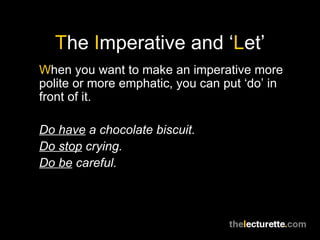
T he  I mperative and ‘ L et’ W hen you want to make an imperative more polite or more emphatic, you can put ‘do’ in front of it. Do have  a chocolate biscuit. Do stop  crying. Do be  careful.
T he  I mperative and ‘ L et’ T he imperative is also use in written instructions on how to do something, for example on notices and packets of food, and in books. To report faults,  dial  6666. Store  in a dry place. Fry  the chopped onion and pepper in the oil.
T he  I mperative and ‘ L et’ Note:  written instructions usually have to be short. This means that words such as ‘the’ are often omitted. Wear rubber gloves. Turn off switch.  W ritten imperatives are also used to give warnings. Reduce speed now.
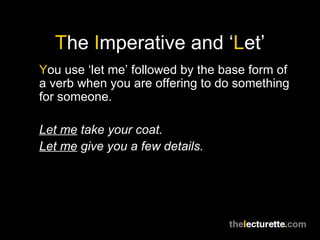
T he  I mperative and ‘ L et’ Y ou use ‘let me’ followed by the base form of a verb when you are offering to do something for someone. Let me  take your coat. Let me  give you a few details.
T he  I mperative and ‘ L et’ Y ou use ‘let’s’ followed by a base form of a verb when you are suggesting what you and someone else should do. Let’s go  outside. Let’s look  at our map.
T he  I mperative and ‘ L et’ Note:  The form ‘let us’ is only used in formal or written English. Let us  consider a very simple example.
T he  I mperative and ‘ L et’ Y ou put ‘do’ before ‘let’s’ when you are very keen to do something. Do let’s  get a taxi. T he negative of ‘let’s’ is ‘let’s not’ or ‘don’t let’s’. Let’s not  talk about that. Don’t let’s  actually write it in the book.
T he  I mperative and ‘ L et’ Y ou put ‘let’ followed by a noun group and the base form of a verb when you are telling someone to do something or to allow someone else to do it. Let  me see it. Let  Philip have a look at it.
Q uestions? For more slide presentations visit:

The Imperative and 'Let'

  • 1.
    T he I mperative and ‘ L et’
  • 2.
    T he I mperative and ‘ L et’ T he imperative is the same as the base of a verb. You do not use a pronoun in front of it. Come to my place. Start when you hear the bell.
  • 3.
    T he I mperative and ‘ L et’ Y ou form a negative imperative by putting ‘do not’, ‘don’t’, or ‘never’ in front of the verb. Do not write in this book. Don’t go so fast. Never open the front door to strangers.
  • 4.
    T he I mperative and ‘ L et’ Y ou use the imperative when you are: asking or telling someone to do something Pass the salt. Hurry up!
  • 5.
    T he I mperative and ‘ L et’ giving someone advice or a warning Mind your head. Take care!
  • 6.
    T he I mperative and ‘ L et’ giving someone instructions on how to do something Put this bit over here, so it fits into that hole. Turn right on Broadway into Caxton Street.
  • 7.
    T he I mperative and ‘ L et’ W hen you want to make an imperative more polite or more emphatic, you can put ‘do’ in front of it. Do have a chocolate biscuit. Do stop crying. Do be careful.
  • 8.
    T he I mperative and ‘ L et’ T he imperative is also use in written instructions on how to do something, for example on notices and packets of food, and in books. To report faults, dial 6666. Store in a dry place. Fry the chopped onion and pepper in the oil.
  • 9.
    T he I mperative and ‘ L et’ Note: written instructions usually have to be short. This means that words such as ‘the’ are often omitted. Wear rubber gloves. Turn off switch. W ritten imperatives are also used to give warnings. Reduce speed now.
  • 10.
    T he I mperative and ‘ L et’ Y ou use ‘let me’ followed by the base form of a verb when you are offering to do something for someone. Let me take your coat. Let me give you a few details.
  • 11.
    T he I mperative and ‘ L et’ Y ou use ‘let’s’ followed by a base form of a verb when you are suggesting what you and someone else should do. Let’s go outside. Let’s look at our map.
  • 12.
    T he I mperative and ‘ L et’ Note: The form ‘let us’ is only used in formal or written English. Let us consider a very simple example.
  • 13.
    T he I mperative and ‘ L et’ Y ou put ‘do’ before ‘let’s’ when you are very keen to do something. Do let’s get a taxi. T he negative of ‘let’s’ is ‘let’s not’ or ‘don’t let’s’. Let’s not talk about that. Don’t let’s actually write it in the book.
  • 14.
    T he I mperative and ‘ L et’ Y ou put ‘let’ followed by a noun group and the base form of a verb when you are telling someone to do something or to allow someone else to do it. Let me see it. Let Philip have a look at it.
  • 15.
    Q uestions? Formore slide presentations visit: