Solving Planning and Scheduling Problems with
CPLEX
ffocacci@decisionbrain.com
Filippo Focacci
AGENDA
1. Introduction
2. Case Studies
3. Best Practices
DECISIONBRAIN
• Global Presence
• France, Hong Kong, Singapore
• IBM Partnership
• Founded in 2013 by former ILOG and IBM employees
• IBM Business Partner
• Expertise & Thought Leadership:
• Planning and Scheduling in Manufacturing, Supply Chain, and Logistics
• Workforce Optimization, Price Optimization and Maintenance Optimization
• Development of Innovative Solutions and Advanced Analytics
• 40+ Scientific Publications in Optimization and Supply Chain, Patents, …
We implement optimizationsolutions to help companies
improve their business operations
3
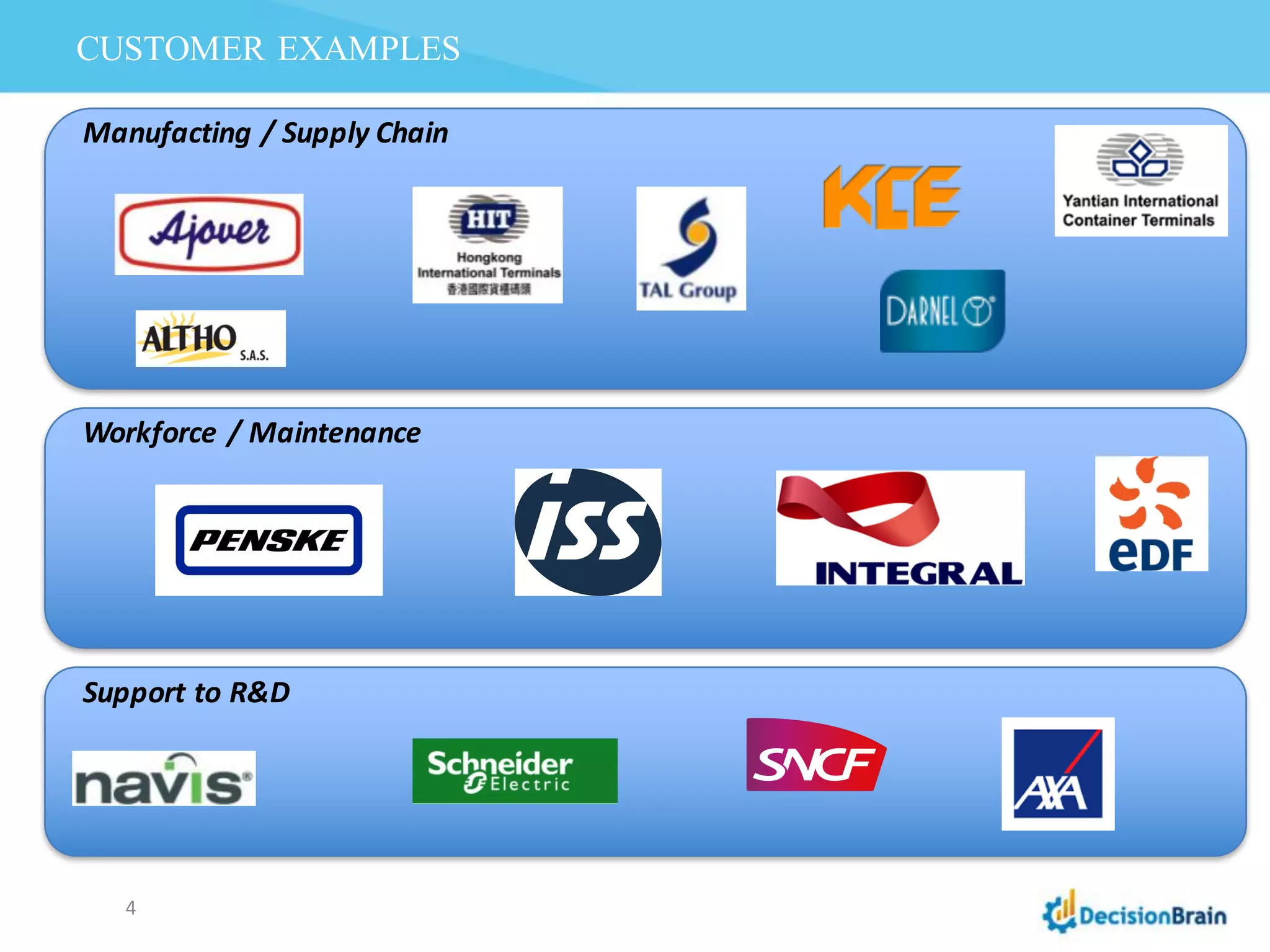
CUSTOMER EXAMPLES
4
Workforce /	
  Maintenance
Manufacting /	
  Supply Chain
Support	
  to	
  R&D
AGENDA
1. Introduction
2. Case Studies
3. Best Practices
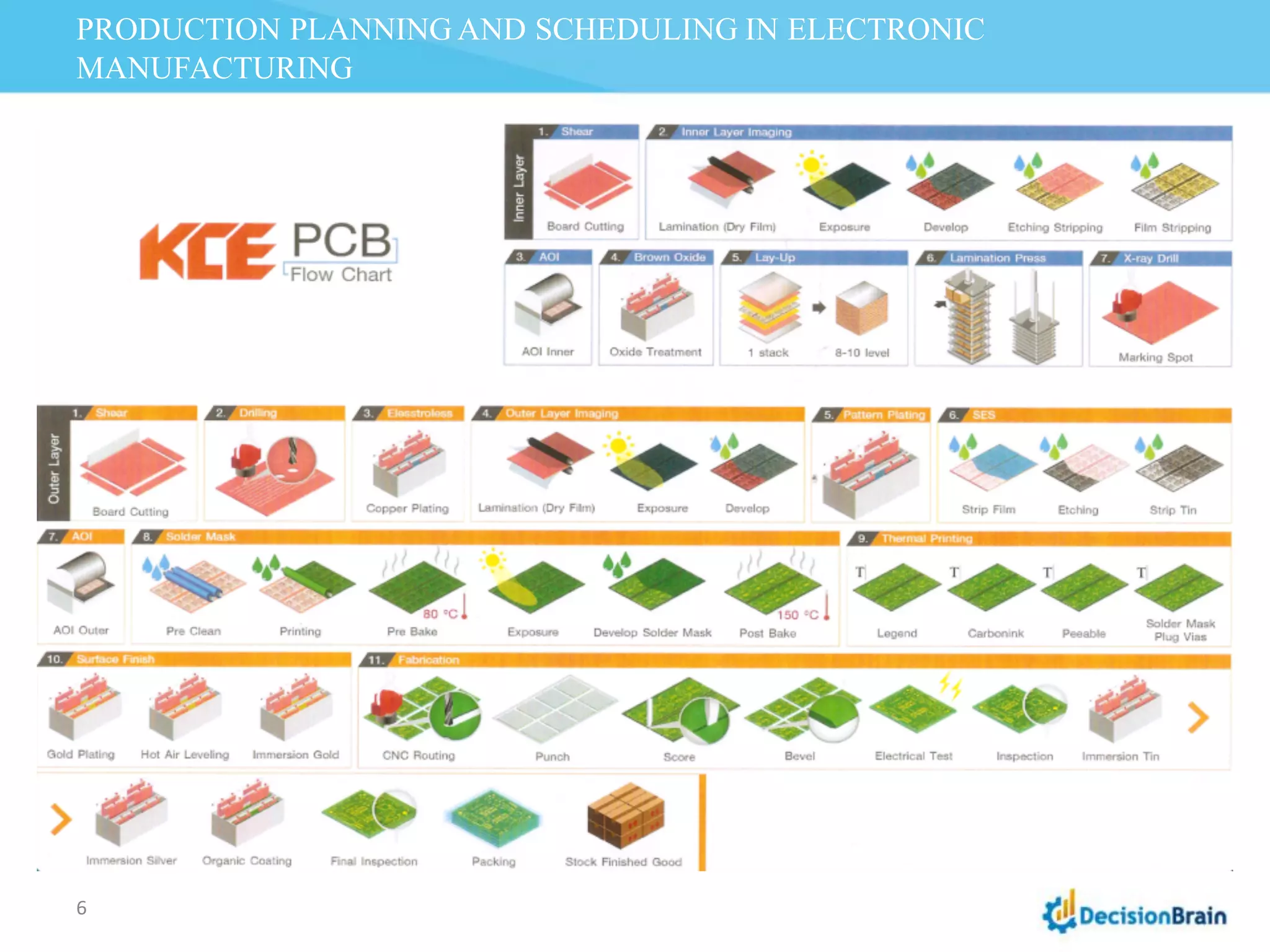
PRODUCTION PLANNING AND SCHEDULING IN ELECTRONIC
MANUFACTURING
6
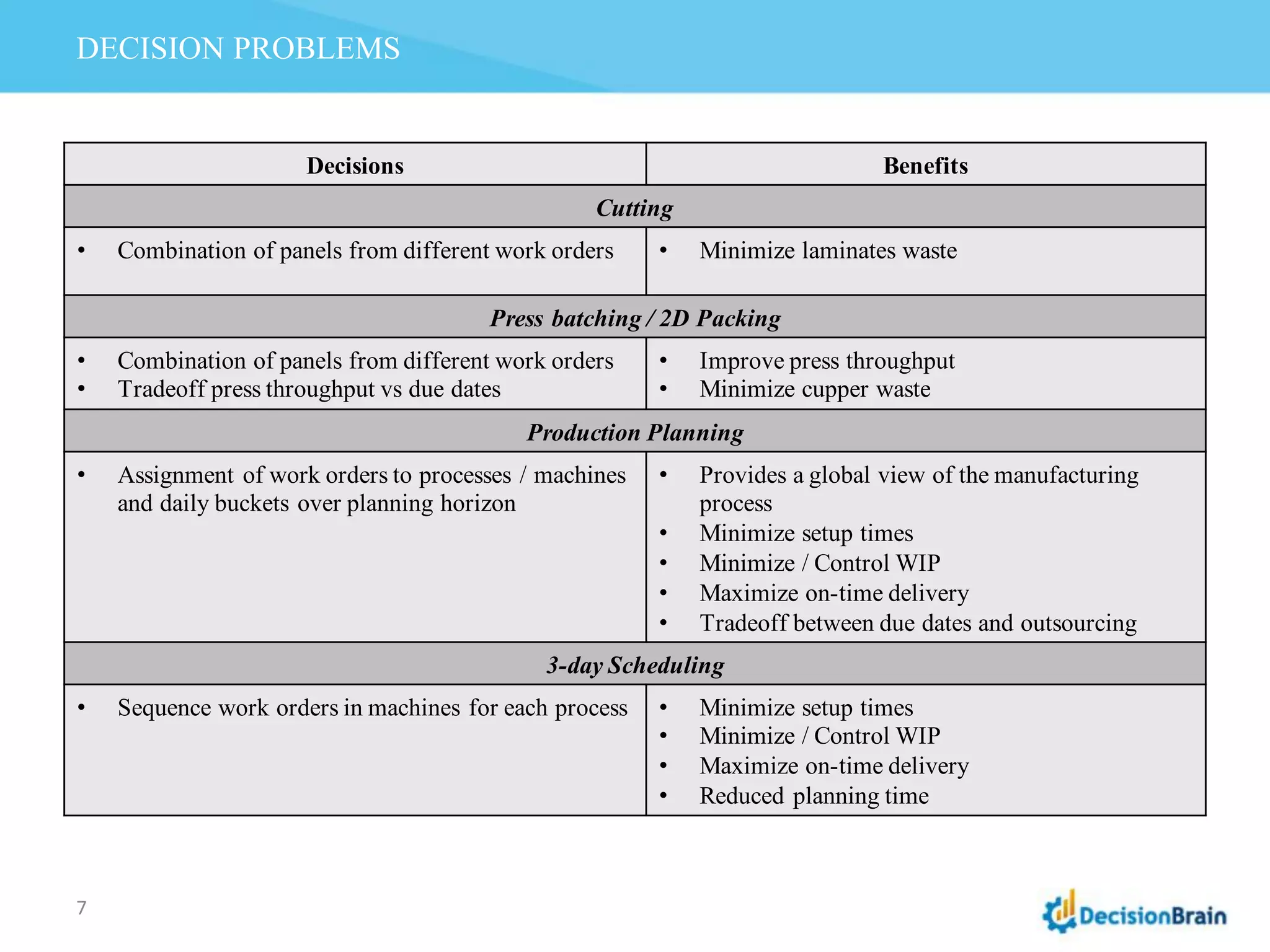
DECISION PROBLEMS
7
Decisions Benefits
Cutting
• Combination of panels from different work orders • Minimize laminates waste
Press batching / 2D Packing
• Combination of panels from different work orders
• Tradeoff press throughput vs due dates
• Improve press throughput
• Minimize cupper waste
Production Planning
• Assignment of work orders to processes / machines
and daily buckets over planning horizon
• Provides a global view of the manufacturing
process
• Minimize setup times
• Minimize / Control WIP
• Maximize on-time delivery
• Tradeoff between due dates and outsourcing
3-day Scheduling
• Sequence work orders in machines for each process • Minimize setup times
• Minimize / Control WIP
• Maximize on-time delivery
• Reduced planning time
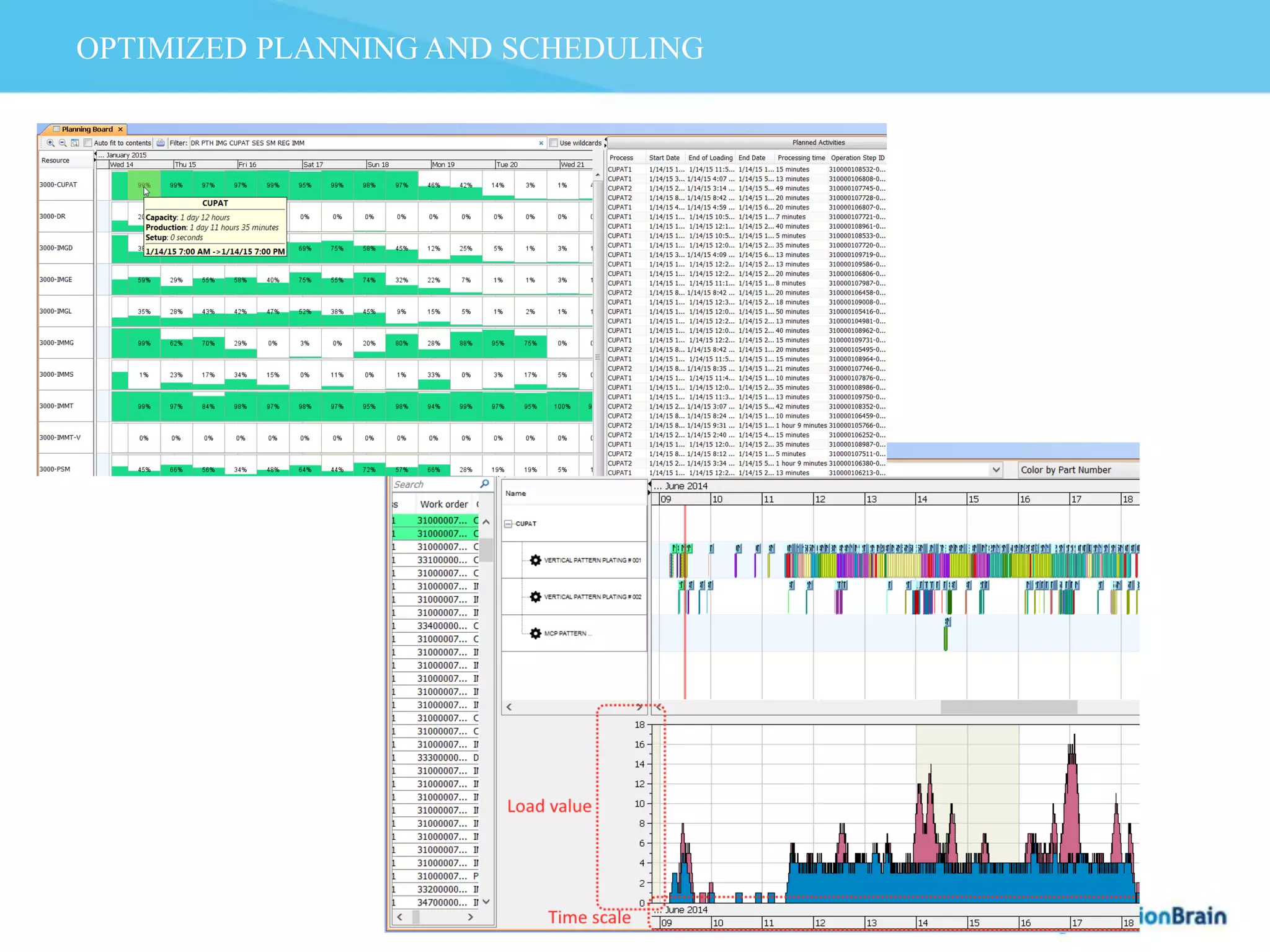
OPTIMIZED PLANNING AND SCHEDULING
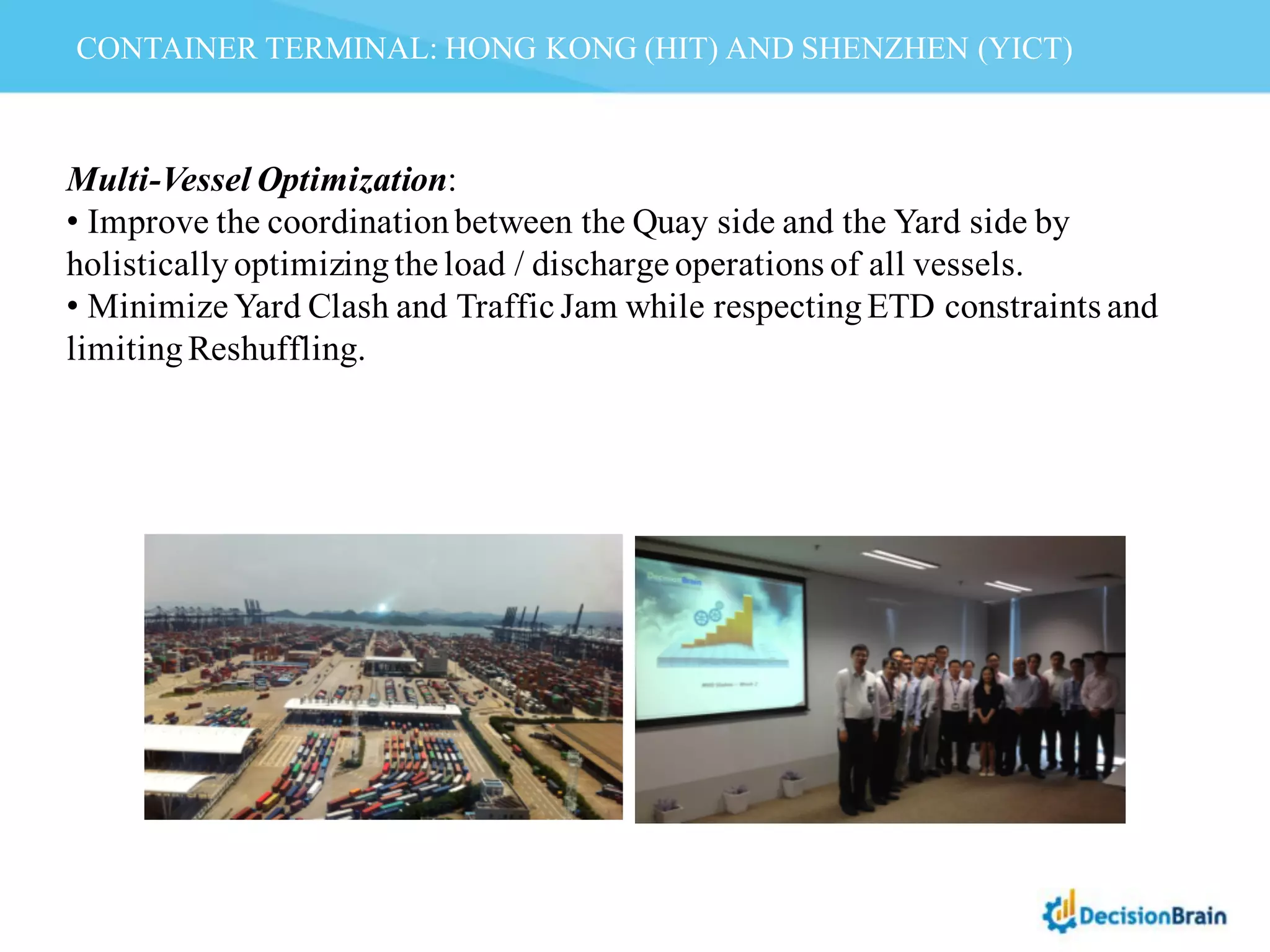
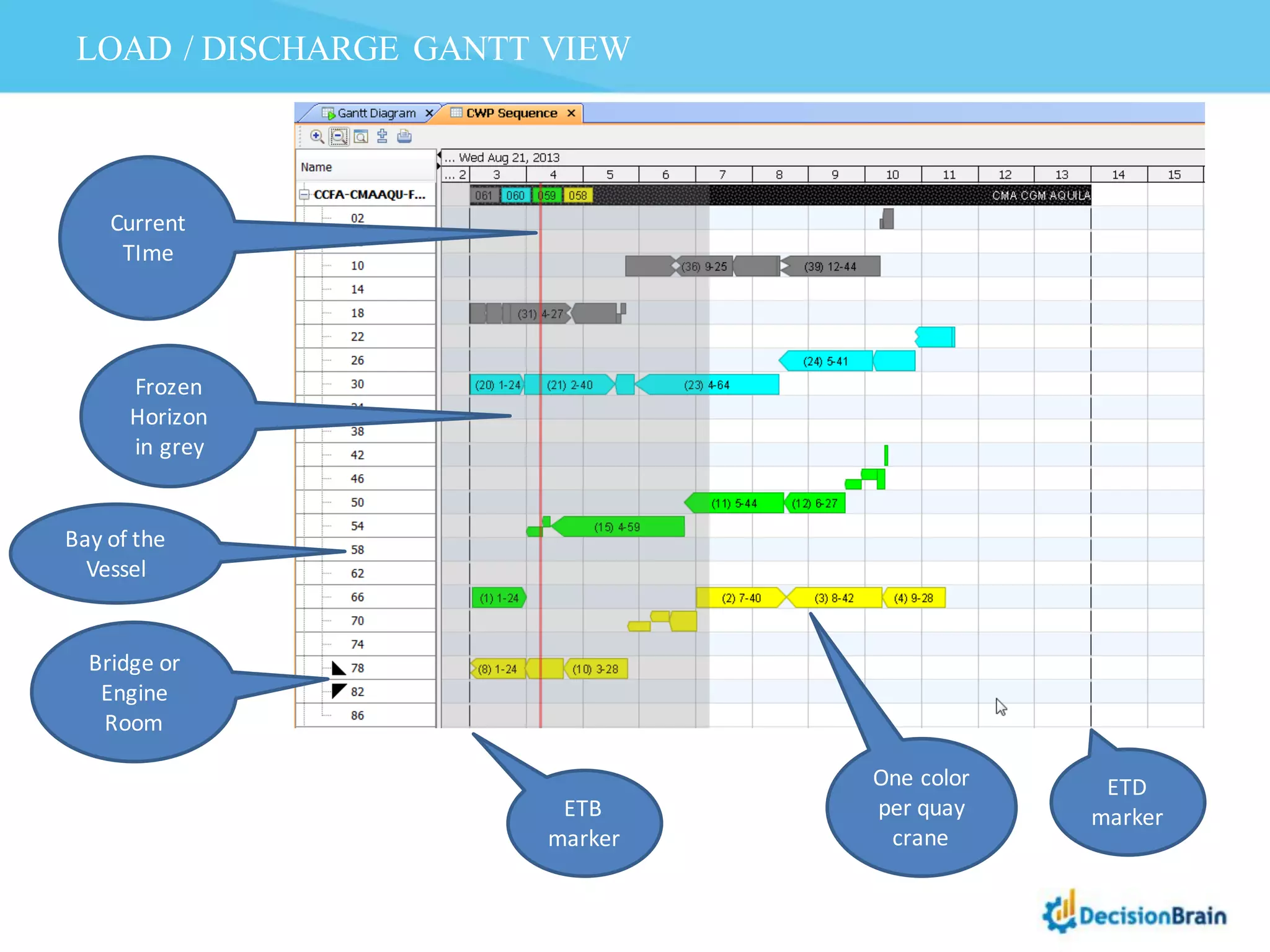
CONTAINER TERMINAL: HONG KONG (HIT) AND SHENZHEN (YICT)
Multi-Vessel Optimization:
• Improve the coordinationbetween the Quay side and the Yard side by
holisticallyoptimizingthe load / discharge operations of all vessels.
• Minimize Yard Clash and Traffic Jam while respectingETD constraints and
limitingReshuffling.
LOAD / DISCHARGE GANTT VIEW
Bridge	
  or	
  
Engine	
  
Room
One	
  color	
  
per	
  quay	
  
crane
ETB	
  
marker
ETD	
  
marker
Current	
  
TIme
Frozen	
  
Horizon	
  
in	
  grey
Bay	
  of	
  the	
  
Vessel
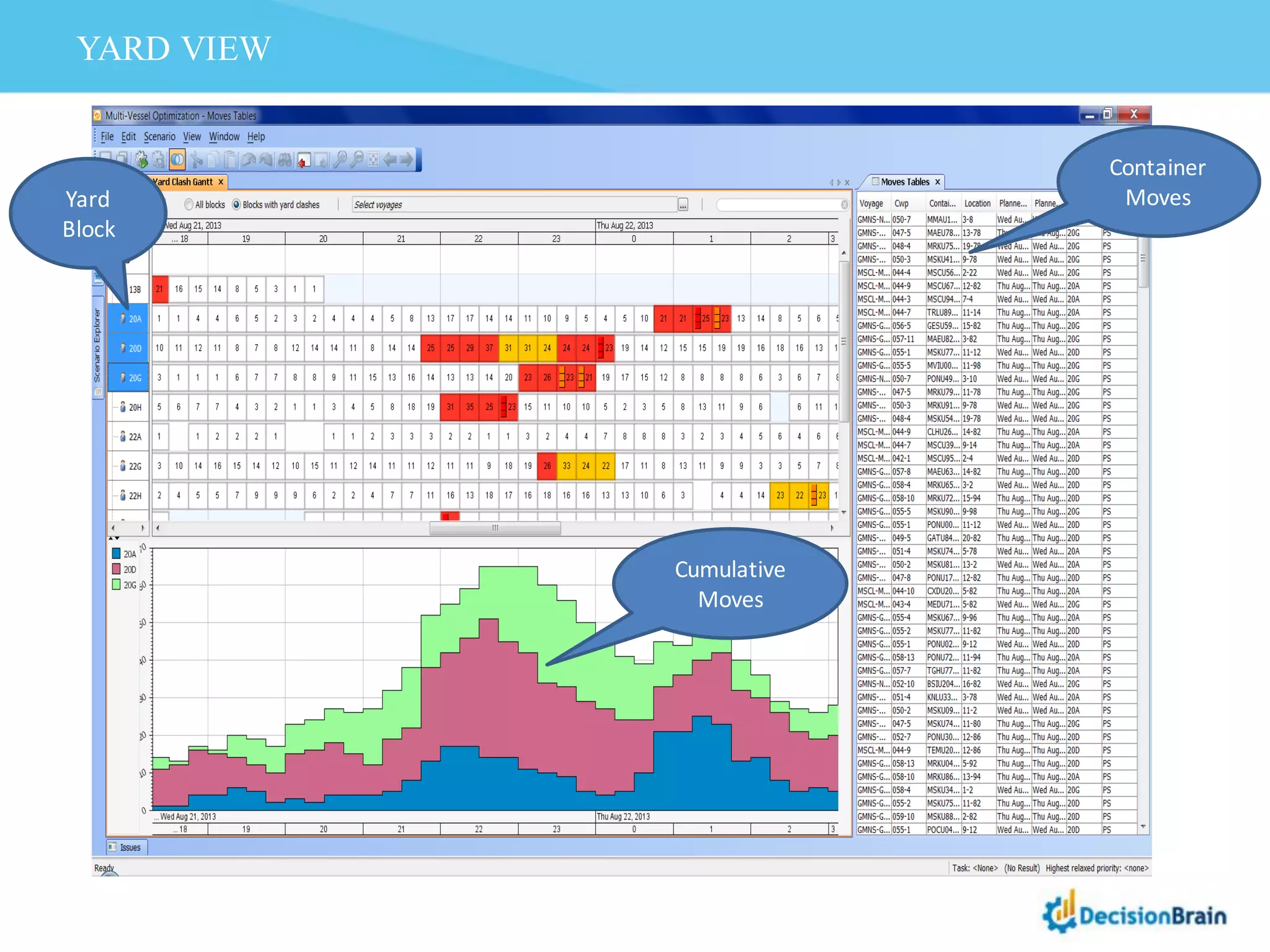
YARD VIEW
Yard	
  
Block
Container	
  
Moves
Cumulative	
  
Moves
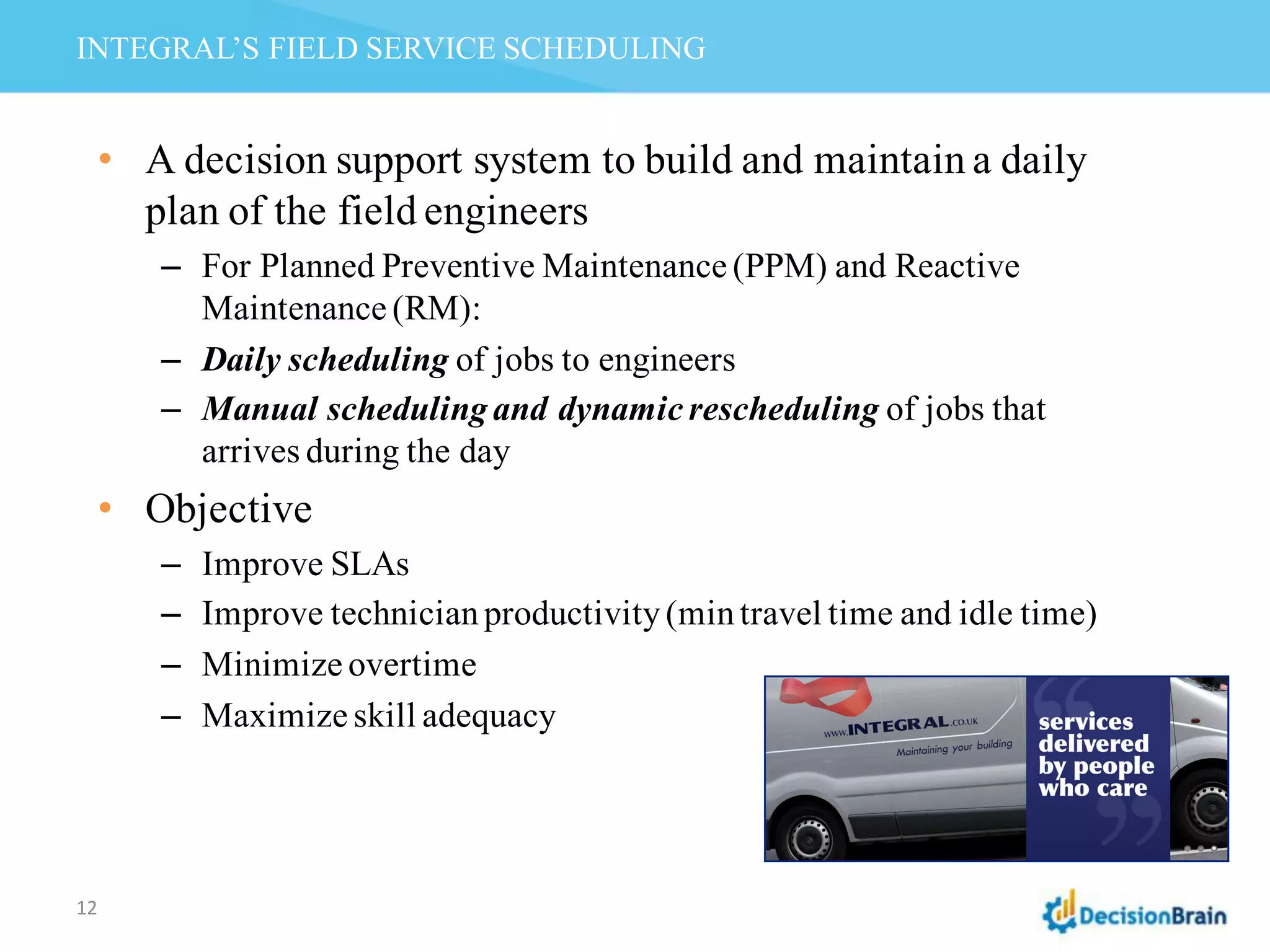
INTEGRAL’S FIELD SERVICE SCHEDULING
12
• A decision support system to build and maintain a daily
plan of the field engineers
– For Planned Preventive Maintenance (PPM) and Reactive
Maintenance (RM):
– Daily scheduling of jobs to engineers
– Manual schedulingand dynamic rescheduling of jobs that
arrives during the day
• Objective
– Improve SLAs
– Improve technicianproductivity(mintravel time and idle time)
– Minimize overtime
– Maximize skill adequacy
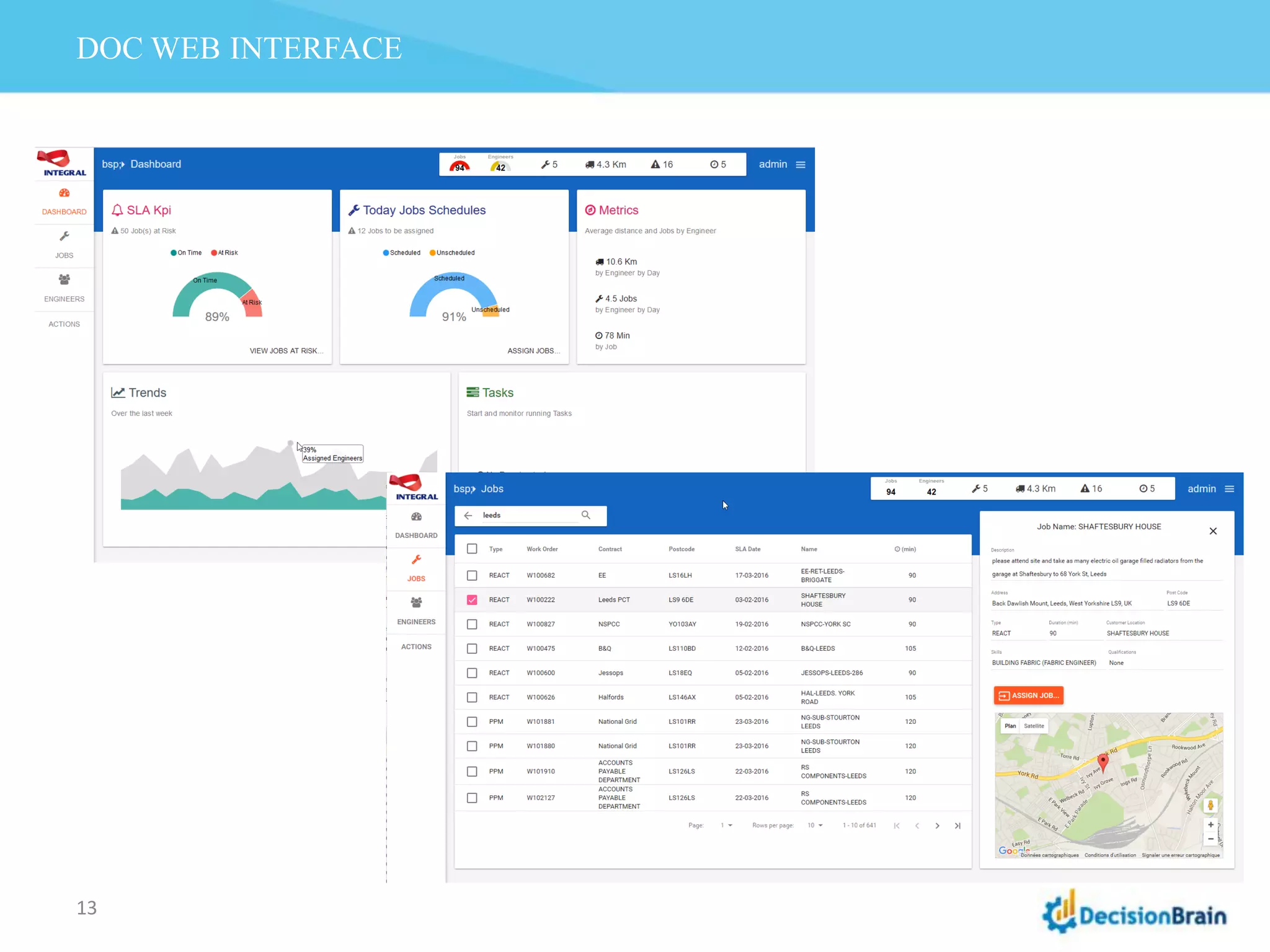
DOC WEB INTERFACE
13
AGENDA
1. Introduction
2. Case Studies
3. Best Practices
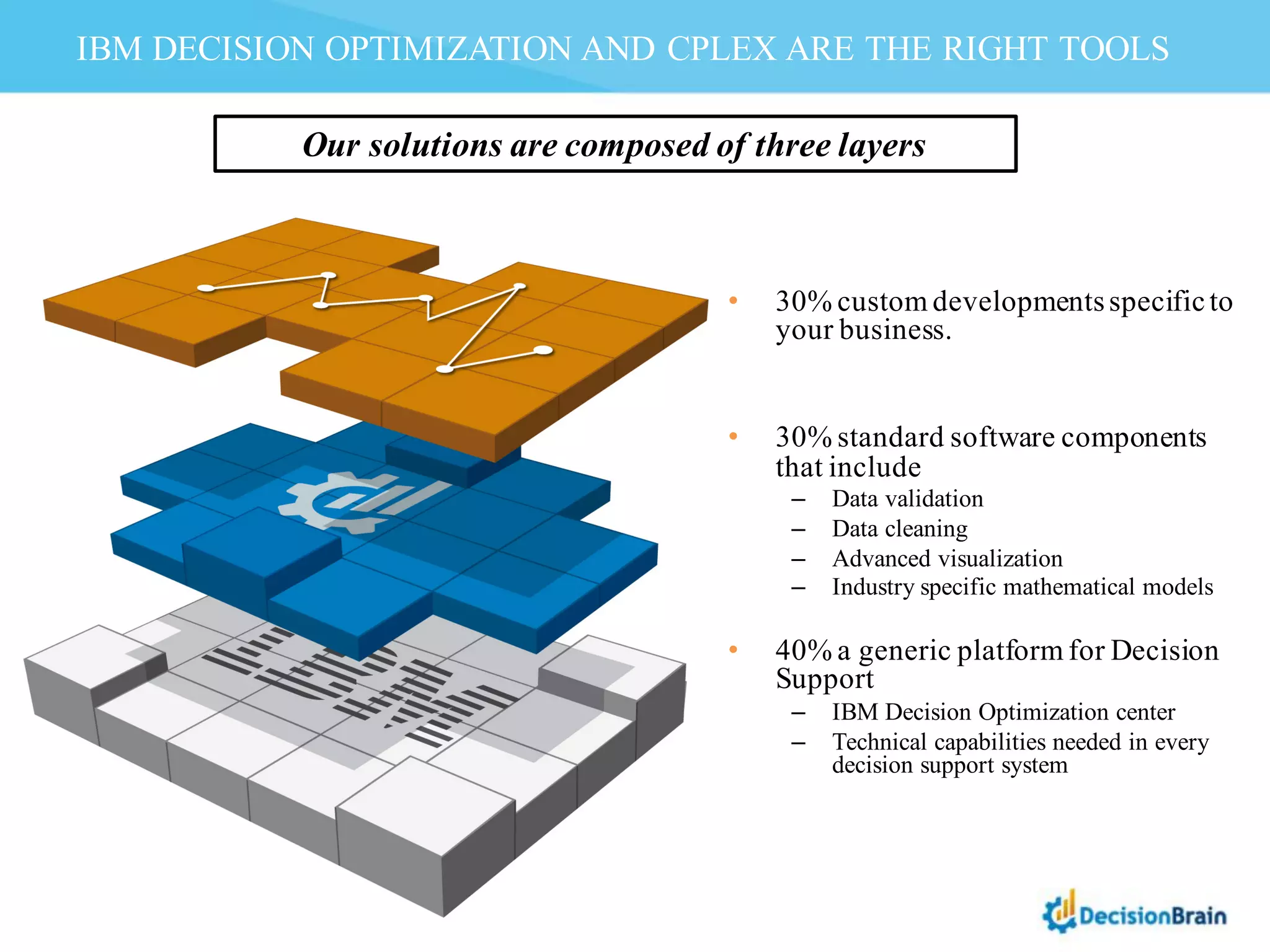
IBM DECISION OPTIMIZATION AND CPLEX ARE THE RIGHT TOOLS
15
• 30% custom developmentsspecificto
your business.
• 30% standard software components
that include
– Data validation
– Data cleaning
– Advanced visualization
– Industry specific mathematical models
• 40% a generic platform for Decision
Support
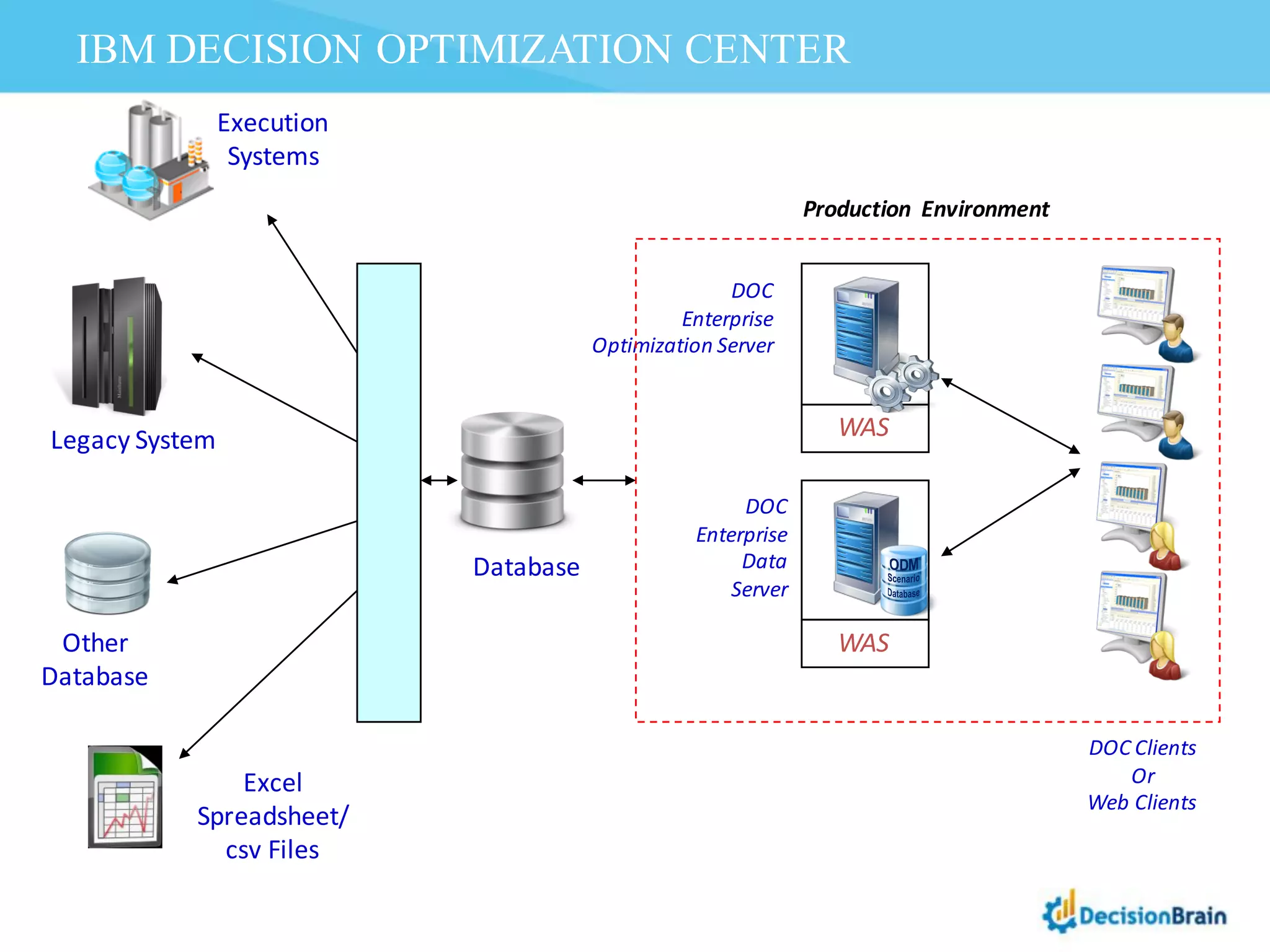
– IBM Decision Optimization center
– Technical capabilities needed in every
decision support system
Our solutions are composed of three layers
WAS
WAS
DOC Clients	
  
Or	
  
Web	
  Clients
DOC
Enterprise
Optimization	
  Server
Production	
   Environment
DOC	
  
Enterprise
Data	
  
Server
Database
Execution	
  
Systems
Excel	
  
Spreadsheet/	
  
csv Files
Other	
  
Database
Legacy	
  System
IBM DECISION OPTIMIZATION CENTER
• Mathematical Optimization
– Modeling all constraints lead to very high complexity
– A straightforward MIP model is not reasonable…
• Constraint Programming
– Constraints can be modeled (although some are quite complex)
– Objective functions are challenging (smooth resource utilization on the
Yard)
• Effective approach: MIP/CP-based Column Generation
• Key takeaway…
– Optimization Technology as a toolkit.
– Conceptually explore or prototype alternatives
– The most effective technique may require more than one technology
è Unique value of IBM CPLEX Optimization Studio
WHICH OPTIMIZATION TECHNOLOGY?
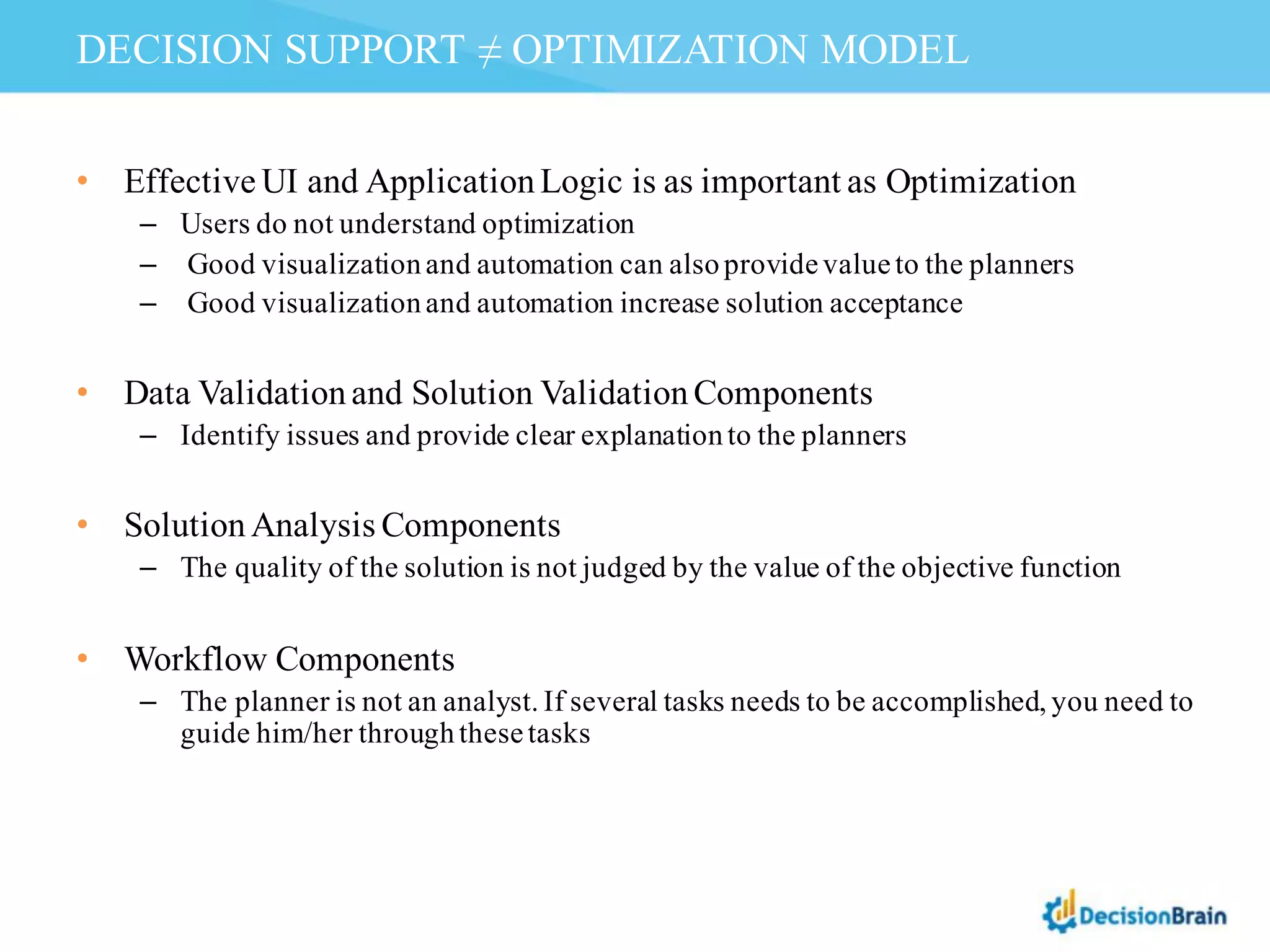
Example from Container Terminal Optimization
• Effective UI and ApplicationLogic is as important as Optimization
– Users do not understand optimization
– Good visualizationand automation can alsoprovidevalueto the planners
– Good visualizationand automation increase solution acceptance
• Data Validationand Solution ValidationComponents
– Identify issues and provide clear explanationto the planners
• SolutionAnalysis Components
– The quality of the solution is not judged by the value of the objective function
• Workflow Components
– The planner is not an analyst. If several tasks needs to be accomplished, you need to
guide him/her throughthesetasks
DECISION SUPPORT ≠ OPTIMIZATION MODEL
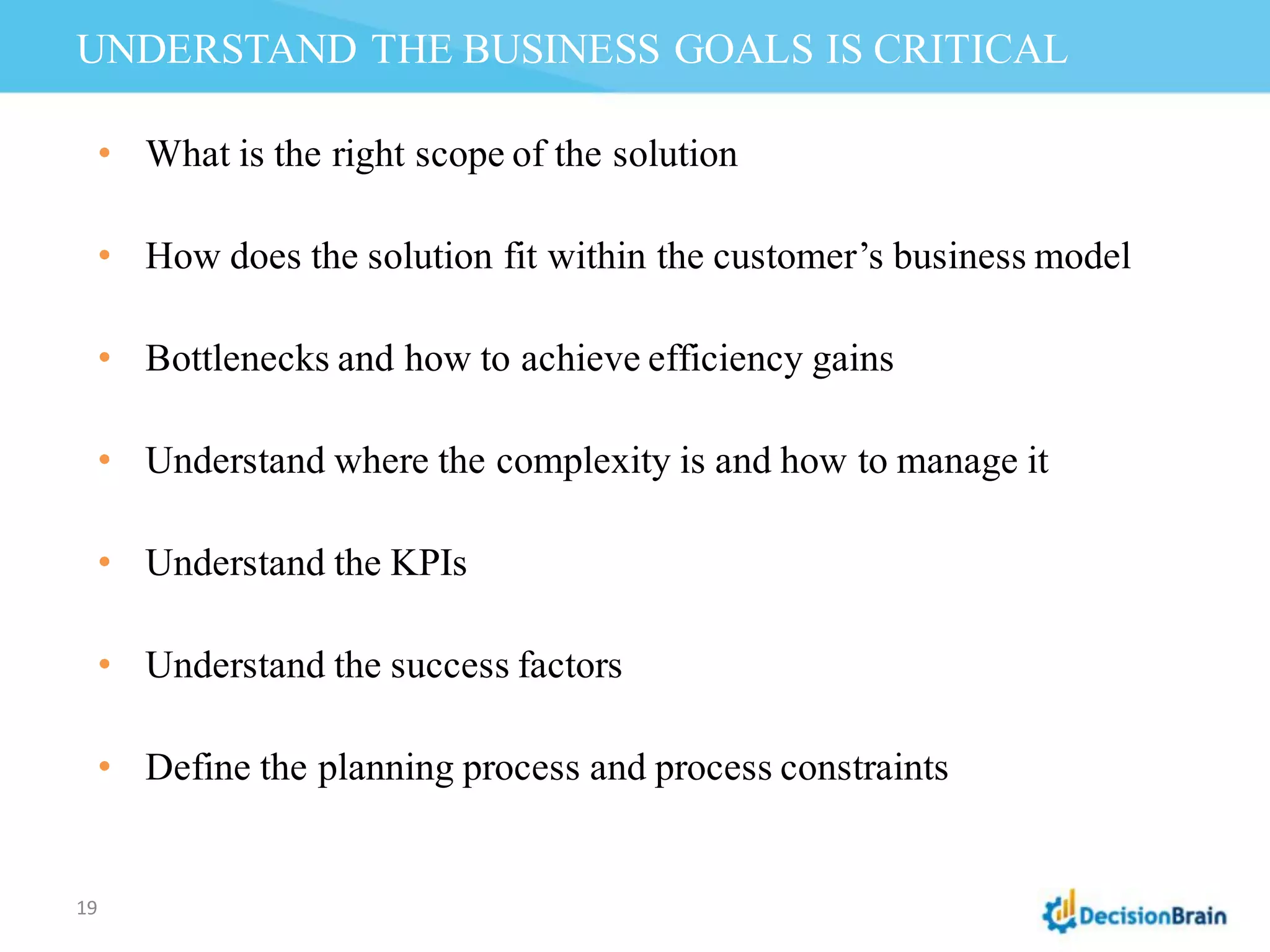
UNDERSTAND THE BUSINESS GOALS IS CRITICAL
19
• What is the right scope of the solution
• How does the solution fit within the customer’s business model
• Bottlenecks and how to achieve efficiency gains
• Understand where the complexity is and how to manage it
• Understand the KPIs
• Understand the success factors
• Define the planning process and process constraints
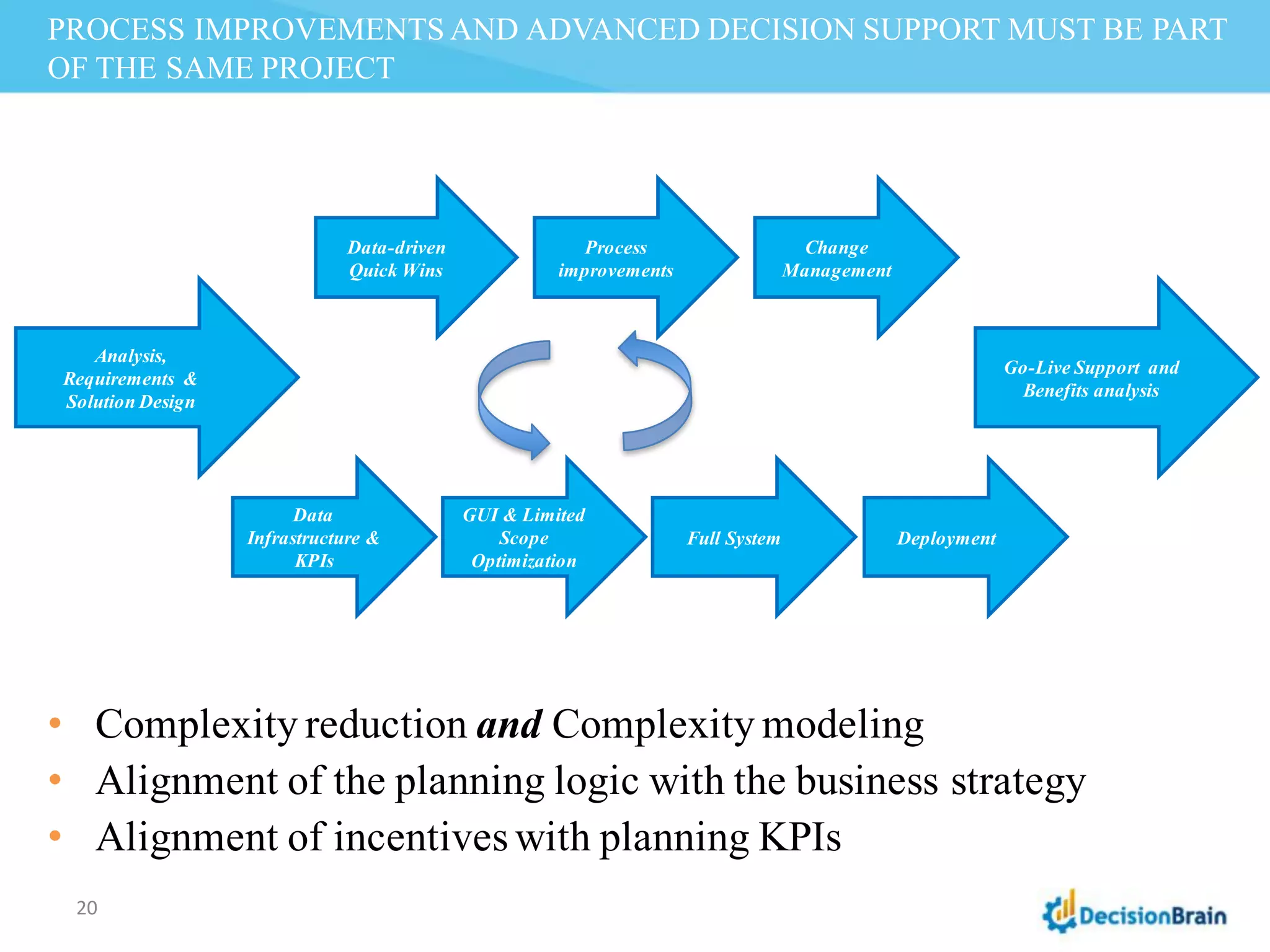
PROCESS IMPROVEMENTS AND ADVANCED DECISION SUPPORT MUST BE PART
OF THE SAME PROJECT
• Complexity reduction and Complexity modeling
• Alignment of the planning logic with the business strategy
• Alignment of incentives with planning KPIs
Analysis,
Requirements &
Solution Design
Data-driven
Quick Wins
GUI & Limited
Scope
Optimization
Full System Deployment
Data
Infrastructure &
KPIs
Go-Live Support and
Benefits analysis
Change
Management
Process
improvements
20
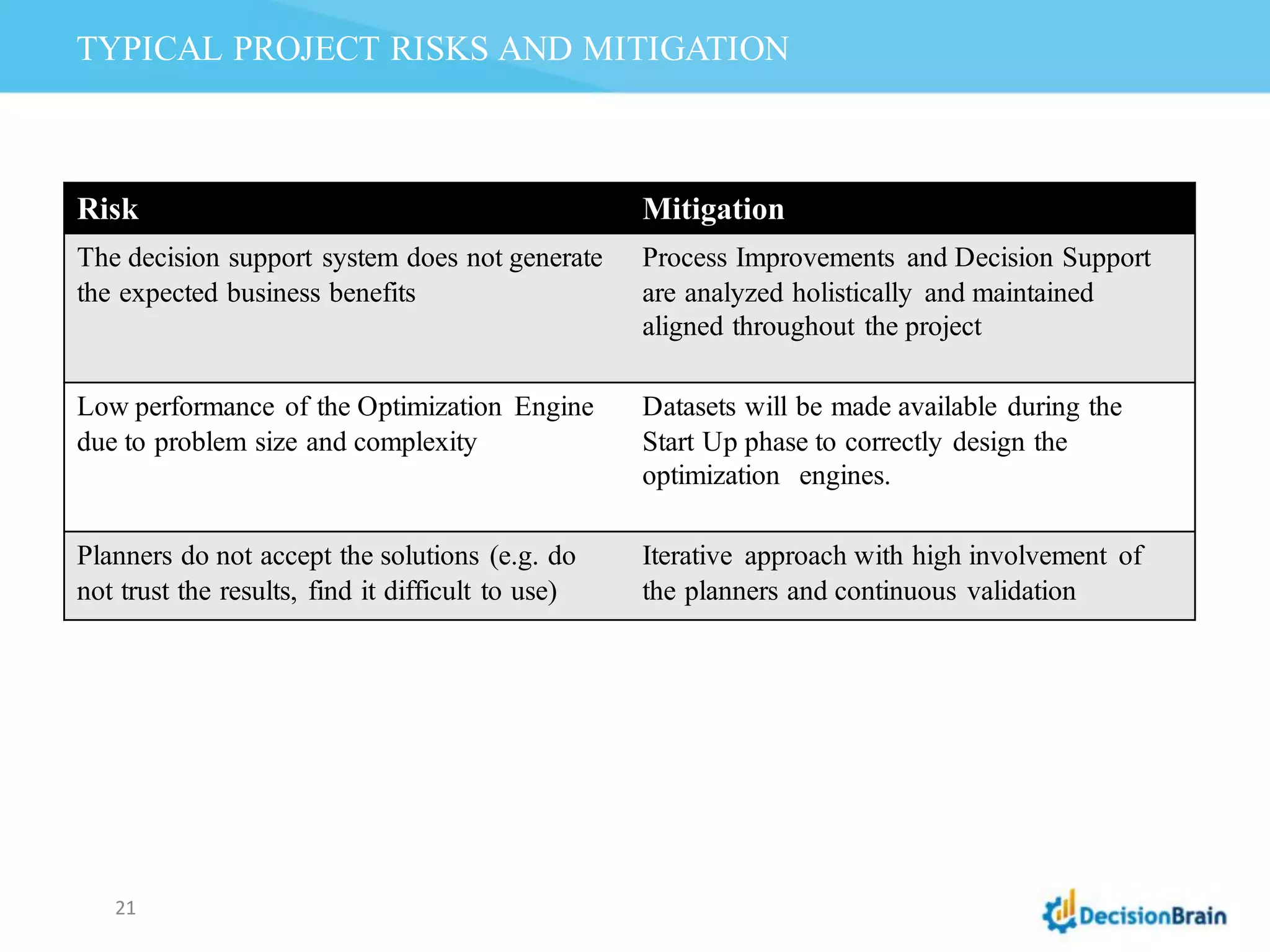
TYPICAL PROJECT RISKS AND MITIGATION
21
Risk Mitigation
The decision support system does not generate
the expected business benefits
Process Improvements and Decision Support
are analyzed holistically and maintained
aligned throughout the project
Low performance of the Optimization Engine
due to problem size and complexity
Datasets will be made available during the
Start Up phase to correctly design the
optimization engines.
Planners do not accept the solutions (e.g. do
not trust the results, find it difficult to use)
Iterative approach with high involvement of
the planners and continuous validation
Discussion
ffocacci@decisionbrain.com
Filippo Focacci

Informs 2016 Solving Planning and Scheduling Problems with CPLEX

  • 1.
    Solving Planning andScheduling Problems with CPLEX ffocacci@decisionbrain.com Filippo Focacci
  • 2.
    AGENDA 1. Introduction 2. CaseStudies 3. Best Practices
  • 3.
    DECISIONBRAIN • Global Presence •France, Hong Kong, Singapore • IBM Partnership • Founded in 2013 by former ILOG and IBM employees • IBM Business Partner • Expertise & Thought Leadership: • Planning and Scheduling in Manufacturing, Supply Chain, and Logistics • Workforce Optimization, Price Optimization and Maintenance Optimization • Development of Innovative Solutions and Advanced Analytics • 40+ Scientific Publications in Optimization and Supply Chain, Patents, … We implement optimizationsolutions to help companies improve their business operations 3
  • 4.
    CUSTOMER EXAMPLES 4 Workforce /  Maintenance Manufacting /  Supply Chain Support  to  R&D
  • 5.
    AGENDA 1. Introduction 2. CaseStudies 3. Best Practices
  • 6.
    PRODUCTION PLANNING ANDSCHEDULING IN ELECTRONIC MANUFACTURING 6
  • 7.
    DECISION PROBLEMS 7 Decisions Benefits Cutting •Combination of panels from different work orders • Minimize laminates waste Press batching / 2D Packing • Combination of panels from different work orders • Tradeoff press throughput vs due dates • Improve press throughput • Minimize cupper waste Production Planning • Assignment of work orders to processes / machines and daily buckets over planning horizon • Provides a global view of the manufacturing process • Minimize setup times • Minimize / Control WIP • Maximize on-time delivery • Tradeoff between due dates and outsourcing 3-day Scheduling • Sequence work orders in machines for each process • Minimize setup times • Minimize / Control WIP • Maximize on-time delivery • Reduced planning time
  • 8.
  • 9.
    CONTAINER TERMINAL: HONGKONG (HIT) AND SHENZHEN (YICT) Multi-Vessel Optimization: • Improve the coordinationbetween the Quay side and the Yard side by holisticallyoptimizingthe load / discharge operations of all vessels. • Minimize Yard Clash and Traffic Jam while respectingETD constraints and limitingReshuffling.
  • 10.
    LOAD / DISCHARGEGANTT VIEW Bridge  or   Engine   Room One  color   per  quay   crane ETB   marker ETD   marker Current   TIme Frozen   Horizon   in  grey Bay  of  the   Vessel
  • 11.
    YARD VIEW Yard   Block Container   Moves Cumulative   Moves
  • 12.
    INTEGRAL’S FIELD SERVICESCHEDULING 12 • A decision support system to build and maintain a daily plan of the field engineers – For Planned Preventive Maintenance (PPM) and Reactive Maintenance (RM): – Daily scheduling of jobs to engineers – Manual schedulingand dynamic rescheduling of jobs that arrives during the day • Objective – Improve SLAs – Improve technicianproductivity(mintravel time and idle time) – Minimize overtime – Maximize skill adequacy
  • 13.
  • 14.
    AGENDA 1. Introduction 2. CaseStudies 3. Best Practices
  • 15.
    IBM DECISION OPTIMIZATIONAND CPLEX ARE THE RIGHT TOOLS 15 • 30% custom developmentsspecificto your business. • 30% standard software components that include – Data validation – Data cleaning – Advanced visualization – Industry specific mathematical models • 40% a generic platform for Decision Support – IBM Decision Optimization center – Technical capabilities needed in every decision support system Our solutions are composed of three layers
  • 16.
    WAS WAS DOC Clients   Or   Web  Clients DOC Enterprise Optimization  Server Production   Environment DOC   Enterprise Data   Server Database Execution   Systems Excel   Spreadsheet/   csv Files Other   Database Legacy  System IBM DECISION OPTIMIZATION CENTER
  • 17.
    • Mathematical Optimization –Modeling all constraints lead to very high complexity – A straightforward MIP model is not reasonable… • Constraint Programming – Constraints can be modeled (although some are quite complex) – Objective functions are challenging (smooth resource utilization on the Yard) • Effective approach: MIP/CP-based Column Generation • Key takeaway… – Optimization Technology as a toolkit. – Conceptually explore or prototype alternatives – The most effective technique may require more than one technology è Unique value of IBM CPLEX Optimization Studio WHICH OPTIMIZATION TECHNOLOGY? Example from Container Terminal Optimization
  • 18.
    • Effective UIand ApplicationLogic is as important as Optimization – Users do not understand optimization – Good visualizationand automation can alsoprovidevalueto the planners – Good visualizationand automation increase solution acceptance • Data Validationand Solution ValidationComponents – Identify issues and provide clear explanationto the planners • SolutionAnalysis Components – The quality of the solution is not judged by the value of the objective function • Workflow Components – The planner is not an analyst. If several tasks needs to be accomplished, you need to guide him/her throughthesetasks DECISION SUPPORT ≠ OPTIMIZATION MODEL
  • 19.
    UNDERSTAND THE BUSINESSGOALS IS CRITICAL 19 • What is the right scope of the solution • How does the solution fit within the customer’s business model • Bottlenecks and how to achieve efficiency gains • Understand where the complexity is and how to manage it • Understand the KPIs • Understand the success factors • Define the planning process and process constraints
  • 20.
    PROCESS IMPROVEMENTS ANDADVANCED DECISION SUPPORT MUST BE PART OF THE SAME PROJECT • Complexity reduction and Complexity modeling • Alignment of the planning logic with the business strategy • Alignment of incentives with planning KPIs Analysis, Requirements & Solution Design Data-driven Quick Wins GUI & Limited Scope Optimization Full System Deployment Data Infrastructure & KPIs Go-Live Support and Benefits analysis Change Management Process improvements 20
  • 21.
    TYPICAL PROJECT RISKSAND MITIGATION 21 Risk Mitigation The decision support system does not generate the expected business benefits Process Improvements and Decision Support are analyzed holistically and maintained aligned throughout the project Low performance of the Optimization Engine due to problem size and complexity Datasets will be made available during the Start Up phase to correctly design the optimization engines. Planners do not accept the solutions (e.g. do not trust the results, find it difficult to use) Iterative approach with high involvement of the planners and continuous validation
  • 22.