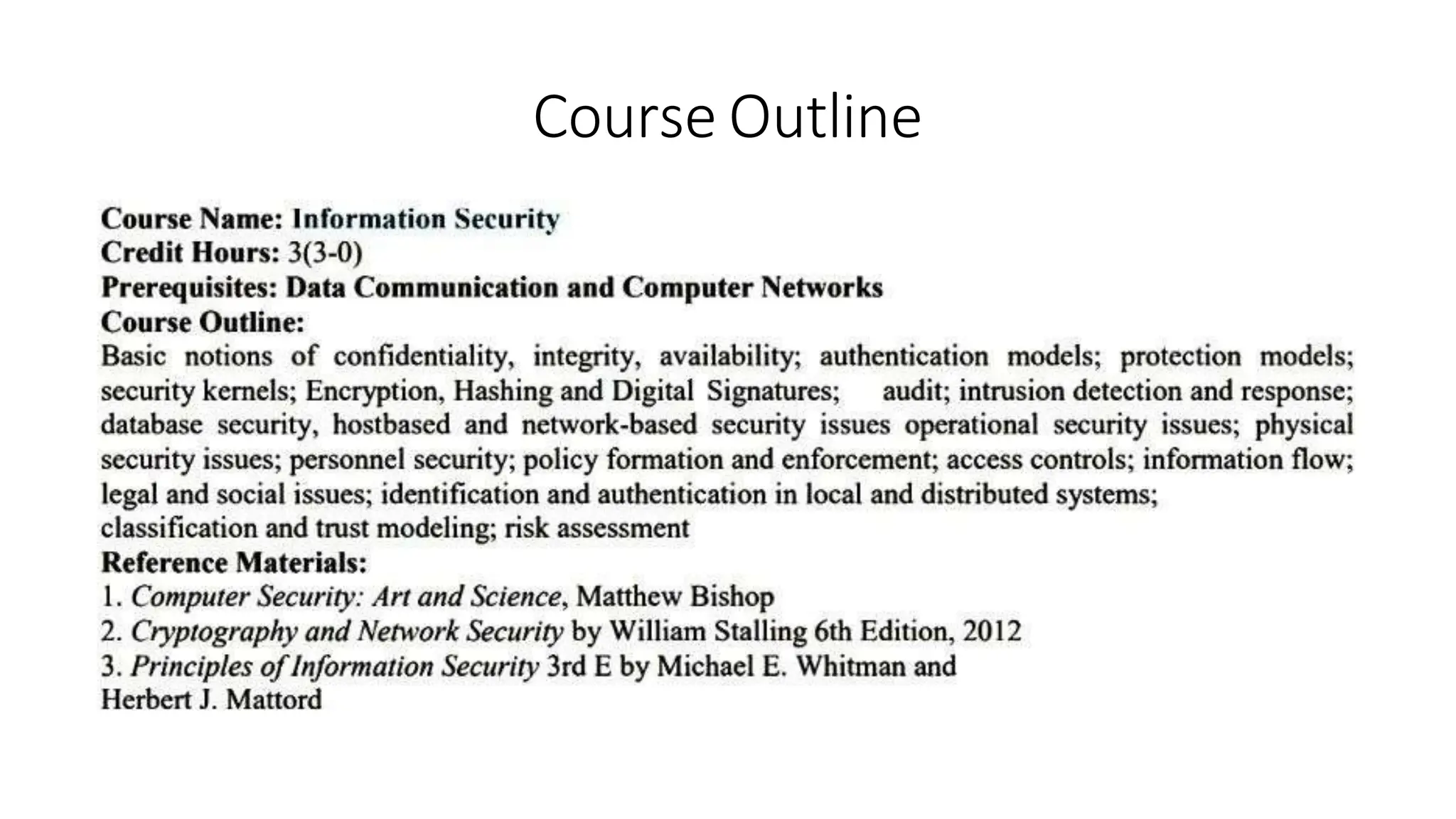
Course Outline
ArfanShahzad.com
Intrusion Detection and Response
ArfanShahzad.com
• An intrusion occurs when an attacker attempts to gain entry into or
disrupt the normal operations of an information system, almost
always with the intent to do harm.
• Even when such attacks are self-propagating, as in the case of viruses
and DDoS attacks, they are almost always instigated (initiated) by
someone whose purpose is to harm an organization.
Intrusion Detection and Response cont…
ArfanShahzad.com
• Intrusion prevention consists of activities that deter (prevent) an
intrusion.
• Some important intrusion prevention activities are:
Intrusion Detection and Response cont…
ArfanShahzad.com
1. Writing & implementing enterprise information security policy,
2. Planning & executing effective information security programs,
3. Installing & testing technology-based information security
countermeasures (e.g. firewalls and intrusion detection systems),
4. Conducting & measuring the effectiveness of employee training
and awareness activities.
Intrusion Detection and Response cont…
ArfanShahzad.com
• Information security intrusion detection systems (IDSs) became
commercially available in the late 1990s.
• An IDS works like a burglar alarm (robber alarm) in that it detects a
violation and activates an alarm.
• This alarm can be audible and/or visual (producing noise and lights,
respectively), or it can be silent (an e-mail message alert).
Intrusion Detection and Response cont…
ArfanShahzad.com
• A current extension of IDS technology is the Intrusion Detection and
Response (IDR).
• IDR is a crucial aspect of cybersecurity that involves monitoring,
detecting, and responding to unauthorized activities or potential
threats within a computer network or system.
Intrusion Detection and Response cont…
ArfanShahzad.com
• It aims to protect the network and its assets from malicious activities
and minimize the impact of security incidents.
• The process of IDR typically involves the following steps:
Intrusion Detection and Response cont…
ArfanShahzad.com
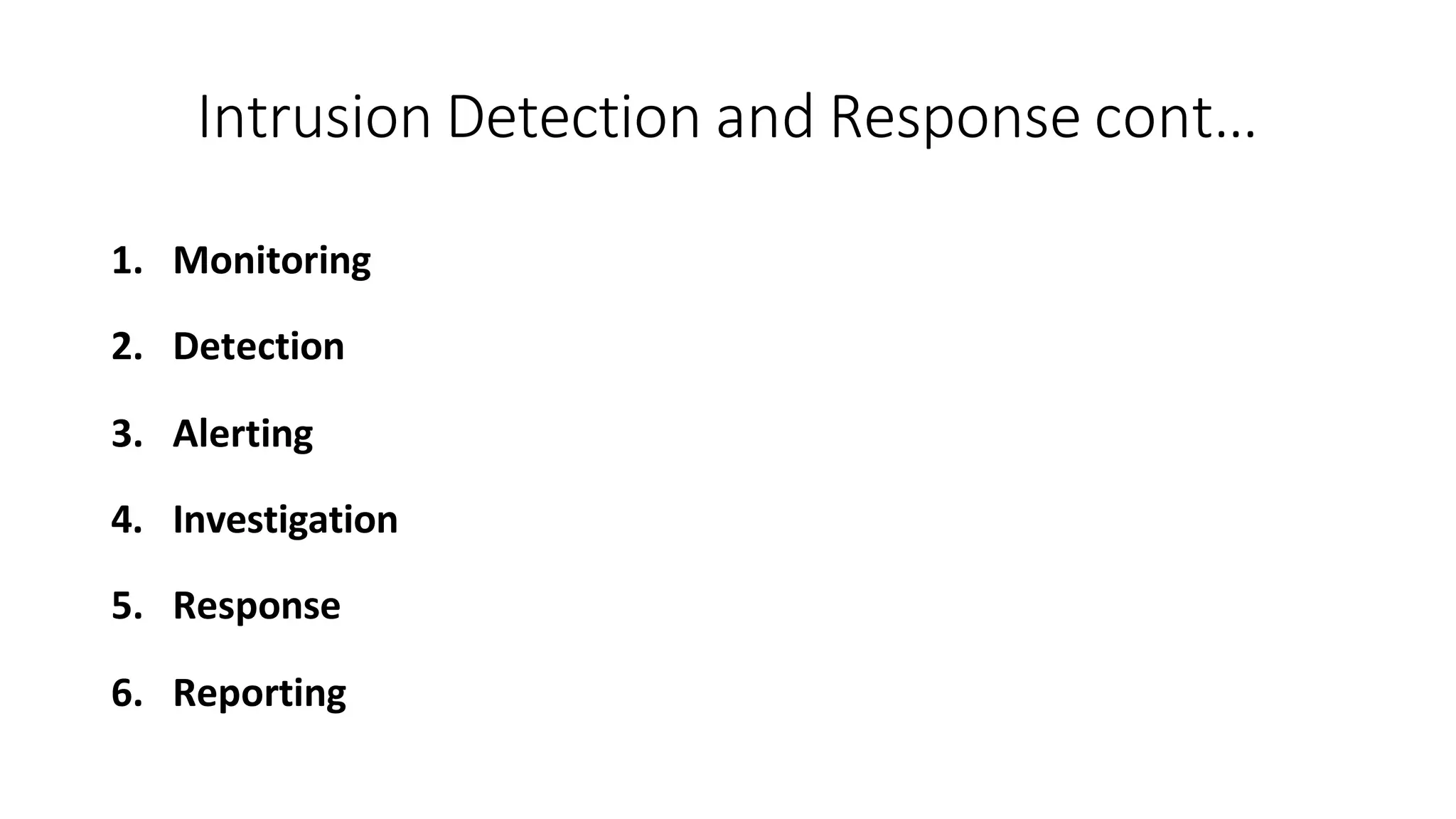
1. Monitoring
2. Detection
3. Alerting
4. Investigation
5. Response
6. Reporting
Intrusion Detection and Response cont…
ArfanShahzad.com
• 1- Monitoring: Continuous monitoring of network traffic, system logs, and
user activities to identify any abnormal or suspicious behavior.
• This can be done using various technologies such as network intrusion
detection systems (NIDS), host-based intrusion detection systems (HIDS),
and security information and event management (SIEM) tools.
Intrusion Detection and Response cont…
ArfanShahzad.com
• 2- Detection: Analyzing the collected data and applying detection
mechanisms to identify potential security incidents or indicators of
compromise (IOCs).
• This includes the use of signature-based detection, anomaly
detection, and behavioral analysis to identify known and unknown
threats.
Intrusion Detection and Response cont…
ArfanShahzad.com
• 3- Alerting: Generating alerts or notifications when potential security
incidents or anomalies are detected.
• These alerts are typically sent to a centralized console or a security
operations center (SOC) where they are analyzed and prioritized
based on their severity.
Intrusion Detection and Response cont…
ArfanShahzad.com
• 4- Investigation: Conducting a thorough investigation of the detected
incidents to determine the nature and extent of the security breach.
• This may involve analyzing log files, examining network traffic, and
gathering evidence to understand the root cause and impact of the
incident.
Intrusion Detection and Response cont…
ArfanShahzad.com
• 5- Response: Implementing appropriate response actions to contain
and mitigate the impact of the security incident.
• This may include
traffic, applying
isolating affected systems, blocking malicious
patches or updates, resetting compromised
credentials, and restoring affected services.
Intrusion Detection and Response cont…
ArfanShahzad.com
• 6- Reporting: Documenting the incident response activities, including
the details of the incident, actions taken, and lessons learned.
• This helps in improving future incident response processes and
enables regulatory compliance and reporting requirements.
Intrusion Detection and Response cont…
ArfanShahzad.com
• The overall goal of intrusion detection and response is to detect and
respond to security incidents in a timely manner, minimizing the
potential damage and reducing the risk of future incidents.
• It requires a combination of technology, processes, and skilled
personnel to effectively identify and respond to threats, ultimately
enhancing the overall security posture of an organization.

Information Security 08- Intrusion Detection and Response (1).pdf

  • 1.
  • 2.
    Intrusion Detection andResponse ArfanShahzad.com • An intrusion occurs when an attacker attempts to gain entry into or disrupt the normal operations of an information system, almost always with the intent to do harm. • Even when such attacks are self-propagating, as in the case of viruses and DDoS attacks, they are almost always instigated (initiated) by someone whose purpose is to harm an organization.
  • 3.
    Intrusion Detection andResponse cont… ArfanShahzad.com • Intrusion prevention consists of activities that deter (prevent) an intrusion. • Some important intrusion prevention activities are:
  • 4.
    Intrusion Detection andResponse cont… ArfanShahzad.com 1. Writing & implementing enterprise information security policy, 2. Planning & executing effective information security programs, 3. Installing & testing technology-based information security countermeasures (e.g. firewalls and intrusion detection systems), 4. Conducting & measuring the effectiveness of employee training and awareness activities.
  • 5.
    Intrusion Detection andResponse cont… ArfanShahzad.com • Information security intrusion detection systems (IDSs) became commercially available in the late 1990s. • An IDS works like a burglar alarm (robber alarm) in that it detects a violation and activates an alarm. • This alarm can be audible and/or visual (producing noise and lights, respectively), or it can be silent (an e-mail message alert).
  • 6.
    Intrusion Detection andResponse cont… ArfanShahzad.com • A current extension of IDS technology is the Intrusion Detection and Response (IDR). • IDR is a crucial aspect of cybersecurity that involves monitoring, detecting, and responding to unauthorized activities or potential threats within a computer network or system.
  • 7.
    Intrusion Detection andResponse cont… ArfanShahzad.com • It aims to protect the network and its assets from malicious activities and minimize the impact of security incidents. • The process of IDR typically involves the following steps:
  • 8.
    Intrusion Detection andResponse cont… ArfanShahzad.com 1. Monitoring 2. Detection 3. Alerting 4. Investigation 5. Response 6. Reporting
  • 9.
    Intrusion Detection andResponse cont… ArfanShahzad.com • 1- Monitoring: Continuous monitoring of network traffic, system logs, and user activities to identify any abnormal or suspicious behavior. • This can be done using various technologies such as network intrusion detection systems (NIDS), host-based intrusion detection systems (HIDS), and security information and event management (SIEM) tools.
  • 10.
    Intrusion Detection andResponse cont… ArfanShahzad.com • 2- Detection: Analyzing the collected data and applying detection mechanisms to identify potential security incidents or indicators of compromise (IOCs). • This includes the use of signature-based detection, anomaly detection, and behavioral analysis to identify known and unknown threats.
  • 11.
    Intrusion Detection andResponse cont… ArfanShahzad.com • 3- Alerting: Generating alerts or notifications when potential security incidents or anomalies are detected. • These alerts are typically sent to a centralized console or a security operations center (SOC) where they are analyzed and prioritized based on their severity.
  • 12.
    Intrusion Detection andResponse cont… ArfanShahzad.com • 4- Investigation: Conducting a thorough investigation of the detected incidents to determine the nature and extent of the security breach. • This may involve analyzing log files, examining network traffic, and gathering evidence to understand the root cause and impact of the incident.
  • 13.
    Intrusion Detection andResponse cont… ArfanShahzad.com • 5- Response: Implementing appropriate response actions to contain and mitigate the impact of the security incident. • This may include traffic, applying isolating affected systems, blocking malicious patches or updates, resetting compromised credentials, and restoring affected services.
  • 14.
    Intrusion Detection andResponse cont… ArfanShahzad.com • 6- Reporting: Documenting the incident response activities, including the details of the incident, actions taken, and lessons learned. • This helps in improving future incident response processes and enables regulatory compliance and reporting requirements.
  • 15.
    Intrusion Detection andResponse cont… ArfanShahzad.com • The overall goal of intrusion detection and response is to detect and respond to security incidents in a timely manner, minimizing the potential damage and reducing the risk of future incidents. • It requires a combination of technology, processes, and skilled personnel to effectively identify and respond to threats, ultimately enhancing the overall security posture of an organization.