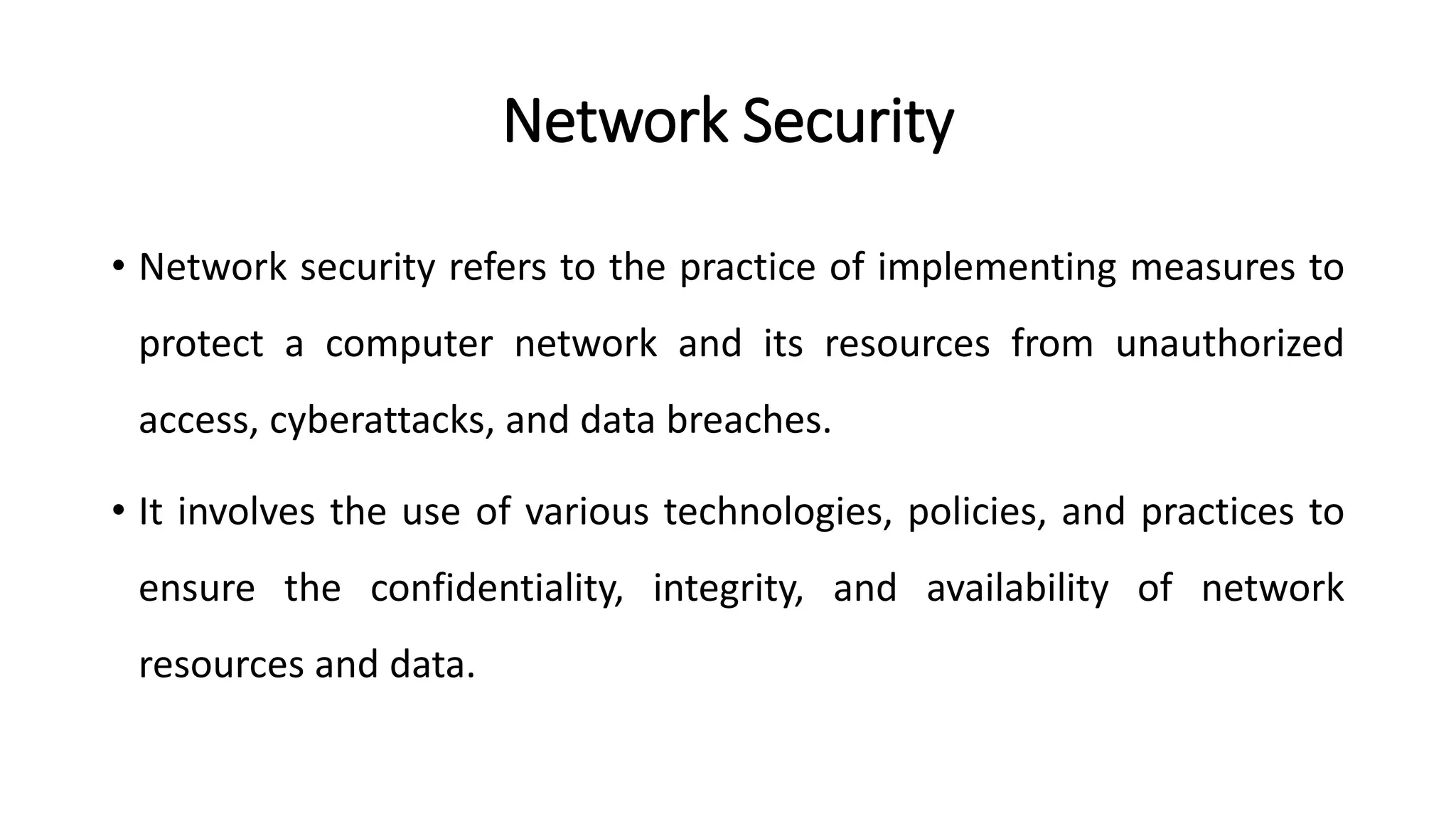
Network Security
• Networksecurity refers to the practice of implementing measures to
protect a computer network and its resources from unauthorized
access, cyberattacks, and data breaches.
• It involves the use of various technologies, policies, and practices to
ensure the confidentiality, integrity, and availability of network
resources and data.
ArfanShahzad.com
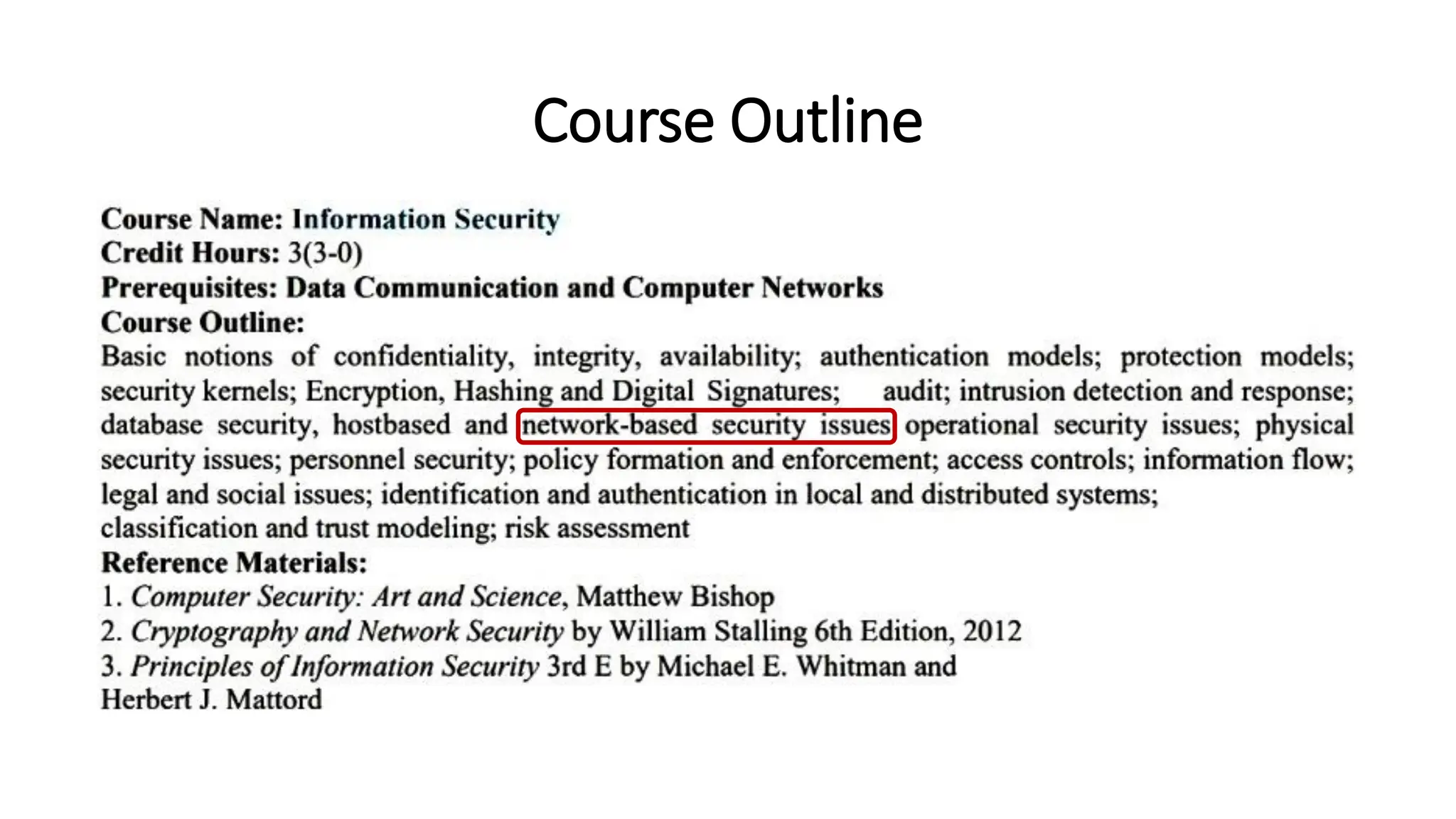
4.
Network Security cont…
•Network security aims to create a secure environment where
communication and data exchange can occur without compromising
the safety of the network and its users.
• Key Aspects and Components of Network Security:
ArfanShahzad.com
5.
Network Security cont…
•1- Firewalls: Firewalls are devices or software applications that
monitor and control incoming and outgoing network traffic.
• They enforce security policies by allowing or blocking traffic based on
predefined rules.
• Firewalls can be stateful, examining the state of active connections, or
stateless, based on individual packets.
ArfanShahzad.com
6.
Network Security cont…
•2- Intrusion Detection and Prevention Systems (IDS/IPS): These
systems monitor network traffic for suspicious activities or anomalies
that could indicate an intrusion or attack.
• IDS detects and alerts, while IPS actively blocks or prevents
unauthorized activities.
ArfanShahzad.com
7.
Network Security cont…
•3- Virtual Private Networks (VPNs): VPNs create encrypted tunnels
over public networks, allowing secure communication between
remote users and the corporate network.
• They ensure data confidentiality and integrity while traversing
untrusted networks.
ArfanShahzad.com
8.
Network Security cont…
•4- Network Access Control (NAC): NAC solutions enforce security
policies by assessing and verifying the health and compliance status
of devices before granting network access.
• This prevents unauthorized or compromised devices from accessing
the network.
ArfanShahzad.com
9.
Network Security cont…
•5- Network Segmentation: Dividing the network into segments helps
contain potential breaches and limit the lateral movement of
attackers within the network.
• It enhances security by isolating sensitive data and resources.
ArfanShahzad.com
10.
Network Security cont…
•6- Encryption: Encrypting network traffic ensures that even if
intercepted, the data remains unreadable without the proper
decryption key.
• Secure Sockets Layer (SSL) and Transport Layer Security (TLS)
protocols are commonly used for encryption.
ArfanShahzad.com
11.
Network Security cont…
•7- Authentication and Authorization: Strong authentication
mechanisms, such as multifactor authentication (MFA), verify users'
identities before granting access to the network.
• Authorization ensures that users have appropriate permissions to
access specific resources.
ArfanShahzad.com
12.
Network Security cont…
•8- Wireless Security: Securing wireless networks involves implementing
strong encryption (e.g., WPA3), disabling unnecessary services, and
protecting against unauthorized access and attacks like rogue APs.
• 9- Patch Management: Keeping network devices and software up to date
with the latest security patches helps prevent vulnerabilities from being
exploited by attackers.
ArfanShahzad.com
13.
Network Security cont…
•10- Network Monitoring and Logging: Constantly monitoring
network traffic and maintaining detailed logs enable the quick
detection of anomalies and the identification of security incidents.
• 11- Denial of Service (DoS) Protection: Implementing measures to
detect and mitigate DoS attacks helps ensure the availability of
network resources.
ArfanShahzad.com
14.
Network Security cont…
•12- Application Layer Security: Protecting applications and services at the
application layer prevents attacks like SQL injection, cross-site scripting
(XSS), and application vulnerabilities.
• 13- Network Security Policies: Organizations establish security policies that
define acceptable use, access control, and security procedures.
• These policies guide the implementation of security measures.
ArfanShahzad.com
15.
Network Security cont…
•14- Incident Response Plan: Having a well-defined incident response
plan helps in effectively managing and mitigating security incidents.
ArfanShahzad.com




![[DSC Europe 25] Debmalya Biswas - Agentification: the art of transforming man...](https://cdn.slidesharecdn.com/ss_thumbnails/r5azlggvtqiaiiusrqdr-4-251212103249-5a12c89b-thumbnail.jpg?width=640&height=640&fit=bounds)


![[DSC Europe 25] Behzad Hosseini - AI Agents in the Wild: Deploying Models tha...](https://cdn.slidesharecdn.com/ss_thumbnails/3qtejajvsjqrzwfept2c-10-251212103250-7f2b1068-thumbnail.jpg?width=640&height=640&fit=bounds)

![[DSC Europe 25] Dusan Nesic - Securing Tomorrow’s Infrastructure: Why Cyber-P...](https://cdn.slidesharecdn.com/ss_thumbnails/qikbszfftyowjm2q6duw-1-251211083848-8f2ead6b-thumbnail.jpg?width=640&height=640&fit=bounds)
![[DSC Europe 25] Tatevik Maytesyan - How to actually use AI in marketing: gett...](https://cdn.slidesharecdn.com/ss_thumbnails/tjo626lsqdgfntbgl2mw-4-251216103155-e36cd239-thumbnail.jpg?width=640&height=640&fit=bounds)


![[DSC Europe 25] Jon Dajci - Bridging TradFi and DeFi: Building the Future of ...](https://cdn.slidesharecdn.com/ss_thumbnails/fqmhfvlbqhkihjvqvhmu-7-251211083849-6af7e325-thumbnail.jpg?width=640&height=640&fit=bounds)

![[DSC Europe 25] Nikolay Burlutskiy - Best Practices for Building Enterprise M...](https://cdn.slidesharecdn.com/ss_thumbnails/uirvaiuvq8y1w8hzd9tx-7-251212103249-2619edb4-thumbnail.jpg?width=640&height=640&fit=bounds)


