What’s Inside A Masjid?
The masjid of Allah shall
be visited and maintained
by such as believe in Allah
and the Last Day, establish
regular prayers, and
practice regular charity, and
fear none (at all) except
Allah. It is they who are
expected to be on true
guidance."
[9:17-18]
The Call To Prayer
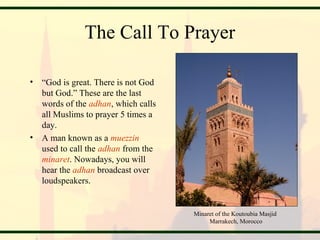
• “God is great. There is not God
but God.” These are the last
words of the adhan, which calls
all Muslims to prayer 5 times a
day.
• A man known as a muezzin
used to call the adhan from the
minaret. Nowadays, you will
hear the adhan broadcast over
loudspeakers.
Minaret of the Koutoubia Masjid
Marrakech, Morocco
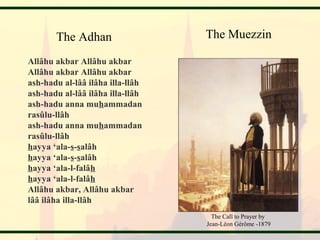
Allâhu akbar Allâhu akbar
ash-hadu al-lââ ilâha illa-llâh
ash-hadu anna muhammadan
rasûlu-llâh
ash-hadu anna muhammadan
rasûlu-llâh
hayya ‘ala-s-salâh
hayya ‘ala-s-salâh
hayya ‘ala-l-falâh
hayya ‘ala-l-falâh
Allâhu akbar, Allâhu akbar
lââ ilâha illa-llâh
The Adhan The Muezzin
The Call to Prayer by
Jean-Léon Gérôme -1879
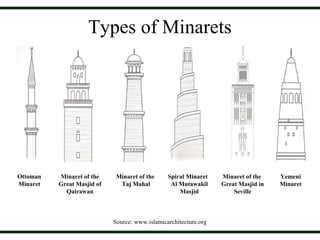
Types of Minarets
Ottoman
Minaret
Minaret of the
Great Masjid of
Qairawan
Minaret of the
Taj Mahal
Spiral Minaret
Al Mutawakil
Masjid
Minaret of the
Great Masjid in
Seville
Yemeni
Minaret
Source: www.islamicarchitecture.org
Front Entrance and Shoe Racks
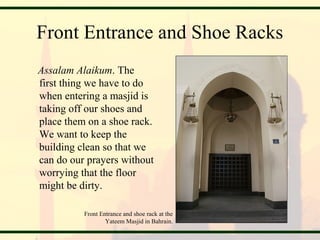
Assalam Alaikum. The
first thing we have to do
when entering a masjid is
taking off our shoes and
place them on a shoe rack.
We want to keep the
building clean so that we
can do our prayers without
worrying that the floor
might be dirty.
Front Entrance and shoe rack at the
Yateem Masjid in Bahrain.
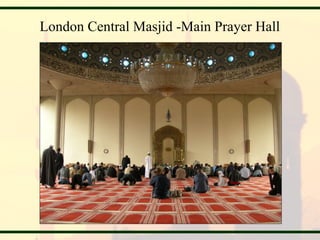
London Central Masjid -Main Prayer Hall
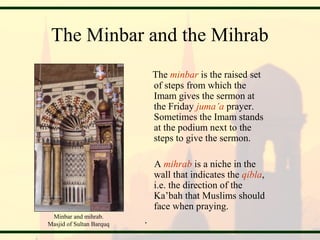
The Minbar and the Mihrab
The minbar is the raised set
of steps from which the
Imam gives the sermon at
the Friday juma’a prayer.
Sometimes the Imam stands
at the podium next to the
steps to give the sermon.
A mihrab is a niche in the
wall that indicates the qibla,
i.e. the direction of the
Ka’bah that Muslims should
face when praying.
.Minbar and mihrab.
Masjid of Sultan Barquq
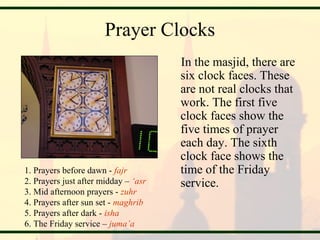
Prayer Clocks
In the masjid, there are
six clock faces. These
are not real clocks that
work. The first five
clock faces show the
five times of prayer
each day. The sixth
clock face shows the
time of the Friday
service.
1. Prayers before dawn - fajr
2. Prayers just after midday – ‘asr
3. Mid afternoon prayers - zuhr
4. Prayers after sun set - maghrib
5. Prayers after dark - isha
6. The Friday service – juma’a
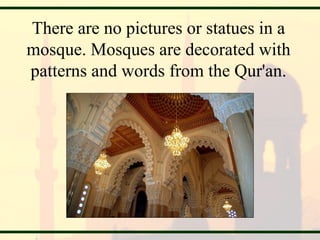
There are no pictures or statues in a
mosque. Mosques are decorated with
patterns and words from the Qur'an.
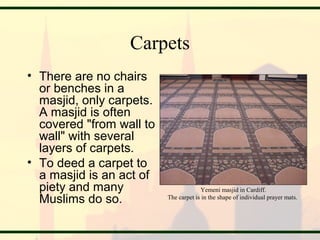
Carpets
• There are no chairs
or benches in a
masjid, only carpets.
A masjid is often
covered "from wall to
wall" with several
layers of carpets.
• To deed a carpet to
a masjid is an act of
piety and many
Muslims do so.
Yemeni masjid in Cardiff.
The carpet is in the shape of individual prayer mats.
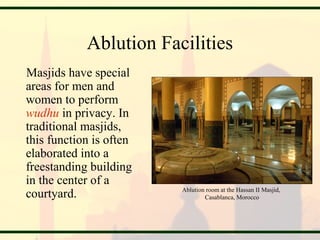
Ablution Facilities
Masjids have special
areas for men and
women to perform
wudhu in privacy. In
traditional masjids,
this function is often
elaborated into a
freestanding building
in the center of a
courtyard. Ablution room at the Hassan II Masjid,
Casablanca, Morocco
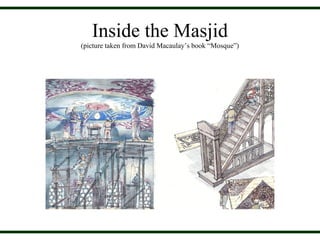
Inside the Masjid
(picture taken from David Macaulay’s book “Mosque”)
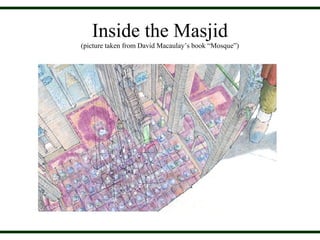
Inside the Masjid
(picture taken from David Macaulay’s book “Mosque”)
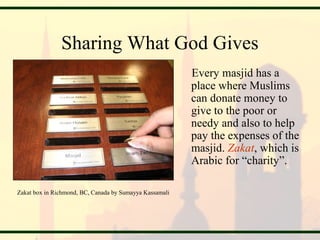
Sharing What God Gives
Every masjid has a
place where Muslims
can donate money to
give to the poor or
needy and also to help
pay the expenses of the
masjid. Zakat, which is
Arabic for “charity”.
Zakat box in Richmond, BC, Canada by Sumayya Kassamali
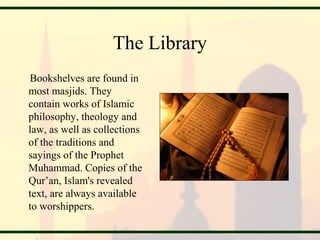
The Library
Bookshelves are found in
most masjids. They
contain works of Islamic
philosophy, theology and
law, as well as collections
of the traditions and
sayings of the Prophet
Muhammad. Copies of the
Qur’an, Islam's revealed
text, are always available
to worshippers.
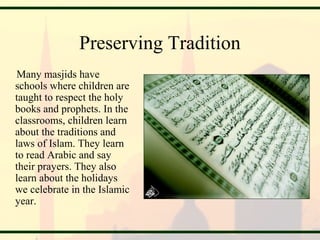
Preserving Tradition
Many masjids have
schools where children are
taught to respect the holy
books and prophets. In the
classrooms, children learn
about the traditions and
laws of Islam. They learn
to read Arabic and say
their prayers. They also
learn about the holidays
we celebrate in the Islamic
year.

Library masjid

  • 1.
    What’s Inside AMasjid? The masjid of Allah shall be visited and maintained by such as believe in Allah and the Last Day, establish regular prayers, and practice regular charity, and fear none (at all) except Allah. It is they who are expected to be on true guidance." [9:17-18]
  • 2.
    The Call ToPrayer • “God is great. There is not God but God.” These are the last words of the adhan, which calls all Muslims to prayer 5 times a day. • A man known as a muezzin used to call the adhan from the minaret. Nowadays, you will hear the adhan broadcast over loudspeakers. Minaret of the Koutoubia Masjid Marrakech, Morocco
  • 3.
    Allâhu akbar Allâhuakbar Allâhu akbar Allâhu akbar ash-hadu al-lââ ilâha illa-llâh ash-hadu al-lââ ilâha illa-llâh ash-hadu anna muhammadan rasûlu-llâh ash-hadu anna muhammadan rasûlu-llâh hayya ‘ala-s-salâh hayya ‘ala-s-salâh hayya ‘ala-l-falâh hayya ‘ala-l-falâh Allâhu akbar, Allâhu akbar lââ ilâha illa-llâh The Adhan The Muezzin The Call to Prayer by Jean-Léon Gérôme -1879
  • 4.
    Types of Minarets Ottoman Minaret Minaretof the Great Masjid of Qairawan Minaret of the Taj Mahal Spiral Minaret Al Mutawakil Masjid Minaret of the Great Masjid in Seville Yemeni Minaret Source: www.islamicarchitecture.org
  • 5.
    Front Entrance andShoe Racks Assalam Alaikum. The first thing we have to do when entering a masjid is taking off our shoes and place them on a shoe rack. We want to keep the building clean so that we can do our prayers without worrying that the floor might be dirty. Front Entrance and shoe rack at the Yateem Masjid in Bahrain.
  • 6.
    London Central Masjid-Main Prayer Hall
  • 7.
    The Minbar andthe Mihrab The minbar is the raised set of steps from which the Imam gives the sermon at the Friday juma’a prayer. Sometimes the Imam stands at the podium next to the steps to give the sermon. A mihrab is a niche in the wall that indicates the qibla, i.e. the direction of the Ka’bah that Muslims should face when praying. .Minbar and mihrab. Masjid of Sultan Barquq
  • 8.
    Prayer Clocks In themasjid, there are six clock faces. These are not real clocks that work. The first five clock faces show the five times of prayer each day. The sixth clock face shows the time of the Friday service. 1. Prayers before dawn - fajr 2. Prayers just after midday – ‘asr 3. Mid afternoon prayers - zuhr 4. Prayers after sun set - maghrib 5. Prayers after dark - isha 6. The Friday service – juma’a
  • 9.
    There are nopictures or statues in a mosque. Mosques are decorated with patterns and words from the Qur'an.
  • 10.
    Carpets • There areno chairs or benches in a masjid, only carpets. A masjid is often covered "from wall to wall" with several layers of carpets. • To deed a carpet to a masjid is an act of piety and many Muslims do so. Yemeni masjid in Cardiff. The carpet is in the shape of individual prayer mats.
  • 11.
    Ablution Facilities Masjids havespecial areas for men and women to perform wudhu in privacy. In traditional masjids, this function is often elaborated into a freestanding building in the center of a courtyard. Ablution room at the Hassan II Masjid, Casablanca, Morocco
  • 12.
    Inside the Masjid (picturetaken from David Macaulay’s book “Mosque”)
  • 13.
    Inside the Masjid (picturetaken from David Macaulay’s book “Mosque”)
  • 14.
    Sharing What GodGives Every masjid has a place where Muslims can donate money to give to the poor or needy and also to help pay the expenses of the masjid. Zakat, which is Arabic for “charity”. Zakat box in Richmond, BC, Canada by Sumayya Kassamali
  • 15.
    The Library Bookshelves arefound in most masjids. They contain works of Islamic philosophy, theology and law, as well as collections of the traditions and sayings of the Prophet Muhammad. Copies of the Qur’an, Islam's revealed text, are always available to worshippers.
  • 16.
    Preserving Tradition Many masjidshave schools where children are taught to respect the holy books and prophets. In the classrooms, children learn about the traditions and laws of Islam. They learn to read Arabic and say their prayers. They also learn about the holidays we celebrate in the Islamic year.