10-1
Part Three
                      SOURCES AND
                    COLLECTION OF DATA


 10-2
McGraw-Hill/Irwin           © 2003 The McGraw-Hill Companies, Inc.,All Rights Reserved.
Chapter Ten
         EXPLORING
       SECONDARY DATA


10-3
Exploratory Research

       • Expand understanding of management
         dilemma
       • Expand understanding of research
         question
       • Identify plausible investigative questions


10-4
Levels of Information

       • Primary sources
       • Secondary sources
       • Tertiary sources


10-5
Types of Information Sources

       •   Indexes and Bibliographies
       •   Dictionaries
       •   Encyclopedias
       •   Handbooks
       •   Directories


10-6
Secondary Sources by Type

       • Indexes and Bibliographies
          – to find or locate books or articles
          – to find authors, topics to use in online
            searches


10-7
Secondary Sources by Type

       • Dictionaries
         – to identify jargon of an industry--used for
           online searches
         – to identify bell-weather events in an
           industry
         – to identify knowledgeable people to
           interview
         – to identify organizations of influence


10-8
Secondary Sources by Type

       • Encyclopedias
         – To identify historical or background
           information
         – To find critical dates within an industry
         – To find events of significance to the
           industry, company


10-9
Secondary Sources by Type

        • Handbooks
         – To find facts relevant to topic
         – To identify influential individuals through
           source citations


10-10
Secondary Sources by Type

        • Directories
          – To identify influential people and
            organizations
          – to find addresses, e-mail, other contact info
            on these people and organizations


10-11
Evaluating Information Sources

        •   Purpose
        •   Scope
        •   Authority
        •   Audience
        •   Format


10-12
Evaluating Sources

        • Purpose
          – What the author is attempting to
            accomplish
             • identify hidden agenda(s)
             • identify direction of bias
          – Seek both biased and unbiased sources


10-13
Evaluating Sources

        • Scope
          – Identify dates of inclusion and
            exclusion
          – Identify subjects of inclusion and
            exclusion


10-14
Evaluating Sources

        • Authority
          – Identify background of author
             • Credentials: educational,
               professional
             • Experience: duration, setting, level
          – Identify the level of scholarship in
            content
             • footnotes, endnotes
10-15
Evaluating Sources

        • Audience
          – Identify knowledge level and
            background
          – Identify orientation and bias
          – Seek biased and unbiased sources


10-16
Evaluating Sources

        • Format
          – Order of content
          – Versatility of use
             • Indexed?
             • Searchable?
             • Downloadable?


10-17
Searching Databases

        Select an appropriate database
         ABI/Inform
         Business InfoSuite
         Business Source
         DowJones Interactive
         Nexis-Lexis Universe


10-18
Searching Databases

        Select an appropriate database
        Construct a search query
          Boolean Operators
             OR - for plurals, synonyms spelling
            variations (woman OR women)
             AND - narrows your search
               advertising AND bibliography


10-19
Searching Databases

        Construct a search query
          Boolean Operators (cont.)
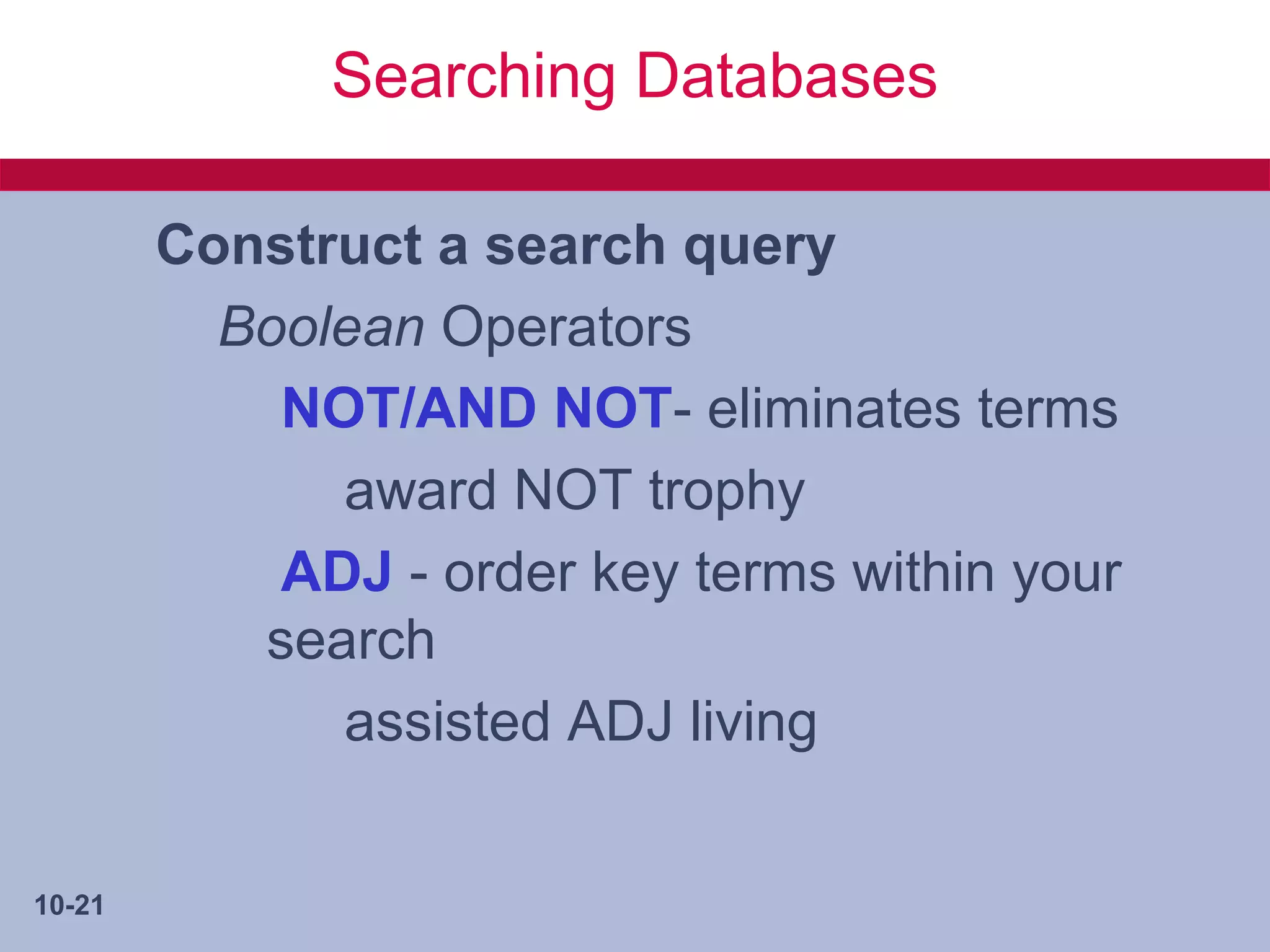
            NOT/AND NOT- eliminates terms
              award NOT trophy
            ADJ - order key terms within your
           search
              assisted ADJ living


10-20
Searching Databases

        Construct a search query
          Boolean Operators
            NOT/AND NOT- eliminates terms
              award NOT trophy
            ADJ - order key terms within your
           search
              assisted ADJ living


10-21
Searching Databases

        Construct a search query
          Boolean Operators (cont.)
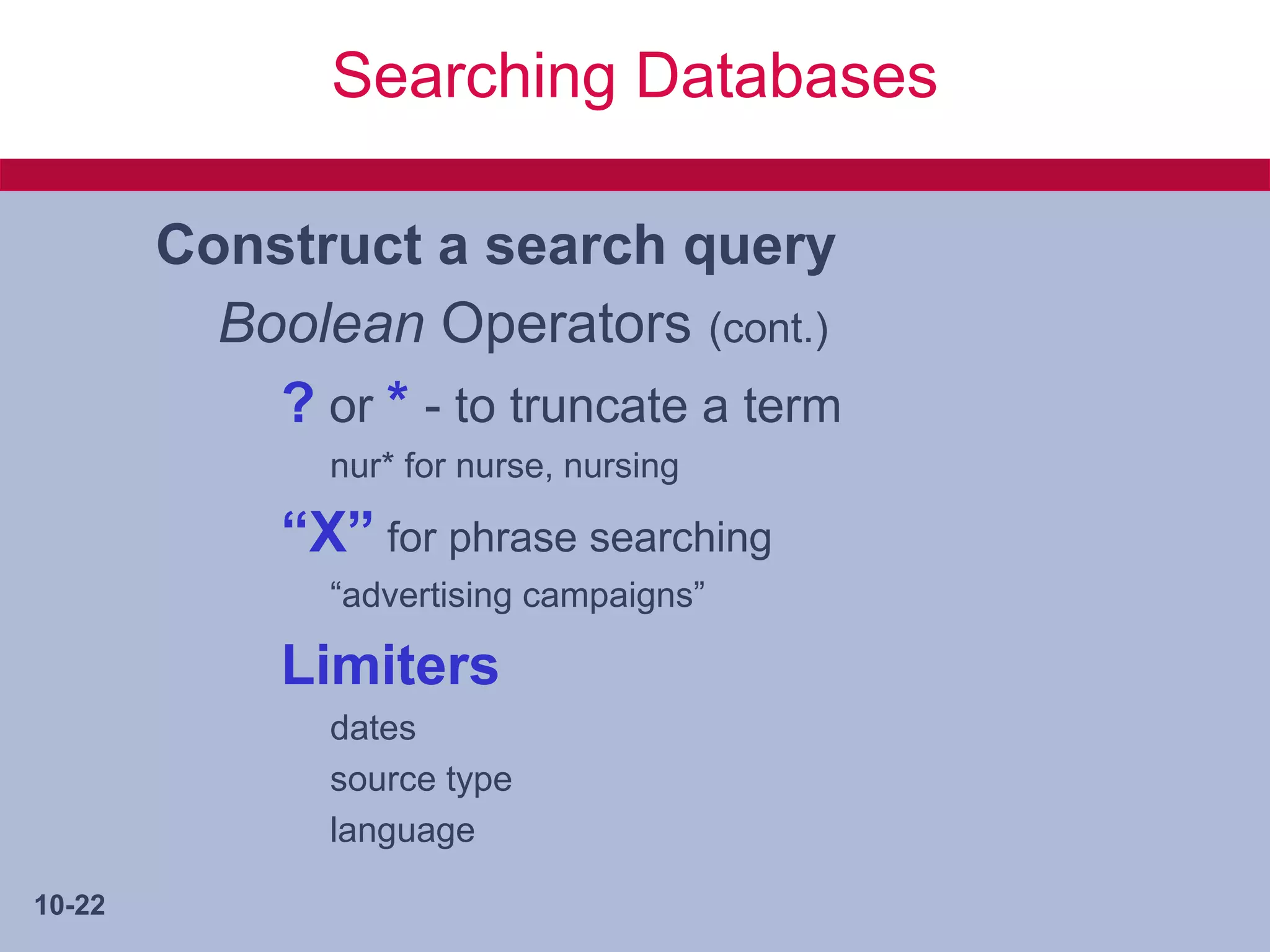
            ? or * - to truncate a term
               nur* for nurse, nursing

             “X” for phrase searching
               “advertising campaigns”

             Limiters
               dates
               source type
               language

10-22
Searching Databases

        Select an appropriate database
        Construct a search query
        – Review and evaluate search results
           • Relevancy
           • Quantity
           • Timeliness


10-23
Searching Databases

        – Modify the search query
           • Check bibliography
              • new key words,
              • other authors
           • Link directly
           • Adapt original search query
           • Create new search query with new key
             words
           • Search for other works by same
             author(s)
10-24
Searching Databases

        Select an appropriate database
        Construct a search query
        Document findings
          Print or download search findings
          Download full-text source
          Print full-text source


10-25
Searching Databases

        Select an appropriate database
        Construct a search query
        Document findings
        Retrieve or request articles
          Search online catalog
          Interlibrary loan
          Interlibrary delivery
        Supplement results with Web sources
10-26
Searching Databases

        Select an appropriate database
        Construct a search query
        Document findings
        Retrieve or request articles
        Supplement results with Web sources


10-27
Web Searches

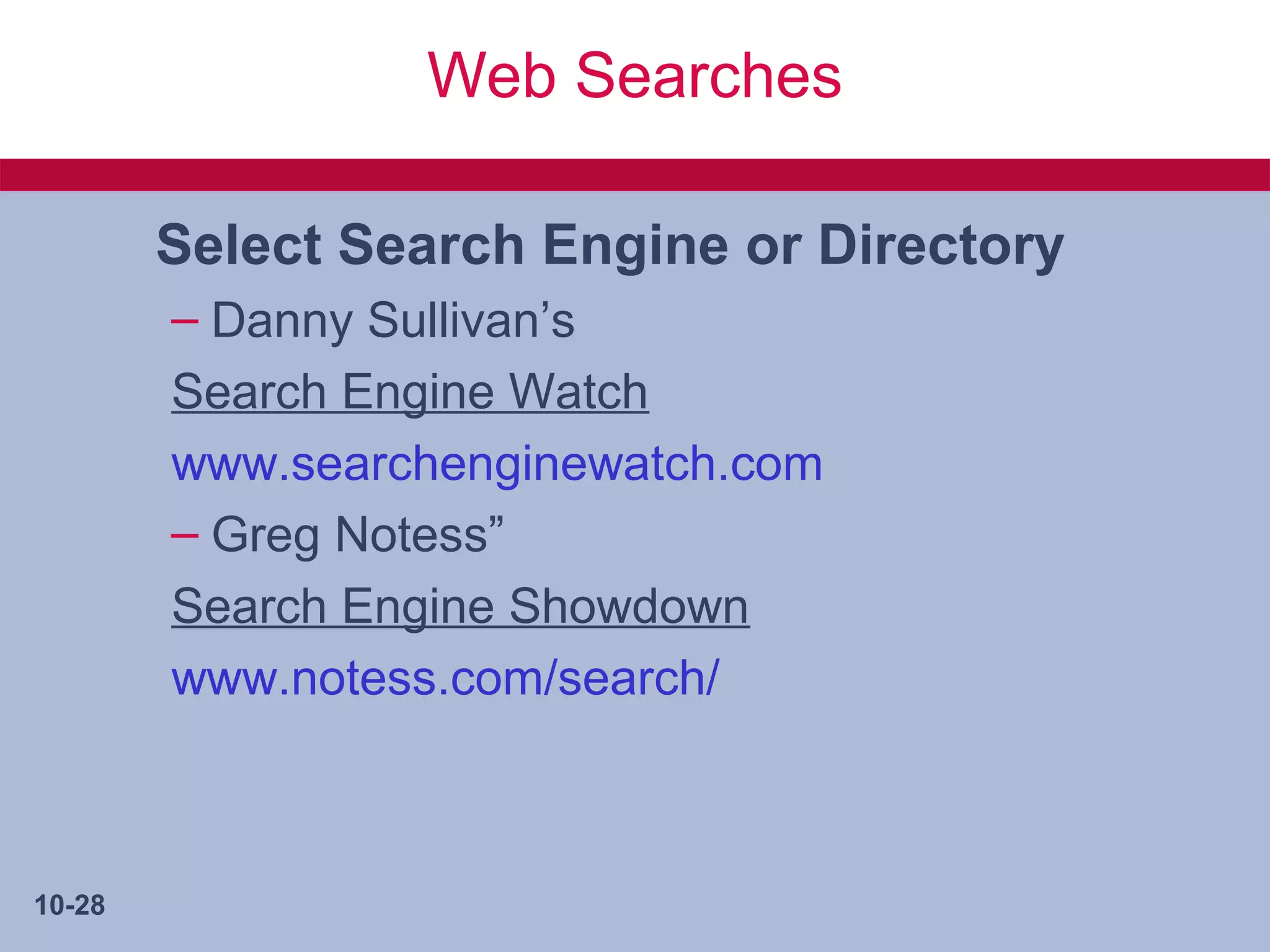
        Select Search Engine or Directory
        – Danny Sullivan’s
        Search Engine Watch
        www.searchenginewatch.com
        – Greg Notess”
        Search Engine Showdown
        www.notess.com/search/


10-28
Web Searches

        Select Search Engine or Directory
        Determine Search Options and
        Protocol


10-29
Web Searches

        Select Search Engine or Directory
        Determine Search Options and
        Protocol
        Construct search query
        – Review search results
        – Modify search query
        – Search using a different search engine


10-30
Web Searches

        Select Search Engine or Directory
        Determine Search Options and
        Protocol
        Construct search query
        Document your findings
        – search findings
        – full text sources


10-31
Web Searches

        Select Search Engine or Directory
        Determine Search Options and
        Protocol
        Construct search query
        Document your findings
        Supplement Web results from other
        sources


10-32
Specific Web Searches

        •   Known-Item
        •   Who
        •   Where
        •   What


10-33
Government Sources

        • Government organizations
        • Laws, regulations, court decisions
        • Government statistics


10-34
Mining Internal Sources

        • Data warehouse
        • Data mart
        • Data mining
          – Pattern discovery
          – Predicting trends and behaviors


10-35
Data Mining Techniques

        • Data Visualization
            – Dimensions
            – Measurements
            – Hierarchies
        •   Clustering
        •   Neural Networks
        •   Tree Models
        •   Classification
10-36
Data Mining Techniques (cont.)

        •   Estimation
        •   Association
        •   Market-Basket Analysis
        •   Sequence Based Analysis
        •   Fuzzy Logic
        •   Genetic Algorithms
        •   Fractal-Based Transformation

10-37
Data Mining Process

        •   Sample
        •   Explore
        •   Modify
        •   Model
        •   Assess


10-38

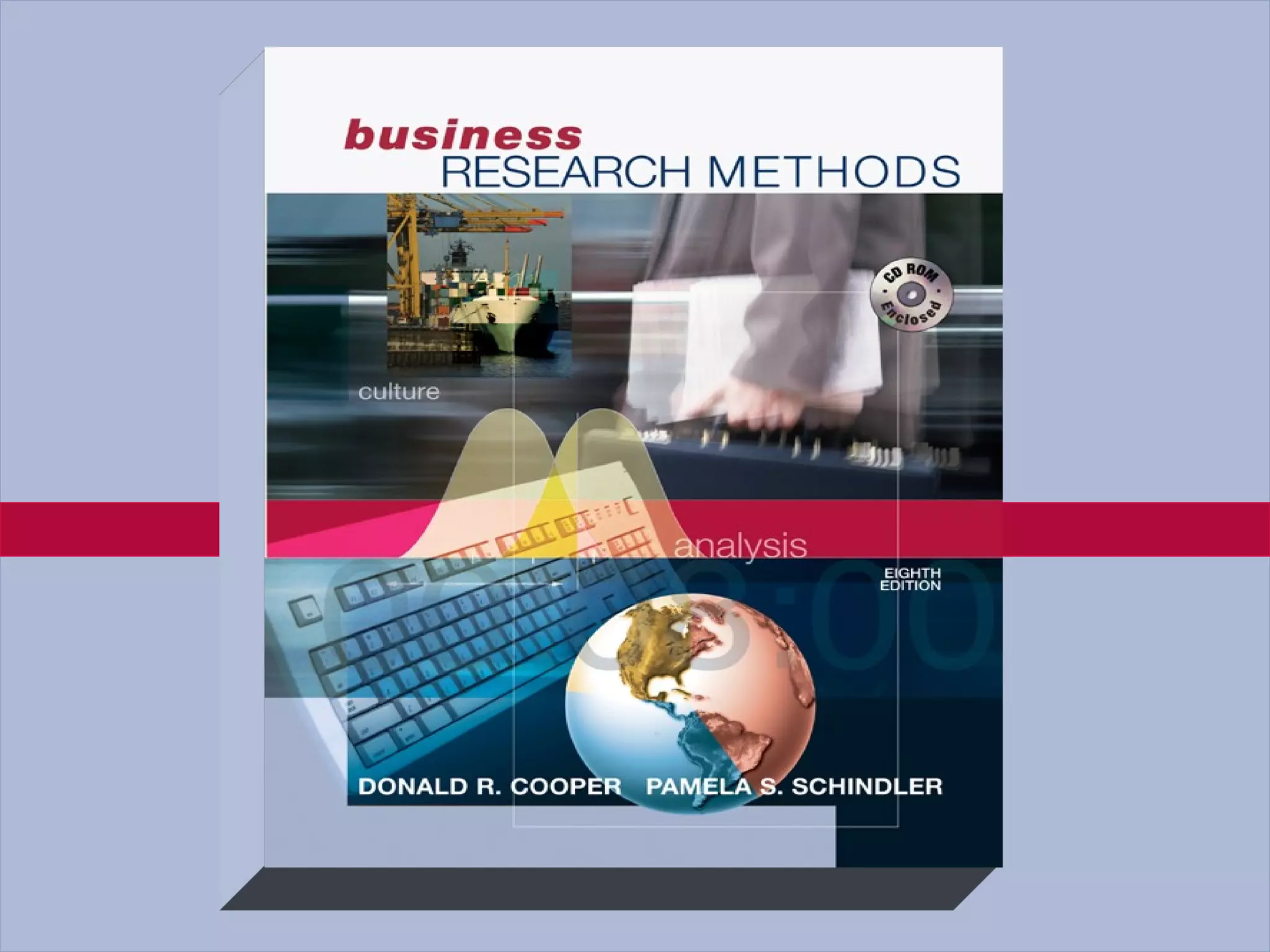
Business Research Methods Chap010

  • 1.
  • 2.
    Part Three SOURCES AND COLLECTION OF DATA 10-2 McGraw-Hill/Irwin © 2003 The McGraw-Hill Companies, Inc.,All Rights Reserved.
  • 3.
    Chapter Ten EXPLORING SECONDARY DATA 10-3
  • 4.
    Exploratory Research • Expand understanding of management dilemma • Expand understanding of research question • Identify plausible investigative questions 10-4
  • 5.
    Levels of Information • Primary sources • Secondary sources • Tertiary sources 10-5
  • 6.
    Types of InformationSources • Indexes and Bibliographies • Dictionaries • Encyclopedias • Handbooks • Directories 10-6
  • 7.
    Secondary Sources byType • Indexes and Bibliographies – to find or locate books or articles – to find authors, topics to use in online searches 10-7
  • 8.
    Secondary Sources byType • Dictionaries – to identify jargon of an industry--used for online searches – to identify bell-weather events in an industry – to identify knowledgeable people to interview – to identify organizations of influence 10-8
  • 9.
    Secondary Sources byType • Encyclopedias – To identify historical or background information – To find critical dates within an industry – To find events of significance to the industry, company 10-9
  • 10.
    Secondary Sources byType • Handbooks – To find facts relevant to topic – To identify influential individuals through source citations 10-10
  • 11.
    Secondary Sources byType • Directories – To identify influential people and organizations – to find addresses, e-mail, other contact info on these people and organizations 10-11
  • 12.
    Evaluating Information Sources • Purpose • Scope • Authority • Audience • Format 10-12
  • 13.
    Evaluating Sources • Purpose – What the author is attempting to accomplish • identify hidden agenda(s) • identify direction of bias – Seek both biased and unbiased sources 10-13
  • 14.
    Evaluating Sources • Scope – Identify dates of inclusion and exclusion – Identify subjects of inclusion and exclusion 10-14
  • 15.
    Evaluating Sources • Authority – Identify background of author • Credentials: educational, professional • Experience: duration, setting, level – Identify the level of scholarship in content • footnotes, endnotes 10-15
  • 16.
    Evaluating Sources • Audience – Identify knowledge level and background – Identify orientation and bias – Seek biased and unbiased sources 10-16
  • 17.
    Evaluating Sources • Format – Order of content – Versatility of use • Indexed? • Searchable? • Downloadable? 10-17
  • 18.
    Searching Databases Select an appropriate database ABI/Inform Business InfoSuite Business Source DowJones Interactive Nexis-Lexis Universe 10-18
  • 19.
    Searching Databases Select an appropriate database Construct a search query Boolean Operators OR - for plurals, synonyms spelling variations (woman OR women) AND - narrows your search advertising AND bibliography 10-19
  • 20.
    Searching Databases Construct a search query Boolean Operators (cont.) NOT/AND NOT- eliminates terms award NOT trophy ADJ - order key terms within your search assisted ADJ living 10-20
  • 21.
    Searching Databases Construct a search query Boolean Operators NOT/AND NOT- eliminates terms award NOT trophy ADJ - order key terms within your search assisted ADJ living 10-21
  • 22.
    Searching Databases Construct a search query Boolean Operators (cont.) ? or * - to truncate a term nur* for nurse, nursing “X” for phrase searching “advertising campaigns” Limiters dates source type language 10-22
  • 23.
    Searching Databases Select an appropriate database Construct a search query – Review and evaluate search results • Relevancy • Quantity • Timeliness 10-23
  • 24.
    Searching Databases – Modify the search query • Check bibliography • new key words, • other authors • Link directly • Adapt original search query • Create new search query with new key words • Search for other works by same author(s) 10-24
  • 25.
    Searching Databases Select an appropriate database Construct a search query Document findings Print or download search findings Download full-text source Print full-text source 10-25
  • 26.
    Searching Databases Select an appropriate database Construct a search query Document findings Retrieve or request articles Search online catalog Interlibrary loan Interlibrary delivery Supplement results with Web sources 10-26
  • 27.
    Searching Databases Select an appropriate database Construct a search query Document findings Retrieve or request articles Supplement results with Web sources 10-27
  • 28.
    Web Searches Select Search Engine or Directory – Danny Sullivan’s Search Engine Watch www.searchenginewatch.com – Greg Notess” Search Engine Showdown www.notess.com/search/ 10-28
  • 29.
    Web Searches Select Search Engine or Directory Determine Search Options and Protocol 10-29
  • 30.
    Web Searches Select Search Engine or Directory Determine Search Options and Protocol Construct search query – Review search results – Modify search query – Search using a different search engine 10-30
  • 31.
    Web Searches Select Search Engine or Directory Determine Search Options and Protocol Construct search query Document your findings – search findings – full text sources 10-31
  • 32.
    Web Searches Select Search Engine or Directory Determine Search Options and Protocol Construct search query Document your findings Supplement Web results from other sources 10-32
  • 33.
    Specific Web Searches • Known-Item • Who • Where • What 10-33
  • 34.
    Government Sources • Government organizations • Laws, regulations, court decisions • Government statistics 10-34
  • 35.
    Mining Internal Sources • Data warehouse • Data mart • Data mining – Pattern discovery – Predicting trends and behaviors 10-35
  • 36.
    Data Mining Techniques • Data Visualization – Dimensions – Measurements – Hierarchies • Clustering • Neural Networks • Tree Models • Classification 10-36
  • 37.
    Data Mining Techniques(cont.) • Estimation • Association • Market-Basket Analysis • Sequence Based Analysis • Fuzzy Logic • Genetic Algorithms • Fractal-Based Transformation 10-37
  • 38.
    Data Mining Process • Sample • Explore • Modify • Model • Assess 10-38