Information infrastructure for crisis
response coordination: a study of
local emergency management in
Norwegian municipalities
Torbjørg Meum & Bjørn Erik Munkvold
Centre for Integrated Emergency Management
University of Agder
http://ciem.prosjekt.uia.no
Outline
• Background and motivation
• Related work
• Aims
• Theoretical framework
• Mapping the information flow in local emergency
• Preliminary findings
• Questions
2
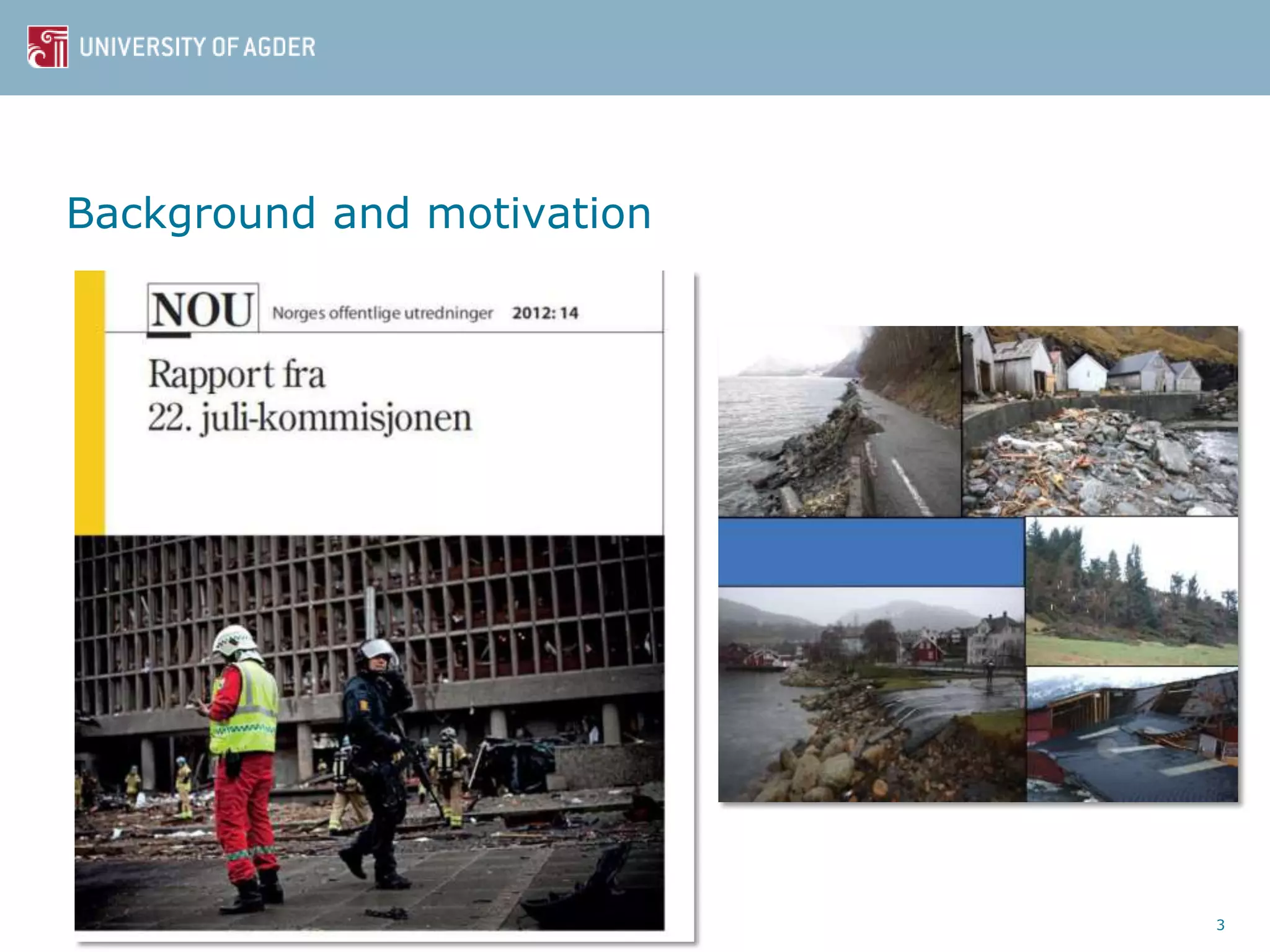
Background and motivation
3
4
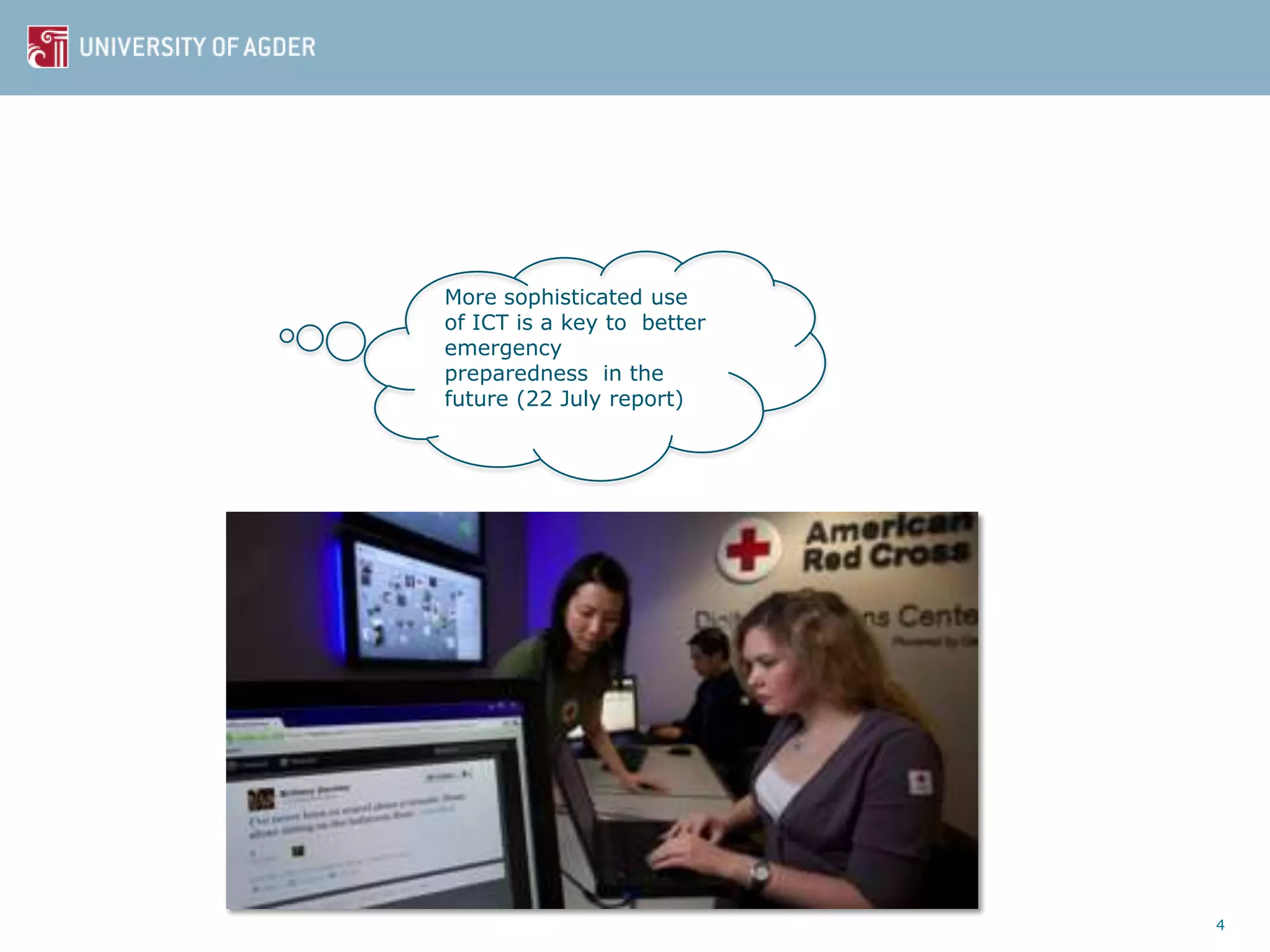
More sophisticated use
of ICT is a key to better
emergency
preparedness in the
future (22 July report)
5
The use of social media in the throes of the crisis give 22 July a
unique simultaneity (…. ) never before have the member of
government personally received information by text messages,
telephone calls and social media directly from victims, at the same
time as they were supposed to dealing with a national crisis
(22 July report)
AIMS
• Main aim: To provide empirical insight as
well as expand on conceptual perspectives
of processes related to information sharing,
communication and coordination in terms
of crisis management
• Identifying information flow in local
crisis management
• Identifying information systems in use
• Identifying enabling and constraining
factors
• Promote development and adoption of
technologies to facilitate
communication and coordination
6
Related work
• The evolving role of ICT in crisis management (Van de Walle, Turoff&Hiltz,
2010)
• ICT as an enabling actor to improve communication, coordination and decision
support (Van de Walle&Turoff, 2007)
• Emerging use of social media and changing communication pathways (Hughes
&Palen, 2012)
• The transformational role of ICT in crisis and mechanisms for aligning informal
and formal sources of information (Palen et al, 2010)
7
Theoreticalframework
Coordination Theory
• The act of managing interdependencies between activities performed to
achieve a goal (Malone &Crowston, 1990)
• Procedures, standards, planning tools and checklists as coordinating
mechanisms that reduce the complexities of articulation work (Schmidt &
Simone, 1996)
• Task interdependencies and technologies interdependencies (Bailey &Leonardi,
2009)
• Interdependency in a complex network of tasks, resources, and actors (Turoff,
2002)
8
Theoretical framework
Information Infrastructure
• Information Infrastructure is an evolving shared, open, and heterogeneous
installed base (Hanseth&Lyytinen, 2004)
• A way of conceptualizing interconnected networks rather than stand-alone
information systems (Ciborra, 2001)
• Infrastructures are interconnected, interrelated and multi-layered
• Infrastructures shapes and are shaped by the dynamics in the socio-technical
network
9
Building information infrastructures
• Infrastructuringis the integration of new tools and technologies with existing
material, tools and people
• Evolutionary: always built on and integrated with existing systems and work
practices(bottom-up)
• Relational dimension of information Infrastructure
• Information Infrastructure occurs in relation to organized practices (Star &Ruhleder,
1996)
• All entities achieve their significance and meaning by being in relation to others
entities and performed in, by, and through those relations (Law &Hassard, 1999)
10
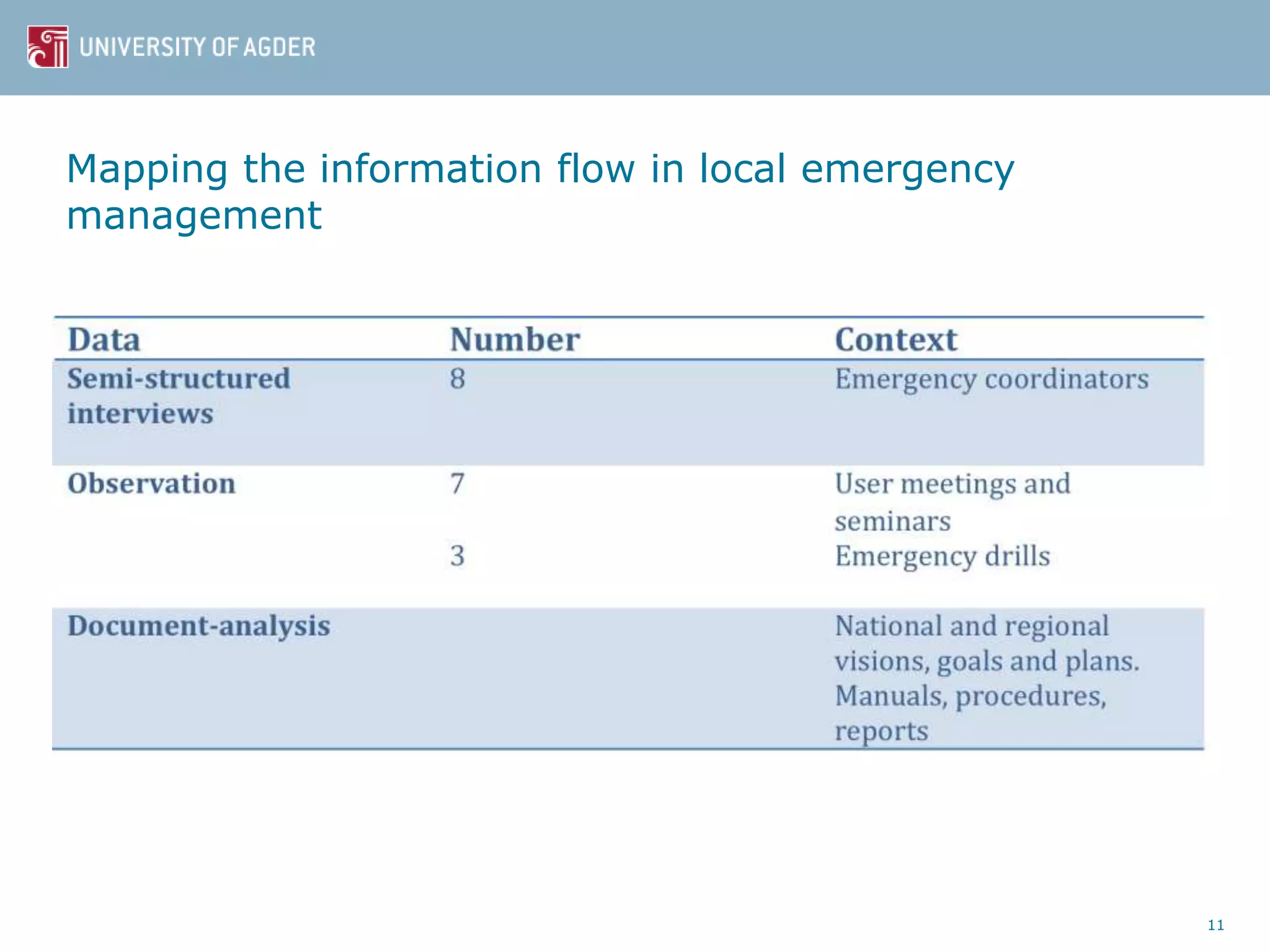
Mapping the information flow in local emergency
management
11
12
The overall national principles for crisis management
• The principle of responsibility
• The principle of subsidiarity
• The principle of similarity
• The principle of
collaboration
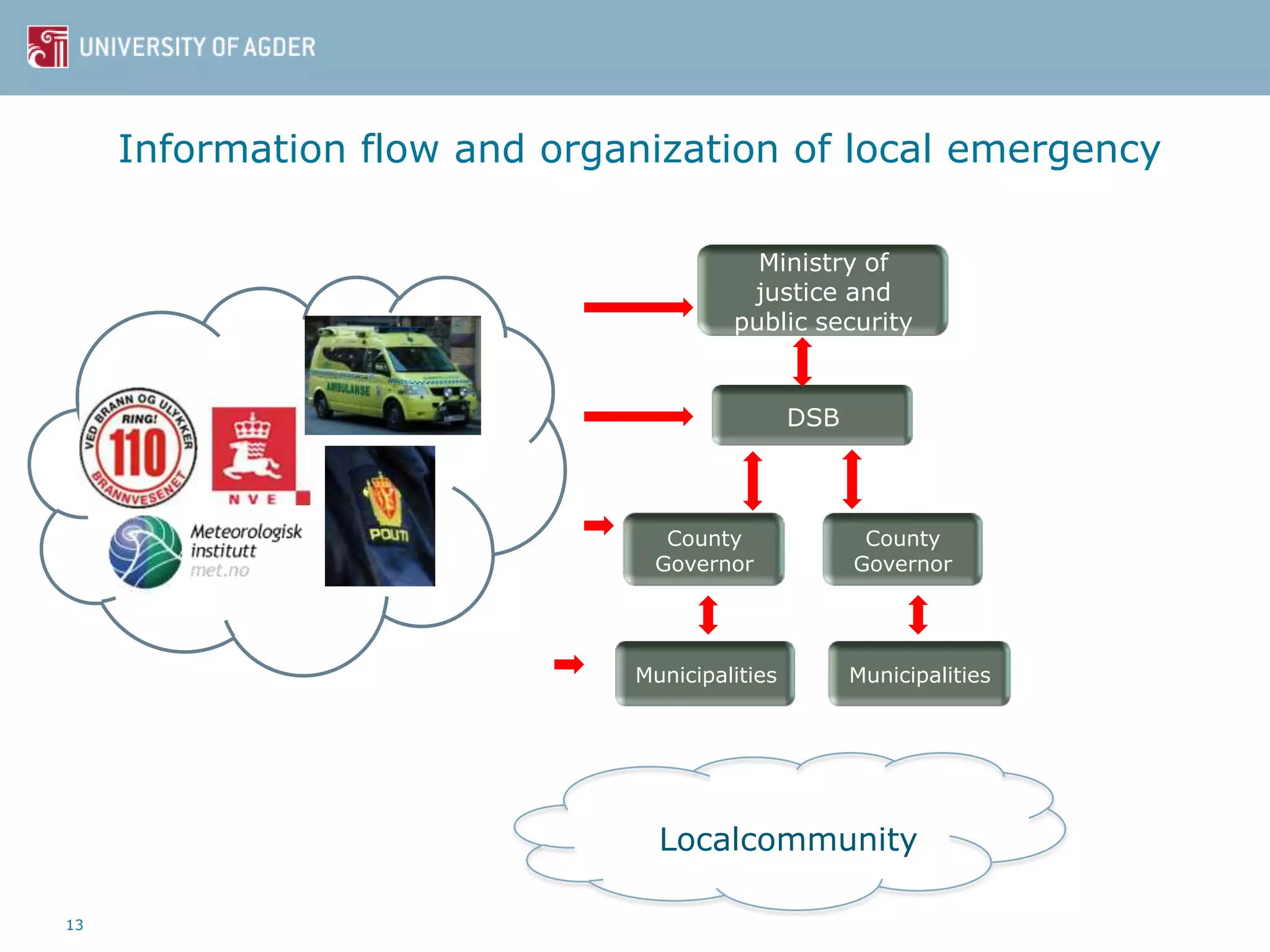
Information flow and organization of local emergency
13
Municipalities Municipalities
County
Governor
County
Governor
DSB
Ministry of
justice and
public security
Localcommunity
Existing ICT infrastructure in use
14
Preliminary findings
• Regional and local efforts to adopt a shared decision support system
• increased standardization of risk and vulnerability assessments as well as
emergency response plans
• motivated to consider new technologies such as alert systems, mobile
technology etc.
However…..
• Multiple systems in use
• Fragmentation
• lack of integration between systems and tasks
15
Some questions for further work
• How can coordination and shared situational awareness best be supported for
emergency responders through further development of ICT systems?
• How can new services be integrated in the existing information infrastructure
familiar to the emergency responders?
• Extension and improvement of what already exist, e.g. Geographic
Information Systems (GIS)
• Shared representation and visualization of information across
organizational and domain-specific boundaries
16
• How can social media be integrated with GIS to support coordination within
and across municipalities?
• sorting, filtering, classification and analysis of user-generated information
from social media
• How can social media effectively and realistically be included in emergency
drills?
• How can a virtual helpdesk of volunteers be established to support local
emergency coordinators
17

Information Infrastructure for Crisis Response Coordination: A Study of local Emergency Management in Norwegian Municipalities

  • 1.
    Information infrastructure forcrisis response coordination: a study of local emergency management in Norwegian municipalities Torbjørg Meum & Bjørn Erik Munkvold Centre for Integrated Emergency Management University of Agder http://ciem.prosjekt.uia.no
  • 2.
    Outline • Background andmotivation • Related work • Aims • Theoretical framework • Mapping the information flow in local emergency • Preliminary findings • Questions 2
  • 3.
  • 4.
    4 More sophisticated use ofICT is a key to better emergency preparedness in the future (22 July report)
  • 5.
    5 The use ofsocial media in the throes of the crisis give 22 July a unique simultaneity (…. ) never before have the member of government personally received information by text messages, telephone calls and social media directly from victims, at the same time as they were supposed to dealing with a national crisis (22 July report)
  • 6.
    AIMS • Main aim:To provide empirical insight as well as expand on conceptual perspectives of processes related to information sharing, communication and coordination in terms of crisis management • Identifying information flow in local crisis management • Identifying information systems in use • Identifying enabling and constraining factors • Promote development and adoption of technologies to facilitate communication and coordination 6
  • 7.
    Related work • Theevolving role of ICT in crisis management (Van de Walle, Turoff&Hiltz, 2010) • ICT as an enabling actor to improve communication, coordination and decision support (Van de Walle&Turoff, 2007) • Emerging use of social media and changing communication pathways (Hughes &Palen, 2012) • The transformational role of ICT in crisis and mechanisms for aligning informal and formal sources of information (Palen et al, 2010) 7
  • 8.
    Theoreticalframework Coordination Theory • Theact of managing interdependencies between activities performed to achieve a goal (Malone &Crowston, 1990) • Procedures, standards, planning tools and checklists as coordinating mechanisms that reduce the complexities of articulation work (Schmidt & Simone, 1996) • Task interdependencies and technologies interdependencies (Bailey &Leonardi, 2009) • Interdependency in a complex network of tasks, resources, and actors (Turoff, 2002) 8
  • 9.
    Theoretical framework Information Infrastructure •Information Infrastructure is an evolving shared, open, and heterogeneous installed base (Hanseth&Lyytinen, 2004) • A way of conceptualizing interconnected networks rather than stand-alone information systems (Ciborra, 2001) • Infrastructures are interconnected, interrelated and multi-layered • Infrastructures shapes and are shaped by the dynamics in the socio-technical network 9
  • 10.
    Building information infrastructures Buildinginformation infrastructures • Infrastructuringis the integration of new tools and technologies with existing material, tools and people • Evolutionary: always built on and integrated with existing systems and work practices(bottom-up) • Relational dimension of information Infrastructure • Information Infrastructure occurs in relation to organized practices (Star &Ruhleder, 1996) • All entities achieve their significance and meaning by being in relation to others entities and performed in, by, and through those relations (Law &Hassard, 1999) 10
  • 11.
    Mapping the informationflow in local emergency management 11
  • 12.
    12 The overall nationalprinciples for crisis management • The principle of responsibility • The principle of subsidiarity • The principle of similarity • The principle of collaboration
  • 13.
    Information flow andorganization of local emergency 13 Municipalities Municipalities County Governor County Governor DSB Ministry of justice and public security Localcommunity
  • 14.
  • 15.
    Preliminary findings • Regionaland local efforts to adopt a shared decision support system • increased standardization of risk and vulnerability assessments as well as emergency response plans • motivated to consider new technologies such as alert systems, mobile technology etc. However….. • Multiple systems in use • Fragmentation • lack of integration between systems and tasks 15
  • 16.
    Some questions forfurther work • How can coordination and shared situational awareness best be supported for emergency responders through further development of ICT systems? • How can new services be integrated in the existing information infrastructure familiar to the emergency responders? • Extension and improvement of what already exist, e.g. Geographic Information Systems (GIS) • Shared representation and visualization of information across organizational and domain-specific boundaries 16
  • 17.
    • How cansocial media be integrated with GIS to support coordination within and across municipalities? • sorting, filtering, classification and analysis of user-generated information from social media • How can social media effectively and realistically be included in emergency drills? • How can a virtual helpdesk of volunteers be established to support local emergency coordinators 17