LVC TRAINING ENVIRONMENT FOR STRATEGIC
AND TACTICAL EMERGENCY OPERATIONS
Laura Ardila, Israel Perez-Llopis,
Carlos Palau, Manuel Esteve
Communications Department
Universitat Politècnica de València
• Introduction
• Motivation and challenges
• System description
• Conclusions and future work
Contents
• Emergency management → training of operatives
• Use of ICT (C2IS , VR) in emergency systems
• New approach for developing training scenarios for crisis
management using virtual worlds
– Trainees learn and practice how to perform physical or procedural tasks
– Work toward collaborative animated agents
– Interoperability – MPEG-V standard
• Key features:
– Realization of joint exercises reducing costs in transportation of
personnel and equipment utilization
– Flexibility and real-time response
Introduction
• Traditional training simulated-based systems are
expensive and offer little flexibility
• Real training in the field of emergency management is
very expensive and complicated regarding the
harmonization of procedures between agencies
• A network-based system that integrates reality and
simulation will be relatively cheap and facilitate the
interoperability and harmonization of procedures
Introduction – Base hypotheses
• LVCTE → connect virtual worlds and C2IS
– LVCTE: Live, Virtual and Constructive Training Environment
– C2IS: Command and Control Information Systems
• Training in crisis management
• Standardized data formats
• Middleware in which different applications can interoperate.
• Seamless interactions among virtual and real participants
• Units deployed on the field and generated in the VW
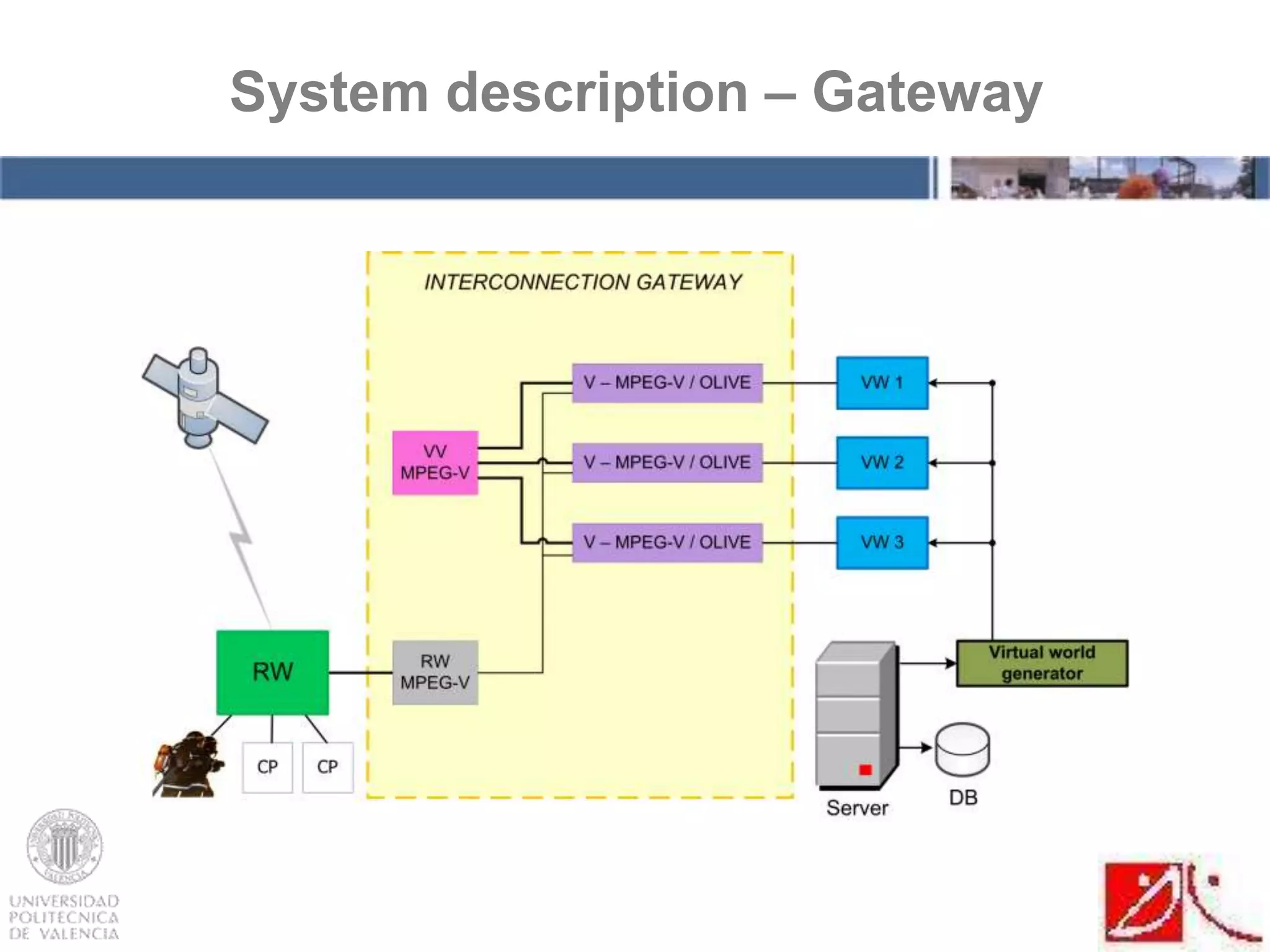
• MPEG-V Gateway to interconnect the virtual and real world
• Train with the same tools used in a real crisis mitigation
LVCTE for Strategic and Tactical
Emergency Operations
• Introduction
• Motivation and challenges
• System description
• Conclusions and future work
Contents
• Use virtual reality to reproduce real environments and to
create immersive training exercises for human beings in
the context of crisis management
– Firemen, paramedics...
• Enhance and extend the training capabilities of
traditional virtual systems
• Reflect the reality with high fidelity
– Help managers and first responders develop actuation strategies
– Homogenize procedures based on realistic environments
Motivation and challenges (I)
• Enable collaboration between entities and to develop
actuation strategies
• Provide interaction and overlapping between virtual and
real worlds using MPEG-V
Interoperable training environment
• Represent accurately entities and their features and
support a variety of mechanisms, software and
communication tools
Motivation and challenges (II)
• Introduction
• Motivation and challenges
• System description
• Conclusions and future work
Contents
• MPEG-V gateway
• Live, Virtual and Constructive Training
Environment
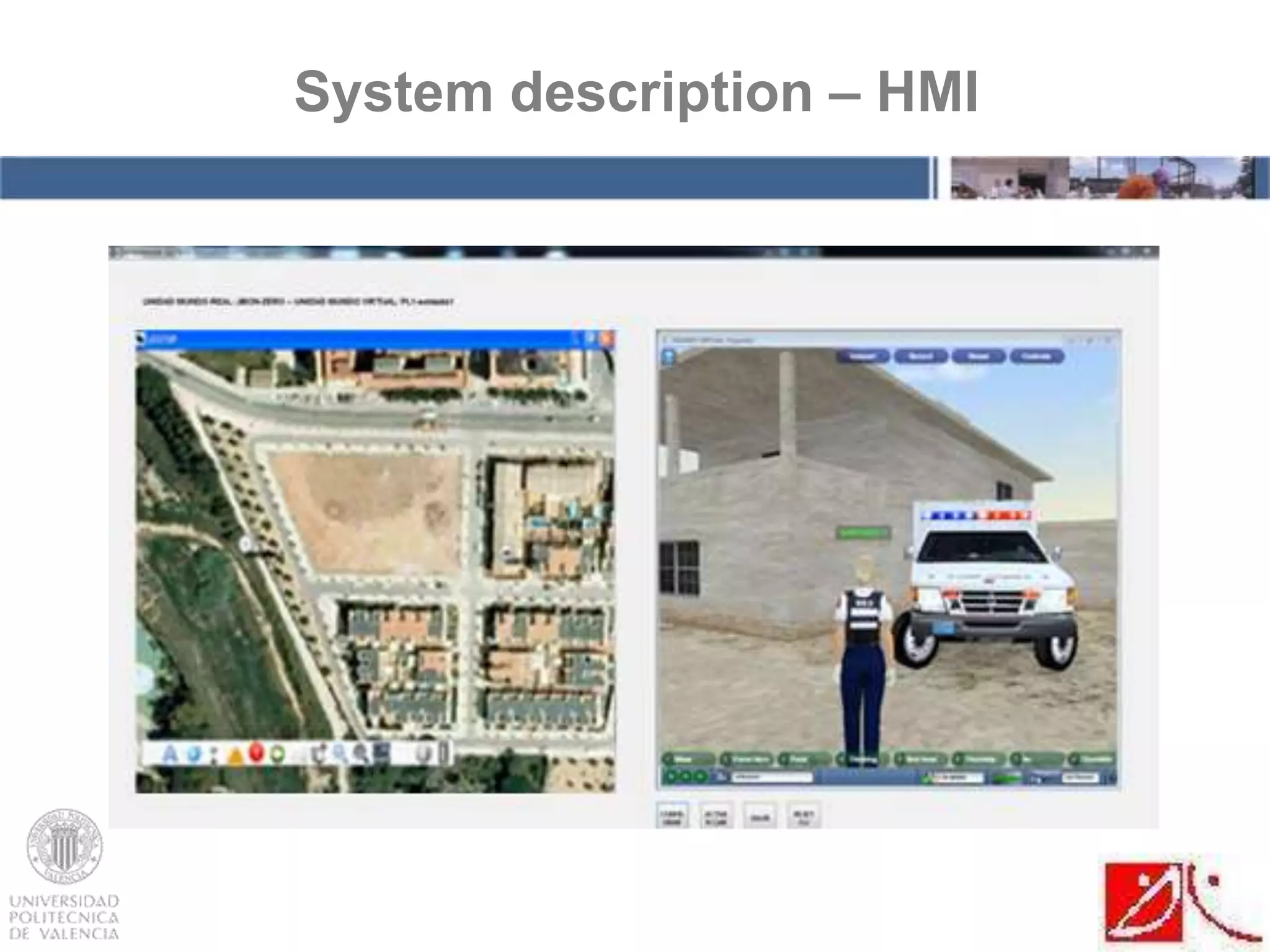
• Human-Machine Interface
System description
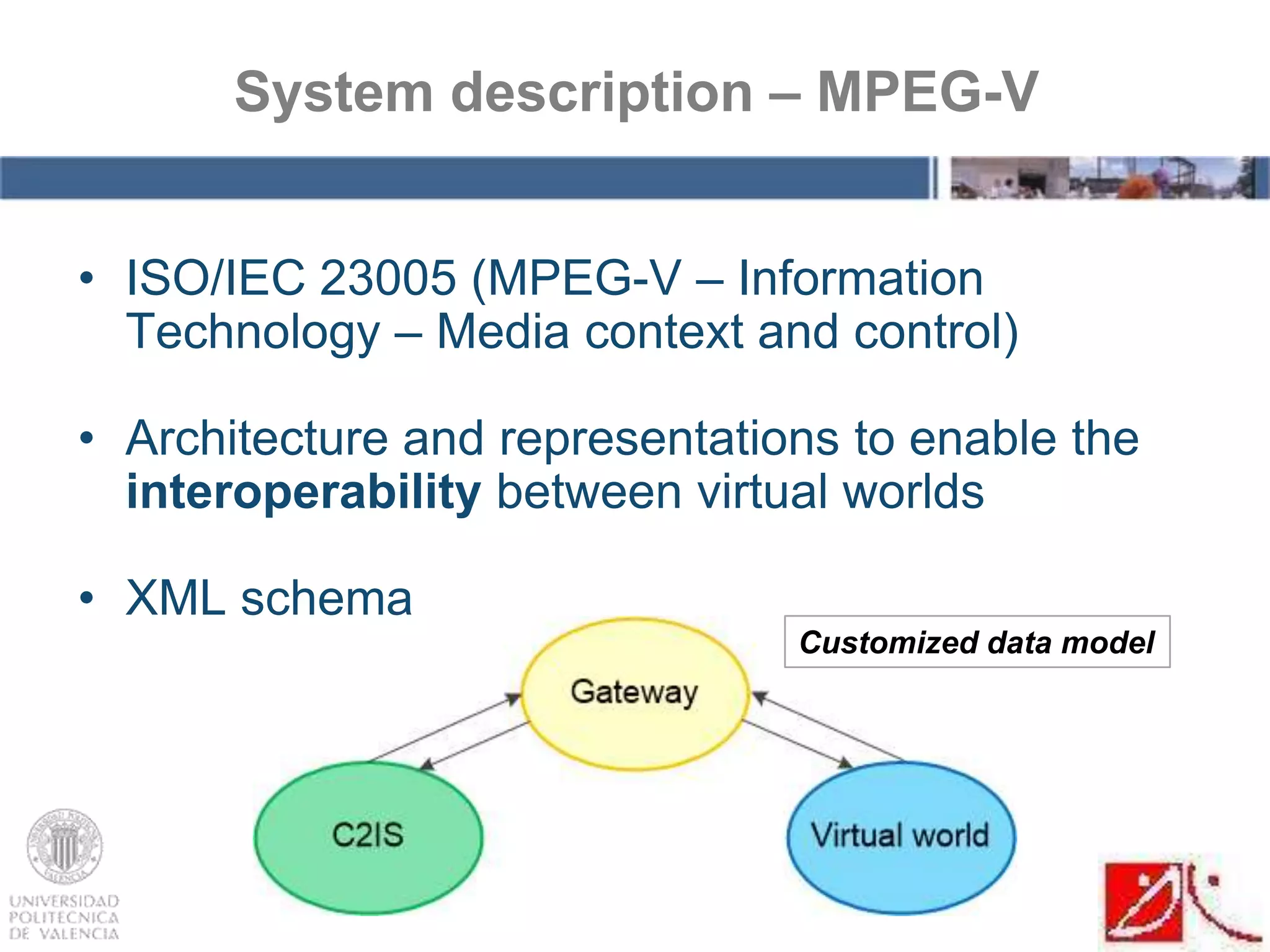
• ISO/IEC 23005 (MPEG-V – Information
Technology – Media context and control)
• Architecture and representations to enable the
interoperability between virtual worlds
• XML schema
System description – MPEG-V
Customized data model
System description – Gateway
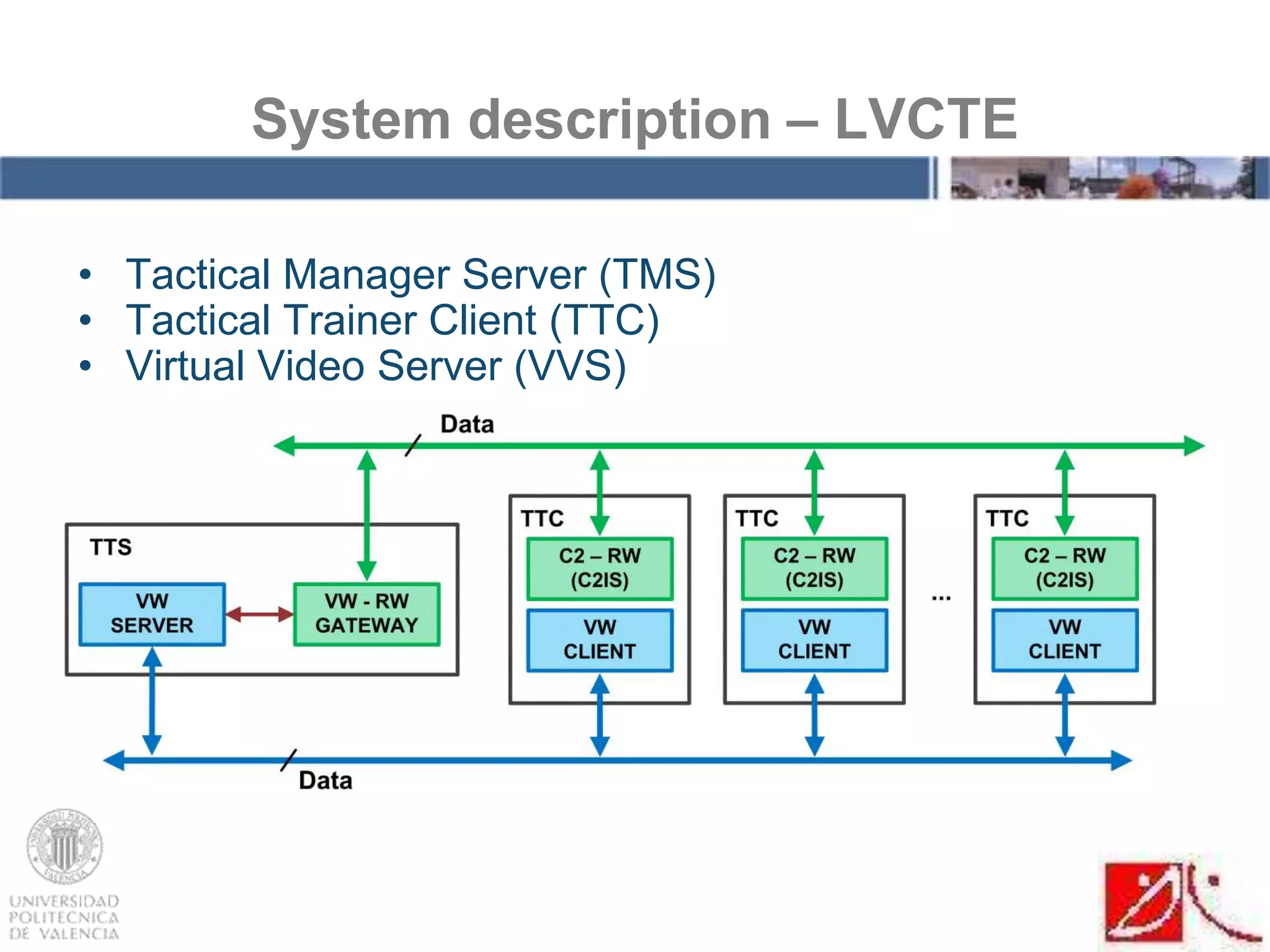
System description – LVCTE
• Tactical Manager Server (TMS)
• Tactical Trainer Client (TTC)
• Virtual Video Server (VVS)
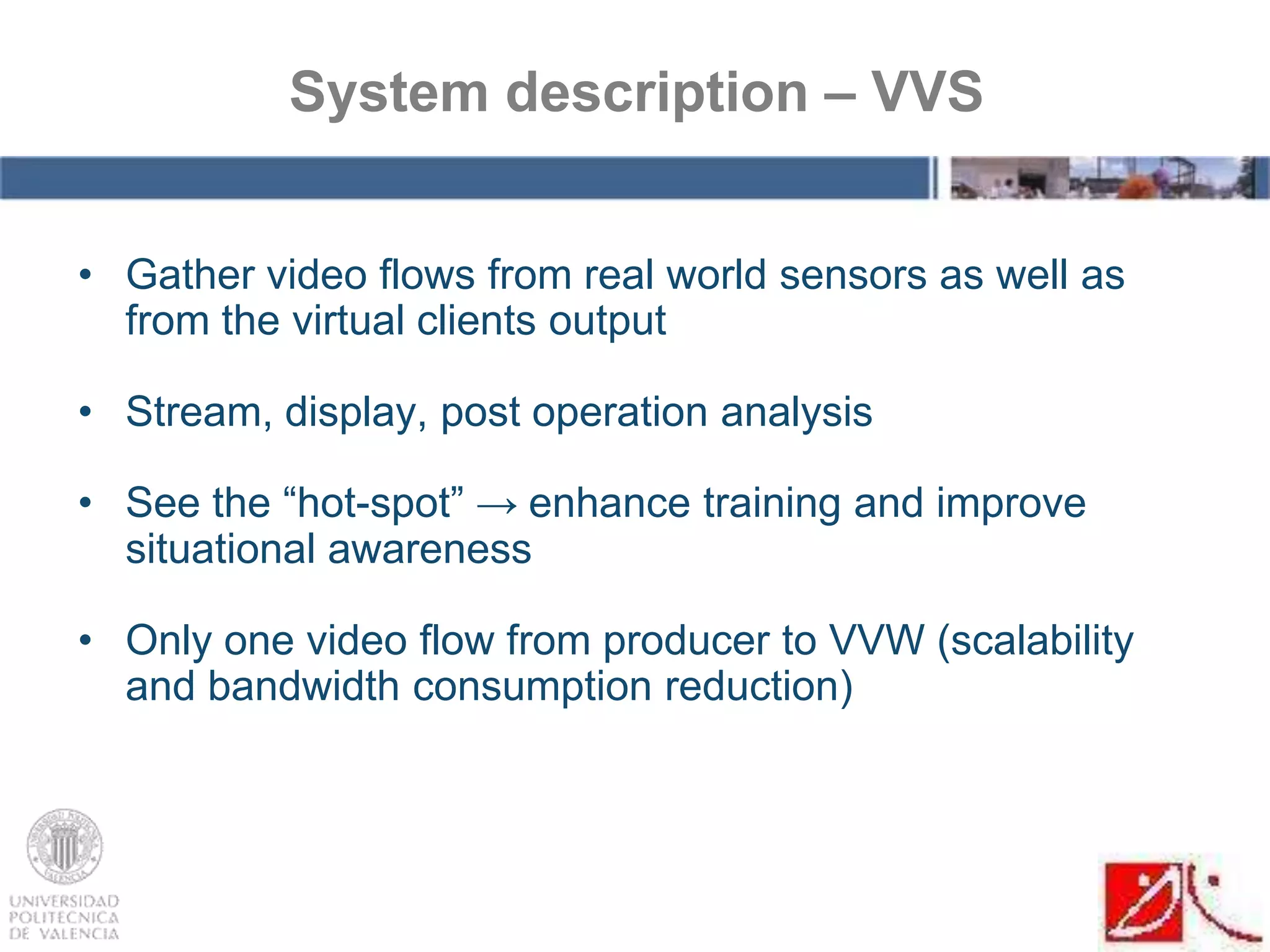
• Gather video flows from real world sensors as well as
from the virtual clients output
• Stream, display, post operation analysis
• See the “hot-spot” → enhance training and improve
situational awareness
• Only one video flow from producer to VVW (scalability
and bandwidth consumption reduction)
System description – VVS
System description – HMI
• Introduction
• Motivation and challenges
• System description
• Conclusions and future work
Contents
• Successful preliminary implementations using OLIVE
• MPEG-V Gateway:
– Acts as a middleware connecting C2IS for emergency
management with virtual worlds
– Performs data streaming between real and virtual worlds
• LVCTE:
– Innovative, interoperable, flexible and scalable
– Contributes to improve the deployment of applications related to
emergency management.
Conclusions
• Integrate stationary sensors and UAV
• Develop virtual environments representing different
types of real environments
• Test new virtual worlds engines (e.g. OpenSim)
• Evaluate the inclusion of video streaming from real
cameras in the virtual world using MPEG-V data
definitions.
• Handling masses of people and “surprise element”
Future work
Thank you!
Ing. Laura Ardila
lauarsi1@upvnet.upv.es
Dr. Manuel Esteve
mesteve@dcom.upv.es

LVC Training Environment for Strategic and Tactical Emergency Operations

  • 1.
    LVC TRAINING ENVIRONMENTFOR STRATEGIC AND TACTICAL EMERGENCY OPERATIONS Laura Ardila, Israel Perez-Llopis, Carlos Palau, Manuel Esteve Communications Department Universitat Politècnica de València
  • 2.
    • Introduction • Motivationand challenges • System description • Conclusions and future work Contents
  • 3.
    • Emergency management→ training of operatives • Use of ICT (C2IS , VR) in emergency systems • New approach for developing training scenarios for crisis management using virtual worlds – Trainees learn and practice how to perform physical or procedural tasks – Work toward collaborative animated agents – Interoperability – MPEG-V standard • Key features: – Realization of joint exercises reducing costs in transportation of personnel and equipment utilization – Flexibility and real-time response Introduction
  • 4.
    • Traditional trainingsimulated-based systems are expensive and offer little flexibility • Real training in the field of emergency management is very expensive and complicated regarding the harmonization of procedures between agencies • A network-based system that integrates reality and simulation will be relatively cheap and facilitate the interoperability and harmonization of procedures Introduction – Base hypotheses
  • 5.
    • LVCTE →connect virtual worlds and C2IS – LVCTE: Live, Virtual and Constructive Training Environment – C2IS: Command and Control Information Systems • Training in crisis management • Standardized data formats • Middleware in which different applications can interoperate. • Seamless interactions among virtual and real participants • Units deployed on the field and generated in the VW • MPEG-V Gateway to interconnect the virtual and real world • Train with the same tools used in a real crisis mitigation LVCTE for Strategic and Tactical Emergency Operations
  • 6.
    • Introduction • Motivationand challenges • System description • Conclusions and future work Contents
  • 7.
    • Use virtualreality to reproduce real environments and to create immersive training exercises for human beings in the context of crisis management – Firemen, paramedics... • Enhance and extend the training capabilities of traditional virtual systems • Reflect the reality with high fidelity – Help managers and first responders develop actuation strategies – Homogenize procedures based on realistic environments Motivation and challenges (I)
  • 8.
    • Enable collaborationbetween entities and to develop actuation strategies • Provide interaction and overlapping between virtual and real worlds using MPEG-V Interoperable training environment • Represent accurately entities and their features and support a variety of mechanisms, software and communication tools Motivation and challenges (II)
  • 9.
    • Introduction • Motivationand challenges • System description • Conclusions and future work Contents
  • 10.
    • MPEG-V gateway •Live, Virtual and Constructive Training Environment • Human-Machine Interface System description
  • 11.
    • ISO/IEC 23005(MPEG-V – Information Technology – Media context and control) • Architecture and representations to enable the interoperability between virtual worlds • XML schema System description – MPEG-V Customized data model
  • 12.
  • 13.
    System description –LVCTE • Tactical Manager Server (TMS) • Tactical Trainer Client (TTC) • Virtual Video Server (VVS)
  • 14.
    • Gather videoflows from real world sensors as well as from the virtual clients output • Stream, display, post operation analysis • See the “hot-spot” → enhance training and improve situational awareness • Only one video flow from producer to VVW (scalability and bandwidth consumption reduction) System description – VVS
  • 15.
  • 16.
    • Introduction • Motivationand challenges • System description • Conclusions and future work Contents
  • 17.
    • Successful preliminaryimplementations using OLIVE • MPEG-V Gateway: – Acts as a middleware connecting C2IS for emergency management with virtual worlds – Performs data streaming between real and virtual worlds • LVCTE: – Innovative, interoperable, flexible and scalable – Contributes to improve the deployment of applications related to emergency management. Conclusions
  • 18.
    • Integrate stationarysensors and UAV • Develop virtual environments representing different types of real environments • Test new virtual worlds engines (e.g. OpenSim) • Evaluate the inclusion of video streaming from real cameras in the virtual world using MPEG-V data definitions. • Handling masses of people and “surprise element” Future work
  • 19.
    Thank you! Ing. LauraArdila lauarsi1@upvnet.upv.es Dr. Manuel Esteve mesteve@dcom.upv.es