Presentation Topic:
Bangladesh Resources and Environment
Presented By
Name Student Id
Afroza Khatun 141610
Shakil Ahmed 141627
M. M. Abdullah Al- Mamun Sony 141642
Course Title: Sustainable Development
Course No: Soc 4209
Khulna University
1
Presentation Outline
 Meaning of Resources
Classification of Resources in Bangladesh
Natural Resources in Bangladesh
 Meaning of Environment
Environment of Bangladesh
 Relation between Resources and Environmental Sustainability
 Current Initiative Taken for Resources and Environmental Management
 Problems of Resources and Environmental Management
What can be the Solution?
2
Meaning of Resource
• Everything in our environment which can be used to satisfy our needs, provided, it is
technologically accessible, economically feasible and culturally acceptable can be
termed as “Resource” (Kiran & Kumar, 2014).
• Resources have three main characteristics: utility, limited availability and potential
for consumption (Wikipedia, 2018).
3
Classification of Resources in Bangladesh
Source: Kiran & Kumar, 2014
4
Renewable resources are natural resources that can be replenished or reproduced by
physical, chemical or mechanical process in a short period of time (Chowdhury, 2015).
• Renewable resources are the part of natural environment and the largest components
of ecosphere. Renewable resources helps to ensure resources and environmental
sustainability.
• In Bangladesh, renewable natural resources are Energy, Water, Fish, Forest, Land etc.
1. Renewable Resources
Natural Resources in Bangladesh
5
1.1 Water Resources
Bangladesh is endowed with plenty of surface and groundwater resources. Two main
rivers, the Brahmaputra and Padma and the account for more than 80% of stream flows
(Banglapedia, 2015).
• The total water requirement has been estimated at 24,370 Mm3 (million cubic meter)
but total water supply in this month is 23,490 Mm3. Maximum water demand occurs
in March.
• Out of these entire requirement, 77.2% is expected to be provided by surface water
and the balance 22.8% is expected to come from groundwater (Banglapedia, 2015).
6
1.2 Forest Resources
In terms of forest land, the Chittagong Hill Tracts forest division on the southeastern border
of the country contributes about 47%, followed by the Sundarbans and Patuakhali coastal
divisions, about 27%.
• Official records show that Government forest land produces about 5,50,000 m3 (Cubic
Meter) of roundwood and about 65 million pieces of bamboo annually.
• Wood is the main component for making almost all rural transports including bullock
cart, buffalo cart, boat, rickshaw, carriage van etc. More than 80% of the total fuel and
firewood are procured from forests (Banglapedia, 2015).
7
1.3 Land Resources
• Total Geographical area of Bangladesh is about 56,000 square miles (143,998
square kilometer). Out of which about 9 million hectares are cultivable land.
• It is estimated that the growing population pressure will use up 50 percent of the
country’s cultivable land by 2025.
• Every person working in the agriculture sector now owns only an average of 0.12
hectares of cropland (Chowdhury, 2015).
8
1.4 Fisheries
Bangladesh is crisscrossed with hundreds of rivers and it has established a credible
record of sustained growth where fisheries sector have been playing a very significant
role.
• This sector contributes 4.39% to the national GDP and almost one fourth (22.76%) to
the agricultural (crop, livestock and forestry) GDP (Bangladesh Economic Review,
2012).
• The sector's contribution to the national as it provides about 60% of the animal
protein intake and more than 11% of the total population of the country is directly or
indirectly involved in this sector for their livelihoods (Chowdhury, 2015).
9
2. Non-renewable Resources
A non-renewable resource (also called a finite resource) is a resource that does not
renew itself at a sufficient rate for sustainable economic extraction in meaningful human
time-frames (Chowdhury, 2015).
• In Bangladesh, non-renewable resources are coal, natural gas, petroleum, oil, white
clay, glass sand etc.
• These resources are limited in supply and it takes millions of years in their formation.
10
2.1 Gas
In Bangladesh, 27 gas fields have been discovered with the rate of success ratio is 3.1:1 of
which two of the gas fields are located in offshore area.
• Gas is produced from 20 gas fields (79 gas wells), 15 are state-owned and the
remaining operated by international oil companies. Up to December 2013 as much as
11.92 TCF gas has been produced.
• The demand for gas has already surpassed 2700 million cubic feet (MMCF) per day
whereas the peak supply of gas is nearly 2287 MMCF leaving shortfall of 413 MMCF
per day (Banglapedia, 2014; Chowdhury, 2015).
11
2.2 Oil
The only oilfield of the country has been discovered at Haripur in 1986 that is located in near
Haripur in the eastern hilly district of Sylhet, but these have yet to be developed.
• The Haripur reserves are estimated at 40 million barrel, with a recoverable reserve of
about 6 million (Banglapedia, 2014; Chowdhury, 2015).
2.3 Coal
Coal reserves of about 3.3 billion tons comprising 5 deposits
at depths of 118-1158 meters have been discovered so far in
the north-western part of Bangladesh.
The name of these deposits are-Barapukuria, Phulbari and
Dighipara coal feld in Dinajpur district, Khalashpir in
Rangpur district (Banglapedia, 2014).
12
White Clay occurs in Sherpur, Netrokona, Dinajpur and Chittagong district and it is used
to make crockery’s, sanitary materials, insulator and tiles. In addition, it is also used in
Paper, cement and sugar industries. The showing white clay is not good in quality that is
used in the ceramic factories of Bangladesh after mixing with high quality imported clay.
2.4 White Clay and Glass Sand
Important deposits of glass sand of the country are at
Balijuri (0.64 million ton) and Shahjibazar (1.41 million
ton) at or near the surface, Maddhyapara (17.25 million
ton) and Barapukuria (90.0 million ton) below the
surface.
Total deposit is about 109.58 million ton (Banglapedia,
2014; Chowdhury, 2015).
13
• Environment the aggregate of conditions affecting the existence or development of
life and nature (Banglapedia, 2015).
• Environment is the complex of physical, chemical, and biotic factors (such as
climate, soil, and living things) that act upon an organism or an ecological
community and ultimately determine its form and survival (Marriam- Webster
Dictionary, 2018).
Meaning of Environment
14
Environment of Bangladesh
The overall global environment is declining fast and for Bangladesh it has been doing
so more rapidly during the last few decades because of many obvious reasons.
Bangladesh passed an act on environmental conservation in 1995. A few factors on the
environment of Bangladesh are given below:
1. State of environment
2. Environmental pollution
3. Environmental degradation
4. Environment policy
15
Globally Bangladesh has great importance for its exceptional hydro-geographical setting.
Three mighty rivers, the padma, the brahmaputra and the meghna drain a total catchment
area of about 1.5 million sq km.
• The land is largely low-lying floodplain. The physical characteristics of the land,
geographic location, the multiplicity of rivers and the monsoon climate render
Bangladesh highly vulnerable to natural disasters such as floods and cyclones.
• Seasonal extremes of water availability, i.e. flood and drought are characteristics of
Bangladesh. These natural phenomena act as significant constraints in achieving
sustainable socio-economic development (Banglapedia, 2015).
1. State of Environment
16
• Bangladesh's climate is a tropical monsoon climate characterized by marked
seasonal variations. Abundant rainfall during the monsoon (July-October) is
followed by a cool winter period (November-February), then a hot, dry summer
(March-June).
• In the hot season, the average maximum temperature is 34°C and the average
minimum is 21°C. Average maximum temperature in winter is 29°C and the
minimum is 11°C.
• The average annual recorded rainfall within Bangladesh varies from about 1100 mm
in the extreme west to about 5700 mm in the northeastern corner of the country.
Rainfall in the Himalayas ranges from 2,000 to 15,000 mm annually (Banglapedia,
2015).
1. State of Environment
17
• Pollution broadly means disruption of man's own environment and refers primarily to
the fouling of air, water, and soil by wastes or harmful materials.
• The pollution from solid wastes is a major problem in Bangladesh. At present, Dhaka
city alone generates about 5000 million tons of solid wastes per day. The amount
increases with the increase of population every year.
2. Environmental Pollution
• Air pollution is a serious environmental health hazard
affecting the populations of Bangladesh. Indoor air
pollution is mainly associated with the use of biomass
fuels during cooking with poor ventilation. Industrial
emissions and automobiles are the principle sources of
outdoor air pollution (Banglapedia, 2015).
18
• Water pollution creates serious health hazard for Bangladesh. The dumping of
municipal wastes, hospital wastes and toxic environmental discharges from mostly
industries pollute both surface and ground water sources.
2. Environmental Pollution
• The most dangerous threat emanating from
environmental degradation is the arsenic
contamination of ground water and it is
found more than 70 times higher than that
standard. (Banglapedia, 2015).
• Soil pollution has become a serious threat, as there is a lack of proper soil
management practices. The processes of erosion and removal of soil gradually
make soils infertile, disrupting the natural ecosystem. Unplanned, uncoordinated
land use and agricultural methods are the causes of soil pollution (Banglapedia,
2015). 19
3. Environmental Degradation
There is much concern today in Bangladesh about environmental stresses leading to
environmental degradation, namely the increasing aridity being experienced in the
western and northwestern zone, particularly in the districts of Rajshahi, Dinajpur,
Bogra, and some areas of Kushtia and Jessore.
• The degradation of the biological environment has increased the risk of erosion,
salinization and above all desertification. It is possible that the climate is becoming
drier, enhancing the process of desertification (Banglapedia, 2015).
• Which also lead to the decline, of the
general standard of living of the
people and the quality of the
environment (Banglapedia, 2015).
20
4. Environment policy
• Global environmental degradation in recent years calls for serious environmental
planning making and effective implementation of policies.
• In recent years, environmental protection has become a priority agenda of the
Government of Bangladesh.
• The governments have initiated a series of policies and programmes aimed at
putting development on a sustainable path, including the adoption of an
Environment Policy in 1992.
21
• To maintain ecological balance and
overall development;
• To protect the country against natural
disasters;
• To identify and regulate activities which
pollute and degrade the environment;
• To ensure environmentally sound
development in all sectors;
• To ensure sustainable and environmentally
sound use of all national resources; and
• To remain associated with all international
environmental initiatives.
The objectives of Environment Policy 1992
22
Relation between Resources and Environmental Sustainability
Bangladesh, with an area of 144,000 km2, features a flood plain landscape and several
river systems throughout the country. This landscape provides the major natural
resources of water, land, fisheries, forests, and wildlife.
• The country currently faces several environmental issues which threaten these
resources. (World Bank, 2006).
• The upward trend in population and poverty has increased the pressure on the
available resources in the country. This pressure has resulted in unsustainable use of
the available natural resources and pressure on environment(Chowdhury, 2015).
• The development of strong institutional mechanisms is necessary to facilitate the
sustainable management of resources and to prevent further deterioration of the
environment.
23
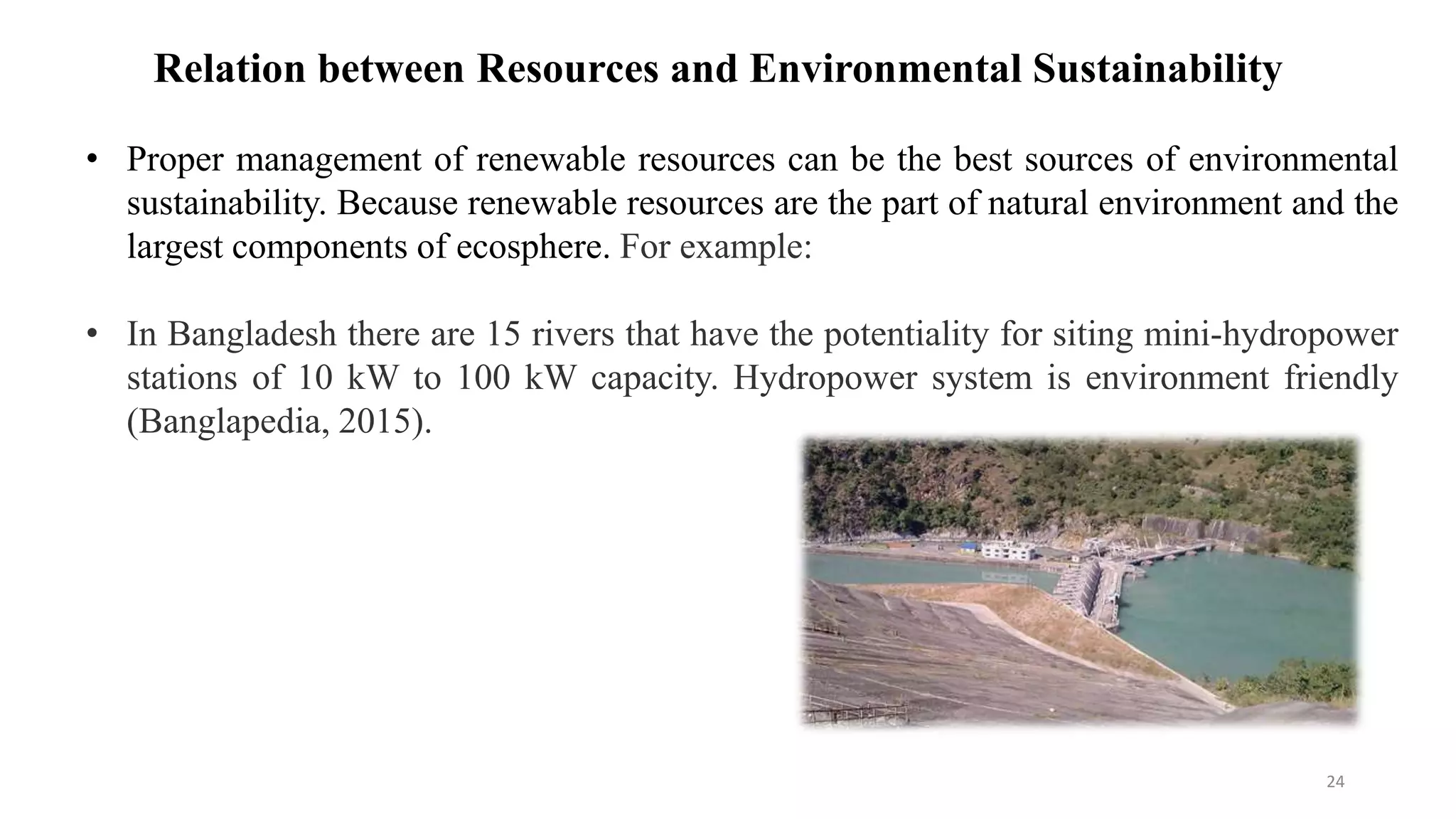
• Proper management of renewable resources can be the best sources of environmental
sustainability. Because renewable resources are the part of natural environment and the
largest components of ecosphere. For example:
• In Bangladesh there are 15 rivers that have the potentiality for siting mini-hydropower
stations of 10 kW to 100 kW capacity. Hydropower system is environment friendly
(Banglapedia, 2015).
Relation between Resources and Environmental Sustainability
24
• Solar Energy can be a great source for solving power crisis in an environmental
manner. Bangladesh is a subtropical country, 70% of year sunlight is dropped in
Bangladesh (Banglapedia, 2015).The amount of solar energy is around 5 kWh/day
per square meter on the total surface area of the country, enough to meet the total
demand of the country (Banglapedia, 2015).
• Bangladesh have 724 km long coastline. Wind energy can potentially generate more
than 2000 -MW of electricity in the coastal regions. In one hand, the cost of
generating wind energy will be about half than solar energy on the other hand
pressure will be reduced over renewable resources (Banglapedia, 2015).
Relation between Resources and Environmental Sustainability
25
Over Population
Poverty
Poor Governance
Create
Pressure
on
Resources
Environmental
Pollution and
Degradation
Sustainable
Environmental
Development
Renewable Resources, Policy,
Awareness, Poverty Reduction,
Population Control
Reduce
pressure
on
Positive
Negative Positive
Negative
Source: Viju, 1995
Relation between Resources and Environmental Sustainability
26
Current Initiative Taken for Resources and Environmental Management
The World Bank (2017), identified some current initiative for resources and
environmental management in Bangladesh. These are:
• The Clean Air and Sustainable Environment Project (CASE), to which the
Bank has committed $62.2 million to improve air quality in Dhaka.
• The Strengthening Region Cooperation for Wildlife Protection in Asia, which
has made $36 million available to assist the governments of Nepal and
Bangladesh to jointly minimize illegal wildlife trade and threats to border-area
habitats.
• The Climate Resilient Participatory Afforestation and Reforestation
Project (CRPARP), a $33.8 million initiative to reduce forest degradation and
help communities in coastal and hilly areas build long-term resilience against the
effects of climate change.
27
The South Asia Water Initiative Sundarbans Focus Area Strategy ($2 million), which
enhances Bangladeshi-Indian technical cooperation around water resources
management in the Sundarbans, one of the world’s largest mangrove forests.
The Forest Investment Program – Investment Plan. With Climate Investment Funds,
the World Bank leads coordination of Bangladesh’s strategy to invest in climate-
resilient forest management and greenhouse gas emission reduction.
Bangladesh Blue Economy Assessment – An initiative supporting the Prime Minister’s
national priority to find new sources of sustainable growth in marine and ocean areas
peacefully handed over from India and Myanmar to Bangladesh in 2015.
Current Initiative Taken for Resources and Environmental Management
28
Problems of Resources and Environmental Management
Though some current initiative have taken for resources and environmental
management there have some limitations. which are shorting below,
• Lack of inter-sectorial coordination;
• Conflict in sectorial policies;
• Lack of institutional capacities;
• Regulatory and institutional inadequacies for policy implementation;
• Outdated law;
• Non-punitive approach of laws (Chowdhury, 2015).
29
What can be the Solution?
Integrating environmental protection and management into national planning and
strengthening environmental institutions, especially to respond to the Bangladesh’s
rapid urbanization, industrialization, and growing pollution.
• Unlocking the potential of the climate-smart “blue” economy. Bangladesh needs to
improve its protection of ocean health, create sustained jobs and livelihoods, and
strengthen its management of vast marine resources.
• Efforts for controlling air pollution need to be further supported by improved
traffic management, higher technical standard for motor vehicles and expansion of
public transport system (Chowdhury, 2015).
30
• Proper urbanization.
• Dealing with ground water contamination with arsenic.
• Control the Wetland loss.
• Energy conservation and enforce renewable energy.
• Control river bank erosion
• Solid waste management.
• Water resource management
What can be the solution?
31
Banglapedia (2015).The National Encyclopedia of Bangladesh.
Bangladesh Economic Review (2012). Ministry of Finance.
Chowdhury MNM (2015) Present Scenario of Renewable and Non-Renewable Resources in Bangladesh: A
Compact Analysis. Bus Eco J 6: 134. doi:10.4172/2151-6219.1000134.
Kiran & Kumar, (2014). Inquisitive Social Sciences For Class -8. S.CHAND & COMPANY PVT. LTD. Ney
Delhi.
Miller, G.T. & S. Spoolman (2011). Living in the Environment: Principles, Connections, and Solutions (17th ed.).
Belmont, CA: Brooks-Cole. Oxford.
The World Bank (2017). Bangladesh: Protecting The Environment And Natural Resource Management. The
World Bank Group. Washington D.C.
Wikipedia. (20 February 2018). Resource. the free encyclopedia. https://en.wikipedia.org/wiki/Resource
References
32
33

Bangladesh Resources and Environment

  • 1.
    Presentation Topic: Bangladesh Resourcesand Environment Presented By Name Student Id Afroza Khatun 141610 Shakil Ahmed 141627 M. M. Abdullah Al- Mamun Sony 141642 Course Title: Sustainable Development Course No: Soc 4209 Khulna University 1
  • 2.
    Presentation Outline  Meaningof Resources Classification of Resources in Bangladesh Natural Resources in Bangladesh  Meaning of Environment Environment of Bangladesh  Relation between Resources and Environmental Sustainability  Current Initiative Taken for Resources and Environmental Management  Problems of Resources and Environmental Management What can be the Solution? 2
  • 3.
    Meaning of Resource •Everything in our environment which can be used to satisfy our needs, provided, it is technologically accessible, economically feasible and culturally acceptable can be termed as “Resource” (Kiran & Kumar, 2014). • Resources have three main characteristics: utility, limited availability and potential for consumption (Wikipedia, 2018). 3
  • 4.
    Classification of Resourcesin Bangladesh Source: Kiran & Kumar, 2014 4
  • 5.
    Renewable resources arenatural resources that can be replenished or reproduced by physical, chemical or mechanical process in a short period of time (Chowdhury, 2015). • Renewable resources are the part of natural environment and the largest components of ecosphere. Renewable resources helps to ensure resources and environmental sustainability. • In Bangladesh, renewable natural resources are Energy, Water, Fish, Forest, Land etc. 1. Renewable Resources Natural Resources in Bangladesh 5
  • 6.
    1.1 Water Resources Bangladeshis endowed with plenty of surface and groundwater resources. Two main rivers, the Brahmaputra and Padma and the account for more than 80% of stream flows (Banglapedia, 2015). • The total water requirement has been estimated at 24,370 Mm3 (million cubic meter) but total water supply in this month is 23,490 Mm3. Maximum water demand occurs in March. • Out of these entire requirement, 77.2% is expected to be provided by surface water and the balance 22.8% is expected to come from groundwater (Banglapedia, 2015). 6
  • 7.
    1.2 Forest Resources Interms of forest land, the Chittagong Hill Tracts forest division on the southeastern border of the country contributes about 47%, followed by the Sundarbans and Patuakhali coastal divisions, about 27%. • Official records show that Government forest land produces about 5,50,000 m3 (Cubic Meter) of roundwood and about 65 million pieces of bamboo annually. • Wood is the main component for making almost all rural transports including bullock cart, buffalo cart, boat, rickshaw, carriage van etc. More than 80% of the total fuel and firewood are procured from forests (Banglapedia, 2015). 7
  • 8.
    1.3 Land Resources •Total Geographical area of Bangladesh is about 56,000 square miles (143,998 square kilometer). Out of which about 9 million hectares are cultivable land. • It is estimated that the growing population pressure will use up 50 percent of the country’s cultivable land by 2025. • Every person working in the agriculture sector now owns only an average of 0.12 hectares of cropland (Chowdhury, 2015). 8
  • 9.
    1.4 Fisheries Bangladesh iscrisscrossed with hundreds of rivers and it has established a credible record of sustained growth where fisheries sector have been playing a very significant role. • This sector contributes 4.39% to the national GDP and almost one fourth (22.76%) to the agricultural (crop, livestock and forestry) GDP (Bangladesh Economic Review, 2012). • The sector's contribution to the national as it provides about 60% of the animal protein intake and more than 11% of the total population of the country is directly or indirectly involved in this sector for their livelihoods (Chowdhury, 2015). 9
  • 10.
    2. Non-renewable Resources Anon-renewable resource (also called a finite resource) is a resource that does not renew itself at a sufficient rate for sustainable economic extraction in meaningful human time-frames (Chowdhury, 2015). • In Bangladesh, non-renewable resources are coal, natural gas, petroleum, oil, white clay, glass sand etc. • These resources are limited in supply and it takes millions of years in their formation. 10
  • 11.
    2.1 Gas In Bangladesh,27 gas fields have been discovered with the rate of success ratio is 3.1:1 of which two of the gas fields are located in offshore area. • Gas is produced from 20 gas fields (79 gas wells), 15 are state-owned and the remaining operated by international oil companies. Up to December 2013 as much as 11.92 TCF gas has been produced. • The demand for gas has already surpassed 2700 million cubic feet (MMCF) per day whereas the peak supply of gas is nearly 2287 MMCF leaving shortfall of 413 MMCF per day (Banglapedia, 2014; Chowdhury, 2015). 11
  • 12.
    2.2 Oil The onlyoilfield of the country has been discovered at Haripur in 1986 that is located in near Haripur in the eastern hilly district of Sylhet, but these have yet to be developed. • The Haripur reserves are estimated at 40 million barrel, with a recoverable reserve of about 6 million (Banglapedia, 2014; Chowdhury, 2015). 2.3 Coal Coal reserves of about 3.3 billion tons comprising 5 deposits at depths of 118-1158 meters have been discovered so far in the north-western part of Bangladesh. The name of these deposits are-Barapukuria, Phulbari and Dighipara coal feld in Dinajpur district, Khalashpir in Rangpur district (Banglapedia, 2014). 12
  • 13.
    White Clay occursin Sherpur, Netrokona, Dinajpur and Chittagong district and it is used to make crockery’s, sanitary materials, insulator and tiles. In addition, it is also used in Paper, cement and sugar industries. The showing white clay is not good in quality that is used in the ceramic factories of Bangladesh after mixing with high quality imported clay. 2.4 White Clay and Glass Sand Important deposits of glass sand of the country are at Balijuri (0.64 million ton) and Shahjibazar (1.41 million ton) at or near the surface, Maddhyapara (17.25 million ton) and Barapukuria (90.0 million ton) below the surface. Total deposit is about 109.58 million ton (Banglapedia, 2014; Chowdhury, 2015). 13
  • 14.
    • Environment theaggregate of conditions affecting the existence or development of life and nature (Banglapedia, 2015). • Environment is the complex of physical, chemical, and biotic factors (such as climate, soil, and living things) that act upon an organism or an ecological community and ultimately determine its form and survival (Marriam- Webster Dictionary, 2018). Meaning of Environment 14
  • 15.
    Environment of Bangladesh Theoverall global environment is declining fast and for Bangladesh it has been doing so more rapidly during the last few decades because of many obvious reasons. Bangladesh passed an act on environmental conservation in 1995. A few factors on the environment of Bangladesh are given below: 1. State of environment 2. Environmental pollution 3. Environmental degradation 4. Environment policy 15
  • 16.
    Globally Bangladesh hasgreat importance for its exceptional hydro-geographical setting. Three mighty rivers, the padma, the brahmaputra and the meghna drain a total catchment area of about 1.5 million sq km. • The land is largely low-lying floodplain. The physical characteristics of the land, geographic location, the multiplicity of rivers and the monsoon climate render Bangladesh highly vulnerable to natural disasters such as floods and cyclones. • Seasonal extremes of water availability, i.e. flood and drought are characteristics of Bangladesh. These natural phenomena act as significant constraints in achieving sustainable socio-economic development (Banglapedia, 2015). 1. State of Environment 16
  • 17.
    • Bangladesh's climateis a tropical monsoon climate characterized by marked seasonal variations. Abundant rainfall during the monsoon (July-October) is followed by a cool winter period (November-February), then a hot, dry summer (March-June). • In the hot season, the average maximum temperature is 34°C and the average minimum is 21°C. Average maximum temperature in winter is 29°C and the minimum is 11°C. • The average annual recorded rainfall within Bangladesh varies from about 1100 mm in the extreme west to about 5700 mm in the northeastern corner of the country. Rainfall in the Himalayas ranges from 2,000 to 15,000 mm annually (Banglapedia, 2015). 1. State of Environment 17
  • 18.
    • Pollution broadlymeans disruption of man's own environment and refers primarily to the fouling of air, water, and soil by wastes or harmful materials. • The pollution from solid wastes is a major problem in Bangladesh. At present, Dhaka city alone generates about 5000 million tons of solid wastes per day. The amount increases with the increase of population every year. 2. Environmental Pollution • Air pollution is a serious environmental health hazard affecting the populations of Bangladesh. Indoor air pollution is mainly associated with the use of biomass fuels during cooking with poor ventilation. Industrial emissions and automobiles are the principle sources of outdoor air pollution (Banglapedia, 2015). 18
  • 19.
    • Water pollutioncreates serious health hazard for Bangladesh. The dumping of municipal wastes, hospital wastes and toxic environmental discharges from mostly industries pollute both surface and ground water sources. 2. Environmental Pollution • The most dangerous threat emanating from environmental degradation is the arsenic contamination of ground water and it is found more than 70 times higher than that standard. (Banglapedia, 2015). • Soil pollution has become a serious threat, as there is a lack of proper soil management practices. The processes of erosion and removal of soil gradually make soils infertile, disrupting the natural ecosystem. Unplanned, uncoordinated land use and agricultural methods are the causes of soil pollution (Banglapedia, 2015). 19
  • 20.
    3. Environmental Degradation Thereis much concern today in Bangladesh about environmental stresses leading to environmental degradation, namely the increasing aridity being experienced in the western and northwestern zone, particularly in the districts of Rajshahi, Dinajpur, Bogra, and some areas of Kushtia and Jessore. • The degradation of the biological environment has increased the risk of erosion, salinization and above all desertification. It is possible that the climate is becoming drier, enhancing the process of desertification (Banglapedia, 2015). • Which also lead to the decline, of the general standard of living of the people and the quality of the environment (Banglapedia, 2015). 20
  • 21.
    4. Environment policy •Global environmental degradation in recent years calls for serious environmental planning making and effective implementation of policies. • In recent years, environmental protection has become a priority agenda of the Government of Bangladesh. • The governments have initiated a series of policies and programmes aimed at putting development on a sustainable path, including the adoption of an Environment Policy in 1992. 21
  • 22.
    • To maintainecological balance and overall development; • To protect the country against natural disasters; • To identify and regulate activities which pollute and degrade the environment; • To ensure environmentally sound development in all sectors; • To ensure sustainable and environmentally sound use of all national resources; and • To remain associated with all international environmental initiatives. The objectives of Environment Policy 1992 22
  • 23.
    Relation between Resourcesand Environmental Sustainability Bangladesh, with an area of 144,000 km2, features a flood plain landscape and several river systems throughout the country. This landscape provides the major natural resources of water, land, fisheries, forests, and wildlife. • The country currently faces several environmental issues which threaten these resources. (World Bank, 2006). • The upward trend in population and poverty has increased the pressure on the available resources in the country. This pressure has resulted in unsustainable use of the available natural resources and pressure on environment(Chowdhury, 2015). • The development of strong institutional mechanisms is necessary to facilitate the sustainable management of resources and to prevent further deterioration of the environment. 23
  • 24.
    • Proper managementof renewable resources can be the best sources of environmental sustainability. Because renewable resources are the part of natural environment and the largest components of ecosphere. For example: • In Bangladesh there are 15 rivers that have the potentiality for siting mini-hydropower stations of 10 kW to 100 kW capacity. Hydropower system is environment friendly (Banglapedia, 2015). Relation between Resources and Environmental Sustainability 24
  • 25.
    • Solar Energycan be a great source for solving power crisis in an environmental manner. Bangladesh is a subtropical country, 70% of year sunlight is dropped in Bangladesh (Banglapedia, 2015).The amount of solar energy is around 5 kWh/day per square meter on the total surface area of the country, enough to meet the total demand of the country (Banglapedia, 2015). • Bangladesh have 724 km long coastline. Wind energy can potentially generate more than 2000 -MW of electricity in the coastal regions. In one hand, the cost of generating wind energy will be about half than solar energy on the other hand pressure will be reduced over renewable resources (Banglapedia, 2015). Relation between Resources and Environmental Sustainability 25
  • 26.
    Over Population Poverty Poor Governance Create Pressure on Resources Environmental Pollutionand Degradation Sustainable Environmental Development Renewable Resources, Policy, Awareness, Poverty Reduction, Population Control Reduce pressure on Positive Negative Positive Negative Source: Viju, 1995 Relation between Resources and Environmental Sustainability 26
  • 27.
    Current Initiative Takenfor Resources and Environmental Management The World Bank (2017), identified some current initiative for resources and environmental management in Bangladesh. These are: • The Clean Air and Sustainable Environment Project (CASE), to which the Bank has committed $62.2 million to improve air quality in Dhaka. • The Strengthening Region Cooperation for Wildlife Protection in Asia, which has made $36 million available to assist the governments of Nepal and Bangladesh to jointly minimize illegal wildlife trade and threats to border-area habitats. • The Climate Resilient Participatory Afforestation and Reforestation Project (CRPARP), a $33.8 million initiative to reduce forest degradation and help communities in coastal and hilly areas build long-term resilience against the effects of climate change. 27
  • 28.
    The South AsiaWater Initiative Sundarbans Focus Area Strategy ($2 million), which enhances Bangladeshi-Indian technical cooperation around water resources management in the Sundarbans, one of the world’s largest mangrove forests. The Forest Investment Program – Investment Plan. With Climate Investment Funds, the World Bank leads coordination of Bangladesh’s strategy to invest in climate- resilient forest management and greenhouse gas emission reduction. Bangladesh Blue Economy Assessment – An initiative supporting the Prime Minister’s national priority to find new sources of sustainable growth in marine and ocean areas peacefully handed over from India and Myanmar to Bangladesh in 2015. Current Initiative Taken for Resources and Environmental Management 28
  • 29.
    Problems of Resourcesand Environmental Management Though some current initiative have taken for resources and environmental management there have some limitations. which are shorting below, • Lack of inter-sectorial coordination; • Conflict in sectorial policies; • Lack of institutional capacities; • Regulatory and institutional inadequacies for policy implementation; • Outdated law; • Non-punitive approach of laws (Chowdhury, 2015). 29
  • 30.
    What can bethe Solution? Integrating environmental protection and management into national planning and strengthening environmental institutions, especially to respond to the Bangladesh’s rapid urbanization, industrialization, and growing pollution. • Unlocking the potential of the climate-smart “blue” economy. Bangladesh needs to improve its protection of ocean health, create sustained jobs and livelihoods, and strengthen its management of vast marine resources. • Efforts for controlling air pollution need to be further supported by improved traffic management, higher technical standard for motor vehicles and expansion of public transport system (Chowdhury, 2015). 30
  • 31.
    • Proper urbanization. •Dealing with ground water contamination with arsenic. • Control the Wetland loss. • Energy conservation and enforce renewable energy. • Control river bank erosion • Solid waste management. • Water resource management What can be the solution? 31
  • 32.
    Banglapedia (2015).The NationalEncyclopedia of Bangladesh. Bangladesh Economic Review (2012). Ministry of Finance. Chowdhury MNM (2015) Present Scenario of Renewable and Non-Renewable Resources in Bangladesh: A Compact Analysis. Bus Eco J 6: 134. doi:10.4172/2151-6219.1000134. Kiran & Kumar, (2014). Inquisitive Social Sciences For Class -8. S.CHAND & COMPANY PVT. LTD. Ney Delhi. Miller, G.T. & S. Spoolman (2011). Living in the Environment: Principles, Connections, and Solutions (17th ed.). Belmont, CA: Brooks-Cole. Oxford. The World Bank (2017). Bangladesh: Protecting The Environment And Natural Resource Management. The World Bank Group. Washington D.C. Wikipedia. (20 February 2018). Resource. the free encyclopedia. https://en.wikipedia.org/wiki/Resource References 32
  • 33.