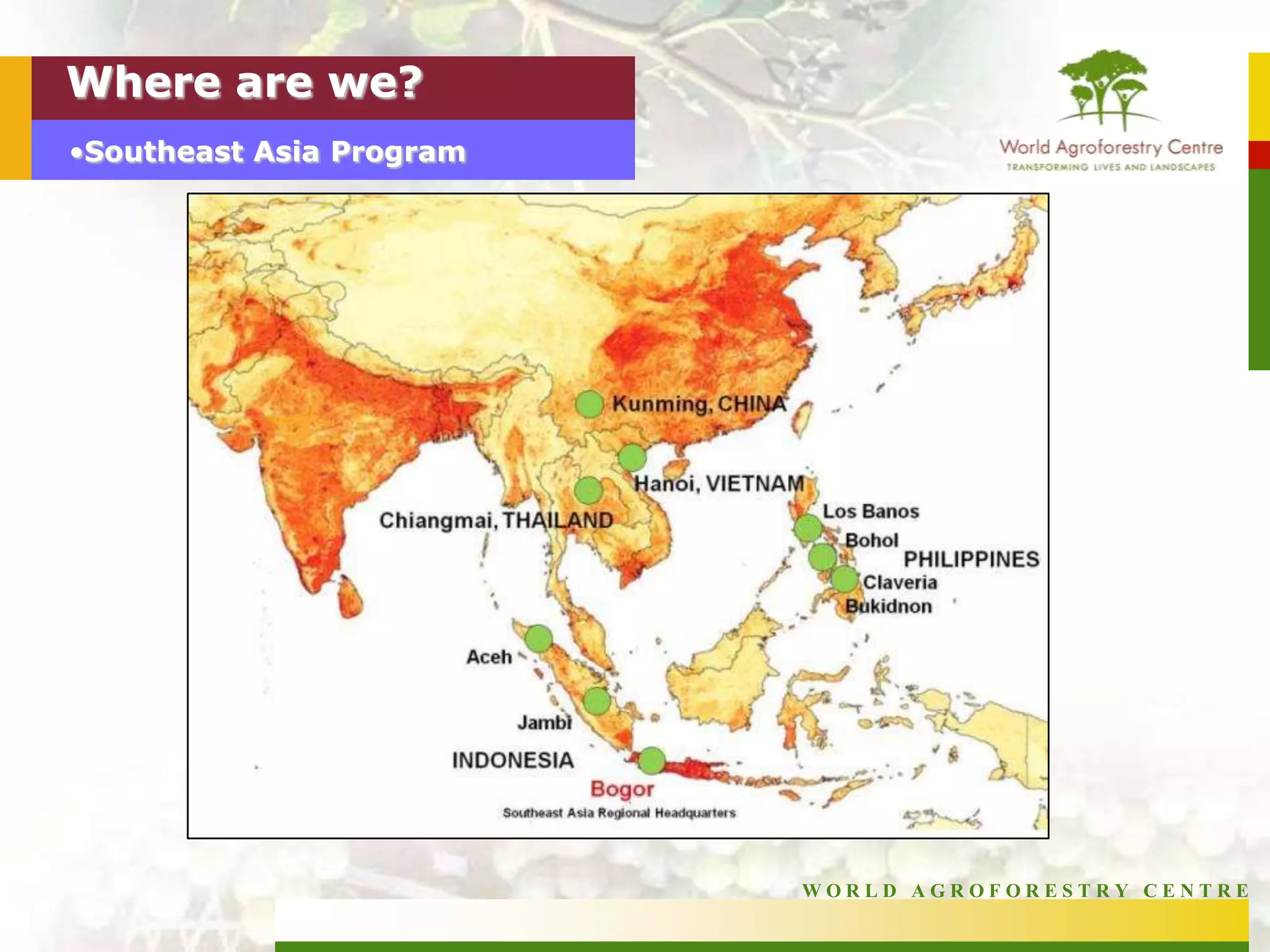
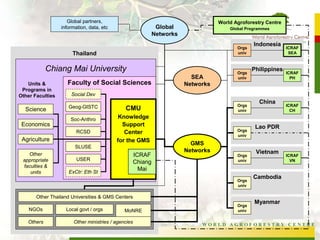
Where are we?Southeast Asia Program Southeast AsiaRegional characteristicsBetween 1995 and 2010, Southeast Asia lost 32.8 million ha of its forests and woodlands and 18.2 million ha of its natural exploitable forests, equalling 11% and 14% respectively of the 1995 area.The demands and expectations of lowland capital cities and economic centres for regular flows of clean water from the uplands cannot be realistically met. Inconsistent or contradictory policies and conflicts over rights of use and access are main determinants of unsustainable natural resource management and poverty in the uplands and forest margins. Climate change is a present reality in Southeast Asia; Heat waves, droughts, floods and tropical cyclones have been more intense and frequent, causing extensive damage to property, assets and loss of human life. Smallholder and subsistence farmers are especially vulnerable to the impact of climate change.Such issues play a major role in our agenda.
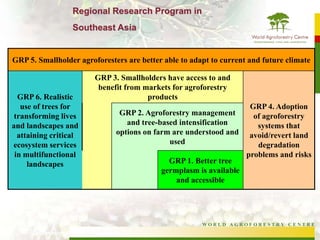
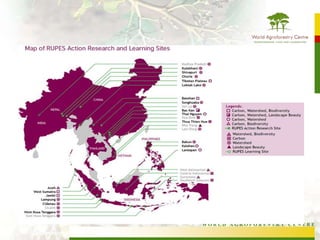
Regional Research Program in Southeast AsiaRegional Research Program in Southeast Asia
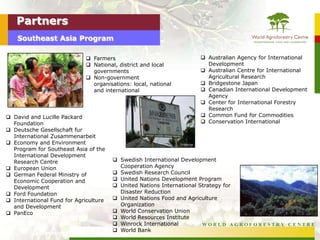
PartnersSoutheast Asia ProgramAustralian Agency for International Development
Australian Centre for International Agricultural Research
Bridgestone Japan
Canadian International Development Agency
Center for International Forestry Research
Common Fund for Commodities
Conservation International
Farmers
National, district and local governments
Non-government organisations: local, national and international
David and Lucille Packard Foundation
Deutsche Gesellschaft fur International Zusammenarbeit
Economy and Environment Program for Southeast Asia of the International Development Research Centre
European Union
German Federal Ministry of Economic Cooperation and Development
Ford Foundation
International Fund for Agriculture and Development
PanEco
Swedish International Development Cooperation Agency
Swedish Research Council
United Nations Development Program
United Nations International Strategy for Disaster Reduction
United Nations Food and Agriculture Organization
World Conservation Union
World Resources Institute

Bot sea presentation final 1

  • 1.
    Where are we?SoutheastAsia Program Southeast AsiaRegional characteristicsBetween 1995 and 2010, Southeast Asia lost 32.8 million ha of its forests and woodlands and 18.2 million ha of its natural exploitable forests, equalling 11% and 14% respectively of the 1995 area.The demands and expectations of lowland capital cities and economic centres for regular flows of clean water from the uplands cannot be realistically met. Inconsistent or contradictory policies and conflicts over rights of use and access are main determinants of unsustainable natural resource management and poverty in the uplands and forest margins. Climate change is a present reality in Southeast Asia; Heat waves, droughts, floods and tropical cyclones have been more intense and frequent, causing extensive damage to property, assets and loss of human life. Smallholder and subsistence farmers are especially vulnerable to the impact of climate change.Such issues play a major role in our agenda.
  • 2.
    Regional Research Programin Southeast AsiaRegional Research Program in Southeast Asia
  • 3.
    PartnersSoutheast Asia ProgramAustralianAgency for International Development
  • 4.
    Australian Centre forInternational Agricultural Research
  • 5.
  • 6.
  • 7.
    Center for InternationalForestry Research
  • 8.
    Common Fund forCommodities
  • 9.
  • 10.
  • 11.
    National, district andlocal governments
  • 12.
    Non-government organisations: local,national and international
  • 13.
    David and LucillePackard Foundation
  • 14.
    Deutsche Gesellschaft furInternational Zusammenarbeit
  • 15.
    Economy and EnvironmentProgram for Southeast Asia of the International Development Research Centre
  • 16.
  • 17.
    German Federal Ministryof Economic Cooperation and Development
  • 18.
  • 19.
    International Fund forAgriculture and Development
  • 20.
  • 21.
  • 22.
  • 23.
  • 24.
    United Nations InternationalStrategy for Disaster Reduction
  • 25.
    United Nations Foodand Agriculture Organization
  • 26.
  • 27.
  • 28.
  • 29.
  • 30.
  • 32.
    Country PrioritiesPhilippines: community-based natural resources management through the Landcare approach, improving farming and governance systems in the uplands, climate-change mitigation and adaptation strategies, and rewards for environmental servicesVietnam: capacity building and partnerships emphasizing research on payments for environmental services, role of trees on farm and landscapes, and agroforestry as a distinct entry point for climate change adaptation and mitigation strategiesChina: research on science bases of biodiversity and carbon assets, trade-offs among different land-use options and national capacity development of the agriculture and forestry sectors. These activities address the country’s environmental problems such as land degradation in dryland ecosystems, effects of climate change and deforestation. Research activities in the Himalayas, Mekong region, and North KoreaThailand: emerging cross-country partnerships and networking relationships among key colleagues and institutions in the region by helping strengthen research, education and information exchange
  • 33.
    Indonesia program longterm priorities Promote agroforestry for increasing farmers welfare as well as for improving environment
  • 34.
    Promote agroforetsry asa strategy for adaptation and mitigation actions.
  • 35.
    Produce high-quality andapplicable policy research to potentially support policy development under the context of sustainable environment and improved livelihood
  • 36.
    Enhancing stakeholder awarenessand technical capacity regarding the production and management of high quality germplasm
  • 37.
    Developing viable modelsfor community trees nurseries
  • 38.
  • 39.
    Understanding smallholder marketingsystems and identifying ways to enhance farmers’ marketing roles
  • 40.
    Assessment viable offarmer associations to expand smallholder markets, livelihoods and incomeKey accomplishments 2010PhilippinesThird national PES conference that brought multistakeholders together and discussed COS, CES, CIS aspects
  • 41.
    Participation in thedrafting of the national REDD+ strategy
  • 42.
    Two major proposalsto US AID approved and funding stabilized
  • 43.
    Development of apro-poor rewards mechanism in Watershed Services and Carbon Sequestration in two RUPES pilot sitesKey accomplishments 2010IndonesiaNational emissions baseline mapping on national carbon stocks
  • 44.
    Technical advice onclimate change to Government of Indonesia thru the Government’s Presidential Working Group Unit on National Strategy on REDD+
  • 45.
    Recommendations to encouragepolicy on recognition of indigenous people and land tenure
  • 46.
    Establishment of REDD+institutions at the sub-national level and increase capacity of local stakeholders
  • 47.
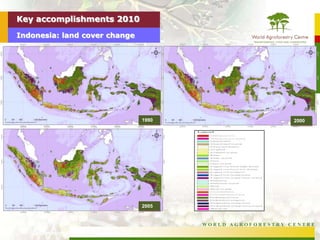
    CAN$ 9 millionproposal to CIDA approved (equivalent to 9.2 million US) for SulawesiKey accomplishments 2010Indonesia: land cover change199020002005
  • 48.
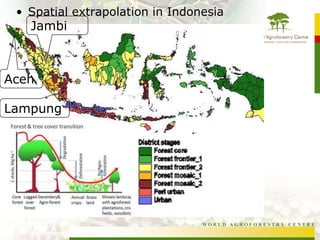
    Spatial extrapolation inIndonesiaJambiAcehLampung
  • 49.
    Key accomplishments 2010VietnamAU$2 million proposal submitted to ACIAR
  • 50.
    Technical advice tothe national emissions reduction strategy
  • 51.
    REALU report onNorthwest Uplands to allow decision makers to account for all emission from a landscape and devise holistic policies and actions
  • 52.
    Studied tree plantingprogram in 3 sites in Vietnam (agro-ecological zone, central uplands and coastal) to advise best methods to improve the quality of Vietnam’s tree nurseries Key accomplishments 2010ChinaEast Asia Node to cover neighboring countries and secure resources and provide ICRAF expertise
  • 53.
    DPR Korea project– pioneering agroforestry systems restoring heavily degraded and sloping landscapes and providing food for people there. From three user groups to 65 user groups in seven counties.
  • 54.
    Graduation of fivelong-term trainers from DPR Korea
  • 55.
    Cooperation in Mongoliafor rangeland carbon finance being discussed
  • 56.
    RUPES worked withnational policy advisors to design a large scale payment for ES targeting nation’s rangelands
  • 57.
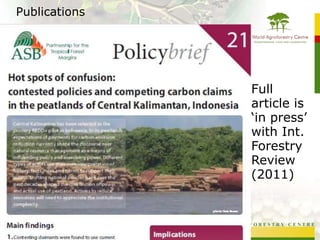
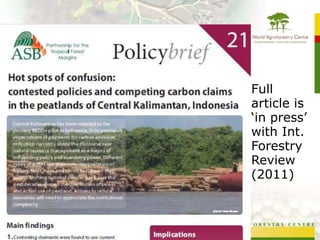
    PublicationsFull article is‘in press’ with Int. Forestry Review (2011)
  • 58.
    Full article is‘in press’ with Int. Forestry Review (2011)
  • 59.
  • 62.
  • 63.
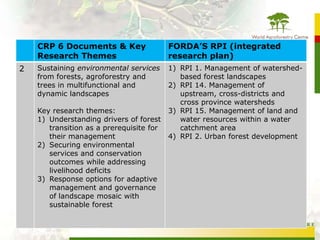
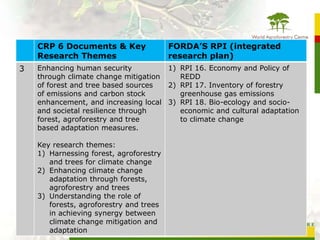
    Engagement Experiences withCRPsWork within SEA relates to CRP 6 (land use changes; environmental services -RUPES, TULSEA tools); REALU work from social sciences perspectiveWith FORDA and RLPS at Ministry of Forestry With CIFOR (and IFPRI) on resource rights, property rights, and gender aspects of CRPs, SEA and China level activities With Asean Forestry R and D group and Korean Forestry Services; ASEAN Social Forestry Network; SEANAFE; IASC With donors and partners (RECOFTC, RRI, ILC)
  • 66.
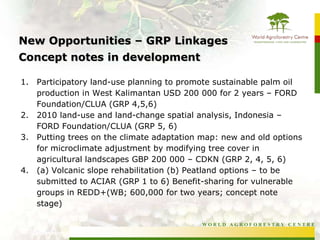
    New Opportunities –GRP LinkagesConcept notes in developmentParticipatory land-use planning to promote sustainable palm oil production in West Kalimantan USD 200 000 for 2 years – FORD Foundation/CLUA (GRP 4,5,6)2010 land-use and land-change spatial analysis, Indonesia – FORD Foundation/CLUA (GRP 5, 6)Putting trees on the climate adaptation map: new and old options for microclimate adjustment by modifying tree cover in agricultural landscapes GBP 200 000 – CDKN (GRP 2, 4, 5, 6)(a) Volcanic slope rehabilitation (b) Peatland options – to be submitted to ACIAR (GRP 1 to 6) Benefit-sharing for vulnerable groups in REDD+(WB; 600,000 for two years; concept note stage)
  • 67.