Fiscal Policy 
The most important instrument of government intervention in 
the economy is fiscal or budgetary policy. 
fiscal policy is essential in the matter of 
 Overcoming Recession or Inflation 
 Promoting and Accelerating Economic Growth. 
1122//1144//1144 1111
‘Fisc’ means State Treasury 
FFiissccaall ppoolliiccyy 
FFiissccaall ppoolliiccyy iiss tthhee ggoovveerrnnmmeenntt pprrooggrraammmmee ooff mmaakkiinngg ddiissccrreettiioonnaarryy 
cchhaannggeess iinn 
 TThhee ppaatttteerrnn aanndd lleevveell ooff iittss eexxppeennddiittuurree,, 
 TTaaxxaattiioonn 
 BBoorrrroowwiinnggss 
TToo AAcchhiieevvee Intended Economic Growth, Employment, Income Equality 
and Stabilization of the Economy on a Growing Path. 
1122//1144//1144 2222
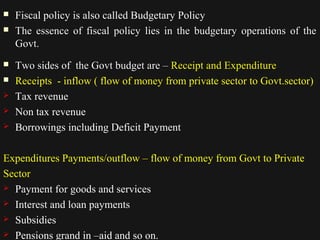
 Fiscal policy is also called Budgetary Policy 
 TThhee eesssseennccee ooff ffiissccaall ppoolliiccyy lliieess iinn tthhee bbuuddggeettaarryy ooppeerraattiioonnss ooff tthhee 
GGoovvtt.. 
 TTwwoo ssiiddeess ooff tthhee GGoovvtt bbuuddggeett aarree –– RReecceeiipptt aanndd EExxppeennddiittuurree 
 Receipts - inflow ( flow of money from private sector to Govt.sector) 
 Tax revenue 
 Non tax revenue 
 Borrowings including Deficit Payment 
Expenditures Payments/outflow – flow of money from Govt to Private 
Sector 
 Payment for goods and services 
 Interest and loan payments 
 Subsidies 
1122//1144//1144 3333 
 Pensions grand in –aid and so on.
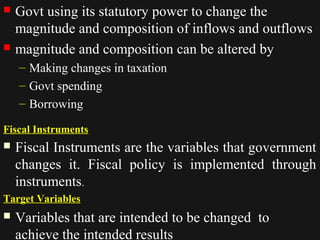
 Govt using its statutory power to change the 
magnitude and composition of inflows and outflows 
 magnitude and composition can be altered by 
– Making changes in taxation 
– Govt spending 
– Borrowing 
Fiscal Instruments 
 Fiscal Instruments are the variables that government 
changes it. Fiscal policy is implemented through 
instruments. 
Target Variables 
 Variables that are intended to be changed to 
1122//1144//1144 4444 
achieve the intended results
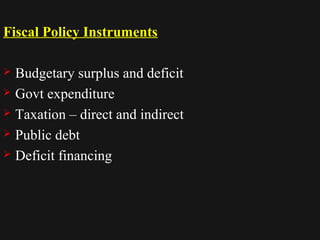
Fiscal Policy Instruments 
 Budgetary surplus and deficit 
 Govt expenditure 
 Taxation – direct and indirect 
 Public debt 
 Deficit financing 
1122//1144//1144 5555
Budgetary Balance Policy 
 Balanced budget – expenses = revenue 
 Deficit budget – Govt.spending> expected revenue 
 Surplus budget - Govt.spending> expected 
revenue 
Balanced, Deficit, Surplus budgets affect the economy 
in different ways and in different directions. 
1122//1144//1144 6666
Govt. Expenditures 
 Govt. expenditures means the sum of public spending on purchase of 
goods and services, public investment, transfer payments 
 Size and composition of GE is a matter of Govt. direction 
 GE is an injection into the economy 
 It adds to the AD (C + I) 
Effect GE depends on 
 Way of Govt. financing 
 Multiplier effect of the GE. 
1122//1144//1144 7777
Taxation 
 Direct – 
• taxes on personal income 
• Corporate income 
• Wealth and property 
 Indirect tax – 
• on production 
• Sale of the goods and services 
1122//1144//1144 8888
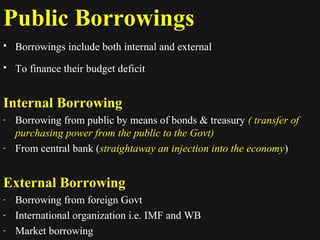
Public Borrowings 
 Borrowings include both internal and external 
 To finance their budget deficit 
Internal Borrowing 
- Borrowing from public by means of bonds & treasury ( transfer of 
purchasing power from the public to the Govt) 
- From central bank (straightaway an injection into the economy) 
External Borrowing 
- Borrowing from foreign Govt 
- International organization i.e. IMF and WB 
1122//1144//1144 9999 
- Market borrowing
Target Variables 
 Disposable income 
 Aggregate Consumption expenditure 
 Savings and investment 
 Imports and exports 
 Level and structure of prices 
1122//1144//1144 11110000
Fiscal Policy and Macroeconomic Goals 
 Fiscal policy for economic growth 
 Fiscal policy for Employment 
 Fiscal policy for Stabilization 
 Fiscal policy for economic equality 
 Fiscal policy for external balances 
1122//1144//1144 11111111
Fiscal Policy and Economic Growth 
 Given the Manpower 
 Technology 
 Natural Resources 
The growth rate of a country depends on the 
 Rate of Savings 
 Investment. 
1122//1144//1144 1122
Therefore fiscal policy in this regard is 
 To create conditions for increase in private savings 
and investment 
 To enhance investment in the public sector. 
To promote savings 
 reducing rate income tax 
 giving tax incentives for savings 
 giving incentives to promote private savings 
 giving concessions to promote private investment 
1122//1144//1144 1133
Incentives/concessions may be one of the following 
 Tax holiday 
 High depreciation allowance 
 Rebate for capacity expansion 
 Investment subsidies 
 Exception of import duties on capital imports 
1122//1144//1144 1144
These measures often prove to be inadequate to 
promote savings and investment due to, 
 Low level of per capita income and high rate of 
MPC 
 A small fraction of population with taxable income 
 Inadequate growth infrastructure and social 
overhead Capital 
Because of these reasons savings and investment may 
inadequate. 
1122//1144//1144 1155
The Government is required, under these conditions to 
play the role of a prime mover 
This requires 
 Expansion of the public sector and 
 Enhancement of the public sector investment. 
To accomplish these things huge amount of resources 
is need. 
1122//1144//1144 1166
Tax is a suitable means of source of income. 
 progressive taxation of personal and cooperate 
income 
 taxation of all kinds of consumer goods 
 taxation of luxury goods at a prohibitive rate 
 imposition of extraordinary high duty on imports of 
consumer goods. 
1122//1144//1144 1177
Fiscal policy for Employment 
According to Keynesian theory of employment 
 All fiscal measures that accelerate the pace of 
economic growth promote employment but 
 This proposition does not hold under all conditions. 
 Developed countries try to maintain full 
employment 
 Developing countries try to create more 
employment opportunities. 
1122//1144//1144 1188
FFiissccaall mmeeaassuurreess sshhoouulldd aacccceelleerraattee 
 Economic growth 
 Promote employment 
Some conditions not increase economic growth 
 Capital intensive or labour saving technology does 
not increase employment 
In this situation Govt. intervene through fiscal policy 
as follows 
 Govt should discourage use of labour – saving 
Technology 
 Encourage 1122//1144//1144 the use of labour absorbing technology 
1199
In this case Govt may take following fiscal measures 
 heavy taxation on capital – intensive good 
 giving subsidization for labour intensive goods 
 heavy duty on imports of capital intensive 
technology 
 Concessions in customs for the import of input for 
labour intensive products 
1122//1144//1144 2200
Fiscal Policy for stabilization 
Fiscal policy for stabilization can take any of the two forms of 
fiscal policy 
 automatic stabilization policy 
 discretionary policy 
 Automatic stabilization policy means adopting a fiscal 
system with built – in flexibility of tax revenue and 
government spending. 
 Built – in flexibility means automatic adjustment in the 
government expenditure and tax revenue in response to rise 
and fall 1122//1144//1144 in GNP. 
2211
Automatic Stabilization Policy 
If GNP increases tax revenue also increases 
 because household income increases 
 no need to government expenditure 
If GNP decreases tax revenue also decreases 
 Because household income decreases 
 So Govt. will increase its expenditures 
1122//1144//1144 2222
Discretionary Fiscal Policy 
It means ad hoc changes – happening when necessary 
and not planned in advance 
So, here Govt. make changes in the 
 level and pattern of taxation 
 size and pattern of govt. expenditures 
 size and composition of public debt 
1122//1144//1144 2233
Fiscal policy for Economic Equity 
 Economic Disparity beyond a level is socially, 
economically and politically undesirable. 
 Both taxation and expenditure measures are 
used to reduce income and wealth gap between 
the rich and poor…… 
1122//1144//1144 2244
Fiscal Policy – Tax Measures 
 Taxation on personal income 
 corporate income at progressive rate 
 Imposition of wealth and property tax 
 Taxation of high price and luxury goods at 
higher rate 
1122//1144//1144 2255
Fiscal Policy – Govt. Expenditures 
 Spending on projects which increase the earning 
capacity of the lower income people 
Ex: Free Education , Medical Facilities 
 Reallocating capital expenditures to enhance 
employment opportunities for unemployed and 
under employed people. 
1122//1144//1144 2266
Fiscal Policy – Govt. Expenditures 
 Financial aid for unemployed people for their self – 
employment 
 Giving unemployed relief and unemployment 
insurance. 
1122//1144//1144 2277
Tax and expenditure measures make two – way attack on 
economic disparity. 
Tax measures limit the growth of incomes in th high – income 
groups and transfer a part of rich people’s income to the 
Govt. treasury 
Which enhances government resources to help poor 
Expenditures increase incomes in low-income groups 
1122//1144//1144 2288
Fiscal policy for External Balances 
 External imbalances arise - when external 
payment obligations exceed the foreign exchange 
earnings. 
 This gap arises mainly due to decreasing trade 
balance or current account deficits 
 Current account deficit increase mainly due to he 
widening gap between imports and exports 
1122//1144//1144 2299
Tax policy can be used as an effective tool of 
resorting the external balance. 
 Imposition of heavy import duty – especially 
on the import of consumer goods 
 Subsidization of exports 
 These measures work efficiently only when 
both imports and exports are price – elastic 
 In the absence of a high – price elasticity, 
these measures may not work 
1122//1144//1144 3300
Kinds of Fiscal Policy 
Variety of fiscal policies have been suggested by the 
economists and used by the policy makers in different 
countries under different circumstances to achieve 
specific macroeconomic goals. 
 Automatic Stabilization Fiscal policy 
 Compensatory Fiscal Policy 
 Discretionary Fiscal Policy 
1122//1144//1144 3311
Automatic Stabilization Fiscal policy 
Automatic stabilization policy means adopting a fiscal 
system with built – in flexibility of tax revenue and 
government spending. 
Built – in flexibility means automatic adjustment in 
the government expenditure and tax revenue in 
response to rise and fall in GNP. 
1122//1144//1144 3322
 Tax revenue increases and government 
expenditure decreases automatically, with an 
increase in GNP 
 Tax revenue decreases and government 
expenditure increases automatically, with an 
decrease in GNP 
1122//1144//1144 3333
Compensatory Fiscal Policy 
 Compensatory Fiscal Policy is deliberate 
budgetary action taken by the government to 
compensate for the deficiency in aggregate 
demand and excess of aggregate demand. 
 During the period of depression – the Govt is 
required to boost up the aggregate demand 
 The government compensatory fiscal actions may 
be – reduction in tax and increase in 
Govt.expenditure. 
1122//1144//1144 3344
This kind of fiscal action (Deficit budgeting) 
increases AD 
 AD leads first to the rise in price level 
 It adds to the producer’s profit without any 
increase in costs. 
 This creates an optimistic environment 
 So opportunity and incentives to invest increases 
 This push up the level of employment and output 
1122//1144//1144 3355
 During the period of high rate of inflation 
surplus budgeting policy is adopted. 
 Inflation is caused by excessive demand 
 So Govt. lowers the expenditure level 
 Increase the tax level 
 Higher taxes reduces the disposable income as 
result aggregate demand decreases 
 Further, cut in the Govt. expenditure reduces the 
AD 
 Therefore, two side attack on the AD helps 
reducing the demand pressure and thereby, the 
inflation. 
1122//1144//1144 3366
Discretionary Fiscal Policy 
 Ad hoc changes in the Govt. expenditure and 
taxation System 
 In Discretionary Fiscal Policy, the Govt. makes 
deliberate changes in 
Level and pattern of taxation 
Size and pattern of its expenditure 
Size and composition of public debt. 
 The discretionary changes in these fiscal instruments 
are made with the view to achieving certain specific 
objectives. 
1122//1144//1144 3377
During recession/depression period Fiscal Policy helps to 
increase demand 
 Govt increase its expenditures 
 Spending more on public works to increase employment 
 Increase subsidies to producers of consumer goods 
 Lowering tax to stimulate consumption and investment 
During period of inflation Fiscal Policy helps to 
Reduce demand 
 Govt reduce its own expenditures 
 Reducing private investment by imposing tax – 
consumption or investment. 
1122//1144//1144 33338888

3.fiscal policy

  • 1.
    Fiscal Policy Themost important instrument of government intervention in the economy is fiscal or budgetary policy. fiscal policy is essential in the matter of  Overcoming Recession or Inflation  Promoting and Accelerating Economic Growth. 1122//1144//1144 1111
  • 2.
    ‘Fisc’ means StateTreasury FFiissccaall ppoolliiccyy FFiissccaall ppoolliiccyy iiss tthhee ggoovveerrnnmmeenntt pprrooggrraammmmee ooff mmaakkiinngg ddiissccrreettiioonnaarryy cchhaannggeess iinn  TThhee ppaatttteerrnn aanndd lleevveell ooff iittss eexxppeennddiittuurree,,  TTaaxxaattiioonn  BBoorrrroowwiinnggss TToo AAcchhiieevvee Intended Economic Growth, Employment, Income Equality and Stabilization of the Economy on a Growing Path. 1122//1144//1144 2222
  • 3.
     Fiscal policyis also called Budgetary Policy  TThhee eesssseennccee ooff ffiissccaall ppoolliiccyy lliieess iinn tthhee bbuuddggeettaarryy ooppeerraattiioonnss ooff tthhee GGoovvtt..  TTwwoo ssiiddeess ooff tthhee GGoovvtt bbuuddggeett aarree –– RReecceeiipptt aanndd EExxppeennddiittuurree  Receipts - inflow ( flow of money from private sector to Govt.sector)  Tax revenue  Non tax revenue  Borrowings including Deficit Payment Expenditures Payments/outflow – flow of money from Govt to Private Sector  Payment for goods and services  Interest and loan payments  Subsidies 1122//1144//1144 3333  Pensions grand in –aid and so on.
  • 4.
     Govt usingits statutory power to change the magnitude and composition of inflows and outflows  magnitude and composition can be altered by – Making changes in taxation – Govt spending – Borrowing Fiscal Instruments  Fiscal Instruments are the variables that government changes it. Fiscal policy is implemented through instruments. Target Variables  Variables that are intended to be changed to 1122//1144//1144 4444 achieve the intended results
  • 5.
    Fiscal Policy Instruments  Budgetary surplus and deficit  Govt expenditure  Taxation – direct and indirect  Public debt  Deficit financing 1122//1144//1144 5555
  • 6.
    Budgetary Balance Policy  Balanced budget – expenses = revenue  Deficit budget – Govt.spending> expected revenue  Surplus budget - Govt.spending> expected revenue Balanced, Deficit, Surplus budgets affect the economy in different ways and in different directions. 1122//1144//1144 6666
  • 7.
    Govt. Expenditures Govt. expenditures means the sum of public spending on purchase of goods and services, public investment, transfer payments  Size and composition of GE is a matter of Govt. direction  GE is an injection into the economy  It adds to the AD (C + I) Effect GE depends on  Way of Govt. financing  Multiplier effect of the GE. 1122//1144//1144 7777
  • 8.
    Taxation  Direct– • taxes on personal income • Corporate income • Wealth and property  Indirect tax – • on production • Sale of the goods and services 1122//1144//1144 8888
  • 9.
    Public Borrowings Borrowings include both internal and external  To finance their budget deficit Internal Borrowing - Borrowing from public by means of bonds & treasury ( transfer of purchasing power from the public to the Govt) - From central bank (straightaway an injection into the economy) External Borrowing - Borrowing from foreign Govt - International organization i.e. IMF and WB 1122//1144//1144 9999 - Market borrowing
  • 10.
    Target Variables Disposable income  Aggregate Consumption expenditure  Savings and investment  Imports and exports  Level and structure of prices 1122//1144//1144 11110000
  • 11.
    Fiscal Policy andMacroeconomic Goals  Fiscal policy for economic growth  Fiscal policy for Employment  Fiscal policy for Stabilization  Fiscal policy for economic equality  Fiscal policy for external balances 1122//1144//1144 11111111
  • 12.
    Fiscal Policy andEconomic Growth  Given the Manpower  Technology  Natural Resources The growth rate of a country depends on the  Rate of Savings  Investment. 1122//1144//1144 1122
  • 13.
    Therefore fiscal policyin this regard is  To create conditions for increase in private savings and investment  To enhance investment in the public sector. To promote savings  reducing rate income tax  giving tax incentives for savings  giving incentives to promote private savings  giving concessions to promote private investment 1122//1144//1144 1133
  • 14.
    Incentives/concessions may beone of the following  Tax holiday  High depreciation allowance  Rebate for capacity expansion  Investment subsidies  Exception of import duties on capital imports 1122//1144//1144 1144
  • 15.
    These measures oftenprove to be inadequate to promote savings and investment due to,  Low level of per capita income and high rate of MPC  A small fraction of population with taxable income  Inadequate growth infrastructure and social overhead Capital Because of these reasons savings and investment may inadequate. 1122//1144//1144 1155
  • 16.
    The Government isrequired, under these conditions to play the role of a prime mover This requires  Expansion of the public sector and  Enhancement of the public sector investment. To accomplish these things huge amount of resources is need. 1122//1144//1144 1166
  • 17.
    Tax is asuitable means of source of income.  progressive taxation of personal and cooperate income  taxation of all kinds of consumer goods  taxation of luxury goods at a prohibitive rate  imposition of extraordinary high duty on imports of consumer goods. 1122//1144//1144 1177
  • 18.
    Fiscal policy forEmployment According to Keynesian theory of employment  All fiscal measures that accelerate the pace of economic growth promote employment but  This proposition does not hold under all conditions.  Developed countries try to maintain full employment  Developing countries try to create more employment opportunities. 1122//1144//1144 1188
  • 19.
    FFiissccaall mmeeaassuurreess sshhoouullddaacccceelleerraattee  Economic growth  Promote employment Some conditions not increase economic growth  Capital intensive or labour saving technology does not increase employment In this situation Govt. intervene through fiscal policy as follows  Govt should discourage use of labour – saving Technology  Encourage 1122//1144//1144 the use of labour absorbing technology 1199
  • 20.
    In this caseGovt may take following fiscal measures  heavy taxation on capital – intensive good  giving subsidization for labour intensive goods  heavy duty on imports of capital intensive technology  Concessions in customs for the import of input for labour intensive products 1122//1144//1144 2200
  • 21.
    Fiscal Policy forstabilization Fiscal policy for stabilization can take any of the two forms of fiscal policy  automatic stabilization policy  discretionary policy  Automatic stabilization policy means adopting a fiscal system with built – in flexibility of tax revenue and government spending.  Built – in flexibility means automatic adjustment in the government expenditure and tax revenue in response to rise and fall 1122//1144//1144 in GNP. 2211
  • 22.
    Automatic Stabilization Policy If GNP increases tax revenue also increases  because household income increases  no need to government expenditure If GNP decreases tax revenue also decreases  Because household income decreases  So Govt. will increase its expenditures 1122//1144//1144 2222
  • 23.
    Discretionary Fiscal Policy It means ad hoc changes – happening when necessary and not planned in advance So, here Govt. make changes in the  level and pattern of taxation  size and pattern of govt. expenditures  size and composition of public debt 1122//1144//1144 2233
  • 24.
    Fiscal policy forEconomic Equity  Economic Disparity beyond a level is socially, economically and politically undesirable.  Both taxation and expenditure measures are used to reduce income and wealth gap between the rich and poor…… 1122//1144//1144 2244
  • 25.
    Fiscal Policy –Tax Measures  Taxation on personal income  corporate income at progressive rate  Imposition of wealth and property tax  Taxation of high price and luxury goods at higher rate 1122//1144//1144 2255
  • 26.
    Fiscal Policy –Govt. Expenditures  Spending on projects which increase the earning capacity of the lower income people Ex: Free Education , Medical Facilities  Reallocating capital expenditures to enhance employment opportunities for unemployed and under employed people. 1122//1144//1144 2266
  • 27.
    Fiscal Policy –Govt. Expenditures  Financial aid for unemployed people for their self – employment  Giving unemployed relief and unemployment insurance. 1122//1144//1144 2277
  • 28.
    Tax and expendituremeasures make two – way attack on economic disparity. Tax measures limit the growth of incomes in th high – income groups and transfer a part of rich people’s income to the Govt. treasury Which enhances government resources to help poor Expenditures increase incomes in low-income groups 1122//1144//1144 2288
  • 29.
    Fiscal policy forExternal Balances  External imbalances arise - when external payment obligations exceed the foreign exchange earnings.  This gap arises mainly due to decreasing trade balance or current account deficits  Current account deficit increase mainly due to he widening gap between imports and exports 1122//1144//1144 2299
  • 30.
    Tax policy canbe used as an effective tool of resorting the external balance.  Imposition of heavy import duty – especially on the import of consumer goods  Subsidization of exports  These measures work efficiently only when both imports and exports are price – elastic  In the absence of a high – price elasticity, these measures may not work 1122//1144//1144 3300
  • 31.
    Kinds of FiscalPolicy Variety of fiscal policies have been suggested by the economists and used by the policy makers in different countries under different circumstances to achieve specific macroeconomic goals.  Automatic Stabilization Fiscal policy  Compensatory Fiscal Policy  Discretionary Fiscal Policy 1122//1144//1144 3311
  • 32.
    Automatic Stabilization Fiscalpolicy Automatic stabilization policy means adopting a fiscal system with built – in flexibility of tax revenue and government spending. Built – in flexibility means automatic adjustment in the government expenditure and tax revenue in response to rise and fall in GNP. 1122//1144//1144 3322
  • 33.
     Tax revenueincreases and government expenditure decreases automatically, with an increase in GNP  Tax revenue decreases and government expenditure increases automatically, with an decrease in GNP 1122//1144//1144 3333
  • 34.
    Compensatory Fiscal Policy  Compensatory Fiscal Policy is deliberate budgetary action taken by the government to compensate for the deficiency in aggregate demand and excess of aggregate demand.  During the period of depression – the Govt is required to boost up the aggregate demand  The government compensatory fiscal actions may be – reduction in tax and increase in Govt.expenditure. 1122//1144//1144 3344
  • 35.
    This kind offiscal action (Deficit budgeting) increases AD  AD leads first to the rise in price level  It adds to the producer’s profit without any increase in costs.  This creates an optimistic environment  So opportunity and incentives to invest increases  This push up the level of employment and output 1122//1144//1144 3355
  • 36.
     During theperiod of high rate of inflation surplus budgeting policy is adopted.  Inflation is caused by excessive demand  So Govt. lowers the expenditure level  Increase the tax level  Higher taxes reduces the disposable income as result aggregate demand decreases  Further, cut in the Govt. expenditure reduces the AD  Therefore, two side attack on the AD helps reducing the demand pressure and thereby, the inflation. 1122//1144//1144 3366
  • 37.
    Discretionary Fiscal Policy  Ad hoc changes in the Govt. expenditure and taxation System  In Discretionary Fiscal Policy, the Govt. makes deliberate changes in Level and pattern of taxation Size and pattern of its expenditure Size and composition of public debt.  The discretionary changes in these fiscal instruments are made with the view to achieving certain specific objectives. 1122//1144//1144 3377
  • 38.
    During recession/depression periodFiscal Policy helps to increase demand  Govt increase its expenditures  Spending more on public works to increase employment  Increase subsidies to producers of consumer goods  Lowering tax to stimulate consumption and investment During period of inflation Fiscal Policy helps to Reduce demand  Govt reduce its own expenditures  Reducing private investment by imposing tax – consumption or investment. 1122//1144//1144 33338888