LatinMacroWatch  Special Analysis LMW: the Big Picture on a Small Screen A new RES feature
October 23 rd , 2002 Between Financial Distress and Lackluster Performance:  A Regional Assessment Prepared for presentation at The World Bank,  Washington , DC
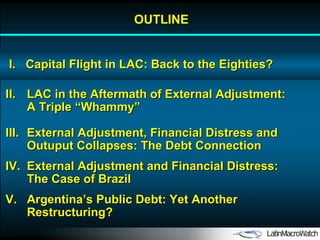
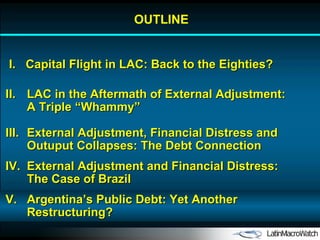
OUTLINE I.  Capital Flight in LAC: Back to the Eighties? II. LAC in the Aftermath of External Adjustment: A Triple “Whammy” IV. External Adjustment and Financial Distress: The Case of Brazil V. Argentina’s Public Debt: Yet Another Restructuring? III. External Adjustment, Financial Distress and Outuput Collapses: The Debt Connection
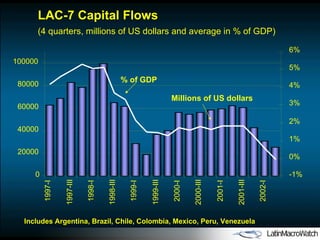
LAC-7 Capital Flows (4 quarters, millions of US dollars and average in % of GDP) Includes Argentina, Brazil, Chile, Colombia, Mexico, Peru, Venezuela 0 20000 40000 60000 80000 100000 1997-I 1997-III 1998-I 1998-III 1999-I 1999-III 2000-I 2000-III 2001-I 2001-III 2002-I -1% 0% 1% 2% 3% 4% 5% 6% Millions of US dollars % of GDP
LAC-7 Foreign Direct Investment (4 quarters, millions of US dollars and average in % of GDP) Includes Argentina, Brazil, Chile, Colombia, Mexico, Peru, Venezuela 0 10000 20000 30000 40000 50000 60000 70000 80000 1997-I 1997-III 1998-I 1998-III 1999-I 1999-III 2000-I 2000-III 2001-I 2001-III 2002-I 1.5% 2.0% 2.5% 3.0% 3.5% 4.0% 4.5% 5.0% Millions of US dollars % of GDP
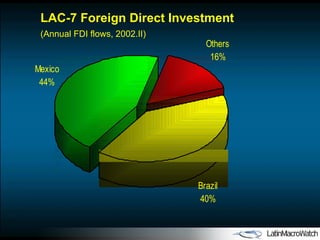
LAC-7 Foreign Direct Investment (Annual FDI flows, 2002.II)
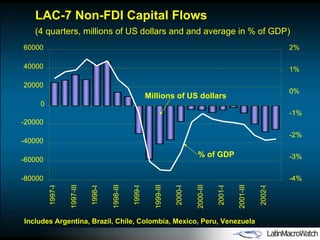
LAC-7 Non-FDI Capital Flows (4 quarters, millions of US dollars and and average in % of GDP) Includes Argentina, Brazil, Chile, Colombia, Mexico, Peru, Venezuela -80000 -60000 -40000 -20000 0 20000 40000 60000 1997-I 1997-III 1998-I 1998-III 1999-I 1999-III 2000-I 2000-III 2001-I 2001-III 2002-I -4% -3% -2% -1% 0% 1% 2% Millions of US dollars % of GDP
Financial Flows to LAC: Back to the Eigthies? (Billions of real US dollars of May 2002, deflated by US CPI) -60 -40 -20 0 20 40 60 80 1971 1973 1975 1977 1979 1981 1983 1985 1987 1989 1991 1993 1995 1997 1999 2001
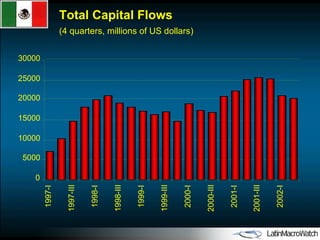
0 5000 10000 15000 20000 25000 30000 1997-I 1997-III 1998-I 1998-III 1999-I 1999-III 2000-I 2000-III 2001-I 2001-III 2002-I Total Capital Flows  (4 quarters, millions of US dollars)
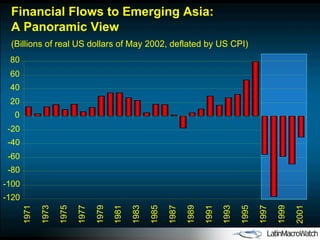
Financial Flows to Emerging Asia: A Panoramic View (Billions of real US dollars of May 2002, deflated by US CPI) -120 -100 -80 -60 -40 -20 0 20 40 60 80 1971 1973 1975 1977 1979 1981 1983 1985 1987 1989 1991 1993 1995 1997 1999 2001
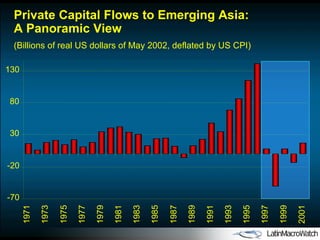
Private Capital Flows to Emerging Asia: A Panoramic View (Billions of real US dollars of May 2002, deflated by US CPI) -70 -20 30 80 130 1971 1973 1975 1977 1979 1981 1983 1985 1987 1989 1991 1993 1995 1997 1999 2001
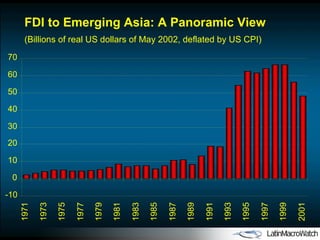
FDI to Emerging Asia: A Panoramic View (Billions of real US dollars of May 2002, deflated by US CPI) -10 0 10 20 30 40 50 60 70 1971 1973 1975 1977 1979 1981 1983 1985 1987 1989 1991 1993 1995 1997 1999 2001
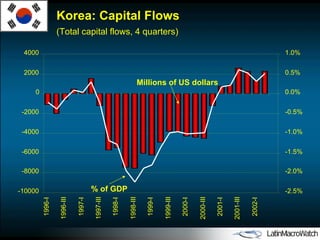
Korea: Capital Flows  (Total capital flows, 4 quarters) -10000 -8000 -6000 -4000 -2000 0 2000 4000 1996-I 1996-III 1997-I 1997-III 1998-I 1998-III 1999-I 1999-III 2000-I 2000-III 2001-I 2001-III 2002-I -2.5% -2.0% -1.5% -1.0% -0.5% 0.0% 0.5% 1.0% Millions of US dollars % of GDP
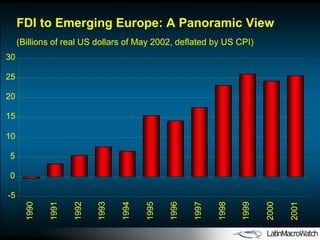
FDI to Emerging Europe: A Panoramic View  (Billions of real US dollars of May 2002, deflated by US CPI) -5 0 5 10 15 20 25 30 1990 1991 1992 1993 1994 1995 1996 1997 1998 1999 2000 2001
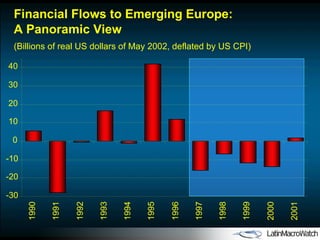
Financial Flows to Emerging Europe:  A Panoramic View  (Billions of real US dollars of May 2002, deflated by US CPI) -30 -20 -10 0 10 20 30 40 1990 1991 1992 1993 1994 1995 1996 1997 1998 1999 2000 2001
OUTLINE I.  Capital Flight in LAC: Back to the Eighties? II. LAC in the Aftermath of External Adjustment: A Triple “Whammy” IV. External Adjustment and Financial Distress: The Case of Brazil V. Argentina’s Public Debt: Yet Another Restructuring? III. External Adjustment, Financial Distress and Outuput Collapses: The Debt Connection
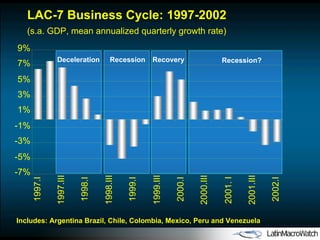
LAC-7 Business Cycle: 1997-2002 (s.a. GDP, mean annualized quarterly growth rate) Includes: Argentina Brazil, Chile, Colombia, Mexico, Peru and Venezuela Deceleration Recession Recovery Recession? -7% -5% -3% -1% 1% 3% 5% 7% 9% 1997.I 1997.III 1998.I 1998.III 1999.I 1999.III 2000.I 2000.III 2001. I 2001.III 2002.I
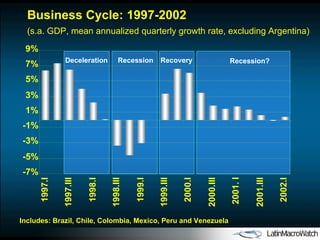
Business Cycle: 1997-2002 (s.a. GDP, mean annualized quarterly growth rate, excluding Argentina) Deceleration Recession Recovery Recession? -7% -5% -3% -1% 1% 3% 5% 7% 9% 1997.I 1997.III 1998.I 1998.III 1999.I 1999.III 2000.I 2000.III 2001. I 2001.III 2002.I Includes: Brazil, Chile, Colombia, Mexico, Peru and Venezuela
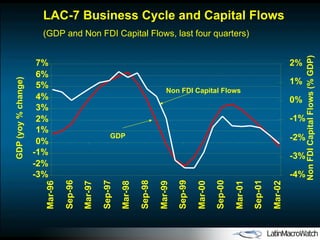
LAC-7 Business Cycle and Capital Flows  (GDP and Non FDI Capital Flows, last four quarters) -3% -2% -1% 0% 1% 2% 3% 4% 5% 6% 7% Mar-96 Sep-96 Mar-97 Sep-97 Mar-98 Sep-98 Mar-99 Sep-99 Mar-00 Sep-00 Mar-01 Sep-01 Mar-02 GDP (yoy % change) -4% -3% -2% -1% 0% 1% 2% Non FDI Capital Flows (% GDP) GDP  Non FDI Capital Flows
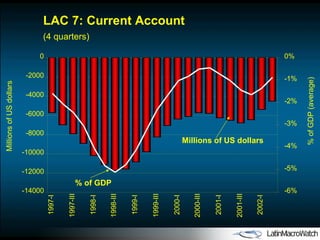
-14000 -12000 -10000 -8000 -6000 -4000 -2000 0 1997-I 1997-III 1998-I 1998-III 1999-I 1999-III 2000-I 2000-III 2001-I 2001-III 2002-I -6% -5% -4% -3% -2% -1% 0% LAC 7: Current Account  (4 quarters) Millions of US dollars  % of GDP (average) Millions of US dollars % of GDP
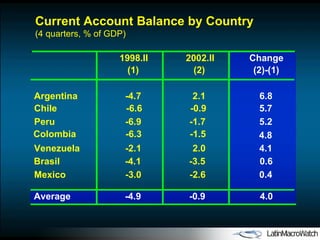
4.8 1998.II 200 2 . II Change (1) (2) (2)-(1) Venezuela 2.0 4.1 -2.1 Colombia  -1.5 -6.3 Argentina 2.1 6.8 -4.7 Average -4.9 -0.9 4.0 Current Account Balance by Country (4 quarters, % of GDP) Chile -0.9 5.7 -6.6 Peru -1.7 5.2 -6.9 Mexico -2.6 0.4 -3.0 Bra s il -4.1 -3.5 0.6
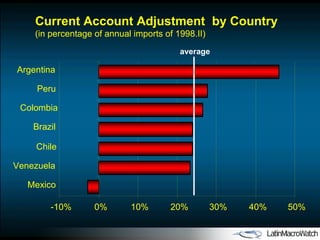
Current Account Adjustment  by Country (in percentage of annual imports of 1998.II) -10% 0% 10% 20% 30% 40% 50% Mexico Venezuela Chile Brazil Colombia Peru Argentina average
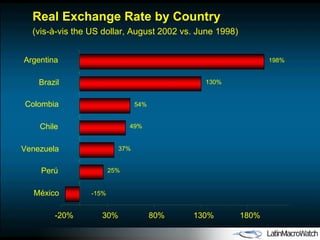
Real Exchange Rate by Country (vis-à-vis the US dollar, August 2002 vs. June 1998) 25% 37% 49% 54% 130% 198% -15% -20% 30% 80% 130% 180% México Perú Venezuela Chile Colombia Brazil Argentina
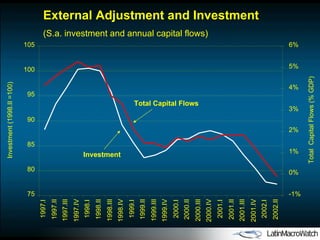
75 80 85 90 95 100 105 1997.I 1997.II 1997.III 1997.IV 1998.I 1998.II 1998.III 1998.IV 1999.I 1999.II 1999.III 1999.IV 2000.I 2000.II 2000.III 2000.IV 2001.I 2001.II 2001.III 2001.IV 2002.I 2002.II -1% 0% 1% 2% 3% 4% 5% 6% External Adjustment and Investment  (S.a. investment and annual capital flows) Investment  Total Capital Flows Investment (1998.II =100) Total  Ca pital Flows (% GDP)
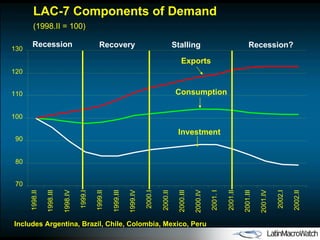
70 80 90 100 110 120 130 1998.II 1998.III 1998.IV 1999.I 1999.II 1999.III 1999.IV 2000.I 2000.II 2000.III 2000.IV 2001. I 2001.II 2001.III 2001.IV 2002.I 2002.II Exports Consumption Investment Recession Stalling Recovery LAC-7 Components of Demand (1998.II = 100) Includes Argentina, Brazil, Chile, Colombia, Mexico, Peru Recession?
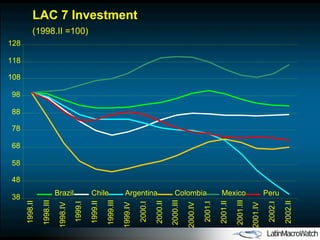
LAC 7 Investment  (1998.II =100) 38 48 58 68 78 88 98 108 118 128 1998.II 1998.III 1998.IV 1999.I 1999.II 1999.III 1999.IV 2000.I 2000.II 2000.III 2000.IV 2001.I 2001.II 2001.III 2001.IV 2002.I 2002.II Brazil Chile Argentina Colombia Mexico Peru
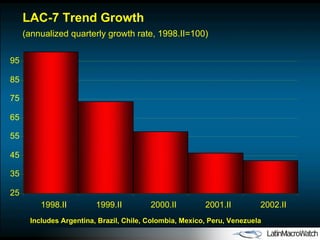
LAC-7 Trend Growth (annualized quarterly growth rate, 1998.II=100) Includes Argentina, Brazil, Chile, Colombia, Mexico, Peru, Venezuela 25 35 45 55 65 75 85 95 1998.II 1999.II 2000.II 2001.II 2002.II
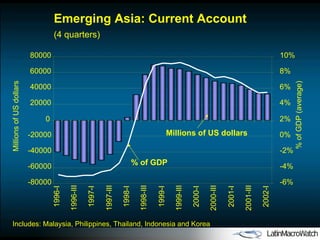
Emerging Asia: Current Account  (4 quarters) Includes: Malaysia, Philippines, Thailand, Indonesia and Korea -80000 -60000 -40000 -20000 0 20000 40000 60000 80000 1996-I 1996-III 1997-I 1997-III 1998-I 1998-III 1999-I 1999-III 2000-I 2000-III 2001-I 2001-III 2002-I Millions of US dollars  -6% -4% -2% 0% 2% 4% 6% 8% 10% % of GDP (average) Millions of US dollars % of GDP
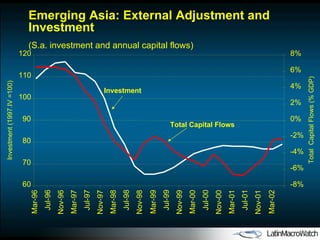
60 70 80 90 100 110 120 Mar-96 Jul-96 Nov-96 Mar-97 Jul-97 Nov-97 Mar-98 Jul-98 Nov-98 Mar-99 Jul-99 Nov-99 Mar-00 Jul-00 Nov-00 Mar-01 Jul-01 Nov-01 Mar-02 -8% -6% -4% -2% 0% 2% 4% 6% 8% Emerging Asia: External Adjustment and Investment  (S.a. investment and annual capital flows) Investment  Total Capital Flows Investment (1997.IV =100) Total  Ca pital Flows (% GDP)
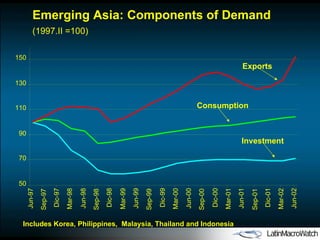
50 70 90 110 130 150 Jun-97 Sep-97 Dic-97 Mar-98 Jun-98 Sep-98 Dic-98 Mar-99 Jun-99 Sep-99 Dic-99 Mar-00 Jun-00 Sep-00 Dic-00 Mar-01 Jun-01 Sep-01 Dic-01 Mar-02 Jun-02 Emerging Asia: Components of Demand  (1997.II =100) Exports Consumption Investment Includes Korea, Philippines,  Malaysia, Thailand and Indonesia
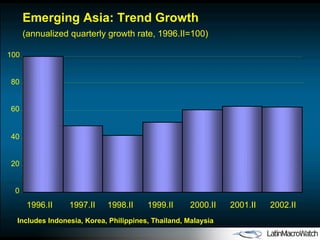
Emerging Asia: Trend Growth (annualized quarterly growth rate, 1996.II=100) Includes Indonesia, Korea, Philippines, Thailand, Malaysia 1998.II 1999.II 2000.II 2001.II 2002.II 199 7 .II 199 6 .II 0 20 40 60 80 100
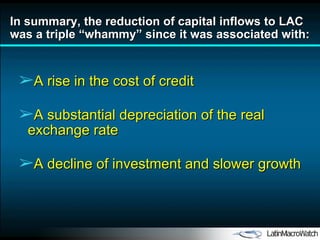
In  s ummary ,  the reduction of capital inflows  to LAC  was a triple  “ whammy ” since it was associated with: A rise in the cost of credit A substantial depreciation of the real exchange rate A decline of investment and slower growth
OUTLINE I.  Capital Flight in LAC: Back to the Eighties? II. LAC in the Aftermath of External Adjustment: A Triple “Whammy” IV. External Adjustment and Financial Distress: The Case of Brazil V. Argentina’s Public Debt: Yet Another Restructuring? III. External Adjustment, Financial Distress and Outuput Collapses: The Debt Connection
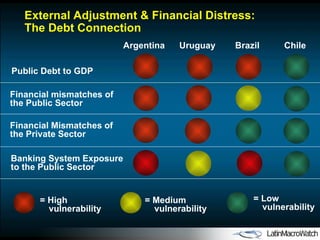
External Adjustment & Financial Distress:  The Debt Connection  Brazil Chile Argentina Uruguay Financial Mismatches of the Private Sector = High vulnerability = Medium vulnerability = Low vulnerability Financial mismatches of the Public Sector  Public Debt to GDP  Banking System Exposure to the Public Sector
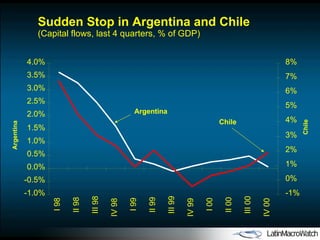
Sudden Stop in Argentina and Chile (Capital flows, last 4 quarters, % of GDP) -1.0% -0.5% 0.0% 0.5% 1.0% 1.5% 2.0% 2.5% 3.0% 3.5% 4.0% I 98 II 98 III 98 IV 98 I 99 II 99 III 99 IV 99 I 00 II 00 III 00 IV 00 -1% 0% 1% 2% 3% 4% 5% 6% 7% 8% Argentina Chile Argentina Chile
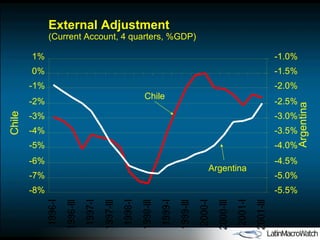
External Adjustment (Current Account, 4 quarters, %GDP) -8% -7% -6% -5% -4% -3% -2% -1% 0% 1% Chile -5.5% -5.0% -4.5% -4.0% -3.5% -3.0% -2.5% -2.0% -1.5% -1.0% Argentina Argentina Chile
Contraction and Recovery: GDP and Investment (s.a., 1998.II=100) GDP Investment 80 85 90 95 100 105 110 1998.II 1998.IV 1999.II 1999.IV 2000.II 2000.IV 2001.II 2001.IV 2002.II 35 45 55 65 75 85 95 1998.II 1998.IV 1999.II 1999.IV 2000.II 2000.IV 2001.II 2001.IV 2002.II Beginning of bank run in Argentina Chile Argentina Chile Argentina
Sudden Stop and the Real Exchange Rate Required % change in RER to eliminate the CAD 25 30 35 40 45 50 55 60 Chile Argentina Source:  Calvo, Izquierdo, Talvi (2002) 32.4 46.2 379 178 100 150 200 250 300 350 400 450 Chile Argentina Relative Openness, 1998 (External Debt to Exports Ratio)
Fiscal Sustainability in Argentina after the Sudden Stop in 1998 Debt to GDP ratio (%) Req. Prim. Surplus Adjust.   (a)  Baseline 36.5 0 .3 (b)  Change in Relative Prices to  close the CA deficit (RER depreciation of 46,2%) 49.7 0.7 (c) : (b) + 200  BPS Increase in  Real  Interest Rate  49.7 1.7 (d): (c) + 1% Reduction in  GDP growth 49.7 2.2 (e): (d) + Contingent Liabilities 58.6 2.7 Source:  Calvo, Izquierdo, Talvi (2002) Note:  The observed primary surplus for 1998 was 0.9 percent of GDP.  The baseline scenario  assumes a long run rate of growth of 3,8% and a 7,1% interest rate 25.6 45.4 66.0 71.7 75.9 Debt Reduction(%)
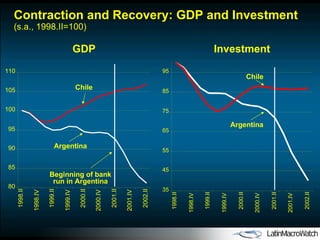
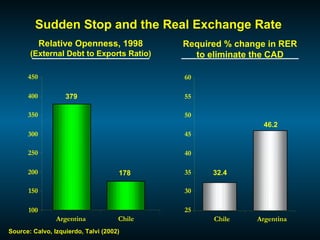
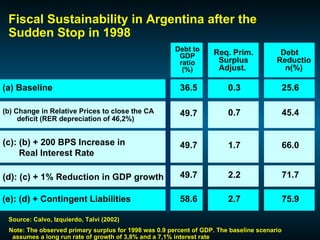
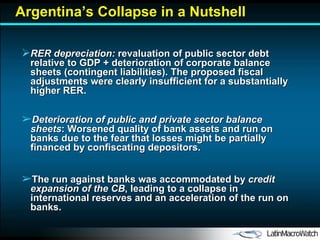
Argentina ’s Collapse in a Nutshell RER depreciation:  revaluation of public sector debt relative to GDP + deterioration of corporate balance sheets (contingent liabilities). The proposed fiscal adjustments were clearly insufficient for a substantially higher RER. Deterioration of public and private sector balance sheets : Worsened quality of bank assets and run on banks due to the fear that losses might be partially financed by confiscating depositors. The run against banks was accommodated by  credit expansion of the CB , leading to a collapse in international reserves and an acceleration of the run on banks.
OUTLINE I.  Capital Flight in LAC: Back to the Eighties? II. LAC in the Aftermath of External Adjustment: A Triple “Whammy” IV. External Adjustment and Financial Distress: The Case of Brazil V. Argentina’s Public Debt: Yet Another Restructuring? III. External Adjustment, Financial Distress and Outuput Collapses: The Debt Connection
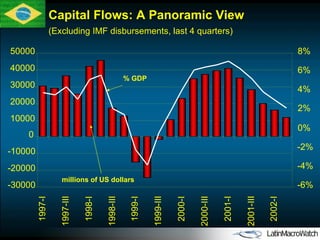
-30000 -20000 -10000 0 10000 20000 30000 40000 50000 1997-I 1997-III 1998-I 1998-III 1999-I 1999-III 2000-I 2000-III 2001-I 2001-III 2002-I -6% -4% -2% 0% 2% 4% 6% 8% % GDP millions of US dollars Capital Flows: A Panoramic View  (Excluding IMF disbursements, last 4 quarters)
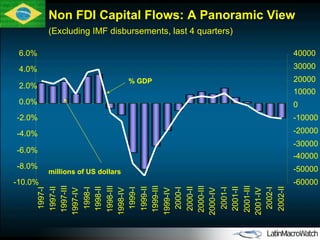
Non FDI Capital Flows: A Panoramic View  (Excluding IMF disbursements, last 4 quarters) -10.0% -8.0% -6.0% -4.0% -2.0% 0.0% 2.0% 4.0% 6.0% 1997-I 1997-II 1997-III 1997-IV 1998-I 1998-II 1998-III 1998-IV 1999-I 1999-II 1999-III 1999-IV 2000-I 2000-II 2000-III 2000-IV 2001-I 2001-II 2001-III 2001-IV 2002-I 2002-II -60000 -50000 -40000 -30000 -20000 -10000 0 10000 20000 30000 40000 % GDP millions of US dollars
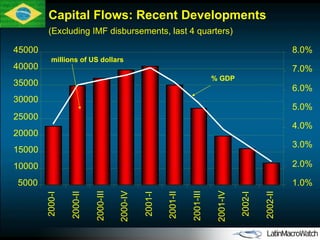
5000 10000 15000 20000 25000 30000 35000 40000 45000 2000-I 2000-II 2000-III 2000-IV 2001-I 2001-II 2001-III 2001-IV 2002-I 2002-II 1.0% 2.0% 3.0% 4.0% 5.0% 6.0% 7.0% 8.0% % GDP millions of US dollars Capital Flows: Recent Developments  (Excluding IMF disbursements, last 4 quarters)
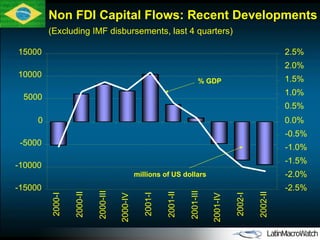
-15000 -10000 -5000 0 5000 10000 15000 2000-I 2000-II 2000-III 2000-IV 2001-I 2001-II 2001-III 2001-IV 2002-I 2002-II -2.5% -2.0% -1.5% -1.0% -0.5% 0.0% 0.5% 1.0% 1.5% 2.0% 2.5% % GDP millions of US dollars Non FDI Capital Flows: Recent Developments  (Excluding IMF disbursements, last 4 quarters)
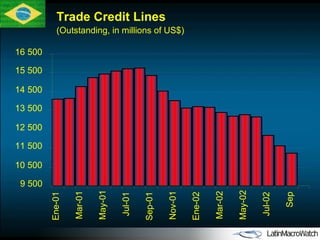
Trade Credit Lines  (Outstanding, in millions of US$) 9 500 10 500 11 500 12 500 13 500 14 500 15 500 16 500 Ene-01 Mar-01 May-01 Jul-01 Sep-01 Nov-01 Ene-02 Mar-02 May-02 Jul-02 Sep
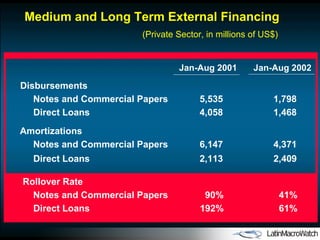
Jan- Aug  2001 Jan- Aug  2002 Disbursements Notes and Commercial Papers 5,535 1 ,798 Direct Loans 4,058 1 ,468 Amortizations Notes and Commercial Papers 6,147 4,371 Direct Loans 2,113 2,409 Medium and Long Term External Financing  (Private Sector, in millions of US$) Rollover Rate Notes and Commercial Papers 9 0% 4 1 % Direct Loans 1 92 % 61 %
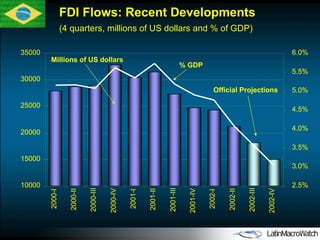
FDI Flows: Recent Developments  (4 quarters, millions of US dollars  and % of GDP ) 10000 15000 20000 25000 30000 35000 2000-I 2000-II 2000-III 2000-IV 2001-I 2001-II 2001-III 2001-IV 2002-I 2002-II 2002-III 2002-IV 2.5% 3.0% 3.5% 4.0% 4.5% 5.0% 5.5% 6.0% % GDP Millions of US dollars Official Projections
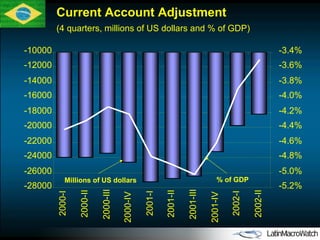
-28000 -26000 -24000 -22000 -20000 -18000 -16000 -14000 -12000 -10000 2000-I 2000-II 2000-III 2000-IV 2001-I 2001-II 2001-III 2001-IV 2002-I 2002-II -5.2% -5.0% -4.8% -4.6% -4.4% -4.2% -4.0% -3.8% -3.6% -3.4% % of GDP Millions of US dollars Current Account Adjustment (4 quarters, millions of US dollars  and % of GDP )
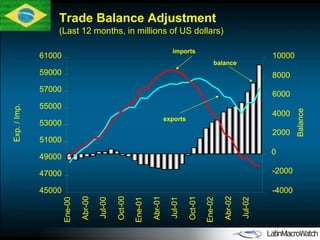
Trade Balance Adjustment (Last 12 months, in millions of US dollars) 45000 47000 49000 51000 53000 55000 57000 59000 61000 Ene-00 Abr-00 Jul-00 Oct-00 Ene-01 Abr-01 Jul-01 Oct-01 Ene-02 Abr-02 Jul-02 Exp. / Imp. -4000 -2000 0 2000 4000 6000 8000 10000 Balance imports exports balance
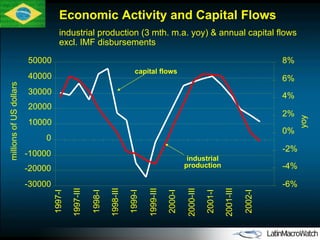
-30000 -20000 -10000 0 10000 20000 30000 40000 50000 1997-I 1997-III 1998-I 1998-III 1999-I 1999-III 2000-I 2000-III 2001-I 2001-III 2002-I millions of US dollars -6% -4% -2% 0% 2% 4% 6% 8% yoy Economic Activity and Capital Flows industrial production (3 mth. m.a. yoy) & annual capital flows excl. IMF  disbursements   industrial production capital flows
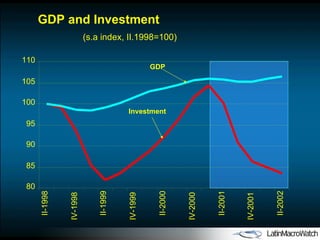
GDP and Investment  (s.a index, II.1998=100) 80 85 90 95 100 105 110 II-1998 IV-1998 II-1999 IV-1999 II-2000 IV-2000 II-2001 IV-2001 II-2002 GDP Investment
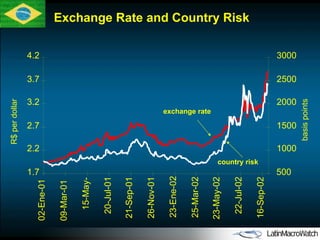
Exchange Rate and Country Risk 1.7 2.2 2.7 3.2 3.7 4.2 02-Ene-01 09-Mar-01 15-May- 20-Jul-01 21-Sep-01 26-Nov-01 23-Ene-02 25-Mar-02 23-May-02 22-Jul-02 16-Sep-02 500 1000 1500 2000 2500 3000 R$ per dollar basis points exchange rate country risk
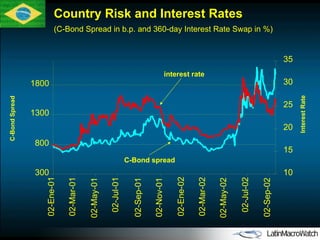
Country Risk and Interest Rates (C-Bond Spread in b.p. and 360-day Interest Rate Swap in %) 300 800 1300 1800 02-Ene-01 02-Mar-01 02-May-01 02-Jul-01 02-Sep-01 02-Nov-01 02-Ene-02 02-Mar-02 02-May-02 02-Jul-02 02-Sep-02 10 15 20 25 30 35 C-Bond Spread Interest Rate interest rate C-Bond spread
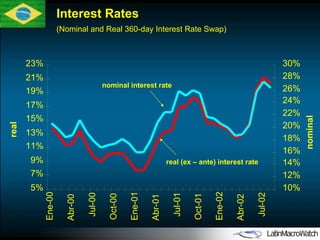
5% 7% 9% 11% 13% 15% 17% 19% 21% 23% Ene-00 Abr-00 Jul-00 Oct-00 Ene-01 Abr-01 Jul-01 Oct-01 Ene-02 Abr-02 Jul-02 10% 12% 14% 16% 18% 20% 22% 24% 26% 28% 30% nominal interest rate real (ex – ante) interest rate Interest Rates (Nominal and Real 360-day Interest Rate Swap) nominal real
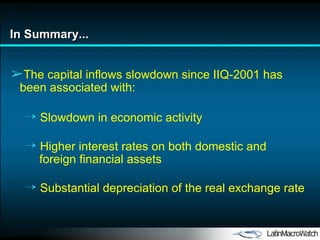
In Summary... The capital inflows slowdown since IIQ-2001 has been associated with: Slowdown in economic activity Higher interest rates on both domestic and  foreign financial assets Substantial depreciation of the real exchange rate
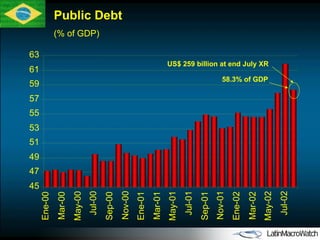
Public Debt (% of GDP)  45 47 49 51 53 55 57 59 61 63 Ene-00 Mar-00 May-00 Jul-00 Sep-00 Nov-00 Ene-01 Mar-01 May-01 Jul-01 Sep-01 Nov-01 Ene-02 Mar-02 May-02 Jul-02 58.3% of GDP US$ 259 billion at end July XR
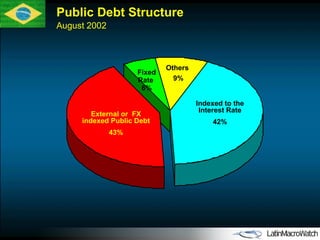
Public Debt Structure August 2002 Fixed Rate  6%  Others 9% External or  FX indexed Public Debt 43% Indexed to the Interest Rate 42%
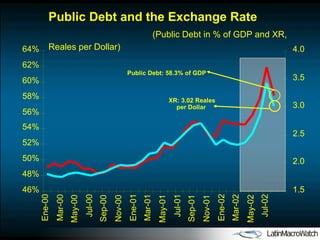
Public Debt and the Exchange Rate  (Public Debt in % of GDP and XR, Reales per Dollar) 46% 48% 50% 52% 54% 56% 58% 60% 62% 64% Ene-00 Mar-00 May-00 Jul-00 Sep-00 Nov-00 Ene-01 Mar-01 May-01 Jul-01 Sep-01 Nov-01 Ene-02 Mar-02 May-02 Jul-02 1.5 2.0 2.5 3.0 3.5 4.0 XR: 3.02 Reales per Dollar  Public Debt: 58.3% of GDP
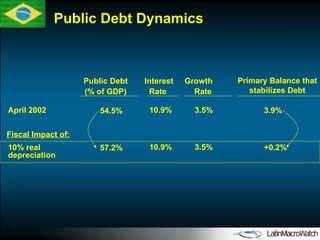
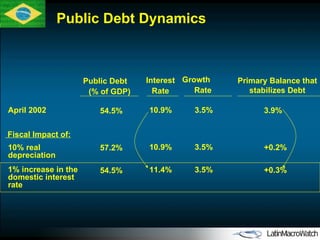
Public Debt Dynamics April 2002 Fiscal Impact of: 54.5% 10.9% 3.5% 3.9% Public Debt  ( %  of GDP ) Interest Rate   Growth Rate Primary Balance that stabilizes Debt 10% real depreciation 57.2% 10.9% 3.5% +0.2%
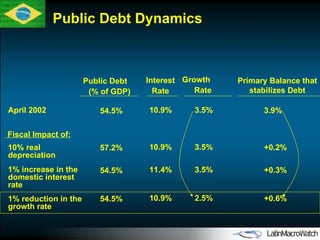
Public Debt Dynamics 10% real depreciation 57.2% 10.9% 3.5% +0.2% April 2002 Fiscal Impact of: 54.5% 10.9% 3.5% 3.9% Public Debt  ( %  of GDP ) Interest  Rate   Growth  Rate Primary Balance that stabilizes Debt 1% increase in the domestic interest rate 54.5% 11.4% 3.5% +0.3%
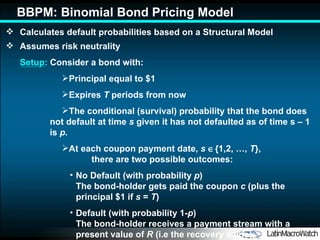
1% increase in the domestic interest rate 54.5% 11.4% 3.5% +0.3% Public Debt Dynamics 10% real depreciation 57.2% 10.9% 3.5% +0.2% April 2002 Fiscal Impact of: 54.5% 10.9% 3.5% 3.9% Public Debt  ( %  of GDP ) Interest  Rate   Growth  Rate Primary Balance that stabilizes Debt 1% reduction in the growth rate 54.5% 10.9% 2.5% +0.6%
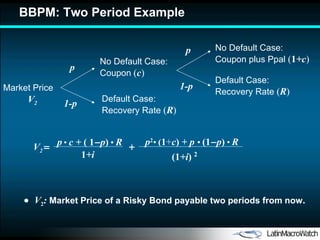
Calculates default probabilities based on a Structural Model Assumes risk neutrality Setup:  Consider a bond with: Principal equal to $1 Expires  T  periods from now The conditional (survival) probability that the bond does not default at time  s  given it has not defaulted as of time  s  – 1 is  p . At each coupon payment date,  s    {1,2, …,  T },  there are  two possible  outcomes : No Default (with probability  p )  The bond-holder gets paid the coupon  c  (plus the principal $1 if  s  =  T ) Default (with probability 1- p )  The bond-holder receives a payment stream with a present value of  R  (i.e the recovery value) BBPM: Binomial Bond Pricing Model
BBPM : Two Period Example    V 2 :  Market Price of a Risky Bond payable two periods from now . Default Case: Recovery Rate  ( R ) No Default Case: Coupon  ( c ) Market Price   V 2 p 1-p Default Case: Recovery Rate  ( R ) No Default Case: Coupon plus Ppal  ( 1 +c ) p 1-p p   •  c +  ( 1  p )   •  R 1 +i V 2   p 2 •  ( 1 + c )  + p  •  (1  p )   •  R (1 +i )  2 
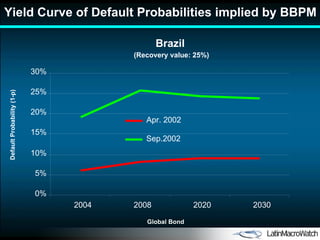
Yield Curve of Default Probabilities implied by  BBPM 0% 5% 10% 15% 20% 25% 30% 2004 2008 2020 2030 Apr. 2002 Sep.2002 Brazil Global Bond Default Probability (1-p) (Recovery value: 25%)
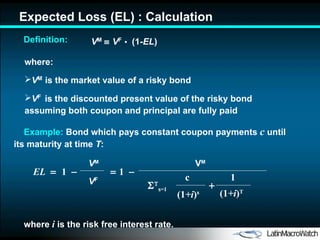
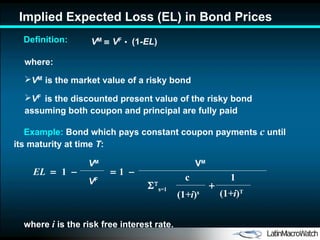
Expected Loss  ( E L)  : Calculation V M      V F   •   (1- E L ) where: V M   is the market value of a risky bond V F   is the discounted present value of the risky bond  assuming  both coupon and principal are fully  paid where  i  is the risk free interest rate. Definition: Example:  Bond  which pays constant coupon payments  c   until its maturity at time  T : V M c (1 +i ) s   s =1  (1 +i ) T 1 EL     1      1   V M V F
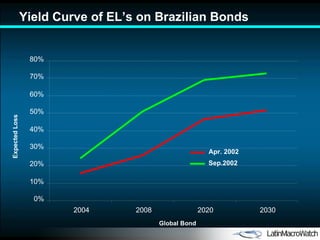
0% 10% 20% 30% 40% 50% 60% 70% 80% 2004 2008 2020 2030 Apr. 2002 Sep.2002 Yield Curve of EL’s on Brazilian Bonds Global Bond Expected Loss
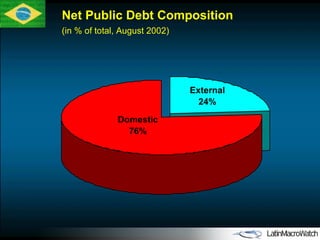
Net Public Debt Composition (in % of total, August 2002) Domestic 76% External 24%
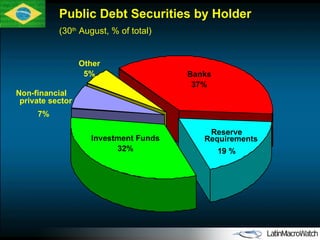
Public Debt Securities by Holder  (30 th  August, % of total) Banks 37% Investment Funds 32% Other 5% Reserve Requirements 19 % Non-financial private sector 7%
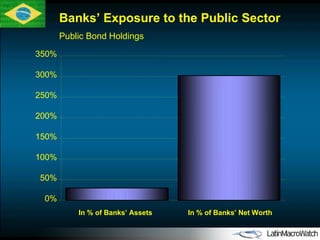
Banks’ Exposure to the Public Sector  Public Bond Holdings 0% 50% 100% 150% 200% 250% 300% 350% In % of Banks’ Assets In % of Banks’ Net Worth
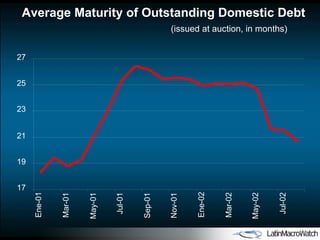
Average Maturity of Outstanding Domestic Debt  (issued at auction, in months) 17  19  21  23  25  27  Ene-01 Mar-01 May-01 Jul-01 Sep-01 Nov-01 Ene-02 Mar-02 May-02 Jul-02
02-Jul-02 02-Ago-02 -25000 -20000 -15000 -10000 -5000 0 5000 10000 Ene-02 Feb-02 Mar-02 Abr-02 May-02 Jun-02 Jul-02 Until 28 Aug. The run from Investment Funds to Saving Deposits In millions of R$ Saving Deposits (Caderneta de Poupan ç a) 31 st  May: Marking to market of IF’s bonds Net Flows to Investment Funds Since 31 st  May:  R$ 15.1 billion Since 31 st  May:  - R$ 51.9 billion 31 st  May: Marking to market of IF’s bonds 117000 120000 123000 126000 129000 132000 135000 02-Ene-02 02-Feb-02 02-Mar-02 02-Abr-02 02-May-02 02-Jun-02
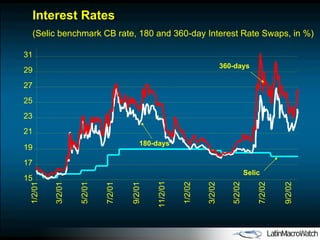
15 17 19 21 23 25 27 29 31 1/2/01 3/2/01 5/2/01 7/2/01 9/2/01 11/2/01 1/2/02 3/2/02 5/2/02 7/2/02 9/2/02 Interest Rates (Selic benchmark CB rate, 180 and 360-day Interest Rate Swaps, in %)  180-days 360-days Selic
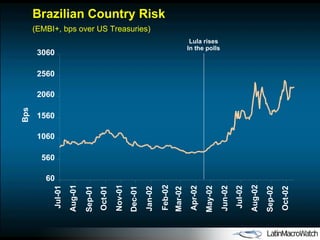
60 560 1060 1560 2060 2560 3060 Jul-01 Aug-01 Sep-01 Oct-01 Nov-01 Dec-01 Jan-02 Feb-02 Mar-02 Apr-02 May-02 Jun-02 Jul-02 Aug-02 Sep-02 Oct-02 Bps Brazilian Country Risk ( EMBI+, bps over US Treasuries ) Lula rises In the polls
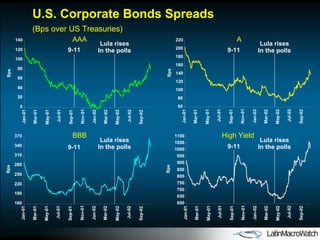
U.S. Corporate Bonds Spreads ( Bps over US Treasuries ) 0 20 40 60 80 100 120 140 Jan-01 Mar-01 May-01 Jul-01 Sep-01 Nov-01 Jan-02 Mar-02 May-02 Jul-02 Sep-02 Bps 60 80 100 120 140 160 180 200 220 Jan-01 Mar-01 May-01 Jul-01 Sep-01 Nov-01 Jan-02 Mar-02 May-02 Jul-02 Sep-02 Bps 160 190 220 250 280 310 340 370 Jan-01 Mar-01 May-01 Jul-01 Sep-01 Nov-01 Jan-02 Mar-02 May-02 Jul-02 Sep-02 Bps 600 650 700 750 800 850 900 950 1000 1050 1100 Jan-01 Mar-01 May-01 Jul-01 Sep-01 Nov-01 Jan-02 Mar-02 May-02 Jul-02 Sep-02 Bps AAA BBB A High Yield 9-11 9-11 9-11 9-11 Lula rises In the polls Lula rises In the polls Lula rises In the polls Lula rises In the polls
600 650 700 750 800 850 900 950 1000 1050 1100 Jul-01 Aug-01 Sep-01 Oct-01 Nov-01 Dec-01 Jan-02 Feb-02 Mar-02 Apr-02 May-02 Jun-02 Jul-02 Aug-02 Sep-02 Oct-02 Bps 500 1000 1500 2000 2500 3000 60 70 80 90 100 110 120 130 140 150 160 Jul-01 Aug-01 Sep-01 Oct-01 Nov-01 Dec-01 Jan-02 Feb-02 Mar-02 Apr-02 May-02 Jun-02 Jul-02 Aug-02 Sep-02 Oct-02 Bps 500 1000 1500 2000 2500 3000 Lula Effect? Look Again ( EMBI+ and US corporate bonds, bps over US Treasuries ) A High Yield Brazil Brazil 9-11 9-11 Lula rises In the polls Lula rises In the polls
OUTLINE I.  Capital Flight in LAC: Back to the Eighties? II. LAC in the Aftermath of External Adjustment: A Triple “Whammy” IV. External Adjustment and Financial Distress: The Case of Brazil V. Argentina’s Public Debt: Yet Another Restructuring? III. External Adjustment, Financial Distress and Outuput Collapses: The Debt Connection
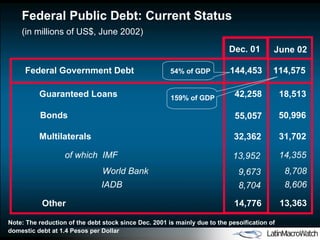
Federal Public Debt: Current Status (in millions of US$, June 2002) Federal Government Debt 11 4 , 575 Multilaterals 31, 702 of which  IMF 14,355 World Bank 8,708 IADB 8, 606 Guaranteed Loans 18,513 Bonds 50,996 June 02 Dec. 01 1 44,453 42,258 3 2,362 14,776 13,363 55,057 Other 13, 952 9, 673 8, 704 54% of GDP 159% of GDP Note: The reduction of the debt stock since Dec. 2001 is mainly due to the pesoification of domestic debt at 1.4 Pesos per Dollar
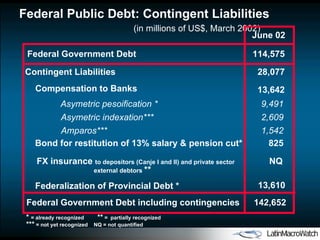
Federal Public Debt: Contingent Liabilities  (in millions of US$, March 2002) Federal Government Debt 11 4 , 575 June 02 Contingent Liabilities Asymetric indexation*** Compensation to Banks Asymetric pesoification * Amparos*** FX insurance  to depositors (Canje I and II) and private sector  external debtors  ** Bond for restitution of 13% salary & pension cut* 28,077 2,609 13,642 9,491 1,542 NQ 825 Federalization of Provincial Debt * Federal Government Debt  including contingencies 142,652 *  = already recognized  **  =  partially recognized  ***  = not yet recognized  NQ = not quantified 13,610
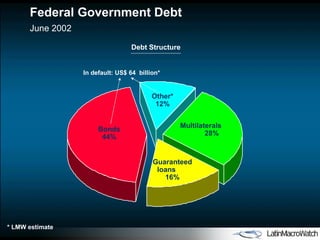
Federal Government Debt  June 2002 Bonds 44% Guaranteed loans  16% Multilaterals  28% Other* 12% Debt Structure In default: US$ 64  billion* * LMW estimate
Implied Expected Loss  ( E L)  in Bond Prices V M      V F   •   (1- E L ) where: V M   is the market value of a risky bond V F   is the discounted present value of the risky bond  assuming  both coupon and principal are fully  paid where  i  is the risk free interest rate. Definition: Example:  Bond  which pays constant coupon payments  c   until its maturity at time  T : V M c (1 +i ) s   s =1  (1 +i ) T 1 EL     1      1   V M V F
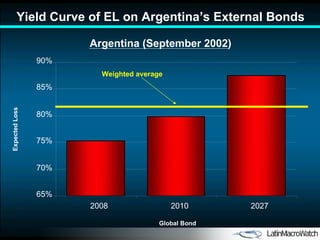
65% 70% 75% 80% 85% 90% 2008 2010 2027 Yield Curve of EL on Argentina’s External Bonds Global Bond Expected Loss Weighted average Argentina (September 2002)
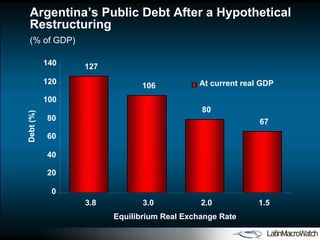
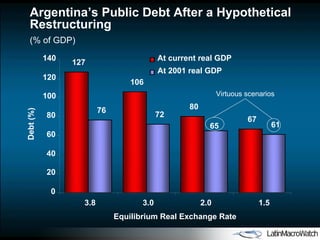
Argentina’s Public Debt After a Hypothetical Restructuring (% of GDP) 127 106 80 67 0 20 40 60 80 100 120 140 3.8 3.0 2.0 1.5 Equilibrium Real Exchange Rate Debt (%) At current real GDP
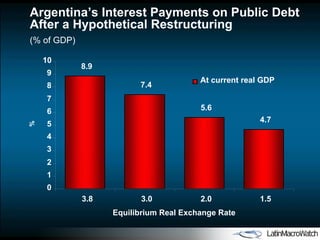
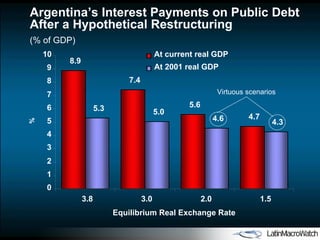
Argentina’s Interest Payments on Public Debt After a Hypothetical Restructuring (% of GDP) 8.9 7.4 5.6 4.7 0 1 2 3 4 5 6 7 8 9 10 3.8 3.0 2.0 1.5 Equilibrium Real Exchange Rate % At current real GDP
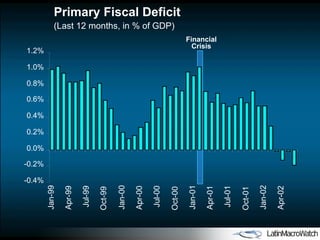
-0.4% -0.2% 0.0% 0.2% 0.4% 0.6% 0.8% 1.0% 1.2% Jan-99 Apr-99 Jul-99 Oct-99 Jan-00 Apr-00 Jul-00 Oct-00 Jan-01 Apr-01 Jul-01 Oct-01 Jan-02 Apr-02 Primary  Fiscal  Deficit (Last 12 months, in % of GDP) Financial Crisis
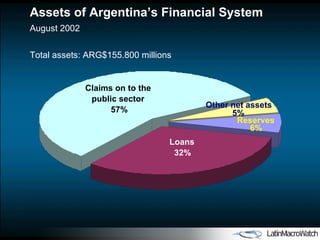
Assets of Argentina’s Financial System August 2002 Other net  assets 5% Reserves 6% Loans 32% C laims on  to the  public sector 57% Total assets: ARG$155.800 millions
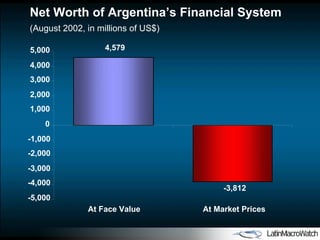
4,579 -3,812 -5,000 -4,000 -3,000 -2,000 -1,000 0 1,000 2,000 3,000 4,000 5,000 At Face Value At Market Prices Net Worth of Argentina’s Financial System (August 2002, in millions of US$)
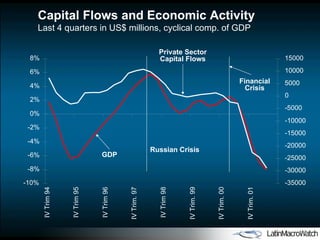
-10% -8% -6% -4% -2% 0% 2% 4% 6% 8% IV Trim 94 IV Trim 95 IV Trim 96 IV Trim. 97 IV Trim 98 IV Trim. 99 IV Trim. 00 IV Trim. 01 -35000 -30000 -25000 -20000 -15000 -10000 -5000 0 5000 10000 15000 Capital Flows and Economic Activity  Last 4 quarters in US$ millions, cyclical comp. of GDP Private Sector Capital Flows GDP Russian Crisis Financial Crisis
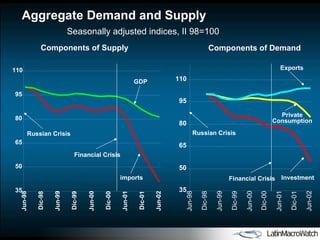
Aggregate Demand and Supply  Seasonally adjusted indices, II 98=100  35 50 65 80 95 110 Jun-98 Dic-98 Jun-99 Dic-99 Jun-00 Dic-00 Jun-01 Dic-01 Jun-02 Components of Demand Exports Investment Private Consumption 35 50 65 80 95 110 Jun-98 Dic-98 Jun-99 Dic-99 Jun-00 Dic-00 Jun-01 Dic-01 Jun-02 Components of Supply imports GDP Russian Crisis Financial Crisis Russian Crisis Financial Crisis
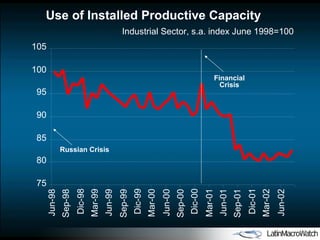
Use of Installed Productive Capacity  Industrial Sector, s.a. index June 1998=100  75 80 85 90 95 100 105 Jun-98 Sep-98 Dic-98 Mar-99 Jun-99 Sep-99 Dic-99 Mar-00 Jun-00 Sep-00 Dic-00 Mar-01 Jun-01 Sep-01 Dic-01 Mar-02 Jun-02 Financial Crisis Russian Crisis
Argentina’s Public Debt After a Hypothetical Restructuring (% of GDP) 127 106 80 67 76 72 65 61 0 20 40 60 80 100 120 140 3.8 3.0 2.0 1.5 Equilibrium Real Exchange Rate Debt (%) At current real GDP At 2001 real GDP Virtuous scenarios
Argentina’s Interest Payments on Public Debt After a Hypothetical Restructuring (% of GDP) 8.9 7.4 5.6 4.7 5.3 5.0 4.6 4.3 0 1 2 3 4 5 6 7 8 9 10 3.8 3.0 2.0 1.5 Equilibrium Real Exchange Rate % At current real GDP At 2001 real GDP Virtuous scenarios
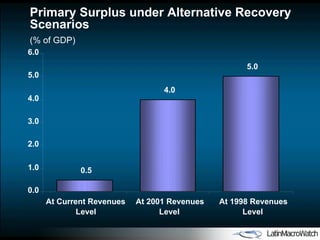
Primary Surplus under Alternative Recovery Scenarios (% of GDP) 0.5 4.0 5.0 0.0 1.0 2.0 3.0 4.0 5.0 6.0 At Current Revenues Level At 2001 Revenues Level At 1998 Revenues Level

Talvi L Ac Macro Watch October 2002

  • 1.
    LatinMacroWatch SpecialAnalysis LMW: the Big Picture on a Small Screen A new RES feature
  • 2.
    October 23 rd, 2002 Between Financial Distress and Lackluster Performance: A Regional Assessment Prepared for presentation at The World Bank, Washington , DC
  • 3.
    OUTLINE I. Capital Flight in LAC: Back to the Eighties? II. LAC in the Aftermath of External Adjustment: A Triple “Whammy” IV. External Adjustment and Financial Distress: The Case of Brazil V. Argentina’s Public Debt: Yet Another Restructuring? III. External Adjustment, Financial Distress and Outuput Collapses: The Debt Connection
  • 4.
    LAC-7 Capital Flows(4 quarters, millions of US dollars and average in % of GDP) Includes Argentina, Brazil, Chile, Colombia, Mexico, Peru, Venezuela 0 20000 40000 60000 80000 100000 1997-I 1997-III 1998-I 1998-III 1999-I 1999-III 2000-I 2000-III 2001-I 2001-III 2002-I -1% 0% 1% 2% 3% 4% 5% 6% Millions of US dollars % of GDP
  • 5.
    LAC-7 Foreign DirectInvestment (4 quarters, millions of US dollars and average in % of GDP) Includes Argentina, Brazil, Chile, Colombia, Mexico, Peru, Venezuela 0 10000 20000 30000 40000 50000 60000 70000 80000 1997-I 1997-III 1998-I 1998-III 1999-I 1999-III 2000-I 2000-III 2001-I 2001-III 2002-I 1.5% 2.0% 2.5% 3.0% 3.5% 4.0% 4.5% 5.0% Millions of US dollars % of GDP
  • 6.
    LAC-7 Foreign DirectInvestment (Annual FDI flows, 2002.II)
  • 7.
    LAC-7 Non-FDI CapitalFlows (4 quarters, millions of US dollars and and average in % of GDP) Includes Argentina, Brazil, Chile, Colombia, Mexico, Peru, Venezuela -80000 -60000 -40000 -20000 0 20000 40000 60000 1997-I 1997-III 1998-I 1998-III 1999-I 1999-III 2000-I 2000-III 2001-I 2001-III 2002-I -4% -3% -2% -1% 0% 1% 2% Millions of US dollars % of GDP
  • 8.
    Financial Flows toLAC: Back to the Eigthies? (Billions of real US dollars of May 2002, deflated by US CPI) -60 -40 -20 0 20 40 60 80 1971 1973 1975 1977 1979 1981 1983 1985 1987 1989 1991 1993 1995 1997 1999 2001
  • 9.
    0 5000 1000015000 20000 25000 30000 1997-I 1997-III 1998-I 1998-III 1999-I 1999-III 2000-I 2000-III 2001-I 2001-III 2002-I Total Capital Flows (4 quarters, millions of US dollars)
  • 10.
    Financial Flows toEmerging Asia: A Panoramic View (Billions of real US dollars of May 2002, deflated by US CPI) -120 -100 -80 -60 -40 -20 0 20 40 60 80 1971 1973 1975 1977 1979 1981 1983 1985 1987 1989 1991 1993 1995 1997 1999 2001
  • 11.
    Private Capital Flowsto Emerging Asia: A Panoramic View (Billions of real US dollars of May 2002, deflated by US CPI) -70 -20 30 80 130 1971 1973 1975 1977 1979 1981 1983 1985 1987 1989 1991 1993 1995 1997 1999 2001
  • 12.
    FDI to EmergingAsia: A Panoramic View (Billions of real US dollars of May 2002, deflated by US CPI) -10 0 10 20 30 40 50 60 70 1971 1973 1975 1977 1979 1981 1983 1985 1987 1989 1991 1993 1995 1997 1999 2001
  • 13.
    Korea: Capital Flows (Total capital flows, 4 quarters) -10000 -8000 -6000 -4000 -2000 0 2000 4000 1996-I 1996-III 1997-I 1997-III 1998-I 1998-III 1999-I 1999-III 2000-I 2000-III 2001-I 2001-III 2002-I -2.5% -2.0% -1.5% -1.0% -0.5% 0.0% 0.5% 1.0% Millions of US dollars % of GDP
  • 14.
    FDI to EmergingEurope: A Panoramic View (Billions of real US dollars of May 2002, deflated by US CPI) -5 0 5 10 15 20 25 30 1990 1991 1992 1993 1994 1995 1996 1997 1998 1999 2000 2001
  • 15.
    Financial Flows toEmerging Europe: A Panoramic View (Billions of real US dollars of May 2002, deflated by US CPI) -30 -20 -10 0 10 20 30 40 1990 1991 1992 1993 1994 1995 1996 1997 1998 1999 2000 2001
  • 16.
    OUTLINE I. Capital Flight in LAC: Back to the Eighties? II. LAC in the Aftermath of External Adjustment: A Triple “Whammy” IV. External Adjustment and Financial Distress: The Case of Brazil V. Argentina’s Public Debt: Yet Another Restructuring? III. External Adjustment, Financial Distress and Outuput Collapses: The Debt Connection
  • 17.
    LAC-7 Business Cycle:1997-2002 (s.a. GDP, mean annualized quarterly growth rate) Includes: Argentina Brazil, Chile, Colombia, Mexico, Peru and Venezuela Deceleration Recession Recovery Recession? -7% -5% -3% -1% 1% 3% 5% 7% 9% 1997.I 1997.III 1998.I 1998.III 1999.I 1999.III 2000.I 2000.III 2001. I 2001.III 2002.I
  • 18.
    Business Cycle: 1997-2002(s.a. GDP, mean annualized quarterly growth rate, excluding Argentina) Deceleration Recession Recovery Recession? -7% -5% -3% -1% 1% 3% 5% 7% 9% 1997.I 1997.III 1998.I 1998.III 1999.I 1999.III 2000.I 2000.III 2001. I 2001.III 2002.I Includes: Brazil, Chile, Colombia, Mexico, Peru and Venezuela
  • 19.
    LAC-7 Business Cycleand Capital Flows (GDP and Non FDI Capital Flows, last four quarters) -3% -2% -1% 0% 1% 2% 3% 4% 5% 6% 7% Mar-96 Sep-96 Mar-97 Sep-97 Mar-98 Sep-98 Mar-99 Sep-99 Mar-00 Sep-00 Mar-01 Sep-01 Mar-02 GDP (yoy % change) -4% -3% -2% -1% 0% 1% 2% Non FDI Capital Flows (% GDP) GDP Non FDI Capital Flows
  • 20.
    -14000 -12000 -10000-8000 -6000 -4000 -2000 0 1997-I 1997-III 1998-I 1998-III 1999-I 1999-III 2000-I 2000-III 2001-I 2001-III 2002-I -6% -5% -4% -3% -2% -1% 0% LAC 7: Current Account (4 quarters) Millions of US dollars % of GDP (average) Millions of US dollars % of GDP
  • 21.
    4.8 1998.II 2002 . II Change (1) (2) (2)-(1) Venezuela 2.0 4.1 -2.1 Colombia -1.5 -6.3 Argentina 2.1 6.8 -4.7 Average -4.9 -0.9 4.0 Current Account Balance by Country (4 quarters, % of GDP) Chile -0.9 5.7 -6.6 Peru -1.7 5.2 -6.9 Mexico -2.6 0.4 -3.0 Bra s il -4.1 -3.5 0.6
  • 22.
    Current Account Adjustment by Country (in percentage of annual imports of 1998.II) -10% 0% 10% 20% 30% 40% 50% Mexico Venezuela Chile Brazil Colombia Peru Argentina average
  • 23.
    Real Exchange Rateby Country (vis-à-vis the US dollar, August 2002 vs. June 1998) 25% 37% 49% 54% 130% 198% -15% -20% 30% 80% 130% 180% México Perú Venezuela Chile Colombia Brazil Argentina
  • 24.
    75 80 8590 95 100 105 1997.I 1997.II 1997.III 1997.IV 1998.I 1998.II 1998.III 1998.IV 1999.I 1999.II 1999.III 1999.IV 2000.I 2000.II 2000.III 2000.IV 2001.I 2001.II 2001.III 2001.IV 2002.I 2002.II -1% 0% 1% 2% 3% 4% 5% 6% External Adjustment and Investment (S.a. investment and annual capital flows) Investment Total Capital Flows Investment (1998.II =100) Total Ca pital Flows (% GDP)
  • 25.
    70 80 90100 110 120 130 1998.II 1998.III 1998.IV 1999.I 1999.II 1999.III 1999.IV 2000.I 2000.II 2000.III 2000.IV 2001. I 2001.II 2001.III 2001.IV 2002.I 2002.II Exports Consumption Investment Recession Stalling Recovery LAC-7 Components of Demand (1998.II = 100) Includes Argentina, Brazil, Chile, Colombia, Mexico, Peru Recession?
  • 26.
    LAC 7 Investment (1998.II =100) 38 48 58 68 78 88 98 108 118 128 1998.II 1998.III 1998.IV 1999.I 1999.II 1999.III 1999.IV 2000.I 2000.II 2000.III 2000.IV 2001.I 2001.II 2001.III 2001.IV 2002.I 2002.II Brazil Chile Argentina Colombia Mexico Peru
  • 27.
    LAC-7 Trend Growth(annualized quarterly growth rate, 1998.II=100) Includes Argentina, Brazil, Chile, Colombia, Mexico, Peru, Venezuela 25 35 45 55 65 75 85 95 1998.II 1999.II 2000.II 2001.II 2002.II
  • 28.
    Emerging Asia: CurrentAccount (4 quarters) Includes: Malaysia, Philippines, Thailand, Indonesia and Korea -80000 -60000 -40000 -20000 0 20000 40000 60000 80000 1996-I 1996-III 1997-I 1997-III 1998-I 1998-III 1999-I 1999-III 2000-I 2000-III 2001-I 2001-III 2002-I Millions of US dollars -6% -4% -2% 0% 2% 4% 6% 8% 10% % of GDP (average) Millions of US dollars % of GDP
  • 29.
    60 70 8090 100 110 120 Mar-96 Jul-96 Nov-96 Mar-97 Jul-97 Nov-97 Mar-98 Jul-98 Nov-98 Mar-99 Jul-99 Nov-99 Mar-00 Jul-00 Nov-00 Mar-01 Jul-01 Nov-01 Mar-02 -8% -6% -4% -2% 0% 2% 4% 6% 8% Emerging Asia: External Adjustment and Investment (S.a. investment and annual capital flows) Investment Total Capital Flows Investment (1997.IV =100) Total Ca pital Flows (% GDP)
  • 30.
    50 70 90110 130 150 Jun-97 Sep-97 Dic-97 Mar-98 Jun-98 Sep-98 Dic-98 Mar-99 Jun-99 Sep-99 Dic-99 Mar-00 Jun-00 Sep-00 Dic-00 Mar-01 Jun-01 Sep-01 Dic-01 Mar-02 Jun-02 Emerging Asia: Components of Demand (1997.II =100) Exports Consumption Investment Includes Korea, Philippines, Malaysia, Thailand and Indonesia
  • 31.
    Emerging Asia: TrendGrowth (annualized quarterly growth rate, 1996.II=100) Includes Indonesia, Korea, Philippines, Thailand, Malaysia 1998.II 1999.II 2000.II 2001.II 2002.II 199 7 .II 199 6 .II 0 20 40 60 80 100
  • 32.
    In summary , the reduction of capital inflows to LAC was a triple “ whammy ” since it was associated with: A rise in the cost of credit A substantial depreciation of the real exchange rate A decline of investment and slower growth
  • 33.
    OUTLINE I. Capital Flight in LAC: Back to the Eighties? II. LAC in the Aftermath of External Adjustment: A Triple “Whammy” IV. External Adjustment and Financial Distress: The Case of Brazil V. Argentina’s Public Debt: Yet Another Restructuring? III. External Adjustment, Financial Distress and Outuput Collapses: The Debt Connection
  • 34.
    External Adjustment &Financial Distress: The Debt Connection Brazil Chile Argentina Uruguay Financial Mismatches of the Private Sector = High vulnerability = Medium vulnerability = Low vulnerability Financial mismatches of the Public Sector Public Debt to GDP Banking System Exposure to the Public Sector
  • 35.
    Sudden Stop inArgentina and Chile (Capital flows, last 4 quarters, % of GDP) -1.0% -0.5% 0.0% 0.5% 1.0% 1.5% 2.0% 2.5% 3.0% 3.5% 4.0% I 98 II 98 III 98 IV 98 I 99 II 99 III 99 IV 99 I 00 II 00 III 00 IV 00 -1% 0% 1% 2% 3% 4% 5% 6% 7% 8% Argentina Chile Argentina Chile
  • 36.
    External Adjustment (CurrentAccount, 4 quarters, %GDP) -8% -7% -6% -5% -4% -3% -2% -1% 0% 1% Chile -5.5% -5.0% -4.5% -4.0% -3.5% -3.0% -2.5% -2.0% -1.5% -1.0% Argentina Argentina Chile
  • 37.
    Contraction and Recovery:GDP and Investment (s.a., 1998.II=100) GDP Investment 80 85 90 95 100 105 110 1998.II 1998.IV 1999.II 1999.IV 2000.II 2000.IV 2001.II 2001.IV 2002.II 35 45 55 65 75 85 95 1998.II 1998.IV 1999.II 1999.IV 2000.II 2000.IV 2001.II 2001.IV 2002.II Beginning of bank run in Argentina Chile Argentina Chile Argentina
  • 38.
    Sudden Stop andthe Real Exchange Rate Required % change in RER to eliminate the CAD 25 30 35 40 45 50 55 60 Chile Argentina Source: Calvo, Izquierdo, Talvi (2002) 32.4 46.2 379 178 100 150 200 250 300 350 400 450 Chile Argentina Relative Openness, 1998 (External Debt to Exports Ratio)
  • 39.
    Fiscal Sustainability inArgentina after the Sudden Stop in 1998 Debt to GDP ratio (%) Req. Prim. Surplus Adjust. (a) Baseline 36.5 0 .3 (b) Change in Relative Prices to close the CA deficit (RER depreciation of 46,2%) 49.7 0.7 (c) : (b) + 200 BPS Increase in Real Interest Rate 49.7 1.7 (d): (c) + 1% Reduction in GDP growth 49.7 2.2 (e): (d) + Contingent Liabilities 58.6 2.7 Source: Calvo, Izquierdo, Talvi (2002) Note: The observed primary surplus for 1998 was 0.9 percent of GDP. The baseline scenario assumes a long run rate of growth of 3,8% and a 7,1% interest rate 25.6 45.4 66.0 71.7 75.9 Debt Reduction(%)
  • 40.
    Argentina ’s Collapsein a Nutshell RER depreciation: revaluation of public sector debt relative to GDP + deterioration of corporate balance sheets (contingent liabilities). The proposed fiscal adjustments were clearly insufficient for a substantially higher RER. Deterioration of public and private sector balance sheets : Worsened quality of bank assets and run on banks due to the fear that losses might be partially financed by confiscating depositors. The run against banks was accommodated by credit expansion of the CB , leading to a collapse in international reserves and an acceleration of the run on banks.
  • 41.
    OUTLINE I. Capital Flight in LAC: Back to the Eighties? II. LAC in the Aftermath of External Adjustment: A Triple “Whammy” IV. External Adjustment and Financial Distress: The Case of Brazil V. Argentina’s Public Debt: Yet Another Restructuring? III. External Adjustment, Financial Distress and Outuput Collapses: The Debt Connection
  • 42.
    -30000 -20000 -100000 10000 20000 30000 40000 50000 1997-I 1997-III 1998-I 1998-III 1999-I 1999-III 2000-I 2000-III 2001-I 2001-III 2002-I -6% -4% -2% 0% 2% 4% 6% 8% % GDP millions of US dollars Capital Flows: A Panoramic View (Excluding IMF disbursements, last 4 quarters)
  • 43.
    Non FDI CapitalFlows: A Panoramic View (Excluding IMF disbursements, last 4 quarters) -10.0% -8.0% -6.0% -4.0% -2.0% 0.0% 2.0% 4.0% 6.0% 1997-I 1997-II 1997-III 1997-IV 1998-I 1998-II 1998-III 1998-IV 1999-I 1999-II 1999-III 1999-IV 2000-I 2000-II 2000-III 2000-IV 2001-I 2001-II 2001-III 2001-IV 2002-I 2002-II -60000 -50000 -40000 -30000 -20000 -10000 0 10000 20000 30000 40000 % GDP millions of US dollars
  • 44.
    5000 10000 1500020000 25000 30000 35000 40000 45000 2000-I 2000-II 2000-III 2000-IV 2001-I 2001-II 2001-III 2001-IV 2002-I 2002-II 1.0% 2.0% 3.0% 4.0% 5.0% 6.0% 7.0% 8.0% % GDP millions of US dollars Capital Flows: Recent Developments (Excluding IMF disbursements, last 4 quarters)
  • 45.
    -15000 -10000 -50000 5000 10000 15000 2000-I 2000-II 2000-III 2000-IV 2001-I 2001-II 2001-III 2001-IV 2002-I 2002-II -2.5% -2.0% -1.5% -1.0% -0.5% 0.0% 0.5% 1.0% 1.5% 2.0% 2.5% % GDP millions of US dollars Non FDI Capital Flows: Recent Developments (Excluding IMF disbursements, last 4 quarters)
  • 46.
    Trade Credit Lines (Outstanding, in millions of US$) 9 500 10 500 11 500 12 500 13 500 14 500 15 500 16 500 Ene-01 Mar-01 May-01 Jul-01 Sep-01 Nov-01 Ene-02 Mar-02 May-02 Jul-02 Sep
  • 47.
    Jan- Aug 2001 Jan- Aug 2002 Disbursements Notes and Commercial Papers 5,535 1 ,798 Direct Loans 4,058 1 ,468 Amortizations Notes and Commercial Papers 6,147 4,371 Direct Loans 2,113 2,409 Medium and Long Term External Financing (Private Sector, in millions of US$) Rollover Rate Notes and Commercial Papers 9 0% 4 1 % Direct Loans 1 92 % 61 %
  • 48.
    FDI Flows: RecentDevelopments (4 quarters, millions of US dollars and % of GDP ) 10000 15000 20000 25000 30000 35000 2000-I 2000-II 2000-III 2000-IV 2001-I 2001-II 2001-III 2001-IV 2002-I 2002-II 2002-III 2002-IV 2.5% 3.0% 3.5% 4.0% 4.5% 5.0% 5.5% 6.0% % GDP Millions of US dollars Official Projections
  • 49.
    -28000 -26000 -24000-22000 -20000 -18000 -16000 -14000 -12000 -10000 2000-I 2000-II 2000-III 2000-IV 2001-I 2001-II 2001-III 2001-IV 2002-I 2002-II -5.2% -5.0% -4.8% -4.6% -4.4% -4.2% -4.0% -3.8% -3.6% -3.4% % of GDP Millions of US dollars Current Account Adjustment (4 quarters, millions of US dollars and % of GDP )
  • 50.
    Trade Balance Adjustment(Last 12 months, in millions of US dollars) 45000 47000 49000 51000 53000 55000 57000 59000 61000 Ene-00 Abr-00 Jul-00 Oct-00 Ene-01 Abr-01 Jul-01 Oct-01 Ene-02 Abr-02 Jul-02 Exp. / Imp. -4000 -2000 0 2000 4000 6000 8000 10000 Balance imports exports balance
  • 51.
    -30000 -20000 -100000 10000 20000 30000 40000 50000 1997-I 1997-III 1998-I 1998-III 1999-I 1999-III 2000-I 2000-III 2001-I 2001-III 2002-I millions of US dollars -6% -4% -2% 0% 2% 4% 6% 8% yoy Economic Activity and Capital Flows industrial production (3 mth. m.a. yoy) & annual capital flows excl. IMF disbursements industrial production capital flows
  • 52.
    GDP and Investment (s.a index, II.1998=100) 80 85 90 95 100 105 110 II-1998 IV-1998 II-1999 IV-1999 II-2000 IV-2000 II-2001 IV-2001 II-2002 GDP Investment
  • 53.
    Exchange Rate andCountry Risk 1.7 2.2 2.7 3.2 3.7 4.2 02-Ene-01 09-Mar-01 15-May- 20-Jul-01 21-Sep-01 26-Nov-01 23-Ene-02 25-Mar-02 23-May-02 22-Jul-02 16-Sep-02 500 1000 1500 2000 2500 3000 R$ per dollar basis points exchange rate country risk
  • 54.
    Country Risk andInterest Rates (C-Bond Spread in b.p. and 360-day Interest Rate Swap in %) 300 800 1300 1800 02-Ene-01 02-Mar-01 02-May-01 02-Jul-01 02-Sep-01 02-Nov-01 02-Ene-02 02-Mar-02 02-May-02 02-Jul-02 02-Sep-02 10 15 20 25 30 35 C-Bond Spread Interest Rate interest rate C-Bond spread
  • 55.
    5% 7% 9%11% 13% 15% 17% 19% 21% 23% Ene-00 Abr-00 Jul-00 Oct-00 Ene-01 Abr-01 Jul-01 Oct-01 Ene-02 Abr-02 Jul-02 10% 12% 14% 16% 18% 20% 22% 24% 26% 28% 30% nominal interest rate real (ex – ante) interest rate Interest Rates (Nominal and Real 360-day Interest Rate Swap) nominal real
  • 56.
    In Summary... Thecapital inflows slowdown since IIQ-2001 has been associated with: Slowdown in economic activity Higher interest rates on both domestic and foreign financial assets Substantial depreciation of the real exchange rate
  • 57.
    Public Debt (%of GDP) 45 47 49 51 53 55 57 59 61 63 Ene-00 Mar-00 May-00 Jul-00 Sep-00 Nov-00 Ene-01 Mar-01 May-01 Jul-01 Sep-01 Nov-01 Ene-02 Mar-02 May-02 Jul-02 58.3% of GDP US$ 259 billion at end July XR
  • 58.
    Public Debt StructureAugust 2002 Fixed Rate 6% Others 9% External or FX indexed Public Debt 43% Indexed to the Interest Rate 42%
  • 59.
    Public Debt andthe Exchange Rate (Public Debt in % of GDP and XR, Reales per Dollar) 46% 48% 50% 52% 54% 56% 58% 60% 62% 64% Ene-00 Mar-00 May-00 Jul-00 Sep-00 Nov-00 Ene-01 Mar-01 May-01 Jul-01 Sep-01 Nov-01 Ene-02 Mar-02 May-02 Jul-02 1.5 2.0 2.5 3.0 3.5 4.0 XR: 3.02 Reales per Dollar Public Debt: 58.3% of GDP
  • 60.
    Public Debt DynamicsApril 2002 Fiscal Impact of: 54.5% 10.9% 3.5% 3.9% Public Debt ( % of GDP ) Interest Rate Growth Rate Primary Balance that stabilizes Debt 10% real depreciation 57.2% 10.9% 3.5% +0.2%
  • 61.
    Public Debt Dynamics10% real depreciation 57.2% 10.9% 3.5% +0.2% April 2002 Fiscal Impact of: 54.5% 10.9% 3.5% 3.9% Public Debt ( % of GDP ) Interest Rate Growth Rate Primary Balance that stabilizes Debt 1% increase in the domestic interest rate 54.5% 11.4% 3.5% +0.3%
  • 62.
    1% increase inthe domestic interest rate 54.5% 11.4% 3.5% +0.3% Public Debt Dynamics 10% real depreciation 57.2% 10.9% 3.5% +0.2% April 2002 Fiscal Impact of: 54.5% 10.9% 3.5% 3.9% Public Debt ( % of GDP ) Interest Rate Growth Rate Primary Balance that stabilizes Debt 1% reduction in the growth rate 54.5% 10.9% 2.5% +0.6%
  • 63.
    Calculates default probabilitiesbased on a Structural Model Assumes risk neutrality Setup: Consider a bond with: Principal equal to $1 Expires T periods from now The conditional (survival) probability that the bond does not default at time s given it has not defaulted as of time s – 1 is p . At each coupon payment date, s  {1,2, …, T }, there are two possible outcomes : No Default (with probability p ) The bond-holder gets paid the coupon c (plus the principal $1 if s = T ) Default (with probability 1- p ) The bond-holder receives a payment stream with a present value of R (i.e the recovery value) BBPM: Binomial Bond Pricing Model
  • 64.
    BBPM : TwoPeriod Example  V 2 : Market Price of a Risky Bond payable two periods from now . Default Case: Recovery Rate ( R ) No Default Case: Coupon ( c ) Market Price V 2 p 1-p Default Case: Recovery Rate ( R ) No Default Case: Coupon plus Ppal ( 1 +c ) p 1-p p • c + ( 1  p ) • R 1 +i V 2  p 2 • ( 1 + c ) + p • (1  p ) • R (1 +i ) 2 
  • 65.
    Yield Curve ofDefault Probabilities implied by BBPM 0% 5% 10% 15% 20% 25% 30% 2004 2008 2020 2030 Apr. 2002 Sep.2002 Brazil Global Bond Default Probability (1-p) (Recovery value: 25%)
  • 66.
    Expected Loss ( E L) : Calculation V M  V F • (1- E L ) where: V M is the market value of a risky bond V F is the discounted present value of the risky bond assuming both coupon and principal are fully paid where i is the risk free interest rate. Definition: Example: Bond which pays constant coupon payments c until its maturity at time T : V M c (1 +i ) s   s =1  (1 +i ) T 1 EL  1   1  V M V F
  • 67.
    0% 10% 20%30% 40% 50% 60% 70% 80% 2004 2008 2020 2030 Apr. 2002 Sep.2002 Yield Curve of EL’s on Brazilian Bonds Global Bond Expected Loss
  • 68.
    Net Public DebtComposition (in % of total, August 2002) Domestic 76% External 24%
  • 69.
    Public Debt Securitiesby Holder (30 th August, % of total) Banks 37% Investment Funds 32% Other 5% Reserve Requirements 19 % Non-financial private sector 7%
  • 70.
    Banks’ Exposure tothe Public Sector Public Bond Holdings 0% 50% 100% 150% 200% 250% 300% 350% In % of Banks’ Assets In % of Banks’ Net Worth
  • 71.
    Average Maturity ofOutstanding Domestic Debt (issued at auction, in months) 17 19 21 23 25 27 Ene-01 Mar-01 May-01 Jul-01 Sep-01 Nov-01 Ene-02 Mar-02 May-02 Jul-02
  • 72.
    02-Jul-02 02-Ago-02 -25000-20000 -15000 -10000 -5000 0 5000 10000 Ene-02 Feb-02 Mar-02 Abr-02 May-02 Jun-02 Jul-02 Until 28 Aug. The run from Investment Funds to Saving Deposits In millions of R$ Saving Deposits (Caderneta de Poupan ç a) 31 st May: Marking to market of IF’s bonds Net Flows to Investment Funds Since 31 st May: R$ 15.1 billion Since 31 st May: - R$ 51.9 billion 31 st May: Marking to market of IF’s bonds 117000 120000 123000 126000 129000 132000 135000 02-Ene-02 02-Feb-02 02-Mar-02 02-Abr-02 02-May-02 02-Jun-02
  • 73.
    15 17 1921 23 25 27 29 31 1/2/01 3/2/01 5/2/01 7/2/01 9/2/01 11/2/01 1/2/02 3/2/02 5/2/02 7/2/02 9/2/02 Interest Rates (Selic benchmark CB rate, 180 and 360-day Interest Rate Swaps, in %) 180-days 360-days Selic
  • 74.
    60 560 10601560 2060 2560 3060 Jul-01 Aug-01 Sep-01 Oct-01 Nov-01 Dec-01 Jan-02 Feb-02 Mar-02 Apr-02 May-02 Jun-02 Jul-02 Aug-02 Sep-02 Oct-02 Bps Brazilian Country Risk ( EMBI+, bps over US Treasuries ) Lula rises In the polls
  • 75.
    U.S. Corporate BondsSpreads ( Bps over US Treasuries ) 0 20 40 60 80 100 120 140 Jan-01 Mar-01 May-01 Jul-01 Sep-01 Nov-01 Jan-02 Mar-02 May-02 Jul-02 Sep-02 Bps 60 80 100 120 140 160 180 200 220 Jan-01 Mar-01 May-01 Jul-01 Sep-01 Nov-01 Jan-02 Mar-02 May-02 Jul-02 Sep-02 Bps 160 190 220 250 280 310 340 370 Jan-01 Mar-01 May-01 Jul-01 Sep-01 Nov-01 Jan-02 Mar-02 May-02 Jul-02 Sep-02 Bps 600 650 700 750 800 850 900 950 1000 1050 1100 Jan-01 Mar-01 May-01 Jul-01 Sep-01 Nov-01 Jan-02 Mar-02 May-02 Jul-02 Sep-02 Bps AAA BBB A High Yield 9-11 9-11 9-11 9-11 Lula rises In the polls Lula rises In the polls Lula rises In the polls Lula rises In the polls
  • 76.
    600 650 700750 800 850 900 950 1000 1050 1100 Jul-01 Aug-01 Sep-01 Oct-01 Nov-01 Dec-01 Jan-02 Feb-02 Mar-02 Apr-02 May-02 Jun-02 Jul-02 Aug-02 Sep-02 Oct-02 Bps 500 1000 1500 2000 2500 3000 60 70 80 90 100 110 120 130 140 150 160 Jul-01 Aug-01 Sep-01 Oct-01 Nov-01 Dec-01 Jan-02 Feb-02 Mar-02 Apr-02 May-02 Jun-02 Jul-02 Aug-02 Sep-02 Oct-02 Bps 500 1000 1500 2000 2500 3000 Lula Effect? Look Again ( EMBI+ and US corporate bonds, bps over US Treasuries ) A High Yield Brazil Brazil 9-11 9-11 Lula rises In the polls Lula rises In the polls
  • 77.
    OUTLINE I. Capital Flight in LAC: Back to the Eighties? II. LAC in the Aftermath of External Adjustment: A Triple “Whammy” IV. External Adjustment and Financial Distress: The Case of Brazil V. Argentina’s Public Debt: Yet Another Restructuring? III. External Adjustment, Financial Distress and Outuput Collapses: The Debt Connection
  • 78.
    Federal Public Debt:Current Status (in millions of US$, June 2002) Federal Government Debt 11 4 , 575 Multilaterals 31, 702 of which IMF 14,355 World Bank 8,708 IADB 8, 606 Guaranteed Loans 18,513 Bonds 50,996 June 02 Dec. 01 1 44,453 42,258 3 2,362 14,776 13,363 55,057 Other 13, 952 9, 673 8, 704 54% of GDP 159% of GDP Note: The reduction of the debt stock since Dec. 2001 is mainly due to the pesoification of domestic debt at 1.4 Pesos per Dollar
  • 79.
    Federal Public Debt:Contingent Liabilities (in millions of US$, March 2002) Federal Government Debt 11 4 , 575 June 02 Contingent Liabilities Asymetric indexation*** Compensation to Banks Asymetric pesoification * Amparos*** FX insurance to depositors (Canje I and II) and private sector external debtors ** Bond for restitution of 13% salary & pension cut* 28,077 2,609 13,642 9,491 1,542 NQ 825 Federalization of Provincial Debt * Federal Government Debt including contingencies 142,652 * = already recognized ** = partially recognized *** = not yet recognized NQ = not quantified 13,610
  • 80.
    Federal Government Debt June 2002 Bonds 44% Guaranteed loans 16% Multilaterals 28% Other* 12% Debt Structure In default: US$ 64 billion* * LMW estimate
  • 81.
    Implied Expected Loss ( E L) in Bond Prices V M  V F • (1- E L ) where: V M is the market value of a risky bond V F is the discounted present value of the risky bond assuming both coupon and principal are fully paid where i is the risk free interest rate. Definition: Example: Bond which pays constant coupon payments c until its maturity at time T : V M c (1 +i ) s   s =1  (1 +i ) T 1 EL  1   1  V M V F
  • 82.
    65% 70% 75%80% 85% 90% 2008 2010 2027 Yield Curve of EL on Argentina’s External Bonds Global Bond Expected Loss Weighted average Argentina (September 2002)
  • 83.
    Argentina’s Public DebtAfter a Hypothetical Restructuring (% of GDP) 127 106 80 67 0 20 40 60 80 100 120 140 3.8 3.0 2.0 1.5 Equilibrium Real Exchange Rate Debt (%) At current real GDP
  • 84.
    Argentina’s Interest Paymentson Public Debt After a Hypothetical Restructuring (% of GDP) 8.9 7.4 5.6 4.7 0 1 2 3 4 5 6 7 8 9 10 3.8 3.0 2.0 1.5 Equilibrium Real Exchange Rate % At current real GDP
  • 85.
    -0.4% -0.2% 0.0%0.2% 0.4% 0.6% 0.8% 1.0% 1.2% Jan-99 Apr-99 Jul-99 Oct-99 Jan-00 Apr-00 Jul-00 Oct-00 Jan-01 Apr-01 Jul-01 Oct-01 Jan-02 Apr-02 Primary Fiscal Deficit (Last 12 months, in % of GDP) Financial Crisis
  • 86.
    Assets of Argentina’sFinancial System August 2002 Other net assets 5% Reserves 6% Loans 32% C laims on to the public sector 57% Total assets: ARG$155.800 millions
  • 87.
    4,579 -3,812 -5,000-4,000 -3,000 -2,000 -1,000 0 1,000 2,000 3,000 4,000 5,000 At Face Value At Market Prices Net Worth of Argentina’s Financial System (August 2002, in millions of US$)
  • 88.
    -10% -8% -6%-4% -2% 0% 2% 4% 6% 8% IV Trim 94 IV Trim 95 IV Trim 96 IV Trim. 97 IV Trim 98 IV Trim. 99 IV Trim. 00 IV Trim. 01 -35000 -30000 -25000 -20000 -15000 -10000 -5000 0 5000 10000 15000 Capital Flows and Economic Activity Last 4 quarters in US$ millions, cyclical comp. of GDP Private Sector Capital Flows GDP Russian Crisis Financial Crisis
  • 89.
    Aggregate Demand andSupply Seasonally adjusted indices, II 98=100 35 50 65 80 95 110 Jun-98 Dic-98 Jun-99 Dic-99 Jun-00 Dic-00 Jun-01 Dic-01 Jun-02 Components of Demand Exports Investment Private Consumption 35 50 65 80 95 110 Jun-98 Dic-98 Jun-99 Dic-99 Jun-00 Dic-00 Jun-01 Dic-01 Jun-02 Components of Supply imports GDP Russian Crisis Financial Crisis Russian Crisis Financial Crisis
  • 90.
    Use of InstalledProductive Capacity Industrial Sector, s.a. index June 1998=100 75 80 85 90 95 100 105 Jun-98 Sep-98 Dic-98 Mar-99 Jun-99 Sep-99 Dic-99 Mar-00 Jun-00 Sep-00 Dic-00 Mar-01 Jun-01 Sep-01 Dic-01 Mar-02 Jun-02 Financial Crisis Russian Crisis
  • 91.
    Argentina’s Public DebtAfter a Hypothetical Restructuring (% of GDP) 127 106 80 67 76 72 65 61 0 20 40 60 80 100 120 140 3.8 3.0 2.0 1.5 Equilibrium Real Exchange Rate Debt (%) At current real GDP At 2001 real GDP Virtuous scenarios
  • 92.
    Argentina’s Interest Paymentson Public Debt After a Hypothetical Restructuring (% of GDP) 8.9 7.4 5.6 4.7 5.3 5.0 4.6 4.3 0 1 2 3 4 5 6 7 8 9 10 3.8 3.0 2.0 1.5 Equilibrium Real Exchange Rate % At current real GDP At 2001 real GDP Virtuous scenarios
  • 93.
    Primary Surplus underAlternative Recovery Scenarios (% of GDP) 0.5 4.0 5.0 0.0 1.0 2.0 3.0 4.0 5.0 6.0 At Current Revenues Level At 2001 Revenues Level At 1998 Revenues Level