BREAST CARCINOMA
Ahmed Mashood Khan
House Officer
Surgical Unit 2
INTRODUCTION
• Pakistan alone has the highest rate of Breast Cancer than any
other Asian country as approximately 90000 new cases are
diagnosed every year out of which 40000 die. (jpma)
• Is the most common cause of death in middle aged women in
western countries
Which country has the highest rate of Breast Cancer
worldwide?
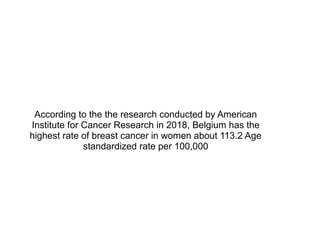
According to the the research conducted by American
Institute for Cancer Research in 2018, Belgium has the
highest rate of breast cancer in women about 113.2 Age
standardized rate per 100,000
ETIOLOGY
• Geographical: common in western world

• Age: extremely rare below the age of 20 years
• Gender: Less than 0.5 per cent in male

• Diet: low phyto-estrogen, high alcohol intake

• Genetic

• Endocrine: long term HRT

• Radiation history
OTHER RISKS FACTORS
• Menarche Age, early menarche is a risk

• Age at first Live Birth

• Lack of breast feeding is a risk

• First-Degree Relatives with Breast Cancer

• Carcinoma of the contralateral breast or endometrium
• Obesity in old age ~ increase in estrogen
• Environmental Toxins
• Tobacco
Screening
• After 40 years mammography indicated
PATHOGENESIS
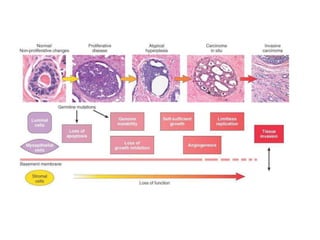
1. Genetic Changes
• Mutation of proto-oncogen( overexpression of HER2)
• Mutation of tumor supressor gene (BRCA1,BRCA2) in breast
epithelium
2. Hormonal Influence /Sporadic Breast Cancer
• Endogenous/exogenous estrogen excess or hormonal
imbalance ! cause mutations or generate DNA-damaging
free radicals ! Tumor.
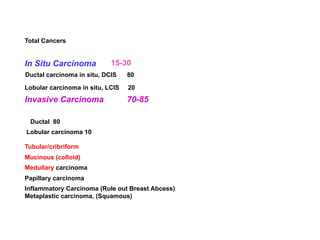
Total Cancers
In Situ Carcinoma* 15-30
Ductal carcinoma in situ, DCIS 80
Lobular carcinoma in situ, LCIS 20
Invasive Carcinoma 70-85
Ductal 80
Lobular carcinoma 10
Tubular/cribriform
Mucinous (colloid)
Medullary carcinoma
Papillary carcinoma
Inflammatory Carcinoma (Rule out Breast Abcess)

Metaplastic carcinoma, (Squamous)
SPREAD OF BREAST CANCER
1. Local spread: to the skin, the pectoral muscles and even
the chest wall if diagnosed late 

2. Lymphatic: primarily to the axillary and the internal
mammary lymph nodes 

3. Blood stream: skeletal metastases, liver, lungs, brain,
adrenal, ovaries 

Clinical Features
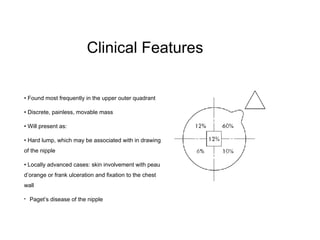
• Found most frequently in the upper outer quadrant
• Discrete, painless, movable mass
• Will present as:
• Hard lump, which may be associated with in drawing
of the nipple
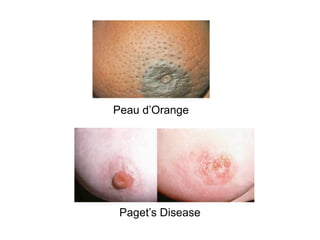
• Locally advanced cases: skin involvement with peau
d’orange or frank ulceration and fixation to the chest
wall
• Paget’s disease of the nipple
Paget’s Disease
Peau d’Orange
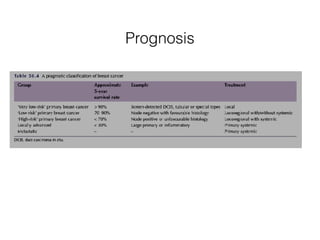
Prognosis
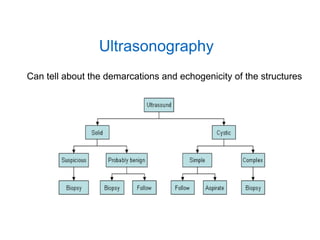
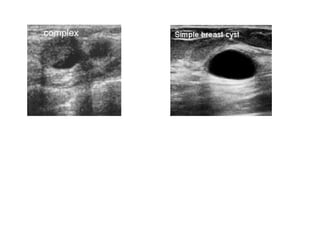
Ultrasonography
Can tell about the demarcations and echogenicity of the structures
complex
complex
• MRI
• CT
• PET/ CT
• Sodium Fluoride PET
• FDG PET
Mammography
• Beneficial in finding occult malignancies
• All women 30 years or older with a breast mass
• Spot compression views and magnification views are recommended
• Multi-focal or multi-centric disease should be noted
• Palpable breast mass – sensitivity 82% to 94% ( Rule Out)

– specificity 55% to 84% for detecting breast cancer ( Rule In)
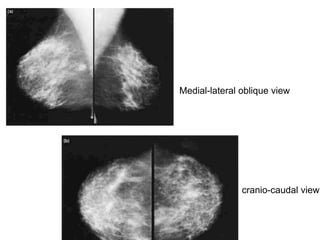
Medial-lateral oblique view
cranio-caudal view
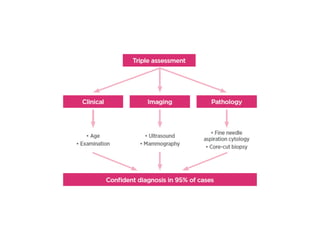
Biopsies
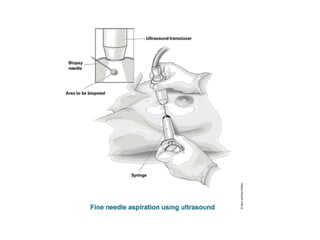
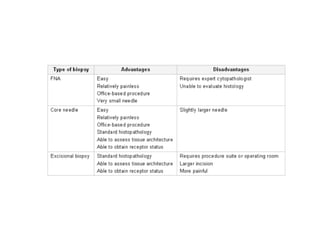
• FNA
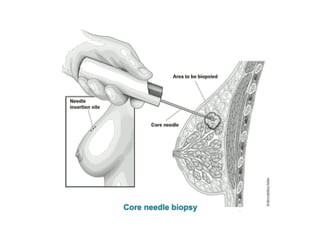
• Core Needle
• Surgical (open) - Incisional and Excisional
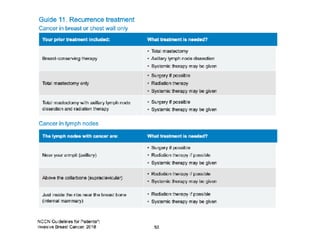
Treatment
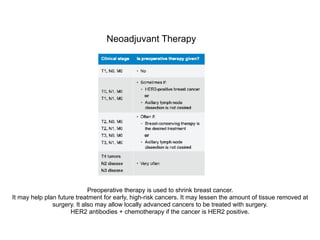
Neoadjuvant Therapy
Preoperative therapy is used to shrink breast cancer.
It may help plan future treatment for early, high-risk cancers. It may lessen the amount of tissue removed at
surgery. It also may allow locally advanced cancers to be treated with surgery.
HER2 antibodies + chemotherapy if the cancer is HER2 positive.
Surgery
• Breast Conserving Surgery - Lumpectomy and Quadrantectomy
- followed by radiotherapy. Not indicated in familial disorders
due to increased risk of breast cancer recurrence
• Mastectomy
1. Simple Mastectomy
2. Radical Mastectomy
3. Modified Radical Mastectomy
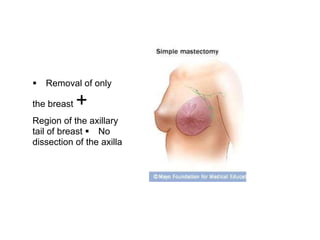
" Removal of only
the breast +
Region of the axillary
tail of breast " No
dissection of the axilla
Includes excision of:
• The breast
• Axillary lymph nodes

• Pectoralis major and minor muscles
• No longer indicated
RADICAL HALSTED MASTECTOMY
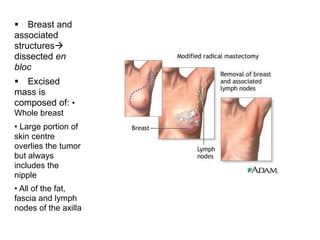
" Breast and
associated
structures#
dissected en
bloc
" Excised
mass is
composed of: •
Whole breast
• Large portion of
skin centre
overlies the tumor
but always
includes the
nipple
• All of the fat,
fascia and lymph
nodes of the axilla
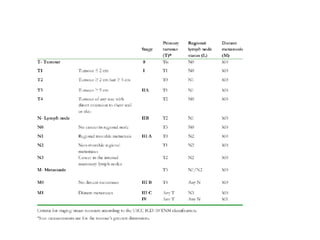
• Stage the patient and to treat the axilla 

• Presence of metastatic disease within the axillary lymph 

nodes - best single marker for prognosis 

• Major determinant of appropriate systemic adjuvant therapy 

• But treatment does not affect long-term survival 

AXILLARY SURGERY
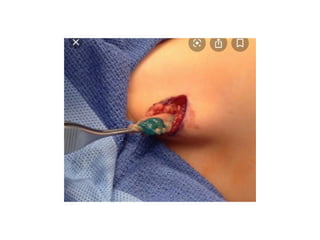
• Sentinel node biopsy
• Sampling
• Removal of the nodes behind and lateral to the pectoralis minor or a
full axillary dissection
How to Deal with Axilla?
SENTINEL NODE BIOPSY
• Standard of care in the management of the axilla 

• In patients with clinically node-negative disease 

• Sentinel node is localised peroperatively by the injection of patent blue
dye and radioisotope labelled albumin in the breast 

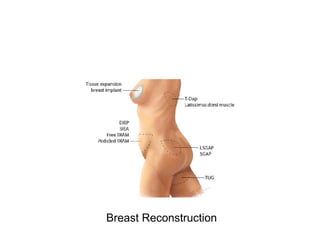
Breast Reconstruction
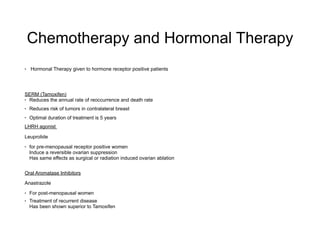
Chemotherapy and Hormonal Therapy
• Hormonal Therapy given to hormone receptor positive patients
SERM (Tamoxifen)
• Reduces the annual rate of reoccurrence and death rate
• Reduces risk of tumors in contralateral breast
• Optimal duration of treatment is 5 years
LHRH agonist
Leuprolide
• for pre-menopausal receptor positive women

Induce a reversible ovarian suppression

Has same effects as surgical or radiation induced ovarian ablation
Oral Aromatase Inhibitors
Anastrazole
• For post-menopausal women
• Treatment of recurrent disease

Has been shown superior to Tamoxifen
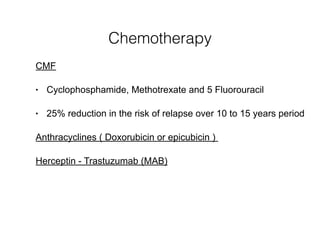
Chemotherapy
CMF
• Cyclophosphamide, Methotrexate and 5 Fluorouracil
• 25% reduction in the risk of relapse over 10 to 15 years period
Anthracyclines ( Doxorubicin or epicubicin )
Herceptin - Trastuzumab (MAB)
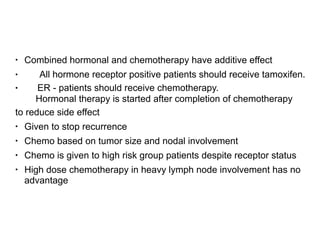
• Combined hormonal and chemotherapy have additive effect
• All hormone receptor positive patients should receive tamoxifen.
• ER - patients should receive chemotherapy. 

Hormonal therapy is started after completion of chemotherapy
to reduce side effect
• Given to stop recurrence
• Chemo based on tumor size and nodal involvement
• Chemo is given to high risk group patients despite receptor status
• High dose chemotherapy in heavy lymph node involvement has no
advantage
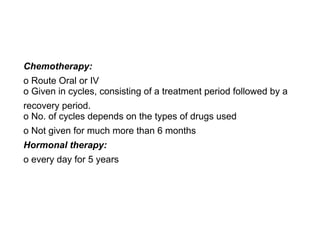
Chemotherapy:
o Route Oral or IV

o Given in cycles, consisting of a treatment period followed by a
recovery period.
o No. of cycles depends on the types of drugs used
o Not given for much more than 6 months
Hormonal therapy:
o every day for 5 years
Psychological Support
Thank You

Breast carcinoma

  • 1.
    BREAST CARCINOMA Ahmed MashoodKhan House Officer Surgical Unit 2
  • 2.
    INTRODUCTION • Pakistan alonehas the highest rate of Breast Cancer than any other Asian country as approximately 90000 new cases are diagnosed every year out of which 40000 die. (jpma) • Is the most common cause of death in middle aged women in western countries
  • 3.
    Which country hasthe highest rate of Breast Cancer worldwide?
  • 4.
    According to thethe research conducted by American Institute for Cancer Research in 2018, Belgium has the highest rate of breast cancer in women about 113.2 Age standardized rate per 100,000
  • 5.
    ETIOLOGY • Geographical: commonin western world
 • Age: extremely rare below the age of 20 years • Gender: Less than 0.5 per cent in male
 • Diet: low phyto-estrogen, high alcohol intake
 • Genetic
 • Endocrine: long term HRT
 • Radiation history
  • 6.
    OTHER RISKS FACTORS •Menarche Age, early menarche is a risk
 • Age at first Live Birth
 • Lack of breast feeding is a risk
 • First-Degree Relatives with Breast Cancer
 • Carcinoma of the contralateral breast or endometrium • Obesity in old age ~ increase in estrogen • Environmental Toxins • Tobacco
  • 7.
    Screening • After 40years mammography indicated
  • 8.
    PATHOGENESIS 1. Genetic Changes •Mutation of proto-oncogen( overexpression of HER2) • Mutation of tumor supressor gene (BRCA1,BRCA2) in breast epithelium 2. Hormonal Influence /Sporadic Breast Cancer • Endogenous/exogenous estrogen excess or hormonal imbalance ! cause mutations or generate DNA-damaging free radicals ! Tumor.
  • 10.
    Total Cancers In SituCarcinoma* 15-30 Ductal carcinoma in situ, DCIS 80 Lobular carcinoma in situ, LCIS 20 Invasive Carcinoma 70-85 Ductal 80 Lobular carcinoma 10 Tubular/cribriform Mucinous (colloid) Medullary carcinoma Papillary carcinoma Inflammatory Carcinoma (Rule out Breast Abcess)
 Metaplastic carcinoma, (Squamous)
  • 11.
    SPREAD OF BREASTCANCER 1. Local spread: to the skin, the pectoral muscles and even the chest wall if diagnosed late 
 2. Lymphatic: primarily to the axillary and the internal mammary lymph nodes 
 3. Blood stream: skeletal metastases, liver, lungs, brain, adrenal, ovaries 

  • 12.
    Clinical Features • Foundmost frequently in the upper outer quadrant • Discrete, painless, movable mass • Will present as: • Hard lump, which may be associated with in drawing of the nipple • Locally advanced cases: skin involvement with peau d’orange or frank ulceration and fixation to the chest wall • Paget’s disease of the nipple
  • 13.
  • 15.
  • 18.
    Ultrasonography Can tell aboutthe demarcations and echogenicity of the structures
  • 19.
  • 20.
    • MRI • CT •PET/ CT • Sodium Fluoride PET • FDG PET
  • 21.
    Mammography • Beneficial infinding occult malignancies • All women 30 years or older with a breast mass • Spot compression views and magnification views are recommended • Multi-focal or multi-centric disease should be noted • Palpable breast mass – sensitivity 82% to 94% ( Rule Out)
 – specificity 55% to 84% for detecting breast cancer ( Rule In)
  • 22.
  • 25.
    Biopsies • FNA • CoreNeedle • Surgical (open) - Incisional and Excisional
  • 29.
  • 30.
    Neoadjuvant Therapy Preoperative therapyis used to shrink breast cancer. It may help plan future treatment for early, high-risk cancers. It may lessen the amount of tissue removed at surgery. It also may allow locally advanced cancers to be treated with surgery. HER2 antibodies + chemotherapy if the cancer is HER2 positive.
  • 31.
    Surgery • Breast ConservingSurgery - Lumpectomy and Quadrantectomy - followed by radiotherapy. Not indicated in familial disorders due to increased risk of breast cancer recurrence • Mastectomy 1. Simple Mastectomy 2. Radical Mastectomy 3. Modified Radical Mastectomy
  • 32.
    " Removal ofonly the breast + Region of the axillary tail of breast " No dissection of the axilla
  • 33.
    Includes excision of: •The breast • Axillary lymph nodes
 • Pectoralis major and minor muscles • No longer indicated RADICAL HALSTED MASTECTOMY
  • 34.
    " Breast and associated structures# dissecteden bloc " Excised mass is composed of: • Whole breast • Large portion of skin centre overlies the tumor but always includes the nipple • All of the fat, fascia and lymph nodes of the axilla
  • 35.
    • Stage thepatient and to treat the axilla 
 • Presence of metastatic disease within the axillary lymph 
 nodes - best single marker for prognosis 
 • Major determinant of appropriate systemic adjuvant therapy 
 • But treatment does not affect long-term survival 
 AXILLARY SURGERY
  • 36.
    • Sentinel nodebiopsy • Sampling • Removal of the nodes behind and lateral to the pectoralis minor or a full axillary dissection How to Deal with Axilla?
  • 37.
    SENTINEL NODE BIOPSY •Standard of care in the management of the axilla 
 • In patients with clinically node-negative disease 
 • Sentinel node is localised peroperatively by the injection of patent blue dye and radioisotope labelled albumin in the breast 

  • 39.
  • 40.
    Chemotherapy and HormonalTherapy • Hormonal Therapy given to hormone receptor positive patients SERM (Tamoxifen) • Reduces the annual rate of reoccurrence and death rate • Reduces risk of tumors in contralateral breast • Optimal duration of treatment is 5 years LHRH agonist Leuprolide • for pre-menopausal receptor positive women
 Induce a reversible ovarian suppression
 Has same effects as surgical or radiation induced ovarian ablation Oral Aromatase Inhibitors Anastrazole • For post-menopausal women • Treatment of recurrent disease
 Has been shown superior to Tamoxifen
  • 41.
    Chemotherapy CMF • Cyclophosphamide, Methotrexateand 5 Fluorouracil • 25% reduction in the risk of relapse over 10 to 15 years period Anthracyclines ( Doxorubicin or epicubicin ) Herceptin - Trastuzumab (MAB)
  • 42.
    • Combined hormonaland chemotherapy have additive effect • All hormone receptor positive patients should receive tamoxifen. • ER - patients should receive chemotherapy. 
 Hormonal therapy is started after completion of chemotherapy to reduce side effect • Given to stop recurrence • Chemo based on tumor size and nodal involvement • Chemo is given to high risk group patients despite receptor status • High dose chemotherapy in heavy lymph node involvement has no advantage
  • 43.
    Chemotherapy: o Route Oralor IV
 o Given in cycles, consisting of a treatment period followed by a recovery period.
 o No. of cycles depends on the types of drugs used o Not given for much more than 6 months Hormonal therapy: o every day for 5 years
  • 44.
  • 46.