INFLAMATORY
GLAUCOMA
PRESENTED
BY
JUDITH WOKWEN
COURSE OUTLINE
 Brief review of aqueous production and flow
 Brief review of anterior chamber angle
 Introduction
 Definitions
 Signs/symptoms
 classification
 Pathogenesis
 Management
AQUEOUS PRODUCTION AND OUT FLOW
ANTERIOR CHAMBER ANGLE
INTRODUCTION
Glaucoma is an ocular disease characterized by
elevated intraocular pressure(IOP) optic nerve
cupping with or without visual field loss.
several types of Glaucoma exist with their different
causes and pathophysiology.
Definitions
Inflammatory glaucoma is a condition in which ocular
inflammation causes a persistent or recurrent increase in
intraocular pressure (IOP), resulting in anatomical and
physiological changes. There maybe progressive optic
nerve cupping with corresponding retinal nerve fiber loss
and visual field defect. Mostly associated with uveitis
(uveitic glaucoma ).
Uveitis is inflammation of uveal tissue (iris, ciliary body
and choroid). It is characterised by presence of cells or
cellular aggregates that are sometimes visible in the
chambers during examinations.
SYMPTOMS
• Cloudy vision [in some cases]
• Pains (sudden and severe)
• Photophobia
• Colored haloes,
• Braw ache.
• Nausea /vomiting
SIGNS
• Decrease VA
• IOP may or may not be elevated
• Ciliary congestion (ciliary injection)
• Corneal: odema, kerathopathy [bullae] ,
stroma scaring, KPs
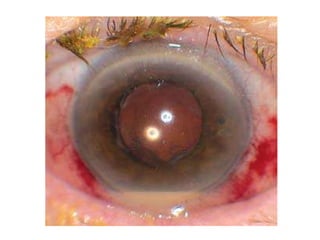
• Anterior chamber: shallow , cells, hypopion.
• Anterior / Posterior Synaechia
• Optic Nerve Cupping and destruction of
Retina Nerve fibres
• Iris: They may be neovascularization of iris,
posterior synechia, peripheral anterior
synechia, iris bombe.
• Pupils: may be mild dilated or moderately
dilated, reacts sluggishly to light, or fixed.
• Lens: Iris pigments on anterior capsule,
posterior sub capsular opacity.
• Fundus :+/- glaucomatous changes of optic
nerve, retinitis, macular oedema.
CLASSIFICATION
1) Angle- closure with pupillary block : when there is
360 degree posterior synaechia]
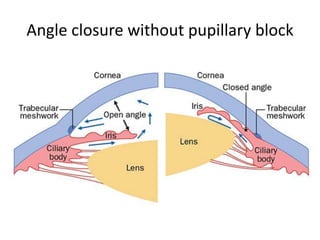
2) Angle closure without pupillary block: [protein cell
and exudates can migrate during the inflammatory
process into the anterior chamber angle, causing
blockage of the angle]
3) Open angle: Here, there is trabeculitis causing
resistance to aqueous drainage thus accumulation
of fluid leading to destruction of the optic nerve
and retinal nerve fibres
PATHOGENESIS
Angle –closure with pupillary block
• It occurs when inflammatory cells and
proteins in aqueous humour, forms
adhesion between iris and lens forming
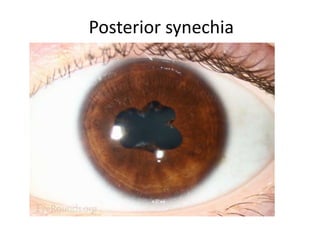
posterior synechia .
• Posterior synechia obstruct aqueous flow
from the posterior to anterior chamber.
• Pressure in the posterior chamber is
increased producing anterior bowing of
the peripheral iris(iris bombe)
• Resulting in shallowing of anterior
chamber.
• Inflamed iris easily sticks to the
trabeculum and the iridocorneal contact.
• This may be permanent with development
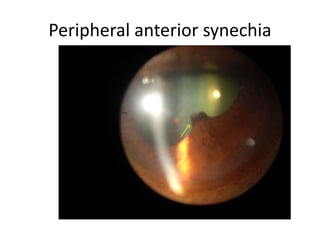
of peripheral anterior synechia
Posterior synechia
Peripheral anterior synechia
Angle-closure glaucoma without
papillary block
 Chronic anterior uveitis causes the
deposition of inflammatory cell and
debris in the angle.
.
Angle closure without pupillary block
Open- angle glaucoma
1. In acute anterior uveitis the IOP is
usually normal or sub normal.
It may be steroid induced or caused
by combination of other machanisms; .
 There may be ciliary short down. But
most commonly as acute inflammation
subsides, the cilliary body function
returns.
 Trabecular obstruction; proteins,
fibrin, debris from inflamed iris
blood vessel enter aqueous
humour and anterior chamber
and disrupt the aqueous flow.
 Acute trabeculitis: Cytotoxic
agents from inflammatory cells
further causes oedema of
trabecular meshwork.
2 . In chronic anterior uveitis there is
trabecular scarring and/or sclerosis
secondary to chronic trabeculitis.
.
• Pathogenesis of elevated IOP may be
uncertain because multiple mechanisms
may be involved such as steroid
responders.
• Assessment of glaucomatous damage
may be disturbed by small pupil or
opacity in the media. Poor visual acuity
may affect accurate results
• Iris vessels may give diagnostic confusion
(NVG).
MANAGEMENT OF INFLAMMATORY
GLAUCOMA
Identify the cause and treat
Medical therapy of elevated IOP and
making sure you assess for steroid
induce ocular hypertension.
Surgical therapy
IDENTIFICATION, CAUSE AND TREATMENT
 History taking
Slit lamp examination
Fundoscopy examination
Gionoscopy examination
Laboratory examinations e.g. ESR,TOXO,
ASLO tests
MEDICAL THERAPY
1. CORTICOTERIODS
e.g. prednisolone, tablets, frakidex, eye
drops and ointment, flucon eye drop,
maxidex oint and eye drop, etc reduced
inflammation
2. CYCLOPLEGICS e.g Atropine,
mydriaticum.They reduce photophobia
and pains [ciliary spasms]. They should
be used with caution.
3. BETA BLOCKERS eg Timolol, Timosol,
carteol.
4. CARBONIC ANHYDRASE INHIBITORS e.g.
Acetazolamide (diamox ) reduces aqueous
humour production and increases uveosclera
outflow
5. ALPHA 2 AGONIST e.g. Brimonidine eye
drop
6. PROSTAGLANDINS e.g. Travatans,
Increases outflow throw uveal
pathway and ciliary muscle
Site effect may worsen inflammation
and increase risk of macular oedema
in uveitis
7. HYPEROSMOTIC AGENTS eg mannitol
SURGICAL THERAPY
 Iridotomy is done in eyes with papillary-
block angle closure glaucoma with uveitis.
The hole can become ocluded .
 Surgical iridectomy can be done to prevent
pupilary block.
 Trabeculectomy..
 Cyclodistructive procedure [cyclocryo]
Thanks For Your Kind Attention
END!!!

Inflamatory glaucoma

  • 1.
  • 2.
  • 3.
    COURSE OUTLINE  Briefreview of aqueous production and flow  Brief review of anterior chamber angle  Introduction  Definitions  Signs/symptoms  classification  Pathogenesis  Management
  • 4.
  • 5.
  • 6.
    INTRODUCTION Glaucoma is anocular disease characterized by elevated intraocular pressure(IOP) optic nerve cupping with or without visual field loss. several types of Glaucoma exist with their different causes and pathophysiology.
  • 7.
    Definitions Inflammatory glaucoma isa condition in which ocular inflammation causes a persistent or recurrent increase in intraocular pressure (IOP), resulting in anatomical and physiological changes. There maybe progressive optic nerve cupping with corresponding retinal nerve fiber loss and visual field defect. Mostly associated with uveitis (uveitic glaucoma ). Uveitis is inflammation of uveal tissue (iris, ciliary body and choroid). It is characterised by presence of cells or cellular aggregates that are sometimes visible in the chambers during examinations.
  • 8.
    SYMPTOMS • Cloudy vision[in some cases] • Pains (sudden and severe) • Photophobia • Colored haloes, • Braw ache. • Nausea /vomiting
  • 9.
    SIGNS • Decrease VA •IOP may or may not be elevated • Ciliary congestion (ciliary injection) • Corneal: odema, kerathopathy [bullae] , stroma scaring, KPs • Anterior chamber: shallow , cells, hypopion. • Anterior / Posterior Synaechia • Optic Nerve Cupping and destruction of Retina Nerve fibres
  • 10.
    • Iris: Theymay be neovascularization of iris, posterior synechia, peripheral anterior synechia, iris bombe. • Pupils: may be mild dilated or moderately dilated, reacts sluggishly to light, or fixed. • Lens: Iris pigments on anterior capsule, posterior sub capsular opacity. • Fundus :+/- glaucomatous changes of optic nerve, retinitis, macular oedema.
  • 11.
    CLASSIFICATION 1) Angle- closurewith pupillary block : when there is 360 degree posterior synaechia] 2) Angle closure without pupillary block: [protein cell and exudates can migrate during the inflammatory process into the anterior chamber angle, causing blockage of the angle] 3) Open angle: Here, there is trabeculitis causing resistance to aqueous drainage thus accumulation of fluid leading to destruction of the optic nerve and retinal nerve fibres
  • 12.
    PATHOGENESIS Angle –closure withpupillary block • It occurs when inflammatory cells and proteins in aqueous humour, forms adhesion between iris and lens forming posterior synechia . • Posterior synechia obstruct aqueous flow from the posterior to anterior chamber.
  • 13.
    • Pressure inthe posterior chamber is increased producing anterior bowing of the peripheral iris(iris bombe) • Resulting in shallowing of anterior chamber. • Inflamed iris easily sticks to the trabeculum and the iridocorneal contact. • This may be permanent with development of peripheral anterior synechia
  • 14.
  • 15.
  • 16.
    Angle-closure glaucoma without papillaryblock  Chronic anterior uveitis causes the deposition of inflammatory cell and debris in the angle. .
  • 17.
    Angle closure withoutpupillary block
  • 18.
    Open- angle glaucoma 1.In acute anterior uveitis the IOP is usually normal or sub normal. It may be steroid induced or caused by combination of other machanisms; .  There may be ciliary short down. But most commonly as acute inflammation subsides, the cilliary body function returns.
  • 19.
     Trabecular obstruction;proteins, fibrin, debris from inflamed iris blood vessel enter aqueous humour and anterior chamber and disrupt the aqueous flow.  Acute trabeculitis: Cytotoxic agents from inflammatory cells further causes oedema of trabecular meshwork.
  • 22.
    2 . Inchronic anterior uveitis there is trabecular scarring and/or sclerosis secondary to chronic trabeculitis. .
  • 23.
    • Pathogenesis ofelevated IOP may be uncertain because multiple mechanisms may be involved such as steroid responders. • Assessment of glaucomatous damage may be disturbed by small pupil or opacity in the media. Poor visual acuity may affect accurate results • Iris vessels may give diagnostic confusion (NVG).
  • 24.
    MANAGEMENT OF INFLAMMATORY GLAUCOMA Identifythe cause and treat Medical therapy of elevated IOP and making sure you assess for steroid induce ocular hypertension. Surgical therapy
  • 25.
    IDENTIFICATION, CAUSE ANDTREATMENT  History taking Slit lamp examination Fundoscopy examination Gionoscopy examination Laboratory examinations e.g. ESR,TOXO, ASLO tests
  • 26.
    MEDICAL THERAPY 1. CORTICOTERIODS e.g.prednisolone, tablets, frakidex, eye drops and ointment, flucon eye drop, maxidex oint and eye drop, etc reduced inflammation
  • 27.
    2. CYCLOPLEGICS e.gAtropine, mydriaticum.They reduce photophobia and pains [ciliary spasms]. They should be used with caution. 3. BETA BLOCKERS eg Timolol, Timosol, carteol.
  • 28.
    4. CARBONIC ANHYDRASEINHIBITORS e.g. Acetazolamide (diamox ) reduces aqueous humour production and increases uveosclera outflow 5. ALPHA 2 AGONIST e.g. Brimonidine eye drop
  • 29.
    6. PROSTAGLANDINS e.g.Travatans, Increases outflow throw uveal pathway and ciliary muscle Site effect may worsen inflammation and increase risk of macular oedema in uveitis 7. HYPEROSMOTIC AGENTS eg mannitol
  • 30.
    SURGICAL THERAPY  Iridotomyis done in eyes with papillary- block angle closure glaucoma with uveitis. The hole can become ocluded .  Surgical iridectomy can be done to prevent pupilary block.  Trabeculectomy..  Cyclodistructive procedure [cyclocryo]
  • 31.
    Thanks For YourKind Attention END!!!