party reproduction
   beyond science-guidelines,ethics
               and law

               Is it a very muddy and dirty party ? Or is it ???


                     narendra malhotra
                      jaideep malhotra
                     www.malhotrahospitals.com
               acknowledgements for inputs and slides
nayna patel,kaberi banarjee,pc mahpatra,kd nayyar,rg patel,rajvi mehta
    and all the others involved in ART and 3rd party reproduction
Infertility – A Global Problem
normal need for reproduction
        One man ----One woman
       One sperm and one oocyte
          AND “THE STORK”


        AND THE SCIENTIFIC ROMANCE
               &
         THE MIRACLE OF LIFE
origin of reproduction


So, God created man in His own image, in the image
of God created He him; male and female created.
And God blessed them and God said unto them.
Be fruitful and multiply and replenish the earth and
Subdue it.


                             (Genesis 1:27-28)
Rachel’s desperate plea to her
husband Jacob


“Give me children or else I will die”

                             Anguish or
Cry of female
Sarah & Abraham
Sarah considered the problem and asked Abraham to
go in unto my maid; it may be that I may obtain
children by her. Abraham honoured Sarah’s request
and Hagar conceived


    Irresistible Desire to have Child
Human Reproduction – changed

• 25th July, 1978
• Louise Joy Brown
• World’s First Successful Test Tube Baby


Landmark Event in Reproductive Revolution   Science Proves Wonders
Third-party reproduction
                      Wikipedia
•   Third party reproduction refers to a process where another person
    provides sperm or eggs or where another woman provides her uterus so that a
    woman can have a child. Thus the reproductive process goes beyond the
    traditional father-mother model. However, the third party's involvement is limited
    to the reproductive process and does not extend into the raising of the child. One
    can separate:
•   Sperm donation. A third party provides sperm that can be used for insemination of
    the future mother or to fertilise an ovum for re-insertion of the resulting embryo
    into the mother, or by embryo transfer into a surrogate mother.
•   Ovum donation. An egg donor provides ova for fertilization in the IVF process. The
    embryo is placed into the uterus/womb of the future mother (embryo transfer).
•   Embryo donation, with unused embryos after the woman for whom they were
    originally created has successfully carried one or more pregnancies to term, or
    where embryos are specifically created for donation using donor eggs and donor
    sperm.
•   Gestational carrier. A woman carries a baby through the pregnancy for another
    person. This involves the use of IVF as the embryo is implanted by embryo transfer.
Thus a child can have a genetic and social (non-genetic, non-biologic) father,
  and a genetic, gestational, and social (non-biologic) mother, and any
  combinations thereof.
Theoretically a child thus could have 5 parents.
party reproduction & parenting how ?

Oocyte donation

Sperm Donation

Embryo Donation

IVF with gestational carrier

Traditional surrogacy

Adoption

Ovarian Transplantation
with increasing age, the woman’s ovaries run out
         of eggs(limited ovarian reserve)


The only option these women have for having a baby is egg donation –ivf…third party
there is also an increasing incidence
            of POF & DOR
• For these women to concieve the only way
  out is to use donor eggs(third party)
• Aged women
• Oophrectomy cases
• Cancer ovary and operated or irradiated
• Premature ovarian failure(premature
  menopause)
there is an increasing incidence of non
        obstructive azospermia

                the only chance these couple have to have a baby
                is thru sperm donation……third party
some women have untreatable
     uterine abnormality
RKH,endom TB,hystrectomy, etc
the only chance of these couples to
 have babies is thru
 surrogacy…………third party
What is Egg Donation?
•   Egg donation is the part of third party reproduction.

•   Eggs are retrieved from a young woman ( < 33 yrs ) called the donor.

•   These eggs are then fertilized with the sperms of the recipient’s husband.

•   Resultant embryo is inserted into the uterus of the recipient.
OOCYTE DONATION
 Oocyte donation has been used for more
 than 20 years to help infertile couples
 become pregnant through IVF
 Oocyte from a donor are fertilized with
 male partner’s sperm & resulting
 embryos are transferred into the
 female partner’s uterus
oocyte donation:Indications
 Advanced Reproductive Age(attained Menopause)
 Hypergonadotropic hypogonadism
 Resistant Ovary Syndrome
 Ovarian Failure-------Malignancies, Surgical
 Castration,Premature Ovarian Failure
 Poor oocyte or embryo quality
 Recurrent IVF failure
 Recurrent pregnancy loss
 Genetic disorder (affected or carrier)
The Oocyte Donation Process
  The donor
 Donor recruitment: Who are the donors?
 Donor Screening: How are they tested?
 Donor matching: How do I pick a donor?

  The recipient couple
 Medical Screening : The Mock cycle
 Psychological issues
 Legal Issues
 Ethical concerns: Disclosure
classification of donors
Three Categories of Donors
 Anonymous Fertile donors
 Anonymous Infertile donors
  (shared cycles)
 Known donors
 Future: donor oocyte vitrification
Pregnancy rates depend on who donates
 Anonymous Young (Fertile) donors
 Best Known donors often less fertile
donors
 IVF patients, willing to share their extra- oocytes
  OOCYTE SHARING PROGRAMME( COMMON )
 Women with tubectomy, willing to be hyperstimulated
  ( MONETARY COMPENSATION)
 Known donors include family members who come forward
  to donate their oocytes ( FAMILY )
 Professional donors, recruited after advertisement
  (MONETARY COMPENSATION)
 Volunteers , philanthropic enough to donate their oocytes
  (RARE BUT MAY FIND SUCH)
Matching
 Donors are matched as closely as possible with the
 recipient couple for characteristics, such as hair
 color, eye color, occupation
 Medical matching(bl.grp. And screened for other ds)
 Compensated for their time & effort
 Compensation remains the same no matter how
 many oocytes are retrieved
donor screening
 Suggested medical ,personal, family
  (genetic) & reproductive history
 Complete blood count with platelets
 Blood type
                    Proper selection of donor.Thorough evaluation & treatment of
 Hepatitis screen
 VDRL              recipient. Optimum dose of Gonadotrophins and proper


 HIV-1, HIV- 2 monitoring of donor.Avoid complications in egg donor.
 Cervical cultures for gonorrhoea and
  Chlamydia
 Pap smear
 Transvaginal ultrasound of pelvis
 Appropriate genetic tests
Preparation of the donor
 Donor preparation – Synchronize cycle with
 recipient & start with stimulation protocols
 either an antagonist -protocol or a long-
 protocol to yield several mature oocytes for
 fertilization
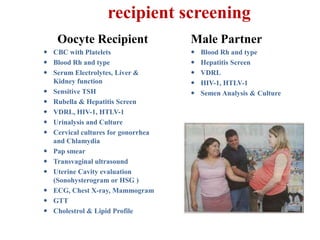
recipient screening
    Oocyte Recipient                Male Partner
 CBC with Platelets                   Blood Rh and type
 Blood Rh and type                    Hepatitis Screen
 Serum Electrolytes, Liver &          VDRL
  Kidney function                      HIV-1, HTLV-1
 Sensitive TSH                        Semen Analysis & Culture
 Rubella & Hepatitis Screen
 VDRL, HIV-1, HTLV-1
 Urinalysis and Culture
 Cervical cultures for gonorrhea
  and Chlamydia
 Pap smear
 Transvaginal ultrasound
 Uterine Cavity evaluation
  (Sonohysterogram or HSG )
 ECG, Chest X-ray, Mammogram
 GTT
 Cholestrol & Lipid Profile
algorithm oocyte donation
Recipient evaluation(USG to monitor development of oocytes, blood tests to check E2 levels).
                                              ↓
                                   Donor Recruitment
                                              ↓
                                     Donor Screening
                                              ↓
                   Obtaining informed consent from recipient and donor
                                              ↓
                       Synchronization of donor and recipient cycles
                                              ↓
                        Prescription of hormones for the recipient
                                              ↓
                               Ovarian stimulation of donor
                                              ↓
                              Oocytes retrieval from donors
                                              ↓
                                  Fertilization of oocytes
                                              ↓
                                    Embryo Transfer
                                              ↓
                          Maintenance of pregnancy in recipient
Concerns & Complications
• Ethical, legal, religious & social issues
• Pre-embryo donation raises several unique issues,
such as the status of pre-embryo & its well-being
• Relationship between biological & social parents, &
safeguarding of the interests of the offspring, may be
resolved by specific legislation pertaining to each
country
concerns & complications
 Adequate study of the health risks of
  oocyte extraction, including long-term
  risks
 Medical costs for adverse effects caused
  by the procedure
 True informed consent from women who
  provide oocytes
 Exploitation of poor women
 No meaningful oversight
success rates
  Depends on:
 Age of the woman providing the oocytes & that of recipient
 Cause of the couple's infertility
 Quality & Developmental stage of embryos when they are
  transfered
 Number of embryos transferred
 Each IVF treatment cycle using donated oocytes has a 55 % chance
  of success
Legality & telling the child
• Egg donation is regulated and / or prohibited in many countries.

• The egg recipient and the father of the child are the legal parents.

• The father must pay child-support even if he claims a divorce before the
   delivery of the child.

• Most egg donors express a strong desire not to be identified by the
   children.

• ?? Should donor identity be revealed to the child resulting from egg
   donation once he/she reaches the age of 18 years.
Commodification

“There exists some scale
into which every value
inhering in a good can be
translated; . . . and this
scale is money.”

“. . . Money is the
superscale of value.”

E. Richard Gold, Body Parts, p. 148.
donor sperm


 SPERM BANKS
IN CHINA
FOR DONORS
SPERM DONATION
• Artificial insemination using donor sperm has been
  practiced for over a
   century, although the first published reports about the
  practice were in 1945.
• Over the past 10 years, the utilization of donor sperm has
  decreased as the utilization of intracytoplasmic sperm
  injection (ICSI) for the treatment of male
• AIDS, artificial donor insemination has been performed
  exclusively with frozen and quarantined sperm.
• Current FDA and ASRM guidelines recommend that
  sperm be quarantined for at least six months before being
  released for use
Indications for Sperm Donation
•    Currently, therapeutic donor insemination (DI or TDI) is appropriate when
•    the male partner has severe abnormalities in the semen parameters. (caused by
     a blockage of the ejaculatory ducts) and non-obstructive (due to testicular
     failure) azoospermia (absence of sperm), which may be congenital or acquired.

•    Examples of obstructive azoospermia include congenital absence of the vas
     deferens or previous vasectomy.
•    non-obstructive azoospermia include primary testicular
     failure or secondary testicular failure due to previous radiation or chemotherapy
     treatment.
    Severe oligospermia (decreased sperm count) or other significant
•    sperm or seminal fluid abnormalities are also indications for DI.
•    DI is also indicated if the male has ejaculatory dysfunction or if he is a carrier or
     affected with a significant genetic defect and would prefer not to pass this gene
     on to his children.
•    DI may be used if the female is Rh-sensitized and the male partner is
     Rh-positive.
•    DI is often used in the treatment for a single woman who desires a pregnancy but
     who lacks a male partner.
Selection of Sperm Donors

• Sperm donors should be of legal age and ideally less than
  40 years of age to minimize the potential hazards of aging.
• Traditionally, donors have been anonymous; however, the
  donor may also be known or directed to the couple or
  single woman. The ASRM believes it is important that
  both anonymous donors and donors known to the
  recipient-though not necessarily intimate sexual
  partners-undergo the same initial and periodic screening
  and testing process.
• However, the FDA only requires that anonymous sperm
  donors be screened for risk factors for and clinical
  evidence of communicable disease agents or diseases.
sperm donor
• The donor will undergo a semen analysis and the
   sample will be thawed to evaluate post-
   freezing/thawing semen parameters.
• Sperm susceptibility to damage with freezing varies
   between individuals, as well as between samples of a
  given donor.
  Donors are selected if the post-thaw semen parameters
   meet a minimum standard. In general, specimens
   should contain a minimum from 20 to 30 million
   motile sperm per milliliter after thawing.
 Post-thaw motility is generally in the range of 25% to
   40%.
• In addition to the medical information that is
  obtained from the donor,
• Donors are asked to provide detailed
  information about their personal habits,
  education,hobbies, and interests.
• Sperm banks may provide pictures of the donor
  and video or audiotapes from the donor.
• Donors may identify themselves as open to
  contact from any child conceived through DI
  once a child reaches legal age
embryo donations
EMBRYO DONATION

• Embryo donation is a procedure that enables
  embryos either that were created by couples
  undergoing fertility treatment or that were created
  from donor sperm and donor eggs specifically for the
  purpose of donation to be transferred to infertile
  patients in order to achieve a pregnancy.
• Indications for embryo donation include untreatable
  infertility that involves both partners, untreatable
  infertility in a single woman, recurrent pregnancy loss
  thought to be related to embryonic factors, and
  genetic disorders affecting one or both partners.
• The process of embryo donation requires that
  the recipient couple undergo the appropriate
  medical and psychological screening
  recommended for all gamete donor cycles.
• In addition, the female partner undergoes an
  evaluation of her uterine cavity and then her
  endometrium is prepared with estrogen and
  progesterone in anticipation of an embryo
  transfer.
IVF with gestational carrier
          surrogacy
DEFINITIONS
 “Surrogacy”, means an arrangement in which a
  woman agrees to a pregnancy achieved through
  ART, in which neither of the gametes belong to her
  or her husband, with the intention to carry it to
  term and handover the child to the person or
  persons for whom she is acting as a surrogate.
 Although the treatment process is in it self
  straightforward, surrogacy has brought with it very
  complex ethical, legal and moral issues.
Steps in Surrogacy
 Proper patient selection
 Source of surrogate (ART bank)
 Proper selection & screening of the
  surrogate
 Intensive counselling – the key factor
 Synchronizing the cycles of the
  surrogate and the genetic mother
 Proper controlled ovarian stimulation
  and IVF technique
 Preparing the surrogate
 Window period for embryo transfer
 Taking care of the legalities and
  financial contracts
 Transparency of the whole
  arrangement
Indications
 Women with absence of uterus
 Women with hysterectomy for various reasons
 Women who suffer repeated miscarriages
 Repeated IVF failure – due to nonreceptive uterus
 Women with certain medical conditions – severe
  heart disease, kidney disease
 Women for whom the prospect of carrying a baby to
  term is very remote
 Single father
 GAY COUPLES..???
 LESBIANS …???
Counselling
In depth counseling of all parties
engaged in surrogacy arrangements is of
paramount importance and aims to
prepare all parties contemplating this
treatment of last resort to consider all
the facts which will have an influence on
the future lives of each of them
Counselling for the couple
 A review of all alternative treatment options
 The practical difficulty and cost of treatment by
  gestational surrogacy
 The medical and psychological risks of surrogacy
 Potential psychological risk to the child
 The chances of having a multiple pregnancy
 The degree of involvement that the host may wish to
  have with the child
 The possibility that a child may be born with a
  handicap
 The possibility that the host may wish to retain the
  child after birth
 The importance of obtaining legal advice
Selection of Surrogate
Improper selection of the surrogate can
 create problems at any stage of the
 procedure
ART – 2010 has defined the criterias for
 screening a surrogate
Indian guidelines for ART ( pending for LAW)
Surrogacy ,allowed in India but some “gray”
 areas
Counselling for the surrogate
 The full implications of undergoing treatment by IVF
  surrogacy
 The possibility of multiple pregnancy
 The possibility of her family and friends being
  against her having treatment
 The medical risks associated with pregnancy and
  delivery
 The implications of guilt on both sides if the host
  should spontaneously abort a pregnancy
 The possible effect on her own children of acting as
  a surrogate
 The possibility that the host may fell a sense of
  bereavement when she gives the baby to the
  commissioning couple
Screening for the surrogate
A physical examination and pap smear
Infective disease testing
Hysteroscopy
A mock cycle
Psyclogical testing and evaluation
Agreement /contract
 A legal agreement between a gestational carrier,
  her husband if married, and the intended parents,
  negotiated by an independent, separate legal
  counsel, is highly recommended.
 A gestational carrier contract should be as
  comprehensive as possible, setting forth for
  example, the parties intentions with respect to the
  parentage of the child, their financial arrangements,
  prenatal care, delivery plans, selective reduction,
  abortion, future contact among the parties, and
  cooperation on legal steps to establish parentage.
Signing the contract - ART 2010

 Agreement of surrogacy
 Contract - Semen bank and surrogate
            - Surrogate and patient
            - Semen bank and ART clinic
            - Patient and Surrogate
International Surrogacy
Framing international guidelines on the
practice of surrogacy is the challenge of the
day. Legal advice and formal and honest
counseling to all the parties engaged in the
surrogacy contract with a clear agreement on
the terms of payment would be highly
beneficial in protecting surrogacy from
exploitation, avoiding legal, social, and
psychological complications and further
promoting the practice.
Costs for surrogacy
 The cost of the basic procedure are quite complex
  and must be discussed in detail with the patient.
  Over and above cost of IVF procedure and surrogate
  preparation cost, there can be
  – Ongoing psychologic counselling costs
  – Pregnancy complications cost
  – Maternal complications
  – Fetal complications as multiple pregnancy/ selective fetal
    reduction
  – Genetic amniocentesis if required
  – Medical complications
Problems in Surrogacy
 When problems arise in surrogacy it is usually
  because of a breakdown in communication or
  counselling
 Issues that need to be comprehensively addressed
  are
  •   Medical process
  •   Realistic expectations for all parties
  •   Signing the contract
  •   Potential complications
  •   Financial and legal matters
  •   Establishment of parameters of acceptable conduct
      by the parties.
Practical Problems ???
What if
  – The surrogate is not traceable or refuses to hand
    over the child?
  – Anomalous baby born ? Down’s
  – Abortion or preterm delivery?
  – Contracts HIV during pregnancy?
  – Couple doesnot come to take the child?
  – Couples divorce ?
  – Death of comisioning parents ?
  – Country of commisiong parents does not allow
    baby to enter the country ?
  – If it is ED then genetically will not be a DNA match
    with parents ? More problems to take the baby to
    the counrty of commissioning parents
  – Death of the surrogate?
Realistic expectations for all Parties


1. Transparency of the procedure
2. Trust
3. Commitment of all the people
   involved
4. Respect for one another
5. End result - healthy baby – healthy
   surrogate
Establishment of parameters of Acceptable
          conduct by the parties

As a rule both the parties should meet one
 another
Communication between the two parties
 during the pregnancy of the surrogate should
 be allowed
There should be no exploitation of the
 surrogate or blackmailing of the couple at
 any stage.
Well being of the Child
The best interest of the child must always be
the most important consideration in surrogacy
agreements.
surrogacy
 The treatment process in itself is
  straightforward.
 The difficult aspects of the treatment
  concern the extreme care with which
  the surrogate host must be selected by
  the genetic couple to ensure complete
  compatibility and also the in-depth
  counseling that is required, both in the
  short and the long term, on all aspects
  of the treatment
 The support and advice of an
  independent counselor and lawyer are
  absolutely essential.
 Psychological screening and support
  prior to, during and following surrogacy
  is very important
 The success rates of surrogacy procedures
  are entirely dependent upon the overall
  success rates for the given ART facility
 At experienced centre, the process of IVF
  surrogate pregnancy has thus far been
  uncomplicated and gratifying
 None the less, all programs involved in this
  type of arrangement should adopt strict
  guidelines with direct evaluation and
  monitoring of all the procedures involved
  in the care of these patients for the best
  outcomes.
In the emerging world of
  baby-making, there’s a
  new player,
  formally called a
  “third party,”
  who can facilitate ways
  to conceive, or carry a
  pregnancy and give
  birth.
DONOR SPERM
DONOR EGG
DONOR EMBRYO
SURROGACY
When a third person—egg donor, sperm donor, or
  surrogate—becomes part of the baby-making
  process
a couple’s relationship may require extra attention.
• Pre-treatment Counselling is a
                                 must
                               - understanding of the ethical,
                                 moral and legal issues involved
                                 -
                              • psychosocial, emotional and
                                 ethical complexities


Our role is to assess whether they (patients) are
ready and knowledgeable psychosocially and
emotionally about proceeding with treatment, be it
IVF with their own gametes or using third party
gametes.
 Recipient counselling
  for donor insemination
 Recipient counselling
  for oocyte donation
 The donor as patient:
  assessment and support
 Embryo donation:
  counselling donors and
  recipients
 Surrogacy-both legal and
  psychosocial scrutiny
The laws that currently exist are
a poorly constructed patchwork quilt,
that can be confusing even to legal practitioners
Ethics - Definition


Code of moral principles derived from a
system of values and beliefs that helps
 define the correctness of our actions.
Ethics & Medicine

            Hippocratic Oath
           Nightingale Pledge


I will follow that system of regimen which
  according to my ability and judgment, I
  consider for the benefit of my patients
 and abstain from whatever is deleterious
               and mischievous
Ethics in Reproductive Medicine
• Who is the actual patient
   – Many participants involved

• Spectrum of Patients
   – From couple to single to homosexuals


• Impact of our decision on unborn child –   Crucial
• Commercialisation of the Profession

• Pregnancy at any cost – Pregnancy at whose cost ?
Ethical Dilemmas in
                 Reproductive Medicine
• Fertility preservation & reproduction in cancer patients
• Fertility treatment when the prognosis is very poor or futile
• Child rearing ability & the provision of fertility services
• Informing offspring of their conception by gamete donation
• Family members/friends as gamete donors & surrogates
• Donating spare embryos for embryonic stem cell research
• HIV & Infertility Treatment
• Preconception gonadal selection for non-medical reasons
• Financial incentives in recruitment of oocyte donors
  /surrogates
• Reproduction in single partner, lesbians & gays
• New possibilities also carry new challenges.

• How to handle the fact that an “outsider” -
  an egg donor, sperm donor, or surrogate - has
  become part of what used to be a very
  private and personal process.

• Another challenge may be to redefine
  ingrained ideas of how families are created,
  and what it means to be a family.
Psychological complications
• Blame for the reproductive
  failing.
• Emotional responses.
• Social stigma and
  community ostracism.
• Economic
  impoverishment.
• Lifelong consequences
  (poverty in old age) .
Moral controversy
•   Infertility is not a life-threatening disease.
•   Is having children a basic necessity?
•   Is access to ARTs a reproductive right?
•   Ruins reputations.
•   Ruins marriages.
•   Ruins livelihoods.
•   Ruins mental health.
•   Ruins long-term security.
The unborn child
• Instructing parents on how to
  handle disclosure issues to the
  children and kind of keeping an
  eye out for the child before it is
  conceived.


• The fear is that knowledge of the
  actual genetic relationships
  among the participants could
  contribute to a profoundly altered
  view of identity and family
  relationships.
• New genetic relationships never before possible
  esp. with intra-familial donations.

• The offspring’s genetic lineage becomes very
  confusing, further complicating the concept of
  the family.

  “His aunt is also his genetic mother.” ?????
Mr .Z - a man who
desperately wanted a
family, resisted the idea
of a sperm donor,
believing this would
mean that another man
could give his wife the
baby he could not.
• Couples who decide to use donor egg or sperm have
  to face the fact that only one of them will be a
  biological parent. This sticky issue may be a bit easier
  for women to deal with, especially if she is able to use
  a donor egg to carry the pregnancy herself, or use her
  own egg but have the pregnancy carried by a
  surrogate. In either of these cases the woman still has
  a physical connection to the pregnancy.

. But when a couple uses donor sperm, the husband’s
   lack of a biological or physical link Can cause tension
   in the marriage, and sometimes even make it difficult
   for a new father to bond with his child.
• Mrs X ;35 year old, who recently spoke of her
  distress and feelings of being an “outsider” in
  the birth of her child.
  Her husband, a man 12 years older, desperately
  wanted a biological child . But Mrs X had
  undergone fertility treatments only to discover
  that she would not be able to conceive or carry a
  child, and the couple decided to use both a
  gestational carrier and a donor egg.
• As she was awaiting the results of the carrier’s
  pregnancy test, she said, she felt as if she were
  waiting to see if she was about to become the
  babysitter for her husband’s child!
• Another woman, Mrs Y., was consumed with
   jealousy for the gestational carrier who was
   bearing her child.
  In spite of her biological connection with the
   baby - the embryo was created with her egg
   and her husband’s sperm - couldn’t silence
   her intense envy every time she accompanied
   the pregnant carrier to the doctor’s
   appointments and watched her own husband
   and the medical staff shower the carrier with
   attention.
COUNSELLING
1.Your Feelings Are Normal
   The science may have gotten more complicated, but
   basically humans are still hardwired to accept a
   more traditional way of being a family. In making
   this transition, acknowledge that it’s natural to have
   a whole range of feelings.

2.Grieve Your Link
  Part of adjusting to this new way of being a family is
  to say goodbye to the idea of what you hoped your
  family would be. Spend quiet time with your
  feelings, and think of meaningful ways to honour
  and express them.
COUNSELLING
3.Talk To Your Spouse
  Rather than imagining that your spouse can
  read your mind, share what is true for you.
  Start off by setting ground rules that there
  are no feelings or concerns that are off
  bounds, and that you will commit to
  mutually addressing all concerns.
COUNSELLING
4.Redefine Being a Parent
• Be creative about ways to include both partners in every
   step of the pregnancy and birth process, regardless of the
   biological link.

• For example, after Mr.Z,s’ wife became pregnant using a
  sperm donor, they decided that every evening they would
  “talk to the baby,” while he lay his hands on his wife’s
  belly to feel her move.

• After Mrs.X shared her feelings of being left out with her
  husband, he made sure that she was front and center
  each time their Surrogate carrier had a doctor’s visit or a
  sonogram.
After the baby is born,
many come to realize that
biological or not, it is daily
parenting that creates and
strengthens the bond you
have with your child.
Take home message
• Couples relationship is 1st priority.
• Child to be born is 2nd priority.
• If interogation of 3rd party is not acceptable
  even to one of the intending parents ,we
  should advice against it.
• Adoption can be encouraged in such cases.
• Include both partners equally in each step of
  pregnancy and birth process regardless of the
  biological link.
Take home message
• Expert counselling to be included at every
  step.
• With 3rd party helping in reproduction – aim
  has to be making a family and not breaking
  or weakening the relationship of intending
  parents.
Donated gametes and uterus


Is commercialization justified ?
Known donor….why not?
Donor and Surrogate –
   same person?


     IUI or IVF ?
Child through third party
      reproduction….

Should he/she know origin?
Human Reproduction – Future


    Reproductive Bazar


      Designer Babies

    Your Comments… ?
Homosexual Man
           Lesbians
        Single Partner

    Right to have babies ???
     Bearing or Rearing ???
    Legal & Moral Status ???
 Production or Reproduction ???

Changing Society – Changing Concept
First Gay couple to have a baby thru
          surrogate in India
ADDITIONAL FACTORS
• India is emerging as a leader in international
  surrogacy
• Surrogacy in India is low cost and legal
  environment is friendly

• There was a need to increase international
  confidence in going in to India for surrogacy.
• Manji case as set a landmark decision
HUMAN RIGHTS
INDIAN REGISTRY OF CENTRES
IVF TOURISM IN INDIA

• According to a study in 2004,India could earn as much
  as two billion dollars annually by 2012,through
  medical tourism including fertility services.
• India spends just 1.2% of GDP on health, but takes
  care of foreign patients
• It ranks second in medical tourism in 2007,only next
  to Thailand
• Indian hospitals treated 4.5 lakh patients as compared
  to 12 lakhs by Thailand
Why Surrogacy in India?

•   Indian surrogates very popular b/o-
•   Easy availability
•   Low cost
•               Price comes to roughly a
    Non demanding
              third of whatever is being
•   Indian clinics are becoming more competetive
               charged anywhere else in
    in pricing and retention and hiring of surrogates.
                        the world
Across the border laws

Laws all over the world are
different, even different states in
US have different laws,.
Difficult to keep track
Till the demand is there,
providers are available
Lets not forget the safe waters
for abortions and cloning
Surrogacy agreements

• . Care has to be taken that the agreement
  does not violate any of the laws, which do not
  in ay way match with surrogacy. I would say
  that each agreement has to be carefully
  drafted carrying these very essential points:
IVF Tourism in India
        A Boon or a threat ?


Why is India such a favourite destination
                for ART ?
What can be done ?
 The patients who are coming to India for IVF
  treatment are coming via internet and their
Our indian association of the clinic is not complete.
  knowledge about assisted reproduction (ISAR) is
underfirst of all of accrediting to be some sortbig leap
  So the process there has facilities, which is a of
towards improving the standard of care universally
  gradation /rating or information ISAR 2008 about the
  clinics which can be easily available for
  patients.
Surrogate mother has become a price
• As it happened in the past in every society that any process
  /method when takes the shape of industry the sensitiveness
  goes for a toss.
• In our case surrogate mother has become “nothing but the
  price”. Even if we are not able to restrict commercialization
  of the surrogate practice in India at least there has to be
  some resolve amongst the clinics to make it expensive or
  lesser accessible by standardizing the rates and will also
  compel everybody to think twice before taking a call on
  surrogacy and it will help clinics to invest in good training,
  infrastructure for these kind of treatments.
                              Mr Srinivas
                            marketing executive
Democratic India
India’s population and the democratic system
are quite slow, not only because of the
corruption but, also because the complex
nature of our constitution, it will be unfair to
expect the Government to act very swiftly on
any issue in our country. So the immediate
responsibility falls back on the society, on the
Doctor/Clinics to implement the ethical policies
or moral values which they like to follows.
                            Ashish Modi
        Ivf Equipment manufacturer and exporter
There always was an inflow of patients from
 neighbouring countries and West Asia ,but
 now significant numbers are coming from
 USA,UK and EUROPE
                              Deloitte
           Health care researcher two year study
As the industry grows, raking in money,
infertility specialists are making a quick buck
by advising patients to opt for surrogacy
without weighing the pros and cons,
regulations will take some time to be
implemented.
                              Dr Anjali Malpani
                    Infertility specialist(mumbai)
• Definitely a boon ! Provided :
• 1. Carried out as per ICMR guidelines.
• 2. Complete transparency in the process,
  especially financial transactions.
• 3. Proper medicolegal safety for all parties
  concerned.
                             Dr Manish Banker
It is a win ,win situation for
everybody, whether it is the
patients, doctors, society, city,
or the country.
Dr H.D.Pai (Mumbai)                 Dr Nayana Patel ( Anand)
Dr Rama Raju (Vizag)            Dr Kanthi Bansal (Ahmadabad)
                Dr Abha Majumdar (Delhi)
CONCLUSION
• The options available through third party reproduction provide
  many couples
• the opportunity to make their dream of parenthood a reality.
• The comprehensive nature of the screening and counseling of
  intended parents and their donors or surrogates ensures that the
  process meets the needs of all involved.
• Finally, as third party reproduction is more widely used, there
  continues to be a broader
• understanding of the ethical, moral and legal issues involved.
• The ultimate goal of physicians, mental health professionals, and
  attorneys specializing in
• reproductive law is to enable this process to move forward as
  smoothly as possible and bring joy and satisfaction to all parties
  involved in ensuring the conception and delivery of a healthy child.
thanks for hearing me out on this
issue of 3rd party reproduction I hope
 this does not lead to this….. In a few
          years from now….
OUR FIRST SURROGATE BIRTHS FOR
     AN AMERICAN COUPLE
more to solve this
  controversy see you at
 BCGiP-COGI 15-18nov at
          DELHI

27 hrs credit points by MCI

3RD PARTY REPORDUCTION

  • 1.
    party reproduction beyond science-guidelines,ethics and law Is it a very muddy and dirty party ? Or is it ??? narendra malhotra jaideep malhotra www.malhotrahospitals.com acknowledgements for inputs and slides nayna patel,kaberi banarjee,pc mahpatra,kd nayyar,rg patel,rajvi mehta and all the others involved in ART and 3rd party reproduction
  • 2.
    Infertility – AGlobal Problem
  • 3.
    normal need forreproduction One man ----One woman One sperm and one oocyte AND “THE STORK” AND THE SCIENTIFIC ROMANCE & THE MIRACLE OF LIFE
  • 4.
    origin of reproduction So,God created man in His own image, in the image of God created He him; male and female created. And God blessed them and God said unto them. Be fruitful and multiply and replenish the earth and Subdue it. (Genesis 1:27-28)
  • 5.
    Rachel’s desperate pleato her husband Jacob “Give me children or else I will die” Anguish or Cry of female
  • 6.
    Sarah & Abraham Sarahconsidered the problem and asked Abraham to go in unto my maid; it may be that I may obtain children by her. Abraham honoured Sarah’s request and Hagar conceived Irresistible Desire to have Child
  • 7.
    Human Reproduction –changed • 25th July, 1978 • Louise Joy Brown • World’s First Successful Test Tube Baby Landmark Event in Reproductive Revolution Science Proves Wonders
  • 8.
    Third-party reproduction Wikipedia • Third party reproduction refers to a process where another person provides sperm or eggs or where another woman provides her uterus so that a woman can have a child. Thus the reproductive process goes beyond the traditional father-mother model. However, the third party's involvement is limited to the reproductive process and does not extend into the raising of the child. One can separate: • Sperm donation. A third party provides sperm that can be used for insemination of the future mother or to fertilise an ovum for re-insertion of the resulting embryo into the mother, or by embryo transfer into a surrogate mother. • Ovum donation. An egg donor provides ova for fertilization in the IVF process. The embryo is placed into the uterus/womb of the future mother (embryo transfer). • Embryo donation, with unused embryos after the woman for whom they were originally created has successfully carried one or more pregnancies to term, or where embryos are specifically created for donation using donor eggs and donor sperm. • Gestational carrier. A woman carries a baby through the pregnancy for another person. This involves the use of IVF as the embryo is implanted by embryo transfer. Thus a child can have a genetic and social (non-genetic, non-biologic) father, and a genetic, gestational, and social (non-biologic) mother, and any combinations thereof. Theoretically a child thus could have 5 parents.
  • 9.
    party reproduction &parenting how ? Oocyte donation Sperm Donation Embryo Donation IVF with gestational carrier Traditional surrogacy Adoption Ovarian Transplantation
  • 10.
    with increasing age,the woman’s ovaries run out of eggs(limited ovarian reserve) The only option these women have for having a baby is egg donation –ivf…third party
  • 11.
    there is alsoan increasing incidence of POF & DOR • For these women to concieve the only way out is to use donor eggs(third party) • Aged women • Oophrectomy cases • Cancer ovary and operated or irradiated • Premature ovarian failure(premature menopause)
  • 12.
    there is anincreasing incidence of non obstructive azospermia the only chance these couple have to have a baby is thru sperm donation……third party
  • 13.
    some women haveuntreatable uterine abnormality RKH,endom TB,hystrectomy, etc
  • 14.
    the only chanceof these couples to have babies is thru surrogacy…………third party
  • 15.
    What is EggDonation? • Egg donation is the part of third party reproduction. • Eggs are retrieved from a young woman ( < 33 yrs ) called the donor. • These eggs are then fertilized with the sperms of the recipient’s husband. • Resultant embryo is inserted into the uterus of the recipient.
  • 16.
    OOCYTE DONATION  Oocytedonation has been used for more than 20 years to help infertile couples become pregnant through IVF  Oocyte from a donor are fertilized with male partner’s sperm & resulting embryos are transferred into the female partner’s uterus
  • 17.
    oocyte donation:Indications  AdvancedReproductive Age(attained Menopause)  Hypergonadotropic hypogonadism  Resistant Ovary Syndrome  Ovarian Failure-------Malignancies, Surgical Castration,Premature Ovarian Failure  Poor oocyte or embryo quality  Recurrent IVF failure  Recurrent pregnancy loss  Genetic disorder (affected or carrier)
  • 18.
    The Oocyte DonationProcess The donor  Donor recruitment: Who are the donors?  Donor Screening: How are they tested?  Donor matching: How do I pick a donor? The recipient couple  Medical Screening : The Mock cycle  Psychological issues  Legal Issues  Ethical concerns: Disclosure
  • 19.
    classification of donors ThreeCategories of Donors  Anonymous Fertile donors  Anonymous Infertile donors (shared cycles)  Known donors  Future: donor oocyte vitrification Pregnancy rates depend on who donates  Anonymous Young (Fertile) donors  Best Known donors often less fertile
  • 20.
    donors  IVF patients,willing to share their extra- oocytes OOCYTE SHARING PROGRAMME( COMMON )  Women with tubectomy, willing to be hyperstimulated ( MONETARY COMPENSATION)  Known donors include family members who come forward to donate their oocytes ( FAMILY )  Professional donors, recruited after advertisement (MONETARY COMPENSATION)  Volunteers , philanthropic enough to donate their oocytes (RARE BUT MAY FIND SUCH)
  • 21.
    Matching  Donors arematched as closely as possible with the recipient couple for characteristics, such as hair color, eye color, occupation  Medical matching(bl.grp. And screened for other ds)  Compensated for their time & effort  Compensation remains the same no matter how many oocytes are retrieved
  • 22.
    donor screening  Suggestedmedical ,personal, family (genetic) & reproductive history  Complete blood count with platelets  Blood type Proper selection of donor.Thorough evaluation & treatment of  Hepatitis screen  VDRL recipient. Optimum dose of Gonadotrophins and proper  HIV-1, HIV- 2 monitoring of donor.Avoid complications in egg donor.  Cervical cultures for gonorrhoea and Chlamydia  Pap smear  Transvaginal ultrasound of pelvis  Appropriate genetic tests
  • 23.
    Preparation of thedonor  Donor preparation – Synchronize cycle with recipient & start with stimulation protocols either an antagonist -protocol or a long- protocol to yield several mature oocytes for fertilization
  • 24.
    recipient screening Oocyte Recipient Male Partner  CBC with Platelets  Blood Rh and type  Blood Rh and type  Hepatitis Screen  Serum Electrolytes, Liver &  VDRL Kidney function  HIV-1, HTLV-1  Sensitive TSH  Semen Analysis & Culture  Rubella & Hepatitis Screen  VDRL, HIV-1, HTLV-1  Urinalysis and Culture  Cervical cultures for gonorrhea and Chlamydia  Pap smear  Transvaginal ultrasound  Uterine Cavity evaluation (Sonohysterogram or HSG )  ECG, Chest X-ray, Mammogram  GTT  Cholestrol & Lipid Profile
  • 25.
    algorithm oocyte donation Recipientevaluation(USG to monitor development of oocytes, blood tests to check E2 levels). ↓ Donor Recruitment ↓ Donor Screening ↓ Obtaining informed consent from recipient and donor ↓ Synchronization of donor and recipient cycles ↓ Prescription of hormones for the recipient ↓ Ovarian stimulation of donor ↓ Oocytes retrieval from donors ↓ Fertilization of oocytes ↓ Embryo Transfer ↓ Maintenance of pregnancy in recipient
  • 26.
    Concerns & Complications •Ethical, legal, religious & social issues • Pre-embryo donation raises several unique issues, such as the status of pre-embryo & its well-being • Relationship between biological & social parents, & safeguarding of the interests of the offspring, may be resolved by specific legislation pertaining to each country
  • 27.
    concerns & complications Adequate study of the health risks of oocyte extraction, including long-term risks  Medical costs for adverse effects caused by the procedure  True informed consent from women who provide oocytes  Exploitation of poor women  No meaningful oversight
  • 28.
    success rates Depends on:  Age of the woman providing the oocytes & that of recipient  Cause of the couple's infertility  Quality & Developmental stage of embryos when they are transfered  Number of embryos transferred  Each IVF treatment cycle using donated oocytes has a 55 % chance of success
  • 29.
    Legality & tellingthe child • Egg donation is regulated and / or prohibited in many countries. • The egg recipient and the father of the child are the legal parents. • The father must pay child-support even if he claims a divorce before the delivery of the child. • Most egg donors express a strong desire not to be identified by the children. • ?? Should donor identity be revealed to the child resulting from egg donation once he/she reaches the age of 18 years.
  • 31.
    Commodification “There exists somescale into which every value inhering in a good can be translated; . . . and this scale is money.” “. . . Money is the superscale of value.” E. Richard Gold, Body Parts, p. 148.
  • 32.
    donor sperm SPERMBANKS IN CHINA FOR DONORS
  • 33.
    SPERM DONATION • Artificialinsemination using donor sperm has been practiced for over a century, although the first published reports about the practice were in 1945. • Over the past 10 years, the utilization of donor sperm has decreased as the utilization of intracytoplasmic sperm injection (ICSI) for the treatment of male • AIDS, artificial donor insemination has been performed exclusively with frozen and quarantined sperm. • Current FDA and ASRM guidelines recommend that sperm be quarantined for at least six months before being released for use
  • 34.
    Indications for SpermDonation • Currently, therapeutic donor insemination (DI or TDI) is appropriate when • the male partner has severe abnormalities in the semen parameters. (caused by a blockage of the ejaculatory ducts) and non-obstructive (due to testicular failure) azoospermia (absence of sperm), which may be congenital or acquired. • Examples of obstructive azoospermia include congenital absence of the vas deferens or previous vasectomy. • non-obstructive azoospermia include primary testicular failure or secondary testicular failure due to previous radiation or chemotherapy treatment. Severe oligospermia (decreased sperm count) or other significant • sperm or seminal fluid abnormalities are also indications for DI. • DI is also indicated if the male has ejaculatory dysfunction or if he is a carrier or affected with a significant genetic defect and would prefer not to pass this gene on to his children. • DI may be used if the female is Rh-sensitized and the male partner is Rh-positive. • DI is often used in the treatment for a single woman who desires a pregnancy but who lacks a male partner.
  • 35.
    Selection of SpermDonors • Sperm donors should be of legal age and ideally less than 40 years of age to minimize the potential hazards of aging. • Traditionally, donors have been anonymous; however, the donor may also be known or directed to the couple or single woman. The ASRM believes it is important that both anonymous donors and donors known to the recipient-though not necessarily intimate sexual partners-undergo the same initial and periodic screening and testing process. • However, the FDA only requires that anonymous sperm donors be screened for risk factors for and clinical evidence of communicable disease agents or diseases.
  • 36.
    sperm donor • Thedonor will undergo a semen analysis and the sample will be thawed to evaluate post- freezing/thawing semen parameters. • Sperm susceptibility to damage with freezing varies between individuals, as well as between samples of a given donor. Donors are selected if the post-thaw semen parameters meet a minimum standard. In general, specimens should contain a minimum from 20 to 30 million motile sperm per milliliter after thawing. Post-thaw motility is generally in the range of 25% to 40%.
  • 37.
    • In additionto the medical information that is obtained from the donor, • Donors are asked to provide detailed information about their personal habits, education,hobbies, and interests. • Sperm banks may provide pictures of the donor and video or audiotapes from the donor. • Donors may identify themselves as open to contact from any child conceived through DI once a child reaches legal age
  • 38.
  • 39.
    EMBRYO DONATION • Embryodonation is a procedure that enables embryos either that were created by couples undergoing fertility treatment or that were created from donor sperm and donor eggs specifically for the purpose of donation to be transferred to infertile patients in order to achieve a pregnancy. • Indications for embryo donation include untreatable infertility that involves both partners, untreatable infertility in a single woman, recurrent pregnancy loss thought to be related to embryonic factors, and genetic disorders affecting one or both partners.
  • 40.
    • The processof embryo donation requires that the recipient couple undergo the appropriate medical and psychological screening recommended for all gamete donor cycles. • In addition, the female partner undergoes an evaluation of her uterine cavity and then her endometrium is prepared with estrogen and progesterone in anticipation of an embryo transfer.
  • 41.
    IVF with gestationalcarrier surrogacy
  • 42.
    DEFINITIONS  “Surrogacy”, meansan arrangement in which a woman agrees to a pregnancy achieved through ART, in which neither of the gametes belong to her or her husband, with the intention to carry it to term and handover the child to the person or persons for whom she is acting as a surrogate.  Although the treatment process is in it self straightforward, surrogacy has brought with it very complex ethical, legal and moral issues.
  • 43.
    Steps in Surrogacy Proper patient selection  Source of surrogate (ART bank)  Proper selection & screening of the surrogate  Intensive counselling – the key factor  Synchronizing the cycles of the surrogate and the genetic mother  Proper controlled ovarian stimulation and IVF technique  Preparing the surrogate  Window period for embryo transfer  Taking care of the legalities and financial contracts  Transparency of the whole arrangement
  • 44.
    Indications  Women withabsence of uterus  Women with hysterectomy for various reasons  Women who suffer repeated miscarriages  Repeated IVF failure – due to nonreceptive uterus  Women with certain medical conditions – severe heart disease, kidney disease  Women for whom the prospect of carrying a baby to term is very remote  Single father  GAY COUPLES..???  LESBIANS …???
  • 45.
    Counselling In depth counselingof all parties engaged in surrogacy arrangements is of paramount importance and aims to prepare all parties contemplating this treatment of last resort to consider all the facts which will have an influence on the future lives of each of them
  • 46.
    Counselling for thecouple  A review of all alternative treatment options  The practical difficulty and cost of treatment by gestational surrogacy  The medical and psychological risks of surrogacy  Potential psychological risk to the child  The chances of having a multiple pregnancy  The degree of involvement that the host may wish to have with the child  The possibility that a child may be born with a handicap  The possibility that the host may wish to retain the child after birth  The importance of obtaining legal advice
  • 47.
    Selection of Surrogate Improperselection of the surrogate can create problems at any stage of the procedure ART – 2010 has defined the criterias for screening a surrogate Indian guidelines for ART ( pending for LAW) Surrogacy ,allowed in India but some “gray” areas
  • 48.
    Counselling for thesurrogate  The full implications of undergoing treatment by IVF surrogacy  The possibility of multiple pregnancy  The possibility of her family and friends being against her having treatment  The medical risks associated with pregnancy and delivery  The implications of guilt on both sides if the host should spontaneously abort a pregnancy  The possible effect on her own children of acting as a surrogate  The possibility that the host may fell a sense of bereavement when she gives the baby to the commissioning couple
  • 49.
    Screening for thesurrogate A physical examination and pap smear Infective disease testing Hysteroscopy A mock cycle Psyclogical testing and evaluation
  • 50.
    Agreement /contract  Alegal agreement between a gestational carrier, her husband if married, and the intended parents, negotiated by an independent, separate legal counsel, is highly recommended.  A gestational carrier contract should be as comprehensive as possible, setting forth for example, the parties intentions with respect to the parentage of the child, their financial arrangements, prenatal care, delivery plans, selective reduction, abortion, future contact among the parties, and cooperation on legal steps to establish parentage.
  • 51.
    Signing the contract- ART 2010  Agreement of surrogacy  Contract - Semen bank and surrogate - Surrogate and patient - Semen bank and ART clinic - Patient and Surrogate
  • 52.
    International Surrogacy Framing internationalguidelines on the practice of surrogacy is the challenge of the day. Legal advice and formal and honest counseling to all the parties engaged in the surrogacy contract with a clear agreement on the terms of payment would be highly beneficial in protecting surrogacy from exploitation, avoiding legal, social, and psychological complications and further promoting the practice.
  • 54.
    Costs for surrogacy The cost of the basic procedure are quite complex and must be discussed in detail with the patient. Over and above cost of IVF procedure and surrogate preparation cost, there can be – Ongoing psychologic counselling costs – Pregnancy complications cost – Maternal complications – Fetal complications as multiple pregnancy/ selective fetal reduction – Genetic amniocentesis if required – Medical complications
  • 55.
    Problems in Surrogacy When problems arise in surrogacy it is usually because of a breakdown in communication or counselling  Issues that need to be comprehensively addressed are • Medical process • Realistic expectations for all parties • Signing the contract • Potential complications • Financial and legal matters • Establishment of parameters of acceptable conduct by the parties.
  • 56.
    Practical Problems ??? Whatif – The surrogate is not traceable or refuses to hand over the child? – Anomalous baby born ? Down’s – Abortion or preterm delivery? – Contracts HIV during pregnancy? – Couple doesnot come to take the child? – Couples divorce ? – Death of comisioning parents ? – Country of commisiong parents does not allow baby to enter the country ? – If it is ED then genetically will not be a DNA match with parents ? More problems to take the baby to the counrty of commissioning parents – Death of the surrogate?
  • 57.
    Realistic expectations forall Parties 1. Transparency of the procedure 2. Trust 3. Commitment of all the people involved 4. Respect for one another 5. End result - healthy baby – healthy surrogate
  • 58.
    Establishment of parametersof Acceptable conduct by the parties As a rule both the parties should meet one another Communication between the two parties during the pregnancy of the surrogate should be allowed There should be no exploitation of the surrogate or blackmailing of the couple at any stage.
  • 59.
    Well being ofthe Child The best interest of the child must always be the most important consideration in surrogacy agreements.
  • 60.
    surrogacy  The treatmentprocess in itself is straightforward.  The difficult aspects of the treatment concern the extreme care with which the surrogate host must be selected by the genetic couple to ensure complete compatibility and also the in-depth counseling that is required, both in the short and the long term, on all aspects of the treatment  The support and advice of an independent counselor and lawyer are absolutely essential.  Psychological screening and support prior to, during and following surrogacy is very important
  • 61.
     The successrates of surrogacy procedures are entirely dependent upon the overall success rates for the given ART facility  At experienced centre, the process of IVF surrogate pregnancy has thus far been uncomplicated and gratifying  None the less, all programs involved in this type of arrangement should adopt strict guidelines with direct evaluation and monitoring of all the procedures involved in the care of these patients for the best outcomes.
  • 62.
    In the emergingworld of baby-making, there’s a new player, formally called a “third party,” who can facilitate ways to conceive, or carry a pregnancy and give birth. DONOR SPERM DONOR EGG DONOR EMBRYO SURROGACY
  • 63.
    When a thirdperson—egg donor, sperm donor, or surrogate—becomes part of the baby-making process a couple’s relationship may require extra attention.
  • 64.
    • Pre-treatment Counsellingis a must - understanding of the ethical, moral and legal issues involved - • psychosocial, emotional and ethical complexities Our role is to assess whether they (patients) are ready and knowledgeable psychosocially and emotionally about proceeding with treatment, be it IVF with their own gametes or using third party gametes.
  • 65.
     Recipient counselling for donor insemination  Recipient counselling for oocyte donation  The donor as patient: assessment and support  Embryo donation: counselling donors and recipients  Surrogacy-both legal and psychosocial scrutiny
  • 66.
    The laws thatcurrently exist are a poorly constructed patchwork quilt, that can be confusing even to legal practitioners
  • 67.
    Ethics - Definition Codeof moral principles derived from a system of values and beliefs that helps define the correctness of our actions.
  • 68.
    Ethics & Medicine Hippocratic Oath Nightingale Pledge I will follow that system of regimen which according to my ability and judgment, I consider for the benefit of my patients and abstain from whatever is deleterious and mischievous
  • 69.
    Ethics in ReproductiveMedicine • Who is the actual patient – Many participants involved • Spectrum of Patients – From couple to single to homosexuals • Impact of our decision on unborn child – Crucial • Commercialisation of the Profession • Pregnancy at any cost – Pregnancy at whose cost ?
  • 70.
    Ethical Dilemmas in Reproductive Medicine • Fertility preservation & reproduction in cancer patients • Fertility treatment when the prognosis is very poor or futile • Child rearing ability & the provision of fertility services • Informing offspring of their conception by gamete donation • Family members/friends as gamete donors & surrogates • Donating spare embryos for embryonic stem cell research • HIV & Infertility Treatment • Preconception gonadal selection for non-medical reasons • Financial incentives in recruitment of oocyte donors /surrogates • Reproduction in single partner, lesbians & gays
  • 71.
    • New possibilitiesalso carry new challenges. • How to handle the fact that an “outsider” - an egg donor, sperm donor, or surrogate - has become part of what used to be a very private and personal process. • Another challenge may be to redefine ingrained ideas of how families are created, and what it means to be a family.
  • 72.
    Psychological complications • Blamefor the reproductive failing. • Emotional responses. • Social stigma and community ostracism. • Economic impoverishment. • Lifelong consequences (poverty in old age) .
  • 73.
    Moral controversy • Infertility is not a life-threatening disease. • Is having children a basic necessity? • Is access to ARTs a reproductive right? • Ruins reputations. • Ruins marriages. • Ruins livelihoods. • Ruins mental health. • Ruins long-term security.
  • 74.
    The unborn child •Instructing parents on how to handle disclosure issues to the children and kind of keeping an eye out for the child before it is conceived. • The fear is that knowledge of the actual genetic relationships among the participants could contribute to a profoundly altered view of identity and family relationships.
  • 75.
    • New geneticrelationships never before possible esp. with intra-familial donations. • The offspring’s genetic lineage becomes very confusing, further complicating the concept of the family. “His aunt is also his genetic mother.” ?????
  • 76.
    Mr .Z -a man who desperately wanted a family, resisted the idea of a sperm donor, believing this would mean that another man could give his wife the baby he could not.
  • 77.
    • Couples whodecide to use donor egg or sperm have to face the fact that only one of them will be a biological parent. This sticky issue may be a bit easier for women to deal with, especially if she is able to use a donor egg to carry the pregnancy herself, or use her own egg but have the pregnancy carried by a surrogate. In either of these cases the woman still has a physical connection to the pregnancy. . But when a couple uses donor sperm, the husband’s lack of a biological or physical link Can cause tension in the marriage, and sometimes even make it difficult for a new father to bond with his child.
  • 78.
    • Mrs X;35 year old, who recently spoke of her distress and feelings of being an “outsider” in the birth of her child. Her husband, a man 12 years older, desperately wanted a biological child . But Mrs X had undergone fertility treatments only to discover that she would not be able to conceive or carry a child, and the couple decided to use both a gestational carrier and a donor egg. • As she was awaiting the results of the carrier’s pregnancy test, she said, she felt as if she were waiting to see if she was about to become the babysitter for her husband’s child!
  • 79.
    • Another woman,Mrs Y., was consumed with jealousy for the gestational carrier who was bearing her child. In spite of her biological connection with the baby - the embryo was created with her egg and her husband’s sperm - couldn’t silence her intense envy every time she accompanied the pregnant carrier to the doctor’s appointments and watched her own husband and the medical staff shower the carrier with attention.
  • 80.
    COUNSELLING 1.Your Feelings AreNormal The science may have gotten more complicated, but basically humans are still hardwired to accept a more traditional way of being a family. In making this transition, acknowledge that it’s natural to have a whole range of feelings. 2.Grieve Your Link Part of adjusting to this new way of being a family is to say goodbye to the idea of what you hoped your family would be. Spend quiet time with your feelings, and think of meaningful ways to honour and express them.
  • 81.
    COUNSELLING 3.Talk To YourSpouse Rather than imagining that your spouse can read your mind, share what is true for you. Start off by setting ground rules that there are no feelings or concerns that are off bounds, and that you will commit to mutually addressing all concerns.
  • 82.
    COUNSELLING 4.Redefine Being aParent • Be creative about ways to include both partners in every step of the pregnancy and birth process, regardless of the biological link. • For example, after Mr.Z,s’ wife became pregnant using a sperm donor, they decided that every evening they would “talk to the baby,” while he lay his hands on his wife’s belly to feel her move. • After Mrs.X shared her feelings of being left out with her husband, he made sure that she was front and center each time their Surrogate carrier had a doctor’s visit or a sonogram.
  • 83.
    After the babyis born, many come to realize that biological or not, it is daily parenting that creates and strengthens the bond you have with your child.
  • 84.
    Take home message •Couples relationship is 1st priority. • Child to be born is 2nd priority. • If interogation of 3rd party is not acceptable even to one of the intending parents ,we should advice against it. • Adoption can be encouraged in such cases. • Include both partners equally in each step of pregnancy and birth process regardless of the biological link.
  • 85.
    Take home message •Expert counselling to be included at every step. • With 3rd party helping in reproduction – aim has to be making a family and not breaking or weakening the relationship of intending parents.
  • 86.
    Donated gametes anduterus Is commercialization justified ?
  • 87.
  • 88.
    Donor and Surrogate– same person? IUI or IVF ?
  • 89.
    Child through thirdparty reproduction…. Should he/she know origin?
  • 90.
    Human Reproduction –Future Reproductive Bazar Designer Babies Your Comments… ?
  • 91.
    Homosexual Man Lesbians Single Partner Right to have babies ??? Bearing or Rearing ??? Legal & Moral Status ??? Production or Reproduction ??? Changing Society – Changing Concept
  • 92.
    First Gay coupleto have a baby thru surrogate in India
  • 94.
    ADDITIONAL FACTORS • Indiais emerging as a leader in international surrogacy • Surrogacy in India is low cost and legal environment is friendly • There was a need to increase international confidence in going in to India for surrogacy. • Manji case as set a landmark decision
  • 95.
  • 96.
  • 97.
    IVF TOURISM ININDIA • According to a study in 2004,India could earn as much as two billion dollars annually by 2012,through medical tourism including fertility services. • India spends just 1.2% of GDP on health, but takes care of foreign patients • It ranks second in medical tourism in 2007,only next to Thailand • Indian hospitals treated 4.5 lakh patients as compared to 12 lakhs by Thailand
  • 98.
    Why Surrogacy inIndia? • Indian surrogates very popular b/o- • Easy availability • Low cost • Price comes to roughly a Non demanding third of whatever is being • Indian clinics are becoming more competetive charged anywhere else in in pricing and retention and hiring of surrogates. the world
  • 102.
    Across the borderlaws Laws all over the world are different, even different states in US have different laws,. Difficult to keep track Till the demand is there, providers are available Lets not forget the safe waters for abortions and cloning
  • 103.
    Surrogacy agreements • .Care has to be taken that the agreement does not violate any of the laws, which do not in ay way match with surrogacy. I would say that each agreement has to be carefully drafted carrying these very essential points:
  • 104.
    IVF Tourism inIndia A Boon or a threat ? Why is India such a favourite destination for ART ?
  • 105.
    What can bedone ? The patients who are coming to India for IVF treatment are coming via internet and their Our indian association of the clinic is not complete. knowledge about assisted reproduction (ISAR) is underfirst of all of accrediting to be some sortbig leap So the process there has facilities, which is a of towards improving the standard of care universally gradation /rating or information ISAR 2008 about the clinics which can be easily available for patients.
  • 106.
    Surrogate mother hasbecome a price • As it happened in the past in every society that any process /method when takes the shape of industry the sensitiveness goes for a toss. • In our case surrogate mother has become “nothing but the price”. Even if we are not able to restrict commercialization of the surrogate practice in India at least there has to be some resolve amongst the clinics to make it expensive or lesser accessible by standardizing the rates and will also compel everybody to think twice before taking a call on surrogacy and it will help clinics to invest in good training, infrastructure for these kind of treatments. Mr Srinivas marketing executive
  • 107.
    Democratic India India’s populationand the democratic system are quite slow, not only because of the corruption but, also because the complex nature of our constitution, it will be unfair to expect the Government to act very swiftly on any issue in our country. So the immediate responsibility falls back on the society, on the Doctor/Clinics to implement the ethical policies or moral values which they like to follows. Ashish Modi Ivf Equipment manufacturer and exporter
  • 108.
    There always wasan inflow of patients from neighbouring countries and West Asia ,but now significant numbers are coming from USA,UK and EUROPE Deloitte Health care researcher two year study
  • 109.
    As the industrygrows, raking in money, infertility specialists are making a quick buck by advising patients to opt for surrogacy without weighing the pros and cons, regulations will take some time to be implemented. Dr Anjali Malpani Infertility specialist(mumbai)
  • 110.
    • Definitely aboon ! Provided : • 1. Carried out as per ICMR guidelines. • 2. Complete transparency in the process, especially financial transactions. • 3. Proper medicolegal safety for all parties concerned. Dr Manish Banker
  • 111.
    It is awin ,win situation for everybody, whether it is the patients, doctors, society, city, or the country. Dr H.D.Pai (Mumbai) Dr Nayana Patel ( Anand) Dr Rama Raju (Vizag) Dr Kanthi Bansal (Ahmadabad) Dr Abha Majumdar (Delhi)
  • 112.
    CONCLUSION • The optionsavailable through third party reproduction provide many couples • the opportunity to make their dream of parenthood a reality. • The comprehensive nature of the screening and counseling of intended parents and their donors or surrogates ensures that the process meets the needs of all involved. • Finally, as third party reproduction is more widely used, there continues to be a broader • understanding of the ethical, moral and legal issues involved. • The ultimate goal of physicians, mental health professionals, and attorneys specializing in • reproductive law is to enable this process to move forward as smoothly as possible and bring joy and satisfaction to all parties involved in ensuring the conception and delivery of a healthy child.
  • 113.
    thanks for hearingme out on this issue of 3rd party reproduction I hope this does not lead to this….. In a few years from now….
  • 114.
    OUR FIRST SURROGATEBIRTHS FOR AN AMERICAN COUPLE
  • 115.
    more to solvethis controversy see you at BCGiP-COGI 15-18nov at DELHI 27 hrs credit points by MCI