INFECTED NONUNION
NON UNION
A state in which healing process comes to a halt as judged by
clinical & x-ray evidence, beyond the stipulated period of
healing for a particular bone due to mechanical or biological
failure , with a gap being filled with fibrous or dense fibro
cartilaginous tissue requiring a change in treatment.
INFECTED NONUNION
That state existing after considerable time [6-8 months] has
elapsed, when there is no evidence that fracture will unite
and infection still persists. Therefore other method of
treatment to be done to achieve union and eradicate
infection.
PROBLEMS
Multiple sinuses
Osteomyelitis
Bone and soft tissue loss
Disuse Osteoporosis
Adjacent joint stiffness
Complex deformities
Limb length inequalities
Multi-drug resistant polybacterial infections
Tibia – most common site
Open fracture with infection – most common cause
Infection following ORIF of closed #.
PATHOGENESIS
INOCULATION
Virulence of microbe
Suboptimal condition of the local environment
Systemic compromise of the host.
Infection perse doesn’t cause nonunion
OM  thrombosis of blood vessel of haversian canals 
bone sclerosis and dead bone.
Butterfly fragments become sequestrii, isolated & devitalized
by pus & infection granulation tissue.
Infection granulation tissue  Osteolysis  gaps 
nonunion.
Osteolysis occurs around the implants  loosening 
instability of fixation  nonunion.
Infection causes nonunion earlier than non-infected pts.
BIOFILM
Key for the development & persistence of inf.
Aggregation of microbes enclosed with in an extracelluar
polysaccharide matrix [glycocalyx] that adheres to the surface
of the implants or devitalized bone.
59% of orthopaedic biomaterial related infections +ve
findings.
Protects the organism from antibiotics and host defense
mechanism.
Allows the infection to exist in sub clinical state and recur.
Implants promotes biofilm, infection would persist.
MICROBIOLOGY
Staphylococcus aureas most common, [alone or in
combination in 65-70%].
Pseudomonas aeroginosa [20-37%]
Commonly polymicrobial [32-70%].
Atypical mycobacterium & fungi in immunocompromised
pts.
CLASSIFICATION
Infected nonunion comes under Cierney type IV chronic
osteomyelitis ie; there unstable before and after
debridement.
ROSEN et al [AO manual]
Infected non-draining nonunion
Infected draining nonunion.
Infected nondraining nonunion
Quiescent ( dry, nondraining for at least 3 months)
Needs one stage treatment.
Active ( non draining but abscess & fever).
Needs two stage treatment.
Infected draining nonunion
I STAGE: By pass bone grafting [fibular protibia,
posteromedial femur or humerus grafting.
II STAGE: By pass has become solid  radical debridement
& open/closed irrigation & antibiotics.
III STAGE: cancellous B.G, muscle or skin pedicle flap,
G.S KULKARNI classification
Severity of infection
Apposition of fragments
Presence or absence of deformity.
TYPE I: fragments in apposition with mild infection and
with or with out implant, stable implant insitu with
mild infection.
TYPE II: Fragments in apposition with severe infection
with large or small wound.
TYPE III: Severe infection with a gap or deformity or
shortening.
3A  defect with loss of full circumference
3B  defect in > 1/3 of cortex
3C  infected nonunion with deformity.
CLINICAL EVALUATION
Pain, erythema, swelling, draining sinuses, abnormal
mobility.
No Fever
Infection is clinically silent.
High index of suspicion esp in atrophic nonunion.
0.2-1.6% chronic draining sinuses  S.C.C
Suspect when change in pain / discharge.
INVESTIGATION
Elevated ESR & CRP,Normal WBC.
X RAY:
1] Quality of bone
2] Type of implant
3] Fracture healing status
4] Angular alignment.
Areas suspicious of infection
Bone resorption
Sequestrum & involucrum
Periosteal & endosteal new bone formation
Cortical irregularities.
Disadvantages
Due to distorted anatomy due to trauma
Physiological reaction of bone to injury.
Presence of implants.
Can't reliably differentiate between septic and aseptic
changes
Serial x rays, sensitivity-14%, specificity- 70% in diagnosing
active infection.
C.T SCAN
Better cortical bone details
Sequestrum
Subtle cortical erosion
Best detail of bone structure for planning.
No artifact with implants.
MRI
Highly sensitive modality. 98% sensitivity, 75% specificity.
Gadolinium enhanced MRI: allows discrimination of active
infection from artifacts and fibro-vascular scar.
Demonstrate sinus tracts, differentiate bone & soft tissue inf,
extent of bone involvement.
NUCLEAR IMAGING STUDIES
 Tc-99 M high sensitivity but low specificity15%
Ga-67  more specific.
Indium 111 labeled WBC scan: sensitivity 83%, specificity
86%.
Labor intensive, increase radiation dose, 24 hr delay, low
resolution image, in-vitro label.
IMMUNOSCINTIGRAPHY
Inj of radiolabelled murine monoclonal anti-granulocyte AB
that binds WBC antigen.
Sensitivity: 93%, specificity: 89%.
In-vivo labeling.
CULTURE
Gold standard
Prior antibiotic treatment and improper handling of
specimens preclude the growth.
Multiple intra-op specimens: sinus tract, purulent fluid, soft
tissue, curetted bone, bed of the involved bone.
Different micro enviroments.
PRINCIPLES
Prompt diagnosis and aggressive Rx
Infection control with surgical debridement and specific
antibiotics.
# stabilisation
Soft tissue coverage
Restoration of bone defects.
GOALS
(1) the infected tissues must be resected to live margins;
 (2) the methods must address previous fixation failures
and structural deficiencies;
(3) the patient must have the potential to heal, survive
treatment, and benefit from treatment; and
(4) the prognosis for success must be reasonable and the
methods within the capabilities of the medical team
METHODS
Conventional or classic method
Active or modern method
Pulsed electromagnetic fields
Ilizarov method.
CONVENTIONAL METHOD
To convert an infected and draining nonunion in to one
that has not drained for several months and then to
promote bone healing by bone grafting.
More time consuming.
Stiffness of adjacent joints.
Reconstructive procedures should be delayed until at
least 6 months after all signs of infections have
disappeared.
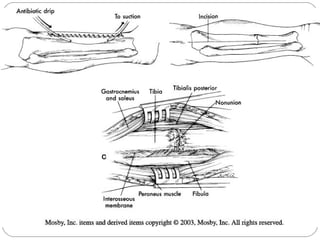
POSTEROLATERAL GRAFTING
To avoid the active draining sinuses and poor skin in the
anterior aspect.
Posterior aspect of the tibia is roughened superior and
inferior to nonunion.
Entire area is covered with graft.
Nonunion site is not exposed.
ACTIVE METHOD
To obtain bony union early and thus shorten the period of
convalescence.
To preserve the motion in adjacent jts.
Restoration of bony continuity- I step.
Bone union takes priority over infection.
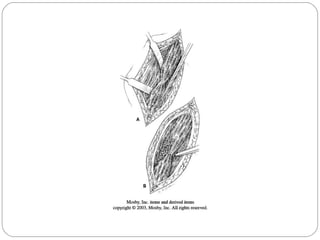
Nonunion exposed through old scars and sinuses.
The ends of the fragments are decorticated subperiosteally
osteoperiosteal flaps.
All devitalized and infected bone and soft tissue were
removed.
Fragments aligned and stabilised ext.fix.
If necessary a second decortication with or with out B.G
carried out.
ILIZAROV METHOD
To eliminate infection and to achieve union vascularity must
be increased.
By corticotomy and circular ext. fix.
To remove necrotic and infected segments before
osteosynthesis.
For hypertrophic nonunion with minimal infection & no
sequestrated bone compression.
Monofocal compression
Compression increases repair callus and vascularity.
Infection spontaneously eliminated.
For infected hypertrophic nonunion with deformity.
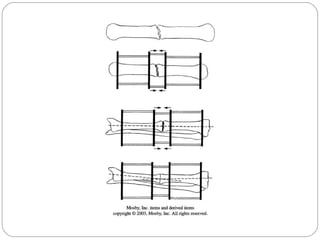
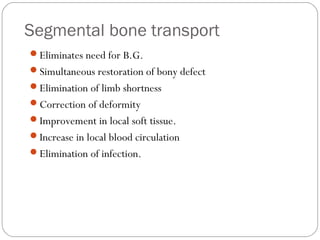
Segmental bone transport
Eliminates need for B.G.
Simultaneous restoration of bony defect
Elimination of limb shortness
Correction of deformity
Improvement in local soft tissue.
Increase in local blood circulation
Elimination of infection.
TYPES OF BONE TRANSPORT
3 TYPES.
Differs in the way that the bone fragments are transfixed to
the frame and in how they are transported to the intended
site
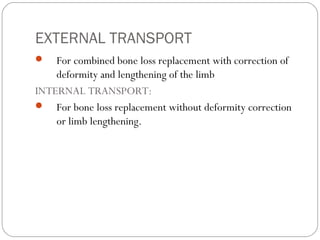
EXTERNAL TRANSPORT
 For combined bone loss replacement with correction of
deformity and lengthening of the limb
INTERNAL TRANSPORT:
 For bone loss replacement without deformity correction
or limb lengthening.
B.T OVER A NAIL
Herzenberg et.al
At the end of the bone transport interlocking was done.
Ilizarov fixator can be removed at an early stage .
Avoid complications of the ring fixator.
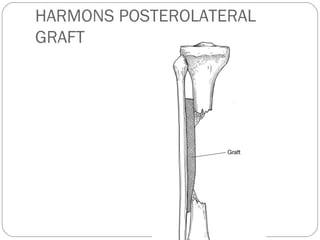
HARMONS GRAFTING
Bone grafting on the interosseous membrane to obtain a long
synostosis with fibula, spanning the tibial defect.
C.I in proximal defects.
HARMONS POSTEROLATERAL
GRAFT
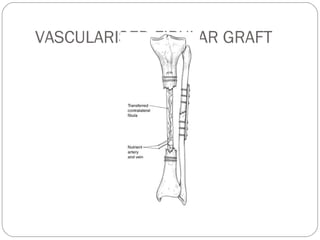
Free vascularised bone transfer
Rib, fibula, iliac crest.
Isolation of a segment of contra lateral fibula with attached
nutrient artery and vein.
Length of graft should be 4 cm longer than defect to allow 2
cm overlap at the proximal and distal ends.
VASCULARISED FIBULAR GRAFT
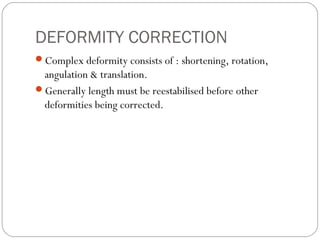
DEFORMITY CORRECTION
Complex deformity consists of : shortening, rotation,
angulation & translation.
Generally length must be reestabilised before other
deformities being corrected.
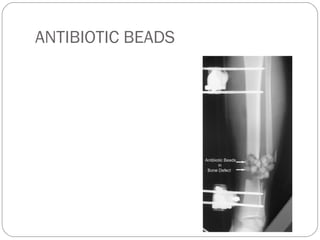
ANTIBIOTIC BEADS
Polymethyl methacrylate powder is mixed with antibiotic
powder beads.
Aminoglycosides common choice.
broad spectrum
heat stability
low allergenicity.
BEAD POUCH TECHNIQUE
Occupy dead space and prevents haematoma or scar tissue.
Free flap placed over the beads contour much better.
High local conc. Antibiotic.
Minimizes systemic toxicity.
Seals the wound from external environment with semi
permeable barrier  prevents secondary inf.
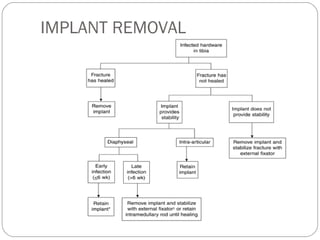
IMPLANT REMOVAL
CLOSED SUCTION IRRIGATION
Used when there is a large potential space or cavity after closure.
Abandoned due to risk of secondary contamination.
PRIMARY CLOSURE
When all the infected tissue has been removed, wound is
alive, dead space has been addressed and the antibiotic is
pathogen specific.
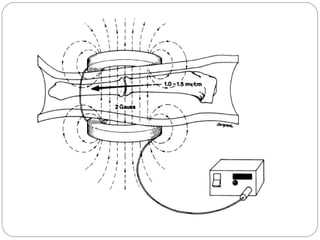
Electrical and electromagnetic
stimulation
Bone growth stimulators used along with cast immobilization
and weight bearing.
Either invasive or semi-invasive.
Gap tissues progressively calcify and are invaded
by vessels from the flanking bone margins,
producing a picture very similar to that of normal
endochondral ossification.
The electrical fields do not stimulate osteogenesis
directly, but rather appear to modify
fibrochondrocyte function so that any soft-tissue
impediment to bridging by bone is eliminated.
PAPINEAU PROCEDURE
Open bone grafting tech, done to control infection.
Infected nonunion with large cavity or bone defect &
inadequate soft tissue coverage & inability to close skin
directly.
PAPINEAU TECH
1) granulation tissue markedly resists infection,
2) Autogenous cancellous bone grafts are rapidly
revascularized and are resistant to infection,
3) the infected area is completely excised,
4) adequate drainage is provided,
5) adequate immobilization is provided,
 6) antibiotics are used for prolonged periods.
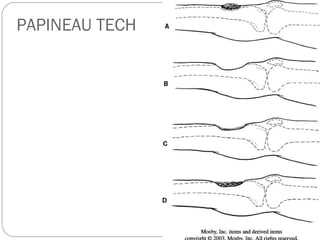
Stage I: Radical debridement
Stage II: bone grafting
Stage III: skin coverage.
PAPINEAU TECH
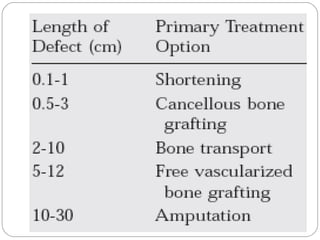
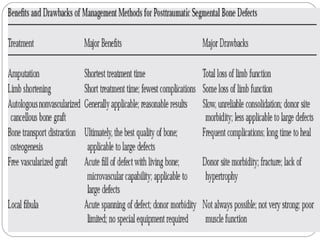
Amputation
Any one or all of the following
1) Extensive bone defect
2) Poor soft tissue cover
3) Neurovascular compromise
4) Anticipated poor outcome after treatment.
5) Severe Pt co morbidities.

Infected nonunion2

  • 1.
  • 2.
    NON UNION A statein which healing process comes to a halt as judged by clinical & x-ray evidence, beyond the stipulated period of healing for a particular bone due to mechanical or biological failure , with a gap being filled with fibrous or dense fibro cartilaginous tissue requiring a change in treatment.
  • 3.
    INFECTED NONUNION That stateexisting after considerable time [6-8 months] has elapsed, when there is no evidence that fracture will unite and infection still persists. Therefore other method of treatment to be done to achieve union and eradicate infection.
  • 4.
    PROBLEMS Multiple sinuses Osteomyelitis Bone andsoft tissue loss Disuse Osteoporosis Adjacent joint stiffness Complex deformities Limb length inequalities Multi-drug resistant polybacterial infections
  • 5.
    Tibia – mostcommon site Open fracture with infection – most common cause Infection following ORIF of closed #.
  • 6.
    PATHOGENESIS INOCULATION Virulence of microbe Suboptimalcondition of the local environment Systemic compromise of the host.
  • 7.
    Infection perse doesn’tcause nonunion OM  thrombosis of blood vessel of haversian canals  bone sclerosis and dead bone. Butterfly fragments become sequestrii, isolated & devitalized by pus & infection granulation tissue.
  • 8.
    Infection granulation tissue Osteolysis  gaps  nonunion. Osteolysis occurs around the implants  loosening  instability of fixation  nonunion. Infection causes nonunion earlier than non-infected pts.
  • 9.
    BIOFILM Key for thedevelopment & persistence of inf. Aggregation of microbes enclosed with in an extracelluar polysaccharide matrix [glycocalyx] that adheres to the surface of the implants or devitalized bone. 59% of orthopaedic biomaterial related infections +ve findings.
  • 10.
    Protects the organismfrom antibiotics and host defense mechanism. Allows the infection to exist in sub clinical state and recur. Implants promotes biofilm, infection would persist.
  • 11.
    MICROBIOLOGY Staphylococcus aureas mostcommon, [alone or in combination in 65-70%]. Pseudomonas aeroginosa [20-37%] Commonly polymicrobial [32-70%]. Atypical mycobacterium & fungi in immunocompromised pts.
  • 12.
    CLASSIFICATION Infected nonunion comesunder Cierney type IV chronic osteomyelitis ie; there unstable before and after debridement.
  • 13.
    ROSEN et al[AO manual] Infected non-draining nonunion Infected draining nonunion.
  • 14.
    Infected nondraining nonunion Quiescent( dry, nondraining for at least 3 months) Needs one stage treatment. Active ( non draining but abscess & fever). Needs two stage treatment.
  • 15.
    Infected draining nonunion ISTAGE: By pass bone grafting [fibular protibia, posteromedial femur or humerus grafting. II STAGE: By pass has become solid  radical debridement & open/closed irrigation & antibiotics. III STAGE: cancellous B.G, muscle or skin pedicle flap,
  • 16.
    G.S KULKARNI classification Severityof infection Apposition of fragments Presence or absence of deformity.
  • 17.
    TYPE I: fragmentsin apposition with mild infection and with or with out implant, stable implant insitu with mild infection. TYPE II: Fragments in apposition with severe infection with large or small wound. TYPE III: Severe infection with a gap or deformity or shortening. 3A  defect with loss of full circumference 3B  defect in > 1/3 of cortex 3C  infected nonunion with deformity.
  • 18.
    CLINICAL EVALUATION Pain, erythema,swelling, draining sinuses, abnormal mobility. No Fever Infection is clinically silent. High index of suspicion esp in atrophic nonunion. 0.2-1.6% chronic draining sinuses  S.C.C Suspect when change in pain / discharge.
  • 19.
    INVESTIGATION Elevated ESR &CRP,Normal WBC. X RAY: 1] Quality of bone 2] Type of implant 3] Fracture healing status 4] Angular alignment.
  • 20.
    Areas suspicious ofinfection Bone resorption Sequestrum & involucrum Periosteal & endosteal new bone formation Cortical irregularities.
  • 21.
    Disadvantages Due to distortedanatomy due to trauma Physiological reaction of bone to injury. Presence of implants. Can't reliably differentiate between septic and aseptic changes Serial x rays, sensitivity-14%, specificity- 70% in diagnosing active infection.
  • 22.
    C.T SCAN Better corticalbone details Sequestrum Subtle cortical erosion Best detail of bone structure for planning. No artifact with implants.
  • 23.
    MRI Highly sensitive modality.98% sensitivity, 75% specificity. Gadolinium enhanced MRI: allows discrimination of active infection from artifacts and fibro-vascular scar. Demonstrate sinus tracts, differentiate bone & soft tissue inf, extent of bone involvement.
  • 24.
    NUCLEAR IMAGING STUDIES Tc-99 M high sensitivity but low specificity15% Ga-67  more specific. Indium 111 labeled WBC scan: sensitivity 83%, specificity 86%. Labor intensive, increase radiation dose, 24 hr delay, low resolution image, in-vitro label.
  • 25.
    IMMUNOSCINTIGRAPHY Inj of radiolabelledmurine monoclonal anti-granulocyte AB that binds WBC antigen. Sensitivity: 93%, specificity: 89%. In-vivo labeling.
  • 26.
    CULTURE Gold standard Prior antibiotictreatment and improper handling of specimens preclude the growth. Multiple intra-op specimens: sinus tract, purulent fluid, soft tissue, curetted bone, bed of the involved bone. Different micro enviroments.
  • 27.
    PRINCIPLES Prompt diagnosis andaggressive Rx Infection control with surgical debridement and specific antibiotics. # stabilisation Soft tissue coverage Restoration of bone defects.
  • 28.
    GOALS (1) the infectedtissues must be resected to live margins;  (2) the methods must address previous fixation failures and structural deficiencies; (3) the patient must have the potential to heal, survive treatment, and benefit from treatment; and (4) the prognosis for success must be reasonable and the methods within the capabilities of the medical team
  • 29.
    METHODS Conventional or classicmethod Active or modern method Pulsed electromagnetic fields Ilizarov method.
  • 30.
    CONVENTIONAL METHOD To convertan infected and draining nonunion in to one that has not drained for several months and then to promote bone healing by bone grafting. More time consuming. Stiffness of adjacent joints. Reconstructive procedures should be delayed until at least 6 months after all signs of infections have disappeared.
  • 31.
    POSTEROLATERAL GRAFTING To avoidthe active draining sinuses and poor skin in the anterior aspect. Posterior aspect of the tibia is roughened superior and inferior to nonunion. Entire area is covered with graft. Nonunion site is not exposed.
  • 33.
    ACTIVE METHOD To obtainbony union early and thus shorten the period of convalescence. To preserve the motion in adjacent jts. Restoration of bony continuity- I step. Bone union takes priority over infection. Nonunion exposed through old scars and sinuses.
  • 34.
    The ends ofthe fragments are decorticated subperiosteally osteoperiosteal flaps. All devitalized and infected bone and soft tissue were removed. Fragments aligned and stabilised ext.fix. If necessary a second decortication with or with out B.G carried out.
  • 36.
    ILIZAROV METHOD To eliminateinfection and to achieve union vascularity must be increased. By corticotomy and circular ext. fix. To remove necrotic and infected segments before osteosynthesis. For hypertrophic nonunion with minimal infection & no sequestrated bone compression.
  • 37.
    Monofocal compression Compression increasesrepair callus and vascularity. Infection spontaneously eliminated. For infected hypertrophic nonunion with deformity.
  • 39.
    Segmental bone transport Eliminatesneed for B.G. Simultaneous restoration of bony defect Elimination of limb shortness Correction of deformity Improvement in local soft tissue. Increase in local blood circulation Elimination of infection.
  • 40.
    TYPES OF BONETRANSPORT 3 TYPES. Differs in the way that the bone fragments are transfixed to the frame and in how they are transported to the intended site
  • 41.
    EXTERNAL TRANSPORT  Forcombined bone loss replacement with correction of deformity and lengthening of the limb INTERNAL TRANSPORT:  For bone loss replacement without deformity correction or limb lengthening.
  • 42.
    B.T OVER ANAIL Herzenberg et.al At the end of the bone transport interlocking was done. Ilizarov fixator can be removed at an early stage . Avoid complications of the ring fixator.
  • 43.
    HARMONS GRAFTING Bone graftingon the interosseous membrane to obtain a long synostosis with fibula, spanning the tibial defect. C.I in proximal defects.
  • 44.
  • 45.
    Free vascularised bonetransfer Rib, fibula, iliac crest. Isolation of a segment of contra lateral fibula with attached nutrient artery and vein. Length of graft should be 4 cm longer than defect to allow 2 cm overlap at the proximal and distal ends.
  • 46.
  • 49.
    DEFORMITY CORRECTION Complex deformityconsists of : shortening, rotation, angulation & translation. Generally length must be reestabilised before other deformities being corrected.
  • 50.
  • 51.
    Polymethyl methacrylate powderis mixed with antibiotic powder beads. Aminoglycosides common choice. broad spectrum heat stability low allergenicity.
  • 52.
    BEAD POUCH TECHNIQUE Occupydead space and prevents haematoma or scar tissue. Free flap placed over the beads contour much better. High local conc. Antibiotic. Minimizes systemic toxicity. Seals the wound from external environment with semi permeable barrier  prevents secondary inf.
  • 53.
  • 54.
    CLOSED SUCTION IRRIGATION Usedwhen there is a large potential space or cavity after closure. Abandoned due to risk of secondary contamination.
  • 55.
    PRIMARY CLOSURE When allthe infected tissue has been removed, wound is alive, dead space has been addressed and the antibiotic is pathogen specific.
  • 56.
    Electrical and electromagnetic stimulation Bonegrowth stimulators used along with cast immobilization and weight bearing. Either invasive or semi-invasive.
  • 57.
    Gap tissues progressivelycalcify and are invaded by vessels from the flanking bone margins, producing a picture very similar to that of normal endochondral ossification. The electrical fields do not stimulate osteogenesis directly, but rather appear to modify fibrochondrocyte function so that any soft-tissue impediment to bridging by bone is eliminated.
  • 59.
    PAPINEAU PROCEDURE Open bonegrafting tech, done to control infection. Infected nonunion with large cavity or bone defect & inadequate soft tissue coverage & inability to close skin directly.
  • 60.
    PAPINEAU TECH 1) granulationtissue markedly resists infection, 2) Autogenous cancellous bone grafts are rapidly revascularized and are resistant to infection, 3) the infected area is completely excised, 4) adequate drainage is provided, 5) adequate immobilization is provided,  6) antibiotics are used for prolonged periods.
  • 61.
    Stage I: Radicaldebridement Stage II: bone grafting Stage III: skin coverage.
  • 62.
  • 63.
    Amputation Any one orall of the following 1) Extensive bone defect 2) Poor soft tissue cover 3) Neurovascular compromise 4) Anticipated poor outcome after treatment. 5) Severe Pt co morbidities.