Panel IV
Closed Loop Automation for NFV
Our speakers
Srilakshmi Valisammagari
Senior Technologist and Strategist
Verizon Enterprise Solutions
Jim Fagan
Director, Global Platforms
Telstra
David Hughes
VP, IP Engineering
PCCW Global
Outline
• Closed-loop automation is the end goal for NFV.
• Telcos are on a journey from manual processes to writing scripts
(Python), building models (YANG, TOSCA), introducing model-driven
programmability, analytics and finally AI.
• With machine learning the network can detect or predict faults, know
how to fix it (e.g. re-route traffic, spin up a new instance) and execute
it without any human intervention.
• However, in the early days it may be risky and many CSPs will want
tools that will let them confirm changes are handled correctly.
• This panel will discuss the state of play for closed loop automation in
NFV and what needs to be done to make it a reality.
Control Loop Automation
• Open loop systems capture telemetry and diagnostics information
from the underlying infrastructure (syslog, SNMP, fault and
performance events), conduct analysis, and provide reports or alarms
to the operations team.
• Closed-loop systems continuously monitor the system for problems
(fault, performance, security, etc.) and compute a set of signatures
based on detected anomalies.
• A policy engine then interprets these signatures and recommends
corrective actions to repair the system.
• Once the system has been repaired the status is monitored to check
the problem has been fixed.
• The goal is to minimise downtime
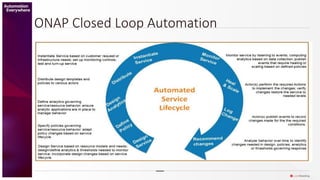
ONAP Closed Loop Automation
ETSI OSM view of NFV automation
• Design and development (onboarding) – full automation still some
way off
• Instance lifecycle – what can be changed in-life and what is
immutable?
• In-life
• Performance – auto scaling
• Resilience – fault tolerant load sharing
• Service monitoring, assurance and reporting
• All this automation is policy driven
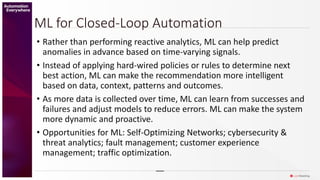
ML for Closed-Loop Automation
• Rather than performing reactive analytics, ML can help predict
anomalies in advance based on time-varying signals.
• Instead of applying hard-wired policies or rules to determine next
best action, ML can make the recommendation more intelligent
based on data, context, patterns and outcomes.
• As more data is collected over time, ML can learn from successes and
failures and adjust models to reduce errors. ML can make the system
more dynamic and proactive.
• Opportunities for ML: Self-Optimizing Networks; cybersecurity &
threat analytics; fault management; customer experience
management; traffic optimization.

Closed Loop Automation for NFV

  • 1.
    Panel IV Closed LoopAutomation for NFV
  • 2.
    Our speakers Srilakshmi Valisammagari SeniorTechnologist and Strategist Verizon Enterprise Solutions Jim Fagan Director, Global Platforms Telstra David Hughes VP, IP Engineering PCCW Global
  • 3.
    Outline • Closed-loop automationis the end goal for NFV. • Telcos are on a journey from manual processes to writing scripts (Python), building models (YANG, TOSCA), introducing model-driven programmability, analytics and finally AI. • With machine learning the network can detect or predict faults, know how to fix it (e.g. re-route traffic, spin up a new instance) and execute it without any human intervention. • However, in the early days it may be risky and many CSPs will want tools that will let them confirm changes are handled correctly. • This panel will discuss the state of play for closed loop automation in NFV and what needs to be done to make it a reality.
  • 4.
    Control Loop Automation •Open loop systems capture telemetry and diagnostics information from the underlying infrastructure (syslog, SNMP, fault and performance events), conduct analysis, and provide reports or alarms to the operations team. • Closed-loop systems continuously monitor the system for problems (fault, performance, security, etc.) and compute a set of signatures based on detected anomalies. • A policy engine then interprets these signatures and recommends corrective actions to repair the system. • Once the system has been repaired the status is monitored to check the problem has been fixed. • The goal is to minimise downtime
  • 5.
    ONAP Closed LoopAutomation
  • 6.
    ETSI OSM viewof NFV automation • Design and development (onboarding) – full automation still some way off • Instance lifecycle – what can be changed in-life and what is immutable? • In-life • Performance – auto scaling • Resilience – fault tolerant load sharing • Service monitoring, assurance and reporting • All this automation is policy driven
  • 7.
    ML for Closed-LoopAutomation • Rather than performing reactive analytics, ML can help predict anomalies in advance based on time-varying signals. • Instead of applying hard-wired policies or rules to determine next best action, ML can make the recommendation more intelligent based on data, context, patterns and outcomes. • As more data is collected over time, ML can learn from successes and failures and adjust models to reduce errors. ML can make the system more dynamic and proactive. • Opportunities for ML: Self-Optimizing Networks; cybersecurity & threat analytics; fault management; customer experience management; traffic optimization.