Industry, Disruption,
and Opportunity
A Pattern
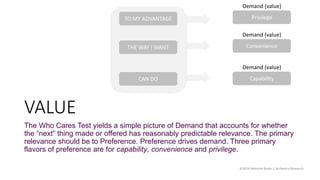
VALUE
The Who Cares Test yields a simple picture of Demand that accounts for whether
the “next” thing made or offered has reasonably predictable relevance. The primary
relevance should be to Preference. Preference drives demand. Three primary
flavors of preference are for capability, convenience and privilege.
Privilege
Demand (value)
Convenience
Demand (value)
Capability
Demand (value)
TO MY ADVANTAGE
THE WAY I WANT
CAN DO
©2018 Malcolm Ryder / Archestra Research
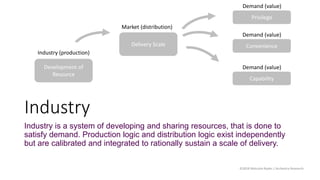
Industry
Industry is a system of developing and sharing resources, that is done to
satisfy demand. Production logic and distribution logic exist independently
but are calibrated and integrated to rationally sustain a scale of delivery.
Privilege
Development of
Resource
Delivery Scale
Industry (production)
Market (distribution)
Demand (value)
Convenience
Demand (value)
Capability
Demand (value)
©2018 Malcolm Ryder / Archestra Research
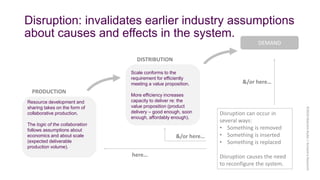
Disruption: invalidates earlier industry assumptions
about causes and effects in the system.
Resource development and
sharing takes on the form of
collaborative production.
The logic of the collaboration
follows assumptions about
economics and about scale
(expected deliverable
production volume).
Scale conforms to the
requirement for efficiently
meeting a value proposition.
More efficiency increases
capacity to deliver re: the
value proposition (product
delivery – good enough, soon
enough, affordably enough).
DEMAND
Disruption can occur in
several ways:
• Something is removed
• Something is inserted
• Something is replaced
Disruption causes the need
to reconfigure the system.
here…
&/or here…
&/or here…
PRODUCTION
DISTRIBUTION
©2018MalcolmRyder/ArchestraResearch
Innovation changes the formula for
realizing value
Innovation is always one of the following: an unprecedented application of a means or mode
within an established context, in order to generate the opportunity or actuality of a
recognized type of value.
Value propositions reflect the priorities of a user, user type, or user community.
An industrial disruption occurs when a value proposition can be addressed with a new logic
of production scale.
An innovation makes the new logic possible, as well as valid, with adequate economies of
scale.
An innovation may also shift focus from one existing kind of value to a different existing kind
or even to a potentially new kind.
©2018 Malcolm Ryder / Archestra Research
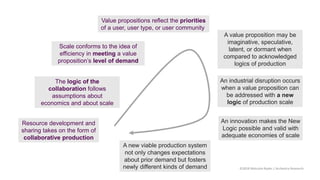
Resource development and
sharing takes on the form of
collaborative production
The logic of the
collaboration follows
assumptions about
economics and about scale
Scale conforms to the idea of
efficiency in meeting a value
proposition’s level of demand
Value propositions reflect the priorities
of a user, user type, or user community
An industrial disruption occurs
when a value proposition can
be addressed with a new
logic of production scale
An innovation makes the New
Logic possible and valid with
adequate economies of scale
A value proposition may be
imaginative, speculative,
latent, or dormant when
compared to acknowledged
logics of production
A new viable production system
not only changes expectations
about prior demand but fosters
newly different kinds of demand ©2018 Malcolm Ryder / Archestra Research
Opportunity from Disruption
Value propositions, readily seen as targets, are also demand-side
opportunities to generate benefit. Perceived benefit routinely appears in at
least four different ways related to current expectations.
A value proposition, representing a desired benefit, anticipates availability of
the benefit which, when compared to acknowledged logics of production, is
characterized as imaginative, speculative, latent, or dormant.
Corresponding to that, provider-side opportunity to meet demand may come
in different forms and strengths.
Opportunity also emerges when new industrial means result in new property
(output) that becomes a resource (input) for another level of industrial
creativity.
©2018 Malcolm Ryder / Archestra Research
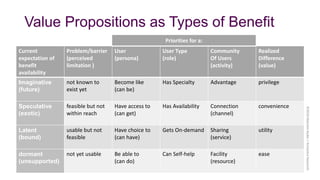
Current
expectation of
benefit
availability
Problem/barrier
(perceived
limitation )
User
(persona)
User Type
(role)
Community
Of Users
(activity)
Realized
Difference
(value)
Imaginative
(future)
not known to
exist yet
Become like
(can be)
Has Specialty Advantage privilege
Speculative
(exotic)
feasible but not
within reach
Have access to
(can get)
Has Availability Connection
(channel)
convenience
Latent
(bound)
usable but not
feasible
Have choice to
(can have)
Gets On-demand Sharing
(service)
utility
dormant
(unsupported)
not yet usable Be able to
(can do)
Can Self-help Facility
(resource)
ease
Value Propositions as Types of Benefit
Priorities for a:
©2018MalcolmRyder/ArchestraResearch
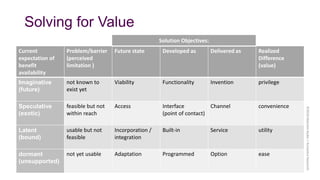
Current
expectation of
benefit
availability
Problem/barrier
(perceived
limitation )
Future state Developed as Delivered as Realized
Difference
(value)
Imaginative
(future)
not known to
exist yet
Viability Functionality Invention privilege
Speculative
(exotic)
feasible but not
within reach
Access Interface
(point of contact)
Channel convenience
Latent
(bound)
usable but not
feasible
Incorporation /
integration
Built-in Service utility
dormant
(unsupported)
not yet usable Adaptation Programmed Option ease
Solving for Value
Solution Objectives:
©2018MalcolmRyder/ArchestraResearch
Creation from Disruption
The idea that disruption is “creative” is an abbreviation of the
thought that creativity operates on conditions that do not already
have their final form.
When disruption un-does existing form, the new current
conditions are preconditions for creation.
This also means that an innovation of one type can be the basis
of another type of innovation, either as a component or as a
partner. As creativity directs interactions, approaches exploiting
innovations generate new types of value and/or more value.
©2018 Malcolm Ryder / Archestra Research
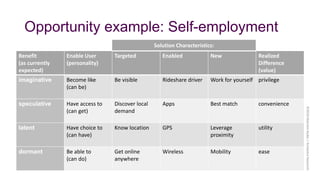
Benefit
(as currently
expected)
Enable User
(personality)
Targeted Enabled New Realized
Difference
(value)
imaginative Become like
(can be)
Be visible Rideshare driver Work for yourself privilege
speculative Have access to
(can get)
Discover local
demand
Apps Best match convenience
latent Have choice to
(can have)
Know location GPS Leverage
proximity
utility
dormant Be able to
(can do)
Get online
anywhere
Wireless Mobility ease
Opportunity example: Self-employment
Solution Characteristics:
©2018MalcolmRyder/ArchestraResearch
Archestra notebooks compile and organize decades of in-the-field and ongoing empirical findings.
All presented findings are derived exclusively from original research.
Archestra notebooks carry no prescriptive warranty.
As ongoing research, all notebooks are subject to change at any time.
©2018 Malcolm Ryder / Archestra Research
www.archestra.com
mryder@archestra.com
Archestra research is done from the perspective of strategy and architecture.
With all subject matter and topics, the purpose of the notes is analytic, primarily to:
* explore, expose and model why things are
included, excluded, or can happen
in given ways and/or to certain effects.
* comment on, and navigate between,
motives and potentials that predetermine
Decisions about, and shapings of, the observed activity.

Industry, Disruption, and Opportunity

  • 1.
  • 2.
    VALUE The Who CaresTest yields a simple picture of Demand that accounts for whether the “next” thing made or offered has reasonably predictable relevance. The primary relevance should be to Preference. Preference drives demand. Three primary flavors of preference are for capability, convenience and privilege. Privilege Demand (value) Convenience Demand (value) Capability Demand (value) TO MY ADVANTAGE THE WAY I WANT CAN DO ©2018 Malcolm Ryder / Archestra Research
  • 3.
    Industry Industry is asystem of developing and sharing resources, that is done to satisfy demand. Production logic and distribution logic exist independently but are calibrated and integrated to rationally sustain a scale of delivery. Privilege Development of Resource Delivery Scale Industry (production) Market (distribution) Demand (value) Convenience Demand (value) Capability Demand (value) ©2018 Malcolm Ryder / Archestra Research
  • 4.
    Disruption: invalidates earlierindustry assumptions about causes and effects in the system. Resource development and sharing takes on the form of collaborative production. The logic of the collaboration follows assumptions about economics and about scale (expected deliverable production volume). Scale conforms to the requirement for efficiently meeting a value proposition. More efficiency increases capacity to deliver re: the value proposition (product delivery – good enough, soon enough, affordably enough). DEMAND Disruption can occur in several ways: • Something is removed • Something is inserted • Something is replaced Disruption causes the need to reconfigure the system. here… &/or here… &/or here… PRODUCTION DISTRIBUTION ©2018MalcolmRyder/ArchestraResearch
  • 5.
    Innovation changes theformula for realizing value Innovation is always one of the following: an unprecedented application of a means or mode within an established context, in order to generate the opportunity or actuality of a recognized type of value. Value propositions reflect the priorities of a user, user type, or user community. An industrial disruption occurs when a value proposition can be addressed with a new logic of production scale. An innovation makes the new logic possible, as well as valid, with adequate economies of scale. An innovation may also shift focus from one existing kind of value to a different existing kind or even to a potentially new kind. ©2018 Malcolm Ryder / Archestra Research
  • 6.
    Resource development and sharingtakes on the form of collaborative production The logic of the collaboration follows assumptions about economics and about scale Scale conforms to the idea of efficiency in meeting a value proposition’s level of demand Value propositions reflect the priorities of a user, user type, or user community An industrial disruption occurs when a value proposition can be addressed with a new logic of production scale An innovation makes the New Logic possible and valid with adequate economies of scale A value proposition may be imaginative, speculative, latent, or dormant when compared to acknowledged logics of production A new viable production system not only changes expectations about prior demand but fosters newly different kinds of demand ©2018 Malcolm Ryder / Archestra Research
  • 7.
    Opportunity from Disruption Valuepropositions, readily seen as targets, are also demand-side opportunities to generate benefit. Perceived benefit routinely appears in at least four different ways related to current expectations. A value proposition, representing a desired benefit, anticipates availability of the benefit which, when compared to acknowledged logics of production, is characterized as imaginative, speculative, latent, or dormant. Corresponding to that, provider-side opportunity to meet demand may come in different forms and strengths. Opportunity also emerges when new industrial means result in new property (output) that becomes a resource (input) for another level of industrial creativity. ©2018 Malcolm Ryder / Archestra Research
  • 8.
    Current expectation of benefit availability Problem/barrier (perceived limitation ) User (persona) UserType (role) Community Of Users (activity) Realized Difference (value) Imaginative (future) not known to exist yet Become like (can be) Has Specialty Advantage privilege Speculative (exotic) feasible but not within reach Have access to (can get) Has Availability Connection (channel) convenience Latent (bound) usable but not feasible Have choice to (can have) Gets On-demand Sharing (service) utility dormant (unsupported) not yet usable Be able to (can do) Can Self-help Facility (resource) ease Value Propositions as Types of Benefit Priorities for a: ©2018MalcolmRyder/ArchestraResearch
  • 9.
    Current expectation of benefit availability Problem/barrier (perceived limitation ) Futurestate Developed as Delivered as Realized Difference (value) Imaginative (future) not known to exist yet Viability Functionality Invention privilege Speculative (exotic) feasible but not within reach Access Interface (point of contact) Channel convenience Latent (bound) usable but not feasible Incorporation / integration Built-in Service utility dormant (unsupported) not yet usable Adaptation Programmed Option ease Solving for Value Solution Objectives: ©2018MalcolmRyder/ArchestraResearch
  • 10.
    Creation from Disruption Theidea that disruption is “creative” is an abbreviation of the thought that creativity operates on conditions that do not already have their final form. When disruption un-does existing form, the new current conditions are preconditions for creation. This also means that an innovation of one type can be the basis of another type of innovation, either as a component or as a partner. As creativity directs interactions, approaches exploiting innovations generate new types of value and/or more value. ©2018 Malcolm Ryder / Archestra Research
  • 11.
    Benefit (as currently expected) Enable User (personality) TargetedEnabled New Realized Difference (value) imaginative Become like (can be) Be visible Rideshare driver Work for yourself privilege speculative Have access to (can get) Discover local demand Apps Best match convenience latent Have choice to (can have) Know location GPS Leverage proximity utility dormant Be able to (can do) Get online anywhere Wireless Mobility ease Opportunity example: Self-employment Solution Characteristics: ©2018MalcolmRyder/ArchestraResearch
  • 12.
    Archestra notebooks compileand organize decades of in-the-field and ongoing empirical findings. All presented findings are derived exclusively from original research. Archestra notebooks carry no prescriptive warranty. As ongoing research, all notebooks are subject to change at any time. ©2018 Malcolm Ryder / Archestra Research www.archestra.com mryder@archestra.com Archestra research is done from the perspective of strategy and architecture. With all subject matter and topics, the purpose of the notes is analytic, primarily to: * explore, expose and model why things are included, excluded, or can happen in given ways and/or to certain effects. * comment on, and navigate between, motives and potentials that predetermine Decisions about, and shapings of, the observed activity.