Presented by
R.Rajasimman
What we are
 Name: CRY - Child Rights and You. (CRY changed it's
  name from Child Relief and You to Child Rights and
  You as on April 1, 2006.)

 Over three decades of working for children and their
  families across 23 states in India,

 we've learnt that lasting change is only possible when
  we tackle the root causes that continue to keep them
  uneducated, exploited and vulnerable.
Vision
A happy, healthy and creative
 child whose rights are protected
 and honoured in a society that is
 built on respect for dignity,
 justice and equity for all.
Mission
 To enable people to take responsibility for the situation of
  the deprived Indian child
 To motivate them to seek resolution through individual and
  collective action thereby enabling children to realise their
  full potential.
 Enable people to discover their potential for action and
  change.
 To enable peoples' collectives and movements
  encompassing diverse segments, to pledge their particular
  strengths, working in partnership to secure, protect and
  honour the rights of India's children.
Origin
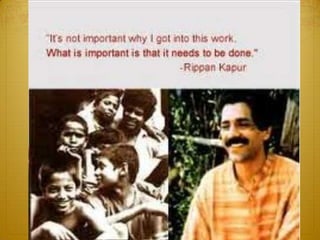
 These qualities of resourcefulness and
  determination were to come in handy
  when Rippan and 6 of his friends started
  CRY with Rs. 50/- around Rippan's
  mother's dining table. That was 29 years
  ago, in 1979. They felt that something
  needed to be done to improve the
  situation of the underprivileged Indian
  child.
Milestone
 2008
 CRY partners NAFRE Jan Andolan in the Jan Haq Yatra -
  traversing 210,000 km over 2 months, amplifying the Voice
  of the 15 lakh People across 16 states demanding change
  at the grassroots.
 CRY wins in the Large NGO category at Indian NGO
  awards 2007 after a thorough process of evaluation, field
  visits and multilevel audits.
 Child Rights and You UK Limited is formally registered in
  the UK
Milestone
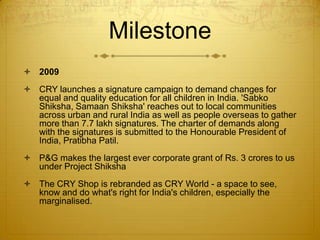
 2009
 CRY launches a signature campaign to demand changes for
  equal and quality education for all children in India. 'Sabko
  Shiksha, Samaan Shiksha' reaches out to local communities
  across urban and rural India as well as people overseas to gather
  more than 7.7 lakh signatures. The charter of demands along
  with the signatures is submitted to the Honourable President of
  India, Pratibha Patil.
 P&G makes the largest ever corporate grant of Rs. 3 crores to us
  under Project Shiksha
 The CRY Shop is rebranded as CRY World - a space to see,
  know and do what's right for India's children, especially the
  marginalised.
SWOT

Strength
Weakness
Opportunities
 Threats
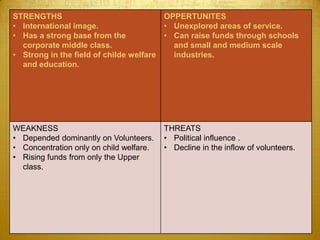
STRENGTHS                                 OPPERTUNITES
• International image.                    • Unexplored areas of service.
• Has a strong base from the              • Can raise funds through schools
  corporate middle class.                   and small and medium scale
• Strong in the field of childe welfare     industries.
  and education.


WEAKNESS                                  THREATS
• Depended dominantly on Volunteers.      • Political influence .
• Concentration only on child welfare.    • Decline in the inflow of volunteers.
• Rising funds from only the Upper
  class.
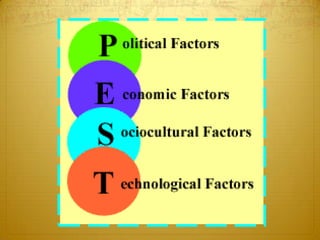
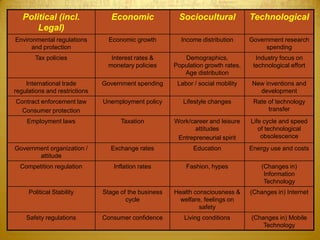
Political (incl.               Economic              Sociocultural             Technological
       Legal)
Environmental regulations        Economic growth         Income distribution      Government research
      and protection                                                                   spending
       Tax policies               Interest rates &        Demographics,             Industry focus on
                                 monetary policies     Population growth rates,    technological effort
                                                          Age distribution
    International trade        Government spending      Labor / social mobility   New inventions and
regulations and restrictions                                                        development
Contract enforcement law       Unemployment policy        Lifestyle changes        Rate of technology
  Consumer protection                                                                   transfer
    Employment laws                  Taxation          Work/career and leisure    Life cycle and speed
                                                              attitudes              of technological
                                                        Entrepreneurial spirit        obsolescence
Government organization /        Exchange rates               Education           Energy use and costs
       attitude
  Competition regulation          Inflation rates          Fashion, hypes             (Changes in)
                                                                                       Information
                                                                                       Technology
     Political Stability       Stage of the business   Health consciousness &     (Changes in) Internet
                                       cycle             welfare, feelings on
                                                                safety
    Safety regulations         Consumer confidence        Living conditions       (Changes in) Mobile
                                                                                      Technology
Cry foundation SWOT and PEST

Cry foundation SWOT and PEST

  • 1.
  • 2.
    What we are Name: CRY - Child Rights and You. (CRY changed it's name from Child Relief and You to Child Rights and You as on April 1, 2006.)  Over three decades of working for children and their families across 23 states in India,  we've learnt that lasting change is only possible when we tackle the root causes that continue to keep them uneducated, exploited and vulnerable.
  • 3.
    Vision A happy, healthyand creative child whose rights are protected and honoured in a society that is built on respect for dignity, justice and equity for all.
  • 4.
    Mission  To enablepeople to take responsibility for the situation of the deprived Indian child  To motivate them to seek resolution through individual and collective action thereby enabling children to realise their full potential.  Enable people to discover their potential for action and change.  To enable peoples' collectives and movements encompassing diverse segments, to pledge their particular strengths, working in partnership to secure, protect and honour the rights of India's children.
  • 6.
    Origin  These qualitiesof resourcefulness and determination were to come in handy when Rippan and 6 of his friends started CRY with Rs. 50/- around Rippan's mother's dining table. That was 29 years ago, in 1979. They felt that something needed to be done to improve the situation of the underprivileged Indian child.
  • 7.
    Milestone  2008  CRYpartners NAFRE Jan Andolan in the Jan Haq Yatra - traversing 210,000 km over 2 months, amplifying the Voice of the 15 lakh People across 16 states demanding change at the grassroots.  CRY wins in the Large NGO category at Indian NGO awards 2007 after a thorough process of evaluation, field visits and multilevel audits.  Child Rights and You UK Limited is formally registered in the UK
  • 8.
    Milestone  2009  CRYlaunches a signature campaign to demand changes for equal and quality education for all children in India. 'Sabko Shiksha, Samaan Shiksha' reaches out to local communities across urban and rural India as well as people overseas to gather more than 7.7 lakh signatures. The charter of demands along with the signatures is submitted to the Honourable President of India, Pratibha Patil.  P&G makes the largest ever corporate grant of Rs. 3 crores to us under Project Shiksha  The CRY Shop is rebranded as CRY World - a space to see, know and do what's right for India's children, especially the marginalised.
  • 9.
  • 10.
    STRENGTHS OPPERTUNITES • International image. • Unexplored areas of service. • Has a strong base from the • Can raise funds through schools corporate middle class. and small and medium scale • Strong in the field of childe welfare industries. and education. WEAKNESS THREATS • Depended dominantly on Volunteers. • Political influence . • Concentration only on child welfare. • Decline in the inflow of volunteers. • Rising funds from only the Upper class.
  • 12.
    Political (incl. Economic Sociocultural Technological Legal) Environmental regulations Economic growth Income distribution Government research and protection spending Tax policies Interest rates & Demographics, Industry focus on monetary policies Population growth rates, technological effort Age distribution International trade Government spending Labor / social mobility New inventions and regulations and restrictions development Contract enforcement law Unemployment policy Lifestyle changes Rate of technology Consumer protection transfer Employment laws Taxation Work/career and leisure Life cycle and speed attitudes of technological Entrepreneurial spirit obsolescence Government organization / Exchange rates Education Energy use and costs attitude Competition regulation Inflation rates Fashion, hypes (Changes in) Information Technology Political Stability Stage of the business Health consciousness & (Changes in) Internet cycle welfare, feelings on safety Safety regulations Consumer confidence Living conditions (Changes in) Mobile Technology