Pollution control and prevention: Sewage, agricultural/
aquaculture and Industrial waste and its treatment.
(Chapter-05)
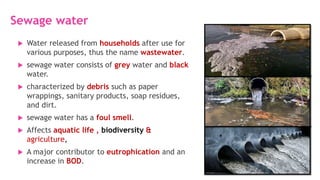
Sewage water
 Water released from households after use for
various purposes, thus the name wastewater.
 sewage water consists of grey water and black
water.
 characterized by debris such as paper
wrappings, sanitary products, soap residues,
and dirt.
 sewage water has a foul smell.
 Affects aquatic life , biodiversity &
agriculture,
 A major contributor to eutrophication and an
increase in BOD.
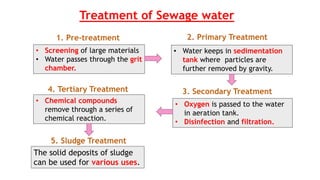
5. Sludge Treatment
The solid deposits of sludge
can be used for various uses.
2. Primary Treatment
• Water keeps in sedimentation
tank where particles are
further removed by gravity.
4. Tertiary Treatment
• Chemical compounds
remove through a series of
chemical reaction.
1. Pre-treatment
• Screening of large materials
• Water passes through the grit
chamber.
3. Secondary Treatment
• Oxygen is passed to the water
in aeration tank.
• Disinfection and filtration.
Treatment of Sewage water
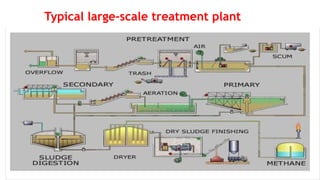
Typical large-scale treatment plant
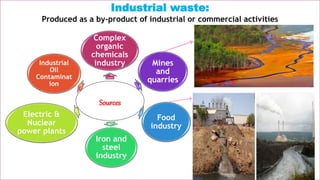
Industrial waste:
Produced as a by-product of industrial or commercial activities
Sources
Complex
organic
chemicals
industry Mines
and
quarries
Food
industry
Iron and
steel
industry
Electric &
Nuclear
power plants
Industrial
Oil
Contaminat
ion
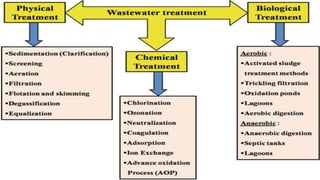
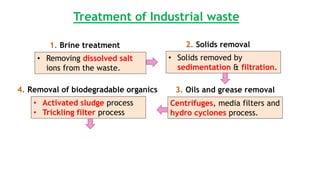
Treatment of Industrial waste
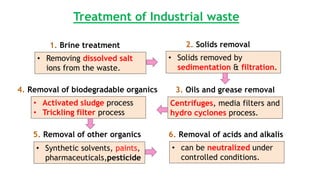
1. Brine treatment
• Removing dissolved salt
ions from the waste.
2. Solids removal
• Solids removed by
sedimentation & filtration.
3. Oils and grease removal
Centrifuges, media filters and
hydro cyclones process.
4. Removal of biodegradable organics
• Activated sludge process
• Trickling filter process
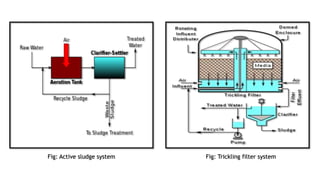
Fig: Active sludge system Fig: Trickling filter system
Treatment of Industrial waste
1. Brine treatment
• Removing dissolved salt
ions from the waste.
2. Solids removal
• Solids removed by
sedimentation & filtration.
3. Oils and grease removal
Centrifuges, media filters and
hydro cyclones process.
4. Removal of biodegradable organics
• Activated sludge process
• Trickling filter process
5. Removal of other organics
• Synthetic solvents, paints,
pharmaceuticals,pesticide
6. Removal of acids and alkalis
• can be neutralized under
controlled conditions.
Agricultural waste and its treatment:
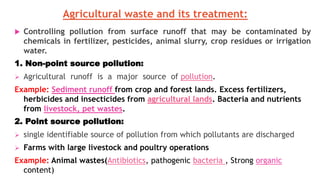
 Controlling pollution from surface runoff that may be contaminated by
chemicals in fertilizer, pesticides, animal slurry, crop residues or irrigation
water.
1. Non-point source pollution:
 Agricultural runoff is a major source of pollution.
Example: Sediment runoff from crop and forest lands. Excess fertilizers,
herbicides and insecticides from agricultural lands. Bacteria and nutrients
from livestock, pet wastes.
2. Point source pollution:
 single identifiable source of pollution from which pollutants are discharged
 Farms with large livestock and poultry operations
Example: Animal wastes(Antibiotics, pathogenic bacteria , Strong organic
content)
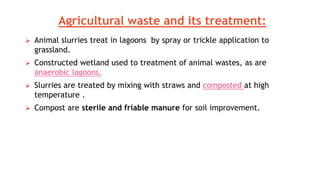
 Animal slurries treat in lagoons by spray or trickle application to
grassland.
 Constructed wetland used to treatment of animal wastes, as are
anaerobic lagoons.
 Slurries are treated by mixing with straws and composted at high
temperature .
 Compost are sterile and friable manure for soil improvement.
Agricultural waste and its treatment:
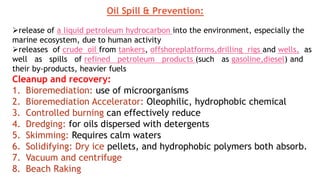
Oil Spill & Prevention:
release of a liquid petroleum hydrocarbon into the environment, especially the
marine ecosystem, due to human activity
releases of crude oil from tankers, offshoreplatforms,drilling rigs and wells, as
well as spills of refined petroleum products (such as gasoline,diesel) and
their by-products, heavier fuels
Cleanup and recovery:
1. Bioremediation: use of microorganisms
2. Bioremediation Accelerator: Oleophilic, hydrophobic chemical
3. Controlled burning can effectively reduce
4. Dredging: for oils dispersed with detergents
5. Skimming: Requires calm waters
6. Solidifying: Dry ice pellets, and hydrophobic polymers both absorb.
7. Vacuum and centrifuge
8. Beach Raking
CAM-502,Chapter-5.pptx

CAM-502,Chapter-5.pptx

  • 1.
    Pollution control andprevention: Sewage, agricultural/ aquaculture and Industrial waste and its treatment. (Chapter-05)
  • 2.
    Sewage water  Waterreleased from households after use for various purposes, thus the name wastewater.  sewage water consists of grey water and black water.  characterized by debris such as paper wrappings, sanitary products, soap residues, and dirt.  sewage water has a foul smell.  Affects aquatic life , biodiversity & agriculture,  A major contributor to eutrophication and an increase in BOD.
  • 4.
    5. Sludge Treatment Thesolid deposits of sludge can be used for various uses. 2. Primary Treatment • Water keeps in sedimentation tank where particles are further removed by gravity. 4. Tertiary Treatment • Chemical compounds remove through a series of chemical reaction. 1. Pre-treatment • Screening of large materials • Water passes through the grit chamber. 3. Secondary Treatment • Oxygen is passed to the water in aeration tank. • Disinfection and filtration. Treatment of Sewage water
  • 5.
  • 6.
    Industrial waste: Produced asa by-product of industrial or commercial activities Sources Complex organic chemicals industry Mines and quarries Food industry Iron and steel industry Electric & Nuclear power plants Industrial Oil Contaminat ion
  • 7.
    Treatment of Industrialwaste 1. Brine treatment • Removing dissolved salt ions from the waste. 2. Solids removal • Solids removed by sedimentation & filtration. 3. Oils and grease removal Centrifuges, media filters and hydro cyclones process. 4. Removal of biodegradable organics • Activated sludge process • Trickling filter process
  • 8.
    Fig: Active sludgesystem Fig: Trickling filter system
  • 9.
    Treatment of Industrialwaste 1. Brine treatment • Removing dissolved salt ions from the waste. 2. Solids removal • Solids removed by sedimentation & filtration. 3. Oils and grease removal Centrifuges, media filters and hydro cyclones process. 4. Removal of biodegradable organics • Activated sludge process • Trickling filter process 5. Removal of other organics • Synthetic solvents, paints, pharmaceuticals,pesticide 6. Removal of acids and alkalis • can be neutralized under controlled conditions.
  • 10.
    Agricultural waste andits treatment:  Controlling pollution from surface runoff that may be contaminated by chemicals in fertilizer, pesticides, animal slurry, crop residues or irrigation water. 1. Non-point source pollution:  Agricultural runoff is a major source of pollution. Example: Sediment runoff from crop and forest lands. Excess fertilizers, herbicides and insecticides from agricultural lands. Bacteria and nutrients from livestock, pet wastes. 2. Point source pollution:  single identifiable source of pollution from which pollutants are discharged  Farms with large livestock and poultry operations Example: Animal wastes(Antibiotics, pathogenic bacteria , Strong organic content)
  • 11.
     Animal slurriestreat in lagoons by spray or trickle application to grassland.  Constructed wetland used to treatment of animal wastes, as are anaerobic lagoons.  Slurries are treated by mixing with straws and composted at high temperature .  Compost are sterile and friable manure for soil improvement. Agricultural waste and its treatment:
  • 12.
    Oil Spill &Prevention: release of a liquid petroleum hydrocarbon into the environment, especially the marine ecosystem, due to human activity releases of crude oil from tankers, offshoreplatforms,drilling rigs and wells, as well as spills of refined petroleum products (such as gasoline,diesel) and their by-products, heavier fuels Cleanup and recovery: 1. Bioremediation: use of microorganisms 2. Bioremediation Accelerator: Oleophilic, hydrophobic chemical 3. Controlled burning can effectively reduce 4. Dredging: for oils dispersed with detergents 5. Skimming: Requires calm waters 6. Solidifying: Dry ice pellets, and hydrophobic polymers both absorb. 7. Vacuum and centrifuge 8. Beach Raking