INDUSTRIAL PRODUCT
DEVELOPMENT PROCESS
SHIBIN OOMMEN ABRAHAM 556 24-A
PRODUCT
A product is the item offered for sale.
A product can be a service or an item.
It can be physical or in virtual or cyber form.
Every product is made at a cost and each is sold at a price.
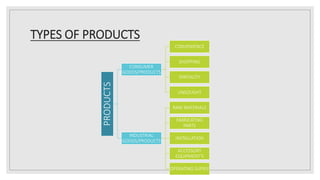
TYPES OF PRODUCTS
PRODUCTS
CONSUMER
GOODS/PRODUCTS
CONVENIENCE
SHOPPING
SPATIALITY
UNSOUGHT
INDUSTRIAL
GOODS/PRODUCTS
RAW MATERIALS
FABRICATING
PARTS
INSTALLATION
ACCESSORY
EQUIPMENT'S
OPERATING SUPPLY
DIFFERENCE
INDUSTRIAL PRODUCTS
Industrial goods are based on the demand for
the consumer goods they help to produce.
Industrial goods are classified as either
production goods or support goods.
Production goods are used in the production
of a final consumer good or product, while
support goods help in the production process
of consumer goods such as machinery and
equipment.
CONSUMER PRODUCT
Consumer goods are tangible
commodities produced and purchased to
satisfy the wants of a buyer.
That's why these goods are also referred to as
final goods or end products.
They are goods that consumers can typically
find stocked on store shelves.
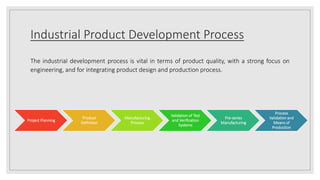
Industrial Product Development Process
The industrial development process is vital in terms of product quality, with a strong focus on
engineering, and for integrating product design and production process.
Project Planning
Product
Definition
Manufacturing
Process
Validation of Test
and Verification
Systems
Pre-series
Manufacturing
Process
Validation and
Means of
Production
STAGE 1 – PROJECT PLANNING
With the aim that this planning stage will lead to set
specifications in terms of the time, cost and quality.
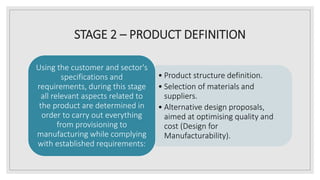
STAGE 2 – PRODUCT DEFINITION
• Product structure definition.
• Selection of materials and
suppliers.
• Alternative design proposals,
aimed at optimising quality and
cost (Design for
Manufacturability).
Using the customer and sector's
specifications and
requirements, during this stage
all relevant aspects related to
the product are determined in
order to carry out everything
from provisioning to
manufacturing while complying
with established requirements:
STAGE 3 – MANUFACTURING PROCESS
Using advanced quality methods, the process is defined
with the aim of optimising cost and ensuring product
STAGE 4 - VALIDATION OF TEST AND
VERIFICATION SYSTEMS
Studying the combination of different testing systems with
the aim of obtaining the best detection possible to achieve
the intended quality ratio and customer satisfaction.
STAGE 5 – PRE SERIES MANUFACTURING
Ensuring that all means
of production and
processes are set up so
the production process is
standardised, repetitive
and robust.
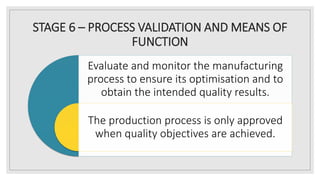
STAGE 6 – PROCESS VALIDATION AND MEANS OF
FUNCTION
Evaluate and monitor the manufacturing
process to ensure its optimisation and to
obtain the intended quality results.
The production process is only approved
when quality objectives are achieved.
THANK YOU!!!

Industrial product development process

  • 1.
  • 2.
    PRODUCT A product isthe item offered for sale. A product can be a service or an item. It can be physical or in virtual or cyber form. Every product is made at a cost and each is sold at a price.
  • 3.
  • 4.
    DIFFERENCE INDUSTRIAL PRODUCTS Industrial goodsare based on the demand for the consumer goods they help to produce. Industrial goods are classified as either production goods or support goods. Production goods are used in the production of a final consumer good or product, while support goods help in the production process of consumer goods such as machinery and equipment. CONSUMER PRODUCT Consumer goods are tangible commodities produced and purchased to satisfy the wants of a buyer. That's why these goods are also referred to as final goods or end products. They are goods that consumers can typically find stocked on store shelves.
  • 5.
    Industrial Product DevelopmentProcess The industrial development process is vital in terms of product quality, with a strong focus on engineering, and for integrating product design and production process. Project Planning Product Definition Manufacturing Process Validation of Test and Verification Systems Pre-series Manufacturing Process Validation and Means of Production
  • 6.
    STAGE 1 –PROJECT PLANNING With the aim that this planning stage will lead to set specifications in terms of the time, cost and quality.
  • 7.
    STAGE 2 –PRODUCT DEFINITION • Product structure definition. • Selection of materials and suppliers. • Alternative design proposals, aimed at optimising quality and cost (Design for Manufacturability). Using the customer and sector's specifications and requirements, during this stage all relevant aspects related to the product are determined in order to carry out everything from provisioning to manufacturing while complying with established requirements:
  • 8.
    STAGE 3 –MANUFACTURING PROCESS Using advanced quality methods, the process is defined with the aim of optimising cost and ensuring product
  • 9.
    STAGE 4 -VALIDATION OF TEST AND VERIFICATION SYSTEMS Studying the combination of different testing systems with the aim of obtaining the best detection possible to achieve the intended quality ratio and customer satisfaction.
  • 10.
    STAGE 5 –PRE SERIES MANUFACTURING Ensuring that all means of production and processes are set up so the production process is standardised, repetitive and robust.
  • 11.
    STAGE 6 –PROCESS VALIDATION AND MEANS OF FUNCTION Evaluate and monitor the manufacturing process to ensure its optimisation and to obtain the intended quality results. The production process is only approved when quality objectives are achieved.
  • 12.

Editor's Notes

  • #13 https://ikor.es/en/product-services/industrial-process-development