Product &
Process design
Chapter 5
Production &
operations management
Product &
Process design
Product Design:
™Product Design can be defined as the idea generation,
concept development, testing and manufacturing or
implementation of a physical object or service. It covers more
than the discipline name - Industrial Design.
™ Product Designers conceptualize and evaluate ideas,
making them tangible through products in a more systematic
approach.
™The role of a product designer encompasses many
characteristics of the marketing manager, Product
management, industrial designer and design engineer.
™The title name of Industrial designer has in many cases
fallen into the category of an art.
Product &
Process design
™The role of product designer combines art, science and
commerce for tangible non-perishable items. This evolving
role has been facilitated by digital tools that allow designers
to communicate, visualize and analyze ideas in a way that
would have taken greater manpower in the past.
™As with most of the design fields the idea for the design of
a product arises from a need and has a use. It follows certain
method and can sometimes be attributed to more complex
factors such as association and Telesis.
™Aesthetics is considered important in Product Design but
designers also deal with important aspects including
technology, ergonomics, usability, human factors and
material technology.
Product &
Process design
™The values and its accompanying aspects which product
design is based on vary, both between different schools of
thought and among practicing designers.
™Product designers are equipped with the skills needed to
bring products from conception to market. They should also
have the ability to manage design projects, and subcontract
areas to other sectors of the design industry.
™Also used to describe a technically competent product
designer or industrial designer is the term Industrial Design
Engineer. The Cyclone vacuum cleaner inventor James
Dyson for example could be considered to be in this
category
Product &
Process design
™A Product is anything that is capable of satisfying a
felt need.
™A New Product is the one which is truly innovative
and is significantly different from the other existing
products.
™The stages through which a new product passes
through
1) Needs Identification.
2) Advance product planning.
3) Advanced design, Detailed engineering
4) Production process design and development
5)Product Evaluation
6) Product use & support
Product Life Cycle
™The conditions a product is sold under will change over
time. The Product Life Cycle refers to the succession of
stages a product goes through. Product Life Cycle
Management is the succession of strategies used by
management as a product goes through its life cycle.
™The product lifecycle goes through many phases and
involves many professional disciplines and requires many
skills, tools and processes.
™ Product life cycle (PLC) is to do with the life of a product
in the market with respect to business/commercial costs and
sales measures; whereas Product Lifecycle Management
(PLM) is more to do with managing descriptions.
Product Life Cycle
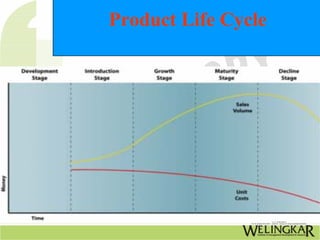
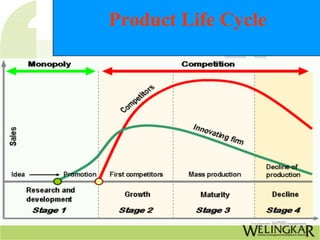
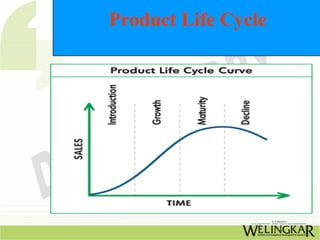
™Products tend to go through five stages:
1.New product development stage
™very expensive
™no sales revenue
™losses
1.Market introduction stage
™cost high
™sales volume low
™no/little competition - competitive manufacturers watch for
acceptance/segment growth
™losses
™demand has to be created
Product Life Cycle
™customers have to be prompted to try the product
1.Growth stage
™costs reduced due to economies of scale
™sales volume increases significantly
™profitability
™public awareness
™competition begins to increase with a few new players in
establishing market
™prices to maximize market share
1.Mature stage
™costs are very low as you are well established in market &
no need for publicity.
Product Life Cycle
™sales volume peaks
™increase in competitive offerings
™prices tend to drop due to the proliferation of competing
products
™brand differentiation, feature diversification, as each player
seeks to differentiate from competition with "how much
product" is offered
™very profitable
1.Decline or Stability stage
™costs become counter-optimal
™sales volume decline or stabilize
™prices, profitability diminish
Product Life Cycle
Product Life Cycle
Product Life Cycle
Process Design
™New products are not realities until they are
manufactured.
™Process design is necessary to manufacture new products.
™Process design means the complete delineation and
description of specific steps in the production process and
linkage among the steps that will enable the production
system to produce products systems to produce products of
the desired quality,in the required quantity.
™Process planning is intense for new product,but replanting
can also occur as capacity needs change
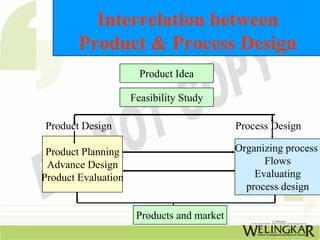
Interrelation between
Product & Process Design
Product Idea
Feasibility Study
Product Planning
Advance Design
Product Evaluation
Organizing process
Flows
Evaluating
process design
Products and market
Product Design Process Design
Key Decisions in
Process Design
Key decisions relating to Process design is related
to organizing the process flows necessary to
manufacture new products.
Organizing process flow
™Five types of Processes are distinguished
™ Project
™Job Shop
™Batch
™Assembly line
™Continuous
Relations of process Design to
types of process flow
™There is a definite relation between Production
process and process flow.For continuous
manufacturing the methods and processes are
determined before the line set up.
™The process design is built into the line
™Changes usually require that the line be shut down
with consequent loss of production
™For intermittent process no lines are set up.process
engineer is usually adapt the methods to the types of
equipment available.
™Changes in methods can easily be effected without
affecting the overall productive capacity of the plant.
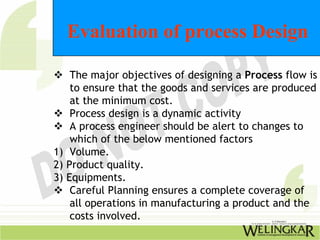
Evaluation of process Design
™ The major objectives of designing a Process flow is
to ensure that the goods and services are produced
at the minimum cost.
™ Process design is a dynamic activity
™ A process engineer should be alert to changes to
which of the below mentioned factors
1) Volume.
2) Product quality.
3) Equipments.
™ Careful Planning ensures a complete coverage of
all operations in manufacturing a product and the
costs involved.
Production &
operations management
End Of
Chapter 5

Ch5ProductDesign.pdf

  • 1.
    Product & Process design Chapter5 Production & operations management
  • 2.
    Product & Process design ProductDesign: ™Product Design can be defined as the idea generation, concept development, testing and manufacturing or implementation of a physical object or service. It covers more than the discipline name - Industrial Design. ™ Product Designers conceptualize and evaluate ideas, making them tangible through products in a more systematic approach. ™The role of a product designer encompasses many characteristics of the marketing manager, Product management, industrial designer and design engineer. ™The title name of Industrial designer has in many cases fallen into the category of an art.
  • 3.
    Product & Process design ™Therole of product designer combines art, science and commerce for tangible non-perishable items. This evolving role has been facilitated by digital tools that allow designers to communicate, visualize and analyze ideas in a way that would have taken greater manpower in the past. ™As with most of the design fields the idea for the design of a product arises from a need and has a use. It follows certain method and can sometimes be attributed to more complex factors such as association and Telesis. ™Aesthetics is considered important in Product Design but designers also deal with important aspects including technology, ergonomics, usability, human factors and material technology.
  • 4.
    Product & Process design ™Thevalues and its accompanying aspects which product design is based on vary, both between different schools of thought and among practicing designers. ™Product designers are equipped with the skills needed to bring products from conception to market. They should also have the ability to manage design projects, and subcontract areas to other sectors of the design industry. ™Also used to describe a technically competent product designer or industrial designer is the term Industrial Design Engineer. The Cyclone vacuum cleaner inventor James Dyson for example could be considered to be in this category
  • 5.
    Product & Process design ™AProduct is anything that is capable of satisfying a felt need. ™A New Product is the one which is truly innovative and is significantly different from the other existing products. ™The stages through which a new product passes through 1) Needs Identification. 2) Advance product planning. 3) Advanced design, Detailed engineering 4) Production process design and development 5)Product Evaluation 6) Product use & support
  • 6.
    Product Life Cycle ™Theconditions a product is sold under will change over time. The Product Life Cycle refers to the succession of stages a product goes through. Product Life Cycle Management is the succession of strategies used by management as a product goes through its life cycle. ™The product lifecycle goes through many phases and involves many professional disciplines and requires many skills, tools and processes. ™ Product life cycle (PLC) is to do with the life of a product in the market with respect to business/commercial costs and sales measures; whereas Product Lifecycle Management (PLM) is more to do with managing descriptions.
  • 7.
    Product Life Cycle ™Productstend to go through five stages: 1.New product development stage ™very expensive ™no sales revenue ™losses 1.Market introduction stage ™cost high ™sales volume low ™no/little competition - competitive manufacturers watch for acceptance/segment growth ™losses ™demand has to be created
  • 8.
    Product Life Cycle ™customershave to be prompted to try the product 1.Growth stage ™costs reduced due to economies of scale ™sales volume increases significantly ™profitability ™public awareness ™competition begins to increase with a few new players in establishing market ™prices to maximize market share 1.Mature stage ™costs are very low as you are well established in market & no need for publicity.
  • 9.
    Product Life Cycle ™salesvolume peaks ™increase in competitive offerings ™prices tend to drop due to the proliferation of competing products ™brand differentiation, feature diversification, as each player seeks to differentiate from competition with "how much product" is offered ™very profitable 1.Decline or Stability stage ™costs become counter-optimal ™sales volume decline or stabilize ™prices, profitability diminish
  • 10.
  • 11.
  • 12.
  • 13.
    Process Design ™New productsare not realities until they are manufactured. ™Process design is necessary to manufacture new products. ™Process design means the complete delineation and description of specific steps in the production process and linkage among the steps that will enable the production system to produce products systems to produce products of the desired quality,in the required quantity. ™Process planning is intense for new product,but replanting can also occur as capacity needs change
  • 14.
    Interrelation between Product &Process Design Product Idea Feasibility Study Product Planning Advance Design Product Evaluation Organizing process Flows Evaluating process design Products and market Product Design Process Design
  • 15.
    Key Decisions in ProcessDesign Key decisions relating to Process design is related to organizing the process flows necessary to manufacture new products. Organizing process flow ™Five types of Processes are distinguished ™ Project ™Job Shop ™Batch ™Assembly line ™Continuous
  • 16.
    Relations of processDesign to types of process flow ™There is a definite relation between Production process and process flow.For continuous manufacturing the methods and processes are determined before the line set up. ™The process design is built into the line ™Changes usually require that the line be shut down with consequent loss of production ™For intermittent process no lines are set up.process engineer is usually adapt the methods to the types of equipment available. ™Changes in methods can easily be effected without affecting the overall productive capacity of the plant.
  • 17.
    Evaluation of processDesign ™ The major objectives of designing a Process flow is to ensure that the goods and services are produced at the minimum cost. ™ Process design is a dynamic activity ™ A process engineer should be alert to changes to which of the below mentioned factors 1) Volume. 2) Product quality. 3) Equipments. ™ Careful Planning ensures a complete coverage of all operations in manufacturing a product and the costs involved.
  • 18.