SUNEEL GUPTA ASSOCIATE PROFESSOR GHS IMR, KANPUR INDUSTRIAL POLICY
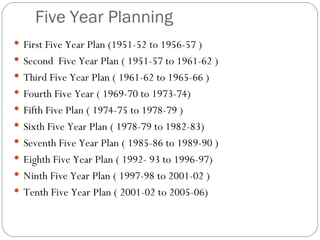
Five Year Planning First Five Year Plan (1951-52 to 1956-57 ) Second  Five Year Plan ( 1951-57 to 1961-62 ) Third Five Year Plan ( 1961-62 to 1965-66 ) Fourth Five Year ( 1969-70 to 1973-74) Fifth Five Plan ( 1974-75 to 1978-79 ) Sixth Five Year Plan ( 1978-79 to 1982-83)  Seventh Five Year Plan ( 1985-86 to 1989-90 ) Eighth Five Year Plan ( 1992- 93 to 1996-97) Ninth Five Year Plan ( 1997-98 to 2001-02 ) Tenth Five Year Plan ( 2001-02 to 2005-06)
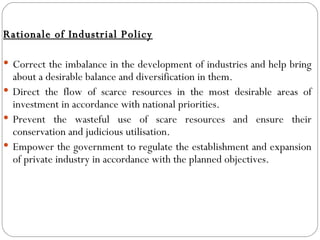
Rationale of Industrial Policy Correct the imbalance in the development of industries and help bring about a desirable balance and diversification in them. Direct the flow of scarce resources in the most desirable areas of investment in accordance with national priorities. Prevent the wasteful use of scare resources and ensure their conservation and judicious utilisation. Empower the government to regulate the establishment and expansion of private industry in accordance with the planned objectives.
Demarcate areas among the public, private and joint sectors of the economy, as well as large, medium and small-scale industries. Prevent, trough fiscal and monetary policies, the formation of monopolies and concentration of wealth in a few hands so that the evils associated with monopolies can  be effectively curbed. Give guidelines for importing foreign capital and the conditions on which such capital should be permitted to operate.
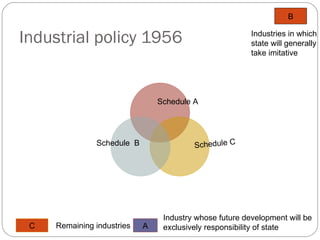
Industrial policy 1956 Schedule A Schedule  B Schedule C C Remaining industries A Industry whose future development will be  exclusively responsibility of state B Industries in which state will generally  take imitative
Industrial Policy 1991 Thrust on deregulation and economic policy liberalization represents a significant step forward in the endeavor to eliminate poverty and unemployment and fasten the pace of social and economic progress
Main feature #Self Reliance #Grater emphasis placed on developing our ability to pay for imports from our own foreign exchange earning #Government is committed to the development of indigenous capabilities in technology and manufacturing as well as up gradation of living standards. #To encourage entrepreneurship  #To bring new technology #Dismantling regulatory system  #Reformation of PSU #Manufacturing activity to be thrown open to private competition
Industrial Policy 1991 Industrial licensing Foreign Investment Foreign technology policy Public sector outlay MRTP Act
Industrial Licensing Automatic clearance if (where imported capital good is required) In case for-ex availability is assured through foreign equity If CIF vale of imported capital good required is less than 25% of total value up to maximum value of Rs 2 crore If population of cities is less then 1 million then no government is required (25 KM)
Phase manufacturing program will not be applicable to new projects. Existing unit will be provided a new broad banding facility to facility to enable them to produce any article without any additional investment. All existing registration scheme will be abolished (Delicensed registration Exempted Industries Registration, DGTD) Entrepreneur will henceforth only be required to file an information on new projects and substantial expansion.
Foreign Investment Approval will be given for FDI up to 51% in high priority industry. There shall be no bottleneck of any kind in this process.  A special empower  board would be constituted to negotiate with large international firm and approve FDI in selected area While the import of component ,raw material and intermediate good, and payment of know-how fee and royalties will be governed by the general policy applicable to other domestic units.
Foreign Technology Agreement Automatic permission in high priority industry up to lump sum payment of Rs1 million( 5% royalty on domestic sale & 8% royalty sale on export sale) No permission on hiring foreign technician Testing of indigenously developed technologies allowed In respect of industries other than those in automatic permission will be given subject to the same guidelines as above if no foreign exchange is required for any payment.
Public Sector Private sector to be allowed in PSU reserved area To encourage wider participation  a large part of government share holding in the public sector would be offered to mutual fund, FI’s, general public & worker. Board of PSU will be given greater power. PSU enterprise which are chronically sick and which are unlikely to be turned around will, for the formulation of revival/rehabilitation scheme,be referred to the Board of Industrial and Financial Reconstruction (BIFR).or other similar high level institutions created for the purpose.
MRTP Act. The MRTP Act will be amended to remove the threshold limits of assets in respect of MRTP companies and dominant undertaking. ie no prior approval required for establishment of new undertaking expansion, merger, amalgamation and takeover and appointment of director under certain circumstances. Emphasis will be placed on controlling and regulating monopolistic, restrictive, and unfair trade practice.
THREE STUDIES SHAPE THE MRTP ACT HAZARI COMMITTEE REPORT ON INDUSTRIAL LICENSING PROCEDURE, 1955  MAHALANOBIS COMMITTEE REPORT ON DISTRIBUTION AND LEVELS OF INCOME, 1964 MONOPOLIES INQUIRY COMMISSION REPORT OF DAS GUPTA, 1965
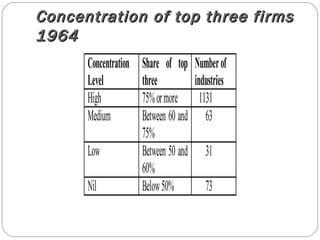
Concentration of top three firms 1964
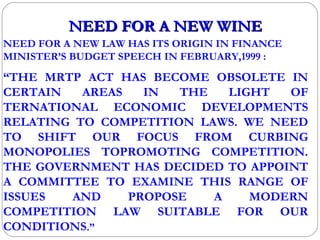
NEED FOR A NEW WINE NEED FOR A NEW LAW HAS ITS ORIGIN IN FINANCE MINISTER’S BUDGET SPEECH IN FEBRUARY,1999 : “ THE MRTP ACT HAS BECOME OBSOLETE IN CERTAIN AREAS IN THE LIGHT OF TERNATIONAL ECONOMIC DEVELOPMENTS RELATING TO COMPETITION LAWS. WE NEED TO SHIFT OUR FOCUS FROM CURBING MONOPOLIES TOPROMOTING COMPETITION. THE GOVERNMENT HAS DECIDED TO APPOINT A COMMITTEE TO EXAMINE THIS RANGE OF ISSUES AND PROPOSE A MODERN COMPETITION LAW SUITABLE FOR OUR CONDITIONS .”
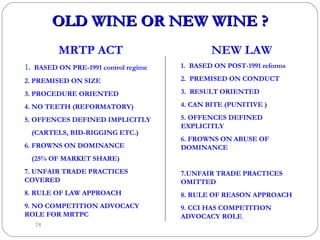
OLD WINE OR NEW WINE ? MRTP ACT 1 .  BASED ON PRE-1991 control regime 2. PREMISED ON SIZE 3. PROCEDURE ORIENTED 4. NO TEETH (REFORMATORY) 5. OFFENCES DEFINED IMPLICITLY  (CARTELS, BID-RIGGING ETC.) 6. FROWNS ON DOMINANCE (25% OF MARKET SHARE) 7. UNFAIR TRADE PRACTICES COVERED 8. RULE OF LAW APPROACH 9. NO COMPETITION ADVOCACY ROLE FOR MRTPC NEW LAW 1.  BASED ON POST-1991 reforms 2.  PREMISED ON CONDUCT  3.  RESULT ORIENTED 4. CAN BITE (PUNITIVE ) 5. OFFENCES DEFINED EXPLICITLY 6. FROWNS ON ABUSE OF  DOMINANCE 7.UNFAIR TRADE PRACTICES OMITTED 8. RULE OF REASON APPROACH 9. CCI HAS COMPETITION ADVOCACY ROLE
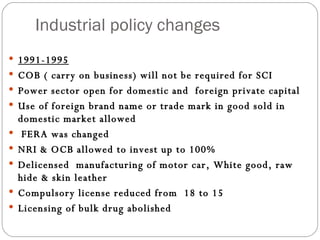
Industrial policy changes 1991-1995 COB ( carry on business) will not be required for SCI Power sector open for domestic and  foreign private capital Use of foreign brand name or trade mark in good sold in domestic market allowed FERA was changed NRI & OCB allowed to invest up to 100% Delicensed  manufacturing of motor car, White good, raw hide & skin leather Compulsory license reduced from  18 to 15 Licensing of bulk drug abolished
1995 onwards SlR reduced to 31.5 Modvat extended to capital goods & petroleum products Corporate taxed reduced : 45% /40% (Indian), 65%/55% (Foreign) The  five –year tax holiday to new industrial undertaking initially allowed for industriallybackward states in the Budget for 93-94 extended to all backward area. Investment ceiling on SSI undertaking /ancillary industrial  undertaking has been enhanced from Rs 60 lakhs/ Rs 75 lakhs to Rs 3 crore  and for any tiny units to Rs 25 lakhs from Rs 5 Lakhs.
11 PSU’s referred as ‘Navaratnas’ other 97 PSU  as ‘Mini Navaratnas’ Reserved industries  reduced to 7 Indian companies have been permitted to accept investment  under automatic approval route without obtaining prior permissionby RBI
2001-2002 onwards 14 items related to leather goods, shoes and toys are now de-reserved The exemption limit has been doubled to Rs 1 crore from September 2001. FDI up to 100% permitted on the automatic route for manufacturing of drug and pharmaceutical ( No License required) * FDI up to 100% is permitted in airport
The defense industry sector opened up to 100% for Indian private  sector participation with FDI permissible up to 26%, both  subjected to licensing. *FDI up to 100% permitted hotel and tourism, courier services,  Mass rapid transport system in all metropolitan cities. NRI investment in foreign exchange made fully repatriable FDI in telecom permitted up to 74%  FDI up 49% from all sources is permitted in the banking sector on automatic route.

Industrial Policy

  • 1.
    SUNEEL GUPTA ASSOCIATEPROFESSOR GHS IMR, KANPUR INDUSTRIAL POLICY
  • 2.
    Five Year PlanningFirst Five Year Plan (1951-52 to 1956-57 ) Second Five Year Plan ( 1951-57 to 1961-62 ) Third Five Year Plan ( 1961-62 to 1965-66 ) Fourth Five Year ( 1969-70 to 1973-74) Fifth Five Plan ( 1974-75 to 1978-79 ) Sixth Five Year Plan ( 1978-79 to 1982-83) Seventh Five Year Plan ( 1985-86 to 1989-90 ) Eighth Five Year Plan ( 1992- 93 to 1996-97) Ninth Five Year Plan ( 1997-98 to 2001-02 ) Tenth Five Year Plan ( 2001-02 to 2005-06)
  • 3.
    Rationale of IndustrialPolicy Correct the imbalance in the development of industries and help bring about a desirable balance and diversification in them. Direct the flow of scarce resources in the most desirable areas of investment in accordance with national priorities. Prevent the wasteful use of scare resources and ensure their conservation and judicious utilisation. Empower the government to regulate the establishment and expansion of private industry in accordance with the planned objectives.
  • 4.
    Demarcate areas amongthe public, private and joint sectors of the economy, as well as large, medium and small-scale industries. Prevent, trough fiscal and monetary policies, the formation of monopolies and concentration of wealth in a few hands so that the evils associated with monopolies can be effectively curbed. Give guidelines for importing foreign capital and the conditions on which such capital should be permitted to operate.
  • 5.
    Industrial policy 1956Schedule A Schedule B Schedule C C Remaining industries A Industry whose future development will be exclusively responsibility of state B Industries in which state will generally take imitative
  • 6.
    Industrial Policy 1991Thrust on deregulation and economic policy liberalization represents a significant step forward in the endeavor to eliminate poverty and unemployment and fasten the pace of social and economic progress
  • 7.
    Main feature #SelfReliance #Grater emphasis placed on developing our ability to pay for imports from our own foreign exchange earning #Government is committed to the development of indigenous capabilities in technology and manufacturing as well as up gradation of living standards. #To encourage entrepreneurship #To bring new technology #Dismantling regulatory system #Reformation of PSU #Manufacturing activity to be thrown open to private competition
  • 8.
    Industrial Policy 1991Industrial licensing Foreign Investment Foreign technology policy Public sector outlay MRTP Act
  • 9.
    Industrial Licensing Automaticclearance if (where imported capital good is required) In case for-ex availability is assured through foreign equity If CIF vale of imported capital good required is less than 25% of total value up to maximum value of Rs 2 crore If population of cities is less then 1 million then no government is required (25 KM)
  • 10.
    Phase manufacturing programwill not be applicable to new projects. Existing unit will be provided a new broad banding facility to facility to enable them to produce any article without any additional investment. All existing registration scheme will be abolished (Delicensed registration Exempted Industries Registration, DGTD) Entrepreneur will henceforth only be required to file an information on new projects and substantial expansion.
  • 11.
    Foreign Investment Approvalwill be given for FDI up to 51% in high priority industry. There shall be no bottleneck of any kind in this process. A special empower board would be constituted to negotiate with large international firm and approve FDI in selected area While the import of component ,raw material and intermediate good, and payment of know-how fee and royalties will be governed by the general policy applicable to other domestic units.
  • 12.
    Foreign Technology AgreementAutomatic permission in high priority industry up to lump sum payment of Rs1 million( 5% royalty on domestic sale & 8% royalty sale on export sale) No permission on hiring foreign technician Testing of indigenously developed technologies allowed In respect of industries other than those in automatic permission will be given subject to the same guidelines as above if no foreign exchange is required for any payment.
  • 13.
    Public Sector Privatesector to be allowed in PSU reserved area To encourage wider participation a large part of government share holding in the public sector would be offered to mutual fund, FI’s, general public & worker. Board of PSU will be given greater power. PSU enterprise which are chronically sick and which are unlikely to be turned around will, for the formulation of revival/rehabilitation scheme,be referred to the Board of Industrial and Financial Reconstruction (BIFR).or other similar high level institutions created for the purpose.
  • 14.
    MRTP Act. TheMRTP Act will be amended to remove the threshold limits of assets in respect of MRTP companies and dominant undertaking. ie no prior approval required for establishment of new undertaking expansion, merger, amalgamation and takeover and appointment of director under certain circumstances. Emphasis will be placed on controlling and regulating monopolistic, restrictive, and unfair trade practice.
  • 15.
    THREE STUDIES SHAPETHE MRTP ACT HAZARI COMMITTEE REPORT ON INDUSTRIAL LICENSING PROCEDURE, 1955 MAHALANOBIS COMMITTEE REPORT ON DISTRIBUTION AND LEVELS OF INCOME, 1964 MONOPOLIES INQUIRY COMMISSION REPORT OF DAS GUPTA, 1965
  • 16.
    Concentration of topthree firms 1964
  • 17.
    NEED FOR ANEW WINE NEED FOR A NEW LAW HAS ITS ORIGIN IN FINANCE MINISTER’S BUDGET SPEECH IN FEBRUARY,1999 : “ THE MRTP ACT HAS BECOME OBSOLETE IN CERTAIN AREAS IN THE LIGHT OF TERNATIONAL ECONOMIC DEVELOPMENTS RELATING TO COMPETITION LAWS. WE NEED TO SHIFT OUR FOCUS FROM CURBING MONOPOLIES TOPROMOTING COMPETITION. THE GOVERNMENT HAS DECIDED TO APPOINT A COMMITTEE TO EXAMINE THIS RANGE OF ISSUES AND PROPOSE A MODERN COMPETITION LAW SUITABLE FOR OUR CONDITIONS .”
  • 18.
    OLD WINE ORNEW WINE ? MRTP ACT 1 . BASED ON PRE-1991 control regime 2. PREMISED ON SIZE 3. PROCEDURE ORIENTED 4. NO TEETH (REFORMATORY) 5. OFFENCES DEFINED IMPLICITLY (CARTELS, BID-RIGGING ETC.) 6. FROWNS ON DOMINANCE (25% OF MARKET SHARE) 7. UNFAIR TRADE PRACTICES COVERED 8. RULE OF LAW APPROACH 9. NO COMPETITION ADVOCACY ROLE FOR MRTPC NEW LAW 1. BASED ON POST-1991 reforms 2. PREMISED ON CONDUCT 3. RESULT ORIENTED 4. CAN BITE (PUNITIVE ) 5. OFFENCES DEFINED EXPLICITLY 6. FROWNS ON ABUSE OF DOMINANCE 7.UNFAIR TRADE PRACTICES OMITTED 8. RULE OF REASON APPROACH 9. CCI HAS COMPETITION ADVOCACY ROLE
  • 19.
    Industrial policy changes1991-1995 COB ( carry on business) will not be required for SCI Power sector open for domestic and foreign private capital Use of foreign brand name or trade mark in good sold in domestic market allowed FERA was changed NRI & OCB allowed to invest up to 100% Delicensed manufacturing of motor car, White good, raw hide & skin leather Compulsory license reduced from 18 to 15 Licensing of bulk drug abolished
  • 20.
    1995 onwards SlRreduced to 31.5 Modvat extended to capital goods & petroleum products Corporate taxed reduced : 45% /40% (Indian), 65%/55% (Foreign) The five –year tax holiday to new industrial undertaking initially allowed for industriallybackward states in the Budget for 93-94 extended to all backward area. Investment ceiling on SSI undertaking /ancillary industrial undertaking has been enhanced from Rs 60 lakhs/ Rs 75 lakhs to Rs 3 crore and for any tiny units to Rs 25 lakhs from Rs 5 Lakhs.
  • 21.
    11 PSU’s referredas ‘Navaratnas’ other 97 PSU as ‘Mini Navaratnas’ Reserved industries reduced to 7 Indian companies have been permitted to accept investment under automatic approval route without obtaining prior permissionby RBI
  • 22.
    2001-2002 onwards 14items related to leather goods, shoes and toys are now de-reserved The exemption limit has been doubled to Rs 1 crore from September 2001. FDI up to 100% permitted on the automatic route for manufacturing of drug and pharmaceutical ( No License required) * FDI up to 100% is permitted in airport
  • 23.
    The defense industrysector opened up to 100% for Indian private sector participation with FDI permissible up to 26%, both subjected to licensing. *FDI up to 100% permitted hotel and tourism, courier services, Mass rapid transport system in all metropolitan cities. NRI investment in foreign exchange made fully repatriable FDI in telecom permitted up to 74% FDI up 49% from all sources is permitted in the banking sector on automatic route.