PRESENTATION

          ON
INDUSTRIAL POLICY, 1991


      MASTER OF SOCIAL WORKS-II
                  YR
SYNOPSIS


•   MEANING: INDUSTRIAL POLICY
•   OBJECTIVES OF INDUSTRIAL POLICY
•   OBJECTIVES OF NEW INDUSTRIAL POLICY
•   FEATURES OF NIP
•   INDUSTRIAL POLICIES
•   POSITIVES AND WATCH-OUTS
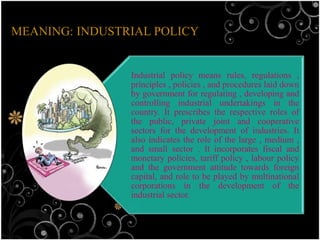
MEANING: INDUSTRIAL POLICY


                Industrial policy means rules, regulations ,
                principles , policies , and procedures laid down
                by government for regulating , developing and
                controlling industrial undertakings in the
                country. It prescribes the respective roles of
                the public, private joint and cooperative
                sectors for the development of industries. It
                also indicates the role of the large , medium ,
                and small sector . It incorporates fiscal and
                monetary policies, tariff policy , labour policy
                and the government attitude towards foreign
                capital, and role to be played by multinational
                corporations in the development of the
                industrial sector.
OBJECTIVES OF INDUSTRIAL POLICY

     Accelerating the overall rate of        Preventing monopolies and
    growth through industrialization.        concentration of industrial
    Expanding the industrial base in                   power.
  relation to industrialization needs of
                the country.
                                           Creating competitive conditions
      Generating employment and            and encouraging the growth of
            reducing poverty.
                                                  entrepreneurship

                       Promoting balanced industrial
                                development.
                       Promoting linkages with others
                          sectors of the economy.
                         Assisting small enterprises
                         Encouraging the growth of
                          industrial research and
                                development
OBJECTIVES OF NEW INDUSTRIAL POLICY

                          Attainment of
                           international
                         competitiveness.

       Revival of                           Development of
       weak units.                          backward areas.


      Full utilization
                                             Encouraging
         of plant
                                             competition
       capacities to
                                             within Indian
         generate
                                               industry.
       employment.
                         Efficient use of
                           productive
                           resources.
FEATURES OF NIP
• De-reservation of Public Sector: The number of industries reserved for
  public sector was reduced to 8 industries. At present, there are only three
  industries reserved for public sector which include. (a) Atomic energy (b)
  Railways, and (c) specified Minerals.
• De-licensing: -The most important features of NIP, 1991 was the abolition
  of industrial licensing of all industries except six industries. The six
  industries are of social and strategic concern. The six industries are
   1. Hazardous Chemicals. 2. Alcohol 3. Cigarettes 4. Industrial Explosives
  5. Defense Products, and 6. Drug and pharmaceuticals.
• Disinvestment of public sector: -The NIP 1991 permitted disinvestment of
  public sector units. Disinvestment is a process of selling government equity
  in PSUs in favour of private parties. Disinvestments aim at certain
  objectives. (1) To provide better customer Service. (2) To make effective
  use of disinvestment funds. (3) To overcome the problem of political
  interference. (4) To enable the government to concentrate on social
  development.
FEATURES OF NIP,1991 (cont…..)
• Foreign Investment: Approval will be given for direct foreign investment
  up to 51 percent foreign equity in high priority industries . There shall be
  no bottlenecks of any kind in this process
• Foreign Technology Agreements: Automatic permission will be given for
  foreign technology agreements in high priority industries up to a lump sum
  payment of Rs. 1 crore, 5% royalty for domestic sales and 8% for exports,
  subject to total payment of 8% of sales over a 10 year period from date of
  agreement or 7 years from commencement of production. No permission
  will be necessary for hiring of foreign technicians, foreign testing of
  indigenously developed technologies.
• MRTP Act: Emphasis will be placed on controlling and regulating
  monopolistic, restrictive and unfair trade practices. Simultaneously, the
  newly empowered MRTP Commission will be authorized to initiative
  investigations on complaints received from individual consumers or classes
  of consumers in regard to monopolistic, restrictive and unfair trade
  practices.
FEATURES OF NIP,1991 (cont…..)
• Public Sector Policy: The priority areas for growth of public enterprises in
  the future will be the following:
 Essential infrastructure goods and services.
 Exploration and exploitation of oil and mineral resources.
 Technology development and building of manufacturing capabilities in
  areas which are crucial in the long term development of the economy and
  where private sector investment is inadequate.
 Manufacture of products where strategic considerations predominate such
  as defense equipment.
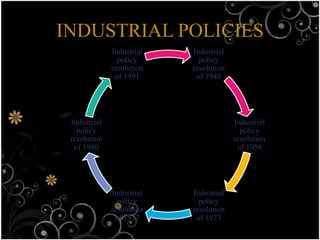
INDUSTRIAL POLICIES
              Industrial   Industrial
                policy       policy
              resolution   resolution
               of 1991      of 1948


 Industrial                             Industrial
   policy                                 policy
 resolution                             resolution
  of 1980                                of 1956


              Industrial   Industrial
                policy       policy
              resolution   resolution
               of 1977      of 1973
Positives & Watch- Outs
o POSITIVES:
• De-licensing of most industries will help entrepreneurs to quickly seize
  business opportunities.
• Removal of controls under the MRTP Act will facilitate expansion and
  growth.
• There will be greater inflow of foreign capital and technology due to easing
  of restrictions.
• Burden on the public sector will be reduced.
o WATCH-OUTS:
• . The bureaucracy has a tendency to attempt to defeat measures aimed at
  deregulations.
• Foreign investors still regard the policy and procedural system in India
  confusing. Rather many feel that policy and development environment in
  China is superior to India.
• Distortion in Industrial pattern would occur due to slow pace of investment in
  few basic and strategic industries. Absence of a mechanism would slow down
  the development of backward areas
THANK
 YOU

Industrial policy,1991

  • 1.
    PRESENTATION ON INDUSTRIAL POLICY, 1991 MASTER OF SOCIAL WORKS-II YR
  • 2.
    SYNOPSIS • MEANING: INDUSTRIAL POLICY • OBJECTIVES OF INDUSTRIAL POLICY • OBJECTIVES OF NEW INDUSTRIAL POLICY • FEATURES OF NIP • INDUSTRIAL POLICIES • POSITIVES AND WATCH-OUTS
  • 3.
    MEANING: INDUSTRIAL POLICY Industrial policy means rules, regulations , principles , policies , and procedures laid down by government for regulating , developing and controlling industrial undertakings in the country. It prescribes the respective roles of the public, private joint and cooperative sectors for the development of industries. It also indicates the role of the large , medium , and small sector . It incorporates fiscal and monetary policies, tariff policy , labour policy and the government attitude towards foreign capital, and role to be played by multinational corporations in the development of the industrial sector.
  • 4.
    OBJECTIVES OF INDUSTRIALPOLICY Accelerating the overall rate of Preventing monopolies and growth through industrialization. concentration of industrial Expanding the industrial base in power. relation to industrialization needs of the country. Creating competitive conditions Generating employment and and encouraging the growth of reducing poverty. entrepreneurship Promoting balanced industrial development. Promoting linkages with others sectors of the economy. Assisting small enterprises Encouraging the growth of industrial research and development
  • 5.
    OBJECTIVES OF NEWINDUSTRIAL POLICY Attainment of international competitiveness. Revival of Development of weak units. backward areas. Full utilization Encouraging of plant competition capacities to within Indian generate industry. employment. Efficient use of productive resources.
  • 6.
    FEATURES OF NIP •De-reservation of Public Sector: The number of industries reserved for public sector was reduced to 8 industries. At present, there are only three industries reserved for public sector which include. (a) Atomic energy (b) Railways, and (c) specified Minerals. • De-licensing: -The most important features of NIP, 1991 was the abolition of industrial licensing of all industries except six industries. The six industries are of social and strategic concern. The six industries are 1. Hazardous Chemicals. 2. Alcohol 3. Cigarettes 4. Industrial Explosives 5. Defense Products, and 6. Drug and pharmaceuticals. • Disinvestment of public sector: -The NIP 1991 permitted disinvestment of public sector units. Disinvestment is a process of selling government equity in PSUs in favour of private parties. Disinvestments aim at certain objectives. (1) To provide better customer Service. (2) To make effective use of disinvestment funds. (3) To overcome the problem of political interference. (4) To enable the government to concentrate on social development.
  • 7.
    FEATURES OF NIP,1991(cont…..) • Foreign Investment: Approval will be given for direct foreign investment up to 51 percent foreign equity in high priority industries . There shall be no bottlenecks of any kind in this process • Foreign Technology Agreements: Automatic permission will be given for foreign technology agreements in high priority industries up to a lump sum payment of Rs. 1 crore, 5% royalty for domestic sales and 8% for exports, subject to total payment of 8% of sales over a 10 year period from date of agreement or 7 years from commencement of production. No permission will be necessary for hiring of foreign technicians, foreign testing of indigenously developed technologies. • MRTP Act: Emphasis will be placed on controlling and regulating monopolistic, restrictive and unfair trade practices. Simultaneously, the newly empowered MRTP Commission will be authorized to initiative investigations on complaints received from individual consumers or classes of consumers in regard to monopolistic, restrictive and unfair trade practices.
  • 8.
    FEATURES OF NIP,1991(cont…..) • Public Sector Policy: The priority areas for growth of public enterprises in the future will be the following:  Essential infrastructure goods and services.  Exploration and exploitation of oil and mineral resources.  Technology development and building of manufacturing capabilities in areas which are crucial in the long term development of the economy and where private sector investment is inadequate.  Manufacture of products where strategic considerations predominate such as defense equipment.
  • 9.
    INDUSTRIAL POLICIES Industrial Industrial policy policy resolution resolution of 1991 of 1948 Industrial Industrial policy policy resolution resolution of 1980 of 1956 Industrial Industrial policy policy resolution resolution of 1977 of 1973
  • 10.
    Positives & Watch-Outs o POSITIVES: • De-licensing of most industries will help entrepreneurs to quickly seize business opportunities. • Removal of controls under the MRTP Act will facilitate expansion and growth. • There will be greater inflow of foreign capital and technology due to easing of restrictions. • Burden on the public sector will be reduced. o WATCH-OUTS: • . The bureaucracy has a tendency to attempt to defeat measures aimed at deregulations. • Foreign investors still regard the policy and procedural system in India confusing. Rather many feel that policy and development environment in China is superior to India. • Distortion in Industrial pattern would occur due to slow pace of investment in few basic and strategic industries. Absence of a mechanism would slow down the development of backward areas
  • 11.