BUSINESS ENVIRONMENT
TOPIC :- INDUSTRY POLICY
INDEX (INDUSTRIAL POLICY)
• DEFINITION
• INTRODUCTION
• OBJECTIVES OF INDUSTRIAL POLICY
• INDUSTRIAL POLICY RESOLUTION 1956
• OBJECTS
• NEW INDUSTRIAL POLICY 1991
• REFORMS IN INDUSTRIAL POLICY 1991
• INDUSTRIAL POLICY CHANGES
DEFINITION OF INDUSTRY POLICY
The term industrial policy refers to the government
policy towards industry – their establishment,
functioning, growth and management. This helps the
government officials by providing guidelines in
administrating industrial development.
the industrial policy indicated the respective of
public, private, joint and cooperative sector. Small,
medium and large scale industries and underlined the
national priorities. In short the industrial development
and thereby the economic development to a very
significant extent has been guided, regulated and faster
by the industrial policy.
INDTRODUCTION
• No country can progress and prosper without its
industrial development and no all around and
balance industrial growth is possible without an
industrial policy. Every industrial advance countries
have their own industrial policy. It determines a
reasonable relationship between the state and the
private enterprise, between industry and industry
and regions and regions.
• Before first world war the state was not expected to
interfere in the industrial field. It was beyond the
legitimate sphere of activity of the state in India to
evince an interest in India and efforts were
therefore made to formulate policy of postwar
industrial reconstruction and development.
• The first step to this end the govt. of India set up a
planning and development department in 1944.the
department issued a statement of industrial policy
on April 21 , 1945which tried to define the role of
the state and the private enterprise in future
industrial development of the country . the
department also appointed a number of panels to
prepare specific targets in the field of industrial
development.
• for a definite demarcation of the In July 1946
this department was abolished and its functions
were transferred partly to the department of
industries and supplies and partly to the co-
ordination committee of the cabinet under which
a development board was set up to co-ordinate
various post-war plans.
• In august 1947, a national govt. came to a
power while it was still engaged in the
problems arising out of the partition of the
country, an industrial crisis was developing in
the country owing to the unsatisfactory
relation between mgt and labor, the shortage
of raw material, the difficulty of obtaining
capital goods and the paucity of technical
personnel. The investors have no idea about
the industrial policy of the new government.
the conflicting statement of various ministers
and leaders had in the mind of people and
industrialist. in December 1947, an industries
conference was convened. The conference
emphasized the need spheres of the private
and public enterprises and adopted a
resolution on the industrial truce between
labour and capital.
OBJECTIVES OF INDUSTRY POLICY
1. RAPID INDUSTRIAL GROWTH : The industrial policy of
government of India is aimed at increasing the tempo
of the industrial development.
2. BALANCED INDUSTRIAL STRUCTURE : The industrial
policy is designed to correct the prevailing lopsided
industrial structure.
3. BALANCED REGIONAL GROWTH : Industrial policy also
aims at correcting regional imbalances in industrial
development. It is quite well-known that some
regions in the country are industrially quite advanced.
4. Solving the problem of unemployment.
INDUSTRY POLICY RESOLUTION 1956
ABOUT INDUSTRY POLICY 1956
As a direct of the drawbacks of first industrial policy declared in
1948 and on account of the important changes and development
that had taken place since then, the revision of the policy was
considered necessary. The constitution of India guaranteeing
certain fundamental rights and enunciating directives principles of
state policy had been enacted; planning had proceeded on an
organized basis and the first five year plan was completed; the
parliament had accepted the socialist pattern of society as the
objective of social and economic policy. The important
developments necessitated a fresh statement of industrial policy
more particularly as the second five year plan was going to be
launched. A new policy was, therefore, announced on 30th April
1956
OBJECTIVES OF I.P. 1956
1. Acceleration of the rate of the economic growth and the
speeding up of industrialization and, in particular, the
development of heavy industries and machine making
industries.
2. The expansion of the public sector
3. The building of up of a large and growing co-operative sectors
4. An increase in the opportunities for gainful employment and
the improvement of living standards and working condition for
the mass of the people.
5. The reduction of existing disparities in income and wealth.
6. The prevention of private monopolies and the concentration of
economic power of the field in different hands of small no. of
individuals.
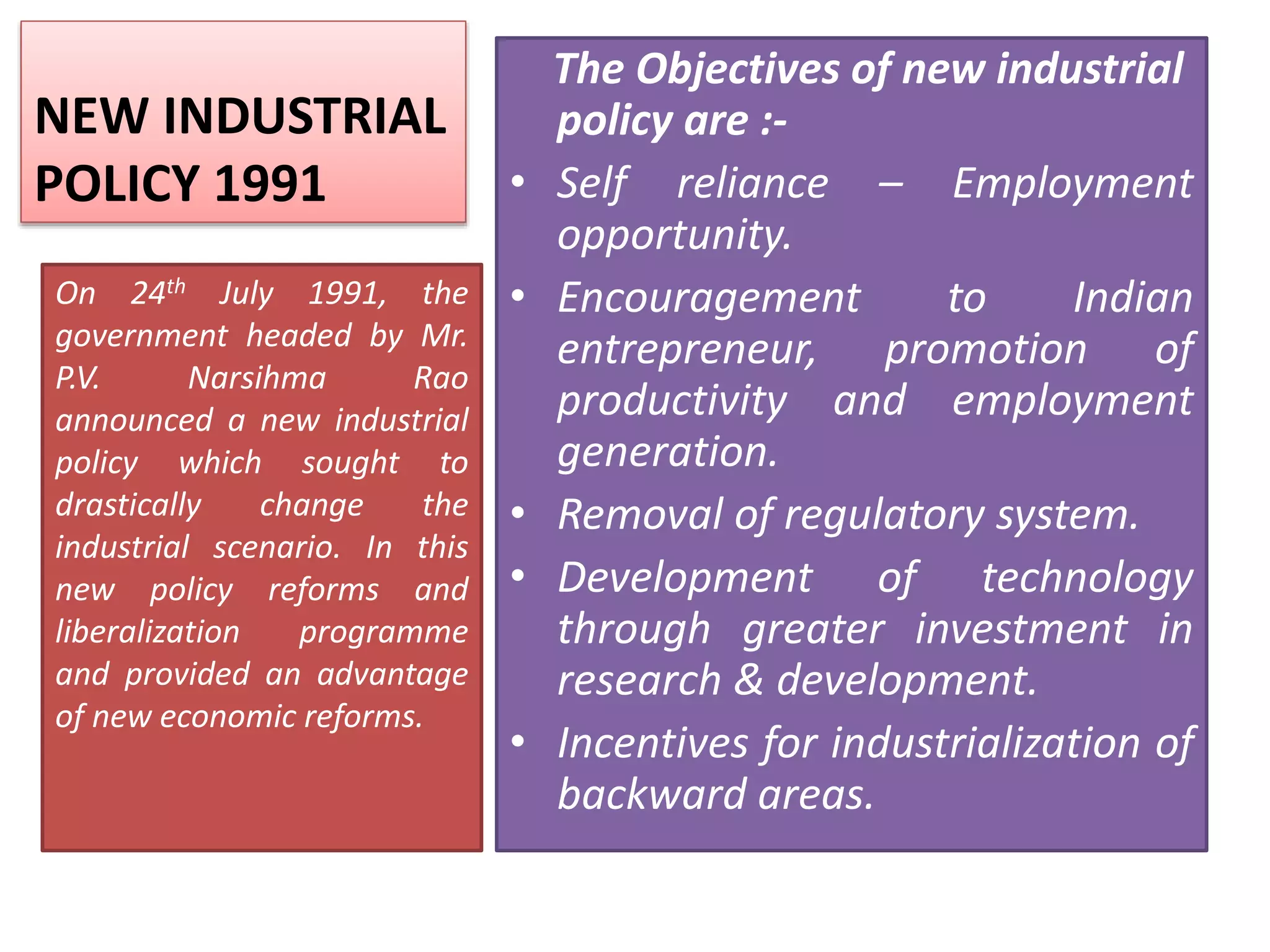
NEW INDUSTRIAL POLICY 1991
NEW INDUSTRIAL
POLICY 1991
The Objectives of new industrial
policy are :-
• Self reliance – Employment
opportunity.
• Encouragement to Indian
entrepreneur, promotion of
productivity and employment
generation.
• Removal of regulatory system.
• Development of technology
through greater investment in
research & development.
• Incentives for industrialization of
backward areas.
On 24th July 1991, the
government headed by Mr.
P.V. Narsihma Rao
announced a new industrial
policy which sought to
drastically change the
industrial scenario. In this
new policy reforms and
liberalization programme
and provided an advantage
of new economic reforms.
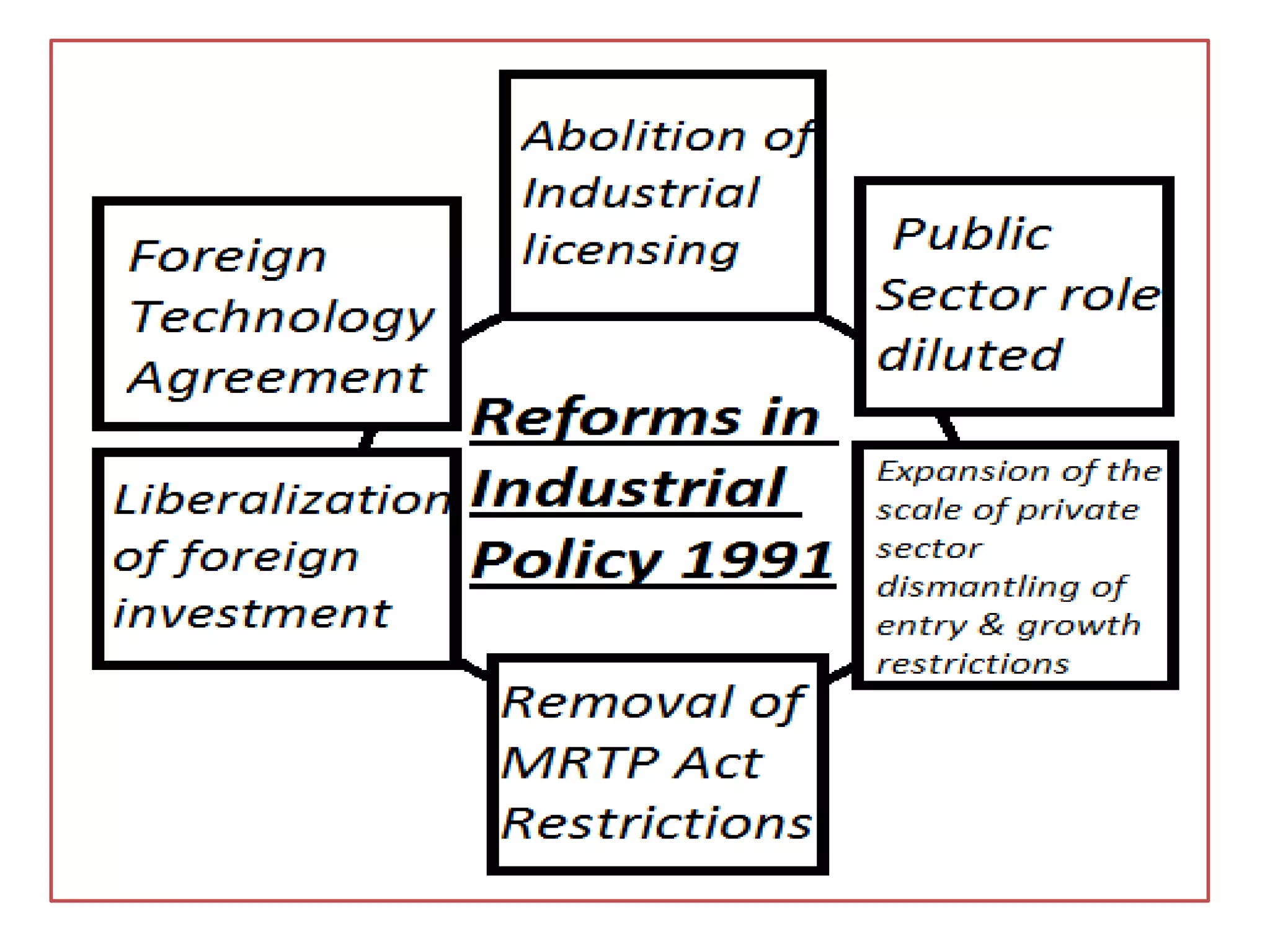
• Abolition of Industrial Licensing :- In order to liberalize the economy and to enable
the entrepreneurs to make investment decisions on the basis of their own commercial
judgment the 1991 industrial policy abolished industrial licensing for all except 18
industries with the passage of time the no of industries were reduced to 6. These alcohol,
hazardous chemicals, drugs etc.
• Public Sector role diluted :- The 1956 resolution reserved 17 industries for public
sector. The 1991 industrial policy reserved this no. to 8.
These are: arms and ammunition, atomic energy, coal & lignite, mineral oil, mining of ore,
manganese ore, gold & diamond, mining of copper, lead, zinc, tin, mineral specified in
the schedule to the atomic energy, rail transport.
• In 2001 this no. was again reduced to 3.
• Expansion of the scale of private sector and dismantling of entry & growth
restrictions :- The scope of private sector has been expanded enormously by drastically
reducing the no. of industries reserved for the public sector & by substantially dismantling
the barrier to entry and growth
• Removal of MRTP Act Restrictions :- The provision of the MRTP Act pertaining to
concentration of economic power i.e., (those requiring prior permissions for establishment
of new undertaking, substantial expansion, manufacturing of new items & merger &
acquisitions) were scar appeal.
• Liberalization of foreign investment :- In order to invite foreign investment in high
priority industries requiring large investments and advanced technology, it has been
described to provide approval for direct foreign investment upon 51% foreign equity.
• Foreign Technology Agreement :- With a view to injecting the desired level of
technological dynamism in the Indian industry, automatic permission will be given by the
government for technological agreements related to high priority industries in specified
parameters.
Indian companies will be free to negotiate the terms of technology their counterpart.
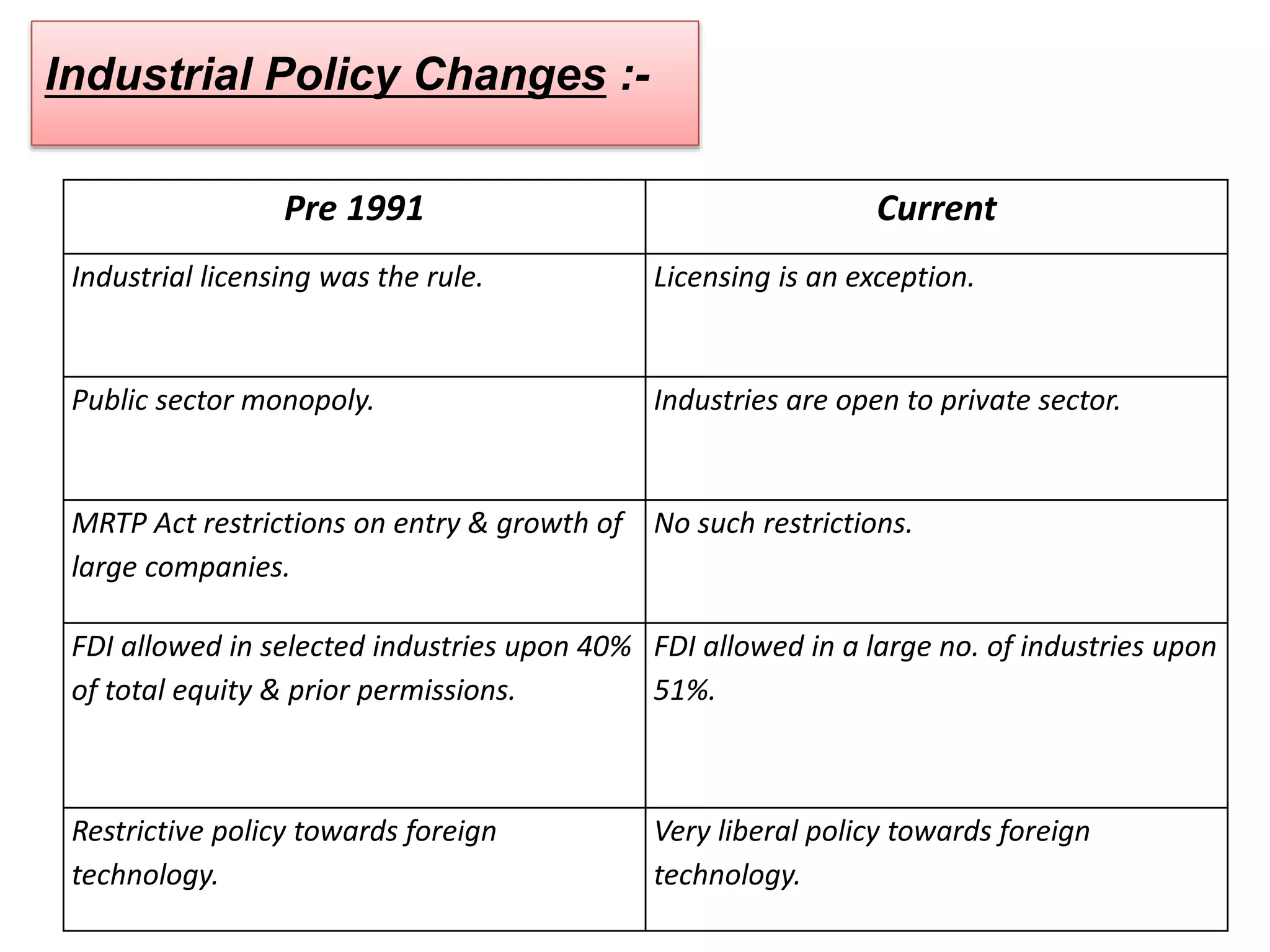
INDUSTRIAL POLICY CHANGES
Pre 1991 Current
Industrial licensing was the rule. Licensing is an exception.
Public sector monopoly. Industries are open to private sector.
MRTP Act restrictions on entry & growth of
large companies.
No such restrictions.
FDI allowed in selected industries upon 40%
of total equity & prior permissions.
FDI allowed in a large no. of industries upon
51%.
Restrictive policy towards foreign
technology.
Very liberal policy towards foreign
technology.
Industrial Policy Changes :-
Industrial policy 1956 1991

Industrial policy 1956 1991

  • 1.
  • 2.
    INDEX (INDUSTRIAL POLICY) •DEFINITION • INTRODUCTION • OBJECTIVES OF INDUSTRIAL POLICY • INDUSTRIAL POLICY RESOLUTION 1956 • OBJECTS • NEW INDUSTRIAL POLICY 1991 • REFORMS IN INDUSTRIAL POLICY 1991 • INDUSTRIAL POLICY CHANGES
  • 4.
    DEFINITION OF INDUSTRYPOLICY The term industrial policy refers to the government policy towards industry – their establishment, functioning, growth and management. This helps the government officials by providing guidelines in administrating industrial development. the industrial policy indicated the respective of public, private, joint and cooperative sector. Small, medium and large scale industries and underlined the national priorities. In short the industrial development and thereby the economic development to a very significant extent has been guided, regulated and faster by the industrial policy.
  • 5.
    INDTRODUCTION • No countrycan progress and prosper without its industrial development and no all around and balance industrial growth is possible without an industrial policy. Every industrial advance countries have their own industrial policy. It determines a reasonable relationship between the state and the private enterprise, between industry and industry and regions and regions. • Before first world war the state was not expected to interfere in the industrial field. It was beyond the legitimate sphere of activity of the state in India to evince an interest in India and efforts were therefore made to formulate policy of postwar industrial reconstruction and development. • The first step to this end the govt. of India set up a planning and development department in 1944.the department issued a statement of industrial policy on April 21 , 1945which tried to define the role of the state and the private enterprise in future industrial development of the country . the department also appointed a number of panels to prepare specific targets in the field of industrial development. • for a definite demarcation of the In July 1946 this department was abolished and its functions were transferred partly to the department of industries and supplies and partly to the co- ordination committee of the cabinet under which a development board was set up to co-ordinate various post-war plans. • In august 1947, a national govt. came to a power while it was still engaged in the problems arising out of the partition of the country, an industrial crisis was developing in the country owing to the unsatisfactory relation between mgt and labor, the shortage of raw material, the difficulty of obtaining capital goods and the paucity of technical personnel. The investors have no idea about the industrial policy of the new government. the conflicting statement of various ministers and leaders had in the mind of people and industrialist. in December 1947, an industries conference was convened. The conference emphasized the need spheres of the private and public enterprises and adopted a resolution on the industrial truce between labour and capital.
  • 6.
    OBJECTIVES OF INDUSTRYPOLICY 1. RAPID INDUSTRIAL GROWTH : The industrial policy of government of India is aimed at increasing the tempo of the industrial development. 2. BALANCED INDUSTRIAL STRUCTURE : The industrial policy is designed to correct the prevailing lopsided industrial structure. 3. BALANCED REGIONAL GROWTH : Industrial policy also aims at correcting regional imbalances in industrial development. It is quite well-known that some regions in the country are industrially quite advanced. 4. Solving the problem of unemployment.
  • 7.
  • 8.
    ABOUT INDUSTRY POLICY1956 As a direct of the drawbacks of first industrial policy declared in 1948 and on account of the important changes and development that had taken place since then, the revision of the policy was considered necessary. The constitution of India guaranteeing certain fundamental rights and enunciating directives principles of state policy had been enacted; planning had proceeded on an organized basis and the first five year plan was completed; the parliament had accepted the socialist pattern of society as the objective of social and economic policy. The important developments necessitated a fresh statement of industrial policy more particularly as the second five year plan was going to be launched. A new policy was, therefore, announced on 30th April 1956
  • 9.
    OBJECTIVES OF I.P.1956 1. Acceleration of the rate of the economic growth and the speeding up of industrialization and, in particular, the development of heavy industries and machine making industries. 2. The expansion of the public sector 3. The building of up of a large and growing co-operative sectors 4. An increase in the opportunities for gainful employment and the improvement of living standards and working condition for the mass of the people. 5. The reduction of existing disparities in income and wealth. 6. The prevention of private monopolies and the concentration of economic power of the field in different hands of small no. of individuals.
  • 10.
  • 11.
    NEW INDUSTRIAL POLICY 1991 TheObjectives of new industrial policy are :- • Self reliance – Employment opportunity. • Encouragement to Indian entrepreneur, promotion of productivity and employment generation. • Removal of regulatory system. • Development of technology through greater investment in research & development. • Incentives for industrialization of backward areas. On 24th July 1991, the government headed by Mr. P.V. Narsihma Rao announced a new industrial policy which sought to drastically change the industrial scenario. In this new policy reforms and liberalization programme and provided an advantage of new economic reforms.
  • 14.
    • Abolition ofIndustrial Licensing :- In order to liberalize the economy and to enable the entrepreneurs to make investment decisions on the basis of their own commercial judgment the 1991 industrial policy abolished industrial licensing for all except 18 industries with the passage of time the no of industries were reduced to 6. These alcohol, hazardous chemicals, drugs etc. • Public Sector role diluted :- The 1956 resolution reserved 17 industries for public sector. The 1991 industrial policy reserved this no. to 8. These are: arms and ammunition, atomic energy, coal & lignite, mineral oil, mining of ore, manganese ore, gold & diamond, mining of copper, lead, zinc, tin, mineral specified in the schedule to the atomic energy, rail transport. • In 2001 this no. was again reduced to 3. • Expansion of the scale of private sector and dismantling of entry & growth restrictions :- The scope of private sector has been expanded enormously by drastically reducing the no. of industries reserved for the public sector & by substantially dismantling the barrier to entry and growth • Removal of MRTP Act Restrictions :- The provision of the MRTP Act pertaining to concentration of economic power i.e., (those requiring prior permissions for establishment of new undertaking, substantial expansion, manufacturing of new items & merger & acquisitions) were scar appeal. • Liberalization of foreign investment :- In order to invite foreign investment in high priority industries requiring large investments and advanced technology, it has been described to provide approval for direct foreign investment upon 51% foreign equity. • Foreign Technology Agreement :- With a view to injecting the desired level of technological dynamism in the Indian industry, automatic permission will be given by the government for technological agreements related to high priority industries in specified parameters. Indian companies will be free to negotiate the terms of technology their counterpart.
  • 15.
  • 16.
    Pre 1991 Current Industriallicensing was the rule. Licensing is an exception. Public sector monopoly. Industries are open to private sector. MRTP Act restrictions on entry & growth of large companies. No such restrictions. FDI allowed in selected industries upon 40% of total equity & prior permissions. FDI allowed in a large no. of industries upon 51%. Restrictive policy towards foreign technology. Very liberal policy towards foreign technology. Industrial Policy Changes :-