INDUSTRIALIZATION
POLICY
Prepared By:
GROUP IV
4 Major Objectives of Industrial
Policy (India)
• The major objectives of industrial policy are:
• Rapid Industrial Development
• Balanced industrial Structure
• Prevention of Concentration of Economic
Power
• Balanced Regional Growth
Why Industrial Policy is Desirable?
• Knowledge Spill over
• Infant Industry
• Coordination Failure
• Informational externalities
PRE REFORM POLICY
Industries (Development and Regulation) Act (IDRA), 1951
 The main provisions of the IDRA, 1951 were;
a) All existing undertakings at the commencement of the Act, except those owned by
the Central Government were compulsorily required to register with the designated
authority.
b) b) No one except the central Government would be permitted to set up any new
industrial undertaking “except under and in accordance with a license issued in that
behalf by the Central Government.”
c) c) Such a license or permission prescribed a variety of conditions, such as, location,
minimum standards in respect of size and techniques to be used, which the Central
Government may approve.
d) d) Such licenses and clearances were also required in cases of ‘substantial
expansion’ of an existing industrial undertaking.
(1) New classification of Industries: IPR, 1956 divided the industries into the following
three categories:
(a) Schedule A industries: The industries that were the monopoly of state or
Government. It included 17 industries. The private sector was allowed to operate
in these industries if national interest so required.
(b) (b) Schedule B industries: In this category of industries state was allowed to
establish new units but the private sector was not denied to set up or expand
existing units e.g. chemical industries, fertilizer, synthetic, rubber, aluminum etc.
(c) (c) Schedule C industries: The industries not mentioned in the above category
formed pat of Schedule C. Thus the IPR, 1956 emphasized the mutual existence
of public and private sector industries.
(2) Encouragement to Small-scale and Cottage Industries: In order to strengthen the
small-scale sector supportive measures were suggested in terms of cheap credit,
subsidies, reservation etc.
(3) Emphasized on Reduction of Regional Disparities: Fiscal concessions were granted
to open industries in backward regions. Public sector enterprises were given greater
role to develop these areas.
Industrial Policy Resolution, 1956
• Protection to Indian Industries: Local industries were given shelter from international
competition by introducing partial physical ban on the imports of products and high
imports tariffs. Protection from imports encouraged Indian industry to undertake the
manufacture of a variety of products. There was a ready market for all these products.
• Import-Substitution Policy: Government used its import policy for the healthy
development of local industries. Barring the first few years after Independence, the
country was facing a shortage of foreign exchange, and so save scarce foreign exchange
imports-substitution policy was initiated i.e. Government encouraged the production of
imported goods indigenously.
• Control over Indian Industries: Indian industries were highly regulated through
legislations such as Industrial licensing, MRTPAct, 1969 etc. These legislations
restricted the production, expansion and pricing of output of almost all kinds of
industries in the country.
• Encouragement to Small Industries: Government encouraged small-scale industries
(SSIs) by providing a number of support measures for its growth. Policy measures
addressed the basic requirements of the SSI like credit, marketing, technology,
entrepreneurship development, and fiscal, financial and infrastructural support.
• Emphasis on Public Sector: The Government made huge investments in providing
infrastructure and basic facilities to industries. This was achieved by establishing public
sector enterprises in the key sectors such as power generation, capital goods, heavy
machineries, banking, telecommunication, etc.
Major Features of Pre-1991 Industrial Policy
POST REFORM POLICY
India’s New Industrial Policy announced in July 1991 (hereafter
NIP) was radical compared to its earlier industrial policies in
terms of objectives and major features.
It emphasized on the need to promote further industrial
development based on consolidating the gains already made and
correct the distortion or weaknesses that might have crept in,
and attain international competitiveness. (Ministry of Industry,
1991).
The liberalized Industrial Policy aims at rapid and substantial
economic growth, and integration with the global economy in a
harmonized manner.
The Industrial Policy reforms have reduced the industrial
licensing requirements, removed restrictions on investment and
expansion, and facilitated easy access to foreign technology and
foreign direct investment.
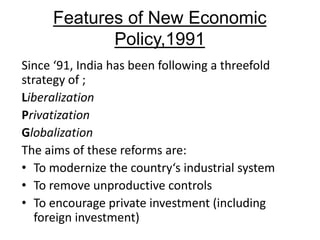
Features of New Economic
Policy,1991
Since ‘91, India has been following a threefold
strategy of ;
Liberalization
Privatization
Globalization
The aims of these reforms are:
• To modernize the country‘s industrial system
• To remove unproductive controls
• To encourage private investment (including
foreign investment)
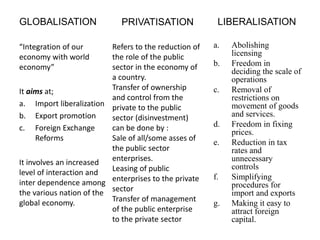
GLOBALISATION
“Integration of our
economy with world
economy”
It aims at;
a. Import liberalization
b. Export promotion
c. Foreign Exchange
Reforms
It involves an increased
level of interaction and
inter dependence among
the various nation of the
global economy.
LIBERALISATION
a. Abolishing
licensing
b. Freedom in
deciding the scale of
operations
c. Removal of
restrictions on
movement of goods
and services.
d. Freedom in fixing
prices.
e. Reduction in tax
rates and
unnecessary
controls
f. Simplifying
procedures for
import and exports
g. Making it easy to
attract foreign
capital.
PRIVATISATION
Refers to the reduction of
the role of the public
sector in the economy of
a country.
Transfer of ownership
and control from the
private to the public
sector (disinvestment)
can be done by :
Sale of all/some asses of
the public sector
enterprises.
Leasing of public
enterprises to the private
sector
Transfer of management
of the public enterprise
to the private sector
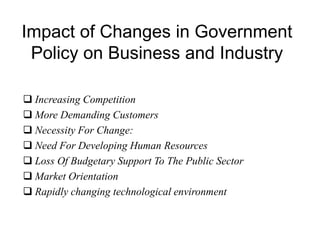
Impact of Changes in Government
Policy on Business and Industry
 Increasing Competition
 More Demanding Customers
 Necessity For Change:
 Need For Developing Human Resources
 Loss Of Budgetary Support To The Public Sector
 Market Orientation
 Rapidly changing technological environment

INDUSTRIALIZATION POLICY

  • 1.
  • 2.
    4 Major Objectivesof Industrial Policy (India) • The major objectives of industrial policy are: • Rapid Industrial Development • Balanced industrial Structure • Prevention of Concentration of Economic Power • Balanced Regional Growth
  • 3.
    Why Industrial Policyis Desirable? • Knowledge Spill over • Infant Industry • Coordination Failure • Informational externalities
  • 4.
    PRE REFORM POLICY Industries(Development and Regulation) Act (IDRA), 1951  The main provisions of the IDRA, 1951 were; a) All existing undertakings at the commencement of the Act, except those owned by the Central Government were compulsorily required to register with the designated authority. b) b) No one except the central Government would be permitted to set up any new industrial undertaking “except under and in accordance with a license issued in that behalf by the Central Government.” c) c) Such a license or permission prescribed a variety of conditions, such as, location, minimum standards in respect of size and techniques to be used, which the Central Government may approve. d) d) Such licenses and clearances were also required in cases of ‘substantial expansion’ of an existing industrial undertaking.
  • 5.
    (1) New classificationof Industries: IPR, 1956 divided the industries into the following three categories: (a) Schedule A industries: The industries that were the monopoly of state or Government. It included 17 industries. The private sector was allowed to operate in these industries if national interest so required. (b) (b) Schedule B industries: In this category of industries state was allowed to establish new units but the private sector was not denied to set up or expand existing units e.g. chemical industries, fertilizer, synthetic, rubber, aluminum etc. (c) (c) Schedule C industries: The industries not mentioned in the above category formed pat of Schedule C. Thus the IPR, 1956 emphasized the mutual existence of public and private sector industries. (2) Encouragement to Small-scale and Cottage Industries: In order to strengthen the small-scale sector supportive measures were suggested in terms of cheap credit, subsidies, reservation etc. (3) Emphasized on Reduction of Regional Disparities: Fiscal concessions were granted to open industries in backward regions. Public sector enterprises were given greater role to develop these areas. Industrial Policy Resolution, 1956
  • 6.
    • Protection toIndian Industries: Local industries were given shelter from international competition by introducing partial physical ban on the imports of products and high imports tariffs. Protection from imports encouraged Indian industry to undertake the manufacture of a variety of products. There was a ready market for all these products. • Import-Substitution Policy: Government used its import policy for the healthy development of local industries. Barring the first few years after Independence, the country was facing a shortage of foreign exchange, and so save scarce foreign exchange imports-substitution policy was initiated i.e. Government encouraged the production of imported goods indigenously. • Control over Indian Industries: Indian industries were highly regulated through legislations such as Industrial licensing, MRTPAct, 1969 etc. These legislations restricted the production, expansion and pricing of output of almost all kinds of industries in the country. • Encouragement to Small Industries: Government encouraged small-scale industries (SSIs) by providing a number of support measures for its growth. Policy measures addressed the basic requirements of the SSI like credit, marketing, technology, entrepreneurship development, and fiscal, financial and infrastructural support. • Emphasis on Public Sector: The Government made huge investments in providing infrastructure and basic facilities to industries. This was achieved by establishing public sector enterprises in the key sectors such as power generation, capital goods, heavy machineries, banking, telecommunication, etc. Major Features of Pre-1991 Industrial Policy
  • 7.
    POST REFORM POLICY India’sNew Industrial Policy announced in July 1991 (hereafter NIP) was radical compared to its earlier industrial policies in terms of objectives and major features. It emphasized on the need to promote further industrial development based on consolidating the gains already made and correct the distortion or weaknesses that might have crept in, and attain international competitiveness. (Ministry of Industry, 1991). The liberalized Industrial Policy aims at rapid and substantial economic growth, and integration with the global economy in a harmonized manner. The Industrial Policy reforms have reduced the industrial licensing requirements, removed restrictions on investment and expansion, and facilitated easy access to foreign technology and foreign direct investment.
  • 8.
    Features of NewEconomic Policy,1991 Since ‘91, India has been following a threefold strategy of ; Liberalization Privatization Globalization The aims of these reforms are: • To modernize the country‘s industrial system • To remove unproductive controls • To encourage private investment (including foreign investment)
  • 9.
    GLOBALISATION “Integration of our economywith world economy” It aims at; a. Import liberalization b. Export promotion c. Foreign Exchange Reforms It involves an increased level of interaction and inter dependence among the various nation of the global economy. LIBERALISATION a. Abolishing licensing b. Freedom in deciding the scale of operations c. Removal of restrictions on movement of goods and services. d. Freedom in fixing prices. e. Reduction in tax rates and unnecessary controls f. Simplifying procedures for import and exports g. Making it easy to attract foreign capital. PRIVATISATION Refers to the reduction of the role of the public sector in the economy of a country. Transfer of ownership and control from the private to the public sector (disinvestment) can be done by : Sale of all/some asses of the public sector enterprises. Leasing of public enterprises to the private sector Transfer of management of the public enterprise to the private sector
  • 10.
    Impact of Changesin Government Policy on Business and Industry  Increasing Competition  More Demanding Customers  Necessity For Change:  Need For Developing Human Resources  Loss Of Budgetary Support To The Public Sector  Market Orientation  Rapidly changing technological environment