
Readwithdaisy.home.blog
MACRO- TEACHING
Bioscience
Readwithdaisy.home.blog
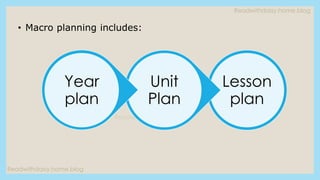
• Macro planning includes:
Lesson
plan
Unit
Plan
Year
plan
Readwithdaisy.home.blog
Year / Annual plan
Readwithdaisy.home.blog
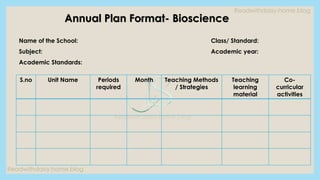
Annual Plan Format- Bioscience
Name of the School: Class/ Standard:
Subject: Academic year:
Academic Standards:
S.no Unit Name Periods
required
Month Teaching Methods
/ Strategies
Teaching
learning
material
Co-
curricular
activities
Readwithdaisy.home.blog
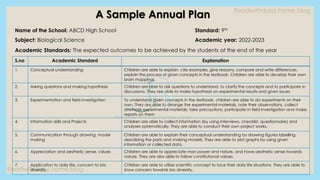
A Sample Annual Plan
Name of the School: ABCD High School Standard: 9th
Subject: Biological Science Academic year: 2022-2023
Academic Standards: The expected outcomes to be achieved by the students at the end of the year
S.no Academic Standard Explanation
1. Conceptual understanding Children are able to explain, cite examples, give reasons, compare and write differences,
explain the process of given concepts in the textbook. Children are able to develop their own
brain mappings
2. Asking questions and making hypothesis Children are able to ask questions to understand, to clarify the concepts and to participate in
discussions. They are able to make hypothesis on experimental results and given issues
3. Experimentation and field investigation To understand given concepts in the textbook, children are able to do experiments on their
own. They are able to arrange the experimental materials, note their observations, collect
alternate experimental materials, take precautions, participate in field investigation and make
reports on them
4. Information skills and Projects Children are able to collect information (by using interviews, checklist, questionnaire) and
analyses systematically. They are able to conduct their own project works.
5. Communication through drawing, model
making
Children are able to explain their conceptual understanding by drawing figures labelling,
describing the parts and making models. They are able to plot graphs by using given
information or collected data.
6. Appreciation and aesthetic sense, values Children are able to appreciate man power and nature, and have aesthetic sense towards
nature. They are also able to follow constitutional values.
7. Application to daily life, concern to bio
diversity.
Children are able to utilize scientific concept to face their daily life situations. They are able to
show concern towards bio diversity.
Readwithdaisy.home.blog
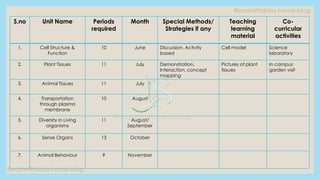
S.no Unit Name Periods
required
Month Special Methods/
Strategies if any
Teaching
learning
material
Co-
curricular
activities
1. Cell Structure &
Function
10 June Discussion, Activity
based
Cell model Science
laboratory
2. Plant Tissues 11 July Demonstration,
Interaction, concept
mapping
Pictures of plant
tissues
In campus
garden visit
3. Animal Tissues 11 July
4. Transportation
through plasma
membrane
10 August
5. Diversity in Living
organisms
11 August/
September
6. Sense Organs 13 October
7. Animal Behaviour 9 November
Readwithdaisy.home.blog
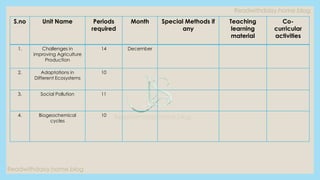
S.no Unit Name Periods
required
Month Special Methods if
any
Teaching
learning
material
Co-
curricular
activities
1. Challenges in
improving Agriculture
Production
14 December
2. Adaptations in
Different Ecosystems
10
3. Social Pollution 11
4. Biogeochemical
cycles
10
Readwithdaisy.home.blog
Unit plan
Readwithdaisy.home.blog
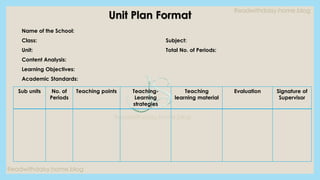
Unit Plan Format
Name of the School:
Class: Subject:
Unit: Total No. of Periods:
Content Analysis:
Learning Objectives:
Academic Standards:
Sub units No. of
Periods
Teaching points Teaching-
Learning
strategies
Teaching
learning material
Evaluation Signature of
Supervisor
Readwithdaisy.home.blog
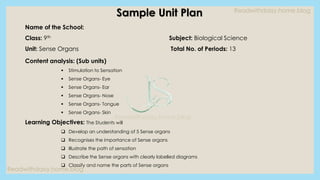
Sample Unit Plan
Name of the School:
Class: 9th Subject: Biological Science
Unit: Sense Organs Total No. of Periods: 13
Content analysis: (Sub units)
▪ Stimulation to Sensation
▪ Sense Organs- Eye
▪ Sense Organs- Ear
▪ Sense Organs- Nose
▪ Sense Organs- Tongue
▪ Sense Organs- Skin
Learning Objectives: The Students will
❑ Develop an understanding of 5 Sense organs
❑ Recognises the importance of Sense organs
❑ Illustrate the path of sensation
❑ Describe the Sense organs with clearly labelled diagrams
❑ Classify and name the parts of Sense organs
Readwithdaisy.home.blog
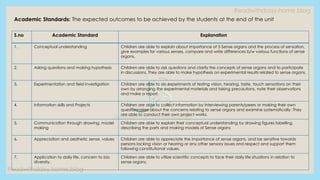
Academic Standards: The expected outcomes to be achieved by the students at the end of the unit
S.no Academic Standard Explanation
1. Conceptual understanding Children are able to explain about importance of 5 Sense organs and the process of sensation,
give examples for various senses, compare and write differences b/w various functions of sense
organs.
2. Asking questions and making hypothesis Children are able to ask questions and clarify the concepts of sense organs and to participate
in discussions. They are able to make hypothesis on experimental results related to sense organs.
3. Experimentation and field investigation Children are able to do experiments of testing vision, hearing, taste, touch sensations on their
own by arranging the experimental materials and taking precautions, note their observations
and make a report.
4. Information skills and Projects Children are able to collect information by interviewing parents/peers or making their own
questionnaires about the concerns relating to sense organs and examine systematically. They
are able to conduct their own project works.
5. Communication through drawing, model
making
Children are able to explain their conceptual understanding by drawing figures labelling,
describing the parts and making models of Sense organs
6. Appreciation and aesthetic sense, values Children are able to appreciate the importance of sense organs, and be sensitive towards
persons lacking vision or hearing or any other sensory issues and respect and support them
following constitutional values.
7. Application to daily life, concern to bio
diversity.
Children are able to utilize scientific concepts to face their daily life situations in relation to
sense organs.
Readwithdaisy.home.blog
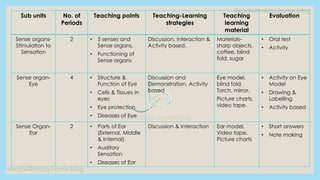
Sub units No. of
Periods
Teaching points Teaching-Learning
strategies
Teaching
learning
material
Evaluation
Sense organs-
Stimulation to
Sensation
2 • 5 senses and
Sense organs,
• Functioning of
Sense organs
Discussion, Interaction &
Activity based.
Materials-
sharp objects,
coffee, blind
fold, sugar
• Oral test
• Activity
Sense organ-
Eye
4 • Structure &
Function of Eye
• Cells & Tissues in
eyes
• Eye protection
• Diseases of Eye
Discussion and
Demonstration, Activity
based
Eye model,
blind fold,
Torch, mirror,
Picture charts,
video tape.
• Activity on Eye
Model
• Drawing &
Labelling
• Activity based
Sense Organ-
Ear
2 • Parts of Ear
(External, Middle
& Internal)
• Auditory
Sensation
• Diseases of Ear
Discussion & Interaction Ear model,
Video tape,
Picture charts
• Short answers
• Note making
Readwithdaisy.home.blog
Sub units No. of
Periods
Teaching points Teaching-Learning
strategies
Teaching
learning
material
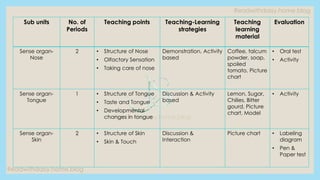
Evaluation
Sense organ-
Nose
2 • Structure of Nose
• Olfactory Sensation
• Taking care of nose
Demonstration, Activity
based
Coffee, talcum
powder, soap,
spoiled
tomato, Picture
chart
• Oral test
• Activity
Sense organ-
Tongue
1 • Structure of Tongue
• Taste and Tongue
• Developmental
changes in tongue
Discussion & Activity
based
Lemon, Sugar,
Chilies, Bitter
gourd, Picture
chart, Model
• Activity
Sense organ-
Skin
2 • Structure of Skin
• Skin & Touch
Discussion &
Interaction
Picture chart • Labeling
diagram
• Pen &
Paper test
Readwithdaisy.home.blog
Lesson plan
Readwithdaisy.home.blog
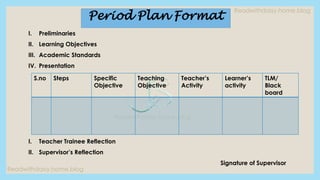
Period Plan Format
I. Preliminaries
II. Learning Objectives
III. Academic Standards
IV. Presentation
I. Teacher Trainee Reflection
II. Supervisor’s Reflection
Signature of Supervisor
S.no Steps Specific
Objective
Teaching
Objective
Teacher’s
Activity
Learner’s
activity
TLM/
Black
board
Readwithdaisy.home.blog
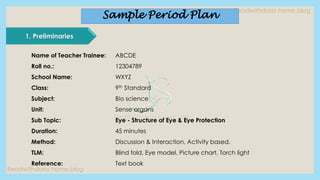
1. Preliminaries
Name of Teacher Trainee: ABCDE
Roll no.: 12304789
School Name: WXYZ
Class: 9th Standard
Subject: Bio science
Unit: Sense organs
Sub Topic: Eye - Structure of Eye & Eye Protection
Duration: 45 minutes
Method: Discussion & Interaction, Activity based.
TLM: Blind fold, Eye model, Picture chart, Torch light
Reference: Text book
Sample Period Plan
Readwithdaisy.home.blog
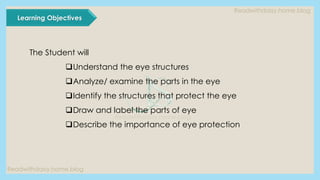
Learning Objectives
The Student will
❑Understand the eye structures
❑Analyze/ examine the parts in the eye
❑Identify the structures that protect the eye
❑Draw and label the parts of eye
❑Describe the importance of eye protection
Readwithdaisy.home.blog
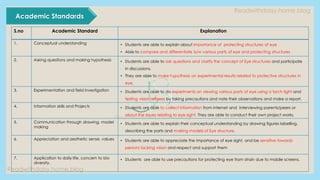
Academic Standards
S.no Academic Standard Explanation
1. Conceptual understanding • Students are able to explain about importance of protecting structures of eye
• Able to compare and differentiate b/w various parts of eye and protecting structures
2. Asking questions and making hypothesis • Students are able to ask questions and clarify the concept of Eye structures and participate
in discussions.
• They are able to make hypothesis on experimental results related to protective structures in
eye.
3. Experimentation and field investigation • Students are able to do experiments on viewing various parts of eye using a torch light and
testing vision reflexes by taking precautions and note their observations and make a report.
4. Information skills and Projects • Students are able to collect information from internet and interviewing parents/peers or
about the issues relating to eye sight. They are able to conduct their own project works.
5. Communication through drawing, model
making
• Students are able to explain their conceptual understanding by drawing figures labelling,
describing the parts and making models of Eye structure.
6. Appreciation and aesthetic sense, values • Students are able to appreciate the importance of eye sight, and be sensitive towards
persons lacking vision and respect and support them
7. Application to daily life, concern to bio
diversity.
• Students are able to use precautions for protecting eye from strain due to mobile screens.
Readwithdaisy.home.blog
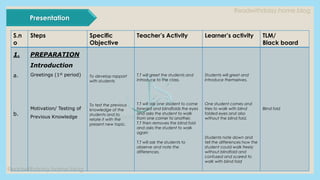
Presentation
S.n
o
Steps Specific
Objective
Teacher’s Activity Learner’s activity TLM/
Black board
1.
a.
b.
PREPARATION
Introduction
Greetings (1st period)
Motivation/ Testing of
Previous Knowledge
To develop rapport
with students
To test the previous
knowledge of the
students and to
relate it with the
present new topic.
T.T will greet the students and
introduce to the class.
T.T will ask one student to come
forward and blindfolds the eyes
and asks the student to walk
from one corner to another.
T.T then removes the blind fold
and asks the student to walk
again
T.T will ask the students to
observe and note the
differences.
Students will greet and
introduce themselves.
One student comes and
tries to walk with blind
folded eyes and also
without the blind fold.
Students note down and
tell the differences how the
student could walk freely
without blindfold and
confused and scared to
walk with blind fold
Blind fold
Readwithdaisy.home.blog
Presentation
S.n
o
Steps Specific
Objective
Teacher’s Activity Learner’s activity TLM/
Black board
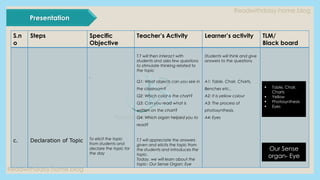
c. Declaration of Topic
.
To elicit the topic
from students and
declare the topic for
the day
T.T will then interact with
students and asks few questions
to stimulate thinking related to
the topic
Q1: What objects can you see in
the classroom?
Q2: Which color is the chart?
Q3: Can you read what is
written on the chart?
Q4: Which organ helped you to
read?
T.T will appreciate the answers
given and elicits the topic from
the students and introduces the
topic.
Today, we will learn about the
topic- Our Sense Organ: Eye
Students will think and give
answers to the questions
A1: Table, Chair, Charts,
Benches etc.,
A2: It is yellow colour
A3: The process of
photosynthesis.
A4: Eyes
Our Sense
organ- Eye
▪ Table, Chair,
Charts
▪ Yellow
▪ Photosynthesis
▪ Eyes
Readwithdaisy.home.blog
S.no Steps Specific
Objective
Teacher’s Activity Learner’s activity TLM/
Black board
2.
a.
b.
PRESENTATION
Reading
Reading the
textbook
& Underlining of
difficult words
Discussion of hard
words with the
group
To enable students
to get familiar with
the terminology
and pronunciation.
To enable students
to learn new terms
and its usage
T.T will ask the students to open their
textbooks to page no. 78 & 91 and
read about the topics:
1. Structures of the eye
2. Eye protection
T.T will instruct them to underline the
new words or put a ? Above the
word using a pencil.
T.T will write the words on black
board and gives correct
pronunciation and makes the
students to recite the new terms
Students will open their
books and read the
topics. They will underline
the words.
Students will recite the
words and will
pronounce them
correctly.
▪ Conjunctiva
▪ Lachrymal
gland
▪ Sclerotic
layer
▪ Choroid
layer
▪ Suspensory
ligament
Readwithdaisy.home.blog
S.no Steps Specific
Objective
Teacher’s Activity Learner’s activity TLM/
Black board
Explanation
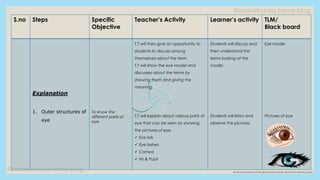
1. Outer structures of
eye
To know the
different parts of
eye.
T.T will then give an opportunity to
students to discuss among
themselves about the term.
T.T will show the eye model and
discusses about the terms by
showing them and giving the
meaning.
T.T will explain about various parts of
eye that can be seen by showing
the pictures of eye.
✓ Eye lids
✓ Eye lashes
✓ Cornea
✓ Iris & Pupil
Students will discuss and
then understand the
terms looking at the
model.
Students will listen and
observe the pictures.
Eye model
Pictures of eye
All the pictures belong to the rightful owners and are used for educational purpose
Readwithdaisy.home.blog
S.no Steps Specific
Objective
Teacher’s Activity Learner’s activity TLM/
Black board
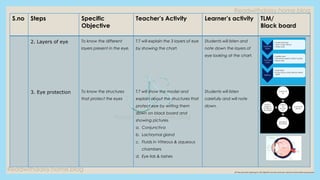
2. Layers of eye
3. Eye protection
To know the different
layers present in the eye.
To know the structures
that protect the eyes
T.T will explain the 3 layers of eye
by showing the chart.
T.T will show the model and
explain about the structures that
protect eye by writing them
down on black board and
showing pictures.
a. Conjunctiva
b. Lachrymal gland
c. Fluids in Vitreous & aqueous
chambers
d. Eye lids & lashes
Students will listen and
note down the layers of
eye looking at the chart.
Students will listen
carefully and will note
down.
Sclerotic
layer
• Outermost layer
• Thick, tough, fibrous
• White color
Choroid
layer
• Middle layer
• Has blood vessel & ciliary muscles
• Black color
Retina
• Inner layer
• It has rods & cones; Blind & Yellow
spots
Protecti
ng
structur
es
Conjuncti
va
Lachrymal
glands
Eye lids &
Eye lashes
Fluids in
Aqueous
& Vitreous
chambers
All the pictures belong to the rightful owners and are used for educational purpose
Readwithdaisy.home.blog
S.no Steps Specific
Objective
Teacher’s Activity Learner’s activity TLM/
Black board
Discussion/
Demonstration
To construct practical
applicability of the
theoretical
knowledge
T.T will discuss about the different
structures present in eye and
asks students to share their ideas
and thoughts and then performs
certain activities
Activity 1: T.T will ask the students
to look at their friends eye and
note the structures that are
visible with our eye.
Activity 2: T.T will ask students to
observe the eye ball of friend in
normal light and then puts
beam of torchlight on the eye
and instruct the students to note
the changes.
Students will discuss and
share their ideas.
Students will look into their
friends eyes and note all
the structures visible to
them.
Students will observe and
notice the changes and
will note them down in the
book
Torch light
Readwithdaisy.home.blog
S.no Steps Specific
Objective
Teacher’s Activity Learner’s activity TLM/
Black board
3.
4.
5.
Recapitulation
Evaluation
Home
assignment
To recall the main points
To assess the understand
of the students
To develop better retention
of content and consolidate
with the new learning.
T.T will summarize the topic main
points: Outer structures of eye,
layers in the eye, eye
protection.
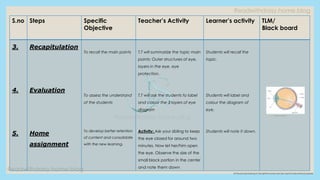
T.T will ask the students to label
and colour the 3 layers of eye
diagram
Activity: Ask your sibling to keep
the eye closed for around two
minutes. Now let her/him open
the eye. Observe the size of the
small black portion in the center
and note them down
Students will recall the
topic.
Students will label and
colour the diagram of
eye.
Students will note it down.
This Photo byUnknown Author is licensed under CC BY
All the pictures belong to the rightful owners and are used for educational purpose
Readwithdaisy.home.blog
Teacher Trainee Reflection
Supervisor’s Reflection
The students were enthusiastic and participated in discussion. They involved themselves
in the activities. XXX & YYY were little hesitant to participate in the activity given to them.
The students could understand the topic well and answered the questions actively. The
use of picture charts and eye model was helpful in drawing the attention of students.
Supervisor Signature
Readwithdaisy.home.blog

Bioscience Macro Teaching

  • 1.
  • 2.
  • 3.
  • 4.
    Readwithdaisy.home.blog Readwithdaisy.home.blog Readwithdaisy.home.blog Annual Plan Format-Bioscience Name of the School: Class/ Standard: Subject: Academic year: Academic Standards: S.no Unit Name Periods required Month Teaching Methods / Strategies Teaching learning material Co- curricular activities
  • 5.
    Readwithdaisy.home.blog Readwithdaisy.home.blog Readwithdaisy.home.blog A Sample AnnualPlan Name of the School: ABCD High School Standard: 9th Subject: Biological Science Academic year: 2022-2023 Academic Standards: The expected outcomes to be achieved by the students at the end of the year S.no Academic Standard Explanation 1. Conceptual understanding Children are able to explain, cite examples, give reasons, compare and write differences, explain the process of given concepts in the textbook. Children are able to develop their own brain mappings 2. Asking questions and making hypothesis Children are able to ask questions to understand, to clarify the concepts and to participate in discussions. They are able to make hypothesis on experimental results and given issues 3. Experimentation and field investigation To understand given concepts in the textbook, children are able to do experiments on their own. They are able to arrange the experimental materials, note their observations, collect alternate experimental materials, take precautions, participate in field investigation and make reports on them 4. Information skills and Projects Children are able to collect information (by using interviews, checklist, questionnaire) and analyses systematically. They are able to conduct their own project works. 5. Communication through drawing, model making Children are able to explain their conceptual understanding by drawing figures labelling, describing the parts and making models. They are able to plot graphs by using given information or collected data. 6. Appreciation and aesthetic sense, values Children are able to appreciate man power and nature, and have aesthetic sense towards nature. They are also able to follow constitutional values. 7. Application to daily life, concern to bio diversity. Children are able to utilize scientific concept to face their daily life situations. They are able to show concern towards bio diversity.
  • 6.
    Readwithdaisy.home.blog Readwithdaisy.home.blog Readwithdaisy.home.blog S.no Unit NamePeriods required Month Special Methods/ Strategies if any Teaching learning material Co- curricular activities 1. Cell Structure & Function 10 June Discussion, Activity based Cell model Science laboratory 2. Plant Tissues 11 July Demonstration, Interaction, concept mapping Pictures of plant tissues In campus garden visit 3. Animal Tissues 11 July 4. Transportation through plasma membrane 10 August 5. Diversity in Living organisms 11 August/ September 6. Sense Organs 13 October 7. Animal Behaviour 9 November
  • 7.
    Readwithdaisy.home.blog Readwithdaisy.home.blog Readwithdaisy.home.blog S.no Unit NamePeriods required Month Special Methods if any Teaching learning material Co- curricular activities 1. Challenges in improving Agriculture Production 14 December 2. Adaptations in Different Ecosystems 10 3. Social Pollution 11 4. Biogeochemical cycles 10
  • 8.
  • 9.
    Readwithdaisy.home.blog Readwithdaisy.home.blog Readwithdaisy.home.blog Unit Plan Format Nameof the School: Class: Subject: Unit: Total No. of Periods: Content Analysis: Learning Objectives: Academic Standards: Sub units No. of Periods Teaching points Teaching- Learning strategies Teaching learning material Evaluation Signature of Supervisor
  • 10.
    Readwithdaisy.home.blog Readwithdaisy.home.blog Readwithdaisy.home.blog Sample Unit Plan Nameof the School: Class: 9th Subject: Biological Science Unit: Sense Organs Total No. of Periods: 13 Content analysis: (Sub units) ▪ Stimulation to Sensation ▪ Sense Organs- Eye ▪ Sense Organs- Ear ▪ Sense Organs- Nose ▪ Sense Organs- Tongue ▪ Sense Organs- Skin Learning Objectives: The Students will ❑ Develop an understanding of 5 Sense organs ❑ Recognises the importance of Sense organs ❑ Illustrate the path of sensation ❑ Describe the Sense organs with clearly labelled diagrams ❑ Classify and name the parts of Sense organs
  • 11.
    Readwithdaisy.home.blog Readwithdaisy.home.blog Readwithdaisy.home.blog Academic Standards: Theexpected outcomes to be achieved by the students at the end of the unit S.no Academic Standard Explanation 1. Conceptual understanding Children are able to explain about importance of 5 Sense organs and the process of sensation, give examples for various senses, compare and write differences b/w various functions of sense organs. 2. Asking questions and making hypothesis Children are able to ask questions and clarify the concepts of sense organs and to participate in discussions. They are able to make hypothesis on experimental results related to sense organs. 3. Experimentation and field investigation Children are able to do experiments of testing vision, hearing, taste, touch sensations on their own by arranging the experimental materials and taking precautions, note their observations and make a report. 4. Information skills and Projects Children are able to collect information by interviewing parents/peers or making their own questionnaires about the concerns relating to sense organs and examine systematically. They are able to conduct their own project works. 5. Communication through drawing, model making Children are able to explain their conceptual understanding by drawing figures labelling, describing the parts and making models of Sense organs 6. Appreciation and aesthetic sense, values Children are able to appreciate the importance of sense organs, and be sensitive towards persons lacking vision or hearing or any other sensory issues and respect and support them following constitutional values. 7. Application to daily life, concern to bio diversity. Children are able to utilize scientific concepts to face their daily life situations in relation to sense organs.
  • 12.
    Readwithdaisy.home.blog Readwithdaisy.home.blog Readwithdaisy.home.blog Sub units No.of Periods Teaching points Teaching-Learning strategies Teaching learning material Evaluation Sense organs- Stimulation to Sensation 2 • 5 senses and Sense organs, • Functioning of Sense organs Discussion, Interaction & Activity based. Materials- sharp objects, coffee, blind fold, sugar • Oral test • Activity Sense organ- Eye 4 • Structure & Function of Eye • Cells & Tissues in eyes • Eye protection • Diseases of Eye Discussion and Demonstration, Activity based Eye model, blind fold, Torch, mirror, Picture charts, video tape. • Activity on Eye Model • Drawing & Labelling • Activity based Sense Organ- Ear 2 • Parts of Ear (External, Middle & Internal) • Auditory Sensation • Diseases of Ear Discussion & Interaction Ear model, Video tape, Picture charts • Short answers • Note making
  • 13.
    Readwithdaisy.home.blog Readwithdaisy.home.blog Readwithdaisy.home.blog Sub units No.of Periods Teaching points Teaching-Learning strategies Teaching learning material Evaluation Sense organ- Nose 2 • Structure of Nose • Olfactory Sensation • Taking care of nose Demonstration, Activity based Coffee, talcum powder, soap, spoiled tomato, Picture chart • Oral test • Activity Sense organ- Tongue 1 • Structure of Tongue • Taste and Tongue • Developmental changes in tongue Discussion & Activity based Lemon, Sugar, Chilies, Bitter gourd, Picture chart, Model • Activity Sense organ- Skin 2 • Structure of Skin • Skin & Touch Discussion & Interaction Picture chart • Labeling diagram • Pen & Paper test
  • 14.
  • 15.
    Readwithdaisy.home.blog Readwithdaisy.home.blog Readwithdaisy.home.blog Period Plan Format I.Preliminaries II. Learning Objectives III. Academic Standards IV. Presentation I. Teacher Trainee Reflection II. Supervisor’s Reflection Signature of Supervisor S.no Steps Specific Objective Teaching Objective Teacher’s Activity Learner’s activity TLM/ Black board
  • 16.
    Readwithdaisy.home.blog Readwithdaisy.home.blog Readwithdaisy.home.blog 1. Preliminaries Name ofTeacher Trainee: ABCDE Roll no.: 12304789 School Name: WXYZ Class: 9th Standard Subject: Bio science Unit: Sense organs Sub Topic: Eye - Structure of Eye & Eye Protection Duration: 45 minutes Method: Discussion & Interaction, Activity based. TLM: Blind fold, Eye model, Picture chart, Torch light Reference: Text book Sample Period Plan
  • 17.
    Readwithdaisy.home.blog Readwithdaisy.home.blog Readwithdaisy.home.blog Learning Objectives The Studentwill ❑Understand the eye structures ❑Analyze/ examine the parts in the eye ❑Identify the structures that protect the eye ❑Draw and label the parts of eye ❑Describe the importance of eye protection
  • 18.
    Readwithdaisy.home.blog Readwithdaisy.home.blog Readwithdaisy.home.blog Academic Standards S.no AcademicStandard Explanation 1. Conceptual understanding • Students are able to explain about importance of protecting structures of eye • Able to compare and differentiate b/w various parts of eye and protecting structures 2. Asking questions and making hypothesis • Students are able to ask questions and clarify the concept of Eye structures and participate in discussions. • They are able to make hypothesis on experimental results related to protective structures in eye. 3. Experimentation and field investigation • Students are able to do experiments on viewing various parts of eye using a torch light and testing vision reflexes by taking precautions and note their observations and make a report. 4. Information skills and Projects • Students are able to collect information from internet and interviewing parents/peers or about the issues relating to eye sight. They are able to conduct their own project works. 5. Communication through drawing, model making • Students are able to explain their conceptual understanding by drawing figures labelling, describing the parts and making models of Eye structure. 6. Appreciation and aesthetic sense, values • Students are able to appreciate the importance of eye sight, and be sensitive towards persons lacking vision and respect and support them 7. Application to daily life, concern to bio diversity. • Students are able to use precautions for protecting eye from strain due to mobile screens.
  • 19.
    Readwithdaisy.home.blog Readwithdaisy.home.blog Readwithdaisy.home.blog Presentation S.n o Steps Specific Objective Teacher’s ActivityLearner’s activity TLM/ Black board 1. a. b. PREPARATION Introduction Greetings (1st period) Motivation/ Testing of Previous Knowledge To develop rapport with students To test the previous knowledge of the students and to relate it with the present new topic. T.T will greet the students and introduce to the class. T.T will ask one student to come forward and blindfolds the eyes and asks the student to walk from one corner to another. T.T then removes the blind fold and asks the student to walk again T.T will ask the students to observe and note the differences. Students will greet and introduce themselves. One student comes and tries to walk with blind folded eyes and also without the blind fold. Students note down and tell the differences how the student could walk freely without blindfold and confused and scared to walk with blind fold Blind fold
  • 20.
    Readwithdaisy.home.blog Readwithdaisy.home.blog Readwithdaisy.home.blog Presentation S.n o Steps Specific Objective Teacher’s ActivityLearner’s activity TLM/ Black board c. Declaration of Topic . To elicit the topic from students and declare the topic for the day T.T will then interact with students and asks few questions to stimulate thinking related to the topic Q1: What objects can you see in the classroom? Q2: Which color is the chart? Q3: Can you read what is written on the chart? Q4: Which organ helped you to read? T.T will appreciate the answers given and elicits the topic from the students and introduces the topic. Today, we will learn about the topic- Our Sense Organ: Eye Students will think and give answers to the questions A1: Table, Chair, Charts, Benches etc., A2: It is yellow colour A3: The process of photosynthesis. A4: Eyes Our Sense organ- Eye ▪ Table, Chair, Charts ▪ Yellow ▪ Photosynthesis ▪ Eyes
  • 21.
    Readwithdaisy.home.blog Readwithdaisy.home.blog Readwithdaisy.home.blog S.no Steps Specific Objective Teacher’sActivity Learner’s activity TLM/ Black board 2. a. b. PRESENTATION Reading Reading the textbook & Underlining of difficult words Discussion of hard words with the group To enable students to get familiar with the terminology and pronunciation. To enable students to learn new terms and its usage T.T will ask the students to open their textbooks to page no. 78 & 91 and read about the topics: 1. Structures of the eye 2. Eye protection T.T will instruct them to underline the new words or put a ? Above the word using a pencil. T.T will write the words on black board and gives correct pronunciation and makes the students to recite the new terms Students will open their books and read the topics. They will underline the words. Students will recite the words and will pronounce them correctly. ▪ Conjunctiva ▪ Lachrymal gland ▪ Sclerotic layer ▪ Choroid layer ▪ Suspensory ligament
  • 22.
    Readwithdaisy.home.blog Readwithdaisy.home.blog Readwithdaisy.home.blog S.no Steps Specific Objective Teacher’sActivity Learner’s activity TLM/ Black board Explanation 1. Outer structures of eye To know the different parts of eye. T.T will then give an opportunity to students to discuss among themselves about the term. T.T will show the eye model and discusses about the terms by showing them and giving the meaning. T.T will explain about various parts of eye that can be seen by showing the pictures of eye. ✓ Eye lids ✓ Eye lashes ✓ Cornea ✓ Iris & Pupil Students will discuss and then understand the terms looking at the model. Students will listen and observe the pictures. Eye model Pictures of eye All the pictures belong to the rightful owners and are used for educational purpose
  • 23.
    Readwithdaisy.home.blog Readwithdaisy.home.blog Readwithdaisy.home.blog S.no Steps Specific Objective Teacher’sActivity Learner’s activity TLM/ Black board 2. Layers of eye 3. Eye protection To know the different layers present in the eye. To know the structures that protect the eyes T.T will explain the 3 layers of eye by showing the chart. T.T will show the model and explain about the structures that protect eye by writing them down on black board and showing pictures. a. Conjunctiva b. Lachrymal gland c. Fluids in Vitreous & aqueous chambers d. Eye lids & lashes Students will listen and note down the layers of eye looking at the chart. Students will listen carefully and will note down. Sclerotic layer • Outermost layer • Thick, tough, fibrous • White color Choroid layer • Middle layer • Has blood vessel & ciliary muscles • Black color Retina • Inner layer • It has rods & cones; Blind & Yellow spots Protecti ng structur es Conjuncti va Lachrymal glands Eye lids & Eye lashes Fluids in Aqueous & Vitreous chambers All the pictures belong to the rightful owners and are used for educational purpose
  • 24.
    Readwithdaisy.home.blog Readwithdaisy.home.blog Readwithdaisy.home.blog S.no Steps Specific Objective Teacher’sActivity Learner’s activity TLM/ Black board Discussion/ Demonstration To construct practical applicability of the theoretical knowledge T.T will discuss about the different structures present in eye and asks students to share their ideas and thoughts and then performs certain activities Activity 1: T.T will ask the students to look at their friends eye and note the structures that are visible with our eye. Activity 2: T.T will ask students to observe the eye ball of friend in normal light and then puts beam of torchlight on the eye and instruct the students to note the changes. Students will discuss and share their ideas. Students will look into their friends eyes and note all the structures visible to them. Students will observe and notice the changes and will note them down in the book Torch light
  • 25.
    Readwithdaisy.home.blog Readwithdaisy.home.blog Readwithdaisy.home.blog S.no Steps Specific Objective Teacher’sActivity Learner’s activity TLM/ Black board 3. 4. 5. Recapitulation Evaluation Home assignment To recall the main points To assess the understand of the students To develop better retention of content and consolidate with the new learning. T.T will summarize the topic main points: Outer structures of eye, layers in the eye, eye protection. T.T will ask the students to label and colour the 3 layers of eye diagram Activity: Ask your sibling to keep the eye closed for around two minutes. Now let her/him open the eye. Observe the size of the small black portion in the center and note them down Students will recall the topic. Students will label and colour the diagram of eye. Students will note it down. This Photo byUnknown Author is licensed under CC BY All the pictures belong to the rightful owners and are used for educational purpose
  • 26.
    Readwithdaisy.home.blog Readwithdaisy.home.blog Readwithdaisy.home.blog Teacher Trainee Reflection Supervisor’sReflection The students were enthusiastic and participated in discussion. They involved themselves in the activities. XXX & YYY were little hesitant to participate in the activity given to them. The students could understand the topic well and answered the questions actively. The use of picture charts and eye model was helpful in drawing the attention of students. Supervisor Signature
  • 27.