z
[All images, photographs and content belong to their rightful owners
and are used purely for educational and non-commercial purpose only]
z
Family communication
refers to the way verbal
and non-verbal
information is exchanged
between family members.
(Epstein, Bishop, Ryan,
Miller, & Keitner, (1993)
WHAT IS FAMILY COMMUNICATION?
McLeod and Chaffee (1972, 1973) developed the
original model of Family Communication
Patterns (FCP) to describe families' tendencies
to develop fairly stable and predictable ways of
communicating with one another.
Fitzpatrick and Ritchie (1993, 1994; Ritchie, 1991,
1997; Ritchie & Fitzpatrick, 1990) refined and
reconceptualized McLeod and Chaffee's (1972) FCP to
construct an instrument to measure family
communication patterns more generally.
Revised Family Communication Patterns
(RFCP)
z
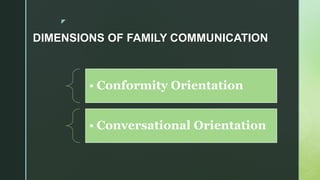
DIMENSIONS OF FAMILY COMMUNICATION
• Conformity Orientation
• Conversational Orientation
z
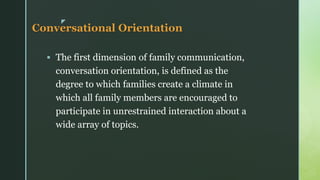
Conversational Orientation
▪ The first dimension of family communication,
conversation orientation, is defined as the
degree to which families create a climate in
which all family members are encouraged to
participate in unrestrained interaction about a
wide array of topics.
z
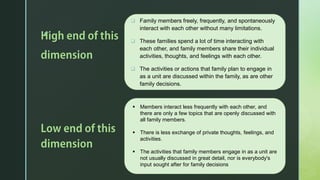
❑ Family members freely, frequently, and spontaneously
interact with each other without many limitations.
❑ These families spend a lot of time interacting with
each other, and family members share their individual
activities, thoughts, and feelings with each other.
❑ The activities or actions that family plan to engage in
as a unit are discussed within the family, as are other
family decisions.
▪ Members interact less frequently with each other, and
there are only a few topics that are openly discussed with
all family members.
▪ There is less exchange of private thoughts, feelings, and
activities.
▪ The activities that family members engage in as a unit are
not usually discussed in great detail, nor is everybody's
input sought after for family decisions
z
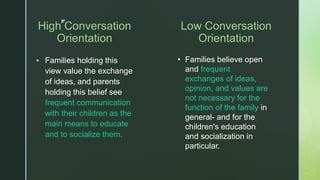
High Conversation
Orientation
▪ Families holding this
view value the exchange
of ideas, and parents
holding this belief see
frequent communication
with their children as the
main means to educate
and to socialize them.
Low Conversation
Orientation
• Families believe open
and frequent
exchanges of ideas,
opinion, and values are
not necessary for the
function of the family in
general- and for the
children's education
and socialization in
particular.
z
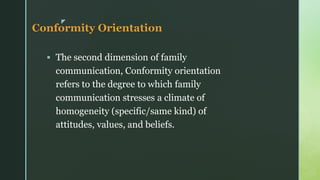
Conformity Orientation
▪ The second dimension of family
communication, Conformity orientation
refers to the degree to which family
communication stresses a climate of
homogeneity (specific/same kind) of
attitudes, values, and beliefs.
z
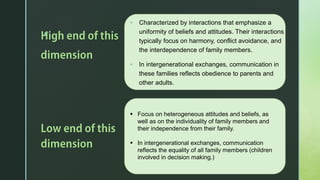
▪ Characterized by interactions that emphasize a
uniformity of beliefs and attitudes. Their interactions
typically focus on harmony, conflict avoidance, and
the interdependence of family members.
▪ In intergenerational exchanges, communication in
these families reflects obedience to parents and
other adults.
▪ Focus on heterogeneous attitudes and beliefs, as
well as on the individuality of family members and
their independence from their family.
▪ In intergenerational exchanges, communication
reflects the equality of all family members (children
involved in decision making.)
z
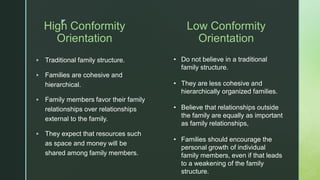
High Conformity
Orientation
▪ Traditional family structure.
▪ Families are cohesive and
hierarchical.
▪ Family members favor their family
relationships over relationships
external to the family.
▪ They expect that resources such
as space and money will be
shared among family members.
Low Conformity
Orientation
• Do not believe in a traditional
family structure.
• They are less cohesive and
hierarchically organized families.
• Believe that relationships outside
the family are equally as important
as family relationships,
• Families should encourage the
personal growth of individual
family members, even if that leads
to a weakening of the family
structure.
z
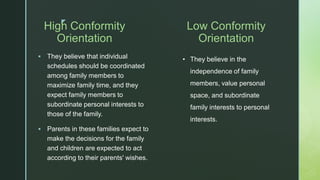
High Conformity
Orientation
▪ They believe that individual
schedules should be coordinated
among family members to
maximize family time, and they
expect family members to
subordinate personal interests to
those of the family.
▪ Parents in these families expect to
make the decisions for the family
and children are expected to act
according to their parents' wishes.
Low Conformity
Orientation
• They believe in the
independence of family
members, value personal
space, and subordinate
family interests to personal
interests.
z
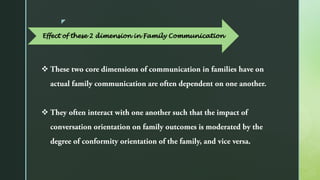
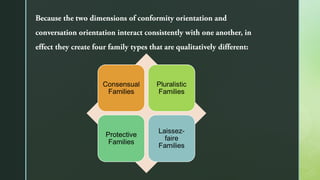
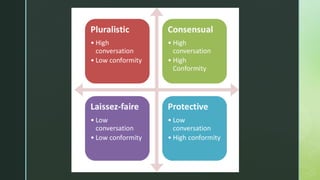
Effect of these 2 dimension in Family Communication
❖
❖
Consensual
Families
Pluralistic
Families
Protective
Families
Laissez-
faire
Families
CONSENSUAL FAMILIES
✓
✓
✓
✓
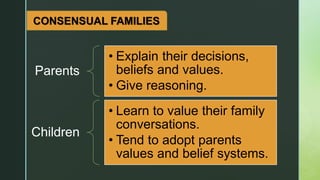
CONSENSUAL FAMILIES
Parents
• Explain their decisions,
beliefs and values.
• Give reasoning.
Children
• Learn to value their family
conversations.
• Tend to adopt parents
values and belief systems.
PLURALISTIC FAMILIES
✓
✓
✓
✓
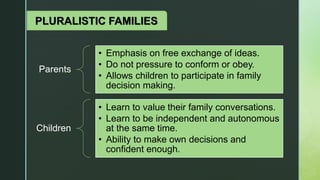
PLURALISTIC FAMILIES
Parents
• Emphasis on free exchange of ideas.
• Do not pressure to conform or obey.
• Allows children to participate in family
decision making.
Children
• Learn to value their family conversations.
• Learn to be independent and autonomous
at the same time.
• Ability to make own decisions and
confident enough.
PROTECTIVE FAMILIES
✓
✓
✓
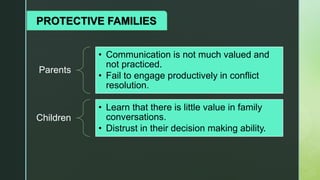
PROTECTIVE FAMILIES
Parents
• Communication is not much valued and
not practiced.
• Fail to engage productively in conflict
resolution.
Children
• Learn that there is little value in family
conversations.
• Distrust in their decision making ability.
LAISSEZ-FAIRE FAMILIES
✓
✓
✓
✓
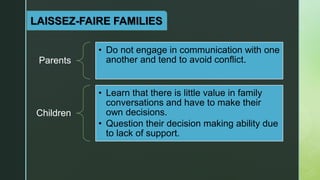
LAISSEZ-FAIRE FAMILIES
Parents
• Do not engage in communication with one
another and tend to avoid conflict.
Children
• Learn that there is little value in family
conversations and have to make their
own decisions.
• Question their decision making ability due
to lack of support.
z
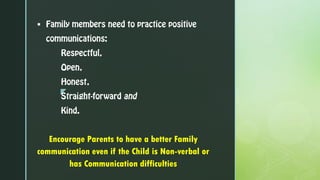
▪
Encourage Parents to have a better Family
communication even if the Child is Non-verbal or
has Communication difficulties
z
THANK YOU

COMMUNICATION PATTERNS WITHIN THE FAMILIES

  • 1.
    z [All images, photographsand content belong to their rightful owners and are used purely for educational and non-commercial purpose only]
  • 2.
    z Family communication refers tothe way verbal and non-verbal information is exchanged between family members. (Epstein, Bishop, Ryan, Miller, & Keitner, (1993) WHAT IS FAMILY COMMUNICATION?
  • 3.
    McLeod and Chaffee(1972, 1973) developed the original model of Family Communication Patterns (FCP) to describe families' tendencies to develop fairly stable and predictable ways of communicating with one another.
  • 4.
    Fitzpatrick and Ritchie(1993, 1994; Ritchie, 1991, 1997; Ritchie & Fitzpatrick, 1990) refined and reconceptualized McLeod and Chaffee's (1972) FCP to construct an instrument to measure family communication patterns more generally. Revised Family Communication Patterns (RFCP)
  • 5.
    z DIMENSIONS OF FAMILYCOMMUNICATION • Conformity Orientation • Conversational Orientation
  • 6.
    z Conversational Orientation ▪ Thefirst dimension of family communication, conversation orientation, is defined as the degree to which families create a climate in which all family members are encouraged to participate in unrestrained interaction about a wide array of topics.
  • 7.
    z ❑ Family membersfreely, frequently, and spontaneously interact with each other without many limitations. ❑ These families spend a lot of time interacting with each other, and family members share their individual activities, thoughts, and feelings with each other. ❑ The activities or actions that family plan to engage in as a unit are discussed within the family, as are other family decisions. ▪ Members interact less frequently with each other, and there are only a few topics that are openly discussed with all family members. ▪ There is less exchange of private thoughts, feelings, and activities. ▪ The activities that family members engage in as a unit are not usually discussed in great detail, nor is everybody's input sought after for family decisions
  • 8.
    z High Conversation Orientation ▪ Familiesholding this view value the exchange of ideas, and parents holding this belief see frequent communication with their children as the main means to educate and to socialize them. Low Conversation Orientation • Families believe open and frequent exchanges of ideas, opinion, and values are not necessary for the function of the family in general- and for the children's education and socialization in particular.
  • 9.
    z Conformity Orientation ▪ Thesecond dimension of family communication, Conformity orientation refers to the degree to which family communication stresses a climate of homogeneity (specific/same kind) of attitudes, values, and beliefs.
  • 10.
    z ▪ Characterized byinteractions that emphasize a uniformity of beliefs and attitudes. Their interactions typically focus on harmony, conflict avoidance, and the interdependence of family members. ▪ In intergenerational exchanges, communication in these families reflects obedience to parents and other adults. ▪ Focus on heterogeneous attitudes and beliefs, as well as on the individuality of family members and their independence from their family. ▪ In intergenerational exchanges, communication reflects the equality of all family members (children involved in decision making.)
  • 11.
    z High Conformity Orientation ▪ Traditionalfamily structure. ▪ Families are cohesive and hierarchical. ▪ Family members favor their family relationships over relationships external to the family. ▪ They expect that resources such as space and money will be shared among family members. Low Conformity Orientation • Do not believe in a traditional family structure. • They are less cohesive and hierarchically organized families. • Believe that relationships outside the family are equally as important as family relationships, • Families should encourage the personal growth of individual family members, even if that leads to a weakening of the family structure.
  • 12.
    z High Conformity Orientation ▪ Theybelieve that individual schedules should be coordinated among family members to maximize family time, and they expect family members to subordinate personal interests to those of the family. ▪ Parents in these families expect to make the decisions for the family and children are expected to act according to their parents' wishes. Low Conformity Orientation • They believe in the independence of family members, value personal space, and subordinate family interests to personal interests.
  • 13.
    z Effect of these2 dimension in Family Communication ❖ ❖
  • 14.
  • 15.
  • 16.
    CONSENSUAL FAMILIES Parents • Explaintheir decisions, beliefs and values. • Give reasoning. Children • Learn to value their family conversations. • Tend to adopt parents values and belief systems.
  • 17.
  • 18.
    PLURALISTIC FAMILIES Parents • Emphasison free exchange of ideas. • Do not pressure to conform or obey. • Allows children to participate in family decision making. Children • Learn to value their family conversations. • Learn to be independent and autonomous at the same time. • Ability to make own decisions and confident enough.
  • 19.
  • 20.
    PROTECTIVE FAMILIES Parents • Communicationis not much valued and not practiced. • Fail to engage productively in conflict resolution. Children • Learn that there is little value in family conversations. • Distrust in their decision making ability.
  • 21.
  • 22.
    LAISSEZ-FAIRE FAMILIES Parents • Donot engage in communication with one another and tend to avoid conflict. Children • Learn that there is little value in family conversations and have to make their own decisions. • Question their decision making ability due to lack of support.
  • 24.
    z ▪ Encourage Parents tohave a better Family communication even if the Child is Non-verbal or has Communication difficulties
  • 25.