



TYPES OF
TYPES OF
GROUP
GROUP
Presented by: A Daisy Evangeline
Introduction
Introduction
All of us are simultaneously
members of various types of groups.
We are
Members of a family,
Members of friendship groups,
Members of work organizations
Members of fan club or
Members of a religious group.
There are many
There are many
different types of
different types of
groups in general
groups in general
and includes the
and includes the
following types:
following types:
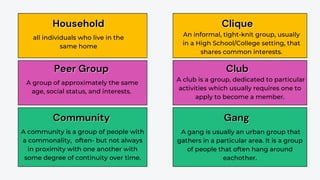
all individuals who live in the
same home
A group of approximately the same
age, social status, and interests.
Household
Household
Peer Group
Peer Group
Community
Community
Clique
Clique
Gang
Gang
Club
Club
A community is a group of people with
a commonality, often- but not always
in proximity with one another with
some degree of continuity over time.
An informal, tight-knit group, usually
in a High School/College setting, that
shares common interests.
A gang is usually an urban group that
gathers in a particular area. It is a group
of people that often hang around
eachother.
A club is a group, dedicated to particular
activities which usually requires one to
apply to become a member.
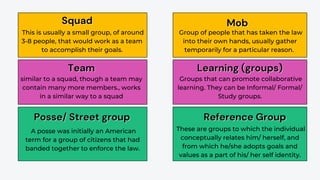
This is usually a small group, of around
3-8 people, that would work as a team
to accomplish their goals.
similar to a squad, though a team may
contain many more members., works
in a similar way to a squad
Squad
Squad
Team
Team
Posse/ Street group
Posse/ Street group
Mob
Mob
Reference Group
Reference Group
Learning (groups)
Learning (groups)
A posse was initially an American
term for a group of citizens that had
banded together to enforce the law.
Group of people that has taken the law
into their own hands, usually gather
temporarily for a particular reason.
These are groups to which the individual
conceptually relates him/ herself, and
from which he/she adopts goals and
values as a part of his/ her self identity.
Groups that can promote collaborative
learning. They can be Informal/ Formal/
Study groups.
Sociologists
Sociologists
have attempted
have attempted
to classify
to classify
various types of
various types of
groups
groups
Groups we join through our own
choice and effort are voluntary
groups.
E.g., joining a political party or a
particular association
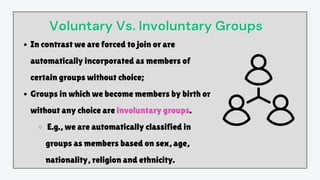
Voluntary Vs. Involuntary Groups
In contrast we are forced to join or are
automatically incorporated as members of
certain groups without choice;
Groups in which we become members by birth or
without any choice are involuntary groups.
E.g., we are automatically classified in
groups as members based on sex, age,
nationality, religion and ethnicity.
Voluntary Vs. Involuntary Groups
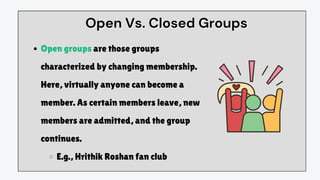
Open groups are those groups
characterized by changing membership.
Here, virtually anyone can become a
member. As certain members leave, new
members are admitted, and the group
continues.
E.g., Hrithik Roshan fan club
Open Vs. Closed Groups
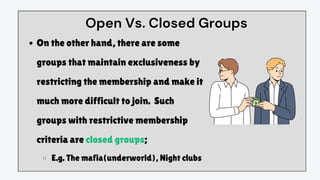
On the other hand, there are some
groups that maintain exclusiveness by
restricting the membership and make it
much more difficult to join. Such
groups with restrictive membership
criteria are closed groups;
E.g. The mafia(underworld), Night clubs
Open Vs. Closed Groups
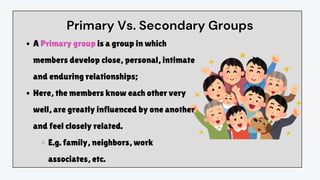
A Primary group is a group in which
members develop close, personal, intimate
and enduring relationships;
Here, the members know each other very
well, are greatly influenced by one another
and feel closely related.
E.g. family, neighbors, work
associates, etc.
Primary Vs. Secondary Groups
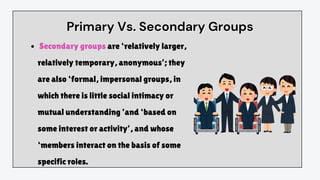
Secondary groups are ‘relatively larger,
relatively temporary, anonymous’; they
are also ‘formal, impersonal groups, in
which there is little social intimacy or
mutual understanding ’and ‘based on
some interest or activity’, and whose
‘members interact on the basis of some
specific roles.
Primary Vs. Secondary Groups
Natural vs. Formed Groups
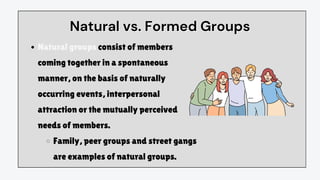
Natural groups consist of members
coming together in a spontaneous
manner, on the basis of naturally
occurring events, interpersonal
attraction or the mutually perceived
needs of members.
Family, peer groups and street gangs
are examples of natural groups.
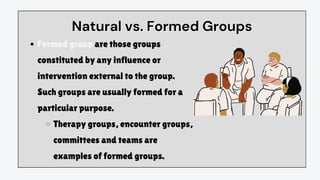
Formed group are those groups
constituted by any influence or
intervention external to the group.
Such groups are usually formed for a
particular purpose.
Therapy groups, encounter groups,
committees and teams are
examples of formed groups.
Natural vs. Formed Groups
There are certain groups, whose
membership consists of
individuals from all walks of life;
Such a group may be regarded as a
vertical group.
e.g. religious groups may have
members from all classes.
Vertical vs. Horizontal Groups
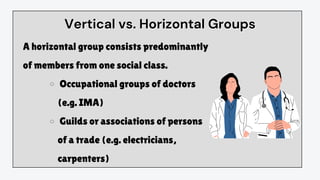
A horizontal group consists predominantly
of members from one social class.
Occupational groups of doctors
(e.g. IMA)
Guilds or associations of persons
of a trade (e.g. electricians,
carpenters)
Vertical vs. Horizontal Groups
 Formal vs. Informal Groups
Formal groups are those groups that require
someone to determine a task that needs to be
accomplished, which requires some kind of
organizational system, made up of various job
roles, for which individuals are recruited
(Artherton, 2003).
Here, task is what matters, and everything
else—particularly the individuals and the
roles they occupy—may be changed.
 Formal vs. Informal Groups
Informal groups work the other way
round.
A group of individuals meet: if they
form a group, then they will
informally allocate roles depending
on individual preferences, and / or
on talents.
Benefits of Groups
The productivity of groups is higher
than that of the individuals.
Groups are likely to make effective
decisions andsolve the problems better.
we inculcate values of altruism, kindness,
compassion, responsibility and so forth.
The quality of emotional life in terms of
friendship, love, excitement, joy,
fulfillment and achievement is richer in
groups and helps in personal growth.
Thank
Thank
you!
you!

Unit IV: Community Group Work: Types of Groups

  • 1.
  • 2.
    Introduction Introduction All of usare simultaneously members of various types of groups. We are Members of a family, Members of friendship groups, Members of work organizations Members of fan club or Members of a religious group.
  • 3.
    There are many Thereare many different types of different types of groups in general groups in general and includes the and includes the following types: following types:
  • 4.
    all individuals wholive in the same home A group of approximately the same age, social status, and interests. Household Household Peer Group Peer Group Community Community Clique Clique Gang Gang Club Club A community is a group of people with a commonality, often- but not always in proximity with one another with some degree of continuity over time. An informal, tight-knit group, usually in a High School/College setting, that shares common interests. A gang is usually an urban group that gathers in a particular area. It is a group of people that often hang around eachother. A club is a group, dedicated to particular activities which usually requires one to apply to become a member.
  • 5.
    This is usuallya small group, of around 3-8 people, that would work as a team to accomplish their goals. similar to a squad, though a team may contain many more members., works in a similar way to a squad Squad Squad Team Team Posse/ Street group Posse/ Street group Mob Mob Reference Group Reference Group Learning (groups) Learning (groups) A posse was initially an American term for a group of citizens that had banded together to enforce the law. Group of people that has taken the law into their own hands, usually gather temporarily for a particular reason. These are groups to which the individual conceptually relates him/ herself, and from which he/she adopts goals and values as a part of his/ her self identity. Groups that can promote collaborative learning. They can be Informal/ Formal/ Study groups.
  • 6.
    Sociologists Sociologists have attempted have attempted toclassify to classify various types of various types of groups groups
  • 7.
    Groups we jointhrough our own choice and effort are voluntary groups. E.g., joining a political party or a particular association Voluntary Vs. Involuntary Groups Voluntary Vs. Involuntary Groups
  • 8.
    In contrast weare forced to join or are automatically incorporated as members of certain groups without choice; Groups in which we become members by birth or without any choice are involuntary groups. E.g., we are automatically classified in groups as members based on sex, age, nationality, religion and ethnicity. Voluntary Vs. Involuntary Groups Voluntary Vs. Involuntary Groups
  • 9.
    Open groups arethose groups characterized by changing membership. Here, virtually anyone can become a member. As certain members leave, new members are admitted, and the group continues. E.g., Hrithik Roshan fan club Open Vs. Closed Groups Open Vs. Closed Groups
  • 10.
    On the otherhand, there are some groups that maintain exclusiveness by restricting the membership and make it much more difficult to join. Such groups with restrictive membership criteria are closed groups; E.g. The mafia(underworld), Night clubs Open Vs. Closed Groups Open Vs. Closed Groups
  • 11.
    A Primary groupis a group in which members develop close, personal, intimate and enduring relationships; Here, the members know each other very well, are greatly influenced by one another and feel closely related. E.g. family, neighbors, work associates, etc. Primary Vs. Secondary Groups Primary Vs. Secondary Groups
  • 12.
    Secondary groups are‘relatively larger, relatively temporary, anonymous’; they are also ‘formal, impersonal groups, in which there is little social intimacy or mutual understanding ’and ‘based on some interest or activity’, and whose ‘members interact on the basis of some specific roles. Primary Vs. Secondary Groups Primary Vs. Secondary Groups
  • 13.
    Natural vs. FormedGroups Natural vs. Formed Groups Natural groups consist of members coming together in a spontaneous manner, on the basis of naturally occurring events, interpersonal attraction or the mutually perceived needs of members. Family, peer groups and street gangs are examples of natural groups.
  • 14.
    Formed group arethose groups constituted by any influence or intervention external to the group. Such groups are usually formed for a particular purpose. Therapy groups, encounter groups, committees and teams are examples of formed groups. Natural vs. Formed Groups Natural vs. Formed Groups
  • 15.
    There are certaingroups, whose membership consists of individuals from all walks of life; Such a group may be regarded as a vertical group. e.g. religious groups may have members from all classes. Vertical vs. Horizontal Groups Vertical vs. Horizontal Groups
  • 16.
    A horizontal groupconsists predominantly of members from one social class. Occupational groups of doctors (e.g. IMA) Guilds or associations of persons of a trade (e.g. electricians, carpenters) Vertical vs. Horizontal Groups Vertical vs. Horizontal Groups
  • 17.
     Formal vs.Informal Groups  Formal vs. Informal Groups Formal groups are those groups that require someone to determine a task that needs to be accomplished, which requires some kind of organizational system, made up of various job roles, for which individuals are recruited (Artherton, 2003). Here, task is what matters, and everything else—particularly the individuals and the roles they occupy—may be changed.
  • 18.
     Formal vs.Informal Groups  Formal vs. Informal Groups Informal groups work the other way round. A group of individuals meet: if they form a group, then they will informally allocate roles depending on individual preferences, and / or on talents.
  • 19.
    Benefits of Groups Theproductivity of groups is higher than that of the individuals. Groups are likely to make effective decisions andsolve the problems better. we inculcate values of altruism, kindness, compassion, responsibility and so forth. The quality of emotional life in terms of friendship, love, excitement, joy, fulfillment and achievement is richer in groups and helps in personal growth.
  • 20.