Chapter 4
Attitudes, Values, & Ethics
Attitude
Attitude - a psychological tendency expressed by
evaluating an entity with some degree of favor or
disfavor
Should poor performance be
blamed on “bad attitude”?
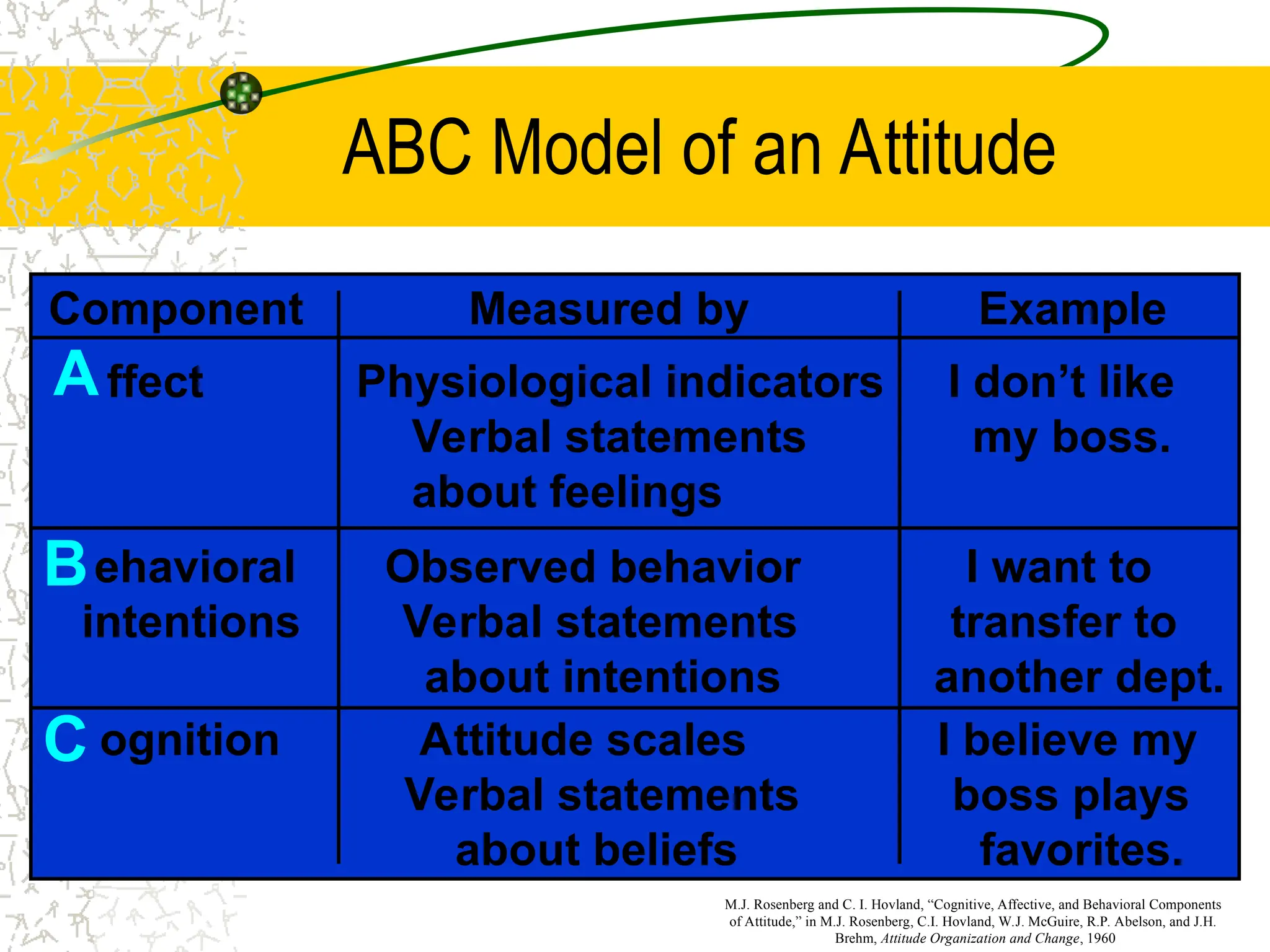
ffect Physiological indicators I don’t like
Verbal statements my boss.
about feelings
ehavioral Observed behavior I want to
intentions Verbal statements transfer to
about intentions another dept.
M.J. Rosenberg and C. I. Hovland, “Cognitive, Affective, and Behavioral Components
of Attitude,” in M.J. Rosenberg, C.I. Hovland, W.J. McGuire, R.P. Abelson, and J.H.
Brehm, Attitude Organization and Change, 1960
ABC Model of an Attitude
Component Measured by Example
ognition Attitude scales I believe my
Verbal statements boss plays
about beliefs favorites.
A
C
B
Cognitive Dissonance
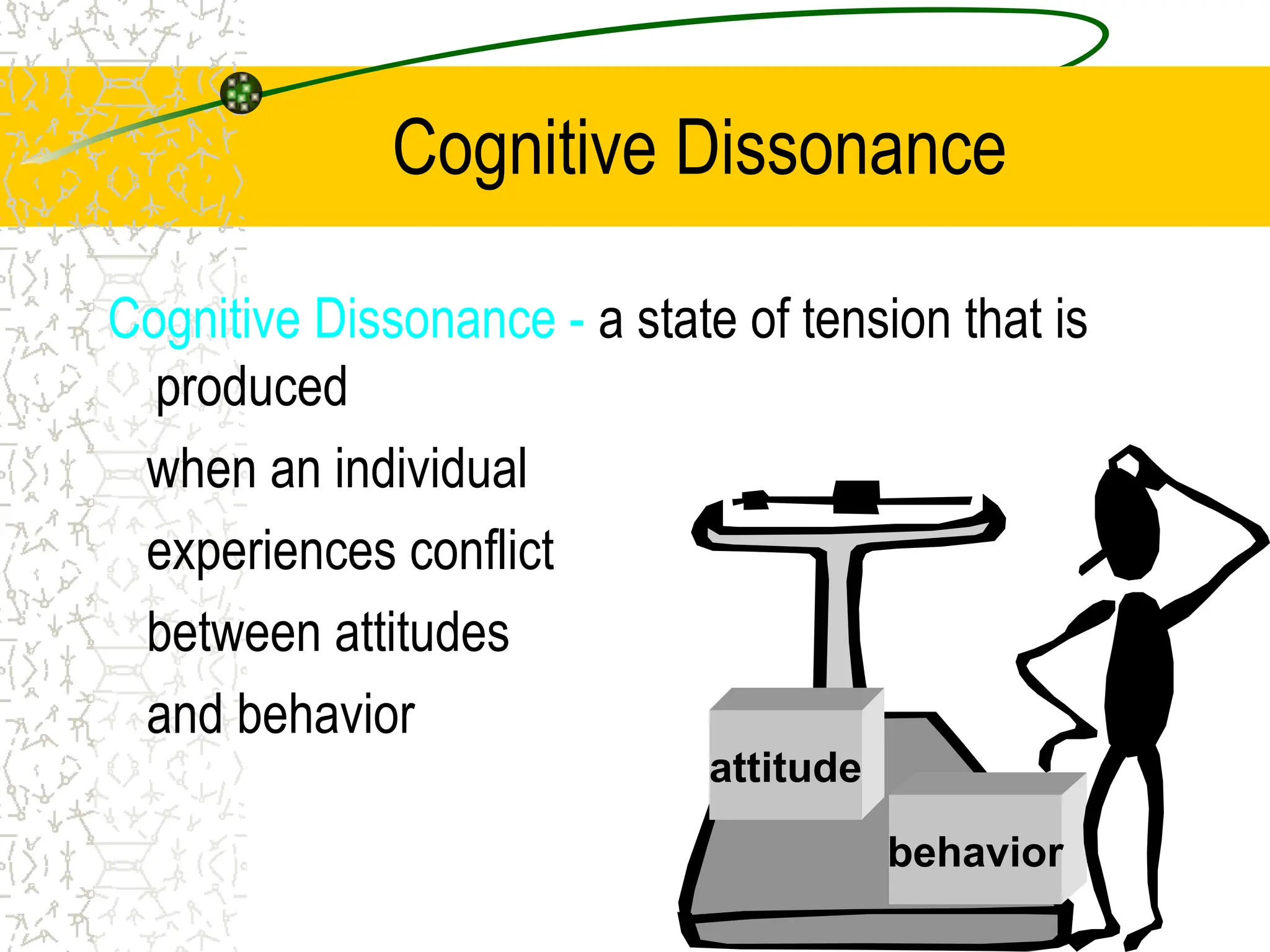
Cognitive Dissonance - a state of tension that is
produced
when an individual
experiences conflict
between attitudes
and behavior
attitude
behavior
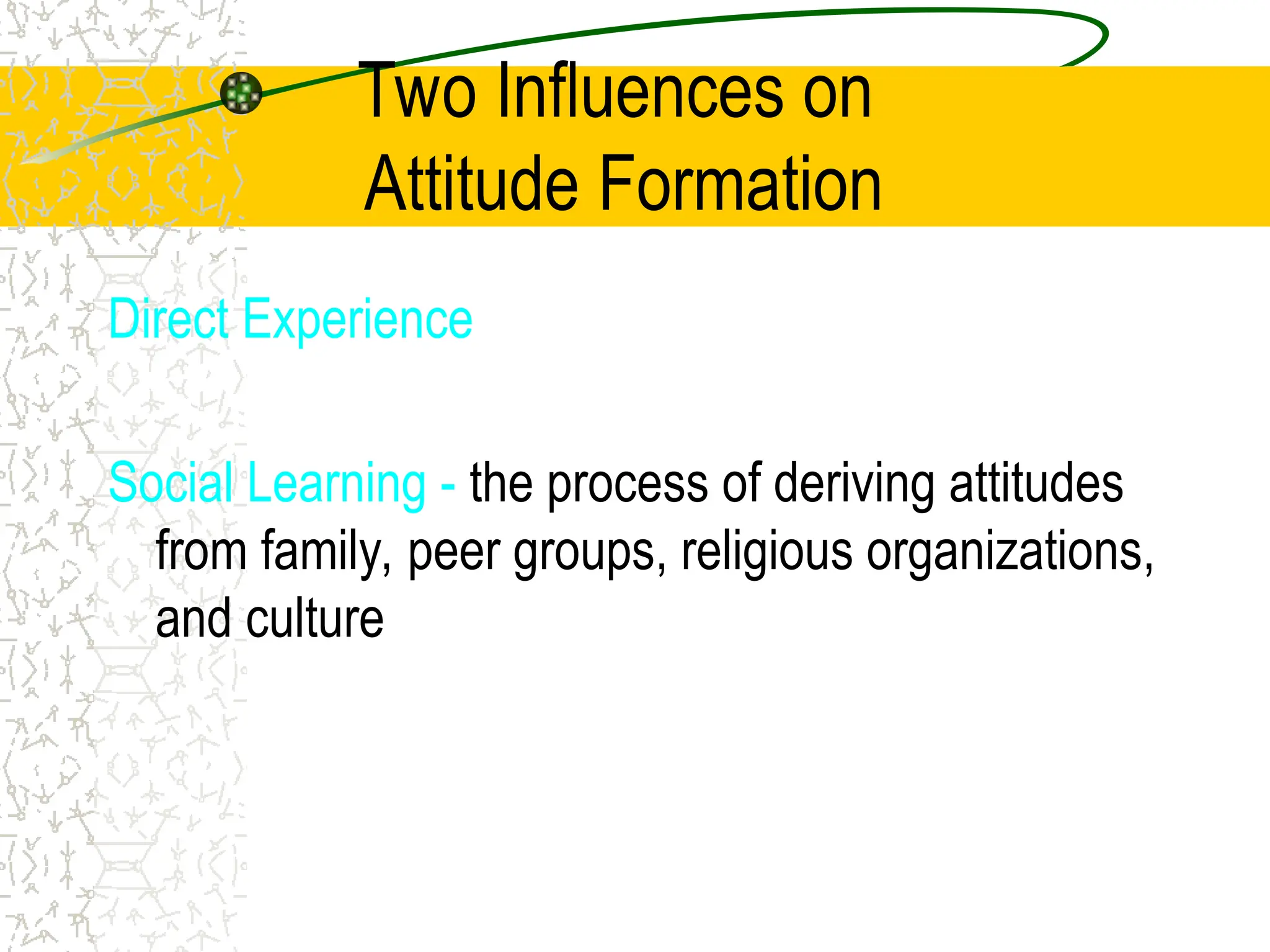
Two Influences on
Attitude Formation
Direct Experience
Social Learning - the process of deriving attitudes
from family, peer groups, religious organizations,
and culture
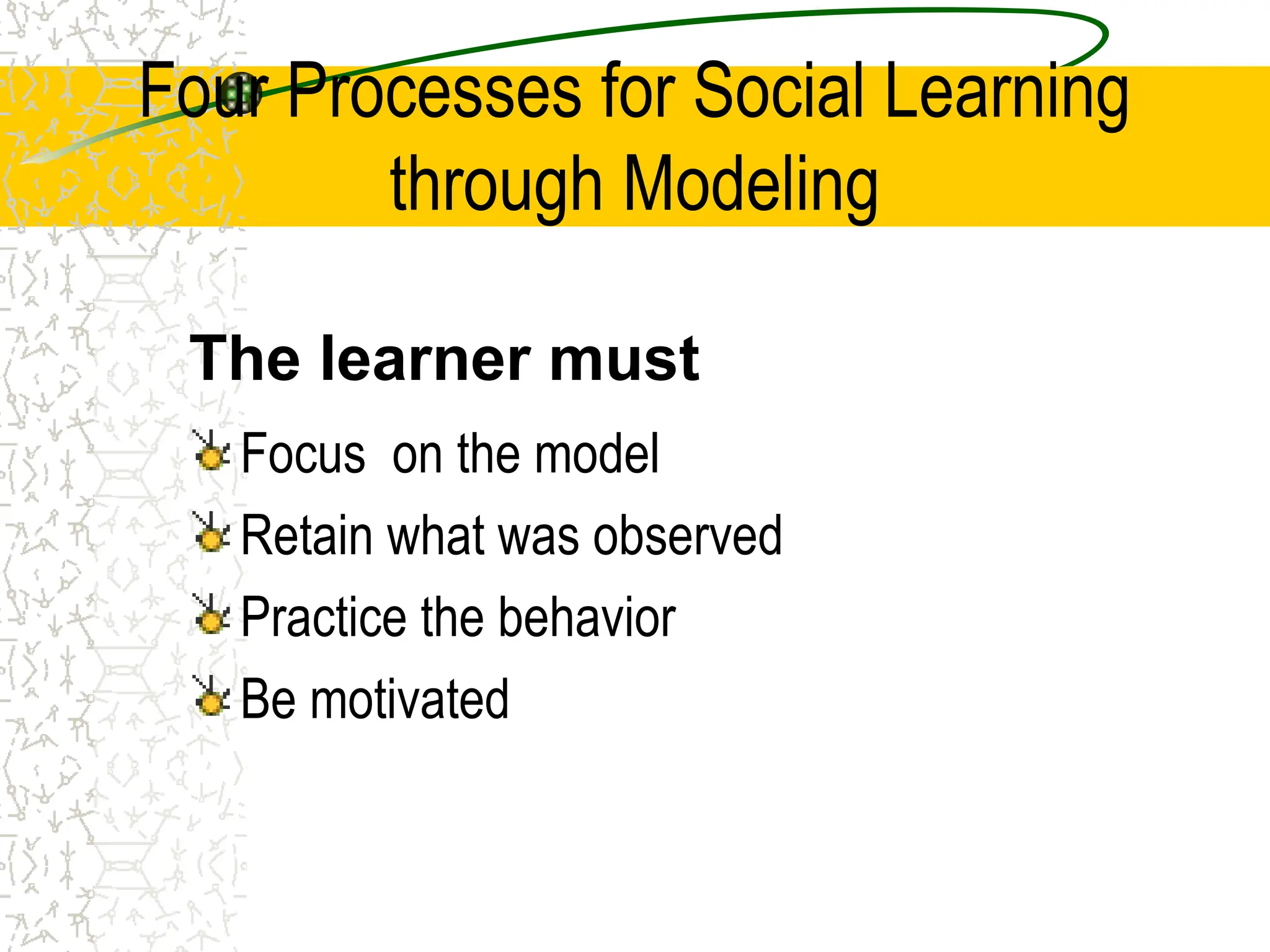
Four Processes for Social Learning
through Modeling
Focus on the model
Retain what was observed
Practice the behavior
Be motivated
The learner must
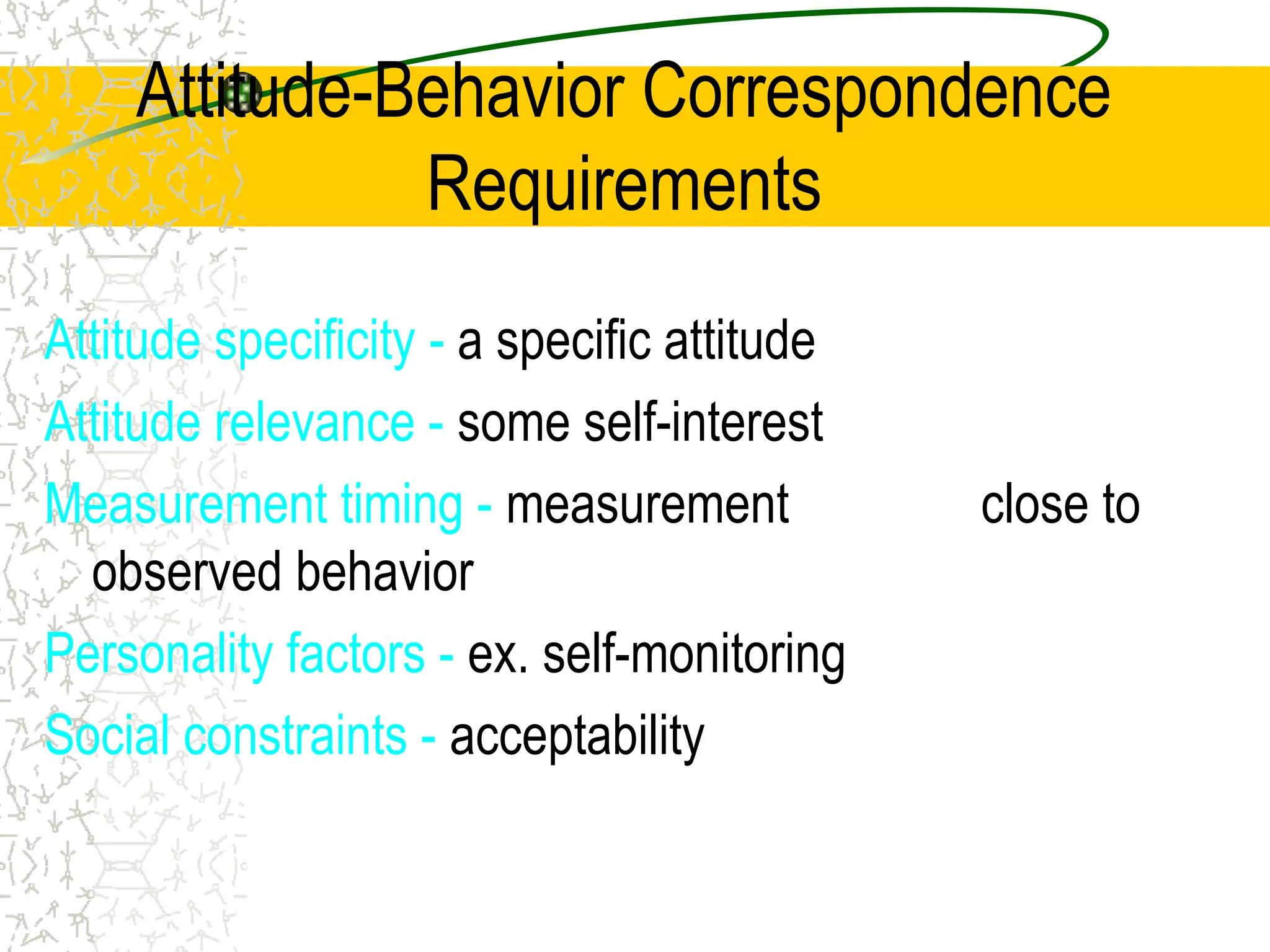
Attitude-Behavior Correspondence
Requirements
Attitude specificity - a specific attitude
Attitude relevance - some self-interest
Measurement timing - measurement close to
observed behavior
Personality factors - ex. self-monitoring
Social constraints - acceptability
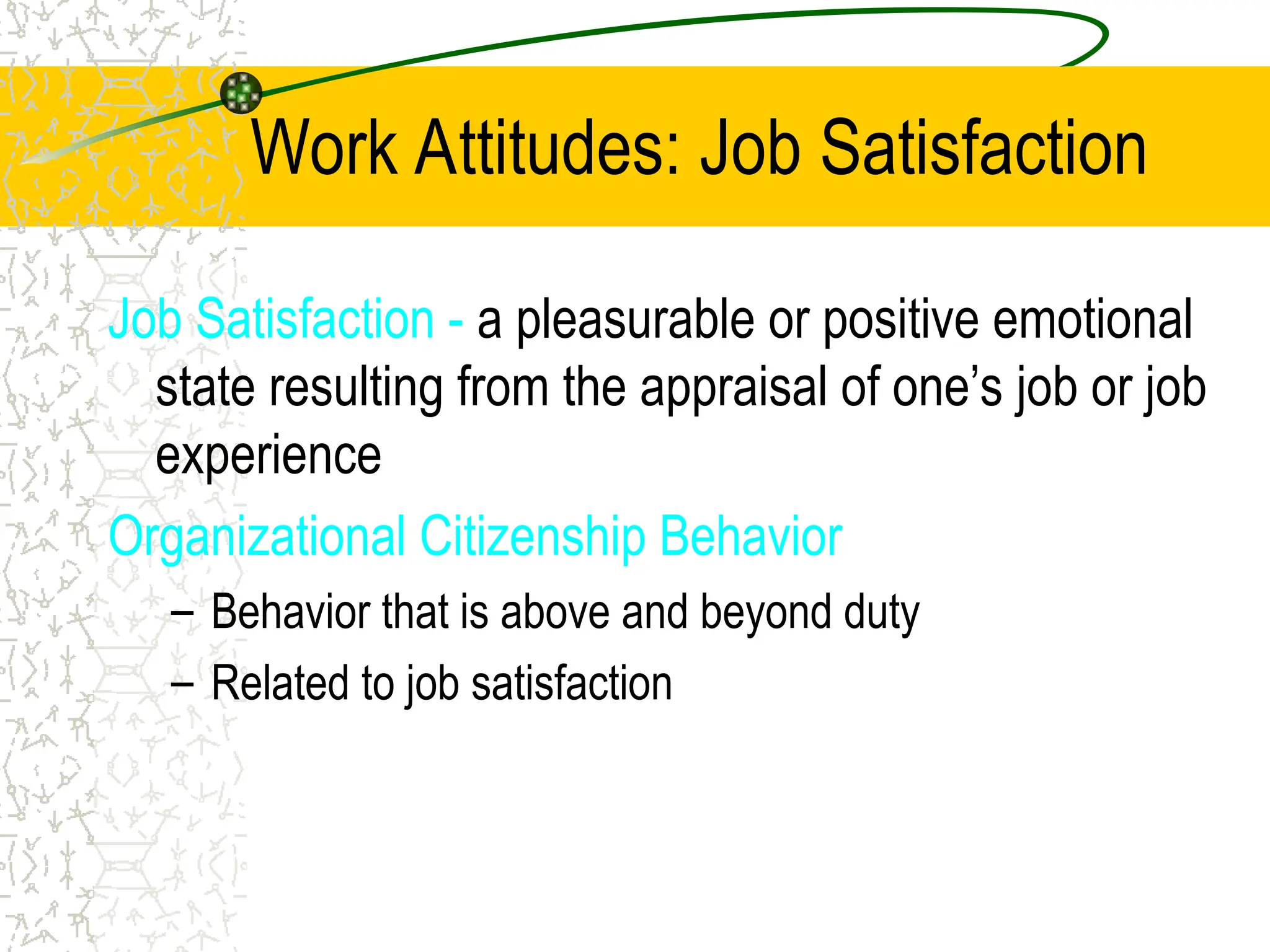
Work Attitudes: Job Satisfaction
Job Satisfaction - a pleasurable or positive emotional
state resulting from the appraisal of one’s job or job
experience
Organizational Citizenship Behavior
– Behavior that is above and beyond duty
– Related to job satisfaction
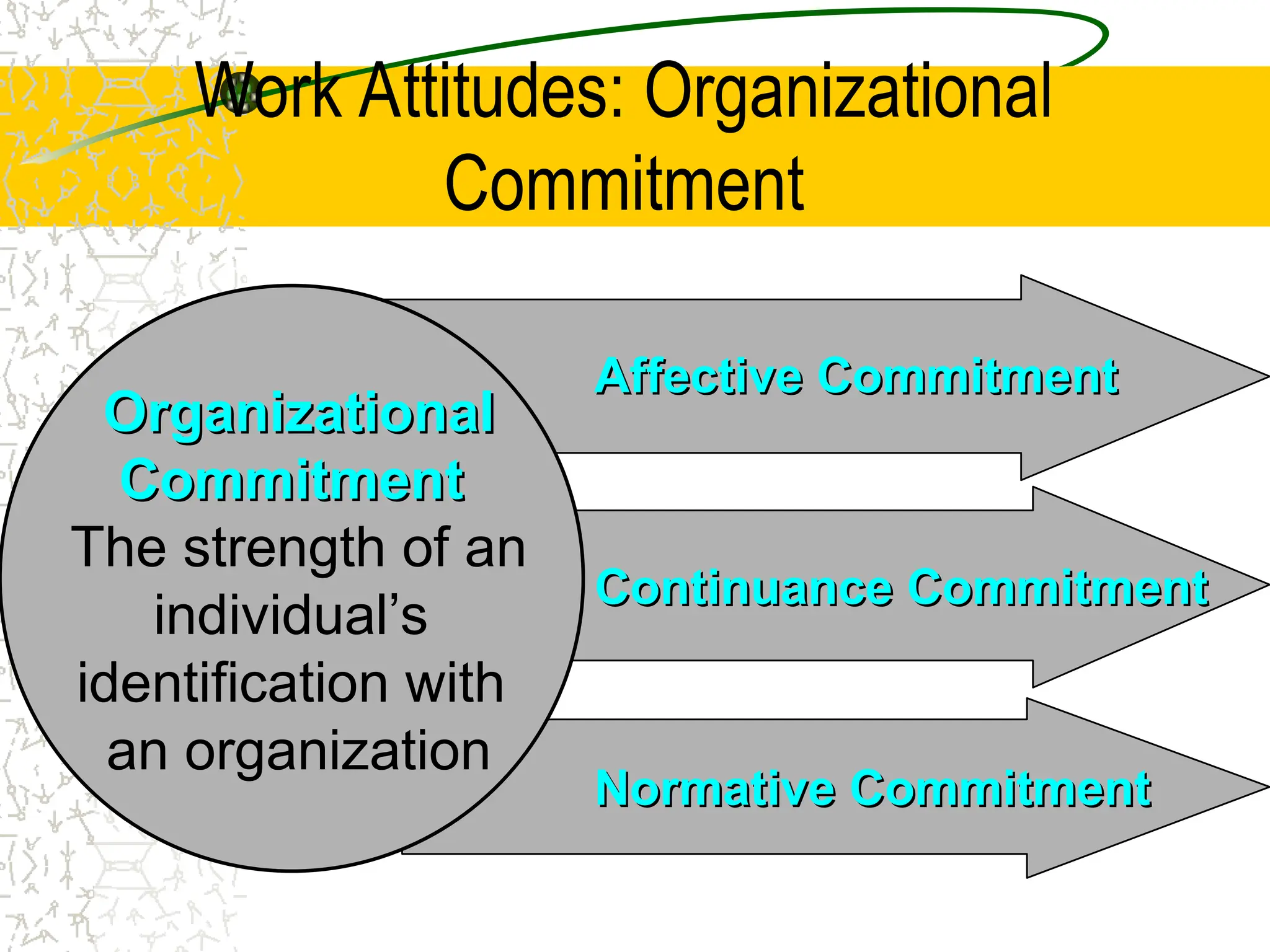
Work Attitudes: Organizational
Commitment
Affective Commitment
Continuance Commitment
Normative Commitment
Organizational
Organizational
Commitment
Commitment
The strength of an
individual’s
identification with
an organization
Values
Values - enduring beliefs that a specific mode of
conduct or end state of existence is personally
or socially preferable to an opposite or converse
mode of conduct or end state of existence
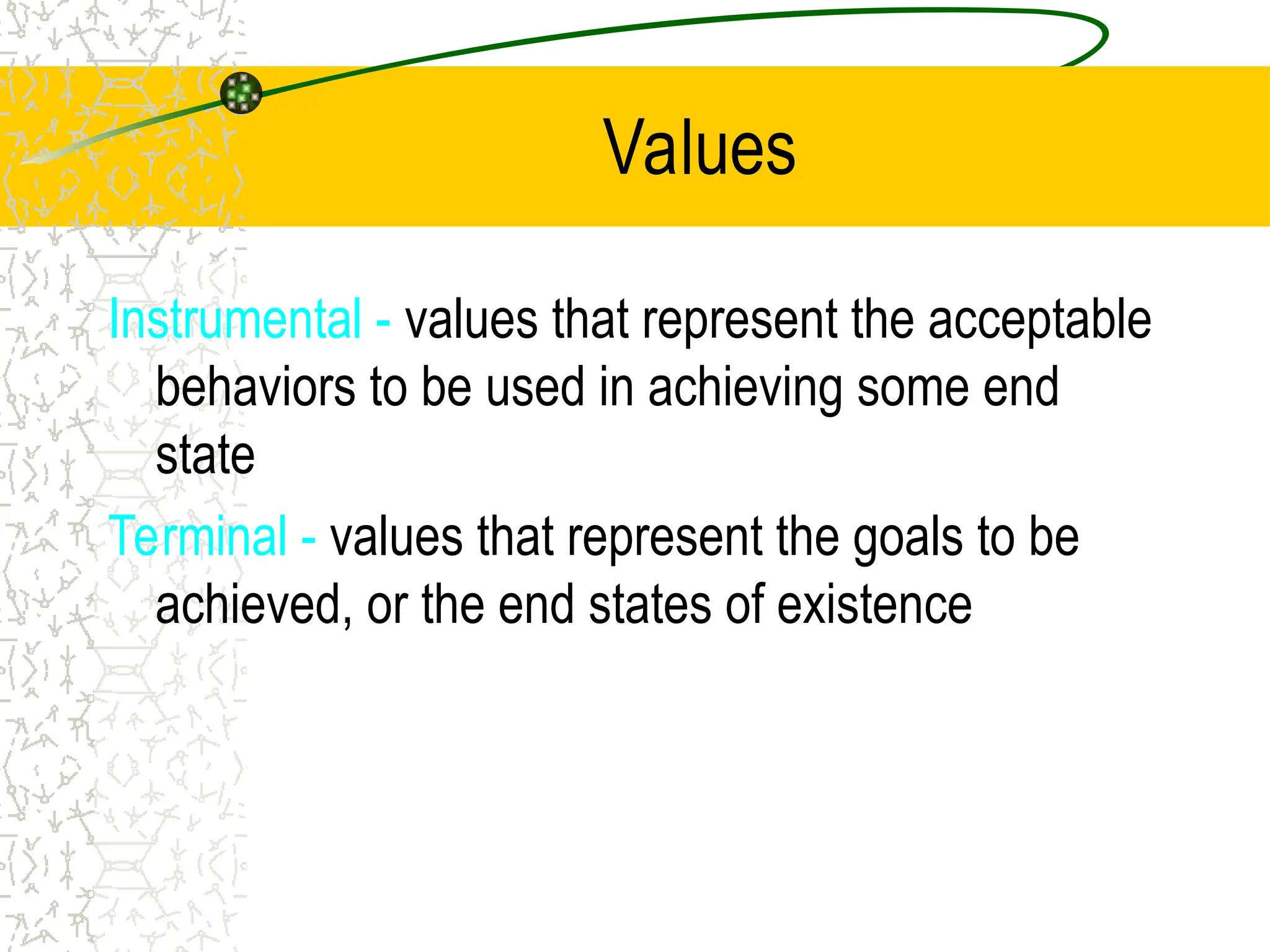
Values
Instrumental - values that represent the acceptable
behaviors to be used in achieving some end
state
Terminal - values that represent the goals to be
achieved, or the end states of existence
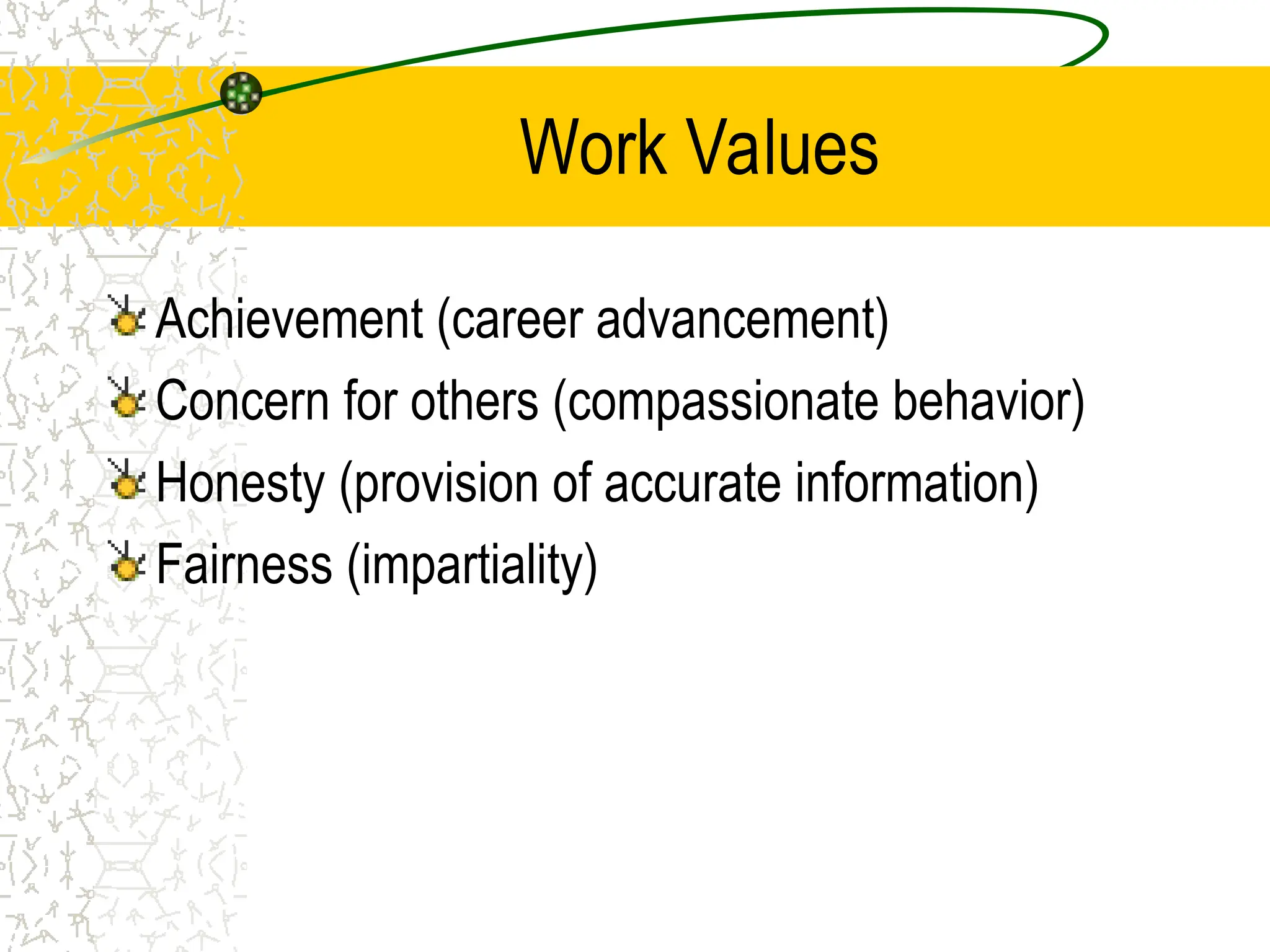
Work Values
Achievement (career advancement)
Concern for others (compassionate behavior)
Honesty (provision of accurate information)
Fairness (impartiality)
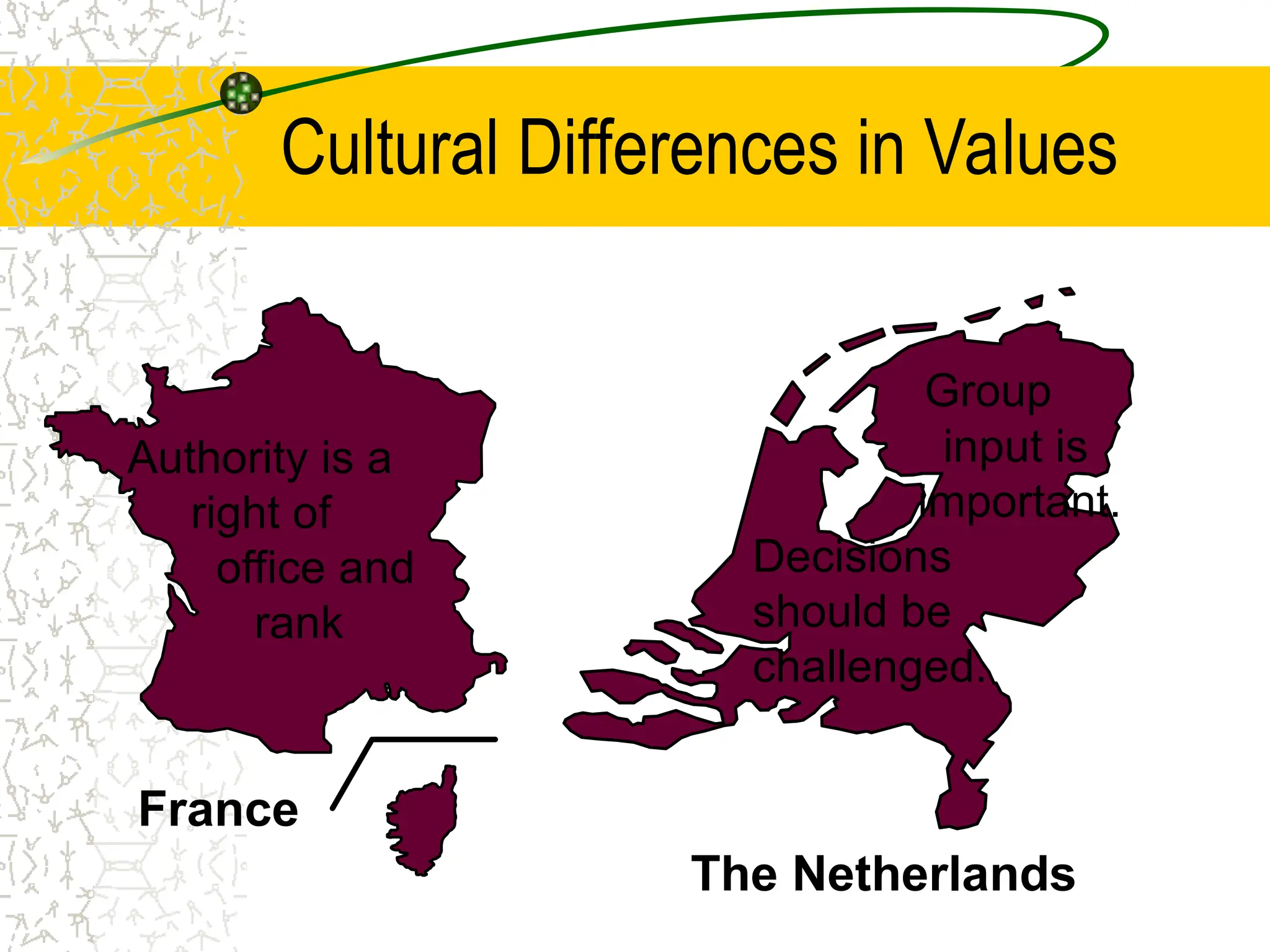
Cultural Differences in Values
Authority is a
right of
office and
rank
Group
input is
important.
Decisions
should be
challenged.
France
The Netherlands
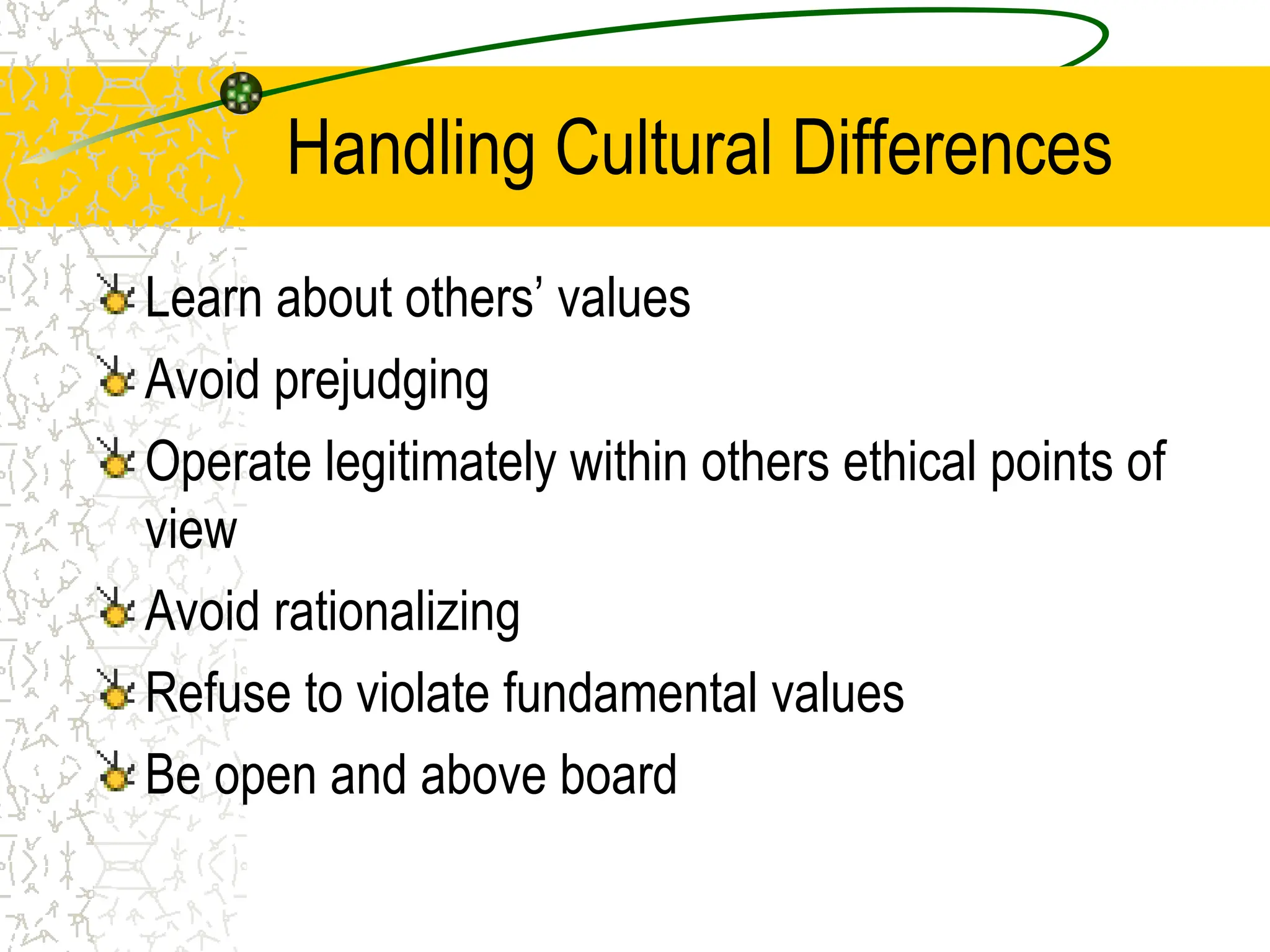
Handling Cultural Differences
Learn about others’ values
Avoid prejudging
Operate legitimately within others ethical points of
view
Avoid rationalizing
Refuse to violate fundamental values
Be open and above board
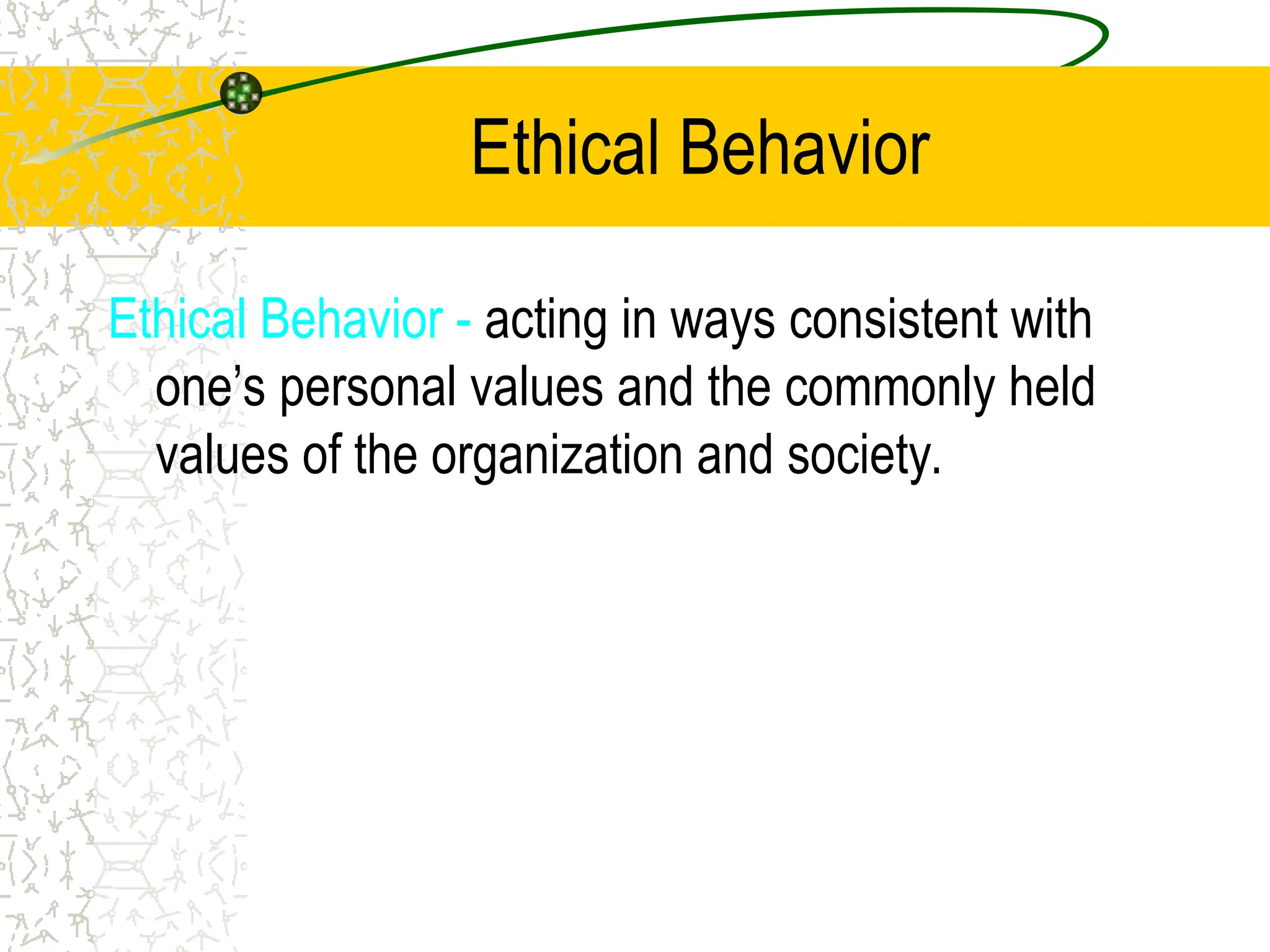
Ethical Behavior
Ethical Behavior - acting in ways consistent with
one’s personal values and the commonly held
values of the organization and society.
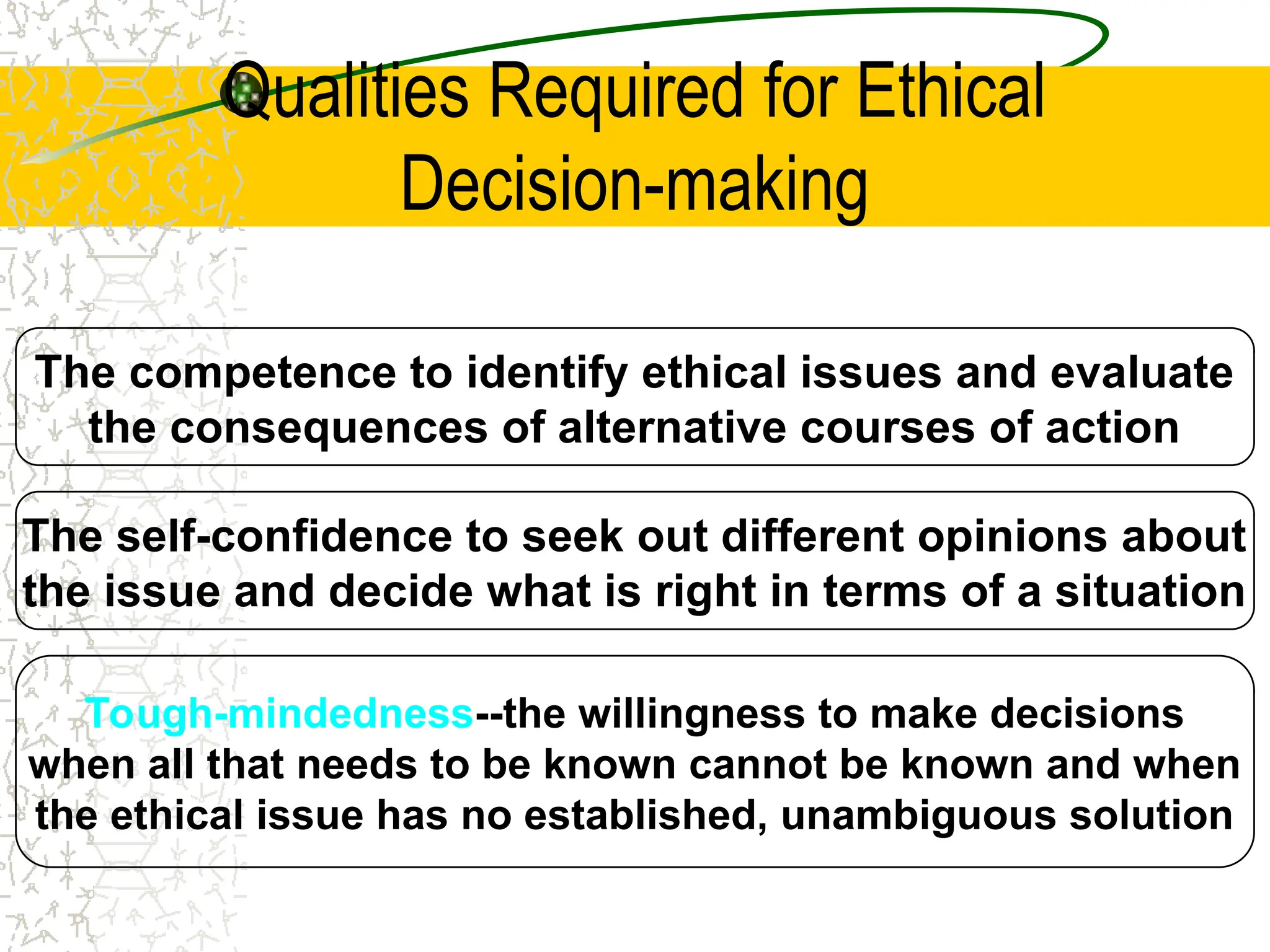
Qualities Required for Ethical
Decision-making
The competence to identify ethical issues and evaluate
the consequences of alternative courses of action
The self-confidence to seek out different opinions about
the issue and decide what is right in terms of a situation
Tough-mindedness--the willingness to make decisions
when all that needs to be known cannot be known and when
the ethical issue has no established, unambiguous solution
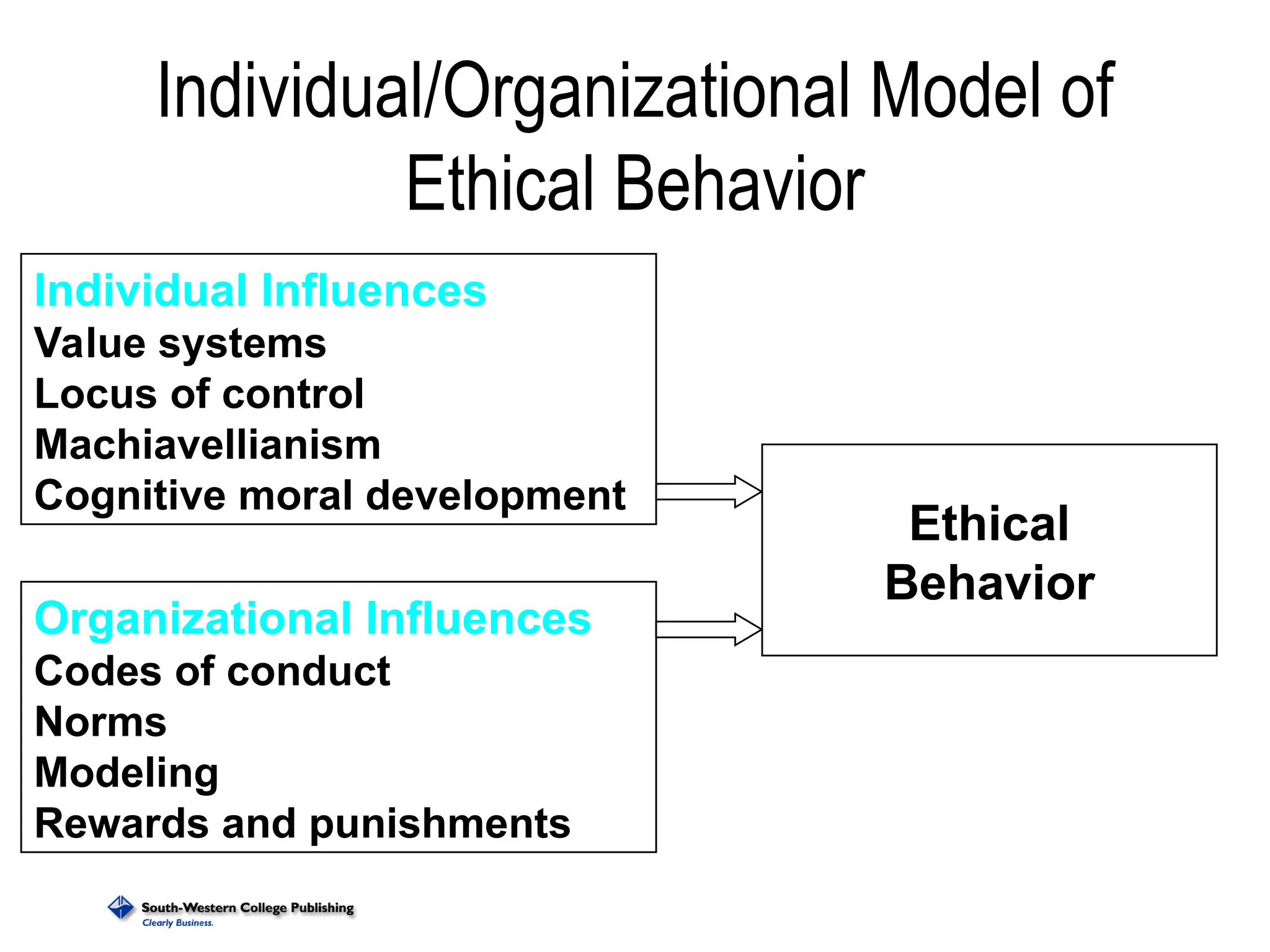
Individual/Organizational Model of
Ethical Behavior
Individual Influences
Value systems
Locus of control
Machiavellianism
Cognitive moral development
Organizational Influences
Codes of conduct
Norms
Modeling
Rewards and punishments
Ethical
Behavior
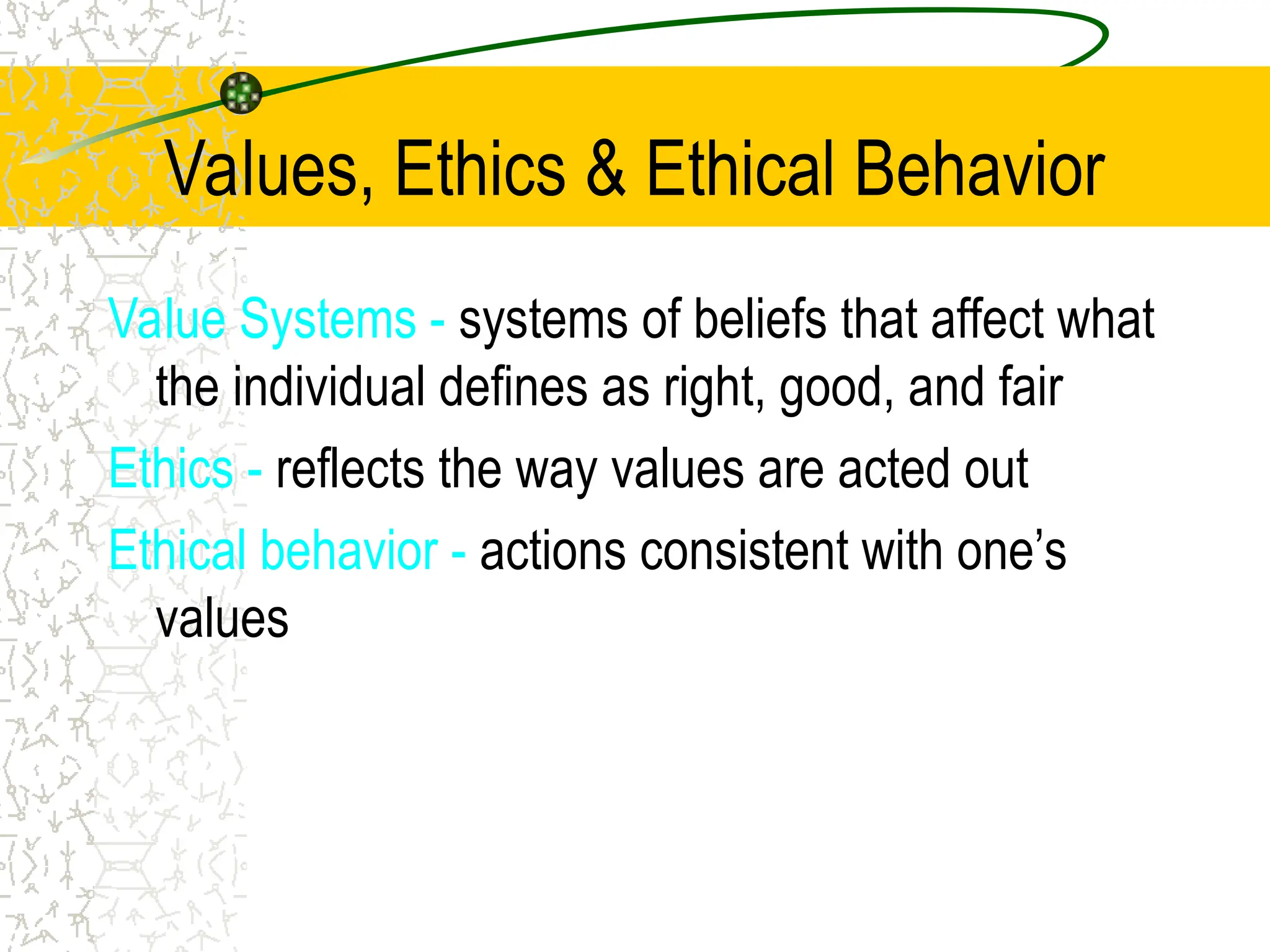
Values, Ethics & Ethical Behavior
Value Systems - systems of beliefs that affect what
the individual defines as right, good, and fair
Ethics - reflects the way values are acted out
Ethical behavior - actions consistent with one’s
values
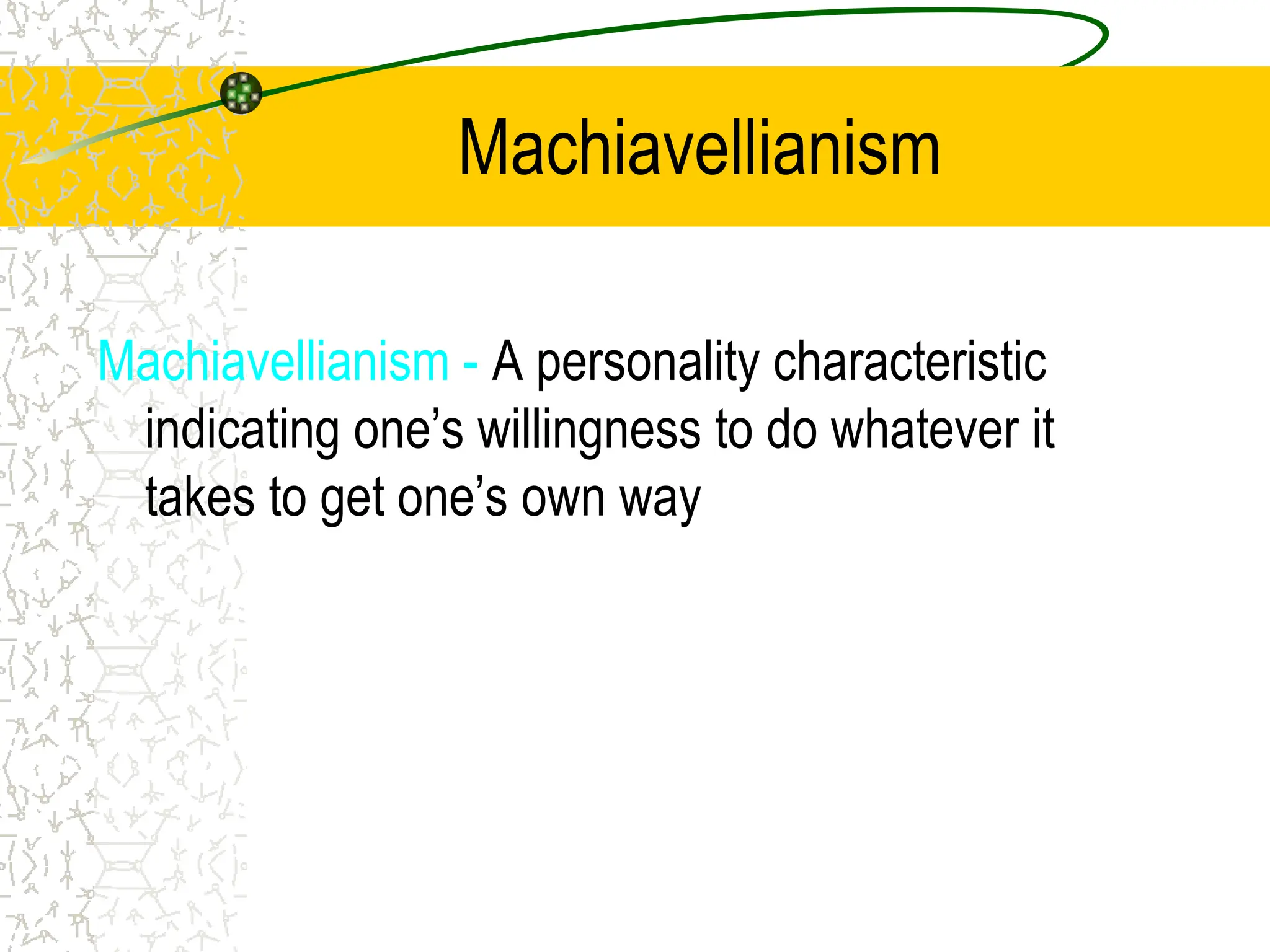
Machiavellianism
Machiavellianism - A personality characteristic
indicating one’s willingness to do whatever it
takes to get one’s own way
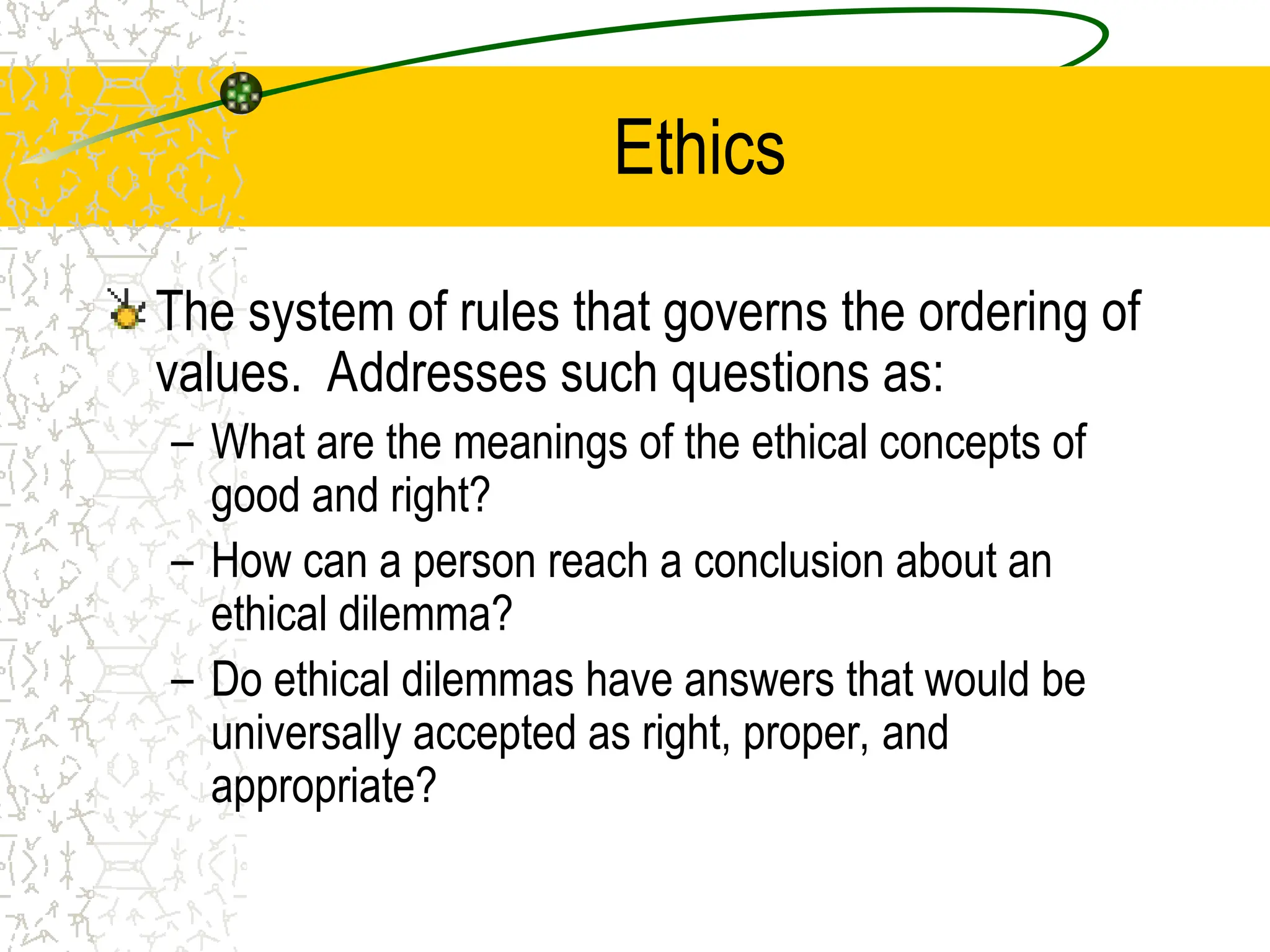
Ethics
The system of rules that governs the ordering of
values. Addresses such questions as:
– What are the meanings of the ethical concepts of
good and right?
– How can a person reach a conclusion about an
ethical dilemma?
– Do ethical dilemmas have answers that would be
universally accepted as right, proper, and
appropriate?
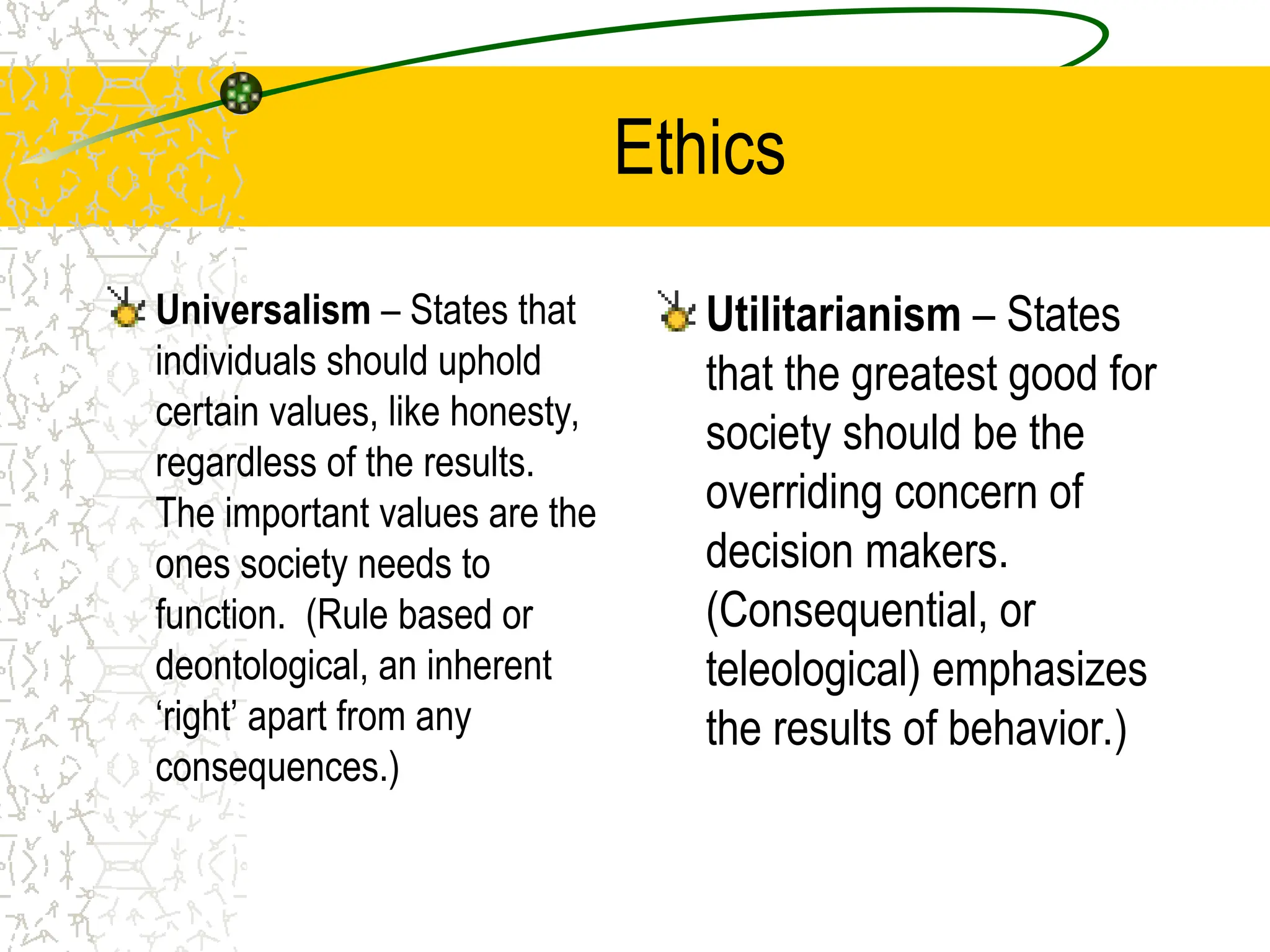
Ethics
Universalism – States that
individuals should uphold
certain values, like honesty,
regardless of the results.
The important values are the
ones society needs to
function. (Rule based or
deontological, an inherent
‘right’ apart from any
consequences.)
Utilitarianism – States
that the greatest good for
society should be the
overriding concern of
decision makers.
(Consequential, or
teleological) emphasizes
the results of behavior.)
Ethics
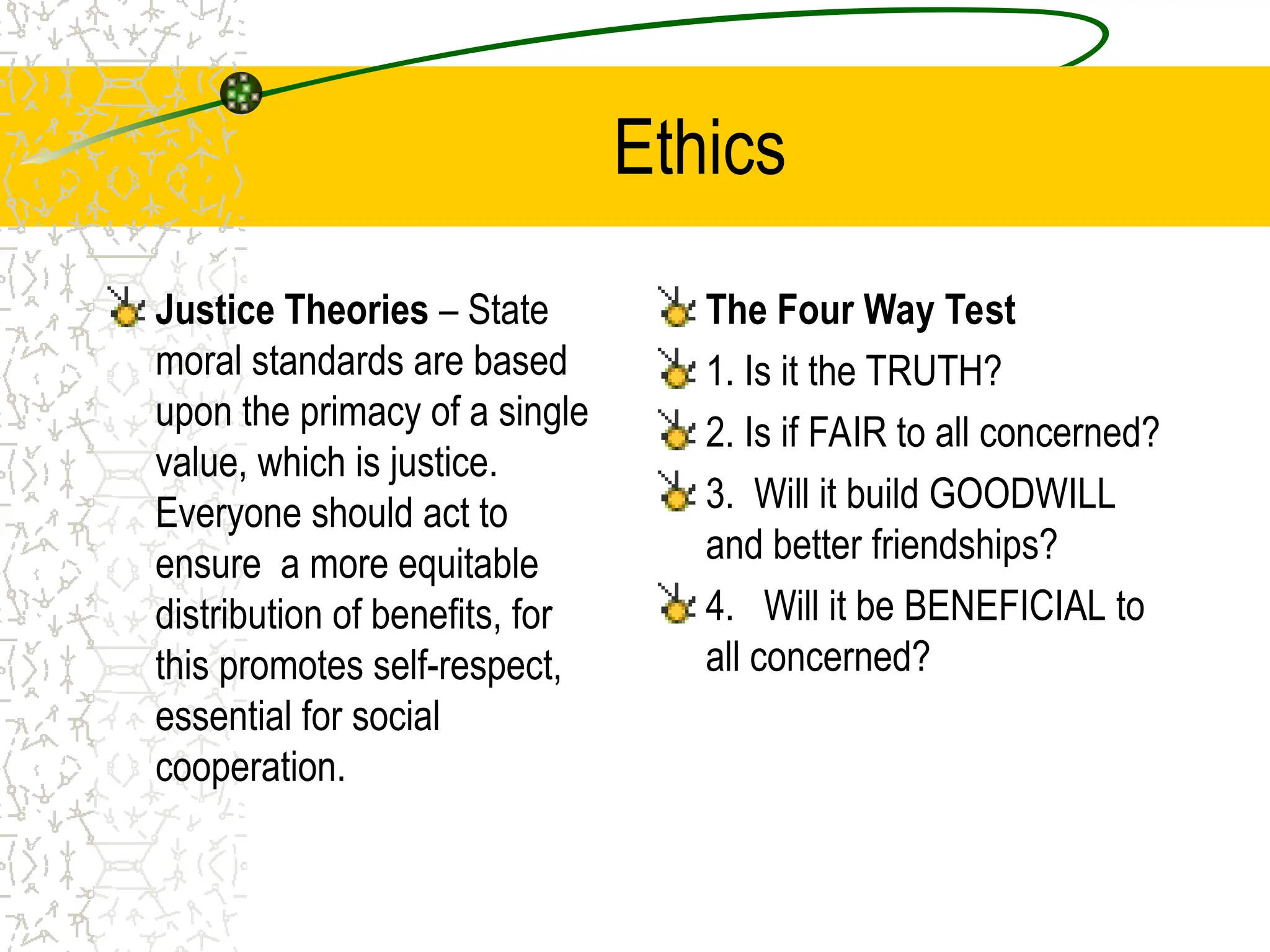
Justice Theories – State
moral standards are based
upon the primacy of a single
value, which is justice.
Everyone should act to
ensure a more equitable
distribution of benefits, for
this promotes self-respect,
essential for social
cooperation.
The Four Way Test
1. Is it the TRUTH?
2. Is if FAIR to all concerned?
3. Will it build GOODWILL
and better friendships?
4. Will it be BENEFICIAL to
all concerned?
Moral Reasoning
The thinking processes involved in judgments
about questions of right and wrong.
Kohlberg’s work (’63, ’75, ’81):
– Divided moral development into three levels
Moral Reasoning
Pre-conventional
– Judgment based solely on a person’s own needs and
perceptions
Conventional
– Expectations of society and law are taken into account
Post-Conventional
– Judgment based on abstract, personal principles not
necessarily defined by society’s laws.
Kohlberg’s Moral Dilemmas
Hypothetical situations in which no choice is
clearly and indisputably right.
The Heinz Dilemma
A man’s wife is dying. There is one drug that
could save her life, but it is very expensive, and
the druggist who invented it will not sell it at a
price low enough for the man to buy it. Finally,
the man becomes desperate and considers
stealing the drug for his wife. What should he do
and why?
Kohlberg’s Work
Stage 1 (Pre conventional)
– Punishment-obedience orientation
• Fear of authority and avoidance of punishment are
reasons for behaving morally.
Stage 2 (Pre conventional)
– Personal reward orientation
• Satisfying personal needs determines moral choice.
Kohlberg’s Work
Stage 3 (Conventional)
– Good boy-nice girl orientation
• Maintaining the affection and approval of friends and
relatives motivates good behavior
Stage 4 (Conventional)
– Law and order/authority orientation
• A duty to uphold rules and laws for their own sake justifies
moral conformity
Kohlberg’s Work
Stage 5 (Post conventional)
– Social contract orientation
• We obey rules because they are necessary for social
order, but rules can be changed if there were better
alternatives
Stage 6 (Post conventional)
– Morality of individual principles and conscience
• Behavior which conforms to internal principles (justice and
equality) and may sometimes violate society’s rules.
Carol Gilligan
“In a Different Voice”
1977, 1981
Moral reasoning is delimited by
“...two moral perspectives that
organize thinking in different ways.”
Men: define morality in terms of justice.
Women: less in terms of rights and more in
terms of standards of responsibility and care.
Gilligan’s Perspective:
Males = typically a justice/rights orientation
Females = care response orientation
Orientations arise form rational experiences of inequality and
attachment
Girls attached to and identify with mothers
Boys attached to mothers and identify with fathers
Believes that:
That response orientation is of a higher order than justice
rights orientation
Because Kohlberg’s theory is hierarchical with justice/rights
the basis--women would necessarily show a less reasoned
perspective on his scales.
First studies of Kohlberg only conducted with men
The two perspectives are not
opposite ends of a continuum,
“...with justice uncaring and caring
unjust...”, but rather, “...a different
method of organizing the basic
elements of moral judgment: self,
others, and the relationship between
them.”
(Gilligan, 1987, p.22)
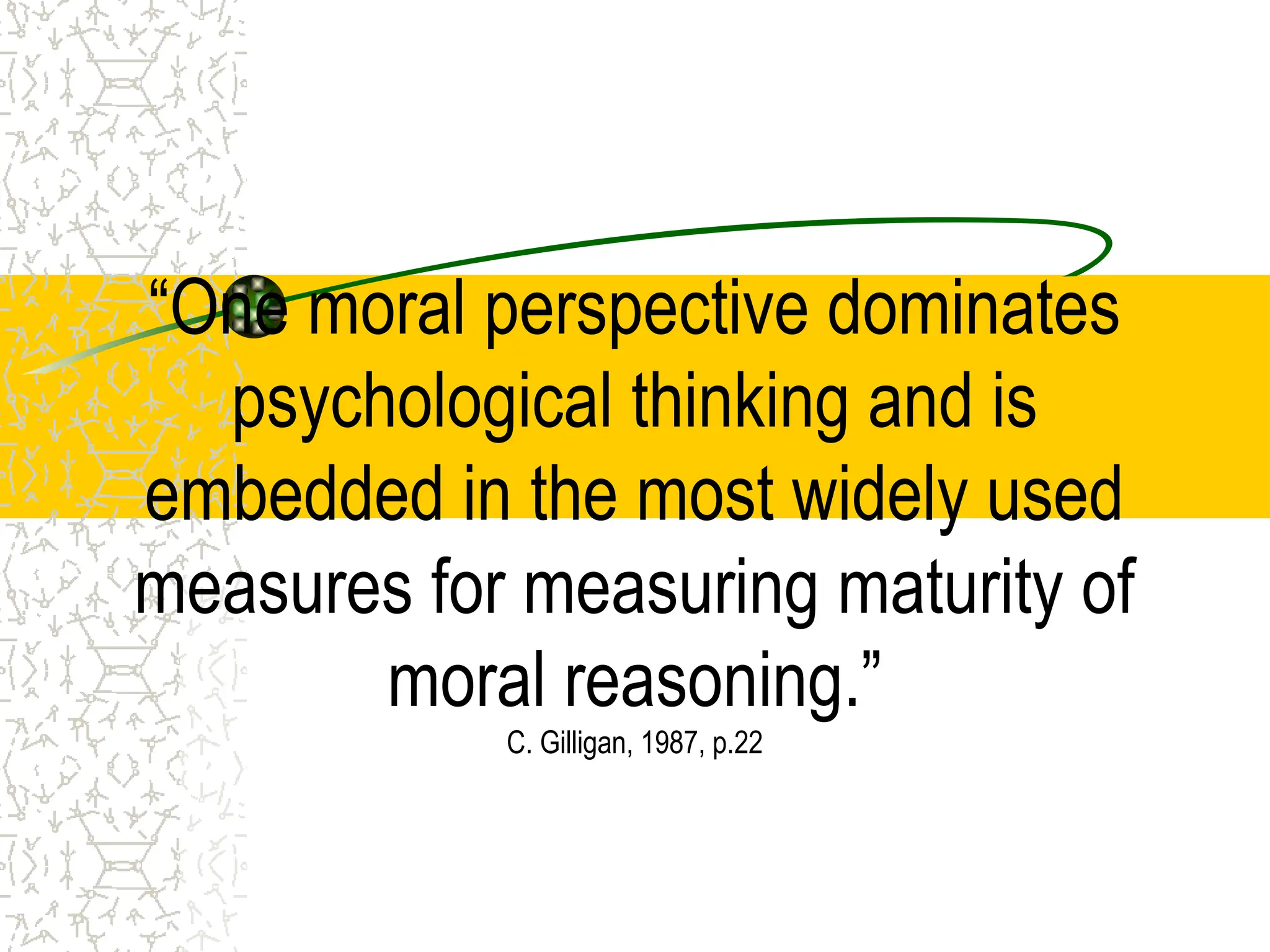
“One moral perspective dominates
psychological thinking and is
embedded in the most widely used
measures for measuring maturity of
moral reasoning.”
C. Gilligan, 1987, p.22
Gilligan’s Theory
Based on two observational studies.
Study One: 25 college students
Study Two: 29 women considering
abortion
Gilligan’s Research:
“shift[s] the focus of attention from ways people
reason about hypothetical dilemmas to ways
people construct moral conflicts and choice in
their lives...and [makes] it possible to see what
experiences people define in moral terms, and to
explore the relationship between the
understanding of moral problems and the
reasoning strategies used and the actions taken in
attempting to solve them.” Gilligan, 1987, p.21
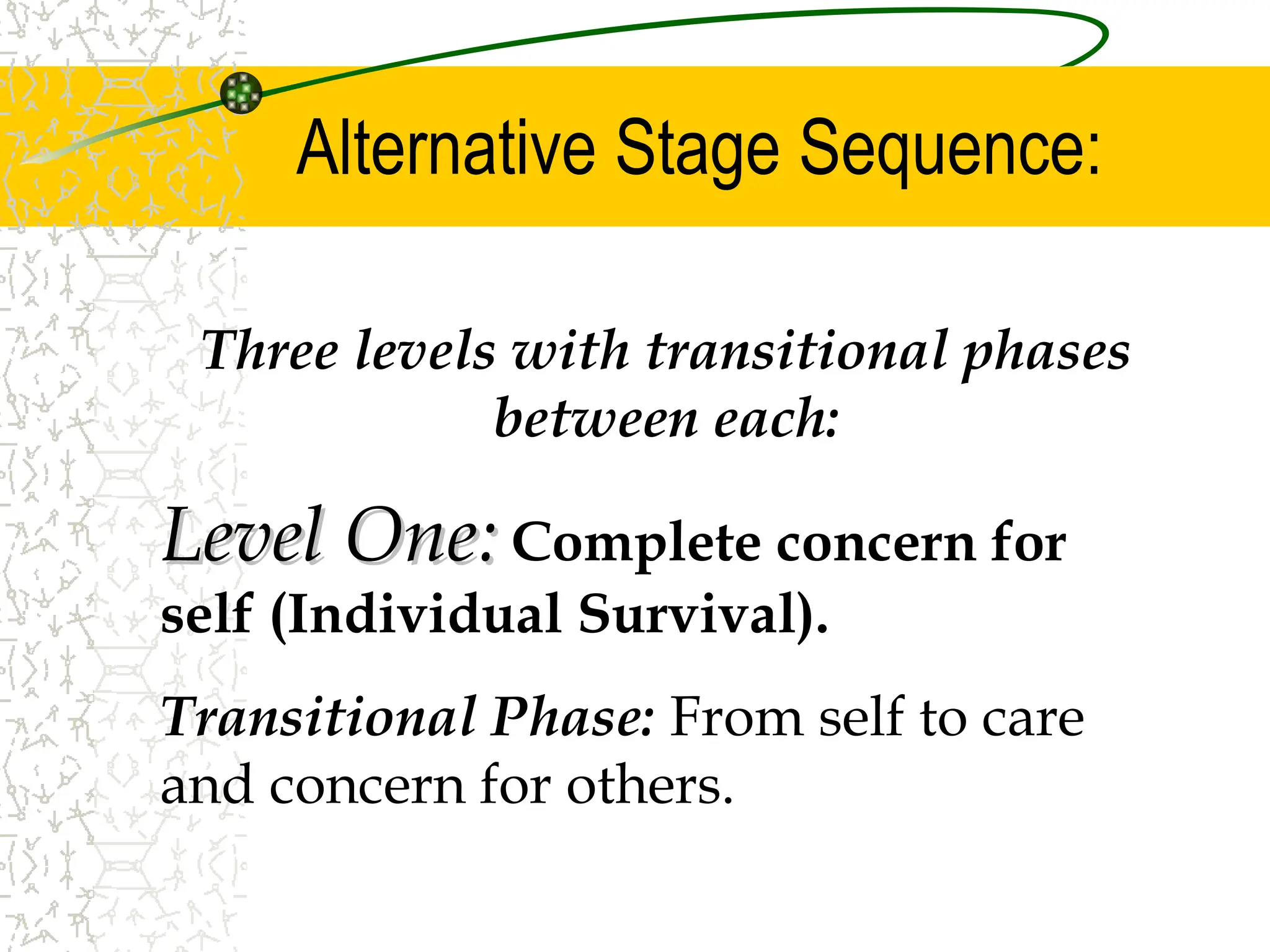
Alternative Stage Sequence:
Three levels with transitional phases
between each:
Level One:
Level One: Complete concern for
self (Individual Survival).
Transitional Phase: From self to care
and concern for others.
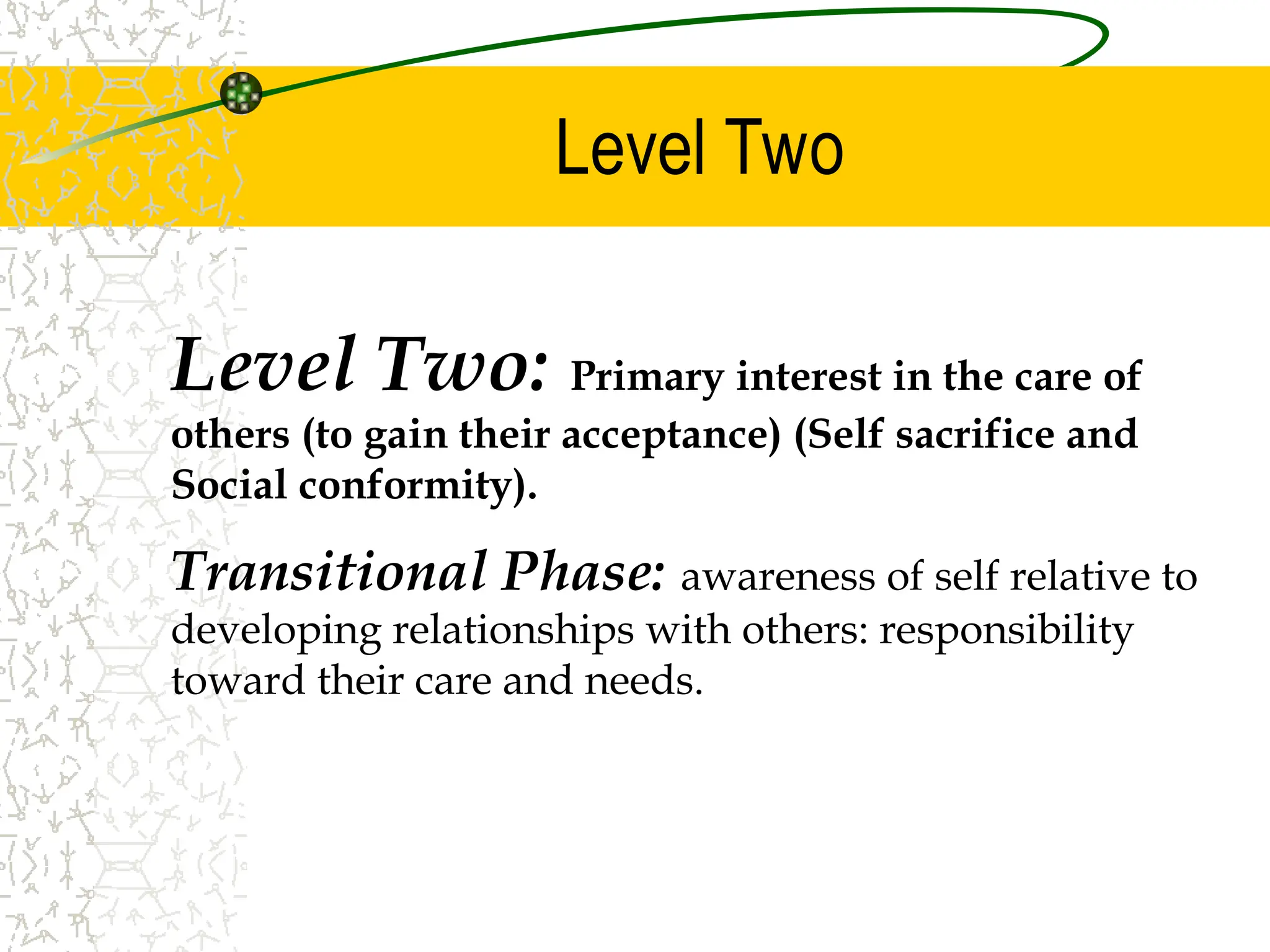
Level Two
Level Two: Primary interest in the care of
others (to gain their acceptance) (Self sacrifice and
Social conformity).
Transitional Phase: awareness of self relative to
developing relationships with others: responsibility
toward their care and needs.
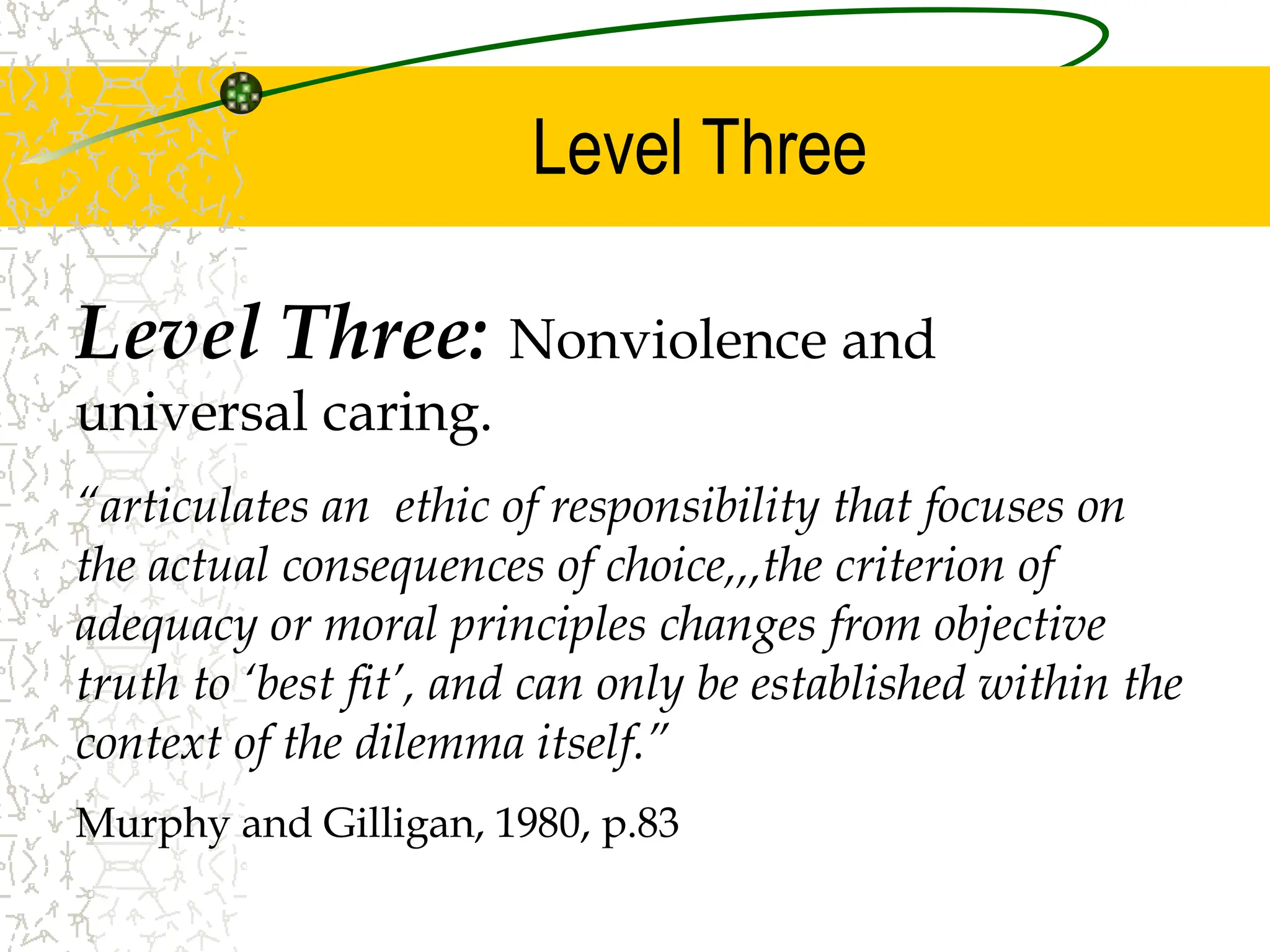
Level Three
Level Three: Nonviolence and
universal caring.
“articulates an ethic of responsibility that focuses on
the actual consequences of choice,,,the criterion of
adequacy or moral principles changes from objective
truth to ‘best fit’, and can only be established within the
context of the dilemma itself.”
Murphy and Gilligan, 1980, p.83
Good Points:
Concept of care giving and nurturing
Relationship of self to others, responsibility
Empathy
Effect on environment
Hawthorne Effect:
Subjects may try harder simply
because they are in the control
group.
Rosenthal Effect:
Researcher’s biases tend to sway the
results to be what the researcher
wants to find
“Rather than arguing over the extent to which sex
bias is inherent in Kohlberg’s theory of moral
development, it might be more appropriate to
ask why the myth that males are more
advanced in moral reasoning than females
persists in light of such little evidence.”
Walker, 1984, p.688
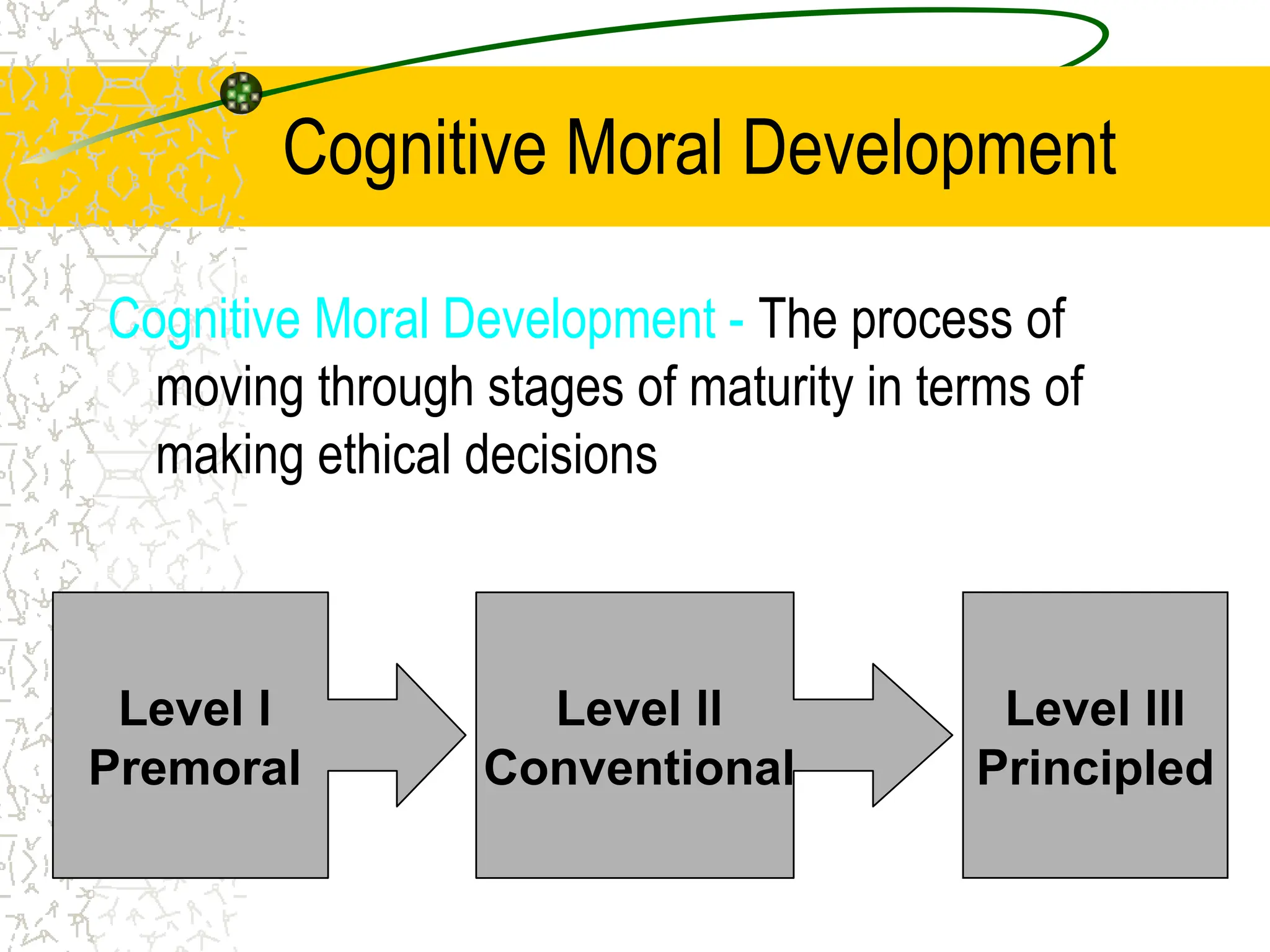
Cognitive Moral Development
Cognitive Moral Development - The process of
moving through stages of maturity in terms of
making ethical decisions
Level l
Premoral
Level ll
Conventional
Level lll
Principled

Attitudes, Values and Ethics in Organisational Behaviour.ppt

  • 1.
  • 2.
    Attitude Attitude - apsychological tendency expressed by evaluating an entity with some degree of favor or disfavor Should poor performance be blamed on “bad attitude”?
  • 3.
    ffect Physiological indicatorsI don’t like Verbal statements my boss. about feelings ehavioral Observed behavior I want to intentions Verbal statements transfer to about intentions another dept. M.J. Rosenberg and C. I. Hovland, “Cognitive, Affective, and Behavioral Components of Attitude,” in M.J. Rosenberg, C.I. Hovland, W.J. McGuire, R.P. Abelson, and J.H. Brehm, Attitude Organization and Change, 1960 ABC Model of an Attitude Component Measured by Example ognition Attitude scales I believe my Verbal statements boss plays about beliefs favorites. A C B
  • 4.
    Cognitive Dissonance Cognitive Dissonance- a state of tension that is produced when an individual experiences conflict between attitudes and behavior attitude behavior
  • 5.
    Two Influences on AttitudeFormation Direct Experience Social Learning - the process of deriving attitudes from family, peer groups, religious organizations, and culture
  • 6.
    Four Processes forSocial Learning through Modeling Focus on the model Retain what was observed Practice the behavior Be motivated The learner must
  • 7.
    Attitude-Behavior Correspondence Requirements Attitude specificity- a specific attitude Attitude relevance - some self-interest Measurement timing - measurement close to observed behavior Personality factors - ex. self-monitoring Social constraints - acceptability
  • 8.
    Work Attitudes: JobSatisfaction Job Satisfaction - a pleasurable or positive emotional state resulting from the appraisal of one’s job or job experience Organizational Citizenship Behavior – Behavior that is above and beyond duty – Related to job satisfaction
  • 9.
    Work Attitudes: Organizational Commitment AffectiveCommitment Affective Commitment Continuance Commitment Continuance Commitment Normative Commitment Normative Commitment Organizational Organizational Commitment Commitment The strength of an individual’s identification with an organization
  • 10.
    Values Values - enduringbeliefs that a specific mode of conduct or end state of existence is personally or socially preferable to an opposite or converse mode of conduct or end state of existence
  • 11.
    Values Instrumental - valuesthat represent the acceptable behaviors to be used in achieving some end state Terminal - values that represent the goals to be achieved, or the end states of existence
  • 12.
    Work Values Achievement (careeradvancement) Concern for others (compassionate behavior) Honesty (provision of accurate information) Fairness (impartiality)
  • 13.
    Cultural Differences inValues Authority is a right of office and rank Group input is important. Decisions should be challenged. France The Netherlands
  • 14.
    Handling Cultural Differences Learnabout others’ values Avoid prejudging Operate legitimately within others ethical points of view Avoid rationalizing Refuse to violate fundamental values Be open and above board
  • 15.
    Ethical Behavior Ethical Behavior- acting in ways consistent with one’s personal values and the commonly held values of the organization and society.
  • 16.
    Qualities Required forEthical Decision-making The competence to identify ethical issues and evaluate the consequences of alternative courses of action The self-confidence to seek out different opinions about the issue and decide what is right in terms of a situation Tough-mindedness--the willingness to make decisions when all that needs to be known cannot be known and when the ethical issue has no established, unambiguous solution
  • 17.
    Individual/Organizational Model of EthicalBehavior Individual Influences Value systems Locus of control Machiavellianism Cognitive moral development Organizational Influences Codes of conduct Norms Modeling Rewards and punishments Ethical Behavior
  • 18.
    Values, Ethics &Ethical Behavior Value Systems - systems of beliefs that affect what the individual defines as right, good, and fair Ethics - reflects the way values are acted out Ethical behavior - actions consistent with one’s values
  • 19.
    Machiavellianism Machiavellianism - Apersonality characteristic indicating one’s willingness to do whatever it takes to get one’s own way
  • 20.
    Ethics The system ofrules that governs the ordering of values. Addresses such questions as: – What are the meanings of the ethical concepts of good and right? – How can a person reach a conclusion about an ethical dilemma? – Do ethical dilemmas have answers that would be universally accepted as right, proper, and appropriate?
  • 21.
    Ethics Universalism – Statesthat individuals should uphold certain values, like honesty, regardless of the results. The important values are the ones society needs to function. (Rule based or deontological, an inherent ‘right’ apart from any consequences.) Utilitarianism – States that the greatest good for society should be the overriding concern of decision makers. (Consequential, or teleological) emphasizes the results of behavior.)
  • 22.
    Ethics Justice Theories –State moral standards are based upon the primacy of a single value, which is justice. Everyone should act to ensure a more equitable distribution of benefits, for this promotes self-respect, essential for social cooperation. The Four Way Test 1. Is it the TRUTH? 2. Is if FAIR to all concerned? 3. Will it build GOODWILL and better friendships? 4. Will it be BENEFICIAL to all concerned?
  • 23.
    Moral Reasoning The thinkingprocesses involved in judgments about questions of right and wrong. Kohlberg’s work (’63, ’75, ’81): – Divided moral development into three levels
  • 24.
    Moral Reasoning Pre-conventional – Judgmentbased solely on a person’s own needs and perceptions Conventional – Expectations of society and law are taken into account Post-Conventional – Judgment based on abstract, personal principles not necessarily defined by society’s laws.
  • 25.
    Kohlberg’s Moral Dilemmas Hypotheticalsituations in which no choice is clearly and indisputably right.
  • 26.
    The Heinz Dilemma Aman’s wife is dying. There is one drug that could save her life, but it is very expensive, and the druggist who invented it will not sell it at a price low enough for the man to buy it. Finally, the man becomes desperate and considers stealing the drug for his wife. What should he do and why?
  • 27.
    Kohlberg’s Work Stage 1(Pre conventional) – Punishment-obedience orientation • Fear of authority and avoidance of punishment are reasons for behaving morally. Stage 2 (Pre conventional) – Personal reward orientation • Satisfying personal needs determines moral choice.
  • 28.
    Kohlberg’s Work Stage 3(Conventional) – Good boy-nice girl orientation • Maintaining the affection and approval of friends and relatives motivates good behavior Stage 4 (Conventional) – Law and order/authority orientation • A duty to uphold rules and laws for their own sake justifies moral conformity
  • 29.
    Kohlberg’s Work Stage 5(Post conventional) – Social contract orientation • We obey rules because they are necessary for social order, but rules can be changed if there were better alternatives Stage 6 (Post conventional) – Morality of individual principles and conscience • Behavior which conforms to internal principles (justice and equality) and may sometimes violate society’s rules.
  • 30.
    Carol Gilligan “In aDifferent Voice” 1977, 1981
  • 31.
    Moral reasoning isdelimited by “...two moral perspectives that organize thinking in different ways.” Men: define morality in terms of justice. Women: less in terms of rights and more in terms of standards of responsibility and care.
  • 32.
    Gilligan’s Perspective: Males =typically a justice/rights orientation Females = care response orientation Orientations arise form rational experiences of inequality and attachment Girls attached to and identify with mothers Boys attached to mothers and identify with fathers
  • 33.
    Believes that: That responseorientation is of a higher order than justice rights orientation Because Kohlberg’s theory is hierarchical with justice/rights the basis--women would necessarily show a less reasoned perspective on his scales. First studies of Kohlberg only conducted with men
  • 34.
    The two perspectivesare not opposite ends of a continuum, “...with justice uncaring and caring unjust...”, but rather, “...a different method of organizing the basic elements of moral judgment: self, others, and the relationship between them.” (Gilligan, 1987, p.22)
  • 35.
    “One moral perspectivedominates psychological thinking and is embedded in the most widely used measures for measuring maturity of moral reasoning.” C. Gilligan, 1987, p.22
  • 36.
    Gilligan’s Theory Based ontwo observational studies. Study One: 25 college students Study Two: 29 women considering abortion
  • 37.
    Gilligan’s Research: “shift[s] thefocus of attention from ways people reason about hypothetical dilemmas to ways people construct moral conflicts and choice in their lives...and [makes] it possible to see what experiences people define in moral terms, and to explore the relationship between the understanding of moral problems and the reasoning strategies used and the actions taken in attempting to solve them.” Gilligan, 1987, p.21
  • 38.
    Alternative Stage Sequence: Threelevels with transitional phases between each: Level One: Level One: Complete concern for self (Individual Survival). Transitional Phase: From self to care and concern for others.
  • 39.
    Level Two Level Two:Primary interest in the care of others (to gain their acceptance) (Self sacrifice and Social conformity). Transitional Phase: awareness of self relative to developing relationships with others: responsibility toward their care and needs.
  • 40.
    Level Three Level Three:Nonviolence and universal caring. “articulates an ethic of responsibility that focuses on the actual consequences of choice,,,the criterion of adequacy or moral principles changes from objective truth to ‘best fit’, and can only be established within the context of the dilemma itself.” Murphy and Gilligan, 1980, p.83
  • 41.
    Good Points: Concept ofcare giving and nurturing Relationship of self to others, responsibility Empathy Effect on environment
  • 42.
    Hawthorne Effect: Subjects maytry harder simply because they are in the control group.
  • 43.
    Rosenthal Effect: Researcher’s biasestend to sway the results to be what the researcher wants to find
  • 44.
    “Rather than arguingover the extent to which sex bias is inherent in Kohlberg’s theory of moral development, it might be more appropriate to ask why the myth that males are more advanced in moral reasoning than females persists in light of such little evidence.” Walker, 1984, p.688
  • 45.
    Cognitive Moral Development CognitiveMoral Development - The process of moving through stages of maturity in terms of making ethical decisions Level l Premoral Level ll Conventional Level lll Principled