
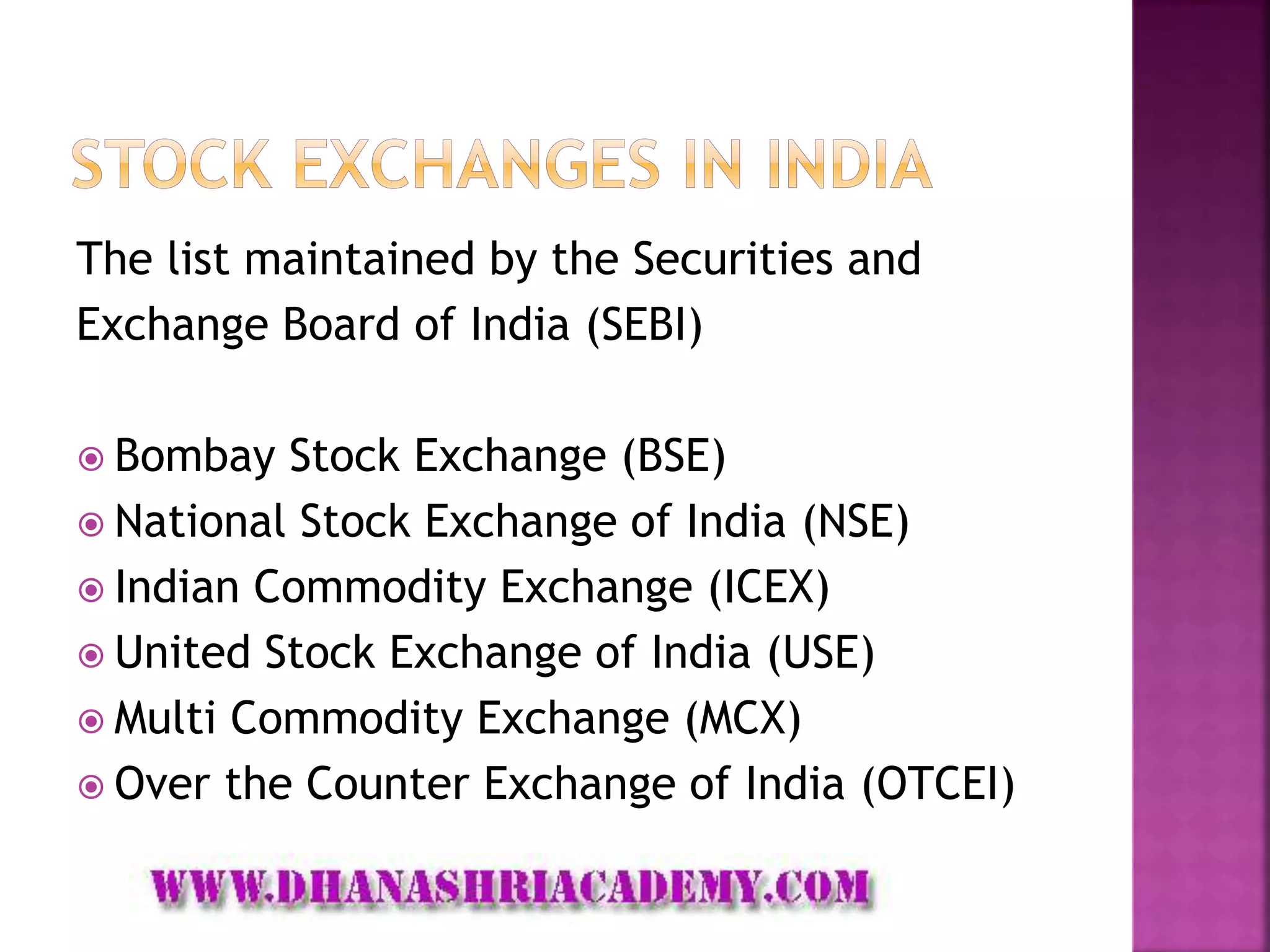







The list maintained by the Securities and
Exchange Board of India (SEBI)
 Bombay Stock Exchange (BSE)
 National Stock Exchange of India (NSE)
 Indian Commodity Exchange (ICEX)
 United Stock Exchange of India (USE)
 Multi Commodity Exchange (MCX)
 Over the Counter Exchange of India (OTCEI)
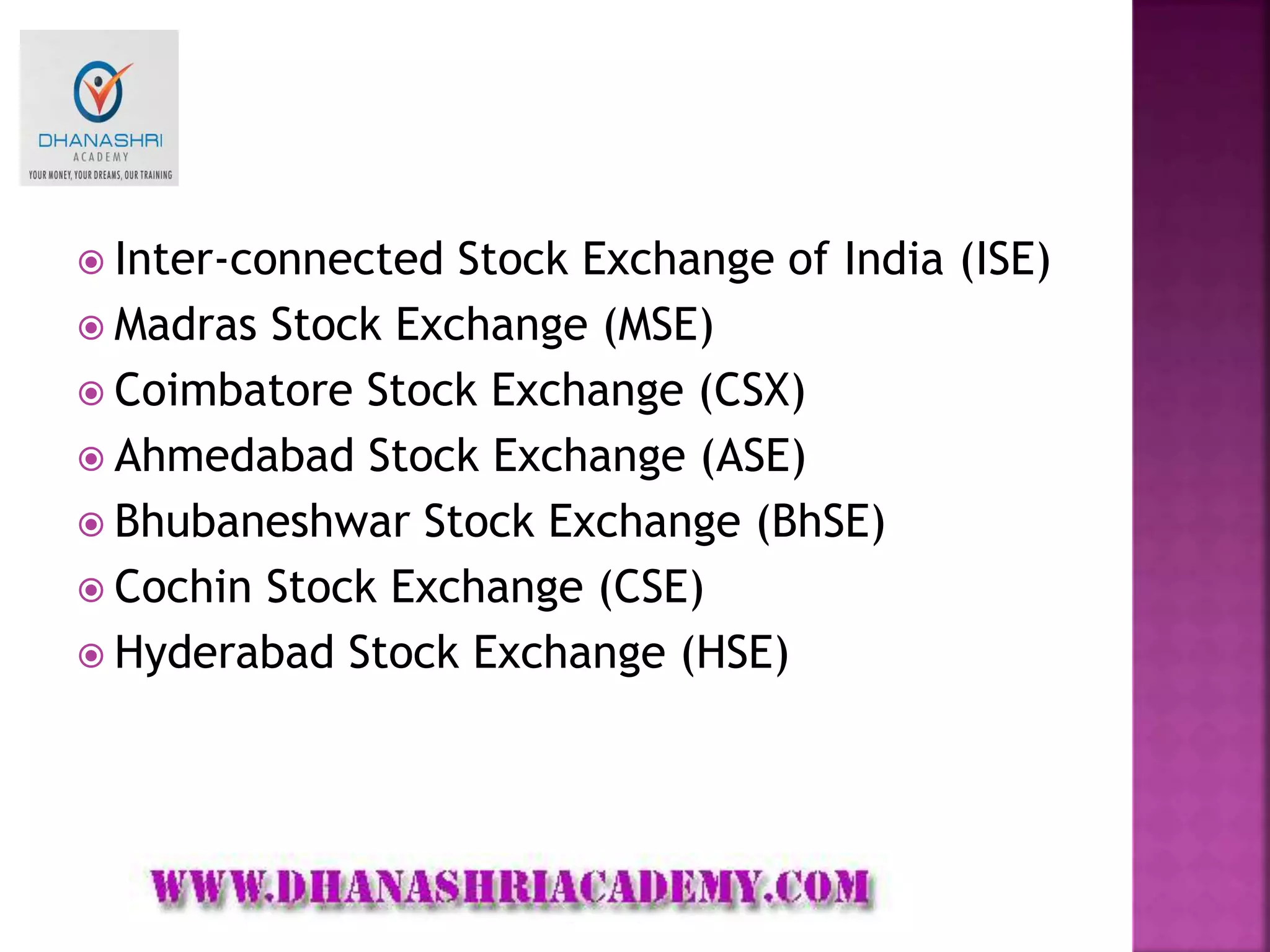
 Inter-connected Stock Exchange of India (ISE)
 Madras Stock Exchange (MSE)
 Coimbatore Stock Exchange (CSX)
 Ahmedabad Stock Exchange (ASE)
 Bhubaneshwar Stock Exchange (BhSE)
 Cochin Stock Exchange (CSE)
 Hyderabad Stock Exchange (HSE)
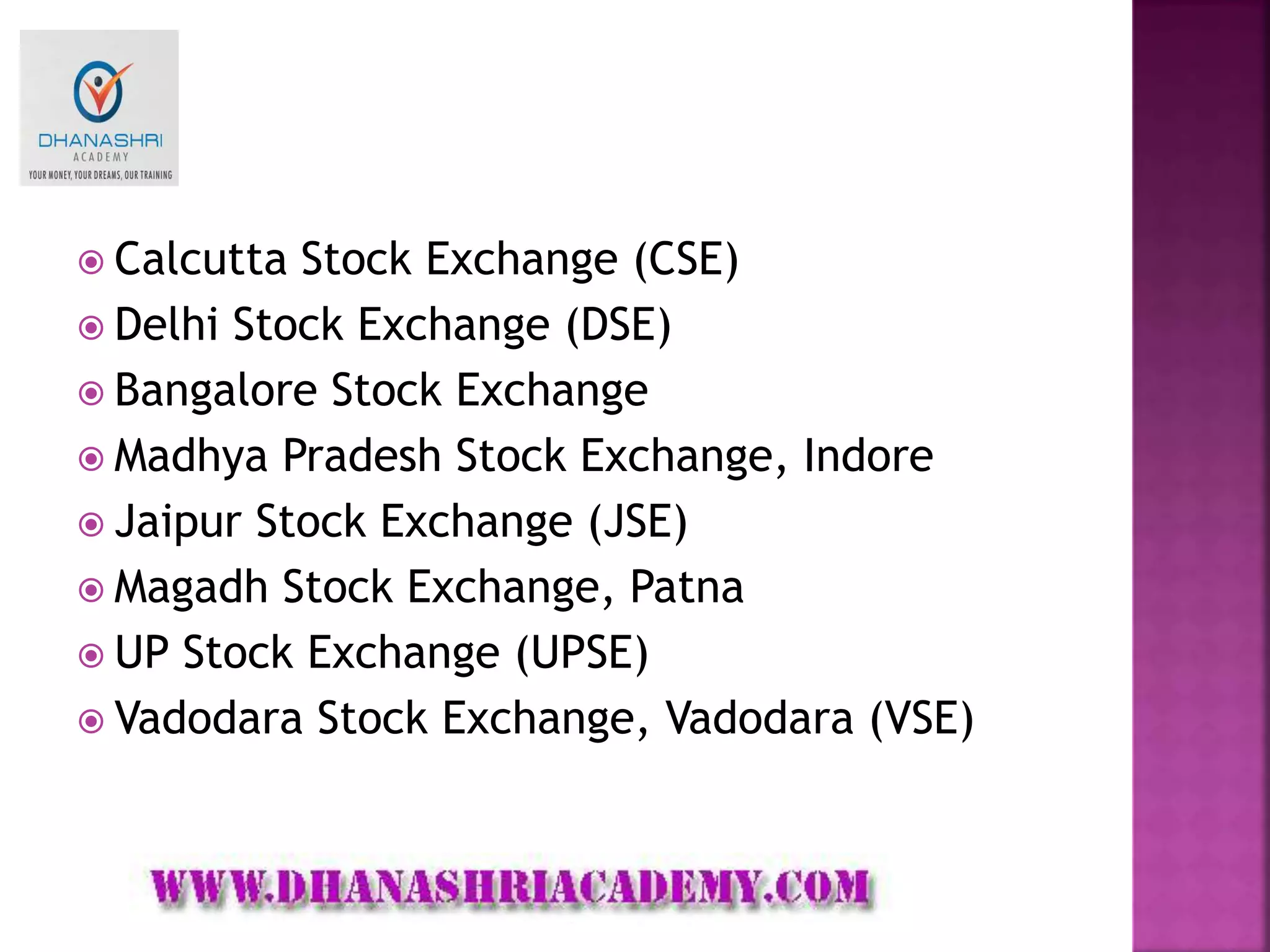
 Calcutta Stock Exchange (CSE)
 Delhi Stock Exchange (DSE)
 Bangalore Stock Exchange
 Madhya Pradesh Stock Exchange, Indore
 Jaipur Stock Exchange (JSE)
 Magadh Stock Exchange, Patna
 UP Stock Exchange (UPSE)
 Vadodara Stock Exchange, Vadodara (VSE)
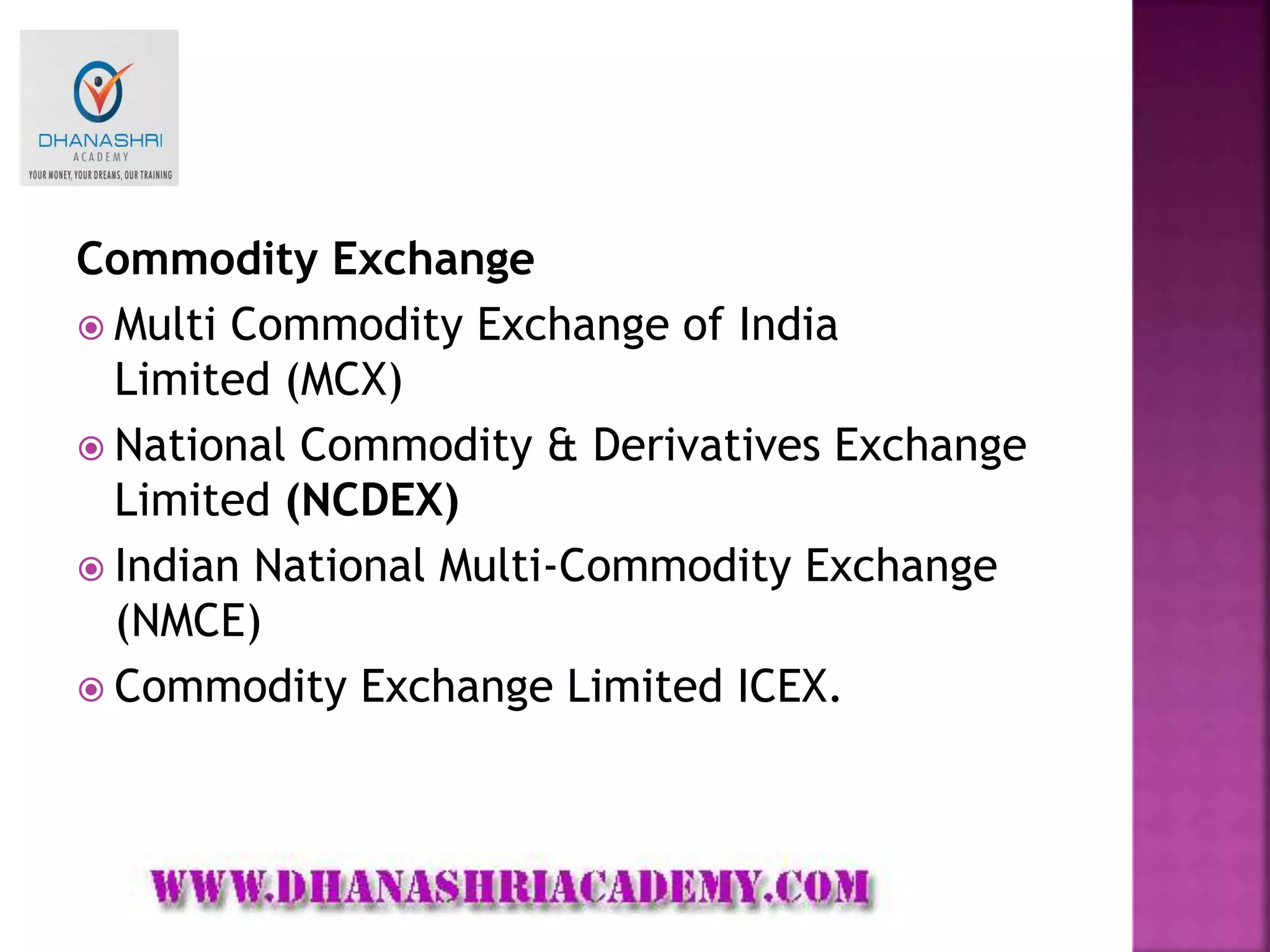
Commodity Exchange
 Multi Commodity Exchange of India
Limited (MCX)
 National Commodity & Derivatives Exchange
Limited (NCDEX)
 Indian National Multi-Commodity Exchange
(NMCE)
 Commodity Exchange Limited ICEX.
 An initial public offering (IPO) or stock
market launch is a type of public
offering where shares of stock in a company
are sold to the general public, on a securities
exchange, for the first time. Through this
process, a private company transforms into
a public company.
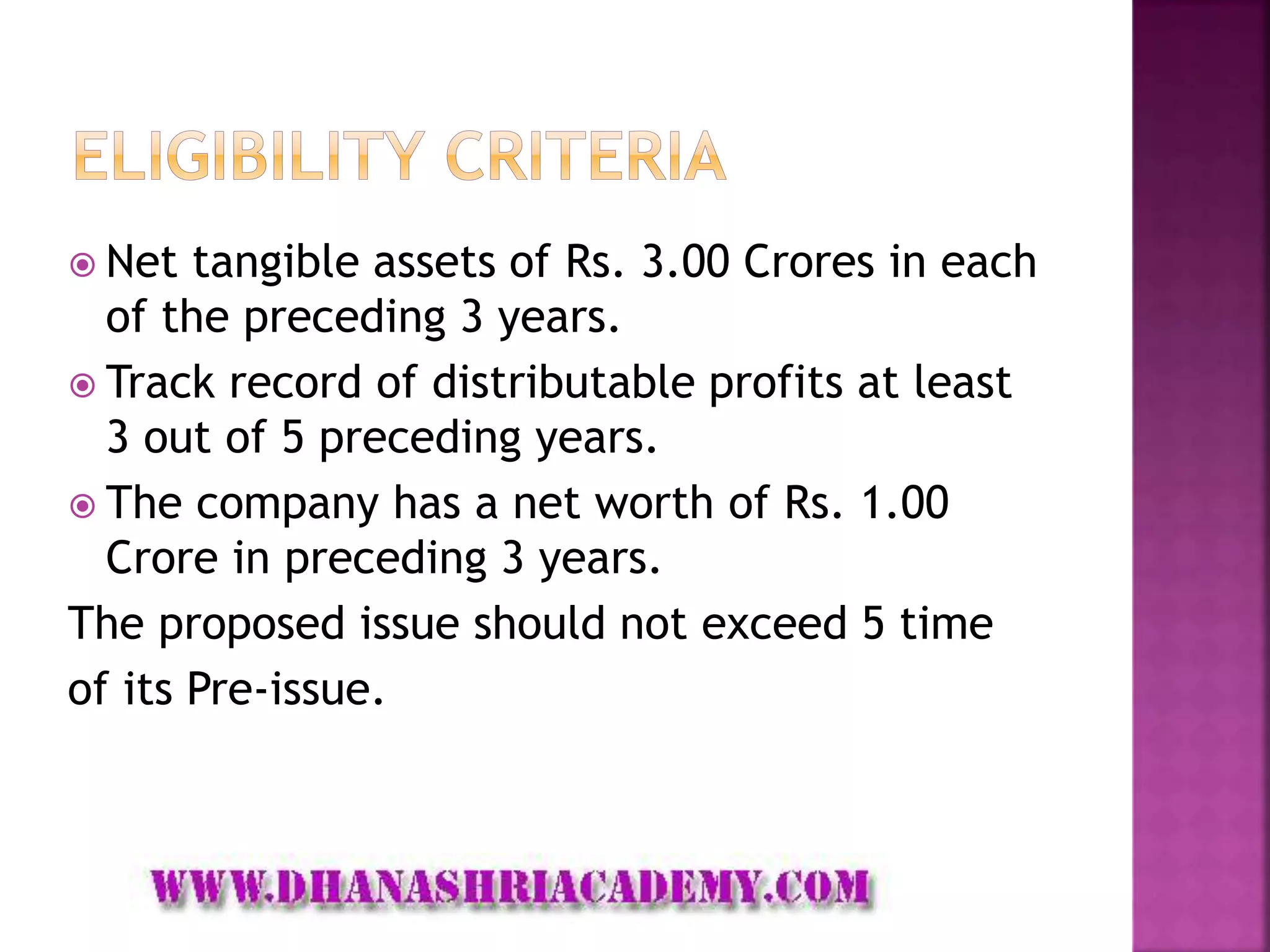
 IPOs are used by companies to raise
expansion capital, to possibly monetize the
investments of early private investors, and to
become publicly traded enterprises.
 A company selling shares is never required to
repay the capital to its public investors.
 After the IPO, when shares trade freely in
the open market, money passes between
public investors.
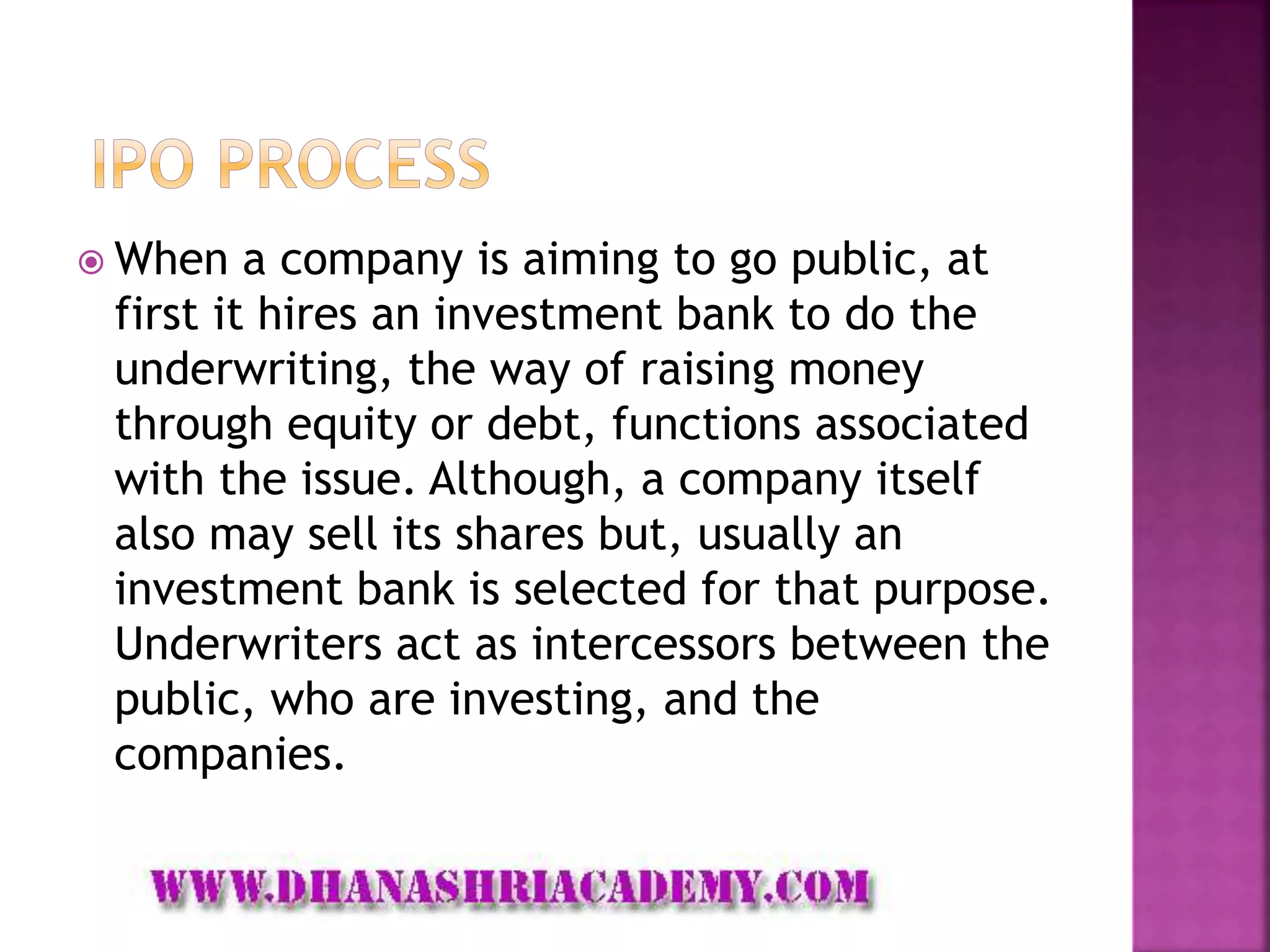
 Net tangible assets of Rs. 3.00 Crores in each
of the preceding 3 years.
 Track record of distributable profits at least
3 out of 5 preceding years.
 The company has a net worth of Rs. 1.00
Crore in preceding 3 years.
The proposed issue should not exceed 5 time
of its Pre-issue.
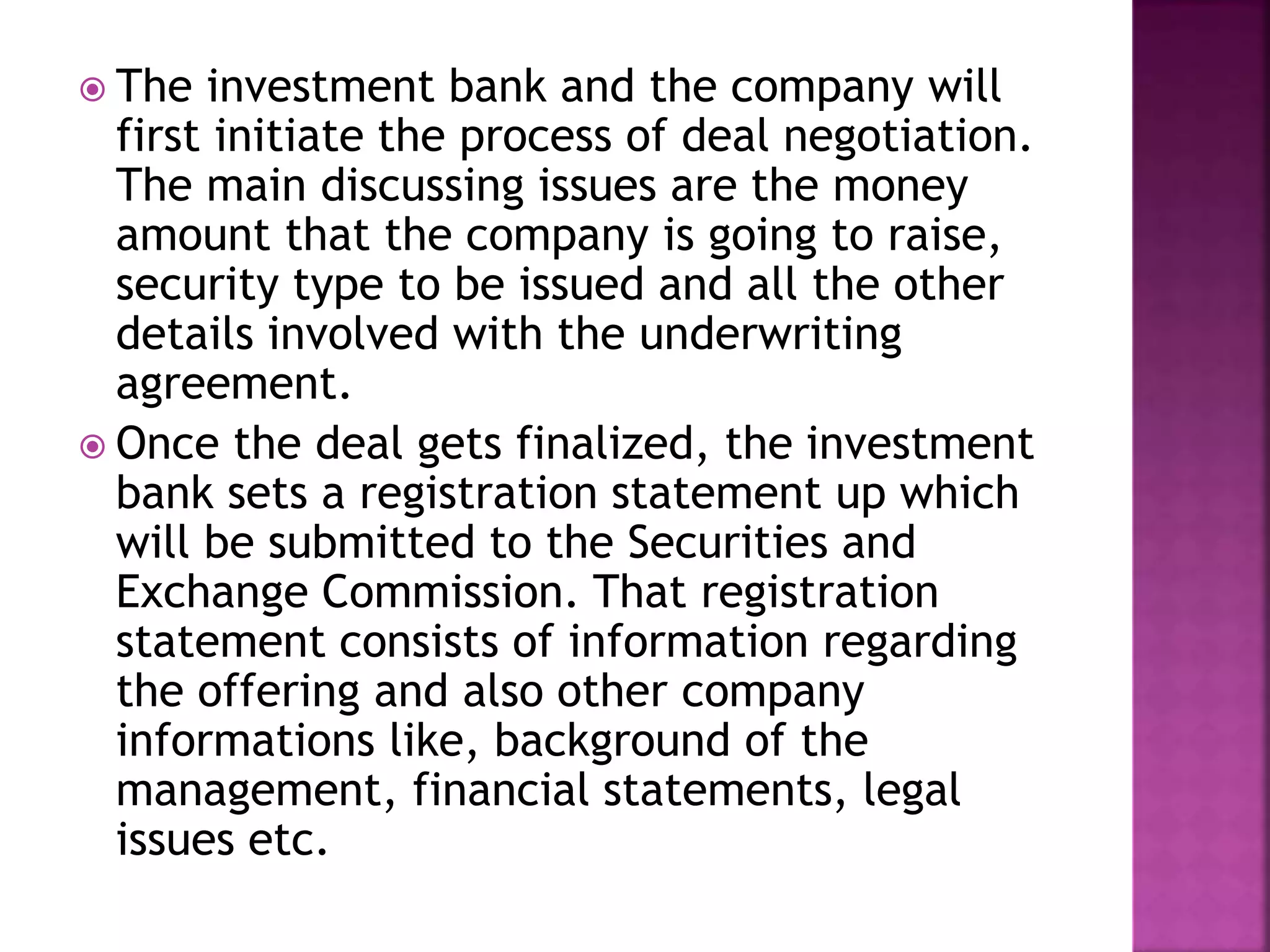
 When a company is aiming to go public, at
first it hires an investment bank to do the
underwriting, the way of raising money
through equity or debt, functions associated
with the issue. Although, a company itself
also may sell its shares but, usually an
investment bank is selected for that purpose.
Underwriters act as intercessors between the
public, who are investing, and the
companies.
 The investment bank and the company will
first initiate the process of deal negotiation.
The main discussing issues are the money
amount that the company is going to raise,
security type to be issued and all the other
details involved with the underwriting
agreement.
 Once the deal gets finalized, the investment
bank sets a registration statement up which
will be submitted to the Securities and
Exchange Commission. That registration
statement consists of information regarding
the offering and also other company
informations like, background of the
management, financial statements, legal
issues etc.
 Then the Securities and Exchange
Commission (SEC) needs a cooling off period
during which it will examine all the
submitted documents and make sure that
all information regarding the deal have
been given to them. After getting the SEC's
approval, a date is going to be fixed on
which the company will offer the stock to
the public.
 During the above mentioned cooling off
period the underwriter publishes an initial
prospectus that contains all the necessary
information regarding the company. The
effective date of issuing the stock as well as
the price have not been mentioned in the
prospectus, for these are not known at this
time.
 Then the company and the underwriter
meets to decide the price of the stock. This
decision depends highly on the current
market condition.
 Lastly, the stocks are sold in the market and
money is raised from the investors.
 Book building is usually a process used in IPO
which helps to determine price and demand
discovery.
 It is a process used for marketing a public
offer of equity shares of a company. It is a
process where, during the period for which
the book for IPO is open, bids are collected
from investors at various prices, which are
above or equal to floor price.
 The offer/issue price is then determined
after the last date of IPO based on certain
evaluation criteria.
 The underwriters are appointed who commit
to shoulder the liability and subscribe to the
shortfall in case the issue is under-
subscribed. For this commitment they are
entitled to a maximum commission of 2.5%
on the amount underwritten
 Registrars process the application forms,
tabulate the amounts collected during the
issue and initiate the allotment procedures.
 Recognized members of the Stock Exchanges
are appointed as brokers to the issue for
marketing the issue.
 They are eligible for a maximum brokerage
of 1.5%.
 Lawyers are appointed by company to ensure
that all the agreements they enter are as per
the rules and regulations.
 A draft prospectus is prepared giving out
details of the company, promoters,
background, management, terms of the
issue, project details, modes of financing,
past financial performance, projected
profitability and others.
 The lead manager has to verify and certify
the facts stated in the draft prospectus and
ensure that the company is not making any
false claims. Which is to be filed with SEBI
(Securities and Exchange Board of India) 21
days before IPO, SEBI gives its observation
and recommends necessary changes.
 The prospectus along with the copies of the
agreements entered into with the Lead
Manager, Underwriters, Bankers, Registrars
and Brokers to the issue is filed with the
Registrar of the Companies of the state
where the registered office of the company
is located.
 The prospectus and application forms are
printed and dispatched to all the merchant
bankers, underwriters, brokers to the issue.
What is an Initial Public Offering | Stock Market IPO

What is an Initial Public Offering | Stock Market IPO

  • 2.
    The list maintainedby the Securities and Exchange Board of India (SEBI)  Bombay Stock Exchange (BSE)  National Stock Exchange of India (NSE)  Indian Commodity Exchange (ICEX)  United Stock Exchange of India (USE)  Multi Commodity Exchange (MCX)  Over the Counter Exchange of India (OTCEI)
  • 3.
     Inter-connected StockExchange of India (ISE)  Madras Stock Exchange (MSE)  Coimbatore Stock Exchange (CSX)  Ahmedabad Stock Exchange (ASE)  Bhubaneshwar Stock Exchange (BhSE)  Cochin Stock Exchange (CSE)  Hyderabad Stock Exchange (HSE)
  • 4.
     Calcutta StockExchange (CSE)  Delhi Stock Exchange (DSE)  Bangalore Stock Exchange  Madhya Pradesh Stock Exchange, Indore  Jaipur Stock Exchange (JSE)  Magadh Stock Exchange, Patna  UP Stock Exchange (UPSE)  Vadodara Stock Exchange, Vadodara (VSE)
  • 5.
    Commodity Exchange  MultiCommodity Exchange of India Limited (MCX)  National Commodity & Derivatives Exchange Limited (NCDEX)  Indian National Multi-Commodity Exchange (NMCE)  Commodity Exchange Limited ICEX.
  • 6.
     An initialpublic offering (IPO) or stock market launch is a type of public offering where shares of stock in a company are sold to the general public, on a securities exchange, for the first time. Through this process, a private company transforms into a public company.
  • 7.
     IPOs areused by companies to raise expansion capital, to possibly monetize the investments of early private investors, and to become publicly traded enterprises.  A company selling shares is never required to repay the capital to its public investors.  After the IPO, when shares trade freely in the open market, money passes between public investors.
  • 8.
     Net tangibleassets of Rs. 3.00 Crores in each of the preceding 3 years.  Track record of distributable profits at least 3 out of 5 preceding years.  The company has a net worth of Rs. 1.00 Crore in preceding 3 years. The proposed issue should not exceed 5 time of its Pre-issue.
  • 9.
     When acompany is aiming to go public, at first it hires an investment bank to do the underwriting, the way of raising money through equity or debt, functions associated with the issue. Although, a company itself also may sell its shares but, usually an investment bank is selected for that purpose. Underwriters act as intercessors between the public, who are investing, and the companies.
  • 10.
     The investmentbank and the company will first initiate the process of deal negotiation. The main discussing issues are the money amount that the company is going to raise, security type to be issued and all the other details involved with the underwriting agreement.  Once the deal gets finalized, the investment bank sets a registration statement up which will be submitted to the Securities and Exchange Commission. That registration statement consists of information regarding the offering and also other company informations like, background of the management, financial statements, legal issues etc.
  • 11.
     Then theSecurities and Exchange Commission (SEC) needs a cooling off period during which it will examine all the submitted documents and make sure that all information regarding the deal have been given to them. After getting the SEC's approval, a date is going to be fixed on which the company will offer the stock to the public.
  • 12.
     During theabove mentioned cooling off period the underwriter publishes an initial prospectus that contains all the necessary information regarding the company. The effective date of issuing the stock as well as the price have not been mentioned in the prospectus, for these are not known at this time.  Then the company and the underwriter meets to decide the price of the stock. This decision depends highly on the current market condition.  Lastly, the stocks are sold in the market and money is raised from the investors.
  • 13.
     Book buildingis usually a process used in IPO which helps to determine price and demand discovery.  It is a process used for marketing a public offer of equity shares of a company. It is a process where, during the period for which the book for IPO is open, bids are collected from investors at various prices, which are above or equal to floor price.  The offer/issue price is then determined after the last date of IPO based on certain evaluation criteria.
  • 14.
     The underwritersare appointed who commit to shoulder the liability and subscribe to the shortfall in case the issue is under- subscribed. For this commitment they are entitled to a maximum commission of 2.5% on the amount underwritten
  • 15.
     Registrars processthe application forms, tabulate the amounts collected during the issue and initiate the allotment procedures.
  • 16.
     Recognized membersof the Stock Exchanges are appointed as brokers to the issue for marketing the issue.  They are eligible for a maximum brokerage of 1.5%.
  • 17.
     Lawyers areappointed by company to ensure that all the agreements they enter are as per the rules and regulations.
  • 18.
     A draftprospectus is prepared giving out details of the company, promoters, background, management, terms of the issue, project details, modes of financing, past financial performance, projected profitability and others.  The lead manager has to verify and certify the facts stated in the draft prospectus and ensure that the company is not making any false claims. Which is to be filed with SEBI (Securities and Exchange Board of India) 21 days before IPO, SEBI gives its observation and recommends necessary changes.
  • 19.
     The prospectusalong with the copies of the agreements entered into with the Lead Manager, Underwriters, Bankers, Registrars and Brokers to the issue is filed with the Registrar of the Companies of the state where the registered office of the company is located.
  • 20.
     The prospectusand application forms are printed and dispatched to all the merchant bankers, underwriters, brokers to the issue.