STOCK EXCHANGE
0 Presented by
Neelam kushwaha
SECURITY MARKET
0 Security Market means a place or area where the
shares, debenture, bonds of companies, government
securities, units and securities issued by financial
institutions and other financial assets are sold or
purchased. Mainly stock exchanges are known as
securities market. The securities market may be
divided into:
0 Primary market
0 Secondary market
PRIMARY MARKET
Primary Market is a market for new issues or new
financial claims. Hence, it is also called New Issue
Market. The primary market deals with those
securities which are issued to the public for first
time. In the primary market, borrowers exchange
new financial securities for long term funds. Thus,
primary market facilitates capital formation.
There are three ways by which a company may
raise capital in a primary market. They are:-
• Public issue
• Right issue
• Private placement
SECONDARY MARKET:
Secondary Market is a market for secondary sale of
securities. In other words, securities which have already
passed through the new issue market are traded in the
Market. Generally, such securities are quoted in the stock
exchange and it provides a continuous and regular market
for buying and selling of securities. This market consists of
all stock exchanges recognized by government of India.
The Secondary Market provides ready marketability to the
investors, which in turn results in improved liquidity to
investors without requiring them to hold the securities
indefinitely
STOCK EXCHANGE
Stock market which are also called as stock exchanges exist to
facilitate purchase and sale of securities or bonds issued by the
companies and Government. Any body of individual, whether
incorporated or not, constituted for the purpose of regulating or
controlling the business of buying, selling or dealing in securities is
called stock exchange. There are 24 stock exchanges today in India.
Stock exchanges are an integral part of a nation’s economic life
According to securities contract (regulation) act, 1956,
“Stock Exchange means any body of individuals, whether
incorporated or not, constituted for the purpose of assisting,
regulating or controlling the business of buying, selling or dealing
in securities”.
SOME QUESTION ABOUT INVESTMENT:-
 What's the difference between saving
and investing?
 Should I be investing in the stock market?
 What is the next step after
investment?
ACCOUNTS
POOL ACCOUNT
It is the account of the broker who sell the stock that stock taken
by the buyer and keep in the demat account. All clients demat
account is kept in pool account.
DEMAT ACCOUNT/ DP/ DEPOSITORY ACCOUNT
DEPOSITORY
ACCOUNT
DP-ID CLIENT-ID
Demat account is an account wherein you can hold shares of
various companies in the dematerialised {electronic} form. You
can open a Demat account with a share brokerage or a bank. You
should necessarily have a PAN card for opening such an account
Documents needed for opening Demat account?
PAN CARD
ONE PHOTOGRAPH FOR INDIVIDUAL, FOR JOINTLY-NOMINEE’S PHOTO
ADDRESS PROOF
ID PROOF
CANCEL CHEQUE PREFERABLY MICR
BANK STATEMENT
ADDITIONAL PROOF (ELECTRICITY BILL, TELEPHONE BILL, LICENSE,
RASAN CARD)
AMOUNT CHEQUE.
When all document given client/ buyer/ holder receive two copy of CMR
(client master report). One copy for client and another for company.
Standard charges for opening demat account
Opening charges Rs 250
AMC (Annual Maintenance Charges) Rs 300
• Bombay Stock Exchange is the oldest stock exchange in Asia What is
now popularly known as the BSE was established as "The Native
Share & Stock Brokers' Association" in 1875.
• The companies listed on BSE command a total market capitalization
of USD Trillion 1.28 as of Feb, 2010.
• BSE is the first exchange in India and the second in the world to obtain an ISO
9001:2000 certifications.
• It is also the first Exchange in the country and second in the world to
receive Information Security Management System Standard BS 7799-
2-2002 certification for its BSE On-Line trading System (BOLT).
• The BSE Index, SENSEX, is India's first and most popular Stock Market
benchmark index.
The National Stock Exchange of India Limited has
genesis in the report of the High Powered Study
Group on Establishment of New Stock Exchanges. It
recommended promotion of a National Stock
Exchange by financial institutions (FIs) to provide
access to investors from all across the country on an
equal footing. Based on the recommendations, NSE
was promoted by leading Financial Institutions at the
behest of the Government of India and was
incorporated in November 1992 as a tax-paying
company unlike other stock exchanges in the
country.
Commodity trading means trading in commodity
derivatives . Trading futures of commodities like natural
gas, aluminum, zinc, crude oil, gold, silver, agricultural
commodities etc. Commodity derivatives are traded at
the commodity exchanges.
COMMODITY
COMMODITY TRAND
NCDEX MCX
PRODUCTS
Bullions Metals Energy Oil & Oil
Seeds
Other
Gold Aluminium ATF Crude Palm
Oil
Almond
Gold Guinea Copper Crude Oil Kapasia Khalli
Mentha Oil
Gold HNI Lead Gasoline Refined Soya
Oil
Pulses
Platinum Nickel Heating
Oil
Soya Bean Fiber
Silver Tin, Zinc Natural
Gas
Spices
Silver M Zinc Mini
BSE
MARKET WATCH
BUY ORDER
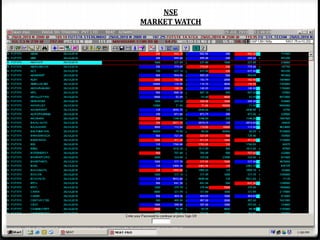
NSE
MARKET WATCH
TYPES OF
TRADING
Intra-day Trader
The stock or futures day trader is someone who is buying and selling
intraday. They tend to do this with frequency throughout the day.
A day trader attempts to take advantage of price swings within a day.
Day trading is the most rewarding in very short time (in few minutes
to few hours).
But in intraday trading one has to be very fast and quick.
Day traders are not interested in the fundamental or intrinsic value
of stocks, but in price fluctuations during market hours.
Day trader’s goal is to make money by capturing the quick moves in
very short time.
Important rules to follow as an Intra-
day Trader
*Be with current market trend
* Always place a stop-loss.
* Shift trailing stop loss to breakeven
to run the profit.
Future and Option
Trading
Futures contract is a financial contract obligating the
buyer to purchase an asset (or the seller to sell an
asset), such as a physical commodity or a financial
instrument, at a predetermined future date and price.
Futures contracts detail the quality and quantity of
the underlying asset; they are standardized to
facilitate trading on a futures exchange. Some futures
contracts may call for physical delivery of the asset,
while others are settled in cash. The futures markets
are characterized by the ability to use very high
leverage relative to stock markets.
Types of Option
contract:
Call
A call option conveys to the option buyer the right to
purchase a particular futures contract at a stated price at
any time during the life of the option.
Put
If the price remains above strike price, premium will erode as time
decay and at expiry, premium will become zero. So maximum loss
is limited to premium only.
A put option conveys to the option buyer the right to sell a
particular futures contract at a stated price at any time during the
life of the option.

Stock Exchange

  • 1.
    STOCK EXCHANGE 0 Presentedby Neelam kushwaha
  • 2.
    SECURITY MARKET 0 SecurityMarket means a place or area where the shares, debenture, bonds of companies, government securities, units and securities issued by financial institutions and other financial assets are sold or purchased. Mainly stock exchanges are known as securities market. The securities market may be divided into: 0 Primary market 0 Secondary market
  • 3.
    PRIMARY MARKET Primary Marketis a market for new issues or new financial claims. Hence, it is also called New Issue Market. The primary market deals with those securities which are issued to the public for first time. In the primary market, borrowers exchange new financial securities for long term funds. Thus, primary market facilitates capital formation. There are three ways by which a company may raise capital in a primary market. They are:- • Public issue • Right issue • Private placement
  • 4.
    SECONDARY MARKET: Secondary Marketis a market for secondary sale of securities. In other words, securities which have already passed through the new issue market are traded in the Market. Generally, such securities are quoted in the stock exchange and it provides a continuous and regular market for buying and selling of securities. This market consists of all stock exchanges recognized by government of India. The Secondary Market provides ready marketability to the investors, which in turn results in improved liquidity to investors without requiring them to hold the securities indefinitely
  • 5.
    STOCK EXCHANGE Stock marketwhich are also called as stock exchanges exist to facilitate purchase and sale of securities or bonds issued by the companies and Government. Any body of individual, whether incorporated or not, constituted for the purpose of regulating or controlling the business of buying, selling or dealing in securities is called stock exchange. There are 24 stock exchanges today in India. Stock exchanges are an integral part of a nation’s economic life According to securities contract (regulation) act, 1956, “Stock Exchange means any body of individuals, whether incorporated or not, constituted for the purpose of assisting, regulating or controlling the business of buying, selling or dealing in securities”.
  • 6.
    SOME QUESTION ABOUTINVESTMENT:-  What's the difference between saving and investing?  Should I be investing in the stock market?  What is the next step after investment?
  • 7.
    ACCOUNTS POOL ACCOUNT It isthe account of the broker who sell the stock that stock taken by the buyer and keep in the demat account. All clients demat account is kept in pool account. DEMAT ACCOUNT/ DP/ DEPOSITORY ACCOUNT DEPOSITORY ACCOUNT DP-ID CLIENT-ID Demat account is an account wherein you can hold shares of various companies in the dematerialised {electronic} form. You can open a Demat account with a share brokerage or a bank. You should necessarily have a PAN card for opening such an account
  • 8.
    Documents needed foropening Demat account? PAN CARD ONE PHOTOGRAPH FOR INDIVIDUAL, FOR JOINTLY-NOMINEE’S PHOTO ADDRESS PROOF ID PROOF CANCEL CHEQUE PREFERABLY MICR BANK STATEMENT ADDITIONAL PROOF (ELECTRICITY BILL, TELEPHONE BILL, LICENSE, RASAN CARD) AMOUNT CHEQUE. When all document given client/ buyer/ holder receive two copy of CMR (client master report). One copy for client and another for company. Standard charges for opening demat account Opening charges Rs 250 AMC (Annual Maintenance Charges) Rs 300
  • 9.
    • Bombay StockExchange is the oldest stock exchange in Asia What is now popularly known as the BSE was established as "The Native Share & Stock Brokers' Association" in 1875. • The companies listed on BSE command a total market capitalization of USD Trillion 1.28 as of Feb, 2010. • BSE is the first exchange in India and the second in the world to obtain an ISO 9001:2000 certifications. • It is also the first Exchange in the country and second in the world to receive Information Security Management System Standard BS 7799- 2-2002 certification for its BSE On-Line trading System (BOLT). • The BSE Index, SENSEX, is India's first and most popular Stock Market benchmark index.
  • 10.
    The National StockExchange of India Limited has genesis in the report of the High Powered Study Group on Establishment of New Stock Exchanges. It recommended promotion of a National Stock Exchange by financial institutions (FIs) to provide access to investors from all across the country on an equal footing. Based on the recommendations, NSE was promoted by leading Financial Institutions at the behest of the Government of India and was incorporated in November 1992 as a tax-paying company unlike other stock exchanges in the country.
  • 11.
    Commodity trading meanstrading in commodity derivatives . Trading futures of commodities like natural gas, aluminum, zinc, crude oil, gold, silver, agricultural commodities etc. Commodity derivatives are traded at the commodity exchanges. COMMODITY COMMODITY TRAND NCDEX MCX
  • 12.
    PRODUCTS Bullions Metals EnergyOil & Oil Seeds Other Gold Aluminium ATF Crude Palm Oil Almond Gold Guinea Copper Crude Oil Kapasia Khalli Mentha Oil Gold HNI Lead Gasoline Refined Soya Oil Pulses Platinum Nickel Heating Oil Soya Bean Fiber Silver Tin, Zinc Natural Gas Spices Silver M Zinc Mini
  • 13.
  • 14.
  • 15.
  • 16.
    TYPES OF TRADING Intra-day Trader Thestock or futures day trader is someone who is buying and selling intraday. They tend to do this with frequency throughout the day. A day trader attempts to take advantage of price swings within a day. Day trading is the most rewarding in very short time (in few minutes to few hours). But in intraday trading one has to be very fast and quick. Day traders are not interested in the fundamental or intrinsic value of stocks, but in price fluctuations during market hours. Day trader’s goal is to make money by capturing the quick moves in very short time.
  • 17.
    Important rules tofollow as an Intra- day Trader *Be with current market trend * Always place a stop-loss. * Shift trailing stop loss to breakeven to run the profit.
  • 18.
    Future and Option Trading Futurescontract is a financial contract obligating the buyer to purchase an asset (or the seller to sell an asset), such as a physical commodity or a financial instrument, at a predetermined future date and price. Futures contracts detail the quality and quantity of the underlying asset; they are standardized to facilitate trading on a futures exchange. Some futures contracts may call for physical delivery of the asset, while others are settled in cash. The futures markets are characterized by the ability to use very high leverage relative to stock markets.
  • 19.
    Types of Option contract: Call Acall option conveys to the option buyer the right to purchase a particular futures contract at a stated price at any time during the life of the option. Put If the price remains above strike price, premium will erode as time decay and at expiry, premium will become zero. So maximum loss is limited to premium only. A put option conveys to the option buyer the right to sell a particular futures contract at a stated price at any time during the life of the option.