_ KOMAL KASHISH
In the history of modern india , the socio-religious
reforms occupy a significant place. Social
reformers like Raja Rammohan Roy, Swami
Dayanand Sarawathi and Swami Vivekanand
were responsible for the social and cutural
awakening in India.
The spread of liberal ideas of the west provided
further stimulus for the emergence of reform
movements. These movements introduced
important changes in social an religious life of
the people of India.
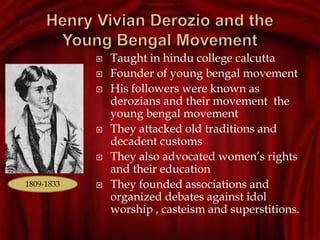
 Taught in hindu college calcutta
 Founder of young bengal movement
 His followers were known as
derozians and their movement the
young bengal movement
 They attacked old traditions and
decadent customs
 They also advocated women’s rights
and their education
 They founded associations and
organized debates against idol
worship , casteism and superstitions.
1809-1833
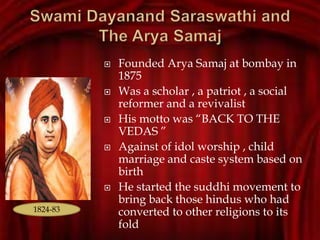
 Founded Arya Samaj at bombay in
1875
 Was a scholar , a patriot , a social
reformer and a revivalist
 His motto was “BACK TO THE
VEDAS ”
 Against of idol worship , child
marriage and caste system based on
birth
 He started the suddhi movement to
bring back those hindus who had
converted to other religions to its
fold
1824-83
 The Arya Samaj , though founded in Bombay ,
became very powerful in Punjab and spread its
influence to other parts of India.
 It has contributed much to the spread of
education.
 The Arya Samaj had also spread nationalism .
 Hundreds of Arya Samaj patriots , including
Lala Lajpat Rai , took part in the Indian
freedom struggle .
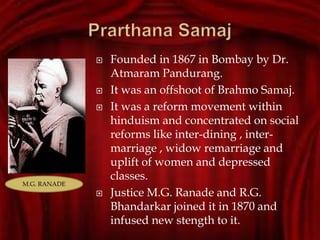
 Founded in 1867 in Bombay by Dr.
Atmaram Pandurang.
 It was an offshoot of Brahmo Samaj.
 It was a reform movement within
hinduism and concentrated on social
reforms like inter-dining , inter-
marriage , widow remarriage and
uplift of women and depressed
classes.
 Justice M.G. Ranade and R.G.
Bhandarkar joined it in 1870 and
infused new stength to it.
M.G. RANADE
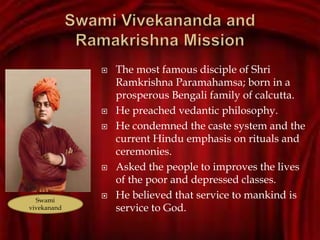
 The most famous disciple of Shri
Ramkrishna Paramahamsa; born in a
prosperous Bengali family of calcutta.
 He preached vedantic philosophy.
 He condemned the caste system and the
current Hindu emphasis on rituals and
ceremonies.
 Asked the people to improves the lives
of the poor and depressed classes.
 He believed that service to mankind is
service to God.
Swami
vivekanand
 He founded the Ramkrishna Mission at Belur
in Howrah in 1897.
 It is a social service and charitable society.
 The objective of this mission are providing
humanitarian relief and social work through
the estabishment of schools , colleges ,
hospitals and orphanages.
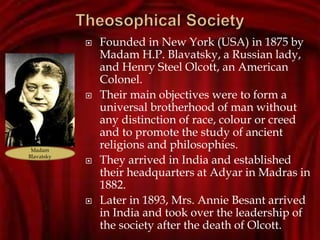
 Founded in New York (USA) in 1875 by
Madam H.P. Blavatsky, a Russian lady,
and Henry Steel Olcott, an American
Colonel.
 Their main objectives were to form a
universal brotherhood of man without
any distinction of race, colour or creed
and to promote the study of ancient
religions and philosophies.
 They arrived in India and established
their headquarters at Adyar in Madras in
1882.
 Later in 1893, Mrs. Annie Besant arrived
in India and took over the leadership of
the society after the death of Olcott.
Madam
Blavatsky
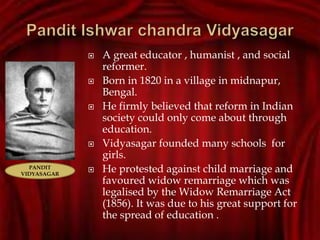
 A great educator , humanist , and social
reformer.
 Born in 1820 in a village in midnapur,
Bengal.
 He firmly believed that reform in Indian
society could only come about through
education.
 Vidyasagar founded many schools for
girls.
 He protested against child marriage and
favoured widow remarriage which was
legalised by the Widow Remarriage Act
(1856). It was due to his great support for
the spread of education .
PANDIT
VIDYASAGAR
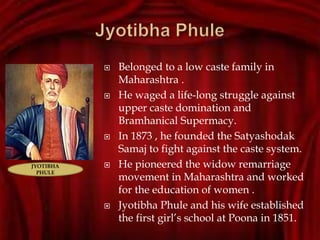
 Belonged to a low caste family in
Maharashtra .
 He waged a life-long struggle against
upper caste domination and
Bramhanical Supermacy.
 In 1873 , he founded the Satyashodak
Samaj to fight against the caste system.
 He pioneered the widow remarriage
movement in Maharashtra and worked
for the education of women .
 Jyotibha Phule and his wife established
the first girl’s school at Poona in 1851.
JYOTIBHA
PHULE
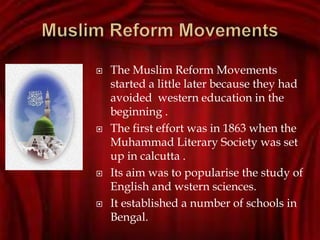
 The Muslim Reform Movements
started a little later because they had
avoided western education in the
beginning .
 The first effort was in 1863 when the
Muhammad Literary Society was set
up in calcutta .
 Its aim was to popularise the study of
English and wstern sciences.
 It established a number of schools in
Bengal.
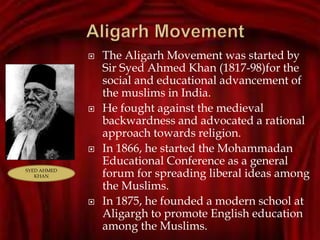
 The Aligarh Movement was started by
Sir Syed Ahmed Khan (1817-98)for the
social and educational advancement of
the muslims in India.
 He fought against the medieval
backwardness and advocated a rational
approach towards religion.
 In 1866, he started the Mohammadan
Educational Conference as a general
forum for spreading liberal ideas among
the Muslims.
 In 1875, he founded a modern school at
Aligargh to promote English education
among the Muslims.
SYED AHMED
KHAN
SYED AHMED
KHAN
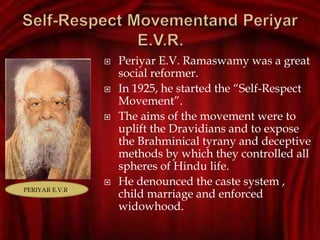
 Periyar E.V. Ramaswamy was a great
social reformer.
 In 1925, he started the “Self-Respect
Movement”.
 The aims of the movement were to
uplift the Dravidians and to expose
the Brahminical tyrany and deceptive
methods by which they controlled all
spheres of Hindu life.
 He denounced the caste system ,
child marriage and enforced
widowhood.
PERIYAR E.V.R.
 The Deoband School Movement
 Sikh Reform Movement
 Parsi Reform Movement
 Saint Ramalinga
 Sri Vaikunda Swamigal
Socio religious movements in india

Socio religious movements in india

  • 1.
  • 2.
    In the historyof modern india , the socio-religious reforms occupy a significant place. Social reformers like Raja Rammohan Roy, Swami Dayanand Sarawathi and Swami Vivekanand were responsible for the social and cutural awakening in India. The spread of liberal ideas of the west provided further stimulus for the emergence of reform movements. These movements introduced important changes in social an religious life of the people of India.
  • 5.
     Taught inhindu college calcutta  Founder of young bengal movement  His followers were known as derozians and their movement the young bengal movement  They attacked old traditions and decadent customs  They also advocated women’s rights and their education  They founded associations and organized debates against idol worship , casteism and superstitions. 1809-1833
  • 6.
     Founded AryaSamaj at bombay in 1875  Was a scholar , a patriot , a social reformer and a revivalist  His motto was “BACK TO THE VEDAS ”  Against of idol worship , child marriage and caste system based on birth  He started the suddhi movement to bring back those hindus who had converted to other religions to its fold 1824-83
  • 7.
     The AryaSamaj , though founded in Bombay , became very powerful in Punjab and spread its influence to other parts of India.  It has contributed much to the spread of education.  The Arya Samaj had also spread nationalism .  Hundreds of Arya Samaj patriots , including Lala Lajpat Rai , took part in the Indian freedom struggle .
  • 8.
     Founded in1867 in Bombay by Dr. Atmaram Pandurang.  It was an offshoot of Brahmo Samaj.  It was a reform movement within hinduism and concentrated on social reforms like inter-dining , inter- marriage , widow remarriage and uplift of women and depressed classes.  Justice M.G. Ranade and R.G. Bhandarkar joined it in 1870 and infused new stength to it. M.G. RANADE
  • 9.
     The mostfamous disciple of Shri Ramkrishna Paramahamsa; born in a prosperous Bengali family of calcutta.  He preached vedantic philosophy.  He condemned the caste system and the current Hindu emphasis on rituals and ceremonies.  Asked the people to improves the lives of the poor and depressed classes.  He believed that service to mankind is service to God. Swami vivekanand
  • 10.
     He foundedthe Ramkrishna Mission at Belur in Howrah in 1897.  It is a social service and charitable society.  The objective of this mission are providing humanitarian relief and social work through the estabishment of schools , colleges , hospitals and orphanages.
  • 11.
     Founded inNew York (USA) in 1875 by Madam H.P. Blavatsky, a Russian lady, and Henry Steel Olcott, an American Colonel.  Their main objectives were to form a universal brotherhood of man without any distinction of race, colour or creed and to promote the study of ancient religions and philosophies.  They arrived in India and established their headquarters at Adyar in Madras in 1882.  Later in 1893, Mrs. Annie Besant arrived in India and took over the leadership of the society after the death of Olcott. Madam Blavatsky
  • 12.
     A greateducator , humanist , and social reformer.  Born in 1820 in a village in midnapur, Bengal.  He firmly believed that reform in Indian society could only come about through education.  Vidyasagar founded many schools for girls.  He protested against child marriage and favoured widow remarriage which was legalised by the Widow Remarriage Act (1856). It was due to his great support for the spread of education . PANDIT VIDYASAGAR
  • 13.
     Belonged toa low caste family in Maharashtra .  He waged a life-long struggle against upper caste domination and Bramhanical Supermacy.  In 1873 , he founded the Satyashodak Samaj to fight against the caste system.  He pioneered the widow remarriage movement in Maharashtra and worked for the education of women .  Jyotibha Phule and his wife established the first girl’s school at Poona in 1851. JYOTIBHA PHULE
  • 14.
     The MuslimReform Movements started a little later because they had avoided western education in the beginning .  The first effort was in 1863 when the Muhammad Literary Society was set up in calcutta .  Its aim was to popularise the study of English and wstern sciences.  It established a number of schools in Bengal.
  • 15.
     The AligarhMovement was started by Sir Syed Ahmed Khan (1817-98)for the social and educational advancement of the muslims in India.  He fought against the medieval backwardness and advocated a rational approach towards religion.  In 1866, he started the Mohammadan Educational Conference as a general forum for spreading liberal ideas among the Muslims.  In 1875, he founded a modern school at Aligargh to promote English education among the Muslims. SYED AHMED KHAN SYED AHMED KHAN
  • 16.
     Periyar E.V.Ramaswamy was a great social reformer.  In 1925, he started the “Self-Respect Movement”.  The aims of the movement were to uplift the Dravidians and to expose the Brahminical tyrany and deceptive methods by which they controlled all spheres of Hindu life.  He denounced the caste system , child marriage and enforced widowhood. PERIYAR E.V.R.
  • 17.
     The DeobandSchool Movement  Sikh Reform Movement  Parsi Reform Movement  Saint Ramalinga  Sri Vaikunda Swamigal