India: Heritage, Culture, &
Customs
Which India: Rural or Urban?
• Rural/Urban: 70/30 (US 30/70)
• Father of India
    • Mohandas Karamchand
       Gandhi (Gandhiji)
“India does not live in her
   cities, … … she lives in her
   villages” – M.K. Gandhi,
   1931.
• My Grandfather
    • Sardar A. Vedaratnam
       Pillai
Firm believer in educating
   women. India can attain self-
   sufficiency only when rural
   women have education and
   economic status in free India.

                                    2
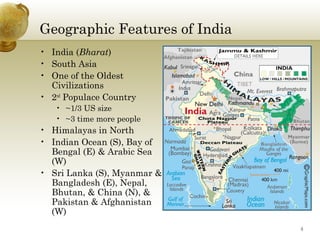
Geographic Features of India
• India (Bharat)
• South Asia
• One of the Oldest
  Civilizations
• 2nd Populace Country
   • ~1/3 US size
   • ~3 time more people
• Himalayas in North
• Indian Ocean (S), Bay of
  Bengal (E) & Arabic Sea
  (W)
• Sri Lanka (S), Myanmar &
  Bangladesh (E), Nepal,
  Bhutan, & China (N), &
  Pakistan & Afghanistan
  (W)
                               3
Environment of India
•   North: Himalayas
•   South, East, & West: Seas
•   Latitude: (E-W): 32°-10°N
•   Longitude: (N-S): 70-90°E
    • Tallahassee (30°N; 84°W)
• Summer: March to June
• Monsoon: June to October
• Winter: October to March


                                 wikipedia.org
                                                 4
Government
• Gained Independence from British on August 15, 1947
• Became a Democratic Republic on January 26, 1950
   • Constitution of India adopted
   • 395 Articles and 7 Schedules
   • 93 Amendments
• President Head of the State
• Parliament
• Prime Minister
• Council of Ministers
• Members of the Parliament
• Based on British System


                                                        5
Government of India (Central)
• Parliament
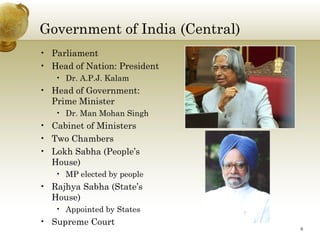
• Head of Nation: President
   • Dr. A.P.J. Kalam
• Head of Government:
  Prime Minister
   • Dr. Man Mohan Singh
• Cabinet of Ministers
• Two Chambers
• Lokh Sabha (People’s
  House)
   • MP elected by people
• Rajhya Sabha (State’s
  House)
   • Appointed by States
• Supreme Court
                                6
Government of India (State)
• States are Semi-
  Independent
• Head of State: Governor
• Head of Government: Chief
  Minister
• Cabinet of Ministers
• Members of Legislative
  Assembly (Elected)
• Members of Legislative
  Council (Appointed)
• Regional Parties (DMK,
  TD)
• National Parties
  (Congress, Janata Dal)

                              7
Economy of India
• Traditional
   •   Legacy-System
   •   Agrarian
   •   Textile
   •   Raw Materials
   •   Spices
   •   Jewelry
• Modern
   • Knowledge-Based
   • Information Technology
   • Out-Sourcing
   • Customer Service (English
     helps!)
   • Manufacturing (Low cost
     qualified people)


                                 8
Education in India
• State is Responsible            • Literacy Rate (A person
• Age 5-16 Free                     who can read and write in
   •   Elementary 1-5 grades        any language)
   •   Middle 6-8 grades             • Male: 75% (2001)
   •   High 9-12                     • Female: 54% (2001)
   •   State & Private            • Sex Ratio
   •   Local Language & English
                                     • 933 F / 1000 M (2001)
• College
                                  • Population
   • Taught in English (British
     Legacy)                         • 1.03 Billion (2001)
   • Bachelors                       • 5.3 person/household
   • Masters
   • Professional
   • Doctoral
   • Mostly Private


                                                                9
Religion in India
• India is a Secular Country
• No State Sponsored Religion
• Major Religions
   •   Hindu: 75%
   •   Muslim: 12%
   •   Christian: 6%
   •   Sikh, Jain, Buddhist, &
       Jews: 7%
• Ironically religion is a
  uniting feature
• Hinduism is non
  proselytizing
• No preaching
• Most people are tolerant
• Very private
• Becoming less important        Encarta
                                           10
Languages in India
• Twenty-two (22)
• Official Languages:
   • Hindi
   • Language of the State
   • English
• Languages Demarcate
  States
• North India                    Tamil
   • Sanskrit (like Latin)
   • Indo-Iranian-Germanic
     Branch
   • Hindi, Bengali, Gujarati,
     & Marathi
• South India
   • Dravidian Branch
   • Tamil, Malayalam,
     Telugu, and Kannada
                                         11
Health Care in India
• Insurance is Rare < 8%      • Private
• Life Expectancy: 63 (M) |      • Private Doctors &
  65 (F) (74 & 80 US)              Facilities
• Infant Mortality: 60/1000      • Pay for Service
  live births (6/1000 US)        • Reasonable Service
• Public Health Services      • Middle Class & Rich
   • Covers 20% Population       • Get Good Service
   • 150,000 Centers             • Qualified Physicians
   • 23,000 Primary Care         • Attracting Foreigners
     Facilities               • Average Folks
   • Government Doctors &        • Go only when sick
     Facilities                  • Avoid costly procedures
   • Waiting Lines               • Indebtedness in rural
   • No Fees!                      areas
   • Pervasive Corruption
   • Lack of Amenities
        Encarta
                                                             12
Family & Women
• Family is the Main Unit   • Status of Women
   • Joint Families           Improving
   • Family Comes First        • More are Educated
   • Individuals Less          • More have Jobs
     Important                 • More Acceptance of
   • Patriarchal System          Working Women
   • Divorce Less Common       • Economic Necessity
       • Social Factors        • More Progress Expected
       • Economic Factors
       • Children


                                                          13
Travel in India
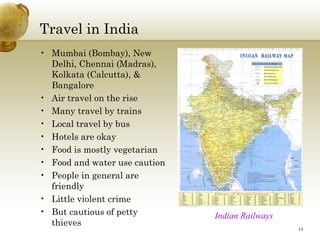
• Mumbai (Bombay), New
  Delhi, Chennai (Madras),
  Kolkata (Calcutta), &
  Bangalore
• Air travel on the rise
• Many travel by trains
• Local travel by bus
• Hotels are okay
• Food is mostly vegetarian
• Food and water use caution
• People in general are
  friendly
• Little violent crime
• But cautious of petty        Indian Railways
  thieves
                                                 14
Customs and Traditions: Food
• Use of Spices, Lentil, &
  Herbs
• Practicing Vegetarians
• South India
   • Idli, Dosai, Vadai
   • Sambar, Chutney,
     Vegetables
   • Rice, Pickle, & Yogurt
   • Coffee (Milk + Sugar)
• North India
   •   Roti, Chapati
   •   Lentils, Cheese
   •   Sweets, Yogurt
   •   Tea (Milk + Sugar)

                               15
Entertainment: Television & Radio
• Slowly Replacing Movies
• Doordarshan (State owned)
   • National and Regional
• Other Television Stations
   • Private
   • Corporations
• Hindi, Tamil, English
  language programs
• News, Sports, Drama, Mini
  Series
• Regional (Sun TV)
• Radio is loosing popularity
   • Urban Stations Popular
• All India Radio
                                    16
Entertainment: Dance
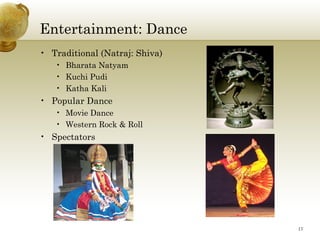
• Traditional (Natraj: Shiva)
   • Bharata Natyam
   • Kuchi Pudi
   • Katha Kali
• Popular Dance
   • Movie Dance
   • Western Rock & Roll
• Spectators


                                17
Entertainment: Music
• Traditional Music
   • Hindustani (N India)
       • Vocal
       • Instrumental
   • Carnatic (S India)
       • Vocal
       • Instrumental
• Popular Music
   • Movies
       • Very Popular
       • Professionals
   • Western Pop Music
       • Urban Areas
       • Clubs


                            18
Conclusions
•   India is in Transition
•   Middle Class is Gaining Economic Status
•   There is a Widening Gap Between Rich and Poor
•   Small Percentage is Very Rich
•   Social System may not be Ready
•   There is no Economic Safety Net
•   Young Entrepreneurs should Embrace Rural Folks
    • Grameen Bank of Bangladesh
    • Micro Lending
    • Technological Empowerment
• Government Should Enforce Fair Distribution of
  Wealth
                                                   19

India presentation

  • 1.
  • 2.
    Which India: Ruralor Urban? • Rural/Urban: 70/30 (US 30/70) • Father of India • Mohandas Karamchand Gandhi (Gandhiji) “India does not live in her cities, … … she lives in her villages” – M.K. Gandhi, 1931. • My Grandfather • Sardar A. Vedaratnam Pillai Firm believer in educating women. India can attain self- sufficiency only when rural women have education and economic status in free India. 2
  • 3.
    Geographic Features ofIndia • India (Bharat) • South Asia • One of the Oldest Civilizations • 2nd Populace Country • ~1/3 US size • ~3 time more people • Himalayas in North • Indian Ocean (S), Bay of Bengal (E) & Arabic Sea (W) • Sri Lanka (S), Myanmar & Bangladesh (E), Nepal, Bhutan, & China (N), & Pakistan & Afghanistan (W) 3
  • 4.
    Environment of India • North: Himalayas • South, East, & West: Seas • Latitude: (E-W): 32°-10°N • Longitude: (N-S): 70-90°E • Tallahassee (30°N; 84°W) • Summer: March to June • Monsoon: June to October • Winter: October to March wikipedia.org 4
  • 5.
    Government • Gained Independencefrom British on August 15, 1947 • Became a Democratic Republic on January 26, 1950 • Constitution of India adopted • 395 Articles and 7 Schedules • 93 Amendments • President Head of the State • Parliament • Prime Minister • Council of Ministers • Members of the Parliament • Based on British System 5
  • 6.
    Government of India(Central) • Parliament • Head of Nation: President • Dr. A.P.J. Kalam • Head of Government: Prime Minister • Dr. Man Mohan Singh • Cabinet of Ministers • Two Chambers • Lokh Sabha (People’s House) • MP elected by people • Rajhya Sabha (State’s House) • Appointed by States • Supreme Court 6
  • 7.
    Government of India(State) • States are Semi- Independent • Head of State: Governor • Head of Government: Chief Minister • Cabinet of Ministers • Members of Legislative Assembly (Elected) • Members of Legislative Council (Appointed) • Regional Parties (DMK, TD) • National Parties (Congress, Janata Dal) 7
  • 8.
    Economy of India •Traditional • Legacy-System • Agrarian • Textile • Raw Materials • Spices • Jewelry • Modern • Knowledge-Based • Information Technology • Out-Sourcing • Customer Service (English helps!) • Manufacturing (Low cost qualified people) 8
  • 9.
    Education in India •State is Responsible • Literacy Rate (A person • Age 5-16 Free who can read and write in • Elementary 1-5 grades any language) • Middle 6-8 grades • Male: 75% (2001) • High 9-12 • Female: 54% (2001) • State & Private • Sex Ratio • Local Language & English • 933 F / 1000 M (2001) • College • Population • Taught in English (British Legacy) • 1.03 Billion (2001) • Bachelors • 5.3 person/household • Masters • Professional • Doctoral • Mostly Private 9
  • 10.
    Religion in India •India is a Secular Country • No State Sponsored Religion • Major Religions • Hindu: 75% • Muslim: 12% • Christian: 6% • Sikh, Jain, Buddhist, & Jews: 7% • Ironically religion is a uniting feature • Hinduism is non proselytizing • No preaching • Most people are tolerant • Very private • Becoming less important Encarta 10
  • 11.
    Languages in India •Twenty-two (22) • Official Languages: • Hindi • Language of the State • English • Languages Demarcate States • North India Tamil • Sanskrit (like Latin) • Indo-Iranian-Germanic Branch • Hindi, Bengali, Gujarati, & Marathi • South India • Dravidian Branch • Tamil, Malayalam, Telugu, and Kannada 11
  • 12.
    Health Care inIndia • Insurance is Rare < 8% • Private • Life Expectancy: 63 (M) | • Private Doctors & 65 (F) (74 & 80 US) Facilities • Infant Mortality: 60/1000 • Pay for Service live births (6/1000 US) • Reasonable Service • Public Health Services • Middle Class & Rich • Covers 20% Population • Get Good Service • 150,000 Centers • Qualified Physicians • 23,000 Primary Care • Attracting Foreigners Facilities • Average Folks • Government Doctors & • Go only when sick Facilities • Avoid costly procedures • Waiting Lines • Indebtedness in rural • No Fees! areas • Pervasive Corruption • Lack of Amenities Encarta 12
  • 13.
    Family & Women •Family is the Main Unit • Status of Women • Joint Families Improving • Family Comes First • More are Educated • Individuals Less • More have Jobs Important • More Acceptance of • Patriarchal System Working Women • Divorce Less Common • Economic Necessity • Social Factors • More Progress Expected • Economic Factors • Children 13
  • 14.
    Travel in India •Mumbai (Bombay), New Delhi, Chennai (Madras), Kolkata (Calcutta), & Bangalore • Air travel on the rise • Many travel by trains • Local travel by bus • Hotels are okay • Food is mostly vegetarian • Food and water use caution • People in general are friendly • Little violent crime • But cautious of petty Indian Railways thieves 14
  • 15.
    Customs and Traditions:Food • Use of Spices, Lentil, & Herbs • Practicing Vegetarians • South India • Idli, Dosai, Vadai • Sambar, Chutney, Vegetables • Rice, Pickle, & Yogurt • Coffee (Milk + Sugar) • North India • Roti, Chapati • Lentils, Cheese • Sweets, Yogurt • Tea (Milk + Sugar) 15
  • 16.
    Entertainment: Television &Radio • Slowly Replacing Movies • Doordarshan (State owned) • National and Regional • Other Television Stations • Private • Corporations • Hindi, Tamil, English language programs • News, Sports, Drama, Mini Series • Regional (Sun TV) • Radio is loosing popularity • Urban Stations Popular • All India Radio 16
  • 17.
    Entertainment: Dance • Traditional(Natraj: Shiva) • Bharata Natyam • Kuchi Pudi • Katha Kali • Popular Dance • Movie Dance • Western Rock & Roll • Spectators 17
  • 18.
    Entertainment: Music • TraditionalMusic • Hindustani (N India) • Vocal • Instrumental • Carnatic (S India) • Vocal • Instrumental • Popular Music • Movies • Very Popular • Professionals • Western Pop Music • Urban Areas • Clubs 18
  • 19.
    Conclusions • India is in Transition • Middle Class is Gaining Economic Status • There is a Widening Gap Between Rich and Poor • Small Percentage is Very Rich • Social System may not be Ready • There is no Economic Safety Net • Young Entrepreneurs should Embrace Rural Folks • Grameen Bank of Bangladesh • Micro Lending • Technological Empowerment • Government Should Enforce Fair Distribution of Wealth 19

Editor's Notes

  • #2 Title page with speaker ’ s name and town
  • #4 Insert a picture of one of the geographic features of your country.
  • #5 Map of India illustrating a seasons and rainfall.
  • #7 Insert a picture of the head leader of your country.
  • #8 Insert a picture of the head leader of your country.
  • #9 Insert a picture that illustrates some part of your country’s economy.
  • #10 Insert a picture of one of the points of interest for your country.
  • #11 Insert a picture of one of the points of interest for your country.
  • #12 Spoken and written languages of India
  • #13 Health care system in India
  • #14 Health care system in India
  • #15 Insert a picture of one of the points of interest for your country.
  • #16 Insert a picture illustrating a custom or tradition here.
  • #17 Insert a picture illustrating a custom or tradition here.
  • #18 Insert a picture illustrating a custom or tradition here.
  • #19 Insert a picture illustrating a custom or tradition here.
  • #20 Insert a picture illustrating a custom or tradition here.