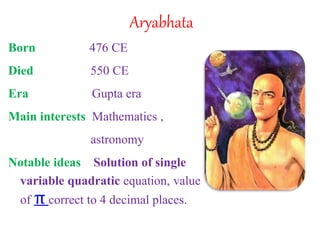
Aryabhata
Born 476 CE
Died 550 CE
Era Gupta era
Main interests Mathematics ,
astronomy
Notable ideas Solution of single
variable quadratic equation, value
of π correct to 4 decimal places.
• Aryabhata is sometimes called to be the one
who gave the world the digit zero.
• He did not use a symbol for zero; its
knowledge was implicit in his place-value
system as a place holder for the powers of
ten with null coefficients.
• His other works include theorems on
trigonometry, arithmetic, algebra, quadratic
equations and the sine table.
• He is called the first of the great
astronomers of the classical age of India .
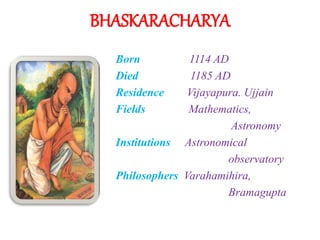
BHASKARACHARYA
Born 1114 AD
Died 1185 AD
Residence Vijayapura. Ujjain
Fields Mathematics,
Astronomy
Institutions Astronomical
observatory
Philosophers Varahamihira,
Bramagupta
• He was born in a village of Mysore district.
• He was the first to give that any number divided
by 0 gives infinity (00).
• He has written a lot about zero, surds,
permutation and combination.
• He wrote, “The hundredth part of the
circumference of a circle seems to be straight.
Our earth is a big sphere and that’s why it
appears to be flat.”
• He gave the formulae like sin(A ± B) =
sinA.cosB ± cosA.sinB
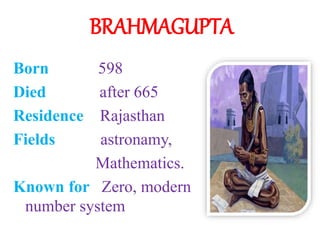
BRAHMAGUPTA
Born 598
Died after 665
Residence Rajasthan
Fields astronamy,
Mathematics.
Known for Zero, modern
number system
• He gave four methods of multiplication.
• He gave the following formula, used in
G.P series
• a + ar + ar2 + ar3 +……….. + arn-1 = (arn-
1) ÷ (r – 1)
• He gave the following formulae :
• Area of a cyclic quadrilateral with side a,
b, c, d= √(s -a)(s- b)(s -c)(s- d) where 2s =
a + b + c + d.
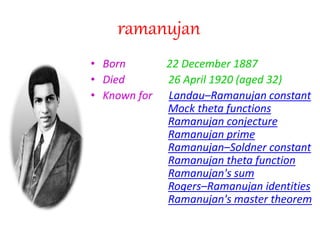
ramanujan
• Born 22 December 1887
• Died 26 April 1920 (aged 32)
• Known for Landau–Ramanujan constant
Mock theta functions
Ramanujan conjecture
Ramanujan prime
Ramanujan–Soldner constant
Ramanujan theta function
Ramanujan's sum
Rogers–Ramanujan identities
Ramanujan's master theorem
 He showed extraordinary liking for
mathematics. When he was yet in school,
he mathematically calculated the
approximate length of earth’s equator. He
very clearly knew the values of the square
root of two and the pie value.
The number 1729 is known as the
Hardy–Ramanujan number after a famous
anecdote of the British mathematician G.
H. Hardy regarding a visit to the hospital
to see Ramanujan.
Indian Mathematicians

Indian Mathematicians

  • 3.
    Aryabhata Born 476 CE Died550 CE Era Gupta era Main interests Mathematics , astronomy Notable ideas Solution of single variable quadratic equation, value of π correct to 4 decimal places.
  • 4.
    • Aryabhata issometimes called to be the one who gave the world the digit zero. • He did not use a symbol for zero; its knowledge was implicit in his place-value system as a place holder for the powers of ten with null coefficients. • His other works include theorems on trigonometry, arithmetic, algebra, quadratic equations and the sine table. • He is called the first of the great astronomers of the classical age of India .
  • 5.
    BHASKARACHARYA Born 1114 AD Died1185 AD Residence Vijayapura. Ujjain Fields Mathematics, Astronomy Institutions Astronomical observatory Philosophers Varahamihira, Bramagupta
  • 6.
    • He wasborn in a village of Mysore district. • He was the first to give that any number divided by 0 gives infinity (00). • He has written a lot about zero, surds, permutation and combination. • He wrote, “The hundredth part of the circumference of a circle seems to be straight. Our earth is a big sphere and that’s why it appears to be flat.” • He gave the formulae like sin(A ± B) = sinA.cosB ± cosA.sinB
  • 7.
    BRAHMAGUPTA Born 598 Died after665 Residence Rajasthan Fields astronamy, Mathematics. Known for Zero, modern number system
  • 8.
    • He gavefour methods of multiplication. • He gave the following formula, used in G.P series • a + ar + ar2 + ar3 +……….. + arn-1 = (arn- 1) ÷ (r – 1) • He gave the following formulae : • Area of a cyclic quadrilateral with side a, b, c, d= √(s -a)(s- b)(s -c)(s- d) where 2s = a + b + c + d.
  • 9.
    ramanujan • Born 22December 1887 • Died 26 April 1920 (aged 32) • Known for Landau–Ramanujan constant Mock theta functions Ramanujan conjecture Ramanujan prime Ramanujan–Soldner constant Ramanujan theta function Ramanujan's sum Rogers–Ramanujan identities Ramanujan's master theorem
  • 10.
     He showedextraordinary liking for mathematics. When he was yet in school, he mathematically calculated the approximate length of earth’s equator. He very clearly knew the values of the square root of two and the pie value. The number 1729 is known as the Hardy–Ramanujan number after a famous anecdote of the British mathematician G. H. Hardy regarding a visit to the hospital to see Ramanujan.