

Presentation
on
Section 66A of IT Act
BY
Anveshika
1
Contents:-
1.Information Technology Act 2000
2.Objective of IT Legislation in India
3.Structure of IT Act
4.Section 66 of IT act
i. Section 66A
ii. Section 66B
iii. Section 66C
iv. Section 66D
v. Section 66E
vi. Section 66F
5.Conclusion
2
Information Technology Act
2000
The Information Technology Act 2000 has been
substantially amended through the Information
Technology Act 2008 which was passed by the
two houses of the Indian Parliament on December
23, and 24, 2008. It got the Presidential assent on
February 5, 2009 and came into force on October
27, 2009. The amended Act has provided
additional focus on information security.
3
OBJECTIVES OF IT
LEGISLATION IN INDIA
“to provide legal recognition for transactions
carried out by means of electronic data
interchange and other means of electronic
communication, commonly referred to as
"electronic commerce" .
4
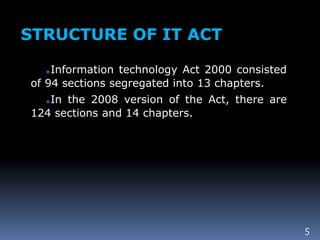
STRUCTURE OF IT ACT
.Information technology Act 2000 consisted
of 94 sections segregated into 13 chapters.
.In the 2008 version of the Act, there are
124 sections and 14 chapters.
5
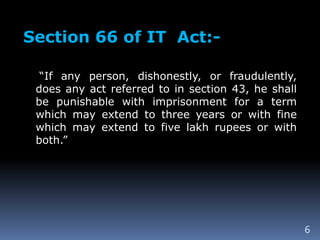
Section 66 of IT Act:-
“If any person, dishonestly, or fraudulently,
does any act referred to in section 43, he shall
be punishable with imprisonment for a term
which may extend to three years or with fine
which may extend to five lakh rupees or with
both.”
6
7
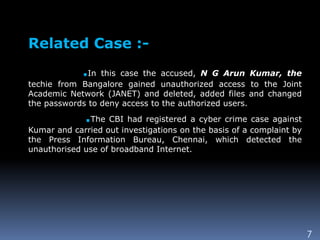
Related Case :-
.In this case the accused, N G Arun Kumar, the
techie from Bangalore gained unauthorized access to the Joint
Academic Network (JANET) and deleted, added files and changed
the passwords to deny access to the authorized users.
.The CBI had registered a cyber crime case against
Kumar and carried out investigations on the basis of a complaint by
the Press Information Bureau, Chennai, which detected the
unauthorised use of broadband Internet.
8
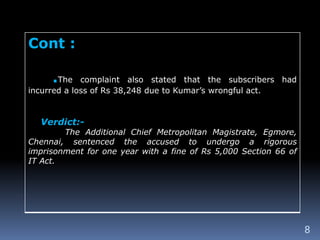
Cont :
.The complaint also stated that the subscribers had
incurred a loss of Rs 38,248 due to Kumar’s wrongful act.
Verdict:-
The Additional Chief Metropolitan Magistrate, Egmore,
Chennai, sentenced the accused to undergo a rigorous
imprisonment for one year with a fine of Rs 5,000 Section 66 of
IT Act.
9
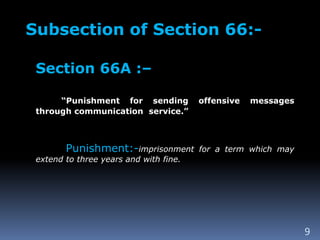
Subsection of Section 66:-
Section 66A :–
“Punishment for sending offensive messages
through communication service.”
Punishment:-imprisonment for a term which may
extend to three years and with fine.
10
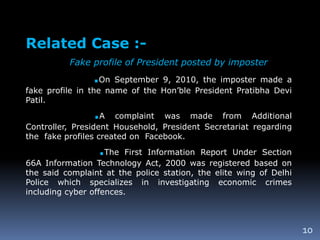
Related Case :-
Fake profile of President posted by imposter
.On September 9, 2010, the imposter made a
fake profile in the name of the Hon’ble President Pratibha Devi
Patil.
.A complaint was made from Additional
Controller, President Household, President Secretariat regarding
the fake profiles created on Facebook.
.The First Information Report Under Section
66A Information Technology Act, 2000 was registered based on
the said complaint at the police station, the elite wing of Delhi
Police which specializes in investigating economic crimes
including cyber offences.
11
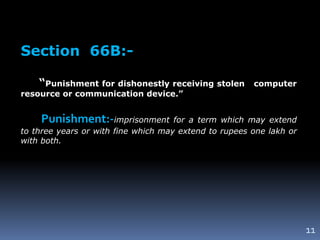
Section 66B:-
“Punishment for dishonestly receiving stolen computer
resource or communication device.”
Punishment:-imprisonment for a term which may extend
to three years or with fine which may extend to rupees one lakh or
with both.
12
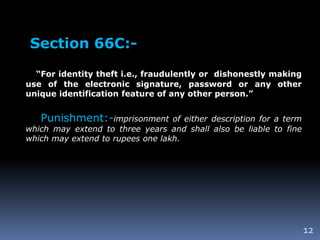
Section 66C:-
“For identity theft i.e., fraudulently or dishonestly making
use of the electronic signature, password or any other
unique identification feature of any other person.”
Punishment:-imprisonment of either description for a term
which may extend to three years and shall also be liable to fine
which may extend to rupees one lakh.
13
Related Case:-
.The CEO of an identity theft protection company,
Lifelock, Todd Davis's social security number was exposed by Matt
Lauer on NBC’s Today Show.
.Davis’ identity was used to obtain a $500 cash
advance loan.
14
Section 66D :-
“Punishment for cheating by personation by using
computer resource.”
Punishment:-with imprisonment of either description
for a term which may extend to three years and shall also be liable
to fine which may extend to one lakh rupees.
15
Related Case:-
. A complaint filed by the representative of a
Company, The company has a web-site in the name and and style
`www.jaypolychem.com' but, another web site
`www.jayplychem.org' was set up by the accused,Samdeep
Varghese @ Sam, (who was dismissed from the company).
.The Company suffered losses of several crores of
Rupees from producers, suppliers and customers and were unable
to do business.
16
Section 66E:-
“For violation of privacy i.e., intentionally or knowingly
capturing, publishing or transmitting the image of a private
area of any person without his or her consent, violating the
privacy of that person,.”
Punishment:-imprisonment which may extend to three
years or with fine not exceeding two lakh rupees, or with both.
17
Related Case:-
Jawaharlal Nehru University MMS scandal
.A pornographic MMS clip was apparently made
in the campus and transmitted outside the university.
. reports claimed that the two accused students
initially tried to extort money from the girl in the video but when
they failed the culprits put the video out on mobile phones, on the
internet and even sold it as a CD .
18
Section 66F-
“For cyber terrorism i.e., intention to threaten the
unity, integrity, security or sovereignty of India or to strike
terror in the people or any section of the people.”
Punishment:-imprisonment which may extend to
imprisonment for life.
19
Related case:-
.The Mumbai police have registered a case of ‘cyber
terrorism’ here a threat email was sent to the BSE and NSE .
. an email challenging the security agencies to
prevent a terror attack was sent by one Shahab Md with an ID
sh.itaiyeb125@yahoo.in to BSE’s administrative email ID
corp.relations@bseindia.com.
. The MRA Marg police have registered forgery for
purpose of cheating, criminal intimidation cases under the IPC
and a cyber-terrorism case under the IT Act.
20
Conclusion:-
.Section 66A of the Information Technology
Act, “does not silence anyone”.
. You can always exercise your right to speak,
your freedom of speech and expression without offending
people
ANY QUERIES…..
21
22

Section 66 of Information Technology Act.

  • 1.
    Presentation on Section 66A ofIT Act BY Anveshika 1
  • 2.
    Contents:- 1.Information Technology Act2000 2.Objective of IT Legislation in India 3.Structure of IT Act 4.Section 66 of IT act i. Section 66A ii. Section 66B iii. Section 66C iv. Section 66D v. Section 66E vi. Section 66F 5.Conclusion 2
  • 3.
    Information Technology Act 2000 TheInformation Technology Act 2000 has been substantially amended through the Information Technology Act 2008 which was passed by the two houses of the Indian Parliament on December 23, and 24, 2008. It got the Presidential assent on February 5, 2009 and came into force on October 27, 2009. The amended Act has provided additional focus on information security. 3
  • 4.
    OBJECTIVES OF IT LEGISLATIONIN INDIA “to provide legal recognition for transactions carried out by means of electronic data interchange and other means of electronic communication, commonly referred to as "electronic commerce" . 4
  • 5.
    STRUCTURE OF ITACT .Information technology Act 2000 consisted of 94 sections segregated into 13 chapters. .In the 2008 version of the Act, there are 124 sections and 14 chapters. 5
  • 6.
    Section 66 ofIT Act:- “If any person, dishonestly, or fraudulently, does any act referred to in section 43, he shall be punishable with imprisonment for a term which may extend to three years or with fine which may extend to five lakh rupees or with both.” 6
  • 7.
    7 Related Case :- .Inthis case the accused, N G Arun Kumar, the techie from Bangalore gained unauthorized access to the Joint Academic Network (JANET) and deleted, added files and changed the passwords to deny access to the authorized users. .The CBI had registered a cyber crime case against Kumar and carried out investigations on the basis of a complaint by the Press Information Bureau, Chennai, which detected the unauthorised use of broadband Internet.
  • 8.
    8 Cont : .The complaintalso stated that the subscribers had incurred a loss of Rs 38,248 due to Kumar’s wrongful act. Verdict:- The Additional Chief Metropolitan Magistrate, Egmore, Chennai, sentenced the accused to undergo a rigorous imprisonment for one year with a fine of Rs 5,000 Section 66 of IT Act.
  • 9.
    9 Subsection of Section66:- Section 66A :– “Punishment for sending offensive messages through communication service.” Punishment:-imprisonment for a term which may extend to three years and with fine.
  • 10.
    10 Related Case :- Fakeprofile of President posted by imposter .On September 9, 2010, the imposter made a fake profile in the name of the Hon’ble President Pratibha Devi Patil. .A complaint was made from Additional Controller, President Household, President Secretariat regarding the fake profiles created on Facebook. .The First Information Report Under Section 66A Information Technology Act, 2000 was registered based on the said complaint at the police station, the elite wing of Delhi Police which specializes in investigating economic crimes including cyber offences.
  • 11.
    11 Section 66B:- “Punishment fordishonestly receiving stolen computer resource or communication device.” Punishment:-imprisonment for a term which may extend to three years or with fine which may extend to rupees one lakh or with both.
  • 12.
    12 Section 66C:- “For identitytheft i.e., fraudulently or dishonestly making use of the electronic signature, password or any other unique identification feature of any other person.” Punishment:-imprisonment of either description for a term which may extend to three years and shall also be liable to fine which may extend to rupees one lakh.
  • 13.
    13 Related Case:- .The CEOof an identity theft protection company, Lifelock, Todd Davis's social security number was exposed by Matt Lauer on NBC’s Today Show. .Davis’ identity was used to obtain a $500 cash advance loan.
  • 14.
    14 Section 66D :- “Punishmentfor cheating by personation by using computer resource.” Punishment:-with imprisonment of either description for a term which may extend to three years and shall also be liable to fine which may extend to one lakh rupees.
  • 15.
    15 Related Case:- . Acomplaint filed by the representative of a Company, The company has a web-site in the name and and style `www.jaypolychem.com' but, another web site `www.jayplychem.org' was set up by the accused,Samdeep Varghese @ Sam, (who was dismissed from the company). .The Company suffered losses of several crores of Rupees from producers, suppliers and customers and were unable to do business.
  • 16.
    16 Section 66E:- “For violationof privacy i.e., intentionally or knowingly capturing, publishing or transmitting the image of a private area of any person without his or her consent, violating the privacy of that person,.” Punishment:-imprisonment which may extend to three years or with fine not exceeding two lakh rupees, or with both.
  • 17.
    17 Related Case:- Jawaharlal NehruUniversity MMS scandal .A pornographic MMS clip was apparently made in the campus and transmitted outside the university. . reports claimed that the two accused students initially tried to extort money from the girl in the video but when they failed the culprits put the video out on mobile phones, on the internet and even sold it as a CD .
  • 18.
    18 Section 66F- “For cyberterrorism i.e., intention to threaten the unity, integrity, security or sovereignty of India or to strike terror in the people or any section of the people.” Punishment:-imprisonment which may extend to imprisonment for life.
  • 19.
    19 Related case:- .The Mumbaipolice have registered a case of ‘cyber terrorism’ here a threat email was sent to the BSE and NSE . . an email challenging the security agencies to prevent a terror attack was sent by one Shahab Md with an ID sh.itaiyeb125@yahoo.in to BSE’s administrative email ID corp.relations@bseindia.com. . The MRA Marg police have registered forgery for purpose of cheating, criminal intimidation cases under the IPC and a cyber-terrorism case under the IT Act.
  • 20.
    20 Conclusion:- .Section 66A ofthe Information Technology Act, “does not silence anyone”. . You can always exercise your right to speak, your freedom of speech and expression without offending people
  • 21.
  • 22.