KING GEORGE’S MEDICAL UNIVERSITY,
LUCKNOW
K.G.M.U. COLLEGE OF NURSING
TOPIC-INDIAN CHILDHOOD CIRRHOSIS
CONTENTS
 Introduction
 Definition
 Causes
 Pathophysiology
 Clinical Features
 Diagnostic Evaluation
 Medical & Surgical Management
 Nursing Management
Term cirrhosis of liver introduced by Laennec in 1826 . Originated from the
Greek term "scirrhus" and is used to describe the orange or tawny surface.
When we talk about Indian Childhood Cirrhosis ,it is an auto immune
disorder peculiar to Indian children is most often seen in children between
the age of 6 months to 4 years.
INTRODUCTION
DEFINITION
Cirrhosis of liver is chronic degenerative state
of liver which leads to development of band of
fibrous tissue, firm nodules and scarring of
liver ,ultimately leading to irreversible cell
damage.
 Copper Intoxication
 Viral Infections
 Genetic
CAUSES
PATHOPHYSIOLOGY
Due to etiological factors
Marked damage of the hepatocytes
Complete disorganization of liver architecture, i.e., size of liver varies,
and its color change.
Formation of macronodules and micronodules in the surface of the liver, while the
portal vein and the biliary passages are patent, the lymphatics appear normal.
Absence of regenerative activity and manifesting
degenerative changes in the liver.
Necrosis and fibrosis of the hepatic lobules
Indian childhood cirrhosis
Regenerating nodules in the liver are encircled by the
bands of fibrous tissue
CLINICAL FEATURES
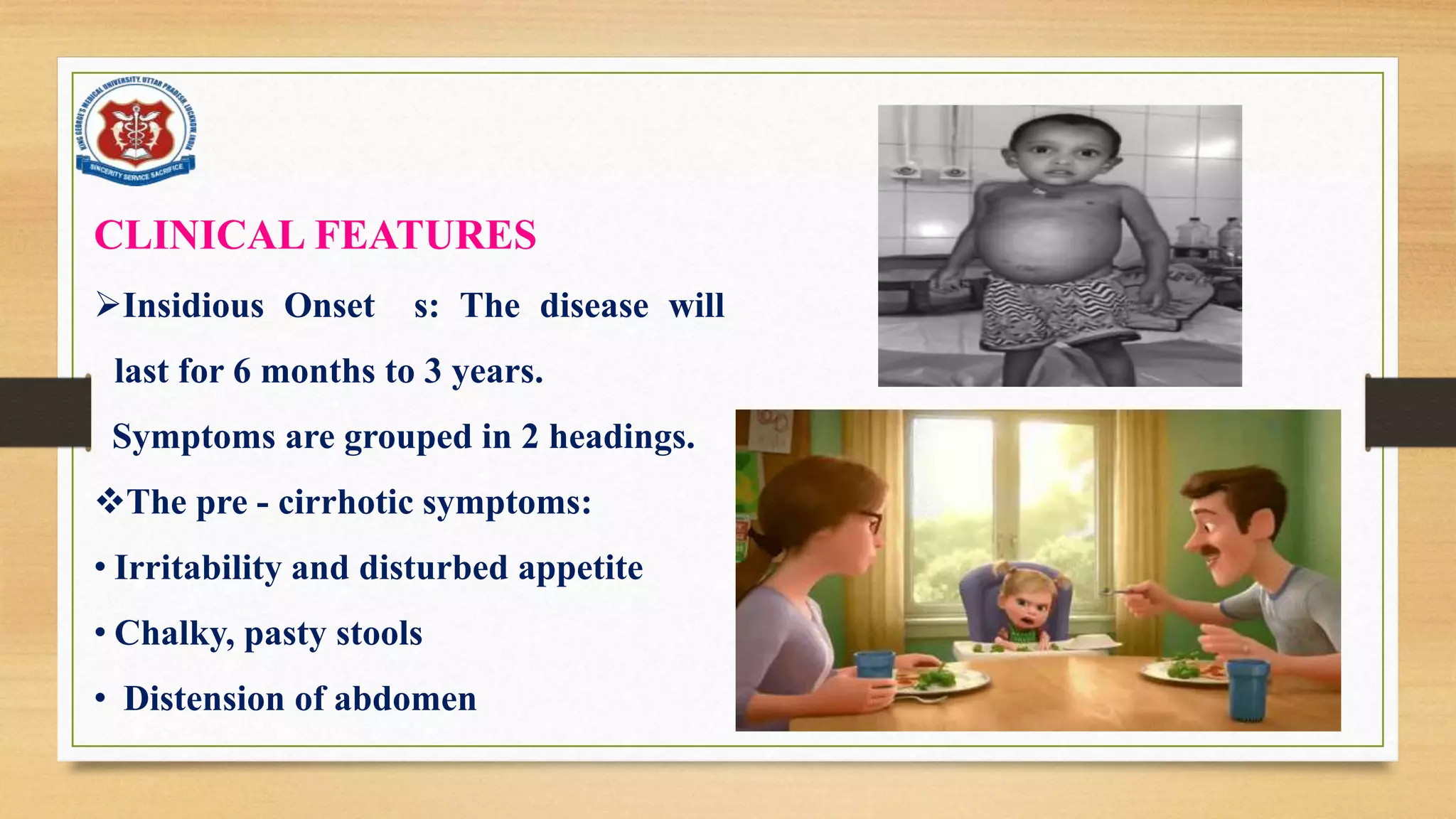
Insidious Onset s: The disease will
last for 6 months to 3 years.
Symptoms are grouped in 2 headings.
The pre - cirrhotic symptoms:
• Irritability and disturbed appetite
• Chalky, pasty stools
• Distension of abdomen
• Constipation
• Diarrhoea
• Often slight irregular fever
The cirrhotic symptoms: Cirrhotic symptoms
are grouped under 3 stages.
Stage I:
• Slight fever, enlarged liver to 3-5 cm with
sharp edges , poor growth , anorexia,
constipation/diarrhoea and jaundice, clay
colored stools, and growth failure.
Stage II:
• Diffuse hepatomegaly , splenomegaly ,
ascites , esophageal varices, hemoptysis ,
anemia , muscle weakness , lethargy and
GI bleeding.
Stage III:
 It is the terminal stage of the
disease featuring restlessness,
confusion, dyspnea and cyanosis
on exertion, evidences of
hepatocellular failure in the
form of palmar erythema
 Spider nevi appearance on the upper
torso a peculiar garlic odor in
patients with impending liver cell
failure, enlarged and hard spleen
and terminally, there is jaundice and
hepatic coma and is often associated
with gastrointestinal bleeding.
• Child may die at this stage either from hepatic failure or recurrent
infections.
Acute Onset
It has a sudden onset of disease and sometimes child becomes
symptomatic for a variable period and then shows the manifestations
of insidious onset. The symptoms include-
Sudden onset of fever
Jaundice with clay- colored stools.
Hepatomegaly
Death with hepatic coma
History collection
Physical examination : Liver can be
palpable, very firm in consistency and its
boarders will be sharp . On auscultation ,
hepatic bruit is heard in severe cases , if
there is ascites, fluid thrill test can be done.
DIAGNOSTIC EVALUATION
Liver function Test : Increased
Alanine Transaminase (ALT),
Increased Gama Glutaryl
Transpeptidase (GGT) Prothrombin
time , clotting time ,and bleeding time
will be prolonged.
Liver biopsy: To find out the
sclerosis of liver. It is a reliable
method of arriving at a fool proof
of diagnosis.
 Cupriuresis: Testing the presence of copper in
urine after administration of d-penicillamine .
TREATMENT
Medical Management
ICC was dubbed as a "frustrating
situation" as there was no specific
treatment available. If the diagnosis is
made on an early stage (before the
development of jaundice and ascites), ICC
is potentially treated.
The drug of choice is d-pencillamine
(which chelate copper) in a dose of 20-40
mg/kg/day for 12-18 months, leads to
marked improvement and even total
reversal in the histopathologic picture.
Initial Stage
Adequate diet with enough of good
quality proteins, vitamins and minerals is
desirable.
Antibiotics should be given to treat the
intercurrent infections/infestations.
Symptomatic treatment should be given.
Immunomodulators such as levamisole can
be used.
Corticosteroids and gammaglobulins are
also helpful.
Administer IV fluids if there is dehydration.
Prevention of infection: Follow aseptic
techniques and prophylactic antibiotics .
Terminal Stage
If the patient has entered precoma or coma, the
protein intake should be reduced.
Administration of neomycin by gavage and 20%
IV glucose drip are helpful .
 Oxygen can be administered, if necessary.
 Exchange transfusion to remove the circulating
toxins.
Surgical Management
 No special surgical correction The only
successful treatment for end stage liver
disease is liver tansplantation . If there is
portal hypertension with hematemesis ,
sengestaken tube to control esophageal
bleeding .
 A portocaval anastamosis may be done to relieve the portal
hypertension and complications of hypersplenism .
Nursing Management
Nursing Diagnosis
Hyperthermia related to inflammatory process in the liver.
Impaired breathing pattern related to pressure on diaphragm
secondary to ascites.
Impaired liver function related to damage of hepatic cells
Diarrhoea or constipation related to acute abdominal condition .
Delayed growth and development related to chronic illness .
Parental anxiety related to management of the disease.
Nursing Interventions
Follow aseptic techniques to prevent infection.
Intake and output chart should be maintained.
Health Education
Explain the cause, symptoms, and management of the disease.
Avoid food rich in copper like dry nuts, chocolates
liver, etc.
Provide small and frequent diet to the child.
Advise the mother to breast feed their baby for longer
period and not to introduce food supplements beyond
the age of 6 months.
Milk used for infant should not be boiled and stored in copper and copper
alloy pots.
Reduce the use of brass and copper vessels.
Use aluminium and steel utensils.
Foods rich in tryptophan (milk, eggs, meat, nuts, beans, fish, and cheese)
should be reduced.
Provide more vitamin B, rich foods like potato, banana, spinach, soya bean,
fruits and vegetables (vitamin B help to convert tryptophan to niacin).
Cirrhosis of liver is a chronic, degenerative state
of liver, which leads to development of bands of
fibrous tissue, firm nodules and connections
between the central and portal areas of liver.
Cirrhosis is peculiar to Indian children. Indian
childhood cirrhosis is an auto immune disorder
is most often seen in Indian children between the
age of 6 months to 4 years.
SUMMARY
ASSIGNMENT
 Prepare an assignment on Liver transplantation .
It is manifested by slight fever, enlarged liver to 3-5 cm,
with sharp edges and giving an appearance of leafy
boarder, jaundice etc. Antibiotics , good quality protein
, minerals ,vitamins etc are very much helpful in
providing relief in case of liver cirrhosis .In case of 3rd
stage liver cirrhosis liver transplantation is suggested.
RECAPITULATION
 What is Indian Childhood cirrhosis ?
 What are the factors that cause liver cirrhosis ?
 Enlist the symptoms of stage – I ?
 Listdown the clinical features of stage –II .
 What treatment modalities can be used for the
patient with liver cirrhosis ?
REFERENCES
• Pal Panchali. Textbook of pediatric nursing. Edition 1.
Paras Medical Publishers, 2016 p.313-315.
• Sharma Rimple. Essentials of pediatric nursing. Edition 2.
Paras Medical Publishers, Delhi: Jaypee Publication, 2017
p. 329-331
• Datta Parul. Pediatric Nursing . Edition 4. Jaypee
Publication.p. 315-317
indian childhood cirrosis

indian childhood cirrosis

  • 2.
    KING GEORGE’S MEDICALUNIVERSITY, LUCKNOW K.G.M.U. COLLEGE OF NURSING TOPIC-INDIAN CHILDHOOD CIRRHOSIS
  • 3.
    CONTENTS  Introduction  Definition Causes  Pathophysiology  Clinical Features  Diagnostic Evaluation  Medical & Surgical Management  Nursing Management
  • 5.
    Term cirrhosis ofliver introduced by Laennec in 1826 . Originated from the Greek term "scirrhus" and is used to describe the orange or tawny surface. When we talk about Indian Childhood Cirrhosis ,it is an auto immune disorder peculiar to Indian children is most often seen in children between the age of 6 months to 4 years. INTRODUCTION
  • 6.
    DEFINITION Cirrhosis of liveris chronic degenerative state of liver which leads to development of band of fibrous tissue, firm nodules and scarring of liver ,ultimately leading to irreversible cell damage.
  • 7.
     Copper Intoxication Viral Infections  Genetic CAUSES
  • 8.
    PATHOPHYSIOLOGY Due to etiologicalfactors Marked damage of the hepatocytes Complete disorganization of liver architecture, i.e., size of liver varies, and its color change. Formation of macronodules and micronodules in the surface of the liver, while the portal vein and the biliary passages are patent, the lymphatics appear normal.
  • 9.
    Absence of regenerativeactivity and manifesting degenerative changes in the liver. Necrosis and fibrosis of the hepatic lobules Indian childhood cirrhosis Regenerating nodules in the liver are encircled by the bands of fibrous tissue
  • 10.
    CLINICAL FEATURES Insidious Onsets: The disease will last for 6 months to 3 years. Symptoms are grouped in 2 headings. The pre - cirrhotic symptoms: • Irritability and disturbed appetite • Chalky, pasty stools • Distension of abdomen
  • 11.
    • Constipation • Diarrhoea •Often slight irregular fever
  • 12.
    The cirrhotic symptoms:Cirrhotic symptoms are grouped under 3 stages. Stage I: • Slight fever, enlarged liver to 3-5 cm with sharp edges , poor growth , anorexia, constipation/diarrhoea and jaundice, clay colored stools, and growth failure.
  • 13.
    Stage II: • Diffusehepatomegaly , splenomegaly , ascites , esophageal varices, hemoptysis , anemia , muscle weakness , lethargy and GI bleeding.
  • 14.
    Stage III:  Itis the terminal stage of the disease featuring restlessness, confusion, dyspnea and cyanosis on exertion, evidences of hepatocellular failure in the form of palmar erythema
  • 15.
     Spider neviappearance on the upper torso a peculiar garlic odor in patients with impending liver cell failure, enlarged and hard spleen and terminally, there is jaundice and hepatic coma and is often associated with gastrointestinal bleeding.
  • 16.
    • Child maydie at this stage either from hepatic failure or recurrent infections. Acute Onset It has a sudden onset of disease and sometimes child becomes symptomatic for a variable period and then shows the manifestations of insidious onset. The symptoms include-
  • 17.
    Sudden onset offever Jaundice with clay- colored stools. Hepatomegaly Death with hepatic coma
  • 18.
    History collection Physical examination: Liver can be palpable, very firm in consistency and its boarders will be sharp . On auscultation , hepatic bruit is heard in severe cases , if there is ascites, fluid thrill test can be done. DIAGNOSTIC EVALUATION
  • 19.
    Liver function Test: Increased Alanine Transaminase (ALT), Increased Gama Glutaryl Transpeptidase (GGT) Prothrombin time , clotting time ,and bleeding time will be prolonged.
  • 20.
    Liver biopsy: Tofind out the sclerosis of liver. It is a reliable method of arriving at a fool proof of diagnosis.
  • 21.
     Cupriuresis: Testingthe presence of copper in urine after administration of d-penicillamine .
  • 22.
    TREATMENT Medical Management ICC wasdubbed as a "frustrating situation" as there was no specific treatment available. If the diagnosis is made on an early stage (before the development of jaundice and ascites), ICC is potentially treated.
  • 23.
    The drug ofchoice is d-pencillamine (which chelate copper) in a dose of 20-40 mg/kg/day for 12-18 months, leads to marked improvement and even total reversal in the histopathologic picture.
  • 24.
    Initial Stage Adequate dietwith enough of good quality proteins, vitamins and minerals is desirable. Antibiotics should be given to treat the intercurrent infections/infestations.
  • 25.
    Symptomatic treatment shouldbe given. Immunomodulators such as levamisole can be used. Corticosteroids and gammaglobulins are also helpful. Administer IV fluids if there is dehydration. Prevention of infection: Follow aseptic techniques and prophylactic antibiotics .
  • 26.
    Terminal Stage If thepatient has entered precoma or coma, the protein intake should be reduced. Administration of neomycin by gavage and 20% IV glucose drip are helpful .  Oxygen can be administered, if necessary.  Exchange transfusion to remove the circulating toxins.
  • 27.
    Surgical Management  Nospecial surgical correction The only successful treatment for end stage liver disease is liver tansplantation . If there is portal hypertension with hematemesis , sengestaken tube to control esophageal bleeding .
  • 28.
     A portocavalanastamosis may be done to relieve the portal hypertension and complications of hypersplenism .
  • 29.
    Nursing Management Nursing Diagnosis Hyperthermiarelated to inflammatory process in the liver. Impaired breathing pattern related to pressure on diaphragm secondary to ascites. Impaired liver function related to damage of hepatic cells
  • 30.
    Diarrhoea or constipationrelated to acute abdominal condition . Delayed growth and development related to chronic illness . Parental anxiety related to management of the disease. Nursing Interventions Follow aseptic techniques to prevent infection. Intake and output chart should be maintained.
  • 31.
    Health Education Explain thecause, symptoms, and management of the disease. Avoid food rich in copper like dry nuts, chocolates liver, etc. Provide small and frequent diet to the child. Advise the mother to breast feed their baby for longer period and not to introduce food supplements beyond the age of 6 months.
  • 32.
    Milk used forinfant should not be boiled and stored in copper and copper alloy pots. Reduce the use of brass and copper vessels. Use aluminium and steel utensils. Foods rich in tryptophan (milk, eggs, meat, nuts, beans, fish, and cheese) should be reduced. Provide more vitamin B, rich foods like potato, banana, spinach, soya bean, fruits and vegetables (vitamin B help to convert tryptophan to niacin).
  • 33.
    Cirrhosis of liveris a chronic, degenerative state of liver, which leads to development of bands of fibrous tissue, firm nodules and connections between the central and portal areas of liver. Cirrhosis is peculiar to Indian children. Indian childhood cirrhosis is an auto immune disorder is most often seen in Indian children between the age of 6 months to 4 years. SUMMARY
  • 34.
    ASSIGNMENT  Prepare anassignment on Liver transplantation . It is manifested by slight fever, enlarged liver to 3-5 cm, with sharp edges and giving an appearance of leafy boarder, jaundice etc. Antibiotics , good quality protein , minerals ,vitamins etc are very much helpful in providing relief in case of liver cirrhosis .In case of 3rd stage liver cirrhosis liver transplantation is suggested.
  • 35.
    RECAPITULATION  What isIndian Childhood cirrhosis ?  What are the factors that cause liver cirrhosis ?  Enlist the symptoms of stage – I ?  Listdown the clinical features of stage –II .  What treatment modalities can be used for the patient with liver cirrhosis ?
  • 36.
    REFERENCES • Pal Panchali.Textbook of pediatric nursing. Edition 1. Paras Medical Publishers, 2016 p.313-315. • Sharma Rimple. Essentials of pediatric nursing. Edition 2. Paras Medical Publishers, Delhi: Jaypee Publication, 2017 p. 329-331 • Datta Parul. Pediatric Nursing . Edition 4. Jaypee Publication.p. 315-317