MENINGITIS
PRESENTED BY-MOHIT KUMAR MEENA
B.SC(NSG.) 3RD YEAR BMCHRC
COLLEGE OF NURSING
 INTRODUCTION
• Meningitis is a disease caused by the inflammation
of the protective membrane covering the brain and
spinal cord known as meninges.
• The inflammation is usually caused by an infection
of the fluid surrounding the brain and spinal cord.
• Meningitis can be life threatening therefore the
condition is classified as a medical emergency.
DEFINITION
Meningitis is the acute inflammation of
the protective membrane(meninges)
covering the brain and spinal cord.
 MENINGES
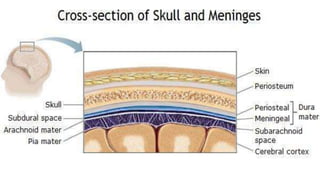
• Meninges is the protective membrane of the brain and spinal cord, it is lying between skull
and the brain.
• It has 3 layers
A. Dura meter(it is made up by 2 layers )
a. periosteal layer (outer layer)
b. Meningeal layer (inner layer)
B. Arachenoid meter
C. Pia meter
• The dura meter and arachenoid meter are seprated by a potential space,the subdural space.
• The arachenoid meter and pia meter are seprated by the subarachnoid space,containing
cerebrospinal fluid(CSF).
INCIDENCE
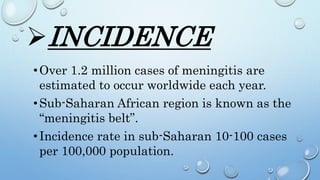
•Over 1.2 million cases of meningitis are
estimated to occur worldwide each year.
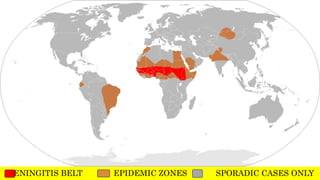
•Sub-Saharan African region is known as the
“meningitis belt”.
•Incidence rate in sub-Saharan 10-100 cases
per 100,000 population.
MENINGITIS BELT EPIDEMIC ZONES SPORADIC CASES ONLY
 CAUSES
•Bacterial infection
•Viral infection
•Physical injury
•Cancer
•Drugs(mainly NSAID’S)
 TYPES
According to infection mainly 2 types of
meningitis will be seen
i. Bacterial
ii. viral
 BACTERIAL
• Bacterial meningitis is usually preceded by a mild upper
respiratory tract infection during which a few bact. Enter
the bloodstream and are carried to the meningitis.common
microbes include:-
• Haemophilus influenzae in children between the ages of 2-5
yr.
• Neisseria meningitidis in those between 5-30 yr,the most
common type.
• Streptococcus pneumoniae in people over 30 yr.
 VIRAL
This is the most common form of meningitis,it is
milder and occur more then bacterial meningitis.
It affect children and adults under age 30.most
infections occur in children under age 5 yr.
Duration of illness:- 7-10 days
Common viruses are followed
• Entrovirus
 CONT…
• Arboviral(mosquito borne disease)
• Herpes simplex virus type 2(especially in infants)
• Varicella zoster
• Hiv
• Mumps
• Measles
 PATHOPHYSIOLOG
Y
Due to etiological factor
 SIGN &
SYMPTOM
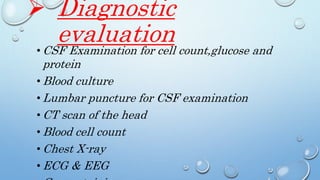
 Diagnostic
evaluation• CSF Examination for cell count,glucose and
protein
• Blood culture
• Lumbar puncture for CSF examination
• CT scan of the head
• Blood cell count
• Chest X-ray
• ECG & EEG

Meningitis

  • 1.
    MENINGITIS PRESENTED BY-MOHIT KUMARMEENA B.SC(NSG.) 3RD YEAR BMCHRC COLLEGE OF NURSING
  • 2.
     INTRODUCTION • Meningitisis a disease caused by the inflammation of the protective membrane covering the brain and spinal cord known as meninges. • The inflammation is usually caused by an infection of the fluid surrounding the brain and spinal cord. • Meningitis can be life threatening therefore the condition is classified as a medical emergency.
  • 3.
    DEFINITION Meningitis is theacute inflammation of the protective membrane(meninges) covering the brain and spinal cord.
  • 4.
     MENINGES • Meningesis the protective membrane of the brain and spinal cord, it is lying between skull and the brain. • It has 3 layers A. Dura meter(it is made up by 2 layers ) a. periosteal layer (outer layer) b. Meningeal layer (inner layer) B. Arachenoid meter C. Pia meter • The dura meter and arachenoid meter are seprated by a potential space,the subdural space. • The arachenoid meter and pia meter are seprated by the subarachnoid space,containing cerebrospinal fluid(CSF).
  • 6.
    INCIDENCE •Over 1.2 millioncases of meningitis are estimated to occur worldwide each year. •Sub-Saharan African region is known as the “meningitis belt”. •Incidence rate in sub-Saharan 10-100 cases per 100,000 population.
  • 7.
    MENINGITIS BELT EPIDEMICZONES SPORADIC CASES ONLY
  • 8.
     CAUSES •Bacterial infection •Viralinfection •Physical injury •Cancer •Drugs(mainly NSAID’S)
  • 9.
     TYPES According toinfection mainly 2 types of meningitis will be seen i. Bacterial ii. viral
  • 10.
     BACTERIAL • Bacterialmeningitis is usually preceded by a mild upper respiratory tract infection during which a few bact. Enter the bloodstream and are carried to the meningitis.common microbes include:- • Haemophilus influenzae in children between the ages of 2-5 yr. • Neisseria meningitidis in those between 5-30 yr,the most common type. • Streptococcus pneumoniae in people over 30 yr.
  • 11.
     VIRAL This isthe most common form of meningitis,it is milder and occur more then bacterial meningitis. It affect children and adults under age 30.most infections occur in children under age 5 yr. Duration of illness:- 7-10 days Common viruses are followed • Entrovirus
  • 12.
     CONT… • Arboviral(mosquitoborne disease) • Herpes simplex virus type 2(especially in infants) • Varicella zoster • Hiv • Mumps • Measles
  • 13.
     PATHOPHYSIOLOG Y Due toetiological factor
  • 14.
  • 15.
     Diagnostic evaluation• CSFExamination for cell count,glucose and protein • Blood culture • Lumbar puncture for CSF examination • CT scan of the head • Blood cell count • Chest X-ray • ECG & EEG