SUBMITTED BY:
SIDDHESH SHAH
BANKING SECTOR IN INDIA
WHAT IS A BANKING?
• Banking Regulation Act of India ,1949 defines banking
as “accepting for the purpose of lending or investment of
deposits of money from the public repayable on demand
or otherwise or withdrawal by cheque , draft order or
otherwise”.
• The Reserve Bank of India Act 1934 and the Banking
Regulation Act 1949 governs the banking operation in
India.
• A bank is a financial institution that accepts deposits from
the public for the purpose of lending and investment .
HISTORY OF BANK
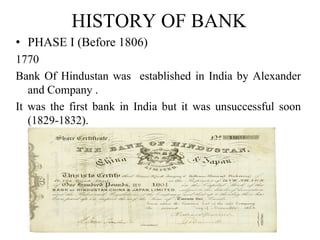
• PHASE I (Before 1806)
1770
Bank Of Hindustan was established in India by Alexander
and Company .
It was the first bank in India but it was unsuccessful soon
(1829-1832).
• PHASE II (1806-1860)
Three Presidency Bank were established in India by
Britishers
They entered from west and captured whole India .
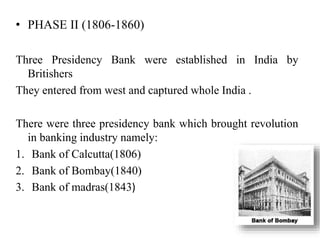
There were three presidency bank which brought revolution
in banking industry namely:
1. Bank of Calcutta(1806)
2. Bank of Bombay(1840)
3. Bank of madras(1843)
• PHASE III (1860-1913)
1. (1865) Allahabad Bank was established it is the Oldest
Public Sector Bank in India.
2. (1881) Awadh Commercial Bank was established at
Faizabad-1st bank of limited liability managed by
Indians.(after independence in 1958 this bank failed.)
3. (1894) Punjab National Bank was established at Lahore in
Punjab Province of undivided India (it was 1st complete
Indian bank which was started with Indian capital run by
Indians established by Indians and even customers were
also Indians) Founder of PNB was LALA LAJPAT RAI.
• PHASE IV (1913-1980)
1. 1ST India Commercial Bank owned and managed by Indian:
Central bank of India established in 1911.
It was also First Swadeshi bank.
2. 17th January ,1921
Three presidency bank were amalgamated to form a single
bank namely Imperial Bank Of India
3. In 1955 Imperial Bank Of India was converted into State
Bank Of India.
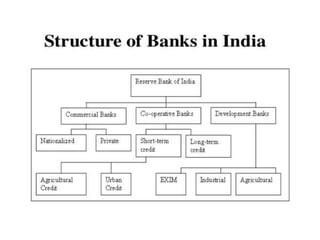
Classification of banks in india
1.RBI: The RBI is the supreme monetary and banking
authority in the country and has the responsibility to
control the banking system in the country
2. Public sector bank: PSBs are banks where the majority
stake (i.e more than 50%) is held by a government. The
shares of these banks are listed on the stock exchange.
3. Private sector bank: Private Sector Banks are the banks
where greater parts of state or equity are held by private
shareholders and not by government.
4.Cooperative sector bank: Cooperative sector banks are
retail and commercial banks organized on a cooperative
basis.
5.Development banks: Development banks are those
financial institutions whose primary goal is to finance the
primary(basic) needs of the society.
Reserve Bank Of India
• The Reserve Bank of India (RBI) is India's central
banking institution, which controls the monetary policy of
the Indian rupee. It commenced its operations on 1 April
1935 during the British Rule in accordance with the
provisions of the Reserve Bank of India Act, 1934.
• A Central Bank is an independent apex monetary
authority which regulates banks and provides important
financial services like storing of foreign exchange
reserves, control of inflation, monetary policy report.
Commercial banks
• Commercial bank comprises of public sector bank, foreign
bank and private sector bank ,represent the most important
financial intermediary in the Indian financial system.
Functions of commercial banks:
1.Acceptance of deposits
2.Advancing of loans
3.Agency function(collecting receipt and making
payments)
4.General utility function(providing atms and credit card
facility)
Investment Bank
• An Investment bank is typically a private company that
provide various financial related and other services to
individuals, and government such as raising financial
capital by underwriting.
• An Investment bank may also assist companies involved
in Mergers and acquisitions(M&A).
Cooperative Bank
• Cooperative banking institutions take deposit and lend
money in most parts of the world.
• Cooperative banks are that banks that holds deposits,
makes loans and provides other financial services to
cooperatives and member owned organisations also
known as bank of cooperative.
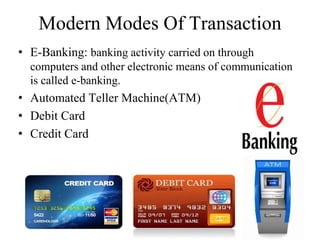
Modern Modes Of Transaction
• E-Banking: banking activity carried on through
computers and other electronic means of communication
is called e-banking.
• Automated Teller Machine(ATM)
• Debit Card
• Credit Card
THANK YOU
Q/A

BANK PRESENTATION

  • 1.
  • 2.
    WHAT IS ABANKING? • Banking Regulation Act of India ,1949 defines banking as “accepting for the purpose of lending or investment of deposits of money from the public repayable on demand or otherwise or withdrawal by cheque , draft order or otherwise”. • The Reserve Bank of India Act 1934 and the Banking Regulation Act 1949 governs the banking operation in India. • A bank is a financial institution that accepts deposits from the public for the purpose of lending and investment .
  • 3.
    HISTORY OF BANK •PHASE I (Before 1806) 1770 Bank Of Hindustan was established in India by Alexander and Company . It was the first bank in India but it was unsuccessful soon (1829-1832).
  • 4.
    • PHASE II(1806-1860) Three Presidency Bank were established in India by Britishers They entered from west and captured whole India . There were three presidency bank which brought revolution in banking industry namely: 1. Bank of Calcutta(1806) 2. Bank of Bombay(1840) 3. Bank of madras(1843)
  • 5.
    • PHASE III(1860-1913) 1. (1865) Allahabad Bank was established it is the Oldest Public Sector Bank in India. 2. (1881) Awadh Commercial Bank was established at Faizabad-1st bank of limited liability managed by Indians.(after independence in 1958 this bank failed.) 3. (1894) Punjab National Bank was established at Lahore in Punjab Province of undivided India (it was 1st complete Indian bank which was started with Indian capital run by Indians established by Indians and even customers were also Indians) Founder of PNB was LALA LAJPAT RAI.
  • 6.
    • PHASE IV(1913-1980) 1. 1ST India Commercial Bank owned and managed by Indian: Central bank of India established in 1911. It was also First Swadeshi bank. 2. 17th January ,1921 Three presidency bank were amalgamated to form a single bank namely Imperial Bank Of India 3. In 1955 Imperial Bank Of India was converted into State Bank Of India.
  • 8.
    Classification of banksin india 1.RBI: The RBI is the supreme monetary and banking authority in the country and has the responsibility to control the banking system in the country 2. Public sector bank: PSBs are banks where the majority stake (i.e more than 50%) is held by a government. The shares of these banks are listed on the stock exchange. 3. Private sector bank: Private Sector Banks are the banks where greater parts of state or equity are held by private shareholders and not by government.
  • 9.
    4.Cooperative sector bank:Cooperative sector banks are retail and commercial banks organized on a cooperative basis. 5.Development banks: Development banks are those financial institutions whose primary goal is to finance the primary(basic) needs of the society.
  • 10.
    Reserve Bank OfIndia • The Reserve Bank of India (RBI) is India's central banking institution, which controls the monetary policy of the Indian rupee. It commenced its operations on 1 April 1935 during the British Rule in accordance with the provisions of the Reserve Bank of India Act, 1934. • A Central Bank is an independent apex monetary authority which regulates banks and provides important financial services like storing of foreign exchange reserves, control of inflation, monetary policy report.
  • 11.
    Commercial banks • Commercialbank comprises of public sector bank, foreign bank and private sector bank ,represent the most important financial intermediary in the Indian financial system. Functions of commercial banks: 1.Acceptance of deposits 2.Advancing of loans 3.Agency function(collecting receipt and making payments) 4.General utility function(providing atms and credit card facility)
  • 12.
    Investment Bank • AnInvestment bank is typically a private company that provide various financial related and other services to individuals, and government such as raising financial capital by underwriting. • An Investment bank may also assist companies involved in Mergers and acquisitions(M&A).
  • 13.
    Cooperative Bank • Cooperativebanking institutions take deposit and lend money in most parts of the world. • Cooperative banks are that banks that holds deposits, makes loans and provides other financial services to cooperatives and member owned organisations also known as bank of cooperative.
  • 14.
    Modern Modes OfTransaction • E-Banking: banking activity carried on through computers and other electronic means of communication is called e-banking. • Automated Teller Machine(ATM) • Debit Card • Credit Card
  • 15.