India and the WTO
30-03-2018
Professor Mahendra Kumar Ghadoliya, RNB Global University,
Bikaner
30-03-2018
Professor Mahendra Kumar Ghadoliya, RNB Global University,
Bikaner
Rise and fall of WTO. Too ambitious?
World Trade Organization (WTO) is one of the most powerful institutions in the
world was born in 1995 replacing the general Agreement on Tariff and Trade (GATT).
 It is an international, multilateral organization, which sets the rules for the global
trading system & resolves disputes between its member states.
It oversees global trade in goods & services and has 30 agreements.
It was also given powers to punish countries which violated these rules.
Yet, in what must be an unusual development in the history of international
institutions, the WTO has been felled by the weight of the extraordinary ambitions
placed on it.
Since the late 2000s, the organisation has been unable to carry out its basic task of
overseeing a successful conduct of multilateral trade negotiations.
The failure of the recent ministerial meeting at Buenos Aires is only symptomatic of
a decline in its importance.
The rise and decline has happened quickly.
.
WTO headquarters are located in Geneva, Switzerland.
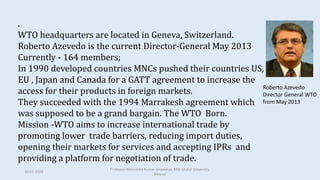
Roberto Azevedo is the current Director-General May 2013
Currently - 164 members;
In 1990 developed countries MNCs pushed their countries US,
EU , Japan and Canada for a GATT agreement to increase the
access for their products in foreign markets.
They succeeded with the 1994 Marrakesh agreement which
was supposed to be a grand bargain. The WTO Born.
Mission -WTO aims to increase international trade by
promoting lower trade barriers, reducing import duties,
opening their markets for services and accepting IPRs and
providing a platform for negotiation of trade.
Roberto Azevedo
Director General WTO
from May 2013
30-03-2018
Professor Mahendra Kumar Ghadoliya, RNB Global University,
Bikaner
Five Core Principles of WTO
 Non discrimination between countries:
 No Most Favoured Nation (MFN) Treatment - no special
deals to trading partners, all members of WTO must be
treated the same.
 No National Special Treatment - locals and foreigners are
treated equally .
 Freer trade: gradually through negotiations
 Predictability: Promising not to raise tariffs is called binding
a tariff and binding leads to greater certainty for businesses
 Promoting competition.
 Encouraging Development and Economic Reform
30-03-2018
Professor Mahendra Kumar Ghadoliya, RNB Global University,
Bikaner
 Multilateral Trade Liberalisation:
 Under GATT Uruguay Round and Doha Development Agenda
nations agreed to reduce tariff and non-tariff trade barriers
 It was accepted that trade liberalisation will stimulate production
in India in those sectors where the country has comparative
advantage in labour intensive area
 Resources will be allocated efficiently and large scale production will result in
economies of scale.
 In 1990 India was a over protected country through QRs this resulted in
continuously declining the share of India in international trade.
 Prior to 1991 imports tariff rates were highest in the world.
They were reduced to about 25 %.
30-03-2018
Professor Mahendra Kumar Ghadoliya, RNB Global University,
Bikaner
Features of WTO
• It is open for all. At present 164 members
• Multilateral Trade Agreements
• Wider Scope than GATT
• Each Member has a single voting right.
• International organisation.
• Agreements applicable on all
30-03-2018
Professor Mahendra Kumar Ghadoliya, RNB Global University,
Bikaner
Objectives of WTO
• To raise the standard of living
• To reduce tariff and other trade barriers
• Optimum use of resources
• Expanding production
• More employment through Trade
• Eliminate discriminatory treatment.
30-03-2018
Professor Mahendra Kumar Ghadoliya, RNB Global University,
Bikaner
The china Factor
• The entry of China into the WTO in 2001 also changed the picture.
China used its newly acquired ‘most favoured nation’ status to the hilt.
• It expanded exports manifold to the EU and the U.S. Indeed, an
influential body of opinion holds China’s export success as responsible
for the hollowing out of U.S. manufacturing.
• In 2001 they presented a new agenda under Doha Development Agenda
covering old and new issues.
• US soon realised this that on a global platform he cannot dictate the
terms. They let the DDA die. The US and EU started picking up those
agreements which were beneficial to them.
• This virtually destroyed the principle of reciprocity under which each
country wanting to obtain gains in specific areas makes concessions in
others.
30-03-2018
Professor Mahendra Kumar Ghadoliya, RNB Global University,
Bikaner
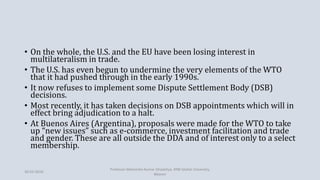
• On the whole, the U.S. and the EU have been losing interest in
multilateralism in trade.
• The U.S. has even begun to undermine the very elements of the WTO
that it had pushed through in the early 1990s.
• It now refuses to implement some Dispute Settlement Body (DSB)
decisions.
• Most recently, it has taken decisions on DSB appointments which will in
effect bring adjudication to a halt.
• At Buenos Aires (Argentina), proposals were made for the WTO to take
up “new issues” such as e-commerce, investment facilitation and trade
and gender. These are all outside the DDA and of interest only to a select
membership.
30-03-2018
Professor Mahendra Kumar Ghadoliya, RNB Global University,
Bikaner
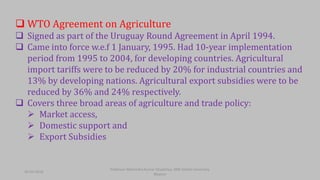
 WTO Agreement on Agriculture
 Signed as part of the Uruguay Round Agreement in April 1994.
 Came into force w.e.f 1 January, 1995. Had 10-year implementation
period from 1995 to 2004, for developing countries. Agricultural
import tariffs were to be reduced by 20% for industrial countries and
13% by developing nations. Agricultural export subsidies were to be
reduced by 36% and 24% respectively.
 Covers three broad areas of agriculture and trade policy:
 Market access,
 Domestic support and
 Export Subsidies
30-03-2018
Professor Mahendra Kumar Ghadoliya, RNB Global University,
Bikaner
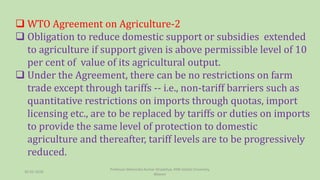
 WTO Agreement on Agriculture-2
 Obligation to reduce domestic support or subsidies extended
to agriculture if support given is above permissible level of 10
per cent of value of its agricultural output.
 Under the Agreement, there can be no restrictions on farm
trade except through tariffs -- i.e., non-tariff barriers such as
quantitative restrictions on imports through quotas, import
licensing etc., are to be replaced by tariffs or duties on imports
to provide the same level of protection to domestic
agriculture and thereafter, tariff levels are to be progressively
reduced.
30-03-2018
Professor Mahendra Kumar Ghadoliya, RNB Global University,
Bikaner
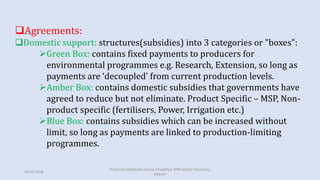
Agreements:
Domestic support: structures(subsidies) into 3 categories or "boxes":
Green Box: contains fixed payments to producers for
environmental programmes e.g. Research, Extension, so long as
payments are ‘decoupled’ from current production levels.
Amber Box: contains domestic subsidies that governments have
agreed to reduce but not eliminate. Product Specific – MSP, Non-
product specific (fertilisers, Power, Irrigation etc.)
Blue Box: contains subsidies which can be increased without
limit, so long as payments are linked to production-limiting
programmes.
30-03-2018
Professor Mahendra Kumar Ghadoliya, RNB Global University,
Bikaner
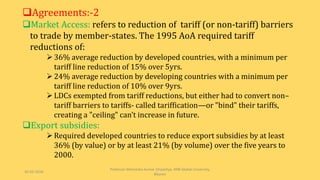
Agreements:-2
Market Access: refers to reduction of tariff (or non-tariff) barriers
to trade by member-states. The 1995 AoA required tariff
reductions of:
36% average reduction by developed countries, with a minimum per
tariff line reduction of 15% over 5yrs.
24% average reduction by developing countries with a minimum per
tariff line reduction of 10% over 9yrs.
LDCs exempted from tariff reductions, but either had to convert non–
tariff barriers to tariffs- called tariffication—or "bind" their tariffs,
creating a "ceiling" can’t increase in future.
Export subsidies:
Required developed countries to reduce export subsidies by at least
36% (by value) or by at least 21% (by volume) over the five years to
2000.
30-03-2018
Professor Mahendra Kumar Ghadoliya, RNB Global University,
Bikaner
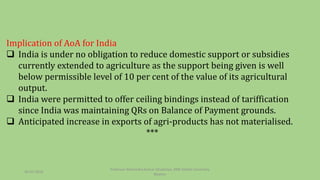
Implication of AoA for India
 India is under no obligation to reduce domestic support or subsidies
currently extended to agriculture as the support being given is well
below permissible level of 10 per cent of the value of its agricultural
output.
 India were permitted to offer ceiling bindings instead of tariffication
since India was maintaining QRs on Balance of Payment grounds.
 Anticipated increase in exports of agri-products has not materialised.
***
30-03-2018
Professor Mahendra Kumar Ghadoliya, RNB Global University,
Bikaner

India and the WTO

  • 1.
    India and theWTO 30-03-2018 Professor Mahendra Kumar Ghadoliya, RNB Global University, Bikaner
  • 2.
    30-03-2018 Professor Mahendra KumarGhadoliya, RNB Global University, Bikaner Rise and fall of WTO. Too ambitious? World Trade Organization (WTO) is one of the most powerful institutions in the world was born in 1995 replacing the general Agreement on Tariff and Trade (GATT).  It is an international, multilateral organization, which sets the rules for the global trading system & resolves disputes between its member states. It oversees global trade in goods & services and has 30 agreements. It was also given powers to punish countries which violated these rules. Yet, in what must be an unusual development in the history of international institutions, the WTO has been felled by the weight of the extraordinary ambitions placed on it. Since the late 2000s, the organisation has been unable to carry out its basic task of overseeing a successful conduct of multilateral trade negotiations. The failure of the recent ministerial meeting at Buenos Aires is only symptomatic of a decline in its importance. The rise and decline has happened quickly.
  • 3.
    . WTO headquarters arelocated in Geneva, Switzerland. Roberto Azevedo is the current Director-General May 2013 Currently - 164 members; In 1990 developed countries MNCs pushed their countries US, EU , Japan and Canada for a GATT agreement to increase the access for their products in foreign markets. They succeeded with the 1994 Marrakesh agreement which was supposed to be a grand bargain. The WTO Born. Mission -WTO aims to increase international trade by promoting lower trade barriers, reducing import duties, opening their markets for services and accepting IPRs and providing a platform for negotiation of trade. Roberto Azevedo Director General WTO from May 2013 30-03-2018 Professor Mahendra Kumar Ghadoliya, RNB Global University, Bikaner
  • 4.
    Five Core Principlesof WTO  Non discrimination between countries:  No Most Favoured Nation (MFN) Treatment - no special deals to trading partners, all members of WTO must be treated the same.  No National Special Treatment - locals and foreigners are treated equally .  Freer trade: gradually through negotiations  Predictability: Promising not to raise tariffs is called binding a tariff and binding leads to greater certainty for businesses  Promoting competition.  Encouraging Development and Economic Reform 30-03-2018 Professor Mahendra Kumar Ghadoliya, RNB Global University, Bikaner
  • 5.
     Multilateral TradeLiberalisation:  Under GATT Uruguay Round and Doha Development Agenda nations agreed to reduce tariff and non-tariff trade barriers  It was accepted that trade liberalisation will stimulate production in India in those sectors where the country has comparative advantage in labour intensive area  Resources will be allocated efficiently and large scale production will result in economies of scale.  In 1990 India was a over protected country through QRs this resulted in continuously declining the share of India in international trade.  Prior to 1991 imports tariff rates were highest in the world. They were reduced to about 25 %. 30-03-2018 Professor Mahendra Kumar Ghadoliya, RNB Global University, Bikaner
  • 6.
    Features of WTO •It is open for all. At present 164 members • Multilateral Trade Agreements • Wider Scope than GATT • Each Member has a single voting right. • International organisation. • Agreements applicable on all 30-03-2018 Professor Mahendra Kumar Ghadoliya, RNB Global University, Bikaner
  • 7.
    Objectives of WTO •To raise the standard of living • To reduce tariff and other trade barriers • Optimum use of resources • Expanding production • More employment through Trade • Eliminate discriminatory treatment. 30-03-2018 Professor Mahendra Kumar Ghadoliya, RNB Global University, Bikaner
  • 8.
    The china Factor •The entry of China into the WTO in 2001 also changed the picture. China used its newly acquired ‘most favoured nation’ status to the hilt. • It expanded exports manifold to the EU and the U.S. Indeed, an influential body of opinion holds China’s export success as responsible for the hollowing out of U.S. manufacturing. • In 2001 they presented a new agenda under Doha Development Agenda covering old and new issues. • US soon realised this that on a global platform he cannot dictate the terms. They let the DDA die. The US and EU started picking up those agreements which were beneficial to them. • This virtually destroyed the principle of reciprocity under which each country wanting to obtain gains in specific areas makes concessions in others. 30-03-2018 Professor Mahendra Kumar Ghadoliya, RNB Global University, Bikaner
  • 9.
    • On thewhole, the U.S. and the EU have been losing interest in multilateralism in trade. • The U.S. has even begun to undermine the very elements of the WTO that it had pushed through in the early 1990s. • It now refuses to implement some Dispute Settlement Body (DSB) decisions. • Most recently, it has taken decisions on DSB appointments which will in effect bring adjudication to a halt. • At Buenos Aires (Argentina), proposals were made for the WTO to take up “new issues” such as e-commerce, investment facilitation and trade and gender. These are all outside the DDA and of interest only to a select membership. 30-03-2018 Professor Mahendra Kumar Ghadoliya, RNB Global University, Bikaner
  • 10.
     WTO Agreementon Agriculture  Signed as part of the Uruguay Round Agreement in April 1994.  Came into force w.e.f 1 January, 1995. Had 10-year implementation period from 1995 to 2004, for developing countries. Agricultural import tariffs were to be reduced by 20% for industrial countries and 13% by developing nations. Agricultural export subsidies were to be reduced by 36% and 24% respectively.  Covers three broad areas of agriculture and trade policy:  Market access,  Domestic support and  Export Subsidies 30-03-2018 Professor Mahendra Kumar Ghadoliya, RNB Global University, Bikaner
  • 11.
     WTO Agreementon Agriculture-2  Obligation to reduce domestic support or subsidies extended to agriculture if support given is above permissible level of 10 per cent of value of its agricultural output.  Under the Agreement, there can be no restrictions on farm trade except through tariffs -- i.e., non-tariff barriers such as quantitative restrictions on imports through quotas, import licensing etc., are to be replaced by tariffs or duties on imports to provide the same level of protection to domestic agriculture and thereafter, tariff levels are to be progressively reduced. 30-03-2018 Professor Mahendra Kumar Ghadoliya, RNB Global University, Bikaner
  • 12.
    Agreements: Domestic support: structures(subsidies)into 3 categories or "boxes": Green Box: contains fixed payments to producers for environmental programmes e.g. Research, Extension, so long as payments are ‘decoupled’ from current production levels. Amber Box: contains domestic subsidies that governments have agreed to reduce but not eliminate. Product Specific – MSP, Non- product specific (fertilisers, Power, Irrigation etc.) Blue Box: contains subsidies which can be increased without limit, so long as payments are linked to production-limiting programmes. 30-03-2018 Professor Mahendra Kumar Ghadoliya, RNB Global University, Bikaner
  • 13.
    Agreements:-2 Market Access: refersto reduction of tariff (or non-tariff) barriers to trade by member-states. The 1995 AoA required tariff reductions of: 36% average reduction by developed countries, with a minimum per tariff line reduction of 15% over 5yrs. 24% average reduction by developing countries with a minimum per tariff line reduction of 10% over 9yrs. LDCs exempted from tariff reductions, but either had to convert non– tariff barriers to tariffs- called tariffication—or "bind" their tariffs, creating a "ceiling" can’t increase in future. Export subsidies: Required developed countries to reduce export subsidies by at least 36% (by value) or by at least 21% (by volume) over the five years to 2000. 30-03-2018 Professor Mahendra Kumar Ghadoliya, RNB Global University, Bikaner
  • 14.
    Implication of AoAfor India  India is under no obligation to reduce domestic support or subsidies currently extended to agriculture as the support being given is well below permissible level of 10 per cent of the value of its agricultural output.  India were permitted to offer ceiling bindings instead of tariffication since India was maintaining QRs on Balance of Payment grounds.  Anticipated increase in exports of agri-products has not materialised. *** 30-03-2018 Professor Mahendra Kumar Ghadoliya, RNB Global University, Bikaner