
FOREIGN TRADE
POLICY OF INDIA
CONTENT
Introduction
Foreign trade policy before 1991
Foreign trade policy after 1991
Conclusion
Reference
Introduction
Before independence, India did not
have a clear trade policy, it was after the
independence, that a trade policy, as a
part of general economic policy of
development was formulated.
Foreign trade policy of India is
classified into two:
Foreign trade policy before 1991
Foreign trade policy after 1991
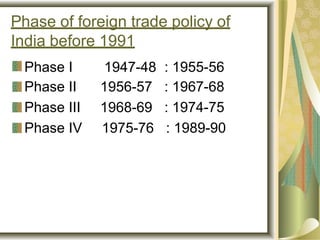
Phase of foreign trade policy of
India before 1991
Phase I 1947-48 : 1955-56
Phase II 1956-57 : 1967-68
Phase III 1968-69 : 1974-75
Phase IV 1975-76 : 1989-90
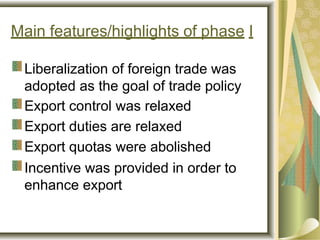
Main features/highlights of phase I
Liberalization of foreign trade was
adopted as the goal of trade policy
Export control was relaxed
Export duties are relaxed
Export quotas were abolished
Incentive was provided in order to
enhance export
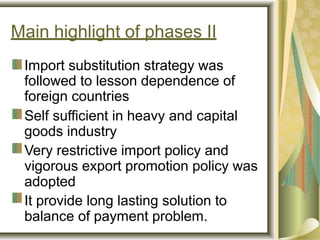
Main highlight of phases II
Import substitution strategy was
followed to lesson dependence of
foreign countries
Self sufficient in heavy and capital
goods industry
Very restrictive import policy and
vigorous export promotion policy was
adopted
It provide long lasting solution to
balance of payment problem.
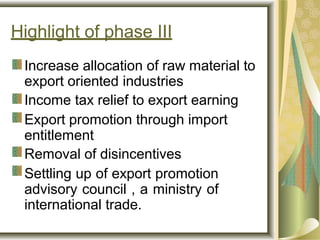
Highlight of phase III
Increase allocation of raw material to
export oriented industries
Income tax relief to export earning
Export promotion through import
entitlement
Removal of disincentives
Settling up of export promotion
advisory council , a ministry of
international trade.
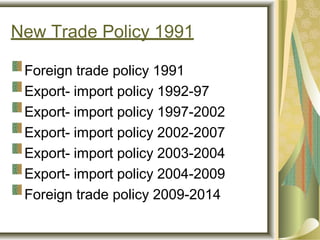
New Trade Policy 1991
Foreign trade policy 1991
Export- import policy 1992-97
Export- import policy 1997-2002
Export- import policy 2002-2007
Export- import policy 2003-2004
Export- import policy 2004-2009
Foreign trade policy 2009-2014
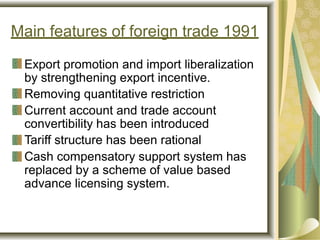
Main features of foreign trade 1991
Export promotion and import liberalization
by strengthening export incentive.
Removing quantitative restriction
Current account and trade account
convertibility has been introduced
Tariff structure has been rational
Cash compensatory support system has
replaced by a scheme of value based
advance licensing system.
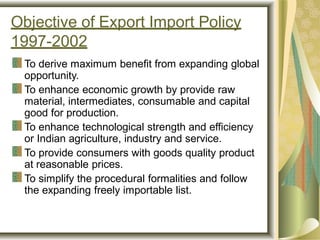
Objective of Export Import Policy
1997-2002
To derive maximum benefit from expanding global
opportunity.
To enhance economic growth by provide raw
material, intermediates, consumable and capital
good for production.
To enhance technological strength and efficiency
or Indian agriculture, industry and service.
To provide consumers with goods quality product
at reasonable prices.
To simplify the procedural formalities and follow
the expanding freely importable list.
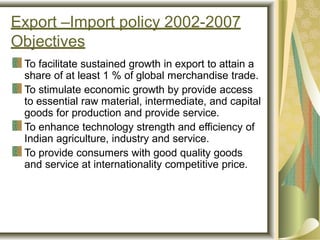
Export –Import policy 2002-2007
Objectives
To facilitate sustained growth in export to attain a
share of at least 1 % of global merchandise trade.
To stimulate economic growth by provide access
to essential raw material, intermediate, and capital
goods for production and provide service.
To enhance technology strength and efficiency of
Indian agriculture, industry and service.
To provide consumers with good quality goods
and service at internationality competitive price.
Policy measures
Comprehensive package for
development of special economic
zone.
Decontrol and deregulation of
agriculture sector.
De reservation from small scale
industries.
Technological up gradation.
Reduction in peak customs duty from
35% to 20%.
Highlights of Foreign Trade Policy
2004-2009
Push to export to garner 1.5% of world
share by export $150 billion worth of
merchandise.
Hundred percent FDI would be permitted
for develop infrastructure.
FDI permitted up to 100 percent to
establish and develop free trade and
warehousing zone, each to have a Rs.100
crore outlay.
Import of seed, bulbs and fibers liberalized.
New policy exempts all goods and service
export form service tax.
Foreign Trade Policy 2009-2014
objectives
The main objective of policy is to achieving an
annual export growth of 15% with an annual
export target of us $ 200 billion by march 2011.
In remaining 3 years of foreign trade policy up to
2014, the country should be able to come back on
the high export growth of around 25%p.a.
By 2014, the expect to double India’s export of
goods and service.
The long term policy objective for the government
is to double India’s share in global trade in 2020.
Highlights of Foreign Trade policy
2015 - 2020
Increase exports to $900 billion by 2019-20, from $466
billion in 2013-14.
Raise India's share in world exports from 2% to 3.5%.
Merchandise Export from India Scheme (MEIS) and
Service Exports from India Scheme (SEIS) launched.
Served From India Scheme (SFIS) will be replaced with
Service Export from India Scheme (SEIS).
For grant of rewards under MEIS, the countries have been
categorized into 3 Groups, whereas the rates of rewards under
MEIS range from 2 per cent to 5 per cent. Under SEIS the
selected Services would be rewarded at the rates of 3 per cent
and 5 per cent.
8/17/2015
FTP to be aligned to Make in India, Digital India and
Skills India initiatives.
Duty credit scripts made freely transferable and
usable For payment of custom duty, excise duty
and service tax.
Export promotion mission to take on board state
Governments
Unlike annual reviews, FTP will be reviewed
after two-and- Half years.
Higher level of support for export of
defence, farm Produce and eco-friendly
products.
Nomenclature of Export House, Star Export
House, Trading House, Premier Trading
House certificate changed to 1,2,3,4,5 Star
Export House. The criteria for export
performance for recognition of status holder
have been changed from Rupees to US dollar
earnings.
Online procedure to upload digitally
signed document by Chartered
Accountant/Company Secretary/Cost
Accountant to be developed.
Validity period of SCOMET export
authorisation extended from present 12
months to 24 months.
Chapter-3 incentives extended to units
located in SEZs.
Export obligation under EPCG scheme reduced to
75%
to Promote domestic capital goods manufacturing.
E-Commerce exports of handloom products,
books/periodicals, leather footwear, toys and
customised fashion garments through courier or
foreign post office would also be able to get benefit
of MEIS (for values up to INR 25,000).
Inter-ministerial consultations to be held online
for issue of various licences.
No need to repeatedly submit physical copies of
documents
available on Exporter Importer Profile.
108 MSME clusters have been identified for
focused interventions to boost exports.
Accordingly, ‘Niryat Bandhu Scheme’ has been
galvanised and repositioned to achieve the
objectives of ‘Skill India’.
Trade facilitation and enhancing the ease of doing business
are the other major focus areas in this new FTP. One of the
major objective of new FTP is to move towards paperless
working in 24x7 environment.
Manufacturers, who are also status holders, will now
be able to self-certify their manufactured goods in
phases, as
originating from India with a view to qualifying for
preferential treatment under various forms of bilateral and
regional trade agreements. This ǮApproved Exporter Systemǯ
will help manufacturer exporters considerably in getting
fast 8/
a17/
c20
c15
ess to international markets.
Foreign trade

Foreign trade

  • 1.
  • 2.
    CONTENT Introduction Foreign trade policybefore 1991 Foreign trade policy after 1991 Conclusion Reference
  • 3.
    Introduction Before independence, Indiadid not have a clear trade policy, it was after the independence, that a trade policy, as a part of general economic policy of development was formulated.
  • 4.
    Foreign trade policyof India is classified into two: Foreign trade policy before 1991 Foreign trade policy after 1991
  • 5.
    Phase of foreigntrade policy of India before 1991 Phase I 1947-48 : 1955-56 Phase II 1956-57 : 1967-68 Phase III 1968-69 : 1974-75 Phase IV 1975-76 : 1989-90
  • 6.
    Main features/highlights ofphase I Liberalization of foreign trade was adopted as the goal of trade policy Export control was relaxed Export duties are relaxed Export quotas were abolished Incentive was provided in order to enhance export
  • 7.
    Main highlight ofphases II Import substitution strategy was followed to lesson dependence of foreign countries Self sufficient in heavy and capital goods industry Very restrictive import policy and vigorous export promotion policy was adopted It provide long lasting solution to balance of payment problem.
  • 8.
    Highlight of phaseIII Increase allocation of raw material to export oriented industries Income tax relief to export earning Export promotion through import entitlement Removal of disincentives Settling up of export promotion advisory council , a ministry of international trade.
  • 9.
    New Trade Policy1991 Foreign trade policy 1991 Export- import policy 1992-97 Export- import policy 1997-2002 Export- import policy 2002-2007 Export- import policy 2003-2004 Export- import policy 2004-2009 Foreign trade policy 2009-2014
  • 10.
    Main features offoreign trade 1991 Export promotion and import liberalization by strengthening export incentive. Removing quantitative restriction Current account and trade account convertibility has been introduced Tariff structure has been rational Cash compensatory support system has replaced by a scheme of value based advance licensing system.
  • 11.
    Objective of ExportImport Policy 1997-2002 To derive maximum benefit from expanding global opportunity. To enhance economic growth by provide raw material, intermediates, consumable and capital good for production. To enhance technological strength and efficiency or Indian agriculture, industry and service. To provide consumers with goods quality product at reasonable prices. To simplify the procedural formalities and follow the expanding freely importable list.
  • 12.
    Export –Import policy2002-2007 Objectives To facilitate sustained growth in export to attain a share of at least 1 % of global merchandise trade. To stimulate economic growth by provide access to essential raw material, intermediate, and capital goods for production and provide service. To enhance technology strength and efficiency of Indian agriculture, industry and service. To provide consumers with good quality goods and service at internationality competitive price.
  • 13.
    Policy measures Comprehensive packagefor development of special economic zone. Decontrol and deregulation of agriculture sector. De reservation from small scale industries. Technological up gradation. Reduction in peak customs duty from 35% to 20%.
  • 14.
    Highlights of ForeignTrade Policy 2004-2009 Push to export to garner 1.5% of world share by export $150 billion worth of merchandise. Hundred percent FDI would be permitted for develop infrastructure. FDI permitted up to 100 percent to establish and develop free trade and warehousing zone, each to have a Rs.100 crore outlay. Import of seed, bulbs and fibers liberalized. New policy exempts all goods and service export form service tax.
  • 15.
    Foreign Trade Policy2009-2014 objectives The main objective of policy is to achieving an annual export growth of 15% with an annual export target of us $ 200 billion by march 2011. In remaining 3 years of foreign trade policy up to 2014, the country should be able to come back on the high export growth of around 25%p.a. By 2014, the expect to double India’s export of goods and service. The long term policy objective for the government is to double India’s share in global trade in 2020.
  • 16.
    Highlights of ForeignTrade policy 2015 - 2020 Increase exports to $900 billion by 2019-20, from $466 billion in 2013-14. Raise India's share in world exports from 2% to 3.5%. Merchandise Export from India Scheme (MEIS) and Service Exports from India Scheme (SEIS) launched. Served From India Scheme (SFIS) will be replaced with Service Export from India Scheme (SEIS). For grant of rewards under MEIS, the countries have been categorized into 3 Groups, whereas the rates of rewards under MEIS range from 2 per cent to 5 per cent. Under SEIS the selected Services would be rewarded at the rates of 3 per cent and 5 per cent. 8/17/2015
  • 17.
    FTP to bealigned to Make in India, Digital India and Skills India initiatives. Duty credit scripts made freely transferable and usable For payment of custom duty, excise duty and service tax. Export promotion mission to take on board state Governments Unlike annual reviews, FTP will be reviewed after two-and- Half years.
  • 18.
    Higher level ofsupport for export of defence, farm Produce and eco-friendly products. Nomenclature of Export House, Star Export House, Trading House, Premier Trading House certificate changed to 1,2,3,4,5 Star Export House. The criteria for export performance for recognition of status holder have been changed from Rupees to US dollar earnings.
  • 19.
    Online procedure toupload digitally signed document by Chartered Accountant/Company Secretary/Cost Accountant to be developed. Validity period of SCOMET export authorisation extended from present 12 months to 24 months. Chapter-3 incentives extended to units located in SEZs.
  • 20.
    Export obligation underEPCG scheme reduced to 75% to Promote domestic capital goods manufacturing. E-Commerce exports of handloom products, books/periodicals, leather footwear, toys and customised fashion garments through courier or foreign post office would also be able to get benefit of MEIS (for values up to INR 25,000). Inter-ministerial consultations to be held online for issue of various licences.
  • 21.
    No need torepeatedly submit physical copies of documents available on Exporter Importer Profile. 108 MSME clusters have been identified for focused interventions to boost exports. Accordingly, ‘Niryat Bandhu Scheme’ has been galvanised and repositioned to achieve the objectives of ‘Skill India’.
  • 22.
    Trade facilitation andenhancing the ease of doing business are the other major focus areas in this new FTP. One of the major objective of new FTP is to move towards paperless working in 24x7 environment. Manufacturers, who are also status holders, will now be able to self-certify their manufactured goods in phases, as originating from India with a view to qualifying for preferential treatment under various forms of bilateral and regional trade agreements. This ǮApproved Exporter Systemǯ will help manufacturer exporters considerably in getting fast 8/ a17/ c20 c15 ess to international markets.