 Introduction to GATT andWTO
 Achievements of GATT
 WTO over GATT
 WTO Powers
 Role ofWTO
 India’s Role inWTO
 (GATT) is a multilateral agreement regulating international trade. Its
purpose is the "substantial reduction of tariffs and other trade barriers
and the elimination of preferences, on a reciprocal and mutually
advantageous basis. It was negotiated during the UN Conference on
Trade and Employment and was the outcome of the failure of
negotiating governments to create the InternationalTrade Organization
(ITO). GATT was signed in 1947 and lasted until 1993, when it was
replaced by the WorldTrade Organization in 1995.The originalGATT text
(GATT 1947) is still in effect under the WTO framework, subject to the
modifications of GATT 1994
 Tariff
 Quantitative Restrictions
 Developing Countries
 GATT has enjoyed a membership of over 100 countries and generated
about 85-90% of world trade.
(i) trade liberalization in industrial products (Kennedy Round)
(ii) Adopted codes on NTBs (Tokyo Round)
(iii) No world wars since 1948 (Increased trade promotes world peace)
(iv) Replaced byWTO on January 1, 1995.
 It came into existence on 1st January 1995.
 The original intention was to create a third institution to handle the trade
side of the international economic cooperation, joining the two “Bretton
Woods” institutions, the International Monetary Fund and the World Bank.
 All was not going well under the GATT and with the world trade becoming
more and more complex, GATT was not able to deal with it. For instance,
in agriculture, loopholes in the multilateral system were heavily exploited,
and efforts at liberalizing agricultural trade met with little success.
 In the textiles and clothing sector, an exception to GATT’s normal
disciplines was negotiated in the 1960s and early 1970s, leading to
the Multifibre Arrangement. Even GATT’s dispute settlement
systems were causing concern.
 The WTO framework ensures a “single undertaking approach” to
the results of the Uruguay Round — thus, membership in the WTO
entails accepting all the results of the Round without exception
 WTO covers a much broader purview, including subsidies, intellectual
property, food safety and other policies that were once solely the subject of
national governments.
 The WTO also has strong dispute settlement mechanisms. As under GATT,
panels weigh trade disputes, but these panels have to adhere to a strict time
schedule.
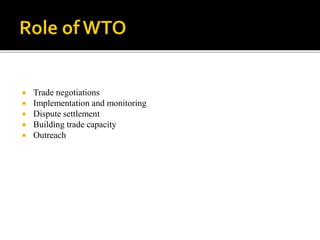
 Trade negotiations
 Implementation and monitoring
 Dispute settlement
 Building trade capacity
 Outreach
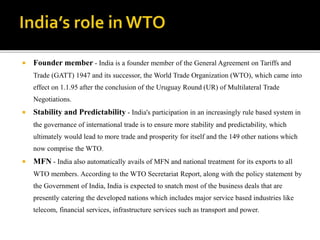
 Founder member - India is a founder member of the General Agreement on Tariffs and
Trade (GATT) 1947 and its successor, the World Trade Organization (WTO), which came into
effect on 1.1.95 after the conclusion of the Uruguay Round (UR) of Multilateral Trade
Negotiations.
 Stability and Predictability - India's participation in an increasingly rule based system in
the governance of international trade is to ensure more stability and predictability, which
ultimately would lead to more trade and prosperity for itself and the 149 other nations which
now comprise the WTO.
 MFN - India also automatically avails of MFN and national treatment for its exports to all
WTO members. According to the WTO Secretariat Report, along with the policy statement by
the Government of India, India is expected to snatch most of the business deals that are
presently catering the developed nations which includes major service based industries like
telecom, financial services, infrastructure services such as transport and power.
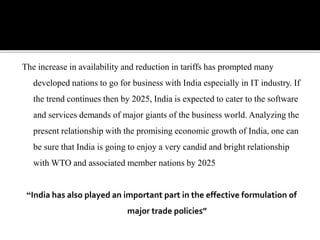
The increase in availability and reduction in tariffs has prompted many
developed nations to go for business with India especially in IT industry. If
the trend continues then by 2025, India is expected to cater to the software
and services demands of major giants of the business world. Analyzing the
present relationship with the promising economic growth of India, one can
be sure that India is going to enjoy a very candid and bright relationship
with WTO and associated member nations by 2025
“India has also played an important part in the effective formulation of
major trade policies”
Globalization

Globalization

  • 2.
     Introduction toGATT andWTO  Achievements of GATT  WTO over GATT  WTO Powers  Role ofWTO  India’s Role inWTO
  • 3.
     (GATT) isa multilateral agreement regulating international trade. Its purpose is the "substantial reduction of tariffs and other trade barriers and the elimination of preferences, on a reciprocal and mutually advantageous basis. It was negotiated during the UN Conference on Trade and Employment and was the outcome of the failure of negotiating governments to create the InternationalTrade Organization (ITO). GATT was signed in 1947 and lasted until 1993, when it was replaced by the WorldTrade Organization in 1995.The originalGATT text (GATT 1947) is still in effect under the WTO framework, subject to the modifications of GATT 1994
  • 4.
     Tariff  QuantitativeRestrictions  Developing Countries
  • 5.
     GATT hasenjoyed a membership of over 100 countries and generated about 85-90% of world trade. (i) trade liberalization in industrial products (Kennedy Round) (ii) Adopted codes on NTBs (Tokyo Round) (iii) No world wars since 1948 (Increased trade promotes world peace) (iv) Replaced byWTO on January 1, 1995.
  • 6.
     It cameinto existence on 1st January 1995.  The original intention was to create a third institution to handle the trade side of the international economic cooperation, joining the two “Bretton Woods” institutions, the International Monetary Fund and the World Bank.  All was not going well under the GATT and with the world trade becoming more and more complex, GATT was not able to deal with it. For instance, in agriculture, loopholes in the multilateral system were heavily exploited, and efforts at liberalizing agricultural trade met with little success.
  • 7.
     In thetextiles and clothing sector, an exception to GATT’s normal disciplines was negotiated in the 1960s and early 1970s, leading to the Multifibre Arrangement. Even GATT’s dispute settlement systems were causing concern.  The WTO framework ensures a “single undertaking approach” to the results of the Uruguay Round — thus, membership in the WTO entails accepting all the results of the Round without exception
  • 8.
     WTO coversa much broader purview, including subsidies, intellectual property, food safety and other policies that were once solely the subject of national governments.  The WTO also has strong dispute settlement mechanisms. As under GATT, panels weigh trade disputes, but these panels have to adhere to a strict time schedule.
  • 9.
     Trade negotiations Implementation and monitoring  Dispute settlement  Building trade capacity  Outreach
  • 10.
     Founder member- India is a founder member of the General Agreement on Tariffs and Trade (GATT) 1947 and its successor, the World Trade Organization (WTO), which came into effect on 1.1.95 after the conclusion of the Uruguay Round (UR) of Multilateral Trade Negotiations.  Stability and Predictability - India's participation in an increasingly rule based system in the governance of international trade is to ensure more stability and predictability, which ultimately would lead to more trade and prosperity for itself and the 149 other nations which now comprise the WTO.  MFN - India also automatically avails of MFN and national treatment for its exports to all WTO members. According to the WTO Secretariat Report, along with the policy statement by the Government of India, India is expected to snatch most of the business deals that are presently catering the developed nations which includes major service based industries like telecom, financial services, infrastructure services such as transport and power.
  • 11.
    The increase inavailability and reduction in tariffs has prompted many developed nations to go for business with India especially in IT industry. If the trend continues then by 2025, India is expected to cater to the software and services demands of major giants of the business world. Analyzing the present relationship with the promising economic growth of India, one can be sure that India is going to enjoy a very candid and bright relationship with WTO and associated member nations by 2025 “India has also played an important part in the effective formulation of major trade policies”