B.J.P.S Samiti’s
M.V.HERWADKAR ENGLISH
MEDIUM HIGH SCHOOL
Mrs Varada Phadke
INDIA AND NEIGHBOURING
COUNTRIES
Std 7th
M.V.HERWADKAR ENGLISH MEDIUM SCHOOL 1
INDIA AND NEIGHBOURING
COUNTRIES
The economic affairs of South Asia are India
centred.
India is playing an important role in South
Asian affairs due to its large size,
geographical conditions, economic and
military powers.
M.V.HERWADKAR ENGLISH MEDIUM SCHOOL 2
M.V.HERWADKAR ENGLISH MEDIUM SCHOOL 3
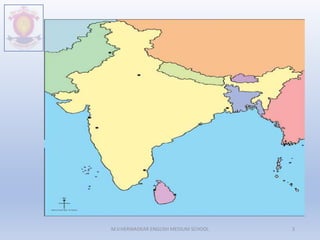
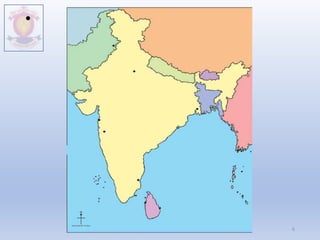
From the map we can make out that there are
seven nations share their border with India.
China, Nepal and Bhutan in the North,
Myanmar and Bangladesh in the East,
Pakistan in the North-West and
Srilanka in the South.
M.V.HERWADKAR ENGLISH MEDIUM SCHOOL 4
India has a rich record of peace,
friendly relations and co-operation
with its neighbours. Though India has
differences over several matters with
its neighbours, it wants solutions
through peaceful discussions.
M.V.HERWADKAR ENGLISH MEDIUM SCHOOL 5
•
M.V.HERWADKAR ENGLISH MEDIUM SCHOOL 6
INDIA AND PAKISTAN
Pakistan which was a part of India,
emerged as a separate nation in 1947.
These two nations took birth well
before they came into proper contact
resulting in lack of understanding with
each other. Therefore, several
problems still remain unsolved.
M.V.HERWADKAR ENGLISH MEDIUM SCHOOL 7
Some of the important problems are -
Kashmir problem
Military occupation
Terrorism
Water dispute
Protection to minorities
Development of Trade and Commerce
M.V.HERWADKAR ENGLISH MEDIUM SCHOOL 8
The Kashmir problem is still a major obstacle
in improvement of India-Pakistan relations.
Till now, India and Pakistan have fought four
wars [1947, 1965, 1971 and 1998]. In 1948,
the Pakistani forces tried to occupy Kashmir
but took control of few areas. It is known as
Pak-Occupied Kashmir [PoK]. India has
declared that Kashmir is the integral part of
India. In this direction, the United States
has been pursuing the bi-partisan policy. It is
supplying arms to Pak for various reasons.
M.V.HERWADKAR ENGLISH MEDIUM SCHOOL 9
1962 - After Indo-China war, Pakistan has
maintained close military relations with
China. Pakistan has lent 2,700 square
kilometres of land area to China.
1965 - In this war, the Indian forces
captured over 80,000 Pakistan soldiers
but it released them and handed over to
Pakistan. Kashmir problem can be solved
only through peaceful dialogue between
them.
M.V.HERWADKAR ENGLISH MEDIUM SCHOOL 10
There was a severe armed conflict between
Pakistani forces and India backed East
Pakistani forces. This war is
known as the third war between India and
Pakistan.
M.V.HERWADKAR ENGLISH MEDIUM SCHOOL 11
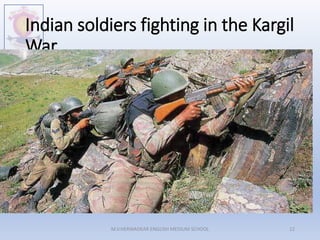
Indian soldiers fighting in the Kargil
War
M.V.HERWADKAR ENGLISH MEDIUM SCHOOL 12
Shimla Agreement
1971 – India and Pakistan war took place.
A summit was held in 1972 at Shimla.
Indira Gandhi was the Prime Minister of
India. In the summit, it was decided to
solve all the mutual problems including
the Kashmir issue through peaceful talks.
This is known as Shimla Agreement.
M.V.HERWADKAR ENGLISH MEDIUM SCHOOL 13
1999 – Prime Minister Atal Bihari Vajpayee
started the bus service to Lahore from
Amritsar after the Kargil military operations,
in order to improve the mutual relations. He
also tried to improve further relations
through the Agra Summit. The talks failed as
Pakistan continued to sponsor cross border
terrorism against India. As a result, the Pak
backed terrorists attacked the Parliament
building of India on 13th December 2001.
This event has further diluted themutual
relations.
M.V.HERWADKAR ENGLISH MEDIUM SCHOOL 14
INDIA AND CHINA
China is an important neighbour to India as it
shares a long record of border relations with
India. India used its good offices to secure a
permanent seat for China in the UN Security
Council. India expected friendly relations with
China since inception.
The matters related to Tibet and Arunachal
Pradesh are the major causes for the Indo-
China conflict.
M.V.HERWADKAR ENGLISH MEDIUM SCHOOL 15
India was disappointed when Chinese
forces occupied Tibet in 1958. When
China tried to suppress the sovereignty
of Tibet, India reiterated its commitment
to respect human rights and gave shelter
to the Tibetan refugees. China
condemned the policy of India and
strongly accused India of interfering in its
internal matters.
M.V.HERWADKAR ENGLISH MEDIUM SCHOOL 16
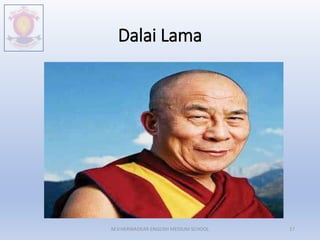
Dalai Lama
M.V.HERWADKAR ENGLISH MEDIUM SCHOOL 17
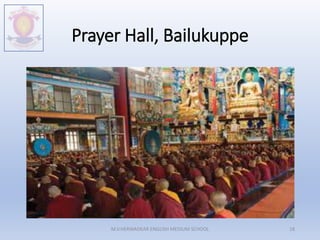
Prayer Hall, Bailukuppe
M.V.HERWADKAR ENGLISH MEDIUM SCHOOL 18
In 1950, Chinese forces gained control
over Tibet. At this time, India provided
shelter to more than 80,000 Tibetan
refugees who lost their identity and fled
to India with their spiritual leader Dalai
Lama. They were rehabilitated in ten
states of India. The Tibetan settlement
centres are found at Bailukuppe and
Mundagod in Karnataka. India protested
when the discontented Chinese forces
occupied the territories of India in the
east.
M.V.HERWADKAR ENGLISH MEDIUM SCHOOL 19
The Chinese Prime Minister Chou-En-Lai
who visited India in 1954 signed the
Panchasheela Treaty with Nehru.
You are already aware of its principles.
India made a request to China to make
corrections in its textbooks wherein the
territories of India have been shown
within China. Chinese Prime Minister has
agreed to do so, but nothing has been
done in this direction.
M.V.HERWADKAR ENGLISH MEDIUM SCHOOL 20
In 1962, China occupied the territories
from the East till Ladakh region [near
Jammu and Kashmir] in the background of
Tibetan problem. China unilaterally
declared truce with India. Before this, it
had already occupied 12,000 sq kms area
belonged to India. Prime Minister Nehru
who was a signatory to Panchasheela was
upset with these developments. Even at
present, the Line of Actual Control
– LAC maintains the status-quo
M.V.HERWADKAR ENGLISH MEDIUM SCHOOL 21
INDIA AND NEPAL
Nepal is in the North of India having its
borders with the Himalayan belt. India
and Nepal have close relations.
The border areas of both these countries
are free from disputes and are useful for
trade and public traffic without
interruption.
M.V.HERWADKAR ENGLISH MEDIUM SCHOOL 22
Nepal is a landlocked country and has to
establish contacts with other countries
through India only. China is another country
which has close borders with Nepal. Since
it is an overseas country, Nepal always likes to
maintain good relations with India. The India-
Nepal relations is based on the Friendship and
Peace agreement of 1950. India has been
specially helping Nepal in various areas like
transport, communication, irrigation, power,
forest, education etc.
M.V.HERWADKAR ENGLISH MEDIUM SCHOOL 23
India and Nepal who are signatories of 1971 Trade
Agreement are entitled for tax free trade. The
Maoist rebels who are gaining grounds in the recent
years in Nepal have threatened their mutual
relations. The mass killing of royal family members
in Nepal has brought shame.
Recently, the democratic set up is brought into
force ending the age long monarchy in Nepal.
M.V.HERWADKAR ENGLISH MEDIUM SCHOOL 24
INDIA AND BHUTAN
According to 1949 agreement, India has
assured Bhutan that it will not interfere in
its internal matters. Bhutan has formally
agreed to seek India’s help while dealing
with the foreign affairs.
M.V.HERWADKAR ENGLISH MEDIUM SCHOOL 25
The efforts of India enabled Bhutan to
secure a seat in the United Nations. India
has extended economic cooperation
to Bhutan from 1961-1981 and moreover
gave complete financial aid for its
projects. Bhutan is a member nation of
SAARC.
M.V.HERWADKAR ENGLISH MEDIUM SCHOOL 26
INDIA AND SRILANKA
Srilanka is an island located to the South.
India and Srilanka have cordial relations
since the times of Ramayana.
The missionaries were sent to Srilanka by
Emperor Ashoka for propagation of
Buddhism.
The cultural relations between
India and Srilanka have been further
strengthened.
M.V.HERWADKAR ENGLISH MEDIUM SCHOOL 27
Srilanka has two prominent communities
called Simhalese and Tamilians. Simhalese
are the original inhabitants of Srilanka.
Tamilians are the ethnic group living
in Srilanka. Both these communities have
been engaged in constant conflicts. The
Tamilians are fighting for their rights
and for establishing a new Tamil state
within Srilanka for the last two decades.
M.V.HERWADKAR ENGLISH MEDIUM SCHOOL 28
India has signed agreement in 1974-76
with Srilanka for asserting its right over
the Kachativ island situated between the
Palk Strait.
The Government of Srilanka made a
request in 1987 to India to pacify the
Tamil militants who were fighting for a
separate Tamil state on its soil.
M.V.HERWADKAR ENGLISH MEDIUM SCHOOL 29
The Tamil community living in Srilanka
protested the decision taken by India. A
futile bid was made to assassinate the Prime
Minister Rajiv Gandhi when he visited
Srilanka. In spite of these developments, the
militant Tamil organization called Liberation
of Tamil Tigers Eelam [LTTE] assassinated
Rajiv Gandhi on 21st May 1991. India is still
trying to maintain good relations with
Srilanka. After killing of the LTTE chief
Vellupillai Prabhakaran, its militant activities
have come to a halt.
M.V.HERWADKAR ENGLISH MEDIUM SCHOOL 30
INDIA AND BANGLADESH
Bangladesh which was the part of Pakistan
was called East Pakistan. The struggle for
independent state began as early as 1960. The
Awami League under the leadership of
Sheikh Mujibur Rehaman started a movement.
The armed forces of India entered East
Pakistan when the human rights were violated
there. In 1971 the West Pakistan lost the war
and later the East Pakistan emerged as an
independent state called Bangladesh.
M.V.HERWADKAR ENGLISH MEDIUM SCHOOL 31
In 1972, the Prime Ministers of India and
Bangladesh met in Dhaka and signed a
treaty for promotion of friendship, co-
operation and peace for 25 years.
Consequently, the problems between the
two countries found solutions thereafter.
M.V.HERWADKAR ENGLISH MEDIUM SCHOOL 32
The Chakma refugees of Bangladesh who
are migrating
to India from Chittagong hilly areas
smuggle drugs and other problems are
yet to be solved. The Bangladesh refugee
influx into the Indian territories is still a
major problem.
The Government of Bangladesh which is
harbouring the naxalite groups operating
in the Eastern region is a matter of grate
concern. Bangladesh continues friendly
relations with India
M.V.HERWADKAR ENGLISH MEDIUM SCHOOL 33
SAARC
The South Asian Nations have decided to start a
regional association for promoting Co-operation
called SAARC. In 1985, the SAARC [South Asian
Association for Regional Co-operation] came into
force. It comprised seven member nations
originally. Afghanistan joined the SAARC as the
eighth member [14th Summit held in 2007 at
New Delhi].
India, Bangladesh, Bhutan, Maldives, Nepal,
Pakistan, Srilanka and Afghanistan are the
member nations of SAARC.
M.V.HERWADKAR ENGLISH MEDIUM SCHOOL 34
Aims of SAARC
To improve mutual faith and goodwill among
the South Asian nations.
To promote the welfare of the South Asian
people
To extend co-operation and collaboration in
the economic, cultural, technical and scientific
fields.
To strengthen relations with the developed
countries.
M.V.HERWADKAR ENGLISH MEDIUM SCHOOL 35
There are hurdles in the path of progress
of member nations as the SAARC
members expect unilateral response
from India besides expressing fear and
suspicion
M.V.HERWADKAR ENGLISH MEDIUM SCHOOL 36

india and neighbouring countries.STD 7.pptx

  • 1.
    B.J.P.S Samiti’s M.V.HERWADKAR ENGLISH MEDIUMHIGH SCHOOL Mrs Varada Phadke INDIA AND NEIGHBOURING COUNTRIES Std 7th M.V.HERWADKAR ENGLISH MEDIUM SCHOOL 1
  • 2.
    INDIA AND NEIGHBOURING COUNTRIES Theeconomic affairs of South Asia are India centred. India is playing an important role in South Asian affairs due to its large size, geographical conditions, economic and military powers. M.V.HERWADKAR ENGLISH MEDIUM SCHOOL 2
  • 3.
  • 4.
    From the mapwe can make out that there are seven nations share their border with India. China, Nepal and Bhutan in the North, Myanmar and Bangladesh in the East, Pakistan in the North-West and Srilanka in the South. M.V.HERWADKAR ENGLISH MEDIUM SCHOOL 4
  • 5.
    India has arich record of peace, friendly relations and co-operation with its neighbours. Though India has differences over several matters with its neighbours, it wants solutions through peaceful discussions. M.V.HERWADKAR ENGLISH MEDIUM SCHOOL 5
  • 6.
  • 7.
    INDIA AND PAKISTAN Pakistanwhich was a part of India, emerged as a separate nation in 1947. These two nations took birth well before they came into proper contact resulting in lack of understanding with each other. Therefore, several problems still remain unsolved. M.V.HERWADKAR ENGLISH MEDIUM SCHOOL 7
  • 8.
    Some of theimportant problems are - Kashmir problem Military occupation Terrorism Water dispute Protection to minorities Development of Trade and Commerce M.V.HERWADKAR ENGLISH MEDIUM SCHOOL 8
  • 9.
    The Kashmir problemis still a major obstacle in improvement of India-Pakistan relations. Till now, India and Pakistan have fought four wars [1947, 1965, 1971 and 1998]. In 1948, the Pakistani forces tried to occupy Kashmir but took control of few areas. It is known as Pak-Occupied Kashmir [PoK]. India has declared that Kashmir is the integral part of India. In this direction, the United States has been pursuing the bi-partisan policy. It is supplying arms to Pak for various reasons. M.V.HERWADKAR ENGLISH MEDIUM SCHOOL 9
  • 10.
    1962 - AfterIndo-China war, Pakistan has maintained close military relations with China. Pakistan has lent 2,700 square kilometres of land area to China. 1965 - In this war, the Indian forces captured over 80,000 Pakistan soldiers but it released them and handed over to Pakistan. Kashmir problem can be solved only through peaceful dialogue between them. M.V.HERWADKAR ENGLISH MEDIUM SCHOOL 10
  • 11.
    There was asevere armed conflict between Pakistani forces and India backed East Pakistani forces. This war is known as the third war between India and Pakistan. M.V.HERWADKAR ENGLISH MEDIUM SCHOOL 11
  • 12.
    Indian soldiers fightingin the Kargil War M.V.HERWADKAR ENGLISH MEDIUM SCHOOL 12
  • 13.
    Shimla Agreement 1971 –India and Pakistan war took place. A summit was held in 1972 at Shimla. Indira Gandhi was the Prime Minister of India. In the summit, it was decided to solve all the mutual problems including the Kashmir issue through peaceful talks. This is known as Shimla Agreement. M.V.HERWADKAR ENGLISH MEDIUM SCHOOL 13
  • 14.
    1999 – PrimeMinister Atal Bihari Vajpayee started the bus service to Lahore from Amritsar after the Kargil military operations, in order to improve the mutual relations. He also tried to improve further relations through the Agra Summit. The talks failed as Pakistan continued to sponsor cross border terrorism against India. As a result, the Pak backed terrorists attacked the Parliament building of India on 13th December 2001. This event has further diluted themutual relations. M.V.HERWADKAR ENGLISH MEDIUM SCHOOL 14
  • 15.
    INDIA AND CHINA Chinais an important neighbour to India as it shares a long record of border relations with India. India used its good offices to secure a permanent seat for China in the UN Security Council. India expected friendly relations with China since inception. The matters related to Tibet and Arunachal Pradesh are the major causes for the Indo- China conflict. M.V.HERWADKAR ENGLISH MEDIUM SCHOOL 15
  • 16.
    India was disappointedwhen Chinese forces occupied Tibet in 1958. When China tried to suppress the sovereignty of Tibet, India reiterated its commitment to respect human rights and gave shelter to the Tibetan refugees. China condemned the policy of India and strongly accused India of interfering in its internal matters. M.V.HERWADKAR ENGLISH MEDIUM SCHOOL 16
  • 17.
  • 18.
    Prayer Hall, Bailukuppe M.V.HERWADKARENGLISH MEDIUM SCHOOL 18
  • 19.
    In 1950, Chineseforces gained control over Tibet. At this time, India provided shelter to more than 80,000 Tibetan refugees who lost their identity and fled to India with their spiritual leader Dalai Lama. They were rehabilitated in ten states of India. The Tibetan settlement centres are found at Bailukuppe and Mundagod in Karnataka. India protested when the discontented Chinese forces occupied the territories of India in the east. M.V.HERWADKAR ENGLISH MEDIUM SCHOOL 19
  • 20.
    The Chinese PrimeMinister Chou-En-Lai who visited India in 1954 signed the Panchasheela Treaty with Nehru. You are already aware of its principles. India made a request to China to make corrections in its textbooks wherein the territories of India have been shown within China. Chinese Prime Minister has agreed to do so, but nothing has been done in this direction. M.V.HERWADKAR ENGLISH MEDIUM SCHOOL 20
  • 21.
    In 1962, Chinaoccupied the territories from the East till Ladakh region [near Jammu and Kashmir] in the background of Tibetan problem. China unilaterally declared truce with India. Before this, it had already occupied 12,000 sq kms area belonged to India. Prime Minister Nehru who was a signatory to Panchasheela was upset with these developments. Even at present, the Line of Actual Control – LAC maintains the status-quo M.V.HERWADKAR ENGLISH MEDIUM SCHOOL 21
  • 22.
    INDIA AND NEPAL Nepalis in the North of India having its borders with the Himalayan belt. India and Nepal have close relations. The border areas of both these countries are free from disputes and are useful for trade and public traffic without interruption. M.V.HERWADKAR ENGLISH MEDIUM SCHOOL 22
  • 23.
    Nepal is alandlocked country and has to establish contacts with other countries through India only. China is another country which has close borders with Nepal. Since it is an overseas country, Nepal always likes to maintain good relations with India. The India- Nepal relations is based on the Friendship and Peace agreement of 1950. India has been specially helping Nepal in various areas like transport, communication, irrigation, power, forest, education etc. M.V.HERWADKAR ENGLISH MEDIUM SCHOOL 23
  • 24.
    India and Nepalwho are signatories of 1971 Trade Agreement are entitled for tax free trade. The Maoist rebels who are gaining grounds in the recent years in Nepal have threatened their mutual relations. The mass killing of royal family members in Nepal has brought shame. Recently, the democratic set up is brought into force ending the age long monarchy in Nepal. M.V.HERWADKAR ENGLISH MEDIUM SCHOOL 24
  • 25.
    INDIA AND BHUTAN Accordingto 1949 agreement, India has assured Bhutan that it will not interfere in its internal matters. Bhutan has formally agreed to seek India’s help while dealing with the foreign affairs. M.V.HERWADKAR ENGLISH MEDIUM SCHOOL 25
  • 26.
    The efforts ofIndia enabled Bhutan to secure a seat in the United Nations. India has extended economic cooperation to Bhutan from 1961-1981 and moreover gave complete financial aid for its projects. Bhutan is a member nation of SAARC. M.V.HERWADKAR ENGLISH MEDIUM SCHOOL 26
  • 27.
    INDIA AND SRILANKA Srilankais an island located to the South. India and Srilanka have cordial relations since the times of Ramayana. The missionaries were sent to Srilanka by Emperor Ashoka for propagation of Buddhism. The cultural relations between India and Srilanka have been further strengthened. M.V.HERWADKAR ENGLISH MEDIUM SCHOOL 27
  • 28.
    Srilanka has twoprominent communities called Simhalese and Tamilians. Simhalese are the original inhabitants of Srilanka. Tamilians are the ethnic group living in Srilanka. Both these communities have been engaged in constant conflicts. The Tamilians are fighting for their rights and for establishing a new Tamil state within Srilanka for the last two decades. M.V.HERWADKAR ENGLISH MEDIUM SCHOOL 28
  • 29.
    India has signedagreement in 1974-76 with Srilanka for asserting its right over the Kachativ island situated between the Palk Strait. The Government of Srilanka made a request in 1987 to India to pacify the Tamil militants who were fighting for a separate Tamil state on its soil. M.V.HERWADKAR ENGLISH MEDIUM SCHOOL 29
  • 30.
    The Tamil communityliving in Srilanka protested the decision taken by India. A futile bid was made to assassinate the Prime Minister Rajiv Gandhi when he visited Srilanka. In spite of these developments, the militant Tamil organization called Liberation of Tamil Tigers Eelam [LTTE] assassinated Rajiv Gandhi on 21st May 1991. India is still trying to maintain good relations with Srilanka. After killing of the LTTE chief Vellupillai Prabhakaran, its militant activities have come to a halt. M.V.HERWADKAR ENGLISH MEDIUM SCHOOL 30
  • 31.
    INDIA AND BANGLADESH Bangladeshwhich was the part of Pakistan was called East Pakistan. The struggle for independent state began as early as 1960. The Awami League under the leadership of Sheikh Mujibur Rehaman started a movement. The armed forces of India entered East Pakistan when the human rights were violated there. In 1971 the West Pakistan lost the war and later the East Pakistan emerged as an independent state called Bangladesh. M.V.HERWADKAR ENGLISH MEDIUM SCHOOL 31
  • 32.
    In 1972, thePrime Ministers of India and Bangladesh met in Dhaka and signed a treaty for promotion of friendship, co- operation and peace for 25 years. Consequently, the problems between the two countries found solutions thereafter. M.V.HERWADKAR ENGLISH MEDIUM SCHOOL 32
  • 33.
    The Chakma refugeesof Bangladesh who are migrating to India from Chittagong hilly areas smuggle drugs and other problems are yet to be solved. The Bangladesh refugee influx into the Indian territories is still a major problem. The Government of Bangladesh which is harbouring the naxalite groups operating in the Eastern region is a matter of grate concern. Bangladesh continues friendly relations with India M.V.HERWADKAR ENGLISH MEDIUM SCHOOL 33
  • 34.
    SAARC The South AsianNations have decided to start a regional association for promoting Co-operation called SAARC. In 1985, the SAARC [South Asian Association for Regional Co-operation] came into force. It comprised seven member nations originally. Afghanistan joined the SAARC as the eighth member [14th Summit held in 2007 at New Delhi]. India, Bangladesh, Bhutan, Maldives, Nepal, Pakistan, Srilanka and Afghanistan are the member nations of SAARC. M.V.HERWADKAR ENGLISH MEDIUM SCHOOL 34
  • 35.
    Aims of SAARC Toimprove mutual faith and goodwill among the South Asian nations. To promote the welfare of the South Asian people To extend co-operation and collaboration in the economic, cultural, technical and scientific fields. To strengthen relations with the developed countries. M.V.HERWADKAR ENGLISH MEDIUM SCHOOL 35
  • 36.
    There are hurdlesin the path of progress of member nations as the SAARC members expect unilateral response from India besides expressing fear and suspicion M.V.HERWADKAR ENGLISH MEDIUM SCHOOL 36