One day the educational opportunities available to
   children will be determined solely by their
          talent, motivation, and effort.
Presentation and Workshop Agenda
Is Our Program Working?
How to Partner with Evaluators and Get Results

 ► I: Presentation: Overview of evaluation partnership and key
   learnings
 ► II: Small group exercise: Overcoming potential evaluation
   challenges
 ► III: Question and Answer Period and Discussion

 Traci Kirtley, Director of Programming and Evaluation, College Possible

 Dr. Chris Avery, Roy E. Larsen Professor of Public Policy and Management,
 Malcolm Wiener Center for Social Policy, Harvard Kennedy School of
 Government
Introduction to College Possible
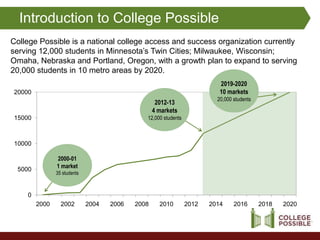
College Possible is a national college access and success organization currently
serving 12,000 students in Minnesota’s Twin Cities; Milwaukee, Wisconsin;
Omaha, Nebraska and Portland, Oregon, with a growth plan to expand to serving
20,000 students in 10 metro areas by 2020.
                                                                          2019-2020
20000                                                                     10 markets
                                                                         20,000 students
                                                   2012-13
                                                  4 markets
15000                                         12,000 students


10000

               2000-01
               1 market
 5000
               35 students


    0
        2000     2002        2004   2006   2008     2010        2012   2014     2016       2018   2020
Program Model
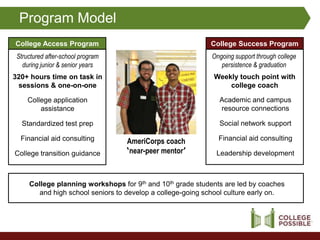
College Access Program                                     College Success Program
                                                          College Success Program
 Structured after-school program                            Ongoing support through college
   during junior & senior years                                persistence & graduation
320+ hours time on task in                                  Weekly touch point with
 sessions & one-on-one                                          college coach

     College application                                      Academic and campus
         assistance                                           resource connections

  Standardized test prep                                      Social network support

  Financial aid consulting         AmeriCorps coach           Financial aid consulting

College transition guidance        ‘near-peer mentor’        Leadership development


     College planning workshops for 9th and 10th grade students are led by coaches
       and high school seniors to develop a college-going school culture early on.
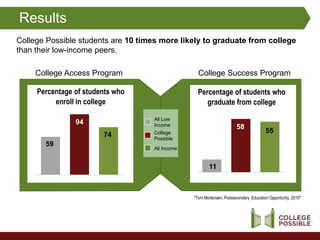
Results
College Possible students are 10 times more likely to graduate from college
than their low-income peers.

     College Access Program                        College Success Program

     Percentage of students who                    Percentage of students who
          enroll in college                           graduate from college

                                    All Low
                94                  Income                              58
                                    College                                            55
                        74          Possible
       59
                                    All Income


                                                         11


                                                 "Tom Mortensen, Postsecondary Education Opportunity, 2010"
Introduction to Dr. Christopher Avery

► Roy E. Larson Professor of Public Policy at Harvard Kennedy School

► Extensive research in college admissions

► Current focus on college application and enrollment
  patterns, especially among low-income students

► Recent studies have highlighted the issue of “undermatching” of high-
  achieving, low-income students in applying to and enrolling in more
  selective institutions
Why Evaluate?

3 main reasons to devote resources to program evaluation:
   - Shows if program is working, and for whom and in what conditions
  - Learn how to improve programmatic practices
  - Increases organization’s credibility with funders and other
  constituents


As College Possible grows to serve more students, rigorous and
systematic evaluation of program implementation and outcomes
becomes increasingly important to ensure the organization’s credibility
and sustainability.
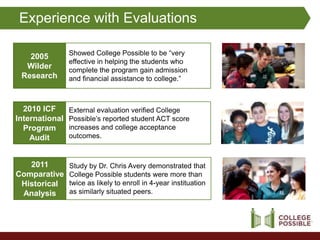
Experience with Evaluations

                Showed College Possible to be “very
   2005
                effective in helping the students who
  Wilder        complete the program gain admission
 Research       and financial assistance to college.”


  2010 ICF      External evaluation verified College
International   Possible’s reported student ACT score
  Program       increases and college acceptance
    Audit       outcomes.


   2011         Study by Dr. Chris Avery demonstrated that
Comparative     College Possible students were more than
 Historical     twice as likely to enroll in 4-year instituation
 Analysis       as similarly situated peers.
Case Study: Avery study of College Possible

- During spring 2010 student recruitment, College Possible identified 8
high schools with significantly more eligible sophomore applicants than
available spots in cohort.

- School teams selected 80% of cohorts (32/40) as they usually would,
leaving a “last-in, first out” group of about 240 students.

- Among “last-in, first-out” group, the evaluator randomly assigned
students to enroll in the program or be on waitlist. This created treatment
and control groups.

- Treatment and control groups were solidified in fall 2010, when some
students were admitted off waitlist to replace students who had moved or
transferred. Ultimately, around 130 students were in treatment group.
Case Study: Avery study of College Possible

- From their junior year onward, evaluator compared following
outcomes of treatment and control groups using data from
independent sources.

    -   ACT attendance and score increases
    -   Number of college applications sent
    -   Types of colleges applied to (2 year or 4 year, selectivity, etc.)
    -   Admissions decisions
    -   College enrollment rates in fall and spring

- Plans to continue following students to study rates of college
persistence and graduation.
Lessons Learned: Evaluation Challenges

► Conducting an evaluation takes resources and attention away from
  running the program

► Evaluations can challenge core beliefs when you “just know it works”

► Self-selection issues may exist
   – How are participants recruited?
   – How are participants selected?

► Evaluation needs must be balanced with program design needs or
  preferences

► Find an evaluator you trust!
Lessons Learned: Evaluation prerequisites

► Measurable outcomes

► Logical explanation for how results are achieved

► Historical evidence
   – Observational study/regression discontinuity
   – As a program, are you ready to be evaluated?

► Data collection systems and process

► Staff buy-in
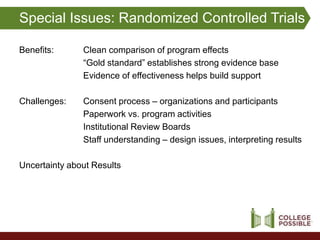
Special Issues: Randomized Controlled Trials

Benefits:      Clean comparison of program effects
               “Gold standard” establishes strong evidence base
               Evidence of effectiveness helps build support

Challenges:    Consent process – organizations and participants
               Paperwork vs. program activities
               Institutional Review Boards
               Staff understanding – design issues, interpreting results

Uncertainty about Results
Small Group Discussion
Question and Answer/
    Discussion

Is Our Program Working? How to Partner with Evaluators and Get Results

  • 1.
    One day theeducational opportunities available to children will be determined solely by their talent, motivation, and effort.
  • 2.
    Presentation and WorkshopAgenda Is Our Program Working? How to Partner with Evaluators and Get Results ► I: Presentation: Overview of evaluation partnership and key learnings ► II: Small group exercise: Overcoming potential evaluation challenges ► III: Question and Answer Period and Discussion Traci Kirtley, Director of Programming and Evaluation, College Possible Dr. Chris Avery, Roy E. Larsen Professor of Public Policy and Management, Malcolm Wiener Center for Social Policy, Harvard Kennedy School of Government
  • 3.
    Introduction to CollegePossible College Possible is a national college access and success organization currently serving 12,000 students in Minnesota’s Twin Cities; Milwaukee, Wisconsin; Omaha, Nebraska and Portland, Oregon, with a growth plan to expand to serving 20,000 students in 10 metro areas by 2020. 2019-2020 20000 10 markets 20,000 students 2012-13 4 markets 15000 12,000 students 10000 2000-01 1 market 5000 35 students 0 2000 2002 2004 2006 2008 2010 2012 2014 2016 2018 2020
  • 4.
    Program Model College AccessProgram College Success Program College Success Program Structured after-school program Ongoing support through college during junior & senior years persistence & graduation 320+ hours time on task in Weekly touch point with sessions & one-on-one college coach College application Academic and campus assistance resource connections Standardized test prep Social network support Financial aid consulting AmeriCorps coach Financial aid consulting College transition guidance ‘near-peer mentor’ Leadership development College planning workshops for 9th and 10th grade students are led by coaches and high school seniors to develop a college-going school culture early on.
  • 5.
    Results College Possible studentsare 10 times more likely to graduate from college than their low-income peers. College Access Program College Success Program Percentage of students who Percentage of students who enroll in college graduate from college All Low 94 Income 58 College 55 74 Possible 59 All Income 11 "Tom Mortensen, Postsecondary Education Opportunity, 2010"
  • 6.
    Introduction to Dr.Christopher Avery ► Roy E. Larson Professor of Public Policy at Harvard Kennedy School ► Extensive research in college admissions ► Current focus on college application and enrollment patterns, especially among low-income students ► Recent studies have highlighted the issue of “undermatching” of high- achieving, low-income students in applying to and enrolling in more selective institutions
  • 7.
    Why Evaluate? 3 mainreasons to devote resources to program evaluation: - Shows if program is working, and for whom and in what conditions - Learn how to improve programmatic practices - Increases organization’s credibility with funders and other constituents As College Possible grows to serve more students, rigorous and systematic evaluation of program implementation and outcomes becomes increasingly important to ensure the organization’s credibility and sustainability.
  • 8.
    Experience with Evaluations Showed College Possible to be “very 2005 effective in helping the students who Wilder complete the program gain admission Research and financial assistance to college.” 2010 ICF External evaluation verified College International Possible’s reported student ACT score Program increases and college acceptance Audit outcomes. 2011 Study by Dr. Chris Avery demonstrated that Comparative College Possible students were more than Historical twice as likely to enroll in 4-year instituation Analysis as similarly situated peers.
  • 9.
    Case Study: Averystudy of College Possible - During spring 2010 student recruitment, College Possible identified 8 high schools with significantly more eligible sophomore applicants than available spots in cohort. - School teams selected 80% of cohorts (32/40) as they usually would, leaving a “last-in, first out” group of about 240 students. - Among “last-in, first-out” group, the evaluator randomly assigned students to enroll in the program or be on waitlist. This created treatment and control groups. - Treatment and control groups were solidified in fall 2010, when some students were admitted off waitlist to replace students who had moved or transferred. Ultimately, around 130 students were in treatment group.
  • 10.
    Case Study: Averystudy of College Possible - From their junior year onward, evaluator compared following outcomes of treatment and control groups using data from independent sources. - ACT attendance and score increases - Number of college applications sent - Types of colleges applied to (2 year or 4 year, selectivity, etc.) - Admissions decisions - College enrollment rates in fall and spring - Plans to continue following students to study rates of college persistence and graduation.
  • 11.
    Lessons Learned: EvaluationChallenges ► Conducting an evaluation takes resources and attention away from running the program ► Evaluations can challenge core beliefs when you “just know it works” ► Self-selection issues may exist – How are participants recruited? – How are participants selected? ► Evaluation needs must be balanced with program design needs or preferences ► Find an evaluator you trust!
  • 12.
    Lessons Learned: Evaluationprerequisites ► Measurable outcomes ► Logical explanation for how results are achieved ► Historical evidence – Observational study/regression discontinuity – As a program, are you ready to be evaluated? ► Data collection systems and process ► Staff buy-in
  • 13.
    Special Issues: RandomizedControlled Trials Benefits: Clean comparison of program effects “Gold standard” establishes strong evidence base Evidence of effectiveness helps build support Challenges: Consent process – organizations and participants Paperwork vs. program activities Institutional Review Boards Staff understanding – design issues, interpreting results Uncertainty about Results
  • 14.
  • 15.