Incorporating Planned Trail Projects Into
    the NEPA Process for Highways
A Little Bit About Me
—  Education:
   —  Master of Regional and
       Community Planning, Kansas
       State University
   —  Bachelor of Arts, Eastern
       Kentucky University

—  Experience:
   —  City of Clemson, SC
   —  HNTB – Plano, TX
   —  City of Mesquite, TX
   —  Lake County, Illinois
What are we talking about today?
—  Which bike/ped facilities are considered during the NEPA process
    for highway projects and how they are considered;
—  How alternatives for large-scale highway and transportation
    projects take planned bicycle/pedestrian facilities and their
    linkages into consideration and FHWA policy on bike/ped
    facilities; and
—  How planners can integrate planned or programmed bike/ped
    facilities into the NEPA and environmental documentation process
    for highway and other projects.
To Do This, We Need To…
        —  Understand the Transportation Planning Process and
            where and how in the process the Project
            Development phase fits;
        —  Understand the NEPA process, how it is applied to
            Federally funded transportation projects, and what
            considerations are made during the NEPA process
            that may involve bike/ped facilities;
        —  Understand how local government planners should
            and can get involved in the Federally funded
            Transportation Planning Process, including the the
            Project Development phase; and
        —  Determine what level of involvement and how much
            specificity in local government planning regarding
            bike/ped facilities is needed to ensure local goals and
            plans are considered and incorporated.
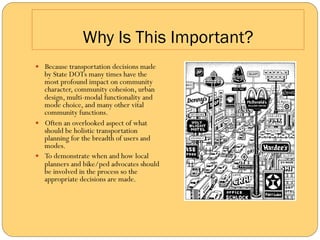
Why Is This Important?
—  Because transportation decisions made
    by State DOTs many times have the
    most profound impact on community
    character, community cohesion, urban
    design, multi-modal functionality and
    mode choice, and many other vital
    community functions.
—  Often an overlooked aspect of what
    should be holistic transportation
    planning for the breadth of users and
    modes.
—  To demonstrate when and how local
    planners and bike/ped advocates should
    be involved in the process so the
    appropriate decisions are made.
Federal Transportation Planning
                         Process
—  Federal role is to provide funds and standards for state and local decisions.
—  LRTP (MTP) – Long-Range Transportation Plan or Metropolitan Transportation Plan
      —  MPO’s transportation planning policy guide.
      —  Even if a proposed project is not proposed to be federally funded, should be incorporated.
      —  First opportunity to be involved. This is project conception phase. First attempt should be to get trail projects and
          plans for on-road facilities for the community in the MPO LRTP. (INSERT IMAGE OF MTP TRAIL PROJECTS
          HERE – TRAIL PROJECT INCORPORATED INTO MTP)
—    TIP or STIP – Transportation Improvement Program/Statewide Transportation Improvement Program
      —  State DOTs, MPOs, and transit operators make investment decisions with Federal dollars.
      —  Programs of funding, phasing, and scheduling used to implement the LRTP with Federal funds.
      —  Every 4 years, USDOT approves State DOTs’ programs of all projects proposed to be executed with Federal Funds.
—    Process designed to reflect the desires of communities.
      —  Spirit of Federally funded transportation planning is that transportation investment decisions are best made at the local
          level.
      —  However, for large MPOs, this is highly sensitive to community’s policy committee representation.
—    Project Development – Environmental review or NEPA phase.
      —  Links planning process with actual project location, design, and eventual construction and operation. Works out finer
          details of the project and how it will fit within affected communities.
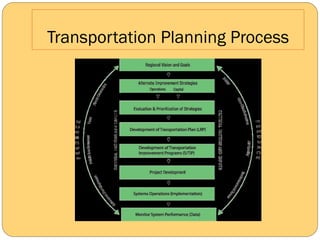
Transportation Planning Process
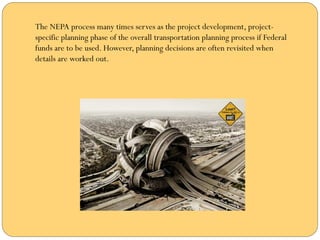
The NEPA process many times serves as the project development, project-
specific planning phase of the overall transportation planning process if Federal
funds are to be used. However, planning decisions are often revisited when
details are worked out.
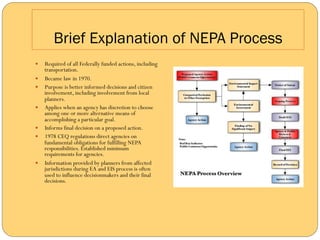
Brief Explanation of NEPA Process
—    Required of all Federally funded actions, including
      transportation.
—    Became law in 1970.
—    Purpose is better informed decisions and citizen
      involvement, including involvement from local
      planners.
—    Applies when an agency has discretion to choose
      among one or more alternative means of
      accomplishing a particular goal.
—    Informs final decision on a proposed action.
—    1978 CEQ regulations direct agencies on
      fundamental obligations for fulfilling NEPA
      responsibilities. Established minimum
      requirements for agencies.
—    Information provided by planners from affected
      jurisdictions during EA and EIS process is often
      used to influence decisionmakers and their final
      decisions.
NEPA Continued…
—  Categorical Exclusion (CE) – Applies to a category of actions that an agency has
    determined does not individually or cumulatively have a significant effect on the quality
    of the human environment.
—  Environmental Assessment (EA) – Used to determine the significance of environmental
    effects and to look at alternative means to achieve the agency’s objectives. Informs
    whether an EIS will need to be prepared or if there is a FONSI. Must involve public
    input.
—  Environmental Impact Statement (EIS) – Must prepare for a proposed major action
    significantly affecting the quality of the human environment.
   —    Notice of Intent published.
   —    Scoping conducted – must involve local communities if affected.
   —    Draft EIS prepared – Notice of Availability in Federal Register
   —    Evaluate/consider alternatives.
   —    Final EIS.
   —    Record of Decision.
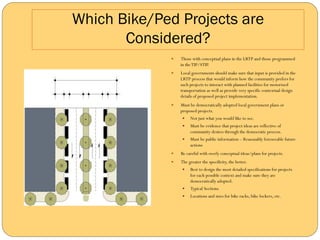
Which Bike/Ped Projects are
       Considered?
             —    Those with conceptual plans in the LRTP and those programmed
                   in the TIP/STIP.
             —    Local governments should make sure that input is provided in the
                   LRTP process that would inform how the community prefers for
                   such projects to interact with planned facilities for motorized
                   transportation as well as provide very specific contextual design
                   details of proposed project implementation.
             —    Must be democratically adopted local government plans or
                   proposed projects.
                    —    Not just what you would like to see.
                    —    Must be evidence that project ideas are reflective of
                          community desires through the democratic process.
                    —    Must be public information – Reasonably foreseeable future
                          actions
             —    Be careful with overly conceptual ideas/plans for projects.
             —    The greater the specificity, the better.
                    —    Best to design the most detailed specifications for projects
                          for each possible context and make sure they are
                          democratically adopted.
                    —    Typical Sections.
                    —    Locations and sizes for bike racks, bike lockers, etc.
How are they considered?
—    FHWA regulations (October 1987 Technical Advisory) require:
       —  Draft EIS to discuss current and anticipated use of facilities,
           potential impact of proposed alternatives, and proposed
           measures, if any, to avoid or reduce impacts to the facilities
           and its users where current pedestrian or bicycle facilities
           or indications of use are identified.
       —  Where new facilities are proposed as part of the proposed
           highway project (which they now are), environmental
           document should include sufficient information to explain
           the basis for providing the facilities (e.g., proposed bicycle
           facility is a link in the local plan or sidewalks will reduce
           project access impact to the community). – As if we have to
           justify why something other than being trapped in a car
           should even be considered.
       —  Where proposed alternative would sever an existing major
           route for non-motorized transportation, proposed project
           needs to provide reasonably alternative route or
           demonstrate that such route exists.
What about local government planned/
        proposed projects?
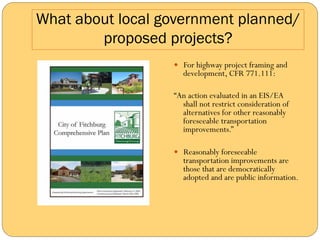
                  —  For highway project framing and
                     development, CFR 771.111:

                  “An action evaluated in an EIS/EA
                    shall not restrict consideration of
                    alternatives for other reasonably
                    foreseeable transportation
                    improvements.”

                  —  Reasonably foreseeable
                     transportation improvements are
                     those that are democratically
                     adopted and are public information.
Other Related Resources Examined in
     NEPA Process and Mitigation
—  FHWA regulations require examination of:
   —  Air Quality Impacts
   —  Economic Impacts
   —  Social Impacts – Environmental Justice and Community Cohesion
   —  Land Use Impacts
   —  Indirect Impacts – Impacts removed from project by time and/or distance.
       Induced land development, increased rate of land development, etc.
   —  Cumulative Impacts – Impacts of project in conjunction with other reasonably
       foreseeable future projects.
—  Other than Federal law and policies related to bike/ped projects, other
    opportunities to make a case for bike/ped facilities.
—  Mitigation
USDOT Federally funded project policy
—  Old Policy – “due consideration” of bicycle transportation facilities
    and pedestrian walkways, where appropriate, in conjunction with
    all new construction and reconstruction of transportation
    facilities, except where bike/ped uses are not permitted.
—  New Policy (as of Spring 2010) – “due accommodation” – State
    DOTs must now prove that facilities cannot be implemented and
    demonstrate why.
—  For utilitarian reasons, not recreation.
—  Problem is…this doesn’t dictate types and designs of facilities in
    different contexts.
—  South Carolina Cities for Cycling Initiative
Opportunities to Get Involved
—  LRTP development by MPO – Keep track of updates to plan and
    get involved.
—  Work with your MPO Policy Committee representation.
—  Keep track of projects programmed in TIP/STIP and their timing.
—  During project development phase/NEPA process, attend public
    hearings and provide input during public comment periods.
—  Schedule an appointment to meet with project consultants to
    discuss issues.
QUESTIONS/COMMENTS/
     DISCUSSION?
NEPA many times the only real
          planning document for a project
—  MUST HAVE A POLICY/RESOLUTION/ORDINANCE
      DEMOCRATICALLY CONSIDERED/ADOPTED FOR IT TO BE
      TAKEN SERIOUSLY AND IT MUST BE AS SPECIFIC AS POSSIBLE
      FOR IT TO BE CONSIDERED/INCORPORATED
—    Lots of money spent here – sticking within budget constraints.
—    Mitigation contingencies – EPIC – commitments
—    Get things entered into Environmental Documents as commitments
—    This is the only proof that the community as a whole was represented
      and wants what you are asking for.
—    Anyone can come along and say these are our plans, but that is not
      necessarily reflective of the community.

Incorporating planned trails projects into the nepa process for highways

  • 1.
    Incorporating Planned TrailProjects Into the NEPA Process for Highways
  • 2.
    A Little BitAbout Me —  Education: —  Master of Regional and Community Planning, Kansas State University —  Bachelor of Arts, Eastern Kentucky University —  Experience: —  City of Clemson, SC —  HNTB – Plano, TX —  City of Mesquite, TX —  Lake County, Illinois
  • 3.
    What are wetalking about today? —  Which bike/ped facilities are considered during the NEPA process for highway projects and how they are considered; —  How alternatives for large-scale highway and transportation projects take planned bicycle/pedestrian facilities and their linkages into consideration and FHWA policy on bike/ped facilities; and —  How planners can integrate planned or programmed bike/ped facilities into the NEPA and environmental documentation process for highway and other projects.
  • 4.
    To Do This,We Need To… —  Understand the Transportation Planning Process and where and how in the process the Project Development phase fits; —  Understand the NEPA process, how it is applied to Federally funded transportation projects, and what considerations are made during the NEPA process that may involve bike/ped facilities; —  Understand how local government planners should and can get involved in the Federally funded Transportation Planning Process, including the the Project Development phase; and —  Determine what level of involvement and how much specificity in local government planning regarding bike/ped facilities is needed to ensure local goals and plans are considered and incorporated.
  • 5.
    Why Is ThisImportant? —  Because transportation decisions made by State DOTs many times have the most profound impact on community character, community cohesion, urban design, multi-modal functionality and mode choice, and many other vital community functions. —  Often an overlooked aspect of what should be holistic transportation planning for the breadth of users and modes. —  To demonstrate when and how local planners and bike/ped advocates should be involved in the process so the appropriate decisions are made.
  • 6.
    Federal Transportation Planning Process —  Federal role is to provide funds and standards for state and local decisions. —  LRTP (MTP) – Long-Range Transportation Plan or Metropolitan Transportation Plan —  MPO’s transportation planning policy guide. —  Even if a proposed project is not proposed to be federally funded, should be incorporated. —  First opportunity to be involved. This is project conception phase. First attempt should be to get trail projects and plans for on-road facilities for the community in the MPO LRTP. (INSERT IMAGE OF MTP TRAIL PROJECTS HERE – TRAIL PROJECT INCORPORATED INTO MTP) —  TIP or STIP – Transportation Improvement Program/Statewide Transportation Improvement Program —  State DOTs, MPOs, and transit operators make investment decisions with Federal dollars. —  Programs of funding, phasing, and scheduling used to implement the LRTP with Federal funds. —  Every 4 years, USDOT approves State DOTs’ programs of all projects proposed to be executed with Federal Funds. —  Process designed to reflect the desires of communities. —  Spirit of Federally funded transportation planning is that transportation investment decisions are best made at the local level. —  However, for large MPOs, this is highly sensitive to community’s policy committee representation. —  Project Development – Environmental review or NEPA phase. —  Links planning process with actual project location, design, and eventual construction and operation. Works out finer details of the project and how it will fit within affected communities.
  • 7.
  • 8.
    The NEPA processmany times serves as the project development, project- specific planning phase of the overall transportation planning process if Federal funds are to be used. However, planning decisions are often revisited when details are worked out.
  • 9.
    Brief Explanation ofNEPA Process —  Required of all Federally funded actions, including transportation. —  Became law in 1970. —  Purpose is better informed decisions and citizen involvement, including involvement from local planners. —  Applies when an agency has discretion to choose among one or more alternative means of accomplishing a particular goal. —  Informs final decision on a proposed action. —  1978 CEQ regulations direct agencies on fundamental obligations for fulfilling NEPA responsibilities. Established minimum requirements for agencies. —  Information provided by planners from affected jurisdictions during EA and EIS process is often used to influence decisionmakers and their final decisions.
  • 10.
    NEPA Continued… —  CategoricalExclusion (CE) – Applies to a category of actions that an agency has determined does not individually or cumulatively have a significant effect on the quality of the human environment. —  Environmental Assessment (EA) – Used to determine the significance of environmental effects and to look at alternative means to achieve the agency’s objectives. Informs whether an EIS will need to be prepared or if there is a FONSI. Must involve public input. —  Environmental Impact Statement (EIS) – Must prepare for a proposed major action significantly affecting the quality of the human environment. —  Notice of Intent published. —  Scoping conducted – must involve local communities if affected. —  Draft EIS prepared – Notice of Availability in Federal Register —  Evaluate/consider alternatives. —  Final EIS. —  Record of Decision.
  • 11.
    Which Bike/Ped Projectsare Considered? —  Those with conceptual plans in the LRTP and those programmed in the TIP/STIP. —  Local governments should make sure that input is provided in the LRTP process that would inform how the community prefers for such projects to interact with planned facilities for motorized transportation as well as provide very specific contextual design details of proposed project implementation. —  Must be democratically adopted local government plans or proposed projects. —  Not just what you would like to see. —  Must be evidence that project ideas are reflective of community desires through the democratic process. —  Must be public information – Reasonably foreseeable future actions —  Be careful with overly conceptual ideas/plans for projects. —  The greater the specificity, the better. —  Best to design the most detailed specifications for projects for each possible context and make sure they are democratically adopted. —  Typical Sections. —  Locations and sizes for bike racks, bike lockers, etc.
  • 12.
    How are theyconsidered? —  FHWA regulations (October 1987 Technical Advisory) require: —  Draft EIS to discuss current and anticipated use of facilities, potential impact of proposed alternatives, and proposed measures, if any, to avoid or reduce impacts to the facilities and its users where current pedestrian or bicycle facilities or indications of use are identified. —  Where new facilities are proposed as part of the proposed highway project (which they now are), environmental document should include sufficient information to explain the basis for providing the facilities (e.g., proposed bicycle facility is a link in the local plan or sidewalks will reduce project access impact to the community). – As if we have to justify why something other than being trapped in a car should even be considered. —  Where proposed alternative would sever an existing major route for non-motorized transportation, proposed project needs to provide reasonably alternative route or demonstrate that such route exists.
  • 13.
    What about localgovernment planned/ proposed projects? —  For highway project framing and development, CFR 771.111: “An action evaluated in an EIS/EA shall not restrict consideration of alternatives for other reasonably foreseeable transportation improvements.” —  Reasonably foreseeable transportation improvements are those that are democratically adopted and are public information.
  • 14.
    Other Related ResourcesExamined in NEPA Process and Mitigation —  FHWA regulations require examination of: —  Air Quality Impacts —  Economic Impacts —  Social Impacts – Environmental Justice and Community Cohesion —  Land Use Impacts —  Indirect Impacts – Impacts removed from project by time and/or distance. Induced land development, increased rate of land development, etc. —  Cumulative Impacts – Impacts of project in conjunction with other reasonably foreseeable future projects. —  Other than Federal law and policies related to bike/ped projects, other opportunities to make a case for bike/ped facilities. —  Mitigation
  • 15.
    USDOT Federally fundedproject policy —  Old Policy – “due consideration” of bicycle transportation facilities and pedestrian walkways, where appropriate, in conjunction with all new construction and reconstruction of transportation facilities, except where bike/ped uses are not permitted. —  New Policy (as of Spring 2010) – “due accommodation” – State DOTs must now prove that facilities cannot be implemented and demonstrate why. —  For utilitarian reasons, not recreation. —  Problem is…this doesn’t dictate types and designs of facilities in different contexts. —  South Carolina Cities for Cycling Initiative
  • 16.
    Opportunities to GetInvolved —  LRTP development by MPO – Keep track of updates to plan and get involved. —  Work with your MPO Policy Committee representation. —  Keep track of projects programmed in TIP/STIP and their timing. —  During project development phase/NEPA process, attend public hearings and provide input during public comment periods. —  Schedule an appointment to meet with project consultants to discuss issues.
  • 17.
  • 18.
    NEPA many timesthe only real planning document for a project —  MUST HAVE A POLICY/RESOLUTION/ORDINANCE DEMOCRATICALLY CONSIDERED/ADOPTED FOR IT TO BE TAKEN SERIOUSLY AND IT MUST BE AS SPECIFIC AS POSSIBLE FOR IT TO BE CONSIDERED/INCORPORATED —  Lots of money spent here – sticking within budget constraints. —  Mitigation contingencies – EPIC – commitments —  Get things entered into Environmental Documents as commitments —  This is the only proof that the community as a whole was represented and wants what you are asking for. —  Anyone can come along and say these are our plans, but that is not necessarily reflective of the community.