A	
  Collaborative	
  Multi-­‐Jurisdictional	
  Planning	
  Effort	


 Texas	
  Trails	
  &	
  Active	
  Transportation	
  Conference	
  
                          February	
  3,	
  2012	
  
—  Methods	
  used	
  to	
  gain	
  stakeholder	
  input	
  
—  An	
  overview	
  of	
  the	
  planning	
  process	
  
—  Development	
  of	
  a	
  large	
  and	
  robust	
  GIS	
  database	
  
—  Use	
  of	
  mobile	
  GIS	
  technology	
  
—  Lessons	
  learned	
  during	
  the	
  project.	
  
—  Inventory	
  of	
  Existing	
  Trails,	
  Generators,	
  and	
  Attractors	
  
—  User	
  Groups	
  (Who’s	
  your	
  target?)	
  
—  Needs	
  Assessment	
  
   —    Public	
  Input	
  (Citizen	
  Demand)	
  
   —    Level	
  of	
  Service	
  
   —    Latent	
  Demand	
  
   —    Network	
  Connectivity	
  
   —    Opportunities	
  
—  Facility	
  Typologies	
  &	
  Standards	
  
—  Network	
  Design	
  
—  Route	
  Segment	
  Analysis	
  
—  Priorities	
  and	
  Cost	
  Estimates	
  
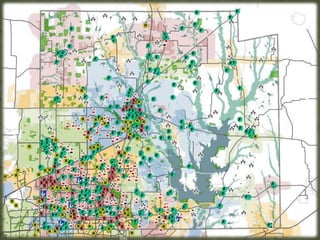
Develop	
  a	
  Collin	
  County	
  Regional	
  Trails	
  Master	
  Plan	
  that	
  
provides	
  coordination	
  and	
  connectivity	
  between	
  cities	
  within	
  
the	
  County	
  for	
  future	
  trail	
  development.	


—  Objectives	
  
   —  Build	
  upon	
  the	
  planning	
  efforts	
  of	
  member	
  cities	
  and	
  
      other	
  regional	
  studies.	
  

   —  Define	
  high-­‐priority	
  corridors	
  that	
  connect	
  two	
  or	
  more	
  
      cities	
  within	
  or	
  adjacent	
  to	
  Collin	
  County	
  to	
  encourage	
  
      corridor	
  preservation	
  and	
  multi-­‐jurisdictional	
  
      implementation.	
  

   —  Identify	
  and	
  address	
  gaps	
  and	
  primary	
  potential	
  trail	
  
      connections	
  between	
  cities	
  in	
  order	
  to	
  provide	
  intercity	
  
      linkages.	
  
—  Objectives	
  (continued)	
  
   —  Ensure	
  that	
  every	
  city	
  and	
  town	
  in	
  the	
  County	
  is	
  
      connected	
  to	
  the	
  Collin	
  County	
  Regional	
  Trail	
  System.	
  

   —  Recommend	
  design	
  guidelines	
  and	
  facility	
  hierarchy	
  for	
  
      the	
  Regional	
  Trail	
  System.	
  

   —  Provide	
  a	
  tool	
  that	
  gives	
  guidance	
  to	
  Collin	
  County	
  for	
  
      evaluating	
  funding	
  requests	
  and	
  coordinating	
  trail	
  
      projects	
  with	
  other	
  capital	
  projects.	
  
—  Allen	
             —  Lavon	
                 —  Princeton	
  
—  Anna	
              —  Lowry	
  Crossing	
     —  Prosper	
  
—  Blue	
  Ridge	
     —  Lucas	
                 —  Richardson	
  
—  Carrollton	
  
                        —  McKinney	
              —  Royse	
  City	
  
—  Celina	
  
                        —  Melissa	
               —  Sachse	
  
—  Dallas	
  
                        —  Murphy	
                —  Saint	
  Paul	
  
—  Fairview	
  
                        —  Nevada	
                —  The	
  Colony	
  
—  Farmersville	
  
—  Frisco	
            —  New	
  Hope	
           —  Van	
  Alstyne	
  

—  Garland	
           —  Parker	
                —  Weston	
  
—  Josephine	
         —  Plano	
                 —  Wylie	
  
—  Transportation	
  Agencies	
  
   —  TxDOT	
  
   —  DART	
  
   —  NTTA	
  
—  Utility	
  Owners	
  
   —  Oncor	
  
   —  NTMWUD	
  
—  Other	
  Regional	
  Agencies	
  
   —  US	
  Army	
  Corps	
  of	
  Engineers	
  (water	
  bodies)	
  
   —  NCTCOG	
  (coordination	
  with	
  adjacent	
  areas)	
  
—  Municipal	
  Agencies	
  
   —  Worksessions	
  (day-­‐long	
  summits)	
  
       —  Presentation	
  
       —  Location-­‐based	
  breakout	
  groups	
  
       —  Hands-­‐on	
  map	
  review 	
  	
  
   —  Off-­‐line	
  (on-­‐line)	
  coordination	
  
        —  Rounds	
  of	
  map	
  distribution	
  and	
  review	
  
        —  Tap	
  into	
  local	
  knowledge	
  
        —  Maintain	
  accuracy	
  as	
  time	
  progresses	
  

—  Non-­‐Municipal	
  Agencies                       	
  	
  
   —  Coordination	
  worksession	
  with	
  all	
  
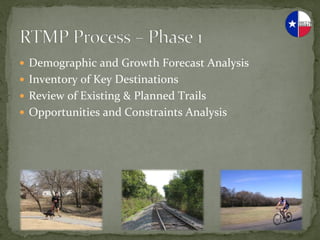
—  Demographic	
  and	
  Growth	
  Forecast	
  Analysis	
  
—  Inventory	
  of	
  Key	
  Destinations	
  
—  Review	
  of	
  Existing	
  &	
  Planned	
  Trails	
  
—  Opportunities	
  and	
  Constraints	
  Analysis	
  
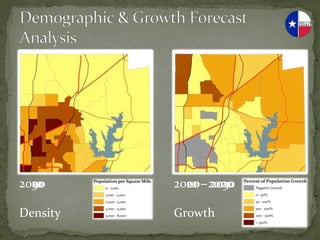
2030	
  
2020	
  
2010	
  
2000	
        2020	
   010	
  
              2010	
  -­‐ 2030	
  
              2000	
  -­‐	
  	
  2020	
  

Density	
     Growth	
  
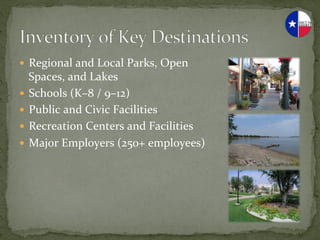
—  Regional	
  and	
  Local	
  Parks,	
  Open	
  
    Spaces,	
  and	
  Lakes	
  
—  Schools	
  (K–8	
  /	
  9–12)	
  
—  Public	
  and	
  Civic	
  Facilities	
  
—  Recreation	
  Centers	
  and	
  Facilities	
  
—  Major	
  Employers	
  (250+	
  employees)	
  
Garla
—  City	
  Trail	
  Systems,	
  Trail	
  Plans,	
  and	
  Published	
  Trail	
  
    Standards	
  
—  Existing	
  Conditions	
  
   —  269	
  Miles	
  of	
  Existing/Programmed	
  Trails	
  in	
  the	
  County	
  
   —  727	
  Miles	
  of	
  Planned/Proposed	
  Trails	
  in	
  the	
  County	
  
—  Identify	
  Major	
  Trail	
  Corridors	
  
—  Analyze	
  Intercity	
  Connection	
  Points	
  
—  Guidelines	
  for	
  Regional	
  Trails	
  
—  Governmental	
  Agency	
  Input	
  and	
  Review	
  
—  Recommendations	
  &	
  Final	
  Report	
  
—  Public	
  and	
  Elected	
  Official	
  Review	
  
—  Distribution	
  of	
  Plan	
  and	
  Data	
  to	
  Cities	
  
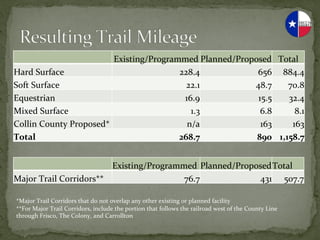
Existing/Programmed	
  Planned/Proposed	
   Total	
  
Hard	
  Surface	
                                 228.4	
             656	
   884.4	
  
Soft	
  Surface	
                                   22.1	
           48.7	
      70.8	
  
Equestrian	
                                       16.9	
             15.5	
     32.4	
  
Mixed	
  Surface	
                                   1.3	
             6.8	
       8.1	
  
Collin	
  County	
  Proposed*	
                     n/a	
              163	
      163	
  
Total	
                                           268.7	
             890	
   1,158.7	


                                  Existing/Programmed	
   Planned/Proposed	
  Total	
  
Major	
  Trail	
  Corridors**	
                    76.7	
              431	
   507.7	
  

*Major	
  Trail	
  Corridors	
  that	
  do	
  not	
  overlap	
  any	
  other	
  existing	
  or	
  planned	
  facility	
  
**For	
  Major	
  Trail	
  Corridors,	
  include	
  the	
  portion	
  that	
  follows	
  the	
  railroad	
  west	
  of	
  the	
  County	
  Line	
  
through	
  Frisco,	
  The	
  Colony,	
  and	
  Carrollton	
  
2010*	
                         2040	
  
                                                              (782,341)	
                   (1,526,634)	
  
Hard	
  Surface	
                                                             3,425	
                         1,726	
  
Soft	
  Surface	
                                                             35,400	
                        21,563	
  
Equestrian	
                                                                  46,292	
                        47,118	
  
Mixed	
  Surface	
                                                            601,801	
                  188,473	
  
Total	
                                                                        2,912	
                        1,318	
  

*2010	
  United	
  States	
  Census	
  Redistricting	
  Data	
  
**NCTCOG	
  2040	
  Population	
  Estimate	
  
—  Number	
  of	
  points	
  
    analyzed:	
  32	
  
—  Mostly	
  in	
  southwest	
  
    quadrant	
  due	
  to	
  
    more	
  challenging	
  
    physical	
  constraints	
  
Multi-­‐Use	
  Trail	
  Types	
               Minimum	
   Minimum	
   Notes	
  
                                            Tread	
  Width	
   Corridor	
  
                                                                       Width	
  
Urbanized	
                                         12’	
                20’	
          Concrete;	
  width	
  depending	
  
                                                                                        upon	
  adjacent	
  densities	
  and	
  
Exclusive	
  ROW	
  in	
  Higher	
          (14’-­‐16’	
  pref.)	
   (32’	
  pref.)	
   volume	
  of	
  use	
  
Density	
  Areas	
  
Greenway	
                                          10’	
                 25’	
          Concrete	
  or	
  pervious	
  pavement	
  
                                                                                         in	
  ecologically	
  sensitive	
  areas	
  
Natural	
  Areas	
  in	
  an	
  Urban	
        (12’	
  pref.)	
       (32’	
  pref.)	
  
Environment	
  
Two-­‐way	
  Sidepath	
                             10’	
                 18’	
            Concrete;	
  includes	
  shoulders	
  
                                                                                           and	
  a	
  5’	
  buffer	
  between	
  path	
  
Along	
  a	
  Roadway	
                        (12’	
  pref.)	
       (25’	
  pref.)	
     and	
  roadway	


Pioneer	
  Trail	
                                   8’	
                 25’	
            Corridor	
  preservation;	
  	
  
                                                                                           natural	
  surface	
  or	
  asphalt	
  
Rural	
  Areas	
                               (10’	
  pref.)	
       (32’	
  pref.)	
     acceptable	
  
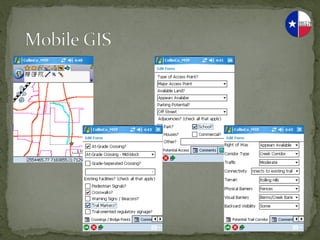
—  Verified	
  Corridor	
  Locations	
  
—  Identification	
  of	
  Grade-­‐Separated	
  Crossing	
  Challenges	
  
—  ArcPAD	
  and	
  GPS-­‐Enabled	
  Camera	
  
—  A	
  project	
  of	
  this	
  type	
  is	
  more	
  about	
  facilitation	
  than	
  
    planning.	
  
—  The	
  accuracy	
  of	
  GIS	
  is	
  dependant	
  on	
  the	
  accuracy	
  of	
  
    your	
  data.	
  
    —  Data	
  created	
  for	
  different	
  reasons	
  by	
  different	
  
       organizations	
  have	
  differing	
  levels	
  of	
  accuracy.	
  
—  Larger	
  municipalities	
  with	
  greater	
  resources	
  are	
  often	
  
    very	
  willing	
  to	
  help	
  smaller	
  towns.	
  
—  A	
  few	
  hours	
  spent	
  with	
  your	
  neighbors	
  can	
  help	
  you	
  
    for	
  years	
  to	
  come.	
  
Collin County Regional Trails Master Plan

Collin County Regional Trails Master Plan

  • 1.
    A  Collaborative  Multi-­‐Jurisdictional  Planning  Effort     Texas  Trails  &  Active  Transportation  Conference   February  3,  2012  
  • 2.
    —  Methods  used  to  gain  stakeholder  input   —  An  overview  of  the  planning  process   —  Development  of  a  large  and  robust  GIS  database   —  Use  of  mobile  GIS  technology   —  Lessons  learned  during  the  project.  
  • 3.
    —  Inventory  of  Existing  Trails,  Generators,  and  Attractors   —  User  Groups  (Who’s  your  target?)   —  Needs  Assessment   —  Public  Input  (Citizen  Demand)   —  Level  of  Service   —  Latent  Demand   —  Network  Connectivity   —  Opportunities   —  Facility  Typologies  &  Standards   —  Network  Design   —  Route  Segment  Analysis   —  Priorities  and  Cost  Estimates  
  • 4.
    Develop  a  Collin  County  Regional  Trails  Master  Plan  that   provides  coordination  and  connectivity  between  cities  within   the  County  for  future  trail  development.    
  • 5.
    —  Objectives   —  Build  upon  the  planning  efforts  of  member  cities  and   other  regional  studies.   —  Define  high-­‐priority  corridors  that  connect  two  or  more   cities  within  or  adjacent  to  Collin  County  to  encourage   corridor  preservation  and  multi-­‐jurisdictional   implementation.   —  Identify  and  address  gaps  and  primary  potential  trail   connections  between  cities  in  order  to  provide  intercity   linkages.  
  • 6.
    —  Objectives  (continued)   —  Ensure  that  every  city  and  town  in  the  County  is   connected  to  the  Collin  County  Regional  Trail  System.   —  Recommend  design  guidelines  and  facility  hierarchy  for   the  Regional  Trail  System.   —  Provide  a  tool  that  gives  guidance  to  Collin  County  for   evaluating  funding  requests  and  coordinating  trail   projects  with  other  capital  projects.  
  • 7.
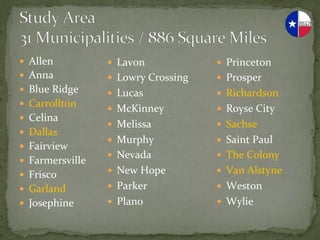
    —  Allen   —  Lavon   —  Princeton   —  Anna   —  Lowry  Crossing   —  Prosper   —  Blue  Ridge   —  Lucas   —  Richardson   —  Carrollton   —  McKinney   —  Royse  City   —  Celina   —  Melissa   —  Sachse   —  Dallas   —  Murphy   —  Saint  Paul   —  Fairview   —  Nevada   —  The  Colony   —  Farmersville   —  Frisco   —  New  Hope   —  Van  Alstyne   —  Garland   —  Parker   —  Weston   —  Josephine   —  Plano   —  Wylie  
  • 8.
    —  Transportation  Agencies   —  TxDOT   —  DART   —  NTTA   —  Utility  Owners   —  Oncor   —  NTMWUD   —  Other  Regional  Agencies   —  US  Army  Corps  of  Engineers  (water  bodies)   —  NCTCOG  (coordination  with  adjacent  areas)  
  • 9.
    —  Municipal  Agencies   —  Worksessions  (day-­‐long  summits)   —  Presentation   —  Location-­‐based  breakout  groups   —  Hands-­‐on  map  review     —  Off-­‐line  (on-­‐line)  coordination   —  Rounds  of  map  distribution  and  review   —  Tap  into  local  knowledge   —  Maintain  accuracy  as  time  progresses   —  Non-­‐Municipal  Agencies     —  Coordination  worksession  with  all  
  • 11.
    —  Demographic  and  Growth  Forecast  Analysis   —  Inventory  of  Key  Destinations   —  Review  of  Existing  &  Planned  Trails   —  Opportunities  and  Constraints  Analysis  
  • 12.
    2030   2020   2010   2000   2020   010   2010  -­‐ 2030   2000  -­‐    2020   Density   Growth  
  • 13.
    —  Regional  and  Local  Parks,  Open   Spaces,  and  Lakes   —  Schools  (K–8  /  9–12)   —  Public  and  Civic  Facilities   —  Recreation  Centers  and  Facilities   —  Major  Employers  (250+  employees)  
  • 14.
  • 15.
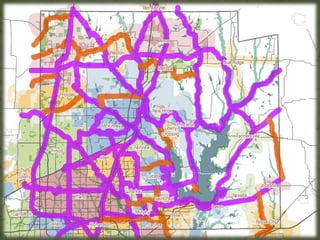
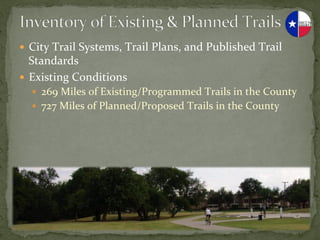
    —  City  Trail  Systems,  Trail  Plans,  and  Published  Trail   Standards   —  Existing  Conditions   —  269  Miles  of  Existing/Programmed  Trails  in  the  County   —  727  Miles  of  Planned/Proposed  Trails  in  the  County  
  • 18.
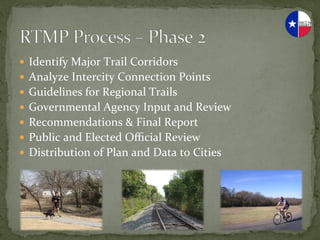
    —  Identify  Major  Trail  Corridors   —  Analyze  Intercity  Connection  Points   —  Guidelines  for  Regional  Trails   —  Governmental  Agency  Input  and  Review   —  Recommendations  &  Final  Report   —  Public  and  Elected  Official  Review   —  Distribution  of  Plan  and  Data  to  Cities  
  • 20.
    Existing/Programmed  Planned/Proposed  Total   Hard  Surface   228.4   656   884.4   Soft  Surface   22.1   48.7   70.8   Equestrian   16.9   15.5   32.4   Mixed  Surface   1.3   6.8   8.1   Collin  County  Proposed*   n/a   163   163   Total   268.7   890   1,158.7   Existing/Programmed   Planned/Proposed  Total   Major  Trail  Corridors**   76.7   431   507.7   *Major  Trail  Corridors  that  do  not  overlap  any  other  existing  or  planned  facility   **For  Major  Trail  Corridors,  include  the  portion  that  follows  the  railroad  west  of  the  County  Line   through  Frisco,  The  Colony,  and  Carrollton  
  • 21.
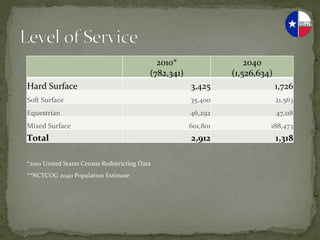
    2010*   2040   (782,341)   (1,526,634)   Hard  Surface   3,425   1,726   Soft  Surface   35,400   21,563   Equestrian   46,292   47,118   Mixed  Surface   601,801   188,473   Total   2,912   1,318   *2010  United  States  Census  Redistricting  Data   **NCTCOG  2040  Population  Estimate  
  • 24.
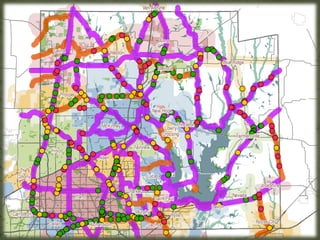
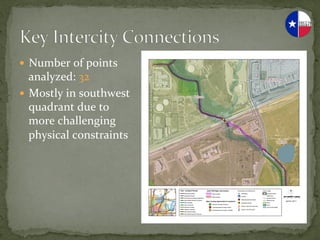
    —  Number  of  points   analyzed:  32   —  Mostly  in  southwest   quadrant  due  to   more  challenging   physical  constraints  
  • 26.
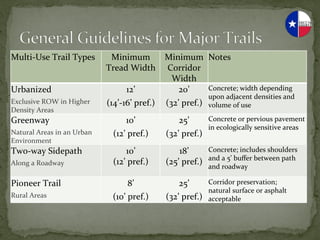
    Multi-­‐Use  Trail  Types   Minimum   Minimum   Notes   Tread  Width   Corridor   Width   Urbanized   12’   20’   Concrete;  width  depending   upon  adjacent  densities  and   Exclusive  ROW  in  Higher   (14’-­‐16’  pref.)   (32’  pref.)   volume  of  use   Density  Areas   Greenway   10’   25’   Concrete  or  pervious  pavement   in  ecologically  sensitive  areas   Natural  Areas  in  an  Urban   (12’  pref.)   (32’  pref.)   Environment   Two-­‐way  Sidepath   10’   18’   Concrete;  includes  shoulders   and  a  5’  buffer  between  path   Along  a  Roadway   (12’  pref.)   (25’  pref.)   and  roadway     Pioneer  Trail   8’   25’   Corridor  preservation;     natural  surface  or  asphalt   Rural  Areas   (10’  pref.)   (32’  pref.)   acceptable  
  • 27.
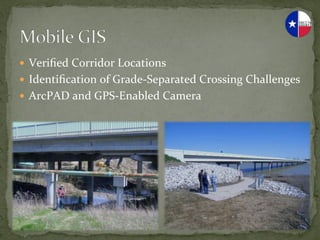
    —  Verified  Corridor  Locations   —  Identification  of  Grade-­‐Separated  Crossing  Challenges   —  ArcPAD  and  GPS-­‐Enabled  Camera  
  • 29.
    —  A  project  of  this  type  is  more  about  facilitation  than   planning.   —  The  accuracy  of  GIS  is  dependant  on  the  accuracy  of   your  data.   —  Data  created  for  different  reasons  by  different   organizations  have  differing  levels  of  accuracy.   —  Larger  municipalities  with  greater  resources  are  often   very  willing  to  help  smaller  towns.   —  A  few  hours  spent  with  your  neighbors  can  help  you   for  years  to  come.